I.S.F.D LENGUAS VIVAS BARILOCHE
PRÁCTICA DOCENTE III
ENTREGA DE PLANIFICACIÓN
ALUMNA PRACTICANTE: Valeria Zentner
Institución educativa: Charles Dickens Institute
Año y sección: Second Juniors - Única Sección
Nivel lingüístico del curso: Elementary
Cantidad de alumnos: 8
Tipo de Planificación: Clase
Unidad Temática: The Past
Clase Nº: 1
Duración de la clase: 90 minutos
Fecha de la clase: Tuesday, June 15th
Fecha de entrega de la planificación: May 24th
Learning Aims
During this lesson, learners will be able to…
→ Understand the importance of History.
→ Get insights regarding relevant events and people from history.
→ Develop reading comprehension skills.
→ Develop their listening skills while noticing relevant key phrases to express likes and
dislikes.
→ Express their opinion on important events and people from history.
Language Focus
LEXIS FUNCTIONS STRUCTURE
R
E
V
-
To talk about facts in
history
Simple Present
N
E
W
Positive and Negative
adjectives:
Boring – Exciting – Dead
– Alive – Poor – Rich –
Scary – Relaxing – Awful
– Brave – Useful –
Useless – Cruel – Kind –
Popular – Unpopular –
Brilliant – Horrible –
Enormous -Tiny
To describe important
people and events in
history
-
Materials
→ Eight small whiteboards and markers
→ YouTube video: “What is History?” - Available at https://youtu.be/kRgG2JS02mY
→ Phone timer
→ Big timeline of the last millennium *1
→ Cards with short descriptions of the most important events and people from the last
millennium *
→ Flashcards with pictures of important people in history *
→ Letter to Leonardo da Vinci
→ Letter template for each student *
Procedures
NOTE: All of the activities are described as suggested by the tutor, in
terms of timing, description and instructions, and transition comments.
Scaffolding strategies are included within the description of each
activity.
ROUTINE
 Timing: 5/8 minutes
 Activity description and instructions as they will be said to students (direct
speech and scaffolding strategies are included):
Students will be received in the institute’s door. As always, the teacher will check their
temperature and sterilize their hands, feet and school objects, and then let them in (It usually
takes a while). Once in the classroom, they will be greeted by the teacher. She will say
"Good afternoon, my dear students! How are you today? How was your afternoon so far?"
As a next step, she will ask "What day of the week is today? And what date? Of what
month?" and then copy the date on the board.
 Transition comment to link each stage of the lesson with the next one:
“Okay my students; I have a question for you all. What subject teaches us about the past?
WARM-UP
 Timing: 10 minutes
 Activity description and instructions as they will be said to students (direct
speech and scaffolding strategies are included):
Three questions will be written on the whiteboard by the teacher:
What’s History?
What is it for?
Where does it come from?
The teacher will say “Okay, read these questions on the board. I want you to think about
them carefully for a second” and ask one question at a time so she can write keywords from
1
The materials marked with a * will be not printed until two days before the lesson, just in case it needs to be
taught online. In that case, the pictures will be shared with the students through an online tool.
their answers on the board. Then, she will say “Good job! Now, let’s watch a video called
What is History? And see what is the speaker’ definition of History.”
https://youtu.be/kRgG2JS02mY
After the video finishes, the teacher will ask “What’s the speaker’s definition of History?
According to her, what is it for? Is it similar or different from yours?” so to start a brief
discussion on the topic. Then, she will play the video again, but this second time, she will ask
students to pay special attention to any keywords related to the other question from the
board, “Where does it come from?”, and how different civilizations have recorded their own
history. It will be discussed at the end of the video.
 Transition comment to link each stage of the lesson with the next one:
“Now that we know what history is, what it is for, and where it comes from… How do we
divide the different historical periods?”
PRESENTATION
 Timing: 15 minutes
 Activity description and instructions as they will be said to students (direct
speech and scaffolding strategies are included):
It will be explained to students that history is divided into different historical periods, and that
one of the most known ways of doing so is with the terms decade, century and millennium.
She will ask “Do you know how many years are there in a decade? And how many decades
are there in a century? Okay, now you tell me… How many years are there in a millennium?
So, how many years are there in a millennium?” while writing their answers on the
whiteboard.
A very big timeline will be displayed on the board (see illustrative example below). The
teacher will say “Here we have our last millennium in a timeline. As you can see it’s divided
into 10 centuries. Do you know in what year each century begins and ends? Let’s start with
the 11th century. When does it begin? It begins around the year 1001. So… if a century lasts
100 years… when does it end? Exactly, in 1100” while writing the years in the timeline. The
process will be repeated until all the centuries are completed.
Comentario [A1]: They might
systematize main ideas.
Illustrative timeline to be presented to the students.
Once this is done, some big cards with some of the most important events and people from
history will be displayed oin the board as well. The teacher will say “I want you to pay
attention ONLY to the years written on each card, okay? You’ll be working with your partner
form on your right, and you’ll have only 3 minutes to decide where each event goes in the
timeline. You can use these whiteboards to write down some notes as you discuss with your
partners.” while giving them the small whiteboards.
Small whiteboards to be given to the students
She will then set the timer on her phone and leave it on the desk so everyone can see it.
Once the timer has stopped, the students’ results will be discussed and checked with the
whole class. As doing so, each card will be placed in the right place in the timeline.
Cards to be displayed on the whiteboard
 Transition comment to link each stage of the lesson with the next one:
“Well done, my students! Now, let’s finally read this text and find out what happened in the
last millennium!”
Comentario [A2]: You´ve been
using the present simple
throughout the lesson. Be
consistent.
DEVELOPMENT (PRACTICE and PRODUCTION)
Activity 1
 Timing: 10 minutes
 Activity description and instructions as they will be said to students (direct
speech and scaffolding strategies are included):
Students will be invited to read the text by teacher, who may say “Who wants to read this
text? I need some people to do so. Up your hands if you want!” while upping her hand to
illustrate students what she wants them to do. Then, she will say “Okay, X, X and X will read.
Please, don’t pay attention to the blank gaps. We’re going back to them later. Okay? Go
ahead!”.
Once the text is read, a comprehension check activity will be carried out. In this activity,
students will be asked to relate some pictures with the main topics of each paragraph of the
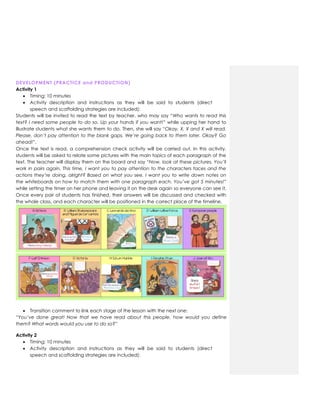
text. The teacher will display them on the board and say “Now, look at these pictures. You’ll
work in pairs again. This time, I want you to pay attention to the characters faces and the
actions they’re doing, alright? Based on what you see, I want you to write down notes on
the whiteboards on how to match them with one paragraph each. You’ve got 5 minutes!”
while setting the timer on her phone and leaving it on the desk again so everyone can see it.
Once every pair of students has finished, their answers will be discussed and checked with
the whole class, and each character will be positioned in the correct place of the timeline.
 Transition comment to link each stage of the lesson with the next one:
“You’ve done great! Now that we have read about this people, how would you define
them? What words would you use to do so?”
Activity 2
 Timing: 10 minutes
 Activity description and instructions as they will be said to students (direct
speech and scaffolding strategies are included):
The teacher will say “Did you notice the words in colour? Brave, awful, etc. Well, can you tell
me what kind of words are them? They are adjectives, right! And what do we used them to?
To describe people. Now, I want you to work in pairs again. You’re going to reread the
paragraphs from the timeline and you’re going to decide which word is the correct one to
describe these people and events. Okay? You can use your dictionaries if necessary. You’ve
got 5 minutes!” while setting the timer on her phone and leaving it on the desk so everyone
can see it. Once every pair of students has finished, their answers will be discussed and
checked with the whole class, and the teacher will circle the correct words as she elicits
them from the learners. After that, the teacher will write the words Positive and Negative in
the whiteboard and ask “What adjectives from the timeline are positive? And negative?” As
students answer, she will write the words in the correct place, positive or negative
respectively.
 Transition comment to link each stage of the lesson with the next one:
“Great job my students! Now, if you had a time machine, which person from this timeline
would you like to know? Which event would you like to be witness of?”
Activity 3
 Timing: 20 minutes
 Activity description and instructions as they will be said to students (direct
speech and scaffolding strategies are included):
Students are now going to work with a technique called Dictogloss, which has a focus on
listening skills. She will tell them “Okay, I have written a letter to Leonardo da Vinci, who I
admire so much! I will send it to him through a time machine someday, but first I’ll read it to
you three times. Yeah! Three times, so you can write it oin your notebooks. The first two times I
read it, it will be slowly so you can write down what you hear. The third time, I’ll read it at a
normal speed for you to check the whole text. Remember, you don’t have to write
everything perfectly. It’s OK if you miss a word. Just make sure you write everything you can.
Okay, here it goes!”. Then, she will ask “Okay, can you tell me what this letter is about? What
kind of information does it include?”. After a brief discussion on the topic, she will ask “Okay,
well done! Now, tell me… what phrases in the letter are used to introduce likes and dislikes?”.
If students need some guidance, the teacher will read a line aloud, making emphasis on the
key phrase so students are able to notice it. Then, she will ask students to find more phrases
at the beginning of the sentences that play the same role as the one they have already
analysed.
Hello Leo!
I hope this letter finds you well!
I really admire you! You do an excellent job as an artist and inventor. I really love
everything you paint. I quite like The Mona Lisa. It’s beautiful! The Llast Supper is very
good, too. The colours, the pictures, the details in the food… It looks very real to me. It’s
brilliant!
I’m really into your job as an inventor! The flying machine and helicopter are very good
ideas for your time!
That’s it! I’m a big fan of your work!
I hope to see you soon,
Val.
Letter to be read to the students
 Transition comment to link each stage of the lesson with the next one:
“If you had the opportunity to send a letter to any person from the timeline, who would you
write to?”
CLOSURE
 Timing: 10 minutes
 Activity description and instructions as they will be said to students (direct
speech and scaffolding strategies are included):
The teacher will say “At home, you’ll write a letter to any character from the timeline we
have been working with today. You have the timeline in the Student’s Book, pages 28 and
29 if you need to reread the information, or you can surf the internet so to find more
information about the character you’ll write to” while showing them the two pages
mentioned. Students will be also explained that the phrases to express likes and dislikes they
have talked about, are on page 29, exercise 6 in case they want to use them. Besides, a
letter template will be given to make it easier the writing process. They may use it or not.
Hello/Hi…
I hope…
I really…
I quite like…
I’m a big fan of…
See you soon/A hug/Hope… ,
____________ .
Letter template to be given to the students
 Transition comment to link each stage of the lesson with the next one:
“We’ve finished for today! I’m really looking forward to reading your letters! See you next
time!”
To be completed by your tutor:
Lesson plan
component
Excellent
5
Very
Good
4
Good
3
Acceptable
2
Needs
improvement
1
Visual
organization
X
Comentario [A3]: The closure
stage should be an interesting way
of rounding up the lesson -
recapping main ideas, playing a
game, etc.
You can assign homework before
or after this stage.
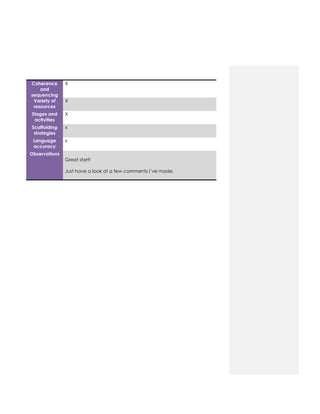
Coherence
and
sequencing
X
Variety of
resources
X
Stages and
activities
X
Scaffolding
strategies
x
Language
accuracy
x
Observations
Great start!
Just have a look at a few comments I´ve made.

DU1: The Past - Lesson 1

  • 1.
    I.S.F.D LENGUAS VIVASBARILOCHE PRÁCTICA DOCENTE III ENTREGA DE PLANIFICACIÓN ALUMNA PRACTICANTE: Valeria Zentner Institución educativa: Charles Dickens Institute Año y sección: Second Juniors - Única Sección Nivel lingüístico del curso: Elementary Cantidad de alumnos: 8 Tipo de Planificación: Clase Unidad Temática: The Past Clase Nº: 1 Duración de la clase: 90 minutos Fecha de la clase: Tuesday, June 15th Fecha de entrega de la planificación: May 24th Learning Aims During this lesson, learners will be able to… → Understand the importance of History. → Get insights regarding relevant events and people from history. → Develop reading comprehension skills. → Develop their listening skills while noticing relevant key phrases to express likes and dislikes. → Express their opinion on important events and people from history. Language Focus LEXIS FUNCTIONS STRUCTURE R E V - To talk about facts in history Simple Present N E W Positive and Negative adjectives: Boring – Exciting – Dead – Alive – Poor – Rich – Scary – Relaxing – Awful – Brave – Useful – Useless – Cruel – Kind – Popular – Unpopular – Brilliant – Horrible – Enormous -Tiny To describe important people and events in history - Materials → Eight small whiteboards and markers
  • 2.
    → YouTube video:“What is History?” - Available at https://youtu.be/kRgG2JS02mY → Phone timer → Big timeline of the last millennium *1 → Cards with short descriptions of the most important events and people from the last millennium * → Flashcards with pictures of important people in history * → Letter to Leonardo da Vinci → Letter template for each student * Procedures NOTE: All of the activities are described as suggested by the tutor, in terms of timing, description and instructions, and transition comments. Scaffolding strategies are included within the description of each activity. ROUTINE  Timing: 5/8 minutes  Activity description and instructions as they will be said to students (direct speech and scaffolding strategies are included): Students will be received in the institute’s door. As always, the teacher will check their temperature and sterilize their hands, feet and school objects, and then let them in (It usually takes a while). Once in the classroom, they will be greeted by the teacher. She will say "Good afternoon, my dear students! How are you today? How was your afternoon so far?" As a next step, she will ask "What day of the week is today? And what date? Of what month?" and then copy the date on the board.  Transition comment to link each stage of the lesson with the next one: “Okay my students; I have a question for you all. What subject teaches us about the past? WARM-UP  Timing: 10 minutes  Activity description and instructions as they will be said to students (direct speech and scaffolding strategies are included): Three questions will be written on the whiteboard by the teacher: What’s History? What is it for? Where does it come from? The teacher will say “Okay, read these questions on the board. I want you to think about them carefully for a second” and ask one question at a time so she can write keywords from 1 The materials marked with a * will be not printed until two days before the lesson, just in case it needs to be taught online. In that case, the pictures will be shared with the students through an online tool.
  • 3.
    their answers onthe board. Then, she will say “Good job! Now, let’s watch a video called What is History? And see what is the speaker’ definition of History.” https://youtu.be/kRgG2JS02mY After the video finishes, the teacher will ask “What’s the speaker’s definition of History? According to her, what is it for? Is it similar or different from yours?” so to start a brief discussion on the topic. Then, she will play the video again, but this second time, she will ask students to pay special attention to any keywords related to the other question from the board, “Where does it come from?”, and how different civilizations have recorded their own history. It will be discussed at the end of the video.  Transition comment to link each stage of the lesson with the next one: “Now that we know what history is, what it is for, and where it comes from… How do we divide the different historical periods?” PRESENTATION  Timing: 15 minutes  Activity description and instructions as they will be said to students (direct speech and scaffolding strategies are included): It will be explained to students that history is divided into different historical periods, and that one of the most known ways of doing so is with the terms decade, century and millennium. She will ask “Do you know how many years are there in a decade? And how many decades are there in a century? Okay, now you tell me… How many years are there in a millennium? So, how many years are there in a millennium?” while writing their answers on the whiteboard. A very big timeline will be displayed on the board (see illustrative example below). The teacher will say “Here we have our last millennium in a timeline. As you can see it’s divided into 10 centuries. Do you know in what year each century begins and ends? Let’s start with the 11th century. When does it begin? It begins around the year 1001. So… if a century lasts 100 years… when does it end? Exactly, in 1100” while writing the years in the timeline. The process will be repeated until all the centuries are completed. Comentario [A1]: They might systematize main ideas.
  • 4.
    Illustrative timeline tobe presented to the students. Once this is done, some big cards with some of the most important events and people from history will be displayed oin the board as well. The teacher will say “I want you to pay attention ONLY to the years written on each card, okay? You’ll be working with your partner form on your right, and you’ll have only 3 minutes to decide where each event goes in the timeline. You can use these whiteboards to write down some notes as you discuss with your partners.” while giving them the small whiteboards. Small whiteboards to be given to the students She will then set the timer on her phone and leave it on the desk so everyone can see it. Once the timer has stopped, the students’ results will be discussed and checked with the whole class. As doing so, each card will be placed in the right place in the timeline. Cards to be displayed on the whiteboard  Transition comment to link each stage of the lesson with the next one: “Well done, my students! Now, let’s finally read this text and find out what happened in the last millennium!” Comentario [A2]: You´ve been using the present simple throughout the lesson. Be consistent.
  • 5.
    DEVELOPMENT (PRACTICE andPRODUCTION) Activity 1  Timing: 10 minutes  Activity description and instructions as they will be said to students (direct speech and scaffolding strategies are included): Students will be invited to read the text by teacher, who may say “Who wants to read this text? I need some people to do so. Up your hands if you want!” while upping her hand to illustrate students what she wants them to do. Then, she will say “Okay, X, X and X will read. Please, don’t pay attention to the blank gaps. We’re going back to them later. Okay? Go ahead!”. Once the text is read, a comprehension check activity will be carried out. In this activity, students will be asked to relate some pictures with the main topics of each paragraph of the text. The teacher will display them on the board and say “Now, look at these pictures. You’ll work in pairs again. This time, I want you to pay attention to the characters faces and the actions they’re doing, alright? Based on what you see, I want you to write down notes on the whiteboards on how to match them with one paragraph each. You’ve got 5 minutes!” while setting the timer on her phone and leaving it on the desk again so everyone can see it. Once every pair of students has finished, their answers will be discussed and checked with the whole class, and each character will be positioned in the correct place of the timeline.  Transition comment to link each stage of the lesson with the next one: “You’ve done great! Now that we have read about this people, how would you define them? What words would you use to do so?” Activity 2  Timing: 10 minutes  Activity description and instructions as they will be said to students (direct speech and scaffolding strategies are included):
  • 6.
    The teacher willsay “Did you notice the words in colour? Brave, awful, etc. Well, can you tell me what kind of words are them? They are adjectives, right! And what do we used them to? To describe people. Now, I want you to work in pairs again. You’re going to reread the paragraphs from the timeline and you’re going to decide which word is the correct one to describe these people and events. Okay? You can use your dictionaries if necessary. You’ve got 5 minutes!” while setting the timer on her phone and leaving it on the desk so everyone can see it. Once every pair of students has finished, their answers will be discussed and checked with the whole class, and the teacher will circle the correct words as she elicits them from the learners. After that, the teacher will write the words Positive and Negative in the whiteboard and ask “What adjectives from the timeline are positive? And negative?” As students answer, she will write the words in the correct place, positive or negative respectively.  Transition comment to link each stage of the lesson with the next one: “Great job my students! Now, if you had a time machine, which person from this timeline would you like to know? Which event would you like to be witness of?” Activity 3  Timing: 20 minutes  Activity description and instructions as they will be said to students (direct speech and scaffolding strategies are included): Students are now going to work with a technique called Dictogloss, which has a focus on listening skills. She will tell them “Okay, I have written a letter to Leonardo da Vinci, who I admire so much! I will send it to him through a time machine someday, but first I’ll read it to you three times. Yeah! Three times, so you can write it oin your notebooks. The first two times I read it, it will be slowly so you can write down what you hear. The third time, I’ll read it at a normal speed for you to check the whole text. Remember, you don’t have to write everything perfectly. It’s OK if you miss a word. Just make sure you write everything you can. Okay, here it goes!”. Then, she will ask “Okay, can you tell me what this letter is about? What kind of information does it include?”. After a brief discussion on the topic, she will ask “Okay, well done! Now, tell me… what phrases in the letter are used to introduce likes and dislikes?”. If students need some guidance, the teacher will read a line aloud, making emphasis on the key phrase so students are able to notice it. Then, she will ask students to find more phrases at the beginning of the sentences that play the same role as the one they have already analysed. Hello Leo! I hope this letter finds you well! I really admire you! You do an excellent job as an artist and inventor. I really love everything you paint. I quite like The Mona Lisa. It’s beautiful! The Llast Supper is very good, too. The colours, the pictures, the details in the food… It looks very real to me. It’s brilliant! I’m really into your job as an inventor! The flying machine and helicopter are very good ideas for your time! That’s it! I’m a big fan of your work!
  • 7.
    I hope tosee you soon, Val. Letter to be read to the students  Transition comment to link each stage of the lesson with the next one: “If you had the opportunity to send a letter to any person from the timeline, who would you write to?” CLOSURE  Timing: 10 minutes  Activity description and instructions as they will be said to students (direct speech and scaffolding strategies are included): The teacher will say “At home, you’ll write a letter to any character from the timeline we have been working with today. You have the timeline in the Student’s Book, pages 28 and 29 if you need to reread the information, or you can surf the internet so to find more information about the character you’ll write to” while showing them the two pages mentioned. Students will be also explained that the phrases to express likes and dislikes they have talked about, are on page 29, exercise 6 in case they want to use them. Besides, a letter template will be given to make it easier the writing process. They may use it or not. Hello/Hi… I hope… I really… I quite like… I’m a big fan of… See you soon/A hug/Hope… , ____________ . Letter template to be given to the students  Transition comment to link each stage of the lesson with the next one: “We’ve finished for today! I’m really looking forward to reading your letters! See you next time!” To be completed by your tutor: Lesson plan component Excellent 5 Very Good 4 Good 3 Acceptable 2 Needs improvement 1 Visual organization X Comentario [A3]: The closure stage should be an interesting way of rounding up the lesson - recapping main ideas, playing a game, etc. You can assign homework before or after this stage.
  • 8.