I.S.F.D LENGUAS VIVAS BARILOCHE –
PRÁCTICA DOCENTE III
ENTREGA DE PLANIFICACIÓN
ALUMNO PRACTICANTE:
Institución educativa: First English Institute
Año y sección: 5th Seniors
Nivel lingüístico del curso: intermediate
Cantidad de alumnos: 14
Tipo de Planificación: Clase
Unidad Temática: “Final Frontiers”
Clase Nº: 2
Duración de la clase: 80 minutos
Fecha de la clase: 28 de mayo
Fecha de entrega de la planificación: 23 de mayo
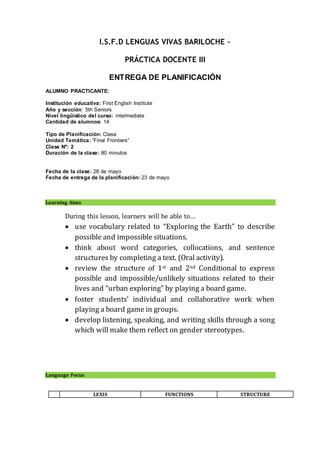
Learning Aims
During this lesson, learners will be able to…
 use vocabulary related to “Exploring the Earth” to describe
possible and impossible situations.
 think about word categories, collocations, and sentence
structures by completing a text. (Oral activity).
 review the structure of 1st and 2nd Conditional to express
possible and impossible/unlikely situations related to their
lives and “urban exploring” by playing a board game.
 foster students’ individual and collaborative work when
playing a board game in groups.
 develop listening, speaking, and writing skills through a song
which will make them reflect on gender stereotypes.
Language Focus
LEXIS FUNCTIONS STRUCTURE
R
E
V
Light-dark- strange- ordinary-
modern- heavy- powerful-
strong-low- high Deep-shallow-
-narrow-wide- weak-
permanent- temporary- ancient
Talk about consequences and
hypothetical situations
First and second conditionals
N
E
W
Studentswill review First and Second conditionalsentences, both of
which they have seen in earlier levels. However, this is the first time
they are required to actively distinguish between possible situations in
the futureand unlikely/impossiblesituationsin the presentor future
and decidewhich of the two constructions they should use.
Materials
Slides: https://docs.google.com/presentation/d/1JOWsvNuf_Xf_RsUkKNBz -
drGKEbh2qzoaMGnUCeS7cE/edit?usp=sharing
Song worksheet:
https://drive.google.com/file/d/17BQIxdTgeJYTOE0tH_84XPRG5WnL6a0a/view?usp=sharing
Video:
https://youtu.be/AWpsOqh8q0M
Digital board game: https://docs.google.com/presentation/d/e/2PACX-
1vRG6v5eDCFcbjziim4LaRqRhfKUtLnoa2HDuJDujHV9njPFunmxisyvBdJsrfLfFTmwsfcYuGogmR0x/
pub?start=false&loop=false&delayms=3000
Textbook: Move it 4 Pearson (see page at the end of the sequence of activities)
Procedures
I will greet students and engage in casual conversation. Then, I will
check attendance.
(10 minutes)
I will tell the students we will do an activity in which I will read aloud
the text they have worked the previousclass, but I will replace some of
the original wordsfrom the text with the word “banana” Students will
have to say the hidden word behind banana.
(5 minutes)
I will ask studentsto read the grammar table on page 80 and complete
it. Then, Iwill ask them to check the table in pairsand look for examples
in the text on page 79. We’ll check answers as a class.
Activity 1 (15 minutes)
I will display a digital board game on the TV screen. (I have used
activities similar to tasks 2, 3 and 4 in their textbooks) The class will be
divided into two. Each group will take turns to throw the digital dice.
The dice will determinethe numbersof squares they will move
forward. Eachnumber displaysa card with a task to be completed. I
will explain the rules to my students. The object of the game is to be
the first to reach the end by movingacross the board from square1 to
the finalsquare. Basically, this is played like any common board game
and studentsare familiar with the format. Studentswill have to agree
on an answer before the speaker says it aloud.
https://docs.google.com/presentation/d/e/2PACX-
1vRG6v5eDCFcbjziim4LaRqRhfKUtLnoa2HDuJDujHV9njPFunmxisyvB
dJsrfLfFTmwsfcYuGogmR0x/pub?start=false&loop=false&delayms=30
00
Transition: “Well played!I can see you’vehad fun. Now, you are going
to work with the students’book. Open your books to page80”
Activity 2 (10 minutes)
Book Activity: Studentswill now complete activity 2, 3 and 4; and they
will check them in pairs. I will monitor them and answer questions.
Transition: “Well done!You’veworked hard. Now, let’s have a break”
Duringthe break I will ask for their workbooks to check they have
donehomework. If everyonehas, I ‘ll send the key to the WhatsApp
group so that they can check their answerson their own.
___________________break_____________________________
(5 minutes)
I will tell them I am going to read aloud four sentences about me (two
are false and two are true). Students will have to guess which are the
false ones.
I’d be really scared if I went on a rollercoaster ride (false!)
My friends will be unhappy if I cook vegetarian food for them. (true)
If I was a millionaire, I’d spend all my money traveling around the
world. (true)
If I was taller, I would love to play basketball professionally. (false)
Transition: “Now, let’s give a look at what I have just said”
(5 minutes)
I will show my sentenceson the TV screen, and Iwill say: “Look at these
sentences. Comparethe first two sentences with the last two. How are
they different?
I’d be really scared if I went on a rollercoaster ride (false!)
My friends will be unhappy if I cook vegetarian food for them. (true)
If I were a millionaire, I’d spend all my money traveling around the
world. (true)
If I were taller, I would love to play basketball professionally. (false)
I will make surethey remember that when the conditionalclauses are
inverted, the comma is omitted.
Transition: “Now, I want you to tell your classmates something that is
true for you”
Activity 1 (10 minutes)
I will give them a slip of paper with the beginning of the sentences I
have on the screen. They will have to complete the sentences, so they
are true for them. Then, I will read them aloud and they will have to
guess who wrotewhich.
Transition: “Good guesses! Now, I want you to look at exercise 6.”
Activity 2 (7 minutes)
Individually, studentswillcomplete the questions in exercise 6. I will
monitor and check they have them right. Then, they will pair up and
ask and answer each other these questions. I will monitor discreetly,
helping them with the vocabulary if necessary or unlessstudentsmake
mistakes with the conditional sentences.
Transition: “Great! Now, as for the last part of the class we are going to
listen to a song.”
Activity 3 (20 minutes)
Song
I will hand in the followingword document, and Iwill work with the
followingYouTubevideo:
Word file:
https://drive.google.com/file/d/17BQIxdTgeJYTOE0tH_84XPRG5WnL6a0a/view?usp=sharing
Video:
https://youtu.be/AWpsOqh8q0M
First, I will work with the pre-listeningtask to introduce the topic of
gender stereotypes. Then, I will play the video till minute1:20 and ask
them to describe what is going on. “What are the man and the woman
doing? How have the roles changed? Is the woman imaginingthis
situation? How do you think she feels? And what about him? Then, I
will tell them they are going to listen to the entire song, and I will draw
their attention to the activities of the while-listening tasks. I will
explain what they mustdo in each part though they are used to
completing activities of this kind while listening to songs. Then, I will
play the song onceand if they need it, I will pausethe video for them to
have time to complete. (They will probably need to listen to the song
for a second time.) Finally, I will check answersas a class.
Transition: “Good, time’s up. So, you’llhave to do the last task at home”
Closure
I will ask them to reflect on the questions written in the post-listening
task and write a short paragraphabout it (80 words). They will have to
send this via WhatsApp for correction.
To be completed by your tutor:
Lesson plan
component
Excellent
5
Very Good
4
Good
3
Acceptable
2
Needs
improvement
1
Visual
organization
X
Coherence and
sequencing
X
Variety of
resources
X
Stages and
activities
X
Scaffolding
strategies
X
Language
accuracy
X
Observations
Fantastic!
Each activity must be described in terms of the following components:
 Timing
 Activity description and instructions as they will be said to
students (include direct speech)
 Scaffolding strategies
 Transition comment to link each stage of the lesson with the next one

Alvarez marina lesson plan 2

  • 1.
    I.S.F.D LENGUAS VIVASBARILOCHE – PRÁCTICA DOCENTE III ENTREGA DE PLANIFICACIÓN ALUMNO PRACTICANTE: Institución educativa: First English Institute Año y sección: 5th Seniors Nivel lingüístico del curso: intermediate Cantidad de alumnos: 14 Tipo de Planificación: Clase Unidad Temática: “Final Frontiers” Clase Nº: 2 Duración de la clase: 80 minutos Fecha de la clase: 28 de mayo Fecha de entrega de la planificación: 23 de mayo Learning Aims During this lesson, learners will be able to…  use vocabulary related to “Exploring the Earth” to describe possible and impossible situations.  think about word categories, collocations, and sentence structures by completing a text. (Oral activity).  review the structure of 1st and 2nd Conditional to express possible and impossible/unlikely situations related to their lives and “urban exploring” by playing a board game.  foster students’ individual and collaborative work when playing a board game in groups.  develop listening, speaking, and writing skills through a song which will make them reflect on gender stereotypes. Language Focus LEXIS FUNCTIONS STRUCTURE
  • 2.
    R E V Light-dark- strange- ordinary- modern-heavy- powerful- strong-low- high Deep-shallow- -narrow-wide- weak- permanent- temporary- ancient Talk about consequences and hypothetical situations First and second conditionals N E W Studentswill review First and Second conditionalsentences, both of which they have seen in earlier levels. However, this is the first time they are required to actively distinguish between possible situations in the futureand unlikely/impossiblesituationsin the presentor future and decidewhich of the two constructions they should use. Materials Slides: https://docs.google.com/presentation/d/1JOWsvNuf_Xf_RsUkKNBz - drGKEbh2qzoaMGnUCeS7cE/edit?usp=sharing Song worksheet: https://drive.google.com/file/d/17BQIxdTgeJYTOE0tH_84XPRG5WnL6a0a/view?usp=sharing Video: https://youtu.be/AWpsOqh8q0M Digital board game: https://docs.google.com/presentation/d/e/2PACX- 1vRG6v5eDCFcbjziim4LaRqRhfKUtLnoa2HDuJDujHV9njPFunmxisyvBdJsrfLfFTmwsfcYuGogmR0x/ pub?start=false&loop=false&delayms=3000 Textbook: Move it 4 Pearson (see page at the end of the sequence of activities) Procedures I will greet students and engage in casual conversation. Then, I will check attendance. (10 minutes) I will tell the students we will do an activity in which I will read aloud the text they have worked the previousclass, but I will replace some of the original wordsfrom the text with the word “banana” Students will have to say the hidden word behind banana.
  • 3.
    (5 minutes) I willask studentsto read the grammar table on page 80 and complete it. Then, Iwill ask them to check the table in pairsand look for examples in the text on page 79. We’ll check answers as a class. Activity 1 (15 minutes) I will display a digital board game on the TV screen. (I have used activities similar to tasks 2, 3 and 4 in their textbooks) The class will be divided into two. Each group will take turns to throw the digital dice. The dice will determinethe numbersof squares they will move forward. Eachnumber displaysa card with a task to be completed. I will explain the rules to my students. The object of the game is to be the first to reach the end by movingacross the board from square1 to the finalsquare. Basically, this is played like any common board game and studentsare familiar with the format. Studentswill have to agree on an answer before the speaker says it aloud.
  • 4.
    https://docs.google.com/presentation/d/e/2PACX- 1vRG6v5eDCFcbjziim4LaRqRhfKUtLnoa2HDuJDujHV9njPFunmxisyvB dJsrfLfFTmwsfcYuGogmR0x/pub?start=false&loop=false&delayms=30 00 Transition: “Well played!Ican see you’vehad fun. Now, you are going to work with the students’book. Open your books to page80” Activity 2 (10 minutes) Book Activity: Studentswill now complete activity 2, 3 and 4; and they will check them in pairs. I will monitor them and answer questions. Transition: “Well done!You’veworked hard. Now, let’s have a break” Duringthe break I will ask for their workbooks to check they have donehomework. If everyonehas, I ‘ll send the key to the WhatsApp group so that they can check their answerson their own. ___________________break_____________________________ (5 minutes) I will tell them I am going to read aloud four sentences about me (two are false and two are true). Students will have to guess which are the false ones. I’d be really scared if I went on a rollercoaster ride (false!) My friends will be unhappy if I cook vegetarian food for them. (true) If I was a millionaire, I’d spend all my money traveling around the world. (true) If I was taller, I would love to play basketball professionally. (false) Transition: “Now, let’s give a look at what I have just said”
  • 5.
    (5 minutes) I willshow my sentenceson the TV screen, and Iwill say: “Look at these sentences. Comparethe first two sentences with the last two. How are they different? I’d be really scared if I went on a rollercoaster ride (false!) My friends will be unhappy if I cook vegetarian food for them. (true) If I were a millionaire, I’d spend all my money traveling around the world. (true) If I were taller, I would love to play basketball professionally. (false) I will make surethey remember that when the conditionalclauses are inverted, the comma is omitted. Transition: “Now, I want you to tell your classmates something that is true for you” Activity 1 (10 minutes) I will give them a slip of paper with the beginning of the sentences I have on the screen. They will have to complete the sentences, so they are true for them. Then, I will read them aloud and they will have to guess who wrotewhich. Transition: “Good guesses! Now, I want you to look at exercise 6.” Activity 2 (7 minutes) Individually, studentswillcomplete the questions in exercise 6. I will monitor and check they have them right. Then, they will pair up and ask and answer each other these questions. I will monitor discreetly, helping them with the vocabulary if necessary or unlessstudentsmake mistakes with the conditional sentences.
  • 6.
    Transition: “Great! Now,as for the last part of the class we are going to listen to a song.” Activity 3 (20 minutes) Song I will hand in the followingword document, and Iwill work with the followingYouTubevideo: Word file: https://drive.google.com/file/d/17BQIxdTgeJYTOE0tH_84XPRG5WnL6a0a/view?usp=sharing Video: https://youtu.be/AWpsOqh8q0M First, I will work with the pre-listeningtask to introduce the topic of gender stereotypes. Then, I will play the video till minute1:20 and ask them to describe what is going on. “What are the man and the woman doing? How have the roles changed? Is the woman imaginingthis situation? How do you think she feels? And what about him? Then, I will tell them they are going to listen to the entire song, and I will draw
  • 7.
    their attention tothe activities of the while-listening tasks. I will explain what they mustdo in each part though they are used to completing activities of this kind while listening to songs. Then, I will play the song onceand if they need it, I will pausethe video for them to have time to complete. (They will probably need to listen to the song for a second time.) Finally, I will check answersas a class. Transition: “Good, time’s up. So, you’llhave to do the last task at home” Closure I will ask them to reflect on the questions written in the post-listening task and write a short paragraphabout it (80 words). They will have to send this via WhatsApp for correction. To be completed by your tutor: Lesson plan component Excellent 5 Very Good 4 Good 3 Acceptable 2 Needs improvement 1 Visual organization X
  • 8.
    Coherence and sequencing X Variety of resources X Stagesand activities X Scaffolding strategies X Language accuracy X Observations Fantastic! Each activity must be described in terms of the following components:  Timing  Activity description and instructions as they will be said to students (include direct speech)  Scaffolding strategies  Transition comment to link each stage of the lesson with the next one