Medicine
Disciplinary Literacy
Reading
• Reading is important to people in the medical field in
  many ways:
• Professionals in the Medical field read different
  instruments everyday that correspond to their specific
  profession.
   – Ex: Radiologists need to know how to read x-rays so they
     can properly diagnose patients.

• All professionals in the medical field need to know
  how to read their patients’ medical histories so they
  don’t prescribe medications that may be harmful to
  them or that could cause unintended effects when
  combined with other medicine they are already taking.
Reading
• Outside of the workplace professionals in the
  medical field read trade journals and scholarly
  articles     to     keep      up      with       new
  studies, discoveries, and research in the field.
   – One trade journal, Family Practice News has articles
     about three different drugs that had deadly side
     effects, which had not been reported before the FDA
     approved these drugs. They were put into the journal
     so professionals that read the journal could be aware
     of the possible side effects and refrain from prescribing
     them.
Writing
• 1. Be good at discovering blank
  – selected topic blank based medicine and
    clinical medicine and social medical
    study, which is no cause people to pay
    attention to the subject
• 2. Added the views of others
  – found in the selected topic from others, get
    inspiration, based on this understanding, the
    new ideas to create new, and make it more
    comprehensive, more rich.
Writing

• 3. In conflicts for choice
   – Choose the focus of the debates in
     the academic carrying out the
     plan, through the clinical argument
     put forward their views and opinions
Writing
4. Material preparation
  – The audit of the data and statistics processing.
  – List and drawing.
  – The photos and the choice of typical cases (part of the
    clinical diagnosis and treatment technology and
    method is introduced to paper).
5. Quoted the sorting of literature.
6. From the start the results of the
   experiment, abstracting viewpoint.
7. The necessary supplement the experiment.
8. Clear view and a conclusion.
Writing
9. Draw up an outline
  – by the topic, the authors usually, abstract, key
    words, the introduction, the methods and materials,
    the results, the discussion, and references and parts.
10.Drafts
  – For the professional term paper, should not be
    commonly use abbreviation.
11.Submission and revision
  – The editorial department by integrating expert and
    edit the opinion, to name the editorial department
    to the author puts forward Suggestions and
    requirements
Speaking

• There is a different form of jargon that is
  spoken around the hospital, office, or any
  medical facility.
  – Communicating with patients
  – Communicating with coworkers and other
    physicians
Speaking with Patients
• The only way patients inform the physician on his or
  her specific illness is by word of mouth. This involves a
  short detailed description of a fault in physiology and
  the location of the fault.
• As a physician, it is his or her job to question the
  patient on any specific medical history or illness that
  may interrupt the procedure needed to be done
• Without this form of jargon, which mainly includes
  question and answering, there is no way for the
  physician to truly understand what is troubling the
  patient
Speaking with Coworkers
• Speaking with coworkers involves a jargon
  obtained through multiple years of medical
  school
• If emergencies were to ever occur at a
  hospital, which is highly common in the ER, a
  physician needs to communicate with his
  coworkers in such a way that immediate action
  be taken. This jargon must be set up and
  practiced for the specific procedure to be
  completed as soon as possible
Technology
• There are many different devices most medical
  professionals must use
• Devices help with:
  – Diagnosis and treatment
  – Research
  – Learning about medicine
• Examine:
  – What the devices are like, what they can do
  – Learning to use these devices
  – Why this literacy is necessary
Technology
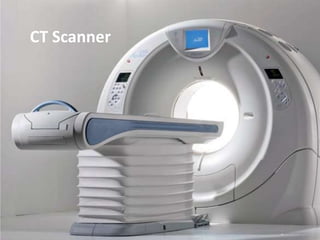
• CT Scanner

  – Creates detailed 3-D movies of entire organs in
    real time.
  – Fast and accurate diagnoses in emergencies like
    strokes and heart attacks, offering patients the
    best treatment options.
CT Scanner
Technology
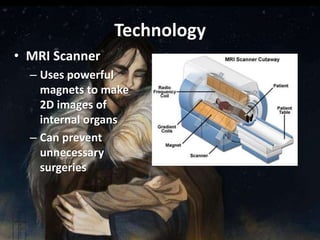
• MRI Scanner
  – Uses powerful
    magnets to make
    2D images of
    internal organs
  – Can prevent
    unnecessary
    surgeries
Technology
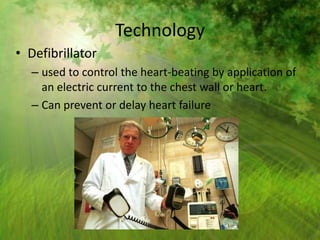
• Defibrillator
  – used to control the heart-beating by application of
    an electric current to the chest wall or heart.
  – Can prevent or delay heart failure
Technology
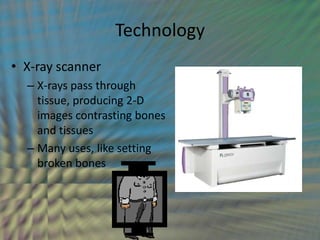
• X-ray scanner
  – X-rays pass through
    tissue, producing 2-D
    images contrasting bones
    and tissues
  – Many uses, like setting
    broken bones
Technology
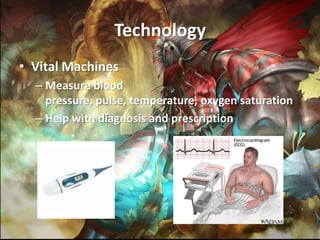
• Vital Machines
  – Measure blood
    pressure, pulse, temperature, oxygen saturation
  – Help with diagnosis and prescription
Technology
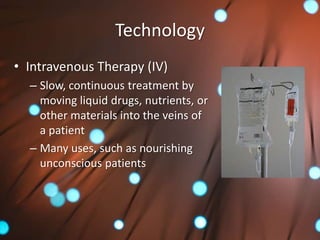
• Intravenous Therapy (IV)
  – Slow, continuous treatment by
    moving liquid drugs, nutrients, or
    other materials into the veins of
    a patient
  – Many uses, such as nourishing
    unconscious patients
Technology
• Undergraduate:
  – Bachelors degree is pretty much anything you
    want as long as you also take classes that will give
    you the info you need to pass the MCATS


• MCATS
  – Test you need to take to be eligible to apply to
    medical school.
Technology, Medical School
• First and Second Year
   – Basic sciences are taught to give the student a good understanding of the
     body, how it works, and diseases they may encounter as a doctor.
• Third Year
   –   Begin rotations, introduces expectations of the medical field
   –   Rotations can include internal medicine, OB/GYN, and psychiatry.
   –   Learn to use some equipment in your rotation
   –   Narrow down what type of doctor you want to be
• Fourth Year
   – Specialization, complete rotation close to field of interest, get used to
     different technologies in the field as preparation for medical practice
   – Interact with patients, complete basic medical procedures.
   – Know how to use the technology you will be using the procedure.
• Board Exams
   – Taken in last year of medical school to become certified
Technology, Residency
• By this time you will have decided on a specialization and you will basically
  shadow a doctor who has been in the field for a while and perfect your
  skills so you feel comfortable doing it by yourself.

• A residency usually last three to seven years depending on your
  specialization.

• This is really where all of your knowledge comes together. This is where
  you perfect what you will be doing for the rest of your life.

• Medicine is like a “trade” in the sense that you learn how to use the
  technology and learn special techniques from your colleagues.

• The more and more you specialize the more and more technologies you
  will learn and become proficient in. Just like surgeons probably have a
  different and more specialized set of technology skills than a radiologist.
Technology
• Conclusion
  – Literacy in technology is paramount for those
    going into the medical field
  – It is required to diagnose, treat, and provide care
    to patients in any setting
  – Learning to use technology in the medical field
    usually begins around the third year of medical
    school by taking classes and participating in
    rotations
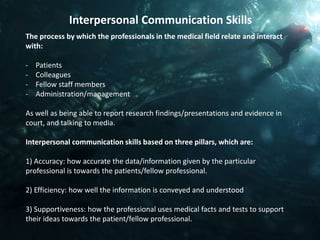
Interpersonal Communication Skills
The process by which the professionals in the medical field relate and interact
with:

-   Patients
-   Colleagues
-   Fellow staff members
-   Administration/management

As well as being able to report research findings/presentations and evidence in
court, and talking to media.

Interpersonal communication skills based on three pillars, which are:

1) Accuracy: how accurate the data/information given by the particular
professional is towards the patients/fellow professional.

2) Efficiency: how well the information is conveyed and understood

3) Supportiveness: how the professional uses medical facts and tests to support
their ideas towards the patient/fellow professional.
Interpersonal Communication With Patients
Medical professionals try to create a strong relationship with their patients that is built on
honesty, confidentiality, trust, and respect by various communication principles:
- Ensure good interaction rather than direct transmission of information
- Reduce uncertainty
- Show empathy and how to handle emotional outbreak
- Increase patient satisfaction
- Increase patient understanding of his illness and management
- Improve patient compliance with the management

To do this, various techniques are used to ensure the professionals’ care for the patients well
being and concerns:
- Good eye contact
- Good personal attitude
- Hand gesture/body language
- Start with open ended questions
- Allow time to patient and do not interrupt
- Ask direct questions
- Do not use medical terms, use simple terms
- Exchange information

The medical professional must have relational versatility, ability of the physician to match her
interpersonal approach to the communication and relationship needs of different patients, to be
who and what the patient needs.
Interpersonal Communication with Other Professionals
Medical professionals try to create a relationship with fellow professionals based on
mutual respect and trust.

Unlike the relationship with the patient, the main goal of the interaction between
professionals is for the common good of the patients, which must be based on an
academic and work basis. This is accomplished by:

-   Exchanging information and options on various topics; must be based on an
    understanding on both sides in order to solve problems at hand. Both sides must
    be open to opposing ideas, as well as, curiosity to advance those ideas and
    willingness to work together towards a common goal.
-   Through consultations
-   Do your share part of work: collaboration between various professionals (E.g.
    Nurses and doctors)
-   Attendance of seminars, conferences and meetings to address new
    technology, innovations, and problems the professionals are facing.
Conclusion
Medical Field Process:

     1: Preparing for the Field
     2: Working in the Field
     3: Literacy Process
     4:Cultural Artifacts
Preparing for the Field
• Seek Information
  – Professors, advisors, books, online, classes, etc.
• Get Experience
  – Literacy emersion, communication, labs, TA’s,
    rotations.
• Academic work—being competitive
  – GPA, MCAT, contact professors, extracurricular
    activities
• Use Medical Literacy for a Revisionary Purpose
  – Read—understand—connect—apply—observe—improve
Working in the Field
• Use Cultural Artifacts
  – Medical technology
  – Communication interfaces
  – Read—journals, books, etc.
• Produce Cultural Artifacts
  – Be innovative with technology
  – Write: publish studies, patient records
  – Speak: with colleagues, the media, students, etc.
  – Interpersonal: Collaborate, help out, be amenable
Medicine
Disciplinary Literacy

Medicine and Disciplinary Literacies

  • 1.
  • 2.
    Reading • Reading isimportant to people in the medical field in many ways: • Professionals in the Medical field read different instruments everyday that correspond to their specific profession. – Ex: Radiologists need to know how to read x-rays so they can properly diagnose patients. • All professionals in the medical field need to know how to read their patients’ medical histories so they don’t prescribe medications that may be harmful to them or that could cause unintended effects when combined with other medicine they are already taking.
  • 3.
    Reading • Outside ofthe workplace professionals in the medical field read trade journals and scholarly articles to keep up with new studies, discoveries, and research in the field. – One trade journal, Family Practice News has articles about three different drugs that had deadly side effects, which had not been reported before the FDA approved these drugs. They were put into the journal so professionals that read the journal could be aware of the possible side effects and refrain from prescribing them.
  • 4.
    Writing • 1. Begood at discovering blank – selected topic blank based medicine and clinical medicine and social medical study, which is no cause people to pay attention to the subject • 2. Added the views of others – found in the selected topic from others, get inspiration, based on this understanding, the new ideas to create new, and make it more comprehensive, more rich.
  • 5.
    Writing • 3. Inconflicts for choice – Choose the focus of the debates in the academic carrying out the plan, through the clinical argument put forward their views and opinions
  • 6.
    Writing 4. Material preparation – The audit of the data and statistics processing. – List and drawing. – The photos and the choice of typical cases (part of the clinical diagnosis and treatment technology and method is introduced to paper). 5. Quoted the sorting of literature. 6. From the start the results of the experiment, abstracting viewpoint. 7. The necessary supplement the experiment. 8. Clear view and a conclusion.
  • 7.
    Writing 9. Draw upan outline – by the topic, the authors usually, abstract, key words, the introduction, the methods and materials, the results, the discussion, and references and parts. 10.Drafts – For the professional term paper, should not be commonly use abbreviation. 11.Submission and revision – The editorial department by integrating expert and edit the opinion, to name the editorial department to the author puts forward Suggestions and requirements
  • 8.
    Speaking • There isa different form of jargon that is spoken around the hospital, office, or any medical facility. – Communicating with patients – Communicating with coworkers and other physicians
  • 9.
    Speaking with Patients •The only way patients inform the physician on his or her specific illness is by word of mouth. This involves a short detailed description of a fault in physiology and the location of the fault. • As a physician, it is his or her job to question the patient on any specific medical history or illness that may interrupt the procedure needed to be done • Without this form of jargon, which mainly includes question and answering, there is no way for the physician to truly understand what is troubling the patient
  • 10.
    Speaking with Coworkers •Speaking with coworkers involves a jargon obtained through multiple years of medical school • If emergencies were to ever occur at a hospital, which is highly common in the ER, a physician needs to communicate with his coworkers in such a way that immediate action be taken. This jargon must be set up and practiced for the specific procedure to be completed as soon as possible
  • 11.
    Technology • There aremany different devices most medical professionals must use • Devices help with: – Diagnosis and treatment – Research – Learning about medicine • Examine: – What the devices are like, what they can do – Learning to use these devices – Why this literacy is necessary
  • 12.
    Technology • CT Scanner – Creates detailed 3-D movies of entire organs in real time. – Fast and accurate diagnoses in emergencies like strokes and heart attacks, offering patients the best treatment options.
  • 13.
  • 14.
    Technology • MRI Scanner – Uses powerful magnets to make 2D images of internal organs – Can prevent unnecessary surgeries
  • 15.
    Technology • Defibrillator – used to control the heart-beating by application of an electric current to the chest wall or heart. – Can prevent or delay heart failure
  • 16.
    Technology • X-ray scanner – X-rays pass through tissue, producing 2-D images contrasting bones and tissues – Many uses, like setting broken bones
  • 17.
    Technology • Vital Machines – Measure blood pressure, pulse, temperature, oxygen saturation – Help with diagnosis and prescription
  • 18.
    Technology • Intravenous Therapy(IV) – Slow, continuous treatment by moving liquid drugs, nutrients, or other materials into the veins of a patient – Many uses, such as nourishing unconscious patients
  • 19.
    Technology • Undergraduate: – Bachelors degree is pretty much anything you want as long as you also take classes that will give you the info you need to pass the MCATS • MCATS – Test you need to take to be eligible to apply to medical school.
  • 20.
    Technology, Medical School •First and Second Year – Basic sciences are taught to give the student a good understanding of the body, how it works, and diseases they may encounter as a doctor. • Third Year – Begin rotations, introduces expectations of the medical field – Rotations can include internal medicine, OB/GYN, and psychiatry. – Learn to use some equipment in your rotation – Narrow down what type of doctor you want to be • Fourth Year – Specialization, complete rotation close to field of interest, get used to different technologies in the field as preparation for medical practice – Interact with patients, complete basic medical procedures. – Know how to use the technology you will be using the procedure. • Board Exams – Taken in last year of medical school to become certified
  • 21.
    Technology, Residency • Bythis time you will have decided on a specialization and you will basically shadow a doctor who has been in the field for a while and perfect your skills so you feel comfortable doing it by yourself. • A residency usually last three to seven years depending on your specialization. • This is really where all of your knowledge comes together. This is where you perfect what you will be doing for the rest of your life. • Medicine is like a “trade” in the sense that you learn how to use the technology and learn special techniques from your colleagues. • The more and more you specialize the more and more technologies you will learn and become proficient in. Just like surgeons probably have a different and more specialized set of technology skills than a radiologist.
  • 22.
    Technology • Conclusion – Literacy in technology is paramount for those going into the medical field – It is required to diagnose, treat, and provide care to patients in any setting – Learning to use technology in the medical field usually begins around the third year of medical school by taking classes and participating in rotations
  • 23.
    Interpersonal Communication Skills Theprocess by which the professionals in the medical field relate and interact with: - Patients - Colleagues - Fellow staff members - Administration/management As well as being able to report research findings/presentations and evidence in court, and talking to media. Interpersonal communication skills based on three pillars, which are: 1) Accuracy: how accurate the data/information given by the particular professional is towards the patients/fellow professional. 2) Efficiency: how well the information is conveyed and understood 3) Supportiveness: how the professional uses medical facts and tests to support their ideas towards the patient/fellow professional.
  • 24.
    Interpersonal Communication WithPatients Medical professionals try to create a strong relationship with their patients that is built on honesty, confidentiality, trust, and respect by various communication principles: - Ensure good interaction rather than direct transmission of information - Reduce uncertainty - Show empathy and how to handle emotional outbreak - Increase patient satisfaction - Increase patient understanding of his illness and management - Improve patient compliance with the management To do this, various techniques are used to ensure the professionals’ care for the patients well being and concerns: - Good eye contact - Good personal attitude - Hand gesture/body language - Start with open ended questions - Allow time to patient and do not interrupt - Ask direct questions - Do not use medical terms, use simple terms - Exchange information The medical professional must have relational versatility, ability of the physician to match her interpersonal approach to the communication and relationship needs of different patients, to be who and what the patient needs.
  • 25.
    Interpersonal Communication withOther Professionals Medical professionals try to create a relationship with fellow professionals based on mutual respect and trust. Unlike the relationship with the patient, the main goal of the interaction between professionals is for the common good of the patients, which must be based on an academic and work basis. This is accomplished by: - Exchanging information and options on various topics; must be based on an understanding on both sides in order to solve problems at hand. Both sides must be open to opposing ideas, as well as, curiosity to advance those ideas and willingness to work together towards a common goal. - Through consultations - Do your share part of work: collaboration between various professionals (E.g. Nurses and doctors) - Attendance of seminars, conferences and meetings to address new technology, innovations, and problems the professionals are facing.
  • 26.
    Conclusion Medical Field Process: 1: Preparing for the Field 2: Working in the Field 3: Literacy Process 4:Cultural Artifacts
  • 27.
    Preparing for theField • Seek Information – Professors, advisors, books, online, classes, etc. • Get Experience – Literacy emersion, communication, labs, TA’s, rotations. • Academic work—being competitive – GPA, MCAT, contact professors, extracurricular activities • Use Medical Literacy for a Revisionary Purpose – Read—understand—connect—apply—observe—improve
  • 28.
    Working in theField • Use Cultural Artifacts – Medical technology – Communication interfaces – Read—journals, books, etc. • Produce Cultural Artifacts – Be innovative with technology – Write: publish studies, patient records – Speak: with colleagues, the media, students, etc. – Interpersonal: Collaborate, help out, be amenable
  • 29.