Medical Assistant Programs at


   What Does a Medical Assistant
         Need to Know?
              Part 2
The Importance of Medical
                Assistants
•   Medical assistants are indispensible members of the
    healthcare field.

•   Several divisions of the medical field rely on medical
    assistants for their day-to-day operations. As such,
    medical assistants play a critical role in:
     –   Clinics
     –   Nursing homes
     –   Medical supply businesses
     –   Home health agencies
     –   Insurance companies
     –   Doctor’s offices
     –   And more
Medical Assistant Training
•   Because of the critical roles they play in the medical field, medical
    assistants require a breadth of training

•   After training, medical assistants are equipped to navigate much of
    the medical field or move on to specialization.

•   As a part of their advanced medical assistant curriculum, students
    at Everest College receive hands-on training in the following
    classes:

     –   Medical Insurance and Billing
     –   Cardiopulmonary and Electrocardiography
     –   Laboratory Procedures
     –   Endocrinology and Reproduction
     –   Medical Law and Ethics
Medical Insurance and Billing
    The medical insurance system can be difficult to navigate,
    especially claims processing and billing. Familiarizing oneself
    with the insurance system is a valuable skill.
•   Students will learn:
     –   Major medical insurance programs and claims form processing
     –   Types and sources of insurance, health insurance basics, traditional
         insurance plans, managed care, Medicare, Medicaid, military carriers, and
         Worker's Compensation and Disability insurance
     –   The ICD-9-CM, CPT-4 and HCPCS manuals, and their relationship to the
         process of insurance claims submission
     –   Billing and collections
     –   Patient confidentiality
     –   How to enter patient information and schedule appointments electronically
     –   How to process insurance claims manually and electronically
Cardiopulmonary and
            Electrocardiography
    Understanding these sciences behind the heart and lungs is
    critical for diagnosing signs of life in a patient. Vital signs and
    lifesaving CPR procedures are an important part of this
    course.
•   Students will learn:
     – The structure and function of the heart and lungs
     – Diseases and disorders
     – Diagnostic tests
     – Anatomy and physiology
     – Medical terminology
     – The electrical pathways of the heart muscle in preparation for
       applying electrocardiography leads and recording a 12-lead
       electrocardiogram (ECG)
     – Cardiopulmonary resuscitation (CPR) and the use of an automated
       external defibrillator (AED)
     – How to check vital signs and differentiate between normal values for
       pediatric and adult patients
Laboratory Procedures
    Safety and sanitation standards are an important part
    of many clinical settings. A few other anatomical
    sciences are included in this course.
•   Students will learn:
     – Specimen identification, collection, handling and transportation
       procedures
     – Venipuncture and routine diagnostic hematology
     – Maintenance and care of laboratory equipment and supplies
     – Radiology and nuclear medicine as well as various radiological
       examinations and patient preparation for these exams
     – Anatomy and physiology of the urinary system
     – The human immune system
     – Common diagnostic exams and disorders related to the
       urinary, blood, lymphatic and immune systems.
Endocrinology and
                 Reproduction
•   Human anatomy and the biological sciences are of supreme
    importance for medical assistants. This class focuses on
    top-level anatomical sciences and basic clinical
    bookkeeping.
•   Students will learn:
     –   Good health, nutrition, weight control and strategies in promoting good
         health in patients
     –   Basic anatomy and physiology, common diseases and disorders, and
         medical terminology of the digestive system
     –   The medical assistant's role in emergency preparedness and assisting
         during and after a disaster
     –   Bookkeeping procedures, accounts receivable and payable, financial
         management, banking, and check-writing procedures essential to the
         successful operation of the medical office
     –   The administrative and clinical uses of the electronic health record.
Medical Law and Ethics
    In preparation for becoming a true medical professional, students
    will study relevant laws, ethics, psychology, and therapeutic
    procedures.
•   Students will learn:
     –   Concepts related to patient reception in the medical office and
         preparing for the day
     –   Professional behavior in the workplace
     –   Office management, including the responsibilities an office manager
         has to the office, the staff and the physician
     –   Medical office safety, security and emergency procedures
     –   How to maintain equipment and inventory
     –   The functions of computers in the medical office
     –   The role of ergonomics in the health of the staff and patients
     –   How to provide mobility assistance and support to patients with special
         physical and emotional needs
     –   The basic principles of psychology, psychological disorders, diseases,
         available treatments, and medical terminology related to mental and
         behavioral health
     –   Medical law and ethics in relation to health care
Join Everest College’s Medical
         Assisting Community
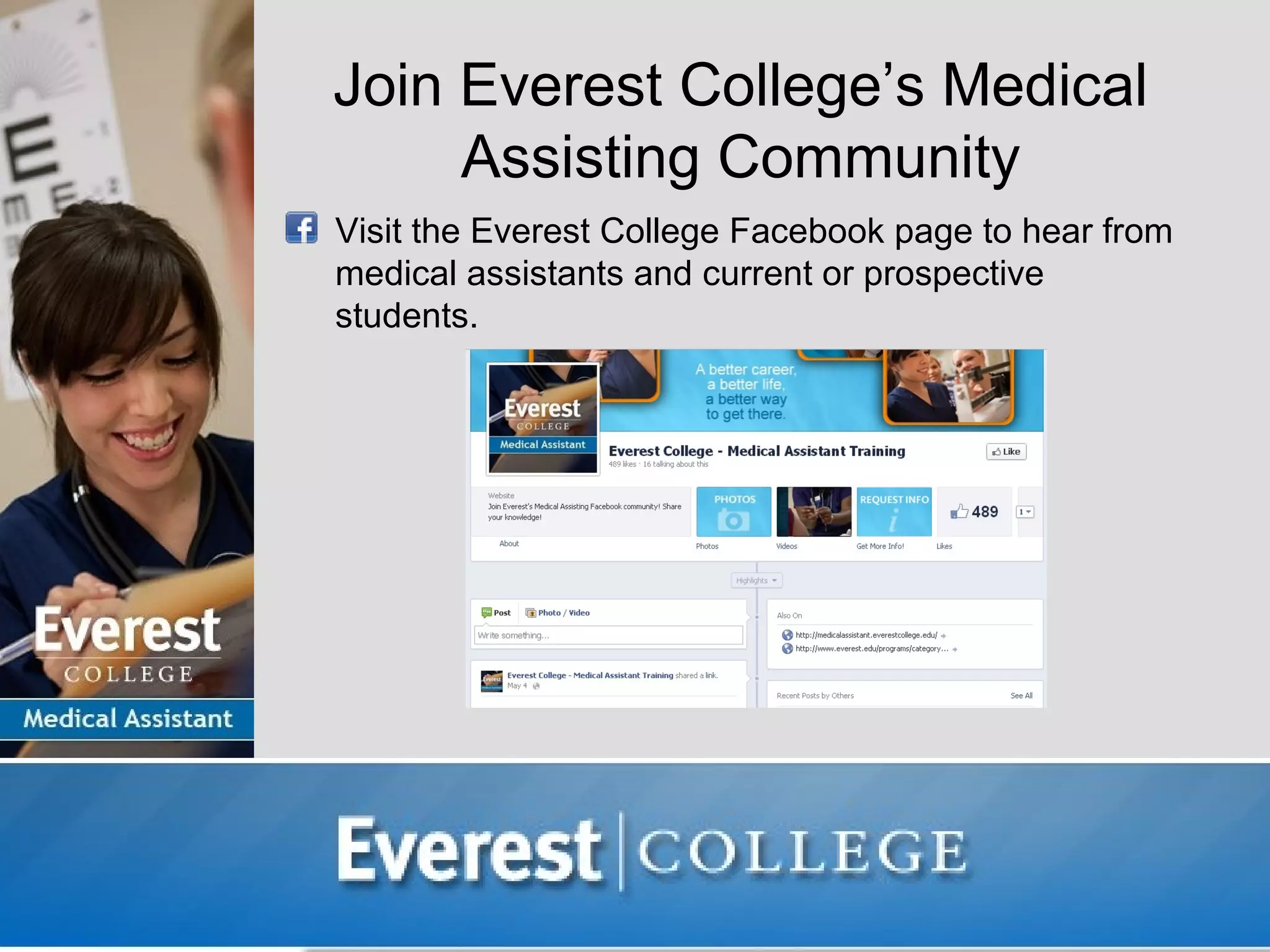
•   Visit the Everest College Facebook page to hear from
    medical assistants and current or prospective
    students.
About Us
• Corinthian Colleges, Inc. offers
  medical assistant training and
  education through its Everest College,
  Everest University, and Everest
  Institute campuses nationwide.

• We are the largest educator of medical
  assistants in the United States.
Request More Information
• Please call 1-(866) 210-6524 or visit
  the Everest College Website to
  request more information about
  becoming a medical assistant.

• We look forward to hearing from you!

What Does a Medical Assistant Need to Know? Part 2

  • 1.
    Medical Assistant Programsat What Does a Medical Assistant Need to Know? Part 2
  • 2.
    The Importance ofMedical Assistants • Medical assistants are indispensible members of the healthcare field. • Several divisions of the medical field rely on medical assistants for their day-to-day operations. As such, medical assistants play a critical role in: – Clinics – Nursing homes – Medical supply businesses – Home health agencies – Insurance companies – Doctor’s offices – And more
  • 3.
    Medical Assistant Training • Because of the critical roles they play in the medical field, medical assistants require a breadth of training • After training, medical assistants are equipped to navigate much of the medical field or move on to specialization. • As a part of their advanced medical assistant curriculum, students at Everest College receive hands-on training in the following classes: – Medical Insurance and Billing – Cardiopulmonary and Electrocardiography – Laboratory Procedures – Endocrinology and Reproduction – Medical Law and Ethics
  • 4.
    Medical Insurance andBilling The medical insurance system can be difficult to navigate, especially claims processing and billing. Familiarizing oneself with the insurance system is a valuable skill. • Students will learn: – Major medical insurance programs and claims form processing – Types and sources of insurance, health insurance basics, traditional insurance plans, managed care, Medicare, Medicaid, military carriers, and Worker's Compensation and Disability insurance – The ICD-9-CM, CPT-4 and HCPCS manuals, and their relationship to the process of insurance claims submission – Billing and collections – Patient confidentiality – How to enter patient information and schedule appointments electronically – How to process insurance claims manually and electronically
  • 5.
    Cardiopulmonary and Electrocardiography Understanding these sciences behind the heart and lungs is critical for diagnosing signs of life in a patient. Vital signs and lifesaving CPR procedures are an important part of this course. • Students will learn: – The structure and function of the heart and lungs – Diseases and disorders – Diagnostic tests – Anatomy and physiology – Medical terminology – The electrical pathways of the heart muscle in preparation for applying electrocardiography leads and recording a 12-lead electrocardiogram (ECG) – Cardiopulmonary resuscitation (CPR) and the use of an automated external defibrillator (AED) – How to check vital signs and differentiate between normal values for pediatric and adult patients
  • 6.
    Laboratory Procedures Safety and sanitation standards are an important part of many clinical settings. A few other anatomical sciences are included in this course. • Students will learn: – Specimen identification, collection, handling and transportation procedures – Venipuncture and routine diagnostic hematology – Maintenance and care of laboratory equipment and supplies – Radiology and nuclear medicine as well as various radiological examinations and patient preparation for these exams – Anatomy and physiology of the urinary system – The human immune system – Common diagnostic exams and disorders related to the urinary, blood, lymphatic and immune systems.
  • 7.
    Endocrinology and Reproduction • Human anatomy and the biological sciences are of supreme importance for medical assistants. This class focuses on top-level anatomical sciences and basic clinical bookkeeping. • Students will learn: – Good health, nutrition, weight control and strategies in promoting good health in patients – Basic anatomy and physiology, common diseases and disorders, and medical terminology of the digestive system – The medical assistant's role in emergency preparedness and assisting during and after a disaster – Bookkeeping procedures, accounts receivable and payable, financial management, banking, and check-writing procedures essential to the successful operation of the medical office – The administrative and clinical uses of the electronic health record.
  • 8.
    Medical Law andEthics In preparation for becoming a true medical professional, students will study relevant laws, ethics, psychology, and therapeutic procedures. • Students will learn: – Concepts related to patient reception in the medical office and preparing for the day – Professional behavior in the workplace – Office management, including the responsibilities an office manager has to the office, the staff and the physician – Medical office safety, security and emergency procedures – How to maintain equipment and inventory – The functions of computers in the medical office – The role of ergonomics in the health of the staff and patients – How to provide mobility assistance and support to patients with special physical and emotional needs – The basic principles of psychology, psychological disorders, diseases, available treatments, and medical terminology related to mental and behavioral health – Medical law and ethics in relation to health care
  • 9.
    Join Everest College’sMedical Assisting Community • Visit the Everest College Facebook page to hear from medical assistants and current or prospective students.
  • 10.
    About Us • CorinthianColleges, Inc. offers medical assistant training and education through its Everest College, Everest University, and Everest Institute campuses nationwide. • We are the largest educator of medical assistants in the United States.
  • 11.
    Request More Information •Please call 1-(866) 210-6524 or visit the Everest College Website to request more information about becoming a medical assistant. • We look forward to hearing from you!