Utilization Management
in
the U.S
Objectives
• At the end of module, the learner will be able to
• Identify what is Utilization review/management
• Entities of Utilization review
• Important of Utilization review
• Unitization review process and screening tools
Utilization Management Defined
• The evaluation & management of medical necessity,
appropriateness, and efficiency of medical services and
procedures
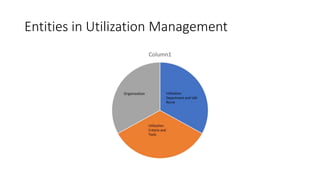
Entities in Utilization Management
Organizations
• Health care facility
• Government/Commercial payor
• Government entity who regulate the rules
• Medicare
• Medicid
Utilization Review department
• Health care facility
• Insurance
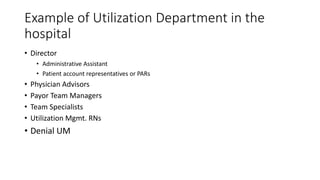
Example of Utilization Department in the
hospital
• Director
• Administrative Assistant
• Patient account representatives or PARs
• Physician Advisors
• Payor Team Managers
• Team Specialists
• Utilization Mgmt. RNs
• Denial UM
Utilization Manager RN
 collaborate with the business office to ensure notice of admission (NOA) &
accurate payor information has been received
 prepare extracted information from the patients medical record in the
form of a “clinical” summary & applies appropriate InterQual® criteria set
to each OBS/INPT admission
 assure the admission order accurately relates to the appropriate level of
care indicated & the order is signed/co-signed by MD
 validate payor authorization matches the physician order and level of care
being provided
Utilization Manager RN
• ensuring proper status
• encouraging accurate documentation of the patient’s medical status
• documentation of D/C disposition
• delivery of HINNS (hospital issued notice of non-coverage)
• delivery of ABN’s (advance beneficiary notice)
Utilization Manager RN
• Collaborates with Clinical CM, SW & MD to expedite D/C plan when it
becomes appropriate
• Collaborates with MD to clarify severity of illness and treatment plan
if it is unclear
• Facilitates peer to peer communication with payer’s medical director
to defend case as needed
Why is RN experience essential to Utilization
Management?
• Because a seasoned RN:
• Is a patient advocate
• Is a credible member of the healthcare profession
• Is proficient at reviewing medical records
• Is capable of ‘reading between the lines’
• Is skilled at noticing the immediate needs of a patient
• Is experienced in regards to abnormal findings
• Is able to identify errors / omissions & can seek clarification
• Is familiar with the standard of care for a particular condition
• Is able to recognize discrepancies (medication, test report etc.)
Denials Management
12
UM Team Denials Team
Handles denials issued for incomplete or lack of
clinicals
Handles other situations where clinicals did not
reach the payor on time
UM Specialist will initially review the denial to
determine why case was denied and assign the case
to the appropriate UM staff member
Handles appeals for denials issued >1 week post D/C
Handles denials due to changes in payor not known until >1
week post D/C
Manage retrospective submissions for Medicaid cases
Conducts case audits to identify learning/coaching needs
Suggests alternate presentation of denied cases for
improvement
New staff receives specialized training in Denials
Management
Types of Payors in the US
• Commercial
• Government
Commercial Payors
Per Diem method of payment
• Set dollar rate per-day has been negotiated LHS
• Clinical summaries must support
• daily severity of illness
• daily intensity of service
Commercial Payors
DRG (diagnosis related grouping)
• Follow Medicare guidelines for LOS & rates
• Negotiates with LHS to pay a % of the Medicare DRG rate
• Show initial severity of illness & intensity of service
• Payor will request additional reviews if > anticipated LOS
Government Payors
• Medicare Part A (pays Hospital inpatient stays)
• Medicare Part B (outpatient services, including MD visits)
• clinical summaries are saved in system, not faxed anywhere
• Part C: Managed MCR plans
• Examples: AARP, Wellmed, UHC
• treat like Commercial Payor
• fax clinical summary
Government Payors
• Traditional Medicaid
• Clinical submitted online to eQHealth
• Medicaid HMO
• treat like Commercial Payor
• fax clinical summary
Medical necessity screening
for Utilization review
Patients Entry point to the hospital
• Via Emergency Department
• After an initial evaluation & treatment → if pt. requires further workup and treatment for a diagnosed
or undiagnosed condition
• As Direct admit
• Acute
• Sent from office by MD (OB, PEDS), urgent care, transfer from another facility (sister hospital, SNF, ALF, etc.)
• Elective
• Surgical- should always come in the day of surgery, not before
• Appropriate early admit --> intractable pain, anticoagulant reversal, post cardiac catheterization & requires
surgery within 24h
• Cardiac/pulmonary clearance should already be on file
• Prescheduled procedures should have prior auth on file
Status of patients in the hospital
• Extended recovery
• Observation
• Inpatient
Examples of Observation Status
Acute Coronary Syndrome (ACS, rule out MI)
Altered Mental Status (with or without existing dementia)
Issues following outpatient surgery or procedure
Pain: abdominal; intractable back or chronic back
Rule out…
Shortness of breath (if hypoxic, usually meets Inpatient)
Syncope / Pre-syncope /TIA
Vomiting
Asthma
Bleeding and hemodynamically stable
Chest pain
Dehydration
Diarrhea
Gastritis
Observation after OP surgery
• For post surgical patients that are hemodynamically stable, but require 6-24h of
treatment or assessment pending a decision regarding the need for additional
care
• Examples:
• any delayed recovery from anesthesia
monitoring level of consciousness, persistent hypotension
• laparoscopic appendectomy with uncontrolled pain
monitoring pain level, change in pain medication
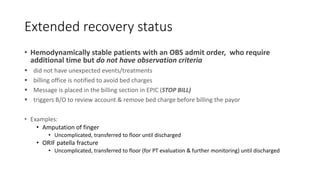
Extended recovery status
• Hemodynamically stable patients with an OBS admit order, who require
additional time but do not have observation criteria
 did not have unexpected events/treatments
 billing office is notified to avoid bed charges
 Message is placed in the billing section in EPIC (STOP BILL)
 triggers B/O to review account & remove bed charge before billing the payor
• Examples:
• Amputation of finger
• Uncomplicated, transferred to floor until discharged
• ORIF patella fracture
• Uncomplicated, transferred to floor (for PT evaluation & further monitoring) until discharged
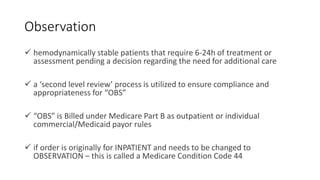
Observation
 hemodynamically stable patients that require 6-24h of treatment or
assessment pending a decision regarding the need for additional care
 a ‘second level review’ process is utilized to ensure compliance and
appropriateness for “OBS”
 “OBS” is Billed under Medicare Part B as outpatient or individual
commercial/Medicaid payor rules
 if order is originally for INPATIENT and needs to be changed to
OBSERVATION – this is called a Medicare Condition Code 44
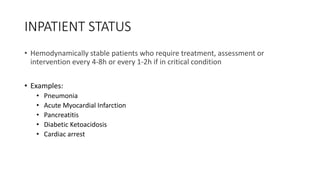
INPATIENT STATUS
• Hemodynamically stable patients who require treatment, assessment or
intervention every 4-8h or every 1-2h if in critical condition
• Examples:
• Pneumonia
• Acute Myocardial Infarction
• Pancreatitis
• Diabetic Ketoacidosis
• Cardiac arrest
Medical Necessity Screening tools
• Interqual,
• Milliman, or
• other proprietary systems
• Example Xolis using AI system
Chapter 8 Medicare guideline for SNF
Clinical information should include
• Findings / Severity of illness
• Interventions / Intensity of service
• Discharge plan
• Consists of criteria justifying an admission for eval, care and treatment of an acute condition.
• Supporting documentation may include:
• failed outpatient Tx, include ED – what was provided & didn’t work?
• complexity of signs and symptoms
• evidence of instability or high risk for complications or mortality
• advanced age / multiple co- morbidities
• treatment plan & tentative D/C plan if known
• UM RN will review the patient's record, possibly prospectively in the ED
• usually during the first 24 hours of admission, to determine if the screening tool's criteria are
met. The main criteria relate to
• intensity of service (IS)
• severity of illness.( SI)
intensity of service (IS)
severity of illness.( SI)
• . Both SI and IS criteria must be met to support the medical necessity for admission ( inpatient ,
observation
• Many of the criteria are similar for observation and inpatient but the inpatient admission SI and
IS criteria indicate higher acuity.
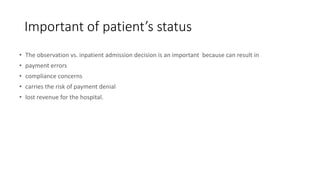
Important of patient’s status
• The observation vs. inpatient admission decision is an important because can result in
• payment errors
• compliance concerns
• carries the risk of payment denial
• lost revenue for the hospital.
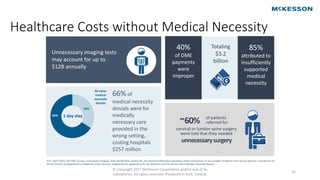
Healthcare Costs without Medical Necessity
© Copyright 2017 McKesson Corporation and/or one of its
subsidiaries. All rights reserved. Produced in Cork, Ireland.
32
34%
66% 1 day stay
All other
medical
necessity
denials
66%of
medical necessity
denials were for
medically
necessary care
provided in the
wrong setting,
costing hospitals
$257 million
AHA. (April 2014). RACTRAC Survey; Unnecessary Imaging, 2014, peer60 data; Epstein NE. Are recommended spine operations either unnecessary or too complex? Evidence from second opinions. Surg Neurol Int
2013;4:S353-8; US Department of Health & Human Services. Supplementary Appendices for the Medicare Fee-For-Service 2015 Improper Payments Report.
~60% of patients
referred for
cervical or lumbar spine surgery
were told that they needed
unnecessarysurgery
Unnecessary imaging tests
may account for up to
$12B annually
40%
of DME
payments
were
improper
85%
attributed to
insufficiently
supported
medical
necessity
Totaling
$3.2
billion
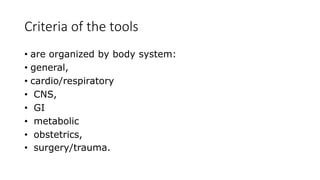
Criteria of the tools
• are organized by body system:
• general,
• cardio/respiratory
• CNS,
• GI
• metabolic
• obstetrics,
• surgery/trauma.
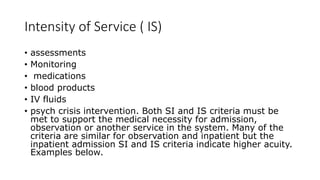
Intensity of Service ( IS)
• assessments
• Monitoring
• medications
• blood products
• IV fluids
• psych crisis intervention. Both SI and IS criteria must be
met to support the medical necessity for admission,
observation or another service in the system. Many of the
criteria are similar for observation and inpatient but the
inpatient admission SI and IS criteria indicate higher acuity.
Examples below.
Sample
InterQual®
application:
35
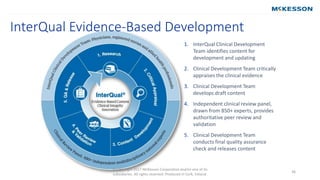
InterQual Evidence-Based Development
© Copyright 2017 McKesson Corporation and/or one of its
subsidiaries. All rights reserved. Produced in Cork, Ireland.
36
1. InterQual Clinical Development
Team identifies content for
development and updating
2. Clinical Development Team critically
appraises the clinical evidence
3. Clinical Development Team
develops draft content
4. Independent clinical review panel,
drawn from 850+ experts, provides
authoritative peer review and
validation
5. Clinical Development Team
conducts final quality assurance
check and releases content
37
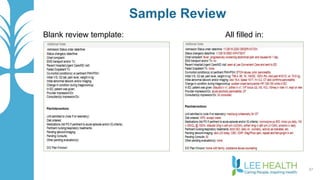
Sample Review
Blank review template: All filled in:
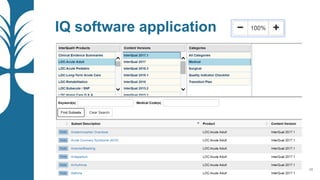
IQ software application
38
39
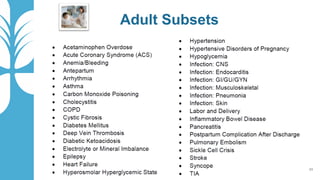
Adult Subsets
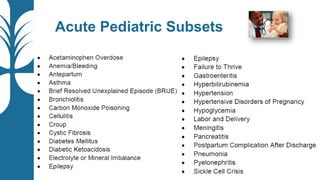
Acute Pediatric Subsets
40
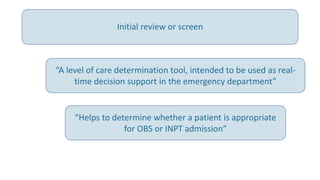
“A level of care determination tool, intended to be used as real-
time decision support in the emergency department”
“Helps to determine whether a patient is appropriate
for OBS or INPT admission”
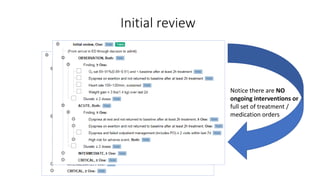
Initial review or screen
Initial review
Notice there are NO
ongoing interventions or
full set of treatment /
medication orders
Initial review VS Episode Day 1
• While Initial review enables identification of the level of care, it is not
intended to, and should not be used as, a substitute for an Episode Day 1
review, which will generally include specific, evidence-based interventions
and intensity of service requirements
• We would conduct an Episode Day 1 review (and not an Initial review)
under the following circumstances:
• After the decision to admit has been made
• If you’re conducting the review retrospectively
• If you have a full set of treatment or medication orders
• If you have sufficient information to conduct an Episode Day 1 review
44
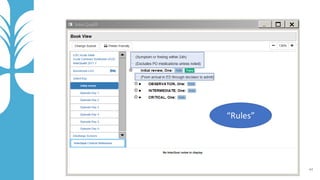
“Rules”
45
46
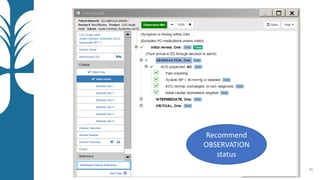
Recommend
OBSERVATION
status
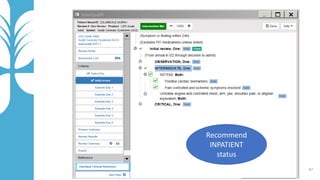
47
Recommend
INPATIENT
status
© Copyright 2017 McKesson Corporation and/or one of its
subsidiaries. All rights reserved. Produced in Cork, Ireland.
48
• Stuart, a 79-year-old male, was brought to the ED by his
family. They report Stuart seemed confused this
morning and was slurring his words. He was unable to
stand, even with assistance; the left side of his mouth
was drooping. Stuart had surgery 2 weeks ago for a
bowel obstruction. He has been recovering at his
daughter's home without complications until this
morning. Stuart has a past medical history of
hypertension, atrial fib, MI x2, COPD and smoking.
• He has been on warfarin PO at home; however, levels at
this time are sub-therapeutic. Stuart is evaluated 6
hours after the initial onset of symptoms. His condition
is not amenable to endovascular intervention.
Case Study 1A
© Copyright 2017 McKesson Corporation and/or one of its
subsidiaries. All rights reserved. Produced in Cork, Ireland.
49
Case Study 1A
• (continued)
• Physical Examination/Clinical Findings
• Pale, elderly man who is confused
and has difficulty forming words
• BP 167/102 mmHg, P 122, Resp 24, T
98.9° F (PO), O2 saturation 91% on
room air
• INR 1.1
• Lungs clear to auscultation
bilaterally, CXR WNL
• Blood glucose 117 mg/dL
• Abdominal incision healing, well-
approximated, without drainage
• Left-sided weakness; muscle strength
2/5
• ECG shows atrial fibrillation
• CT of the brain reveals focal ischemia, no evidence
of a hemorrhage or mass
© Copyright 2017 McKesson Corporation and/or one of its
subsidiaries. All rights reserved. Produced in Cork, Ireland.
50
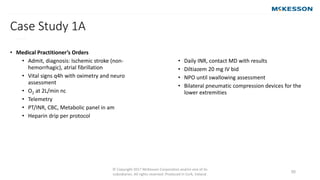
Case Study 1A
• (continued)
• Medical Practitioner’s Orders
• Admit, diagnosis: Ischemic stroke (non-
hemorrhagic), atrial fibrillation
• Vital signs q4h with oximetry and neuro
assessment
• O2 at 2L/min nc
• Telemetry
• PT/INR, CBC, Metabolic panel in am
• Heparin drip per protocol
• Daily INR, contact MD with results
• Diltiazem 20 mg IV bid
• NPO until swallowing assessment
• Bilateral pneumatic compression devices for the
lower extremities
Case Study 1A
© Copyright 2017 McKesson Corporation and/or one of its
subsidiaries. All rights reserved. Produced in Cork, Ireland.
51
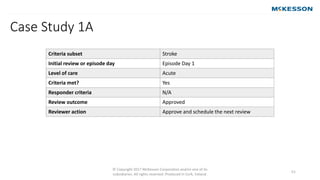
Criteria subset Stroke
Initial review or episode day Episode Day 1
Level of care Acute
Criteria met? Yes
Responder criteria N/A
Review outcome Approved
Reviewer action Approve and schedule the next review
© Copyright 2017 McKesson Corporation and/or one of its
subsidiaries. All rights reserved. Produced in Cork, Ireland.
52
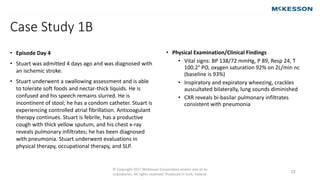
• Episode Day 4
• Stuart was admitted 4 days ago and was diagnosed with
an ischemic stroke.
• Stuart underwent a swallowing assessment and is able
to tolerate soft foods and nectar-thick liquids. He is
confused and his speech remains slurred. He is
incontinent of stool; he has a condom catheter. Stuart is
experiencing controlled atrial fibrillation. Anticoagulant
therapy continues. Stuart is febrile, has a productive
cough with thick yellow sputum, and his chest x-ray
reveals pulmonary infiltrates; he has been diagnosed
with pneumonia. Stuart underwent evaluations in
physical therapy, occupational therapy, and SLP.
• Physical Examination/Clinical Findings
• Vital signs: BP 138/72 mmHg, P 89, Resp 24, T
100.2° PO, oxygen saturation 92% on 2L/min nc
(baseline is 93%)
• Inspiratory and expiratory wheezing, crackles
auscultated bilaterally, lung sounds diminished
• CXR reveals bi-basilar pulmonary infiltrates
consistent with pneumonia
Case Study 1B
© Copyright 2017 McKesson Corporation and/or one of its
subsidiaries. All rights reserved. Produced in Cork, Ireland.
53
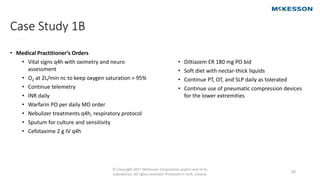
Case Study 1B
• (continued)
• Medical Practitioner’s Orders
• Vital signs q4h with oximetry and neuro
assessment
• O2 at 2L/min nc to keep oxygen saturation > 95%
• Continue telemetry
• INR daily
• Warfarin PO per daily MD order
• Nebulizer treatments q4h, respiratory protocol
• Sputum for culture and sensitivity
• Cefotaxime 2 g IV q4h
• Diltiazem ER 180 mg PO bid
• Soft diet with nectar-thick liquids
• Continue PT, OT, and SLP daily as tolerated
• Continue use of pneumatic compression devices
for the lower extremities
Case Study 1B
© Copyright 2017 McKesson Corporation and/or one of its
subsidiaries. All rights reserved. Produced in Cork, Ireland.
54
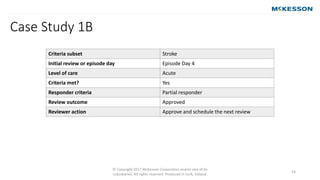
Criteria subset Stroke
Initial review or episode day Episode Day 4
Level of care Acute
Criteria met? Yes
Responder criteria Partial responder
Review outcome Approved
Reviewer action Approve and schedule the next review
Case Study 1C
© Copyright 2017 McKesson Corporation and/or one of its
subsidiaries. All rights reserved. Produced in Cork, Ireland.
55
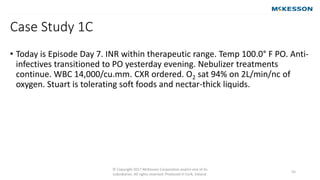
• Today is Episode Day 7. INR within therapeutic range. Temp 100.0° F PO. Anti-
infectives transitioned to PO yesterday evening. Nebulizer treatments
continue. WBC 14,000/cu.mm. CXR ordered. O2 sat 94% on 2L/min/nc of
oxygen. Stuart is tolerating soft foods and nectar-thick liquids.
Case Study 1C
© Copyright 2017 McKesson Corporation and/or one of its
subsidiaries. All rights reserved. Produced in Cork, Ireland.
56
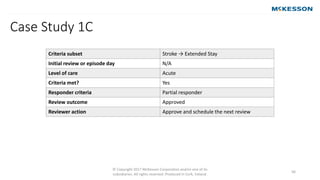
Criteria subset Stroke → Extended Stay
Initial review or episode day N/A
Level of care Acute
Criteria met? Yes
Responder criteria Partial responder
Review outcome Approved
Reviewer action Approve and schedule the next review
References
• Reyes, Ireda, (2018) Utilization Review Training Manaul
• McKesson Corporation (2020) I InterQual Level of Care Acute Criteria Adult

UM in the US[17757].ppt

  • 1.
  • 2.
    Objectives • At theend of module, the learner will be able to • Identify what is Utilization review/management • Entities of Utilization review • Important of Utilization review • Unitization review process and screening tools
  • 3.
    Utilization Management Defined •The evaluation & management of medical necessity, appropriateness, and efficiency of medical services and procedures
  • 4.
  • 5.
    Organizations • Health carefacility • Government/Commercial payor • Government entity who regulate the rules • Medicare • Medicid
  • 6.
    Utilization Review department •Health care facility • Insurance
  • 7.
    Example of UtilizationDepartment in the hospital • Director • Administrative Assistant • Patient account representatives or PARs • Physician Advisors • Payor Team Managers • Team Specialists • Utilization Mgmt. RNs • Denial UM
  • 8.
    Utilization Manager RN collaborate with the business office to ensure notice of admission (NOA) & accurate payor information has been received  prepare extracted information from the patients medical record in the form of a “clinical” summary & applies appropriate InterQual® criteria set to each OBS/INPT admission  assure the admission order accurately relates to the appropriate level of care indicated & the order is signed/co-signed by MD  validate payor authorization matches the physician order and level of care being provided
  • 9.
    Utilization Manager RN •ensuring proper status • encouraging accurate documentation of the patient’s medical status • documentation of D/C disposition • delivery of HINNS (hospital issued notice of non-coverage) • delivery of ABN’s (advance beneficiary notice)
  • 10.
    Utilization Manager RN •Collaborates with Clinical CM, SW & MD to expedite D/C plan when it becomes appropriate • Collaborates with MD to clarify severity of illness and treatment plan if it is unclear • Facilitates peer to peer communication with payer’s medical director to defend case as needed
  • 11.
    Why is RNexperience essential to Utilization Management? • Because a seasoned RN: • Is a patient advocate • Is a credible member of the healthcare profession • Is proficient at reviewing medical records • Is capable of ‘reading between the lines’ • Is skilled at noticing the immediate needs of a patient • Is experienced in regards to abnormal findings • Is able to identify errors / omissions & can seek clarification • Is familiar with the standard of care for a particular condition • Is able to recognize discrepancies (medication, test report etc.)
  • 12.
    Denials Management 12 UM TeamDenials Team Handles denials issued for incomplete or lack of clinicals Handles other situations where clinicals did not reach the payor on time UM Specialist will initially review the denial to determine why case was denied and assign the case to the appropriate UM staff member Handles appeals for denials issued >1 week post D/C Handles denials due to changes in payor not known until >1 week post D/C Manage retrospective submissions for Medicaid cases Conducts case audits to identify learning/coaching needs Suggests alternate presentation of denied cases for improvement New staff receives specialized training in Denials Management
  • 13.
    Types of Payorsin the US • Commercial • Government
  • 14.
    Commercial Payors Per Diemmethod of payment • Set dollar rate per-day has been negotiated LHS • Clinical summaries must support • daily severity of illness • daily intensity of service
  • 15.
    Commercial Payors DRG (diagnosisrelated grouping) • Follow Medicare guidelines for LOS & rates • Negotiates with LHS to pay a % of the Medicare DRG rate • Show initial severity of illness & intensity of service • Payor will request additional reviews if > anticipated LOS
  • 16.
    Government Payors • MedicarePart A (pays Hospital inpatient stays) • Medicare Part B (outpatient services, including MD visits) • clinical summaries are saved in system, not faxed anywhere • Part C: Managed MCR plans • Examples: AARP, Wellmed, UHC • treat like Commercial Payor • fax clinical summary
  • 17.
    Government Payors • TraditionalMedicaid • Clinical submitted online to eQHealth • Medicaid HMO • treat like Commercial Payor • fax clinical summary
  • 18.
  • 19.
    Patients Entry pointto the hospital • Via Emergency Department • After an initial evaluation & treatment → if pt. requires further workup and treatment for a diagnosed or undiagnosed condition • As Direct admit • Acute • Sent from office by MD (OB, PEDS), urgent care, transfer from another facility (sister hospital, SNF, ALF, etc.) • Elective • Surgical- should always come in the day of surgery, not before • Appropriate early admit --> intractable pain, anticoagulant reversal, post cardiac catheterization & requires surgery within 24h • Cardiac/pulmonary clearance should already be on file • Prescheduled procedures should have prior auth on file
  • 20.
    Status of patientsin the hospital • Extended recovery • Observation • Inpatient
  • 21.
    Examples of ObservationStatus Acute Coronary Syndrome (ACS, rule out MI) Altered Mental Status (with or without existing dementia) Issues following outpatient surgery or procedure Pain: abdominal; intractable back or chronic back Rule out… Shortness of breath (if hypoxic, usually meets Inpatient) Syncope / Pre-syncope /TIA Vomiting Asthma Bleeding and hemodynamically stable Chest pain Dehydration Diarrhea Gastritis
  • 22.
    Observation after OPsurgery • For post surgical patients that are hemodynamically stable, but require 6-24h of treatment or assessment pending a decision regarding the need for additional care • Examples: • any delayed recovery from anesthesia monitoring level of consciousness, persistent hypotension • laparoscopic appendectomy with uncontrolled pain monitoring pain level, change in pain medication
  • 23.
    Extended recovery status •Hemodynamically stable patients with an OBS admit order, who require additional time but do not have observation criteria  did not have unexpected events/treatments  billing office is notified to avoid bed charges  Message is placed in the billing section in EPIC (STOP BILL)  triggers B/O to review account & remove bed charge before billing the payor • Examples: • Amputation of finger • Uncomplicated, transferred to floor until discharged • ORIF patella fracture • Uncomplicated, transferred to floor (for PT evaluation & further monitoring) until discharged
  • 24.
    Observation  hemodynamically stablepatients that require 6-24h of treatment or assessment pending a decision regarding the need for additional care  a ‘second level review’ process is utilized to ensure compliance and appropriateness for “OBS”  “OBS” is Billed under Medicare Part B as outpatient or individual commercial/Medicaid payor rules  if order is originally for INPATIENT and needs to be changed to OBSERVATION – this is called a Medicare Condition Code 44
  • 25.
    INPATIENT STATUS • Hemodynamicallystable patients who require treatment, assessment or intervention every 4-8h or every 1-2h if in critical condition • Examples: • Pneumonia • Acute Myocardial Infarction • Pancreatitis • Diabetic Ketoacidosis • Cardiac arrest
  • 26.
    Medical Necessity Screeningtools • Interqual, • Milliman, or • other proprietary systems • Example Xolis using AI system Chapter 8 Medicare guideline for SNF
  • 27.
    Clinical information shouldinclude • Findings / Severity of illness • Interventions / Intensity of service • Discharge plan
  • 28.
    • Consists ofcriteria justifying an admission for eval, care and treatment of an acute condition. • Supporting documentation may include: • failed outpatient Tx, include ED – what was provided & didn’t work? • complexity of signs and symptoms • evidence of instability or high risk for complications or mortality • advanced age / multiple co- morbidities • treatment plan & tentative D/C plan if known
  • 29.
    • UM RNwill review the patient's record, possibly prospectively in the ED • usually during the first 24 hours of admission, to determine if the screening tool's criteria are met. The main criteria relate to • intensity of service (IS) • severity of illness.( SI)
  • 30.
    intensity of service(IS) severity of illness.( SI) • . Both SI and IS criteria must be met to support the medical necessity for admission ( inpatient , observation • Many of the criteria are similar for observation and inpatient but the inpatient admission SI and IS criteria indicate higher acuity.
  • 31.
    Important of patient’sstatus • The observation vs. inpatient admission decision is an important because can result in • payment errors • compliance concerns • carries the risk of payment denial • lost revenue for the hospital.
  • 32.
    Healthcare Costs withoutMedical Necessity © Copyright 2017 McKesson Corporation and/or one of its subsidiaries. All rights reserved. Produced in Cork, Ireland. 32 34% 66% 1 day stay All other medical necessity denials 66%of medical necessity denials were for medically necessary care provided in the wrong setting, costing hospitals $257 million AHA. (April 2014). RACTRAC Survey; Unnecessary Imaging, 2014, peer60 data; Epstein NE. Are recommended spine operations either unnecessary or too complex? Evidence from second opinions. Surg Neurol Int 2013;4:S353-8; US Department of Health & Human Services. Supplementary Appendices for the Medicare Fee-For-Service 2015 Improper Payments Report. ~60% of patients referred for cervical or lumbar spine surgery were told that they needed unnecessarysurgery Unnecessary imaging tests may account for up to $12B annually 40% of DME payments were improper 85% attributed to insufficiently supported medical necessity Totaling $3.2 billion
  • 33.
    Criteria of thetools • are organized by body system: • general, • cardio/respiratory • CNS, • GI • metabolic • obstetrics, • surgery/trauma.
  • 34.
    Intensity of Service( IS) • assessments • Monitoring • medications • blood products • IV fluids • psych crisis intervention. Both SI and IS criteria must be met to support the medical necessity for admission, observation or another service in the system. Many of the criteria are similar for observation and inpatient but the inpatient admission SI and IS criteria indicate higher acuity. Examples below.
  • 35.
  • 36.
    InterQual Evidence-Based Development ©Copyright 2017 McKesson Corporation and/or one of its subsidiaries. All rights reserved. Produced in Cork, Ireland. 36 1. InterQual Clinical Development Team identifies content for development and updating 2. Clinical Development Team critically appraises the clinical evidence 3. Clinical Development Team develops draft content 4. Independent clinical review panel, drawn from 850+ experts, provides authoritative peer review and validation 5. Clinical Development Team conducts final quality assurance check and releases content
  • 37.
    37 Sample Review Blank reviewtemplate: All filled in:
  • 38.
  • 39.
  • 40.
  • 41.
    “A level ofcare determination tool, intended to be used as real- time decision support in the emergency department” “Helps to determine whether a patient is appropriate for OBS or INPT admission” Initial review or screen
  • 42.
    Initial review Notice thereare NO ongoing interventions or full set of treatment / medication orders
  • 43.
    Initial review VSEpisode Day 1 • While Initial review enables identification of the level of care, it is not intended to, and should not be used as, a substitute for an Episode Day 1 review, which will generally include specific, evidence-based interventions and intensity of service requirements • We would conduct an Episode Day 1 review (and not an Initial review) under the following circumstances: • After the decision to admit has been made • If you’re conducting the review retrospectively • If you have a full set of treatment or medication orders • If you have sufficient information to conduct an Episode Day 1 review
  • 44.
  • 45.
  • 46.
  • 47.
  • 48.
    © Copyright 2017McKesson Corporation and/or one of its subsidiaries. All rights reserved. Produced in Cork, Ireland. 48 • Stuart, a 79-year-old male, was brought to the ED by his family. They report Stuart seemed confused this morning and was slurring his words. He was unable to stand, even with assistance; the left side of his mouth was drooping. Stuart had surgery 2 weeks ago for a bowel obstruction. He has been recovering at his daughter's home without complications until this morning. Stuart has a past medical history of hypertension, atrial fib, MI x2, COPD and smoking. • He has been on warfarin PO at home; however, levels at this time are sub-therapeutic. Stuart is evaluated 6 hours after the initial onset of symptoms. His condition is not amenable to endovascular intervention. Case Study 1A
  • 49.
    © Copyright 2017McKesson Corporation and/or one of its subsidiaries. All rights reserved. Produced in Cork, Ireland. 49 Case Study 1A • (continued) • Physical Examination/Clinical Findings • Pale, elderly man who is confused and has difficulty forming words • BP 167/102 mmHg, P 122, Resp 24, T 98.9° F (PO), O2 saturation 91% on room air • INR 1.1 • Lungs clear to auscultation bilaterally, CXR WNL • Blood glucose 117 mg/dL • Abdominal incision healing, well- approximated, without drainage • Left-sided weakness; muscle strength 2/5 • ECG shows atrial fibrillation • CT of the brain reveals focal ischemia, no evidence of a hemorrhage or mass
  • 50.
    © Copyright 2017McKesson Corporation and/or one of its subsidiaries. All rights reserved. Produced in Cork, Ireland. 50 Case Study 1A • (continued) • Medical Practitioner’s Orders • Admit, diagnosis: Ischemic stroke (non- hemorrhagic), atrial fibrillation • Vital signs q4h with oximetry and neuro assessment • O2 at 2L/min nc • Telemetry • PT/INR, CBC, Metabolic panel in am • Heparin drip per protocol • Daily INR, contact MD with results • Diltiazem 20 mg IV bid • NPO until swallowing assessment • Bilateral pneumatic compression devices for the lower extremities
  • 51.
    Case Study 1A ©Copyright 2017 McKesson Corporation and/or one of its subsidiaries. All rights reserved. Produced in Cork, Ireland. 51 Criteria subset Stroke Initial review or episode day Episode Day 1 Level of care Acute Criteria met? Yes Responder criteria N/A Review outcome Approved Reviewer action Approve and schedule the next review
  • 52.
    © Copyright 2017McKesson Corporation and/or one of its subsidiaries. All rights reserved. Produced in Cork, Ireland. 52 • Episode Day 4 • Stuart was admitted 4 days ago and was diagnosed with an ischemic stroke. • Stuart underwent a swallowing assessment and is able to tolerate soft foods and nectar-thick liquids. He is confused and his speech remains slurred. He is incontinent of stool; he has a condom catheter. Stuart is experiencing controlled atrial fibrillation. Anticoagulant therapy continues. Stuart is febrile, has a productive cough with thick yellow sputum, and his chest x-ray reveals pulmonary infiltrates; he has been diagnosed with pneumonia. Stuart underwent evaluations in physical therapy, occupational therapy, and SLP. • Physical Examination/Clinical Findings • Vital signs: BP 138/72 mmHg, P 89, Resp 24, T 100.2° PO, oxygen saturation 92% on 2L/min nc (baseline is 93%) • Inspiratory and expiratory wheezing, crackles auscultated bilaterally, lung sounds diminished • CXR reveals bi-basilar pulmonary infiltrates consistent with pneumonia Case Study 1B
  • 53.
    © Copyright 2017McKesson Corporation and/or one of its subsidiaries. All rights reserved. Produced in Cork, Ireland. 53 Case Study 1B • (continued) • Medical Practitioner’s Orders • Vital signs q4h with oximetry and neuro assessment • O2 at 2L/min nc to keep oxygen saturation > 95% • Continue telemetry • INR daily • Warfarin PO per daily MD order • Nebulizer treatments q4h, respiratory protocol • Sputum for culture and sensitivity • Cefotaxime 2 g IV q4h • Diltiazem ER 180 mg PO bid • Soft diet with nectar-thick liquids • Continue PT, OT, and SLP daily as tolerated • Continue use of pneumatic compression devices for the lower extremities
  • 54.
    Case Study 1B ©Copyright 2017 McKesson Corporation and/or one of its subsidiaries. All rights reserved. Produced in Cork, Ireland. 54 Criteria subset Stroke Initial review or episode day Episode Day 4 Level of care Acute Criteria met? Yes Responder criteria Partial responder Review outcome Approved Reviewer action Approve and schedule the next review
  • 55.
    Case Study 1C ©Copyright 2017 McKesson Corporation and/or one of its subsidiaries. All rights reserved. Produced in Cork, Ireland. 55 • Today is Episode Day 7. INR within therapeutic range. Temp 100.0° F PO. Anti- infectives transitioned to PO yesterday evening. Nebulizer treatments continue. WBC 14,000/cu.mm. CXR ordered. O2 sat 94% on 2L/min/nc of oxygen. Stuart is tolerating soft foods and nectar-thick liquids.
  • 56.
    Case Study 1C ©Copyright 2017 McKesson Corporation and/or one of its subsidiaries. All rights reserved. Produced in Cork, Ireland. 56 Criteria subset Stroke → Extended Stay Initial review or episode day N/A Level of care Acute Criteria met? Yes Responder criteria Partial responder Review outcome Approved Reviewer action Approve and schedule the next review
  • 57.
    References • Reyes, Ireda,(2018) Utilization Review Training Manaul • McKesson Corporation (2020) I InterQual Level of Care Acute Criteria Adult