Medical Writing  in Canada Presented at AMWA National Conference October 25, 2008, Louisvile, KY Amanda Strong [email_address] 514.239.2736 www.medicalcommunications.ca
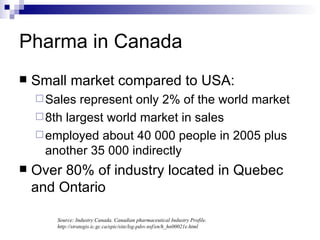
Pharma in Canada Small market compared to USA: Sales represent only 2% of the world market 8th largest world market in sales employed about 40 000 people in 2005 plus another 35 000 indirectly Over 80% of industry located in Quebec and Ontario Source:  Industry Canada. Canadian pharmaceutical Industry Profile.  http://strategis.ic.gc.ca/epic/site/lsg-pdsv.nsf/en/h_hn00021e.html
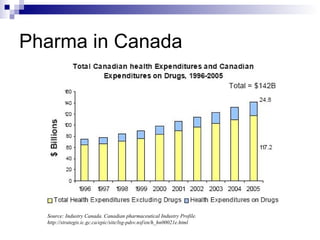
Pharma in Canada Source:  Industry Canada. Canadian pharmaceutical Industry Profile.  http://strategis.ic.gc.ca/epic/site/lsg-pdsv.nsf/en/h_hn00021e.html
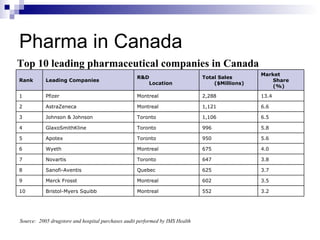
Pharma in Canada Source:   2005 drugstore and hospital purchases audit performed by IMS Health Top 10 leading pharmaceutical companies in Canada   3.2 552 Montreal Bristol-Myers Squibb 10 3.5 602 Montreal Merck Frosst 9 3.7 625 Quebec Sanofi-Aventis 8 3.8 647 Toronto Novartis 7 4.0 675 Montreal Wyeth 6 5.6 950 Toronto Apotex 5 5.8 996 Toronto GlaxoSmithKline 4 6.5 1,106 Toronto Johnson & Johnson 3 6.6 1,121 Montreal AstraZeneca 2 13.4 2,288 Montreal Pfizer 1 Market  Share (%) Total Sales  ($Millions) R&D  Location Leading Companies Rank
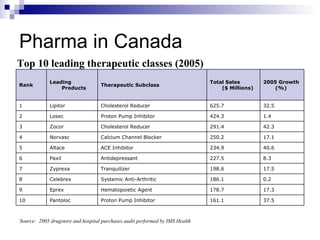
Pharma in Canada Top 10 leading therapeutic classes (2005)   Source:   2005 drugstore and hospital purchases audit performed by IMS Health 37.5 161.1 Proton Pump Inhibitor Pantoloc 10 17.3 178.7 Hematopoietic Agent Eprex 9 0.2 186.1 Systemic Anti-Arthritic Celebrex 8 17.5 198.6 Tranquilizer Zyprexa 7 8.3 227.5 Antidepressant Paxil 6 40.6 234.9 ACE Inhibitor Altace 5 17.1 250.2 Calcium Channel Blocker Norvasc 4 42.3 291.4 Cholesterol Reducer Zocor 3 1.4 424.3 Proton Pump Inhibitor Losec 2 32.5 625.7 Cholesterol Reducer Lipitor 1 2005 Growth (%) Total Sales ($ Millions) Therapeutic Subclass Leading Products Rank
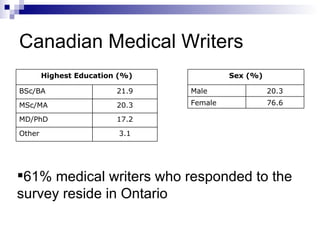
Canadian Medical Writers 61% medical writers who responded to the survey reside in Ontario 3.1 Other 17.2 MD/PhD 20.3 MSc/MA 21.9 BSc/BA Highest Education (%) 76.6 Female 20.3 Male Sex (%)
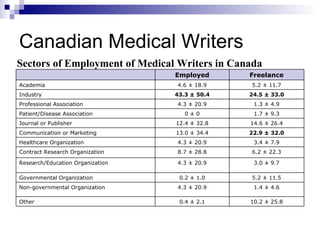
Canadian Medical Writers Sectors of Employment of Medical Writers in Canada   10.2 ± 25.8 0.4 ± 2.1 Other 1.4 ± 4.6 4.3 ± 20.9 Non-governmental Organization 5.2 ± 11.5 0.2 ± 1.0 Governmental Organization 3.0 ± 9.7 4.3 ± 20.9 Research/Education Organization 6.2 ± 22.3 8.7 ± 28.8 Contract Research Organization 3.4 ± 7.9 4.3 ± 20.9 Healthcare Organization 22.9 ± 32.0 13.0 ± 34.4 Communication or Marketing 14.6 ± 26.4 12.4 ± 32.8 Journal or Publisher 1.7 ± 9.3 0 ± 0 Patient/Disease Association 1.3 ± 4.9 4.3 ± 20.9 Professional Association 24.5 ± 33.0 43.3 ± 50.4 Industry 5.2 ± 11.7 4.6 ± 18.9 Academia Freelance Employed  
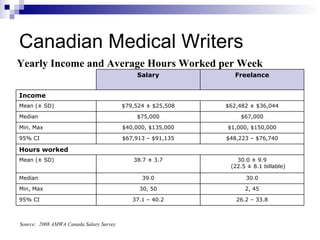
Canadian Medical Writers Yearly Income and Average Hours Worked per Week Source:   2008 AMWA Canada Salary Survey 26.2 – 33.8 37.1 – 40.2 95% CI 2, 45 30, 50 Min, Max 30.0 39.0 Median 30.0 ± 9.9 (22.5 ± 8.1 billable) 38.7 ± 3.7 Mean (± SD) Hours worked $48,223 – $76,740 $67,913 – $91,135 95% CI $1,000, $150,000 $40,000, $135,000 Min, Max $67,000 $75,000 Median $62,482 ± $36,044 $79,524 ± $25,508 Mean (± SD) Income Freelance Salary
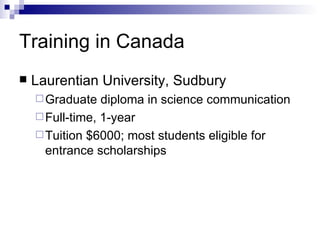
Training in Canada Laurentian University, Sudbury Graduate diploma in science communication Full-time, 1-year Tuition $6000; most students eligible for entrance scholarships
Training in Canada Concordia University, Montreal 2 introductory stand-alone courses in medical writing  (~$300) Manuscript preparation Pharmaceutical marketing Has been some discussions around creating a scientific or medical communications cont-ed certificate program available for completion online
Training in Canada University of Toronto 2 MSc programs in Biomedical Communications, however they focus on medical artwork   Interactive media tools Illustration and animation Tuition about $7500
Training in Canada Canadian Institutes of Health Research (CIHR) Science Writer Scholarships / Health Research Communications Award  $21-26 000 for 2 students enrolled in a post-graduate journalism or communications program Also fund health communications awards / programs Ie, Doctoral Research Award: CHE
Writing
Regulatory Environment Health Canada.  Food and Drugs Act who can sell a drug and how;  what standards need to be met for a drug to be sold in Canada;  how drugs must be labelled and packaged
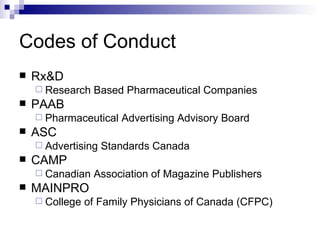
Codes of Conduct Rx&D Research Based Pharmaceutical Companies   PAAB Pharmaceutical Advertising Advisory Board ASC Advertising Standards Canada CAMP Canadian Association of Magazine Publishers MAINPRO College of Family Physicians of Canada (CFPC)
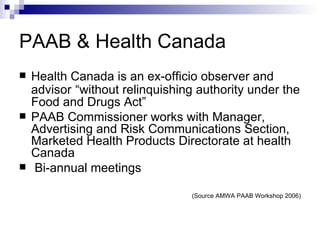
PAAB & Health Canada Health Canada is an ex-officio observer and advisor   “without relinquishing authority under the Food and Drugs Act” PAAB Commissioner works with Manager, Advertising and Risk Communications Section, Marketed Health Products Directorate at health Canada Bi-annual   meetings (Source AMWA PAAB Workshop 2006)
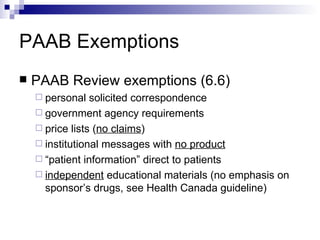
PAAB Exemptions PAAB Review exemptions (6.6) personal solicited correspondence government agency requirements price lists ( no claims ) institutional messages with  no product “ patient information ”  direct to patients independent  educational materials (no emphasis on sponsor’s drugs, see Health Canada guideline)
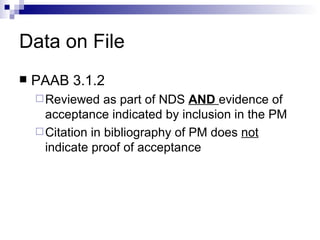
Data on File PAAB 3.1.2 Reviewed as part of NDS  AND  evidence of acceptance indicated by inclusion in the PM Citation in bibliography of PM does  not  indicate proof of acceptance
Published Article s Yes- Publication in a peer-reviewed journal (PAAB 3.1.1) No- Papers published in journal supplements  unless  the advertiser can demonstrate that the supplement has also been subject to a rigorous peer-review process similar to the attached journal  (PAAB 3.1.2)
Published Clinical Trial Formulation / dose range must be as per PM and the same as used in Canada  Open label trials are generally not acceptable Post hoc analyses an d  pooled dat a  are generally not acceptable Statistical analysis must be presented as part of any data presentation
Other  Articles Review articles: Usually not acceptable Meta-analyses:  Depends on design Guidelines and consensus statements Usually acceptable  Claims must be consistent with PM Posters and abstracts Not acceptable
DTC Not allowed in Canada Consumer ads can identify drug or indication, but not both
Help Seeking Ads Okay when: No drug is identified No implication that there is one sole treatment available No drug manufacturer’s name is included
Third Party Content must be 100% independent of Pharma Pharma involvement limited to  funding  development and distribution Reps can not distribute (becomes advertising)
CHE in Canada Unaccredited must follow PAAB and Rx&D codes of conduct Accredited programs bypass the Rx&D and PAAB codes   The two most common accreditation bodies in Canada are the two physician colleges: the CFPC and the RCPSC   Accreditation is separate for each province
CHE in Canada Usually aim for national faculty Programs for Quebec are usually in French – but often initially written in English ‘ Firewall’ requirements between marketing and CHE
Service-orientated Items Service Orientated Items (Rx&D) Acceptable service-oriented items are defined as items whose primary goal is to enhance the health care professional’s or patient’s understanding of a condition or its treatment. Such items may bear the corporate name and logo of the donor, but must not bear the name of any medicine. Rx&D 8.2
Miscellaneous Ad boards Similar to US but limitations on distribution Conference Reports Must follow PAAB, Rx&D codes unless involvement strictly restricted to funding
Miscellaneous Probably similar to USA although market and budgets are generally smaller Hospital Patient advocacy (usually national) Publishers: textbooks, journals… Corporate communications Posters, abstracts, articles PR Conference coverage, journalism
Key differences Intensive pre-clearance process for marketing / CHE Strict regulations restricting communication to approved labeling Strict regulations on data presentation and acceptable references No DTC Fallout: website barriers Less use of technology and new media E-detailing or use of tablet PCs rare Less use of websites Restrictions on satellite symposia in Canadian conferences as well as distribution of post-conference materials Smaller budgets overall especially evident in CHE and less use of ad boards
Unique Opportunities Canadianising global or US materials  especially relevant in advertising, sales rep training, interactive materials Backgrounders based on Canadian market Although writing is done in English, writers who can communicate in French are in demand
Finding Canadian Info For guidelines: CMA Infobase  http://mdm.ca/cpgsnew/cpgs/index.asp Canada Health Portal http://chp-pcs.gc.ca/index.jsp  Health and Wellness Resource Centre at La Bibliothèque Nationale (members) http://bibnum2.bnquebec.ca A searchable database for magazine articles on health and wellness  Statistics Canada
Finding Work P.R.N Directory ( www.prnonline.ca ) Directory of pharma companies and suppliers Canadian Health network ( www.publichealth.gc.ca ) Provides a comprehensive list of health orgs in Canada: CharityVillage.ca  occasionally has job postings for hospitals, foundations, academia and advocacy organizations Health Canada (jobs.gc.ca) Workpolis.com / Monster.ca AMWA / CSWA / STC-Canada  List your services on AMWA-Canada or writers.ca ‘ Headhunters’

Medical Writing Canada

  • 1.
    Medical Writing in Canada Presented at AMWA National Conference October 25, 2008, Louisvile, KY Amanda Strong [email_address] 514.239.2736 www.medicalcommunications.ca
  • 2.
    Pharma in CanadaSmall market compared to USA: Sales represent only 2% of the world market 8th largest world market in sales employed about 40 000 people in 2005 plus another 35 000 indirectly Over 80% of industry located in Quebec and Ontario Source: Industry Canada. Canadian pharmaceutical Industry Profile. http://strategis.ic.gc.ca/epic/site/lsg-pdsv.nsf/en/h_hn00021e.html
  • 3.
    Pharma in CanadaSource: Industry Canada. Canadian pharmaceutical Industry Profile. http://strategis.ic.gc.ca/epic/site/lsg-pdsv.nsf/en/h_hn00021e.html
  • 4.
    Pharma in CanadaSource: 2005 drugstore and hospital purchases audit performed by IMS Health Top 10 leading pharmaceutical companies in Canada 3.2 552 Montreal Bristol-Myers Squibb 10 3.5 602 Montreal Merck Frosst 9 3.7 625 Quebec Sanofi-Aventis 8 3.8 647 Toronto Novartis 7 4.0 675 Montreal Wyeth 6 5.6 950 Toronto Apotex 5 5.8 996 Toronto GlaxoSmithKline 4 6.5 1,106 Toronto Johnson & Johnson 3 6.6 1,121 Montreal AstraZeneca 2 13.4 2,288 Montreal Pfizer 1 Market Share (%) Total Sales ($Millions) R&D Location Leading Companies Rank
  • 5.
    Pharma in CanadaTop 10 leading therapeutic classes (2005) Source: 2005 drugstore and hospital purchases audit performed by IMS Health 37.5 161.1 Proton Pump Inhibitor Pantoloc 10 17.3 178.7 Hematopoietic Agent Eprex 9 0.2 186.1 Systemic Anti-Arthritic Celebrex 8 17.5 198.6 Tranquilizer Zyprexa 7 8.3 227.5 Antidepressant Paxil 6 40.6 234.9 ACE Inhibitor Altace 5 17.1 250.2 Calcium Channel Blocker Norvasc 4 42.3 291.4 Cholesterol Reducer Zocor 3 1.4 424.3 Proton Pump Inhibitor Losec 2 32.5 625.7 Cholesterol Reducer Lipitor 1 2005 Growth (%) Total Sales ($ Millions) Therapeutic Subclass Leading Products Rank
  • 6.
    Canadian Medical Writers61% medical writers who responded to the survey reside in Ontario 3.1 Other 17.2 MD/PhD 20.3 MSc/MA 21.9 BSc/BA Highest Education (%) 76.6 Female 20.3 Male Sex (%)
  • 7.
    Canadian Medical WritersSectors of Employment of Medical Writers in Canada 10.2 ± 25.8 0.4 ± 2.1 Other 1.4 ± 4.6 4.3 ± 20.9 Non-governmental Organization 5.2 ± 11.5 0.2 ± 1.0 Governmental Organization 3.0 ± 9.7 4.3 ± 20.9 Research/Education Organization 6.2 ± 22.3 8.7 ± 28.8 Contract Research Organization 3.4 ± 7.9 4.3 ± 20.9 Healthcare Organization 22.9 ± 32.0 13.0 ± 34.4 Communication or Marketing 14.6 ± 26.4 12.4 ± 32.8 Journal or Publisher 1.7 ± 9.3 0 ± 0 Patient/Disease Association 1.3 ± 4.9 4.3 ± 20.9 Professional Association 24.5 ± 33.0 43.3 ± 50.4 Industry 5.2 ± 11.7 4.6 ± 18.9 Academia Freelance Employed  
  • 8.
    Canadian Medical WritersYearly Income and Average Hours Worked per Week Source: 2008 AMWA Canada Salary Survey 26.2 – 33.8 37.1 – 40.2 95% CI 2, 45 30, 50 Min, Max 30.0 39.0 Median 30.0 ± 9.9 (22.5 ± 8.1 billable) 38.7 ± 3.7 Mean (± SD) Hours worked $48,223 – $76,740 $67,913 – $91,135 95% CI $1,000, $150,000 $40,000, $135,000 Min, Max $67,000 $75,000 Median $62,482 ± $36,044 $79,524 ± $25,508 Mean (± SD) Income Freelance Salary
  • 9.
    Training in CanadaLaurentian University, Sudbury Graduate diploma in science communication Full-time, 1-year Tuition $6000; most students eligible for entrance scholarships
  • 10.
    Training in CanadaConcordia University, Montreal 2 introductory stand-alone courses in medical writing (~$300) Manuscript preparation Pharmaceutical marketing Has been some discussions around creating a scientific or medical communications cont-ed certificate program available for completion online
  • 11.
    Training in CanadaUniversity of Toronto 2 MSc programs in Biomedical Communications, however they focus on medical artwork Interactive media tools Illustration and animation Tuition about $7500
  • 12.
    Training in CanadaCanadian Institutes of Health Research (CIHR) Science Writer Scholarships / Health Research Communications Award $21-26 000 for 2 students enrolled in a post-graduate journalism or communications program Also fund health communications awards / programs Ie, Doctoral Research Award: CHE
  • 13.
  • 14.
    Regulatory Environment HealthCanada. Food and Drugs Act who can sell a drug and how; what standards need to be met for a drug to be sold in Canada; how drugs must be labelled and packaged
  • 15.
    Codes of ConductRx&D Research Based Pharmaceutical Companies PAAB Pharmaceutical Advertising Advisory Board ASC Advertising Standards Canada CAMP Canadian Association of Magazine Publishers MAINPRO College of Family Physicians of Canada (CFPC)
  • 16.
    PAAB & HealthCanada Health Canada is an ex-officio observer and advisor “without relinquishing authority under the Food and Drugs Act” PAAB Commissioner works with Manager, Advertising and Risk Communications Section, Marketed Health Products Directorate at health Canada Bi-annual meetings (Source AMWA PAAB Workshop 2006)
  • 17.
    PAAB Exemptions PAABReview exemptions (6.6) personal solicited correspondence government agency requirements price lists ( no claims ) institutional messages with no product “ patient information ” direct to patients independent educational materials (no emphasis on sponsor’s drugs, see Health Canada guideline)
  • 18.
    Data on FilePAAB 3.1.2 Reviewed as part of NDS AND evidence of acceptance indicated by inclusion in the PM Citation in bibliography of PM does not indicate proof of acceptance
  • 19.
    Published Article sYes- Publication in a peer-reviewed journal (PAAB 3.1.1) No- Papers published in journal supplements unless the advertiser can demonstrate that the supplement has also been subject to a rigorous peer-review process similar to the attached journal (PAAB 3.1.2)
  • 20.
    Published Clinical TrialFormulation / dose range must be as per PM and the same as used in Canada Open label trials are generally not acceptable Post hoc analyses an d pooled dat a are generally not acceptable Statistical analysis must be presented as part of any data presentation
  • 21.
    Other ArticlesReview articles: Usually not acceptable Meta-analyses: Depends on design Guidelines and consensus statements Usually acceptable Claims must be consistent with PM Posters and abstracts Not acceptable
  • 22.
    DTC Not allowedin Canada Consumer ads can identify drug or indication, but not both
  • 23.
    Help Seeking AdsOkay when: No drug is identified No implication that there is one sole treatment available No drug manufacturer’s name is included
  • 24.
    Third Party Contentmust be 100% independent of Pharma Pharma involvement limited to funding development and distribution Reps can not distribute (becomes advertising)
  • 25.
    CHE in CanadaUnaccredited must follow PAAB and Rx&D codes of conduct Accredited programs bypass the Rx&D and PAAB codes The two most common accreditation bodies in Canada are the two physician colleges: the CFPC and the RCPSC Accreditation is separate for each province
  • 26.
    CHE in CanadaUsually aim for national faculty Programs for Quebec are usually in French – but often initially written in English ‘ Firewall’ requirements between marketing and CHE
  • 27.
    Service-orientated Items ServiceOrientated Items (Rx&D) Acceptable service-oriented items are defined as items whose primary goal is to enhance the health care professional’s or patient’s understanding of a condition or its treatment. Such items may bear the corporate name and logo of the donor, but must not bear the name of any medicine. Rx&D 8.2
  • 28.
    Miscellaneous Ad boardsSimilar to US but limitations on distribution Conference Reports Must follow PAAB, Rx&D codes unless involvement strictly restricted to funding
  • 29.
    Miscellaneous Probably similarto USA although market and budgets are generally smaller Hospital Patient advocacy (usually national) Publishers: textbooks, journals… Corporate communications Posters, abstracts, articles PR Conference coverage, journalism
  • 30.
    Key differences Intensivepre-clearance process for marketing / CHE Strict regulations restricting communication to approved labeling Strict regulations on data presentation and acceptable references No DTC Fallout: website barriers Less use of technology and new media E-detailing or use of tablet PCs rare Less use of websites Restrictions on satellite symposia in Canadian conferences as well as distribution of post-conference materials Smaller budgets overall especially evident in CHE and less use of ad boards
  • 31.
    Unique Opportunities Canadianisingglobal or US materials especially relevant in advertising, sales rep training, interactive materials Backgrounders based on Canadian market Although writing is done in English, writers who can communicate in French are in demand
  • 32.
    Finding Canadian InfoFor guidelines: CMA Infobase http://mdm.ca/cpgsnew/cpgs/index.asp Canada Health Portal http://chp-pcs.gc.ca/index.jsp Health and Wellness Resource Centre at La Bibliothèque Nationale (members) http://bibnum2.bnquebec.ca A searchable database for magazine articles on health and wellness Statistics Canada
  • 33.
    Finding Work P.R.NDirectory ( www.prnonline.ca ) Directory of pharma companies and suppliers Canadian Health network ( www.publichealth.gc.ca ) Provides a comprehensive list of health orgs in Canada: CharityVillage.ca occasionally has job postings for hospitals, foundations, academia and advocacy organizations Health Canada (jobs.gc.ca) Workpolis.com / Monster.ca AMWA / CSWA / STC-Canada List your services on AMWA-Canada or writers.ca ‘ Headhunters’

Editor's Notes

  • #4 The pharmaceutical industry is involved in producing prescription and non-prescription drugs, including biopharmaceuticals. More than 22 000 drug products are available in Canada and the pharmaceutical industry is one of the most profitable in Canada, ranked #8 worldwide in market sales with an 8% annual growth rate. Drug costs are the single largest healthcare cost in Canada, behind hospitals and ahead of physicians, and its proportion is increasing every year. In 2005, about bout 18% of total health expenditures were pharmaceutical purchases. Biopharmaceuticals are a growing segment of the pharmaceutical market. In contrast to traditional pharmaceuticals that are chemicals, biologics are made by using living biological systems to modify large molecules, like proteins and hormones.
  • #5 Brand name drugs account for most sales in Canada (84% in 2005), most of which are developed and manufactured by foreign-owned multi-nationals like Merck-Frosst, Novartis, or Pfizer. The Canadian offices for most of these companies are located in the greater Montreal or Toronto areas. However biopharmaceutical companies tend to cluster in Montreal and Calgary. Brand-name companies are involved in the whole lifecycle of a drug, from development to market, and own (or license) the patents on a drug. Research and development (R&D) of a pharmaceutical is expensive and time-consuming. It typically takes between 10 to 15 years for a drug to reach market, at an estimated cost of $605 million USD for traditional chemical-based pharmaceuticals and $559 million USD for biopharmaceuticals (2005 costs). That does not include operating or marketing costs. Here are the top 10 leading pharmaceutical companies in Canada, according to a 2005 drugstore and hospital purchases audit performed by IMS Health:
  • #6 In 2005, 14% of drugs sold in Canada were cardiovascular agents. This class includes drugs used to treat high blood pressure (hypertension), heart failure, arrhythmia and angina, as well as anticoagulants and similar medications. The next largest class of drug sales in Canada was the psychotherapeutics (10%). These are drugs used to treat mental illness, such as depression, anxiety, schizophrenia and bipolar disorder. Cholesterol agents represented 9% of drugs sold in Canada, followed by anti-spasmodics (drugs that reduce muscle spasms or cramping; 8%) and anti-cancer agents (7%). Here are the top 10 leading prescription drug (brand name products), according to a 2005 drugstore and hospital purchases audit performed by IMS Health. Keep in mind that these are 2005 figures. In the pharmaceutical industry, ‘market position’ of a brand can change fairly rapidly as new drugs are introduced into the marketplace and long-term adverse event profiles of existing drugs become known.