© Jacqueline Che, Roxanne Eisermann, Khalia Ii, Jasmine LeFever
What does it mean to be a Person of Color?
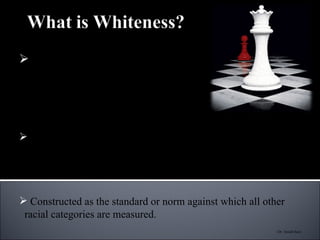
“ An ideology of white dominance that marginalizes and oppresses people of color, ensuring existing privileges for  white people in this country”  (McIntyre, 1997) Meaning lies solely on the hierarchical placement advantage  it conveys Constructed as the standard or norm against which all other racial categories are measured. (Dr. Derald Sue)
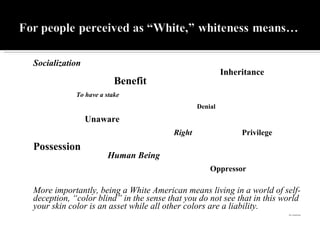
Socialization Inheritance  Benefit To have a stake Denial Unaware Right Privilege Possession   Human Being Oppressor  More importantly, being a White American means living in a world of self-deception, “color blind” in the sense that you do not see that in this world your skin color is an asset while all other colors are a liability. (Dr. Derald Sue)
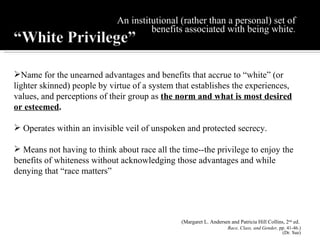
An institutional (rather than a personal) set of benefits associated with being white . Name for the unearned advantages and benefits that accrue to “white” (or lighter skinned) people by virtue of a system that establishes the experiences, values, and perceptions of their group as  the norm and what is most desired or esteemed .  Operates within an invisible veil of unspoken and protected secrecy. Means not having to think about race all the time--the privilege to enjoy the benefits of whiteness without acknowledging those advantages and while denying that “race matters” (Margaret L. Andersen and Patricia Hill Collins, 2 nd  ed.  Race, Class, and Gender,  pp. 41-46.) (Dr. Sue)
 
A societal goal; a concept that symbolizes the effort to deconstruct the meaning of race by highlighting their absence. Denies the existence of racial, ethnic, and cultural barriers in the larger society.  i.e. the seeking to systematically expunge from African-American   students’ cultural   repertoire those aspects of their group identity that might be associated with   their African and African-American   ancestry.
 
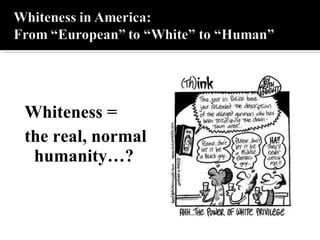
Whiteness =  the real, normal humanity…?
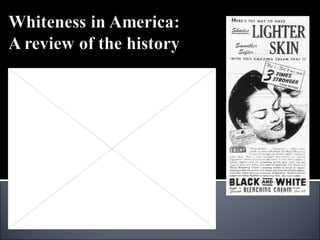
Whiteness, initially constructed as a form of racial identity, evolved into a form of property, historically and presently acknowledged and protected in American law. Following the period of slavery and conquest, whiteness became the basis of racialized privilege Whites as Citizens…Blacks as Others
Slave Codes, enacted from 1680 through 1705 Bacon’s Rebellion U.S. Civil War (1861– 1865) Citizenship  Naturalization Act of 1870  Chinese Exclusion Act of 1882, 1892 (renewed in 1892 and in 1902) Court petitioned citizenship The tyranny of the Jim Crow era in American life (from Reconstruction through the 1960s)
No families for Chinese (1880's – 1914) The Dawes Land Allotment Act (1887) Plessy v. Ferguson (1896) U.S. Supreme Court’s ruling in Brown v. Board of Education (1954) “ Three Strikes You’re Out” in California (1994) The passage of Proposition 209 (1996)
“ White” is a political term  “ White privilege” is a relational term  “ White” was originally a class term A study of the historical origin of the term white suggests that:


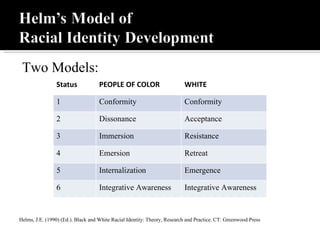
Two Models: Helms, J.E. (1990) (Ed.). Black and White Racial Identity: Theory, Research and Practice. CT: Greenwood Press Status PEOPLE OF COLOR WHITE 1 Conformity Conformity 2 Dissonance Acceptance 3 Immersion Resistance 4 Emersion Retreat 5 Internalization Emergence 6 Integrative Awareness Integrative Awareness
 
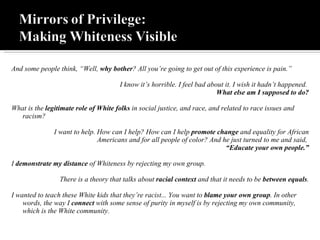
And some people think, “Well,  why bother ? All you’re going to get out of this experience is pain.” I know it’s horrible. I feel bad about it. I wish it hadn’t happened.  What else am I supposed to do? What is the  legitimate role of White folks  in social justice, and race, and related to race issues and racism? I want to help. How can I help? How can I help  promote change  and equality for African Americans and for all people of color? And he just turned to me and said,  “ Educate your own people.” I  demonstrate my distance  of Whiteness by rejecting my own group. There is a theory that talks about  racial context  and that it needs to be  between equals . I wanted to teach these White kids that they’re racist... You want to  blame your own group . In other words, the way I  connect  with some sense of purity in myself is by rejecting my own community, which is the White community.
 
Using the experience of a white person as true for everyone.  “ I’m not followed around in the store by a guard, what makes you think you are?” Reinserting oneself into the conversation if it is felt that it has drifted to focus on a person of color or on an issue of others’ race.  “ I don’t really think the issue is race as much  as it is class.” Kendall, F.2. (2001). Understanding White Privilege
Defining the parameters of “appropriate” conversation and communication. “ I’d like a “safe” space before I’ll feel open to talk about race and racism.”
“ You always focus on race. I remember at two meetings last year…” “ I know we have a way to go, but things have gotten better.”  Kendall, F.2. (2001). Understanding White Privilege
Determine for yourself what issues may be at play without disempowering people of color for having a different point of view.  Kendall, F.2. (2001). Understanding White Privilege Brazaitis, S.J. (2004). White women - Protectors of the Status quo, positioned to disrupt it. In S. Cytrynbaum and D. Noumair, (Eds.), Group Relations Reader 3 (pp. 99-116). Washington, D.C.: A.K. Rice Institute.
Let’s examine the lens which we view interactions with.
 
 
Know that exposing whiteness and white privilege will threaten your power and privilege too.  But… There is an opportunity for a shift to take place.  People of color can be freed of the “diversity expert” role.
Activity: Make a list of 10 things you usually do during the week.
 
What is your social responsibility to understand whiteness and white privilege? What role does leadership play in all of this?

Making Meaning of White Privilege

  • 1.
    © Jacqueline Che,Roxanne Eisermann, Khalia Ii, Jasmine LeFever
  • 2.
    What does itmean to be a Person of Color?
  • 3.
    “ An ideologyof white dominance that marginalizes and oppresses people of color, ensuring existing privileges for white people in this country” (McIntyre, 1997) Meaning lies solely on the hierarchical placement advantage it conveys Constructed as the standard or norm against which all other racial categories are measured. (Dr. Derald Sue)
  • 4.
    Socialization Inheritance Benefit To have a stake Denial Unaware Right Privilege Possession Human Being Oppressor More importantly, being a White American means living in a world of self-deception, “color blind” in the sense that you do not see that in this world your skin color is an asset while all other colors are a liability. (Dr. Derald Sue)
  • 5.
    An institutional (ratherthan a personal) set of benefits associated with being white . Name for the unearned advantages and benefits that accrue to “white” (or lighter skinned) people by virtue of a system that establishes the experiences, values, and perceptions of their group as the norm and what is most desired or esteemed . Operates within an invisible veil of unspoken and protected secrecy. Means not having to think about race all the time--the privilege to enjoy the benefits of whiteness without acknowledging those advantages and while denying that “race matters” (Margaret L. Andersen and Patricia Hill Collins, 2 nd ed. Race, Class, and Gender, pp. 41-46.) (Dr. Sue)
  • 6.
  • 7.
    A societal goal;a concept that symbolizes the effort to deconstruct the meaning of race by highlighting their absence. Denies the existence of racial, ethnic, and cultural barriers in the larger society. i.e. the seeking to systematically expunge from African-American students’ cultural repertoire those aspects of their group identity that might be associated with their African and African-American ancestry.
  • 8.
  • 9.
    Whiteness = the real, normal humanity…?
  • 10.
    Whiteness, initially constructedas a form of racial identity, evolved into a form of property, historically and presently acknowledged and protected in American law. Following the period of slavery and conquest, whiteness became the basis of racialized privilege Whites as Citizens…Blacks as Others
  • 11.
    Slave Codes, enactedfrom 1680 through 1705 Bacon’s Rebellion U.S. Civil War (1861– 1865) Citizenship Naturalization Act of 1870 Chinese Exclusion Act of 1882, 1892 (renewed in 1892 and in 1902) Court petitioned citizenship The tyranny of the Jim Crow era in American life (from Reconstruction through the 1960s)
  • 12.
    No families forChinese (1880's – 1914) The Dawes Land Allotment Act (1887) Plessy v. Ferguson (1896) U.S. Supreme Court’s ruling in Brown v. Board of Education (1954) “ Three Strikes You’re Out” in California (1994) The passage of Proposition 209 (1996)
  • 13.
    “ White” isa political term “ White privilege” is a relational term “ White” was originally a class term A study of the historical origin of the term white suggests that:
  • 14.
  • 15.
  • 16.
  • 17.
    Two Models: Helms,J.E. (1990) (Ed.). Black and White Racial Identity: Theory, Research and Practice. CT: Greenwood Press Status PEOPLE OF COLOR WHITE 1 Conformity Conformity 2 Dissonance Acceptance 3 Immersion Resistance 4 Emersion Retreat 5 Internalization Emergence 6 Integrative Awareness Integrative Awareness
  • 18.
  • 19.
    And some peoplethink, “Well, why bother ? All you’re going to get out of this experience is pain.” I know it’s horrible. I feel bad about it. I wish it hadn’t happened. What else am I supposed to do? What is the legitimate role of White folks in social justice, and race, and related to race issues and racism? I want to help. How can I help? How can I help promote change and equality for African Americans and for all people of color? And he just turned to me and said, “ Educate your own people.” I demonstrate my distance of Whiteness by rejecting my own group. There is a theory that talks about racial context and that it needs to be between equals . I wanted to teach these White kids that they’re racist... You want to blame your own group . In other words, the way I connect with some sense of purity in myself is by rejecting my own community, which is the White community.
  • 20.
  • 21.
    Using the experienceof a white person as true for everyone. “ I’m not followed around in the store by a guard, what makes you think you are?” Reinserting oneself into the conversation if it is felt that it has drifted to focus on a person of color or on an issue of others’ race. “ I don’t really think the issue is race as much as it is class.” Kendall, F.2. (2001). Understanding White Privilege
  • 22.
    Defining the parametersof “appropriate” conversation and communication. “ I’d like a “safe” space before I’ll feel open to talk about race and racism.”
  • 23.
    “ You alwaysfocus on race. I remember at two meetings last year…” “ I know we have a way to go, but things have gotten better.” Kendall, F.2. (2001). Understanding White Privilege
  • 24.
    Determine for yourselfwhat issues may be at play without disempowering people of color for having a different point of view. Kendall, F.2. (2001). Understanding White Privilege Brazaitis, S.J. (2004). White women - Protectors of the Status quo, positioned to disrupt it. In S. Cytrynbaum and D. Noumair, (Eds.), Group Relations Reader 3 (pp. 99-116). Washington, D.C.: A.K. Rice Institute.
  • 25.
    Let’s examine thelens which we view interactions with.
  • 26.
  • 27.
  • 28.
    Know that exposingwhiteness and white privilege will threaten your power and privilege too. But… There is an opportunity for a shift to take place. People of color can be freed of the “diversity expert” role.
  • 29.
    Activity: Make alist of 10 things you usually do during the week.
  • 30.
  • 31.
    What is yoursocial responsibility to understand whiteness and white privilege? What role does leadership play in all of this?

Editor's Notes

  • #22 An element of white privilege is the ability to see white people as normal and all others as different-from-normal. White people express this privilege in many ways, such as: 1)Using the experience of a white person as true for everyone 2) Reinserting oneself into the conversation if we feel it has drifted to focus on a person of color or an issue of other’s race.
  • #23 3) The ability to define the parameters of “appropriate” conversation and communication, keeping white culture, manners, and language central. All of these things are inherently oppressive
  • #24 Asking why people of color always focus on the negative. Comments may be given inflated worth based on an individual’s white privilege. Enormous damage can be done . Connect to the Discharge theory.
  • #25 It’s important that you discern for yourself while not disempowering them for having a different point of view. Consider the dynamics from a complex perspective. This will allow for a richer understanding and a collaboration across race. Don’t feel held hostage to diversity issues for fear of being bad, wrong or criticized.
  • #26 Let’s take a look at some contemporary examples around implications of whiteness and white privilege. And I’ll ask you to self-examine the lens in which you view interactions with..
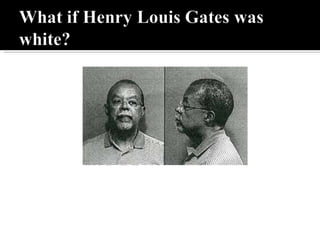
  • #27 We all are familiar with the incident with Dr. Henry Louis Gates being arrested for ‘disorderly conduct’ after the Cambridge arrived from a report of a potential break-in. Take a moment, ask yourself “What if Dr. Gates was white?” Write down ur response
  • #28 In 1997 Morgan Freeman originally offered to pay for an integrated prom at this high school in Mississippi. He received pushback from the local school board and parents. It wasn’t until 2008 until they accepted his offer and even did parent’s still stressed that there be a White prom, and they had one. How do you reconcile an educational system perpetuating racist attitudes toward difference and enforcing this system on a whole town of people. For the most part against many of the students own volition.
  • #29 We must be prepared to do the work, and everyone won’t like you for it. But…. Shift in responsibility: It is a burden to carry these issues, what feels like alone. Diversity work is the work of everyone rather than a person of color’s problem or their sole area of expertise
  • #31 My group and I were particularly inspired by the research Dr.Mosby did with black students in Community Colleges. In his research he spoke of this duality of role that these men were experiencing. I have a poem that I will share with you all today, which speaks exactly to this point. I’d like to preface it by saying that the piece uses the N word. It is done in a very deliberate way to illustrate a very important point. I hope it won’t be a distraction for anyone.
  • #32 We have given you a lot of information tonight. And I’d like for everyone to take a moment, be still and quiet and sit with your thoughts for a moment. Thinking about all of what we have discussed thus far. I ask you now, what is your social responsibility to understand whiteness and white privilege? (LIGHTS WILL BE OFF DURING THIS TIME)