1
DEPARTMENT OF PHARMACEUTCAL SCIENCES,
MAHARSHI DAYANAND UNIVERSITY, ROHTAK(HRY)
Guided By…
Dr. Vikaas Budhwar
Professor of Pharmaceutics
Presented By…
Garima Saini
Roll no. 2606
M.Pharm. (DRA)(SEM-II)
USA
2
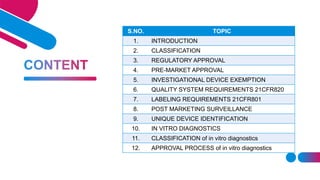
S.NO. TOPIC
1. INTRODUCTION
2. CLASSIFICATION
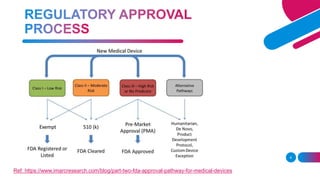
3. REGULATORY APPROVAL
4. PRE-MARKET APPROVAL
5. INVESTIGATIONAL DEVICE EXEMPTION
6. QUALITY SYSTEM REQUIREMENTS 21CFR820
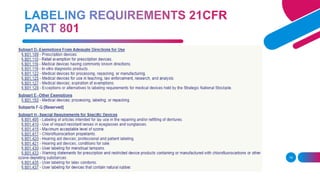
7. LABELING REQUIREMENTS 21CFR801
8. POST MARKETING SURVEILLANCE
9. UNIQUE DEVICE IDENTIFICATION
10. IN VITRO DIAGNOSTICS
11. CLASSIFICATION of in vitro diagnostics
12. APPROVAL PROCESS of in vitro diagnostics
Medical Device Regulations in the USA
• In the USA, medical devices are regulated by the Food and
Drug Administration (FDA) with an aim to ensure safety and
effectiveness of the devices. The Center for Devices and
Radiological Health (CDRH) is an FDA component and looks
after this program.
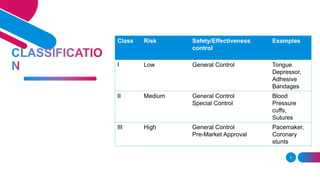
• Medical devices are classified into three categories based on
the associated risk, namely: Class I, II and III
• With respect to that, most of Class I devices are exempted
from 510(k) premarket notification submission, while most of
Class II devices are submitted for premarket notification. On
the other hand, Class III devices need to go through the
Premarket Approval Application (PMA) and other class III
devices, which are exempted from PMA must submit a 510(k)
notification to FDA.
4
5
Class Risk Safety/Effectiveness
control
Examples
I Low General Control Tongue
Depressor,
Adhesive
Bandages
II Medium General Control
Special Control
Blood
Pressure
cuffs,
Sutures
III High General Control
Pre-Market Approval
Pacemaker,
Coronary
stunts
6
Ref: https://www.imarcresearch.com/blog/part-two-fda-approval-pathway-for-medical-devices
7
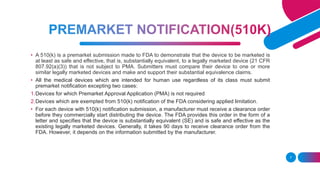
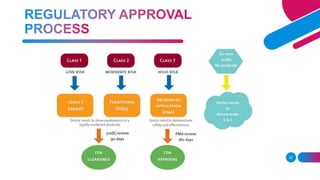
• A 510(k) is a premarket submission made to FDA to demonstrate that the device to be marketed is
at least as safe and effective, that is, substantially equivalent, to a legally marketed device (21 CFR
807.92(a)(3)) that is not subject to PMA. Submitters must compare their device to one or more
similar legally marketed devices and make and support their substantial equivalence claims.
• All the medical devices which are intended for human use regardless of its class must submit
premarket notification excepting two cases:
1.Devices for which Premarket Approval Application (PMA) is not required
2.Devices which are exempted from 510(k) notification of the FDA considering applied limitation.
• For each device with 510(k) notification submission, a manufacturer must receive a clearance order
before they commercially start distributing the device. The FDA provides this order in the form of a
letter and specifies that the device is substantially equivalent (SE) and is safe and effective as the
existing legally marketed devices. Generally, it takes 90 days to receive clearance order from the
FDA. However, it depends on the information submitted by the manufacturer.
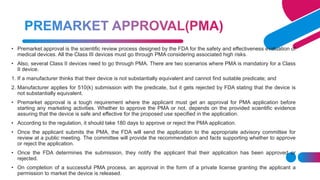
• Premarket approval is the scientific review process designed by the FDA for the safety and effectiveness evaluation of
medical devices. All the Class III devices must go through PMA considering associated high risks.
• Also, several Class II devices need to go through PMA. There are two scenarios where PMA is mandatory for a Class
II device.
1. If a manufacturer thinks that their device is not substantially equivalent and cannot find suitable predicate; and
2. Manufacturer applies for 510(k) submission with the predicate, but it gets rejected by FDA stating that the device is
not substantially equivalent.
• Premarket approval is a tough requirement where the applicant must get an approval for PMA application before
starting any marketing activities. Whether to approve the PMA or not, depends on the provided scientific evidence
assuring that the device is safe and effective for the proposed use specified in the application.
• According to the regulation, it should take 180 days to approve or reject the PMA application.
• Once the applicant submits the PMA, the FDA will send the application to the appropriate advisory committee for
review at a public meeting. The committee will provide the recommendation and facts supporting whether to approve
or reject the application.
• Once the FDA determines the submission, they notify the applicant that their application has been approved or
rejected.
• On completion of a successful PMA process, an approval in the form of a private license granting the applicant a
permission to market the device is released.
9
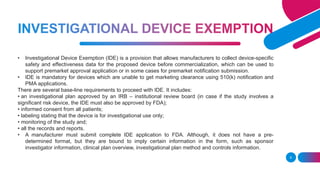
• Investigational Device Exemption (IDE) is a provision that allows manufacturers to collect device-specific
safety and effectiveness data for the proposed device before commercialization, which can be used to
support premarket approval application or in some cases for premarket notification submission.
• IDE is mandatory for devices which are unable to get marketing clearance using 510(k) notification and
PMA applications.
There are several base-line requirements to proceed with IDE. It includes:
• an investigational plan approved by an IRB – institutional review board (in case if the study involves a
significant risk device, the IDE must also be approved by FDA);
• informed consent from all patients;
• labeling stating that the device is for investigational use only;
• monitoring of the study and;
• all the records and reports.
• A manufacturer must submit complete IDE application to FDA. Although, it does not have a pre-
determined format, but they are bound to imply certain information in the form, such as sponsor
investigator information, clinical plan overview, investigational plan method and controls information.
10
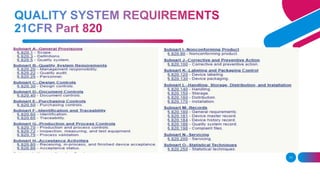
• The quality system specifies the regulatory requirements related to the methods, facilities, and controls used for
the entire medical device lifecycle, including the purchasing, designing, manufacturing, packaging & labeling,
storing, installing and servicing of the devices.
• The FDA mandates to establish and follow quality system requirements for manufacturers to ensure that the
devices meet applicable requirements and specifications consistently.
• FDA published the part 820 revision on October 7, 1996 (61 FR 52602) and put into effect June 1, 1997.
• Considering the multiple types of medical devices, the regulation does not provide “how to’s” for a specific
device, but it, in fact, provides a framework that manufacturers need to follow to comply with the regulation.
• Also, to ensure that all requirements are followed, FDA inspects all manufacturing facilities as well. Every
manufacturer is responsible for establishing the regulatory requirements to make the device safe and effective
regardless of the type of device. This regulation applies to all the finished device manufacturers who intend to
commercially distribute medical devices in the United States. A finished device is any device that is suitable for
use or capable of functioning, whether or not it is labeled, packaged, or sterilized.
11
12
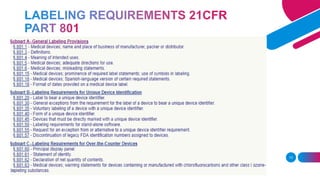
• It is mandatory to apply labels on each device. Labeling contains labels and literature in the form of description
and information that accompanies the device usage.
• This regulation specifies the requirements in the below form:
• General Device Labeling
• Use of Symbols
• In Vitro Diagnostic Products
• Investigational Device Exemptions
• Unique Device Identification
• Good Manufacturing Practices
• General Electronic Products
13
14
15
• Drug and Cosmetic Act, which authorizes the FDA to require post-market surveillance by manufacturers for
some Class II and III devices.
• Under Section 522, the FDA may require post-market surveillance by manufacturers in four cases:
1. For Class II or III devices that may cause serious adverse health consequences if they fail
2. For Class II or III devices with widespread use on pediatric populations
3. For Class II or III devices intended for implantation in humans for more than one year
4. For Class II or III devices intended for life-sustaining or life-saving uses outside of healthcare facilities
• If the FDA determines that post-market surveillance for a particular device is indeed necessary, the device
manufacturer must conduct post-market surveillance for up to 36 months. For pediatric devices, the agency may
require post-market surveillance for more than 36 months without a manufacturer’s agreement if additional time
is deemed necessary to determine how a particular device will impact pediatric patients.
• Once the FDA has issued an order to conduct post-market surveillance, a manufacturer must initiate such
activities no later than 15 months from the date of that order.
16
• Manufacturers that must comply with 522 post-market surveillance requirements must submit significant
amounts of information to the FDA, including background data on their devices; post-market surveillance plans,
objectives and designs; patient populations and sample size calculations; and schedules for interim and final
reports to the regulator.
• Once a manufacturer has submitted its post-market surveillance plan and related information to the FDA, the
agency will evaluate the submission for completeness and whether it addresses the questions raised by the 522
order. The guidance lays out further steps manufacturers may take if the agency deems their proposed post-
market surveillance plans insufficient.
• Interim and final reporting requirements
• Following approval and launch of a post-market surveillance plan, the manufacturer is expected to provide
interim reports every six months during the first two years of its plan, and then on an annual basis in subsequent
years.
• Final reports should be submitted to the FDA within three months of either a concluded post-market surveillance
activity or termination of a 522 order.
17
• The FDA established the unique device identification system to adequately identify medical devices sold in the
United States from manufacturing through distribution to patient use.
• When fully implemented, the label of most devices will include a unique device identifier (UDI) in human- and
machine-readable form, which will ultimately improve patient safety, modernize device postmarket surveillance,
and facilitate medical device innovation.
• The Unique Device Identifier (UDI) is provided to label the medical device with a unique numeric or
alphanumeric code. The UDI information has to be displayed on the device as both human-readable data and
machine-readable data.
18
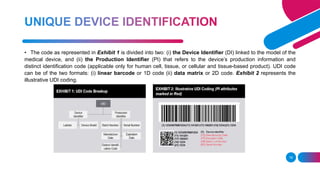
• The code as represented in Exhibit 1 is divided into two: (i) the Device Identifier (DI) linked to the model of the
medical device, and (ii) the Production Identifier (PI) that refers to the device’s production information and
distinct identification code (applicable only for human cell, tissue, or cellular and tissue-based product). UDI code
can be of the two formats: (i) linear barcode or 1D code (ii) data matrix or 2D code. Exhibit 2 represents the
illustrative UDI coding.
19
• In vitro diagnostics are tests done on samples
such as blood or tissue that have been taken from
the human body. In vitro diagnostics can detect
diseases or other conditions, and can be used to
monitor a person’s overall health to help cure,
treat, or prevent diseases.
• In vitro diagnostics may also be used in
precision medicine to identify patients who are
likely to benefit from specific treatments or
therapies. These in vitro diagnostics can include
next generation sequencing tests, which scan a
person’s DNA to detect genomic variations.
• Some tests are used in laboratory or other
health professional settings and other tests are for
consumers to use at home.
20
• An in-vitro diagnostic (IVD) device usually
comprises pathology tests and related
instrumentation used to conduct testing on
human bodily fluids or tissue samples to assist
in clinical diagnosis.
• IVDs are defined under 21 CFR 809 and are
regulated under guidelines similar to medical
devices.
21
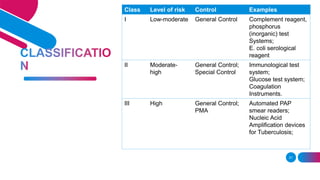
Class Level of risk Control Examples
I Low-moderate General Control Complement reagent,
phosphorus
(inorganic) test
Systems;
E. coli serological
reagent
II Moderate-
high
General Control;
Special Control
Immunological test
system;
Glucose test system;
Coagulation
Instruments.
III High General Control;
PMA
Automated PAP
smear readers;
Nucleic Acid
Amplification devices
for Tuberculosis;
22
23
• https://www.fda.gov/medical-devices
• einfochips.com/blog/an-overview-of-fda-regulations-for-medical-devices/
• https://www.emergobyul.com/blog/2016/05/us-fda-lays-out-final-guidance-post-market-surveillance-requirements
• https://www.ulpurelearning.com/hubfs/eduneeringresources/Resource_Center/MDRS/White%20Papers/Regulat
ory%20Path%20For%20IVD.pdf
THANK YOU

Medical device regulations

  • 1.
    1 DEPARTMENT OF PHARMACEUTCALSCIENCES, MAHARSHI DAYANAND UNIVERSITY, ROHTAK(HRY) Guided By… Dr. Vikaas Budhwar Professor of Pharmaceutics Presented By… Garima Saini Roll no. 2606 M.Pharm. (DRA)(SEM-II)
  • 2.
  • 3.
    S.NO. TOPIC 1. INTRODUCTION 2.CLASSIFICATION 3. REGULATORY APPROVAL 4. PRE-MARKET APPROVAL 5. INVESTIGATIONAL DEVICE EXEMPTION 6. QUALITY SYSTEM REQUIREMENTS 21CFR820 7. LABELING REQUIREMENTS 21CFR801 8. POST MARKETING SURVEILLANCE 9. UNIQUE DEVICE IDENTIFICATION 10. IN VITRO DIAGNOSTICS 11. CLASSIFICATION of in vitro diagnostics 12. APPROVAL PROCESS of in vitro diagnostics
  • 4.
    Medical Device Regulationsin the USA • In the USA, medical devices are regulated by the Food and Drug Administration (FDA) with an aim to ensure safety and effectiveness of the devices. The Center for Devices and Radiological Health (CDRH) is an FDA component and looks after this program. • Medical devices are classified into three categories based on the associated risk, namely: Class I, II and III • With respect to that, most of Class I devices are exempted from 510(k) premarket notification submission, while most of Class II devices are submitted for premarket notification. On the other hand, Class III devices need to go through the Premarket Approval Application (PMA) and other class III devices, which are exempted from PMA must submit a 510(k) notification to FDA. 4
  • 5.
    5 Class Risk Safety/Effectiveness control Examples ILow General Control Tongue Depressor, Adhesive Bandages II Medium General Control Special Control Blood Pressure cuffs, Sutures III High General Control Pre-Market Approval Pacemaker, Coronary stunts
  • 6.
  • 7.
    7 • A 510(k)is a premarket submission made to FDA to demonstrate that the device to be marketed is at least as safe and effective, that is, substantially equivalent, to a legally marketed device (21 CFR 807.92(a)(3)) that is not subject to PMA. Submitters must compare their device to one or more similar legally marketed devices and make and support their substantial equivalence claims. • All the medical devices which are intended for human use regardless of its class must submit premarket notification excepting two cases: 1.Devices for which Premarket Approval Application (PMA) is not required 2.Devices which are exempted from 510(k) notification of the FDA considering applied limitation. • For each device with 510(k) notification submission, a manufacturer must receive a clearance order before they commercially start distributing the device. The FDA provides this order in the form of a letter and specifies that the device is substantially equivalent (SE) and is safe and effective as the existing legally marketed devices. Generally, it takes 90 days to receive clearance order from the FDA. However, it depends on the information submitted by the manufacturer.
  • 8.
    • Premarket approvalis the scientific review process designed by the FDA for the safety and effectiveness evaluation of medical devices. All the Class III devices must go through PMA considering associated high risks. • Also, several Class II devices need to go through PMA. There are two scenarios where PMA is mandatory for a Class II device. 1. If a manufacturer thinks that their device is not substantially equivalent and cannot find suitable predicate; and 2. Manufacturer applies for 510(k) submission with the predicate, but it gets rejected by FDA stating that the device is not substantially equivalent. • Premarket approval is a tough requirement where the applicant must get an approval for PMA application before starting any marketing activities. Whether to approve the PMA or not, depends on the provided scientific evidence assuring that the device is safe and effective for the proposed use specified in the application. • According to the regulation, it should take 180 days to approve or reject the PMA application. • Once the applicant submits the PMA, the FDA will send the application to the appropriate advisory committee for review at a public meeting. The committee will provide the recommendation and facts supporting whether to approve or reject the application. • Once the FDA determines the submission, they notify the applicant that their application has been approved or rejected. • On completion of a successful PMA process, an approval in the form of a private license granting the applicant a permission to market the device is released.
  • 9.
    9 • Investigational DeviceExemption (IDE) is a provision that allows manufacturers to collect device-specific safety and effectiveness data for the proposed device before commercialization, which can be used to support premarket approval application or in some cases for premarket notification submission. • IDE is mandatory for devices which are unable to get marketing clearance using 510(k) notification and PMA applications. There are several base-line requirements to proceed with IDE. It includes: • an investigational plan approved by an IRB – institutional review board (in case if the study involves a significant risk device, the IDE must also be approved by FDA); • informed consent from all patients; • labeling stating that the device is for investigational use only; • monitoring of the study and; • all the records and reports. • A manufacturer must submit complete IDE application to FDA. Although, it does not have a pre- determined format, but they are bound to imply certain information in the form, such as sponsor investigator information, clinical plan overview, investigational plan method and controls information.
  • 10.
    10 • The qualitysystem specifies the regulatory requirements related to the methods, facilities, and controls used for the entire medical device lifecycle, including the purchasing, designing, manufacturing, packaging & labeling, storing, installing and servicing of the devices. • The FDA mandates to establish and follow quality system requirements for manufacturers to ensure that the devices meet applicable requirements and specifications consistently. • FDA published the part 820 revision on October 7, 1996 (61 FR 52602) and put into effect June 1, 1997. • Considering the multiple types of medical devices, the regulation does not provide “how to’s” for a specific device, but it, in fact, provides a framework that manufacturers need to follow to comply with the regulation. • Also, to ensure that all requirements are followed, FDA inspects all manufacturing facilities as well. Every manufacturer is responsible for establishing the regulatory requirements to make the device safe and effective regardless of the type of device. This regulation applies to all the finished device manufacturers who intend to commercially distribute medical devices in the United States. A finished device is any device that is suitable for use or capable of functioning, whether or not it is labeled, packaged, or sterilized.
  • 11.
  • 12.
    12 • It ismandatory to apply labels on each device. Labeling contains labels and literature in the form of description and information that accompanies the device usage. • This regulation specifies the requirements in the below form: • General Device Labeling • Use of Symbols • In Vitro Diagnostic Products • Investigational Device Exemptions • Unique Device Identification • Good Manufacturing Practices • General Electronic Products
  • 13.
  • 14.
  • 15.
    15 • Drug andCosmetic Act, which authorizes the FDA to require post-market surveillance by manufacturers for some Class II and III devices. • Under Section 522, the FDA may require post-market surveillance by manufacturers in four cases: 1. For Class II or III devices that may cause serious adverse health consequences if they fail 2. For Class II or III devices with widespread use on pediatric populations 3. For Class II or III devices intended for implantation in humans for more than one year 4. For Class II or III devices intended for life-sustaining or life-saving uses outside of healthcare facilities • If the FDA determines that post-market surveillance for a particular device is indeed necessary, the device manufacturer must conduct post-market surveillance for up to 36 months. For pediatric devices, the agency may require post-market surveillance for more than 36 months without a manufacturer’s agreement if additional time is deemed necessary to determine how a particular device will impact pediatric patients. • Once the FDA has issued an order to conduct post-market surveillance, a manufacturer must initiate such activities no later than 15 months from the date of that order.
  • 16.
    16 • Manufacturers thatmust comply with 522 post-market surveillance requirements must submit significant amounts of information to the FDA, including background data on their devices; post-market surveillance plans, objectives and designs; patient populations and sample size calculations; and schedules for interim and final reports to the regulator. • Once a manufacturer has submitted its post-market surveillance plan and related information to the FDA, the agency will evaluate the submission for completeness and whether it addresses the questions raised by the 522 order. The guidance lays out further steps manufacturers may take if the agency deems their proposed post- market surveillance plans insufficient. • Interim and final reporting requirements • Following approval and launch of a post-market surveillance plan, the manufacturer is expected to provide interim reports every six months during the first two years of its plan, and then on an annual basis in subsequent years. • Final reports should be submitted to the FDA within three months of either a concluded post-market surveillance activity or termination of a 522 order.
  • 17.
    17 • The FDAestablished the unique device identification system to adequately identify medical devices sold in the United States from manufacturing through distribution to patient use. • When fully implemented, the label of most devices will include a unique device identifier (UDI) in human- and machine-readable form, which will ultimately improve patient safety, modernize device postmarket surveillance, and facilitate medical device innovation. • The Unique Device Identifier (UDI) is provided to label the medical device with a unique numeric or alphanumeric code. The UDI information has to be displayed on the device as both human-readable data and machine-readable data.
  • 18.
    18 • The codeas represented in Exhibit 1 is divided into two: (i) the Device Identifier (DI) linked to the model of the medical device, and (ii) the Production Identifier (PI) that refers to the device’s production information and distinct identification code (applicable only for human cell, tissue, or cellular and tissue-based product). UDI code can be of the two formats: (i) linear barcode or 1D code (ii) data matrix or 2D code. Exhibit 2 represents the illustrative UDI coding.
  • 19.
    19 • In vitrodiagnostics are tests done on samples such as blood or tissue that have been taken from the human body. In vitro diagnostics can detect diseases or other conditions, and can be used to monitor a person’s overall health to help cure, treat, or prevent diseases. • In vitro diagnostics may also be used in precision medicine to identify patients who are likely to benefit from specific treatments or therapies. These in vitro diagnostics can include next generation sequencing tests, which scan a person’s DNA to detect genomic variations. • Some tests are used in laboratory or other health professional settings and other tests are for consumers to use at home.
  • 20.
    20 • An in-vitrodiagnostic (IVD) device usually comprises pathology tests and related instrumentation used to conduct testing on human bodily fluids or tissue samples to assist in clinical diagnosis. • IVDs are defined under 21 CFR 809 and are regulated under guidelines similar to medical devices.
  • 21.
    21 Class Level ofrisk Control Examples I Low-moderate General Control Complement reagent, phosphorus (inorganic) test Systems; E. coli serological reagent II Moderate- high General Control; Special Control Immunological test system; Glucose test system; Coagulation Instruments. III High General Control; PMA Automated PAP smear readers; Nucleic Acid Amplification devices for Tuberculosis;
  • 22.
  • 23.
    23 • https://www.fda.gov/medical-devices • einfochips.com/blog/an-overview-of-fda-regulations-for-medical-devices/ •https://www.emergobyul.com/blog/2016/05/us-fda-lays-out-final-guidance-post-market-surveillance-requirements • https://www.ulpurelearning.com/hubfs/eduneeringresources/Resource_Center/MDRS/White%20Papers/Regulat ory%20Path%20For%20IVD.pdf
  • 24.