MONOSACCHARIDES
18/01/2020 M.ADEEL AKRAM 1
Presented by:
Adeel Akram
Iqra Saeed
Saqiba Koukab
Masood Ahmad
Carbohydrates
• Carbohydrates are polyhydroxy aldehydes or ketones, or substances that yield such compounds
on hydrolysis.
• Carbohydrates are the most abundant biomolecules on Earth.
• Many, but not all, carbohydrates have the empirical formula (CH₂O)n.
• some also contain nitrogen, phosphorus, or sulphur.
• oxidation of carbohydrates is the central energy-yielding pathway in most non-photosynthetic cells.
• Carbohydrate polymers (also called glycan's) serve as structural and protective elements in
the cell walls of bacteria and plants and in the connective tissues of animals e.g.(Chitin, Cellulose)
18/01/2020 2M.ADEEL AKRAM
18/01/2020 3
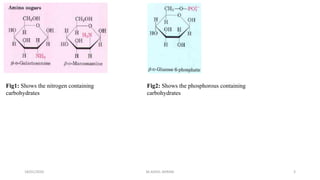
Fig1: Shows the nitrogen containing
carbohydrates
Fig2: Shows the phosphorous containing
carbohydrates
M.ADEEL AKRAM
• carbohydrate polymers lubricate skeletal joints and participate in recognition and adhesion between
cells.
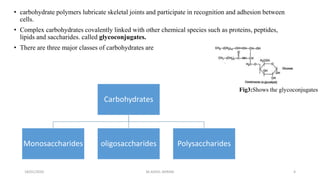
• Complex carbohydrates covalently linked with other chemical species such as proteins, peptides,
lipids and saccharides. called glycoconjugates.
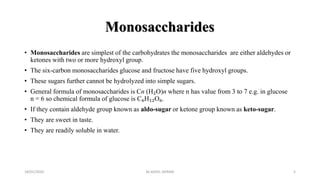
• There are three major classes of carbohydrates are
18/01/2020 4
Carbohydrates
Monosaccharides oligosaccharides Polysaccharides
Fig3:Shows the glycoconjugates
M.ADEEL AKRAM
Monosaccharides
• Monosaccharides are simplest of the carbohydrates the monosaccharides are either aldehydes or
ketones with two or more hydroxyl group.
• The six-carbon monosaccharides glucose and fructose have five hydroxyl groups.
• These sugars further cannot be hydrolyzed into simple sugars.
• General formula of monosaccharides is Cn (H₂O)n where n has value from 3 to 7 e.g. in glucose
n = 6 so chemical formula of glucose is C₆H₁₂O₆.
• If they contain aldehyde group known as aldo-sugar or ketone group known as keto-sugar.
• They are sweet in taste.
• They are readily soluble in water.
18/01/2020 5M.ADEEL AKRAM
Monosaccharides Are Aldoses and Ketoses
18/01/2020 6
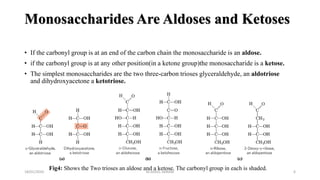
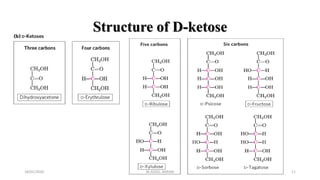
• If the carbonyl group is at an end of the carbon chain the monosaccharide is an aldose.
• if the carbonyl group is at any other position(in a ketone group)the monosaccharide is a ketose.
• The simplest monosaccharides are the two three-carbon trioses glyceraldehyde, an aldotriose
and dihydroxyacetone a ketotriose.
Fig4: Shows the Two trioses an aldose and a ketose. The carbonyl group in each is shaded.M.ADEEL AKRAM
Monosaccharides have asymmetric centers
• All the monosaccharides accept dihydroxyacetone contain one or more asymmetrical chiral carbon.
• So they are optically active isomeric form.
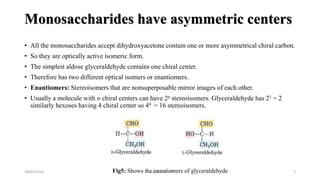
• The simplest aldose glyceraldehyde contains one chiral center.
• Therefore has two different optical isomers or enantiomers.
• Enantiomers: Stereoisomers that are nonsuperposable mirror images of each other.
• Usually a molecule with n chiral centers can have 2n stereoisomers. Glyceraldehyde has 21 = 2
similarly hexoses having 4 chiral center so 44 = 16 stereoisomers.
18/01/2020 7Fig5: Shows the enantiomers of glyceraldehydeM.ADEEL AKRAM
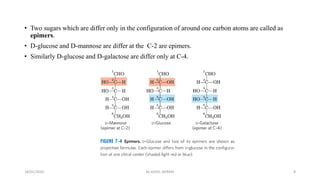
• Two sugars which are differ only in the configuration of around one carbon atoms are called as
epimers.
• D-glucose and D-mannose are differ at the C-2 are epimers.
• Similarly D-glucose and D-galactose are differ only at C-4.
18/01/2020 8M.ADEEL AKRAM
D&L Stereoisomers
• All of the monosaccharides except dihydroxyacetone contain one or more asymmetric
(chiral) carbon atoms.
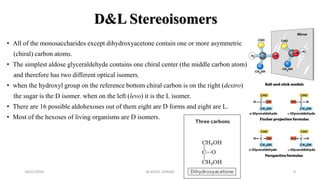
• The simplest aldose glyceraldehyde contains one chiral center (the middle carbon atom)
and therefore has two different optical isomers.
• when the hydroxyl group on the reference bottom chiral carbon is on the right (dextro)
the sugar is the D isomer. when on the left (levo) it is the L isomer.
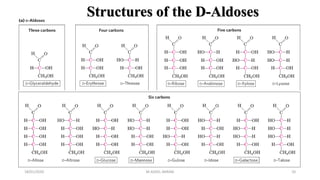
• There are 16 possible aldohexoses out of them eight are D forms and eight are L.
• Most of the hexoses of living organisms are D isomers.
18/01/2020 9M.ADEEL AKRAM
Structures of the D-Aldoses
18/01/2020 10M.ADEEL AKRAM
Structure of D-ketose
18/01/2020 11M.ADEEL AKRAM
Formation of Hemiacetals and Hemiketals
• Aldotetroses and all monosaccharides with five or more carbon atoms occur predominantly as
cyclic ring structures in which the carbonyl group has formed a covalent bond with the oxygen of a
hydroxyl group along the chain.
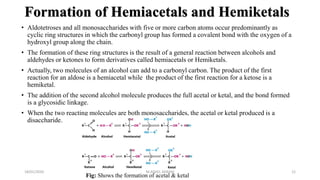
• The formation of these ring structures is the result of a general reaction between alcohols and
aldehydes or ketones to form derivatives called hemiacetals or Hemiketals.
• Actually, two molecules of an alcohol can add to a carbonyl carbon. The product of the first
reaction for an aldose is a hemiacetal while the product of the first reaction for a ketose is a
hemiketal.
• The addition of the second alcohol molecule produces the full acetal or ketal, and the bond formed
is a glycosidic linkage.
• When the two reacting molecules are both monosaccharides, the acetal or ketal produced is a
disaccharide.
18/01/2020 12
Fig: Shows the formation of acetal & ketal
M.ADEEL AKRAM
Cyclization of D-Glucose
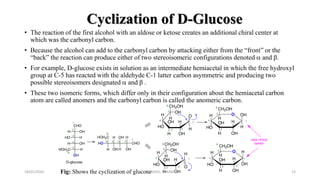
• The reaction of the first alcohol with an aldose or ketose creates an additional chiral center at
which was the carbonyl carbon.
• Because the alcohol can add to the carbonyl carbon by attacking either from the “front” or the
“back” the reaction can produce either of two stereoisomeric configurations denoted  and β.
• For example, D-glucose exists in solution as an intermediate hemiacetal in which the free hydroxyl
group at C-5 has reacted with the aldehyde C-1 latter carbon asymmetric and producing two
possible stereoisomers designated  and β .
• These two isomeric forms, which differ only in their configuration about the hemiacetal carbon
atom are called anomers and the carbonyl carbon is called the anomeric carbon.
18/01/2020 13Fig: Shows the cyclization of glucoseM.ADEEL AKRAM
Pyranoses and Furanoses
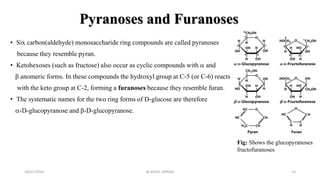
• Six carbon(aldehyde) monosaccharide ring compounds are called pyranoses
because they resemble pyran.
• Ketohexoses (such as fructose) also occur as cyclic compounds with  and
β anomeric forms. In these compounds the hydroxyl group at C-5 (or C-6) reacts
with the keto group at C-2, forming a furanoses because they resemble furan.
• The systematic names for the two ring forms of D-glucose are therefore
-D-glucopyranose and β-D-glucopyranose.
18/01/2020. 14
Fig: Shows the glucopyranoses
fructofuranoses
M.ADEEL AKRAM
Reducing and non-reducing sugar
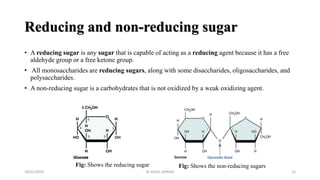
• A reducing sugar is any sugar that is capable of acting as a reducing agent because it has a free
aldehyde group or a free ketone group.
• All monosaccharides are reducing sugars, along with some disaccharides, oligosaccharides, and
polysaccharides.
• A non-reducing sugar is a carbohydrates that is not oxidized by a weak oxidizing agent.
18/01/2020 15
Fig: Shows the reducing sugar Fig: Shows the non-reducing sugars
M.ADEEL AKRAM
Fisher and Howarth projection
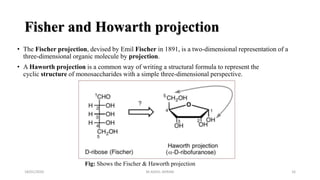
• The Fischer projection, devised by Emil Fischer in 1891, is a two-dimensional representation of a
three-dimensional organic molecule by projection.
• A Haworth projection is a common way of writing a structural formula to represent the
cyclic structure of monosaccharides with a simple three-dimensional perspective.
18/01/2020 16
Fig: Shows the Fischer & Haworth projection
M.ADEEL AKRAM
Mutarotation
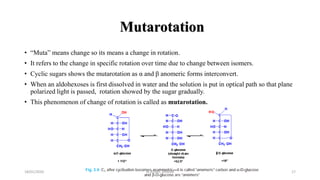
• “Muta” means change so its means a change in rotation.
• It refers to the change in specific rotation over time due to change between isomers.
• Cyclic sugars shows the mutarotation as α and β anomeric forms interconvert.
• When an aldohexoses is first dissolved in water and the solution is put in optical path so that plane
polarized light is passed, rotation showed by the sugar gradually.
• This phenomenon of change of rotation is called as mutarotation.
18/01/2020 17M.ADEEL AKRAM
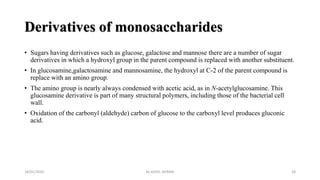
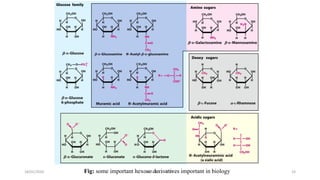
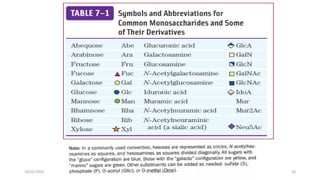
Derivatives of monosaccharides
• Sugars having derivatives such as glucose, galactose and mannose there are a number of sugar
derivatives in which a hydroxyl group in the parent compound is replaced with another substituent.
• In glucosamine,galactosamine and mannosamine, the hydroxyl at C-2 of the parent compound is
replace with an amino group.
• The amino group is nearly always condensed with acetic acid, as in N-acetylglucosamine. This
glucosamine derivative is part of many structural polymers, including those of the bacterial cell
wall.
• Oxidation of the carbonyl (aldehyde) carbon of glucose to the carboxyl level produces gluconic
acid.
18/01/2020 18M.ADEEL AKRAM
18/01/2020 19Fig: some important hexose derivatives important in biologyM.ADEEL AKRAM
18/01/2020 20M.ADEEL AKRAM
Importance of monosaccharides
• The hexoses glucose, galactose and fructose are important monosaccharides.
• Glucose is the most prevalent monosaccharide in diet.
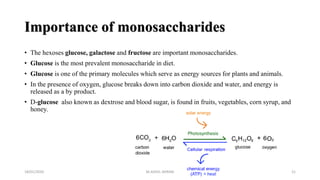
• Glucose is one of the primary molecules which serve as energy sources for plants and animals.
• In the presence of oxygen, glucose breaks down into carbon dioxide and water, and energy is
released as a by product.
• D-glucose also known as dextrose and blood sugar, is found in fruits, vegetables, corn syrup, and
honey.
18/01/2020 21M.ADEEL AKRAM
• D-mannose is used to treat a rare disease(CDGS) called carbohydrate-deficient glycoprotein
syndrome type 1b.
• After the age of 15 the disease was mainly characterised by neurological symptoms consisting of
non-progressive ataxia & mental retardation.
• It may also reduce low blood sugar in people with this disease.
• D-mannose may also treat or prevent urinary tract infections (UTIs).
• The typical dose of D-mannose for UTI treatment is 500 mg, in capsule or powder form, taken in
a glass of water or juice every two to three hours for five days.
18/01/2020 22M.ADEEL AKRAM

Carbohydrates

  • 1.
    MONOSACCHARIDES 18/01/2020 M.ADEEL AKRAM1 Presented by: Adeel Akram Iqra Saeed Saqiba Koukab Masood Ahmad
  • 2.
    Carbohydrates • Carbohydrates arepolyhydroxy aldehydes or ketones, or substances that yield such compounds on hydrolysis. • Carbohydrates are the most abundant biomolecules on Earth. • Many, but not all, carbohydrates have the empirical formula (CH₂O)n. • some also contain nitrogen, phosphorus, or sulphur. • oxidation of carbohydrates is the central energy-yielding pathway in most non-photosynthetic cells. • Carbohydrate polymers (also called glycan's) serve as structural and protective elements in the cell walls of bacteria and plants and in the connective tissues of animals e.g.(Chitin, Cellulose) 18/01/2020 2M.ADEEL AKRAM
  • 3.
    18/01/2020 3 Fig1: Showsthe nitrogen containing carbohydrates Fig2: Shows the phosphorous containing carbohydrates M.ADEEL AKRAM
  • 4.
    • carbohydrate polymerslubricate skeletal joints and participate in recognition and adhesion between cells. • Complex carbohydrates covalently linked with other chemical species such as proteins, peptides, lipids and saccharides. called glycoconjugates. • There are three major classes of carbohydrates are 18/01/2020 4 Carbohydrates Monosaccharides oligosaccharides Polysaccharides Fig3:Shows the glycoconjugates M.ADEEL AKRAM
  • 5.
    Monosaccharides • Monosaccharides aresimplest of the carbohydrates the monosaccharides are either aldehydes or ketones with two or more hydroxyl group. • The six-carbon monosaccharides glucose and fructose have five hydroxyl groups. • These sugars further cannot be hydrolyzed into simple sugars. • General formula of monosaccharides is Cn (H₂O)n where n has value from 3 to 7 e.g. in glucose n = 6 so chemical formula of glucose is C₆H₁₂O₆. • If they contain aldehyde group known as aldo-sugar or ketone group known as keto-sugar. • They are sweet in taste. • They are readily soluble in water. 18/01/2020 5M.ADEEL AKRAM
  • 6.
    Monosaccharides Are Aldosesand Ketoses 18/01/2020 6 • If the carbonyl group is at an end of the carbon chain the monosaccharide is an aldose. • if the carbonyl group is at any other position(in a ketone group)the monosaccharide is a ketose. • The simplest monosaccharides are the two three-carbon trioses glyceraldehyde, an aldotriose and dihydroxyacetone a ketotriose. Fig4: Shows the Two trioses an aldose and a ketose. The carbonyl group in each is shaded.M.ADEEL AKRAM
  • 7.
    Monosaccharides have asymmetriccenters • All the monosaccharides accept dihydroxyacetone contain one or more asymmetrical chiral carbon. • So they are optically active isomeric form. • The simplest aldose glyceraldehyde contains one chiral center. • Therefore has two different optical isomers or enantiomers. • Enantiomers: Stereoisomers that are nonsuperposable mirror images of each other. • Usually a molecule with n chiral centers can have 2n stereoisomers. Glyceraldehyde has 21 = 2 similarly hexoses having 4 chiral center so 44 = 16 stereoisomers. 18/01/2020 7Fig5: Shows the enantiomers of glyceraldehydeM.ADEEL AKRAM
  • 8.
    • Two sugarswhich are differ only in the configuration of around one carbon atoms are called as epimers. • D-glucose and D-mannose are differ at the C-2 are epimers. • Similarly D-glucose and D-galactose are differ only at C-4. 18/01/2020 8M.ADEEL AKRAM
  • 9.
    D&L Stereoisomers • Allof the monosaccharides except dihydroxyacetone contain one or more asymmetric (chiral) carbon atoms. • The simplest aldose glyceraldehyde contains one chiral center (the middle carbon atom) and therefore has two different optical isomers. • when the hydroxyl group on the reference bottom chiral carbon is on the right (dextro) the sugar is the D isomer. when on the left (levo) it is the L isomer. • There are 16 possible aldohexoses out of them eight are D forms and eight are L. • Most of the hexoses of living organisms are D isomers. 18/01/2020 9M.ADEEL AKRAM
  • 10.
    Structures of theD-Aldoses 18/01/2020 10M.ADEEL AKRAM
  • 11.
  • 12.
    Formation of Hemiacetalsand Hemiketals • Aldotetroses and all monosaccharides with five or more carbon atoms occur predominantly as cyclic ring structures in which the carbonyl group has formed a covalent bond with the oxygen of a hydroxyl group along the chain. • The formation of these ring structures is the result of a general reaction between alcohols and aldehydes or ketones to form derivatives called hemiacetals or Hemiketals. • Actually, two molecules of an alcohol can add to a carbonyl carbon. The product of the first reaction for an aldose is a hemiacetal while the product of the first reaction for a ketose is a hemiketal. • The addition of the second alcohol molecule produces the full acetal or ketal, and the bond formed is a glycosidic linkage. • When the two reacting molecules are both monosaccharides, the acetal or ketal produced is a disaccharide. 18/01/2020 12 Fig: Shows the formation of acetal & ketal M.ADEEL AKRAM
  • 13.
    Cyclization of D-Glucose •The reaction of the first alcohol with an aldose or ketose creates an additional chiral center at which was the carbonyl carbon. • Because the alcohol can add to the carbonyl carbon by attacking either from the “front” or the “back” the reaction can produce either of two stereoisomeric configurations denoted  and β. • For example, D-glucose exists in solution as an intermediate hemiacetal in which the free hydroxyl group at C-5 has reacted with the aldehyde C-1 latter carbon asymmetric and producing two possible stereoisomers designated  and β . • These two isomeric forms, which differ only in their configuration about the hemiacetal carbon atom are called anomers and the carbonyl carbon is called the anomeric carbon. 18/01/2020 13Fig: Shows the cyclization of glucoseM.ADEEL AKRAM
  • 14.
    Pyranoses and Furanoses •Six carbon(aldehyde) monosaccharide ring compounds are called pyranoses because they resemble pyran. • Ketohexoses (such as fructose) also occur as cyclic compounds with  and β anomeric forms. In these compounds the hydroxyl group at C-5 (or C-6) reacts with the keto group at C-2, forming a furanoses because they resemble furan. • The systematic names for the two ring forms of D-glucose are therefore -D-glucopyranose and β-D-glucopyranose. 18/01/2020. 14 Fig: Shows the glucopyranoses fructofuranoses M.ADEEL AKRAM
  • 15.
    Reducing and non-reducingsugar • A reducing sugar is any sugar that is capable of acting as a reducing agent because it has a free aldehyde group or a free ketone group. • All monosaccharides are reducing sugars, along with some disaccharides, oligosaccharides, and polysaccharides. • A non-reducing sugar is a carbohydrates that is not oxidized by a weak oxidizing agent. 18/01/2020 15 Fig: Shows the reducing sugar Fig: Shows the non-reducing sugars M.ADEEL AKRAM
  • 16.
    Fisher and Howarthprojection • The Fischer projection, devised by Emil Fischer in 1891, is a two-dimensional representation of a three-dimensional organic molecule by projection. • A Haworth projection is a common way of writing a structural formula to represent the cyclic structure of monosaccharides with a simple three-dimensional perspective. 18/01/2020 16 Fig: Shows the Fischer & Haworth projection M.ADEEL AKRAM
  • 17.
    Mutarotation • “Muta” meanschange so its means a change in rotation. • It refers to the change in specific rotation over time due to change between isomers. • Cyclic sugars shows the mutarotation as α and β anomeric forms interconvert. • When an aldohexoses is first dissolved in water and the solution is put in optical path so that plane polarized light is passed, rotation showed by the sugar gradually. • This phenomenon of change of rotation is called as mutarotation. 18/01/2020 17M.ADEEL AKRAM
  • 18.
    Derivatives of monosaccharides •Sugars having derivatives such as glucose, galactose and mannose there are a number of sugar derivatives in which a hydroxyl group in the parent compound is replaced with another substituent. • In glucosamine,galactosamine and mannosamine, the hydroxyl at C-2 of the parent compound is replace with an amino group. • The amino group is nearly always condensed with acetic acid, as in N-acetylglucosamine. This glucosamine derivative is part of many structural polymers, including those of the bacterial cell wall. • Oxidation of the carbonyl (aldehyde) carbon of glucose to the carboxyl level produces gluconic acid. 18/01/2020 18M.ADEEL AKRAM
  • 19.
    18/01/2020 19Fig: someimportant hexose derivatives important in biologyM.ADEEL AKRAM
  • 20.
  • 21.
    Importance of monosaccharides •The hexoses glucose, galactose and fructose are important monosaccharides. • Glucose is the most prevalent monosaccharide in diet. • Glucose is one of the primary molecules which serve as energy sources for plants and animals. • In the presence of oxygen, glucose breaks down into carbon dioxide and water, and energy is released as a by product. • D-glucose also known as dextrose and blood sugar, is found in fruits, vegetables, corn syrup, and honey. 18/01/2020 21M.ADEEL AKRAM
  • 22.
    • D-mannose isused to treat a rare disease(CDGS) called carbohydrate-deficient glycoprotein syndrome type 1b. • After the age of 15 the disease was mainly characterised by neurological symptoms consisting of non-progressive ataxia & mental retardation. • It may also reduce low blood sugar in people with this disease. • D-mannose may also treat or prevent urinary tract infections (UTIs). • The typical dose of D-mannose for UTI treatment is 500 mg, in capsule or powder form, taken in a glass of water or juice every two to three hours for five days. 18/01/2020 22M.ADEEL AKRAM