Case Study Idea Bounty & Peperami, Unilever Nic Ray Managing Director, Quirk Noam Buchalter Marketing Manager Peperami, Unilever
 
Creative Crowdsourcing (or how to disrupt the traditional agency model and  have some fun at the same time) Nic Ray and Noam Buchalter   26.10.09
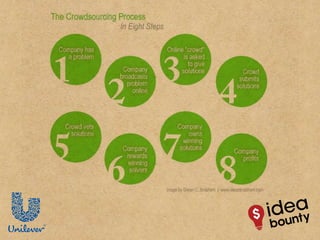
“ Crowdsourcing is a distributed problem-solving and production model. Problems are broadcast to an unknown group of solvers in the form of an open call for solutions. Users - also known as the Crowd - typically form into online communities, and the crowd submits solutions” source: Wikipedia
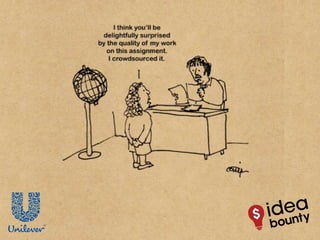
"Crowdsourcing is the process by which the power of the many can be leveraged to accomplish feats that were once the province of a specialized few." Jeff Howe What is crowdsourcing?
The wisdom of crowds – not an entirely new idea… In the 19th century the first Oxford English Dictionary was crowd sourced
With technology, the crowd is:  Larger Better connected Able to contribute in many ways based on a range of skill levels
 
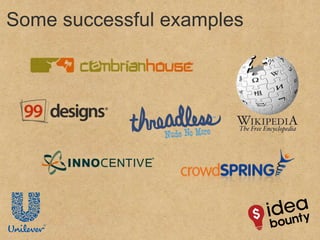
Some successful examples
General benefits The organisation can tap a wider range of talent Problems can be explored at comparatively little cost, and often very quickly. Payment is by results  By listening to the crowd, organisations gain first-hand insight on customer desires. The community may feel a brand-building kinship with the crowdsourcing organisation, which is result of an earned sense of ownership through contribution and collaboration.
Creative Crowdsourcing “ Using the principles of crowdsourcing and the power of the internet to generate innovative marketing or advertising ideas.”
Shaking up the industry A challenge to the traditional agency model Thousands of creatives (from diverse backgrounds) vs. two Significantly lower cost and risk Faster turnaround Insights and consumer engagement PR exposure Exposure / awareness to a early adopting,  networked community
Challenges  Intellectual property protection (client and creative) Choosing the right idea (from hundreds) How to produce the idea Managing community expectations Traditional agency ‘sour grapes’
Creative crowdsourcing is not right for every brief!
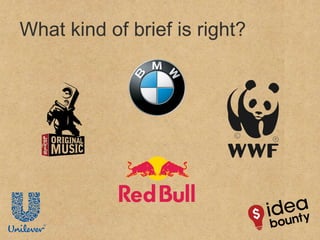
What kind of brief is right?
The Peperami story –  a client’s perspective
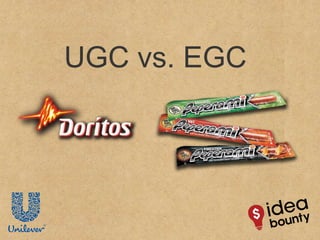
UGC vs. EGC
Next steps… Idea selection Idea production

Media140 London Idea Bounty

  • 1.
    Case Study IdeaBounty & Peperami, Unilever Nic Ray Managing Director, Quirk Noam Buchalter Marketing Manager Peperami, Unilever
  • 2.
  • 3.
    Creative Crowdsourcing (orhow to disrupt the traditional agency model and have some fun at the same time) Nic Ray and Noam Buchalter 26.10.09
  • 4.
    “ Crowdsourcing isa distributed problem-solving and production model. Problems are broadcast to an unknown group of solvers in the form of an open call for solutions. Users - also known as the Crowd - typically form into online communities, and the crowd submits solutions” source: Wikipedia
  • 5.
    "Crowdsourcing is theprocess by which the power of the many can be leveraged to accomplish feats that were once the province of a specialized few." Jeff Howe What is crowdsourcing?
  • 6.
    The wisdom ofcrowds – not an entirely new idea… In the 19th century the first Oxford English Dictionary was crowd sourced
  • 7.
    With technology, thecrowd is: Larger Better connected Able to contribute in many ways based on a range of skill levels
  • 8.
  • 9.
  • 10.
    General benefits Theorganisation can tap a wider range of talent Problems can be explored at comparatively little cost, and often very quickly. Payment is by results By listening to the crowd, organisations gain first-hand insight on customer desires. The community may feel a brand-building kinship with the crowdsourcing organisation, which is result of an earned sense of ownership through contribution and collaboration.
  • 11.
    Creative Crowdsourcing “Using the principles of crowdsourcing and the power of the internet to generate innovative marketing or advertising ideas.”
  • 12.
    Shaking up theindustry A challenge to the traditional agency model Thousands of creatives (from diverse backgrounds) vs. two Significantly lower cost and risk Faster turnaround Insights and consumer engagement PR exposure Exposure / awareness to a early adopting, networked community
  • 13.
    Challenges Intellectualproperty protection (client and creative) Choosing the right idea (from hundreds) How to produce the idea Managing community expectations Traditional agency ‘sour grapes’
  • 14.
    Creative crowdsourcing isnot right for every brief!
  • 15.
    What kind ofbrief is right?
  • 16.
    The Peperami story– a client’s perspective
  • 17.
  • 18.
    Next steps… Ideaselection Idea production

Editor's Notes

  • #2 Speaker Slide
  • #5 Lose this slide – keep the jeff howe one
  • #11 Final two points are more relevant for UGC competitions.
  • #13 Engaging other types of risk – see point 2.
  • #14 Puts a lot more pressure on end outcome due to exposure up front
  • #15 Not for: Briefs that are confidential Briefs where competitors can get insight into your strategy Briefs where expert knowledge of the category / product is needed Briefs where the brand is new or not well established / understood. Where the overall strategic challenge is new. Briefs that benefit from F2F interaction and debate between client and creative (eg. pack design)
  • #17 Why UL chose to engage in CS – intro to Chrysalis and Noam Why Peperami as the brand Creative spark needed - wider range and volume of inputs. Creative Quality is NB Clear definition of campaign and very well understood creative mechanic / brand Value for money.
  • #18 Explain the difference between user generated competitions (eg Doritos or Walkers) and what UL are doing through IB EGC = Expert Generated Content Not a stunt – focus is on speaking to experts and producing a product (ad) of a similar or better quality to what would have been done by a traditional agency. With UGC competitions, majority of focus is on buzz generation and media spend is on the competition itself. EGC is sustainable and can execute complex briefs or briefs looking to communicate RTB Talk about recruitment process – looking for experts Giving clear templates in brief to manage response – TV script and print layout examples
  • #19 Explain how we are choosing an idea – filter and then workshop with experts Note on selection process: Initial filtering done by a panel of experts, using a considered process (scorecard with rating scale). Process also has safety checks to make sure judges score consistently. Final 20 ideas going into workshop at UL with client, production, CD and judging panel present. Day long workshop with different exercises used to establish the best idea. Explain how UL are going to produce the idea via Smart Works. Suggest emphasising that production can also be done more efficiently if it is ‘decoupled’ from traditional agency production.