MEDIA KEY TERMS
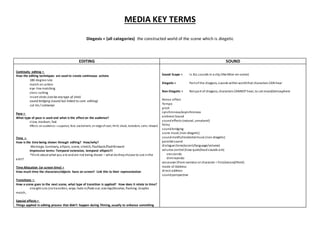
Diegesis = (all categories) the constructed world of the scene which is diegetic
EDITING SOUND
Continuity editing =
How the editing techniques are used to create continuous actions
180 degree rule
match on action
eye-line matching
cross cutting
insert shots (can be anytype of shot)
sound bridging (sound but linked to cont. editing)
cut ins / cutaways
Pace =
What type of pace is used and what is the effect on the audience?
slow, medium, fast
Effects on audience=suspense, fear, excitement, on edgeofseat, thrill, shock, boredom, calm, relaxed
Time =
How is the time being shown through editing? How/why?
Montage, Summary, ellipsis, scene, stretch, flashback/flashforward
Impressive terms: Temporal extension, temporal ellipsis!!!
*think about what you are andare not being shown – what dotheychoose to out inthe
edit?
Time Allocation (or screen time) =
How much time the characters/objects have on screen? Link this to their representation
Transitions =
How a scene goes to the next scene, what type of transition is applied? How does it relate to time?
straight cuts (notransition, wipe, fade in/fade out, overlap/dissolve, flashing, Graphic
match,
Special effects =
Things applied in editing process that didn’t happen during filming, usually to enhance something
Sound Scape = Is ALL sounds in a clip (like Mise-en-scene)
Diegetic = Part of the diegesis, sounds withinworldthat characters CAN hear
Non-Diegetic = Not part of diegesis, characters CANNOT hear, to set mood/atmosphere
Atmos effect
Tempo
pitch
synchronous/asynchronous
ambient Sound
soundeffects (natural, unnatural)
foley
soundbridging
score music (non-diegetic)
soundmotifs/incidentalmusic (non-diegetic)
parallel sound
dialogue (tone/accent/language/volume)
volume control (how quiet/loudsounds are)
crescendo
diminuendo
voiceover (from narrator or character = first/second/third)
mode of Address
direct address
soundperspective
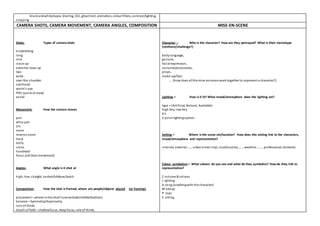
blackandwhite/sepia, blurring, CGI, ghost trail, animation, colour filters, contrast/lighting,
cropping
CAMERA SHOTS, CAMERA MOVEMENT, CAMERA ANGLES, COMPOSITION MISE-EN-SCENE
Shots: Types of camera shots
establishing
long
mid
close-up
extreme close-up
two
wide
over the shoulder
overhead
worm’s eye
POV (point of view)
aerial
Movement: How the camera moves
pan
whip pan
tilt
zoom
reverse zoom
track
dolly
crane
handheld
focus pull (lens movement)
Angles: What angle is it shot at
high, low, straight, canted/oblique/dutch
Composition: How the shot is framed, where are people/objects placed (or framing)
placement = where inthe shot? (corner/side/middle/bottom)
balance = Symmetry/Asymmetry
rule of thirds
depth of field = shallowfocus, deepfocus, rule of thirds,
Character = Who is the character? How are they portrayed? What is their stereotype
(reinforce/challenge?)
bodylanguage,
gesture,
facial expression,
costume/accessories,
props,
make-up/hair,
…. (how does allthe mise-en-scene work together to represent a character?)
Lighting = How is it lit? What mood/atmosphere does the lighting set?
type = (Artificial, Natural, Available)
high Key, low Key
fill
3 point lightingsystem
Setting = Where is the scene set/location? How does this setting link to the characters,
mood/atmosphere and representation?
internal, external……..urban(inner city), rural/country………weather……….professional, domestic
Colour symbolism = What colours do you see and what do they symbolize? How do they link to
representation?
C ostume & colours
L ighting
A cting (anythingwith the character)
M akeup
P rops
S etting
Media key terms

Media key terms

  • 1.
    MEDIA KEY TERMS Diegesis= (all categories) the constructed world of the scene which is diegetic EDITING SOUND Continuity editing = How the editing techniques are used to create continuous actions 180 degree rule match on action eye-line matching cross cutting insert shots (can be anytype of shot) sound bridging (sound but linked to cont. editing) cut ins / cutaways Pace = What type of pace is used and what is the effect on the audience? slow, medium, fast Effects on audience=suspense, fear, excitement, on edgeofseat, thrill, shock, boredom, calm, relaxed Time = How is the time being shown through editing? How/why? Montage, Summary, ellipsis, scene, stretch, flashback/flashforward Impressive terms: Temporal extension, temporal ellipsis!!! *think about what you are andare not being shown – what dotheychoose to out inthe edit? Time Allocation (or screen time) = How much time the characters/objects have on screen? Link this to their representation Transitions = How a scene goes to the next scene, what type of transition is applied? How does it relate to time? straight cuts (notransition, wipe, fade in/fade out, overlap/dissolve, flashing, Graphic match, Special effects = Things applied in editing process that didn’t happen during filming, usually to enhance something Sound Scape = Is ALL sounds in a clip (like Mise-en-scene) Diegetic = Part of the diegesis, sounds withinworldthat characters CAN hear Non-Diegetic = Not part of diegesis, characters CANNOT hear, to set mood/atmosphere Atmos effect Tempo pitch synchronous/asynchronous ambient Sound soundeffects (natural, unnatural) foley soundbridging score music (non-diegetic) soundmotifs/incidentalmusic (non-diegetic) parallel sound dialogue (tone/accent/language/volume) volume control (how quiet/loudsounds are) crescendo diminuendo voiceover (from narrator or character = first/second/third) mode of Address direct address soundperspective
  • 2.
    blackandwhite/sepia, blurring, CGI,ghost trail, animation, colour filters, contrast/lighting, cropping CAMERA SHOTS, CAMERA MOVEMENT, CAMERA ANGLES, COMPOSITION MISE-EN-SCENE Shots: Types of camera shots establishing long mid close-up extreme close-up two wide over the shoulder overhead worm’s eye POV (point of view) aerial Movement: How the camera moves pan whip pan tilt zoom reverse zoom track dolly crane handheld focus pull (lens movement) Angles: What angle is it shot at high, low, straight, canted/oblique/dutch Composition: How the shot is framed, where are people/objects placed (or framing) placement = where inthe shot? (corner/side/middle/bottom) balance = Symmetry/Asymmetry rule of thirds depth of field = shallowfocus, deepfocus, rule of thirds, Character = Who is the character? How are they portrayed? What is their stereotype (reinforce/challenge?) bodylanguage, gesture, facial expression, costume/accessories, props, make-up/hair, …. (how does allthe mise-en-scene work together to represent a character?) Lighting = How is it lit? What mood/atmosphere does the lighting set? type = (Artificial, Natural, Available) high Key, low Key fill 3 point lightingsystem Setting = Where is the scene set/location? How does this setting link to the characters, mood/atmosphere and representation? internal, external……..urban(inner city), rural/country………weather……….professional, domestic Colour symbolism = What colours do you see and what do they symbolize? How do they link to representation? C ostume & colours L ighting A cting (anythingwith the character) M akeup P rops S etting