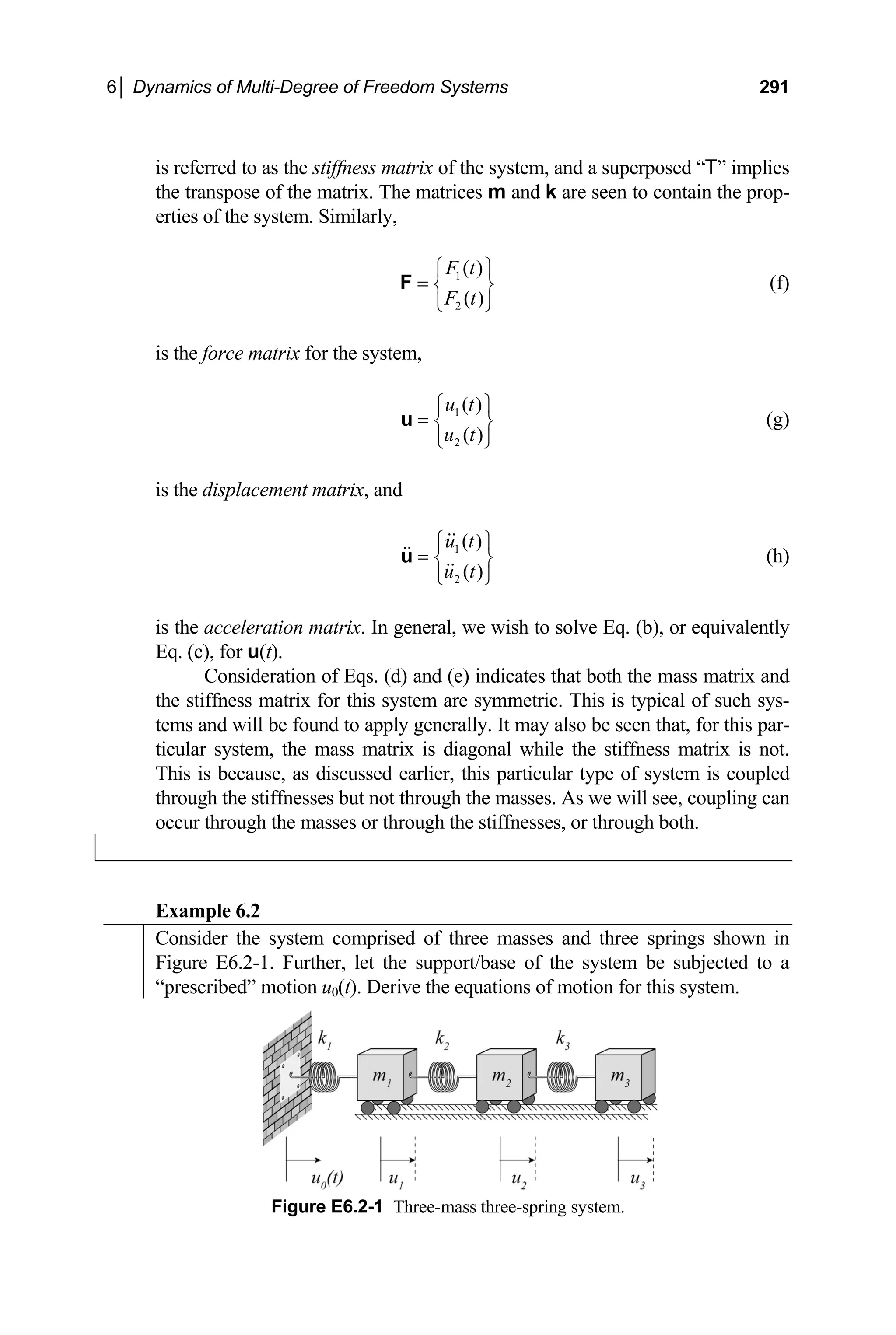
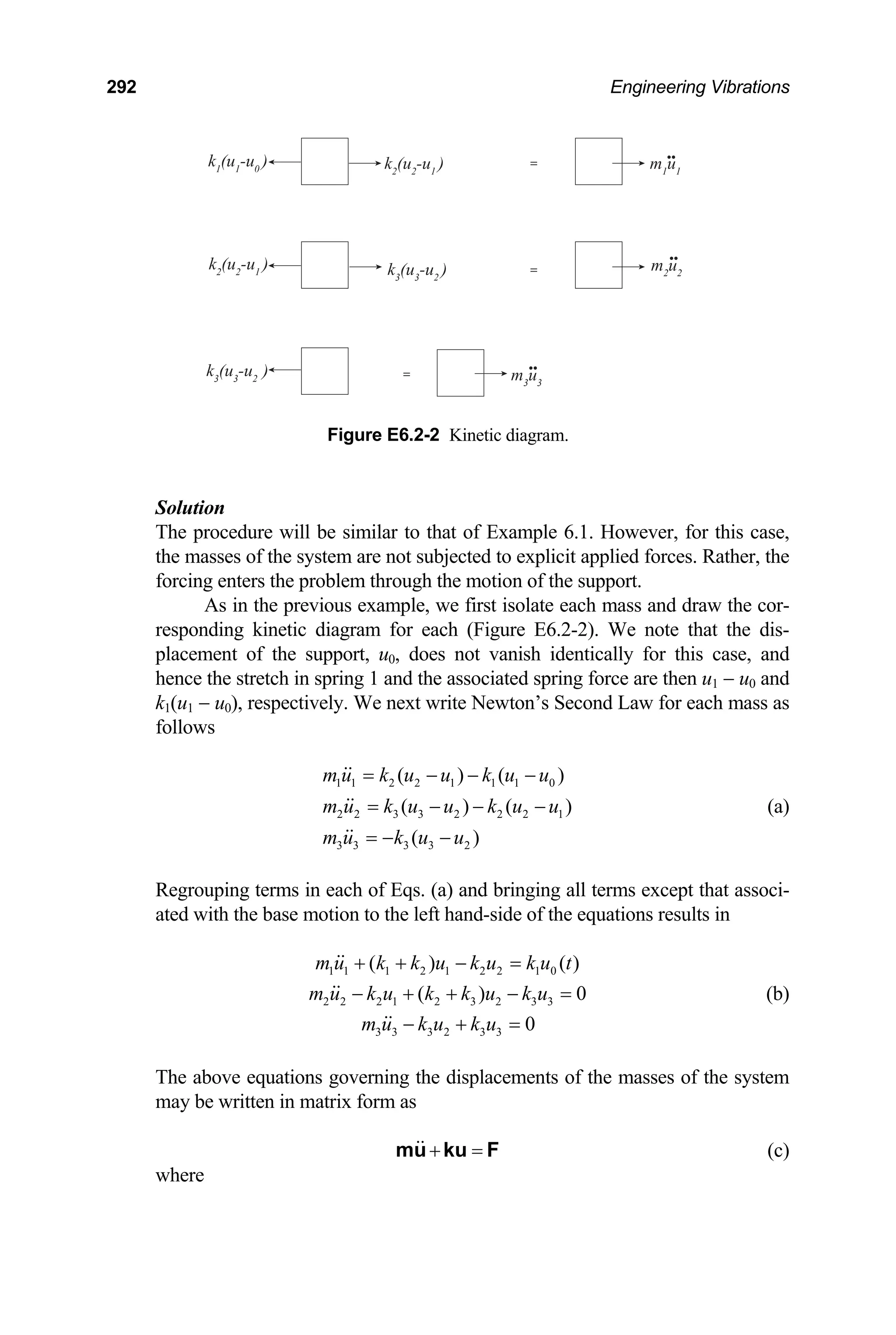
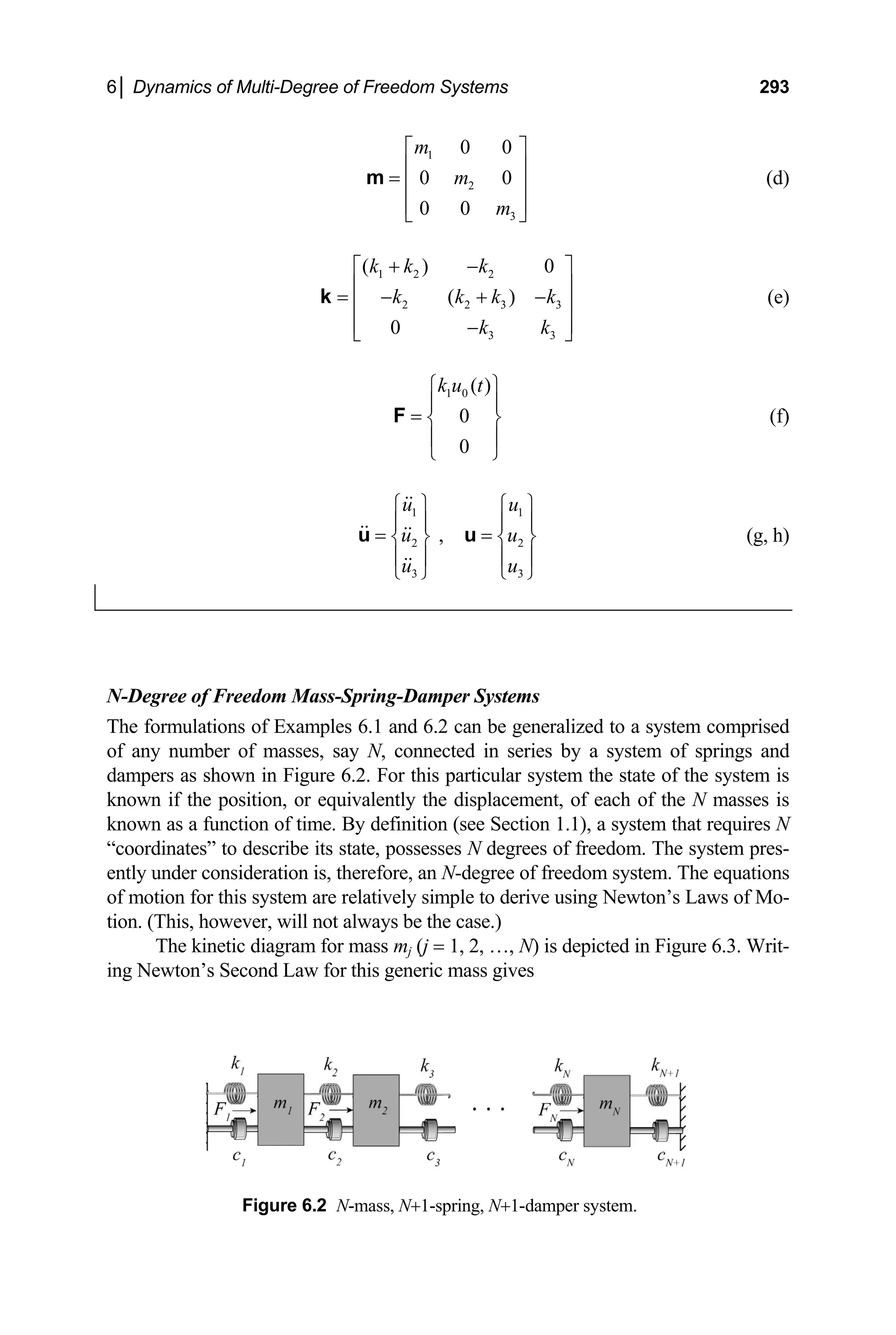
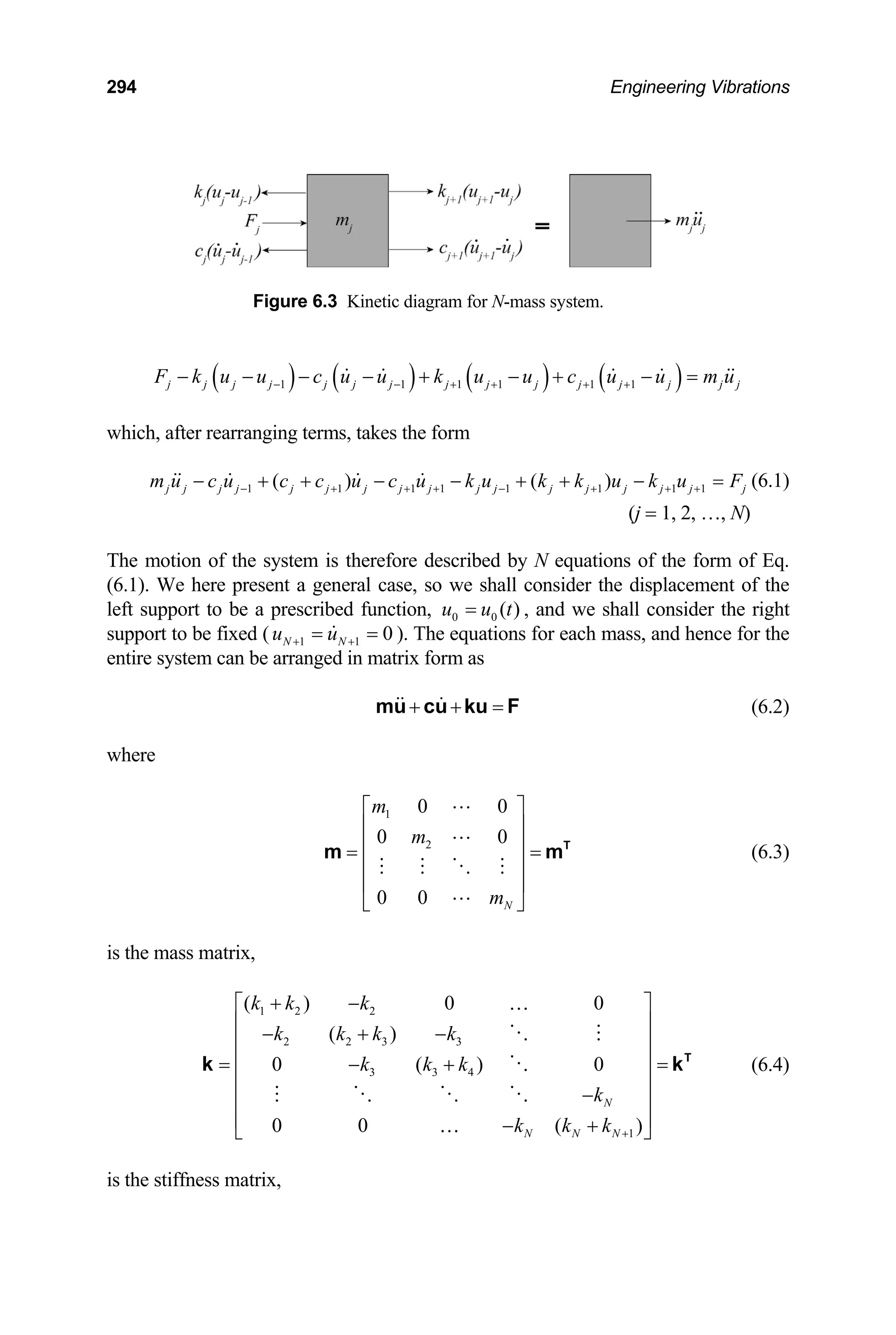
DK802X_
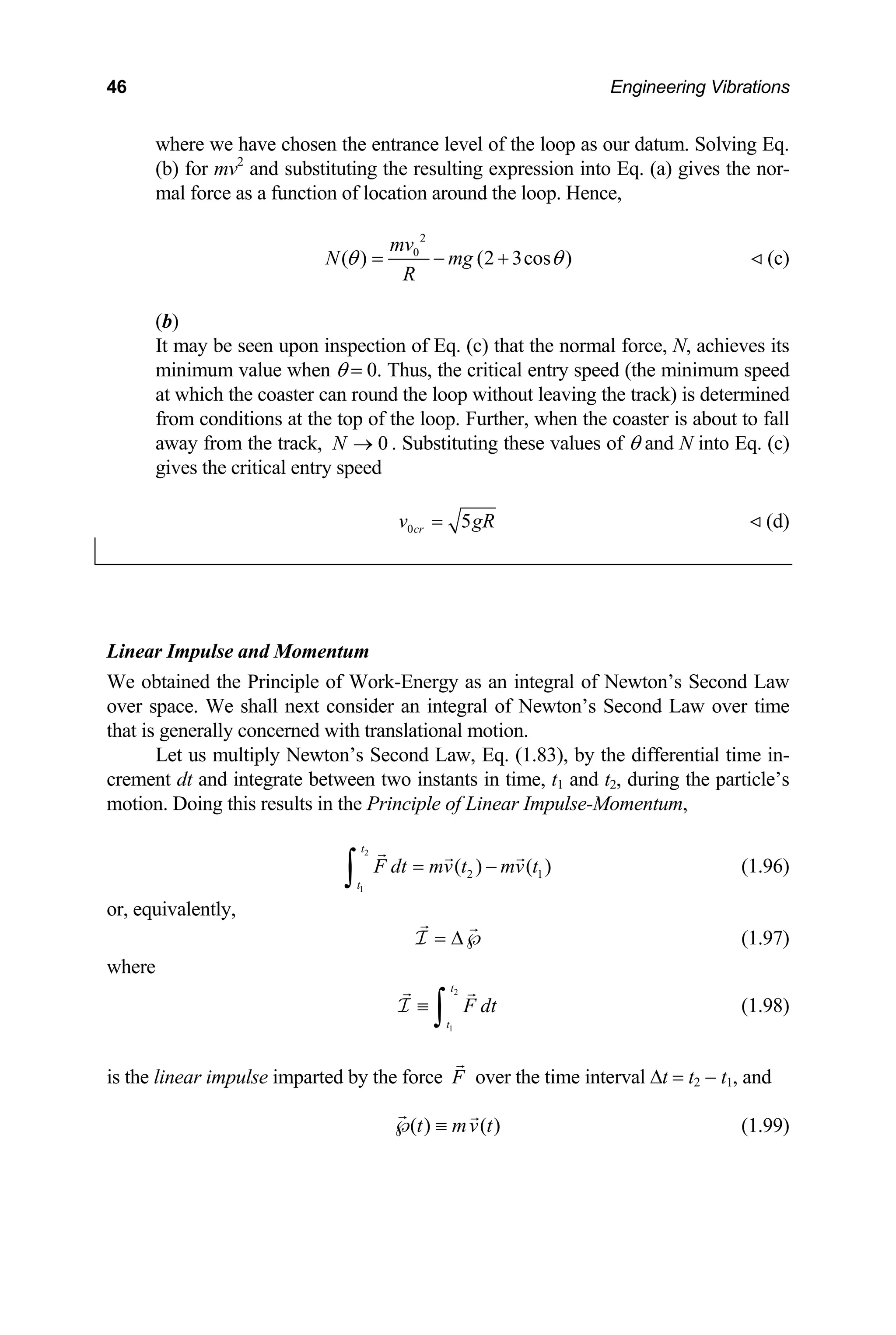
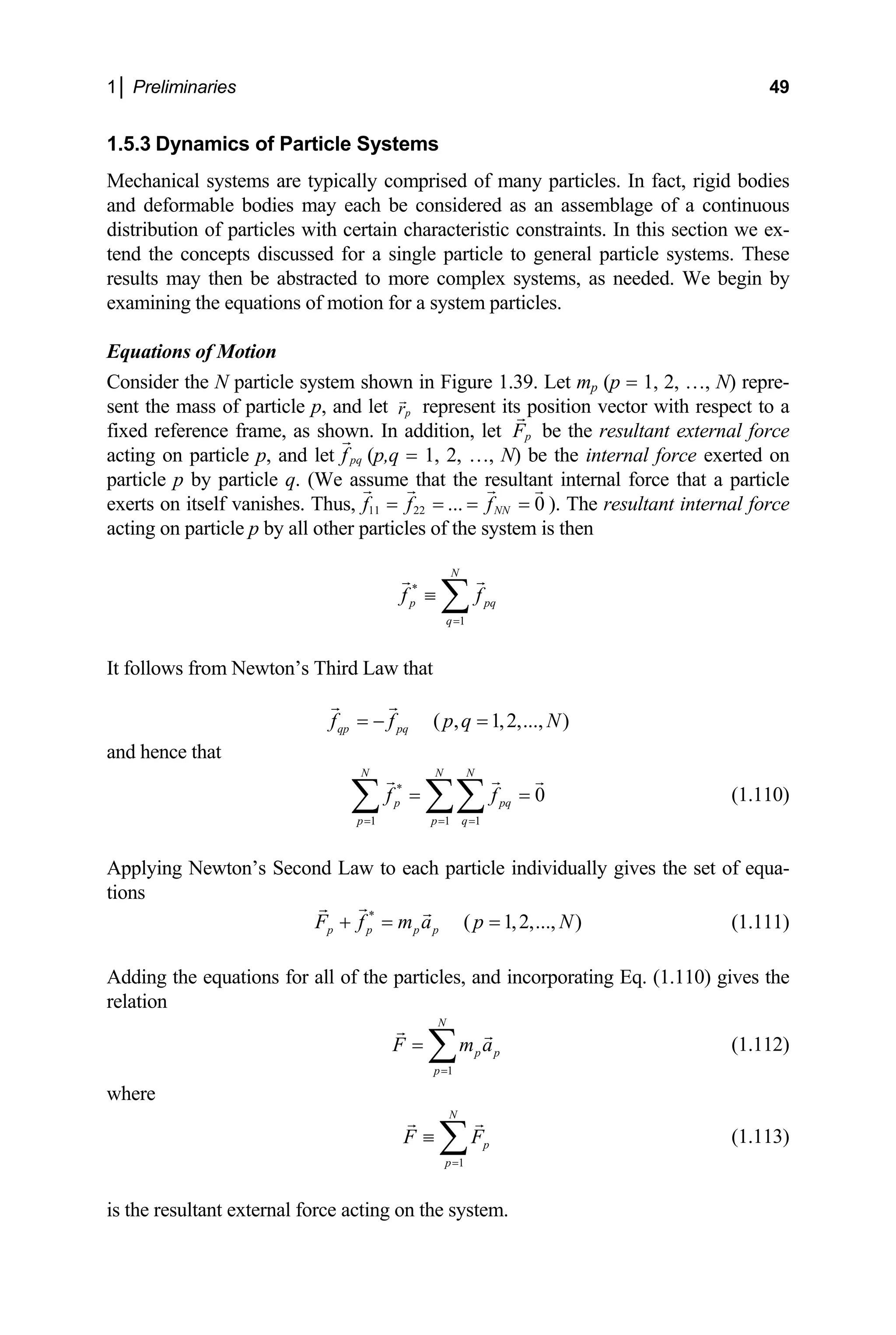
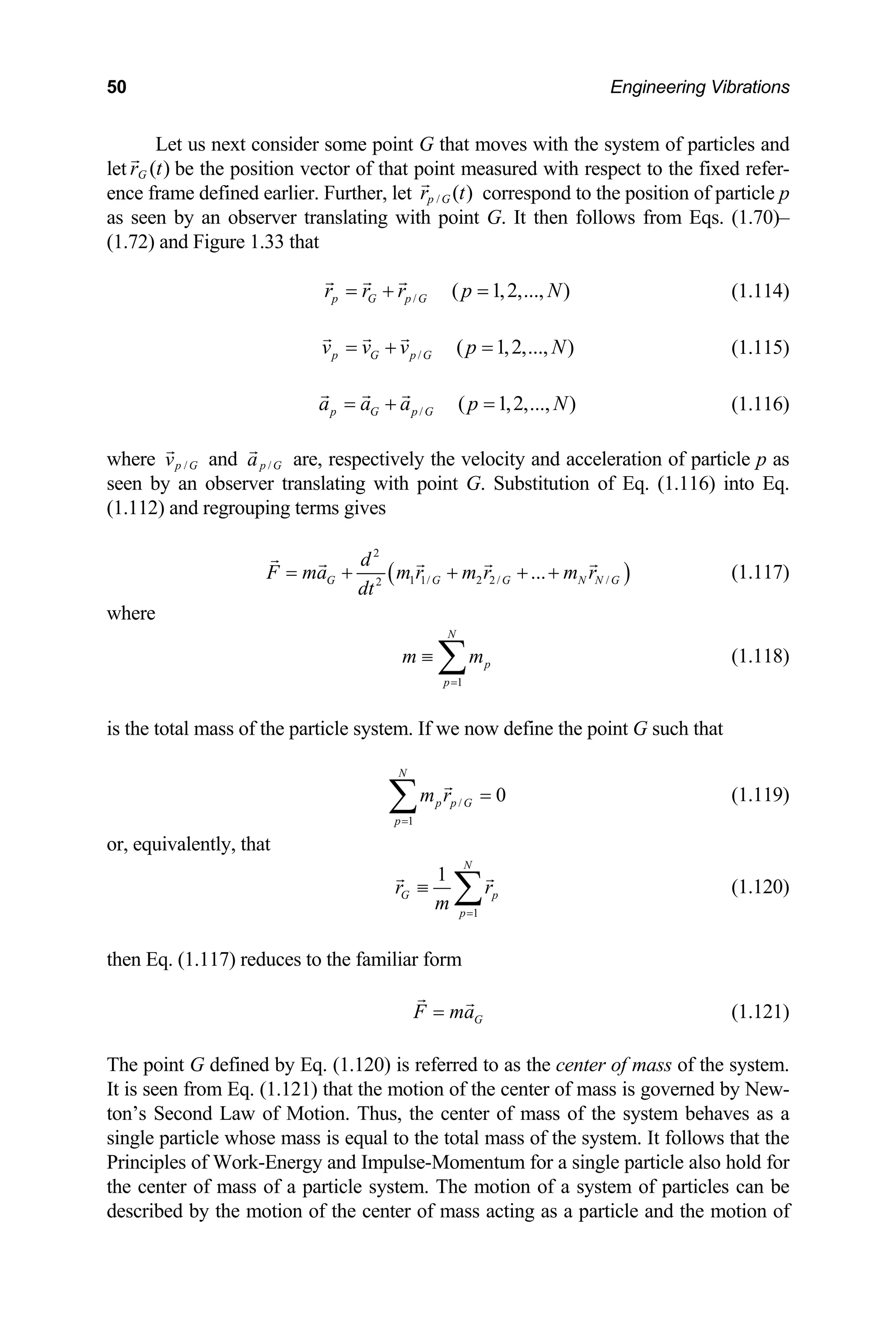
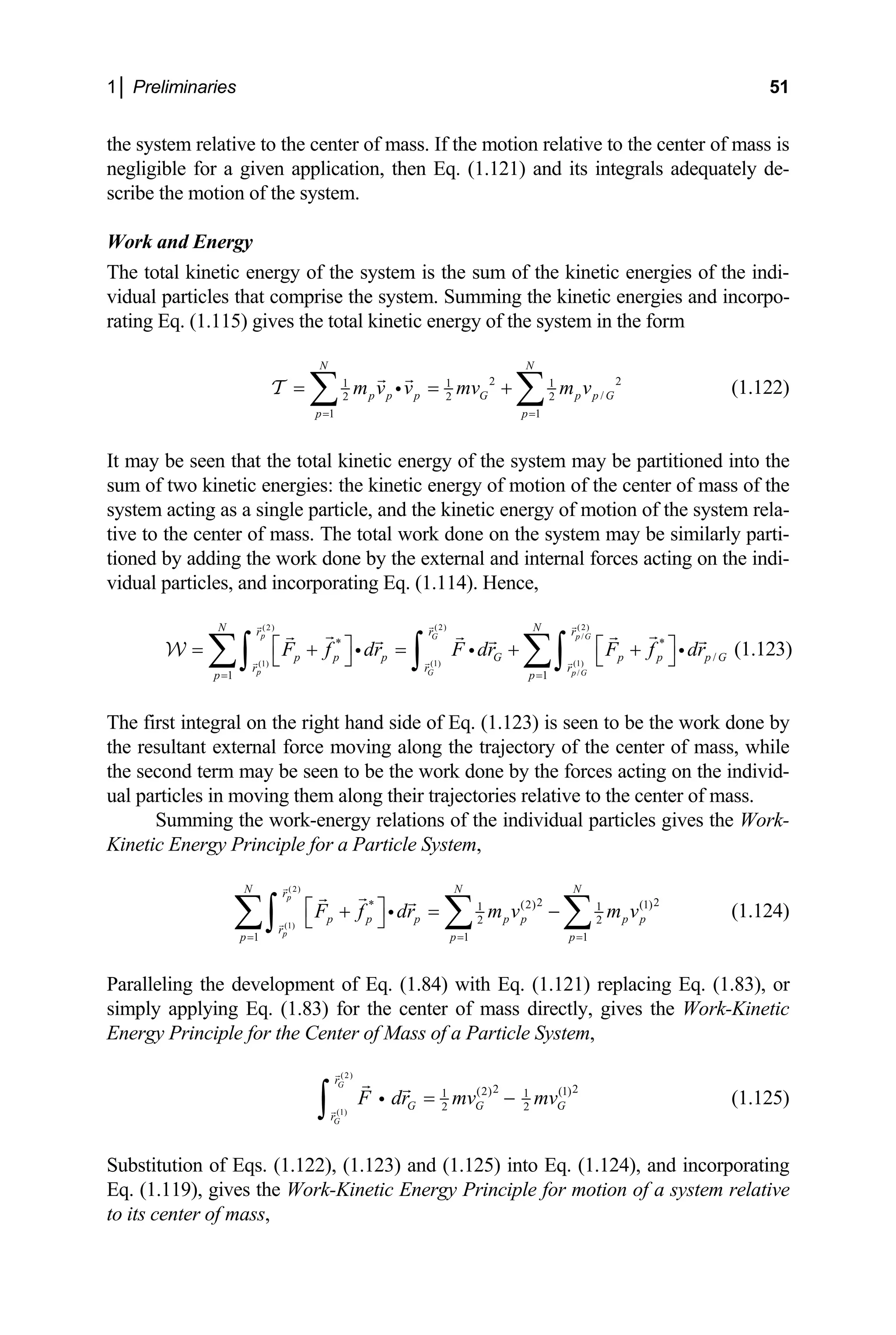
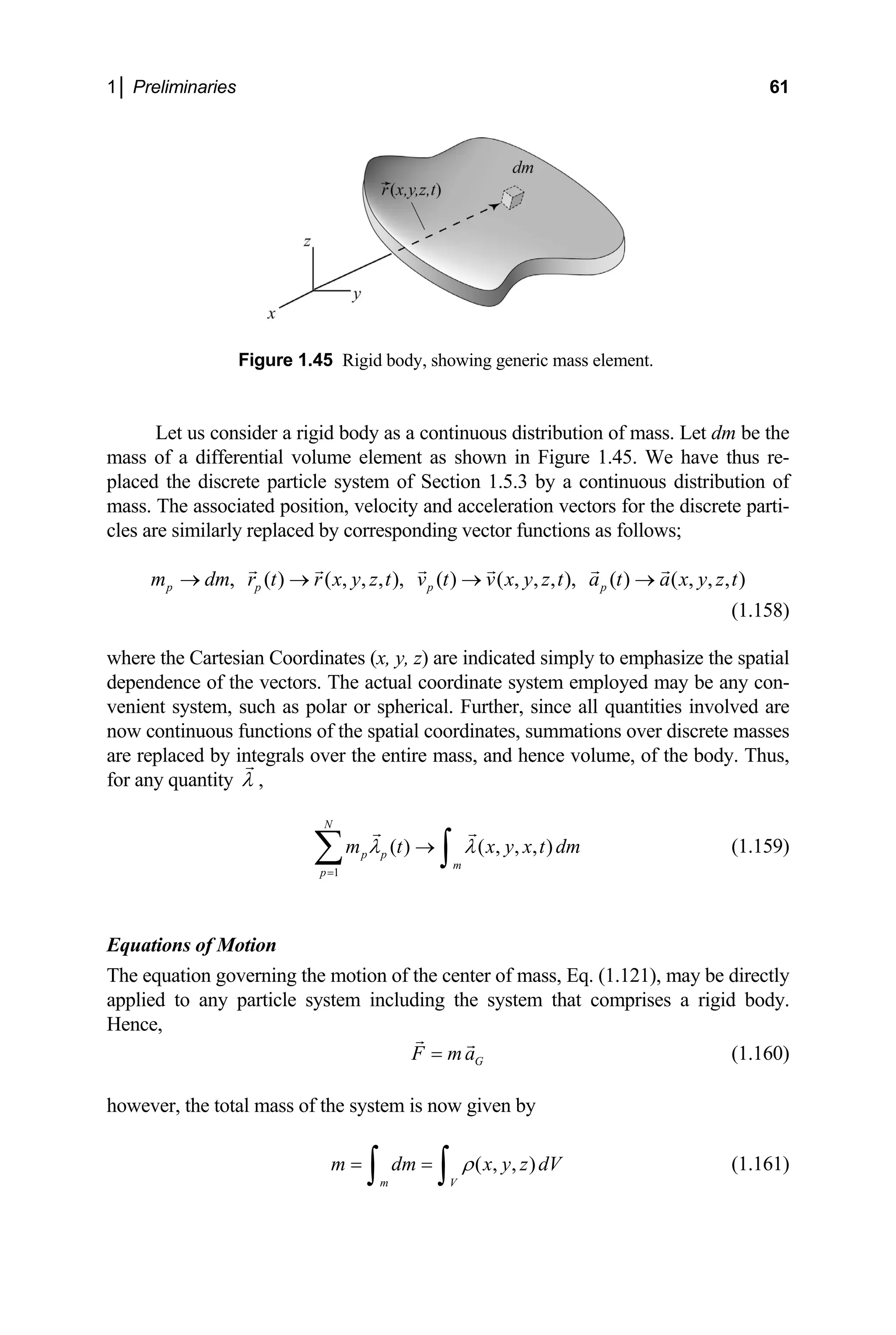
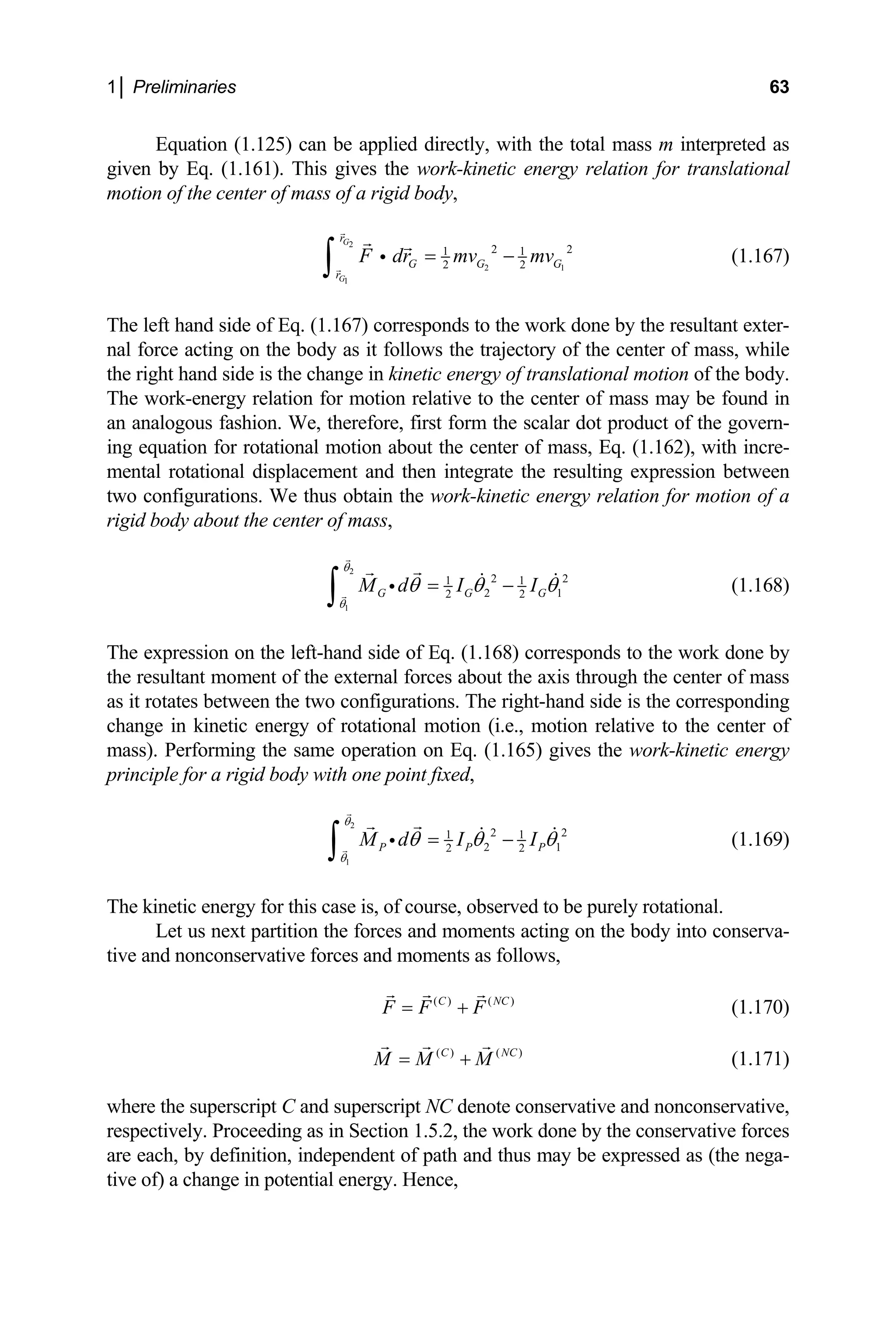
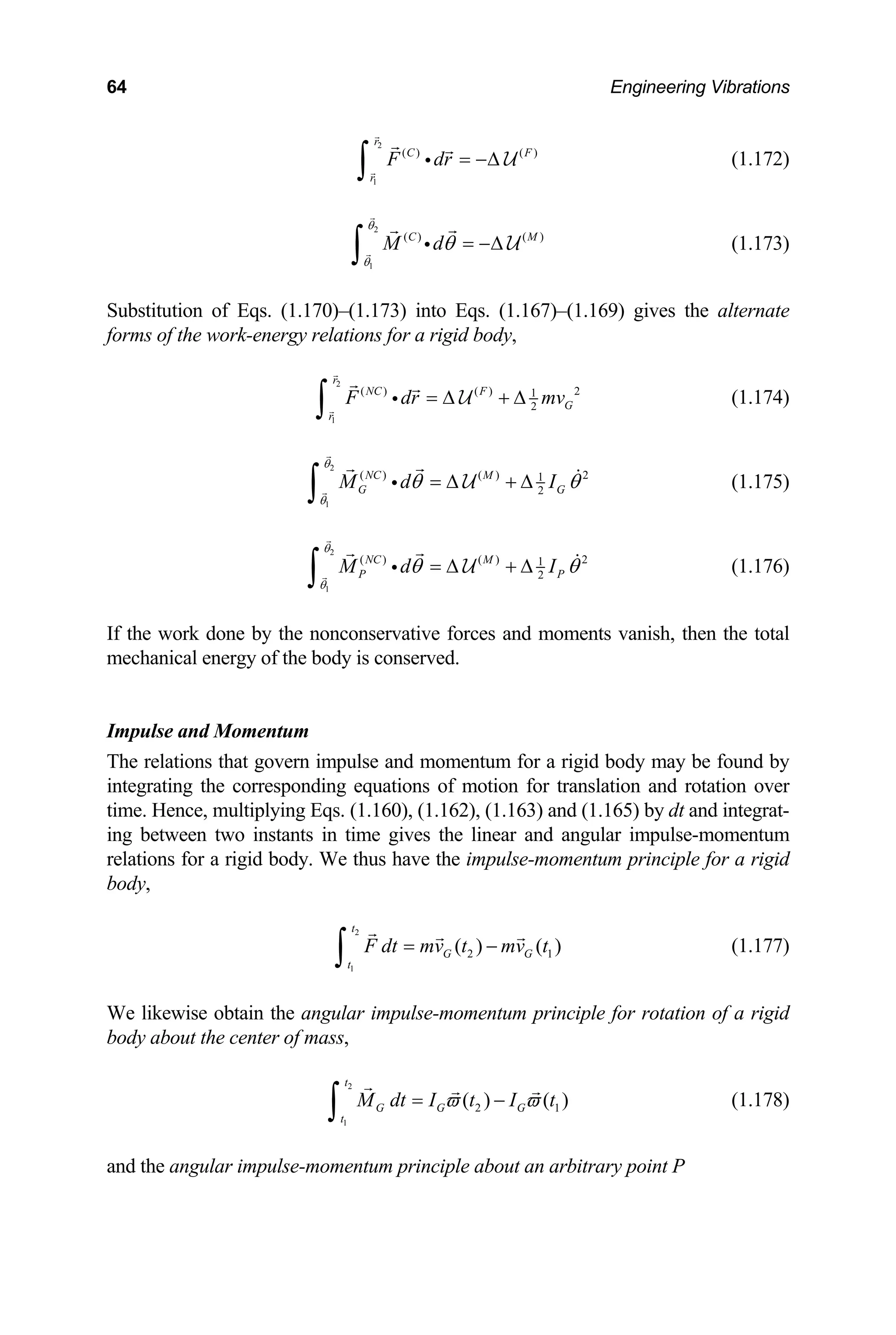
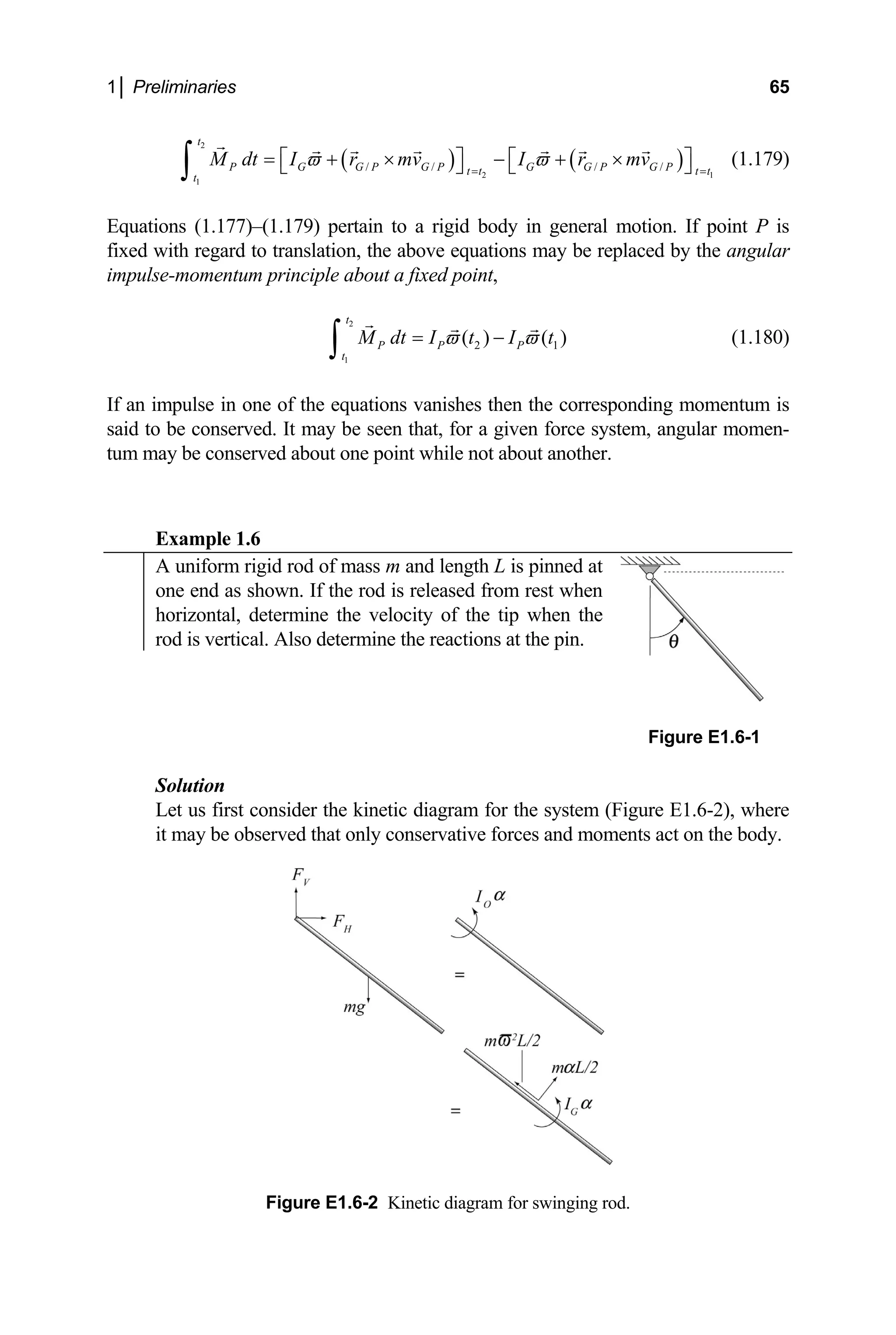
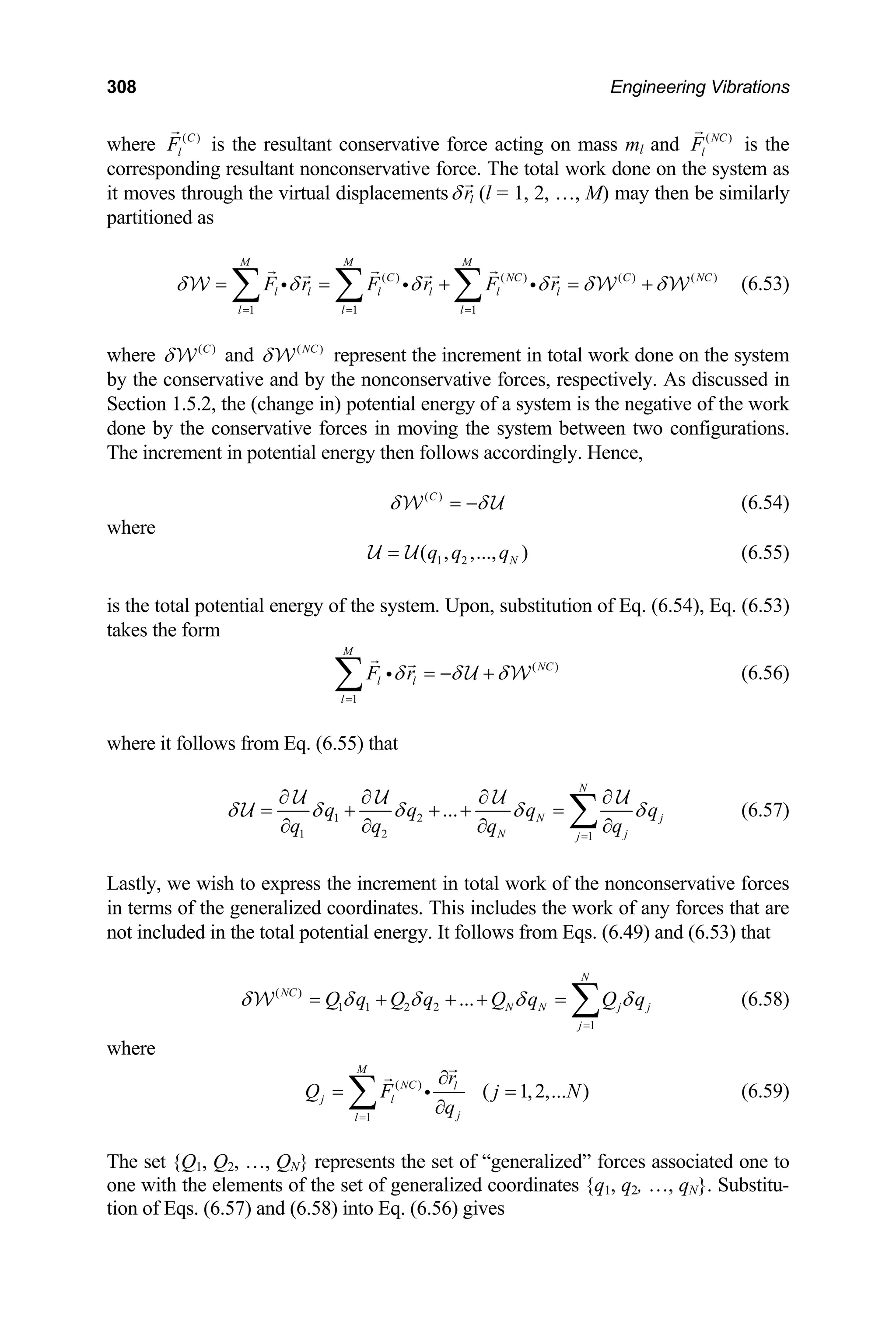
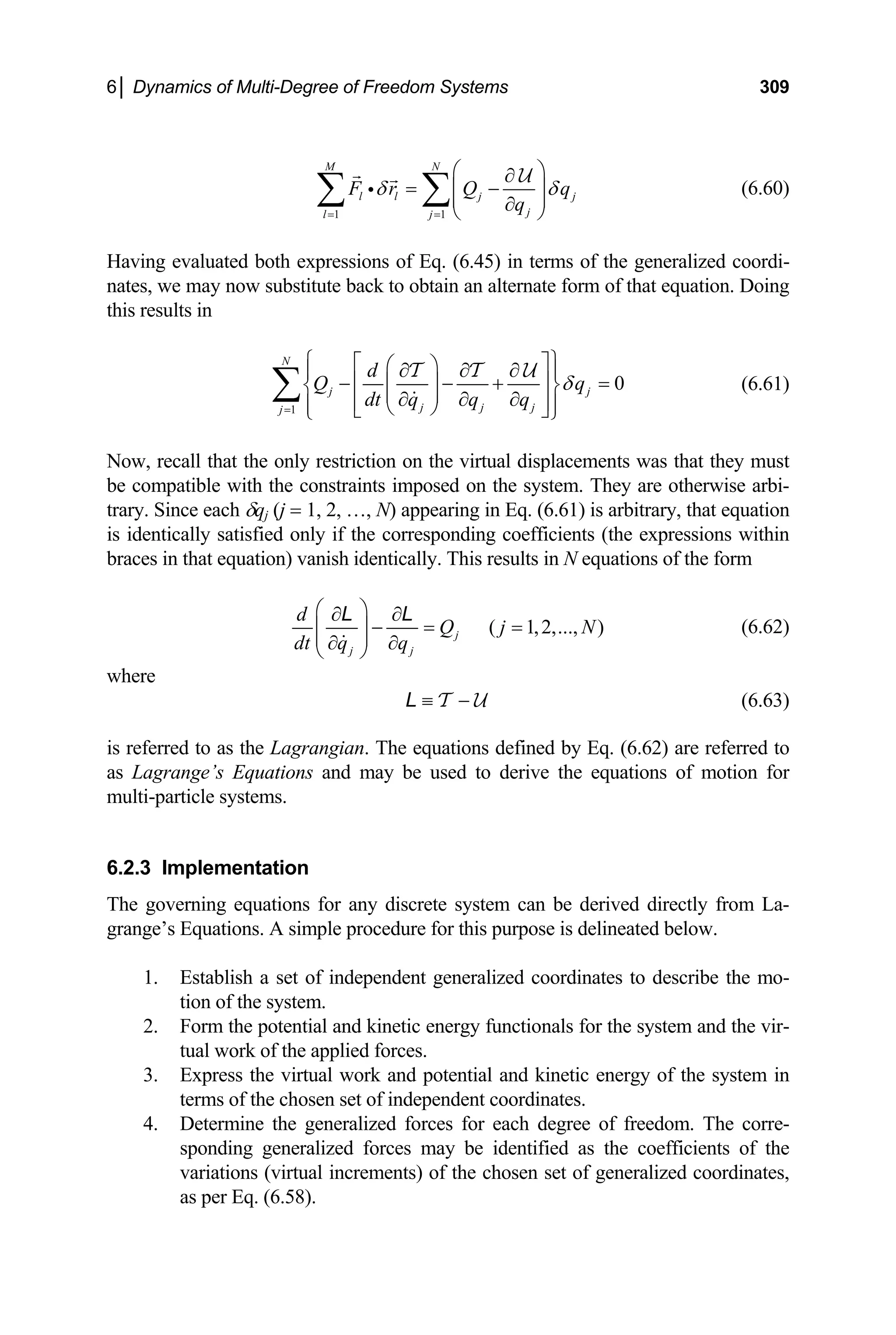
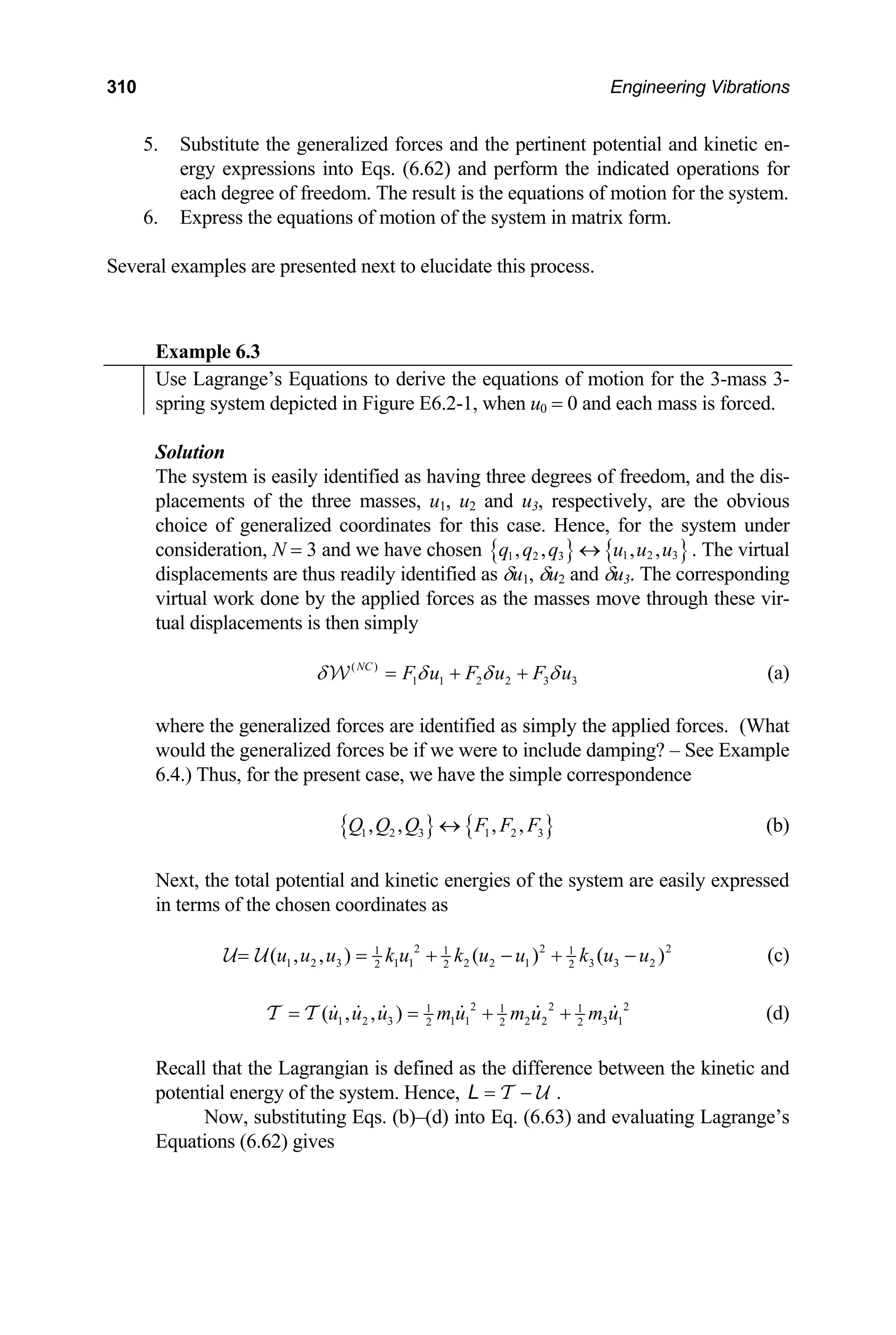
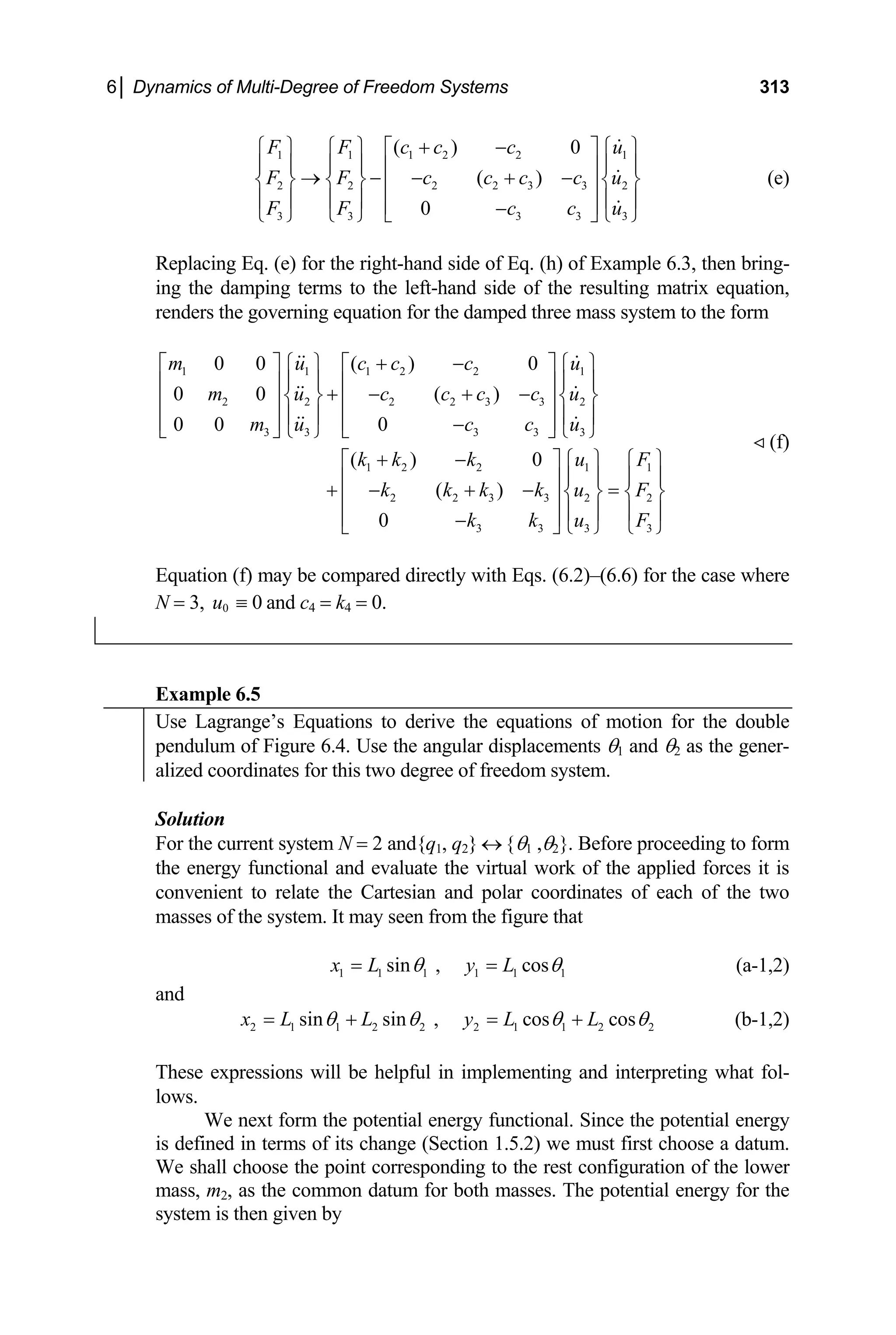
Untitled-1 2 12/10/07 12:14:04 PM
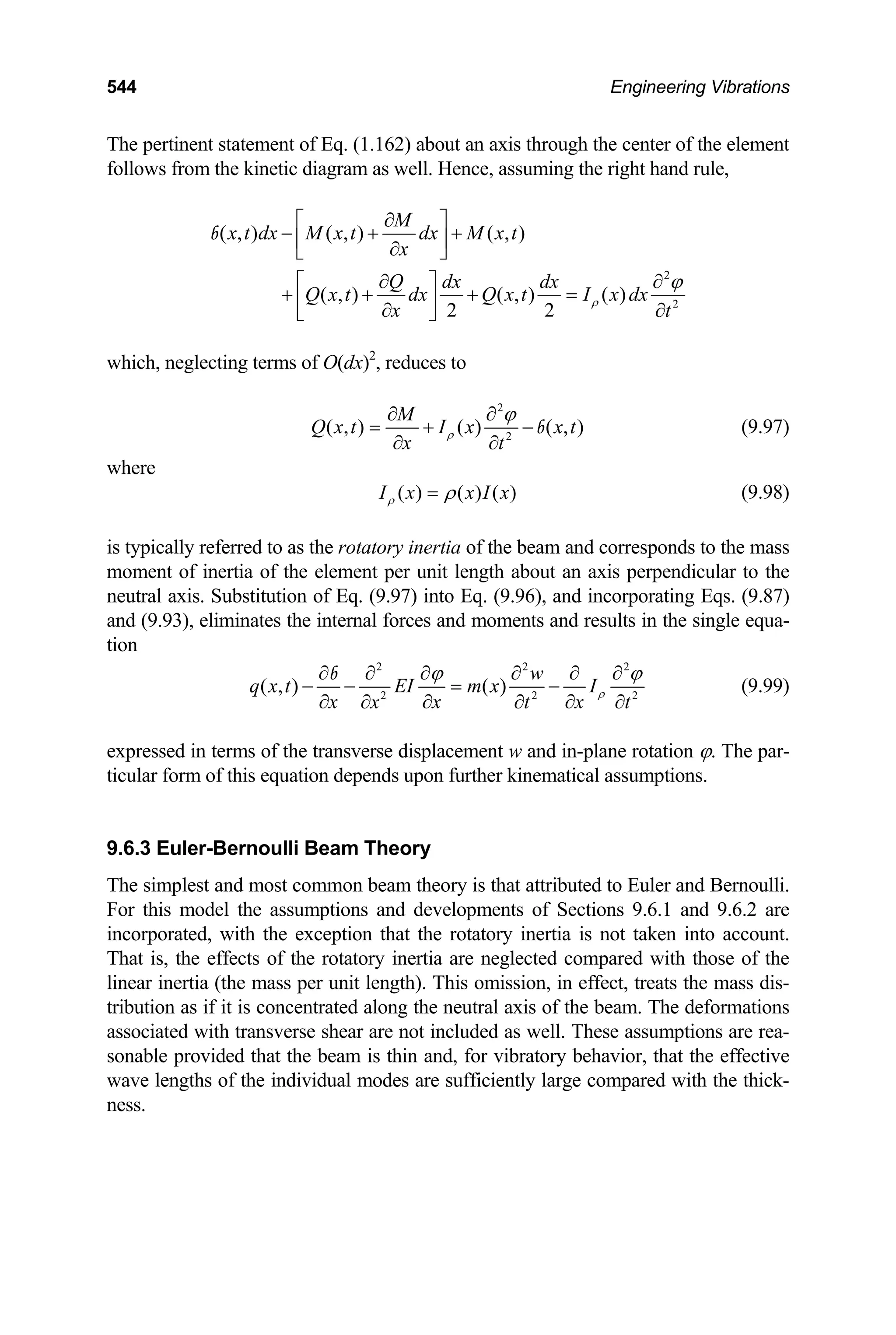
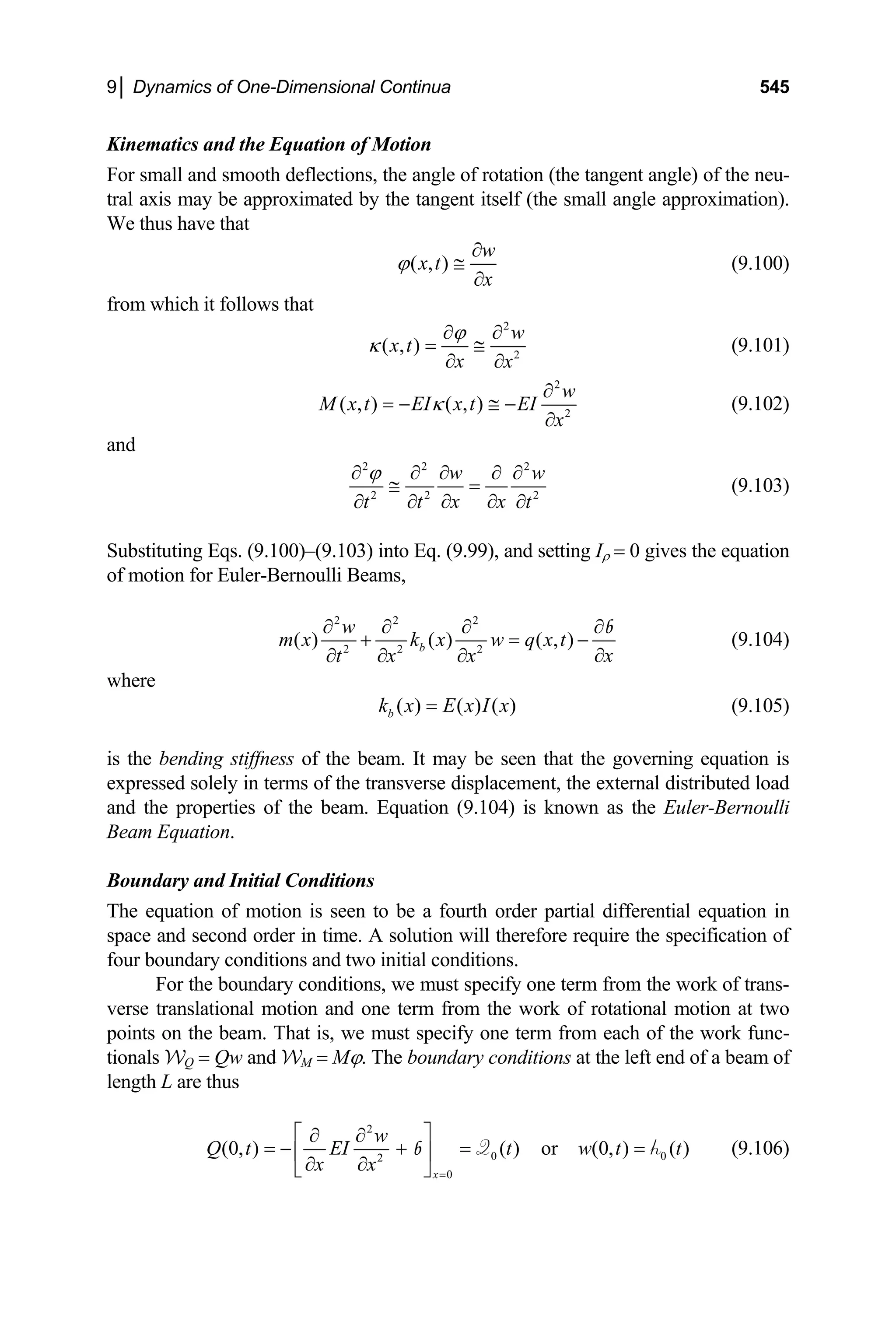
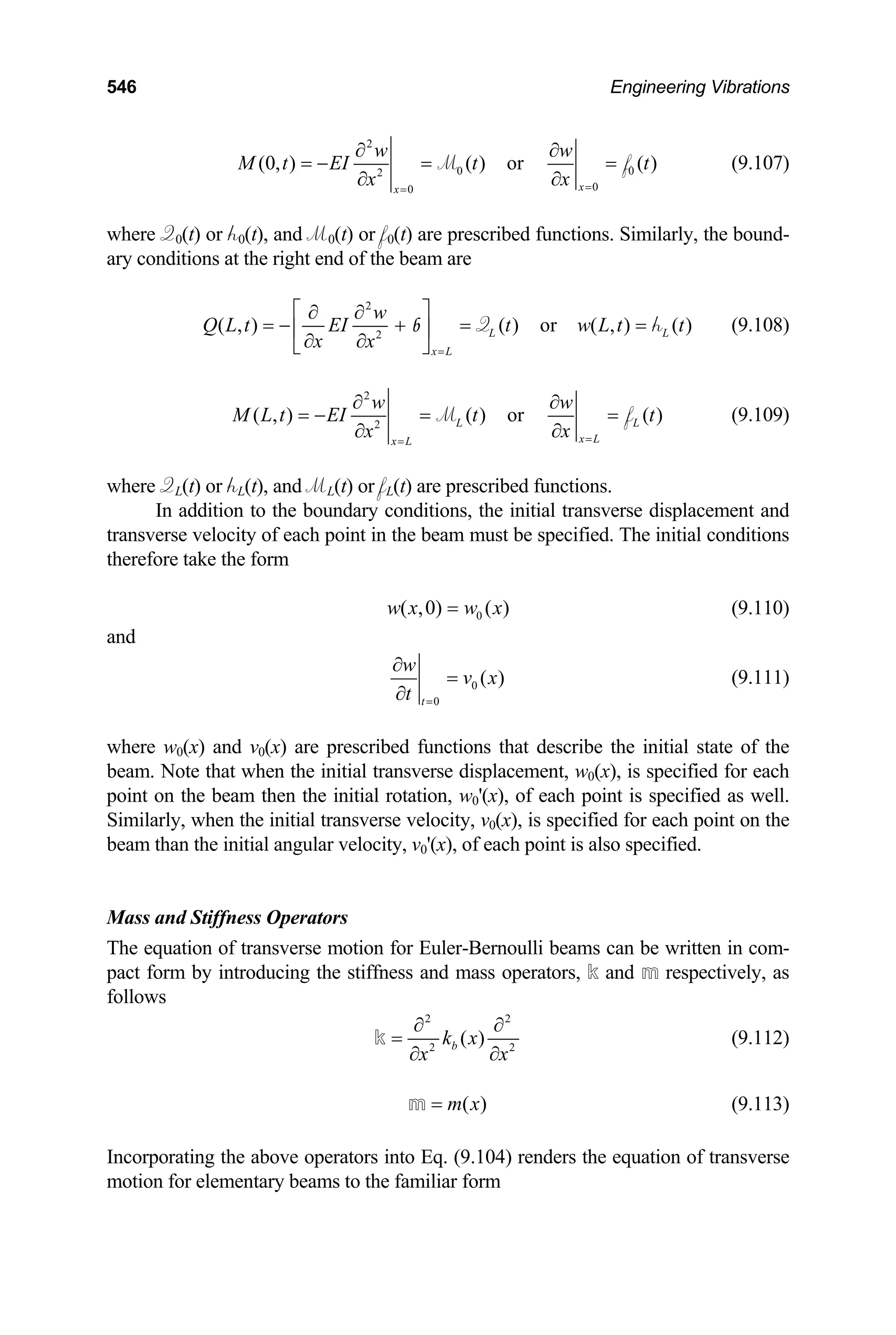
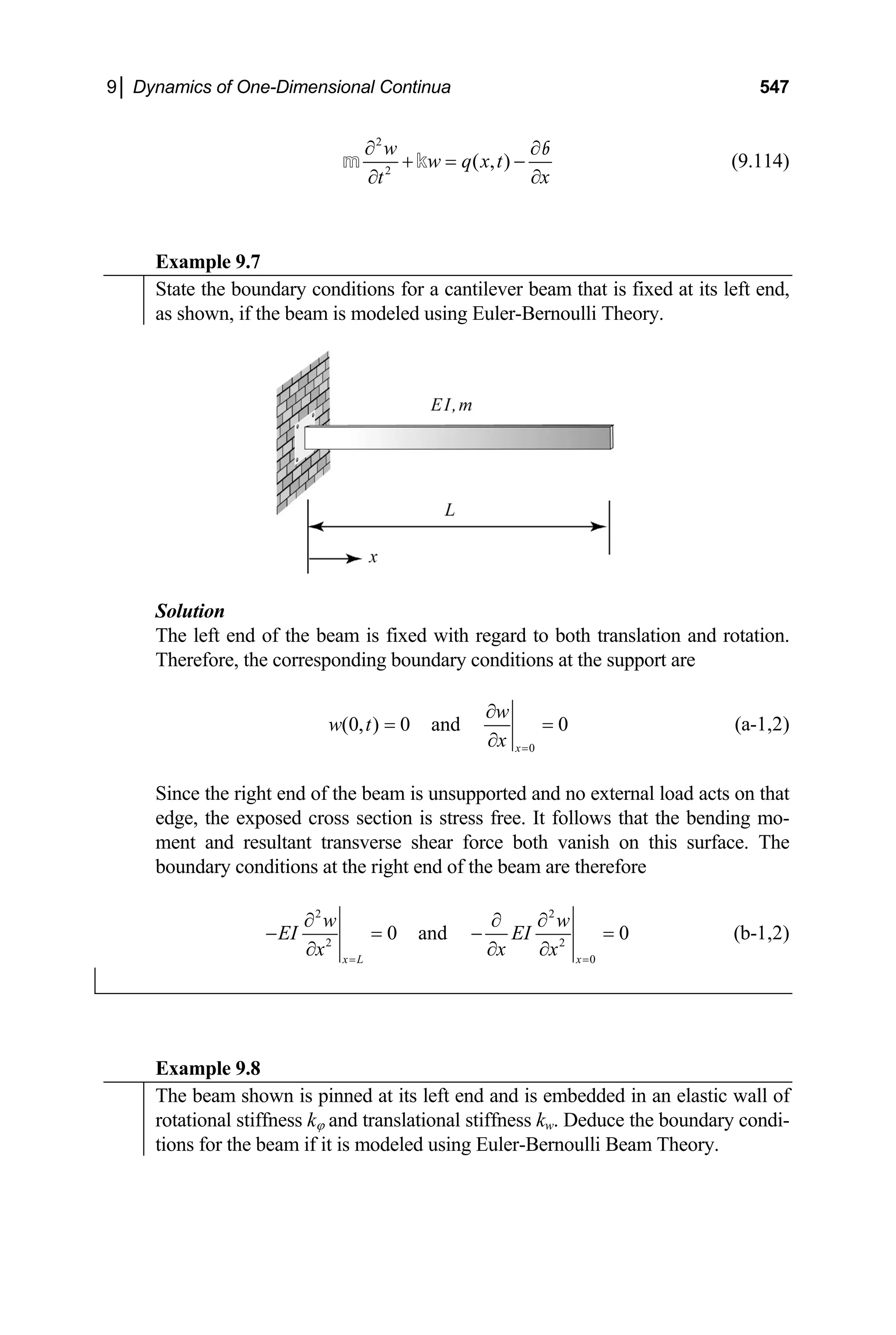
DK802X_half 12/2/05 12:02 PM Page 1
Engineering
Vibrations
Untitled-1 1 12/10/07 12:14:04 PM
DK802X_
Untitled-1 2 12/10/07 12:14:04 PM
DK802X_title 12/2/05 12:02 PM Page 1
Engineering
Vibrations
William J. Bottega
A CRC title, part of the Taylor & Francis imprint, a member of the
Taylor & Francis Group, the academic division of T&F Informa plc.
Boca Raton London New York
Untitled-1 3 12/10/07 12:14:04 PM
CRC Press
Taylor & Francis Group
6000 Broken Sound Parkway NW, Suite 300
Boca Raton, FL 33487-2742
© 2006 by Taylor & Francis Group, LLC
CRC Press is an imprint of Taylor & Francis Group, an Informa business
No claim to original U.S. Government works
Version Date: 20110713
International Standard Book Number-13: 978-1-4200-2009-0 (eBook - PDF)
This book contains information obtained from authentic and highly regarded sources. Reasonable efforts
have been made to publish reliable data and information, but the author and publisher cannot assume
responsibility for the validity of all materials or the consequences of their use. The authors and publishers
have attempted to trace the copyright holders of all material reproduced in this publication and apologize to
copyright holders if permission to publish in this form has not been obtained. If any copyright material has
not been acknowledged please write and let us know so we may rectify in any future reprint.
Except as permitted under U.S. Copyright Law, no part of this book may be reprinted, reproduced, transmit-
ted, or utilized in any form by any electronic, mechanical, or other means, now known or hereafter invented,
including photocopying, microfilming, and recording, or in any information storage or retrieval system,
without written permission from the publishers.
For permission to photocopy or use material electronically from this work, please access www.copyright.
com (http://www.copyright.com/) or contact the Copyright Clearance Center, Inc. (CCC), 222 Rosewood
Drive, Danvers, MA 01923, 978-750-8400. CCC is a not-for-profit organization that provides licenses and
registration for a variety of users. For organizations that have been granted a photocopy license by the CCC,
a separate system of payment has been arranged.
Trademark Notice: Product or corporate names may be trademarks or registered trademarks, and are used
only for identification and explanation without intent to infringe.
Visit the Taylor & Francis Web site at
http://www.taylorandfrancis.com
and the CRC Press Web site at
http://www.crcpress.com
About the Author
William J. Bottega is Professor of Mechanical and Aerospace Engineering at Rutgers
University, where he has been since 1984. He received his Ph.D. in Applied Mechan-
ics from Yale University, his M.S. in Theoretical and Applied Mechanics from Cor-
nell University and his B.E. from the City College of New York. He also spent sev-
eral years in R&D at General Dynamics where he worked on vibration and sound-
structure interaction problems. Dr. Bottega is the author of numerous archival publi-
cations on various areas of theoretical and applied mechanics. He is an Associate
Fellow of the American Institute of Aeronautics and Astronautics and is a member of
the American Society of Mechanical Engineers, the American Academy of Mechan-
ics, the Society for Industrial and Applied Mathematics, the American Society for
Engineering Education and Sigma Xi.
To my mother, Marie Bottega
Preface
The effects of vibrations on the behavior of mechanical and structural systems are
often of critical importance to their design, performance, and survival. For this reason
the subject of mechanical vibrations is offered at both the advanced undergraduate
level and graduate level at most engineering schools. I have taught vibrations to me-
chanical and aerospace engineering students, primarily seniors, for a number of years
and have used a variety of textbooks in the process. As with many books of this type,
the emphasis is often a matter of taste. Some texts emphasize mathematics, but gen-
erally fall short on physical interpretation and demonstrative examples, while others
emphasize methodology and application but tend to oversimplify the mathematical
development and fail to stress the fundamental principles. Moreover, both types fail
to stress the underlying mechanics and physics to a satisfactory degree, if at all. For
these reasons, there appeared to be a need for a textbook that couples thorough
mathematical development and physical interpretation, and that emphasizes the me-
chanics and physics of the phenomena. The book would need to be readable for stu-
dents with the background afforded by a typical university engineering curriculum,
and would have to be self-contained to the extent that concepts are developed, ad-
vanced and abstracted using that background as a base. The present volume has been
written to meet these goals and fill the apparent void.
Engineering Vibrations provides a systematic and unified presentation of the
subject of mechanical and structural vibrations, emphasizing physical interpretation,
fundamental principles and problem solving, coupled with rigorous mathematical
development in a form that is readable to advanced undergraduate and graduate uni-
versity students majoring in engineering and related fields. Abstract concepts are de-
veloped and advanced from principles familiar to the student, and the interaction of
theory, numerous illustrative examples and discussion form the basic pedagogical
vii
Preface
viii
approach. The text, which is extensively illustrated, gives the student a thorough un-
derstanding of the basic concepts of the subject, and enables him or her to apply these
principles and techniques to any problem of interest. In addition, the pedagogy en-
courages the reader’s physical sense and intuition, as well as analytical skills. The
text also provides the student with a solid background for further formal study and
research, as well as for self study of specialized techniques and more advanced topics.
Particular emphasis is placed on developing a connected string of ideas, con-
cepts and techniques that are sequentially advanced and generalized throughout the
text. In this way, the reader is provided with a thorough background in the vibration
of single degree of freedom systems, discrete multi-degree of freedom systems, one-
dimensional continua, and the relations between each, with the subject viewed as a
whole. Some distinctive features are as follows. The concept of mathematical model-
ing is introduced in the first chapter and the question of validity of such models is
emphasized throughout. An extensive review of elementary dynamics is presented as
part of the introductory chapter. A discussion and demonstration of the underlying
physics accompany the introduction of the phenomenon of resonance. A distinctive
approach incorporating generalized functions and elementary dynamics is used to
develop the general impulse response. Structural damping is introduced and devel-
oped from first principle as a phenomenological theory, not as a heuristic empirical
result as presented in many other texts. Continuity between basic vector operations
including the scalar product and normalization in three-dimensions and their exten-
sions to N-dimensional space is clearly established. General (linear) viscous damping,
as well as Rayleigh (proportional) damping, of discrete multi-degree of freedom sys-
tems is discussed, and represented in state space. Correspondence between discrete
and continuous systems is established and the concepts of linear differential operators
are introduced. A thorough development of the mechanics of pertinent 1-D continua
is presented, and the dynamics and vibrations of various structures are studied in
depth. These include axial and torsional motion of rods and transverse motion of
strings, transverse motion of Euler-Bernoulli Beams and beam-columns, beams on
elastic foundations, Rayleigh Beams and Timoshenko Beams. Unlike in other texts,
the Timoshenko Beam problem is stated and solved in matrix form. Operator notation
is introduced throughout. In this way, all continua discussed are viewed from a uni-
fied perspective. Case studies provide a basis for comparison of the various beam
theories with one another and demonstrate quantitatively the limitations of single
degree of freedom approximations. Such studies are examined both as examples and
as exercises for the student.
The background assumed is typical of that provided in engineering curricula at
U.S. universities. The requisite background includes standard topics in differential
and integral calculus, linear differential equations, linear algebra, boundary value
problems and separation of variables as pertains to linear partial differential equations
of two variables, sophomore level dynamics and mechanics of materials. MATLAB is
used for root solving and related computations, but is not required. A certain degree
of computational skill is, however, desirable.
The text can basically be partitioned into preliminary material and three major
parts: single degree of freedom systems, discrete multi-degree of freedom systems,
Preface ix
and one-dimensional continua. For each class of system the fundamental dynamics is
discussed and free and forced vibrations under various conditions are studied. A
breakdown of the eleven chapters that comprise the text is provided below.
The first chapter provides introductory material and includes discussions of
degrees of freedom, mathematical modeling and equivalent systems, a review of
complex numbers and an extensive review of elementary dynamics. Chapters 2
through 4 are devoted to free and forced vibration of single degree of freedom sys-
tems. Chapter 2 examines free vibrations and includes undamped, viscously damped
and Coulomb damped systems. An extensive discussion of the linear and nonlinear
pendulum is also included. In Chapter 3 the response to harmonic loading is estab-
lished and extended to various applications including support excitation, rotating im-
balance and whirling of shafts. The mathematical model for structural damping is
developed from first principle based on local representation of the body as comprised
of linear hereditary material. The chapter closes with a general Fourier Series solution
for systems subjected to general periodic loading and its application. The responses of
systems to nonperiodic loading, including impulse, step and ramp loading and others,
as well as general loading, are discussed in Chapter 4. The Dirac Delta Function and
the Heaviside Step Function are first introduced as generalized functions. The relation
and a discussion of impulsive and nonimpulsive forces follow. The general impulse
response is then established based on application of these concepts with basic dynam-
ics. The responses to other types of loading are discussed throughout the remainder of
the chapter. Chapter 5, which is optional and does not affect continuity, covers
Laplace transforms and their application as an alternate, less physical/nonphysical,
approach to problems of vibration of single degree of freedom systems.
The dynamics of multi-degree of freedom systems is studied in Chapter 6. The
first part of the chapter addresses Newtonian mechanics and the derivation of the
equations of motion of representative systems in this context. It has been my experi-
ence (and I know I’m not alone in this) that many students often have difficulty and
can become preoccupied or despondent with setting up the equations of motion for a
given system. As a result of this they often lose sight of, or never get to, the vibrations
problem itself. To help overcome this difficulty, Lagrange’s equations are developed
in the second part of Chapter 6, and a methodology and corresponding outline are
established to derive the equations of motion for multi-degree of freedom systems.
Once mastered, this approach provides the student a direct means of deriving the
equations of motion of complex multi-degree of freedom systems. The instructor who
chooses not to cover Lagrange’s equations may bypass these sections. The chapter
closes with a fundamental discussion of the symmetry of the mass, stiffness and
damping matrices with appropriate coordinates.
The free vibration problem for multi-degree of freedom systems with applica-
tions to various systems and conditions including semi-definite systems is presented
in Chapter 7. The physical meanings of the modal vectors for undamped systems are
emphasized and the properties of the modal vectors are discussed. The concepts of
the scalar product, orthogonality and normalization of three-dimensional vectors are
restated in matrix form and abstracted to N-dimensional space, where they are then
discussed in the context of the modal vectors. The chapter closes with extensive dis-
Preface
x
cussions of the free vibration of discrete systems with viscous damping. The problem
is examined in both N-dimensional space and in the corresponding state space.
Analogies to the properties of the modal vectors for undamped systems are then ab-
stracted to the complex eigenvectors for the problem of damped systems viewed in
state space. Forced vibration of discrete multi-degree of freedom systems is studied in
Chapter 8. A simple matrix inversion approach is first introduced for systems sub-
jected to harmonic excitation. The introductory section concludes with a discussion of
the simple vibration absorber. The concepts of coordinate transformations, principal
coordinates and modal coordinates are next established. The bulk of the chapter is
concerned with modal analysis of undamped and proportionally damped systems.
The chapter concludes with these procedures abstracted to systems with general (lin-
ear) viscous damping in both N-dimensional space and in state space.
The dynamics of one-dimensional continua is discussed in Chapter 9. Correla-
tion between discrete and continuous systems is first established, and the concept of
differential operators is introduced. The correspondence between vectors and func-
tions is made evident as is that of matrix operators and differential operators. This
enables the reader to identify the dynamics of continua as an abstraction of the dy-
namics of discrete systems. The scalar product and orthogonality in function space
then follow directly. The kinematics of deforming media is then developed for both
linear and geometrically nonlinear situations. The equations governing various one-
dimensional continua are established, along with corresponding possibilities for
boundary conditions. It has been my experience that students have difficulty in stating
all but the simplest boundary conditions when approaching vibrations problems. This
discussion will enlighten the reader in this regard and aid in alleviating that problem.
Second order systems that are studied include longitudinal and torsional motion of
elastic rods and transverse motion of strings. Various beam theories are developed
from a general, first principle, point of view with the limitations of each evident from
the discussion. Euler-Bernoulli Beams and beam-columns, Rayleigh Beams and Ti-
moshenko Beams are discussed in great detail, as is the dynamics of accelerating
beam-columns. The various operators pertinent to each system are summarized in a
table at the end of the chapter.
The general free vibration of one-dimensional continua is established in Chap-
ter 10 and applied to the various continua discussed in Chapter 9. The operator nota-
tion introduced earlier permits the student to perceive the vibrations problem for con-
tinua as merely an extension of that discussed for discrete systems. Case studies are
presented for various rods and beams, allowing for a direct quantitative evaluation of
the one degree of freedom approximation assumed in the first five chapters. It further
allows for direct comparison of the effectiveness and validity of the various beam
theories. Properties of the modal functions, including the scalar product, normaliza-
tion and orthogonality are established. The latter is then used in the evaluation of am-
plitudes and phase angles. Forced vibration of one-dimensional continua is discussed
in Chapter 11. The justification for generalized Fourier Series representation of the
response is established and modal analysis is applied to the structures of interest un-
der various loading conditions.
Preface xi
The material covered in this text is suitable for a two-semester sequence or a
one-semester course. The instructor can choose appropriate chapters and/or sections
to suit the level, breadth and length of the particular course being taught.
To close, I would like to thank Professor Haim Baruh, Professor Andrew Nor-
ris, Ms. Pamela Carabetta, Mr. Lucian Iorga and Ms. Meghan Suchorsky, all of Rut-
gers University, for reading various portions of the manuscript and offering helpful
comments and valuable suggestions. I would also like to express my gratitude to Ms.
Carabetta for preparing the index. I wish to thank Glen and Maria Hurd for their time,
effort and patience in producing the many excellent drawings for this volume. Fi-
nally, I wish to thank all of those students, past and present, who encouraged me to
write this book.
William J. Bottega
Contents
1. PRELIMINARIES 1
1.1 Degrees of Freedom……………………………………………………. 2
1.2 Equivalent Systems…………………………………………………….. 6
1.2.1 Extension/Contraction of Elastic Rods……………………………6
1.2.2 Bending of Elastic Beams………………………………………... 8
1.2.3 Torsion of Elastic Rods………………………………………….16
1.2.4 Floating Bodies………………………………………………….20
1.2.5 The Viscous Damper…………………………………………… 22
1.2.6 Aero/Hydrodynamic Damping (Drag)………………………….. 24
1.3 Springs Connected in Parallel and in Series……………………………25
1.3.1 Springs in Parallel………………………………………………. 26
1.3.2 Springs in Series…………………………………………………26
1.4 A Brief Review of Complex Numbers…………………………………28
1.5 A Review of Elementary Dynamics…………………………………... 30
1.5.1 Kinematics of Particles…………………………………………. 31
1.5.2 Kinetics of a Single Particle……………………………………..38
1.5.3 Dynamics of Particle Systems…………………………………...49
1.5.4 Kinematics of Rigid Bodies…………………………………….. 56
1.5.5 (Planar) Kinetics of Rigid Bodies………………………………. 60
1.6 Concluding Remarks………………………………………………….. 66
Bibliography…………………………………………………………...67
Problems……………………………………………………………….67
xiii
xiv Contents
2. FREE VIBRATION OF SINGLE DEGREE OF FREEDOM SYSTEMS 75
2.1 Free Vibration of Undamped Systems…………………………………75
2.1.1 Governing Equation and System Response……………………...76
2.1.2 The Effect of Gravity…………………………………………… 87
2.1.3 Work and Energy……………………………………………….. 93
2.1.4 The Simple Pendulum…………………………………………...94
2.2 Free Vibration of Systems with Viscous Damping…………………...109
2.2.1 Equation of Motion and General System Response…………… 109
2.2.2 Underdamped Systems…………………………………………111
2.2.3 Logarithmic Decrement………………………………………. 115
2.2.4 Overdamped Systems…………………………………………..119
2.2.5 Critically Damped Systems…………………………………….121
2.3 Coulomb (Dry Friction) Damping…………………………………….127
2.3.1 Stick-Slip Condition……………………………………………127
2.3.2 System Response……………………………………………….129
2.4 Concluding Remarks………………………………………………… 133
Bibliography………………………………………………………….135
Problems…………………………………………………………….. 135
3. FORCED VIBRATION OF SINGLE DEGREE OF FREEDOM
SYSTEMS – 1: PERIODIC EXCITATION 143
3.1 Standard Form of the Equation of Motion…………………………… 143
3.2 Superposition…………………………………………………………144
3.3 Harmonic Forcing…………………………………………………….147
3.3.1 Formulation…………………………………………………….147
3.3.2 Steady State Response of Undamped Systems…………………149
3.3.3 Steady State Response of Systems with Viscous Damping…….162
3.3.4 Force Transmission and Vibration Isolation……………………179
3.4 Structural Damping………………………………………………….. 184
3.4.1 Linear Hereditary Materials…………………………………… 185
3.4.2 Steady State Response of Linear Hereditary Materials………... 186
3.4.3 Steady State Response of Single Degree of Freedom Systems... 189
3.5 Selected Applications………………………………………………... 192
3.5.1 Harmonic Motion of the Support……………………………… 192
3.5.2 Unbalanced Motor…………………………………………….. 201
3.5.3 Synchronous Whirling of Rotating Shafts…………………….. 206
3.6 Response to General Periodic Loading……………………………… 211
3.6.1 General Periodic Excitation…………………………………… 211
3.6.2 Steady State Response………………………………………… 213
3.7 Concluding Remarks………………………………………………… 219
Contents xv
Bibliography………………………………………………………….220
Problems……………………………………………………………...220
4. FORCED VIBRATION OF SINGLE DEGREE OF FREEDOM
SYSTEMS – 2: NONPERIODIC EXCITATION 229
4.1 Two Generalized Functions…………………………………………..229
4.1.1 The Dirac Delta Function (Unit Impulse)……………………… 230
4.1.2 The Heaviside Step Function (Unit Step)……………………… 232
4.1.3 Relation Between the Unit Step and the Unit Impulse………….233
4.2 Impulse Response…………………………………………………….234
4.2.1 Impulsive and Nonimpulsive Forces………………………….. 234
4.2.2 Response to an Applied Impulse………………………………. 235
4.3 Response to Arbitrary Excitation……………………………………. 239
4.4 Response to Step Loading…………………………………………… 241
4.5 Response to Ramp Loading………………………………………….. 246
4.6 Transient Response by Superposition………………………………... 248
4.6.1 The Rectangular Pulse………………………………………… 249
4.6.2 Linear Transition to Constant Load Level…………………….. 255
4.7 Shock Spectra……………………………………………………….. 257
4.8 Concluding Remarks………………………………………………… 268
Bibliography………………………………………………………….269
Problems…………………………………………………………….. 269
5. OPERATIONAL METHODS 273
5.1 The Laplace Transform……………………………………………… 273
5.1.1 Laplace Transforms of Basic Functions………………………..274
5.1.2 Shifting Theorem……………………………………………… 276
5.1.3 Laplace Transforms of the Derivatives of Functions………….. 277
5.1.4 Convolution…………………………………………………… 278
5.2 Free Vibrations……………………………………………………… 279
5.3 Forced Vibrations……………………………………………………. 281
5.3.1 The Governing Equations……………………………………... 281
5.3.2 Steady State Response………………………………………… 282
5.3.3 Transient Response……………………………………………. 283
5.4 Concluding Remarks………………………………………………… 285
Bibliography………………………………………………………….285
Problems…………………………………………………………….. 285
xvi Contents
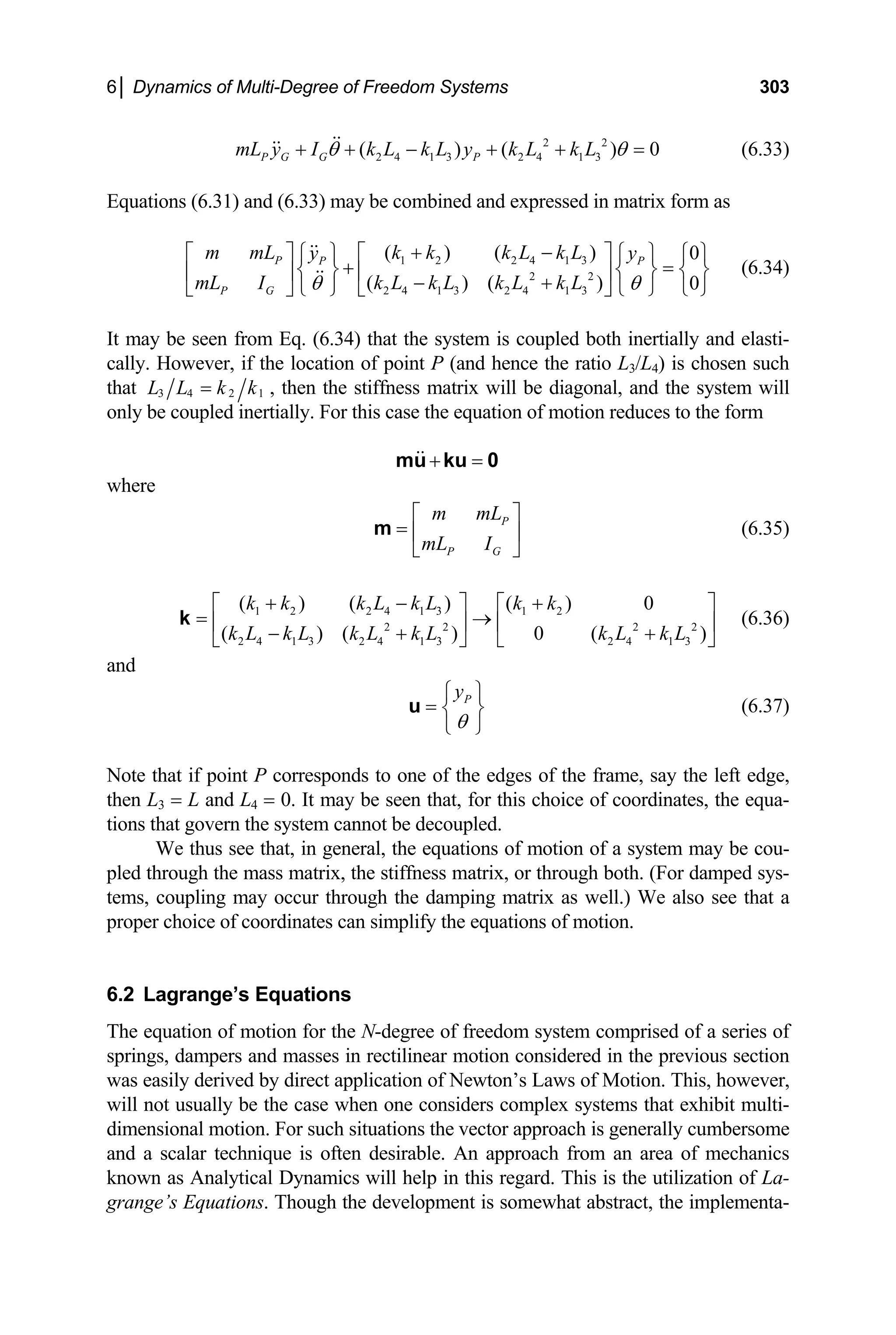
6. DYNAMICS OF MULTI-DEGREE OF FREEDOM SYSTEMS 287
6.1 Newtonian Mechanics of Discrete Systems…………………………. 288
6.1.1 Mass-Spring Systems…………………………………………. 288
6.1.2 The Double Pendulum………………………………………… 296
6.1.3 Two-Dimensional Motion of a Rigid Frame………………….. 300
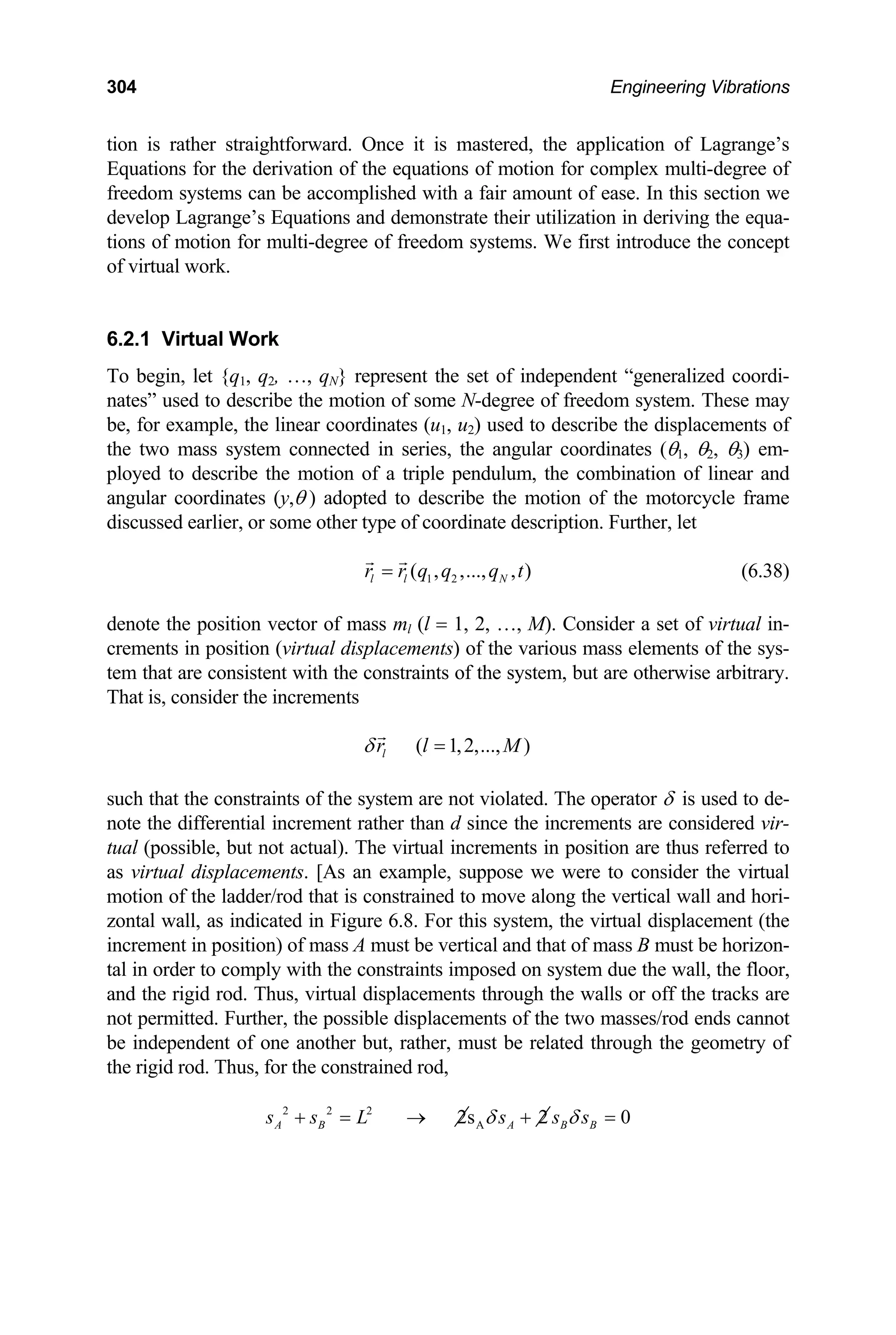
6.2 Lagrange’s Equations……………………………………………….. 303
6.2.1 Virtual Work………………………………………………….. 304
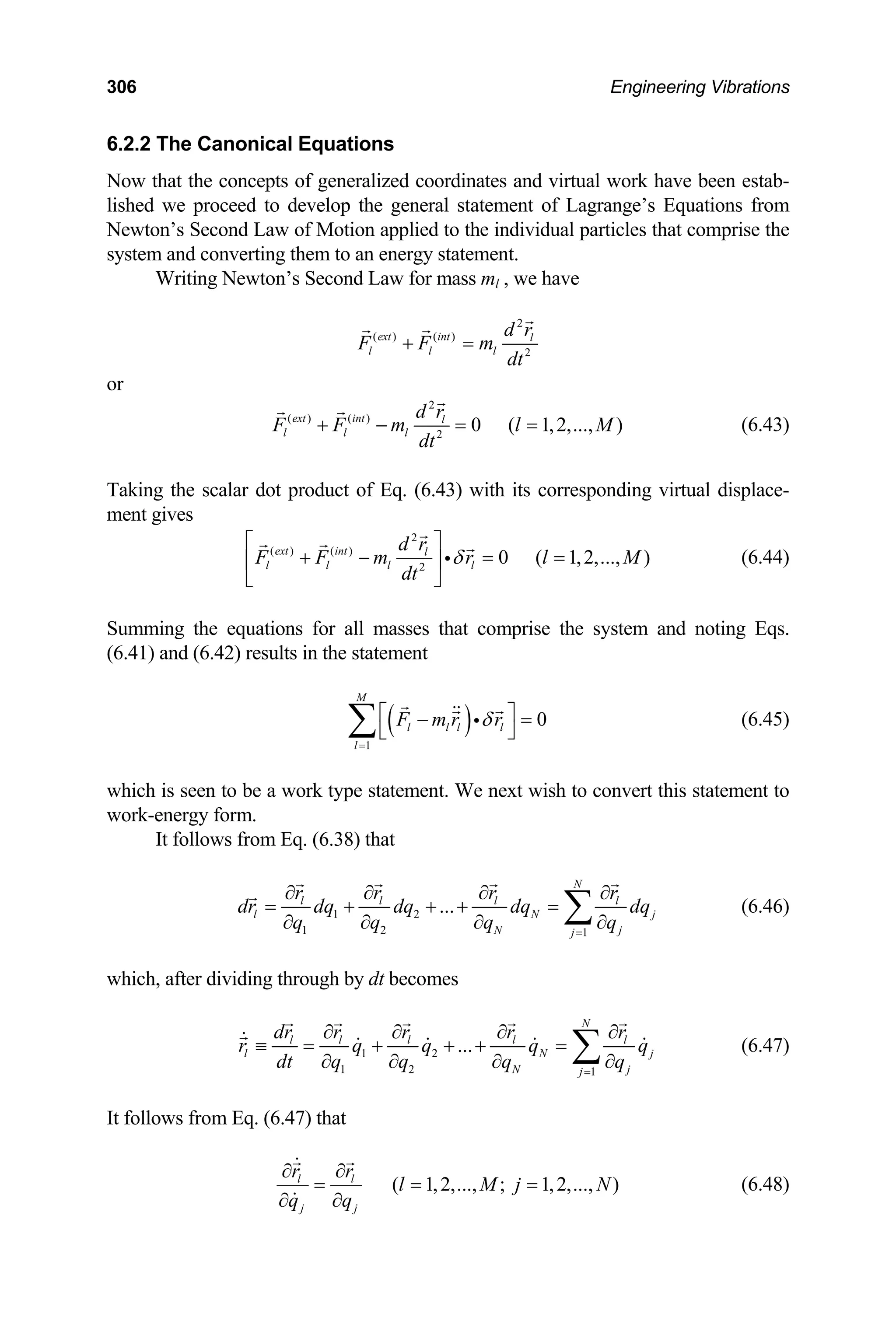
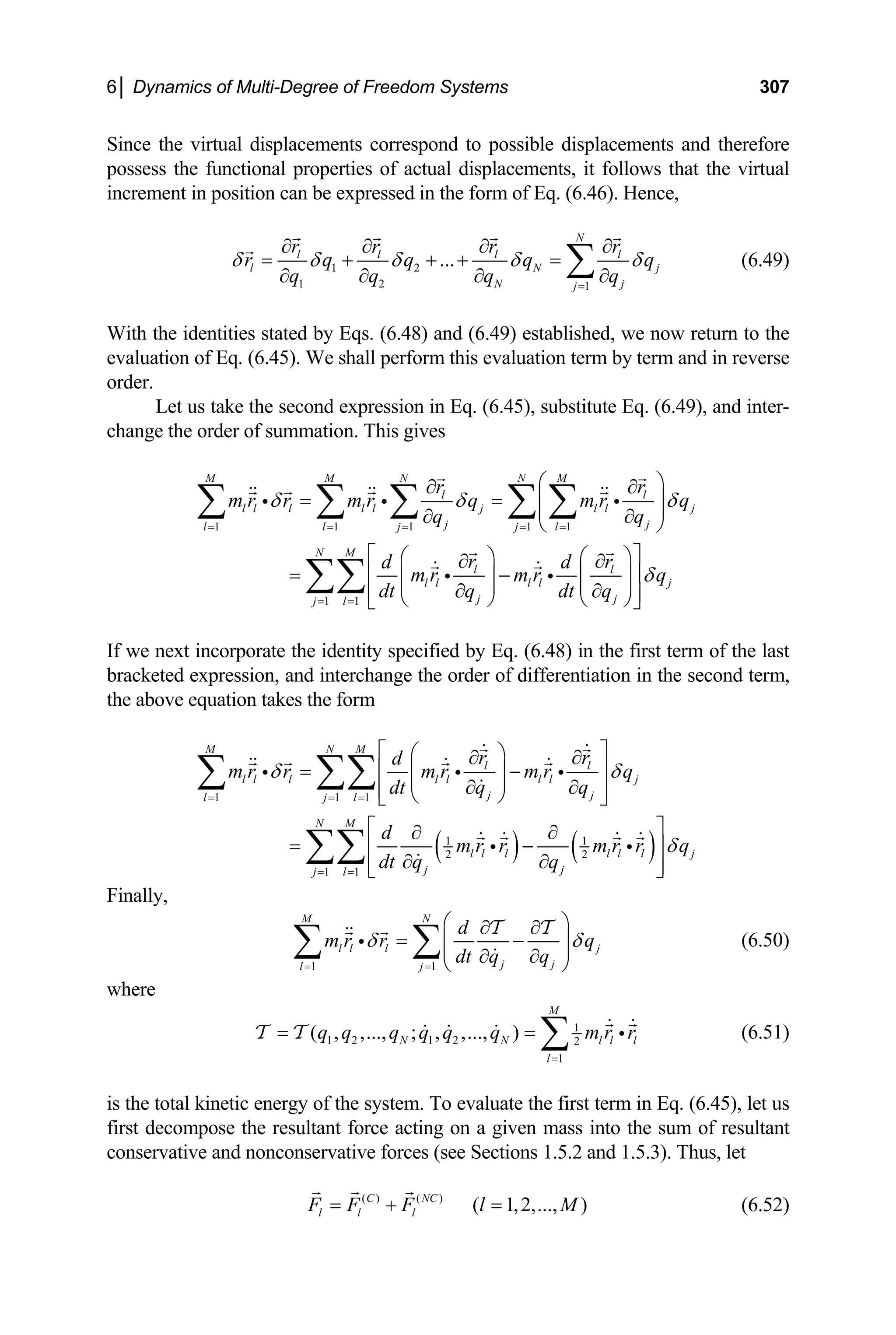
6.2.2 The Canonical Equations……………………………………… 306
6.2.3 Implementation…………………………………………………309
6.2.4 The Rayleigh Dissipation Function…………………………….321
6.3 Symmetry of the System Matrices……………………………………324
6.3.1 The Stiffness Matrix……………………………………………324
6.3.2 The Mass Matrix……………………………………………….327
6.3.3 The Damping Matrix………………………………………….. 328
6.4 Concluding Remarks………………………………………………… 329
Bibliography………………………………………………………….330
Problems…………………………………………………………….. 330
7. FREE VIBRATION OF MULTI-DEGREE OF FREEDOM SYSTEMS 341
7.1 The General Free Vibration Problem and Its Solution………………. 341
7.2 Unrestrained Systems……………………………………………….. 371
7.3 Properties of Modal Vectors………………………………………….374
7.3.1 The Scalar Product……………………………………………..375
7.3.2 Orthogonality…………………………………………………..377
7.3.3 Normalization…………………………………………………. 384
7.4 Systems with Viscous Damping……………………………………... 387
7.4.1 System Response……………………………………………… 387
7.4.2 State Space Representation……………………………………. 394
7.5 Evaluation of Amplitudes and Phase Angles…………………………400
7.5.1 Undamped Systems…………………………………………….401
7.5.2 Systems with General Viscous Damping………………………403
7.6 Concluding Remarks………………………………………………… 404
Bibliography………………………………………………………….405
Problems……………………………………………………………...405
Contents xvii
8. FORCED VIBRATION OF MULTI-DEGREE OF FREEDOM
SYSTEMS 415
8.1 Introduction………………………………………………………….. 416
8.1.1 Steady State Response to Harmonic Excitation……………….. 416
8.1.2 The Simple Vibration Absorber……………………………….. 418
8.2 Modal Coordinates……………………………………………………422
8.2.1 Principal Coordinates…………………………………………..422
8.2.2 Coordinate Transformations……………………………………424
8.2.3 Modal Coordinates……………………………………………..427
8.3 General Motion in Terms of the Natural Modes……………………...431
8.3.1 Linear Independence of the Set of Modal Vectors…………….. 431
8.3.2 Modal Expansion……………………………………………… 432
8.4 Decomposition of the Forced Vibration Problem……………………. 433
8.5 Solution of Forced Vibration Problems……………………………… 440
8.6 Mode Isolation………………………………………………………..468
8.7 Rayleigh Damping……………………………………………………474
8.8 Systems with General Viscous Damping……………………………. 479
8.8.1 Steady State Response to Harmonic Excitation……………….. 480
8.8.2 Eigenvector Expansion…………………………………………483
8.8.3 Decomposition of the Forced Vibration Problem………………484
8.8.4 Solution of Forced Vibration Problems……………………….. 487
8.9 Concluding Remarks………………………………………………… 498
Bibliography………………………………………………………….500
Problems…………………………………………………………….. 500
9. DYNAMICS OF ONE-DIMENSIONAL CONTINUA 511
9.1 Mathematical Description of 1-D Continua…………………………. 511
9.1.1 Correspondence Between Discrete and Continuous Systems…. 512
9.1.2 The Scalar Product and Orthogonality………………………… 517
9.2 Characterization of Local Deformation……………………………… 520
9.2.1 Relative Extension of a Material Line Element……………….. 521
9.2.2 Distortion……………………………………………………… 524
9.3 Longitudinal Motion of Elastic Rods…………………………………525
9.4 Torsional Motion of Elastic Rods……………………………………. 530
9.5 Transverse Motion of Strings and Cables……………………………. 534
9.6 Transverse Motion of Elastic Beams………………………………… 539
9.6.1 Kinematical and Constitutive Relations……………………….. 539
9.6.2 Kinetics………………………………………………………...543
9.6.3 Euler-Bernoulli Beam Theory………………………………… 544
9.6.4 Rayleigh Beam Theory………………………………………... 549
xviii Contents
9.6.5 Timoshenko Beam Theory……………………………………. 552
9.7 Geometrically Nonlinear Beam Theory……………………………. 558
9.8 Translating 1-D Continua……………………………………………. 562
9.8.1 Kinematics of a Material Particle………………………………562
9.8.2 Kinetics……………………………………………………….. 565
9.9 Concluding Remarks………………………………………………… 569
Bibliography………………………………………………………….570
Problems…………………………………………………………….. 571
10. FREE VIBRATION OF ONE-DIMENSIONAL CONTINUA 579
10.1 The General Free Vibration Problem…………………………………579
10.2 Free Vibration of Uniform Second Order Systems………………….. 581
10.2.1 The General Free Vibration Problem and Its Solution……….. 581
10.2.2 Longitudinal Vibration of Elastic Rods……………………… 582
10.2.3 Torsional Vibration of Elastic Rods…………………………. 591
10.2.4 Transverse Vibration of Strings and Cables…………………. 595
10.3 Free Vibration of Euler-Bernoulli Beams…………………………… 599
10.4 Free Vibration of Euler-Bernoulli Beam-Columns………………….. 617
10.5 Free Vibration of Rayleigh Beams……………………………………622
10.6 Free Vibration of Timoshenko Beams………………………………..627
10.7 Normalization of the Modal Functions………………………………. 634
10.8 Orthogonality of the Modal Functions………………………………..636
10.8.1 Systems Whose Mass Operators Are Scalar Functions……….637
10.8.2 Second Order Systems……………………………………….. 639
10.8.3 Euler-Bernoulli Beams and Beam-Columns………………….646
10.8.4 Rayleigh Beams………………………………………………652
10.8.5 Timoshenko Beams………………………………………….. 656
10.9 Evaluation of Amplitudes and Phase Angles…………………………660
10.9.1 Systems Possessing a Single Scalar Mass Operator…………. 660
10.9.2 Rayleigh Beams………………………………………………666
10.9.3 Timoshenko Beams………………………………………….. 669
10.10 Concluding Remarks………………………………………………… 673
Bibliography………………………………………………………… 675
Problems…………………………………………………………….. 675
11. FORCED VIBRATION OF ONE-DIMENSIONAL CONTINUA 683
11.1 Modal Expansion……………………………………………………. 684
11.1.1 Linear Independence of the Modal Functions……………….. 684
Contents xix
11.1.2 Generalized Fourier Series……………………………………685
11.2 Decomposition of the Forced Vibration Problem……………………. 686
11.3 Solution of Forced Vibration Problems……………………………… 690
11.3.1 Axially Loaded Elastic Rods………………………………… 690
11.3.2 Torsion of Elastic Rods……………………………………… 692
11.3.3 Strings and Cables…………………………………………… 694
11.3.4 Euler-Bernoulli Beams………………………………………. 697
11.3.5 Rayleigh Beams………………………………………………708
11.3.6 Timoshenko Beams………………………………………….. 711
11.4 Concluding Remarks………………………………………………… 714
Bibliography………………………………………………………….714
Problems…………………………………………………………….. 715
INDEX…………………………………………………………………………… 721
1
Preliminaries
The subject of mechanical vibrations is primarily concerned with the study of re-
peated, or nearly repeated, motion of mechanical systems. As engineers, we may be
interested in avoiding excessive vibration in a structure, machine or vehicle, or we
may wish to induce certain types of vibrations in a very precise manner. Stealth of a
submarine is intimately connected to vibration suppression, and earthquakes can have
dramatic effects on engineering structures. The response and durability of an engi-
neering system to short duration, high intensity, loading is a function of the vibration
characteristics of the system as well. Most of us have experienced the effects of vibra-
tions in our everyday lives. We might feel undesirable vibrations in an automobile, or
similarly while riding a bicycle. Likewise we might observe the vibration of an air-
plane wing while flying to or from a vacation, on our way to visiting friends or rela-
tives, or while traveling on business. We all enjoy the benefit of vibrations when we
have a conversation on a telephone or when we listen to music coming from our ste-
reo speakers. Even our ability to speak stems from the vibrations of our vocal chords.
The earliest modern scientific studies of vibrations are generally attributed to
Galileo, who examined the motion of the simple pendulum and the motion of strings.
Based on his observations, Galileo arrived at a relationship between the length of the
pendulum and its frequency and described the phenomenon of resonance, whereby a
system exhibits large amplitude vibrations when excited at or near its natural fre-
quency. Galileo also observed the dependence of the frequencies of a string on its
length, mass density and tension, and made comparisons with the behavior of the
pendulum. The fundamental understanding of mechanical vibrations was advanced in
the centuries that followed, with the development and advancement of mechanics and
the calculus. Investigations toward this end continue to the present day.
1
2 Engineering Vibrations
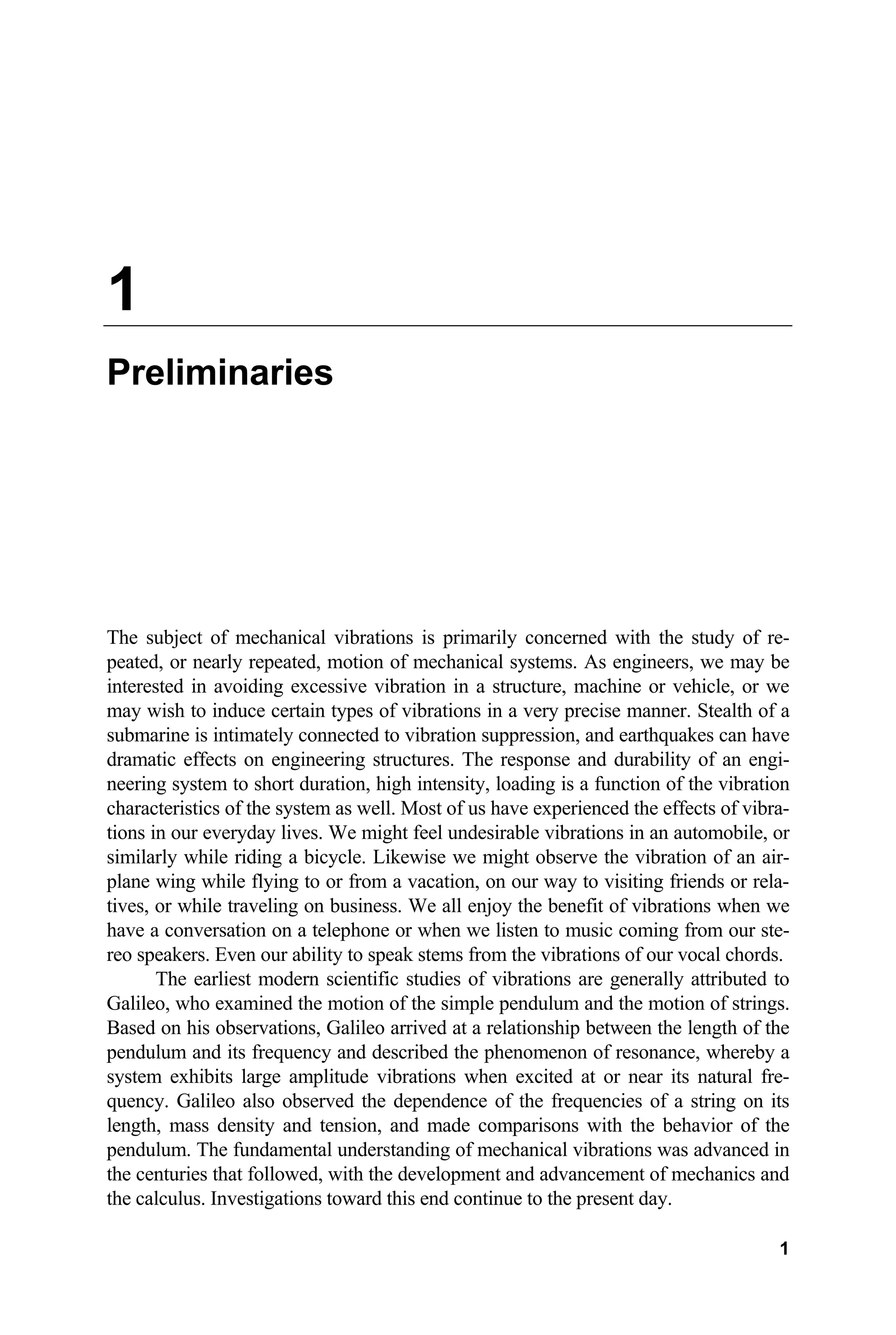
Figure 1.1 A two bar mechanism.
To study vibrations properly we must first understand and bring into context
certain preliminary material that will be used throughout this text. Much of this mate-
rial is presented in the present chapter, while other material of this type is introduced
and discussed in subsequent chapters of this book as needed. The preliminary mate-
rial presented in this chapter includes a discussion of the concepts of degrees of free-
dom, mathematical modeling and equivalent systems, and a review of complex num-
bers. The chapter finishes with an extensive review of elementary dynamics.
1.1 DEGREES OF FREEDOM
When we study the behavior of a system we need to choose parameters that describe
the motion of that system and we must make sure that we are employing enough pa-
rameters to characterize the motion of interest completely. That is to say, if we know
the values of these variables at a particular instant in time then we know the configu-
ration of the system at that time. Consider, for example, the two (rigid) bar mecha-
nism shown in Figure 1.1. Note that if we know the location of pins B and C at any
time, then we know the configuration of the entire system at that time, since the
lengths of the rigid rods are specified. That is, we know the location of every particle
(e.g., point) of the system. It may be noted that the location of pins B and C may be
characterized in many ways, some more efficient than others. We may, for example,
describe their locations by their Cartesian coordinates (xB , yB) and (xC , yC), or we may
describe their locations by the angular coordinates θAB and θBC, as indicated. Both sets
of coordinates describe the configuration of the mechanism completely. A combina-
tion of the two sets of coordinates, say (xB , yB) and θBC, also describes the configura-
tion of the system. It may be seen, however, that if we choose the angular coordinates
then we only need two coordinates to describe the configuration of the system, while
if we choose the Cartesian coordinates we need four, and if we choose the mixed set
of coordinates we need three. We see that, for this particular system, the minimum
number of coordinates needed to characterize its configuration completely is two.
This minimum number of coordinates is referred to as the degrees of freedom of the
system. We also note that the two angular coordinates may not be expressed in terms
of one another. They are said to be independent in this regard. In general then, the
number of degrees of freedom of a system refers to the number of independent coord-
1│ Preliminaries 3
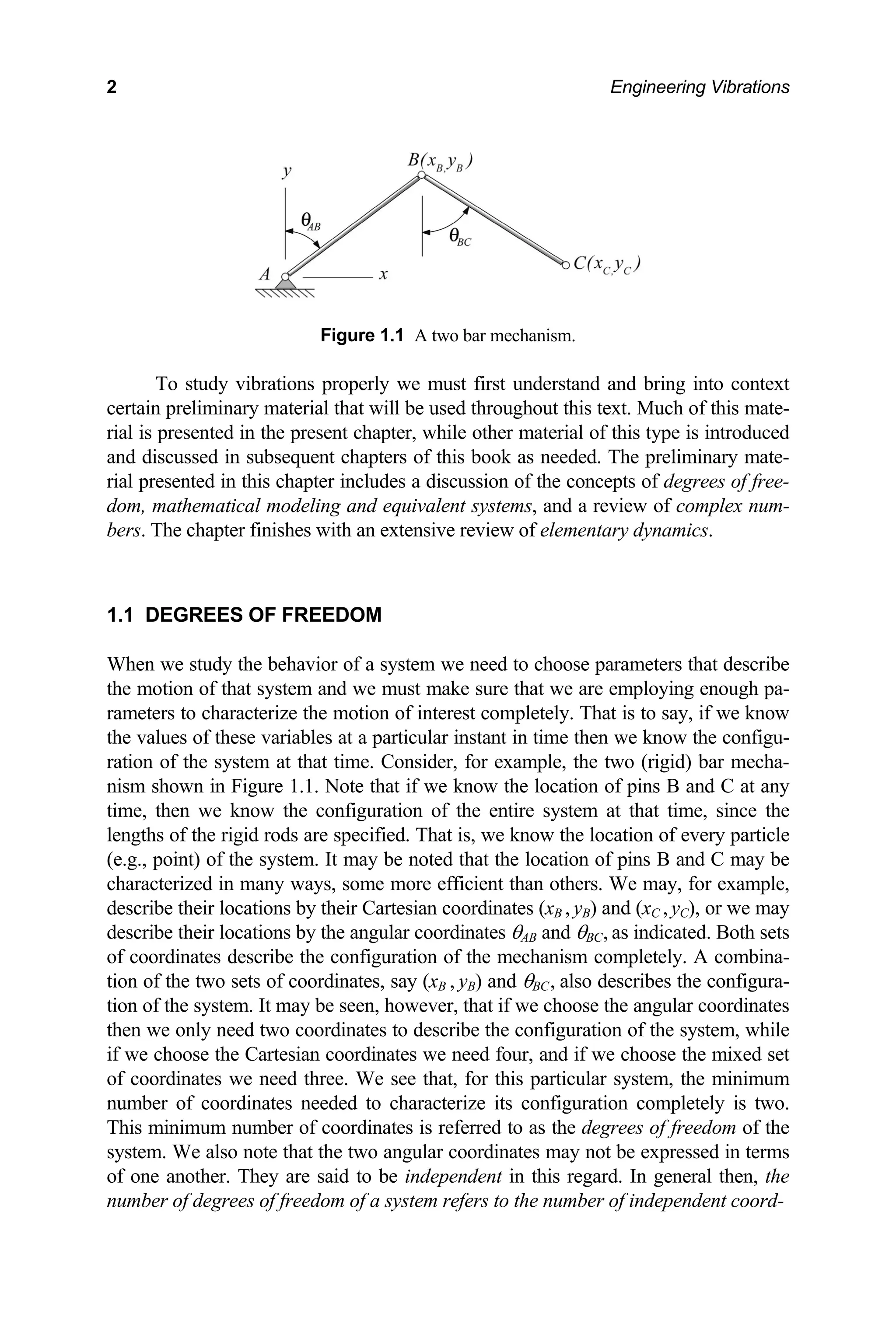
Figure 1.2 Sample single degree of freedom systems: (a) mass-spring system, (b) simple
pendulum.
inates needed to describe its configuration at any time. Examples of one degree of
freedom (1 d.o.f.) systems, two degree of freedom systems (2 d.o.f.), ‘N’ degree of
freedom systems (N d.o.f. — where N is any integer) and continuous (infinite degree
of freedom) systems are discussed in the remainder of this section.
Single Degree of Freedom Systems
Single degree of freedom systems are the simplest systems as they require only one
independent coordinate to describe their configuration. The simplest example of a
single degree of freedom system is the mass-spring system shown in Figure 1.2a. For
the system shown, the coordinate x indicates the position of the mass measured rela-
tive to its position when the massless elastic spring is unstretched. If x is known as a
function of time t, that is x = x(t) is known, then the motion of the entire system is
known as a function of time. Similarly, the simple pendulum shown in Figure 1.2b is
also a one degree of freedom system since the motion of the entire system is known if
the angular coordinate θ is known as a function of time. Note that while the position
of the bob may be described by the two Cartesian coordinates, x(t) and y(t), these
coordinates are not independent. That is, the Cartesian coordinates (x,y) of the bob
are related by the constraint equation, x2
+ y2
= L2
. Thus, if x is known then y is
known and vice versa. Further, both x(t) and y(t) are known if ( )
t
θ is known. In ei-
ther case, only one coordinate is needed to characterize the configuration of the sys-
tem. The system therefore has one degree of freedom.
Two Degree of Freedom Systems
The two bar mechanism described in the introduction of this section was identified as
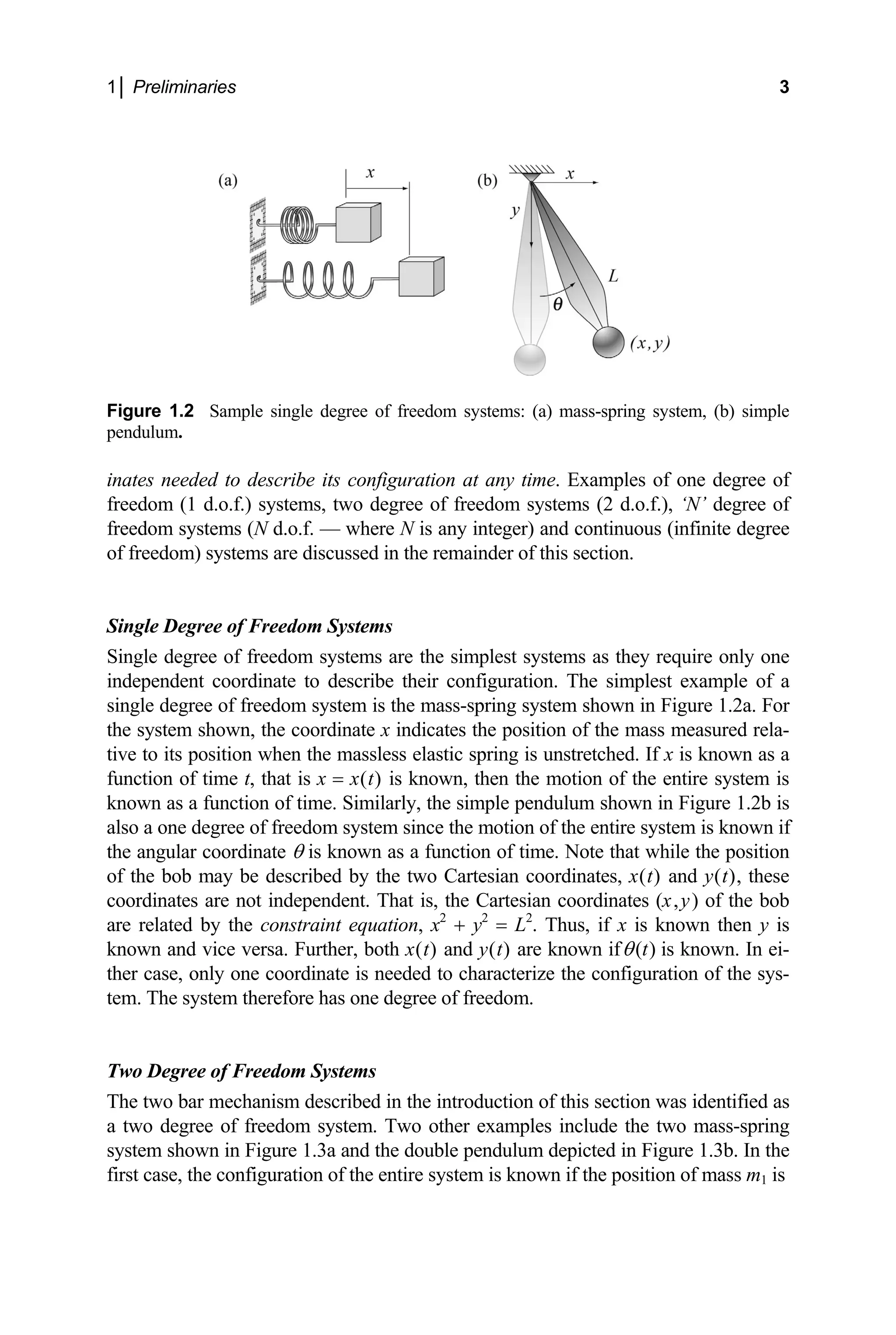
a two degree of freedom system. Two other examples include the two mass-spring
system shown in Figure 1.3a and the double pendulum depicted in Figure 1.3b. In the
first case, the configuration of the entire system is known if the position of mass m1 is
4 Engineering Vibrations
Figure 1.3 Sample two degree of freedom systems: (a) two-mass two-spring system, (b) dou-
ble pendulum.
known and the position of mass m2 is known. The positions are known if the coordi-
nates u1 and u2 are known, where u1 and u2 represent the displacements of the respec-
tive masses from their equilibrium configurations. Likewise, the motion of the double
pendulum is known if the angular displacements, θ1 and θ2, measured from the verti-
cal equilibrium configurations of the masses, are known functions of time.
General Discrete Multi-Degree of Freedom Systems
Two degree of freedom systems are a special case of multi-degree of freedom sys-
tems (systems with more than 1 d.o.f.). Thus, let us consider general N degree of
freedom systems, where N can take on any integer value as large as we like. Exam-
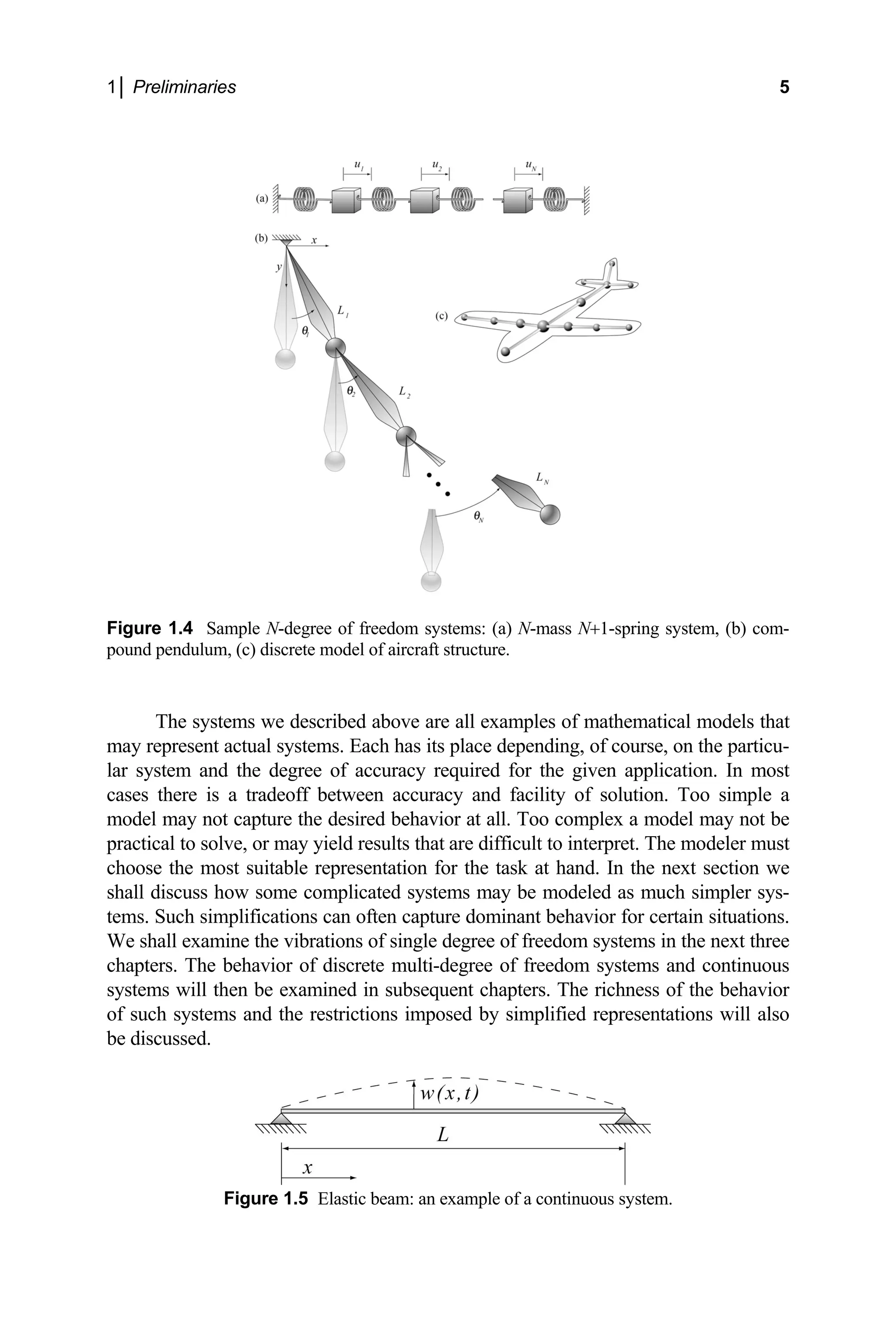
ples of such systems are the system comprised of N masses and N + 1 springs shown
in Figure 1.4a, and the compound pendulum consisting of N rods and N bobs shown
in Figure 1.4b and the discrete model of an aircraft structure depicted in Figure 1.4c.
Continuous Systems
To this point we have been discussing discrete systems — systems that have a finite
(or even infinite) number of masses separated by a finite distance. Continuous sys-
tems are systems whose mass is distributed continuously, typically over a finite do-
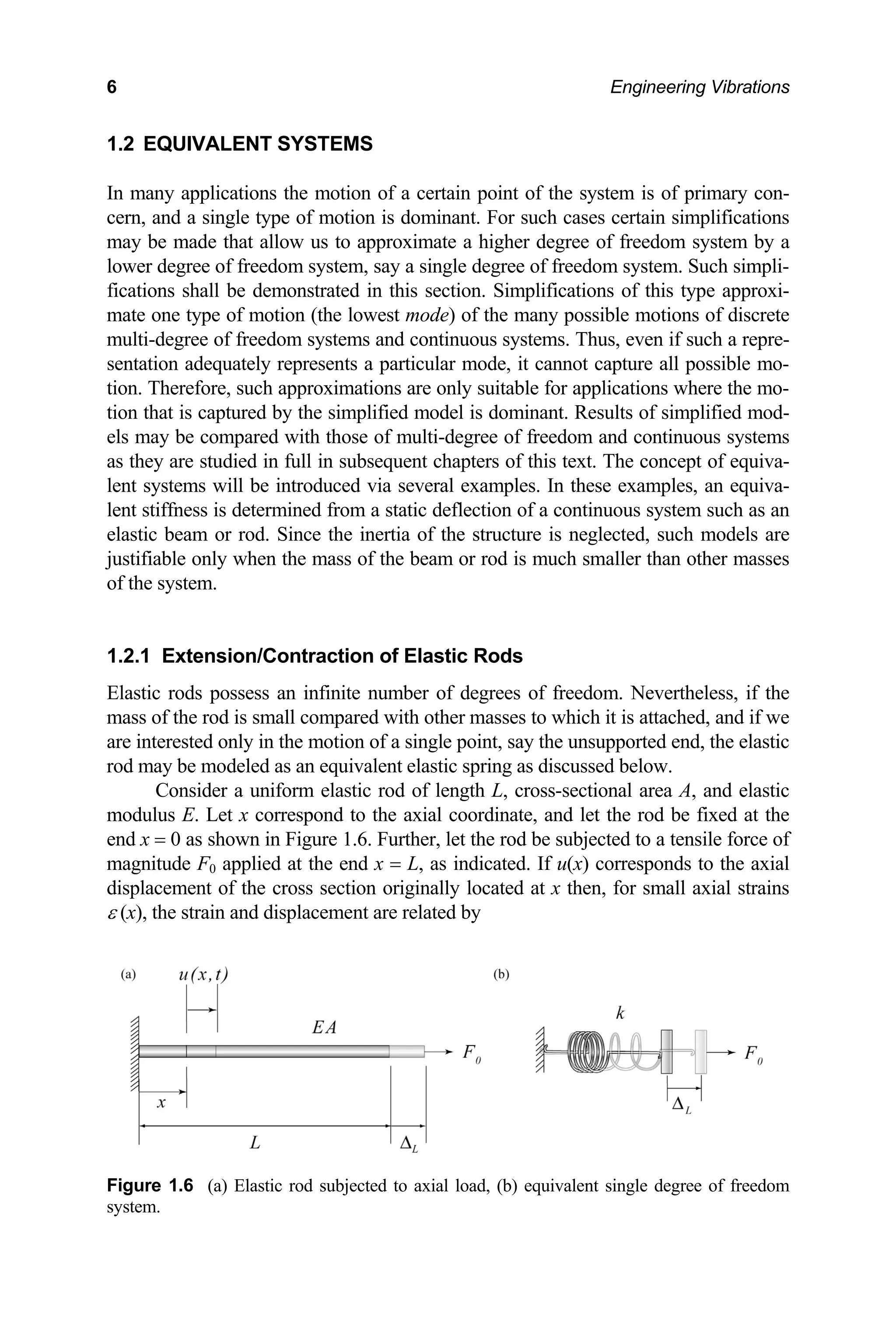
main. An example of a continuous system is the elastic beam shown in Figure 1.5.
For the case of a linear beam (one for which the strain-displacement relation contains
only first order terms of the displacement gradient), the transverse motion of the
beam is known if the transverse deflection, w(x,t), of each particle located at the co-
ordinates 0 x L
≤ ≤ along the axis of the beam is known.
1│ Preliminaries 5
Figure 1.4 Sample N-degree of freedom systems: (a) N-mass N+1-spring system, (b) com-
pound pendulum, (c) discrete model of aircraft structure.
The systems we described above are all examples of mathematical models that
may represent actual systems. Each has its place depending, of course, on the particu-
lar system and the degree of accuracy required for the given application. In most
cases there is a tradeoff between accuracy and facility of solution. Too simple a
model may not capture the desired behavior at all. Too complex a model may not be
practical to solve, or may yield results that are difficult to interpret. The modeler must
choose the most suitable representation for the task at hand. In the next section we
shall discuss how some complicated systems may be modeled as much simpler sys-
tems. Such simplifications can often capture dominant behavior for certain situations.
We shall examine the vibrations of single degree of freedom systems in the next three
chapters. The behavior of discrete multi-degree of freedom systems and continuous
systems will then be examined in subsequent chapters. The richness of the behavior
of such systems and the restrictions imposed by simplified representations will also
be discussed.
Figure 1.5 Elastic beam: an example of a continuous system.
6 Engineering Vibrations
1.2 EQUIVALENT SYSTEMS
In many applications the motion of a certain point of the system is of primary con-
cern, and a single type of motion is dominant. For such cases certain simplifications
may be made that allow us to approximate a higher degree of freedom system by a
lower degree of freedom system, say a single degree of freedom system. Such simpli-
fications shall be demonstrated in this section. Simplifications of this type approxi-
mate one type of motion (the lowest mode) of the many possible motions of discrete
multi-degree of freedom systems and continuous systems. Thus, even if such a repre-
sentation adequately represents a particular mode, it cannot capture all possible mo-
tion. Therefore, such approximations are only suitable for applications where the mo-
tion that is captured by the simplified model is dominant. Results of simplified mod-
els may be compared with those of multi-degree of freedom and continuous systems
as they are studied in full in subsequent chapters of this text. The concept of equiva-
lent systems will be introduced via several examples. In these examples, an equiva-
lent stiffness is determined from a static deflection of a continuous system such as an
elastic beam or rod. Since the inertia of the structure is neglected, such models are
justifiable only when the mass of the beam or rod is much smaller than other masses
of the system.
1.2.1 Extension/Contraction of Elastic Rods
Elastic rods possess an infinite number of degrees of freedom. Nevertheless, if the
mass of the rod is small compared with other masses to which it is attached, and if we
are interested only in the motion of a single point, say the unsupported end, the elastic
rod may be modeled as an equivalent elastic spring as discussed below.
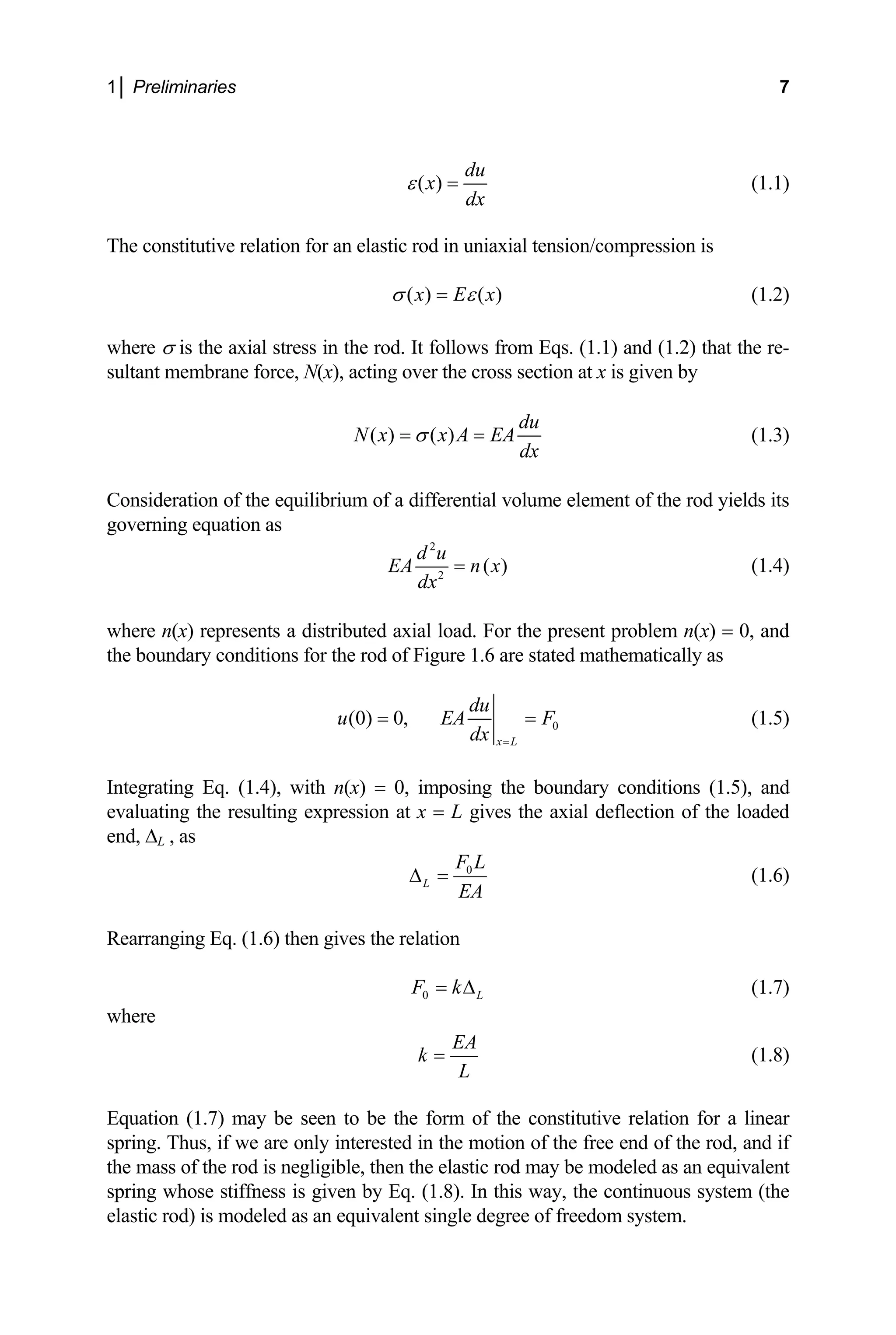
Consider a uniform elastic rod of length L, cross-sectional area A, and elastic
modulus E. Let x correspond to the axial coordinate, and let the rod be fixed at the
end x = 0 as shown in Figure 1.6. Further, let the rod be subjected to a tensile force of
magnitude F0 applied at the end x = L, as indicated. If u(x) corresponds to the axial
displacement of the cross section originally located at x then, for small axial strains
ε (x), the strain and displacement are related by
Figure 1.6 (a) Elastic rod subjected to axial load, (b) equivalent single degree of freedom
system.
1│ Preliminaries 7
( )
du
x
dx
ε = (1.1)
The constitutive relation for an elastic rod in uniaxial tension/compression is
( ) ( )
x E x
σ ε
= (1.2)
where σ is the axial stress in the rod. It follows from Eqs. (1.1) and (1.2) that the re-
sultant membrane force, N(x), acting over the cross section at x is given by
( ) ( )
du
N x x A EA
dx
σ
= = (1.3)
Consideration of the equilibrium of a differential volume element of the rod yields its
governing equation as
2
2
( )
d u
EA n x
dx
= (1.4)
where n(x) represents a distributed axial load. For the present problem n(x) = 0, and
the boundary conditions for the rod of Figure 1.6 are stated mathematically as
0
(0) 0,
x L
du
u EA
dx =
F
= = (1.5)
Integrating Eq. (1.4), with n(x) = 0, imposing the boundary conditions (1.5), and
evaluating the resulting expression at x = L gives the axial deflection of the loaded
end, ∆L , as
0
L
F L
EA
∆ = (1.6)
Rearranging Eq. (1.6) then gives the relation
0 L
F k
= ∆ (1.7)
where
EA
k
L
= (1.8)
Equation (1.7) may be seen to be the form of the constitutive relation for a linear
spring. Thus, if we are only interested in the motion of the free end of the rod, and if
the mass of the rod is negligible, then the elastic rod may be modeled as an equivalent
spring whose stiffness is given by Eq. (1.8). In this way, the continuous system (the
elastic rod) is modeled as an equivalent single degree of freedom system.
8 Engineering Vibrations
1.2.2 Bending of Elastic Beams
As discussed earlier, continuous systems such as elastic beams have an infinite num-
ber of degrees of freedom. Yet, under appropriate circumstances (loading type, kin-
ematical constraints, mass ratios, etc.) a certain type of motion may be dominant.
Further, as a simple model may be desirable and still capture important behavior, we
next consider several examples of elastic beams modeled as equivalent single degree
of freedom systems.
The Cantilever Beam
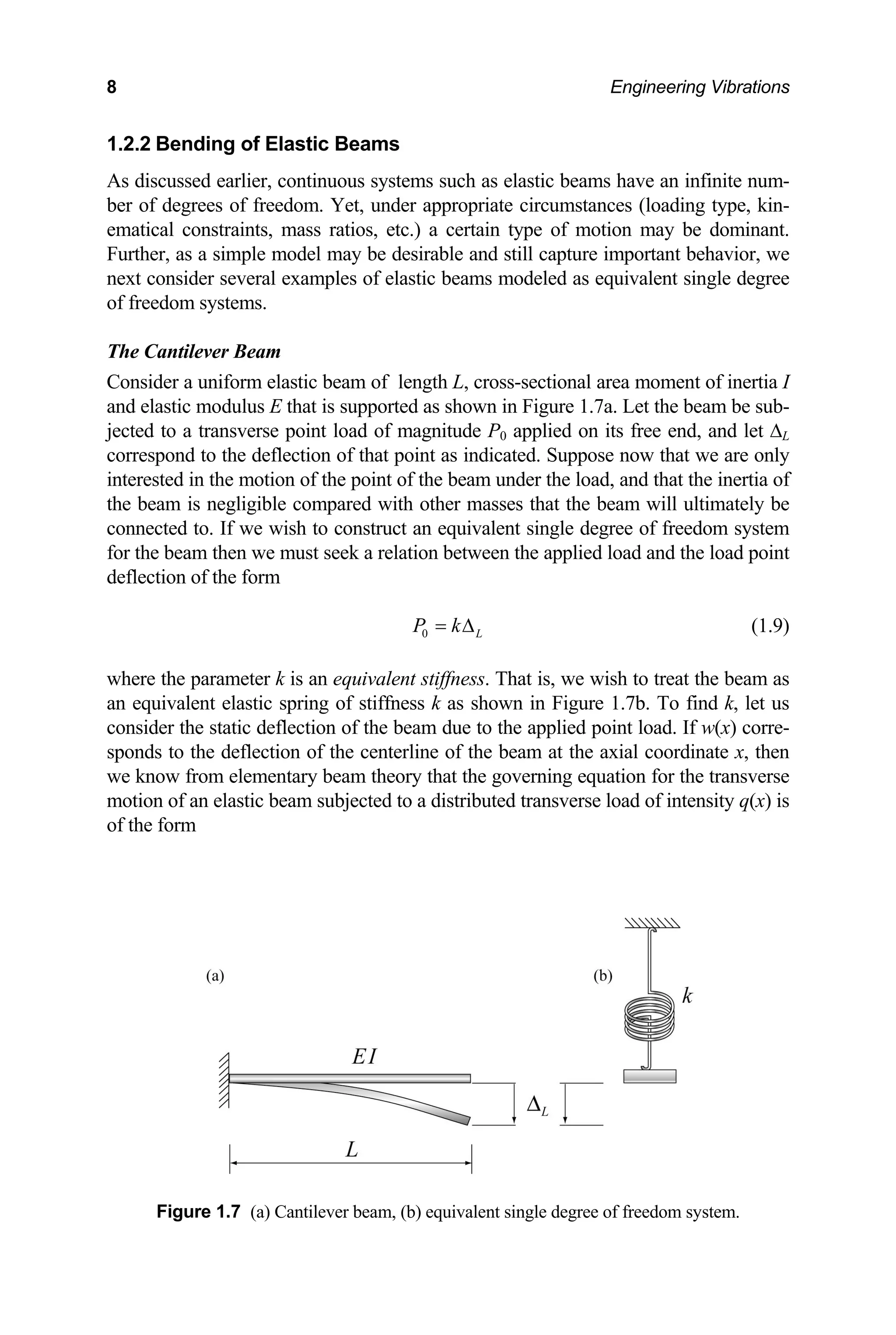
Consider a uniform elastic beam of length L, cross-sectional area moment of inertia I
and elastic modulus E that is supported as shown in Figure 1.7a. Let the beam be sub-
jected to a transverse point load of magnitude P0 applied on its free end, and let ∆L
correspond to the deflection of that point as indicated. Suppose now that we are only
interested in the motion of the point of the beam under the load, and that the inertia of
the beam is negligible compared with other masses that the beam will ultimately be
connected to. If we wish to construct an equivalent single degree of freedom system
for the beam then we must seek a relation between the applied load and the load point
deflection of the form
0 L
P k
= ∆ (1.9)
where the parameter k is an equivalent stiffness. That is, we wish to treat the beam as
an equivalent elastic spring of stiffness k as shown in Figure 1.7b. To find k, let us
consider the static deflection of the beam due to the applied point load. If w(x) corre-
sponds to the deflection of the centerline of the beam at the axial coordinate x, then
we know from elementary beam theory that the governing equation for the transverse
motion of an elastic beam subjected to a distributed transverse load of intensity q(x) is
of the form
Figure 1.7 (a) Cantilever beam, (b) equivalent single degree of freedom system.
1│ Preliminaries 9
4
4
( )
d w
EI q x
dx
= (1.10)
where q(x) = 0 for the case under consideration. The boundary conditions for a beam
that is clamped at the origin and loaded by a point load at its free end are
2 3
0
2 3
0
(0) 0, 0,
x x L x L
dw d w d w
w EI EI
dx dx dx
= = =
= = = = P
− (1.11)
Integrating Eq. (1.10) with q(x) = 0, imposing the boundary conditions of Eq. (1.11)
and evaluating the resulting solution at x = L gives the load point deflection
3
0
( )
3
L
P L
w L
EI
∆ ≡ = (1.12)
Solving Eq. (1.12) for P0 gives the relation
0 L
P k
= ∆ (1.13)
where
3
3EI
k
L
= (1.14)
We have thus found the equivalent stiffness (i.e., the stiffness of an equivalent spring)
for a cantilever beam loaded at its free edge by a transverse point load. We shall next
use this result to establish mathematical models for selected sample structures.
Side-Sway of Structures
In the previous section we found the equivalent stiffness of a cantilever beam as per-
tains to the motion of its free end. In this section we shall employ that stiffness in the
construction of a dynamic single degree of freedom model of a one-story structure
undergoing side-sway motion as may occur, for example, during an earthquake.
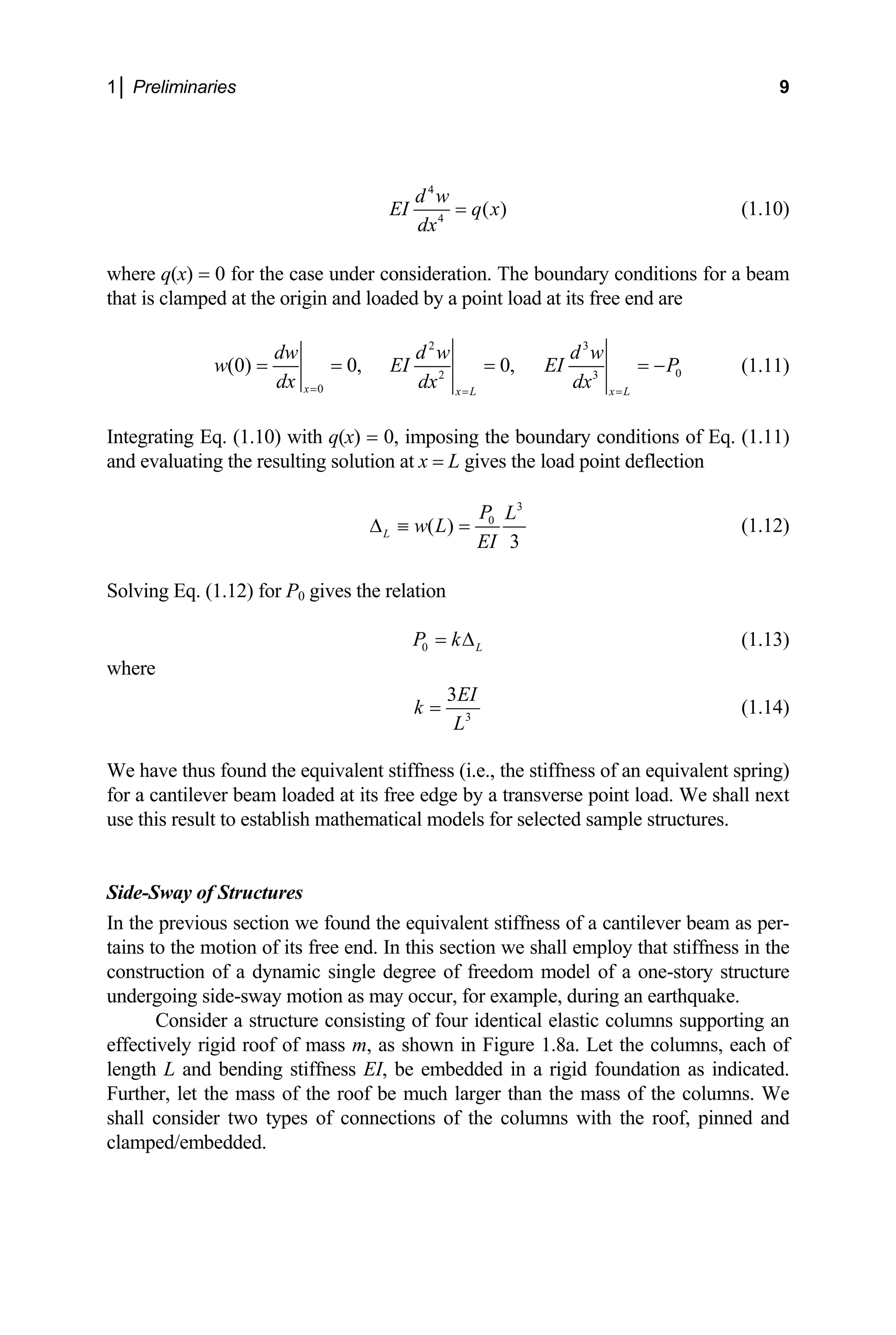
Consider a structure consisting of four identical elastic columns supporting an
effectively rigid roof of mass m, as shown in Figure 1.8a. Let the columns, each of
length L and bending stiffness EI, be embedded in a rigid foundation as indicated.
Further, let the mass of the roof be much larger than the mass of the columns. We
shall consider two types of connections of the columns with the roof, pinned and
clamped/embedded.
10 Engineering Vibrations
Figure 1.8 Side-sway of one-story structure with pinned connections at roof: (a) repre-
sentative structure, (b) roof with columns represented as equivalent springs, (c) equiva-
lent system.
Pinned Connections
Let the columns be connected to the roof of the structure as shown in Figure
1.8a. If we are interested in side-sway motion of the structure as may occur dur-
ing earthquakes, and if the mass of the columns is negligible compared with the
mass of the roof, then the columns may be treated as cantilever beams as dis-
cussed earlier. For this purpose, the structure may be modeled as four equiva-
lent springs, each of stiffness k as given by Eq. (1.14) and shown in Figure
1.8b. This, in turn, is equivalent to a mass attached to a single effective spring
of stiffness keff (see Section 1.3), given by
3
12
4
eff
EI
k k
L
= = (1.15)
1│ Preliminaries 11
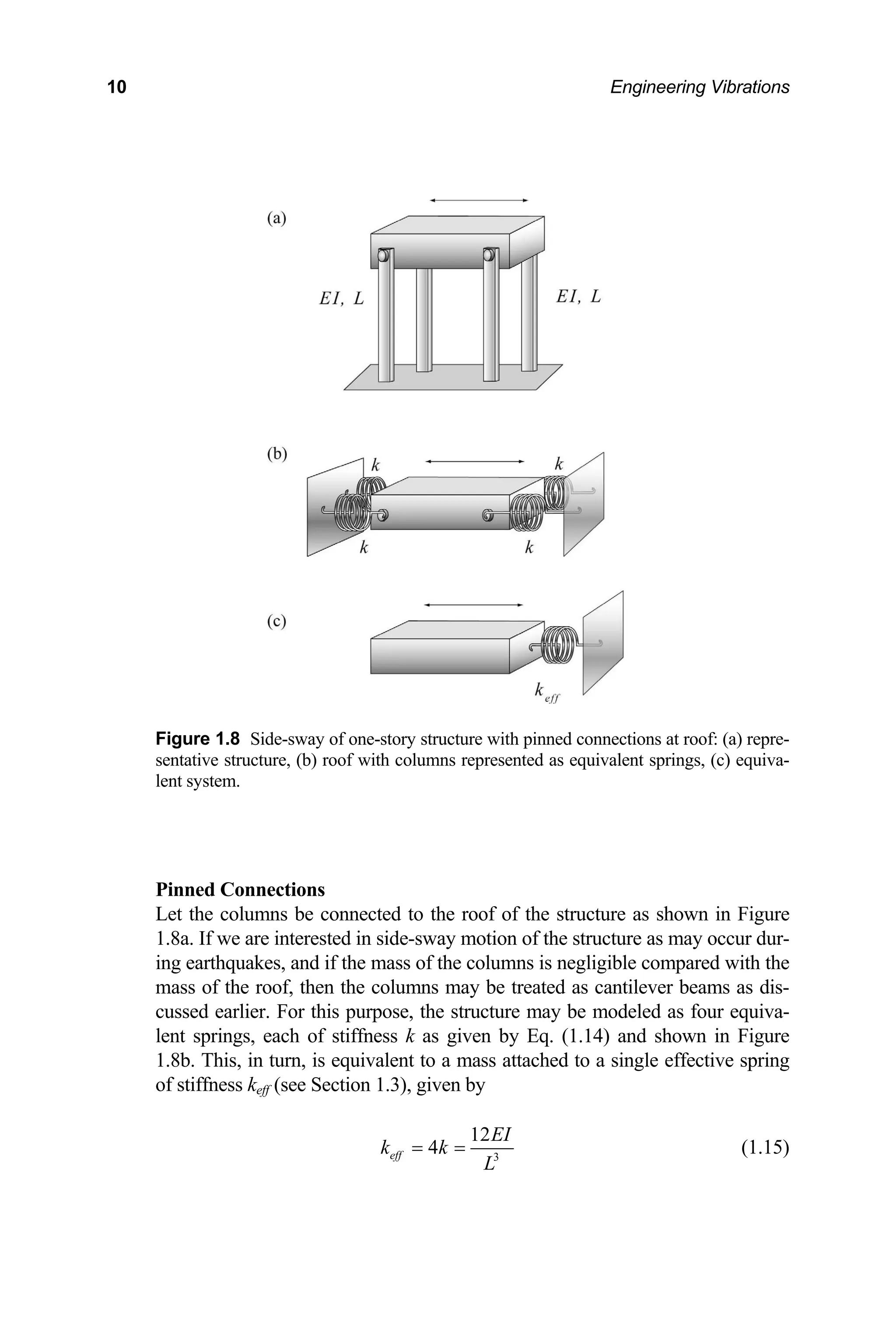
Figure 1.9 Side-sway of one-story structure with clamped connections at roof: (a)
structure in motion, (b) deflection of column showing inflection point A.
Clamped Connections
If the columns are embedded (framed) into the roof structure, as shown in Fig-
ure 1.9a), the deflections differ from those for the pinned case. One way to de-
termine the equivalent stiffness of a beam that is clamped-fixed at one end and
clamped-free at the other is to solve Eq. (1.10) with q(x) = 0 subject to the
boundary conditions
3
0
3
0
(0) 0, =0,
x x L x L
dw dw d w
w E
dx dx dx
= = =
= = = −
I P (1.16)
in lieu of the boundary conditions of Eq. (1.11). It may be seen that only the
last condition differs from the previous case. This approach, however, will be
left as an exercise (Problem 1.6). Instead, we shall use the results for the canti-
lever beam to obtain the desired result. This may be done if we realize that, due
to the anti-symmetry of the deformation, the deflection of the column for the
present case possesses an inflection point at the center of the span (point A, Fig-
ure 1.9b). Since, by definition, the curvature and hence the bending moment
vanishes at an inflection point such a point is equivalent to a pin joint. Thus,
each of the columns for the structure under consideration may be viewed as two
cantilever beams of length L/2 that are connected by a pin at the center of the
span. The total deflection of the roof will then be twice that of the inflection
point, as indicated. Therefore, letting and in Eq. (1.13)
gives, for a single clamped-fixed/clamped-free column, that
/ 2
L L
→ / 2
L L
∆ → ∆
3
12EI
k
L
= (1.17)
12 Engineering Vibrations
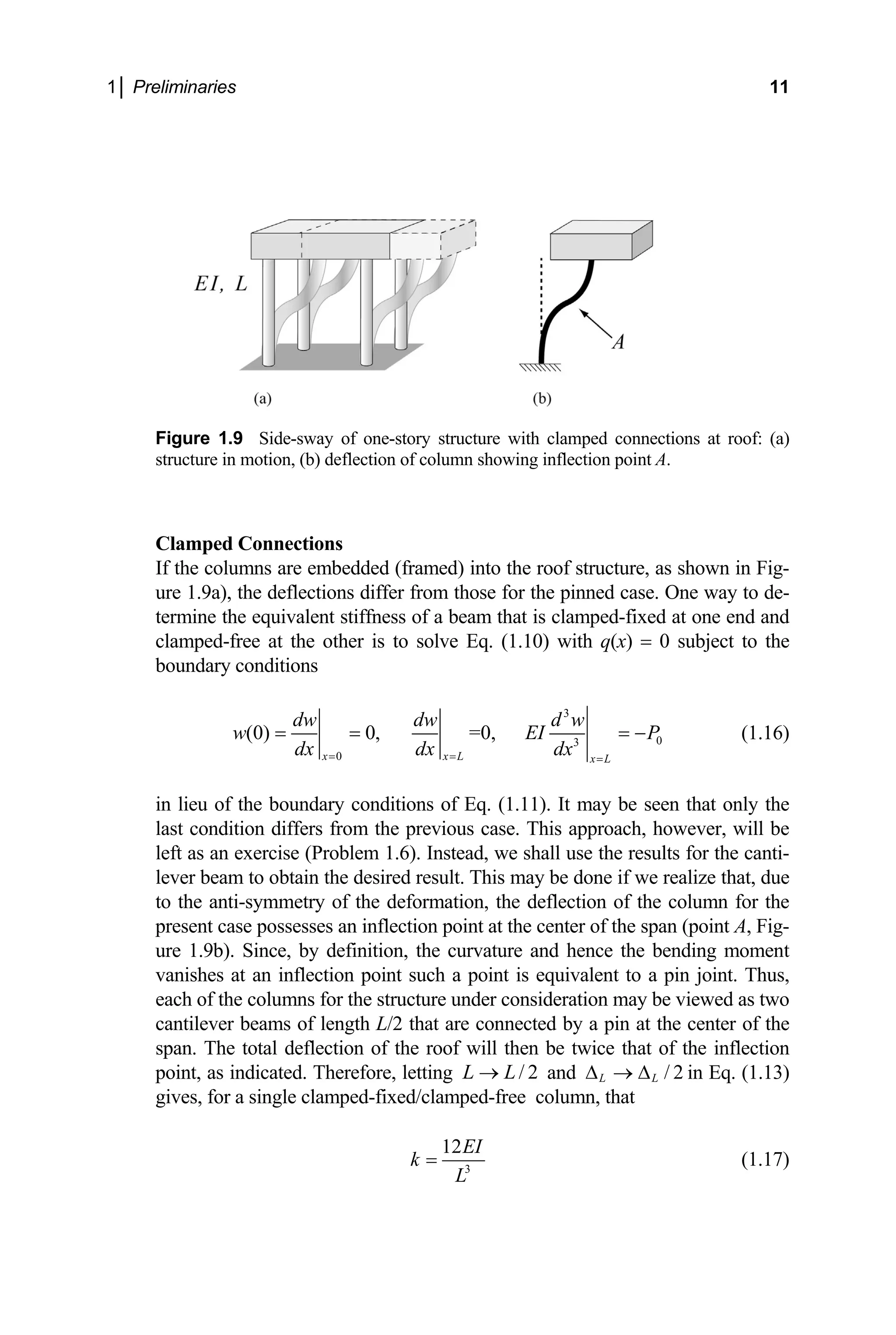
Figure 1.10 Side-sway of multi-story structure: (a) multi-story building, (b) equivalent dis-
crete system.
As for the pinned roof structure considered earlier, the four equivalent springs
for the present structure act in parallel (see Section 1.3) and are thus equivalent
to a single effective spring of stiffness
3
48
4
eff
EI
k k
L
= = (1.18)
Note that since, for this case, the columns are embedded in the roof and hence
provide greater resistance to bending and therefore to lateral translation of the
roof than for the pinned case, the effective stiffness is higher (by a factor of 4)
than the stiffness for the pinned case.
Multi-Story Buildings
Consider the N-story building shown in Figure 1.10a. Let each floor of the
building be connected by four columns below it and four columns above it,
with the obvious exception that the roof (floor number N) has no columns
above it. Let each floor, numbered j = 1, 2, …, N from bottom to top, possess
1│ Preliminaries 13
mass mj and let the ends of the columns be embedded into the floors. The
ground floor, j = 0, is fixed to the ground. Further, let each column that con-
nects floor j with floor j −1 possess bending stiffness EjIj, as indicated, where Ej
and Ij respectively correspond to the elastic modulus and area moment of iner-
tia of the column. If we are interested in side-sway motion of the building, and
if the masses of the columns are negligible compared to those of the floors,
then the building may be represented by the equivalent discrete N – degree of
freedom system shown in Figure 1.10b. It follows from our discussions of a
single story building with end-embedded columns that the equivalent stiffness
of the jth
spring may be obtained directly from Eq. (1.18). Hence,
3
48
( 1,2,... )
j j
j
E I
k j
L
= = N (1.19)
The Simply Supported Beam
We next construct an equivalent single degree of freedom system for a simply sup-
ported beam subjected to a transverse point load applied at the midpoint of the span.
The equivalent stiffness of this structure can, of course, be found by solving Eq.
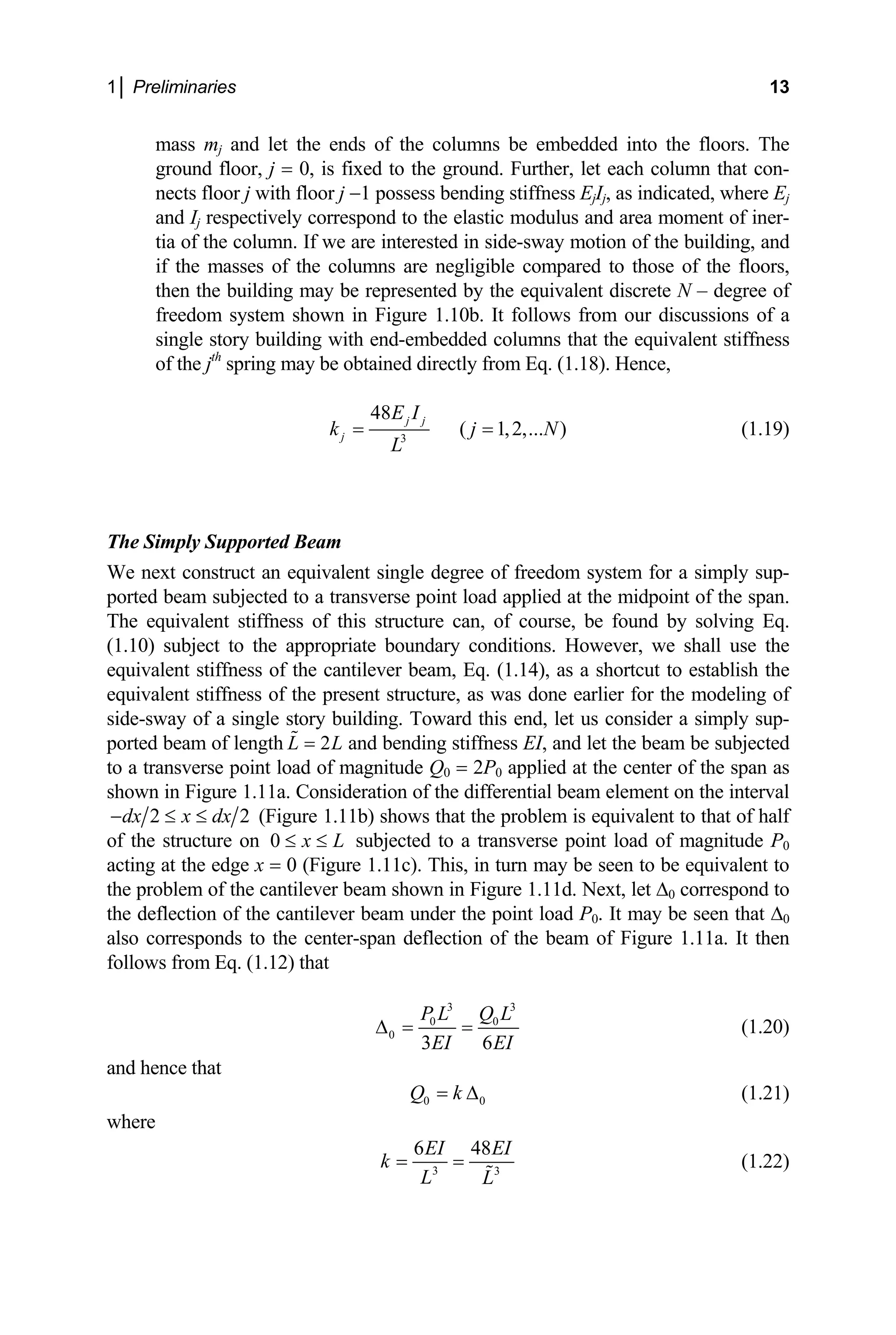
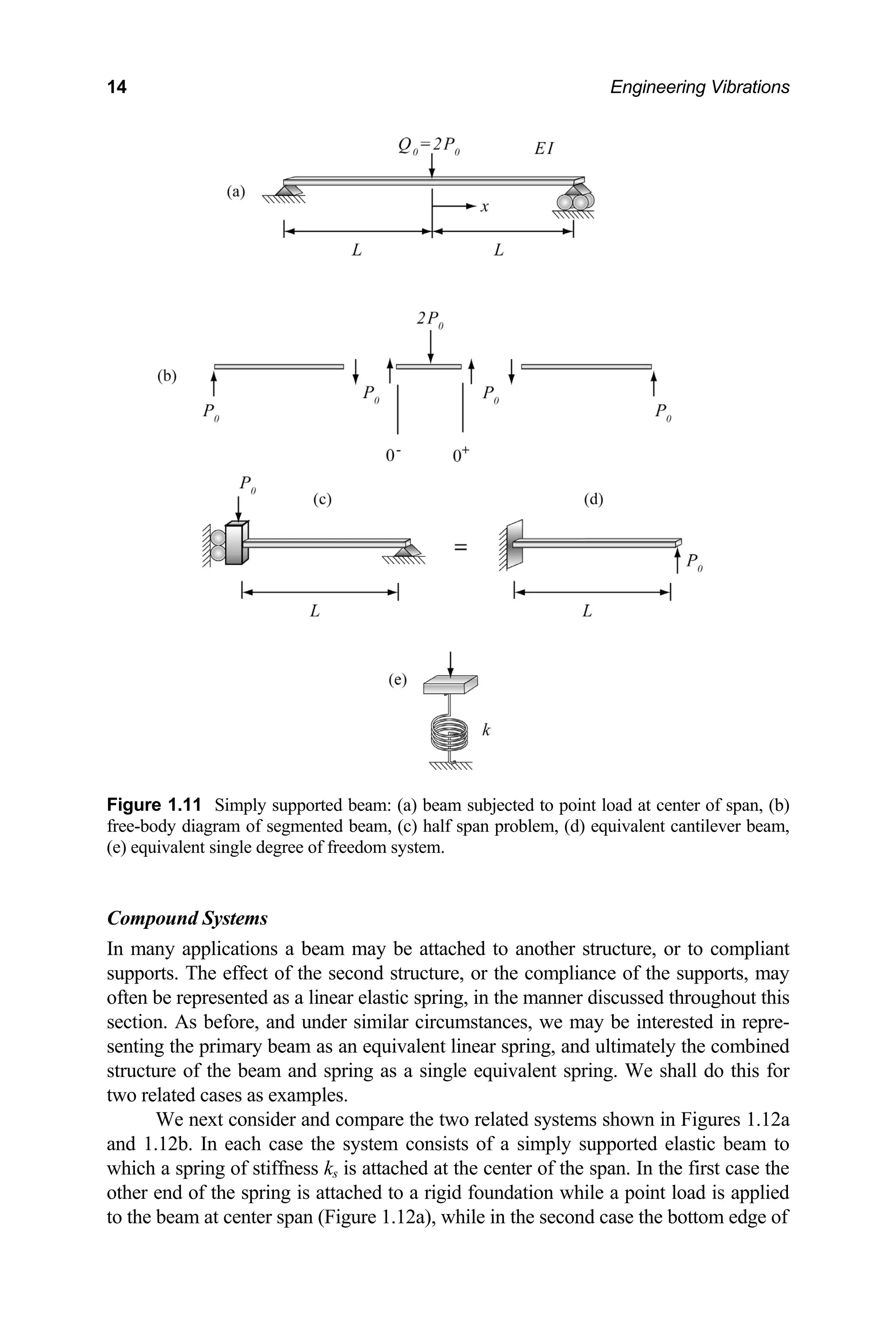
(1.10) subject to the appropriate boundary conditions. However, we shall use the
equivalent stiffness of the cantilever beam, Eq. (1.14), as a shortcut to establish the
equivalent stiffness of the present structure, as was done earlier for the modeling of
side-sway of a single story building. Toward this end, let us consider a simply sup-
ported beam of length and bending stiffness EI, and let the beam be subjected
to a transverse point load of magnitude Q
2
L L
=
0 = 2P0 applied at the center of the span as
shown in Figure 1.11a. Consideration of the differential beam element on the interval
2
dx x dx
− ≤ ≤ 2 (Figure 1.11b) shows that the problem is equivalent to that of half
of the structure on 0 x L
≤ ≤ subjected to a transverse point load of magnitude P0
acting at the edge x = 0 (Figure 1.11c). This, in turn may be seen to be equivalent to
the problem of the cantilever beam shown in Figure 1.11d. Next, let ∆0 correspond to
the deflection of the cantilever beam under the point load P0. It may be seen that ∆0
also corresponds to the center-span deflection of the beam of Figure 1.11a. It then
follows from Eq. (1.12) that
3 3
0 0
0
3 6
P L Q L
EI EI
∆ = = (1.20)
and hence that
0
Q k 0
= ∆ (1.21)
where
3 3
6 48
EI EI
k
L L
= = (1.22)
14 Engineering Vibrations
Figure 1.11 Simply supported beam: (a) beam subjected to point load at center of span, (b)
free-body diagram of segmented beam, (c) half span problem, (d) equivalent cantilever beam,
(e) equivalent single degree of freedom system.
Compound Systems
In many applications a beam may be attached to another structure, or to compliant
supports. The effect of the second structure, or the compliance of the supports, may
often be represented as a linear elastic spring, in the manner discussed throughout this
section. As before, and under similar circumstances, we may be interested in repre-
senting the primary beam as an equivalent linear spring, and ultimately the combined
structure of the beam and spring as a single equivalent spring. We shall do this for
two related cases as examples.
We next consider and compare the two related systems shown in Figures 1.12a
and 1.12b. In each case the system consists of a simply supported elastic beam to
which a spring of stiffness ks is attached at the center of the span. In the first case the
other end of the spring is attached to a rigid foundation while a point load is applied
to the beam at center span (Figure 1.12a), while in the second case the bottom edge of
1│ Preliminaries 15
Since we are interested in the vertical motion of the center-span of the beam we
may model the beam as an equivalent linear spring. It follows that the effective
ven by Eq. (1.22). The
Figure 1.12 Compound system of elastic beam and spring: (a) fixed spring, (b) loaded spring.
the spring is free to translate and a point load is applied to that edge (Figure 1.12b).
Simply Supported Beam Attached to a Fixed Spring
stiffness, kbeam, of the equivalent spring for the beam is gi
stiffness of the compound system consisting of the two springs may then be ob-
tained by superposition, as shown in Figure 1.13. For this case, the springs are
seen to act in parallel and thus to act as a single equivalent spring whose stiff-
ness, keq, is the sum of the stiffnesses of the two parallel springs (see Section
1.3). We therefore have that
3
6
eq
EI
k k k k
beam s s
L
= + = + (1.23)
Figure 1.13 Equivalent system for beam and spring of Figure 1.12a.
16 Engineering Vibrations
Figure 1.14 Equivalent system for beam and spring of Figure 1.12b.
Simply Suppo
Let us again consider a sim attached to a linear
spring of stiffness ks load is applied to the free
edge of the spring (Figure 1.1 n, if we are only interested in the
motion of the point of the b the point load (the center-
an of the beam), we may model the beam as an equivalent linear spring as we
4, it may
be seen that the two springs act in series and hence that the effect of the two
springs is equivalent to that of a single equivalent spring. As shown in Section
ompound system of
rted Beam Attached to a Loaded Spring
ply supported elastic beam
. In this case, however, a point
2b). Once agai
eam that lies directly over
sp
did for the previous case. Using superposition, as shown in Figure 1.1
1.3, the stiffness of the equivalent spring representing the c
the two springs in series is given by
( ) ( ) ( ) ( )
3
1 1
1 1 6 1
eq
beam s s
k
k k L EI k
= =
+ +
(1.24)
Torsion of Elastic Rods
tion 1.2.1 we examined axial motion
1.2.3
In Sec of elastic rods and the bending of elastic
eams. In each case we found the stiffness of an equivalent elastic spring for situa-
ons where we would be concerned with axial or transverse mo
f the structure. This stiffness could then be used in the const
system representation for situations where the mass of the
d or beam is much smaller than other masses of the system. An example of the use
f such a representation was in the side-sway motion of a roof structure. In this sec-
stiffness of an equivalent torsional spring rep-
of an elastic rod of circular cross section. In this
b
ti tion of a single point
o ruction of a simpler,
single degree of freedom
ro
o
tion we shall determine the analogous
resenting the rotational resistance
regard, such a model will be applicable in situations where we are interested in small
rotational motion of a single cross section at some point along the axis of the rod, say
at its free end, and when the mass moment of inertia of the rod is small compared
with other mass moments of the system.
1│ Preliminaries 17
Figure stem.
Single Rod
C of length L,
shear m
nd and be subjected to a twisting moment (torque) of magnitude T0 at its free end, as
own in Figure 1.15a. Let a coordinate x originate at the fixed end of the rod and run
1.15 Torsion of elastic rod: (a) elastic rod, (b) equivalent 1 d.o.f. sy
onsider a long thin elastic rod of circular cross section. Let the rod be
odulus G, and polar moment of inertia J. Further, let the rod be fixed at one
e
sh
along the axis of the rod, and let ( )
x
θ correspond to the rotation of the cross section
cated at coordinate x quilibrium equation for torsion
f a uniform elastic rod subjected to a distributed torque (torque per unit length)
lo as indicated. The governing e
o
( )
x
µ is given by
2
2
( )
GJ x
dx
µ
= (1.25)
where ( ) 0
x
d θ
µ = for the present case. The boundary conditions for the case under
consideration are
0
( ) 0,
L
d
L GJ
dx θ
θ
θ
=
= = T (1.26)
Integrating Eq. (1.25), with µ = 0, imposing the boundary conditions defined in Eq.
.26), and evaluating the resulting expression at
s
(1 x = L gives the rotation at the free
end of the rod a
0
( )
L
L
L
GJ
θ θ
≡ = T (1.27)
or
0 T L
k θ
=
T (1.28)
here
T
GJ
k
L
= (1.29)
w
18 Engineering Vibrations
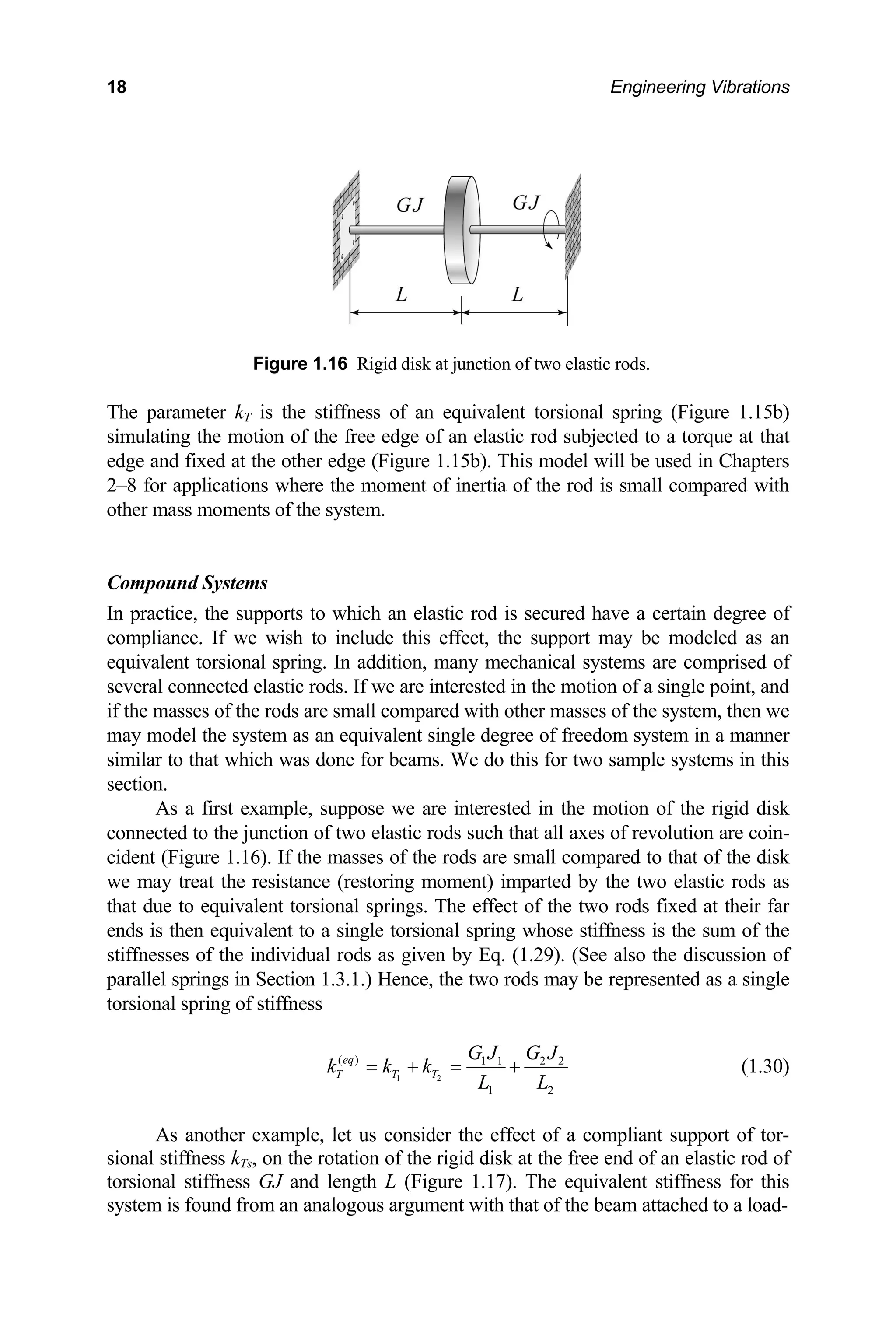
tion of two elastic rods.
Figure 1.16 Rigid disk at junc
he parameter kT is the stiffness of an equivalent torsional spring (Figure 1.15b)
simulating the motion of t tic rod subjected to a torque at that
edge and fixed at the other ed will be used in Chapters
2–8 for applications where t is small compared with
other mass moments of the s
Compound Systems
ain degree of
modeled as an
As a first example, suppose we are interested in the motion of the rigid disk
tion of two elastic rods such that all axes of revolution are coin-
he masses of the rods are small compared to that of the disk
T
he free edge of an elas
ge (Figure 1.15b). This model
he moment of inertia of the rod
ystem.
In practice, the supports to which an elastic rod is secured have a cert
compliance. If we wish to include this effect, the support may be
equivalent torsional spring. In addition, many mechanical systems are comprised of
several connected elastic rods. If we are interested in the motion of a single point, and
if the masses of the rods are small compared with other masses of the system, then we
may model the system as an equivalent single degree of freedom system in a manner
similar to that which was done for beams. We do this for two sample systems in this
section.
connected to the junc
cident (Figure 1.16). If t
we may treat the resistance (restoring moment) imparted by the two elastic rods as
that due to equivalent torsional springs. The effect of the two rods fixed at their far
ends is then equivalent to a single torsional spring whose stiffness is the sum of the
stiffnesses of the individual rods as given by Eq. (1.29). (See also the discussion of
parallel springs in Section 1.3.1.) Hence, the two rods may be represented as a single
torsional spring of stiffness
1 2
( ) 1 1 2 2
1 2
eq
T T T
k k k
L L
= + = + (1.30)
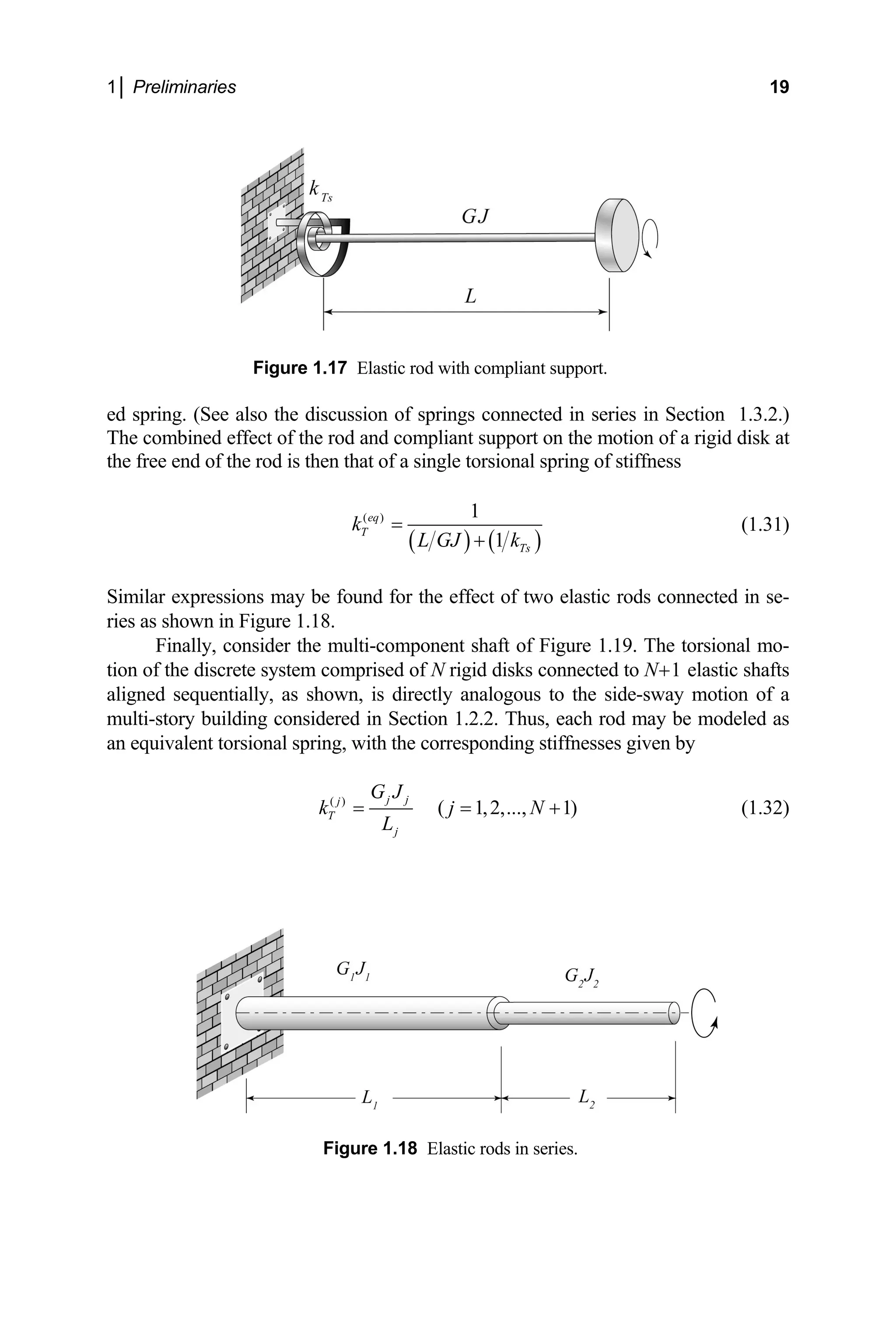
As another example, let us consider the effect of a compliant support of tor-
sional stiffness k
G J G J
Ts, on the rotation of the rigid disk at the free end of an elastic rod of
torsional stiffness GJ and length L (Figure 1.17). The equivalent stiffness for this
system is found from an analogous argument with that of the beam attached to a load-
1│ Preliminaries 19
Figure 1.17 Elastic rod with compliant support.
ed spring. (See also t Section 1.3.2.)
The combined on of a rigid disk at
the free end of t
he discussion of springs connected in series in
effect of the rod and compliant support on the moti
he rod is then that of a single torsional spring of stiffness
( ) ( )
( ) 1
1
eq
T
Ts
k
L GJ k
=
+
(1.31)
Similar expressions may be found for the effect of two elastic rods connected in se-
es as shown in Figure 1.18.
9. The torsional mo-
on of the discrete system comprised of N rigid disks connected to N+1 elastic shafts
ri
Finally, consider the multi-component shaft of Figure 1.1
ti
aligned sequentially, as shown, is directly analogous to the side-sway motion of a
multi-story building considered in Section 1.2.2. Thus, each rod may be modeled as
an equivalent torsional spring, with the corresponding stiffnesses given by
( )
( 1,2,..., 1)
j j
j
T
j
G J
k j N
L
= =
Figure 1.18 Elastic rods in series.
+ (1.32)
20 Engineering Vibrations
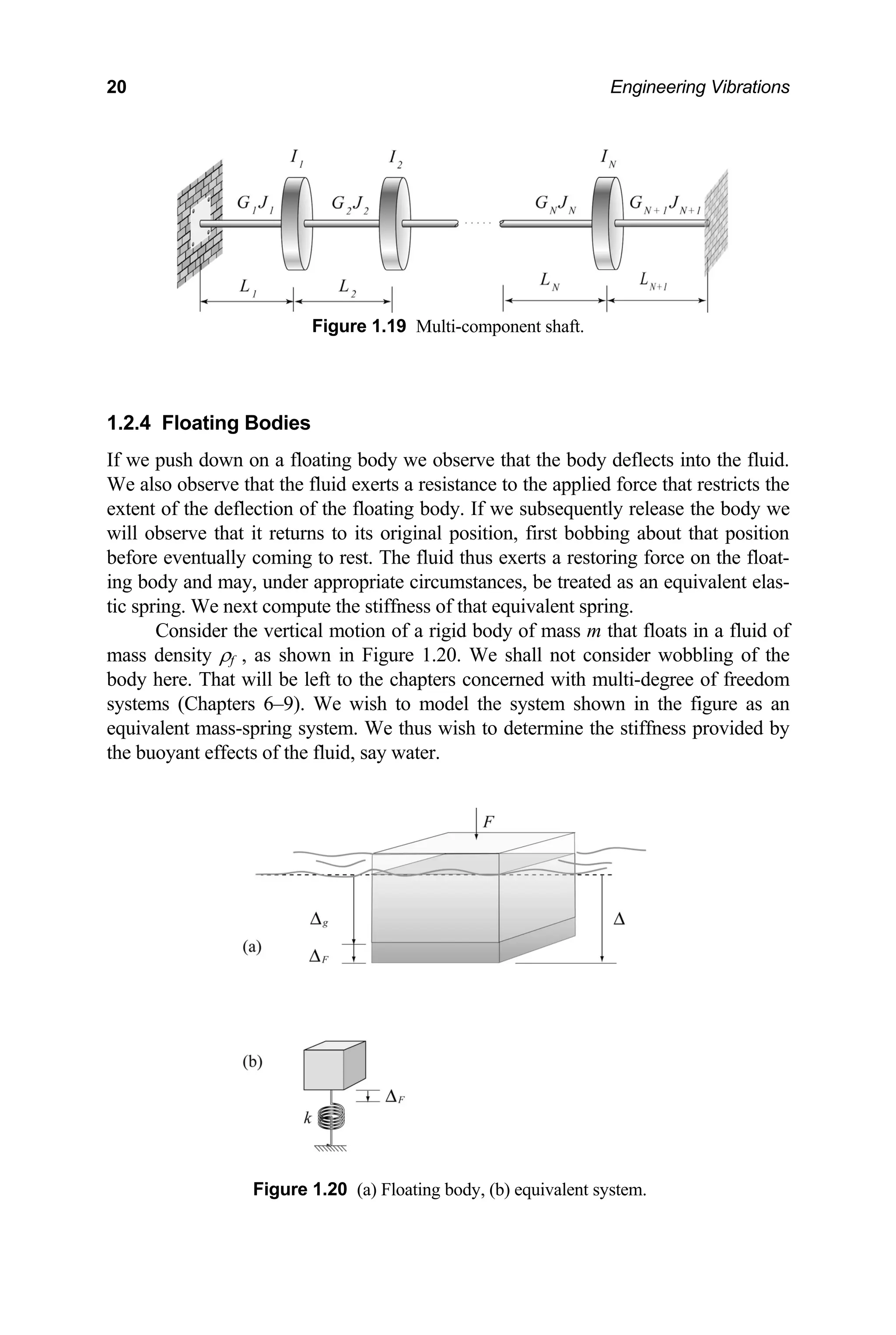
Figure 1.19 Multi-component shaft.
we push down on a floating body we observe that the body deflects into the fluid.
e also observe that the fluid exerts a resistance to the applied force that restricts the
the floating body. If we subsequently release the body we
to its original position, first bobbing about that position
the figure as an
uiv
Figure 1.20 (a) Floating body, (b) equivalent system.
1.2.4 Floating Bodies
If
W
extent of the deflection of
will observe that it returns
before eventually coming to rest. The fluid thus exerts a restoring force on the float-
ing body and may, under appropriate circumstances, be treated as an equivalent elas-
tic spring. We next compute the stiffness of that equivalent spring.
Consider the vertical motion of a rigid body of mass m that floats in a fluid of
mass density ρf , as shown in Figure 1.20. We shall not consider wobbling of the
body here. That will be left to the chapters concerned with multi-degree of freedom
systems (Chapters 6–9). We wish to model the system shown in
eq alent mass-spring system. We thus wish to determine the stiffness provided by
the buoyant effects of the fluid, say water.
1│ Preliminaries 21
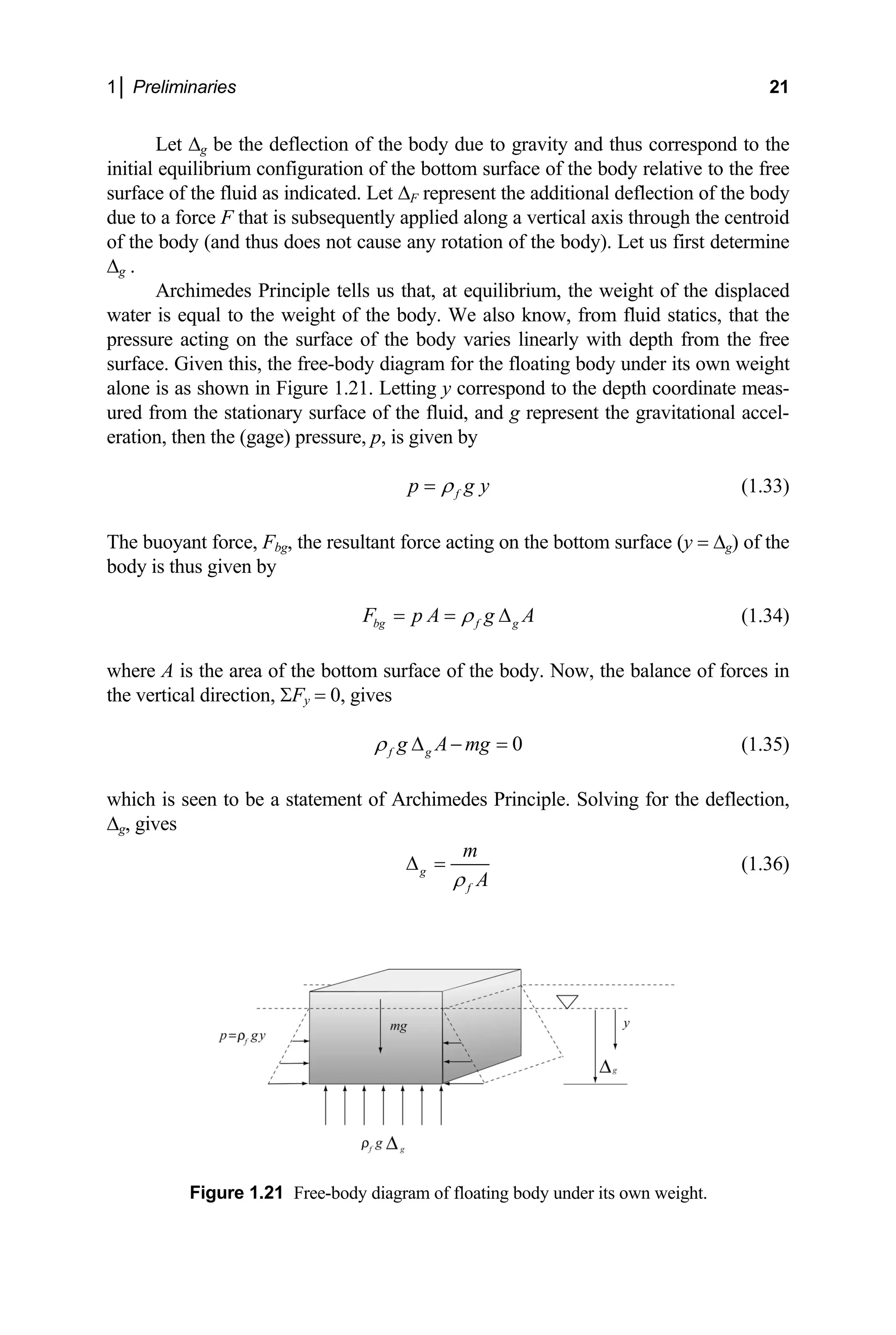
Let ∆g be the deflection of the body due to gravity and thus correspond to the
initial equilibriu to the free
surface of the fluid as indica ection of the body
due to a force F rough the centroid
of the body (and us first determine
∆g .
Archimed of the displaced
water is equal t d statics, that the
with depth from the free
surface. Given this, under its own weight
alone is as shown i h coordinate meas-
ured from the sta tional accel-
eration, then th
y
m configuration of the bottom surface of the body relative
ted. Let ∆F represent the additional defl
that is subsequently applied along a vertical axis th
thus does not cause any rotation of the body). Let
es Principle tells us that, at equilibrium, the weight
o the weight of the body. We also know, from flui
pressure acting on the surface of the body varies linearly
the free-body diagram for the floating body
n Figure 1.21. Letting y correspond to the dept
tionary surface of the fluid, and g represent the gravita
e (gage) pressure, p, is given by
f
p g
ρ
= (1.33)
The buoyant force, F , the resultant force acting on the bottom surfac
bg e (y = ∆g) of the
body is thus given by
bg f g
F p A g A
ρ
= = ∆ (1.34)
where A is the area of the bottom surface of the body. Now, the balance of forces in
e v
th rtical direction, ΣF
e y = 0, gives
0
f g
g A mg
ρ ∆ − = (1.35)
which is seen to be a statement of Archimedes Principle. Solving for the deflection,
∆g, gives
g
f
m
A
ρ
∆ = (1.36)
Figure 1.21 Free-body diagram of floating body under its own weight.
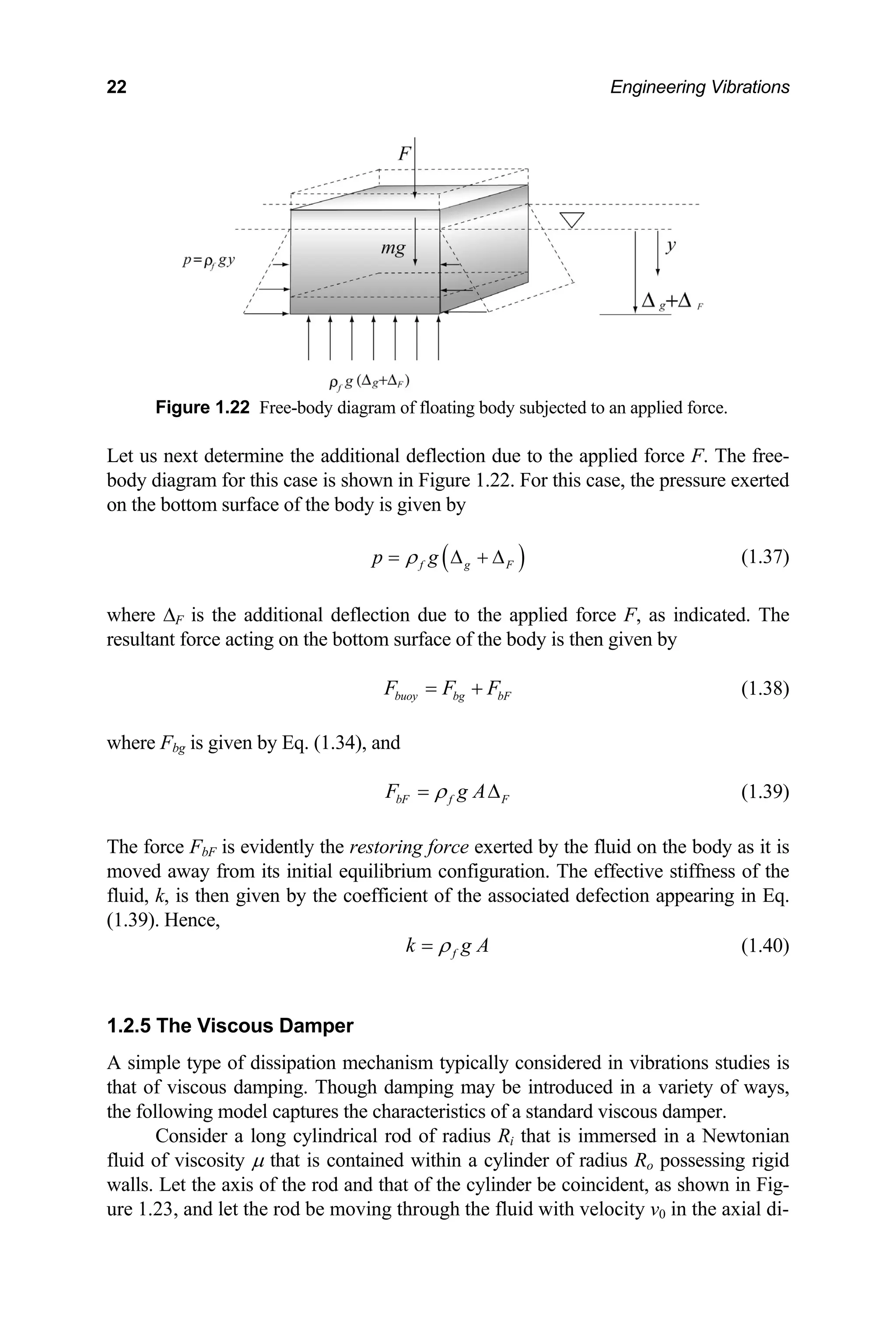
22 Engineering Vibrations
Figure rce.
Let us next deter F. The free-
body diagram re exerted
n the bottom surface of the body is given by
1.22 Free-body diagram of floating body subjected to an applied fo
mine the additional deflection due to the applied force
for this case is shown in Figure 1.22. For this case, the pressu
o
( )
f g F
p g
ρ
= ∆ + ∆ (1.37)
where ∆ cated. The
resultant force
F is the additional deflection due to the applied force F, as indi
acting on the bottom surface of the body is then given by
buoy bg bF
F F F
= +
bg is given by Eq. (1.34), and
bF f F
F g A
(1.38)
where F
ρ
= ∆ (1.39)
it is
itial equilibrium configuration. The effective stiffness of the
The force FbF is evidently the restoring force exerted by the fluid on the body as
oved away from its in
m
fluid, k, is then given by the coefficient of the associated defection appearing in Eq.
(1.39). Hence,
f
k g A
ρ
= (1.40)
.2.5 The Viscous Damper
ety of ways,
e following model captures the characteristics of a standard viscous damper.
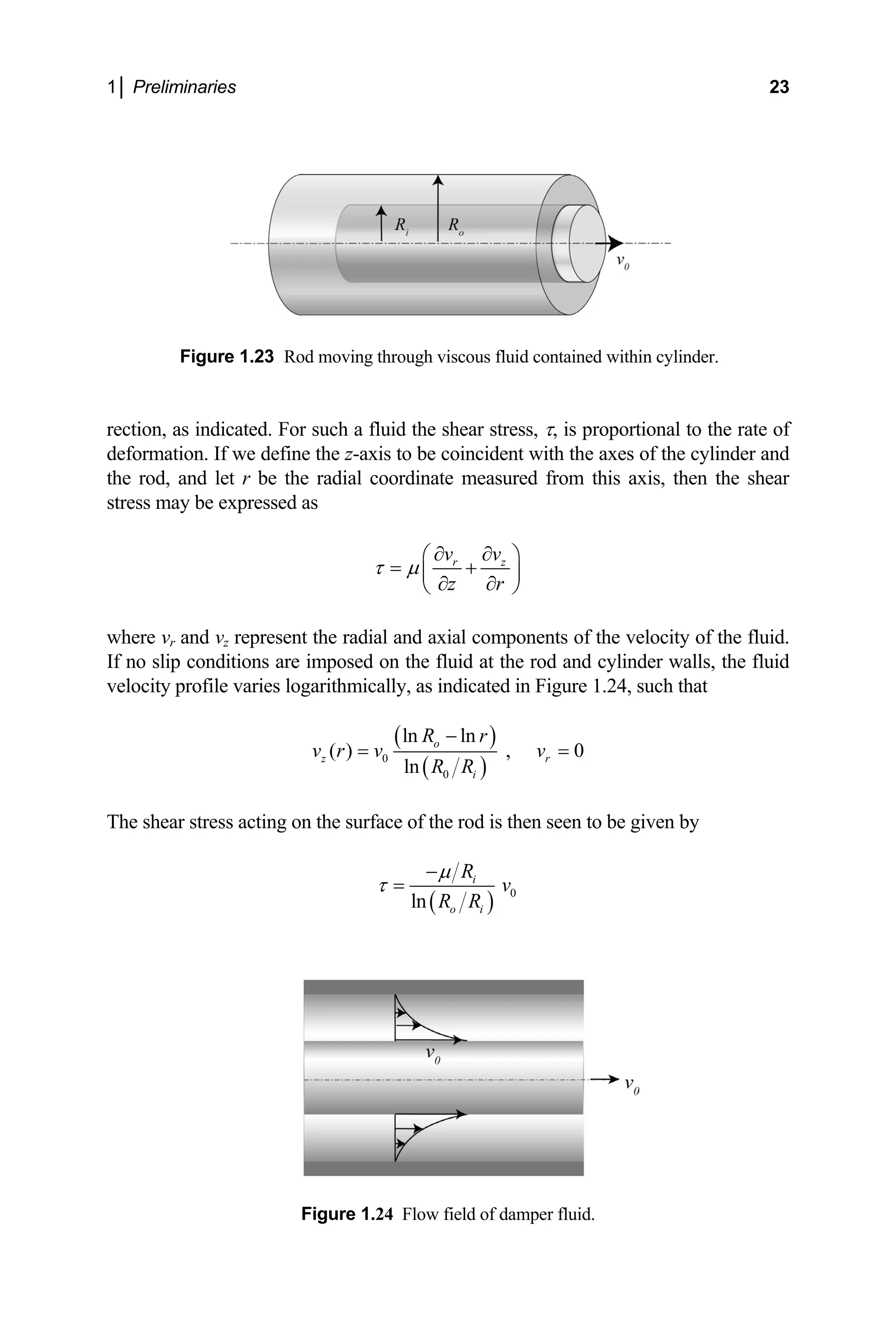
Consider a long cylindrical rod of radius Ri
uid of viscosity µ that is contained within a cylinder of radius Ro possessing rigid
of the cylinder be coincident, as shown in Fig-
e 1.23, and let the rod be moving through the fluid with velocity v0 in the axial di-
1
A simple type of dissipation mechanism typically considered in vibrations studies is
that of viscous damping. Though damping may be introduced in a vari
th
that is immersed in a Newtonian
fl
walls. Let the axis of the rod and that
ur
1│ Preliminaries 23
Figure 1.23 Rod moving through viscous fluid contained within cylinder.
rection, as indicated. For such a fluid the shear stress, τ, is proportional to the rate of
deformation. If we define the z-axis to be coincident with the axes of the cylinder and
e ro
th d, and let r be the radial coordinate measured from this axis, then the shear
stress may be expressed as
r z
v v
z r
τ µ
∂ ∂
⎛ ⎞
= +
⎜ ⎟
∂ ∂
⎝ ⎠
where vr and v of the fluid.
If no slip condi ls, the fluid
velocity profil hat
z represent the radial and axial components of the velocity
tions are imposed on the fluid at the rod and cylinder wal
e varies logarithmically, as indicated in Figure 1.24, such t
( )
( )
0
0
ln ln
( ) , 0
ln
o
z r
i
R r
v r v v
R R
−
= =
he shear stress acting on the surface of the rod is then seen to be given by
T
( ) 0
ln
i
o i
R
v
R R
µ
τ
−
=
Figure 1.24 Flow field of damper fluid.
24 Engineering Vibrations
Figure 1.25 Representation of viscous damper.
It follows that the result scous fluid is given
by
ant force, Fd, applied to the rod by the vi
0
d
F A cv
τ
= = −
where
( )
ln
i
o i
A R
c
R R
µ
=
and A is the surface area of the rod.
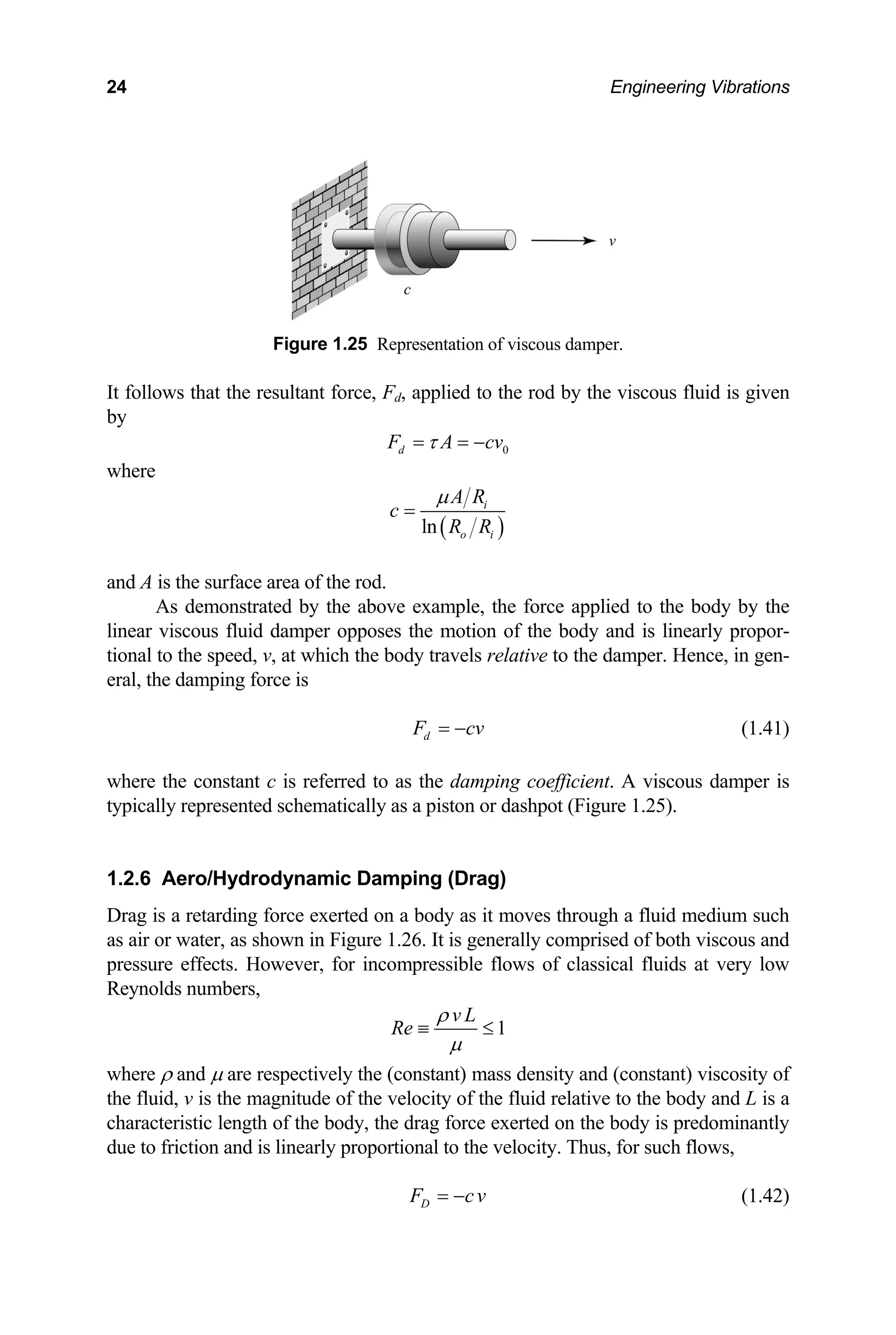
As demonstrated by the above example, the force applied to the body by the
is linearly propor-
tional to the speed, v per. Hence, in gen-
eral, the damping force is
linear viscous fluid damper opposes the motion of the body and
, at which the body travels relative to the dam
d
F cv
= −
is referred to as the damping coefficient
d schematically as a piston or dashpot (Fi
(1.41)
where the constant c . A viscous damper is
typically represente gure 1.25).
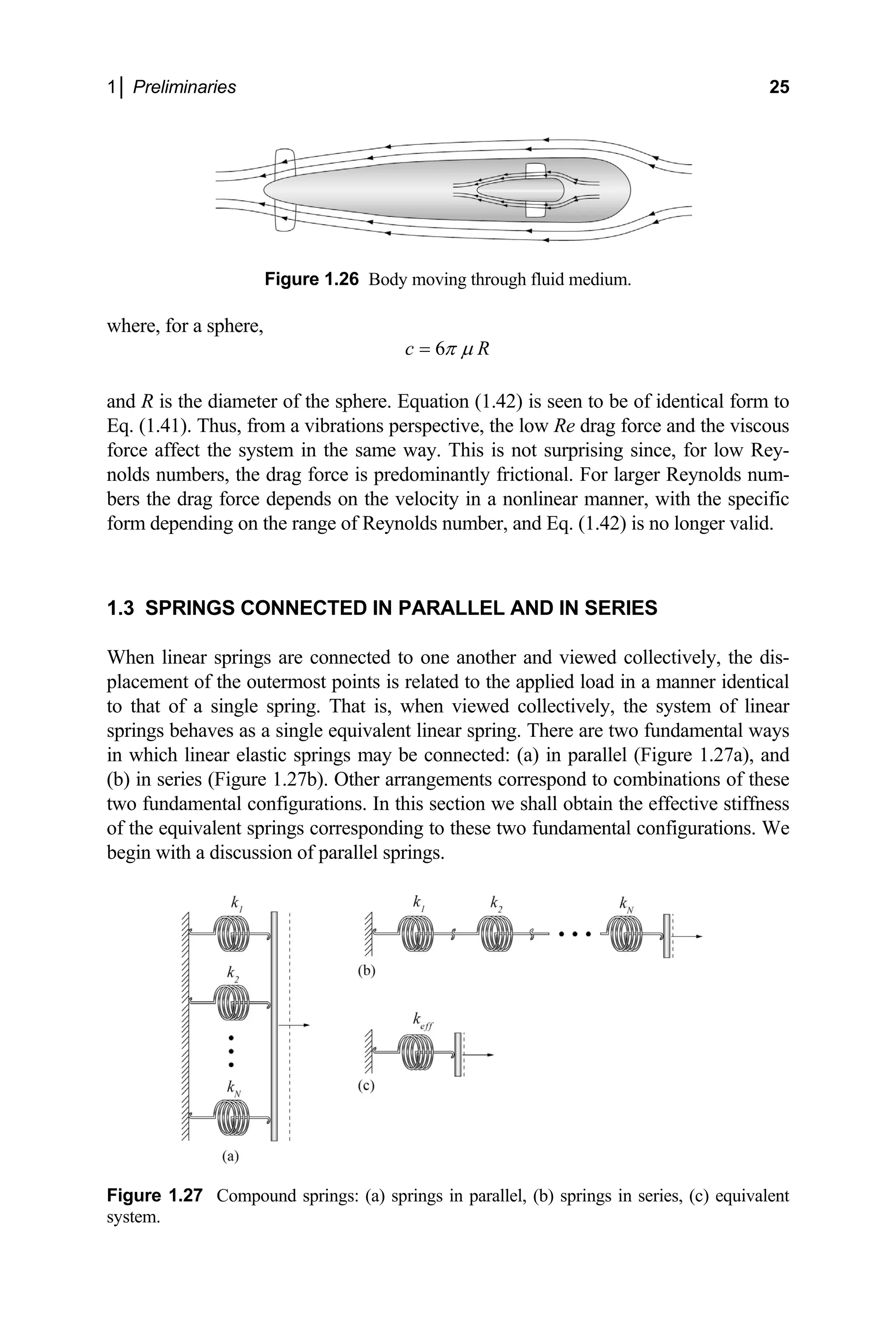
.2.6 Aero/Hydrodynamic Damping (Drag)
ir or water, as shown in Figure 1.26. It is generally comprised of both viscous and
e effects. However, for incompressible flows of classical fluids at very low
ds numbers,
1
Drag is a retarding force exerted on a body as it moves through a fluid medium such
s a
a
pressur
Reynol
1
v L
Re
ρ
µ
≡ ≤
where ρ and µ are respectively the (const
the fluid, v is the magnitude of the v
ant) mass density and (constant) viscosity of
elocity of the fluid relative to the body and L is a
characteristic length of the body, the drag force exerted on the body is predominantly
due to friction and is linearly proportional to the velocity. Thus, for such flows,
D
F cv
= − (1.42)
1│ Preliminaries 25
Figure 1.26 Body moving through fluid medium.
where, for a sphere,
6
c R
π µ
=
and R is the diameter of the sphere. Equation (1.42) is seen to be of identical form to
Eq. (1.41). Thus, from a vibrations perspective, the low Re drag force and the viscous
rce affect the system in the same way. This is not surprising since, for low Rey-
.3 SPRINGS CONNECTED IN PARALLE
ively, the dis-
placement nner identical
m of linear
spri ental ways
which linear elastic springs may be connected: (a) in parallel (Figure 1.27a), and
binations of these
o fundamental configurations. In this section we shall obtain the effective stiffness
ngs corresponding to these two fundamental configurations. We
egin with a discussion of parallel springs.
fo
nolds numbers, the drag force is predominantly frictional. For larger Reynolds num-
bers the drag force depends on the velocity in a nonlinear manner, with the specific
form depending on the range of Reynolds number, and Eq. (1.42) is no longer valid.
1 L AND IN SERIES
When linear springs are connected to one another and viewed collect
of the outermost points is related to the applied load in a ma
to that of a single spring. That is, when viewed collectively, the syste
ngs behaves as a single equivalent linear spring. There are two fundam
in
(b) in series (Figure 1.27b). Other arrangements correspond to com
tw
of the equivalent spri
b
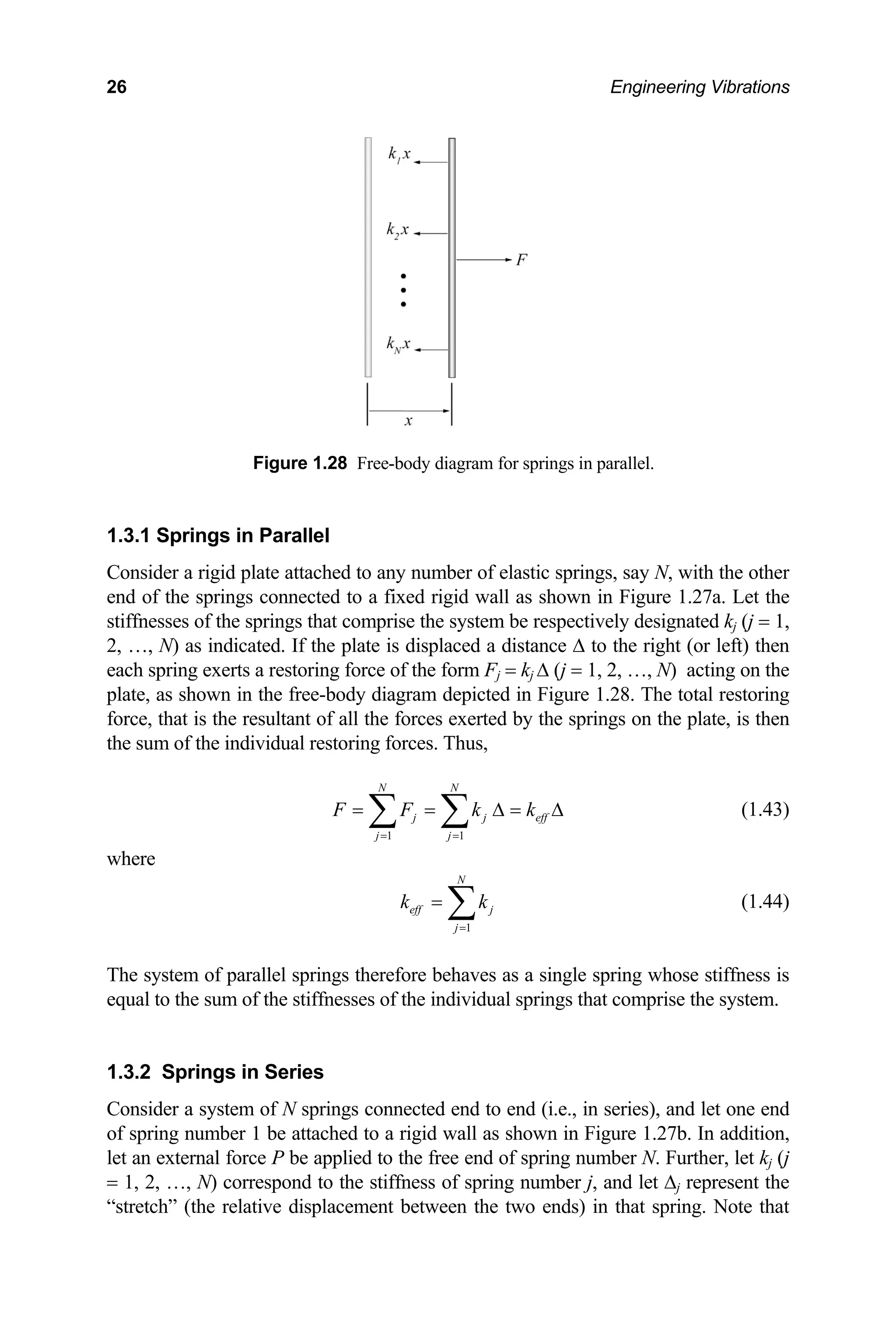
Figure 1.27 Compound springs: (a) springs in parallel, (b) springs in series, (c) equivalent
system.
26 Engineering Vibrations
1.3.1
Consid th the other
ted. If the ance ∆ to the right (or left) then
each spring exerts a restor ∆ (j = 1, 2, …, N) acting on the
plate, as shown in the free-body Figure 1.28. The total restoring
force, that is the resultant of all th erted by the springs on the plate, is then
the sum of the individual restori
ff
Figure 1.28 Free-body diagram for springs in parallel.
Springs in Parallel
er a rigid plate attached to any number of elastic springs, say N, wi
end of the springs connected to a fixed rigid wall as shown in Figure 1.27a. Let the
stiffnesses of the springs that comprise the system be respectively designated kj (j = 1,
2, …, N) as indica plate is displaced a dist
ing force of the form Fj = kj
diagram depicted in
e forces ex
ng forces. Thus,
1 1
N N
j j e
j j
F F k k
= =
= = ∆ =
∑ ∑ ∆ (1.43)
where
1
N
eff j
j
k k
=
= ∑ (1.44)
hose stiffness is
qual to the sum of the stiffnesses of the individual springs that comprise the system.
The system of parallel springs therefore behaves as a single spring w
e
1.3.2 Springs in Series
Consider a system of N springs connected end to end (i.e., in series), and let one end
of spring number 1 be attached to a rigid wall as shown in Figure 1.27b. In addition,
let an external force P be applied to the free end of spring number N. Further, let kj (j
= 1, 2, …, N) correspond to the stiffness of spring number j, and let ∆j represent the
“stretch” (the relative displacement between the two ends) in that spring. Note that
1│ Preliminaries 27
since spring 1 is fixed at one end, the stretch in that particular spring, ∆1, is also the
absolute displacement of the joint connecting spring 1 and spring 2. Let ∆* represent
e absolute displacement of the free end of the system (i.e., the displacement of joint
ber N measured with respect to its rest position), and t
pplied force P. The displacement ∆* then also represent
he stretch of an equivalent spring with effective stiffness keff. We wish to
e keff such that the relationship between the applied force and its displace-
ent is of the form
th
num hus the displacement of the
a s the total stretch in the sys-
tem, or t
determin
m
*
eff
P k
= ∆ (1.45)
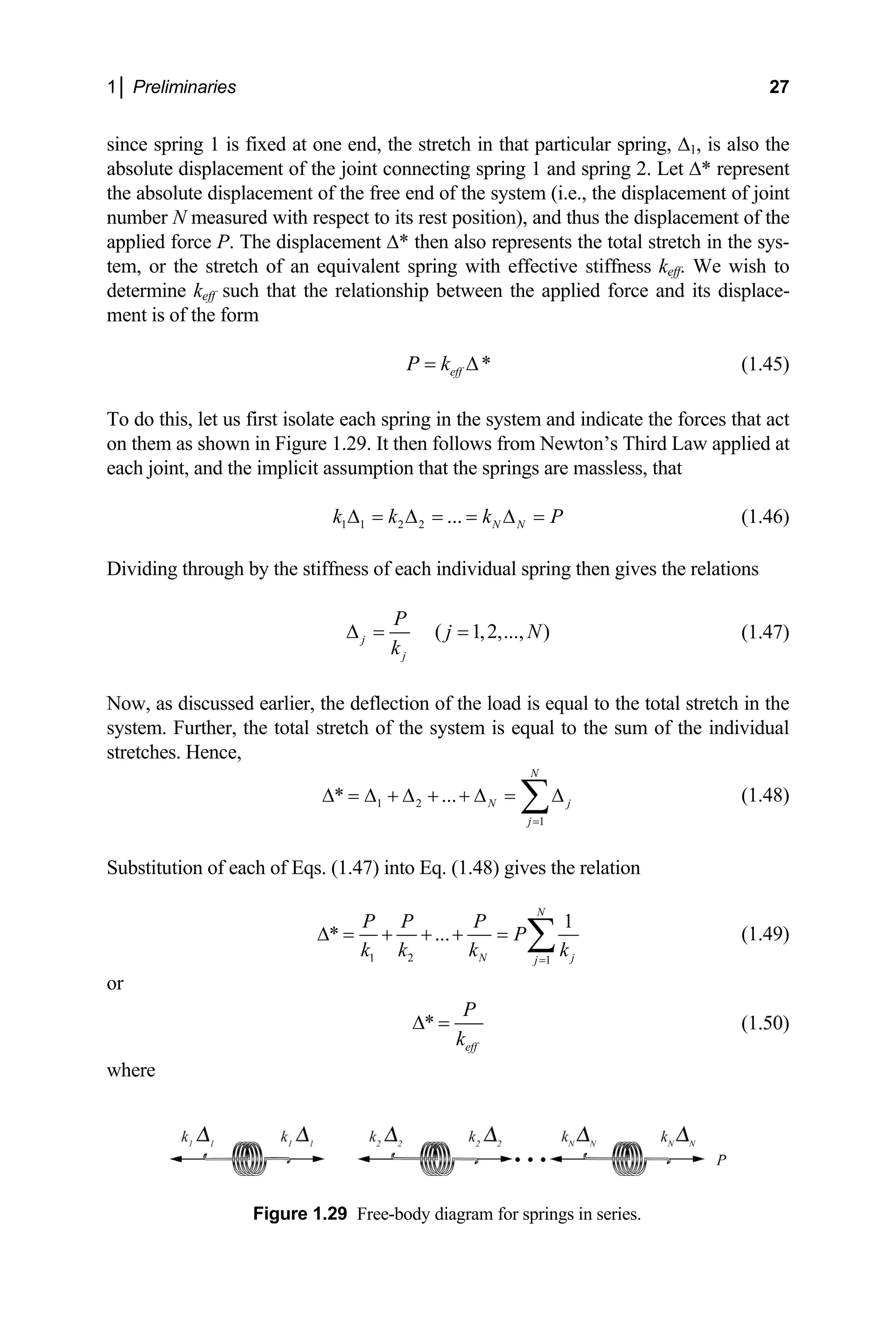
Figure 1.29. It then follows from Newton’s Third Law applied at
it assumption that the springs are massless, that
To do this, let us first isolate each spring in the system and indicate the forces that act
on them as shown in
each joint, and the implic
1 1 2 2 ... N N
k k k P
∆ = ∆ = = ∆ = (1.46)
Dividing through by the stiffness of each individual spring then gives the relations
( 1,2,..., )
j
j
P
j N
k
∆ = = (1.47)
Now, as discussed earlier, the deflection of the load is equal to the total stretch in the
system. Further, the total stretch of the system is equal to the sum of the individual
stretches. Hence,
1 2
* ...
N
N j
∆ = ∆ + ∆ + + ∆ = ∆
1
j=
∑ (1.48)
S ) gives the relation
ubstitution of each of Eqs. (1.47) into Eq. (1.48
1 2 1
1
* ...
N
N j
j
P P P
P
k k k k
=
∆ = + + + = ∑ (1.49)
or
*
eff
P
k
∆ = (1.50)
Figure 1.29 Free-body diagram for springs in series.
where
28 Engineering Vibrations
1 2 1
1 1 1 1 1
...
N
k k k k k
= + + + =
eff N j
j=
∑ (1.51)
quation (1.51) gives the relation between the effective sti
lent spring and the stiffnesses of the springs that comprise the system.
.4 A BRIEF REVIEW OF COMPLEX NUMBERS
During the course of our study of vibrations we shall find that many pertinent func-
s and solutions may be expressed more generally and more compactly using
complex representation. Likewise, solutions to many vibrations problems are facili-
ted by the use of complex numbers. In this se
ve certain identities that will be used throughout this text.
et us consider numbers of the form
E ffness of the single equiva-
1
tion
ta ction we briefly review complex num-
bers and deri
L
z x iy
= + (1.52)
1
i ≡ − . The number x is said to be the real part of the complex number z,
where
and y is said to be the imaginary part of z. Alternatively, we may write
Re( ), Im( )
x z y z
= = (1.53)
he complex conjugate of z, which we shall denote as , is defined as
zc
T
z x iy
≡ −
c
(1.54)
The product of a complex number and its conjugate may be seen to have the property
2
2 2
c
z z x y z
= + = (1.55)
where z is called the magnitude of the complex number z. Alternatively, we may
write
2 2
mag( )
z z x y z z
= = + = c
(1.56)
he complex number z may be expressed in vector form as z = (x, y), and may be
presented graphically in the complex plane as
e magnitude and argument of z as the radius or length, r, of the line from the origin
oint (x,
T
re shown in Figure 1.30. We then define
th
to the p y) and the angle, ψ, that this line makes with the x-axis, respectively.
Hence,
1│ Preliminaries 29
r
z: (x,y)
Re (z)
Im (z)
z c
: (x,-y)
r
Figure 1.30 Graphical representation of a complex number and its conjugate.
2 2
mag( )
r x y z z z z
= + = = = c
(1.57)
and
( )
1
tan arg( )
y x z
ψ −
= = (1.58)
Both z and zc
zc
i
are displa that
yed in Figure 1.30 where it is seen s the reflection of
z through the real axis. It is also seen from Figure 1.30 that a complex number and its
conjugate may be expressed in terms of its magnitude, r, and its argument, ψ, as
(cos sin )
(cos sin )
z r i
z r i
ψ ψ
ψ ψ
= +
= −
c
(1.59)
Note that if ψ = ω t, where the parameter t is the time, then ω corresponds to angular
frequency, a quantity that will be central to our studies of vibrating systems. In this
case, ω is the angular rate (angular velocity — see Section 1.5) at which the radial
line segment connecting the origin and point z (i.e., the “vector” z) rotates about an
axis through the origin and perpendicular to the complex plane.
The forms given by Eqs. (1.59) will lead us to further identities that will be
sefu series
pres and sin ,
u l to us in our study of vibrations. Toward this end, let us first recall the
entation for cosψ ψ
re
2 4
3 5
cos 1
2! 4!
sin
3! 5
ψ ψ
ψ
ψ ψ
ψ ψ
= − + −
= − + −
(1.60)
30 Engineering Vibrations
Let us next t e the complex sum of the two series as follows,
ak
2 3
cos sin 1
i i
ψ ψ
ψ ψ ψ
⎛ ⎞ ⎛ ⎞
+ = − + + − +
2
2! 3!
( ) ( )
1
1! 2! 3!
i i
ψ ψ
⎜ ⎟ ⎜ ⎟
⎝ ⎠ ⎝ ⎠
= + + +
3
( )
iψ
+
i
eψ
=
Similarly, letting ψ ψ
→ − in the above expressions gives the identity
cos sin i
i e ψ
ψ ψ −
− =
Combining the above two results gives Euler’s Formula,
cos sin
i
e i
ψ
ψ ψ
±
= ± (1.61)
omplex numbers and their conjugates may be written
ormula. Substitution of Eq. (1.61) into Eqs. (1.59) giv
forms for a complex number and its conjugate,
i
z x iy r i re
C in useful forms using Euler’s
F es the summary of the various
(cos sin ) i
z x iy r i reψ
ψ ψ
(cos sin ) ψ
ψ ψ −
= + = + =
(1.62)
= − = − =
c
Lastly, letting i
ψ ψ
→ − in Eq. (1.60) and paralleling the development of Eq. (1.61)
gives the analog of Euler’s Formula for hyperbolic functions,
cosh sinh
e ψ
ψ ψ
±
= ± (1.63)
s of func l greatly facili-
roughou
ynamics is the study of motion. As such, the princ
ur study of vibrations. In fact, vibrations may be v
he subject known as Analytical
The complex form tions, and Euler’s Formula in particular, wil
tate our analyses th t this text.
1.5 A REVIEW OF ELEMENTARY DYNAMICS
D iples of dynamics are central to
o iewed as a subset of dynamics,
focusing on certain types of motions. For the study of mechanical and structural vi-
brations, which constitutes the scope of this book, we are interested in classical me-
chanics. In this section we shall review some of the basic principles of Newtonian
Mechanics, while certain concepts and principles of t
1│ Preliminaries 31
Mechanics will be introduced in Chapter 6. (The reader who is well grounded in ele-
entary dynamics may proceed to Chapter 2 without loss
rst discuss the dynamics of single particles, and then extend these ideas to particle
concepts will then be abstr
eformable bodies is in-
oduced in Chapter 9.
The study of dynamics can be separated into
inetics. Kinematics is the study of the geometry of motion. That is, it is the study of
d the response (motion) of the bodies to these
rces. The notion of a particle is an idealization. A particle is a body that has mass
but no volume. It is thus a point that moves through space. We shall see that, for
equately described by that of a
finite bodies will be examined
m of continuity.) We shall
fi
systems. These acted to a continuum, viewed as a continu-
ous distribution of matter or particles, with the dynamics of rigid bodies presented as
a special case at the close of this section. The dynamics of d
tr
two sub-areas, kinematics and
k
how we describe a given motion mathematically. Kinetics, on the other hand, deals
with the forces imparted on bodies an
fo
many situations, the motion of a finite body may be ad
particle. The consequences of such an idealization for
in subsequent sections. More generally, a body may be viewed as an assemblage of
particles. We first review the kinematics of particles.
1.5.1 Kinematics of Particles
As stated in the introduction to this section, kinematics is the study of the geometry of
motion. In this section we introduce fundamental mathematical measures that charac-
terize the motion of a particle.
Basic Kinematic Measures
In order to locate a particle, we must specify its location with respect to some refer-
ence. Therefore, let us define a coordinate system with origin at point “O.” All quan-
tities are then measured with respect to this point. Alternatively, we may view such
quantities as those “seen by an observer standing at O.” In this context, the location of
a particle at a particular time is defined as the position of the particle at that time. We
thus introduce the position vector
Figure 1.31 A particle and its trajectory.
32 Engineering Vibrations
Figure 1.32 Displacement of a particle.
( )
r r t
= (1.64)
hich is represented as the directed line segment between the origin O and the loca-
on of the particle at time t, as shown in Figure 1.31.
lled the particle’s tra-
ory at two instants in
me, t and t + ∆t, as shown i tion of the particle be-
tween these two points icle and is defined by the
displacement vector
w
ti
The path that the particle follows during its motion is ca
ctory. Let us consider the particle at two points along its traject
je
ti n Figure 1.32. The change in posi
is called the displacement of the part
( ) ( )
r r t t r t
∆ ≡ + ∆ −
ize how quickly the particle is changi
ent by quantifying the rate at which th
e of change of the position vector is ca
ty over a given time interval, ∆t, is s
e duration of the interval. The averag
(1.65)
If we wish to character ng its location we must
continue our developm e position of the particle
is changing. The time rat lled the velocity vec-
tor. The average veloci imply the ratio of the
change of position to th e velocity is thus
( ) ( )
r r t t r t
v
∆ + ∆ −
≡ =
avg
t t
∆ ∆
(1.66)
T city, at a given time t is established by
he instantaneous velocity, or simply the velo
letting the time interval approach zero. Thus, the instantaneous velocity at time t is
given by
0 0
( ) ( )
( ) lim lim
t t
d r r r t t r t
v t
dt t t
∆ → ∆ →
∆ + ∆ −
≡ = =
∆ ∆
(1.67)
1│ Preliminaries 33
If one considers the displacement vector between two positions of the particle, and
lets this vector get smaller and smaller as shown in Figure 1.32, it is seen that as
the vector and becomes tangent to the path at time t. It follows
om Eq. (1.67) that the velocity vector is always tan
partic .
r d r
∆ →
0
t
∆ →
fr gent to the path traversed by the
le
To characterize how the velocity changes as a function of time we introduce its
rate of change. The time rate of change of the velocity vector is referred to as the ac-
celeration vector, or simply the acceleration. Paralleling our discussion of velocity we
first introduce the average acceleration,
( ) (
avg
v v t t v t
a
t t
∆ + ∆ −
≡ =
∆ ∆
)
(1.68)
he instantaneous acceleration is then
T
0 0
( ) ( )
( ) lim lim
d v v v t t v t
a t
∆ + ∆ −
≡ = =
t t
dt t t
∆ → ∆ →
∆ ∆
(1.69)
Relative Motion
onsider the motions of two particles, A and B, and let ( ) and ( )
A B
r t r t
C be the corre-
lat ng) with p
particle A may be expressed in terms of the positions of the two particles
ith r
sponding position vectors of the particles with respect to a common origin O. Further,
let / ( )
B A
r t correspond to the position vector of particle B as seen by an observer trans-
ut not rotati article A, as indicated in Figure 1.33. It may be seen
from the figure that, through vector addition, the relative position of particle B with
respect to
ing (b
w espect to the origin O by the relation
/ ( ) ( ) ( )
B A B A
r t r t r t
= − (1.70)
Figure 1.33 Two particles in motion.
34 Engineering Vibrations
Eq. (1.70) with respect to time gives the relative velocity of particle
Differentiation of
B with respect to particle A,
/ ( ) ( ) ( )
B A B A
v t v t v t
= − (1.71)
where ( ) and ( )
A B
v t v t are, respectively, the velocities of particles A and B with re-
spect to O. Differentiating Eq. (1.71) gives the corresponding relative acceleration,
/ ( ) ( ) ( )
B A B A
a t a t a t
= − (1.72)
here are the accelerations of the indicated particles with respect to
e origin. The relative velocity
( ) and ( )
A B
a t a t
w
th / ( )
B A
v t is interpreted as the velocity of particle B as
seen by an observer that is transl not rotating) with particle A. The relative
acceleration is in
Coordinate Systems
It is often expedient to use a p for a particular problem or
application. We next consi -polar and spherical coordi-
nates, and expr vectors in terms of their
components with respect to
Cartesian Coordinates
Let represent unit base vectors oriented along the x, y, z coordinate axes,
, as indicated in Figure 1.34. As the basis vectors are constant in di-
rection as well as magnitude for this case, it follows that their derivatives with
, velocity and accelera-
( )
x y z
r t x t i y t j z t k
v t v t i v t j v t k x t i
a t
= + +
= + + = +
=
ating (but
/ ( )
B A
a t terpreted similarly.
articular coordinate system
der Cartesian, path, cylindrical
ess the position, velocity and acceleration
these coordinate systems.
, ,
i j k
respectively
respect to time vanish. It then follows that the position
tion vectors expressed in terms of their Cartesian components, are respectively
( ) ( ) ( ) ( )
( ) ( ) ( ) ( ) ( ) ( ) ( )
y t j z t k
+ (1.73)
( ) ( ) ( ) ( ) ( ) ( )
x y z
a t i a t j a t k x t i y t j z t k
+ + = + +
Figure 1.34 Cartesian Coordinates.
1│ Preliminaries 35
Path Coordinates
Let s represent a coordinate along the path traversed by a particle, as indicated
resent the unit vector that is tangent to the path in the
in Figure 1.35. Let t
e rep
ction of increasing s
dire at a given point, let n
e represent the unit normal to the
path directed toward the center of curvature at that point, and let b t n
e e e
≡ × be
the corresponding unit binormal vector that completes the triad of basis vectors,
as indicated. We note that, though the basis vectors are of unit magnitude, their
directions are constantly changing as the particle proceeds along its trajectory.
n fact, it is easily shown that
I
t n
s
e e
ρ
= (1.74)
here ρ
w is the radius of curvature of the path at the point in question. Since
t) measures the distance along the path, and hence locates the particle at a
given time, it follo
s(
ws that the speed is given by
( ) ( )
v t s t
=
vector is always tangent to the path
( ) ( ) ( ) ( )
t t
v t v t e t s t e
Since the velocity , we have that
= =
75) and incorporating the ident
(1.75)
Differentiating Eq. (1. ity stated by Eq. (1.74)
on i ial components. Hence,
gives the accelerati n terms of its normal and tangent
2
( ) ( ) ( ) ( )
t t n n t n
s
a t a t e a t e s t e e
ρ
= + = + (1.76)
Figure 1.35 Path coordinates.
36 Engineering Vibrations
Figure 1.36 Cylindrical-polar coordinates.
Cylindrical Po
Let R,θ, z, represent nates of a particle at a
given instant, as i
lar Coordinates
the radial, angular and axial coordi
ndicated in Figure 1.36. Let , ,
R z
e e e
θ
l three basi
represent the corre-
sponding unit vectors. Though the magnitude of al s vectors remains
constant, the directions associated with the first two are constantly changing as
the particles moves along its trajectory. The relation between the time deriva-
tives of the first two unit vectors is similar to that for the basis vectors associ-
ated with path coordinates. The position vector expressed in terms of its com-
ponents in cylindrical-polar coordinates takes the form
( ) ( ) ( )
R z
r t R t e z t e
= + (1.77)
rentiating Eq. (1.77) with respect to time, and noting that
Diffe
and
R R
e e e e
θ θ
θ θ
= = −
ng velocity vector
gives the correspondi
( ) ( ) ( ) ( )
R R z z R
v t v t e v t e v t e Re R e z e
θ θ θ
θ
= + + = + + z (1.78)
Differentiating again gives the acceleration vector in terms of its cylindrical-
polar components as
( ) ( )
2
( ) ( ) ( ) ( ) 2
R R z
a t a t e a R R
θ θ
= + −
z R z
t e a t e e R R e z e
θ
θ θ θ
+ = + + + (1.79)
1│ Preliminaries 37
Figure 1.37 Spherical coordinates.
Spherical Coordinates
et r, θ, ϕ represent the radial, polar angle and azimuth coordinates and let
L
, ,
r
e e eϕ
θ represent the corresponding unit vectors, as indicated in Figure 1.37.
lar and path coordinates, the unit vectors associated with spherical co-
ordinates have constant magnitude but constantly change direc
the motion of the particle. Therefore, their time derivatives do not vanish. Pro-
As for po
tion throughout
ceeding as we did for path and polar coordinates, we first express the position
vector in terms of its spherical components. This is simply
( ) ( ) r
r t r t e
= (1.80)
ifferentiating Eq. (1.80) gives the velocity vector in terms of its spherical
omponents. Hence,
s
v t v t e r e
D
c
( ) ( ) ( ) ( ) co
r r r
e v t e v t e r e r
θ θ ϕ ϕ θ ϕ
θ ϕ ϕ
= + + = +
ives the corresponding expression for the acceler
+ (1.81)
Differentiating again g ation
vector as
( )
( )
2 2 2 2
2 2
( ) ( ) ( ) ( )
cos
cos 2 sin
1
+ sin cos
r
r r
r
a t a t e a t e a t e
d
r r r e r r e
r dt
d
r r
dt
θ θ ϕ ϕ
e
θ
ϕ
ϕ
ϕ θ ϕ θ θ ϕ ϕ
ϕ θ ϕ ϕ
= + +
⎡ ⎤
⎡ ⎤
= − − + −
⎢ ⎥
⎣ ⎦ ⎣ ⎦
⎡ ⎤
+
⎢ ⎥
⎣ ⎦
(1.82)
38 Engineering Vibrations
1.5.2 Kinetics of a Single Particle
Class ental laws posed by Newton, and
the in o
Newto
Newt
parap
that state unless
an unbalanced force.
ewton’s Second Law
rce. This is stated mathematically by the well-known re-
tion
ical mechanics is based on the three fundam
tegrals of ne of them. We first discuss Newton’s Laws of Motion.
n’s Laws of Motion
on’s three laws of motion form the basis for our study of dynamics. They are
hrased below.
Newton’s First Law
body at rest, or in motion at constant velocity, remains in
A
acted upon by
N
If a body is acted upon by an unbalanced force, its velocity changes at a rate
proportional to that fo
la
F m a
= (1.83)
where F is the force acting on the particle, a is the time rate of change of the
velocity of the particle and m is the mass of the particle. The mass (or inertia)
of the particle is seen to be a measure of the resistance of the particle to
changes in its velocity. The larger the mass, the larger the force required to
produce the same rate of change of velocity.
Newton’s Third Law
If a body exerts a force on a second body, the second body exerts an equal and
opposite force on the first body.
principle, the motion of a particle is completely defined by these laws. However, it
from an alternate perspective. Certain inte-
and lead to other principles of classi-
h the increment of the position vector,
In
is often convenient to approach a problem
grals of Newton’s Second Law accomplish this,
cal mechanics. These principles are discussed in the following sections.
Work and Kinetic Energy
If we take the scalar dot product of the mathematical statement of Newton’s Second
Law, Eq. (1.83), wit dr , multiply and divide
the right hand side by the resulting expression between two points on
the pa
dt, and integrate
rticle’s trajectory we arrive at the Principle of Work-Energy,
2 1
= ∆ =
W T −
T T (1.84)
where
2
1
r
r
F dr
≡
∫ i
W (1.85)
1│ Preliminaries 39
is the
to pos
work done by the applied force in moving the particle from position 1 1
( )
r r t
≡
ition 2 2
( )
r r t
≡ , t1 and t2 are the times at which the particle is at these positions,
2
(1.86)
1
2
mv
≡
T
is the en
terms
tial, n
kinetic ergy of the particle, and vj = v(tj). It is instructive to write Eq. (1.85) in
of path coordinates. Hence, expressing the resultant force in terms of its tangen-
ormal and binormal components, noting that t
dr dse
= , substituting into Eq.
) and carrying through the dot product gives
(1.85
2
[
2
s s
] ( )
1 1
t t n n b b t t
s s
F e F e F e dse F ds
+ + =
∫
=
∫ i (1.87)
here 1 1 2 2 from Eq. (1.87) that only the tangential com-
force in
oving the particle from position 1 to position 2 is independent of the particular path
along which the particle moves. Let us denote this force as
W
s = s(t ) and s = s(t ). It is seen
w
ponent of the force does work.
Path Dependence, Conservative Forces and Potential Energy
Let us consider a particular type of force for which the work done by that
m
( )
C
F . The work done by
such a force,
2
1
( ) ( )
r
C C
r
F dr
≡
∫ i
W (1.88)
is thus a function of the coordinates of the end points of the path only. If we denote
is function as − U, where we adopt the minus sign
2
1
2
( )
2
( )
r
C
r
r
F dr s
th for convention, then
[ ]
1
( )
s
= − −
∫
1
r
dr
= −∆
= − ∇
∫
i
i
U U
(1.89)
here is the gradient operator. Comparison of the integrals on the right and left
and sides of Eq. (1.89) gives the relation
U
U
w ∇
h
( )
C
F = −∇ U (1.90)
It is seen from Eq. (1.90) that a force for which the w e is independent of the
path traversed is derivable from a scalar potential.
ork don
Such a force is referred to as a con-
rvative force, and the corresponding potential function as the potential energy.
se
40 Engineering Vibrations
F h the work done is
d e forces. It is seen
orces that do not fall into this category, that is forces for whic
ependent on the path traversed, are referred to as nonconservativ
om Eq. (1.89) that only the difference in potential energy between positions, or its
. The potential energy is defined through its
f the work done by a
e
red energy” or “the ability to do work”. Examples of conservative
rces are the gravitational force and the force of an elastic spring. Examples of non-
onservative forces are friction forces, damping for
the thrust of a rocket.
If we partition our forces into conservative and nonconservative then the work-
onservative
rce and a resultant nonconservative force,
fr
gradient, enters the formulation and thus the potential energy is defined to within an
arbitrary constant. It is often convenient to introduce a ‘datum’ in order to assign a
definite value to the potential energy
change. Hence, the change in potential energy is the negative o
conservative force in moving a particle between two positions. The potential energy
is thus seen to be the work that would be done if the process were reversed. That is, it
is the work that would be done by the conservative force if th particle were to move
from the latter position to the former position. The potential energy may therefore be
iewed as “sto
v
fo
c ces, and follower forces such as
energy principle, Eq. (1.84), may be written in an alternative form. Toward this end,
let the resultant force acting on a particle be comprised of a resultant c
fo ( )
C
F ( )
NC
F
and , respectively. Hence,
C
( ) ( ) ( )
C NC N
F F F F
= + = −∇ +
U (1.91)
where we have incorporated Eq. (1.90). Substituting Eqs. (1.91) and (1.88) into Eqs.
.85) and (1.84), and rearranging terms, gives the alternate form of the work energy
le
(1
princip
( )
NC
= ∆ +
W ∆
T U (1.92)
here
r
NC NC
r
w
)
2
1
( ) (
F
≡
∫ dr
i (1.93)
W
is the work of the nonconservative force. Note that the work of the conservative force
is already taken into account as the change in potential energy. Thus, ( )
NC
W repre-
sents the work of the remaining forces (those not included in ∆U) acting on the parti-
cle.
Example 1.1 – Work done by the weight of a body
A car travels between two points, A
and B, along the road shown. Evalu-
ate the work done by the weight of
the car as it travels between these two
points.
Figure E1.1-1
1│ Preliminaries 41
Figure E1.1-2 Kinetic diagram for veh
sed in terms of the Cartesian coordinates shown as
j
icle.
Solution
The kinetic diagram corresponding to the car at a generic point along the path is
shown in Figure E1.1-2. The weight and the increment in position may be ex-
pres
W mg
= − (a)
and
d r dxi dy j
= + (b)
A
r s y
y
where the relation between the coordinates x and y depends on the specific
equation that describes the road (not given). We next evaluate the work done by
the weight by substituting Eqs. (a) and (b) into Eq. (1.85). Thus,
B B B
A A
r s
F dr mg j dxi dy j
⎡ ⎤ ⎡ ⎤
= − + = −
⎣ ⎦ ⎣ ⎦
∫ ∫ ∫ mgdy (c)
A
y
i i
Hence,
(
W mg y )
B
= −
W
It may be se
− (d)
en that the work done by the weight depends only on the coordi-
nates of the end points of the path. The particular road on which the car travels
of the
weight the weight is
then a conservati is then, by definition,
between the two points A and B is thus immaterial as far as the work
is concerned. Since the work done is independent of path,
ve force. The change in potential energy
mg y
∆ = ∆
U (e)
If we choose ou ) to be at A, we re-
cover the elem
r datum (the level of zero potential energy
entary formula
mgh
=
U
where h y – yA is the height above the datum.
=
42 Engineering Vibrations
Example 1.2 – Work done by a follower force
Consider the motion of a rocket car as it moves along a straight track or along a
circular track between two points A and B, as shown. For simplicity, let us as-
sume that the magnitude of the thrust is constant throughout the motion. The
thrust, , which is always tangent t
t
T T e
= o the path, is an example of what is
referred to as a “follower force,” since it follows the direction of the path of the
particle.
Figure E1.2 Rocket car traversing two different tracks.
olution
A
R
T
1
2
T
B
T = T0 = co
to B along the straight track (Path 1) clear
S
For nstant, the work done by the thrust as the rocket car moves from
ly differs from that done along the
A
circular track (Path 2). Specifically, using Eq. (1.87), we have that
(1)
T R
=
W W(2)
0 0
2 2
T R
π
≠ =
Since the work done clearly depends on the particular path traversed by the car,
the thrust is then a nonconservative force.
Example 1.3 – Potential energy of elastic springs
Determ potential energy of (a) a deformed linear spring of stiffness k
ine the
and (b) a deformed torsional spring of stiffness kT.
Solution
1│ Preliminaries 43
Figure E1.3 Displacement and restoring action: (a) linear spring, (b) torsional spring.
)
s stretched from
nce (unstretched) configuration to the current configuration is readily
(a
The work done by the restoring force of a linear spring as it i
the refere
evaluated as
( ) 2
1
2
0
s
s
ks ds ks
= − = −
∫
W (a)
s is the stretch in the spring (Figure E1.3a). The
where
e
corresponding potential
nergy of the deformed spring is then, from Eq. (1.89),
( ) 2
1
s
ks
= 2
U (b)
ote that it is implicit in the above expression that the datum is chosen as the
ndeformed state of the spring [as per the lower limit of integration of Eq. (a)].
torque and then using Eq.
nce,
N
u
(b)
The potential energy of the deformed torsional spring is similarly determined
y first calculating the work done by the restoring
b
(1.89). He
( ) 2
1
2
0
TS
T T
k d k
θ
θ θ θ
= − = −
∫
W (c)
and
( ) 2
1
2
TS
T
k θ
=
U (d)
where it is implicit that that the datum is taken as the undeformed state of the
torsional spring.
44 Engineering Vibrations
Conservation of M
A system for which only to be a conservative
system. If this is the ca
echanical Energy
conservative forces do work is said
se, that is if
2
1
( )
0
r
NC
r
F dr =
∫ i (1.94)
then Eq. (1.92) reduces to the statement that
0
∆ + ∆ =
T U
This may also be expressed in the alternate form
constant
= + =
E T U (1.95)
where
of con
forces l energy.
Example 1.4
E is the total mechanical energy of the system. Equation (1.95) is the statement
servation of mechanical energy of the system. It is thus seen that conservative
conserve mechanica
A coaster traveling with speed v0 enters a vertical loop of radius R and proceeds
around the loop as shown in Fig. E1.4-1. (a) If the total mass of the coaster and
its passengers is m, determine the force exerted by the track on the coaster as it
moves around the loop (i.e., as a function of the angular coordinate θ ). (b)
What is the minimum entry speed for the coaster to successfully traverse the
loop?
v0
R
Figure E1.4-1 Roller coaster and loop.
1│ Preliminaries 45
Solution
We first draw the kinetic diagram (dynamic free-body diagram) of the coaster
E1.4-2. This displays the forces that
er) on one figure, and the inertia
“forces” (the response of the particle) on anoth
cally a pictorial statement of Newton’s Second (and Third) L
more informative if we choose the former.
We shall therefore solve the problem using path coordinates.
help of the kinetic diagram, and the incorporation of Eq. (1.76),
N
R
mg
mv
mv2
=
.
Figure E1.4-2 Kinetic diagram for coaster.
at a generic location, as depicted in Figure
act on the “particle” (in this case the coast
er. The kinetic diagram is basi-
aw.
(a)
For this particular problem it is convenient to work in either path of polar coor-
dinates. It is, however, somewhat
With the
the component of the statement of Newton’s Second Law along the normal di-
rection is written as
2
cos
mv
N mg
R
θ
+ =
which, when solved for the normal force N, gives
2
cos
mv
N mg
R
θ
= − (a)
In order to find N(θ ) for a given v0 we must first determine v(θ ). That we re-
quire the velocity as a function of position suggests that we should employ the
work-energy principle. It is evident from Eq. (1.87) that the normal force does
no work. Since the only other force acting on the coaster is the weight, which is
a conservative force, we know that the energy of the system is conserved
throughout its motion. Evaluating Eq. (1.95) at the entrance and at the current
point of the loop gives the relation
2 2
1 1
0
2 2
(1 cos )
mv mgR mv
θ
= + + (b)
46 Engineering Vibrations
where we have chosen the entrance level of the loop as our datum. Solving Eq.
(b) for mv2
and substituting the resulting expression into Eq. (a) gives the nor-
mal force as a function of location around the loop. Hence,
2
0
( ) (2 3cos )
mv
N mg
R
θ θ
= − + (c)
)
may be seen upon inspection of Eq. (c) that the normal force, N, achieves its
value when θ = 0. Thus, the critical entry speed (the minimum speed
(b
It
minimum
at which the coaster can round the loop without leaving the track) is determined
from conditions at the top of the loop. Further, when the coaster is about to fall
away from the track, 0
N → . Substituting these values of θ and N into Eq. (c)
gives the critical entry speed
0 5
cr
v g
= R (d)
Linea
We obtained the Principle of
over space. We shall next consider an integral of Newton’s Second Law over time
that is generally concerned with translational motion.
Let us multiply Newton’s Second Law, Eq. (1 3), by the differential time in-
crement dt and integrate between two instants in time, t1 and t2, during the particle’s
motio lse-Momentum,
( ) (
t
t
r Impulse and Momentum
Work-Energy as an integral of Newton’s Second Law
.8
n. Doing this results in the Principle of Linear Impu
1)
2
1
2
F dt mv t mv
= −
∫
or, equivalently,
(1.96)
t
= ∆℘
I (1.97)
2
1
t
t
where
F dt
≡
∫
I (1.98)
linear impulse imparted by the force F
is the over the time interval ∆t = t2 − t1, and
( ) ( )
t mv t
℘ ≡ (1.99)
1│ Preliminaries 47
is the
partic
during
onservation of Linear Momentum
If the linear impulse vanishes over a given time interval, Eqs. (1.96) and (1.97) re-
duce to the statements
linear momentum of the particle at time t. Thus, a linear impulse that acts on a
le for a given duration produces a change in linear momentum of that particle
that time period.
C
2 1
( ) ( )
mv t mv t
= (1.100)
constant
mv
or
℘= = (1.101)
this occurs, the linear momentum is said to be conserved over the given time
.
When
interv
ngular Impulse and Momentum
In the previous section we established an integral, over time, of Newton’s Second
aw that led to the principle of linear impulse-momentum. We next establish the rota-
tional analogue of that principle.
product of Newton’s Second Law, Eq. (1.83), with
al
A
L
Let us form the vector cross
the position vector of a particle at a given instant. Doing this results in the relation
O O
M H
= (1.102)
where
O
M r F
= × (1.103)
is the moment of the applied force about an axis through the origin, and
O
H r mv
= × (1.104)
red to as the angular momentum, or m
. Let us next multiply Eq. (1.102) by the differential time increment dt, and
tegrate the resulting expression between two i
le’s motion. This results in the statement of the
omentum,
t t t t
t
v
is oment of momentum, of the particle
refer
about O
in nstants in time, t1 and t2, during the
partic Principle of Angular Impulse-
M
[ ] [ ]
2
t
r F dt r m r mv
2 1
1
= =
× = × − ×
∫ (1.105)
r, equivalently,
o
O O
H
= ∆
J (1.106)
where
48 Engineering Vibrations
O
F
Figure 1.38 Central force motion.
2 2
1 1
t t
O O
t t
M dt r F dt
≡ = ×
∫ ∫
J (1.107)
is the angular impulse about an axis through O, imparted by the force F , or simply
the angular impulse about O. The angular impulse is seen to be the impulse of the
oment o
m f the applied force about the origin.
m
Conservation of Angular Momentu
If the angular impulse about an axis vanishes, then Eqs. (1.105) and (1.106) reduce to
the equivalent statements
[ ] [ ]
2 1
t t t t
r mv r mv
= =
× = × (1.108)
or
constant
O
H r mv
= × = (1.109)
e given time interval. When this is so, the angular momentum is said to be
onserved about an axis through O. It should be
e conserved about an axis through one point and not anoth
Figure 1.39 System of N particles.
over th
c noted that angular momentum may
er. An example of this is
b
when a particle undergoes central force motion, where the line of action of the ap-
lied force is always directed through the same point (Figure 1.38).
p
Fp
rp
rG
fpq
mp
m1
mq
m2
mN
G
fqp
rp/G
1│ Preliminaries 49
1.5.3 Dynamics of Particle Systems
Mechanical systems are typically comprised of many particles. In fact, rigid bodies
and deformable bodies may each be considered as an assemblage of a continuous
ibution of particles with certain characteristic constraints. In this section we ex-
nd t e concepts discussed for a single particle to general particle systems. These
as needed. We begin by
Equations of Motion
onsider the N particle system shown in Figure 1.39. Le
nt the mass of particle p, and let
distr
te h
results may then be abstracted to more complex systems,
examining the equations of motion for a system particles.
C t mp (p = 1, 2, …, N) repre-
p
r represent its position vector with respect to a
se
fixed reference frame, as shown. In addition, let p
F be the resultant e ternal force
acting on particle p, and let pq
f
x
(p,q = 1, 2, …, N) be the internal force exerted on
particle p by particle q. (We assume that the resultant internal force that a particle
exerts on itself vanishes. Thus, 11 22 ... 0
NN
f f f
= = = = ). The resultant internal force
of the system is then
acting on particle p by all other particles
N
*
1
p pq
q
f f
=
≡ ∑
llows from Newton’s Third Law that
qp pq
f f p q
= − =
It fo
)
N
( , 1,2,...,
and hence that
*
1 1 1
0
N N N
p pq
p p q
f f
= = =
= =
∑ ∑∑ (1.110)
pplying Newton’s Second Law to each particle individually gives
A
ti
the set of equa-
ons
*
( 1,2,..., )
p p p p
F f m a p N
+ = = (1.111)
Adding the equations for all of the particles, and incorporating Eq. (1.110) gives the
relation
1
N
p p
p
F m a
=
= ∑ (1.112)
where
1
N
p
p
F F
=
≡ ∑ (1.113)
is the resultant external force acting on the system.
50 Engineering Vibrations
Let us next consider some point G that moves with the system of particles and
let ( )
G
r t be the position vector of that point measured with respect to the fixed refer-
ence frame defined earlier. Further, let / ( )
p G
r t correspond to the position of particle p
as seen by an observer translating with point G. It then follows from Eqs. (1.70)–
(1.72) and Figure 1.33 that
/ ( 1,2,..., )
p G p G
r r r p N
= + = (1.114)
/ ( 1,2,..., )
p G p G
v v v p N
= + = (1.115)
/ ( 1,2,..., )
p G p G
a a p N
a
= + = (1.116)
where /
p G
v and /
p G
a are, respectively the velocity and acceleration of particle p as
seen by an observer translating with ion of Eq. (1.116) into Eq.
(1.112) and regrouping terms gi
point G. Substitut
ves
( )
2
1 1/ 2 2/ /
2
...
G G G N
d
F ma m r m r m r
dt
= + + + + N G (1.117)
where
1
N
p
p
m ≡ m
=
∑ (1.118)
the total mass of the particle system. If we now define the point G such that
is
/
1
0
N
p p G
p
m r
=
=
∑
r, equivalently, that
(1.119)
o
1
1
N
G p
p
r r
m =
≡ ∑ (1.120)
then Eq. (1.117) reduces to the familiar form
G
F ma
= (1.121)
The point G defined by Eq. (1.120) is referred to as the center of mass of the system.
n from Eq. (1.121) that the motion of the center of mass is governed by New-
ton’s Second Law of Motion. Thus, the center of mass of the system behaves as a
ngle particle whose mass is equal to the total m
Principles of Work-Energy and Impulse-Momentum for a single particle also hold for
e center of mass of a particle system. The motion of a system of particles can be
g as a particle and the motion of
It is see
si ass of the system. It follows that the
th
described by the motion of the center of mass actin
1│ Preliminaries 51
the system relative to the center of mass. If the motion relative to the center of mass is
negligible for a given application, then Eq. (1.121) and its integrals adequately de-
scribe the motion of the system.
Work and Energy
The total kinetic energy of the system is the sum of the kin
idual particles that comprise the system. Summing the ki
rating Eq. (1.115) gives the total kinetic energy of the system in the form
etic energies of the indi-
v netic energies and incorpo-
2 2
1 1 1
/
2 2 2
1 1
N N
p p p G
p p
m v v mv m
= =
= = +
∑ ∑
i
T
be s t th
d the kinetic energy of motion of the system rela-
ve to the center of mass. The total work done on the system may be similarly parti-
adding the work done by the external and internal forces act
idual particles, and incorporating Eq. (1.114). Hence,
(1)
*
1 1
p G p G
p G
N N
r r r
p p G
v (1.122)
It may een tha e total kinetic energy of the system may be partitioned into the
sum of two kinetic energies: the kinetic energy of motion of the center of mass of the
system acting as a single particle, an
ti
tioned by ing on the indi-
v
(1)
/
*
/
p G
(2) (2)
(2)
/
(1)
p p p
r r
p p
G p p p G
r
F f dr F dr
= =
⎡ ⎤
= + =
⎣ ⎦
∑∫ ∫ F f dr
⎡ ⎤
+ +
⎣ ⎦
∑∫
i i
W
one by
the second term may be seen to be the work done by the forces acting on the individ-
al particles in moving them along their trajectorie
Summing the work-energy relations of the individual particles gives the Work-
ple for a Particle System,
i (1.123)
The first integral on the right hand side of Eq. (1.123) is seen to be the work d
e resultant external force moving along the trajectory of the center of mass, while
th
u s relative to the center of mass.
Kinetic Energy Princi
(2)
(1)
2 2
* (2) (1)
N
1 1
2 2
1 1 1
p
p
N N
r
p p p p p p p
r
p p p
F f dr m v m v
= = =
⎡ ⎤
+ = −
⎣ ⎦
∑ ∑ ∑
∫ i (1.124)
aralleling the development of Eq. (1.84) with Eq. (1.121) replacing Eq. (1.83), or
mply applying Eq. (1.83) for the center of m
nergy Principle for the Center of Mass of a Particle System,
P
si ass directly, gives the Work-Kinetic
E
(2)
(1)
2 2
(2) (1)
1 1
2 2
G
G
r
G G G
r
F dr mv mv
= −
∫ i (1.125)
Substitution of Eqs. (1.122), (1.123) and (1.125) into Eq. (1.124), and incorporating
Eq. (1.119), gives the Work-Kinetic Energy Principle for motion of a system relative
to its center of mass,
52 Engineering Vibrations
(2)
/
(1)
/
2 2
* (2) (1)
1 1
p G
p G
N N N
r
/ / /
2 2
1 1 1
p p
r
F f dr m v m v
⎡ ⎤ p G p p G p p G
p p p
= = =
+ = −
⎣ ⎦
∑ ∑ ∑
∫ (1.126)
i
n 1.5.2. Do-
g this results in the alternative forms of Eqs. (1.124)–(1.126), respectively, as
Equations (1.124)–(1.126) hold for all particle systems. When a subset of the forces
that act on the system are conservative, these work-energy relations can be written in
alternative forms, replacing the work done by the conservative forces by correspond-
ng changes in potential energy, as discussed for single particles in Sectio
i
in
( )
NC
= ∆ + ∆
W T U (1.127)
measured following the center
ass, and a subscript rel indicates work, kinetic energy and potential energy
easured relative to the center of mass.
inear Impulse and Momentum
by
ultip
ch particle of the system. Either ap-
roach gives the relation
( )
NC
G G G
= ∆ + ∆
W T U (1.128)
( )
NC
rel rel rel
= ∆ + ∆
W T U (1.129)
where the superscript NC indicates work done by nonconservative forces, a subscript
indicates work, kinetic energy and potential energy
G
of m
m
L
The impulse-momentum principles for particle systems may be obtained in a manner
similar to that employed to obtain the work-energy principles. We first consider linear
impulse and momentum.
The linear impulse-momentum relation for each particle may be obtained
m lying Eq. (1.111) by dt and integrating between two instants in time. Alterna-
tively, we could simply apply Eq. (1.96) for ea
p
2
1
*
2 1
( ) ( ) ( 1,2,..., )
t
p p p p p p
t
F f dt m v t m v t p N
⎡ ⎤
+ = − =
⎣ ⎦
∫ (1.130)
for a
particle system given by
( ) ( )
N N
t
The total linear momentum of a system of particles is the sum of the momenta of the
individual particles. If we add the linear-momentum relations for the individual parti-
les, and recall Eq. (1.110), we obtain the Linear Impulse-Momentum Principle
c
2
1
2 1
1 1
p p p p
t
p p
F dt m v t m v t
= −
∑ ∑
∫ (1.131)
= =
1│ Preliminaries 53
where is the resultant external force acting on the system, as defined by Eq.
3).
Multiplying Eq. (1.121) by dt, and integrating over the given
Principle of Linear Impulse-Momentum for the center of mass of a particle
stem
F
(1.11
time interval,
gives the
sy ,
2
1
2 1
( ) ( )
t
G G
t
F dt mv t mv t
= −
∫ (1.132)
Substituting Eq. (1.115) into Eq. (1.131), and subtracting Eq. (1.132) from the result-
g expression gives the Principle of Linear Impulse-Momentum for motion rela
in tive
the center of mass,
1 1
( )
N N
p p G p p
p p
m v t m v
= =
=
∑ ∑
is seen from Eq. (1.133) that the linear momentum for
altered but the total momentum of the sys-
this phenomenon may be seen when a cue ball col-
to
1
( )
G t (1.133)
/ 2 /
motion relative to the center
It
of mass is always conserved. Further, it may be seen from Eqs. (1.131) and (1.132)
that if the resultant external impulse acting on the system vanishes over a given time
interval then the total momentum of the system is conserved, and the velocity of the
center of mass is constant during this time interval. Thus, in such situations, the mo-
mentum of the individual particles may be
tem is unchanged. An example of
lides with a set of billiard balls.
Angular Impulse and Momentum
Let us next take the vector cross product of the position vector of particle p with Eq.
(1.111). This gives the relation
( 1,2,..., )
p p
M H p N
= = (1.134)
here
w
*
p p p p
M r F f
⎡ ⎤
≡ × +
⎣ ⎦
nd
(1.135)
a
p p p p
H r m v
≡ × (1.136)
are, respectively, the moment of the forces acting on particle p about an axis through
the origin O, and the angular momentum of particle p about O. Summing Eq. (1.134)
ver all particles of the system, noting that it is implicitly assumed that each external
force is collinear with its reciprocal, and recalling Eq. (1.110) gives the relation
o
O O
M H
= (1.137)
where
54 Engineering Vibrations
N
O p p
M r F
1
p=
≡ ×
∑ (1.138)
p
and
1
N
O p p
p
H r m v
=
≡ ×
∑ (1.139)
spectively correspond to the resultant moment of the external forces about O, and
stants in time, we obtain the Principle of Angular Impulse-
omentum for the particle system,
re
total angular momentum of the system about an axis through O.
If we next multiply Eq. (1.137) by the differential time increment dt, and inte-
grate between two in
M
2
1
2 1
( ) ( )
t
O O O
t
M dt H t H t
= −
∫ (1.140)
or, in expanded form,
2
2 1
1
1 1 1
N N N
t
p p p p p p p p
t t t t
t
p p p
r F dt r m v r m v
= =
= = =
⎡ ⎤ ⎡ ⎤
× = × − ×
⎣ ⎦ ⎣ ⎦
∑ ∑ ∑
∫ (1.141)
Proceeding for the center of mass as for a single particle gives the Principle of Angu-
lar Impulse-Momentum for the center of mass of a particle system,
G
t
r F dt [ ] [ ]
2
2 1
1
t
G G G G
t t t t
r mv r mv
= =
× − ×
× =
∫ (1.142)
(1.115) into Eq. (1.141), subtracting Eq. (1.142) from
e resulting expression and incorporating Eq. (1.119) gives the Principle of Angular
pulse-Momentum for motion relative to the center of m
1 1 1
N N N
t
p G p p G p p G t t
t
p p p
r F dt r m v
Substitution of Eqs. (1.114) and
th
Im ass,
/ /
p G p p G t t
r m v
2
2 1
1
/ / / = =
= = =
⎡ ⎤
× = × ⎡ ⎤
− ×
⎣ ⎦
∑ ∑
∫
quations (1.140)–(1.143) are the statements of an
ral particle systems.
⎣ ⎦
∑ (1.143)
E gular impulse-momentum for gen-
e
Example 1.5
Consider a circular disk comprised of a skin of mass ms, a relatively rigid core
of mass mc and a compliant weave modeled as n identical linear springs of
k and negligible mass, as shown
stiffness . The length of each spring when un-
stretched is R0 = Rs − Rc − ε. The disk is translating at a speed v0 in the direction
1│ Preliminaries 55
indicated when the skin fragments into four identical pieces and separates from
the remaining structure. If the fragments travel at the same speed relative to the
core, and at equal angles as viewed from the core, determine the absolute ve-
locity of the fragments if the energy loss due to the fragmentation is negligible.
Assume that the fragmentation occurs instantaneously.
Figure E1.5 Fragmented disk.
e imposed by the
weight of the ball is vanishingly small. (See the discussion of nonimpulsive
forces in Chapter 4.) Therefore, since there are no extern
the system, the total linear momentum of the system is c
the interval of interest. For these conditions, Eq. (1.132) tells us that the veloc-
Solution
If the fragmentation occurs instantaneously, then the impuls
al impulses acting on
onserved throughout
ity of the center of mass is unchanged. Thus,
0
( )
G
v t v
= (a)
If the energy of fragmentation is negligible, then the work done by the noncon-
servative forces vanishes and the energy of the system is conserved.
apply Eq. (1.129) with
We next
( )
0
NC
rel =
W . This gives
2 2
1 1
0 0 0
s rel
m v nk
2 2
ε
⎡ ⎤ ⎡ ⎤
= − + −
⎣ ⎦ ⎣ ⎦ (b)
where vrel is the speed of the fragments relative to the center of mass. Solving
for v gives
rel
rel
s
nk
v
m
ε
= (c)
56 Engineering Vibrations
Substitution of Eqs. (a) and (c) into Eq. (1.115) gives the absolute velocities of
the fragments,
1,2 0
2 s
nk
v v i j
m
ε ⎡ ⎤
= + ±
⎣ ⎦ (d-1,2)
3,4 0
2 s
nk
v v i j
m
ε ⎡ ⎤
= − ±
⎣ ⎦ (d-3,4)
1.5.4 Kinematics of Rigid Bodies
A rigid body is an idealization that, in certain applications, may capture the dominant
motion of the body. Alternatively, we may be interested in motions such as vibrations
where the circumstances are such that the rigid body portion of the motion is unim-
portant to us, for example in predicting structural or material failure in aircraft or
ther vehicular structures. In such cases it may be necessary to identify the rigid body
id body motion, and hence
dy may be considered to be a continuous distribution of particles, and
hence
stitue
of pa
of par
are re
the m
shall r motion of rigid bodies.
motion of rigid bodies is comprised
l first consider each type of m
Figure 1.40 Rigid body in pure translation.
o
portion of the response and subtract it out. In any event rig
the dy amics of rigid bodies, is of interest.
n
A rigid bo
a particle system, for which the relative distances and orientations of the con-
nt particles remains fixed. Therefore, the principles pertaining to the dynamics
rticle systems discussed in Section 1.5.3 may be applied to this particular class
ticle systems. As the relative motions of the particles that comprise a rigid body
stricted, it is expedient to incorporate these constraints into the description of
otion. In this regard, we first discuss the kinematics of rigid body motion. We
strict the overall discussion herein to planar
e
The of two basic motions — translation
and rotation. We shal otion separately and then together.
1│ Preliminaries 57
Pure
Trans n for which the velocity vectors are the same for each and every
oint of the body throughout the motion. As a result of this, the orientation
ody with regard to a given reference frame is preserved throughout the mo
demonstrated in Figure 1.40.
ure Rotation
As the relative distances between particles or points of a rigid body remain fixed, it is
vident that if one point on the body is fixed with regard to translation (say pinned) as
in Figure 1.41, then each point on the body traverses a circular path about the axis
through the fixed point. The most general motion of a rigid body with one point fixed
is therefore equivalent to a rotation about an axis through the fixed point.
of a rigid body with a fixed point is known,
Translation
lation is a motio
p of the
b tion, as
P
e
It is apparent that if the rotation
then the displacement of each and every particle or point of the body is known. Fur-
ther, the velocity and acceleration of each point is known if we know the first and
second time rates of change of this angle, Letting the z-axis correspond to the axis of
rotation, we introduce the angular displacement, θ , the angular velocity, ϖ , and the
angular acceleration, α , respectively defined as
( )
t k
θ θ
= (1.144)
( ) ( )
d
t k t k
dt
θ
ϖ ϖ θ
≡ = = (1.145)
( ) ( ) ( )
d
t k t k t k
dt
ϖ
α α ϖ θ
≡ = = = (1.146)
where k is the corresponding unit vector parallel to the axis.
otion of a rigid bod ne point fixed: pure rotation.
Figure 1.41 M y with o
58 Engineering Vibrations
Figure 1.42 Velocity and acceleration of generic point of a rigid body in pure rotation.
As each particle of the body traverses a circular path about the axis of rotation,
foll
it ows from Eqs. (1.78), (1.79), (1.145) and (1.146) that the velocity and accelera-
tion of a point on the body located a radial distance r from the axis of rotation are
respectively given by
( ) ( )
v t r t e r
θ
θ ϖ
= = × (1.147)
and
2
( ) ( ) ( )
r r
ϖ ϖ
+ × × (1.148)
r
a t r e r e
θ
θ θ α
= − = ×
where is the position vector of the point on the body in question, and
( )
r t r
e , eθ are
nit vectors in the directions indicated (Figure 1.42).
l Motion
onsider the representative body shown in Figure 1.43 and t
B. Suppose that you are translating but not rotating with point A and that you are ob-
Then, since the body is
gid, and therefore
u
Genera
C wo generic points, A and
serving the motion of point B which is painted on the body.
ri / constant
B A
r = , the motion of point B that you would observe
simply that point moving in a circular path around you at distance /
B A
r
is . It is evi-
d body in general motion (i.e., no point on the body is fixed) the
relative motion between two points on the body is purely rotational. Therefore, from
Eqs. (1.147) and (1.148 acceleration of particle B
with respect to particle
dent that, for a rigi
), the relative velocity and relative
A are, respectively,
/ /
( )
B A B A
v t r
ϖ
= ×
/ /
( )
(1.149)
/
B A B A B
a t r r A
α ϖ ϖ
= × + × ×
tion of Eqs. (1.149) and (1.150) into Eqs. (1.71) and (1.72)
(1.150)
Substitu gives the velocity
and acceleration of point B with respect to the fixed reference frame at O. Hence,
1│ Preliminaries 59
.
Figure 1.43 General motion of a rigid body
( ) ( ) /
B A B A
v t v t r
ϖ
= + × (1.151)
/ /
( ) ( )
B A B A
a t a t r rB A
α ϖ ϖ
= + × + × × (1.152)
olling Motion
ider a rigid wheel that rolls along the surface of a track such that no slip occurs
etween the surface of the wheel and the surface of the track. Su
as rolling without slip. If the wheel rolls without slipping, then the velocity of the
t point with respect to the track
ust vanish. Consider a wheel of radius R that is rolling on a stationary track, as
shown in Figure 1.44. Let the velocity and tangential component of the acceleration
metric center, of the wheel be designated as vC and aCt respectively,
ng and adheres
Equations (1.151) and (1.152) are statements of Euler’s Theorem, which says that the
most general motion of a rigid body is equivalent to the translation of one point on
the body and a rotation about an axis through that point.
R
Cons
b ch motion is referred
to
point of the wheel in instantaneous contact with the track must have the same velocity
as the track. Thus, the relative velocity of the contac
m
of the hub, or geo
and let the angular velocity and angular acceleration of the wheel be ϖ(t) and α(t),
respectively. Let us next consider a small time interval ∆t during the motion of the
wheel, and let ∆s be the displacement of the hub during this time. Further, let ∆θ rep-
resent the corresponding angle through which the wheel rotates. If we imagine a piece
of tape attached to the circumference of the wheel peels during rolli
point by point to the surface of the track as shown, it is evident from the figure that
s R θ
∆ = ∆ (1.153)
Dividing both sides of the above equation by the time increment and taking the limit
s gives the relation
a 0
t
∆ →
( ) ( )
C
v t R t
ϖ
= (1.154)
60 Engineering Vibrations
ifferentiating with respect to time gives the companion relation
s
R
v ,a
,
c ct
Figure 1.44 Wheel rolling without slip.
D
( )
Ct
a R t
α
=
An extension of the above arguments that accounts fo
(1.155)
r rocking of the wheel
shows that the relations stated in Eqs. (1.154) and (1.155) hold for rolling on curved
tracks as well. For rolling on curved tracks the normal component of the acceleration
of the hub does not vanish identically ( 0)
Cn
a ≠ as it does for flat tracks. Formally,
regardless of the curvature of the track, the velocity of the point of the wheel (say,
oint P) that is instantaneously in contact with the surface of the track is found from
p
Eq. (1.151) as
/ /
( ) ( ) ( )
P C P C C C P
v t v t r v t r
ϖ ϖ
= + × = − × (1.156)
Recognizing that for no slip 0
P
v = , the above expression gives
/ ( ) ( )
C C P C
v r v t R t
ϖ ϖ
= × ↔ = (1.157)
regardless of the curvature of the track.
To this point we have established how the motion of a rigid body may be de-
scribed. We next discuss the physical laws that govern this motion.
1.5.5 (Planar) Kinetics of Rigid Bodies
A rigid body may be considered as an assemblage of particles that are subject to cer-
in kinematical constraints. We can therefore apply
on 1.5.3 and exploit the constraints and the ki
ped in Section 1.5.4.
ta the principles established in Sec-
ti nematics of rigid body motion devel-
o
1│ Preliminaries 61
Figure 1.45 Rigid body, showing generic mass element.
Let us consider a rigid body as a continuous distribution of mass. Let dm be the
mass of a differential volume element as shown in Figure 1.45. We have thus re-
the discrete particle system of Section 1.5.3 by a continuous distribution of
discrete parti-
s follows;
a x y z t
→
(1.158)
here the Cartesian Coordinates (x, y, z) are indicat
placed
mass. The associated position, velocity and acceleration vectors for the
les are similarly replaced by corresponding vector functions a
c
, ( ) ( , , , ), ( ) ( , , , ), ( )
p p p p
m dm r t r x y z t v t v x y z t a t
→ → → ( , , , )
ed simply to emphasize the spatial
w
dependence of the vectors. The actual coordinate system employed may be any con-
venient system, such as polar or spherical. Further, since all quantities involved are
now continuous functions of the spatial coordinates, summations over discrete masses
are replaced by integrals over the entire mass, and hence volume, of the body. Thus,
for any quantity λ ,
N
1
( ) ( , , , )
p p
m
p
m t x y x t dm
λ λ
=
→
∑ ∫ (1.159)
he equation governing the motion of the center of mass, Eq. (1.121), may be directly
pplied to any particle system including the system tha
ence,
Equations of Motion
T
a t comprises a rigid body.
H
F G
ma
= (1.160)
V (1.161)
however, the total mass of the system is now given by
( , , )
m V
m dm x y z d
ρ
= =
∫ ∫
62 Engineering Vibrations
where ρ is the mass density (mass per unit volume) of the body.
Let us next express Eqs. (1.137)–(1.139) in terms of continuous functions using
Eqs. (1.158) and (1.159). Doing this gives the equations governing rotational motion
about the center of mass, and about an arbitrary point P. Hence,
G G
M I α
= (1.162)
[ ]
/
P G G P G
M I r ma
α
= + × (1.163)
where G
M and P
M
ss and the resu
are, respectively, the resultant moment about an axis through the
center of ma ltant moment about an axis through P of the external
forces acting on the body. Further, the parameter
2
G rel
m
I r dm
=
∫ (1.164)
the mass moment of inertia (the second moment of the mass) about the axis though
is
the center of mass of the body, and
( , , ) ( , , )
rel rel
r x y z r x y z
≡
is the distance of the mass element, dm, from that axis.
If one point of the body is fixed with regard to translation, say point P as in
igures 1.41 and 1.42, then the acceleration of the center of mass is obtained from Eq.
F
(1.148) which, when substituted into Eq. (1.163), gives the equation of motion for
ure rotation,
p
P P
M I α
= (1.165)
where
2
/
P G G P
I I r m
= + (1.166)
s the moment of ne
i
th
i rtia about the axis through P. Equation (1.166) is a statement of
e Parallel Axis Theorem. Equations (1.160), (1.162) and (1.163) govern the motion
f a rigid body. For the special case of a rigid body with o
to translation, these equations reduce to Eq. (1.165).
motion that were established above for a rigid body.
o ne point fixed with regard
Work and Energy
The relations that govern work and energy for a rigid body may be found by applying
the corresponding relations for particle systems in a manner similar to that which was
done to obtain the equations of motion. Alternatively, we can operate directly on the
equations of
1│ Preliminaries 63
, with the total mass m interpreted as
energy relation for translational
Equation (1.125) can be applied directly
iven by Eq. (1.161). This gives the work-kinetic
g
motion of the center of mass of a rigid body,
2
2
1
2
1
1 1
2 2
G
G
r
G G G
r
2
F dr mv mv
= −
∫ i
y the resultant exter-
ass may be found in
n analogous fashion. We, therefore, first form the scalar dot product of the govern-
g equation for rotational motion about the cen
ental rotational displacement and then integrate the resulting expression between
o configurations. We thus obtain the work-kinetic en
gid body about the center of mass,
(1.167)
The left hand side of Eq. (1.167) corresponds to the work done b
nal force acting on the body as it follows the trajectory of the center of mass, while
the right hand side is the change in kinetic energy of translational motion of the body.
The work-energy relation for motion relative to the center of m
a
in ter of mass, Eq. (1.162), with incre-
m
tw ergy relation for motion of a
ri
2
1
2 2
1 1
2 1
2 2
G G G
M d I I
θ
θ
θ θ θ
= −
∫ i (1.168)
The expression on the left-hand side of Eq. (1.168) corresponds to the work done by
e resultant moment of the external forces about
s it rotates between the two configurations. The right-hand side is the corresponding
oint fixed,
th the axis through the center of mass
a
change in kinetic energy of rotational motion (i.e., motion relative to the center of
mass). Performing the same operation on Eq. (1.165) gives the work-kinetic energy
rinciple for a rigid body with one p
p
2
1
θ
2 2
1 1
2 1
2 2
P P P
M d I I
θ
θ θ θ
= −
∫ i (1.169)
C
The kinetic energy for this case is, of course, observed to be purely rotational.
Let us next partition the forces and moments acting on the body into conserva-
tive and nonconservative forces and moments as follows,
( ) ( )
C N
F F F
= + (1.170)
( ) ( )
C NC
M M M
= + (1.171)
here the superscript C and superscript NC denote conservative and nonconservative,
w
respectively. Proceeding as in Section 1.5.2, the work done by the conservative forces
are each, by definition, independent of path and thus may be expressed as (the nega-
tive of) a change in potential energy. Hence,
64 Engineering Vibrations
2
1
( ) ( )
r
C F
r
F dr = −∆
∫ i U (1.172)
2
1
( ) ( )
C M
M d
θ
θ
θ = −∆
∫ i U (1.173)
Substitution of Eqs. (1.170)–(1.173) into Eqs. (1.167)–(1.169) gives the alternate
forms of the work-energy relations for a rigid body,
2
1
( ) ( ) 2
1
2
r
NC F
G
r
F dr mv
= ∆ + ∆
∫ i U (1.174)
2
1
2
G G
θ
( ) ( ) 2
1
NC M
M d I
θ
θ θ
= ∆ + ∆
∫ i U (1.175)
2
1
( ) ( ) 2
1
2
NC M
P P
M d I
θ
θ
θ θ
= ∆ + ∆
∫ i U (1.176)
If the work done by the nonconservative forces and moments vanish, then the total
mechanical energy of the body is conserved.
Impulse and Momentum
he relations that govern impulse and momentum for a r
integrating the corresponding equations of motion for translation and rotation over
me. Hence, multiplying Eqs. (1.160), (1.162), (1.163) and (1.165) by dt and integrat-
1
( )
G
T igid body may be found by
ti
ing between two instants in time gives the linear and angular impulse-momentum
relations for a rigid body. We thus have the impulse-momentum principle for a rigid
body,
2
2
( )
t
G
t1
F dt mv t
=
∫ mv t
− (1.177)
e likewise obtain the angular impulse-momentum prin
body about the center of mass,
W ciple for rotation of a rigid
1
2 1
( ) ( )
G G G
t
2
t
M dt I t I t
ϖ ϖ
= −
∫ (1.178)
and the angular impulse-momentum principle about an arbitrary point P
1│ Preliminaries 65
( ) ( )
r mv
ϖ
2
2 1
/ / / /
t
P G G P G P G G P G P
t t t t
M dt I r mv I
ϖ
1
t
= =
= + × −
⎡ ⎤ ⎡
⎣ ⎦ ⎣ ⎦
∫
int,
t
P P P
t
+ × ⎤ (1.179)
Equations (1.177)–(1.179) pertain to a rigid body in general motion. If point P is
fixed with regard to translation, the above equations may be replaced by the angular
impulse-momentum principle about a fixed po
( )
2
1
2 1
( )
M dt I t I
ϖ ϖ
= −
∫ t
an impulse in one of the equations vanishes then th
id to be conserved. It may be seen that, for a given
m may be conserved about one point while not about another.
Example 1.6
(1.180)
If e corresponding momentum is
sa force system, angular momen-
tu
A uniform rigid rod of mass m and length L is pinned at
one end as shown. If the rod is released from rest when
horizontal, determine the velocity of the tip when the
rod is vertical. Also determine the reactions at the pin.
Figure E1.6-1
Solution
e forces and moments act on the body.
Let us first consider the kinetic diagram for the system (Figure E1.6-2), where
it may be observed that only conservativ
Figure E1.6-2 Kinetic diagram for swinging rod.
66 Engineering Vibrations
( )
0
NC
O
M =
Application of Eq. (1.176) with gives
[ ]
2
1
2
0 0 ( / 2)cos
O
I mg L
θ
⎡ ⎤
= − + −
⎣ ⎦
on. Solving
for the angular speed, and using Eq. (1.78) and the relation IO = mL3
/3, gives
the speed of the tip of the rod as
0
θ − (a)
where we have chosen the datum to be at the horizontal configurati
0 0
tip θ θ
= =
directed to the left.
We next apply Eq. (1.165) and solve f
3
v L gL
θ
= = (b)
or α to get
2 0
0
( / 2)sin
0
O
mg L
I
θ
θ
θ
α α =
=
= = −
s. (b) and (c) and the
relation IO = mL /3, gives the reactions at the pin,
= (c)
Then, applying Eq. (1.160) in component form along the horizontal and vertical
directions when θ = 0, and incorporating the results of Eq
3
2
( / 2) 0
H
F m L α
= = (d-1)
2 3
2 2
( / 2)
V V 2.5
F mg m L F m g g
θ
− = ⇒ = + =
⎡ ⎤
⎣ ⎦ mg (d-2)
some fundamental issues pertinent to the
udy
eling
propr
of elementary dynamics. With this basic background we are now ready to begin our
study of vibrations. Additional background material will be introduced in subsequent
chapters, as needed.
1.6 CONCLUDING REMARKS
In this chapter we discussed and reviewed
st of vibrations. These included the concepts of degrees of freedom and the mod-
of complex systems as equivalent lower degree of freedom systems under ap-
iate circumstances. We also reviewed complex numbers and the basic principles
1│ Preliminaries 67
BIBLIOGRAPHY
Baruh, H. Analytical Dyna
Beer, F.P., John r Engineers - Dynamics, 7th
ed., McGraw-Hill, N
Churchill, R.V. and Brown, , 4th
ed., McGraw-Hill,
New York, 1984.
Fox, R.W. and McDonald, ed., Wiley, New York,
1998.
Greenwood, D.T., Principles o od Cliffs, 1988.
Landau, L.D. an Vol. 6: Fluid Mechanics,
Pergamon, Oxford
Meriam, J.L. and Kraig, L. ed., Wiley, New York,
2002.
ayleigh, J.W.S., Th
Shame -Hill, New 962.
eer, J.M. and Timoshenko, S.P., Mechanics of Materials, 4 ed., PWS, Boston, 1997.
PRO
mics, McGraw-Hill, Boston, 1999.
ston, E.R., and Clausen, W.E., Vector Mechanics fo
ew York, 2004.
J.W., Complex Variables with Applications
A.T., Introduction to Fluid Mechanics, 5th
f Dynamics, 2nd
ed., Prentice-Hall, Englewo
d Lifschitz, E.M., Course of Theoretical Physics –
, 1975.
G., Engineering Mechanics - Dynamics, 5th
R e Theory of Sound, Vol. 1, Dover, New York, 1941.
s, I.H., Mechanics of Fluids, McGraw York, 1
th
G
BLEMS
1.1 Assess the number of degrees of freedom for the system shown in Figure
P1.1.
Fig. P1.1 Fig. P1.
1.2
1.3
freedom for the system shown in
Figure P1.3.
Fig. P1.3
1.4 A 200 lb weight is placed at the free end of a cantilevered beam that is 10 ft
in length and has a 2"
2
Assess the number of degrees of freedom for the system shown in Figure
P1.2.
Assess the number of degrees of
× 4" rectangular cross section (Figure P1.4). Deter-
mine the elastic modulus of the beam if the weight deflects ½ inch.
68 Engineering Vibrations
Fig. P1.4 Fig. P1.5
1.5 Determine the elastic modulus of the beam of Problem 1.4 if it is simply
supported and the weight is placed at the center of the span (Figure P1.5).
1.6 Determine the effective stiffness of
nt single degree of free-
dom system for the cantilever beam
this by
appropriate boundary conditions. Fig. P1.6
an equivale
whose free end is embedded in a
rigid block that is free to move
transversely as indicated. Do
solving the elementary beam equa-
tion with the
1.7 A flat raft with a 6 ft × 6 ft
surface floats in a fresh wa-
ter lake. Determine the de-
flection of the raft if a 190
lb man stands at the geomet-
1.7
1.8 Determine the stiffness of a single equivalent spring that represents the
three-spring system shown in Figure P1.8.
Fig. P1. Fig. P1.
1.9 Determine the stiffness of a single equivalent ts the
three-spring system shown in Figure P1.9.
1.10 A 2m aluminum rod of circular cross section is welded end
to a 3m steel rod of circular cross section and radius 3cm as shown. If
ric center.
Fig. P
9
spring that represen
and 2cm radius
8
to end
1│ Preliminaries 69
the steel rod is fixed at one end and the axes of the two rods are coincident,
the free end of the composite rod if it is pulled
1.11 Determine the rotation of the free end of the rod of Problem 1.10 if a torque
that end (Figure P1.1
n
n
Fig. P1.12
1.13 -
e beam struc-
Fig. P1.13
determine the deflection of
axially by a force of 10N at the free end as indicated.
Fig. P1.10
of 200N-m is applied at 1).
Fig. P1.11
1.12 Determine the effective stiffness of a
equivalent single degree of freedo
system that models side-sway motio
of the frame shown in Figure P1.12.
m
Determine the effective stiff
ness of an equivalent single
degree of freedom system
that models th
ture shown in Figure P1.13.
70 Engineering Vibrations
1.14 Determine the effective stiffness of an equivalent single degree of freedom
system that models the beam shown in Figure P1.14.
wom
1.16
1.17
ig.
Fig. P1.14
1.15 A raft consists of a board
sitting on four cylindrical
floats, each of 2 ft radius
and oriented vertically as
shown. If the raft sits in sea
water, determine the deflec-
tion of the raft if a 125 lb
an sits at its geometric center. Fig. P1.15
Determine the effective stiffness of the multi-rod system shown in Figure
P1.16.
Fig. P1.16
Determine the effective torsional stiffness of the multi-rod system shown in
Figure P1.17 when it is twisted at the center of the span.
F P1.17
1│ Preliminaries 71
1.18 Determine the effective stiffness of the multi-beam system shown in Figure
P1.18. (Neglect twisting.)
Fig. P1.18
1.19 Use Euler’s Formula to establish the identities
cos and sin
2 2
e e e
i i i i
e
i
ψ ψ ψ ψ
− −
+ −
1.20 Use Eq. (1.63) to show that
ψ ψ
= =
cosh and sinh
2 2
e e e e
ψ ψ ψ
ψ ψ
− −
+ −
= =
ψ
1.21 Consider the function
1
2
( ) ( 1
2
) ( )
i i
f a ib e a ib e
θ θ
θ −
= +
ere a and b are real numbers. Show that f can be written in the for
+ −
wh m
1 2
( ) cos sin
f C C
θ θ θ
= +
and determine the values of C
1.22 Consider the co
1 and C2.
mplex number
a ib
z
c id
+
=
+
and d are real. Determine Re(z) and Im(z).
where a, b, c
72 Engineering Vibrations
1.23 A cart is attached to an elastic tether of stiffness k as shown. Determine the
moves from point A to point C; (a)
if the cart traverses path AC, and (b) if the cart traverses path ABC. The
1.24 A block o mine the work
done by B and back to A
along path 1. ion force as the block
moves fro 4. What do your
results show?
Fig. P1.24
deflected by an angle θ0
and released from rest. Determine the velocity of the
hen the rod passes through the vertical. The
mass of the rod may be considered negligible and the
spring is untorqued when θ = 0.
Fig. P1.25
work done by the tether force as the cart
tether is fixed through a hole in point A and is unstretched when the cart is at
that location.
Fig. P1.23
f mass m moves in the horizontal plane. (a) Deter
the friction force if the block moves from A to
(b) Determine the work done by the frict
m A to B to C to D to A along paths 1, 2, 3 and
1.25 The timing device shown is
mass m w
y
x
B
C
A
D
4
3
1
2
1│ Preliminaries 73
1│ Preliminaries 73
1.26 Derive the equations of motion for the mass-spring-damper system shown,
(a) using Newton’s Second Law and (b) using the Principle of Work – En-
.26
1.27 A tire of mass m and radius of gyra-
tion rG and outer radius R rolls with-
ergy.
Fig. P1
out slipping down the hill as shown.
If the tire started from rest at the top
of the hill determine the linear and
angular velocities of the tire when it
reaches the flat road.
Fig. P1.27
h
R
2
Free Vibration of Single Degree of
Freedom Systems
The most fundamental system germane to the study of vibrations is the single degree
of freedom system. By definition (see Section 1.1), a single degree of freedom system
is one for which only a single independent coordinate is needed to describe the mo-
tion of the system completely. It was seen in Chapter 1 that, under appropriate cir-
cumstances, many complex systems may be adequately represented by an equivalent
single degree of freedom system. Further, it will be shown in later chapters that, un-
der a certain type of transformation, the motion of discrete multi-degree of freedom
systems and continuous systems can be decomposed into the motion of a series of
independent single degree of freedom systems. Thus, the behavior of single degree of
freedom systems is of interest in this context as well as in its own right. In the next
few chapters the behavior of these fundamental systems will be studied and basic
concepts of vibration will be introduced.
2.1 FREE VIBRATION OF UNDAMPED SYSTEMS
The oscillatory motion of a mechanical system may be generally characterized as one
of two types, free vibration or forced vibration. Vibratory motions that occur without
the action of external dynamic forces are referred to as free vibrations, while those
resulting from dynamic external forces are referred to as forced vibrations. In this
chapter we shall study free vibrations of single degree of freedom systems. We first
establish the general form of the equation of motion and its associated solution.
75
76 Engineering Vibrations
Figure 2.1 Mass-spring system.
2.1.1 Governing Equation and System Response
It was seen in Chapter 1 that many mechanical systems can be represented as equiva-
lent single degree of freedom systems and, in particular, as equivalent mass-spring
systems. Let us therefore consider the system comprised of a mass m attached to a
linear spring of stiffness k that is fixed at one end, as shown in Figure 2.1. Let the
mass be constrained so as to move over a horizontal frictionless surface, and let the
coordinate x measure the position of the mass with respect to its rest configuration, as
indicated. Thus, x = 0 corresponds to the configuration of the horizontally oriented
system when the spring is unstretched. We wish to determine the motion of the mass
as a function of time, given the displacement and velocity of the mass at the instant it
is released. If we let the parameter t represent time, we will know the motion of a
given system if we know x(t) for all times of interest. To accomplish this, we must
first derive the equation of motion that governs the given system. This is expedited by
examination of the dynamic free-body diagram (DFBD) for the system, also known
as the kinetic diagram, depicted in Figure 2.2. In that figure, the applied force acting
on the system (the cause) is shown on the left hand side of the figure, and the inertia
force (the response) is shown on the right hand side of the figure. The kinetic diagram
is simply a pictorial representation of Newton’s Second Law of Motion and, as was
seen in Section 1.5, greatly aids in the proper derivation of the governing equations
for complex systems. In Figure 2.2, and throughout this text, we employ the notation
that superposed dots imply (total) differentiation with respect to time (i.e.,
/
x dx dt
≡ , etc.). Stating Newton’s Second Law mathematically for the one-
dimensional problem at hand, we have that
kx mx
− =
Figure 2.2 Kinetic diagram.
2│ Free Vibration of Single Degree of Freedom Systems 77
Upon rearranging terms and dividing through by m, we obtain the governing equation
2
0
x x
ω
+ = (2.1)
where
k
m
ω = (2.2)
Equation (2.1) is known as the harmonic equation, and the parameter ω is referred to
as the natural (circular) frequency. It may be seen that the natural frequency defines
the undamped system in the sense that all the parameters that characterize the system
are contained in the single parameter ω. Thus, systems with the same stiffness to
mass ratio will respond in the same way to a given set of initial conditions. The
physical meaning and importance of the natural frequency of the system will be es-
tablished once we determine the response of the system. As the solution of Eq. (2.1)
will give the motion of the system as a function of time, we shall next determine this
solution.
Suppose the mass is pulled some distance away from its equilibrium position
and subsequently released with a given velocity. We wish to determine the motion of
the mass-spring system when it is released from such an initial configuration. That is,
we wish to obtain the solution to Eq. (2.1) subject to a general set of initial condi-
tions. To do this, let us assume a solution of the form
( ) st
x t Ce
∼ (2.3)
where e is the exponential function, and the parameters C and s are constants that are
yet to be determined. In order for Eq. (2.3) to be a solution to Eq. (2.1) it must, by
definition, satisfy that equation. That is it must yield zero when substituted into the
left-hand side of Eq. (2.1). Upon substitution of Eq. (2.3) into Eq. (2.1) we have that
( )
2 2
0
st
s Ce
ω
+ = (2.4)
Thus, for Eq. (2.3) to be a solution of Eq. (2.1), the parameters C and s must satisfy
Eq. (2.4). One obvious solution is C = 0, which gives ( ) 0
x t ≡ (the trivial solution).
This corresponds to the equilibrium configuration, where the mass does not move.
This solution is, of course, uninteresting to us as we are concerned with the dynamic
response of the system. For nontrivial solutions [ ( ) 0
x t ≠ identically], it is required
that . If this is so, then the bracketed term in Eq. (2.4) must vanish. Setting the
bracketed expression to zero and solving for s we obtain
0
C ≠
s iω
= ± (2.5)
where 1
i ≡ − . Equation (2.5) suggests two values of the parameter s, and hence two
solutions of the form of Eq. (2.3), that satisfy Eq. (2.1). Since Eq. (2.1) is a linear
78 Engineering Vibrations
differential equation, a linear combination of these solutions is also a solution. Thus,
the general solution to Eq. (2.1) is given by
1 2
( ) i t i t
x t C e C e
ω ω
−
= + (2.6)
where C1 and C2 are complex constants. While Eq. (2.6) is a form of the general solu-
tion to Eq. (2.1), the solution may be written in alternative forms that lend themselves
to physical interpretation. If we apply Euler’s Formula, Eq. (1.61), to Eq. (2.6) we
find that the solution may be expressed in the alternate form
1 2
( ) cos sin
x t A t A t
ω ω
= + (2.7)
where
1 1 2 2 1 2
and ( )
A C C A i C C
= + = − (2.8)
are real constants. Let us further define two additional constants, A and φ, such that
(
2 2 -1
1 2 2 1
and tan )
A A A A A
φ
= + = (2.9)
or, equivalently,
1 2
cos and sin
A A A A
φ φ
= = (2.10)
Substitution of Eqs. (2.9) and (2.10) into Eq. (2.7) provides the alternate, and physi-
cally interpretable, form of the solution given by
( ) cos( )
x t A t
ω φ
= − (2.11)
The constant A is referred to as the amplitude of the oscillation, and the constant φ is
called the phase angle. The reason for this terminology will become apparent shortly.
Equations (2.6), (2.7) and (2.11) are different forms of the same solution. Each has its
place. The last form, Eq. (2.11), allows for the most direct physical interpretation.
The constants of integration are evaluated by imposing the initial conditions. Clearly,
once one pair of integration constants is determined then all integration constants are
determined.
The system is put into motion by displacing the mass and releasing it at some
instant in time. We shall take the instant of release as our reference time, t = 0. Thus,
if at the instant of release the mass is at position x0 and is moving at velocity v0, the
initial conditions may be formally stated as
0
(0) , (0) (0) 0
x x x v v
= = = (2.12)
Imposition of the initial conditions, Eq. (2.12), on the solution given by Eq. (2.7)
yields
1 0 2 0
and
A x A v ω
= = (2.13)
2│ Free Vibration of Single Degree of Freedom Systems 79
T
A
−A
x
x 0
tφ
t
(t )
Figure 2.3 Time history of a harmonic oscillator in free vibration.
follows from Eqs. (2.7) and (2.13) that the response is given by
It
0
0
( ) cos sin
v
x t x t t
ω ω
ω
= + (2.14)
qs. (2.9), (2.11) and (2.13) that the response is also given by the
quivalent form
It follows from E
e
( ) cos( )
x t A t
ω φ
= − (2.15)
here
w
( )
2
2
0 0
A x v ω
= + (2.16)
and
1 0
0
tan
v
x
φ
ω
− ⎛
= ⎜ ⎟
⎝ ⎠
⎞
(2.17)
ts equilibrium
osition. It is also seen that the cosine function is shifted by an amount
A plot of the response described by Eq. (2.15) is displayed in Figure 2.3. It may be
seen from the figure that A is indeed the amplitude of the oscillations. It corresponds
to the magnitude of the maximum displacement of the mass during its motion and
therefore represents a bound on the displacement of the mass from i
p
tφ φ ω
= (2.18)
along the time axis. This time difference is referred to as the phase shift, or phase lag,
of the response in that the response is shifted from, or lags behind, a pure cosine re-
sponse by this amount of time. It is seen from Eq. (2.17) that the pure cosine response
(φ = 0) corresponds to the case of vanishing initial velocity (v0 = 0). From a physical
perspective, for such initial conditions, the mass is initially displaced (held) away
from its equilibrium configuration, say x0 > 0, and released from rest. The mass then
80 Engineering Vibrations
immediately begins to move toward the equilibrium configuration, eventually passes
it and moves away from it, and so on, as described by the cosine function. For the
case of nonvanishing initial velocity the mass is initially displaced away from the
equilibrium configuration, say x0 > 0, and “launched” with an initial velocity, say v0 >
0, as if the mass is thrown or hit with a baseball bat or a golf club. For such initial
conditions, the mass first moves further away from the equilibrium configuration,
until it stops for an instant and reverses its direction. The time to this first direction
reversal is the phase lag, tφ . For subsequent times the mass follows the pure cosine
function as if it were released from rest. The initial velocity thus causes the system to
peats itself (i.e., it is periodic) at time intervals of 2π /ω. In this context, the quantity
lag behind the initially quiescent system by tφ .
It may be seen from Figure 2.3, as well as from Eq. (2.15), that the response
re
2
T
π
ω
= (2.19)
times t = t + nT, where n is
ny integer. The response therefore has the property that
is referred to as the period of the vibratory response. If the mass is at a certain posi-
tion x at time t, the mass will be at the same location at
a
( ) ( ) ( 1,2,...)
x t nT x t n
+ = = (2.20)
rameters introduced in this section (along with sample units) is
iven in Table 2.1.
Tab ration Paramet
MBOL N ITS
Equation (2.20) is characteristic of all functions of period T and is, in fact, the formal
definition of a periodic function. The inverse of the period is the natural frequency ν.
It corresponds to the rate at which the vibrations are occurring and hence to the num-
ber of oscillations, or cycles, that the system goes through per unit of time. The fre-
quency ν differs slightly from the natural circular frequency ω, which is related to ν,
and represents an angular rate in the complex plane as discussed in Section 1.4. A
summary of the pa
g
le 2.1 Free Vib ers
SY DEFINITIO SAMPLE UN
A amplitude et
meters, fe
T = 2π /ω = 1/ν period seconds
ν = 1/T = ω / 2π natural frequency cycles per second
ω = 2πν = 2π /T lar) frequency er second
natural (circu radians p
φ phase angle radians
tφ = φ / ω phase shift seconds
2│ Free Vibration of Single Degree of Freedom Systems 81
Figure 2.4 Freeze-frame depiction of motion of mass-spring system.
e same instant. The process
en starts all over again and repeats itself continuously.
The corresponding physical depiction of the motion described by Eq. (2.15) is
sketched, at selected instants in time, in Figure 2.4. Recognizing that the slope of the
x vs. t plot of Figure 2.3 corresponds to the velocity of the mass at any instant in
time, the solution given by Eq. (2.15) and its plot (Figure 2.3) offer the scenario de-
picted in Figure 2.4. It may be seen that the mass moves first in one direction, slows,
then stops and subsequently reverses its direction when t = tφ = φ / ω. The mass then
continues to move in the opposite direction and eventually slows, stops and reverses
direction again. The mass then moves in its original direction and eventually reaches
its initial position and achieves its initial velocity at th
th
82 Engineering Vibrations
Example 2.1
A 2 kg block sits on a frictionless table and is connected to a coil of stiffness
4.935 N/m. The mass is displaced 1 m and released with a velocity of 2.721
m/sec. Determine the natural frequency of the system and the amplitude and
phase lag of the response. Sketch and label the time history of the response.
Solution
The natural frequency of the mass-spring system is calculated from Eq. (2.2) to
give
4.935
1.571 rad/sec
2
k
m
ω = = = (a)
The natural period of the motion is then, from Eq. (2.19),
2 2
4.0 secs
1.571
T
π π
ω
= = = (b)
The amplitude of the motion is found using Eq. (2.16). Hence,
( ) ( )
2
2 2
0 0 (1) 2.721 1.571 2 m
A x v ω
= + = + =
2
(c)
The phase angle is calculated using Eq. (2.17). We thus obtain
1 1
0
0
3
tan tan 63.36 1.088 rads
(1.571)(1)
v
x
φ
ω
− −
⎛ ⎞ ⎛ ⎞
= = = ° =
⎜ ⎟ ⎜ ⎟
⎝ ⎠
⎝ ⎠
(d)
The phase lag is then, from Eq. (2.18),
1.088 1.571 0.693 secs
tφ φ ω
= = = (e)
Figure E2.1 Time history of response.
0 2 4 6 8 10 12
−2
−1
0
1
2
t
x
= 0.693 secs
(secs)
(m)
= 4 secs
T
t
A = 2 m
φ
2│ Free Vibration of Single Degree of Freedom Systems 83
Example 2.2
Consider side-sway motion of the elastic column of length L and bending stiff-
ness EI, which is pinned to a rigid mass m as shown (Figure E2.2a), where the
total mass of the column is much smaller than that of the supported mass. If ρ
is the mass density of the column and A is its cross-sectional area, determine
the response of the structure when the supported mass is displaced a distance x0
from the equilibrium position and then released from rest at that position.
Figure E2.2 (a) Column-mass structure, (b) equivalent system.
Solution
If ρAL m we may treat the column-point mass system as the equivalent sin-
gle degree of freedom system shown in Figure E2.2b, as discussed in Section
1.2.2. For the particular structure under consideration we have, from Eq. (1.14),
that
3
3
eq
k EI L
=
It then follows from Eqs. (2.2) and (2.19) that the natural frequency of the sys-
m is
te
3
3EI
mL
ω = (a)
nd the natural period is
a
3
2
3
mL
T
EI
π
= (b)
ition x0 then v0 = 0. The re-
onse is then found from Eqs. (2.15)–(2.17) to be
If the mass is released from rest from the initial pos
sp
84 Engineering Vibrations
0 3
3
( ) cos
EI
x t x
mL
= t (c)
The structure therefore oscillates from side to side at the frequency given by
Eq. (a) with amplitude A = x0, as described by Eq. (c).
Example 2.3
A 20 lb wheel of 15 inch radius is attached to a 3 ft long axle that is supported
by a fixed frictionless collar, as shown. The axle is 1 inch in diameter and its
mass is negligible compared with that of the wheel. If the wheel is rotated
slightly and released, a period of 0.1 seconds is observed. Determine the shear
modulus of the axle. (Assume that the mass of the wheel is uniformly distrib-
uted.)
Figure E2.3-1 and axle.
olution
mass of the axle is small compared with that of the wheel, the axle
first derive the equation of motion for the equivalent system, with the
z-a
Figure E2.3-2 Equivalent system.
Wheel
S
Since the
may be modeled as an equivalent torsional spring as discussed in Section 1.2.3.
This renders the equivalent single degree of freedom system shown in Figure
E2.3-2.
Let us
xis chosen to coincide with the axis of the shaft. In this regard, we apply Eq.
(1.165) to the present problem with the help of the kinetic diagram of Figure
E2.3-3.
2│ Free Vibration of Single Degree of Freedom Systems 85
Figure E2.3-3 Kinetic diagram.
,
Hence
T zz
k I
θ θ
− =
or
2
0
θ ω θ
+ = (a)
where
T
zz
k
I
ω = (b)
he stiffness of the equivalent system is given by Eq. (1.29) as
T
T
k GJ L
= (c)
here G, J, and L are respectively the shear modulus, area polar moment of in-
w
ertia, and length of the axle. Further, the mass moment of inertia for a disk of
mass m and radius R is
2
1
2
zz
I mR
= (d)
ubstitution of Eqs. (c) and (d) into Eq. (b) and solving for the shear modulus
S
gives
( )
( )
2
2
2 2
2 4
4
2
2
64
32
T zz
mR L
k L I L mR L
G
J J T T D
D
ω π
π
π
⎛ ⎞
= = = =
⎜ ⎟
⎝ ⎠
(e)
ubstitution of the given values of the various parameters into Eq. (e) gives the
S
value
2
6
2 4
[20/(32.2 12)](15) (3 12)
64 8.43 10 psi
(0.1) (1)
G π
× ×
= = × (f)
86 Engineering Vibrations
xample 2.4
E
A 200 lb man floats on a 6 ft by 2 ft inflatable raft in a quiescent swimming
pool. Estimate the period of vertical bobbing of the man and raft system should
the man be disturbed. Assume
that the weight of the man is
distributed uniformly over the
raft and that the mass of the raft
is negligible.
Solution
of the stiffness of the water, as pertains to the
e thus have from Eq. (1.40) that
The effect
man and the raft, is modeled as an equivalent spring as
discussed in Section 1.2.4. The corresponding equivalent
system is shown in the adjacent figure.
W
( ) 62.4[(2)(6)] 749 lb/ft
eq water
k g A
ρ
= = = (a)
he natural frequency of the system is then obtained from Eq. (2.2) as
T
749
11.0 rad/sec
200/32.2
ω = = (b)
quation (2.19) then gives the period as
E
2
0.571 sec
11.0
T
π
= = (c)
ow, from Table 2.1,
N
1
1.75 cps
0.571
ν = = (d)
hus, the man will oscillate through a little less than 2 cycles in a second. (How
T
does this compare with your own experience?)
2│ Free Vibration of Single Degree of Freedom Systems 87
Figure 2.5 Mass-spring sy vertical configuration with
ring unstretched, (c) vertical equilibrium configuration and generic position of mass in mo-
.1.2 The Effect of Gravity
idered systems modeled as an equivalent mass-spring
ivalent mass-spring system was aligned horizontally
o the static deflection of the mass as depicted in Figure 2.5, and let
sociated free body diagram of the equilibrated system shown in
Figure 2.6 Free-body diagram for mass in equilibrium.
stem: (a) in horizontal equilibrium, (b)
sp
tion.
2
In the previous section we cons
system. In those models the equ
along a frictionless surface, and so gravity was not a factor. Suppose now that we take
the horizontally configured mass-spring system in its undeformed configuration as
depicted in Figure 2.5a and hold the mass so that the spring remains unstretched as
we rotate the system until it is aligned vertically as shown in Figure 2.5b. Let us next
allow the mass to deflect very slowly until the system comes to equilibrium as shown
in Figure 2.5c. Let x measure the position of the mass with respect to its position
when the spring is unstretched, and let u measure the deflection of the mass from its
equilibrium position in the vertical configuration as indicated.
Static Deflection
Let xst correspond t
us consider the as
Figure 2.6. For equilibrium the forces must sum to zero and hence the gravitational
force and the spring force must balance. Thus,
88 Engineering Vibrations
st
kx mg
= (2.21)
where g is the gravitational acceleration.
Dynamic Response
Suppose now that the mass of the vert ented system is deflected away from
its equilibrium position and released. The corresponding dynamic free body diagram
of the mass is shown in Figure 2.7. Ap n of Newton’s Second Law gives
ically ori
plicatio
mg kx mx
− = (2.22)
hich, after substitution of Eq. (2.21) and rearra
0
x
w nging terms, takes the form
(
mx k x )
st
+ − = (2.23)
Let
st
u x x
= − (2.24)
on of
e system expressed in terms of the position rel
on. Hence,
represent the displacement of the mass from its equilibrium position. Substituting Eq.
(2.24) into Eq. (2.23) and noting that xst is a constant gives the equation of moti
th ative to the equilibrium configura-
ti
2
0
u u
ω
+ = (2.25)
here ω is given by Eq. (2.2). It follows from Eqs. (
w 2.15)–(2.17) that
( )
t
( ) cos
u t A ω φ
= − (2.26)
where
( )
2
2
0 0
A u v ω
= + (2.27)
1 0
0 ⎠
tan
v
u
φ
ω
− ⎛ ⎞
= ⎜ ⎟
⎝
(2.28)
Figure 2.7 Kinetic diagram for vertical motion.
2│ Free Vibration of Single Degree of Freedom Systems 89
and u0 and v0 are, respectively, the initial displacement and initial velocity of the
ass. Consideration of Eq. (2.26) shows that the m
position in precisely the same manner that the mass of the horizontally oriented sys-
tem oscillates about its (unstr position. Thus, from a vibrations
perspective, gravity has no ef stem except to change the
position about which the mass
Example 2.5
m ass oscillates about its equilibrium
etched) equilibrium
fect on the behavior of the sy
oscillates.
A block of mass m ks that is suspended from
is attached to a spring of stiffness
a long cantilever beam of length L and bending stiffness EI as shown in Figure
E2.5a. If the mass of the block is much greater than the mass of the beam, de-
termine the natural frequency of the system.
Figure E2.5 Elastic beam with suspended mass: (a) physical system, (b) rep
of compound system with beam as equivalent 1 d.o.f. system, (c) equivalent sy
d spring combination.
Solution
The natural frequency of an equivalent single degree of freedom
stiffness keq and mass m is given by Eq. (2.2) as
resentation
stem for
beam an
system of
eq
k
m
ω = (a)
e therefore need to determine the equivalent stiffness keq .
y be modeled as a spring of stiffness kbm, where,
om Eq. (1.14),
W
The equivalent single degree of freedom system is realized by first con-
sidering the equivalent system for the beam alone. As discussed in Section
1.2.2, a cantilever beam ma
3
3
bm
k EI
= L (b)
fr
90 Engineering Vibrations
The composite beam-spring structure is thus represented as two springs con-
nected in series as shown in Figure E2.5b. The two spring structure may in
rn be represented as an equivalent single spring of stiffness keq as shown in
Figure E2.5c and discussed in Section 1.3.2. We then have, from Eq. (1.51),
that
tu
( )
1
eq
s bm
k k
+
s
k
k = (c)
Substituting Eq. (b) in to Eq. (c) gives the equivalent stiffness of the beam-
spring-mass system as
( )
3
1 3
s
eq
k
k
k L
=
+ s
Substitution of Eq. (d) into Eq. (a) gives the natural frequency sought. Hence,
EI
(d)
( )
3
1 3
s
s
k m
k L EI
ω =
+
(e)
may be seen that the expression in the numerator of Eq. (e) corresponds to
covered if the beam has infinite bending stiffness. That
, it may be seen that
It
the natural frequency of the mass-spring system attached to a rigid support, and
that this frequency is re
is
as
s
k m EI
ω → →
-
natural frequency of the system. Such behavior is characteristic of mechanical
systems in general.
∞
We thus see that the effect of adding compliance to the support of the mass
ring system, in this case the flexibility of an elastic beam, is to lower the
sp
Example 2.6
Consider the small two wheel trailer of known mass mA (shown in end view in
Figure E2.6-1). Let the tires of the trailer be modeled as elastic springs, each of
unknown stiffness k/2, as indicated, and let a removable package of unknown
mass, mB, be secured to the trailer as shown. How might we measure (a) the
stiffness of the spring and (b) the mass of the package if there is no scale avail-
able in our laboratory? (c) If the natural period of oscillation of the trailer is in-
creased by a factor of 1.05 when hauling the package, determine the weight of
the package as a percentage of the weight of the unloaded trailer.
2│ Free Vibration of Single Degree of Freedom Systems 91
Figure E2.6-1 Two wheel trailer carrying package.
Solution
If we displace and release the known mass, mA, with or without the unknown
mass, m , attached we may measure the period of vibration (or equivalently
B the
corresponding itude and phase of the
motion. The latter two are imm e present problem.
Thus, we may deter nown mass of
the package in term the measured period
for both the one ma
(a)
Let us first re n and then release the
ailer (mass m ), and trace the subsequent motion of the lone mass on a re-
ppearance to that
own in Figure E2.6-2. We may then read off the period, TA, of the motion of
mass from this trace. Equations (2.2) and (2.19) then give, for the
natural frequency), as well as the ampl
aterial for the purposes of th
mine the stiffness of the springs and the unk
s of the known mass of the trailer and
ss and two mass systems.
move the package. Let us next push down o
tr A
cording device. The trace of the response will be similar in a
sh
the single
trailer alone,
2
A
A A
k
T m
π
ω = = (a)
Figure E2.6-2 Free vibration of trailer alone.
92 Engineering Vibrations
Equation (a) may be solved for k to give the spring stiffness in terms of the
known mass and measured period,
2
4 A
A
m
k
T
π
= (b)
(b)
Let us next secure the package in the trailer and then pull and release the com-
bined mass system (Figure E2.6-1). We then trace and record the resulting mo-
tion, which would appear as in Fig. E2.6-3, and read off the corresponding pe-
riod, TA+B, from the plot. Once again, we substitute the measured value of the
eriod into Eqs. (2.2) and (2.19) to determine the natural frequency for the
p
combined mass system. Thus,
2π
A B
A B B
k
T m m
ω +
+
= =
+
(c)
Equation (c) may now be solved for mB. This gives the unknown mass in terms
n mass and measured spring stiffness as
A
of the know
2
2
4
A B
B A
k T
m m
π
+
= − (d)
Substitution of Eq. (b) into Eq. (d) gives the unknown mass of the package in
terms of the known mass of the trailer and the measured periods of the single
nd combined mass systems. Hence,
a
( )
2
1
B A A B A
m m T T
+
⎡ ⎤
= −
⎣ ⎦
(e)
Figure E2.6-3 Free vibration of trailer with package.
2│ Free Vibration of Single Degree of Freedom Systems 93
(c)
rom Eq. (e),
F
2
(1.05) 1 0.1025
B
A
m g
m g
= − = (f)
Thus, the weight of the package is 10.25% of the weight of the unloaded trailer.
2.1.3 and Energy
Consi ince there are no
mech s for energy dissipation in this ideal system, the total mechanical energy
of the erved. As discussed in Section 1.5, the total mechanical energy
f the system, E, consists of the sum of the kinetic energy of the system, T, and
l energy of the system, U . Thus, for such a conservative system,
Work
der a system for which there are no dissipation mechanisms. S
anism
system is cons
o the
potentia
constant
= + =
E T
is evident from Eq. (2.29) that during any motion of the system, the kinetic energy
creases as the potential energy decreases, and vice versa. It then follows that
when
= =
T T
(2.30)
U (2.29)
It
in
U Umax min
max min
when
= =
T T U U
Let us now focus our attention on the simple mass-spring system of Figure 2.1. For
this particular system Eq. (2.29) may be stated explicitly as
2 2
1 1
constant
mx kx
+ = (2.31)
2 2
bstitution of Eqs. (2.30) into Eq. (2.31), and equating the resulting expressions,
Su
gives the identity
2 2
1 1
max max
2 2
0 0
mx kx
+ = + (2.32)
hus, for this simple system, the maximum potential e
ring achieves its maximum extension (contraction). T
otion is about to reverse itself, at which point the mass stops momentarily. Con-
2) for k/m
nd evaluating Eq. (2.15) at the instants of maximum p
T nergy is achieved when the
sp his occurs at the instant the
m
versely, the potential energy of the system vanishes when the stretch in the spring
vanishes. Thus, the mass achieves its maximum kinetic energy, and hence its maxi-
um speed, as the mass passes through this configuration. Solving Eq. (2.3
m
a otential energy and maximum
94 Engineering Vibrations
kinetic energy gives the natural frequency of the system in terms of the amplitude of
the motion and the maximum speed of the mass. Hence,
2
2 max
2
m
v
k
A
ω = = (2.33)
where ( ) ( )
v t x t
≡ is the velocity of the mass and thus corresponds to the slope of the
x vs. t trace (Figure 2.3), and xmax = A (the amplitude of the oscillation). Finally, note
that when we differentiate Eq. (2.31) with respect to t, we obtain the equality
( ) 0
x mx kx
+ =
We thus recover the equation of motion for the mass-spring system, Eq. (2.1), for
≠ . This should not surprise us since the work-energy principle is an integral of
ewton’s Second Law (Section 1.5.2). Such an
ethod for the derivation of equations of motion f
classic problem in mechanics in general, and vibrations in particular, is the problem
f the simple pendulum. The pendulum consists of a “bob” of mass m that is attached
to the end of a rod or cord of length L and negligible mass. The rod is pinned to a
coord
Figure m.
x 0
N approach provides an alternative
m or conservative systems.
2.1.4 The Simple Pendulum
A
o
rigid support at its opposite end, as shown in Figure 2.8. In that figure, the angular
inate θ measures the position of the rod with respect to its (downward) vertical
configuration, and the path coordinate s locates the position of the bob with respect to
its position in that configuration, as indicated.
2.8 The simple pendulu
2│ Free Vibration of Single Degree of Freedom Systems 95
he Equations of Motion
he e atio several ways. In
e context of the discussions of this and the preceding chapter, we may use New-
total energy of the system, as per Eq. (2.31), and then
time. The latter approach will be demonstrated and em-
Figure 2.9 Kinetic diagram for bob of simple pendulum.
T
T
th
qu ns of motion for the simple pendulum may be derived in
ton’s laws or we may form the
differentiate with respect to
ployed in a subsequent section. We shall here apply Newton’s laws directly. We
therefore first consider the dynamic free-body diagram of the system (Figure 2.9). In
that figure the parameter P corresponds to the tension in the rod, g is the gravitational
acceleration, and the inertial force has been resolved into its tangential and normal
components. Writing Newton’s Second Law in component form along the normal
and tangential directions of the path of the bob, we have
2
sin
cos
mg ms
s
mg P m
L
θ
θ
− =
− + =
Rearranging terms gives
sin 0
s g θ
+ = (2.34)
and
2
( ) cos
s
P t m g
L
θ
⎡ ⎤
= +
⎢ ⎥
⎣ ⎦
(2.35)
It may be seen that the mass drops out of the equation that governs the tangential
omponents since both the restoring force (the weigh
portional to the mass. It is thus seen that the motion along the path is independent of
e mass. Once the motion s(t) is known, the time history of the tension in the cord
c t) and the inertia force are pro-
th
may be computed using Eq. (2.35). We are therefore interested in solving Eq. (2.34).
To do this, it is convenient to express the above equations solely in terms of the angu-
lar coordinate θ. In this regard, we substitute the kinematical relationship
96 Engineering Vibrations
s Lθ
= (2.36)
into Eq. (2.34) and divide by L. Doing this renders the equation of motion to the form
sin 0
g
L
θ θ
+
imilarly, Eq. (2.35) takes the form
= (2.37)
S
2
( ) sin
P t mg
g L
θ
θ
⎡ ⎤
= +
⎢ ⎥
⎣ ⎦
(2.38)
The solution of Eq. (2.37) determines the motion of the pendulum as a function of
me. It may be seen that the only system parameter
pendulum is the length of the rod (or cord). It is seen from Eq. (2.38), however, that
the tension in the rod (or cord) depends on the mass of the bob, as well as the length
ution is nontrivial and will be examined in
ict our attention to small motions
nt by “small” momentarily), an ap-
ti that affects the motion of the
of the rod (or cord), as one might expect.
Linearization and the “Small Angle Response”
Equation (2.37) is seen to be a nonlinear differential equation and is valid for all val-
ues of the angular displacement θ. Its sol
detail in the next section. However, if we here restr
about the vertical (we shall specify what is mea
proximate, yet very applicable, solution is easily established. To obtain this solution
we shall first linearize Eq. (2.37) and then determine the solution to the resulting
equation. To do this, let us first consider the series representation of the sine function
given by
3 5 2 4
sin ... 1 ...
3! 5! 3! 5!
θ θ θ θ
θ θ θ
⎡ ⎤
= − + − = − + −
⎢ ⎥
⎣ ⎦
(2.39)
If we limit ourselves to motions for which (where θ is, of course, measured in
dians) then all terms involving θ within the brackets on the ri
(2.39) may be neglected. We thus make the approximation
2
1
θ
ra ght-hand side of Eq.
sinθ θ
≈ (2.40)
oximating it by its domi-
ant linear term. Substitution of Eq. (2.40) into Eq. (2.37) gives the linearized equa-
on of motion of the pendulum,
In doing this, we have linearized the sine function by appr
n
ti
2
0
θ ω θ
+ = (2.41)
where
2│ Free Vibration of Single Degree of Freedom Systems 97
g
L
ω = (2.42)
is the natural frequency of the system. Equation (2.41) is seen to correspond to the
x replaced
(2.17) that the free-vibration response of the pendulum is given by
t A
h by θ. It therefore follows from Eqs.
armonic equation, Eq. (2.1), with
(2.15)–
)
t
( ) cos(
θ ω φ
= − (2.43)
where
( )
2
2
0 0
A θ χ ω
= + (2.44)
1 0
0
tan
χ
φ
ωθ
− ⎧ ⎫
= ⎨ ⎬
⎩ ⎭
(2.45)
(0) and (0)
and
0
0
θ θ θ χ
= =
are respectively the initial angular displacement and angular velocity of the pendu-
m. The response is thus seen to be harmonic with
(2.46)
lu period
2 2
T
g L
π π
ω
= = (2.47)
olely on the parameters of
e system (in this case the length of the rod or cord). It will be seen that the exact
eriod of the free vibration response, the respons
(2.37), is dependent on the initial conditions described by Eq. (2.46) as
ell. It will also be seen that this exact period is asymptotic to the approximate con-
The natural frequency and natural period of the harmonic oscillator, and hence of the
linear model of the pendulum, is a constant that depends s
th
p e of the nonlinear pendulum de-
scribed by Eq.
w
stant period given by Eq. (2.47). It will be demonstrated in an example at the end of
the next subsection, and in Problem 2.24, that the constant period predicted by the
linear model is a reasonable approximation of the actual period, even for moderate
initial displacements.
Example 2.7
A child’s swing consists of a seat hanging from four chains. A
child is sitting quietly in a swing when a parent gently pulls and
releases the seat. If the parent observes that it takes approxi-
mately 2 seconds for the child and swing to return, what is the
length of the swing’s hoist?
98 Engineering Vibrations
Solution
From Eq. (2.47),
2
T
g L
π
= (a)
olving for L and substituting the observed period and the value of g gives the
he hoist as
S
length of t
2 2
2
32.2 3.26 3 -3
2 2
T
L g
π π
⎛ ⎞ ⎛ ⎞
′ ′ ′′
= ≅ (b)
= =
⎜ ⎟ ⎜ ⎟
⎝ ⎠ ⎝ ⎠
Example 2.8
A uniform rigid disk of mass m and radius rD is released from rest from some
initial position along a circular track segment of radius R as shown. Determine
the resulting small amplitude motion if the disk rolls without slipping.
Solution
Kinema tion of the
geom dius of
curvature of that path. Further, let vG be the (linear) speed of the geometric cen-
and normal compo-
nents of the (linear) acceleration of that point, respectively, as indicated. We
en have the following kinematical relations between the path coordinate s and
r displacement θ (see Section 1.5):
Figure E2.8-1 Disk rolling on circular track.
tics: Let s represent the path coordinate following the mo
etric center of the disk, and let ρ = R − rD be the corresponding ra
ter of the disk and let aGt and aGn represent the tangential
th
the angula
( )
D
s R r
ρθ θ
= = − (a)
2│ Free Vibration of Single Degree of Freedom Systems 99
sk.
Figure E2.8-2 Kinetic diagram for rolling di
( )
G D
v s R r θ
= = − (b)
( )
Gt D
a s R r θ
= = − (c)
2
2
( )
Gn D
s
a R r θ
ρ
= = − (d)
urthermore, since the disk rolls without slipping we have, from Eqs. (1.154)
and (1.155), the following no slip conditions
tangential component of the linear acceleration of the center
angular velocity, ϖ, and the angular acceleratio
F
between the linear speed and the
of the disk, and the
n, α :
G D
v r
ϖ
= (e)
Gt D
a r
α
= (f)
Substituting Eq. (b) into Eq. (e), and Eq. (c) into Eq. (f), gives the relations
D
R r
D
r
ϖ θ
−
= (g)
D
D
R r
r
α θ (h)
−
=
to
associated equations of motion. To do this, we first consider the ki-
netic diagram for the system (Figure E2.8
point of contact of the disk with the track is labeled P. The rotational equation
of motion of a rigid body about some poin
present problem as
inetics: Having established the kinematics of the system, we are now ready
K
derive the
-2). In that figure, the instantaneous
t P, Eq. (1.163), is rewritten for the
/
P G G P G
M I r ma
α
= + ×
∑ (i)
100 Engineering Vibrations
nent in the direction of the normal to that plane. Taking
oments about an axis perpendicular to the plane and through the contact point
P, and substituting these moments into Eq. (i), give
where /
G P
r is the position of point G as seen by an observer translating with
point P. Since the disk rolls in a single plane, the only nontrivial component of
Eq. (i) is the compo
m
s
2
/
sin
D G G P P
mgr I mr I
θ α α α
= − − = − (j)
where
2
/
P G G P
I I mr
= + (k)
is the moment of inertia of the disk about an axis through the contact point.
urther, for a uniform disk, the geometric center and the center of mass coin-
cide. The moment of inertia of a uniform disk of
its geometric center G is given by
F
radius rD about an axis
through
2
1
2
G cm D
I I mr
= = (l)
Substitution of Eq. (l) into Eq. (k) gives the moment of inertia about the axis
through P as
2
3
2
P D
I mr
= (m)
Substitution of Eq. (h) into Eq. (j), and rearra
otion of the disk in terms of the angular displacement θ. Hence,
nging terms, gives the equation of
m
sin 0
eff
g
L
θ θ
+ = (n)
where
3
2
( )
eff D
L R r
= − (o)
Comparison of Eq. (n) with Eq. (2.37) shows that the rigid disk rolling on a cir-
cular segment of track behaves as a pendulum
parameter Leff therefore represents an effective rod length. As for the pendulum,
linearize Eq. (n) if we restrict the motions of the disk to those for
which . Hence, employing the appro
) simplifies to the harmonic equation in θ,
with a rod of length L = Leff. The
we may
ximation given by Eq. (2.40), Eq.
2
1
θ
(n
2
0
θ ω θ
+ = (p)
with the natural frequency identified as
2│ Free Vibration of Single Degree of Freedom Systems 101
2
3( )
eff D
g g
L R
ω = =
r
−
(q)
3)–(2.46), with ω and T interpreted ac-
.
he response is then given by Eqs. (2.4
T
cordingly
Example 2.9
A glider of mass m and radius of gyration r teeters on its belly just before lift-
G
ing off the ground. The center of mass of the craft lies a distance ℓ from the
geometric center of the fuselage of radius R, as indicated. Determine the period
of the small angle motion if no slip occurs.
Figure E2.9-1 Teetering glider.
Solution
The kinetic diagram for the system is shown in Figure E2.9-2. We next derive
e equation of motion of the system by taking moments about the contact point
u of the center of mass. For
o slip conditions, we have from Eq. (1.155) that the acceleration of the geo-
ter is
th
P. To do this, we m st first establish the acceleration
n
metric cen
O
a R i
θ
= (a)
Figure E2.9-2 Kinetic diagram for glider.
102 Engineering Vibrations
Figure E2.9-3 Relative motion of glider.
The acceleratio metric center is seen to
148) and (a), the accel-
eration of the center of
)
(b)
or small angle motion, let us linearize the above expression. Thus, neglecting
representation of the
cceleration of the center of mass as
n of the center of mass relative to the geo
be pure rotation (Figure E2.9-3). From Eqs. (1.72), (1.
mass with respect to the ground is
( ) (
/
2 2
sin cos cos sin
G O G O
a a a
R i i j
θ θ θ θ θ θ θ θ θ
= +
⎡ ⎤
= + − + +
⎣ ⎦
F
terms of second order and above gives the approximate
a
( )
G
a R i
θ
≅ − (c)
We next take moments about the contact point. Hence,
[ ]
/
sin G G P G z
mg I r ma
θ θ
− = + × (d)
inearizing the left hand side and substituting Eq. (c) gives the equation of mo-
L
tion as
2 2
( )
G
mg m r R
θ θ
⎡ ⎤
− = + −
⎣ ⎦ (e)
ringing nonvanishing terms to one side and dividing by the coefficient of
B
θ gives the equation of motion as
0
g
θ θ
eff
L
+ = (f)
where
2 2
( )
eff G
L r R
⎡ ⎤
= + −
⎣ ⎦ (g)
2│ Free Vibration of Single Degree of Freedom Systems 103
Thus,
2
eff
g L
ω = (h)
The period for small angle motion of the glider is then
2 2
( )
2 2
T
π π
= = 2 G
eff
r R
g
g L
π
ω
+ −
= (i)
onse
the previous subsection we approximated th
pendulum, Eq. (2.37), by its linear counterpart, Eq. (2.41). The latter was seen to be
the h tions with constant pe-
riod. The ate equation are limited
to line r differential equations. Solving the exact nonlinear equation of motion, Eq.
(2.37 r nt approach. We shall here examine e nonlinear respon
and assess how well the linear approximation represents the motion of the pendulum.
e first consider the static response.
Static Response
For the static case, Eq. (2.37) reduces to the equilibrium equation given by
Finite Angle Resp
In e equation of motion for the simple
armonic equation and therefore yielded sinusoidal solu
methods used to obtain the solution to the approxim
a
), requires a diffe e th se
W
sin 0
mgL θ = (2.48)
The roots of Eq. (2.48) yield the solution, and hence the corresponding equilib-
rium configurations, defined by
( 0,1,2,...)
n n
θ π
= = (2.49)
Thus, the exact equation of motion gives the two distinct equilibrium configu-
rations, 0, ,
θ π
= shown in Figure 2.10. These obviously correspond to align-
rtically downward and vertically upward, respectively. If we
ter-
ment of the rod ve
parallel the above calculation with Eq. (2.41), it is seen that the linear coun
part to Eq. (2.48) only gives the configuration 0.
θ = Evidently the upward
configuration is not predicted by the lineari
stricted our attention to angles that are sm
zed equation of motion since we re-
all compared to unity in that ap-
proximation. In other words, when we linearized Eq. (2.37), we restricted our
attention to angles close to the first equilibrium configuration (n = 0).
104 Engineering Vibrations
Figure ndulum.
The omissi l of what may happen
when an equation, or sy
ard) equilibrium configura-
tion, we intuitively . That is, we expect
that the pendulu is given even
the sm ze this instability.
To do this we system, which for the
case under con ose the lower equi-
brium position of the bob as our datum (i.e., the level of zero potential en-
ithin allow-
ble m mass, is given by
2.10 Equilibrium configurations of the simple pe
on of equilibrium configurations is typica
stem of equations, is linearized.
If we focus our attention on the second (upw
know that this configuration is unstable
m will move away from this configuration if it
allest perturbation (“nudge”). It is instructive to analy
must establish the potential energy of the
sideration is solely due to gravity. If we cho
li
ergy), then the potential energy of the system at any other point, w
otions of the
a
(1 cos )
mgL θ
= −
U (2.50)
Figure 2.11 Potential energy n of angular displacement.
of the simple pendulum as a functio
2
1
2
0
mgL
2│ Free Vibration of Single Degree of Freedom Systems 105
A sketch of this function is displayed in Figure 2.11. Let us next take the de-
rivative of the potential energy with respect to the angular displacement θ, and
set the resulting expression to zero. This results in the equation
sin 0
d
mgL
d
θ
θ
= =
U
(2.51)
which is seen to be the equilibrium equation, Eq. (2.48), the solution of which
yields the roots that correspond to the equilibrium configurations of the system
as established previously. What we have effectively done is apply the statement
of conservation of mechanical energy, Eq. (1.95), for the particular (conserva-
tive) single particle system under consideration. It may be seen that the equilib-
rium configurations correspond to points on the potential energy curve for
which the function is stationary (i.e., points where the derivative of the poten-
tial energy vanishes, and hence where the potential energy is a relative mini-
mum or maximum). Additional information regarding the behavior of the sys-
tem at these points can be attained by examination of the second derivative of
the potential energy of the system. Thus, differentiating Eq. (2.51) with respect
to θ gives
2
2
cos
d
mgL
d
θ
θ
=
U
(2.52)
Evaluation of this expression at each of the equilibrium configurations shows
that
2
2
0
2
2
0
0
d
mgL
d
d
mgL
d
θ
θ π
θ
θ
=
=
= + >
= − <
U
U
(2.53)
may be observed that the second derivative of the potential energy is positive
It
for the stable configuration (θ = 0) and negative for the unstable configuration
(θ = π). This is also seen by examination of Figure 2.11. These characteristics
may be understood by analogy with a marble that is perched either at the bot-
tom of a well or at the top of a hill whose profile is similar to that of the poten-
tial energy function shown in Figure 2.11. When in the well, the potential en-
ergy of the marble will increase 2 2
( / 0)
d dθ >
U as the marble is perturbed
away from its equilibrium configur he marble will return to, or
remain in the vicinity of, that configuration when the perturbation is removed.
In contrast, when the marble is at the top of the hill its potential energy will de-
crease 2 2
( / 0)
d dθ <
U as it is perturbed away from its equilibrium configura-
tion, an e to move away from the equilibrium configuration after
the perturbation is removed. In general for any system, whether single degree
ation. Further, t
d it will continu
106 Engineering Vibrations
of freedom or multi-degree of freedom, the convexity of the potential energy of
that system at a given equilibrium configuration establishes the stability or in-
stability of that configuration.
Dynamic Response
In this section we shall obtain a solution to the equation of motion, Eq. (2.37),
without any restriction on the size of the angular displacement. Because of the
nonlinear nature of the problem, we shall obtain the response in the form
( )
t t θ
= rather than the conventional form ( ).
t
θ θ
=
It may be seen from the dynamic free-body diagram for the system (Fig-
ure 2.9) that the tension in rod, P, is always perpendicular to the path of the bob
and therefore does no work throughout the motion of the particle. Further, the
only other force acting on the bob is its own weight, which is a conservative
force. Finally, the pin at O is assumed to be frictionless and thus exerts no
transverse shear or moment on the rod and hence on the bob. The total energy
of the system is therefore conserved throughout the motion. If we take θ = 0 as
our datum for the gravitational potential energy, then the statement of conserva-
tion of mechanical energy for the pendulum may be written in the explicit form
2 2 2 2
1
0
2
(1 cos ) (1 cos )
mgL mL mgL mL
1
0
2
θ θ θ χ
− + = − + (2.54)
where 0
(0)
θ θ
= and 0
(0)
θ χ
= . Solving Eq. (2.54) for θ gives
( ) 2
0
2
cos cos
d g
dt L
θ
0
θ θ χ
= − + (2.55)
which may be rearranged to the form
( ) 2
0 0
2
cos cos
d
dt
g
L
θ
θ θ χ
=
− +
(2.56)
We remark that Eq. (2.55) could also be obtained by first multiplying the equa-
tion of motion, Eq. (2.37), by θ , exploiting the identity
( )
2
1
2
d d
θθ θ
= t
and then integrating the resulting expression and solving for θ . We bypassed
these calculations by starting from the statement of conservation of energy,
since the work-energy principle is, in fact, an integral of the equation of motion
(see Section 1.5).
2│ Free Vibration of Single Degree of Freedom Systems 107
Let us next integrate Eq. (2.56) over the time interval [0, t] and divide the
resulting expression by the period of oscillation of the linear response,
0
2
T
g L
π
≡ (2.57)
Doing this gives the response as
( )
0
2
0
0
0
1
2
2 cos cos
t d
t
T
g L
θ
θ
θ
π χ
θ θ
≡ =
⎛ ⎞
− + ⎜ ⎟
⎝ ⎠
∫ (2.58)
where t is the normalized time. Equation (2.58) is the solution we are seeking
and may be integrated for given initial conditions to give the response.
Let us next consider motions for which the bob is released from rest
0
( 0)
χ = . In this way we exclude possible motions for which the bob orbits the
pin. We also know, from conservation of energy, that the motion is periodic.
Further, by virtue of the same arguments, we know that the time for the bob to
move between the positions θ = θ0 and θ = 0 is one quarter of a period. Like-
wise, the reverse motion, where the bob moves from the position θ = 0 to
θ = θ0, takes a quarter of a period to traverse as well. Taking this into account
and utilizing the equivalence of the cosine function in the first and fourth quad-
rants in Eq. (2.58) gives the exact period, T, of an oscillation of the simple pen-
dulum,
( )
0
0
0 0
1
4
2 2 cos cos
T d
T
T
θ
θ
π θ θ
≡ = ⋅
−
∫ (2.59)
where T is the normalized period. It is seen that the “true” period depends on
the initial conditions, that is 0
( )
T T θ
= , while the period predicted by the linear
approximation is independent of the initial conditions. We might expect, how-
ever, that the two solutions will converge as 0 0
θ → . It is left as an exercise
(Problem 2.24) to demonstrate that this is so. The integral of Eq. (2.59) may be
applied directly, or it may be put in a standard form by introducing the change
of variable
( )
1 1
sin sin 2
q
ϕ − ⎛ ⎞
≡ ⎜
⎝ ⎠
θ ⎟ (2.60)
where
( )
0
sin 2
q θ
≡ (2.61)
After making these substitutions, Eq. (2.59) takes the equivalent form
108 Engineering Vibrations
2
( , / 2)
T q π
π
= F (2.62)
where
2 2
0
( , )
1 sin
d
q
q
β
ϕ
β
ϕ
≡
−
∫
F (2.63)
is referred to as an Elliptic Integral of the First Kind, and ( , / 2)
q π
F is called a
Complete Elliptic Integral of the First Kind. Elliptic integrals are tabulated in
tables in much the same way as trigonometric functions and, in an analogous
way, are also available in certain mathematical software. Equation (2.62), or
equivalently Eq. (2.59), is normalized by the period that is predicted by the lin-
ear approximation. It thus allows for a direct comparison of the response pre-
dicted by the linear approximation with that predicted by the exact nonlinear
model.
Example 2.10
Determine the percent error in approximating the true period of a simple pendu-
lum by the period predicted by the linear approximation for an initial angular
displacement of 30 degrees. Do the same for initial angular displacements of 15
degrees and 10 degrees.
Solution
We must first evaluate the normalized period for 0 30
θ = ° . For this initial an-
gular displacement, Eq. (2.61) gives
sin(30 / 2) 0.2588
q = ° = (a)
The corresponding value of the complete elliptic integral is found from a table,
using software, or from numerical integration of Eq. (2.63). We here use the
MATLAB function “ellipke” to compute
(0.2588, / 2) 1.598
π =
F (b)
Substitution of Eq. (b) into Eq. (2.62) gives the normalized period
2
(1.598) 1.017
T
π
= = (c)
Finally,
0 1 1
1 1 0.01672
1.017
T T
T T
−
= − = − = (d)
Hence,
2│ Free Vibration of Single Degree of Freedom Systems 109
% Error = 1.67% (e)
Carrying out similar calculations gives, for 0 15
θ = ° , 1.005
T = and
% Error = 0.498% (f)
and, for ,
0 10
θ = ° 1.002
T = and
% Error = 0.200% (g)
It is seen that the linear approximation gives quite accurate values of the period
for small, and even for moderate, initial angular displacements.
2.2 FREE VIBRATION OF SYSTEMS WITH VISCOUS DAMPING
In all physical systems, a certain amount of energy is dissipated through various
mechanisms. Hence, the vibrations considered in the previous section, though impor-
tant, applicable and representative for many applications, conserve energy and are
therefore idealistic in that sense. It is therefore of interest to examine and to character-
ize to the extent possible, the effects of damping on the vibratory behavior of me-
chanical systems. The inclusion of some damping and its influence on the vibratory
behavior of single degree of freedom systems is the subject of the next two sections.
In particular, we shall discuss the effects of viscous damping in the present section
and damping due to Coulomb friction in Section 2.3. Structural (material) damping
and its effects on vibrating systems will be introduced in Chapter 3 (Section 3.4).
2.2.1 Equation of Motion and General System Response
A simple type of dissipation mechanism often considered in vibrations studies is that
of viscous damping. It was demonstrated in Section 1.2.5 that the force applied to a
body by a linear viscous damper opposes the motion of the body and is linearly pro-
portional to the speed at which the body travels relative to the damper. In this section
we derive the equations of motion and obtain the general solution for systems pos-
sessing this type of damping.
Consider the system comprised of a mass, m, attached to a spring of stiffness k,
and a viscous damper with damping coefficient c (see Section 1.2.5), where the oppo-
site end of the spring and the damper are fixed, as shown in Figure 2.12. Let x(t) de-
note the displacement of the mass, measured from its equilibrium configuration. We
shall be interested in the response of the system after it is initially displaced and re-
leased. The corresponding kinetic diagram for the system is shown in Figure 2.13.
110 Engineering Vibrations
Figure 2.12 Mass-spring-damper system.
Applying Newton’s Second Law along the horizontal direction gives
kx cx mx
− − =
0
which, after rearranging terms, takes the form
2
2
x x x
ωζ ω
+ + = (2.64)
where
2 2
c c
m mk
ζ
ω
= = (2.65)
and ω is given by Eq. (2.2). The parameter ζ is referred to as the damping factor,
while ω is seen to correspond to the natural frequency when no damping is present.
(It will be seen shortly that, when damping is present, ω no longer corresponds to the
frequency of oscillation.)
Figure 2.13 Kinetic diagram for mass-spring-damper system.
2│ Free Vibration of Single Degree of Freedom Systems 111
To determine the response of the mass-spring-damper system we must solve
Eq. (2.64). To do this we shall proceed as we did for the undamped system. Hence,
we first assume a solution of the form
( ) st
x t Ce
∼ (2.66)
here C and s are (complex) parameters that are yet to be determined. Substitution of
w
this expression into the governing equation (2.64) results in the characteristic equa-
tion
2 2
2 0
s s
ωζ ω
+ + = (2.67)
hich yields the roots
w
2
1
s ωζ ω ζ
= − ± − (2.68)
he response of the system is thus comprised of the sum of two solutions of the form
2.2.2 Underdamped Systems )
T
of Eq. (2.66) corresponding to the two roots of Eq. (2.68). It is evident from Eqs.
(2.66) and (2.68) that the behavior of the system is characterized by whether the
damping factor is less than, greater than, or equal to unity. We shall consider each
case separately.
2
( 1
ζ <
Systems for which ζ 2
< 1 are refer s un
red to a derdamped systems. When the square
of the damping factor is less than unity, the characteristic roots given by Eq. (2.68)
may be written as
d
s i
ωζ ω
= − ± (2.69)
here
w
2
1
d
ω ω ζ
= − (2.70)
will be seen that ωd corresponds to the frequency of oscillation of the damped sys-
It
tem (the damped natural frequency). Substitution of each of the characteristic roots
defined by Eq. (2.69) into Eq. (2.66) gives two solutions of the form
( ) d
i t
t
x t Ce e ω
ζω ±
−
∼ (2.71)
he general solution to Eq. (2.64) consists of a linear combination of these two solu-
T
tions. Hence,
1 2
( ) d d
i t i t
t
x t e C e C e
ω ω
ζω −
−
⎡ ⎤
= +
⎣ ⎦ (2.72)
112 Engineering Vibrations
The terms within the brackets of Eq. (2.72) are seen to be identical in form to the
right-hand side of Eq. (2.6). It therefore follows from Eqs. (2.6)–(2.11) that the solu-
tion for the underdamped case (ζ 2
< 1) may also be expressed in the equivalent forms
[ ]
1 2
( ) cos sin
t
d d
x t e A t A t
ζω
ω ω
−
= + (2.73)
and
( ) cos( ) ( )cos( )
t
d d d
x t Ae t A t t
ζω
ω φ ω
−
= − = φ
− (2.74)
where
( ) t
d
A t Ae ζω
−
= (2.75)
and the pairs of constants (A, φ), (A1, A2) and (C1, C2) are related by Eqs. (2.8), (2.9)
and (2.10). The specific values of these constants are determined by imposing the
initial conditions
0 0
(0) and (0)
x x x v
= =
on the above solutions. Doing this gives the relations
( )
0
1 0 2
2
,
1
v
A x A
0
x
ω ζ
ζ
+
= =
−
(2.76)
and
( ) ( )
2
0 0 0 0
1
0 2 2
1 , tan
1 1
v x v x
A x
ω ζ ω ζ
φ
ζ ζ
−
⎛ ⎞
+
⎡ ⎤ +
⎣ ⎦ ⎜
= + =
⎜
− −
⎝ ⎠
⎟
⎟
(2.77)
It may be seen from Eqs. (2.74) and (2.75) that the response of the system corre-
sponds to harmonic oscillations whose amplitudes, Ad(t), decay with time at the rate
ζω (= c/2m). It may be noted that the frequency of the oscillation for the under-
damped case is ωd, as defined by Eq. (2.70). It follows that the corresponding period
is
2
2 2
1
d
d
T
π π
ω ω ζ
= =
−
(2.78)
and that the associated phase lag is
d
tφ ω φ
= (2.79)
Note that the frequency of the damped oscillations is lower, and hence the corre-
sponding period is longer, than that for the undamped system (ζ = 0). It is thus seen
that damping tends to slow the system down, as might be anticipated.
2│ Free Vibration of Single Degree of Freedom Systems 113
x
t
A d
T d
tφ
0
Figure 2.14 Characteristic response history of an underdamped system.
A typical response history of an underdamped system is shown in Figure 2.14.
It may be noted that, unlike the undamped case, the underdamped system will gener-
ally exhibit a nonvanishing phase shift for vanishing initial velocity (v0 = 0). The
phase shift corresponds to the instant at which the time dependent amplitude and the
displacement first become equal. Inclusion of the damping force in the development
presented in Section 2.1.2 shows that the effect of gravity is the same for damped
systems. That is, the damped system will exhibit decaying oscillations about the equi-
librium configuration corresponding to the statically stretched spring due to gravity
alone, with x(t) and x0 measured relative to the equilibrium position of the mass.
Example 2.11
A 4 kg mass is attached to a spring of stiffness 400 N/m and a viscous damper
of coefficient 16 N-sec/m as shown. If the mass is displaced 0.5 m from its
equilibrium position and released from rest, determine the position of the mass
after it has oscillated
through 3 cycles from
the point of release.
Evaluate the ratio of the
magnitude of the dis-
placement to the initial
displacement at this in-
stant.
114 Engineering Vibrations
Solution
The undamped natural frequency and the damping factor may be calculated
from the given parameters as
/ 400/ 4 10 rad/sec
k m
ω = = = (a)
and
16
0.2
2 2(4)(10)
c
m
ζ
ω
= = = (b)
The damped natural frequency and the associated damped natural period are
then obtained by substituting Eqs. (a) and (b) into Eqs. (2.70) and (2.78), re-
spectively. Hence,
2 2
1 10 1 (0.2) 9.798 rad/sec
d
ω ω ζ
= − = − = (c)
2 2
0.6413 secs
9.798
d
d
T
π π
ω
= = = (d)
The initial conditions for the problem are
0
(0) 0.5m and (0) 0
x x x v0
= = = = (e)
The amplitude coefficient A and phase angle φ may be evaluated by substitut-
ing Eqs. (b) and (e) into Eqs. (2.77). We thus have that
0
2 2
0.5
0.5103 m
1 1 (0.2)
x
A
ζ
→ = =
− −
(f)
and
1 1
2 2
0.2
tan tan 11.54 0.2014 rads
1 1 (0.2)
ζ
φ
ζ
− −
⎛ ⎞
⎛ ⎞
⎜ ⎟
⎜ ⎟
→ = = ° =
⎜ ⎟ ⎜ ⎟
− −
⎝ ⎠ ⎝ ⎠
(g)
Now, the time to the completion of 3 cycles is
3 3 3(0.6413) 1.924 secs
d
t T
= = = (h)
The amplitude at this instant is then computed using Eq. (2.75). This gives
(i)
(3 ) 0.2(10)(1.924)
3
( ) (3 ) (0.5103) 0.01088 m
d
T
d d d
A t A T Ae e
ζω
− −
= = = =
Next,
2│ Free Vibration of Single Degree of Freedom Systems 115
( )
{ }
3
cos( ) cos( 3 ) cos 3 2
cos(6 0.2014) 0.9798
d d d d d
t T
ω φ ω φ ω π ω φ
π
− = ⋅ − = ⋅ −
= − =
(j)
Finally, substitution of Eqs. (i) and (j) into Eq. (2.74) gives the desired response
3
(3 )cos( 3 ) 0.01066 m
d
d d d d
t T
x A T T
ω φ
=
= ⋅ − = (k)
The ratio of the displacement after three cycles to the initial displacement is
given by
0
(3 ) 0.01066
0.02132
0.5
d
x T
x
= = (l)
It is seen that the displacement of the damped oscillation reduces to 2.1% of its
original value after three cycles.
2.2.3 Logarithmic Decrement (measurement of ζ )
Suppose we have an underdamped system (ζ 2
< 1) and we wish to measure the
damping coefficient, ζ. How might we accomplish this? Let us imagine that we dis-
place the mass of Figure 2.12 an initial distance, release it, and then plot a trace of the
ensuing motion as depicted in Figure 2.15. Let us consider the displacements meas-
ured at two instants in time occurring one period apart, say at two consecutive peaks,
as indicated. Let the displacement at time t = t1 be denoted as x(t1) = x1, and the dis-
placement measured at t = t2 be denoted as x(t2) = x2. It follows from Eq. (2.74) that
the displacements at these instants are given by
1
2
1
2 2
cos( )
cos( )
t
d
t
d
x Ae t
x Ae t
ζω
ζω
1
ω φ
ω φ
−
−
= −
= −
(2.80)
Since the measurements are taken at times separated by one period, we have the rela-
tion
2 1 d
t t T
= + (2.81)
It then follows that
{ }
2 1
cos( ) cos ( ) cos( )
d d d d
t t T 1
t
ω φ ω φ ω
− = + − = −φ (2.82)
Next, let us take the ratio of the displacements measured a period apart. This gives
116 Engineering Vibrations
0
x1
x2
T d
x
t
Figure 2.15 Two measurements taken one period apart.
1 1
2 1
2 2
( )
1 1
1
2 2 1
cos( ) cos( )
cos( ) cos( )
d
t t
T
t t
d d
t t
d d
Ae t Ae t
x
e e
x Ae t Ae t
ζω ζω
ζω
ζω
ζω ζω
ω φ ω φ
ω φ ω φ
− −
−
− −
− −
= = =
− −
= (2.83)
The logarithmic decrement, δ , is defined as the natural log of this ratio. Hence,
1
2
2
2
ln
1
d
x
T
x
πζ
δ ζω
ζ
⎛ ⎞
≡ = =
⎜ ⎟
−
⎝ ⎠
(2.84)
where we have used Eq. (2.78) to eliminate the period. Solving for ζ gives the inverse
relation
2 2
4
δ
ζ
π δ
=
+
(2.85)
It is seen that δ completely determines ζ . We may therefore measure successive
peaks off of an x-t plot, take the natural log of the ratio, and substitute the logarithmic
decrement into Eq. (2.85) to determine ζ . It may be seen from Eqs. (2.84) and (2.85)
that for light damping 2 2
( 1, or equivalently 4 )
2
ζ δ π ,
2
δ
ζ
π
≈ (2.86)
2│ Free Vibration of Single Degree of Freedom Systems 117
Let us next consider n+1 successive instants in time, such that adjacent instants are
separated by a natural period on the displacement plot for an underdamped system
(Figure 2.15). If we let xj and xj+1 represent the jth
and j+1st
measurement, then we
have from Eq. (2.84) that
1
ln
j
d
j
x
T
x
δ ζω
+
⎛ ⎞
= =
⎜ ⎟
⎜ ⎟
⎝ ⎠
(2.87)
Let us next take the ratio of the first and last displacement measurements. Using the
above identity in the resulting expression gives
( )
1 1 2
1 2 3 1
d d
n
T n
n
n n
x
x x x
e e
x x x x
ζω ζω
+ +
= ⋅⋅⋅ = = T
(2.88)
Evaluating the natural log of this expression gives the relation
1
1
1
ln
n
x
n x
δ
+
⎛
= ⎜
⎝ ⎠
⎞
⎟ (2.89)
Thus, we may measure two displacements separated by n periods (∆t = nTd) and cal-
culate the logarithmic decrement using Eq. (2.89). We may then determine the damp-
ing coefficient ζ using Eq. (2.85) or, under appropriate circumstances, Eq. (2.86).
Finally, another useful relation is obtained if we take the inverse natural log of
Eq. (2.89), rearrange terms, and substitute Eq. (2.84) into the resulting expression.
This yields the relation
2
2 1
1 1 1 1
d n
n T
n
n
x x e x e x e π ζ ζ
ζω
δ − −
−
−
+ = = = (2.90)
Example 2.12
A portion of an automobile suspension system consists of an elastic spring and
a viscous damper, as
shown. If the spring is
chosen such that k/m = 40
sec-2
, determine the allow-
able range of the ratio c/m
so that any oscillations that
occur will decay by a fac-
tor of 95% within 1 cycle.
118 Engineering Vibrations
Solution
It is required that x2 = 0.05 x1. Thus, from Eq. (2.84),
1
ln 2.996
0.05
δ
⎛ ⎞
= =
⎜ ⎟
⎝ ⎠
(a)
Using Eq. (2.85), we calculate the damping factor to be
2 2
2.996
0.4304
4 (2.996)
ζ
π
= =
+
(b)
Substituting Eq. (b) into Eq. (2.65) and solving for c/m gives the value for the
desired ratio as
-1
2(0.4304) 40 5.444 sec
c m = = (c)
Thus, in order for an oscillation to decay at the desired rate, the damper must be
chosen such that
-1
5.444 sec
c m ≥ (d)
Example 2.13 (Ex. 2.11 revisited)
A 4 kg mass is attached to a spring of stiffness 400 N/m and a viscous damper
of coefficient 16 N-sec/m as shown in Figure E2.11. If the mass is displaced
0.5 m from its equilibrium position, and released from rest, determine the posi-
tion of the mass after it has oscillated through 3 cycles.
Solution
The given the initial conditions are
0
(0) 0.5 m and (0) 0
x x x v0
= = = = (a)
As in our prior analysis of this problem (Example 2.11), we first calculate the
undamped natural frequency and the damping factor. We thus have
400 4 10 rad/sec
k m
ω = = = (b)
and
16
0.2
2 2(4)(10)
c
m
ζ
ω
= = = (c)
2│ Free Vibration of Single Degree of Freedom Systems 119
We next employ Eq. (2.90) where, for the present problem, n = 3 and x1 = 0.5
m. This gives the desired position directly as
(d-1)
3(0.2)(10)(0.6413)
(3 ) 0.5 0.01066 m
d
x T e−
= =
Equivalently,
2
6 (0.2) 1 (0.2)
(3 ) 0.5 0.01066 m
d
x T e π
− −
= = (d-2)
2.2.4 Overdamped Systems 2
( 1
ζ > )
t
Systems for which ζ 2
> 1 are referred to as overdamped systems. For such systems,
the characteristic roots given by Eq. (2.68) are all real. Substitution of these roots into
Eq. (2.66) gives the solution for the overdamped case as
( ) ( )
1 2
( ) t
x t C e C e
ζ ω ζ ω
− − − +
= +
z z
(2.91)
where
2
1
ζ
= −
z (2.92)
An equivalent form of the solution is easily obtained with the aid of Eq. (1.63) as
[ ]
1 2
( ) cosh sinh
t
x t e A t A t
ζω
ω ω
−
= +
z z
2
(2.93)
and
1 1 2 2 1
,
A C C A C C
= + = − (2.94)
Upon imposing the initial conditions 0
(0)
x x
= and 0
(0)
x v
= , Eq. (2.93) gives the
integration constants as
( )
0
1 0 2
2
,
1
v x
A x A 0
ω ζ
ζ
+
= =
−
(2.95)
The solution for the overdamped case then takes the form
( )
0 0
0
( ) cosh sinh
t v x
x t e x t t
ζω ζω
ω ω
ω
− +
⎡ ⎤
= +
⎢ ⎥
⎣ ⎦
z
z
z (2.96)
where z is given by Eq. (2.92). Consideration of the exponential form of the solution,
Eq. (2.91), shows that both terms of the solution decay exponentially. A typical re-
sponse is depicted in Figure 2.16.
120 Engineering Vibrations
x0
x
t
0
Figure 2.16 Typical response history of an overdamped system.
Example 2.14
The automobile system of Figure E2.12 is initially at rest when it is impacted,
imparting an initial vertical velocity of 0.5 m/sec. Determine the maximum ver-
tical displacement of the system if c/m = 19 sec-1
.
Solution
For the given system, k/m = 40 sec-2
, c/m = 19 sec-1
, and the initial conditions
are x0 = 0 and v0 = 2 m/sec. Thus, from Eqs. (2.2), (2.65) and (2.92),
40 6.32 rad/sec
ω = = (a)
19
1.50
2 2(6.32)
c m
ζ
ω
= = = (b)
and
2
(1.5) 1 1.12
= − =
z (c)
Differentiating Eq. (2.96) once with respect to time, setting the resulting ex-
pression to zero, and imposing the condition of vanishing initial displacement
gives the time to the maximum displacement, t*, as
1 1.12
* tanh 0.965
1.50
t
ω − ⎛ ⎞
= =
⎜ ⎟
⎝ ⎠
z (d)
2│ Free Vibration of Single Degree of Freedom Systems 121
Hence,
* 0.641 [(1.12)(6.32)] 0.136 secs
t = = (e)
Substitution of the nondimensional time, Eq. (d), or the dimensional time, Eq.
(e), into Eq. (2.96) gives the maximum deflection. Thus,
*
0
max
1.50(0.136)
( *) sinh( *)
0.5
sinh(0.965)
(6.32)(1.12)
0.0647 m 6.47 cm
t
v
x x t e t
e
ζω
ω
ω
−
−
= =
=
= =
z
z
(f)
2.2.5 Critically Damped Systems 2
( 1
ζ )
=
It was seen in the prior two sections that the response of an underdamped system (ζ 2
< 1) is a decaying oscillation, while the response of an overdamped system (ζ2
> 1) is
an exponential decay with no oscillatory behavior at all. A system for which ζ 2
=1 is
referred to as critically damped since it lies at the boundary between the under-
damped and overdamped cases and therefore separates oscillatory behavior from
nonoscillatory behavior. We examine this case next.
For critically damped systems, the characteristic roots given by Eq. (2.68) re-
duce to
,
s ω ω
= − − (2.97)
When substituted into Eq. (2.66), these roots yield the solution for the critically
damped case in the form
( )
1 2
( ) t
x t A A t e ω
−
= + (2.98)
where the factor t occurs because the roots are repeated. Imposition of the initial con-
ditions, 0
(0)
x x
= and 0
(0)
x v
= , renders the response given by Eq. (2.98) to the
form
( )
0 0 0
( ) t
x t x v x t e ω
ω −
= + +
⎡ ⎤
⎣ ⎦ (2.99)
ial velocity
Representative characteristic responses are displayed in Figure 2.17. It is seen from
Eq. (2.99) that when the initial displacement and the init are of opposite
sign and the latter is of sufficient magnitude, such that 0 0 1
v x
ω < − , then the dis-
lacement passes through zero once and occurs at time
p
122 Engineering Vibrations
0 0
1
a
t t
v x ω
= =
−
(2.100)
Thus, for this situation, the displacement is initially positive and then becomes nega-
tive for t > ta . The mass then continues to move in the opposite direction, and eventu-
ally achieves a displacement of maximum magnitude, after which it changes direc-
tion. The displacement then decays exponentially. The change in direction occurs
when . Imposing this condition on Eq. (2.99) and solving for the time gives the
time to maximum overshoot as
0
x =
1
os a
t t t
ω
= = + (2.101)
This maximum displacement following reversal of direction is referred to as the
“overshoot.” Thus, from Eq. (2.99), we have that the overshoot is given by
( 1)
0
( ) 2.718
os os
t
os os
os os
x 0 t
x
x x t e e
t t
ω ω
+
= = − = − (2.102)
To visualize this phenomenon let us imagine that we pull the mass in one direction,
hold it, and then “throw” the mass toward its equilibrium configuration. The mass
then moves in this direction, and eventually passes through the equilibrium configura-
tion. At some later time, the mass stops for an instant (the displacement at this instant
is the “overshoot”). It then reverses its direction and travels back toward the equilib-
rium position asymptotically.
Figure 2.17 Characteristic response histories of critically damped systems.
0
x
v 0 > 0
v0 = 0
< 0 (case b)
v 0
t
x0
v0 < 0 (case a)
x os
2│ Free Vibration of Single Degree of Freedom Systems 123
Example 2.15
A plank that bridges a small segment of a body of still water is pinned at one
end and sits on a pontoon at a distance L from the pin as shown in Fig. E2.15-1.
The plank is of length 3
L , the cross-sectional area of the pontoon is 1 m2
and
the total mass of the plank and the pontoon together is 100 kg. It is desired to
attach a viscous damper of coefficient 1200 N-sec/m at some distance l along
the plank to minimize the effects of vibration. (a) Assume “small angle” mo-
tion of the plank and determine the ratio of the attachment length of the damper
to that of the pontoon which will cause the system to achieve critical damping,
and in so doing establish the allowable range of l/L that will prohibit (free) os-
cillatory motion. (b) If the
pontoon is raised, held, and
then pushed downward and
released at a clockwise an-
gular speed of 1.5 rad/sec at
an angle of 0.1 rads coun-
terclockwise from its level
at equilibrium, determine
the overshoot (if any) of the
float if the system is criti-
cally damped. The density
of water is ρw = 1000 kg/m3
. Figure E2.15-1 Plank and float system.
olution
S
(a)
solve t
To his problem we must (i) establish an equivalent system (recognizing
Figure E2.15-2 Equivalent system.
that the buoyant force exerted on the pontoon by the water acts as a restoring
force, (ii) derive the equation of motion for the pontoon using this model, (iii)
put the governing equation in the form of Eq. (2.64) and establish the effective
damping factor, ζ, and the undamped natural frequency, ω. (iv) We can then set
the damping factor to unity and solve for the desired value of the length ratio in
question.
124 Engineering Vibrations
(i) The equi , using Eq. (1.40),
Figure E2.15-3 Kinetic diagram.
valent system is shown in Figure E2.15-2 where
(1000)(9.81)(1) 9810 N
eff w
k gA /m
ρ
= = = (a)
e
(ii) To derive the governing equation of motion for the equivalent system we
first draw the kinetic diagram shown in Fig. E2.15-3. As we need the rotational
acceleration of the plank and the velocity of the damper, as well as the dis-
placement of the mass, it is convenient to express our equations in terms of th
angular coordinate ( )
t
θ .
The damping force, Fd, and the spring force, Fs, are respectively
d l
F cs clθ
= = (b)
and
sin
s eff L eff
F k y k L θ
= = (c)
he inertia force of the pontoon may be resolved into its normal and tangential
T
components, fl n
m a and fl t
m a , with regard to the circular path described by the
float, where an and at are respectively the normal and tangential components of
the acceleration of the pontoon, and mfl is its mass. Thus, if s = Lθ is the path
coordinate for the pontoon, we have from Eq. (1.76) that
2
2
s
m a m m L
fl n fl fl
L
θ
= = (d)
L
fl t fl fl
m a m s m θ
= =
[Note that we could have just as easily used pol
= L.] The moment of inertia of the plank about hinge O is given by
(e)
ar coordinates, Eq. (1.79), with
R
( ) 2
1
3
pl
O pl pl
I m L
= (f)
where mpl and Lpl respectively correspond to the mass and length of the plank,
nd we have modeled the plank as a (uniform) rod. For th
a
le
e present problem the
ngth of the plank is given as
2│ Free Vibration of Single Degree of Freedom Systems 125
3
pl
L L
=
Upon substituting this into Eq. (f), the momen
by
t of inertia of the plank is given
( ) 2 2
1
3
pl
O pl pl pl
I m L m L
= = (g)
We are now ready to write the equation of motion for the plank-pontoon-
damper system.
fl
(iii) Let FH and FV represent the horizontal and vertical reactions at pin O, re-
spectively. Taking moments about pin O, and using Eqs. (a)–(e) and (1.163),
gives the rotational equation of motion for the plank. Thus,
( )
/
pl
O O fl O fl
M I r m
α
= + × :
a
( ) ( )
2
( ) 2
fl
m L θ
+
(h)
( sin )( cos )
eff pl fl
pl
cl l k L L m L m L L
m
θ θ θ θ θ
+ = − −
= −
a, about O, of an equivalent rod with a singularity at r = L in
(Note that the coefficient of the angular acceleration in Eq. (h) is simply the
moment of inerti
the otherwise uniform mass distribution.) Upon rearranging terms, the equation
of angular motion takes the form
2 2 2
sin cos 0
mL cl k L
θ θ θ θ
eff
+ + = (i)
where
pl fl
m m m
= + (j)
is the total mass of the system. If we divide through by mL2
small angle assumption and linearize Eq. (i) by setting
and employ the
sin cos
θ θ θ
≈ , the
equation of motion of the plank-pontoon-damper system reduces to the familiar
form
2
2 0
θ ωζθ ω θ
+ + = (k)
where
(1000)(9.81)(1)
9.90 rad/sec (l)
100
eff w
k g A
m m
ρ π
ω = = = =
and
( )
2
2
c
l L
m
ζ
ω
= (m)
126 Engineering Vibrations
(iv) For critical damping, we set ζ = 1 in Eq. (m) and so itical
length ratio. Doing this gives
lve for the cr
1/ 2
2 2(9.90)(100)
1.28
= (n)
1200
cr
l m
L c
ω
⎛ ⎞ ⎡ ⎤
= =
⎜ ⎟ ⎢ ⎥
⎝ ⎠ ⎣ ⎦
Thus, for the system to avoid free vibratory behavior, the length rat
such that
io must be
1/ 2
2
1.28
l mk
L c
⎡ ⎤
≥ =
⎢ ⎥
⎣ ⎦
(o)
(b) Let us first check to see that there will be an overshoot. Hence,
0 0 1.5 [9.9( 0.1)] 16.67 1
v ωθ = − = − < −
Since the ratio satisfies the requisite inequality, we anticipate that the plank will
pass through its equilibrium position one time before retu
cally. We now proceed to calculate by how much. To deter
e first calculate the time to the overshoot. Substitution of the given initial
.100) gives the time to crossing the equilibrium position as
rning to it asymptoti-
mine the overshoot,
w
conditions and the value of the undamped natural frequency given by Eq. (l)
into Eq. (2
1
0.196 secs
(1.5)/( 0.1) 9.9
a
t = =
− −
(p)
me to over-
oot as
ubstitution of Eqs. (l) and (p) into Eq. (2.101) then gives the ti
S
sh
1
0.196 0.297 secs
9.90
os
The overshoot may now be determined using Eq. (2.102). Thus,
t = + = (q)
0.297
( 0.10)
2.718 0.0458 rads
(9.90)(0.297)
os e
θ
−
= − = (r)
2│ Free Vibration of Single Degree of Freedom Systems 127
Figure 2.18 Mass-spring system on rough surface.
2.3 COULOMB (DRY FRICTION) DAMPING
The m ss of the single degree of freedom system considered in Section 2.1 was as-
sumed to move along a frictionless uppose that we relax the assumption of
the frictionless surface (Figure of friction affect the re-
sponse of the mass-spri ssipative (nonconservative)
force we know that the energ conserved (Section 1.5.2).
We therefore anticipate th fect on the motion of the
mass. Let’s examine how.
Consi ationary block that sits on a frictional surface and is acted upon by a
force , as shown in Figure 2.19a. The corresponding free-body diagram is shown in
Figure 2.19b. It is seen from the free-body diagram that the applied force, F, is bal-
a
surface. S
2.18). How will the presence
ng system? Since friction is a di
y of the system will not be
at friction will have a damping ef
2.3.1 Stick-Slip Condition
der a st
F
anced by the friction force, Fµ , provided that
s s
F N mg
µ µ µ
< = (2.103)
where µs is the coefficient of static friction for the pair of surfaces in mutual contact,
and N is the (compressive) normal force exerted on the block by the support. Once
the magnitude of the friction force, and hence that of the applied force, achieves the
critical level ||F||cr where
s s
cr
F N m
µ µ
= = g (2.104)
sliding begins. The friction force then maintains the magnitude
k k
F N mg
µ µ µ
= = (2.105)
128 Engineering Vibrations
Figure 2.19 Equilibrium of block on rough surface: (a) block under a
body diagram.
pplied load, (b) free-
roughout the motion, where µk is the coefficient of kinetic friction and
th 1
k s
µ µ
≤ < .
Conversely, if during motion the mass should stop momentarily, and if the applied
rce drops below the critical value while the mass is stationary, then the motion of
e mass will cease. Thus, if ||F|| falls below ||F||cr as defined by Eq. (2.104), then the
motion of the mass is mass-spring system of
interest, we anticipate rection, stop for an in-
stant, then move in th hen move in the origi-
nal direction, stop for an i this is the case
will be confirmed short stem, the force ap-
pearing in Eqs. (2.103 oring force of the spring, Fs
= −kx, at the instants bstituting F for F in
fo
th
arrested (i.e., the mass “sticks”). For the
that the mass will first move in one di
e opposite direction, stop for an instant, t
nstant and reverse direction, and so on. That
ly. In this regard, for the mass-spring sy
) and (2.104) is replaced by the rest
when the velocity of the mass vanishes. Su s
Eq. (2.104) and solving for x gives the associated critical displacement, ||x||cr , as
cr
x fµ
µ
= (2.106)
where
k
F mg
f
k k
µ
µ µ
≡ = (2.107)
and
1
s
k
µ
µ
µ
≡ ≥ (2.108)
The parameter fµ is seen to be the static displacement of the mass if subjected to a
constant force having the magnitude of the friction force. After incorporating Eqs.
(2.106)–(2.108) into Eqs. (2.103)–(2.105), the stick-slip criterion for the mass-spring
system may be stated as follows;
If, at time , ( ) 0
then ( ) 0 provided that ( ) .
If not, 0 for .
s s
s s
s
t t x t
x t x
x t t
t fµ
µ
+
= =
> ≥
≡ >
(2.109)
2│ Free Vibration of Single Degree of Freedom Systems 129
Figure 2.20 Kinetic diagram.
2.3.2 System
Let us consid on 2.1, however, let us
now relax the assu mass slides is frictionless
(Figure 2.18). The ki Figure 2.20. When
motion occurs, the 105) and its di-
rection is always he friction force
reverses direct e the problem we
therefore write and
Response
er once again the mass-spring system of Secti
mption that the surface on which the
netic diagram for the present case is shown in
magnitude of the friction force is given by Eq. (2.
opposite to that of the velocity of the mass. Thus, t
ion whenever the mass reverses direction. To solv
the equations of motion for each case, 0
x > 0
x < , separately.
Applying Newton’s Second Law as depicted in Figures 2.20a and 2.20b, respectively,
and rearranging terms gives
( 0)
x x f x
µ
ω ω
2 2
( 0)
x x f x
µ
ω ω
2 2
+ = − >
+ = + <
(2.110)
Eqs. (2.2) and (2.107), respectively. The solution for
where ω and fµ are given by
each case is easily found by adding the particular solution corresponding to the ap-
propriate right-hand side of Eq. (2.110) to the complementary solution given by Eq.
(2.11). Thus, in each case, the response is of the form of a harmonic oscillation with a
constant shift in displacement, fµ
∓ . Hence,
( ) cos( ) ( 0)
( ) cos( ) (
x t A t f x
x t A t f x
µ
µ
ω φ
ω φ
+ +
− −
0)
= − − >
= − +
(2.111)
Since each solution is only
<
valid for the sign of the velocity indicated, each of the
bove forms yields the response for only half of a cycle.
a
130 Engineering Vibrations
by
the vani s direc-
tion, l art
our “m e is zero
and th
A
0
f
µ
A
0
µ
f
4f
µ
3f
µ
A
0
T/2 T/2
x
t
t 0
+
−
−
Figure 2.21 Typical response history over one cycle.
As the solutions described by Eqs. (2.111) are valid on intervals bounded
shing of the velocity, and hence when the mass is about to reverse it
et us consider the motion between the corresponding instants in time. If we st
easurements” in this way, then the initial velocity of each half cycl
e phase angle appearing in Eqs. (2.111) vanishes ( 0)
φ±
= . Likewise, th
ement for each half cycle is given by the final displacement of the
and the amplitude of the half cycle is adjusted accordingly (see Fi
ncrement between half cycles in this way to obtain the full
tion of time. It will, however, prove sufficient to examine a single cycle in
Let us now consider the motion through one cycle, beginning at time
e initial
displac prior half
cycle, gure 2.21).
One can i response as a
func detail.
and
concluding at time , where the period T is related to the frequency ω
hrough Eq. (2.19). We shall take the reference displacement as positive, therefore the
ass moves to the left ) for the first half of the cycle as indicated in Figure
0
t t
=
0
t t T
= +
t
m ( 0
x <
2.21. Let 0
A A
−
= correspond to the amplitude of the half cycle that begins at time
= Eqs. (2.111) then gives
0
t t . The second of
0 0
( )
x t A fµ
= + (2.112)
which can, of course, be solved for the amplitude A0 for given 0 0
( )
x t x
= . Similarly,
( ) ( )
0 0
2
x t T A fµ
+ = − − (2.113)
2│ Free Vibration of Single Degree of Freedom Systems 131
W ext perform a similar calculation for the second half of the cycle (t
e n T/2
t of Eqs.
0 + t≤
t
≤
0 + T ) using the firs (2.111) together with Eq. (2.113) as the initial condi-
tion. This gives
0
2
A f A
µ
+
= − (2.114)
ituting Eq. (2.114) into the first of Eqs. (2
Su
p
bst .111) and evaluating the resulting ex-
ression at t = t0 + T gives the displacement at that particular instant as
0 0
( ) 3
x t T A fµ
+ = − (2.115)
et ∆ correspond to the reduction in deflection over the cycle. Then, subtracting Eq.
.115) from Eq. (2.112) gives the reduction
L
(2
0 0
4
( ) ( ) 4 k mg
x t T x t f
k
µ
µ
∆ = + − = = (2.116)
er half of the cycle is ∆/2. The displacement reduction is clearly the
me for each and every cycle. Thus, the effect o
ration response of the simple harmonic oscillator. However, the damping rate is seen
iscous damp-
he frequency of oscillation and hence the perio
iction. Further, the motion terminates when
It is similarly seen, by subtracting Eq. (2.113) from Eq. (2.112), that the reduction in
displacement ov
sa f dry friction is to damp the free vi-
b
to be constant causing the oscillations to decay in a linear manner for this case, as
shown in Figure 2.22, rather than in an exponential manner as for the viscous damper
iscussed in Section 2.2.2. It is also seen that, unlike for systems with v
d
ing, t d is unaltered by the presence of
fr 0
x = and ||x|| < ||x|| . At this point, the
cr
s through to that point. Let n = 1, 2, …,
present the half-cycle number and let xn represent the corresponding peak displace-
ent at the end of that half-cycle. It is seen from Figures 2.21
spring force can no longer overcome the friction force.
To determine the time at which the mass sticks and motion subsides, let us con-
sider the number of half-cycles the mass goe
re
m and 2.22 that
0 0
n (2 1) 2
x A n f x n f
µ µ
The stick-slip condition, Eq. (2.109), tells us that motion will continue beyond a
given peak provided that
= − − = − (2.117)
0 2
x n f f
µ µ
µ
− ≥ (2.118)
The value of n for which sticking occurs is thus the first value of n for which the ine-
quality of Eq. (2.118) is violated. Solving the corresponding equality for n gives the
critical parameter
132 Engineering Vibrations
Τ = 2π/ω
xcr
4fµ
x
t
0
Figure 2.22 Response history of system with Coulomb damping from onset to cessation of
motion.
0
1
2
cr
x
n
fµ
µ
⎡ ⎤
= −
⎢ ⎥
⎢ ⎥
⎣ ⎦
(2.11
parameter ncr will not be an integer. Thus, according to the crit
09) together with Eq. (2.118), the value of the integer n at which st
described as follows:
is the first value of that is greater than or equal to
9)
In general, the erion of
Eq. (2.1 icking
occurs is
stick cr
n n n (2.120)
he time, t , at which sticking of the mass occurs is then
T stick
2
stick stick
t n T
= (2.121)
he mass is thus seen to stick at the first peak that lies between the dotted horizontal
nvelope, ||x|| = ||x||cr , shown in Figure 2.22.
T
e
Example 2.16
A 2 kg mass attached to a linear elastic spring of stiffness k = 200 N/m is re-
leased from rest when the spring is stretched 10 cm. If the coefficients of static
and kinetic friction between the mass and the surface that it moves on are µs =
µk = 0.1, determine the time after release at which the mass sticks and the cor-
responding displacement of the mass.
Solution
We first calculate the natural frequency and
Hence,
period using Eqs. (2.2) and (2.19).
2│ Free Vibration of Single Degree of Freedom Systems 133
200
1
2
ω = = 0 rad/sec (a)
2
0.628 secs
10
T
π
= = (b)
We next evaluate the displacement parameter defined by Eq. (2.107), giving
(0.1)(2)(9.81)
0.00981 m
200
fµ = = (c)
The half-cycle number for which stick occurs is next obtained by evaluating
Eq. (2.108), and substituting this result, along with Eq. (c), into Eq. (2.119).
This gives
0.1 0.1
0.5 4.60 (d)
0.00981 0.1
cr
n
⎡ ⎤
= − =
⎢ ⎥
⎣ ⎦
Thus, from Eq. (2.120),
5
stick
n = (e)
at
hich the motion of the mass is arrested is found by substituting Eqs. (b) and
(e) into Eq. (2.121), giving
Therefore, the mass comes to rest after going through 2½ cycles. The time
w
5 (5) 1.57 secs
2
stick
t t
= = = (f)
Finally, we
(0.628)
have from the given initial conditions that x0 = 0.10 m. The dis-
placement of the mass at the sticking point is then fo
thus find that
und using Eq. (2.117). We
5 0.1
stick
x x
= = 0 2(5)(0.00981) 0.0019 m 0.19 cm
− = = (g)
2.4 CONCLUDING REMARKS
this chapter we have examined the behavior of single d
when they are free from forces from outside of the system. That is, no dynamic exter-
nal forces were considered. Rather, only the forces exerted by one part of the system
on another part of the system (internal forces) entered into the problem. In this regard,
In egree of freedom systems
134 Engineering Vibrations
the sp
which
the sp pers were considered to be massless. That is, the models consid-
ered apply to systems for which the mass, represented as a block or bob etc., is much
reater than the masses of the objects represented as springs and dam s such
lastic beams. The only external force that was considered was the static gravitational
orce, e effect of which was simply to shift the equilibrium configuration about
which he mass oscillated for the case of the mass-spring-damper system. For the
simpl um the gravitational force was seen to act as a restoring force in the
spirit of that of an elastic spring for a mass-spring system. Gravity was seen to also
Newtonian fluid acting on a floating body. This
resulted in the representation of the fluid as an equivalent elastic spring.
sting to note
at t
ring, the viscous damper and, in the case of Coulomb friction, the surface upon
the mass moved were all considered to be part of the system. We remark that
rings and dam
g per as
e
f th
t
e pendul
play a role in the buoyant force of a
The mathematical process of linearization was demonstrated for the problem of
the simple pendulum. The complex nonlinear equation of motion for the pendulum
was simplified and took the form of the simple harmonic oscillator for situations
where the amplitudes of the angular motions were suitably restricted. It was seen,
however, that when this was done the second (vertical) equilibrium configuration was
not predicted. This is typical of what occurs when linearization is performed; some
information is lost. It was, however, seen that the oscillatory behavior of the pendu-
lum was well represented by the linearized equation for a fairly wide range of ampli-
tudes. It is instructive to remark here that the Euler-Bernoulli beam equations, used in
this and the prior chapter to represent the members of certain structural systems as
equivalent linear springs, are also obtained by linearization of more complex models.
Such beam equations are valid for a restricted range of strains (infinitesimal), rota-
tions and deflections. More correct models include the small strain and moderate ro-
tation model typically used to examine buckling behavior (both static and dynamic).
These issues are discussed in greater detail in Chapter 9. For truly finite deflections
the structure must be modeled, more correctly, as an elastica. It is intere
th he equation governing the tangent angle as a function of distance along the axis
for the (quasi-static) elastica is identical to the nonlinear equation of motion (angle of
rotation as a function of time) for the simple pendulum, with the parameters suitably
interpreted.
The effects of two types of damping were considered. These included viscous
and Coulomb damping. Other types of damping that influence the vibratory behavior
of mechanical systems include structural/internal/material or hysteresis damping, and
aerodynamic damping, though these are often treated as effective viscous damping in
practice. The effects of structural damping will be discussed in Chapter 3.
At this point we have an understanding of the vibratory behavior of single de-
gree of freedom systems when free of external dynamic forces. We are now ready to
examine the motion of such systems due to time dependent external excitation.
2│ Free Vibration of Single Degree of Freedom Systems 135
BIBLIOGRAPHY
Abramowitz, M. and Stegun, I.A., Handbook of Mathematical Functions, Dover, Mineola,
1972.
Zwillinger, D., CRC Standard Mathematical Tables and Formulae, 31st
ed., Chapman and
Hall/CRC, Boca Raton, 2003.
Fox, R.W. and McDonald, A.T., Introduction to Fluid Mechanics, 5th
ed., Wiley, New York,
1998.
Love, A.E.H., A Treatise on the Mathematical Theory of Elasticity, 4th
ed., Dover, Mineola,
1
homson, W.T., Theory of Vibration with Applications, 4th
ed., Prentice-Hall, Englewood
Cliffs, 1993.
944.
Meirovitch, L., Elements of Vibration Analysis, 2nd
ed., McGraw-Hill, New York, 1986.
Meirovitch, L., Fundamentals of Vibrations, McGraw-Hill, Boston, 2001.
T
PROBLEMS
2.1 The mass of a mass-spring system is displaced and released from rest. If the 20
gm mass is observed to return to the release point every seconds, determine
ess is 50 lb/in. When one package is accidentally knocked off the scale the
hat is
2.3 the natural frequency for side-sway motion of the one story structure
shown in Figure 1.8. Do the same for the structure shown in Figure 1.9. What is
the relation between the two and hence what is the effect of embedding the col-
umns in the roof on the motion of the structure?
system is represented as a 4 kg mass attached to a
label the response history of the system.
phase lag for the motion? Sketch
and label the response history of the system.
2
the stiffness of the spring.
2.2 Two packages are placed on a spring scale whose plate weighs 10 lb and whose
stiffn
remaining package is observed to oscillate through 3 cycles per second. W
the weight of the remaining package?
Determine
2.4 A single degree of freedom
spring possessing a stiffness of 6 N/m. Determine the response of the horizon-
tally configured system if the mass is displaced 2 meters to the right and re-
leased with a velocity of 4 m/sec. What is the amplitude, period and phase lag
for the motion? Sketch and
2.5 A single degree of freedom system is represented as a 2 kg mass attached to a
spring possessing a stiffness of 4 N/m. Determine the response of the vertically
configured system if the mass is displaced 1 meter downward and released
from rest. What is the amplitude, period and
136 Engineering Vibrations
A 30 cm aluminum rod possessing a circular cross
section of 1.25 cm radius is inserted into a testing
machine where it is fixed at one end and attach
2.6
ed
to a load cell at the other end. At some point during
Fig. P2.6
2.7
cell slips, releasing that end of the rod. If
2.8 loating in water. Measure
tor and calculate its natural
ding on your particular ice
tray.) Confirm your “experiment.” Place an ice cube in water, displace it
slightly and n oscil-
lation with your wrist watch, or a
2.9 re the
ddenly
re re-
cillations of the manometer fluid about its equi-
2.10
e weight if it has been welded to the beam.
a tensile test the clamp at the load cell slips, releas-
ing that end of the rod. If the 20 kg clamp remains
attached to the end of the rod, determine the fre-
quency of the oscillations of the rod-clamp system?
A 30 cm aluminum rod possessing a circular cross section of 1.25 cm radius is
inserted into a testing machine where it is fixed at one end and attached to a
load cell at the other end. At some point
during a torsion test the clamp at the load
the 20 kg clamp remains attached to the
end of the rod, determine the frequency of
the oscillations of the rod-clamp system.
The radius of gyration of the clamp is 5 cm.
Determine the natural period of a typical ice cube f
the dimensions of a typical cube from your refrigera
frequency in water. (The dimensions may vary depen
Fig. P2.7
release it. Make an approximate measure of the period of a
stop watch if available. Repeat
this operation several times and
compare the average measured
value with the calculated value.
The manometer shown is used to measu
pressure in a pipe. If the pipe pressure is su
reduced to atmospheric (the gage pressu
duced to zero), determine the frequency of the os-
Fig. P2.8
librium configuration if the total length of the
manometer fluid is L and the tube is uniform.
Fig. P2.9
The tip of cantilever beam of Problem 1.4 is displaced 1˝ and released from
rest. Determine the response of th
Sketch and label the response.
2│ Free Vibration of Single Degree of Freedom Systems 137
2.11
he response of the weight if it
has been welded to the beam. Sketch and label the response.
2.12 1.6 if
st. The beam and moveable
em 1.4.
2.13 ailroad yard. The stop con-
e end and
welded to a rigid plate at the other. The plate is hooked to the stationary rail-
d
tem after docking. Fig. P2.13
2.14
2.16
water
center-
lies a
troid G,
moment of inertia IG, determine the fre-
.17 A woman observes that the chandelier hanging in the hallway of her home is
swinging to and fro about every three seconds. What is the length of the chan-
delier’s cable?
The center span of the simply supported beam of Problem 1.5 is displaced 1˝
and released at a speed of 13.9 in/sec. Determine t
Determine the response of the movable support for
the support is displaced 1˝ and released from re
support have the properties of the beam and weight of Probl
A railroad car of mass m is attached to a stop in a r
sists of four identical metal rods of length L, radius R and
the system of Problem
elastic modulus E
that are arranged symmetrically and are fixed to a rigid wall at on
road car as shown. In a docking
maneuver, a second car of mass
m approaches the first at spee
v1. If the second car locks onto
the first upon contact, determine
the response of the two car sys-
Determine the response of the 200 lb. raft of Problem 1.7 if the man suddenly
dives off.
2.15 Determine the response of the 200 lb. raft of Problem 1.15 if the woman sud-
denly dives off.
The line of action of the resultant buoy
force exerted on a ship by the
passes through a point Q along the
plane as indicated. If the point Q
distance above the ship’s cen
and the ship possesses mass m and mass
ant
quency of small angle rolling.
Fig. P2.16
2
138 Engineering Vibrations
2.18 The bob of a simple pendulum is
immersed in a medium whose re-
sistance ay be represented as a
spring of stiffness k connected at
m
distance a from the base of the rod
as shown. Determine the natural
frequency of the system.
Fig. P2.18
2.19
igible m ss supported by a torsional spring at its
s k , where k /mgL > 1, determine the pe-
evice as a function of the attachment length,
0.
.20 A circular tube of 1 m inner diameter stands in the vertical plane. A 6 gm mar-
ble of 1.5 cm laced in the t and then re-
leased. Determine the time it takes for um height
on the opposite rise. What is the frequency
2.21 The system shown consists of a rigi mass m,
and an elastic belt of stiffness k. Determ e system.
The belt is unstretched when θ = 0.
Fig. P2.21
The timing device shown consists of a movable cylinder of known mass m that
is attached to a rod of negl a
base. If the stiffness of the spring i
riod of small angle motion of the d
L, if the spring is untorqued when θ =
T T
Fig. P2.19 Fig. P2.20
2
diameter is p ube, held at a certain height
the marble to reach its maxim
of the marble’s motion?
d rod, a flywheel of radius R and
ine the natural frequency of th
2│ Free Vibration of Single Degree of Freedom Systems 139
2.22 wly rotated
through angle θ0 and then released from rest.
2.23
ssless rod which, in turn, is pin-connected
to a wheel at radi f the wheel
about an axis throu of the sys-
tem. (The spring i ‘O’.)
proximation i
2.25 A singl mass attached to a
spri er whose coefficient
is 1 N-sec/m. ( configured system
if the mass is displaced 2 meters to the right and released with a velocity of 4
system. (b) Determine the re-
sponse and plot its history if the damping coefficient is 5 N-sec/m. (c) Deter-
2.26
leased from rest. Plot and la-
bel the response history of the system. (b) Determine the response and plot its
2.27
Determine the response of the flywheel of Problem 2.21 if it is slo
The cranking device shown consists of a mass-spring system of stiffness k and
mass m that is pin-connected to a ma
us R, as indicated. If the mass moment of inertia o
gh the hub is IO, determine the natural frequency
s unstretched when connecting pin is directly over hub
Fig. P2.23
2.24 Use the software of your choice (or, if this is not option, any suitable mathe-
matical tables at your disposal) to evaluate the period of the finite motion of a
pendulum when it is released from rest at a series of initial angles within the
range 0 < θ0 < π. (a) Plot the normalized period as a function of the initial an-
gle. (b) Determine the initial angle at which the percent error for the linear ap-
s (i) less than 5%, (ii) less than 1%.
e degree of freedom system is represented as a 4 kg
ng possessing a stiffness of 6 N/m and a viscous damp
a) Determine the response of the horizontally
m/sec. Plot and label the response history of the
mine the response and plot its history if the damping coefficient is 10 N-sec/m.
A single degree of freedom system is represented as a 2 kg mass attached to a
spring possessing a stiffness of 4 N/m and a viscous damper whose coefficient
is 2 N-sec/m. (a) Determine the response of the horizontally configured system
if the mass is displaced 1 meter to the right and re
history if the damping coefficient is 8 N-sec/m.
A 12 kg spool that is 1 m in radius is pinned to a viscoelastic rod of negligible
mass with effective properties k = 10 N/m and c = 8 N-sec/m. The end of the
rod is attached to a rigid support as shown. Determine the natural frequency of
the system if the spool rolls without slipping.
140 Engineering Vibrations
Fig. P2.27
A viscous damper with coefficient c is fixed
2.28 at one end
and is attached to the cylindrical mass of the timing de-
vice of Probl
natural
2.29 (a) A ma 6 seconds. After a
-spring-damper system is ob-
served to oscillate with a period of 3.0 seconds. Determine the damping factor
for the system. (b) A mass-spring-damper system is displ
orded and displayed,
om the measured re-
Fig. P2.29
em 2.19 at the other end. Determine the
frequency of the system.
Fig. P2.28
ss-spring system oscillates freely with a period of 2.
viscous damper is attached, the resulting mass
aced and released
from rest. The time history of the motion of the mass is rec
as shown (Figure P2.29). Estimate the damping factor fr
sponse.
0 2 4 6 8 10 12
−0.8
−0.6
−0.4
−0.2
0
0.2
0.4
0.6
0.8
1
t (secs)
x(t)
(inches)
2│ Free Vibration of Single Degree of Freedom Systems 141
2.30 A diving board that is 7 feet in length, has a cross-sectional area of 2 ft2
and a
specif ffness kT =
13.45 103
ft-lb/rad and a viscous damper of coefficient c that is located 2 feet
ahead of the spring’s pivot, as shown. Assuming that the flexure of the board is
accounted for in the model of the spring, and hence that the board may be
treated as rigid, determine the value of c so that the oscillations will decay to
2% of their initial amplitude within 5 cycles.
Fig. P2.30
2.31 A simple pendulum is immersed in a viscous fluid. If the resistance of the fluid
near s s damper attached a distance a
2.32 Deter board of
Probl 2.30.
T
of the door as indicated, and a damper is to be in-
stalled near t
from slammi
damping coeffici
the damp
hinge.
ic weight of 48 lb/ft3
is supported by a torsional spring of sti
×
can be modeled by the li pring and viscou
from the support, determine the critical value of c.
Fig. P2.31
mine the critical value of the damping coefficient for the diving
em
2.33 A screen door of mass m, height L and width is
attached to a door frame as indicated. A torsional
spring of stiffness k is attached as a closer at the top
he bottom of the door to keep the door
ng. Determine the limiting value of the
ent so that the door closes gently, if
er is to be attached a distance a from the
Fig. P2.33
142 Engineering Vibrations
2.34 De t vershoot if the lem 2.25 is critically damped and
v0 = − 4 m/sec.
2.35 vershoot if the system of Problem 2.26 i
v0 = − 2 m/sec.
mass attached to a
ents of static and kinetic
are µs = µk = 0.1, and the
ith a velocity of 4 m/sec,
ks and the corresponding
2.37 2 kg mass attached to a
kinetic
ictio betw en the µs =
tween successive periods
f the oscillations?
way of the Principle of Work-Energy, that the decay in dis-
placement per cycle for a mass-spring system with coulomb friction is
termine he o system of Prob
Determine the o s critically damped and
2.36 A single degree of freedom system is represented as a 4 kg
spring possessing a stiffness of 6 N/m. If the coeffici
friction between the mass and the surface it moves on
mass is displaced 2 meters to the right and released w
determine the time after release at which the mass stic
displacement of the mass.
A single degree of freedom system is represented as a
spring possessing a stiffness of 4 N/m. If the coefficients of static and
fr n e block and the surface it moves on are respectively
0.12 and µk = 0.10, determine the drop in amplitude be
during free vibration. What is the frequency o
2.38 Use the work-energy principle, Eq. (1.84) or Eq. (1.92), to arrive at Eq. (2.116).
That is show, by
4 k mg k
µ
∆ = .
3
Forced Vibration of Single Degree of
Freedom Systems – 1:
Periodic Excitation
In Chapter 2 we studied the response of single degree of freedom systems that were
free from external loading. In doing so we established parameters that characterize
the system and discussed the motion that would ensue if the system was disturbed
from equilibrium and then moved under its own volition. In this and the next chapter
we shall study the response of single degree of freedom systems that are subjected to
time dependent external forcing, that is forcing which is applied to the system from
an outside source. In the present chapter we consider forcing that is continuously ap-
plied and repeats itself over time. Specifically, we now consider forcing that varies
harmonically with time, and forcing that is periodic but is otherwise of a general na-
ture. We begin with a discussion of the general form of the equation of motion for
forced single degree of freedom systems, followed by a discussion of superposition.
3.1 STANDARD FORM OF THE EQUATION OF MOTION
It was seen in the previous two chapters that a mass-spring damper system is repre-
sentative of a variety of complex systems. It was also seen that the equations of mo-
tion of various single degree of freedom systems took on a common general form.
We therefore consider the externally forced mass-spring-damper system to initiate
our discussion.
Consider the system comprised of a mass m attached to a spring of stiffness k
and a viscous damper of damping coefficient c that is subjected to a time dependent
force F(t) as shown in Figure 3.1. The mass moves along a frictionless surface, or
hangs vertically, as indicated. In either case, x(t) measures the displacement of the
143
144 Engineering Vibrations
mass from its equilibrium configuration. The corresponding dynamic free body dia-
gram (DFBD) is depicted in Figure 3.2. Applying Newton’s Second Law along the x
direction gives
( )
kx cx F t mx
− − + =
 
)
which, when rearranged, takes the form
2 2
2 (
x x x f t
ωζ ω ω
+ + =
  (3.1)
where
( )
( )
F t
f t
k
= (3.2)
and
2
c
mk
ζ = and
k
m
ω =
respectively correspond to the viscous damping factor and undamped natural fre-
quency introduced in Chapter 2. An equation of motion expressed in the form of Eq.
(3.1) will be said to be in standard form. Equation (3.1) is seen to be of the same gen-
eral form as Eq. (2.64), but with nonvanishing right hand side. It may be seen that, for
the mass-spring-damper system, the quantity f(t) has units of length.
3.2 SUPERPOSITION
In this section we shall establish the principle of superposition for the specific class of
linear systems under consideration. This principle shall be of great importance in
evaluating the response of the many types of systems and loading considered
throughout our study of linear vibrations. We consider the mass-spring-damper sys-
tem to represent the class of systems of interest.
Figure 3.1 Mass-spring-damper system subjected to external forcing.
3│ Forced Vibration of Single Degree of Freedom Systems – 1 145
Figure 3.2 Kinetic diagram for mass-spring-damper system.
Suppose the mass of the system of Figure 3.1 is simultaneously subjected to
two different forces F1(t) and F2(t). Let x1(t) correspond to the response of the system
when it is subjected to F1(t) alone, and let x2(t) correspond to the response of the sys-
tem when it is subjected to F2(t) alone. Further, let
1 1 2 2
( ) ( ) and ( ) ( )
f t F t k f t F t k
= =
If this is so then each force-displacement pair, {F1, x1} and {F2, x2}, must separately
satisfy Eq. (3.1). Hence,
2 2
1 1 1 1
2 ( )
x x x f
ωζ ω ω
+ + =
  t
( )
(3.3)
2 2
2 2 2 2
2
x x x f
ωζ ω ω
+ + =
  t (3.4)
Adding Eqs. (3.3) and (3.4), and exploiting the fact that the differential operators are
linear, gives the relation
{ } { } { } {
2
2 2
1 2 1 2 1 2 1 2
2
2
d d
}
x x x x x x f
dt
dt
ωζ ω ω
+ + + + + = + f
( )
or, equivalently,
2 2
2
x x x f t
ωζ ω ω
+ + =
  (3.5)
where
1 2
( ) ( ) ( )
x t x t x t
= + (3.6)
and
1 2
1 2
( ) ( )
( ) ( ) ( )
F t F t
f t f t f t
k
+
= + = (3.7)
Equation (3.5) is seen to be identical to Eq. (3.1), and the response is seen to be the
sum of the responses to the individual forces. We thus see that the response of the
system subjected to two forces acting simultaneously is equal to the sum of the re-
sponses to the two forces acting individually. This process can be extended to any
number of forces and is referred to as the principle of superposition. What permits
this convenient property to occur when we add Eqs. (3.3) and (3.4) to get Eq. (3.5) is
146 Engineering Vibrations
the fact that the differential operators in Eq. (3.1), and hence in Eqs. (3.3) and (3.4),
appear to first power only as does the displacement. If this was not the case (say, for
example, one or more of the operators was squared) then it is evident that the equa-
tion resulting from the sum of the individual equations of motion would not be of the
same form as the original two equations.
Example 3.1
Determine the response of an undamped mass-spring system to an applied
force of the form 0
( ) (1 )
F t F bt
= + , where 0
F and b are constants.
Solution
Let us consider the applied force as the sum of two forces 1 0
( )
F t F
= and
2 0
( )
F t F b
= t . Let us further determine the response of the system (the solution)
to each force acting separately. Thus, let us solve the following two problems:
2 2 0
F
x x
k
ω ω
+ =
 (a)
2 2 0
F
x x
k
ω ω
+ =
 bt (b)
The solutions to Eqs. (a) and (b) are readily obtained as
0
1 1 2
( ) cos sin
F
x t A t A t
k
ω ω
= + + (c)
0
2 1 2
( ) cos sin
F
x t B t B t bt
k
ω ω
= + + (d)
respectively. Based on the principle of superposition, the response of the sys-
tem in question to the given applied force is obtained by add-
ing Eqs. (c) and (d). Hence,
0
( ) (1 )
F t F bt
= +
0
1 2
(1 )
( ) cos sin
F bt
x t C t C t
k
ω ω
+
= + + (e)

where
1 1 1 2 2
and
C A B C A B2
= + = +
and the constants of integration, C1 and C2, are determined from the specific
initial conditions for a given problem.
3│ Forced Vibration of Single Degree of Freedom Systems – 1 147
In preparation for the development and analyses of the next section, we finish
the present discussion by establishing a result for complex forces and displacements
(forces and displacements possessing both real and imaginary parts). To accomplish
this, let us multiply Eq. (3.4) by the imaginary number 1
i ≡ − and add Eq. (3.3) to
the resulting expression. This gives the differential equation
2 2 ˆ
ˆ ˆ ˆ
2 ( )
x x x f t
ωζ ω ω
+ + =
  (3.8)
where
1 2
ˆ( ) ( ) ( )
x t x t ix t
= + (3.9)
and
1 2
1 2
( ) ( )
ˆ( ) ( ) ( )
F t iF t
f t f t if t
k
+
= + = (3.10)
It is seen from the above superposition that the real part of the complex response is
the response to the real part of the complex force and the imaginary part of the com-
plex response is the response to the imaginary part of the complex force. We shall use
this important property in the developments and analyses of the next section, and
throughout our study of vibrations.
3.3 HARMONIC FORCING
An important class of forcing in the study of vibrations, both fundamentally and with
regard to applications, is harmonic excitation. In this section we shall consider the
specific class of forces whose time dependence is harmonic. That is, we shall con-
sider forces that vary temporally in the form of sine and cosine functions.
3.3.1 Formulation
Let us consider forcing functions of the form
0
( ) cos and ( ) sin
0
F t F t F t F t
= Ω = Ω (3.11)
where F0 = constant is the amplitude of the applied force and Ω is the frequency of
the applied force. The latter is referred to as the forcing frequency or the excitation
frequency.
We can solve the problem of harmonic forcing for time dependence in the form
of cosine or sine functions individually, however that will be left as an exercise. In-
stead we shall solve both problems simultaneously by using the principle of superpo-
sition (Section 3.2) together with Euler’s Formula, Eq. (1.61). Let us combine the two
forcing functions described by Eqs. (3.11) by defining the complex forcing function
148 Engineering Vibrations
0 0
ˆ( ) cos sin i t
0
F t F t iF t F e Ω
= Ω + Ω = (3.12)
It follows from Eqs. (3.8)–(3.10) that once the response to the complex force is de-
termined then the response to the cosine function will be the real part of the complex
response and the response to the sine function will be the imaginary part of the com-
plex response. We shall therefore solve the problem
2 2 2
0
ˆ
ˆ ˆ ˆ
2 ( ) i t
x x x f t f e
ωζ ω ω ω Ω
+ + = =
  (3.13)
where
0 0
f F k
= (3.14)
It may be seen that the parameter f0 corresponds to the deflection that the mass of the
system would undergo if it was subjected to a static force of the same magnitude, F0,
as that of the dynamic load.
The general solution of Eq. (3.13) consists of the sum of the complementary
solution and the particular solution associated with the specific form of the forcing
function considered. Hence,
ˆ ˆ ˆ
( ) ( ) ( )
c p
x t x t x t
= + (3.15)
where subscripts c and p indicate the complementary and particular solution, respec-
tively. The former corresponds to the solution to the associated homogeneous equa-
tion, as discussed in Chapter 2. Incorporating Eqs. (2.11), (2.74), (2.93) and (2.98)
gives the general solutions for undamped and viscously damped systems as
(3.16)
( ) cos( ) ( ) (0 1)
t
d p
x t Ae t x t
ζω
ω φ ζ
−
= − + ≤ 
[ ]
1 2
( ) cosh sinh ( ) ( 1)
t
p
x t e A t A t x t
ζω
ω ω ζ
−
= + +
z z  (3.17)
( )
1 2
( ) ( ) ( 1)
t
p
x t A A t e x t
ω
ζ
−
= + + = (3.18)
where ωd and z are defined by Eqs. (2.70) and (2.92), respectively. The constants of
integration are evaluated by imposition of the initial conditions on the pertinent form
of the response, Eq. (3.16), (3.17) or (3.18), after the specific form of the particular
solution is determined.
It is seen that the complementary solution damps out and becomes negligible
with respect to the particular solution after a sufficient amount of time. (Note that the
undamped case, ζ = 0, is an idealization for very light damping. Since all systems
possess some damping we shall, for the purposes of the present discussion, consider
the complementary solution to decay for vanishing damping as well.) Since we are
presently considering forces that act continuously over very long time intervals, the
particular solution for these cases corresponds to the steady state response of the sys-
3│ Forced Vibration of Single Degree of Freedom Systems – 1 149
tem. As an example, imagine that we are modeling the behavior of a machine or ve-
hicle that is switched on and then runs for the entire day. The normal operating state
will be achieved a short time after the system is turned on, after the transients have
died out. This state is referred to as the steady state, and the response during this time
is referred to as the steady state response. Thus, for any loading which repeats itself
over long intervals of time, including the present harmonic loading, we denote the
particular solution as xss. Thus, xp ↔ xss for the class of loading considered in this
chapter. We first examine the steady state response for undamped systems and then
study the effects of damping on forced vibrations.
3.3.2 Steady State Response of Undamped Systems
Though all systems possess some degree of damping it is instructive, as well as prac-
tical, to examine the response of undamped systems. We therefore first consider the
special case of vanishing damping.
To establish the steady state response we seek to determine the complex func-
tion ˆss
x that, when substituted into the left hand side of Eq. (3.13) with ζ = 0, results
in the right hand side of that equation. Given that the time dependence of the forcing
function is exponential, and given that differentiation of exponentials results in expo-
nentials, let us assume a particular solution of the form
ˆ
ˆ ˆ
( ) ( ) i t
p ss
x t x t Xe Ω
= = (3.19)
where is a (possibly complex) constant to be determined. Substitution of the as-
sumed form of the solution, Eq. (3.19), into the governing equation, Eq. (3.13), re-
sults in the algebraic equation
X̂
2 2 2
0
ˆ
( ) i t i t
i Xe f
ω ω e
Ω Ω
⎡ ⎤
Ω + =
⎣ ⎦
which may be solved for to give
X̂
0
2
ˆ
1
f
X =
− Ω
(3.20)
where
/ω
Ω ≡ Ω (3.21)
Equivalently,
ˆ i
X Xe− Φ
= (3.22)
where
( )
0 0
X f
= Γ Ω (3.23)
150 Engineering Vibrations
( )
0 2
1
1
Γ Ω =
− Ω
(3.24)
and
0 when 1
when 1
π
Φ = Ω 
Φ = Ω 
(3.25)
Substituting Eq. (3.20) into Eq. (3.19) and using Euler’s Formula gives the particular
solution
[ ] [ ]
0
2
ˆ ( ) cos( ) sin( ) cos sin
1
ss
f
x t X t i t t i t
= Ω − Φ + Ω − Φ = Ω + Ω
− Ω
(3.26)
As discussed at the end of Section 3.2, the response to the real part of a complex forc-
ing function is the real part of the complex response. Likewise, the response to the
imaginary part of a complex forcing function is the imaginary part of the complex
response. Thus, pairing Eq. (3.26) with Eq. (3.12) in this sense, we find the following
responses:
if 0
( ) cos
F t F
= t
Ω , then
0
2
( ) cos( ) cos
1
ss
f
x t X t t
= Ω − Φ = Ω
− Ω
(3.27)
if 0
( ) sin
F t F t
= Ω , then
0
2
( ) sin( ) sin
1
ss
f
x t X t t
= Ω − Φ = Ω
− Ω
(3.28)
0
f(t)
x(t)
t
t
f
0
−f0
0
0
f
−f
0
0
Figure 3.3 Typical time histories of excitation, and response,
( ),
f t ( ),
x t for 1.
Ω
3│ Forced Vibration of Single Degree of Freedom Systems – 1 151
The parameter X is seen to be the amplitude of the steady state response. Conse-
quently, the parameter Γ0 is referred to as the magnification factor, and the angle Φ is
seen to be the phase angle of the steady state response measured with respect to the
excitation.
It may be seen that the steady state response is in phase with the force when the
excitation frequency is less than the natural frequency of the system and that the re-
sponse is π radians out of phase with the force, and hence lags the force by tlag = π /ω,
when the excitation frequency is greater than the natural frequency. Thus, when in
steady state motion, the mass oscillates about its equilibrium position with frequency
Ω and constant amplitude X, completely in phase or 180 degrees out of phase with the
force according to Eq. (3.25). Typical time histories of the excitation and the corre-
sponding response of the system are displayed in Figure 3.3 for the case when 1
Ω  .
In addition, it may be seen that the magnification factor corresponds to the ratio of the
amplitude of the deflection induced by the applied harmonic force to the static deflec-
tion that would be produced by an applied static force having the same magnitude as
the dynamic force. The magnification factor therefore measures the magnification of
the static response due to the dynamic nature of the applied force and mechanical
system and, as will be demonstrated in subsequent sections, is an important parameter
in design considerations where vibratory behavior is pertinent.
Example 3.2
A 4 kg mass is attached to a spring of stiffness 2 N/m. If the mass is excited by
the external force F(t) = 5cos2t N, determine the amplitude and phase of the
steady state response. Write down the response. Plot the steady state response
of the system and label pertinent measures.
Solution
For the mass-spring system, the natural frequency is
2
.7071 rad/sec
4
ω = = (a)
The frequency of the given excitation is Ω = 2 rad/sec. Thus,
2
2.828 ( 1)
0.7071
Ω = = 
It then follows from Eq. (3.25) that
π
Φ = (b)
152 Engineering Vibrations
The amplitude of the steady state response is next computed using Eq. (3.23).
Hence,
2
5 2
0.357 m = 35.7 cm
1 (2.828)
X = =
−
(c)

The steady state response of the mass-spring system is now calculated using
Eq. (3.27). Thus,
( ) 0.357cos(2 ) 0.357cos2 m 35.7cos2 cm
ss
x t t t t
π
= − = − = − (d)

The force and response histories are displayed below (Figure E3.2).
0 1 2 3 4 5 6 7 8
−5
0
5
0 1 2 3 4 5 6 7 8
−0.4
−0.2
0
0.2
0.4
F(t)
x(t)
t
t
(N)
(m)
(secs)
(secs)
Figure E3.2
Example 3.3
The teetering glider of Example 2.9 undergoes a sustained breeze while on the
ground. The force imposed by the breeze consists of a constant uniform lift
force of magnitude 0
F ( mg) and a nonuniform time dependent perturbation.
The perturbation of the wind force manifests itself as the equivalent of two har-
monic forces, each of magnitude Fε and frequency Ω, mutually out of phase
and acting at the half length points of the wings as indicated. If FL lags FR by
180°, determine the steady state response of the glider.
3│ Forced Vibration of Single Degree of Freedom Systems – 1 153
Figure E3.3 Glider with wind load perturbation.
Solution
The perturbed portion of the wind forces may be expressed as follows:
( ) sin
R
F t F t
ε
= Ω
( ) sin( ) sin
L
F t F t F t
ε ε
π
= Ω − = − Ω
To derive the equations of motion for the present case, we augment the kinetic
diagram of Example 2.9 by including the wind forces. The inertia portion of the
kinetic diagram remains the same. Adding the moments of the wind forces to
the development of Example 2.9, and linearizing as for that problem, gives the
equation of motion for the forced system as
2 2
sin ( )
G
LF t mg m r R
ε θ θ
⎡ ⎤
Ω − = + −
⎣ ⎦

A A (a)
Rearranging terms gives the equation of motion for the wind excited glider as
sin
eff eff
LF
g g
t
L L mg
ε
θ θ
+ =

A
Ω (b)
where
2 2
( )
eff G
L r R
⎡ ⎤
= + −
⎣ ⎦
A A (c)
Equation (b) may be written in the “standard form”
2 2
sin
f t
ε
θ ω θ ω
+ =
 Ω (d)
where
154 Engineering Vibrations
2
eff
g
L
ω = (e)
and
LF
f
mg
ε
ε =
A
(f)
With Eqs. (d)–(f) identified, the response can now be written directly from Eq.
(3.28). Doing this we find that the steady state response of the glider is
( )
2
( ) sin
1 eff
f
t t
L g
ε
θ = Ω
− Ω
(g)

The discussion to this point has pertained to excitation frequencies for which
.
ω
Ω ≠ However, upon examination of Eqs. (3.23), (3.24), (3.27) and (3.28), it is
seen that the amplitude, and hence the solutions, become singular when
2
1 ( ).
ω
Ω = Ω = Though this tells us that something interesting occurs when the
forcing frequency takes on the value of the natural frequency of the system, the solu-
tions given by Eqs. (3.26)–(3.28) are actually invalid when 1.
Ω = This becomes
evident when we go back and examine the equation of motion for this special case
(ζ = 0). We must therefore re-solve the problem for the case where the forcing fre-
quency equals the natural frequency of the system.
The Phenomenon of Resonance
When ζ = 0 and 1
Ω = (Ω = ω), Eq. (3.13) reduces to the form
2 2
0
ˆ ˆ i t
x x f e ω
ω ω
+ =
 (3.29)
It is seen that, for this case, the time dependence of the forcing function is of precisely
the same form as the solution to the corresponding homogenous equation studied in
Section 2.1. Thus, any solution of the form ˆ( ) i t
x t Ce ω
= will yield zero when substi-
tuted into the left-hand side of Eq. (3.29). The particular solution for this special case
is therefore found by seeking a solution of the form
ˆ
ˆ ( ) i t
ss
x t Cte ω
= (3.30)
where is a (complex) constant. Substituting Eq. (3.30) into Eq. (3.29) and solving
for the constant gives
Ĉ
3│ Forced Vibration of Single Degree of Freedom Systems – 1 155
1
0
2
Ĉ i f
ω
= − (3.31)
Substituting Eq. (3.31) back into Eq. (3.30) and using Euler’s Formula gives the par-
ticular solution of Eq. (3.29) as
or
[ ]
[ ]
1
0
2
1
0
2
( ) sin cos
( ) cos( / 2) sin( / 2)
ss
ss
x t f t t i t
x t f t t i t
ω ω ω
ω ω π ω π
= −
= − + −
(3.32)
As per earlier discussions, the real part of the solution is the response to the real part
of the complex forcing function, and the imaginary part of the solution is the response
to the imaginary part of the complex forcing function. Thus,
when 0
( ) cos ,
F t F t
ω
=
1
0
2
( ) sin ( )cos( / 2)
ss
x t f t t X t t
ω ω ω π
= = − (3.33)
when 0
( ) sin ,
F t F t
ω
=
1
0
2
( ) cos ( )sin( / 2)
ss
x t f t t X t t
ω ω ω π
= − = − (3.34)
where
1
0
2
( )
X X t f t
ω
= = (3.35)
is the (time dependent) amplitude of the steady state response. It is seen that, when
the forcing frequency is numerically equal to the natural frequency of the undamped
system, the steady state response of the system is out of phase with the force by
Φ = π/2 radians and hence lags the force by tlag = π /2ω. The amplitude, X, is seen to
grow linearly with time. A typical response is displayed in Figure 3.4. We see that,
when the undamped system is excited by a harmonically varying force whose fre-
quency is identical in value to the natural frequency of the system, the steady state
response increases linearly in time without bound. This phenomenon is called reso-
nance. Clearly the energy supplied by the applied force is being used in an optimum
manner in this case. We certainly know, from our discussions of free vibrations in
Chapter 2, that the system moves naturally at this rate (the natural frequency) when
disturbed and then left on its own. The system is now being forced at this very same
rate. Let’s examine what is taking place more closely.
To better understand the mechanics of resonance let us examine the work done
by the applied force over one cycle of motion, nT  t  (n + 1)T, where T is the period
of the excitation (and thus of the steady state response as well) and n is any integer.
We shall compare the work done by the applied force, F(t), for three cases; (i) 1,
Ω 
(ii) 1
Ω  and (iii) 1
Ω = .
156 Engineering Vibrations
0
x(t)
t
Figure 3.4 Time history of the response of a system at resonance.
From the definition of work given in Section 1.5.2 [see Eqs. (1.85) and (1.87)],
and utilization of the chain rule of differentiation, the work done by the applied force
for the single degree of freedom system under consideration is seen to be given by the
relation
2 2
1 1
x t
x t
Fdx Fx dt
= =
∫ ∫ 
W (3.36)
where x1 = x(t1), x2 = x(t2) and, for the interval under consideration, t1 = nT and T2
= (n + 1)T for any given n.
For the sake of the present discussion we will assume, without loss of general-
ity, that the forcing function is of the form of a cosine function. The response is then
given by Eq. (3.33). Typical plots of the applied force and the resulting steady state
response for cases (i)–(iii) are displayed as functions of time over one cycle in Fig-
ures 3.5a–3.5d, respectively. Noting that the slope of the response plot corresponds to
the velocity of the mass, we can examine the work done by the applied force qualita-
tively during each quarter of the representative period considered for each case.
Case (i): 1
Ω 
Consideration of Figures 3.5a and 3.5b shows that F  0 and 0
ss
x 
 in the first
quadrant. Thus, it may be concluded from Eq. (3.36) that W  0 over the first
quarter of the period. If we examine the second quadrant, it is seen that F  0
and during this interval. Hence, W  0 during the second quarter of the
period. Proceeding in a similar manner, it is seen that F  0 and during
the third quarter of the period. Hence, W  0 during this interval. Finally, it
may be observed that F  0 and during the fourth quarter of the period.
Therefore, W  0 during the last interval. It is thus seen that the applied force
does positive work on the system during half of the period and negative work
during half of the period. Therefore, the applied force reinforces the motion of
the mass during half of the period and opposes the motion of the mass during
half the period. In fact, the total work done by the applied force over a cycle
0
ss
x 

0
ss
x 

0
ss
x
3│ Forced Vibration of Single Degree of Freedom Systems – 1 157
vanishes for this case. Hence, the motion of the mass remains bounded for
situations when 1
Ω  .
Case (ii): 1
Ω 
Proceeding as for case (i), it is seen from Figures 3.5a and 3.5c that W  0 dur-
ing the first and third quarters of the period, and that W  0 for the second and
fourth quarters of the period. Thus, as for case (i), the applied force does posi-
tive work on the system during half of the period and negative work during half
of the period. It therefore reinforces the motion of the mass for half of the cycle
and opposes it during half of the cycle. As for case (i), the total work done by
the applied force during a cycle vanishes and the motion of the mass remains
bounded.
Case (iii): 1
Ω =
For this case it may be seen, upon consideration of Figures 3.5a and 3.5d to-
gether with Eq. (3.36), that F  0 and during the first and fourth quarters
of the period. Hence, W  0 during these intervals. It may be similarly observed
that F  0 and during the second and third quarters of the period. There-
fore W  0 during these intervals as well. Thus, for the case when Ω = ω, the
applied force does positive work in moving the mass during the entire period.
Hence, during resonance, the phase relationship between the applied force and
the response of the system is such that the force continuously reinforces the
motion of the mass (does positive work). The amplitude of the displacement of
the mass thus increases continuously. It is seen that, during resonance, the sys-
tem uses the work imparted by the applied force in the most optimum manner
possible.
0
ss
x 

0
ss
x 

0
0
0
0
F(t)
x/X(t)
x/X(t)
x/X(t)
t
(a)
(b)
(c)
(d)
Figure 3.5 Time histories of (a) the applied force, and the corresponding steady response of
the system when (b) 1
Ω  , (c) 1
Ω  , and (d) 1
Ω = .
158 Engineering Vibrations
Example 3.4
A 10 kg mass is attached to the
end of a 1 m long cantilever beam
of rectangular cross section as
shown. If the mass attached to the
30 mm by 5 mm beam is driven
by a harmonic point force it is
found that the beam vibrates violently when the forcing frequency approaches 3
cps. Determine Young’s Modulus for the beam.
Solution
The beam has clearly achieved resonance at this frequency. Hence,
2 2 (3) 6 rad/sec
ω πν π π
= Ω = = = (a)
From Eqs. (2.2) and (1.14),
2
3
3
k E
m mL
ω = =
I
(b)
Solving Eq. (b) for Young’s Modulus, substituting Eq. (a) into the resulting ex-
pression and evaluating the final form in terms of the given values of the sys-
tem parameters yields
2 3 2 3
11 2
3
(6 ) (10)(1)
1.05 10 N/m
3 3 0.005(0.030) 12
mL
E
I
ω π
= = = ×
⎡ ⎤
⎣ ⎦
(c)

Example 3.5
A system consisting of a 1 kg mass attached to a spring of stiffness k = 900
N/m is initially at rest. It is subsequently excited by the force F(t) =5cos(30t) N,
where t is measured in seconds. (a) Determine the displacement of the mass
due to a static force of equivalent magnitude. (b) Determine the displacement
of the mass 25 seconds after the given time dependent force is applied.
Solution
(a)
Applying Eq. (3.14):
0
0
5
0.00556 m
900
F
f
k
= = = (a)
3│ Forced Vibration of Single Degree of Freedom Systems – 1 159
(b)
Applying Eq. (2.2):
900
30.0 rad/sec
1
k
m
ω = = = (b)
Now, for the given excitation, Ω = 30 rad/sec. Hence,
30
1
30
ω
Ω
Ω = = = (c)
This is evidently a resonance condition for the undamped system under consid-
eration.
Though we argued that the complementary solution damps out after
some time for real systems, it is instructive to include it for the present problem
since the system is initially at rest and since the time of interest after application
of the load is finite. Therefore, we have from Eqs. (3.16) and (3.33) that the
forced response is given by
1
0
2
( ) cos( ) sin
x t A t f t t
ω φ ω
= − + ω (d)
To evaluate the constants of integration, A and φ, we must impose the
given initial conditions on Eq. (d). Doing so we find that
(0) 0 cos( )
x A φ
= = −
either 0 or cos( ) 0
A φ
⇒ = − = (e)
and
(0) 0 sin( )
x A
ω φ
= = − −

either 0 or sin( ) 0
A φ
⇒ = − = (f)
Since both cos(−φ) and sin(−φ) cannot vanish simultaneously, we conclude
from Eqs. (e) and (f), that
0
A = (g)
Upon substitution of Eq. (g) into Eq. (d) it is seen that the response of the sys-
tem which is initially at rest is simply the steady state response
1
0
2
( ) sin ( 0)
x t f t t t
ω ω
= ≥ (h)
Substitution of the given values of the system parameters into Eq. (h), or
equivalently Eq. (3.33), gives the displacement in question. Hence,
160 Engineering Vibrations
{ }
25
(0.00556)
(30)(25)sin 30(25) 1.55 m
2
t
x =
= = (i)

It is interesting to note that
25
0
1.55
279
0.00556
t
x
f
=
= = (j)
Thus, within the first 25 seconds of application, the dynamic force deflects the
initially resting mass by a factor of 279 times greater than the deflection that
would be imparted by a static force of equal magnitude. (We remark that, at
this stage, the system may have passed beyond the critical damage state or be-
yond the range of validity of the linear spring model employed, depending on
the actual system being represented by this model and its dimensions and mate-
rial properties.)
The Phenomenon of Beating
It was seen that resonance of an undamped system occurs when the mass is harmoni-
cally forced at a frequency equal to the natural frequency of the system. Another in-
teresting phenomenon occurs when such a system is forced harmonically at a fre-
quency very near, but not equal to, the natural frequency of the system. We examine
this situation next.
Consider a single degree of freedom system subjected to sinusoidal forcing
If the system is initially undisturbed when the force is applied, i.e.;
if and , then the response is found by incorporating Eq. (3.28) into
Eq. (3.16) and then imposing the stated initial conditions. Doing this, we find that the
response takes the form
0
( ) sin .
F t F t
= Ω
(0) 0
x = (0) 0
x =

0
2
( ) sin sin
1
f
x t t t
ω
⎡ ⎤
= Ω − Ω
⎣ ⎦
− Ω
(3.37)
The solution described by Eq. (3.37) is valid for all .
ω
Ω ≠ However, let us now re-
strict our attention to the situation where the forcing frequency is very near, but not
equal to, the natural frequency of the system ( ω
Ω ≈ ). For this case, the solution can
be simplified somewhat and, more importantly, it can be put into a form that has a
clear physical interpretation.
If the forcing frequency is very close in value to the natural frequency of the
system, the quotient appearing in Eq. (3.37) can be simplified as follows:
3│ Forced Vibration of Single Degree of Freedom Systems – 1 161
[ ]
0 0 0
2
(1 )(1 ) 1 (1 ) 2
1
0
f f f f
ε ε ε
= =
− Ω + Ω + −
− Ω
≅ (3.38)
where
1 (|| || 1
ε ε
≡ − Ω  ) (3.39)
Let us next introduce the average between the excitation and natural frequencies, a
ω ,
and its conjugate frequency, .
b
ω Hence,
2
a
ω
ω
+ Ω
≡ (3.40)
1
2
2
b
ω
ω εω
− Ω
≡ = (3.41)
Next, let us use the first of the identities
sin and cos
2 2
i i i i
e e e e
i
ψ ψ ψ ψ
ψ ψ
− −
− +
= =
(see Problem 1.19) in the trigonometric terms of Eq. (3.37). Doing this, then incorpo-
rating Eqs. (3.40) and (3.41) and regrouping terms gives
sin sin 2 sin
2 2
b b a a
i t i t i t i t
e e e e
t t
i
ω ω ω ω
t
ω ε ω
− −
⎛ ⎞⎛ ⎞
− +
Ω − Ω = − +
⎜ ⎟⎜ ⎟
⎝ ⎠⎝ ⎠
Using the aforementioned identities (Problem 1.19) once again simplifies the above
equality to the convenient form
1
2
sin sin 2sin cos sin
2sin( )cos
b a
a
t t t t
t t
t
ω ω ω ε ω
εω ω
Ω − Ω = − +
≅ −
(3.42)
Finally, substituting Eqs. (3.38) and (3.42) into Eq. (3.37) gives the desired physically
interpretable form of the response as
( ) ( )sin( / 2)
a
x t X t t
ω π
≅ − (3.43)
where
0 1
2
( ) sin( )
f
X t t
εω
ε
= (3.44)
162 Engineering Vibrations
0
X(t)
x(t)
t
X res
Figure 3.6 Time history of response when ,
ω
Ω ≈ demonstrating beating.
The response described by Eqs. (3.43) and (3.44) is sketched in Figure 3.6. It may be
seen from the solution, and with the aid of the figure, that the system oscillates at the
average value of the excitation and natural frequencies and within an envelope corre-
sponding to a time dependent amplitude that oscillates at the much slower frequency
ωb = εω / 2. This phenomenon is referred to as beating. It is also seen that the re-
sponse is out of phase with the excitation by Φ ≅ π / 2 radians and hence that the dis-
placement lags the force by tlag ≅ π / 2ωa for beating as for resonance. Thus, when the
forcing frequency is very near but not equal to the natural frequency of the system,
the system nearly achieves resonance. However, in this case, the response does not
“run away,” but rather is “captured” and remains bounded with the amplitude oscil-
lating at a relatively slow rate. In fact, if we make the small angle approximation for
the sine function in Eq. (3.44),
0 1 1
0
2 2
( ) sin( )
f
X t t f t
εω ω
ε
= ≈
and let a
ω ω
≈ in the sine function of Eq. (3.43), then the solution takes the form
1
0
2
( ) sin( / 2)
x t f t t
ω ω π
≈ −
which is identical to the resonance solution given by Eqs. (3.34) and (3.35). Thus, as
indicated in Figure 3.6, beating parallels resonance for times small compared with the
natural period of the system.
Our study of the behavior of undamped systems subjected to harmonic forcing
has revealed some interesting and important characteristics. We shall next examine
how damping alters this behavior.
3.3.3 Steady State Response of Systems with Viscous Damping
In this section we consider the response of viscously damped systems to harmonic
excitation. It was seen in Section 3.3.1 that the complimentary solution damps out
over time. This is not the same for the particular solution associated with the steady
3│ Forced Vibration of Single Degree of Freedom Systems – 1 163
state response. We shall first obtain the corresponding solution and then examine the
associated response under various conditions. As for the case of vanishing damping,
we shall obtain the response for both cosine and sine excitation functions simultane-
ously by solving the corresponding problem for complex excitation. The governing
equation is given by Eq. (3.13).
We seek to determine the function which, when substituted into the left-hand
side of Eq. (3.13) results in the exponential function on the right-hand side of that
equation. As for the case of vanishing damping considered in Section 3.3.2, we as-
sume a particular solution of the form
ˆ
ˆ ( ) i t
ss
x t Xe Ω
= (3.45)
where is a complex constant that is yet to be determined. Substitution of Eq. (3.45)
into Eq. (3.13) results in the algebraic equality
X̂
2 2
0
ˆ
( ) 2 ( ) i t i t
i i Xe f
ωζ ω ω2
e
Ω Ω
⎡ ⎤
Ω + Ω + =
⎣ ⎦
which when solved for gives
X̂
( )
0
2
ˆ
1 2
f
X
i ζ
=
− Ω + Ω
(3.46)
where Ω is defined by Eq. (3.21). Let us next multiply both the numerator and the
denominator of Eq. (3.46) by the complex conjugate of the denominator. This will put
the complex amplitude in the usual complex form ˆ ˆ
Re Im ˆ
X X i X
= + . Hence, multi-
plying the right hand side of Eq. (3.46) by the unit expression
( )
( )
2
2
1 2
1 2
i
i
ζ
ζ
−Ω − Ω
−Ω − Ω
gives the alternate form of the complex amplitude
( ) ( )
( )
2
0
2 2
2
ˆ 1 2
1 2
f
X i ζ
ζ
⎡ ⎤
= − Ω − Ω
⎣ ⎦
− Ω + Ω
(3.47)
Equation (3.47) can be expressed in exponential form with the aid of Eq. (1.62). This
gives
ˆ i
X Xe− Φ
= (3.48)
where
( )
0
ˆ ;
X X f ζ
= = Γ Ω (3.49)
164 Engineering Vibrations
( ) ( )
2 2
2
0
1
1 2
X
f
ζ
Γ ≡ =
− Ω + Ω
(3.50)
and
1
2
2
tan
1
ζ
− ⎛ ⎞
Ω
Φ = ⎜
− Ω
⎝ ⎠
⎟ (3.51)
Substitution of Eq. (3.48) into Eq. (3.45) gives the particular solution to Eq. (3.13).
Hence,
[ ]
( )
ˆ ( ) cos( ) sin( )
i t
ss
x t Xe X t i t
Ω −Φ
= = Ω − Φ + Ω − Φ (3.52)
From our discussion of superposition in Section 3.2 we see that if the force is of the
form of a cosine function then the response is given by the real part of Eq. (3.52).
Likewise, if the force is of the form of a sine function then the corresponding re-
sponse is given by the imaginary part of Eq. (3.52). It follows that
if 0
( ) cos
F t F
= t
Ω , then
0
( ) cos( ) ( ; )cos( )
ss
x t X t f t
ζ
= Ω − Φ = Γ Ω Ω − Φ (3.53)
and if 0
( ) sin
F t F
= t
Ω , then
0
( ) sin( ) ( ; )sin( )
ss
x t X t f t
ζ
= Ω − Φ = Γ Ω Ω − Φ (3.54)
It is seen that, after the transients die out, the system oscillates with the frequency of
the excitation, but that the displacement of the mass lags the force by the time tlag
= Φ / Ω. The angle Φ is thus the phase angle of the steady state response and charac-
terizes the extent to which the response lags the excitation. (The phase angle Φ
should not be confused with the phase angle φ associated with the transient or free
vibration response appearing in Eqs. (3.16) or (2.15), respectively.) The parameter X,
defined by Eq. (3.49), is seen to be the amplitude of the steady state response of the
system to the applied harmonic force. The amplitude of the response is seen to de-
pend on the effective static deflection, f0, the damping factor, ζ, and the frequency
ratio Ω . Representative plots of the applied force and the resulting steady state re-
sponse are displayed as functions of time in Figure 3.7.
It may be seen from Eq. (3.49) that the parameter Γ corresponds to the ratio of
the amplitude of the dynamic response to that of the effective static response. For this
reason, Γ is referred to as the magnification factor as it is a measure of the magnifica-
tion of the response of the system to the harmonic force above the response of the
system to a static force having the same magnitude. Note that Eq. (3.24) is a special
case of Eq. (3.50). That is,
( ) ( )
0 ,0
Γ Ω = Γ Ω
3│ Forced Vibration of Single Degree of Freedom Systems – 1 165
F(t)
2π/Ω
2π/Ω
Φ/Ω
t
t
x(t)
f0 Γ
Γ
0
f
−
0
0
Figure 3.7 Time histories of excitation and corresponding steady state response.
It may be seen from Eqs. (3.50) and (3.51) that, for a given system, the parameters Γ
and Φ are solely dependent on the frequency ratio Ω . Plots of the magnification fac-
tor and the corresponding phase angle of the steady state response are displayed in
Figures 3.8 and 3.9 as functions of the ratio of the excitation frequency to the un-
damped natural frequency of the system for a range of values of the damping factor.
Consideration of Figures 3.8 and 3.9 reveals several important features. It is
seen that the magnification factor, and hence the response of the system, achieves a
maximum when the frequency ratio is at or near 1
Ω = , depending on the value of the
damping factor for the particular system of interest. (We shall discuss this optimum
response shortly.) We note that in all cases, except zero damping, the response is
bounded. We also note that 1
Γ → and 0
Φ → as 0
Ω → , regardless of the value of
the damping factor. This is the static limit. That is, as 0
Ω → , the magnitude of the
dynamic response approaches that of the static response, and the motion of the mass
becomes synchronized with the applied force as the frequency of the excitation be-
comes small compared with the natural frequency of the system. The system there-
fore behaves quasi-statically when the forcing frequency is low enough. We have all
had the experience of trying to carry a delicate object very slowly so as not to disturb
it. When we do this, we are attempting to achieve the static limit for the object we are
carrying. In the opposite limit, we see that 0
Γ → and π
Φ → as Ω → ∞ , regard-
less of the damping factor. That is, the system is essentially unaffected by the applied
harmonic force when the frequency of the excitation is very large compared with the
natural frequency of the system. Hence, for this case, the motion of the mass is com-
pletely out of phase with the force. Under these conditions, the period of the excita-
tion is very small compared with the natural time scale of the system, the period of
free vibration, so the system effectively does not “sense” the excitation for large
enough forcing frequencies. As this limit is approached, the force is essentially mov-
ing too fast for the system to react to it, so the system remains almost stationary.
166 Engineering Vibrations
Figu
Figure 3.9 Phase angle as a function of frequency ratio for various values of the damping
factor.
re 3.8 Magnification factor as a function of frequency ratio for various values of the
damping factor.
0 0.5 1 1.5 2 2.5 3
Φ
Ω/ω
π/2
π
ζ = 0
ζ = 0.05
ζ = 0.1
ζ = 0.15
ζ = 0.2
ζ = 0.3
ζ = 0.5
ζ = 1.0
0
ζ = 0
ζ = 0
0 0.5 1 1.5 2 2.5 3
0
1
2
3
4
5
6
7
8
9
10
ζ = 0
ζ = 0.05
ζ = 0.1
ζ = 0.15
ζ = 0.2
ζ = 0.3
ζ = 0.5
ζ = 1.0
Γ
Ω/ω
3│ Forced Vibration of Single Degree of Freedom Systems – 1 167
It is seen from Figure 3.8 that for a large range of values of ζ the amplitude of
the dynamic response of the system achieves its maximum when 1
Ω ≈
is large en
at which the peak response
. It may be
observed that the maximum shifts left, to lower values of the frequency ratio, as the
damping factor increases. In fact, if the damping of the system ough, no
maximum is seen at all. To determine the frequency ratio
occurs, ,
pk
Ω = Ω
ratio, set
we simply differentiate the magnification factor with respect to the
frequency the resulting expression to zero and solve the corresponding equa-
tion for .
pk
Ω Doing this, we find that Γ = Γmax when
( )
2
1 2 0 1 2
pk ζ ζ
Ω = Ω ≡ −   (3.55)
This is the resonance condition for the damped system. It is seen that 1
pk
Ω → as
0
ζ →
discussed
for
, which recovers the resonance condition for the case of vanishing damping
in Section 3.3.2. It may be further seen from Figure 3.8 and Eq. (3.55) that
1 2
ζ  no peak is achieved in the Γ vs.Ω curve. In fact, for these cases,
with the equality being achieved when
1
Γ ≤ .
0
Ω =
ow things do
Damping is thus seen to retard
the motion of the system and therefore to sl wn. It should be emphasized
that in the above measures the forcing frequency is divided by the natural frequency
for vanishing damping. Recall that the natural frequency, ωd, for an underdamped
system )
ζ  is given by Eq. (2.70), from which it follows that
2
( 1
2
2
1 2
1
1
pk
pk
d
ζ
ω ζ
Ω −
Ω ≡ = 
−
 (3.56)
Thus, fo ishing damping, the peak response is seen to occur when the forcing
frequency is less than the damped natural frequency as well, though it may be noted
that
r nonvan
pk pk
Ω . It may be seen from Figure 3.9 that
 Ω
 / 2
π
Φ ≈ at resonance.
Example 3.6
A mechanical system represented as a mass-spring-damper system has the
properties m = 4 kg, k = 2 N/m and c = 3 N-sec/m. Determine the a of
mplitude
the steady state response of the system, (a) if the mass is subjected to the exter-
nal force F(t) = 5sin2t N, (b) if it is subjected to the force ( ) 5sin
F t t
ω
= N, (c)
if it is s N
ubjected to the force F(t) = 5sin(ωd t) , and (d) if it is subjected to the
force F(t) = 5sin(Ωpk t) N. (In each case, seconds.)
t is in
Solution
Let us first calculate the system parameters. Hence,
2
.7071 rad/sec (a)
4
k
m
ω = = =
168 Engineering Vibrations
3
0.5303
2 2(0.7071)(4)
c
m
ζ
ω
= = = (b)
2 2
1 0.7071 1 (0.5303) 0.5995 rad/sec
d
ω ω
= −ζ = − = (c)
Further, for each case,
0
0
5
2.5 m
2
F
f
k
= = = (d)
)
(a
For this case,
2
2.828
Ω
Ω = = =
0.7071
ω
(e)
For this excitation frequency the magnification factor is calculated as
( ) ( )
[ ]
2 2
2
2 2
2
1
1 2
1
0.1313
1 (2.828) 2(0.5303)(2.828)
ζ
Γ =
− Ω + Ω
= =
⎡ ⎤
− +
⎣ ⎦
(f)
We now calculate the corresponding amplitude of the steady state response,
(g)
et us compare the amplitude of the steady state response just calculated with
mplitude calculated in Example 3.2 for the same system without damping
e same excitation. For the undamped system the amplitude of the
culated to be X = 35.7 cm. We see that the damp-
ing has reduced the amplitude of the response by
equency.
or the case where the forcing frequency has the same value as the undamped
natural frequency,
0 (2.5)(0.1313) 0.3283 m 32.83 cm
X f
= Γ = = = 
L
the a
subjected to th
steady state response was cal
about 3 cm at this excitation
fr
b)
(
F
1
Ω =
and hence,
3│ Forced Vibration of Single Degree of Freedom Systems – 1 169
1 1
0.9429
2 2(0.5303)
ζ
Γ → = = (h)
Thus, the amplitude of the steady state response when the excitation frequency
has the same value as the undamped natural frequency is
(2.5)(0.9429) 2.355 m
X = =  (i)
)
For the case where the excitation frequency has the same value as the dam
atural frequency,
(c
ped
n
2
2
1
1 (0.5303) 0.8478
ω ζ
ω
−
Ω = = − = (j)
The magnification factor is then
[ ]
2 2
2
1.061
1 (0.8478) 2(0.5303)(0.8478)
⎡ ⎤
1
Γ = =
− +
agnitude of the steady state sponse for this excitation frequency is
⎣ ⎦
(k)
Thus, the m re
(2.5)(1.061) 2.653 m
X = =  (l)
(d)
For the peak (resonance) response, the normalized excitation frequency is cal-
culated using Eq. (3.55). Hence,
2 2
1 2 1 2(0.5303) 0.6615
pk ζ
Ω = − = − = (m)
The magnification factor for the peak (resonance) response is next calculated to
be
[ ]
2 2
2
1
1.112 (n)
1 (0.6615) 2(0.5303)(0.6615)
Γ = =
⎡ ⎤
− +
⎣ ⎦
response at resonance is then
The amplitude of the steady state
(2.5)(1.112) 2.780 m
X = =  (o)
170 Engineering Vibrations
xample 3.7
E
A sensor and actuator are attached to a mechanical system in an effort to con-
trol any vibrations that may occur. The total mass of the system is 6 kg, its ef-
fective stiffness is 2 N/m and its coefficient of viscous damping is 3.7 N-sec/m.
If the sensor detects a sustained harmonic vibration of amplitude 60 cm and
frequency 2 rad/sec, what force must be applied by the actuator to counter the
observed motion?
Figure E3.7-1 Mass-spring system with applied force and actuator force.
Solution
o counter the observed motion, the actuator must apply a force that would
uce a motion that is equal in magnitude and 180˚ out of phase with the ap-
s, using superposition, we wish the actuator to apply a force
T
prod
plied force. That i
such that
( ) ( ) ( ) 0
obs act
x t x t x t
= + = (a)
Since the observed motion is sustained (i.e., is steady state) our objective can
be accomplished by applying a force that is of equal amplitude and 180˚ out of
hase with the applied force. (See Figures E3.7-1 and E3.7-2.) We must there-
fore determine m the motion of the
system detect
Figure E3.7-2 Time history of applied force and actuator force.
p
the characteristics of the applied force fro
ed by the sensor.
F(t)
0
t
Fapplied Factuator
3│ Forced Vibration of Single Degree of Freedom Systems – 1 171
We may determine the amplitude of the applied force from the amplitude
(b)
(The phase angle is unknown, but is merely a refe
rce that is 180˚ out of phase with the applied force will produce a response
of the observed response as follows. The observed response may be expressed
mathematically as
( ) sin( ) 0.6sin(2 ) m
obs obs obs
x t X t t
= Ω − Φ = − Φ
rence in this case. Note that a
fo
that is 180˚ out of phase with the observed motion and Eq. (a) will be satisfied.)
For the modified system,
2
0.5774 rad/sec
k
m
ω = = = (c)
6
and
3.7
0.5340
2 2(0.5774)(6)
c
m
ζ
ω
= = = (d)
Hence, for the observed steady state motion,
2
3.464
0.5774
Ω = = (e)
Now, from Eq. (3.49),
0
F
X f0
obs
k
= Γ = Γ (f)
Hence,
[ ]
0
2 2
2
(2)(0.6)
13.93 N
1 1 (3.464) 2(3.464)(0.5340)
obs
F = = =
Γ ⎡ ⎤
k X
− +
l force as the sine function
⎣ ⎦
(g)
If we reference the externa
0
( ) sin 13.93sin 2
F t F t t
= Ω = (h)
the actuator must apply the force
act
then
) N
( ) 13.93sin(2 ) 13.93sin(2
F t t t
π
= − = −  (i)
to counter the effects of the excitation.
172 Engineering Vibrations
Example 3.8
A 20 lb rigid baffle hangs in the vertical plane. The
baffle is 5 ft in length and is restrained by a viscous
damper of coefficient 1 lb-sec/ft attached at mid-
span as shown. A motor exerts a harmonic torque
at the support causing the baffle to waffle at a pre-
scribed rate. Determine the range of allowable ex-
citation frequencies if the magnitude of the applied
torque is 2.5 ft-lbs and the maximum allowable de-
flection of the baffle is 6 inches.
olution
e draw the corresponding
inetic diagram and then take moments about the support at O. Hence,
S
We first derive the equation of motion. To do this, w
k
( ) cos
2
c sin
2
O
L L
M t cv mg I
θ θ θ
=  (a)
where
− −
sin
2
c
v
dt
cos
2
d L L
θ θ θ
⎛ ⎞
=  (b)
and
= ⎜ ⎟
⎝ ⎠
2
1
3
O
I mL
= (c)
for a uniform baffle. Next, we note that
max
max max
6 (1'/12)
5'
L
θ
∆ ×
Θ ≡ = = =
Making the small angle approximation in Eq. (a) an
the equation of motion for the baffle as
0.1 rads (d)
d rearranging terms gives
2
1
I cL
θ θ
+ +
 1
4 2
( )
O mgL M t
θ =
 (e)
( )
We next put Eq. (e) in standard form by dividing through by IO and grouping
terms accordingly. Doing this we arrive at the equation
2 2
2 f t
θ ωζθ ω θ ω
+ + =
  (f)
where
3│ Forced Vibration of Single Degree of Freedom Systems – 1 173
2 2 3
2
O
mgL g
I L
ω = = (g)
2
1 3
2 4 8
O
cL c
I m
ω
(h)
ζ
ω
= =
nd
a
( )
( )
2
M t
mgL
(i)
Since phase is unimportant for the present analysis let us take t
e sine function
f t =
he excitation as
th
0
( ) sin
M t M t
= Ω (j)
Substituting Eq. (j) into Eq. (i) gives
0
( ) sin
f t f t
= Ω (k)
where
0
0
2
M
f
mgL
= (l)
We next compute the values of the system pa
properties. Hence,
rameters using the given system
3 (32.2)
1.5 3.108 rad/sec
2 5
g
L
ω = = = (m)
and
3 (1)
0.1943
= (n)
8 (3.108)(20/32.2)
ζ =
e of the applied moment. Hence,
The amplitude of the excitation function is similarly computed from Eq. (l) and
he given amplitud
t
0
(2.5)
0.05
(20)(5) 2
f = = (o)
From Eq. (3.54), we know that the response of the baffle will be of the form
( ) sin( )
t t
θ = Θ Ω − Φ
where
0
f
Θ = Γ (p)
174 Engineering Vibrations
and the magnification factor, Γ, is given by Eq. (3.50). The constraints on the
system require that
max 0.1 rads
Θ  Θ = (q)
Substitution of Eq. (q) into Eq. (p) gives the relation
max
0
0
f
Θ
Γ − = (r-1)
Expanding Γ in the above relation gives the polynomial
( ) ( )( )
2
2
2 2
2 0
max ⎥
⎠
2 1 2 1 0
f
ζ
⎛ ⎞
⎢ ⎥
Ω − − Ω + − =
⎜ ⎟
Θ
⎢ ⎝
⎣
⎡ ⎤
⎦
(r-2)
ng
which defines the bounds on the allowable excitation frequencies. Substituti
qs. (d), (n) and (o) into Eq. (r-2) and solving for
E Ω gives the bounds on the
llowable frequency ratios as
a
0.7752, 1.117
Ω = (s)
Now,
3.108
ω
Ω = Ω = Ω
Upon substituting the values listed in Eq. (s) i
at the frequencies of the applied torque must
to satisfy the constraints imposed on the ba
nto the above expression we find
lie in the ranges
th
2.41 rad/sec and 3.47 rad
Ω  Ω  /sec
ffle.
Sharpness of the Resonance Peak
any applications it is desired to have the maximum perform
chieved within a narrow range of excitation frequencies. The pe
tic speakers, transducers, and telephone receivers fall in this category. The necessity
of a c uires that the resonance peak of the associated Γ vs.
In m ance of the system
a rformance of acous-
Ω
lean peak response req
plot, Figure 3.8, be as sharp as possible ( 1)
ζ  . In this way, a relatively small devia-
n the driving frequency will not excite vibrations o appreciable amplitude. It
nsures that a relatively large v
tion i f
also i alue of the amplitude will be achieved when the
driving frequency is such that the frequency ratio lies within a narrow band in the
icinity of the peak. It is useful to characterize the
situat
v sharpness of the peak for such
ions.
3│ Forced Vibration of Single Degree of Freedom Systems – 1 175
Figure 3.10 Typical plot of magnification factor versus frequency ratio for lightly damped
system, show
0
x x
Ω a Ω b
1
1
Ω/ω
Γ
Λ
half power points
ing resonance peak, half-power points and band width.
To characterize the sharpness of the peak of a typical Γ vs. Ω curve (see Figure
3.10) we must establish some measure of the width of th on of its
height. A standard approach is to define these measures in terms of work and energy,
or average power, over one cycle of the response of the system cular, we shall
employ as our measure the average power imparted by the appli d force acting on the
system over a cycle of the response. Specifically, let PQ repr age power
of the applied force when operating at the excitation frequency associated with the
peak response (i.e., when
e peak as a functi
. In parti
e
esent the aver
)
pk
Ω = Ω as defined by Eq. (3.55). Further, let a
Ω and
b
Ω
th
Pb =
correspond to the excitation frequencies at which the average power imparted by
e applied force over a cycle is half that associated with the peak response (i.e., Pa =
PQ /2). The corresponding points on the associated Γ vs. Ω curve are referred to
as the half power points. The width of the peak at this level of the average power is
referred to as the band width, Λ, and is seen to characterize the sharpness of the peak.
(See Figure 3.10.) The bandwidth is thus defined as
b a
Λ ≡ Ω − Ω (3.57)
To evaluate the sharpness of the peak explicitly, we must express these quantities in
rms of the parameters of the system. We do this next.
te
176 Engineering Vibrations
As discussed in Section 1.5, the work done by the forces acting on a mass may
be partitioned into two parts; the work done by the conservative forces acting on the
ody and the work done by the nonconservative forces acting on the body. As shown
the s
b
in aforementioned section, the work of the conservative force may be expressed
as the negative of the change in potential energy of the system. For a mass-spring-
damper system, the potential energy is simply the elastic energy of the spring. We
further partition the remaining work into that done by the applied force, F(t), and that
done by the viscous damping force, d
F cx
= −  . When this is done Eq. (1.92) takes the
form
d
ext + = ∆ + ∆
W W T U (3.58)
w ere
2 2
1 1
( )
x t
ext
x t
h
F t dx F x dt
= =
∫ ∫ 
W (3.59)
is the work done by the applied force,
1
t
2 2
1
2
x t
d d
x
F dx
= = −
∫ ∫ c x dt

W
ts in time, x1 = x(t1) and x2 =
(t2).
(3.60)
is the work done by the viscous damping force, U and T are respectively the potential
and kinetic energy of the system, t1 and t2 are two instan
x Recall that the steady state response of the system given by Eqs. (3.53) and
(3.54) is purely harmonic. Therefore, if we consider the motion of the system over
one cycle (i.e., t2 = t1 + Tss, where Tss = 2π/Ω), then the change in potential energy and
the change in kinetic energy vanish over this interval. For this situation, Eq. (3.58)
gives the equality
( )
ext d ss
t T
= − ∆ =
W W (3.61)
Evaluating Eq. (3.60) for an applied force of the form of either of Eq. (3.11), together
ith the corresponding steady state response given by Eq. (3.53) or Eq. (3.54), gives
e work done by the viscous damper and thus by the a
(3.62)
is seen that the integrand of the right most integral of Eq. (3.59) corresponds to the
e is evaluated with the aid of Eqs. (3.62) and
.49) to give
w
th pplied force over a cycle as
2 2
ext d c X
= − = Ω
W W
It
power. The average power over a cycl
(3
2
1
3 2
c f
Ω
3
2 2
0
1
2 2 2
t
avg ext
t
ss
c
F x dt X
T π π π
Ω Ω
= = = = Γ
∫ 
P W (3.63)
3│ Forced Vibration of Single Degree of Freedom Systems – 1 177
As stated at the outset of the present discussion, the sharpness of the resonance peak
will be characterized by the average power.
It may be seen from Eq. (3.63) that the average power imparted by the applied
force over a cycle achieves a maximum when the amplitude of the response, X,
achieves a maximum. It follows from Eq. (3.49) that the amplitude, and hence the
average power, achieves a maximum when the magnification factor, Γ, achieves a
maximum. For sys 1 2
ζ  )
tems possessing a resonance peak (systems for which
and, in particular, those systems possessing very light damping )
( 1
ζ  the maximum
alue of the magnification factor, Γpk, is referred to as t
y factor may be expressed in terms of the damping factor alone by substituting Eq.
v he quality factor, Qf. The qual-
it
(3.55) into Eq. (3.50). Thus,
( ) 2 2
2 1
1 1
;
f pk pk
Q ζ
ζ
ζ ζ
−
4)
follows from Eq. (3.63) that
≡ Γ = Γ Ω = ≈ (3.6
It
3 2
2
0
c f
Q
Ω
≡ = (3.65)
max 2
Q avg f
π
P P
quation (3.64) allows for the evaluation of the damping factor by m
he quality factor from the Γ vs
E easurement of
t . Ω curve for a given system.
To determine the bandwidth we must first evaluate the excitation frequencies at
when the equality
the half power points. It may be seen from Eqs. (3.65) and (3.63) that the frequency
ratios at which Pavg = PQ/2 is achieved occur
( )
;
2
f
Q
ζ
Γ Ω = (3.66)
is satisfied. The frequency ratios associated with the half power points will be desig-
nated as Ω .
a
Ω and b
Ω , and may be found by solving Eq. (3.66) for Substitution of
Eqs. (3.50) and (3.64) into Eq. (3.66), and rearranging terms, gives the fourth order
polynomial equation for the frequency ratios associated with the half power points.
Hence,
( ) ( )
2 2
2 2
1 2 8
ζ ζ 0
− Ω + Ω − = (3.67)
hen expanded, Eq. (3.67) may be solved for the square of the frequency ratio to
W
give
2 2
1 2 , 1 2
a b
ζ ζ
≅ − Ω ≅ + (3.68)
Ω
for 1
ζ  . It follows from Eqs. (3.68), and the definition of bandwidth as stated by
q. (3.57), that
E
178 Engineering Vibrations
( )( )
2 2
2 4
b a b a b a ζ
Ω − Ω = Ω + Ω Ω − Ω ≅ Λ = (3.69)
Solving Eq. (3.69) for Λ gives the bandwidth in terms of the damping factor as
2ζ
Λ ≅ (3.70)
he bandwidth, as given by Eq. (3.70), character
for a given system. Finally, substitution of Eq. (3.70) into Eq. (3.64) gives the relation
etween the quality factor and the bandwidth,
T izes the sharpness of the resonance
b
1
f
Q ≅
Λ
(3.71)
Thus, measurement of the quality factor determines the bandwidth directly.
Example 3.9
A harmonic force is applied to the mass of a lightly damped system. The exci-
tation frequency is slowly varied, and the magnitude of the displacement of the
mass is measured as a function of the excitation frequency giving the record
shown in Figure E3.9. Determine the damping factor of the system. What is the
bandwidth?
0.333
2.0
1.0
X
1 Ω/ω
(inches)
Figure E3.9
3│ Forced Vibration of Single Degree of Freedom Systems – 1 179
f the displacement parameters Xpk and f0 may be read directly from
lot of the test data. Then, using Eqs. (3.49) and (3.64) along with these
values, we calculate the quality factor
Solution
The values o
the p
0
2
6
0.333
pk
f pk
X
Q
f
≡ Γ = = = (a)
The damping factor may now be determined by substituting Eq. (a) into Eq.
(3.64) and solving for ζ. This gives
1 1
0.0833
2 2(6)
f
Q
ζ = = =  (b)
Finally, using Eq. (3.71), the bandwidth is calculated to be
1 1
0.1667
6
f
Q
Λ ≅ = =  (c)
3.3.4
In ma
by th example, to minimize the magnitude of
the tr itted force so as not to damage the support or what is beyond or attached to
. Similarly, we may wish to minimize the magnitude
d sound transmission through the boundary so as to
system et. In contrast, we may wish to maximize, or at least optimize in some
sense
per system that is subjected to a harmoni-
cally varying force applied to the mass (Figure 3.1) as our representative system.
Newton’s Third Law, and the associated dynamic free body diagram display
Figure 3.11, it is seen that the force transmitted to the support by the vibrating s
tem is mprised of the elastic spring force and the viscous damping force. Hence,
Figure 3.11 Kinetic diagram for mass-spring-damper system and support.
Force Transmission and Vibration Isolation
ny applications it is of interest to determine the force transmitted to the support
e oscillating system. We may wish, for
ansm
it of the transmitted force to
avoi keep the operation of the
qui
, the amount of information transmitted via this force.
Let us consider the mass-spring-dam
From ed
in ys-
co
180 Engineering Vibrations
2
2
tr
F cx kx m x x
ωζ ω
⎡ ⎤
= + = +
⎣ ⎦
  (3.72)
press the applied force in
For the sake of the present discussion, it is convenient to ex
the exponential form of Eq. (3.12). Substituting Eq. (3.12) and the corresponding
complex form of the steady state solution, Eq. (3.52), into Eq. (3.72) gives the com-
plex form of the transmitted force as
( )
0
ˆ 1 2
i t i
tr
F F e i e
ζ
Ω − Φ
⎡ ⎤
= + Ω Γ
⎣ ⎦ (3.73)
where Γ and Φ are given by Eqs. (3.50) and (3.51), respectively. It may be seen from
Eq. (3.51), with the aid of Figure 3.12, that
( )
2
cos 1 and sin 2ζ
Φ = − Ω Γ Φ = ΩΓ (3.74)
Applying Eq. (1.61) to the exponential term within the brackets, and employing the
identities of Eq. (3.74), renders the complex representation of the transmitted force to
the form
( )
ˆ i t
tr tr
F F e Ω −Ψ
= (3.75)
where
( )
0
tr ;
F F ζ
= ϒ Ω (3.76)
ansmitted force,
is the magnitude of the tr
( ) ( ) ( )
2
; ; 1 2
ζ ζ ζ
ϒ Ω = Γ Ω + Ω (3.77)
and
( )
3
1
2
2
2
tan
1 2
ζ
ζ
−
⎧ ⎫
Ω
⎪ ⎪
Ψ = ⎨ ⎬
− Ω + Ω
⎪ ⎪
⎩ ⎭
(3.78)
Figure 3.12 Geometric relation between Γ and Φ.
3│ Forced Vibration of Single Degree of Freedom Systems – 1 181
Figure 3.13 Phase angle of transmitted force as a function of frequency ratio for various
values of the damping factor.
smitted force lags
lag . Plots of the
phase angle as for vari-
if
0 0.5 1 1.5 2 2.5 3
Ψ
Ω/ω
ζ = 1.0
ζ = 0.5
ζ = 0.3
ζ = 0.2
ζ = 0 ζ = 0.1
ζ = 0.05
ζ = 0
π
π/2
The latter is the phase angle that measures the extent that the tran
behind the applied force. The corresponding lag time is thus t = Ψ/Ω
a function of the frequency ratio are displayed in Figure 3.13
ous values of the damping factor. Finally, it follows from Eq. (3.75) that
0
( ) cos
F t F
= Ωt then
( )
0 ; cos( )
tr
F F t
ζ
= ϒ Ω Ω − Ψ (3.79)
if 0
( ) sin
F t F t
= Ω then
( )
0 ; sin( )
tr
F F t
ζ
= ϒ Ω Ω − Ψ (3.80)
It may be seen from Eqs. (3.76) and (3.77) that the magnitude of the force
transmitted to the support is the product of the magnification factor and a nonlinear
function of the damping factor and frequency ratio, as well as of the magnitude of the
applied force. We shall characterize the frequency dependence of the transmitted
force in a manner analogous to that for the steady state displacement. To do this we
define the transmissibility,
( )
0
;
F
tr
F
ζ
≡ = ϒ Ω
R
T (3.81)
182 Engineering Vibrations
F
in
igure 3.14 Transmissibility as a function of frequency ratio for various values of the damp-
g factor.
is given by Eq. (3.77). The transmissibility is thus the ratio of the magni-
mitted force to the magnitude of the applied force, and is seen to give
all pertinent information concerning the force transmitted to the support by the sys-
tem. P ots of the transmissibility as a function of the frequency ratio are displayed in
r various values of the damping factor. It is seen from the figure that the
maxim force transmitted to the support occurs when the maximum displacement
esonance conditions), which is to be expected. Setting
0 0.5 1 1.5 2 2.5 3
0.5
1
1.5
2
2.5
3
3.5
4
4.5
5
ζ = 0
ζ = 0.1
ζ = 0.15
ζ = 0.2
ζ = 0.3
ζ = 0.5
ζ = 1.0
1.414 Ω/ω
Υ
where ϒ
tude of the trans
l
Figure 3.14 fo
um
occurs (i.e., at r ϒ to unity and
solving for the frequency ratio, we find that
when
0
tr
F F
=
0 and 2
Ω = Ω = (3.82)
regardless of the value of ζ, as demonstrated in Figure 3.14. It may be noted from the
figure that the magnitude of the transmitted force reduces to less than the magnitude
of the applied force (i.e., to less than that which would occur for a static force of the
same magnitude) when 2
Ω 
itted fo
. We may also note that increasing the damping fac-
tor increases the transm rce in this frequency range. Thus, if the force transmit-
ted to the support is a consideration in the design of a system, then it would be desir-
able to operate the system in the aforementioned frequency range, and with minimum
damping, provided that the desired frequency range can be achieved without passing
3│ Forced Vibration of Single Degree of Freedom Systems – 1 183
through resonance. The desired frequency range may also be achieved if the system
can be restrained during start-up, or a large amount of damping can be temporarily
imposed until the excitation frequency is sufficiently beyond the resonance fre-
quency. To close, it is seen that if the system is operated in the desired frequency
range and possesses low damping, then the vibrations of the system become isolated
from the surroundings. This is a very desirable result in many situations.
Example 3.10
Consider the system of Example 3.6. (a) Determine the magnitude of the force
transmitted to the support if the system is excited by the external force F(t) =
5sin2t N, where t is measured in seconds. Also determine the lag time of the re-
action force with respect to the applied force. (b) Determine the magnitude of
the transmitted force at resonance.
Solution
(a)
From Part (a) of Example 3.6, ζ = 0.5303, 2.828
Ω = and Γ= 0.1313. Substi-
tuting these values into Eq. (3.77) gives the transmissibility as
2
0.1313 1 [2(0.5303)(2.828)] 0.4151
= ϒ = + =
R
T
Thus, 42% of the applied force is transmitted to the support. The magnitude of
the force transmitted to the support is then, from Eq. (3.81),
(a)
0 (5)(0.4151) 2.076 N
tr
F F
= = =
R
T  (b)
The corresponding phase angle is calculated using Eq. (3.78). Hence,
[ ]
3
1
2
2
2(.5303)(2.828)
tan 85.24 1.48 rads
1 (2.828) 2(.5303)(2
−
⎧ ⎫
8
.828)
⎪
⎪
⎪
Ψ = = ° =
⎨ ⎬
− +
⎪
⎩ ⎭
It follows that
 (c)
1.488 2 0.7440 secs
lag
t = Ψ Ω = =  (d)
(b)
For this case we have from Part (d) of Example 3.6 that 0.6615
Ω = and
Γ= 1.112. Thus,
2
1.112 1 [2(.5303)(0.6615)] 1.358
= + =
R
T (e)
184 Engineering Vibrations
The magnitude of the force transmitted to the support is then
(5)(1.358) 6.790 N
tr
F = =  (f)
Example 3.11
The beam of Example 3.4 was designed on the basis of a static analysis. If the
structure is to support harmonic loads at or below the static design level, deter-
mine the range of allowable frequencies of the applied load.
Solution
static analysis predicts that the m
A aximum transverse shear occurs at the sup-
is then the force that is transmitted to the support since the resultant
in the beam vanishes. The problem is therefore to determine the fre-
s corresponds to
e situation where
port. This
l force
axia
quency range for the applied dynamic load at which the magnitude of the force
transmitted to the support is equal to the magnitude of the applied force (which
e take to be equal to the level of the static design load). Thi
w
th
1
=
R
T (a)
and hence, from Eq. (3.82) and Figure 3.14, that
2
Ω = (b)
rom Example 3.4, the natural frequency of the system is 6π rad/sec. Substitut-
F
ing this value into Eq. (b) gives
( )
2 ( ) 2 26.7 rad/sec 4.24 cps
ω π
Ω = = 6 = = (c)
The allowable operating range is thus
26.7 rad/sec
Ω   (d)
3.4 S
In Chapter 1, and thereafter, we employed models of equivalent single degree of
eedom systems based on stiffnesses derived from the quasi-sta
elastic structures. Such models assume that the elastic moduli are constants that can
TRUCTURAL DAMPING
fr tic behavior of linear
3│ Forced Vibration of Single Degree of Freedom Systems – 1 185
be me that elastic struc-
tures such as rods, beams, plates and shells, and their simplified 1 d.o.f. counterparts,
o oscillate at natural frequencies often adequately pred ted based on these mod
It is, however, also observed (even in our every day experiences) that the vibrations
in
us
edium, but rather must be a function of internal friction of the material comprising
the st this section we discuss and develop a model of internal friction
for th
3.4.1 inear Hereditary Materials
The c
the st
assum
the cu
nal fr
we sh
pend
avio ry of the loading are referred to as
aterials with memory. Materials for which
linear hereditary materials. We shall be interested in the behavior of structures com-
prised
Consider a material for which the current state of strain is dependent, not only on
e current state of stress, but on the entire hi
the purposes of the present discussion, let us consider a specimen of such a material
loade
during a tension test or a torsion test. Let
asured from simple quasi-static experiments. It is observed
d ic uli.
of such structures decay with time. Such damping is seen when structures oscillate
vacuum, as well. The damping cannot then be a result of some external visco
a
m
ructure itself. In
e case of structures subjected to harmonic excitation.
L
onstitutive relations (the stress-strain relations) for the elastic materials used in
ructural models relate the current stress and the current strain. They implicitly
e that the history of loading does not affect the current strain, and thus that only
rrent level of the load is influential. In order to account for the effects of inter-
iction (which, as discussed in Section 1.5, is by its very nature nonconservative)
all relax this implicit restriction and allow the current value of the strain to de-
on the history of the stress as well as on its current level. Materials whose be-
r depends on the histo
h hereditary materials, or
m this relation is linear are referred to as
of linear hereditary materials.
th story of stress to the present time. For
d in a simple manner, say in uniaxial tension or in pure shear, as would occur
( )
t
σ represent the stress at some point in the
body at time t and let ( )
t
ε represent the corresponding strain at that time. Consider a
eneric stress history as depicted in Figure 3.15a and let the inc
time t ue to the increment in stress at some prior time τ (Figure 3.15b) be related to
that in ence, let
g rement in strain at
, d
crement in stress in a linear fashion. H
d
( ) ( ) ( )
d t t
ε τ σ τ τ
= − 
J (3.83)
where ( )
t τ
−
J is a material property referred to as the creep function. A material that
beys the constitutive relation given by Eq. (3.83) is referred to as a linear hereditary
. Let us sum the strains due to the stress states at all prior times to obtain the
strain at the current time. Thus,
o
material
0
( ) ( ) ( )
t
t t d
t
ε τ σ τ τ
= −
∫ 
J (3.84)
186 Engineering Vibrations
Figure 3.15 Generic stress and strain histories.
where t0 is the initial (reference) time. An integral of the type that appears in Eq.
(3.84) is called a convolution integral. Such integrals will be introduced and em-
ployed in a different context in Chapter 4. In a similar manner, the stress at the cur-
rent time t is related to the strain history by the convolution integral
( )
t
t
t
(a)
(b)
t
.
0
( )
t
t d
σ τ ε τ
Ξ −
∫  (3.85)
where Ξ(t − τ) is referred to as the relaxation function for the material. In this section
we shall be interested in the behavior of structures comprised of linear hereditary
materials when they are subjected to harm excitation.
3.4.2 Steady State Response of Linear Hereditary Materials
et us consider the response of systems after they are operating for tim
=
onic
L es long enough
died out. That is, let us consid
extend the reference tim
finity to
d
for all transients to have er the steady state response of
ese systems. For such situations, we e back through nega-
th
tive in capture the entire history of loading. In this case Eq. (3.84) assumes
the form
(
t
t t
) ( ) ( )
ε τ σ τ τ
−∞
= −
∫ 
J (3.86)
of the linear hereditary materia
e shift
To discuss the response ls to harmonic excitation it is
convenient to introduce the tim
3│ Forced Vibration of Single Degree of Freedom Systems – 1 187
t
ξ τ
= − (3.87)
into Eq. (3.86). The stress-strain relation then takes the form
d
0
( ) ( ) ( )
t t
ε ξ σ ξ ξ
∞
= −
∫ 
J (3.88)
where we are now integrating back in time. Let us next consider the situation where
the stress history varies harmonically in time. Hence, let us consider the stress history
of the form
0
( ) i t
t e
σ σ Ω
= (3.89)
where σ0 = constant. Substitution of the harmonic stress form, Eq. (3.89), into the
constitutive relation, Eq. (3.88), gives the corresponding strain history
0
( ) i t
t e
ε ε Ω
= (3.90)
where
0 0
( )
i
ε σ
= Ω Ω

J (3.91)
and
0
( ) ( ) i
e d
ξ
ξ ξ
∞
− Ω
Ω =
∫

J J (3.92)
he parameter ( )
Ω

J is known as the complex compliance of the material and may be
T
recognized as the Fourier transform of its counterpart J. As ( )
Ω

J is generally a com-
plex function of the excitation frequency, it may be expressed as the sum of its real
and imaginary parts. Hence, we may express the complex compliance in the form
i
( ) ( ) ( )
R I
Ω = Ω + Ω
  
J J (3.93)
J
where ( )
R
J Ω

is referred to as the storage compliance and ( )
I
J Ω

is called the loss
compliance. Substitution of Eq. (3.93) into Eq. (3.91) and solving for σ0 renders the
relation between the magnitudes of the stress and strain to the form
0 0
ˆ( )
E
σ ε
= Ω (3.94)
the complex elastic modulus of
where ˆ( )
E Ω is defined as the material given by
ˆ( ) ( ) ( )
E E iE
Ω = Ω + Ω
 (3.95)
with
188 Engineering Vibrations
2 2
( ) ( )
( ) ( ) R
E E
and
( )
I
( )
Ω − Ω
Ω = Ω =
Ω Ω Ω Ω
 
 J
(3.96)
 
J
J J
( )
E Ω

The parameters E(Ω) and are referred to as the storage modulus
is seen that the components of
eneral, dependent on the excitation frequency. An analogous development may be
G G iG
and the loss
modulus, respectively. It the complex modulus are, in
g
used to establish the corresponding shear modulus of the material during a state of
pure shear imposed, say, during a torsion test. If this is done, the corresponding com-
plex shear modulus takes the form
( )
ˆ( ) ( )
Ω = Ω +
f the complex
tic storage modulus) an
e modulus) are indepe
re equal to the corresponding elastic modulus, E, and shear modulus, G, that
ng quasi-static tests, then
rial lies solely in the imaginary part of the corresponding modulus (the elastic
loss modulus). For such materials, Eqs. (3.95) and (3.9
Ω
 (3.97)
where the associated shear storage modulus and shear loss modulus are generally
dependent on the excitation frequency.
If we restrict our attention to materials for which the real part o
elastic modulus (the elas d the real part of the complex shear
modulus (the shear storag ndent of the excitation frequency and
hence a
would be measured duri the frequency dependence of the
mate
loss modulus or the shear 7)
take the respective forms
ˆ( ) ( )
E E iE
Ω = + Ω
 (3.98)
and
ˆ( ) ( )
G G iG
Ω = + Ω
 (3.99)
In this way, the standard elastic constants, E and G, together with the frequency de-
and
) ( )
G Ω

pendent loss moduli, (
E Ω
 characterize the m
f harmonic loading. These parameters may be measured directly, and therefore pro-
ial t
e standard elastic constants in any structural model of interest, for the loading type
may be done, for exam
nd beam models discussed in Chapters 9–11, or for the simplified representations of
ditary
al behavior introduced above into the
point.
aterial behavior for the case
o
vide an equivalent characterization of the behavior of the mater o that provided by
the creep function, J, for the case of harmonic excitation.
The complex moduli defined by Eqs. (3.98) and (3.99) may be substituted for
th
under consideration. This ple, for the continuous dynamic rod
a
such structures considered thus far. We shall next incorporate the model of here
ateri approximate representations for structural
m
systems employed to this
3│ Forced Vibration of Single Degree of Freedom Systems – 1 189
Figure 3.16 Kinetic diagram for structure.
3.4.3 Steady State Response of Single Degree of Freedom Systems
When the mass of a structural member, such as a beam or rod, is small compared
with the other mass measures of a system, and we are primarily interested in the mo-
tion of a single point on that structure, we often approximate that system as an
equivalent single degree of freedom system. We next incorporate the effects of inter-
nal friction into such models.
If, in the equivalent single degree of freedom models of the elastic systems
discussed in Chapter 1 and employed to this point, we replace Young’s modulus, E,
and the shear modulus, G, by the complex elastic modulus, ˆ( ),
E Ω and complex shear
modulus, ˆ( ),
G Ω respectively defined by Eqs. (3.98) and (3.99), then the equivalent
iffness in each case will be replac
st ed by an equivalent com of the
plex stiffness, ˆ( ),
k Ω
form
[ ]
ˆ( ) ( ) 1 ( )
k k ik k iγ
Ω = + Ω = +
  (3.100)
equivalent elastic stiffness as co
Ω
here k = constant is the mputed in Section 1.2 and
w
( ) ( )
k k
= Ω
 (3.101)
is the structural loss factor. It follows from the corresponding dynamic free body
diagram (Figure 3.16) that the equation of motion for a ha
γ Ω

rmonically excited system
ith
w material damping takes the form of that for an undamped system with the spring
stiffness replaced by the complex stiffness defined by Eq. (3.100). If we introduce the
harmonic excitation in complex form, then the equation of motion for the correspond-
ing equivalent single degree of freedom system takes the form
0
ˆ
ˆ ˆ
( ) i t
mx k x F e Ω
+ Ω =
 (3.102)
or equivalently
[ ]
2 2
0
ˆ ˆ
1 ( ) i t
x i x f e
ω γ ω Ω
+ + Ω =
  (3.103)
190 Engineering Vibrations
where the familiar parameters f0 and ω are defined by Eqs. (3.14) and (2.2), respec-
tively. We next parallel the approach of Sections 3.3.2 and 3.3.3 to obtain the particu-
lar solution, and hence the steady state response of the structurally damped system
described by Eq. (3.103). We thus assume a solution of the form
ˆ
ˆ( ) i t
x t Xe Ω
= (3.104)
it into Eq. (3.103). Solving the resulting algebraic equation for and
) gives the particular
X̂
and substitute
substituting the corresponding expression back into Eq. (3.104
lution
so
( )
0
ˆ( ) ( ) i t
x t f e Ω −Φ
= Γ Ω

 (3.105)
where
0
F
0
f
k
(3.106)
=
( )
2
2 2
1
( )
1 γ
Γ Ω =
− Ω +


(3.107)
and
1
2
tan
1
γ
− ⎧ ⎫
Φ = ⎨ ⎬
− Ω
⎩ ⎭

 (3.108)
are, respectively, the magnification factor and phase angle of the structura mped
respon
lly da
se. Employing Euler’s Formula, Eq. (1.61), in Eq. (3.105) and equating real
s the steady state response for the
ons as follows:
and imaginary parts give explicit harmonic excita-
ti
0
( ) cos
F t F
= Ωt then
if
( )
0
( ) ( )cos
ss
x t f t
= Γ Ω Ω − Φ
  (3.109)
if 0
( ) sin
F t F t
= Ω then
( )
0
( ) ( )sin
ss
x t f t
= Γ Ω Ω − Φ
  (3.110)
A comparison of Eqs. (3.107)–(3.110) with Eqs. (3.50), (3.51), (3.53) and (3.54) sug-
effective damping factor
gests the definition of the
( )
( )
2
eff
γ
ζ
Ω
Ω ≡
Ω

(3.111)
3│ Forced Vibration of Single Degree of Freedom Systems – 1 191
which is seen to be dependent on the excitation frequency. Thus, the loss factor ( )
γ Ω

is often referred to as the structural loss factor. Equations (3.111) and (3.101) together
with Eq. (2.65) suggest the definition of an effective damping coefficient of an equiva-
lent, but frequency dependent, viscous damper in the form
( ) ( )
k γ Ω

(3.112)
( )
eff
k
c
Ω
Ω ≡ =
Ω Ω

xample 3.12
Hereditary materials are also referred to as viscoelastic materials.
E
A 1' 1 1/16 metal strip is suppor
× × ted by rollers at its edges. Young’s
modulus of the strip is measured in a quasi-static test as 3 × 10⁷
psi. A 3 lb
weight is bonded to the beam at center-span and the lower edge of the beam is
excited by a harm is set
onic force as indicated. When the excitation frequency
at 6 cps, the time h f the weight is observed to be
istory of the displacement o
out of phase with the force by 30°. Determine the loss factor, the effective
damping factor and the damp-
ing coefficient of the beam
for the given frequency.
Solution
We first determine the effective stiffness of the equivalent single degree of
freedom system. The area moment of inertia of a cross section is
3
5 4
(1)(1/16)
2.035 10 in
12
I −
= = × (a)
t found using Eq. (1.22).
The effective stiffness is nex Hence,
7 5
3
48(3 10 )(2.035 10 )
16.95 lb/in 203.4 lb/ft
(12)
k
−
× ×
= = = (b)
It then follows that
203.4
46.72 rad/sec
3/32.2
ω = = (c)
The excitation frequency is
d/sec
2 (6) 37.70 ra
π
Ω = =
Hence,
(d)
192 Engineering Vibrations
37.70 46.72 0.8069
Ω = =
From Eq. (3.108), the structural loss factor is computed as
(e)
2
2
1 tan(30 )
.2015
 (f)
1 (0.8069) (0.5774) 0
γ ⎡ ⎤
= − Ω °
⎣ ⎦
⎡ ⎤
= − =
⎣ ⎦

giving
Now, the effective damping factor is computed using Eq. (3.111)
(0.2015)
0.1249
2(0.8069)
2
eff
γ
ζ = = =
Ω

 (g)
Finally, the effective damping coefficient is found using Eq. (3.112) to give
(203.4)(0.2015)
1.087 lb-sec/ft
37.70
eff
k
c
γ
= = =
Ω

 (h)
3.5 SEL APPLICATIONS
In thi
excita
synchronous w
3.5.1 Motion of the Support
In ma en and undergoes
motion. Examples include earthquake loadings on buildings and devices attached to
achinery. In this section we consider the response of single degree of f
ms that are excited in this manner.
onsider the system shown in Figure 3.17, and let the foundation undergo the
prescr F(t) as indicated. The associated kinetic diagram for the
system ure 3.18. Since the spring force is proportional to the rela-
ve displacement of the mass with respect to the suppor
ortional to the relative velocity of the mass with respect
tion o motion is found from Newton’s Second Law as follows;
ECTED
s section, we examine three representative applications that involve harmonic
tion. These include harmonic motion of the support, the unbalanced motor, and
hirling of rotating shafts.
Harmonic
ny applications the support or foundation of the system is driv
m reedom sys-
te
C
ibed displacement x
is displayed in Fig
ti t, and the damping force is
prop to the support, the equa-
f
( ) ( )
F F
k x x c x x mx
− − − − =
3│ Forced Vibration of Single Degree of Freedom Systems – 1 193
Figure 3.17 Mass-spring-damper system with movable support.
or
2
2 ( ) ( ) 0
F F
x x x x x
ωζ ω
+ − + − =
   (3.113)
elative Motion
Let u(t) measure the displacement of the to the moving foundation, and
ence measure the stretch in the spring. Hence,
R
mass relative
h
( ) ( ) ( )
F
u t x t x t
= − (3.114)
elative velocity of the mass with respect to the
foundation and therefore measures the rate at which the viscous damper is being
)
t (3.115)
n and is seen to have the
It then follows that ( )
u t
 represents the r
separated. Substitution of Eq. (3.114) into Eq. (3.113) gives the governing equation in
terms of the relative motion of the mass as
2
2 (
F
u u u x
ωζ ω
+ + = −
  
Equation (3.115) is valid for any form of support excitatio
form of the governing equation for the damped harmonic oscillator subjected to a
time dependent force. As we are presently interested in harmonic motion of the sup-
port let us consider support motion in the form
0
( ) sin
F
x t h t
= Ω (3.116)
su
Figure 3.18 Kinetic diagram for system with pport motion.
194 Engineering Vibrations
Figure 3.19 Normalized amplitude of relative motion as a function of frequency ratio for
arious values of the damping factor.
litu
0 0.5 1 1.5 2 2.5 3
0
1
2
3
4
5
6
7
8
9
10
Ω/ω
ζ = 0
ζ = 0.05
ζ = 0.1
ζ = 0.2
ζ = 0.3
ζ = 0.5 ζ = 1.0
U
v
where h0 is the amp de of the displacement of the foundation. Substitution of the
prescribed support displacement given by Eq. (3.116) into Eq. (3.115) gives the equa-
tion of motion in the form
2 2
0
2 sin
u u u f t
ωζ ω ω
+ + = Ω
  (3.117)
here
w
2
0 0
f h
= Ω (3.118)
and, as before, / .
ω
Ω = Ω Equation (3.117) is seen to be in standard form. Therefore,
the steady state response may be written directly from Eq. (3.54), with appropriate
change of variables. Thus,
)
0
( ) sin(
ss
u t U t
= Ω −
here
Φ (3.119)
w
( )
2
0 0 ;
U h ζ
= Ω Γ Ω (3.120)
is the amplitude of the st are given by Eqs. (3.50)
respectively. The phase angle Φ measures the degree that the relative
otion of the mass lags the motion of the support.
eady state response, and Γ and Φ
and Eq. (3.51)
m
3│ Forced Vibration of Single Degree of Freedom Systems – 1 195
It may be seen that the ratio of the amplitude of the relative motion of the mass
to the amplitude of the motion of the support is given by
( )
2
0
0
;
U
U
h
ζ
≡ = Ω Γ Ω (3.121)
The normalized amplitude, ,
U
hat the
0) th
characterizes the relative motion of the support excited
system in the same sense t magnification factor, Γ, characterizes the absolute
motion of a system excited by a harmonic force applied to the mass. It may be noted
from Eqs. (3.121) and (3.5 at when
2
1
Ω  , 1
U ≈ and hence 0 0
U h
≈ regardless
of the excitation frequency. Plots of the normalized amplitude are disp d as func-
tions of the frequency ratio for various values of the damping factor in Figure 3.19.
The phase angle is seen to be of the same form as that for the case of the harmoni-
cally forced mass. Hence the plots of the phase angle displayed in Figure 3.9 pertain
to the present case as well, but with the current interpretation.
Absolute Motion
The solution given by Eq. (3.119) gives the motion of the mass of the support excited
system as seen by an observer moving with the support. We next determine the mo-
tion of the mass as seen by an observer attached to a fixed reference frame.
The absolute steady state motion of the mass, that is the motion with regard to a
tion of the support appear on the right-hand side.
ence
laye
fixed reference frame, is obtained by first rearranging Eq. (3.113) so that all terms
associated with the prescribed mo
H ,
2 2
2 2 F F
x x x x x
ωζ ω ωζ ω
+ + = +
   (3.122)
Equation (3.122) is valid for any excitation of the foundation. As for relative motion,
e are here interested in harmonic motion of the foun
however, expedient to solve for the absolut
x form. Hence, let us consider the complex for
w dation in the form of Eq.
e motion of the mass in
(3.116). It is,
comple m of the support motion
0
F
ˆ ( ) i t
x t h e Ω
= (3.123)
m of the sine function of interest. Substitution of
q. (3.123) into Eq. (3.122) gives the differential eq
sponse as
After solving, we shall extract the imaginary part of the solution, as it will correspond
o the response to forcing in the for
t
E uation governing the complex
re
( )
2 i t
2 2
0
ˆ ˆ ˆ
2 1
x x x h i
ωζ ω ω e
ζ Ω
+ + = +
 
The right-hand side of Eq. (3.124) may be viewed as the superposition of two har-
monic forces,
Ω (3.124)
196 Engineering Vibrations
(1) (1)
0 0
( ) i t i t
f t f e h e
Ω Ω
= =
and
(2) (2) i t
0 0
( ) 2 i t
f t f e ih e
ζ
Ω Ω
the response of the
stem to the two forces is the sum of the responses to each of the excitations applied
dividually. In addition, Eq. (3.124) is in standard
(3.51) for the two forces of Eq. (3.124) and summing gives the complex form of the
eady state response as
= = Ω
follows from the Principle of Superposition (Section 3.1) that
It
sy
in form. Applying Eqs. (3.47)–
st
ˆ
ˆ ( ) i t
ss
x t Xe Ω
= (3.125)
where
( )
0
ˆ 1 2
i
X h e i ζ
− Φ
= Γ + Ω (3.126)
and Γ and Φ are given by Eqs. (3.50) and Eq. (3.51), respectively. Next, paralleling
the development of Eqs. (3.73)–(3.74) gives the steady state response for the absolute
motion of the mass as
( )
ˆ ( ) i t
ss
x t Xe Ω −Ψ
= (3.127)
where
( ) ( ) ( )
2
0 0
; ; 1 2
X h h
ζ ζ ζ
= ϒ Ω = Γ Ω + Ω (3.128)
and
( ) ( )
3
1
2
2
tan
ζ
−
2
1 2ζ
⎧ ⎫
Ω
⎪ ⎪
Ψ = ⎨ ⎬
− Ω + Ω
⎪ ⎪
⎩ ⎭
the motion of the foundation is given by Eq. (3.116) then
(3.129)
If the steady state response
of the support is given by the imaginary part of the complex response, Eq. (3.127).
Hence,
0
( ) sin( )
ss
x t h t
= ϒ Ω − Ψ (3.130)
T racterized by the ratio of the ampli-
tu of the motion of the foundation
he absolute motion of the mass is seen to be cha
de of the motion of the system to the amplitude
( )
0
;
X
X
h
ζ
≡ = ϒ Ω (3.131)
omparison of Eqs. (3.131
C ) and (3.81) shows that the same functional form governs
oth the response for the present case and the force transmi
b tted to a fixed support,
3│ Forced Vibration of Single Degree of Freedom Systems – 1 197
though the parameters they represent have, of course, very different interpretations.
systems with appropriate interpretation of the parameters.
ted to the Moving Support
he kinetic diagram of the system (Figure 3.18) together with Eq. (3.113) shows that
Thus, the plots displayed in Figures 3.13 and 3.14 characterize the absolute motion of
support excited
Force Transmit
T
the force transmitted to the support by the system is
tr
F cu ku mx
= + = −
  (3.132)
Substitution of the steady state response, Eq. (3.130), into the right-hand side of Eq.
.132) gives the transmitted force as
(3
sin( )
tr tr
F F t
= Ω − Ψ (3.133)
where
0
tr
F k h
=

T (3.134)
and
( )
( ) ( )
2
2
2
1 2ζ
Ω + Ω

2 2
2
1 2ζ
= Ω ϒ =
− Ω + Ω
T (3.135)
Example 3.13
The foundation of a one-story building un-
dergoes harmonic ground motion of magni-
tude 2 inches and frequency 4 cps. If the roof
structure weighs one ton, the bending stiff-
ness of each of the four identical 12 ft col-
umns is 6
4 10
× lb-ft2
and the structural damp-
ing factor at this frequency is estimated to be
0.1, determine the steady state response of
the structure. Also determine the magnitude
of the shear force within each column.
Solution
The effective stiffness of the structure may be computed using Eq. (1.18) to
give
6
3 3
48 48(4 10 )
1.1
(12)
eff
EI
k
L
×
= = =
Hence,
5
1 10 lb/ft
× (a)
198 Engineering Vibrations
5
3
48 1.11 10
42.3 rad/sec
(2000/32.2)
eff EI
m mL
ω
×
= = = = (b)
The excitation frequency is given as
k
4 cps 2 rads/cycle 8 rad/sec
π π
Ω = × = (c)
Thus,
8π
Ω = 0.594
42.3
= (d)
Now, to calculate the amplitude of the response using Eq. (3.128) we first com-
pute ϒ, giving
( )
( ) ( )
[ ]
[ ]
2 2
1 2 1 2(0.1)(0.594)
ζ
+ Ω +
ϒ = =
2 2 2 2
2 2
1.53
1 (0.594)
1 2ζ
=
⎡ ⎤
− +
− Ω + Ω ⎣ ⎦
(e)
he amplitude of the steady state response is
2(0.1)(0.594)
T then
0 2(1.53) 3.06
X h ′′
= ϒ = = (f)
The phase angle is next computed using Eq. (3.129) giving
( )
[ ]
3
1
2
2
2
2
tan
1 2
0.0633 rads
)
ζ
ζ
−
⎧ ⎫
Ω
⎪ ⎪
Ψ = ⎨ ⎬
− Ω + Ω
⎪ ⎪
⎩ ⎭
⎪
3
1
2
2(0.10)(0.594)
tan
1 (0.594) 2(0.1)(0.594
−
⎧ ⎫
⎪
= =
⎨ ⎬
⎪
− +
⎪
⎩ ⎭
(g)
0) gives the steady state response
Substituting Eqs. (c), (f) and (g) into Eq. (3.13
of the building,
( ) 3.06sin(8 0.0633)
ss
x t t (inches)
π
= −
The force transmitted to the support is compute
For 2
1
ζ  we have
(h)
d from Eqs. (3.134) and (3.135).

5 2 3
0 (1.11 10 )(2/12) (0.594) (1.53) 9.99 10 lb
tr
F k h ⎡ ⎤
= = × = ×
⎣ ⎦

T (i)
3│ Forced Vibration of Single Degree of Freedom Systems – 1 199
Finally, the shear force in each of the four columns is one quarter of the
transmitted force. Hence,
total
3
4 2.50 10 lb
tr
V F
= = ×  (j)
xample 3.14 Vehicle Traveling on a Buckled Road
E
During very hot weather roads often suffer thermal buckling. If the buckle is
sinusoidal, as shown, the rise of the buckle, y, may be expressed as a function
of the distance along the road, ξ, in the form 0 sin(2 )
y y πξ λ
= , where y0 is
the amplitude of the buckle (the maximum rise) and λ is the wavelength (the
spatial period) of the buckle. Those of us that drive, or even just ride, all know
that the ride over a bumpy road is often worse at particular speeds. If a vehicle
modeled as the equivalent, lightly damped, single degree of freedom system
shown rides along the
buckled road at con-
stant speed, v0, deter-
mine the value of the
speed at which the am-
plitude of the vehicle
vibration achieves a
maximum. Also deter-
mine the magnitude of
the force transmitted to
the axle at this speed.
Solution
The vehicle
which causes the vehicle to rise and dip as it follows the contou
The first thing we need to do is determine the vertical motion of the wheel as a
function of time. Since the vehicle travels at constant speed, the horizontal
omponent of the velocity is constant. The distance traveled in the horizontal
moves to the right at constant speed v0 over the buckled road,
r of the road.
c
direction is then given by
0
v t
ξ = (a)
s indicated in the figure. Substitution of Eq. (a) into the given equation for the
a
road deflection gives the vertical motion of the wheel as
0 sin
y y t
= Ω (b)
200 Engineering Vibrations
where
0
2 v
π λ
Ω = (c)
(vertical) excitation of the support,
y(t) identified with
With the vertical motion of the wheel hub given by Eq. (b), it may be seen that
e present problem corresponds to one of
th
with ( )
F
x t and y0 identified w th h0. Since the damping
the vehicle’s suspension system is “light” ) , the maximum vertical
sponse of the vehicle will occur when
i in
re-
2
( 1
ζ 
1
Ω ≅ . Substituting Eq. (c) into the reso-
nance condition, ω
Ω ≅ , and solving for the velocity gives the critical speed of
the vehicle,
2
cr
v
m
π
=
k
λ
(d)

The magnitude of the force transmitted to the axle is found using Eq. (3.134)
and (3.135) with 1
Ω ≅ and 2
1
ζ  . This gives
0
2
tr
k y
F
ζ
≅ (e)
Substituting Eqs. (c) and (
force at the critical speed
d) into Eq. (e) gives the magnitude of the transmitted
as
( )
0 0
0
2
2 2
tr
F
k y y k m
v
c m c
π
ω λ
= = (f)

Figure 3.20 Rotor system with imbalance.
3│ Forced Vibration of Single Degree of Freedom Systems – 1 201
3.5.2 d Motor
ma systems the situation exists w
tating body is not evenly distributed. (In reality
ase to some extent in all systems.) If, for examp
the sense that the mass of the rotor is not quite symmetrically distributed throughout
its cro
We ex
Equa
Consi
sentat in Fig
shaft, the distribution of the mass of the rotor be slightly nonuniform. A
mple way to model this situation is to represen en distribution of mass
int mass embedded in a uniform distribution of mass. We shall thus
consider an eccentric point mass, me, to be embedded in the rotor and located a dis-
tance
lar rat θ , of erator to the eccentric mass is
then Ωt. Finally, let the vertical displacement of the axis of rotation relative to its
m position be x. We are interested in the
lts from the rotation of the nonuniform rotor.
o derive the equation of motion of the composite system it is useful to first
expre
Unbalance
In here the mass of a supposedly axi-
ny practical
etric ro
symm , this will likely be the
c le, a motor is slightly unbalanced in
ss section, unwanted vibrations of the motor or its support system can occur.
amine this phenomenon in the present section.
tion of Motion
der a circular wheel or shaft rotating within the frictionless sleeve of the repre-
ive system shown ure 3.20. Let the total mass of the system, including the
be m, and let
si t the unev as
an eccentric po
A from the axis of rotation, as indicated. If the shaft rotates at a constant angu-
e Ω, the angular displacement, the radial gen
θ =
equilibriu motion x(t) of the system that re-
su
T
ss the Cartesian coordinates ( , )
e e
x y that establish the position of the eccentric
in terms of the vertical displacement of the axis of rotation and the angular dis-
ent of the rotor or flywheel. The de
mass,
placem sired relations are found, with the aid of
Figure 3.21, as
( ) ( ) sin
e
x t x t t
= + Ω
A (3.136)
( ) cos
e
y t t
= − Ω
A (3.137)
Figure 3.21 Description of motion of the system.
t t
x(t)
xe
(t)
sin
x
y
202 Engineering Vibrations
We next isolate each of the bodies that comprise the idealized system. The corre-
In those diagrams the
mass of the rotor is labeled mw, and the resultant internal forces acting on the wheel,
lock are labeled
sponding dynamic free-body diagram is shown in Figure 3.22.
( )
,
w
F
G ( )
e
F
G
and ( )
,
b
F
G
respectively. A
the eccentric mass and the b
subscript x indicates the corresponding vertical component of that force. With the aid
of the kinetic diagrams, the vertical component of Newton’s Second Law may be
written for each body as
[ ]
( )
b
x e w
F kx cx m m m x
− − = − −
 
( ) 2
sin
e
x e e
F m x m x t
⎡ ⎤
= = − Ω Ω
⎣ ⎦ (3.138)
  A
( )
w
x w
F m
= 
x
We next sum Eqs. (3.138) and note that the internal forces sum to zero via Newton’s
Third Law. This results in the governing equation for the vertical motion of the entire
system
2
sin
e
mx cx kx m t
+ + = Ω Ω
  A (3.139)
When rearranged, Eq. (3.139) takes the standard form
2 2
0
2 sin
x x x f t
ωζ ω ω
+ + = Ω
  (3.140)
where
( ) 2
0 0
e
f f
m
m
= Ω = Ω (3.141)
A
Figure stem.
3.22 Kinetic diagram for each component of the sy
3│ Forced Vibration of Single Degree of Freedom Systems – 1 203
Steady State Response
The steady state solution of Eq. (3.140) is given by Eq. (3.54) with appropriate inter-
pretation of the parameters. Hence, the steady state response of the unbalanced motor
is given by
( )
2
( ) sin( ) in(
e
ss
m
x t X t t
m
= Ω − Φ = Ω Ω
A
(3.142)
where Γ and Φ are given by Eqs. (3.50) and Eq. (3.51), respectively. The ratio of the
irst moments of the mass
; s )
ζ
Γ Ω − Φ
,
f
( )
2
;
e
mX
m
ζ
≡ = Ω Γ Ω
A
Q
seen to characterize the response of the unbalanced motor. We note that when
(3.143)
is
2
1
Ω  , 1
≈
Q and hence
e
X m m
≈ A (3.144)
hus, for large frequency ratios the amplitude of the response is effectively independ-
e normalized (first) mass mo-
e function as the normalized
mplitude of the relative motion associated with harmoni
orresponding plots of that function displayed in Figure 3.
acteristics of the response for the unbalanced motor, as well. Plots of
e associated phase angle are shown in Figure 3.9.
3.19 it may be seen that n the vicinity of
T
ent of the excitation frequency. It may be seen that th
ent defined by Eq. (3.143) is characterized by the sam
m
a c motion of the support, Eq.
19 then de-
(3.121). The c
scribe the char
th Upon consideration of Figure
max
→
Q Q i 1
Ω = as may be expected. It
ay also be seen that and
0
→
Q 0
Φ → as 0
Ω → , and also that and
1
→
Q
m
π
Φ → as Ω → ∞ . These trends may be put into context by examination of the mo-
ter of mass of the system.
The location of the center of mass of the block-rotor-eccentric mass system
shifts as the block moves up and down and the eccentric mass rotates with the rotor
about the corresponding axis of rotation. The vertical location of the center of mass is
found, as a function of time, by applying Eqs. (3.136) and (3.142) to Eq. (1.120). This
gives
tion of the cen
( ) sin( ) sin
e
cm
m
x t X t t
mX
⎡ ⎤
= Ω − Φ + Ω
⎢ ⎥
⎣ ⎦
A
(3.145)
Recall, from our earlier discussion, that and
0
→
Q 0
Φ → as .
0
Ω → It is seen
from Eq. (3.145) that, in this extreme,
sin
e
cm
m
x t
m
→ Ω
A
204 Engineering Vibrations
Thus, in the static limit, the excitation is so slow compared with the natural motion of
nter of mass
slowly moves up and down as the eccentric mass rotates very slowly about the axis of
extreme, recall that and
the system that the block essentially remains stationary (X = 0) and the ce
1
→
Q π
Φ → as Ω → ∞ . It is
rotation. In the opposite
seen from Eq. (3.145) that, in this extreme,
1 sin
e
cm
m
x X t
mX
⎡ ⎤
→ − + Ω →
⎢ ⎥
⎣ ⎦
A
0
Thus, in this limit, the center of mass of the system remains essentially stationary
to compensate. This scenario is in keeping with that for
e high (excitation) frequency response found for the cases discussed in previous
ions in that, in this extreme, the excitation is so rapid that
ssentially does not respond to the excitation.
he force transm support can be obtained by adopting the development of
ection 3.3.4 to the present case. To do this, we
ate response given by Eq. (3.142) into Eq. (3.72) an
while the eccentric mass rotates rapidly about the axis of rotation, and the block
moves rapidly up and down
th
sect the system as a whole
e
Force Transmitted to the Support
itted to the
T
S substitute the amplitude of the steady
d parallel the development lead-
st
ing to Eq. (3.80). This gives the force transmitted to the support of the unbalanced
motor as
sin( )
tr tr
F F t
= Ω − Ψ (3.146)
where
( ) ( )
2 2
1 2
tr e
F k X k m m
ζ
= + Ω = Ω ϒ
A (3.147)
ϒ is defined by Eq. (3.7 Ψ is gi Eq. (
7) and ven by 3.78).
Example 3.15
A 4 kg motor sits on an isolation mount possessing an equivalent stiffness of 64
N/m and damping coefficient 6.4 N-sec/m. It is observed that the motor oscil-
lates at an amplitude of 5 cm when the rotor turns at a rate of 6 rad/sec. (a) De-
termine the offset moment of the motor. (b) What is the magnitude of the force
transmitted to the support at this rate of rotation?
Solution
meters ω and ζ. Hence,
(a)
Let us first determine the system para
3│ Forced Vibration of Single Degree of Freedom Systems – 1 205
64
4 rad
4
k
m
ω = = = /sec (a)
and
6.4
0.2
2 2(4)(4)
c
m
ζ
ω
= = = (b)
Therefore,
6
1.5
4
ω
Ω
Ω = = = (c)
Substituting Eqs. (b) and (c) into Eq. (3.143) gives the ratio of the first inertial
moments as
[ ]
2
2
2 2
2
(1.5)
1.623
1 (1.5) 2(1.5)(0.2)
= Ω Γ = =
⎡ ⎤
− +
Rearranging Eq. (3.143) and substituting Eq. (d) gives the offset moment
⎣ ⎦
Q (d)
(4)(0.05)
0.1232 kg-m
1.623
e
mX
m = = =
A
Q
 (e)
(b)
To determine the magnitude of the transmitted force, we simply substitute the
given displacement and effective stiffness, as well as the computed damping
factor and frequency ratio, into Eq. (3.147). Ca
magnitude of the force transmitted to t
rrying through the computation
he support as
gives the
[ ]
2
(64)(0.05) 1 2(0.2)(1.5) 3.732 N  (f)
tr
F = + =
Example 3.16
Determine the amplitude of the response of the system of Example 3.15 when
the rotation rate is increased to 60 rad/sec.
Solution
For this case,
60
15
4
Ω = = (a)
and hence
206 Engineering Vibrations
2
225 1
Ω =  (b)
herefore and
1
≈
Q
T
0.1232
0.03080 m 3.08 cm
4
e
m
X
m
≈ = = =
A
 (c)
Let us next calculate the amplitude using the “exact” solution. Hence,
[ ]
2
2
2
(15)
1.004
1 (15) 2(0.2)(1
= =
⎡ ⎤
− +
⎣ ⎦
Q (d)
2
5)
The amplitude of the steady state response is then
0.1232
(1.004) 0.03092 m 3.09 cm
4
e
m
X
m
= = = =
A
Q  (e)
Comparing the two answers we see that the error in using the large frequency
pproximation is
a
3.09 3.08
% error 100% 0.324%
3.09
−
= × = (f)
3.5.3
Cons
tic sh k be offset a dis-
tance m the axis of the shaft as shown, and let the shaft-disk system be spinning
bout its axis at the angular rate Ω. Further let the mass of the shaft be very sm
mpared with the mass of the disk and thus be considered negligible. The system
may then be modeled as an equivalent single degree of freedom system as shown in
Figure 3.24. In this regard, let k represent the equivalent elastic stiffness of the shaft
bending (Section 1.2.2), and let c represent some effective viscous damping of the
system y be provided, for example, by oil in the bearings, by structural
damp
proble
Synchronous Whirling of Rotating Shafts
ider a circular disk of mass m that is coaxially attached at center span of an elas-
aft as shown in Figure 3.23. Let the center of mass of the dis
ℓ fro
a all
co
in
. The latter ma
ing (Section 3.4) or by aerodynamic damping (Section 1.2.6). To examine this
m, we first derive the equations of motion for the disk during whirl.
3│ Forced Vibration of Single Degree of Freedom Systems – 1 207
o derive the equations of motion, we must apply Newton’s Second Law of
otion to the system of interest. In order to this we must first obtain xpressions
e acceleration of the center of mass during this relatively complex otion. If po
O refers to the geometric center of the disk then we have, from Eq. (1.72), that the
accele
metric and hence of the axis of the shaft, by the relation
O
Figure 3.23 Whirling shaft.
T
M e for
th m int
ration of the center of mass of the disk is related to the acceleration of the geo-
center of the disk,
/
G O G
a a a
= +
G G G
(3.148)
Figure 3.24 Equivalent system.
208 Engineering Vibrations
where and correspond to the absolute acceleration of the center of mass and the
absolute acce ration of the geometric center, respectively, and
G
a
G
O
a
G
le /
G O
a
G
is the relative
acceleration of the center of mass with respect to the geometric c (i.e., the accel-
eration of the center of mass as seen by an observer translating, but not rotating, with
point O). For the present problem, it is convenient to work in polar coordinates. The
acceleration of the geometric center is then given by Eq. (1.79) as
enter
( ) ( )
2
2
O R
a R R e R R eθ
θ θ θ
= − + +
G G
 
  G
 (3.149)
where R is the radial distance of the geometric center of the disk from the axis be-
tween the supports (the z-axis) as shown in Figure 3.23. Thus, R(t) represents the
amplitude of the whirling motion. The relative acceleration of the center of mass with
respect to the geometric center is similarly obtained, with the aid of Figure 3.25. We
us find that
e
t t e
th
2
a t t
/
2
cos( ) sin( )
+ cos( ) sin( )
G O R
θ
⎡
= − Ω − + Ω Ω −
θ
θ
θ θ
⎤
Ω
⎣ ⎦
⎡ ⎤
Ω Ω − − Ω Ω −
G 
A A
⎣ ⎦
G
G

(3.150)
g rate is numerically equal to the rotational ra
hirling motion remains steady. We therefore, at thi
motions for which
(3.151)
Integration of the first of Eqs. (3.151) with respect to time gives the angular dis-
placement of the whirl as
A A
where θ is the angular displacement of the geometric center about the axis connecting
the supports, as indicated in Figure 3.24, and we have employed the fact that the off-
set, A , of the center of mass is constant for a rigid disk. The kinematic relations de-
scribed by Eqs. (3.148)–(3.150) are valid for general whirling of the system.
For synchronous whirl, we restrict our attention to motions for which the whirl-
in te of the shaft, and for which the
s juncture, restrict our attention
w
to
constant and constant
R
θ = Ω = =

t
θ = Ω − Φ (3.152)
where Φ is seen to measure the lag of the whirl angle with respect to the spin angle
(see Figure 3.25). Substituting Eqs. (3.151) and (3.152) into Eqs. (3.149) and (3.150),
and then substituting the resulting expressions into Eq. (3.148), gives the acceleration
of the center of mass of the system during synchronous whirl as
( )
2
cos sin
G R
a R e θ
e
⎡ ⎤
= −Ω + Φ + Φ
⎣ ⎦
G G
A
G
(3.153)
here
w
R R
≡ A (3.154)
3│ Forced Vibration of Single Degree of Freedom Systems – 1 209
Figure 3.25 Inertial and axial reference frames.
is eration evaluated,
w system of interest.
the normalized ampli l
e are now ready to apply Newton’s Second Law of Motion to the
write the equations of motion for our system in terms of polar coordinates,
tude of the whirling motion. With the acce
We thus
substitute Eqs. (3.151)–(3.153) into these equations, and equate components. This
gives the governing equations for the system along the radial and circumferential
directions, respectively, as
( )
2
2
cos
sin
kR m R
c R m
− = − Ω + Φ
− Ω = − Ω Φ
A
A
(3.155)
Solving the first of Eqs. (3.155) for cosΦ , the second for sinΦ , and dividing the
tter by the former gives the phase angle in terms of the damping factor and the spin
te of the shaft as
la
ra
1
2
2
tan
ζ
−
1
⎧ ⎫
Ω
Φ = ⎨ ⎬
− Ω
⎩ ⎭
her
(3.156)
e Ω
w is the ratio of the spin rate of the shaft
e system and ζ is the damping factor. It may be seen that Eq. (3.156) is identical to
n the rotation of the
ccentric mass about the geometric center of the disk (see Figure 3.25) and the mo-
on of the geometric center about the axis between the supp
cond) of Eqs. (3.74) into the first (second) of Eqs. (3.155) gives the normal-
to the undamped natural frequency of
th
Eq. (3.51). Thus, the plots displayed in Figure 3.9 pertain to the current problem as
well, with suitable interpretation. However, recall that for structural damping the
damping factor is dependent on the excitation frequency. (See Section 3.4) For the
present case, the angle Φ represents the phase difference betwee
e
ti orts. Substitution of the
first (se
210 Engineering Vibrations
ized amplitude of whirling as a function of the normalized spin rate and the damping
factor. Hence,
( )
2
;
R
R ζ
≡ = Ω Γ Ω
A
(3.157)
It may be seen that the normalized amplitude given by Eq. (3.157) is of the identical
functional form as Eq. (3.121). The associated plots displayed in Figure 3.19 there-
fore describe the normalized amplitude for the problem of synchronized whirl, as
well. Recall, however, that for structural damping the damping factor is dependent on
the excitation frequency.
xam .
E ple 3 17
A 50 lb rotor is mounted at center span of a 6 ft shaft having a bending stiffness
of lb-in2
. The shaft is supported by rigid bearings at each end. When
6
20 10
×
operating at 2000 rpm the shaft is strobed and the rotor is observed to displace
off-axis by ½ inch. If the damping factor for the system is 0.1 at this frequency,
determine the offset of the rotor.
Solution
The effective stiffness for transverse motion of the shaft is determined using
Eq. (1.17) to give
6
3 3 3
12 (20 10 )
2 192 192 10,290 lb/in
( / 2) (6 12)
EI EI
k
L L
×
= × = = =
×
(a)
(See Problem 1.14.) The natural frequency of the system is then computed to be
10,290
282 rad/sec
50/(32.2 12)
ω = =
×
(b)
The rotation rate of the rod is given as
2000rev/min 2 rad/rev 1min/60sec 209 rad/sec
π
Ω = × × = (c)
Hence,
209
0.741
282
Ω = = (d)
Now,
[ ]
2
2
2 2
2
(0.741)
1.16
Ω Γ = = (e)
1 (0.741) 2(0.10)(0.741)
⎡ ⎤
− +
⎣ ⎦
3│ Forced Vibration of Single Degree of Freedom Systems – 1 211
Rearranging Eq. (3.157) and substituting the observed displacement and Eq. (e)
gives the offset
2 0.432 inches
1.16
= = =
Ω Γ
A  (f)
0.5
R
3.6 RESPONSE TO GENERAL PERIODIC LOADING
To th
jected to excitati
consid
that ar
in com in engineering systems. A ratcheting action,
a uneven cam driving a mechanism or a parent pushing a child on a swing are just
three In this section we study the response of single degree of freedom
system
forcin ic loading is a special case. We shall see that the response to
harmonic loading is intimately related to the response to other types of periodic load-
3.6.1
We shall consider the class of time dependent excitations that are applied to systems
long span of time and whose temporal form rep
tervals (see Figure 3.26). The forces and hence the asso
scribe them, may be discontinuous as in the case of periodically applied pulses such
as those im Such periodic forces are
repres defined as functions pos-
Figure 3.26 Generic periodic function.
is point we have studied the response of single degree of freedom systems sub-
ons that vary harmonically with time. That is the forcing functions
ered were of the form of cosine or sine functions. We next consider excitations
e periodic, but not necessarily harmonic, in time. Such excitations are prevalent
mon everyday systems as well as
examples.
s that are subjected to this broader class of excitations, namely general periodic
g of which harmon
ing.
General Periodic Excitation
over a very eats itself over specified
in ciated functions that de-
parted by a parent pushing a child on a swing.
nted mathematically by periodic functions which are
e
sessing the property
2
-2
F(t)
t
-
212 Engineering Vibrations
)
( ) (
F t F t
τ
+ = (3.158)
where
of the equation of motion for single degree of freedom sys-
tems is given by Eq. (3.1), and is repeated here for convenience. Hence,
)
t is the time and τ is the period of application of the force.
The standard form
2 2
2 (
x x x f
ωζ ω ω
+ + =
  t
here now
)
w
( ) (
f t f t
τ
+ = (3.159)
which is related to F(t) by Eq. (3.2) for a mass-spring-damper system, or by analo-
evident from Eq. (3.2)
that
gous relations for other single degree of freedom systems. It is
( )
f t is periodic and has the same period as F(t). We wish to determine the gen-
eral form of the steady state response of single degree of freedom systems (or equiva-
lently establish an algorithm to determine the steady state response of systems) sub-
jected to excitations that vary periodically with time. To do this we shall first resolve
the applied force into its projections (components) onto a set of periodic basis func-
tions. That is we shall express ( )
f t in terms of its Fourier series.
Functions such as ( )
f t are basically vectors in infinite dimensional space (see
Chapters 9 and 10). We can therefore express a function as the sum of the products of
its components with respect to a set of mutually orthogonal basis functions just as we
can express a vector in three dimensional space as the sum of the products of its com-
ponents with respect to three mutually orthogonal basis vectors. In three dimensional
space there must be three basis vectors. In function space there must be an infinite
umber of basis functions. For the class of periodic functions under consideration,
the set of functions
n
( ) ( )
{ }
cos 2 / ,sin 2 / 0,1,2,...
p t p t p
π τ π τ =
forms such a basis. These functions have the property that
( ) ( )
/ 2
/ 2
cos 2 / sin 2 / 0 ( , 0,1,2,...)
p t q t dt p q
τ
τ
π τ π τ
−
= =
∫ (3.160)
( ) ( )
/ 2
/ 2
0 ( ) ( , 0,1,2,...)
2
cos 2 / cos 2 /
2;1 ( ) ( , 0;1,2,...)
p q p q
p t q t dt
p q p q
τ
τ
π τ π τ
τ −
≠ =
⎧
= ⎨
= =
⎩
∫ (3.161)
( ) ( )
/ 2
/ 2
0 ( )
2
sin 2 / sin 2 / ( , 1,2,3,...)
1 ( )
p q
p t q t dt p q
p q
τ
τ
π τ π τ
τ −
≠
⎧
= =
⎨
=
⎩
∫ (3.162)
e set are thus mutually orthogonal in this sense (Chap-
The functions that comprise th
ters 9 and 10).
3│ Forced Vibration of Single Degree of Freedom Systems – 1 213
( )
f t i
Let us express the excitation function n terms of its Fourier series. Hence,
0
1 1
( ) cos sin
( ) ( )
c s
p p p p
p p
f t f f t f t
= =
= + Ω + Ω
∑ ∑ (3.163)
here
∞ ∞
w
2
( 1,2,...)
p
p
p
π
τ
Ω = = (3.164)
nd the associated Fourier components are given by
a
/ 2
0
/ 2
1
( )
f f t dt
τ
τ
τ −
=
∫ (3.165)
which is seen to be the average value of the excitation ( )
f t over a period, and
/ 2
( ) 2
( )cos ( 1,2,...)
c
p p
f f t t dt p
τ
τ
= Ω =
∫ (3.166)
/ 2
τ
−
d
an
/ 2
( )
/ 2
2
( )sin ( 1,2,...)
s
p p
f f t t dt p
τ
τ
τ −
= Ω =
∫ (3.167)
which are the Fourier coefficients (components) of the cosine and sine basis func-
tions, respectively. These coefficients are thus the components of the given forcing
function with respect to the harmonic basis functions. [The equations for the Fourier
omponents arise fro
c m multiplying Eq. (3.163) by cos pt
Ω or sin pt
Ω , then integrat-
period τ and incorporating Eqs. (3.160)–(3.162).] At this point we are
minded of certain characteristics regarding convergence of a Fourier series repre-
ntation, particularly for functions that possess discontinuities. Notably, that the
average value of the func-
on at points of discontinuity, and that the series does not converge uniformly.
if the series for such a function is truncated, the partial sums
henomenon whereby overshoots (bounded oscillatory spikes) relativ
occur in the vicinity of the discontinuity. With the Fourier series of an arbitrary peri-
odic excitation established, we now proceed to obtain the general form of the corre-
ing steady state response.
Steady State Response
We next substitute the Fourier series for the excitation into the equation of motion for
the system. The equation of motion then takes the form
ing over the
re
se
Fourier series of a discontinuous function converges to the
ti
Rather, exhibit Gibbs
P e to the mean
spond
3.6.2
214 Engineering Vibrations
2 2 2 2 ( )
2 cos sin
s
( )
0
1 1
c
p p p p
p p
x x x f t f t
ωζ ω ω ω ω
∞ ∞
+ + = + Ω + Ω
∑ ∑
  (3.168)
f
= =
defined by Eq. (3.16
Eq. (3.1) we are, in effect, treating the system as if it is subjected to an equiva-
of harmonic forces and a constant force. Recall that the constant force is
e average value of From the superposition princ
w that the response of the system to the system of forces is the sum of the re-
state response to F(t)
o the individual Fourier compo-
ents of F(t). The steady state response for the general periodic force may thus be
und directly from Eqs. (3.53) and (3.54) for each Ω
( )
c s
We see that by incorporating the expansion 3) in the right hand
side of
lent system
th iple discussed in Section 3.2
( ).
f t
we kno
sponses to the individual forces applied separately. The steady
therefore corresponds to the sum of the responses t
n
fo p. Hence,
0
1
( ) ( )
ss p p
p
( ) ( )
x t x x t x
=
t
∞
⎡ ⎤
= + +
⎣ ⎦ (3.169)
here
∑
w
0 0
x f
= (3.170)
( )
( ) ( )
( ) cos
c c
p p p p p
x t f t
= Γ Ω − Φ (3.171)
( )
( ) ( )
( ) sin
s s
p p p p p
x t f t
= Γ Ω − Φ (3.172)
( )
( ) ( )
( )
2 2
2
1
; 1,2,...
1 2
p p
p
p
ζ
ζ
Γ ≡ Γ Ω = =
− Ω + Ω
(3.173)
p
( ) 1
2
2
; tan ( 1,2,...)
1
p
p p
p
p
ζ
ζ −
⎧ ⎫
Ω
⎪ ⎪
Φ ≡ Φ Ω = =
⎨ ⎬
− Ω
⎪ ⎪
⎩ ⎭
(3.174)
( )
1,2,...
p
p p
ω
Ω
Ω ≡ = (3.175)
For vanishing damping
( )
( )
2
cos
1
c
p
c
p p
p
f
x t
= Ω
− Ω
(3.176)
and
( )
( )
2
sin
1
s
p
s
p p
f
p
x t
= Ω
− Ω
(3.177)
3│ Forced Vibration of Single Degree of Freedom Systems – 1 215
as per Eqs. (3. the damp-
in the excita-
27) and (3.28). Note that for the case of structural damping
g factor will generally have a different value for each harmonic, Ωp, of
on. That is, for the case of structural damping,
ti
( ) ( 1,2,...)
p p p
ζ ζ ζ
→ ≡ Ω = (3.178)
Thus, for practical purposes, one must have an extensive knowledge of the structural
damping factor if this approach is to be used for systems with appreciable structural
damping.
Example 3.18
A parent pushes a child on a swing whose chains are 6 ft long, as shown. The
force history exerted by the parent is approximated by the sequence of periodi-
cally applied step pulses of 0.75 second duration applied every 3 secs as indi-
cated. Determine the motion of the child if the magnitude of the applied force is
1/10th
the combined weight of the child and the seat. Assume that the system is
free from damping and that the mass of the chain is negligible.
Figure E3.18-1
Solution
The equation of motion is derived by following the procedure for the simple
pendulum of Section 2.1.4. The kinetic diagram
ure E3.18-2, where we have assumed that the pushing forc
to the path. Writing Newton’s Second Law along the tangential direction, rear-
for the system is shown in Fig-
e is applied tangent
216 Engineering Vibrations
ranging terms and linearizing the resulting expression gives the equation of mo-
tion for the child on the swing as
2 2
( )
f t
θ ω θ ω
+ =
 (a)
where
( )
F t
( )
f t
mg
= (b)
and
32.2
2.317 rad/sec
6
g
L
ω = = = (c)
g is pushed periodically we may express the applied force in
Since the swin
terms of its Fourier Series. The frequencies of the Fourier basis functions are
then computed as
2 2
3
p
p p
π π
τ
Ω = = (d)
from which it follows that
2 2
0.904
(2.317)(3)
p
p p
p
π π
ωτ
Ω = = = (e)
We next compute the Fourier components of the applied force. The force is de-
scribed over the interval 3 3
t
− ≤ ≤ seconds by
0
0 ( 3 0)
( ) (0 0.75)
0 (0.75 3)
t
F t F t
t
− ≤ 
⎧
⎪
= ≤ 
⎨
⎪ ≤ 
⎩
(f)
Figure E3.18-2 Kinetic Diagram.
3│ Forced Vibration of Single Degree of Freedom Systems – 1 217
Substituting Eq. (f) into Eqs. (3.165)–(3.167) and carrying through the integra-
tion gives
/ 2 0 0.75 1.5
0 1
0
F
dt dt
+
∫
0
/ 2 1.5 0 0.75
0
1 1 1
( ) 0
3 3 3
(0.1)
0.025
4 4
f f t dt dt
mg
F mg
τ
τ
τ − −
= = +
= = =
∫ ∫ ∫ (g)
f0 is the average value of f over a period),
(note that
/ 2
( )
/ 2
0 0.75 1.5
0
1.5
2 2 2
0 cos cos 0 cos
3
p p p
F
t dt t dt t dt
τ
τ −
−
= ⋅ Ω + Ω + ⋅ Ω
∫ ∫ ∫ (h)
0 0.75
2
( )cos
3 3
sin( / 2)
0.1
c
p p
f f t t dt
mg
p
p
τ
π
π
= Ω
=
∫
and
/ 2
( ) 2
s
τ
/ 2
0 0.75
0
1.5 0 1.5
( )sin
2 2
0 sin sin
3 3 3
p p
p p p
f f t t dt
F
t dt t d
mg
τ
τ
π
−
− −
= Ω
= ⋅ Ω + Ω +
∫
∫ ∫ ∫
Substituting Eqs. (d)–(i) into Eqs. (3.169), (3.170), (3.176) and (3.177) gives
onse of the child and swing,
0
2
0 sin
t t dt
⋅ Ω (i)
[1 cos( / 2)]
0.1
p
p
π
−
=
the steady state resp
[ ]
{ }
2
1
( ) 0.025
0.1 1
+ sin( / 2)cos(2 /3) 1 cos( / 2) sin(2 /3)
(1 0.816 )
ss
p
t
p p t p p t
p p
θ
π π π π
π
∞
=
=
+ −
−
∑
radi (j)
ans
218 Engineering Vibrations
Example 3.19
A motor is configured to drive a system at the constant rate . A controller al-
0
F

ters the sense of the applied force over specified time intervals of duration as
t
indicated by the force history shown. Determine the response of the mass-
spring-damper system.
p
with period
F(t)
Fo
Fo
3t
2t
1 1
4t
t
-t
-2t
t
Solution
The force applied to the single degree of freedom system is clearly eriodic
2t
τ =  (a)
ay be described over the interval t t t
− ≤ ≤
 
and m by the relations
0
0
( ) ( 0)
( ) (0 )
F t F t t t
F t F t t t
= − − ≤ ≤
= ≤
 
 
≤
(b)
We may therefore represent the force imparted by the motor by its Fourier Se-
ries, where the frequencies of the Fourier basis functions are
2
p
t
p p
π π
τ
Ω = =

(c)
Hence,
p
p
t
π
ω
Ω =

(d)
We next evaluate the Fourier components of the applied force. Substituting Eq.
–(3.167) and carry
(b) into Eqs. (3.165) ing through the integration gives
/ 2 0
0 0 0 0
/ 2 0 0
1 1 1 1
( )
2 2 2
t t
t
0
F t F F F
f t dt dt t dt t dt t
t k t k t k k
τ
τ
τ − −
= = − + = =
∫ ∫ ∫ ∫


(e)
f
0
( ) 0 0
0
2 2
sin sin 0
2 2
t
s
p p
t
F F
f t t dt t t dt
t k t k
−
= − Ω + Ω =
∫ ∫


  p (f)
3│ Forced Vibration of Single Degree of Freedom Systems – 1 219
0
( ) 2
c F
[ ]
0 0
0 0
1
0 0
2 2 2 2
cos cos cos
2 2
2 2
1 cos 1 ( 1)
p p p p
t
p
0
2 2
t t
F F
f t t dt t t dt t t dt
t k t k t k
F t F t
p
p k p k
π
π π
−
+
= − Ω + Ω = Ω
⎡ ⎤
= − − = − + −
⎣ ⎦
∫ ∫ ∫


With the Fourier components of the applied force calculated, we now deter-
mine the steady state response of the system by substituting Eqs. (d)–(g) into
Eqs. (3.169)–(3.175). In doing so we obtain the steady state response of the
system as
(g)
1
0
2 2
1
4 1 ( 1)
( ) 1 cos( / )
2
p
ss p
p
F t
x t p
k p
π
π
∞ +
=
t t
⎡ ⎤
+ −
⎢ ⎥
= − Γ
⎢ ⎥
⎣ ⎦
∑
 
  (h)
where
( ) ( )
2
2
1
p
p t
π ω
Γ =
⎡ ⎤
1
2
2 p t
ζ π ω
⎡ ⎤
+
− ⎣ ⎦
⎢ ⎥
⎣ ⎦

(i)


3.7 CONCLUDING REMARKS
In thi freedom systems
that ar citation, that is excitation that repeats itself at regular
time. We began by studying sy
cted to external forces that vary harmonically in ti
onding to motion of the support, unbalanced motors and synchro-
ating shafts. In each case the steady state response was seen to be
rongly influenced by the ratio of the excitatio
undamped motion, and the viscous damping factor. A notable feature is the phe-
nomenon of resonance whereby the mass of the system undergoes large amplitude
motio
tems ncy. It
was seen that at resonance the work of the external force is used in the optimal man-
ndamped systems the amplitude of the steady state response was seen to
row linearly with time. The related phenomenon of beating was seen to occu
stems with vanishing damping, when the excitation frequency was very close to but
ot equal to the natural frequency. In this case the system is seen to oscillate at the
verage between the excitation and natural frequency, with the amplit
monically with very large period. For viscously damped systems the peak re-
sponse was seen to occur at values of the excitation frequency away from the un-
damped natural frequency, and at lower frequencies for a force excited system, the
damping slowing the system down. We remark that in some literature the term reso-
s chapter we have considered the motion of single degree of
e subjected to periodic ex
intervals over long periods of stems which were sub-
je me. We also considered classes of
applications corresp
nous whirling of rot
st n frequency to the natural frequency
n when the excitation frequency achieves a critical value. For undamped sys-
this occurs when the forcing frequency is equal to the excitation freque
ner. For u
g r, for
sy
n
a ude oscillating
har
220 Engineering Vibrations
nance is associated solely with undamped systems, and the term resonance frequency
with the excitation frequency equal to the undamped natural frequency. We here use
e terms to mean the peak/maximum response and the frequency at which it oc
In all cases the amplitude of the steady state response is characterized by a magnifica-
tion factor, or related expression, which measures the effect of the dynamics on the
amplitude of the response. In addition, the steady state response lags the excitation
with t
The p
The f
cal fr ond which the system is essentially isolated from the effects
of vibration, was identified. A model for structural damping was presented, based on
the mechanics of linear hereditary materials. The model was adapted to single degree
f freedom systems and took the form of an effective viscous damp g factor tha
generally dependent on the frequency of the excitation. We finished by studying the
motio stems subjected to general periodic loading based on the principle of
superposition and using Fourier Series. In the next chapter we shall study the re-
onse of single degree of freedom systems subjected to excitations that are of fin
duration in time.
BIBLIOGRAPHY
Churchill, R.V. and Brown, J.W., Fourier Series and Boundary Value Problems, 3rd
ed.,
Fung, Y.C., Foundations of Solid Mechanics, Prentice Hall, Englewood Cliffs, 1965.
th curs.
he phase lag dependent upon the same parameters as the magnification factor.
hasing was seen to be central to the description of the resonance phenomenon.
orce transmitted to the support during excitation was also examined and a criti-
equency ratio, bey
o in t is
n of sy
sp ite
McGraw-Hill, New York, 1978.
Malvern, L.E., Introduction to the Mechanics of a Continuous Medium, Prentice Hall, Engle-
wood Cliffs, 1969.
Meirovitch, L., Elements of Vibration Analysis, 2nd
ed., McGraw-Hill, New York, 1986.
Meirovitch, L., Fundamentals of Vibrations, McGraw-Hill, Boston, 2001.
Pinsky, M.A., Introduction to Partial Differential Equations with Applications, McGraw-Hill,
New York, 1984.
Thomson, W.T., Theory of Vibration with Applications, 4th
ed., Prentice-Hall, Englewood
Cliffs, 1993.
PROBLEMS
3.1 The mass of the system of Problem 2.1 is subjected to the force
( ) 250cos4
F t t
= dynes, where t is in seconds. Determine the response of the
system. Plot the response and identify the amplitude, period and lag time.
3.2 The load cell clamp attached to the end of the rod of Problem 2.6 is observed to
oscillate with an amplitude of 0.1 cm when attached to a driving mechanism
3│ Forced Vibration of Single Degree of Freedom Systems – 1 221
operating at the rate of 1 cps. Determine the magnitude of the force imparted by
the mechanism.
3.3 The wheel of Example 2.3 is subjected to a harmonic torque of frequency 15
rad/sec and magnitude 10 lb-ft. Determine the amplitude of the steady state re-
sponse of the system.
3.4 A 3000 pound cylindrical pontoon having a radius of 6 feet floats in a body of
fluid. A driver exerts a harmonic force of magnitude 500 lb at a rate of 200 cy-
cles per minute at the center of the up-
per surface of the float as indicated. (a)
Determine the density of the fluid if
the pontoon is observed to bob with an
amplitude of 1 foot. (b) What is the
magnitude of the bobbing motion of
the pontoon when the excitation fre-
quency is reduced to 5 rad/sec?
Fig. P3.4
directed harmonic force
3.5 A horizontally 0
( ) sin
F t F t
= Ω acts
.5
on the bob of mass m of a simple pendulum of length L. De-
termine the steady state response of the pendulum.
Fig. P3
3.6 The left wheel of a conveyor belt is locked into position when the motor is ac-
cidentally switched on, exerting a harmonic torque 0
( ) sin
M t M t
= Ω about the
hub of the right wheel, as indicated. The mass and radius of the flywheel are m
and R, respectively. If no slipping occurs between the belt and wheels the effec-
tive stiffness of each leg of the elastic belt may be represented as k/2, as shown.
Determine the response of the system at resonance. What is the amplitude of
the response at a time of 4 natural periods after the motor is switched on?
Fig. P3.6
222 Engineering Vibrations
3.7 -up for ground testing is modeled as shown, where a brace
represented as a torsional spring of stiffness kT has been attached at the pivot
ters deviates from the prescribed force by adding a per-
turbation in the form of a harmonic thrust of small amplitude. Thus, the force
An aircraft mock
support to restrain excessive yawing. It is assumed that during a test, both
thrusters will exert a constant force of magnitude F0. However, during a simu-
lation, one of the thrus
applied by this thruster takes the form 0
( ) (1 sin )
F t F t
ε
= + Ω , as indicated,
where 1
ε  . Determine the steady state yawing motion of the mock-up. What
is the amplitude of the response at resonance?
3.8
3.9 Th d k of iven by the torque
Fig. P3.7
The tip of the beam of Problem 1.4 is subjected to a sinusoidal force whose
magnitude is 1% of the supported weight. Determine the motion of the sup-
ported mass if the excitation frequency is tuned to 98% of the natural frequency
of the system. Plot and label the response.
e is Example 2.8 is dr ( ) 2 cos( / )
M t mgr gt R
= (posi-
tive clockwise). Determine the small angle
3.10 A horizontally directed harmonic force
motion of the disk.
0
( ) sin
F t F t
= Ω
ine the steady state
acts on the mass of the
timing device of Problem 2.28. Determ response of the de-
vice.
3.11 De t rque transmitte port of the system of Problem 3.3.
termine he to d to the sup
3│ Forced Vibration of Single Degree of Freedom Systems – 1 223
3.12 The mount for the system of Problem 3.1 is to be replaced by a mount having
3.13
(a) Determine the de
ue to
natural frequency of an elastic
beam possessing the same geometry and elastic modulus (Problem 3.8) the am-
plitude of the deflection of the supported weight is measured to be 12.5 inches.
Determine the structural loss factor of the system for this excitation frequency.
3.14 The base of the inverted pendulum shown is attached to a cranking mechanism
causing the base motion described by
the same stiffness as the original but possessing appreciable damping. If the
system is to be driven by the same force during operation, determine the mini-
mum value of the damping coefficient needed by the mount so that the force
transmitted to the base never exceeds 150% of the applied force.
A viscoelastic beam is configured as in Problem 1.4 and is subjected to a har-
monic edge load of magnitude 1000 lb. flection of the
beam d a static load of the same magnitude as the dynamic load. (b) When
the frequency of the excitation approaches the
0 .
( ) (1 cos )
x t X t
= − Ω
 mgL.
Determine the
steady state motion of the pendulum if kT
3.15
Fig. P3.14
Determine the range of excitation frequencies for which the amplitude of the
(absolute) steady state motion of the roof of the structure of Example 3.13 will
always be smaller than the amplitude of the ground motion.
Fig. P3.16
224 Engineering Vibrations
3.16 An automatic slicer consists of an elastic rod of length L and axial stiffness EA
attached to the hub of a semi-circular blade of radius R and mass m, as shown.
If the base of the rod is controlled so that its horizontal motion is described
by 0 ,
( ) sin
x t h t
= Ω determine the motion of the blade during the cutting proc-
ess. What force must be applied to the rod by the motor in order to produce this
motion?
3.17
3.18
controller is embedded in the system and can provide an effective moment M(t)
A structure identical to the building of Example 3.13, but with unknown damp-
ing factor, undergoes the same ground motion. If the magnitude of the steady
state response is 2.75 inches, determine the structural loss factor for that excita-
tion frequency.
The pitching motion of a certain vehicle is studied using the model shown. A
about the pivot, as indicated. If the base at the right undergoes the prescribed
harmonic motion 0
( ) sin
y t y t
= Ω while the base at the left remains fixed, de-
termine the moment that must be applied by the actuator to compensate for the
base motion so that a passenger within the vehicle will experience a smooth
ride?
tact, determine the
steady state motion of the boy.
3.20 A controller is attached to the pendulum of Problem 3.5. If a sensor measures
the amplitude of the motion of the pendulum driven by the applied force to be
X1, determine the moment that must be exerted by the actuator to maintain the
quiescence of the system.
Fig. P3.18
3.19 A 150 pound boy stands at the edge of the diving board of Problem 2.30, pre-
paring to execute a dive. During this time, he shifts his weight in a leaping mo-
tion, moving up and down at the rate of 1 cps. If, at the apogee of each bob his
feet just touch the board so that they are nearly losing con
3│ Forced Vibration of Single Degree of Freedom Systems – 1 225
3.21 Suppose the block sitting at the center of the simply supported beam of Prob-
en the motor o
ent of the rotor. Fig. P3.21
ch that the belt moves with constant speed v0, determine the
vertical motion of the wheel. What is the critical speed of the belt? (Assume
Fig. P3.22/P3.23
3.23 Determine the horizontal motion of the flywheel of Problem 3.22, and the cor-
responding critical speed of the fanbelt, if the cross-sectional area of the rod is
A.
3.24 Several bolts on the propeller of a fanboat detach, resulting in an offset moment
ampli f the boat when the fan rotates
eight
of the boat and passengers is
of the undamped natural frequency of the shaft if the
radius of the shaft is 1 inch?
lem 1.5 corresponds to a motor whose rotor spins at a constant rate. If the beam
is observed to deflect with an amplitude
of 3 inches (about the static deflection)
wh perates at 50% of the
critical rate of rotation determine the
offset mom
3.22 A flywheel of radius R and mass m is supported by an elastic rod of length L
and bending stiffness EI, as shown. The wheel possesses an offset moment meℓ
and is connected to the rest of the system by a fan belt, as indicated. If the fly-
wheel rotates su
that no slip of the belt occurs and that its stiffness is negligible.)
of 5 lb-ft. Determine the tude of bobbing o
at 200 rpm, if the total w
1000 lbs and the wet area
projection is approximately
30 sq ft. What is the ampli-
tude at 1000 rpm?
Fig. P3.24
3.25 The damping factor for a shaft-turbine system is measured to be 0.15. When the
turbine rotates at a rate equal to 120% of the undamped natural frequency of the
shaft, the system is observed to whirl with an amplitude equal to the radius of
the shaft. What will be the amplitude of whirling when the rotation rate of the
turbine is reduced to 80%
226 Engineering Vibrations
3.26 Determine the amplitude of whirling motion of the system of Example 3.17 if
the supports permit in-plane rotation as well as spin.
Determine the response of the system of P
sawtooth force history shown in Figure P3
x F
t
0.25 0.5 0.75
− 0.25
−0.5
2.0
0
(inches)
(secs)
3.27 roblem 3.1 when it is subjected to the
.27.
Fig. P3.27
3.28 Determine the response of the right wheel of the conveyor belt of Problem 3.6
if the left wheel is locked and the alternating step torque shown in Figure P3.28
is applied to the right wheel by the motor.
3.29 structure of Example 3.13 if the base motion is
soid shown in Figure P3.29. Neglect the effects
-4 -2 2
250
F(t)
4 6 t
(dynes)
(secs)
M0
/2 3 /2
/2
-M
t
0
M(t)
-
-
Fig. P3.28
Determine the response of the
described by the stuttering sinu
of damping.
Fig. P3.29
3│ Forced Vibration of Single Degree of Freedom Systems – 1 227
damping is negligible.
Fig. P3.30
h susp ss k and negligible damping, is
nd (b) the force transmitted to the
block.
3.30 Determine the response of the vehicle of Problem 3.18 when the right base
undergoes the step motion shown in Figure P3.30 and
y0
3
-3 -
-5 5 7
y(t)
t
3.31 A vehicle of mass m, wit ension of stiffne
traveling at constant speed v0 when it encounters the series of equally spaced
semi-circular speed bumps shown. Assuming that no slip occurs between the
wheel and the road, determine (a) the motion of the engine block while it is
traveling over this part of the roadway a
Fig. P3.31
4
Forced Vibration of Single Degree of
Freedom Systems – 2:
Nonperiodic Excitation
To this point we have considered the response of systems to excitations that are con-
tinuously applied over a very long period of time. Moreover, we restricted our atten-
tion to excitations that vary periodically in time. Though such excitations are clearly
important in the study of vibrations, engineering systems may obviously be subjected
to other forms of excitation. A system may be at rest when it is first excited by a peri-
odic or other continuously varying force. Alternatively, an engineering system may
be subjected to a short duration load, a pulse, which can clearly affect its response
and performance. Examples of such transient excitation include the start-up of an
automobile engine, the behavior of a machine before it achieves steady state opera-
tion, the loads on an aircraft during take-off or landing, or the impact of a foreign
object on a structure. In addition, a system may be subjected to loading that does not
fall into any particular category. In this chapter we shall examine the behavior of sin-
gle degree of freedom systems that are subjected to transient loading and to the gen-
eral case of arbitrary excitation.
4.1 TWO GENERALIZED FUNCTIONS
To facilitate our study of the response of single degree of freedom systems to tran-
sient and general excitation it is expedient to introduce two generalized functions, the
Dirac Delta Function and the Heaviside Step Function. The qualification “general-
ized” is employed because these mathematical entities do not follow the traditional
definitions and rules of ordinary functions. Rather, they fall into the category of “dis-
tributions.”
229
230 Engineering Vibrations
δ(t)
)
δ(t − a)
)
a
−τ/2 τ/2
0
t
t
Ο ∼ 1/τ
(a)
(b)
Figure 4.1 The Dirac Delta Function (unit impulse).
4.1.1 The Dirac Delta Function (Unit Impulse)
Consider a function, )
(t
δ , which is of the form shown in Figure 4.1a. The function in
question is effectively a spike acting over the very small time interval
2
/
2
/ τ
τ ≤
≤
− t , and the maximum height of the function is of the order of the in-
verse of the duration, as indicated. The specific form of the function is not specified.
However, its integral is. The generalized function just described is referred to as the
Dirac Delta Function, also known as the unit impulse function, and is defined in
terms of its integral as follows:
/ 2
0 / 2
lim ( ) 1
t dt
τ
τ τ
δ
→ −
=
∫ (4.1)
The integral of the unit impulse is dimensionless, hence the dimension of the unit
impulse corresponds to that of the inverse of the independent variable. Thus, for the
case under discussion, the Dirac Delta Function has units of 1/t. It may be seen that
the delta function has the property that
0 ( 0)
( )
1 ( 0)
t t
t dt
t
δ
−∞

⎧
= ⎨

⎩
∫ (4.2)
Likewise,
1 ( 0)
( )
0 ( 0)
t
t
t dt
t
δ
∞ 
⎧
= ⎨

⎩
∫ (4.3)
4│ Forced Vibration of Single Degree of Freedom Systems – 2 231
a
t
f (t)
Figure 4.2 Generic function ( )
f t , with unit impulse in background.
If we introduce a time shift so that the delta function acts in the vicinity of t = a, as
indicated in Figure 4.1b, we see that the unit impulse has the following properties:
/ 2
0 / 2
lim ( ) 1
a
a
t a dt
τ
τ τ
δ
+
→ −
− =
∫ (4.4)
0 ( )
( )
1 ( )
t t a
t a dt
t a
δ
−∞

⎧
− = ⎨

⎩
∫ (4.5)
1 ( )
( )
0 ( )
t
t a
t a dt
t a
δ
∞ 
⎧
− = ⎨

⎩
∫ (4.6)
Another useful property of the Dirac Delta Function is found when we consider the
integral of its product with some regular well behaved function, (See Figure
4.2.) Piecewise evaluation of that integral takes the form
( ).
f t
/ 2
0
/ 2
0 0
/ 2 / 2
( ) ( ) lim ( ) ( )
lim ( ) ( ) lim ( ) ( )
a
a
a a
f t t a dt f t t a dt
τ
τ
τ
τ τ
τ τ
δ δ
δ δ
∞ −
→
−∞ −∞
+ ∞
→ →
− +
− = −
+ − +
∫ ∫
∫ ∫ −
It may be seen from Eqs. (4.5) and (4.6) that the first and third integrals on the right-
hand side of the above expression vanish. Further, over the infinitesimal time interval
bounded by the limits of integration for the second integral on the right-hand side, the
function f (t) effectively maintains the constant value f (a) and can be taken out of the
corresponding integrand. Application of Eq. (4.4) on the resulting expression then
gives the identity
( ) ( ) ( )
f t t a dt f a
δ
∞
−∞
− =
∫ (4.7)
We next define the derivative of the unit impulse.
232 Engineering Vibrations
As for the delta function itself, the derivative of the Dirac Delta Function is de-
fined through its integral. To motivate this, consider the integral
( ) ( ) ( ) ( ) ( ) ( )
f t t a dt f t t a f t t a dt
δ δ δ
∞ ∞
+∞
−∞
−∞ −∞
⎡ ⎤
− = − − −
⎣ ⎦
∫ ∫
where we have assumed that we may perform integration by parts with the delta func-
tion as we do for regular functions. We may argue that the term in brackets vanishes
at the limits and thus that
( ) ( ) ( ) ( ) ( )
f t t a dt f t t a dt f a
δ δ
∞ ∞
−∞ −∞
− = − − = −
∫ ∫ (4.8)
Regardless, we take Eq. (4.8) as the definition of the derivative of the Dirac Delta
Function. The above procedure may be extended to give the jth
derivative of the delta
function as
( ) ( ) ( )
( ) ( ) ( )
( )
( ) ( ) ( 1) ( ) ( 1)
j j
j j
j j
t a
d d f t
f t t a dt t a dt
dt dt dt
δ δ
∞ ∞
−∞ −∞
=
− = − − = −
∫ ∫
j
j
d f
(4.9)
We next introduce a (generalized) companion function to the Dirac Delta Function.
4.1.2 The Heaviside Step Function (Unit Step)
Consider a function of the form shown in Figure 4.3a. Such a function can rep-
resent, say, a sudden start-up of a system to a constant operating level if the times of
interest are large relative to the start-up time. The function in question is seen to be
discontinuous at the origin, jumping from zero for t  0 to unity for t  0. This gener-
alized function is referred to as the Heaviside Step Function, also known as the unit
step function. It is formally defined as follows,
( )
t
H
0 ( 0)
( )
1 ( 0)
t
t
t

⎧
= ⎨

⎩
H (4.10)
The unit step function is dimensionless. If we introduce a time shift so that the jump
occurs at t = a (Figure 4.3b), we have that
0 ( )
( )
1 ( )
t a
t a
t a

⎧
− = ⎨

⎩
H (4.11)
The Heaviside Step Function is inherently related the Dirac Delta Function. This rela-
tion is discussed next.
4│ Forced Vibration of Single Degree of Freedom Systems – 2 233
(a)
(b)
1
0 t
H (t)
H (t - a)
1
0 a t
Figure 4.3 The Heaviside Step Function (unit step).
4.1.3 Relation Between the Unit Step and the Unit Impulse
When Eqs. (4.2) and (4.10) are compared, it is evident that
( ) ( )
t
t dt t
δ
−∞
=
∫ H (4.12)
Similarly, comparison of Eqs. (4.5) and (4.11) gives the relation
( ) (
t
t a dt t a
δ
−∞
)
− = −
∫ H (4.13)
Since the unit step and unit impulse functions are related in this way, the derivatives
of the Heaviside Step Function may be defined as the inverse operation. Equations
(4.12) and (4.13) therefore suggest the definition of the derivative of the unit step
function as
( ) ( )
d
t
dt
t
δ
=
H (4.14)
( ) (
d
t a t a
dt
δ )
− = −
H (4.15)
Both the Dirac Delta Function and the Heaviside Step Function will prove to be very
useful in describing the loading and response for various types of transient excitation,
as well as for the development of the response for arbitrary excitation.
234 Engineering Vibrations
4.2 IMPULSE RESPONSE
Engineering systems are often subjected to forces of very large magnitude that act
over very short periods of time. Examples include forces produced by impact, explo-
sions or shock. In this section we examine the response of single degree of freedom
systems to such loading. It will be seen that the response to impulse loading provides
a fundamental solution from which the response to more general loading types may
be based. Toward these ends, we first classify forces into two fundamental types.
4.2.1 Impulsive and Nonimpulsive Forces
Time dependent forces may be classified as impulsive or nonimpulsive. Impulsive
forces are those that act over very short periods of time but possess very large magni-
tudes, such as the forces associated with explosions and impact. Nonimpulsive forces
are those that are well behaved over time, such as the gravitational force, the elastic
spring force and the viscous damping force. Impulsive and nonimpulsive forces are
defined formally in what follows. With the qualitative descriptions of these two types
of forces established we now proceed to formally define impulsive and nonimpulsive
forces mathematically.
Impulsive Forces
Forces that act over very short periods of time, such as those due to explosions or
impact, may be difficult to measure directly or to quantify mathematically. However,
their impulses can be measured and quantified. In this light, an impulsive force is
defined as a force that imparts a finite (nonvanishing) impulse over an infinitesimal
time interval. Formally, an impulsive force F(t) is a force for which
(4.16)
0 0
lim ( ) 0
t
t
F t dt
∆
∆ →
→ ≠
∫ I
where I is the impulse imparted by the impulsive force F. Consequently, and in light
of Eqs. (4.7) and (4.16), an impulsive force may be expressed in the form
( ) ( )
F t t
δ
= I (4.17)
where )
(t
δ is the Dirac Delta Function discussed Section 4.1.
Nonimpulsive Forces
Nonimpulsive forces, such as spring forces, damping forces and the gravitational
force, are forces that are well behaved over time. Since such forces are finite, the im-
pulse they produce over infinitesimal time intervals is vanishingly small. Formally, a
nonimpulsive force is a force F(t) for which
4│ Forced Vibration of Single Degree of Freedom Systems – 2 235
(4.18)
0 0
lim ( ) 0
t
t
F t dt
∆
∆ →
→
∫
With the mathematical description of impulsive and nonimpulsive forces established,
we next determine the general response of a standard single degree of freedom sys-
tem to an arbitrary impulsive force.
4.2.2 Response to an Applied Impulse
Consider a mass-spring-damper system that is initially at rest when it is subjected to
an impulsive force F(t), as shown in Figure 4.4. Let us next apply the principle of
linear impulse-momentum, Eq. (1.96), to the initially quiescent system over the time
interval when the impulsive force defined by Eq. (4.17) is applied. Hence,
[ ]
0 0
0 0
( ) (0 ) (0 )
t dt kx cx dt m x x
δ
+ +
− −
+ −
⎡ ⎤
− + = −
⎣ ⎦
∫ ∫
I (4.19)
where m, k and c correspond to the mass, spring constant and damping coefficient of
the system, respectively. Since the spring force and damping force are nonimpulsive
forces, the second integral on the left-hand side of Eq. (4.19) vanishes. Since the sys-
tem is initially at rest, the corresponding initial velocity is zero as well. The impulse-
momentum balance, Eq. (4.19), then reduces to the relation
(0 )
mx +
=
I (4.20)
If we consider times after the impulsive force has acted (t  0) then, using Eq. (4.20)
to define the initial velocity, the problem of interest becomes equivalent to the prob-
lem of free vibrations with the initial conditions
Figure 4.4 Mass-spring-damper system subjected to an impulsive force.
236 Engineering Vibrations
0 0
(0) 0 and (0)
x x v x
≡ = ≡ = I m (4.21)
Recognizing this, the response can be written directly by incorporating the initial
conditions stated in Eq. (4.21) into the solution given by Eqs. (2.73) and (2.76). The
motion of an underdamped system is then described as follows:
( ) 0 ( 0)
x t t
= 
( ) sin ( 0)
t
d
d
x t e t t
m
ζω
ω
ω
−
= 
I
Let us next incorporate Eq. (4.10) into the above solution. The response of the under-
damped system to the impulse I can then be restated in the compact form
( ) ( )
x t t
= I G (4.22)
where
1
( ) sin ( )
t
d
d
t e t
m
ζω
ω
ω
−
≡
G t
H (4.23)
is the unit impulse response (the response of a single degree of freedom system to an
impulse of unit magnitude applied at t = 0). In Eq. (4.23), is the Heaviside Step
Function and ω, ζ and
( )
t
H
d
ω are given by Eqs. (2.2), (2.65) and (2.70) respectively.
The response to an impulse applied at t = τ is found by incorporating a time
shift into Eq. (4.22). The motion of the system for this case is then
( ) ( )
x t t τ
= −
I G (4.24)
The response of a system to an impulse is evidently of fundamental, as well as of
practical, importance in its own right. In addition, the response of engineering sys-
tems to impulse loading is fundamental to their response to loading of any type. This
relation is discussed in the next section.
Example 4.1
A system consisting of a 4 kg mass, a spring of stiffness 400 N/m and a damper
of coefficient 16 N-sec/m is initially at rest when it is struck by a hammer. (a)
If the hammer imparts an impulse of magnitude 2 N-sec, determine the motion
of the system. (b) Determine the response if the hammer again strikes the mass
with the same impulse 10 seconds later. (c) Determine the response of the sys-
tem if instead, the second strike occurs 6.413 seconds after the first.
4│ Forced Vibration of Single Degree of Freedom Systems – 2 237
Solution
The damping factor, natural frequency and natural period are easily computed
to be (see Example 2.11)
2
400 4 10 rad/sec, 16 [2(10)(4)] 0.2,
10 1 (0.2) 9.798 rad/sec, 2 9.798 0.6413 secs
d d
T
ω ζ
ω π
= = = =
= − = = =
(a)
(a)
The unit step response for the system is computed from Eq. (4.23) giving
(0.2)(10)
2
1
( ) sin(9.798 ) ( )
(4)(9.798)
0.02552 sin(9.798 ) ( ) (m/N-sec)
t
t
t e t
e t t
−
−
=
=
G H
H
t
⎦
(b)
Substitution of the given impulse and Eq. (b) into Eq. (4.22) gives the response
of the system as
(c)
2
2
( ) (2) 0.02552 sin(9.798 ) ( )
0.05104 sin(9.798 ) ( ) (meters)
t
t
x t e t t
e t t
−
−
⎡ ⎤
= ⎣
=
H
H
Hence,
2
( ) 0 ( 0)
( ) 0.05104 sin(9.798 ) ( 0)
t
x t t
x t e t t
−
= 
= 
(d)
(b)
The response of the system to the two impulses is the sum of the response to
each impulse applied individually. Hence,
(e)
{ }
2
2( 10)
( ) 0.05104 sin(9.798 ) ( )
sin 9.798( 10) ( 10) (m)
t
t
x t e t t
e t t
−
− −
⎡
= ⎣
⎤
+ − − ⎦
H
H
Thus,
{ }
2
2 2( 10)
( ) 0 (m) ( 0)
( ) 0.05104 sin(9.798 ) (m) (0 10 secs)
( ) 0.05104 sin(9.798 ) sin 9.798( 10) (m) ( 10 secs)
t
t t
x t t
x t e t t
x t e t e t t
−
− − −
= 
=  
⎡ ⎤
= + −
⎣ ⎦ 
(f)
238 Engineering Vibrations
(c)
Paralleling the computation of Eq. (e) gives
(g)
{ }
2
2( 6.413)
( ) 0.05104 sin(9.798 ) ( )
sin 9.798( 6.413) ( 6.413) (m)
t
t
x t e t t
e t t
−
− −
⎡
= ⎣
⎤
+ − − ⎦
H
H
The response of the system before the second impulse is applied (0  t  6.413)
follows as
(h-i,ii)
2
( ) 0 (m) ( 0)
( ) 0.05104 sin(9.798 ) (m) (0 6.413 secs)
t
x t t
x t e t t
−
= 
=  
However, for later times, Equation (g) can be simplified by noting that the ap-
plication of the second pulse occurs at precisely ten natural periods after the
first pulse is imparted. Thus, for these times,
( )
2 12.83
4 2
( ) 0.05104 1 sin9.798
1.905 10 sin(9.798 ) (m) ( 6.413 secs)
t
t
x t e e t
e t t
−
−
⎡ ⎤
= +
⎣ ⎦
= × 
(h-iii)
Example 4.2
A tethered 1 pound ball hangs in the vertical plane
when it is tapped with a racket. Following the tap
the ball is observed to exhibit oscillatory motion
of amplitude 0.2 radians with a period of 2 sec-
onds. Determine the impulse imparted by the
racket.
Solution
From Eq. (4.22), the path of the ball as a function
of time takes the form
( ) ( ) ( )
s t L t t
θ
= = I G (a)
The ball and tether are evidently equivalent to a pendulum of length L. The
natural frequency for small angle motion of the ball is then, from Eq. (2.42),
g L
ω = (b)
4│ Forced Vibration of Single Degree of Freedom Systems – 2 239
Substituting the frequency into Eq. (a) gives the small angle response of the
ball as
( )
( ) sin ( )
t g L t
m L
θ
ω
=
I
H t (c)
where I is the unknown impulse imparted by the racket and L is the unknown
length of the tether. The length can be determined from the period of the ob-
served motion as follows. The natural period for small angle motion of a pen-
dulum, and hence of the tethered ball, is from Eq. (2.47) or Eq. (b)
2
T
g L
π
= (d)
The length of the cord may now be computed using Eq. (d), giving
2 2
2 2
32.2(2)
3.263 ft
4 4
gT
L
π π
= = = (d)
Next, it follows from Eq. (c) that the amplitude of the observed motion is re-
lated to the magnitude of the applied impulse by
m L
θ ω
= I (e)
Solving Eq. (e) for I and substituting Eq. (d) and the observed amplitude gives
the impact imparted by the racket on the ball as
(0.2)(3.263)(1/32.2)(2 / 2) 0.06367 lb-sec
Lm
θ ω π
= = =
I (f)
4.3 RESPONSE TO ARBITRARY EXCITATION
In this section we develop the response of an initially quiescent single degree of free-
dom system to a force of arbitrary form, based on the response to impulse loading.
Toward this end, consider the generic time dependent force, F(t), shown in Figure
4.5a. Let us further consider the impulse of the force over the particular time inter-
val ,
t d
τ τ τ
≤ ≤ + as indicated. The impulse, dI, imparted by the force on the mass
during this particular differential time interval is thus given by
( )
d F d
τ τ
=
I (4.25)
240 Engineering Vibrations
F(t)
(a)
F( )d
t
x(t)
x(t)
(b)
dx(t; )
t
Figure 4.5 Generic time histories of force and corresponding system response.
The increment in the response of the system at some later time t to the particular in-
crement of the impulse acting during the interval ,
t d
τ τ τ
≤ ≤ + as depicted in Figure
4.5b, is obtained using Eq. (4.24) and takes the form
( ; ) ( ) ( ) ( )
dx t d t F t d
τ τ τ τ τ
= − = −
I G G (4.26)
The response at time t to the impulses imparted by the force F during all times t

τ
is obtained by superposing the responses of each of the corresponding impulses.
Hence, “summing” all such increments gives the general form of the total response of
the system as
0
( ) ( ) ( )
t
x t F t d
τ τ τ
= −
∫ G (4.27)
Equation (4.27) is referred to as the convolution integral and it gives the response of
an initially quiescent system to any force history F(t).
An alternate form of the convolution integral is obtained by introducing the
coordinate shift τ
τ −
= t into Eq. (4.27). This transforms the corresponding integral
to the form
0
( ) ( ) ( )
t
x t F t d
τ τ τ
= − −
∫ G
which, after reversing the direction of integration, gives the response as
0
( ) ( ) ( )
t
x t F t d
τ τ τ
= −
∫ G (4.28)
4│ Forced Vibration of Single Degree of Freedom Systems – 2 241
Either convolution integral, Eq. (4.27) or Eq. (4.28), may be used to obtain the re-
sponse of an initially quiescent system to any force F(t). In the next two sections we
employ the convolution integral to obtain the response of single degree of freedom
systems subjected to a number of fundamental loading types. The response to other
types of loading are then obtained, using these results, in Section 4.6. Finally, in Sec-
tion 4.7, the convolution integral is used to assess the maximum peak response for
systems subjected to transient loading.
4.4 RESPONSE TO STEP LOADING
We next consider the situation where a system is loaded by a force F(t) that is applied
very rapidly to a certain level F0 and is then maintained at that level thereafter (Figure
4.6). If the rise time is small compared with the times of interest then the loading may
be treated as a step function. Such loading is referred to as step loading and may be
represented mathematically in the form
0
( ) ( )
F t F t
= H (4.29)
where is the unit step function. The response is easily evaluated by substituting
Eq. (4.29) into the convolution integral defined by Eq. (4.27). Hence, for an under-
damped system,
( )
t
H
( )
0
0
0 0
( ) ( ) ( ) sin ( ) ( )
t t
t
d
d
F
x t F t d e t d
m
ζω τ
τ τ τ ω τ τ
ω
− −
= − = −
∫ ∫
H G H t (4.30)
Performing the required integration gives the step response
0
( ) ( )
x t f t
= S (4.31)
where
2
( ) 1 cos( ) ( )
1
t
d
e
t t
ζω
ω φ
ζ
−
⎡ ⎤
⎢
≡ − −
⎢ ⎥
−
⎣ ⎦
S t
⎥ H (4.32)
is the unit step response,
Figure 4.6 Step loading.
F(t)
F0
t
242 Engineering Vibrations
0 0
f F k
= (4.33)
for a mass-spring-damper system,
2
1
d
ω ω ζ
= − (4.34)
and
1
2
tan
1
ζ
φ
ζ
−
⎧ ⎫
⎪ ⎪
= ⎨ ⎬
−
⎪ ⎪
⎩ ⎭
(4.35)
Example 4.3
The beam and mass system of Example 3.4 is ini-
tially at rest when an actuator suddenly applies a
constant downward force whose magnitude is half
the weight of the system. Determine the motion of
the beam and block. Plot the time history of the re-
sponse.
Figure E4.3-1
Solution
From Example 3.4, m = 10 kg and ω = 6π rad/sec. Hence,
(a)
2 2
(6 ) (10) 360 N/m
k π π
= =
We shall take the time at which the force is first applied to the structure as t = 0.
Now, the magnitude of the applied force is simply half the weight of the block.
Further, since the force is applied suddenly, its time dependence may be taken
as a step function. Thus,
1 1
0 2 2
( ) ( ) ( ) (10)(9.81) ( ) 49.1 ( ) N
F t F t mg t t t
= = − = − = −
H H H H (b)
It follows that
0
0 2
49.1
0.0138 m
360
F
f
k π
−
= = = − (c)
Substitution of the Eq. (c) and the known natural frequency into Eq. (4.31),
with ζ = 0, gives the motion of the system as
( ) 0.0138[1 cos6 ] ( ) m
1.38[1 cos6 ] ( ) cm
x t t t
t t
π
π
= − −
= − −
H
H
(d)
4│ Forced Vibration of Single Degree of Freedom Systems – 2 243
Recalling that the deflection x(t) is measured from the equilibrium configura-
tion of the 10 kg mass, it may be seen that the system oscillates about the equi-
librium configuration associated with quasi-static application of the actuator
force. A plot of the response is shown in Figure E4.3-2.
0 0.5 1 1.5 2 2.5 3 3.5 4
−2
−1
0
1
2
x(t)
t
(cm)
(secs)
Figure E4.3-2
Example 4.4
A package of mass m is being shipped in the (rigid) crate shown, where k and c
represent the stiffness and damping coefficient of the packing material. If the
system is initially at rest, determine the response of the package if the crate is
suddenly displaced a distance h0 to the right, (a) when damping is negligible
and (b) when the system is underdamped.
Figure E4.4-1 Package inside crate.
244 Engineering Vibrations
Figure E4.4-2 Kinetic diagram of package.
Solution
The first thing we must do is derive the equation of motion for the system. To
accomplish this we first draw the kinetic diagram for the package. Let x(t) cor-
respond to the motion of the package and let xC(t) represent the motion of the
crate. To establish a convention, let us assume that the package displaces to the
right relative to the crate. When this is so the left spring is in tension and the
right spring is in compression, as indicated. Similarly, if the relative velocity of
the package with respect to the crate is assumed positive (i.e., to the right) both
the left and right dashpots act in the direction indicated.
We next apply Newton’s Second Law, based on the forces shown in the
kinetic diagram (dynamic free-body diagram). Doing this gives
( ) ( ) ( ) ( ) x
m
x
x
c
x
x
k
x
x
c
x
x
k C
C
C
C =
−
−
−
−
−
+
−
which upon rearranging takes the form
)
(
2
)
(
2
2
2 t
kx
t
x
c
kx
x
c
x
m C
C +
=
+
+ (a)
Note that we have brought the expressions for the displacement and velocity of
the crate to the right-hand side of the equation since the excitation enters the
problem through the prescribed motion of the crate. Equation (a) is valid for
any prescribed motion of the crate. Let us next consider the specific excitation
under consideration.
Since the crate is suddenly moved a given distance, the displacement of
the crate is readily expressed as a function of time with the aid of the Heaviside
Step Function. Hence,
0
( ) ( )
C
x t h t
= H (b)
The corresponding velocity of the crate is then found by direct application of
Eq. (4.14) to the expression for the displacement just established. This gives
)
(
)
( 0 t
h
t
xC δ
= (c)
4│ Forced Vibration of Single Degree of Freedom Systems – 2 245
Substitution of Eqs. (b) and (c) into Eq. (a) gives the explicit form of the equa-
tion of motion for the problem at hand. Thus,
mx 0 0
2 2 2 ( ) 2 ( )
cx kx ch t k h t
δ
+ + = + H
( )
(d)
It is useful to put the above equation of motion in standard form. Doing so
gives
1 2
2 2 2
0
( ) ( )
2 ( )
f t f t
x x x t h t
ωζ ω ω δ ω
+ + = + (e)
I H
where
0
k h c k
= =
I I (f)
2
2 and
k m c m
ω ζ ω
= = (g,h)
(a)
For negligible damping, c = ζ = 0 and the governing equation, Eq. (e), reduces
to the form
2 2
0
( )
( )
f t
x x h
ω ω
+ = t
H (i)
The response is obtained directly from Eq. (4.31) as
( )
0
( ) 1 cos 2 ( )
x t h k m t t
⎡
= −
⎣
H
⎤
⎦
(j)
and is sketched in Figure E4.4-3. It is seen that the package oscillates about the
new equilibrium configuration of the crate.
x
t
h 0
0
Figure E4.4-3 Time history of response for negligible damping.
246 Engineering Vibrations
(b)
When damping is taken into account, the response of the package to the com-
bined effects of the damping and stiffness forces, f1 and f2 of Eq. (e), may be
obtained using superposition. In this context, the response of the package is
simply the sum of the responses to the two forces acting individually. Direct
application of Eqs. (4.22) and (4.31) then gives the response of the package as
0
0
2
( ) sin ( ) 1 cos( ) ( )
1
t
t
d d
d
h c e
x t e t t h t
m
ζω
ζω
ω ω t
ω ζ
−
−
⎡ ⎤
⎢ ⎥
= + − −
⎢ ⎥
−
⎣ ⎦
H H
φ (k)
or
( )
0 0
2
( ) ( ) sin cos ( )
1
t
d d
e
x t h t h t t t
ζω
ζ ω ω φ
ζ
−
⎡ ⎤
= + − −
⎣ ⎦
−
H H (l)
where ωd and φ are given by Eqs. (4.34) and (4.35), respectively. It may be seen
from Eq. (l) that the package oscillates about the new equilibrium position of
the crate, with the amplitude of the oscillation decaying exponentionally with
time.
4.5 RESPONSE TO RAMP LOADING
We next consider an initially quiescent single degree of freedom system that is sub-
sequently excited by a force that increases linearly with time. If we consider the load
to be activated at time t = 0, then the excitation is such that the magnitude of the load
is zero for t  0 and increases linearly with time for t  0, as depicted in Figure 4.7.
Such loading is referred to as ramp loading, and may be expressed mathematically as
(4.36)
( ) ( )
F t F t t
= H
where is the (constant) rate at which the loading is applied to the system. It may be
noted that the ramp function with unit loading rate
F
( 1
F )
= is simply the integral of the
unit step function and is a generalized function. It follows that the derivative of the
unit ramp function is the unit step function.
The response to ramp loading may be determined by direct substitution of the
forcing function defined by Eq. (4.36) into the convolution integral, Eq. (4.27).
Hence,
( )
0
1
( ) sin ( ) ( )
t
t
d
d
x t F e t d
m
ζω τ
τ ω τ τ
ω
− −
⎡ ⎤
= −
⎣ ⎦
∫ H t
Carrying out the integration gives the response to the ramp loading as
4│ Forced Vibration of Single Degree of Freedom Systems – 2 247
F
t
0
F
.
1
Figure 4.7 Ramp loading.
( ) ( )
x t f t
= R (4.37)
where
f F k
= (4.38)
for a mass-spring-damper system, and
( )
2
1 2
2 2
( ) cos sin ( )
t
d d
d
t t e t t t
ζω
ζ
ζ ζ
ω ω
ω ω ω
−
⎧ ⎫
⎡ ⎤
−
⎪ ⎪
⎢ ⎥
≡ − + −
⎨ ⎬
⎢ ⎥
⎪ ⎪
⎣ ⎦
⎩ ⎭
R H (4.39)
is the unit ramp response. The interpretation of the parameter f in Eq. (4.37) is ad-
justed accordingly for systems other than mass-spring-damper systems.
Example 4.5
The man and the raft of Example 2.4 are at rest when a long rope is lowered to
the raft. If the man guides the rope so that it forms a coil whose weight in-
creases at the rate of 0.5 lb/sec, determine the vertical motion of the raft during
this process. (mrope mman)
Figure E4.5-1 Rope lowered to man on raft.
248 Engineering Vibrations
Solution
From Example 2.4, keq = 749 lb/ft, ζ = 0 and the natural frequency of the un-
damped system is ω = 11.0 rad/sec. It is evident, from the given loading, that
the problem at hand corresponds to ramp loading of the man and raft, with
The applied force may be expressed mathematically as
0.5 lb/sec.
F =
( ) 0.5 ( )
F t t t
= H (a)
where t = 0 represents the instant that the rope first comes into contact with the
man and raft. It follows that
4
0.5
6.68 10 ft/sec
749
f −
= = × (b)
Substituting Eq. (b), ζ = 0 and ω = 11.0 rad/sec into Eqs. (4.37) and (4.39)
gives the motion of the raft during the loading process as
[ ]
4 5
1
11
( ) 6.68 10 sin(11 ) (t) 6.07 10 11 sin(11 ) (t) ft
x t t t t t
− −
= × − = × −
⎡ ⎤
⎣ ⎦ H H (c)
The time history of the response is displayed in Figure E4.5-2.
−0.5 0 0.5 1 1.5 2 2.5 3
0
10
20
30
x/A
t (secs)
Figure E4.5-2 Time history of vertical motion of man and raft as rope is lowered
.
5
( 6.07 10 ft
A −
= × )
4.6 TRANSIENT RESPONSE BY SUPERPOSITION
Many transient loads and pulses may be constructed from combinations of the basic
step and ramp functions, as well as other functions, by way of superposition. The
corresponding response is then simply the sum of the responses to the participating
functions. To demonstrate this approach, we consider the response of an equivalent
mass-spring-damper system to two basic forcing functions, the rectangular pulse and
the linear transition to constant load.
4│ Forced Vibration of Single Degree of Freedom Systems – 2 249
F
t
0
F0
t1
t2
Figure 4.8 The rectangular pulse.
4.6.1 The Rectangular Pulse
Consider a rectangular pulse of magnitude 0 applied to a single degree of freedom
system over the time interval 2
1
F
t
t
t 
 as depicted in Figure 4.8. The pulse can be
expressed as the sum of two step loads, as indicated. The pulse may thus be repre-
sented mathematically in the form
[ ]
0 1
( ) ( ) ( )
2
F t F t t t t
= − − −
H H (4.40)
From the superposition principle established in Section 3.1, the response of the sys-
tem to this pulse is then given by the sum of the responses to the individual step load-
ings. Hence, upon application of Eq. (4.31), the motion of the system is given by
[ ]
0 1 2
( ) ( ) ( )
x t f t t t t
= − − −
S S (4.41)
When expanded, Eq. (4.41) takes the form
{ }
{ }
1
2
( )
0 1
2
( )
2 2
2
( ) 1 cos ( ) ( )
1
1 cos ( ) ( )
1
t t
d
t t
d
e
1
x t f t t t t
e
t t t t
ζω
ζω
ω φ
ζ
ω φ
ζ
− −
− −
⎧⎡ ⎤
⎪
⎢ ⎥
= − − − −
⎨
⎢ ⎥
−
⎪⎣ ⎦
⎩
⎫
⎡ ⎤ ⎪
⎢ ⎥
− − − − − ⎬
⎢ ⎥
− ⎪
⎣ ⎦ ⎭
H
H
(4.42)
Thus,
250 Engineering Vibrations
{ }
{ }
{ }
1
2
1
1
( )
0 1
2
( )
0 2
2
( )
1 2
2
( ) 0 ( )
( ) 1 cos ( ) ( )
1
( ) cos ( )
1
cos ( ) ( )
1
t t
d
t t
d
t t
d
x t t t
e
1 2
x t f t t t t t
e
x t f t t
e
t t t t
ζω
ζω
ζω
ω φ
ζ
ω φ
ζ
ω φ
ζ
− −
− −
− −
= 
⎡ ⎤
= − − −  
⎢ ⎥
⎢ ⎥
−
⎣ ⎦
⎡
= − −
⎢
⎢ −
⎣
⎤
− − − 
⎥
⎥
− ⎦
(4.43)
where 0 and
f φ are given by Eqs. (4.33) and (4.35), respectively.
Example 4.6
Determine the motion of the system of Example 4.3, (a) if the actuator force is
suddenly removed 10.5 seconds after first being applied to the structure, (b) if
the actuator force is suddenly removed 10 seconds after first being applied to
the structure.
Solution
(a)
For this situation, the force may be expressed as the step loading
[ ]
( ) 49.1 ( ) ( 10.5) N
F t t t
= − − −
H H (a)
The response then follows by direct application of Eqs. (4.41)–(4.43), for an
undamped system. We thus have that
[ ] [ ]
{ }
( ) 1.38 1 cos(6 ) ( ) 1 cos{6 ( 10.5)} ( 10.5) cm
x t t t t t
π π
= − − − − − −
H H (b)
Expanding equation (b) gives the motion of the system as
(c)
[ ]
[ ]
( ) 0 ( 0)
( ) 1.38 1 cos(6 ) cm (0 10.5 secs)
( ) 1.38 cos(6 ) cos{6 ( 10.5)} cm ( 10.5 secs)
x t t
x t t t
x t t t t
π
π π
= 
= − − ≤ 
= − − ≥
It may be seen that the motion of the system between the time the force is first
applied and when it is removed is identical to that predicted in Example 4.3, as
it should be. It is also seen that, after the actuator force is removed, the system
oscillates about the original equilibrium configuration, x = 0. The time history
of the motion of the beam-block system is displayed in Figure E4.6-1.
4│ Forced Vibration of Single Degree of Freedom Systems – 2 251
0 5 10 15 20
−2
−1
0
1
2
x(t)
t
(cm)
(secs)
Figure E4.6-1 Time history of the motion of the beam-mass system when the actuator
force is removed 10.5 seconds after it is first applied.
(b)
The forcing function for this case may be expressed in the form
[ ]
( ) 49.1 ( ) ( 10) N
F t t t
= − − −
H H (d)
Proceeding as for the previous case yields the response
[ ] [ ]
{ }
( ) 1.38 1 cos(6 ) ( ) 1 cos{6 ( 10)} ( 10) cm
x t t t t t
π π
= − − − − − −
H H (e)
Expanding Eq. (e) gives the explicit form
(f)
[ ]
[ ]
( ) 0 ( 0)
( ) 1.38 1 cos(6 ) cm (0 10 secs)
( ) 1.38 cos{6 ( 10)} cos(6 ) 0 cm ( 10 secs)
x t t
x t t t
x t t t t
π
π π
= 
= − − ≤ 
= − − = ≥
The time history of the motion is displayed in Figure E4.6-2. Note that, for this
case, the system comes to rest after the actuator force is removed. This is be-
cause the amplitude of the oscillation to that point corresponds to the static de-
flection due to the actuator force, and because the time between the instant the
force is first applied to the beam and the time it is removed is precisely an inte-
ger multiple of the natural period of the system. The force is therefore removed
at the exact instant that the system passes through the original equilibrium posi-
tion and is about to reverse direction. At this instant the position and velocity
are both zero. This situation is equivalent to a free vibration problem in which
the initial conditions vanish identically. The system thus remains in the equilib-
rium configuration, x = 0, for all later times.
252 Engineering Vibrations
0 5 10 15 20
−2
−1
0
1
2
x(t)
t
(cm)
(secs)
Figure E4.6-2 Time history of the motion of the beam-mass system when the actuator
force is removed 10.0 seconds after it is first applied .
Example 4.7
A vehicle travels at constant speed over a flat road when it encounters a bump
of rise h0 and length L, having the shape shown. Determine the response of the
vehicle to the disturbance in
the road if the shape may be
approximated as harmonic
and, assuming that the hori-
zontal speed of the vehicle
is maintained, that the wheel
rolls over the bump without
leaving the surface of the
road. Damping is negligible.
Solution
ion for the path of the vehicle when it traverses the bump is given, in
The equat
terms of the indicated coordinates, as
⎥
⎦
⎤
⎢
⎣
⎡
−
=
L
h
y
πξ
ξ
2
cos
1
)
( 0 (0  ξ  L) (a)
here h0 is the rise of the bump and L is its length. Since the vehicle travels at
w
constant speed, the horizontal position of the vehicle may be expressed as a
function of time as
t
v0
=
ξ (b)
4│ Forced Vibration of Single Degree of Freedom Systems – 2 253
where v0 is the speed and ξ is measured from the start of the bump, as indicated.
Substitution of Eq. (b) into Eq. (a) gives the vertical motion of the wheel as a
function of time. Hence,
[ ]
0
( ) 0 ( 0)
( ) 1 cos (0 )
( ) 0 ( )
L
L
y t t
y t h t t t
y t t t
= 
= − Ω  
= 
or
[ ] ( )
[ ][ ]
0 0
0
( ) 1 cos ( ) 1 cos ( )
1 cos ( ) ( )
L L
L
y t h t t h t t t t
h t t t t
= − Ω − − Ω − −
⎡ ⎤
⎣ ⎦
= − Ω − −
H H
H H
(c)
where
2 L
t
π
Ω = (d)
and
0
L
t L v
= (e)
is the time that it takes for the vehicle to traverse the bump. The problem is thus
equivalent to that of a single degree of freedom system subjected to prescribed
motion of its support. The equation of motion is then given by Eq. (3.122)
which, for vanishing damping and support motion given by Eq. (c), takes the
form
2 2
x x y
ω ω
+ =
or
[ ] [ ]
2 2 2
0 0
( ) ( ) cos ( ) ( )
L L
x x h t t t h t t t t
ω ω ω
+ = − − − Ω − −
H H H H (f)
It may be seen from Eqs. (c) and (f) that the system is excited by the superposi-
tion of a rectangular pulse and a cosine pulse. We shall solve Eq. (f) two differ-
ent ways.
The response to the rectangular pulse is found directly from Eq. (4.42),
while the response to the cosine pulse can be evaluated using the convolution
integral, Eq. (4.27). Thus,
[ ] ( )
0 0
( ) 1 cos ( ) 1 cos ( )
L L
x t h t t h t t t t
ω ω
= − − − − −
⎡ ⎤
⎣ ⎦
H H
( )
0
0
1
cos sin ( )
t
k h t d t
m
τ ω τ τ
ω
− Ω −
∫ H
( )
0
0
1
cos sin ( )
t
L L
k h t t d t t
m
τ ω τ τ
ω
+ Ω − −
∫ H −
254 Engineering Vibrations
which, after carrying out the integration and using trigonometric identities and
lengthy algebraic operations, takes the form
( )
( ) ( ) ( )
2
0
2
0
( ) 1 cos cos ( )
1 cos cos ( )
L L L
x t h t t t
h t t t t
ω β ω β
ω β ω β
⎡ ⎤
= + Ω − Ω
⎣ ⎦
⎡ ⎤
− + Ω − − Ω − −
⎣ ⎦
H
H t t
(g)
where
( ) ( )
2
1 1
1 1 2 L
t
β
ω π ω
= =
− Ω −
2
(h)
Though the use of the convolution integral to obtain the response is, in
principle, straightforward it required a great deal of algebraic and trigonometric
manipulation for the current loading type. [The reader is invited to evaluate the
corresponding convolution integrals to obtain the solution (g).] An alternative,
and perhaps simpler, approach to solving Eq. (f) is to use the solutions pertain-
ing to harmonic excitation developed in Chapter 3. To do this, we shall first ob-
tain the response to the first forcing function on the right hand side of Eq. (c).
The solution to the second forcing function will then be the same as the first but
with a time shift (t replaced by t − tL). The actual response will be obtained by
superposing the two solutions.
The general solution to Eq. (f) is given by the sum of the complementary
and particular solutions. Hence, with aid of Eqs. (2.7) and (3.27), the general
form of the response (1)
( )
x t to the first forcing function
[ ]
(1)
0
( ) 1 cos ( )
f t h t t
= − Ω H is given by
[ ]
(1) (1) (1)
1 2 0
( ) cos sin 1 cos
c p
x t x x A t A t h t
ω ω β
= + = + + − Ω (i)
Imposing the quiescent initial conditions 0
)
0
(
)
0
( =
= x
x gives
( ) β
ω 2
0
1 Ω
= h
A , 0
2 =
A
Hence,
( )
2
(1)
0
( ) 1 cos cos ( )
x t h t t t
ω β ω β
⎡
= + Ω − Ω
⎣
H
⎤
⎦
(j)
The solution (2)
( )
x t associated with the second forcing function,
[ ]
(2)
0
( ) 1 cos ( ) ( )
L L
f t h t t t t
= − − Ω − −
H , is then simply given by
( )
2
(2)
0
( ) 1 cos ( ) cos ( ) ( )
L L L
x t h t t t t t t
ω β ω β
⎡ ⎤
= − + Ω − − Ω − −
⎣ ⎦
H (k)
4│ Forced Vibration of Single Degree of Freedom Systems – 2 255
The total response to the bump is then obtained by superposition. Hence, add-
ing Eqs. (j) and (k) gives
(1) (2)
( ) ( ) ( )
x t x t x t
= +
( )
2
0 1 cos cos
h t
ω β ω β
⎡
= + Ω − Ω
⎣
H ( )
t t
⎤
⎦
(l)
( ) ( ) ( )
2
0 1 cos cos ( )
L L L
h t t t t
ω β ω β
⎡ ⎤
− + Ω − − Ω − −
⎣ ⎦
H t t
which is identical to Eq. (g) obtained using the convolution integral. The ex-
plicit form of the response is then
( )
( ) { }
{ }
2
0
2
0
( ) 0 ( 0)
( ) 1 cos cos (0 )
( ) cos cos ( )
cos cos ( ) ( )
L
L
L L
x t t
x t h t t t t
x t h t t t
t t t t t
ω β ω β
β ω ω ω
= 
⎡ ⎤
= + Ω − Ω  
⎣ ⎦
⎡
= Ω − −
⎣
⎤
− Ω − Ω − 
⎦
(m)
4.6.2 Linear Transition to a Constant Load Level
We next consider loading that consists of a linear transition over time τ to a constant
load level, 0 , as depicted in Figure 4.9. For this case, the loading function may be
constructed as the sum of two opposing ramp functions. Thus,
F
0 0
( ) ( ) ( ) ( )
F F
F t t t t t
τ τ
τ τ
= − −
H H − (4.44)
The response of a single degree of freedom system to this loading is then the sum of
the responses to the individual ramp functions. Hence,
[
0
( ) ( ) ( )
f
x t t t ]
τ
τ
= − −
R R (4.45)
where R (t) is given by Eq. (4.39) and, for a mass-spring-damper system,
0 0
f F k
= (4.46)
Expanding Eq. (4.45) gives the explicit form of the response of the system as
256 Engineering Vibrations
F
F0
t
τ
0
Figure 4.9 Linear transition to a constant level of force.
( )
( )
2
0
( )
0 0
2
( )
0
( ) 0 ( 0)
1 2
2 2
( ) cos sin (0 )
2
( ) cos cos ( )
1 2
sin sin ( ) (
t
d d
d
t t
d d
t t
d d
d
x t t
f
x t t e t t t
x t f f e t e t
f e t e t
ζω
ζω ζω τ
ζω ζω τ
ζ
ζ ζ
ω ω τ
τ ω ω ω
ζ
ω ω τ
ωτ
ζ
ω ω τ
ω τ
−
− − −
− − −
= 
⎧ ⎫
⎡ ⎤
−
⎪ ⎪
⎢ ⎥
= − + −  
⎨ ⎬
⎢ ⎥
⎪ ⎪
⎣ ⎦
⎩ ⎭
⎡ ⎤
= + − −
⎣ ⎦
−
⎡ ⎤
− −
⎣ ⎦ )
t
− τ

(4.47)
Example 4.8
Determine the motion of the raft of Problem 4.5 if the loading of the rope is
completed 20 seconds after the first of it touches down.
Solution
For the present problem τ = 20 seconds and, from Eq. (b) of Example 4.5,
4
0 6.68 10 ft/sec
f f
τ −
= = × 2
(a)
Substituting these values into Eqs. (4.45) and (4.47) gives the response
[ ]
{
[ ] }
5
( ) 6.07 10 11 sin(11 ) ( )
11( 20) sin11( 20) ( 20) ft
x t t t t
t t t
−
= × −
− − − − −
H
H
(b)
It is seen from Eq. (b) that during the 20 second drop of the rope, the motion of
the raft is identical to that described by Eq. (c) of Example 4.5. After the drop is
completed, that is for seconds, the vertical motion of the raft is described
by
20
t ≥
[ ]
5
( ) 0.0134 6.07 10 sin11( 20) sin(11 ) ft ( 20 secs)
x t t t t
−
= + × − − ≥ (c)
4│ Forced Vibration of Single Degree of Freedom Systems – 2 257
Note that the static deflection due to the weight of the entire rope is
4
(6.68 10 )(20) 0.0134 ft
rope
static
eff eff
W F
f
k k
τ
τ −
∆ = = = = × = (d)
Since x(t) is measured from the equilibrium position of the man and raft it may
be seen from Eq. (c) that, after the rope has completed its drop, the system oscil-
lates about the new equilibrium position of the combined raft, man and rope
system.
In this section we have demonstrated the use of superposition to obtain the re-
sponse of linear systems to pulses that can be constructed by adding together other
pulses for which we already know, or can easily obtain, the response to. This tech-
nique was used to obtain the response of single degree of freedom systems to two
sample pulse forms: the rectangular pulse and the linear transition to a constant load
level. It should be emphasized that this technique is not restricted to these sample
pulse forms, but rather can be applied to many other pulse forms as well. In the next
section we study a procedure to characterize and compare the response of systems to
various forms of short duration pulses, and the sensitivities of different systems to a
given pulse.
4.7 SHOCK SPECTRA
Engineering systems are often subjected to loads possessing large magnitudes acting
over short periods of time. Excitations for which the duration is on the order of, or
shorter than, the natural period of the system upon which they act are referred to as
shocks. As shocks may have detrimental effects on engineering systems, compromis-
ing their effectiveness or causing significant damage, the sensitivity of a system to
shocks must generally be taken into account in its design. It is therefore of interest to
characterize the response of a given system to shocks of various forms, and also to
compare the sensitivities of different systems (or the same system with different val-
ues of the system parameters) to a given type of shock. This is generally accom-
plished by determining and interpreting the shock spectrum for a given type of pulse
and system. This is the subject of the present section.
In the present section we consider the response of single degree of freedom
systems to shock, and establish a measure for comparison. To do this we must first
identify the parameters that characterize a shock and the parameters that describe the
system of interest. In this context, a shock of a given type may be distinguished by its
magnitude and duration. Alternatively, the shock may be characterized by its impulse.
Since the effects of damping generally accrue over time, and since damping tends to
retard motion, damping is typically neglected when considering the severity of the
response of systems to shock. The system may thus be defined by its natural fre-
258 Engineering Vibrations
quency for vanishing damping, or equivalently by the corresponding natural period.
The severity of the response of a system, and hence the sensitivity of that system, to a
given shock may be characterized by the magnitude of the maximum deflection of the
mass. Evaluations can then be made by comparing the maximum peak response for
different values of the shock and system parameters.
For the purposes of comparison, a natural timescale (normalized time) is ob-
tained by dividing the time by the natural period of the system in question. Similarly,
a natural length scale (normalized response) is obtained by dividing the dynamic de-
flection of the mass by the characteristic static deflection (the ratio of the magnitude
of the applied force to the stiffness of the system). The sensitivity of various systems
to a given type of shock may then be characterized by plotting the normalized maxi-
mum peak response (the maximax) of the system as a function of the normalized du-
ration of the pulse. In this way a “universal” plot is created. Such a plot is referred to
as the Shock Spectrum or Shock Response Spectrum.
In general, the maximum peak response for an initially quiescent undamped
single degree of freedom system subjected to a shock, F, of duration t*, may be ob-
tained using the convolution integral of Section 4.3. When this is done the maximax
may generally be found from the convolution integral
max
0 max
1
( )sin ( )
t
x F t
m
τ ω τ τ
ω
= −
∫ d (4.48)
The plot of 0
max
x f vs. π
ω 2
*
* t
T
t = is the Shock Response Spectrum for
pulses of the form of F. It should be noted that the peak response as defined above is
not unique to any particular shock, but rather may be the same for various cases.
We shall next generate the shock spectra for two sample shock types; those in
the form of a rectangular pulse, and those in the form of a half-sine pulse. The spectra
for other pulse types may be found in a similar manner.
Example 4.9 – Shock Spectrum for a Rectangular Pulse
Consider a single degree of freedom system subjected to a rectangular pulse of
magnitude F0 and duration t*, as shown. Determine the shock spectrum for this
type of pulse.
F
t
0
F0
t*
Figure E4.9-1
4│ Forced Vibration of Single Degree of Freedom Systems – 2 259
Solution
The response of a single degree of freedom system to a rectangular pulse was
established in Section 4.6.1. If we neglect the effects of damping, the response
of the system to the rectangular pulse is obtained from Eq. (4.43) as
)
0
(
0
)
( 
= t
t
x (a)
[ ]
0
( ) 1 cos (0 *)
x t f t t t
ω
= −  ≤ (b)
[ ] *)
(
cos
*)
(
cos
)
( 0 t
t
t
t
t
f
t
x 
−
−
= ω
ω (c)
where 2 T
ω π
= is the natural frequency of the system and T is the correspond-
ing natural period. The peak response may occur either (i) during the time in-
terval that the applied pulse is active (0  t  t*), or (ii) after the pulse subsides
(t  t*).
(i) 0  t  t* : Initial Spectrum
The maximum response of the system, while the applied pulse is active is de-
termined by consideration of Eq. (b). For short duration pulses ( * 0.5 )
t T
 it is
seen from Eq. (b) that
2
max
0
1 cos * 2sin ( * ) ( * 0.5 )
x
t t T t
f
ω π
= − =  T
T
(d-1)
For long duration pulses , it is seen that
( * 0.5 )
t ≥
max
0
2 ( * 0.5 )
x
t T
f
=  (d-2)
It may be seen from Eqs. (d-1) and (d-2) that the initial shock spectrum for the
rectangular pulse increases monotonically as the duration of the pulse in-
creases, and reaches a plateau when the duration of the pulse is at least half the
natural period of the system (Figure E4.9-2).
(ii) : Residual Spectrum
*
t t

We next consider the maximum response achieved by the system after the
pulse subsides. To find the time (t = tpk) at which the peak response occurs for
this case, and hence to find the peak response when t  t*, we take the deriva-
tive of Eq. (c), set it to zero and solve for the time. Hence,
260 Engineering Vibrations
[ pk
pk
t
t
t
t
t
t
t
f
dt
dx
=
=
−
−
−
=
= ω
ω
ω sin
*)
(
sin
0 0 ] (e)
With the aid of the identity sin(a) – sin(b) = 2 cos{(a + b)/2} sin{(a − b)/2},
Eq. (e) takes the form
{ } { }
1 1
2 2
2cos (2 *) cos * 0
pk
t t t
ω ω
− = (f)
Hence,
*
(2 1)
2 2
pk
t
t n
ω π
ω = + − (g)
Evaluating Eq. (c) at t = tpk and substituting Eq. (g) into the resulting expression
gives the maximum response
max
0
*
2sin
x t
f T
π
⎛ ⎞
= ⎜ ⎟
⎝ ⎠
(h)
A plot of Eq. (h) (the residual shock spectrum) is displayed in Figure 4.9-2
along with the initial shock spectrum described by Eq. (d). It may be seen that
the maximum displacements are larger and hence the residual spectrum domi-
nates for short duration pulses while the initial spectrum dominates for large
duration pulses. It may also be seen that the most sensitive systems are those
for which the duration of the pulse is at least as large as half the natural period
of the system (i.e., those for which 5
.
0
* ≥
T
t ). The complete shock spectrum
is indicated by solid lines in Figure E4.9-2.
0 0.5 1 1.5 2 2.5 3
0
0.5
1
1.5
2
t*/T
initial
spectrum
residual
spectrum
x max
Figure E4.9-2 Shock spectrum for a rectangular pulse.
4│ Forced Vibration of Single Degree of Freedom Systems – 2 261
Example 4.10 – Response Spectrum for Rectangular Support Motion
Determine the shock spectrum for a single degree of freedom system when the
time history of the motion of the support is in the form of a rectangular pulse of
amplitude h0 and duration t*.
x
t
0
h 0
t*
F
Figure E4.10-1
Solution
The motion of the support shown in Figure E4.10-1 may be expressed in the
form
[ ]
0
( ) ( ) ( *)
F
x t h t t t
= − −
H H (a)
Substitution of Eq. (a) into Eq. (3.122) gives the equation governing absolute
motion as
[ ]
2 2
0 ( ) ( *)
x x h t t t
ω ω
+ = − −
H H (b)
Thus, the present problem is identical in form with that of Example 4.9, with f0
replaced by h0. The absolute motion of the mass then follows from Eq. (4.43)
or Eqs. (a)–(c) of Example 4.9 with f0 replaced by h0. For the present problem,
the extension/compression of the equivalent elastic spring is described by the
motion of the mass relative to the support,
( ) ( ) ( )
F
u t x t x t
= − (c)
Hence,
( ) ( ) 0 ( 0)
u t x t t
= =  (d)
0
( ) cos (0 *)
u t h t t t
ω
= −  ≤ (e)
[ ]
0
( ) ( ) cos ( *) cos ( *)
u t x t h t t t t t
ω ω
= = − − −  (f)
We see from Eq. (e) that the maximum relative deflection of the mass while the
pulse is active is
262 Engineering Vibrations
max
0
1
u
h
= (g)
Equation (g) describes the initial shock spectrum. Since the deflection of the
support vanishes for t  t* the relative motion and absolute motion are the same
during this interval. The residual spectrum is thus described by Eq. (h) of Ex-
ample 4.9 with f0 replaced by h0. Hence,
max
0
*
2sin
u t
h T
π
⎛ ⎞
= ⎜ ⎟
⎝ ⎠
(h)
The complete shock spectrum is formed by taking the larger of the values com-
puted from Eqs. (g) and (h) for a given value of the pulse duration. The shock
spectrum is displayed in Figure E4.10-2.
0 0.5 1 1.5 2 2.5 3
0
0.5
1
1.5
2
t*/T
initial
spectrum
residual
spectrum
umax
Figure E4.10-2 Shock spectrum for rectangular support motion.
Example 4.11 – Shock Spectrum for a Half-Sine Pulse
Consider a single degree of freedom subjected to a pulse in the form of a half-
sine wave, as indicated. For this case the duration of the pulse is t* = T*/2,
where T* is the period of the sine function. Determine the shock spectrum for
this type of pulse.
t
F
F0
t*
Figure E4.11-1 A half-sine pulse.
4│ Forced Vibration of Single Degree of Freedom Systems – 2 263
t
F
F0
t*
Figure E4.11-2 Pulse represented as superposition of sine waves.
Solution
The forcing function for this pulse takes the form
[ ]
0
0 0
( ) sin ( ) ( *)
sin ( ) sin ( *) ( *)
F t F t t t t
F t t F t t t t
= Ω − −
= Ω + Ω − −
H H
H H
(a)
where
2 * /
T *
t
π π
Ω = = (b)
(see Figure E4.11-2). Substitution of Eq. (a) into Eq. (4.48) gives
0
0
0
0
( ) sin sin ( ) ( )
sin ( *) sin ( * ) ( *)
t
t
F
x t t d t
m
F
t t t d t
m
τ ω τ τ
ω
τ ω τ τ
ω
= Ω −
+ Ω − + −
∫
∫
H
H t
−
(c)
Carrying through the integration gives the response to the half-sine pulse as
( )
( )
{ }
2
0
( ) 1
sin * sin ( )
2 *
1 2 *
sin ( *) * sin ( *) ( *)
2 *
x t T
t t t t
f t
T t
T
t t t t t t t
t
π ω
π ω
⎧⎡ ⎤
= −
⎨⎢ ⎥
⎣ ⎦
− ⎩
⎫
⎡ ⎤
+ − − − − ⎬
⎢ ⎥
⎣ ⎦ ⎭
H
H
(d)
We must next determine the maximum values of the response and when they
occur. We shall consider two intervals, (i) the time interval during which the
pulse is still active (t  t*) and (ii) the interval after the pulse subsides (t  t*).
The maximum displacements will then be plotted as a function of the duration
of the pulse, constructing the shock spectrum for the half-sine pulse.
264 Engineering Vibrations
(i) 0  t  t* : Initial Spectrum
To determine the time at which the maximum deflection occurs we take the de-
rivative of the response, set it to zero and solve for the time. The response of
the system while the pulse is active is, from Eq. (d),
( )
( )
2
0
( ) 1
sin * sin
2 *
1 2 *
x t T
t t t
f t
T t
π ω
⎡ ⎤
= −
⎢ ⎥
⎣ ⎦
−
(e)
Differentiating Eq. (e) and setting the resulting expression to zero gives
cos cos 0
t t
ω
Ω − =
Now, using the identity cos(a) − cos(b) = −2 sin{(a + b)/2} sin{(a − b)/2} in
the above expression gives the equivalent statement
{ } { }
1 1
2 2
sin ( ) sin ( ) 0
t
ω ω t
Ω + Ω − = (f)
It may be seen that Eq. (f) is satisfied if either
or
2 2
t n t n
ω ω
π π
Ω + Ω −
⎛ ⎞ ⎛ ⎞
=
⎜ ⎟ ⎜ ⎟
⎝ ⎠ ⎝ ⎠
= (n = 0, 1, 2, …) (g)
Equation (g) thus yields two sets of peak times (times that render the response
an extremum),
( ) 2
( 0,1,2,...)
pk
a n
t n
π
ω
= =
Ω +
(h-1)
and
( ) 2
( 0,1,2,...)
pk
b n
t n
π
ω
= =
Ω −
(h-2)
It remains to establish which set renders the response the true maximum.
Substituting Eq. (h-1) into Eq. (e) and noting that sin( 2 ) sin
t n t
ω π ω
=
∓
and that
( ) 2 2
2 2
a
pk
n n
t n n
π ω π
ω π π
ω ω
Ω
− = − = −
Ω + Ω +
gives the responses at the first set of extrema as
( )
( )
( )
0
1
sin
1
a
pk
a
pk
t t
x f
ω
=
=
− Ω
t
Ω (i)
4│ Forced Vibration of Single Degree of Freedom Systems – 2 265
Similarly, substituting Eq. (h-2) into Eq. (e) and noting that
( ) 2 2
2 2
b
pk
n n
t n n
π ω π
ω π π
ω ω
Ω
+ = + =
Ω − Ω −
gives the second set of extrema as
( )
( )
( )
0
1
sin
1
b
pk
b
pk
t t
x f
ω
=
=
⎡ ⎤
+ Ω
⎣ ⎦
t
Ω (j)
It may be seen by comparing Eqs. (i) and (j) that
( ) ( )
a b
pk pk
t t t t
x x
= =

and hence that
( )
max a
pk
t t
x x =
= (k)
Substituting Eqs. (h-1) and (i) into Eq. (e) gives the maximum response during
the interval for which the pulse is active as
( ) ( )
max
0
1 2
sin
1 2 *
1 2 *
x n
f t
T t
π
T
⎧ ⎫
⎪ ⎪
= ⎨ ⎬
+
⎡ ⎤
− ⎪ ⎪
⎩ ⎭
⎣ ⎦
(l)
where tpk  t* and, from Eq. (h-1),
1 *
2
t
n
T
 + (m)
Since n must be an integer, it is seen from Eq. (m) that no maxima occur when
the duration of the pulse is less than half the natural period of the system.
(ii) t  t* : Residual Spectrum
Evaluating Eq. (e) for t  t* gives the response of the system after the pulse has
subsided as
( )
[
2
0
( ) 2 *
sin sin ( *)
2 * 1
x t T t
t t t
f T t
ω ω
= +
⎡ ⎤
−
⎣ ⎦
]
− (n)
Differentiating Eq. (n) and setting the resulting expression to zero gives
266 Engineering Vibrations
[ ]
cos cos ( *) 0
pk
t t
t t t
ω ω =
+ − =
which, after using the identity cos(a) + cos(b) = 2cos{(a + b)/2}cos{(a − b)/2},
takes the alternate form
( )
{ } { }
1 1
2 2
cos * cos * 0
t t t
ω ω
− = (o)
It follows that
*
(2 1)
2 2
pk
t
t n
ω π
ω = + − (p)
Substituting Eq. (p) into Eq. (n) gives the maximum response after the pulse
has subsided as
( )
( )
( )
max
2
0
2 *
2 cos
2 * 1
x t T
t T
f t T
π
=
⎡ ⎤
−
⎣ ⎦
* (q)
A plot of the residual spectrum is displayed in Figure E4.11-3, along with the
initial spectrum. For a given range of the pulse duration ratio t*/T, the greater
of the initial or residual maxima form the shock spectrum. It may be seen that
the residual spectrum dominates when the duration of the pulse is less than half
the natural period of the system while the initial spectrum governs for t*  T / 2
0 0.5 1 1.5 2 2.5 3 3.5 4
0
0.5
1
1.5
2
xmax
t*/T
n = 1
n = 2
n = 3
n = 4
residual
Figure E4.11-3 Shock spectrum for a half-sine pulse.
4│ Forced Vibration of Single Degree of Freedom Systems – 2 267
Example 4.12 – Motion of the Support in Form of a Half-Sine Wave
Consider a shock in the form of a sudden motion of the support of a mass-
spring-damper system (such as in Example 4.10). Set up the equations that de-
scribe the shock spectrum of the system if the time history of the displacement
of the support is in the form of a half-sine pulse.
Solution
The motion of the support is of the form
0
0 ( 0)
( ) sin (0 *)
0 ( *)
F
t
x t h t t t
t t

⎧
⎪
= Ω  
⎨
⎪ 
⎩
(a)
where
2 * /
T *
t
π π
Ω = = (b)
The motion can be described formally by the equation
[ ]
[ ]
0
0
( ) sin ( ) ( *)
sin ( ) sin ( *) ( *)
F
x t h t t t t
h t t t t t t
= Ω − −
= Ω + Ω − −
H H
H H
(a')
The equation that governs the absolute motion of the mass is, from Eq. (3.122),
( ) ( ) ( )
F
m x t k x t k x t
+ = (c)
(i) 0  t  t* : Initial Spectrum
During the interval that the pulse is active the equation of motion takes the
form
0
( ) ( ) sin
m x t k x t kh t
+ = Ω (d)
The absolute response may be determined directly from Eq. (e) of Example
4.11 by letting F0 = kh0. Hence,
( )
( )
2
0
( ) 1
sin * sin
2 *
1 2 *
x t T
t t t
h t
T t
π ω
⎡ ⎤
= −
⎢ ⎥
⎣ ⎦
−
(e)
The relative displacement of the mass with respect to the support is then
( )
( )
( ) ( )
2
0 0
2 *
( ) ( )
( )
2 * sin * sin
1 2 *
F
T t
x t x t
u t
T t t t t
h h T t
π ω
−
⎡ ⎤
= = −
⎣ ⎦
−
(f)
268 Engineering Vibrations
( ) ( ) ( )
2
0 2 * cos * cos 2
pk pk
u T t t t t
π π
= = − T (g)
The roots of Eq. (g) yield the times tpk  t* at which the relative displacement is
an extremum for a given value of the pulse duration. These values can be sub-
stituted into Eq. (f) to determine the corresponding maximum displacement.
The plot of the corresponding maximum displacement as a function of the
pulse duration then yields the initial shock spectrum.
(ii) t  t* : Residual Spectrum
For this time interval, the absolute displacement of the mass may be obtained
directly from Eq. (n) of Example 4.11 by letting F0 = kh0. Since after the pulse
subsides xF = 0 it follows that u(t) = x(t) and hence, from Eq. (q) of Example
4.11, that
( )
( )
( )
max max
2
0 0
2 *
2 cos
2 * 1
u x t T
t T
h h t T
π
= =
⎡ ⎤
−
⎣ ⎦
* (h)
The larger of the values of the initial and residual spectra form the shock spec-
trum for the system under support shock. The generation of the shock spectrum
for this case is left as a project for the reader (Problem 4.20).
4.8 CONCLUDING REMARKS
In this chapter we have focused our attention on single degree of freedom systems
subjected to transient loads of various types. We began by introducing two general-
ized functions and their properties, operations and relations. These functions allowed
us to formally obtain the response of single degree of freedom systems to impulse
loading. A representation of the response of initially quiescent systems to arbitrary
loading was developed based on the response to impulse loading and took the form of
the convolution integral. The convolution integral can be used to determine the re-
sponse of a system to any loading, given the time history of the load. This formula-
tion was used to determine the response of systems to the specific forms of step load-
ing and ramp loading. For linear systems superposition may be used to construct solu-
tions of complex loading types from the known responses of loads that, together,
comprise the loading of interest. This was done explicitly for two loading types, step
loading and linear transition to constant load level. The method may, of course, be
used to obtain solutions of other load types. The chapter finished with a discussion of
shock spectra, a characterization of the severity of the response of a system to a given
type of pulse or shock. Specific spectra were presented for rectangular pulses and
4│ Forced Vibration of Single Degree of Freedom Systems – 2 269
half-sine pulses. The methodology outlined could be used to develop the response
spectra for other types of pulses as well.
BIBLIOGRAPHY
Greenberg, M.D., Applications of Green’s Functions in Science and Engineering, Prentice-
Hall, 1971.
Meirovitch, L., Elements of Vibration Analysis, 2nd
ed., McGraw-Hill, New York, 1986.
Meirovitch, L., Fundamentals of Vibrations, McGraw-Hill, Boston, 2001.
Thomson, W.T., Theory of Vibration with Applications, 4th
ed., Prentice-Hall, Englewood
Cliffs, 1993.
Tse, F.S., Morse, I.E. and Hinkle, R.T., Mechanical Vibrations, Theory and Applications, 2nd
ed., Prentice Hall, Englewood Cliffs, 1978.
PROBLEMS
4.1 Consider the function 4
( ) 2 .
f t t
= Evaluate the following integrals:
(a)
10
0
( ) ( 3)
f t t d
δ −
∫ t (b)
10
0
( ) ( 3)
f t t d
δ −
∫ t
(c)
10
0
( ) ( 3)
f t t d
δ −
∫ t (d)
10
0
( ) ( 3)
f t t d
δ − t
∫
4.2 Consider the function 4
( ) 2 .
f t t
= Evaluate the following integrals:
(a)
10
0
( ) ( 3)
f t t d
−
∫ H t (b)
10
0
( ) ( 3)
f t t d
−
∫ H t
(c)
10
0
( ) ( 3)
f t t d
−
∫ H t (d)
10
0
( ) ( 3)
f t t d
−
∫ H t
4.3 The mass of the system of Problem 2.25 is subjected to an impulse of ampli-
tude 20 N-sec. Determine the response history of the system.
4.4 A 12 inch wrench is attached to the hub of the wheel of
Example 2.3 and extends horizontally, as indicated. De-
termine the rotational history of the wheel if a tool sud-
denly falls on the free end of the wrench, imparting an
impulse of magnitude 10 lb-sec at that point. (The
wrench may be treated as rigid for the purposes of the
present problem.) Fig. P4.4/P4.5
270 Engineering Vibrations
4.5 A 12 inch wrench is attached to the hub of the wheel of Example 2.3 and ex-
tends horizontally, as indicated. After a tool suddenly falls and strikes the free
end of the wrench, the wheel is observed to oscillate at its natural frequency
with an amplitude of 0.15 radians. Determine the impulse imparted by the tool.
4.6 The timing device of Problem 2.19 is tapped to initiate motion. Determine the
magnitude of the impulse required so that the motion of the device has an am-
plitude Θ0.
4.7 A 10 N dead load is suddenly applied to the mass of the system of Problem
2.26a. Determine the response history of the system.
4.8 A flat 225 lb raft with a 6 ft × 6 ft surface floats in a fresh water lake. Deter-
mine the response history for vertical motion of the system when a 120 lb boy
suddenly jumps onto the float. Assume that the jump is primarily horizontal so
that the vertical component of the boy’s velocity is negligible as he lands on the
raft. Also assume that the boy doesn’t “bounce” on the raft after landing.
Fig. P4.8
4.9 Determine the motion of the one-story building of Example 3.13 if the base
suddenly moves 2 inches to the right.
4.10 The diving board of
Problem 2.30 is at rest
when a 110 lb boy
stands at its edge. De-
termine the response
of the diving board af-
ter the boy jumps into
the pool.
Fig. P4.10
4│ Forced Vibration of Single Degree of Freedom Systems – 2 271
4.11 The spool of the system of Problem 2.27 is initially at rest when it is pulled on
by a force whose magnitude increases linearly with time at the rate of 0.1
N/sec. Determine the motion of the spool assuming that no slipping occurs be-
tween the spool and the ground.
4.12 Solve Problem 4.11 if damping is negligible and the magnitude of the force
increases parabolically with time such that the rate of application of the load in-
creases at the rate of 0.1 N/sec2
.
4.13 Determine the yawing motion of the aircraft mock-up of Problem 3.7 if the
thrust supplied by one of the engines suddenly deviates from the norm by a fac-
tor of ε for a time interval of duration τ.
4.14 Determine the time history of the response of the system of Problem 2.21
when, over the interval 0 t τ
  , the flywheel is loaded at a constant rate to
the ultimate level M0 and then maintained at that level.
4.15 Differential settlement of a segment of roadway causes a small drop of magni-
tude h. Repairs are performed effecting a transition ramp of length L between
the two segments of the roadway. A vehicle travels at constant speed v0 along a
flat road when it encounters the drop. Assuming that the driver maintains the
same horizontal speed throughout his motion, determine the vertical motion of
the vehicle during and after it encounters the drop. The vehicle never leaves the
roadway and the vertical speed due to gravity is negligible.
Fig. P4.15
4.16 Determine the response of the system of Problem 3.1 when it is subjected to a
half-sine pulse of 250 dyne amplitude and 0.25π seconds duration.
272 Engineering Vibrations
4.17 Determine the response of a standard mass-spring-damper system when it is
subjected to a sinusoidal transition of duration t* to a constant load of magni-
tude F0.
F(t)
Fo
t* t
Fig. P4.17
4.18 Determine the time history of the response of a standard mass-spring-damper
system when it is subjected to a triangular pulse of magnitude F0 and total dura-
tion 2τ, when the ramp-up and ramp-down times are of the same duration.
Fig. P4.18
F(t)
Fo
2 t
4.19 Determine the shock spectrum for a linear system subjected to the transition
loading of Section 4.6.2.
4.20 (Project) Use Eqs. (f), (g) and (h) of Example 4.12 to generate the shock spec-
trum for a system whose base undergoes a motion in the form of a half-sine
pulse.
4.21 (Project) Determine the shock spectrum for a linear system subjected to a trian-
gular pulse of magnitude F0 and total duration t*, when the ramp-up and ramp-
down times are of the same duration.
5
Operational Methods
In this chapter we shall study an alternate approach to solving vibration problems for
mechanical systems. This approach is used in various situations, particularly with
regard to systems analysis and vibration control. (The reader may bypass this chapter
and continue on to subsequent chapters without any loss of continuity.)
Operational methods, in the present context, refer to techniques associated with
integral operators and are also known as integral transform techniques. We shall here
be interested in the particular transform attributed to Laplace. When applied, an inte-
gral transform maps an ordinary differential equation (o.d.e.) to an algebraic equation
in terms of a transformed dependent variable. The algebraic equation may then be
solved directly for the transformed dependent variable, and that variable may then be
inverted (mapped back) to give the solution to the original problem. We first review
the Laplace transform and some of its properties.
5.1 THE LAPLACE TRANSFORM
Consider some real functi n ξ of a real variable t. The Laplace transform of
o ( )
t
ξ ,
which we shall denote as ( ),
s
ξ

is defined by the relation
{ }
0
( ) ( ) ( )
st
s t e t
ξ ξ ξ
∞
−
= ≡
∫

L dt (5.1)
where s is a complex variable such that Re(s)  s0  0, and L{ξ} is read “L operating
on ξ .” Equation (5.1) maps the function ξ(t) to the function ( ).
s
ξ

In all applications
273
274 Engineering Vibrations
of the Laplace transform considered in this text, the inversions (i.e., the inverse map-
pings) may be accomplished by algebraic manipulation and inspection, as will be
discussed shortly. In this regard, many pertinent Laplace transforms are evaluated
below as examples. The Laplace transforms of many other functions may be found in
published mathematical tables.
Though we shall have no need to employ it in our present study of vibrations,
the formal inverse Laplace transform is presented for completeness, and for situations
where functions are encountered such that their inverses are not readily available. For
these situations, the associated inverse transform that maps ( ) ( )
s t
ξ ξ
→

is given by
{ }
1 1
( ) ( ) ( )
2
i
st
i
t s e
i
β
β
ξ ξ ξ
π
+ ∞
−
− ∞
= ≡
∫


L s ds
t
(5.2)
where the integration is performed in the complex plane and β  s0 defines what is
referred to as the Bromwich line. The reader is referred to the variety of applied
mathematics texts for discussion of the evaluation of the inversion integral for arbi-
trary functions. In the remainder of this section we shall evaluate the Laplace trans-
forms of a variety of pertinent functions. We will then apply this technique to vibra-
tion analysis in subsequent sections.
5.1.1 Laplace Transforms of Basic Functions
We next evaluate the Laplace transform of some basic functions of interest. These
functions include the generalized functions introduced in Chapter 4 (the unit impulse
function, the unit step function and the unit ramp function), as well as the exponential
and harmonic functions. All are easily evaluated by straightforward integration and
may be verified by the reader.
The Unit Impulse
The Laplace transform of the Dirac Delta Function (the unit impulse) is obtained by
setting ( ) ( )
t
ξ δ
=

in Eq. (5.1) and using Eq. (4.7). Doing this, we find that
{ } 0
( ) ( ) 1
st
t e t dt
δ δ
∞
−
= =
∫
 
L (5.3)
Similarly,
{ } 0
( ) ( )
st
t e t dt s
e τ
δ τ δ τ
∞
− −
− = − =
∫
 
L (5.4)
5│ Operational Methods 275
The Unit Step Function
The Laplace transform of the Heaviside Step Function (the unit step function) is ob-
tained by setting ( ) ( )
t t
ξ = H in Eq. (5.1) and evaluating the resulting integral. This
gives
{ }
0 0
1
( ) st st
t e dt e
1
s s
∞
∞
− −
= = − =
∫
L H (5.5)
Similarly,
{ }
0
( ) ( )
s
st st e
t e t dt e dt
s
τ
τ
τ τ
−
∞ ∞
− −
− = − = =
∫ ∫
L H H (5.6)
The Unit Ramp Function
The Laplace transform of the unit ramp function is obtained by substituting the func-
tion ( ) ( )
t t t
ξ = H (the unit ramp function) into Eq. (5.1) and evaluating the resulting
integral. Carrying out this calculation gives
{ } 2
0 0
0
1
( ) 0
st
st st
te
t t te dt e dt
s s
1
s
∞
−
∞ ∞
− −
= = − + =
∫ ∫
H
L +
Hence,
{ } 2
1
( )
t t
s
=
H
L (5.7)
The Exponential Function
The Laplace transform of the exponential function is obtained by direct
evaluation as
( ) at
t e
ξ =
{ } ( )
0
1
( ) at s a t
s e e dt
s a
ξ
∞
− −
= = =
−
∫

L (5.8)
The Harmonic Functions
The Laplace transform of the harmonic functions cos t
ω and sin t
ω can be evaluated
with the aid of Eq. (5.8) and the two identities
cos and sin
2 2
i i i i
e e e e
i
ψ ψ ψ
ψ ψ
− −
+
=
ψ
−
= (5.9)
(see Problem 1.19). Now, from Eqs. (5.8) and (5.9),
276 Engineering Vibrations
{ } { } { } 2 2
1 1 1
cos
2 2( ) 2( )
i t i t s
t e e
s i s i s
ω ω
ω
ω ω ω
−
⎡ ⎤
= + = + =
⎣ ⎦ − + +
L L L
Hence,
{ } 2 2
cos
s
t
s
ω
ω
=
+
L (5.10)
Similarly,
{ } 2
sin t
s
ω
ω 2
ω
=
+
L (5.11)
Harmonic Functions with Exponential Amplitudes
Two more functions of evident interest for our study of vibrations are the combina-
tions ( ) cos
at
t e t
ξ ω
= and .
( ) sin
at
t e t
ξ ω
= The Laplace transform of these compos-
ite functions are evaluated in a manner similar to that for the harmonic functions
alone. Hence,
{ } { } { }
( ) ( )
1 1
cos
2 2( )
at a i t a i t
e t e e
1
2( )
s a i s a i
ω ω
ω
ω ω
+ −
⎡ ⎤
= + = +
⎣ ⎦ − − − +
L L L
Combining the two fractions gives the desired transform
{ } 2 2
cos
( )
at s a
e t
s a
ω
ω
−
=
− +
L (5.12)
A similar calculation gives the companion transform
{ } 2 2
sin
( )
at
e t
s a
ω
ω
ω
=
− +
L (5.13)
5.1.2 Shifting Theorem
Consider a function f (t) that is shifted by time τ, as shown in Figure 5.1, but is oth-
erwise arbitrary. Let us evaluate the Laplace transform of such a function. The shifted
function may be represented as
( ) ( ) (
f t f t t
τ )
τ τ
= − −
H (5.14)
where H (t) is the Heaviside Step Function defined in Chapter 4. We wish to evaluate
{ }
( )
f t
τ
L . Thus, letting ( ) ( )
t f t
τ
ξ = in Eq. (5.1) gives
5│ Operational Methods 277
f
t
τ
Figure 5.1 Generic function shifted by time τ.
{ }
0
( ) ( ) ( ) ( )
st st
f t e f t t dt e f t
τ
τ
τ τ τ
∞ ∞
−
= − − = −
∫ ∫
H
L dt
−
(5.15)
Next, let us introduce the time shift
ˆ
t t τ
= − (5.16)
from which it follows that ˆ
dt dt
= . Incorporating Eq. (5.16) into Eq. (5.15) gives
ˆ ˆ
( )
0 0
ˆ ˆ ˆ ˆ
( ) ( ) ( ) ( )
s t s st s
f s e f t dt e e f t dt e f s
τ τ τ
τ
∞ ∞
− + − − −
= = =
∫ ∫
 
Hence,
{ } { }
( ) ( ) ( )
s
f t t e f
τ
τ τ −
− − =
H
L t
L (5.17)
5.1.3 Laplace Transforms of the Derivatives of Functions
We have seen that establishing the dynamic response of a mechanical system gener-
ally involves solving a differential equation. It is therefore of interest to evaluate the
Laplace transform of the derivatives of a function. The Laplace transform of the de-
rivative of a function is determined by substituting that derivative into Eq. (5.1) and
performing integration by parts. Doing this we find that
{ } 0
0 0
( ) (0) ( )
st st st
d
t e dt e se dt s
dt
ξ
s
ξ ξ ξ ξ
∞ ∞
∞
− − −
⎡ ⎤
= = + = − +
⎣ ⎦
∫ ∫


L ξ
Hence,
{ } (0) ( )
s s
ξ ξ ξ
= − +


L (5.18)
278 Engineering Vibrations
The Laplace transform of the second derivative of a function is similarly obtained by
defining a second function equal to the derivative of the first and applying Eq. (5.18).
This gives the Laplace transform of the second derivative as
{ } 2
( ) (0) (0) ( )
t s s
ξ ξ ξ ξ
= − − +

 
L s (5.19)
This process can be continued to obtain the Laplace transform of any order deriva-
tive. It is seen that the Laplace transforms of the derivatives of a function are simply
functions of the transform of the function itself and of the associated initial condi-
tions. We can therefore anticipate that taking the Laplace transform of an ordinary
differential equation results in an algebraic equation involving these parameters.
5.1.4 Convolution
In the previous section we evaluated the Laplace transforms of the product of har-
monic functions and exponential functions directly, with the aid of Euler’s Formula.
In this section we develop a general expression for the determination of the Laplace
transforms and the associated inverses of the products of arbitrary functions.
Consider two functions, and
( )
f t ( )
g t , and their respective Laplace transforms,
( )
f s

and ( ).
g s

It follows from Eq. (5.1) that
0 0
( ) ( ) ( ) ( ) ( ) ( )
s s
g s f s g s e f d f e g s d
τ τ
τ τ τ
∞ ∞
− −
= =
∫ ∫

  
τ (5.20)
Expressing ( )
g s

in terms of its definition in the right most integral of Eq. (5.20) and
employing the shifting theorem, Eq. (5.17), gives
{ } { }
0 0
( ) ( ) ( ) ( ) ( ) ( ) ( )
s
g s f s f e g t d f g t t d
τ
τ τ τ τ τ
∞ ∞
−
= = −
∫ ∫


L L H τ
−
and thus,
0 0
( ) ( ) ( ) ( ) ( )
st
f s g s f e g t t dt d
τ τ τ
∞ ∞
−
= − −
∫ ∫
 
H τ
Now, interchanging the order of integration gives
0 0
( ) ( ) ( ) ( ) ( )
st
f s g s e f g t t d dt
τ τ τ τ
∞ ∞
−
= − −
∫ ∫
 
H
which may be written as
5│ Operational Methods 279
0 0
( ) ( ) lim ( ) ( ) ( )
lim ( ) ( ) ( )
st
st
f s g s e f g t t d dt
e f g t t d
τ τ τ τ
dt
τ τ τ τ
Τ Τ
−
Τ→∞
∞ ∞
−
Τ→∞ Τ Τ
= − −
+ −
∫ ∫
∫ ∫
 
H
H −
The second term on the right-hand side is seen to vanish in the limit. Finally, from the
definition of the Heaviside Step Function, Eq. (4.11), it is noted that H (t – τ) = 0 for
τ  t. Hence, we finally have the relation
0 0
( ) ( ) ( ) ( )
t
st
f s g s e f g t d dt
τ τ τ
∞
−
= −
∫ ∫
 
(5.21)
Equation (5.21) may be expressed in the form
{ }
( ) ( ) ( ) ( )
*
f s g s f t g t
=
 
L (5.22)
where
0
( ) ( ) ( ) ( )
*
t
f t g t f g t d
τ τ τ
≡ −
∫ (5.23)
is referred to as the convolution of f and g, and the integral on the right-hand side as
the convolution integral, also known as the Faltung Integral. It follows that the in-
verse Laplace transform of a product of two functions is given by
{ }
1
( ) ( ) ( ) ( )
*
f s g s f t g t
−
=
 
L (5.24)
Equation (5.24) is very useful in a variety of applications.
5.2 FREE VIBRATIONS
Recall the standard form of the equation of motion pertaining to single degree of
freedom systems, Eq. (2.64),
2
2 0
x x x
ωζ ω
+ + =
 
and the associated initial conditions
0 0
(0) , (0)
x x x v
= =
280 Engineering Vibrations
Taking the Laplace transform of the governing equation, exploiting the property that
Laplace transformation is a linear operation and using Eqs. (5.18) and (5.19), results
in the algebraic equation for the transformed displacement
[ ]
2 2
(0) (0) ( ) 2 (0) ( ) ( ) 0
x s x s x s x s x s x s
ωζ ω
⎡ ⎤
− − + + − + + =
⎣ ⎦


(5.25)
Equation (5.25) may be solved for ( )
x s

to give
( )
0
2
2
( )
2
v s x
x s
s s
ωζ 0
2
ωζ ω
+ +
=
+ +

(5.26)
If we compare the denominator of Eq. (5.26) with the characteristic function Z(s),
the left-hand side of Eq. (2.67), it is seen that the denominator corresponds to the
characteristic function. Further, let us recall that the roots of the characteristic equa-
tion Z(s) = 0 yield the exponents of Eq. (2.66) and hence the general form of the solu-
tion. Let us next factor the denominator of Eq. (5.26) to give the form
( )
( ) ( )
0 0
2
( )
d d
v s x
x s
s i s i
ωζ
ζω ω ζω ω
+ +
=
+ + + −
⎡ ⎤ ⎡ ⎤
⎣ ⎦ ⎣ ⎦

(5.27)
where ωd is defined by Eq. (2.70) for underdamped systems. It may be seen that the
singularities of the transformed displacement, the values of s for which the bracketed
expressions in the denominator of Eq. (5.27) vanish, correspond to the roots of the
characteristic equation Z(s) = 0. In order to invert the transformed displacement, and
hence to obtain the response x(t), it is desirable to express Eq. (5.27) in a form, or
combination of forms, that corresponds to the Laplace transform of functions that we
have already established or are listed elsewhere. This may be accomplished by multi-
plying the respective factors in the denominator back again, and regrouping terms.
The transformed displacement then takes the form
( )
( )
( )
( )
0 0
0 2 2 2
2
( )
1
d d
s v x
x s x
s s
ζω ω ζ ω
2
ζω ω ζω ω
ζ
+
= +
+ + + +
−

(5.28)
Equation (5.28) may now be inverted by direct application of Eqs. (5.12) and (5.13).
This gives the free vibration response as
{ }
( )
0 0
1
0
2
( ) ( ) cos sin
1
t t
d d
v x
x t x s x e t e
ζω ζω
ω ζ
t
ω ω
ζ
− − −
⎡ ⎤
+
= = + ⎢ ⎥
⎢ ⎥
−
⎣ ⎦

L (5.29)
Substituting Eqs. (2.6)–(2.11) puts the response in the form identical to Eq. (2.74).
5│ Operational Methods 281
5.3 FORCED VIBRATIONS
We next consider the response of single degree of freedom systems when they are
subjected to externally applied forces.
5.3.1 The Governing Equations
Recall the general equation of motion in standard form, Eq. (3.1),
2 2
2 ( )
x x x f t
ωζ ω ω
+ + =
  (5.30)
The right-hand side of Eq. (5.30), , is seen to correspond to the specific ap-
plied force (the force per unit mass acting on the system). Taking the Laplace trans-
form of Eq. (5.30) results in the algebraic equation
2
( )
f t
ω
2
0
( ) ( ) ( ) ( )
s x s s f s
ω
− =


Z Z (5.31)
where
2
( ) 2
s s s 2
ωζ ω
= + +
Z (5.32)
( )
0 0
( ) 2 0
s v ωζ
= + +
Z s x (5.33)
and The function Z(s) is referred to as the mechanical impedance
of the system. Equation (5.31) may be solved for
{ }
( ) ( ) .
f s f t
≡

L
( )
x s

to give
2
0
( ) ( )
( )
( )
f s s
x s
s
ω +
=

 Z
Z
(5.34)
which may then be inverted for given ( )
f s

. It may be noted that the inverse trans-
form of Z0(s)/Z(s) is given by Eq. (5.28). Also note that Eq. (5.34) reduces to Eq.
(5.26) when . If the system is initially at rest it may be seen that Z
0
f =

0(s) = 0, and
hence that
2
( ) ( ) ( )
s f s x s
ω
=
 
Z (5.35)
In this context, the mechanical impedance is seen to correspond to the (specific) force
per unit displacement in the space of the transformed variables. The inverse of the
impedance,
1 2
( ) ( ) ( ) ( )
s s x s f s
ω
−
= =


Q Z (5.36)
282 Engineering Vibrations
( )
x s

( )
f s

Q(s)
Figure 5.2 Block diagram for forced vibration problem.
is referred to as the mechanical admittance (transfer function) and, in the present con-
text, is seen to correspond to the displacement per unit (specific) force in the trans-
formed space. From a systems perspective, ( )
f s

and ( )
x s

may be viewed as input-
output pairs, with Q(s) the corresponding transfer function as depicted in the block
diagram of Figure 5.2. Both Z(s) and Q(s) characterize the system and are important
parameters in certain applications (such as control theory).
5.3.2 Steady State Response
Let us next consider the response of single degree of freedom systems to external
time dependent forces. In particular, let us first consider the response to harmonic
forcing. Thus, let us consider the external force of the form
[ ]
0 0
( ) cos sin
i t
f t f e f t i t
Ω
= = Ω + Ω (5.37)
It follows from Eq. (5.8), or equivalently from Eqs. (5.10) and (5.11), that
0
( )
f
f s
s i
=
− Ω

(5.38)
The transform of the response is then readily obtained by substituting Eq. (5.38) into
Eq. (5.34). This gives
2 2
0 0 0 0
2 2 2 2
( ) ( )
( )
( )( 2 ) ( ) ( ) d
f s f s
x s
s i s s s i s
ω ω
ωζ ω ζω ω
+ +
= =
− Ω + + ⎡ ⎤
− Ω + +
⎣ ⎦
 Z Z
(5.39)
The physical response is found by inverting Eq. (5.39). This can be done by expand-
ing the denominator and using partial fractions. However, it is expedient as well as
instructive to perform the inversion using the convolution theorem. To do this we first
partition Eq. (5.39) using Eqs. (5.8), (5.12) and (5.13). We then incorporate the result-
ing expression into Eq. (5.23) to get
{ }
1 2 ( )
0
0
( ) ( ) sin ( )
t
i t
d a
x t x s f e e x
τ ζωτ
d
ω ω τ τ τ
− Ω − −
⎡ ⎤
= = +
⎣ ⎦
∫

L (5.40)
5│ Operational Methods 283
where xa(t) is given by Eq. (5.29). Evaluating the integral in Eq. (5.40) gives the re-
sponse of the system as
( )
[
0
2
( ) ( ) ( )
1 2
i t
t
a b
f e
]
x t e x
i
ζω
ζ
Ω
−
= +
− Ω + Ω
t x t
+ (5.41)
where
ω
Ω ≡ Ω (5.42)
( )
2 2
2
( ) 1 2 cos sin
1
a d
i
d
x t i t
ζ
ζ ω ω
ζ
t
⎡ ⎤
+ Ω
⎡ ⎤ ⎢ ⎥
= Γ − Ω − Ω +
⎣ ⎦ ⎢ ⎥
−
⎣ ⎦
(5.43)
( )
0 0
2
( ) cos sin
1
b d
v x
d
x t t
ω ζ
t
ω ω
ζ
+
= +
−
(5.44)
and Γ is given by Eq. (3.50). The second term in Eq. (5.41) may be seen to tend to
zero for large t, and thus will become negligible after sufficient time has elapsed fol-
lowing the start-up of the system. Therefore, neglecting the decaying term in that
expression gives the steady state response as
( ) (
0
( ) ; i t
ss
x t f e
ζ )
Ω −Φ
= Γ Ω (5.45)
where Γ and Φ respectively correspond to the magnification factor and phase angle
of the steady state response, as discussed in Section 3.3.3. The response given by Eq.
(5.45) is seen to be identical with that described by Eq. (3.52) as, of course, it should
be.
5.3.3 Transient Response
We next consider the response of initially quiescent systems to short duration loads
(pulses). It is seen from Eq. (5.33) that Z0 = 0 for systems that are initially at rest.
Impulse Response
Consider a single degree of free system, say a mass-spring-damper system that is
subjected to an impulse of the form
( ) ( )
f t t
k
δ
=

I
(5.46)
284 Engineering Vibrations
where k is the stiffness of the spring, I is the magnitude of the impulse, and ( )
t
δ

is
the Dirac Delta Function. The Laplace transform of the excitation is found directly
from Eq. (5.3) to be
( )
f s =

I k (5.47)
The response is found by substituting Eq. (5.47) into Eq. (5.34) and inverting the re-
sulting expression. Then, using the inversion results of the free vibration analysis
performed earlier in this chapter, with mv0 replaced by I, gives the response to an
impulse as
( ) ( )
x t t
= I G (5.48)
where
1
( ) sin ( )
t
d
d
t e t
m
ζω
ω
ω
−
=
G t
H (5.49)
It is seen that Eq. (5.48) compares directly with Eq. (4.22). The response to step load-
ing may be similarly obtained using the Laplace transform approach. The calculation
is left as an exercise for the reader.
Ramp Loading
Consider next a transient load that varies linearly with time. We thus consider an ex-
citation of the form
( ) ( )
f t f t t
=  H (5.50)
where f
 is a constant. The Laplace transform of this forcing function is given by Eq.
(5.7). Hence, for the given loading function,
2
( )
f
f s
s
=


(5.51)
The transform of the displacement is then obtained by substituting Eq. (5.51) into Eq.
(5.34). This gives
2
2
( )
( )
f
x s
s s
ω
=


Z
(5.52)
The response may be obtained by inverting Eq. (5.52) using the convolution theorem.
Thus,
2
0
sin
( ) ( )
t
d
d
e
x t f t d
ζωτ
ω τ
ω τ
ω
−
= −
∫
 τ (5.53)
Evaluating the integral, we obtain the response to the ramp loading as
5│ Operational Methods 285
( ) ( )
x t f t
=  R (5.54)
where
( )
2
1 2
2 2
( ) cos sin ( )
t
d d
d
t t e t t t
ζω
ζ
ζ ζ
ω ω
ω ω ω
−
⎧ ⎫
⎡ ⎤
−
⎪ ⎪
⎢ ⎥
= − + −
⎨ ⎬
⎢ ⎥
⎪ ⎪
⎣ ⎦
⎩ ⎭
R H (5.55)
is the unit ramp response. Equation (5.55) compares directly with Eq. (4.37) as, of
course, it should.
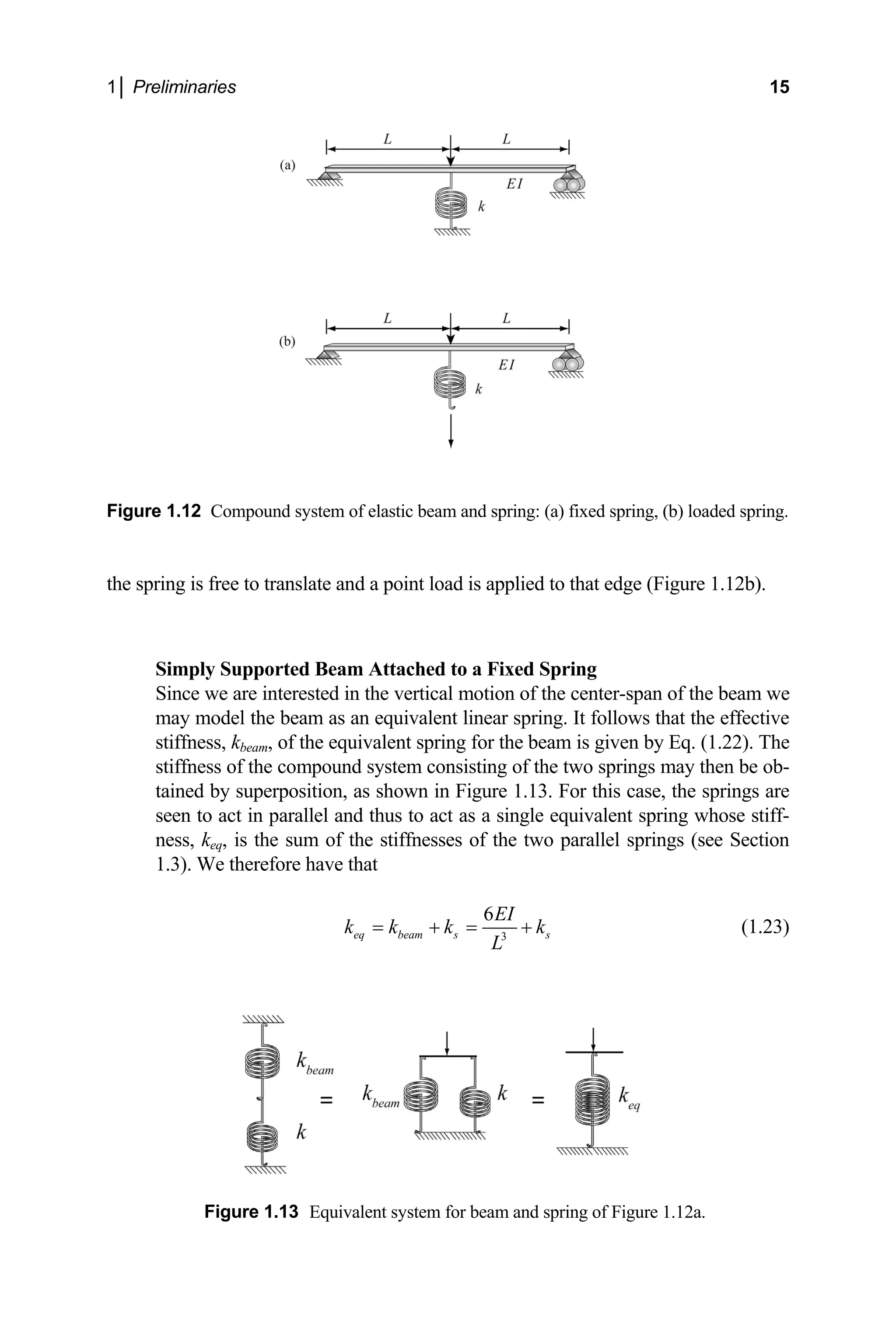
5.4 CONCLUDING REMARKS
In this chapter we introduced an alternate approach to vibration problems using
Laplace transforms. The basic definition was established, the shifting theorem estab-
lished and the convolution integral derived. The transforms of fundamental relevant
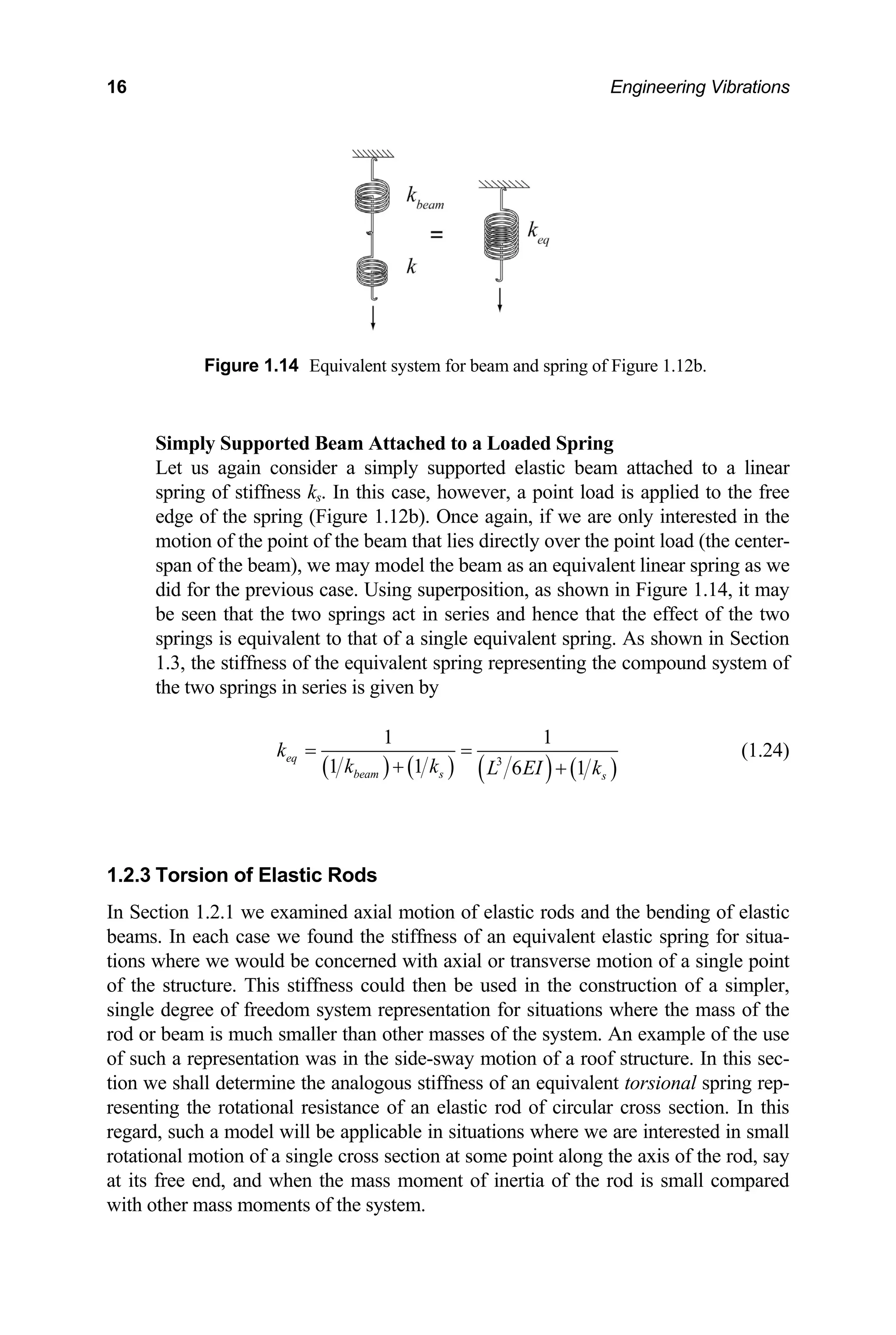
functions were determined and the solutions for free and forced vibration problems
were developed. The concepts of mechanical impedance and admittance were also
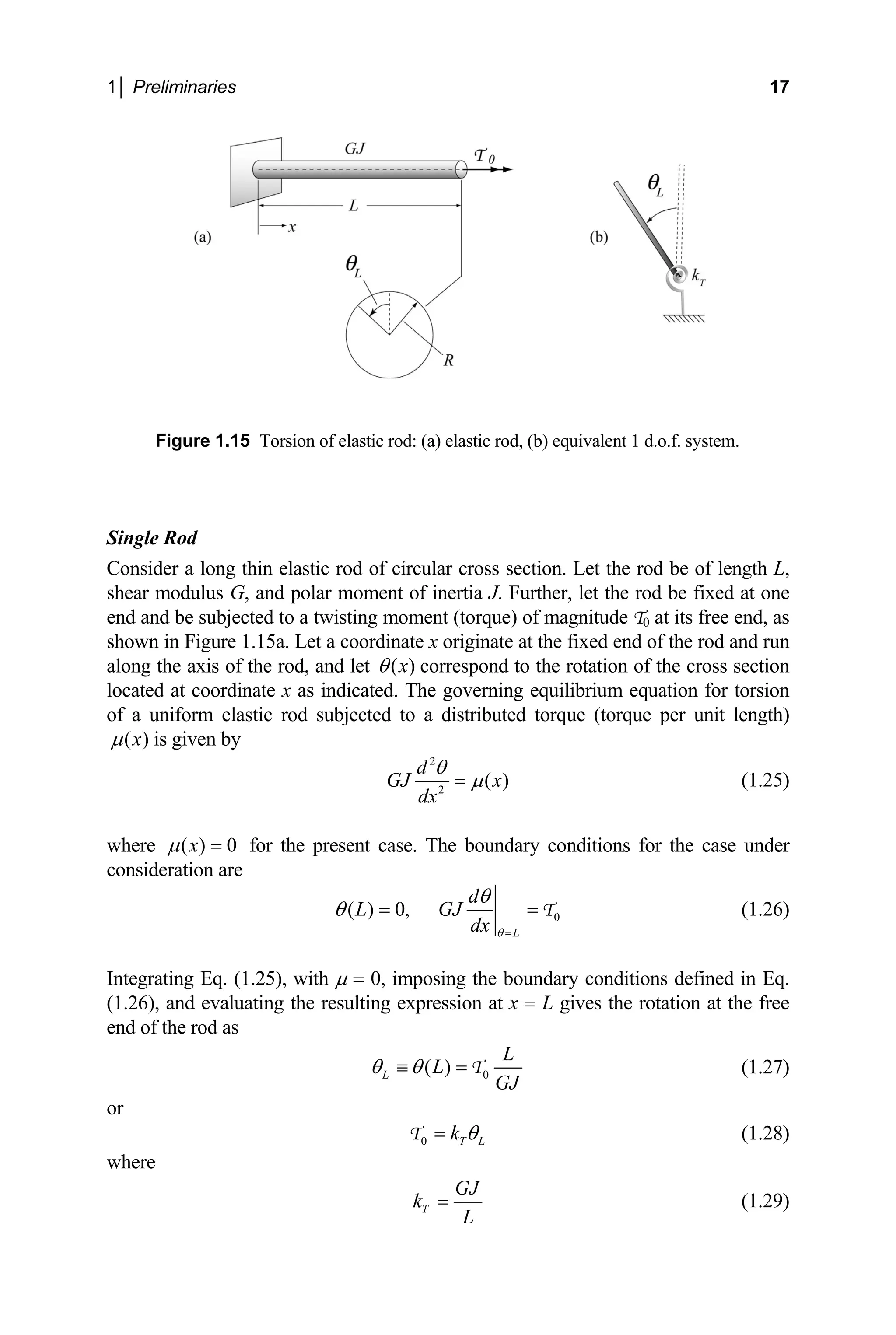
introduced.
BIBLIOGRAPHY
Benaroya, H., Mechanical Vibration: Analysis, Uncertainties and Control, 2nd
ed., Dek-
ker/CRC, Boca Raton, 2004.
Boyce, W.E. and DiPrima, R.C., Elementary Differential Equations, 5th
ed., Wiley, New York,
1992.
Churchill, R.V., Operational Mathematics, 3rd
ed., McGraw-Hill, New York, 1972.
Graff, K.F., Wave Motion in Elastic Solids, Dover, New York, 1991.
Greenberg, M.D., Advanced Engineering Mathematics, 2nd
ed., Prentice-Hall, Upper Saddle
River, 1998.
Meirovitch, L., Fundamentals of Vibrations, McGraw-Hill, Boston, 2001.
Meirovitch, L., Principles and Techniques of Vibrations, Prentice-Hall, Upper Saddle River,
1996.
PROBLEMS
5.1 Evaluate the Laplace transform of the step function 0 .
( )
F t
H
5.2 Evaluate the Laplace transform of the step function 0 .
( )
F t τ
−
H
286 Engineering Vibrations
5.3 Evaluate the Laplace transform of the ramp function 0
( ) ( ) ( )
f t f t t
τ τ
= ⋅ − ⋅ −
 H
where 0 constant.
f =

5.4 Verify Eq. (5.11) by evaluating { }
sin .
t
ω
L
5.5 Verify Eq. (5.13) by evaluating { }
sin .
at
e t
ω
L
5.6 Evaluate the mechanical impedance and the mechanical admittance of the sim-
ple pendulum.
5.7 Evaluate the mechanical impedance and the mechanical admittance of the sys-
tem of Problem 3.6 when one wheel is fixed.
5.8 Evaluate the mechanical impedance and the mechanical admittance of the
structure of Example 3.13.
5.9 Use the Laplace transform approach to obtain the solution to Example 3.1 if the
system is initially at rest.
5.10 Use the Laplace transform approach to determine the motion of the mass of
Example 3.5 if it is subjected to the applied force 2
( ) 0.05
F t t
= N.
6
Dynamics of Multi-Degree of Freedom
Systems
Actual mechanical systems generally possess many, if not an infinite number, of de-
grees of freedom. Further, many continuous systems may be adequately modeled as
discrete systems with many degrees of freedom. It is therefore of practical, as well as
fundamental, interest to understand the nature of such systems. The next three chap-
ters are devoted to the study of vibrations of discrete multi-degree of freedom sys-
tems. Examples of such systems include the multi-story building shown in Figure
6.1a, the motorcycle frame shown in Figure 6.1b and the compound pendulum dis-
played in Figure 6.1c. The analysis of multi-degree of freedom systems requires the
introduction of many new concepts that will be used in conjunction with the ideas and
concepts presented thus far. Before we can examine the vibratory behavior of these
rather complex systems, we must first develop the facility to derive the equations of
motion that describe them. Acquisition of this capability will also allow for the repre-
sentation and characterization of the various systems, as well. Toward this end, we
first introduce multi-degree of freedom systems by example and derive the governing
equations for selected systems using Newtonian Mechanics in Section 6.1. Though a
useful approach, and most certainly a fundamentally correct one, the derivation of the
equations of motion by direct application of Newton’s laws is often cumbersome and
tedious for systems other than relatively simple assemblages. To facilitate the deriva-
tion of equations of motion for all multi-degree of freedom systems we introduce
aspects of a subject area known as Analytical Dynamics in Section 6.2. In particular,
we focus our attention on the development and application of Lagrange’s Equations
as an alternate, and often more convenient, approach for deriving the governing equa-
tions of complex systems.
287
288 Engineering Vibrations
Figure 6.1 Examples of multi-degree of freedom systems.
6.1 NEWTONIAN MECHANICS OF DISCRETE SYSTEMS
In this chapter, and in the two chapters that follow, we shall be interested in the be-
havior of systems possessing many degrees of freedom. We will introduce the topic
through several representative examples using the principles of elementary dynamics
discussed in Section 1.5. Sample systems include mass-spring systems, multiple pen-
dulum systems and rigid frames. We begin with a discussion of a simple two degree
of freedom system, the results of which are then generalized to systems with any
number of degrees of freedom.
6.1.1 Mass-Spring Systems
Mass-spring systems, with or without damping, are appropriate representations for
many physical systems such as the multi-story building shown in Figure 1.10 and
other elastic structures from submarines to aircraft. The derivation of the equations of
motion for simple systems, such as masses and springs in series, is easily accom-
plished by direct application of Newton’s Laws of Motion. In this section, we demon-
strate how this is done by first introducing two examples; a two degree of freedom
system consisting of two masses subjected to external forces and three springs, and a
6│ Dynamics of Multi-Degree of Freedom Systems 289
three degree of freedom system consisting of three masses and three springs excited
by the motion of its base. We then extend these results to the formulation for analo-
gous N-degree of freedom systems, where N is any integer.
Example 6.1
Consider a system consisting of two masses, m1 and m2, connected by three
elastic springs with stiffnesses k1, k2 and k3 respectively, as indicated in Figure
E6.1-1. Let the masses be subjected to the externally applied forces F1 and F2,
respectively, and let u1 and u2
represent the corresponding dis-
placements from equilibrium of
the masses, as shown. We wish
to derive the equations of motion
for this system using Newton’s
Laws of Motion.
Figure E6.1-1 Two-mass three-spring system.
Solution
To derive the equations of motion for the system, we must derive the equation
of motion for each mass individually. To do this we first isolate each mass and
draw its kinetic diagram as shown in Figure E6.1-2. Note that Newton’s Third
Law is implied in the figure. For the sake of convention, we take u2  u1  0
throughout our derivation. This renders all but the third spring to be in tension
as a reference. Results to the contrary in subsequent analyses may then be in-
terpreted accordingly.
Figure E6.1-2 Kinetic diagram.
With the individual kinetic diagrams drawn, we may directly apply Newton’s
Second Law to each mass of the system. We then have
1 1 1 2 2 1 1
( ) 1
F k u k u u m u
− + − =
2 2 2 1 3 2 2
( ) 2
F k u u k u m u
− − − =
290 Engineering Vibrations
which when rearranged gives the equations of motion for mass 1 and mass 2,
respectively, as
1 1 1 2 1 2 2 1
2 2 2 1 2 3 2 2
( )
( )
m u k k u k u F
m u k u k k u F
+ + − =
− + + =
(a)
Note that the equation governing m1 depends on the displacement of m2 as well
as the displacement of m1, while the equation governing the second mass also
involves the displacements of both masses. The equations, and hence the mo-
tions of each mass, are said to be coupled. This, of course, makes physical
sense since we might anticipate that the motion of one mass is dependent on the
motion of the other since they are connected through the springs. This particu-
lar type of coupling is referred to as stiffness coupling since the coupling is
manifested through the stiffness elements of the system (in this case the elastic
springs). We shall elaborate on this and other types of coupling later in this sec-
tion.
It is seen that this two degree of freedom system is governed by two
(coupled) equations of motion. This is the case for two degree of freedom sys-
tems, in general. A three degree of freedom system will be governed by three
equations of motion, and so on. Thus, an N-degree of freedom system will be
governed by N equations of motion. While it is cumbersome to work with
many equations individually, the governing equations, and hence any analysis
and interpretation is made easier and cleaner by writing the equations in matrix
form. Analyses may then be performed using the methods of matrix analysis,
and of linear algebra in general. Toward this end, Eqs. (a) may be easily written
in matrix form as
1 2 2
1 1 1
2 2 3
2 2 2 2
0
0
k k k
m u u
k k k
m u u F
+ −
⎡ ⎤
⎡ ⎤ ⎧ ⎫ ⎧ ⎫ ⎧ ⎫
+ 1
F
=
⎨ ⎬ ⎨
⎢ ⎥
⎢ ⎥ − +
⎣ ⎦ ⎩ ⎭ ⎩ ⎭ ⎩ ⎭
⎣ ⎦
⎬ ⎨ ⎬ (b)
or, in the compact form
+ =
mu ku F (c)
where
(d)
1
2
0
0
m
m
⎡ ⎤
= =
⎢ ⎥
⎣ ⎦
T
m m
is referred to as the mass matrix of the system,
1 2 2
2 2 3
k k k
k k k
+ −
⎡ ⎤
= =
⎢ − +
⎣ ⎦
T
k ⎥ k (e)
6│ Dynamics of Multi-Degree of Freedom Systems 291
is referred to as the stiffness matrix of the system, and a superposed “T” implies
the transpose of the matrix. The matrices m and k are seen to contain the prop-
erties of the system. Similarly,
1
2
( )
( )
F t
F t
⎧ ⎫
= ⎨ ⎬
⎩ ⎭
F (f)
is the force matrix for the system,
1
2
( )
( )
u t
u t
⎧ ⎫
= ⎨ ⎬
⎩ ⎭
u (g)
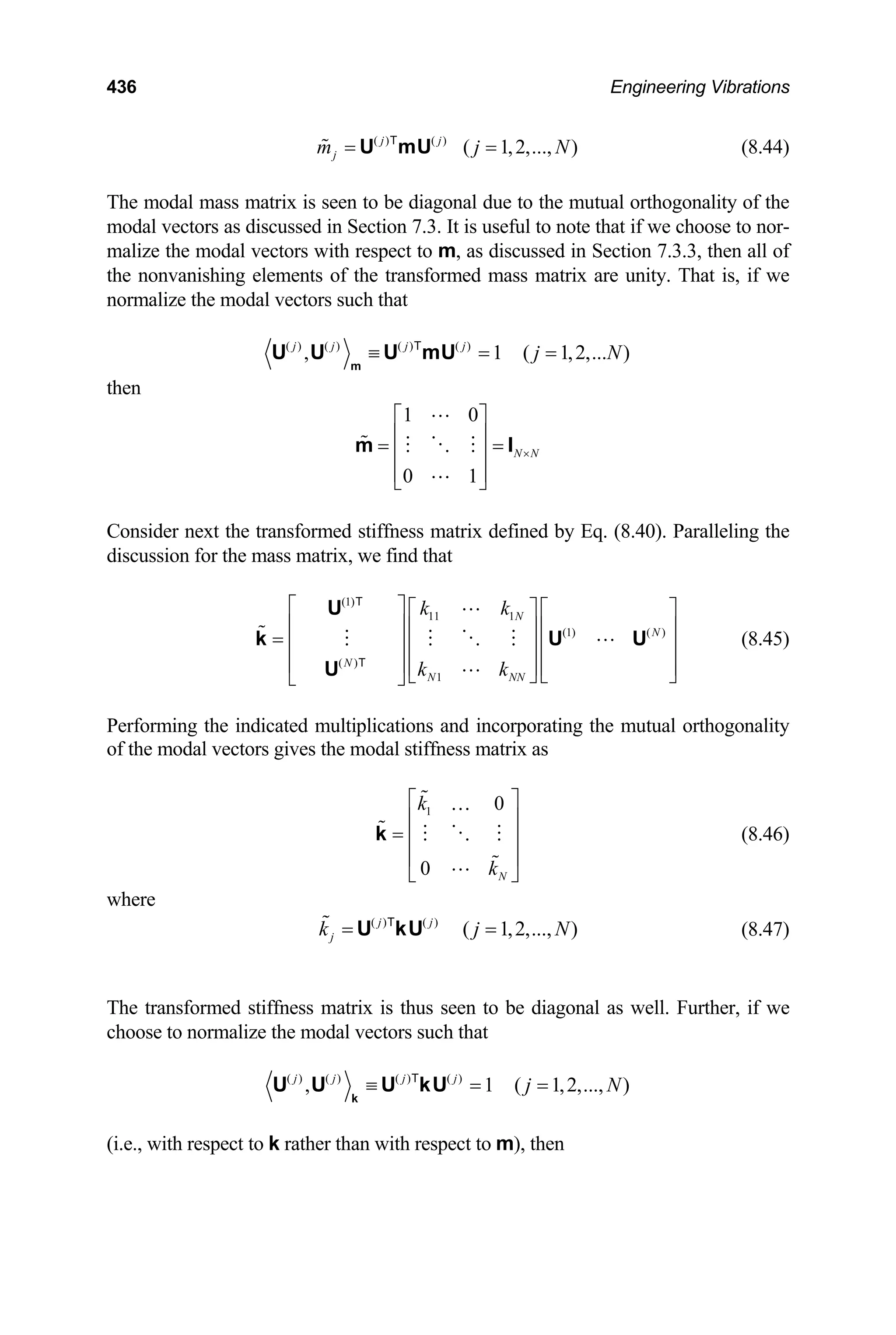
is the displacement matrix, and
1
2
( )
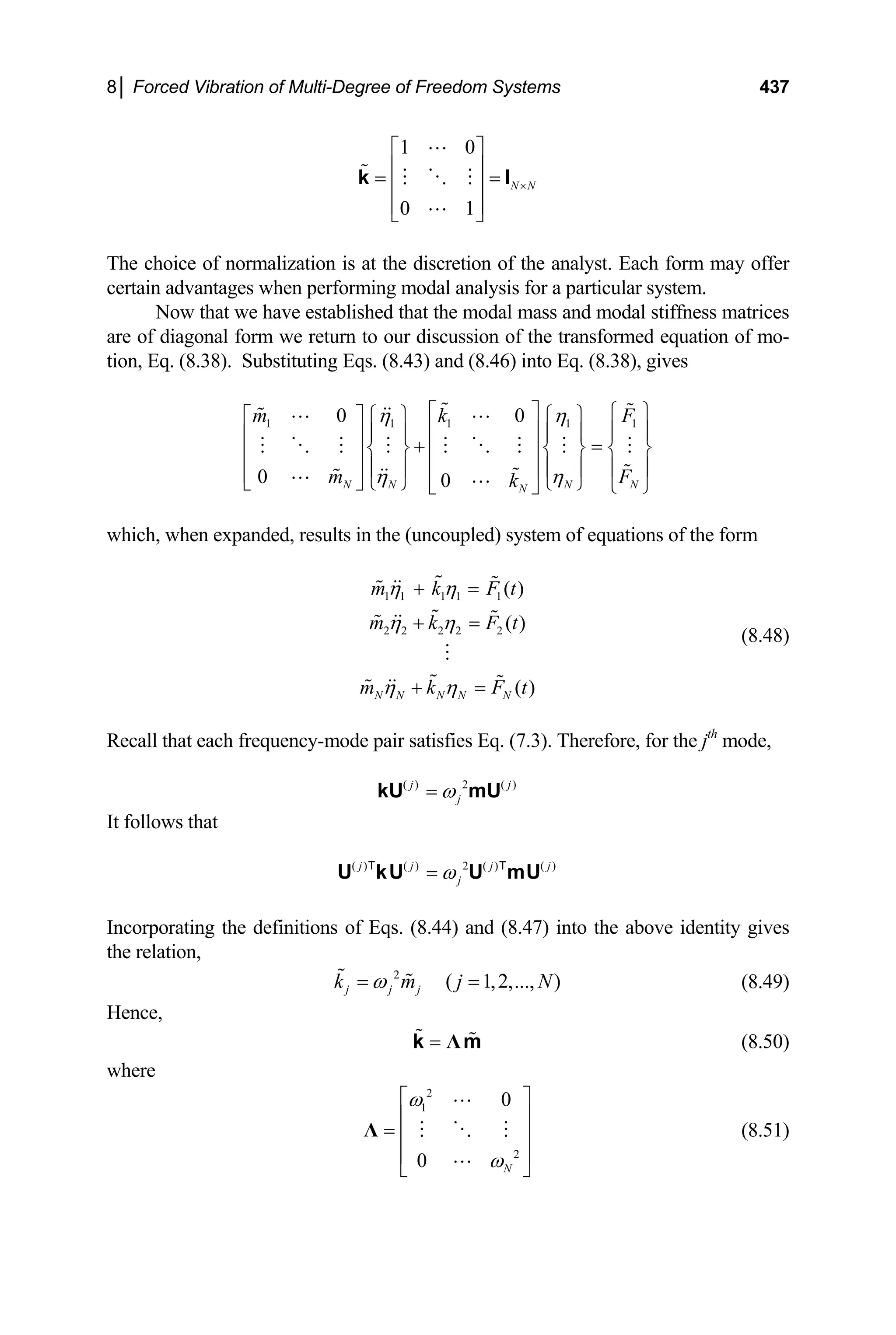
( )
u t
u t
⎧ ⎫
= ⎨ ⎬
⎩ ⎭
u (h)
is the acceleration matrix. In general, we wish to solve Eq. (b), or equivalently
Eq. (c), for u(t).
Consideration of Eqs. (d) and (e) indicates that both the mass matrix and
the stiffness matrix for this system are symmetric. This is typical of such sys-
tems and will be found to apply generally. It may also be seen that, for this par-
ticular system, the mass matrix is diagonal while the stiffness matrix is not.
This is because, as discussed earlier, this particular type of system is coupled
through the stiffnesses but not through the masses. As we will see, coupling can
occur through the masses or through the stiffnesses, or through both.
Example 6.2
Consider the system comprised of three masses and three springs shown in
Figure E6.2-1. Further, let the support/base of the system be subjected to a
“prescribed” motion u0(t). Derive the equations of motion for this system.
Figure E6.2-1 Three-mass three-spring system.
292 Engineering Vibrations
k2
(u2
-u1
)
k1
(u1
-u0
)
k2
(u2
-u1
)
k3
(u3
-u2
)
m1
u1
m2
u2
k3
(u3
-u2
)
m3
u3
=
=
=
Figure E6.2-2 Kinetic diagram.
Solution
The procedure will be similar to that of Example 6.1. However, for this case,
the masses of the system are not subjected to explicit applied forces. Rather, the
forcing enters the problem through the motion of the support.
As in the previous example, we first isolate each mass and draw the cor-
responding kinetic diagram for each (Figure E6.2-2). We note that the dis-
placement of the support, u0, does not vanish identically for this case, and
hence the stretch in spring 1 and the associated spring force are then u1 − u0 and
k1(u1 − u0), respectively. We next write Newton’s Second Law for each mass as
follows
1 1 2 2 1 1 1 0
2 2 3 3 2 2 2 1
3 3 3 3 2
( ) (
( ) (
( )
m u k u u k u u
m u k u u k u u
m u k u u
)
)
= − − −
= − − −
= − −
(a)
Regrouping terms in each of Eqs. (a) and bringing all terms except that associ-
ated with the base motion to the left hand-side of the equations results in
1 1 1 2 1 2 2 1 0
( ) (
m u k k u k u k u t)
+ + − =
2 2 2 1 2 3 2 3 3
( )
m u k u k k u k u 0
− + + − = (b)
3 3 3 2 3 3 0
m u k u k u
− + =
The above equations governing the displacements of the masses of the system
may be written in matrix form as
+ =
mu ku F (c)
where
6│ Dynamics of Multi-Degree of Freedom Systems 293
1
2
3
0 0
0
0 0
m
m
m
0
⎡ ⎤
⎢ ⎥
= ⎢ ⎥
⎢ ⎥
⎣ ⎦
m (d)
1 2 2
2 2 3
3 3
( ) 0
( )
0
k k k
k k k k
k k
+ −
3
⎡ ⎤
⎢ ⎥
= − + −
⎢ ⎥
⎢ ⎥
−
⎣ ⎦
k (e)
1 0 ( )
0
0
k u t
⎧ ⎫
⎪ ⎪
= ⎨ ⎬
⎪ ⎪
⎩ ⎭
F (f)
1 1
2
3 3
,
u u
u
u u
2
u
⎧ ⎫ ⎧ ⎫
⎪ ⎪ ⎪
= =
⎪
⎨ ⎬ ⎨ ⎬
⎪ ⎪ ⎪
⎩ ⎭ ⎩ ⎭
u u
⎪
(g, h)
N-Degree of Freedom Mass-Spring-Damper Systems
The formulations of Examples 6.1 and 6.2 can be generalized to a system comprised
of any number of masses, say N, connected in series by a system of springs and
dampers as shown in Figure 6.2. For this particular system the state of the system is
known if the position, or equivalently the displacement, of each of the N masses is
known as a function of time. By definition (see Section 1.1), a system that requires N
“coordinates” to describe its state, possesses N degrees of freedom. The system pres-
ently under consideration is, therefore, an N-degree of freedom system. The equations
of motion for this system are relatively simple to derive using Newton’s Laws of Mo-
tion. (This, however, will not always be the case.)
The kinetic diagram for mass mj (j = 1, 2, …, N) is depicted in Figure 6.3. Writ-
ing Newton’s Second Law for this generic mass gives
Figure 6.2 N-mass, N+1-spring, N+1-damper system.
294 Engineering Vibrations
Figure 6.3 Kinetic diagram for N-mass system.
( ) ( ) ( ) ( )
1 1 1 1 1 1
j j j j j j j j j j j j j j j
F k u u c u u k u u c u u m u
− − + + + +
− − − − + − + − =
which, after rearranging terms, takes the form
1 1 1 1 1 1 1 1
( ) ( )
j j j j j j j j j j j j j j j j
m u c u c c u c u k u k k u k u F
− + + + − + + +
− + + − − + + − = j (6.1)
(j = 1, 2, …, N
The m tion of the system is therefore described by N equations of the form of Eq.
)
o
(6.1). We here present a general case, so we shall consider the displacement of the
left support to be a prescribed function, 0 0 ( )
u u t
= , and we shall consider the right
support to be fixed ( 1 1 0
N N
u u
+ +
= = ). The s for each mass, and hence for the
entire system can be trix form as
equation
arranged in ma
+ + =
mu cu ku F (6.2)
here
⎥
⎥
(6.3)
the mass matrix,
= (6.4)
the stiffness matrix,
w
1
2
0 0
0 0
0 0 N
m
m
m
⎡ ⎤
⎢ ⎥
⎢ ⎥
= =
⎢
⎢
⎣ ⎦
T
m m
is
1 2 2
2 2 3 3
3 3 4
1
( ) 0 0
( )
0 ( ) 0
0 0 ( )
N
N N N
k k k
k k k k
k k k
k
k k k +
+ −
⎡ ⎤
⎢ ⎥
− + −
⎢ ⎥
⎢ ⎥
= − +
⎢ ⎥
−
⎢ ⎥
⎢ ⎥
− +
⎣ ⎦
…
…
T
k k
is
6│ Dynamics of Multi-Degree of Freedom Systems 295
( )
0 ( ) 0
0 0 ( )
N
N N N
c c c c
c c c
c
c c c +
⎢ ⎥
− + −
⎢ ⎥
⎢ ⎥
= − + =
⎢ ⎥
−
⎢ ⎥
⎢ ⎥
− +
⎣ ⎦
…
T
c c (6.5)
the damping matrix, and
(6.6)
are the acceleration, velocity and displacement matrices, respectively, and
1 2 2
( ) 0 0
c c c
+ −
⎡ ⎤
…
2 2 3 3
3 3 4
1
is
1 1 1
2 2 2
( ) ( ) ( )
( ) ( ) ( )
, , ,
( ) ( ) ( )
N N N
u t u t u t
u t u t u t
u t u t u t
⎧ ⎫ ⎧ ⎫ ⎧ ⎫
⎪ ⎪ ⎪ ⎪ ⎪ ⎪
⎪ ⎪ ⎪ ⎪ ⎪ ⎪
= = =
⎨ ⎬ ⎨ ⎬ ⎨ ⎬
⎪ ⎪ ⎪ ⎪ ⎪ ⎪
⎪ ⎪ ⎪ ⎪ ⎪ ⎪
⎩ ⎭ ⎩ ⎭ ⎩ ⎭
u u u
1 1 0 1 0
2
( ) ( ) ( )
( )
( )
N
F t k u t c u t
F t
F t
+ +
⎧ ⎫
⎪ ⎪
⎪ ⎪
= ⎨ ⎬
⎪ ⎪
⎪ ⎪
⎩ ⎭
F (6.7)
the force matrix. Note that if the left base is fixed, then we set
is 0 0 0
u u
= = in the
or damper
y be noted that for this class of system, the stiffness and damping matrices
force matrix, Eq. (6.7). If the right end is free (there is no spring at the
right end of the system), then we respectively set kN+1 = 0 in the stiffness matrix, Eq.
(6.4), and cN+1 = 0 in the damping matrix, Eq. (6.5). The reader may wish to verify
that the equations for the system of Example 6.1 may be obtained by setting c = 0, N
= 2 and 0 0 0
u u
= = in the above formulation. Similarly, the equations for the system
of Exam be obtained by setting c = 0, N = 3 and k
ple 6.2 may 4 = 0 in the above for-
mulation.
It ma
are banded. That is, nonzero elements occur along or near the diagonal of the matrix.
This is so because, for this system, the springs and dashpots are connected in series
and therefore a given mass is only directly acted upon by the springs and dashpots
connected to its neighboring masses. The matrices would not be banded if nonadja-
cent masses were connected (for example if a spring connected m1 with mN , etc., as
well as m2). Banding of matrices provides a computational advantage for the analysis
of large systems. However, for general systems, such convenient banding does not
always occur directly.
296 Engineering Vibrations
Fi m.
6.1.2 The Double Pendulum
at of a multiple pendulum. We here consider the
Kinematics
coordinates (ξ, η) aligned with the deflected position of the first rod at
gure 6.4 The double pendulu
Another exemplary problem is th
double pendulum (Figure 6.4) for simplicity. The pendulum is comprised of two
masses m1 and m2 that are pinned to rigid rods (or cords) of length L1 and L2, respec-
tively. One end of the first rod is pinned to a rigid support, as indicated. For this sys-
tem the coordinates θ1 and θ2 measure the displacement of the two masses. The sys-
tem therefore possesses two degrees of freedom. In this section we will derive the
equations of motion for the double pendulum using Newton’s Laws of Motion. It will
be seen that, even for this relatively simple two degree of freedom system, the deriva-
tion is quite complex and must be carefully implemented. (The difficulty in deriving
the governing equations for systems of this type possessing more than two degrees of
freedom, say the triple or quadruple pendulum, is compounded accordingly.) The
governing equations for the double pendulum are considered again in Section 6.2,
where the advantage of Lagrange’s Equations will become apparent. For the moment,
however, let us derive the corresponding equations of motion using traditional vector
mechanics. To do this, we must first evaluate the acceleration of each mass with re-
spect to a common, and convenient, reference frame.
Consider the
the instant of observation. Since mass m1 moves along a circular path, its acceleration
is easily expressed in terms of polar coordinates (see Section 1.5.1), and is thus of the
same form as that for the mass of the simple pendulum of Section 2.1.4. Hence,
(1) 2
1 1 1
a L e L e
ξ η
θ θ
= + (6.8)
here
w eξ and eη correspond to unit vectors in the axial and normal directions of the
first rod, respectively.
6│ Dynamics of Multi-Degree of Freedom Systems 297
Figure
he acceleration of mass m2 may be expressed as the sum of the acceleration of mass
m1 and the acceleration of mass m2 as seen by an observer translating, but not rotat-
a
6.5 Kinetic diagram for the double pendulum.
T
ing, with mass m1 (see Section 1.5.1). Thus,
(2) (1)
a a
= + (2 /1)
he above form may be decomposed into its components along the (ξ, η) directions,
nd may be expressed in terms of the angular coordinates θ1 and θ2 as follows:
T
a
(2) (2) (2)
a a e a e
ξ ξ η η
= + (6.9)
here
1 2 2 2 2
(2) 2 2
1 1 2 2 2 2
cos
sin cos
a L L L
a L L L
ξ
η
w
(2) 2
sin
θ θ ψ θ ψ
θ θ ψ θ ψ
= + −
= + +
(6.10)
nd
a
2 1
ψ θ θ
= − (6.11)
inetics
With the expressions for the acceleration established, we may now derive the equa-
otion for the system. To do this we first isolate each mass and draw the
K
tions of m
associated kinetic diagram (Figure 6.5). Once this is done we can express Newton’s
Second Law for each mass. For this system, it is more expedient to take the moment
of Newton’s Second Law about the common origin, O, for each mass individually.
298 Engineering Vibrations
We then have, for the first mass,
(1) (1) (1)
0 1
M r m a
= ×
∑ :
1 1 1 1 1 1 1 2 1 1 1 1
sin cos sin
L m g L F L P L m L
θ θ ψ
− + + = θ
r, after rearranging,
L m gL L P F L
o
m 2
1 1 1 1 1 1 1 2 1 1 1
sin sin cos
θ θ ψ θ
+ − = (6.12)
may be seen that the unknown internal force P2 appears in Eq.
rce in terms of the chosen coordinates and their derivatives, we write out the ξ
It (6.12). To find this
fo
component of Newton’s Second Law for mass m2. Thus,
(2) (2)
2
F m a
ξ ξ
=
∑ :
2
2 2 1 2 1 2 1 1 2 2 2 2
sin sin cos ( cos sin )
P m g F m L L L
ψ θ θ θ θ ψ θ
− − + = + − ψ (6.13)
olving Eq. (6.13) for P2 and substituting the resulting expression into Eq
liminates the unknown internal force and gives the equation of motion for mass m1
1
( ) sin ( ) cos
m m gL F F L
S . (6.12)
e
as
2 2
1 2 1 1 2 1 2 2 2 1 2 2
( ) cos sin
m m L m L L m L L
θ θ ψ θ ψ
1 2 1 1 1 2 1
θ θ
+ + = +
(6.14)
Linearization of Eq. (6.14) about θ1 = θ2 = 0, as discussed in Section 2.1.4, renders
e corresponding equation of motion for mass m1 to the form
1
)
F L
+ (6.15)
o obtain the equation of motion for mass m2 we proceed in a simila
us take the moment about the origin of the statement of Newton’s Second Law for
2
+ + −
th
2
1 2 1 1 2 1 2 2 1 2 1 1
( ) ( ) (
m m L m L L m m gL F
θ θ θ
+ + + + = 1 2
T r manner. We
th
mass m2. Hence,
(2) (2)
0
(2)
M r m
= ×
∑ a :
2
2 2 2 1 2 2 1 1 2
(2) (2)
2 1 1 2 2 2 1 2 2 2
cos sin sin ( cos ) ( cos cos )
( sin sin ) ( cos ) sin
P L P L L F L L
m g L L m a L L m a L
ξ η
ψ ψ ψ ψ θ θ
θ θ ψ
− + + +
− + = + + ψ
Substituting Eqs. (6.10) and (6.13) into the above expression then gives the desired
rm of the governing equation as
2 2 2 2
2 2 2 2 2 2
n sin (1 cos )
sin cos
m L
m gL F L
fo
2
2 1 2 1 1
cos si
m L L 2 2
θ ψ θ
⎡ +
⎣ ψ θ θ ψ ψ
θ θ
⎤ ⎡ ⎤
+ − −
⎦ ⎣ ⎦
+ =
(6.16)
6│ Dynamics of Multi-Degree of Freedom Systems 299
Linearization of Eq. (6.16) about θ1 = θ2 = 0 renders the corresponding equation of
otion for mass m2 as
quations (6.15) and (6.17) describe the coupled motion of the double pendulu
r the class of mass-spring systems discussed previously, it i
ese equations in matrix form. When this is done, the equation of (small angle) mo-
0
( )
m gL
m
2
2 1 2 1 2 2 2 2 2 2 2 2
m L L m L m g L F L
θ θ θ
+ + = (6.17)
E m. As
fo s of interest to express
th
tion for the double pendulum takes the form
2
1 2 1 1
1 2 1 2 1 2 1
2
( ) 0
( ) m m gL
m m L m L L
m L L m L 2 2 2
2 1 2 2 2 2
1 2 1
2 2
F F L
F L
θ
⎨ ⎬
θ
θ
θ
⎧ ⎫
⎡ ⎤ +
⎡ ⎤ ⎧ ⎫
+ ⎪ ⎪
+
⎨ ⎬
⎢ ⎥ ⎢ ⎥
⎣ ⎦ ⎩ ⎭
⎣ ⎦ ⎩ ⎭
+
⎪ ⎪
⎧ ⎫
= ⎨ ⎬
⎩ ⎭
(6.18)
r, equivalently,
o
+ =
mu ku F
where
L
m
2
1 2 1 2 1 2
2
2 1 2 2 2
( )
m m L m L L
m L L
⎡ ⎤
+
= ⎢ ⎥
⎣ ⎦
m (6.19)
1 2 1
2 2
( ) 0
0
m m gL
m gL
+
⎡ ⎤
= ⎢ ⎥
⎣ ⎦
k (6.20)
1 2 1
2 2
( )
F F L
F L
+
⎧ ⎫
= ⎨ ⎬
⎩ ⎭
F (6.21)
1
2
θ
θ
⎧ ⎫
= ⎨ ⎬
⎩ ⎭
u (6.22)
ote that, for this system, the elements of the d
lar displacements and the elements of the force matrix are actually moments. Thus,
we speak of the “displacement matrix” and of the “force matrix” in the most general
N isplacement matrix are actually angu-
sense, with their elements interpreted accordingly. It may be seen that this system is
coupled through the mass matrix. Such coupling is referred to as inertial coupling.
300 Engineering Vibrations
.1.3 Two-Dimensional Motion of a Rigid Frame
onsider the motorcycle frame shown in Figure 6.6. The frame has mass m and
cated a horizontal distance
t of inertia about an axis
Figure 6.6 Motorcycle frame.
6
C
length L = L1 + L2, as indicated. Its center of mass G is lo
L from the rear of the bike, as shown, and its momen
1
through the center of mass is IG. The tires are modeled as elastic springs, with the
respective stiffnesses k1 and k2, that resist vertical motion as shown. We shall derive
the equations of motion for this twice, using different sets of coordinates. It will be
seen that the type of coupling is dependent on the coordinates chosen to describe the
motion of the system.
Figure 6.7 Kinetic diagram for motorcycle frame.
6│ Dynamics of Multi-Degree of Freedom Systems 301
Case 1: Translation of, and Rotation About, the Center of Mass
he coordinate that
inate that measures
respect to the equi-
A natural set of coordinates to describe the motion of the frame is t
describes the lateral position of the center of mass, and the coord
the rotation about an axis through that point (both measured with
librium configuration of the system). These measures are denoted as yG and θ, respec-
tively, as shown on the kinetic diagram of Figure 6.7a. Writing Newton’s Second
Law for the vertical motion of the frame gives
y y
F ma
=
∑ :
( sin ) (
k y L k y
1 1 2 2 sin )
G G G
L my
θ θ
+ =
hich for sm motion simplifies to
0
my k k y k L k L
− − −
w all angle
1 2
G G 2 2 1 1
( ) ( )θ
+ + + − = (6.23)
e next write the equation of rotational motion of the frame about its center of m
ence, applying Eq. (1.162),
W ass.
H
G G
M I α
=
∑ :
2 2 2 1 1 1
( sin ) ( sin )
G G
k y L L k y L L IG
θ θ θ
+ − − = −
all angle motion simplifies to
1 1 2 2
( ) 0
k L k L
+ + = (6.24)
qs. (6.23) and (6.24) can be combined and represented in matrix
G
k k k L k L
+ −
⎡ ⎤
which for sm
2 2
2 2 1 1
( )
G G
I k L k L y
θ θ
+ −
E form as
1 2 2 2 1 1
2 2
( ) ( )
0 0
G G
m y y
k L k L k L k L
I θ θ
⎡ ⎤
2 2 1 1 1 1 2 2
( ) ( )
0 0
⎧ ⎫
⎣ ⎦
⎧ ⎫ ⎧ ⎫
+ =
⎨ ⎬ ⎨ ⎬ ⎨ ⎬
⎢ ⎥
⎢ ⎥ − +
⎩ ⎭ ⎩ ⎭ ⎩ ⎭
⎣ ⎦
(6.25)
or
+ =
mu ku 0
where
0
0 G
m
I
⎡ ⎤
= ⎢ ⎥
⎣ ⎦
m (6.26)
2 2
2 2 1 1 1 1 2 2
( ) (
( ) ( )
k k k L
k L k L k L k L
+
1 2 2 2 1 1 )
k L
−
⎡ ⎤
= ⎢ ⎥
− +
⎣ ⎦
k (6.27)
and
G
y
θ
⎧ ⎫
= ⎨ ⎬
⎩ ⎭
u (6.28)
302 Engineering Vibrations
It 5), or Eqs. (6.26) and (6.27)
th es for this choice of coordinates. Note
may be seen from Eqs. (6.23) and (6.24), or Eq. (6.2
at the system is coupled through the stiffness
at the equations completely decouple if the parameters of the system are such that
3
the rear of the frame as shown in the corresponding kinetic diagram of Figure
cate the same point
th
k1L1 = k2L2.
Case 2: Translation of, and Rotation About, an Arbitrary Point
Consider the vertical translation of some arbitrary point “P” located a distance L
from
6.7b, and the rotation about an axis through that point. Let L4 lo
from the front end of the frame and LP locate that point with respect to the center of
mass, as indicated. In this case we choose the lateral displacement of point P, yP, and
the angular displacement, θ, to describe the motion of this two degree of freedom
system. We next parallel the development of Case 1, but with the present set of coor-
dinates.
We first note that the lateral displacement of the center of mass may be ex-
pressed in terms of the lateral displacement of point P and the rotational displace-
ment. Hence,
sin
G P P
y y L θ
= + (6.29)
and, after differentiating twice with respect to time,
( )
2
cos sin
G P P
y y L θ θ θ θ
= + − (6.30)
ewton’s Second Law then gives the equation of lateral motion as
N
( )
2
1 3 2 4
( sin ) ( sin ) cos sin
P P P P
k y L k y L m y L
θ θ θ θ θ θ
⎡ ⎤
− − − + = + −
⎣ ⎦
where P is the distance between points P and G, as indicated in Figure 6.7b. For
all angle motion, the above equation of translational motion simplifies to
We next write the equation rotational motion about an axis through P. Applying Eq.
.163) for the present system gives the equation of rotational mot
L
sm
1 2 2 4 1 3
( ) ( ) 0
P P P
my mL k k y k L k L
θ θ
+ + + + − = (6.31)
(1 ion of the frame as
2 4 4 1 3 3
( sin ) cos ( sin ) cos
cos
P P
G G P
k y L L k y L L
I my L
θ θ θ θ
θ θ
+ − −
= − −
(6.32)
For small angle motion, the equation of rotational motion simplifies to
6│ Dynamics of Multi-Degree of Freedom Systems 303
2 2
2 4 1 3 2 4 1 3
( ) ( )
P G G P
mL y I k L k L y k L k L
θ θ
+ + − + + = 0 (6.33)
quations (6.31) and (6.33) may be combined and expressed in matrix form as
P P P
P G
m mL k k k L k L
y y
mL I k L k L k L k L
θ θ
⎡ ⎤ ⎡ ⎤
⎧ ⎫ ⎧ ⎫ ⎧ ⎫
+ =
⎨ ⎬ ⎨ ⎬
⎢ ⎥ ⎢ ⎥
− +
⎩ ⎭ ⎩ ⎭
⎣ ⎦ ⎣ ⎦
(6.34)
elasti-
ally. However, if the location of point P (and hence the ratio L3/L4) is chosen such
E
+ −
1 2 2 4 1 3
2 2
2 4 1 3 2 4 1 3
( ) ( ) 0
( ) ( ) 0
⎨ ⎬
⎩ ⎭
It may be seen from Eq. (6.34) that the system is coupled both inertially and
c
that 3 4 2 1
L L k k
= , then the stiffness matrix will be diagonal, and the sy
nly be coupled inertially. For this case the equation of motion reduces to th
stem will
o e form
+ =
mu ku 0
where
P
P G
m mL
mL I
⎡ ⎤
= ⎢ ⎥
⎣ ⎦
m (6.35)
1 2 2 4 1 3 1 2
2 2 2 2
2 4 1 3 2 4 1 3 2 4 1 3
( ) ( ) ( )
⎡ 0
( ) ( ) 0 ( )
k k k L k L k k
k L k L k L k L k L k L
+ − +
⎡ ⎤ ⎤
= →
⎢ ⎥ ⎢ ⎥
− + +
⎣ ⎦ ⎣ ⎦
k (6.36)
nd
a
P
y
θ
⎧ ⎫
= ⎨ ⎬
⎩ ⎭
u (6.37)
Note that if point P corresponds to one of the edges of the frame, say the left edge,
L3 = L and L4 = 0. It may be seen that, for this choice of coordinates, the equa-
tions that govern the system cannot be decoupled.
We thus see that, in general, the equation
mass matrix, the stiffness matrix, or through both. (For damped sys-
previous section
as easily derived by direct application of Newton’s Laws of Motion. This, however,
will not usually be the case when one considers complex systems that exhibit multi-
uations the vector approach is generally cumbersome
then
s of motion of a system may be cou-
pled through the
tems, coupling may occur through the damping matrix as well.) We also see that a
proper choice of coordinates can simplify the equations of motion.
6.2 Lagrange’s Equations
The equation of motion for the N-degree of freedom system comprised of a series of
springs, dampers and masses in rectilinear motion considered in the
w
dimensional motion. For such sit
and a scalar technique is often desirable. An approach from an area of mechanics
known as Analytical Dynamics will help in this regard. This is the utilization of La-
grange’s Equations. Though the development is somewhat abstract, the implementa-
304 Engineering Vibrations
tion is rather straightforward. Once it is mastered, the application of Lagrange’s
Equations for the derivation of the equations of motion for complex multi-degree of
freedom systems can be accomplished with a fair amount of ease. In this section we
develop Lagrange’s Equations and demonstrate their utilization in deriving the equa-
tions of motion for multi-degree of freedom systems. We first introduce the concept
of virtual work.
6.2.1 Virtual Work
To begin, let {q1, q2, …, qN} represent the set of independent “generalized coordi-
nates” used to describe the motion of some N-degree of freedom system. These may
e, for example,
b
th
the linear coordinates (u1, u2) used to describe the displacements of
e two mass system connected in series, the angular coordinates (θ1, θ2, θ3) em-
motion of a triple pendulum, the combination of linear and
,θ ) adopted to describe the motion of the motorcycle frame
ployed to describe the
angular coordinates (y
discussed earlier, or some other type of coordinate description. Further, let
1 2
( , ,..., , )
l l N
r r q q q t
= (6.38)
denote the position vector of mass ml (l = 1, 2, …, M). Consider a set of virtual in-
crements in position (virtual displacements) of the various mass elements of the sys-
tem that are consistent with the constraints of the system, but are otherwise arbitrary.
hat is, consider the increments
T
( 1,2,..., )
l
r l M
δ =
such that the constraints of the system are not violated. The operator δ is used to de-
note the differential increment rather than d since the increments are considered vir-
tual (possible, but not actual). The virtual increments in position are thus referred to
s virtual displacements. [As an example, suppose we were to consider the virtual
otion of the ladder/rod that is constrained to move along the vertical wall and hori-
ontal wall, as indicated in Figure 6.8. For this system, the virtual displacement (the
a
m
z
increment in position) of mass A must be vertical and that of mass B must be horizon-
tal in order to comply with the constraints imposed on system due the wall, the floor,
and the rigid rod. Thus, virtual displacements through the walls or off the tracks are
not permitted. Further, the possible displacements of the two masses/rod ends cannot
be independent of one another but, rather, must be related through the geometry of
the rigid rod. Thus, for the constrained rod,
2 2 2
A
2s 2 0
A B A B B
s s L s s s
δ δ
+ = → + =
6│ Dynamics of Multi-Degree of Freedom Systems 305
sA
A
L
B
sB
Figu tem.
here sA and sB respectively locate the positions of mass A and mass B, as indicated.]
em, the virtual work
one by the external force and by the resultant internal force acting on mass ml , as the
ass moves through the corresponding virtual displacement
re 6.8 Example of a constrained sys
w
Returning to the discussion of a general N-degree of freedom syst
d
m l
r
δ , is then
( )
( ) ( )
ext int
l l l l
F F r
δ δ
= + i
W
int
l lj
j
F
=
=
(6.39)
where,
M
( )
1
∑P (6.40)
e internal force exerted on mass ml by mass mj, and it is understood that
= =
P P P (i.e., no mass exerts a force on itself). It follows from New-
n’s Third Law that
lj
P is th
= =
11 22 ... 0
MM
jl l
= −
P P (
to j l, j = 1, 2, …, M),
1
int
l
j
F
=
=
∑ ∑∑
he work done by the forces acting on each particle of the system as
xpressed by Eq. (6.39), and noting that the internal forces of the system sum to
as expressed by Eq. (6.41), gives the total virtual work done on the system as
and hence that
( )
11 12 1 1 2
1 1
( ... ) ... ( ... ) 0
M M M
lj M M M MM
l l
= =
= + + + + + + + + =
P P P P P P P (6.41)
Thus, adding t
e zero
1 1
M M
l l l
l l
F r
δ δ δ
= =
= =
∑ ∑ i
W W (6.42)
where l
F includes external forces, and those internal forces for which the associated
isplacement can differ from that of the force’s mirror im
d age.
306 Engineering Vibrations
6.2.2 The Canonical Equations
nge’s Equations from
lied to the individual particles that comprise the
rgy statement.
Now that the concepts of generalized coordinates and virtual work have been estab-
lished we proceed to develop the general statement of Lagra
Newton’s Second Law of Motion app
system and converting them to an ene
Writing Newton’s Second Law for mass ml , we have
2
( ) ( )
2
ext int l
l l l
d r
F F m
dt
+ =
or
2
( ) ( )
2
0 ( 1,2,..., )
ext int l
l l l
d r
F F m l M
dt
+ − = = (6.43)
ing the scalar dot product of Eq. (6.43) with its corresponding virtual displace-
ent gives
Tak
m
2
( ) ( )
2
0 ( 1,2,..., )
ext int l
l l l l
d r
F F m r l M
dt
⎣ ⎦
δ
⎡ ⎤
+ − = =
⎢ ⎥ i (6.44)
equations for all masses that comprise the system and noting Eqs.
.41) and (6.42) results in the statement
Summing the
(6
( )
1
0
l l l l
l
F m r r
δ
=
⎡ ⎤
M
− =
⎣ ⎦
∑
seen to be a work type statement. We next wish to convert this statement to
ork-energy form.
It follows from Eq. (6.38) that
i (6.45)
which is
w
1 2
1 2
q q
∂ ∂ 1
... N j
N j
j
dq dq dq dq
q q
=
∂ ∂
(6.46)
by dt becomes
N
l l l l
l
r r r r
dr
∂ ∂ ∂ ∂
= + + + = ∑
which, after dividing through
1 2
1 2
dt q q
∂ ∂ 1
...
N
l l l l l
l N j
N j
j
dr r r r r
r q q q q
q q
=
∂ ∂ ∂ ∂
≡ = + + + =
∂ ∂
∑ (6.47)
It follows from Eq. (6.47) that
( 1,2,..., ; 1,2,..., )
l l
j j
q q
∂ ∂
r r
l M j N
∂ ∂
= = = (6.48)
6│ Dynamics of Multi-Degree of Freedom Systems 307
Since the virtual displacements correspond to possible displacements and therefore
of actual displacements, it follows that
crement in position can be expressed in the form of Eq. (6.46).
possess the functional properties the virtual
in Hence,
1 2
1 2 1
...
N
l l l l
l N j
N j
j
r r r r
r q q q q
q q q q
δ δ δ δ δ
=
∂ ∂ ∂ ∂
= + + + =
∂ ∂ ∂ ∂
∑ (6.49)
ith the identities stated by Eqs. (6.48) and (6.49) established, we no
valuation of Eq. (6.45). We shall perform this evaluation term by term
order.
W w return to the
e and in reverse
et us take the second expression in Eq. (6.45), substitute Eq. (6.49), and inter-
change the order of summation. This gives
L
1 1 1
M M N N M
l l
l l l l l j l l j
j
l l j
r r
m r r m r q m r q
q 1 1
1 1
j
j l
N M
l l
l l l l j
j j
j l
q
r r
d d
m r m r q
dt q dt q
δ δ δ
= = =
⎛ ⎞
∂ ∂
= =
δ
= =
= =
⎜ ⎟
⎜ ⎟
∂
⎝ ⎠
⎡ ⎤
⎛ ⎞ ⎛ ⎞
∂ ∂
= ⎢ − ⎥
⎜ ⎟ ⎜ ⎟
⎜ ⎟ ⎜ ⎟
∂ ∂
⎢ ⎥
⎝ ⎠ ⎝ ⎠
⎣ ⎦
∑∑
∂
∑ ∑ ∑ ∑ ∑
i i
If we next incorporate the identity specified by Eq. (6.48) in the first term of the last
bracketed expression, and interchange the order of differentiation in the second term,
the form
i i i
the above equation takes
( ) ( )
1 1 1
M N M
l l
l l l l l l l j
l j l
r r
d
m r r m r m r q
δ δ
1 1
2 2
1 1
j j
N M
l l l l l l j
j j
j l
dt q q
d
m r r m r r q
dt q q
δ
= = =
⎡ ⎤
⎛ ⎞
= =
∂ ∂
= ⎢
∂ ∂
⎝ ⎠
⎡ ⎤
∂ ∂
= −
⎢ ⎥
∂ ∂
⎢ ⎥
⎣ ⎦
∑∑
− ⎥
⎜ ⎟
⎜ ⎟
⎢ ⎥
⎣ ⎦
∑ ∑∑
i i i
i i
inally,
F
1 1
M N
l l l j
j j
l j
d
m r r q
dt q q
δ δ
= =
⎛ ⎞
∂ ∂
= −
⎜ ⎟
⎜ ⎟
∂ ∂
⎝ ⎠
∑ ∑
i
T T
(6.50)
where
1
1 2 1 2 2
1
( , ,..., ; , ,..., )
M
N N l l l
r r
l
q q q q q q m
=
= = ∑ i (6.51)
T T
tal kinetic energy of the system. To evaluate the first term in Eq. (6.45), let us
rst decompose the resultant force acting on a given mass into th
d nonconservative forces (see Sections 1.5.2 and 1.5.3). Thus, let
is the to
fi e sum of resultant
conservative an
( ) ( )
( 1,2,..., )
C NC
l l l
F F F l M
= + = (6.52)
308 Engineering Vibrations
where ( )
C
l
F is the resultant conservative force acting on mass ml and ( )
NC
l
F is the
corresponding resultant nonconservative force. The total work done on the system as
it moves through the virtual displacements l
r
δ (l = 1, 2, …, M) may then be similarly
artiti
NC
=
p oned as
( ) ( ) ( )
1 1 1
M M M
C NC C
l l l l l l
l l l
F r F r F r
δ δ δ δ δ δ
= =
= = + = +
∑ ∑ ∑
i i i ( )
W W
represent the increment in total work done on the system
y the conservative and by the nonconservative forces, respectively. As discussed in
ection 1.5.2, the (change in) potential energy of a system is the negative of
one by the conservative forces in moving the system between two config
he increment in potential energy then follows accordingly. Hence,
W (6.53)
where ( )
C
δW and ( )
NC
δW
b
S the work
d urations.
T
( )
C
δ δ
= −
W U (6.54)
where
1 2
( , ,..., )
N
q q q
=
U U (6.55)
is the total potential energy of the system. Upon, substitution of Eq. (6.54), Eq. (6.53)
kes the form
ta
( )
1
M
NC
l l
l
F r
δ δ δ
=
= − +
∑ i U W (6.56)
where it follows from Eq. (6.55) that
1 2
1 2 1
...
N
N j
q
N j
j
q q q
q q q q
δ δ δ δ
=
∂ ∂ ∂
= + + + =
∂ ∂ ∂ ∂
U U U
U
ent in total work of the nonconservative forces
terms of the generalized coordinates. This includes the work of any forces that are
ot included in the total potential energy. It follows from Eqs. (6.49) an
N
NC
δ
∂
∑
U
(6.57)
Lastly, we wish to express the increm
in
n d (6.53) that
( )
1 1 2 2
1
... N N j j
j
Q q Q q Q q Q q
δ δ δ δ δ
=
= + + + = ∑
W (6.58)
where
( )
1
( 1,2,... )
M
r
∂
NC l
j l
j
l
Q F j N
q
=
= =
∂
∑ i (6.59)
Q1, Q2, …, QN} represents the set of “generalized” forces associated one to
h the elements of the set of generalized coordinates {q1, q2, …, qN}. Substitu-
tion of Eqs. (6.57) and (6.58) into Eq. (6.56) gives
The set {
one wit
6│ Dynamics of Multi-Degree of Freedom Systems 309
1 1
M N
l l j j
j
l j
F r Q
q
q
δ δ
= =
⎛ ⎞
∂
= −
⎜ ⎟
⎜ ⎟
∂
⎝ ⎠
∑ ∑
i
U
(6.60)
rnate form of that equation. Doing
is results in
Having evaluated both expressions of Eq. (6.45) in terms of the generalized coordi-
nates, we may now substitute back to obtain an alte
th
1 j j j
j=
0
N
j j
d
Q q
dt q q q
δ
⎧ ⎫
⎡ ⎤
⎛ ⎞
∂ ∂ ∂
⎪ ⎪
− ⎢ − + ⎥ =
⎜ ⎟
⎨ ⎬
⎜ ⎟
∂ ∂ ∂
⎢ ⎥
⎪ ⎪
⎝ ⎠
⎣ ⎦
∑
T T U
(6.61)
with the constraints imposed on the system. They are otherwise arbi-
ince each δqj (j = 1, 2, …, N) appearing in Eq. (6.61) is arbitrary, that equation
identically satisfied only if the corresponding coefficients (th
that equation) vanish identically. This results in N equations of the form
⎩ ⎭
Now, recall that the only restriction on the virtual displacements was that they must
e compatible
b
trary. S
is e expressions within
braces in
( 1,2,..., )
j
j j
d
Q j N
dt q q
⎛ ⎞
∂ ∂
− = =
⎜ ⎟
⎜ ⎟
∂ ∂
⎝ ⎠
L L
(6.62)
where
≡ −
T U
L (6.63)
is referred to as the Lagrangian. The equations defined by Eq. (6.62) are referred to
s Lagrange’s Equations and may be used to derive the eq
ulti-particle systems.
.2.3 Implementation
1. Establish a set of independent generalized coordinates to describe the mo-
tion of the system.
l and kinetic energy functionals for the system and the vir-
a uations of motion for
m
6
The governing equations for any discrete system can be derived directly from La-
grange’s Equations. A simple procedure for this purpose is delineated below.
2. Form the potentia
tual work of the applied forces.
3. Express the virtual work and potential and kinetic energy of the system in
terms of the chosen set of independent coordinates.
4. Determine the generalized forces for each degree of freedom. The corre-
sponding generalized forces may be identified as the coefficients of the
variations (virtual increments) of the chosen set of generalized coordinates,
as per Eq. (6.58).
310 Engineering Vibrations
5. Substitute the generalized forces and the pertinent potential and kinetic en-
ergy expressions into Eqs. (6.62) and perform the indicated operations for
6.
Several e ted next to elucidate this process.
x
each degree of freedom. The result is the equations of motion for the system.
Express the equations of motion of the system in matrix form.
xamples are presen
E ample 6.3
Use Lagrange’s Equations to derive the equations of motion for the 3-mass 3-
spring system depicted in Figure E6.2-1, when u0 = 0 and each mass is forced.
Solution
The system is easily identified as having three degrees of freedom, and the dis-
the three masses, u , u and u , respectively, are the obvious
placements of 1 2 3
choice of generalized coordinates for this case. Hence, for the system under
consideration, N = 3 and we have chosen { } { }
1 2 3
1 2 3
, , , ,
q q q u u u
↔ . The virtual
splacements are thus readily identified as 1 2 3 The corresponding
rk done by the applied forces as the masses move through these vir-
δu , δu and δu .
di
virtual wo
tual displacements is then simply
( )
1 1 2 2 3 3
NC
F u F u F u
δ δ δ δ
= + +
W (a)
where the generalized forces are identified as simply the applied forces. (What
would the generalized forces be if we were to include damping? – See Example
6.4.) Thus, for the present case, we have the simple correspondence
{ } { }
1 2 3 1 2 3
, , , ,
Q Q Q F F F
↔ (b)
Next, the total potential and kinetic energies of the system are easily expressed
in terms of the chosen coordinates as
2 2
1 1 1 2
2 3 1 1 2 2 1
2 2
, ) ( )
u k u k u u
+ − +
1 3 3 2
2
( , ( )
u u k u u
= = −
U U (c)
2 2
1 1 1 2
as the difference between the kinetic and
l energy of the system. Hence,
1 2 3 1 1 2 2 3 1
2 2 2
( , , )
u u u m u m u m u
= = + +
T T (d)
ecall that the Lagrangian is defined
R
potentia = −
T U
L .
E
Now, substituting Eqs. (b)–(d) into Eq. (6.63) and evaluati
quations (6.62) gives
ng Lagrange’s
6│ Dynamics of Multi-Degree of Freedom Systems 311
j = 1:
( ) [ ]
1 1 1 1 1 2 2 1 1
1 1
( )
Q m u k u k u u F
dt q q dt
d d
⎛ ⎞
∂ ∂
− = → − − + − =
⎜ ⎟
∂ ∂
egrouping terms results in the equation of motion for the first mass,
⎝ ⎠
L L
R
1 1 1 2 1 2 2 1
( )
m u k k u k u F
+ + − = (e)
j = 2:
( )
2 2 2 2 2 1 3 3 2 2
( ) ( )( 1)
d d
Q m u k u u k u u F
⎛ ⎞
∂ ∂
− = → + − + − − =
⎜ ⎟
2 2
dt q q dt
∂ ∂
L L
This results in the equation of motion for the secon
⎝ ⎠
d mass,
2 2 2 1 2 3 2 3 3 2
( )
m u k u k k u k u F
− + + − = (f)
3:
j =
( ) [ ]
3 3 3 3 3 2 3
( )
d d
Q m u k u u F
⎛ ⎞
∂ ∂
− = → − − − =
⎜ ⎟
3 3
dt q q dt
∂ ∂
L L
which gives the equation of motion for the third mass,
⎝ ⎠
3 3 3 2 3 3 3
m u k u k u F
− + = (g)
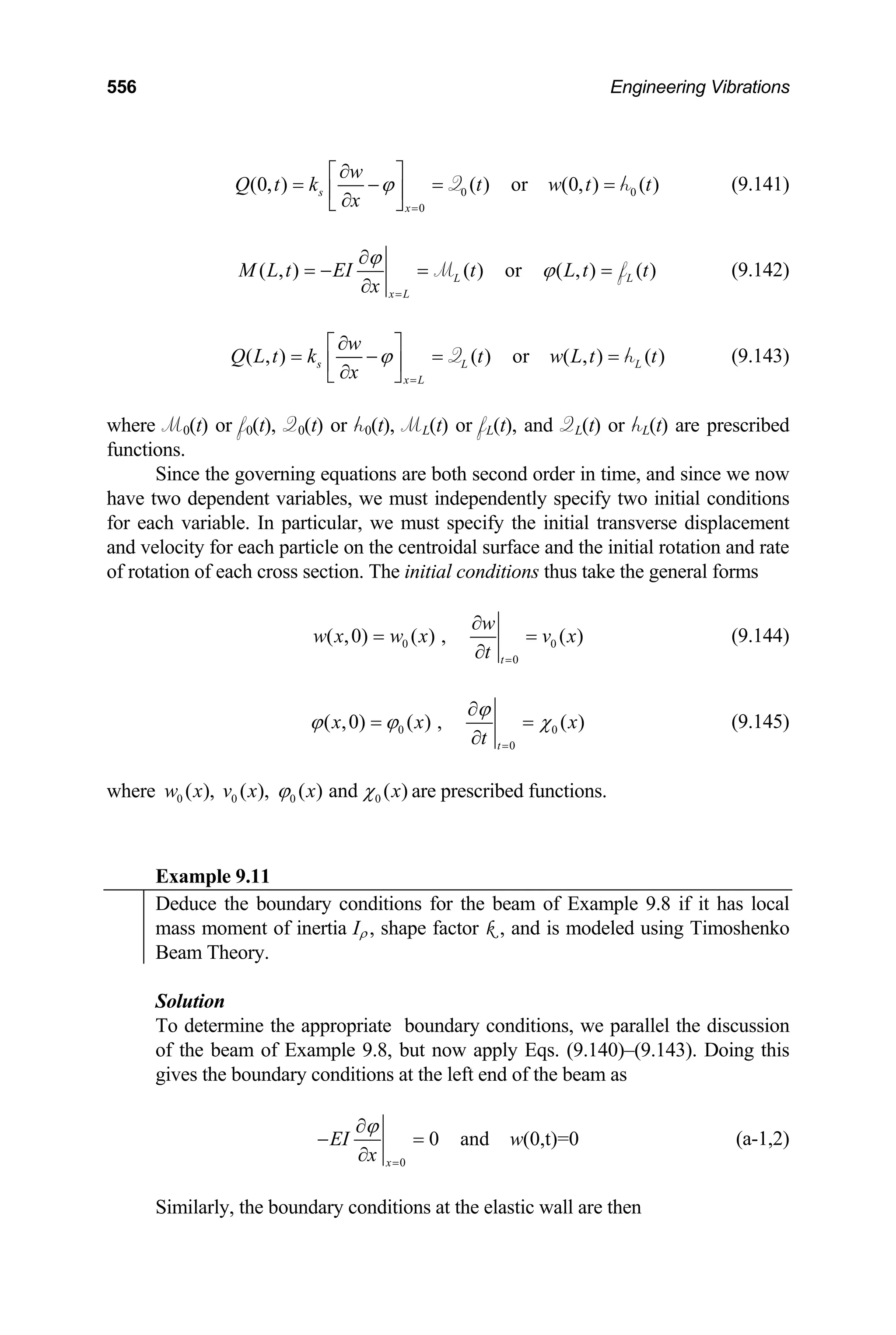
qs. (e)–(f) may be combined in matrix form as
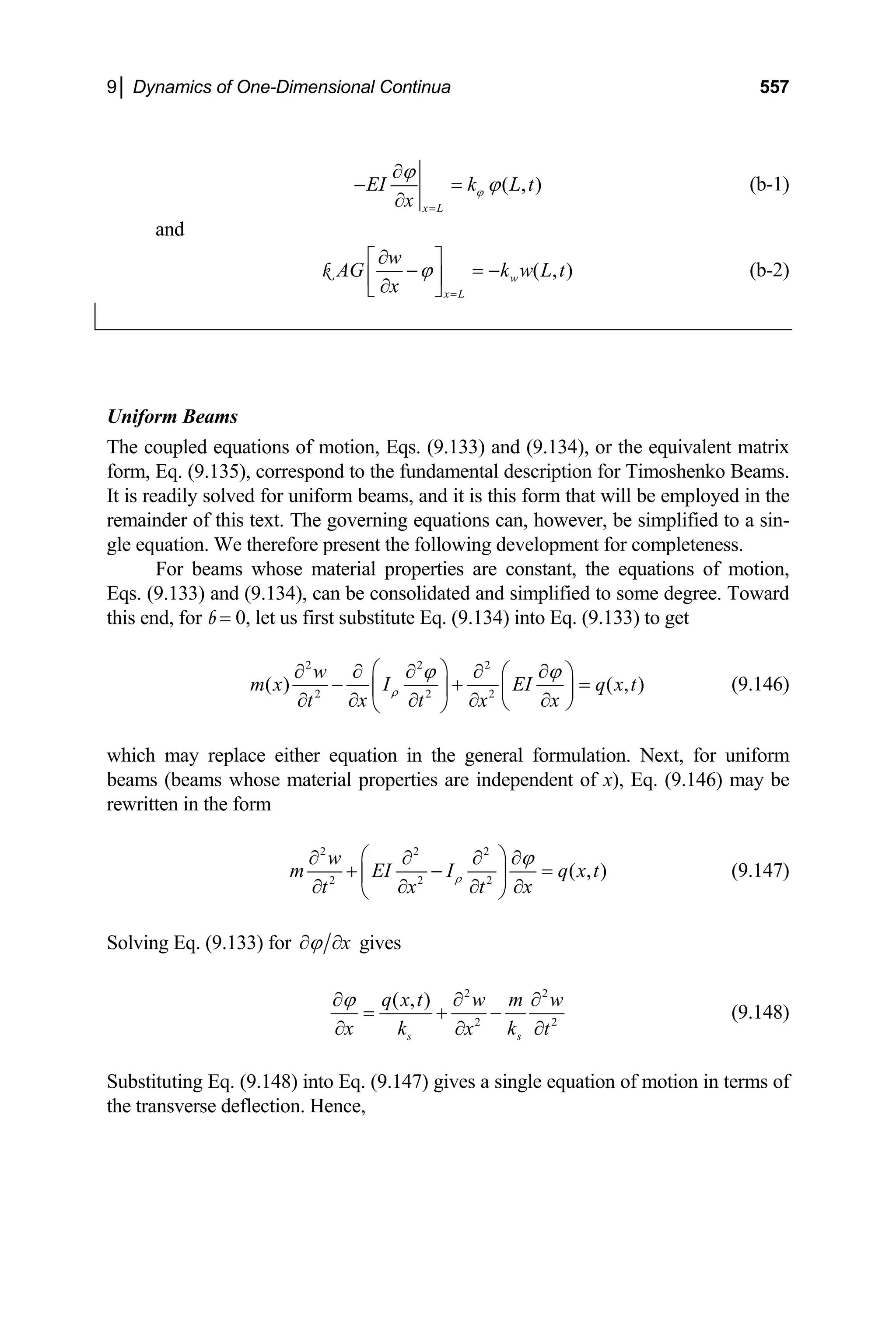
2 2 2 2 3 3 2 2
3 3 3
0 0 0
u F
u F
m u k
E
1 1 1 2 2
0 0 ( ) 0
0 0 ( )
m u k k k
m u k k k k
+ − 1 1
3 3 3
k u F
⎪ ⎪ ⎪ ⎪
⎥
⎦ ⎩ ⎭ ⎩ ⎭
⎡ ⎤ ⎧ ⎫ ⎧ ⎫
⎪ ⎪ ⎪ ⎪
=
⎨ ⎬ ⎨ ⎬
⎢ ⎥ ⎢ ⎥
⎪ ⎪
⎢ ⎥ ⎢ −
⎣ ⎦ ⎩ ⎭ ⎣
(h)
(6.2)–(6.6) for the case where
= 3, k4 = 0 and c = 0.
⎧ ⎫ ⎡ ⎤
⎪ ⎪
⎢ ⎥ ⎢ ⎥
+ − + −
⎨ ⎬
Equation (h) may be compared directly with Eqs.
N 0 0
u ≡ ,
Example 6.4
Use Lagrange’s Equations to derive the equations of motion for the 3-mass 3-
spring 3-damper system of Figure E6.4-1.
312 Engineering Vibrations
Solution
To derive the equations of m st add the virtual work
of the viscous dam rtual work of the applied forces when
evaluating the total vir the nonconservative forces that act on
. We may then proceed as we did for the undamped 3 mass system of
, with the c diagram depicted in Figure E6.4-
ual work done by the nonconservative forces is given by
Figure E6.4-1
otion for this system we mu
ping forces to the vi
tual work done by
the system
Example 6.3. Thus aid of the kineti
2, the virt
[ ] [ ]
[ ]
( )
1 1 2 2 3 3
1 1 1 2 2 1 1 2 2 2 1 3 3 2 2
3 3 3 2 3
( ) ( ) ( )
( )
NC
Q u Q u Q u
F c u c u u u F c u u c u u u
F c u u u
δ δ δ δ
δ δ
δ
= + +
= − + − + − − + −
+ − −
W
(a)
he generalized forces are then given by the coefficients of the
T
p
virtual dis-
lacements in Eq. (a). Hence,
2
1 1 1 2 1 2
( )
Q F c c u c u
= − + + (b)
3
2 2 2 1 2 3 2 3
( )
Q F c u c c u c u
= + − + + (c)
3
3 3 3 2 3
Q F c u c u
= + − (d)
gies for the damped system are the same as for
e undamped system of the previous example. Therefore, incorporating the
damping forces into the generalized forces in the
ample 6.3 modifies the right hand side of the resultin
example to the form
Figure E6.4-2 Kinetic diagram.
The potential and kinetic ener
th
development put forth in Ex-
g matrix equation of that
6│ Dynamics of Multi-Degree of Freedom Systems 313
1 1 1 2 2 1
2 2 2 2 3 3 2
3 3 3 3 3
( ) 0
( )
0
F F c c c u
F F c c c c u
F F c c
+ −
⎧ ⎫ ⎧ ⎫ ⎡ ⎤ ⎧ ⎫
⎪ ⎪ ⎪ ⎪ ⎪ ⎪
⎢ ⎥
→ − − + −
⎨ ⎬ ⎨ ⎬ ⎨ ⎬
⎢ ⎥
⎪ ⎪ ⎪ ⎪ ⎪ ⎪
⎢ ⎥
−
⎩ ⎭ ⎩ ⎭ ⎣ ⎦ ⎩ ⎭
u
(e)
f Example 6.3, then bring-
ing the damping terms to the left-hand side of the resulting matrix equation,
renders the governing equation for the damped three mass sy
1 2 2 1 1
2 2 3 3 2 2
3 3 3 3
0 0 ( ) 0
( )
0
m u c c c u
k k k k u F
k k u F
+ −
⎤ ⎧ ⎫ ⎡ ⎤ ⎧ ⎫
⎪ ⎪ ⎪ ⎪
⎪ ⎪
⎢ ⎥
+ − + − =
⎨ ⎬
⎢ ⎥
⎪ ⎪
⎢ ⎥
−
⎣ ⎦ ⎩ ⎭
Replacing Eq. (e) for the right-hand side of Eq. (h) o
stem to the form
1 1 1 2 2 1
2 2 2 2 3 3 2
3 3 3 3 3
0 0 ( )
0 0 0
( ) 0
m u c c c c u
m u c c u
k k k u F
⎢ ⎥
+ − + −
⎨ ⎬ ⎨ ⎬
⎢ ⎥ ⎢ ⎥
⎪ ⎪ ⎪ ⎪
⎢ ⎥ ⎢ ⎥
−
⎣ ⎦ ⎩ ⎭ ⎣ ⎦ ⎩ ⎭
+ −
⎡ ⎤ ⎧ ⎫
⎡
⎢ ⎥
(f)
⎧ ⎫
⎪ ⎪
⎨ ⎬
⎪ ⎪
⎩ ⎭
Equation (f) may be compared directly with Eqs. (6.2)–(6.6) for e case wh
N = 3, and c4 = k4 = 0.
th ere
0 0
u ≡
Example 6.5
Use Lagrange’s Equations to derive the equations of motion for the double
pendulu Figure 6.4. Use t
m of he angular displacements θ1 and θ2 as the gener-
alized coordinates for this two degree of freedom system.
Solution
For the current system N = 2 and{q1, q2} ↔ {θ1 ,θ2}. Before proceeding to form
the energy functional and evaluate the virtual work of the applied forces it is
convenient to relate the Cartesian and polar coordinates of each of the two
asses of the system. It may seen from the figure that
m
1 1 1 1 1 1
sin , cos
x L y L
θ θ
= = (a-1,2)
and
2 1 1 2 2 2 1 1 2 2
sin sin , cos cos
x L L y L L
θ θ θ θ
= + = + (b-1,2)
These expressions will be helpful in implementing and interpreting what fol-
lows.
We next form the potential energy functional. Since the potential energy
fined in terms of its change (Section 1.5.2) we must first
hall choose the point corresponding to the rest configura
ass, m2, as the common datum for both masses. The potential energy for the
system is then given by
is de choose a datum.
tion of the lower
We s
m
314 Engineering Vibrations
)
1 1 2 2 1 1 2 1 2 1 2 2
( ) (
m gh m gh m g L L y m g L L y
= + = + − + + −
U (c)
Substituting the coordinate transformation described by Eqs. (a) and (b) into
Eq. (c) gives the potential energy in terms of the angular coordinates θ1 and θ2
as
[ ] [ ]
1 1 1 2 2 1 1 2 2 )
(1 cos ) (1 cos ) (1 cos
m g L L m g L L
θ θ θ
= − + + − + −
U (d)
The kinetic energy of the system is easily written as
( ) ( )
2 2 2 2 2 2
1 1 1 1
m v m v m x y m x y
= + = + + +
T (e)
1 1 2 2 1 1 1 2 2 2
2 2 2 2
Substituting Eqs. (a) and (b) into Eq. (e) gives
( ) ( )
( ) (
2 2
2 1 1 1 2 2 2 1 1 1 2 2
2
1
cos cos sin sin
2
m L L L L
θ θ θ θ θ θ θ
⎣ ⎦
⎡ ⎤
+ + + − −
⎢ ⎥
⎣ ⎦
(f)
2 2
1 1 1 1 1 1 1
1
cos sin
m L L
θ θ θ θ
⎡ ⎤
= + −
⎢ ⎥
T
)
2
θ
hich, when expanded, takes the simple form
w
2 2 2 2
1 1
1 2 1 1 2 2 2 2 1 2 1 2 1 2
2 2
( ) cos(
m m L m L m L L )
θ θ θ θ θ
= + + + −
T θ (g)
It is instructive to note that Eq. (f) could be obtained directly by calculating the
lative velocity of m2 with respect to m1 and adding it to the velocity of the
in Figure 6.5 and discussed in
f each mass in terms of its com-
ponents with respect to the path coordinates of the first mass at a given instant
in time, we have
re
first mass using the reference frame depicted
Section 6.1.2. Hence, expressing the velocity o
1 1 1
v L eξ
θ
= (h)
2 1 2/1 1 1 2 2 2 1 2 1
cos( ) sin( )
v v v L e L e e
ξ ξ η
θ θ θ θ θ θ
⎡ ⎤
= + = + − + −
⎣ ⎦ (i)
It follows directly that
2
v v v L
2 2
1 1 1 1 1
θ
= =
i (j)
and
2 2
2 2 2 2 2
2 2 2 1 1 1 2 1 2 2 1 2 2
2 cos( )
v v v L L L L
θ θ θ θ θ θ
= = + − +
i (k)
6│ Dynamics of Multi-Degree of Freedom Systems 315
Substitution of Eqs. (j) and (k) into Eq. (e) then gives the kinetic energy in the
form of Eq. (f).
The last things we must determine before we
are the generalized forces Q1 and Q2. To do this we must evalua
tual work of the applied forces F1 and F2. Since the indicated
the horizontal, the virtual work of these forces is simply
NC
F x F x
tions
can apply Lagrange’s Equa-
te the vir-
forces act along
( )
1 1 2 2
δ δ δ
= + (l)
1
W
However, we must express everything in terms of the chosen generalized coor-
dinates, θ1 and θ2. Now, it follows from Eqs. (a) and (b) that
1 1 1
cos
x L
δ θ δθ
=
nd
(m-1)
a
2 1 1 1 2 2 2
cos cos
x L L
δ θ δθ θ δθ
= + (m-2)
ubstitu -1) and (m-2) into Eq. (l) gives the virtual work of the
S
applied forces
tion of Eqs. (m
in the desired form. Hence,
( )
( )
1 1 2 2 1 2 1 1 1
cos
NC
Q Q F F L 2 2 2 2
cos
F L θ δθ (n)
δ δθ δθ θ δθ
= + = + +
W
1 2
From Eq. (6.58), the generalized forces associated with the chosen coordinates
are the coefficients of the virtual displacements δθ and δθ . These may be read
irectly from Eq. (n) to give
d
( )
1 1 2 1 cos
Q F F L 1
θ
= + (o-1)
2 2 2 2
cos
Q F L θ
= (o-2)
[N
cation of Eq. (
ote that the generalized forces may have also been computed by direct appli-
6.59).] It may be seen that, for t
actually moments. This is, of course, as it should be since the vir
lacements are angular. Equations (d), (g) and (o) m
rectly into Eqs. (6.62) and (6.63). Carrying
ith {q , q θ ,θ }, gives the equations of motion for the double pendu-
his case, the generalized forces
tual dis-
are
p ay now be substituted di-
through the required calculations,
w 1 2} ↔ { 1 2
lum. Hence,
j = 1:
1
1 1
d
Q
dt q q
⎛ ⎞
∂ ∂
− = ⇒
⎜ ⎟
∂ ∂
⎝ ⎠
L L
316 Engineering Vibrations
c
2 2
1 2 1 1 2 1 2 2 2 1 2 1 2 2 2 1
1 2 1 1 1 2 1
( )
1
os( ) sin( )
( ) sin ( ) cos
m m L m L L m L L
m m gL F F L
θ θ θ θ θ θ θ
θ θ
+ + − − −
+ + = +
(p)
= 2:
j
2
2 2
d
Q
dt q q
⎛ ⎞
∂ ∂
− = ⇒
⎜ ⎟
∂ ∂
⎝ ⎠
L L
{ }
2
2 1 2 1 2 1 1
θ 2 1
2 2
2 2 2 2 2 1 2 1
2 2 2 2 2 2
cos( ) sin( )
sin( ) 1 cos( )
sin cos
m L L
m L
m gL F L
θ θ θ θ θ
θ θ θ θ θ θ
θ θ
⎡ ⎤
− + −
⎣ ⎦
⎡ ⎤
+ − − − −
⎣ ⎦
+ =
(q)
hich are identical with Eqs. (6.14) and (6.16), respectively. Linear
θ1 = θ2 = 0 and putting the resulting expressions in matrix form gives the gov-
erning equation for small angle motion,
1 2 1
2 2
( )
w izing about
2
1 2 1 1
1 2 1 2 1 2 1
2
2 1 2 2 2 2
( ) 0
( )
0
m m gL
m m L m L L
m gL
m L L m L 2 2 2
F F L
F L
⎦ ⎭
+
θ
θ
θ
θ
⎧ ⎫
⎡ ⎤ +
⎡ ⎤ ⎧ ⎫
+ ⎪ ⎪
+
⎨ ⎬ ⎨ ⎬
⎢ ⎥ ⎢ ⎥
⎪ ⎪ ⎣
⎣ ⎦ ⎩ ⎭ ⎩
⎧ ⎫
= ⎨ ⎬
⎩ ⎭
(r)
hich is, of course, identical to Eq. (6.18).
w
Example 6.6
A docked utility tram consists of a barrow of mass m2 suspended from an over-
head frame of mass m1 by rods of length L as shown. The frame is latched to a
rigid wall by an elastic coupler of effective stiffness k. A cable exerts a tension
force F on the
1 frame and a controller exerts a torque M about the pivot point.
Environmental forces are represented by the horizontal force F2 acting though
the attachment point of the barrow as indicated. If the stretch of track in the vi-
cinity of the docking station is hori-
zontal and the mass of the connecting
rods and the spin of the barrow, as
well as its moment of inertia about its
own axis, are negligible derive the
equations of motion for the system
using Lagrange’s Equations. Lin-
earize the resulting equations by as-
suming small relative motion of the
suspended car. Figure E6.6-1 Docked utility tram.
6│ Dynamics of Multi-Degree of Freedom Systems 317
Solution
T w dy sesses two
he t o bo system evidently pos
freedom. The horizontal coordinate
on and rotation of the barrow it is convenient to partition the motion of the lat-
degrees of
u and the angular coordinate θ, shown in the
adjacent figure, are the obvious choices for our
generalized coordinates. The former measures
the absolute displacement of the frame with
respect to the fixed track and the latter meas-
ures the relative displacement of the barrow
with respect to the frame.
Figure E6.6-2 Coordinates.
Since we have both pure translation of the frame and combined transla-
ti
ter in terms of its horizontal and vertical components. We shall take our origin
at the equilibrium position of the frame. For consistency we shall set our datum
to coincide with our datum at the level of the frame as well. Thus, let (x1 = u, 0)
locate the frame and let (x2, y2) locate the car. It then follows that
2 2
sin , cos
x u L y L
θ θ
= + = − (a-1,2)
The kinetic energy is then easily computed as
{ }
( )
2 2 2
1 1
1 2 2 2
2 2
m u m x y
⎡ ⎤
= + +
2 2
2
1 1
1 2
2 2
2 2 2
1 1
1 2 2 1
2 2
cos sin
2 cos
m u m u L L
m m u m L x L
θ θ θ θ
θ θ θ
⎣ ⎦
⎡ ⎤ ⎡ ⎤
= + + +
⎣ ⎦ ⎣ ⎦
⎡ ⎤
= + + +
⎣ ⎦
(b)
The potential energy of the system at some generic configuration is
T
2
1
2
cos
ku mgL θ
= −
U (c)
Next, we determine the generalized forces asso
ates. To do this, we evaluate the virtual work done by the applied forces and
ciated with our chosen coordi-
n
moment and express the work in terms of the chosen coordinates u and θ. The
generalized forces then correspond to the respective coefficients of the varia-
tions (virtual increments) of the generalized coordinates. Now, for a small vir-
tual motion of the system it is clear that the virtual work done by the applied
actions is
1 2 2
F u F x M
δ δ δ δθ
= + +
W (d)
318 Engineering Vibrations
e wish to express Eq. (d) in terms of the two independent coordinates u and
W
θ. This is accomplished by first evaluating the variation (“virtual differential”)
of Eq. (a-1), which gives the relation
2 cos
x u L
δ δ θ δθ
= + (e)
ubstituting Eq. (e) into Eq. (d) and regrouping terms gives the virtual work in
S
the desired form
( ) ( )
1 2 2 cos
F F u F L M
δ δ θ
= + + +
W δθ (f)
follows from Eqs. (f) and (6.58) that
2
It
1 1
Q F F
= + (g-1)
and
2 2 cos
Q F L M
θ
= + (g-2)
ith the kinetic and potential energies expressed in terms of the chosen gener-
W
alized coordinates, and the corresponding generalized forces evaluated, we can
now substitute these expressions into Lagrange’s Equations and determine the
sought after equations of motion for the system. Thus, substituting Eqs. (b), (c),
(g-1) and (g-2) into Eqs. (6.62) and (6.63) and carrying through the indicated
operations, with {q1, q2} ↔ {u, θ}, gives the equations of motion for the sys-
tem. Hence,
j = 1:
1
1 1
d
Q
dt q q
⎛ ⎞
∂ ∂
− = ⇒
⎜ ⎟
∂ ∂
⎝ ⎠
L L
2 (h-1)
= 2:
( ) 2
1 2 2 1
cos sin
m m u m L ku F F
θ θ θ θ
⎡ ⎤
+ + − + = +
⎣ ⎦
j
2
2 2
d
Q
dt q q
⎛ ⎞
∂ ∂
− = ⇒
⎜ ⎟
∂ ∂
⎝ ⎠
L L
2
2 cos sin
m L L u u
θ θ θ θ
+ −
( )
2 sin
m uLθ θ
⎡ ⎤
⎢ ⎥
⎣ ⎦
+ 2
sin cos
gL F L
θ θ
⎡ ⎤ M
+ = +
⎣ ⎦
(h-2)
6│ Dynamics of Multi-Degree of Freedom Systems 319
Linearizing Eqs. (h) and expressing the resulting equations in matrix form gives
)
⎫
the equation of motion
1 2 2 1 2
2
2 2 2 2
( ) 0 ( )
0 (
m m m L k F F
u u
m L m L m gL F L M
θ θ
+ +
⎡ ⎤ ⎡ ⎤ ⎧
⎧ ⎫ ⎧ ⎫
+ =
⎨ ⎬ ⎨ ⎬ ⎨
⎢ ⎥ ⎢ ⎥ +
⎩ ⎭ ⎩ ⎭
⎣ ⎦ ⎣ ⎦ ⎩
⎬
⎭
(i)
Example 6.7
Consider the motorcycle frame of Section 6.1.3. Suppose a rider of mass mb sits
rear of the center of mass a distance ℓ and that the padding and support for the
seat is represented as a spring of
stiffness kb attached to the frame at
that point, as shown. In addition, let
the road conditions be such that the
bases undergo the prescribed verti-
cal deflections y01(t) and y02(t), re-
spectively, and let the frame be sub-
jected to dynamic loading repre-
sented by the vertical forces F1(t)
and F2(t) applied at the indicated
ends of the frame and directed
downward and the force Fb(t) ap-
plied to the rider. Use Lagrange’s
Equations to derive the equations of
motion of the system. Linearize the
equations for small rotations and
express them in matrix form.
Figure E6.7-1 Motorcycle and rider. Equivalent system.
olution
hoose the vertical deflection of the center of mass, yG, the rotation of
Figure E6.7-2 Coordinates.
S
We shall c
the frame, θ, and the vertical deflection of the rider, yb, as our generalized coor-
dinates for the present analysis. Thus, (q1, q2, q3)
↔ (yG, θ, yb). (See Figure E6.7-2.) Further, we
shall measure all deflections from their equilib-
rium positions. The deflections of the end points
of the frame and of the point of the frame at
which the seat is attached, y1, y2 and yℓ are ex-
pressed in terms of the chosen coordinates as
follows:
320 Engineering Vibrations
1 1 2 2
sin , sin , sin
G G G
y y L y y L y y
θ θ θ
= − = + = − (a-1, 2, 3)
It follows that
1 1 2 2
cos , cos
G G
y y L y y L
δ δ θ δθ δ δ
= − = + θ δθ
b
(b-1, 2)
The virtual work of the applied forces is then
1 1 2 2
1 2 2 2 1 1
( ) ( )cos
b b
G b
F y F y F y
F F y F L F L F y
δ δ δ δ
δ θ δθ δ
= + +
= + + − +
W
(c)
from which we deduce the generalized forces
1 1 2 2 2 2 1 1 3
, ( )cos , b
Q F F Q F L F L Q F
θ
= + = − = (d-1, 2, 3)
The kinetic and potential energies for the system are, respectively,
2 2
1 1 1
2 2 2
G G b
my I m y
θ
= + +
T 2
b (e)
and
2
1
1 1 01
2
2
1 1
2 2 02
2 2
( sin )
( sin ) ( sin )
G
G b G
k y L y
k y L y k y y
θ
θ θ
= − −
+ + − + − − 2
b
U
(f)
Substituting Eqs. (d), (e), and (f) into Eqs. (6.62) and (6.63) and carrying
through the indicated operations, with (q1, q2, q3) ↔ (yG, θ, yb), gives the equa-
tions of motion for the system. Hence,
j = 1:
1
1 1
d
Q
dt q q
⎛ ⎞
∂ ∂
− = ⇒
⎜ ⎟
∂ ∂
⎝ ⎠
L L
1 2 2 2 1 1
1 2 1 01 2 0
( ) ( )sin
G b G b b b
my k k k y k L k L k k y
2
F F k y k y
θ
+ + + + − − −
= + + +
(g-1)
j = 2:
2
2 2
d
Q
dt q q
⎛ ⎞
∂ ∂
− = ⇒
⎜ ⎟
∂ ∂
⎝ ⎠
L L
6│ Dynamics of Multi-Degree of Freedom Systems 321
( )
2 2 1 1
2 2 2
2 2 1 1
2 2 1 1 1 1 01 2 2 02
( ) cos
( )sin cos
cos cos
G b G
b
b b
I k L k L k y
k L k L k
k y F L F L k L y k L y
θ θ
θ θ
θ θ
+ − −
+ + +
+ = − + −
(g-2)
j = 3:
3
3 3
d
Q
dt q q
⎛ ⎞
∂ ∂
− = ⇒
⎜ ⎟
∂ ∂
⎝ ⎠
L L
sin
b b b G b b b b
m y k y k k y F
θ
− − − = (g-3)
Linearizing equations (g-1)–(g-3) for 1
θ and expressing the resulting equa-
tions in matrix form gives
1 2 2 2 1 1
2 2 2
2 2 1 1 2 2 1 1
0 0
0 0
0 0
( ) ( )
( ) ( )
G
G
b b
b b b G
b
b b b
b b b
m y
I
m y
k k k k L k L k k y
k L k L k k L k L k k
k k k y
θ
θ
⎡ ⎤ ⎧ ⎫
⎪ ⎪
⎢ ⎥
⎨ ⎬
⎢ ⎥
⎪ ⎪
⎢ ⎥
⎣ ⎦ ⎩ ⎭
+ + − − −
⎡ ⎤ ⎧ ⎫
⎪ ⎪
⎢ ⎥
+ − − + + + ⎨ ⎬
⎢ ⎥
⎪ ⎪
⎢ ⎥
− +
⎣ ⎦ ⎩ ⎭
( )
1 2 1 01 2 02
2 2 1 1 1 1 01 2 2 02
( )
b
F F k y k y
F L F L k L y k L y
F
+ + +
⎧ ⎫
⎪ ⎪
= − + −
⎨ ⎬
⎪ ⎪
⎩ ⎭
(h)
It may be seen that if we let mb, kb and Fb 0 in Eqs. (g) and (h) we obtain
the equations for the frame derived in Section 6.1.3 using Newton’s Law’s of
Motion directly. If we let the excitations vanish identically, as well, Eq. (h) be-
comes identical with Eq. (6.25).
→
6.2.4 The Rayleigh Dissipation Function
In Example 6.4 we derived the equations of motion for a viscously damped system
using Lagrange’s Equations and included the effects of damping by calculating the
virtual work of the damping forces to obtain the corresponding generalized forces.
For systems with linear viscous damping it is possible to formulate a dissipation func-
tion which may be included on the left hand side of Lagrange’s Equations in the spirit
of the kinetic and potential energies to augment that formulation. This would replace
the calculation of the virtual work and inclusion of the associated generalized forces
322 Engineering Vibrations
due to damping. To develop this formulation we separate the forces due to damping
from the remaining forces in Eq. (6.45) and thereafter. Equation (6.45) then takes the
form
( )
( )
1
0
M
d
l l l l l
l
F F m r r
δ
=
⎡ ⎤
+ −
⎣
∑ =
⎦
i (6.64)
where
( )
ˆ
d
l l l
F c r
= − (6.65)
and is a linear combination of the coefficients of the dampers attached to mass l. In
contrast to its interpretation in Eq. (6.45), l
ˆl
c
F now represents all active forces that
impinge on mass l except those due to damping. With this distinction, let us now pro-
ceed as in Section 6.2.2. All computations are the same, but now we shall evaluate
the contributions of the damping forces separately. Toward this end, we determine the
product
( ) 1
2
1 1 1
ˆ
M M M
d l l
l l l
j j j
l l l
r r
ˆl l l
F c r c r r
q q q
= = =
∂ ∂ ∂
= − = −
∂ ∂ ∂
∑ ∑ ∑
i i i (6.66)
Thus,
( )
1
M
d l
l
j j
l
r
F
q q
=
∂ ∂
= −
∂ ∂
∑ i R (6.67)
where
1
1 2 2
1
ˆ
( , ,..., )
M
N l
l
q q q c r r
=
= = ∑ l l
i
R R (6.68)
is called the Rayleigh Dissipation Function. Paralleling the development of Section
6.2.2, and incorporating Eq. (6.67), results in the alternate statement of Lagrange’s
Equations given by
( 1,2,..., )
j
j j j
d
Q j N
dt q q q
⎛ ⎞
∂ ∂ ∂
− + = =
⎜ ⎟
⎜ ⎟
∂ ∂ ∂
⎝ ⎠
R
L L
(6.69)
The equations of motion for a discrete system with viscous damping may be derived
by formulating the Rayleigh dissipation function for that system, in addition to the
potential and kinetic energies of the system and the virtual work of the applied forces,
and substituting each into Eq. (6.69) and performing the indicated operations. Such a
formulation may be advantageous when using certain numerical techniques for large
scale systems. In this case we would construct the function from the damping forces.
In the present context, the above approach provides an alternative to the basic formu-
lation of Section 6.2.2 where the equations of motion for discrete systems are derived
by computing the virtual work of the damping forces, identifying the corresponding
generalized forces, formulating the kinetic and potential energies and utilizing the
6│ Dynamics of Multi-Degree of Freedom Systems 323
fundamental form of Lagrange’s Equations given by Eq. (6.62), as was done in a very
straightforward manner in Example 6.4.
Example 6.8
Formulate the Rayleigh dissipation function for the system of Example 6.4 and
use it to derive the equations of motion for that system.
Solution
For this problem the generalized coordinates are simply the displacements of
the masses from their equilibrium positions. Thus, (q1, q2, q3) ↔ (x1, x2, x3). We
seek a function whose derivatives with respect to the velocities of the masses
will yield the corresponding damping forces. Toward this end let us consider
the function
( ) ( )
2 2
2 2
1 1 1 1
1 1 2 2 1 3 3 2 4 3
2 2 2 2
c x c x x c x x c x
= + − + − +
R (a)
Evaluating the derivatives of R with respect to each velocity gives the follow-
ing:
1 2 1 2
1
( )
c c x c x
x
∂
= + −
∂
R
2 (b-1)
2 1 2 3 3 2 3
2
( )
c x c c x c x
x
∂
= − + + −
∂
R
(b-2)
3 2 3 4 3
3
( )
c x c c x
x
∂
= − + +
∂
R
(b-3)
The kinetic and potential energies are given by Eqs. (c) and (d) of Example 6.3.
The virtual work done for the present case is simply
1 1 2 2 3 3
F x F x F x
δ δ δ δ
= + +
W (c)
The generalized forces may be read directly from Eq. (c) and are seen to be
simply the applied forces themselves. Substituting all of the above into Eq.
(6.69) and carrying through the calculations gives the equations of motion
stated in Eq. (f) of Example 6.4.
324 Engineering Vibrations
6.3 SYMMETRY OF THE SYSTEM MATRICES
The physical properties of linear mechanical systems were seen to be described by
the mass, stiffness and damping matrices appearing in the general equation of motion
+ + =
mu cu ku F (6.70)
For each of the representative systems considered in Sections 6.1 and 6.2 these matri-
ces were seen to be symmetric. In this section we show that the system matrices of all
linear mechanical systems are symmetric when the corresponding motions are ex-
pressed in terms of a set of linearly independent coordinates.
6.3.1 The Stiffness Matrix
For the moment, let us restrict our attention to linear elastic systems subjected to
quasi-static loading. Under these circumstances Eq. (6.70) reduces to the algebraic
form
=
ku F (6.71)
Pre-multiplying Eq. (6.71) by k-1
gives the relation
=
u aF (6.72)
where
1
−
=
a k (6.73)
is the compliance matrix, also known as the flexibility matrix. The symmetry of the
stiffness matrix will be established by considering the work done by the applied
loads.
A
1
2 B
Q(A)
Q
0
q(A) q(B)
0
Figure 6.9 Load-deflection paths.
6│ Dynamics of Multi-Degree of Freedom Systems 325
The constitutive (stress-strain) relations, and hence the load-deflection rela-
tions, for a linear elastic solid are, by definition, linear. Likewise, the load-deflection
relations for a system comprised of linear elastic springs, Eq. (6.72), are linear as
well. If we consider a single generalized force Q applied to a linear system, and the
associated generalized displacement q of the system at the load point, the correspond-
ing load-deflection path will plot as a straight line as shown in Figure 6.9. If the sys-
tem is initially in the undeformed state when the force Q is applied, and Q is in-
creased slowly from 0 to Q(A)
the load-point deflection increases accordingly to the
value q(A)
. The work done as the state of the system progresses along path OA is, by
Eq. (1.85),
( )
( ) ( ) ( )
1
2
0
A
q
A
OA
A A
F dr Qdq Q q
= = =
∫ ∫
i
W (6.74)
That is, the work done by the force Q in bringing the system to state A corresponds to
the area under the curve OA (the area of triangle OAq(A)
). Suppose now that the sys-
tem is deformed further, say by some other force, so that the deflection under the first
force increases to say q(B)
while Q is maintained at the value Q(A)
throughout the sub-
sequent deformation process. During this process the system progresses along path
AB in the Qq-plane (Figure 6.9). The additional work done by the constant force Q
during this process is then
( )
( )
( ) ( ) ( )
B
A
q
AB A BA
AB q
F dr Qdq Q q
= = =
∫ ∫
i
W (6.75)
where
( ) ( ) ( )
BA B
q q q
= − A
(6.76)
(The integral is seen to correspond to area q(A)
AB q(B)
.) The total work done by the
force applied at the point in question in bringing the system to state B is thus
( ) ( ) ( ) ( ) ( ) ( ) ( )
1
2
OB OA AB A A A BA
Q q Q q
= + = +
W W W (6.77)
With the work of a given load during the segmented process established, let us next
consider an arbitrary elastic system subjected to generalized forces at any two points l
and j (j,l = 1, 2, …). Let Ql and Qj represent these forces and let ql and qj represent the
corresponding generalized displacements (generalized coordinates). Suppose that the
force Qj is first applied, increasing from zero and deforming the system from the ref-
erence (undeformed) state so that the point of application deflects to the value ( )
j
j
q
and point l deflects by the amount ( )
.
j
l
q (See, for example, the frame in Figure 6.10a-
1.) Next let a load be applied at point l. Let it increase slowly from zero deforming
the system further so that the additional deflections at points j and l due to the load at
point l are, respectively, ( )
l
j
q and (See, for example, the frame in Figure 6.10a-2.)
( )
.
l
l
q
326 Engineering Vibrations
Figure 6.10 Physical example of load-deflection scenario.
With the aid of Eq. (6.77), the total work done by both forces in bringing the system
to its current state is calculated as
( , ) ( ) ( ) ( )
1 1
2 2
j l j l l
j j j j l l
Q q Q q Q q
= + +
W (6.78)
Now, from Eq. (6.72),
( ) ( ) ( ) ( )
, , ,
j j l l
j jj j l lj j j jl l l ll l
q a Q q a Q q a Q q a Q
= = = = (6.79)
Substituting Eqs. (6.79) into Eq. (6.78) gives the work to the present state as
( , ) 2 2
1
2
j l 1
2
jj j jl j l ll l
a Q a Q Q a Q
= + +
W (6.80)
Let us next reverse the order of application of the forces and compute the work done
in bringing the system to its present state. Paralleling the development for the previ-
ous case, but with the order reversed as demonstrated for the example frame in Fig-
ures 6.10b-1 and 6.10b-2, the work done in bringing the system to the current state is
( , ) ( ) ( ) ( )
1
2
l j l j j
l l l l j j
Q q Q q Q q
= + +
W 1
2
(6.81)
6│ Dynamics of Multi-Degree of Freedom Systems 327
This is also found by simply interchanging the indices in Eq. (6.78). Substituting Eqs.
(6.79) into Eq. (6.81) gives the work for this load order as
( , ) 2 2
1
2
l j
ll l lj l j jj j
a Q a Q Q a Q
= + +
W 1
2
(6.82)
By definition of an elastic system all work is recoverable and the work done in bring-
ing the system to its current configuration is independent of the loading path. That is,
it is independent of the order in which the loads are applied. Thus,
(6.83)
( , ) ( , )
l j j l
=
W W
Substituting Eqs. (6.80) and (6.82) into Eq. (6.83) gives the identity
lj jl
a a
= (6.84)
Equation (6.84) is valid for any pair of points (j,l = 1, 2, …) in the system and implies
that the deflection at one point of an elastic system due the force at a second point of
the system is equal to the deflection at the second point due to a force of equal magni-
tude applied at the first point. This is known as Maxwell’s Reciprocal Theorem and is
applicable to continuous as well as discrete systems. Since we are presently interested
in discrete systems, we shall take j,l = 1, 2, …, N. Hence, when written in matrix
form, Eq. (6.84) implies that
=
a a
T
(6.85)
It then follows from Eq. (6.73) that
(6.86)
=
k k
T
The stiffness matrix is thus symmetric, which is what we set out to show.
6.3.2 The Mass Matrix
The inherent symmetry of the mass matrix, when written in terms of a set of linearly
independent coordinates, may be shown by consideration of the kinetic energy of the
system. Let the position vector of a generic mass of the system be described in terms
of some set of generalized coordinates as described by Eq. (6.38). Substituting Eq.
(6.47) into Eq. (6.51) gives the kinetic energy of the system as
1 1 1 1
1 1
2 2
M M N N
n n
n n n n j l
j l
n n j l
r r
m r r m q q
q q
= = = =
⎧ ⎫
∂ ∂
⎪ ⎪
= = ⎨ ⎬
∂ ∂
⎪ ⎪
⎩ ⎭
∑ ∑ ∑ ∑
i i
T (6.87)
Changing the order of summation renders the kinetic energy to the form
328 Engineering Vibrations
1 1 1
1
2
N N M
n n
n j
j l
j l n
r r
m q
q q
= = =
⎧ ⎫
∂ ∂
⎪ ⎪
= ⎨ ⎬
∂ ∂
⎪ ⎪
⎩ ⎭
∑∑ ∑ l
q
i
T
Hence, the kinetic energy of an N-degree of freedom system is
1 1
2 2
1 1
N N
jl j l
j l
m q q
= =
= =
∑∑
T q mq
T
(6.88)
where
1
M
n n
jl n
j l
n
r r
m m
q q
=
∂ ∂
=
∂ ∂
∑ i (6.89)
11 1
1
N
N N
m m
m m N
⎡ ⎤
⎢ ⎥
= ⎢ ⎥
⎢ ⎥
⎣ ⎦
m (6.90)
and
1
N
q
q
⎧ ⎫
⎪ ⎪
= ⎨ ⎬
⎪ ⎪
⎩ ⎭
q (6.91)
It is evident from Eq. (6.89) that
( , 1,2,..., )
jl lj
m m l j N
= = (6.92)
Thus,
=
m m
T
(6.93)
for any linear system whose motion is described by a set of generalized coordinates.
6.3.3 The Damping Matrix
To show the symmetry of the damping matrix for linear systems whose motions are
expressed in terms of a set of generalized coordinates we shall proceed in an analo-
gous manner as for the mass matrix, but with the Rayleigh dissipation function re-
placing the kinetic energy. Thus,
6│ Dynamics of Multi-Degree of Freedom Systems 329
1 1 1 1
1 1 1
1 1
ˆ ˆ
2 2
1
ˆ
2
M M N N
n n
n n n n j l
j l
n n j l
N N M
n n
n j
j l
j l n
r r
c r r c q q
q q
r r
c q
q q
= = = =
= = =
l
q
⎧ ⎫
∂ ∂
⎪ ⎪
= = ⎨ ⎬
∂ ∂
⎪ ⎪
⎩
⎧ ⎫
∂ ∂
⎪ ⎪
= ⎨ ⎬
∂ ∂
⎪ ⎪
⎩ ⎭
∑ ∑ ∑ ∑
∑∑ ∑
⎭
i i
i
R
(6.94)
Hence,
1 1
2 2
1 1
N N
jl j l
j l
c q q
= =
= =
∑∑
R q cq
T
(6.95)
where
1
ˆ
M
n n
jl n
j l
n
r r
c c
q q
=
∂ ∂
=
∂ ∂
∑ i (6.96)
and
11 1
1
N
N N
c c
c c N
⎡ ⎤
⎢ ⎥
= ⎢ ⎥
⎢ ⎥
⎣ ⎦
c (6.97)
It is evident, from Eq. (6.96), that
(6.98)
( , 1,2,..., )
jl lj
c c l j N
= =
and hence that
=
c c
T
(6.99)
The symmetry of the system matrices will be of great importance in our studies of
both free and forced vibrations of multi-degree of freedom systems.
6.4 CONCLUDING REMARKS
In this chapter we considered the mathematical description of multi-degree of free-
dom systems. We first used the Newtonian approach to derive the equations of mo-
tion for certain representative systems. We then introduced the notions of generalized
coordinates and virtual work and, with these, derived Lagrange’s Equations — a gen-
eral statement of the equations of motion expressed in terms of the potential and ki-
netic energies of the system and the virtual work of forces for which a potential func-
tion is not or cannot be written. Thus, once the generalized forces are identified for a
given problem through the virtual work of the actual forces and moments, Lagrange’s
Equations basically provide a recipe for the derivation of the equations of motion for
the specific system of interest. Derivations for selected systems were performed by
330 Engineering Vibrations
direct application of Newton’s Laws of Motion and by Lagrange’s Equations and
compared. It was seen that the derivation of the equations of motion for complex sys-
tems is simplified a great deal when implemented using Lagrange’s Equations. Once
the technique is mastered, Lagrange’s Equations provide a convenient and relatively
simple scalar procedure for deriving the equations of motion for complex mechanical
systems. The chapter concluded with a proof of Maxwell’s Reciprocal Theorem
which, for discrete systems, implies that the stiffness matrix is symmetric for all lin-
ear systems. Finally, it was shown that the mass and damping matrices for all linear
mechanical systems whose motions are expressed in terms of a set of linearly inde-
pendent coordinates are symmetric as well.
BIBLIOGRAPHY
Baruh, H., Analytical Dynamics, McGraw-Hill, Boston, 1999.
Ginsberg, J.H., Advanced Engineering Dynamics, Cambridge, New York, 1998.
Greenwood, D.T., Principles of Dynamics, 2nd
ed., Prentice-Hall, Englewood Cliffs, 1988.
Meirovitch, L., Elements of Vibration Analysis, 2nd
ed., McGraw-Hill, New York, 1986.
Rayleigh, J.W.S., The Theory of Sound, Vol.1, Dover, New York, 1945.
Shabana, A.A., Vibration of Discrete and Continuous Systems, Springer, New York, 1997.
Whittaker, E.T., A Treatise on the Analytical Dynamics of Particles and Rigid Bodies, Cam-
bridge, New York, 1970.
PROBLEMS
6.1 Use Lagrange’s Equations to derive the equation of motion for a simple mass-
spring-damper system.
6.2 Use Lagrange’s Equations to derive the equation of motion of the simple pen-
dulum.
6.3 Use Lagrange’s Equations to derive the equation of motion for the timing de-
vice of Problem 2.19.
6.4 Use Lagrange’s Equations to derive the equation of motion for the constrained
rod shown in Figure P6.4.
6│ Dynamics of Multi-Degree of Freedom Systems 331
Fig. P6.4 Fig. P6.5
6.5 The pendulum with elastic constraint shown in Fig. P6.5 is subjected to a hori-
zontally directed force applied to the mid-span of the rod as indicated. Use La-
grange’s Equations to derive the equation of motion for the system. The spring
is unstretched when θ = 0. The masses of the rod, roller and spring are negligi-
ble.
6.6 Derive the equations of motion
for the crankshaft system shown
in Figure P6.6 using Lagrange’s
Equations. The spring is unde-
formed when the connecting pin
A is directly above or below the
hub of the wheel. Fig. P6.6
6.7 Use Lagrange’s Equations to derive
the equations of motion for the con-
strained hook and ladder shown.
The spring is untorqued when θ = 0
and the tip of the ladder is subjected
to a downward vertical force F2 as
indicated. Fig. P6.7
6.8 A tram consists of a rigid frame of mass mf from which a passenger compart-
ment of mass mc and radius of gyration rG is pinned to the frame at the car’s
center of mass as shown in Figure P6.8. The wheels of the tram frame are of
radius R and negligible mass mw and roll without slip during motion. A motor
applies a torque M to one of the wheels, thus driving the system, and the pas-
senger compartment is subjected to a wind force whose resultant acts through a
point that lies a distance a below the pin, as indicated. If an elastic guide cable
of effective stiffness k is attached to the frame as shown, derive the equations of
motion for the system using Lagrange’s Equations. 2
0
( )
c G
I m r
=
332 Engineering Vibrations
Fig. P6.8
6.9 Use Lagrange’s Equations to derive the equations of motion for the coupled
pendulum shown in Figure P6.9.
Fig. P6.9
6.10 A conveyor belt system consists of two flywheels of mass m1 and radius R1,
and mass m2 and radius R2, respectively. The wheels are connected by an elas-
tic belt as shown in Figure P6.10. If no slip occurs between the wheels and belt,
the effective stiffness of each leg is k, as indicated. Finally, a motor applies a
torque M1 to the left wheel and a torque M2 to the right wheel as shown. (a) Use
Lagrange’s Equations to derive the equations of motion for the system. (b)
Check your answer using Newton’s Laws of Motion.
Fig. P6.10
6│ Dynamics of Multi-Degree of Freedom Systems 333
6.11 A square raft of mass m and side L sits in water of specific gravity γw. A uni-
form vertical line force of intensity P acts downward at a distance a left of cen-
ter of the span. (a) Use Lagrange’s Equations to derive the 2-D equations of
motion of the raft. (b) Check your answers using Newton’s Laws of Motion.
6.12 Two identical bodies of mass m are connected by
a spring of stiffness k and constrained to move in
rectilinear motion as shown. Derive the equations
of motion for the system.
Fig. P6.12
6.13 Use Lagrange’s Equations to derive the governing equations for two dimen-
sional motion of the elastic dumbbell satellite shown in Figure P6.13.
Fig. P6.13 Fig. P6.14
6.14 Use Lagrange’s Equations to derive the equations of motion for the inverted
elastic pendulum shown in Figure P6.14 if the massless rod is of length L.
6.15 Use Lagrange’s Equations to derive the Equations of motion for the pulley sys-
tem shown in Figure P6.15. The wheel has radius R and I = mR2
.
Fig. P6.15 Fig. P6.16
334 Engineering Vibrations
6.16 A motor supplies a torque M through a drive shaft whose moment of inertia is
I1. The shaft of radius R is connected to the pulley system shown in Figure
P6.16. If the cable is elastic with effective stiffness k, as indicated, the moment
of inertia of the pulley is I2 and the cable supports a suspended mass m as indi-
cated, derive the equations of motion of the system using Lagrange’s Equa-
tions.
6.17 Use Lagrange’s Equations to derive the equations of motion for the pulley sys-
tem shown in Figure P6.17.
6.18 shown is restrained by an elastic rod of effective
mo
cated. The mass of each whee
equations of mo
6.19 A rigid rod of length L
base of mass mb through
shown. The ba
indicated. Derive the equati
ing Lagrange’s Equations.
6.20 center of an offshore platform as shown.
The total mass of the crane and platform is m and the mass of
tical floats of ra-
is LB, derive the
Fig. P6.17 Fig. P6.18
The elastic fan-belt system
stiffness k1 while a tor supplies a torque M to the right flywheel, as indi-
l is m. Use Lagrange’s Equations to derive the
tion for the system.
, and mass ma is connected to a rigid
a torsional spring of stiffness kT as
se sits on an elastic support of stiffness k as
ons of motion of the system us-
Fig. P6.19
A crane is attached to the geometric
the boom is neg-
ligible. The square platform has side L and sits atop four iden
dius R. If the length of the horizontal projection of the boom
equations that govern planar motion of the structure.
6│ Dynamics of Multi-Degree of Freedom Systems 335
6.21
nal inte-
rior co
as indicated.
6.22
Fig. P6.20
A certain submarine is modeled as shown, for simple calculations of longitudi-
motion. The mass of the hull and frame structure is 2ms and that of the
mpartment is mc. The hull and interior compartment are separated by
springs of stiffness k, and the longitudinal stiffness of the hull is ks
Derive the equations that govern longitudinal motion of the boat.
Fig. P6.21
Use Lagrange’s Equations to derive the equations of motion for the linked sys-
tem shown in Figure P6.22. The mass of the rigid connecting rod is negligible
compared with the other masses of the system.
Fig. P6.22 Fig. P6.23
336 Engineering Vibrations
6.23 mass extends radially from the periphery of a solid
R, as shown. The hub of the wheel is attached to
mass and equivalent torsional stiffness kT. A sleeve
of m nected to the wheel by an elastic
and unstretched length L, and a transverse force F(t) is ap-
plied L + R. The spoke is sufficiently lubricated
Lagrange’s Equations to derive the equa-
tions of stem.
6.24 egligible mass connects two identical cylindrical
floats, R and mass ma. The system floats in a fluid of
center of the span
6.25
and shear modulus
G. The ends of the rod are embedded in rigid supports as shown. The spans be-
tween the disks and between the disks and the supports are each of length L.
are subjected
to
Fig. P6.25
A rigid spoke of negligible
wheel of mass mw and radius
an elastic axle of negligible
ass m is fitted around the spoke and con
spring of stiffness k
to the end of the rod of length
so that friction is not a concern. Use
motion for the wheel sy
A rigid rod of length L and n
each possessing radius
mass density ρf. A block of mass mb is suspended from the
by an elastic spring of stiffness k as shown, and a downward vertical force of
magnitude F is applied to the suspended mass, as indicated. Derive the equa-
tions of motion of the system using Lagrange’s Equations.
Fig. P6.24
Three identical rigid disks, each of mass m and radius R, are attached at their
centers to an elastic shaft of area polar moment of inertia J
Derive the equations of angular motion for the system if the disks
the twisting moments M1, M2 and M3, respectively.
6.26 Use Lagrange’s Equations to derive the equations of motion for the triple pen-
dulum whose bobs are subjected to horizontal forces F1, F2 and F3, respec-
tively.
6│ Dynamics of Multi-Degree of Freedom Systems 337
Fig. P6.26 Fig. P6.27
The assembly of Problem 6.23 is mounted on a movable base of mass m
6.27
agrange’s Equations to derive the equations of motion for the
augmented system.
6.28
k and undeformed length L. The system rolls without slip
motion of
the wheel s
6.29 tion for the coupled
b as
shown. Use L
Fig. P6.28
Two wheels, each of mass m and radius rw, are connected by an elastic coupler
of effective stiffness
around a circular track of radius R, as shown. Derive the equations of
ystem.
Use Lagrange’s Equations to derive the equations of mo
trio of pendulums shown.
Fig. P6.29
338 Engineering Vibrations
6.30 f a rigid frame of mass ma and length L that is supported at
each end by elastic springs of stiffness k. Two identical blocks of mass mb are
rive the equations of motion for the system.
6.31 C d as it undergoes
tight per odeled as
lage
wall. about its respective
of inertia Io
equati r the aircraft.
6.32
Fig. P6.
.33 Derive the equations of motion for the elastically coupled wheel system of
Problem 6.28 if a damper of coefficient c is attached as shown in Figure P6.33.
A system consists o
mounted at either end of the frame atop mounts of stiffness k as shown. Use
Lagrange’s Equations to de
Fig. P6.30
Fig. P6.31
onsider an aircraft traveling at constant altitude and spee
iodic rolling motion of the fuselage. Let the wings be m
equivalent rigid bodies with torsional springs of stiffness kT at the fuse
In addition, let each wing possess moment of inertia Ic
connection point and let the fuselage of radius R have moment
about its axis. Derive the ons of rolling motion fo
Derive the equation of motion for the system of Prob-
lem 6.19 if the support possesses damping of coeffi-
cient c.
32
6
6│ Dynamics of Multi-Degree of Freedom Systems 339
Fig. P6.34
6.34 Derive the equations of m ss-spring-damper system
shown in Figur
6.35 Derive the or belt system of Problem 6.10 if
the elastic belt is replaced by a viscoelastic belt of the same stiffness and damp-
.
Fig. P6.33
otion for the compound ma
e P6.34.
equations of motion for the convey
ing coefficient c as shown
Fig. P6.35
340 Engineering Vibrations
6.36 Derive the equations of motion
for the system of Problem 6.15
.37 Derive the equations of motion for longitudinal motion of the submarine of
Problem 6.2 d to the hull and
damping of coefficient c is introduced to the compartment mounts, as shown.
if a damper of coefficient 2c is
inserted into the left support as
shown, and the elastic cable is
replaced by a viscoelastic cable
of the same stiffness and damp-
ing coefficient c as indicated.
Fig. P6.36
6
1 if damping of effective coefficient cs is introduce
Fig. P6.37
7
Free Vibration of Multi-Degree of
Freedom Systems
In this chapter we consider the behavior of discrete multi-degree of freedom systems
that are free from externally applied dynamic forces. That is, we examine the re-
sponse of such systems when each mass of the system is displaced and released in a
manner that is consistent with the constraints imposed on it. We are thus interested in
the behavior of the system when is left to move under its own volition. As for the
case of single degree of freedom systems, it will be seen that the free vibration re-
sponse yields fundamental information and parameters that define the inherent dy-
namical properties of the system.
7.1 THE GENERAL FREE VIBRATION PROBLEM AND ITS SOLUTION
It was seen in Chapter 6 that the equations that govern discrete multi-degree of free-
dom systems take the general matrix form of Eq. 6.2. We shall here consider the fun-
damental class of problems corresponding to undamped systems that are free from
applied (external) forces. For this situation, Eq. 6.2 reduces to the form
+ =
mu ku 0 (7.1)
where, for an N degree of freedom system, m and k are the N N
× mass and stiffness
matrices of the system, respectively, and u is the corresponding 1
N × displacement
matrix. To solve Eq. (7.1), we parallel the approach taken for solving the correspond-
341
342 Engineering Vibrations
ing scalar problem for single degree of freedom systems. We thus assume a solution
of the form
i t
e ω
=
u U (7.2)
where U is a column matrix with N, as yet, unknown constants, and ω is an, as yet,
unknown constant as well. The column matrix U may be considered to be the spatial
distribution of the response while the exponential function is the time dependence.
Based on our experience with single degree of freedom systems, we anticipate that
the time dependence may be harmonic. We therefore assume solutions of the form of
Eq. (7.2). If we find harmonic forms that satisfy the governing equations then such
forms are, by definition, solutions to those equations.
Substitution of Eq. (7.2) into Eq. (7.1), and factoring common terms, results in
the form
2 i t
e ω
ω
⎡ ⎤
− =
⎣ ⎦
k m U 0
Assuming that 0
ω ≥ , we can divide through by the exponential term. This results in
the equation
2
ω
⎡ ⎤
− =
⎣ ⎦
k m U 0 (7.3)
which may also be stated in the equivalent forms,
(7.3')
2
ω
=
kU mU
and
λ
=
kU U (7.3)
where
1 2
and =
λ ω
−
=
k m k
Thus, solving Eq. (7.1) for u(t) is reduced to finding pairs that satisfy Eq.
(7.3), or equivalently Eq. (7.3'). A problem of this type may be recognized as an ei-
genvalue problem, with the scalar parameter
2
( , )
ω U
2
ω identified as the eigenvalue and the
column matrix U as the corresponding eigenvector. An N degree of freedom system
will generally possess N eigenvalues and N eigenvectors. The solutions of the eigen-
value problem, when substituted into Eq. (7.2), will give the solution to Eq. (7.1) and
hence the free vibration response of the system of interest.
Natural Frequencies
One obvious solution of Eq. (7.3) is the trivial solution U = 0. This corresponds to the
equilibrium configuration of the system. Though this is clearly a solution correspond-
ing to a physically realizable configuration, it is evidently uninteresting as far as vi-
brations are concerned. We are thus interested in physical configurations associated
with nontrivial solutions. From linear algebra we know that a matrix equation Ax = b
may be row reduced. If the rows or columns of the matrix A are linearly independent
7│ Free Vibration of Multi-Degree of Freedom Systems 343
(that is, no row can be expressed as a linear combination of the other rows) then the
corresponding matrix equation can be reduced to diagonal form, and the solution for
x can be read directly. In matrix form,
1 1 1 1 1
: =
0
0 N N N N N
n
a x b x b 1
a
x b x b
a
⎛ ⎞
a
⎧ ⎫ ⎧
⎧ ⎫ ⎧ ⎫
⎜ ⎟
⎫
⎪ ⎪ ⎪
⎪ ⎪ ⎪ ⎪
= → = = ⇒
⎜ ⎟
⎪
⎨ ⎬ ⎨ ⎬ ⎨ ⎬ ⎨ ⎬
⎜ ⎟⎪ ⎪ ⎪ ⎪ ⎪ ⎪ ⎪ ⎪
⎜ ⎟⎩ ⎭ ⎩ ⎭
⎩ ⎭ ⎩ ⎭
⎝ ⎠
Ax b Ax b
It is evident that det 0.
≠
A A matrix A whose rows are linearly independent is said
to be nonsingular. Similarly, if Eq. (7.3) is row reduced to diagonal form then the
matrix ⎦ is nonsingular and the solution, U, can be read directly. However,
since the right-hand side of Eq. (7.3) is the null matrix, this will yield the trivial solu-
tion U = 0. Therefore, for nontrivial solutions we require that the matrix
be singular. That is, we require that at least one of the rows (or columns) of the ma-
trix can be expressed as a linear combination of the others. This means that the set of
linear equations represented by Eq. (7.3) corresponds to, at most, N – 1 equations for
the N unknowns U
2
ω
⎡ −
⎣ ⎤
k m
2
ω
⎡ ⎤
−
⎣ ⎦
k m
j (j = 1, 2, …, N). (The importance of this property will become
apparent later in our analysis.) If the rows of the matrix 2
ω
⎡ ⎤
−
⎣ ⎦
k m are linear de-
pendent (i.e., at least one row can be written as a linear combination of the others)
then when the corresponding system of equations is row reduced, at least one row
will become all zeros. The determinant of such a matrix clearly vanishes identically.
Thus, if A is a singular matrix, then
11 12 1
21 22 2
det 0
0 0 0
N
N
a a a
a a a
= =
A
(This property is often taken as the definition of a singular matrix.) Therefore, for Eq.
(7.3) to yield nontrivial solutions, we require that
2 2
( ) det 0
ω ω
⎡ ⎤
≡ − =
⎣ ⎦
k m
F (7.4)
If the elements of the mass and stiffness matrices, k and m, are specified then Eq.
(7.4) results in an Nth
order polynomial equation (the characteristic equation) in terms
of the parameter ω2
of the form
(7.5)
2 2 2 1 2
1 1
( ) ( ) ( ) ... ( ) 0
N N
N N
ω µ ω µ ω µ ω µ
−
−
= + + + +
F 0 =
where µj (j = 0, 1, 2, …, N) are functions of the mass and stiffness parameters for the
particular system. The characteristic equation will yield N roots,
344 Engineering Vibrations
2 2 2
1 2
, ,..., N
2
ω ω ω ω
= (7.6)
(It is customary to label the frequencies in ascending order, according to their magni-
tude. That is, ω1
2
 ω2
2
 …  ωN
2
.) Since the assumed form of the solution given by
Eq. (7.2) is harmonic, the roots of Eq. (7.5) correspond to frequencies, and the char-
acteristic equation is referred to as the frequency equation for the system. Recall that
we are presently considering systems that are not subjected to applied dynamic
forces. These frequencies are therefore referred to as the natural frequencies of the
system. An N degree of freedom system is seen to possess N natural frequencies, each
of which are dependent upon the parameters of the system through Eq. (7.4). The
eigenvalues that satisfy Eq. (7.3) (the eigenvalues of m-1
k) thus correspond to the
squares of the natural frequencies of the system. Recall that we seek the (ω2
, U) pairs
that satisfy Eq. (7.3). We must therefore determine the eigenvector associated with
each eigenvalue (frequency). This is discussed following Example 7.1.
Example 7.1
The system shown consists of
two identical masses of mass m
connected by three identical
elastic springs of stiffness k. If
the outer springs are fixed at
one end, as shown, determine
the natural frequencies of the system. Figure E7.1
Solution
The equation of motion for this system is obtained from Eq. (b) of Example 6.1
by setting m1 = m2 = m and k1 = k2 = k3 = k, or equivalently from Eq. (6.2) by
letting N = 2 and c = 0 and inputting the given mass and stiffnesses into the re-
sulting expression. Since we are interested in free vibrations, the force matrix is
the null array F = 0. This gives
+ =
mu ku 0 (a)
with
1
2
u
u
⎧ ⎫
= ⎨ ⎬
⎩ ⎭
u (b)
0 1
0 0
m
m
m
0
1
⎡ ⎤ ⎡
= =
⎤
⎢ ⎥ ⎢ ⎥
⎣ ⎦ ⎣
m
⎦
1
2
(c)
and
2 2
2 1
k k
k
k k
− −
⎡ ⎤ ⎡
= =
⎤
⎢ ⎥ ⎢
− − ⎥
⎣ ⎦ ⎣
k
⎦
(d)
7│ Free Vibration of Multi-Degree of Freedom Systems 345
The frequency equation for the system is then obtained as follows:
2
2 2
2
(2 )
( ) det 0
(2 )
k m k
k k m
ω
ω ω
ω
− −
⎡ ⎤
= − = =
⎣ ⎦ − −
k m
F (e)
or
2 2 2 2
( ) (2 ) 0
k m k
ω ω
= − − =
F
After rearranging, the above relation results in the algebraic equation
2
2 2 2
( ) 4 ( ) 3 0
k k
m m
ω ω
⎛ ⎞
− + ⎜ ⎟
⎝ ⎠
= (f)
Equation (f) is readily solved for ω2
to give the two roots (eigenvalues)
2
, 3
k k
m m
ω = (g)
The natural frequencies of the system under consideration are then
1 2
, 3
k m k m
ω ω
= = (h)
Natural Modes
Each natural frequency ωj (j = 1, 2, …, N) corresponds to a solution of Eq. (7.5). The
associated eigenvector, the matrix U(j)
, for the frequency ωj is found by substituting
that particular frequency into Eq. (7.3) and solving the resulting algebraic system of
equations. Note that if the matrix U(j)
satisfies Eq. (7.3) then the matrix αU(j)
, where α
is an arbitrary scalar, satisfies that equation as well. That is
2
ω α
⎡ ⎤
− =
⎣ ⎦
k m U 0
The eigenvectors are thus, at most, unique to within a scalar multiplier. (Graphically
this means that the length of the vector in N dimensional space is arbitrary. Hence,
only the orientation of the vector in that space is determined.)
Recall that the matrix 2
ω
⎡ ⎤
−
⎣ ⎦
k m is singular and therefore has, at most, N − 1
independent rows. Thus there are, at most, N − 1 independent algebraic equations to
determine the N elements of the matrix U(j)
. In matrix form,
346 Engineering Vibrations
2 ( )
11 11 12 1 1
2 ( )
21 22 22 2 2
2 ( )
1 2
( ) 0
( ) 0
( ) 0
j
j N
j
j N
j
N N NN j NN N
k m k k U
k k m k U
k k k m U
ω
ω
ω
⎡ ⎤ ⎧ ⎫
− ⎧ ⎫
⎢ ⎥ ⎪ ⎪ ⎪ ⎪
− ⎪ ⎪ ⎪ ⎪
⎢ ⎥ =
⎨ ⎬ ⎨ ⎬
⎢ ⎥
⎪ ⎪ ⎪ ⎪
⎢ ⎥
⎪ ⎪ ⎪ ⎪
−
⎢ ⎥ ⎩ ⎭
⎩ ⎭
⎣ ⎦
(7.7)
It follows that, when expanded, the above matrix equation will yield, at most, N − 1
independent equations. This means that we can, at most, determine the relative mag-
nitudes (the ratios) of the elements of U(j)
. Therefore the direction, but not the length,
of U(j)
is determined. Solving Eq. (7.7) for the elements of U(j)
, gives
( )
1
( )
( ) 2
( )
j
j
j
j
N
U
U
U
⎧ ⎫
⎪ ⎪
⎪ ⎪
= ⎨ ⎬
⎪ ⎪
⎪ ⎪
⎩ ⎭
U (7.8)
to within a scalar multiplier. The lack of determinacy of an eigenvector is typically
resolved by choosing the magnitude of one element, say the first, as unity. Alterna-
tively the elements are normalized so as to render the length of the vector as unity.
We shall discuss this process, in detail, later in this chapter. Since the eigenvectors
that satisfy Eq. (7.3) define the relative motion of the various mass elements for a
given frequency of the system they are referred to as the modal vectors, modal matri-
ces, mode shapes or simply the modes of the system. When normalized (their lengths
made unity) they are referred to as normal modes. It may be seen from Eq. (7.2) that
the motion of the system associated with each pair corresponds to oscilla-
tions at the rate of that natural frequency, with the masses moving relative to one an-
other in the proportions described by the modal matrix. It will be seen that any mo-
tion of the system consists of a linear combination of these fundamental motions.
2 ( )
( , )
j
j
ω U
Example 7.2
Determine the modal vectors for the two-mass three-spring system of Example
7.1.
Solution
Recall from Example 7.1 that, for the system under consideration,
0
0
m
m
⎡ ⎤
= ⎢ ⎥
⎣ ⎦
m (a)
7│ Free Vibration of Multi-Degree of Freedom Systems 347
2
2
k k
k k
−
⎡ ⎤
= ⎢ ⎥
−
⎣ ⎦
k (b)
1 2
, 3
k m k m
ω ω
= = (c-1,2)
Substitution of the elements of the mass and stiffness matrices of Eqs. (a) and
(b) into Eq. (7.7) with N = 2 gives
(d)
2 ( )
1
2 ( )
2
(2 ) 0
, ( 1,2)
(2 ) 0
j
j
j
j
k k U
j
k k U
ω
ω
⎡ ⎤ ⎧ ⎫
− − ⎧ ⎫
⎪ ⎪
= =
⎢ ⎥ ⎨ ⎬ ⎨ ⎬
− − ⎪ ⎪
⎢ ⎥ ⎩ ⎭
⎩ ⎭
⎣ ⎦
Each natural frequency – modal matrix pair( )
( )
, j
j
ω U must satisfy Eq. (d).
j = 1:
The modal matrix associated with the frequency ω1 is found by setting j = 1 in
Eq. (d) and substituting Eq. (c-1). This gives
(1)
1
(1)
2
0
0
k k U
k k U
⎧ ⎫
−
⎡ ⎤ ⎪ ⎪
=
⎧ ⎫
⎨ ⎬ ⎨ ⎬
⎢ ⎥
− ⎪ ⎪
⎣ ⎦ ⎩
⎩ ⎭ ⎭
(e)
or, after expanding the matrix equation,
(1) (1)
1 2
(1) (1)
1 2
0
0
kU kU
kU kU
− =
− + =
(f)
It follows that
(g)
(1) (1)
2 1
U U
=
Consider the square matrix, 2
1
ω
⎡ ⎤
−
⎣ ⎦
k m , of Eq. (e). Note that the second row
of that matrix is simply the negative of the first. Correspondingly, we observe
that the second equation of Eq. (f) is simply the first equation multiplied by −1.
This occurs because we rendered this matrix singular by setting its determinant
to zero in order to obtain nontrivial solutions. Recall that when a matrix is sin-
gular, then at least one row can be expressed as a linear combination of the oth-
ers. Since this singular matrix has only two rows then one is a scalar multiple of
the other. We thus have only one distinct equation for the two unknowns
and Therefore the modal matrix is unique to within a scalar multiple.
Hence, from Eq. (g),
(1)
1
U
(1)
2 .
U
(1)
(1) 1
1
(1)
2
1
1
U
U
α
⎧ ⎫ ⎧ ⎫
⎪ ⎪
= =
⎨ ⎬ ⎨
⎪ ⎪ ⎩ ⎭
⎩ ⎭
U ⎬ (h)
348 Engineering Vibrations
where α1 is an arbitrary scalar constant. For definiteness, we shall choose
α1 = 1. The modal vector associated with the frequency 1 k m
ω = is then
given by
(1) 1
1
⎧ ⎫
= ⎨ ⎬
⎩ ⎭
U (i)
Note that, as an alternative, we could have chosen the value of α1 so that the
corresponding vector has unit magnitude in some sense of normalization. If we
do this in the conventional sense (we shall discuss normalization in Section
7.3.3), the modal matrix takes the form
(1) 1
1
1
2
⎧ ⎫
= ⎨ ⎬
⎩ ⎭
U (i')
j = 2:
The modal matrix associated with the frequency ω2 is found by setting j = 2 in
Eq. (d) and substituting Eq. (c-2). This gives
(2)
1
(2)
2
0
0
k k U
k k U
⎧ ⎫
− −
⎡ ⎤ ⎪ ⎪
=
⎧ ⎫
⎨ ⎬ ⎨ ⎬
⎢ ⎥
− − ⎪ ⎪
⎣ ⎦ ⎩
⎩ ⎭ ⎭
(j)
Expanding Eq. (j) gives
(2) (2)
1 2
(2) (2)
1 2
0
0
kU kU
kU kU
− − =
− − =
(k)
Hence,
(l)
(2) (2)
2
U U
= − 1
and
(2)
(2) 1
2
(2)
2
1
1
U
U
α
⎧ ⎫ ⎧ ⎫
⎪ ⎪
= =
⎨ ⎬ ⎨ ⎬
−
⎪ ⎪ ⎩ ⎭
⎩ ⎭
U (m)
where α2 is an arbitrary scalar constant. If we choose α2 = 1 for definiteness,
the modal vector associated with the frequency 2 3k m
ω = is given by
(2) 1
1
⎧ ⎫
= ⎨ ⎬
−
⎩ ⎭
U (n)
Alternatively, we could choose α2 so that the associated vector has unit magni-
tude. Doing this gives
7│ Free Vibration of Multi-Degree of Freedom Systems 349
Figure E7.2-1 Natural modes of the system depicted in Figure E7.1.
(2) 1
1
1
2
⎧ ⎫
= ⎨ ⎬
−
⎩ ⎭
U (n')
The depictions of the system for each of the modes are shown in Figure E7.2-1.
It may be seen that when the system vibrates in the first mode, it does so at the
frequency 1 k m
ω = , and with both masses moving in the same direction
(left or right) and with the same magnitude. During this motion, the center
spring is unstretched, and so the two masses behave as if they are a single mass
of magnitude 2m as indicated in Figure E7.2-2. The combined stiffness of the
outer spring during this mode is 2k. Thus, for the first mode, the system be-
haves as a single degree of freedom system of mass 2m and stiffness 2k and
hence ω1 is given by Eq. (c-1).
Figure E7.2-2 Effective behavior of system in first mode.
When the system vibrates in the second mode it does so at the frequency
2 3k m
ω = and the motion of the second mass is the reflection of the motion
of the first. When vibrating in this “accordion mode,” the two masses move to-
gether and apart symmetrically about the center of the middle spring. The mid-
point of the center spring remains stationary (and is referred to as a node).
Thus, the motion is equivalent to that of two independent masses of mass m at-
tached to a fixed spring of half the actual length, and hence twice the stiffness
2k [see Eq. (1.8) of Section 1.2.1], as well as to an outer spring of stiffness k as
shown in Figure 7.2-3. This, in turn, is equivalent to two independent masses of
350 Engineering Vibrations
mass m attached to single fixed springs of stiffness 3k, as indicated. The natural
frequency of each of these single degree of freedom systems is then given by
Eq. (c-2).
Figure E7.2-3 Effective behavior of system in second mode.
Free Vibration Response
Once the set of frequency-mode pairs{ }
( )
2
, | 1,2,...,
j
j j
ω =
U N
)
j
ω
is determined, then
the set of solutions of the form of Eq. (7.2) is determined. Recall that the eigenvalues
are the squares of the frequencies. Therefore, both +ωj and −ωj , together with the
modal vector U(j)
, provide solutions of the desired form. Since the governing equa-
tion, Eq. (7.1), is linear the general solution consists of a linear combination of the
individual modal solutions. Hence,
(7.9)
(
( ) ( ) ( ) ( )
1 2
1 1
( ) ( ) j
N N
i t i t
j j j j
j j
t t C e C e
ω −
= =
= = +
∑ ∑
u u U
where ( )
1
j
C and ( )
2
j
C (j = 1, 2, …, N) are constants of integration. Alternate forms of
the response are found by substituting Euler’s Formula, Eq. (1.61), into Eq. (7.9) and
paralleling the development for the free vibration solution of single degree of free-
dom systems (see Section 2.1). This gives the response for the N-degree of freedom
system in the equivalent forms
( )
( ) ( ) ( )
1 2
1
( ) cos sin
N
j j j
j j
j
t A t A t
ω ω
=
= +
∑
u U (7.10)
and
(
( ) ( )
1
( ) cos
N
j j
)
j j
j
t A t
ω φ
=
= ∑
u U − (7.11)
where the various integration constants are related as follows:
7│ Free Vibration of Multi-Degree of Freedom Systems 351
2
( ) ( ) ( )
1 2
j j
A A A
= +
2
j
(7.12)
( )
1 ( ) ( )
2 1
tan j j
j A A
φ −
= (7.13)
( ) ( ) ( )
1 1 2
j j
A C C
= + j
(7.14)
( )
( ) ( ) ( )
2 1 2
j j
A i C C
= − j
2
u
(7.15)
Consideration of Eq. (7.11) indicates that any free vibration response consists of the
superposition of a harmonic vibration of each mode oscillating at its particular natural
frequency. The constants A(j)
(j = 1, 2, …, N) are seen to correspond to the amplitudes
of the modes and indicate the relative participation of each mode in the total response
of the system. Similarly, the constants φj (j = 1, 2, …, N) are seen to correspond to the
phase angles of the individual modes during free vibration. The set of constants {A(j)
,
φj; (j = 1, 2, …, N)} are determined from the initial conditions
1 1
2
(0) (0)
(0) (0)
(0) , (0)
(0) (0)
N N
u u
u
u u
⎧ ⎫ ⎧ ⎫
⎪ ⎪ ⎪ ⎪
⎪ ⎪ ⎪
= =
⎪
⎨ ⎬ ⎨ ⎬
⎪ ⎪ ⎪ ⎪
⎪ ⎪ ⎪
⎩ ⎭ ⎩ ⎭
u u
⎪
(7.16)
imposed on the system. The initial displacements and initial velocities of each mass
element of the system must be specified to determine the explicit form of the free
vibration response.
Example 7.3
Determine the free vibration response of the two-mass three-spring system of
Examples 7.1 and 7.2 if it is released from rest with the second mass held at its
equilibrium position and the first mass held 1 unit of distance from its equilib-
rium position.
Solution
The specified initial conditions may be written in matrix form as
1 0
(0) , (0)
0 0
⎧ ⎫ ⎧
=
⎫
=
⎨ ⎬
⎩ ⎭ ⎩ ⎭
u u ⎨ ⎬ (a-1, 2)
352 Engineering Vibrations
Substituting the modal vectors given by Eqs. (i) and (n) of Example 7.2 into
Eq. (7.11) with N = 2 gives the general free vibration response of the system as
1 (1) (2)
1 1 2 2
2
( ) 1 1
cos( ) cos( )
( ) 1 1
u t
A t A t
u t
ω φ
⎧ ⎫ ⎧ ⎫ ⎧ ⎫
= − +
⎨ ⎬ ⎨ ⎬ ⎨ ⎬
−
⎩ ⎭ ⎩ ⎭
⎩ ⎭
ω φ
− (b)
where
1 2
, 3
k m k m
ω ω
= = (c-1, 2)
Imposing Eq. (a-1) on Eq. (b) gives
(1) (2)
1
1 1 1
cos( ) cos( )
0 1 1
A A 2
φ φ
⎧ ⎫ ⎧ ⎫ ⎧ ⎫
= − +
⎨ ⎬ ⎨ ⎬ ⎨ ⎬
−
⎩ ⎭ ⎩ ⎭ ⎩ ⎭
−
2
(d)
which, when expanded and noting that cos(−φ) = cos φ , takes the form
(1) (2)
1
(1) (2)
1 2
1 cos cos
0 cos cos
A A
A A
φ φ
φ φ
= +
= −
(e)
Adding and subtracting Eqs. (e) with one another gives the alternate pair of
equations
(1)
1
(2)
2
1 2 cos
1 2 cos
A
A
φ
φ
=
=
(f)
If we next impose Eq. (a-2) on Eq. (b), and proceed in a similar manner, we ob-
tain
(1) (2)
1 2
0 1 1
(0) sin( ) 3 sin( )
0 1 1
k
A A
m m
k
φ φ
⎧ ⎫ ⎧ ⎫ ⎧ ⎫
= = − − − −
⎨ ⎬ ⎨ ⎬ ⎨ ⎬
−
⎩ ⎭ ⎩ ⎭ ⎩ ⎭
u (g)
which, when expanded and noting that sin(−φ) = −sin(φ), takes the form
(1) (2)
1
(1) (2)
1 2
0 sin 3 sin
0 sin 3 sin
A A
A A
2
φ φ
φ φ
= +
= −
(h)
Adding and subtracting Eqs. (h) with one another gives the alternate pair of
equations
(1)
1
(2)
2
0 2 sin
0 2 sin
A
A
φ
φ
=
=
(i)
7│ Free Vibration of Multi-Degree of Freedom Systems 353
The first of Eqs. (i) is satisfied if either A(1)
= 0 or sinφ1 = 0. Since the first of
Eqs. (f) cannot be satisfied if A(1)
= 0, we conclude that
1
sin 0
φ =
and hence that
1 ( 0,1,2,...)
n n
φ π
= = (j)
Similarly, the second of Eqs. (i) is satisfied if either A(2)
= 0 or sinφ2 = 0. How-
ever, the second of Eqs. (f) cannot be satisfied if A(2)
= 0. We thus conclude that
2
sin 0
φ =
and hence that
2 ( 0,1,2,...)
n n
φ π
= = (k)
Substituting Eqs. (j) and (k) into Eqs. (f) we find that,
(1) (2)
(1) (2)
1 2 ( 0,2,4,...)
1 2 ( 1,3,5,...)
A A n
A A n
= = + =
= = − =
(l)
Substitution of Eqs. (l) and (c) into Eq. (b) gives the free vibration response of
the system resulting from the given initial conditions as
1 3
2
( ) 1 1
1 1
( ) cos cos
( ) 1 1
2 2
k
m
u t
t t k
m
u t
⎧ ⎫ ⎧ ⎫ ⎧ ⎫
= = +
⎨ ⎬ ⎨ ⎬ ⎨ ⎬
−
⎩ ⎭ ⎩ ⎭
⎩ ⎭
u t (m)
Equation (m) can also be expressed in the equivalent form
1 3
2
( ) 1 2 1 2
1 1
( ) cos cos
( ) 2 2
1 2 1 2
k k
m m
u t
t t
u t
⎧ ⎫ ⎧ ⎫
⎧ ⎫ ⎪ ⎪ ⎪ ⎪
= = +
⎨ ⎬ ⎨ ⎬ ⎨ ⎬
−
⎩ ⎭ ⎪ ⎪ ⎪ ⎪
⎩ ⎭ ⎩ ⎭
u t (m')
for which the modal vectors have unit magnitude [that is they have the alternate
forms stated by Eqs. (i') and (n') of Example 7.2)]. It may be seen from either
Eq. (m) or Eq. (m') that, for the given initial conditions, the amplitudes of both
modes are the same. Thus, the degree of participation of each mode is the same.
Example 7.4
Consider the system of the previous example when each mass is initially dis-
placed and held a unit distance from its equilibrium position and then both are
released from rest simultaneously. That is, consider an initial displacement of
354 Engineering Vibrations
the system in the form of the first modal vector and let the system be released
from rest from this configuration.
Solution
The initial conditions of the two-mass three-spring system for the present case
are written in matrix form as
1 0
(0) , (0)
1 0
⎧ ⎫ ⎧
=
⎫
=
⎨ ⎬
⎩ ⎭ ⎩ ⎭
u u ⎨ ⎬ (a-1, 2)
Recall from Eqs. (b) and (c) of Example 7.3 that the general form of the free
vibration response of the system under consideration is
1 (1) (2)
1 1 2 2
2
( ) 1 1
cos( ) cos( )
( ) 1 1
u t
A t A t
u t
ω φ
⎧ ⎫ ⎧ ⎫ ⎧ ⎫
= − +
⎨ ⎬ ⎨ ⎬ ⎨ ⎬
−
⎩ ⎭ ⎩ ⎭
⎩ ⎭
ω φ
− (b)
where
1 2
, 3
k m k m
ω ω
= = (c-1, 2)
Imposing Eq. (a-1) on Eq. (b) results in the pair of algebraic equations
(1) (2)
1
(1) (2)
1 2
1 cos cos
1 cos cos
A A
A A
2
φ φ
φ φ
= +
= −
(d)
Adding and subtracting Eqs. (d) with one another gives the alternate pair of al-
gebraic equations
(1)
1
(2)
2
2 2 cos
0 2 cos
A
A
φ
φ
=
=
(e)
Similarly, imposing Eq. (a-2) on Eq. (b) and adding and subtracting the result-
ing expressions gives the pair of algebraic equations
(1)
1
(2)
2
0 2 sin
0 2 sin
A
A
φ
φ
=
=
(f)
The first of Eqs. (f) is satisfied if either A(1)
= 0 or sinφ1 = 0. Since the first of
Eqs. (e) cannot be satisfied if A(1)
= 0, we conclude that
1
sin 0
φ =
and hence that
7│ Free Vibration of Multi-Degree of Freedom Systems 355
1 ( 0,1,2,...)
n n
φ π
= = (g)
Substitution of Eq. (g) into the first of Eqs. (e) gives the amplitude of the first
mode as
(1) 1 ( 0,2,4,...)
1
1 ( 1,3,5,...)
cos
n
A
n
nπ
+ =
⎧
= = ⎨
− =
⎩
(h)
Upon consideration of the second of Eqs. (e) and the second of Eqs. (f) it may
be concluded that both equations are satisfied only if
(2)
0
A = (i)
Substitution of Eqs. (g), (h) and (i) into Eq. (b) gives the free vibration response
for the given initial conditions as
1 1 2
( ) cos 2 cos
1 1 2
k k
m m
t t
⎧ ⎫
⎧ ⎫ ⎪ ⎪
= =
⎨ ⎬ ⎨ ⎬
⎩ ⎭ ⎪ ⎪
⎩ ⎭
u t (j)
It is seen that when the initial displacement is in the form of the first mode, then
the response of the system is solely comprised of that mode. The other mode
does not participate. If the initial displacement was of the form of the second
mode, the response of the system would be solely comprised of the second
mode (see Problem 7.9).
Example 7.5
Consider the uniform double pendulum shown in
Figure E7.5-1. (a) Determine the natural frequencies
of the system. (b) Determine the corresponding natu-
ral modes, and sketch the mode shapes. (c) Deter-
mine the free vibration response of the pendulum.
Solution
The equations of motion for the double pendulum
were derived in Chapter 6. (See Section 6.1.2 and
Example 6.5.) The corresponding displacement ma-
trix is
Figure E7.5-1
356 Engineering Vibrations
1
2
( )
( )
( )
t
t
t
θ
θ
⎧ ⎫
= ⎨ ⎬
⎩ ⎭
u
where θ1 and θ2 are measured from the vertical (rest) configuration, as indi-
cated. For the particular system shown the masses are of equal magnitude, as
are the lengths of the rods. Thus, m1 = m2 = m and L1 = L2 = L. Substitution of
these values into the mass and stiffness matrices of Eq. (6.18), or equivalently
of Eq. (r) of Example 6.5, gives the mass and stiffness matrices for the present
system as
2
2
1 2 1 2 1 2
2
2 1 2 2 2
2 1
( )
1 1
m m L m L L
mL
m L L m L
⎡ ⎤
+ ⎡ ⎤
= =
⎢ ⎥ ⎢ ⎥
⎣ ⎦
⎣ ⎦
m (a)
1 2 1 2
2 2
( ) 0 2 0
0 0
m m L g g L
mL
m L g g L
+
⎡ ⎤ ⎡ ⎤
= =
⎢ ⎥ ⎢ ⎥
⎣ ⎦
⎣ ⎦
k (b)
(a)
We first establish the frequency equation for the system. Hence,
2 2
2 2
2 2
2( )
det 0
( )
g
L
g
L
mL
ω ω
ω
ω ω
− −
⎡ ⎤
− = =
⎣ ⎦ − −
k m (c)
Expanding the determinant in Eq. (c) and dividing through by mL2
gives the
frequency equation
2
2 2 2
( ) 4 ( ) 2 0
g g
L L
ω ω
⎛ ⎞
− + ⎜ ⎟
⎝ ⎠
= (d)
The natural frequencies are next determined from this equation. Equation (d) is
easily solved to give the two distinct roots
( )
2
2 2
g
L
ω = ∓
Thus,
1 2
0.765 , 1.85
g L
ω ω
= = g L (e-1,2)
(b)
Substituting the mass and stiffness matrices given by Eqs. (a) and (b) into the
equation
2 ( )
( 1,2)
j
j j
ω
⎡ ⎤
− = =
⎣ ⎦
k m U 0
7│ Free Vibration of Multi-Degree of Freedom Systems 357
gives the equations for the modal matrices as
2 2 ( )
2 1
2 2 ( )
2
0
2( )
, ( 1,2)
0
( )
g j
j j
L
g j
j j
L
mL j
ω ω θ
ω ω θ
⎡ ⎤ ⎧ ⎫
− − ⎧ ⎫
⎪ ⎪
= =
⎢ ⎥ ⎨ ⎬ ⎨ ⎬
− − ⎪ ⎪
⎢ ⎥ ⎩ ⎭
⎩ ⎭
⎣ ⎦
(f)
j = 1:
Setting j = 1 in Eq. (f), substituting Eq. (e-1) and expanding the matrix equation
gives two algebraic equations. The first is
(1) (1)
1 2
2 (2 2) (2 2) 0
g g g
U U
L L L
⎛ ⎞
− − − − =
⎜ ⎟
⎝ ⎠
which simplifies to the relation
(1) (1)
2 2
U U
= 1 (g)
(Note that the second equation corresponding to the second row of Eq. (f) re-
duces to Eq. (g) as well. Why?) The modal matrix associated with frequency ω1
is then
(1)
1
1
2
α
⎧ ⎫
⎪ ⎪
= ⎨ ⎬
⎪ ⎪
⎩ ⎭
U (h)
where α1 is arbitrary. For definiteness we shall let α1 = 1. Thus
(1)
1
2
⎧ ⎫
⎪ ⎪
= ⎨ ⎬
⎪ ⎪
⎩ ⎭
U (h')
j = 2:
Following the same procedure for j = 2 as we did for j = 1, we obtain the alge-
braic equation
(2) (2)
1 2
2 (2 2) (2 2)
g g g
U U
L L L
⎛ ⎞
− + − + =
⎜ ⎟
⎝ ⎠
0
which, upon performing the indicated additions, simplifies to the relation
(2) (2)
2 2
U = − 1
U (i)
It follows that
(2)
2
1
2
α
⎧ ⎫
⎪ ⎪
= ⎨ ⎬
−
⎪ ⎪
⎩ ⎭
U (j)
358 Engineering Vibrations
where α2 is arbitrary. Setting α2 = 1 for definiteness gives the modal matrix as-
sociated with natural frequency ω2 as
(2)
1
2
⎧ ⎫
⎪ ⎪
= ⎨ ⎬
−
⎪ ⎪
⎩ ⎭
U (j')
The two mode shapes are depicted in Figure E7.5-2.
Figure E7.5-2 Natural modes for the double pendulum.
(c)
The general form of the free vibration response of the double pendulum is
found by substituting the above natural frequencies and modal matrices into
Eq. (7.11), with N = 2. This gives
( ) ( )
1 (1) (2)
1 2
2
1 1
( )
cos 0.765 cos 1.85
( ) 2 2
g g
L L
t
A A
t
θ
φ φ
θ
⎧ ⎫ ⎧ ⎫
⎧ ⎫ ⎪ ⎪ ⎪ ⎪
= − +
⎨ ⎬ ⎨ ⎬ ⎨ ⎬
−
⎪ ⎪ ⎪ ⎪
⎩ ⎭ ⎩ ⎭ ⎩ ⎭
− (k)
Hence,
( ) ( )
( ) ( )
(1) (2)
1 1
(1) (2)
2 1
( ) cos 0.765 cos 1.85
( ) 2 cos 0.765 2 cos 1.85
g g
L L
g g
L L
t A A
t A A
θ φ 2
2
φ
θ φ φ
= − + −
= − − −
(l)
The values of the amplitudes, A(1)
and A(2)
, and the phase angles, φ1 and φ2, are
found from the specific initial conditions imposed on the system.
7│ Free Vibration of Multi-Degree of Freedom Systems 359
Example 7.6
Determine the free vibration response associated with side-sway motion of the
three-story building shown in Figure E7.6-1. The 3 floors are each of mass m,
and the 12 identical elastic columns are each of length L and have bending
stiffness EI.
Figure E7.6-1 Three-story building.
Solution
Figure E7.6-2 Equivalent system.
We first establish the equivalent discrete system shown in Figure E7.6-2. It is
evident that the equivalent system has three degrees of freedom. The stiffnesses
of the equivalent elastic springs can be obtained directly from Eq. (1.19) by set-
ting N = 3, E1I1 = E2I2 = E3I3 = EI and L1 = L2 = L3 = L. We thus have that
3
1 2 3 48
k k k k EI L
= = = = (a)
The discrete representation for this structure therefore consists of three masses
(the floors and roof), each of mass m, connected by three identical springs
whose stiffnesses are given by Eq. (a).
360 Engineering Vibrations
The equation of motion for the equivalent system is easily determined by
setting m1 = m2 = m3 = m, k1 = k2 = k3 = k and F1 = F2 = F3 = 0 in Eqs. (d)–(f) of
Example 6.2 or Eq. (h) of Example 6.3. (Alternatively, the equation of motion
could be derived directly using one of the methods discussed in Chapter 6.) Do-
ing this we arrive at the governing equation given by
+ =
mu ku 0 (b)
where
1 0 0
0 1 0
0 0 1
m
⎡ ⎤
⎢ ⎥
= ⎢ ⎥
⎢ ⎥
⎣ ⎦
m ,
2 1 0
1 2 1
0 1 1
k
−
⎡ ⎤
⎢ ⎥
= − −
⎢ ⎥
⎢ ⎥
−
⎣ ⎦
k (c, d)
The eigenvalue problem, 2
,
ω
⎡ ⎤
− =
⎣ ⎦
k m U 0 for the system under consideration
is then
2
1
2
2
2
3
(2 ) 0 0
(2 ) 0
0 ( )
k m k U
k k m k U
k k m U
ω
ω
ω
⎡ ⎤
− −
0
⎧ ⎫ ⎧ ⎫
⎢ ⎥ ⎪ ⎪ ⎪ ⎪
− − − =
⎨ ⎬ ⎨ ⎬
⎢ ⎥
⎪ ⎪ ⎪ ⎪
⎢ ⎥
− − ⎩ ⎭ ⎩ ⎭
⎣ ⎦
(e)
Since the numerical values of the parameters k and m are not specified it is
convenient to express Eq. (e) in an alternate form by factoring out k. This gives
2
1
2
2
2
3
(2 ) 1 0 0
1 (2 ) 1 0
0 1 (1 )
U
k
U
ω
ω
ω
⎡ ⎤
− −
0
U
⎧ ⎫ ⎧ ⎫
⎢ ⎥ ⎪ ⎪ ⎪ ⎪
− − − =
⎨ ⎬ ⎨ ⎬
⎢ ⎥
⎪ ⎪ ⎪ ⎪
⎢ ⎥
− − ⎩ ⎭ ⎩ ⎭
⎣ ⎦
(f)
where
2
2
k m
ω
ω = (g)
Once the eigenvalues 2
ω are determined, the corresponding natural frequencies
2
ω may be obtained using Eq. (g).
The characteristic equation (frequency equation) is found by requiring
that the determinant of the square matrix of Eq. (f) vanish. Hence,
2
2 2 2 3 2 2
2
(2 ) 1 0
( ) 1 (2 ) 1 ( ) 5( ) 6( ) 1 0
0 1 (1 )
ω
ω ω ω ω
ω
− −
= − − − = − + − + =
− −
F ω (h)
The roots of Eq. (h) may be found by classical means, or by using a root solv-
ing routine, or by using software that solves the complete eigenvalue problem
7│ Free Vibration of Multi-Degree of Freedom Systems 361
defined by Eq. (f) directly, such as the MATLAB function “eig.” We here use the
MATLAB polynomial solver, “roots,” to determine the zeros of the characteris-
tic equation. This is done by constructing the matrix of coefficients of the poly-
nomial appearing in Eq. (h), P = [−1, 5, −6, 1], and invoking the MATLAB com-
mand roots(P). We thus obtain the zeroes of Eq. (h),
2
0.1981, 1.555, 3.247
ω = (i)
Substitution of each eigenvalue of Eq. (i) into Eq. (g) gives the corresponding
natural frequencies for the three-story structure,
1 3
0.4451 3.08
EI
k m
mL
ω = = (j-1)
2 3
1.247 8.64
EI
k m
mL
ω = = (j-2)
3 3
1.802 12.5
EI
k m
mL
ω = = (j-3)
To determine the associated modal vectors, we substitute a frequency from Eq.
(j), or equivalently Eq. (i), into Eq. (f) and solve for the components of the cor-
responding modal vector. Since the matrix 2
ω
⎡ ⎤
− =
⎣ ⎦
k m U 0 was rendered sin-
gular by requiring that its determinant vanish, (at most) only two of the three
scalar equations of Eq. (f) will be independent. We shall choose to solve the
first and third equations since they each have a vanishing term. Hence,
2 ( ) ( )
1 2
( ) 2 ( )
2 3
(2 ) 0
(1 ) 0
j j
i
j j
i
U U
U U
ω
ω
− −
− + − =
=
( 1,2,3)
j = (k)
(1)
U :
Substitution of the first value of Eq. (i) into Eqs. (k), with j = 1, gives
(1) (1) (1) (1)
1 2 2 1
(2 0.1981) 0 1.802
U U U U
− − = ⇒ =
(1) (1) (1) (1) (1)
2 3 3 2
(1 0.1981) 0 1.247 2.247
U U U U
− + − = ⇒ = = 1
U
Hence,
(1)
1
1
1.802
2.247
α
⎧ ⎫
⎪ ⎪
= ⎨ ⎬
⎪ ⎪
⎩ ⎭
U (l)
where α1 is an arbitrary scalar. The scalar multiplier can be chosen as anything
we like, such as unity as was done in prior examples. For this case, however,
362 Engineering Vibrations
we shall choose α1 so that U(1)
has unit magnitude in the conventional sense
(i.e., we shall divide the above vector by its magnitude). Thus, let
1
2 2
1
1 1.802 2.247
α =
+ + 2
This gives the first natural mode as the normal mode
(1)
0.328
0.591
0.737
⎧ ⎫
⎪ ⎪
= ⎨ ⎬
⎪ ⎪
⎩ ⎭
U (l')
(2)
U :
Proceeding as for the first modal vector,
(2) (2) (2) (2)
1 2 2 1
(2 1.555) 0 0.4450
U U U U
− − = ⇒ =
(2) (2) (2) (2) (2)
2 3 3 2
(1 1.555) 0 1.802 0.8019
U U U U
− + − = ⇒ = − = − 1
U
.737
Hence,
(2) (2)
2
1 0
0.4450 0.328
0.8019 0.591
α
⎧ ⎫ ⎧ ⎫
⎪ ⎪ ⎪
= → =
⎪
⎨ ⎬ ⎨ ⎬
⎪ ⎪ ⎪
− −
⎩ ⎭ ⎩
U U
⎪
⎭
1
(m)
(3)
U :
The third modal vector is obtained in the same manner as the first two. Thus,
(3) (3) (3) (3)
1 2 2 1
(2 3.247) 0 1.247
U U U U
− − = ⇒ = −
(3) (3) (3) (3) (3)
2 3 3 2
(1 3.247) 0 0.4450 0.5550
U U U U U
− + − = ⇒ = =
Solving the above system gives
(3) (3)
3
1 0.591
1.247 0.737
0.5550 0.328
α
⎧ ⎫ ⎧ ⎫
⎪ ⎪ ⎪
= − → = −
⎪
⎨ ⎬ ⎨ ⎬
⎪ ⎪ ⎪
⎩ ⎭ ⎩ ⎭
U U
⎪
(n)
Depictions of the three-story structure in each of its three natural modes are dis-
played in Figures E7.6-3 (a)–(c). We are now ready to determine the general
response of the structure.
7│ Free Vibration of Multi-Degree of Freedom Systems 363
Figure E7.6-3 Natural modes of three-story building.
The general form of the free vibration response of a three degree of free-
dom system is given by Eq. (7.11) with N = 3. Hence,
3
( )
1
( , ) cos( )
j
j j
j
x t t
ω φ
=
= −
∑
u U
Substituting the calculated frequencies and modes into the above expression
gives the free vibration response of the three-story building as
( )
( )
1
(1)
2 0 1
3
(2)
0 2
( , ) 0.328
( , ) 0.591 cos 3.08
( , ) 0.737
0.737
0.328 cos 8.64
0.591
0.5
u x t
u x t A t
u x t
A t
ω φ
ω φ
⎧ ⎫ ⎧ ⎫
⎪ ⎪ ⎪ ⎪
= −
⎨ ⎬ ⎨ ⎬
⎪ ⎪ ⎪ ⎪
⎩ ⎭ ⎩ ⎭
⎧ ⎫
⎪ ⎪
+ −
⎨ ⎬
⎪ ⎪
−
⎩ ⎭
+ ( )
(3)
0 3
91
0.737 cos 12.5
0.328
A t
ω φ
⎧ ⎫
⎪ ⎪
− −
⎨ ⎬
⎪ ⎪
⎩ ⎭
(o)
where
0 3
EI
mL
ω = (p)
364 Engineering Vibrations
It is seen that, from a vibrations perspective, the particular system is defined by
the single parameter ω0. The amplitudes and phase angles, A(j)
and φj, (j = 1, 2,
3) are determined from the specific initial conditions imposed on the structure.
Example 7.7
Consider free vibrations of the tram system of Example 6.6. (a) Determine the
frequency equation for the general system. (b)
Independent measurements of the natural fre-
quency of the frame and spring alone, and of
the barrow and support rod when attached to a
fixed frame, are found to yield identical val-
ues. Determine the natural frequencies and
modes of the coupled tram system if the mass
of the barrow is twice that of the frame. (c)
Determine the free vibration response for the
system of part (b). Express your answers to (b)
and (c) in terms of the common natural fre-
quency measured for the detached subsystems. Figure E7.7-1
Solution
(a)
Setting F = 0 in Eq. (i) of Example 6.6 gives the pertinent equation of motion,
1 2 2
2
2 2 2
( ) 0 0
0 0
m m m L k
u u
m L m L m gL
θ θ
+
⎡ ⎤ ⎡ ⎤
⎧ ⎫ ⎧ ⎫
+
⎧ ⎫
=
⎨ ⎬ ⎨ ⎬
⎢ ⎥ ⎢ ⎥
⎩ ⎭ ⎩ ⎭ ⎩ ⎭
⎣ ⎦ ⎣ ⎦
⎨ ⎬ (a)
The corresponding eigenvalue problem, 2
ω
⎡ ⎤
− =
⎣ ⎦
k m U 0 , is then
{ }
{ }
2 2
1 2 2 1
2 2 2
2
2 2 2
( ) 0
0
k m m m L U
U
m L m gL m L
ω ω
ω ω
⎡ ⎤
− + − ⎧ ⎫ ⎧ ⎫
⎢ =
⎥ ⎨ ⎬ ⎨ ⎬
⎢ − − ⎩ ⎭
⎩ ⎭
⎣ ⎦
⎥
(b)
Setting the determinant of the square matrix of Eq. (b) to zero and rearranging
terms gives the frequency equation for the system as
( )
2
2 2 2
1 1 1
1 0
m g k k g
m L m m L
ω ω
⎡ ⎤
⎛ ⎞
− + + +
⎢ ⎥
⎜ ⎟
⎢ ⎥
⎝ ⎠
⎣ ⎦
= (c)
7│ Free Vibration of Multi-Degree of Freedom Systems 365
(b)
Let ω0 be the measured natural frequency of the detached subsystems. Hence,
2
0 1
g L k m
ω = = (d)
Substituting Eq. (d) and the given mass ratio into Eq. (c) renders the frequency
equation to the form
( )
2
2 2
4 1
ω ω 0
− + = (e)
where
0
ω ω ω
= (f)
The roots of Eq. (e) are easily found to be
2
2 3 0.268, 3.73
ω = =
∓ (g)
Substituting these roots into Eq. (f) gives the natural frequencies,
1 0 2
0.518 , 1.93 0
ω ω ω ω
= = (h)
To determine the natural modes let us expand Eq. (b) and divide the second
equation by m2L. This gives the relation
( )
2 2
1 1
U LU
ω ω 2 0
− + − = (i)
Substituting the first root stated in Eq. (g) into Eq. (i) and solving for in
terms of gives the first natural mode as
(1)
2
U
(1)
1
U
(1)
1 2
0
1
1 1
0.366
0.366 0.366 g
L L
α
ω
⎧ ⎫
⎧ ⎫ ⎧ ⎫
= → =
⎨ ⎬ ⎨ ⎬ ⎨
⎩ ⎭ ⎩ ⎭ ⎩ ⎭
U ⎬ (j)
where we have chosen the arbitrary scalar multiple α1 to have unit value. Sub-
stituting the second root stated in Eq. (g) into Eq. (i) and proceeding in a similar
manner gives the second natural mode as
(2)
2 2
0
1
1 1
1.37
1.37 1.37 g
L L
α
ω
⎧ ⎫
⎧ ⎫ ⎧ ⎫
= → =
⎨ ⎬ ⎨ ⎬ ⎨
−
− −
⎩ ⎭ ⎩ ⎭ ⎩ ⎭
U ⎬ (k)
The natural modes for the system are depicted in Figure E7.7-2.
366 Engineering Vibrations
Figure E7.7-2 Natural modes of tram system.
(c)
Substitution of Eqs. (h), (j) and (k) into Eq. (7.11) with N = 2 results in the free
vibration response of the system,
(1)
0 1
2
0
(2)
0 2
2
0
1
( , )
( , ) cos(0.518 )
0.366
( , )
1
cos(1.93 )
1.37
u x t
x t A t
g
x t
A t
g
ω φ
ω
θ
ω φ
ω
⎧ ⎫
⎧ ⎫
= = −
⎨ ⎬ ⎨ ⎬
⎩ ⎭ ⎩ ⎭
⎧ ⎫
+ −
⎨ ⎬
−
⎩ ⎭
u
(l)
where the amplitudes and phase angles are found from the particular initial con-
ditions imposed on the system.
Example 7.8
Determine the free vibration response for the motorcycle frame of Example 6.7
for the case where the stiffness supplied by each wheel is identical and the rider
sits over the center of mass. The
mass of the rider is 1/3 the mass of
the bike, and the stiffness of the
seat assemblage is 2/3 the effec-
tive stiffness of the tire and sus-
pension system combination. For
simplicity, assume that the frame
can be treated as uniform.
Figure E7.8-1
7│ Free Vibration of Multi-Degree of Freedom Systems 367
Figure E7.8-2 Equivalent system.
Solution
For the given frame and rider, k1 = k2 = k, kb = 2k/3, mb = m/3, ℓ = 0 and L1 = L2
= L/2. The moment of inertia about an axis through the center of mass of the
uniform frame (Figure E7.8-2) is then IG = mL2
/12.
Recall that the vertical displacement of the center of mass of the frame,
yG, the rotational displacement, θ, and the vertical displacement of the rider, yb,
are chosen as the generalized coordinates. The corresponding displacement ma-
trix is then
( )
( ) ( )
( )
G
b
y t
t t
y t
θ
⎧ ⎫
⎪ ⎪
= ⎨ ⎬
⎪ ⎪
⎩ ⎭
u (a)
For the given parameters, the system matrices of Example 6.7 reduce to
2
8 3 0 2 3
0 2 0
2 3 0 2 3
k k
kL
k k
−
⎡ ⎤
⎢ ⎥
→ ⎢ ⎥
⎢ ⎥
−
⎣ ⎦
k (b)
0 0
0 0
0 0 3
G
m
I
m
⎡ ⎤
⎢ ⎥
→ ⎢ ⎥
⎢ ⎥
⎣ ⎦
m (c)
The corresponding eigenvalue problem is then
( )
( )
( )
2
1
2 2
2
2 3
8 3 0 2 3
0
0 2 0
0
2 3 0 2 3
G
k m k
U
kL I U
U
k k m
ω
ω
ω
⎡ ⎤
− −
0
⎧ ⎫ ⎧ ⎫
⎢ ⎥
⎪ ⎪ ⎪ ⎪
⎢ ⎥
− =
⎨ ⎬ ⎨ ⎬
⎢ ⎥ ⎪ ⎪ ⎪ ⎪
⎢ ⎥ ⎩ ⎭ ⎩ ⎭
− −
⎣ ⎦
(d)
368 Engineering Vibrations
We next determine the frequency equation for the system. Hence,
( )
( )
( )
2
2 2
2
8 3 0 2 3
0 2 0
2 3 0 2 3
G
k m k
kL I
k k
ω
ω
ω
− −
0
m
− =
− −
(e)
Expanding the above determinant gives the desired frequency equation,
( )
2 2 2 2 2 2 2
2 12 4 ( ) 3 ( )
G
kL I k k m m
ω ω ω
⎡
− −1 +
⎣ 0
⎤ =
⎦ (f)
Equation (f) is easily factored to yield the natural frequencies,
2 2 2 2
1 2 3
1.132 , 3.535 , 2 6
G
k m k m kL I k m
ω ω ω
= = = = (g)
We next determine the associated modal vectors. Substituting the first fre-
quency into the first row of Eq. (d) gives
8
1.132
3
k
k
m
− m (1) (1) (1) (1)
1 3 3
2
0 2.303
3
U kU U U
⎛ ⎞
− = ⇒ =
⎜ ⎟
⎝ ⎠
1 (h)
[The third row of Eq. (d) gives the identical relation.] Substituting the first
natural frequency into the second row of Eq. (d) gives
2 k 2
1.132
k
L −
m
m (1) (1)
2 0 0
U U
⎛ ⎞
2
= ⇒ =
⎜ ⎟
⎝ ⎠
(i)
Combining Eqs. (h) and (i) in matrix form gives the modal vector associated
with the first natural frequency,
(1)
1
0
2.303
⎧ ⎫
⎪ ⎪
= ⎨ ⎬
⎪ ⎪
⎩ ⎭
U (j)
A physical depiction of the modal vector is shown in Figure E7.8-3a. Similar
calculations give the modal vector associated with the second natural fre-
quency. Hence,
7│ Free Vibration of Multi-Degree of Freedom Systems 369
8
3.535
3
k
k
m
− m (2) (2) (2) (2)
1 3 3
2
0 1.303
3
U kU U U
⎛ ⎞
− = ⇒ = −
⎜ ⎟
⎝ ⎠
1 (k)
and
2 k 2
3.535
k
L −
m
m (2) (2)
2 0 0
U U
⎛ ⎞
2
= ⇒
⎜ ⎟
⎝ ⎠
= (l)
which, when combining in matrix form gives the modal vector associated with
the second natural frequency,
(2)
1
0
1.303
⎧ ⎫
⎪ ⎪
= ⎨ ⎬
⎪ ⎪
−
⎩ ⎭
U (m)
A physical depiction of the modal vector is shown in Figure E7.8-3b. To obtain
the third modal vector we substitute the third natural frequency into the first
and third rows of Eq. (d) to get
2
(3) (3)
1 3
2
8 2 2
0
3 3
12
kL
k U kU
mL
⎛ ⎞
− −
⎜ ⎟
⎝ ⎠
= (n)
and
Figure E7.8-3 Natural modes of motorcycle frame.
370 Engineering Vibrations
2
(3) (3)
1 2
2 2
2
3 12
mL
kU U
mL
⎛ ⎞
− + −
⎜ ⎟
⎝ ⎠
3 0
= (o)
These two equations may be solved to give
(3) (3)
1 3 0
U U
= = (p)
Since Eqs. (n) and (o) yielded definite values, the second row of Eq. (d) will re-
flect the lack of determinacy. Substituting the third natural frequency into the
second row of Eq. (d) gives the relation
2
2 2
2
G
kL
kL
I
− G
I (3) (3) (3)
2 2 2
0 0 0
U U U anything
⎛ ⎞
⎜ ⎟ = → ⋅ = ⇒ =
⎜ ⎟
⎝ ⎠
(q)
as we would expect since the square matrix of Eq. (d) must be singular. [For
this frequency, all elements of the second row of the square matrix of Eq. (d)
vanish.] The third modal vector is thus of the form
(3)
0
1
0
⎧ ⎫
⎪ ⎪
= ⎨ ⎬
⎪ ⎪
⎩ ⎭
U (r)
As seen in the depiction of the mode shown in Figure E7.8-3c, the third mode
corresponds to pure rotation. Finally, the free vibration response of the motor-
cycle frame is
( )
( )
(1)
0 1
(2)
0 2
(3)
0
( ) 1
( ) 0 cos 1.06
( ) 2.30
1
0 cos 1.88
1.30
0
1 cos 2.45
0
G
b
y t
t A t
y t
A t
A t
θ ω φ
ω φ
ω
⎧ ⎫ ⎧ ⎫
⎪ ⎪ ⎪ ⎪
= −
⎨ ⎬ ⎨ ⎬
⎪ ⎪ ⎪ ⎪
⎩ ⎭ ⎩ ⎭
⎧ ⎫
⎪ ⎪
+ −
⎨ ⎬
⎪ ⎪
−
⎩ ⎭
⎧ ⎫
⎪ ⎪
+ −
⎨ ⎬
⎪ ⎪
⎩ ⎭
( )
3
φ
(s)
where
0 k m
ω = (t)
7│ Free Vibration of Multi-Degree of Freedom Systems 371
Figure 7.1 Examples of unrestrained (semi-definite) systems.
7.2 UNRESTRAINED SYSTEMS
Systems such as an aircraft in flight or a railroad train in transit are said to be unre-
strained in the sense that they are free to translate and, in the case of the airplane, free
to rotate. Even though the systems are not restrained in an overall sense, we know
that such systems exhibit vibrations and we must be able to understand, predict and
characterize their motions for engineering and performance purposes. Systems that
are not fixed with respect to translation or rotation at one or more points are referred
to as unrestrained, or semi-definite, systems. (Simple examples of such systems in-
clude the multiple mass-spring system of Figure 7.1a or the rotating elastic system
depicted in Figure 7.1b.) With regard to vibrations, such systems have specific char-
acteristics associated with them. The lack of constraint manifests itself as a set of
“rigid body modes” for which there is no oscillatory behavior, together with the pure
vibration modes that we have studied to this point. The occurrence of rigid body
modes, their properties and implications, is best demonstrated by example.
Example 7.9
Consider rectilinear motion of the sys-
tem comprised of two identical masses
of mass m connected by a single linear
spring of stiffness k, as shown in Figure
E7.9-1. Determine (a) the natural fre-
quencies, (b) the natural modes, and (c)
the free vibration response of the system. Figure E7.9-1
Solution
(a)
The equation of motion and mass and stiffness matrices may be found directly
from Eqs. (b)–(e) of Example (6.1), with m1 = m2 = m, k2 = k, k1 = k3 = 0 and F
= 0. This gives
372 Engineering Vibrations
+ =
mu ku 0 (a)
where
0
0
m
m
⎡ ⎤
= ⎢ ⎥
⎣ ⎦
m and
k k
k k
−
⎡ ⎤
= ⎢ ⎥
−
⎣ ⎦
k (b, c)
Note that the second row of the stiffness matrix is simply the negative of the
first row, and hence that the matrix k is singular. This is characteristic of unre-
strained systems. Next, assuming a solution of the form
i t
e ω
=
u U (d)
and substituting into Eq. (a) results in the eigenvalue problem
2
1
2
2
2
0
( )
0
( )
U
k m k
U
k k m
ω
ω
ω
⎡ ⎤ ⎧ ⎫ ⎧ ⎫
− −
⎡ ⎤
− = =
⎨ ⎬ ⎨ ⎬
⎢ ⎥
⎣ ⎦ − − ⎩ ⎭
⎩ ⎭
⎣ ⎦
k m U (e)
The frequency equation is then
2
2
2
( )
( ) ( ) ( ) 0
( )
k m k
k m k
k k m
ω
ω ω
ω
− −
= = −
− −
F 2 2 2
− − =
0
(f)
which, when expanded, takes the form
2 2
2
m m k
ω ω
⎡ ⎤
− =
⎣ ⎦ (g)
The roots of Eq. (g) may be read directly as
2
0,2k m
ω = (h)
from which we obtain the natural frequencies
1 2
2
0,
k
m
ω ω
= = (i-1, 2)
We see that the first natural frequency is zero, indicating no oscillation for that
mode. This is due to the lack of constraint of the system. We shall see its impli-
cations in what follows. Let us first determine the associated natural modes.
7│ Free Vibration of Multi-Degree of Freedom Systems 373
(b)
(1)
U :
Substitution of Eq. (i-1) into Eq. (e) gives the algebraic relation
(j)
2 (1) (1) (1) (1)
1 2 1
( 0 ) 0
k m U kU U U
− − = ⇒ = 2
Hence,
(1)
1
1 1
1 1
α
⎧ ⎫ ⎧ ⎫
= →
⎨ ⎬ ⎨ ⎬
⎩ ⎭ ⎩ ⎭
U (k)
where α1 is any scalar and we have chosen its value to be unity. Note that this
is the “rigid body” mode seen in Example 7.2. However, in this case there is no
oscillation (ω1 = 0) for the rigid body mode due to the lack of constraint. Thus,
the first mode simply corresponds to a rigid body translation of the entire sys-
tem. (See Figure E7.9-2a.)
(2)
U :
Substitution of Eq. (i-2) into Eq. (e) gives the algebraic relation
(2) (2) (2) (2)
1 2 2
2
0
k
k m U kU U U
m
⎛ ⎞
− − = ⇒ = −
⎜ ⎟
⎝ ⎠
1 (l)
Hence,
(2)
2
1 1
1 1
α
⎧ ⎫ ⎧ ⎫
= →
⎨ ⎬ ⎨ ⎬
− −
⎩ ⎭ ⎩ ⎭
U (m)
where α2 is arbitrary and we have chosen it to have unit value. This is the ac-
cordion mode discussed in Example 7.2, but with the oscillations now at the
frequency given by Eq. (i-2). (See Figure E7.9-2b.)
Figure E7.9-2 Natural modes of system.
374 Engineering Vibrations
(c)
Substitution of the roots 1,2
ω
± given by Eqs.(i) and the associated modal matri-
ces given by Eqs. (k) and (m) into Eq. (d) and superposing these solutions gives
the solution of Eq. (a) for the unstrained system. Note that both ω = + 0 and
ω = − 0 give the same solution, a constant. In addition, note that multiplying a
constant by t also yields a solution corresponding to vanishing ω. The free vi-
bration response of the unrestrained two-mass one-spring system is thus
( ) ( )
1 (1) (1) (2) 2
1 2 2
2
( ) 1 1
( ) cos
( ) 1 1
k
m
u t
t A A t A t
u t
φ
⎧ ⎫ ⎧ ⎫ ⎧
= = + + −
⎨ ⎬ ⎨ ⎬ ⎨
⎫
⎬
−
⎩ ⎭ ⎩ ⎭
⎩ ⎭
u (n)
Consideration of Eq. (n) shows that the free vibration response of the unre-
strained system consists of a rigid body displacement of the entire system, with
the corresponding rigid body displacement increasing linearly with time, to-
gether with the two masses moving harmonically relative to the center of the
translating spring and 180 degrees out of phase with one another (i.e., moving
toward and away from one another at the same rate). The rigid body translation
is a result of the lack of restraint. Note that since the system is constrained to
translate in one dimension there is only one rigid body mode. Thus, imagine
that the mass spring system is sitting on a frictionless surface or track when it is
suddenly tossed, or struck with a baseball bat or a golf club. Equation (n) tells
us that, after being released (or struck), the system will move off in the direc-
tion of the initial velocity and will vibrate relative to the position of the center
of the spring (the center of mass of the system) with frequency 2 2 /
k m
ω = .
(See Figure E7.9-3.)
Figure E7.9-3 Motion of system.
7.3 PROPERTIES OF MODAL VECTORS
In this section we shall study the general properties of the modal vectors of discrete
multi-degree of freedom systems. These properties will be central to our study of
forced, as well as free, vibrations of mechanical systems. We first introduce the con-
cept of the scalar product of two modal vectors.
7│ Free Vibration of Multi-Degree of Freedom Systems 375
7.3.1 The Scalar Product
Fundamental to the characterization of the natural modes of a system is the scalar
product of two modal vectors. We introduce this concept in the present section.
Though we are interested in general N-degree of freedom systems, and hence in N-
dimensional space, it is instructive to first discuss vectors in three-dimensional space
since such vectors are familiar to us and easier to visualize.
Consider the Cartesian reference frame with axes (x1, x2, x3) in three-
dimensional space, and let 1 2 3
, ,
e e e be corresponding unit vectors directed along
these axes, as shown in Figure 7.2. Further, let u and v be two vectors in that space
as indicated. The two vectors may be expressed in terms of their components with
respect to the particular coordinate system chosen as follows;
1 1 2 2 3 3
1 1 2 2 3 3
u u e u e u e
v v e v e v e
= + +
= + +
(7.17)
Taking the scalar dot product of u and v results in the familiar relation
1 1 2 2 3 3
u v u v u v u v v u
= + + =
i i
2
v
(7.18)
Let us next construct two column matrices, u and v, whose elements correspond to
the components of and , respectively. Hence, let
u v
1 1
2
3 3
,
u v
u
u v
⎧ ⎫ ⎧ ⎫
⎪ ⎪ ⎪
= =
⎪
⎨ ⎬ ⎨ ⎬
⎪ ⎪ ⎪
⎩ ⎭ ⎩ ⎭
u v
⎪
(7.19)
We shall define the scalar product of u and v as follows;
v
u
x2
e2
e1
x1
e3
x3
Figure 7.2 Vectors and coordinate system.
376 Engineering Vibrations
[ ]
1
1 2 3 2 1 1 2 2 3 3
3
, ,
v
u u u v u v u v u v
v
⎧ ⎫
⎪ ⎪
≡ = = + + = =
⎨ ⎬
⎪ ⎪
⎩ ⎭
u v u v v u v u
T T
(7.20)
Comparison of Eqs. (7.20) and (7.18) shows the two to be equivalent statements.
Orthogonality
The basic definition and geometric interpretation of the scalar dot product between
two vectors is given by the relation
cos
u v u v θ
=
i (7.21)
where θ is the angle between the vectors. It follows that
if 0 then
u v u v
= ⊥
i (7.22)
Likewise, we say that,
if , 0
=
u v then ⊥
u v .
The Weighted Scalar Product
It is useful for our study of vibrations, as well as for fundamental purposes, to extend
the concept of the scalar product beyond the elementary definition and operation dis-
cussed above. Therefore, let us consider some square symmetric matrix A = AT
and
two column matrices u and v. The weighted scalar product of u and v with respect to
the weight matrix A is defined as
, ≡
A
u v u Av
T
(7.23)
The operation described by Eq. (7.23) may be interpreted algebraically as taking a
scalar product of the two vectors u and v, but weighting the contributions of the vari-
ous products of the elements (components) differently according to the weight matrix
A. The operation may be interpreted geometrically as first stretching and rotating the
vector v to obtain a new vector ,
=
v Av then taking the conventional dot product
between the vectors u and .
v Orthogonality of two vectors with respect to the weight
matrix is defined accordingly.
7│ Free Vibration of Multi-Degree of Freedom Systems 377
Orthogonality
If the weighted scalar product of u and v vanishes, then u and v are said to be or-
thogonal (with respect to A). Stated symbolically,
if 0
=
A
u,v then ⊥
A
u v
All of the concepts and operations discussed above for three-dimensional vec-
tors are applicable to vectors of any dimension, say N. Hence,
1
,
N
j j
j
u v
=
≡ = =
∑
u v u v v u
T T
(7.24)
and
1 1 1 1
,
N N N N
l lj j l jl j
l j l j
u a v u a v
= = = =
≡ = = =
∑∑ ∑∑
A
u v u A v v Au
T T
(7.25)
where
,
1
2
N
u
u
u
⎧ ⎫
⎪ ⎪
⎪ ⎪
= ⎨ ⎬
⎪ ⎪
⎪ ⎪
⎩ ⎭
u
1
2
N
v
v
v
⎧ ⎫
⎪ ⎪
⎪ ⎪
= ⎨ ⎬
⎪ ⎪
⎪ ⎪
⎩ ⎭
v ,
11 12 1
21 22 2
1 2
N
N
N N NN
a a a
a a a
a a a
⎡ ⎤
⎢ ⎥
⎢ ⎥
= =
⎢ ⎥
⎢ ⎥
⎣ ⎦
A AT
It may be seen that the conventional scalar product corresponds to the weighted scalar
product with A = I (the N N identity matrix). With the scalar product and orthogo-
nality defined, we are now ready to establish the properties and characteristics of the
normal modes.
×
7.3.2 Orthogonality
The mutual orthogonality of the modal vectors for multi-degree of freedom systems is
an important property that is central to the understanding and solution of vibration
problems. In this section we establish the mutual orthogonality of the modes associ-
ated with distinct roots of the frequency equation, and examine the characteristics of
the modes associated with repeated roots of the frequency equation and the manner in
which they can be rendered mutually orthogonal.
Consider a set of frequency-mode pairs, { }
2 ( )
, | 1,2,...,
j
j j
ω =
U N for a given
N-degree of freedom system. Let us focus our attention on two generic frequency-
mode pairs, say the lth
and jth
, and recall that each pair satisfies Eq. (7.3). Hence,
( ) 2 ( )
( ) 2 ( )
l l
l
j j
j
ω
ω
=
=
kU mU
kU mU
(7.26)
378 Engineering Vibrations
Pre-multiplying the first equation by ( )
j
U T
results in the equality
( ) ( ) 2 ( ) ( )
j l j
l
ω
=
U kU U mU
T T l
(7.27)
Taking the transpose of the second of Eqs. (7.26) gives
( ) 2 ( )
j j
j
ω
=
U k U m
T T T T
Now, post-multiplying the above expression by U(l)
and using the fact that the mass
and stiffness matrices are symmetric (m = mT
, k = kT
) results in the equality
( ) ( ) 2 ( ) ( )
j l j
j
ω
=
U kU U mU
T T l
(7.28)
Distinct Frequencies
Subtracting Eq. (7.28) from Eq. (7.27) results in the relation
2 2 ( ) ( )
0 ( ) ,
j l
l j
ω ω
= −
m
U U (7.29)
where
( ) ( ) ( ) ( )
,
j l j l
=
m
U U U mU
T
(7.30)
is the weighted scalar product of the lth
and jth
modal vectors with respect to the mass
matrix m. It is seen from Eq. (7.29) that that the modal vectors are mutually orthogo-
nal with respect to the mass matrix provided that the corresponding frequencies are
distinct (i.e., they are not equal). Thus,
provided that
( ) ( )
l
⊥
m
U U j 2
j
2
l
ω ω
≠ (7.31)
It may be seen from Eq. (7.27) that if the scalar product of the two modal vectors with
respect to m vanishes, then it also vanishes with respect to k. Thus,
provided that
( ) ( )
l
⊥
k
U U j 2
j
2
l
ω ω
≠ (7.32)
We have thus proven the following theorem: modal vectors associated with distinct
natural frequencies are mutually orthogonal with respect to both the mass matrix and
the stiffness matrix.
Example 7.10
Verify that the natural modes for the double pendulum of Example 7.5 are mu-
tually orthogonal.
7│ Free Vibration of Multi-Degree of Freedom Systems 379
Solution
From the solution of Example 7.5, the natural frequencies and associated modal
matrices for the double pendulum are
( )
2 (1)
1
1
2 2 ,
2
g
L
ω
⎧ ⎫
⎪ ⎪
= − = ⎨ ⎬
⎪ ⎪
⎩ ⎭
U (a-1, 2)
and
( )
2 (2)
2
1
2 2 ,
2
g
L
ω
⎧ ⎫
⎪ ⎪
= + = ⎨ ⎬
−
⎪ ⎪
⎩ ⎭
U (b-1, 2)
Clearly 2
1 2
2
ω ω
≠ and so, from the theorem of this section, we know that U(1)
and U(2)
are mutually orthogonal with respect to both the mass matrix for the
system and the stiffness matrix for the system. This may be verified by direct
substitution of the modal matrices and mass and stiffness matrices into the cor-
responding weighted scalar products. Upon carrying through the calculations,
we see that
(1) (2) (1) (2) 2
1
2 1
, 1 2
1 1 2
mL
⎧ ⎫
⎡ ⎤ ⎪ ⎪
⎡ ⎤
= = ⎨ ⎬
⎢ ⎥
⎣ ⎦ −
⎪ ⎪
⎣ ⎦ ⎩ ⎭
m
U U U mU
T
0
= (c)
therefore,
(1) (2)
⊥
m
U U
Similarly,
(1) (2) (1) (2) 2
1
2 0
, 1 2
0 2
g L
mL
g L
⎧ ⎫
⎡ ⎤ ⎪ ⎪
⎡ ⎤
= = ⎨ ⎬
⎢ ⎥
⎣ ⎦ −
⎪ ⎪
⎣ ⎦ ⎩ ⎭
k
U U U kU
T
0
= (d)
which implies that
(1) (2)
⊥
k
U U
Equations (c) and (d) verify that the modal vectors are mutually orthogonal
with respect to both the mass and the stiffness matrices.
Repeated Frequencies
Suppose now that two roots of the frequency equation are repeated. For example, for
a three degree of freedom system the frequency equation would take the form
380 Engineering Vibrations
2 2 2 2 2 2 2 2 2
( ) ( ) ( ) 0 , , 2
ω ω α ω β ω α α β
= − − = ⇒ =
F
For the purpose of this discussion, and ease of visualization, let us consider such a
case for a three degree of freedom system. The corresponding results and interpreta-
tions can then be abstracted to systems with any number of degrees of freedom.
Consider a three degree of freedom system with two repeated frequencies, as
discussed above. Thus, let
2 2
1 2
2
ω ω α
= = , and 2 2
3
ω β
=
Then, from the theorem of the previous section, we know that U(3)
is orthogonal (with
respect to both m and k) to the modal vectors associated with the repeated frequency.
We therefore know that the latter vectors lie in the plane whose normal is parallel to
U(3)
, as depicted in Figure 7.3). However, the aforementioned theorem gives us no
further information about the modal vectors associated with the repeated frequencies.
Nevertheless, we do know that the repeated frequencies and associated modal vectors
must satisfy Eq. (7.3). Hence,
(7.33)
(1) 2 (1)
(2) 2 (2)
α
α
=
=
kU mU
kU mU
where U(1)
and U(2)
are two such vectors. Let us multiply the first equation by a scalar
constant a, and the second equation by a scalar constant b, where a and b are other-
wise arbitrary, and add the resulting equations. We then have that
(7.34)
2
α
=
kU mU
where
(7.35)
(1) (2)
a b
= +
U U U
U(1)
U(2)
U(3)
Figure 7.3 Vectors associated with repeated roots (lying in horizontal plane) and vector asso-
ciated with differing root (perpendicular to plane).
7│ Free Vibration of Multi-Degree of Freedom Systems 381
It is seen that if U(1)
and U(2)
are modal vectors associated with the repeated frequency
α then, since a and b are arbitrary, any linear combination of them is also a modal
vector. Therefore, any vector that is orthogonal to U(3)
, and hence lies in the plane
whose normal is parallel to U(3)
, is a modal vector associated with the repeated fre-
quency. This lack of determinacy is explained algebraically by recalling the nature of
the matrix . Recall that this matrix is singular – that is, at least one
row of the matrix can be expressed as a linear combination of the other rows. How-
ever, when two roots are repeated it implies that two rows are linear dependent on the
other rows. This adds an additional degree of indeterminacy. For a three degree of
freedom system there are thus at most two independent rows of
2
ω
⎡ ⎤
−
⎣ ⎦
k m U = 0
2
ω
⎡ ⎤
− =
⎣ ⎦
k m U 0 , but
this is reduced to one when two frequencies are repeated. This lack of determinacy is
reflected in the result that any vector orthogonal to the third modal vector is a modal
vector associated with the repeated frequency. The above discussion is readily ex-
tended to N-degree of freedom systems. Therefore, for systems possessing N degrees
of freedom, any vector lying in the hyperplane that is orthogonal to the remaining
modal vectors is a modal vector corresponding to the repeated frequency. For the
purpose of analysis, it is convenient to choose two mutually orthogonal vectors lying
in that hyperplane as the modal vectors for the repeated frequency.
Example 7.11
A floating platform is comprised of a board of length L that sits atop two iden-
tical floats, each of mass m/2 and cross-sectional area A, as indicated. The mass
of the board is negligible compared with the mass of the floats and the mass
density of the fluid is ρf.
Determine the natural fre-
quencies and natural
modes for the floating
platform. Assume small
rotations of the platform. Figure E7.11-1 Floating platform.
Solution
The effects of buoyancy may be accounted for through equivalent springs of
stiffness k = ρf gA, as shown in Figure E7.11-2, where g is the gravitational ac-
celeration (see Section 1.2.4). The equations of motion for the equivalent sys-
tem can then be derived by direct application of Newton’s Laws, or by using
Lagrange’s Equations. As the present system is a simple one, the former ap-
proach is easily implemented. In either case, let us choose the centerspan verti-
cal deflection, yG (positive downward), and the rotational displacement, θ (posi-
tive clockwise), as the generalized coordinates to describe the motion of this
system. Νewton’s Second Law and the corresponding angular momentum prin-
ciple are then, respectively, expressed for the current system as
382 Engineering Vibrations
Figure E7.11-2 Equivalent system.
,
G G G
F m y M I θ
= =
∑ ∑ (a-1, 2)
The kinetic diagram for the deflected system is shown in Figure E7.11-3. Upon
implementing Eq. (a-1), we have
sin sin
2 2
G G
L L
k y k y my
θ θ
⎛ ⎞ ⎛ ⎞
− + − − =
⎜ ⎟ ⎜ ⎟
⎝ ⎠ ⎝ ⎠
G
which simplifies to the standard form
2
0
G G
k
y y
m
+ = (b)
Taking moments about point G and implementing Eq. (a-2) gives the relation
2
sin cos sin cos 2
2 2 2 2 2 2
G G
L L L L m L
k y k y
θ θ θ θ
⎛ ⎞ ⎛ ⎞ ⎛
+ − − = −
⎜ ⎟ ⎜ ⎟ ⎜
⎝ ⎠ ⎝ ⎠ ⎝
θ
⎞
⎟
⎠
which, after regrouping terms, reduces to the form
2 sin cos 0
m k
θ θ θ
+ = (c)
For small angle motions of the platform, we may linearize Eq. (c). The equation
for rotational motion then simplifies to the standard form
2
0
k
m
θ θ
+ = (d)
Equations (b) and (d) may be expressed in matrix form as
0 2 0
0 0 2
G G
m y k y
m k
θ θ
⎡ ⎤ ⎧ ⎫ ⎡ ⎤ ⎧ ⎫ ⎧
+
0
0
⎫
=
⎨ ⎬ ⎨ ⎬
⎢ ⎥ ⎢ ⎥
⎣ ⎦ ⎩ ⎭ ⎣ ⎦ ⎩ ⎭ ⎩
⎨ ⎬
⎭
(e)
7│ Free Vibration of Multi-Degree of Freedom Systems 383
Figure E7.11-3 Kinetic diagram.
A comparison of the equations for translational and rotational motion, Eqs. (b)
and (d), reveals two interesting properties of the system. First, we may note that
the two equations are uncoupled for the chosen generalized coordinates. (Coor-
dinates which have this property are referred to as principal, or modal, coordi-
nates and will be discussed formally in the next chapter.) Second, it is readily
seen that
1 2
2k
m
ω ω
= = (f)
That is, the natural frequencies for the two motions are the same. Formally, the
eigenvalue problem for this system takes the form
2
2
0
(2 ) 0
0
0 (2 )
Y
k m
k m
ω
ω
⎡ ⎤ ⎧ ⎫ ⎧ ⎫
−
=
⎨ ⎬ ⎨ ⎬
⎢ ⎥
Θ
− ⎩ ⎭ ⎩ ⎭
⎣ ⎦
(g)
The corresponding frequency equation is then
2 2 2
( ) det (2 ) 0
k m
ω ω ω
⎡ ⎤ 2
= − = − =
⎣ ⎦
k m
F (h)
which yields the roots
2 2 2
,
k k
m m
ω = (i)
The roots of the frequency equation are clearly repeated (not distinct) and, of
course, yield the identical frequencies stated in Eq. (f).
To determine the modal matrices we substitute the frequencies into Eq.
(g) and solve for U(j)
= [Y(j)
Θ(j)
]T
(j = 1, 2). Since the roots are repeated (the
two natural frequencies are the same) this gives, for both modes,
384 Engineering Vibrations
(1,2) (1,2)
(1,2) (1,2)
2
2 0
2
0 2
k
k m Y
m
k
Y k m
m
⎛ ⎞
0
0
− + ⋅Θ =
⎜ ⎟
⎝ ⎠
⎛ ⎞
⋅ + − Θ =
⎜ ⎟
⎝ ⎠
(j)
Each of which reduces to
(1,2) (1,2)
0 0
Y 0
⋅ + ⋅Θ = (k)
It is seen from Eq. (k) that both of the components of the modal vectors can
take on any value. Thus, any 2 row column matrix will satisfy Eq. (g) and,
therefore, correspond to a modal matrix. Two convenient pairs are given by
(1) (2)
1 0
,
0 1
⎧ ⎫ ⎧
= =
⎫
⎨ ⎬ ⎨
⎩ ⎭ ⎩ ⎭
U U ⎬
or
(1) (2)
1 1
1 1
,
1 1
2 2
⎧ ⎫ ⎧
= =
⎫
⎨ ⎬ ⎨ ⎬
−
⎩ ⎭ ⎩ ⎭
U U
Physical depictions of each of the two pairs of modal vectors are sketched in
Figure E7.11-4.
Figure E7.11-4 Natural modes for floating platform.
7.3.3 Normalization
It was shown in Section 7.1 that the modal matrices are determined to within, at most,
a scalar multiple. One way to introduce definiteness to the modal matrix is to set an
element of the matrix, typically the first element, to one. Alternatively, we can nor-
malize the corresponding vector so that its magnitude is unity. That is, we can render
the modal vectors unit vectors. When this is done to a set of modal vectors, the modes
are said to be normalized and the resulting vectors are referred to as the normal
7│ Free Vibration of Multi-Degree of Freedom Systems 385
modes of the system. In the present section, we shall discuss several options for con-
structing a set of normal modes.
A unit vector is a vector whose scalar product with itself is one. In this regard,
the scale or metric may be defined in several ways. We can set the conventional sca-
lar product of a modal vector with itself to unity, or we can set a weighted scalar
product of the modal vector with itself to unity. For the latter case we have two obvi-
ous candidates for the weight matrix; the mass matrix or the stiffness matrix. The
problem may be stated mathematically as follows; since a modal matrix is determined
to within a scalar multiplier, a typical modal vector for an N-degree of freedom sys-
tem will be of the form
1
2
N
U
U
U
α
⎧ ⎫
⎪ ⎪
⎪ ⎪
= ⎨ ⎬
⎪ ⎪
⎪ ⎪
⎩ ⎭
U (7.36)
here α is arbitrary. To construct the corresponding normal mode, we take the scalar
Conventional Scalar Product
in terms of the conventional scalar product, we take
w
product of this vector with itself, set the resulting expression to one and solve for α.
Then, substitute the calculated value of α back into Eq. (7.36) to obtain the corre-
sponding normal mode.
To normalize the modal vector
the product as
, 1
= =
U U U U
T
(7.37)
r
o
[ ]
1
2
1 2 1
N
N
U
U
U U U
U
α α
⎧ ⎫
⎪ ⎪
⎪ ⎪
=
⎨ ⎬
⎪ ⎪
⎪ ⎪
⎩ ⎭
olving for α and substituting this value back into Eq. (7.37) gives the corresponding
S
normal mode as
1
2
2 2 2
1 2
1
... N
N
U
U
U U U
U
⎧ ⎫
⎪ ⎪
⎪ ⎪
= ⎨ ⎬
+ + + ⎪ ⎪
⎪ ⎪
⎩ ⎭
U (7.38)
386 Engineering Vibrations
It may be seen that this result would be obtained by simply dividing the original vec-
tor by its magnitude. (See Example 7.6.) Equivalently, the arbitrary multiplier, α, is
eliminated if we simply divide U by its magnitude (the square root of the scalar prod-
uct of the modal vector with itself). Thus,
1
,
= =
U
U
U U U
U (7.39)
Weighted Scalar Product
The modal vectors may also be normalized in terms of a weighted scalar product. The
arbitrary scalar multiplier is eliminated for a given modal vector if we normalize with
respect to some weight matrix, say the mass matrix or the stiffness matrix. Hence,
1 1
,
= = =
m m
U
U U
U U U U mU
T
U (7.40)
or
1 1
,
= = =
k k
U
U U
U U U U kU
T
U (7.41)
Normalizing the modal vectors in a consistent manner allows for the evaluation of the
relative contribution of each mode in a given response. For the analysis of forced
vibrations, it is often convenient to normalize with respect to the mass matrix as de-
scribed by Eq. (7.40).
Example 7.12
Determine the normal modes for the two-mass three-spring system of Exam-
ples 7.1 and 7.2. Use the mass matrix as the weighting measure.
Solution
The modes for the system of interest were determined in Example 2.2 to be
(1) (2)
1
,
1 1
1
⎧ ⎫ ⎧
= =
⎫
⎨ ⎬ ⎨ ⎬
−
⎩ ⎭ ⎩ ⎭
U U (a-1, 2)
The corresponding scalar products with respect to the mass are then
[ ]
(1) (1) 0 1
, 1 1
0 1
m
m
m
⎡ ⎤ ⎧ ⎫
= ⎨ ⎬
⎢ ⎥
⎣ ⎦ ⎩ ⎭
m
U U 2
= (b)
7│ Free Vibration of Multi-Degree of Freedom Systems 387
[ ]
(2) (2) 0 1
, 1 1
0 1
m
m
m
⎡ ⎤ ⎧ ⎫
= − =
⎨ ⎬
⎢ ⎥ −
⎣ ⎦ ⎩ ⎭
m
U U 2 (c)
Substituting Eqs. (a-1) and (b), and Eqs. (a-2) and (c), into Eq. (7.40) gives the
desired normal modes,
(1) (2)
1 1
1 1
,
1 1
2 2
m m
⎧ ⎫ ⎧
= =
⎫
⎨ ⎬ ⎨ ⎬
−
⎩ ⎭ ⎩ ⎭
U U (d-1,2)
7.4 SYSTEMS WITH VISCOUS DAMPING
To this point, we have considered the fundamental problem of free vibrations of
multi-degree of freedom systems without damping. The problem is an important one,
both as a basis for analysis and because we know from our discussions of single de-
gree of freedom systems that damped oscillations eventually die out. Nevertheless,
there are situations in which the effects of damping are important and/or the under-
standing of these effects is germane. We now consider free vibrations of multi-degree
of freedom systems with viscous damping.
Recall from Chapter 6 that the equation of motion for an N-degree of freedom
system with viscous damping is of the general form
+ + =
mu cu ku 0 (7.42)
We shall first obtain the free vibration response of an arbitrary N-degree of freedom
system by solving Eq. (7.42) directly. We will then gain further insight by consider-
ing the system response in state space.
7.4.1 System Response
We shall here approach the problem for damped systems in a manner similar to that
for undamped systems. We thus assume a solution of the form
( ) t
t eα
=
u U (7.43)
where α and the elements of U are constants to be determined. Substituting Eq. (7.43)
into Eq. (7.42) results in the characteristic value problem
2
α α
⎡ ⎤
+ + =
⎣ ⎦
m c k U 0 (7.44)
388 Engineering Vibrations
The free vibration problem is thus reduced to finding (α, U) pairs that satisfy Eq.
(7.44). For nontrivial solutions we require that
2
det ( ) 0
α α α
⎡ ⎤
+ + = =
⎣ ⎦
m c k F (7.45)
which, when expanded, results in a characteristic equation for the unknown exponent
α in the form of a polynomial of order 2N. For dissipative systems, the roots of the
characteristic equation will be complex with negative real parts or, for large damping,
they will be real and negative. That is
( 1,2,..., )
j j j
i j N
α µ ω
= − ± = (7.46)
or, for large damping,
( 1,2,...,2 )
j j j N
α µ
= − = (7.47)
where µj  0. The characteristic equation could also yield roots of both of the afore-
mentioned types. We shall first consider the case of complex roots of the characteris-
tic equation.
For each complex αj there corresponds a U(j)
which will, in general, be com-
plex. That is,
(7.48)
( ) ( ) ( )
( 1,2,..., )
j j j
R I
i j
= ± =
U U U N
[For the conjugate root, the matrix operator in Eq. (7.44) is the complex conjugate of
the original operator. The corresponding vector is then the complex conjugate of the
original vector.] Substitution of Eqs. (7.46) and (7.48) into Eq. (7.43) gives the corre-
sponding solution
{ } { }
( ) (
( ) ( ) ( ) ( ) ( ) ( ) ( )
ˆ ˆ
( ) j j j j
i t i t
j j j j j j j
R I R I
t i A e i B e
µ ω µ ω
− + − −
= + + −
u U U U U
)
jt
(7.49)
which, after using Euler’s Formula, takes the alternate form
( ) ( ) ( ) ( )
( ) ( ) ( )
( ) cos sin
cos sin
j
j
t
j j j j
R j j
t j j j
I j
t e A t B t
e B t A
µ
µ
ω ω
ω ω
−
−
⎡ ⎤
= +
⎣ ⎦
⎡ ⎤
+ −
⎣ ⎦
u U
U
(7.50)
where
( )
( ) ( ) ( ) ( ) ( ) ( )
ˆ ˆ
ˆ , ˆ
j j j j j j
A A B B i A B
= + = −
Proceeding as in Section 2.1 renders the solution to the form
7│ Free Vibration of Multi-Degree of Freedom Systems 389
{ }
( ) ( ) ( ) ( )
( ) cos( ) sin( )
jt
j j j j
R j j I j j
t A e t t
µ
ω φ ω
−
= − + φ
−
u U U (7.51)
where
( )
2 2
( ) ( ) ( ) 1 ( ) ( )
, tan
j j j j
j
A A B B A
φ −
= + = j
( )
1 ( ) ( )
tan 2
j j
j A B j
φ φ π
−
= − = −
The general free vibration response is comprised of a linear combination of all solu-
tions of the above form. Hence,
{ }
( )
1
( ) ( ) ( )
1
( ) ( )
cos( ) sin( )
j
N
j
j
N
t
j j j
R j j I j
j
t t
A e t t
µ
j
ω φ ω
=
−
=
=
= − +
∑
∑
u u
U U φ
−
j
U
(7.52)
where the constants A(j)
and φj are determined from the initial conditions. It may be
seen that the motion of the system at a given frequency consists of two motions that
are out of phase with one another. It is also seen that a separate rate of decay is asso-
ciated with each (damped) natural frequency.
For large damping the characteristic values are all real and negative and the
corresponding response is of the form
(7.53)
2
( ) ( )
1
( ) j
N
t
j
j
t A e
µ
−
=
= ∑
u
More generally, the response of a damped system may be comprised of some combi-
nation of the elemental solutions stated in Eqs. (7.52) and (7.53).
The analysis and behavior of viscously damped systems that are free from ex-
ternal forces is demonstrated by the following example.
Example 7.13
Consider the uniform frame of mass m and length L supported at its ends as
shown. (a) Determine the free vibration response of the frame if k1 = k2 = k ,
and no damping exists, and (b) when the stiffnesses and dampers are such that
k1 = k2 = k , c2 = 2c1 and 1 2 0
c km = .1. (c) Repeat part (b) if c2 = 2c1 and
1 2 1.
c km = 0 . (d) Obtain the characteristic values and the general form of
the free vibration response if c2 = 2c1 and 1 2 0
c km = .1.
390 Engineering Vibrations
Figure E7.13 Uniform frame with viscoelastic supports.
Solution
The equation of motion for the system is obtained by including the damping
forces in the development of Section 6.1.3. This gives, for the system under
consideration,
1 2 2 1
2
2 1 1 2
2
0 ( ) ( ) 2
0 ( ) 2 ( ) 4
2 0 0
0 2
G G
G
G
m c c c c L
y y
I c c L c c L
k y
kL
θ θ
θ
+ −
⎡ ⎤ ⎡ ⎤
⎧ ⎫ ⎧ ⎫
+
⎨ ⎬ ⎨ ⎬
⎢ ⎥ ⎢ ⎥
− +
⎩ ⎭ ⎩ ⎭
⎣ ⎦
⎣ ⎦
0
⎡ ⎤ ⎧ ⎫ ⎧ ⎫
+ =
⎨ ⎬ ⎨ ⎬
⎢ ⎥
⎣ ⎦ ⎩ ⎭ ⎩ ⎭
(a)
where, for a uniform frame, IG = mL2
/12. The system is seen to be coupled
through the damping matrix.
(a)
For vanishing damping (c1 = c2 = 0) the natural frequencies and modal vectors
are easily seen to be
(1)
1
1
2 ,
0
k m
ω
⎧ ⎫
= = ⎨ ⎬
⎩ ⎭
U (b-1, 2)
2 (2)
2
0
2 6 ,
1
G
I L k m
ω
⎧ ⎫
= = = ⎨ ⎬
⎩ ⎭
U (b-3, 4)
Note that the second natural frequency and mode shape correspond to the third
mode of Example 7.8 since in that example the rider was over the center of
mass of the frame and so did not influence the rotation of the system. The re-
sponse of the system is then
( ) (
(1) (2)
2
1
1 1
cos cos
0 0
G k
m
y
A t A )
6
2
k
m
t
φ φ
θ
⎧ ⎫ ⎧ ⎫ ⎧ ⎫
= − +
⎨ ⎬ ⎨ ⎬ ⎨ ⎬
⎩ ⎭ ⎩ ⎭ ⎩ ⎭
− (c)
7│ Free Vibration of Multi-Degree of Freedom Systems 391
(b)
The characteristic value problem for the damped system takes the form
{ }
{ }
2
1 2 2 1 1
2 2 2
2
2 1 1 2
( ) 2 ( ) 2 0
0
( ) 2 ( ) 4 2
G
m c c k c c L U
U
c c L I c c L kL
α α α
α α α
⎡ ⎤
+ + + − ⎧ ⎫ ⎧ ⎫
⎢ ⎥ =
⎨ ⎬ ⎨ ⎬
⎢ ⎥
− + + + ⎩ ⎭
⎩ ⎭
⎣ ⎦
(d)
Setting the determinant of the square matrix of Eq. (d) to zero (and dividing the
resulting equation by mIGω0
4
) gives the characteristic equation
[ ] [ ] [ ]
4 3 2
1 2 1 2 1 2
ˆ ˆ ˆ ˆ ˆ
( ) 4( ) 4(1 3 ) 6( ) 3 0
α α α η η α ηη α η η
= + + + + + + + =
F (e)
where
0
α̂ α ω
= (f)
0 2k m
ω = (g)
1 1 2 2
2 , 2
c mk c m
η η
= = k (h-1, 2)
For η2 = 2η1 and η1 = 0.1 we find, using the MATLAB solver “roots,” that
(i)
(1)
,
(2)
,
ˆ 0.1499 0.9964
ˆ 0.4501 1.6590
a b
a b
i
i
α
α
= − ±
= − ±
The first row of Eq. (d) gives, for 2 1
c c
≠ ,
( )
2 ( ) ( )
( )
( ) ( )
1 2 1
2 1
( )
2 1
( ) 2
2
( )
j j
j
j j
j
m c c k U
U P
L
c c
α α
α
+ + +
= − = − +
−
iQ U L (j)
where
2
( )
1 2
( )
2
( )
2 1
ˆ ˆ ˆ
( )
2
ˆ ( )
j
j
j
j
P
j
α µ η η µ
α η η
⎡ ⎤
− + + −
⎣
=
−
⎦ (k)
2
( )
( )
2
( )
2 1
ˆ ˆ
2 1
ˆ ( )
j
j
j
j
Q
ω α
α η η
⎡ ⎤
−
⎢ ⎥
⎣ ⎦
=
−
(l)
2
( ) 2 2
ˆ ˆ
j
ˆ
j j
α µ ω
= + (m)
392 Engineering Vibrations
Substituting the given parameters and the first of Eq. (i) into Eqs. (j)–(l) gives,
for j = 1,
( )
(1) (1)
2 0.0491 0.300
U = − + 1
i U L (n)
Hence,
(1) (1) (1) 0
0.0491 0.300
R I
L
i i
⎧ ⎫ ⎧ ⎫
= + = +
⎨ ⎬ ⎨ ⎬
− −
⎩ ⎭ ⎩
U U U
⎭
(o)
Similarly, for j = 2,
( )
(2) (2)
2 6.05 22.0
U i
= − 1
U L (p)
and hence
(2) (2) (2) 0
6.05 22.0
R I
L
i i
⎧ ⎫ ⎧ ⎫
= + = +
⎨ ⎬ ⎨ ⎬
−
⎩ ⎭ ⎩
U U U
⎭
(q)
Substituting Eqs. (o) and (q) into Eq. (7.52) gives the free vibration response of
the system,
0
0
0.150
(1)
0 1 0 1
0.450
(2)
0 2 0 2
( )
( )
1 0
cos(0.996 ) sin(0.996 )
0.0491 0.300
1 1
cos(1.66 ) sin(1.66 )
6.05 22.0
G
t
t
y t L
t
A e t t
A e t t
ω
ω
θ
ω φ ω
ω φ ω φ
−
−
⎧ ⎫
=
⎨ ⎬
⎩ ⎭
⎡ ⎤
⎧ ⎫ ⎧ ⎫
− + −
⎢⎨ ⎬ ⎨ ⎬ ⎥
− −
⎩ ⎭ ⎩ ⎭
⎣ ⎦
⎡ ⎤
⎧ ⎫ ⎧ ⎫
+ − +
⎢⎨ ⎬ ⎨ ⎬ ⎥
−
⎩ ⎭ ⎩ ⎭
⎣ ⎦
φ
−
(r)
where ω0 is defined by Eq. (g). The system is seen to move with damped har-
monic vibrations that decay exponentially with time.
(c)
Substituting η2 = 2.0 and η1 = 1.0 into Eq. (e) and finding the corresponding ze-
ros of the characteristic equation using the MATLAB solver “roots,” we obtain
ˆ 0.2611, 0.6470, 1.9406, 9.1514
α = − − − − (s)
In this case the characteristic values are all real. To obtain the associated vec-
tors for we have, from the first row of Eq. (d),
2
c c
≠ 1
7│ Free Vibration of Multi-Degree of Freedom Systems 393
2 ( )
( )
( ) ( )
1 2
2 1
( )
2 1
ˆ ˆ ( ) 1
( 1 4)
ˆ ( ) 2
j
j
j
j
U U
L
α α η η
α η η
+ + +
= − = −
−
j
j
L ⎫
⎬
⎭
(t)
Substitution of each root listed in Eq. (s) into Eq. (t) gives the corresponding
vectors
(u)
(1) (2) (3) (4)
, , ,
2.182 1.615 1.088 12.52
L L L
⎧ ⎫ ⎧ ⎫ ⎧ ⎫ ⎧
= = = =
⎨ ⎬ ⎨ ⎬ ⎨ ⎬ ⎨
− − −
⎩ ⎭ ⎩ ⎭ ⎩ ⎭ ⎩
U U U U
Finally, we substitute each (α, U) pair into Eq. (7.53) to obtain the free vibra-
tion response
0 0
0 0
0.261 0.647
(1) (2)
1.94 9.15
(3) (4)
1 1
2.18 1.61
1 1
1.09 12.6
G t t
t t
y L
A e A e
A e A e
ω ω
ω ω
θ
− −
− −
⎧ ⎫ ⎧ ⎫ ⎧ ⎫
= +
⎨ ⎬ ⎨ ⎬ ⎨ ⎬
−
⎩ ⎭ ⎩ ⎭ ⎩ ⎭
⎧ ⎫ ⎧
+ +
⎫
⎨ ⎬ ⎨
− −
⎩ ⎭ ⎩ ⎭
⎬
(v)
For this case we see that the system response is a purely decaying motion.
(d)
Substituting η2 = 1.0 and η1 = 0.5 into Eq. (e) and finding the corresponding ze-
ros of the characteristic equation using the MATLAB solver “roots,” we obtain
ˆ 0.6129, 4.0251, 0.6810 0.8673
α = − − − ± (w)
We see that for this case we have both real and complex roots. The free vibra-
tion response is then
0 0
0
0.613 4.03
(1) (2)
0.681
(3)
0 3 0 3
1 1
2.98 11.1
1 0
cos(0.867 ) sin(0.867 )
1.04 0.616
G t t
t
y L
A e A e
A e t t
ω ω
ω
θ
ω φ ω
− −
−
⎧ ⎫ ⎧ ⎫ ⎧ ⎫
= +
⎨ ⎬ ⎨ ⎬ ⎨ ⎬
⎩ ⎭ ⎩ ⎭ ⎩ ⎭
⎡ ⎤
⎧ ⎫ ⎧ ⎫
+ − +
⎢⎨ ⎬ ⎨ ⎬ ⎥
− −
⎩ ⎭ ⎩ ⎭
⎣ ⎦
φ
−
(x)
where the corresponding vectors are obtained by substituting each of the two
real roots listed in Eq. (w) into Eq. (t) and substituting the real and imaginary
parts of the complex roots into Eq. (j). For this last case we see that the system
response is comprised of a purely decaying motion together with decaying
harmonic oscillations.
394 Engineering Vibrations
To offset the lack of determinacy of the characteristic vectors, an element of the
vector can be set to unity. However, as for undamped systems, it is often desirable to
introduce a common scale and thus to normalize the vectors in some way. One ap-
proach is to extend the procedures employed for undamped systems. In this regard,
complex characteristic vectors can be normalized by setting the Hermitian scalar
product of the vector with itself to unity. That is we set the scalar product of a vector
with its complex conjugate to unity. Stated mathematically, to normalize U(j)
we may
set
{ }
( ) ( ) ( ) ( ) ( ) ( ) ( ) ( ) ( ) ( )
, 1
j j j j j j j j j j
R I R I R R I I
i i
⎡ ⎤
= − + = + =
⎣ ⎦
U U U U U U U U U U
T
C T T
(7.54)
where UC
represents the complex conjugate of U. Equivalently, to obtain the normal-
ized vector, the characteristic vector may be divided by the square root of the afore-
mentioned product (its Hermitian length). Hence,
( )
( )
( ) ( )
,
j
j
j j
=
U
U
U U
C
(7.55)
The characteristic vectors can be similarly scaled by dividing each by the square root
of the corresponding weighted scalar product of the vector and its conjugate, taken
with respect to a real symmetric system matrix such as m or k. Hence,
( )
( )
( ) ( )
,
j
j
j j
=
m
U
U
U U
C
(7.56)
Characteristic vectors associated with real characteristic values will be real and there-
fore can be normalized as discussed in Section 7.3.3. Other, means of normalization
for damped systems are suggested in the next section. Finally, in contrast to the mo-
dal vectors of systems with no damping, the characteristic vectors associated with
damped systems are generally not mutually orthogonal in the conventional sense. To
understand their relation we next examine the corresponding problem in the context
of its state space representation. This will yield more general orthogonality relations
and also suggest procedures of normalizing vectors, both of which will be pertinent to
forced vibration of damped systems.
7.4.2 State Space Representation
As an alternative to the approach of Section 7.4.1 we may consider the vibration
problem in the context of its state space (the space of the generalized displacements
and velocities). It will be seen that the two approaches lead to the same results and
7│ Free Vibration of Multi-Degree of Freedom Systems 395
that additional insight into the nature of the characteristic vectors is gained from the
latter formulation.
Formulation and Solution
To formulate the problem in its state space let us first write the velocity matrix as
=
u Iu (7.57)
where I represents the identity matrix. Next, let us pre-multiply Eq. (7.42) by
m
N N
×
-1
and solve for . This gives
u
(7.58)
1 1
− −
= − −
u m ku m cu
Equations (7.57) and (7.58) may be combined in matrix form as
=
z Sz (7.59)
where
⎧ ⎫
= ⎨ ⎬
⎩ ⎭
u
z
u
(7.60)
is the state vector, and
2N ×1
1 1
− −
⎡ ⎤
= ⎢ ⎥
− −
⎣ ⎦
0 I
S
m k m c
(7.61)
is the system matrix. (Note that, in general, S is not symmetric.) The free
vibration problem is now recast in terms of the state vector z. We wish to solve Eq.
(7.59).
2 2
N N
×
To solve for the state vector as a function of time let us seek solutions of the
form
ˆ t
eα
=
z U (7.62)
where
ˆ ⎧ ⎫
= ⎨ ⎬
⎩ ⎭
U
U
V
(7.63)
is a array of, as yet, unknown (complex) constants that we have partitioned
into two vectors U and V for convenience. It is evident that V = αU. We next
substitute Eq. (7.62) into Eq. (7.59) and arrive at the (complex) eigenvalue problem
2N ×1
1
N ×
ˆ ˆ
α
⎡ ⎤
− =
⎣ ⎦
S I U 0 (7.64)
where
396 Engineering Vibrations
ˆ ⎡ ⎤
= ⎢ ⎥
⎣ ⎦
I 0
I
0 I
is the identity matrix. The characteristic equation for the above eigenvalue
problem is then
2 2
N N
×
ˆ
det ( ) 0
α α
⎡ ⎤
− = =
⎣ ⎦
S I F (7.65)
which yields 2N roots, α = α1, α2, ... α2N. For each eigenvalue αj (j = 1, 2, …, 2N)
there is an associated eigenvector ( )
ˆ .
j
U More precisely, ( )
ˆ j
U is said to be the right
eigenvector of the nonsymmetric matrix S. The solution of Eq. (7.59) is then com-
prised of a linear combination of all such solutions. Hence,
2
( ) ( )
1
ˆ
( ) j
N
t
j j
j
t A e
α
=
= ∑
z U
j
U
(7.66)
It follows from Eqs. (7.60), (7.63) and (7.66) that
(7.67)
2
( ) ( )
1
( ) j
N
t
j
j
t A e
α
=
= ∑
u
The response corresponding to complex roots with negative real parts or to negative
real roots follows directly from the development of the preceding section beginning
with Eqs. (7.46) and (7.47), and leading to Eqs. (7.52) and (7.53). It is pertinent to
note that the eigenvalues, αj (j = 1, 2, …, 2N), and the associated subeigenvectors,
U(j)
, of S correspond directly with the roots and vectors of the solution described in
Section 7.4.1. This may be seen by utilizing the identity
11 12 1
11 22 21 11 12
21 22
−
= −
A A
A A A A A
A A
(7.68)
for the determinant of a partitioned matrix in Eq. (7.65) and noting that
[ ] 1 1
.
α α
− −
=
I I Doing this results in a characteristic equation that is identical to Eq.
(7.45). The roots of Eq. (7.45) therefore correspond to the eigenvalues of S. It follows
that the vector comprised of the first N rows of the eigenvector of the system matrix
S, the subvector U appearing in Eq. (7.63), corresponds to the characteristic vector U
of Eq. (7.44) for the same value of α. The various forms of Eq. (7.67) for complex
and real eigenvalues therefore correspond directly to the forms derived in the previ-
ous section by way of direct solution of the equation of motion, Eq. (7.42).
7│ Free Vibration of Multi-Degree of Freedom Systems 397
Example 7.14
Determine the response of the system of Example 7.13(d) using the approach of
this section.
Solution
It is convenient to nondimensionalize the equations of motion before begin-
ning. (We effectively did this for Example 7.13 when we expressed the charac-
teristic equation in terms of ratios of the system parameters and divided the
translation of the center of mass by the length of the frame.) Formally, let us in-
troduce the normalized displacement
G G
y y L
= (a)
and the normalized timescale
0
2k
t
m
τ ω
= = t (b)
It follows that for any function f,
0
df df d df
dt d dt d
τ
ω
τ τ
= = (c)
Introducing Eqs. (a)–(c) into Eq. (a) of Example 7.13 and dividing the first row
by m and the second row by IG = mL2
/12 renders the equation of motion to the
nondimensional form
2 2
2 2
1 2 2 1
2 1 1 2
1 0
0 1
( ) ( ) 2 1 0 0
6( ) 3( ) 0 3 0
G
G G
d y d
d d
dy d y
d d
τ
θ τ
η η η η τ
η η η η θ τ θ
⎧ ⎫
⎡ ⎤ ⎪ ⎪
⎨ ⎬
⎢ ⎥
⎪ ⎪
⎣ ⎦ ⎩ ⎭
+ −
⎡ ⎤ ⎧ ⎫ ⎡ ⎤ ⎧ ⎫ ⎧ ⎫
+ + =
⎨ ⎬ ⎨ ⎬
⎢ ⎥ ⎢ ⎥
− + ⎩ ⎭ ⎣ ⎦ ⎩ ⎭ ⎩
⎣ ⎦
⎨ ⎬
⎭
(d)
We next construct the pertinent system matrix S by substituting the nondimen-
sional mass, damping and stiffness matrices into Eq. (7.61). Hence,
1 2 2 1
2 1 1 2
0 0 1 0
0 0 0 1
1 0 ( ) ( ) 2
0 3 6( ) 3( )
η η η η
η η η η
⎡ ⎤
⎢ ⎥
⎢
=
⎢− − + − −
⎢ ⎥
− − − − +
⎣ ⎦
S ⎥
⎥
(e)
The eigenvalue problem for the free vibration problem is then
398 Engineering Vibrations
1
2
1
1 2 2 1
2
2 1 1 2
ˆ 0 1 0
ˆ
0 0 1
ˆ
1 0 ( ) ( ) 2 0
ˆ
0 3 6( ) 3( ) 0
U
U
V
V
α
α
η η α η η
η η η η α
−
⎡ ⎤ ⎧ ⎫ 0
0
⎧ ⎫
⎢ ⎥ ⎪ ⎪ ⎪ ⎪
− ⎪ ⎪ ⎪ ⎪
⎢ ⎥ =
⎨ ⎬ ⎨ ⎬
⎢ ⎥
− − + + − − ⎪ ⎪ ⎪ ⎪
⎢ ⎥ ⎪ ⎪ ⎪ ⎪
− − − − + − ⎩ ⎭
⎩ ⎭
⎣ ⎦
(f)
We next require that the determinant of the square matrix of Eq. (f) vanishes.
This results in the characteristic equation
[ ] [ ] [ ]
4 3 2
1 2 1 2 1 2
ˆ ˆ ˆ ˆ ˆ
( ) 4( ) 4(1 3 ) 6( ) 3 0
α α α η η α ηη α η η
= + + + + + + + =
F (g)
which is seen to be identical to the characteristic equation of Example 7.13, as
it should be. The roots of the characteristic equation, for η2 = 1.0 and η1 = 0.5,
are then
ˆ 0.6129, 4.0251, 0.6810 0.8673
α = − − − ± (h)
Substituting the first row of Eq. (f) into the third row and solving the resulting
expression for U2 in terms of U1 gives, for each respective characteristic value,
(i)
(1) (2) (3,4)
1 1 1
, ,
2.98 11.1 1.04 0.616i
⎧ ⎫ ⎧ ⎫ ⎧
= = =
⎨ ⎬ ⎨ ⎬ ⎨
−
⎩ ⎭ ⎩ ⎭ ⎩ ∓
U U U
⎫
⎬
⎭
The response of the system is then
0 0
0
0.613 4.03
(1) (2)
0.681
(3)
0 3 0 3
1 1
2.98 11.1
1 0
cos(0.867 ) sin(0.867 )
1.04 0.616
G t t
t
y L
A e A e
A e t t
ω ω
ω
θ
ω φ ω
− −
−
⎧ ⎫ ⎧ ⎫ ⎧ ⎫
= +
⎨ ⎬ ⎨ ⎬ ⎨ ⎬
⎩ ⎭ ⎩ ⎭ ⎩ ⎭
⎡ ⎤
⎧ ⎫ ⎧ ⎫
+ − +
⎢⎨ ⎬ ⎨ ⎬ ⎥
− −
⎩ ⎭ ⎩ ⎭
⎣ ⎦
φ
−
(j)
Orthogonality
The (right) eigenvectors (j = 1, 2, …, 2N) of the system matrix S are not, in gen-
eral, mutually orthogonal in the conventional sense. However, a broader view of the
problem reveals an orthogonality relation between the right eigenvectors and the cor-
responding members of a related set of vectors, the left eigenvectors of S. We estab-
lish this relation in the following development. Toward this end, let us consider the
eigenvalue problem
( )
ˆ j
U
7│ Free Vibration of Multi-Degree of Freedom Systems 399
(7.69)
ˆ α
=
W S W
T ˆ T
1
where S is the system matrix defined by Eq. (7.61) and we wish to determine
pairs that satisfy this equation. The 2
ˆ
( , )
α W N × (complex) vector is referred
as the left eigenvector of S, due to its positioning in Eq. (7.69). Taking the transpose
of Eq. (7.69) gives the equivalent relation
Ŵ
ˆ ˆ
α
=
S W W
T
which may also be written in the form
ˆ ˆ
α
⎡ ⎤
− =
⎣ ⎦
S I W
T
0 (7.70)
The problem is therefore equivalent to the determination of the eigenvalues and ei-
genvectors of ST
. Since the determinant of a matrix is equal to the determinant of its
transpose, we have that
ˆ ˆ ( ) 0
α α α
− = − = =
S I S I F
T
(7.71)
Thus, the eigenvalues of ST
are the same as those of S (α = α1, α2, ... α2N ). Substitu-
tion of each eigenvalue into Eq. (7.64) and solving for the corresponding vector com-
ponents generates the associated right eigenvectors ( )
ˆ j
U (j = 1, 2, …, 2N). Likewise,
substitution of each eigenvalue into Eq. (7.70) and solving for the corresponding vec-
tor components generates the associated left eigenvectors ( )
ˆ j
W (j = 1, 2, …, 2N). It
follows that and respectively satisfy the equations
( )
ˆ j
U ( )
ˆ l
W
(7.72)
( ) ( )
ˆ j
j
α
=
SU Û j
ˆ l T
(7.73)
( ) ( )
ˆ l
l
α
=
W S W
T
Let us multiply Eq. (7.72) on the left by and multiply Eq. (7.73) on the right by
( )
ˆ l
W
T
( )
ˆ ,
j
U and then subtract the latter from the former. Doing this gives the relation
(7.74)
( ) ( )
ˆ ˆ
0 ( ) l
j l
α α
= − W U
T j
It follows that if j l
α α
≠ then
(7.75)
( ) ( )
ˆ ˆ
0 l
= W U
T j
400 Engineering Vibrations
Hence, for distinct eigenvalues, the left eigenvectors of S are mutually orthogonal to
the right eigenvectors and vice versa. The modal vectors are thus orthogonal in this
sense. In addition, it follows from Eq. (7.72) or (7.73) that
( ) ( )
ˆ ˆ 0
l j
=
W S U
T
(7.76)
That is, for distinct eigenvalues, the weighted scalar product with respect to S of the
left eigenvectors with the right eigenvectors vanishes. Thus, for distinct eigenvalues,
the left and right eigenvectors are orthogonal to one another in this sense as well. The
above orthogonality relations will prove useful when considering forced vibration of
damped systems.
Normalization
The othogonality relations of Eqs. (7.75) and (7.76) suggest normalization of the ei-
genvectors by setting
( ) ( )
ˆ ˆ 1
j j
=
W U
T
(7.77)
or by setting
( ) ( )
ˆ ˆ 1
j j
=
W S U
T
(7.78)
The state space formulation and the associated orthogonality conditions and normali-
zation procedure will prove useful when considering forced vibration of damped
multi-degree of freedom systems.
7.5 EVALUATION OF AMPLITUDES AND PHASE ANGLES
It was shown in this chapter that the free vibration response of discrete systems con-
sists of a linear combination of the modal vectors with harmonic time signatures (un-
damped systems), or exponentially decaying time signatures – harmonic or otherwise
(damped systems), the amplitudes and phase angles of which are evaluated by impos-
ing the initial conditions. For an N-degree of freedom system this results in a system
of 2N equations in the 2N unknowns A(j)
, φj (j = 1, 2, …, N), which may be solved by
conventional algebraic means as demonstrated in Examples 7.3 and 7.4. As an alter-
native to solving simultaneous algebraic equations, whether for numerical reasons or
for fundamental purposes, the amplitudes and phase angles can be evaluated explic-
itly by exploiting the mutual orthogonality of the modal vectors. This procedure is
discussed in the present section. We will first discuss this for undamped systems.
7│ Free Vibration of Multi-Degree of Freedom Systems 401
7.5.1 Undamped Systems
Consider an N-degree of freedom system which is in the initial configuration
0
(0) , (0) 0
= =
u u u v
at the instant it is released. Let us recall the general forms of the free vibration re-
sponse for N-degree of freedom systems without damping, Eqs. (7.10) and (7.11):
( ) ( ) ( ) ( ) ( )
1 2
1 1
( ) cos sin cos( )
N N
j j j j j
j j
j j
t A t A t A t
j j
ω ω ω φ
= =
⎡ ⎤
= + =
⎣ ⎦
∑ ∑
u U U −
where
2 2
( ) ( ) ( )
1 2
j j
A A A
= + j
( )
1 ( ) ( )
2 1
tan j j
j A A
φ −
=
and ωj and U(j)
correspond to the jth
frequency-mode pair of the undamped system.
Imposing the initial conditions on the above modal expansion results in the identities
( ) ( )
0
1
N
j j
j
1
A
=
= ∑
u U
( ) ( )
0
1
N
2
j j
j
j
A
ω
=
= ∑
v U
When expanded, the above equalities represent 2N equations in 2N unknowns that
may be solved for the indicated amplitudes and phase angles. Let us next multiply the
above relations by Hence,
( )
.
l
U m
T
( ) ( ) ( ) ( )
0
1
N
l l
j
1
j j
A
=
= ∑
U mu U mU
T T
( ) ( ) ( ) ( )
0
1
N
l l j
j
j
2
j
A
ω
=
= ∑
U mv U mU
T T
Exploiting the mutual orthogonality of the modal vectors, Eq. (7.29), renders the
above expressions to the forms
402 Engineering Vibrations
( ) ( )
1
j j
A = X (7.79)
and
( ) ( )
2
j j
A = Y (7.80)
where
( )
( ) 0
2
( )
j
j
j
=
m
U mu
U
T
X (7.81)
( )
( ) 0
2
( )
j
j
j
j
ω
=
m
U mv
U
T
Y (7.82)
In doing this we have decoupled the modes, and have thus reduced the problem to
evaluating the above expressions. It should be noted that if the above development is
paralleled with the mass matrix replaced by the stiffness matrix, we again arrive at
Eqs. (7.79) and (7.80) but with the equivalent statements
( )
( ) 0
2
( )
j
j
j
=
k
U ku
U
T
X (7.83)
( )
( ) 0
2
( )
j
j
j
j
ω
=
k
U k v
U
T
Y (7.84)
Either form, Eqs. (7.81) and (7.82) or Eqs. (7.83) and (7.84) may be used. The former
form would evidently be advantageous when the particular system is coupled through
the stiffness matrix while the latter form would be advantageous when the system is
coupled through the mass matrix. The amplitudes and phase angles are then respec-
tively evaluated as
2
( ) ( ) ( )
j j
A = +
X Y
2
j
(7.85)
and
( )
1 ( ) ( )
tan j j
j
φ −
= Y X (7.86)
Finally, for a system that is released from rest, v0 = 0. It follows that φj = 0 (j = 1, 2,
…, N) and
( ) ( )
( ) ( ) 0 0
2 2
( ) ( )
( 1,2,..., )
j j
j j
j j
A j
= = = =
m k
U mu U ku
U U
T T
X N (7.87)
7│ Free Vibration of Multi-Degree of Freedom Systems 403
The expressions established in this section allow for the direct evaluation of the am-
plitudes and phase angles for any and all modes of a given N-degree of freedom sys-
tem in free vibration.
7.5.2 Systems with General Viscous Damping
The evaluation of the amplitudes and phase angles for systems with general (linear)
viscous damping is achieved in an analogous manner to that for undamped systems. It
is convenient to consider the evaluation in state space. Toward this end, consider a
damped N-degree of freedom system that is in the initial configuration
0
(0) =
z z
where
0
0
0
⎧ ⎫
= ⎨ ⎬
⎩ ⎭
u
z
v
is the state vector at t = 0. Let us next recall the general form of the response in state
space given by Eq. (7.66). Hence,
2
( ) ( )
1
ˆ
( ) j
N
t
j
j
t A e
α
=
= ∑
z j
U
where αj and ( )
ˆ j
U correspond to the jth
(complex) eigenvalue and corresponding
(complex) right eigenvector of the system matrix S and A(j)
is a complex amplitude.
Imposing the initial conditions on the above expansion yields the identity
2
( ) ( )
0
1
ˆ
N
j j
j
A
=
= ∑
z U
ˆ j
T
When expanded, the above equality represents 2N equations in 2N unknowns that
may be solved for the indicated (complex) amplitudes. Let us next multiply the above
expression on the left by the product where is the l
( )
ˆ ,
l
W S
T ( )
ˆ l
W th
right eigenvector
of S. This results in the identity
2
( ) ( ) ( ) ( )
0
1
ˆ ˆ
N
l j l
j
A
=
= ∑
W Sz W SU
T
Exploiting the statement of orthogonality of the left eigenvectors of S with the corre-
sponding right eigenvectors of S, Eq. (7.76), and solving for A(j)
gives the relation
404 Engineering Vibrations
( )
( ) 0
( ) ( )
ˆ
( 1,2,...,2 )
ˆ ˆ
j
j
j j
A j
= =
W Sz
W S W
T
T
N (7.88)
The expressions established in this section allow for the direct evaluation of the com-
plex amplitudes, and hence of the amplitudes and phase angles associated with any
and all modes of a given viscously damped N-degree of freedom system in free vibra-
tion.
7.6 CONLUDING REMARKS
The vibration of multi-degree of freedom systems is germane to a variety of applica-
tions and engineering systems. In this chapter we laid the groundwork for the study of
such systems by considering the motion of systems when they are free from exter-
nally applied dynamic forces and moments. It was seen that the free vibration prob-
lem reduces to the solution of an eigenvalue problem, the eigenvalues of which corre-
spond to the squares of the natural frequencies for an undamped system and the ei-
genvectors of which correspond to the associated natural modes (modal matri-
ces/vectors). The characteristic equation for such problems is therefore referred to as
the frequency equation for the system. Through this analysis it was seen that a dis-
crete system will possess the same number of natural frequencies and modes as de-
grees of freedom, with their values and form dependent upon the values of the physi-
cal parameters that describe the system. Each mode represents a natural motion of the
system that oscillates at the corresponding natural frequency, and the individual ele-
ments of the modal vector physically represent the relative amplitudes of the motions
of the individual members that comprise the system when vibrating in that mode. The
free vibration response of a discrete system is comprised of a linear combination of
the natural modes undergoing harmonic vibration. The degree of participation of the
various modes is measured by their amplitudes and associated phase angles, which
depend on the specific initial conditions imposed on the system. For systems with
viscous damping the characteristic values and associated vectors are generally com-
plex, with the imaginary part of each eigenvalue corresponding to a (damped) natural
frequency and the (negative) real part of the eigenvalue being an associated damping
factor. A discussion of the general properties of modal vectors, including normaliza-
tion and orthogonality, was presented. These properties will be central to the under-
standing of vibrations of discrete systems subjected to applied dynamic loading,
which is studied in the next chapter.
7│ Free Vibration of Multi-Degree of Freedom Systems 405
BIBLIOGRAPHY
Ginsberg, J.H., Mechanical and Structural Vibrations: Theory and Applications, Wiley, New
York, 2001.
Hildebrand, F.B., Methods of Applied Mathematics, 2nd
ed., Prentice-Hall, Englewood Cliffs,
1965.
Meirovitch, L., Elements of Vibration Analysis, 2nd
ed., McGraw-Hill, New York, 1986.
Meirovitch, L., Fundamentals of Vibrations, McGraw-Hill, New York, 2001.
Rayleigh, J.W.S., The Theory of Sound, Vol.1, Dover, New York, 1945.
Thomson, W.T., Theory of Vibration with Applications, 4th
ed., Prentice-Hall, Englewood
Cliffs, 1993.
Weaver, W. Jr., Timoshenko, S.P. and Young, D.H., Vibration Problems in Engineering, 5th
ed., Wiley-Interscience, 1990.
Whittaker, E.T., A Treatise on the Analytical Dynamics of Particles and Rigid Bodies, Cam-
bridge, New York, 1970.
Zwillinger, D., CRC Standard Mathematical Tables and Formulae, 31st
ed., Chapman and
Hall/CRC, Boca Raton, 2003.
PROBLEMS
7.1 Consider the constrained hook and ladder system of Problem 6.7 when kT = kL2
and mc = 10mL = 10m. (a) Determine the natural frequencies and modal vectors
for the system. (b) Sketch and label the physical configuration of the system for
each mode. (c) Establish the free vibration response of the system.
Fig. P7.1 Fig. P7.2
7.2 Consider the tram of Problem 6.8 when mC = 5mF. (a) Determine the natural
frequencies and modal vectors for the system. (b) Sketch and label the physical
configuration of the system for each mode. (c) Establish the free vibration re-
sponse of the system.
406 Engineering Vibrations
7.3 Consider the coupled pendulums of Problem 6.9. (a) Determine the natural
frequencies and modal vectors for the system. (b) Sketch and label the physical
configuration of the system for each mode. (c) Establish the free vibration re-
sponse of the system.
Fig. P7.3
7.4 Consider the special case where the pendulum system of Problem 7.3 has the
property that k m g L . If the pendulums are released from rest when in the
configuration θ1(0) = θ0 and θ2(0) = 0, show that the response is of the form
1 1 0
2 2 0
( ) ( )cos cos cos
( ) ( )sin sin sin
a b
a b
t A t t t t
t A t t t t
a
a
θ ω θ ω ω
θ ω θ ω ω
≅ =
≅ =
where
2 1 2 1
( ) 2, ( )
a b 2
ω ω ω ω ω ω
= + = −
Plot the response. What type of behavior does the pendulum system exhibit?
7.5 Consider the system of Problem 6.15.
(a) Determine the natural frequencies
and modal vectors for the system if
the wheel is of radius R and I = 2mR2
.
(b) Sketch and label the physical con-
figuration of the system for each
mode. (c) Establish the free vibration
response of the system.
Fig. P7.5
7.6 Suppose each mass of the system of Problem 7.5 is displaced a distance u0 and
held in that position. If the masses are subsequently released from rest, what is
the response of the system?
7│ Free Vibration of Multi-Degree of Freedom Systems 407
7.7 The brakes of the truck of Problem 7.1 are engaged and hold it stationary while
a fireman slowly mounts the ladder, bringing it to equilibrium at an angle of de-
flection θ0. At a certain instant, the fireman jumps off the ladder and the brakes
are simultaneously released by the driver. Determine the response of the sys-
tem.
7.8 The coupled pendulums of Problem 7.3 are at rest when the right bob is struck,
giving it a velocity v0. Determine the response of the system.
7.9 Consider the two-mass three-spring system of Example 7.2. Suppose a rigid
brace is slowly inserted between the two masses so that one mass is displaced a
distance u0 to the left and the other a distance u0 to the right. Determine the re-
sponse of the system if the brace is suddenly removed.
7.10 Consider the inverted pendulum of Problem 6.14. (a) Determine the natural
frequencies and modal vectors for the system if m1 = 5m2 and the length of the
massless rod is L. (b) Sketch and label the physical configuration of the system
for each mode. (c) Establish the free vibration response of the system.
Fig. P7.10 Fig. P7.11
7.11 Consider the system of Problem 6.16. (a) Determine the natural frequencies
and modal vectors for the system if I2 = 2I1= 2mR2
. (b)
Sketch and label the physical configuration of the system for
each mode. (c) Establish the free vibration response of the
system.
7.12 Consider the system of Problem 6.17 (R2 = 2R1 = 2R, I0 =
mR2
). (a) Determine the natural frequencies and modal vec-
tors for the system. (b) Sketch and label the physical con-
figuration of the system for each mode. (c) Establish the free
vibration response of the system. Fig. P7.12
408 Engineering Vibrations
Fig. P7.13
7.13 Consider the elastically restrained fan belt of Problem 6.18, with k2 = 2k1 = 2k,
m2 = m1 = m. (a) Determine the natural frequencies and modal vectors for the
system. (b) Sketch and label the physical configuration of the system for each
mode. (c) Establish the free vibration response of the system.
7.14 Consider the system of Problem 6.19 when mb = 2ma = 2m and kT = kL2
. (a)
Determine the natural frequencies and modal vectors for the system. (b) Sketch
and label the physical configuration of the system for each mode. (c) Establish
the free vibration response of the system.
Fig. P7.14 Fig. P7.15
7.15 Consider the offshore platform of Problem 6.20. (a) Determine the natural fre-
quencies and modal vectors for the platform when L = 10R. (b) Sketch and la-
bel the physical configuration of the system for each mode. (c) Establish the
free vibration response of the platform.
7.16 Consider the linked system of Problem 6.22 when k1 = k2 = k and 2m2 = m1= m.
(a) Determine the natural frequencies and modal vectors for the system. (b)
Sketch and label the physical configuration of the system for each mode. (c)
Establish the free vibration response of the system.
7│ Free Vibration of Multi-Degree of Freedom Systems 409
Fig. P7.16 Fig. P7.17
7.17 Consider the mechanism of Problem 6.23 when mw = 3m and kT = kR2
and R =
L (the unstretched spring length). (a) Determine the natural frequencies and
modal vectors for the system. (b) Sketch and label the physical configuration of
the system for each mode. (c) Establish the free vibration response of the sys-
tem.
7.18 Consider the floating system of Problem 6.24 when mb = ma /2 and k = ρf gR2
/2,
(a) Determine the natural frequencies and modal vectors for the system. (b)
Sketch and label the physical configuration of the system for each mode. (c)
Establish the free vibration response of the system.
Fig. P7.18
7.19 Consider the shaft system of Problem 6.25. (a) Determine the natural frequen-
cies and modal vectors for the system. (b) Sketch and label the physical con-
figuration of the system for each mode. (c) Establish the free vibration response
of the system.
Fig. P7.19
410 Engineering Vibrations
7.20 Consider the triple pendulum of Problem 6.26. (a) Determine the natural fre-
quencies and modal vectors for the system. (b) Sketch and label the physical
configuration of the system for each mode. (c) Establish the free vibration re-
sponse of the system.
Fig. P7.20 Fig. P7.21
7.21 Consider the system of Problem 6.27, when mb = mw = 3m and kT = kR2
and R =
L. (a) Determine the natural frequencies and modal vectors for the system. (b)
Sketch and label the physical configuration of the system for each mode. (c)
Establish the free vibration response of the system.
7.22 Consider the coupled pendulums of
Problem 6.29. (a) Determine the natu-
ral frequencies and modal vectors for
the system. (b) Sketch and label the
physical configuration of the system
for each mode. (c) Establish the free
vibration response of the system.
Fig. P7.22
7.23 Consider the frame system of Problem 6.30 with mb/ma = 0.25. (a) Determine
the natural frequencies and modal vectors for the system. (b) Sketch and label
the physical configuration of the system for each mode. (c) Establish the free
vibration response of the system.
7.24 Consider the conveyor belt system of Problem 6.10 with m2 = m1 = m and R1 =
R2 = R. (a) Determine the natural frequencies and modal vectors for the system.
(b) Sketch and label the physical configuration of the system for each mode. (c)
Establish the free vibration response of the system.
7│ Free Vibration of Multi-Degree of Freedom Systems 411
Fig. P7.23
Fig. P7.24
7.25 Consider the dumbbell satellite of Problem 6.13, where the undeformed length
of the access tube is L. (a) Determine the natural frequencies and modal vectors
for two dimensional motion of the system. (b) Sketch and label the physical
configuration of the system for each mode. (c) Establish the free vibration re-
sponse of the system.
Fig. P7.25
412 Engineering Vibrations
7.26 The submarine of Problem 6.21 is modeled as shown, for simple calculations of
Fig. P7.26
.27 Consider the elastically coupled two wheel system of Problem 6.28. The vehi-
Fig. P7.27
longitudinal motion. The mass of the hull and frame structure is 2ms and that of
the interior compartment is mc = 0.5ms. The hull and interior compartment are
separated by springs of stiffness k, and the longitudinal stiffness of the hull is ks
(= 2k) as indicated. (a) Determine the natural frequencies and modes for the
boat. (b) Sketch and label the physical configuration of the structure for each
mode. (c) Establish the free (longitudinal) vibration response of the submarine.
7
cle is comprised of two wheels, each of mass m and radius rw, that are con-
nected by an elastic coupler of effective stiffness k and undeformed length L.
The system rolls without slip around a circular track of radius R, as shown. (a)
Determine the natural frequencies and modal vectors for the specific vehicle
where L = 4rw and R = 20rw. (b) Determine the small angle motion of the vehi-
cle if it is released from rest when the front wheel is in the position θ01 and the
rear wheel is in the position θ02, where the angles are measured from the bot-
tom of the valley.
7│ Free Vibration of Multi-Degree of Freedom Systems 413
7.28 Consider the aircraft of Problem 6.31 where the wings are modeled as equiva-
lent rigid bodies with torsional springs of stiffness kT at the fuselage wall, each
wing possesses moment of inertia Ic about its respective connection point and
the fuselage has moment of inertia Io = Ic about its axis. Determine the natural
frequencies and modal vectors for pure rolling motion of the fuselage of radius
R.
Fig. P7.28
7.29 Normalize the modes for the hook and ladder system of Problem 7.1, (a) in the
conventional sense and (b) with respect to the mass matrix.
7.30 Normalize the modes for the tram system of Problem 7.2, (a) in the conven-
tional sense and (b) with respect to the mass matrix.
7.31 Normalize the modes for the conveyor belt system of Problem 7.24, (a) in the
conventional sense and (b) with respect to the mass matrix.
7.32 Normalize the modes for the shaft system of Problem 7.19, (a) in the conven-
tional sense and (b) with respect to the mass matrix.
7.33 Verify that the modes computed in Problem 7.1 are mutually orthogonal with
respect to both m and k.
7.34 Verify that the modes computed in Problem 7.2 are mutually orthogonal with
respect to both m and k.
7.35 Verify that the modes computed in Problem 7.24 are mutually orthogonal with
respect to both m and k.
7.36 Verify that the modes computed in Problem 7.19 are mutually orthogonal with
respect to both m and k.
7.37 Determine the general free vibration response of a two-mass three-spring three-
damper system where m1 = m2 = m, k1 = k2 = k3 = k, c1 = c2 = c3 = c and c2
/km =
0.04.
414 Engineering Vibrations
7.38 Determine the general free vibration response of the system of Problem 6.32
when mb = 2ma = 2m, kT = kL2
and c2
/km = 0.04.
Fig. P7.38 Fig. P7.39
7.39 Determine the general free vibration response of the system of Problem 6.34
when m1 = m2 = m3 = m, k1 = k2 = k3 = k4 = 0.5 k5 = k and c2
/km = 0.04.
7.40 Determine the general free
vibration response of the sys-
tem of Problem 6.36 for
c2
/km = 0.04 and I = 2mR2
.
Fig. P7.41 Fig. P7.40
7.41 Determine the general free vibration response of the submarine of Problem
6.37 when ks = 2k, cs = 2c, ms = 2mc and c2
/kmc = 0.01.
8
Forced Vibration of Multi-Degree of
Freedom Systems
Mechanical systems are generally subjected to a variety of forces and force types
during the course of their operation. Such forces may cause desirable or undesirable
motions of the system, with the former required for its effective operation and the
latter having detrimental, if not catastrophic, consequences. In any event, it is clearly
of interest to understand and predict the effects that time dependent forces have on
mechanical and structural systems. In the previous chapter we discussed the motion
of discrete multi-degree of freedom systems when they are free to move under their
own volition. It was seen therein that each system has fundamental motions associ-
ated with it called modes, and that each mode oscillates at its own natural frequency.
It was also shown that any free vibration of the system is comprised of some combi-
nation of these fundamental motions. In this chapter we will examine the behavior of
discrete multi-degree of freedom systems that are subjected to external forces. It will
be seen that, as for free vibrations, the response of such systems to time dependent
forcing is described by a combination of the basic motions, or modes, as well. In this
light, the general approach that we shall take to study the behavior of multi-degree of
freedom systems to forces of all types will be via the fundamental method known as
Modal Analysis. This approach not only provides a vehicle for solving forced vibra-
tion problems for any type of excitation but it also unveils important physical charac-
teristics of the excited system and the basic mechanisms involved. After an extensive
discussion for undamped systems, the procedure is extended to systems possessing a
restricted type of viscous damping (Rayleigh Damping). The chapter finishes with an
abstraction of modal analysis to state space for multi-degree of freedom systems with
general linear viscous damping. To prepare for our study, we introduce the concept of
415
416 Engineering Vibrations
modal coordinates in Section 8.2. We begin, however, with a simple solution for the
steady state response of undamped systems subjected to harmonic excitation, and a
discussion of the vibration absorber for elementary systems.
8.1 INTRODUCTION
In this section we present a simple solution for the steady state response of undamped
multi-degree of freedom systems subjected to external excitations possessing a (syn-
chronous) harmonic time signature. The same approach is then employed to examine
a simple application — that of a vibration absorber appended to a single degree of
freedom system.
8.1.1 Steady State Response to Harmonic Excitation
Consider an N-degree of freedom system subjected to external forces, all of which
possess the same harmonic time signature. The equation of motion for such a system
will be of the general form
( ) ( ) i t
t t e Ω
+ = 0
mu ku F (8.1)
where Ω is the excitation frequency. We wish to obtain the particular solution to Eq.
(8.1). Toward this end, let us assume a solution of the form
( ) i t
t e Ω
=
p
u H (8.2)
Substituting Eq. (8.2) into Eq. (8.1) and solving for H gives
(8.3)
1
2
−
⎡ ⎤
= − Ω
⎣ ⎦ 0
H k m F
We now substitute Eq. (8.3) into Eq. (8.2) to obtain the steady state response,
1
2
( ) i t
t
−
e Ω
⎡ ⎤
= − Ω
⎣ ⎦
p
u k m F0 (8.4)
Employing Kramer’s Rule results in the equivalent form
2
2
adj
( )
det
i t
t e Ω
⎡ ⎤
− Ω
⎣ ⎦
=
⎡ ⎤
− Ω
⎣ ⎦
p
k m
u
k m
0
F (8.5)
(A similar solution is found for damped systems in Section 8.8.1.) We know from our
discussions of free vibrations (Chapter 7) that 2
det 0
ω
⎡ ⎤
− =
⎣ ⎦
k m is the characteristic
8│ Forced Vibration of Multi-Degree of Freedom Systems 417
equation that yields the natural frequency of the system. We thus see that when Ω = ω
we have a resonance condition and the above solution is no longer valid. (Calculation
of the resonance solution will be demonstrated in Example 8.6b-ii of Section 8.5.)
The solution defined by Eq. (8.4) or Eq. (8.5) is mathematically equivalent to that
which would be obtained using modal analysis (Sections 8.2–8.5), though it does not
reveal the fundamental characteristics of the response to the extent that modal analy-
sis does. It is simple to apply in principle, but requires computation of the inverse of
an N× N matrix. This can prove cumbersome for large scale systems. The response is,
however, readily obtained for simple systems as seen in the following example.
Example 8.1
Consider the two-mass three-spring system of Example 6.1. (a) Determine the
steady state response of the system when each mass is subjected to a force that
varies harmonically in time with frequency Ω and the corresponding magni-
tudes are and 2 , respec-
0
1
F 0
F
tively. (b) Use the results from
Part (a) to evaluate the response
of a system for which k1 = k2 =
k3 = k and m1 = m2 = m, when the
excitation is such that F2 = 0 and
1 ( )
F t 0 sin .
F t
= Ω
Solution
stituting the specific force system under consideration into Eq. (b) of Ex-
(a)
Sub
ample 6.1, gives the equation of motion for the system as
0
1 2 2
1 1 1 1
0
2 2 3
2 2 2 2
0
0
i t
k k k
m u u F
e
k k k
m u u F
Ω
⎧ ⎫
+ −
⎡ ⎤
⎡ ⎤ ⎧ ⎫ ⎧ ⎫ ⎪ ⎪
+ =
⎨ ⎬ ⎨ ⎬ ⎨ ⎬
⎢ ⎥
⎢ ⎥ − + ⎪ ⎪
⎣ ⎦ ⎩ ⎭ ⎩ ⎭
⎣ ⎦ ⎩ ⎭
(a)
ow, the determinant and the adjoint for the simple two degree of freedom sys-
2
(b)
and
1)
m
N
tem under consideration are easily computed as
2 2 2
1 2 1 2 3 2 2
det ( )( )
k k m k k m k
⎡ ⎤
− Ω = + − Ω + − Ω −
⎣ ⎦
k m
2
2 2 3 2 2
2
2 1 2
( )
adj
(
k k m k
k k k
⎡ ⎤
+ − Ω
⎡ ⎤
− Ω = ⎢ ⎥
⎣ ⎦ + − Ω
⎣ ⎦
k m (c)
ubstitution of Eqs. (b) and (c) into Eq. (8.5) gives the steady state response
S
418 Engineering Vibrations
2 0 0
2 3 2 1 2 2
1 2 2
1 2 1 2 3 2 2
( )
( )
( )( )
i t
k k m F k F
u t e
k k m k k m k 2
Ω
+ − Ω +
=
+ − Ω + − Ω −
(d-1)
0 2 0
2 1 1 2 1 2
2 2 2
1 2 1 2 3 2 2
( )
( )
( )( )
i t
k F k k m F
u t e
k k m k k m k 2
Ω
+ + − Ω
=
+ − Ω + − Ω −
(d-2)
)
the case where k1 = k2 = k3 = k and m1 = m2 = m and F2 = 0 the response of
(b
For
the system simplifies to the form
( )
( ) ( )
( ) ( )
2
1
0
1 2 2
1 2
0
2 2 2
1 2
2
( ) sin
3 1 1
1
( ) sin
3 1 1
F
u t t
k
F
u t t
k
ω
ω ω
ω ω
⎡ ⎤
− Ω
⎣ ⎦
= Ω
⎡ ⎤ ⎡ ⎤
− Ω − Ω
⎣ ⎦ ⎣ ⎦
= Ω
⎡ ⎤ ⎡ ⎤
− Ω − Ω
⎣ ⎦ ⎣ ⎦
(e)
where
1 2
, 3
k m k m
ω ω
= = (f)
re the natural frequencies of the system (see Example 7.1).
a
8.1.2 The Simple Vibration Absorber
t when an undamped system is excited
It was seen in Sections 3.3.2 and 8.1.1 tha
harmonically at one of its natural frequencies a resonance condition occurs whereby
large amplitude vibrations occur. It was also seen that if the excitation frequency of a
single degree of freedom system is sufficiently above (or below) the natural fre-
quency then the oscillations are well behaved. In fact, when operating at excitation
frequencies sufficiently above the resonance frequency the amplitude of the steady
state oscillations are lower then the deflection that would be induced by a static load
of the same magnitude. If vibrations are to be avoided then the system can be de-
signed to operate in this range. (It then becomes a practical issue as to how to ramp
up an initially quiescent system past the resonance frequency to the desired operating
range.) Suppose, however, that the normal operating range is at, or near, the reso-
nance frequency. In addition, suppose that the machine or device cannot be redes-
igned. That is, we wish to use the system as is. How may we resolve this issue? We
know from our studies of free vibrations in Chapter 7 and related discussions of the
8│ Forced Vibration of Multi-Degree of Freedom Systems 419
present chapter that a multi-degree of freedom system will have the same number of
natural frequencies, and hence the same number of resonance conditions, as the num-
ber of degrees of freedom. Therefore, one practical solution is to add an extra degree
of freedom to the system. This will shift the natural frequencies and hence the condi-
tions for resonance. Alternatively, we may wish to induce large motions of the added
mass, leaving the original mass undergoing relatively small motions, in effect isolat-
ing it from vibration. We examine this situation for an originally single degree of
freedom system in the present section.
Consider a single degree of freedom system represented as the mass-spring
system shown in Figure 8.1a. Suppose the system operates in an environment where
it is subjected to a harmonic force F(t), as indicated. Let us further suppose that the
operating frequency is close to the natural frequency of the system. One approach to
remedy the situation is to change the mass or stiffness. However, suppose that this is
not an option, say for reasons of functionality, practicality, economics or aesthetics.
As an alternative, let us attach a spring of stiffness kab and mass mab to the original
system of mass m and stiffness k as shown in Figure 8.1b. Let us examine the re-
sponse of the augmented system compared with that of the original system.
The equation of motion for the augmented system is easily derived, or is ob-
tained directly from Eq. (b) of Example 6.1 by setting m1 = m, m2 = mab, k1 = k, k2 =
kab, k3 = 0, F1 = F(t) and F2 = 0. Hence,
1 1
2 2
0 ( )
( ) ( ) ( )
0 ( ) ( ) 0
ab ab
ab ab ab
m k k k
u t u t F t
m k k
u t u t
+ −
⎡ ⎤ ⎡ ⎤
⎧ ⎫ ⎧ ⎫ ⎧ ⎫
+ =
⎨ ⎬ ⎨ ⎬ ⎨
⎢ ⎥ ⎢ ⎥
− ⎩ ⎭
⎩ ⎭ ⎩ ⎭
⎣ ⎦ ⎣ ⎦
⎬ (8.6)
We seek the steady state response (i.e., the particular solution) of the augmented, now
two degree of freedom, system for excitations of the form
0
( ) i t
F t F e Ω
= (8.7)
Figure 8.1 Single degree of freedom system and vibration absorber: (a) the system alone, (b)
system with absorber.
420 Engineering Vibrations
For the purposes of the present discussion we bypass modal analysis for this very
simple system and loading, and seek a particular solution to Eq. (8.6) of the form
1 1
2 2
( )
( )
i t
p
u t H
e
u t H
Ω
⎧ ⎫ ⎧ ⎫
=
⎨ ⎬ ⎨ ⎬
⎩ ⎭ ⎩ ⎭
(8.8)
where H1 and H2 are to be determined. Substituting Eqs. (8.7) and (8.8) into Eq. (8.6)
results in the pair of equations
2
1 2
2
1 2
( )
0
ab ab
ab ab ab
k k m H k H F
k H k m H
⎡ ⎤ 0
+ − Ω − =
⎣ ⎦
⎡ ⎤
− + − Ω =
⎣ ⎦
(8.9)
which are easily solved for the unknown amplitudes H1 and H2. Hence,
( )
( )( )
2
2
0
1 2 2
2
1
f
H
k
ω
ω
− Ω
= 2
− Ω − Ω − Ω
(8.10)
and
( )( )
2
0
2 2 2
2
1
f
H
k
ω
ω
= 2
− Ω − Ω − Ω
(8.11)
where
0 0
f F k
= (8.12)
ω
Ω = Ω (8.13)
2
k m
ω = (8.14)
2
k m
ω = (8.15)
ab
k k k
= (8.16)
ab
m m m
= (8.17)
Substituting Eqs. (8.10) and (8.11) into Eq. (8.8) gives the steady state response of the
system as
( )( )
2
2
1 0
2
2 2 2
2
2
( )
( ) 1
i t
u t f e
u t k
ω
ω
ω
Ω
⎧ ⎫
⎧ ⎫ − Ω
⎪ ⎪
=
⎨ ⎬ ⎨
− Ω − Ω − Ω
⎬
⎪ ⎪
⎩ ⎭ ⎩ ⎭
(8.18)
8│ Forced Vibration of Multi-Degree of Freedom Systems 421
Now, we are interested in the effect of the added mass and spring on the steady state
response of the original (base) mass. The augmented magnification factor for the mo-
tion of the base mass is then
( )
( )( )
2
2
1
2 2
2
0 1
H
f k
ω
ω
− Ω
Γ = =
− Ω − Ω − Ω
2
(8.19)
When the augmented magnification factor is expressed in the above form it is seen
that the added mass and spring modify the original magnification factor, and hence
influence the steady state response of the system, through the ratios of the added mass
to the original mass and the added stiffness to the original stiffness. (It is readily seen
that the magnification factor for the original single degree of freedom system is re-
covered when 0
k
ω = = .)
The augmented magnification factor is displayed along with the original mag-
nification factor in Figure 8.2 for the case where 0.2
k = and .
1
ω = It is seen from
the figure that the resonance condition at 1
Ω = has been removed and that there is no
motion of the base mass at this excitation frequency. Furthermore, there is a finite
range of excitation frequencies near 1
Ω = for which the amplitude of the displace-
ment of the base mass is less than that which would be induced by a static load of the
same magnitude. The drawback is, of course, that since the augmented system has
two degrees of freedom there are now two resonance conditions as indicated by the
two peaks appearing in the figure. The practical problem of passing through the lower
resonance frequency to get to the operating range when starting up an initially quies-
cent system would still have to be addressed.
Figure 8.2 Augmented magnification factor .
( 0.2, 1)
k ω
= =
0 0.5 1 1.5 2
0
1
2
3
4
5
6
7
8
9
10
Γ
)
Ω/ω
422 Engineering Vibrations
(a) (b) (c)
x3
x1
x2
v
x3
x1
x2
v x3
x1
x2
v
Figure 8.3 Vector shown with various coordinate systems: (a) arbitrary, (b) vector lies in a
coordinate plane, (c) vector parallel to a coordinate axis.
8.2 MODAL COORDINATES
To study the forced vibration of multi-degree of freedom systems it is often conven-
ient, as well as informative, to express a given problem in terms of its most funda-
mental set of coordinates known as modal coordinates. We introduce the definition
and nature of these coordinates in the present section.
Let us consider a vector v in some three-dimensional space. If we express the
vector in terms of its components with respect to some coordinate system then the
vector will generally have three nonvanishing components (Figure 8.3a). If the coor-
dinate system is chosen so that the same vector lies in a coordinate plane, then the
vector will generally have only two nonvanishing components (Figure 8.3b). Lastly,
if the coordinate system is chosen so that one of the axes is aligned with the vector,
then the vector will have only one nonvanishing component (Figure 8.3c). This prop-
erty will also be true for a vector in a space of any number of dimensions, say N.
Suppose now that we have a set of mutually orthogonal vectors of a given dimension
(say N) in some space. If we choose a coordinate system whose axes are parallel to
the vectors of the given set then each of the mutually orthogonal vectors will possess
only one nonvanishing component, the one corresponding to the coordinate axis
aligned with the vector. Such coordinates are referred to as principal coordinates and
find application in many fields. From our study of free vibrations, we know that the
modal vectors for an undamped system form a mutually orthogonal set of vectors.
The corresponding principle coordinates for this case are referred to as modal coordi-
nates. These concepts may be generalized for the case of damped systems. In the pre-
sent section we introduce modal coordinates and examine their important implica-
tions.
8.2.1 Principal Coordinates
The following discussion is presented for vectors in three dimensions for ease of
visualization. However, the concepts and results are readily extended to N-
dimensional space and are thus applicable to systems with any number of degrees of
freedom. With this in mind, let us consider a Cartesian reference frame with axes (x1,
8│ Forced Vibration of Multi-Degree of Freedom Systems 423
x2, x3) in three-dimensional space and let (1) (2) (3)
, and
e e e represent the correspond-
ing unit vectors directed along these axes as shown in Figure 8.4a. Consider, also,
three mutually orthogonal, but otherwise arbitrary, vectors , and
u v w , as indicated.
The three vectors may be expressed in terms of their components with respect to the
given set of axes in the form
(1) (2) (3)
1 2 3
(1) (2) (3)
1 2 3
(1) (2) (3)
1 2 3
u u e u e u e
v v e v e v e
w w e w e w e
= + +
= + +
= + +
The corresponding matrices of the components of these vectors with respect to the
given coordinate system are then
1 1
2 2
3 3
, ,
u v
u v
u v
1
2
3
w
w
w
⎧ ⎫ ⎧ ⎫ ⎧ ⎫
⎪ ⎪ ⎪ ⎪ ⎪
= = =
⎪
⎨ ⎬ ⎨ ⎬ ⎨ ⎬
⎪ ⎪ ⎪ ⎪ ⎪
⎩ ⎭ ⎩ ⎭ ⎩ ⎭
u v w
⎪
Consider next a second set of coordinate axes 1 2 3
( , , )
x x x that are obtained from the
first set of axes (x1, x2, x3) by a rotation about some axis through the origin, and that
are aligned with the three orthogonal vectors as shown in Figure 8.4b. Consider also,
the same mutually orthogonal vectors expressed in terms of their components with
respect this second set of axes. Hence,
(1)
(2)
(3)
u u n
v vn
w wn
=
=
=
(a)
u
e(2)
x2
v
x3
w
e(3)
e(1)
x1
(b)
u
n(2)
x2
v
x3
w
n(3)
n(1)
x1
~
~
~
Figure 8.4 Three mutually orthogonal vectors: (a) shown with arbitrary coordinate system,
(b) shown with principal coordinate system.
424 Engineering Vibrations
e(3)
x3
u
~
~
~
x2
x2
x1
x1
x3
n(2)
e(2)
n(1)
e(1)
n(3)
Figure 8.5 Vector displayed with two coordinate systems. (Unit basis vectors for each system
shown at left.)
where represent the unit vectors along the second set of axes, as
shown. The corresponding matrices of components of these vectors expressed with
respect to the coordinates
(1) (2) (3)
, and
n n n
1 2 3
( , , )
x x x are then
0 0
0 , , 0
0 0
u
v
w
⎧ ⎫ ⎧ ⎫ ⎧ ⎫
⎪ ⎪ ⎪ ⎪ ⎪
= = =
⎪
⎨ ⎬ ⎨ ⎬ ⎨ ⎬
⎪ ⎪ ⎪ ⎪ ⎪
⎩ ⎭ ⎩ ⎭ ⎩ ⎭
u v w
⎪
In this context the coordinates 1 2 3
( , , )
x x x are referred to as the principal coordinates
for the given set of vectors. The obvious advantage of choosing to express the vectors
in terms of the principle coordinates is that the associated matrices have only one
nonzero element. The matrices are thus decoupled in this sense.
8.2.2 Coordinate Transformations
The components of a vector expressed in terms of one set of coordinates can be re-
lated to the components of that same vector expressed in terms of another set of coor-
dinates by a system of linear equations whose coefficients are dependent on the an-
gles between the two sets of axes. This is readily seen when we consider a three-
dimensional vector and the two coordinate systems (x
u 1, x2, x3) and 1 2 3
( , , )
x x x , as
depicted in Figure 8.5. Hence,
(1) (2) (3)
1 2 3
(1) (2) (3)
1 2 3
u e u e u e
u
u n u n u n
⎧ + +
⎪
= ⎨
+ +
⎪
⎩
Taking the successive scalar products of the unit vectors of the second coordinate
system with the first equation gives the set of linear equations
8│ Forced Vibration of Multi-Degree of Freedom Systems 425
R u
R
u
u
~
(a) (b)
Figure 8.6 Vector under coordinate transformation.
1 11 1 12 2 13 3
2 21 1 22 2 23 3
3 31 1 32 2 33 3
u r u r u r u
u r u r u r u
u r u r u r u
= + +
= + +
= + +
where is the cosine of the angle between the
( ) ( )
cos( , ) ( , 1 3)
l j
j l j
l
r n e x x l j
= = =
i −
l
x axis and the xj axis. This system of linear equations can be expressed in matrix
form as
=
u Ru (8.20)
where { }
l
u
=
u and
lj
r
⎡ ⎤
= ⎣ ⎦
R { }.
j
u
=
u In the matrix equation, the column matrix
corresponds to the matrix of components of vector
u u obtained by rotating and
stretching the original vector, as shown in Figure 8.6a. (If the columns/rows of R are
orthonormal, then the length of the vector is preserved during the operation and R
represents a pure rotation.) Alternatively, the operation defined by Eq. (8.20) repre-
sents a rotation (and stretch) of the axes, as shown in Figure 8.6b, and corresponds
to the matrix of components of the same vector expressed with respect to the set of
coordinates obtained by rotation (and stretch) of the original set of coordinates as
discussed earlier. The above discussion can be extended to vectors of any dimension,
say N.
u
Example 8.2
The vector shown in Figure E8.2-1 is of magni-
tude A, lies in the x2 x3-plane and makes equal an-
gles between these two axes.
x3
x2
A
x1
Figure E8.2-1
426 Engineering Vibrations
Determine the components of the vector A with respect to the given coordi-
nate system, and also with respect to a coordinate system related to the first by
the transformation
1 0 0
0 2 2 2 2
0 2 2 2 2
⎡ ⎤
⎢ ⎥
= ⎢ ⎥
⎢ ⎥
−
⎣ ⎦
R
How is the second coordinate system aligned?
Solution
The given vector may be expressed in matrix form as
0
1 2
1 2
A
⎧ ⎫
⎪ ⎪
= ⎨ ⎬
⎪ ⎪
⎩ ⎭
v (a)
Thus, 1 2 3
0, 2
v v v A
= = = . To determine the components of the vector with
respect to the second system we employ the coordinate transformation defined
by Eq. (8.20). Hence,
1 0 0 0 0
0 2 2 2 2 2 1
0
0 2 2 2 2 2
A A
A
⎡ ⎤ ⎧ ⎫ ⎧ ⎫
⎢ ⎥ ⎪ ⎪ ⎪ ⎪
= = =
⎨ ⎬ ⎨
⎢ ⎥ ⎬
⎪ ⎪ ⎪
⎢ ⎥
− ⎩ ⎭
⎣ ⎦ ⎩ ⎭
v R v
⎪
v
(b)
The components of the same vector with respect
to the new coordinates are thus 1 0,
= 2 ,
v A
=
and 3 The new coordinates for this particu-
lar case are evidently principle coordinates and
correspond to a set of axes oriented with respect
to the original coordinate axes as shown in Figure
E8.2-2. It is seen that the given coordinate trans-
formation, R, corresponds to a 45˚ rotation of the
x
0.
v =
2 and x3 axes about the x1 axis.
x3
x2
~
~
A
45
x1
,x1
45
Figure E8.2-2
8│ Forced Vibration of Multi-Degree of Freedom Systems 427
8.2.3 Modal Coordinates
In the previous section it was seen that the components of a vector expressed in two
different coordinate systems are related by a simple matrix operation. We next con-
sider a particular transformation based on the modal vectors of an undamped multi-
degree of freedom system, and the coordinates associated with this transformation.
Consider the set of modal vectors of an N-degree of freedom system, and let us
extend the interpretation of Eqs. (8.20) to N-dimensional space. Further, let us con-
struct a particular matrix B such that the elements of each column correspond to the
components of a modal vector for the system of interest. Hence, let
(1) (2) ( )
1 1 1
(1) (2) ( )
(1) (2) ( ) 2 2 2
(1) (2) ( )
N
N
N
N
N N N
U U U
U U U
U U U
⎡ ⎤
⎡ ⎤ ⎢ ⎥
⎢ ⎥ ⎢ ⎥
≡ =
⎢ ⎥ ⎢ ⎥
⎢ ⎥ ⎢ ⎥
⎣ ⎦
⎢ ⎥
⎣ ⎦
B U U U (8.21)
The matrix B is called the modal matrix of the given system. It follows that the rows
of the transpose of the modal matrix correspond to the transposes of the modal vec-
tors. Hence,
(1)
( )
N
⎡ ⎤
⎢ ⎥
= ⎢ ⎥
⎢ ⎥
⎣ ⎦
U
B
U
T
T
T
(8.22)
Equivalently,
(8.23)
( ) ( )
, ( , 1,2,..., )
j l
lj l lj j
b U b U l j N
= = =
T
Let us now consider the motion of an N-degree of freedom system and the
transformation
( ) ( )
t t
= η
u B (8.24)
where u(t) is some matrix that characterizes the motion, say the displacement matrix,
and B is the modal matrix for the system as defined by Eq. (8.21). The inverse trans-
formation follows directly as
1
( ) ( )
t −
=
η B u t
It is seen, upon comparison with Eq. (8.20), that Eq. (8.24) represents the relation
between the displacements of the system expressed in two different coordinate sys-
tems. Since the elements of the matrix u(t) correspond to the physical displacements
of the system expressed in terms of the (generalized) physical coordinates chosen to
428 Engineering Vibrations
describe the motion, then the elements of the matrix η(t) correspond to the displace-
ments expressed in terms of a different set of coordinates. These latter coordinates are
referred to as the modal coordinates for the system. It will be seen that modal coordi-
nates are, in fact, principal coordinates for a multi-degree of freedom system and that
the implications of transforming to modal coordinates are profound.
Example 8.3 – Free Vibration of an N-Degree of Freedom System
Express the general form of the free vibration response of a discrete N-degree
of freedom system in the form of Eq. (8.24) and identify the modal coordinates
for this case.
Solution
The general form of the free vibration response for the system under considera-
tion is given by Eq. (7.11) as
( ) ( )
1
( ) cos( )
N
j j
j j
j
t A t
ω φ
=
= ∑
u U − (a)
The summation appearing in Eq. (a) may be written as the product of a square
matrix and a column vector as follows:
(1)
1 1 1
(2)
2 (1) (2) ( ) 2 2
( )
( ) cos( )
( ) cos( )
( ) cos( )
N
N
N N N
u t A t
u t A t
u t A t
ω φ
ω φ
ω φ
⎧ ⎫
⎧ ⎫ −
⎡ ⎤ ⎪ ⎪
⎪ ⎪
−
⎢ ⎥
⎪ ⎪ ⎪
=
⎨ ⎬ ⎨
⎢ ⎥
⎪ ⎪ ⎪
⎢ ⎥
⎣ ⎦
⎪ ⎪ ⎪ −
⎩ ⎭ ⎩ ⎭
U U U
⎪
⎬
⎪
⎪
1
2
N
φ
φ
φ
(b)
If we compare Eq. (b) with Eq. (8.24) we see that the square matrix is the mo-
dal matrix for the system and
1 1 1
2 2 2
( ) cos( )
( ) cos( )
( )
( ) cos( )
N N N
t A t
t A t
t
t A t
η ω
η ω
η ω
−
⎧ ⎫ ⎧ ⎫
⎪ ⎪ ⎪ ⎪
−
⎪ ⎪ ⎪ ⎪
= =
⎨ ⎬ ⎨ ⎬
⎪ ⎪ ⎪ ⎪
⎪ ⎪ ⎪ ⎪
−
⎩ ⎭ ⎩
η
⎭
(c)
It follows from Eq. (c) that the time dependent coefficients
(d)
( )
( ) cos( ) ( 1,2,..., )
j
j j j
t A t j N
η ω φ
= − =
correspond to the modal displacements for the free vibration problem.
8│ Forced Vibration of Multi-Degree of Freedom Systems 429
Example 8.4
Consider the floating platform of Example 7.11. Suppose the platform is im-
pacted in such a way that a downward directed impulse of magnitude I is im-
parted to the left edge of the platform. Determine the motion of the platform.
Solution
For this case, we chose the vertical deflection of the center, yG(t) (positive
downward), and the rotation of the float, ( ),
t
θ as our generalized coordinates to
describe the motion of the system. If we include the force F1(t) (positive
downward) applied at the left edge of the float in the derivation of the govern-
ing equations in Example 7.11 we obtain the equations of motion
(a)
1
2 2
1
2 ( )
2 (
G G
m y k y F t
mL k L L F t
θ θ
+ =
+ = )
which may be stated in matrix form as
1
2 2
1
( )
0 2 0
( )
0 0 2
G G F t
m y k y
LF t
mL kL
θ θ
⎧ ⎫
⎡ ⎤ ⎧ ⎫ ⎡ ⎤ ⎧ ⎫
+ =
⎨ ⎬ ⎨ ⎬ ⎨
⎢ ⎥ ⎢ ⎥
⎣ ⎦ ⎩ ⎭ ⎣ ⎦ ⎩ ⎭ ⎩ ⎭
⎬ (a')
where, for the given loading,
1( ) ( )
F t t
δ
= I (b)
It is easily shown from the above equations (as was done in Example 7.11) that
the natural frequencies and modes for the system are
1 2 2k m
ω ω
= = (c)
and
(1) (2)
1 0
,
0 1
⎧ ⎫ ⎧
= =
⎫
⎨ ⎬
⎩ ⎭ ⎩ ⎭
U U ⎨ ⎬ (d)
430 Engineering Vibrations
Now, it is seen that the governing equations (a) or (a') are uncoupled. This al-
lows us to solve for each coordinate separately. In this regard, the solution of
each equation follows directly from Eq. (4.22). The response of the impacted
platform is thus
( )
( )
2
2
( ) sin ( )
2
( ) sin ( )
2
k
G m
k
m
y t t
km
t t
L km
θ
=
=
I
I
H
H
t
t
(e)
For this particular problem the governing equations were very easy to solve be-
cause they were uncoupled. They were uncoupled because of the particular set
of coordinates that we chose to describe the motion of the platform. Let’s ex-
amine this a bit more closely.
Let us form the modal matrix B from the modal vectors stated in Eq. (d).
Hence,
1 0
0 1
⎡ ⎤
= ⎢ ⎥
⎣ ⎦
B (f)
That is, the modal matrix is simply the identity matrix. Let us next apply the
transformation defined by Eq. (8.24) to the chosen coordinates. Doing this we
see that
(g)
1
2 2
( ) ( ) ( )
( ) 1 0
( ) ( ) ( )
( ) 0 1
G
G t y t
y t
t t
t
η η
η θ η
θ
=
⎧ ⎫
⎧ ⎫ ⎡ ⎤
= ⇒
⎨ ⎬ ⎨ ⎬
⎢ ⎥ =
⎩ ⎭ ⎣ ⎦ ⎩ ⎭
1 t
t
It is seen that the chosen set of coordinates yG(t) and ( )
t
θ are, in fact, the mo-
dal (principal) coordinates for the system. We could have deduced this at the
outset since the governing equations are completely decoupled. In this example
we formulated the problem in terms of modal coordinates by “chance.” A
natural choice of displacement measures happened to correspond to modal co-
ordinates. This is not usually the case. In general, the equations of motion for
multi-degree of freedom systems are coupled and it is generally desirable to
transform to the modal coordinates for a given system. The modal coordinates
are not typically obvious or necessarily physical displacements. A rational pro-
cedure for transforming a given problem to modal coordinates is presented in
the next section.
In general, a mapping of the form of Eq. (8.24) corresponds to a transformation from
modal coordinates to physical coordinates. The transformation to modal coordinates
8│ Forced Vibration of Multi-Degree of Freedom Systems 431
and its inverse is central to the solution and fundamental understanding of forced vi-
bration problems. We discuss this process and its ramifications in detail in the next
section.
8.3 GENERAL MOTION IN TERMS OF THE NATURAL MODES
When the N vectors that comprise a set in some N-dimensional space are linearly
independent and mutually orthogonal then any vector in that space can be expressed
as a linear combination of the vectors of that set. This is, in fact, what is done when
we express a three-dimensional vector in terms of the unit vectors aligned with the
coordinate axes. From a vibrations perspective, this means that if the modal vectors
for a given system are linearly independent then the response of the system under any
loading (the solution for any problem) can be expressed as a linear combination of the
modal vectors for that system. This property of the modal vectors will be central to
the analysis of forced vibration problems. In this section we show that the modal vec-
tors for an undamped system are indeed linearly independent and, therefore, that any
displacement array is comprised of a linear combination of the natural modes of the
system.
8.3.1 Linear Independence of the Set of Modal Vectors
The vectors of a given set are said to be linearly independent if no vector of that set
can be expressed as a linear combination of the other vectors of that set. Equivalently,
the vectors of a given set, say the set of modal vectors {U(1)
, U(2)
, …, U(N)
} for an
undamped system, are linearly independent if the equation
( )
1
N
l
l
l
a
=
=
∑ U 0 (8.25)
can only be satisfied if all of the scalar coefficients al (l = 1, 2, …, N) vanish. That is,
if . We must show that this is the case for a set of modal vec-
tors. To do this, let us first premultiply each term of Eq. (8.25) by U
0 ( 1,2,..., )
l
a l
∀ = = N
(j)T
m. This gives
( ) ( )
1
0
N
j l
l
l
a
=
=
∑ U mU
T
(8.26)
Recall from Section 7.3.2 that the modal vectors corresponding to distinct natural
frequencies of an undamped system are mutually orthogonal with respect to the mass
matrix. Hence,
( ) ( )
0 for all
j l
l j
= ≠
U mU
T
(8.27)
432 Engineering Vibrations
Substitution of Eq. (8.27) into Eq. (8.26) results in the simple statement
( ) ( )
0
j j
j
a =
U mU
T
(8.28)
Now,
2
( ) ( ) ( ) ( ) ( )
, 0
j j j j j
= = ≠
m m
U mU U U U
T
It follows from Eq. (8.28) that aj = 0. Since Eqs. (8.26)–(8.28) hold for each and
every mode U(j)
(j = 1, 2, …, N) then
0
j
a = for all j = 1, 2, …, N (8.29)
The modal vectors are therefore linearly independent.
8.3.2 Modal Expansion
It was shown in Section 8.3.1 that the mutually orthogonal modal vectors of an un-
damped system are linearly independent. This suggests that the modal vectors form a
basis in their vector space in much the same way as the standard unit vectors along a
set of coordinate axes do in three-dimensional physical space. It follows that, just as a
physical vector can be expressed as a linear combination of the basis vectors in physi-
cal 3-D space, the N 1 displacement vector (matrix of displacements) for a given
system may be expressed as a linear combination of its modal vectors in the corre-
sponding N-dimensional space. The response of an undamped system may therefore
be expressed in the general form
×
(8.30)
( )
1
( ) ( )
N
j
j
j
t η
=
= ∑
u U t
where u is the array of displacements, U(j)
is the jth
modal vector and ηj is a corre-
sponding time dependent coefficient. Equation (8.30) basically tells us that the mo-
tion of an undamped system, whether free or forced, is comprised of some combina-
tion of the natural modes. If we expand Eq. (8.30) and regroup terms we see that the
series representation can be written in matrix form as
1
2
(1) (2) ( ) (1) (2) ( )
1 2
( )
( )
( ) ( ) ( ) ( )
( )
N N
N
N
t
t
t t t y
t
η
η
η η η
η
⎧ ⎫
⎡ ⎤ ⎪ ⎪
⎢ ⎥ ⎪ ⎪
= + + + = ⎨ ⎬
⎢ ⎥
⎪ ⎪
⎢ ⎥
⎣ ⎦ ⎪ ⎪
⎩ ⎭
…
u U U U U U U
8│ Forced Vibration of Multi-Degree of Freedom Systems 433
The square matrix in the above representation is seen to be the modal matrix defined
by Eq. (8.21). The modal expansion, Eq. (8.30), can thus be written in the equivalent
form
( ) ( )
t t
= η
u B (8.31)
where
1
2
( )
( )
( )
( )
N
t
t
t
t
η
η
η
⎧ ⎫
⎪ ⎪
⎪ ⎪
= ⎨ ⎬
⎪ ⎪
⎪ ⎪
⎩ ⎭
η (8.32)
It may be seen that Eq. (8.31) is identical to Eq. (8.24). It follows that the coefficients
of the modal expansion correspond to the modal coordinates of the system. The ele-
ments of η are then the modal displacements. With Eq. (8.30), and equivalently Eq.
(8.31), established we now proceed to the problem of forced vibrations of discrete
systems.
8.4 DECOMPOSITION OF THE FORCED VIBRATION PROBLEM
In this section, the forced vibration problem for an a general undamped N-degree of
freedom system expressed in terms of the physical displacements of the mass ele-
ments is transformed to its statement in terms of modal coordinates. We will see that,
when this is done, the governing system of equations decouples into a system of N
uncoupled equivalent single degree of freedom systems.
Consider an undamped N-degree of freedom system. It was seen in Chapter 6
that the equation of motion for any system of this class is of the general form
+ =
mu ku F (8.33)
where
1
2
( )
( )
( )
( )
N
u t
u t
t
u t
⎧ ⎫
⎪ ⎪
⎪ ⎪
= = ⎨ ⎬
⎪ ⎪
⎪ ⎪
⎩ ⎭
u u (8.34)
is the displacement matrix,
1
2
( )
( )
( )
( )
N
F t
F t
t
F t
⎧ ⎫
⎪ ⎪
⎪ ⎪
= = ⎨ ⎬
⎪ ⎪
⎪ ⎪
⎩ ⎭
F F (8.35)
434 Engineering Vibrations
is the force matrix,
(8.36)
11 12 1
21 22 2
1 2
N
N
N N NN
m m m
m m m
m m m
⎡ ⎤
⎢ ⎥
⎢
=
⎢
⎢ ⎥
⎣ ⎦
m T
⎥ =
⎥
m
⎥
is the mass matrix, and
11 12 1
21 22 2
1 2
N
N
N N NN
k k k
k k k
k k k
⎡ ⎤
⎢ ⎥
⎢
= =
⎢
⎢ ⎥
⎣ ⎦
k T
⎥
k
T
(8.37)
is the stiffness matrix. In general, we wish to determine the response, u(t), due to a
given system of generalized forces F(t). In order to do this we shall take advantage of
the properties of the modes associated with the system as discussed in Sections 7.3,
8.2 and 8.3. Using these properties, we will transform the governing equation so that
it is expressed in terms of the modal (principal) coordinates. In doing so, we shall
decouple the individual equations from one another, effectively isolating a set of un-
coupled single degree of freedom systems each of which corresponds to an individual
mode. The response of these effective 1 d.o.f. systems will be seen to correspond to
the response of the individual modes. Once the responses of these effective 1 d.o.f.
systems are determined, we can transform back to the original coordinates and obtain
the displacements of the system as a function of time.
Recall from our discussions in Section 8.2.3 that the modal expansion de-
scribed by Eq. (8.31) is equivalent to a transformation between the displacements
described by the physical coordinates of the system and the displacements expressed
in terms of the modal coordinates of the system. It will be seen that writing the forced
vibration problem in terms of the modal coordinates greatly simplifies the analysis
and offers insight into the nature of the response. With this in mind, let us substitute
Eq. (8.31) into Eq. (8.33), and then multiply the resulting equation on the left by BT
.
This gives the equation
+ =
η η
B mB B kB B F
T T
which may be written in the familiar form
+ =
η η
m k F (8.38)
where
8│ Forced Vibration of Multi-Degree of Freedom Systems 435
(8.39)
≡
m B mB
T
(8.40)
≡
k B kB
T
and
(8.41)
≡
F B F
T
Equation (8.38) is the equation of motion expressed in terms of modal coordinates.
The matrices and shall be referred to as the associated (modal) mass and (mo-
dal) stiffness matrices, respectively, and as the corresponding (modal) force ma-
trix. We next examine their form and their implications.
m k
F
Consider the transformed mass matrix defined by Eq. (8.39) and let us express
it in expanded form by substituting Eqs. (8.21), (8.22) and (8.36). Hence,
(1)
11 1
(1) ( )
( )
1
N
N
N
N NN
m m
m m
⎡ ⎤ ⎡ ⎤ ⎡ ⎤
⎢ ⎥ ⎢ ⎥ ⎢ ⎥
= ⎢ ⎥ ⎢ ⎥ ⎢ ⎥
⎢ ⎥ ⎢ ⎥ ⎢ ⎥
⎣ ⎦ ⎣ ⎦
⎣ ⎦
U
m U
U
T
T
U
N
which, after multiplying through, gives
(8.42)
(1) (1) (1) (2) (1) ( )
(2) (1) (2) (2) (2) ( )
( ) (1) ( ) (2) ( ) ( )
N
N
N N N
⎡ ⎤
⎢ ⎥
⎢ ⎥
=
⎢ ⎥
⎢ ⎥
⎢ ⎥
⎣ ⎦
U mU U mU U mU
U mU U mU U mU
m
U mU U mU U mU
T T T
T T T
T T T
Let us next recall that the modal vectors are mutually orthogonal with respect to the
mass and stiffness matrices. (See Section 7.3.2.) That is,
( ) ( )
0
l j
=
U mU
T
2 2
l j
ω ω
≠ ( , 1,2,..., )
l j N
=
( ) ( )
0
l j
=
U kU
T
Upon incorporating these properties into Eq. (8.42), it may be seen that the trans-
formed mass matrix takes the diagonal form
1
2
0 0
0 0
0 0 N
m
m
m
⎡ ⎤
⎢ ⎥
⎢ ⎥
=
⎢ ⎥
⎢ ⎥
⎣ ⎦
m (8.43)
where
436 Engineering Vibrations
(8.44)
( ) ( )
( 1,2,..., )
j j
j
m j
= =
U mU
T
N
The modal mass matrix is seen to be diagonal due to the mutual orthogonality of the
modal vectors as discussed in Section 7.3. It is useful to note that if we choose to nor-
malize the modal vectors with respect to m, as discussed in Section 7.3.3, then all of
the nonvanishing elements of the transformed mass matrix are unity. That is, if we
normalize the modal vectors such that
( ) ( ) ( ) ( )
, 1 ( 1,2,... )
j j j j
j N
≡ = =
m
U U U mU
T
then
1 0
0 1
N N
×
⎡ ⎤
⎢ ⎥
= =
⎢ ⎥
⎢ ⎥
⎣ ⎦
m I
Consider next the transformed stiffness matrix defined by Eq. (8.40). Paralleling the
discussion for the mass matrix, we find that
(1)
11 1
(1) ( )
( )
1
N
N
N
N NN
k k
k k
⎡ ⎤ ⎡ ⎤ ⎡ ⎤
⎢ ⎥ ⎢ ⎥ ⎢ ⎥
= ⎢ ⎥ ⎢ ⎥ ⎢ ⎥
⎢ ⎥ ⎢ ⎥ ⎢ ⎥
⎣ ⎦ ⎣ ⎦
⎣ ⎦
U
k U
U
T
T
U (8.45)
Performing the indicated multiplications and incorporating the mutual orthogonality
of the modal vectors gives the modal stiffness matrix as
1 0
0 N
k
k
⎡ ⎤
⎢ ⎥
= ⎢ ⎥
⎢ ⎥
⎣ ⎦
…
k (8.46)
where
(8.47)
( ) ( )
( 1,2,..., )
j j
j
k j
= =
U kU
T
N
The transformed stiffness matrix is thus seen to be diagonal as well. Further, if we
choose to normalize the modal vectors such that
( ) ( ) ( ) ( )
, 1 ( 1,2,..., )
j j j j
j N
≡ = =
k
U U U kU
T
(i.e., with respect to k rather than with respect to m), then
8│ Forced Vibration of Multi-Degree of Freedom Systems 437
1 0
0 1
N N
×
⎡ ⎤
⎢ ⎥
= =
⎢ ⎥
⎢ ⎥
⎣ ⎦
k I
The choice of normalization is at the discretion of the analyst. Each form may offer
certain advantages when performing modal analysis for a particular system.
Now that we have established that the modal mass and modal stiffness matrices
are of diagonal form we return to our discussion of the transformed equation of mo-
tion, Eq. (8.38). Substituting Eqs. (8.43) and (8.46) into Eq. (8.38), gives
1 1 1 1
0 0
0 0
N N N N
N
m k
m F
k
η η
η η
⎡ ⎤ 1
F
⎧ ⎫
⎡ ⎤ ⎧ ⎫ ⎧ ⎫
⎢ ⎥ ⎪ ⎪
⎪ ⎪ ⎪ ⎪
⎢ ⎥ + =
⎨ ⎬ ⎨ ⎬
⎢ ⎥
⎢ ⎥ ⎨ ⎬
⎪ ⎪ ⎪ ⎪
⎢ ⎥
⎢ ⎥
⎣ ⎦ ⎩ ⎭ ⎩ ⎭ ⎩ ⎭
⎣ ⎦
⎪ ⎪
t
which, when expanded, results in the (uncoupled) system of equations of the form
(8.48)
1 1 1 1 1
2 2 2 2 2
( )
( )
( )
N N N N N
m k F t
m k F t
m k F
η η
η η
η η
+ =
+ =
+ =
Recall that each frequency-mode pair satisfies Eq. (7.3). Therefore, for the jth
mode,
( ) 2 ( )
j j
j
ω
=
kU mU
It follows that
( ) ( ) 2 ( ) ( )
j j j
j
ω
=
U kU U mU
T T j
N
Incorporating the definitions of Eqs. (8.44) and (8.47) into the above identity gives
the relation,
(8.49)
2
( 1,2,..., )
j j j
k m j
ω
= =
Hence,
(8.50)
= Λ
k m
where
2
1
2
0
0 N
ω
ω
⎡ ⎤
⎢ ⎥
= ⎢ ⎥
⎢ ⎥
⎣ ⎦
Λ (8.51)
438 Engineering Vibrations
Figure 8.7 Equivalent system of uncoupled single degree of freedom systems.
With the aid of Eq. (8.49), the transformed system of equations (8.48) may be ex-
pressed in the “standard form”
2 2
1 1 1 1 1
2 2
2 2 2 2 2
2 2
1
N N N N
f
f
f
η ω η ω
η ω η ω
η ω η ω
+ =
+ =
+ =
(8.52)
where
2
( ) ( )
( ) ( 1,2,..., )
j j
j
j j
j
F t F t
f t j
m
k ω
= = = N (8.53)
The above system may also be written in the matrix form
(8.54)
+ =
η Λη Λ f
where
1
1
1 2
( )
( )
( )
N
f t
f t
f t
−
−
⎧ ⎫
⎪ ⎪
⎪ ⎪
= = =
⎡ ⎤ ⎨ ⎬
⎣ ⎦
⎪ ⎪
⎪ ⎪
⎩ ⎭
Λ
f k F m F (8.55)
It may be seen that Eqs. (8.48), and equivalently Eqs. (8.52), are completely
decoupled. Each individual equation therefore corresponds to the response of each
8│ Forced Vibration of Multi-Degree of Freedom Systems 439
individual mode acting as an independent single degree of freedom system of mass
j
m and stiffness j
k subjected to the force ( )
j
F t . A physical representation of this
equivalence is depicted in Figure 8.7. Since the quantities ηj (j = 1, 2, …, N) are seen
to correspond to the displacements of the modal masses, the corresponding forces
may be interpreted as the portion of the external forces that is distributed to the par-
ticular mode indicated. This occurs since each modal vector is aligned with its corre-
sponding coordinate (as in Figure 8.4b) when the problem is expressed in terms of the
modal coordinates. Each of Eqs. (8.48) may be solved using the techniques estab-
lished in Chapters 3, 4 and 5 for single degree of freedom systems. Once the response
for each mode is determined, these values comprise the matrix η(t), which may be
substituted back into Eq. (8.31) to give the desired physical response.
Example 8.5
Consider the double pendulum of Example 7.5. (a)
Compute the modal mass matrix and modal stiffness
matrix for the system. (b) Use Eq. (8.49) to compute
the corresponding natural frequencies and compare
them with those computed in Example 7.5.
Solution
From Examples 6.5 and 7.5, the mass, stiffness and
displacement matrices for the double pendulum are
1
2 2
2
( )
2 1 2 0
, , ( )
( )
1 1 0 1
t
g
mL mL t
t
L
θ
θ
⎧ ⎫
⎡ ⎤ ⎡ ⎤
= = = ⎨ ⎬
⎢ ⎥ ⎢ ⎥
⎣ ⎦ ⎣ ⎦ ⎩ ⎭
m k u (a)
The corresponding modal vectors were calculated to be
(1) (2)
1 1
,
2 2
⎧ ⎫ ⎧ ⎫
⎪ ⎪ ⎪
= =
⎪
⎨ ⎬ ⎨
−
⎬
⎪ ⎪ ⎪
⎩ ⎭ ⎩ ⎭
U U
⎪
(b)
(a)
Substituting the modal vectors into Eq. (8.21), with N = 2, gives the modal ma-
trix for the pendulum as
1 1
2 2
⎡ ⎤
= ⎢ ⎥
−
⎢ ⎥
⎣ ⎦
B (c)
We next compute the transformed mass and stiffness and matrices for the dou-
ble pendulum by incorporating the pertinent system matrices stated in Eq. (a)
and the modal matrix (c) into Eqs. (8.39) and (8.40), respectively. We thus find
the modal mass and stiffness matrices
440 Engineering Vibrations
2 2
1 1
1 2 2 1 2 2 0
2
1 1 2 2
1 2 0 2 2
mL mL
⎡ ⎤ ⎡
⎡ ⎤ +
⎡ ⎤
= =
⎢ ⎥ ⎢
⎢ ⎥
⎢ ⎥
−
⎢ ⎥
− −
⎢ ⎥ ⎢
⎣ ⎦ ⎣ ⎦
⎣ ⎦ ⎣
m
⎤
⎥
⎥
⎦
(d)
2
1 1
1 2 2 0 1 0
4
0 1 0 1
2 2
1 2
g
mL mL
L L
⎡ ⎤ ⎡ ⎤ 2 g
⎡ ⎤
= =
⎢ ⎥ ⎢ ⎥
⎡ ⎤
⎢ ⎥
−
⎢ ⎥
−
⎢ ⎥
⎢ ⎥
⎣ ⎦ ⎣
⎣ ⎦
⎣ ⎦
k
⎦
(e)
(b)
We see that both and are diagonal as they should be. The natural frequen-
cies of the uncoupled equivalent single degree of freedom systems are then,
from Eq. (8.49),
m k
( )
2
1
1 2
1
4 / 2
0.765
2 2
2 2 2
k mL g L g g
m L
mL
ω = = = =
+
+ L
√ (f-1)
( )
2
2
2 2
2
4 / 2
1.85
2 2
2 2 2
k mL g L g g
m L
mL
ω = = = =
−
− L
√ (f-2)
It may be seen that the frequencies computed above are identical with those
computed in Example 7.5, as they should be.
8.5 SOLUTION OF FORCED VIBRATION PROBLEMS
It was shown in Section 8.4 that the forced vibration problem may be mapped to mo-
dal coordinates and stated in the form of Eqs. (8.48), or equivalently Eqs. (8.52) or
(8.54). We next establish an algorithm for the solution of such problems based on this
transformation. The resulting procedure is referred to as modal analysis. In this re-
gard, we first identify the generalized coordinates to describe the motion of the par-
ticular system of interest and then derive the corresponding equations of motion. We
next solve the free vibration problem for the system and determine the natural fre-
quencies and the associated natural modes. Once the set of modal vectors is deter-
mined we then form the modal matrix and compute its transpose. The transformed
mass, stiffness and force matrices may then be determined using Eqs. (8.39)–(8.41).
It should be noted that Eq. (8.49) may be substituted for either Eq. (8.39) or Eq.
(8.40) to render the computation more efficient. At this point the problem is ex-
pressed as a system of uncoupled single degree of freedom systems as defined by
Eqs. (8.48), or equivalently by Eqs. (8.52) or (8.54). The associated modal forces
correspond to the portions of the external forces distributed to the individual modes.
8│ Forced Vibration of Multi-Degree of Freedom Systems 441
Identify the generalized coordinates that will be used to
describe the motion of the system.
Derive the equations of motion for the system.
Solve the free vibration problem (eigenvalue problem)
to obtain the natural frequencies and modal vectors.
2 2 ( )
, ( 1,2,..., )
j
j j N
ω ω
− = ⇒ =
⎡ ⎤
k m U 0 U
⎣ ⎦
Form the modal matrix.
(1) ( )
N
⎡ ⎤
⎢ ⎥
= ⎢ ⎥
⎢ ⎥
⎣ ⎦
B U U
Determine
BT
Evaluate the transformed (modal) mass, stiffness and force matrices.
m B 1
; ; ; −
= = = = =
mB k B kB m F B F f k F
T T T
Λ
Solve the uncoupled equations (for the effective 1 d.o.f. systems) using
the methods discussed in Chapters 3–5 as appropriate, or other methods of
choice, to obtain the modal response.
Figure 8.8 Recipe for modal analysis of discrete systems subjected to external forcing.
2 2
( ) ( ) ( 1,2,..., )
j j j j j j
f t t j N
η ω η ω η
+ = ⇒ =
Transform back to obtain the physical response.
( ) ( )
t t
= η
u B
442 Engineering Vibrations
These equations can be solved for the modal displacements directly, using the meth-
ods of Chapters Three and Four, as appropriate. Once the modal displacements have
been determined, we may substitute them into Eq. (8.31) to obtain the physical re-
sponse of the system. The recipe for this procedure is summarized in the flow chart
displayed in Figure 8.8.
Example 8.6
Consider the system comprised of two identical masses and three identical
springs of Examples 7.1 and 7.2. (a) Determine the steady state response of the
system if the left mass is subjected to a harmonic force a
1 ( ) sin
a
F t F t
= Ω . (b)
Evaluate the motion of the forced system (i) when 4
a k m
Ω = , (ii) when
3
a k m
Ω = and (iii) when 2
a k m
Ω = .
Solution
(a)
For the given two degree of freedom system, we have from Example 7.1,
1
2
( )
0 2
, , ( )
( )
0 2
u t
m k k
t
u t
m k k
− ⎧ ⎫
⎡ ⎤ ⎡ ⎤
= = = ⎨ ⎬
⎢ ⎥ ⎢ ⎥
−
⎣ ⎦ ⎣ ⎦ ⎩ ⎭
m k u (a)
For the present problem the force array is of the form
1
2
( ) sin
( )
( ) 0
a a
F t F t
t
F t
Ω
⎧ ⎫ ⎧ ⎫
= =
⎨ ⎬ ⎨ ⎬
⎩ ⎭
⎩ ⎭
F (b)
To solve the problem using modal analysis we must first determine the natural
frequencies and modal vectors for the system in question. Fortunately we have
already determined these quantities in Examples 7.1 and 7.2, respectively.
Thus,
(1)
1
1
,
1
k
m
ω
⎧ ⎫
= =
⎨ ⎬
⎩ ⎭
U (c-1, 2)
and
(2)
2
1 3
,
1
k
m
ω
⎧ ⎫
= =
⎨ ⎬
−
⎩ ⎭
U (d-1, 2)
The modal matrix for the current system is obtained by substituting the above
modes into Eq. (8.21) (with N = 2). This gives the modal matrix as
1 1
1 1
⎡ ⎤
= ⎢ ⎥
−
⎣ ⎦
B (e)
8│ Forced Vibration of Multi-Degree of Freedom Systems 443
Note that BT
= B for the present case. We next compute the modal force ma-
trix, modal mass and modal stiffness matrices. The modal force matrix is found
by substituting Eqs. (b) and (e) into Eq. (8.41). This gives
sin
1 1 sin
sin
1 1 0
a a
a a
a a
F t
F t
F t
Ω
Ω ⎧ ⎫
⎡ ⎤ ⎧ ⎫
= = =
⎨ ⎬ ⎨ ⎬
⎢ ⎥ Ω
−
⎣ ⎦ ⎩ ⎭ ⎩ ⎭
F B F
T
(f)
It is seen from Eq. (f) that the applied force is distributed equally between the
two modes. We next evaluate the modal mass and modal stiffness matrices by
substituting Eq. (e) together with the pertinent matrices of Eq. (a) into Eqs.
(8.39) and (8.40), respectively. We then get
1 1 0 1 1 2 0
1 1 0 1 1 0 2
m m
m m
⎡ ⎤ ⎡ ⎤ ⎡ ⎤ ⎡ ⎤
= = =
⎢ ⎥ ⎢ ⎥ ⎢ ⎥ ⎢ ⎥
− −
⎣ ⎦ ⎣ ⎦ ⎣ ⎦ ⎣ ⎦
m B mB
T
(g)
and
1 1 2 1 1 2 0
1 1 2 1 1 0 6
k k k
k k k
−
⎡ ⎤ ⎡ ⎤ ⎡ ⎤ ⎡ ⎤
= = =
⎢ ⎥ ⎢ ⎥ ⎢ ⎥ ⎢ ⎥
− − −
⎣ ⎦ ⎣ ⎦ ⎣ ⎦ ⎣ ⎦
k B kB
T
(h)
Alternatively, we can compute the modal stiffness using Eqs. (8.50) and (8.51).
Hence,
0 2 0 2 0
0 3 0 2 0 6
k m m k
k m m k
⎡ ⎤ ⎡ ⎤ ⎡ ⎤
= = =
⎢ ⎥ ⎢ ⎥ ⎢ ⎥
⎣ ⎦ ⎣ ⎦ ⎣ ⎦
Λ
k m (h')
It is seen that the latter computation of is simpler since, for the present sys-
tem, m is diagonal. Note that both and are diagonal, as they should be
according to Eqs. (8.43) and (8.46). The modal equations are then obtained by
substituting the elements of the matrices of Eqs. (f), (g) and (h) into Eqs. (8.52)
and (8.53). Doing this results in the uncoupled pair of equations
k
m k
2 2
1 1 1 1 1
2 2
2 2 2 2 2
sin
sin
a a
a a
f t
f t
η ω η ω
η ω η ω
+ = Ω
+ = Ω
(i-1, 2)
where ω1 and ω2 are given by Eqs. (c-2) and (d-2), and
1
1 2
1 2
and
2 6
a
a a
2 a
F F
F
f f
k k
k k
= = = =
F
(j-1, 2)
It may be seen that Eq. (i-1) corresponds to an effective single degree of free-
dom system whose mass is 2m and whose spring stiffness is 2k, while Eq. (i-2)
represents a single degree of freedom system whose mass is 2m and whose
444 Engineering Vibrations
spring stiffness is 6k. In each case the mass is subjected to a force sin
a a
F t
Ω .
We now proceed to obtain the modal responses.
The steady state response of each effective single degree of freedom (mo-
dal) system may be obtained by direct application of the solution for harmonic
excitation given by Eq. (3.28). We thus have that
( ) ( )
( ) ( )
1
1 2 2
1
2
2 2 2
2
2
( ) sin sin
1
1
6
( ) sin sin
1 3
1
a a
a a
a
a
a a
a a
a
a
f F k
t t
m k
f F k
t t
m k
η
ω
η
ω
= Ω =
− Ω
− Ω
= Ω =
− Ω
− Ω
t
t
Ω
Ω
(k)
The matrix of modal displacements is then
( )
( )
2
2
1
1
( ) sin
1/3
2
1 3
a
a
a
a
m k
F
t t
k
m k
⎧ ⎫
⎪ ⎪
− Ω
⎪ ⎪
= Ω ⎨ ⎬
⎪ ⎪
⎪ ⎪
− Ω
⎩ ⎭
η (l)
Finally, the steady state response of the two degree of freedom system of inter-
est is obtained by transforming back to physical coordinates using Eq. (8.31).
Substituting the modal matrix, Eq. (e), into Eq. (8.31) and carrying through the
indicated multiplication gives the relation between the physical displacements
and the modal coordinates for the given system as
(m)
1 1 1
2 2 1
( ) ( ) ( ) ( )
1 1
( ) ( ) ( ) ( )
1 1
u t t t t
u t t t t
η η η
η η η
+
⎧ ⎫ ⎧ ⎫ ⎧
⎡ ⎤
= =
⎨ ⎬ ⎨ ⎬ ⎨
⎢ ⎥ −
−
⎣ ⎦
⎩ ⎭ ⎩ ⎭ ⎩
2
2
⎫
⎬
⎭
Inserting the specific values of the modal displacements from Eqs. (k) or (l)
gives the explicit form of the response,
( ) ( )
( ) ( )
1 2 2
2 2 2
1 1/3
( ) sin
2 1 1
1 1/3
( ) sin
2 1 1
a
a
a a
a
a
a a
F
u t t
k m k m k
F
u t t
k m k m k
3
3
⎡ ⎤
⎢ ⎥
= Ω +
⎢ ⎥
− Ω − Ω
⎣ ⎦
⎡ ⎤
⎢ ⎥
= Ω −
⎢ ⎥
− Ω − Ω
⎣ ⎦
(n)
It is easily verified that the responses given by Eq. (e) of Example 8.1 and by
Eq. (n) of the present example are identical as, of course, they should be.
8│ Forced Vibration of Multi-Degree of Freedom Systems 445
(b-i)
Substituting 4
a k m
Ω = into Eq. (n) gives the motion of the system for this
excitation frequency as
( ) ( )
( )
4 4
1
4
2
2 2
( ) sin sin
3 3
( ) sin
3
a a
k k
m m
a k
m
F F
u t t t
k k
F
u t t
k
π
= − = −
=
(o)
The motion of the first mass is seen to be 180˚ out of phase with the applied
force, while the motion of the second mass is seen to be in phase with the exci-
tation.
(b-ii)
For this case 2
3
a k m ω
Ω = = . This evidently corresponds to a resonance con-
dition and the solution for the second modal displacement given by Eq. (k) is
not valid. For this excitation frequency Eq. (i-2) takes the form
2 2
2 2 2 2 2 2
sin
a
f t
η ω η ω ω
+ = (p)
The resonance solution for this case follows directly from Eq. (3.34). Hence,
( 3
2 2 2 2
1
( ) sin( / 2) cos
2 12
a k
a m
F k
t f t t t
k m
η ω ω π
= − = − )
3
t (q)
Substituting Eqs. (k-1) and (q) into Eq. (m) gives the motion of the system for
this excitation frequency as
( ) ( )
( ) ( )
3 3
1
3 3
2
( ) cos sin
4 3
( ) cos sin
4 3
a k k
m m
a k k
m m
F k
u t t t t
k m
F k
u t t t t
k m
⎡ ⎤
= − +
⎢ ⎥
⎢ ⎥
⎣ ⎦
⎡ ⎤
= −
⎢ ⎥
⎢ ⎥
⎣ ⎦
(r)
(b-iii)
Substituting 2
a k m
Ω = into Eq. (n) gives the motion of the system for this
excitation frequency as
( ) ( )
1
2 2
2
( ) 0
( ) sin sin
a a
k k
m m
u t
F F
u t t t
k k
π
=
= − = −
(s)
446 Engineering Vibrations
It is seen that for this excitation frequency the first mass remains stationary and
is, in effect, “isolated” from the influence of the applied force. In addition, the
motion of the second mass is 180˚ out of phase with the applied force.
Example 8.7
Consider the two degree of freedom system of Example 8.6 when the left and
right masses are subjected to the forces F1(t) and F2(t), respectively. Determine
the steady state response of the system if (a) F1(t) = 0 and 2 ( ) sin
b b
F t F t
= Ω
and (b) 1 ( ) sin
a a
F t F
= Ω t and 2 ( ) sin
b b
F t F t
= Ω .
Solution
(a) External force applied to right mass.
Since the system under consideration is the same as the system of Example 8.6,
the natural frequencies and modal vectors, and the mass and stiffness matrices
are those identified in that example. It also follows that the modal matrix, and
hence the modal mass and modal stiffness matrices are those computed in Ex-
ample 8.6. The problem differs only in the force matrix. For the present prob-
lem,
0
( )
sin
b
t
F t
⎧ ⎫
= ⎨ ⎬
Ω
⎩ ⎭
F (a)
The modal force matrix is then
0 sin
1 1
( )
sin sin
1 1
b b
b b b b
F t
t
F t F
Ω
t
⎧ ⎫ ⎧ ⎫
⎡ ⎤
= =
⎨ ⎬ ⎨ ⎬
⎢ ⎥ Ω − Ω
−
⎣ ⎦ ⎩ ⎭ ⎩
F
⎭
(b)
and hence,
1 1
2 2
1
sin
( )
1/3
2
b b
F k F t
t
k
F k
⎧ ⎫ ⎧ ⎫
Ω
⎪ ⎪
= =
⎨ ⎬ ⎨
⎩ ⎭
⎪ ⎪
⎩ ⎭
f ⎬ (c)
The equations that govern the modal displacements are then
2 2
1 1 1 1 1
2 2
2 2 2 2 2
sin
sin
b b
b b
f t
f t
η ω η ω
η ω η ω
+ = Ω
+ = − Ω
(d)
where
1
1 2
1 2
and
2 6
b
b b
2 b
F F
F
f f
k k
k k
= = = =
F
(e)
8│ Forced Vibration of Multi-Degree of Freedom Systems 447
The solutions to Eqs. (d) are obtained by direct application of Eq. (3.28). This
gives the modal response as
( )
( )
2
1
2
2
1
1
( )
( ) sin
( ) 1/3
2
1 3
b
b
b
b
m k
t F
t t
t k
m k
η
η
⎧ ⎫
⎪ ⎪
− Ω
⎧ ⎫ ⎪ ⎪
= = Ω
⎨ ⎬ ⎨
−
⎩ ⎭
⎬
⎪ ⎪
⎪ ⎪
− Ω
⎩ ⎭
η (f)
The physical displacements are next found by substituting Eq. (f) into Eq. (m)
of Example (8.6). Doing this, we obtain the displacements
( ) ( )
( ) ( )
1 2 2
2 2 2
1 1/3
( ) sin
2 1 1
1 1/3
( ) sin
2 1 1
b
b
b b
b
b
b b
F
u t t
k m k m k
F
u t t
k m k m k
3
3
⎡ ⎤
⎢ ⎥
= Ω −
⎢ ⎥
− Ω − Ω
⎣ ⎦
⎡ ⎤
⎢ ⎥
= Ω +
⎢ ⎥
− Ω − Ω
⎣ ⎦
(g)
(b) External forces applied to both masses.
Since the governing equations are linear, the response to the combined loading
may be superposed. Thus, adding Eq. (n) of Example 8.6 and Eq. (g) of the
present example gives the response to the combined loading as
( ) ( )
( ) ( )
1 2 2
2 2
1 1/3
( ) sin
2 1 1 3
1 1/3
sin
2 1 1
a
a
a a
b
b
b b
F
u t t
k m k m k
F
t
k m k m k
3
⎡ ⎤
⎢ ⎥
= Ω +
⎢ ⎥
− Ω − Ω
⎣ ⎦
⎡ ⎤
⎢ ⎥
+ Ω −
⎢ ⎥
− Ω − Ω
⎣ ⎦
(h-1)
( ) ( )
( ) ( )
2 2 2
2 2
1 1/3
( ) sin
2 1 1 3
1 1/3
sin
2 1 1
a
a
a a
b
b
b b
F
u t t
k m k m k
F
t
k m k m k
3
⎡ ⎤
⎢ ⎥
= Ω −
⎢ ⎥
− Ω − Ω
⎣ ⎦
⎡ ⎤
⎢ ⎥
+ Ω +
⎢ ⎥
− Ω − Ω
⎣ ⎦
(h-2)
448 Engineering Vibrations
Example 8.8
Consider the three-story building
comprised of 12 identical columns,
each of length L and bending stiff-
ness EI shown in the figure. The
three floors supported by the col-
umns are each of mass m as indi-
cated. Determine the steady state
response of the structure if the base
is excited harmonically in the form
0 0
( ) sin
u t h t
= Ω .
Figure E8.8-1
Solution
Figure E8.8-2
This is the structure of Example 7.6 subjected to base excitation. As such, the
three story building under consideration may be represented as the equivalent
three-mass three-spring system shown in Figure 8.8-2, where the stiffness of
each equivalent spring is obtained directly from Eq. (1.19) as
3
48
k EI L
= (a)
The equivalent discrete system corresponds to the system considered in Exam-
ple 6.2. Hence, the equations of motion that govern the equivalent system are,
from Eq. (c) of Example 6.2,
1 1 0
2 2
3 3
0 0 2 0 ( ) sin
0 0 2 0 0
0 0 0 0 0
m u k k u k u t k h
m u k k k u
m u k k u
0 t
− Ω
⎡ ⎤ ⎧ ⎫ ⎡ ⎤ ⎧ ⎫ ⎧ ⎫ ⎧ ⎫
⎪ ⎪ ⎪ ⎪ ⎪ ⎪ ⎪ ⎪
⎢ ⎥ ⎢ ⎥
+ − − = =
⎨ ⎬ ⎨ ⎬ ⎨ ⎬ ⎨ ⎬
⎢ ⎥ ⎢ ⎥
⎪ ⎪ ⎪ ⎪ ⎪ ⎪ ⎪ ⎪
⎢ ⎥ ⎢ ⎥
−
⎣ ⎦ ⎩ ⎭ ⎣ ⎦ ⎩ ⎭ ⎩ ⎭ ⎩ ⎭
(b)
8│ Forced Vibration of Multi-Degree of Freedom Systems 449
The governing equations could have also been obtained by direct application of
Eqs. (6.2)–(6.7) for N = 3, with m1 = m2 = m3 = m, k1 = k2 = k3 = k and k4 = 0.
The natural frequencies and corresponding modes for the system under
consideration are, from Example 7.6,
(1)
1 0
0.328
0.445 3.08 , 0.591
0.737
k m
ω ω
⎧ ⎫
⎪ ⎪
= = = ⎨ ⎬
⎪ ⎪
⎩ ⎭
U (c)
(2)
2 0
0.737
1.25 8.64 , 0.328
0.591
k m
ω ω
⎧ ⎫
⎪ ⎪
= = = ⎨ ⎬
⎪ ⎪
−
⎩ ⎭
U (d)
(3)
3 0
0.591
1.80 12.5 , 0.737
0.328
k m
ω ω
⎧ ⎫
⎪ ⎪
= = = −
⎨ ⎬
⎪ ⎪
⎩ ⎭
U (e)
where
0 3
EI
mL
ω = (f)
The modal matrix is then
0.328 0.737 0.591
0.591 0.328 0.737
0.737 0.591 0.328
⎡ ⎤
⎢ ⎥
= −
⎢ ⎥
⎢ ⎥
−
⎣ ⎦
B (g)
and the modal mass, stiffness and force matrices are computed as follows.
The modal mass matrix is computed directly as
1 0 0
0 1 0
0 0 1
m
⎡ ⎤
⎢ ⎥
= = ⎢ ⎥
⎢ ⎥
⎣ ⎦
m B mB
T
(h)
Since the mass matrix m is diagonal, and the stiffness matrix k is full (stiffness
coupling), the computation of the modal stiffness matrix for this system is sim-
plified somewhat by using Eq. (8.50). Hence,
0.198 0 0 1 0 0 0.198 0 0
0 1.56 0 0 1 0 0 1.56 0
0 0 3.25 0 0 1 0 0 3.25
k
m k
m
=
⎡ ⎤ ⎡ ⎤ ⎡ ⎤
⎢ ⎥ ⎢ ⎥ ⎢ ⎥
= =
⎢ ⎥ ⎢ ⎥ ⎢ ⎥
⎢ ⎥ ⎢ ⎥ ⎢ ⎥
⎣ ⎦ ⎣ ⎦ ⎣ ⎦
Λ
k m
(i)
450 Engineering Vibrations
The modal force matrix is easily computed as
0
0.328
sin 0.737
0.591
kh t
⎧ ⎫
⎪ ⎪
= = Ω ⎨ ⎬
⎪ ⎪
⎩ ⎭
F B F
T
(j)
Having computed the modal mass, modal stiffness and modal force matrices,
the modal equations for the three-story building are then
1 0.198 0.328 sin
m k k h0 t
η η
+ = Ω
t
(k-1)
2 2 0
1.56 0.737 sin
m k k h
η η
+ = Ω
t
(k-2)
3 3 0
3.25 0.591 sin
m k k h
η η
+ = Ω (k-3)
or, in standard form,
2 2 (1) (1) 0
1 1 1 1 0 0
0.328
sin ; 1.66
0.198
k h
f t f
k
η ω η ω
+ = Ω = = 0
h (l-1)
2 2 (2) (2) 0
2 2 2 2 0 0
0.737
sin ; 0.472
1.56
k h
f t f
k
η ω η ω
+ = Ω = = 0
h (l-2)
2 2 (1) (3) 0
3 3 3 3 0 0
0.591
sin ; 0.182
3.25
k h
f t f
k
η ω η ω
+ = Ω = = 0
h (l-3)
The steady state response for each mode [i.e., the solutions to Eqs. (l-1)–(l-
3)] can be written directly from Eq. (3.28). Hence, letting j j
ω
Ω ≡ Ω (j = 1,
2, 3), we obtain
( )
(1)
0 0
1 2 2 2
1 0
1.66
( ) sin sin
1 1 0.105
f h
t t
η
ω
= Ω =
− Ω − Ω
t
Ω (m-1)
( )
(2)
0 0
2 2 2 2
2 0
0.472
( ) sin sin
1 1 0.0134
f h
t t
η
ω
= Ω =
− Ω − Ω
t
Ω (m-2)
( )
(3)
0 0
3 2 2 2
3 0
0.182
( ) sin sin
1 1 0.00640
f h
t t
η
ω
= Ω =
− Ω − Ω
t
Ω (m-3)
Finally, the response of the structure is obtained by transforming back to physi-
cal coordinates using Eq. (8.30). Hence,
8│ Forced Vibration of Multi-Degree of Freedom Systems 451
0 5 10 15 20
0
1
2
3
4
5
6
7
8
9
10
χ 1
Ω 0
0 5 10 15 20
0
1
2
3
4
5
6
7
8
9
10
χ 2
Ω 0
0 5 10 15 20
0
1
2
3
4
5
6
7
8
9
10
χ 3
Ω 0
Figure E8.8-3 Normalized amplitudes of side-sway motion for each floor of three-story
building.
452 Engineering Vibrations
3
( )
1
( ) ( )
j
j
j
t t
η
=
= ∑
u U
which gives the steady state response of the three story building as
( )
1 1 0 0
0
2 2 2
0 0 0
( ) sin
0.544 0.348 0.106
sin
1 0.105 1 0.0134 1 0.00640
u t h t
h t
χ
= Ω Ω
⎛ ⎞
= + +
⎜ ⎟
− Ω − Ω − Ω
⎝ ⎠
Ω
(n-1)
( )
2 2 0 0
0
2 2 2
0 0 0
( ) sin
0.981 0.155 0.134
sin
1 0.105 1 0.0134 1 0.00640
u t h t
h t
χ
= Ω Ω
⎛ ⎞
= + −
⎜ ⎟
− Ω − Ω − Ω
⎝ ⎠
Ω
(n-2)
( )
3 3 0 0
0
2 2 2
0 0 0
( ) sin
1.22 0.279 0.0597
sin
1 0.105 1 0.0134 1 0.00640
u t h t
h t
χ
= Ω Ω
⎛ ⎞
= − +
⎜ ⎟
− Ω − Ω − Ω
⎝ ⎠
Ω
(n-3)
where
0 0
ω
Ω = Ω (o)
and ω0 is given by Eq. (f). It may be seen that the amplitude of the response of
each mass is dependent upon the normalized forcing frequency, 0.
Ω Plots of
the normalized amplitudes χj (j = 1, 2, 3) as a function of the normalized excita-
tion frequency are displayed in Figure E8.8-3.
Example 8.9
Two identical railroad cars, each of mass m, are attached by an elastic coupler
of effective stiffness k, as shown. The cars are initially at rest when a third car
collides with the system and imparts an impact of magnitude I to the left car, as
indicated. Determine the motion of the coupled cars following impact.
8│ Forced Vibration of Multi-Degree of Freedom Systems 453
Solution
The equation of motion for the system is easily derived, or may be found di-
rectly from Eq. (b) of Example 6.1 by setting m1 = m2 = m, k2 = k, k1 = k3 = 0,
F2 = 0 and 1 ( ) ( )
F t t
δ
= I . The resulting equation is
1 1
2 2
( ) ( )
0 ( )
( ) ( )
0 0
u t u t
m k k t
u t u t
m k k
δ
⎧ ⎫
−
⎧ ⎫ ⎧ ⎫
⎡ ⎤ ⎡ ⎤ ⎪ ⎪
+ =
⎨ ⎬ ⎨ ⎬ ⎨
⎢ ⎥ ⎢ ⎥
−
⎬
⎪ ⎪
⎣ ⎦ ⎣ ⎦
⎩ ⎭ ⎩ ⎭ ⎩ ⎭
I
(a)
The free vibration problem for the system corresponds to that for the unre-
strained system of Example 7.9. The natural frequencies and modal vectors
were computed therein as
(1)
1
1
0,
1
ω
⎧ ⎫
= = ⎨ ⎬
⎩ ⎭
U (b)
(2)
2
1
2 ,
1
k m
ω
⎧ ⎫
= = ⎨ ⎬
−
⎩ ⎭
U (c)
Recall that the first mode corresponds to a rigid body mode. The modal matrix
follows directly as
(d)
1 1
1 1
⎡ ⎤
= =
⎢ ⎥
−
⎣ ⎦
B T
B
⎤
⎥
⎦
⎤
= ⎥
⎦
I t
We next compute the modal mass, stiffness and force matrices. Hence,
(e)
1 1 0 1 1 2 0
1 1 0 1 1 0 2
m m
m m
⎡ ⎤ ⎡ ⎤ ⎡ ⎤ ⎡
= =
⎢ ⎥ ⎢ ⎥ ⎢ ⎥ ⎢
− −
⎣ ⎦ ⎣ ⎦ ⎣ ⎦ ⎣
m
(f)
1 1 1 1 0 0
1 1 1 1 0 4
k k
k k k
−
⎡ ⎤ ⎡ ⎤ ⎡ ⎤ ⎡
= ⎢ ⎥ ⎢ ⎥ ⎢ ⎥ ⎢
− − −
⎣ ⎦ ⎣ ⎦ ⎣ ⎦ ⎣
k
and
ˆ
1 1 1
( ) ˆ
( ) ( )
1 1 1
0
I t
t
δ
δ
⎧ ⎫
⎡ ⎤ ⎧
⎪ ⎪
= =
⎫
⎨ ⎬ ⎨
⎢ ⎥
− ⎪ ⎪
⎬
⎣ ⎦ ⎩
⎩ ⎭ ⎭
F (g)
It is seen from Eq. (g) that the applied force excites both modes. Note also,
from Eq. (f), that the equivalent 1 d.o.f. system associated with the first mode
(i.e., the rigid body mode) possesses vanishing stiffness. The corresponding
modal equations are
454 Engineering Vibrations
1
2 2
2 ( ) ( )
2 ( ) 4 ( ) (
m t t
m t k t t
η δ
)
η η δ
=
+ =
I
I
(h)
Integrating the first of Eqs. (h) and incorporating Eq. (4.21) gives
1( ) ( )
2
t t
m
η =
I
H t (i-1)
It is seen that the first modal displacement corresponds to a rectilinear motion
at constant velocity. The solution to the second of Eqs. (h) is found by direct
application of Eq. (4.22). We thus obtain the second modal displacement as
2
2 ( ) sin ( )
8
k
m
t
km
η =
I
H
t t
2
2
⎫
⎬
⎭
(i-2)
Mapping back to physical space gives the response of the system as
(j)
1 1 1
2 2 1
( ) ( ) ( ) ( )
1 1
( ) ( ) ( ) ( )
1 1
u t t t t
u t t t t
η η η
η η η
+
⎧ ⎫ ⎧ ⎫ ⎧
⎡ ⎤
= =
⎨ ⎬ ⎨ ⎬ ⎨
⎢ ⎥ −
−
⎣ ⎦
⎩ ⎭ ⎩ ⎭ ⎩
Substituting the Eqs. (i-1) and (i-2) into Eq. (j) gives the motion of the railroad
cars as
2
1
2
2
1
( ) sin ( )
2 2
1
( ) sin ( )
2 2
k
m
k
m
u t t t t
m k m
u t t t t
m k m
⎛ ⎞
= +
⎜ ⎟
⎜ ⎟
⎝
⎛ ⎞
= −
⎜ ⎟
⎜ ⎟
⎝ ⎠
I
I
H
H
⎠
(k)
The motion of the system is seen to be comprised of a rigid body translation of
both cars traveling together at constant speed 0 2
v = I m combined with the
two cars vibrating relative to one another in an “accordion mode” at frequency
2 .
k m
ω =
Example 8.10
Determine the response of the double pendulum of Examples 6.5 and 7.5 if the
bottom mass is subjected to the horizontally directed triangular pulse indicated.
8│ Forced Vibration of Multi-Degree of Freedom Systems 455
Figure E8.10-1 Double pendulum subjected to triangular pulse.
Solution
From the development in Section 6.1.2, and from Examples 6.5 and 7.5, the
governing equations for the pendulum are
+ =
mu ku F
where
1
2
( )
( )
( )
t
t
t
θ
θ
⎧ ⎫
= = ⎨ ⎬
⎩ ⎭
u u
and the system matrices for the uniform pendulum are
2 2
2 1 2 0
,
1 1 0 1
g
mL mL
L
⎡ ⎤ ⎡
= =
⎤
⎢ ⎥ ⎢ ⎥
⎣ ⎦ ⎣
m k
⎦
(a, b)
Further, the natural frequencies and associated modal vectors are, from Exam-
ple 7.5,
(1)
1
1
0.765 / ,
2
g L
ω
⎧ ⎫
⎪ ⎪
= = ⎨ ⎬
⎪ ⎪
⎩ ⎭
U (c-1, 2)
(2)
2
1
1.85 / ,
2
g L
ω
⎧ ⎫
⎪ ⎪
= = ⎨ ⎬
−
⎪ ⎪
⎩ ⎭
U (c-3, 4)
For the present problem, the force matrix is
1 2 1
2 2
( ) ( ) 1
( ) ( )
( ) 1
F F L P t L
t
F L P t L
+
⎧ ⎫
P t L
⎧ ⎫ ⎧
= → =
⎨ ⎬ ⎨ ⎬
⎩ ⎭ ⎩
⎩ ⎭
F
⎫
⎨ ⎬
⎭
(d)
It follows from Eqs. (c-2) and (c-4) that the modal matrix for the system is
456 Engineering Vibrations
1 1
2 2
⎡ ⎤
= ⎢ ⎥
−
⎢ ⎥
⎣ ⎦
B (e)
The modal mass, modal stiffness and modal force matrices are next obtained
using Eqs. (8.39), (8.40) and (8.41), respectively. Hence,
2 2
1 1
1 2 2 1 2 2 0
2
1 1 2 2
1 2 0 2 2
mL mL
⎡ ⎤ ⎡
⎡ ⎤ +
⎡ ⎤
= =
⎢ ⎥ ⎢
⎢ ⎥
⎢ ⎥
−
⎢ ⎥
− −
⎢ ⎥ ⎢
⎣ ⎦ ⎣ ⎦
⎣ ⎦ ⎣
m
⎤
⎥
⎥
⎦
(f)
2
1 1
1 2 2 0 1 0
4
0 1 0 1
2 2
1 2
g
mL mL
L L
⎡ ⎤ ⎡ ⎤ 2 g
⎡ ⎤
= =
⎢ ⎥ ⎢ ⎥
⎡ ⎤
⎢ ⎥
−
⎢ ⎥
−
⎢ ⎥
⎢ ⎥
⎣ ⎦ ⎣
⎣ ⎦
⎣ ⎦
k
⎦
(g)
Since the present system has only two degrees of freedom, is was simple
enough to compute the modal mass matrix directly. It may be seen, however,
that the stiffness matrix for this system is diagonal while the mass matrix is full
(inertia coupling). The computation of the modal mass matrix for systems of
this type is generally simplified by using Eq. (8.50). Thus, we may also com-
pute the modal mass as follows:
1 2
2
1 (2 2) 0 1 0
4
0 1
0 1 (2 2)
2 2 0
2
0 2 2
L g
mL
g L
mL
−
⎡ ⎤
− ⎡ ⎤
= = ⎢ ⎥ ⎢ ⎥
+ ⎣ ⎦
⎢ ⎥
⎣ ⎦
⎡ ⎤
+
= ⎢ ⎥
−
⎢ ⎥
⎣ ⎦
Λ
m k
Finally, the modal force matrix is computed as
1
2
1 2 ( )
( ) ( )
( )
1 2
P t L L
t
P t L L
⎡ ⎤
P t
⎧ ⎫
⎧ ⎫ ⎪ ⎪
= =
⎢ ⎥ ⎨ ⎬ ⎨ ⎬
⎪ ⎪
−
⎢ ⎥ ⎩ ⎭ ⎩ ⎭
⎣ ⎦
F (h)
where
( ) ( )
1 2
1 2 , 1 2
L L L L
= + = − (i)
With the modal mass, modal stiffness and modal force matrices for the system
established, the transformed (modal) equations for the double pendulum take
the specific form
1 1 1 1 1
2 2 2 2 2
( )
( )
m k P t L
m k P t
η η
η η
+ =
+ = L
8│ Forced Vibration of Multi-Degree of Freedom Systems 457
Figure E8.10-2 Decomposition of triangular pulse into the sum of three pulses.
or
2 2
1 1 1 1 1
2 2
2 2 2 2 2
( )
( )
f t
f t
η ω η ω
η ω η ω
+ =
+ =
(j)
where
2
1 1 1
2
2 2 2
( ) ( )
( ) ( )
1
2
f t P t L k
f t P t L
ω
ω
=
= k
(k)
Equations (j) may be solved for the modal displacements once we establish an
analytical form for the pulse P(t). Toward this end, the given triangular pulse
may be constructed as the sum of two ramp loads and a step load as shown in
Figure E8.10-2. Mathematically,
(l)
( ) ( ) ( )
( ) ( ) ( ) ( )
a b c
P t P t P t P t
= + +
where
( ) 0
0
( ) ( )
a P
P t t t
t
= H (m-1)
( )
( )
0 0
( ) 1 ( )
b
P t P t t t t
⎡ ⎤ 0
= −
⎣ ⎦ H −
0
(m-2)
( )
0
( ) ( )
c
P t P t t
= − −
H (m-3)
The response of each 1 d.o.f. system [the solutions to Eqs. (j)] is then the sum
of the responses to the individual pulses (m-1), (m-2) and (m-3). From the dis-
cussions of Sections 4.4, 4.5 and 4.6 we thus have that
458 Engineering Vibrations
[ ]
( ) ( ) ( )
1 1 1 1
0 1 1 0 1
1 1 0 1
0 1
( ) ( ) ( ) ( )
( ) ( ) ( )
a b c
t t t t
P L k P L
t t t t t
t k
η η η η
= + +
= − − −
R R S 0
−
(n-1)
and
[ ]
( ) ( ) ( )
2 2 2 2
0 2 2 0 2
2 2 0 2
0 2
( ) ( ) ( ) ( )
( ) ( ) ( )
a b c
t t t t
P L k P L
t t t t
t k
η η η η
= + +
= − − −
R R S 0
t
−
(n-2)
where, from Eqs. (4.32) and (4.39),
sin
( ) ( ) ( 1,2)
j
j
j
t
t t t j
ω
ω
⎡ ⎤
= − =
⎢ ⎥
⎢ ⎥
⎣ ⎦
R H (o)
(p)
0 0 0
( ) 1 cos ( ) ( ) ( 1,2
j j
t t t t t t j
ω
⎡ ⎤
− = − − − =
⎣ ⎦
S H )
The response of the double pendulum to the triangular pulse imparted on the
bottom mass is then found by substituting Eqs. (e) and (n) into Eq. (8.31). Do-
ing this, we find that
( )
( )
1 2
1 1
2 2 1 2
1 1
( ) ( )
( ) ( ) 2
2 2
t t
t t
η η
θ η
θ η η η
⎧ ⎫
+
⎡ ⎤
⎧ ⎫ ⎧ ⎫ ⎪ ⎪
= =
⎢ ⎥
⎨ ⎬ ⎨ ⎬ ⎨
−
−
⎢ ⎥
⎩ ⎭ ⎩ ⎭
⎬
⎪ ⎪
⎣ ⎦ ⎩ ⎭
(q)
and hence that
0 1 2 1 1 2 2
1
0 1 2
1 2 1 2
0 1 0 2
1 2 1 2
0 0
0 1 2
1 2 1 2
1 2
0
1 2
sin sin
( ) ( )
sin ( ) sin ( )
( ) ( )
P L L L t L t
t t t
t k k k k
P t t t
L L L L
t t t t
t k k k k
L L
P
k k
ω ω
θ
ω ω
ω ω
ω ω
⎡ ⎤
⎛ ⎞
= + − −
⎢ ⎥
⎜ ⎟
⎜ ⎟
⎢ ⎥
⎝ ⎠
⎣ ⎦
⎡ ⎤
⎛ ⎞ − −
− − + − − −
⎢ ⎥
⎜ ⎟
⎜ ⎟
⎢ ⎥
⎝ ⎠
⎣ ⎦
− + −
H
H
0
t
1 2
1 0 2 0 0
1 2
cos ( ) cos ( ) ( )
L L
t t t t t t
k k
ω ω
⎡ ⎤
− − − −
⎢ ⎥
⎢ ⎥
⎣ ⎦
H
(r-1)
8│ Forced Vibration of Multi-Degree of Freedom Systems 459
0 1 2 1 1 2 2
2
0 1 2
1 2 1 2
0 1 0 2
1 2 1 2
0 0
0 1 2
1 2 1 2
1 2
0
1 2
sin sin
( ) ( )
sin ( ) sin ( )
( ) ( )
P L L L t L t
t t t
t k k k k
P t t t
L L L L
t t t t
t k k k k
L L
P
k k
ω ω
θ
ω ω
ω ω
ω ω
⎡ ⎤
⎛ ⎞
= − − +
⎢ ⎥
⎜ ⎟
⎜ ⎟
⎢ ⎥
⎝ ⎠
⎣ ⎦
⎡ ⎤
⎛ ⎞ − −
− − − − + −
⎢ ⎥
⎜ ⎟
⎜ ⎟
⎢ ⎥
⎝ ⎠
⎣ ⎦
− − −
H
H
0
t
1 2
1 0 2 0 0
1 2
cos ( ) cos ( ) ( )
L L
t t t t t t
k k
ω ω
⎡ ⎤
− + − −
⎢ ⎥
⎢ ⎥
⎣ ⎦
H
(r-2)
Finally, upon substituting Eqs. (g) and (i) into Eqs. (r-1) and (r-2), we have
( ) ( )
( )
( )
0
1 1 2
0 1 0 2 0
0 1 0
1 0
0 1 0
2 0
2 0
2 0
1 2 1 2
( ) sin sin ( )
2 2 2
1 2 sin ( )
cos ( )
2 2
1 2 sin ( )
cos ( )
2
P t
t t t t
mg t t t
P t t
t
t t
mg t t
t t
t t
t
θ ω ω
ω ω
ω
ω
ω
ω
ω
ω
⎡ ⎤
+ −
⎢ ⎥
= − −
⎢ ⎥
⎢ ⎥
⎣ ⎦
⎡ + ⎧ ⎫
−
⎪ ⎪
⎢
− − + −
⎨ ⎬
⎢ ⎪ ⎪
⎩ ⎭
⎢
⎣
⎤
− ⎧ ⎫
−
⎪ ⎪⎥
− + −
⎨ ⎬⎥
⎪ ⎪
⎩ ⎭⎥
⎦
H
H 0
( )
t t
−
(s-1)
( ) ( )
( )
( )
0
2 1 2
0 1 0 2 0
0 1 0
1 0
0 1 0
2 0
2 0
2 0
1 2 1 2
( ) sin sin ( )
2 2 2
1 2 sin ( )
cos ( )
2 2
1 2 sin ( )
cos ( )
2
P t
t t t t
mg t t t
P t t
t
t t
mg t t
t t
t t
t
θ ω ω
ω ω
ω
ω
ω
ω
ω
ω
⎡ ⎤
+ −
⎢ ⎥
= − +
⎢ ⎥
⎢ ⎥
⎣ ⎦
⎡ + ⎧ ⎫
−
⎪ ⎪
⎢
− − + −
⎨ ⎬
⎢ ⎪ ⎪
⎩ ⎭
⎢
⎣
⎤
− ⎧ ⎫
−
⎪ ⎪⎥
+ + −
⎨ ⎬⎥
⎪ ⎪
⎩ ⎭⎥
⎦
H
H 0
( )
t t
−
(s-2)
where ω1 and ω2 are given by Eqs. (c-1) and (c-3) respectively.
It may be seen from Eqs. (s-1) and (s-2) that once the pulse subsides (i.e.,
when t  t0) the linear time dependence in the response cancels. It may be noted
that this also occurs for the sine terms in the expression for either θ1 or θ2 if the
duration of the pulse, t0, is a multiple of the corresponding natural period. That
is, Eq. (s-1) or Eq. (s-2) will simplify to the indicated cosine terms if t0 =
2nπ/ω1 or if t0 = 2nπ/ω2, respectively, where n is any integer.
460 Engineering Vibrations
Example 8.11
The tram of Examples 6.6 and 7.7 is shut down and at rest and, as a conse-
quence, the cable is slack and the controller is off when a wind gust strikes the
structure. Determine the motion of the tram if the effect of the wind gust may
be modeled as a rectangular pulse of magnitude F0 and duration τ.
Figure E8.11 Tram subjected to wind load.
Solution
For the specific system in question, the mass of the barrow is twice the mass of
the frame. That is, m2 = 2m1 = 2m. Further, for the present conditions, F1 = 0, M
= 0 and
[ ]
2 0
( ) ( ) ( )
F F t F t t τ
= = − −
H H (a)
The equation of motion of the system is then, from Example 6.6,
2
3 2 0 ( )
2 2 0 2 ( )
m mL u k u F t
mL mL mgL L F t
θ θ
⎡ ⎤ ⎧ ⎫ ⎡ ⎤ ⎧ ⎫ ⎧
+ =
⎫
⎨ ⎬ ⎨ ⎬ ⎨
⎢ ⎥ ⎢ ⎥
⎣ ⎦ ⎩ ⎭ ⎣ ⎦ ⎩ ⎭ ⎩
⎬
⎭
(b)
The natural frequencies and modes for this system were computed in Example
7.7 as
(1)
1 0 2
0
1
0.518 ,
0.366 g
ω ω
ω
⎧ ⎫
= = ⎨ ⎬
⎩ ⎭
U (c-1, 2)
(2)
2 0 2
0
1
1.93 ,
1.37 g
ω ω
ω
⎧ ⎫
= = ⎨ ⎬
−
⎩ ⎭
U (d-1, 2)
where the properties of the particular system under consideration are such that
2
0 k m g L
ω = = (e)
8│ Forced Vibration of Multi-Degree of Freedom Systems 461
The corresponding modal matrix is then
2
0 0
1 1
0.366 1.37 2
g g
ω ω
⎡ ⎤
= ⎢ ⎥
−
⎣ ⎦
B (f)
With the modal matrix established, we next compute the modal stiffness and
modal force matrices. Hence,
2
0
2
2
0 0
0
1 1
0
1 0.366
0.366 1.37
0 2
1 1.37
k
g
2
g g
mgL
g
ω
ω ω
ω
⎡ ⎤ ⎡ ⎤
⎡ ⎤
= ⎢ ⎥ ⎢ ⎥
⎢ ⎥ −
− ⎣ ⎦ ⎣ ⎦
⎣ ⎦
k
1.27 0
0 4.76
k
k
⎡ ⎤
⇒ = ⎢ ⎥
⎣ ⎦
k (g)
and
2
0
2
0
( ) 1.37 ( )
1 0.366
( ) 0.366 ( )
1 1.37
F t F t
g
L F t F t
g
ω
ω
⎡ ⎤ ⎧ ⎫ ⎧ ⎫
= =
⎨ ⎬ ⎨ ⎬
⎢ ⎥
−
− ⎩ ⎭ ⎩
⎣ ⎦
F
⎭
(h)
The modal equations are then
[ ]
[ ]
2 2 (1)
1 1 1 1 0
2 2 (2)
2 2 1 2 0
( ) ( ) ( ) ( )
( ) ( ) ( ) ( )
t t f t t
t t f t t
η ω η ω τ
η ω η ω τ
+ = − −
+ = − −
H H
H H
(i)
where
(1) (1)
0 0 1 0
(2) (2)
0 0 2 0
1.08
0.0769
f F k F k
f F k F k
= =
= = −
(j)
The solutions to equations (i) follow directly from Eq. (4.43). The modal dis-
placements are therefore
[ ] [ ]
{ }
[ ] [ ]
{ }
(1)
1 0 1 1 1 1
(2)
2 0 2 2 2 2
( ) 1 cos( ) ( ) 1 cos{ ( ) } ( )
t f t t t t
t f t t t t
η ω φ ω τ φ τ
η ω φ ω τ φ τ
= − − − − − − −
= − − − − − − −
H H
H H
(k)
Transforming back to physical space gives the desired response. Hence,
1
2 2
0 0
1 2
2
1 2 0
1 1
( )
0.366 1.37 ( )
( )
( ) ( )
(0.366 1.37 )
t
u t
g g
t
t t
g
η
ω ω η
θ
η η
η η ω
⎡ ⎤
2
( )
t
⎧ ⎫
⎧ ⎫
=
⎨ ⎬ ⎨
⎢ ⎥
−
⎩ ⎭ ⎩
⎣
+
⎧ ⎫
= ⎨ ⎬
−
⎩ ⎭
⎬
⎭
⎦
(l)
462 Engineering Vibrations
Finally,
[ ]
[ ]
[ ]
0
0
0 1 0 1
0
0 1 0 1
( ) ( ) ( )
1.08cos(0.518 ) 0.0769cos(1.93 ) ( )
1.08cos{0.518 ( ) } 0.0769cos{1.93 ( ) } ( )
F
u t L t t
mg
F
t t t
mg
F
t t
mg
τ
ω φ ω φ
t
ω τ φ ω τ φ τ
= − −
− − − −
+ − − − − −
H H
H
H −
(m-1)
[ ]
[ ]
[ ]
0
0
0 1 0 1
0
0 1 0 1
( ) ( ) ( )
2
0.395cos(0.518 ) 0.105cos(1.93 ) ( )
0.395cos{0.518 ( ) } 0.105cos{1.93 ( ) } ( )
F
t t t
mg
F
t t t
mg
F
t t
mg
θ τ
ω φ ω φ
t
ω τ φ ω τ φ τ
= − −
− − + −
+ − − + − −
H H
H
H −
(m-2)
Example 8.12
The motorcycle of Examples 6.7 and 7.8 is traveling at constant speed v0 on a
horizontal road when it encounters a small depression in the road. If the depres-
sion is described by the function [ ]
0
( ) 1 cos(2 )
y h
ξ πξ λ
= − , determine the re-
sponse of the motorcycle that results from riding through the dip.
Figure E8.12-1 Motorcycle approaching depression in road.
Solution
The problem is similar to Example 4.7, but now for a three-degree of freedom
system with two wheels (Figure E8.12-2). The spatial equation that describes
the geometry of the depression is given as
[ ]
0
( ) 1 cos(2 )
y h
ξ πξ λ
= − (a)
8│ Forced Vibration of Multi-Degree of Freedom Systems 463
here h0 is the depth of the depression and λ is the corresponding length as
Figure E8.12-2 Equivalent system.
w
shown. Since the motorcycle moves at constant speed v0 the problem may be
viewed as if the vehicle is fixed and each base undergoes a prescribed vertical
motion, where the motion of the second base lags the first by the time incre-
ment
0
lag
t v L
= (b)
the first wheel encounters the depression at t 0 then, while passing through
(c)
ssing through the de
lag
ubstituting Eq. (c) into Eq. (a) gives the vertical motion of the front wheel as,
If =
the dip, the horizontal motion of the first wheel is
v t
ξ = 0
imilarly, while pa pression, the horizontal motion of the
S
second wheel is
( )
v t v t t
ξ ′
= = − (d)
0 0
S
[ ][ ]
01 0
( ) 1 cos ( ) ( )
y t h t t t t
= − Ω − −
H H (e)
λ
where
2 tλ
π
Ω = (f)
and
0
t v
λ λ
= (g)
the time it takes for the wheel to traverse th
) ( )
lag lag lag
t t t tλ
⎤
− − −
⎣ ⎦ ⎣ ⎦ (h)
is e depression. Likewise, the verti-
cal motion of the second wheel is given by
( ) 1 cos ( ) (
y t h t t t
⎡ ⎤ ⎡
= − Ω − −
H H
02 0
464 Engineering Vibrations
Now, the equations of motion for the particular system under consideration are
found by substituting the given system parameters into Eq. (h) of Example 6.7.
We then have
01 02
2
01 02
0 0 8 3 0 2 3 ( )
0 0 0 2 0 ( )
0 0 3 2 3 0 2 3 0
G G
G
b b
m y k k y k y y
I kL kL
m y k k y
θ θ
− +
⎡ ⎤ ⎧ ⎫ ⎡ ⎤ ⎧ ⎫ ⎧
⎪ ⎪ ⎪ ⎪ ⎪ ⎪
⎢ ⎥ ⎢ ⎥
+ =
⎨ ⎬ ⎨ ⎬ ⎨ ⎬
⎢ ⎥ ⎢ ⎥
⎪ ⎪ ⎪ ⎪ ⎪ ⎪
⎢ ⎥ ⎢ ⎥
−
⎣ ⎦ ⎩ ⎭ ⎣ ⎦ ⎩ ⎭ ⎩
2
y y
⎫
−
⎭
(i)
where
2
12
G
I mL
= (j)
We wish to solve Eq. (i) subject to the base motions defined by Eqs. (e) and
(h). To do this we first recall the natural frequencies and modal vectors that
were computed in Example 7.8. Thus,
2 (1)
1
1
1.132 , 0
2.303
k m
ω
⎧ ⎫
⎪ ⎪
= = ⎨ ⎬
⎪ ⎪
⎩ ⎭
U (k)
2 (1)
2
1
3.535 , 0
1.303
k m
ω
⎧ ⎫
⎪ ⎪
= = ⎨ ⎬
⎪ ⎪
−
⎩ ⎭
U (l)
2 (1)
3
0
6 , 1
0
k m
ω
⎧ ⎫
⎪ ⎪
= = ⎨ ⎬
⎪ ⎪
⎩ ⎭
U (m)
The corresponding modal matrix is then
1 1
0 0
2.303 1.303 0
0
1
⎡ ⎤
⎢ ⎥
= ⎢ ⎥
⎢ ⎥
−
⎣ ⎦
B (n)
We next compute the modal mass, modal stiffness and modal force matrices.
Hence,
8│ Forced Vibration of Multi-Degree of Freedom Systems 465
2
1 0 2.303 0 0 1 1 0
1 0 1.303 0 0 0 0 1
0 1 0 0 0 3 2.303 1.303 0
2.768 0 0
0 1.566 0
0 0 12
G
m
I
m
m
m
mL
⎡ ⎤ ⎡ ⎤ ⎡
⎢ ⎥ ⎢ ⎥ ⎢
= −
⎢ ⎥ ⎢ ⎥ ⎢
⎢ ⎥ ⎢ ⎥ ⎢ −
⎣ ⎦ ⎣ ⎦ ⎣
⎡ ⎤
⎢ ⎥
= ⎢ ⎥
⎢ ⎥
⎣ ⎦
m
⎤
⎥
⎥
⎥
⎦
(o)
2
1.132 0 0 2.768 0 0
0 3.535 0 0 1.566 0
0 0 6 0 0
3.133 0 0
0 5.536 0
0 0 2
G
m
k
m
m
I
k
L
⎡ ⎤ ⎡ ⎤
⎢ ⎥ ⎢ ⎥
= = ⎢ ⎥ ⎢ ⎥
⎢ ⎥ ⎢ ⎥
⎣ ⎦ ⎣ ⎦
⎡ ⎤
⎢ ⎥
= ⎢ ⎥
⎢ ⎥
⎣ ⎦
Λ
k m
(p)
and
01 02 01 02
01 02 01 02
01 02
1 0 2.303 ( ) ( )
1 0 1.303 ( ) 2 ( )
0 1 0 0 ( ) 2
k y y k y y
kL y y k y y
kL y y
+ +
⎡ ⎤ ⎧ ⎫ ⎧ ⎫
⎪ ⎪ ⎪ ⎪
⎢ ⎥
= − − = +
⎨ ⎬ ⎨ ⎬
⎢ ⎥
⎪ ⎪ ⎪ ⎪
⎢ ⎥ −
⎣ ⎦ ⎩ ⎭ ⎩
F
⎭
(q)
It is seen from Eq. (q) that all three modes are excited. Substituting the above
values into Eq. (8.52) gives the corresponding equations for the modal dis-
placements,
{ }
2 2 2
1 1 1 1 1 1 01 02
( ) ( ) ( ) 0.3192 ( ) ( )
t t f t y t y t
η ω η ω ω ⎡ ⎤
+ = = +
⎣ ⎦ (r-1)
{ }
2 2 2
2 2 2 2 2 2 01 02
( ) ( ) ( ) 0.1806 ( ) ( )
t t f t y t y
η ω η ω ω t
⎡ ⎤
+ = = +
⎣ ⎦ (r-2)
{ }
2 2 2
3 3 3 3 3 3 01 02
( ) ( ) ( ) ( ) ( )
t t f t y t y t
η ω η ω ω L
⎡ ⎤
+ = = −
⎣ ⎦ (r-3)
where y01(t) and y02(t) are given by Eqs. (e) and (h), respectively. Equations (r-
1), (r-2) and (r-3) can be solved using the methods of Chapter 4. For this par-
ticular case, we can simplify our analysis by taking advantage of calculations
already performed in a previous example and using superposition. In this re-
gard, the solution to Example 4.7 can be utilized by incorporating the current
values of the parameters. Doing this we obtain
466 Engineering Vibrations
( )
( )
( )
( )
2
(1)
1 1 1 1 1
2
(1)
1 1 1 1
2
(1)
1 1 1 1
2
(1)
1 1 1 1
( ) 1 cos cos ( )
1 cos ( ) cos ( ) ( )
1 cos ( ) cos ( ) (
lag lag lag
lag lag la
t h t t t
h t t t t t t
h t t t t t t
h t t t t t t
λ λ λ
λ λ
η ω β ω β
ω β ω β
ω β ω β
ω β ω β
⎡ ⎤
= + Ω − Ω
⎣ ⎦
⎡ ⎤
− + Ω − − Ω − −
⎣ ⎦
⎡ ⎤
+ + Ω − − Ω − −
⎣ ⎦
⎡ ⎤
− + Ω − − − Ω − − −
⎣ ⎦
H
H
H
H )
g t
t t λ
−
(s-1)
( )
( )
( )
( )
2
(2)
2 2 2 2 2
2
(2)
2 2 2 2
2
(2)
2 2 2 2
2
(2)
2 2 2 2
( ) 1 cos cos ( )
1 cos ( ) cos ( ) ( )
1 cos ( ) cos ( ) (
lag lag lag
lag lag la
t h t t t
h t t t t t t
h t t t t t t
h t t t t t t
λ λ λ
λ λ
η ω β ω β
ω β ω β
ω β ω β
ω β ω β
⎡ ⎤
= + Ω − Ω
⎣ ⎦
⎡ ⎤
− + Ω − − Ω − −
⎣ ⎦
⎡ ⎤
+ + Ω − − Ω − −
⎣ ⎦
⎡ ⎤
− + Ω − − − Ω − − −
⎣ ⎦
H
H
H
H )
g t
t t λ
−
(s-2)
( )
( )
( )
( )
2
(3)
3 3 3 3 3
2
(3)
3 3 3 3
2
(3)
3 3 3 3
2
(3)
3 3 3 3
( ) 1 cos cos ( )
1 cos ( ) cos ( ) ( )
1 cos ( ) cos ( ) (
lag lag lag
lag lag la
t h t t t
h t t t t t t
h t t t t t t
h t t t t t t
λ λ λ
λ λ
η ω β ω β
ω β ω β
ω β ω β
ω β ω β
⎡ ⎤
= + Ω − Ω
⎣ ⎦
⎡ ⎤
− + Ω − − Ω − −
⎣ ⎦
⎡ ⎤
+ + Ω − − Ω − −
⎣ ⎦
⎡ ⎤
− + Ω − − − Ω − − −
⎣ ⎦
H
H
H
H )
g t
t t λ
−
(s-3)
where
( )
2
1
( 1,2,3
1
j
j
j
β
ω
=
− Ω
)
= (t)
(1) (2) (3)
0 0
0.3192 , 0.1806 ,
h h h h h
= = 0
h L
=
t
η
⎫
⎪
⎬
⎪
⎭
(u-1, 2, 3)
The physical displacements are finally obtained by transforming back to the
original coordinates using Eq. (8.31). Hence,
(v)
1
2
3
( ) 1 1 0 ( )
( ) 0 0 1 ( )
( ) 2.303 1.303 0 ( )
G
b
y t t
t
y t t
η
θ
η
⎧ ⎫ ⎡ ⎤ ⎧
⎪ ⎪ ⎪
⎢ ⎥
=
⎨ ⎬ ⎨
⎢ ⎥
⎪ ⎪ ⎪
⎢ ⎥
−
⎩ ⎭ ⎣ ⎦ ⎩
which when expanded gives
8│ Forced Vibration of Multi-Degree of Freedom Systems 467
1 2
( ) ( ) ( )
G
y t t t
η η
= + (w-1)
3
( ) ( )
t t
θ η
= (w-2)
1 2
( ) 2.303 ( ) 1.303 ( )
b
y t t t
η η
= − (w-3)
where η1(t), η2(t) and η3(t) are given by Eqs. (s-1), (s-2) and (s-3), respectively.
It is seen that the rotational coordinate is a modal coordinate. Let’s examine the
motion of the rider in detail.
The detailed response of the rider is found by substituting Eqs. (s-1) and
(s-2) into Eq. (w-3) and evaluating the resulting expression when the front
wheel is rolling through the depression (0  t  tλ), after it passes the dip but be-
fore the second wheel encounters the depression (tλ  t  tlag), when the second
wheel rolls through the depression (tlag  t  tlag + tλ) and after the second wheel
passes the dip (t  tlag). The explicit forms are detailed below.
0  t  tλ :
During the interval when the first wheel is going through the depression, the
motion of the rider is
( ) ( )
( )
( ) ( )
0 0
2 2
0 0 0
2 2
0 0
0 0
2 2
0 0
( ) 1 0.7351 0.2353
cos 2
2 1 34.87 1 11.17
25.63 2.628
cos(1.064 ) cos(1.880 )
1 34.87 1 11.17
b
y t
v t
h v v
v v
t t
v v
π ω
ω ω
⎡ ⎤
⎢ ⎥
= + −
⎢ ⎥
− −
⎣ ⎦
+ −
− −
(x-1)
where
0
0
0
v
v
ω λ
= (y)
and
0 k m
ω = (z)
tλ  t  tlag :
After the first wheel has gone through the depression, but before the second
wheel begins its transversal, the motion of the rider is
( )
[ ]
( )
[ ]
2
0
0 0
2
0 0
2
0
0 0
2
0
( ) 25.63
cos(1.064 ) cos{1.064 ( )}
1 34.87
2.628
cos(1.880 ) cos{1.880 ( )}
1 11.17
b
y t v
t t
h v
v
t t
t
v
λ
λ
ω ω
ω ω
= − −
−
− − −
−
t
(x-2)
468 Engineering Vibrations
tlag  t  tlag + tλ :
As the second wheel rolls through the depression the motion of the rider is
given by
( ) ( )
( )
( )
0 0
2 2
0 0 0
2
0
0 0 0
2
0
2
0
0 0
2
0
( ) 1 0.7351 0.2353
cos{2 ( )}
2 1 34.87 1 11.17
25.63
cos(1.064 ) cos{1.064 ( )} cos{1.064 ( )}
1 34.87
2.628
cos(1.880 ) cos{1.880 ( )} c
1 11.17
b
lag
lag
y t
v t t
h v v
v
t t t t
v
v
t t t
v
λ
λ
π ω
ω ω ω
ω ω
⎡ ⎤
⎢ ⎥
= + − −
⎢ ⎥
− −
⎣ ⎦
⎡ ⎤
+ − − +
⎣ ⎦
−
− − − +
−
0
os{1.880 ( )}
lag
t t
ω
⎡ ⎤
−
⎣ ⎦
t
−
(x-3)
t  tlag :
After the second wheel has passed the depression the motion of the rider is
( )
[ ]
{
}
( )
[ ]
{
2
0
0 0
2
0 0
0 0
2
0
0 0
2
0
0 0
( ) 25.63
cos(1.064 ) cos{1.064 ( )}
1 34.87
cos{1.064 ( )} cos{1.064 ( )}
2.628
cos(1.880 ) cos{1.880 ( )}
1 11.17
cos{1.880 ( )} cos{1.880 (
b
lag lag
lag lag
y t v
t t t
h v
t t t t t
v
t t t
v
t t t t t
λ
λ
λ
ω ω
ω ω
ω ω
ω ω
= − −
−
⎡ ⎤
+ − − − −
⎣ ⎦
− − −
−
+ − − − − }
)}
λ
⎡ ⎤
⎣ ⎦
(x-4)
8.6 MODE ISOLATION
In certain situations it may be desirable to excite one particular mode of a system, but
none of the other modes. In the present section we examine how this may be accom-
plished.
Recall from Section 8.2.2 that when a vector v is operated on by a linear trans-
formation R, it results in a vector such that
,
v
=
v R v
8│ Forced Vibration of Multi-Degree of Freedom Systems 469
As discussed earlier, the matrix v may be considered to be the matrix of components
of a vector with respect to a certain set of coordinates, and the matrix may be
thought of as the matrix of components of that same vector expressed in terms of a
different set of coordinates. With this in mind let us consider an N-degree of freedom
system with mass matrix m and stiffness matrix k, and let us focus on a particular
modal matrix, say U
v
(j)
. Further, let us consider the transformed modal vector ( )
,
j
U
where either
( ) ( )
j j
=
U mU (8.56)
or
( ) ( )
j j
=
U kU (8.57)
Next, let us consider the specific class of force systems whose matrices are propor-
tional to the transformed modal vector. That is, let us consider force matrices of the
form
( )
( ) ( ) j
t t
λ
=
F U (8.58)
where λ(t) is a scalar function with appropriate units. The corresponding matrix of
modal forces is then obtained by substituting Eq. (8.58) into Eq. (8.41) to obtain
( )
( ) ( ) j
t t
λ
=
F BT
U (8.59)
Recalling the definition of the modal matrix B, Eq. (8.21), and expressing this in Eq.
(8.59), we see that
(1) (1) ( )
( )
( ) ( ) ( )
( ) ( ) ( )
j
j
N N j
t t t
λ λ
⎧ ⎫
⎡ ⎤
⎪ ⎪
⎢ ⎥
= = ⎨ ⎬
⎢ ⎥
⎪ ⎪
⎢ ⎥
⎣ ⎦ ⎩ ⎭
U U
F U
U U U
T T
T T
U
m
(8.60)
If the transformation defined by Eq. (8.56) is used in Eq. (8.60), and if we exploit the
mutual orthogonality of the modal vectors and also incorporate Eq. (8.44), then
(1) ( )
( ) ( )
( ) ( )
0 0
0 0
( ) ( ) ( ) 1
0 0
0 0
j
j j
j j
N j
m
t t t
λ λ λ
⎧ ⎫ ⎧ ⎫
⎪ ⎪ ⎪ ⎪
⎧ ⎫ ⎪ ⎪ ⎪ ⎪
⎪ ⎪ ⎪ ⎪ ⎪ ⎪
⎪ ⎪ ⎪ ⎪ ⎪ ⎪
⎪ ⎪
= = =
⎨ ⎬ ⎨ ⎬
⎪ ⎪ ⎪ ⎪
⎪ ⎪ ⎪ ⎪
⎪ ⎪ ⎪ ⎪
⎩ ⎭
⎨ ⎬
⎪ ⎪
⎪ ⎪
⎪ ⎪
⎪ ⎪ ⎪
⎩ ⎭
⎩ ⎭
U mU
F U mU
U mU
T
T
T
⎪
(8.61)
470 Engineering Vibrations
Similarly, if the transformation defined by Eq. (8.57) is used and we incorporate Eq.
(8.47), then
(1) ( )
( ) ( )
( ) ( )
0
0
0 0
( ) ( ) ( ) 1
0
0
0
0
j
j j
j
j
N j
t t t
k
λ λ λ
⎧ ⎫
k
⎧ ⎫
⎪ ⎪
⎪ ⎪
⎪ ⎪
⎧ ⎫ ⎪ ⎪
⎪ ⎪
⎪ ⎪ ⎪ ⎪
⎪ ⎪
⎪ ⎪ ⎪ ⎪
⎪ ⎪ ⎪ ⎪
= = =
⎨ ⎬ ⎨ ⎬ ⎨
⎪ ⎪ ⎪ ⎪ ⎪
⎪ ⎪ ⎪ ⎪ ⎪
⎪ ⎪ ⎪ ⎪ ⎪
⎩ ⎭
⎬
⎪
⎪
⎪
⎪ ⎪ ⎪
⎩ ⎭
⎪ ⎪
⎩ ⎭
U kU
F U kU
U kU
T
T
T
⎪
(8.62)
In each case, it may be seen that the matrix of modal forces has only one nonvanish-
ing component; that corresponding to the jth
mode. It is thus seen, from (8.48), that
when the matrix of applied forces is of the form of Eq. (8.58), with ( )
j
U given by
either Eq. (8.56) or Eq. (8.57), then only the jth
mode is excited by the given set of
forces. Finally, it may be seen that for those systems for which the mass matrix or the
stiffness matrix is a scalar matrix (a matrix that is proportional to the identity matrix)
then a single mode will be excited if the force matrix is directly proportional to that
mode.
Example 8.13
Consider a system that may be modeled as
the double pendulum of Examples 7.5 and
8.10. Suppose that we wish to examine the
response of the system to impulses applied to
the masses of the system, as indicated. In ad-
dition, suppose that it is desired to observe
the motion of each mode individually, and
that we have a mechanism that will pulse
each mass simultaneously. (a) How should
we choose the relative magnitudes of the pulses so that the system responds in
the first mode only? (b) Demonstrate that the forcing chosen does, in fact, acti-
vate the desired mode in each case. (c) determine the response of the system to
the chosen forcing function.
Solution
This is evidently a mode isolation problem. We would therefore configure the
forcing mechanism to apply the pulses so that, in each case, the matrix of ap-
plied forces is proportional to either Eq. (8.56) or Eq. (8.57).
Let us recall from Example (7.5) that the two modes for this system are
8│ Forced Vibration of Multi-Degree of Freedom Systems 471
(1) (2)
1 1
,
2 2
⎧ ⎫ ⎧ ⎫
⎪ ⎪ ⎪
= =
⎪
⎨ ⎬ ⎨
−
⎬
⎪ ⎪ ⎪
⎩ ⎭ ⎩ ⎭
U U
⎪
(a-1, 2)
and hence that the modal matrix is
1 1
2 2
⎡ ⎤
= ⎢ ⎥
−
⎢ ⎥
⎣ ⎦
B (b)
Let us also recall that the mass and stiffness matrices for the system are, respec-
tively,
2 2 1 2 0
,
1 1 0 1
mL mgL
⎡ ⎤ ⎡
= =
⎤
⎢ ⎥ ⎢ ⎥
⎣ ⎦ ⎣
m k
⎦
t
(c-1, 2)
For the loading under consideration, the time dependence of the forces corre-
sponds to an impulse. Hence,
0
( ) ( )
t
λ δ
∼ I (d)
(a)
Since, for this particular system, the stiffness matrix is diagonal, let’s design
our forcing using Eq. (8.57). Hence,
(1) (1)
0
( ) ( ) ( )
1
2 0
( ) ( )
0 1 2 2
t t t
t mgL t
λ λ
λ δ
= =
2
⎧ ⎫ ⎧
⎡ ⎤ ⎫
⎪ ⎪ ⎪
= =
⎪
⎨ ⎬ ⎨
⎢ ⎥ ⎬
⎪ ⎪ ⎪
⎣ ⎦ ⎩ ⎭ ⎩ ⎭
F U kU
I
⎪
(e)
where, from Eq. (d), we have taken 0
( ) ( ) .
t t m
λ δ
= gL
I
(b)
Now, to demonstrate that the pair of pulses given by Eq. (e) will excite only the
first mode let us compute the corresponding modal forces. Thus,
0 0
2
1 2 1
( ) ( ) ( ) 4 ( )
0
2
1 2
t t t t
δ δ
⎡ ⎤ ⎧ ⎫ ⎧ ⎫
⎪ ⎪
= = =
⎢ ⎥ ⎨ ⎬
⎪ ⎪
−
⎢ ⎥ ⎩ ⎭
⎩ ⎭
⎣ ⎦
F B F I I
T
⎨ ⎬ (f)
It is seen from Eq. (f) that only the first element of the modal force matrix, that
corresponding to the first mode, is nonzero. Therefore, only the first mode is
excited.
472 Engineering Vibrations
(c)
Paralleling the analysis of Example 8.10 for the present loading, the modal
equations for this system are
1 1 1 1 0
2 2 2 2 2
4 ( )
0 ( ) 0
m k t
m k t
η η δ
η η η
+ =
+ = ⇒ =
I
(g)
where the modal mass and modal stiffness matrices for the double pendulum
are given by Eqs. (f) and (g) of Example 8.5. Equation (g-2) clearly yields the
trivial solution since the second mode is not forced as concluded in Part (b).
The solution to Eq. (g-1) is obtained directly from Eqs. (4.22) and (4.23). Iden-
tifying 0
4
=
I I , ζ = 0, and the mass and stiffness as the modal mass and mo-
dal stiffness for the mode in question gives
0
1 1
1 1
4
( ) sin ( )
t t
m
η ω
ω
= t
I
H (h)
Transforming to physical coordinates gives the response of the pendulum as
1 1 0
1 1
2 1 1
1 1 1 1
( ) ( ) 4
( ) sin ( )
( ) 0
2 2 2 2
t t
t t
t m
θ η
η ω
θ ω
⎡ ⎤ ⎧ ⎫ ⎧
⎧ ⎫ ⎧ ⎫
t
⎫
⎪ ⎪ ⎪
= = =
⎨ ⎬ ⎨ ⎬ ⎨ ⎬ ⎨
⎢ ⎥
−
⎪
⎬
⎪ ⎪ ⎪
⎩ ⎭
⎩ ⎭ ⎣ ⎦ ⎩ ⎭ ⎩ ⎪
⎭
I
H (i)
and finally,
1 0
3
2
1
( ) 5.23
sin(0.765 ) ( )
( ) 2
t
g L t t
t m gL
θ
θ
⎧ ⎫
⎧ ⎫ ⎪ ⎪
=
⎨ ⎬ ⎨ ⎬
⎪ ⎪
⎩ ⎭ ⎩ ⎭
I
H (j)
Example 8.14
Consider the two degree of freedom mass-spring system of Example 8.7(b) for
the case where Ωa = Ωb = Ω. (a) Determine the relative amplitudes of the ap-
plied forces, Fa and Fb, if we
wish to excite (i) the first mode
alone or (ii) the second mode
alone. (b) Determine the corre-
sponding response for each case.
Solution
(a)
For the loading under consideration, the force system is of the form
8│ Forced Vibration of Multi-Degree of Freedom Systems 473
( ) sin
a
b
F
t
F
⎧ ⎫
t
= Ω
⎨ ⎬
⎩ ⎭
F (a)
Hence
0
( ) sin
t t
λ λ
= Ω (b)
where the amplitude λ0 may be any scalar. Since, for this particular system, the
mass matrix is diagonal we shall choose to construct the force matrix using Eq.
(8.56) for ease of computation.
(i) Response in the form of Mode 1:
For this case,
(1) 1 0 1 1
( ) ( ) ( ) ( )
0 1 1 1
t t t t
λ λ λ
⎡ ⎤ ⎧ ⎫ ⎧ ⎫
= = =
⎨ ⎬ ⎨
⎢ ⎥ ⎬
⎣ ⎦ ⎩ ⎭ ⎩ ⎭
F mU (c)
We thus see that only the first mode will be excited if we apply a force system
that is proportional to the first mode. For the particular case of harmonic load-
ing described by Eq. (a), we see from Eqs. (b) and (c) that
0
a b
F F λ
= = (d)
and any force system such that
1
b a
F F =
will accomplish our objective.
(ii) Response in the form of Mode 2:
For this case,
(2) 1 0 1 1
( ) ( ) ( ) ( )
0 1 1 1
t t t t
λ λ λ
⎡ ⎤ ⎧ ⎫ ⎧ ⎫
= = =
⎨ ⎬ ⎨
⎢ ⎥ ⎬
− −
⎣ ⎦ ⎩ ⎭ ⎩ ⎭
F mU (e)
It is seen that, as for the previous case, the second mode alone will be excited if
the force matrix is constructed to be proportional to the second mode. For the
particular loading under consideration it is seen that
0
b a
F F λ
= − = − (f)
and any force system such that
474 Engineering Vibrations
1
b a
F F = −
will achieve the desired response. The results for this system should have been
anticipated since the mass matrix for the system is a scalar matrix. That is, it is
proportional to the identity matrix.
(b)
The response to the harmonic loadings described by Eqs. (c) and (d), and by
Eqs. (e) and (f), may be found directly from the solution of Example 8.7 by set-
ting Ωa = Ωb = Ω, and also setting 0
a b
F F λ
= = or 0
b a
F F λ
= − = − accord-
ingly. Thus, for the first case,
( )
1 0
2
2 1
( ) 1
sin
( ) 1
1
u t k
t
u t
λ
ω
⎧ ⎫ ⎧ ⎫
=
⎨ ⎬ ⎨
− Ω ⎩ ⎭
⎩ ⎭
Ω ⎬ (g)
where we recall from Example 8.6 that 1 .
k m
ω = For the second case,
( )
1 0
2
2 2
( ) 1
3
sin
( ) 1
1
u t k
t
u t
λ
ω
⎧ ⎫ ⎧ ⎫
= Ω
⎨ ⎬ ⎨ ⎬
−
− Ω ⎩ ⎭
⎩ ⎭
(h)
where 2 3 .
k m
ω =
8.7 RAYLEIGH DAMPING
To this point we have restricted our attention to the ideal case of undamped systems
subjected to external dynamic loading. In this and the next section we relax this re-
striction and consider the behavior of systems that possess viscous damping. We de-
fer our discussion of the general case to Section 8.8 and presently consider a specific
class of systems with viscous damping, those for which the damping matrix is propor-
tional to the mass and/or stiffness matrices. Damping of this type is known as
Rayleigh Damping, and is also referred to as proportional damping. It will be seen
that damping of this type allows decoupling of the equations of motion through mo-
dal analysis of forced systems, based on the natural modes of the corresponding un-
damped systems. We first recall the general equations of motion for damped systems.
Systems with linear damping are governed by equations of the form of Eq.
(6.2). We repeat them here for clarity of the present discussion. Hence,
+ + =
mu cu ku F (8.63)
8│ Forced Vibration of Multi-Degree of Freedom Systems 475
We next introduce proportional damping, that is damping where the matrix of damp-
ing coefficients (the damping matrix), c, is linearly proportional to the mass and stiff-
ness matrices. We thus consider systems for which
α β
= +
c m k
T
(8.64)
where α and β are scalar material constants. We shall seek a solution in the form of
an expansion in terms of the modal vectors of the undamped system. That is we as-
sume a solution in the form of Eq. (8.31). Substituting Eq. (8.31) into Eq. (8.63) and
pre-multiplying the resulting expression by BT
results in the transformed equation of
motion
⎡ ⎤ ⎡ ⎤ ⎡ ⎤
+ + =
⎣ ⎦ ⎣ ⎦ ⎣ ⎦
η η η
B mB B cB B mB B F
T T T
which may be written as
+ + =
m η cη k η F (8.65)
where, from the development in Section 8.4,
1
2
0 0
0 0
0 0 N
m
m
m
⎡ ⎤
⎢ ⎥
⎢ ⎥
= =
⎢ ⎥
⎢ ⎥
⎣ ⎦
m B mB
T
is the modal mass matrix,
1
2
0 0
0 0
0 0 N
k
k
k
⎡ ⎤
⎢ ⎥
⎢ ⎥
= = ⎢ ⎥
⎢ ⎥
⎢ ⎥
⎣ ⎦
k B kB
T
is the modal stiffness matrix and
1
2
N
F
F
F
⎧ ⎫
⎪ ⎪
⎪ ⎪
= = ⎨ ⎬
⎪ ⎪
⎪ ⎪
⎩ ⎭
F B F
T
is the modal force matrix. Further, incorporating Eq. (8.64) into the transformation of
the damping matrix gives
476 Engineering Vibrations
α β α
= = + = +
c B cB B mB B kB m k
T T T
β (8.66)
Thus, the modal damping matrix for a system with proportional damping takes the
diagonal form
1
2
0 0
0 0
0 0 N
c
c
c
⎡ ⎤
⎢ ⎥
⎢ ⎥
=
⎢ ⎥
⎢ ⎥
⎣ ⎦
c (8.67)
where
(8.68)
( 1,2,..., )
j j j
c m k j N
α β
= + =
Since the damping matrix is a linear combination of the mass and stiffness matrices
of the system, the transformed damping matrix is diagonal like the modal mass and
modal stiffness matrices. Therefore, the transformed equations of motion for systems
with Rayleigh Damping are decoupled in the same way as those for undamped sys-
tems. Expanding Eq. (8.65) gives the system of N uncoupled differential equations
for the modal displacements ηj (j = 1, 2, …, N),
(8.69)
1 1 1 1 1 1 1
2 2 1 2 1 2 2
N N N N N N N
m c k F
m c k F
m c k F
η η η
η η η
η η η
+ + =
+ + =
+ + =
which may be thought of as corresponding to the governing equations of the N
equivalent single degree of freedom systems shown in Figure 8.7, with damping.
These equations may be put in the standard form,
(8.70)
2 2
1 1 1 1 1 1 1 1
2 2
2 2 2 2 2 2 2 2
2 2
2
2
2
N N N N N N N N
f
f
f
η ω ζ η ω η ω
η ω ζ η ω η ω
η ω ζ η ω η ω
+ + =
+ + =
+ + =
where
2
j j j
c m
ζ ω
= j (8.71)
and
( ) ( )
j j
f t F t k
= j (8.72)
For given forcing, each of Eqs. (8.70) may be solved using the techniques already
discussed for single degree of freedom systems in Chapters 3–5. Once the modal dis-
8│ Forced Vibration of Multi-Degree of Freedom Systems 477
placements (the solutions to the above equations) have been obtained, they may be
mapped back to physical coordinates using Eq. (8.31). This gives the forced response
of the proportionally damped system.
Example 8.15
Consider the system of Example 8.6, but let it
now possess three identical viscous dampers
with coefficient 0.2
c m
= k as shown. De-
termine the steady state response of the system
if the left mass is subjected to the harmonic
force 1 .
( ) sin
a a
F t F t
= Ω
Solution
The equation of motion for the system is easily derived directly, or by using Eq.
(6.2) with N = 2, k1 = k2 = k3 = k , c1 = c2 = c3 = c and m1 = m2 = m. Hence,
1 1
2 2
( ) ( )
0 2 sin
, , ,
( ) ( )
0 2
a a
u t F t
m k k F
u t F t
m k k
− Ω
⎧ ⎫ ⎧ ⎫
⎡ ⎤ ⎡ ⎤ ⎧
= = = = =
0
t⎫
⎨ ⎬ ⎨ ⎬ ⎨
⎢ ⎥ ⎢ ⎥
−
⎣ ⎦ ⎣ ⎦ ⎩
⎩ ⎭ ⎩ ⎭
m k u F ⎬
⎭
(a)
and
2 2
2 2
c c k k
c
c c k k
k
β
− −
⎡ ⎤ ⎡ ⎤
= = =
⎢ ⎥ ⎢ ⎥
− −
⎣ ⎦ ⎣ ⎦
c k (b)
where
0.2
0,
c
k k m
α β
= = = (c)
This is clearly a system with Rayleigh (Proportional) Damping.
The analysis for the present system is identical to that for the undamped
system of Example 8.6 up to Eq. (h) of that example. Thus, the modal mass,
modal stiffness and modal force matrices remain the same. However, the modal
equations must now be modified to include the effects of proportional damping.
For the present system we have, after substituting the given and calculated ma-
terial parameters into Eq. (8.67),
2 0 0.4 0
0.2
0
0 6 0 1.2
k mk
k
k m mk
α β
⎡ ⎤
⎡ ⎤
= + = + = ⎢ ⎥
⎢ ⎥
⎣ ⎦ ⎢ ⎥
⎣ ⎦
c m k (d)
478 Engineering Vibrations
Hence,
1
1
1 1
0.4
0.1
2 2 (2 )
c mk
m k m m
ζ
ω
= = = (e-1)
2
2
2 2
1.2
0.1732
2 2 3 (2 )
c mk
m k m m
ζ
ω
= = = (e-2)
Applying Eqs. (8.70) to the present problem gives the equations governing the
modal displacements,
2 2 2
1 1 1 1 1 1 1 1 1
2 2 2
2 2 2 2 2 2 2 2 2
2 sin
2
2 sin
6
a
a a a
a
a a
F
f t t
k
F
f t
k
η ω ζ η ω η ω ω
η ω ζ η ω η ω ω
+ + = Ω = Ω
+ + = Ω =
sin
sin at
Ω
(f)
where 2
1,
ζ ζ and 1 2
,
ω ω are respectively given by Eqs. (e-1) and (e-2) above,
and Eqs. (c-2) and (d-2) of Example 8.6, respectively. The solutions of Eqs. (f)
are obtained by direct application of Eqs. (3.54), (3.50) and (3.51) for each
case. We thus obtain
1 1 1 1
2 2 2
( ) ( , )sin( )
2
( ) ( , )sin( )
6
a
a
a
a
F
t t
k
F
t t
k
η ζ
η ζ
= Γ Ω Ω − Φ
2
= Γ Ω Ω − Φ
(g)
where
( ) 2
2
2
1
,
1 2
j j
j j j
ζ
ζ
Γ Ω =
⎡ ⎤
⎡ ⎤
− Ω + Ω
⎣ ⎦ ⎣ ⎦
,2)
j
( 1
= (h)
1
2
2
tan
1
j j
j
j
ζ
−
⎛ ⎞
Ω
Φ = ⎜ ⎟
⎜ ⎟
− Ω
⎝ ⎠
( 1,2
j )
= (i)
and
j a j
ω
Ω = Ω (j)
Mapping back to physical coordinates gives the desired steady state response.
Hence,
(1) (2)
1 2
( ) ( )
t t
η η
= = +
η
u B U U
which, after substituting Eqs. (g), gives
8│ Forced Vibration of Multi-Degree of Freedom Systems 479
( ) ( )
( ) ( )
1
1 1 1
2
2 2 2
( ) 1
, sin
( ) 1 2
1
, sin
1 6
a
a
a
a
u t F
t
u t k
F
t
k
ζ
ζ
⎧ ⎫ ⎧ ⎫
= Γ Ω Ω − Φ
⎨ ⎬ ⎨ ⎬
⎩ ⎭
⎩ ⎭
⎧ ⎫
+ Γ Ω Ω − Φ
⎨ ⎬
−
⎩ ⎭
(k)
Expanding Eq. (k) and substituting Eqs. (e) and (h) gives the explicit form of
the displacements as functions of time,
( ) ( )
( ) ( )
1 1
2
2 2
2
2
2 2
1
( ) sin( )
2
1 0.0400
1
sin( )
6
1 3 0.1200 3
a
a
a a
a
a
a a
F
u t t
k
m k m k
F
t
k
m k m k
= Ω
⎡ ⎤
− Ω + Ω
⎣ ⎦
+ Ω
⎡ ⎤
− Ω + Ω
⎣ ⎦
− Φ
− Φ
(l-1)
( ) ( )
( ) ( )
2 1
2
2 2
2
2
2 2
1
( ) sin( )
2
1 0.0400
1
sin( )
6
1 3 0.1200 3
a
a
a a
a
a
a a
F
u t t
k
m k m k
F
t
k
m k m k
= Ω
⎡ ⎤
− Ω + Ω
⎣ ⎦
− Ω
⎡ ⎤
− Ω + Ω
⎣ ⎦
− Φ
− Φ
(l-2)
8.8 SYSTEMS WITH GENERAL VISCOUS DAMPING
To this point we have considered forced vibration of undamped systems and the spe-
cial case of systems with proportional damping. It was seen that the modal vectors
were linearly independent and mutually orthogonal and therefore that any response is
comprised of a linear combination of the modal vectors. This property formed the
basis of modal analysis, which we proceeded to apply to problems of forced vibra-
tion. Because of the special property of the damping matrix for systems with
Rayleigh Damping, we were able to apply the same approach to these systems as
well. That is, we were able to determine a solution in terms of the modal vectors for
the undamped system. It was seen in Section 7.4 that the characteristic vectors for a
system with viscous damping, are not, in general, mutually orthogonal in the conven-
tional sense. However, when the motion of such systems is represented in state space
then the right eigenvectors of the 2N × 2N system matrix S are mutually orthogonal
with respect to their counterparts, the left eigenvectors of S. It is this property that
will allow us to establish a generalization of modal analysis for damped systems. We
480 Engineering Vibrations
first show that the response of any N-degree of freedom system can be expressed as a
linear combination of the right eigenvectors of the system matrix S. Before proceed-
ing to the general problem in state space, we first determine a simple solution for
damped multi-degree of freedom systems subjected to harmonic excitation.
8.8.1 Steady State Response to Harmonic Excitation
In this section we determine a simple solution for damped multi-degree of freedom
systems. To accomplish this we shall parallel the related development for undamped
systems discussed in Section 8.1.1. Toward this end, let us consider an N-degree of
freedom system with general linear viscous damping subjected to external forces, all
of which possess the same harmonic time signature. The equation of motion for such
a system is of the general form
( ) ( ) ( ) i t
t t t e Ω
+ + = 0
mu cu ku F (8.73)
where Ω is the excitation frequency. We wish to obtain the particular solution to Eq.
(8.73). Let us therefore assume a solution of the form
( ) i t
t e Ω
=
p
u H
and substitute it into Eq. (8.73). Solving the resulting expression for H gives the par-
ticular solution, and hence the steady state response,
1
2
( ) i t
t i
−
e Ω
⎡ ⎤
= − Ω + Ω
⎣ ⎦
p
u k m c F0 (8.74)
or, equivalently,
2
2
adj
( )
det
i t
i
t
i
e Ω
⎡ ⎤
− Ω + Ω
⎣ ⎦
=
⎡ ⎤
− Ω + Ω
⎣ ⎦
p
k m c
u
k m c
0
F (8.75)
The use of the above solution is demonstrated in by the following example. We then
proceed to a more general technique, applicable to any type of excitation.
Example 8.16
Consider the elastically supported frame of mass m and length L of Examples
7.13(d) and 7.14 , where the stiffnesses of the two identical springs at each end
of the frame have the magnitude k = mg/L, and the damping coefficients have
the values c2 = 2c1 and 1 2 0.1
c km = . Let a force 0
( ) sin
F t F t
= Ω (positive
8│ Forced Vibration of Multi-Degree of Freedom Systems 481
downward) be applied to
the left edge of the frame,
as shown. Determine the
steady state motion of the
frame when F0 = 2mg and
1.5 2g L
Ω = .
Solution
We shall describe the motion of the system in terms of the rotation of the
frame, θ (t) (positive clockwise), and the transverse deflection of the center of
mass, yG(t) (positive downward). To solve the problem, we shall normalize the
deflection and the time, and hence the system parameters and equations of mo-
tion, as we did in Example 7.14. We thus introduce the normalized deflection
of center of mass,
G G
y y L
= (a)
and the normalized timescale
0
2k
t
m
τ ω
= = t (b)
where,
2
0 2 2
k m g L
ω = = (c)
Hence, for any function f,
0
df df d df
dt d dt d
τ
ω
τ τ
= = (d)
Introducing Eqs. (a)–(d) into Eq. (a) of Example 7.13 and dividing the first row
by m and the second row by IG = mL2
/12 renders the equation of motion to the
nondimensional form
2 2
2 2
1 2 2 1
2 1 1 2
1 0
0 1
( ) ( ) 2 1 0
6( ) 3( ) 0 3
G
G G
G
d y d
d d
dy d y F
d d M
τ
θ τ
η η η η τ
η η η η θ τ θ
⎧ ⎫
⎡ ⎤ ⎪ ⎪
⎨ ⎬
⎢ ⎥
⎪ ⎪
⎣ ⎦ ⎩ ⎭
⎧ ⎫
+ −
⎡ ⎤ ⎧ ⎫ ⎡ ⎤ ⎧ ⎫ ⎪ ⎪
+ + =
⎨ ⎬ ⎨ ⎬ ⎨
⎢ ⎥ ⎢ ⎥
− +
⎬
⎪ ⎪
⎩ ⎭ ⎣ ⎦ ⎩ ⎭
⎣ ⎦ ⎩ ⎭
(e)
where
2
0
( ) ( ) sin(1.5 )
F F mL
τ τ ω τ
= = (f-1)
and
482 Engineering Vibrations
2 2 2
0 0
( ) ( ) 12 ( ) 6sin(1.5 )
G G G G
M M I M mL
τ τ ω τ ω τ
= = = (f-2)
are the normalized resultant applied force and moment about an axis through G.
For the particular system in question, η1 = 0.5 and η2 = 1.0. It then follows that,
for the system in question, the complex form of the normalized force vector is
1.5
1
( )
6
i
t e τ
⎧ ⎫
= ⎨ ⎬
⎩ ⎭
F (g)
Further, for the given parameters,
2 ( 1.25 2.25 ) 0.375
4.5 (0.75 6.75 )
i i
i
i i
− +
⎡ ⎤
⎡ ⎤
− Ω + Ω = ⎢ ⎥
⎣ ⎦ +
⎣ ⎦
k m c (h)
We next compute the inverse of the above matrix using the MATLAB “inv” fa-
cility. Hence,
1
2 (0.2220 0.3637 ) (0.0100 0.0213 )
(0.1196 0.2558 ) (0.0113 0.1611 )
i i
i
i i
− − + +
⎡ ⎤
⎡ ⎤
− Ω + Ω = ⎢ ⎥
⎣ ⎦ + −
⎣ ⎦
k m c (i)
The complex form of the response is then found by substituting Eqs. (g) and (i)
into Eq. (8.74). Doing this we obtain
1.5
1.5
( ) (0.2220 0.3637 ) (0.0100 0.0213 ) 1
( ) (0.1196 0.2558 ) (0.0113 0.1611 ) 6
(0.1622 0.2358 )
(0.1871 0.7109 )
G i
i
y t i i
e
t i i
i
e
i
τ
τ
θ
− + +
⎧ ⎫ ⎡ ⎤ ⎧ ⎫
=
⎨ ⎬ ⎨ ⎬
⎢ ⎥
+ −
⎩ ⎭ ⎣ ⎦ ⎩ ⎭
− +
⎧ ⎫
= ⎨ ⎬
−
⎩ ⎭
(j)
Restating the exponential using Euler’s Formula and carrying through the indi-
cated multiplications gives
( ) [ 0.1622cos(1.5 ) 0.2358sin(1.5 )]
[0.2358cos(1.5 ) 0.1622sin(1.5 )]
G
y t
i
τ τ
τ τ
= − +
− +
(k-1)
( ) [0.1871cos(1.5 ) 0.7109sin(1.5 )]
[ 0.7109cos(1.5 ) 0.1871sin(1.5 )]
t
i
θ τ τ
τ τ
= +
+ − +
(k-2)
Since the excitation is a sine function, the imaginary part of the above solution
corresponds to the response of the system. The steady state response of the sys-
tem is then
8│ Forced Vibration of Multi-Degree of Freedom Systems 483
0
( ) / [0.2358cos(1.5 ) 0.1622sin(1.5 )]
G
y t L t t
0
ω ω
= − + (l-1)
0
( ) 0.7109cos(1.5 ) 0.1871sin(1.5 )
t t 0t
θ ω
=− + ω (l-2)
8.8.2 Eigenvector Expansion
The solution presented in Section 8.8.1 is restricted to harmonic excitation. In this
section we develop a procedure for damped systems that is a generalization of modal
analysis, and is applicable to any type of loading. To accomplish this we must repre-
sent the forced vibration problem in its corresponding state space, as we did for free
vibrations of damped systems in Section 7.4.2. We then seek to express the response
of the forced system in terms of the (right) eigenvectors of the state space system
matrix computed for the associated free vibration problem.
In order to express the state vector in terms of the right eigenvectors of the sys-
tem matrix S defined by Eq. (7.61) we must first show that the vectors are linearly
independent. This is done by generalizing the development of Section 8.3.1 in the
context of the state space representation. Toward this end, let us consider the sets of
2N 1 (complex) right and left eigenvectors of the (nonsymmetric) system matrix S,
×
{ } { }
( ) ( )
ˆ ˆ
1,2,...,2 and 1,2,...,2
j j
j N j
= =
U W N
respectively, where S is defined by Eq. (7.61) and and are defined by Eqs.
(7.63), (7.64) and (7.69). If the right eigenvectors are linearly independent then the
equation
Û Ŵ
2
( )
1
ˆ 0
N
j
j
j
a
=
=
∑ U (8.76)
is satisfied only if all aj = 0 (j = 1, 2, …, N) . We proceed to show that this is the case.
Let us next multiply Eq. (8.76) by This gives
( )
ˆ .
l
W
T
2
( ) ( )
1
ˆ ˆ 0
N
l j
j
j
a
=
=
∑ W U
T
(8.77)
We next incorporate the orthogonality relation stated by Eq. (7.75) into Eq. (8.77).
This results in the statement
( ) ( )
ˆ ˆ 0
l l
l
a =
W U
T
(8.78)
484 Engineering Vibrations
from which we conclude that al = 0 for all l = 1, 2, …, 2N. The right eigenvectors are
therefore linearly independent. The linear independence of the right eigenvectors and
their orthogonality with the left eigenvectors suggests that a 2N × 1 complex vector z
defined in the same vector space may be expressed as a linear combination of the
eigenvectors of S. That is,
(8.79)
2
( )
1
ˆ ˆ
( ) ( )
N
j
j
j
t η
=
= ∑
z U t
where the time dependent coefficients of the eigenvectors are, in general, complex.
We shall use such an expansion in the following development.
8.8.3 Decomposition of the Forced Vibration Problem
Let us consider the forced vibration problem
+ + =
mu cu ku F (8.80)
for a damped N-degree of freedom system, where m, c and k are the N N mass,
damping and stiffness matrices of the system and u and F are the N
×
× 1 displacement
and forces matrices, respectively. We shall approach the problem by consideration of
the corresponding representation in state space. Hence, paralleling the development
of Section 7.4.2, we first write
=
u Iu (8.81)
where I is the N N identity matrix. Multiplying Eq. (8.80) by m
× -1
and solving for
gives
u
(8.82)
1 1
− − −
= − − +
u m ku m cu m F
1
We next combine Eqs. (8.81) and (8.82) in matrix form giving the state space repre-
sentation of the forced vibration problem as
ˆ
− =
z Sz F (8.83)
where
( )
( )
( )
t
t
t
⎧ ⎫
= ⎨ ⎬
⎩ ⎭
u
z
u
(8.84)
is the 2N × 1 state vector,
8│ Forced Vibration of Multi-Degree of Freedom Systems 485
1
ˆ
−
⎡ ⎤
= ⎢ ⎥
⎣ ⎦
0
F
m
F (8.85)
is the corresponding 2N × 1 force vector and
1 1
− −
⎡ ⎤
= ⎢ ⎥
− −
⎣ ⎦
0 I
S
m k m c
(8.86)
is the 2N × 2N system matrix. In the remainder of this development we shall normal-
ize the eigenvectors according to Eq. (7.77). That is, we shall eliminate a degree of
indeterminacy of the eigenvectors by enforcing the relation
(8.87)
( ) ( )
ˆ ˆ 1 ( 1,2,...,2 )
j j
j
= =
W U
T
N
N
It then follows, from either Eq. (7.72) or Eq. (7.73), that
(8.88)
( ) ( )
ˆ ˆ ( 1,2,...,2 )
j j
j j
α
= =
W SU
T
where αj is the jth
eigenvalue of S. Let us next introduce the 2N × 2N right and left
“modal” matrices
(8.89)
(1) (2 ) (1) (2 )
ˆ ˆ ˆ ˆ ˆ ˆ
and
N
⎡ ⎤ ⎡
⎢ ⎥ ⎢
= =
⎢ ⎥ ⎢
⎢ ⎥ ⎢
⎣ ⎦ ⎣
B U U A W W N
⎤
⎥
⎥
⎥
⎦
respectively. With the aid of these matrices and the orthogonality relations, Eqs.
(7.75) and (7.76), Eqs. (8.87) and (8.88) can be expressed in the equivalent matrix
forms
ˆ ˆ ˆ
=
A B I
T
(8.90)
and
ˆ ˆ ˆ
= Λ
A SB
T
(8.91)
where
1
2
0
ˆ
0 N
α
α
⎡ ⎤
⎢ ⎥
= ⎢ ⎥
⎢ ⎥
⎣ ⎦
Λ (8.92)
is the 2N × 2N diagonal matrix of eigenvalues and
486 Engineering Vibrations
ˆ ⎡ ⎤
= ⎢ ⎥
⎣ ⎦
I 0
I
0 I
is the 2N 2N identity matrix. It follows from Eq. (8.90) that, for the adopted nor-
malization,
×
1
ˆ ˆ −
=
A B
T
(8.93)
With the above established, we shall seek a solution to Eq. (8.83) as an expan-
sion of the right eigenvectors of S. Hence, let
2
( )
1
ˆ ˆ
ˆ ˆ
( ) ( ) ( )
N
j
j
j
t t
η
=
= =
∑
z U B t
η (8.94)
where
1
2
2
ˆ ( )
ˆ ( )
ˆ( )
ˆ ( )
N
t
t
t
t
η
η
η
⎧ ⎫
⎪ ⎪
⎪ ⎪
= ⎨ ⎬
⎪ ⎪
⎪ ⎪
⎩ ⎭
η
is the 2N 1 matrix of the, as yet unknown, time dependent coefficients of the ei-
genvectors. Let us next substitute Eq. (8.94) into Eq. (8.83) and multiply the resulting
expression on the left by This results in the relation
×
ˆ .
AT
ˆ ˆ ˆ ˆ ˆ ˆ
ˆ ˆ
( ) ( ) ( )
t t
− =
A B A S B A F
T T T
η η t
t
t
t
Substituting Eqs. (8.90) and (8.91) into the above identity reduces the transformed
equation of motion to the form
(8.95)
ˆ
ˆ
ˆ ˆ
( ) ( ) ( )
t t
− =
η Λ η f
where
(8.96)
-1
ˆ ˆ ˆ ˆ ˆ
( ) ( ) ( )
t t
= =
f A F B F
T
Recall that is diagonal. We thus see that the transformed (“modal”) equations of
motion are decoupled. If we expand Eq. (8.95) we have the 2N uncoupled first order
ordinary differential equations
Λ̂
(8.97)
1 1 1 1
2 2 2 2
2 2 2 2
ˆ
ˆ ˆ
( ) ( ) ( )
ˆ
ˆ ˆ
( ) ( ) ( )
ˆ
ˆ ˆ
( ) ( ) ( )
N N N N
t t f t
t t f t
t t f
η α η
η α η
η α η
− =
− =
− =
8│ Forced Vibration of Multi-Degree of Freedom Systems 487
where is the j
ˆ ( )
j
f t th
element of Each equation of the above system can be
solved directly for the corresponding transformed (“modal”) displacement
ˆ( ).
t
f
ˆ ( ).
j t
η
Once these have been found for a given system with specified forcing, their values
can be substituted back into Eq. (8.94) to obtain the state vector as a function of time.
The physical displacements of the system are then the first N elements of z(t). The
last N rows of z(t) are the corresponding velocities.
8.8.4 Solution of Forced Vibration Problems
The decomposition developed in the previous section allows for solution of forced
vibration problems of damped N-degree of freedom systems. The general procedure
is summarized below.
1. Identify a system of generalized coordinates to describe the motion of the
system. Derive the equations of motion in terms of these coordinates.
2. Construct the system matrix S from the mass, damping and stiffness matri-
ces. Solve the (right) eigenvalue problem to obtain the associated eigenval-
ues and corresponding (right) eigenvectors of S.
3. Formulate the (right) “modal matrix” from the eigenvectors and compute
its inverse. The latter corresponds to the transpose of the left “modal matrix”
of S. That is
B̂
-1
ˆ ˆ .
=
B AT
4. Evaluate the state space force vector from the physical force array and
then determine the transformed forces . Solve the un-
coupled transformed equations of motion to obtain the corresponding trans-
formed state variables
ˆ( )
t
F
ˆ ( ) ( 1,2,...,2 )
j
f t j N
=
ˆ ( ).
j t
η
5. Map back to the state space to obtain the state vector z(t). The first N rows
of z(t) correspond to the physical displacements u(t).
The complementary solutions of Eq. (8.97) correspond to the free vibration solution
discussed in Section 7.4. The particular solutions to Eq. (8.97) depend, of course, on
the specific form of the transformed force. The above procedure is applicable to any
type of dynamic loading. We consider impulse loading and general harmonic forcing
below.
Impulse Loading
Let us take the Laplace Transform of the jth
equation of Eq. (8.97). Doing this, using
Eq. (5.18) and solving for { }
ˆ ( )
j t
η
L gives
{ }
{ }
ˆ ˆ
( ) (0)
ˆ ( )
j j
j
j
f t
t
s
η
η
α
+
=
−
L
L (8.98)
488 Engineering Vibrations
For a system that is initially at rest, ˆ (0) 0
j
η = . Now, let us suppose that the system is
subjected to impulse loading. We therefore consider forces of the form
0
ˆ ˆ
( ) ( )
j j
f t f t
δ
= (8.99)
where ( )
t
δ is the Dirac Delta Function. The Laplace transform of this force is, from
Eq. (5.3),
{ } { }
0 0
ˆ ˆ
( ) ( )
j
ˆ
j j
f t f t
δ
= f
=
L L (8.100)
Substituting this specific force into Eq. (8.98) gives the Laplace transform of the
“modal” displacement as
{ }
0
ˆ ˆ (0)
ˆ ( )
j j
j
j
f
t
s
η
η
α
+
=
−
L (8.101)
Equation (8.101) is inverted by direct application of Eq. (5.8) to give
(8.102)
( )
0 0
ˆ ˆ
ˆ ˆ ˆ
( ) (0) ( ) (0) ( )
jt t
j j j j j
t f e t f e t
α
η η η
− ±
⎡ ⎤ ⎡ ⎤
= + = +
⎣ ⎦ ⎣ ⎦
H H
j j
µ ω
where is the Heaviside Step Function. Mapping back to the state space using
Eq. (8.94) gives the general form of the state vector as
( )
t
H
(8.103)
2
0
1
ˆ ˆ ˆ
( ) (0) ( ) ( 1,2,...,2 )
j
N
t
l lj j j
j
z t b f e t l N
α
η
=
⎡ ⎤
= + =
⎣ ⎦
∑ H
The physical displacements of the system correspond to the first N elements of the
state vector. That is, uj(t) = zj(t) (j = 1, 2, …, N).
Example 8.17
Consider the elastically supported frame of mass m and length L of Examples
7.13d, 7.14 and 8.16, where the stiffnesses of the two identical springs at each
end of the frame have the magnitude k = mg/L and the damping coefficients
have the values c2 = 2c1 and
1
c t the
2 0.1
km = . Le
frame be struck above the
left support in such a way
that an impulse of magni-
tude 0
2mg ω
=
I im-
is
parted to the upper surface,
as shown. Determine the re-
sponse of the frame.
8│ Forced Vibration of Multi-Degree of Freedom Systems 489
Solution
In keeping with our prior analyses of this system we choose the rotation of the
frame, θ (t) (positive clockwise), and the transverse deflection of the center of
mass, yG(t) (positive downward) as our generalized coordinates and normalize
them accordingly. The equations of motion are then
2 2
2 2
1 2 2 1
2 1 1 2
1 0
0 1
( ) ( ) 2 1 0
6( ) 3( ) 0 3
G
G G
G
d y d
d d
dy d y F
d d M
τ
θ τ
η η η η τ
η η η η θ τ θ
⎧ ⎫
⎡ ⎤ ⎪ ⎪
⎨ ⎬
⎢ ⎥
⎪ ⎪
⎣ ⎦ ⎩ ⎭
⎧ ⎫
+ −
⎡ ⎤ ⎧ ⎫ ⎡ ⎤ ⎧ ⎫ ⎪ ⎪
+ + =
⎨ ⎬ ⎨ ⎬ ⎨
⎢ ⎥ ⎢ ⎥
− +
⎬
⎪ ⎪
⎩ ⎭ ⎣ ⎦ ⎩ ⎭
⎣ ⎦ ⎩ ⎭
(a)
where
G G
y y L
= (b)
0
2k
t
m
τ ω
= = t (c)
2
0 2 2
k m g L
ω = = (d)
For the present loading condition,
2
0
( ) ( ) ( )
F F mL 0
τ τ ω δ τ ω
= = (e-1)
and
2 2 2
0 0
( ) ( ) 12 ( ) 6 ( )
G G G G
M M I M mL 0
τ τ ω τ ω δ τ ω
= = = (e-2)
are the normalized resultant applied force and moment about an axis through
point G. We next construct the pertinent system matrix S by substituting the
nondimensional mass, damping and stiffness matrices into Eq. (7.61). For the
particular system in question, η1 = 0.5 and η2 = 1.0. Hence,
1 2 2 1
2 1 1 2
0 0 1 0 0 0 1 0
0 0 0 1 0 0 0 1
1 0 ( ) ( ) 2 1 0 1.5 0.25
0 3 6( ) 3( ) 0 3 3.0 4.5
η η η η
η η η η
⎡ ⎤ ⎡ ⎤
⎢ ⎥ ⎢ ⎥
⎢ ⎥ ⎢ ⎥
= =
⎢ ⎥ ⎢ ⎥
− − + − − − − −
⎢ ⎥ ⎢ ⎥
− − − − + − − −
⎣ ⎦
⎣ ⎦
S (f)
The state space force vector is then
490 Engineering Vibrations
0
0
0 0 0
0
0 0 0
( ) ( )
ˆ( )
( )
1 0 1
( )
( )
0 1 6
G
G
F
F
M
M
τ δ τ
τ
τ ω
τ
τ
⎧ ⎫
⎡ ⎤ ⎧ ⎫
⎪ ⎪
⎢ ⎥ ⎪ ⎪
⎧ ⎫
⎪ ⎪ ⎪ ⎪ ⎪ ⎪
⎢ ⎥
= = =
⎨ ⎬ ⎨ ⎬ ⎨ ⎬
⎢ ⎥ ⎪ ⎪
⎩ ⎭ ⎪ ⎪ ⎪ ⎪
⎢ ⎥ ⎪ ⎪ ⎪ ⎪
⎣ ⎦ ⎩ ⎭
⎩ ⎭
F (g)
With the problem formulated, we next proceed to calculate the response. Using
the MATLAB “eig” routine to solve the eigenvalue problem gives the eigenval-
ues of S,
ˆ 4.035, (0.6810 0.8673 ), (0.6810 0.8673 ), 0.6129
i i
α = − − − − + − (h)
and the corresponding matrix of (right) eigenvectors
(i)
0.0216 (0.4001 0.1545 ) (0.4001 0.1545 ) 0.2714
0.2401 (0.3193 0.4066 ) (0.3193 0.4066 ) 0.8082
ˆ
0.0871 (0.4065 0.2418 ) (0.4065 0.2418 ) 0.1664
0.9666 0.5701 0.5701 0.4954
i i
i i
i i
+ −
⎡ ⎤
⎢ ⎥
− + − −
⎢ ⎥
=
⎢ ⎥
− − − − + −
⎢ ⎥
− −
⎣ ⎦
B
[Note that MATLAB normalizes the eigenvectors in the conventional sense, as
per Eq. (7.39).] We next compute the inverse of the “modal matrix” using the
MATLAB “inv” routine. Hence,
1
0.3068 0.8508 1.235 1.142
(0.3644 1.052 ) ( 0.2564 0.2162 ) (0.6640 1.032 ) (0.0043 0.1232 )
(0.3644 1.052 ) (0.2564 0.2162 ) ( 0.6640 1.032 ) (0.0043 0.1232 )
1.437 1.070 0.8809 0.2186
ˆ
i i i
i i i i
−
− − − −
− − + − + +
+ − + − + −
=
⎡ ⎤
⎢ ⎥
⎢ ⎥
⎢ ⎥
⎢ ⎥
⎣ ⎦
B
i
(j)
With the above established, we now compute the “modal” forces, using Eq.
(8.96). Hence,
0.3068 0.8508 1.235 1.142
(0.3644 1.052 ) ( 0.2564 0.2162 ) (0.6640 1.032 ) (0.0043 0.1232 )
(0.3644 1.052 ) (0.2564 0.2162 ) ( 0.6640 1.032 ) (0.0043 0.1232 )
1.437 1.070 0.8809 0.2186
ˆ( )
0
0
1
6
i i i i
i i i i
t
− − − −
− − + − + +
+ − + − + −
=
⎧
⎡ ⎤
⎢ ⎥
⎢ ⎥ ⎨
⎢ ⎥
⎢ ⎥
⎣ ⎦
f
0
( )
δ τ
ω
⎫
⎪ ⎪
⎪ ⎪
⎬
⎪ ⎪
⎪ ⎪
⎩ ⎭
which, after carrying through the indicated multiplications gives
8│ Forced Vibration of Multi-Degree of Freedom Systems 491
0
8.0839
0.6381 0.2929 ( )
ˆ( )
0.6381 0.2929
2.1925
i
t
i
δ τ
ω
−
⎧ ⎫
⎪ ⎪
− −
⎪
= ⎨
− +
⎪ ⎪
⎪ ⎪
⎩ ⎭
⎪
⎬
f (k)
The “modal” displacements are next found by substituting Eq. (k) into Eq.
(8.102). Hence,
4.035
0 1
(0.6381 0.2929 )
0 2
(0.6381 0.2929 )
0 3
0.6129
0 4
ˆ ( ) 8.084 ( )
ˆ ( ) (0.6381 0.2929 ) ( )
ˆ ( ) 2.193 ( )
i
i
e
i e
i e
e
τ
τ
τ
τ
ω η τ τ
ω η τ τ
ω η τ τ
ω η τ τ
−
− +
− −
−
= −
= − +
= − −
=
H
H
H
H
(l)
To obtain the physical displacements, we map back to the state space as fol-
lows:
4
0 0 1
1
4.035
(0.6381 0.2929 )
(0.6381 0.2929 )
0.6129
ˆ ˆ
( ) ( )
0.02160( 8.084) ( )
(0.4001 0.1545 )(0.6381 0.2929 ) ( )
(0.4001 0.1545 )(0.6381 0.2929 ) ( )
0.2714(2.193) ( )
G j j
j
i
i
y b
e
i i e
i i e
e
τ
τ
τ
τ
ω τ ω η τ
τ
τ
τ
τ
=
−
− +
− −
−
=
= −
− + +
+ − −
+
∑ H
H
H
H
H
4
0 0 2
1
4.035
(0.6381 0.2929 )
(0.6381 0.2929 )
0.6129
ˆ ˆ
( ) ( ) ( )
0.2401( 8.084) ( )
(0.3193 0.4066 )( 0.6381 0.2929 ) ( )
(0.3193 0.4066 )( 0.6381 0.2929 ) ( )
0.8082(2.193) ( )
j j
j
i
i
b
e
i i e
i i e
e
τ
τ
τ
τ
ω θ τ ω η τ τ
τ
τ
τ
τ
=
−
− +
− −
−
=
= −
− + − −
− − − +
+
∑ H
H
H
H
H
Carrying through the indicated multiplication gives the response of the frame as
[ ]
0 0
0
4.035 0.6129
0
0.6810
0 0
( ) 0.1746 ( ) 0.5952 ( )
0.4200cos(0.8673 ) 0.4316sin(0.8673 ) ( )
t t
G
t
y t L e t e t
e t
ω ω
ω
ω
ω ω
− −
−
= − +
− −
H H
H
t t
(m-1)
492 Engineering Vibrations
(m-2)
[ ]
0 0
0
4.035 0.6129
0
0.6810
0 0
( ) 1.941 ( ) 1.772 ( )
0.1612cos(0.8673 ) 0.7060sin(0.8673 ) ( )
t t
t
t e t e t
e t
ω ω
ω
ω θ
ω ω
− −
−
= − +
+ −
H H
H
t t
Arbitrary Loading
The response of a system to arbitrary loading is found by paralleling the arguments of
Section 4.3 and incorporating the impulse response defined above to obtain the corre-
sponding “modal displacements.” Doing this we find that, for a system initially at
rest,
(8.104)
( )
0
ˆ
ˆ ( ) ( ) ( )
j
t
t
j j
t f e d
α τ
η τ τ
−
=
∫ H t
The above expression may be evaluated for any given ˆ ( ).
j
f τ Once the “modal dis-
placements” are determined for a given set of forces, they may be mapped back to the
state space using Eq. (8.94) to obtain the state vector z(t). The physical displacements
of the system then correspond to the first N elements of this vector. Equation (8.94) is
evaluated for step loading and ramp loading below.
Step Loading
Consider forces of the form
(8.105)
0
ˆ ˆ
( ) ( )
j j
f t f t
= H
where (complex) constant. Substituting the above step load function into
Eq. (8.104) and evaluating the resulting integral gives the corresponding dis-
placements
0
ˆ
j
f =
0
ˆ
ˆ ( ) 1 ( )
jt
j
j
j
f
t e
α
η
α
⎡ ⎤
= −
⎣ ⎦
H t (8.106)
Ramp Loading
Consider forces of the form
(8.107)
0
ˆ ˆ
( ) ( )
j j
f t f t t
= H
where (complex) constant. Substituting the above ramp load function into
Eq. (8.104) and evaluating the resulting integral gives the corresponding dis-
placements
0
ˆ
j
f =
8│ Forced Vibration of Multi-Degree of Freedom Systems 493
0
2
ˆ
ˆ ( ) (1 ) ( )
jt
j
j
j
f
t e t
α
η α
α
⎡ ⎤
= − +
⎣ ⎦
H
j t (8.108)
Harmonic Excitation
We close out the section by considering the state space representation of damped
systems subjected to harmonic excitation. Since such an analysis involves inversion
of the matrix of (right) eigenvectors of the system matrix it does not have the compu-
tational advantage over the procedure of Section 8.8.1 for large systems as does mo-
dal analysis over the approach of Section 8.1.1 for undamped systems in this regard.
Further, since the eigenvectors are complex, the procedure does not offer the physical
interpretation of its counterpart for undamped systems either. It is nevertheless in-
structive to apply this approach to harmonic loading of damped systems for the pur-
poses of continuity and comparison, as well as for utility.
Suppose a multi-degree of freedom system is subjected to a system of general-
ized forces that vary harmonically in time with the same excitation frequency. Let the
“modal” forces be of the form
0
ˆ ˆ
( ) i t
j j
f t f e Ω
= (8.109)
where 0
ˆ
j
f = complex constant. The corresponding differential equation is then, from
Eq. (8.97),
0
ˆ
ˆ ˆ
( ) ( ) i t
j j j j
t t f
η α η e Ω
− = (8.110)
To obtain the particular solution, let us assume a solution of the form
0
ˆ ( ) i t
j j
t H e
η Ω
= (8.111)
Substituting the above form into Eq. (8.110) and solving for 0
j
H gives
0
0
ˆ
j
j
j
f
H
i
α
= −
− Ω
(8.112)
Thus,
0
ˆ
ˆ ( )
j i t
j
j
f
t
i
η
α
e Ω
= −
− Ω
(8.113)
494 Engineering Vibrations
As discussed in Section 7.4, for dissipative systems, the eigenvalues of S will be ei-
ther negative and real or complex with negative real parts. We thus consider eigen-
values of the general form
j j i j
α µ ω
= − ± (8.114)
where ωj is a damped natural frequency. Further, the magnitude of the “modal” force
will generally be complex. Let us therefore write the complex magnitude of the trans-
formed force in terms of its real and imaginary parts as
0 0 0
ˆ ˆ ˆ
R I
j j
f f i f
= + j (8.115)
Substituting Eqs. (8.114) and (8.115) into Eq. (8.113) gives the solution
0 ( )
ˆ ( ) i t
j j
t H e
η Ω +Ψ
= (8.116)
where
( ) ( )
2
2
0 R I
j j
H H H
= +
2
j (8.117)
( )
1
tan I R
j j
H H
−
Ψ = (8.118)
0 0
2
ˆ ˆ
( )
( )2
R I
j j j j
R
j
j j
f f
H
µ ω
µ ω
− Ω ±
=
+ Ω ±
(8.119)
0 0
2
ˆ ˆ
( )
( )2
I R
j j j j
I
j
j j
f f
H
µ ω
µ ω
+ Ω ±
=
+ Ω ±
(8.120)
We may then transform back to the state space using Eq. (8.94). The first N rows of
the resulting state vector correspond to the physical displacements uj(t) (j = 1, 2, …,
N). Euler’s Formula can then be used to express the displacements in terms of har-
monic functions. Then, as per the related discussions of Section 3.3.3, if the time de-
pendence of the applied force F(t) is a cosine function, then the displacements due to
this force correspond to the real part of the solution. That is, uj(t) = Re zj(t) (j = 1, 2,
…, N). Likewise, if the same applied force is a sine function, then the displacements
due to that force correspond to the imaginary part of the solution. That is, uj(t) = Im
zj(t) (j = 1, 2, …, N). When considering force systems with multiple time dependen-
cies, the results for each may be superposed.
8│ Forced Vibration of Multi-Degree of Freedom Systems 495
Example 8.18
Consider once again the elastically supported frame of Examples 8.16 and 8.17.
The frame of mass m and length L is supported at each edge by identical
springs and disparate dampers. The springs each possess stiffness k = mg/L and
the dampers have the properties c2 = 2c1 and 1 2 0.
c km = 1. If a force
0
( ) sin
F t F t
= Ω (positive downward) is applied to the left edge of the frame,
as shown in Figure E8.16, determine the steady state motion of the frame when
F0 = 2mg and 1.5 2g L
Ω = .
Solution
The formulation of the problem is identical to that for Example 8.17 except for
the time dependence of the excitation. Hence,
2 2
2 2
1 2 2 1
2 1 1 2
1 0
0 1
( ) ( ) 2 1 0
6( ) 3( ) 0 3
G
G G
G
d y d
d d
dy d y F
d d M
τ
θ τ
η η η η τ
η η η η θ τ θ
⎧ ⎫
⎡ ⎤ ⎪ ⎪
⎨ ⎬
⎢ ⎥
⎪ ⎪
⎣ ⎦ ⎩ ⎭
⎧ ⎫
+ −
⎡ ⎤ ⎧ ⎫ ⎡ ⎤ ⎧ ⎫ ⎪ ⎪
+ + =
⎨ ⎬ ⎨ ⎬ ⎨
⎢ ⎥ ⎢ ⎥
− +
⎬
⎪ ⎪
⎩ ⎭ ⎣ ⎦ ⎩ ⎭
⎣ ⎦ ⎩ ⎭
(a)
where
G G
y y L
= (b)
0
2k
t
m
τ ω
= = t (c)
2
0 2 2
k m g L
ω = = (d)
For the present loading condition,
2
0
( ) ( ) sin(1.5 )
F F mL
τ τ ω τ
= = (f-1)
and
2 2 2
0 0
( ) ( ) 12 ( ) 6sin(1.5 )
G G G G
M M I M mL
τ τ ω τ ω τ
= = = (f-2)
are the normalized resultant applied force and moment about an axis through G.
The state space force vector is then
1.5
0
0 0 0
0
0 0 0
( )
ˆ( )
( )
1 0 1
( )
( )
0 1 6
i
G
G
F
e
F
M
M
τ
τ
τ
τ
τ
τ
⎧ ⎫
⎡ ⎤ ⎧ ⎫
⎪ ⎪
⎢ ⎥ ⎪ ⎪
⎧ ⎫
⎪ ⎪ ⎪ ⎪ ⎪ ⎪
⎢ ⎥
= = =
⎨ ⎬ ⎨ ⎬ ⎨ ⎬
⎢ ⎥ ⎪ ⎪
⎩ ⎭ ⎪ ⎪ ⎪ ⎪
⎢ ⎥ ⎪ ⎪ ⎪ ⎪
⎣ ⎦ ⎩ ⎭
⎩ ⎭
F (g)
496 Engineering Vibrations
where we have adopted the exponential form for the harmonic time dependence
to facilitate the calculation. We will extract the appropriate portion of the solu-
tion at the end of our computations. For the particular system in question,
η1 = 0.5 and η2 = 1.0. Hence, the system matrix is
1 2 2 1
2 1 1 2
0 0 1 0 0 0 1 0
0 0 0 1 0 0 0 1
1 0 ( ) ( ) 2 1 0 1.5 0.25
0 3 6( ) 3( ) 0 3 3.0 4.5
η η η η
η η η η
⎡ ⎤ ⎡ ⎤
⎢ ⎥ ⎢ ⎥
⎢ ⎥ ⎢ ⎥
= =
⎢ ⎥ ⎢ ⎥
− − + − − − − −
⎢ ⎥ ⎢ ⎥
− − − − + − − −
⎣ ⎦
⎣ ⎦
S (h)
as computed in Example 8.17. Now that the problem has been formulated, we
proceed to calculate the response.
The eigenvalues of S, the matrix of the associated right eigenvectors
and its inverse were computed in Example 8.17 as
B̂
ˆ 4.035, (0.6810 0.8673 ), (0.6810 0.8673 ), 0.6129
i i
α = − − − − + − (i)
(j)
0.0216 (0.4001 0.1545 ) (0.4001 0.1545 ) 0.2714
0.2401 (0.3193 0.4066 ) (0.3193 0.4066 ) 0.8082
ˆ
0.0871 (0.4065 0.2418 ) (0.4065 0.2418 ) 0.1664
0.9666 0.5701 0.5701 0.4954
i i
i i
i i
+ −
⎡ ⎤
⎢ ⎥
− + − −
⎢ ⎥
=
⎢ ⎥
− − − − + −
⎢ ⎥
− −
⎣ ⎦
B
and
-1
0.3068 0.8508 1.235 1.142
(0.3644 1.052 ) ( 0.2564 0.2162 ) (0.6640 1.032 ) (0.0043 0.1232 )
(0.3644 1.052 ) (0.2564 0.2162 ) ( 0.6640 1.032 ) (0.0043 0.1232 )
1.437 1.070 0.8809 0.2186
ˆ
i i i
i i i i
− − − −
− − + − + +
+ − + − + −
=
⎡ ⎤
⎢ ⎥
⎢ ⎥
⎢ ⎥
⎢ ⎥
⎣ ⎦
B
i
(k)
respectively. The “modal” forces for the present loading are computed using
Eq. (8.96). Thus,
8│ Forced Vibration of Multi-Degree of Freedom Systems 497
0.3068 0.8508 1.235 1.142
(0.3644 1.052 ) ( 0.2564 0.2162 ) (0.6640 1.032 ) (0.0043 0.1232 )
(0.3644 1.052 ) (0.2564 0.2162 ) ( 0.6640 1.032 ) (0.0043 0.1232 )
1.437 1.070 0.8809 0.2186
ˆ( )
0
0
1
6
i i i i
i i i i
t
− − − −
− − + − + +
+ − + − + −
=
⎧
⎡ ⎤
⎢ ⎥
⎢ ⎥ ⎨
⎢ ⎥
⎢ ⎥
⎣ ⎦
f
1.5
i
e τ
⎫
⎪ ⎪
⎪ ⎪
⎬
⎪ ⎪
⎪ ⎪
⎩ ⎭
which, after carrying through the indicated multiplications gives
1.5
8.0839
0.6381 0.2929
ˆ( )
0.6381 0.2929
2.1925
i
i
t
i
e τ
−
⎧ ⎫
⎪ ⎪
− −
⎪
= ⎨
− +
⎪ ⎪
⎪ ⎪
⎩ ⎭
f
⎪
⎬
e
(l)
Substituting Eq. (l) into Eq. (8.113) gives the matrix of modal displacements
1.5
1.7635 0.6572
0.7174 0.2364
( )
0.0427 0.2818
0.5118 1.2525
i
i
i
t
i
i
τ
− −
⎧ ⎫
⎪ ⎪
− −
⎪
= ⎨
−
⎪ ⎪
⎪ ⎪
+
⎩ ⎭
η
⎪
⎬ (m)
We next map back to the state space to obtain the state vector as a function of
time. Substituting Eqs. (j) and (m) into Eq. (8.94) gives
0.0216 (0.4001 0.1545 ) (0.4001 0.1545 ) 0.2714
0.2401 (0.3193 0.4066 ) (0.3193 0.4066 ) 0.8082
( )
0.0871 (0.4065 0.2418 ) (0.4065 0.2418 ) 0.1664
0.9666 0.5701 0.5701 0.4954
1.7635 0.6572
0.
i i
i i
t
i i
i
+ −
⎡ ⎤
⎢ ⎥
− + − −
⎢ ⎥
=
⎢ ⎥
− − − − + −
⎢ ⎥
− −
⎣ ⎦
− −
−
i
z
1.5
7174 0.2364
0.0427 0.2818
0.5118 1.2525
i
i
e
i
i
τ
⎧ ⎫
⎪ ⎪
−
⎪ ⎪
⎨ ⎬
−
⎪ ⎪
⎪ ⎪
+
⎩ ⎭
Carrying through the indicated matrix multiplication results in the state vector
1.5
0.1622 0.2358
0.1871 0.7109
( )
0.3538 0.2433
1.0663 0.2807
i
i
i
t
i
i
e τ
− +
⎧ ⎫
⎪ ⎪
−
⎪
= ⎨
−
⎪ ⎪
⎪ ⎪
+
⎩ ⎭
z
⎪
⎬ (n)
498 Engineering Vibrations
We now extract the first two rows of the state vector to obtain the displace-
ments
1.5
( ) 0.1622 0.2358
( ) 0.1871 0.7109
G i
y t i
e
t i
τ
θ
− +
⎧ ⎫ ⎧ ⎫
=
⎨ ⎬ ⎨ ⎬
−
⎩ ⎭ ⎩ ⎭
(o)
Expanding Eq. (o) and using Euler’s Formula gives the complex response of
the system,
[ ]
[ ]
( ) 0.1622cos(1.5 ) 0.2358sin(1.5 )
0.2358cos(1.5 ) 0.1622sin(1.5 )
G
y
i
τ τ τ
τ τ
= − +
− +
(p-1)
and
[ ]
[ ]
( ) 0.1871cos(1.5 ) 0.7109sin(1.5 )
0.7109cos(1.5 ) 0.1871sin(1.5 )
i
θ τ τ τ
τ τ
= +
+ − +
(p-2)
Finally, since the excitation is a sine function, the physical response corre-
sponds to the imaginary part of the computed displacements. The steady state
motion of the frame is thus
[ ]
0
( ) 0.2358cos(1.5 ) 0.1622sin(1.5 )
G 0
y t L t t
ω
= − + ω
0t
(q-1)
0
( ) 0.7109cos(1.5 ) 0.1871sin(1.5 )
t t
θ ω
= − + ω (q-2)
The response calculated above compares exactly with the response calculated
in Example 8.16 as, of course, it should.
8.9 CONCLUDING REMARKS
In this chapter we have considered the vibration of systems possessing multiple de-
grees of freedom when they are subjected to a variety of dynamic load conditions.
We studied the behavior of systems with no damping, systems with a special type of
viscous damping known as Rayleigh Damping and systems with general viscous
damping. For the undamped case we began by developing a simple solution for sys-
tems subjected to harmonic loading. The advantage of such an approach was in its
conceptual simplicity. Its implementation, however, requires the inversion of an
N× N matrix, which may be computationally intensive for large systems. In addition,
while this approach provides a convenient mathematical solution, little is gained in
the way of detailing the fundamental mechanisms involved when a system is forced.
8│ Forced Vibration of Multi-Degree of Freedom Systems 499
The concepts of coordinate transformations, principal coordinates and specifically
modal coordinates were introduced. A fundamental approach called modal analysis
was developed based on these ideas. In this approach, the response of the system is
expressed as a linear combination of the corresponding modal vectors. Such an ap-
proach may be applied to study systems subjected to any type of forcing, including
but not limited to harmonic excitation. The governing equations are transformed so
that they are expressed in terms of modal coordinates (the time dependent coefficients
of the modal vectors). When this is done, the governing equations map to a system of
uncoupled ordinary differential equations of the individual modal coordinates and
time. In the process, the manner in which the applied load is distributed to the indi-
vidual modes is revealed and the modal coordinates are seen to correspond to the
displacements of equivalent single degree of freedom systems associated with each
mode. These equations may be solved by established methods and then mapped back
to the physical space yielding the time response of the system. In this form the contri-
bution of each individual mode to the overall response is unveiled. It is also seen how
particular modes may be excited individually. In addition to the obvious physical
significance of this procedure, the computations do not involve matrix inversion but
rather involve simple matrix multiplication. Modal analysis was extended to systems
with Rayleigh damping. In this case the damping matrix is proportional to the mass
and stiffness matrices of the system, the constants of proportionality being properties
of the system. Because of this special form, the response of such systems to forcing
may be expressed in terms of the modal vectors for the corresponding undamped sys-
tem. As a consequence of this, the analysis and results maintain all the benefits seen
for the undamped systems. The chapter finished with a discussion of forced multi-
degree of freedom systems possessing general viscous damping. For these systems a
solution for harmonic excitation was first presented. This approach was seen to pos-
sess the simplicity and convenience, as well as the drawbacks, of the corresponding
analysis for undamped systems considered in the introduction. For general loading,
the concept of modal analysis was generalized and applied to the case of damped
systems. To do this, the equations of motion were represented in the corresponding
state space. Though analogous to that for undamped systems, the analysis for damped
systems is much more cumbersome. The system matrix for the N-degree of freedom
system in this case is not symmetric and the associated (right) eigenvectors of the
associated 2N× 2N system matrix are not mutually orthogonal. They are, however,
orthogonal to their counterparts — the left eigenvectors of the system matrix. Further,
the procedure involves the inversion of a 2N× 2N matrix of eigenvectors.
To this point we have studied discrete systems. That is, systems with a discrete
distribution of mass. In the remaining chapters we abstract the present discussion to
infinite degree of freedom systems possessing a continuous distribution of mass.
500 Engineering Vibrations
BIBLIOGRAPHY
Ginsberg, J.H., Mechanical and Structural Vibrations: Theory and Applications, Wiley, New
York, 2001.
Hildebrand, F.B., Methods of Applied Mathematics, 2nd
ed., Prentice-Hall, Englewood Cliffs,
1965.
Meirovitch, L., Elements of Vibration Analysis, 2nd
ed., McGraw-Hill, New York, 1986.
Meirovitch, L., Fundamentals of Vibrations, McGraw-Hill, Boston, 2001.
Rayleigh, J.W.S., The Theory of Sound, Vol.1, Dover, New York, 1945.
Thomson, W.T., Theory of Vibration with Applications, 4th
ed., Prentice-Hall, Englewood
Cliffs, 1993.
PROBLEMS
8.1 Consider the system of Problems 6.15 and 7.5. Use the method of Section 8.1.1
to determine the steady state response of the system if 0 .
( ) cos
F t F t
= Ω
Fig. P8.1 Fig. P8.2
.2 Consider the system of Problems 6.19 and 7.14 when mb = 2ma = 2m and kT =
8
kL2
. Use the method of Section 8.1.1 to determine the steady state response of
the system for small angle motion of the rod if a force 0
( ) sin
F t F t
= Ω is ap-
plied to the base mass.
.3 Design a vibration absorber for the beam and mass structure of Example 3.4.
.4 A machine is placed on the pontoon of Problem 3.4. At its operating frequency,
the mass of the float.
8
8
the machine excites the pontoon near its resonance frequency. Design a vibra-
tion absorber for the pontoon. The mass of the machine is small compared with
8│ Forced Vibration of Multi-Degree of Freedom Systems 501
8.5
system of Problems 6.7 and 7.1 when kL =
8.7 ine the re-
sponse of the system if, when at rest, a horizontal impulse of magnitude I
Fig. P8.7
the steady
ate response of the system when the left mass is subjected to the horizontal
8.9 Problem 6.15, 7.5 and 8.1. Use modal analysis to de-
termine the steady state response of the system when
Show that the results of Examples 8.1b and 8.6a are the same.
8.6 Consider the constrained hook and ladder
2
kT and m1 = 10m2 = 10m. Determine the re-
sponse of the system when a fireman of
weight W suddenly mounts the end of the lad
Consider the tram of Problems 6.8 and 7.2 when m
der. Fig. P8.6
C = 5mF. Determ
strikes the bottom of the car as shown.
Fig. P8.8
8.8 Consider the coupled pendulums of Problems 6.9, 7.3. Determine
st
force F(t) = F0sinΩt.
Consider the system of
0 .
( ) cos
F t F t
= Ω
An automobile is traveling at constant speed v
8.10 buckled road. Determine
the motion of the car if the buckle is described as
0 over a
( )
0
( ) sin 2
y x h x
π λ
= where
d length L and the co
λ is the wavelength of the buckle and h0 is its rise. Assume that the frame of the
car may be modeled as a uniform rod of mass m an mbined
stiffness of the tires and suspension in both the front and the back is k.
Fig. P8.10
502 Engineering Vibrations
8.11 n automobile is traveling at constant speed v along a flat road when it en-
as ed bump descri
A 0
( )
1 cos 2
h
( )
y ξ
counters spe bed by 0 πξ λ
⎡ ⎤
= − −
⎣ ⎦
the wavelength of the bump and h
where λ is
at the frame of the car may
system of P 0 and 7.24 (m1 = m2 = m, R1 = R2 =
R) is at rest when a constant torque M0 is suddenly applied to the left flywheel.
stem o nd 7.24 (m1 = m2 = m, R1 = R2 =
R) is at rest when it is loaded by a torque applied to the right flywheel. Deter-
0 is the height. Determine the motion of the
car as it traverses the bump. Assume th be modeled
as a uniform rod of mass m and length L and the combined stiffness of the tires
and suspension in both the front and the back is k.
Fig. P8.11
8.12 The conveyor belt roblems 6.1
Determine the response of the system.
Fig. P8.12/P8.13
8.13 The conveyor belt sy f Problems 6.10 a
mine the motion of the system if the magnitude of the applied torque is in-
creased at the constant rate M to the level M0 where it remains thereafter.
Consider the offshore platf of Problems 6.20 and 7.15. Each side o
8.14 orm f the
square platform of mass m has length L = 10R. The cable of a small crane is
fixed to the center of the platform and is attached to a diving bell of mass mb
that floats on the calm surface of the ocean. If the hoist suddenly engages and
lifts the bell at constant speed, determine the motion of the platform. The boom
of the crane is aligned so that its horizontal projection is of length L and coin-
cides with the central axis of the platform. The dominant motion of the plat-
form may, therefore, be considered planar. Assume that the effects of small an-
gle motion of the bell on the tension in the cable can be neglected and that the
8│ Forced Vibration of Multi-Degree of Freedom Systems 503
mass of the boom and cable is negligible compared with the mass of the plat-
form and crane base.
Fig. P8.14
8.15 7 and 7.12 when R2 = 2R1 = 2R and
I0 = mR . Determine the steady state response of the system if the block is sub-
8.16
mass of the hull and frame structure be 2ms and the mass of the internal com-
Fig. P8.15
Consider the pulley system of Problems 6.1
2
jected to the periodic rectangular pulse of magnitude F0 and duration TF shown.
Consider the simple model of the submarine of Problems 6.21 and 7.26. Let the
partment be mc = ms/2. In addition, let the stiffness of each of the elastic mounts
between the internal compartment and the frame be k, and let the longitudinal
stiffness of the hull be ks = 2k. The propeller exerts a force F0 that is sufficient
to overcome the drag force and maintain the constant speed v0. An imperfection
504 Engineering Vibrations
in the propeller shaft induces a small harmonic perturbation in the thrust of fre-
quency Ω. The actual thrust applied is then of the form 0 0
( ) [1 sin ]
F t F t
ε
= + Ω
where 0 1
ε . If we neglect the corresponding perturbation of the drag force,
determine the response of the submarine.
7.28 where the wings are modeled
as equivalent rigid bodies with torsional springs of stiffness kT at the fuselage
8.18 d 7.25 spins about its axis at the
constant rate ϖ0 as it travels in a fixed orbit at constant speed v0, as shown. The
Fig. P8.16
Fig. P8.17
8.17 Consider the aircraft of Problems 6.31 and
wall, each wing possesses moment of inertia Ic about its respective connection
point and the fuselage of radius R has moment of inertia Io = Ic about its axis.
Let the plane be traveling at constant altitude and speed as it undergoes a ma-
neuver inducing a tight periodic rolling motion of the fuselage with the
sawtooth time history shown. Determine the (perturbed) steady state motion of
the aircraft under these conditions.
The dumbbell satellite of Problems 6.13 an
orbit is maintained such that spin axis is always perpendicular to the surface of
the earth during the orbit. The two compartments are each of mass m and an
elastic access tube of undeformed length L, effective stiffness k and negligible
8│ Forced Vibration of Multi-Degree of Freedom Systems 505
mass connects them. To prepare for a docking maneuver thrusters are suddenly
activated applying a couple of magnitude M0 for time duration τ and are then
suddenly shut off. Determine the motion of the satellite during this maneuver.
Assume that deformations of the access tube do not significantly alter the mo-
ment inertia of the system about the spin axis.
Fig. P8.18
.19 Consider the elastically restrained conveyor belt of Problems 6.18 and 7.13
when k = 2k and m1 = m2 = m. Determine the steady state response if a torque
8
2
0
( ) sin
M t M t
= Ω is applied to the right flywheel as shown.
Fig. P8.19
.19 and 7.14 when
mb = 2ma = 2m and kT = kL . Use modal analysis to de-
8.20 Consider the system of Problems 6
2
termine the steady state response of the system if a
force 0
( ) sin
F t F t
= Ω is applied to the base mass.
Fig. P8.20
506 Engineering Vibrations
8.21 1 = k2 = k and 2m
n
.22 Consider the mechanism of Problems 6.23 and 7.17 when mw = 3m, kT = kR2
ls the radius of the disk (i.e., L = R).
Determine the steady state response of the system if the end of the arm is ex-
Consider the linked system of Problems 6.22 and 7.16 when k 2
= m1 = m. Determine the response of the system if the upper link is subjected to
a (temporally) symmetric triangular pulse of magnitude F0 and duratio
τ 2
= m/k.
Fig. P8.21
8
and the undeformed length of the coil equa
cited by the transverse harmonic load 0 .
( ) sin
F t F t
= Ω
Fig. P8.23
Fig. P8.22
8│ Forced Vibration of Multi-Degree of Freedom Systems 507
8.23 Actuators apply torques to each wheel of the conveyor belt system of Problems
6.10 and 7.2 rques that should
of the sec-
ond m frequency.
8.24 Consid m = ma /2 and
k = ρf gR2
/2. Determine the response of the system if
4 (m2 = m1 = m and R2 = R1 = R). Determine the to
be applied if, in the steady state, the system is to vibrate in the form
ode, but oscillate at 1.5 times the corresponding natural
er the floating platform of Problems 6.24 and 7.18 when b
0 .
( ) sin
F t F t
= Ω
n it is suddenly t sted by
a constant torque of magnitude M0.
.26 Consider the triple pendulum of Problems 6.26 and 7.20. Determine the re-
Fig. P8.27
Fig. P8.24
8.25 Consider the shaft system of Problems 6.25 and 7.19. Determine the response
of the system if the center disk is initially at rest whe wi
Fig. P8.25
8
sponse of the system if it is initially at rest when the bottom most bob is im-
pacted horizontally by an impulse of magnitude I.
Fig. P8.26
508 Engineering Vibrations
8.27 onsider the mechanism of Problems 6.27 and 7.21 (Figure P8.27) when mw =
he radius
C
mb = 3m, kT R2
= kb = k and the undeformed length of the coil equals t
of the disk (i.e., L = R). Determine the steady state response of the system if the
end of the arm is excited by the transverse harmonic load 0 .
( ) sin
F t F t
= Ω
Consider the coupled pendulums
8.28
of Problems 6.29 and 7.22. De-
termine the response of the system
when the leftmost bob is subjected
to a horizontally directed rectan-
gular pulse of magnitude F0 and
duration 2
L g .
Fig. P8.
6.30 and 7.23, where mb/ma = 0.25.
Determine the motion of the system when 1
28
Fig. P8.29
8.29 Consider the frame system of Problems
1 01
( ) sin
F t F t
= Ω (and F2 = 0).
Fig. P8.30
8│ Forced Vibration of Multi-Degree of Freedom Systems 509
8.30 Consider the system of Problems 6.36 and 7.40 (c2
/km = 0.04, I = 2mR2
). De-
termine the steady state response of the system if 0 .
( ) cos
F t F t
= Ω
mine the response of the two-mass three-spring three-damper system of
8.31 Deter
Problem 7.37 when the left mass is subjected to the pulse ( ) ( ).
F t t
δ
= I
.32 Consider the system of Problem 6.32 and 7.38
8
when mb = 2ma = 2m, kT = kL2
and c2
/km =
0.04. Determine the steady state response of
the system if a force 0
( ) sin
F t F t
= Ω is ap-
plied to the base mass.
Fig. P8.32
.33 Repeat Problem 8.16, this time taking into account the effect of the perturbation
.34 Consider the simple model of the submarine of Problem 6.37, where the mass
8
on the drag force where the corresponding coefficient is cd = c.
8
of the internal compartment is mc, the mass of the hull and frame structure is
ms = 2mc, the stiffness of each of the elastic mounts between the internal com-
partment and the hull frame is k, the damping factor for each of the mounts is
0.1 ,
c
c km
= the longitudinal stiffness of the hull is ks = 2k and the effective
r of the hull is c
damping facto s = 2c. The propeller exerts a force F0 that is suf-
ficient to overcome the drag force and maintain the constant speed v0. An im-
perfection in the propeller shaft induces a small harmonic perturbation in the
thrust of frequency Ω. The actual thrust applied is then of the form
0 0
( ) [1 sin ]
F t F t
ε
= + Ω where 0 1
ε . If we neglect the corresponding pertur-
, determin response of the submarine.
bation of the drag force e the
Fig. P8.34
510 Engineering Vibrations
8.35 Determine the response of the frame of Example 8.17 if it is struck at the left
.36 The conveyor belt system of Problem 6.35 has the properties m1 = m2 = m, R1 =
Fig. P8.36
support by a rectangular pulse of amplitude F0 and duration tp.
8
R2 = R and c2
/km = 0.16. It is at rest when a constant torque M0 is suddenly ap-
plied to the left flywheel. Determine the response of the system.
9
Dynamics of One-Dimensional
Continua
A material continuum is a medium or body that possesses a continuous, not necessar-
ily uniform, distribution of mass and other material properties over its domain of
definition. At the macroscopic scale many engineering systems lie in this category.
One-dimensional continua are the simplest types of continua and correspond to bod-
ies whose deformations are determined in terms of one spatial variable and time.
Such bodies include elastic rods, strings and cables, and elastic beams and columns.
To this point we have restricted our attention to systems for which an elastic rod or
beam was a part, and for which the mass of the rod or beam was negligible compared
with other mass measures of the total system. In this and subsequent chapters we
shall study the motion of the elastic body itself. It will be seen that much, if not all, of
the capabilities that were developed for discrete systems can be abstracted and gener-
alized for continuous systems with the introduction of a few new concepts. As such,
the study of vibrations of continuous systems will be seen to be completely analogous
to that of discrete systems. In this chapter we derive the equations of motion of the
systems of interest using elementary means. We begin by discussing the correlations
between the mathematical representations of discrete systems and mathematically
one-dimensional continua.
9.1 MATHEMATICAL DESCRIPTION OF 1-D CONTINUA
In the previous three chapters it was seen that the properties, external forces and mo-
tion of discrete systems are described by matrices. In contrast, the properties, external
forces and behavior of continuous systems are naturally described by continuous
functions. The purpose of this section is to provide a smooth and logical segue from
511
512 Engineering Vibrations
discrete to continuous systems. In this section we view discrete and continuous sys-
tems from a unified perspective, with one being viewed as a limiting case of the
other. This correlation will allow for a smooth extension of previously established
concepts that will aid in the transition to, and in our interpretation of the behavior of,
continuous systems.
9.1.1 Correspondence Between Discrete and Continuous Systems
Consider the discrete system of masses and springs aligned in series as shown in Fig-
ure 9.1a, and let the coordinate xj (j = 1, 2, …, N) correspond to the equilibrium posi-
tion of mass mj (j = 1, 2, …, N) as indicated. The coordinate, x, originates at the left
boundary of the system, and the system is defined on the domain 0 x L
≤ ≤ . Let uj (j
= 1, 2, …, N) correspond to the displacement of the indicated mass and let Fj (j = 1, 2,
…, N) be the corresponding external force acting on that mass as defined in the pre-
vious three chapters. With the introduction of the coordinate system x, the displace-
ments and external forces may be thought of as values of the functions u(x,t) and
F(x,t) defined at the discrete equilibrium coordinates as follows:
(9.1)
( , ) ( ) , ( , ) ( ) ( 1,2,..., )
j j j j
u x t u t F x t F t j N
= = =
The forms displayed in Eq. (9.1) are thus alternative forms of the matrix representa-
tions
1 1
2
( ) ( )
( ) ( )
( ) , ( )
( ) ( )
N N
u t F t
u t F t
t t
u t F t
2
⎧ ⎫ ⎧ ⎫
⎪ ⎪ ⎪ ⎪
⎪ ⎪ ⎪
= =
⎪
⎨ ⎬ ⎨ ⎬
⎪ ⎪ ⎪ ⎪
⎪ ⎪ ⎪
⎩ ⎭ ⎩
u F
⎪
⎭
0
(9.2)
Let us next consider the system to be comprised of a progressively increasing
number of masses distributed over the fixed domain defined earlier. It follows that the
distance between adjacent masses,
(9.3)
1 ( 0,1,2,..., ; 0)
j j j
x x x j N x
+
∆ ≡ − = ≡
decreases accordingly. Let ℓ denote the average axial length of the masses. It then
follows that, in the limit as and
N → ∞ j
x dx
∆ → (j = 0, 1, 2, …, N),
( ) ( , ) and ( ) ( , )
t u x t t p x t
→
u F → (9.4)
where is the applied force per unit length of the continuous body.
( , )
p x t
Let us next consider the stiffness matrix for the system of Figure 9.1a and the
product ku as appears in the corresponding equation of motion, Eq. (8.33). In the
spirit of Eq. (9.1), let us introduce the notation
9│ Dynamics of One-Dimensional Continua 513
Figure 9.1 Discrete and continuous systems exhibiting longitudinal motion: (a) N-degree of
freedom system, (b) continuous rod.
( ) ( 1,2,..., )
j j
k x k j N
= = (9.5)
and
(9.6)
1 ( 1,2,..., )
j j j
k k k j N
+
∆ ≡ − =
Now, let us consider the jth
row of the matrix product ku. Noting that
1
( ) ( ) ( ) ( )
j j j j j
k x k x x k x k x
+ = + ∆ = + ∆ (9.7)
and substituting Eqs. (9.5)–(9.7) into the jth
row of ku gives
{ } 1 1
( ) ( ) ( ) ( ) ( ) ( )
( ) ( ) ( ) ( )
j j j j j
j
j j j
k x u x u x k x k x u x
k x k x u x u x
− +
⎡ ⎤ ⎡
= − − ∆ + +
⎣ ⎦ ⎣ j
j
⎤
⎦
⎡ ⎤ ⎡ ⎤
− + ∆ + ∆
⎣ ⎦ ⎣ ⎦
ku
which, after rearranging terms, takes the form
{ }
( ) ( )
1 1
( ) ( ) ( ) ( ) ( ) ( )
( ) ( ) ( ) ( )
j j
u x k x
j j j j j j
j
j j j j
k x u x u x k x k x u x
k x u x k x u x
∆∆ ∆
− +
⎡ ⎤ ⎡
= − ∆ − ∆ + −
⎣ ⎦ ⎣
− ∆ − ∆ ∆
ku ⎤
⎦
j
,
Hence,
(9.8)
{ } ( ) ( ) ( ) ( )
j j j
j
k x u x k x u x
= − ∆∆ − ∆ ∆
ku
Dividing Eq. (9.8) by ℓ2
, and multiplying and dividing by gives
2
( )
j
x
∆
514 Engineering Vibrations
{ }
2
2
( ) ( ) ( )
1
( )
( )
j j j
j
j
j j
j
x u x k x u
k x
x x
x
j
x
⎧ ⎫
∆ ∆∆ ∆ ∆
⎛ ⎞ ⎪ ⎪
= − +
⎜ ⎟ ⎨
∆ ∆
∆
⎬
⎪ ⎪
⎝ ⎠ ⎩ ⎭
ku
Letting and simultaneously,
N → ∞ 0
j
x
∆ → 1
j
x
∆ → and we find that
1
( , ) ( ) ( , )
u x t k x u x t
x x
∂ ∂
→ = −
∂ ∂
ku k (9.9)
where ku(x,t) is read “k operating on u(x,t).” It follows that
1
( )
k x
x x
∂ ∂
→ = −
∂ ∂
k k (9.10)
It is thus seen that, in the limit, the stiffness matrix tends to the differential stiffness
operator k. With the limit of the stiffness matrix established, we next evaluate the
limit of the mass matrix.
It was seen in Section 6.1.1 that the mass matrix for the system of Figure 9.1a
is of diagonal form. If we write the masses of the system as
( ) ( 1,2,..., )
j j
m x j N
= =
m (9.11)
then the corresponding mass matrix takes the form
(9.12)
1 1
2 2
0 0 ( ) 0 0
0 0 0 ( )
0 0 0 0 ( )
N N
m x
m x
m x
⎡ ⎤ ⎡
⎢ ⎥ ⎢
⎢ ⎥ ⎢
= =
⎢ ⎥ ⎢
⎢ ⎥ ⎢
⎣ ⎦ ⎣
m
m
m
m
0
⎤
⎥
⎥
⎥
⎥
⎦
It is seen that the elements of m are such that
(9.13)
ˆ
( ) ( , 1,2,..., )
lj j lj
m x l j N
δ
= =
m
where ˆ
lj
δ is known as Knonecker’s Delta and has the property that
1 (when )
ˆ
0 (when )
lj
l j
l j
δ
=
⎧
= ⎨
≠
⎩
(9.14)
In the limit,
9│ Dynamics of One-Dimensional Continua 515
1 1 1
2 2 2
( ) ( , )
( ) ( , )
1
( , ) ( ) ( , )
( ) ( , )
N N N
m x u x t
m x u x t
u x t m x u x t
m x u x t
⎧ ⎫
⎪ ⎪
⎪ ⎪
= → =
⎨ ⎬
⎪ ⎪
⎪ ⎪
⎩ ⎭
mu m (9.15)
Hence, for the present system,
1
( )
m x
→ =
m m (9.16)
where m(x) is interpreted as the mass per unit length of the structure. In general, the
mass matrix for a discrete system will not be diagonal. For such systems, the limit of
the mass matrix will be a differential operator, m, in the spirit of the stiffness opera-
tor.
With the above limits established, the limit of the matrix equation that governs
the system of Figure 9.1a, Eq. (8.33), takes the form
( , ) ( , ) ( , )
u x t u x t p x t
+ =
m k (9.17)
We thus see that, in the present context, a function is simply a limiting case of a col-
umn matrix or vector. We also see that the limiting case of a matrix operator (square
matrix) is a differential operator. The limiting case of the discrete system of Figure
9.1a corresponds to the representation that describes longitudinal motion of an elastic
rod (Figure 9.1b) and will be considered in detail in Section 9.3. The correlation be-
tween certain other discrete systems and their continuous counterparts discussed in
later sections is described below.
Figure 9.2 Discrete and continuous systems exhibiting torsional motion: (a) N-degree of
freedom system, (b) continuous rod.
516 Engineering Vibrations
Suppose now that the masses of the discrete system of Figure 9.1a are replaced
by rigid disks of known mass moment of inertia that are attached to massless rigid
axles that are connected in series by torsional springs that rotate about the axis of the
collinear axles as shown in Figure 9.2a. Correspondingly, let the linear displacements,
uj(t), of the original system be replaced by angular displacements, θj(t), and let the
external forces Fj(t) be replaced by externally applied torques, Tj (t). If we then pro-
ceed as we did for the original system, we arrive at a representation for the torsion of
elastic rods in terms of the angular displacement field ( , )
x t
θ and the applied distrib-
uted torque ( , )
x t
µ shown in Figure 9.2b. This system will be considered in detail in
Section 9.4.
Finally, consider a system of collinear rigid rods of known length and mass
density, whose centers are located at the coordinates xj, and let the rods be connected
in series by torsional springs, as shown in Figure 9.3a. For this system, the torsional
springs rotate about axes that are perpendicular to the axes of the rods as indicated.
Let the rods be subjected to externally applied transverse forces, Qj(t), (forces that act
perpendicular to the axis of the rods) and let us use the transverse displacement wj(t)
= ∆xj sinψj, as the measure of displacement, where ψj(t) is the angle of rotation of
the rod, and ∆xj is defined by Eq. (9.3). If we proceed as we did for the two systems
discussed previously we arrive at the representation for flexure of elastic beams in
terms of the transverse displacement field w(x,t) and the distributed transverse load
q(x,t) (Figure 9.3b). This system will be considered in detail in Sections 9.6–9.8.
To conclude, it is seen that, in the limit, column matrices tend to functions and
the corresponding matrix operators tend to differential operators. The detailed deriva-
tion of the mathematical models for the systems discussed above and others, includ-
ing the associated mass and stiffness operators, will be considered in later sections of
this chapter.
Figure 9.3 Discrete and continuous systems exhibiting flexural motion: (a) N-degree of free-
dom system, (b) continuous beam.
9│ Dynamics of One-Dimensional Continua 517
9.1.2 The Scalar Product and Orthogonality
It was seen in Chapter 8 that the orthogonality of the modal vectors is central to the
analysis and comprehension of forced vibration of discrete systems. Since continua
and their motions are described by continuous functions, and since it was shown in
the previous section that functions are generalizations of column matrices and vec-
tors, it may be anticipated that the orthogonality of functions will be important in our
study of continuous systems and that the definitions and operations pertaining to sca-
lar products and orthogonality, etc., can be abstracted/extended to functions. We next
establish the corresponding definitions and operations. Other properties, such as nor-
malization, will be established in later chapters as needed.
The Conventional Scalar Product
Consider two vectors u and v expressed in the forms of Eqs. (9.1) and (9.2). It fol-
lows from Eq. (7.24) that the scalar product of u and v is given by
1 1
, ( ) ( ) ( , )
N N
j j j j
j j
u t v t u x t v x t
= =
= = =
∑ ∑
u v u v
T
( , ) (9.18)
We next expand Eq. (9.18), multiply by ℓ, note that u(xj+1) = u(xj + ∆xj) and take the
limit as N and ∆x
→ ∞ j → dx. Recognizing that in the limit summation becomes inte-
gration, we see that the scalar product of two functions defined on the domain
0 x L
≤ ≤ is given by
0
, ( , ) ( ,
L
u v u x t v x t dx
=
∫ ) (9.19)
As for the case of discrete vectors, two functions are said to be mutually orthogonal if
their scalar product vanishes. Stated mathematically,
if , 0 then ( , ) ( , )
u v u x t v x t
= ⊥ (9.20)
Example 9.1
Determine the scalar product of the functions f(x) = sin(2nπx/L) and g(x) =
sin(2pπx/L) on the domain 0 x L
≤ ≤ , where n p
≠ are positive integers
greater than zero.
Solution
From Eq. (9.19),
518 Engineering Vibrations
( ) ( )
{ } { }
0 0
, ( ) ( ) sin 2 sin 2
sin 2 ( ) sin 2 ( )
0 0 0
2 ( ) 2 ( )
L L
f g f x g x dx n x L p x L
n p n p
n p L n p L
π π
π π
π π
= =
− +
= − = − =
− +
∫ ∫ dx
Thus, on [0, L].
f g
⊥
Note that the given functions would be orthogonal on the domain [−L, L]
as well. Compare the above functions with the functions used as the basis for
conventional Fourier Series (Section 3.6). It may be seen that a Fourier Series is
an expansion in terms of a set of mutually orthogonal functions.
The Weighted Scalar Product
It follows from Eq. (7.25), that the weighted scalar product of two vectors u and v
with respect to a matrix m is given by
1 1 1 1
, ( ) ( ) ( ,
N N N N
l lj j l lj j
l j l j
u t v t u x t v x t
= = = =
= = =
∑∑ ∑∑
m
u v u mv
T
m m
) ( , ) (9.21)
It is seen, upon incorporating Eq. (9.13) into Eq. (9.21), that the weighted scalar
product with respect to a diagonal mass matrix simplifies to the form
1
, ( , ) ( ) (
N
j j j
j
u x t m x v x t
=
= ∑
m
u v , ) (9.22)
Taking the limit as and
N → ∞ , j
x dx
∆ → gives the scalar product of the two
functions u(x,t) and v(x,t) with respect to the weight function m(x). Hence,
0
, ( , ) ( ) ( ,
L
m
u v u x t m x v x t dx
=
∫ ) (9.23)
If the weighted scalar product vanishes, the functions u(x,t) and v(x,t) are said to be
orthogonal with respect to the weight function m(x). Stated mathematically,
if , 0 then ( , ) ( , )
m m
u v u x t v x t
= ⊥ (9.24)
The weighted scalar product of two vectors, u and v, with respect to the stiff-
ness matrix k is defined as discussed in Section 7.3.1. Hence,
9│ Dynamics of One-Dimensional Continua 519
1 1 1 1
, ( ) ( ) ( ,
N N N N
l lj j l lj j
l j l j
u t v t u x t v x t
= = = =
= = =
∑∑ ∑∑
k
u v u k v
T
k k
) ( , ) (9.25)
It follows from prior discussions that taking the limit as and ∆x
N → ∞ j → dx gives
the weighted scalar product of the two functions u(x,t) and v(x,t) with respect to the
stiffness operator k. Hence,
0
, ( , ) ( ,
L
u v u x t v x t dx
≡
∫
k
k ) (9.26)
If the weighted scalar product vanishes, the functions u(x,t) and v(x,t) may be said to
be orthogonal with respect to the stiffness operator k. Stated mathematically,
if , 0 then ( , ) ( , )
u v u x t v x t
=
k k
⊥ (9.27)
The general case of the scalar product and corresponding statement of orthogonality,
with respect to a differential mass operator follows as for the stiffness, with the mass
function being the operator as a special case as discussed below.
In general, the scalar product of two functions u(x,t) and v(x,t) with respect to
some linear differential operator d is defined in an analogous fashion to that for the
case above. The mutual orthogonality of the two functions with respect to the differ-
ential operator follows directly. Thus, in general, the weighted scalar product of two
functions, u(x,t) and v(x,t), with respect to a differential operator
( )
n p
n
S x p
x x
∂ ∂
=
∂ ∂
d (9.28)
where S(x) represents some system property, is defined as
0
, ( , ) ( ,
L
u v u x t v x t dx
≡
∫
d
d ) (9.29)
The corresponding statement of orthogonality follows directly. Hence,
if , 0 then ( , ) ( , )
u v u x t v x t
=
d d
⊥ (9.30)
It is seen that the scalar product and orthogonality with respect to weight functions
follows directly from Eqs. (9.28)–(9.30) for operators where the order of the spatial
derivatives is reduced to zero (i.e., when n = p = 0). Finally, it is evident that
, ,
u v u v
=
d
d .
520 Engineering Vibrations
Vector Functions and Differential Matrix Operators
For more complex systems the above definitions may be generalized. For certain
types of structures the displacement field may be described by more than one scalar
function. In this case the displacement is described by a vector (matrix) function of
the form
1
2
( , )
( , )
( , )
( , )
N
u x t
u x t
x t
u x t
⎧ ⎫
⎪ ⎪
⎪ ⎪
= ⎨ ⎬
⎪ ⎪
⎪ ⎪
⎩ ⎭
u
and the corresponding mass and stiffness operators are of the general form
11 12 1
21 22 2
1 1
N
N
N N NN
⎡ ⎤
⎢ ⎥
⎢ ⎥
=
⎢ ⎥
⎢ ⎥
⎣ ⎦
d
d d d
d d d
d d d
where dlj (l,j = 1, 2, …, N) are differential operators. For such systems we extend the
definition of scalar product between two vector functions. In this case we define the
scalar product between two vector functions u(x,t) and v(x,t) as
0
,
L
dx
≡
∫
d
u v u dv
T
(9.31)
Correspondingly the vector functions are said to be orthogonal with respect to the
differential operator if the scalar product vanishes. That is
0
if , 0 then
L
dx
≡ =
∫
d d
u v u dv u v
T
⊥ (9.32)
Finally, it is evident that , ,
=
d
u v u dv . The above definitions can be extended to
include multi-dimensional domains as well.
9.2 CHARACTERIZATION OF LOCAL DEFORMATION
To study the motion of continua, in particular the vibrations of continua, we are inter-
ested in the relative motion of adjacent material particles. Such relative motion is
generally termed deformation of a material body. In the present and the next two
chapters we shall be concerned with one-dimensional continua. Such systems typi-
9│ Dynamics of One-Dimensional Continua 521
cally correspond to continua that are geometrically long and thin. More precisely, we
shall consider structures for which one dimension, the axial, is much larger than the
others. We shall herein be interested in two types of deformation, stretching and dis-
tortion, and shall limit our discussion to those measures pertinent to one-dimensional
continua.
9.2.1 Relative Extension of a Material Line Element
One mode of deformation can be characterized by examination of the relative exten-
sion/contraction of a line element in a continuous medium or body. This measure is
often referred to as the normal strain. When the strain is measured in a direction par-
allel to the major axis of a long thin body, the normal strain is also referred to as the
axial strain. In all of our discussions we shall consider infinitesimal strains. That is,
we shall consider strains whose magnitudes are small compared with unity.
Pure Translation
We first consider an element of a material line that is originally aligned parallel to a
coordinate axis, say the x-axis, and remains oriented parallel to that axis throughout
its motion. Thus, let us consider a line element of initial length dx emanating from
coordinate x, as shown in Figure 9.4. During the course of its motion, the element
translates and stretches so that the left end of the element is currently located at coor-
dinate x and the current length of the element is dx as indicated. Let u(x,t) corre-
spond to the displacement of the left end of the element. For continuous displace-
ments of the material line, the right end then displaces an amount ( )
u u x dx
+ ∂ ∂ , as
shown. It then follows, as may be seen from Figure 9.4, that
u
dx dx dx
x
∂
= +
∂
The relative extension, εxx, is then
xx
dx dx u
dx x
ε
− ∂
= =
∂
(9.33)
and is typically referred to as the normal strain.
Translation and Local Rotation
Let us now consider the same material line initially emanating from coordinate (x,z)
and of initial length dx as shown in Figure 9.5. However, we now remove the restric-
tion of motions of pure translation and allow small rotations in a plane, say the xz-
plane, as well as extension and contraction. Let u and w respectively correspond to
the displacements in the x and z directions of the left end of the element as shown.
522 Engineering Vibrations
Figure 9.4 Deformation of material line element in pure translation.
The right end then displaces correspondingly, as indicated. Since the element is no
longer parallel to the x-axis when in the current configuration, let the current length of
the element be denoted as ds, and the projections of ds onto the coordinate axes be
denoted as dx and dz , respectively. We wish to evaluate the relative extension of
the line element in terms of the displacements and their spatial gradients. It may be
seen from Figure 9.5 that
2 2 2
2 2
1 2
u w u u
ds dx dz dx dx dx dx
2
w
x x x x
∂ ∂ ∂ ∂ ∂
⎛ ⎞ ⎛ ⎞ ⎛ ⎞ ⎛
= + = + + = + + +
⎜ ⎟ ⎜ ⎟ ⎜ ⎟ ⎜
∂ ∂ ∂ ∂ ∂
⎝ ⎠ ⎝ ⎠ ⎝ ⎠ ⎝ x
⎞
⎟
⎠
which, after expressing the radical by its series expansion gives the relation
2 2
1 1
1
2 2
u u w
ds dx
x x x
⎡ ⎤
∂ ∂ ∂
⎛ ⎞ ⎛ ⎞
= + + + +
⎢ ⎥
⎜ ⎟ ⎜ ⎟
∂ ∂ ∂
⎝ ⎠ ⎝ ⎠
⎢ ⎥
⎣ ⎦
… (9.34)
Figure 9.5 Deformation of material line element in translation and local rotation.
9│ Dynamics of One-Dimensional Continua 523
The relative extension of the material line element is then, to second order,
2 2
1 1 1
2 2 2
ds dx u u w u w
dx x x x x x
− ∂ ∂ ∂ ∂ ∂
⎛ ⎞ ⎛ ⎞ ⎛ ⎞
= + + ≅ +
⎜ ⎟ ⎜ ⎟ ⎜ ⎟
∂ ∂ ∂ ∂ ∂
⎝ ⎠ ⎝ ⎠ ⎝ ⎠
2
(9.35)
where, for small displacement gradients, the square of a quantity is neglected when
compared with that quantity to the first power. We shall consider two classifications
of infinitesimal strain: small strain with “moderate” rotations, and small strain with
“small” rotations.
Small Strain, Moderate Rotations
We here consider infinitesimal extension ratios. We, therefore, consider defor-
mations where the magnitude of each term in Eq. (9.35) is small compared with
unity. If
2
w u
O
x x
∂ ∂
⎛ ⎞ ⎛
⎜ ⎟ ⎜
⎞
⎟
∂ ∂
⎝ ⎠ ⎝
∼
⎠
then the nonlinear term must be retained and the infinitesimal strain εxx is given
by
2
1
2
xx
u w
x x
ε
∂ ∂
⎛ ⎞
= + ⎜ ⎟
∂ ∂
⎝ ⎠
(9.36)
The nonlinear term in the above expression may be identified as the angle of
rotation of the line element in the xz-plane since, for small angles, the tangent is
approximated by the angle itself and vice-versa. It is seen that the axial motion
and transverse motion are coupled through this term. If we considered the ele-
ment to move out of the plane as well as in it, and we paralleled the above de-
velopment, an analogous nonlinear term corresponding to out of plane rotation
would be added to the right hand side of Eq. (9.36).
Small Strain, Small Rotations
When the nonlinear term in Eq. (9.36) is small compared to the first, the rota-
tions are said to be “small.” In this case the nonlinear term is often neglected,
resulting in a common definition of infinitesimal strain. Stated mathematically,
if
w u
O
x x
∂ ∂
⎛ ⎞
⎜ ⎟
∂ ∂
⎝ ⎠
∼
then the infinitesimal strain is often taken as
524 Engineering Vibrations
xx
u
x
ε
∂
≈
∂
(9.37)
This is the common form of infinitesimal normal strain used in linear problems.
It may be seen that, for this case, the current length, ds, is approximated by its
projection, dx (Figure 9.5). When this approximation is made, all coupling be-
tween axial and transverse motion is ignored. The modeler should be aware of
this limitation as such omissions can have significant ramifications in certain
settings, even for small rotations.
9.2.2 Distortion
Consider a differential element whose faces are initially parallel to the coordinate
planes. In particular, let us focus on the face parallel to the xz-plane, as shown in Fig-
ure 9.6. During motion, the element will generally translate rotate, stretch and distort.
We shall here be concerned with the distortion of the face shown. Thus, let the edges
of the element, originally perpendicular to one another, be currently oriented at angles
φxz and ψxz with respect to the coordinate planes as indicated. We shall label the cor-
responding subtended angle as θxz. For small angle changes, 1
xz
φ and , it
follows that
1
xz
ψ
tan and tan
xz xz xz xz
w u
x z
φ φ ψ ψ
∂ ∂
≈ = ≈ =
∂ ∂
(9.38)
The change in angle parallel to the xz-plane is then
2
xz xz
w u
x z
π
γ θ
∂ ∂
= − ≈ +
∂ ∂
(9.39)
Figure 9.6 Distortion of differential material element.
9│ Dynamics of One-Dimensional Continua 525
The corresponding shear strain is formally defined as half the angle change, hence
1
2
xz
w u
x z
ε
∂ ∂
⎛
= +
⎜
⎞
⎟
∂ ∂
⎝ ⎠
(9.40)
Analogous measures are defined for distortion on other planes. With the relation be-
tween discrete and continuous systems understood, and the measures of characteriz-
ing deformation established, we now examine several models for studying various
motions of one-dimensional continua.
9.3 LONGITUDINAL MOTION OF ELASTIC RODS
In this section we derive the equation of motion, and the general boundary and initial
conditions that govern the longitudinal motion of elastic rods. That is, we shall here
be interested in motions of material particles whose directions parallel that of the axis
of the rod. For small deformations of thin rods, rods whose axial deformations as well
as lateral dimensions are small compared with the overall length of the rod, the axial
motion and associated stress may be considered to be approximately uniform over a
given cross section. Similarly, the Poisson effect (the lateral contraction/extension
that accompanies axial stretching/compression) may also be neglected, rendering the
problem mathematically one-dimensional in nature. In what follows, we shall con-
sider a moderately general case, where the material properties of the rod may vary
smoothly along its length but are invariant over a given cross section. We thus con-
sider an orthotropic rod in this sense. Similarly, the shape of the rod is arbitrary and
the cross-sectional area may vary in the axial direction. The case of a uniform iso-
tropic rod is thus recovered as a special case.
Consider an elastic rod of length L and cross-sectional area A(x), where the
coordinate x parallels the axis of the rod and originates at its left end as shown in Fig-
ure 9.7a. Let the rod be comprised of material of mass density ρ(x) and elastic
modulus E(x). The mass per unit length of the rod is then m(x) = ρ(x)A(x). In addition,
let the rod be subjected to the externally applied distributed axial force p(x,t) as de-
picted in Figure 9.1b. As discussed in the preceding paragraph, we assume that the
stress and deformation is uniform over a cross section and, therefore, that they each
are a function of the axial coordinate x and time t only. Since we neglect the Poisson
effect as well, the axial stress σ(x,t) is solely dependent on the axial strain ε(x,t)
through the elementary form of Hooke’s Law. Hence,
( , ) ( ) ( , ) ( )
u
x t E x x t E x
x
σ ε
∂
= =
∂
(9.41)
526 Engineering Vibrations
Figure 9.7 Longitudinal motion of rod: (a) kinematical description, (b) kinetic diagram of
differential rod element.
where u(x,t) corresponds to the axial displacement of the cross section located at
coordinate x when in the rest configuration. Since the stress is assumed to be uniform
over a cross section, the resultant membrane force, N(x,t), acting on a cross section is
then
( , )
( , ) ( )
a
u x t
N x t k x
x
∂
=
∂
(9.42)
where
( ) ( ) ( )
a
k x E x A x
= (9.43)
is identified as the axial stiffness (per unit length) of the rod.
With the internal force measure for the rod established, we now proceed to
derive the equation of motion. Toward this end, we first examine the kinetic diagram
for a generic differential element of the rod shown in Figure 9.7b. We next apply
Newton’s Second Law to the element, which takes the form
2
2
( , )
( , ) ( , ) ( , ) ( )
N x t u
p x t dx N x t dx N x t m x dx
x t
∂ ∂
⎡ ⎤
+ + − =
⎢ ⎥
∂ ∂
⎣ ⎦
Rearranging terms and incorporating Eq. (9.42) gives the local form of the equation
of motion for the rod as
2
2
( , )
( ) ( ) ( , ) ( , )
a
u x t
m x k x u x t p x t
x x
t
∂ ∂ ∂
−
∂ ∂
∂
= (9.44)
Equation (9.44) is seen to be a second order partial differential equation for the axial
displacement and may be identified as the one-dimensional wave equation. As such,
9│ Dynamics of One-Dimensional Continua 527
the solution of this equation requires the specification of two boundary conditions and
two initial conditions. We consider the boundary conditions first.
To obtain a solution to the equation of motion, one term (but not both terms) of
the work W = Nu must be prescribed at two points on the structure, typically at the
boundaries. (Note that if one term is prescribed then its conjugate represents the cor-
responding response or reaction and therefore cannot be specified independently.)
The general forms of the boundary conditions for the elastic rod are stated below. At
the left edge of the rod, we must specify either
0
0
(0, ) ( ) or (0, ) ( )
a
x
u
N t k t u t t
x =
∂
= = =
∂
N 0
h (9.45)
where N0(t) is a prescribed edge load or h0(t) is a prescribed edge displacement. Simi-
larly, at the right edge of the rod, we must specify either
( , ) ( ) or ( , ) ( )
a L
x L
u
N L t k t u L t t
x =
∂
= = =
∂
N L
h (9.46)
where NL(t) is a prescribed edge load or hL(t) is a prescribed edge displacement.
In addition to the boundary conditions, the initial displacement and initial ve-
locity of each material point in the rod must be specified as well. The solution of the
equation of motion therefore requires the initial conditions
0
( ,0) ( )
u x u x
= (9.47)
and
0
0
( )
t
u
v x
t =
∂
=
∂
(9.48)
where u0(x) and v0(x) are prescribed functions that describe the initial state of the rod.
The boundary value problem corresponding to longitudinal motion of an elastic rod is
defined by Eqs. (9.44)–(9.48).
Before leaving our discussion of elastic rods it is useful to rewrite the equation
of motion, Eq. (9.44), in operator form. This will aid in the comparison of various
systems as well as with the interpretation and solution in this and subsequent chap-
ters. Hence, let us define the stiffness operator for the rod as
( )
a
k x
x x
∂ ∂
= −
∂ ∂
k (9.49)
Comparison of Eq. (9.49) with Eq. (9.10) shows the stiffness operator for the rod to
be of the identical form as that via the limiting process of Section 9.1. For complete-
ness, let us similarly define the mass operator m for the present system as
528 Engineering Vibrations
( )
m x
=
m (9.50)
Incorporating Eqs. (9.49) and (9.50) into Eq. (9.44) gives the equation of motion for
the rod in operator form. The alternate form of the equation of motion governing lon-
gitudinal motion of elastic rods is then
2
2
( , )
u
u p x t
t
∂
+ =
∂
m k (9.51)
where k and m for the rod are defined above. Comparison of Eq. (9.51) with Eq.
(8.33) shows the mass and stiffness operators to be completely analogous to the mass
and stiffness matrices for discrete systems. In fact, the operators for longitudinal mo-
tion of a rod were shown to be limiting cases of these matrices in Section 9.1.
Example 9.2
State the boundary conditions
for longitudinal motion of an
elastic rod for the two cases
shown.
Solution
In both case (i) and case (ii) the left end of the rod is fixed. Thus, for both
cases,
(0, ) 0
u t = (a)
For case (i) the right end of the rod is subjected to the force 0
( ) sin .
F t F t
= Ω
Hence,
0
( , ) sin sin
x L
u
N L t F t EA F t
x =
∂
= Ω ⇒ =
∂
0 Ω (b)
For case (ii) the right end of the rod is free. That is the applied load is zero on
this edge. Since the right edge is stress free, the boundary condition is
0
x L
u
EA
x =
∂
=
∂
(c)
9│ Dynamics of One-Dimensional Continua 529
Example 9.3
Determine the boundary conditions
for an elastic rod contained between
two elastic walls of stiffness kw.
Solution
To establish the boundary conditions for this system, consider the displace-
ments at the edges of the rod to be positive. Then, the spring at the left edge of
the rod is extended and the spring at the right end of the rod is compressed. It
follows that a tensile load is applied at x = 0 while a compressive load is ap-
plied to the rod at x = L. The boundary conditions are then
0
(0, ) (0, ) (0, )
w
x
u
N t k u t EA k u t
x =
∂
= ⇒ =
∂
w (a)
and
( , ) ( , ) ( , )
w
x L
u
N L t k u L t EA k u L t
x =
∂
= − ⇒ = −
∂
w (b)
Example 9.4
Determine the boundary conditions for
the elastic rod shown, if the support un-
dergoes the horizontal motion ∆0sinΩt
and a rigid block of mass m is attached
to the right end.
Figure E9.4-1
Solution
The left edge of the rod is affixed to the support. Therefore, the displacement at
the left edge is prescribed. The corresponding boundary condition is then
0
(0, ) sin
u t t
= ∆ Ω (a)
To establish the boundary condition at the right edge of the rod, it is helpful to
consider the kinetic diagram for the mass and rod (Figure E9.4-2). From New-
ton’s Third Law, the force acting on the rigid mass is equal and opposite to the
resultant membrane force acting on the edge of the rod, as indicated.
530 Engineering Vibrations
Figure E9.4-2 Kinetic diagram of end mass.
Applying Newton’s Second Law to the rigid mass gives
2
2
( , )
x L
u
N L t
t =
∂
− =
∂
m
Hence,
2
2
x L x L
u u
EA
x t
= =
∂ ∂
− =
∂ ∂
m (b)
9.4 TORSIONAL MOTION OF ELASTIC RODS
In this section we derive the equation of motion and general boundary and initial con-
ditions that govern the torsional motion of solid elastic rods of circular cross section.
The small strain theory of torsion of elastic rods attributed to St. Venant predicts that
no warping of cross sections or axial extension accompanies twisting of rods with
circular cross sections. Though we restrict our attention to rods of circular cross sec-
tion we shall, however, allow the radius, mass density and shear modulus of the rod
to vary in the axial direction.
Consider the circular elastic rod of length L, radius R(x), shear modulus G(x),
and mass density ρ(x), where the axial coordinate x originates at the left end of the
rod as shown in Figure 9.8a. In addition, let the rod be subjected to the distributed
twisting moment (torque per unit length) µ(x,t) as indicated. The St. Venant assump-
tion holds that a cross section rotates uniformly about its axis. The angular displace-
ment of a cross section is then simply a function of the axial coordinate and time,
while the axial and radial displacements vanish identically. It follows that the linear
displacement, uφ , of a material particle in the plane of the cross section varies linearly
with the radial coordinate r measured from the axis of the rod (Figure 9.8b). Hence,
( , , ) ( , )
u x r t r x t
φ θ
= (9.52)
( , , ) 0, ( , , ) 0
x r
u x r t u x r t
≡ ≡ (9.53)
9│ Dynamics of One-Dimensional Continua 531
Figure 9.8 Torsional motion of circular rod: (a) deformation and loading, (b) rotation of cross
section, (c) kinetic diagram of differential rod element.
where ( , )
x t
θ is the angular displacement of the cross section and r is the radial coor-
dinate measured from the axis of the rod.
With the linear displacement defined in terms of the rotational displacement,
the shear stress, ( , )
x t
τ , acting on the cross section is readily obtained in terms of the
rotation of the cross section using Hooke’s law. Hence,
1 (
( , , ) 2 x
r
u u , )
x t
x r t G G Gr
x r x
φ
θ
θ
τ ε
φ
∂
⎛ ⎞
∂ ∂
= = + =
⎜ ⎟
∂ ∂ ∂
⎝ ⎠
(9.54)
Multiplying the shear stress by rdA, where dA is the differential area on the cross
section, substituting Eq. (9.54), and integrating the resulting expression over the area
of the cross section gives the resultant torque, T (x,t) (positive counterclockwise),
that acts on the cross section. We thus obtain the constitutive relation
( , ) ( )
T
x t k x
x
θ
∂
=
∂
T (9.55)
where
( ) ( ) ( )
T
k x G x J x
= (9.56)
is the torsional stiffness (per unit length) of the circular rod and
532 Engineering Vibrations
2 1
2
( )
( ) ( )
A x
4
J x r dA R
π
≡ =
∫ x (9.57)
is the geometric polar moment of inertia of the cross section. In this sense, the rod is
defined in terms of the parameters kT, ρ and L. With the constitutive relation for the
rod established, we now proceed to derive the equation of torsional motion for elastic
rods of circular cross section.
We first consider the kinetic diagram of a differential element of the rod shown
in Figure 9.8c. Note that the mass polar moment of inertia of the uniform circular
cross section is simply
( ) ( ) ( )
J x x J
ρ x
ρ
= (9.58)
We now express Eq. (1.162) for the element and obtain
2
2
( , ) ( , ) ( , ) ( )
x t dx x t dx x t J x
x t
ρ
θ
µ
∂ ∂
⎡ ⎤
+ + − =
⎢ ⎥
∂ ∂
⎣ ⎦
T
T T
Rearranging terms and incorporating Eq. (9.55) gives the local equation of motion for
the rod as
2
2
( , )
( ) ( ) ( , ) ( , )
T
x t
J x k x x t
x x
t
ρ
θ
θ µ
∂ ∂ ∂
−
∂ ∂
∂
x t
= (9.59)
which is seen to correspond to the one-dimensional wave equation in terms of the
rotational displacement. As for the case of longitudinal motion, the solution requires
the specification of two boundary conditions and two initial conditions.
To obtain a solution to the equation of motion we must specify one term of the
torsional work W = Tθ at two points along the rod, typically at the boundaries. Thus,
at the left edge, we must specify either
0
0
(0, ) ( ) or (0, ) ( )
T
x
t k t t t
x
θ
θ
=
∂
= = =
∂
h
T T 0 (9.60)
where T0(t) is a prescribed torque or h0(t) is a prescribed rotation. Similarly, at the
right edge of the rod, we must specify either
( , ) ( ) or ( , ) ( )
T L
x L
L t k t L t t
x
θ
θ
=
∂
= = =
∂
h
T T L (9.61)
where TL(t) is a prescribed torque or hL(t) is a prescribed rotation.
9│ Dynamics of One-Dimensional Continua 533
The solution of the equation of motion also requires the specification of the
initial angular displacement and initial angular velocity of each cross section of the
rod. The initial conditions for torsional motion of the rod are thus of the form
0
( ,0) ( )
x x
θ θ
= (9.62)
and
0
0
( )
x
t θ
θ
χ
=
∂
=
∂
(9.63)
where θ0(x) and χ0(x) are prescribed functions that describe the initial state of the rod.
It may be see that the problem of torsional motion defined above is directly analogous
to the problem of longitudinal motion defined in Section 9.2, with the axial displace-
ment replaced by the rotation θ(x,t), the axial force replaced by the resultant torque
T (x,t) and the distributed axial load replaced by the distributed twisting moment
µ(x,t).
To complete our discussion, we rewrite the equation of motion in operator
form. We thus identify the stiffness operator and mass operators, k and m, for the
present system as
( )
T
k x
x x
∂ ∂
= −
∂ ∂
k (9.64)
and
( )
J x
ρ
=
m (9.65)
Incorporation of the above relations into Eq. (9.59) gives the alternate form of the
equation of torsional motion,
2
2
( , )
x t
t
θ
θ µ
∂
+ =
∂
m k (9.66)
The correspondence between Eq. (9.66) and its associated operators with the equation
of motion for discrete systems and its associated matrices is evident.
Example 9.5
Determine the boundary conditions for the
rod supported by identical torsional springs
of stiffness kθ at each edge.
Solution
Recall that the torques are taken as positive
in the counterclockwise sense. Thus, if the
angle of rotation is positive at the left end of the rod, then the restoring torque
applied by the spring is positive. In contrast, if the angle of rotation at the right
534 Engineering Vibrations
end of the rod is positive, then the restoring torque produced by the spring is
negative. (Compare with the extension/compression of the linear springs in Ex-
ample 9.3.) It follows that the boundary conditions for this system are then
0
(0, )
x
GJ k t
x
θ
θ
θ
=
∂
=
∂
(a)
and
( , )
x L
GJ k L t
x
θ
θ
θ
=
∂
= −
∂
(b)
9.5 TRANSVERSE MOTION OF STRINGS AND CABLES
Strings and cables are employed in musical instruments and many engineering sys-
tems where flexible tension carrying members are needed. Strings and cables are long
thin continua possessing negligible resistance to bending compared with their resis-
tance to axial deformation. As such, they are idealized mathematically as structures
with vanishing bending stiffness and hence with no global resistance to axial com-
pression. Correspondingly, the stress distribution over a cross section is characterized
by the resultant axial force. From a vibrations perspective, we are primarily interested
in the dominant transverse motion of these systems. Since strings and cables are ex-
tremely flexible, their transverse motion and axial effects are coupled, primarily
through the axial tension. We must therefore examine the equation of axial motion as
well as the equation of transverse motion for these systems. As for the elastic rods
discussed earlier, we shall consider the properties of the string to be uniform through
a cross section, but allow them to vary along the axis of the structure. We shall ne-
glect the Poisson effect as well.
Consider a string of length L, cross-sectional area A(x) and mass density ρ(x),
where the coordinate x originates at the left end of the structure as shown in Figure
9.9a. Let the string be subjected to the external distributed transverse force (force per
unit length) q(x,t) and external distributed axial force p(x,t). In addition, let w(x,t)
represent the transverse displacement of a material particle originally located at coor-
dinate x when the string is undeformed, as indicated, and let N(x,t) 0 represent the
internal tension acting on the corresponding cross section. The kinetic diagram for a
representative differential element of the string is depicted in Figure 9.9b. We shall
apply Newton’s Second Law to the generic string element shown, first in the trans-
verse direction and then in the axial direction. In what follows, we restrict our atten-
tion to smooth motions of the string with “moderate rotations” of the cross section.
That is, we restrict our attention to motions for which the angle of rotation, ϕ (Figure
9.9b), at any cross section is such that
≥
9│ Dynamics of One-Dimensional Continua 535
Figure 9.9 Transverse motion of a string: (a) deformation and loading, (b) kinetic diagram of
differential element.
sin tan 1
w
x
ϕ ϕ
∂
≈ =
∂
(9.67)
Applying Newton’s Second Law of Motion in the transverse direction then gives
2
2
( , ) ( , )
( )
w w
q x t dx p x t dx N
x x
N w w
N dx dx m x dx
x x x x t
∂ ∂
+ −
∂ ∂
⎡ ⎤
∂ ∂ ∂ ∂ ∂
⎛ ⎞ ⎛ ⎞
+ + + =
⎢ ⎥
⎜ ⎟ ⎜ ⎟
∂ ∂ ∂ ∂
w
∂
⎝ ⎠ ⎝ ⎠
⎣ ⎦
(9.68)
where
( ) ( ) ( )
m x x A x
ρ
= (9.69)
is the mass per unit length of the string. Expanding Eq. (9.68), neglecting terms of
order (dx)2
compared with dx and rearranging the resulting expression gives the equa-
tion of transverse motion for the string as
2 2
2 2
( , ) ( , )
w w N w
m N p x t q x
x x
t x
∂ ∂ ∂ ∂
⎡ ⎤
− − + =
⎢ ⎥
∂ ∂
∂ ∂ ⎣ ⎦
t (9.70)
Insight into the internal tension is obtained by considering the equation of motion for
the axial direction. Newton’s Second Law gives
536 Engineering Vibrations
x
N
pdx N dx N mdx a
x
∂
⎛ ⎞
+ + − =
⎜ ⎟
∂
⎝ ⎠
(9.71)
which, after rearranging terms, takes the form
( , )
x
N
ma p x t
x
∂
− =
∂
(9.72)
where ax represents the axial acceleration of a material particle originally located at
coordinate x. Since the string has negligible bending stiffness, it may be anticipated
that the transverse motion of a given point on the string will be much greater than the
axial motion of that point. If, for example, we consider the motion of a guitar string
during a cycle, the distance traversed in the transverse direction by a material particle
will be much larger than the distance traveled in the axial direction by that same par-
ticle. The particle will necessarily travel much more rapidly in the transverse direc-
tion. It follows that the kinetic energy of transverse motion is much greater than the
kinetic energy of axial motion. Likewise, the axial component of the acceleration will
be negligible compared with the corresponding transverse component. If we neglect
the kinetic energy of axial motion and, equivalently, the axial component of the ac-
celeration in our formulation, then Eq. (9.72) reduces to the statement
N
p
x
∂
≅ −
∂
(9.73)
Incorporation of Eq. (9.73) into Eq. (9.70) reduces the equation of transverse motion
of the string to the form
2 2
2 2
( , )
w w
m N q x
t x
∂ ∂
− =
∂ ∂
t (9.74)
It is seen from Eq. (9.73) that the tension in the string is effectively a spatial integral
of the axial body force p(x,t). It is further seen that if the distributed axial load is in-
dependent of time then the tension in the string is effectively independent of time as
well. That is,
if ( ) then ( )
p p x N N x
= =
It follows, as a special case, that if the axial body force is uniform, as well as inde-
pendent of time then the internal tension is effectively constant.
The equation of transverse motion for strings and cables, Eq. (9.74), is seen to
be of the same form as the equations that govern longitudinal motion and torsional
motion of uniform elastic rods, the one-dimensional wave equation. It is also seen
that the internal tension supplies the stiffness per unit length of the string. Regardless,
9│ Dynamics of One-Dimensional Continua 537
we must specify two boundary conditions and two initial conditions to complete our
formulation. For the highly flexible string under consideration, the internal force act-
ing in the transverse direction is the projection of the corresponding internal tension
in that direction (see Figure 9.9b). We must therefore specify one term of the trans-
verse work, (N w x w
= ∂ ∂
W ) , at two points of the string. The boundary conditions
for the string are thus
0
0
( ) or (0, ) ( )
x
w
N Q t w t
x =
∂
=
∂
h0 t
= (9.75)
and
( ) or ( , ) ( )
L
x L
w
N Q t w L t
x =
∂
=
∂
hL t
= (9.76)
where Q0(t) and QL(t) are prescribed transverse edge loads, and h0(t) and hL(t) are
prescribed edge displacements. To finish our formulation for transverse motion we
must specify the initial transverse displacement and the initial transverse velocity for
each point on the string. The corresponding initial conditions thus take the form
0
( ,0) ( )
w x w x
= (9.77)
and
0
0
( )
t
w
v x
t =
∂
=
∂
(9.78)
where w0(x) and v0(x) are prescribed functions that describe the initial state of the
string.
We complete our discussion by writing the equation of motion in operator
form. We thus introduce the stiffness and mass operators
2
2
N
x
∂
= −
∂
k (9.79)
and
( )
m x
=
m (9.80)
respectively, into Eq. (9.74). This results in the familiar form
2
2
( , )
w
w q x t
t
∂
+ =
∂
m k (9.81)
538 Engineering Vibrations
Example 9.6
A sign of mass m hangs from a uniform chain of length L and mass per unit
length .
m m L Determine the explicit form of the transverse equation of
(small) motion for the cable. Also determine the associated boundary condi-
tions if (i) the lateral motion of the sign is restricted as shown, and (ii) if the
sign hangs freely (Figure E9.6-1). Assume that the weight of the sign is much
greater than the weight of the chain.
Figure E9.6-1 Figure E9.6-2
Solution
The tension in the cable is easily obtained by considering the kinetic diagram of
a section of the cable and sign (Figure E9.6-2). In keeping with earlier discus-
sions, we assume that the axial acceleration of the system is negligible. Fur-
thermore, and hence p = mg is negligible. We thus have that
( )
m L x
− m
N g
= m (a)
Substitution of Eq. (a) into Eq. (9.79) gives the stiffness operator as
2
2
g
x
∂
= −
∂
m
k (b)
Equation (9.74), or equivalently Eq. (9.81), gives the explicit form of the equa-
tion of motion as
2 2
2 2
0
w w
m g
t x
∂ ∂
− =
∂ ∂
m (c)
For both case (i) and case (ii), the boundary condition at the fixed support at x =
0, is
(0, ) 0
w t = (d)
9│ Dynamics of One-Dimensional Continua 539
The boundary condition at the end of the chain that is attached to the sign de-
pends on the restraints on the sign.
Case (i):
For this case the sign cannot move laterally. Hence, the boundary condition for
the string is
( , ) 0
w L t = (e-i)
Case (ii):
In this case, the sign is free to move laterally. The corresponding boundary
condition is thus
0 0
x L x L
w w
g
x x
= =
∂ ∂
= ⇒
∂ ∂
m = (e-ii)
Therefore, for small motions the sign may swing laterally, but any rotation of
the sign is neglected.
9.6 TRANSVERSE MOTION OF ELASTIC BEAMS
Long thin structural elements that are primarily excited by end moments and/or trans-
verse loading are encountered in many practical situations. Unlike strings and cables,
such bodies possess substantial resistance to bending and are utilized for this purpose.
These objects are referred to as beams and their mathematically one-dimensional
representations are referred to as beam theories. In this section we develop and dis-
cuss several fundamental beam theories often employed in linear vibration analysis.
The section also includes discussions of geometrically nonlinear beam theory and
translating beams. We begin with an account of the basic geometrical assumptions
and material relations.
9.6.1 Kinematical and Constitutive Relations
A beam theory is a mathematically one-dimensional representation of a long and thin
three-dimensional body that undergoes flexure. Such a theory is developed by ex-
ploiting the fact that the thickness and width of the beam are small compared with the
overall length of the beam. Standard theories incorporate a linear variation of the
strain and stress through the thickness that is strictly true for pure bending (i.e., when
the structure is subjected to stress distributions applied at its edges that are statically
equivalent to only a moment). The beam theory similarly incorporates the assumption
that the variations of the stress, strain and displacement through the width of the beam
540 Engineering Vibrations
are negligible. Such theories have been quite successful in predicting the behavior of
these structures for many other loading conditions, when the stresses acting on sur-
faces with normals perpendicular to the axis of the beam are small compared with the
stresses acting on the cross sections of the beam. With the variation through the
thickness and width assumed apriori, the problem is reduced to finding the deflection
of the neutral axis of the beam and is thus transformed into a mathematically one-
dimensional boundary value problem as discussed below.
Consider an elastic beam, and let the x-axis coincide with the centroid of the
beam in the rest configuration, as shown in Figure 9.101. In addition, let the z-axis
originate at the x-axis, and run perpendicular to it in the thickness direction. Let
and respectively correspond to the axial and transverse dis-
placements of the material particle originally located at the indicated coordinates.
Further, let u(x,t) and w(x,t) represent the corresponding displacements of the mate-
rial particles on the neutral surface z = 0. We next assume the kinematical relations
attributed to Kirchhoff,
( , , )
x
u x z t ( , , )
z
u x z t
( , , ) ( , ) ( , )
x
u x z t u x t z x t
ϕ
= − (9.82)
( , , ) ( , )
z
u x z t w x t
≅ (9.83)
where ( , )
x t
ϕ represents the in-plane rotation of the cross section of the beam origi-
nally located at coordinate x (Figure 9.102). An analogous relation between the infini-
tesimal axial strain ( , , ),
xx x z t
ε where
( , , ) x
xx
u
x z t
x
ε
∂
=
∂
(9.84)
and its counterpart at the neutral surface
( , )
u
x t
x
ε
∂
=
∂
(9.85)
is found by substituting Eq. (9.82) into Eq. (9.84). This gives the strain distribution
( , , ) ( , ) ( , )
xx x z t x t z x t
ε ε κ
= − (9.86)
where
( , )
x t
x
ϕ
κ
∂
=
∂
(9.87)
is the curvature of the neutral axis of the beam at the point originally located at coor-
dinate x. (In future we shall simply say the displacement, strain, curvature, etc., “at
x,” with the interpretation being taken to mean at the point originally located at coor-
dinate x.)
9│ Dynamics of One-Dimensional Continua 541
Figure 9.10 Kinematical measures of the motion of a beam.
With the basic kinematical assumptions established we next introduce alternate
measures of the internal stress distribution. Based on the Kirchhoff assumptions, we
implicitly neglect the Poisson effect in the beam. The axial stress, ,
( , , )
xx x z t
σ σ
= is
therefore related to the strain by the one-dimensional statement of Hooke’s Law,
( , , ) ( ) ( , , )
xx
x z t E x x z t
σ ε
= (9.88)
Since we wish to construct a mathematically one-dimensional theory, we shall ex-
press the stress distribution acting on a cross section by statically equivalent forces
and moments. In this regard, the normal stress distribution acting on a cross section is
statically equivalent to a resultant normal force and moment, while the associated
shear stress distribution is statically equivalent to a resultant transverse shear force.
The resultant membrane (axial) force, N(x,t), acting on the cross section at x is found
by integrating the axial stress over the area of the cross section. Hence,
( , ) ( , , )
A
N x t x z t dA
σ
=
∫ (9.89)
Substituting Eq. (9.86) and (9.88) into Eq. (9.89) gives
( , ) ( ) ( , , ) ( ) ( , ) ( ) ( , )
xx
A A
N x t E x x z t dA E x x t dA E x x t z dA
ε ε κ
= = −
∫ ∫ A
∫
Recall that z originates at the x-axis, the area centroid. Therefore, by definition of the
area centroid,
( )
0
A x
z dA =
∫ (9.90)
The resultant membrane force is thus given by the constitutive relation
542 Engineering Vibrations
( , ) ( , )
u
N x t EA x t EA
x
ε
∂
= =
∂
(9.91)
The resultant moment produced by the axial stress field about an axis that passes
through the centroidal axis and is perpendicular to it is obtained by taking the mo-
ment of each individual differential force, σ dA, and summing all such moments. The
resultant moment, referred to as the bending moment, acting on cross section x is then
( , ) ( , , )
A
M x t x z t z dA
σ
=
∫ (9.92)
Substituting Eqs. (9.86) and (9.88) into Eq. (9.92) gives the relation
2
( , ) ( ) ( , ) ( ) ( , )
A A
M x t E x x t z dA E x x t z dA
ε κ
= −
∫ ∫
Substituting Eq. (9.90) into the above expression gives the bending moment about the
axis perpendicular to the neutral axis as
( , ) ( , )
M x t EI x t
κ
= − (9.93)
where
2
( )
( )
A x
I I x z dA
= ≡
∫ (9.94)
The resultant shear force, Q(x,t), on cross section x is simply
(9.95)
( )
( , ) ( , , )
A x
Q x t x z t dA
τ
=
∫
where τ (x,z,t) is the transverse shear stress acting on that cross section. With the
kinematical assumptions and force measures introduced in this section, the descrip-
tion of the beam is given in terms of the displacements and strains of the centroidal
surface and the resultant forces and moments at a cross section, all of which are func-
tions of one spatial variable and time. We now derive the equations of motion in
terms of these variables.
Figure 9.11 Beam with distributed transverse force and body couples.
9│ Dynamics of One-Dimensional Continua 543
9.6.2 Kinetics
Consider a beam that is loaded by both normal and shear stresses over its upper and
lower surfaces. In keeping with the resultant internal forces and moments discussed
in the previous section, the external forces may be expressed as distributed transverse
loads and distributed (body) couples, the latter taken about axes that go through the
neutral surface and are perpendicular to the xz-plane (i.e., that are parallel to the y-
axis). The distributed transverse forces, q(x,t), may be considered to be the sum of
any body forces acting in the transverse direction and the difference (jump) in the
normal stresses applied on the outer surfaces, while the body couples, b(x,t), may be
considered as the moments about the y-axis of the shear stresses acting on the outer
surfaces of the beam plus any intrinsic body couples (see Figure 9.11). To derive the
equations of motion for the beam let us consider a generic differential element of
length dx. The corresponding kinetic diagram is expressed in terms of the displace-
ment and force parameters defined in the previous section and is depicted in Figure
9.12. We consider both translation in the transverse direction and rotation of the ele-
ment. Since the bending stiffness for beams is finite, as is the resistance to shear, the
corresponding rotations and distortions are relatively small. Because of this, the pro-
jection of the membrane force in the transverse direction is generally much smaller
than the resultant transverse shear and is neglected in elementary (linear) beam the-
ory. Recall that the reverse was true for strings and cables. The reader should be
aware, however, that such terms must be retained in situations where the coupling of
axial and transverse motions is important, such as for predicting dynamic, as well as
static, buckling. For the present theories, the statement of Newton’s Second Law in
the transverse direction may be written directly from the kinetic diagram as
2
2
( , ) ( , ) ( , ) ( )
Q w
q x t dx Q x t dx Q x t m x dx
x t
∂ ∂
⎡ ⎤
+ + − =
⎢ ⎥
∂ ∂
⎣ ⎦
which reduces to
2
2
( , ) ( )
Q
q x t m x
x t
w
∂ ∂
+ =
∂ ∂
(9.96)
Figure 9.12 Kinetic diagram for beam element.
544 Engineering Vibrations
The pertinent statement of Eq. (1.162) about an axis through the center of the element
follows from the kinetic diagram as well. Hence, assuming the right hand rule,
2
2
( , ) ( , ) ( , )
( , ) ( , ) ( )
2 2
M
x t dx M x t dx M x t
x
Q dx dx
Q x t dx Q x t I x dx
x t
ρ
ϕ
∂
⎡ ⎤
− + +
⎢ ⎥
∂
⎣ ⎦
∂ ∂
⎡ ⎤
+ + + =
⎢ ⎥
∂ ∂
⎣ ⎦
b
which, neglecting terms of O(dx)2
, reduces to
2
2
( , ) ( ) ( , )
M
Q x t I x x t
x t
ρ
ϕ
∂ ∂
= + −
∂ ∂
b (9.97)
where
( ) ( ) ( )
I x x I
ρ x
ρ
= (9.98)
is typically referred to as the rotatory inertia of the beam and corresponds to the mass
moment of inertia of the element per unit length about an axis perpendicular to the
neutral axis. Substitution of Eq. (9.97) into Eq. (9.96), and incorporating Eqs. (9.87)
and (9.93), eliminates the internal forces and moments and results in the single equa-
tion
2 2
2 2
( , ) ( )
w
q x t EI m x I
x x x
2
2
x t t
ρ
ϕ ϕ
∂ ∂ ∂ ∂ ∂ ∂
− − = −
∂ ∂ ∂
∂ ∂ ∂
b
(9.99)
expressed in terms of the transverse displacement w and in-plane rotation ϕ. The par-
ticular form of this equation depends upon further kinematical assumptions.
9.6.3 Euler-Bernoulli Beam Theory
The simplest and most common beam theory is that attributed to Euler and Bernoulli.
For this model the assumptions and developments of Sections 9.6.1 and 9.6.2 are
incorporated, with the exception that the rotatory inertia is not taken into account.
That is, the effects of the rotatory inertia are neglected compared with those of the
linear inertia (the mass per unit length). This omission, in effect, treats the mass dis-
tribution as if it is concentrated along the neutral axis of the beam. The deformations
associated with transverse shear are not included as well. These assumptions are rea-
sonable provided that the beam is thin and, for vibratory behavior, that the effective
wave lengths of the individual modes are sufficiently large compared with the thick-
ness.
9│ Dynamics of One-Dimensional Continua 545
Kinematics and the Equation of Motion
For small and smooth deflections, the angle of rotation (the tangent angle) of the neu-
tral axis may be approximated by the tangent itself (the small angle approximation).
We thus have that
( , )
w
x t
x
ϕ
∂
≅
∂
(9.100)
from which it follows that
2
2
( , )
w
x t
x x
ϕ
κ
∂ ∂
= ≅
∂ ∂
(9.101)
2
2
( , ) ( , )
w
M x t EI x t EI
x
κ
∂
= − ≅ −
∂
(9.102)
and
2 2 2
2 2
w
x x
t t t
ϕ
2
w
∂ ∂ ∂ ∂ ∂
≅ =
∂ ∂
∂ ∂ ∂
(9.103)
Substituting Eqs. (9.100)–(9.103) into Eq. (9.99), and setting Iρ = 0 gives the equation
of motion for Euler-Bernoulli Beams,
2 2 2
2 2 2
( ) ( ) ( , )
b
w
m x k x w q x t
x
t x x
∂ ∂ ∂ ∂
+ = −
∂
∂ ∂ ∂
b
(9.104)
where
( ) ( ) ( )
b
k x E x I x
= (9.105)
is the bending stiffness of the beam. It may be seen that the governing equation is
expressed solely in terms of the transverse displacement, the external distributed load
and the properties of the beam. Equation (9.104) is known as the Euler-Bernoulli
Beam Equation.
Boundary and Initial Conditions
The equation of motion is seen to be a fourth order partial differential equation in
space and second order in time. A solution will therefore require the specification of
four boundary conditions and two initial conditions.
For the boundary conditions, we must specify one term from the work of trans-
verse translational motion and one term from the work of rotational motion at two
points on the beam. That is, we must specify one term from each of the work func-
tionals WQ = Qw and WM = Mϕ. The boundary conditions at the left end of a beam of
length L are thus
2
0
2
0
(0, ) ( ) or (0, ) ( )
x
w
Q t EI t w t t
x x =
⎡ ⎤
∂ ∂
= − + = =
⎢ ⎥
∂ ∂
⎣ ⎦
Q
b 0
h (9.106)
546 Engineering Vibrations
2
0
2
0
0
(0, ) ( ) or ( )
x
x
w w
0
M t EI t t
x
x =
=
∂ ∂
= − = =
∂
∂
M f (9.107)
where Q0(t) or h0(t), and M0(t) or f0(t) are prescribed functions. Similarly, the bound-
ary conditions at the right end of the beam are
2
2
( , ) ( ) or ( , ) ( )
L L
x L
w
Q L t EI t w L t t
x x =
⎡ ⎤
∂ ∂
= − + = =
⎢ ⎥
∂ ∂
⎣ ⎦
Q
b h (9.108)
2
2
( , ) ( ) or ( )
L
x L
x L
w w
L
M L t EI t t
x
x =
=
∂ ∂
= − = =
∂
∂
M f (9.109)
where QL(t) or hL(t), and ML(t) or fL(t) are prescribed functions.
In addition to the boundary conditions, the initial transverse displacement and
transverse velocity of each point in the beam must be specified. The initial conditions
therefore take the form
0
( ,0) ( )
w x w x
= (9.110)
and
0
0
( )
t
w
v x
t =
∂
=
∂
(9.111)
where w0(x) and v0(x) are prescribed functions that describe the initial state of the
beam. Note that when the initial transverse displacement, w0(x), is specified for each
point on the beam then the initial rotation, w0'(x), of each point is specified as well.
Similarly, when the initial transverse velocity, v0(x), is specified for each point on the
beam than the initial angular velocity, v0'(x), of each point is also specified.
Mass and Stiffness Operators
The equation of transverse motion for Euler-Bernoulli beams can be written in com-
pact form by introducing the stiffness and mass operators, k and m respectively, as
follows
2 2
2
( )
b
k x 2
x x
∂ ∂
=
∂ ∂
k (9.112)
( )
m x
=
m (9.113)
Incorporating the above operators into Eq. (9.104) renders the equation of transverse
motion for elementary beams to the familiar form
9│ Dynamics of One-Dimensional Continua 547
2
2
( , )
w
w q x t
x
t
∂ ∂
+ = −
∂
∂
m k
b
(9.114)
Example 9.7
State the boundary conditions for a cantilever beam that is fixed at its left end,
as shown, if the beam is modeled using Euler-Bernoulli Theory.
Solution
The left end of the beam is fixed with regard to both translation and rotation.
Therefore, the corresponding boundary conditions at the support are
0
(0, ) 0 and 0
x
w
w t
x =
∂
= =
∂
(a-1,2)
Since the right end of the beam is unsupported and no external load acts on that
edge, the exposed cross section is stress free. It follows that the bending mo-
ment and resultant transverse shear force both vanish on this surface. The
boundary conditions at the right end of the beam are therefore
2 2
2 2
0
0 and 0
x L x
w w
EI EI
x
x x
= =
∂ ∂ ∂
− = −
∂
∂
=
∂
(b-1,2)
Example 9.8
The beam shown is pinned at its left end and is embedded in an elastic wall of
rotational stiffness kϕ and translational stiffness kw. Deduce the boundary condi-
tions for the beam if it is modeled using Euler-Bernoulli Beam Theory.
548 Engineering Vibrations
Solution
The support at the left edge is such that the beam is free to rotate about an axis
through that point, but it cannot translate in the transverse direction. The corre-
sponding boundary conditions are thus
2
2
0
0 and (0, ) 0
x
w
EI w t
x =
∂
− =
∂
= (a-1,2)
The elastic wall exerts a restoring moment and restoring force on the right end
of the beam. The latter is in the form of a transverse shear force. Therefore, the
corresponding boundary conditions are
2
2
( , )
x L
w w
EI k L t
x
x
ϕ
=
∂ ∂
− =
∂
∂
(b-1)
and
2
2
( , )
w
x L
w
EI k w L t
x x =
∂ ∂
− = −
∂ ∂
(b-2)
Example 9.9
State the boundary conditions for the
problem of flexural motion of a uniform
beam supporting a small block of mass
m at its edge if the support undergoes the
prescribed lateral motion indicated. The
dimensions of the block and the weight of
the beam may be neglected.
Figure E9.9-1
9│ Dynamics of One-Dimensional Continua 549
Solution
ary conditions at the support follow directly as
The bound
0
0
(0, ) sin and 0
x
w
w t t
x =
∂
= ∆ Ω =
∂
(a-1, 2)
ince the dimensions of the block may be neglected, the moment of inertia of
S
the block is neglected as well. The edge of the beam is thus free to rotate.
Hence,
2
2
0
x L
w
EI
x =
∂
− =
∂
(b-1)
he last boundary condition follows directly from the kinetic diagram of the
T
supported mass (Figure E9.9-2) and gives
3 2
3 2
( , )
x L
w w
Q L t EI
x t x L
= =
∂ ∂
− = =
∂ ∂
m (b-2)
Figure E9.9-2 Kinetic diagram of supported mass.
9.6.4 Rayleigh Beam Theory
ributed to J. W. S. Rayleigh. This model incorpo-
Equation of Motion
To derive the equation of motion for Rayleigh Beams, we parallel the development of
the previous section but now include the effects of rotatory inertia. Substituting Eqs.
We next study the beam theory att
rates the rotatory inertia into the model already established for the Euler-Bernoulli
Beam Theory.
550 Engineering Vibrations
(9.100)–(9.103) into Eq. (9.99) and retaining the rotatory inertia gives the equation of
motion for Rayleigh Beams as
2 2 2 2
2
( ) ( ) ( ) ( , )
b
w w
m x I x k x w q x t
2 2 2
x x x
t x x
∂ ∂
∂ ∂ ∂
oundary and Initial Conditions
he equation of transverse motion for Rayleigh Beams is a fourth order partial differ-
ential equation in space and second order in time. Therefore, as for Euler-Bernoulli
from the work of transverse translational motion
t
ρ
∂ ∂ ∂ ∂ ∂ ∂ ∂
− + = −
∂
∂
b
(9.115)
B
T
Beams, we must specify one term
and one term from the work of rotational motion at two points on the beam. That is,
we must specify one term of each of the work functionals WQ = Qw and WM = Mϕ.
For Rayleigh Beams, however, we must be careful to account for the rotatory inertia
in these conditions. Specifically, the rotatory inertia enters the condition for trans-
verse shear through Eq. (9.97). The remaining conditions are the same as for Euler-
Bernoulli Beams. Hence, the boundary conditions for a Rayleigh Beam of length L
are thus, at the left end of the beam,
2 3
2 2
(0, ) ( ) or (0, ) ( )
w w
Q t EI I t w t t
x x t
ρ
⎡ ⎤
0 0
0
x
x =
∂ ∂
∂
∂
= − − + = =
⎢ ⎥
∂ ∂ ∂
⎣ ⎦
Q h
b (9.116)
2
0 0
2
0
0
(0, ) ( ) or ( )
x
x
w w
M t EI t t
x
x =
=
∂ ∂
= − = =
∂
∂
M f (9.11
nd, at the right end of the beam,
7)
a
2 3
2
( , )
Q L t EI I
x x
ρ
= − −
⎢
∂ ∂ 2
( ) or ( , ) ( )
L L
x L
w w
t w L t t
t x =
⎡ ⎤
∂ ∂ ∂
+ = =
⎥
∂ ∂
⎣ ⎦
Q h
b (9.118)
2
2
( , ) ( ) or ( )
L L
x L
x L
w w
M L t EI t t
x
x =
=
∂ ∂
= − = =
∂
∂
M f
here Q0(t) or h0(t), M0(t) or f0(t), QL(t) or hL(t), and ML(t) or fL(t
ions.
The initial conditions are of the form
(9.119)
w ) are prescribed
funct
0
( ,0) ( )
w x w x
= (9.120)
and
9│ Dynamics of One-Dimensional Continua 551
0
0
( )
t
w
v x
t =
∂
=
∂
(9.12
w0(x) and v0(x) are prescribed functions that de
eam. As for Euler-Bernoulli Beams, when these two functions are specified, the
ass and Stiffness Operators
The equations of transverse motion for Rayleigh beams can be written in compact
ss and mass operators, k and m respectively, as fol-
1)
where scribe the initial state of the
b
initial rotations and rotation rates are specified as well.
M
form by introducing the stiffne
lows
2 2
( )
k x
2 2
b
x x
∂ ∂
=
∂ ∂
k (9.122)
( ) ( )
m x I x
x x
ρ
∂ ∂
= −
∂ ∂
m (9.123)
corporating the above operators in Eq. (9.115) rend
otion for elementary beams to the familiar form
In ers the equation of transverse
m
2
( , )
w
w q x t
2
x
t
∂ ∂
−
+ =
∂
∂
b
(9.124)
Example 9.10
m k
Deduce the boundary conditions for the beam of Example 9.9 if it has local
mass moment of inertia Iρ and is modeled using Rayleigh Beam Theory.
Solution
The boundary conditions for displacement and moment are the same as for
noulli Theory. The first three conditions, Eqs. (a), (b) and (c), estab-
Euler-Ber
lished in Example 9.9 hold for the present model as well. The condition for
transverse shear does, however, differ. The last boundary condition of Example
9.9, Eq. (d), is replaced by the condition
3 3 2
( , ) 3 2 2
x L x L
w
x t x t
ρ
w w
Q L t EI I
= =
⎤ ∂
=
∂ ∂ ∂ ∂
⎣ ⎦
m (d)
⎡ ∂ ∂
− = −
⎢ ⎥
552 Engineering Vibrations
he beam theories presented herein are predicated on the assumption that the
ickness deformations are negligible. The transverse deflections therefore arise from
e ro
.6.5 Timoshenko Beam Theory
4 are very successful at pre-
es whose thicknesses are very small compared
mation. This
ay b
orrection for Transverse Shear
σxz = τ (x,z,t), acting on a cross section,
x,z,t), where
T
th
th tations of the cross sections. In the next section we consider modifications of
the current beam theory to include a measure of deformation due to transverse shear.
9
The beam theories discussed in Sections 9.6.3 and 9.6.
dicting the flexural behavior of structur
with their lengths. From a vibrations perspective, such beam theories yield satisfac-
tory results for situations where the wave lengths of the deformation are relatively
large compared with the thickness of the beam. For shorter beams, or for situations
where we are interested in vibrations whose wavelengths are not so restricted, a
modified beam theory is needed. Alternatively, or if the behavior of interest was such
that the thickness vibrations and associated behavior is pertinent, we would investi-
gate the problem from the much more complex two or three-dimensional elastody-
namics point of view. We here present the former approach, and include the effects of
transverse shear as a correction to classical beam theory consistent with the desired
mathematically one-dimensional representations discussed to this point.
Both the Euler-Bernoulli and the Rayleigh beam theories discussed in Sections
9.6.3 and 9.6.4, respectively, each neglect the contribution of shear defor
m e seen by substituting Eqs.(9.82) and (9.83) into Eq. (9.39), which yields van-
ishing angle of distortion, identically. This omission is satisfactory provided the ratio
of the flexural wave length to the thickness of the vibrating structure is sufficiently
large. (For static problems the critical ratio is less acute and corresponds to the ratio
of the overall length of the beam to its thickness.) Typically, the shear stresses and
transverse normal stresses in the structures of interest are much smaller than the axial
normal stress, which justifies the basic assumptions of the elementary beam theories.
However, a static analysis of a cantilever beam of rectangular cross section shows
that the maximum value of the average shear stress acting on a cross section becomes
the same order of magnitude as the corresponding maximum normal stress when the
length to thickness ratio is less than about three. On this basis, we anticipate that
shear deformation will become important in vibration problems for which the wave
length is sufficiently small as well. The following theory adds a correction for shear
deformation to the basic beam theories discussed to this point.
C
Let us consider the transverse shear stress,
and the associated shear strain, εxz(
( , , ) ( ,
xz xz , ) 2
x z t x z t
ε γ
= (9.125)
9│ Dynamics of One-Dimensional Continua 553
Figure 9.13 Transver ions of beam element.
se shear stress distribution on cross sect
nd ( , , )
xz x z t
γ represents the corresponding angle change (shear distortion) as di
a s-
ussed in Section 9.2.2. Hooke’s Law for shear then gives the relation
c
( , , ) 2 ( ) ( , , ) ( ) ( , , )
xz xz
x z t G x x z t G x x z t
τ ε γ
= = (9.126)
w rises the beam. The
here G(x) is the shear modulus of the elastic material that comp
ear stress acting on a cross section of a beam will generally vary through the thick-
sh
ness, as suggested by the partial kinetic diagram for the beam element shown in Fig-
ure 9.13. It follows that the associated shear distortion will be nonuniform over a
cross section as well. Nevertheless, since a beam theory is a mathematically one-
dimensional representation of a three-dimensional body, we shall represent the effects
of shear distortion by a single “shear angle” associated with transverse shear for a
given cross section. We thus define the shear angle for a beam as
( )
1
( , ) ( , , )
xz
( ) A x
x t x z t dA
γ γ
=
∫
A x
k
(9.127)
here k is a “shape factor” that depends on the geometry o
metimes referred to as the Timoshenko Shear Coefficient. (Specific values of the
w f the cross section and is
so
shape factor may be determined, for example, by matching results predicted by the
above beam theory with results predicted by an “exact” three-dimensional elastody-
namics analysis, deduced from a static elasticity solution, or measured from experi-
ments. The value k = 2/3 is often associated with rectangular cross sections, while the
value k = 3/4 is similarly associated with circular cross sections.) The shear angle
defined above is seen to correspond to a weighted average of the shear strain over the
cross section.
To incorporate the above shear description into a mathematically one-
dimensional theory we express the shear stress τ distribution acting on the cross sec-
tion in terms of the corresponding resultant transverse shear force Q and the shape
factor k . Substitution of Eqs. (9.126) and (9.127) into Eq. (9.95) results in the consti-
tutive relation
554 Engineering Vibrations
Figure 9.14 Rotation of element due to transverse shear and bending.
( , ) ( ) ( , )
s
Q x t k x x t
γ
= (9.128)
here
w
( ) ( ) ( )
s
k x A x G x
= k
the shear stiffness of the beam. With the introduct
ribed above, the total angle of rotation, ψ, of the centroidal axis is now comprised
(9.129)
is ion of the shear deformation de-
sc
of that due to bending, ϕ, and that due to shear, γ (Figure 9.14). Hence,
( , ) ( , ) ( , )
w
x t x t x t
x
ϕ γ ψ
∂
+ = ≅
∂
(9.130)
ubstitution of Eq. (9.130) into Eq. (9.128) gives the usefu
S l identity
( , )
( , ) ( , )
w Q x t
x t x t
( )
s
x k x
∂
(9.131)
bstitution of Eqs. (9.130) and (9.131) into Eq. (9.93) giv
γ ϕ
∂
= − =
Su es the constitutive relation
2
( , ) ( , ) 2
s
w w Q
M x t EI x t EI
x x x k
x
γ
⎡ ⎤
∂ ∂ ∂ ∂
⎡ ⎤
= − − = − −
⎢ ⎥
⎢ ⎥
∂ ∂ ∂
∂
⎣ ⎦ ⎣ ⎦
The constitutive relation for the membrane force for the present case remains the
me as for the beam theories discussed previously, and is given by Eq. (9.91). With
overning Equations, Boundary Conditions and Initial Conditions
Substitution of Eqs. (9.128), (9.131) and (9.132) into Eqs. (9.96) and (9.97) gives the
equations of motion
(9.132)
sa
the kinematical and constitutive relations established, we may now derive the equa-
tions of motion.
G
9│ Dynamics of One-Dimensional Continua 555
2
( ) ( ) ( , ) ( , )
w w
m x k x x t q x t
ϕ
⎡ ⎤
2 s
x x
t
∂ ∂ ∂
⎧ ⎫
− −
∂ ∂
∂ ⎩ ⎭
⎣ ⎦
=
⎨ ⎬
⎢ ⎥ (9.133)
2
2
( ) ( , ) ( , )
s
w
I k x x t EI x
x x x
t
ρ
ϕ ϕ
ϕ
∂ ∂ ∂ ∂
⎧ ⎫
− − − =
⎨ ⎬
∂ ∂ ∂
∂ ⎩ ⎭
b
he above equations can be written in operator/matrix form as follow
t (9.134)
T s
2
2
t
∂
+ =
∂
m ku F (9.13
u
5)
here
w
0
0
m
Iρ
⎡ ⎤
= ⎢ ⎥
⎣ ⎦
m (9.136)
s s
s s
k k
x x x
k k EI
x x x
∂ ∂ ∂
⎡ ⎤
−
⎢ ⎥
∂ ∂ ∂
= ⎢ ⎥
∂ ∂ ∂
⎢ ⎥
− −
⎢ ⎥
∂ ∂ ∂
⎣ ⎦
k (9.137)
( , )
( , )
w x t
x t
ϕ
⎧ ⎫
= ⎨ ⎬
⎩ ⎭
u (9.138)
( , )
( , )
q x t
x t
⎧ ⎫
= ⎨ ⎬
⎩ ⎭
F
b
(9.139)
B r correction and rotatory inertia are
re descriptions include the shear cor-
eams whose descriptions include both the shea
ferred to as Timoshenko Beams. Beams whose
ction but neglect the rotatory inertia are generally referred to as shear beams.
re
By incorporating the shear angle into the mathematical model, we have added
an additional degree of freedom at each cross section. Consequently, the governing
equations, Eqs. (9.133) and (9.134), are seen to be coupled second order partial dif-
ren
fe tial equations of two dependent variables, the transverse displacement w and the
bending rotation (of the cross section) ϕ. The associated boundary conditions follow
from the work of rotation and the work of transverse translation as discussed for the
elementary beam theories. For the present beam theory, the boundary conditions take
the general forms
0 0
0
(0, ) ( ) or (0, ) ( )
x
M t EI t t t
ϕ
ϕ
∂
= − = =
x =
∂
M f (9.140)
556 Engineering Vibrations
0
0
(0, ) ( ) or (0, ) ( )
s
x
w
Q t k t w t t
x
ϕ
=
∂
⎡ ⎤
= − = =
⎢ ⎥
∂
⎣ ⎦
Q 0
h (9.141)
( , ) ( ) or ( , ) ( )
L
x L
L
M L t EI t L t t
x
ϕ
ϕ
=
∂
= − = =
∂
M f (9.142)
( , ) ( ) or ( , ) ( )
s L
x L
w
Q L t k t w L t t
x
ϕ
=
∂
⎡ ⎤
= − = =
⎢ ⎥
∂
⎣ ⎦
Q L
h
M0(t) or f0(t), Q0(t) or h0(t), ML(t) or fL(t), and QL(t) or hL(t) are
nctions.
Since the governing equations are both second order in time, and since we now
c
(9.143)
where prescribed
fu
have two dependent variables, we must independently spe ify two initial conditions
for each variable. In particular, we must specify the initial transverse displacement
and velocity for each particle on the centroidal surface and the initial rotation and rate
of rotation of each cross section. The initial conditions thus take the general forms
0 0
0
( ,0) ( ) , ( )
t
w
w x w x v x
t =
∂
= =
∂
(9.144)
0
0
( ,0) ( ) , ( )
t
0
x x
t
ϕ
ϕ ϕ χ
=
∂
=
∂
x
=
where
(9.145)
0 0 0 0
( ), ( ), ( ) and ( )
w x v x x x
ϕ χ are prescribed functions.
xample 9.11
E
Deduce the boundary conditions for the beam of Example 9.8 if it has local
mass moment of inertia Iρ , shape factor k , and is modeled using Timoshenko
Beam Theory.
Solution
To determine the appropriate boundary conditions, we parallel the discussion
of the beam of Example 9.8, but now apply Eqs. (9.140)–(9.143). Doing this
conditions at the left end of the beam as
gives the boundary
0
0 and (0,t)=0
x
EI w
x
ϕ
=
∂
− =
∂
(a-1,2)
Similarly, the boundary conditions at the elastic wall are then
9│ Dynamics of One-Dimensional Continua 557
( , )
x L
EI k L t
x
ϕ
ϕ
ϕ
=
∂
− =
∂
(b-1)
and
( , )
w
x L
w
AG k
x
ϕ
=
∂
⎡ ⎤
− = −
⎢ ⎥
∂
⎣ ⎦
k w L t (b-2)
niform Beams
The coupled equations of motion, Eqs. (9.133) and (9.134), or the equivalent matrix
form, Eq. (9.135), correspond to the fundamental description for Timoshenko Beams.
It is readily solved for uniform beams, and it is this form that will be employed in the
. The governing equations can, however, be simplified to a sin-
U
remainder of this text
gle equation. We therefore present the following development for completeness.
For beams whose material properties are constant, the equations of motion,
Eqs. (9.133) and (9.134), can be consolidated and simplified to some degree. Toward
this end, for b = 0, let us first substitute Eq. (9.134) into Eq. (9.133) to get
2 2 2
2 2 2
( ) ( , )
w
m x I EI q x t
x x
t t x
ρ
ϕ ϕ
⎛ ⎞
∂ ∂ ∂ ∂ ∂
⎛ ⎞
− + =
⎜ ⎟ ⎜ ⎟
∂ ∂
∂ ∂ ∂ ⎝ ⎠
⎝ ⎠
hich may replace either equation in the general formulation. Next, for uniform
s (beams whose material properties are independent of x), Eq. (9.1
written in the form
(9.146)
w
beam 46) may be
re
2 2 2
2 2 2
( , )
w
m EI I q x t
x
t x t
ρ
ϕ
⎛ ⎞
∂ ∂
olving Eq. (9.133) fo
∂ ∂
+ − =
⎜ ⎟
∂
∂ ∂ ∂
⎝ ⎠
(9.147)
r x
ϕ
∂ ∂
S gives
2
2 2
( , )
s s
q x t w m w
x k k
2
x t
ϕ
∂ ∂ ∂
= + −
∂ ∂ ∂
(9.148)
ubstituting Eq. (9.148) into Eq. (9.147) gives a single equation of motion in terms of
e deflection. Hence,
S
the transvers
558 Engineering Vibrations
2 2 2 2 2 2 2
2 2 2 2 2 2 2
2
2 2
( , )
s s
s s
I m
w w mEI w
m I EI
k k
t t t x t x x
I q EI q
q x t
k k
t x
ρ
ρ
ρ
⎛ ⎞
∂ ∂ ∂ ∂ ∂ ∂ ∂
+ − + +
⎜ ⎟
∂ ∂ ∂ ∂ ∂ ∂ ∂
⎝ ⎠
2
w
∂ ∂
= + −
∂ ∂
(9.149)
quation (9.149) is often referred to as the Timoshenko Beam Equation. Once this
eam Equation, Eq. (9.149), is written in operator form as
E
equation is solved and w(x,t) is determined, the resulting function can be substituted
into Eq. (9.148) and integrated to give the corresponding rotations due to bending.
The bending moments and shear forces can then be calculated using previously de-
fined formulae.
The Timoshenko B
2
2
( , )
w
w F x t
t
∂
+ =
∂
m k (9.150)
where
2 2
2
s s
mI
mEI
m I
k k 2
x t
ρ
ρ
⎛ ⎞ ∂ ∂
= − + +
⎜ ⎟
∂ ∂
⎝ ⎠
m (9.151)
4
4
EI
x
∂
=
∂
k (9.152)
and
2 2
2 2
( , ) ( , )
s s
I q EI q
F x t q x t
k k
t
ρ
x
∂ ∂
= + +
∂ ∂
(9.153)
s discussed earlier, the coupled equations presented in matrix form correspond to
9.7 GEOMETRICALLY NONLINEAR BEAM THEORY
In many situations, the coupling between the transverse motion and axial motion of a
A
the fundamental description for Timoshenko Beams and is readily solved for uniform
systems. The reduced form for uniform systems discussed above allows an alternate
approach and is presented here for completeness.
beam is important. This may occur in problems of static or dynamic buckling, or sim-
ply when the rotations of the beam’s axis are sufficiently large as described in Section
9.2. Thin straight structures that carry compressive axial loads as well as transverse
loads are referred to as beam-columns. For problems of this nature, the linear beam
theories discussed in Sections 9.6.3–9.6.5 are inadequate. In fact, linear beam theory
cannot predict buckling behavior at all. We must therefore construct, or extend the
9│ Dynamics of One-Dimensional Continua 559
beam theories discussed in prior sections to include the effects of geometric nonlin-
earities. For simplicity, compactness and utility, we shall neglect the effects of shear
deformation and rotatory inertia. Those effects may be added on directly if desired.
To derive the geometrically nonlinear beam theory we must incorporate the
strain-displacement relation for moderate rotations, Eq. (9.36) into our development.
We next parallel the development presented in Section 9.6.1, proceeding exactly as
we did for linear beam theory. Everything then follows identically as in Section 9.6.1,
with the exception that the constitutive relation for the membrane force given by Eq.
(9.91) is now replaced by the constitutive relation
2
1
( , ) ( , )
2
u w
N x t EA x t EA
x x
ε
⎡ ⎤
∂ ∂
⎛ ⎞
= = +
⎢ ⎥
⎜ ⎟
∂ ∂
⎝ ⎠
⎢ ⎥
⎣ ⎦
(9.154)
e next derive the equations of motion for the beam based on the kinetic diagram for
W
a generic beam element shown in Figure 9.11. To derive the equation of transverse
motion, we parallel the corresponding development in Sections 9.6.2 and 9.6.3. How-
ever, for the present case, we include the projections of the membrane force in the
transverse direction as was done for strings and cables in Section 9.5. This is neces-
sarily consistent with Eq. (9.154). Adding the contribution of the membrane force to
the equation of transverse of motion, Eq. (9.96), and to the equation of rotational mo-
tion, Eq. (9.97), respectively gives the relations
2
2
( , ) ( , ) ( )
w Q w
q x t p x t m x
x x t
∂ ∂ ∂
+ + =
∂ ∂ ∂
(9.155)
( , )
M w
Q x t N
x x
∂ ∂
= +
∂ ∂
(9.156)
ubstituting Eqs. (9.102) and (9.156) into Eq. (9.155) and paralleling the rest of the
S
development of Section 9.6.2 gives the equation of transverse motion for the structure
as
2 2 2 2
2 2 2 2
( ) ( ) ( , )
( , ) ( , )
b
w w w
m x k x N x t
t x x x
N w
p x t q x t
x x
∂ ∂ ∂ ∂
+ −
∂ ∂ ∂ ∂
∂ ∂
⎡ ⎤
− + =
⎢ ⎥
∂ ∂
⎣ ⎦
(9.157)
here N(x,t) is given by Eq. (9.154). Application of Newton’s Second Law in the
w
axial direction gives the equation of longitudinal motion
2
2
( ) ( , )
u N
m x p x t
x
t
∂ ∂
− =
∂
∂
(9.158)
560 Engineering Vibrations
which is of the same form as for strings and cables (Section 9.5). Paralleling the ar-
guments made for strings and cables, in many situations, the longitudinal component
of the acceleration may be neglected compared with the transverse component. In this
case, Eq. (9.158) simplifies to the form
( , )
N
p x t
x
∂
≈ −
∂
(9.159)
ubstitution of Eq. (9.159) into Eq. (9.157) renders the equation of transverse motion
S
to the form
2 2 2 2
2 2 2 2
( ) ( ) ( , ) ( , )
b
w w
m x k x w N x t q x t
t x x x
∂ ∂ ∂ ∂
+ − =
∂ ∂ ∂ ∂
(9.160)
he boundary conditions follow as
T
2
0 0
2
0
0
(0, ) ( ) or (0, ) ( )
x
x
w w
Q t EI N t w t t
x x
x =
=
∂ ∂ ∂
= − + = =
∂ ∂
∂
Q h (9.161)
2
0 0
2
0
0
(0, ) ( ) or ( )
x
x
w w
M t EI t t
x
x =
=
∂ ∂
= − = =
∂
∂
M f (9.162)
2
2
( , ) ( ) or ( , ) ( )
L L
x L
x L
w w
Q L t EI N t w L t t
x x
x =
=
∂ ∂ ∂
= − + = =
∂ ∂
∂
Q h (9.163)
2
2
( , ) ( ) or ( )
L L
x L
x L
w w
M L t EI t t
x
x =
=
∂ ∂
= − = =
∂
∂
M f (9.164)
here Q0(t) or h0(t), M0(t) or f0(t), QL(t) or hL(t), and ML(t) or fL(t) are prescribed
w
functions. As for Euler-Bernoulli Beams, the initial conditions are of the form
0
( ,0) ( )
w x w x
= (9.165)
nd
a
0
0
( )
t
w
v x
t =
∂
=
∂
(9.166)
If no distributed axial load (axial body force) acts on the structure (p = 0) then,
om
fr Eq. (9.159),
0 constant
N N
= = (9.167)
9│ Dynamics of One-Dimensional Continua 561
or this case, Eq. (9.160) may be written in the form of Eq. (9.124) with m = m(x)
F
and
2 2 2
0
2 2 2
EI N
x x x
∂ ∂ ∂
= −
∂ ∂ ∂
k (9.168)
hus, if N0 is prescribed, the motion of the geometrically nonlinear beam is seen to be
xample 9.12
T
governed by a linear differential equation of standard operator form.
E
Determine the equation of motion and associated boundary conditions for the
uniform beam-column subjected to a compressive edge load, P(t), as shown.
Solution
oblem at hand, q = p = 0. The membrane force may be determined by
For the pr
consideration of the kinetic diagram for the beam element at the loaded edge. If
we neglect the axial component of the acceleration, the membrane force in the
beam is simply
( )
N P t
= − (a)
serting Eq. (a) into Eq. (9.160) gives the explicit form of the equation of
In
transverse motion as
4 2 2
4 2 2
( ) 0
w w w
EI P t m
x x t
∂ ∂ ∂
+ + =
∂ ∂ ∂
(b)
is seen that, in this problem, the forcing function enters the equation as a pre-
It
scribed time dependent coefficient of the second term of the governing differ-
ential equation. The boundary conditions follow directly from Eqs. (9.161)–
(9.164) as
2
2
0
(0, ) 0 , 0
x
w
w t EI
x =
∂
= − =
∂
(c-1,2)
562 Engineering Vibrations
2
2
( , ) 0 , 0
x L
w
w L t EI
x =
∂
= − =
∂
(d-1,2)
9.8 TRANSLATING 1-D CONTINUA
In many situations, a structure or device is in overall motion and that motion, as well
as other sources, induces vibrations of the system. Such situations include vehicular
structures, support excited structures and parts of mechanisms, to name but a few.
When the base motion of a structure is in the transverse direction alone, the base mo-
tion may be introduced as a boundary condition as discussed earlier. However, when
the support motion includes motion in the axial direction, the reference frame for
measuring deformation in the conventional sense is accelerating, or is at least translat-
ing with constant velocity. This is so since it is natural to choose a coordinate system
that travels with the moving base so that the deformation measures defined in Section
9.2 may be employed directly. When this is done, the motion of the reference frame
must be accounted for when evaluating time rates of change. This alters the form of
the kinematical measures that describe the motion of a material particle and, ulti-
mately, the equations of motion. In this section we examine the motion of a geometri-
cally nonlinear beam-column that is translating in a given plane. The case of a mov-
ing string or cable is obtained as a special case by letting the bending stiffness vanish,
and so is treated in this context. We begin by establishing a description of velocity
and acceleration with respect to a translating reference frame, for material particles
that comprise a translating beam-column.
9.8.1 Kinematics of a Material Particle
Consider the translating elastic beam-column of initial length L, shown in Figure
9.15. Let a point on the structure, say at its base, be moving with the prescribed mo-
tion in the xz-plane described by χ(t) = (χx,χz), where χx(t) and χz(t) respectively cor-
respond to the longitudinal and transverse components of the displacement, as indi-
cated. Let each particle along the axis of the structure be labeled by its coordinates in
the rest configuration, X = (X,0). To describe the motion of the individual particles
of the structure, let us follow a generic material particle X as the structure translates
and deforms. Let the particle X move to its present position ξ = (ξx ,ξz) at time t.
Hence,
( ,0) ( , )
x z
X ξ ξ
= → =
X ξ
9│ Dynamics of One-Dimensional Continua 563
Figure 9.15 Deformation of translating beam-column.
To measure the deformation, let us introduce the (fictitious) intermediate configura-
tion corresponding to the rigid body translation of the entire undeformed structure.
[Since the structure is elastic, its deformation is independent of the deformation his-
tory and thus independent of the path traversed by a material particle as it moves from
the point (X,0) to the point (ξx ,ξz ). Deformations can then be measured relative to
this convenient configuration.] Let the point x = (x,z) correspond to the location of
the image of particle X in the intermediate configuration at time t. The coordinates x
thus correspond to the projection of ξ onto the rigidly displaced image of the rod at
time t. Hence,
= +
x X χ (9.169)
or, in component form,
( )
( )
x
z
x X t
z t
χ
χ
= +
=
(9.170)
The relative deflection, the displacement of particle X at time t measured relative to
the intermediate configuration, is then
( , )
u w
= = −
u ξ x (9.171)
The velocity of particle X is then
t t t
∂ ∂ ∂
≡ = +
∂ ∂ ∂
X X
ξ x u
v
X
(9.172)
Now, from Eq. (9.169),
564 Engineering Vibrations
( )
t
t
∂
=
∂ X
x
χ (9.173)
In component form,
( ) , ( )
x
x z
t
t t
χ
∂ ∂
= =
∂ ∂
z t
χ (9.174)
Further, applying the chain rule to the second term on the right-hand side of Eq.
(9.172) and incorporating Eq. (9.173), we have that
x
t t
χ
x
∂ ∂ ∂
= +
∂ ∂
X x
u u
∂
u
(9.175)
In Eq. (9.175), t
∂ ∂
u corresponds to the time rate of change of u for any material
particle as seen by an observer fixed at x, while
x
t x
χ
∂ ∂
+
∂ ∂
u u
corresponds to the velocity of a material particle as seen by an observer translating
with the support. The convective term, x x
χ ∂ ∂
u accounts for the fact that the particle
at point x is changing, and we are following the particular particle X.
Substituting Eqs. (9.173) and (9.175) into Eq. (9.172) gives the velocity in
terms of the intermediate coordinates as
( , ) ( ) x
x t t
t
χ
x
∂ ∂
= + +
∂ ∂
x
u u
v χ (9.176)
In component form,
( , )
z z x
w w
v x t
t
χ χ
x
∂ ∂
= + +
∂ ∂
(9.177)
( , )
x x x x
u u
v x t
t x
χ χ χ
u
t
∂ ∂ ∂
= + + ≅ +
∂ ∂ ∂
t
(9.178)
If the kinetic energy of relative axial motion is small compared with the kinetic en-
ergy of transverse motion, or if it is small compared with the bulk kinetic energy of
axial motion, then we may make the approximation that
( )
x x
v χ
≈ (9.179)
which is consistent with similar approximations discussed for strings and cables in
Section 9.5 and for geometrically nonlinear beams in Section 9.7.
9│ Dynamics of One-Dimensional Continua 565
To evaluate the acceleration, we proceed in an analogous fashion to the evalua-
tion of the velocity. Thus, taking the time derivative of the velocity of a material par-
ticle, holding the particle constant and employing the chain rule, we obtain the accel-
eration of particle X as
x
t t
χ
x
∂ ∂
≡ = +
∂
∂ ∂ ∂
X x
v v
a
v
(9.180)
The transverse and axial components of the acceleration are then, respectively,
2 2
2
2
2
z z x x x
w w w
a
x x t
t x
χ χ χ χ
2
2
w
∂ ∂ ∂ ∂
= + + + +
∂ ∂ ∂
∂ ∂
(9.181)
2 2
2
2 2
2 2 2
2
2 2
1 2
2
x x x x
x x x
u u u
a
x x t
t
u u u
x t
t x
χ χ
χ χ χ
2
u
x
χ
∂ ∂ ∂
⎛ ⎞
= + + + +
⎜ ⎟
∂ ∂ ∂
∂
∂ ∂
⎝ ⎠
∂ ∂ ∂
≅ + + +
∂ ∂
∂ ∂
(9.182)
If the axial acceleration relative to the support is neglected, in keeping with approxi-
mations made in Sections 9.5 and 9.7, then the axial component of the acceleration
simplifies to
x x
a χ
≈ (9.183)
Now that the expressions for velocity and acceleration of a material particle have
been established, we may proceed to derive the equations of motion of the translating
structure.
9.8.2 Kinetics
To derive the equations of motion, we consider the kinetic diagram of a generic ele-
ment at the current time t and parallel the development of Section 9.7 (Figure 9.12).
Application of Newton’s Second Law in the coordinate directions gives the equations
2 2 2
2 2 2
( , ) ( ) ( , )
( , ) ( ) ( , )
b
z
w w
q x t k x N x t
x x x
N w
p x t m x a x t
x x
∂ ∂ ∂
− +
∂ ∂ ∂
∂ ∂
⎡ ⎤
+ + =
⎢ ⎥
∂ ∂
⎣ ⎦
(9.184)
( , ) ( ) ( , )
x
N
p x t m x a x t
x
∂
+ =
∂
(9.185)
566 Engineering Vibrations
where N is given by Eq. (9.154). Substituting Eqs. (9.181) and (9.182) into Eqs.
(9.184) and (9.185) and rearranging terms gives the equations of transverse and longi-
tudinal motion, respectively, as
( )
2 2 2
2
2 2 2
2 2
2
( , ) 2 ( , ) ( )
x
x x
w
EI w N m
x x x
N w w w
p x t m m q x t m t
x x x t
t
χ
χ χ
∂ ∂ ∂
− −
∂ ∂ ∂
⎡ ⎤
∂ ∂ ∂ ∂
⎡ ⎤
− + − + + = −
⎢ ⎥
⎢ ⎥
∂ ∂ ∂ ∂
∂
⎣ ⎦ ⎣ ⎦
z
χ
(9.186)
and
2 2 2
2
2 2
2
x x x
N u u u
m p
x x t
t x
χ χ χ
⎡ ⎤
∂ ∂ ∂ ∂
− + + + + =
⎢
∂ ∂ ∂
∂ ∂
⎣ ⎦
( , )
x t
⎥ (9.187)
If the longitudinal motion relative to the support is neglected, then the longitudinal
equation of motion simplifies to the form
( , )
x
N
m p x
x
χ
∂
− ≈ −
∂
t (9.188)
Incorporating Eq. (9.188) into Eq. (9.186) renders the equation of transverse motion
to the form
( )
2 2 2
2
2 2 2
2 2
2
2 ( , ) ( )
x
x z
w w
EI N m
x x x
w w
m q x t
x t
t
χ
χ χ
∂ ∂ ∂
− −
∂ ∂ ∂
⎛ ⎞
∂ ∂
+ + = −
⎜ ⎟
∂ ∂
∂
⎝ ⎠
m t
(9.189)
If we consider an observer moving with a beam element, then the above equation
may be thought of as representing an equivalent beam with stationary supports sub-
jected to the effective distributed transverse load
ˆ( , ) ( , ) ( )
x
q x t q x t m t
χ
= −
and effective membrane force
2
ˆ ( , ) ( , ) ( )
x
N x t N x t m t
χ
= −
The quantity may be viewed as an analog of the “stagnation pressure” in fluid
mechanics, with
N̂
2
x
mχ the analog of the “dynamic pressure” and N the analog of the
“static pressure.” For an observer moving with the beam element, and thus rotating
with it as the beam bends, the second term in the effective acceleration,
9│ Dynamics of One-Dimensional Continua 567
2
2 2
x x
w
x t t
ϕ
χ χ
∂ ∂
=
∂ ∂ ∂
may be interpreted as a Coriolis-like acceleration.
Boundary Conditions
The boundary conditions follow from the interpretation of the effective membrane
force. (A derivation using the Calculus of Variations and Hamilton’s Principle yields
the above equations of motion and the boundary conditions below, and thus gives
credence to this interpretation.) The associated boundary conditions are thus
( )
2
2
0
2
( ) or 0
x
x
x x
x
w w
EI N m Q t w
x x
x χ
χ
χ =
=
⎡ ⎤
⎛ ⎞
∂ ∂ ∂
− + − =
⎢ ⎥
⎜ ⎟
∂ ∂
∂
⎢ ⎥
⎝ ⎠
⎣ ⎦
= (9.190)
2
0
2
( ) or 0
x
x
x
x
w
EI M t
x
x χ
χ =
=
∂ ∂
− =
∂
∂
w
= (9.191)
( )
2
2
2
( ) or 0
x
x
x L x L
x L
w w
EI N m Q t w
x x
x χ
χ
χ = +
= +
⎡ ⎤
⎛ ⎞
∂ ∂ ∂
− + − =
⎢ ⎥
⎜ ⎟
∂ ∂
∂
⎢ ⎥
⎝ ⎠
⎣ ⎦
= (9.192)
2
2
( ) or 0
x
x
L
x L
x L
w w
EI M t
x
x χ
χ = +
= +
∂ ∂
− =
∂
∂
= (9.193)
where Q0(t), M0(t), QL(t) and ML(t) are prescribed functions. For the special case of
strings and cables, in Eq. (9.189) and the boundary conditions for shear,
Eqs. (9.190) and (9.192), while the boundary conditions defined by Eqs. (9.191) and
(9.193) are omitted.
0
EI →
Example 9.13
Consider a fan belt operating at steady state as shown in the figure. If the con-
stant speed of the belt is v0 and the constant tension in the belt is N0, establish
the governing equation and boundary conditions for the upper straight segment
of the belt between the rollers.
568 Engineering Vibrations
Solution
For the present problem, EI = 0, 0
z
χ ≡ and 0 .
x v
χ = Substituting these values
into Eq. (9.189) gives the equation of motion of the belt as
( )
2 2 2
2
0 0 0
2 2
2 0
w w w
m v N mv
x t
t x
⎛ ⎞
∂ ∂ ∂
+ − − =
⎜ ⎟
∂ ∂
∂ ∂
⎝ ⎠
(a)
The boundary conditions are simply
(0, ) 0 and ( , ) 0
w t w L t
= = (b-1,2)
Example 9.14
Determine the equation of motion and associated boundary conditions for a
uniform cantilevered beam-column supporting a large point mass if
mL
m
the support undergoes the elliptical motion described parametrically by the
equations 0 0
( ) (1 cos )
u t t
α
= ∆ − Ω and 0 0 sin ,
w t
= ∆ Ω where 0 1
L
∆ and
α  1.
Solution
For the problem at hand, p = q = 0. The kinetic diagram and associated equa-
tion of motion for the point mass show that
[ ]
x
x
L
N g
χ
χ
+
≅ +
m (a)
Integrating the equation of longitudinal motion, Eq. (9.188), and incorporating
Eq. (a) gives the membrane force as
[ ]
[ ] [ ]( ) [
2
0
( , )
cos
x
x
x
L
x
L
]
x x x x
N x t N m g a dx
g m g L x g
g t
χ
χ
χ
χ χ χ χ
α
+
+
= + +
≅ + + + + − ≈ +
⎡ ⎤
= + Ω ∆ Ω
⎣ ⎦
∫
m m
m
(b)
or
0 0
( , ) cos
N x t N n t
= + Ω
g
(c)
where
0
N = m (d)
and
2
0 0
n α
= ∆ Ω (e)
Next,
9│ Dynamics of One-Dimensional Continua 569
( )
( ) ( ) ( )
( )
2 2 2 2 2 2
0 0
2
2 2
0 0
2
0
cos sin
cos sin
sin
x
N m g t m t
L g L L t mL L t
g t
χ α α
α α
α
− = + ∆ Ω Ω − ∆ Ω Ω
⎡ ⎤
= + Ω ∆ Ω − ∆ Ω
⎣ ⎦
≈ + ∆ Ω Ω
m
m
m
2 2
Ω (f)
Substituting Eq. (f) into Eq. (9.189) gives the desired equation of motion,
( )
4 2
2
0
4 2
2 2
2
0 0
2
cos
2 sin cos
w w
EI g t
x x
w w
m t m
t x
t
α
α
∂ ∂
+ + ∆ Ω Ω
∂ ∂
⎛ ⎞
∂ ∂
+ + ∆ Ω Ω = ∆ Ω Ω
⎜ ⎟
∂ ∂
∂
⎝ ⎠
m
t
(d)
9.9 CONCLUDING REMARKS
In this chapter we defined measures to characterize the local behavior of continua and
developed a number of representations that describe the motion of mathematically
one-dimensional continua. These mathematical models pertain to long, thin bodies.
That is, they represent structures where one characteristic length is much larger than
the others. We studied both linear and geometrically nonlinear structures. These in-
cluded longitudinal motion of elastic rods, torsional motion of rods of circular cross
section, the motion of strings and cables, and several representations for flexural mo-
tion of elastic structures possessing various degrees and types of complexity, includ-
ing the coupling of flexural and axial motions. The linear systems of Sections 9.3–
9.6 were seen to each be described by equations of motion of the general form
2
2
( , )
F x t
t
∂
+ =
∂
m k
u
u (9.194)
where m and k are differential (or scalar) operators, u(x,t) is a displacement function
that characterizes the motion of the body and F(x,t) corresponds to an appropriate
distributed external force. For Timoshenko Beam Theory, a matrix equation of the
same general form governs the motion of the structure. For this case, the mass and
stiffness operators are matrices of differential operators, the motion is charac-
terized by a matrix of displacement functions and the applied force is character-
ized by a
2 2
×
2 1
×
2 1
× matrix of force distributions. The mathematical representation of each
linear system is summarized in Table 9.1. It was seen that the parameters and opera-
tors that describe the motion of continuous systems are abstractions of those that de-
scribe discrete systems, and that both classes of systems lie within the same general
framework.
570 Engineering Vibrations
Table 9.1 Parameters for Various 1-D Continua
( , )
x t
u k m ( , )
F x t
Longitudinal Motion of
Rods:
( , )
u x t
EA
x x
∂ ∂
= −
∂ ∂
k ( ) ( ) ( )
m x x A x
ρ
= ( , )
p x t
Torsional Motion of
Rods:
( , )
x t
θ
GJ
x x
∂ ∂
= −
∂ ∂
k ( ) ( ) ( )
J x x J
ρ
ρ
= x ( , )
x t
T
Transverse Motion of
Strings and Cables:
( , )
w x t
2
2
N
x
∂
= −
∂
k ( ) ( ) ( )
m x x A x
ρ
= ( , )
q x t
Euler-Bernoulli Beams:
( , )
w x t
2 2
2 2
EI
x x
∂ ∂
=
∂ ∂
k ( ) ( ) ( )
m x x A x
ρ
=
( , )
q x t
x
−∂ ∂
b
Nonlinear E.-B. Beams
with const. axial force:
( , )
w x t
2 2
0
2 2
EI N
2
2
x x x
∂ ∂ ∂
= −
∂ ∂ ∂
k ( ) ( ) ( )
m x x A x
ρ
=
( , )
q x t
(p = 0)
Rayleigh Beams:
( , )
w x t
2 2
2 2
EI
x x
∂ ∂
=
∂ ∂
k ( ) ( )
m x I x
x x
ρ
∂ ∂
= −
∂ ∂
m
( , )
q x t
x
−∂ ∂
b
Timoshenko Beams:
( , )
( , )
w x t
x t
ϕ
=
⎧ ⎫
⎨ ⎬
⎩ ⎭
u
lj
= ⎡ ⎤
⎣ ⎦
k
k where
11 12
x
= −∂ ∂
k k
12 21 s
k x
= − = ∂ ∂
k k
22 s
k EI
x x
∂ ∂
= −
∂ ∂
k
( ) 0
0 (
m x
I x
ρ
=
)
⎡ ⎤
⎢ ⎥
⎣ ⎦
m
q
=
⎧ ⎫
⎨ ⎬
⎩ ⎭
F
b
BIBLIOGRAPHY
Archibold, F.R. and Elmslie, A.G., “The Vibration of a String Having a Uniform Motion Along
Its Length,” ASME Journal of Applied Mechanics, 25, 1958, 347–348.
Bottega, W.J., “Dynamics and Stability of Support Excited Beam-Columns with End Mass,”
Dynamics and Stability of Systems, 1, 1986, 201–215.
Fung, Y.C., Foundations of Solid Mechanics, Prentice-Hall, Englewood Cliffs, 1965.
Graff, K.F., Wave Motion in Elastic Solids, Dover, New York, 1991.
Rayleigh, J.W.S., Theory of Sound, Vol. 1, Dover, New York, 1945.
Weaver, W. Jr., Timoshenko, S.P. and Young, D.P., Vibration Problems in Engineering, 5th
ed., Wiley-Interscience, 1990.
9│ Dynamics of One-Dimensional Continua 571
PROBLEMS
9.1 Determine the scalar product of the functions ( )
( ) cos 2
f x n x
π
= L and
( )
( ) cos 2
g x p x
π
= L on the domain 0 x L
≤ ≤ , where n p
≠ are positive in-
tegers greater than zero.
9.2 Determine the scalar product of the functions ( )
( ) sin 2
f x n x
π
= L and
(
( ) cos 2 )
g x p x
π
= L on the domain 0 x L
≤ ≤ , where n p
≠ are positive in-
tegers greater than zero.
9.3 State the equation of motion and deduce the boundary conditions for longitudi-
nal motion of the rod shown in Figure P9.3.
Fig. P9.3 Fig. P9.4
.4 State the equation of motion and deduce the boundary conditions for longitudi-
ons for longitudi-
Fig. P9
.6 State the equation of motion and deduce the boundary conditions for longitudi-
.7 State the equation of motion and deduce the boundary conditions for torsional
9
nal motion of the rod shown in Figure P9.4.
9.5 State the equation of motion and deduce the boundary conditi
nal motion of the rod shown in Figure P9.5.
.6
Fig. P9.5
9
nal motion of the rod shown in Figure P9.6.
9
motion of the rod shown in Figure P9.7.
Fig. P9.8
Fig. P9.7
572 Engineering Vibrations
ate the equation of motion and deduce the boundary conditions for torsional
.9 State the equation of motion and deduce the boundary conditions for torsional
e equation of motion and boundary conditions for torsional motion of
.11 State the governing equation and boundary conditions for transverse motion of
.12 State the governing equation and boundary conditions for transverse motion of
.13 State the equation of motion and deduce the boundary conditions for flexural
.14 State the equation of motion and deduce the boundary conditions for flexural
9.8 St
motion of the rod shown in Figure P9.8.
9
motion of the rod shown in Figure P9.9.
Fig. P9.10
Fig. P9.9
9.10 State th
an elastic rod that is fixed at on end and is attached to a rigid disk of mass mo-
ment of inertia ID at its free end.
9
the active segment of a guitar string of mass density ρ and cross-sectional area
A that is under static tension N, when a musician presses on the string with his
finger at a fret located a distance L from the bridge. The stiffness of the musi-
cian’s finger is k.
9
a cable of mass density ρ and cross-sectional area A that is under static tension
N and is adhered to elastic mounts of stiffness k at each end.
9
motion of the simply supported beam shown when it is modeled mathemati-
cally using Euler-Bernoulli Beam Theory.
Fig. P9.14
Fig. P9.13
motion of the cantilevered beam shown when it is modeled mathematically us-
ing Euler-Bernoulli Beam Theory.
9
9│ Dynamics of One-Dimensional Continua 573
9.15 State the equation of motion and deduce the boundary conditions for flexural
motion of the beam supported by elastic hinges at each end, as shown, when it
tion a undary conditions for flexural
motion of the elastically clamped beam shown when it is modeled mathemati-
tion a undary conditions for flexural
motion of the beam supported at one end by an elastic clamp and at the other by
an elastic mount, as shown, when the structure is modeled mathematically us-
is modeled mathematically using Euler-Bernoulli Beam Theory.
Fig. P9.15
9.16 State the equation of mo nd deduce the bo
cally using Euler-Bernoulli Beam Theory.
Fig. P9.16
9.17 State the equation of mo nd deduce the bo
ing Euler-Bernoulli Beam Theory.
Fig. P9.17
574 Engineering Vibrations
9.18 State the equation of motion and deduce the boundary conditions for flexural
.19 State the equation of motion and deduce the boundary conditions for flexural
.20 Repeat Problem 9.13 for a beam of local mass moment of inertia Iρ if the struc-
.21 Repeat Problem 9.14 for a beam of local mass moment of inertia Iρ if the struc-
.22 Repeat Problem 9.15 for a beam of local mass moment of inertia Iρ if the struc-
.23 Repeat Problem 9.16 for a beam of local mass moment of inertia Iρ if the struc-
.24 Repeat Problem 9.17 for a beam of local mass moment of inertia Iρ if the struc-
ture is modeled using Rayleigh Beam Theory.
motion of the beam supported by elastic mounts at each end, as shown, when it
is modeled mathematically using Euler-Bernoulli Beam Theory.
Fig. P9.18
9
motion of the an elastic beam that is embedded in a rigid wall at one and sits on
an elastic foundation at the other when the structure is modeled mathematically
using Euler-Bernoulli Beam Theory.
Fig. P9.19
9
ture is modeled using Rayleigh Beam Theory.
9
ture is modeled using Rayleigh Beam Theory.
9
ture is modeled using Rayleigh Beam Theory.
9
ture is modeled using Rayleigh Beam Theory.
9
9│ Dynamics of One-Dimensional Continua 575
9.25 Repeat Problem 9.18 for a beam of local mass moment of inertia Iρ if the struc-
ture is modeled using Rayleigh Beam Theory.
Repeat Problem 9.19 for a beam of local mass
9.26 moment of inertia Iρ if the struc-
ture is modeled using Rayleigh Beam Theory.
9.27 moment of inertia Iρ and shear
stiffness ks if the structure is modeled using Timoshenko Beam Theory.
9.28 d shear
stiffness ks if the structure is modeled using Timoshenko Beam Theory.
9.29 d shear
stiffness ks if the structure is modeled using Timoshenko Beam Theory.
9.30 d shear
stiffness ks if the structure is modeled using Timoshenko Beam Theory.
9.31 d shear
stiffness ks if the structure is modeled using Timoshenko Beam Theory.
9.32 d shear
stiffness ks if the structure is modeled using Timoshenko Beam Theory.
9.33 d shear
stiffness ks if the structure is modeled using Timoshenko Beam Theory.
9.34 ditions
for the elastic beam-column shown in Figure P9.34. The mass of the movable
ssociated boundary conditions
for the beam-column with elastic
Fig. P9.35
Repeat Problem 9.13 for a beam of local mass
Repeat Problem 9.14 for a beam of local mass moment of inertia Iρ an
Repeat Problem 9.15 for a beam of local mass moment of inertia Iρ an
Repeat Problem 9.16 for a beam of local mass moment of inertia Iρ an
Repeat Problem 9.17 for a beam of local mass moment of inertia Iρ an
Repeat Problem 9.18 for a beam of local mass moment of inertia Iρ an
Repeat Problem 9.19 for a beam of local mass moment of inertia Iρ an
State the equation of transverse motion and the associated boundary con
support is negligible.
Fig. P9.34
9.35 State the equation of transverse motion and the a
clamp shown in Figure P9.35.
576 Engineering Vibrations
9.36 Determine the equation of lateral motion and establish the corresponding
bound er segments of cable of the pulley system
.37 Determine the equation of lateral motion for the inner segments of cable of the
pulley system of Problem 9.36 after the left most segment of the cable is cut
9.38 am, the linearized
version of Eq. (9.189) converges to Eq. (9.104) for proper change of variables.
9.39 ing
beam shown in Figure P9.39.
f mo conditions for the translating
beam shown in Figure P9.40.
ary conditions for the inn
shown, if the cable has mass per unit length m and the mass of the pulley
wheels is negligible compared with that of the suspended weight.
Fig. P9.36
9
and before its free end passes through the first pulley wheel.
Show that, for the case of lateral motion of the support of a be
(Hint: Note that in Example 9.9 w corresponds to “absolute displacement.”)
Determine the equation of motion and boundary conditions for the translat
Fig. P9.39
9.40 Determine the equation o tion and boundary
9│ Dynamics of One-Dimensional Continua 577
f mo conditions for the translating
beam shown in Figure P9.41.
Fig. P9.40
9.41 Determine the equation o tion and boundary
Fig. P9.41
10
Free Vibration of One-Dimensional
Continua
One-dimensional continua are three-dimensional bodies or media whose deforma-
tions and motions are described mathematically as functions of a single spatial vari-
able. In this chapter we consider the motion of mathematically one-dimensional con-
tinua when they are free from externally applied dynamic forces. That is, we examine
free vibrations of one-dimensional continua. The study of free vibrations reveals fun-
damental characteristics of the system, as well as behavior that is of interest in its
own right. The presentation and discussion will parallel earlier discussions pertaining
to discrete systems. We specifically consider the behavior of linear continua, includ-
ing longitudinal motion of elastic rods, torsional motion of elastic rods, transverse
motion of strings and cables, and the flexural motion of elastic beams based on Euler-
Bernoulli, Rayleigh and Timoshenko theories. We also study the free vibrations of
geometrically nonlinear beams and beam-columns with constant axial load. We begin
with a discussion of the general free vibration problem for mathematically one-
dimensional continua.
10.1 THE GENERAL FREE VIBRATION PROBLEM
The equations of motion for linear one-dimensional continua are described by the
general form of Eq. (9.194). For free vibrations, the distributed external load vanishes
and the equations of motion take the general form
579
580 Engineering Vibrations
2
2
0
t
∂
+ =
∂
m k
u
u (10.1)
where u(x,t) represents the appropriate displacement field, m is a scalar or differen-
tial mass operator and k is a differential stiffness operator. The motion of Ti-
moshenko Beams is governed by a matrix equation of the form of Eq. (10.1), where
the displacement measure consists of a column matrix whose two elements are func-
tions that correspond to the transverse displacement and the rotation of the cross sec-
tion, respectively. In addition, the mass and stiffness operators for Timoshenko
Beams are each 2 by 2 matrices whose elements are scalar and differential operators,
respectively.
Equation (10.1), together with an appropriate set of boundary and initial condi-
tions, defines the free vibration problem. To solve this problem, we proceed in an
analogous fashion to that for discrete systems. We thus seek a response of the form
( , ) ( ) i t
x t x e ω
=
u U (10.2)
Note that the spatial function U(x) is completely analogous to the corresponding col-
umn vector for discrete systems introduced in Eq. (7.2). Substituting the assumed
form, Eq. (10.2), into the general equation of motion, Eq. (10.1), and recalling that m
and k operate only on the spatial variable x, gives
2
( ) i t
x e ω
ω
− mU ( ) i t
x e ω
+kU 0
=
which results in the eigenvalue problem
2
( ) 0
x
ω
⎡ ⎤
− =
⎣ ⎦
k m U (10.3)
The free vibration problem is thus reduced to the determination of { }
2
, ( )
x
ω U pairs
that satisfy Eq. (10.3), where the parameter 2
ω is identified as the eigenvalue and the
function U(x) is identified as the corresponding eigenfunction. Since deformable con-
tinua possess an infinite number of degrees of freedom, the eigenvalue problem
yields an infinity of frequency-modal function pairs. It may be seen from Eq. (10.3)
that the modal functions are unique to within, at most, a constant multiplier. The
value of this constant is arbitrary and is typically chosen as unity, or it is chosen so as
to render the magnitude of the modal function unity. The latter option is discussed in
Section 10.7 and the mutual orthogonality of the modal functions is discussed in Sec-
tion 10.8.
The solution of the eigenvalue problem depends on the specific stiffness and
mass operators, as well as the boundary conditions, for a particular system under con-
sideration. Each frequency-mode pair,{ }
( )
2
, ( ) | ( 1,2,...)
j
j x j
ω =
U , obtained in this
way corresponds to a solution of Eq. (10.1) in the form of Eq. (10.2). The general
10│ Free Vibration of One-Dimensional Continua 581
solution then consists of a linear combination of all such solutions. Thus, the free
vibration response takes the general form
( ) ( ) ( ) ( )
1 1
( , ) ( ) ( ) cos( )
j
i t
j j j j
j j
j j
x t C x e x A t
ω
ω φ
∞ ∞
= =
= =
∑ ∑
u U U − (10.4)
where the modal amplitudes and associated phase angles, A(j)
and φj (j = 1, 2, …) re-
spectively, are determined from the initial conditions. In the next five sections we
consider various second order and fourth order systems and analyze the correspond-
ing types of motion.
10.2 FREE VIBRATION OF UNIFORM SECOND ORDER SYSTEMS
We next consider the free vibration problem for systems with a second order stiffness
operator. In particular, we consider longitudinal motion of uniform rods, torsional
motion of uniform rods with circular cross sections and the transverse motion of uni-
form strings and cables under constant tension. As all of these systems are governed
by the same differential equation, the one-dimensional wave equation, the general
solution is the same. We therefore consider the common problem first and then pre-
sent specific results for each case.
10.2.1 The General Free Vibration Problem and Its Solution
For systems with uniform properties the local mass and stiffness measures, m and k,
are constants. The stiffness operator then takes the form
2
2
k
x
∂
= −
∂
k (10.5)
and the equation of motion is given by the one-dimensional wave equation,
2 2
2
2 2
0
c
t x
∂ ∂
− =
∂ ∂
u u
(10.6)
where
2
c k m
= (10.7)
is a characteristic wave speed. Substitution of Eq. (10.2) into Eq. (10.6), or equiva-
lently substituting Eq. (10.5) into Eq. (10.3), results in the eigenvalue problem de-
fined by the ordinary differential equation
2
( ) ( ) 0
x x
β
′′ + =
U U (10.8)
582 Engineering Vibrations
where
2 2
2
2
k m
c
ω ω
β = = (10.9)
and superposed primes denote total differentiation with respect to x. Equation (10.8)
is seen to correspond to the harmonic equation in space. It therefore yields the solu-
tion
1 2
( ) cos sin
x A x A x
β β
= +
U (10.10)
which corresponds to the general form of the modal functions for uniform second
order systems. The parameter β is referred to as the wave number and is interpreted
as a spatial frequency. To complement this parameter we introduce the corresponding
wave length
2
λ π β
= (10.11)
which is interpreted as the corresponding spatial period. The parameter β, and hence
ω, as well as the integration constants A1 and A2 depend on the specific boundary
conditions for the particular system under consideration. In general there will be an
infinite number of values of β, and hence of ω. Once these values have been deter-
mined, each may be substituted into Eq. (10.10) to give the associated modal func-
tion. The resulting expression may then be substituted back into Eq. (10.2) to give the
corresponding solution. The sum of all such solutions, Eq. (10.4), then corresponds to
the free vibration response of the given system. In the remainder of this section we
shall apply the above results to study three types of vibratory motion of second order
one-dimensional continua.
10.2.2 Longitudinal Vibration of Elastic Rods
Consider a uniform elastic rod of length L, mass per unit length m = ρA and axial
stiffness ka = EA. For longitudinal motion (Section 9.3) the displacement measure is
the axial displacement u(x,t) (Figure 10.1) and, from Eq. (9.44) or (9.51), the equa-
tion of motion for free vibrations is
2 2
2 2
0
u u
m EA
t x
∂ ∂
− =
∂ ∂
(10.12)
Letting u(x,t) u(x,t), U(x) U(x), k k
→ → → a = EA and m = ρA (Section 9.3) in the
general analysis of Sections 10.1 and 10.2.1 gives the free vibration response for lon-
gitudinal motion of rods as
10│ Free Vibration of One-Dimensional Continua 583
Figure 10.1 Longitudinal motion of a thin rod.
( ) ( )
1
( , ) ( ) cos( )
j j
j j
j
u x t U x A t
ω φ
∞
=
= ∑ − (10.13)
where
( ) ( ) ( )
1 2
( ) cos sin
j j j
j j
U x A x A x
β β
= + (10.14)
is the jth
modal function and
2 2
2
2
j j
j
a a
k m c
ω ω
β = = (10.15)
and
a
EA E
c
m ρ
= = (10.16)
are, respectively, the jth
wave number and wave speed for axial motion. (The axial
wave speed is the speed of a longitudinal wave in an elastic medium with vanishing
Poisson’s ratio.) The specific wave numbers, and hence the specific natural frequen-
cies and corresponding modal functions, are determined by the particular boundary
conditions imposed on a given structure as demonstrated in the following examples.
Example 10.1
Consider a uniform elastic rod of length L,
membrane stiffness EA and mass per unit
length m. (a) Determine the natural frequen-
cies and modal functions for when the struc-
ture is fixed at its left end as shown. (b) Plot
and label the first three modal functions. (c)
Determine the general form of the free vibra-
tion response of the rod. Figure E10.1-1
584 Engineering Vibrations
Solution
(a)
The physical boundary conditions for this rod are, from Example 9.2-ii,
(0, ) 0 , 0
x L
u
u t EA
x =
∂
= =
∂
(a-1,2)
To obtain the boundary conditions for the modal functions we substitute the as-
sumed harmonic response,
( , ) ( ) i t
u x t U x e ω
=
as per Eq. (10.2), into Eqs. (a-1) and (a-2) to get
(0) 0 (0) 0
i t
U e U
ω
= ⇒ = (b-1)
( ) 0 ( ) 0
i t
EA U L e U L
ω
′ ′
= ⇒ =
1
A
(b-2)
To determine the natural frequencies and modal functions, we next impose
conditions (b-1) and (b-2) on the general form of the modal function given by
Eq. (10.14) to get
1 2
(0) 0 cos(0) sin(0)
U A A
= = + = (c-1)
and
1 2
( ) 0 sin cos
U L A L A L
β β β β
′ = = − + (c-2)
Substituting Eq. (c-1) into Eq. (c-2) results in the identity
2 cos 0
A L
β β = (d)
It is seen from Eq. (d) that if either β = 0 or A2 = 0 then Eq. (10.14) yields the
trivial solution. Hence, for vibratory motion, we must have that 2 0
A
β ≠ .
Equation (d) then reduces to the frequency equation for the given rod,
cos 0
L
β = (e)
It is seen that any value of β such that
(2 1) 2 ( 1,2,...)
L j j
β π
= − = (f)
satisfies Eq. (e). We thus have an infinite number of wave numbers,
10│ Free Vibration of One-Dimensional Continua 585
(2 1) ( 1,2,...)
2
j j j
L
π
β = − = (g)
The corresponding frequencies are found from Eq. (10.15) and Eq. (g) as
0
(2 1) ( 1,2,...)
2
j j j
π
ω ω
= − = (h)

where
0 2
a
c
EA
L
mL
ω ≡ = (i)
Substituting Eqs. (c-1) and (g) into Eq. (10.14) gives the corresponding modal
functions as
{ }
( ) ( ) ( )
2 2
( ) sin sin (2 1) 2 ( 1,2,...)
j j j
j
U x A x A j x L j
β π
= = − =
The value of the integration constant ( )
2
j
A is arbitrary so we shall set it equal to
one. (Alternatively, we can normalize the modal functions so that their magni-
tudes are one.) The modal functions for the rod under consideration are then
{ }
( )
( ) sin sin (2 1) 2 ( 1,2,...)
j
j
U x x j x L j
β π
= = − = (j)

The first three modal functions are displayed in Figure E10.1-2 and are dis-
cussed below.
(b)
The graphs depicted in Figure E10.1-2 are plots of the axial deformation as a
function of x. Since the wave number, βj, for a given mode is the spatial fre-
quency for that mode, the corresponding wave length, λj, (the spatial period) is
found by substituting Eq. (g) into Eq. (10.11) giving
2 4
( 1,2,...
2 1
j
j
L
j
j
π
λ
β
≡ = =
−
) (k)
To interpret these results we note, from Eq. (9.37), that the slopes of these
curves at any point correspond to the axial modal strain at that point. Let us
consider the first mode, U(1)
, displayed in Figure E10.1-2. Since the wavelength
for the first mode is greater than the length of the rod (λ1 = 4L), the entire rod
will be either in tension or compression when oscillating in that mode. It is seen
that the maximum deformation occurs at the origin and the strain vanishes at
the free end of the rod, x = L. It follows from Eq. (h), that the rod oscillates at
the rate ω1 = πω0/2 in this mode. Let us next consider the second mode. For this
586 Engineering Vibrations
case the wavelength is calculated to be λ2 = 4L/3, which is slightly larger than
the length of the rod. It is seen that a “node” occurs (U(2)
= 0) at x = 2L/3. It is
observed from Figure E10.1-2 that the slope, and hence the axial strain for the
second mode, is positive (negative) for 0  x  L/3 and therefore that the rod is
in tension (compression) in this region, with the maximum extension (contrac-
tion) occurring as we approach the origin. Conversely, the rod is seen to be in
compression (extension) on L/3  x  L with the maximum deformation occur-
ring as we approach the node. (Note that an inflection point of the U vs. x curve
occurs at the node.) The magnitude of the deformation is seen to decrease
monotonically as x L/3 and as x L. It follows from Eq. (h) that, in the sec-
ond mode, the rod oscillates at the frequency ω
→ →
2 = 3πω0/2 with the regions of
the structure alternating between tension and compression as indicated. For the
third mode displayed in Figure E10.1-2, U(3)
, the wave length is calculated as
λ3 = 4L/5 and is seen to be less than the total length of the rod. For this case we
observe nodes at two points, x = 2L/5 and x = 4L/5, and inflection points at both
locations. In this mode, the structure is seen to be in tension (compression) on 0
 x  L/5, in compression (tension) on L/5  x  3L/5, and in tension (compres-
sion) on 3L/5  x  L. It is also seen that the maximum deformation occurs as x
approaches the origin and as x approaches the nodes, and that the minimum de-
formation occurs at the relative maxima and minima at x = L/5, 3L/5 and L. In
this mode the structure oscillates at the frequency ω3 = 5πω0/2, with the regions
defined earlier alternating between tension and compression as indicated.
0 0.2 0.4 0.6 0.8 1
0
1
0 0.2 0.4 0.6 0.8 1
−1
0
1
0 0.2 0.4 0.6 0.8 1
−1
0
1
U
(1)
U
(2)
U
(3)
x/L
Figure E10.1-2 The first three longitudinal modes of an elastic rod with one edge fixed.
10│ Free Vibration of One-Dimensional Continua 587
(c)
Substituting each mode defined by Eq. (j) into Eq. (10.13) gives the free vibra-
tion response of the rod as
{ }
( )
1
( , ) sin (2 1) 2 cos( )
j
j j
j
u x t A j x L t
π ω φ
∞
=
= −
∑ − (l)

where ωj is given by Eq. (h) and the amplitudes and phase angles, A(j)
and φj (j
= 1, 2, …), are determined from the initial conditions. The calculation of the
amplitudes and phase angles is facilitated by the mutual orthogonality of the
modal functions, which is discussed in Section 10.8. We therefore defer discus-
sion and implementation of this calculation to Section 10.9.
Example 10.2
Consider the elastic rod of length
L, axial stiffness EA and mass per
unit length m that is fixed at its
left end and is attached to a block
of mass mL
α
=
m on its right
end as shown, where α is a di-
mensionless number. (a) Deter-
mine the frequency equation and
the general form of the corresponding mode shapes for the structure. (b) Evalu-
ate the first three frequencies for a structure with mass ratio 2
α = . (c) Evaluate
the general free vibration response of the rod for the structure of case (b).
Solution
(a)
The left end of the rod is fixed. Hence,
(0, ) 0 (0) (0) 0
i t
u t U e U
ω
= = ⇒ = (a)
The boundary condition at the right end follows directly from Eq. (b) of Exam-
ple 9.4. Substitution of the assumed form of the response, ( , ) ( ) i t
u x t U x e ω
= ,
into that boundary condition gives the modal boundary condition. Hence,
2
2
2
( ) ( )
i t i t
x L x L
u u
EA EAU L e U L e
x t
ω ω
ω
= =
∂ ∂
′
− = ⇒ − = −
∂ ∂
m m
or
588 Engineering Vibrations
2
( ) ( ) 0
U L U L
m
β
′ − =
m
(b)
Now that the boundary conditions for the modal functions have been estab-
lished, the frequencies and modal functions can be determined by imposing
them on the general form of the modal function given by Eq. (10.14). Imposing
condition (a) gives
1
(0) 0
U A
= = (c)
After substituting back into the general form of Eq. (10.14) we have that
2
( ) sin
U x A x
β
= (d)
Imposing condition (b) on Eq. (d) results in the statement
2 cos sin 0
A L L
m
β β β β
⎡ ⎤
− =
⎢
⎣ ⎦
m
⎥
It is evident from Eq. (d) that both β = 0 and A2 = 0 result in the trivial solution.
Hence, for nontrivial solutions 2 0,
A
β ≠ which gives the frequency equation
as
cos sin 0
L L L
β α β β
− = (e)

The roots of Eq. (e) can be determined numerically for a given value of the
mass ratio α. The corresponding mode shapes are then of the form
( ) ( )
2
( ) sin ( 1,2,...)
j j
j
U x A x j
β
= =
where βj corresponds to the jth
root of Eq. (e). Since ( )
2
j
A is arbitrary we shall
set it equal to one, rendering the modal function for the rod to the form
(f)
( )
( ) sin ( 1,2,...)
j
j
U x x j
β
= = 
(b)
The first three roots of Eq. (e) for α = 2 are obtained using the MATLAB routine
“fzero.” Hence,
0.6533, 3.292, 6.362, ...
L
β = (g)
The natural frequencies then follow from Eq. (10.15) as
2
j j L EA mL
ω β
= (h)
10│ Free Vibration of One-Dimensional Continua 589
from which we obtain
1 0 2 0 3 0
0.6533 , 3.292 , 6.362 , ...
ω ω ω ω ω ω
= = = (i)

where
2
0 EA mL
ω = (j)
(c)
The general free vibration response is found by substituting Eq. (f) into Eq.
(10.13). This gives the response of the rod as
( )
1
(1)
0 0
(2)
0 0
(3)
0 0
( , ) sin cos( )
sin(0.6533 )cos(0.6533 )
sin(3.292 )cos(3.292 )
sin(6.362 )cos(6.362 )
...
j
j j j
j
u x t A x t
A x L t
A x L t
A x L t
β ω φ
ω ω
ω ω
1
2
3
φ
φ
ω ω φ
∞
=
= −
= −
+ −
+ −
+
∑
(k)

where A(j)
and φj (j = 1, 2, …) are determined from the specific form of the ini-
tial conditions.
Example 10.3
Evaluate the first three natural frequencies for the rod structure of Example
10.2 for the mass ratios α = 1, 2, 5, 10, 20 and 50. Use these results to assess
the validity of the equivalent single degree of freedom system described in Sec-
tion 1.2.1 to model structures of this type.
Solution
The stiffnesses of the “massless” springs of the equivalent single degree of
freedom systems introduced in Chapter 1 were based on the assumption that
the mass of the elastic body, in this case a uniform rod, is small compared with
the mass of the attached body. They were then calculated using a static analysis
(i.e., neglecting the inertia of the structure). It was argued, on physical grounds,
that the behavior predicted by such simple mathematical models should ap-
proximate the fundamental mode of the elastic structure. We here assess the
applicability of such a simplified model by comparing the natural frequencies
computed using the 1 d.o.f. model with those computed by using the rod solu-
tion of Example 10.2. We first interpret the parameters of the equivalent single
590 Engineering Vibrations
degree of freedom system of Section 1.2.1 in the context of the present struc-
ture.
From Eq. (1.8), the stiffness of the equivalent single degree of freedom
system is eq
k EA
= L . It follows that the natural frequency, *,
ω of the equiva-
lent mass-spring system is
0
*
EA
L
ω
ω
α
= =
m
(a)
where
0 2
EA
mL
ω = (b)
With the above established, we next compute the values of the natural frequen-
cies, for different mass ratios, for the simple model and for the rod model of
Example 10.2. A comparison of the two will allow us to assess to what extent
the simple model represents the rod model.
The first three natural frequencies are computed for the given values of
the mass ratio α by calculating the roots of Eq. (e) of Example 10.2 using the
MATLAB routine “fzero.” These values are displayed in the Table E10.3 along
with the corresponding values of the approximate single degree of freedom sys-
tem. It is seen that the frequency predicted by the simple single degree of free-
dom model approximates that of the first mode of the rod system and con-
verges to within two significant figures when the attached mass is twenty times
larger than the mass of the rod. It is further seen that the frequency predicted by
the single degree of freedom system model converges to within three signifi-
cant figures of the rod model when the attached mass is fifty times the mass of
the structure.
Table E10.3
The first three natural frequencies of an elastic rod with a concentrated end mass for
various values of the mass ratio together with the natural frequencies of the correspond-
ing “equivalent” single degree of freedom systems
mL
α = m 0
*
ω ω 1 0
ω ω 2 0
ω ω 3 0
ω ω
1 1.000 0.8603 3.426 6.437
2 0.7071 0.6533 3.292 6.362
5 0.4472 0.4328 3.204 6.315
10 0.3162 0.3111 3.173 6.299
20 0.2236 0.2218 3.157 6.291
50 0.1414 0.1410 3.148 6.286
*equivalent 1 d.o.f. system
10│ Free Vibration of One-Dimensional Continua 591
10.2.3 Torsional Vibration of Elastic Rods
Consider a uniform elastic rod of circular cross section, length L, polar moment of
inertia Jρ = ρJ and torsional stiffness kT = GJ. For torsional motion of rods (Section
9.4) the displacement measure is the cross-sectional rotation ( , )
x t
θ (Figure 10.2) and,
from (Eq. 9.59), the equation of motion for free vibrations is given by
2 2
2 2
0
J GJ
t x
ρ
θ θ
∂ ∂
− =
∂ ∂
(10.17)
Letting ( , ) ( , )
x t x t
θ
→
u ( ) ( )
x x
→ Θ
U
, and J
m → ρ = ρJ in the general analysis of
Sections 10.1 and 10.2.1 gives the free vibration response for torsional motion of rods
as
( ) ( )
1
( , ) ( ) cos( )
j j
j j
j
x t x A t
θ ω φ
∞
=
= Θ −
∑ (10.18)
where
( ) ( ) ( )
1 2
( ) cos sin
j j j
j j
x A x A x
β β
Θ = + (10.19)
is the jth
modal function. Furthermore,
2 2
2
2
j j
j
T T
k J c
ρ
ω ω
β = = (10.20)
and
T
GJ G
c
Jρ ρ
= = (10.21)
are, respectively, the jth
wave number and wave speed for torsional motion. (It may
be noted that the torsional wave speed corresponds to the speed of shear waves in an
elastic body.) The specific wave numbers, and hence the specific natural frequencies
and corresponding modal functions, are determined by the particular boundary condi-
tions imposed on a given structure as demonstrated in the following example.
Figure 10.2 Torsional motion of a thin circular rod.
592 Engineering Vibrations
Example 10.4
Consider torsional motion of a uniform elastic rod of circular cross section,
stiffness GJ, length L and mass density ρ, when it is fixed at its right end and is
supported at its left end by a torsional spring of stiffness kθ = αGJ/L, where α is
a dimensionless number, as shown. (a) Derive the frequency equation and gen-
eral form of the mode shapes for the rod, and establish the general free vibra-
tion response of the structure. (b) Deter-
mine the first three natural frequencies for
the case where α = 1 and plot the corre-
sponding modes. (c) Evaluate the general
free vibration response of the rod of part
(b).
Figure E10.4-1
Solution
(a)
Substituting the value of the spring stiffness into Eq. (a) of Example 9.5 gives
the boundary condition at the left end of the rod as
0
(0, )
x
L
x
θ
αθ
=
∂
=
∂
t (a-1)
Since the right end of the rod is fixed, the corresponding boundary condition is
then
( , ) 0
L t
θ = (a-2)
Substitution of the assumed form of the solution for free torsional vibrations,
( , ) ( ) i t
x t x e ω
θ = Θ
as per Eq. (10.2), into Eqs. (a-1) and (a-2) gives the boundary conditions for the
modal functions as
(b-1)
(0) (0) (0) (0)
i t i t
L e e L
ω ω
α
′
Θ = Θ ⇒ Θ = Θ
α
′
and
( ) 0 ( ) 0
i t
L e L
ω
Θ = ⇒ Θ = (b-2)
To obtain the natural frequencies and corresponding modal functions we im-
pose the boundary conditions on the general form of the modal function given
by Eq. (10.19). Imposing condition (b-1) gives the relation
2 1
L A A
β α
= (c)
10│ Free Vibration of One-Dimensional Continua 593
Imposing condition (b-2) on the general form of the modal function and substi-
tuting Eq. (c) into the resulting expression gives
[ ]
2
cos sin 0
A
L L L
β β α β
α
+ =
It may be seen from Eq. (10.19) and Eq. (c) that A2 = A1 = 0 yields the trivial
solution, as does β = 0. Hence, for nontrivial solutions, the expression within
the brackets must vanish. We thus obtain the frequency equation for the rod in
question,
cos sin 0
L L L
β β α β
+ = (d)

Equation (d) may be solved numerically to obtain the natural frequencies of the
rod. Substituting Eq. (c) into Eq. (10.19) gives the modal function associated
with the jth
natural frequency as
( )
2
( )
( ) cos sin
j
j
j j j
A
x L x
β β α β
α
x
⎡ ⎤
Θ = +
⎣ ⎦
Since the value of ( )
2
j
A is arbitrary we shall set ( )
2
.
j
A α
= The jth
modal function
is then
( )
( ) cos sin
j
j j j
x L x x
β β α β
Θ = + (e)

With the frequencies determined from Eq. (d), substituting Eq. (e) into Eq.
(10.18) gives the free vibration response of the rod as
( )
1
( , ) cos sin cos( )
j
j j j j
j
x t A L x x t j
θ β β α β ω φ
∞
=
⎡ ⎤
= +
⎣ ⎦
∑ − (f)

(b)
The first three roots of Eq. (d) are determined numerically using the MATLAB
routine “fzero,” which gives, for systems with 1
α = ,
1 2 3
2.029 , 4.913 , 7.979, ...
L L L
β β β
= = = (g)
The associated natural frequencies are obtained by substituting the above roots
into Eq. (10.20). Hence,
1 0 2 0 3 0
2.029 , 4.913 , 7.979 , ...
ω ω ω ω ω ω
= = = (h)
594 Engineering Vibrations
0 0.2 0.4 0.6 0.8 1
0
0 0.2 0.4 0.6 0.8 1
0
0 0.2 0.4 0.6 0.8 1
0
Θ
(1)
Θ
(2)
Θ
(3)
x/L
x/L
Figure E10.4-2 The first three torsional modes of elastic rod with one elastic support
and one fixed support.
where
0 2
T
G
c L
L
ω
ρ
= = (i)
The first three modes are displayed in Figure E10.4-2. The values shown corre-
spond to the rotational displacement as a function of x and are interpreted in
this context. The wave lengths for the first three modes are calculated as
1 2 3
2 2 2
3.097 , 1.279 , 0.7875
2.029 4.913 7.979
L L L
L L
π π π
λ λ λ
= = = = = = L (j)
The displacement measure is the rotation of the cross section located at coordi-
nate x, measured positive counterclockwise. The first mode then corresponds to
deformations of the rod where all rotations are in the same sense. The sense of
the motions alternate between positive and negative as the structure oscillates at
the first natural frequency, but maintains the same proportion of the relative ro-
tations of the cross sections throughout the motion. The second mode is seen to
correspond to deformations where part of the rod, say that adjacent to the left
support, rotates in the positive (negative) sense while the remaining segment of
the structure rotates in the negative (positive) sense. The deformations alternate
in direction as the rod oscillates at the second natural frequency, with the pro-
portions of the relative rotation of the cross sections maintained throughout the
motion. Lastly, the third mode consists of three regions, with the middle seg-
10│ Free Vibration of One-Dimensional Continua 595
ment deformed in the opposite sense of the outer segments. The sense of the ro-
tation of each segment alternates between positive and negative as the structure
oscillates at the third natural frequency and maintains the same relative propor-
tions throughout the motion.
(c)
The free vibration response of the structure with stiffness ratio 1
α = is then
determined by substituting the wave numbers and natural frequencies stated in
Eqs. (g) and (h) into Eq. (f). We thus have that
( ) ( ) ( )
( ) ( ) ( )
( ) ( ) ( )
(1)
0 1
(2)
0 2
(3)
0 2
( , ) 2.029cos 2.029 sin 2.029 cos 2.029
4.913cos 4.913 sin 4.913 cos 4.913
7.979cos 7.979 sin 7.979 cos 7.979
...
x t A x L x L t
A x L x L
A x L x L t
θ ω φ
ω φ
t
ω φ
⎡ ⎤
= + −
⎣ ⎦
⎡ ⎤
+ + −
⎣ ⎦
⎡ ⎤
+ + −
⎣ ⎦
+
 (k)
10.2.4 Transverse Vibration of Strings and Cables
Consider a string or cable of length L and mass per unit length m = ρA. In addition,
let the string be under uniform tension N0. For these systems (Section 9.5) the dis-
placement measure is the transverse displacement w(x,t) (Figure 10.3) and, from Eq.
(9.74), the equation of motion for free vibrations is
2 2
0
2 2
0
w w
m N
t x
∂ ∂
− =
∂ ∂
(10.22)
Figure 10.3 Transverse motion of a string.
596 Engineering Vibrations
Letting u(x,t) w(x,t), U(x) W(x), and k → N
→ → 0 in the analysis of Sections 10.1
and 10.2.1 gives the free vibration response of the string or cable as
( ) ( )
1
( , ) ( ) cos( )
j j
j j
j
w x t W x A t
ω φ
∞
=
= ∑ − (10.23)
where
( ) ( ) ( )
1 2
( ) cos sin
j j j
j j
W x A x A x
β β
= + (10.24)
is the jth
modal function. In addition,
2 2
2
2
0
j j
j
k m c
ω ω
β = = (10.25)
and
2
0 0
c N m
= (10.26)
are, respectively, the jth
wave number and the wave speed of a transverse disturbance
propagating along the length of the string. The specific wave numbers, and hence the
specific natural frequencies and corresponding modal functions, are determined by
the particular boundary conditions imposed on a given structure as demonstrated in
the following example.
Example 10.5
Consider a string that is under uniform tension and is fixed at both ends, as
shown. (a) Determine the natural fre-
quencies and corresponding modes. (b)
Plot the first three modes. (c) Establish
the general free vibration response of
the string. (d) Apply the results of part
(c) to the chain of Example 9.6-i.
Figure E10.5-1
Solution
(a)
We first determine the boundary conditions for the modal functions from the
physical boundary conditions. Since the string is fixed at both ends, the bound-
ary conditions for the transverse displacement are simply
(0, ) 0, ( , ) 0
w t w L t
= = (a-1, 2)
Substitution of the assumed form of the solution,
( , ) ( ) i t
w x t W x e ω
=
10│ Free Vibration of One-Dimensional Continua 597
as per Eq. (10.2), into Eqs. (a-1) and (a-2) gives the modal boundary conditions
as follows,
(0) 0 (0) 0
i t
W e W
ω
= ⇒ = (b-1)
( ) 0 ( ) 0
i t
W L e W L
ω
= ⇒ = (b-2)
To determine the natural frequencies and the corresponding modal functions
we impose the boundary conditions on the general form of the modal function
given by Eq. (10.24). Imposing Eq. (b-1) gives
1 0
A = (c)
Imposing Eq. (b-2) yields the relation
1 2
cos sin 0
A L A L
β β
+ =
which, upon incorporating Eq. (c), becomes
2 sin 0
A L
β = (d)
It may be seen from Eq. (10.24) and Eq. (d) that A2 = 0 yields the trivial solu-
tion. Thus, for nontrivial solutions, we require that
sin 0
L
β = (e)
This is the frequency equation for the string which has the roots
( 1,2,...
j L j j )
β π
= = (f)
Substitution of Eq. (f) into Eq. (10.25) gives the natural frequencies for the
string as
0
2
( 1,2,...
j
N
j j
mL
ω π
= = ) (g)

Substitution of Eq. (f) into Eq. (10.24) gives the corresponding modal functions
( ) ( )
2
( ) sin ( 1,2,...)
j j
j
W x A x j
β
= =
Since the value of ( )
2
j
A is arbitrary we shall set it equal to one. The modal func-
tions then take the form
598 Engineering Vibrations
( )
( ) sin( ) ( 1,2,...)
j
W x j x L j
π
= = (h)

(b)
The first three mode shapes are displayed in Fig. E10.5-2. The corresponding
wave lengths are calculated from Eq. (f) and Eq. (10.11) to be, λ1 = 2L, λ2 = L
and λ3 = 2L/3, respectively. Since the deflections are in the transverse direction
the plots displayed in the figure are, in fact, physical depictions of the first three
modes. Each mode oscillates at the associated frequency, ω1 = πω0, ω2 = 2πω0
and ω3 = 3πω0, with the deflections alternating over the corresponding period
T1 = 2/ω0, T2 = 1/ω0 and T3 = 2/3ω0.
0 0.2 0.4 0.6 0.8 1
0
1
0 0.2 0.4 0.6 0.8 1
−1
0
1
0 0.2 0.4 0.6 0.8 1
−1
0
1
W
(1)
W
(2)
W
(3)
x/L
Figure E10.5-2 The first three modes for a string that is fixed at both ends.
(c)
Substitution of Eq. (h) into Eq. (10.23) gives the free vibration response
( )
( ) 2
0
1
( , ) sin( )cos
j
j
j
w x t A j x L j N mL t
π π φ
∞
=
= −
∑ (i)

(d)
For the system of Example 9.6 the tension in the cable is due to the weight of
the hanging sign. Hence, N0 = mg, where is the mass of the sign. It
then follows from Eq. (g) that
mL

m
10│ Free Vibration of One-Dimensional Continua 599
0
j j
ω π ω
= (j)
where
0 g L
ω α
= (k)
and
1
mL
α = 
m (l)
The free vibration response of the chain is then, from Eq. (i),
(
( )
1
( , ) sin( )cos
j
j
j
w x t A j x L j g L t )
π π α φ
∞
=
= −
∑ (m)

10.3 FREE VIBRATION OF EULER-BERNOULLI BEAMS
Consider a uniform Euler-Bernoulli Beam (Section 9.6.3) of length L, bending stiff-
ness EI and mass per unit length m = ρA. For this structure the displacement measure
is the transverse displacement w(x,t) (Figure 10.4) and the stiffness operator is a
fourth order differential operator. For uniform beams the stiffness operator takes the
form
4
4
EI
x
∂
=
∂
k
The equation of motion for an unforced beam follows from Eq. (9.104) as
2 4
2 4
0
w w
m EI
t x
∂ ∂
+ =
∂ ∂
(10.27)
Further, for these structures, u(x,t) w(x,t) in the analysis of Section 10.1. We thus
seek solutions of the form
→
Figure 10.4 Transverse motion of a beam.
600 Engineering Vibrations
( , ) ( ) i t
w x t W x e ω
= (10.28)
as per Eq. (10.2). Substituting Eq. (10.28) into Eq. (10.27) results in the specific form
of the eigenvalue problem for Euler-Bernoulli Beams defined by the differential
equation
4
( ) ( ) 0
W x W x
β
′′′′ − = (10.29)
where
4 2
m EI
β ω
= (10.30)
To solve Eq. (10.29) we assume a solution of the form
( ) sx
W x Ae
= (10.31)
where the constants A and s are to be determined. Substituting Eq. (10.31) into Eq.
(10.29) and solving the resulting equation for s gives the values
,
s i
β β
= ± ± (10.32)
where β is defined by Eq. (10.30). Each value of s corresponds to a solution of the
form of Eq. (10.31). The general solution of Eq. (10.29) is then comprised of a linear
combination of all such solutions. Summing these solutions and using Eqs. (1.61) and
(1.63) gives the general form of the modal functions for uniform Euler-Bernoulli
Beams,
1 2 3 4
( ) cosh sinh cos sin
W x A x A x A x A x
β β β β
= + + + (10.33)
The integration constants and the parameter β, and hence the frequency ω, are deter-
mined from the specific boundary conditions for a given system. As for the second
order systems discussed in Section 10.2, the modal functions are seen to be unique to
within a constant multiplier. This constant is typically set to one, or chosen so as to
render the magnitude of the modal function unity (Section 10.7). Once the specific
frequencies are determined they may be substituted into Eq. (10.33) to evaluate the
corresponding modal functions, with each frequency-mode pair yielding a solution of
the form of Eq. (10.28). The sum of these solutions, as per Eq. (10.4), corresponds to
the free vibration response of the beam given by
( ) ( )
1
( , ) ( ) cos( )
j j
j j
j
w x t W x A t
ω φ
∞
=
= ∑ − (10.34)
10│ Free Vibration of One-Dimensional Continua 601
Example 10.6
Consider the simply supported uniform beam of Figure E10.6-1 and its repre-
sentation using Euler-Bernoulli Theory. Determine the frequency equation, the
natural frequencies, the natural modes and the general free vibration response.
Figure E10.6-1 Simply supported beam.
Solution
The boundary conditions for the modal functions are determined by substitut-
ing the assumed form of the solution, Eq. (10.28), into the physical boundary
conditions. Hence,
(0, ) 0 (0) (0) 0
i t
w t W e W
ω
= = ⇒ = (a-1)
2
2
0
( , ) 0 (0) (0) 0
i t
x
w
M L t EI EIW e W
x
ω
=
∂
′′ ′′
= − = = − ⇒ =
∂
(a-2)
( , ) 0 ( ) ( ) 0
i t
w L t W L e W L
ω
= = ⇒ = (a-3)
2
2
( , ) 0 ( ) ( ) 0
i t
x L
w
M L t EI EIW L e W L
x
ω
=
∂
′′ ′′
= − = = − ⇒ =
∂
(a-4)
Imposing the above boundary conditions on the general form of the modal
function, Eq. (10.33), gives the following system of algebraic equations for the
integration constants:
1 3 0
A A
+ = (b-1)
( )
2
1 3 0
A A
β − = (b-2)
1 2 3 4
cosh sinh cos sin 0
A L A L A L A L
β β β β
+ + + = (b-3)
( )
2
1 2 3 4
cosh sinh cos sin 0
A L A L A L A L
β β β β β
+ − − = (b-4)
602 Engineering Vibrations
It is seen from Eq. (10.33) that β = 0 corresponds to the trivial solution. It fol-
lows from Eqs. (b-1) and (b-2) that, for nontrivial solutions ( 0),
β ≠
1 3 0
A A
= = (c-1, 2)
Substituting Eqs. (c-1) and (c-2) into Eqs. (b-3) and (b-4) and adding and sub-
tracting the resulting expressions gives the relations
2
2 sinh 0
A L
β = (d-1)
4
2 sin 0
A L
β = (d-2)
It follows from Eqs. (d-1) and (d-2) that, for nontrivial solutions ( 0),
β ≠
2 0
A = (e)
and
sin 0
L
β = (f)

Equation (f) is the frequency equation for the simply supported Euler-Bernoulli
beam and yields the roots
( 1,2,...)
j L j j
β π
= = (g)
It follows from Eq. (10.30) that
2
0
( )
j j
ω π ω
= (h)
where
0 4
EI
mL
ω = (i)
Substitution of Eqs. (c-1), (c-2), (e) and (g) into Eq. (10.33) gives
( ) ( )
4
( ) sin ( )
j j
W x A j x L
π
= (j)
Since ( )
4
j
A is arbitrary we shall set it equal to one. Alternatively, we could
choose 4
( )
j
A so that the modal function has unit magnitude (Section 10.7). The
modal functions for the simply supported Euler-Bernoulli Beam are seen to be
of identical form with those of the string of Example 10.5 (though the natural
frequencies of the beam and string, of course, differ). The plots of the first three
modes of the simply supported beam are shown in Figure 10.6-2 for the benefit
of the reader. Since the deflections are transverse to the axis of the beam, the
plots displayed in the figure correspond to physical depictions of the first three
10│ Free Vibration of One-Dimensional Continua 603
mode shapes. The free vibration response is obtained by substituting each of
the modes and frequencies into Eq. (10.34). Doing this gives the response as
{
( ) 2
0
1
( , ) sin( )cos ( )
j
j
j
w x t A j x L j t }
π π ω φ
∞
=
= ∑ − (k)
where ω0 is given by Eq. (i) and the amplitudes and phase angles A(j)
and φj (j
= 1, 2, …) are determined from the initial conditions.
0 0.2 0.4 0.6 0.8 1
0
1
0 0.2 0.4 0.6 0.8 1
−1
0
1
0 0.2 0.4 0.6 0.8 1
−1
0
1
W
(1)
W
(2)
W
(3)
x/L
Figure E10.6-2 The first three modes for a simply supported Euler-Bernoulli Beam.
Example 10.7
Consider the uniform cantilever beam of Figure E10.7-1 and its representation
using Euler-Bernoulli Theory. Determine the frequency equation, the first three
natural frequencies, the natural modes and the general free vibration response
for the structure. Plot and label the first three modes of the beam.
Figure E10.7-1 Cantilevered beam.
604 Engineering Vibrations
Solution
The boundary conditions for the modal functions are determined by substitut-
ing the assumed form of the solution, Eq. (10.28), into the physical boundary
conditions established in Example 9.7. Hence,
(0, ) 0 (0) (0) 0
i t
w t W e W
ω
= = ⇒ = (a-1)
0
0 (0) (0)
i t
x
w
W e W
x
ω
=
∂
′ ′ 0
= = ⇒
∂
= (a-2)
2
2
( , ) 0 ( ) ( ) 0
i t
x L
w
M L t EI EIW L e W L
x
ω
=
∂
′′ ′′
= − = = − ⇒ =
∂
(a-3)
3
3
( , ) 0 ( ) ( ) 0
i t
x L
w
Q L t EI EIW L e W L
x
ω
=
∂
′′′ ′′′
= − = = − ⇒ =
∂
(a-4)
Imposing the above boundary conditions on the general form of the modal
function, Eq. (10.33), gives the following system of algebraic equations for the
integration constants:
1 3 0
A A
+ = (b-1)
( )
2 4 0
A A
β + = (b-2)
( )
2
1 2 3 4
cosh sinh cos sin 0
A L A L A L A L
β β β β β
+ − − = (b-3)
( )
3
1 2 3 4
sinh cosh sin cos 0
A L A L A L A L
β β β β β
+ + − = (b-4)
Upon noting Eq. (b-1), it is seen from Eq. (10.33) that β = 0 corresponds to the
trivial solution. We are therefore interested in nonvanishing values of β and can
divide Eqs. (b-2), (b-3) and (b-4) by β, β 2
and β 3
, respectively. The remainder
of the analysis is simplified if we eliminate A3 and A4 for the above system.
Substituting Eqs. (b-1) and (b-2) into Eqs. (b-3) and (b-4) results in the pair of
algebraic equations
1 2
(cosh cos ) (sinh sin ) 0
A L L A L L
β β β β
+ + + = (c-1)
1 2
(sinh sin ) (cosh cos ) 0
A L L A L L
β β β β
− + + = (c-2)
or, in matrix form,
10│ Free Vibration of One-Dimensional Continua 605
1
2
(cosh cos ) (sinh sin ) 0
(sinh sin ) (cosh cos ) 0
A
L L L L
A
L L L L
β β β β
β β β β
+ + ⎧ ⎫
⎡ ⎤
=
⎧ ⎫
⎨ ⎬ ⎨ ⎬
⎢ ⎥
− +
⎣ ⎦ ⎩ ⎭ ⎩ ⎭
(d)
For nontrivial solutions, we require that the determinant of the square matrix in
Eq. (d) vanish. This gives the transcendental equation
2 2 2
(cosh cos ) (sinh sin ) 0
L L L L
β β β β
+ − − =
Expanding the above relation and utilizing simple trigonometric identities re-
sults in the frequency equation for the uniform cantilever beam,
cosh cos 1 0
L L
β β + = (e)

which may be solved numerically for βL. The values of the first three roots are
found using MATLAB’s “fzero” routine to be
1 2 3
1.875, 4.694, 7.855, ...
L L L
β β β
= = = (f)
Substituting each root into Eq. (10.30) and solving for ω gives the first three
natural frequencies,
4 4
1 2 3
3.516 , 22.03 , 61.70 , ...
EI mL EI mL EI mL
ω ω ω
= = = 4
(g)

Solving Eq. (c-1) for A2 and substituting the result, along with Eqs. (b-1), (b-2)
and (e), into Eq. (10.33) gives the corresponding modal functions
( ){ }
( ){ }
( ) ( )
1
( ) sinh sin cosh cos
cosh cos sinh sin ( 1,2,...)
j j
j j j j
j j j j
W x A L L x x
L L x x j
β β β β
β β β β
⎡
= + −
⎣
⎤
− + − =
⎦

where
1
( )
1
sinh sin
j
A
A
L L
β β
=
+

Since the value of A1 is arbitrary it may be set equal to one. When this is done,
the jth
modal function for the uniform cantilevered beam takes the form
( ){ }
( ){ } ( )
( )
( ) sinh sin cosh cos
cosh cos sinh sin sinh sin
j
j j j j
j j j j j
W x L L x x
L L x x L
β β β β
β β β β β β
⎡
= + −
⎣
⎤
− + − +
⎦ j L
 (h)
606 Engineering Vibrations
The first three modal functions are displayed in Figure E10.7-2. Since the de-
flections are transverse to the axis of the beam the plots displayed in the figure
are, in fact, physical depictions of the first three mode shapes.
The free vibration response is obtained by substituting each of the modes
and frequencies into Eq. (10.34). This gives
( ){ }
( ){ }
( )
1
( )
( , ) sinh sin cosh cos
cos( )
cosh cos sinh sin
sinh sin
j j j j
j
j
j j
j j j j
j j
w x t L L x x
A t
L L x x
L L
β β β β
ω φ
β β β β
β β
∞
=
⎡
= + −
⎣
−
⎤
− + −
⎦ +
∑
(i)

where βj and ωj (j = 1, 2, …) are given by the roots of Eq. (e) together with Eq.
(10.30).
0 0.2 0.4 0.6 0.8 1
0
1
0 0.2 0.4 0.6 0.8 1
−1
0
1
0 0.2 0.4 0.6 0.8 1
−1
0
1
W
(1)
W
(2)
W
(3)
x/L
Figure E10.7-2 The first three flexural modes for a cantilevered Euler-Bernoulli Beam
(shown scaled by their maximum values).
Example 10.8
Consider a uniform cantilever beam of length L, bending stiffness EI and mass
per unit length m that supports a concentrated mass m = α mL at its free end,
as shown, using Euler-Bernoulli Theory. (a) Determine the frequency equation
10│ Free Vibration of One-Dimensional Continua 607
and the general form of the mode shapes for the structure. (b) Evaluate the first
three natural frequencies for a structure with mass ratio α = 2. (c) Establish the
general free vibration response of the beam for α = 2.
Solution
(a)
The boundary conditions for the modal functions are determined by substitut-
ing the assumed form of the solution, Eq. (10.28), into the physical boundary
conditions established in Examples 9.9 and 10.7. The two boundary conditions
at the support follow from Example 10.7. If the physical dimensions of the con-
centrated mass are negligible, the boundary condition for moment at the far end
of the beam is also the same as for Example 10.7. The fourth boundary condi-
tion, the condition for shear at the far end of the beam, is obtained by inspec-
tion of the kinetic diagram of the concentrated mass (see Example 9.9) and
proceeding as for the others. Hence,
(0) 0, (0) 0, ( ) 0
W W W L
′ ′′
= = = (a-1, 2, 3)
From Eq. (b-2) of Example 9.9, the boundary condition for transverse shear in
the rod is
3 2
3 2
( ) i t
x L x L
w w
EI EI W L e
x t
ω
= =
∂ ∂
′′′
= ⇒
∂ ∂
m 2
( ) i t
W L e ω
ω
= − m
The frequency appears explicitly in the above condition due to the presence of
the inertia of the concentrated mass in the boundary condition. However, the
frequency and wave number are directly related through Eq. (10.30). Incorpo-
rating this relation into the right hand side of the last boundary condition ren-
ders the boundary condition for transverse shear to the form
4
( ) ( ) 0
W L LW L
β α
′′′ + = (a-4)
Imposing the above boundary conditions on the general form of the modal
function, Eq. (10.33), gives the following system of algebraic equations for the
integration constants:
608 Engineering Vibrations
1 3 0
A A
+ = (b-1)
( )
2 4 0
A A
β + = (b-2)
( )
2
1 2 3 4
cosh sinh cos sin 0
A L A L A L A L
β β β β β
+ − − = (b-3)
( )
( )
3
1 2 3 4
3
1 2 3 4
sinh cosh sin cos
cosh sinh cos sin 0
A L A L A L A L
L A L A L A L A L
β β β β β
β αβ β β β β
+ + −
− + + + =
(b-4)
As for the previous example, it is seen from Eqs. (b-1) and (10.33) that β = 0
corresponds to the trivial solution. We can therefore divide Eqs. (b-2), (b-3)
and (b-4) by β, β 2
and β 3
, respectively. Eliminating A3 and A4 in the above
system by substituting Eqs. (b-1) and (b-2) into Eqs. (b-3) and (b-4) results in
the pair of algebraic equations
1 2
(cosh cos ) (sinh sin ) 0
A L L A L L
β β β β
+ + + = (c-1)
[ ]
[ ]
1
2
(sinh sin ) (cosh cos )
(cosh cos ) (sinh sin ) 0
A L L L L L
A L L L L L
β β αβ β β
β β β β β
− + −
+ + + − =
(c-2)
Arranging Eqs. (c-1) and (c-2) in matrix form and, since we are interested in
nontrivial solutions, setting the determinant of the coefficients of the integra-
tion constants to zero results in the frequency equation
( ) ( )
1 cosh cos sinh cos cosh sin 0
L L L L L L L
β β αβ β β β β
+ + − = (d)

The roots of the above equation yield the wave numbers, and hence the natural
frequencies, for the given structure.
Equation (c-1) gives A2 in terms of A1. Substituting this expression into
Eqs. (b-1) and (b-2) gives the remaining constants, A3 and A4, in terms of A1.
Substituting the resulting expressions into Eq. (10.33) then gives modal func-
tions for the structure. We thus obtain,
{ }
{ }
( ) ( )
1
( ) (sinh sin ) cosh cos
(cosh cos ) sinh sin
j j
j j j j
j j j j
W x A L L x x
L L x
β β β β
β β β β
⎡
= + −
⎣
⎤
− + −
⎦
x

( 1,2,...
j = )
where
( ) ( )
1 1 (sinh sin )
j j
j j
A A L
β β
= + L
10│ Free Vibration of One-Dimensional Continua 609
Since ( )
1
j
A is arbitrary we shall choose it equal to one. The jth
modal function for
the structure is then
{ }
{ }
( )
( ) (sinh sin ) cosh cos
(cosh cos ) sinh sin (sinh sin )
j
j j j j
j j j j j
W x L L x x
L L x x L
β β β β
β β β β β β
⎡
= + −
⎣
⎤
− + − +
⎦ j L
 (e)
The general form of the response of the Euler-Bernoulli Beam with tip mass
then follows as
{ }
{ }
( )
( )
1
( )
( , ) (sinh sin ) cosh cos
cos( )
(cosh cos ) sinh sin
sinh sin
j
j j j j
j
j
j j
j j j j
j j
w x t A L L x x
A t
L L x x
L L
β β β β
ω φ
β β β β
β β
∞
=
⎡
= + −
⎣
−
⎤
− + −
⎦ +
∑
 (f)
It is seen that the form of the modal functions for the present case is the same
as for the cantilevered beam without the tip mass. This is because the two
boundary conditions at the support are the same for both structures. The differ-
ence in the two structures, that is the effect of the tip mass, is manifested
through Eq. (d) and hence through the natural frequencies and wave numbers
which we calculate next.
(b)
The first three roots of Eq. (d) are obtained for a structure with α = 2 using the
MATLAB routine “fzero” as
1.076, 3.983, 7.103, ...
L
β = (g)
From Eq. (10.30),
( )
2
0 ( 1,2,...
j j L j
ω β ω
= = ) (h)
where
4
0 EI mL
ω = (i)
The natural frequencies corresponding to the roots stated in Eq. (g) are then
0 0 0
1.158 , 15.86 , 50.45 , ...
ω ω ω ω
= (j)
The first three modal functions follow from Eq. (e) as
610 Engineering Vibrations
( ) ( )
{ }
( ) ( )
{ }
(1)
( ) cosh 1.076 cos 1.076
0.971 sinh 1.076 sin 1.076
W x x L x L
x L x
= −
− − L
(k-1)
( ) ( )
{ }
( ) ( )
{ }
(2)
( ) cosh 3.983 cos 3.983
sinh 3.983 sin 3.983
W x x L x L
x L x
= −
− − L
(k-2)
( ) ( )
{ }
( ) ( )
{ }
(3)
( ) cosh 7.103 cos 7.103
sinh 7.103 sin 7.103
W x x L x L
x L x
= −
− L
(k-3)
(c)
The response of the structure with α = 2 is found by substituting the computed
frequencies and modes into Eq. (f). Thus,
( ) ( )
{ }
( ) ( )
{ }
( ) ( )
{ }
( ) ( )
{ }
( ) ( )
{ }
( )
(1)
0 1
(2)
0 2
(3)
( , ) cosh 1.076 cos 1.076
0.971 sinh 1.076 sin 1.076 cos(1.158 )
cosh 3.983 cos 3.983
sinh 3.983 sin 3.983 cos(15.86 )
cosh 7.103 cos 7.103
sinh 7.103 sin 7.10
w x t A x L x L
x L x L t
A x L x L
x L x L t
A x L x L
x L
ω φ
ω φ
⎡
= −
⎣
⎤
− − ⎦
⎡
+ −
⎣
⎤
− − ⎦
⎡
+ −
⎣
− −
−
−
( )
{ } 0 3
3 cos(50.45 )
...
x L t
ω φ
⎤ −
⎦
+
(l)

Example 10.9
Evaluate the first three natural frequencies for the beam structure of Example
10.8 for the mass ratios α = 1, 2, 5, 10, 20, 50 and 100. Use these results to as-
sess the validity of the equivalent single degree of freedom system described in
Section 1.2.2 to model beam structures of this type.
Solution
The stiffnesses of the “massless” springs of the equivalent single degree of
freedom systems introduced in Chapter 1 were based on the assumption that
the mass of the elastic body, in this case a uniform beam, is small compared
10│ Free Vibration of One-Dimensional Continua 611
with the mass of the attached body. They were then calculated using a static
analysis (i.e., neglecting the inertia of the structure). It was argued, on physical
grounds, that the behavior predicted by such simple mathematical models
should approximate the fundamental mode of the elastic structure. We here as-
sess the applicability of such a simplified model by comparing the natural fre-
quencies computed using the 1 d.o.f. model with those computed by using the
cantilever beam solution of Example 10.8. We first interpret the parameters of
the equivalent single degree of freedom system of Section 1.2.2 in the context
of the present structure.
From Eq. (1.14), the stiffness of the equivalent single degree of freedom
system is 3
.
3
eq
k EI L
= It follows that the natural frequency, ω∗, of the
equivalent mass-spring system is
0
3
3
*
EI
L
ω ω
3
α
= =
m
(a)
where
0 4
EI
mL
ω = (b)
Hence,
0
* 3
ω ω = α (c)
With the above established, we next compute the values of the natural frequen-
cies, for different mass ratios, for the simple model and for the beam model of
Example 10.8. A comparison of the two will allow us to assess to what extent
the simple model represents the beam model.
The first three natural frequencies are computed for the given values of
the mass ratio α by calculating the roots of Eq. (d) of Example 10.8 using the
MATLAB routine “fzero.” These values are displayed in Table E10.9 along with
the corresponding values of the approximate single degree of freedom system.
It is seen that the frequency predicted by the simple single degree of freedom
model approximates that of the first mode of the beam system and converges to
within two significant figures when the attached mass is ten times larger than
the mass of the beam. It is further seen that the frequency predicted by the sin-
gle degree of freedom system model converges to within three significant fig-
ures of the beam model when the attached mass is one hundred times the mass
of the column.
612 Engineering Vibrations
Table E10.9
The first three natural frequencies of a uniform cantilevered beam with a concentrated
end mass for various values of the mass ratio, and the natural frequency predicted for the
“equivalent” 1 d.o.f. system
mL
α = m 0
*
ω ω 1 0
ω ω 2 0
ω ω 3 0
ω ω
1 1.732 1.558 16.25 50.89
2 1.225 1.158 15.86 50.45
5 0.7746 0.7569 15.60 50.16
10 0.5477 0.5414 15.52 50.07
20 0.3873 0.3850 15.46 50.01
50 0.2449 0.2443 15.43 49.98
100 0.1732 0.1730 15.43 49.97
*equivalent 1 d.o.f. system
Example 10.10
Consider the (transversely) free-free beam shown in Figure E10.10-1. (a) Es-
tablish the modal boundary conditions, determine the frequency equation and
the general form of the modal functions, and the general free vibration re-
sponse. (b) Determine the first three natural frequencies and corresponding
modal functions. Plot the first three modes.
Figure E10.10-1 A (transversely) free-free beam.
Solution
The structure is evidently an unrestrained system in that it can move freely in
the vertical direction. From our discussion of unrestrained discrete systems
(Section 7.2) we anticipate the existence of a “rigid body mode” along with
modes that describe the deformation of the beam.
(a)
The beam is clearly free to rotate and free to translate in the vertical direction at
the end points x = 0 and x = L. The support therefore exerts no moment or
transverse force at these points. Therefore, the bending moment and transverse
shear in the beam must vanish at the boundaries. Hence,
10│ Free Vibration of One-Dimensional Continua 613
2 3
2 3
0 0
0, 0
x x
w w
EI EI
x x
= =
∂ ∂
− = −
∂ ∂
= (a-1, 2)
and
2 3
2 3
0, 0
x L x L
w w
EI EI
x x
= =
∂ ∂
− = −
∂ ∂
= (a-3, 4)
Substitution of the harmonic form
( , ) ( ) i t
w x t W x e ω
=
into Eqs. (a-1)–(a-4) and dividing through by i t
e ω
gives the modal boundary
conditions
(0) 0, (0) 0
W W
′′ ′′′
= = (b-1, 2)
and
( ) 0, ( ) 0
W L W L
′′ ′′′
= = (b-3, 4)
Imposing Eqs. (b-1)–(b-4) on the general form of the modal function, Eq.
(10.33), results in the system of equations
( )
2
1 3 0
A A
β − = (c-1)
( )
3
2 4 0
A A
β − = (c-2)
( )
2
1 2 3 4
cosh sinh cos sin 0
A L A L A L A L
β β β β β
+ − − = (c-3)
( )
3
1 2 3 4
sinh cosh sin cos 0
A L A L A L A L
β β β β β
+ + − = (c-4)
In each of Eqs. (c-1)–(c-4), either β = 0 or the terms in parentheses vanish.
Let’s consider each case.
0 :
β =
For this case, Eqs. (10.30) and (10.33) give the corresponding natural fre-
quency and associated mode as
0
RB
ω ω
= = (d-1)
(d-2)
( )
1 3
( ) constant
RB
W x W A A
= = + =
This is evidently the rigid body mode and corresponds to a rigid body dis-
placement with no oscillations.
614 Engineering Vibrations
0 :
β ≠
For this case, Eqs. (c-1) and (c-2) yield
3 1 4
, 2
A A A A
= = (e-1, 2)
Substituting Eqs. (e-1) and (e-2) into Eqs. (c-3) and (c-4) and arranging the re-
sulting expressions in matrix form gives
( ) ( )
( ) ( )
1
2
cosh cos sinh sin 0
sinh sin cosh cos 0
L L L L A
L L L L A
β β β β
β β β β
⎡ ⎤
− − ⎧ ⎫ ⎧ ⎫
=
⎢ ⎥ ⎨ ⎬ ⎨ ⎬
+ −
⎢ ⎥ ⎩ ⎭
⎩ ⎭
⎣ ⎦
(f)
For nontrivial solutions, we require that the determinant of the square matrix of
Eq. (f) vanish. Imposing this condition yields the frequency equation,
cosh cos 1
L L
β β = (g)
Equation (g) yields an infinite number of roots βj (j = 1, 2, …) and hence, via
Eq. (10.30), an infinite number of frequencies
( )
2
0
j j L
ω ω β
= (h)
where
4
0 EI mL
ω = (i)
Substituting Eqs. (e-1), (e-2) and the first row of Eq. (f) into Eq. (10.33) gives
the corresponding modal functions for the beam as
( )
( )
( )
( )
( )
( )
( )
sinh sin
cosh cos sinh sin
cosh cos
( 1,2,...)
j
j
W x
L L
A x x x x
L L
j
β β
β β β β
β β
=
⎡ ⎤
+
+ − +
⎢ ⎥
−
⎢ ⎥
⎣ ⎦
=

(j)
The value of ( )
j
A

is arbitrary. We shall set it equal to one. The free vibration
response is then given by
( ) ( )
0 0
1
( , ) ( ) cos( )
j j
j j
j
w x t A t B W x A t
ω φ
∞
=
= + + −
∑ (k)
where the constants A0, B0, A(j)
and φj (j = 1, 2, …) are determined from the ini-
tial conditions (Section 10.9).
10│ Free Vibration of One-Dimensional Continua 615
(b)
Since the first mode is the rigid body mode described earlier, the second and
third modes will correspond to the first two roots of Eq. (g). These are found
using the MATLAB routine “fzero” and give
1 2
4.730, 7.853
L L
β β
= = (l)
The corresponding natural frequencies are then computed using Eq. (h) to give
1 0 2
22.37 , 61.67 0
ω ω ω ω
= = (m)
where ω0 is defined by Eq. (i). The first three modes — the rigid body mode,
W(RB)
, and the first two deformation modes, W(1)
and W(2)
— are displayed in
Figure E10.10-2.
0 0.2 0.4 0.6 0.8 1
−2
0
2
0 0.2 0.4 0.6 0.8 1
−2
0
2
0 0.2 0.4 0.6 0.8 1
0
2
W
W
W
(RB)
(1)
(2)
x/L
x/L
Figure E10.10-2 The first three natural modes of the free-free beam.
616 Engineering Vibrations
Figure 10.5 Beam on an elastic foundation.
Beam on Elastic Foundation
In certain situations a beam rests on a support throughout its span, such as when a
railroad track sits on soil or other deformable media. The simplest mathematical
model that accounts for the elastic compliance of the supporting media is the repre-
sentation of the foundation as a continuous distribution of elastic springs, as shown in
Figure 10.5. For such a model, let the stiffness per unit surface area of the elastic
foundation be denoted as kf. If we include the restoring force imparted on a deflected
beam in the development of Sections 9.6.1–9.6.3, the corresponding equation of mo-
tion for free vibration of a uniform Euler-Bernoulli Beam on a uniform elastic foun-
dation takes the form
2 4
2
0
f
w w
m k w EI
t
∂ ∂
4
x
+ +
∂ ∂
= (10.35)
To solve the free vibration problem we proceed as for prior structures and assume a
solution in the form
( , ) ( ) i t
w x t W x e ω
=
and substitute it into the equation of motion. This results in the identical eigenvalue
problem as that for all other Euler-Bernoulli Beams considered to this point,
4
( ) ( ) 0
W x W x
β
′′′′ − =
but now,
4 2 f
k
m
EI EI
β ω
= − (10.36)
The corresponding modal functions are therefore of the general form given by Eq.
(10.33). Thus, for a given beam and set of boundary conditions the roots βj
of the characteristic equation, and the corresponding modal functions
W
( 1,2,...
j = )
(j)
(x), will be identical to their counterparts for beams without foundation. Similarly,
10│ Free Vibration of One-Dimensional Continua 617
the free vibration response of the structure is given by Eq. (10.34). However, from
Eq. (10.36), the natural frequencies associated with each mode for the present type of
structure are given by
( ) ( )
4
4
0 ( 1,2,...
j j f
L k L EI j
ω ω β
= + = ) (10.37)
where
4
0 EI mL
ω = (10.38)
Comparing Eq. (10.37) with Eq. (10.30) we see that the effect of the presence of the
elastic foundation is to raise the natural frequencies of the beam. In addition, if we
consider a beam with free-free edges, such as that of Example 10.10, we see that the
added constraints imposed by the foundation render the rigid body mode (β = 0)
bounded and oscillatory ( RB 0)
ω ≠ , as may be anticipated on physical grounds. Thus,
a beam on an elastic foundation, that possesses the same material properties and the
same boundary conditions as its counterpart without the foundation, will freely vi-
brate in the same forms as its less constrained counterpart, but at higher natural fre-
quencies.
10.4 FREE VIBRATION OF EULER-BERNOULLI BEAM-COLUMNS
In this section we consider the free vibrations of uniform Euler-Bernoulli Beam-
Columns. These are beams for which the geometrically nonlinear term in the strain-
displacement relation, Eq. (9.36), is retained. This causes the membrane force to ap-
pear in the equation of motion as well, thus accounting for bending-stretching cou-
pling effects. As discussed at the end of Section 9.7, the membrane force may be
treated as constant when no body force acts on the structure in the axial direction. If
we consider the case where the membrane force is compressive, N0 = −P0, then the
structure is referred to as a beam-column and, from Eq. (9.160), the equation of mo-
tion is
2 4 2
0
2 4 2
0
w w w
m EI P
t x x
∂ ∂ ∂
+ +
∂ ∂ ∂
= (10.39)
As for the linear beam of the previous section, we seek a solution of the form of Eq.
(10.28) and substitute that expression into Eq. (10.39). Doing this results in the ei-
genvalue problem defined by the differential equation
2
0 0
EI W PW mW
ω
′′′′ ′′
+ − = (10.40)
To solve the above equation we proceed as for the linear Euler-Bernoulli Beam prob-
lem and assume a solution of the form of Eq. (10.31). We then substitute that expres-
618 Engineering Vibrations
sion into Eq. (10.40) and solve the resulting equation for s. Summing solutions for
each root gives the general form of the modal function for Euler Beam-Columns as
1 2 3 3
( ) cosh sinh cos sin
W x A x A x A x A x
α α β β
= + + + (10.41)
where
( )
1
0
2
a P EI
α ⎡ ⎤
= −
⎣ ⎦ (10.42)
( )
1
0
2
a P EI
β ⎡ ⎤
= +
⎣ ⎦ (10.43)
and
( ) ( )
2 2
0 4
a P EI m EI
ω
= + (10.44)
The integration constants and the natural frequencies are found by imposing the
boundary conditions for the particular structure in question on Eq. (10.41). Once the
specific frequencies are determined they may be substituted into Eq. (10.41) to evalu-
ate the corresponding modal functions. Each frequency-modal function pair evaluated
in this way yields a solution of the form of Eq. (10.28). The sum of these solutions, as
per Eq. (10.4), is the free vibration response of the beam-column given by
( ) ( )
1
( , ) ( ) cos( )
j j
j j
j
w x t W x A t
ω φ
∞
=
= ∑ − (10.45)
Example 10.11
Consider the cantilevered beam-column subjected to a constant compressive
load of magnitude P0 at its free end, as shown, where P0 is less than the critical
static buckling load. (a) Determine the frequency equation, general form of the
mode shapes and general free vi-
bration response of the structure.
(b) Assess the effects of the axial
load on the natural frequencies of
the structure. (c) Plot the first
three modes for the case where the
applied load is half the static
buckling load. Figure E10.11-1
Solution
(a)
The boundary conditions for the beam-column follow from Eqs. (9.161)–
(9.164) as
10│ Free Vibration of One-Dimensional Continua 619
0
(0, ) 0, 0
x
w
w t
x =
∂
= =
∂
(a-1, 2)
2 3
0
2 3
0, 0
x L x L
w w w
EI EI P
x
x x
= =
⎡ ⎤
∂ ∂ ∂
− = − +
⎢ ⎥
∂
∂ ∂
⎣ ⎦
= (a-3, 4)
Substituting Eq. (10.28) into the above conditions gives the corresponding
boundary conditions for the modal functions as
(0) 0, (0) 0
W W′
= = (c-1, 2)
0
( ) 0, ( ) ( ) 0
W L EIW L PW L
′′ ′′′ ′
= + = (c-3, 4)
We next impose the modal boundary conditions, Eqs. (c-1)–(c-4), on Eq.
(10.41). This gives the following system of algebraic equations for the integra-
tion constants:
1 3 0
A A
+ = (d-1)
2 4 0
A A
α β
+ = (d-2)
(d-3)
2 2 2 2
1 2 3 4
cosh sinh cos sin 0
A L A L A L A L
α α α α β β β β
+ − − =
[ ] [ ]
2 2
1 2 3 4
sinh cosh sin cos 0
A L A L A L A L
αβ α β α β β β
+ + − = (d-4)
The computations can be simplified somewhat by substituting Eqs. (d-1) and
(d-2) into Eqs. (d-3) and (d-4) and writing the resulting equations in matrix
form as
2 2 2
1
2 2 2 3
2
0
( cosh cos ) ( sinh sin )
0
( sinh sin ) ( cosh cos )
A
L L L L
A
L L L L
α α β β α α αβ β
αβ α α β β αβ α α β
⎡ ⎤ ⎧ ⎫ ⎧ ⎫
+ +
=
⎨ ⎬ ⎨ ⎬
⎢ ⎥
− + ⎩ ⎭
⎩ ⎭
⎣ ⎦
(e)
For nontrivial solutions we require that the determinant of the matrix of coeffi-
cients in Eq. (e) vanish. This results in the frequency equation for the beam-
column,
( ) ( )
( )
2 4 4
2
0
2 cosh cos
sinh sin 0
m EI L L
P EI L L
αω α α β α β
α β α β
+ +
− =
(f)

which may be solved numerically to obtain the associated set of natural fre-
quencies.
620 Engineering Vibrations
Solving the first of Eqs. (e) for A2 in terms of A1 and substituting the re-
sulting expression, along with equations (d-1) and (d-2), into Eq. (10.41) gives
the modal functions for the beam-column as
( ){ }
( ) ( )
{ }
( ) ( ) 2
1
2 2
( ) sinh sin cosh cos
cosh cos sinh sin
j j
j j j j j j j
j j j j j j j j
W x A L L x x
L L x
α α α β β α β
α α β β α α β β
⎡
= + −
⎣
⎤
− + −
⎦
x

where
( )
1
( ) ( ) 2
1 sinh sin
j j
j j j j j
A A L
α α α β β
= + L

and αj and βj correspond to the values of α and β, Eqs. (10.42) and (10.43),
evaluated at the jth
natural frequency ωj. Since its value is arbitrary we shall set
. The modal function for the beam-column is then
( )
1 1
j
A =
{ }
( )
( )
( )
{ }
( )
2 2
2
( ) cosh cos
cosh cos
sinh sin
sinh sin
j
j j
j j j j
j j j j
j j j j j
W x x x
L L
x x
L L
α β
α α β β
α α β β
α α α β β
= −
+
− −
+
(g)

Substitution of Eq. (g) into Eq. (10.45) gives the free vibration response of the
beam-column as
( ) ( )
1
( , ) ( ) cos( )
j j
j j
j
w x t W x A t
ω φ
∞
=
= −
∑ (i)

where W(j)
is given by Eq. (g) and ωj is the jth
root of Eq. (f). The modal ampli-
tudes, A(j)
, and corresponding phase angles, φj, depend on the specific initial
conditions imposed on the structure.
(b)
For a cantilevered beam-column, the critical load is
2
2
4
cr
P E
L
π
= I
We thus consider applied loads, P0, for which
2
0
2
( 1
4
P
EI L
π
λ λ )
=  (j)
where λ ( 1) is a constant.
10│ Free Vibration of One-Dimensional Continua 621
Table E10.11
The first three natural frequencies of a cantilevered beam-column for various values
of the axial loading parameter
λ 1 0
ω ω 2 0
ω ω 3 0
ω ω
0 3.516 22.03 61.70
0.005 3.508 22.03 61.69
0.01 3.500 22.02 61.68
0.05 3.433 21.94 61.62
0.10 3.348 21.85 61.54
0.20 3.168 21.67 61.39
0.50 2.535 21.11 60.92
0.99 0.3662 20.15 60.15
The frequency equation, Eq. (f), can now be rewritten in the form
( ) ( ) ( )
( ) ( )( )
2 4 4
0
2 2
2 cosh c
4 sinh sin 0
L L L L L L
L L L L
α ω ω α α β α β
α β λπ α β
⎡ ⎤
+ +
⎣ ⎦
os
− =
(k)
with
( )
2 2
1
2
4
L aL
α λπ
⎡ ⎤
= −
⎣ ⎦
(l-1)
( )
2 2
1
2
4
L aL
β λπ
⎡ ⎤
= +
⎣ ⎦
(l-2)
and
( ) ( )
2 2
2 2
0
4 4
aL λπ ω ω
= + (l-3)
The first three roots of Eq. (k) are evaluated for a range of values of λ using the
MATLAB routine “fzero.” The results are summarized in Table E10.11. It is
seen that the compressive load makes the structure more flexible. (Conversely,
a tensile load makes the structure stiffer – that is, it makes it more resistant to
bending.) We also remark that for compressive loads greater than or equal to
the static buckling load ( 1)
λ ≥ , the branch corresponding to the first natural
frequency disappears.
(c)
The first three natural modes of an elastic beam-column are displayed in Figure
E10.11-2, for the case where the applied load is half the static buckling load.
622 Engineering Vibrations
0 0.2 0.4 0.6 0.8 1
0
2
0 0.2 0.4 0.6 0.8 1
−2
0
2
0 0.2 0.4 0.6 0.8 1
−2
0
2
(1)
W
(2)
W
(3)
x/L
W
Figure E10.11-2 The first three modes for a cantilevered beam-column with λ = 0.5.
10.5 FREE VIBRATION OF RAYLEIGH BEAMS
Rayleigh Beam Theory adds a correction to Euler-Bernoulli Beam Theory to account
for the effects of rotatory inertia on the motion of a beam. The governing equation for
free vibration of Rayleigh Beams (Section 9.6.4) is obtained by letting the right-hand
side of Eq. (9.115) vanish. In this section we consider the motion of uniform
Rayleigh Beams (beams whose material and geometric properties are invariant
throughout the length of the beam). The corresponding equation of motion is then
2 4 4
2 2 2 4
0
w w w
m I EI
t x t x
ρ
∂ ∂ ∂
− +
∂ ∂ ∂ ∂
= (10.46)
where Iρ = ρI is the mass moment of inertia of the cross section. All other parameters
are the same as those for Euler-Bernoulli Beams. We remark that, for the general
analysis of Section 10.1, u(x,t) → w(x,t), U(x) W(x) and
→
2
2
m I
x
ρ
∂
= −
∂
m
For free vibrations, we seek solutions of the form
10│ Free Vibration of One-Dimensional Continua 623
( , ) ( ) i t
w x t W x e ω
= (10.47)
Substituting the assumed form of the response, Eq. (10.47), into the equation of mo-
tion, Eq. (10.46), results in the eigenvalue problem defined by the differential equa-
tion
( )
2 2 2
0
G
W W r W
ϖ ϖ
′′′′ ′′
+ − = (10.48)
where
2 2
a
c
ϖ ω
≡ 2
(10.49)
2
a
c E ρ
= (10.50)
from Eq. (10.16),
2
G
r I
= A (10.51)
is the radius of gyration of the cross section and ρ is the mass density. A comparison
of Eq. (10.48) with Eq. (10.40) shows that the eigenvalue problem for Rayleigh
Beams is governed by the same equation as that for Euler Beam-Columns, with suit-
able changes in parameters. We could therefore write the solution directly from Eq.
(10.41). However, to keep the section self contained, it is useful to establish the solu-
tion once again. Hence, we assume a solution of the form
( ) sx
W x Ae
= (10.52)
and substitute the above form into Eq. (10.48). This results in the characteristic equa-
tion
( )
4 2 2 2 2
0
G
s s r
ϖ ϖ
+ − = (10.53)
which yields the roots
,
s i
α β
= ± ± (10.54)
where
( 1) 2
R
α ϖ
= − (10.55)
( 1) 2
R
β ϖ
= + (10.56)
and
( )
2 2
1 4 G
R ϖ
= + r (10.57)
Each root corresponds to a solution to Eq. (10.48) of the form of Eq. (10.52). Sum-
ming all four solutions and employing the trigonometric identities introduced in Sec-
tion 1.4 gives the general form of the modal functions for uniform Rayleigh Beams as
1 2 3 4
( ) cosh sinh cos sin
W x A x A x A x A x
α α β β
= + + + (10.58)
624 Engineering Vibrations
Note the similarity with the modal functions for Euler-Bernoulli Beams and Beam-
Columns. The integration constants and the natural frequencies are found by impos-
ing the boundary conditions for the particular structure in question on Eq. (10.58).
Once the specific frequencies are determined they may be substituted into Eq. (10.58)
to evaluate the corresponding modal functions. Each frequency-mode pair evaluated
in this way yields a solution of the form of Eq. (10.47). The sum of these solutions, as
per Eq. (10.4), corresponds to the free vibration response of the beam-column given
by
( ) ( )
1
( , ) ( ) cos( )
j j
j j
j
w x t W x A t
ω φ
∞
=
= ∑ − (10.59)
Example 10.12
Consider a uniform cantilevered elastic beam and its representation using
Rayleigh Beam Theory. (a) Determine the frequency equation for a uniform
beam that is supported at its left end. (b) Evaluate the first five values of the
natural frequency of the beam for various values of the rotatory inertia (ex-
pressed in terms of its radius of gyration) and compare the results with those
computed in Example 10.7 using Euler-Bernoulli Beam Theory.
Solution
(a)
The boundary conditions for a beam that is fixed at the origin and is completely
free at x = L follow from Eqs. (9.116)–(9.119) as
0
(0, ) 0, 0
x
w
w t
x =
∂
= =
∂
(a-1, 2)
2 3 3
2 3 2
0, 0
x L x L
w w w
EI EI I
x x t
ρ
= =
⎡ ⎤
∂ ∂ ∂
− = − −
⎢
∂ ∂ ∂ ∂
⎣ ⎦
x
=
⎥ (a-3, 4)
10│ Free Vibration of One-Dimensional Continua 625
Substituting Eq. (10.47) into the above conditions gives the corresponding
boundary conditions for the modal functions,
(0) 0, (0) 0
W W′
= = (b-1, 2)
2
( ) 0, ( ) ( ) 0
W L W L W L
ϖ
′′ ′′′ ′
= + = (b-3, 4)
Note that since the rotatory inertia is included in the present model, the fre-
quency appears in the boundary condition for shear, Eq. (b-4), through the pa-
rameter ϖ. Imposing conditions (b-1)–(b-4) on Eq. (10.58) results in the system
of algebraic equations for the integration constants given by
1 3 0
A A
+ = (c-1)
2 4 0
A A
α β
+ = (c-2)
(c-3)
2 2 2 2
1 2 3 4
cosh sinh cos sin 0
A L A L A L A L
α α α α β β β β
+ − − =
[ ] [ ]
2 2
1 2 3 4
sinh cosh sin cos 0
A L A L A L A L
αβ α β α β β β
+ + − = (c-4)
The ensuing computations are simplified somewhat by substituting Eqs. (c-1)
and (c-2) into Eqs. (c-3) and (c-4) and writing the resulting equations in matrix
form as
2 2 2
1
2 2 2 3
2
0
( cosh cos ) ( sinh sin )
0
( sinh sin ) ( cosh cos )
A
L L L L
A
L L L L
α α β β α α αβ β
αβ α α β β αβ α α β
⎡ ⎤ ⎧ ⎫ ⎧ ⎫
+ +
=
⎨ ⎬ ⎨ ⎬
⎢ ⎥
− + ⎩ ⎭
⎩ ⎭
⎣ ⎦
(d)
For nontrivial solutions we require that the determinant of the matrix of coeffi-
cients in Eq. (d) vanish. This results in the frequency equation for the Rayleigh
Beam,
( )
2
4 4 2 2
2
2 cosh cos sinh sin 0
G
L L L L
r
ϖ
α α α β α β α βϖ α β
+ + − = (e)

Equation (e) may be solved numerically to obtain the set of natural frequencies
for the Rayleigh Beam. The modal function for the beam is then
626 Engineering Vibrations
{ }
( )
( )
( )
{ }
( )
2 2
2
( ) cosh cos
cosh cos
sinh sin
sinh sin
j
j j
j j j j
j j j j
j j j j j
W x x x
L L
x x
L L
α β
α α β β
α α β β
α α α β β
= −
+
− −
+
(f)

where and αj and βj correspond to the values of α and β, Eqs. (10.55) and
(10.56), evaluated at the jth
natural frequency ωj. Substitution of Eq. (f) into Eq.
(10.59) gives the free vibration response of the cantilevered Rayleigh Beam as
( ) ( )
1
( , ) ( ) cos( )
j j
j j
j
w x t W x A t
ω φ
∞
=
= −
∑ (g)

where W(j)
is given by Eq. (f) and ωj is the jth
root of Eq. (e). The modal ampli-
tudes, A(j)
, and corresponding phase angles, φj, depend on the specific initial
conditions imposed on the beam.
(b)
The frequency equation for the cantilevered beam, Eq. (e), can be rewritten in a
form convenient for computation by multiplying it by L5
and grouping terms
accordingly. Doing this renders the frequency equation to the form
( ) ( )
( )
4 4
2
2 2 2
2 cosh c
sinh sin 0
G
L L L L L L
L L r L L
α ω α α β α β
α β ω α β
⎡ ⎤
+ +
⎣ ⎦
os
− =
(h)
where
0
ω ω ω
= (i-1)
G G
r r L
= (i-2)
( )
1 2
G
L r R
α ω
= − (j-1)
( )
1 2
G
L r R
β ω
= + (j-2)
2 4
1 4 G
R ω r
− −
= + (j-3)
10│ Free Vibration of One-Dimensional Continua 627
Table E10.12
The first five natural frequencies of a uniform cantilevered Rayleigh Beam for various
values of rotatory inertia (radius of gyration)
G G
r r L
= 1 0
ω ω 2 0
ω ω 3 0
ω ω 4 0
ω ω 5 0
ω ω
0.000* 3.516* 22.03* 61.70* 120.8* 199.7*
0.010 3.515 22.00 61.46 120.0 197.6
0.050 3.496 21.19 56.48 103.8 159.7
0.100 3.437 19.14 46.49 78.21 111.8
0.150 3.344 16.75 37.81 60.20 82.92
0.200 3.226 14.58 31.38 48.27 65.15
*Euler-Bernoulli Theory
The first five natural frequencies of the cantilevered Rayleigh Beam, the first
five roots of Eq. (h), are evaluated using the MATLAB “fzero” routine for vari-
ous values of the normalized radius of gyration. The results are tabulated in
Table E10.12 and are compared with the first five natural frequencies com-
puted using Euler-Bernoulli Beam Theory ( 0
G
r )
= as per Example 10.7. It is
seen that the rotatory inertia influences the higher modes significantly, within
the range of inertias considered.
10.6 FREE VIBRATION OF TIMOSHENKO BEAMS
In this section we discuss the vibration of Timoshenko Beams when moving under
their own volition. Recall from Section 9.6.5 that Timoshenko Beams include a cor-
rection for transverse shear deformation in an average sense through the thickness
and also include the effects of rotatory inertia as for Rayleigh Beams. Beams that
include the correction for transverse shear but not the effects of rotatory inertia are
referred to as shear beams.
Timoshenko Beams and Shear Beams differ from Euler-Bernoulli Beams and
Rayleigh Beams in that there is an additional set of degrees of freedom corresponding
to the shear deformations. Two of the three displacement measures (transverse dis-
placement, rotation due to bending and distortion due to shear deformation) are inde-
pendent. We shall use the transverse displacement, w(x,t), and the cross-sectional
rotation, ( , )
x t
ϕ , to describe the motion of the beam. For free vibrations, the govern-
ing equations for Timoshenko Beams, Eq. (9.135), reduce to the form
2
2
t
∂
+ =
∂
0
u
m ku (10.60)
where
628 Engineering Vibrations
0
0
m
Iρ
⎡ ⎤
= ⎢ ⎥
⎣ ⎦
m (10.61)
s s
s s
k k
x x x
k k EI
x x x
∂ ∂ ∂
⎡ ⎤
−
⎢ ⎥
∂ ∂ ∂
= ⎢ ⎥
∂ ∂ ∂
⎢ ⎥
− −
⎢ ⎥
∂ ∂ ∂
⎣ ⎦
k (10.62)
( , )
( , )
w x t
x t
ϕ
⎧ ⎫
= ⎨ ⎬
⎩ ⎭
u (10.63)
and, recalling Eq. (9.129),
s
k AG
= k (10.64)
where k is a shape factor (see Section 9.6.5). For free vibrations we seek solutions to
Eq. (10.60) of the form
( , ) ( ) i t
x t x e ω
=
u U (10.65)
where
( )
( )
( )
W x
x
x
ϑ
⎧ ⎫
= ⎨ ⎬
⎩ ⎭
U (10.66)
Substitution of Eq. (10.65) into Eq. (10.60) gives the corresponding eigenvalue prob-
lem
2
ω
⎡ ⎤
− =
⎣ ⎦ 0
k m U
or, in explicit form,
2
2
2
2
2
2
( ) 0
( ) 0
s s
s s
d d
k m k
dx
dx W x
x
d d
k k EI I
dx dx
ρ
ω
ϑ
ω
⎡ ⎤
⎛ ⎞
− +
⎢ ⎥
⎜ ⎟
⎧ ⎫ ⎧ ⎫
⎝ ⎠
⎢ ⎥
=
⎨ ⎬ ⎨ ⎬
⎢ ⎥
⎛ ⎞ ⎩ ⎭ ⎩
⎢ ⎥
− − −
⎜ ⎟
⎢ ⎥
⎝ ⎠
⎣ ⎦
⎭
0
(10.67)
which, after expanding, yields the coupled equations
(10.68)
2
2
0
( )
s s
s s
k W mW k
k W EI k Iρ
ω ϑ
ϑ ω ϑ
′′ ′
− − + =
′ ′′
− − + − =
To solve the above system let us assume a solution of the form
10│ Free Vibration of One-Dimensional Continua 629
( ) sx A sx
x e
B
e
⎧ ⎫
= = ⎨ ⎬
⎩ ⎭
U A (10.69)
Substitution of Eq. (10.69) into Eq. (10.67) gives the algebraic equation
2 2
2 2
( )
( )
s s sx
s s
k s m k s A
e
k s k EIs I B
ρ
ω
ω
⎡ ⎤
− + ⎧ ⎫
⎢ ⎨ ⎬
− − −
⎢ ⎥ ⎩ ⎭
⎣ ⎦
⎥
0
0
⎧ ⎫
= ⎨ ⎬
⎩ ⎭
(10.70)
For nontrivial solutions we require that the determinant of the square matrix in the
above equation vanish. This results in the characteristic equation for s,
( ) ( )
4 2 2 2 2 2
1 G
s E s E r
ϖ ϖ ϖ −
+ + + − = 0 (10.71)
where
E
E
G
=
k
(10.72)
and ϖ and rG are as defined in Eqs. (10.49) and (10.51) respectively. Solving Eq.
(10.71) for s gives the roots
,
s i
α β
= ± ± (10.73)
where
{ }
1
2
1
2
(1 )
R E
α ϖ ⎡ ⎤
= − +
⎣ ⎦
(10.74)
{ }
1
2
1
2
(1 )
R E
β ϖ ⎡ ⎤
= + +
⎣ ⎦
(10.75)
( ) ( )
2
2 2
1 4 G
R E r
ϖ
= − + (10.76)
Note that for infinite shear modulus 0
E → , and the characteristic equation and the
parameters α, β and R reduce to the corresponding expressions for Rayleigh Beams,
as they should. Substituting each root back into Eq. (10.69) and summing all such
solutions gives the general form of the modal functions as
* * * *
1 2 3 4
( ) x x i x i
W x A e A e A e A e x
α α β
−
= + + + β
−
(10.77)
* * * *
1 2 3 4
( ) x x i x i x
x B e B e B e B e
α α β
ϑ −
= + + + β
−
(10.78)
630 Engineering Vibrations
The constants of integration of the modal rotation, ϑ(x), are related to the constants of
integration of the associated modal deflection, W(x), through Eq. (10.70). Since the
matrix of coefficients was rendered singular, both rows of that matrix equation yield
the same information. From the first row we find that
2
* E
B s A
s
ϖ
⎛
= +
⎜
⎝ ⎠
*
⎞
⎟ (10.79)
Evaluating Eq. (10.79) for each root of the characteristic equation for s gives the cor-
responding relations
2
*
1,2 1,2
E
B
ϖ
α
α
⎛ ⎞
= ± +
⎜ ⎟
⎝ ⎠
*
A (10.80)
and
2 2
* *
3,4 3,4 3,4
i
E E
B i A e A
π
ϖ ϖ
β β
β β
±
⎛ ⎞ ⎛ ⎞
= ± − = −
⎜ ⎟ ⎜ ⎟
⎝ ⎠ ⎝ ⎠
2 *
(10.81)
Substituting Eqs. (10.80) and (10.81) into Eq. (10.78) gives the modal rotation as
( )
( ) ( ) ( )
2 2 * *
1 2
2 2
2 2 * *
3 4
1
( )
1
x x
i x i x
x E A e A e
E A e A e
α α
β π β π
ϑ α ϖ
α
β ϖ
β
−
+ − +
⎡ ⎤
= + −
⎣ ⎦
⎡ ⎤
+ − +
⎣ ⎦
(10.82)
Using Eqs. (1.61) and (1.63) in Eqs. (10.77) and (10.82) renders the modal functions
to the forms
1 2 3 4
( ) cosh sinh cos sin
W x A x A x A x A x
α α β β
= + + + (10.83)
and
[ ] [ ]
1 2 3 4
( ) sinh cosh sin cos
x g A x A x g A x A x
α β
ϑ α α β
= + − − β (10.84)
where
( ) (
2 2 2 2
1 1
, )
g E g E
α β
α ϖ β ϖ
α β
= + = − (10.85)
and
( )
* * * * * * * *
1 1 2 2 1 2 3 3 4 4 3 4
, , ,
A A A A A A A A A A i A A
= + = − = + = − (10.86)
The remainder of the analysis proceeds as for the free vibration analysis of Euler-
Bernoulli Beams, etc. and depends upon the particular support conditions imposed on
the structure. Once the natural frequencies are obtained they are substituted into Eqs.
(10.83) and (10.84) for each mode. The general response is then found by substituting
10│ Free Vibration of One-Dimensional Continua 631
the modes and corresponding frequencies into Eq. (10.65) and summing over all such
solutions. The free vibration response of the Timoshenko Beam is then
( )
( )
( )
1
( , ) ( )
( , ) cos( )
( , ) ( )
j
j
j j
j
j
w x t W x
x t A t
x t x
ω φ
ϕ ϑ
∞
=
⎧ ⎫
⎧ ⎫ ⎪ ⎪
= = −
⎨ ⎬ ⎨ ⎬
⎪ ⎪
⎩ ⎭ ⎩ ⎭
∑
u (10.87)
Example 10.13
Consider a uniform cantilevered elastic beam and its representation using Ti-
moshenko Beam Theory. (a) Determine the frequency equation for a uniform
beam that is supported at its left end. (b) Evaluate the first five values of the
natural frequency of a beam with 0.1
G
r L = , for various values of the
modulus ratio 0.1
E G =
k . Compare the results with those computed in Exam-
ple 10.12 using Rayleigh Beam Theory.
Solution
(a)
The boundary conditions follow from Eqs. (9.140)–(9.143) as
(0, ) 0, (0, ) 0
w t t
ϕ
= = (a-1, 2)
0, 0
s
x L x L
w
EI k
x x
ϕ
ϕ
= =
∂ ∂
⎡ ⎤
− = −
⎢ ⎥
∂ ∂
⎣ ⎦
= (a-3, 4)
Substitution of Eq. (10.65) into Eqs. (a-1)–(a-4) gives the corresponding
boundary conditions for the modal functions,
(0) 0, (0) 0
W ϑ
= = (b-1, 2)
( ) 0, ( ) ( ) 0
L W L L
ϑ ϑ
′ ′
= − = (b-3, 4)
We next impose Eqs. (b-1)–(b-4) on the general form of the modal functions
given by Eqs. (10.83) and (10.84). This gives the set of algebraic equations
632 Engineering Vibrations
1 3 0
A A
+ = (c-1)
2 4 0
g A g A
α β
+ = (c-2)
[ ] [ ]
1 2 3 4
cosh sinh cos sin 0
g A L A L g A L A L
α β
α α α β β β
+ − + = (c-3)
[ ] [ ]
1 2 3 4
( ) sinh cosh ( ) sin cos 0
g A L A L g A L A L
α β
α α α β β β
− + − − − = (c-4)
where gα and gβ are given by Eqs. (10.85). Substituting Eqs. (c-1) and (c-2) into
Eqs. (c-3) and (c-4) simplifies the calculation and gives two algebraic equations
in the two constants A1 and A2. The equations are expressed in matrix form as
11 12 1
21 22 2
0
0
H H A
H H A
⎡ ⎤ ⎧ ⎫ ⎧ ⎫
=
⎨ ⎬ ⎨ ⎬
⎢ ⎥
⎩ ⎭
⎣ ⎦ ⎩ ⎭
(d)
where
11 cosh cos
H g L g
α β L
α α β β
= + (e-1)
( )
12 sinh sin
H g L
α L
α α β β
= + (e-2)
21 ( )sinh ( )sin
H g L g
α β L
α α β β
= − + − (e-3)
22 ( )cosh ( )( )cos
H g L g g g
α β α β L
α α β β
= − − − (e-4)
Now, for nontrivial solutions the determinant of the matrix of coefficients of
Eq. (d) must vanish. This results in the frequency equation,
11 22 12 21
( ; ) 0
E H H H H
ϖ = −
F = (f)
which, after expanding, takes the form
( ) ( ) ( )
( )
2 2 2
1
cosh cos
2 sinh sin 0
g g E g g g g L L
g
g g g L
α β β α α β
β
α α β
ϖ β α α β α β
αβ β α α β
⎡ ⎤
− + + − − −
⎣ ⎦
⎡ ⎤ L
− − + =
⎣ ⎦
(f΄)
Equation (f) may be solved numerically for ϖ, for given material and geometric
parameters. Then, for each root ϖj (j = 1, 2, …) of the frequency equation, the
natural frequencies are found from Eq. (10.49) as
( 1,2,...)
j j a
c j
ω ϖ
= = (g)
10│ Free Vibration of One-Dimensional Continua 633
The first row of Eq. (d) gives A2 in terms of A1 as
11
2
12
H
1
A A
H
= − (h)
Now, substituting Eq. (h) into Eq. (c-2) gives A4 in terms of A1. Hence,
11
4
12
g H
1
A A
g H
α
β
= (i)
Incorporating Eqs. (c-1), (h) and (i) into Eqs. (10.83) and (10.84) gives the mo-
dal functions for the cantilevered Timoshenko Beam in the form
( )
{ }
( )
( ) ( ) ( ) ( )
11
1 ( )
12
( ) cosh cos sinh sin
j
j j j j
j j j j
j
H
W x A x x x g g x
H
α β
α β α β
⎡ ⎤
= − − −
⎢ ⎥
⎣ ⎦
(j-1)
{ }
( )
( ) ( ) ( ) ( ) ( ) 11
1 ( )
12
( ) sinh sin cosh cos
j
j j j j j
j j j
j
H
j
x A g x g x g x x
H
α β α
ϑ α β α
⎡ ⎤
= + − −
⎢ ⎥
⎣ ⎦
β (j-2)
where we will choose ( )
1 1
j
A = when 1
R E
 + and ( )
1
j
A i
= when 1
R E
 + .
(b)
The frequency equation, Eq. (f), can be rewritten in a form convenient for com-
putation by multiplying the first row of Eq. (d) by L2
and the second row by L
and noting that
{ }
1
2
1
2
(1 )
G
L r R E
α ω ⎡ ⎤
= − +
⎣ ⎦
(k-1)
{ }
1
2
1
2
(1 )
G
L r R E
β ω ⎡ ⎤
= + +
⎣ ⎦
(k-2)
( ) ( )
2
2 4
1 4 G
R E r
ω
= − + (k-3)
where
0
ω ω ω
= (l-1)
4
0 EI mL
ω = (l-2)
and
G G
r r L
= (m)
634 Engineering Vibrations
The first five roots of the frequency equation are computed for various values
of E using the MATLAB routine “fzero.” The results are summarized in Table
E10.13. It is seen that the inclusion of transverse shear deformation lowers the
predicted natural frequencies of the structure and that the effects are significant
for frequencies other than the fundamental frequency, even for moderate values
of the modulus ratio. It is also seen that the fundamental frequency predicted
when the shear deformation is neglected (Rayleigh Theory) differs from that
predicted by the Timoshenko Theory by 20% when the elastic modulus is lar-
ger than the effective shear modulus by a factor of ten. The data for the case
study of a uniform cantilevered beam, contained in Tables E10.12 and E10.13,
when taken together, provides a characterization of the influence of the rotatory
inertia and shear deformation.
Table E10.13
The first five natural frequencies of a uniform cantilevered Timoshenko Beam with
0.1
G
r = , for various values of the modulus ratio
E E G
= k 1 0
ω ω 2 0
ω ω 3 0
ω ω 4 0
ω ω 5 0
ω ω
0.0* 3.437* 19.14* 46.49* 78.21* 111.8*
0.1 3.430 18.92 45.73 76.73 109.7
1.0 3.366 17.23 39.79 64.35 89.89
5.0 3.116 12.90 27.41 40.38 50.75
10.0 2.864 10.48 21.46 30.52 37.29
*Rayleigh Theory
10.7 NORMALIZATION OF THE MODAL FUNCTIONS
It was seen in Section 10.1 that the modal functions are unique to within a constant
multiplier. In prior sections we implicitly set the constant equal to one. To alleviate
this arbitrariness, and to allow for a uniform measure of the modal functions, we may
choose to normalize the modal functions in a fashion that is analogous to that used for
discrete modal vectors. That is, we shall divide the functions by their magnitudes thus
rendering them unit functions. As for the discrete case, this may be done in the con-
ventional sense or in the weighted sense as delineated below.
Conventional Scalar Product as Metric
To render a modal function a unit function (a function of unit magnitude) in the con-
ventional sense, we divide the function by its magnitude as measured by the square
root of its conventional scalar product with itself. Thus, when defined in this manner,
10│ Free Vibration of One-Dimensional Continua 635
the corresponding normal mode is related to the original modal function by the rela-
tion
( ) ( )
( )
( ) ( ) ( )
( ) ( )
( )
( ) ,
j j
j
j j j
x
x
x
= =
U U
U
U U U
x
(10.88)
where, from Eq. (9.19), the conventional scalar product of the original modal func-
tion with itself is given by
2
( ) ( ) ( )
0
,
L
j j j
( )
x dx
=
∫
U U U (10.89)
It is customary to drop the over-bar when consistently using normal modes.
Weighted Scalar Product as Metric
It is often convenient to choose the weighted scalar product to provide the metric
(i.e., “length scale”) of a function. If this is done, then the corresponding normal
mode is given by
( ) ( )
( )
( ) ( ) ( )
( ) ( )
( )
,
j j
j
j j j
x x
x = =
U U
U
U U U
m m
(10.90)
where, from Eq. (9.29), the scalar product of the modal function with itself, measured
with respect to the mass operator m, is given by
( ) ( ) ( ) ( )
0
, ( )
L
j j j j
( )
x x dx
=
∫
U U U U
m
m (10.91)
As for the conventional case discussed earlier, it is customary to drop the over-bar
when consistently using normal modes.
Example 10.14
Determine the normal modes for the elastic rod of Example 10.1, (a) by nor-
malizing in the conventional sense and (b) by normalizing with respect to the
mass.
Solution
From Example 10.1, the modal functions for the rod are
(a)
( ) ( )
2
( ) sin ( 1,2,...)
j j
j
U x A x j
β
= =
636 Engineering Vibrations
(a)
We first compute the magnitude of the jth
modal function. Hence,
( )2
2
( ) ( )2 ( )2 2 2
2
0 0
( ) sin
2
j
L L
j j j
j
A L
U U x dx A xdx
β
= = =
∫ ∫ (b)
We next divide the modal function of Eq. (a) by its magnitude to obtain the jth
normal mode,
( )
2
( )
( )2
2
sin 2
( ) sin
2
j
j
j
j
j
A x
U x x
L
A L
β
β
= = (c)

(b)
Computing the magnitude of the jth
modal function using the weighted scalar
product gives
( )2
2
( ) ( ) ( ) ( )2 2 2
2
0 0
( ) ( ) sin
2
j
L L
j j j j
j
m
A mL
U U x mU x dx A m xdx
β
= =
∫ ∫ = (d)
The jth
normal mode is then
( )
2
( )
( )2
2
sin 2
( ) sin
2
j
j
j
j
j
A x
U x
mL
A mL
β
x
β
= = (e)

10.8 ORTHOGONALITY OF THE MODAL FUNCTIONS
The modal functions for a given system correspond to fundamental motions that con-
stitute the response of that system. It will be seen that any motion, forced or free, can
be described as a linear combination of the modal functions. To establish this we
must first establish the mutual orthogonality, as defined in Section 9.1.2, of the modal
functions for the systems of interest. In particular, we shall consider the class of one-
dimensional continua that includes the mathematical models for longitudinal motion
of elastic rods, torsional motion of elastic rods, transverse motion of flexible strings
and cables, transverse motion of Euler-Bernoulli Beams and Beam-Columns,
Rayleigh Beams and Timoshenko Beams.
10│ Free Vibration of One-Dimensional Continua 637
10.8.1 Systems Whose Mass Operators Are Scalar Functions
In this section we establish the general condition of orthogonality of the modal func-
tions for continuous systems whose mass operator corresponds to a single scalar
function of the spatial coordinate. These systems include the mathematical models for
longitudinal motion of elastic rods, torsional motion of elastic rods, transverse motion
of strings and cables, and transverse motion of Euler-Bernoulli Beams.
Systems Described by a Smooth Mass Distribution
To establish the conditions for the mutual orthogonality of the modal functions for
the class of systems under consideration we proceed in a fashion analogous to that
which was done in Section 7.3.2 for discrete systems.
It was seen in Section 10.1 that the general free-vibration problem is reduced to
finding the frequency-mode pairs that satisfy the eigenvalue problem defined by Eq.
(10.3). Let us consider the lth
and jth
natural frequencies and corresponding modal
functions
2 ( ) 2 ( )
, ( ) and , (
l j
l j )
x x
ω ω
U U
Each pair represents a solution to Eq. (10.3). Therefore
( ) 2 ( )
( ) ( )
l
l
l
x x
ω
=
U U
k m (10.92)
and
( ) 2 ( )
( ) ( )
j
j
j
x x
ω
=
U U
k m (10.93)
Let us multiply Eq. (10.92) by U(j)
(x)dx and Eq. (10.93) by U(l)
(x)dx. Integrating the
resulting expressions over [0, L] results in the identities
(10.94)
( ) ( ) 2 ( ) ( )
0 0
L L
j l j l
l
dx dx
ω
=
∫ ∫
U U U U
k m
m
and
(10.95)
( ) ( ) 2 ( ) ( )
0 0
L L
l j l j
j
dx dx
ω
=
∫ ∫
U U U U
k
Subtracting Eq. (10.95) from Eq. (10.94) gives
(10.96)
( ) ( ) ( ) ( )
0 0
2 ( ) ( ) 2 ( ) ( )
0 0
L L
j l l j
L L
j l l j
l j
dx dx
dx dx
ω ω
−
= −
∫ ∫
∫ ∫
U U U U
U U U U
k k
m m
where
638 Engineering Vibrations
(10.97)
( ) ( ) ( ) ( ) ( )
0 0
L L
jl j l l j
B dx
≡ −
∫ ∫
U U U U
k k k dx
x dx
will depend on the boundary conditions for the modal functions. The development to
this point applies to systems with differential mass operators as well as scalar func-
tion mass operators. In the remainder of this section we restrict our attention to sys-
tems whose mass operators are single scalar functions. More complex systems are
considered in Sections 10.8.4 and 10.8.5.
For systems whose mass operator is given by a smooth scalar function,
m = m(x), Eq. (10.96) reduces to the form
(10.98)
( )
( ) 2 2 ( ) ( )
0
( ) ( ) ( )
L
jl j l
l j
B x m x
ω ω
= −
∫
k U U
where ( )
jl
Bk is defined by Eq. (10.97). Therefore, if
( )
0
jl
B =
k (10.99)
then, for distinct frequencies ( 2 2
l j
ω ω
≠ ),
( ) ( ) ( ) ( )
0
, ( ) ( ) (
L
l j l j
m
x m x x dx
) 0
≡ =
∫
U U U U (10.100)
and
( ) ( )
( ) ( )
l j
m
x x
⊥
U U
It follows from Eq. (10.94) that if Eq. (10.100) holds then
( ) ( ) ( ) ( )
0
,
L
l j l j
dx 0
≡ =
∫
U U U U
k
k (10.101)
and
( ) ( )
( ) ( )
l j
x x
⊥
U U
k
as well. The question of mutual orthogonality of the modal functions is thus reduced
to demonstrating that the boundary conditions for a given system satisfy Eq. (10.99).
Continuous Systems with One or More Concentrated Mass Points
The conditions for, and statements of, orthogonality described above hold equally
well for one-dimensional continua that are described by a smooth mass distribution
except at one or more isolated points, and require only minor differences in represen-
tation and interpretation. To demonstrate this consider a continuous structure such as
10│ Free Vibration of One-Dimensional Continua 639
a rod or beam whose mass distribution is smooth except at a single point, say at x = L,
where the mass at that point is This situation corresponds to a smooth structure
with a point mass attached to its edge (Figure 10.6). For this case the mass operator
may be expressed in the form
.
m
( ) ( ) ( )
x m x x L
δ
= = + −

m
m m (10.102)
where m(x) is the mass distribution of the structure on 0  x  L and ( )
x
δ

is the
Dirac Delta Function (see Chapter 4). Substitution of Eq. (10.102) into Eq. (10.100)
gives the evaluation of the scalar product and corresponding statement of orthogonal-
ity for a structure possessing a point mass as
( ) ( ) ( ) ( )
0
( ) ( ) ( ) ( )
0
, ( )
( ) ( ) ( ) 0
L
l j l j
L
l j l j
x dx
m x dx L L
≡
= +
∫
∫
m
U U U m U
U U U U
m =
(10.103)
Thus, for such situations, all prior discussions concerning the conditions of orthogo-
nality hold, with the scalar product taken with respect to the mass distribution being
interpreted in this sense. Similar statements may be made if the concentrated mass is
located at an interior point of the structure.
The above development is applied to second order systems and to Euler-
Bernoulli Beams and Beam-Columns in Sections 10.8.2 and 10.8.3. The conditions
for, and interpretation of, the mutual orthogonality of the modes for systems with
more complex mass operators, specifically Rayleigh Beams and Timoshenko Beams,
are developed separately in Sections 10.8.4 and 10.8.5.
10.8.2 Second Order Systems
In this section we examine the mutual orthogonality of the modal functions corre-
sponding to the longitudinal motion of elastic rods, torsional motion of elastic rods
and transverse motion of flexible strings and cables. In each case, the mass operator
is a scalar function of the axial coordinate, and the weighted scalar product with re-
spect to the stiffness operator is of the form
Figure 10.6 Smooth structure with attached mass.
640 Engineering Vibrations
( )
( ) ( ) ( )
0 0
( )
l
L L
j l j d d
dx k x dx
dx dx
= −
∫ ∫
U
U U U
k (10.104)
Integrating by parts twice gives the relation
( ) ( ) ( ) ( ) ( )
0 0
L L
j l l j
dx dx B
=
∫ ∫
U U U U k
k k jl
+ (10.105)
where
( ) ( )
( ) ( ) ( )
0 0
L L
l j
jl j l
d d
B k k
dx dx
⎡ ⎤ ⎡ ⎤
⎧ ⎫ ⎧ ⎫
= −
⎢ ⎥ ⎢
⎨ ⎬ ⎨ ⎬
⎢ ⎥ ⎢ ⎥
⎩ ⎭ ⎩ ⎭
⎣ ⎦ ⎣ ⎦
U U
U
k ⎥
U (10.106)
It follows from Eqs. (10.99) and (10.106) that the modal functions for the continuous
systems under consideration are mutually orthogonal if the boundary conditions are
such that the terms in brackets of Eq. (10.106) sum to zero. The problem of orthogo-
nality is thus reduced to properties of the boundary conditions for a given system. We
next examine these conditions for individual types of motion.
Longitudinal Motion of Elastic Rods
Let us recall from Section 9.3 that, for axial motion of elastic rods, u(x,t) u(x,t),
U(x) → U(x), k k
→
→ a = EA and m = m(x) = ρA. Let us also recall that the membrane
force, N, is related to the displacement gradient as
a
u
N k EA
u
x x
∂ ∂
= =
∂ ∂
(10.107)
Further, from our discussions in this chapter, the free vibration response is of the
form
( )
1
( , ) ( ) j
i t
j
j
u x t U x e
ω
∞
=
= ∑ (10.108)
It follows, upon substitution of Eq. (10.108) into Eq. (10.107), that
( )
1
( , ) ( ) j
i t
j
j
N x t N x e
ω
∞
=
= ∑  (10.109)
where
( )
( )
( )
j
j
a
dU
N x k
dx
≡
 (10.110)
10│ Free Vibration of One-Dimensional Continua 641
will be referred to as the modal membrane force. Incorporating this identification into
Eqs. (10.99) and (10.106) gives the condition for the mutual orthogonality of the mo-
dal functions for longitudinal motion of elastic rods as
( ) ( ) ( ) ( )
( ) ( ) ( ) ( )
( ) ( ) ( ) ( )
(0) (0) (0) (0) 0
j l l j
j l l j
N L U L N L U L
N U N U
⎡ ⎤
−
⎣ ⎦
⎡ ⎤
− − =
⎣ ⎦
 
 
(10.111)
It may be seen that Eq. (10.111) will be satisfied if, at each boundary, the work of the
modal membrane force of the jth
mode going through the deflections of the lth
mode is
equal to the work of the modal membrane force of the lth
mode going through the
deflections of the jth
mode. It is readily seen that this condition is satisfied trivially for
the homogeneous boundary conditions
(0) 0 or (0) 0
U N
= =
 (10.112)
and
( ) 0 or ( ) 0
U L N L
= =
 (10.113)
In summary, if the boundary conditions of an elastic rod are such that Eq. (10.111) is
satisfied, then the modal functions are orthogonal as follows:
( ) ( ) ( ) ( ) 2 2
0
, ( ) ( ) ( ) 0 (
L
l j l j
l j
m
U U U x m x U x dx )
ω ω
= =
∫ ≠ (10.114)
{ }
( ) ( ) ( ) ( ) 2 2
0
, ( ) ( ) 0 (
L
l j l j
l j
d
U U U x EAU x dx
dx
ω ω
′
= =
∫
k
)
≠ (10.115)
Example 10.15
Consider the elastic rod with a concentrated mass at its free end discussed in
Example 10.2. Show that the modal functions for longitudinal motion of the
rod are mutually orthogonal.
Solution
To establish the othogonality of the modal functions we must show that the
bracketed terms of Eq. (10.111) sum to zero. For the given support condition
U(0) = 0 (a)
so the second bracketed expression of Eq. (10.111) is seen to vanish identi-
cally. If we consider the concentrated mass to be part of the rod, as discussed at
642 Engineering Vibrations
the end of Section 10.8.1, then the mass operator and distribution is given by
Eq. (10.102). Viewing the structure in this sense, the boundary condition at the
right of the point mass (at x L+
= ) is then
( ) 0
N L+
=
 (b)
The first bracketed expression of Eq. (10.111) is thus seen to vanish as well.
The modal functions are therefore mutually orthogonal with respect to the mass
in the sense of Eq. (10.103), and are therefore orthogonal with respect to the
stiffness operator in this sense as well.
Suppose, instead, that we had considered the rod and point mass as sepa-
rate structures. From Eq. (10.107) and Eq. (b) of Example 10.2, the boundary
condition at x = L−
is now
2 2
( ) ( ) ( ) ( )
a a
N L k U L k U L U L
m
β ω
′
= = =
 m
m (c)
Substitution of Eqs. (a) and (c) into Eq. (10.111) results in the statement
2 2 ( ) ( )
( ) ( ) ( ) 0
j l
j l U L U L
ω ω
− =
m (d)
which is not generally satisfied if the tip mass is free to move. On this basis, we
might conclude that the modal functions are not mutually orthogonal. How-
ever, this simply means that the modal functions do not satisfy Eq. (10.100) on
the interval 0  x  L−
. We would find, by direct calculation, that the modal
functions do satisfy Eq. (10.103) and are thus mutually orthogonal on the do-
main [0, L+
] in that sense.
Torsional Motion of Elastic Rods
For the case of torsional motion of rods, the vibration problem is described by the
angular displacement and the internal torque. We recall from Section 9.4 that, for
such motion, k = kT = GJ and m = Jρ. Thus, in the conditions for general and second
order systems described in Section 10.1 and at the beginning of this section, u(x,t)
θ(x,t), U(x) Θ(x), and m J
→ → → ρ = ρJ. Recall from Section 9.4 that the internal
torque, ( , )
x t
T , is related to the gradient of the angular displacement, ( , )
x t
θ , by the
relation
( , ) T
x t k GJ
x x
θ θ
∂ ∂
= =
∂ ∂
T (10.116)
Further, from earlier discussions, the free vibration response is of the general form
10│ Free Vibration of One-Dimensional Continua 643
( )
1
( , ) ( ) j
i t
j
j
x t x
ω
θ
∞
=
= Θ
∑ e (10.117)
It is seen, upon substitution of Eq. (10.117) into Eq. (10.116), that
( )
1
( , ) ( ) j
i t
j
j
x t x
ω
∞
=
= ∑ 
T T e (10.118)
where
( ) ( )
( )
( )
j j
j
T
d d
x k GJ
dx dx
Θ Θ
≡ =

T (10.119)
will be referred to as the modal torque. Incorporating this identification into Eqs.
(10.99) and (10.106) gives the condition for the mutual orthogonality of the modal
functions for torsional motion of elastic rods as
( ) ( ) ( ) ( )
( ) ( ) ( ) ( )
( ) ( ) ( ) ( )
(0) (0) (0) (0) 0
j l l j
j l l j
L L L L
⎡ ⎤
Θ − Θ
⎣ ⎦
⎡ ⎤
− Θ − Θ =
⎣ ⎦
 
 
T T
T T
(10.120)
It is seen that Eq. (10.120) will be satisfied if, at each boundary, the work of the mo-
dal torque of the jth
mode going through the rotations of the lth
mode is equal to the
work of the modal torque of the lth
mode going through the rotations of the jth
mode.
The condition of orthogonality, Eq. (10.120), is satisfied trivially for the homogene-
ous boundary conditions
(0) 0 or (0) 0
Θ = 
T = (10.121)
and
( ) 0 or ( ) 0
L L
Θ = 
T = (10.122)
In summary, if the boundary conditions of an elastic rod are such that Eq. (10.120) is
satisfied, then the modal functions are mutually orthogonal as follows:
( ) ( ) ( ) ( ) 2 2
0
, ( ) ( ) 0 (
L
l j l j
l j
m
x J x dx )
ρ ω ω
Θ Θ = Θ Θ = ≠
∫ (10.123)
{ }
( ) ( ) ( ) ( ) 2 2
0
, ( ) ( ) 0 (
L
l j l j
l j
d
x GJ x dx
dx
ω ω
′
Θ Θ = Θ Θ = ≠
∫
k
) (10.124)
644 Engineering Vibrations
Example 10.16
Show that the modal functions corresponding to the system of Example 10.4
are mutually orthogonal.
Solution
From Eq. (a-1) of Example 10.4, the boundary condition at the elastic wall
gives
0
0 (0) (0)
i t i t
x
L L e
x
e
ω ω
θ
αθ α
=
∂
⎡ ⎤
′
− = = Θ − Θ
⎢ ⎥
∂
⎣ ⎦
The corresponding modal boundary condition at the left end of the rod is thus
(0) (0)
L α
′
Θ = Θ (a)
From condition (a-2) of Example 10.4, the boundary condition arising from the
presence of the rigid wall at the right end of the rod follows as
( , ) 0 ( ) ( ) 0
i t
L t L e L
ω
θ = = Θ ⇒ Θ = (b)
Substituting Eq. (a) into Eq. (10.119) gives the relation
( ) ( )
(0) (0)
j j
T
k L
α
= Θ

T (c)
Finally, substituting of Eqs. (b) and (c) into the left hand side of Eq. (10.120)
gives
[ ] ( ) ( ) ( ) ( ) ( )
0 0 (0) (0) (0) (0) 0
j i i j
T
k L
α ⎡
− − Θ Θ − Θ Θ =
⎣ ⎤
⎦ (d)
It is seen that Eq. (10.120) is satisfied, and thus that the modal functions are
mutually orthogonal with respect to both m and k.
Transverse Motion of Strings and Cables
When considering the transverse motion of flexible strings and cables, the motion is
characterized by the transverse displacement and the mass by the mass per unit
length. Hence, for these systems, u(x,t) w(x,t), U(x) W(x) and m = m(x) in the
general statements of Section 10.1. We also recall from Section 9.5 that the trans-
verse shear force, Q, is related to the displacement gradient by the relation
→ →
10│ Free Vibration of One-Dimensional Continua 645
( , )
w
Q x t N
x
∂
=
∂
(10.125)
where N is the tension (tensile membrane force). Substituting the free vibration re-
sponse
( )
1
( , ) ( )
j i
j
w x t W x e t
ω
∞
=
= ∑ (10.126)
into Eq. (10.125) gives the transverse shear force as
(10.127)
( )
1
( , ) ( ) j
i t
j
j
Q x t Q x e
ω
∞
=
= ∑ 
where
( ) ( )
( ) ( )
j j
Q x NW x
′
=
 (10.128)
will be referred to as the modal shear force. Incorporating this identification into Eqs.
(10.99) and (10.106) gives the condition for the mutual orthogonality of the modal
functions for transverse motion of strings and cables as
( ) ( ) ( ) ( )
( ) ( ) ( ) ( )
( ) ( ) ( ) ( )
(0) (0) (0) (0) 0
j l l j
j l l j
Q L W L Q L W L
Q W Q W
⎡ ⎤
−
⎣ ⎦
⎡ ⎤
− − =
⎣ ⎦
 
 
(10.129)
It is seen that this condition will be satisfied if, at each boundary, the work of the
modal shear force of the jth
mode going through the deflections of the lth
mode is
equal to the work of the modal shear force of the lth
mode going through the deflec-
tions corresponding to the jth
mode. Equation (10.129) is satisfied trivially for the
homogeneous boundary conditions
(0) 0 or (0) 0
W Q
= =
 (10.130)
and
( ) 0 or ( ) 0
W L Q L
= =
 (10.131)
In summary, if the boundary conditions of an elastic rod are such that Eq. (10.129) is
satisfied, then the modal functions are mutually orthogonal as follows
( ) ( ) ( ) ( ) 2 2
0
, ( ) ( ) ( ) 0 (
L
l j l j
l j
m
W W W x m x W x dx )
ω ω
= =
∫ ≠ (10.132)
646 Engineering Vibrations
( ) ( ) ( ) ( ) 2 2
0
, ( ) ( ) 0 (
L
l j l j
l j
W W W x NW x dx )
ω ω
′′
= =
∫
k
≠ (10.133)
Example 10.17
Show that the modal functions for the system of Example 9.6-ii are mutually
orthogonal.
Solution
From Eq. (10.125) and (10.128), and Eqs. (d) and (e-ii) of Example 9.6,
(0, ) 0 (0) (0) 0
i t
w t W e W
ω
= = ⇒ = (a)
( , ) 0 ( ) ( ) 0
i t
Q L t Q L e Q L
ω
= = ⇒
  = (b)
Conditions (a) and (b) respectively correspond to the first condition of Eq.
(10.130) and the second condition of Eq. (10.131). It is readily seen that Eq.
(10.129) is satisfied. This in turn shows that Eq. (10.99) is satisfied and, there-
fore, that Eqs. (10.100) and (10.101) are satisfied. Hence,
( ) ( ) ( ) ( )
0
, 0 ( , 1,2,3,...)
L
j l j l
m
W W W mW dx l j
≡ = =
∫ (c)
( ) ( )
( ) ( ) ( , 1,2,3,...)
j l
m
W x W x l j
⇒ =
⊥
and
( ) ( ) ( ) ( )
0
, 0 ( , 1,2,3,...)
L
j l j l
W W W W dx l j
≡ = =
∫
k
k (d)
( ) ( )
( ) ( ) ( , 1,2,3,...)
j l
W x W x l j
⇒ =
⊥
k
10.8.3 Euler-Bernoulli Beams and Beam-Columns
The flexural motion of beams and beam-columns is characterized by the transverse
displacement of the neutral axis of the structure. In this section we consider the mu-
tual orthogonality of the modal functions for Euler-Bernoulli Beams and Euler-
Bernoulli Beam-Columns with constant axial load. For these systems, u(x,t) → w(x,t)
10│ Free Vibration of One-Dimensional Continua 647
and U(x) W(x) in the general statements of Section 10.1 and the mass distribution
is characterized by the mass per unit length, m(x).
→
Euler-Bernoulli Beams
For Euler-Bernoulli Beams the local stiffness corresponds to the bending stiffness k =
kb = EI and the stiffness operator is the fourth order differential operator defined by
2 2
2
EI 2
x x
∂ ∂
=
∂ ∂
k
Therefore, the weighted scalar product taken with respect to the stiffness operator is
given by
2 2
( ) ( ) ( ) ( )
2 2
0 0
L L
l j l j
b
d d
W W dx W k W dx
dx dx
=
∫ ∫
k (10.134)
Integrating Eq. (10.134) by parts four times results in the identity
(10.135)
( ) ( ) ( ) ( ) ( )
0 0
L L
l j j l
W W dx W W dx B
=
∫ ∫ k
k k lj
+
where
{ }
{ }
( ) ( ) ( ) ( ) ( )
0
0
( ) ( ) ( ) ( )
0 0
L L
lj l j l j
L
L
l j j l
d
B W EI W W EI W
dx
d
EI W W W W EI
dx
⎡ ⎤ ⎡ ⎤
′′ ′ ′′
= −
⎢ ⎥ ⎢ ⎥
⎣ ⎦
⎣ ⎦
⎡ ⎤
⎡ ⎤
′′ ′ ′′
+ − ⎢ ⎥
⎢ ⎥
⎣ ⎦ ⎣ ⎦
k
(10.136)
From the discussion of Section 10.8.1 for systems with a scalar mass operator, we
need only show that ( )
0
lj
B =
k to establish the mutual orthogonality of the modal
functions for Euler-Bernoulli Beams. Recall from Section 9.6 that for Euler-Bernoulli
Beams the bending moment and transverse shear force are related to the transverse
displacement by the identities
2
2
( , )
w
M x t EI
x
∂
= −
∂
(10.137)
2
2
( , )
M w
Q x t EI
x x x
⎧ ⎫
∂ ∂ ∂
= = − ⎨ ⎬
∂ ∂ ∂
⎩ ⎭
(10.138)
Further, the free vibration response is of the general form
648 Engineering Vibrations
(10.139)
( )
1
( , ) ( ) j
N
i t
j
j
w x t W x e
ω
=
= ∑
where W(j)
(x) corresponds to the jth
modal function. Substitution of Eq. (10.139) into
Eqs. (10.137) and (10.138) results in the relations
( )
1
( , ) ( ) j
i t
j
j
M x t M x e
ω
∞
=
= ∑  (10.140)
and
(10.141)
( )
1
( , ) ( ) j
i t
j
j
Q x t Q x e
ω
∞
=
= ∑ 
where
( ) ( )
( ) ( )
j j
M x EIW x
′′
= −
 (10.142)
is the modal bending moment and
{ }
( ) ( ) ( )
( ) ( ) ( )
j j j
d
Q x M x EI W x
dx
′
= = −
  ′′
=
(10.143)
is the modal shear force. Incorporating Eqs. (10.142) and (10.143) into Eqs. (10.136)
and (10.99) yields the condition for orthogonality,
( ) ( ) ( ) ( ) ( ) ( ) ( ) ( ) ( )
0
( ) ( ) ( ) ( ) ( ) ( ) ( ) ( )
0
0
lj j i i j j i i j
x L x
j i i j j i i j
x L x
B Q W Q W Q W Q W
M W M W M W M W
= =
= =
⎡ ⎤ ⎡ ⎤
= − − −
⎣ ⎦ ⎣ ⎦
⎡ ⎤ ⎡ ⎤
′ ′ ′ ′
− − + −
⎢ ⎥ ⎢ ⎥
⎣ ⎦ ⎣ ⎦
   
   
k
(10.144)
The modal functions for an Euler-Bernoulli Beam are mutually orthogonal if Eq.
(10.144) is satisfied. It may be seen that this is so if the work of the modal shear and
modal moment for the lth
mode going through the deflections and rotations for the jth
mode is equal to the work of the modal shear and moment for the jth
mode going
through the deflections and rotations for the lth
mode. It is observed that Eq. (10.144)
is identically satisfied for the homogeneous boundary conditions
(0) 0 or (0) 0
W Q
= =
 (10.145)
(0) 0 or (0) 0
W M
′ = =
 (10.146)
( ) 0 or ( ) 0
W L Q L
= =
 (10.147)
10│ Free Vibration of One-Dimensional Continua 649
( ) 0 or ( ) 0
W L M L
′ = =
 (10.148)
Structures with other boundary conditions must be considered individually.
In summary, if the boundary conditions of an Euler-Bernoulli Beam are such
that Eq. (10.144) is satisfied, then the modal functions are mutually orthogonal as
follows:
( ) ( ) ( ) ( )
0
, ( ) ( ) (
L
l j l j
m
W W W x m x W x dx
) 0
= =
∫ (10.149)
( )
2 2
l j
ω ω
≠
{ }
2
( ) ( ) ( ) ( )
2
0
, ( ) (
L
l j l j
d
W W W x EI W x dx
dx
′′
=
∫
k
) 0
= (10.150)
Example 10.18
Consider an Euler-Bernoulli Beam that is clamped-fixed on its left edge and
sits on an elastic foundation of stiffness kL at its right edge as shown. Show that
the modal functions are mutually orthogonal.
Solution
The physical boundary conditions for the beam are
0
(0, ) 0 , 0
x
w
w t
x =
∂
= =
∂
(a-1, 2)
( , ) 0 , ( , ) ( , )
L
M L t Q L t k w L t
= = − (a-3, 4)
The spring force imparted by the deflected spring on the right edge of the beam
is equivalent to an applied shear force. The last condition then follows from the
sign convention introduced in Section 9.6 (Figure 9.12). This condition also
arises for the structure of Example 9.8. The boundary conditions for the modal
functions are determined by substituting the assumed form of the solution, Eq.
(10.28), into the physical boundary conditions established above. Hence,
650 Engineering Vibrations
(b-1)
(0) (0) 0
i t
W e W
ω
⇒ =
= (b-2)
(0) (0) 0
i t
W e W
ω
′ ′
⇒
( , ) 0 ( ) ( ) 0
i t
M L t M L e M L
ω
= = ⇒
  =
L
(b-3)
(b-4)
( ) ( ) ( ) ( )
i t i t
L
Q L e k W L e Q L k W L
ω ω
= − ⇒ = −
 
Substituting Eqs. (b-1)–(b-4) into the left hand side of Eq. (10.144) gives
( ) ( )
( ) ( ) ( ) ( ) ( ) ( )
0
( ) ( ) ( ) ( )
0
0 0
0 0 0 0 0
l j l j j l
L L
x x L
j l l j
x
x L
Q Q k W W k W W
W W M M
= =
=
=
⎡ ⎤
⎡ ⎤
⋅ − ⋅ − − − −
⎣ ⎦ ⎣ ⎦
⎡ ⎤
′ ′ ⎡ ⎤
+ ⋅ − ⋅ − ⋅ − ⋅ =
⎣ ⎦
⎢ ⎥
⎣ ⎦
 
 
(e)
The left-hand side of Eq. (e) clearly vanishes. Equation (10.144) is therefore
satisfied and the corresponding modal functions are thus mutually orthogonal
with respect to both m and k.
Beam-Columns with Constant Membrane Force
We next consider geometrically nonlinear beams with constant membrane force.
(Structures for which the membrane force is negative are typically referred to as
beam-columns.) For structures of this type, the coupling between the axial forces and
tran
Engineering Vibrations Engineering Vibrations

Engineering Vibrations Engineering Vibrations

  • 2.
  • 3.
    DK802X_half 12/2/05 12:02PM Page 1 Engineering Vibrations Untitled-1 1 12/10/07 12:14:04 PM
  • 4.
  • 5.
    DK802X_title 12/2/05 12:02PM Page 1 Engineering Vibrations William J. Bottega A CRC title, part of the Taylor & Francis imprint, a member of the Taylor & Francis Group, the academic division of T&F Informa plc. Boca Raton London New York Untitled-1 3 12/10/07 12:14:04 PM
  • 6.
    CRC Press Taylor &Francis Group 6000 Broken Sound Parkway NW, Suite 300 Boca Raton, FL 33487-2742 © 2006 by Taylor & Francis Group, LLC CRC Press is an imprint of Taylor & Francis Group, an Informa business No claim to original U.S. Government works Version Date: 20110713 International Standard Book Number-13: 978-1-4200-2009-0 (eBook - PDF) This book contains information obtained from authentic and highly regarded sources. Reasonable efforts have been made to publish reliable data and information, but the author and publisher cannot assume responsibility for the validity of all materials or the consequences of their use. The authors and publishers have attempted to trace the copyright holders of all material reproduced in this publication and apologize to copyright holders if permission to publish in this form has not been obtained. If any copyright material has not been acknowledged please write and let us know so we may rectify in any future reprint. Except as permitted under U.S. Copyright Law, no part of this book may be reprinted, reproduced, transmit- ted, or utilized in any form by any electronic, mechanical, or other means, now known or hereafter invented, including photocopying, microfilming, and recording, or in any information storage or retrieval system, without written permission from the publishers. For permission to photocopy or use material electronically from this work, please access www.copyright. com (http://www.copyright.com/) or contact the Copyright Clearance Center, Inc. (CCC), 222 Rosewood Drive, Danvers, MA 01923, 978-750-8400. CCC is a not-for-profit organization that provides licenses and registration for a variety of users. For organizations that have been granted a photocopy license by the CCC, a separate system of payment has been arranged. Trademark Notice: Product or corporate names may be trademarks or registered trademarks, and are used only for identification and explanation without intent to infringe. Visit the Taylor & Francis Web site at http://www.taylorandfrancis.com and the CRC Press Web site at http://www.crcpress.com
  • 7.
    About the Author WilliamJ. Bottega is Professor of Mechanical and Aerospace Engineering at Rutgers University, where he has been since 1984. He received his Ph.D. in Applied Mechan- ics from Yale University, his M.S. in Theoretical and Applied Mechanics from Cor- nell University and his B.E. from the City College of New York. He also spent sev- eral years in R&D at General Dynamics where he worked on vibration and sound- structure interaction problems. Dr. Bottega is the author of numerous archival publi- cations on various areas of theoretical and applied mechanics. He is an Associate Fellow of the American Institute of Aeronautics and Astronautics and is a member of the American Society of Mechanical Engineers, the American Academy of Mechan- ics, the Society for Industrial and Applied Mathematics, the American Society for Engineering Education and Sigma Xi.
  • 8.
    To my mother,Marie Bottega
  • 9.
    Preface The effects ofvibrations on the behavior of mechanical and structural systems are often of critical importance to their design, performance, and survival. For this reason the subject of mechanical vibrations is offered at both the advanced undergraduate level and graduate level at most engineering schools. I have taught vibrations to me- chanical and aerospace engineering students, primarily seniors, for a number of years and have used a variety of textbooks in the process. As with many books of this type, the emphasis is often a matter of taste. Some texts emphasize mathematics, but gen- erally fall short on physical interpretation and demonstrative examples, while others emphasize methodology and application but tend to oversimplify the mathematical development and fail to stress the fundamental principles. Moreover, both types fail to stress the underlying mechanics and physics to a satisfactory degree, if at all. For these reasons, there appeared to be a need for a textbook that couples thorough mathematical development and physical interpretation, and that emphasizes the me- chanics and physics of the phenomena. The book would need to be readable for stu- dents with the background afforded by a typical university engineering curriculum, and would have to be self-contained to the extent that concepts are developed, ad- vanced and abstracted using that background as a base. The present volume has been written to meet these goals and fill the apparent void. Engineering Vibrations provides a systematic and unified presentation of the subject of mechanical and structural vibrations, emphasizing physical interpretation, fundamental principles and problem solving, coupled with rigorous mathematical development in a form that is readable to advanced undergraduate and graduate uni- versity students majoring in engineering and related fields. Abstract concepts are de- veloped and advanced from principles familiar to the student, and the interaction of theory, numerous illustrative examples and discussion form the basic pedagogical vii
  • 10.
    Preface viii approach. The text,which is extensively illustrated, gives the student a thorough un- derstanding of the basic concepts of the subject, and enables him or her to apply these principles and techniques to any problem of interest. In addition, the pedagogy en- courages the reader’s physical sense and intuition, as well as analytical skills. The text also provides the student with a solid background for further formal study and research, as well as for self study of specialized techniques and more advanced topics. Particular emphasis is placed on developing a connected string of ideas, con- cepts and techniques that are sequentially advanced and generalized throughout the text. In this way, the reader is provided with a thorough background in the vibration of single degree of freedom systems, discrete multi-degree of freedom systems, one- dimensional continua, and the relations between each, with the subject viewed as a whole. Some distinctive features are as follows. The concept of mathematical model- ing is introduced in the first chapter and the question of validity of such models is emphasized throughout. An extensive review of elementary dynamics is presented as part of the introductory chapter. A discussion and demonstration of the underlying physics accompany the introduction of the phenomenon of resonance. A distinctive approach incorporating generalized functions and elementary dynamics is used to develop the general impulse response. Structural damping is introduced and devel- oped from first principle as a phenomenological theory, not as a heuristic empirical result as presented in many other texts. Continuity between basic vector operations including the scalar product and normalization in three-dimensions and their exten- sions to N-dimensional space is clearly established. General (linear) viscous damping, as well as Rayleigh (proportional) damping, of discrete multi-degree of freedom sys- tems is discussed, and represented in state space. Correspondence between discrete and continuous systems is established and the concepts of linear differential operators are introduced. A thorough development of the mechanics of pertinent 1-D continua is presented, and the dynamics and vibrations of various structures are studied in depth. These include axial and torsional motion of rods and transverse motion of strings, transverse motion of Euler-Bernoulli Beams and beam-columns, beams on elastic foundations, Rayleigh Beams and Timoshenko Beams. Unlike in other texts, the Timoshenko Beam problem is stated and solved in matrix form. Operator notation is introduced throughout. In this way, all continua discussed are viewed from a uni- fied perspective. Case studies provide a basis for comparison of the various beam theories with one another and demonstrate quantitatively the limitations of single degree of freedom approximations. Such studies are examined both as examples and as exercises for the student. The background assumed is typical of that provided in engineering curricula at U.S. universities. The requisite background includes standard topics in differential and integral calculus, linear differential equations, linear algebra, boundary value problems and separation of variables as pertains to linear partial differential equations of two variables, sophomore level dynamics and mechanics of materials. MATLAB is used for root solving and related computations, but is not required. A certain degree of computational skill is, however, desirable. The text can basically be partitioned into preliminary material and three major parts: single degree of freedom systems, discrete multi-degree of freedom systems,
  • 11.
    Preface ix and one-dimensionalcontinua. For each class of system the fundamental dynamics is discussed and free and forced vibrations under various conditions are studied. A breakdown of the eleven chapters that comprise the text is provided below. The first chapter provides introductory material and includes discussions of degrees of freedom, mathematical modeling and equivalent systems, a review of complex numbers and an extensive review of elementary dynamics. Chapters 2 through 4 are devoted to free and forced vibration of single degree of freedom sys- tems. Chapter 2 examines free vibrations and includes undamped, viscously damped and Coulomb damped systems. An extensive discussion of the linear and nonlinear pendulum is also included. In Chapter 3 the response to harmonic loading is estab- lished and extended to various applications including support excitation, rotating im- balance and whirling of shafts. The mathematical model for structural damping is developed from first principle based on local representation of the body as comprised of linear hereditary material. The chapter closes with a general Fourier Series solution for systems subjected to general periodic loading and its application. The responses of systems to nonperiodic loading, including impulse, step and ramp loading and others, as well as general loading, are discussed in Chapter 4. The Dirac Delta Function and the Heaviside Step Function are first introduced as generalized functions. The relation and a discussion of impulsive and nonimpulsive forces follow. The general impulse response is then established based on application of these concepts with basic dynam- ics. The responses to other types of loading are discussed throughout the remainder of the chapter. Chapter 5, which is optional and does not affect continuity, covers Laplace transforms and their application as an alternate, less physical/nonphysical, approach to problems of vibration of single degree of freedom systems. The dynamics of multi-degree of freedom systems is studied in Chapter 6. The first part of the chapter addresses Newtonian mechanics and the derivation of the equations of motion of representative systems in this context. It has been my experi- ence (and I know I’m not alone in this) that many students often have difficulty and can become preoccupied or despondent with setting up the equations of motion for a given system. As a result of this they often lose sight of, or never get to, the vibrations problem itself. To help overcome this difficulty, Lagrange’s equations are developed in the second part of Chapter 6, and a methodology and corresponding outline are established to derive the equations of motion for multi-degree of freedom systems. Once mastered, this approach provides the student a direct means of deriving the equations of motion of complex multi-degree of freedom systems. The instructor who chooses not to cover Lagrange’s equations may bypass these sections. The chapter closes with a fundamental discussion of the symmetry of the mass, stiffness and damping matrices with appropriate coordinates. The free vibration problem for multi-degree of freedom systems with applica- tions to various systems and conditions including semi-definite systems is presented in Chapter 7. The physical meanings of the modal vectors for undamped systems are emphasized and the properties of the modal vectors are discussed. The concepts of the scalar product, orthogonality and normalization of three-dimensional vectors are restated in matrix form and abstracted to N-dimensional space, where they are then discussed in the context of the modal vectors. The chapter closes with extensive dis-
  • 12.
    Preface x cussions of thefree vibration of discrete systems with viscous damping. The problem is examined in both N-dimensional space and in the corresponding state space. Analogies to the properties of the modal vectors for undamped systems are then ab- stracted to the complex eigenvectors for the problem of damped systems viewed in state space. Forced vibration of discrete multi-degree of freedom systems is studied in Chapter 8. A simple matrix inversion approach is first introduced for systems sub- jected to harmonic excitation. The introductory section concludes with a discussion of the simple vibration absorber. The concepts of coordinate transformations, principal coordinates and modal coordinates are next established. The bulk of the chapter is concerned with modal analysis of undamped and proportionally damped systems. The chapter concludes with these procedures abstracted to systems with general (lin- ear) viscous damping in both N-dimensional space and in state space. The dynamics of one-dimensional continua is discussed in Chapter 9. Correla- tion between discrete and continuous systems is first established, and the concept of differential operators is introduced. The correspondence between vectors and func- tions is made evident as is that of matrix operators and differential operators. This enables the reader to identify the dynamics of continua as an abstraction of the dy- namics of discrete systems. The scalar product and orthogonality in function space then follow directly. The kinematics of deforming media is then developed for both linear and geometrically nonlinear situations. The equations governing various one- dimensional continua are established, along with corresponding possibilities for boundary conditions. It has been my experience that students have difficulty in stating all but the simplest boundary conditions when approaching vibrations problems. This discussion will enlighten the reader in this regard and aid in alleviating that problem. Second order systems that are studied include longitudinal and torsional motion of elastic rods and transverse motion of strings. Various beam theories are developed from a general, first principle, point of view with the limitations of each evident from the discussion. Euler-Bernoulli Beams and beam-columns, Rayleigh Beams and Ti- moshenko Beams are discussed in great detail, as is the dynamics of accelerating beam-columns. The various operators pertinent to each system are summarized in a table at the end of the chapter. The general free vibration of one-dimensional continua is established in Chap- ter 10 and applied to the various continua discussed in Chapter 9. The operator nota- tion introduced earlier permits the student to perceive the vibrations problem for con- tinua as merely an extension of that discussed for discrete systems. Case studies are presented for various rods and beams, allowing for a direct quantitative evaluation of the one degree of freedom approximation assumed in the first five chapters. It further allows for direct comparison of the effectiveness and validity of the various beam theories. Properties of the modal functions, including the scalar product, normaliza- tion and orthogonality are established. The latter is then used in the evaluation of am- plitudes and phase angles. Forced vibration of one-dimensional continua is discussed in Chapter 11. The justification for generalized Fourier Series representation of the response is established and modal analysis is applied to the structures of interest un- der various loading conditions.
  • 13.
    Preface xi The materialcovered in this text is suitable for a two-semester sequence or a one-semester course. The instructor can choose appropriate chapters and/or sections to suit the level, breadth and length of the particular course being taught. To close, I would like to thank Professor Haim Baruh, Professor Andrew Nor- ris, Ms. Pamela Carabetta, Mr. Lucian Iorga and Ms. Meghan Suchorsky, all of Rut- gers University, for reading various portions of the manuscript and offering helpful comments and valuable suggestions. I would also like to express my gratitude to Ms. Carabetta for preparing the index. I wish to thank Glen and Maria Hurd for their time, effort and patience in producing the many excellent drawings for this volume. Fi- nally, I wish to thank all of those students, past and present, who encouraged me to write this book. William J. Bottega
  • 15.
    Contents 1. PRELIMINARIES 1 1.1Degrees of Freedom……………………………………………………. 2 1.2 Equivalent Systems…………………………………………………….. 6 1.2.1 Extension/Contraction of Elastic Rods……………………………6 1.2.2 Bending of Elastic Beams………………………………………... 8 1.2.3 Torsion of Elastic Rods………………………………………….16 1.2.4 Floating Bodies………………………………………………….20 1.2.5 The Viscous Damper…………………………………………… 22 1.2.6 Aero/Hydrodynamic Damping (Drag)………………………….. 24 1.3 Springs Connected in Parallel and in Series……………………………25 1.3.1 Springs in Parallel………………………………………………. 26 1.3.2 Springs in Series…………………………………………………26 1.4 A Brief Review of Complex Numbers…………………………………28 1.5 A Review of Elementary Dynamics…………………………………... 30 1.5.1 Kinematics of Particles…………………………………………. 31 1.5.2 Kinetics of a Single Particle……………………………………..38 1.5.3 Dynamics of Particle Systems…………………………………...49 1.5.4 Kinematics of Rigid Bodies…………………………………….. 56 1.5.5 (Planar) Kinetics of Rigid Bodies………………………………. 60 1.6 Concluding Remarks………………………………………………….. 66 Bibliography…………………………………………………………...67 Problems……………………………………………………………….67 xiii
  • 16.
    xiv Contents 2. FREEVIBRATION OF SINGLE DEGREE OF FREEDOM SYSTEMS 75 2.1 Free Vibration of Undamped Systems…………………………………75 2.1.1 Governing Equation and System Response……………………...76 2.1.2 The Effect of Gravity…………………………………………… 87 2.1.3 Work and Energy……………………………………………….. 93 2.1.4 The Simple Pendulum…………………………………………...94 2.2 Free Vibration of Systems with Viscous Damping…………………...109 2.2.1 Equation of Motion and General System Response…………… 109 2.2.2 Underdamped Systems…………………………………………111 2.2.3 Logarithmic Decrement………………………………………. 115 2.2.4 Overdamped Systems…………………………………………..119 2.2.5 Critically Damped Systems…………………………………….121 2.3 Coulomb (Dry Friction) Damping…………………………………….127 2.3.1 Stick-Slip Condition……………………………………………127 2.3.2 System Response……………………………………………….129 2.4 Concluding Remarks………………………………………………… 133 Bibliography………………………………………………………….135 Problems…………………………………………………………….. 135 3. FORCED VIBRATION OF SINGLE DEGREE OF FREEDOM SYSTEMS – 1: PERIODIC EXCITATION 143 3.1 Standard Form of the Equation of Motion…………………………… 143 3.2 Superposition…………………………………………………………144 3.3 Harmonic Forcing…………………………………………………….147 3.3.1 Formulation…………………………………………………….147 3.3.2 Steady State Response of Undamped Systems…………………149 3.3.3 Steady State Response of Systems with Viscous Damping…….162 3.3.4 Force Transmission and Vibration Isolation……………………179 3.4 Structural Damping………………………………………………….. 184 3.4.1 Linear Hereditary Materials…………………………………… 185 3.4.2 Steady State Response of Linear Hereditary Materials………... 186 3.4.3 Steady State Response of Single Degree of Freedom Systems... 189 3.5 Selected Applications………………………………………………... 192 3.5.1 Harmonic Motion of the Support……………………………… 192 3.5.2 Unbalanced Motor…………………………………………….. 201 3.5.3 Synchronous Whirling of Rotating Shafts…………………….. 206 3.6 Response to General Periodic Loading……………………………… 211 3.6.1 General Periodic Excitation…………………………………… 211 3.6.2 Steady State Response………………………………………… 213 3.7 Concluding Remarks………………………………………………… 219
  • 17.
    Contents xv Bibliography………………………………………………………….220 Problems……………………………………………………………...220 4. FORCEDVIBRATION OF SINGLE DEGREE OF FREEDOM SYSTEMS – 2: NONPERIODIC EXCITATION 229 4.1 Two Generalized Functions…………………………………………..229 4.1.1 The Dirac Delta Function (Unit Impulse)……………………… 230 4.1.2 The Heaviside Step Function (Unit Step)……………………… 232 4.1.3 Relation Between the Unit Step and the Unit Impulse………….233 4.2 Impulse Response…………………………………………………….234 4.2.1 Impulsive and Nonimpulsive Forces………………………….. 234 4.2.2 Response to an Applied Impulse………………………………. 235 4.3 Response to Arbitrary Excitation……………………………………. 239 4.4 Response to Step Loading…………………………………………… 241 4.5 Response to Ramp Loading………………………………………….. 246 4.6 Transient Response by Superposition………………………………... 248 4.6.1 The Rectangular Pulse………………………………………… 249 4.6.2 Linear Transition to Constant Load Level…………………….. 255 4.7 Shock Spectra……………………………………………………….. 257 4.8 Concluding Remarks………………………………………………… 268 Bibliography………………………………………………………….269 Problems…………………………………………………………….. 269 5. OPERATIONAL METHODS 273 5.1 The Laplace Transform……………………………………………… 273 5.1.1 Laplace Transforms of Basic Functions………………………..274 5.1.2 Shifting Theorem……………………………………………… 276 5.1.3 Laplace Transforms of the Derivatives of Functions………….. 277 5.1.4 Convolution…………………………………………………… 278 5.2 Free Vibrations……………………………………………………… 279 5.3 Forced Vibrations……………………………………………………. 281 5.3.1 The Governing Equations……………………………………... 281 5.3.2 Steady State Response………………………………………… 282 5.3.3 Transient Response……………………………………………. 283 5.4 Concluding Remarks………………………………………………… 285 Bibliography………………………………………………………….285 Problems…………………………………………………………….. 285
  • 18.
    xvi Contents 6. DYNAMICSOF MULTI-DEGREE OF FREEDOM SYSTEMS 287 6.1 Newtonian Mechanics of Discrete Systems…………………………. 288 6.1.1 Mass-Spring Systems…………………………………………. 288 6.1.2 The Double Pendulum………………………………………… 296 6.1.3 Two-Dimensional Motion of a Rigid Frame………………….. 300 6.2 Lagrange’s Equations……………………………………………….. 303 6.2.1 Virtual Work………………………………………………….. 304 6.2.2 The Canonical Equations……………………………………… 306 6.2.3 Implementation…………………………………………………309 6.2.4 The Rayleigh Dissipation Function…………………………….321 6.3 Symmetry of the System Matrices……………………………………324 6.3.1 The Stiffness Matrix……………………………………………324 6.3.2 The Mass Matrix……………………………………………….327 6.3.3 The Damping Matrix………………………………………….. 328 6.4 Concluding Remarks………………………………………………… 329 Bibliography………………………………………………………….330 Problems…………………………………………………………….. 330 7. FREE VIBRATION OF MULTI-DEGREE OF FREEDOM SYSTEMS 341 7.1 The General Free Vibration Problem and Its Solution………………. 341 7.2 Unrestrained Systems……………………………………………….. 371 7.3 Properties of Modal Vectors………………………………………….374 7.3.1 The Scalar Product……………………………………………..375 7.3.2 Orthogonality…………………………………………………..377 7.3.3 Normalization…………………………………………………. 384 7.4 Systems with Viscous Damping……………………………………... 387 7.4.1 System Response……………………………………………… 387 7.4.2 State Space Representation……………………………………. 394 7.5 Evaluation of Amplitudes and Phase Angles…………………………400 7.5.1 Undamped Systems…………………………………………….401 7.5.2 Systems with General Viscous Damping………………………403 7.6 Concluding Remarks………………………………………………… 404 Bibliography………………………………………………………….405 Problems……………………………………………………………...405
  • 19.
    Contents xvii 8. FORCEDVIBRATION OF MULTI-DEGREE OF FREEDOM SYSTEMS 415 8.1 Introduction………………………………………………………….. 416 8.1.1 Steady State Response to Harmonic Excitation……………….. 416 8.1.2 The Simple Vibration Absorber……………………………….. 418 8.2 Modal Coordinates……………………………………………………422 8.2.1 Principal Coordinates…………………………………………..422 8.2.2 Coordinate Transformations……………………………………424 8.2.3 Modal Coordinates……………………………………………..427 8.3 General Motion in Terms of the Natural Modes……………………...431 8.3.1 Linear Independence of the Set of Modal Vectors…………….. 431 8.3.2 Modal Expansion……………………………………………… 432 8.4 Decomposition of the Forced Vibration Problem……………………. 433 8.5 Solution of Forced Vibration Problems……………………………… 440 8.6 Mode Isolation………………………………………………………..468 8.7 Rayleigh Damping……………………………………………………474 8.8 Systems with General Viscous Damping……………………………. 479 8.8.1 Steady State Response to Harmonic Excitation……………….. 480 8.8.2 Eigenvector Expansion…………………………………………483 8.8.3 Decomposition of the Forced Vibration Problem………………484 8.8.4 Solution of Forced Vibration Problems……………………….. 487 8.9 Concluding Remarks………………………………………………… 498 Bibliography………………………………………………………….500 Problems…………………………………………………………….. 500 9. DYNAMICS OF ONE-DIMENSIONAL CONTINUA 511 9.1 Mathematical Description of 1-D Continua…………………………. 511 9.1.1 Correspondence Between Discrete and Continuous Systems…. 512 9.1.2 The Scalar Product and Orthogonality………………………… 517 9.2 Characterization of Local Deformation……………………………… 520 9.2.1 Relative Extension of a Material Line Element……………….. 521 9.2.2 Distortion……………………………………………………… 524 9.3 Longitudinal Motion of Elastic Rods…………………………………525 9.4 Torsional Motion of Elastic Rods……………………………………. 530 9.5 Transverse Motion of Strings and Cables……………………………. 534 9.6 Transverse Motion of Elastic Beams………………………………… 539 9.6.1 Kinematical and Constitutive Relations……………………….. 539 9.6.2 Kinetics………………………………………………………...543 9.6.3 Euler-Bernoulli Beam Theory………………………………… 544 9.6.4 Rayleigh Beam Theory………………………………………... 549
  • 20.
    xviii Contents 9.6.5 TimoshenkoBeam Theory……………………………………. 552 9.7 Geometrically Nonlinear Beam Theory……………………………. 558 9.8 Translating 1-D Continua……………………………………………. 562 9.8.1 Kinematics of a Material Particle………………………………562 9.8.2 Kinetics……………………………………………………….. 565 9.9 Concluding Remarks………………………………………………… 569 Bibliography………………………………………………………….570 Problems…………………………………………………………….. 571 10. FREE VIBRATION OF ONE-DIMENSIONAL CONTINUA 579 10.1 The General Free Vibration Problem…………………………………579 10.2 Free Vibration of Uniform Second Order Systems………………….. 581 10.2.1 The General Free Vibration Problem and Its Solution……….. 581 10.2.2 Longitudinal Vibration of Elastic Rods……………………… 582 10.2.3 Torsional Vibration of Elastic Rods…………………………. 591 10.2.4 Transverse Vibration of Strings and Cables…………………. 595 10.3 Free Vibration of Euler-Bernoulli Beams…………………………… 599 10.4 Free Vibration of Euler-Bernoulli Beam-Columns………………….. 617 10.5 Free Vibration of Rayleigh Beams……………………………………622 10.6 Free Vibration of Timoshenko Beams………………………………..627 10.7 Normalization of the Modal Functions………………………………. 634 10.8 Orthogonality of the Modal Functions………………………………..636 10.8.1 Systems Whose Mass Operators Are Scalar Functions……….637 10.8.2 Second Order Systems……………………………………….. 639 10.8.3 Euler-Bernoulli Beams and Beam-Columns………………….646 10.8.4 Rayleigh Beams………………………………………………652 10.8.5 Timoshenko Beams………………………………………….. 656 10.9 Evaluation of Amplitudes and Phase Angles…………………………660 10.9.1 Systems Possessing a Single Scalar Mass Operator…………. 660 10.9.2 Rayleigh Beams………………………………………………666 10.9.3 Timoshenko Beams………………………………………….. 669 10.10 Concluding Remarks………………………………………………… 673 Bibliography………………………………………………………… 675 Problems…………………………………………………………….. 675 11. FORCED VIBRATION OF ONE-DIMENSIONAL CONTINUA 683 11.1 Modal Expansion……………………………………………………. 684 11.1.1 Linear Independence of the Modal Functions……………….. 684
  • 21.
    Contents xix 11.1.2 GeneralizedFourier Series……………………………………685 11.2 Decomposition of the Forced Vibration Problem……………………. 686 11.3 Solution of Forced Vibration Problems……………………………… 690 11.3.1 Axially Loaded Elastic Rods………………………………… 690 11.3.2 Torsion of Elastic Rods……………………………………… 692 11.3.3 Strings and Cables…………………………………………… 694 11.3.4 Euler-Bernoulli Beams………………………………………. 697 11.3.5 Rayleigh Beams………………………………………………708 11.3.6 Timoshenko Beams………………………………………….. 711 11.4 Concluding Remarks………………………………………………… 714 Bibliography………………………………………………………….714 Problems…………………………………………………………….. 715 INDEX…………………………………………………………………………… 721
  • 23.
    1 Preliminaries The subject ofmechanical vibrations is primarily concerned with the study of re- peated, or nearly repeated, motion of mechanical systems. As engineers, we may be interested in avoiding excessive vibration in a structure, machine or vehicle, or we may wish to induce certain types of vibrations in a very precise manner. Stealth of a submarine is intimately connected to vibration suppression, and earthquakes can have dramatic effects on engineering structures. The response and durability of an engi- neering system to short duration, high intensity, loading is a function of the vibration characteristics of the system as well. Most of us have experienced the effects of vibra- tions in our everyday lives. We might feel undesirable vibrations in an automobile, or similarly while riding a bicycle. Likewise we might observe the vibration of an air- plane wing while flying to or from a vacation, on our way to visiting friends or rela- tives, or while traveling on business. We all enjoy the benefit of vibrations when we have a conversation on a telephone or when we listen to music coming from our ste- reo speakers. Even our ability to speak stems from the vibrations of our vocal chords. The earliest modern scientific studies of vibrations are generally attributed to Galileo, who examined the motion of the simple pendulum and the motion of strings. Based on his observations, Galileo arrived at a relationship between the length of the pendulum and its frequency and described the phenomenon of resonance, whereby a system exhibits large amplitude vibrations when excited at or near its natural fre- quency. Galileo also observed the dependence of the frequencies of a string on its length, mass density and tension, and made comparisons with the behavior of the pendulum. The fundamental understanding of mechanical vibrations was advanced in the centuries that followed, with the development and advancement of mechanics and the calculus. Investigations toward this end continue to the present day. 1
  • 24.
    2 Engineering Vibrations Figure1.1 A two bar mechanism. To study vibrations properly we must first understand and bring into context certain preliminary material that will be used throughout this text. Much of this mate- rial is presented in the present chapter, while other material of this type is introduced and discussed in subsequent chapters of this book as needed. The preliminary mate- rial presented in this chapter includes a discussion of the concepts of degrees of free- dom, mathematical modeling and equivalent systems, and a review of complex num- bers. The chapter finishes with an extensive review of elementary dynamics. 1.1 DEGREES OF FREEDOM When we study the behavior of a system we need to choose parameters that describe the motion of that system and we must make sure that we are employing enough pa- rameters to characterize the motion of interest completely. That is to say, if we know the values of these variables at a particular instant in time then we know the configu- ration of the system at that time. Consider, for example, the two (rigid) bar mecha- nism shown in Figure 1.1. Note that if we know the location of pins B and C at any time, then we know the configuration of the entire system at that time, since the lengths of the rigid rods are specified. That is, we know the location of every particle (e.g., point) of the system. It may be noted that the location of pins B and C may be characterized in many ways, some more efficient than others. We may, for example, describe their locations by their Cartesian coordinates (xB , yB) and (xC , yC), or we may describe their locations by the angular coordinates θAB and θBC, as indicated. Both sets of coordinates describe the configuration of the mechanism completely. A combina- tion of the two sets of coordinates, say (xB , yB) and θBC, also describes the configura- tion of the system. It may be seen, however, that if we choose the angular coordinates then we only need two coordinates to describe the configuration of the system, while if we choose the Cartesian coordinates we need four, and if we choose the mixed set of coordinates we need three. We see that, for this particular system, the minimum number of coordinates needed to characterize its configuration completely is two. This minimum number of coordinates is referred to as the degrees of freedom of the system. We also note that the two angular coordinates may not be expressed in terms of one another. They are said to be independent in this regard. In general then, the number of degrees of freedom of a system refers to the number of independent coord-
  • 25.
    1│ Preliminaries 3 Figure1.2 Sample single degree of freedom systems: (a) mass-spring system, (b) simple pendulum. inates needed to describe its configuration at any time. Examples of one degree of freedom (1 d.o.f.) systems, two degree of freedom systems (2 d.o.f.), ‘N’ degree of freedom systems (N d.o.f. — where N is any integer) and continuous (infinite degree of freedom) systems are discussed in the remainder of this section. Single Degree of Freedom Systems Single degree of freedom systems are the simplest systems as they require only one independent coordinate to describe their configuration. The simplest example of a single degree of freedom system is the mass-spring system shown in Figure 1.2a. For the system shown, the coordinate x indicates the position of the mass measured rela- tive to its position when the massless elastic spring is unstretched. If x is known as a function of time t, that is x = x(t) is known, then the motion of the entire system is known as a function of time. Similarly, the simple pendulum shown in Figure 1.2b is also a one degree of freedom system since the motion of the entire system is known if the angular coordinate θ is known as a function of time. Note that while the position of the bob may be described by the two Cartesian coordinates, x(t) and y(t), these coordinates are not independent. That is, the Cartesian coordinates (x,y) of the bob are related by the constraint equation, x2 + y2 = L2 . Thus, if x is known then y is known and vice versa. Further, both x(t) and y(t) are known if ( ) t θ is known. In ei- ther case, only one coordinate is needed to characterize the configuration of the sys- tem. The system therefore has one degree of freedom. Two Degree of Freedom Systems The two bar mechanism described in the introduction of this section was identified as a two degree of freedom system. Two other examples include the two mass-spring system shown in Figure 1.3a and the double pendulum depicted in Figure 1.3b. In the first case, the configuration of the entire system is known if the position of mass m1 is
  • 26.
    4 Engineering Vibrations Figure1.3 Sample two degree of freedom systems: (a) two-mass two-spring system, (b) dou- ble pendulum. known and the position of mass m2 is known. The positions are known if the coordi- nates u1 and u2 are known, where u1 and u2 represent the displacements of the respec- tive masses from their equilibrium configurations. Likewise, the motion of the double pendulum is known if the angular displacements, θ1 and θ2, measured from the verti- cal equilibrium configurations of the masses, are known functions of time. General Discrete Multi-Degree of Freedom Systems Two degree of freedom systems are a special case of multi-degree of freedom sys- tems (systems with more than 1 d.o.f.). Thus, let us consider general N degree of freedom systems, where N can take on any integer value as large as we like. Exam- ples of such systems are the system comprised of N masses and N + 1 springs shown in Figure 1.4a, and the compound pendulum consisting of N rods and N bobs shown in Figure 1.4b and the discrete model of an aircraft structure depicted in Figure 1.4c. Continuous Systems To this point we have been discussing discrete systems — systems that have a finite (or even infinite) number of masses separated by a finite distance. Continuous sys- tems are systems whose mass is distributed continuously, typically over a finite do- main. An example of a continuous system is the elastic beam shown in Figure 1.5. For the case of a linear beam (one for which the strain-displacement relation contains only first order terms of the displacement gradient), the transverse motion of the beam is known if the transverse deflection, w(x,t), of each particle located at the co- ordinates 0 x L ≤ ≤ along the axis of the beam is known.
  • 27.
    1│ Preliminaries 5 Figure1.4 Sample N-degree of freedom systems: (a) N-mass N+1-spring system, (b) com- pound pendulum, (c) discrete model of aircraft structure. The systems we described above are all examples of mathematical models that may represent actual systems. Each has its place depending, of course, on the particu- lar system and the degree of accuracy required for the given application. In most cases there is a tradeoff between accuracy and facility of solution. Too simple a model may not capture the desired behavior at all. Too complex a model may not be practical to solve, or may yield results that are difficult to interpret. The modeler must choose the most suitable representation for the task at hand. In the next section we shall discuss how some complicated systems may be modeled as much simpler sys- tems. Such simplifications can often capture dominant behavior for certain situations. We shall examine the vibrations of single degree of freedom systems in the next three chapters. The behavior of discrete multi-degree of freedom systems and continuous systems will then be examined in subsequent chapters. The richness of the behavior of such systems and the restrictions imposed by simplified representations will also be discussed. Figure 1.5 Elastic beam: an example of a continuous system.
  • 28.
    6 Engineering Vibrations 1.2EQUIVALENT SYSTEMS In many applications the motion of a certain point of the system is of primary con- cern, and a single type of motion is dominant. For such cases certain simplifications may be made that allow us to approximate a higher degree of freedom system by a lower degree of freedom system, say a single degree of freedom system. Such simpli- fications shall be demonstrated in this section. Simplifications of this type approxi- mate one type of motion (the lowest mode) of the many possible motions of discrete multi-degree of freedom systems and continuous systems. Thus, even if such a repre- sentation adequately represents a particular mode, it cannot capture all possible mo- tion. Therefore, such approximations are only suitable for applications where the mo- tion that is captured by the simplified model is dominant. Results of simplified mod- els may be compared with those of multi-degree of freedom and continuous systems as they are studied in full in subsequent chapters of this text. The concept of equiva- lent systems will be introduced via several examples. In these examples, an equiva- lent stiffness is determined from a static deflection of a continuous system such as an elastic beam or rod. Since the inertia of the structure is neglected, such models are justifiable only when the mass of the beam or rod is much smaller than other masses of the system. 1.2.1 Extension/Contraction of Elastic Rods Elastic rods possess an infinite number of degrees of freedom. Nevertheless, if the mass of the rod is small compared with other masses to which it is attached, and if we are interested only in the motion of a single point, say the unsupported end, the elastic rod may be modeled as an equivalent elastic spring as discussed below. Consider a uniform elastic rod of length L, cross-sectional area A, and elastic modulus E. Let x correspond to the axial coordinate, and let the rod be fixed at the end x = 0 as shown in Figure 1.6. Further, let the rod be subjected to a tensile force of magnitude F0 applied at the end x = L, as indicated. If u(x) corresponds to the axial displacement of the cross section originally located at x then, for small axial strains ε (x), the strain and displacement are related by Figure 1.6 (a) Elastic rod subjected to axial load, (b) equivalent single degree of freedom system.
  • 29.
    1│ Preliminaries 7 () du x dx ε = (1.1) The constitutive relation for an elastic rod in uniaxial tension/compression is ( ) ( ) x E x σ ε = (1.2) where σ is the axial stress in the rod. It follows from Eqs. (1.1) and (1.2) that the re- sultant membrane force, N(x), acting over the cross section at x is given by ( ) ( ) du N x x A EA dx σ = = (1.3) Consideration of the equilibrium of a differential volume element of the rod yields its governing equation as 2 2 ( ) d u EA n x dx = (1.4) where n(x) represents a distributed axial load. For the present problem n(x) = 0, and the boundary conditions for the rod of Figure 1.6 are stated mathematically as 0 (0) 0, x L du u EA dx = F = = (1.5) Integrating Eq. (1.4), with n(x) = 0, imposing the boundary conditions (1.5), and evaluating the resulting expression at x = L gives the axial deflection of the loaded end, ∆L , as 0 L F L EA ∆ = (1.6) Rearranging Eq. (1.6) then gives the relation 0 L F k = ∆ (1.7) where EA k L = (1.8) Equation (1.7) may be seen to be the form of the constitutive relation for a linear spring. Thus, if we are only interested in the motion of the free end of the rod, and if the mass of the rod is negligible, then the elastic rod may be modeled as an equivalent spring whose stiffness is given by Eq. (1.8). In this way, the continuous system (the elastic rod) is modeled as an equivalent single degree of freedom system.
  • 30.
    8 Engineering Vibrations 1.2.2Bending of Elastic Beams As discussed earlier, continuous systems such as elastic beams have an infinite num- ber of degrees of freedom. Yet, under appropriate circumstances (loading type, kin- ematical constraints, mass ratios, etc.) a certain type of motion may be dominant. Further, as a simple model may be desirable and still capture important behavior, we next consider several examples of elastic beams modeled as equivalent single degree of freedom systems. The Cantilever Beam Consider a uniform elastic beam of length L, cross-sectional area moment of inertia I and elastic modulus E that is supported as shown in Figure 1.7a. Let the beam be sub- jected to a transverse point load of magnitude P0 applied on its free end, and let ∆L correspond to the deflection of that point as indicated. Suppose now that we are only interested in the motion of the point of the beam under the load, and that the inertia of the beam is negligible compared with other masses that the beam will ultimately be connected to. If we wish to construct an equivalent single degree of freedom system for the beam then we must seek a relation between the applied load and the load point deflection of the form 0 L P k = ∆ (1.9) where the parameter k is an equivalent stiffness. That is, we wish to treat the beam as an equivalent elastic spring of stiffness k as shown in Figure 1.7b. To find k, let us consider the static deflection of the beam due to the applied point load. If w(x) corre- sponds to the deflection of the centerline of the beam at the axial coordinate x, then we know from elementary beam theory that the governing equation for the transverse motion of an elastic beam subjected to a distributed transverse load of intensity q(x) is of the form Figure 1.7 (a) Cantilever beam, (b) equivalent single degree of freedom system.
  • 31.
    1│ Preliminaries 9 4 4 () d w EI q x dx = (1.10) where q(x) = 0 for the case under consideration. The boundary conditions for a beam that is clamped at the origin and loaded by a point load at its free end are 2 3 0 2 3 0 (0) 0, 0, x x L x L dw d w d w w EI EI dx dx dx = = = = = = = P − (1.11) Integrating Eq. (1.10) with q(x) = 0, imposing the boundary conditions of Eq. (1.11) and evaluating the resulting solution at x = L gives the load point deflection 3 0 ( ) 3 L P L w L EI ∆ ≡ = (1.12) Solving Eq. (1.12) for P0 gives the relation 0 L P k = ∆ (1.13) where 3 3EI k L = (1.14) We have thus found the equivalent stiffness (i.e., the stiffness of an equivalent spring) for a cantilever beam loaded at its free edge by a transverse point load. We shall next use this result to establish mathematical models for selected sample structures. Side-Sway of Structures In the previous section we found the equivalent stiffness of a cantilever beam as per- tains to the motion of its free end. In this section we shall employ that stiffness in the construction of a dynamic single degree of freedom model of a one-story structure undergoing side-sway motion as may occur, for example, during an earthquake. Consider a structure consisting of four identical elastic columns supporting an effectively rigid roof of mass m, as shown in Figure 1.8a. Let the columns, each of length L and bending stiffness EI, be embedded in a rigid foundation as indicated. Further, let the mass of the roof be much larger than the mass of the columns. We shall consider two types of connections of the columns with the roof, pinned and clamped/embedded.
  • 32.
    10 Engineering Vibrations Figure1.8 Side-sway of one-story structure with pinned connections at roof: (a) repre- sentative structure, (b) roof with columns represented as equivalent springs, (c) equiva- lent system. Pinned Connections Let the columns be connected to the roof of the structure as shown in Figure 1.8a. If we are interested in side-sway motion of the structure as may occur dur- ing earthquakes, and if the mass of the columns is negligible compared with the mass of the roof, then the columns may be treated as cantilever beams as dis- cussed earlier. For this purpose, the structure may be modeled as four equiva- lent springs, each of stiffness k as given by Eq. (1.14) and shown in Figure 1.8b. This, in turn, is equivalent to a mass attached to a single effective spring of stiffness keff (see Section 1.3), given by 3 12 4 eff EI k k L = = (1.15)
  • 33.
    1│ Preliminaries 11 Figure1.9 Side-sway of one-story structure with clamped connections at roof: (a) structure in motion, (b) deflection of column showing inflection point A. Clamped Connections If the columns are embedded (framed) into the roof structure, as shown in Fig- ure 1.9a), the deflections differ from those for the pinned case. One way to de- termine the equivalent stiffness of a beam that is clamped-fixed at one end and clamped-free at the other is to solve Eq. (1.10) with q(x) = 0 subject to the boundary conditions 3 0 3 0 (0) 0, =0, x x L x L dw dw d w w E dx dx dx = = = = = = − I P (1.16) in lieu of the boundary conditions of Eq. (1.11). It may be seen that only the last condition differs from the previous case. This approach, however, will be left as an exercise (Problem 1.6). Instead, we shall use the results for the canti- lever beam to obtain the desired result. This may be done if we realize that, due to the anti-symmetry of the deformation, the deflection of the column for the present case possesses an inflection point at the center of the span (point A, Fig- ure 1.9b). Since, by definition, the curvature and hence the bending moment vanishes at an inflection point such a point is equivalent to a pin joint. Thus, each of the columns for the structure under consideration may be viewed as two cantilever beams of length L/2 that are connected by a pin at the center of the span. The total deflection of the roof will then be twice that of the inflection point, as indicated. Therefore, letting and in Eq. (1.13) gives, for a single clamped-fixed/clamped-free column, that / 2 L L → / 2 L L ∆ → ∆ 3 12EI k L = (1.17)
  • 34.
    12 Engineering Vibrations Figure1.10 Side-sway of multi-story structure: (a) multi-story building, (b) equivalent dis- crete system. As for the pinned roof structure considered earlier, the four equivalent springs for the present structure act in parallel (see Section 1.3) and are thus equivalent to a single effective spring of stiffness 3 48 4 eff EI k k L = = (1.18) Note that since, for this case, the columns are embedded in the roof and hence provide greater resistance to bending and therefore to lateral translation of the roof than for the pinned case, the effective stiffness is higher (by a factor of 4) than the stiffness for the pinned case. Multi-Story Buildings Consider the N-story building shown in Figure 1.10a. Let each floor of the building be connected by four columns below it and four columns above it, with the obvious exception that the roof (floor number N) has no columns above it. Let each floor, numbered j = 1, 2, …, N from bottom to top, possess
  • 35.
    1│ Preliminaries 13 massmj and let the ends of the columns be embedded into the floors. The ground floor, j = 0, is fixed to the ground. Further, let each column that con- nects floor j with floor j −1 possess bending stiffness EjIj, as indicated, where Ej and Ij respectively correspond to the elastic modulus and area moment of iner- tia of the column. If we are interested in side-sway motion of the building, and if the masses of the columns are negligible compared to those of the floors, then the building may be represented by the equivalent discrete N – degree of freedom system shown in Figure 1.10b. It follows from our discussions of a single story building with end-embedded columns that the equivalent stiffness of the jth spring may be obtained directly from Eq. (1.18). Hence, 3 48 ( 1,2,... ) j j j E I k j L = = N (1.19) The Simply Supported Beam We next construct an equivalent single degree of freedom system for a simply sup- ported beam subjected to a transverse point load applied at the midpoint of the span. The equivalent stiffness of this structure can, of course, be found by solving Eq. (1.10) subject to the appropriate boundary conditions. However, we shall use the equivalent stiffness of the cantilever beam, Eq. (1.14), as a shortcut to establish the equivalent stiffness of the present structure, as was done earlier for the modeling of side-sway of a single story building. Toward this end, let us consider a simply sup- ported beam of length and bending stiffness EI, and let the beam be subjected to a transverse point load of magnitude Q 2 L L = 0 = 2P0 applied at the center of the span as shown in Figure 1.11a. Consideration of the differential beam element on the interval 2 dx x dx − ≤ ≤ 2 (Figure 1.11b) shows that the problem is equivalent to that of half of the structure on 0 x L ≤ ≤ subjected to a transverse point load of magnitude P0 acting at the edge x = 0 (Figure 1.11c). This, in turn may be seen to be equivalent to the problem of the cantilever beam shown in Figure 1.11d. Next, let ∆0 correspond to the deflection of the cantilever beam under the point load P0. It may be seen that ∆0 also corresponds to the center-span deflection of the beam of Figure 1.11a. It then follows from Eq. (1.12) that 3 3 0 0 0 3 6 P L Q L EI EI ∆ = = (1.20) and hence that 0 Q k 0 = ∆ (1.21) where 3 3 6 48 EI EI k L L = = (1.22)
  • 36.
    14 Engineering Vibrations Figure1.11 Simply supported beam: (a) beam subjected to point load at center of span, (b) free-body diagram of segmented beam, (c) half span problem, (d) equivalent cantilever beam, (e) equivalent single degree of freedom system. Compound Systems In many applications a beam may be attached to another structure, or to compliant supports. The effect of the second structure, or the compliance of the supports, may often be represented as a linear elastic spring, in the manner discussed throughout this section. As before, and under similar circumstances, we may be interested in repre- senting the primary beam as an equivalent linear spring, and ultimately the combined structure of the beam and spring as a single equivalent spring. We shall do this for two related cases as examples. We next consider and compare the two related systems shown in Figures 1.12a and 1.12b. In each case the system consists of a simply supported elastic beam to which a spring of stiffness ks is attached at the center of the span. In the first case the other end of the spring is attached to a rigid foundation while a point load is applied to the beam at center span (Figure 1.12a), while in the second case the bottom edge of
  • 37.
    1│ Preliminaries 15 Sincewe are interested in the vertical motion of the center-span of the beam we may model the beam as an equivalent linear spring. It follows that the effective ven by Eq. (1.22). The Figure 1.12 Compound system of elastic beam and spring: (a) fixed spring, (b) loaded spring. the spring is free to translate and a point load is applied to that edge (Figure 1.12b). Simply Supported Beam Attached to a Fixed Spring stiffness, kbeam, of the equivalent spring for the beam is gi stiffness of the compound system consisting of the two springs may then be ob- tained by superposition, as shown in Figure 1.13. For this case, the springs are seen to act in parallel and thus to act as a single equivalent spring whose stiff- ness, keq, is the sum of the stiffnesses of the two parallel springs (see Section 1.3). We therefore have that 3 6 eq EI k k k k beam s s L = + = + (1.23) Figure 1.13 Equivalent system for beam and spring of Figure 1.12a.
  • 38.
    16 Engineering Vibrations Figure1.14 Equivalent system for beam and spring of Figure 1.12b. Simply Suppo Let us again consider a sim attached to a linear spring of stiffness ks load is applied to the free edge of the spring (Figure 1.1 n, if we are only interested in the motion of the point of the b the point load (the center- an of the beam), we may model the beam as an equivalent linear spring as we 4, it may be seen that the two springs act in series and hence that the effect of the two springs is equivalent to that of a single equivalent spring. As shown in Section ompound system of rted Beam Attached to a Loaded Spring ply supported elastic beam . In this case, however, a point 2b). Once agai eam that lies directly over sp did for the previous case. Using superposition, as shown in Figure 1.1 1.3, the stiffness of the equivalent spring representing the c the two springs in series is given by ( ) ( ) ( ) ( ) 3 1 1 1 1 6 1 eq beam s s k k k L EI k = = + + (1.24) Torsion of Elastic Rods tion 1.2.1 we examined axial motion 1.2.3 In Sec of elastic rods and the bending of elastic eams. In each case we found the stiffness of an equivalent elastic spring for situa- ons where we would be concerned with axial or transverse mo f the structure. This stiffness could then be used in the const system representation for situations where the mass of the d or beam is much smaller than other masses of the system. An example of the use f such a representation was in the side-sway motion of a roof structure. In this sec- stiffness of an equivalent torsional spring rep- of an elastic rod of circular cross section. In this b ti tion of a single point o ruction of a simpler, single degree of freedom ro o tion we shall determine the analogous resenting the rotational resistance regard, such a model will be applicable in situations where we are interested in small rotational motion of a single cross section at some point along the axis of the rod, say at its free end, and when the mass moment of inertia of the rod is small compared with other mass moments of the system.
  • 39.
    1│ Preliminaries 17 Figurestem. Single Rod C of length L, shear m nd and be subjected to a twisting moment (torque) of magnitude T0 at its free end, as own in Figure 1.15a. Let a coordinate x originate at the fixed end of the rod and run 1.15 Torsion of elastic rod: (a) elastic rod, (b) equivalent 1 d.o.f. sy onsider a long thin elastic rod of circular cross section. Let the rod be odulus G, and polar moment of inertia J. Further, let the rod be fixed at one e sh along the axis of the rod, and let ( ) x θ correspond to the rotation of the cross section cated at coordinate x quilibrium equation for torsion f a uniform elastic rod subjected to a distributed torque (torque per unit length) lo as indicated. The governing e o ( ) x µ is given by 2 2 ( ) GJ x dx µ = (1.25) where ( ) 0 x d θ µ = for the present case. The boundary conditions for the case under consideration are 0 ( ) 0, L d L GJ dx θ θ θ = = = T (1.26) Integrating Eq. (1.25), with µ = 0, imposing the boundary conditions defined in Eq. .26), and evaluating the resulting expression at s (1 x = L gives the rotation at the free end of the rod a 0 ( ) L L L GJ θ θ ≡ = T (1.27) or 0 T L k θ = T (1.28) here T GJ k L = (1.29) w
  • 40.
    18 Engineering Vibrations tionof two elastic rods. Figure 1.16 Rigid disk at junc he parameter kT is the stiffness of an equivalent torsional spring (Figure 1.15b) simulating the motion of t tic rod subjected to a torque at that edge and fixed at the other ed will be used in Chapters 2–8 for applications where t is small compared with other mass moments of the s Compound Systems ain degree of modeled as an As a first example, suppose we are interested in the motion of the rigid disk tion of two elastic rods such that all axes of revolution are coin- he masses of the rods are small compared to that of the disk T he free edge of an elas ge (Figure 1.15b). This model he moment of inertia of the rod ystem. In practice, the supports to which an elastic rod is secured have a cert compliance. If we wish to include this effect, the support may be equivalent torsional spring. In addition, many mechanical systems are comprised of several connected elastic rods. If we are interested in the motion of a single point, and if the masses of the rods are small compared with other masses of the system, then we may model the system as an equivalent single degree of freedom system in a manner similar to that which was done for beams. We do this for two sample systems in this section. connected to the junc cident (Figure 1.16). If t we may treat the resistance (restoring moment) imparted by the two elastic rods as that due to equivalent torsional springs. The effect of the two rods fixed at their far ends is then equivalent to a single torsional spring whose stiffness is the sum of the stiffnesses of the individual rods as given by Eq. (1.29). (See also the discussion of parallel springs in Section 1.3.1.) Hence, the two rods may be represented as a single torsional spring of stiffness 1 2 ( ) 1 1 2 2 1 2 eq T T T k k k L L = + = + (1.30) As another example, let us consider the effect of a compliant support of tor- sional stiffness k G J G J Ts, on the rotation of the rigid disk at the free end of an elastic rod of torsional stiffness GJ and length L (Figure 1.17). The equivalent stiffness for this system is found from an analogous argument with that of the beam attached to a load-
  • 41.
    1│ Preliminaries 19 Figure1.17 Elastic rod with compliant support. ed spring. (See also t Section 1.3.2.) The combined on of a rigid disk at the free end of t he discussion of springs connected in series in effect of the rod and compliant support on the moti he rod is then that of a single torsional spring of stiffness ( ) ( ) ( ) 1 1 eq T Ts k L GJ k = + (1.31) Similar expressions may be found for the effect of two elastic rods connected in se- es as shown in Figure 1.18. 9. The torsional mo- on of the discrete system comprised of N rigid disks connected to N+1 elastic shafts ri Finally, consider the multi-component shaft of Figure 1.1 ti aligned sequentially, as shown, is directly analogous to the side-sway motion of a multi-story building considered in Section 1.2.2. Thus, each rod may be modeled as an equivalent torsional spring, with the corresponding stiffnesses given by ( ) ( 1,2,..., 1) j j j T j G J k j N L = = Figure 1.18 Elastic rods in series. + (1.32)
  • 42.
    20 Engineering Vibrations Figure1.19 Multi-component shaft. we push down on a floating body we observe that the body deflects into the fluid. e also observe that the fluid exerts a resistance to the applied force that restricts the the floating body. If we subsequently release the body we to its original position, first bobbing about that position the figure as an uiv Figure 1.20 (a) Floating body, (b) equivalent system. 1.2.4 Floating Bodies If W extent of the deflection of will observe that it returns before eventually coming to rest. The fluid thus exerts a restoring force on the float- ing body and may, under appropriate circumstances, be treated as an equivalent elas- tic spring. We next compute the stiffness of that equivalent spring. Consider the vertical motion of a rigid body of mass m that floats in a fluid of mass density ρf , as shown in Figure 1.20. We shall not consider wobbling of the body here. That will be left to the chapters concerned with multi-degree of freedom systems (Chapters 6–9). We wish to model the system shown in eq alent mass-spring system. We thus wish to determine the stiffness provided by the buoyant effects of the fluid, say water.
  • 43.
    1│ Preliminaries 21 Let∆g be the deflection of the body due to gravity and thus correspond to the initial equilibriu to the free surface of the fluid as indica ection of the body due to a force F rough the centroid of the body (and us first determine ∆g . Archimed of the displaced water is equal t d statics, that the with depth from the free surface. Given this, under its own weight alone is as shown i h coordinate meas- ured from the sta tional accel- eration, then th y m configuration of the bottom surface of the body relative ted. Let ∆F represent the additional defl that is subsequently applied along a vertical axis th thus does not cause any rotation of the body). Let es Principle tells us that, at equilibrium, the weight o the weight of the body. We also know, from flui pressure acting on the surface of the body varies linearly the free-body diagram for the floating body n Figure 1.21. Letting y correspond to the dept tionary surface of the fluid, and g represent the gravita e (gage) pressure, p, is given by f p g ρ = (1.33) The buoyant force, F , the resultant force acting on the bottom surfac bg e (y = ∆g) of the body is thus given by bg f g F p A g A ρ = = ∆ (1.34) where A is the area of the bottom surface of the body. Now, the balance of forces in e v th rtical direction, ΣF e y = 0, gives 0 f g g A mg ρ ∆ − = (1.35) which is seen to be a statement of Archimedes Principle. Solving for the deflection, ∆g, gives g f m A ρ ∆ = (1.36) Figure 1.21 Free-body diagram of floating body under its own weight.
  • 44.
    22 Engineering Vibrations Figurerce. Let us next deter F. The free- body diagram re exerted n the bottom surface of the body is given by 1.22 Free-body diagram of floating body subjected to an applied fo mine the additional deflection due to the applied force for this case is shown in Figure 1.22. For this case, the pressu o ( ) f g F p g ρ = ∆ + ∆ (1.37) where ∆ cated. The resultant force F is the additional deflection due to the applied force F, as indi acting on the bottom surface of the body is then given by buoy bg bF F F F = + bg is given by Eq. (1.34), and bF f F F g A (1.38) where F ρ = ∆ (1.39) it is itial equilibrium configuration. The effective stiffness of the The force FbF is evidently the restoring force exerted by the fluid on the body as oved away from its in m fluid, k, is then given by the coefficient of the associated defection appearing in Eq. (1.39). Hence, f k g A ρ = (1.40) .2.5 The Viscous Damper ety of ways, e following model captures the characteristics of a standard viscous damper. Consider a long cylindrical rod of radius Ri uid of viscosity µ that is contained within a cylinder of radius Ro possessing rigid of the cylinder be coincident, as shown in Fig- e 1.23, and let the rod be moving through the fluid with velocity v0 in the axial di- 1 A simple type of dissipation mechanism typically considered in vibrations studies is that of viscous damping. Though damping may be introduced in a vari th that is immersed in a Newtonian fl walls. Let the axis of the rod and that ur
  • 45.
    1│ Preliminaries 23 Figure1.23 Rod moving through viscous fluid contained within cylinder. rection, as indicated. For such a fluid the shear stress, τ, is proportional to the rate of deformation. If we define the z-axis to be coincident with the axes of the cylinder and e ro th d, and let r be the radial coordinate measured from this axis, then the shear stress may be expressed as r z v v z r τ µ ∂ ∂ ⎛ ⎞ = + ⎜ ⎟ ∂ ∂ ⎝ ⎠ where vr and v of the fluid. If no slip condi ls, the fluid velocity profil hat z represent the radial and axial components of the velocity tions are imposed on the fluid at the rod and cylinder wal e varies logarithmically, as indicated in Figure 1.24, such t ( ) ( ) 0 0 ln ln ( ) , 0 ln o z r i R r v r v v R R − = = he shear stress acting on the surface of the rod is then seen to be given by T ( ) 0 ln i o i R v R R µ τ − = Figure 1.24 Flow field of damper fluid.
  • 46.
    24 Engineering Vibrations Figure1.25 Representation of viscous damper. It follows that the result scous fluid is given by ant force, Fd, applied to the rod by the vi 0 d F A cv τ = = − where ( ) ln i o i A R c R R µ = and A is the surface area of the rod. As demonstrated by the above example, the force applied to the body by the is linearly propor- tional to the speed, v per. Hence, in gen- eral, the damping force is linear viscous fluid damper opposes the motion of the body and , at which the body travels relative to the dam d F cv = − is referred to as the damping coefficient d schematically as a piston or dashpot (Fi (1.41) where the constant c . A viscous damper is typically represente gure 1.25). .2.6 Aero/Hydrodynamic Damping (Drag) ir or water, as shown in Figure 1.26. It is generally comprised of both viscous and e effects. However, for incompressible flows of classical fluids at very low ds numbers, 1 Drag is a retarding force exerted on a body as it moves through a fluid medium such s a a pressur Reynol 1 v L Re ρ µ ≡ ≤ where ρ and µ are respectively the (const the fluid, v is the magnitude of the v ant) mass density and (constant) viscosity of elocity of the fluid relative to the body and L is a characteristic length of the body, the drag force exerted on the body is predominantly due to friction and is linearly proportional to the velocity. Thus, for such flows, D F cv = − (1.42)
  • 47.
    1│ Preliminaries 25 Figure1.26 Body moving through fluid medium. where, for a sphere, 6 c R π µ = and R is the diameter of the sphere. Equation (1.42) is seen to be of identical form to Eq. (1.41). Thus, from a vibrations perspective, the low Re drag force and the viscous rce affect the system in the same way. This is not surprising since, for low Rey- .3 SPRINGS CONNECTED IN PARALLE ively, the dis- placement nner identical m of linear spri ental ways which linear elastic springs may be connected: (a) in parallel (Figure 1.27a), and binations of these o fundamental configurations. In this section we shall obtain the effective stiffness ngs corresponding to these two fundamental configurations. We egin with a discussion of parallel springs. fo nolds numbers, the drag force is predominantly frictional. For larger Reynolds num- bers the drag force depends on the velocity in a nonlinear manner, with the specific form depending on the range of Reynolds number, and Eq. (1.42) is no longer valid. 1 L AND IN SERIES When linear springs are connected to one another and viewed collect of the outermost points is related to the applied load in a ma to that of a single spring. That is, when viewed collectively, the syste ngs behaves as a single equivalent linear spring. There are two fundam in (b) in series (Figure 1.27b). Other arrangements correspond to com tw of the equivalent spri b Figure 1.27 Compound springs: (a) springs in parallel, (b) springs in series, (c) equivalent system.
  • 48.
    26 Engineering Vibrations 1.3.1 Considth the other ted. If the ance ∆ to the right (or left) then each spring exerts a restor ∆ (j = 1, 2, …, N) acting on the plate, as shown in the free-body Figure 1.28. The total restoring force, that is the resultant of all th erted by the springs on the plate, is then the sum of the individual restori ff Figure 1.28 Free-body diagram for springs in parallel. Springs in Parallel er a rigid plate attached to any number of elastic springs, say N, wi end of the springs connected to a fixed rigid wall as shown in Figure 1.27a. Let the stiffnesses of the springs that comprise the system be respectively designated kj (j = 1, 2, …, N) as indica plate is displaced a dist ing force of the form Fj = kj diagram depicted in e forces ex ng forces. Thus, 1 1 N N j j e j j F F k k = = = = ∆ = ∑ ∑ ∆ (1.43) where 1 N eff j j k k = = ∑ (1.44) hose stiffness is qual to the sum of the stiffnesses of the individual springs that comprise the system. The system of parallel springs therefore behaves as a single spring w e 1.3.2 Springs in Series Consider a system of N springs connected end to end (i.e., in series), and let one end of spring number 1 be attached to a rigid wall as shown in Figure 1.27b. In addition, let an external force P be applied to the free end of spring number N. Further, let kj (j = 1, 2, …, N) correspond to the stiffness of spring number j, and let ∆j represent the “stretch” (the relative displacement between the two ends) in that spring. Note that
  • 49.
    1│ Preliminaries 27 sincespring 1 is fixed at one end, the stretch in that particular spring, ∆1, is also the absolute displacement of the joint connecting spring 1 and spring 2. Let ∆* represent e absolute displacement of the free end of the system (i.e., the displacement of joint ber N measured with respect to its rest position), and t pplied force P. The displacement ∆* then also represent he stretch of an equivalent spring with effective stiffness keff. We wish to e keff such that the relationship between the applied force and its displace- ent is of the form th num hus the displacement of the a s the total stretch in the sys- tem, or t determin m * eff P k = ∆ (1.45) Figure 1.29. It then follows from Newton’s Third Law applied at it assumption that the springs are massless, that To do this, let us first isolate each spring in the system and indicate the forces that act on them as shown in each joint, and the implic 1 1 2 2 ... N N k k k P ∆ = ∆ = = ∆ = (1.46) Dividing through by the stiffness of each individual spring then gives the relations ( 1,2,..., ) j j P j N k ∆ = = (1.47) Now, as discussed earlier, the deflection of the load is equal to the total stretch in the system. Further, the total stretch of the system is equal to the sum of the individual stretches. Hence, 1 2 * ... N N j ∆ = ∆ + ∆ + + ∆ = ∆ 1 j= ∑ (1.48) S ) gives the relation ubstitution of each of Eqs. (1.47) into Eq. (1.48 1 2 1 1 * ... N N j j P P P P k k k k = ∆ = + + + = ∑ (1.49) or * eff P k ∆ = (1.50) Figure 1.29 Free-body diagram for springs in series. where
  • 50.
    28 Engineering Vibrations 12 1 1 1 1 1 1 ... N k k k k k = + + + = eff N j j= ∑ (1.51) quation (1.51) gives the relation between the effective sti lent spring and the stiffnesses of the springs that comprise the system. .4 A BRIEF REVIEW OF COMPLEX NUMBERS During the course of our study of vibrations we shall find that many pertinent func- s and solutions may be expressed more generally and more compactly using complex representation. Likewise, solutions to many vibrations problems are facili- ted by the use of complex numbers. In this se ve certain identities that will be used throughout this text. et us consider numbers of the form E ffness of the single equiva- 1 tion ta ction we briefly review complex num- bers and deri L z x iy = + (1.52) 1 i ≡ − . The number x is said to be the real part of the complex number z, where and y is said to be the imaginary part of z. Alternatively, we may write Re( ), Im( ) x z y z = = (1.53) he complex conjugate of z, which we shall denote as , is defined as zc T z x iy ≡ − c (1.54) The product of a complex number and its conjugate may be seen to have the property 2 2 2 c z z x y z = + = (1.55) where z is called the magnitude of the complex number z. Alternatively, we may write 2 2 mag( ) z z x y z z = = + = c (1.56) he complex number z may be expressed in vector form as z = (x, y), and may be presented graphically in the complex plane as e magnitude and argument of z as the radius or length, r, of the line from the origin oint (x, T re shown in Figure 1.30. We then define th to the p y) and the angle, ψ, that this line makes with the x-axis, respectively. Hence,
  • 51.
    1│ Preliminaries 29 r z:(x,y) Re (z) Im (z) z c : (x,-y) r Figure 1.30 Graphical representation of a complex number and its conjugate. 2 2 mag( ) r x y z z z z = + = = = c (1.57) and ( ) 1 tan arg( ) y x z ψ − = = (1.58) Both z and zc zc i are displa that yed in Figure 1.30 where it is seen s the reflection of z through the real axis. It is also seen from Figure 1.30 that a complex number and its conjugate may be expressed in terms of its magnitude, r, and its argument, ψ, as (cos sin ) (cos sin ) z r i z r i ψ ψ ψ ψ = + = − c (1.59) Note that if ψ = ω t, where the parameter t is the time, then ω corresponds to angular frequency, a quantity that will be central to our studies of vibrating systems. In this case, ω is the angular rate (angular velocity — see Section 1.5) at which the radial line segment connecting the origin and point z (i.e., the “vector” z) rotates about an axis through the origin and perpendicular to the complex plane. The forms given by Eqs. (1.59) will lead us to further identities that will be sefu series pres and sin , u l to us in our study of vibrations. Toward this end, let us first recall the entation for cosψ ψ re 2 4 3 5 cos 1 2! 4! sin 3! 5 ψ ψ ψ ψ ψ ψ ψ = − + − = − + − (1.60)
  • 52.
    30 Engineering Vibrations Letus next t e the complex sum of the two series as follows, ak 2 3 cos sin 1 i i ψ ψ ψ ψ ψ ⎛ ⎞ ⎛ ⎞ + = − + + − + 2 2! 3! ( ) ( ) 1 1! 2! 3! i i ψ ψ ⎜ ⎟ ⎜ ⎟ ⎝ ⎠ ⎝ ⎠ = + + + 3 ( ) iψ + i eψ = Similarly, letting ψ ψ → − in the above expressions gives the identity cos sin i i e ψ ψ ψ − − = Combining the above two results gives Euler’s Formula, cos sin i e i ψ ψ ψ ± = ± (1.61) omplex numbers and their conjugates may be written ormula. Substitution of Eq. (1.61) into Eqs. (1.59) giv forms for a complex number and its conjugate, i z x iy r i re C in useful forms using Euler’s F es the summary of the various (cos sin ) i z x iy r i reψ ψ ψ (cos sin ) ψ ψ ψ − = + = + = (1.62) = − = − = c Lastly, letting i ψ ψ → − in Eq. (1.60) and paralleling the development of Eq. (1.61) gives the analog of Euler’s Formula for hyperbolic functions, cosh sinh e ψ ψ ψ ± = ± (1.63) s of func l greatly facili- roughou ynamics is the study of motion. As such, the princ ur study of vibrations. In fact, vibrations may be v he subject known as Analytical The complex form tions, and Euler’s Formula in particular, wil tate our analyses th t this text. 1.5 A REVIEW OF ELEMENTARY DYNAMICS D iples of dynamics are central to o iewed as a subset of dynamics, focusing on certain types of motions. For the study of mechanical and structural vi- brations, which constitutes the scope of this book, we are interested in classical me- chanics. In this section we shall review some of the basic principles of Newtonian Mechanics, while certain concepts and principles of t
  • 53.
    1│ Preliminaries 31 Mechanicswill be introduced in Chapter 6. (The reader who is well grounded in ele- entary dynamics may proceed to Chapter 2 without loss rst discuss the dynamics of single particles, and then extend these ideas to particle concepts will then be abstr eformable bodies is in- oduced in Chapter 9. The study of dynamics can be separated into inetics. Kinematics is the study of the geometry of motion. That is, it is the study of d the response (motion) of the bodies to these rces. The notion of a particle is an idealization. A particle is a body that has mass but no volume. It is thus a point that moves through space. We shall see that, for equately described by that of a finite bodies will be examined m of continuity.) We shall fi systems. These acted to a continuum, viewed as a continu- ous distribution of matter or particles, with the dynamics of rigid bodies presented as a special case at the close of this section. The dynamics of d tr two sub-areas, kinematics and k how we describe a given motion mathematically. Kinetics, on the other hand, deals with the forces imparted on bodies an fo many situations, the motion of a finite body may be ad particle. The consequences of such an idealization for in subsequent sections. More generally, a body may be viewed as an assemblage of particles. We first review the kinematics of particles. 1.5.1 Kinematics of Particles As stated in the introduction to this section, kinematics is the study of the geometry of motion. In this section we introduce fundamental mathematical measures that charac- terize the motion of a particle. Basic Kinematic Measures In order to locate a particle, we must specify its location with respect to some refer- ence. Therefore, let us define a coordinate system with origin at point “O.” All quan- tities are then measured with respect to this point. Alternatively, we may view such quantities as those “seen by an observer standing at O.” In this context, the location of a particle at a particular time is defined as the position of the particle at that time. We thus introduce the position vector Figure 1.31 A particle and its trajectory.
  • 54.
    32 Engineering Vibrations Figure1.32 Displacement of a particle. ( ) r r t = (1.64) hich is represented as the directed line segment between the origin O and the loca- on of the particle at time t, as shown in Figure 1.31. lled the particle’s tra- ory at two instants in me, t and t + ∆t, as shown i tion of the particle be- tween these two points icle and is defined by the displacement vector w ti The path that the particle follows during its motion is ca ctory. Let us consider the particle at two points along its traject je ti n Figure 1.32. The change in posi is called the displacement of the part ( ) ( ) r r t t r t ∆ ≡ + ∆ − ize how quickly the particle is changi ent by quantifying the rate at which th e of change of the position vector is ca ty over a given time interval, ∆t, is s e duration of the interval. The averag (1.65) If we wish to character ng its location we must continue our developm e position of the particle is changing. The time rat lled the velocity vec- tor. The average veloci imply the ratio of the change of position to th e velocity is thus ( ) ( ) r r t t r t v ∆ + ∆ − ≡ = avg t t ∆ ∆ (1.66) T city, at a given time t is established by he instantaneous velocity, or simply the velo letting the time interval approach zero. Thus, the instantaneous velocity at time t is given by 0 0 ( ) ( ) ( ) lim lim t t d r r r t t r t v t dt t t ∆ → ∆ → ∆ + ∆ − ≡ = = ∆ ∆ (1.67)
  • 55.
    1│ Preliminaries 33 Ifone considers the displacement vector between two positions of the particle, and lets this vector get smaller and smaller as shown in Figure 1.32, it is seen that as the vector and becomes tangent to the path at time t. It follows om Eq. (1.67) that the velocity vector is always tan partic . r d r ∆ → 0 t ∆ → fr gent to the path traversed by the le To characterize how the velocity changes as a function of time we introduce its rate of change. The time rate of change of the velocity vector is referred to as the ac- celeration vector, or simply the acceleration. Paralleling our discussion of velocity we first introduce the average acceleration, ( ) ( avg v v t t v t a t t ∆ + ∆ − ≡ = ∆ ∆ ) (1.68) he instantaneous acceleration is then T 0 0 ( ) ( ) ( ) lim lim d v v v t t v t a t ∆ + ∆ − ≡ = = t t dt t t ∆ → ∆ → ∆ ∆ (1.69) Relative Motion onsider the motions of two particles, A and B, and let ( ) and ( ) A B r t r t C be the corre- lat ng) with p particle A may be expressed in terms of the positions of the two particles ith r sponding position vectors of the particles with respect to a common origin O. Further, let / ( ) B A r t correspond to the position vector of particle B as seen by an observer trans- ut not rotati article A, as indicated in Figure 1.33. It may be seen from the figure that, through vector addition, the relative position of particle B with respect to ing (b w espect to the origin O by the relation / ( ) ( ) ( ) B A B A r t r t r t = − (1.70) Figure 1.33 Two particles in motion.
  • 56.
    34 Engineering Vibrations Eq.(1.70) with respect to time gives the relative velocity of particle Differentiation of B with respect to particle A, / ( ) ( ) ( ) B A B A v t v t v t = − (1.71) where ( ) and ( ) A B v t v t are, respectively, the velocities of particles A and B with re- spect to O. Differentiating Eq. (1.71) gives the corresponding relative acceleration, / ( ) ( ) ( ) B A B A a t a t a t = − (1.72) here are the accelerations of the indicated particles with respect to e origin. The relative velocity ( ) and ( ) A B a t a t w th / ( ) B A v t is interpreted as the velocity of particle B as seen by an observer that is transl not rotating) with particle A. The relative acceleration is in Coordinate Systems It is often expedient to use a p for a particular problem or application. We next consi -polar and spherical coordi- nates, and expr vectors in terms of their components with respect to Cartesian Coordinates Let represent unit base vectors oriented along the x, y, z coordinate axes, , as indicated in Figure 1.34. As the basis vectors are constant in di- rection as well as magnitude for this case, it follows that their derivatives with , velocity and accelera- ( ) x y z r t x t i y t j z t k v t v t i v t j v t k x t i a t = + + = + + = + = ating (but / ( ) B A a t terpreted similarly. articular coordinate system der Cartesian, path, cylindrical ess the position, velocity and acceleration these coordinate systems. , , i j k respectively respect to time vanish. It then follows that the position tion vectors expressed in terms of their Cartesian components, are respectively ( ) ( ) ( ) ( ) ( ) ( ) ( ) ( ) ( ) ( ) ( ) y t j z t k + (1.73) ( ) ( ) ( ) ( ) ( ) ( ) x y z a t i a t j a t k x t i y t j z t k + + = + + Figure 1.34 Cartesian Coordinates.
  • 57.
    1│ Preliminaries 35 PathCoordinates Let s represent a coordinate along the path traversed by a particle, as indicated resent the unit vector that is tangent to the path in the in Figure 1.35. Let t e rep ction of increasing s dire at a given point, let n e represent the unit normal to the path directed toward the center of curvature at that point, and let b t n e e e ≡ × be the corresponding unit binormal vector that completes the triad of basis vectors, as indicated. We note that, though the basis vectors are of unit magnitude, their directions are constantly changing as the particle proceeds along its trajectory. n fact, it is easily shown that I t n s e e ρ = (1.74) here ρ w is the radius of curvature of the path at the point in question. Since t) measures the distance along the path, and hence locates the particle at a given time, it follo s( ws that the speed is given by ( ) ( ) v t s t = vector is always tangent to the path ( ) ( ) ( ) ( ) t t v t v t e t s t e Since the velocity , we have that = = 75) and incorporating the ident (1.75) Differentiating Eq. (1. ity stated by Eq. (1.74) on i ial components. Hence, gives the accelerati n terms of its normal and tangent 2 ( ) ( ) ( ) ( ) t t n n t n s a t a t e a t e s t e e ρ = + = + (1.76) Figure 1.35 Path coordinates.
  • 58.
    36 Engineering Vibrations Figure1.36 Cylindrical-polar coordinates. Cylindrical Po Let R,θ, z, represent nates of a particle at a given instant, as i lar Coordinates the radial, angular and axial coordi ndicated in Figure 1.36. Let , , R z e e e θ l three basi represent the corre- sponding unit vectors. Though the magnitude of al s vectors remains constant, the directions associated with the first two are constantly changing as the particles moves along its trajectory. The relation between the time deriva- tives of the first two unit vectors is similar to that for the basis vectors associ- ated with path coordinates. The position vector expressed in terms of its com- ponents in cylindrical-polar coordinates takes the form ( ) ( ) ( ) R z r t R t e z t e = + (1.77) rentiating Eq. (1.77) with respect to time, and noting that Diffe and R R e e e e θ θ θ θ = = − ng velocity vector gives the correspondi ( ) ( ) ( ) ( ) R R z z R v t v t e v t e v t e Re R e z e θ θ θ θ = + + = + + z (1.78) Differentiating again gives the acceleration vector in terms of its cylindrical- polar components as ( ) ( ) 2 ( ) ( ) ( ) ( ) 2 R R z a t a t e a R R θ θ = + − z R z t e a t e e R R e z e θ θ θ θ + = + + + (1.79)
  • 59.
    1│ Preliminaries 37 Figure1.37 Spherical coordinates. Spherical Coordinates et r, θ, ϕ represent the radial, polar angle and azimuth coordinates and let L , , r e e eϕ θ represent the corresponding unit vectors, as indicated in Figure 1.37. lar and path coordinates, the unit vectors associated with spherical co- ordinates have constant magnitude but constantly change direc the motion of the particle. Therefore, their time derivatives do not vanish. Pro- As for po tion throughout ceeding as we did for path and polar coordinates, we first express the position vector in terms of its spherical components. This is simply ( ) ( ) r r t r t e = (1.80) ifferentiating Eq. (1.80) gives the velocity vector in terms of its spherical omponents. Hence, s v t v t e r e D c ( ) ( ) ( ) ( ) co r r r e v t e v t e r e r θ θ ϕ ϕ θ ϕ θ ϕ ϕ = + + = + ives the corresponding expression for the acceler + (1.81) Differentiating again g ation vector as ( ) ( ) 2 2 2 2 2 2 ( ) ( ) ( ) ( ) cos cos 2 sin 1 + sin cos r r r r a t a t e a t e a t e d r r r e r r e r dt d r r dt θ θ ϕ ϕ e θ ϕ ϕ ϕ θ ϕ θ θ ϕ ϕ ϕ θ ϕ ϕ = + + ⎡ ⎤ ⎡ ⎤ = − − + − ⎢ ⎥ ⎣ ⎦ ⎣ ⎦ ⎡ ⎤ + ⎢ ⎥ ⎣ ⎦ (1.82)
  • 60.
    38 Engineering Vibrations 1.5.2Kinetics of a Single Particle Class ental laws posed by Newton, and the in o Newto Newt parap that state unless an unbalanced force. ewton’s Second Law rce. This is stated mathematically by the well-known re- tion ical mechanics is based on the three fundam tegrals of ne of them. We first discuss Newton’s Laws of Motion. n’s Laws of Motion on’s three laws of motion form the basis for our study of dynamics. They are hrased below. Newton’s First Law body at rest, or in motion at constant velocity, remains in A acted upon by N If a body is acted upon by an unbalanced force, its velocity changes at a rate proportional to that fo la F m a = (1.83) where F is the force acting on the particle, a is the time rate of change of the velocity of the particle and m is the mass of the particle. The mass (or inertia) of the particle is seen to be a measure of the resistance of the particle to changes in its velocity. The larger the mass, the larger the force required to produce the same rate of change of velocity. Newton’s Third Law If a body exerts a force on a second body, the second body exerts an equal and opposite force on the first body. principle, the motion of a particle is completely defined by these laws. However, it from an alternate perspective. Certain inte- and lead to other principles of classi- h the increment of the position vector, In is often convenient to approach a problem grals of Newton’s Second Law accomplish this, cal mechanics. These principles are discussed in the following sections. Work and Kinetic Energy If we take the scalar dot product of the mathematical statement of Newton’s Second Law, Eq. (1.83), wit dr , multiply and divide the right hand side by the resulting expression between two points on the pa dt, and integrate rticle’s trajectory we arrive at the Principle of Work-Energy, 2 1 = ∆ = W T − T T (1.84) where 2 1 r r F dr ≡ ∫ i W (1.85)
  • 61.
    1│ Preliminaries 39 isthe to pos work done by the applied force in moving the particle from position 1 1 ( ) r r t ≡ ition 2 2 ( ) r r t ≡ , t1 and t2 are the times at which the particle is at these positions, 2 (1.86) 1 2 mv ≡ T is the en terms tial, n kinetic ergy of the particle, and vj = v(tj). It is instructive to write Eq. (1.85) in of path coordinates. Hence, expressing the resultant force in terms of its tangen- ormal and binormal components, noting that t dr dse = , substituting into Eq. ) and carrying through the dot product gives (1.85 2 [ 2 s s ] ( ) 1 1 t t n n b b t t s s F e F e F e dse F ds + + = ∫ = ∫ i (1.87) here 1 1 2 2 from Eq. (1.87) that only the tangential com- force in oving the particle from position 1 to position 2 is independent of the particular path along which the particle moves. Let us denote this force as W s = s(t ) and s = s(t ). It is seen w ponent of the force does work. Path Dependence, Conservative Forces and Potential Energy Let us consider a particular type of force for which the work done by that m ( ) C F . The work done by such a force, 2 1 ( ) ( ) r C C r F dr ≡ ∫ i W (1.88) is thus a function of the coordinates of the end points of the path only. If we denote is function as − U, where we adopt the minus sign 2 1 2 ( ) 2 ( ) r C r r F dr s th for convention, then [ ] 1 ( ) s = − − ∫ 1 r dr = −∆ = − ∇ ∫ i i U U (1.89) here is the gradient operator. Comparison of the integrals on the right and left and sides of Eq. (1.89) gives the relation U U w ∇ h ( ) C F = −∇ U (1.90) It is seen from Eq. (1.90) that a force for which the w e is independent of the path traversed is derivable from a scalar potential. ork don Such a force is referred to as a con- rvative force, and the corresponding potential function as the potential energy. se
  • 62.
    40 Engineering Vibrations Fh the work done is d e forces. It is seen orces that do not fall into this category, that is forces for whic ependent on the path traversed, are referred to as nonconservativ om Eq. (1.89) that only the difference in potential energy between positions, or its . The potential energy is defined through its f the work done by a e red energy” or “the ability to do work”. Examples of conservative rces are the gravitational force and the force of an elastic spring. Examples of non- onservative forces are friction forces, damping for the thrust of a rocket. If we partition our forces into conservative and nonconservative then the work- onservative rce and a resultant nonconservative force, fr gradient, enters the formulation and thus the potential energy is defined to within an arbitrary constant. It is often convenient to introduce a ‘datum’ in order to assign a definite value to the potential energy change. Hence, the change in potential energy is the negative o conservative force in moving a particle between two positions. The potential energy is thus seen to be the work that would be done if the process were reversed. That is, it is the work that would be done by the conservative force if th particle were to move from the latter position to the former position. The potential energy may therefore be iewed as “sto v fo c ces, and follower forces such as energy principle, Eq. (1.84), may be written in an alternative form. Toward this end, let the resultant force acting on a particle be comprised of a resultant c fo ( ) C F ( ) NC F and , respectively. Hence, C ( ) ( ) ( ) C NC N F F F F = + = −∇ + U (1.91) where we have incorporated Eq. (1.90). Substituting Eqs. (1.91) and (1.88) into Eqs. .85) and (1.84), and rearranging terms, gives the alternate form of the work energy le (1 princip ( ) NC = ∆ + W ∆ T U (1.92) here r NC NC r w ) 2 1 ( ) ( F ≡ ∫ dr i (1.93) W is the work of the nonconservative force. Note that the work of the conservative force is already taken into account as the change in potential energy. Thus, ( ) NC W repre- sents the work of the remaining forces (those not included in ∆U) acting on the parti- cle. Example 1.1 – Work done by the weight of a body A car travels between two points, A and B, along the road shown. Evalu- ate the work done by the weight of the car as it travels between these two points. Figure E1.1-1
  • 63.
    1│ Preliminaries 41 FigureE1.1-2 Kinetic diagram for veh sed in terms of the Cartesian coordinates shown as j icle. Solution The kinetic diagram corresponding to the car at a generic point along the path is shown in Figure E1.1-2. The weight and the increment in position may be ex- pres W mg = − (a) and d r dxi dy j = + (b) A r s y y where the relation between the coordinates x and y depends on the specific equation that describes the road (not given). We next evaluate the work done by the weight by substituting Eqs. (a) and (b) into Eq. (1.85). Thus, B B B A A r s F dr mg j dxi dy j ⎡ ⎤ ⎡ ⎤ = − + = − ⎣ ⎦ ⎣ ⎦ ∫ ∫ ∫ mgdy (c) A y i i Hence, ( W mg y ) B = − W It may be se − (d) en that the work done by the weight depends only on the coordi- nates of the end points of the path. The particular road on which the car travels of the weight the weight is then a conservati is then, by definition, between the two points A and B is thus immaterial as far as the work is concerned. Since the work done is independent of path, ve force. The change in potential energy mg y ∆ = ∆ U (e) If we choose ou ) to be at A, we re- cover the elem r datum (the level of zero potential energy entary formula mgh = U where h y – yA is the height above the datum. =
  • 64.
    42 Engineering Vibrations Example1.2 – Work done by a follower force Consider the motion of a rocket car as it moves along a straight track or along a circular track between two points A and B, as shown. For simplicity, let us as- sume that the magnitude of the thrust is constant throughout the motion. The thrust, , which is always tangent t t T T e = o the path, is an example of what is referred to as a “follower force,” since it follows the direction of the path of the particle. Figure E1.2 Rocket car traversing two different tracks. olution A R T 1 2 T B T = T0 = co to B along the straight track (Path 1) clear S For nstant, the work done by the thrust as the rocket car moves from ly differs from that done along the A circular track (Path 2). Specifically, using Eq. (1.87), we have that (1) T R = W W(2) 0 0 2 2 T R π ≠ = Since the work done clearly depends on the particular path traversed by the car, the thrust is then a nonconservative force. Example 1.3 – Potential energy of elastic springs Determ potential energy of (a) a deformed linear spring of stiffness k ine the and (b) a deformed torsional spring of stiffness kT. Solution
  • 65.
    1│ Preliminaries 43 FigureE1.3 Displacement and restoring action: (a) linear spring, (b) torsional spring. ) s stretched from nce (unstretched) configuration to the current configuration is readily (a The work done by the restoring force of a linear spring as it i the refere evaluated as ( ) 2 1 2 0 s s ks ds ks = − = − ∫ W (a) s is the stretch in the spring (Figure E1.3a). The where e corresponding potential nergy of the deformed spring is then, from Eq. (1.89), ( ) 2 1 s ks = 2 U (b) ote that it is implicit in the above expression that the datum is chosen as the ndeformed state of the spring [as per the lower limit of integration of Eq. (a)]. torque and then using Eq. nce, N u (b) The potential energy of the deformed torsional spring is similarly determined y first calculating the work done by the restoring b (1.89). He ( ) 2 1 2 0 TS T T k d k θ θ θ θ = − = − ∫ W (c) and ( ) 2 1 2 TS T k θ = U (d) where it is implicit that that the datum is taken as the undeformed state of the torsional spring.
  • 66.
    44 Engineering Vibrations Conservationof M A system for which only to be a conservative system. If this is the ca echanical Energy conservative forces do work is said se, that is if 2 1 ( ) 0 r NC r F dr = ∫ i (1.94) then Eq. (1.92) reduces to the statement that 0 ∆ + ∆ = T U This may also be expressed in the alternate form constant = + = E T U (1.95) where of con forces l energy. Example 1.4 E is the total mechanical energy of the system. Equation (1.95) is the statement servation of mechanical energy of the system. It is thus seen that conservative conserve mechanica A coaster traveling with speed v0 enters a vertical loop of radius R and proceeds around the loop as shown in Fig. E1.4-1. (a) If the total mass of the coaster and its passengers is m, determine the force exerted by the track on the coaster as it moves around the loop (i.e., as a function of the angular coordinate θ ). (b) What is the minimum entry speed for the coaster to successfully traverse the loop? v0 R Figure E1.4-1 Roller coaster and loop.
  • 67.
    1│ Preliminaries 45 Solution Wefirst draw the kinetic diagram (dynamic free-body diagram) of the coaster E1.4-2. This displays the forces that er) on one figure, and the inertia “forces” (the response of the particle) on anoth cally a pictorial statement of Newton’s Second (and Third) L more informative if we choose the former. We shall therefore solve the problem using path coordinates. help of the kinetic diagram, and the incorporation of Eq. (1.76), N R mg mv mv2 = . Figure E1.4-2 Kinetic diagram for coaster. at a generic location, as depicted in Figure act on the “particle” (in this case the coast er. The kinetic diagram is basi- aw. (a) For this particular problem it is convenient to work in either path of polar coor- dinates. It is, however, somewhat With the the component of the statement of Newton’s Second Law along the normal di- rection is written as 2 cos mv N mg R θ + = which, when solved for the normal force N, gives 2 cos mv N mg R θ = − (a) In order to find N(θ ) for a given v0 we must first determine v(θ ). That we re- quire the velocity as a function of position suggests that we should employ the work-energy principle. It is evident from Eq. (1.87) that the normal force does no work. Since the only other force acting on the coaster is the weight, which is a conservative force, we know that the energy of the system is conserved throughout its motion. Evaluating Eq. (1.95) at the entrance and at the current point of the loop gives the relation 2 2 1 1 0 2 2 (1 cos ) mv mgR mv θ = + + (b)
  • 68.
    46 Engineering Vibrations wherewe have chosen the entrance level of the loop as our datum. Solving Eq. (b) for mv2 and substituting the resulting expression into Eq. (a) gives the nor- mal force as a function of location around the loop. Hence, 2 0 ( ) (2 3cos ) mv N mg R θ θ = − + (c) ) may be seen upon inspection of Eq. (c) that the normal force, N, achieves its value when θ = 0. Thus, the critical entry speed (the minimum speed (b It minimum at which the coaster can round the loop without leaving the track) is determined from conditions at the top of the loop. Further, when the coaster is about to fall away from the track, 0 N → . Substituting these values of θ and N into Eq. (c) gives the critical entry speed 0 5 cr v g = R (d) Linea We obtained the Principle of over space. We shall next consider an integral of Newton’s Second Law over time that is generally concerned with translational motion. Let us multiply Newton’s Second Law, Eq. (1 3), by the differential time in- crement dt and integrate between two instants in time, t1 and t2, during the particle’s motio lse-Momentum, ( ) ( t t r Impulse and Momentum Work-Energy as an integral of Newton’s Second Law .8 n. Doing this results in the Principle of Linear Impu 1) 2 1 2 F dt mv t mv = − ∫ or, equivalently, (1.96) t = ∆℘ I (1.97) 2 1 t t where F dt ≡ ∫ I (1.98) linear impulse imparted by the force F is the over the time interval ∆t = t2 − t1, and ( ) ( ) t mv t ℘ ≡ (1.99)
  • 69.
    1│ Preliminaries 47 isthe partic during onservation of Linear Momentum If the linear impulse vanishes over a given time interval, Eqs. (1.96) and (1.97) re- duce to the statements linear momentum of the particle at time t. Thus, a linear impulse that acts on a le for a given duration produces a change in linear momentum of that particle that time period. C 2 1 ( ) ( ) mv t mv t = (1.100) constant mv or ℘= = (1.101) this occurs, the linear momentum is said to be conserved over the given time . When interv ngular Impulse and Momentum In the previous section we established an integral, over time, of Newton’s Second aw that led to the principle of linear impulse-momentum. We next establish the rota- tional analogue of that principle. product of Newton’s Second Law, Eq. (1.83), with al A L Let us form the vector cross the position vector of a particle at a given instant. Doing this results in the relation O O M H = (1.102) where O M r F = × (1.103) is the moment of the applied force about an axis through the origin, and O H r mv = × (1.104) red to as the angular momentum, or m . Let us next multiply Eq. (1.102) by the differential time increment dt, and tegrate the resulting expression between two i le’s motion. This results in the statement of the omentum, t t t t t v is oment of momentum, of the particle refer about O in nstants in time, t1 and t2, during the partic Principle of Angular Impulse- M [ ] [ ] 2 t r F dt r m r mv 2 1 1 = = × = × − × ∫ (1.105) r, equivalently, o O O H = ∆ J (1.106) where
  • 70.
    48 Engineering Vibrations O F Figure1.38 Central force motion. 2 2 1 1 t t O O t t M dt r F dt ≡ = × ∫ ∫ J (1.107) is the angular impulse about an axis through O, imparted by the force F , or simply the angular impulse about O. The angular impulse is seen to be the impulse of the oment o m f the applied force about the origin. m Conservation of Angular Momentu If the angular impulse about an axis vanishes, then Eqs. (1.105) and (1.106) reduce to the equivalent statements [ ] [ ] 2 1 t t t t r mv r mv = = × = × (1.108) or constant O H r mv = × = (1.109) e given time interval. When this is so, the angular momentum is said to be onserved about an axis through O. It should be e conserved about an axis through one point and not anoth Figure 1.39 System of N particles. over th c noted that angular momentum may er. An example of this is b when a particle undergoes central force motion, where the line of action of the ap- lied force is always directed through the same point (Figure 1.38). p Fp rp rG fpq mp m1 mq m2 mN G fqp rp/G
  • 71.
    1│ Preliminaries 49 1.5.3Dynamics of Particle Systems Mechanical systems are typically comprised of many particles. In fact, rigid bodies and deformable bodies may each be considered as an assemblage of a continuous ibution of particles with certain characteristic constraints. In this section we ex- nd t e concepts discussed for a single particle to general particle systems. These as needed. We begin by Equations of Motion onsider the N particle system shown in Figure 1.39. Le nt the mass of particle p, and let distr te h results may then be abstracted to more complex systems, examining the equations of motion for a system particles. C t mp (p = 1, 2, …, N) repre- p r represent its position vector with respect to a se fixed reference frame, as shown. In addition, let p F be the resultant e ternal force acting on particle p, and let pq f x (p,q = 1, 2, …, N) be the internal force exerted on particle p by particle q. (We assume that the resultant internal force that a particle exerts on itself vanishes. Thus, 11 22 ... 0 NN f f f = = = = ). The resultant internal force of the system is then acting on particle p by all other particles N * 1 p pq q f f = ≡ ∑ llows from Newton’s Third Law that qp pq f f p q = − = It fo ) N ( , 1,2,..., and hence that * 1 1 1 0 N N N p pq p p q f f = = = = = ∑ ∑∑ (1.110) pplying Newton’s Second Law to each particle individually gives A ti the set of equa- ons * ( 1,2,..., ) p p p p F f m a p N + = = (1.111) Adding the equations for all of the particles, and incorporating Eq. (1.110) gives the relation 1 N p p p F m a = = ∑ (1.112) where 1 N p p F F = ≡ ∑ (1.113) is the resultant external force acting on the system.
  • 72.
    50 Engineering Vibrations Letus next consider some point G that moves with the system of particles and let ( ) G r t be the position vector of that point measured with respect to the fixed refer- ence frame defined earlier. Further, let / ( ) p G r t correspond to the position of particle p as seen by an observer translating with point G. It then follows from Eqs. (1.70)– (1.72) and Figure 1.33 that / ( 1,2,..., ) p G p G r r r p N = + = (1.114) / ( 1,2,..., ) p G p G v v v p N = + = (1.115) / ( 1,2,..., ) p G p G a a p N a = + = (1.116) where / p G v and / p G a are, respectively the velocity and acceleration of particle p as seen by an observer translating with ion of Eq. (1.116) into Eq. (1.112) and regrouping terms gi point G. Substitut ves ( ) 2 1 1/ 2 2/ / 2 ... G G G N d F ma m r m r m r dt = + + + + N G (1.117) where 1 N p p m ≡ m = ∑ (1.118) the total mass of the particle system. If we now define the point G such that is / 1 0 N p p G p m r = = ∑ r, equivalently, that (1.119) o 1 1 N G p p r r m = ≡ ∑ (1.120) then Eq. (1.117) reduces to the familiar form G F ma = (1.121) The point G defined by Eq. (1.120) is referred to as the center of mass of the system. n from Eq. (1.121) that the motion of the center of mass is governed by New- ton’s Second Law of Motion. Thus, the center of mass of the system behaves as a ngle particle whose mass is equal to the total m Principles of Work-Energy and Impulse-Momentum for a single particle also hold for e center of mass of a particle system. The motion of a system of particles can be g as a particle and the motion of It is see si ass of the system. It follows that the th described by the motion of the center of mass actin
  • 73.
    1│ Preliminaries 51 thesystem relative to the center of mass. If the motion relative to the center of mass is negligible for a given application, then Eq. (1.121) and its integrals adequately de- scribe the motion of the system. Work and Energy The total kinetic energy of the system is the sum of the kin idual particles that comprise the system. Summing the ki rating Eq. (1.115) gives the total kinetic energy of the system in the form etic energies of the indi- v netic energies and incorpo- 2 2 1 1 1 / 2 2 2 1 1 N N p p p G p p m v v mv m = = = = + ∑ ∑ i T be s t th d the kinetic energy of motion of the system rela- ve to the center of mass. The total work done on the system may be similarly parti- adding the work done by the external and internal forces act idual particles, and incorporating Eq. (1.114). Hence, (1) * 1 1 p G p G p G N N r r r p p G v (1.122) It may een tha e total kinetic energy of the system may be partitioned into the sum of two kinetic energies: the kinetic energy of motion of the center of mass of the system acting as a single particle, an ti tioned by ing on the indi- v (1) / * / p G (2) (2) (2) / (1) p p p r r p p G p p p G r F f dr F dr = = ⎡ ⎤ = + = ⎣ ⎦ ∑∫ ∫ F f dr ⎡ ⎤ + + ⎣ ⎦ ∑∫ i i W one by the second term may be seen to be the work done by the forces acting on the individ- al particles in moving them along their trajectorie Summing the work-energy relations of the individual particles gives the Work- ple for a Particle System, i (1.123) The first integral on the right hand side of Eq. (1.123) is seen to be the work d e resultant external force moving along the trajectory of the center of mass, while th u s relative to the center of mass. Kinetic Energy Princi (2) (1) 2 2 * (2) (1) N 1 1 2 2 1 1 1 p p N N r p p p p p p p r p p p F f dr m v m v = = = ⎡ ⎤ + = − ⎣ ⎦ ∑ ∑ ∑ ∫ i (1.124) aralleling the development of Eq. (1.84) with Eq. (1.121) replacing Eq. (1.83), or mply applying Eq. (1.83) for the center of m nergy Principle for the Center of Mass of a Particle System, P si ass directly, gives the Work-Kinetic E (2) (1) 2 2 (2) (1) 1 1 2 2 G G r G G G r F dr mv mv = − ∫ i (1.125) Substitution of Eqs. (1.122), (1.123) and (1.125) into Eq. (1.124), and incorporating Eq. (1.119), gives the Work-Kinetic Energy Principle for motion of a system relative to its center of mass,
  • 74.
    52 Engineering Vibrations (2) / (1) / 22 * (2) (1) 1 1 p G p G N N N r / / / 2 2 1 1 1 p p r F f dr m v m v ⎡ ⎤ p G p p G p p G p p p = = = + = − ⎣ ⎦ ∑ ∑ ∑ ∫ (1.126) i n 1.5.2. Do- g this results in the alternative forms of Eqs. (1.124)–(1.126), respectively, as Equations (1.124)–(1.126) hold for all particle systems. When a subset of the forces that act on the system are conservative, these work-energy relations can be written in alternative forms, replacing the work done by the conservative forces by correspond- ng changes in potential energy, as discussed for single particles in Sectio i in ( ) NC = ∆ + ∆ W T U (1.127) measured following the center ass, and a subscript rel indicates work, kinetic energy and potential energy easured relative to the center of mass. inear Impulse and Momentum by ultip ch particle of the system. Either ap- roach gives the relation ( ) NC G G G = ∆ + ∆ W T U (1.128) ( ) NC rel rel rel = ∆ + ∆ W T U (1.129) where the superscript NC indicates work done by nonconservative forces, a subscript indicates work, kinetic energy and potential energy G of m m L The impulse-momentum principles for particle systems may be obtained in a manner similar to that employed to obtain the work-energy principles. We first consider linear impulse and momentum. The linear impulse-momentum relation for each particle may be obtained m lying Eq. (1.111) by dt and integrating between two instants in time. Alterna- tively, we could simply apply Eq. (1.96) for ea p 2 1 * 2 1 ( ) ( ) ( 1,2,..., ) t p p p p p p t F f dt m v t m v t p N ⎡ ⎤ + = − = ⎣ ⎦ ∫ (1.130) for a particle system given by ( ) ( ) N N t The total linear momentum of a system of particles is the sum of the momenta of the individual particles. If we add the linear-momentum relations for the individual parti- les, and recall Eq. (1.110), we obtain the Linear Impulse-Momentum Principle c 2 1 2 1 1 1 p p p p t p p F dt m v t m v t = − ∑ ∑ ∫ (1.131) = =
  • 75.
    1│ Preliminaries 53 whereis the resultant external force acting on the system, as defined by Eq. 3). Multiplying Eq. (1.121) by dt, and integrating over the given Principle of Linear Impulse-Momentum for the center of mass of a particle stem F (1.11 time interval, gives the sy , 2 1 2 1 ( ) ( ) t G G t F dt mv t mv t = − ∫ (1.132) Substituting Eq. (1.115) into Eq. (1.131), and subtracting Eq. (1.132) from the result- g expression gives the Principle of Linear Impulse-Momentum for motion rela in tive the center of mass, 1 1 ( ) N N p p G p p p p m v t m v = = = ∑ ∑ is seen from Eq. (1.133) that the linear momentum for altered but the total momentum of the sys- this phenomenon may be seen when a cue ball col- to 1 ( ) G t (1.133) / 2 / motion relative to the center It of mass is always conserved. Further, it may be seen from Eqs. (1.131) and (1.132) that if the resultant external impulse acting on the system vanishes over a given time interval then the total momentum of the system is conserved, and the velocity of the center of mass is constant during this time interval. Thus, in such situations, the mo- mentum of the individual particles may be tem is unchanged. An example of lides with a set of billiard balls. Angular Impulse and Momentum Let us next take the vector cross product of the position vector of particle p with Eq. (1.111). This gives the relation ( 1,2,..., ) p p M H p N = = (1.134) here w * p p p p M r F f ⎡ ⎤ ≡ × + ⎣ ⎦ nd (1.135) a p p p p H r m v ≡ × (1.136) are, respectively, the moment of the forces acting on particle p about an axis through the origin O, and the angular momentum of particle p about O. Summing Eq. (1.134) ver all particles of the system, noting that it is implicitly assumed that each external force is collinear with its reciprocal, and recalling Eq. (1.110) gives the relation o O O M H = (1.137) where
  • 76.
    54 Engineering Vibrations N Op p M r F 1 p= ≡ × ∑ (1.138) p and 1 N O p p p H r m v = ≡ × ∑ (1.139) spectively correspond to the resultant moment of the external forces about O, and stants in time, we obtain the Principle of Angular Impulse- omentum for the particle system, re total angular momentum of the system about an axis through O. If we next multiply Eq. (1.137) by the differential time increment dt, and inte- grate between two in M 2 1 2 1 ( ) ( ) t O O O t M dt H t H t = − ∫ (1.140) or, in expanded form, 2 2 1 1 1 1 1 N N N t p p p p p p p p t t t t t p p p r F dt r m v r m v = = = = = ⎡ ⎤ ⎡ ⎤ × = × − × ⎣ ⎦ ⎣ ⎦ ∑ ∑ ∑ ∫ (1.141) Proceeding for the center of mass as for a single particle gives the Principle of Angu- lar Impulse-Momentum for the center of mass of a particle system, G t r F dt [ ] [ ] 2 2 1 1 t G G G G t t t t r mv r mv = = × − × × = ∫ (1.142) (1.115) into Eq. (1.141), subtracting Eq. (1.142) from e resulting expression and incorporating Eq. (1.119) gives the Principle of Angular pulse-Momentum for motion relative to the center of m 1 1 1 N N N t p G p p G p p G t t t p p p r F dt r m v Substitution of Eqs. (1.114) and th Im ass, / / p G p p G t t r m v 2 2 1 1 / / / = = = = = ⎡ ⎤ × = × ⎡ ⎤ − × ⎣ ⎦ ∑ ∑ ∫ quations (1.140)–(1.143) are the statements of an ral particle systems. ⎣ ⎦ ∑ (1.143) E gular impulse-momentum for gen- e Example 1.5 Consider a circular disk comprised of a skin of mass ms, a relatively rigid core of mass mc and a compliant weave modeled as n identical linear springs of k and negligible mass, as shown stiffness . The length of each spring when un- stretched is R0 = Rs − Rc − ε. The disk is translating at a speed v0 in the direction
  • 77.
    1│ Preliminaries 55 indicatedwhen the skin fragments into four identical pieces and separates from the remaining structure. If the fragments travel at the same speed relative to the core, and at equal angles as viewed from the core, determine the absolute ve- locity of the fragments if the energy loss due to the fragmentation is negligible. Assume that the fragmentation occurs instantaneously. Figure E1.5 Fragmented disk. e imposed by the weight of the ball is vanishingly small. (See the discussion of nonimpulsive forces in Chapter 4.) Therefore, since there are no extern the system, the total linear momentum of the system is c the interval of interest. For these conditions, Eq. (1.132) tells us that the veloc- Solution If the fragmentation occurs instantaneously, then the impuls al impulses acting on onserved throughout ity of the center of mass is unchanged. Thus, 0 ( ) G v t v = (a) If the energy of fragmentation is negligible, then the work done by the noncon- servative forces vanishes and the energy of the system is conserved. apply Eq. (1.129) with We next ( ) 0 NC rel = W . This gives 2 2 1 1 0 0 0 s rel m v nk 2 2 ε ⎡ ⎤ ⎡ ⎤ = − + − ⎣ ⎦ ⎣ ⎦ (b) where vrel is the speed of the fragments relative to the center of mass. Solving for v gives rel rel s nk v m ε = (c)
  • 78.
    56 Engineering Vibrations Substitutionof Eqs. (a) and (c) into Eq. (1.115) gives the absolute velocities of the fragments, 1,2 0 2 s nk v v i j m ε ⎡ ⎤ = + ± ⎣ ⎦ (d-1,2) 3,4 0 2 s nk v v i j m ε ⎡ ⎤ = − ± ⎣ ⎦ (d-3,4) 1.5.4 Kinematics of Rigid Bodies A rigid body is an idealization that, in certain applications, may capture the dominant motion of the body. Alternatively, we may be interested in motions such as vibrations where the circumstances are such that the rigid body portion of the motion is unim- portant to us, for example in predicting structural or material failure in aircraft or ther vehicular structures. In such cases it may be necessary to identify the rigid body id body motion, and hence dy may be considered to be a continuous distribution of particles, and hence stitue of pa of par are re the m shall r motion of rigid bodies. motion of rigid bodies is comprised l first consider each type of m Figure 1.40 Rigid body in pure translation. o portion of the response and subtract it out. In any event rig the dy amics of rigid bodies, is of interest. n A rigid bo a particle system, for which the relative distances and orientations of the con- nt particles remains fixed. Therefore, the principles pertaining to the dynamics rticle systems discussed in Section 1.5.3 may be applied to this particular class ticle systems. As the relative motions of the particles that comprise a rigid body stricted, it is expedient to incorporate these constraints into the description of otion. In this regard, we first discuss the kinematics of rigid body motion. We strict the overall discussion herein to planar e The of two basic motions — translation and rotation. We shal otion separately and then together.
  • 79.
    1│ Preliminaries 57 Pure Transn for which the velocity vectors are the same for each and every oint of the body throughout the motion. As a result of this, the orientation ody with regard to a given reference frame is preserved throughout the mo demonstrated in Figure 1.40. ure Rotation As the relative distances between particles or points of a rigid body remain fixed, it is vident that if one point on the body is fixed with regard to translation (say pinned) as in Figure 1.41, then each point on the body traverses a circular path about the axis through the fixed point. The most general motion of a rigid body with one point fixed is therefore equivalent to a rotation about an axis through the fixed point. of a rigid body with a fixed point is known, Translation lation is a motio p of the b tion, as P e It is apparent that if the rotation then the displacement of each and every particle or point of the body is known. Fur- ther, the velocity and acceleration of each point is known if we know the first and second time rates of change of this angle, Letting the z-axis correspond to the axis of rotation, we introduce the angular displacement, θ , the angular velocity, ϖ , and the angular acceleration, α , respectively defined as ( ) t k θ θ = (1.144) ( ) ( ) d t k t k dt θ ϖ ϖ θ ≡ = = (1.145) ( ) ( ) ( ) d t k t k t k dt ϖ α α ϖ θ ≡ = = = (1.146) where k is the corresponding unit vector parallel to the axis. otion of a rigid bod ne point fixed: pure rotation. Figure 1.41 M y with o
  • 80.
    58 Engineering Vibrations Figure1.42 Velocity and acceleration of generic point of a rigid body in pure rotation. As each particle of the body traverses a circular path about the axis of rotation, foll it ows from Eqs. (1.78), (1.79), (1.145) and (1.146) that the velocity and accelera- tion of a point on the body located a radial distance r from the axis of rotation are respectively given by ( ) ( ) v t r t e r θ θ ϖ = = × (1.147) and 2 ( ) ( ) ( ) r r ϖ ϖ + × × (1.148) r a t r e r e θ θ θ α = − = × where is the position vector of the point on the body in question, and ( ) r t r e , eθ are nit vectors in the directions indicated (Figure 1.42). l Motion onsider the representative body shown in Figure 1.43 and t B. Suppose that you are translating but not rotating with point A and that you are ob- Then, since the body is gid, and therefore u Genera C wo generic points, A and serving the motion of point B which is painted on the body. ri / constant B A r = , the motion of point B that you would observe simply that point moving in a circular path around you at distance / B A r is . It is evi- d body in general motion (i.e., no point on the body is fixed) the relative motion between two points on the body is purely rotational. Therefore, from Eqs. (1.147) and (1.148 acceleration of particle B with respect to particle dent that, for a rigi ), the relative velocity and relative A are, respectively, / / ( ) B A B A v t r ϖ = × / / ( ) (1.149) / B A B A B a t r r A α ϖ ϖ = × + × × tion of Eqs. (1.149) and (1.150) into Eqs. (1.71) and (1.72) (1.150) Substitu gives the velocity and acceleration of point B with respect to the fixed reference frame at O. Hence,
  • 81.
    1│ Preliminaries 59 . Figure1.43 General motion of a rigid body ( ) ( ) / B A B A v t v t r ϖ = + × (1.151) / / ( ) ( ) B A B A a t a t r rB A α ϖ ϖ = + × + × × (1.152) olling Motion ider a rigid wheel that rolls along the surface of a track such that no slip occurs etween the surface of the wheel and the surface of the track. Su as rolling without slip. If the wheel rolls without slipping, then the velocity of the t point with respect to the track ust vanish. Consider a wheel of radius R that is rolling on a stationary track, as shown in Figure 1.44. Let the velocity and tangential component of the acceleration metric center, of the wheel be designated as vC and aCt respectively, ng and adheres Equations (1.151) and (1.152) are statements of Euler’s Theorem, which says that the most general motion of a rigid body is equivalent to the translation of one point on the body and a rotation about an axis through that point. R Cons b ch motion is referred to point of the wheel in instantaneous contact with the track must have the same velocity as the track. Thus, the relative velocity of the contac m of the hub, or geo and let the angular velocity and angular acceleration of the wheel be ϖ(t) and α(t), respectively. Let us next consider a small time interval ∆t during the motion of the wheel, and let ∆s be the displacement of the hub during this time. Further, let ∆θ rep- resent the corresponding angle through which the wheel rotates. If we imagine a piece of tape attached to the circumference of the wheel peels during rolli point by point to the surface of the track as shown, it is evident from the figure that s R θ ∆ = ∆ (1.153) Dividing both sides of the above equation by the time increment and taking the limit s gives the relation a 0 t ∆ → ( ) ( ) C v t R t ϖ = (1.154)
  • 82.
    60 Engineering Vibrations ifferentiatingwith respect to time gives the companion relation s R v ,a , c ct Figure 1.44 Wheel rolling without slip. D ( ) Ct a R t α = An extension of the above arguments that accounts fo (1.155) r rocking of the wheel shows that the relations stated in Eqs. (1.154) and (1.155) hold for rolling on curved tracks as well. For rolling on curved tracks the normal component of the acceleration of the hub does not vanish identically ( 0) Cn a ≠ as it does for flat tracks. Formally, regardless of the curvature of the track, the velocity of the point of the wheel (say, oint P) that is instantaneously in contact with the surface of the track is found from p Eq. (1.151) as / / ( ) ( ) ( ) P C P C C C P v t v t r v t r ϖ ϖ = + × = − × (1.156) Recognizing that for no slip 0 P v = , the above expression gives / ( ) ( ) C C P C v r v t R t ϖ ϖ = × ↔ = (1.157) regardless of the curvature of the track. To this point we have established how the motion of a rigid body may be de- scribed. We next discuss the physical laws that govern this motion. 1.5.5 (Planar) Kinetics of Rigid Bodies A rigid body may be considered as an assemblage of particles that are subject to cer- in kinematical constraints. We can therefore apply on 1.5.3 and exploit the constraints and the ki ped in Section 1.5.4. ta the principles established in Sec- ti nematics of rigid body motion devel- o
  • 83.
    1│ Preliminaries 61 Figure1.45 Rigid body, showing generic mass element. Let us consider a rigid body as a continuous distribution of mass. Let dm be the mass of a differential volume element as shown in Figure 1.45. We have thus re- the discrete particle system of Section 1.5.3 by a continuous distribution of discrete parti- s follows; a x y z t → (1.158) here the Cartesian Coordinates (x, y, z) are indicat placed mass. The associated position, velocity and acceleration vectors for the les are similarly replaced by corresponding vector functions a c , ( ) ( , , , ), ( ) ( , , , ), ( ) p p p p m dm r t r x y z t v t v x y z t a t → → → ( , , , ) ed simply to emphasize the spatial w dependence of the vectors. The actual coordinate system employed may be any con- venient system, such as polar or spherical. Further, since all quantities involved are now continuous functions of the spatial coordinates, summations over discrete masses are replaced by integrals over the entire mass, and hence volume, of the body. Thus, for any quantity λ , N 1 ( ) ( , , , ) p p m p m t x y x t dm λ λ = → ∑ ∫ (1.159) he equation governing the motion of the center of mass, Eq. (1.121), may be directly pplied to any particle system including the system tha ence, Equations of Motion T a t comprises a rigid body. H F G ma = (1.160) V (1.161) however, the total mass of the system is now given by ( , , ) m V m dm x y z d ρ = = ∫ ∫
  • 84.
    62 Engineering Vibrations whereρ is the mass density (mass per unit volume) of the body. Let us next express Eqs. (1.137)–(1.139) in terms of continuous functions using Eqs. (1.158) and (1.159). Doing this gives the equations governing rotational motion about the center of mass, and about an arbitrary point P. Hence, G G M I α = (1.162) [ ] / P G G P G M I r ma α = + × (1.163) where G M and P M ss and the resu are, respectively, the resultant moment about an axis through the center of ma ltant moment about an axis through P of the external forces acting on the body. Further, the parameter 2 G rel m I r dm = ∫ (1.164) the mass moment of inertia (the second moment of the mass) about the axis though is the center of mass of the body, and ( , , ) ( , , ) rel rel r x y z r x y z ≡ is the distance of the mass element, dm, from that axis. If one point of the body is fixed with regard to translation, say point P as in igures 1.41 and 1.42, then the acceleration of the center of mass is obtained from Eq. F (1.148) which, when substituted into Eq. (1.163), gives the equation of motion for ure rotation, p P P M I α = (1.165) where 2 / P G G P I I r m = + (1.166) s the moment of ne i th i rtia about the axis through P. Equation (1.166) is a statement of e Parallel Axis Theorem. Equations (1.160), (1.162) and (1.163) govern the motion f a rigid body. For the special case of a rigid body with o to translation, these equations reduce to Eq. (1.165). motion that were established above for a rigid body. o ne point fixed with regard Work and Energy The relations that govern work and energy for a rigid body may be found by applying the corresponding relations for particle systems in a manner similar to that which was done to obtain the equations of motion. Alternatively, we can operate directly on the equations of
  • 85.
    1│ Preliminaries 63 ,with the total mass m interpreted as energy relation for translational Equation (1.125) can be applied directly iven by Eq. (1.161). This gives the work-kinetic g motion of the center of mass of a rigid body, 2 2 1 2 1 1 1 2 2 G G r G G G r 2 F dr mv mv = − ∫ i y the resultant exter- ass may be found in n analogous fashion. We, therefore, first form the scalar dot product of the govern- g equation for rotational motion about the cen ental rotational displacement and then integrate the resulting expression between o configurations. We thus obtain the work-kinetic en gid body about the center of mass, (1.167) The left hand side of Eq. (1.167) corresponds to the work done b nal force acting on the body as it follows the trajectory of the center of mass, while the right hand side is the change in kinetic energy of translational motion of the body. The work-energy relation for motion relative to the center of m a in ter of mass, Eq. (1.162), with incre- m tw ergy relation for motion of a ri 2 1 2 2 1 1 2 1 2 2 G G G M d I I θ θ θ θ θ = − ∫ i (1.168) The expression on the left-hand side of Eq. (1.168) corresponds to the work done by e resultant moment of the external forces about s it rotates between the two configurations. The right-hand side is the corresponding oint fixed, th the axis through the center of mass a change in kinetic energy of rotational motion (i.e., motion relative to the center of mass). Performing the same operation on Eq. (1.165) gives the work-kinetic energy rinciple for a rigid body with one p p 2 1 θ 2 2 1 1 2 1 2 2 P P P M d I I θ θ θ θ = − ∫ i (1.169) C The kinetic energy for this case is, of course, observed to be purely rotational. Let us next partition the forces and moments acting on the body into conserva- tive and nonconservative forces and moments as follows, ( ) ( ) C N F F F = + (1.170) ( ) ( ) C NC M M M = + (1.171) here the superscript C and superscript NC denote conservative and nonconservative, w respectively. Proceeding as in Section 1.5.2, the work done by the conservative forces are each, by definition, independent of path and thus may be expressed as (the nega- tive of) a change in potential energy. Hence,
  • 86.
    64 Engineering Vibrations 2 1 () ( ) r C F r F dr = −∆ ∫ i U (1.172) 2 1 ( ) ( ) C M M d θ θ θ = −∆ ∫ i U (1.173) Substitution of Eqs. (1.170)–(1.173) into Eqs. (1.167)–(1.169) gives the alternate forms of the work-energy relations for a rigid body, 2 1 ( ) ( ) 2 1 2 r NC F G r F dr mv = ∆ + ∆ ∫ i U (1.174) 2 1 2 G G θ ( ) ( ) 2 1 NC M M d I θ θ θ = ∆ + ∆ ∫ i U (1.175) 2 1 ( ) ( ) 2 1 2 NC M P P M d I θ θ θ θ = ∆ + ∆ ∫ i U (1.176) If the work done by the nonconservative forces and moments vanish, then the total mechanical energy of the body is conserved. Impulse and Momentum he relations that govern impulse and momentum for a r integrating the corresponding equations of motion for translation and rotation over me. Hence, multiplying Eqs. (1.160), (1.162), (1.163) and (1.165) by dt and integrat- 1 ( ) G T igid body may be found by ti ing between two instants in time gives the linear and angular impulse-momentum relations for a rigid body. We thus have the impulse-momentum principle for a rigid body, 2 2 ( ) t G t1 F dt mv t = ∫ mv t − (1.177) e likewise obtain the angular impulse-momentum prin body about the center of mass, W ciple for rotation of a rigid 1 2 1 ( ) ( ) G G G t 2 t M dt I t I t ϖ ϖ = − ∫ (1.178) and the angular impulse-momentum principle about an arbitrary point P
  • 87.
    1│ Preliminaries 65 () ( ) r mv ϖ 2 2 1 / / / / t P G G P G P G G P G P t t t t M dt I r mv I ϖ 1 t = = = + × − ⎡ ⎤ ⎡ ⎣ ⎦ ⎣ ⎦ ∫ int, t P P P t + × ⎤ (1.179) Equations (1.177)–(1.179) pertain to a rigid body in general motion. If point P is fixed with regard to translation, the above equations may be replaced by the angular impulse-momentum principle about a fixed po ( ) 2 1 2 1 ( ) M dt I t I ϖ ϖ = − ∫ t an impulse in one of the equations vanishes then th id to be conserved. It may be seen that, for a given m may be conserved about one point while not about another. Example 1.6 (1.180) If e corresponding momentum is sa force system, angular momen- tu A uniform rigid rod of mass m and length L is pinned at one end as shown. If the rod is released from rest when horizontal, determine the velocity of the tip when the rod is vertical. Also determine the reactions at the pin. Figure E1.6-1 Solution e forces and moments act on the body. Let us first consider the kinetic diagram for the system (Figure E1.6-2), where it may be observed that only conservativ Figure E1.6-2 Kinetic diagram for swinging rod.
  • 88.
    66 Engineering Vibrations () 0 NC O M = Application of Eq. (1.176) with gives [ ] 2 1 2 0 0 ( / 2)cos O I mg L θ ⎡ ⎤ = − + − ⎣ ⎦ on. Solving for the angular speed, and using Eq. (1.78) and the relation IO = mL3 /3, gives the speed of the tip of the rod as 0 θ − (a) where we have chosen the datum to be at the horizontal configurati 0 0 tip θ θ = = directed to the left. We next apply Eq. (1.165) and solve f 3 v L gL θ = = (b) or α to get 2 0 0 ( / 2)sin 0 O mg L I θ θ θ α α = = = = − s. (b) and (c) and the relation IO = mL /3, gives the reactions at the pin, = (c) Then, applying Eq. (1.160) in component form along the horizontal and vertical directions when θ = 0, and incorporating the results of Eq 3 2 ( / 2) 0 H F m L α = = (d-1) 2 3 2 2 ( / 2) V V 2.5 F mg m L F m g g θ − = ⇒ = + = ⎡ ⎤ ⎣ ⎦ mg (d-2) some fundamental issues pertinent to the udy eling propr of elementary dynamics. With this basic background we are now ready to begin our study of vibrations. Additional background material will be introduced in subsequent chapters, as needed. 1.6 CONCLUDING REMARKS In this chapter we discussed and reviewed st of vibrations. These included the concepts of degrees of freedom and the mod- of complex systems as equivalent lower degree of freedom systems under ap- iate circumstances. We also reviewed complex numbers and the basic principles
  • 89.
    1│ Preliminaries 67 BIBLIOGRAPHY Baruh,H. Analytical Dyna Beer, F.P., John r Engineers - Dynamics, 7th ed., McGraw-Hill, N Churchill, R.V. and Brown, , 4th ed., McGraw-Hill, New York, 1984. Fox, R.W. and McDonald, ed., Wiley, New York, 1998. Greenwood, D.T., Principles o od Cliffs, 1988. Landau, L.D. an Vol. 6: Fluid Mechanics, Pergamon, Oxford Meriam, J.L. and Kraig, L. ed., Wiley, New York, 2002. ayleigh, J.W.S., Th Shame -Hill, New 962. eer, J.M. and Timoshenko, S.P., Mechanics of Materials, 4 ed., PWS, Boston, 1997. PRO mics, McGraw-Hill, Boston, 1999. ston, E.R., and Clausen, W.E., Vector Mechanics fo ew York, 2004. J.W., Complex Variables with Applications A.T., Introduction to Fluid Mechanics, 5th f Dynamics, 2nd ed., Prentice-Hall, Englewo d Lifschitz, E.M., Course of Theoretical Physics – , 1975. G., Engineering Mechanics - Dynamics, 5th R e Theory of Sound, Vol. 1, Dover, New York, 1941. s, I.H., Mechanics of Fluids, McGraw York, 1 th G BLEMS 1.1 Assess the number of degrees of freedom for the system shown in Figure P1.1. Fig. P1.1 Fig. P1. 1.2 1.3 freedom for the system shown in Figure P1.3. Fig. P1.3 1.4 A 200 lb weight is placed at the free end of a cantilevered beam that is 10 ft in length and has a 2" 2 Assess the number of degrees of freedom for the system shown in Figure P1.2. Assess the number of degrees of × 4" rectangular cross section (Figure P1.4). Deter- mine the elastic modulus of the beam if the weight deflects ½ inch.
  • 90.
    68 Engineering Vibrations Fig.P1.4 Fig. P1.5 1.5 Determine the elastic modulus of the beam of Problem 1.4 if it is simply supported and the weight is placed at the center of the span (Figure P1.5). 1.6 Determine the effective stiffness of nt single degree of free- dom system for the cantilever beam this by appropriate boundary conditions. Fig. P1.6 an equivale whose free end is embedded in a rigid block that is free to move transversely as indicated. Do solving the elementary beam equa- tion with the 1.7 A flat raft with a 6 ft × 6 ft surface floats in a fresh wa- ter lake. Determine the de- flection of the raft if a 190 lb man stands at the geomet- 1.7 1.8 Determine the stiffness of a single equivalent spring that represents the three-spring system shown in Figure P1.8. Fig. P1. Fig. P1. 1.9 Determine the stiffness of a single equivalent ts the three-spring system shown in Figure P1.9. 1.10 A 2m aluminum rod of circular cross section is welded end to a 3m steel rod of circular cross section and radius 3cm as shown. If ric center. Fig. P 9 spring that represen and 2cm radius 8 to end
  • 91.
    1│ Preliminaries 69 thesteel rod is fixed at one end and the axes of the two rods are coincident, the free end of the composite rod if it is pulled 1.11 Determine the rotation of the free end of the rod of Problem 1.10 if a torque that end (Figure P1.1 n n Fig. P1.12 1.13 - e beam struc- Fig. P1.13 determine the deflection of axially by a force of 10N at the free end as indicated. Fig. P1.10 of 200N-m is applied at 1). Fig. P1.11 1.12 Determine the effective stiffness of a equivalent single degree of freedo system that models side-sway motio of the frame shown in Figure P1.12. m Determine the effective stiff ness of an equivalent single degree of freedom system that models th ture shown in Figure P1.13.
  • 92.
    70 Engineering Vibrations 1.14Determine the effective stiffness of an equivalent single degree of freedom system that models the beam shown in Figure P1.14. wom 1.16 1.17 ig. Fig. P1.14 1.15 A raft consists of a board sitting on four cylindrical floats, each of 2 ft radius and oriented vertically as shown. If the raft sits in sea water, determine the deflec- tion of the raft if a 125 lb an sits at its geometric center. Fig. P1.15 Determine the effective stiffness of the multi-rod system shown in Figure P1.16. Fig. P1.16 Determine the effective torsional stiffness of the multi-rod system shown in Figure P1.17 when it is twisted at the center of the span. F P1.17
  • 93.
    1│ Preliminaries 71 1.18Determine the effective stiffness of the multi-beam system shown in Figure P1.18. (Neglect twisting.) Fig. P1.18 1.19 Use Euler’s Formula to establish the identities cos and sin 2 2 e e e i i i i e i ψ ψ ψ ψ − − + − 1.20 Use Eq. (1.63) to show that ψ ψ = = cosh and sinh 2 2 e e e e ψ ψ ψ ψ ψ − − + − = = ψ 1.21 Consider the function 1 2 ( ) ( 1 2 ) ( ) i i f a ib e a ib e θ θ θ − = + ere a and b are real numbers. Show that f can be written in the for + − wh m 1 2 ( ) cos sin f C C θ θ θ = + and determine the values of C 1.22 Consider the co 1 and C2. mplex number a ib z c id + = + and d are real. Determine Re(z) and Im(z). where a, b, c
  • 94.
    72 Engineering Vibrations 1.23A cart is attached to an elastic tether of stiffness k as shown. Determine the moves from point A to point C; (a) if the cart traverses path AC, and (b) if the cart traverses path ABC. The 1.24 A block o mine the work done by B and back to A along path 1. ion force as the block moves fro 4. What do your results show? Fig. P1.24 deflected by an angle θ0 and released from rest. Determine the velocity of the hen the rod passes through the vertical. The mass of the rod may be considered negligible and the spring is untorqued when θ = 0. Fig. P1.25 work done by the tether force as the cart tether is fixed through a hole in point A and is unstretched when the cart is at that location. Fig. P1.23 f mass m moves in the horizontal plane. (a) Deter the friction force if the block moves from A to (b) Determine the work done by the frict m A to B to C to D to A along paths 1, 2, 3 and 1.25 The timing device shown is mass m w y x B C A D 4 3 1 2
  • 95.
    1│ Preliminaries 73 1│Preliminaries 73 1.26 Derive the equations of motion for the mass-spring-damper system shown, (a) using Newton’s Second Law and (b) using the Principle of Work – En- .26 1.27 A tire of mass m and radius of gyra- tion rG and outer radius R rolls with- ergy. Fig. P1 out slipping down the hill as shown. If the tire started from rest at the top of the hill determine the linear and angular velocities of the tire when it reaches the flat road. Fig. P1.27 h R
  • 97.
    2 Free Vibration ofSingle Degree of Freedom Systems The most fundamental system germane to the study of vibrations is the single degree of freedom system. By definition (see Section 1.1), a single degree of freedom system is one for which only a single independent coordinate is needed to describe the mo- tion of the system completely. It was seen in Chapter 1 that, under appropriate cir- cumstances, many complex systems may be adequately represented by an equivalent single degree of freedom system. Further, it will be shown in later chapters that, un- der a certain type of transformation, the motion of discrete multi-degree of freedom systems and continuous systems can be decomposed into the motion of a series of independent single degree of freedom systems. Thus, the behavior of single degree of freedom systems is of interest in this context as well as in its own right. In the next few chapters the behavior of these fundamental systems will be studied and basic concepts of vibration will be introduced. 2.1 FREE VIBRATION OF UNDAMPED SYSTEMS The oscillatory motion of a mechanical system may be generally characterized as one of two types, free vibration or forced vibration. Vibratory motions that occur without the action of external dynamic forces are referred to as free vibrations, while those resulting from dynamic external forces are referred to as forced vibrations. In this chapter we shall study free vibrations of single degree of freedom systems. We first establish the general form of the equation of motion and its associated solution. 75
  • 98.
    76 Engineering Vibrations Figure2.1 Mass-spring system. 2.1.1 Governing Equation and System Response It was seen in Chapter 1 that many mechanical systems can be represented as equiva- lent single degree of freedom systems and, in particular, as equivalent mass-spring systems. Let us therefore consider the system comprised of a mass m attached to a linear spring of stiffness k that is fixed at one end, as shown in Figure 2.1. Let the mass be constrained so as to move over a horizontal frictionless surface, and let the coordinate x measure the position of the mass with respect to its rest configuration, as indicated. Thus, x = 0 corresponds to the configuration of the horizontally oriented system when the spring is unstretched. We wish to determine the motion of the mass as a function of time, given the displacement and velocity of the mass at the instant it is released. If we let the parameter t represent time, we will know the motion of a given system if we know x(t) for all times of interest. To accomplish this, we must first derive the equation of motion that governs the given system. This is expedited by examination of the dynamic free-body diagram (DFBD) for the system, also known as the kinetic diagram, depicted in Figure 2.2. In that figure, the applied force acting on the system (the cause) is shown on the left hand side of the figure, and the inertia force (the response) is shown on the right hand side of the figure. The kinetic diagram is simply a pictorial representation of Newton’s Second Law of Motion and, as was seen in Section 1.5, greatly aids in the proper derivation of the governing equations for complex systems. In Figure 2.2, and throughout this text, we employ the notation that superposed dots imply (total) differentiation with respect to time (i.e., / x dx dt ≡ , etc.). Stating Newton’s Second Law mathematically for the one- dimensional problem at hand, we have that kx mx − = Figure 2.2 Kinetic diagram.
  • 99.
    2│ Free Vibrationof Single Degree of Freedom Systems 77 Upon rearranging terms and dividing through by m, we obtain the governing equation 2 0 x x ω + = (2.1) where k m ω = (2.2) Equation (2.1) is known as the harmonic equation, and the parameter ω is referred to as the natural (circular) frequency. It may be seen that the natural frequency defines the undamped system in the sense that all the parameters that characterize the system are contained in the single parameter ω. Thus, systems with the same stiffness to mass ratio will respond in the same way to a given set of initial conditions. The physical meaning and importance of the natural frequency of the system will be es- tablished once we determine the response of the system. As the solution of Eq. (2.1) will give the motion of the system as a function of time, we shall next determine this solution. Suppose the mass is pulled some distance away from its equilibrium position and subsequently released with a given velocity. We wish to determine the motion of the mass-spring system when it is released from such an initial configuration. That is, we wish to obtain the solution to Eq. (2.1) subject to a general set of initial condi- tions. To do this, let us assume a solution of the form ( ) st x t Ce ∼ (2.3) where e is the exponential function, and the parameters C and s are constants that are yet to be determined. In order for Eq. (2.3) to be a solution to Eq. (2.1) it must, by definition, satisfy that equation. That is it must yield zero when substituted into the left-hand side of Eq. (2.1). Upon substitution of Eq. (2.3) into Eq. (2.1) we have that ( ) 2 2 0 st s Ce ω + = (2.4) Thus, for Eq. (2.3) to be a solution of Eq. (2.1), the parameters C and s must satisfy Eq. (2.4). One obvious solution is C = 0, which gives ( ) 0 x t ≡ (the trivial solution). This corresponds to the equilibrium configuration, where the mass does not move. This solution is, of course, uninteresting to us as we are concerned with the dynamic response of the system. For nontrivial solutions [ ( ) 0 x t ≠ identically], it is required that . If this is so, then the bracketed term in Eq. (2.4) must vanish. Setting the bracketed expression to zero and solving for s we obtain 0 C ≠ s iω = ± (2.5) where 1 i ≡ − . Equation (2.5) suggests two values of the parameter s, and hence two solutions of the form of Eq. (2.3), that satisfy Eq. (2.1). Since Eq. (2.1) is a linear
  • 100.
    78 Engineering Vibrations differentialequation, a linear combination of these solutions is also a solution. Thus, the general solution to Eq. (2.1) is given by 1 2 ( ) i t i t x t C e C e ω ω − = + (2.6) where C1 and C2 are complex constants. While Eq. (2.6) is a form of the general solu- tion to Eq. (2.1), the solution may be written in alternative forms that lend themselves to physical interpretation. If we apply Euler’s Formula, Eq. (1.61), to Eq. (2.6) we find that the solution may be expressed in the alternate form 1 2 ( ) cos sin x t A t A t ω ω = + (2.7) where 1 1 2 2 1 2 and ( ) A C C A i C C = + = − (2.8) are real constants. Let us further define two additional constants, A and φ, such that ( 2 2 -1 1 2 2 1 and tan ) A A A A A φ = + = (2.9) or, equivalently, 1 2 cos and sin A A A A φ φ = = (2.10) Substitution of Eqs. (2.9) and (2.10) into Eq. (2.7) provides the alternate, and physi- cally interpretable, form of the solution given by ( ) cos( ) x t A t ω φ = − (2.11) The constant A is referred to as the amplitude of the oscillation, and the constant φ is called the phase angle. The reason for this terminology will become apparent shortly. Equations (2.6), (2.7) and (2.11) are different forms of the same solution. Each has its place. The last form, Eq. (2.11), allows for the most direct physical interpretation. The constants of integration are evaluated by imposing the initial conditions. Clearly, once one pair of integration constants is determined then all integration constants are determined. The system is put into motion by displacing the mass and releasing it at some instant in time. We shall take the instant of release as our reference time, t = 0. Thus, if at the instant of release the mass is at position x0 and is moving at velocity v0, the initial conditions may be formally stated as 0 (0) , (0) (0) 0 x x x v v = = = (2.12) Imposition of the initial conditions, Eq. (2.12), on the solution given by Eq. (2.7) yields 1 0 2 0 and A x A v ω = = (2.13)
  • 101.
    2│ Free Vibrationof Single Degree of Freedom Systems 79 T A −A x x 0 tφ t (t ) Figure 2.3 Time history of a harmonic oscillator in free vibration. follows from Eqs. (2.7) and (2.13) that the response is given by It 0 0 ( ) cos sin v x t x t t ω ω ω = + (2.14) qs. (2.9), (2.11) and (2.13) that the response is also given by the quivalent form It follows from E e ( ) cos( ) x t A t ω φ = − (2.15) here w ( ) 2 2 0 0 A x v ω = + (2.16) and 1 0 0 tan v x φ ω − ⎛ = ⎜ ⎟ ⎝ ⎠ ⎞ (2.17) ts equilibrium osition. It is also seen that the cosine function is shifted by an amount A plot of the response described by Eq. (2.15) is displayed in Figure 2.3. It may be seen from the figure that A is indeed the amplitude of the oscillations. It corresponds to the magnitude of the maximum displacement of the mass during its motion and therefore represents a bound on the displacement of the mass from i p tφ φ ω = (2.18) along the time axis. This time difference is referred to as the phase shift, or phase lag, of the response in that the response is shifted from, or lags behind, a pure cosine re- sponse by this amount of time. It is seen from Eq. (2.17) that the pure cosine response (φ = 0) corresponds to the case of vanishing initial velocity (v0 = 0). From a physical perspective, for such initial conditions, the mass is initially displaced (held) away from its equilibrium configuration, say x0 > 0, and released from rest. The mass then
  • 102.
    80 Engineering Vibrations immediatelybegins to move toward the equilibrium configuration, eventually passes it and moves away from it, and so on, as described by the cosine function. For the case of nonvanishing initial velocity the mass is initially displaced away from the equilibrium configuration, say x0 > 0, and “launched” with an initial velocity, say v0 > 0, as if the mass is thrown or hit with a baseball bat or a golf club. For such initial conditions, the mass first moves further away from the equilibrium configuration, until it stops for an instant and reverses its direction. The time to this first direction reversal is the phase lag, tφ . For subsequent times the mass follows the pure cosine function as if it were released from rest. The initial velocity thus causes the system to peats itself (i.e., it is periodic) at time intervals of 2π /ω. In this context, the quantity lag behind the initially quiescent system by tφ . It may be seen from Figure 2.3, as well as from Eq. (2.15), that the response re 2 T π ω = (2.19) times t = t + nT, where n is ny integer. The response therefore has the property that is referred to as the period of the vibratory response. If the mass is at a certain posi- tion x at time t, the mass will be at the same location at a ( ) ( ) ( 1,2,...) x t nT x t n + = = (2.20) rameters introduced in this section (along with sample units) is iven in Table 2.1. Tab ration Paramet MBOL N ITS Equation (2.20) is characteristic of all functions of period T and is, in fact, the formal definition of a periodic function. The inverse of the period is the natural frequency ν. It corresponds to the rate at which the vibrations are occurring and hence to the num- ber of oscillations, or cycles, that the system goes through per unit of time. The fre- quency ν differs slightly from the natural circular frequency ω, which is related to ν, and represents an angular rate in the complex plane as discussed in Section 1.4. A summary of the pa g le 2.1 Free Vib ers SY DEFINITIO SAMPLE UN A amplitude et meters, fe T = 2π /ω = 1/ν period seconds ν = 1/T = ω / 2π natural frequency cycles per second ω = 2πν = 2π /T lar) frequency er second natural (circu radians p φ phase angle radians tφ = φ / ω phase shift seconds
  • 103.
    2│ Free Vibrationof Single Degree of Freedom Systems 81 Figure 2.4 Freeze-frame depiction of motion of mass-spring system. e same instant. The process en starts all over again and repeats itself continuously. The corresponding physical depiction of the motion described by Eq. (2.15) is sketched, at selected instants in time, in Figure 2.4. Recognizing that the slope of the x vs. t plot of Figure 2.3 corresponds to the velocity of the mass at any instant in time, the solution given by Eq. (2.15) and its plot (Figure 2.3) offer the scenario de- picted in Figure 2.4. It may be seen that the mass moves first in one direction, slows, then stops and subsequently reverses its direction when t = tφ = φ / ω. The mass then continues to move in the opposite direction and eventually slows, stops and reverses direction again. The mass then moves in its original direction and eventually reaches its initial position and achieves its initial velocity at th th
  • 104.
    82 Engineering Vibrations Example2.1 A 2 kg block sits on a frictionless table and is connected to a coil of stiffness 4.935 N/m. The mass is displaced 1 m and released with a velocity of 2.721 m/sec. Determine the natural frequency of the system and the amplitude and phase lag of the response. Sketch and label the time history of the response. Solution The natural frequency of the mass-spring system is calculated from Eq. (2.2) to give 4.935 1.571 rad/sec 2 k m ω = = = (a) The natural period of the motion is then, from Eq. (2.19), 2 2 4.0 secs 1.571 T π π ω = = = (b) The amplitude of the motion is found using Eq. (2.16). Hence, ( ) ( ) 2 2 2 0 0 (1) 2.721 1.571 2 m A x v ω = + = + = 2 (c) The phase angle is calculated using Eq. (2.17). We thus obtain 1 1 0 0 3 tan tan 63.36 1.088 rads (1.571)(1) v x φ ω − − ⎛ ⎞ ⎛ ⎞ = = = ° = ⎜ ⎟ ⎜ ⎟ ⎝ ⎠ ⎝ ⎠ (d) The phase lag is then, from Eq. (2.18), 1.088 1.571 0.693 secs tφ φ ω = = = (e) Figure E2.1 Time history of response. 0 2 4 6 8 10 12 −2 −1 0 1 2 t x = 0.693 secs (secs) (m) = 4 secs T t A = 2 m φ
  • 105.
    2│ Free Vibrationof Single Degree of Freedom Systems 83 Example 2.2 Consider side-sway motion of the elastic column of length L and bending stiff- ness EI, which is pinned to a rigid mass m as shown (Figure E2.2a), where the total mass of the column is much smaller than that of the supported mass. If ρ is the mass density of the column and A is its cross-sectional area, determine the response of the structure when the supported mass is displaced a distance x0 from the equilibrium position and then released from rest at that position. Figure E2.2 (a) Column-mass structure, (b) equivalent system. Solution If ρAL m we may treat the column-point mass system as the equivalent sin- gle degree of freedom system shown in Figure E2.2b, as discussed in Section 1.2.2. For the particular structure under consideration we have, from Eq. (1.14), that 3 3 eq k EI L = It then follows from Eqs. (2.2) and (2.19) that the natural frequency of the sys- m is te 3 3EI mL ω = (a) nd the natural period is a 3 2 3 mL T EI π = (b) ition x0 then v0 = 0. The re- onse is then found from Eqs. (2.15)–(2.17) to be If the mass is released from rest from the initial pos sp
  • 106.
    84 Engineering Vibrations 03 3 ( ) cos EI x t x mL = t (c) The structure therefore oscillates from side to side at the frequency given by Eq. (a) with amplitude A = x0, as described by Eq. (c). Example 2.3 A 20 lb wheel of 15 inch radius is attached to a 3 ft long axle that is supported by a fixed frictionless collar, as shown. The axle is 1 inch in diameter and its mass is negligible compared with that of the wheel. If the wheel is rotated slightly and released, a period of 0.1 seconds is observed. Determine the shear modulus of the axle. (Assume that the mass of the wheel is uniformly distrib- uted.) Figure E2.3-1 and axle. olution mass of the axle is small compared with that of the wheel, the axle first derive the equation of motion for the equivalent system, with the z-a Figure E2.3-2 Equivalent system. Wheel S Since the may be modeled as an equivalent torsional spring as discussed in Section 1.2.3. This renders the equivalent single degree of freedom system shown in Figure E2.3-2. Let us xis chosen to coincide with the axis of the shaft. In this regard, we apply Eq. (1.165) to the present problem with the help of the kinetic diagram of Figure E2.3-3.
  • 107.
    2│ Free Vibrationof Single Degree of Freedom Systems 85 Figure E2.3-3 Kinetic diagram. , Hence T zz k I θ θ − = or 2 0 θ ω θ + = (a) where T zz k I ω = (b) he stiffness of the equivalent system is given by Eq. (1.29) as T T k GJ L = (c) here G, J, and L are respectively the shear modulus, area polar moment of in- w ertia, and length of the axle. Further, the mass moment of inertia for a disk of mass m and radius R is 2 1 2 zz I mR = (d) ubstitution of Eqs. (c) and (d) into Eq. (b) and solving for the shear modulus S gives ( ) ( ) 2 2 2 2 2 4 4 2 2 64 32 T zz mR L k L I L mR L G J J T T D D ω π π π ⎛ ⎞ = = = = ⎜ ⎟ ⎝ ⎠ (e) ubstitution of the given values of the various parameters into Eq. (e) gives the S value 2 6 2 4 [20/(32.2 12)](15) (3 12) 64 8.43 10 psi (0.1) (1) G π × × = = × (f)
  • 108.
    86 Engineering Vibrations xample2.4 E A 200 lb man floats on a 6 ft by 2 ft inflatable raft in a quiescent swimming pool. Estimate the period of vertical bobbing of the man and raft system should the man be disturbed. Assume that the weight of the man is distributed uniformly over the raft and that the mass of the raft is negligible. Solution of the stiffness of the water, as pertains to the e thus have from Eq. (1.40) that The effect man and the raft, is modeled as an equivalent spring as discussed in Section 1.2.4. The corresponding equivalent system is shown in the adjacent figure. W ( ) 62.4[(2)(6)] 749 lb/ft eq water k g A ρ = = = (a) he natural frequency of the system is then obtained from Eq. (2.2) as T 749 11.0 rad/sec 200/32.2 ω = = (b) quation (2.19) then gives the period as E 2 0.571 sec 11.0 T π = = (c) ow, from Table 2.1, N 1 1.75 cps 0.571 ν = = (d) hus, the man will oscillate through a little less than 2 cycles in a second. (How T does this compare with your own experience?)
  • 109.
    2│ Free Vibrationof Single Degree of Freedom Systems 87 Figure 2.5 Mass-spring sy vertical configuration with ring unstretched, (c) vertical equilibrium configuration and generic position of mass in mo- .1.2 The Effect of Gravity idered systems modeled as an equivalent mass-spring ivalent mass-spring system was aligned horizontally o the static deflection of the mass as depicted in Figure 2.5, and let sociated free body diagram of the equilibrated system shown in Figure 2.6 Free-body diagram for mass in equilibrium. stem: (a) in horizontal equilibrium, (b) sp tion. 2 In the previous section we cons system. In those models the equ along a frictionless surface, and so gravity was not a factor. Suppose now that we take the horizontally configured mass-spring system in its undeformed configuration as depicted in Figure 2.5a and hold the mass so that the spring remains unstretched as we rotate the system until it is aligned vertically as shown in Figure 2.5b. Let us next allow the mass to deflect very slowly until the system comes to equilibrium as shown in Figure 2.5c. Let x measure the position of the mass with respect to its position when the spring is unstretched, and let u measure the deflection of the mass from its equilibrium position in the vertical configuration as indicated. Static Deflection Let xst correspond t us consider the as Figure 2.6. For equilibrium the forces must sum to zero and hence the gravitational force and the spring force must balance. Thus,
  • 110.
    88 Engineering Vibrations st kxmg = (2.21) where g is the gravitational acceleration. Dynamic Response Suppose now that the mass of the vert ented system is deflected away from its equilibrium position and released. The corresponding dynamic free body diagram of the mass is shown in Figure 2.7. Ap n of Newton’s Second Law gives ically ori plicatio mg kx mx − = (2.22) hich, after substitution of Eq. (2.21) and rearra 0 x w nging terms, takes the form ( mx k x ) st + − = (2.23) Let st u x x = − (2.24) on of e system expressed in terms of the position rel on. Hence, represent the displacement of the mass from its equilibrium position. Substituting Eq. (2.24) into Eq. (2.23) and noting that xst is a constant gives the equation of moti th ative to the equilibrium configura- ti 2 0 u u ω + = (2.25) here ω is given by Eq. (2.2). It follows from Eqs. ( w 2.15)–(2.17) that ( ) t ( ) cos u t A ω φ = − (2.26) where ( ) 2 2 0 0 A u v ω = + (2.27) 1 0 0 ⎠ tan v u φ ω − ⎛ ⎞ = ⎜ ⎟ ⎝ (2.28) Figure 2.7 Kinetic diagram for vertical motion.
  • 111.
    2│ Free Vibrationof Single Degree of Freedom Systems 89 and u0 and v0 are, respectively, the initial displacement and initial velocity of the ass. Consideration of Eq. (2.26) shows that the m position in precisely the same manner that the mass of the horizontally oriented sys- tem oscillates about its (unstr position. Thus, from a vibrations perspective, gravity has no ef stem except to change the position about which the mass Example 2.5 m ass oscillates about its equilibrium etched) equilibrium fect on the behavior of the sy oscillates. A block of mass m ks that is suspended from is attached to a spring of stiffness a long cantilever beam of length L and bending stiffness EI as shown in Figure E2.5a. If the mass of the block is much greater than the mass of the beam, de- termine the natural frequency of the system. Figure E2.5 Elastic beam with suspended mass: (a) physical system, (b) rep of compound system with beam as equivalent 1 d.o.f. system, (c) equivalent sy d spring combination. Solution The natural frequency of an equivalent single degree of freedom stiffness keq and mass m is given by Eq. (2.2) as resentation stem for beam an system of eq k m ω = (a) e therefore need to determine the equivalent stiffness keq . y be modeled as a spring of stiffness kbm, where, om Eq. (1.14), W The equivalent single degree of freedom system is realized by first con- sidering the equivalent system for the beam alone. As discussed in Section 1.2.2, a cantilever beam ma 3 3 bm k EI = L (b) fr
  • 112.
    90 Engineering Vibrations Thecomposite beam-spring structure is thus represented as two springs con- nected in series as shown in Figure E2.5b. The two spring structure may in rn be represented as an equivalent single spring of stiffness keq as shown in Figure E2.5c and discussed in Section 1.3.2. We then have, from Eq. (1.51), that tu ( ) 1 eq s bm k k + s k k = (c) Substituting Eq. (b) in to Eq. (c) gives the equivalent stiffness of the beam- spring-mass system as ( ) 3 1 3 s eq k k k L = + s Substitution of Eq. (d) into Eq. (a) gives the natural frequency sought. Hence, EI (d) ( ) 3 1 3 s s k m k L EI ω = + (e) may be seen that the expression in the numerator of Eq. (e) corresponds to covered if the beam has infinite bending stiffness. That , it may be seen that It the natural frequency of the mass-spring system attached to a rigid support, and that this frequency is re is as s k m EI ω → → - natural frequency of the system. Such behavior is characteristic of mechanical systems in general. ∞ We thus see that the effect of adding compliance to the support of the mass ring system, in this case the flexibility of an elastic beam, is to lower the sp Example 2.6 Consider the small two wheel trailer of known mass mA (shown in end view in Figure E2.6-1). Let the tires of the trailer be modeled as elastic springs, each of unknown stiffness k/2, as indicated, and let a removable package of unknown mass, mB, be secured to the trailer as shown. How might we measure (a) the stiffness of the spring and (b) the mass of the package if there is no scale avail- able in our laboratory? (c) If the natural period of oscillation of the trailer is in- creased by a factor of 1.05 when hauling the package, determine the weight of the package as a percentage of the weight of the unloaded trailer.
  • 113.
    2│ Free Vibrationof Single Degree of Freedom Systems 91 Figure E2.6-1 Two wheel trailer carrying package. Solution If we displace and release the known mass, mA, with or without the unknown mass, m , attached we may measure the period of vibration (or equivalently B the corresponding itude and phase of the motion. The latter two are imm e present problem. Thus, we may deter nown mass of the package in term the measured period for both the one ma (a) Let us first re n and then release the ailer (mass m ), and trace the subsequent motion of the lone mass on a re- ppearance to that own in Figure E2.6-2. We may then read off the period, TA, of the motion of mass from this trace. Equations (2.2) and (2.19) then give, for the natural frequency), as well as the ampl aterial for the purposes of th mine the stiffness of the springs and the unk s of the known mass of the trailer and ss and two mass systems. move the package. Let us next push down o tr A cording device. The trace of the response will be similar in a sh the single trailer alone, 2 A A A k T m π ω = = (a) Figure E2.6-2 Free vibration of trailer alone.
  • 114.
    92 Engineering Vibrations Equation(a) may be solved for k to give the spring stiffness in terms of the known mass and measured period, 2 4 A A m k T π = (b) (b) Let us next secure the package in the trailer and then pull and release the com- bined mass system (Figure E2.6-1). We then trace and record the resulting mo- tion, which would appear as in Fig. E2.6-3, and read off the corresponding pe- riod, TA+B, from the plot. Once again, we substitute the measured value of the eriod into Eqs. (2.2) and (2.19) to determine the natural frequency for the p combined mass system. Thus, 2π A B A B B k T m m ω + + = = + (c) Equation (c) may now be solved for mB. This gives the unknown mass in terms n mass and measured spring stiffness as A of the know 2 2 4 A B B A k T m m π + = − (d) Substitution of Eq. (b) into Eq. (d) gives the unknown mass of the package in terms of the known mass of the trailer and the measured periods of the single nd combined mass systems. Hence, a ( ) 2 1 B A A B A m m T T + ⎡ ⎤ = − ⎣ ⎦ (e) Figure E2.6-3 Free vibration of trailer with package.
  • 115.
    2│ Free Vibrationof Single Degree of Freedom Systems 93 (c) rom Eq. (e), F 2 (1.05) 1 0.1025 B A m g m g = − = (f) Thus, the weight of the package is 10.25% of the weight of the unloaded trailer. 2.1.3 and Energy Consi ince there are no mech s for energy dissipation in this ideal system, the total mechanical energy of the erved. As discussed in Section 1.5, the total mechanical energy f the system, E, consists of the sum of the kinetic energy of the system, T, and l energy of the system, U . Thus, for such a conservative system, Work der a system for which there are no dissipation mechanisms. S anism system is cons o the potentia constant = + = E T is evident from Eq. (2.29) that during any motion of the system, the kinetic energy creases as the potential energy decreases, and vice versa. It then follows that when = = T T (2.30) U (2.29) It in U Umax min max min when = = T T U U Let us now focus our attention on the simple mass-spring system of Figure 2.1. For this particular system Eq. (2.29) may be stated explicitly as 2 2 1 1 constant mx kx + = (2.31) 2 2 bstitution of Eqs. (2.30) into Eq. (2.31), and equating the resulting expressions, Su gives the identity 2 2 1 1 max max 2 2 0 0 mx kx + = + (2.32) hus, for this simple system, the maximum potential e ring achieves its maximum extension (contraction). T otion is about to reverse itself, at which point the mass stops momentarily. Con- 2) for k/m nd evaluating Eq. (2.15) at the instants of maximum p T nergy is achieved when the sp his occurs at the instant the m versely, the potential energy of the system vanishes when the stretch in the spring vanishes. Thus, the mass achieves its maximum kinetic energy, and hence its maxi- um speed, as the mass passes through this configuration. Solving Eq. (2.3 m a otential energy and maximum
  • 116.
    94 Engineering Vibrations kineticenergy gives the natural frequency of the system in terms of the amplitude of the motion and the maximum speed of the mass. Hence, 2 2 max 2 m v k A ω = = (2.33) where ( ) ( ) v t x t ≡ is the velocity of the mass and thus corresponds to the slope of the x vs. t trace (Figure 2.3), and xmax = A (the amplitude of the oscillation). Finally, note that when we differentiate Eq. (2.31) with respect to t, we obtain the equality ( ) 0 x mx kx + = We thus recover the equation of motion for the mass-spring system, Eq. (2.1), for ≠ . This should not surprise us since the work-energy principle is an integral of ewton’s Second Law (Section 1.5.2). Such an ethod for the derivation of equations of motion f classic problem in mechanics in general, and vibrations in particular, is the problem f the simple pendulum. The pendulum consists of a “bob” of mass m that is attached to the end of a rod or cord of length L and negligible mass. The rod is pinned to a coord Figure m. x 0 N approach provides an alternative m or conservative systems. 2.1.4 The Simple Pendulum A o rigid support at its opposite end, as shown in Figure 2.8. In that figure, the angular inate θ measures the position of the rod with respect to its (downward) vertical configuration, and the path coordinate s locates the position of the bob with respect to its position in that configuration, as indicated. 2.8 The simple pendulu
  • 117.
    2│ Free Vibrationof Single Degree of Freedom Systems 95 he Equations of Motion he e atio several ways. In e context of the discussions of this and the preceding chapter, we may use New- total energy of the system, as per Eq. (2.31), and then time. The latter approach will be demonstrated and em- Figure 2.9 Kinetic diagram for bob of simple pendulum. T T th qu ns of motion for the simple pendulum may be derived in ton’s laws or we may form the differentiate with respect to ployed in a subsequent section. We shall here apply Newton’s laws directly. We therefore first consider the dynamic free-body diagram of the system (Figure 2.9). In that figure the parameter P corresponds to the tension in the rod, g is the gravitational acceleration, and the inertial force has been resolved into its tangential and normal components. Writing Newton’s Second Law in component form along the normal and tangential directions of the path of the bob, we have 2 sin cos mg ms s mg P m L θ θ − = − + = Rearranging terms gives sin 0 s g θ + = (2.34) and 2 ( ) cos s P t m g L θ ⎡ ⎤ = + ⎢ ⎥ ⎣ ⎦ (2.35) It may be seen that the mass drops out of the equation that governs the tangential omponents since both the restoring force (the weigh portional to the mass. It is thus seen that the motion along the path is independent of e mass. Once the motion s(t) is known, the time history of the tension in the cord c t) and the inertia force are pro- th may be computed using Eq. (2.35). We are therefore interested in solving Eq. (2.34). To do this, it is convenient to express the above equations solely in terms of the angu- lar coordinate θ. In this regard, we substitute the kinematical relationship
  • 118.
    96 Engineering Vibrations sLθ = (2.36) into Eq. (2.34) and divide by L. Doing this renders the equation of motion to the form sin 0 g L θ θ + imilarly, Eq. (2.35) takes the form = (2.37) S 2 ( ) sin P t mg g L θ θ ⎡ ⎤ = + ⎢ ⎥ ⎣ ⎦ (2.38) The solution of Eq. (2.37) determines the motion of the pendulum as a function of me. It may be seen that the only system parameter pendulum is the length of the rod (or cord). It is seen from Eq. (2.38), however, that the tension in the rod (or cord) depends on the mass of the bob, as well as the length ution is nontrivial and will be examined in ict our attention to small motions nt by “small” momentarily), an ap- ti that affects the motion of the of the rod (or cord), as one might expect. Linearization and the “Small Angle Response” Equation (2.37) is seen to be a nonlinear differential equation and is valid for all val- ues of the angular displacement θ. Its sol detail in the next section. However, if we here restr about the vertical (we shall specify what is mea proximate, yet very applicable, solution is easily established. To obtain this solution we shall first linearize Eq. (2.37) and then determine the solution to the resulting equation. To do this, let us first consider the series representation of the sine function given by 3 5 2 4 sin ... 1 ... 3! 5! 3! 5! θ θ θ θ θ θ θ ⎡ ⎤ = − + − = − + − ⎢ ⎥ ⎣ ⎦ (2.39) If we limit ourselves to motions for which (where θ is, of course, measured in dians) then all terms involving θ within the brackets on the ri (2.39) may be neglected. We thus make the approximation 2 1 θ ra ght-hand side of Eq. sinθ θ ≈ (2.40) oximating it by its domi- ant linear term. Substitution of Eq. (2.40) into Eq. (2.37) gives the linearized equa- on of motion of the pendulum, In doing this, we have linearized the sine function by appr n ti 2 0 θ ω θ + = (2.41) where
  • 119.
    2│ Free Vibrationof Single Degree of Freedom Systems 97 g L ω = (2.42) is the natural frequency of the system. Equation (2.41) is seen to correspond to the x replaced (2.17) that the free-vibration response of the pendulum is given by t A h by θ. It therefore follows from Eqs. armonic equation, Eq. (2.1), with (2.15)– ) t ( ) cos( θ ω φ = − (2.43) where ( ) 2 2 0 0 A θ χ ω = + (2.44) 1 0 0 tan χ φ ωθ − ⎧ ⎫ = ⎨ ⎬ ⎩ ⎭ (2.45) (0) and (0) and 0 0 θ θ θ χ = = are respectively the initial angular displacement and angular velocity of the pendu- m. The response is thus seen to be harmonic with (2.46) lu period 2 2 T g L π π ω = = (2.47) olely on the parameters of e system (in this case the length of the rod or cord). It will be seen that the exact eriod of the free vibration response, the respons (2.37), is dependent on the initial conditions described by Eq. (2.46) as ell. It will also be seen that this exact period is asymptotic to the approximate con- The natural frequency and natural period of the harmonic oscillator, and hence of the linear model of the pendulum, is a constant that depends s th p e of the nonlinear pendulum de- scribed by Eq. w stant period given by Eq. (2.47). It will be demonstrated in an example at the end of the next subsection, and in Problem 2.24, that the constant period predicted by the linear model is a reasonable approximation of the actual period, even for moderate initial displacements. Example 2.7 A child’s swing consists of a seat hanging from four chains. A child is sitting quietly in a swing when a parent gently pulls and releases the seat. If the parent observes that it takes approxi- mately 2 seconds for the child and swing to return, what is the length of the swing’s hoist?
  • 120.
    98 Engineering Vibrations Solution FromEq. (2.47), 2 T g L π = (a) olving for L and substituting the observed period and the value of g gives the he hoist as S length of t 2 2 2 32.2 3.26 3 -3 2 2 T L g π π ⎛ ⎞ ⎛ ⎞ ′ ′ ′′ = ≅ (b) = = ⎜ ⎟ ⎜ ⎟ ⎝ ⎠ ⎝ ⎠ Example 2.8 A uniform rigid disk of mass m and radius rD is released from rest from some initial position along a circular track segment of radius R as shown. Determine the resulting small amplitude motion if the disk rolls without slipping. Solution Kinema tion of the geom dius of curvature of that path. Further, let vG be the (linear) speed of the geometric cen- and normal compo- nents of the (linear) acceleration of that point, respectively, as indicated. We en have the following kinematical relations between the path coordinate s and r displacement θ (see Section 1.5): Figure E2.8-1 Disk rolling on circular track. tics: Let s represent the path coordinate following the mo etric center of the disk, and let ρ = R − rD be the corresponding ra ter of the disk and let aGt and aGn represent the tangential th the angula ( ) D s R r ρθ θ = = − (a)
  • 121.
    2│ Free Vibrationof Single Degree of Freedom Systems 99 sk. Figure E2.8-2 Kinetic diagram for rolling di ( ) G D v s R r θ = = − (b) ( ) Gt D a s R r θ = = − (c) 2 2 ( ) Gn D s a R r θ ρ = = − (d) urthermore, since the disk rolls without slipping we have, from Eqs. (1.154) and (1.155), the following no slip conditions tangential component of the linear acceleration of the center angular velocity, ϖ, and the angular acceleratio F between the linear speed and the of the disk, and the n, α : G D v r ϖ = (e) Gt D a r α = (f) Substituting Eq. (b) into Eq. (e), and Eq. (c) into Eq. (f), gives the relations D R r D r ϖ θ − = (g) D D R r r α θ (h) − = to associated equations of motion. To do this, we first consider the ki- netic diagram for the system (Figure E2.8 point of contact of the disk with the track is labeled P. The rotational equation of motion of a rigid body about some poin present problem as inetics: Having established the kinematics of the system, we are now ready K derive the -2). In that figure, the instantaneous t P, Eq. (1.163), is rewritten for the / P G G P G M I r ma α = + × ∑ (i)
  • 122.
    100 Engineering Vibrations nentin the direction of the normal to that plane. Taking oments about an axis perpendicular to the plane and through the contact point P, and substituting these moments into Eq. (i), give where / G P r is the position of point G as seen by an observer translating with point P. Since the disk rolls in a single plane, the only nontrivial component of Eq. (i) is the compo m s 2 / sin D G G P P mgr I mr I θ α α α = − − = − (j) where 2 / P G G P I I mr = + (k) is the moment of inertia of the disk about an axis through the contact point. urther, for a uniform disk, the geometric center and the center of mass coin- cide. The moment of inertia of a uniform disk of its geometric center G is given by F radius rD about an axis through 2 1 2 G cm D I I mr = = (l) Substitution of Eq. (l) into Eq. (k) gives the moment of inertia about the axis through P as 2 3 2 P D I mr = (m) Substitution of Eq. (h) into Eq. (j), and rearra otion of the disk in terms of the angular displacement θ. Hence, nging terms, gives the equation of m sin 0 eff g L θ θ + = (n) where 3 2 ( ) eff D L R r = − (o) Comparison of Eq. (n) with Eq. (2.37) shows that the rigid disk rolling on a cir- cular segment of track behaves as a pendulum parameter Leff therefore represents an effective rod length. As for the pendulum, linearize Eq. (n) if we restrict the motions of the disk to those for which . Hence, employing the appro ) simplifies to the harmonic equation in θ, with a rod of length L = Leff. The we may ximation given by Eq. (2.40), Eq. 2 1 θ (n 2 0 θ ω θ + = (p) with the natural frequency identified as
  • 123.
    2│ Free Vibrationof Single Degree of Freedom Systems 101 2 3( ) eff D g g L R ω = = r − (q) 3)–(2.46), with ω and T interpreted ac- . he response is then given by Eqs. (2.4 T cordingly Example 2.9 A glider of mass m and radius of gyration r teeters on its belly just before lift- G ing off the ground. The center of mass of the craft lies a distance ℓ from the geometric center of the fuselage of radius R, as indicated. Determine the period of the small angle motion if no slip occurs. Figure E2.9-1 Teetering glider. Solution The kinetic diagram for the system is shown in Figure E2.9-2. We next derive e equation of motion of the system by taking moments about the contact point u of the center of mass. For o slip conditions, we have from Eq. (1.155) that the acceleration of the geo- ter is th P. To do this, we m st first establish the acceleration n metric cen O a R i θ = (a) Figure E2.9-2 Kinetic diagram for glider.
  • 124.
    102 Engineering Vibrations FigureE2.9-3 Relative motion of glider. The acceleratio metric center is seen to 148) and (a), the accel- eration of the center of ) (b) or small angle motion, let us linearize the above expression. Thus, neglecting representation of the cceleration of the center of mass as n of the center of mass relative to the geo be pure rotation (Figure E2.9-3). From Eqs. (1.72), (1. mass with respect to the ground is ( ) ( / 2 2 sin cos cos sin G O G O a a a R i i j θ θ θ θ θ θ θ θ θ = + ⎡ ⎤ = + − + + ⎣ ⎦ F terms of second order and above gives the approximate a ( ) G a R i θ ≅ − (c) We next take moments about the contact point. Hence, [ ] / sin G G P G z mg I r ma θ θ − = + × (d) inearizing the left hand side and substituting Eq. (c) gives the equation of mo- L tion as 2 2 ( ) G mg m r R θ θ ⎡ ⎤ − = + − ⎣ ⎦ (e) ringing nonvanishing terms to one side and dividing by the coefficient of B θ gives the equation of motion as 0 g θ θ eff L + = (f) where 2 2 ( ) eff G L r R ⎡ ⎤ = + − ⎣ ⎦ (g)
  • 125.
    2│ Free Vibrationof Single Degree of Freedom Systems 103 Thus, 2 eff g L ω = (h) The period for small angle motion of the glider is then 2 2 ( ) 2 2 T π π = = 2 G eff r R g g L π ω + − = (i) onse the previous subsection we approximated th pendulum, Eq. (2.37), by its linear counterpart, Eq. (2.41). The latter was seen to be the h tions with constant pe- riod. The ate equation are limited to line r differential equations. Solving the exact nonlinear equation of motion, Eq. (2.37 r nt approach. We shall here examine e nonlinear respon and assess how well the linear approximation represents the motion of the pendulum. e first consider the static response. Static Response For the static case, Eq. (2.37) reduces to the equilibrium equation given by Finite Angle Resp In e equation of motion for the simple armonic equation and therefore yielded sinusoidal solu methods used to obtain the solution to the approxim a ), requires a diffe e th se W sin 0 mgL θ = (2.48) The roots of Eq. (2.48) yield the solution, and hence the corresponding equilib- rium configurations, defined by ( 0,1,2,...) n n θ π = = (2.49) Thus, the exact equation of motion gives the two distinct equilibrium configu- rations, 0, , θ π = shown in Figure 2.10. These obviously correspond to align- rtically downward and vertically upward, respectively. If we ter- ment of the rod ve parallel the above calculation with Eq. (2.41), it is seen that the linear coun part to Eq. (2.48) only gives the configuration 0. θ = Evidently the upward configuration is not predicted by the lineari stricted our attention to angles that are sm zed equation of motion since we re- all compared to unity in that ap- proximation. In other words, when we linearized Eq. (2.37), we restricted our attention to angles close to the first equilibrium configuration (n = 0).
  • 126.
    104 Engineering Vibrations Figurendulum. The omissi l of what may happen when an equation, or sy ard) equilibrium configura- tion, we intuitively . That is, we expect that the pendulu is given even the sm ze this instability. To do this we system, which for the case under con ose the lower equi- brium position of the bob as our datum (i.e., the level of zero potential en- ithin allow- ble m mass, is given by 2.10 Equilibrium configurations of the simple pe on of equilibrium configurations is typica stem of equations, is linearized. If we focus our attention on the second (upw know that this configuration is unstable m will move away from this configuration if it allest perturbation (“nudge”). It is instructive to analy must establish the potential energy of the sideration is solely due to gravity. If we cho li ergy), then the potential energy of the system at any other point, w otions of the a (1 cos ) mgL θ = − U (2.50) Figure 2.11 Potential energy n of angular displacement. of the simple pendulum as a functio 2 1 2 0 mgL
  • 127.
    2│ Free Vibrationof Single Degree of Freedom Systems 105 A sketch of this function is displayed in Figure 2.11. Let us next take the de- rivative of the potential energy with respect to the angular displacement θ, and set the resulting expression to zero. This results in the equation sin 0 d mgL d θ θ = = U (2.51) which is seen to be the equilibrium equation, Eq. (2.48), the solution of which yields the roots that correspond to the equilibrium configurations of the system as established previously. What we have effectively done is apply the statement of conservation of mechanical energy, Eq. (1.95), for the particular (conserva- tive) single particle system under consideration. It may be seen that the equilib- rium configurations correspond to points on the potential energy curve for which the function is stationary (i.e., points where the derivative of the poten- tial energy vanishes, and hence where the potential energy is a relative mini- mum or maximum). Additional information regarding the behavior of the sys- tem at these points can be attained by examination of the second derivative of the potential energy of the system. Thus, differentiating Eq. (2.51) with respect to θ gives 2 2 cos d mgL d θ θ = U (2.52) Evaluation of this expression at each of the equilibrium configurations shows that 2 2 0 2 2 0 0 d mgL d d mgL d θ θ π θ θ = = = + > = − < U U (2.53) may be observed that the second derivative of the potential energy is positive It for the stable configuration (θ = 0) and negative for the unstable configuration (θ = π). This is also seen by examination of Figure 2.11. These characteristics may be understood by analogy with a marble that is perched either at the bot- tom of a well or at the top of a hill whose profile is similar to that of the poten- tial energy function shown in Figure 2.11. When in the well, the potential en- ergy of the marble will increase 2 2 ( / 0) d dθ > U as the marble is perturbed away from its equilibrium configur he marble will return to, or remain in the vicinity of, that configuration when the perturbation is removed. In contrast, when the marble is at the top of the hill its potential energy will de- crease 2 2 ( / 0) d dθ < U as it is perturbed away from its equilibrium configura- tion, an e to move away from the equilibrium configuration after the perturbation is removed. In general for any system, whether single degree ation. Further, t d it will continu
  • 128.
    106 Engineering Vibrations offreedom or multi-degree of freedom, the convexity of the potential energy of that system at a given equilibrium configuration establishes the stability or in- stability of that configuration. Dynamic Response In this section we shall obtain a solution to the equation of motion, Eq. (2.37), without any restriction on the size of the angular displacement. Because of the nonlinear nature of the problem, we shall obtain the response in the form ( ) t t θ = rather than the conventional form ( ). t θ θ = It may be seen from the dynamic free-body diagram for the system (Fig- ure 2.9) that the tension in rod, P, is always perpendicular to the path of the bob and therefore does no work throughout the motion of the particle. Further, the only other force acting on the bob is its own weight, which is a conservative force. Finally, the pin at O is assumed to be frictionless and thus exerts no transverse shear or moment on the rod and hence on the bob. The total energy of the system is therefore conserved throughout the motion. If we take θ = 0 as our datum for the gravitational potential energy, then the statement of conserva- tion of mechanical energy for the pendulum may be written in the explicit form 2 2 2 2 1 0 2 (1 cos ) (1 cos ) mgL mL mgL mL 1 0 2 θ θ θ χ − + = − + (2.54) where 0 (0) θ θ = and 0 (0) θ χ = . Solving Eq. (2.54) for θ gives ( ) 2 0 2 cos cos d g dt L θ 0 θ θ χ = − + (2.55) which may be rearranged to the form ( ) 2 0 0 2 cos cos d dt g L θ θ θ χ = − + (2.56) We remark that Eq. (2.55) could also be obtained by first multiplying the equa- tion of motion, Eq. (2.37), by θ , exploiting the identity ( ) 2 1 2 d d θθ θ = t and then integrating the resulting expression and solving for θ . We bypassed these calculations by starting from the statement of conservation of energy, since the work-energy principle is, in fact, an integral of the equation of motion (see Section 1.5).
  • 129.
    2│ Free Vibrationof Single Degree of Freedom Systems 107 Let us next integrate Eq. (2.56) over the time interval [0, t] and divide the resulting expression by the period of oscillation of the linear response, 0 2 T g L π ≡ (2.57) Doing this gives the response as ( ) 0 2 0 0 0 1 2 2 cos cos t d t T g L θ θ θ π χ θ θ ≡ = ⎛ ⎞ − + ⎜ ⎟ ⎝ ⎠ ∫ (2.58) where t is the normalized time. Equation (2.58) is the solution we are seeking and may be integrated for given initial conditions to give the response. Let us next consider motions for which the bob is released from rest 0 ( 0) χ = . In this way we exclude possible motions for which the bob orbits the pin. We also know, from conservation of energy, that the motion is periodic. Further, by virtue of the same arguments, we know that the time for the bob to move between the positions θ = θ0 and θ = 0 is one quarter of a period. Like- wise, the reverse motion, where the bob moves from the position θ = 0 to θ = θ0, takes a quarter of a period to traverse as well. Taking this into account and utilizing the equivalence of the cosine function in the first and fourth quad- rants in Eq. (2.58) gives the exact period, T, of an oscillation of the simple pen- dulum, ( ) 0 0 0 0 1 4 2 2 cos cos T d T T θ θ π θ θ ≡ = ⋅ − ∫ (2.59) where T is the normalized period. It is seen that the “true” period depends on the initial conditions, that is 0 ( ) T T θ = , while the period predicted by the linear approximation is independent of the initial conditions. We might expect, how- ever, that the two solutions will converge as 0 0 θ → . It is left as an exercise (Problem 2.24) to demonstrate that this is so. The integral of Eq. (2.59) may be applied directly, or it may be put in a standard form by introducing the change of variable ( ) 1 1 sin sin 2 q ϕ − ⎛ ⎞ ≡ ⎜ ⎝ ⎠ θ ⎟ (2.60) where ( ) 0 sin 2 q θ ≡ (2.61) After making these substitutions, Eq. (2.59) takes the equivalent form
  • 130.
    108 Engineering Vibrations 2 (, / 2) T q π π = F (2.62) where 2 2 0 ( , ) 1 sin d q q β ϕ β ϕ ≡ − ∫ F (2.63) is referred to as an Elliptic Integral of the First Kind, and ( , / 2) q π F is called a Complete Elliptic Integral of the First Kind. Elliptic integrals are tabulated in tables in much the same way as trigonometric functions and, in an analogous way, are also available in certain mathematical software. Equation (2.62), or equivalently Eq. (2.59), is normalized by the period that is predicted by the lin- ear approximation. It thus allows for a direct comparison of the response pre- dicted by the linear approximation with that predicted by the exact nonlinear model. Example 2.10 Determine the percent error in approximating the true period of a simple pendu- lum by the period predicted by the linear approximation for an initial angular displacement of 30 degrees. Do the same for initial angular displacements of 15 degrees and 10 degrees. Solution We must first evaluate the normalized period for 0 30 θ = ° . For this initial an- gular displacement, Eq. (2.61) gives sin(30 / 2) 0.2588 q = ° = (a) The corresponding value of the complete elliptic integral is found from a table, using software, or from numerical integration of Eq. (2.63). We here use the MATLAB function “ellipke” to compute (0.2588, / 2) 1.598 π = F (b) Substitution of Eq. (b) into Eq. (2.62) gives the normalized period 2 (1.598) 1.017 T π = = (c) Finally, 0 1 1 1 1 0.01672 1.017 T T T T − = − = − = (d) Hence,
  • 131.
    2│ Free Vibrationof Single Degree of Freedom Systems 109 % Error = 1.67% (e) Carrying out similar calculations gives, for 0 15 θ = ° , 1.005 T = and % Error = 0.498% (f) and, for , 0 10 θ = ° 1.002 T = and % Error = 0.200% (g) It is seen that the linear approximation gives quite accurate values of the period for small, and even for moderate, initial angular displacements. 2.2 FREE VIBRATION OF SYSTEMS WITH VISCOUS DAMPING In all physical systems, a certain amount of energy is dissipated through various mechanisms. Hence, the vibrations considered in the previous section, though impor- tant, applicable and representative for many applications, conserve energy and are therefore idealistic in that sense. It is therefore of interest to examine and to character- ize to the extent possible, the effects of damping on the vibratory behavior of me- chanical systems. The inclusion of some damping and its influence on the vibratory behavior of single degree of freedom systems is the subject of the next two sections. In particular, we shall discuss the effects of viscous damping in the present section and damping due to Coulomb friction in Section 2.3. Structural (material) damping and its effects on vibrating systems will be introduced in Chapter 3 (Section 3.4). 2.2.1 Equation of Motion and General System Response A simple type of dissipation mechanism often considered in vibrations studies is that of viscous damping. It was demonstrated in Section 1.2.5 that the force applied to a body by a linear viscous damper opposes the motion of the body and is linearly pro- portional to the speed at which the body travels relative to the damper. In this section we derive the equations of motion and obtain the general solution for systems pos- sessing this type of damping. Consider the system comprised of a mass, m, attached to a spring of stiffness k, and a viscous damper with damping coefficient c (see Section 1.2.5), where the oppo- site end of the spring and the damper are fixed, as shown in Figure 2.12. Let x(t) de- note the displacement of the mass, measured from its equilibrium configuration. We shall be interested in the response of the system after it is initially displaced and re- leased. The corresponding kinetic diagram for the system is shown in Figure 2.13.
  • 132.
    110 Engineering Vibrations Figure2.12 Mass-spring-damper system. Applying Newton’s Second Law along the horizontal direction gives kx cx mx − − = 0 which, after rearranging terms, takes the form 2 2 x x x ωζ ω + + = (2.64) where 2 2 c c m mk ζ ω = = (2.65) and ω is given by Eq. (2.2). The parameter ζ is referred to as the damping factor, while ω is seen to correspond to the natural frequency when no damping is present. (It will be seen shortly that, when damping is present, ω no longer corresponds to the frequency of oscillation.) Figure 2.13 Kinetic diagram for mass-spring-damper system.
  • 133.
    2│ Free Vibrationof Single Degree of Freedom Systems 111 To determine the response of the mass-spring-damper system we must solve Eq. (2.64). To do this we shall proceed as we did for the undamped system. Hence, we first assume a solution of the form ( ) st x t Ce ∼ (2.66) here C and s are (complex) parameters that are yet to be determined. Substitution of w this expression into the governing equation (2.64) results in the characteristic equa- tion 2 2 2 0 s s ωζ ω + + = (2.67) hich yields the roots w 2 1 s ωζ ω ζ = − ± − (2.68) he response of the system is thus comprised of the sum of two solutions of the form 2.2.2 Underdamped Systems ) T of Eq. (2.66) corresponding to the two roots of Eq. (2.68). It is evident from Eqs. (2.66) and (2.68) that the behavior of the system is characterized by whether the damping factor is less than, greater than, or equal to unity. We shall consider each case separately. 2 ( 1 ζ < Systems for which ζ 2 < 1 are refer s un red to a derdamped systems. When the square of the damping factor is less than unity, the characteristic roots given by Eq. (2.68) may be written as d s i ωζ ω = − ± (2.69) here w 2 1 d ω ω ζ = − (2.70) will be seen that ωd corresponds to the frequency of oscillation of the damped sys- It tem (the damped natural frequency). Substitution of each of the characteristic roots defined by Eq. (2.69) into Eq. (2.66) gives two solutions of the form ( ) d i t t x t Ce e ω ζω ± − ∼ (2.71) he general solution to Eq. (2.64) consists of a linear combination of these two solu- T tions. Hence, 1 2 ( ) d d i t i t t x t e C e C e ω ω ζω − − ⎡ ⎤ = + ⎣ ⎦ (2.72)
  • 134.
    112 Engineering Vibrations Theterms within the brackets of Eq. (2.72) are seen to be identical in form to the right-hand side of Eq. (2.6). It therefore follows from Eqs. (2.6)–(2.11) that the solu- tion for the underdamped case (ζ 2 < 1) may also be expressed in the equivalent forms [ ] 1 2 ( ) cos sin t d d x t e A t A t ζω ω ω − = + (2.73) and ( ) cos( ) ( )cos( ) t d d d x t Ae t A t t ζω ω φ ω − = − = φ − (2.74) where ( ) t d A t Ae ζω − = (2.75) and the pairs of constants (A, φ), (A1, A2) and (C1, C2) are related by Eqs. (2.8), (2.9) and (2.10). The specific values of these constants are determined by imposing the initial conditions 0 0 (0) and (0) x x x v = = on the above solutions. Doing this gives the relations ( ) 0 1 0 2 2 , 1 v A x A 0 x ω ζ ζ + = = − (2.76) and ( ) ( ) 2 0 0 0 0 1 0 2 2 1 , tan 1 1 v x v x A x ω ζ ω ζ φ ζ ζ − ⎛ ⎞ + ⎡ ⎤ + ⎣ ⎦ ⎜ = + = ⎜ − − ⎝ ⎠ ⎟ ⎟ (2.77) It may be seen from Eqs. (2.74) and (2.75) that the response of the system corre- sponds to harmonic oscillations whose amplitudes, Ad(t), decay with time at the rate ζω (= c/2m). It may be noted that the frequency of the oscillation for the under- damped case is ωd, as defined by Eq. (2.70). It follows that the corresponding period is 2 2 2 1 d d T π π ω ω ζ = = − (2.78) and that the associated phase lag is d tφ ω φ = (2.79) Note that the frequency of the damped oscillations is lower, and hence the corre- sponding period is longer, than that for the undamped system (ζ = 0). It is thus seen that damping tends to slow the system down, as might be anticipated.
  • 135.
    2│ Free Vibrationof Single Degree of Freedom Systems 113 x t A d T d tφ 0 Figure 2.14 Characteristic response history of an underdamped system. A typical response history of an underdamped system is shown in Figure 2.14. It may be noted that, unlike the undamped case, the underdamped system will gener- ally exhibit a nonvanishing phase shift for vanishing initial velocity (v0 = 0). The phase shift corresponds to the instant at which the time dependent amplitude and the displacement first become equal. Inclusion of the damping force in the development presented in Section 2.1.2 shows that the effect of gravity is the same for damped systems. That is, the damped system will exhibit decaying oscillations about the equi- librium configuration corresponding to the statically stretched spring due to gravity alone, with x(t) and x0 measured relative to the equilibrium position of the mass. Example 2.11 A 4 kg mass is attached to a spring of stiffness 400 N/m and a viscous damper of coefficient 16 N-sec/m as shown. If the mass is displaced 0.5 m from its equilibrium position and released from rest, determine the position of the mass after it has oscillated through 3 cycles from the point of release. Evaluate the ratio of the magnitude of the dis- placement to the initial displacement at this in- stant.
  • 136.
    114 Engineering Vibrations Solution Theundamped natural frequency and the damping factor may be calculated from the given parameters as / 400/ 4 10 rad/sec k m ω = = = (a) and 16 0.2 2 2(4)(10) c m ζ ω = = = (b) The damped natural frequency and the associated damped natural period are then obtained by substituting Eqs. (a) and (b) into Eqs. (2.70) and (2.78), re- spectively. Hence, 2 2 1 10 1 (0.2) 9.798 rad/sec d ω ω ζ = − = − = (c) 2 2 0.6413 secs 9.798 d d T π π ω = = = (d) The initial conditions for the problem are 0 (0) 0.5m and (0) 0 x x x v0 = = = = (e) The amplitude coefficient A and phase angle φ may be evaluated by substitut- ing Eqs. (b) and (e) into Eqs. (2.77). We thus have that 0 2 2 0.5 0.5103 m 1 1 (0.2) x A ζ → = = − − (f) and 1 1 2 2 0.2 tan tan 11.54 0.2014 rads 1 1 (0.2) ζ φ ζ − − ⎛ ⎞ ⎛ ⎞ ⎜ ⎟ ⎜ ⎟ → = = ° = ⎜ ⎟ ⎜ ⎟ − − ⎝ ⎠ ⎝ ⎠ (g) Now, the time to the completion of 3 cycles is 3 3 3(0.6413) 1.924 secs d t T = = = (h) The amplitude at this instant is then computed using Eq. (2.75). This gives (i) (3 ) 0.2(10)(1.924) 3 ( ) (3 ) (0.5103) 0.01088 m d T d d d A t A T Ae e ζω − − = = = = Next,
  • 137.
    2│ Free Vibrationof Single Degree of Freedom Systems 115 ( ) { } 3 cos( ) cos( 3 ) cos 3 2 cos(6 0.2014) 0.9798 d d d d d t T ω φ ω φ ω π ω φ π − = ⋅ − = ⋅ − = − = (j) Finally, substitution of Eqs. (i) and (j) into Eq. (2.74) gives the desired response 3 (3 )cos( 3 ) 0.01066 m d d d d d t T x A T T ω φ = = ⋅ − = (k) The ratio of the displacement after three cycles to the initial displacement is given by 0 (3 ) 0.01066 0.02132 0.5 d x T x = = (l) It is seen that the displacement of the damped oscillation reduces to 2.1% of its original value after three cycles. 2.2.3 Logarithmic Decrement (measurement of ζ ) Suppose we have an underdamped system (ζ 2 < 1) and we wish to measure the damping coefficient, ζ. How might we accomplish this? Let us imagine that we dis- place the mass of Figure 2.12 an initial distance, release it, and then plot a trace of the ensuing motion as depicted in Figure 2.15. Let us consider the displacements meas- ured at two instants in time occurring one period apart, say at two consecutive peaks, as indicated. Let the displacement at time t = t1 be denoted as x(t1) = x1, and the dis- placement measured at t = t2 be denoted as x(t2) = x2. It follows from Eq. (2.74) that the displacements at these instants are given by 1 2 1 2 2 cos( ) cos( ) t d t d x Ae t x Ae t ζω ζω 1 ω φ ω φ − − = − = − (2.80) Since the measurements are taken at times separated by one period, we have the rela- tion 2 1 d t t T = + (2.81) It then follows that { } 2 1 cos( ) cos ( ) cos( ) d d d d t t T 1 t ω φ ω φ ω − = + − = −φ (2.82) Next, let us take the ratio of the displacements measured a period apart. This gives
  • 138.
    116 Engineering Vibrations 0 x1 x2 Td x t Figure 2.15 Two measurements taken one period apart. 1 1 2 1 2 2 ( ) 1 1 1 2 2 1 cos( ) cos( ) cos( ) cos( ) d t t T t t d d t t d d Ae t Ae t x e e x Ae t Ae t ζω ζω ζω ζω ζω ζω ω φ ω φ ω φ ω φ − − − − − − − = = = − − = (2.83) The logarithmic decrement, δ , is defined as the natural log of this ratio. Hence, 1 2 2 2 ln 1 d x T x πζ δ ζω ζ ⎛ ⎞ ≡ = = ⎜ ⎟ − ⎝ ⎠ (2.84) where we have used Eq. (2.78) to eliminate the period. Solving for ζ gives the inverse relation 2 2 4 δ ζ π δ = + (2.85) It is seen that δ completely determines ζ . We may therefore measure successive peaks off of an x-t plot, take the natural log of the ratio, and substitute the logarithmic decrement into Eq. (2.85) to determine ζ . It may be seen from Eqs. (2.84) and (2.85) that for light damping 2 2 ( 1, or equivalently 4 ) 2 ζ δ π , 2 δ ζ π ≈ (2.86)
  • 139.
    2│ Free Vibrationof Single Degree of Freedom Systems 117 Let us next consider n+1 successive instants in time, such that adjacent instants are separated by a natural period on the displacement plot for an underdamped system (Figure 2.15). If we let xj and xj+1 represent the jth and j+1st measurement, then we have from Eq. (2.84) that 1 ln j d j x T x δ ζω + ⎛ ⎞ = = ⎜ ⎟ ⎜ ⎟ ⎝ ⎠ (2.87) Let us next take the ratio of the first and last displacement measurements. Using the above identity in the resulting expression gives ( ) 1 1 2 1 2 3 1 d d n T n n n n x x x x e e x x x x ζω ζω + + = ⋅⋅⋅ = = T (2.88) Evaluating the natural log of this expression gives the relation 1 1 1 ln n x n x δ + ⎛ = ⎜ ⎝ ⎠ ⎞ ⎟ (2.89) Thus, we may measure two displacements separated by n periods (∆t = nTd) and cal- culate the logarithmic decrement using Eq. (2.89). We may then determine the damp- ing coefficient ζ using Eq. (2.85) or, under appropriate circumstances, Eq. (2.86). Finally, another useful relation is obtained if we take the inverse natural log of Eq. (2.89), rearrange terms, and substitute Eq. (2.84) into the resulting expression. This yields the relation 2 2 1 1 1 1 1 d n n T n n x x e x e x e π ζ ζ ζω δ − − − − + = = = (2.90) Example 2.12 A portion of an automobile suspension system consists of an elastic spring and a viscous damper, as shown. If the spring is chosen such that k/m = 40 sec-2 , determine the allow- able range of the ratio c/m so that any oscillations that occur will decay by a fac- tor of 95% within 1 cycle.
  • 140.
    118 Engineering Vibrations Solution Itis required that x2 = 0.05 x1. Thus, from Eq. (2.84), 1 ln 2.996 0.05 δ ⎛ ⎞ = = ⎜ ⎟ ⎝ ⎠ (a) Using Eq. (2.85), we calculate the damping factor to be 2 2 2.996 0.4304 4 (2.996) ζ π = = + (b) Substituting Eq. (b) into Eq. (2.65) and solving for c/m gives the value for the desired ratio as -1 2(0.4304) 40 5.444 sec c m = = (c) Thus, in order for an oscillation to decay at the desired rate, the damper must be chosen such that -1 5.444 sec c m ≥ (d) Example 2.13 (Ex. 2.11 revisited) A 4 kg mass is attached to a spring of stiffness 400 N/m and a viscous damper of coefficient 16 N-sec/m as shown in Figure E2.11. If the mass is displaced 0.5 m from its equilibrium position, and released from rest, determine the posi- tion of the mass after it has oscillated through 3 cycles. Solution The given the initial conditions are 0 (0) 0.5 m and (0) 0 x x x v0 = = = = (a) As in our prior analysis of this problem (Example 2.11), we first calculate the undamped natural frequency and the damping factor. We thus have 400 4 10 rad/sec k m ω = = = (b) and 16 0.2 2 2(4)(10) c m ζ ω = = = (c)
  • 141.
    2│ Free Vibrationof Single Degree of Freedom Systems 119 We next employ Eq. (2.90) where, for the present problem, n = 3 and x1 = 0.5 m. This gives the desired position directly as (d-1) 3(0.2)(10)(0.6413) (3 ) 0.5 0.01066 m d x T e− = = Equivalently, 2 6 (0.2) 1 (0.2) (3 ) 0.5 0.01066 m d x T e π − − = = (d-2) 2.2.4 Overdamped Systems 2 ( 1 ζ > ) t Systems for which ζ 2 > 1 are referred to as overdamped systems. For such systems, the characteristic roots given by Eq. (2.68) are all real. Substitution of these roots into Eq. (2.66) gives the solution for the overdamped case as ( ) ( ) 1 2 ( ) t x t C e C e ζ ω ζ ω − − − + = + z z (2.91) where 2 1 ζ = − z (2.92) An equivalent form of the solution is easily obtained with the aid of Eq. (1.63) as [ ] 1 2 ( ) cosh sinh t x t e A t A t ζω ω ω − = + z z 2 (2.93) and 1 1 2 2 1 , A C C A C C = + = − (2.94) Upon imposing the initial conditions 0 (0) x x = and 0 (0) x v = , Eq. (2.93) gives the integration constants as ( ) 0 1 0 2 2 , 1 v x A x A 0 ω ζ ζ + = = − (2.95) The solution for the overdamped case then takes the form ( ) 0 0 0 ( ) cosh sinh t v x x t e x t t ζω ζω ω ω ω − + ⎡ ⎤ = + ⎢ ⎥ ⎣ ⎦ z z z (2.96) where z is given by Eq. (2.92). Consideration of the exponential form of the solution, Eq. (2.91), shows that both terms of the solution decay exponentially. A typical re- sponse is depicted in Figure 2.16.
  • 142.
    120 Engineering Vibrations x0 x t 0 Figure2.16 Typical response history of an overdamped system. Example 2.14 The automobile system of Figure E2.12 is initially at rest when it is impacted, imparting an initial vertical velocity of 0.5 m/sec. Determine the maximum ver- tical displacement of the system if c/m = 19 sec-1 . Solution For the given system, k/m = 40 sec-2 , c/m = 19 sec-1 , and the initial conditions are x0 = 0 and v0 = 2 m/sec. Thus, from Eqs. (2.2), (2.65) and (2.92), 40 6.32 rad/sec ω = = (a) 19 1.50 2 2(6.32) c m ζ ω = = = (b) and 2 (1.5) 1 1.12 = − = z (c) Differentiating Eq. (2.96) once with respect to time, setting the resulting ex- pression to zero, and imposing the condition of vanishing initial displacement gives the time to the maximum displacement, t*, as 1 1.12 * tanh 0.965 1.50 t ω − ⎛ ⎞ = = ⎜ ⎟ ⎝ ⎠ z (d)
  • 143.
    2│ Free Vibrationof Single Degree of Freedom Systems 121 Hence, * 0.641 [(1.12)(6.32)] 0.136 secs t = = (e) Substitution of the nondimensional time, Eq. (d), or the dimensional time, Eq. (e), into Eq. (2.96) gives the maximum deflection. Thus, * 0 max 1.50(0.136) ( *) sinh( *) 0.5 sinh(0.965) (6.32)(1.12) 0.0647 m 6.47 cm t v x x t e t e ζω ω ω − − = = = = = z z (f) 2.2.5 Critically Damped Systems 2 ( 1 ζ ) = It was seen in the prior two sections that the response of an underdamped system (ζ 2 < 1) is a decaying oscillation, while the response of an overdamped system (ζ2 > 1) is an exponential decay with no oscillatory behavior at all. A system for which ζ 2 =1 is referred to as critically damped since it lies at the boundary between the under- damped and overdamped cases and therefore separates oscillatory behavior from nonoscillatory behavior. We examine this case next. For critically damped systems, the characteristic roots given by Eq. (2.68) re- duce to , s ω ω = − − (2.97) When substituted into Eq. (2.66), these roots yield the solution for the critically damped case in the form ( ) 1 2 ( ) t x t A A t e ω − = + (2.98) where the factor t occurs because the roots are repeated. Imposition of the initial con- ditions, 0 (0) x x = and 0 (0) x v = , renders the response given by Eq. (2.98) to the form ( ) 0 0 0 ( ) t x t x v x t e ω ω − = + + ⎡ ⎤ ⎣ ⎦ (2.99) ial velocity Representative characteristic responses are displayed in Figure 2.17. It is seen from Eq. (2.99) that when the initial displacement and the init are of opposite sign and the latter is of sufficient magnitude, such that 0 0 1 v x ω < − , then the dis- lacement passes through zero once and occurs at time p
  • 144.
    122 Engineering Vibrations 00 1 a t t v x ω = = − (2.100) Thus, for this situation, the displacement is initially positive and then becomes nega- tive for t > ta . The mass then continues to move in the opposite direction, and eventu- ally achieves a displacement of maximum magnitude, after which it changes direc- tion. The displacement then decays exponentially. The change in direction occurs when . Imposing this condition on Eq. (2.99) and solving for the time gives the time to maximum overshoot as 0 x = 1 os a t t t ω = = + (2.101) This maximum displacement following reversal of direction is referred to as the “overshoot.” Thus, from Eq. (2.99), we have that the overshoot is given by ( 1) 0 ( ) 2.718 os os t os os os os x 0 t x x x t e e t t ω ω + = = − = − (2.102) To visualize this phenomenon let us imagine that we pull the mass in one direction, hold it, and then “throw” the mass toward its equilibrium configuration. The mass then moves in this direction, and eventually passes through the equilibrium configura- tion. At some later time, the mass stops for an instant (the displacement at this instant is the “overshoot”). It then reverses its direction and travels back toward the equilib- rium position asymptotically. Figure 2.17 Characteristic response histories of critically damped systems. 0 x v 0 > 0 v0 = 0 < 0 (case b) v 0 t x0 v0 < 0 (case a) x os
  • 145.
    2│ Free Vibrationof Single Degree of Freedom Systems 123 Example 2.15 A plank that bridges a small segment of a body of still water is pinned at one end and sits on a pontoon at a distance L from the pin as shown in Fig. E2.15-1. The plank is of length 3 L , the cross-sectional area of the pontoon is 1 m2 and the total mass of the plank and the pontoon together is 100 kg. It is desired to attach a viscous damper of coefficient 1200 N-sec/m at some distance l along the plank to minimize the effects of vibration. (a) Assume “small angle” mo- tion of the plank and determine the ratio of the attachment length of the damper to that of the pontoon which will cause the system to achieve critical damping, and in so doing establish the allowable range of l/L that will prohibit (free) os- cillatory motion. (b) If the pontoon is raised, held, and then pushed downward and released at a clockwise an- gular speed of 1.5 rad/sec at an angle of 0.1 rads coun- terclockwise from its level at equilibrium, determine the overshoot (if any) of the float if the system is criti- cally damped. The density of water is ρw = 1000 kg/m3 . Figure E2.15-1 Plank and float system. olution S (a) solve t To his problem we must (i) establish an equivalent system (recognizing Figure E2.15-2 Equivalent system. that the buoyant force exerted on the pontoon by the water acts as a restoring force, (ii) derive the equation of motion for the pontoon using this model, (iii) put the governing equation in the form of Eq. (2.64) and establish the effective damping factor, ζ, and the undamped natural frequency, ω. (iv) We can then set the damping factor to unity and solve for the desired value of the length ratio in question.
  • 146.
    124 Engineering Vibrations (i)The equi , using Eq. (1.40), Figure E2.15-3 Kinetic diagram. valent system is shown in Figure E2.15-2 where (1000)(9.81)(1) 9810 N eff w k gA /m ρ = = = (a) e (ii) To derive the governing equation of motion for the equivalent system we first draw the kinetic diagram shown in Fig. E2.15-3. As we need the rotational acceleration of the plank and the velocity of the damper, as well as the dis- placement of the mass, it is convenient to express our equations in terms of th angular coordinate ( ) t θ . The damping force, Fd, and the spring force, Fs, are respectively d l F cs clθ = = (b) and sin s eff L eff F k y k L θ = = (c) he inertia force of the pontoon may be resolved into its normal and tangential T components, fl n m a and fl t m a , with regard to the circular path described by the float, where an and at are respectively the normal and tangential components of the acceleration of the pontoon, and mfl is its mass. Thus, if s = Lθ is the path coordinate for the pontoon, we have from Eq. (1.76) that 2 2 s m a m m L fl n fl fl L θ = = (d) L fl t fl fl m a m s m θ = = [Note that we could have just as easily used pol = L.] The moment of inertia of the plank about hinge O is given by (e) ar coordinates, Eq. (1.79), with R ( ) 2 1 3 pl O pl pl I m L = (f) where mpl and Lpl respectively correspond to the mass and length of the plank, nd we have modeled the plank as a (uniform) rod. For th a le e present problem the ngth of the plank is given as
  • 147.
    2│ Free Vibrationof Single Degree of Freedom Systems 125 3 pl L L = Upon substituting this into Eq. (f), the momen by t of inertia of the plank is given ( ) 2 2 1 3 pl O pl pl pl I m L m L = = (g) We are now ready to write the equation of motion for the plank-pontoon- damper system. fl (iii) Let FH and FV represent the horizontal and vertical reactions at pin O, re- spectively. Taking moments about pin O, and using Eqs. (a)–(e) and (1.163), gives the rotational equation of motion for the plank. Thus, ( ) / pl O O fl O fl M I r m α = + × : a ( ) ( ) 2 ( ) 2 fl m L θ + (h) ( sin )( cos ) eff pl fl pl cl l k L L m L m L L m θ θ θ θ θ + = − − = − a, about O, of an equivalent rod with a singularity at r = L in (Note that the coefficient of the angular acceleration in Eq. (h) is simply the moment of inerti the otherwise uniform mass distribution.) Upon rearranging terms, the equation of angular motion takes the form 2 2 2 sin cos 0 mL cl k L θ θ θ θ eff + + = (i) where pl fl m m m = + (j) is the total mass of the system. If we divide through by mL2 small angle assumption and linearize Eq. (i) by setting and employ the sin cos θ θ θ ≈ , the equation of motion of the plank-pontoon-damper system reduces to the familiar form 2 2 0 θ ωζθ ω θ + + = (k) where (1000)(9.81)(1) 9.90 rad/sec (l) 100 eff w k g A m m ρ π ω = = = = and ( ) 2 2 c l L m ζ ω = (m)
  • 148.
    126 Engineering Vibrations (iv)For critical damping, we set ζ = 1 in Eq. (m) and so itical length ratio. Doing this gives lve for the cr 1/ 2 2 2(9.90)(100) 1.28 = (n) 1200 cr l m L c ω ⎛ ⎞ ⎡ ⎤ = = ⎜ ⎟ ⎢ ⎥ ⎝ ⎠ ⎣ ⎦ Thus, for the system to avoid free vibratory behavior, the length rat such that io must be 1/ 2 2 1.28 l mk L c ⎡ ⎤ ≥ = ⎢ ⎥ ⎣ ⎦ (o) (b) Let us first check to see that there will be an overshoot. Hence, 0 0 1.5 [9.9( 0.1)] 16.67 1 v ωθ = − = − < − Since the ratio satisfies the requisite inequality, we anticipate that the plank will pass through its equilibrium position one time before retu cally. We now proceed to calculate by how much. To deter e first calculate the time to the overshoot. Substitution of the given initial .100) gives the time to crossing the equilibrium position as rning to it asymptoti- mine the overshoot, w conditions and the value of the undamped natural frequency given by Eq. (l) into Eq. (2 1 0.196 secs (1.5)/( 0.1) 9.9 a t = = − − (p) me to over- oot as ubstitution of Eqs. (l) and (p) into Eq. (2.101) then gives the ti S sh 1 0.196 0.297 secs 9.90 os The overshoot may now be determined using Eq. (2.102). Thus, t = + = (q) 0.297 ( 0.10) 2.718 0.0458 rads (9.90)(0.297) os e θ − = − = (r)
  • 149.
    2│ Free Vibrationof Single Degree of Freedom Systems 127 Figure 2.18 Mass-spring system on rough surface. 2.3 COULOMB (DRY FRICTION) DAMPING The m ss of the single degree of freedom system considered in Section 2.1 was as- sumed to move along a frictionless uppose that we relax the assumption of the frictionless surface (Figure of friction affect the re- sponse of the mass-spri ssipative (nonconservative) force we know that the energ conserved (Section 1.5.2). We therefore anticipate th fect on the motion of the mass. Let’s examine how. Consi ationary block that sits on a frictional surface and is acted upon by a force , as shown in Figure 2.19a. The corresponding free-body diagram is shown in Figure 2.19b. It is seen from the free-body diagram that the applied force, F, is bal- a surface. S 2.18). How will the presence ng system? Since friction is a di y of the system will not be at friction will have a damping ef 2.3.1 Stick-Slip Condition der a st F anced by the friction force, Fµ , provided that s s F N mg µ µ µ < = (2.103) where µs is the coefficient of static friction for the pair of surfaces in mutual contact, and N is the (compressive) normal force exerted on the block by the support. Once the magnitude of the friction force, and hence that of the applied force, achieves the critical level ||F||cr where s s cr F N m µ µ = = g (2.104) sliding begins. The friction force then maintains the magnitude k k F N mg µ µ µ = = (2.105)
  • 150.
    128 Engineering Vibrations Figure2.19 Equilibrium of block on rough surface: (a) block under a body diagram. pplied load, (b) free- roughout the motion, where µk is the coefficient of kinetic friction and th 1 k s µ µ ≤ < . Conversely, if during motion the mass should stop momentarily, and if the applied rce drops below the critical value while the mass is stationary, then the motion of e mass will cease. Thus, if ||F|| falls below ||F||cr as defined by Eq. (2.104), then the motion of the mass is mass-spring system of interest, we anticipate rection, stop for an in- stant, then move in th hen move in the origi- nal direction, stop for an i this is the case will be confirmed short stem, the force ap- pearing in Eqs. (2.103 oring force of the spring, Fs = −kx, at the instants bstituting F for F in fo th arrested (i.e., the mass “sticks”). For the that the mass will first move in one di e opposite direction, stop for an instant, t nstant and reverse direction, and so on. That ly. In this regard, for the mass-spring sy ) and (2.104) is replaced by the rest when the velocity of the mass vanishes. Su s Eq. (2.104) and solving for x gives the associated critical displacement, ||x||cr , as cr x fµ µ = (2.106) where k F mg f k k µ µ µ ≡ = (2.107) and 1 s k µ µ µ ≡ ≥ (2.108) The parameter fµ is seen to be the static displacement of the mass if subjected to a constant force having the magnitude of the friction force. After incorporating Eqs. (2.106)–(2.108) into Eqs. (2.103)–(2.105), the stick-slip criterion for the mass-spring system may be stated as follows; If, at time , ( ) 0 then ( ) 0 provided that ( ) . If not, 0 for . s s s s s t t x t x t x x t t t fµ µ + = = > ≥ ≡ > (2.109)
  • 151.
    2│ Free Vibrationof Single Degree of Freedom Systems 129 Figure 2.20 Kinetic diagram. 2.3.2 System Let us consid on 2.1, however, let us now relax the assu mass slides is frictionless (Figure 2.18). The ki Figure 2.20. When motion occurs, the 105) and its di- rection is always he friction force reverses direct e the problem we therefore write and Response er once again the mass-spring system of Secti mption that the surface on which the netic diagram for the present case is shown in magnitude of the friction force is given by Eq. (2. opposite to that of the velocity of the mass. Thus, t ion whenever the mass reverses direction. To solv the equations of motion for each case, 0 x > 0 x < , separately. Applying Newton’s Second Law as depicted in Figures 2.20a and 2.20b, respectively, and rearranging terms gives ( 0) x x f x µ ω ω 2 2 ( 0) x x f x µ ω ω 2 2 + = − > + = + < (2.110) Eqs. (2.2) and (2.107), respectively. The solution for where ω and fµ are given by each case is easily found by adding the particular solution corresponding to the ap- propriate right-hand side of Eq. (2.110) to the complementary solution given by Eq. (2.11). Thus, in each case, the response is of the form of a harmonic oscillation with a constant shift in displacement, fµ ∓ . Hence, ( ) cos( ) ( 0) ( ) cos( ) ( x t A t f x x t A t f x µ µ ω φ ω φ + + − − 0) = − − > = − + (2.111) Since each solution is only < valid for the sign of the velocity indicated, each of the bove forms yields the response for only half of a cycle. a
  • 152.
    130 Engineering Vibrations by thevani s direc- tion, l art our “m e is zero and th A 0 f µ A 0 µ f 4f µ 3f µ A 0 T/2 T/2 x t t 0 + − − Figure 2.21 Typical response history over one cycle. As the solutions described by Eqs. (2.111) are valid on intervals bounded shing of the velocity, and hence when the mass is about to reverse it et us consider the motion between the corresponding instants in time. If we st easurements” in this way, then the initial velocity of each half cycl e phase angle appearing in Eqs. (2.111) vanishes ( 0) φ± = . Likewise, th ement for each half cycle is given by the final displacement of the and the amplitude of the half cycle is adjusted accordingly (see Fi ncrement between half cycles in this way to obtain the full tion of time. It will, however, prove sufficient to examine a single cycle in Let us now consider the motion through one cycle, beginning at time e initial displac prior half cycle, gure 2.21). One can i response as a func detail. and concluding at time , where the period T is related to the frequency ω hrough Eq. (2.19). We shall take the reference displacement as positive, therefore the ass moves to the left ) for the first half of the cycle as indicated in Figure 0 t t = 0 t t T = + t m ( 0 x < 2.21. Let 0 A A − = correspond to the amplitude of the half cycle that begins at time = Eqs. (2.111) then gives 0 t t . The second of 0 0 ( ) x t A fµ = + (2.112) which can, of course, be solved for the amplitude A0 for given 0 0 ( ) x t x = . Similarly, ( ) ( ) 0 0 2 x t T A fµ + = − − (2.113)
  • 153.
    2│ Free Vibrationof Single Degree of Freedom Systems 131 W ext perform a similar calculation for the second half of the cycle (t e n T/2 t of Eqs. 0 + t≤ t ≤ 0 + T ) using the firs (2.111) together with Eq. (2.113) as the initial condi- tion. This gives 0 2 A f A µ + = − (2.114) ituting Eq. (2.114) into the first of Eqs. (2 Su p bst .111) and evaluating the resulting ex- ression at t = t0 + T gives the displacement at that particular instant as 0 0 ( ) 3 x t T A fµ + = − (2.115) et ∆ correspond to the reduction in deflection over the cycle. Then, subtracting Eq. .115) from Eq. (2.112) gives the reduction L (2 0 0 4 ( ) ( ) 4 k mg x t T x t f k µ µ ∆ = + − = = (2.116) er half of the cycle is ∆/2. The displacement reduction is clearly the me for each and every cycle. Thus, the effect o ration response of the simple harmonic oscillator. However, the damping rate is seen iscous damp- he frequency of oscillation and hence the perio iction. Further, the motion terminates when It is similarly seen, by subtracting Eq. (2.113) from Eq. (2.112), that the reduction in displacement ov sa f dry friction is to damp the free vi- b to be constant causing the oscillations to decay in a linear manner for this case, as shown in Figure 2.22, rather than in an exponential manner as for the viscous damper iscussed in Section 2.2.2. It is also seen that, unlike for systems with v d ing, t d is unaltered by the presence of fr 0 x = and ||x|| < ||x|| . At this point, the cr s through to that point. Let n = 1, 2, …, present the half-cycle number and let xn represent the corresponding peak displace- ent at the end of that half-cycle. It is seen from Figures 2.21 spring force can no longer overcome the friction force. To determine the time at which the mass sticks and motion subsides, let us con- sider the number of half-cycles the mass goe re m and 2.22 that 0 0 n (2 1) 2 x A n f x n f µ µ The stick-slip condition, Eq. (2.109), tells us that motion will continue beyond a given peak provided that = − − = − (2.117) 0 2 x n f f µ µ µ − ≥ (2.118) The value of n for which sticking occurs is thus the first value of n for which the ine- quality of Eq. (2.118) is violated. Solving the corresponding equality for n gives the critical parameter
  • 154.
    132 Engineering Vibrations Τ= 2π/ω xcr 4fµ x t 0 Figure 2.22 Response history of system with Coulomb damping from onset to cessation of motion. 0 1 2 cr x n fµ µ ⎡ ⎤ = − ⎢ ⎥ ⎢ ⎥ ⎣ ⎦ (2.11 parameter ncr will not be an integer. Thus, according to the crit 09) together with Eq. (2.118), the value of the integer n at which st described as follows: is the first value of that is greater than or equal to 9) In general, the erion of Eq. (2.1 icking occurs is stick cr n n n (2.120) he time, t , at which sticking of the mass occurs is then T stick 2 stick stick t n T = (2.121) he mass is thus seen to stick at the first peak that lies between the dotted horizontal nvelope, ||x|| = ||x||cr , shown in Figure 2.22. T e Example 2.16 A 2 kg mass attached to a linear elastic spring of stiffness k = 200 N/m is re- leased from rest when the spring is stretched 10 cm. If the coefficients of static and kinetic friction between the mass and the surface that it moves on are µs = µk = 0.1, determine the time after release at which the mass sticks and the cor- responding displacement of the mass. Solution We first calculate the natural frequency and Hence, period using Eqs. (2.2) and (2.19).
  • 155.
    2│ Free Vibrationof Single Degree of Freedom Systems 133 200 1 2 ω = = 0 rad/sec (a) 2 0.628 secs 10 T π = = (b) We next evaluate the displacement parameter defined by Eq. (2.107), giving (0.1)(2)(9.81) 0.00981 m 200 fµ = = (c) The half-cycle number for which stick occurs is next obtained by evaluating Eq. (2.108), and substituting this result, along with Eq. (c), into Eq. (2.119). This gives 0.1 0.1 0.5 4.60 (d) 0.00981 0.1 cr n ⎡ ⎤ = − = ⎢ ⎥ ⎣ ⎦ Thus, from Eq. (2.120), 5 stick n = (e) at hich the motion of the mass is arrested is found by substituting Eqs. (b) and (e) into Eq. (2.121), giving Therefore, the mass comes to rest after going through 2½ cycles. The time w 5 (5) 1.57 secs 2 stick t t = = = (f) Finally, we (0.628) have from the given initial conditions that x0 = 0.10 m. The dis- placement of the mass at the sticking point is then fo thus find that und using Eq. (2.117). We 5 0.1 stick x x = = 0 2(5)(0.00981) 0.0019 m 0.19 cm − = = (g) 2.4 CONCLUDING REMARKS this chapter we have examined the behavior of single d when they are free from forces from outside of the system. That is, no dynamic exter- nal forces were considered. Rather, only the forces exerted by one part of the system on another part of the system (internal forces) entered into the problem. In this regard, In egree of freedom systems
  • 156.
    134 Engineering Vibrations thesp which the sp pers were considered to be massless. That is, the models consid- ered apply to systems for which the mass, represented as a block or bob etc., is much reater than the masses of the objects represented as springs and dam s such lastic beams. The only external force that was considered was the static gravitational orce, e effect of which was simply to shift the equilibrium configuration about which he mass oscillated for the case of the mass-spring-damper system. For the simpl um the gravitational force was seen to act as a restoring force in the spirit of that of an elastic spring for a mass-spring system. Gravity was seen to also Newtonian fluid acting on a floating body. This resulted in the representation of the fluid as an equivalent elastic spring. sting to note at t ring, the viscous damper and, in the case of Coulomb friction, the surface upon the mass moved were all considered to be part of the system. We remark that rings and dam g per as e f th t e pendul play a role in the buoyant force of a The mathematical process of linearization was demonstrated for the problem of the simple pendulum. The complex nonlinear equation of motion for the pendulum was simplified and took the form of the simple harmonic oscillator for situations where the amplitudes of the angular motions were suitably restricted. It was seen, however, that when this was done the second (vertical) equilibrium configuration was not predicted. This is typical of what occurs when linearization is performed; some information is lost. It was, however, seen that the oscillatory behavior of the pendu- lum was well represented by the linearized equation for a fairly wide range of ampli- tudes. It is instructive to remark here that the Euler-Bernoulli beam equations, used in this and the prior chapter to represent the members of certain structural systems as equivalent linear springs, are also obtained by linearization of more complex models. Such beam equations are valid for a restricted range of strains (infinitesimal), rota- tions and deflections. More correct models include the small strain and moderate ro- tation model typically used to examine buckling behavior (both static and dynamic). These issues are discussed in greater detail in Chapter 9. For truly finite deflections the structure must be modeled, more correctly, as an elastica. It is intere th he equation governing the tangent angle as a function of distance along the axis for the (quasi-static) elastica is identical to the nonlinear equation of motion (angle of rotation as a function of time) for the simple pendulum, with the parameters suitably interpreted. The effects of two types of damping were considered. These included viscous and Coulomb damping. Other types of damping that influence the vibratory behavior of mechanical systems include structural/internal/material or hysteresis damping, and aerodynamic damping, though these are often treated as effective viscous damping in practice. The effects of structural damping will be discussed in Chapter 3. At this point we have an understanding of the vibratory behavior of single de- gree of freedom systems when free of external dynamic forces. We are now ready to examine the motion of such systems due to time dependent external excitation.
  • 157.
    2│ Free Vibrationof Single Degree of Freedom Systems 135 BIBLIOGRAPHY Abramowitz, M. and Stegun, I.A., Handbook of Mathematical Functions, Dover, Mineola, 1972. Zwillinger, D., CRC Standard Mathematical Tables and Formulae, 31st ed., Chapman and Hall/CRC, Boca Raton, 2003. Fox, R.W. and McDonald, A.T., Introduction to Fluid Mechanics, 5th ed., Wiley, New York, 1998. Love, A.E.H., A Treatise on the Mathematical Theory of Elasticity, 4th ed., Dover, Mineola, 1 homson, W.T., Theory of Vibration with Applications, 4th ed., Prentice-Hall, Englewood Cliffs, 1993. 944. Meirovitch, L., Elements of Vibration Analysis, 2nd ed., McGraw-Hill, New York, 1986. Meirovitch, L., Fundamentals of Vibrations, McGraw-Hill, Boston, 2001. T PROBLEMS 2.1 The mass of a mass-spring system is displaced and released from rest. If the 20 gm mass is observed to return to the release point every seconds, determine ess is 50 lb/in. When one package is accidentally knocked off the scale the hat is 2.3 the natural frequency for side-sway motion of the one story structure shown in Figure 1.8. Do the same for the structure shown in Figure 1.9. What is the relation between the two and hence what is the effect of embedding the col- umns in the roof on the motion of the structure? system is represented as a 4 kg mass attached to a label the response history of the system. phase lag for the motion? Sketch and label the response history of the system. 2 the stiffness of the spring. 2.2 Two packages are placed on a spring scale whose plate weighs 10 lb and whose stiffn remaining package is observed to oscillate through 3 cycles per second. W the weight of the remaining package? Determine 2.4 A single degree of freedom spring possessing a stiffness of 6 N/m. Determine the response of the horizon- tally configured system if the mass is displaced 2 meters to the right and re- leased with a velocity of 4 m/sec. What is the amplitude, period and phase lag for the motion? Sketch and 2.5 A single degree of freedom system is represented as a 2 kg mass attached to a spring possessing a stiffness of 4 N/m. Determine the response of the vertically configured system if the mass is displaced 1 meter downward and released from rest. What is the amplitude, period and
  • 158.
    136 Engineering Vibrations A30 cm aluminum rod possessing a circular cross section of 1.25 cm radius is inserted into a testing machine where it is fixed at one end and attach 2.6 ed to a load cell at the other end. At some point during Fig. P2.6 2.7 cell slips, releasing that end of the rod. If 2.8 loating in water. Measure tor and calculate its natural ding on your particular ice tray.) Confirm your “experiment.” Place an ice cube in water, displace it slightly and n oscil- lation with your wrist watch, or a 2.9 re the ddenly re re- cillations of the manometer fluid about its equi- 2.10 e weight if it has been welded to the beam. a tensile test the clamp at the load cell slips, releas- ing that end of the rod. If the 20 kg clamp remains attached to the end of the rod, determine the fre- quency of the oscillations of the rod-clamp system? A 30 cm aluminum rod possessing a circular cross section of 1.25 cm radius is inserted into a testing machine where it is fixed at one end and attached to a load cell at the other end. At some point during a torsion test the clamp at the load the 20 kg clamp remains attached to the end of the rod, determine the frequency of the oscillations of the rod-clamp system. The radius of gyration of the clamp is 5 cm. Determine the natural period of a typical ice cube f the dimensions of a typical cube from your refrigera frequency in water. (The dimensions may vary depen Fig. P2.7 release it. Make an approximate measure of the period of a stop watch if available. Repeat this operation several times and compare the average measured value with the calculated value. The manometer shown is used to measu pressure in a pipe. If the pipe pressure is su reduced to atmospheric (the gage pressu duced to zero), determine the frequency of the os- Fig. P2.8 librium configuration if the total length of the manometer fluid is L and the tube is uniform. Fig. P2.9 The tip of cantilever beam of Problem 1.4 is displaced 1˝ and released from rest. Determine the response of th Sketch and label the response.
  • 159.
    2│ Free Vibrationof Single Degree of Freedom Systems 137 2.11 he response of the weight if it has been welded to the beam. Sketch and label the response. 2.12 1.6 if st. The beam and moveable em 1.4. 2.13 ailroad yard. The stop con- e end and welded to a rigid plate at the other. The plate is hooked to the stationary rail- d tem after docking. Fig. P2.13 2.14 2.16 water center- lies a troid G, moment of inertia IG, determine the fre- .17 A woman observes that the chandelier hanging in the hallway of her home is swinging to and fro about every three seconds. What is the length of the chan- delier’s cable? The center span of the simply supported beam of Problem 1.5 is displaced 1˝ and released at a speed of 13.9 in/sec. Determine t Determine the response of the movable support for the support is displaced 1˝ and released from re support have the properties of the beam and weight of Probl A railroad car of mass m is attached to a stop in a r sists of four identical metal rods of length L, radius R and the system of Problem elastic modulus E that are arranged symmetrically and are fixed to a rigid wall at on road car as shown. In a docking maneuver, a second car of mass m approaches the first at spee v1. If the second car locks onto the first upon contact, determine the response of the two car sys- Determine the response of the 200 lb. raft of Problem 1.7 if the man suddenly dives off. 2.15 Determine the response of the 200 lb. raft of Problem 1.15 if the woman sud- denly dives off. The line of action of the resultant buoy force exerted on a ship by the passes through a point Q along the plane as indicated. If the point Q distance above the ship’s cen and the ship possesses mass m and mass ant quency of small angle rolling. Fig. P2.16 2
  • 160.
    138 Engineering Vibrations 2.18The bob of a simple pendulum is immersed in a medium whose re- sistance ay be represented as a spring of stiffness k connected at m distance a from the base of the rod as shown. Determine the natural frequency of the system. Fig. P2.18 2.19 igible m ss supported by a torsional spring at its s k , where k /mgL > 1, determine the pe- evice as a function of the attachment length, 0. .20 A circular tube of 1 m inner diameter stands in the vertical plane. A 6 gm mar- ble of 1.5 cm laced in the t and then re- leased. Determine the time it takes for um height on the opposite rise. What is the frequency 2.21 The system shown consists of a rigi mass m, and an elastic belt of stiffness k. Determ e system. The belt is unstretched when θ = 0. Fig. P2.21 The timing device shown consists of a movable cylinder of known mass m that is attached to a rod of negl a base. If the stiffness of the spring i riod of small angle motion of the d L, if the spring is untorqued when θ = T T Fig. P2.19 Fig. P2.20 2 diameter is p ube, held at a certain height the marble to reach its maxim of the marble’s motion? d rod, a flywheel of radius R and ine the natural frequency of th
  • 161.
    2│ Free Vibrationof Single Degree of Freedom Systems 139 2.22 wly rotated through angle θ0 and then released from rest. 2.23 ssless rod which, in turn, is pin-connected to a wheel at radi f the wheel about an axis throu of the sys- tem. (The spring i ‘O’.) proximation i 2.25 A singl mass attached to a spri er whose coefficient is 1 N-sec/m. ( configured system if the mass is displaced 2 meters to the right and released with a velocity of 4 system. (b) Determine the re- sponse and plot its history if the damping coefficient is 5 N-sec/m. (c) Deter- 2.26 leased from rest. Plot and la- bel the response history of the system. (b) Determine the response and plot its 2.27 Determine the response of the flywheel of Problem 2.21 if it is slo The cranking device shown consists of a mass-spring system of stiffness k and mass m that is pin-connected to a ma us R, as indicated. If the mass moment of inertia o gh the hub is IO, determine the natural frequency s unstretched when connecting pin is directly over hub Fig. P2.23 2.24 Use the software of your choice (or, if this is not option, any suitable mathe- matical tables at your disposal) to evaluate the period of the finite motion of a pendulum when it is released from rest at a series of initial angles within the range 0 < θ0 < π. (a) Plot the normalized period as a function of the initial an- gle. (b) Determine the initial angle at which the percent error for the linear ap- s (i) less than 5%, (ii) less than 1%. e degree of freedom system is represented as a 4 kg ng possessing a stiffness of 6 N/m and a viscous damp a) Determine the response of the horizontally m/sec. Plot and label the response history of the mine the response and plot its history if the damping coefficient is 10 N-sec/m. A single degree of freedom system is represented as a 2 kg mass attached to a spring possessing a stiffness of 4 N/m and a viscous damper whose coefficient is 2 N-sec/m. (a) Determine the response of the horizontally configured system if the mass is displaced 1 meter to the right and re history if the damping coefficient is 8 N-sec/m. A 12 kg spool that is 1 m in radius is pinned to a viscoelastic rod of negligible mass with effective properties k = 10 N/m and c = 8 N-sec/m. The end of the rod is attached to a rigid support as shown. Determine the natural frequency of the system if the spool rolls without slipping.
  • 162.
    140 Engineering Vibrations Fig.P2.27 A viscous damper with coefficient c is fixed 2.28 at one end and is attached to the cylindrical mass of the timing de- vice of Probl natural 2.29 (a) A ma 6 seconds. After a -spring-damper system is ob- served to oscillate with a period of 3.0 seconds. Determine the damping factor for the system. (b) A mass-spring-damper system is displ orded and displayed, om the measured re- Fig. P2.29 em 2.19 at the other end. Determine the frequency of the system. Fig. P2.28 ss-spring system oscillates freely with a period of 2. viscous damper is attached, the resulting mass aced and released from rest. The time history of the motion of the mass is rec as shown (Figure P2.29). Estimate the damping factor fr sponse. 0 2 4 6 8 10 12 −0.8 −0.6 −0.4 −0.2 0 0.2 0.4 0.6 0.8 1 t (secs) x(t) (inches)
  • 163.
    2│ Free Vibrationof Single Degree of Freedom Systems 141 2.30 A diving board that is 7 feet in length, has a cross-sectional area of 2 ft2 and a specif ffness kT = 13.45 103 ft-lb/rad and a viscous damper of coefficient c that is located 2 feet ahead of the spring’s pivot, as shown. Assuming that the flexure of the board is accounted for in the model of the spring, and hence that the board may be treated as rigid, determine the value of c so that the oscillations will decay to 2% of their initial amplitude within 5 cycles. Fig. P2.30 2.31 A simple pendulum is immersed in a viscous fluid. If the resistance of the fluid near s s damper attached a distance a 2.32 Deter board of Probl 2.30. T of the door as indicated, and a damper is to be in- stalled near t from slammi damping coeffici the damp hinge. ic weight of 48 lb/ft3 is supported by a torsional spring of sti × can be modeled by the li pring and viscou from the support, determine the critical value of c. Fig. P2.31 mine the critical value of the damping coefficient for the diving em 2.33 A screen door of mass m, height L and width is attached to a door frame as indicated. A torsional spring of stiffness k is attached as a closer at the top he bottom of the door to keep the door ng. Determine the limiting value of the ent so that the door closes gently, if er is to be attached a distance a from the Fig. P2.33
  • 164.
    142 Engineering Vibrations 2.34De t vershoot if the lem 2.25 is critically damped and v0 = − 4 m/sec. 2.35 vershoot if the system of Problem 2.26 i v0 = − 2 m/sec. mass attached to a ents of static and kinetic are µs = µk = 0.1, and the ith a velocity of 4 m/sec, ks and the corresponding 2.37 2 kg mass attached to a kinetic ictio betw en the µs = tween successive periods f the oscillations? way of the Principle of Work-Energy, that the decay in dis- placement per cycle for a mass-spring system with coulomb friction is termine he o system of Prob Determine the o s critically damped and 2.36 A single degree of freedom system is represented as a 4 kg spring possessing a stiffness of 6 N/m. If the coeffici friction between the mass and the surface it moves on mass is displaced 2 meters to the right and released w determine the time after release at which the mass stic displacement of the mass. A single degree of freedom system is represented as a spring possessing a stiffness of 4 N/m. If the coefficients of static and fr n e block and the surface it moves on are respectively 0.12 and µk = 0.10, determine the drop in amplitude be during free vibration. What is the frequency o 2.38 Use the work-energy principle, Eq. (1.84) or Eq. (1.92), to arrive at Eq. (2.116). That is show, by 4 k mg k µ ∆ = .
  • 165.
    3 Forced Vibration ofSingle Degree of Freedom Systems – 1: Periodic Excitation In Chapter 2 we studied the response of single degree of freedom systems that were free from external loading. In doing so we established parameters that characterize the system and discussed the motion that would ensue if the system was disturbed from equilibrium and then moved under its own volition. In this and the next chapter we shall study the response of single degree of freedom systems that are subjected to time dependent external forcing, that is forcing which is applied to the system from an outside source. In the present chapter we consider forcing that is continuously ap- plied and repeats itself over time. Specifically, we now consider forcing that varies harmonically with time, and forcing that is periodic but is otherwise of a general na- ture. We begin with a discussion of the general form of the equation of motion for forced single degree of freedom systems, followed by a discussion of superposition. 3.1 STANDARD FORM OF THE EQUATION OF MOTION It was seen in the previous two chapters that a mass-spring damper system is repre- sentative of a variety of complex systems. It was also seen that the equations of mo- tion of various single degree of freedom systems took on a common general form. We therefore consider the externally forced mass-spring-damper system to initiate our discussion. Consider the system comprised of a mass m attached to a spring of stiffness k and a viscous damper of damping coefficient c that is subjected to a time dependent force F(t) as shown in Figure 3.1. The mass moves along a frictionless surface, or hangs vertically, as indicated. In either case, x(t) measures the displacement of the 143
  • 166.
    144 Engineering Vibrations massfrom its equilibrium configuration. The corresponding dynamic free body dia- gram (DFBD) is depicted in Figure 3.2. Applying Newton’s Second Law along the x direction gives ( ) kx cx F t mx − − + = ) which, when rearranged, takes the form 2 2 2 ( x x x f t ωζ ω ω + + = (3.1) where ( ) ( ) F t f t k = (3.2) and 2 c mk ζ = and k m ω = respectively correspond to the viscous damping factor and undamped natural fre- quency introduced in Chapter 2. An equation of motion expressed in the form of Eq. (3.1) will be said to be in standard form. Equation (3.1) is seen to be of the same gen- eral form as Eq. (2.64), but with nonvanishing right hand side. It may be seen that, for the mass-spring-damper system, the quantity f(t) has units of length. 3.2 SUPERPOSITION In this section we shall establish the principle of superposition for the specific class of linear systems under consideration. This principle shall be of great importance in evaluating the response of the many types of systems and loading considered throughout our study of linear vibrations. We consider the mass-spring-damper sys- tem to represent the class of systems of interest. Figure 3.1 Mass-spring-damper system subjected to external forcing.
  • 167.
    3│ Forced Vibrationof Single Degree of Freedom Systems – 1 145 Figure 3.2 Kinetic diagram for mass-spring-damper system. Suppose the mass of the system of Figure 3.1 is simultaneously subjected to two different forces F1(t) and F2(t). Let x1(t) correspond to the response of the system when it is subjected to F1(t) alone, and let x2(t) correspond to the response of the sys- tem when it is subjected to F2(t) alone. Further, let 1 1 2 2 ( ) ( ) and ( ) ( ) f t F t k f t F t k = = If this is so then each force-displacement pair, {F1, x1} and {F2, x2}, must separately satisfy Eq. (3.1). Hence, 2 2 1 1 1 1 2 ( ) x x x f ωζ ω ω + + = t ( ) (3.3) 2 2 2 2 2 2 2 x x x f ωζ ω ω + + = t (3.4) Adding Eqs. (3.3) and (3.4), and exploiting the fact that the differential operators are linear, gives the relation { } { } { } { 2 2 2 1 2 1 2 1 2 1 2 2 2 d d } x x x x x x f dt dt ωζ ω ω + + + + + = + f ( ) or, equivalently, 2 2 2 x x x f t ωζ ω ω + + = (3.5) where 1 2 ( ) ( ) ( ) x t x t x t = + (3.6) and 1 2 1 2 ( ) ( ) ( ) ( ) ( ) F t F t f t f t f t k + = + = (3.7) Equation (3.5) is seen to be identical to Eq. (3.1), and the response is seen to be the sum of the responses to the individual forces. We thus see that the response of the system subjected to two forces acting simultaneously is equal to the sum of the re- sponses to the two forces acting individually. This process can be extended to any number of forces and is referred to as the principle of superposition. What permits this convenient property to occur when we add Eqs. (3.3) and (3.4) to get Eq. (3.5) is
  • 168.
    146 Engineering Vibrations thefact that the differential operators in Eq. (3.1), and hence in Eqs. (3.3) and (3.4), appear to first power only as does the displacement. If this was not the case (say, for example, one or more of the operators was squared) then it is evident that the equa- tion resulting from the sum of the individual equations of motion would not be of the same form as the original two equations. Example 3.1 Determine the response of an undamped mass-spring system to an applied force of the form 0 ( ) (1 ) F t F bt = + , where 0 F and b are constants. Solution Let us consider the applied force as the sum of two forces 1 0 ( ) F t F = and 2 0 ( ) F t F b = t . Let us further determine the response of the system (the solution) to each force acting separately. Thus, let us solve the following two problems: 2 2 0 F x x k ω ω + = (a) 2 2 0 F x x k ω ω + = bt (b) The solutions to Eqs. (a) and (b) are readily obtained as 0 1 1 2 ( ) cos sin F x t A t A t k ω ω = + + (c) 0 2 1 2 ( ) cos sin F x t B t B t bt k ω ω = + + (d) respectively. Based on the principle of superposition, the response of the sys- tem in question to the given applied force is obtained by add- ing Eqs. (c) and (d). Hence, 0 ( ) (1 ) F t F bt = + 0 1 2 (1 ) ( ) cos sin F bt x t C t C t k ω ω + = + + (e) where 1 1 1 2 2 and C A B C A B2 = + = + and the constants of integration, C1 and C2, are determined from the specific initial conditions for a given problem.
  • 169.
    3│ Forced Vibrationof Single Degree of Freedom Systems – 1 147 In preparation for the development and analyses of the next section, we finish the present discussion by establishing a result for complex forces and displacements (forces and displacements possessing both real and imaginary parts). To accomplish this, let us multiply Eq. (3.4) by the imaginary number 1 i ≡ − and add Eq. (3.3) to the resulting expression. This gives the differential equation 2 2 ˆ ˆ ˆ ˆ 2 ( ) x x x f t ωζ ω ω + + = (3.8) where 1 2 ˆ( ) ( ) ( ) x t x t ix t = + (3.9) and 1 2 1 2 ( ) ( ) ˆ( ) ( ) ( ) F t iF t f t f t if t k + = + = (3.10) It is seen from the above superposition that the real part of the complex response is the response to the real part of the complex force and the imaginary part of the com- plex response is the response to the imaginary part of the complex force. We shall use this important property in the developments and analyses of the next section, and throughout our study of vibrations. 3.3 HARMONIC FORCING An important class of forcing in the study of vibrations, both fundamentally and with regard to applications, is harmonic excitation. In this section we shall consider the specific class of forces whose time dependence is harmonic. That is, we shall con- sider forces that vary temporally in the form of sine and cosine functions. 3.3.1 Formulation Let us consider forcing functions of the form 0 ( ) cos and ( ) sin 0 F t F t F t F t = Ω = Ω (3.11) where F0 = constant is the amplitude of the applied force and Ω is the frequency of the applied force. The latter is referred to as the forcing frequency or the excitation frequency. We can solve the problem of harmonic forcing for time dependence in the form of cosine or sine functions individually, however that will be left as an exercise. In- stead we shall solve both problems simultaneously by using the principle of superpo- sition (Section 3.2) together with Euler’s Formula, Eq. (1.61). Let us combine the two forcing functions described by Eqs. (3.11) by defining the complex forcing function
  • 170.
    148 Engineering Vibrations 00 ˆ( ) cos sin i t 0 F t F t iF t F e Ω = Ω + Ω = (3.12) It follows from Eqs. (3.8)–(3.10) that once the response to the complex force is de- termined then the response to the cosine function will be the real part of the complex response and the response to the sine function will be the imaginary part of the com- plex response. We shall therefore solve the problem 2 2 2 0 ˆ ˆ ˆ ˆ 2 ( ) i t x x x f t f e ωζ ω ω ω Ω + + = = (3.13) where 0 0 f F k = (3.14) It may be seen that the parameter f0 corresponds to the deflection that the mass of the system would undergo if it was subjected to a static force of the same magnitude, F0, as that of the dynamic load. The general solution of Eq. (3.13) consists of the sum of the complementary solution and the particular solution associated with the specific form of the forcing function considered. Hence, ˆ ˆ ˆ ( ) ( ) ( ) c p x t x t x t = + (3.15) where subscripts c and p indicate the complementary and particular solution, respec- tively. The former corresponds to the solution to the associated homogeneous equa- tion, as discussed in Chapter 2. Incorporating Eqs. (2.11), (2.74), (2.93) and (2.98) gives the general solutions for undamped and viscously damped systems as (3.16) ( ) cos( ) ( ) (0 1) t d p x t Ae t x t ζω ω φ ζ − = − + ≤ [ ] 1 2 ( ) cosh sinh ( ) ( 1) t p x t e A t A t x t ζω ω ω ζ − = + + z z (3.17) ( ) 1 2 ( ) ( ) ( 1) t p x t A A t e x t ω ζ − = + + = (3.18) where ωd and z are defined by Eqs. (2.70) and (2.92), respectively. The constants of integration are evaluated by imposition of the initial conditions on the pertinent form of the response, Eq. (3.16), (3.17) or (3.18), after the specific form of the particular solution is determined. It is seen that the complementary solution damps out and becomes negligible with respect to the particular solution after a sufficient amount of time. (Note that the undamped case, ζ = 0, is an idealization for very light damping. Since all systems possess some damping we shall, for the purposes of the present discussion, consider the complementary solution to decay for vanishing damping as well.) Since we are presently considering forces that act continuously over very long time intervals, the particular solution for these cases corresponds to the steady state response of the sys-
  • 171.
    3│ Forced Vibrationof Single Degree of Freedom Systems – 1 149 tem. As an example, imagine that we are modeling the behavior of a machine or ve- hicle that is switched on and then runs for the entire day. The normal operating state will be achieved a short time after the system is turned on, after the transients have died out. This state is referred to as the steady state, and the response during this time is referred to as the steady state response. Thus, for any loading which repeats itself over long intervals of time, including the present harmonic loading, we denote the particular solution as xss. Thus, xp ↔ xss for the class of loading considered in this chapter. We first examine the steady state response for undamped systems and then study the effects of damping on forced vibrations. 3.3.2 Steady State Response of Undamped Systems Though all systems possess some degree of damping it is instructive, as well as prac- tical, to examine the response of undamped systems. We therefore first consider the special case of vanishing damping. To establish the steady state response we seek to determine the complex func- tion ˆss x that, when substituted into the left hand side of Eq. (3.13) with ζ = 0, results in the right hand side of that equation. Given that the time dependence of the forcing function is exponential, and given that differentiation of exponentials results in expo- nentials, let us assume a particular solution of the form ˆ ˆ ˆ ( ) ( ) i t p ss x t x t Xe Ω = = (3.19) where is a (possibly complex) constant to be determined. Substitution of the as- sumed form of the solution, Eq. (3.19), into the governing equation, Eq. (3.13), re- sults in the algebraic equation X̂ 2 2 2 0 ˆ ( ) i t i t i Xe f ω ω e Ω Ω ⎡ ⎤ Ω + = ⎣ ⎦ which may be solved for to give X̂ 0 2 ˆ 1 f X = − Ω (3.20) where /ω Ω ≡ Ω (3.21) Equivalently, ˆ i X Xe− Φ = (3.22) where ( ) 0 0 X f = Γ Ω (3.23)
  • 172.
    150 Engineering Vibrations () 0 2 1 1 Γ Ω = − Ω (3.24) and 0 when 1 when 1 π Φ = Ω Φ = Ω (3.25) Substituting Eq. (3.20) into Eq. (3.19) and using Euler’s Formula gives the particular solution [ ] [ ] 0 2 ˆ ( ) cos( ) sin( ) cos sin 1 ss f x t X t i t t i t = Ω − Φ + Ω − Φ = Ω + Ω − Ω (3.26) As discussed at the end of Section 3.2, the response to the real part of a complex forc- ing function is the real part of the complex response. Likewise, the response to the imaginary part of a complex forcing function is the imaginary part of the complex response. Thus, pairing Eq. (3.26) with Eq. (3.12) in this sense, we find the following responses: if 0 ( ) cos F t F = t Ω , then 0 2 ( ) cos( ) cos 1 ss f x t X t t = Ω − Φ = Ω − Ω (3.27) if 0 ( ) sin F t F t = Ω , then 0 2 ( ) sin( ) sin 1 ss f x t X t t = Ω − Φ = Ω − Ω (3.28) 0 f(t) x(t) t t f 0 −f0 0 0 f −f 0 0 Figure 3.3 Typical time histories of excitation, and response, ( ), f t ( ), x t for 1. Ω
  • 173.
    3│ Forced Vibrationof Single Degree of Freedom Systems – 1 151 The parameter X is seen to be the amplitude of the steady state response. Conse- quently, the parameter Γ0 is referred to as the magnification factor, and the angle Φ is seen to be the phase angle of the steady state response measured with respect to the excitation. It may be seen that the steady state response is in phase with the force when the excitation frequency is less than the natural frequency of the system and that the re- sponse is π radians out of phase with the force, and hence lags the force by tlag = π /ω, when the excitation frequency is greater than the natural frequency. Thus, when in steady state motion, the mass oscillates about its equilibrium position with frequency Ω and constant amplitude X, completely in phase or 180 degrees out of phase with the force according to Eq. (3.25). Typical time histories of the excitation and the corre- sponding response of the system are displayed in Figure 3.3 for the case when 1 Ω . In addition, it may be seen that the magnification factor corresponds to the ratio of the amplitude of the deflection induced by the applied harmonic force to the static deflec- tion that would be produced by an applied static force having the same magnitude as the dynamic force. The magnification factor therefore measures the magnification of the static response due to the dynamic nature of the applied force and mechanical system and, as will be demonstrated in subsequent sections, is an important parameter in design considerations where vibratory behavior is pertinent. Example 3.2 A 4 kg mass is attached to a spring of stiffness 2 N/m. If the mass is excited by the external force F(t) = 5cos2t N, determine the amplitude and phase of the steady state response. Write down the response. Plot the steady state response of the system and label pertinent measures. Solution For the mass-spring system, the natural frequency is 2 .7071 rad/sec 4 ω = = (a) The frequency of the given excitation is Ω = 2 rad/sec. Thus, 2 2.828 ( 1) 0.7071 Ω = = It then follows from Eq. (3.25) that π Φ = (b)
  • 174.
    152 Engineering Vibrations Theamplitude of the steady state response is next computed using Eq. (3.23). Hence, 2 5 2 0.357 m = 35.7 cm 1 (2.828) X = = − (c) The steady state response of the mass-spring system is now calculated using Eq. (3.27). Thus, ( ) 0.357cos(2 ) 0.357cos2 m 35.7cos2 cm ss x t t t t π = − = − = − (d) The force and response histories are displayed below (Figure E3.2). 0 1 2 3 4 5 6 7 8 −5 0 5 0 1 2 3 4 5 6 7 8 −0.4 −0.2 0 0.2 0.4 F(t) x(t) t t (N) (m) (secs) (secs) Figure E3.2 Example 3.3 The teetering glider of Example 2.9 undergoes a sustained breeze while on the ground. The force imposed by the breeze consists of a constant uniform lift force of magnitude 0 F ( mg) and a nonuniform time dependent perturbation. The perturbation of the wind force manifests itself as the equivalent of two har- monic forces, each of magnitude Fε and frequency Ω, mutually out of phase and acting at the half length points of the wings as indicated. If FL lags FR by 180°, determine the steady state response of the glider.
  • 175.
    3│ Forced Vibrationof Single Degree of Freedom Systems – 1 153 Figure E3.3 Glider with wind load perturbation. Solution The perturbed portion of the wind forces may be expressed as follows: ( ) sin R F t F t ε = Ω ( ) sin( ) sin L F t F t F t ε ε π = Ω − = − Ω To derive the equations of motion for the present case, we augment the kinetic diagram of Example 2.9 by including the wind forces. The inertia portion of the kinetic diagram remains the same. Adding the moments of the wind forces to the development of Example 2.9, and linearizing as for that problem, gives the equation of motion for the forced system as 2 2 sin ( ) G LF t mg m r R ε θ θ ⎡ ⎤ Ω − = + − ⎣ ⎦ A A (a) Rearranging terms gives the equation of motion for the wind excited glider as sin eff eff LF g g t L L mg ε θ θ + = A Ω (b) where 2 2 ( ) eff G L r R ⎡ ⎤ = + − ⎣ ⎦ A A (c) Equation (b) may be written in the “standard form” 2 2 sin f t ε θ ω θ ω + = Ω (d) where
  • 176.
    154 Engineering Vibrations 2 eff g L ω= (e) and LF f mg ε ε = A (f) With Eqs. (d)–(f) identified, the response can now be written directly from Eq. (3.28). Doing this we find that the steady state response of the glider is ( ) 2 ( ) sin 1 eff f t t L g ε θ = Ω − Ω (g) The discussion to this point has pertained to excitation frequencies for which . ω Ω ≠ However, upon examination of Eqs. (3.23), (3.24), (3.27) and (3.28), it is seen that the amplitude, and hence the solutions, become singular when 2 1 ( ). ω Ω = Ω = Though this tells us that something interesting occurs when the forcing frequency takes on the value of the natural frequency of the system, the solu- tions given by Eqs. (3.26)–(3.28) are actually invalid when 1. Ω = This becomes evident when we go back and examine the equation of motion for this special case (ζ = 0). We must therefore re-solve the problem for the case where the forcing fre- quency equals the natural frequency of the system. The Phenomenon of Resonance When ζ = 0 and 1 Ω = (Ω = ω), Eq. (3.13) reduces to the form 2 2 0 ˆ ˆ i t x x f e ω ω ω + = (3.29) It is seen that, for this case, the time dependence of the forcing function is of precisely the same form as the solution to the corresponding homogenous equation studied in Section 2.1. Thus, any solution of the form ˆ( ) i t x t Ce ω = will yield zero when substi- tuted into the left-hand side of Eq. (3.29). The particular solution for this special case is therefore found by seeking a solution of the form ˆ ˆ ( ) i t ss x t Cte ω = (3.30) where is a (complex) constant. Substituting Eq. (3.30) into Eq. (3.29) and solving for the constant gives Ĉ
  • 177.
    3│ Forced Vibrationof Single Degree of Freedom Systems – 1 155 1 0 2 Ĉ i f ω = − (3.31) Substituting Eq. (3.31) back into Eq. (3.30) and using Euler’s Formula gives the par- ticular solution of Eq. (3.29) as or [ ] [ ] 1 0 2 1 0 2 ( ) sin cos ( ) cos( / 2) sin( / 2) ss ss x t f t t i t x t f t t i t ω ω ω ω ω π ω π = − = − + − (3.32) As per earlier discussions, the real part of the solution is the response to the real part of the complex forcing function, and the imaginary part of the solution is the response to the imaginary part of the complex forcing function. Thus, when 0 ( ) cos , F t F t ω = 1 0 2 ( ) sin ( )cos( / 2) ss x t f t t X t t ω ω ω π = = − (3.33) when 0 ( ) sin , F t F t ω = 1 0 2 ( ) cos ( )sin( / 2) ss x t f t t X t t ω ω ω π = − = − (3.34) where 1 0 2 ( ) X X t f t ω = = (3.35) is the (time dependent) amplitude of the steady state response. It is seen that, when the forcing frequency is numerically equal to the natural frequency of the undamped system, the steady state response of the system is out of phase with the force by Φ = π/2 radians and hence lags the force by tlag = π /2ω. The amplitude, X, is seen to grow linearly with time. A typical response is displayed in Figure 3.4. We see that, when the undamped system is excited by a harmonically varying force whose fre- quency is identical in value to the natural frequency of the system, the steady state response increases linearly in time without bound. This phenomenon is called reso- nance. Clearly the energy supplied by the applied force is being used in an optimum manner in this case. We certainly know, from our discussions of free vibrations in Chapter 2, that the system moves naturally at this rate (the natural frequency) when disturbed and then left on its own. The system is now being forced at this very same rate. Let’s examine what is taking place more closely. To better understand the mechanics of resonance let us examine the work done by the applied force over one cycle of motion, nT t (n + 1)T, where T is the period of the excitation (and thus of the steady state response as well) and n is any integer. We shall compare the work done by the applied force, F(t), for three cases; (i) 1, Ω (ii) 1 Ω and (iii) 1 Ω = .
  • 178.
    156 Engineering Vibrations 0 x(t) t Figure3.4 Time history of the response of a system at resonance. From the definition of work given in Section 1.5.2 [see Eqs. (1.85) and (1.87)], and utilization of the chain rule of differentiation, the work done by the applied force for the single degree of freedom system under consideration is seen to be given by the relation 2 2 1 1 x t x t Fdx Fx dt = = ∫ ∫ W (3.36) where x1 = x(t1), x2 = x(t2) and, for the interval under consideration, t1 = nT and T2 = (n + 1)T for any given n. For the sake of the present discussion we will assume, without loss of general- ity, that the forcing function is of the form of a cosine function. The response is then given by Eq. (3.33). Typical plots of the applied force and the resulting steady state response for cases (i)–(iii) are displayed as functions of time over one cycle in Fig- ures 3.5a–3.5d, respectively. Noting that the slope of the response plot corresponds to the velocity of the mass, we can examine the work done by the applied force qualita- tively during each quarter of the representative period considered for each case. Case (i): 1 Ω Consideration of Figures 3.5a and 3.5b shows that F 0 and 0 ss x in the first quadrant. Thus, it may be concluded from Eq. (3.36) that W 0 over the first quarter of the period. If we examine the second quadrant, it is seen that F 0 and during this interval. Hence, W 0 during the second quarter of the period. Proceeding in a similar manner, it is seen that F 0 and during the third quarter of the period. Hence, W 0 during this interval. Finally, it may be observed that F 0 and during the fourth quarter of the period. Therefore, W 0 during the last interval. It is thus seen that the applied force does positive work on the system during half of the period and negative work during half of the period. Therefore, the applied force reinforces the motion of the mass during half of the period and opposes the motion of the mass during half the period. In fact, the total work done by the applied force over a cycle 0 ss x 0 ss x 0 ss x
  • 179.
    3│ Forced Vibrationof Single Degree of Freedom Systems – 1 157 vanishes for this case. Hence, the motion of the mass remains bounded for situations when 1 Ω . Case (ii): 1 Ω Proceeding as for case (i), it is seen from Figures 3.5a and 3.5c that W 0 dur- ing the first and third quarters of the period, and that W 0 for the second and fourth quarters of the period. Thus, as for case (i), the applied force does posi- tive work on the system during half of the period and negative work during half of the period. It therefore reinforces the motion of the mass for half of the cycle and opposes it during half of the cycle. As for case (i), the total work done by the applied force during a cycle vanishes and the motion of the mass remains bounded. Case (iii): 1 Ω = For this case it may be seen, upon consideration of Figures 3.5a and 3.5d to- gether with Eq. (3.36), that F 0 and during the first and fourth quarters of the period. Hence, W 0 during these intervals. It may be similarly observed that F 0 and during the second and third quarters of the period. There- fore W 0 during these intervals as well. Thus, for the case when Ω = ω, the applied force does positive work in moving the mass during the entire period. Hence, during resonance, the phase relationship between the applied force and the response of the system is such that the force continuously reinforces the motion of the mass (does positive work). The amplitude of the displacement of the mass thus increases continuously. It is seen that, during resonance, the sys- tem uses the work imparted by the applied force in the most optimum manner possible. 0 ss x 0 ss x 0 0 0 0 F(t) x/X(t) x/X(t) x/X(t) t (a) (b) (c) (d) Figure 3.5 Time histories of (a) the applied force, and the corresponding steady response of the system when (b) 1 Ω , (c) 1 Ω , and (d) 1 Ω = .
  • 180.
    158 Engineering Vibrations Example3.4 A 10 kg mass is attached to the end of a 1 m long cantilever beam of rectangular cross section as shown. If the mass attached to the 30 mm by 5 mm beam is driven by a harmonic point force it is found that the beam vibrates violently when the forcing frequency approaches 3 cps. Determine Young’s Modulus for the beam. Solution The beam has clearly achieved resonance at this frequency. Hence, 2 2 (3) 6 rad/sec ω πν π π = Ω = = = (a) From Eqs. (2.2) and (1.14), 2 3 3 k E m mL ω = = I (b) Solving Eq. (b) for Young’s Modulus, substituting Eq. (a) into the resulting ex- pression and evaluating the final form in terms of the given values of the sys- tem parameters yields 2 3 2 3 11 2 3 (6 ) (10)(1) 1.05 10 N/m 3 3 0.005(0.030) 12 mL E I ω π = = = × ⎡ ⎤ ⎣ ⎦ (c) Example 3.5 A system consisting of a 1 kg mass attached to a spring of stiffness k = 900 N/m is initially at rest. It is subsequently excited by the force F(t) =5cos(30t) N, where t is measured in seconds. (a) Determine the displacement of the mass due to a static force of equivalent magnitude. (b) Determine the displacement of the mass 25 seconds after the given time dependent force is applied. Solution (a) Applying Eq. (3.14): 0 0 5 0.00556 m 900 F f k = = = (a)
  • 181.
    3│ Forced Vibrationof Single Degree of Freedom Systems – 1 159 (b) Applying Eq. (2.2): 900 30.0 rad/sec 1 k m ω = = = (b) Now, for the given excitation, Ω = 30 rad/sec. Hence, 30 1 30 ω Ω Ω = = = (c) This is evidently a resonance condition for the undamped system under consid- eration. Though we argued that the complementary solution damps out after some time for real systems, it is instructive to include it for the present problem since the system is initially at rest and since the time of interest after application of the load is finite. Therefore, we have from Eqs. (3.16) and (3.33) that the forced response is given by 1 0 2 ( ) cos( ) sin x t A t f t t ω φ ω = − + ω (d) To evaluate the constants of integration, A and φ, we must impose the given initial conditions on Eq. (d). Doing so we find that (0) 0 cos( ) x A φ = = − either 0 or cos( ) 0 A φ ⇒ = − = (e) and (0) 0 sin( ) x A ω φ = = − − either 0 or sin( ) 0 A φ ⇒ = − = (f) Since both cos(−φ) and sin(−φ) cannot vanish simultaneously, we conclude from Eqs. (e) and (f), that 0 A = (g) Upon substitution of Eq. (g) into Eq. (d) it is seen that the response of the sys- tem which is initially at rest is simply the steady state response 1 0 2 ( ) sin ( 0) x t f t t t ω ω = ≥ (h) Substitution of the given values of the system parameters into Eq. (h), or equivalently Eq. (3.33), gives the displacement in question. Hence,
  • 182.
    160 Engineering Vibrations {} 25 (0.00556) (30)(25)sin 30(25) 1.55 m 2 t x = = = (i) It is interesting to note that 25 0 1.55 279 0.00556 t x f = = = (j) Thus, within the first 25 seconds of application, the dynamic force deflects the initially resting mass by a factor of 279 times greater than the deflection that would be imparted by a static force of equal magnitude. (We remark that, at this stage, the system may have passed beyond the critical damage state or be- yond the range of validity of the linear spring model employed, depending on the actual system being represented by this model and its dimensions and mate- rial properties.) The Phenomenon of Beating It was seen that resonance of an undamped system occurs when the mass is harmoni- cally forced at a frequency equal to the natural frequency of the system. Another in- teresting phenomenon occurs when such a system is forced harmonically at a fre- quency very near, but not equal to, the natural frequency of the system. We examine this situation next. Consider a single degree of freedom system subjected to sinusoidal forcing If the system is initially undisturbed when the force is applied, i.e.; if and , then the response is found by incorporating Eq. (3.28) into Eq. (3.16) and then imposing the stated initial conditions. Doing this, we find that the response takes the form 0 ( ) sin . F t F t = Ω (0) 0 x = (0) 0 x = 0 2 ( ) sin sin 1 f x t t t ω ⎡ ⎤ = Ω − Ω ⎣ ⎦ − Ω (3.37) The solution described by Eq. (3.37) is valid for all . ω Ω ≠ However, let us now re- strict our attention to the situation where the forcing frequency is very near, but not equal to, the natural frequency of the system ( ω Ω ≈ ). For this case, the solution can be simplified somewhat and, more importantly, it can be put into a form that has a clear physical interpretation. If the forcing frequency is very close in value to the natural frequency of the system, the quotient appearing in Eq. (3.37) can be simplified as follows:
  • 183.
    3│ Forced Vibrationof Single Degree of Freedom Systems – 1 161 [ ] 0 0 0 2 (1 )(1 ) 1 (1 ) 2 1 0 f f f f ε ε ε = = − Ω + Ω + − − Ω ≅ (3.38) where 1 (|| || 1 ε ε ≡ − Ω ) (3.39) Let us next introduce the average between the excitation and natural frequencies, a ω , and its conjugate frequency, . b ω Hence, 2 a ω ω + Ω ≡ (3.40) 1 2 2 b ω ω εω − Ω ≡ = (3.41) Next, let us use the first of the identities sin and cos 2 2 i i i i e e e e i ψ ψ ψ ψ ψ ψ − − − + = = (see Problem 1.19) in the trigonometric terms of Eq. (3.37). Doing this, then incorpo- rating Eqs. (3.40) and (3.41) and regrouping terms gives sin sin 2 sin 2 2 b b a a i t i t i t i t e e e e t t i ω ω ω ω t ω ε ω − − ⎛ ⎞⎛ ⎞ − + Ω − Ω = − + ⎜ ⎟⎜ ⎟ ⎝ ⎠⎝ ⎠ Using the aforementioned identities (Problem 1.19) once again simplifies the above equality to the convenient form 1 2 sin sin 2sin cos sin 2sin( )cos b a a t t t t t t t ω ω ω ε ω εω ω Ω − Ω = − + ≅ − (3.42) Finally, substituting Eqs. (3.38) and (3.42) into Eq. (3.37) gives the desired physically interpretable form of the response as ( ) ( )sin( / 2) a x t X t t ω π ≅ − (3.43) where 0 1 2 ( ) sin( ) f X t t εω ε = (3.44)
  • 184.
    162 Engineering Vibrations 0 X(t) x(t) t Xres Figure 3.6 Time history of response when , ω Ω ≈ demonstrating beating. The response described by Eqs. (3.43) and (3.44) is sketched in Figure 3.6. It may be seen from the solution, and with the aid of the figure, that the system oscillates at the average value of the excitation and natural frequencies and within an envelope corre- sponding to a time dependent amplitude that oscillates at the much slower frequency ωb = εω / 2. This phenomenon is referred to as beating. It is also seen that the re- sponse is out of phase with the excitation by Φ ≅ π / 2 radians and hence that the dis- placement lags the force by tlag ≅ π / 2ωa for beating as for resonance. Thus, when the forcing frequency is very near but not equal to the natural frequency of the system, the system nearly achieves resonance. However, in this case, the response does not “run away,” but rather is “captured” and remains bounded with the amplitude oscil- lating at a relatively slow rate. In fact, if we make the small angle approximation for the sine function in Eq. (3.44), 0 1 1 0 2 2 ( ) sin( ) f X t t f t εω ω ε = ≈ and let a ω ω ≈ in the sine function of Eq. (3.43), then the solution takes the form 1 0 2 ( ) sin( / 2) x t f t t ω ω π ≈ − which is identical to the resonance solution given by Eqs. (3.34) and (3.35). Thus, as indicated in Figure 3.6, beating parallels resonance for times small compared with the natural period of the system. Our study of the behavior of undamped systems subjected to harmonic forcing has revealed some interesting and important characteristics. We shall next examine how damping alters this behavior. 3.3.3 Steady State Response of Systems with Viscous Damping In this section we consider the response of viscously damped systems to harmonic excitation. It was seen in Section 3.3.1 that the complimentary solution damps out over time. This is not the same for the particular solution associated with the steady
  • 185.
    3│ Forced Vibrationof Single Degree of Freedom Systems – 1 163 state response. We shall first obtain the corresponding solution and then examine the associated response under various conditions. As for the case of vanishing damping, we shall obtain the response for both cosine and sine excitation functions simultane- ously by solving the corresponding problem for complex excitation. The governing equation is given by Eq. (3.13). We seek to determine the function which, when substituted into the left-hand side of Eq. (3.13) results in the exponential function on the right-hand side of that equation. As for the case of vanishing damping considered in Section 3.3.2, we as- sume a particular solution of the form ˆ ˆ ( ) i t ss x t Xe Ω = (3.45) where is a complex constant that is yet to be determined. Substitution of Eq. (3.45) into Eq. (3.13) results in the algebraic equality X̂ 2 2 0 ˆ ( ) 2 ( ) i t i t i i Xe f ωζ ω ω2 e Ω Ω ⎡ ⎤ Ω + Ω + = ⎣ ⎦ which when solved for gives X̂ ( ) 0 2 ˆ 1 2 f X i ζ = − Ω + Ω (3.46) where Ω is defined by Eq. (3.21). Let us next multiply both the numerator and the denominator of Eq. (3.46) by the complex conjugate of the denominator. This will put the complex amplitude in the usual complex form ˆ ˆ Re Im ˆ X X i X = + . Hence, multi- plying the right hand side of Eq. (3.46) by the unit expression ( ) ( ) 2 2 1 2 1 2 i i ζ ζ −Ω − Ω −Ω − Ω gives the alternate form of the complex amplitude ( ) ( ) ( ) 2 0 2 2 2 ˆ 1 2 1 2 f X i ζ ζ ⎡ ⎤ = − Ω − Ω ⎣ ⎦ − Ω + Ω (3.47) Equation (3.47) can be expressed in exponential form with the aid of Eq. (1.62). This gives ˆ i X Xe− Φ = (3.48) where ( ) 0 ˆ ; X X f ζ = = Γ Ω (3.49)
  • 186.
    164 Engineering Vibrations () ( ) 2 2 2 0 1 1 2 X f ζ Γ ≡ = − Ω + Ω (3.50) and 1 2 2 tan 1 ζ − ⎛ ⎞ Ω Φ = ⎜ − Ω ⎝ ⎠ ⎟ (3.51) Substitution of Eq. (3.48) into Eq. (3.45) gives the particular solution to Eq. (3.13). Hence, [ ] ( ) ˆ ( ) cos( ) sin( ) i t ss x t Xe X t i t Ω −Φ = = Ω − Φ + Ω − Φ (3.52) From our discussion of superposition in Section 3.2 we see that if the force is of the form of a cosine function then the response is given by the real part of Eq. (3.52). Likewise, if the force is of the form of a sine function then the corresponding re- sponse is given by the imaginary part of Eq. (3.52). It follows that if 0 ( ) cos F t F = t Ω , then 0 ( ) cos( ) ( ; )cos( ) ss x t X t f t ζ = Ω − Φ = Γ Ω Ω − Φ (3.53) and if 0 ( ) sin F t F = t Ω , then 0 ( ) sin( ) ( ; )sin( ) ss x t X t f t ζ = Ω − Φ = Γ Ω Ω − Φ (3.54) It is seen that, after the transients die out, the system oscillates with the frequency of the excitation, but that the displacement of the mass lags the force by the time tlag = Φ / Ω. The angle Φ is thus the phase angle of the steady state response and charac- terizes the extent to which the response lags the excitation. (The phase angle Φ should not be confused with the phase angle φ associated with the transient or free vibration response appearing in Eqs. (3.16) or (2.15), respectively.) The parameter X, defined by Eq. (3.49), is seen to be the amplitude of the steady state response of the system to the applied harmonic force. The amplitude of the response is seen to de- pend on the effective static deflection, f0, the damping factor, ζ, and the frequency ratio Ω . Representative plots of the applied force and the resulting steady state re- sponse are displayed as functions of time in Figure 3.7. It may be seen from Eq. (3.49) that the parameter Γ corresponds to the ratio of the amplitude of the dynamic response to that of the effective static response. For this reason, Γ is referred to as the magnification factor as it is a measure of the magnifica- tion of the response of the system to the harmonic force above the response of the system to a static force having the same magnitude. Note that Eq. (3.24) is a special case of Eq. (3.50). That is, ( ) ( ) 0 ,0 Γ Ω = Γ Ω
  • 187.
    3│ Forced Vibrationof Single Degree of Freedom Systems – 1 165 F(t) 2π/Ω 2π/Ω Φ/Ω t t x(t) f0 Γ Γ 0 f − 0 0 Figure 3.7 Time histories of excitation and corresponding steady state response. It may be seen from Eqs. (3.50) and (3.51) that, for a given system, the parameters Γ and Φ are solely dependent on the frequency ratio Ω . Plots of the magnification fac- tor and the corresponding phase angle of the steady state response are displayed in Figures 3.8 and 3.9 as functions of the ratio of the excitation frequency to the un- damped natural frequency of the system for a range of values of the damping factor. Consideration of Figures 3.8 and 3.9 reveals several important features. It is seen that the magnification factor, and hence the response of the system, achieves a maximum when the frequency ratio is at or near 1 Ω = , depending on the value of the damping factor for the particular system of interest. (We shall discuss this optimum response shortly.) We note that in all cases, except zero damping, the response is bounded. We also note that 1 Γ → and 0 Φ → as 0 Ω → , regardless of the value of the damping factor. This is the static limit. That is, as 0 Ω → , the magnitude of the dynamic response approaches that of the static response, and the motion of the mass becomes synchronized with the applied force as the frequency of the excitation be- comes small compared with the natural frequency of the system. The system there- fore behaves quasi-statically when the forcing frequency is low enough. We have all had the experience of trying to carry a delicate object very slowly so as not to disturb it. When we do this, we are attempting to achieve the static limit for the object we are carrying. In the opposite limit, we see that 0 Γ → and π Φ → as Ω → ∞ , regard- less of the damping factor. That is, the system is essentially unaffected by the applied harmonic force when the frequency of the excitation is very large compared with the natural frequency of the system. Hence, for this case, the motion of the mass is com- pletely out of phase with the force. Under these conditions, the period of the excita- tion is very small compared with the natural time scale of the system, the period of free vibration, so the system effectively does not “sense” the excitation for large enough forcing frequencies. As this limit is approached, the force is essentially mov- ing too fast for the system to react to it, so the system remains almost stationary.
  • 188.
    166 Engineering Vibrations Figu Figure3.9 Phase angle as a function of frequency ratio for various values of the damping factor. re 3.8 Magnification factor as a function of frequency ratio for various values of the damping factor. 0 0.5 1 1.5 2 2.5 3 Φ Ω/ω π/2 π ζ = 0 ζ = 0.05 ζ = 0.1 ζ = 0.15 ζ = 0.2 ζ = 0.3 ζ = 0.5 ζ = 1.0 0 ζ = 0 ζ = 0 0 0.5 1 1.5 2 2.5 3 0 1 2 3 4 5 6 7 8 9 10 ζ = 0 ζ = 0.05 ζ = 0.1 ζ = 0.15 ζ = 0.2 ζ = 0.3 ζ = 0.5 ζ = 1.0 Γ Ω/ω
  • 189.
    3│ Forced Vibrationof Single Degree of Freedom Systems – 1 167 It is seen from Figure 3.8 that for a large range of values of ζ the amplitude of the dynamic response of the system achieves its maximum when 1 Ω ≈ is large en at which the peak response . It may be observed that the maximum shifts left, to lower values of the frequency ratio, as the damping factor increases. In fact, if the damping of the system ough, no maximum is seen at all. To determine the frequency ratio occurs, , pk Ω = Ω ratio, set we simply differentiate the magnification factor with respect to the frequency the resulting expression to zero and solve the corresponding equa- tion for . pk Ω Doing this, we find that Γ = Γmax when ( ) 2 1 2 0 1 2 pk ζ ζ Ω = Ω ≡ − (3.55) This is the resonance condition for the damped system. It is seen that 1 pk Ω → as 0 ζ → discussed for , which recovers the resonance condition for the case of vanishing damping in Section 3.3.2. It may be further seen from Figure 3.8 and Eq. (3.55) that 1 2 ζ no peak is achieved in the Γ vs.Ω curve. In fact, for these cases, with the equality being achieved when 1 Γ ≤ . 0 Ω = ow things do Damping is thus seen to retard the motion of the system and therefore to sl wn. It should be emphasized that in the above measures the forcing frequency is divided by the natural frequency for vanishing damping. Recall that the natural frequency, ωd, for an underdamped system ) ζ is given by Eq. (2.70), from which it follows that 2 ( 1 2 2 1 2 1 1 pk pk d ζ ω ζ Ω − Ω ≡ = − (3.56) Thus, fo ishing damping, the peak response is seen to occur when the forcing frequency is less than the damped natural frequency as well, though it may be noted that r nonvan pk pk Ω . It may be seen from Figure 3.9 that Ω / 2 π Φ ≈ at resonance. Example 3.6 A mechanical system represented as a mass-spring-damper system has the properties m = 4 kg, k = 2 N/m and c = 3 N-sec/m. Determine the a of mplitude the steady state response of the system, (a) if the mass is subjected to the exter- nal force F(t) = 5sin2t N, (b) if it is subjected to the force ( ) 5sin F t t ω = N, (c) if it is s N ubjected to the force F(t) = 5sin(ωd t) , and (d) if it is subjected to the force F(t) = 5sin(Ωpk t) N. (In each case, seconds.) t is in Solution Let us first calculate the system parameters. Hence, 2 .7071 rad/sec (a) 4 k m ω = = =
  • 190.
    168 Engineering Vibrations 3 0.5303 22(0.7071)(4) c m ζ ω = = = (b) 2 2 1 0.7071 1 (0.5303) 0.5995 rad/sec d ω ω = −ζ = − = (c) Further, for each case, 0 0 5 2.5 m 2 F f k = = = (d) ) (a For this case, 2 2.828 Ω Ω = = = 0.7071 ω (e) For this excitation frequency the magnification factor is calculated as ( ) ( ) [ ] 2 2 2 2 2 2 1 1 2 1 0.1313 1 (2.828) 2(0.5303)(2.828) ζ Γ = − Ω + Ω = = ⎡ ⎤ − + ⎣ ⎦ (f) We now calculate the corresponding amplitude of the steady state response, (g) et us compare the amplitude of the steady state response just calculated with mplitude calculated in Example 3.2 for the same system without damping e same excitation. For the undamped system the amplitude of the culated to be X = 35.7 cm. We see that the damp- ing has reduced the amplitude of the response by equency. or the case where the forcing frequency has the same value as the undamped natural frequency, 0 (2.5)(0.1313) 0.3283 m 32.83 cm X f = Γ = = = L the a subjected to th steady state response was cal about 3 cm at this excitation fr b) ( F 1 Ω = and hence,
  • 191.
    3│ Forced Vibrationof Single Degree of Freedom Systems – 1 169 1 1 0.9429 2 2(0.5303) ζ Γ → = = (h) Thus, the amplitude of the steady state response when the excitation frequency has the same value as the undamped natural frequency is (2.5)(0.9429) 2.355 m X = = (i) ) For the case where the excitation frequency has the same value as the dam atural frequency, (c ped n 2 2 1 1 (0.5303) 0.8478 ω ζ ω − Ω = = − = (j) The magnification factor is then [ ] 2 2 2 1.061 1 (0.8478) 2(0.5303)(0.8478) ⎡ ⎤ 1 Γ = = − + agnitude of the steady state sponse for this excitation frequency is ⎣ ⎦ (k) Thus, the m re (2.5)(1.061) 2.653 m X = = (l) (d) For the peak (resonance) response, the normalized excitation frequency is cal- culated using Eq. (3.55). Hence, 2 2 1 2 1 2(0.5303) 0.6615 pk ζ Ω = − = − = (m) The magnification factor for the peak (resonance) response is next calculated to be [ ] 2 2 2 1 1.112 (n) 1 (0.6615) 2(0.5303)(0.6615) Γ = = ⎡ ⎤ − + ⎣ ⎦ response at resonance is then The amplitude of the steady state (2.5)(1.112) 2.780 m X = = (o)
  • 192.
    170 Engineering Vibrations xample3.7 E A sensor and actuator are attached to a mechanical system in an effort to con- trol any vibrations that may occur. The total mass of the system is 6 kg, its ef- fective stiffness is 2 N/m and its coefficient of viscous damping is 3.7 N-sec/m. If the sensor detects a sustained harmonic vibration of amplitude 60 cm and frequency 2 rad/sec, what force must be applied by the actuator to counter the observed motion? Figure E3.7-1 Mass-spring system with applied force and actuator force. Solution o counter the observed motion, the actuator must apply a force that would uce a motion that is equal in magnitude and 180˚ out of phase with the ap- s, using superposition, we wish the actuator to apply a force T prod plied force. That i such that ( ) ( ) ( ) 0 obs act x t x t x t = + = (a) Since the observed motion is sustained (i.e., is steady state) our objective can be accomplished by applying a force that is of equal amplitude and 180˚ out of hase with the applied force. (See Figures E3.7-1 and E3.7-2.) We must there- fore determine m the motion of the system detect Figure E3.7-2 Time history of applied force and actuator force. p the characteristics of the applied force fro ed by the sensor. F(t) 0 t Fapplied Factuator
  • 193.
    3│ Forced Vibrationof Single Degree of Freedom Systems – 1 171 We may determine the amplitude of the applied force from the amplitude (b) (The phase angle is unknown, but is merely a refe rce that is 180˚ out of phase with the applied force will produce a response of the observed response as follows. The observed response may be expressed mathematically as ( ) sin( ) 0.6sin(2 ) m obs obs obs x t X t t = Ω − Φ = − Φ rence in this case. Note that a fo that is 180˚ out of phase with the observed motion and Eq. (a) will be satisfied.) For the modified system, 2 0.5774 rad/sec k m ω = = = (c) 6 and 3.7 0.5340 2 2(0.5774)(6) c m ζ ω = = = (d) Hence, for the observed steady state motion, 2 3.464 0.5774 Ω = = (e) Now, from Eq. (3.49), 0 F X f0 obs k = Γ = Γ (f) Hence, [ ] 0 2 2 2 (2)(0.6) 13.93 N 1 1 (3.464) 2(3.464)(0.5340) obs F = = = Γ ⎡ ⎤ k X − + l force as the sine function ⎣ ⎦ (g) If we reference the externa 0 ( ) sin 13.93sin 2 F t F t t = Ω = (h) the actuator must apply the force act then ) N ( ) 13.93sin(2 ) 13.93sin(2 F t t t π = − = − (i) to counter the effects of the excitation.
  • 194.
    172 Engineering Vibrations Example3.8 A 20 lb rigid baffle hangs in the vertical plane. The baffle is 5 ft in length and is restrained by a viscous damper of coefficient 1 lb-sec/ft attached at mid- span as shown. A motor exerts a harmonic torque at the support causing the baffle to waffle at a pre- scribed rate. Determine the range of allowable ex- citation frequencies if the magnitude of the applied torque is 2.5 ft-lbs and the maximum allowable de- flection of the baffle is 6 inches. olution e draw the corresponding inetic diagram and then take moments about the support at O. Hence, S We first derive the equation of motion. To do this, w k ( ) cos 2 c sin 2 O L L M t cv mg I θ θ θ = (a) where − − sin 2 c v dt cos 2 d L L θ θ θ ⎛ ⎞ = (b) and = ⎜ ⎟ ⎝ ⎠ 2 1 3 O I mL = (c) for a uniform baffle. Next, we note that max max max 6 (1'/12) 5' L θ ∆ × Θ ≡ = = = Making the small angle approximation in Eq. (a) an the equation of motion for the baffle as 0.1 rads (d) d rearranging terms gives 2 1 I cL θ θ + + 1 4 2 ( ) O mgL M t θ = (e) ( ) We next put Eq. (e) in standard form by dividing through by IO and grouping terms accordingly. Doing this we arrive at the equation 2 2 2 f t θ ωζθ ω θ ω + + = (f) where
  • 195.
    3│ Forced Vibrationof Single Degree of Freedom Systems – 1 173 2 2 3 2 O mgL g I L ω = = (g) 2 1 3 2 4 8 O cL c I m ω (h) ζ ω = = nd a ( ) ( ) 2 M t mgL (i) Since phase is unimportant for the present analysis let us take t e sine function f t = he excitation as th 0 ( ) sin M t M t = Ω (j) Substituting Eq. (j) into Eq. (i) gives 0 ( ) sin f t f t = Ω (k) where 0 0 2 M f mgL = (l) We next compute the values of the system pa properties. Hence, rameters using the given system 3 (32.2) 1.5 3.108 rad/sec 2 5 g L ω = = = (m) and 3 (1) 0.1943 = (n) 8 (3.108)(20/32.2) ζ = e of the applied moment. Hence, The amplitude of the excitation function is similarly computed from Eq. (l) and he given amplitud t 0 (2.5) 0.05 (20)(5) 2 f = = (o) From Eq. (3.54), we know that the response of the baffle will be of the form ( ) sin( ) t t θ = Θ Ω − Φ where 0 f Θ = Γ (p)
  • 196.
    174 Engineering Vibrations andthe magnification factor, Γ, is given by Eq. (3.50). The constraints on the system require that max 0.1 rads Θ Θ = (q) Substitution of Eq. (q) into Eq. (p) gives the relation max 0 0 f Θ Γ − = (r-1) Expanding Γ in the above relation gives the polynomial ( ) ( )( ) 2 2 2 2 2 0 max ⎥ ⎠ 2 1 2 1 0 f ζ ⎛ ⎞ ⎢ ⎥ Ω − − Ω + − = ⎜ ⎟ Θ ⎢ ⎝ ⎣ ⎡ ⎤ ⎦ (r-2) ng which defines the bounds on the allowable excitation frequencies. Substituti qs. (d), (n) and (o) into Eq. (r-2) and solving for E Ω gives the bounds on the llowable frequency ratios as a 0.7752, 1.117 Ω = (s) Now, 3.108 ω Ω = Ω = Ω Upon substituting the values listed in Eq. (s) i at the frequencies of the applied torque must to satisfy the constraints imposed on the ba nto the above expression we find lie in the ranges th 2.41 rad/sec and 3.47 rad Ω Ω /sec ffle. Sharpness of the Resonance Peak any applications it is desired to have the maximum perform chieved within a narrow range of excitation frequencies. The pe tic speakers, transducers, and telephone receivers fall in this category. The necessity of a c uires that the resonance peak of the associated Γ vs. In m ance of the system a rformance of acous- Ω lean peak response req plot, Figure 3.8, be as sharp as possible ( 1) ζ . In this way, a relatively small devia- n the driving frequency will not excite vibrations o appreciable amplitude. It nsures that a relatively large v tion i f also i alue of the amplitude will be achieved when the driving frequency is such that the frequency ratio lies within a narrow band in the icinity of the peak. It is useful to characterize the situat v sharpness of the peak for such ions.
  • 197.
    3│ Forced Vibrationof Single Degree of Freedom Systems – 1 175 Figure 3.10 Typical plot of magnification factor versus frequency ratio for lightly damped system, show 0 x x Ω a Ω b 1 1 Ω/ω Γ Λ half power points ing resonance peak, half-power points and band width. To characterize the sharpness of the peak of a typical Γ vs. Ω curve (see Figure 3.10) we must establish some measure of the width of th on of its height. A standard approach is to define these measures in terms of work and energy, or average power, over one cycle of the response of the system cular, we shall employ as our measure the average power imparted by the appli d force acting on the system over a cycle of the response. Specifically, let PQ repr age power of the applied force when operating at the excitation frequency associated with the peak response (i.e., when e peak as a functi . In parti e esent the aver ) pk Ω = Ω as defined by Eq. (3.55). Further, let a Ω and b Ω th Pb = correspond to the excitation frequencies at which the average power imparted by e applied force over a cycle is half that associated with the peak response (i.e., Pa = PQ /2). The corresponding points on the associated Γ vs. Ω curve are referred to as the half power points. The width of the peak at this level of the average power is referred to as the band width, Λ, and is seen to characterize the sharpness of the peak. (See Figure 3.10.) The bandwidth is thus defined as b a Λ ≡ Ω − Ω (3.57) To evaluate the sharpness of the peak explicitly, we must express these quantities in rms of the parameters of the system. We do this next. te
  • 198.
    176 Engineering Vibrations Asdiscussed in Section 1.5, the work done by the forces acting on a mass may be partitioned into two parts; the work done by the conservative forces acting on the ody and the work done by the nonconservative forces acting on the body. As shown the s b in aforementioned section, the work of the conservative force may be expressed as the negative of the change in potential energy of the system. For a mass-spring- damper system, the potential energy is simply the elastic energy of the spring. We further partition the remaining work into that done by the applied force, F(t), and that done by the viscous damping force, d F cx = − . When this is done Eq. (1.92) takes the form d ext + = ∆ + ∆ W W T U (3.58) w ere 2 2 1 1 ( ) x t ext x t h F t dx F x dt = = ∫ ∫ W (3.59) is the work done by the applied force, 1 t 2 2 1 2 x t d d x F dx = = − ∫ ∫ c x dt W ts in time, x1 = x(t1) and x2 = (t2). (3.60) is the work done by the viscous damping force, U and T are respectively the potential and kinetic energy of the system, t1 and t2 are two instan x Recall that the steady state response of the system given by Eqs. (3.53) and (3.54) is purely harmonic. Therefore, if we consider the motion of the system over one cycle (i.e., t2 = t1 + Tss, where Tss = 2π/Ω), then the change in potential energy and the change in kinetic energy vanish over this interval. For this situation, Eq. (3.58) gives the equality ( ) ext d ss t T = − ∆ = W W (3.61) Evaluating Eq. (3.60) for an applied force of the form of either of Eq. (3.11), together ith the corresponding steady state response given by Eq. (3.53) or Eq. (3.54), gives e work done by the viscous damper and thus by the a (3.62) is seen that the integrand of the right most integral of Eq. (3.59) corresponds to the e is evaluated with the aid of Eqs. (3.62) and .49) to give w th pplied force over a cycle as 2 2 ext d c X = − = Ω W W It power. The average power over a cycl (3 2 1 3 2 c f Ω 3 2 2 0 1 2 2 2 t avg ext t ss c F x dt X T π π π Ω Ω = = = = Γ ∫ P W (3.63)
  • 199.
    3│ Forced Vibrationof Single Degree of Freedom Systems – 1 177 As stated at the outset of the present discussion, the sharpness of the resonance peak will be characterized by the average power. It may be seen from Eq. (3.63) that the average power imparted by the applied force over a cycle achieves a maximum when the amplitude of the response, X, achieves a maximum. It follows from Eq. (3.49) that the amplitude, and hence the average power, achieves a maximum when the magnification factor, Γ, achieves a maximum. For sys 1 2 ζ ) tems possessing a resonance peak (systems for which and, in particular, those systems possessing very light damping ) ( 1 ζ the maximum alue of the magnification factor, Γpk, is referred to as t y factor may be expressed in terms of the damping factor alone by substituting Eq. v he quality factor, Qf. The qual- it (3.55) into Eq. (3.50). Thus, ( ) 2 2 2 1 1 1 ; f pk pk Q ζ ζ ζ ζ − 4) follows from Eq. (3.63) that ≡ Γ = Γ Ω = ≈ (3.6 It 3 2 2 0 c f Q Ω ≡ = (3.65) max 2 Q avg f π P P quation (3.64) allows for the evaluation of the damping factor by m he quality factor from the Γ vs E easurement of t . Ω curve for a given system. To determine the bandwidth we must first evaluate the excitation frequencies at when the equality the half power points. It may be seen from Eqs. (3.65) and (3.63) that the frequency ratios at which Pavg = PQ/2 is achieved occur ( ) ; 2 f Q ζ Γ Ω = (3.66) is satisfied. The frequency ratios associated with the half power points will be desig- nated as Ω . a Ω and b Ω , and may be found by solving Eq. (3.66) for Substitution of Eqs. (3.50) and (3.64) into Eq. (3.66), and rearranging terms, gives the fourth order polynomial equation for the frequency ratios associated with the half power points. Hence, ( ) ( ) 2 2 2 2 1 2 8 ζ ζ 0 − Ω + Ω − = (3.67) hen expanded, Eq. (3.67) may be solved for the square of the frequency ratio to W give 2 2 1 2 , 1 2 a b ζ ζ ≅ − Ω ≅ + (3.68) Ω for 1 ζ . It follows from Eqs. (3.68), and the definition of bandwidth as stated by q. (3.57), that E
  • 200.
    178 Engineering Vibrations ()( ) 2 2 2 4 b a b a b a ζ Ω − Ω = Ω + Ω Ω − Ω ≅ Λ = (3.69) Solving Eq. (3.69) for Λ gives the bandwidth in terms of the damping factor as 2ζ Λ ≅ (3.70) he bandwidth, as given by Eq. (3.70), character for a given system. Finally, substitution of Eq. (3.70) into Eq. (3.64) gives the relation etween the quality factor and the bandwidth, T izes the sharpness of the resonance b 1 f Q ≅ Λ (3.71) Thus, measurement of the quality factor determines the bandwidth directly. Example 3.9 A harmonic force is applied to the mass of a lightly damped system. The exci- tation frequency is slowly varied, and the magnitude of the displacement of the mass is measured as a function of the excitation frequency giving the record shown in Figure E3.9. Determine the damping factor of the system. What is the bandwidth? 0.333 2.0 1.0 X 1 Ω/ω (inches) Figure E3.9
  • 201.
    3│ Forced Vibrationof Single Degree of Freedom Systems – 1 179 f the displacement parameters Xpk and f0 may be read directly from lot of the test data. Then, using Eqs. (3.49) and (3.64) along with these values, we calculate the quality factor Solution The values o the p 0 2 6 0.333 pk f pk X Q f ≡ Γ = = = (a) The damping factor may now be determined by substituting Eq. (a) into Eq. (3.64) and solving for ζ. This gives 1 1 0.0833 2 2(6) f Q ζ = = = (b) Finally, using Eq. (3.71), the bandwidth is calculated to be 1 1 0.1667 6 f Q Λ ≅ = = (c) 3.3.4 In ma by th example, to minimize the magnitude of the tr itted force so as not to damage the support or what is beyond or attached to . Similarly, we may wish to minimize the magnitude d sound transmission through the boundary so as to system et. In contrast, we may wish to maximize, or at least optimize in some sense per system that is subjected to a harmoni- cally varying force applied to the mass (Figure 3.1) as our representative system. Newton’s Third Law, and the associated dynamic free body diagram display Figure 3.11, it is seen that the force transmitted to the support by the vibrating s tem is mprised of the elastic spring force and the viscous damping force. Hence, Figure 3.11 Kinetic diagram for mass-spring-damper system and support. Force Transmission and Vibration Isolation ny applications it is of interest to determine the force transmitted to the support e oscillating system. We may wish, for ansm it of the transmitted force to avoi keep the operation of the qui , the amount of information transmitted via this force. Let us consider the mass-spring-dam From ed in ys- co
  • 202.
    180 Engineering Vibrations 2 2 tr Fcx kx m x x ωζ ω ⎡ ⎤ = + = + ⎣ ⎦ (3.72) press the applied force in For the sake of the present discussion, it is convenient to ex the exponential form of Eq. (3.12). Substituting Eq. (3.12) and the corresponding complex form of the steady state solution, Eq. (3.52), into Eq. (3.72) gives the com- plex form of the transmitted force as ( ) 0 ˆ 1 2 i t i tr F F e i e ζ Ω − Φ ⎡ ⎤ = + Ω Γ ⎣ ⎦ (3.73) where Γ and Φ are given by Eqs. (3.50) and (3.51), respectively. It may be seen from Eq. (3.51), with the aid of Figure 3.12, that ( ) 2 cos 1 and sin 2ζ Φ = − Ω Γ Φ = ΩΓ (3.74) Applying Eq. (1.61) to the exponential term within the brackets, and employing the identities of Eq. (3.74), renders the complex representation of the transmitted force to the form ( ) ˆ i t tr tr F F e Ω −Ψ = (3.75) where ( ) 0 tr ; F F ζ = ϒ Ω (3.76) ansmitted force, is the magnitude of the tr ( ) ( ) ( ) 2 ; ; 1 2 ζ ζ ζ ϒ Ω = Γ Ω + Ω (3.77) and ( ) 3 1 2 2 2 tan 1 2 ζ ζ − ⎧ ⎫ Ω ⎪ ⎪ Ψ = ⎨ ⎬ − Ω + Ω ⎪ ⎪ ⎩ ⎭ (3.78) Figure 3.12 Geometric relation between Γ and Φ.
  • 203.
    3│ Forced Vibrationof Single Degree of Freedom Systems – 1 181 Figure 3.13 Phase angle of transmitted force as a function of frequency ratio for various values of the damping factor. smitted force lags lag . Plots of the phase angle as for vari- if 0 0.5 1 1.5 2 2.5 3 Ψ Ω/ω ζ = 1.0 ζ = 0.5 ζ = 0.3 ζ = 0.2 ζ = 0 ζ = 0.1 ζ = 0.05 ζ = 0 π π/2 The latter is the phase angle that measures the extent that the tran behind the applied force. The corresponding lag time is thus t = Ψ/Ω a function of the frequency ratio are displayed in Figure 3.13 ous values of the damping factor. Finally, it follows from Eq. (3.75) that 0 ( ) cos F t F = Ωt then ( ) 0 ; cos( ) tr F F t ζ = ϒ Ω Ω − Ψ (3.79) if 0 ( ) sin F t F t = Ω then ( ) 0 ; sin( ) tr F F t ζ = ϒ Ω Ω − Ψ (3.80) It may be seen from Eqs. (3.76) and (3.77) that the magnitude of the force transmitted to the support is the product of the magnification factor and a nonlinear function of the damping factor and frequency ratio, as well as of the magnitude of the applied force. We shall characterize the frequency dependence of the transmitted force in a manner analogous to that for the steady state displacement. To do this we define the transmissibility, ( ) 0 ; F tr F ζ ≡ = ϒ Ω R T (3.81)
  • 204.
    182 Engineering Vibrations F in igure3.14 Transmissibility as a function of frequency ratio for various values of the damp- g factor. is given by Eq. (3.77). The transmissibility is thus the ratio of the magni- mitted force to the magnitude of the applied force, and is seen to give all pertinent information concerning the force transmitted to the support by the sys- tem. P ots of the transmissibility as a function of the frequency ratio are displayed in r various values of the damping factor. It is seen from the figure that the maxim force transmitted to the support occurs when the maximum displacement esonance conditions), which is to be expected. Setting 0 0.5 1 1.5 2 2.5 3 0.5 1 1.5 2 2.5 3 3.5 4 4.5 5 ζ = 0 ζ = 0.1 ζ = 0.15 ζ = 0.2 ζ = 0.3 ζ = 0.5 ζ = 1.0 1.414 Ω/ω Υ where ϒ tude of the trans l Figure 3.14 fo um occurs (i.e., at r ϒ to unity and solving for the frequency ratio, we find that when 0 tr F F = 0 and 2 Ω = Ω = (3.82) regardless of the value of ζ, as demonstrated in Figure 3.14. It may be noted from the figure that the magnitude of the transmitted force reduces to less than the magnitude of the applied force (i.e., to less than that which would occur for a static force of the same magnitude) when 2 Ω itted fo . We may also note that increasing the damping fac- tor increases the transm rce in this frequency range. Thus, if the force transmit- ted to the support is a consideration in the design of a system, then it would be desir- able to operate the system in the aforementioned frequency range, and with minimum damping, provided that the desired frequency range can be achieved without passing
  • 205.
    3│ Forced Vibrationof Single Degree of Freedom Systems – 1 183 through resonance. The desired frequency range may also be achieved if the system can be restrained during start-up, or a large amount of damping can be temporarily imposed until the excitation frequency is sufficiently beyond the resonance fre- quency. To close, it is seen that if the system is operated in the desired frequency range and possesses low damping, then the vibrations of the system become isolated from the surroundings. This is a very desirable result in many situations. Example 3.10 Consider the system of Example 3.6. (a) Determine the magnitude of the force transmitted to the support if the system is excited by the external force F(t) = 5sin2t N, where t is measured in seconds. Also determine the lag time of the re- action force with respect to the applied force. (b) Determine the magnitude of the transmitted force at resonance. Solution (a) From Part (a) of Example 3.6, ζ = 0.5303, 2.828 Ω = and Γ= 0.1313. Substi- tuting these values into Eq. (3.77) gives the transmissibility as 2 0.1313 1 [2(0.5303)(2.828)] 0.4151 = ϒ = + = R T Thus, 42% of the applied force is transmitted to the support. The magnitude of the force transmitted to the support is then, from Eq. (3.81), (a) 0 (5)(0.4151) 2.076 N tr F F = = = R T (b) The corresponding phase angle is calculated using Eq. (3.78). Hence, [ ] 3 1 2 2 2(.5303)(2.828) tan 85.24 1.48 rads 1 (2.828) 2(.5303)(2 − ⎧ ⎫ 8 .828) ⎪ ⎪ ⎪ Ψ = = ° = ⎨ ⎬ − + ⎪ ⎩ ⎭ It follows that (c) 1.488 2 0.7440 secs lag t = Ψ Ω = = (d) (b) For this case we have from Part (d) of Example 3.6 that 0.6615 Ω = and Γ= 1.112. Thus, 2 1.112 1 [2(.5303)(0.6615)] 1.358 = + = R T (e)
  • 206.
    184 Engineering Vibrations Themagnitude of the force transmitted to the support is then (5)(1.358) 6.790 N tr F = = (f) Example 3.11 The beam of Example 3.4 was designed on the basis of a static analysis. If the structure is to support harmonic loads at or below the static design level, deter- mine the range of allowable frequencies of the applied load. Solution static analysis predicts that the m A aximum transverse shear occurs at the sup- is then the force that is transmitted to the support since the resultant in the beam vanishes. The problem is therefore to determine the fre- s corresponds to e situation where port. This l force axia quency range for the applied dynamic load at which the magnitude of the force transmitted to the support is equal to the magnitude of the applied force (which e take to be equal to the level of the static design load). Thi w th 1 = R T (a) and hence, from Eq. (3.82) and Figure 3.14, that 2 Ω = (b) rom Example 3.4, the natural frequency of the system is 6π rad/sec. Substitut- F ing this value into Eq. (b) gives ( ) 2 ( ) 2 26.7 rad/sec 4.24 cps ω π Ω = = 6 = = (c) The allowable operating range is thus 26.7 rad/sec Ω (d) 3.4 S In Chapter 1, and thereafter, we employed models of equivalent single degree of eedom systems based on stiffnesses derived from the quasi-sta elastic structures. Such models assume that the elastic moduli are constants that can TRUCTURAL DAMPING fr tic behavior of linear
  • 207.
    3│ Forced Vibrationof Single Degree of Freedom Systems – 1 185 be me that elastic struc- tures such as rods, beams, plates and shells, and their simplified 1 d.o.f. counterparts, o oscillate at natural frequencies often adequately pred ted based on these mod It is, however, also observed (even in our every day experiences) that the vibrations in us edium, but rather must be a function of internal friction of the material comprising the st this section we discuss and develop a model of internal friction for th 3.4.1 inear Hereditary Materials The c the st assum the cu nal fr we sh pend avio ry of the loading are referred to as aterials with memory. Materials for which linear hereditary materials. We shall be interested in the behavior of structures com- prised Consider a material for which the current state of strain is dependent, not only on e current state of stress, but on the entire hi the purposes of the present discussion, let us consider a specimen of such a material loade during a tension test or a torsion test. Let asured from simple quasi-static experiments. It is observed d ic uli. of such structures decay with time. Such damping is seen when structures oscillate vacuum, as well. The damping cannot then be a result of some external visco a m ructure itself. In e case of structures subjected to harmonic excitation. L onstitutive relations (the stress-strain relations) for the elastic materials used in ructural models relate the current stress and the current strain. They implicitly e that the history of loading does not affect the current strain, and thus that only rrent level of the load is influential. In order to account for the effects of inter- iction (which, as discussed in Section 1.5, is by its very nature nonconservative) all relax this implicit restriction and allow the current value of the strain to de- on the history of the stress as well as on its current level. Materials whose be- r depends on the histo h hereditary materials, or m this relation is linear are referred to as of linear hereditary materials. th story of stress to the present time. For d in a simple manner, say in uniaxial tension or in pure shear, as would occur ( ) t σ represent the stress at some point in the body at time t and let ( ) t ε represent the corresponding strain at that time. Consider a eneric stress history as depicted in Figure 3.15a and let the inc time t ue to the increment in stress at some prior time τ (Figure 3.15b) be related to that in ence, let g rement in strain at , d crement in stress in a linear fashion. H d ( ) ( ) ( ) d t t ε τ σ τ τ = − J (3.83) where ( ) t τ − J is a material property referred to as the creep function. A material that beys the constitutive relation given by Eq. (3.83) is referred to as a linear hereditary . Let us sum the strains due to the stress states at all prior times to obtain the strain at the current time. Thus, o material 0 ( ) ( ) ( ) t t t d t ε τ σ τ τ = − ∫ J (3.84)
  • 208.
    186 Engineering Vibrations Figure3.15 Generic stress and strain histories. where t0 is the initial (reference) time. An integral of the type that appears in Eq. (3.84) is called a convolution integral. Such integrals will be introduced and em- ployed in a different context in Chapter 4. In a similar manner, the stress at the cur- rent time t is related to the strain history by the convolution integral ( ) t t t (a) (b) t . 0 ( ) t t d σ τ ε τ Ξ − ∫ (3.85) where Ξ(t − τ) is referred to as the relaxation function for the material. In this section we shall be interested in the behavior of structures comprised of linear hereditary materials when they are subjected to harm excitation. 3.4.2 Steady State Response of Linear Hereditary Materials et us consider the response of systems after they are operating for tim = onic L es long enough died out. That is, let us consid extend the reference tim finity to d for all transients to have er the steady state response of ese systems. For such situations, we e back through nega- th tive in capture the entire history of loading. In this case Eq. (3.84) assumes the form ( t t t ) ( ) ( ) ε τ σ τ τ −∞ = − ∫ J (3.86) of the linear hereditary materia e shift To discuss the response ls to harmonic excitation it is convenient to introduce the tim
  • 209.
    3│ Forced Vibrationof Single Degree of Freedom Systems – 1 187 t ξ τ = − (3.87) into Eq. (3.86). The stress-strain relation then takes the form d 0 ( ) ( ) ( ) t t ε ξ σ ξ ξ ∞ = − ∫ J (3.88) where we are now integrating back in time. Let us next consider the situation where the stress history varies harmonically in time. Hence, let us consider the stress history of the form 0 ( ) i t t e σ σ Ω = (3.89) where σ0 = constant. Substitution of the harmonic stress form, Eq. (3.89), into the constitutive relation, Eq. (3.88), gives the corresponding strain history 0 ( ) i t t e ε ε Ω = (3.90) where 0 0 ( ) i ε σ = Ω Ω J (3.91) and 0 ( ) ( ) i e d ξ ξ ξ ∞ − Ω Ω = ∫ J J (3.92) he parameter ( ) Ω J is known as the complex compliance of the material and may be T recognized as the Fourier transform of its counterpart J. As ( ) Ω J is generally a com- plex function of the excitation frequency, it may be expressed as the sum of its real and imaginary parts. Hence, we may express the complex compliance in the form i ( ) ( ) ( ) R I Ω = Ω + Ω J J (3.93) J where ( ) R J Ω is referred to as the storage compliance and ( ) I J Ω is called the loss compliance. Substitution of Eq. (3.93) into Eq. (3.91) and solving for σ0 renders the relation between the magnitudes of the stress and strain to the form 0 0 ˆ( ) E σ ε = Ω (3.94) the complex elastic modulus of where ˆ( ) E Ω is defined as the material given by ˆ( ) ( ) ( ) E E iE Ω = Ω + Ω (3.95) with
  • 210.
    188 Engineering Vibrations 22 ( ) ( ) ( ) ( ) R E E and ( ) I ( ) Ω − Ω Ω = Ω = Ω Ω Ω Ω J (3.96) J J J ( ) E Ω The parameters E(Ω) and are referred to as the storage modulus is seen that the components of eneral, dependent on the excitation frequency. An analogous development may be G G iG and the loss modulus, respectively. It the complex modulus are, in g used to establish the corresponding shear modulus of the material during a state of pure shear imposed, say, during a torsion test. If this is done, the corresponding com- plex shear modulus takes the form ( ) ˆ( ) ( ) Ω = Ω + f the complex tic storage modulus) an e modulus) are indepe re equal to the corresponding elastic modulus, E, and shear modulus, G, that ng quasi-static tests, then rial lies solely in the imaginary part of the corresponding modulus (the elastic loss modulus). For such materials, Eqs. (3.95) and (3.9 Ω (3.97) where the associated shear storage modulus and shear loss modulus are generally dependent on the excitation frequency. If we restrict our attention to materials for which the real part o elastic modulus (the elas d the real part of the complex shear modulus (the shear storag ndent of the excitation frequency and hence a would be measured duri the frequency dependence of the mate loss modulus or the shear 7) take the respective forms ˆ( ) ( ) E E iE Ω = + Ω (3.98) and ˆ( ) ( ) G G iG Ω = + Ω (3.99) In this way, the standard elastic constants, E and G, together with the frequency de- and ) ( ) G Ω pendent loss moduli, ( E Ω characterize the m f harmonic loading. These parameters may be measured directly, and therefore pro- ial t e standard elastic constants in any structural model of interest, for the loading type may be done, for exam nd beam models discussed in Chapters 9–11, or for the simplified representations of ditary al behavior introduced above into the point. aterial behavior for the case o vide an equivalent characterization of the behavior of the mater o that provided by the creep function, J, for the case of harmonic excitation. The complex moduli defined by Eqs. (3.98) and (3.99) may be substituted for th under consideration. This ple, for the continuous dynamic rod a such structures considered thus far. We shall next incorporate the model of here ateri approximate representations for structural m systems employed to this
  • 211.
    3│ Forced Vibrationof Single Degree of Freedom Systems – 1 189 Figure 3.16 Kinetic diagram for structure. 3.4.3 Steady State Response of Single Degree of Freedom Systems When the mass of a structural member, such as a beam or rod, is small compared with the other mass measures of a system, and we are primarily interested in the mo- tion of a single point on that structure, we often approximate that system as an equivalent single degree of freedom system. We next incorporate the effects of inter- nal friction into such models. If, in the equivalent single degree of freedom models of the elastic systems discussed in Chapter 1 and employed to this point, we replace Young’s modulus, E, and the shear modulus, G, by the complex elastic modulus, ˆ( ), E Ω and complex shear modulus, ˆ( ), G Ω respectively defined by Eqs. (3.98) and (3.99), then the equivalent iffness in each case will be replac st ed by an equivalent com of the plex stiffness, ˆ( ), k Ω form [ ] ˆ( ) ( ) 1 ( ) k k ik k iγ Ω = + Ω = + (3.100) equivalent elastic stiffness as co Ω here k = constant is the mputed in Section 1.2 and w ( ) ( ) k k = Ω (3.101) is the structural loss factor. It follows from the corresponding dynamic free body diagram (Figure 3.16) that the equation of motion for a ha γ Ω rmonically excited system ith w material damping takes the form of that for an undamped system with the spring stiffness replaced by the complex stiffness defined by Eq. (3.100). If we introduce the harmonic excitation in complex form, then the equation of motion for the correspond- ing equivalent single degree of freedom system takes the form 0 ˆ ˆ ˆ ( ) i t mx k x F e Ω + Ω = (3.102) or equivalently [ ] 2 2 0 ˆ ˆ 1 ( ) i t x i x f e ω γ ω Ω + + Ω = (3.103)
  • 212.
    190 Engineering Vibrations wherethe familiar parameters f0 and ω are defined by Eqs. (3.14) and (2.2), respec- tively. We next parallel the approach of Sections 3.3.2 and 3.3.3 to obtain the particu- lar solution, and hence the steady state response of the structurally damped system described by Eq. (3.103). We thus assume a solution of the form ˆ ˆ( ) i t x t Xe Ω = (3.104) it into Eq. (3.103). Solving the resulting algebraic equation for and ) gives the particular X̂ and substitute substituting the corresponding expression back into Eq. (3.104 lution so ( ) 0 ˆ( ) ( ) i t x t f e Ω −Φ = Γ Ω (3.105) where 0 F 0 f k (3.106) = ( ) 2 2 2 1 ( ) 1 γ Γ Ω = − Ω + (3.107) and 1 2 tan 1 γ − ⎧ ⎫ Φ = ⎨ ⎬ − Ω ⎩ ⎭ (3.108) are, respectively, the magnification factor and phase angle of the structura mped respon lly da se. Employing Euler’s Formula, Eq. (1.61), in Eq. (3.105) and equating real s the steady state response for the ons as follows: and imaginary parts give explicit harmonic excita- ti 0 ( ) cos F t F = Ωt then if ( ) 0 ( ) ( )cos ss x t f t = Γ Ω Ω − Φ (3.109) if 0 ( ) sin F t F t = Ω then ( ) 0 ( ) ( )sin ss x t f t = Γ Ω Ω − Φ (3.110) A comparison of Eqs. (3.107)–(3.110) with Eqs. (3.50), (3.51), (3.53) and (3.54) sug- effective damping factor gests the definition of the ( ) ( ) 2 eff γ ζ Ω Ω ≡ Ω (3.111)
  • 213.
    3│ Forced Vibrationof Single Degree of Freedom Systems – 1 191 which is seen to be dependent on the excitation frequency. Thus, the loss factor ( ) γ Ω is often referred to as the structural loss factor. Equations (3.111) and (3.101) together with Eq. (2.65) suggest the definition of an effective damping coefficient of an equiva- lent, but frequency dependent, viscous damper in the form ( ) ( ) k γ Ω (3.112) ( ) eff k c Ω Ω ≡ = Ω Ω xample 3.12 Hereditary materials are also referred to as viscoelastic materials. E A 1' 1 1/16 metal strip is suppor × × ted by rollers at its edges. Young’s modulus of the strip is measured in a quasi-static test as 3 × 10⁷ psi. A 3 lb weight is bonded to the beam at center-span and the lower edge of the beam is excited by a harm is set onic force as indicated. When the excitation frequency at 6 cps, the time h f the weight is observed to be istory of the displacement o out of phase with the force by 30°. Determine the loss factor, the effective damping factor and the damp- ing coefficient of the beam for the given frequency. Solution We first determine the effective stiffness of the equivalent single degree of freedom system. The area moment of inertia of a cross section is 3 5 4 (1)(1/16) 2.035 10 in 12 I − = = × (a) t found using Eq. (1.22). The effective stiffness is nex Hence, 7 5 3 48(3 10 )(2.035 10 ) 16.95 lb/in 203.4 lb/ft (12) k − × × = = = (b) It then follows that 203.4 46.72 rad/sec 3/32.2 ω = = (c) The excitation frequency is d/sec 2 (6) 37.70 ra π Ω = = Hence, (d)
  • 214.
    192 Engineering Vibrations 37.7046.72 0.8069 Ω = = From Eq. (3.108), the structural loss factor is computed as (e) 2 2 1 tan(30 ) .2015 (f) 1 (0.8069) (0.5774) 0 γ ⎡ ⎤ = − Ω ° ⎣ ⎦ ⎡ ⎤ = − = ⎣ ⎦ giving Now, the effective damping factor is computed using Eq. (3.111) (0.2015) 0.1249 2(0.8069) 2 eff γ ζ = = = Ω (g) Finally, the effective damping coefficient is found using Eq. (3.112) to give (203.4)(0.2015) 1.087 lb-sec/ft 37.70 eff k c γ = = = Ω (h) 3.5 SEL APPLICATIONS In thi excita synchronous w 3.5.1 Motion of the Support In ma en and undergoes motion. Examples include earthquake loadings on buildings and devices attached to achinery. In this section we consider the response of single degree of f ms that are excited in this manner. onsider the system shown in Figure 3.17, and let the foundation undergo the prescr F(t) as indicated. The associated kinetic diagram for the system ure 3.18. Since the spring force is proportional to the rela- ve displacement of the mass with respect to the suppor ortional to the relative velocity of the mass with respect tion o motion is found from Newton’s Second Law as follows; ECTED s section, we examine three representative applications that involve harmonic tion. These include harmonic motion of the support, the unbalanced motor, and hirling of rotating shafts. Harmonic ny applications the support or foundation of the system is driv m reedom sys- te C ibed displacement x is displayed in Fig ti t, and the damping force is prop to the support, the equa- f ( ) ( ) F F k x x c x x mx − − − − =
  • 215.
    3│ Forced Vibrationof Single Degree of Freedom Systems – 1 193 Figure 3.17 Mass-spring-damper system with movable support. or 2 2 ( ) ( ) 0 F F x x x x x ωζ ω + − + − = (3.113) elative Motion Let u(t) measure the displacement of the to the moving foundation, and ence measure the stretch in the spring. Hence, R mass relative h ( ) ( ) ( ) F u t x t x t = − (3.114) elative velocity of the mass with respect to the foundation and therefore measures the rate at which the viscous damper is being ) t (3.115) n and is seen to have the It then follows that ( ) u t represents the r separated. Substitution of Eq. (3.114) into Eq. (3.113) gives the governing equation in terms of the relative motion of the mass as 2 2 ( F u u u x ωζ ω + + = − Equation (3.115) is valid for any form of support excitatio form of the governing equation for the damped harmonic oscillator subjected to a time dependent force. As we are presently interested in harmonic motion of the sup- port let us consider support motion in the form 0 ( ) sin F x t h t = Ω (3.116) su Figure 3.18 Kinetic diagram for system with pport motion.
  • 216.
    194 Engineering Vibrations Figure3.19 Normalized amplitude of relative motion as a function of frequency ratio for arious values of the damping factor. litu 0 0.5 1 1.5 2 2.5 3 0 1 2 3 4 5 6 7 8 9 10 Ω/ω ζ = 0 ζ = 0.05 ζ = 0.1 ζ = 0.2 ζ = 0.3 ζ = 0.5 ζ = 1.0 U v where h0 is the amp de of the displacement of the foundation. Substitution of the prescribed support displacement given by Eq. (3.116) into Eq. (3.115) gives the equa- tion of motion in the form 2 2 0 2 sin u u u f t ωζ ω ω + + = Ω (3.117) here w 2 0 0 f h = Ω (3.118) and, as before, / . ω Ω = Ω Equation (3.117) is seen to be in standard form. Therefore, the steady state response may be written directly from Eq. (3.54), with appropriate change of variables. Thus, ) 0 ( ) sin( ss u t U t = Ω − here Φ (3.119) w ( ) 2 0 0 ; U h ζ = Ω Γ Ω (3.120) is the amplitude of the st are given by Eqs. (3.50) respectively. The phase angle Φ measures the degree that the relative otion of the mass lags the motion of the support. eady state response, and Γ and Φ and Eq. (3.51) m
  • 217.
    3│ Forced Vibrationof Single Degree of Freedom Systems – 1 195 It may be seen that the ratio of the amplitude of the relative motion of the mass to the amplitude of the motion of the support is given by ( ) 2 0 0 ; U U h ζ ≡ = Ω Γ Ω (3.121) The normalized amplitude, , U hat the 0) th characterizes the relative motion of the support excited system in the same sense t magnification factor, Γ, characterizes the absolute motion of a system excited by a harmonic force applied to the mass. It may be noted from Eqs. (3.121) and (3.5 at when 2 1 Ω , 1 U ≈ and hence 0 0 U h ≈ regardless of the excitation frequency. Plots of the normalized amplitude are disp d as func- tions of the frequency ratio for various values of the damping factor in Figure 3.19. The phase angle is seen to be of the same form as that for the case of the harmoni- cally forced mass. Hence the plots of the phase angle displayed in Figure 3.9 pertain to the present case as well, but with the current interpretation. Absolute Motion The solution given by Eq. (3.119) gives the motion of the mass of the support excited system as seen by an observer moving with the support. We next determine the mo- tion of the mass as seen by an observer attached to a fixed reference frame. The absolute steady state motion of the mass, that is the motion with regard to a tion of the support appear on the right-hand side. ence laye fixed reference frame, is obtained by first rearranging Eq. (3.113) so that all terms associated with the prescribed mo H , 2 2 2 2 F F x x x x x ωζ ω ωζ ω + + = + (3.122) Equation (3.122) is valid for any excitation of the foundation. As for relative motion, e are here interested in harmonic motion of the foun however, expedient to solve for the absolut x form. Hence, let us consider the complex for w dation in the form of Eq. e motion of the mass in (3.116). It is, comple m of the support motion 0 F ˆ ( ) i t x t h e Ω = (3.123) m of the sine function of interest. Substitution of q. (3.123) into Eq. (3.122) gives the differential eq sponse as After solving, we shall extract the imaginary part of the solution, as it will correspond o the response to forcing in the for t E uation governing the complex re ( ) 2 i t 2 2 0 ˆ ˆ ˆ 2 1 x x x h i ωζ ω ω e ζ Ω + + = + The right-hand side of Eq. (3.124) may be viewed as the superposition of two har- monic forces, Ω (3.124)
  • 218.
    196 Engineering Vibrations (1)(1) 0 0 ( ) i t i t f t f e h e Ω Ω = = and (2) (2) i t 0 0 ( ) 2 i t f t f e ih e ζ Ω Ω the response of the stem to the two forces is the sum of the responses to each of the excitations applied dividually. In addition, Eq. (3.124) is in standard (3.51) for the two forces of Eq. (3.124) and summing gives the complex form of the eady state response as = = Ω follows from the Principle of Superposition (Section 3.1) that It sy in form. Applying Eqs. (3.47)– st ˆ ˆ ( ) i t ss x t Xe Ω = (3.125) where ( ) 0 ˆ 1 2 i X h e i ζ − Φ = Γ + Ω (3.126) and Γ and Φ are given by Eqs. (3.50) and Eq. (3.51), respectively. Next, paralleling the development of Eqs. (3.73)–(3.74) gives the steady state response for the absolute motion of the mass as ( ) ˆ ( ) i t ss x t Xe Ω −Ψ = (3.127) where ( ) ( ) ( ) 2 0 0 ; ; 1 2 X h h ζ ζ ζ = ϒ Ω = Γ Ω + Ω (3.128) and ( ) ( ) 3 1 2 2 tan ζ − 2 1 2ζ ⎧ ⎫ Ω ⎪ ⎪ Ψ = ⎨ ⎬ − Ω + Ω ⎪ ⎪ ⎩ ⎭ the motion of the foundation is given by Eq. (3.116) then (3.129) If the steady state response of the support is given by the imaginary part of the complex response, Eq. (3.127). Hence, 0 ( ) sin( ) ss x t h t = ϒ Ω − Ψ (3.130) T racterized by the ratio of the ampli- tu of the motion of the foundation he absolute motion of the mass is seen to be cha de of the motion of the system to the amplitude ( ) 0 ; X X h ζ ≡ = ϒ Ω (3.131) omparison of Eqs. (3.131 C ) and (3.81) shows that the same functional form governs oth the response for the present case and the force transmi b tted to a fixed support,
  • 219.
    3│ Forced Vibrationof Single Degree of Freedom Systems – 1 197 though the parameters they represent have, of course, very different interpretations. systems with appropriate interpretation of the parameters. ted to the Moving Support he kinetic diagram of the system (Figure 3.18) together with Eq. (3.113) shows that Thus, the plots displayed in Figures 3.13 and 3.14 characterize the absolute motion of support excited Force Transmit T the force transmitted to the support by the system is tr F cu ku mx = + = − (3.132) Substitution of the steady state response, Eq. (3.130), into the right-hand side of Eq. .132) gives the transmitted force as (3 sin( ) tr tr F F t = Ω − Ψ (3.133) where 0 tr F k h = T (3.134) and ( ) ( ) ( ) 2 2 2 1 2ζ Ω + Ω 2 2 2 1 2ζ = Ω ϒ = − Ω + Ω T (3.135) Example 3.13 The foundation of a one-story building un- dergoes harmonic ground motion of magni- tude 2 inches and frequency 4 cps. If the roof structure weighs one ton, the bending stiff- ness of each of the four identical 12 ft col- umns is 6 4 10 × lb-ft2 and the structural damp- ing factor at this frequency is estimated to be 0.1, determine the steady state response of the structure. Also determine the magnitude of the shear force within each column. Solution The effective stiffness of the structure may be computed using Eq. (1.18) to give 6 3 3 48 48(4 10 ) 1.1 (12) eff EI k L × = = = Hence, 5 1 10 lb/ft × (a)
  • 220.
    198 Engineering Vibrations 5 3 481.11 10 42.3 rad/sec (2000/32.2) eff EI m mL ω × = = = = (b) The excitation frequency is given as k 4 cps 2 rads/cycle 8 rad/sec π π Ω = × = (c) Thus, 8π Ω = 0.594 42.3 = (d) Now, to calculate the amplitude of the response using Eq. (3.128) we first com- pute ϒ, giving ( ) ( ) ( ) [ ] [ ] 2 2 1 2 1 2(0.1)(0.594) ζ + Ω + ϒ = = 2 2 2 2 2 2 1.53 1 (0.594) 1 2ζ = ⎡ ⎤ − + − Ω + Ω ⎣ ⎦ (e) he amplitude of the steady state response is 2(0.1)(0.594) T then 0 2(1.53) 3.06 X h ′′ = ϒ = = (f) The phase angle is next computed using Eq. (3.129) giving ( ) [ ] 3 1 2 2 2 2 tan 1 2 0.0633 rads ) ζ ζ − ⎧ ⎫ Ω ⎪ ⎪ Ψ = ⎨ ⎬ − Ω + Ω ⎪ ⎪ ⎩ ⎭ ⎪ 3 1 2 2(0.10)(0.594) tan 1 (0.594) 2(0.1)(0.594 − ⎧ ⎫ ⎪ = = ⎨ ⎬ ⎪ − + ⎪ ⎩ ⎭ (g) 0) gives the steady state response Substituting Eqs. (c), (f) and (g) into Eq. (3.13 of the building, ( ) 3.06sin(8 0.0633) ss x t t (inches) π = − The force transmitted to the support is compute For 2 1 ζ we have (h) d from Eqs. (3.134) and (3.135). 5 2 3 0 (1.11 10 )(2/12) (0.594) (1.53) 9.99 10 lb tr F k h ⎡ ⎤ = = × = × ⎣ ⎦ T (i)
  • 221.
    3│ Forced Vibrationof Single Degree of Freedom Systems – 1 199 Finally, the shear force in each of the four columns is one quarter of the transmitted force. Hence, total 3 4 2.50 10 lb tr V F = = × (j) xample 3.14 Vehicle Traveling on a Buckled Road E During very hot weather roads often suffer thermal buckling. If the buckle is sinusoidal, as shown, the rise of the buckle, y, may be expressed as a function of the distance along the road, ξ, in the form 0 sin(2 ) y y πξ λ = , where y0 is the amplitude of the buckle (the maximum rise) and λ is the wavelength (the spatial period) of the buckle. Those of us that drive, or even just ride, all know that the ride over a bumpy road is often worse at particular speeds. If a vehicle modeled as the equivalent, lightly damped, single degree of freedom system shown rides along the buckled road at con- stant speed, v0, deter- mine the value of the speed at which the am- plitude of the vehicle vibration achieves a maximum. Also deter- mine the magnitude of the force transmitted to the axle at this speed. Solution The vehicle which causes the vehicle to rise and dip as it follows the contou The first thing we need to do is determine the vertical motion of the wheel as a function of time. Since the vehicle travels at constant speed, the horizontal omponent of the velocity is constant. The distance traveled in the horizontal moves to the right at constant speed v0 over the buckled road, r of the road. c direction is then given by 0 v t ξ = (a) s indicated in the figure. Substitution of Eq. (a) into the given equation for the a road deflection gives the vertical motion of the wheel as 0 sin y y t = Ω (b)
  • 222.
    200 Engineering Vibrations where 0 2v π λ Ω = (c) (vertical) excitation of the support, y(t) identified with With the vertical motion of the wheel hub given by Eq. (b), it may be seen that e present problem corresponds to one of th with ( ) F x t and y0 identified w th h0. Since the damping the vehicle’s suspension system is “light” ) , the maximum vertical sponse of the vehicle will occur when i in re- 2 ( 1 ζ 1 Ω ≅ . Substituting Eq. (c) into the reso- nance condition, ω Ω ≅ , and solving for the velocity gives the critical speed of the vehicle, 2 cr v m π = k λ (d) The magnitude of the force transmitted to the axle is found using Eq. (3.134) and (3.135) with 1 Ω ≅ and 2 1 ζ . This gives 0 2 tr k y F ζ ≅ (e) Substituting Eqs. (c) and ( force at the critical speed d) into Eq. (e) gives the magnitude of the transmitted as ( ) 0 0 0 2 2 2 tr F k y y k m v c m c π ω λ = = (f) Figure 3.20 Rotor system with imbalance.
  • 223.
    3│ Forced Vibrationof Single Degree of Freedom Systems – 1 201 3.5.2 d Motor ma systems the situation exists w tating body is not evenly distributed. (In reality ase to some extent in all systems.) If, for examp the sense that the mass of the rotor is not quite symmetrically distributed throughout its cro We ex Equa Consi sentat in Fig shaft, the distribution of the mass of the rotor be slightly nonuniform. A mple way to model this situation is to represen en distribution of mass int mass embedded in a uniform distribution of mass. We shall thus consider an eccentric point mass, me, to be embedded in the rotor and located a dis- tance lar rat θ , of erator to the eccentric mass is then Ωt. Finally, let the vertical displacement of the axis of rotation relative to its m position be x. We are interested in the lts from the rotation of the nonuniform rotor. o derive the equation of motion of the composite system it is useful to first expre Unbalance In here the mass of a supposedly axi- ny practical etric ro symm , this will likely be the c le, a motor is slightly unbalanced in ss section, unwanted vibrations of the motor or its support system can occur. amine this phenomenon in the present section. tion of Motion der a circular wheel or shaft rotating within the frictionless sleeve of the repre- ive system shown ure 3.20. Let the total mass of the system, including the be m, and let si t the unev as an eccentric po A from the axis of rotation, as indicated. If the shaft rotates at a constant angu- e Ω, the angular displacement, the radial gen θ = equilibriu motion x(t) of the system that re- su T ss the Cartesian coordinates ( , ) e e x y that establish the position of the eccentric in terms of the vertical displacement of the axis of rotation and the angular dis- ent of the rotor or flywheel. The de mass, placem sired relations are found, with the aid of Figure 3.21, as ( ) ( ) sin e x t x t t = + Ω A (3.136) ( ) cos e y t t = − Ω A (3.137) Figure 3.21 Description of motion of the system. t t x(t) xe (t) sin x y
  • 224.
    202 Engineering Vibrations Wenext isolate each of the bodies that comprise the idealized system. The corre- In those diagrams the mass of the rotor is labeled mw, and the resultant internal forces acting on the wheel, lock are labeled sponding dynamic free-body diagram is shown in Figure 3.22. ( ) , w F G ( ) e F G and ( ) , b F G respectively. A the eccentric mass and the b subscript x indicates the corresponding vertical component of that force. With the aid of the kinetic diagrams, the vertical component of Newton’s Second Law may be written for each body as [ ] ( ) b x e w F kx cx m m m x − − = − − ( ) 2 sin e x e e F m x m x t ⎡ ⎤ = = − Ω Ω ⎣ ⎦ (3.138) A ( ) w x w F m = x We next sum Eqs. (3.138) and note that the internal forces sum to zero via Newton’s Third Law. This results in the governing equation for the vertical motion of the entire system 2 sin e mx cx kx m t + + = Ω Ω A (3.139) When rearranged, Eq. (3.139) takes the standard form 2 2 0 2 sin x x x f t ωζ ω ω + + = Ω (3.140) where ( ) 2 0 0 e f f m m = Ω = Ω (3.141) A Figure stem. 3.22 Kinetic diagram for each component of the sy
  • 225.
    3│ Forced Vibrationof Single Degree of Freedom Systems – 1 203 Steady State Response The steady state solution of Eq. (3.140) is given by Eq. (3.54) with appropriate inter- pretation of the parameters. Hence, the steady state response of the unbalanced motor is given by ( ) 2 ( ) sin( ) in( e ss m x t X t t m = Ω − Φ = Ω Ω A (3.142) where Γ and Φ are given by Eqs. (3.50) and Eq. (3.51), respectively. The ratio of the irst moments of the mass ; s ) ζ Γ Ω − Φ , f ( ) 2 ; e mX m ζ ≡ = Ω Γ Ω A Q seen to characterize the response of the unbalanced motor. We note that when (3.143) is 2 1 Ω , 1 ≈ Q and hence e X m m ≈ A (3.144) hus, for large frequency ratios the amplitude of the response is effectively independ- e normalized (first) mass mo- e function as the normalized mplitude of the relative motion associated with harmoni orresponding plots of that function displayed in Figure 3. acteristics of the response for the unbalanced motor, as well. Plots of e associated phase angle are shown in Figure 3.9. 3.19 it may be seen that n the vicinity of T ent of the excitation frequency. It may be seen that th ent defined by Eq. (3.143) is characterized by the sam m a c motion of the support, Eq. 19 then de- (3.121). The c scribe the char th Upon consideration of Figure max → Q Q i 1 Ω = as may be expected. It ay also be seen that and 0 → Q 0 Φ → as 0 Ω → , and also that and 1 → Q m π Φ → as Ω → ∞ . These trends may be put into context by examination of the mo- ter of mass of the system. The location of the center of mass of the block-rotor-eccentric mass system shifts as the block moves up and down and the eccentric mass rotates with the rotor about the corresponding axis of rotation. The vertical location of the center of mass is found, as a function of time, by applying Eqs. (3.136) and (3.142) to Eq. (1.120). This gives tion of the cen ( ) sin( ) sin e cm m x t X t t mX ⎡ ⎤ = Ω − Φ + Ω ⎢ ⎥ ⎣ ⎦ A (3.145) Recall, from our earlier discussion, that and 0 → Q 0 Φ → as . 0 Ω → It is seen from Eq. (3.145) that, in this extreme, sin e cm m x t m → Ω A
  • 226.
    204 Engineering Vibrations Thus,in the static limit, the excitation is so slow compared with the natural motion of nter of mass slowly moves up and down as the eccentric mass rotates very slowly about the axis of extreme, recall that and the system that the block essentially remains stationary (X = 0) and the ce 1 → Q π Φ → as Ω → ∞ . It is rotation. In the opposite seen from Eq. (3.145) that, in this extreme, 1 sin e cm m x X t mX ⎡ ⎤ → − + Ω → ⎢ ⎥ ⎣ ⎦ A 0 Thus, in this limit, the center of mass of the system remains essentially stationary to compensate. This scenario is in keeping with that for e high (excitation) frequency response found for the cases discussed in previous ions in that, in this extreme, the excitation is so rapid that ssentially does not respond to the excitation. he force transm support can be obtained by adopting the development of ection 3.3.4 to the present case. To do this, we ate response given by Eq. (3.142) into Eq. (3.72) an while the eccentric mass rotates rapidly about the axis of rotation, and the block moves rapidly up and down th sect the system as a whole e Force Transmitted to the Support itted to the T S substitute the amplitude of the steady d parallel the development lead- st ing to Eq. (3.80). This gives the force transmitted to the support of the unbalanced motor as sin( ) tr tr F F t = Ω − Ψ (3.146) where ( ) ( ) 2 2 1 2 tr e F k X k m m ζ = + Ω = Ω ϒ A (3.147) ϒ is defined by Eq. (3.7 Ψ is gi Eq. ( 7) and ven by 3.78). Example 3.15 A 4 kg motor sits on an isolation mount possessing an equivalent stiffness of 64 N/m and damping coefficient 6.4 N-sec/m. It is observed that the motor oscil- lates at an amplitude of 5 cm when the rotor turns at a rate of 6 rad/sec. (a) De- termine the offset moment of the motor. (b) What is the magnitude of the force transmitted to the support at this rate of rotation? Solution meters ω and ζ. Hence, (a) Let us first determine the system para
  • 227.
    3│ Forced Vibrationof Single Degree of Freedom Systems – 1 205 64 4 rad 4 k m ω = = = /sec (a) and 6.4 0.2 2 2(4)(4) c m ζ ω = = = (b) Therefore, 6 1.5 4 ω Ω Ω = = = (c) Substituting Eqs. (b) and (c) into Eq. (3.143) gives the ratio of the first inertial moments as [ ] 2 2 2 2 2 (1.5) 1.623 1 (1.5) 2(1.5)(0.2) = Ω Γ = = ⎡ ⎤ − + Rearranging Eq. (3.143) and substituting Eq. (d) gives the offset moment ⎣ ⎦ Q (d) (4)(0.05) 0.1232 kg-m 1.623 e mX m = = = A Q (e) (b) To determine the magnitude of the transmitted force, we simply substitute the given displacement and effective stiffness, as well as the computed damping factor and frequency ratio, into Eq. (3.147). Ca magnitude of the force transmitted to t rrying through the computation he support as gives the [ ] 2 (64)(0.05) 1 2(0.2)(1.5) 3.732 N (f) tr F = + = Example 3.16 Determine the amplitude of the response of the system of Example 3.15 when the rotation rate is increased to 60 rad/sec. Solution For this case, 60 15 4 Ω = = (a) and hence
  • 228.
    206 Engineering Vibrations 2 2251 Ω = (b) herefore and 1 ≈ Q T 0.1232 0.03080 m 3.08 cm 4 e m X m ≈ = = = A (c) Let us next calculate the amplitude using the “exact” solution. Hence, [ ] 2 2 2 (15) 1.004 1 (15) 2(0.2)(1 = = ⎡ ⎤ − + ⎣ ⎦ Q (d) 2 5) The amplitude of the steady state response is then 0.1232 (1.004) 0.03092 m 3.09 cm 4 e m X m = = = = A Q (e) Comparing the two answers we see that the error in using the large frequency pproximation is a 3.09 3.08 % error 100% 0.324% 3.09 − = × = (f) 3.5.3 Cons tic sh k be offset a dis- tance m the axis of the shaft as shown, and let the shaft-disk system be spinning bout its axis at the angular rate Ω. Further let the mass of the shaft be very sm mpared with the mass of the disk and thus be considered negligible. The system may then be modeled as an equivalent single degree of freedom system as shown in Figure 3.24. In this regard, let k represent the equivalent elastic stiffness of the shaft bending (Section 1.2.2), and let c represent some effective viscous damping of the system y be provided, for example, by oil in the bearings, by structural damp proble Synchronous Whirling of Rotating Shafts ider a circular disk of mass m that is coaxially attached at center span of an elas- aft as shown in Figure 3.23. Let the center of mass of the dis ℓ fro a all co in . The latter ma ing (Section 3.4) or by aerodynamic damping (Section 1.2.6). To examine this m, we first derive the equations of motion for the disk during whirl.
  • 229.
    3│ Forced Vibrationof Single Degree of Freedom Systems – 1 207 o derive the equations of motion, we must apply Newton’s Second Law of otion to the system of interest. In order to this we must first obtain xpressions e acceleration of the center of mass during this relatively complex otion. If po O refers to the geometric center of the disk then we have, from Eq. (1.72), that the accele metric and hence of the axis of the shaft, by the relation O Figure 3.23 Whirling shaft. T M e for th m int ration of the center of mass of the disk is related to the acceleration of the geo- center of the disk, / G O G a a a = + G G G (3.148) Figure 3.24 Equivalent system.
  • 230.
    208 Engineering Vibrations whereand correspond to the absolute acceleration of the center of mass and the absolute acce ration of the geometric center, respectively, and G a G O a G le / G O a G is the relative acceleration of the center of mass with respect to the geometric c (i.e., the accel- eration of the center of mass as seen by an observer translating, but not rotating, with point O). For the present problem, it is convenient to work in polar coordinates. The acceleration of the geometric center is then given by Eq. (1.79) as enter ( ) ( ) 2 2 O R a R R e R R eθ θ θ θ = − + + G G G (3.149) where R is the radial distance of the geometric center of the disk from the axis be- tween the supports (the z-axis) as shown in Figure 3.23. Thus, R(t) represents the amplitude of the whirling motion. The relative acceleration of the center of mass with respect to the geometric center is similarly obtained, with the aid of Figure 3.25. We us find that e t t e th 2 a t t / 2 cos( ) sin( ) + cos( ) sin( ) G O R θ ⎡ = − Ω − + Ω Ω − θ θ θ θ ⎤ Ω ⎣ ⎦ ⎡ ⎤ Ω Ω − − Ω Ω − G A A ⎣ ⎦ G G (3.150) g rate is numerically equal to the rotational ra hirling motion remains steady. We therefore, at thi motions for which (3.151) Integration of the first of Eqs. (3.151) with respect to time gives the angular dis- placement of the whirl as A A where θ is the angular displacement of the geometric center about the axis connecting the supports, as indicated in Figure 3.24, and we have employed the fact that the off- set, A , of the center of mass is constant for a rigid disk. The kinematic relations de- scribed by Eqs. (3.148)–(3.150) are valid for general whirling of the system. For synchronous whirl, we restrict our attention to motions for which the whirl- in te of the shaft, and for which the s juncture, restrict our attention w to constant and constant R θ = Ω = = t θ = Ω − Φ (3.152) where Φ is seen to measure the lag of the whirl angle with respect to the spin angle (see Figure 3.25). Substituting Eqs. (3.151) and (3.152) into Eqs. (3.149) and (3.150), and then substituting the resulting expressions into Eq. (3.148), gives the acceleration of the center of mass of the system during synchronous whirl as ( ) 2 cos sin G R a R e θ e ⎡ ⎤ = −Ω + Φ + Φ ⎣ ⎦ G G A G (3.153) here w R R ≡ A (3.154)
  • 231.
    3│ Forced Vibrationof Single Degree of Freedom Systems – 1 209 Figure 3.25 Inertial and axial reference frames. is eration evaluated, w system of interest. the normalized ampli l e are now ready to apply Newton’s Second Law of Motion to the write the equations of motion for our system in terms of polar coordinates, tude of the whirling motion. With the acce We thus substitute Eqs. (3.151)–(3.153) into these equations, and equate components. This gives the governing equations for the system along the radial and circumferential directions, respectively, as ( ) 2 2 cos sin kR m R c R m − = − Ω + Φ − Ω = − Ω Φ A A (3.155) Solving the first of Eqs. (3.155) for cosΦ , the second for sinΦ , and dividing the tter by the former gives the phase angle in terms of the damping factor and the spin te of the shaft as la ra 1 2 2 tan ζ − 1 ⎧ ⎫ Ω Φ = ⎨ ⎬ − Ω ⎩ ⎭ her (3.156) e Ω w is the ratio of the spin rate of the shaft e system and ζ is the damping factor. It may be seen that Eq. (3.156) is identical to n the rotation of the ccentric mass about the geometric center of the disk (see Figure 3.25) and the mo- on of the geometric center about the axis between the supp cond) of Eqs. (3.74) into the first (second) of Eqs. (3.155) gives the normal- to the undamped natural frequency of th Eq. (3.51). Thus, the plots displayed in Figure 3.9 pertain to the current problem as well, with suitable interpretation. However, recall that for structural damping the damping factor is dependent on the excitation frequency. (See Section 3.4) For the present case, the angle Φ represents the phase difference betwee e ti orts. Substitution of the first (se
  • 232.
    210 Engineering Vibrations izedamplitude of whirling as a function of the normalized spin rate and the damping factor. Hence, ( ) 2 ; R R ζ ≡ = Ω Γ Ω A (3.157) It may be seen that the normalized amplitude given by Eq. (3.157) is of the identical functional form as Eq. (3.121). The associated plots displayed in Figure 3.19 there- fore describe the normalized amplitude for the problem of synchronized whirl, as well. Recall, however, that for structural damping the damping factor is dependent on the excitation frequency. xam . E ple 3 17 A 50 lb rotor is mounted at center span of a 6 ft shaft having a bending stiffness of lb-in2 . The shaft is supported by rigid bearings at each end. When 6 20 10 × operating at 2000 rpm the shaft is strobed and the rotor is observed to displace off-axis by ½ inch. If the damping factor for the system is 0.1 at this frequency, determine the offset of the rotor. Solution The effective stiffness for transverse motion of the shaft is determined using Eq. (1.17) to give 6 3 3 3 12 (20 10 ) 2 192 192 10,290 lb/in ( / 2) (6 12) EI EI k L L × = × = = = × (a) (See Problem 1.14.) The natural frequency of the system is then computed to be 10,290 282 rad/sec 50/(32.2 12) ω = = × (b) The rotation rate of the rod is given as 2000rev/min 2 rad/rev 1min/60sec 209 rad/sec π Ω = × × = (c) Hence, 209 0.741 282 Ω = = (d) Now, [ ] 2 2 2 2 2 (0.741) 1.16 Ω Γ = = (e) 1 (0.741) 2(0.10)(0.741) ⎡ ⎤ − + ⎣ ⎦
  • 233.
    3│ Forced Vibrationof Single Degree of Freedom Systems – 1 211 Rearranging Eq. (3.157) and substituting the observed displacement and Eq. (e) gives the offset 2 0.432 inches 1.16 = = = Ω Γ A (f) 0.5 R 3.6 RESPONSE TO GENERAL PERIODIC LOADING To th jected to excitati consid that ar in com in engineering systems. A ratcheting action, a uneven cam driving a mechanism or a parent pushing a child on a swing are just three In this section we study the response of single degree of freedom system forcin ic loading is a special case. We shall see that the response to harmonic loading is intimately related to the response to other types of periodic load- 3.6.1 We shall consider the class of time dependent excitations that are applied to systems long span of time and whose temporal form rep tervals (see Figure 3.26). The forces and hence the asso scribe them, may be discontinuous as in the case of periodically applied pulses such as those im Such periodic forces are repres defined as functions pos- Figure 3.26 Generic periodic function. is point we have studied the response of single degree of freedom systems sub- ons that vary harmonically with time. That is the forcing functions ered were of the form of cosine or sine functions. We next consider excitations e periodic, but not necessarily harmonic, in time. Such excitations are prevalent mon everyday systems as well as examples. s that are subjected to this broader class of excitations, namely general periodic g of which harmon ing. General Periodic Excitation over a very eats itself over specified in ciated functions that de- parted by a parent pushing a child on a swing. nted mathematically by periodic functions which are e sessing the property 2 -2 F(t) t -
  • 234.
    212 Engineering Vibrations ) () ( F t F t τ + = (3.158) where of the equation of motion for single degree of freedom sys- tems is given by Eq. (3.1), and is repeated here for convenience. Hence, ) t is the time and τ is the period of application of the force. The standard form 2 2 2 ( x x x f ωζ ω ω + + = t here now ) w ( ) ( f t f t τ + = (3.159) which is related to F(t) by Eq. (3.2) for a mass-spring-damper system, or by analo- evident from Eq. (3.2) that gous relations for other single degree of freedom systems. It is ( ) f t is periodic and has the same period as F(t). We wish to determine the gen- eral form of the steady state response of single degree of freedom systems (or equiva- lently establish an algorithm to determine the steady state response of systems) sub- jected to excitations that vary periodically with time. To do this we shall first resolve the applied force into its projections (components) onto a set of periodic basis func- tions. That is we shall express ( ) f t in terms of its Fourier series. Functions such as ( ) f t are basically vectors in infinite dimensional space (see Chapters 9 and 10). We can therefore express a function as the sum of the products of its components with respect to a set of mutually orthogonal basis functions just as we can express a vector in three dimensional space as the sum of the products of its com- ponents with respect to three mutually orthogonal basis vectors. In three dimensional space there must be three basis vectors. In function space there must be an infinite umber of basis functions. For the class of periodic functions under consideration, the set of functions n ( ) ( ) { } cos 2 / ,sin 2 / 0,1,2,... p t p t p π τ π τ = forms such a basis. These functions have the property that ( ) ( ) / 2 / 2 cos 2 / sin 2 / 0 ( , 0,1,2,...) p t q t dt p q τ τ π τ π τ − = = ∫ (3.160) ( ) ( ) / 2 / 2 0 ( ) ( , 0,1,2,...) 2 cos 2 / cos 2 / 2;1 ( ) ( , 0;1,2,...) p q p q p t q t dt p q p q τ τ π τ π τ τ − ≠ = ⎧ = ⎨ = = ⎩ ∫ (3.161) ( ) ( ) / 2 / 2 0 ( ) 2 sin 2 / sin 2 / ( , 1,2,3,...) 1 ( ) p q p t q t dt p q p q τ τ π τ π τ τ − ≠ ⎧ = = ⎨ = ⎩ ∫ (3.162) e set are thus mutually orthogonal in this sense (Chap- The functions that comprise th ters 9 and 10).
  • 235.
    3│ Forced Vibrationof Single Degree of Freedom Systems – 1 213 ( ) f t i Let us express the excitation function n terms of its Fourier series. Hence, 0 1 1 ( ) cos sin ( ) ( ) c s p p p p p p f t f f t f t = = = + Ω + Ω ∑ ∑ (3.163) here ∞ ∞ w 2 ( 1,2,...) p p p π τ Ω = = (3.164) nd the associated Fourier components are given by a / 2 0 / 2 1 ( ) f f t dt τ τ τ − = ∫ (3.165) which is seen to be the average value of the excitation ( ) f t over a period, and / 2 ( ) 2 ( )cos ( 1,2,...) c p p f f t t dt p τ τ = Ω = ∫ (3.166) / 2 τ − d an / 2 ( ) / 2 2 ( )sin ( 1,2,...) s p p f f t t dt p τ τ τ − = Ω = ∫ (3.167) which are the Fourier coefficients (components) of the cosine and sine basis func- tions, respectively. These coefficients are thus the components of the given forcing function with respect to the harmonic basis functions. [The equations for the Fourier omponents arise fro c m multiplying Eq. (3.163) by cos pt Ω or sin pt Ω , then integrat- period τ and incorporating Eqs. (3.160)–(3.162).] At this point we are minded of certain characteristics regarding convergence of a Fourier series repre- ntation, particularly for functions that possess discontinuities. Notably, that the average value of the func- on at points of discontinuity, and that the series does not converge uniformly. if the series for such a function is truncated, the partial sums henomenon whereby overshoots (bounded oscillatory spikes) relativ occur in the vicinity of the discontinuity. With the Fourier series of an arbitrary peri- odic excitation established, we now proceed to obtain the general form of the corre- ing steady state response. Steady State Response We next substitute the Fourier series for the excitation into the equation of motion for the system. The equation of motion then takes the form ing over the re se Fourier series of a discontinuous function converges to the ti Rather, exhibit Gibbs P e to the mean spond 3.6.2
  • 236.
    214 Engineering Vibrations 22 2 2 ( ) 2 cos sin s ( ) 0 1 1 c p p p p p p x x x f t f t ωζ ω ω ω ω ∞ ∞ + + = + Ω + Ω ∑ ∑ (3.168) f = = defined by Eq. (3.16 Eq. (3.1) we are, in effect, treating the system as if it is subjected to an equiva- of harmonic forces and a constant force. Recall that the constant force is e average value of From the superposition princ w that the response of the system to the system of forces is the sum of the re- state response to F(t) o the individual Fourier compo- ents of F(t). The steady state response for the general periodic force may thus be und directly from Eqs. (3.53) and (3.54) for each Ω ( ) c s We see that by incorporating the expansion 3) in the right hand side of lent system th iple discussed in Section 3.2 ( ). f t we kno sponses to the individual forces applied separately. The steady therefore corresponds to the sum of the responses t n fo p. Hence, 0 1 ( ) ( ) ss p p p ( ) ( ) x t x x t x = t ∞ ⎡ ⎤ = + + ⎣ ⎦ (3.169) here ∑ w 0 0 x f = (3.170) ( ) ( ) ( ) ( ) cos c c p p p p p x t f t = Γ Ω − Φ (3.171) ( ) ( ) ( ) ( ) sin s s p p p p p x t f t = Γ Ω − Φ (3.172) ( ) ( ) ( ) ( ) 2 2 2 1 ; 1,2,... 1 2 p p p p ζ ζ Γ ≡ Γ Ω = = − Ω + Ω (3.173) p ( ) 1 2 2 ; tan ( 1,2,...) 1 p p p p p ζ ζ − ⎧ ⎫ Ω ⎪ ⎪ Φ ≡ Φ Ω = = ⎨ ⎬ − Ω ⎪ ⎪ ⎩ ⎭ (3.174) ( ) 1,2,... p p p ω Ω Ω ≡ = (3.175) For vanishing damping ( ) ( ) 2 cos 1 c p c p p p f x t = Ω − Ω (3.176) and ( ) ( ) 2 sin 1 s p s p p f p x t = Ω − Ω (3.177)
  • 237.
    3│ Forced Vibrationof Single Degree of Freedom Systems – 1 215 as per Eqs. (3. the damp- in the excita- 27) and (3.28). Note that for the case of structural damping g factor will generally have a different value for each harmonic, Ωp, of on. That is, for the case of structural damping, ti ( ) ( 1,2,...) p p p ζ ζ ζ → ≡ Ω = (3.178) Thus, for practical purposes, one must have an extensive knowledge of the structural damping factor if this approach is to be used for systems with appreciable structural damping. Example 3.18 A parent pushes a child on a swing whose chains are 6 ft long, as shown. The force history exerted by the parent is approximated by the sequence of periodi- cally applied step pulses of 0.75 second duration applied every 3 secs as indi- cated. Determine the motion of the child if the magnitude of the applied force is 1/10th the combined weight of the child and the seat. Assume that the system is free from damping and that the mass of the chain is negligible. Figure E3.18-1 Solution The equation of motion is derived by following the procedure for the simple pendulum of Section 2.1.4. The kinetic diagram ure E3.18-2, where we have assumed that the pushing forc to the path. Writing Newton’s Second Law along the tangential direction, rear- for the system is shown in Fig- e is applied tangent
  • 238.
    216 Engineering Vibrations rangingterms and linearizing the resulting expression gives the equation of mo- tion for the child on the swing as 2 2 ( ) f t θ ω θ ω + = (a) where ( ) F t ( ) f t mg = (b) and 32.2 2.317 rad/sec 6 g L ω = = = (c) g is pushed periodically we may express the applied force in Since the swin terms of its Fourier Series. The frequencies of the Fourier basis functions are then computed as 2 2 3 p p p π π τ Ω = = (d) from which it follows that 2 2 0.904 (2.317)(3) p p p p π π ωτ Ω = = = (e) We next compute the Fourier components of the applied force. The force is de- scribed over the interval 3 3 t − ≤ ≤ seconds by 0 0 ( 3 0) ( ) (0 0.75) 0 (0.75 3) t F t F t t − ≤ ⎧ ⎪ = ≤ ⎨ ⎪ ≤ ⎩ (f) Figure E3.18-2 Kinetic Diagram.
  • 239.
    3│ Forced Vibrationof Single Degree of Freedom Systems – 1 217 Substituting Eq. (f) into Eqs. (3.165)–(3.167) and carrying through the integra- tion gives / 2 0 0.75 1.5 0 1 0 F dt dt + ∫ 0 / 2 1.5 0 0.75 0 1 1 1 ( ) 0 3 3 3 (0.1) 0.025 4 4 f f t dt dt mg F mg τ τ τ − − = = + = = = ∫ ∫ ∫ (g) f0 is the average value of f over a period), (note that / 2 ( ) / 2 0 0.75 1.5 0 1.5 2 2 2 0 cos cos 0 cos 3 p p p F t dt t dt t dt τ τ − − = ⋅ Ω + Ω + ⋅ Ω ∫ ∫ ∫ (h) 0 0.75 2 ( )cos 3 3 sin( / 2) 0.1 c p p f f t t dt mg p p τ π π = Ω = ∫ and / 2 ( ) 2 s τ / 2 0 0.75 0 1.5 0 1.5 ( )sin 2 2 0 sin sin 3 3 3 p p p p p f f t t dt F t dt t d mg τ τ π − − − = Ω = ⋅ Ω + Ω + ∫ ∫ ∫ ∫ Substituting Eqs. (d)–(i) into Eqs. (3.169), (3.170), (3.176) and (3.177) gives onse of the child and swing, 0 2 0 sin t t dt ⋅ Ω (i) [1 cos( / 2)] 0.1 p p π − = the steady state resp [ ] { } 2 1 ( ) 0.025 0.1 1 + sin( / 2)cos(2 /3) 1 cos( / 2) sin(2 /3) (1 0.816 ) ss p t p p t p p t p p θ π π π π π ∞ = = + − − ∑ radi (j) ans
  • 240.
    218 Engineering Vibrations Example3.19 A motor is configured to drive a system at the constant rate . A controller al- 0 F ters the sense of the applied force over specified time intervals of duration as t indicated by the force history shown. Determine the response of the mass- spring-damper system. p with period F(t) Fo Fo 3t 2t 1 1 4t t -t -2t t Solution The force applied to the single degree of freedom system is clearly eriodic 2t τ = (a) ay be described over the interval t t t − ≤ ≤ and m by the relations 0 0 ( ) ( 0) ( ) (0 ) F t F t t t F t F t t t = − − ≤ ≤ = ≤ ≤ (b) We may therefore represent the force imparted by the motor by its Fourier Se- ries, where the frequencies of the Fourier basis functions are 2 p t p p π π τ Ω = = (c) Hence, p p t π ω Ω = (d) We next evaluate the Fourier components of the applied force. Substituting Eq. –(3.167) and carry (b) into Eqs. (3.165) ing through the integration gives / 2 0 0 0 0 0 / 2 0 0 1 1 1 1 ( ) 2 2 2 t t t 0 F t F F F f t dt dt t dt t dt t t k t k t k k τ τ τ − − = = − + = = ∫ ∫ ∫ ∫ (e) f 0 ( ) 0 0 0 2 2 sin sin 0 2 2 t s p p t F F f t t dt t t dt t k t k − = − Ω + Ω = ∫ ∫ p (f)
  • 241.
    3│ Forced Vibrationof Single Degree of Freedom Systems – 1 219 0 ( ) 2 c F [ ] 0 0 0 0 1 0 0 2 2 2 2 cos cos cos 2 2 2 2 1 cos 1 ( 1) p p p p t p 0 2 2 t t F F f t t dt t t dt t t dt t k t k t k F t F t p p k p k π π π − + = − Ω + Ω = Ω ⎡ ⎤ = − − = − + − ⎣ ⎦ ∫ ∫ ∫ With the Fourier components of the applied force calculated, we now deter- mine the steady state response of the system by substituting Eqs. (d)–(g) into Eqs. (3.169)–(3.175). In doing so we obtain the steady state response of the system as (g) 1 0 2 2 1 4 1 ( 1) ( ) 1 cos( / ) 2 p ss p p F t x t p k p π π ∞ + = t t ⎡ ⎤ + − ⎢ ⎥ = − Γ ⎢ ⎥ ⎣ ⎦ ∑ (h) where ( ) ( ) 2 2 1 p p t π ω Γ = ⎡ ⎤ 1 2 2 p t ζ π ω ⎡ ⎤ + − ⎣ ⎦ ⎢ ⎥ ⎣ ⎦ (i) 3.7 CONCLUDING REMARKS In thi freedom systems that ar citation, that is excitation that repeats itself at regular time. We began by studying sy cted to external forces that vary harmonically in ti onding to motion of the support, unbalanced motors and synchro- ating shafts. In each case the steady state response was seen to be rongly influenced by the ratio of the excitatio undamped motion, and the viscous damping factor. A notable feature is the phe- nomenon of resonance whereby the mass of the system undergoes large amplitude motio tems ncy. It was seen that at resonance the work of the external force is used in the optimal man- ndamped systems the amplitude of the steady state response was seen to row linearly with time. The related phenomenon of beating was seen to occu stems with vanishing damping, when the excitation frequency was very close to but ot equal to the natural frequency. In this case the system is seen to oscillate at the verage between the excitation and natural frequency, with the amplit monically with very large period. For viscously damped systems the peak re- sponse was seen to occur at values of the excitation frequency away from the un- damped natural frequency, and at lower frequencies for a force excited system, the damping slowing the system down. We remark that in some literature the term reso- s chapter we have considered the motion of single degree of e subjected to periodic ex intervals over long periods of stems which were sub- je me. We also considered classes of applications corresp nous whirling of rot st n frequency to the natural frequency n when the excitation frequency achieves a critical value. For undamped sys- this occurs when the forcing frequency is equal to the excitation freque ner. For u g r, for sy n a ude oscillating har
  • 242.
    220 Engineering Vibrations nanceis associated solely with undamped systems, and the term resonance frequency with the excitation frequency equal to the undamped natural frequency. We here use e terms to mean the peak/maximum response and the frequency at which it oc In all cases the amplitude of the steady state response is characterized by a magnifica- tion factor, or related expression, which measures the effect of the dynamics on the amplitude of the response. In addition, the steady state response lags the excitation with t The p The f cal fr ond which the system is essentially isolated from the effects of vibration, was identified. A model for structural damping was presented, based on the mechanics of linear hereditary materials. The model was adapted to single degree f freedom systems and took the form of an effective viscous damp g factor tha generally dependent on the frequency of the excitation. We finished by studying the motio stems subjected to general periodic loading based on the principle of superposition and using Fourier Series. In the next chapter we shall study the re- onse of single degree of freedom systems subjected to excitations that are of fin duration in time. BIBLIOGRAPHY Churchill, R.V. and Brown, J.W., Fourier Series and Boundary Value Problems, 3rd ed., Fung, Y.C., Foundations of Solid Mechanics, Prentice Hall, Englewood Cliffs, 1965. th curs. he phase lag dependent upon the same parameters as the magnification factor. hasing was seen to be central to the description of the resonance phenomenon. orce transmitted to the support during excitation was also examined and a criti- equency ratio, bey o in t is n of sy sp ite McGraw-Hill, New York, 1978. Malvern, L.E., Introduction to the Mechanics of a Continuous Medium, Prentice Hall, Engle- wood Cliffs, 1969. Meirovitch, L., Elements of Vibration Analysis, 2nd ed., McGraw-Hill, New York, 1986. Meirovitch, L., Fundamentals of Vibrations, McGraw-Hill, Boston, 2001. Pinsky, M.A., Introduction to Partial Differential Equations with Applications, McGraw-Hill, New York, 1984. Thomson, W.T., Theory of Vibration with Applications, 4th ed., Prentice-Hall, Englewood Cliffs, 1993. PROBLEMS 3.1 The mass of the system of Problem 2.1 is subjected to the force ( ) 250cos4 F t t = dynes, where t is in seconds. Determine the response of the system. Plot the response and identify the amplitude, period and lag time. 3.2 The load cell clamp attached to the end of the rod of Problem 2.6 is observed to oscillate with an amplitude of 0.1 cm when attached to a driving mechanism
  • 243.
    3│ Forced Vibrationof Single Degree of Freedom Systems – 1 221 operating at the rate of 1 cps. Determine the magnitude of the force imparted by the mechanism. 3.3 The wheel of Example 2.3 is subjected to a harmonic torque of frequency 15 rad/sec and magnitude 10 lb-ft. Determine the amplitude of the steady state re- sponse of the system. 3.4 A 3000 pound cylindrical pontoon having a radius of 6 feet floats in a body of fluid. A driver exerts a harmonic force of magnitude 500 lb at a rate of 200 cy- cles per minute at the center of the up- per surface of the float as indicated. (a) Determine the density of the fluid if the pontoon is observed to bob with an amplitude of 1 foot. (b) What is the magnitude of the bobbing motion of the pontoon when the excitation fre- quency is reduced to 5 rad/sec? Fig. P3.4 directed harmonic force 3.5 A horizontally 0 ( ) sin F t F t = Ω acts .5 on the bob of mass m of a simple pendulum of length L. De- termine the steady state response of the pendulum. Fig. P3 3.6 The left wheel of a conveyor belt is locked into position when the motor is ac- cidentally switched on, exerting a harmonic torque 0 ( ) sin M t M t = Ω about the hub of the right wheel, as indicated. The mass and radius of the flywheel are m and R, respectively. If no slipping occurs between the belt and wheels the effec- tive stiffness of each leg of the elastic belt may be represented as k/2, as shown. Determine the response of the system at resonance. What is the amplitude of the response at a time of 4 natural periods after the motor is switched on? Fig. P3.6
  • 244.
    222 Engineering Vibrations 3.7-up for ground testing is modeled as shown, where a brace represented as a torsional spring of stiffness kT has been attached at the pivot ters deviates from the prescribed force by adding a per- turbation in the form of a harmonic thrust of small amplitude. Thus, the force An aircraft mock support to restrain excessive yawing. It is assumed that during a test, both thrusters will exert a constant force of magnitude F0. However, during a simu- lation, one of the thrus applied by this thruster takes the form 0 ( ) (1 sin ) F t F t ε = + Ω , as indicated, where 1 ε . Determine the steady state yawing motion of the mock-up. What is the amplitude of the response at resonance? 3.8 3.9 Th d k of iven by the torque Fig. P3.7 The tip of the beam of Problem 1.4 is subjected to a sinusoidal force whose magnitude is 1% of the supported weight. Determine the motion of the sup- ported mass if the excitation frequency is tuned to 98% of the natural frequency of the system. Plot and label the response. e is Example 2.8 is dr ( ) 2 cos( / ) M t mgr gt R = (posi- tive clockwise). Determine the small angle 3.10 A horizontally directed harmonic force motion of the disk. 0 ( ) sin F t F t = Ω ine the steady state acts on the mass of the timing device of Problem 2.28. Determ response of the de- vice. 3.11 De t rque transmitte port of the system of Problem 3.3. termine he to d to the sup
  • 245.
    3│ Forced Vibrationof Single Degree of Freedom Systems – 1 223 3.12 The mount for the system of Problem 3.1 is to be replaced by a mount having 3.13 (a) Determine the de ue to natural frequency of an elastic beam possessing the same geometry and elastic modulus (Problem 3.8) the am- plitude of the deflection of the supported weight is measured to be 12.5 inches. Determine the structural loss factor of the system for this excitation frequency. 3.14 The base of the inverted pendulum shown is attached to a cranking mechanism causing the base motion described by the same stiffness as the original but possessing appreciable damping. If the system is to be driven by the same force during operation, determine the mini- mum value of the damping coefficient needed by the mount so that the force transmitted to the base never exceeds 150% of the applied force. A viscoelastic beam is configured as in Problem 1.4 and is subjected to a har- monic edge load of magnitude 1000 lb. flection of the beam d a static load of the same magnitude as the dynamic load. (b) When the frequency of the excitation approaches the 0 . ( ) (1 cos ) x t X t = − Ω mgL. Determine the steady state motion of the pendulum if kT 3.15 Fig. P3.14 Determine the range of excitation frequencies for which the amplitude of the (absolute) steady state motion of the roof of the structure of Example 3.13 will always be smaller than the amplitude of the ground motion. Fig. P3.16
  • 246.
    224 Engineering Vibrations 3.16An automatic slicer consists of an elastic rod of length L and axial stiffness EA attached to the hub of a semi-circular blade of radius R and mass m, as shown. If the base of the rod is controlled so that its horizontal motion is described by 0 , ( ) sin x t h t = Ω determine the motion of the blade during the cutting proc- ess. What force must be applied to the rod by the motor in order to produce this motion? 3.17 3.18 controller is embedded in the system and can provide an effective moment M(t) A structure identical to the building of Example 3.13, but with unknown damp- ing factor, undergoes the same ground motion. If the magnitude of the steady state response is 2.75 inches, determine the structural loss factor for that excita- tion frequency. The pitching motion of a certain vehicle is studied using the model shown. A about the pivot, as indicated. If the base at the right undergoes the prescribed harmonic motion 0 ( ) sin y t y t = Ω while the base at the left remains fixed, de- termine the moment that must be applied by the actuator to compensate for the base motion so that a passenger within the vehicle will experience a smooth ride? tact, determine the steady state motion of the boy. 3.20 A controller is attached to the pendulum of Problem 3.5. If a sensor measures the amplitude of the motion of the pendulum driven by the applied force to be X1, determine the moment that must be exerted by the actuator to maintain the quiescence of the system. Fig. P3.18 3.19 A 150 pound boy stands at the edge of the diving board of Problem 2.30, pre- paring to execute a dive. During this time, he shifts his weight in a leaping mo- tion, moving up and down at the rate of 1 cps. If, at the apogee of each bob his feet just touch the board so that they are nearly losing con
  • 247.
    3│ Forced Vibrationof Single Degree of Freedom Systems – 1 225 3.21 Suppose the block sitting at the center of the simply supported beam of Prob- en the motor o ent of the rotor. Fig. P3.21 ch that the belt moves with constant speed v0, determine the vertical motion of the wheel. What is the critical speed of the belt? (Assume Fig. P3.22/P3.23 3.23 Determine the horizontal motion of the flywheel of Problem 3.22, and the cor- responding critical speed of the fanbelt, if the cross-sectional area of the rod is A. 3.24 Several bolts on the propeller of a fanboat detach, resulting in an offset moment ampli f the boat when the fan rotates eight of the boat and passengers is of the undamped natural frequency of the shaft if the radius of the shaft is 1 inch? lem 1.5 corresponds to a motor whose rotor spins at a constant rate. If the beam is observed to deflect with an amplitude of 3 inches (about the static deflection) wh perates at 50% of the critical rate of rotation determine the offset mom 3.22 A flywheel of radius R and mass m is supported by an elastic rod of length L and bending stiffness EI, as shown. The wheel possesses an offset moment meℓ and is connected to the rest of the system by a fan belt, as indicated. If the fly- wheel rotates su that no slip of the belt occurs and that its stiffness is negligible.) of 5 lb-ft. Determine the tude of bobbing o at 200 rpm, if the total w 1000 lbs and the wet area projection is approximately 30 sq ft. What is the ampli- tude at 1000 rpm? Fig. P3.24 3.25 The damping factor for a shaft-turbine system is measured to be 0.15. When the turbine rotates at a rate equal to 120% of the undamped natural frequency of the shaft, the system is observed to whirl with an amplitude equal to the radius of the shaft. What will be the amplitude of whirling when the rotation rate of the turbine is reduced to 80%
  • 248.
    226 Engineering Vibrations 3.26Determine the amplitude of whirling motion of the system of Example 3.17 if the supports permit in-plane rotation as well as spin. Determine the response of the system of P sawtooth force history shown in Figure P3 x F t 0.25 0.5 0.75 − 0.25 −0.5 2.0 0 (inches) (secs) 3.27 roblem 3.1 when it is subjected to the .27. Fig. P3.27 3.28 Determine the response of the right wheel of the conveyor belt of Problem 3.6 if the left wheel is locked and the alternating step torque shown in Figure P3.28 is applied to the right wheel by the motor. 3.29 structure of Example 3.13 if the base motion is soid shown in Figure P3.29. Neglect the effects -4 -2 2 250 F(t) 4 6 t (dynes) (secs) M0 /2 3 /2 /2 -M t 0 M(t) - - Fig. P3.28 Determine the response of the described by the stuttering sinu of damping. Fig. P3.29
  • 249.
    3│ Forced Vibrationof Single Degree of Freedom Systems – 1 227 damping is negligible. Fig. P3.30 h susp ss k and negligible damping, is nd (b) the force transmitted to the block. 3.30 Determine the response of the vehicle of Problem 3.18 when the right base undergoes the step motion shown in Figure P3.30 and y0 3 -3 - -5 5 7 y(t) t 3.31 A vehicle of mass m, wit ension of stiffne traveling at constant speed v0 when it encounters the series of equally spaced semi-circular speed bumps shown. Assuming that no slip occurs between the wheel and the road, determine (a) the motion of the engine block while it is traveling over this part of the roadway a Fig. P3.31
  • 251.
    4 Forced Vibration ofSingle Degree of Freedom Systems – 2: Nonperiodic Excitation To this point we have considered the response of systems to excitations that are con- tinuously applied over a very long period of time. Moreover, we restricted our atten- tion to excitations that vary periodically in time. Though such excitations are clearly important in the study of vibrations, engineering systems may obviously be subjected to other forms of excitation. A system may be at rest when it is first excited by a peri- odic or other continuously varying force. Alternatively, an engineering system may be subjected to a short duration load, a pulse, which can clearly affect its response and performance. Examples of such transient excitation include the start-up of an automobile engine, the behavior of a machine before it achieves steady state opera- tion, the loads on an aircraft during take-off or landing, or the impact of a foreign object on a structure. In addition, a system may be subjected to loading that does not fall into any particular category. In this chapter we shall examine the behavior of sin- gle degree of freedom systems that are subjected to transient loading and to the gen- eral case of arbitrary excitation. 4.1 TWO GENERALIZED FUNCTIONS To facilitate our study of the response of single degree of freedom systems to tran- sient and general excitation it is expedient to introduce two generalized functions, the Dirac Delta Function and the Heaviside Step Function. The qualification “general- ized” is employed because these mathematical entities do not follow the traditional definitions and rules of ordinary functions. Rather, they fall into the category of “dis- tributions.” 229
  • 252.
    230 Engineering Vibrations δ(t) ) δ(t− a) ) a −τ/2 τ/2 0 t t Ο ∼ 1/τ (a) (b) Figure 4.1 The Dirac Delta Function (unit impulse). 4.1.1 The Dirac Delta Function (Unit Impulse) Consider a function, ) (t δ , which is of the form shown in Figure 4.1a. The function in question is effectively a spike acting over the very small time interval 2 / 2 / τ τ ≤ ≤ − t , and the maximum height of the function is of the order of the in- verse of the duration, as indicated. The specific form of the function is not specified. However, its integral is. The generalized function just described is referred to as the Dirac Delta Function, also known as the unit impulse function, and is defined in terms of its integral as follows: / 2 0 / 2 lim ( ) 1 t dt τ τ τ δ → − = ∫ (4.1) The integral of the unit impulse is dimensionless, hence the dimension of the unit impulse corresponds to that of the inverse of the independent variable. Thus, for the case under discussion, the Dirac Delta Function has units of 1/t. It may be seen that the delta function has the property that 0 ( 0) ( ) 1 ( 0) t t t dt t δ −∞ ⎧ = ⎨ ⎩ ∫ (4.2) Likewise, 1 ( 0) ( ) 0 ( 0) t t t dt t δ ∞ ⎧ = ⎨ ⎩ ∫ (4.3)
  • 253.
    4│ Forced Vibrationof Single Degree of Freedom Systems – 2 231 a t f (t) Figure 4.2 Generic function ( ) f t , with unit impulse in background. If we introduce a time shift so that the delta function acts in the vicinity of t = a, as indicated in Figure 4.1b, we see that the unit impulse has the following properties: / 2 0 / 2 lim ( ) 1 a a t a dt τ τ τ δ + → − − = ∫ (4.4) 0 ( ) ( ) 1 ( ) t t a t a dt t a δ −∞ ⎧ − = ⎨ ⎩ ∫ (4.5) 1 ( ) ( ) 0 ( ) t t a t a dt t a δ ∞ ⎧ − = ⎨ ⎩ ∫ (4.6) Another useful property of the Dirac Delta Function is found when we consider the integral of its product with some regular well behaved function, (See Figure 4.2.) Piecewise evaluation of that integral takes the form ( ). f t / 2 0 / 2 0 0 / 2 / 2 ( ) ( ) lim ( ) ( ) lim ( ) ( ) lim ( ) ( ) a a a a f t t a dt f t t a dt f t t a dt f t t a dt τ τ τ τ τ τ τ δ δ δ δ ∞ − → −∞ −∞ + ∞ → → − + − = − + − + ∫ ∫ ∫ ∫ − It may be seen from Eqs. (4.5) and (4.6) that the first and third integrals on the right- hand side of the above expression vanish. Further, over the infinitesimal time interval bounded by the limits of integration for the second integral on the right-hand side, the function f (t) effectively maintains the constant value f (a) and can be taken out of the corresponding integrand. Application of Eq. (4.4) on the resulting expression then gives the identity ( ) ( ) ( ) f t t a dt f a δ ∞ −∞ − = ∫ (4.7) We next define the derivative of the unit impulse.
  • 254.
    232 Engineering Vibrations Asfor the delta function itself, the derivative of the Dirac Delta Function is de- fined through its integral. To motivate this, consider the integral ( ) ( ) ( ) ( ) ( ) ( ) f t t a dt f t t a f t t a dt δ δ δ ∞ ∞ +∞ −∞ −∞ −∞ ⎡ ⎤ − = − − − ⎣ ⎦ ∫ ∫ where we have assumed that we may perform integration by parts with the delta func- tion as we do for regular functions. We may argue that the term in brackets vanishes at the limits and thus that ( ) ( ) ( ) ( ) ( ) f t t a dt f t t a dt f a δ δ ∞ ∞ −∞ −∞ − = − − = − ∫ ∫ (4.8) Regardless, we take Eq. (4.8) as the definition of the derivative of the Dirac Delta Function. The above procedure may be extended to give the jth derivative of the delta function as ( ) ( ) ( ) ( ) ( ) ( ) ( ) ( ) ( ) ( 1) ( ) ( 1) j j j j j j t a d d f t f t t a dt t a dt dt dt dt δ δ ∞ ∞ −∞ −∞ = − = − − = − ∫ ∫ j j d f (4.9) We next introduce a (generalized) companion function to the Dirac Delta Function. 4.1.2 The Heaviside Step Function (Unit Step) Consider a function of the form shown in Figure 4.3a. Such a function can rep- resent, say, a sudden start-up of a system to a constant operating level if the times of interest are large relative to the start-up time. The function in question is seen to be discontinuous at the origin, jumping from zero for t 0 to unity for t 0. This gener- alized function is referred to as the Heaviside Step Function, also known as the unit step function. It is formally defined as follows, ( ) t H 0 ( 0) ( ) 1 ( 0) t t t ⎧ = ⎨ ⎩ H (4.10) The unit step function is dimensionless. If we introduce a time shift so that the jump occurs at t = a (Figure 4.3b), we have that 0 ( ) ( ) 1 ( ) t a t a t a ⎧ − = ⎨ ⎩ H (4.11) The Heaviside Step Function is inherently related the Dirac Delta Function. This rela- tion is discussed next.
  • 255.
    4│ Forced Vibrationof Single Degree of Freedom Systems – 2 233 (a) (b) 1 0 t H (t) H (t - a) 1 0 a t Figure 4.3 The Heaviside Step Function (unit step). 4.1.3 Relation Between the Unit Step and the Unit Impulse When Eqs. (4.2) and (4.10) are compared, it is evident that ( ) ( ) t t dt t δ −∞ = ∫ H (4.12) Similarly, comparison of Eqs. (4.5) and (4.11) gives the relation ( ) ( t t a dt t a δ −∞ ) − = − ∫ H (4.13) Since the unit step and unit impulse functions are related in this way, the derivatives of the Heaviside Step Function may be defined as the inverse operation. Equations (4.12) and (4.13) therefore suggest the definition of the derivative of the unit step function as ( ) ( ) d t dt t δ = H (4.14) ( ) ( d t a t a dt δ ) − = − H (4.15) Both the Dirac Delta Function and the Heaviside Step Function will prove to be very useful in describing the loading and response for various types of transient excitation, as well as for the development of the response for arbitrary excitation.
  • 256.
    234 Engineering Vibrations 4.2IMPULSE RESPONSE Engineering systems are often subjected to forces of very large magnitude that act over very short periods of time. Examples include forces produced by impact, explo- sions or shock. In this section we examine the response of single degree of freedom systems to such loading. It will be seen that the response to impulse loading provides a fundamental solution from which the response to more general loading types may be based. Toward these ends, we first classify forces into two fundamental types. 4.2.1 Impulsive and Nonimpulsive Forces Time dependent forces may be classified as impulsive or nonimpulsive. Impulsive forces are those that act over very short periods of time but possess very large magni- tudes, such as the forces associated with explosions and impact. Nonimpulsive forces are those that are well behaved over time, such as the gravitational force, the elastic spring force and the viscous damping force. Impulsive and nonimpulsive forces are defined formally in what follows. With the qualitative descriptions of these two types of forces established we now proceed to formally define impulsive and nonimpulsive forces mathematically. Impulsive Forces Forces that act over very short periods of time, such as those due to explosions or impact, may be difficult to measure directly or to quantify mathematically. However, their impulses can be measured and quantified. In this light, an impulsive force is defined as a force that imparts a finite (nonvanishing) impulse over an infinitesimal time interval. Formally, an impulsive force F(t) is a force for which (4.16) 0 0 lim ( ) 0 t t F t dt ∆ ∆ → → ≠ ∫ I where I is the impulse imparted by the impulsive force F. Consequently, and in light of Eqs. (4.7) and (4.16), an impulsive force may be expressed in the form ( ) ( ) F t t δ = I (4.17) where ) (t δ is the Dirac Delta Function discussed Section 4.1. Nonimpulsive Forces Nonimpulsive forces, such as spring forces, damping forces and the gravitational force, are forces that are well behaved over time. Since such forces are finite, the im- pulse they produce over infinitesimal time intervals is vanishingly small. Formally, a nonimpulsive force is a force F(t) for which
  • 257.
    4│ Forced Vibrationof Single Degree of Freedom Systems – 2 235 (4.18) 0 0 lim ( ) 0 t t F t dt ∆ ∆ → → ∫ With the mathematical description of impulsive and nonimpulsive forces established, we next determine the general response of a standard single degree of freedom sys- tem to an arbitrary impulsive force. 4.2.2 Response to an Applied Impulse Consider a mass-spring-damper system that is initially at rest when it is subjected to an impulsive force F(t), as shown in Figure 4.4. Let us next apply the principle of linear impulse-momentum, Eq. (1.96), to the initially quiescent system over the time interval when the impulsive force defined by Eq. (4.17) is applied. Hence, [ ] 0 0 0 0 ( ) (0 ) (0 ) t dt kx cx dt m x x δ + + − − + − ⎡ ⎤ − + = − ⎣ ⎦ ∫ ∫ I (4.19) where m, k and c correspond to the mass, spring constant and damping coefficient of the system, respectively. Since the spring force and damping force are nonimpulsive forces, the second integral on the left-hand side of Eq. (4.19) vanishes. Since the sys- tem is initially at rest, the corresponding initial velocity is zero as well. The impulse- momentum balance, Eq. (4.19), then reduces to the relation (0 ) mx + = I (4.20) If we consider times after the impulsive force has acted (t 0) then, using Eq. (4.20) to define the initial velocity, the problem of interest becomes equivalent to the prob- lem of free vibrations with the initial conditions Figure 4.4 Mass-spring-damper system subjected to an impulsive force.
  • 258.
    236 Engineering Vibrations 00 (0) 0 and (0) x x v x ≡ = ≡ = I m (4.21) Recognizing this, the response can be written directly by incorporating the initial conditions stated in Eq. (4.21) into the solution given by Eqs. (2.73) and (2.76). The motion of an underdamped system is then described as follows: ( ) 0 ( 0) x t t = ( ) sin ( 0) t d d x t e t t m ζω ω ω − = I Let us next incorporate Eq. (4.10) into the above solution. The response of the under- damped system to the impulse I can then be restated in the compact form ( ) ( ) x t t = I G (4.22) where 1 ( ) sin ( ) t d d t e t m ζω ω ω − ≡ G t H (4.23) is the unit impulse response (the response of a single degree of freedom system to an impulse of unit magnitude applied at t = 0). In Eq. (4.23), is the Heaviside Step Function and ω, ζ and ( ) t H d ω are given by Eqs. (2.2), (2.65) and (2.70) respectively. The response to an impulse applied at t = τ is found by incorporating a time shift into Eq. (4.22). The motion of the system for this case is then ( ) ( ) x t t τ = − I G (4.24) The response of a system to an impulse is evidently of fundamental, as well as of practical, importance in its own right. In addition, the response of engineering sys- tems to impulse loading is fundamental to their response to loading of any type. This relation is discussed in the next section. Example 4.1 A system consisting of a 4 kg mass, a spring of stiffness 400 N/m and a damper of coefficient 16 N-sec/m is initially at rest when it is struck by a hammer. (a) If the hammer imparts an impulse of magnitude 2 N-sec, determine the motion of the system. (b) Determine the response if the hammer again strikes the mass with the same impulse 10 seconds later. (c) Determine the response of the sys- tem if instead, the second strike occurs 6.413 seconds after the first.
  • 259.
    4│ Forced Vibrationof Single Degree of Freedom Systems – 2 237 Solution The damping factor, natural frequency and natural period are easily computed to be (see Example 2.11) 2 400 4 10 rad/sec, 16 [2(10)(4)] 0.2, 10 1 (0.2) 9.798 rad/sec, 2 9.798 0.6413 secs d d T ω ζ ω π = = = = = − = = = (a) (a) The unit step response for the system is computed from Eq. (4.23) giving (0.2)(10) 2 1 ( ) sin(9.798 ) ( ) (4)(9.798) 0.02552 sin(9.798 ) ( ) (m/N-sec) t t t e t e t t − − = = G H H t ⎦ (b) Substitution of the given impulse and Eq. (b) into Eq. (4.22) gives the response of the system as (c) 2 2 ( ) (2) 0.02552 sin(9.798 ) ( ) 0.05104 sin(9.798 ) ( ) (meters) t t x t e t t e t t − − ⎡ ⎤ = ⎣ = H H Hence, 2 ( ) 0 ( 0) ( ) 0.05104 sin(9.798 ) ( 0) t x t t x t e t t − = = (d) (b) The response of the system to the two impulses is the sum of the response to each impulse applied individually. Hence, (e) { } 2 2( 10) ( ) 0.05104 sin(9.798 ) ( ) sin 9.798( 10) ( 10) (m) t t x t e t t e t t − − − ⎡ = ⎣ ⎤ + − − ⎦ H H Thus, { } 2 2 2( 10) ( ) 0 (m) ( 0) ( ) 0.05104 sin(9.798 ) (m) (0 10 secs) ( ) 0.05104 sin(9.798 ) sin 9.798( 10) (m) ( 10 secs) t t t x t t x t e t t x t e t e t t − − − − = = ⎡ ⎤ = + − ⎣ ⎦ (f)
  • 260.
    238 Engineering Vibrations (c) Parallelingthe computation of Eq. (e) gives (g) { } 2 2( 6.413) ( ) 0.05104 sin(9.798 ) ( ) sin 9.798( 6.413) ( 6.413) (m) t t x t e t t e t t − − − ⎡ = ⎣ ⎤ + − − ⎦ H H The response of the system before the second impulse is applied (0 t 6.413) follows as (h-i,ii) 2 ( ) 0 (m) ( 0) ( ) 0.05104 sin(9.798 ) (m) (0 6.413 secs) t x t t x t e t t − = = However, for later times, Equation (g) can be simplified by noting that the ap- plication of the second pulse occurs at precisely ten natural periods after the first pulse is imparted. Thus, for these times, ( ) 2 12.83 4 2 ( ) 0.05104 1 sin9.798 1.905 10 sin(9.798 ) (m) ( 6.413 secs) t t x t e e t e t t − − ⎡ ⎤ = + ⎣ ⎦ = × (h-iii) Example 4.2 A tethered 1 pound ball hangs in the vertical plane when it is tapped with a racket. Following the tap the ball is observed to exhibit oscillatory motion of amplitude 0.2 radians with a period of 2 sec- onds. Determine the impulse imparted by the racket. Solution From Eq. (4.22), the path of the ball as a function of time takes the form ( ) ( ) ( ) s t L t t θ = = I G (a) The ball and tether are evidently equivalent to a pendulum of length L. The natural frequency for small angle motion of the ball is then, from Eq. (2.42), g L ω = (b)
  • 261.
    4│ Forced Vibrationof Single Degree of Freedom Systems – 2 239 Substituting the frequency into Eq. (a) gives the small angle response of the ball as ( ) ( ) sin ( ) t g L t m L θ ω = I H t (c) where I is the unknown impulse imparted by the racket and L is the unknown length of the tether. The length can be determined from the period of the ob- served motion as follows. The natural period for small angle motion of a pen- dulum, and hence of the tethered ball, is from Eq. (2.47) or Eq. (b) 2 T g L π = (d) The length of the cord may now be computed using Eq. (d), giving 2 2 2 2 32.2(2) 3.263 ft 4 4 gT L π π = = = (d) Next, it follows from Eq. (c) that the amplitude of the observed motion is re- lated to the magnitude of the applied impulse by m L θ ω = I (e) Solving Eq. (e) for I and substituting Eq. (d) and the observed amplitude gives the impact imparted by the racket on the ball as (0.2)(3.263)(1/32.2)(2 / 2) 0.06367 lb-sec Lm θ ω π = = = I (f) 4.3 RESPONSE TO ARBITRARY EXCITATION In this section we develop the response of an initially quiescent single degree of free- dom system to a force of arbitrary form, based on the response to impulse loading. Toward this end, consider the generic time dependent force, F(t), shown in Figure 4.5a. Let us further consider the impulse of the force over the particular time inter- val , t d τ τ τ ≤ ≤ + as indicated. The impulse, dI, imparted by the force on the mass during this particular differential time interval is thus given by ( ) d F d τ τ = I (4.25)
  • 262.
    240 Engineering Vibrations F(t) (a) F()d t x(t) x(t) (b) dx(t; ) t Figure 4.5 Generic time histories of force and corresponding system response. The increment in the response of the system at some later time t to the particular in- crement of the impulse acting during the interval , t d τ τ τ ≤ ≤ + as depicted in Figure 4.5b, is obtained using Eq. (4.24) and takes the form ( ; ) ( ) ( ) ( ) dx t d t F t d τ τ τ τ τ = − = − I G G (4.26) The response at time t to the impulses imparted by the force F during all times t τ is obtained by superposing the responses of each of the corresponding impulses. Hence, “summing” all such increments gives the general form of the total response of the system as 0 ( ) ( ) ( ) t x t F t d τ τ τ = − ∫ G (4.27) Equation (4.27) is referred to as the convolution integral and it gives the response of an initially quiescent system to any force history F(t). An alternate form of the convolution integral is obtained by introducing the coordinate shift τ τ − = t into Eq. (4.27). This transforms the corresponding integral to the form 0 ( ) ( ) ( ) t x t F t d τ τ τ = − − ∫ G which, after reversing the direction of integration, gives the response as 0 ( ) ( ) ( ) t x t F t d τ τ τ = − ∫ G (4.28)
  • 263.
    4│ Forced Vibrationof Single Degree of Freedom Systems – 2 241 Either convolution integral, Eq. (4.27) or Eq. (4.28), may be used to obtain the re- sponse of an initially quiescent system to any force F(t). In the next two sections we employ the convolution integral to obtain the response of single degree of freedom systems subjected to a number of fundamental loading types. The response to other types of loading are then obtained, using these results, in Section 4.6. Finally, in Sec- tion 4.7, the convolution integral is used to assess the maximum peak response for systems subjected to transient loading. 4.4 RESPONSE TO STEP LOADING We next consider the situation where a system is loaded by a force F(t) that is applied very rapidly to a certain level F0 and is then maintained at that level thereafter (Figure 4.6). If the rise time is small compared with the times of interest then the loading may be treated as a step function. Such loading is referred to as step loading and may be represented mathematically in the form 0 ( ) ( ) F t F t = H (4.29) where is the unit step function. The response is easily evaluated by substituting Eq. (4.29) into the convolution integral defined by Eq. (4.27). Hence, for an under- damped system, ( ) t H ( ) 0 0 0 0 ( ) ( ) ( ) sin ( ) ( ) t t t d d F x t F t d e t d m ζω τ τ τ τ ω τ τ ω − − = − = − ∫ ∫ H G H t (4.30) Performing the required integration gives the step response 0 ( ) ( ) x t f t = S (4.31) where 2 ( ) 1 cos( ) ( ) 1 t d e t t ζω ω φ ζ − ⎡ ⎤ ⎢ ≡ − − ⎢ ⎥ − ⎣ ⎦ S t ⎥ H (4.32) is the unit step response, Figure 4.6 Step loading. F(t) F0 t
  • 264.
    242 Engineering Vibrations 00 f F k = (4.33) for a mass-spring-damper system, 2 1 d ω ω ζ = − (4.34) and 1 2 tan 1 ζ φ ζ − ⎧ ⎫ ⎪ ⎪ = ⎨ ⎬ − ⎪ ⎪ ⎩ ⎭ (4.35) Example 4.3 The beam and mass system of Example 3.4 is ini- tially at rest when an actuator suddenly applies a constant downward force whose magnitude is half the weight of the system. Determine the motion of the beam and block. Plot the time history of the re- sponse. Figure E4.3-1 Solution From Example 3.4, m = 10 kg and ω = 6π rad/sec. Hence, (a) 2 2 (6 ) (10) 360 N/m k π π = = We shall take the time at which the force is first applied to the structure as t = 0. Now, the magnitude of the applied force is simply half the weight of the block. Further, since the force is applied suddenly, its time dependence may be taken as a step function. Thus, 1 1 0 2 2 ( ) ( ) ( ) (10)(9.81) ( ) 49.1 ( ) N F t F t mg t t t = = − = − = − H H H H (b) It follows that 0 0 2 49.1 0.0138 m 360 F f k π − = = = − (c) Substitution of the Eq. (c) and the known natural frequency into Eq. (4.31), with ζ = 0, gives the motion of the system as ( ) 0.0138[1 cos6 ] ( ) m 1.38[1 cos6 ] ( ) cm x t t t t t π π = − − = − − H H (d)
  • 265.
    4│ Forced Vibrationof Single Degree of Freedom Systems – 2 243 Recalling that the deflection x(t) is measured from the equilibrium configura- tion of the 10 kg mass, it may be seen that the system oscillates about the equi- librium configuration associated with quasi-static application of the actuator force. A plot of the response is shown in Figure E4.3-2. 0 0.5 1 1.5 2 2.5 3 3.5 4 −2 −1 0 1 2 x(t) t (cm) (secs) Figure E4.3-2 Example 4.4 A package of mass m is being shipped in the (rigid) crate shown, where k and c represent the stiffness and damping coefficient of the packing material. If the system is initially at rest, determine the response of the package if the crate is suddenly displaced a distance h0 to the right, (a) when damping is negligible and (b) when the system is underdamped. Figure E4.4-1 Package inside crate.
  • 266.
    244 Engineering Vibrations FigureE4.4-2 Kinetic diagram of package. Solution The first thing we must do is derive the equation of motion for the system. To accomplish this we first draw the kinetic diagram for the package. Let x(t) cor- respond to the motion of the package and let xC(t) represent the motion of the crate. To establish a convention, let us assume that the package displaces to the right relative to the crate. When this is so the left spring is in tension and the right spring is in compression, as indicated. Similarly, if the relative velocity of the package with respect to the crate is assumed positive (i.e., to the right) both the left and right dashpots act in the direction indicated. We next apply Newton’s Second Law, based on the forces shown in the kinetic diagram (dynamic free-body diagram). Doing this gives ( ) ( ) ( ) ( ) x m x x c x x k x x c x x k C C C C = − − − − − + − which upon rearranging takes the form ) ( 2 ) ( 2 2 2 t kx t x c kx x c x m C C + = + + (a) Note that we have brought the expressions for the displacement and velocity of the crate to the right-hand side of the equation since the excitation enters the problem through the prescribed motion of the crate. Equation (a) is valid for any prescribed motion of the crate. Let us next consider the specific excitation under consideration. Since the crate is suddenly moved a given distance, the displacement of the crate is readily expressed as a function of time with the aid of the Heaviside Step Function. Hence, 0 ( ) ( ) C x t h t = H (b) The corresponding velocity of the crate is then found by direct application of Eq. (4.14) to the expression for the displacement just established. This gives ) ( ) ( 0 t h t xC δ = (c)
  • 267.
    4│ Forced Vibrationof Single Degree of Freedom Systems – 2 245 Substitution of Eqs. (b) and (c) into Eq. (a) gives the explicit form of the equa- tion of motion for the problem at hand. Thus, mx 0 0 2 2 2 ( ) 2 ( ) cx kx ch t k h t δ + + = + H ( ) (d) It is useful to put the above equation of motion in standard form. Doing so gives 1 2 2 2 2 0 ( ) ( ) 2 ( ) f t f t x x x t h t ωζ ω ω δ ω + + = + (e) I H where 0 k h c k = = I I (f) 2 2 and k m c m ω ζ ω = = (g,h) (a) For negligible damping, c = ζ = 0 and the governing equation, Eq. (e), reduces to the form 2 2 0 ( ) ( ) f t x x h ω ω + = t H (i) The response is obtained directly from Eq. (4.31) as ( ) 0 ( ) 1 cos 2 ( ) x t h k m t t ⎡ = − ⎣ H ⎤ ⎦ (j) and is sketched in Figure E4.4-3. It is seen that the package oscillates about the new equilibrium configuration of the crate. x t h 0 0 Figure E4.4-3 Time history of response for negligible damping.
  • 268.
    246 Engineering Vibrations (b) Whendamping is taken into account, the response of the package to the com- bined effects of the damping and stiffness forces, f1 and f2 of Eq. (e), may be obtained using superposition. In this context, the response of the package is simply the sum of the responses to the two forces acting individually. Direct application of Eqs. (4.22) and (4.31) then gives the response of the package as 0 0 2 ( ) sin ( ) 1 cos( ) ( ) 1 t t d d d h c e x t e t t h t m ζω ζω ω ω t ω ζ − − ⎡ ⎤ ⎢ ⎥ = + − − ⎢ ⎥ − ⎣ ⎦ H H φ (k) or ( ) 0 0 2 ( ) ( ) sin cos ( ) 1 t d d e x t h t h t t t ζω ζ ω ω φ ζ − ⎡ ⎤ = + − − ⎣ ⎦ − H H (l) where ωd and φ are given by Eqs. (4.34) and (4.35), respectively. It may be seen from Eq. (l) that the package oscillates about the new equilibrium position of the crate, with the amplitude of the oscillation decaying exponentionally with time. 4.5 RESPONSE TO RAMP LOADING We next consider an initially quiescent single degree of freedom system that is sub- sequently excited by a force that increases linearly with time. If we consider the load to be activated at time t = 0, then the excitation is such that the magnitude of the load is zero for t 0 and increases linearly with time for t 0, as depicted in Figure 4.7. Such loading is referred to as ramp loading, and may be expressed mathematically as (4.36) ( ) ( ) F t F t t = H where is the (constant) rate at which the loading is applied to the system. It may be noted that the ramp function with unit loading rate F ( 1 F ) = is simply the integral of the unit step function and is a generalized function. It follows that the derivative of the unit ramp function is the unit step function. The response to ramp loading may be determined by direct substitution of the forcing function defined by Eq. (4.36) into the convolution integral, Eq. (4.27). Hence, ( ) 0 1 ( ) sin ( ) ( ) t t d d x t F e t d m ζω τ τ ω τ τ ω − − ⎡ ⎤ = − ⎣ ⎦ ∫ H t Carrying out the integration gives the response to the ramp loading as
  • 269.
    4│ Forced Vibrationof Single Degree of Freedom Systems – 2 247 F t 0 F . 1 Figure 4.7 Ramp loading. ( ) ( ) x t f t = R (4.37) where f F k = (4.38) for a mass-spring-damper system, and ( ) 2 1 2 2 2 ( ) cos sin ( ) t d d d t t e t t t ζω ζ ζ ζ ω ω ω ω ω − ⎧ ⎫ ⎡ ⎤ − ⎪ ⎪ ⎢ ⎥ ≡ − + − ⎨ ⎬ ⎢ ⎥ ⎪ ⎪ ⎣ ⎦ ⎩ ⎭ R H (4.39) is the unit ramp response. The interpretation of the parameter f in Eq. (4.37) is ad- justed accordingly for systems other than mass-spring-damper systems. Example 4.5 The man and the raft of Example 2.4 are at rest when a long rope is lowered to the raft. If the man guides the rope so that it forms a coil whose weight in- creases at the rate of 0.5 lb/sec, determine the vertical motion of the raft during this process. (mrope mman) Figure E4.5-1 Rope lowered to man on raft.
  • 270.
    248 Engineering Vibrations Solution FromExample 2.4, keq = 749 lb/ft, ζ = 0 and the natural frequency of the un- damped system is ω = 11.0 rad/sec. It is evident, from the given loading, that the problem at hand corresponds to ramp loading of the man and raft, with The applied force may be expressed mathematically as 0.5 lb/sec. F = ( ) 0.5 ( ) F t t t = H (a) where t = 0 represents the instant that the rope first comes into contact with the man and raft. It follows that 4 0.5 6.68 10 ft/sec 749 f − = = × (b) Substituting Eq. (b), ζ = 0 and ω = 11.0 rad/sec into Eqs. (4.37) and (4.39) gives the motion of the raft during the loading process as [ ] 4 5 1 11 ( ) 6.68 10 sin(11 ) (t) 6.07 10 11 sin(11 ) (t) ft x t t t t t − − = × − = × − ⎡ ⎤ ⎣ ⎦ H H (c) The time history of the response is displayed in Figure E4.5-2. −0.5 0 0.5 1 1.5 2 2.5 3 0 10 20 30 x/A t (secs) Figure E4.5-2 Time history of vertical motion of man and raft as rope is lowered . 5 ( 6.07 10 ft A − = × ) 4.6 TRANSIENT RESPONSE BY SUPERPOSITION Many transient loads and pulses may be constructed from combinations of the basic step and ramp functions, as well as other functions, by way of superposition. The corresponding response is then simply the sum of the responses to the participating functions. To demonstrate this approach, we consider the response of an equivalent mass-spring-damper system to two basic forcing functions, the rectangular pulse and the linear transition to constant load.
  • 271.
    4│ Forced Vibrationof Single Degree of Freedom Systems – 2 249 F t 0 F0 t1 t2 Figure 4.8 The rectangular pulse. 4.6.1 The Rectangular Pulse Consider a rectangular pulse of magnitude 0 applied to a single degree of freedom system over the time interval 2 1 F t t t as depicted in Figure 4.8. The pulse can be expressed as the sum of two step loads, as indicated. The pulse may thus be repre- sented mathematically in the form [ ] 0 1 ( ) ( ) ( ) 2 F t F t t t t = − − − H H (4.40) From the superposition principle established in Section 3.1, the response of the sys- tem to this pulse is then given by the sum of the responses to the individual step load- ings. Hence, upon application of Eq. (4.31), the motion of the system is given by [ ] 0 1 2 ( ) ( ) ( ) x t f t t t t = − − − S S (4.41) When expanded, Eq. (4.41) takes the form { } { } 1 2 ( ) 0 1 2 ( ) 2 2 2 ( ) 1 cos ( ) ( ) 1 1 cos ( ) ( ) 1 t t d t t d e 1 x t f t t t t e t t t t ζω ζω ω φ ζ ω φ ζ − − − − ⎧⎡ ⎤ ⎪ ⎢ ⎥ = − − − − ⎨ ⎢ ⎥ − ⎪⎣ ⎦ ⎩ ⎫ ⎡ ⎤ ⎪ ⎢ ⎥ − − − − − ⎬ ⎢ ⎥ − ⎪ ⎣ ⎦ ⎭ H H (4.42) Thus,
  • 272.
    250 Engineering Vibrations {} { } { } 1 2 1 1 ( ) 0 1 2 ( ) 0 2 2 ( ) 1 2 2 ( ) 0 ( ) ( ) 1 cos ( ) ( ) 1 ( ) cos ( ) 1 cos ( ) ( ) 1 t t d t t d t t d x t t t e 1 2 x t f t t t t t e x t f t t e t t t t ζω ζω ζω ω φ ζ ω φ ζ ω φ ζ − − − − − − = ⎡ ⎤ = − − − ⎢ ⎥ ⎢ ⎥ − ⎣ ⎦ ⎡ = − − ⎢ ⎢ − ⎣ ⎤ − − − ⎥ ⎥ − ⎦ (4.43) where 0 and f φ are given by Eqs. (4.33) and (4.35), respectively. Example 4.6 Determine the motion of the system of Example 4.3, (a) if the actuator force is suddenly removed 10.5 seconds after first being applied to the structure, (b) if the actuator force is suddenly removed 10 seconds after first being applied to the structure. Solution (a) For this situation, the force may be expressed as the step loading [ ] ( ) 49.1 ( ) ( 10.5) N F t t t = − − − H H (a) The response then follows by direct application of Eqs. (4.41)–(4.43), for an undamped system. We thus have that [ ] [ ] { } ( ) 1.38 1 cos(6 ) ( ) 1 cos{6 ( 10.5)} ( 10.5) cm x t t t t t π π = − − − − − − H H (b) Expanding equation (b) gives the motion of the system as (c) [ ] [ ] ( ) 0 ( 0) ( ) 1.38 1 cos(6 ) cm (0 10.5 secs) ( ) 1.38 cos(6 ) cos{6 ( 10.5)} cm ( 10.5 secs) x t t x t t t x t t t t π π π = = − − ≤ = − − ≥ It may be seen that the motion of the system between the time the force is first applied and when it is removed is identical to that predicted in Example 4.3, as it should be. It is also seen that, after the actuator force is removed, the system oscillates about the original equilibrium configuration, x = 0. The time history of the motion of the beam-block system is displayed in Figure E4.6-1.
  • 273.
    4│ Forced Vibrationof Single Degree of Freedom Systems – 2 251 0 5 10 15 20 −2 −1 0 1 2 x(t) t (cm) (secs) Figure E4.6-1 Time history of the motion of the beam-mass system when the actuator force is removed 10.5 seconds after it is first applied. (b) The forcing function for this case may be expressed in the form [ ] ( ) 49.1 ( ) ( 10) N F t t t = − − − H H (d) Proceeding as for the previous case yields the response [ ] [ ] { } ( ) 1.38 1 cos(6 ) ( ) 1 cos{6 ( 10)} ( 10) cm x t t t t t π π = − − − − − − H H (e) Expanding Eq. (e) gives the explicit form (f) [ ] [ ] ( ) 0 ( 0) ( ) 1.38 1 cos(6 ) cm (0 10 secs) ( ) 1.38 cos{6 ( 10)} cos(6 ) 0 cm ( 10 secs) x t t x t t t x t t t t π π π = = − − ≤ = − − = ≥ The time history of the motion is displayed in Figure E4.6-2. Note that, for this case, the system comes to rest after the actuator force is removed. This is be- cause the amplitude of the oscillation to that point corresponds to the static de- flection due to the actuator force, and because the time between the instant the force is first applied to the beam and the time it is removed is precisely an inte- ger multiple of the natural period of the system. The force is therefore removed at the exact instant that the system passes through the original equilibrium posi- tion and is about to reverse direction. At this instant the position and velocity are both zero. This situation is equivalent to a free vibration problem in which the initial conditions vanish identically. The system thus remains in the equilib- rium configuration, x = 0, for all later times.
  • 274.
    252 Engineering Vibrations 05 10 15 20 −2 −1 0 1 2 x(t) t (cm) (secs) Figure E4.6-2 Time history of the motion of the beam-mass system when the actuator force is removed 10.0 seconds after it is first applied . Example 4.7 A vehicle travels at constant speed over a flat road when it encounters a bump of rise h0 and length L, having the shape shown. Determine the response of the vehicle to the disturbance in the road if the shape may be approximated as harmonic and, assuming that the hori- zontal speed of the vehicle is maintained, that the wheel rolls over the bump without leaving the surface of the road. Damping is negligible. Solution ion for the path of the vehicle when it traverses the bump is given, in The equat terms of the indicated coordinates, as ⎥ ⎦ ⎤ ⎢ ⎣ ⎡ − = L h y πξ ξ 2 cos 1 ) ( 0 (0 ξ L) (a) here h0 is the rise of the bump and L is its length. Since the vehicle travels at w constant speed, the horizontal position of the vehicle may be expressed as a function of time as t v0 = ξ (b)
  • 275.
    4│ Forced Vibrationof Single Degree of Freedom Systems – 2 253 where v0 is the speed and ξ is measured from the start of the bump, as indicated. Substitution of Eq. (b) into Eq. (a) gives the vertical motion of the wheel as a function of time. Hence, [ ] 0 ( ) 0 ( 0) ( ) 1 cos (0 ) ( ) 0 ( ) L L y t t y t h t t t y t t t = = − Ω = or [ ] ( ) [ ][ ] 0 0 0 ( ) 1 cos ( ) 1 cos ( ) 1 cos ( ) ( ) L L L y t h t t h t t t t h t t t t = − Ω − − Ω − − ⎡ ⎤ ⎣ ⎦ = − Ω − − H H H H (c) where 2 L t π Ω = (d) and 0 L t L v = (e) is the time that it takes for the vehicle to traverse the bump. The problem is thus equivalent to that of a single degree of freedom system subjected to prescribed motion of its support. The equation of motion is then given by Eq. (3.122) which, for vanishing damping and support motion given by Eq. (c), takes the form 2 2 x x y ω ω + = or [ ] [ ] 2 2 2 0 0 ( ) ( ) cos ( ) ( ) L L x x h t t t h t t t t ω ω ω + = − − − Ω − − H H H H (f) It may be seen from Eqs. (c) and (f) that the system is excited by the superposi- tion of a rectangular pulse and a cosine pulse. We shall solve Eq. (f) two differ- ent ways. The response to the rectangular pulse is found directly from Eq. (4.42), while the response to the cosine pulse can be evaluated using the convolution integral, Eq. (4.27). Thus, [ ] ( ) 0 0 ( ) 1 cos ( ) 1 cos ( ) L L x t h t t h t t t t ω ω = − − − − − ⎡ ⎤ ⎣ ⎦ H H ( ) 0 0 1 cos sin ( ) t k h t d t m τ ω τ τ ω − Ω − ∫ H ( ) 0 0 1 cos sin ( ) t L L k h t t d t t m τ ω τ τ ω + Ω − − ∫ H −
  • 276.
    254 Engineering Vibrations which,after carrying out the integration and using trigonometric identities and lengthy algebraic operations, takes the form ( ) ( ) ( ) ( ) 2 0 2 0 ( ) 1 cos cos ( ) 1 cos cos ( ) L L L x t h t t t h t t t t ω β ω β ω β ω β ⎡ ⎤ = + Ω − Ω ⎣ ⎦ ⎡ ⎤ − + Ω − − Ω − − ⎣ ⎦ H H t t (g) where ( ) ( ) 2 1 1 1 1 2 L t β ω π ω = = − Ω − 2 (h) Though the use of the convolution integral to obtain the response is, in principle, straightforward it required a great deal of algebraic and trigonometric manipulation for the current loading type. [The reader is invited to evaluate the corresponding convolution integrals to obtain the solution (g).] An alternative, and perhaps simpler, approach to solving Eq. (f) is to use the solutions pertain- ing to harmonic excitation developed in Chapter 3. To do this, we shall first ob- tain the response to the first forcing function on the right hand side of Eq. (c). The solution to the second forcing function will then be the same as the first but with a time shift (t replaced by t − tL). The actual response will be obtained by superposing the two solutions. The general solution to Eq. (f) is given by the sum of the complementary and particular solutions. Hence, with aid of Eqs. (2.7) and (3.27), the general form of the response (1) ( ) x t to the first forcing function [ ] (1) 0 ( ) 1 cos ( ) f t h t t = − Ω H is given by [ ] (1) (1) (1) 1 2 0 ( ) cos sin 1 cos c p x t x x A t A t h t ω ω β = + = + + − Ω (i) Imposing the quiescent initial conditions 0 ) 0 ( ) 0 ( = = x x gives ( ) β ω 2 0 1 Ω = h A , 0 2 = A Hence, ( ) 2 (1) 0 ( ) 1 cos cos ( ) x t h t t t ω β ω β ⎡ = + Ω − Ω ⎣ H ⎤ ⎦ (j) The solution (2) ( ) x t associated with the second forcing function, [ ] (2) 0 ( ) 1 cos ( ) ( ) L L f t h t t t t = − − Ω − − H , is then simply given by ( ) 2 (2) 0 ( ) 1 cos ( ) cos ( ) ( ) L L L x t h t t t t t t ω β ω β ⎡ ⎤ = − + Ω − − Ω − − ⎣ ⎦ H (k)
  • 277.
    4│ Forced Vibrationof Single Degree of Freedom Systems – 2 255 The total response to the bump is then obtained by superposition. Hence, add- ing Eqs. (j) and (k) gives (1) (2) ( ) ( ) ( ) x t x t x t = + ( ) 2 0 1 cos cos h t ω β ω β ⎡ = + Ω − Ω ⎣ H ( ) t t ⎤ ⎦ (l) ( ) ( ) ( ) 2 0 1 cos cos ( ) L L L h t t t t ω β ω β ⎡ ⎤ − + Ω − − Ω − − ⎣ ⎦ H t t which is identical to Eq. (g) obtained using the convolution integral. The ex- plicit form of the response is then ( ) ( ) { } { } 2 0 2 0 ( ) 0 ( 0) ( ) 1 cos cos (0 ) ( ) cos cos ( ) cos cos ( ) ( ) L L L L x t t x t h t t t t x t h t t t t t t t t ω β ω β β ω ω ω = ⎡ ⎤ = + Ω − Ω ⎣ ⎦ ⎡ = Ω − − ⎣ ⎤ − Ω − Ω − ⎦ (m) 4.6.2 Linear Transition to a Constant Load Level We next consider loading that consists of a linear transition over time τ to a constant load level, 0 , as depicted in Figure 4.9. For this case, the loading function may be constructed as the sum of two opposing ramp functions. Thus, F 0 0 ( ) ( ) ( ) ( ) F F F t t t t t τ τ τ τ = − − H H − (4.44) The response of a single degree of freedom system to this loading is then the sum of the responses to the individual ramp functions. Hence, [ 0 ( ) ( ) ( ) f x t t t ] τ τ = − − R R (4.45) where R (t) is given by Eq. (4.39) and, for a mass-spring-damper system, 0 0 f F k = (4.46) Expanding Eq. (4.45) gives the explicit form of the response of the system as
  • 278.
    256 Engineering Vibrations F F0 t τ 0 Figure4.9 Linear transition to a constant level of force. ( ) ( ) 2 0 ( ) 0 0 2 ( ) 0 ( ) 0 ( 0) 1 2 2 2 ( ) cos sin (0 ) 2 ( ) cos cos ( ) 1 2 sin sin ( ) ( t d d d t t d d t t d d d x t t f x t t e t t t x t f f e t e t f e t e t ζω ζω ζω τ ζω ζω τ ζ ζ ζ ω ω τ τ ω ω ω ζ ω ω τ ωτ ζ ω ω τ ω τ − − − − − − − = ⎧ ⎫ ⎡ ⎤ − ⎪ ⎪ ⎢ ⎥ = − + − ⎨ ⎬ ⎢ ⎥ ⎪ ⎪ ⎣ ⎦ ⎩ ⎭ ⎡ ⎤ = + − − ⎣ ⎦ − ⎡ ⎤ − − ⎣ ⎦ ) t − τ (4.47) Example 4.8 Determine the motion of the raft of Problem 4.5 if the loading of the rope is completed 20 seconds after the first of it touches down. Solution For the present problem τ = 20 seconds and, from Eq. (b) of Example 4.5, 4 0 6.68 10 ft/sec f f τ − = = × 2 (a) Substituting these values into Eqs. (4.45) and (4.47) gives the response [ ] { [ ] } 5 ( ) 6.07 10 11 sin(11 ) ( ) 11( 20) sin11( 20) ( 20) ft x t t t t t t t − = × − − − − − − H H (b) It is seen from Eq. (b) that during the 20 second drop of the rope, the motion of the raft is identical to that described by Eq. (c) of Example 4.5. After the drop is completed, that is for seconds, the vertical motion of the raft is described by 20 t ≥ [ ] 5 ( ) 0.0134 6.07 10 sin11( 20) sin(11 ) ft ( 20 secs) x t t t t − = + × − − ≥ (c)
  • 279.
    4│ Forced Vibrationof Single Degree of Freedom Systems – 2 257 Note that the static deflection due to the weight of the entire rope is 4 (6.68 10 )(20) 0.0134 ft rope static eff eff W F f k k τ τ − ∆ = = = = × = (d) Since x(t) is measured from the equilibrium position of the man and raft it may be seen from Eq. (c) that, after the rope has completed its drop, the system oscil- lates about the new equilibrium position of the combined raft, man and rope system. In this section we have demonstrated the use of superposition to obtain the re- sponse of linear systems to pulses that can be constructed by adding together other pulses for which we already know, or can easily obtain, the response to. This tech- nique was used to obtain the response of single degree of freedom systems to two sample pulse forms: the rectangular pulse and the linear transition to a constant load level. It should be emphasized that this technique is not restricted to these sample pulse forms, but rather can be applied to many other pulse forms as well. In the next section we study a procedure to characterize and compare the response of systems to various forms of short duration pulses, and the sensitivities of different systems to a given pulse. 4.7 SHOCK SPECTRA Engineering systems are often subjected to loads possessing large magnitudes acting over short periods of time. Excitations for which the duration is on the order of, or shorter than, the natural period of the system upon which they act are referred to as shocks. As shocks may have detrimental effects on engineering systems, compromis- ing their effectiveness or causing significant damage, the sensitivity of a system to shocks must generally be taken into account in its design. It is therefore of interest to characterize the response of a given system to shocks of various forms, and also to compare the sensitivities of different systems (or the same system with different val- ues of the system parameters) to a given type of shock. This is generally accom- plished by determining and interpreting the shock spectrum for a given type of pulse and system. This is the subject of the present section. In the present section we consider the response of single degree of freedom systems to shock, and establish a measure for comparison. To do this we must first identify the parameters that characterize a shock and the parameters that describe the system of interest. In this context, a shock of a given type may be distinguished by its magnitude and duration. Alternatively, the shock may be characterized by its impulse. Since the effects of damping generally accrue over time, and since damping tends to retard motion, damping is typically neglected when considering the severity of the response of systems to shock. The system may thus be defined by its natural fre-
  • 280.
    258 Engineering Vibrations quencyfor vanishing damping, or equivalently by the corresponding natural period. The severity of the response of a system, and hence the sensitivity of that system, to a given shock may be characterized by the magnitude of the maximum deflection of the mass. Evaluations can then be made by comparing the maximum peak response for different values of the shock and system parameters. For the purposes of comparison, a natural timescale (normalized time) is ob- tained by dividing the time by the natural period of the system in question. Similarly, a natural length scale (normalized response) is obtained by dividing the dynamic de- flection of the mass by the characteristic static deflection (the ratio of the magnitude of the applied force to the stiffness of the system). The sensitivity of various systems to a given type of shock may then be characterized by plotting the normalized maxi- mum peak response (the maximax) of the system as a function of the normalized du- ration of the pulse. In this way a “universal” plot is created. Such a plot is referred to as the Shock Spectrum or Shock Response Spectrum. In general, the maximum peak response for an initially quiescent undamped single degree of freedom system subjected to a shock, F, of duration t*, may be ob- tained using the convolution integral of Section 4.3. When this is done the maximax may generally be found from the convolution integral max 0 max 1 ( )sin ( ) t x F t m τ ω τ τ ω = − ∫ d (4.48) The plot of 0 max x f vs. π ω 2 * * t T t = is the Shock Response Spectrum for pulses of the form of F. It should be noted that the peak response as defined above is not unique to any particular shock, but rather may be the same for various cases. We shall next generate the shock spectra for two sample shock types; those in the form of a rectangular pulse, and those in the form of a half-sine pulse. The spectra for other pulse types may be found in a similar manner. Example 4.9 – Shock Spectrum for a Rectangular Pulse Consider a single degree of freedom system subjected to a rectangular pulse of magnitude F0 and duration t*, as shown. Determine the shock spectrum for this type of pulse. F t 0 F0 t* Figure E4.9-1
  • 281.
    4│ Forced Vibrationof Single Degree of Freedom Systems – 2 259 Solution The response of a single degree of freedom system to a rectangular pulse was established in Section 4.6.1. If we neglect the effects of damping, the response of the system to the rectangular pulse is obtained from Eq. (4.43) as ) 0 ( 0 ) ( = t t x (a) [ ] 0 ( ) 1 cos (0 *) x t f t t t ω = − ≤ (b) [ ] *) ( cos *) ( cos ) ( 0 t t t t t f t x − − = ω ω (c) where 2 T ω π = is the natural frequency of the system and T is the correspond- ing natural period. The peak response may occur either (i) during the time in- terval that the applied pulse is active (0 t t*), or (ii) after the pulse subsides (t t*). (i) 0 t t* : Initial Spectrum The maximum response of the system, while the applied pulse is active is de- termined by consideration of Eq. (b). For short duration pulses ( * 0.5 ) t T it is seen from Eq. (b) that 2 max 0 1 cos * 2sin ( * ) ( * 0.5 ) x t t T t f ω π = − = T T (d-1) For long duration pulses , it is seen that ( * 0.5 ) t ≥ max 0 2 ( * 0.5 ) x t T f = (d-2) It may be seen from Eqs. (d-1) and (d-2) that the initial shock spectrum for the rectangular pulse increases monotonically as the duration of the pulse in- creases, and reaches a plateau when the duration of the pulse is at least half the natural period of the system (Figure E4.9-2). (ii) : Residual Spectrum * t t We next consider the maximum response achieved by the system after the pulse subsides. To find the time (t = tpk) at which the peak response occurs for this case, and hence to find the peak response when t t*, we take the deriva- tive of Eq. (c), set it to zero and solve for the time. Hence,
  • 282.
    260 Engineering Vibrations [pk pk t t t t t t t f dt dx = = − − − = = ω ω ω sin *) ( sin 0 0 ] (e) With the aid of the identity sin(a) – sin(b) = 2 cos{(a + b)/2} sin{(a − b)/2}, Eq. (e) takes the form { } { } 1 1 2 2 2cos (2 *) cos * 0 pk t t t ω ω − = (f) Hence, * (2 1) 2 2 pk t t n ω π ω = + − (g) Evaluating Eq. (c) at t = tpk and substituting Eq. (g) into the resulting expression gives the maximum response max 0 * 2sin x t f T π ⎛ ⎞ = ⎜ ⎟ ⎝ ⎠ (h) A plot of Eq. (h) (the residual shock spectrum) is displayed in Figure 4.9-2 along with the initial shock spectrum described by Eq. (d). It may be seen that the maximum displacements are larger and hence the residual spectrum domi- nates for short duration pulses while the initial spectrum dominates for large duration pulses. It may also be seen that the most sensitive systems are those for which the duration of the pulse is at least as large as half the natural period of the system (i.e., those for which 5 . 0 * ≥ T t ). The complete shock spectrum is indicated by solid lines in Figure E4.9-2. 0 0.5 1 1.5 2 2.5 3 0 0.5 1 1.5 2 t*/T initial spectrum residual spectrum x max Figure E4.9-2 Shock spectrum for a rectangular pulse.
  • 283.
    4│ Forced Vibrationof Single Degree of Freedom Systems – 2 261 Example 4.10 – Response Spectrum for Rectangular Support Motion Determine the shock spectrum for a single degree of freedom system when the time history of the motion of the support is in the form of a rectangular pulse of amplitude h0 and duration t*. x t 0 h 0 t* F Figure E4.10-1 Solution The motion of the support shown in Figure E4.10-1 may be expressed in the form [ ] 0 ( ) ( ) ( *) F x t h t t t = − − H H (a) Substitution of Eq. (a) into Eq. (3.122) gives the equation governing absolute motion as [ ] 2 2 0 ( ) ( *) x x h t t t ω ω + = − − H H (b) Thus, the present problem is identical in form with that of Example 4.9, with f0 replaced by h0. The absolute motion of the mass then follows from Eq. (4.43) or Eqs. (a)–(c) of Example 4.9 with f0 replaced by h0. For the present problem, the extension/compression of the equivalent elastic spring is described by the motion of the mass relative to the support, ( ) ( ) ( ) F u t x t x t = − (c) Hence, ( ) ( ) 0 ( 0) u t x t t = = (d) 0 ( ) cos (0 *) u t h t t t ω = − ≤ (e) [ ] 0 ( ) ( ) cos ( *) cos ( *) u t x t h t t t t t ω ω = = − − − (f) We see from Eq. (e) that the maximum relative deflection of the mass while the pulse is active is
  • 284.
    262 Engineering Vibrations max 0 1 u h =(g) Equation (g) describes the initial shock spectrum. Since the deflection of the support vanishes for t t* the relative motion and absolute motion are the same during this interval. The residual spectrum is thus described by Eq. (h) of Ex- ample 4.9 with f0 replaced by h0. Hence, max 0 * 2sin u t h T π ⎛ ⎞ = ⎜ ⎟ ⎝ ⎠ (h) The complete shock spectrum is formed by taking the larger of the values com- puted from Eqs. (g) and (h) for a given value of the pulse duration. The shock spectrum is displayed in Figure E4.10-2. 0 0.5 1 1.5 2 2.5 3 0 0.5 1 1.5 2 t*/T initial spectrum residual spectrum umax Figure E4.10-2 Shock spectrum for rectangular support motion. Example 4.11 – Shock Spectrum for a Half-Sine Pulse Consider a single degree of freedom subjected to a pulse in the form of a half- sine wave, as indicated. For this case the duration of the pulse is t* = T*/2, where T* is the period of the sine function. Determine the shock spectrum for this type of pulse. t F F0 t* Figure E4.11-1 A half-sine pulse.
  • 285.
    4│ Forced Vibrationof Single Degree of Freedom Systems – 2 263 t F F0 t* Figure E4.11-2 Pulse represented as superposition of sine waves. Solution The forcing function for this pulse takes the form [ ] 0 0 0 ( ) sin ( ) ( *) sin ( ) sin ( *) ( *) F t F t t t t F t t F t t t t = Ω − − = Ω + Ω − − H H H H (a) where 2 * / T * t π π Ω = = (b) (see Figure E4.11-2). Substitution of Eq. (a) into Eq. (4.48) gives 0 0 0 0 ( ) sin sin ( ) ( ) sin ( *) sin ( * ) ( *) t t F x t t d t m F t t t d t m τ ω τ τ ω τ ω τ τ ω = Ω − + Ω − + − ∫ ∫ H H t − (c) Carrying through the integration gives the response to the half-sine pulse as ( ) ( ) { } 2 0 ( ) 1 sin * sin ( ) 2 * 1 2 * sin ( *) * sin ( *) ( *) 2 * x t T t t t t f t T t T t t t t t t t t π ω π ω ⎧⎡ ⎤ = − ⎨⎢ ⎥ ⎣ ⎦ − ⎩ ⎫ ⎡ ⎤ + − − − − ⎬ ⎢ ⎥ ⎣ ⎦ ⎭ H H (d) We must next determine the maximum values of the response and when they occur. We shall consider two intervals, (i) the time interval during which the pulse is still active (t t*) and (ii) the interval after the pulse subsides (t t*). The maximum displacements will then be plotted as a function of the duration of the pulse, constructing the shock spectrum for the half-sine pulse.
  • 286.
    264 Engineering Vibrations (i)0 t t* : Initial Spectrum To determine the time at which the maximum deflection occurs we take the de- rivative of the response, set it to zero and solve for the time. The response of the system while the pulse is active is, from Eq. (d), ( ) ( ) 2 0 ( ) 1 sin * sin 2 * 1 2 * x t T t t t f t T t π ω ⎡ ⎤ = − ⎢ ⎥ ⎣ ⎦ − (e) Differentiating Eq. (e) and setting the resulting expression to zero gives cos cos 0 t t ω Ω − = Now, using the identity cos(a) − cos(b) = −2 sin{(a + b)/2} sin{(a − b)/2} in the above expression gives the equivalent statement { } { } 1 1 2 2 sin ( ) sin ( ) 0 t ω ω t Ω + Ω − = (f) It may be seen that Eq. (f) is satisfied if either or 2 2 t n t n ω ω π π Ω + Ω − ⎛ ⎞ ⎛ ⎞ = ⎜ ⎟ ⎜ ⎟ ⎝ ⎠ ⎝ ⎠ = (n = 0, 1, 2, …) (g) Equation (g) thus yields two sets of peak times (times that render the response an extremum), ( ) 2 ( 0,1,2,...) pk a n t n π ω = = Ω + (h-1) and ( ) 2 ( 0,1,2,...) pk b n t n π ω = = Ω − (h-2) It remains to establish which set renders the response the true maximum. Substituting Eq. (h-1) into Eq. (e) and noting that sin( 2 ) sin t n t ω π ω = ∓ and that ( ) 2 2 2 2 a pk n n t n n π ω π ω π π ω ω Ω − = − = − Ω + Ω + gives the responses at the first set of extrema as ( ) ( ) ( ) 0 1 sin 1 a pk a pk t t x f ω = = − Ω t Ω (i)
  • 287.
    4│ Forced Vibrationof Single Degree of Freedom Systems – 2 265 Similarly, substituting Eq. (h-2) into Eq. (e) and noting that ( ) 2 2 2 2 b pk n n t n n π ω π ω π π ω ω Ω + = + = Ω − Ω − gives the second set of extrema as ( ) ( ) ( ) 0 1 sin 1 b pk b pk t t x f ω = = ⎡ ⎤ + Ω ⎣ ⎦ t Ω (j) It may be seen by comparing Eqs. (i) and (j) that ( ) ( ) a b pk pk t t t t x x = = and hence that ( ) max a pk t t x x = = (k) Substituting Eqs. (h-1) and (i) into Eq. (e) gives the maximum response during the interval for which the pulse is active as ( ) ( ) max 0 1 2 sin 1 2 * 1 2 * x n f t T t π T ⎧ ⎫ ⎪ ⎪ = ⎨ ⎬ + ⎡ ⎤ − ⎪ ⎪ ⎩ ⎭ ⎣ ⎦ (l) where tpk t* and, from Eq. (h-1), 1 * 2 t n T + (m) Since n must be an integer, it is seen from Eq. (m) that no maxima occur when the duration of the pulse is less than half the natural period of the system. (ii) t t* : Residual Spectrum Evaluating Eq. (e) for t t* gives the response of the system after the pulse has subsided as ( ) [ 2 0 ( ) 2 * sin sin ( *) 2 * 1 x t T t t t t f T t ω ω = + ⎡ ⎤ − ⎣ ⎦ ] − (n) Differentiating Eq. (n) and setting the resulting expression to zero gives
  • 288.
    266 Engineering Vibrations [] cos cos ( *) 0 pk t t t t t ω ω = + − = which, after using the identity cos(a) + cos(b) = 2cos{(a + b)/2}cos{(a − b)/2}, takes the alternate form ( ) { } { } 1 1 2 2 cos * cos * 0 t t t ω ω − = (o) It follows that * (2 1) 2 2 pk t t n ω π ω = + − (p) Substituting Eq. (p) into Eq. (n) gives the maximum response after the pulse has subsided as ( ) ( ) ( ) max 2 0 2 * 2 cos 2 * 1 x t T t T f t T π = ⎡ ⎤ − ⎣ ⎦ * (q) A plot of the residual spectrum is displayed in Figure E4.11-3, along with the initial spectrum. For a given range of the pulse duration ratio t*/T, the greater of the initial or residual maxima form the shock spectrum. It may be seen that the residual spectrum dominates when the duration of the pulse is less than half the natural period of the system while the initial spectrum governs for t* T / 2 0 0.5 1 1.5 2 2.5 3 3.5 4 0 0.5 1 1.5 2 xmax t*/T n = 1 n = 2 n = 3 n = 4 residual Figure E4.11-3 Shock spectrum for a half-sine pulse.
  • 289.
    4│ Forced Vibrationof Single Degree of Freedom Systems – 2 267 Example 4.12 – Motion of the Support in Form of a Half-Sine Wave Consider a shock in the form of a sudden motion of the support of a mass- spring-damper system (such as in Example 4.10). Set up the equations that de- scribe the shock spectrum of the system if the time history of the displacement of the support is in the form of a half-sine pulse. Solution The motion of the support is of the form 0 0 ( 0) ( ) sin (0 *) 0 ( *) F t x t h t t t t t ⎧ ⎪ = Ω ⎨ ⎪ ⎩ (a) where 2 * / T * t π π Ω = = (b) The motion can be described formally by the equation [ ] [ ] 0 0 ( ) sin ( ) ( *) sin ( ) sin ( *) ( *) F x t h t t t t h t t t t t t = Ω − − = Ω + Ω − − H H H H (a') The equation that governs the absolute motion of the mass is, from Eq. (3.122), ( ) ( ) ( ) F m x t k x t k x t + = (c) (i) 0 t t* : Initial Spectrum During the interval that the pulse is active the equation of motion takes the form 0 ( ) ( ) sin m x t k x t kh t + = Ω (d) The absolute response may be determined directly from Eq. (e) of Example 4.11 by letting F0 = kh0. Hence, ( ) ( ) 2 0 ( ) 1 sin * sin 2 * 1 2 * x t T t t t h t T t π ω ⎡ ⎤ = − ⎢ ⎥ ⎣ ⎦ − (e) The relative displacement of the mass with respect to the support is then ( ) ( ) ( ) ( ) 2 0 0 2 * ( ) ( ) ( ) 2 * sin * sin 1 2 * F T t x t x t u t T t t t t h h T t π ω − ⎡ ⎤ = = − ⎣ ⎦ − (f)
  • 290.
    268 Engineering Vibrations () ( ) ( ) 2 0 2 * cos * cos 2 pk pk u T t t t t π π = = − T (g) The roots of Eq. (g) yield the times tpk t* at which the relative displacement is an extremum for a given value of the pulse duration. These values can be sub- stituted into Eq. (f) to determine the corresponding maximum displacement. The plot of the corresponding maximum displacement as a function of the pulse duration then yields the initial shock spectrum. (ii) t t* : Residual Spectrum For this time interval, the absolute displacement of the mass may be obtained directly from Eq. (n) of Example 4.11 by letting F0 = kh0. Since after the pulse subsides xF = 0 it follows that u(t) = x(t) and hence, from Eq. (q) of Example 4.11, that ( ) ( ) ( ) max max 2 0 0 2 * 2 cos 2 * 1 u x t T t T h h t T π = = ⎡ ⎤ − ⎣ ⎦ * (h) The larger of the values of the initial and residual spectra form the shock spec- trum for the system under support shock. The generation of the shock spectrum for this case is left as a project for the reader (Problem 4.20). 4.8 CONCLUDING REMARKS In this chapter we have focused our attention on single degree of freedom systems subjected to transient loads of various types. We began by introducing two general- ized functions and their properties, operations and relations. These functions allowed us to formally obtain the response of single degree of freedom systems to impulse loading. A representation of the response of initially quiescent systems to arbitrary loading was developed based on the response to impulse loading and took the form of the convolution integral. The convolution integral can be used to determine the re- sponse of a system to any loading, given the time history of the load. This formula- tion was used to determine the response of systems to the specific forms of step load- ing and ramp loading. For linear systems superposition may be used to construct solu- tions of complex loading types from the known responses of loads that, together, comprise the loading of interest. This was done explicitly for two loading types, step loading and linear transition to constant load level. The method may, of course, be used to obtain solutions of other load types. The chapter finished with a discussion of shock spectra, a characterization of the severity of the response of a system to a given type of pulse or shock. Specific spectra were presented for rectangular pulses and
  • 291.
    4│ Forced Vibrationof Single Degree of Freedom Systems – 2 269 half-sine pulses. The methodology outlined could be used to develop the response spectra for other types of pulses as well. BIBLIOGRAPHY Greenberg, M.D., Applications of Green’s Functions in Science and Engineering, Prentice- Hall, 1971. Meirovitch, L., Elements of Vibration Analysis, 2nd ed., McGraw-Hill, New York, 1986. Meirovitch, L., Fundamentals of Vibrations, McGraw-Hill, Boston, 2001. Thomson, W.T., Theory of Vibration with Applications, 4th ed., Prentice-Hall, Englewood Cliffs, 1993. Tse, F.S., Morse, I.E. and Hinkle, R.T., Mechanical Vibrations, Theory and Applications, 2nd ed., Prentice Hall, Englewood Cliffs, 1978. PROBLEMS 4.1 Consider the function 4 ( ) 2 . f t t = Evaluate the following integrals: (a) 10 0 ( ) ( 3) f t t d δ − ∫ t (b) 10 0 ( ) ( 3) f t t d δ − ∫ t (c) 10 0 ( ) ( 3) f t t d δ − ∫ t (d) 10 0 ( ) ( 3) f t t d δ − t ∫ 4.2 Consider the function 4 ( ) 2 . f t t = Evaluate the following integrals: (a) 10 0 ( ) ( 3) f t t d − ∫ H t (b) 10 0 ( ) ( 3) f t t d − ∫ H t (c) 10 0 ( ) ( 3) f t t d − ∫ H t (d) 10 0 ( ) ( 3) f t t d − ∫ H t 4.3 The mass of the system of Problem 2.25 is subjected to an impulse of ampli- tude 20 N-sec. Determine the response history of the system. 4.4 A 12 inch wrench is attached to the hub of the wheel of Example 2.3 and extends horizontally, as indicated. De- termine the rotational history of the wheel if a tool sud- denly falls on the free end of the wrench, imparting an impulse of magnitude 10 lb-sec at that point. (The wrench may be treated as rigid for the purposes of the present problem.) Fig. P4.4/P4.5
  • 292.
    270 Engineering Vibrations 4.5A 12 inch wrench is attached to the hub of the wheel of Example 2.3 and ex- tends horizontally, as indicated. After a tool suddenly falls and strikes the free end of the wrench, the wheel is observed to oscillate at its natural frequency with an amplitude of 0.15 radians. Determine the impulse imparted by the tool. 4.6 The timing device of Problem 2.19 is tapped to initiate motion. Determine the magnitude of the impulse required so that the motion of the device has an am- plitude Θ0. 4.7 A 10 N dead load is suddenly applied to the mass of the system of Problem 2.26a. Determine the response history of the system. 4.8 A flat 225 lb raft with a 6 ft × 6 ft surface floats in a fresh water lake. Deter- mine the response history for vertical motion of the system when a 120 lb boy suddenly jumps onto the float. Assume that the jump is primarily horizontal so that the vertical component of the boy’s velocity is negligible as he lands on the raft. Also assume that the boy doesn’t “bounce” on the raft after landing. Fig. P4.8 4.9 Determine the motion of the one-story building of Example 3.13 if the base suddenly moves 2 inches to the right. 4.10 The diving board of Problem 2.30 is at rest when a 110 lb boy stands at its edge. De- termine the response of the diving board af- ter the boy jumps into the pool. Fig. P4.10
  • 293.
    4│ Forced Vibrationof Single Degree of Freedom Systems – 2 271 4.11 The spool of the system of Problem 2.27 is initially at rest when it is pulled on by a force whose magnitude increases linearly with time at the rate of 0.1 N/sec. Determine the motion of the spool assuming that no slipping occurs be- tween the spool and the ground. 4.12 Solve Problem 4.11 if damping is negligible and the magnitude of the force increases parabolically with time such that the rate of application of the load in- creases at the rate of 0.1 N/sec2 . 4.13 Determine the yawing motion of the aircraft mock-up of Problem 3.7 if the thrust supplied by one of the engines suddenly deviates from the norm by a fac- tor of ε for a time interval of duration τ. 4.14 Determine the time history of the response of the system of Problem 2.21 when, over the interval 0 t τ , the flywheel is loaded at a constant rate to the ultimate level M0 and then maintained at that level. 4.15 Differential settlement of a segment of roadway causes a small drop of magni- tude h. Repairs are performed effecting a transition ramp of length L between the two segments of the roadway. A vehicle travels at constant speed v0 along a flat road when it encounters the drop. Assuming that the driver maintains the same horizontal speed throughout his motion, determine the vertical motion of the vehicle during and after it encounters the drop. The vehicle never leaves the roadway and the vertical speed due to gravity is negligible. Fig. P4.15 4.16 Determine the response of the system of Problem 3.1 when it is subjected to a half-sine pulse of 250 dyne amplitude and 0.25π seconds duration.
  • 294.
    272 Engineering Vibrations 4.17Determine the response of a standard mass-spring-damper system when it is subjected to a sinusoidal transition of duration t* to a constant load of magni- tude F0. F(t) Fo t* t Fig. P4.17 4.18 Determine the time history of the response of a standard mass-spring-damper system when it is subjected to a triangular pulse of magnitude F0 and total dura- tion 2τ, when the ramp-up and ramp-down times are of the same duration. Fig. P4.18 F(t) Fo 2 t 4.19 Determine the shock spectrum for a linear system subjected to the transition loading of Section 4.6.2. 4.20 (Project) Use Eqs. (f), (g) and (h) of Example 4.12 to generate the shock spec- trum for a system whose base undergoes a motion in the form of a half-sine pulse. 4.21 (Project) Determine the shock spectrum for a linear system subjected to a trian- gular pulse of magnitude F0 and total duration t*, when the ramp-up and ramp- down times are of the same duration.
  • 295.
    5 Operational Methods In thischapter we shall study an alternate approach to solving vibration problems for mechanical systems. This approach is used in various situations, particularly with regard to systems analysis and vibration control. (The reader may bypass this chapter and continue on to subsequent chapters without any loss of continuity.) Operational methods, in the present context, refer to techniques associated with integral operators and are also known as integral transform techniques. We shall here be interested in the particular transform attributed to Laplace. When applied, an inte- gral transform maps an ordinary differential equation (o.d.e.) to an algebraic equation in terms of a transformed dependent variable. The algebraic equation may then be solved directly for the transformed dependent variable, and that variable may then be inverted (mapped back) to give the solution to the original problem. We first review the Laplace transform and some of its properties. 5.1 THE LAPLACE TRANSFORM Consider some real functi n ξ of a real variable t. The Laplace transform of o ( ) t ξ , which we shall denote as ( ), s ξ is defined by the relation { } 0 ( ) ( ) ( ) st s t e t ξ ξ ξ ∞ − = ≡ ∫ L dt (5.1) where s is a complex variable such that Re(s) s0 0, and L{ξ} is read “L operating on ξ .” Equation (5.1) maps the function ξ(t) to the function ( ). s ξ In all applications 273
  • 296.
    274 Engineering Vibrations ofthe Laplace transform considered in this text, the inversions (i.e., the inverse map- pings) may be accomplished by algebraic manipulation and inspection, as will be discussed shortly. In this regard, many pertinent Laplace transforms are evaluated below as examples. The Laplace transforms of many other functions may be found in published mathematical tables. Though we shall have no need to employ it in our present study of vibrations, the formal inverse Laplace transform is presented for completeness, and for situations where functions are encountered such that their inverses are not readily available. For these situations, the associated inverse transform that maps ( ) ( ) s t ξ ξ → is given by { } 1 1 ( ) ( ) ( ) 2 i st i t s e i β β ξ ξ ξ π + ∞ − − ∞ = ≡ ∫ L s ds t (5.2) where the integration is performed in the complex plane and β s0 defines what is referred to as the Bromwich line. The reader is referred to the variety of applied mathematics texts for discussion of the evaluation of the inversion integral for arbi- trary functions. In the remainder of this section we shall evaluate the Laplace trans- forms of a variety of pertinent functions. We will then apply this technique to vibra- tion analysis in subsequent sections. 5.1.1 Laplace Transforms of Basic Functions We next evaluate the Laplace transform of some basic functions of interest. These functions include the generalized functions introduced in Chapter 4 (the unit impulse function, the unit step function and the unit ramp function), as well as the exponential and harmonic functions. All are easily evaluated by straightforward integration and may be verified by the reader. The Unit Impulse The Laplace transform of the Dirac Delta Function (the unit impulse) is obtained by setting ( ) ( ) t ξ δ = in Eq. (5.1) and using Eq. (4.7). Doing this, we find that { } 0 ( ) ( ) 1 st t e t dt δ δ ∞ − = = ∫ L (5.3) Similarly, { } 0 ( ) ( ) st t e t dt s e τ δ τ δ τ ∞ − − − = − = ∫ L (5.4)
  • 297.
    5│ Operational Methods275 The Unit Step Function The Laplace transform of the Heaviside Step Function (the unit step function) is ob- tained by setting ( ) ( ) t t ξ = H in Eq. (5.1) and evaluating the resulting integral. This gives { } 0 0 1 ( ) st st t e dt e 1 s s ∞ ∞ − − = = − = ∫ L H (5.5) Similarly, { } 0 ( ) ( ) s st st e t e t dt e dt s τ τ τ τ − ∞ ∞ − − − = − = = ∫ ∫ L H H (5.6) The Unit Ramp Function The Laplace transform of the unit ramp function is obtained by substituting the func- tion ( ) ( ) t t t ξ = H (the unit ramp function) into Eq. (5.1) and evaluating the resulting integral. Carrying out this calculation gives { } 2 0 0 0 1 ( ) 0 st st st te t t te dt e dt s s 1 s ∞ − ∞ ∞ − − = = − + = ∫ ∫ H L + Hence, { } 2 1 ( ) t t s = H L (5.7) The Exponential Function The Laplace transform of the exponential function is obtained by direct evaluation as ( ) at t e ξ = { } ( ) 0 1 ( ) at s a t s e e dt s a ξ ∞ − − = = = − ∫ L (5.8) The Harmonic Functions The Laplace transform of the harmonic functions cos t ω and sin t ω can be evaluated with the aid of Eq. (5.8) and the two identities cos and sin 2 2 i i i i e e e e i ψ ψ ψ ψ ψ − − + = ψ − = (5.9) (see Problem 1.19). Now, from Eqs. (5.8) and (5.9),
  • 298.
    276 Engineering Vibrations {} { } { } 2 2 1 1 1 cos 2 2( ) 2( ) i t i t s t e e s i s i s ω ω ω ω ω ω − ⎡ ⎤ = + = + = ⎣ ⎦ − + + L L L Hence, { } 2 2 cos s t s ω ω = + L (5.10) Similarly, { } 2 sin t s ω ω 2 ω = + L (5.11) Harmonic Functions with Exponential Amplitudes Two more functions of evident interest for our study of vibrations are the combina- tions ( ) cos at t e t ξ ω = and . ( ) sin at t e t ξ ω = The Laplace transform of these compos- ite functions are evaluated in a manner similar to that for the harmonic functions alone. Hence, { } { } { } ( ) ( ) 1 1 cos 2 2( ) at a i t a i t e t e e 1 2( ) s a i s a i ω ω ω ω ω + − ⎡ ⎤ = + = + ⎣ ⎦ − − − + L L L Combining the two fractions gives the desired transform { } 2 2 cos ( ) at s a e t s a ω ω − = − + L (5.12) A similar calculation gives the companion transform { } 2 2 sin ( ) at e t s a ω ω ω = − + L (5.13) 5.1.2 Shifting Theorem Consider a function f (t) that is shifted by time τ, as shown in Figure 5.1, but is oth- erwise arbitrary. Let us evaluate the Laplace transform of such a function. The shifted function may be represented as ( ) ( ) ( f t f t t τ ) τ τ = − − H (5.14) where H (t) is the Heaviside Step Function defined in Chapter 4. We wish to evaluate { } ( ) f t τ L . Thus, letting ( ) ( ) t f t τ ξ = in Eq. (5.1) gives
  • 299.
    5│ Operational Methods277 f t τ Figure 5.1 Generic function shifted by time τ. { } 0 ( ) ( ) ( ) ( ) st st f t e f t t dt e f t τ τ τ τ τ ∞ ∞ − = − − = − ∫ ∫ H L dt − (5.15) Next, let us introduce the time shift ˆ t t τ = − (5.16) from which it follows that ˆ dt dt = . Incorporating Eq. (5.16) into Eq. (5.15) gives ˆ ˆ ( ) 0 0 ˆ ˆ ˆ ˆ ( ) ( ) ( ) ( ) s t s st s f s e f t dt e e f t dt e f s τ τ τ τ ∞ ∞ − + − − − = = = ∫ ∫ Hence, { } { } ( ) ( ) ( ) s f t t e f τ τ τ − − − = H L t L (5.17) 5.1.3 Laplace Transforms of the Derivatives of Functions We have seen that establishing the dynamic response of a mechanical system gener- ally involves solving a differential equation. It is therefore of interest to evaluate the Laplace transform of the derivatives of a function. The Laplace transform of the de- rivative of a function is determined by substituting that derivative into Eq. (5.1) and performing integration by parts. Doing this we find that { } 0 0 0 ( ) (0) ( ) st st st d t e dt e se dt s dt ξ s ξ ξ ξ ξ ∞ ∞ ∞ − − − ⎡ ⎤ = = + = − + ⎣ ⎦ ∫ ∫ L ξ Hence, { } (0) ( ) s s ξ ξ ξ = − + L (5.18)
  • 300.
    278 Engineering Vibrations TheLaplace transform of the second derivative of a function is similarly obtained by defining a second function equal to the derivative of the first and applying Eq. (5.18). This gives the Laplace transform of the second derivative as { } 2 ( ) (0) (0) ( ) t s s ξ ξ ξ ξ = − − + L s (5.19) This process can be continued to obtain the Laplace transform of any order deriva- tive. It is seen that the Laplace transforms of the derivatives of a function are simply functions of the transform of the function itself and of the associated initial condi- tions. We can therefore anticipate that taking the Laplace transform of an ordinary differential equation results in an algebraic equation involving these parameters. 5.1.4 Convolution In the previous section we evaluated the Laplace transforms of the product of har- monic functions and exponential functions directly, with the aid of Euler’s Formula. In this section we develop a general expression for the determination of the Laplace transforms and the associated inverses of the products of arbitrary functions. Consider two functions, and ( ) f t ( ) g t , and their respective Laplace transforms, ( ) f s and ( ). g s It follows from Eq. (5.1) that 0 0 ( ) ( ) ( ) ( ) ( ) ( ) s s g s f s g s e f d f e g s d τ τ τ τ τ ∞ ∞ − − = = ∫ ∫ τ (5.20) Expressing ( ) g s in terms of its definition in the right most integral of Eq. (5.20) and employing the shifting theorem, Eq. (5.17), gives { } { } 0 0 ( ) ( ) ( ) ( ) ( ) ( ) ( ) s g s f s f e g t d f g t t d τ τ τ τ τ τ ∞ ∞ − = = − ∫ ∫ L L H τ − and thus, 0 0 ( ) ( ) ( ) ( ) ( ) st f s g s f e g t t dt d τ τ τ ∞ ∞ − = − − ∫ ∫ H τ Now, interchanging the order of integration gives 0 0 ( ) ( ) ( ) ( ) ( ) st f s g s e f g t t d dt τ τ τ τ ∞ ∞ − = − − ∫ ∫ H which may be written as
  • 301.
    5│ Operational Methods279 0 0 ( ) ( ) lim ( ) ( ) ( ) lim ( ) ( ) ( ) st st f s g s e f g t t d dt e f g t t d τ τ τ τ dt τ τ τ τ Τ Τ − Τ→∞ ∞ ∞ − Τ→∞ Τ Τ = − − + − ∫ ∫ ∫ ∫ H H − The second term on the right-hand side is seen to vanish in the limit. Finally, from the definition of the Heaviside Step Function, Eq. (4.11), it is noted that H (t – τ) = 0 for τ t. Hence, we finally have the relation 0 0 ( ) ( ) ( ) ( ) t st f s g s e f g t d dt τ τ τ ∞ − = − ∫ ∫ (5.21) Equation (5.21) may be expressed in the form { } ( ) ( ) ( ) ( ) * f s g s f t g t = L (5.22) where 0 ( ) ( ) ( ) ( ) * t f t g t f g t d τ τ τ ≡ − ∫ (5.23) is referred to as the convolution of f and g, and the integral on the right-hand side as the convolution integral, also known as the Faltung Integral. It follows that the in- verse Laplace transform of a product of two functions is given by { } 1 ( ) ( ) ( ) ( ) * f s g s f t g t − = L (5.24) Equation (5.24) is very useful in a variety of applications. 5.2 FREE VIBRATIONS Recall the standard form of the equation of motion pertaining to single degree of freedom systems, Eq. (2.64), 2 2 0 x x x ωζ ω + + = and the associated initial conditions 0 0 (0) , (0) x x x v = =
  • 302.
    280 Engineering Vibrations Takingthe Laplace transform of the governing equation, exploiting the property that Laplace transformation is a linear operation and using Eqs. (5.18) and (5.19), results in the algebraic equation for the transformed displacement [ ] 2 2 (0) (0) ( ) 2 (0) ( ) ( ) 0 x s x s x s x s x s x s ωζ ω ⎡ ⎤ − − + + − + + = ⎣ ⎦ (5.25) Equation (5.25) may be solved for ( ) x s to give ( ) 0 2 2 ( ) 2 v s x x s s s ωζ 0 2 ωζ ω + + = + + (5.26) If we compare the denominator of Eq. (5.26) with the characteristic function Z(s), the left-hand side of Eq. (2.67), it is seen that the denominator corresponds to the characteristic function. Further, let us recall that the roots of the characteristic equa- tion Z(s) = 0 yield the exponents of Eq. (2.66) and hence the general form of the solu- tion. Let us next factor the denominator of Eq. (5.26) to give the form ( ) ( ) ( ) 0 0 2 ( ) d d v s x x s s i s i ωζ ζω ω ζω ω + + = + + + − ⎡ ⎤ ⎡ ⎤ ⎣ ⎦ ⎣ ⎦ (5.27) where ωd is defined by Eq. (2.70) for underdamped systems. It may be seen that the singularities of the transformed displacement, the values of s for which the bracketed expressions in the denominator of Eq. (5.27) vanish, correspond to the roots of the characteristic equation Z(s) = 0. In order to invert the transformed displacement, and hence to obtain the response x(t), it is desirable to express Eq. (5.27) in a form, or combination of forms, that corresponds to the Laplace transform of functions that we have already established or are listed elsewhere. This may be accomplished by multi- plying the respective factors in the denominator back again, and regrouping terms. The transformed displacement then takes the form ( ) ( ) ( ) ( ) 0 0 0 2 2 2 2 ( ) 1 d d s v x x s x s s ζω ω ζ ω 2 ζω ω ζω ω ζ + = + + + + + − (5.28) Equation (5.28) may now be inverted by direct application of Eqs. (5.12) and (5.13). This gives the free vibration response as { } ( ) 0 0 1 0 2 ( ) ( ) cos sin 1 t t d d v x x t x s x e t e ζω ζω ω ζ t ω ω ζ − − − ⎡ ⎤ + = = + ⎢ ⎥ ⎢ ⎥ − ⎣ ⎦ L (5.29) Substituting Eqs. (2.6)–(2.11) puts the response in the form identical to Eq. (2.74).
  • 303.
    5│ Operational Methods281 5.3 FORCED VIBRATIONS We next consider the response of single degree of freedom systems when they are subjected to externally applied forces. 5.3.1 The Governing Equations Recall the general equation of motion in standard form, Eq. (3.1), 2 2 2 ( ) x x x f t ωζ ω ω + + = (5.30) The right-hand side of Eq. (5.30), , is seen to correspond to the specific ap- plied force (the force per unit mass acting on the system). Taking the Laplace trans- form of Eq. (5.30) results in the algebraic equation 2 ( ) f t ω 2 0 ( ) ( ) ( ) ( ) s x s s f s ω − = Z Z (5.31) where 2 ( ) 2 s s s 2 ωζ ω = + + Z (5.32) ( ) 0 0 ( ) 2 0 s v ωζ = + + Z s x (5.33) and The function Z(s) is referred to as the mechanical impedance of the system. Equation (5.31) may be solved for { } ( ) ( ) . f s f t ≡ L ( ) x s to give 2 0 ( ) ( ) ( ) ( ) f s s x s s ω + = Z Z (5.34) which may then be inverted for given ( ) f s . It may be noted that the inverse trans- form of Z0(s)/Z(s) is given by Eq. (5.28). Also note that Eq. (5.34) reduces to Eq. (5.26) when . If the system is initially at rest it may be seen that Z 0 f = 0(s) = 0, and hence that 2 ( ) ( ) ( ) s f s x s ω = Z (5.35) In this context, the mechanical impedance is seen to correspond to the (specific) force per unit displacement in the space of the transformed variables. The inverse of the impedance, 1 2 ( ) ( ) ( ) ( ) s s x s f s ω − = = Q Z (5.36)
  • 304.
    282 Engineering Vibrations () x s ( ) f s Q(s) Figure 5.2 Block diagram for forced vibration problem. is referred to as the mechanical admittance (transfer function) and, in the present con- text, is seen to correspond to the displacement per unit (specific) force in the trans- formed space. From a systems perspective, ( ) f s and ( ) x s may be viewed as input- output pairs, with Q(s) the corresponding transfer function as depicted in the block diagram of Figure 5.2. Both Z(s) and Q(s) characterize the system and are important parameters in certain applications (such as control theory). 5.3.2 Steady State Response Let us next consider the response of single degree of freedom systems to external time dependent forces. In particular, let us first consider the response to harmonic forcing. Thus, let us consider the external force of the form [ ] 0 0 ( ) cos sin i t f t f e f t i t Ω = = Ω + Ω (5.37) It follows from Eq. (5.8), or equivalently from Eqs. (5.10) and (5.11), that 0 ( ) f f s s i = − Ω (5.38) The transform of the response is then readily obtained by substituting Eq. (5.38) into Eq. (5.34). This gives 2 2 0 0 0 0 2 2 2 2 ( ) ( ) ( ) ( )( 2 ) ( ) ( ) d f s f s x s s i s s s i s ω ω ωζ ω ζω ω + + = = − Ω + + ⎡ ⎤ − Ω + + ⎣ ⎦ Z Z (5.39) The physical response is found by inverting Eq. (5.39). This can be done by expand- ing the denominator and using partial fractions. However, it is expedient as well as instructive to perform the inversion using the convolution theorem. To do this we first partition Eq. (5.39) using Eqs. (5.8), (5.12) and (5.13). We then incorporate the result- ing expression into Eq. (5.23) to get { } 1 2 ( ) 0 0 ( ) ( ) sin ( ) t i t d a x t x s f e e x τ ζωτ d ω ω τ τ τ − Ω − − ⎡ ⎤ = = + ⎣ ⎦ ∫ L (5.40)
  • 305.
    5│ Operational Methods283 where xa(t) is given by Eq. (5.29). Evaluating the integral in Eq. (5.40) gives the re- sponse of the system as ( ) [ 0 2 ( ) ( ) ( ) 1 2 i t t a b f e ] x t e x i ζω ζ Ω − = + − Ω + Ω t x t + (5.41) where ω Ω ≡ Ω (5.42) ( ) 2 2 2 ( ) 1 2 cos sin 1 a d i d x t i t ζ ζ ω ω ζ t ⎡ ⎤ + Ω ⎡ ⎤ ⎢ ⎥ = Γ − Ω − Ω + ⎣ ⎦ ⎢ ⎥ − ⎣ ⎦ (5.43) ( ) 0 0 2 ( ) cos sin 1 b d v x d x t t ω ζ t ω ω ζ + = + − (5.44) and Γ is given by Eq. (3.50). The second term in Eq. (5.41) may be seen to tend to zero for large t, and thus will become negligible after sufficient time has elapsed fol- lowing the start-up of the system. Therefore, neglecting the decaying term in that expression gives the steady state response as ( ) ( 0 ( ) ; i t ss x t f e ζ ) Ω −Φ = Γ Ω (5.45) where Γ and Φ respectively correspond to the magnification factor and phase angle of the steady state response, as discussed in Section 3.3.3. The response given by Eq. (5.45) is seen to be identical with that described by Eq. (3.52) as, of course, it should be. 5.3.3 Transient Response We next consider the response of initially quiescent systems to short duration loads (pulses). It is seen from Eq. (5.33) that Z0 = 0 for systems that are initially at rest. Impulse Response Consider a single degree of free system, say a mass-spring-damper system that is subjected to an impulse of the form ( ) ( ) f t t k δ = I (5.46)
  • 306.
    284 Engineering Vibrations wherek is the stiffness of the spring, I is the magnitude of the impulse, and ( ) t δ is the Dirac Delta Function. The Laplace transform of the excitation is found directly from Eq. (5.3) to be ( ) f s = I k (5.47) The response is found by substituting Eq. (5.47) into Eq. (5.34) and inverting the re- sulting expression. Then, using the inversion results of the free vibration analysis performed earlier in this chapter, with mv0 replaced by I, gives the response to an impulse as ( ) ( ) x t t = I G (5.48) where 1 ( ) sin ( ) t d d t e t m ζω ω ω − = G t H (5.49) It is seen that Eq. (5.48) compares directly with Eq. (4.22). The response to step load- ing may be similarly obtained using the Laplace transform approach. The calculation is left as an exercise for the reader. Ramp Loading Consider next a transient load that varies linearly with time. We thus consider an ex- citation of the form ( ) ( ) f t f t t = H (5.50) where f is a constant. The Laplace transform of this forcing function is given by Eq. (5.7). Hence, for the given loading function, 2 ( ) f f s s = (5.51) The transform of the displacement is then obtained by substituting Eq. (5.51) into Eq. (5.34). This gives 2 2 ( ) ( ) f x s s s ω = Z (5.52) The response may be obtained by inverting Eq. (5.52) using the convolution theorem. Thus, 2 0 sin ( ) ( ) t d d e x t f t d ζωτ ω τ ω τ ω − = − ∫ τ (5.53) Evaluating the integral, we obtain the response to the ramp loading as
  • 307.
    5│ Operational Methods285 ( ) ( ) x t f t = R (5.54) where ( ) 2 1 2 2 2 ( ) cos sin ( ) t d d d t t e t t t ζω ζ ζ ζ ω ω ω ω ω − ⎧ ⎫ ⎡ ⎤ − ⎪ ⎪ ⎢ ⎥ = − + − ⎨ ⎬ ⎢ ⎥ ⎪ ⎪ ⎣ ⎦ ⎩ ⎭ R H (5.55) is the unit ramp response. Equation (5.55) compares directly with Eq. (4.37) as, of course, it should. 5.4 CONCLUDING REMARKS In this chapter we introduced an alternate approach to vibration problems using Laplace transforms. The basic definition was established, the shifting theorem estab- lished and the convolution integral derived. The transforms of fundamental relevant functions were determined and the solutions for free and forced vibration problems were developed. The concepts of mechanical impedance and admittance were also introduced. BIBLIOGRAPHY Benaroya, H., Mechanical Vibration: Analysis, Uncertainties and Control, 2nd ed., Dek- ker/CRC, Boca Raton, 2004. Boyce, W.E. and DiPrima, R.C., Elementary Differential Equations, 5th ed., Wiley, New York, 1992. Churchill, R.V., Operational Mathematics, 3rd ed., McGraw-Hill, New York, 1972. Graff, K.F., Wave Motion in Elastic Solids, Dover, New York, 1991. Greenberg, M.D., Advanced Engineering Mathematics, 2nd ed., Prentice-Hall, Upper Saddle River, 1998. Meirovitch, L., Fundamentals of Vibrations, McGraw-Hill, Boston, 2001. Meirovitch, L., Principles and Techniques of Vibrations, Prentice-Hall, Upper Saddle River, 1996. PROBLEMS 5.1 Evaluate the Laplace transform of the step function 0 . ( ) F t H 5.2 Evaluate the Laplace transform of the step function 0 . ( ) F t τ − H
  • 308.
    286 Engineering Vibrations 5.3Evaluate the Laplace transform of the ramp function 0 ( ) ( ) ( ) f t f t t τ τ = ⋅ − ⋅ − H where 0 constant. f = 5.4 Verify Eq. (5.11) by evaluating { } sin . t ω L 5.5 Verify Eq. (5.13) by evaluating { } sin . at e t ω L 5.6 Evaluate the mechanical impedance and the mechanical admittance of the sim- ple pendulum. 5.7 Evaluate the mechanical impedance and the mechanical admittance of the sys- tem of Problem 3.6 when one wheel is fixed. 5.8 Evaluate the mechanical impedance and the mechanical admittance of the structure of Example 3.13. 5.9 Use the Laplace transform approach to obtain the solution to Example 3.1 if the system is initially at rest. 5.10 Use the Laplace transform approach to determine the motion of the mass of Example 3.5 if it is subjected to the applied force 2 ( ) 0.05 F t t = N.
  • 309.
    6 Dynamics of Multi-Degreeof Freedom Systems Actual mechanical systems generally possess many, if not an infinite number, of de- grees of freedom. Further, many continuous systems may be adequately modeled as discrete systems with many degrees of freedom. It is therefore of practical, as well as fundamental, interest to understand the nature of such systems. The next three chap- ters are devoted to the study of vibrations of discrete multi-degree of freedom sys- tems. Examples of such systems include the multi-story building shown in Figure 6.1a, the motorcycle frame shown in Figure 6.1b and the compound pendulum dis- played in Figure 6.1c. The analysis of multi-degree of freedom systems requires the introduction of many new concepts that will be used in conjunction with the ideas and concepts presented thus far. Before we can examine the vibratory behavior of these rather complex systems, we must first develop the facility to derive the equations of motion that describe them. Acquisition of this capability will also allow for the repre- sentation and characterization of the various systems, as well. Toward this end, we first introduce multi-degree of freedom systems by example and derive the governing equations for selected systems using Newtonian Mechanics in Section 6.1. Though a useful approach, and most certainly a fundamentally correct one, the derivation of the equations of motion by direct application of Newton’s laws is often cumbersome and tedious for systems other than relatively simple assemblages. To facilitate the deriva- tion of equations of motion for all multi-degree of freedom systems we introduce aspects of a subject area known as Analytical Dynamics in Section 6.2. In particular, we focus our attention on the development and application of Lagrange’s Equations as an alternate, and often more convenient, approach for deriving the governing equa- tions of complex systems. 287
  • 310.
    288 Engineering Vibrations Figure6.1 Examples of multi-degree of freedom systems. 6.1 NEWTONIAN MECHANICS OF DISCRETE SYSTEMS In this chapter, and in the two chapters that follow, we shall be interested in the be- havior of systems possessing many degrees of freedom. We will introduce the topic through several representative examples using the principles of elementary dynamics discussed in Section 1.5. Sample systems include mass-spring systems, multiple pen- dulum systems and rigid frames. We begin with a discussion of a simple two degree of freedom system, the results of which are then generalized to systems with any number of degrees of freedom. 6.1.1 Mass-Spring Systems Mass-spring systems, with or without damping, are appropriate representations for many physical systems such as the multi-story building shown in Figure 1.10 and other elastic structures from submarines to aircraft. The derivation of the equations of motion for simple systems, such as masses and springs in series, is easily accom- plished by direct application of Newton’s Laws of Motion. In this section, we demon- strate how this is done by first introducing two examples; a two degree of freedom system consisting of two masses subjected to external forces and three springs, and a
  • 311.
    6│ Dynamics ofMulti-Degree of Freedom Systems 289 three degree of freedom system consisting of three masses and three springs excited by the motion of its base. We then extend these results to the formulation for analo- gous N-degree of freedom systems, where N is any integer. Example 6.1 Consider a system consisting of two masses, m1 and m2, connected by three elastic springs with stiffnesses k1, k2 and k3 respectively, as indicated in Figure E6.1-1. Let the masses be subjected to the externally applied forces F1 and F2, respectively, and let u1 and u2 represent the corresponding dis- placements from equilibrium of the masses, as shown. We wish to derive the equations of motion for this system using Newton’s Laws of Motion. Figure E6.1-1 Two-mass three-spring system. Solution To derive the equations of motion for the system, we must derive the equation of motion for each mass individually. To do this we first isolate each mass and draw its kinetic diagram as shown in Figure E6.1-2. Note that Newton’s Third Law is implied in the figure. For the sake of convention, we take u2 u1 0 throughout our derivation. This renders all but the third spring to be in tension as a reference. Results to the contrary in subsequent analyses may then be in- terpreted accordingly. Figure E6.1-2 Kinetic diagram. With the individual kinetic diagrams drawn, we may directly apply Newton’s Second Law to each mass of the system. We then have 1 1 1 2 2 1 1 ( ) 1 F k u k u u m u − + − = 2 2 2 1 3 2 2 ( ) 2 F k u u k u m u − − − =
  • 312.
    290 Engineering Vibrations whichwhen rearranged gives the equations of motion for mass 1 and mass 2, respectively, as 1 1 1 2 1 2 2 1 2 2 2 1 2 3 2 2 ( ) ( ) m u k k u k u F m u k u k k u F + + − = − + + = (a) Note that the equation governing m1 depends on the displacement of m2 as well as the displacement of m1, while the equation governing the second mass also involves the displacements of both masses. The equations, and hence the mo- tions of each mass, are said to be coupled. This, of course, makes physical sense since we might anticipate that the motion of one mass is dependent on the motion of the other since they are connected through the springs. This particu- lar type of coupling is referred to as stiffness coupling since the coupling is manifested through the stiffness elements of the system (in this case the elastic springs). We shall elaborate on this and other types of coupling later in this sec- tion. It is seen that this two degree of freedom system is governed by two (coupled) equations of motion. This is the case for two degree of freedom sys- tems, in general. A three degree of freedom system will be governed by three equations of motion, and so on. Thus, an N-degree of freedom system will be governed by N equations of motion. While it is cumbersome to work with many equations individually, the governing equations, and hence any analysis and interpretation is made easier and cleaner by writing the equations in matrix form. Analyses may then be performed using the methods of matrix analysis, and of linear algebra in general. Toward this end, Eqs. (a) may be easily written in matrix form as 1 2 2 1 1 1 2 2 3 2 2 2 2 0 0 k k k m u u k k k m u u F + − ⎡ ⎤ ⎡ ⎤ ⎧ ⎫ ⎧ ⎫ ⎧ ⎫ + 1 F = ⎨ ⎬ ⎨ ⎢ ⎥ ⎢ ⎥ − + ⎣ ⎦ ⎩ ⎭ ⎩ ⎭ ⎩ ⎭ ⎣ ⎦ ⎬ ⎨ ⎬ (b) or, in the compact form + = mu ku F (c) where (d) 1 2 0 0 m m ⎡ ⎤ = = ⎢ ⎥ ⎣ ⎦ T m m is referred to as the mass matrix of the system, 1 2 2 2 2 3 k k k k k k + − ⎡ ⎤ = = ⎢ − + ⎣ ⎦ T k ⎥ k (e)
  • 313.
    6│ Dynamics ofMulti-Degree of Freedom Systems 291 is referred to as the stiffness matrix of the system, and a superposed “T” implies the transpose of the matrix. The matrices m and k are seen to contain the prop- erties of the system. Similarly, 1 2 ( ) ( ) F t F t ⎧ ⎫ = ⎨ ⎬ ⎩ ⎭ F (f) is the force matrix for the system, 1 2 ( ) ( ) u t u t ⎧ ⎫ = ⎨ ⎬ ⎩ ⎭ u (g) is the displacement matrix, and 1 2 ( ) ( ) u t u t ⎧ ⎫ = ⎨ ⎬ ⎩ ⎭ u (h) is the acceleration matrix. In general, we wish to solve Eq. (b), or equivalently Eq. (c), for u(t). Consideration of Eqs. (d) and (e) indicates that both the mass matrix and the stiffness matrix for this system are symmetric. This is typical of such sys- tems and will be found to apply generally. It may also be seen that, for this par- ticular system, the mass matrix is diagonal while the stiffness matrix is not. This is because, as discussed earlier, this particular type of system is coupled through the stiffnesses but not through the masses. As we will see, coupling can occur through the masses or through the stiffnesses, or through both. Example 6.2 Consider the system comprised of three masses and three springs shown in Figure E6.2-1. Further, let the support/base of the system be subjected to a “prescribed” motion u0(t). Derive the equations of motion for this system. Figure E6.2-1 Three-mass three-spring system.
  • 314.
    292 Engineering Vibrations k2 (u2 -u1 ) k1 (u1 -u0 ) k2 (u2 -u1 ) k3 (u3 -u2 ) m1 u1 m2 u2 k3 (u3 -u2 ) m3 u3 = = = FigureE6.2-2 Kinetic diagram. Solution The procedure will be similar to that of Example 6.1. However, for this case, the masses of the system are not subjected to explicit applied forces. Rather, the forcing enters the problem through the motion of the support. As in the previous example, we first isolate each mass and draw the cor- responding kinetic diagram for each (Figure E6.2-2). We note that the dis- placement of the support, u0, does not vanish identically for this case, and hence the stretch in spring 1 and the associated spring force are then u1 − u0 and k1(u1 − u0), respectively. We next write Newton’s Second Law for each mass as follows 1 1 2 2 1 1 1 0 2 2 3 3 2 2 2 1 3 3 3 3 2 ( ) ( ( ) ( ( ) m u k u u k u u m u k u u k u u m u k u u ) ) = − − − = − − − = − − (a) Regrouping terms in each of Eqs. (a) and bringing all terms except that associ- ated with the base motion to the left hand-side of the equations results in 1 1 1 2 1 2 2 1 0 ( ) ( m u k k u k u k u t) + + − = 2 2 2 1 2 3 2 3 3 ( ) m u k u k k u k u 0 − + + − = (b) 3 3 3 2 3 3 0 m u k u k u − + = The above equations governing the displacements of the masses of the system may be written in matrix form as + = mu ku F (c) where
  • 315.
    6│ Dynamics ofMulti-Degree of Freedom Systems 293 1 2 3 0 0 0 0 0 m m m 0 ⎡ ⎤ ⎢ ⎥ = ⎢ ⎥ ⎢ ⎥ ⎣ ⎦ m (d) 1 2 2 2 2 3 3 3 ( ) 0 ( ) 0 k k k k k k k k k + − 3 ⎡ ⎤ ⎢ ⎥ = − + − ⎢ ⎥ ⎢ ⎥ − ⎣ ⎦ k (e) 1 0 ( ) 0 0 k u t ⎧ ⎫ ⎪ ⎪ = ⎨ ⎬ ⎪ ⎪ ⎩ ⎭ F (f) 1 1 2 3 3 , u u u u u 2 u ⎧ ⎫ ⎧ ⎫ ⎪ ⎪ ⎪ = = ⎪ ⎨ ⎬ ⎨ ⎬ ⎪ ⎪ ⎪ ⎩ ⎭ ⎩ ⎭ u u ⎪ (g, h) N-Degree of Freedom Mass-Spring-Damper Systems The formulations of Examples 6.1 and 6.2 can be generalized to a system comprised of any number of masses, say N, connected in series by a system of springs and dampers as shown in Figure 6.2. For this particular system the state of the system is known if the position, or equivalently the displacement, of each of the N masses is known as a function of time. By definition (see Section 1.1), a system that requires N “coordinates” to describe its state, possesses N degrees of freedom. The system pres- ently under consideration is, therefore, an N-degree of freedom system. The equations of motion for this system are relatively simple to derive using Newton’s Laws of Mo- tion. (This, however, will not always be the case.) The kinetic diagram for mass mj (j = 1, 2, …, N) is depicted in Figure 6.3. Writ- ing Newton’s Second Law for this generic mass gives Figure 6.2 N-mass, N+1-spring, N+1-damper system.
  • 316.
    294 Engineering Vibrations Figure6.3 Kinetic diagram for N-mass system. ( ) ( ) ( ) ( ) 1 1 1 1 1 1 j j j j j j j j j j j j j j j F k u u c u u k u u c u u m u − − + + + + − − − − + − + − = which, after rearranging terms, takes the form 1 1 1 1 1 1 1 1 ( ) ( ) j j j j j j j j j j j j j j j j m u c u c c u c u k u k k u k u F − + + + − + + + − + + − − + + − = j (6.1) (j = 1, 2, …, N The m tion of the system is therefore described by N equations of the form of Eq. ) o (6.1). We here present a general case, so we shall consider the displacement of the left support to be a prescribed function, 0 0 ( ) u u t = , and we shall consider the right support to be fixed ( 1 1 0 N N u u + + = = ). The s for each mass, and hence for the entire system can be trix form as equation arranged in ma + + = mu cu ku F (6.2) here ⎥ ⎥ (6.3) the mass matrix, = (6.4) the stiffness matrix, w 1 2 0 0 0 0 0 0 N m m m ⎡ ⎤ ⎢ ⎥ ⎢ ⎥ = = ⎢ ⎢ ⎣ ⎦ T m m is 1 2 2 2 2 3 3 3 3 4 1 ( ) 0 0 ( ) 0 ( ) 0 0 0 ( ) N N N N k k k k k k k k k k k k k k + + − ⎡ ⎤ ⎢ ⎥ − + − ⎢ ⎥ ⎢ ⎥ = − + ⎢ ⎥ − ⎢ ⎥ ⎢ ⎥ − + ⎣ ⎦ … … T k k is
  • 317.
    6│ Dynamics ofMulti-Degree of Freedom Systems 295 ( ) 0 ( ) 0 0 0 ( ) N N N N c c c c c c c c c c c + ⎢ ⎥ − + − ⎢ ⎥ ⎢ ⎥ = − + = ⎢ ⎥ − ⎢ ⎥ ⎢ ⎥ − + ⎣ ⎦ … T c c (6.5) the damping matrix, and (6.6) are the acceleration, velocity and displacement matrices, respectively, and 1 2 2 ( ) 0 0 c c c + − ⎡ ⎤ … 2 2 3 3 3 3 4 1 is 1 1 1 2 2 2 ( ) ( ) ( ) ( ) ( ) ( ) , , , ( ) ( ) ( ) N N N u t u t u t u t u t u t u t u t u t ⎧ ⎫ ⎧ ⎫ ⎧ ⎫ ⎪ ⎪ ⎪ ⎪ ⎪ ⎪ ⎪ ⎪ ⎪ ⎪ ⎪ ⎪ = = = ⎨ ⎬ ⎨ ⎬ ⎨ ⎬ ⎪ ⎪ ⎪ ⎪ ⎪ ⎪ ⎪ ⎪ ⎪ ⎪ ⎪ ⎪ ⎩ ⎭ ⎩ ⎭ ⎩ ⎭ u u u 1 1 0 1 0 2 ( ) ( ) ( ) ( ) ( ) N F t k u t c u t F t F t + + ⎧ ⎫ ⎪ ⎪ ⎪ ⎪ = ⎨ ⎬ ⎪ ⎪ ⎪ ⎪ ⎩ ⎭ F (6.7) the force matrix. Note that if the left base is fixed, then we set is 0 0 0 u u = = in the or damper y be noted that for this class of system, the stiffness and damping matrices force matrix, Eq. (6.7). If the right end is free (there is no spring at the right end of the system), then we respectively set kN+1 = 0 in the stiffness matrix, Eq. (6.4), and cN+1 = 0 in the damping matrix, Eq. (6.5). The reader may wish to verify that the equations for the system of Example 6.1 may be obtained by setting c = 0, N = 2 and 0 0 0 u u = = in the above formulation. Similarly, the equations for the system of Exam be obtained by setting c = 0, N = 3 and k ple 6.2 may 4 = 0 in the above for- mulation. It ma are banded. That is, nonzero elements occur along or near the diagonal of the matrix. This is so because, for this system, the springs and dashpots are connected in series and therefore a given mass is only directly acted upon by the springs and dashpots connected to its neighboring masses. The matrices would not be banded if nonadja- cent masses were connected (for example if a spring connected m1 with mN , etc., as well as m2). Banding of matrices provides a computational advantage for the analysis of large systems. However, for general systems, such convenient banding does not always occur directly.
  • 318.
    296 Engineering Vibrations Fim. 6.1.2 The Double Pendulum at of a multiple pendulum. We here consider the Kinematics coordinates (ξ, η) aligned with the deflected position of the first rod at gure 6.4 The double pendulu Another exemplary problem is th double pendulum (Figure 6.4) for simplicity. The pendulum is comprised of two masses m1 and m2 that are pinned to rigid rods (or cords) of length L1 and L2, respec- tively. One end of the first rod is pinned to a rigid support, as indicated. For this sys- tem the coordinates θ1 and θ2 measure the displacement of the two masses. The sys- tem therefore possesses two degrees of freedom. In this section we will derive the equations of motion for the double pendulum using Newton’s Laws of Motion. It will be seen that, even for this relatively simple two degree of freedom system, the deriva- tion is quite complex and must be carefully implemented. (The difficulty in deriving the governing equations for systems of this type possessing more than two degrees of freedom, say the triple or quadruple pendulum, is compounded accordingly.) The governing equations for the double pendulum are considered again in Section 6.2, where the advantage of Lagrange’s Equations will become apparent. For the moment, however, let us derive the corresponding equations of motion using traditional vector mechanics. To do this, we must first evaluate the acceleration of each mass with re- spect to a common, and convenient, reference frame. Consider the the instant of observation. Since mass m1 moves along a circular path, its acceleration is easily expressed in terms of polar coordinates (see Section 1.5.1), and is thus of the same form as that for the mass of the simple pendulum of Section 2.1.4. Hence, (1) 2 1 1 1 a L e L e ξ η θ θ = + (6.8) here w eξ and eη correspond to unit vectors in the axial and normal directions of the first rod, respectively.
  • 319.
    6│ Dynamics ofMulti-Degree of Freedom Systems 297 Figure he acceleration of mass m2 may be expressed as the sum of the acceleration of mass m1 and the acceleration of mass m2 as seen by an observer translating, but not rotat- a 6.5 Kinetic diagram for the double pendulum. T ing, with mass m1 (see Section 1.5.1). Thus, (2) (1) a a = + (2 /1) he above form may be decomposed into its components along the (ξ, η) directions, nd may be expressed in terms of the angular coordinates θ1 and θ2 as follows: T a (2) (2) (2) a a e a e ξ ξ η η = + (6.9) here 1 2 2 2 2 (2) 2 2 1 1 2 2 2 2 cos sin cos a L L L a L L L ξ η w (2) 2 sin θ θ ψ θ ψ θ θ ψ θ ψ = + − = + + (6.10) nd a 2 1 ψ θ θ = − (6.11) inetics With the expressions for the acceleration established, we may now derive the equa- otion for the system. To do this we first isolate each mass and draw the K tions of m associated kinetic diagram (Figure 6.5). Once this is done we can express Newton’s Second Law for each mass. For this system, it is more expedient to take the moment of Newton’s Second Law about the common origin, O, for each mass individually.
  • 320.
    298 Engineering Vibrations Wethen have, for the first mass, (1) (1) (1) 0 1 M r m a = × ∑ : 1 1 1 1 1 1 1 2 1 1 1 1 sin cos sin L m g L F L P L m L θ θ ψ − + + = θ r, after rearranging, L m gL L P F L o m 2 1 1 1 1 1 1 1 2 1 1 1 sin sin cos θ θ ψ θ + − = (6.12) may be seen that the unknown internal force P2 appears in Eq. rce in terms of the chosen coordinates and their derivatives, we write out the ξ It (6.12). To find this fo component of Newton’s Second Law for mass m2. Thus, (2) (2) 2 F m a ξ ξ = ∑ : 2 2 2 1 2 1 2 1 1 2 2 2 2 sin sin cos ( cos sin ) P m g F m L L L ψ θ θ θ θ ψ θ − − + = + − ψ (6.13) olving Eq. (6.13) for P2 and substituting the resulting expression into Eq liminates the unknown internal force and gives the equation of motion for mass m1 1 ( ) sin ( ) cos m m gL F F L S . (6.12) e as 2 2 1 2 1 1 2 1 2 2 2 1 2 2 ( ) cos sin m m L m L L m L L θ θ ψ θ ψ 1 2 1 1 1 2 1 θ θ + + = + (6.14) Linearization of Eq. (6.14) about θ1 = θ2 = 0, as discussed in Section 2.1.4, renders e corresponding equation of motion for mass m1 to the form 1 ) F L + (6.15) o obtain the equation of motion for mass m2 we proceed in a simila us take the moment about the origin of the statement of Newton’s Second Law for 2 + + − th 2 1 2 1 1 2 1 2 2 1 2 1 1 ( ) ( ) ( m m L m L L m m gL F θ θ θ + + + + = 1 2 T r manner. We th mass m2. Hence, (2) (2) 0 (2) M r m = × ∑ a : 2 2 2 2 1 2 2 1 1 2 (2) (2) 2 1 1 2 2 2 1 2 2 2 cos sin sin ( cos ) ( cos cos ) ( sin sin ) ( cos ) sin P L P L L F L L m g L L m a L L m a L ξ η ψ ψ ψ ψ θ θ θ θ ψ − + + + − + = + + ψ Substituting Eqs. (6.10) and (6.13) into the above expression then gives the desired rm of the governing equation as 2 2 2 2 2 2 2 2 2 2 n sin (1 cos ) sin cos m L m gL F L fo 2 2 1 2 1 1 cos si m L L 2 2 θ ψ θ ⎡ + ⎣ ψ θ θ ψ ψ θ θ ⎤ ⎡ ⎤ + − − ⎦ ⎣ ⎦ + = (6.16)
  • 321.
    6│ Dynamics ofMulti-Degree of Freedom Systems 299 Linearization of Eq. (6.16) about θ1 = θ2 = 0 renders the corresponding equation of otion for mass m2 as quations (6.15) and (6.17) describe the coupled motion of the double pendulu r the class of mass-spring systems discussed previously, it i ese equations in matrix form. When this is done, the equation of (small angle) mo- 0 ( ) m gL m 2 2 1 2 1 2 2 2 2 2 2 2 2 m L L m L m g L F L θ θ θ + + = (6.17) E m. As fo s of interest to express th tion for the double pendulum takes the form 2 1 2 1 1 1 2 1 2 1 2 1 2 ( ) 0 ( ) m m gL m m L m L L m L L m L 2 2 2 2 1 2 2 2 2 1 2 1 2 2 F F L F L θ ⎨ ⎬ θ θ θ ⎧ ⎫ ⎡ ⎤ + ⎡ ⎤ ⎧ ⎫ + ⎪ ⎪ + ⎨ ⎬ ⎢ ⎥ ⎢ ⎥ ⎣ ⎦ ⎩ ⎭ ⎣ ⎦ ⎩ ⎭ + ⎪ ⎪ ⎧ ⎫ = ⎨ ⎬ ⎩ ⎭ (6.18) r, equivalently, o + = mu ku F where L m 2 1 2 1 2 1 2 2 2 1 2 2 2 ( ) m m L m L L m L L ⎡ ⎤ + = ⎢ ⎥ ⎣ ⎦ m (6.19) 1 2 1 2 2 ( ) 0 0 m m gL m gL + ⎡ ⎤ = ⎢ ⎥ ⎣ ⎦ k (6.20) 1 2 1 2 2 ( ) F F L F L + ⎧ ⎫ = ⎨ ⎬ ⎩ ⎭ F (6.21) 1 2 θ θ ⎧ ⎫ = ⎨ ⎬ ⎩ ⎭ u (6.22) ote that, for this system, the elements of the d lar displacements and the elements of the force matrix are actually moments. Thus, we speak of the “displacement matrix” and of the “force matrix” in the most general N isplacement matrix are actually angu- sense, with their elements interpreted accordingly. It may be seen that this system is coupled through the mass matrix. Such coupling is referred to as inertial coupling.
  • 322.
    300 Engineering Vibrations .1.3Two-Dimensional Motion of a Rigid Frame onsider the motorcycle frame shown in Figure 6.6. The frame has mass m and cated a horizontal distance t of inertia about an axis Figure 6.6 Motorcycle frame. 6 C length L = L1 + L2, as indicated. Its center of mass G is lo L from the rear of the bike, as shown, and its momen 1 through the center of mass is IG. The tires are modeled as elastic springs, with the respective stiffnesses k1 and k2, that resist vertical motion as shown. We shall derive the equations of motion for this twice, using different sets of coordinates. It will be seen that the type of coupling is dependent on the coordinates chosen to describe the motion of the system. Figure 6.7 Kinetic diagram for motorcycle frame.
  • 323.
    6│ Dynamics ofMulti-Degree of Freedom Systems 301 Case 1: Translation of, and Rotation About, the Center of Mass he coordinate that inate that measures respect to the equi- A natural set of coordinates to describe the motion of the frame is t describes the lateral position of the center of mass, and the coord the rotation about an axis through that point (both measured with librium configuration of the system). These measures are denoted as yG and θ, respec- tively, as shown on the kinetic diagram of Figure 6.7a. Writing Newton’s Second Law for the vertical motion of the frame gives y y F ma = ∑ : ( sin ) ( k y L k y 1 1 2 2 sin ) G G G L my θ θ + = hich for sm motion simplifies to 0 my k k y k L k L − − − w all angle 1 2 G G 2 2 1 1 ( ) ( )θ + + + − = (6.23) e next write the equation of rotational motion of the frame about its center of m ence, applying Eq. (1.162), W ass. H G G M I α = ∑ : 2 2 2 1 1 1 ( sin ) ( sin ) G G k y L L k y L L IG θ θ θ + − − = − all angle motion simplifies to 1 1 2 2 ( ) 0 k L k L + + = (6.24) qs. (6.23) and (6.24) can be combined and represented in matrix G k k k L k L + − ⎡ ⎤ which for sm 2 2 2 2 1 1 ( ) G G I k L k L y θ θ + − E form as 1 2 2 2 1 1 2 2 ( ) ( ) 0 0 G G m y y k L k L k L k L I θ θ ⎡ ⎤ 2 2 1 1 1 1 2 2 ( ) ( ) 0 0 ⎧ ⎫ ⎣ ⎦ ⎧ ⎫ ⎧ ⎫ + = ⎨ ⎬ ⎨ ⎬ ⎨ ⎬ ⎢ ⎥ ⎢ ⎥ − + ⎩ ⎭ ⎩ ⎭ ⎩ ⎭ ⎣ ⎦ (6.25) or + = mu ku 0 where 0 0 G m I ⎡ ⎤ = ⎢ ⎥ ⎣ ⎦ m (6.26) 2 2 2 2 1 1 1 1 2 2 ( ) ( ( ) ( ) k k k L k L k L k L k L + 1 2 2 2 1 1 ) k L − ⎡ ⎤ = ⎢ ⎥ − + ⎣ ⎦ k (6.27) and G y θ ⎧ ⎫ = ⎨ ⎬ ⎩ ⎭ u (6.28)
  • 324.
    302 Engineering Vibrations It5), or Eqs. (6.26) and (6.27) th es for this choice of coordinates. Note may be seen from Eqs. (6.23) and (6.24), or Eq. (6.2 at the system is coupled through the stiffness at the equations completely decouple if the parameters of the system are such that 3 the rear of the frame as shown in the corresponding kinetic diagram of Figure cate the same point th k1L1 = k2L2. Case 2: Translation of, and Rotation About, an Arbitrary Point Consider the vertical translation of some arbitrary point “P” located a distance L from 6.7b, and the rotation about an axis through that point. Let L4 lo from the front end of the frame and LP locate that point with respect to the center of mass, as indicated. In this case we choose the lateral displacement of point P, yP, and the angular displacement, θ, to describe the motion of this two degree of freedom system. We next parallel the development of Case 1, but with the present set of coor- dinates. We first note that the lateral displacement of the center of mass may be ex- pressed in terms of the lateral displacement of point P and the rotational displace- ment. Hence, sin G P P y y L θ = + (6.29) and, after differentiating twice with respect to time, ( ) 2 cos sin G P P y y L θ θ θ θ = + − (6.30) ewton’s Second Law then gives the equation of lateral motion as N ( ) 2 1 3 2 4 ( sin ) ( sin ) cos sin P P P P k y L k y L m y L θ θ θ θ θ θ ⎡ ⎤ − − − + = + − ⎣ ⎦ where P is the distance between points P and G, as indicated in Figure 6.7b. For all angle motion, the above equation of translational motion simplifies to We next write the equation rotational motion about an axis through P. Applying Eq. .163) for the present system gives the equation of rotational mot L sm 1 2 2 4 1 3 ( ) ( ) 0 P P P my mL k k y k L k L θ θ + + + + − = (6.31) (1 ion of the frame as 2 4 4 1 3 3 ( sin ) cos ( sin ) cos cos P P G G P k y L L k y L L I my L θ θ θ θ θ θ + − − = − − (6.32) For small angle motion, the equation of rotational motion simplifies to
  • 325.
    6│ Dynamics ofMulti-Degree of Freedom Systems 303 2 2 2 4 1 3 2 4 1 3 ( ) ( ) P G G P mL y I k L k L y k L k L θ θ + + − + + = 0 (6.33) quations (6.31) and (6.33) may be combined and expressed in matrix form as P P P P G m mL k k k L k L y y mL I k L k L k L k L θ θ ⎡ ⎤ ⎡ ⎤ ⎧ ⎫ ⎧ ⎫ ⎧ ⎫ + = ⎨ ⎬ ⎨ ⎬ ⎢ ⎥ ⎢ ⎥ − + ⎩ ⎭ ⎩ ⎭ ⎣ ⎦ ⎣ ⎦ (6.34) elasti- ally. However, if the location of point P (and hence the ratio L3/L4) is chosen such E + − 1 2 2 4 1 3 2 2 2 4 1 3 2 4 1 3 ( ) ( ) 0 ( ) ( ) 0 ⎨ ⎬ ⎩ ⎭ It may be seen from Eq. (6.34) that the system is coupled both inertially and c that 3 4 2 1 L L k k = , then the stiffness matrix will be diagonal, and the sy nly be coupled inertially. For this case the equation of motion reduces to th stem will o e form + = mu ku 0 where P P G m mL mL I ⎡ ⎤ = ⎢ ⎥ ⎣ ⎦ m (6.35) 1 2 2 4 1 3 1 2 2 2 2 2 2 4 1 3 2 4 1 3 2 4 1 3 ( ) ( ) ( ) ⎡ 0 ( ) ( ) 0 ( ) k k k L k L k k k L k L k L k L k L k L + − + ⎡ ⎤ ⎤ = → ⎢ ⎥ ⎢ ⎥ − + + ⎣ ⎦ ⎣ ⎦ k (6.36) nd a P y θ ⎧ ⎫ = ⎨ ⎬ ⎩ ⎭ u (6.37) Note that if point P corresponds to one of the edges of the frame, say the left edge, L3 = L and L4 = 0. It may be seen that, for this choice of coordinates, the equa- tions that govern the system cannot be decoupled. We thus see that, in general, the equation mass matrix, the stiffness matrix, or through both. (For damped sys- previous section as easily derived by direct application of Newton’s Laws of Motion. This, however, will not usually be the case when one considers complex systems that exhibit multi- uations the vector approach is generally cumbersome then s of motion of a system may be cou- pled through the tems, coupling may occur through the damping matrix as well.) We also see that a proper choice of coordinates can simplify the equations of motion. 6.2 Lagrange’s Equations The equation of motion for the N-degree of freedom system comprised of a series of springs, dampers and masses in rectilinear motion considered in the w dimensional motion. For such sit and a scalar technique is often desirable. An approach from an area of mechanics known as Analytical Dynamics will help in this regard. This is the utilization of La- grange’s Equations. Though the development is somewhat abstract, the implementa-
  • 326.
    304 Engineering Vibrations tionis rather straightforward. Once it is mastered, the application of Lagrange’s Equations for the derivation of the equations of motion for complex multi-degree of freedom systems can be accomplished with a fair amount of ease. In this section we develop Lagrange’s Equations and demonstrate their utilization in deriving the equa- tions of motion for multi-degree of freedom systems. We first introduce the concept of virtual work. 6.2.1 Virtual Work To begin, let {q1, q2, …, qN} represent the set of independent “generalized coordi- nates” used to describe the motion of some N-degree of freedom system. These may e, for example, b th the linear coordinates (u1, u2) used to describe the displacements of e two mass system connected in series, the angular coordinates (θ1, θ2, θ3) em- motion of a triple pendulum, the combination of linear and ,θ ) adopted to describe the motion of the motorcycle frame ployed to describe the angular coordinates (y discussed earlier, or some other type of coordinate description. Further, let 1 2 ( , ,..., , ) l l N r r q q q t = (6.38) denote the position vector of mass ml (l = 1, 2, …, M). Consider a set of virtual in- crements in position (virtual displacements) of the various mass elements of the sys- tem that are consistent with the constraints of the system, but are otherwise arbitrary. hat is, consider the increments T ( 1,2,..., ) l r l M δ = such that the constraints of the system are not violated. The operator δ is used to de- note the differential increment rather than d since the increments are considered vir- tual (possible, but not actual). The virtual increments in position are thus referred to s virtual displacements. [As an example, suppose we were to consider the virtual otion of the ladder/rod that is constrained to move along the vertical wall and hori- ontal wall, as indicated in Figure 6.8. For this system, the virtual displacement (the a m z increment in position) of mass A must be vertical and that of mass B must be horizon- tal in order to comply with the constraints imposed on system due the wall, the floor, and the rigid rod. Thus, virtual displacements through the walls or off the tracks are not permitted. Further, the possible displacements of the two masses/rod ends cannot be independent of one another but, rather, must be related through the geometry of the rigid rod. Thus, for the constrained rod, 2 2 2 A 2s 2 0 A B A B B s s L s s s δ δ + = → + =
  • 327.
    6│ Dynamics ofMulti-Degree of Freedom Systems 305 sA A L B sB Figu tem. here sA and sB respectively locate the positions of mass A and mass B, as indicated.] em, the virtual work one by the external force and by the resultant internal force acting on mass ml , as the ass moves through the corresponding virtual displacement re 6.8 Example of a constrained sys w Returning to the discussion of a general N-degree of freedom syst d m l r δ , is then ( ) ( ) ( ) ext int l l l l F F r δ δ = + i W int l lj j F = = (6.39) where, M ( ) 1 ∑P (6.40) e internal force exerted on mass ml by mass mj, and it is understood that = = P P P (i.e., no mass exerts a force on itself). It follows from New- n’s Third Law that lj P is th = = 11 22 ... 0 MM jl l = − P P ( to j l, j = 1, 2, …, M), 1 int l j F = = ∑ ∑∑ he work done by the forces acting on each particle of the system as xpressed by Eq. (6.39), and noting that the internal forces of the system sum to as expressed by Eq. (6.41), gives the total virtual work done on the system as and hence that ( ) 11 12 1 1 2 1 1 ( ... ) ... ( ... ) 0 M M M lj M M M MM l l = = = + + + + + + + + = P P P P P P P (6.41) Thus, adding t e zero 1 1 M M l l l l l F r δ δ δ = = = = ∑ ∑ i W W (6.42) where l F includes external forces, and those internal forces for which the associated isplacement can differ from that of the force’s mirror im d age.
  • 328.
    306 Engineering Vibrations 6.2.2The Canonical Equations nge’s Equations from lied to the individual particles that comprise the rgy statement. Now that the concepts of generalized coordinates and virtual work have been estab- lished we proceed to develop the general statement of Lagra Newton’s Second Law of Motion app system and converting them to an ene Writing Newton’s Second Law for mass ml , we have 2 ( ) ( ) 2 ext int l l l l d r F F m dt + = or 2 ( ) ( ) 2 0 ( 1,2,..., ) ext int l l l l d r F F m l M dt + − = = (6.43) ing the scalar dot product of Eq. (6.43) with its corresponding virtual displace- ent gives Tak m 2 ( ) ( ) 2 0 ( 1,2,..., ) ext int l l l l l d r F F m r l M dt ⎣ ⎦ δ ⎡ ⎤ + − = = ⎢ ⎥ i (6.44) equations for all masses that comprise the system and noting Eqs. .41) and (6.42) results in the statement Summing the (6 ( ) 1 0 l l l l l F m r r δ = ⎡ ⎤ M − = ⎣ ⎦ ∑ seen to be a work type statement. We next wish to convert this statement to ork-energy form. It follows from Eq. (6.38) that i (6.45) which is w 1 2 1 2 q q ∂ ∂ 1 ... N j N j j dq dq dq dq q q = ∂ ∂ (6.46) by dt becomes N l l l l l r r r r dr ∂ ∂ ∂ ∂ = + + + = ∑ which, after dividing through 1 2 1 2 dt q q ∂ ∂ 1 ... N l l l l l l N j N j j dr r r r r r q q q q q q = ∂ ∂ ∂ ∂ ≡ = + + + = ∂ ∂ ∑ (6.47) It follows from Eq. (6.47) that ( 1,2,..., ; 1,2,..., ) l l j j q q ∂ ∂ r r l M j N ∂ ∂ = = = (6.48)
  • 329.
    6│ Dynamics ofMulti-Degree of Freedom Systems 307 Since the virtual displacements correspond to possible displacements and therefore of actual displacements, it follows that crement in position can be expressed in the form of Eq. (6.46). possess the functional properties the virtual in Hence, 1 2 1 2 1 ... N l l l l l N j N j j r r r r r q q q q q q q q δ δ δ δ δ = ∂ ∂ ∂ ∂ = + + + = ∂ ∂ ∂ ∂ ∑ (6.49) ith the identities stated by Eqs. (6.48) and (6.49) established, we no valuation of Eq. (6.45). We shall perform this evaluation term by term order. W w return to the e and in reverse et us take the second expression in Eq. (6.45), substitute Eq. (6.49), and inter- change the order of summation. This gives L 1 1 1 M M N N M l l l l l l l j l l j j l l j r r m r r m r q m r q q 1 1 1 1 j j l N M l l l l l l j j j j l q r r d d m r m r q dt q dt q δ δ δ = = = ⎛ ⎞ ∂ ∂ = = δ = = = = ⎜ ⎟ ⎜ ⎟ ∂ ⎝ ⎠ ⎡ ⎤ ⎛ ⎞ ⎛ ⎞ ∂ ∂ = ⎢ − ⎥ ⎜ ⎟ ⎜ ⎟ ⎜ ⎟ ⎜ ⎟ ∂ ∂ ⎢ ⎥ ⎝ ⎠ ⎝ ⎠ ⎣ ⎦ ∑∑ ∂ ∑ ∑ ∑ ∑ ∑ i i If we next incorporate the identity specified by Eq. (6.48) in the first term of the last bracketed expression, and interchange the order of differentiation in the second term, the form i i i the above equation takes ( ) ( ) 1 1 1 M N M l l l l l l l l l j l j l r r d m r r m r m r q δ δ 1 1 2 2 1 1 j j N M l l l l l l j j j j l dt q q d m r r m r r q dt q q δ = = = ⎡ ⎤ ⎛ ⎞ = = ∂ ∂ = ⎢ ∂ ∂ ⎝ ⎠ ⎡ ⎤ ∂ ∂ = − ⎢ ⎥ ∂ ∂ ⎢ ⎥ ⎣ ⎦ ∑∑ − ⎥ ⎜ ⎟ ⎜ ⎟ ⎢ ⎥ ⎣ ⎦ ∑ ∑∑ i i i i i inally, F 1 1 M N l l l j j j l j d m r r q dt q q δ δ = = ⎛ ⎞ ∂ ∂ = − ⎜ ⎟ ⎜ ⎟ ∂ ∂ ⎝ ⎠ ∑ ∑ i T T (6.50) where 1 1 2 1 2 2 1 ( , ,..., ; , ,..., ) M N N l l l r r l q q q q q q m = = = ∑ i (6.51) T T tal kinetic energy of the system. To evaluate the first term in Eq. (6.45), let us rst decompose the resultant force acting on a given mass into th d nonconservative forces (see Sections 1.5.2 and 1.5.3). Thus, let is the to fi e sum of resultant conservative an ( ) ( ) ( 1,2,..., ) C NC l l l F F F l M = + = (6.52)
  • 330.
    308 Engineering Vibrations where( ) C l F is the resultant conservative force acting on mass ml and ( ) NC l F is the corresponding resultant nonconservative force. The total work done on the system as it moves through the virtual displacements l r δ (l = 1, 2, …, M) may then be similarly artiti NC = p oned as ( ) ( ) ( ) 1 1 1 M M M C NC C l l l l l l l l l F r F r F r δ δ δ δ δ δ = = = = + = + ∑ ∑ ∑ i i i ( ) W W represent the increment in total work done on the system y the conservative and by the nonconservative forces, respectively. As discussed in ection 1.5.2, the (change in) potential energy of a system is the negative of one by the conservative forces in moving the system between two config he increment in potential energy then follows accordingly. Hence, W (6.53) where ( ) C δW and ( ) NC δW b S the work d urations. T ( ) C δ δ = − W U (6.54) where 1 2 ( , ,..., ) N q q q = U U (6.55) is the total potential energy of the system. Upon, substitution of Eq. (6.54), Eq. (6.53) kes the form ta ( ) 1 M NC l l l F r δ δ δ = = − + ∑ i U W (6.56) where it follows from Eq. (6.55) that 1 2 1 2 1 ... N N j q N j j q q q q q q q δ δ δ δ = ∂ ∂ ∂ = + + + = ∂ ∂ ∂ ∂ U U U U ent in total work of the nonconservative forces terms of the generalized coordinates. This includes the work of any forces that are ot included in the total potential energy. It follows from Eqs. (6.49) an N NC δ ∂ ∑ U (6.57) Lastly, we wish to express the increm in n d (6.53) that ( ) 1 1 2 2 1 ... N N j j j Q q Q q Q q Q q δ δ δ δ δ = = + + + = ∑ W (6.58) where ( ) 1 ( 1,2,... ) M r ∂ NC l j l j l Q F j N q = = = ∂ ∑ i (6.59) Q1, Q2, …, QN} represents the set of “generalized” forces associated one to h the elements of the set of generalized coordinates {q1, q2, …, qN}. Substitu- tion of Eqs. (6.57) and (6.58) into Eq. (6.56) gives The set { one wit
  • 331.
    6│ Dynamics ofMulti-Degree of Freedom Systems 309 1 1 M N l l j j j l j F r Q q q δ δ = = ⎛ ⎞ ∂ = − ⎜ ⎟ ⎜ ⎟ ∂ ⎝ ⎠ ∑ ∑ i U (6.60) rnate form of that equation. Doing is results in Having evaluated both expressions of Eq. (6.45) in terms of the generalized coordi- nates, we may now substitute back to obtain an alte th 1 j j j j= 0 N j j d Q q dt q q q δ ⎧ ⎫ ⎡ ⎤ ⎛ ⎞ ∂ ∂ ∂ ⎪ ⎪ − ⎢ − + ⎥ = ⎜ ⎟ ⎨ ⎬ ⎜ ⎟ ∂ ∂ ∂ ⎢ ⎥ ⎪ ⎪ ⎝ ⎠ ⎣ ⎦ ∑ T T U (6.61) with the constraints imposed on the system. They are otherwise arbi- ince each δqj (j = 1, 2, …, N) appearing in Eq. (6.61) is arbitrary, that equation identically satisfied only if the corresponding coefficients (th that equation) vanish identically. This results in N equations of the form ⎩ ⎭ Now, recall that the only restriction on the virtual displacements was that they must e compatible b trary. S is e expressions within braces in ( 1,2,..., ) j j j d Q j N dt q q ⎛ ⎞ ∂ ∂ − = = ⎜ ⎟ ⎜ ⎟ ∂ ∂ ⎝ ⎠ L L (6.62) where ≡ − T U L (6.63) is referred to as the Lagrangian. The equations defined by Eq. (6.62) are referred to s Lagrange’s Equations and may be used to derive the eq ulti-particle systems. .2.3 Implementation 1. Establish a set of independent generalized coordinates to describe the mo- tion of the system. l and kinetic energy functionals for the system and the vir- a uations of motion for m 6 The governing equations for any discrete system can be derived directly from La- grange’s Equations. A simple procedure for this purpose is delineated below. 2. Form the potentia tual work of the applied forces. 3. Express the virtual work and potential and kinetic energy of the system in terms of the chosen set of independent coordinates. 4. Determine the generalized forces for each degree of freedom. The corre- sponding generalized forces may be identified as the coefficients of the variations (virtual increments) of the chosen set of generalized coordinates, as per Eq. (6.58).
  • 332.
    310 Engineering Vibrations 5.Substitute the generalized forces and the pertinent potential and kinetic en- ergy expressions into Eqs. (6.62) and perform the indicated operations for 6. Several e ted next to elucidate this process. x each degree of freedom. The result is the equations of motion for the system. Express the equations of motion of the system in matrix form. xamples are presen E ample 6.3 Use Lagrange’s Equations to derive the equations of motion for the 3-mass 3- spring system depicted in Figure E6.2-1, when u0 = 0 and each mass is forced. Solution The system is easily identified as having three degrees of freedom, and the dis- the three masses, u , u and u , respectively, are the obvious placements of 1 2 3 choice of generalized coordinates for this case. Hence, for the system under consideration, N = 3 and we have chosen { } { } 1 2 3 1 2 3 , , , , q q q u u u ↔ . The virtual splacements are thus readily identified as 1 2 3 The corresponding rk done by the applied forces as the masses move through these vir- δu , δu and δu . di virtual wo tual displacements is then simply ( ) 1 1 2 2 3 3 NC F u F u F u δ δ δ δ = + + W (a) where the generalized forces are identified as simply the applied forces. (What would the generalized forces be if we were to include damping? – See Example 6.4.) Thus, for the present case, we have the simple correspondence { } { } 1 2 3 1 2 3 , , , , Q Q Q F F F ↔ (b) Next, the total potential and kinetic energies of the system are easily expressed in terms of the chosen coordinates as 2 2 1 1 1 2 2 3 1 1 2 2 1 2 2 , ) ( ) u k u k u u + − + 1 3 3 2 2 ( , ( ) u u k u u = = − U U (c) 2 2 1 1 1 2 as the difference between the kinetic and l energy of the system. Hence, 1 2 3 1 1 2 2 3 1 2 2 2 ( , , ) u u u m u m u m u = = + + T T (d) ecall that the Lagrangian is defined R potentia = − T U L . E Now, substituting Eqs. (b)–(d) into Eq. (6.63) and evaluati quations (6.62) gives ng Lagrange’s
  • 333.
    6│ Dynamics ofMulti-Degree of Freedom Systems 311 j = 1: ( ) [ ] 1 1 1 1 1 2 2 1 1 1 1 ( ) Q m u k u k u u F dt q q dt d d ⎛ ⎞ ∂ ∂ − = → − − + − = ⎜ ⎟ ∂ ∂ egrouping terms results in the equation of motion for the first mass, ⎝ ⎠ L L R 1 1 1 2 1 2 2 1 ( ) m u k k u k u F + + − = (e) j = 2: ( ) 2 2 2 2 2 1 3 3 2 2 ( ) ( )( 1) d d Q m u k u u k u u F ⎛ ⎞ ∂ ∂ − = → + − + − − = ⎜ ⎟ 2 2 dt q q dt ∂ ∂ L L This results in the equation of motion for the secon ⎝ ⎠ d mass, 2 2 2 1 2 3 2 3 3 2 ( ) m u k u k k u k u F − + + − = (f) 3: j = ( ) [ ] 3 3 3 3 3 2 3 ( ) d d Q m u k u u F ⎛ ⎞ ∂ ∂ − = → − − − = ⎜ ⎟ 3 3 dt q q dt ∂ ∂ L L which gives the equation of motion for the third mass, ⎝ ⎠ 3 3 3 2 3 3 3 m u k u k u F − + = (g) qs. (e)–(f) may be combined in matrix form as 2 2 2 2 3 3 2 2 3 3 3 0 0 0 u F u F m u k E 1 1 1 2 2 0 0 ( ) 0 0 0 ( ) m u k k k m u k k k k + − 1 1 3 3 3 k u F ⎪ ⎪ ⎪ ⎪ ⎥ ⎦ ⎩ ⎭ ⎩ ⎭ ⎡ ⎤ ⎧ ⎫ ⎧ ⎫ ⎪ ⎪ ⎪ ⎪ = ⎨ ⎬ ⎨ ⎬ ⎢ ⎥ ⎢ ⎥ ⎪ ⎪ ⎢ ⎥ ⎢ − ⎣ ⎦ ⎩ ⎭ ⎣ (h) (6.2)–(6.6) for the case where = 3, k4 = 0 and c = 0. ⎧ ⎫ ⎡ ⎤ ⎪ ⎪ ⎢ ⎥ ⎢ ⎥ + − + − ⎨ ⎬ Equation (h) may be compared directly with Eqs. N 0 0 u ≡ , Example 6.4 Use Lagrange’s Equations to derive the equations of motion for the 3-mass 3- spring 3-damper system of Figure E6.4-1.
  • 334.
    312 Engineering Vibrations Solution Toderive the equations of m st add the virtual work of the viscous dam rtual work of the applied forces when evaluating the total vir the nonconservative forces that act on . We may then proceed as we did for the undamped 3 mass system of , with the c diagram depicted in Figure E6.4- ual work done by the nonconservative forces is given by Figure E6.4-1 otion for this system we mu ping forces to the vi tual work done by the system Example 6.3. Thus aid of the kineti 2, the virt [ ] [ ] [ ] ( ) 1 1 2 2 3 3 1 1 1 2 2 1 1 2 2 2 1 3 3 2 2 3 3 3 2 3 ( ) ( ) ( ) ( ) NC Q u Q u Q u F c u c u u u F c u u c u u u F c u u u δ δ δ δ δ δ δ = + + = − + − + − − + − + − − W (a) he generalized forces are then given by the coefficients of the T p virtual dis- lacements in Eq. (a). Hence, 2 1 1 1 2 1 2 ( ) Q F c c u c u = − + + (b) 3 2 2 2 1 2 3 2 3 ( ) Q F c u c c u c u = + − + + (c) 3 3 3 3 2 3 Q F c u c u = + − (d) gies for the damped system are the same as for e undamped system of the previous example. Therefore, incorporating the damping forces into the generalized forces in the ample 6.3 modifies the right hand side of the resultin example to the form Figure E6.4-2 Kinetic diagram. The potential and kinetic ener th development put forth in Ex- g matrix equation of that
  • 335.
    6│ Dynamics ofMulti-Degree of Freedom Systems 313 1 1 1 2 2 1 2 2 2 2 3 3 2 3 3 3 3 3 ( ) 0 ( ) 0 F F c c c u F F c c c c u F F c c + − ⎧ ⎫ ⎧ ⎫ ⎡ ⎤ ⎧ ⎫ ⎪ ⎪ ⎪ ⎪ ⎪ ⎪ ⎢ ⎥ → − − + − ⎨ ⎬ ⎨ ⎬ ⎨ ⎬ ⎢ ⎥ ⎪ ⎪ ⎪ ⎪ ⎪ ⎪ ⎢ ⎥ − ⎩ ⎭ ⎩ ⎭ ⎣ ⎦ ⎩ ⎭ u (e) f Example 6.3, then bring- ing the damping terms to the left-hand side of the resulting matrix equation, renders the governing equation for the damped three mass sy 1 2 2 1 1 2 2 3 3 2 2 3 3 3 3 0 0 ( ) 0 ( ) 0 m u c c c u k k k k u F k k u F + − ⎤ ⎧ ⎫ ⎡ ⎤ ⎧ ⎫ ⎪ ⎪ ⎪ ⎪ ⎪ ⎪ ⎢ ⎥ + − + − = ⎨ ⎬ ⎢ ⎥ ⎪ ⎪ ⎢ ⎥ − ⎣ ⎦ ⎩ ⎭ Replacing Eq. (e) for the right-hand side of Eq. (h) o stem to the form 1 1 1 2 2 1 2 2 2 2 3 3 2 3 3 3 3 3 0 0 ( ) 0 0 0 ( ) 0 m u c c c c u m u c c u k k k u F ⎢ ⎥ + − + − ⎨ ⎬ ⎨ ⎬ ⎢ ⎥ ⎢ ⎥ ⎪ ⎪ ⎪ ⎪ ⎢ ⎥ ⎢ ⎥ − ⎣ ⎦ ⎩ ⎭ ⎣ ⎦ ⎩ ⎭ + − ⎡ ⎤ ⎧ ⎫ ⎡ ⎢ ⎥ (f) ⎧ ⎫ ⎪ ⎪ ⎨ ⎬ ⎪ ⎪ ⎩ ⎭ Equation (f) may be compared directly with Eqs. (6.2)–(6.6) for e case wh N = 3, and c4 = k4 = 0. th ere 0 0 u ≡ Example 6.5 Use Lagrange’s Equations to derive the equations of motion for the double pendulu Figure 6.4. Use t m of he angular displacements θ1 and θ2 as the gener- alized coordinates for this two degree of freedom system. Solution For the current system N = 2 and{q1, q2} ↔ {θ1 ,θ2}. Before proceeding to form the energy functional and evaluate the virtual work of the applied forces it is convenient to relate the Cartesian and polar coordinates of each of the two asses of the system. It may seen from the figure that m 1 1 1 1 1 1 sin , cos x L y L θ θ = = (a-1,2) and 2 1 1 2 2 2 1 1 2 2 sin sin , cos cos x L L y L L θ θ θ θ = + = + (b-1,2) These expressions will be helpful in implementing and interpreting what fol- lows. We next form the potential energy functional. Since the potential energy fined in terms of its change (Section 1.5.2) we must first hall choose the point corresponding to the rest configura ass, m2, as the common datum for both masses. The potential energy for the system is then given by is de choose a datum. tion of the lower We s m
  • 336.
    314 Engineering Vibrations ) 11 2 2 1 1 2 1 2 1 2 2 ( ) ( m gh m gh m g L L y m g L L y = + = + − + + − U (c) Substituting the coordinate transformation described by Eqs. (a) and (b) into Eq. (c) gives the potential energy in terms of the angular coordinates θ1 and θ2 as [ ] [ ] 1 1 1 2 2 1 1 2 2 ) (1 cos ) (1 cos ) (1 cos m g L L m g L L θ θ θ = − + + − + − U (d) The kinetic energy of the system is easily written as ( ) ( ) 2 2 2 2 2 2 1 1 1 1 m v m v m x y m x y = + = + + + T (e) 1 1 2 2 1 1 1 2 2 2 2 2 2 2 Substituting Eqs. (a) and (b) into Eq. (e) gives ( ) ( ) ( ) ( 2 2 2 1 1 1 2 2 2 1 1 1 2 2 2 1 cos cos sin sin 2 m L L L L θ θ θ θ θ θ θ ⎣ ⎦ ⎡ ⎤ + + + − − ⎢ ⎥ ⎣ ⎦ (f) 2 2 1 1 1 1 1 1 1 1 cos sin m L L θ θ θ θ ⎡ ⎤ = + − ⎢ ⎥ T ) 2 θ hich, when expanded, takes the simple form w 2 2 2 2 1 1 1 2 1 1 2 2 2 2 1 2 1 2 1 2 2 2 ( ) cos( m m L m L m L L ) θ θ θ θ θ = + + + − T θ (g) It is instructive to note that Eq. (f) could be obtained directly by calculating the lative velocity of m2 with respect to m1 and adding it to the velocity of the in Figure 6.5 and discussed in f each mass in terms of its com- ponents with respect to the path coordinates of the first mass at a given instant in time, we have re first mass using the reference frame depicted Section 6.1.2. Hence, expressing the velocity o 1 1 1 v L eξ θ = (h) 2 1 2/1 1 1 2 2 2 1 2 1 cos( ) sin( ) v v v L e L e e ξ ξ η θ θ θ θ θ θ ⎡ ⎤ = + = + − + − ⎣ ⎦ (i) It follows directly that 2 v v v L 2 2 1 1 1 1 1 θ = = i (j) and 2 2 2 2 2 2 2 2 2 2 1 1 1 2 1 2 2 1 2 2 2 cos( ) v v v L L L L θ θ θ θ θ θ = = + − + i (k)
  • 337.
    6│ Dynamics ofMulti-Degree of Freedom Systems 315 Substitution of Eqs. (j) and (k) into Eq. (e) then gives the kinetic energy in the form of Eq. (f). The last things we must determine before we are the generalized forces Q1 and Q2. To do this we must evalua tual work of the applied forces F1 and F2. Since the indicated the horizontal, the virtual work of these forces is simply NC F x F x tions can apply Lagrange’s Equa- te the vir- forces act along ( ) 1 1 2 2 δ δ δ = + (l) 1 W However, we must express everything in terms of the chosen generalized coor- dinates, θ1 and θ2. Now, it follows from Eqs. (a) and (b) that 1 1 1 cos x L δ θ δθ = nd (m-1) a 2 1 1 1 2 2 2 cos cos x L L δ θ δθ θ δθ = + (m-2) ubstitu -1) and (m-2) into Eq. (l) gives the virtual work of the S applied forces tion of Eqs. (m in the desired form. Hence, ( ) ( ) 1 1 2 2 1 2 1 1 1 cos NC Q Q F F L 2 2 2 2 cos F L θ δθ (n) δ δθ δθ θ δθ = + = + + W 1 2 From Eq. (6.58), the generalized forces associated with the chosen coordinates are the coefficients of the virtual displacements δθ and δθ . These may be read irectly from Eq. (n) to give d ( ) 1 1 2 1 cos Q F F L 1 θ = + (o-1) 2 2 2 2 cos Q F L θ = (o-2) [N cation of Eq. ( ote that the generalized forces may have also been computed by direct appli- 6.59).] It may be seen that, for t actually moments. This is, of course, as it should be since the vir lacements are angular. Equations (d), (g) and (o) m rectly into Eqs. (6.62) and (6.63). Carrying ith {q , q θ ,θ }, gives the equations of motion for the double pendu- his case, the generalized forces tual dis- are p ay now be substituted di- through the required calculations, w 1 2} ↔ { 1 2 lum. Hence, j = 1: 1 1 1 d Q dt q q ⎛ ⎞ ∂ ∂ − = ⇒ ⎜ ⎟ ∂ ∂ ⎝ ⎠ L L
  • 338.
    316 Engineering Vibrations c 22 1 2 1 1 2 1 2 2 2 1 2 1 2 2 2 1 1 2 1 1 1 2 1 ( ) 1 os( ) sin( ) ( ) sin ( ) cos m m L m L L m L L m m gL F F L θ θ θ θ θ θ θ θ θ + + − − − + + = + (p) = 2: j 2 2 2 d Q dt q q ⎛ ⎞ ∂ ∂ − = ⇒ ⎜ ⎟ ∂ ∂ ⎝ ⎠ L L { } 2 2 1 2 1 2 1 1 θ 2 1 2 2 2 2 2 2 2 1 2 1 2 2 2 2 2 2 cos( ) sin( ) sin( ) 1 cos( ) sin cos m L L m L m gL F L θ θ θ θ θ θ θ θ θ θ θ θ θ ⎡ ⎤ − + − ⎣ ⎦ ⎡ ⎤ + − − − − ⎣ ⎦ + = (q) hich are identical with Eqs. (6.14) and (6.16), respectively. Linear θ1 = θ2 = 0 and putting the resulting expressions in matrix form gives the gov- erning equation for small angle motion, 1 2 1 2 2 ( ) w izing about 2 1 2 1 1 1 2 1 2 1 2 1 2 2 1 2 2 2 2 ( ) 0 ( ) 0 m m gL m m L m L L m gL m L L m L 2 2 2 F F L F L ⎦ ⎭ + θ θ θ θ ⎧ ⎫ ⎡ ⎤ + ⎡ ⎤ ⎧ ⎫ + ⎪ ⎪ + ⎨ ⎬ ⎨ ⎬ ⎢ ⎥ ⎢ ⎥ ⎪ ⎪ ⎣ ⎣ ⎦ ⎩ ⎭ ⎩ ⎧ ⎫ = ⎨ ⎬ ⎩ ⎭ (r) hich is, of course, identical to Eq. (6.18). w Example 6.6 A docked utility tram consists of a barrow of mass m2 suspended from an over- head frame of mass m1 by rods of length L as shown. The frame is latched to a rigid wall by an elastic coupler of effective stiffness k. A cable exerts a tension force F on the 1 frame and a controller exerts a torque M about the pivot point. Environmental forces are represented by the horizontal force F2 acting though the attachment point of the barrow as indicated. If the stretch of track in the vi- cinity of the docking station is hori- zontal and the mass of the connecting rods and the spin of the barrow, as well as its moment of inertia about its own axis, are negligible derive the equations of motion for the system using Lagrange’s Equations. Lin- earize the resulting equations by as- suming small relative motion of the suspended car. Figure E6.6-1 Docked utility tram.
  • 339.
    6│ Dynamics ofMulti-Degree of Freedom Systems 317 Solution T w dy sesses two he t o bo system evidently pos freedom. The horizontal coordinate on and rotation of the barrow it is convenient to partition the motion of the lat- degrees of u and the angular coordinate θ, shown in the adjacent figure, are the obvious choices for our generalized coordinates. The former measures the absolute displacement of the frame with respect to the fixed track and the latter meas- ures the relative displacement of the barrow with respect to the frame. Figure E6.6-2 Coordinates. Since we have both pure translation of the frame and combined transla- ti ter in terms of its horizontal and vertical components. We shall take our origin at the equilibrium position of the frame. For consistency we shall set our datum to coincide with our datum at the level of the frame as well. Thus, let (x1 = u, 0) locate the frame and let (x2, y2) locate the car. It then follows that 2 2 sin , cos x u L y L θ θ = + = − (a-1,2) The kinetic energy is then easily computed as { } ( ) 2 2 2 1 1 1 2 2 2 2 2 m u m x y ⎡ ⎤ = + + 2 2 2 1 1 1 2 2 2 2 2 2 1 1 1 2 2 1 2 2 cos sin 2 cos m u m u L L m m u m L x L θ θ θ θ θ θ θ ⎣ ⎦ ⎡ ⎤ ⎡ ⎤ = + + + ⎣ ⎦ ⎣ ⎦ ⎡ ⎤ = + + + ⎣ ⎦ (b) The potential energy of the system at some generic configuration is T 2 1 2 cos ku mgL θ = − U (c) Next, we determine the generalized forces asso ates. To do this, we evaluate the virtual work done by the applied forces and ciated with our chosen coordi- n moment and express the work in terms of the chosen coordinates u and θ. The generalized forces then correspond to the respective coefficients of the varia- tions (virtual increments) of the generalized coordinates. Now, for a small vir- tual motion of the system it is clear that the virtual work done by the applied actions is 1 2 2 F u F x M δ δ δ δθ = + + W (d)
  • 340.
    318 Engineering Vibrations ewish to express Eq. (d) in terms of the two independent coordinates u and W θ. This is accomplished by first evaluating the variation (“virtual differential”) of Eq. (a-1), which gives the relation 2 cos x u L δ δ θ δθ = + (e) ubstituting Eq. (e) into Eq. (d) and regrouping terms gives the virtual work in S the desired form ( ) ( ) 1 2 2 cos F F u F L M δ δ θ = + + + W δθ (f) follows from Eqs. (f) and (6.58) that 2 It 1 1 Q F F = + (g-1) and 2 2 cos Q F L M θ = + (g-2) ith the kinetic and potential energies expressed in terms of the chosen gener- W alized coordinates, and the corresponding generalized forces evaluated, we can now substitute these expressions into Lagrange’s Equations and determine the sought after equations of motion for the system. Thus, substituting Eqs. (b), (c), (g-1) and (g-2) into Eqs. (6.62) and (6.63) and carrying through the indicated operations, with {q1, q2} ↔ {u, θ}, gives the equations of motion for the sys- tem. Hence, j = 1: 1 1 1 d Q dt q q ⎛ ⎞ ∂ ∂ − = ⇒ ⎜ ⎟ ∂ ∂ ⎝ ⎠ L L 2 (h-1) = 2: ( ) 2 1 2 2 1 cos sin m m u m L ku F F θ θ θ θ ⎡ ⎤ + + − + = + ⎣ ⎦ j 2 2 2 d Q dt q q ⎛ ⎞ ∂ ∂ − = ⇒ ⎜ ⎟ ∂ ∂ ⎝ ⎠ L L 2 2 cos sin m L L u u θ θ θ θ + − ( ) 2 sin m uLθ θ ⎡ ⎤ ⎢ ⎥ ⎣ ⎦ + 2 sin cos gL F L θ θ ⎡ ⎤ M + = + ⎣ ⎦ (h-2)
  • 341.
    6│ Dynamics ofMulti-Degree of Freedom Systems 319 Linearizing Eqs. (h) and expressing the resulting equations in matrix form gives ) ⎫ the equation of motion 1 2 2 1 2 2 2 2 2 2 ( ) 0 ( ) 0 ( m m m L k F F u u m L m L m gL F L M θ θ + + ⎡ ⎤ ⎡ ⎤ ⎧ ⎧ ⎫ ⎧ ⎫ + = ⎨ ⎬ ⎨ ⎬ ⎨ ⎢ ⎥ ⎢ ⎥ + ⎩ ⎭ ⎩ ⎭ ⎣ ⎦ ⎣ ⎦ ⎩ ⎬ ⎭ (i) Example 6.7 Consider the motorcycle frame of Section 6.1.3. Suppose a rider of mass mb sits rear of the center of mass a distance ℓ and that the padding and support for the seat is represented as a spring of stiffness kb attached to the frame at that point, as shown. In addition, let the road conditions be such that the bases undergo the prescribed verti- cal deflections y01(t) and y02(t), re- spectively, and let the frame be sub- jected to dynamic loading repre- sented by the vertical forces F1(t) and F2(t) applied at the indicated ends of the frame and directed downward and the force Fb(t) ap- plied to the rider. Use Lagrange’s Equations to derive the equations of motion of the system. Linearize the equations for small rotations and express them in matrix form. Figure E6.7-1 Motorcycle and rider. Equivalent system. olution hoose the vertical deflection of the center of mass, yG, the rotation of Figure E6.7-2 Coordinates. S We shall c the frame, θ, and the vertical deflection of the rider, yb, as our generalized coor- dinates for the present analysis. Thus, (q1, q2, q3) ↔ (yG, θ, yb). (See Figure E6.7-2.) Further, we shall measure all deflections from their equilib- rium positions. The deflections of the end points of the frame and of the point of the frame at which the seat is attached, y1, y2 and yℓ are ex- pressed in terms of the chosen coordinates as follows:
  • 342.
    320 Engineering Vibrations 11 2 2 sin , sin , sin G G G y y L y y L y y θ θ θ = − = + = − (a-1, 2, 3) It follows that 1 1 2 2 cos , cos G G y y L y y L δ δ θ δθ δ δ = − = + θ δθ b (b-1, 2) The virtual work of the applied forces is then 1 1 2 2 1 2 2 2 1 1 ( ) ( )cos b b G b F y F y F y F F y F L F L F y δ δ δ δ δ θ δθ δ = + + = + + − + W (c) from which we deduce the generalized forces 1 1 2 2 2 2 1 1 3 , ( )cos , b Q F F Q F L F L Q F θ = + = − = (d-1, 2, 3) The kinetic and potential energies for the system are, respectively, 2 2 1 1 1 2 2 2 G G b my I m y θ = + + T 2 b (e) and 2 1 1 1 01 2 2 1 1 2 2 02 2 2 ( sin ) ( sin ) ( sin ) G G b G k y L y k y L y k y y θ θ θ = − − + + − + − − 2 b U (f) Substituting Eqs. (d), (e), and (f) into Eqs. (6.62) and (6.63) and carrying through the indicated operations, with (q1, q2, q3) ↔ (yG, θ, yb), gives the equa- tions of motion for the system. Hence, j = 1: 1 1 1 d Q dt q q ⎛ ⎞ ∂ ∂ − = ⇒ ⎜ ⎟ ∂ ∂ ⎝ ⎠ L L 1 2 2 2 1 1 1 2 1 01 2 0 ( ) ( )sin G b G b b b my k k k y k L k L k k y 2 F F k y k y θ + + + + − − − = + + + (g-1) j = 2: 2 2 2 d Q dt q q ⎛ ⎞ ∂ ∂ − = ⇒ ⎜ ⎟ ∂ ∂ ⎝ ⎠ L L
  • 343.
    6│ Dynamics ofMulti-Degree of Freedom Systems 321 ( ) 2 2 1 1 2 2 2 2 2 1 1 2 2 1 1 1 1 01 2 2 02 ( ) cos ( )sin cos cos cos G b G b b b I k L k L k y k L k L k k y F L F L k L y k L y θ θ θ θ θ θ + − − + + + + = − + − (g-2) j = 3: 3 3 3 d Q dt q q ⎛ ⎞ ∂ ∂ − = ⇒ ⎜ ⎟ ∂ ∂ ⎝ ⎠ L L sin b b b G b b b b m y k y k k y F θ − − − = (g-3) Linearizing equations (g-1)–(g-3) for 1 θ and expressing the resulting equa- tions in matrix form gives 1 2 2 2 1 1 2 2 2 2 2 1 1 2 2 1 1 0 0 0 0 0 0 ( ) ( ) ( ) ( ) G G b b b b b G b b b b b b b m y I m y k k k k L k L k k y k L k L k k L k L k k k k k y θ θ ⎡ ⎤ ⎧ ⎫ ⎪ ⎪ ⎢ ⎥ ⎨ ⎬ ⎢ ⎥ ⎪ ⎪ ⎢ ⎥ ⎣ ⎦ ⎩ ⎭ + + − − − ⎡ ⎤ ⎧ ⎫ ⎪ ⎪ ⎢ ⎥ + − − + + + ⎨ ⎬ ⎢ ⎥ ⎪ ⎪ ⎢ ⎥ − + ⎣ ⎦ ⎩ ⎭ ( ) 1 2 1 01 2 02 2 2 1 1 1 1 01 2 2 02 ( ) b F F k y k y F L F L k L y k L y F + + + ⎧ ⎫ ⎪ ⎪ = − + − ⎨ ⎬ ⎪ ⎪ ⎩ ⎭ (h) It may be seen that if we let mb, kb and Fb 0 in Eqs. (g) and (h) we obtain the equations for the frame derived in Section 6.1.3 using Newton’s Law’s of Motion directly. If we let the excitations vanish identically, as well, Eq. (h) be- comes identical with Eq. (6.25). → 6.2.4 The Rayleigh Dissipation Function In Example 6.4 we derived the equations of motion for a viscously damped system using Lagrange’s Equations and included the effects of damping by calculating the virtual work of the damping forces to obtain the corresponding generalized forces. For systems with linear viscous damping it is possible to formulate a dissipation func- tion which may be included on the left hand side of Lagrange’s Equations in the spirit of the kinetic and potential energies to augment that formulation. This would replace the calculation of the virtual work and inclusion of the associated generalized forces
  • 344.
    322 Engineering Vibrations dueto damping. To develop this formulation we separate the forces due to damping from the remaining forces in Eq. (6.45) and thereafter. Equation (6.45) then takes the form ( ) ( ) 1 0 M d l l l l l l F F m r r δ = ⎡ ⎤ + − ⎣ ∑ = ⎦ i (6.64) where ( ) ˆ d l l l F c r = − (6.65) and is a linear combination of the coefficients of the dampers attached to mass l. In contrast to its interpretation in Eq. (6.45), l ˆl c F now represents all active forces that impinge on mass l except those due to damping. With this distinction, let us now pro- ceed as in Section 6.2.2. All computations are the same, but now we shall evaluate the contributions of the damping forces separately. Toward this end, we determine the product ( ) 1 2 1 1 1 ˆ M M M d l l l l l j j j l l l r r ˆl l l F c r c r r q q q = = = ∂ ∂ ∂ = − = − ∂ ∂ ∂ ∑ ∑ ∑ i i i (6.66) Thus, ( ) 1 M d l l j j l r F q q = ∂ ∂ = − ∂ ∂ ∑ i R (6.67) where 1 1 2 2 1 ˆ ( , ,..., ) M N l l q q q c r r = = = ∑ l l i R R (6.68) is called the Rayleigh Dissipation Function. Paralleling the development of Section 6.2.2, and incorporating Eq. (6.67), results in the alternate statement of Lagrange’s Equations given by ( 1,2,..., ) j j j j d Q j N dt q q q ⎛ ⎞ ∂ ∂ ∂ − + = = ⎜ ⎟ ⎜ ⎟ ∂ ∂ ∂ ⎝ ⎠ R L L (6.69) The equations of motion for a discrete system with viscous damping may be derived by formulating the Rayleigh dissipation function for that system, in addition to the potential and kinetic energies of the system and the virtual work of the applied forces, and substituting each into Eq. (6.69) and performing the indicated operations. Such a formulation may be advantageous when using certain numerical techniques for large scale systems. In this case we would construct the function from the damping forces. In the present context, the above approach provides an alternative to the basic formu- lation of Section 6.2.2 where the equations of motion for discrete systems are derived by computing the virtual work of the damping forces, identifying the corresponding generalized forces, formulating the kinetic and potential energies and utilizing the
  • 345.
    6│ Dynamics ofMulti-Degree of Freedom Systems 323 fundamental form of Lagrange’s Equations given by Eq. (6.62), as was done in a very straightforward manner in Example 6.4. Example 6.8 Formulate the Rayleigh dissipation function for the system of Example 6.4 and use it to derive the equations of motion for that system. Solution For this problem the generalized coordinates are simply the displacements of the masses from their equilibrium positions. Thus, (q1, q2, q3) ↔ (x1, x2, x3). We seek a function whose derivatives with respect to the velocities of the masses will yield the corresponding damping forces. Toward this end let us consider the function ( ) ( ) 2 2 2 2 1 1 1 1 1 1 2 2 1 3 3 2 4 3 2 2 2 2 c x c x x c x x c x = + − + − + R (a) Evaluating the derivatives of R with respect to each velocity gives the follow- ing: 1 2 1 2 1 ( ) c c x c x x ∂ = + − ∂ R 2 (b-1) 2 1 2 3 3 2 3 2 ( ) c x c c x c x x ∂ = − + + − ∂ R (b-2) 3 2 3 4 3 3 ( ) c x c c x x ∂ = − + + ∂ R (b-3) The kinetic and potential energies are given by Eqs. (c) and (d) of Example 6.3. The virtual work done for the present case is simply 1 1 2 2 3 3 F x F x F x δ δ δ δ = + + W (c) The generalized forces may be read directly from Eq. (c) and are seen to be simply the applied forces themselves. Substituting all of the above into Eq. (6.69) and carrying through the calculations gives the equations of motion stated in Eq. (f) of Example 6.4.
  • 346.
    324 Engineering Vibrations 6.3SYMMETRY OF THE SYSTEM MATRICES The physical properties of linear mechanical systems were seen to be described by the mass, stiffness and damping matrices appearing in the general equation of motion + + = mu cu ku F (6.70) For each of the representative systems considered in Sections 6.1 and 6.2 these matri- ces were seen to be symmetric. In this section we show that the system matrices of all linear mechanical systems are symmetric when the corresponding motions are ex- pressed in terms of a set of linearly independent coordinates. 6.3.1 The Stiffness Matrix For the moment, let us restrict our attention to linear elastic systems subjected to quasi-static loading. Under these circumstances Eq. (6.70) reduces to the algebraic form = ku F (6.71) Pre-multiplying Eq. (6.71) by k-1 gives the relation = u aF (6.72) where 1 − = a k (6.73) is the compliance matrix, also known as the flexibility matrix. The symmetry of the stiffness matrix will be established by considering the work done by the applied loads. A 1 2 B Q(A) Q 0 q(A) q(B) 0 Figure 6.9 Load-deflection paths.
  • 347.
    6│ Dynamics ofMulti-Degree of Freedom Systems 325 The constitutive (stress-strain) relations, and hence the load-deflection rela- tions, for a linear elastic solid are, by definition, linear. Likewise, the load-deflection relations for a system comprised of linear elastic springs, Eq. (6.72), are linear as well. If we consider a single generalized force Q applied to a linear system, and the associated generalized displacement q of the system at the load point, the correspond- ing load-deflection path will plot as a straight line as shown in Figure 6.9. If the sys- tem is initially in the undeformed state when the force Q is applied, and Q is in- creased slowly from 0 to Q(A) the load-point deflection increases accordingly to the value q(A) . The work done as the state of the system progresses along path OA is, by Eq. (1.85), ( ) ( ) ( ) ( ) 1 2 0 A q A OA A A F dr Qdq Q q = = = ∫ ∫ i W (6.74) That is, the work done by the force Q in bringing the system to state A corresponds to the area under the curve OA (the area of triangle OAq(A) ). Suppose now that the sys- tem is deformed further, say by some other force, so that the deflection under the first force increases to say q(B) while Q is maintained at the value Q(A) throughout the sub- sequent deformation process. During this process the system progresses along path AB in the Qq-plane (Figure 6.9). The additional work done by the constant force Q during this process is then ( ) ( ) ( ) ( ) ( ) B A q AB A BA AB q F dr Qdq Q q = = = ∫ ∫ i W (6.75) where ( ) ( ) ( ) BA B q q q = − A (6.76) (The integral is seen to correspond to area q(A) AB q(B) .) The total work done by the force applied at the point in question in bringing the system to state B is thus ( ) ( ) ( ) ( ) ( ) ( ) ( ) 1 2 OB OA AB A A A BA Q q Q q = + = + W W W (6.77) With the work of a given load during the segmented process established, let us next consider an arbitrary elastic system subjected to generalized forces at any two points l and j (j,l = 1, 2, …). Let Ql and Qj represent these forces and let ql and qj represent the corresponding generalized displacements (generalized coordinates). Suppose that the force Qj is first applied, increasing from zero and deforming the system from the ref- erence (undeformed) state so that the point of application deflects to the value ( ) j j q and point l deflects by the amount ( ) . j l q (See, for example, the frame in Figure 6.10a- 1.) Next let a load be applied at point l. Let it increase slowly from zero deforming the system further so that the additional deflections at points j and l due to the load at point l are, respectively, ( ) l j q and (See, for example, the frame in Figure 6.10a-2.) ( ) . l l q
  • 348.
    326 Engineering Vibrations Figure6.10 Physical example of load-deflection scenario. With the aid of Eq. (6.77), the total work done by both forces in bringing the system to its current state is calculated as ( , ) ( ) ( ) ( ) 1 1 2 2 j l j l l j j j j l l Q q Q q Q q = + + W (6.78) Now, from Eq. (6.72), ( ) ( ) ( ) ( ) , , , j j l l j jj j l lj j j jl l l ll l q a Q q a Q q a Q q a Q = = = = (6.79) Substituting Eqs. (6.79) into Eq. (6.78) gives the work to the present state as ( , ) 2 2 1 2 j l 1 2 jj j jl j l ll l a Q a Q Q a Q = + + W (6.80) Let us next reverse the order of application of the forces and compute the work done in bringing the system to its present state. Paralleling the development for the previ- ous case, but with the order reversed as demonstrated for the example frame in Fig- ures 6.10b-1 and 6.10b-2, the work done in bringing the system to the current state is ( , ) ( ) ( ) ( ) 1 2 l j l j j l l l l j j Q q Q q Q q = + + W 1 2 (6.81)
  • 349.
    6│ Dynamics ofMulti-Degree of Freedom Systems 327 This is also found by simply interchanging the indices in Eq. (6.78). Substituting Eqs. (6.79) into Eq. (6.81) gives the work for this load order as ( , ) 2 2 1 2 l j ll l lj l j jj j a Q a Q Q a Q = + + W 1 2 (6.82) By definition of an elastic system all work is recoverable and the work done in bring- ing the system to its current configuration is independent of the loading path. That is, it is independent of the order in which the loads are applied. Thus, (6.83) ( , ) ( , ) l j j l = W W Substituting Eqs. (6.80) and (6.82) into Eq. (6.83) gives the identity lj jl a a = (6.84) Equation (6.84) is valid for any pair of points (j,l = 1, 2, …) in the system and implies that the deflection at one point of an elastic system due the force at a second point of the system is equal to the deflection at the second point due to a force of equal magni- tude applied at the first point. This is known as Maxwell’s Reciprocal Theorem and is applicable to continuous as well as discrete systems. Since we are presently interested in discrete systems, we shall take j,l = 1, 2, …, N. Hence, when written in matrix form, Eq. (6.84) implies that = a a T (6.85) It then follows from Eq. (6.73) that (6.86) = k k T The stiffness matrix is thus symmetric, which is what we set out to show. 6.3.2 The Mass Matrix The inherent symmetry of the mass matrix, when written in terms of a set of linearly independent coordinates, may be shown by consideration of the kinetic energy of the system. Let the position vector of a generic mass of the system be described in terms of some set of generalized coordinates as described by Eq. (6.38). Substituting Eq. (6.47) into Eq. (6.51) gives the kinetic energy of the system as 1 1 1 1 1 1 2 2 M M N N n n n n n n j l j l n n j l r r m r r m q q q q = = = = ⎧ ⎫ ∂ ∂ ⎪ ⎪ = = ⎨ ⎬ ∂ ∂ ⎪ ⎪ ⎩ ⎭ ∑ ∑ ∑ ∑ i i T (6.87) Changing the order of summation renders the kinetic energy to the form
  • 350.
    328 Engineering Vibrations 11 1 1 2 N N M n n n j j l j l n r r m q q q = = = ⎧ ⎫ ∂ ∂ ⎪ ⎪ = ⎨ ⎬ ∂ ∂ ⎪ ⎪ ⎩ ⎭ ∑∑ ∑ l q i T Hence, the kinetic energy of an N-degree of freedom system is 1 1 2 2 1 1 N N jl j l j l m q q = = = = ∑∑ T q mq T (6.88) where 1 M n n jl n j l n r r m m q q = ∂ ∂ = ∂ ∂ ∑ i (6.89) 11 1 1 N N N m m m m N ⎡ ⎤ ⎢ ⎥ = ⎢ ⎥ ⎢ ⎥ ⎣ ⎦ m (6.90) and 1 N q q ⎧ ⎫ ⎪ ⎪ = ⎨ ⎬ ⎪ ⎪ ⎩ ⎭ q (6.91) It is evident from Eq. (6.89) that ( , 1,2,..., ) jl lj m m l j N = = (6.92) Thus, = m m T (6.93) for any linear system whose motion is described by a set of generalized coordinates. 6.3.3 The Damping Matrix To show the symmetry of the damping matrix for linear systems whose motions are expressed in terms of a set of generalized coordinates we shall proceed in an analo- gous manner as for the mass matrix, but with the Rayleigh dissipation function re- placing the kinetic energy. Thus,
  • 351.
    6│ Dynamics ofMulti-Degree of Freedom Systems 329 1 1 1 1 1 1 1 1 1 ˆ ˆ 2 2 1 ˆ 2 M M N N n n n n n n j l j l n n j l N N M n n n j j l j l n r r c r r c q q q q r r c q q q = = = = = = = l q ⎧ ⎫ ∂ ∂ ⎪ ⎪ = = ⎨ ⎬ ∂ ∂ ⎪ ⎪ ⎩ ⎧ ⎫ ∂ ∂ ⎪ ⎪ = ⎨ ⎬ ∂ ∂ ⎪ ⎪ ⎩ ⎭ ∑ ∑ ∑ ∑ ∑∑ ∑ ⎭ i i i R (6.94) Hence, 1 1 2 2 1 1 N N jl j l j l c q q = = = = ∑∑ R q cq T (6.95) where 1 ˆ M n n jl n j l n r r c c q q = ∂ ∂ = ∂ ∂ ∑ i (6.96) and 11 1 1 N N N c c c c N ⎡ ⎤ ⎢ ⎥ = ⎢ ⎥ ⎢ ⎥ ⎣ ⎦ c (6.97) It is evident, from Eq. (6.96), that (6.98) ( , 1,2,..., ) jl lj c c l j N = = and hence that = c c T (6.99) The symmetry of the system matrices will be of great importance in our studies of both free and forced vibrations of multi-degree of freedom systems. 6.4 CONCLUDING REMARKS In this chapter we considered the mathematical description of multi-degree of free- dom systems. We first used the Newtonian approach to derive the equations of mo- tion for certain representative systems. We then introduced the notions of generalized coordinates and virtual work and, with these, derived Lagrange’s Equations — a gen- eral statement of the equations of motion expressed in terms of the potential and ki- netic energies of the system and the virtual work of forces for which a potential func- tion is not or cannot be written. Thus, once the generalized forces are identified for a given problem through the virtual work of the actual forces and moments, Lagrange’s Equations basically provide a recipe for the derivation of the equations of motion for the specific system of interest. Derivations for selected systems were performed by
  • 352.
    330 Engineering Vibrations directapplication of Newton’s Laws of Motion and by Lagrange’s Equations and compared. It was seen that the derivation of the equations of motion for complex sys- tems is simplified a great deal when implemented using Lagrange’s Equations. Once the technique is mastered, Lagrange’s Equations provide a convenient and relatively simple scalar procedure for deriving the equations of motion for complex mechanical systems. The chapter concluded with a proof of Maxwell’s Reciprocal Theorem which, for discrete systems, implies that the stiffness matrix is symmetric for all lin- ear systems. Finally, it was shown that the mass and damping matrices for all linear mechanical systems whose motions are expressed in terms of a set of linearly inde- pendent coordinates are symmetric as well. BIBLIOGRAPHY Baruh, H., Analytical Dynamics, McGraw-Hill, Boston, 1999. Ginsberg, J.H., Advanced Engineering Dynamics, Cambridge, New York, 1998. Greenwood, D.T., Principles of Dynamics, 2nd ed., Prentice-Hall, Englewood Cliffs, 1988. Meirovitch, L., Elements of Vibration Analysis, 2nd ed., McGraw-Hill, New York, 1986. Rayleigh, J.W.S., The Theory of Sound, Vol.1, Dover, New York, 1945. Shabana, A.A., Vibration of Discrete and Continuous Systems, Springer, New York, 1997. Whittaker, E.T., A Treatise on the Analytical Dynamics of Particles and Rigid Bodies, Cam- bridge, New York, 1970. PROBLEMS 6.1 Use Lagrange’s Equations to derive the equation of motion for a simple mass- spring-damper system. 6.2 Use Lagrange’s Equations to derive the equation of motion of the simple pen- dulum. 6.3 Use Lagrange’s Equations to derive the equation of motion for the timing de- vice of Problem 2.19. 6.4 Use Lagrange’s Equations to derive the equation of motion for the constrained rod shown in Figure P6.4.
  • 353.
    6│ Dynamics ofMulti-Degree of Freedom Systems 331 Fig. P6.4 Fig. P6.5 6.5 The pendulum with elastic constraint shown in Fig. P6.5 is subjected to a hori- zontally directed force applied to the mid-span of the rod as indicated. Use La- grange’s Equations to derive the equation of motion for the system. The spring is unstretched when θ = 0. The masses of the rod, roller and spring are negligi- ble. 6.6 Derive the equations of motion for the crankshaft system shown in Figure P6.6 using Lagrange’s Equations. The spring is unde- formed when the connecting pin A is directly above or below the hub of the wheel. Fig. P6.6 6.7 Use Lagrange’s Equations to derive the equations of motion for the con- strained hook and ladder shown. The spring is untorqued when θ = 0 and the tip of the ladder is subjected to a downward vertical force F2 as indicated. Fig. P6.7 6.8 A tram consists of a rigid frame of mass mf from which a passenger compart- ment of mass mc and radius of gyration rG is pinned to the frame at the car’s center of mass as shown in Figure P6.8. The wheels of the tram frame are of radius R and negligible mass mw and roll without slip during motion. A motor applies a torque M to one of the wheels, thus driving the system, and the pas- senger compartment is subjected to a wind force whose resultant acts through a point that lies a distance a below the pin, as indicated. If an elastic guide cable of effective stiffness k is attached to the frame as shown, derive the equations of motion for the system using Lagrange’s Equations. 2 0 ( ) c G I m r =
  • 354.
    332 Engineering Vibrations Fig.P6.8 6.9 Use Lagrange’s Equations to derive the equations of motion for the coupled pendulum shown in Figure P6.9. Fig. P6.9 6.10 A conveyor belt system consists of two flywheels of mass m1 and radius R1, and mass m2 and radius R2, respectively. The wheels are connected by an elas- tic belt as shown in Figure P6.10. If no slip occurs between the wheels and belt, the effective stiffness of each leg is k, as indicated. Finally, a motor applies a torque M1 to the left wheel and a torque M2 to the right wheel as shown. (a) Use Lagrange’s Equations to derive the equations of motion for the system. (b) Check your answer using Newton’s Laws of Motion. Fig. P6.10
  • 355.
    6│ Dynamics ofMulti-Degree of Freedom Systems 333 6.11 A square raft of mass m and side L sits in water of specific gravity γw. A uni- form vertical line force of intensity P acts downward at a distance a left of cen- ter of the span. (a) Use Lagrange’s Equations to derive the 2-D equations of motion of the raft. (b) Check your answers using Newton’s Laws of Motion. 6.12 Two identical bodies of mass m are connected by a spring of stiffness k and constrained to move in rectilinear motion as shown. Derive the equations of motion for the system. Fig. P6.12 6.13 Use Lagrange’s Equations to derive the governing equations for two dimen- sional motion of the elastic dumbbell satellite shown in Figure P6.13. Fig. P6.13 Fig. P6.14 6.14 Use Lagrange’s Equations to derive the equations of motion for the inverted elastic pendulum shown in Figure P6.14 if the massless rod is of length L. 6.15 Use Lagrange’s Equations to derive the Equations of motion for the pulley sys- tem shown in Figure P6.15. The wheel has radius R and I = mR2 . Fig. P6.15 Fig. P6.16
  • 356.
    334 Engineering Vibrations 6.16A motor supplies a torque M through a drive shaft whose moment of inertia is I1. The shaft of radius R is connected to the pulley system shown in Figure P6.16. If the cable is elastic with effective stiffness k, as indicated, the moment of inertia of the pulley is I2 and the cable supports a suspended mass m as indi- cated, derive the equations of motion of the system using Lagrange’s Equa- tions. 6.17 Use Lagrange’s Equations to derive the equations of motion for the pulley sys- tem shown in Figure P6.17. 6.18 shown is restrained by an elastic rod of effective mo cated. The mass of each whee equations of mo 6.19 A rigid rod of length L base of mass mb through shown. The ba indicated. Derive the equati ing Lagrange’s Equations. 6.20 center of an offshore platform as shown. The total mass of the crane and platform is m and the mass of tical floats of ra- is LB, derive the Fig. P6.17 Fig. P6.18 The elastic fan-belt system stiffness k1 while a tor supplies a torque M to the right flywheel, as indi- l is m. Use Lagrange’s Equations to derive the tion for the system. , and mass ma is connected to a rigid a torsional spring of stiffness kT as se sits on an elastic support of stiffness k as ons of motion of the system us- Fig. P6.19 A crane is attached to the geometric the boom is neg- ligible. The square platform has side L and sits atop four iden dius R. If the length of the horizontal projection of the boom equations that govern planar motion of the structure.
  • 357.
    6│ Dynamics ofMulti-Degree of Freedom Systems 335 6.21 nal inte- rior co as indicated. 6.22 Fig. P6.20 A certain submarine is modeled as shown, for simple calculations of longitudi- motion. The mass of the hull and frame structure is 2ms and that of the mpartment is mc. The hull and interior compartment are separated by springs of stiffness k, and the longitudinal stiffness of the hull is ks Derive the equations that govern longitudinal motion of the boat. Fig. P6.21 Use Lagrange’s Equations to derive the equations of motion for the linked sys- tem shown in Figure P6.22. The mass of the rigid connecting rod is negligible compared with the other masses of the system. Fig. P6.22 Fig. P6.23
  • 358.
    336 Engineering Vibrations 6.23mass extends radially from the periphery of a solid R, as shown. The hub of the wheel is attached to mass and equivalent torsional stiffness kT. A sleeve of m nected to the wheel by an elastic and unstretched length L, and a transverse force F(t) is ap- plied L + R. The spoke is sufficiently lubricated Lagrange’s Equations to derive the equa- tions of stem. 6.24 egligible mass connects two identical cylindrical floats, R and mass ma. The system floats in a fluid of center of the span 6.25 and shear modulus G. The ends of the rod are embedded in rigid supports as shown. The spans be- tween the disks and between the disks and the supports are each of length L. are subjected to Fig. P6.25 A rigid spoke of negligible wheel of mass mw and radius an elastic axle of negligible ass m is fitted around the spoke and con spring of stiffness k to the end of the rod of length so that friction is not a concern. Use motion for the wheel sy A rigid rod of length L and n each possessing radius mass density ρf. A block of mass mb is suspended from the by an elastic spring of stiffness k as shown, and a downward vertical force of magnitude F is applied to the suspended mass, as indicated. Derive the equa- tions of motion of the system using Lagrange’s Equations. Fig. P6.24 Three identical rigid disks, each of mass m and radius R, are attached at their centers to an elastic shaft of area polar moment of inertia J Derive the equations of angular motion for the system if the disks the twisting moments M1, M2 and M3, respectively. 6.26 Use Lagrange’s Equations to derive the equations of motion for the triple pen- dulum whose bobs are subjected to horizontal forces F1, F2 and F3, respec- tively.
  • 359.
    6│ Dynamics ofMulti-Degree of Freedom Systems 337 Fig. P6.26 Fig. P6.27 The assembly of Problem 6.23 is mounted on a movable base of mass m 6.27 agrange’s Equations to derive the equations of motion for the augmented system. 6.28 k and undeformed length L. The system rolls without slip motion of the wheel s 6.29 tion for the coupled b as shown. Use L Fig. P6.28 Two wheels, each of mass m and radius rw, are connected by an elastic coupler of effective stiffness around a circular track of radius R, as shown. Derive the equations of ystem. Use Lagrange’s Equations to derive the equations of mo trio of pendulums shown. Fig. P6.29
  • 360.
    338 Engineering Vibrations 6.30f a rigid frame of mass ma and length L that is supported at each end by elastic springs of stiffness k. Two identical blocks of mass mb are rive the equations of motion for the system. 6.31 C d as it undergoes tight per odeled as lage wall. about its respective of inertia Io equati r the aircraft. 6.32 Fig. P6. .33 Derive the equations of motion for the elastically coupled wheel system of Problem 6.28 if a damper of coefficient c is attached as shown in Figure P6.33. A system consists o mounted at either end of the frame atop mounts of stiffness k as shown. Use Lagrange’s Equations to de Fig. P6.30 Fig. P6.31 onsider an aircraft traveling at constant altitude and spee iodic rolling motion of the fuselage. Let the wings be m equivalent rigid bodies with torsional springs of stiffness kT at the fuse In addition, let each wing possess moment of inertia Ic connection point and let the fuselage of radius R have moment about its axis. Derive the ons of rolling motion fo Derive the equation of motion for the system of Prob- lem 6.19 if the support possesses damping of coeffi- cient c. 32 6
  • 361.
    6│ Dynamics ofMulti-Degree of Freedom Systems 339 Fig. P6.34 6.34 Derive the equations of m ss-spring-damper system shown in Figur 6.35 Derive the or belt system of Problem 6.10 if the elastic belt is replaced by a viscoelastic belt of the same stiffness and damp- . Fig. P6.33 otion for the compound ma e P6.34. equations of motion for the convey ing coefficient c as shown Fig. P6.35
  • 362.
    340 Engineering Vibrations 6.36Derive the equations of motion for the system of Problem 6.15 .37 Derive the equations of motion for longitudinal motion of the submarine of Problem 6.2 d to the hull and damping of coefficient c is introduced to the compartment mounts, as shown. if a damper of coefficient 2c is inserted into the left support as shown, and the elastic cable is replaced by a viscoelastic cable of the same stiffness and damp- ing coefficient c as indicated. Fig. P6.36 6 1 if damping of effective coefficient cs is introduce Fig. P6.37
  • 363.
    7 Free Vibration ofMulti-Degree of Freedom Systems In this chapter we consider the behavior of discrete multi-degree of freedom systems that are free from externally applied dynamic forces. That is, we examine the re- sponse of such systems when each mass of the system is displaced and released in a manner that is consistent with the constraints imposed on it. We are thus interested in the behavior of the system when is left to move under its own volition. As for the case of single degree of freedom systems, it will be seen that the free vibration re- sponse yields fundamental information and parameters that define the inherent dy- namical properties of the system. 7.1 THE GENERAL FREE VIBRATION PROBLEM AND ITS SOLUTION It was seen in Chapter 6 that the equations that govern discrete multi-degree of free- dom systems take the general matrix form of Eq. 6.2. We shall here consider the fun- damental class of problems corresponding to undamped systems that are free from applied (external) forces. For this situation, Eq. 6.2 reduces to the form + = mu ku 0 (7.1) where, for an N degree of freedom system, m and k are the N N × mass and stiffness matrices of the system, respectively, and u is the corresponding 1 N × displacement matrix. To solve Eq. (7.1), we parallel the approach taken for solving the correspond- 341
  • 364.
    342 Engineering Vibrations ingscalar problem for single degree of freedom systems. We thus assume a solution of the form i t e ω = u U (7.2) where U is a column matrix with N, as yet, unknown constants, and ω is an, as yet, unknown constant as well. The column matrix U may be considered to be the spatial distribution of the response while the exponential function is the time dependence. Based on our experience with single degree of freedom systems, we anticipate that the time dependence may be harmonic. We therefore assume solutions of the form of Eq. (7.2). If we find harmonic forms that satisfy the governing equations then such forms are, by definition, solutions to those equations. Substitution of Eq. (7.2) into Eq. (7.1), and factoring common terms, results in the form 2 i t e ω ω ⎡ ⎤ − = ⎣ ⎦ k m U 0 Assuming that 0 ω ≥ , we can divide through by the exponential term. This results in the equation 2 ω ⎡ ⎤ − = ⎣ ⎦ k m U 0 (7.3) which may also be stated in the equivalent forms, (7.3') 2 ω = kU mU and λ = kU U (7.3) where 1 2 and = λ ω − = k m k Thus, solving Eq. (7.1) for u(t) is reduced to finding pairs that satisfy Eq. (7.3), or equivalently Eq. (7.3'). A problem of this type may be recognized as an ei- genvalue problem, with the scalar parameter 2 ( , ) ω U 2 ω identified as the eigenvalue and the column matrix U as the corresponding eigenvector. An N degree of freedom system will generally possess N eigenvalues and N eigenvectors. The solutions of the eigen- value problem, when substituted into Eq. (7.2), will give the solution to Eq. (7.1) and hence the free vibration response of the system of interest. Natural Frequencies One obvious solution of Eq. (7.3) is the trivial solution U = 0. This corresponds to the equilibrium configuration of the system. Though this is clearly a solution correspond- ing to a physically realizable configuration, it is evidently uninteresting as far as vi- brations are concerned. We are thus interested in physical configurations associated with nontrivial solutions. From linear algebra we know that a matrix equation Ax = b may be row reduced. If the rows or columns of the matrix A are linearly independent
  • 365.
    7│ Free Vibrationof Multi-Degree of Freedom Systems 343 (that is, no row can be expressed as a linear combination of the other rows) then the corresponding matrix equation can be reduced to diagonal form, and the solution for x can be read directly. In matrix form, 1 1 1 1 1 : = 0 0 N N N N N n a x b x b 1 a x b x b a ⎛ ⎞ a ⎧ ⎫ ⎧ ⎧ ⎫ ⎧ ⎫ ⎜ ⎟ ⎫ ⎪ ⎪ ⎪ ⎪ ⎪ ⎪ ⎪ = → = = ⇒ ⎜ ⎟ ⎪ ⎨ ⎬ ⎨ ⎬ ⎨ ⎬ ⎨ ⎬ ⎜ ⎟⎪ ⎪ ⎪ ⎪ ⎪ ⎪ ⎪ ⎪ ⎜ ⎟⎩ ⎭ ⎩ ⎭ ⎩ ⎭ ⎩ ⎭ ⎝ ⎠ Ax b Ax b It is evident that det 0. ≠ A A matrix A whose rows are linearly independent is said to be nonsingular. Similarly, if Eq. (7.3) is row reduced to diagonal form then the matrix ⎦ is nonsingular and the solution, U, can be read directly. However, since the right-hand side of Eq. (7.3) is the null matrix, this will yield the trivial solu- tion U = 0. Therefore, for nontrivial solutions we require that the matrix be singular. That is, we require that at least one of the rows (or columns) of the ma- trix can be expressed as a linear combination of the others. This means that the set of linear equations represented by Eq. (7.3) corresponds to, at most, N – 1 equations for the N unknowns U 2 ω ⎡ − ⎣ ⎤ k m 2 ω ⎡ ⎤ − ⎣ ⎦ k m j (j = 1, 2, …, N). (The importance of this property will become apparent later in our analysis.) If the rows of the matrix 2 ω ⎡ ⎤ − ⎣ ⎦ k m are linear de- pendent (i.e., at least one row can be written as a linear combination of the others) then when the corresponding system of equations is row reduced, at least one row will become all zeros. The determinant of such a matrix clearly vanishes identically. Thus, if A is a singular matrix, then 11 12 1 21 22 2 det 0 0 0 0 N N a a a a a a = = A (This property is often taken as the definition of a singular matrix.) Therefore, for Eq. (7.3) to yield nontrivial solutions, we require that 2 2 ( ) det 0 ω ω ⎡ ⎤ ≡ − = ⎣ ⎦ k m F (7.4) If the elements of the mass and stiffness matrices, k and m, are specified then Eq. (7.4) results in an Nth order polynomial equation (the characteristic equation) in terms of the parameter ω2 of the form (7.5) 2 2 2 1 2 1 1 ( ) ( ) ( ) ... ( ) 0 N N N N ω µ ω µ ω µ ω µ − − = + + + + F 0 = where µj (j = 0, 1, 2, …, N) are functions of the mass and stiffness parameters for the particular system. The characteristic equation will yield N roots,
  • 366.
    344 Engineering Vibrations 22 2 1 2 , ,..., N 2 ω ω ω ω = (7.6) (It is customary to label the frequencies in ascending order, according to their magni- tude. That is, ω1 2 ω2 2 … ωN 2 .) Since the assumed form of the solution given by Eq. (7.2) is harmonic, the roots of Eq. (7.5) correspond to frequencies, and the char- acteristic equation is referred to as the frequency equation for the system. Recall that we are presently considering systems that are not subjected to applied dynamic forces. These frequencies are therefore referred to as the natural frequencies of the system. An N degree of freedom system is seen to possess N natural frequencies, each of which are dependent upon the parameters of the system through Eq. (7.4). The eigenvalues that satisfy Eq. (7.3) (the eigenvalues of m-1 k) thus correspond to the squares of the natural frequencies of the system. Recall that we seek the (ω2 , U) pairs that satisfy Eq. (7.3). We must therefore determine the eigenvector associated with each eigenvalue (frequency). This is discussed following Example 7.1. Example 7.1 The system shown consists of two identical masses of mass m connected by three identical elastic springs of stiffness k. If the outer springs are fixed at one end, as shown, determine the natural frequencies of the system. Figure E7.1 Solution The equation of motion for this system is obtained from Eq. (b) of Example 6.1 by setting m1 = m2 = m and k1 = k2 = k3 = k, or equivalently from Eq. (6.2) by letting N = 2 and c = 0 and inputting the given mass and stiffnesses into the re- sulting expression. Since we are interested in free vibrations, the force matrix is the null array F = 0. This gives + = mu ku 0 (a) with 1 2 u u ⎧ ⎫ = ⎨ ⎬ ⎩ ⎭ u (b) 0 1 0 0 m m m 0 1 ⎡ ⎤ ⎡ = = ⎤ ⎢ ⎥ ⎢ ⎥ ⎣ ⎦ ⎣ m ⎦ 1 2 (c) and 2 2 2 1 k k k k k − − ⎡ ⎤ ⎡ = = ⎤ ⎢ ⎥ ⎢ − − ⎥ ⎣ ⎦ ⎣ k ⎦ (d)
  • 367.
    7│ Free Vibrationof Multi-Degree of Freedom Systems 345 The frequency equation for the system is then obtained as follows: 2 2 2 2 (2 ) ( ) det 0 (2 ) k m k k k m ω ω ω ω − − ⎡ ⎤ = − = = ⎣ ⎦ − − k m F (e) or 2 2 2 2 ( ) (2 ) 0 k m k ω ω = − − = F After rearranging, the above relation results in the algebraic equation 2 2 2 2 ( ) 4 ( ) 3 0 k k m m ω ω ⎛ ⎞ − + ⎜ ⎟ ⎝ ⎠ = (f) Equation (f) is readily solved for ω2 to give the two roots (eigenvalues) 2 , 3 k k m m ω = (g) The natural frequencies of the system under consideration are then 1 2 , 3 k m k m ω ω = = (h) Natural Modes Each natural frequency ωj (j = 1, 2, …, N) corresponds to a solution of Eq. (7.5). The associated eigenvector, the matrix U(j) , for the frequency ωj is found by substituting that particular frequency into Eq. (7.3) and solving the resulting algebraic system of equations. Note that if the matrix U(j) satisfies Eq. (7.3) then the matrix αU(j) , where α is an arbitrary scalar, satisfies that equation as well. That is 2 ω α ⎡ ⎤ − = ⎣ ⎦ k m U 0 The eigenvectors are thus, at most, unique to within a scalar multiplier. (Graphically this means that the length of the vector in N dimensional space is arbitrary. Hence, only the orientation of the vector in that space is determined.) Recall that the matrix 2 ω ⎡ ⎤ − ⎣ ⎦ k m is singular and therefore has, at most, N − 1 independent rows. Thus there are, at most, N − 1 independent algebraic equations to determine the N elements of the matrix U(j) . In matrix form,
  • 368.
    346 Engineering Vibrations 2( ) 11 11 12 1 1 2 ( ) 21 22 22 2 2 2 ( ) 1 2 ( ) 0 ( ) 0 ( ) 0 j j N j j N j N N NN j NN N k m k k U k k m k U k k k m U ω ω ω ⎡ ⎤ ⎧ ⎫ − ⎧ ⎫ ⎢ ⎥ ⎪ ⎪ ⎪ ⎪ − ⎪ ⎪ ⎪ ⎪ ⎢ ⎥ = ⎨ ⎬ ⎨ ⎬ ⎢ ⎥ ⎪ ⎪ ⎪ ⎪ ⎢ ⎥ ⎪ ⎪ ⎪ ⎪ − ⎢ ⎥ ⎩ ⎭ ⎩ ⎭ ⎣ ⎦ (7.7) It follows that, when expanded, the above matrix equation will yield, at most, N − 1 independent equations. This means that we can, at most, determine the relative mag- nitudes (the ratios) of the elements of U(j) . Therefore the direction, but not the length, of U(j) is determined. Solving Eq. (7.7) for the elements of U(j) , gives ( ) 1 ( ) ( ) 2 ( ) j j j j N U U U ⎧ ⎫ ⎪ ⎪ ⎪ ⎪ = ⎨ ⎬ ⎪ ⎪ ⎪ ⎪ ⎩ ⎭ U (7.8) to within a scalar multiplier. The lack of determinacy of an eigenvector is typically resolved by choosing the magnitude of one element, say the first, as unity. Alterna- tively the elements are normalized so as to render the length of the vector as unity. We shall discuss this process, in detail, later in this chapter. Since the eigenvectors that satisfy Eq. (7.3) define the relative motion of the various mass elements for a given frequency of the system they are referred to as the modal vectors, modal matri- ces, mode shapes or simply the modes of the system. When normalized (their lengths made unity) they are referred to as normal modes. It may be seen from Eq. (7.2) that the motion of the system associated with each pair corresponds to oscilla- tions at the rate of that natural frequency, with the masses moving relative to one an- other in the proportions described by the modal matrix. It will be seen that any mo- tion of the system consists of a linear combination of these fundamental motions. 2 ( ) ( , ) j j ω U Example 7.2 Determine the modal vectors for the two-mass three-spring system of Example 7.1. Solution Recall from Example 7.1 that, for the system under consideration, 0 0 m m ⎡ ⎤ = ⎢ ⎥ ⎣ ⎦ m (a)
  • 369.
    7│ Free Vibrationof Multi-Degree of Freedom Systems 347 2 2 k k k k − ⎡ ⎤ = ⎢ ⎥ − ⎣ ⎦ k (b) 1 2 , 3 k m k m ω ω = = (c-1,2) Substitution of the elements of the mass and stiffness matrices of Eqs. (a) and (b) into Eq. (7.7) with N = 2 gives (d) 2 ( ) 1 2 ( ) 2 (2 ) 0 , ( 1,2) (2 ) 0 j j j j k k U j k k U ω ω ⎡ ⎤ ⎧ ⎫ − − ⎧ ⎫ ⎪ ⎪ = = ⎢ ⎥ ⎨ ⎬ ⎨ ⎬ − − ⎪ ⎪ ⎢ ⎥ ⎩ ⎭ ⎩ ⎭ ⎣ ⎦ Each natural frequency – modal matrix pair( ) ( ) , j j ω U must satisfy Eq. (d). j = 1: The modal matrix associated with the frequency ω1 is found by setting j = 1 in Eq. (d) and substituting Eq. (c-1). This gives (1) 1 (1) 2 0 0 k k U k k U ⎧ ⎫ − ⎡ ⎤ ⎪ ⎪ = ⎧ ⎫ ⎨ ⎬ ⎨ ⎬ ⎢ ⎥ − ⎪ ⎪ ⎣ ⎦ ⎩ ⎩ ⎭ ⎭ (e) or, after expanding the matrix equation, (1) (1) 1 2 (1) (1) 1 2 0 0 kU kU kU kU − = − + = (f) It follows that (g) (1) (1) 2 1 U U = Consider the square matrix, 2 1 ω ⎡ ⎤ − ⎣ ⎦ k m , of Eq. (e). Note that the second row of that matrix is simply the negative of the first. Correspondingly, we observe that the second equation of Eq. (f) is simply the first equation multiplied by −1. This occurs because we rendered this matrix singular by setting its determinant to zero in order to obtain nontrivial solutions. Recall that when a matrix is sin- gular, then at least one row can be expressed as a linear combination of the oth- ers. Since this singular matrix has only two rows then one is a scalar multiple of the other. We thus have only one distinct equation for the two unknowns and Therefore the modal matrix is unique to within a scalar multiple. Hence, from Eq. (g), (1) 1 U (1) 2 . U (1) (1) 1 1 (1) 2 1 1 U U α ⎧ ⎫ ⎧ ⎫ ⎪ ⎪ = = ⎨ ⎬ ⎨ ⎪ ⎪ ⎩ ⎭ ⎩ ⎭ U ⎬ (h)
  • 370.
    348 Engineering Vibrations whereα1 is an arbitrary scalar constant. For definiteness, we shall choose α1 = 1. The modal vector associated with the frequency 1 k m ω = is then given by (1) 1 1 ⎧ ⎫ = ⎨ ⎬ ⎩ ⎭ U (i) Note that, as an alternative, we could have chosen the value of α1 so that the corresponding vector has unit magnitude in some sense of normalization. If we do this in the conventional sense (we shall discuss normalization in Section 7.3.3), the modal matrix takes the form (1) 1 1 1 2 ⎧ ⎫ = ⎨ ⎬ ⎩ ⎭ U (i') j = 2: The modal matrix associated with the frequency ω2 is found by setting j = 2 in Eq. (d) and substituting Eq. (c-2). This gives (2) 1 (2) 2 0 0 k k U k k U ⎧ ⎫ − − ⎡ ⎤ ⎪ ⎪ = ⎧ ⎫ ⎨ ⎬ ⎨ ⎬ ⎢ ⎥ − − ⎪ ⎪ ⎣ ⎦ ⎩ ⎩ ⎭ ⎭ (j) Expanding Eq. (j) gives (2) (2) 1 2 (2) (2) 1 2 0 0 kU kU kU kU − − = − − = (k) Hence, (l) (2) (2) 2 U U = − 1 and (2) (2) 1 2 (2) 2 1 1 U U α ⎧ ⎫ ⎧ ⎫ ⎪ ⎪ = = ⎨ ⎬ ⎨ ⎬ − ⎪ ⎪ ⎩ ⎭ ⎩ ⎭ U (m) where α2 is an arbitrary scalar constant. If we choose α2 = 1 for definiteness, the modal vector associated with the frequency 2 3k m ω = is given by (2) 1 1 ⎧ ⎫ = ⎨ ⎬ − ⎩ ⎭ U (n) Alternatively, we could choose α2 so that the associated vector has unit magni- tude. Doing this gives
  • 371.
    7│ Free Vibrationof Multi-Degree of Freedom Systems 349 Figure E7.2-1 Natural modes of the system depicted in Figure E7.1. (2) 1 1 1 2 ⎧ ⎫ = ⎨ ⎬ − ⎩ ⎭ U (n') The depictions of the system for each of the modes are shown in Figure E7.2-1. It may be seen that when the system vibrates in the first mode, it does so at the frequency 1 k m ω = , and with both masses moving in the same direction (left or right) and with the same magnitude. During this motion, the center spring is unstretched, and so the two masses behave as if they are a single mass of magnitude 2m as indicated in Figure E7.2-2. The combined stiffness of the outer spring during this mode is 2k. Thus, for the first mode, the system be- haves as a single degree of freedom system of mass 2m and stiffness 2k and hence ω1 is given by Eq. (c-1). Figure E7.2-2 Effective behavior of system in first mode. When the system vibrates in the second mode it does so at the frequency 2 3k m ω = and the motion of the second mass is the reflection of the motion of the first. When vibrating in this “accordion mode,” the two masses move to- gether and apart symmetrically about the center of the middle spring. The mid- point of the center spring remains stationary (and is referred to as a node). Thus, the motion is equivalent to that of two independent masses of mass m at- tached to a fixed spring of half the actual length, and hence twice the stiffness 2k [see Eq. (1.8) of Section 1.2.1], as well as to an outer spring of stiffness k as shown in Figure 7.2-3. This, in turn, is equivalent to two independent masses of
  • 372.
    350 Engineering Vibrations massm attached to single fixed springs of stiffness 3k, as indicated. The natural frequency of each of these single degree of freedom systems is then given by Eq. (c-2). Figure E7.2-3 Effective behavior of system in second mode. Free Vibration Response Once the set of frequency-mode pairs{ } ( ) 2 , | 1,2,..., j j j ω = U N ) j ω is determined, then the set of solutions of the form of Eq. (7.2) is determined. Recall that the eigenvalues are the squares of the frequencies. Therefore, both +ωj and −ωj , together with the modal vector U(j) , provide solutions of the desired form. Since the governing equa- tion, Eq. (7.1), is linear the general solution consists of a linear combination of the individual modal solutions. Hence, (7.9) ( ( ) ( ) ( ) ( ) 1 2 1 1 ( ) ( ) j N N i t i t j j j j j j t t C e C e ω − = = = = + ∑ ∑ u u U where ( ) 1 j C and ( ) 2 j C (j = 1, 2, …, N) are constants of integration. Alternate forms of the response are found by substituting Euler’s Formula, Eq. (1.61), into Eq. (7.9) and paralleling the development for the free vibration solution of single degree of free- dom systems (see Section 2.1). This gives the response for the N-degree of freedom system in the equivalent forms ( ) ( ) ( ) ( ) 1 2 1 ( ) cos sin N j j j j j j t A t A t ω ω = = + ∑ u U (7.10) and ( ( ) ( ) 1 ( ) cos N j j ) j j j t A t ω φ = = ∑ u U − (7.11) where the various integration constants are related as follows:
  • 373.
    7│ Free Vibrationof Multi-Degree of Freedom Systems 351 2 ( ) ( ) ( ) 1 2 j j A A A = + 2 j (7.12) ( ) 1 ( ) ( ) 2 1 tan j j j A A φ − = (7.13) ( ) ( ) ( ) 1 1 2 j j A C C = + j (7.14) ( ) ( ) ( ) ( ) 2 1 2 j j A i C C = − j 2 u (7.15) Consideration of Eq. (7.11) indicates that any free vibration response consists of the superposition of a harmonic vibration of each mode oscillating at its particular natural frequency. The constants A(j) (j = 1, 2, …, N) are seen to correspond to the amplitudes of the modes and indicate the relative participation of each mode in the total response of the system. Similarly, the constants φj (j = 1, 2, …, N) are seen to correspond to the phase angles of the individual modes during free vibration. The set of constants {A(j) , φj; (j = 1, 2, …, N)} are determined from the initial conditions 1 1 2 (0) (0) (0) (0) (0) , (0) (0) (0) N N u u u u u ⎧ ⎫ ⎧ ⎫ ⎪ ⎪ ⎪ ⎪ ⎪ ⎪ ⎪ = = ⎪ ⎨ ⎬ ⎨ ⎬ ⎪ ⎪ ⎪ ⎪ ⎪ ⎪ ⎪ ⎩ ⎭ ⎩ ⎭ u u ⎪ (7.16) imposed on the system. The initial displacements and initial velocities of each mass element of the system must be specified to determine the explicit form of the free vibration response. Example 7.3 Determine the free vibration response of the two-mass three-spring system of Examples 7.1 and 7.2 if it is released from rest with the second mass held at its equilibrium position and the first mass held 1 unit of distance from its equilib- rium position. Solution The specified initial conditions may be written in matrix form as 1 0 (0) , (0) 0 0 ⎧ ⎫ ⎧ = ⎫ = ⎨ ⎬ ⎩ ⎭ ⎩ ⎭ u u ⎨ ⎬ (a-1, 2)
  • 374.
    352 Engineering Vibrations Substitutingthe modal vectors given by Eqs. (i) and (n) of Example 7.2 into Eq. (7.11) with N = 2 gives the general free vibration response of the system as 1 (1) (2) 1 1 2 2 2 ( ) 1 1 cos( ) cos( ) ( ) 1 1 u t A t A t u t ω φ ⎧ ⎫ ⎧ ⎫ ⎧ ⎫ = − + ⎨ ⎬ ⎨ ⎬ ⎨ ⎬ − ⎩ ⎭ ⎩ ⎭ ⎩ ⎭ ω φ − (b) where 1 2 , 3 k m k m ω ω = = (c-1, 2) Imposing Eq. (a-1) on Eq. (b) gives (1) (2) 1 1 1 1 cos( ) cos( ) 0 1 1 A A 2 φ φ ⎧ ⎫ ⎧ ⎫ ⎧ ⎫ = − + ⎨ ⎬ ⎨ ⎬ ⎨ ⎬ − ⎩ ⎭ ⎩ ⎭ ⎩ ⎭ − 2 (d) which, when expanded and noting that cos(−φ) = cos φ , takes the form (1) (2) 1 (1) (2) 1 2 1 cos cos 0 cos cos A A A A φ φ φ φ = + = − (e) Adding and subtracting Eqs. (e) with one another gives the alternate pair of equations (1) 1 (2) 2 1 2 cos 1 2 cos A A φ φ = = (f) If we next impose Eq. (a-2) on Eq. (b), and proceed in a similar manner, we ob- tain (1) (2) 1 2 0 1 1 (0) sin( ) 3 sin( ) 0 1 1 k A A m m k φ φ ⎧ ⎫ ⎧ ⎫ ⎧ ⎫ = = − − − − ⎨ ⎬ ⎨ ⎬ ⎨ ⎬ − ⎩ ⎭ ⎩ ⎭ ⎩ ⎭ u (g) which, when expanded and noting that sin(−φ) = −sin(φ), takes the form (1) (2) 1 (1) (2) 1 2 0 sin 3 sin 0 sin 3 sin A A A A 2 φ φ φ φ = + = − (h) Adding and subtracting Eqs. (h) with one another gives the alternate pair of equations (1) 1 (2) 2 0 2 sin 0 2 sin A A φ φ = = (i)
  • 375.
    7│ Free Vibrationof Multi-Degree of Freedom Systems 353 The first of Eqs. (i) is satisfied if either A(1) = 0 or sinφ1 = 0. Since the first of Eqs. (f) cannot be satisfied if A(1) = 0, we conclude that 1 sin 0 φ = and hence that 1 ( 0,1,2,...) n n φ π = = (j) Similarly, the second of Eqs. (i) is satisfied if either A(2) = 0 or sinφ2 = 0. How- ever, the second of Eqs. (f) cannot be satisfied if A(2) = 0. We thus conclude that 2 sin 0 φ = and hence that 2 ( 0,1,2,...) n n φ π = = (k) Substituting Eqs. (j) and (k) into Eqs. (f) we find that, (1) (2) (1) (2) 1 2 ( 0,2,4,...) 1 2 ( 1,3,5,...) A A n A A n = = + = = = − = (l) Substitution of Eqs. (l) and (c) into Eq. (b) gives the free vibration response of the system resulting from the given initial conditions as 1 3 2 ( ) 1 1 1 1 ( ) cos cos ( ) 1 1 2 2 k m u t t t k m u t ⎧ ⎫ ⎧ ⎫ ⎧ ⎫ = = + ⎨ ⎬ ⎨ ⎬ ⎨ ⎬ − ⎩ ⎭ ⎩ ⎭ ⎩ ⎭ u t (m) Equation (m) can also be expressed in the equivalent form 1 3 2 ( ) 1 2 1 2 1 1 ( ) cos cos ( ) 2 2 1 2 1 2 k k m m u t t t u t ⎧ ⎫ ⎧ ⎫ ⎧ ⎫ ⎪ ⎪ ⎪ ⎪ = = + ⎨ ⎬ ⎨ ⎬ ⎨ ⎬ − ⎩ ⎭ ⎪ ⎪ ⎪ ⎪ ⎩ ⎭ ⎩ ⎭ u t (m') for which the modal vectors have unit magnitude [that is they have the alternate forms stated by Eqs. (i') and (n') of Example 7.2)]. It may be seen from either Eq. (m) or Eq. (m') that, for the given initial conditions, the amplitudes of both modes are the same. Thus, the degree of participation of each mode is the same. Example 7.4 Consider the system of the previous example when each mass is initially dis- placed and held a unit distance from its equilibrium position and then both are released from rest simultaneously. That is, consider an initial displacement of
  • 376.
    354 Engineering Vibrations thesystem in the form of the first modal vector and let the system be released from rest from this configuration. Solution The initial conditions of the two-mass three-spring system for the present case are written in matrix form as 1 0 (0) , (0) 1 0 ⎧ ⎫ ⎧ = ⎫ = ⎨ ⎬ ⎩ ⎭ ⎩ ⎭ u u ⎨ ⎬ (a-1, 2) Recall from Eqs. (b) and (c) of Example 7.3 that the general form of the free vibration response of the system under consideration is 1 (1) (2) 1 1 2 2 2 ( ) 1 1 cos( ) cos( ) ( ) 1 1 u t A t A t u t ω φ ⎧ ⎫ ⎧ ⎫ ⎧ ⎫ = − + ⎨ ⎬ ⎨ ⎬ ⎨ ⎬ − ⎩ ⎭ ⎩ ⎭ ⎩ ⎭ ω φ − (b) where 1 2 , 3 k m k m ω ω = = (c-1, 2) Imposing Eq. (a-1) on Eq. (b) results in the pair of algebraic equations (1) (2) 1 (1) (2) 1 2 1 cos cos 1 cos cos A A A A 2 φ φ φ φ = + = − (d) Adding and subtracting Eqs. (d) with one another gives the alternate pair of al- gebraic equations (1) 1 (2) 2 2 2 cos 0 2 cos A A φ φ = = (e) Similarly, imposing Eq. (a-2) on Eq. (b) and adding and subtracting the result- ing expressions gives the pair of algebraic equations (1) 1 (2) 2 0 2 sin 0 2 sin A A φ φ = = (f) The first of Eqs. (f) is satisfied if either A(1) = 0 or sinφ1 = 0. Since the first of Eqs. (e) cannot be satisfied if A(1) = 0, we conclude that 1 sin 0 φ = and hence that
  • 377.
    7│ Free Vibrationof Multi-Degree of Freedom Systems 355 1 ( 0,1,2,...) n n φ π = = (g) Substitution of Eq. (g) into the first of Eqs. (e) gives the amplitude of the first mode as (1) 1 ( 0,2,4,...) 1 1 ( 1,3,5,...) cos n A n nπ + = ⎧ = = ⎨ − = ⎩ (h) Upon consideration of the second of Eqs. (e) and the second of Eqs. (f) it may be concluded that both equations are satisfied only if (2) 0 A = (i) Substitution of Eqs. (g), (h) and (i) into Eq. (b) gives the free vibration response for the given initial conditions as 1 1 2 ( ) cos 2 cos 1 1 2 k k m m t t ⎧ ⎫ ⎧ ⎫ ⎪ ⎪ = = ⎨ ⎬ ⎨ ⎬ ⎩ ⎭ ⎪ ⎪ ⎩ ⎭ u t (j) It is seen that when the initial displacement is in the form of the first mode, then the response of the system is solely comprised of that mode. The other mode does not participate. If the initial displacement was of the form of the second mode, the response of the system would be solely comprised of the second mode (see Problem 7.9). Example 7.5 Consider the uniform double pendulum shown in Figure E7.5-1. (a) Determine the natural frequencies of the system. (b) Determine the corresponding natu- ral modes, and sketch the mode shapes. (c) Deter- mine the free vibration response of the pendulum. Solution The equations of motion for the double pendulum were derived in Chapter 6. (See Section 6.1.2 and Example 6.5.) The corresponding displacement ma- trix is Figure E7.5-1
  • 378.
    356 Engineering Vibrations 1 2 () ( ) ( ) t t t θ θ ⎧ ⎫ = ⎨ ⎬ ⎩ ⎭ u where θ1 and θ2 are measured from the vertical (rest) configuration, as indi- cated. For the particular system shown the masses are of equal magnitude, as are the lengths of the rods. Thus, m1 = m2 = m and L1 = L2 = L. Substitution of these values into the mass and stiffness matrices of Eq. (6.18), or equivalently of Eq. (r) of Example 6.5, gives the mass and stiffness matrices for the present system as 2 2 1 2 1 2 1 2 2 2 1 2 2 2 2 1 ( ) 1 1 m m L m L L mL m L L m L ⎡ ⎤ + ⎡ ⎤ = = ⎢ ⎥ ⎢ ⎥ ⎣ ⎦ ⎣ ⎦ m (a) 1 2 1 2 2 2 ( ) 0 2 0 0 0 m m L g g L mL m L g g L + ⎡ ⎤ ⎡ ⎤ = = ⎢ ⎥ ⎢ ⎥ ⎣ ⎦ ⎣ ⎦ k (b) (a) We first establish the frequency equation for the system. Hence, 2 2 2 2 2 2 2( ) det 0 ( ) g L g L mL ω ω ω ω ω − − ⎡ ⎤ − = = ⎣ ⎦ − − k m (c) Expanding the determinant in Eq. (c) and dividing through by mL2 gives the frequency equation 2 2 2 2 ( ) 4 ( ) 2 0 g g L L ω ω ⎛ ⎞ − + ⎜ ⎟ ⎝ ⎠ = (d) The natural frequencies are next determined from this equation. Equation (d) is easily solved to give the two distinct roots ( ) 2 2 2 g L ω = ∓ Thus, 1 2 0.765 , 1.85 g L ω ω = = g L (e-1,2) (b) Substituting the mass and stiffness matrices given by Eqs. (a) and (b) into the equation 2 ( ) ( 1,2) j j j ω ⎡ ⎤ − = = ⎣ ⎦ k m U 0
  • 379.
    7│ Free Vibrationof Multi-Degree of Freedom Systems 357 gives the equations for the modal matrices as 2 2 ( ) 2 1 2 2 ( ) 2 0 2( ) , ( 1,2) 0 ( ) g j j j L g j j j L mL j ω ω θ ω ω θ ⎡ ⎤ ⎧ ⎫ − − ⎧ ⎫ ⎪ ⎪ = = ⎢ ⎥ ⎨ ⎬ ⎨ ⎬ − − ⎪ ⎪ ⎢ ⎥ ⎩ ⎭ ⎩ ⎭ ⎣ ⎦ (f) j = 1: Setting j = 1 in Eq. (f), substituting Eq. (e-1) and expanding the matrix equation gives two algebraic equations. The first is (1) (1) 1 2 2 (2 2) (2 2) 0 g g g U U L L L ⎛ ⎞ − − − − = ⎜ ⎟ ⎝ ⎠ which simplifies to the relation (1) (1) 2 2 U U = 1 (g) (Note that the second equation corresponding to the second row of Eq. (f) re- duces to Eq. (g) as well. Why?) The modal matrix associated with frequency ω1 is then (1) 1 1 2 α ⎧ ⎫ ⎪ ⎪ = ⎨ ⎬ ⎪ ⎪ ⎩ ⎭ U (h) where α1 is arbitrary. For definiteness we shall let α1 = 1. Thus (1) 1 2 ⎧ ⎫ ⎪ ⎪ = ⎨ ⎬ ⎪ ⎪ ⎩ ⎭ U (h') j = 2: Following the same procedure for j = 2 as we did for j = 1, we obtain the alge- braic equation (2) (2) 1 2 2 (2 2) (2 2) g g g U U L L L ⎛ ⎞ − + − + = ⎜ ⎟ ⎝ ⎠ 0 which, upon performing the indicated additions, simplifies to the relation (2) (2) 2 2 U = − 1 U (i) It follows that (2) 2 1 2 α ⎧ ⎫ ⎪ ⎪ = ⎨ ⎬ − ⎪ ⎪ ⎩ ⎭ U (j)
  • 380.
    358 Engineering Vibrations whereα2 is arbitrary. Setting α2 = 1 for definiteness gives the modal matrix as- sociated with natural frequency ω2 as (2) 1 2 ⎧ ⎫ ⎪ ⎪ = ⎨ ⎬ − ⎪ ⎪ ⎩ ⎭ U (j') The two mode shapes are depicted in Figure E7.5-2. Figure E7.5-2 Natural modes for the double pendulum. (c) The general form of the free vibration response of the double pendulum is found by substituting the above natural frequencies and modal matrices into Eq. (7.11), with N = 2. This gives ( ) ( ) 1 (1) (2) 1 2 2 1 1 ( ) cos 0.765 cos 1.85 ( ) 2 2 g g L L t A A t θ φ φ θ ⎧ ⎫ ⎧ ⎫ ⎧ ⎫ ⎪ ⎪ ⎪ ⎪ = − + ⎨ ⎬ ⎨ ⎬ ⎨ ⎬ − ⎪ ⎪ ⎪ ⎪ ⎩ ⎭ ⎩ ⎭ ⎩ ⎭ − (k) Hence, ( ) ( ) ( ) ( ) (1) (2) 1 1 (1) (2) 2 1 ( ) cos 0.765 cos 1.85 ( ) 2 cos 0.765 2 cos 1.85 g g L L g g L L t A A t A A θ φ 2 2 φ θ φ φ = − + − = − − − (l) The values of the amplitudes, A(1) and A(2) , and the phase angles, φ1 and φ2, are found from the specific initial conditions imposed on the system.
  • 381.
    7│ Free Vibrationof Multi-Degree of Freedom Systems 359 Example 7.6 Determine the free vibration response associated with side-sway motion of the three-story building shown in Figure E7.6-1. The 3 floors are each of mass m, and the 12 identical elastic columns are each of length L and have bending stiffness EI. Figure E7.6-1 Three-story building. Solution Figure E7.6-2 Equivalent system. We first establish the equivalent discrete system shown in Figure E7.6-2. It is evident that the equivalent system has three degrees of freedom. The stiffnesses of the equivalent elastic springs can be obtained directly from Eq. (1.19) by set- ting N = 3, E1I1 = E2I2 = E3I3 = EI and L1 = L2 = L3 = L. We thus have that 3 1 2 3 48 k k k k EI L = = = = (a) The discrete representation for this structure therefore consists of three masses (the floors and roof), each of mass m, connected by three identical springs whose stiffnesses are given by Eq. (a).
  • 382.
    360 Engineering Vibrations Theequation of motion for the equivalent system is easily determined by setting m1 = m2 = m3 = m, k1 = k2 = k3 = k and F1 = F2 = F3 = 0 in Eqs. (d)–(f) of Example 6.2 or Eq. (h) of Example 6.3. (Alternatively, the equation of motion could be derived directly using one of the methods discussed in Chapter 6.) Do- ing this we arrive at the governing equation given by + = mu ku 0 (b) where 1 0 0 0 1 0 0 0 1 m ⎡ ⎤ ⎢ ⎥ = ⎢ ⎥ ⎢ ⎥ ⎣ ⎦ m , 2 1 0 1 2 1 0 1 1 k − ⎡ ⎤ ⎢ ⎥ = − − ⎢ ⎥ ⎢ ⎥ − ⎣ ⎦ k (c, d) The eigenvalue problem, 2 , ω ⎡ ⎤ − = ⎣ ⎦ k m U 0 for the system under consideration is then 2 1 2 2 2 3 (2 ) 0 0 (2 ) 0 0 ( ) k m k U k k m k U k k m U ω ω ω ⎡ ⎤ − − 0 ⎧ ⎫ ⎧ ⎫ ⎢ ⎥ ⎪ ⎪ ⎪ ⎪ − − − = ⎨ ⎬ ⎨ ⎬ ⎢ ⎥ ⎪ ⎪ ⎪ ⎪ ⎢ ⎥ − − ⎩ ⎭ ⎩ ⎭ ⎣ ⎦ (e) Since the numerical values of the parameters k and m are not specified it is convenient to express Eq. (e) in an alternate form by factoring out k. This gives 2 1 2 2 2 3 (2 ) 1 0 0 1 (2 ) 1 0 0 1 (1 ) U k U ω ω ω ⎡ ⎤ − − 0 U ⎧ ⎫ ⎧ ⎫ ⎢ ⎥ ⎪ ⎪ ⎪ ⎪ − − − = ⎨ ⎬ ⎨ ⎬ ⎢ ⎥ ⎪ ⎪ ⎪ ⎪ ⎢ ⎥ − − ⎩ ⎭ ⎩ ⎭ ⎣ ⎦ (f) where 2 2 k m ω ω = (g) Once the eigenvalues 2 ω are determined, the corresponding natural frequencies 2 ω may be obtained using Eq. (g). The characteristic equation (frequency equation) is found by requiring that the determinant of the square matrix of Eq. (f) vanish. Hence, 2 2 2 2 3 2 2 2 (2 ) 1 0 ( ) 1 (2 ) 1 ( ) 5( ) 6( ) 1 0 0 1 (1 ) ω ω ω ω ω ω − − = − − − = − + − + = − − F ω (h) The roots of Eq. (h) may be found by classical means, or by using a root solv- ing routine, or by using software that solves the complete eigenvalue problem
  • 383.
    7│ Free Vibrationof Multi-Degree of Freedom Systems 361 defined by Eq. (f) directly, such as the MATLAB function “eig.” We here use the MATLAB polynomial solver, “roots,” to determine the zeros of the characteris- tic equation. This is done by constructing the matrix of coefficients of the poly- nomial appearing in Eq. (h), P = [−1, 5, −6, 1], and invoking the MATLAB com- mand roots(P). We thus obtain the zeroes of Eq. (h), 2 0.1981, 1.555, 3.247 ω = (i) Substitution of each eigenvalue of Eq. (i) into Eq. (g) gives the corresponding natural frequencies for the three-story structure, 1 3 0.4451 3.08 EI k m mL ω = = (j-1) 2 3 1.247 8.64 EI k m mL ω = = (j-2) 3 3 1.802 12.5 EI k m mL ω = = (j-3) To determine the associated modal vectors, we substitute a frequency from Eq. (j), or equivalently Eq. (i), into Eq. (f) and solve for the components of the cor- responding modal vector. Since the matrix 2 ω ⎡ ⎤ − = ⎣ ⎦ k m U 0 was rendered sin- gular by requiring that its determinant vanish, (at most) only two of the three scalar equations of Eq. (f) will be independent. We shall choose to solve the first and third equations since they each have a vanishing term. Hence, 2 ( ) ( ) 1 2 ( ) 2 ( ) 2 3 (2 ) 0 (1 ) 0 j j i j j i U U U U ω ω − − − + − = = ( 1,2,3) j = (k) (1) U : Substitution of the first value of Eq. (i) into Eqs. (k), with j = 1, gives (1) (1) (1) (1) 1 2 2 1 (2 0.1981) 0 1.802 U U U U − − = ⇒ = (1) (1) (1) (1) (1) 2 3 3 2 (1 0.1981) 0 1.247 2.247 U U U U − + − = ⇒ = = 1 U Hence, (1) 1 1 1.802 2.247 α ⎧ ⎫ ⎪ ⎪ = ⎨ ⎬ ⎪ ⎪ ⎩ ⎭ U (l) where α1 is an arbitrary scalar. The scalar multiplier can be chosen as anything we like, such as unity as was done in prior examples. For this case, however,
  • 384.
    362 Engineering Vibrations weshall choose α1 so that U(1) has unit magnitude in the conventional sense (i.e., we shall divide the above vector by its magnitude). Thus, let 1 2 2 1 1 1.802 2.247 α = + + 2 This gives the first natural mode as the normal mode (1) 0.328 0.591 0.737 ⎧ ⎫ ⎪ ⎪ = ⎨ ⎬ ⎪ ⎪ ⎩ ⎭ U (l') (2) U : Proceeding as for the first modal vector, (2) (2) (2) (2) 1 2 2 1 (2 1.555) 0 0.4450 U U U U − − = ⇒ = (2) (2) (2) (2) (2) 2 3 3 2 (1 1.555) 0 1.802 0.8019 U U U U − + − = ⇒ = − = − 1 U .737 Hence, (2) (2) 2 1 0 0.4450 0.328 0.8019 0.591 α ⎧ ⎫ ⎧ ⎫ ⎪ ⎪ ⎪ = → = ⎪ ⎨ ⎬ ⎨ ⎬ ⎪ ⎪ ⎪ − − ⎩ ⎭ ⎩ U U ⎪ ⎭ 1 (m) (3) U : The third modal vector is obtained in the same manner as the first two. Thus, (3) (3) (3) (3) 1 2 2 1 (2 3.247) 0 1.247 U U U U − − = ⇒ = − (3) (3) (3) (3) (3) 2 3 3 2 (1 3.247) 0 0.4450 0.5550 U U U U U − + − = ⇒ = = Solving the above system gives (3) (3) 3 1 0.591 1.247 0.737 0.5550 0.328 α ⎧ ⎫ ⎧ ⎫ ⎪ ⎪ ⎪ = − → = − ⎪ ⎨ ⎬ ⎨ ⎬ ⎪ ⎪ ⎪ ⎩ ⎭ ⎩ ⎭ U U ⎪ (n) Depictions of the three-story structure in each of its three natural modes are dis- played in Figures E7.6-3 (a)–(c). We are now ready to determine the general response of the structure.
  • 385.
    7│ Free Vibrationof Multi-Degree of Freedom Systems 363 Figure E7.6-3 Natural modes of three-story building. The general form of the free vibration response of a three degree of free- dom system is given by Eq. (7.11) with N = 3. Hence, 3 ( ) 1 ( , ) cos( ) j j j j x t t ω φ = = − ∑ u U Substituting the calculated frequencies and modes into the above expression gives the free vibration response of the three-story building as ( ) ( ) 1 (1) 2 0 1 3 (2) 0 2 ( , ) 0.328 ( , ) 0.591 cos 3.08 ( , ) 0.737 0.737 0.328 cos 8.64 0.591 0.5 u x t u x t A t u x t A t ω φ ω φ ⎧ ⎫ ⎧ ⎫ ⎪ ⎪ ⎪ ⎪ = − ⎨ ⎬ ⎨ ⎬ ⎪ ⎪ ⎪ ⎪ ⎩ ⎭ ⎩ ⎭ ⎧ ⎫ ⎪ ⎪ + − ⎨ ⎬ ⎪ ⎪ − ⎩ ⎭ + ( ) (3) 0 3 91 0.737 cos 12.5 0.328 A t ω φ ⎧ ⎫ ⎪ ⎪ − − ⎨ ⎬ ⎪ ⎪ ⎩ ⎭ (o) where 0 3 EI mL ω = (p)
  • 386.
    364 Engineering Vibrations Itis seen that, from a vibrations perspective, the particular system is defined by the single parameter ω0. The amplitudes and phase angles, A(j) and φj, (j = 1, 2, 3) are determined from the specific initial conditions imposed on the structure. Example 7.7 Consider free vibrations of the tram system of Example 6.6. (a) Determine the frequency equation for the general system. (b) Independent measurements of the natural fre- quency of the frame and spring alone, and of the barrow and support rod when attached to a fixed frame, are found to yield identical val- ues. Determine the natural frequencies and modes of the coupled tram system if the mass of the barrow is twice that of the frame. (c) Determine the free vibration response for the system of part (b). Express your answers to (b) and (c) in terms of the common natural fre- quency measured for the detached subsystems. Figure E7.7-1 Solution (a) Setting F = 0 in Eq. (i) of Example 6.6 gives the pertinent equation of motion, 1 2 2 2 2 2 2 ( ) 0 0 0 0 m m m L k u u m L m L m gL θ θ + ⎡ ⎤ ⎡ ⎤ ⎧ ⎫ ⎧ ⎫ + ⎧ ⎫ = ⎨ ⎬ ⎨ ⎬ ⎢ ⎥ ⎢ ⎥ ⎩ ⎭ ⎩ ⎭ ⎩ ⎭ ⎣ ⎦ ⎣ ⎦ ⎨ ⎬ (a) The corresponding eigenvalue problem, 2 ω ⎡ ⎤ − = ⎣ ⎦ k m U 0 , is then { } { } 2 2 1 2 2 1 2 2 2 2 2 2 2 ( ) 0 0 k m m m L U U m L m gL m L ω ω ω ω ⎡ ⎤ − + − ⎧ ⎫ ⎧ ⎫ ⎢ = ⎥ ⎨ ⎬ ⎨ ⎬ ⎢ − − ⎩ ⎭ ⎩ ⎭ ⎣ ⎦ ⎥ (b) Setting the determinant of the square matrix of Eq. (b) to zero and rearranging terms gives the frequency equation for the system as ( ) 2 2 2 2 1 1 1 1 0 m g k k g m L m m L ω ω ⎡ ⎤ ⎛ ⎞ − + + + ⎢ ⎥ ⎜ ⎟ ⎢ ⎥ ⎝ ⎠ ⎣ ⎦ = (c)
  • 387.
    7│ Free Vibrationof Multi-Degree of Freedom Systems 365 (b) Let ω0 be the measured natural frequency of the detached subsystems. Hence, 2 0 1 g L k m ω = = (d) Substituting Eq. (d) and the given mass ratio into Eq. (c) renders the frequency equation to the form ( ) 2 2 2 4 1 ω ω 0 − + = (e) where 0 ω ω ω = (f) The roots of Eq. (e) are easily found to be 2 2 3 0.268, 3.73 ω = = ∓ (g) Substituting these roots into Eq. (f) gives the natural frequencies, 1 0 2 0.518 , 1.93 0 ω ω ω ω = = (h) To determine the natural modes let us expand Eq. (b) and divide the second equation by m2L. This gives the relation ( ) 2 2 1 1 U LU ω ω 2 0 − + − = (i) Substituting the first root stated in Eq. (g) into Eq. (i) and solving for in terms of gives the first natural mode as (1) 2 U (1) 1 U (1) 1 2 0 1 1 1 0.366 0.366 0.366 g L L α ω ⎧ ⎫ ⎧ ⎫ ⎧ ⎫ = → = ⎨ ⎬ ⎨ ⎬ ⎨ ⎩ ⎭ ⎩ ⎭ ⎩ ⎭ U ⎬ (j) where we have chosen the arbitrary scalar multiple α1 to have unit value. Sub- stituting the second root stated in Eq. (g) into Eq. (i) and proceeding in a similar manner gives the second natural mode as (2) 2 2 0 1 1 1 1.37 1.37 1.37 g L L α ω ⎧ ⎫ ⎧ ⎫ ⎧ ⎫ = → = ⎨ ⎬ ⎨ ⎬ ⎨ − − − ⎩ ⎭ ⎩ ⎭ ⎩ ⎭ U ⎬ (k) The natural modes for the system are depicted in Figure E7.7-2.
  • 388.
    366 Engineering Vibrations FigureE7.7-2 Natural modes of tram system. (c) Substitution of Eqs. (h), (j) and (k) into Eq. (7.11) with N = 2 results in the free vibration response of the system, (1) 0 1 2 0 (2) 0 2 2 0 1 ( , ) ( , ) cos(0.518 ) 0.366 ( , ) 1 cos(1.93 ) 1.37 u x t x t A t g x t A t g ω φ ω θ ω φ ω ⎧ ⎫ ⎧ ⎫ = = − ⎨ ⎬ ⎨ ⎬ ⎩ ⎭ ⎩ ⎭ ⎧ ⎫ + − ⎨ ⎬ − ⎩ ⎭ u (l) where the amplitudes and phase angles are found from the particular initial con- ditions imposed on the system. Example 7.8 Determine the free vibration response for the motorcycle frame of Example 6.7 for the case where the stiffness supplied by each wheel is identical and the rider sits over the center of mass. The mass of the rider is 1/3 the mass of the bike, and the stiffness of the seat assemblage is 2/3 the effec- tive stiffness of the tire and sus- pension system combination. For simplicity, assume that the frame can be treated as uniform. Figure E7.8-1
  • 389.
    7│ Free Vibrationof Multi-Degree of Freedom Systems 367 Figure E7.8-2 Equivalent system. Solution For the given frame and rider, k1 = k2 = k, kb = 2k/3, mb = m/3, ℓ = 0 and L1 = L2 = L/2. The moment of inertia about an axis through the center of mass of the uniform frame (Figure E7.8-2) is then IG = mL2 /12. Recall that the vertical displacement of the center of mass of the frame, yG, the rotational displacement, θ, and the vertical displacement of the rider, yb, are chosen as the generalized coordinates. The corresponding displacement ma- trix is then ( ) ( ) ( ) ( ) G b y t t t y t θ ⎧ ⎫ ⎪ ⎪ = ⎨ ⎬ ⎪ ⎪ ⎩ ⎭ u (a) For the given parameters, the system matrices of Example 6.7 reduce to 2 8 3 0 2 3 0 2 0 2 3 0 2 3 k k kL k k − ⎡ ⎤ ⎢ ⎥ → ⎢ ⎥ ⎢ ⎥ − ⎣ ⎦ k (b) 0 0 0 0 0 0 3 G m I m ⎡ ⎤ ⎢ ⎥ → ⎢ ⎥ ⎢ ⎥ ⎣ ⎦ m (c) The corresponding eigenvalue problem is then ( ) ( ) ( ) 2 1 2 2 2 2 3 8 3 0 2 3 0 0 2 0 0 2 3 0 2 3 G k m k U kL I U U k k m ω ω ω ⎡ ⎤ − − 0 ⎧ ⎫ ⎧ ⎫ ⎢ ⎥ ⎪ ⎪ ⎪ ⎪ ⎢ ⎥ − = ⎨ ⎬ ⎨ ⎬ ⎢ ⎥ ⎪ ⎪ ⎪ ⎪ ⎢ ⎥ ⎩ ⎭ ⎩ ⎭ − − ⎣ ⎦ (d)
  • 390.
    368 Engineering Vibrations Wenext determine the frequency equation for the system. Hence, ( ) ( ) ( ) 2 2 2 2 8 3 0 2 3 0 2 0 2 3 0 2 3 G k m k kL I k k ω ω ω − − 0 m − = − − (e) Expanding the above determinant gives the desired frequency equation, ( ) 2 2 2 2 2 2 2 2 12 4 ( ) 3 ( ) G kL I k k m m ω ω ω ⎡ − −1 + ⎣ 0 ⎤ = ⎦ (f) Equation (f) is easily factored to yield the natural frequencies, 2 2 2 2 1 2 3 1.132 , 3.535 , 2 6 G k m k m kL I k m ω ω ω = = = = (g) We next determine the associated modal vectors. Substituting the first fre- quency into the first row of Eq. (d) gives 8 1.132 3 k k m − m (1) (1) (1) (1) 1 3 3 2 0 2.303 3 U kU U U ⎛ ⎞ − = ⇒ = ⎜ ⎟ ⎝ ⎠ 1 (h) [The third row of Eq. (d) gives the identical relation.] Substituting the first natural frequency into the second row of Eq. (d) gives 2 k 2 1.132 k L − m m (1) (1) 2 0 0 U U ⎛ ⎞ 2 = ⇒ = ⎜ ⎟ ⎝ ⎠ (i) Combining Eqs. (h) and (i) in matrix form gives the modal vector associated with the first natural frequency, (1) 1 0 2.303 ⎧ ⎫ ⎪ ⎪ = ⎨ ⎬ ⎪ ⎪ ⎩ ⎭ U (j) A physical depiction of the modal vector is shown in Figure E7.8-3a. Similar calculations give the modal vector associated with the second natural fre- quency. Hence,
  • 391.
    7│ Free Vibrationof Multi-Degree of Freedom Systems 369 8 3.535 3 k k m − m (2) (2) (2) (2) 1 3 3 2 0 1.303 3 U kU U U ⎛ ⎞ − = ⇒ = − ⎜ ⎟ ⎝ ⎠ 1 (k) and 2 k 2 3.535 k L − m m (2) (2) 2 0 0 U U ⎛ ⎞ 2 = ⇒ ⎜ ⎟ ⎝ ⎠ = (l) which, when combining in matrix form gives the modal vector associated with the second natural frequency, (2) 1 0 1.303 ⎧ ⎫ ⎪ ⎪ = ⎨ ⎬ ⎪ ⎪ − ⎩ ⎭ U (m) A physical depiction of the modal vector is shown in Figure E7.8-3b. To obtain the third modal vector we substitute the third natural frequency into the first and third rows of Eq. (d) to get 2 (3) (3) 1 3 2 8 2 2 0 3 3 12 kL k U kU mL ⎛ ⎞ − − ⎜ ⎟ ⎝ ⎠ = (n) and Figure E7.8-3 Natural modes of motorcycle frame.
  • 392.
    370 Engineering Vibrations 2 (3)(3) 1 2 2 2 2 3 12 mL kU U mL ⎛ ⎞ − + − ⎜ ⎟ ⎝ ⎠ 3 0 = (o) These two equations may be solved to give (3) (3) 1 3 0 U U = = (p) Since Eqs. (n) and (o) yielded definite values, the second row of Eq. (d) will re- flect the lack of determinacy. Substituting the third natural frequency into the second row of Eq. (d) gives the relation 2 2 2 2 G kL kL I − G I (3) (3) (3) 2 2 2 0 0 0 U U U anything ⎛ ⎞ ⎜ ⎟ = → ⋅ = ⇒ = ⎜ ⎟ ⎝ ⎠ (q) as we would expect since the square matrix of Eq. (d) must be singular. [For this frequency, all elements of the second row of the square matrix of Eq. (d) vanish.] The third modal vector is thus of the form (3) 0 1 0 ⎧ ⎫ ⎪ ⎪ = ⎨ ⎬ ⎪ ⎪ ⎩ ⎭ U (r) As seen in the depiction of the mode shown in Figure E7.8-3c, the third mode corresponds to pure rotation. Finally, the free vibration response of the motor- cycle frame is ( ) ( ) (1) 0 1 (2) 0 2 (3) 0 ( ) 1 ( ) 0 cos 1.06 ( ) 2.30 1 0 cos 1.88 1.30 0 1 cos 2.45 0 G b y t t A t y t A t A t θ ω φ ω φ ω ⎧ ⎫ ⎧ ⎫ ⎪ ⎪ ⎪ ⎪ = − ⎨ ⎬ ⎨ ⎬ ⎪ ⎪ ⎪ ⎪ ⎩ ⎭ ⎩ ⎭ ⎧ ⎫ ⎪ ⎪ + − ⎨ ⎬ ⎪ ⎪ − ⎩ ⎭ ⎧ ⎫ ⎪ ⎪ + − ⎨ ⎬ ⎪ ⎪ ⎩ ⎭ ( ) 3 φ (s) where 0 k m ω = (t)
  • 393.
    7│ Free Vibrationof Multi-Degree of Freedom Systems 371 Figure 7.1 Examples of unrestrained (semi-definite) systems. 7.2 UNRESTRAINED SYSTEMS Systems such as an aircraft in flight or a railroad train in transit are said to be unre- strained in the sense that they are free to translate and, in the case of the airplane, free to rotate. Even though the systems are not restrained in an overall sense, we know that such systems exhibit vibrations and we must be able to understand, predict and characterize their motions for engineering and performance purposes. Systems that are not fixed with respect to translation or rotation at one or more points are referred to as unrestrained, or semi-definite, systems. (Simple examples of such systems in- clude the multiple mass-spring system of Figure 7.1a or the rotating elastic system depicted in Figure 7.1b.) With regard to vibrations, such systems have specific char- acteristics associated with them. The lack of constraint manifests itself as a set of “rigid body modes” for which there is no oscillatory behavior, together with the pure vibration modes that we have studied to this point. The occurrence of rigid body modes, their properties and implications, is best demonstrated by example. Example 7.9 Consider rectilinear motion of the sys- tem comprised of two identical masses of mass m connected by a single linear spring of stiffness k, as shown in Figure E7.9-1. Determine (a) the natural fre- quencies, (b) the natural modes, and (c) the free vibration response of the system. Figure E7.9-1 Solution (a) The equation of motion and mass and stiffness matrices may be found directly from Eqs. (b)–(e) of Example (6.1), with m1 = m2 = m, k2 = k, k1 = k3 = 0 and F = 0. This gives
  • 394.
    372 Engineering Vibrations += mu ku 0 (a) where 0 0 m m ⎡ ⎤ = ⎢ ⎥ ⎣ ⎦ m and k k k k − ⎡ ⎤ = ⎢ ⎥ − ⎣ ⎦ k (b, c) Note that the second row of the stiffness matrix is simply the negative of the first row, and hence that the matrix k is singular. This is characteristic of unre- strained systems. Next, assuming a solution of the form i t e ω = u U (d) and substituting into Eq. (a) results in the eigenvalue problem 2 1 2 2 2 0 ( ) 0 ( ) U k m k U k k m ω ω ω ⎡ ⎤ ⎧ ⎫ ⎧ ⎫ − − ⎡ ⎤ − = = ⎨ ⎬ ⎨ ⎬ ⎢ ⎥ ⎣ ⎦ − − ⎩ ⎭ ⎩ ⎭ ⎣ ⎦ k m U (e) The frequency equation is then 2 2 2 ( ) ( ) ( ) ( ) 0 ( ) k m k k m k k k m ω ω ω ω − − = = − − − F 2 2 2 − − = 0 (f) which, when expanded, takes the form 2 2 2 m m k ω ω ⎡ ⎤ − = ⎣ ⎦ (g) The roots of Eq. (g) may be read directly as 2 0,2k m ω = (h) from which we obtain the natural frequencies 1 2 2 0, k m ω ω = = (i-1, 2) We see that the first natural frequency is zero, indicating no oscillation for that mode. This is due to the lack of constraint of the system. We shall see its impli- cations in what follows. Let us first determine the associated natural modes.
  • 395.
    7│ Free Vibrationof Multi-Degree of Freedom Systems 373 (b) (1) U : Substitution of Eq. (i-1) into Eq. (e) gives the algebraic relation (j) 2 (1) (1) (1) (1) 1 2 1 ( 0 ) 0 k m U kU U U − − = ⇒ = 2 Hence, (1) 1 1 1 1 1 α ⎧ ⎫ ⎧ ⎫ = → ⎨ ⎬ ⎨ ⎬ ⎩ ⎭ ⎩ ⎭ U (k) where α1 is any scalar and we have chosen its value to be unity. Note that this is the “rigid body” mode seen in Example 7.2. However, in this case there is no oscillation (ω1 = 0) for the rigid body mode due to the lack of constraint. Thus, the first mode simply corresponds to a rigid body translation of the entire sys- tem. (See Figure E7.9-2a.) (2) U : Substitution of Eq. (i-2) into Eq. (e) gives the algebraic relation (2) (2) (2) (2) 1 2 2 2 0 k k m U kU U U m ⎛ ⎞ − − = ⇒ = − ⎜ ⎟ ⎝ ⎠ 1 (l) Hence, (2) 2 1 1 1 1 α ⎧ ⎫ ⎧ ⎫ = → ⎨ ⎬ ⎨ ⎬ − − ⎩ ⎭ ⎩ ⎭ U (m) where α2 is arbitrary and we have chosen it to have unit value. This is the ac- cordion mode discussed in Example 7.2, but with the oscillations now at the frequency given by Eq. (i-2). (See Figure E7.9-2b.) Figure E7.9-2 Natural modes of system.
  • 396.
    374 Engineering Vibrations (c) Substitutionof the roots 1,2 ω ± given by Eqs.(i) and the associated modal matri- ces given by Eqs. (k) and (m) into Eq. (d) and superposing these solutions gives the solution of Eq. (a) for the unstrained system. Note that both ω = + 0 and ω = − 0 give the same solution, a constant. In addition, note that multiplying a constant by t also yields a solution corresponding to vanishing ω. The free vi- bration response of the unrestrained two-mass one-spring system is thus ( ) ( ) 1 (1) (1) (2) 2 1 2 2 2 ( ) 1 1 ( ) cos ( ) 1 1 k m u t t A A t A t u t φ ⎧ ⎫ ⎧ ⎫ ⎧ = = + + − ⎨ ⎬ ⎨ ⎬ ⎨ ⎫ ⎬ − ⎩ ⎭ ⎩ ⎭ ⎩ ⎭ u (n) Consideration of Eq. (n) shows that the free vibration response of the unre- strained system consists of a rigid body displacement of the entire system, with the corresponding rigid body displacement increasing linearly with time, to- gether with the two masses moving harmonically relative to the center of the translating spring and 180 degrees out of phase with one another (i.e., moving toward and away from one another at the same rate). The rigid body translation is a result of the lack of restraint. Note that since the system is constrained to translate in one dimension there is only one rigid body mode. Thus, imagine that the mass spring system is sitting on a frictionless surface or track when it is suddenly tossed, or struck with a baseball bat or a golf club. Equation (n) tells us that, after being released (or struck), the system will move off in the direc- tion of the initial velocity and will vibrate relative to the position of the center of the spring (the center of mass of the system) with frequency 2 2 / k m ω = . (See Figure E7.9-3.) Figure E7.9-3 Motion of system. 7.3 PROPERTIES OF MODAL VECTORS In this section we shall study the general properties of the modal vectors of discrete multi-degree of freedom systems. These properties will be central to our study of forced, as well as free, vibrations of mechanical systems. We first introduce the con- cept of the scalar product of two modal vectors.
  • 397.
    7│ Free Vibrationof Multi-Degree of Freedom Systems 375 7.3.1 The Scalar Product Fundamental to the characterization of the natural modes of a system is the scalar product of two modal vectors. We introduce this concept in the present section. Though we are interested in general N-degree of freedom systems, and hence in N- dimensional space, it is instructive to first discuss vectors in three-dimensional space since such vectors are familiar to us and easier to visualize. Consider the Cartesian reference frame with axes (x1, x2, x3) in three- dimensional space, and let 1 2 3 , , e e e be corresponding unit vectors directed along these axes, as shown in Figure 7.2. Further, let u and v be two vectors in that space as indicated. The two vectors may be expressed in terms of their components with respect to the particular coordinate system chosen as follows; 1 1 2 2 3 3 1 1 2 2 3 3 u u e u e u e v v e v e v e = + + = + + (7.17) Taking the scalar dot product of u and v results in the familiar relation 1 1 2 2 3 3 u v u v u v u v v u = + + = i i 2 v (7.18) Let us next construct two column matrices, u and v, whose elements correspond to the components of and , respectively. Hence, let u v 1 1 2 3 3 , u v u u v ⎧ ⎫ ⎧ ⎫ ⎪ ⎪ ⎪ = = ⎪ ⎨ ⎬ ⎨ ⎬ ⎪ ⎪ ⎪ ⎩ ⎭ ⎩ ⎭ u v ⎪ (7.19) We shall define the scalar product of u and v as follows; v u x2 e2 e1 x1 e3 x3 Figure 7.2 Vectors and coordinate system.
  • 398.
    376 Engineering Vibrations [] 1 1 2 3 2 1 1 2 2 3 3 3 , , v u u u v u v u v u v v ⎧ ⎫ ⎪ ⎪ ≡ = = + + = = ⎨ ⎬ ⎪ ⎪ ⎩ ⎭ u v u v v u v u T T (7.20) Comparison of Eqs. (7.20) and (7.18) shows the two to be equivalent statements. Orthogonality The basic definition and geometric interpretation of the scalar dot product between two vectors is given by the relation cos u v u v θ = i (7.21) where θ is the angle between the vectors. It follows that if 0 then u v u v = ⊥ i (7.22) Likewise, we say that, if , 0 = u v then ⊥ u v . The Weighted Scalar Product It is useful for our study of vibrations, as well as for fundamental purposes, to extend the concept of the scalar product beyond the elementary definition and operation dis- cussed above. Therefore, let us consider some square symmetric matrix A = AT and two column matrices u and v. The weighted scalar product of u and v with respect to the weight matrix A is defined as , ≡ A u v u Av T (7.23) The operation described by Eq. (7.23) may be interpreted algebraically as taking a scalar product of the two vectors u and v, but weighting the contributions of the vari- ous products of the elements (components) differently according to the weight matrix A. The operation may be interpreted geometrically as first stretching and rotating the vector v to obtain a new vector , = v Av then taking the conventional dot product between the vectors u and . v Orthogonality of two vectors with respect to the weight matrix is defined accordingly.
  • 399.
    7│ Free Vibrationof Multi-Degree of Freedom Systems 377 Orthogonality If the weighted scalar product of u and v vanishes, then u and v are said to be or- thogonal (with respect to A). Stated symbolically, if 0 = A u,v then ⊥ A u v All of the concepts and operations discussed above for three-dimensional vec- tors are applicable to vectors of any dimension, say N. Hence, 1 , N j j j u v = ≡ = = ∑ u v u v v u T T (7.24) and 1 1 1 1 , N N N N l lj j l jl j l j l j u a v u a v = = = = ≡ = = = ∑∑ ∑∑ A u v u A v v Au T T (7.25) where , 1 2 N u u u ⎧ ⎫ ⎪ ⎪ ⎪ ⎪ = ⎨ ⎬ ⎪ ⎪ ⎪ ⎪ ⎩ ⎭ u 1 2 N v v v ⎧ ⎫ ⎪ ⎪ ⎪ ⎪ = ⎨ ⎬ ⎪ ⎪ ⎪ ⎪ ⎩ ⎭ v , 11 12 1 21 22 2 1 2 N N N N NN a a a a a a a a a ⎡ ⎤ ⎢ ⎥ ⎢ ⎥ = = ⎢ ⎥ ⎢ ⎥ ⎣ ⎦ A AT It may be seen that the conventional scalar product corresponds to the weighted scalar product with A = I (the N N identity matrix). With the scalar product and orthogo- nality defined, we are now ready to establish the properties and characteristics of the normal modes. × 7.3.2 Orthogonality The mutual orthogonality of the modal vectors for multi-degree of freedom systems is an important property that is central to the understanding and solution of vibration problems. In this section we establish the mutual orthogonality of the modes associ- ated with distinct roots of the frequency equation, and examine the characteristics of the modes associated with repeated roots of the frequency equation and the manner in which they can be rendered mutually orthogonal. Consider a set of frequency-mode pairs, { } 2 ( ) , | 1,2,..., j j j ω = U N for a given N-degree of freedom system. Let us focus our attention on two generic frequency- mode pairs, say the lth and jth , and recall that each pair satisfies Eq. (7.3). Hence, ( ) 2 ( ) ( ) 2 ( ) l l l j j j ω ω = = kU mU kU mU (7.26)
  • 400.
    378 Engineering Vibrations Pre-multiplyingthe first equation by ( ) j U T results in the equality ( ) ( ) 2 ( ) ( ) j l j l ω = U kU U mU T T l (7.27) Taking the transpose of the second of Eqs. (7.26) gives ( ) 2 ( ) j j j ω = U k U m T T T T Now, post-multiplying the above expression by U(l) and using the fact that the mass and stiffness matrices are symmetric (m = mT , k = kT ) results in the equality ( ) ( ) 2 ( ) ( ) j l j j ω = U kU U mU T T l (7.28) Distinct Frequencies Subtracting Eq. (7.28) from Eq. (7.27) results in the relation 2 2 ( ) ( ) 0 ( ) , j l l j ω ω = − m U U (7.29) where ( ) ( ) ( ) ( ) , j l j l = m U U U mU T (7.30) is the weighted scalar product of the lth and jth modal vectors with respect to the mass matrix m. It is seen from Eq. (7.29) that that the modal vectors are mutually orthogo- nal with respect to the mass matrix provided that the corresponding frequencies are distinct (i.e., they are not equal). Thus, provided that ( ) ( ) l ⊥ m U U j 2 j 2 l ω ω ≠ (7.31) It may be seen from Eq. (7.27) that if the scalar product of the two modal vectors with respect to m vanishes, then it also vanishes with respect to k. Thus, provided that ( ) ( ) l ⊥ k U U j 2 j 2 l ω ω ≠ (7.32) We have thus proven the following theorem: modal vectors associated with distinct natural frequencies are mutually orthogonal with respect to both the mass matrix and the stiffness matrix. Example 7.10 Verify that the natural modes for the double pendulum of Example 7.5 are mu- tually orthogonal.
  • 401.
    7│ Free Vibrationof Multi-Degree of Freedom Systems 379 Solution From the solution of Example 7.5, the natural frequencies and associated modal matrices for the double pendulum are ( ) 2 (1) 1 1 2 2 , 2 g L ω ⎧ ⎫ ⎪ ⎪ = − = ⎨ ⎬ ⎪ ⎪ ⎩ ⎭ U (a-1, 2) and ( ) 2 (2) 2 1 2 2 , 2 g L ω ⎧ ⎫ ⎪ ⎪ = + = ⎨ ⎬ − ⎪ ⎪ ⎩ ⎭ U (b-1, 2) Clearly 2 1 2 2 ω ω ≠ and so, from the theorem of this section, we know that U(1) and U(2) are mutually orthogonal with respect to both the mass matrix for the system and the stiffness matrix for the system. This may be verified by direct substitution of the modal matrices and mass and stiffness matrices into the cor- responding weighted scalar products. Upon carrying through the calculations, we see that (1) (2) (1) (2) 2 1 2 1 , 1 2 1 1 2 mL ⎧ ⎫ ⎡ ⎤ ⎪ ⎪ ⎡ ⎤ = = ⎨ ⎬ ⎢ ⎥ ⎣ ⎦ − ⎪ ⎪ ⎣ ⎦ ⎩ ⎭ m U U U mU T 0 = (c) therefore, (1) (2) ⊥ m U U Similarly, (1) (2) (1) (2) 2 1 2 0 , 1 2 0 2 g L mL g L ⎧ ⎫ ⎡ ⎤ ⎪ ⎪ ⎡ ⎤ = = ⎨ ⎬ ⎢ ⎥ ⎣ ⎦ − ⎪ ⎪ ⎣ ⎦ ⎩ ⎭ k U U U kU T 0 = (d) which implies that (1) (2) ⊥ k U U Equations (c) and (d) verify that the modal vectors are mutually orthogonal with respect to both the mass and the stiffness matrices. Repeated Frequencies Suppose now that two roots of the frequency equation are repeated. For example, for a three degree of freedom system the frequency equation would take the form
  • 402.
    380 Engineering Vibrations 22 2 2 2 2 2 2 2 ( ) ( ) ( ) 0 , , 2 ω ω α ω β ω α α β = − − = ⇒ = F For the purpose of this discussion, and ease of visualization, let us consider such a case for a three degree of freedom system. The corresponding results and interpreta- tions can then be abstracted to systems with any number of degrees of freedom. Consider a three degree of freedom system with two repeated frequencies, as discussed above. Thus, let 2 2 1 2 2 ω ω α = = , and 2 2 3 ω β = Then, from the theorem of the previous section, we know that U(3) is orthogonal (with respect to both m and k) to the modal vectors associated with the repeated frequency. We therefore know that the latter vectors lie in the plane whose normal is parallel to U(3) , as depicted in Figure 7.3). However, the aforementioned theorem gives us no further information about the modal vectors associated with the repeated frequencies. Nevertheless, we do know that the repeated frequencies and associated modal vectors must satisfy Eq. (7.3). Hence, (7.33) (1) 2 (1) (2) 2 (2) α α = = kU mU kU mU where U(1) and U(2) are two such vectors. Let us multiply the first equation by a scalar constant a, and the second equation by a scalar constant b, where a and b are other- wise arbitrary, and add the resulting equations. We then have that (7.34) 2 α = kU mU where (7.35) (1) (2) a b = + U U U U(1) U(2) U(3) Figure 7.3 Vectors associated with repeated roots (lying in horizontal plane) and vector asso- ciated with differing root (perpendicular to plane).
  • 403.
    7│ Free Vibrationof Multi-Degree of Freedom Systems 381 It is seen that if U(1) and U(2) are modal vectors associated with the repeated frequency α then, since a and b are arbitrary, any linear combination of them is also a modal vector. Therefore, any vector that is orthogonal to U(3) , and hence lies in the plane whose normal is parallel to U(3) , is a modal vector associated with the repeated fre- quency. This lack of determinacy is explained algebraically by recalling the nature of the matrix . Recall that this matrix is singular – that is, at least one row of the matrix can be expressed as a linear combination of the other rows. How- ever, when two roots are repeated it implies that two rows are linear dependent on the other rows. This adds an additional degree of indeterminacy. For a three degree of freedom system there are thus at most two independent rows of 2 ω ⎡ ⎤ − ⎣ ⎦ k m U = 0 2 ω ⎡ ⎤ − = ⎣ ⎦ k m U 0 , but this is reduced to one when two frequencies are repeated. This lack of determinacy is reflected in the result that any vector orthogonal to the third modal vector is a modal vector associated with the repeated frequency. The above discussion is readily ex- tended to N-degree of freedom systems. Therefore, for systems possessing N degrees of freedom, any vector lying in the hyperplane that is orthogonal to the remaining modal vectors is a modal vector corresponding to the repeated frequency. For the purpose of analysis, it is convenient to choose two mutually orthogonal vectors lying in that hyperplane as the modal vectors for the repeated frequency. Example 7.11 A floating platform is comprised of a board of length L that sits atop two iden- tical floats, each of mass m/2 and cross-sectional area A, as indicated. The mass of the board is negligible compared with the mass of the floats and the mass density of the fluid is ρf. Determine the natural fre- quencies and natural modes for the floating platform. Assume small rotations of the platform. Figure E7.11-1 Floating platform. Solution The effects of buoyancy may be accounted for through equivalent springs of stiffness k = ρf gA, as shown in Figure E7.11-2, where g is the gravitational ac- celeration (see Section 1.2.4). The equations of motion for the equivalent sys- tem can then be derived by direct application of Newton’s Laws, or by using Lagrange’s Equations. As the present system is a simple one, the former ap- proach is easily implemented. In either case, let us choose the centerspan verti- cal deflection, yG (positive downward), and the rotational displacement, θ (posi- tive clockwise), as the generalized coordinates to describe the motion of this system. Νewton’s Second Law and the corresponding angular momentum prin- ciple are then, respectively, expressed for the current system as
  • 404.
    382 Engineering Vibrations FigureE7.11-2 Equivalent system. , G G G F m y M I θ = = ∑ ∑ (a-1, 2) The kinetic diagram for the deflected system is shown in Figure E7.11-3. Upon implementing Eq. (a-1), we have sin sin 2 2 G G L L k y k y my θ θ ⎛ ⎞ ⎛ ⎞ − + − − = ⎜ ⎟ ⎜ ⎟ ⎝ ⎠ ⎝ ⎠ G which simplifies to the standard form 2 0 G G k y y m + = (b) Taking moments about point G and implementing Eq. (a-2) gives the relation 2 sin cos sin cos 2 2 2 2 2 2 2 G G L L L L m L k y k y θ θ θ θ ⎛ ⎞ ⎛ ⎞ ⎛ + − − = − ⎜ ⎟ ⎜ ⎟ ⎜ ⎝ ⎠ ⎝ ⎠ ⎝ θ ⎞ ⎟ ⎠ which, after regrouping terms, reduces to the form 2 sin cos 0 m k θ θ θ + = (c) For small angle motions of the platform, we may linearize Eq. (c). The equation for rotational motion then simplifies to the standard form 2 0 k m θ θ + = (d) Equations (b) and (d) may be expressed in matrix form as 0 2 0 0 0 2 G G m y k y m k θ θ ⎡ ⎤ ⎧ ⎫ ⎡ ⎤ ⎧ ⎫ ⎧ + 0 0 ⎫ = ⎨ ⎬ ⎨ ⎬ ⎢ ⎥ ⎢ ⎥ ⎣ ⎦ ⎩ ⎭ ⎣ ⎦ ⎩ ⎭ ⎩ ⎨ ⎬ ⎭ (e)
  • 405.
    7│ Free Vibrationof Multi-Degree of Freedom Systems 383 Figure E7.11-3 Kinetic diagram. A comparison of the equations for translational and rotational motion, Eqs. (b) and (d), reveals two interesting properties of the system. First, we may note that the two equations are uncoupled for the chosen generalized coordinates. (Coor- dinates which have this property are referred to as principal, or modal, coordi- nates and will be discussed formally in the next chapter.) Second, it is readily seen that 1 2 2k m ω ω = = (f) That is, the natural frequencies for the two motions are the same. Formally, the eigenvalue problem for this system takes the form 2 2 0 (2 ) 0 0 0 (2 ) Y k m k m ω ω ⎡ ⎤ ⎧ ⎫ ⎧ ⎫ − = ⎨ ⎬ ⎨ ⎬ ⎢ ⎥ Θ − ⎩ ⎭ ⎩ ⎭ ⎣ ⎦ (g) The corresponding frequency equation is then 2 2 2 ( ) det (2 ) 0 k m ω ω ω ⎡ ⎤ 2 = − = − = ⎣ ⎦ k m F (h) which yields the roots 2 2 2 , k k m m ω = (i) The roots of the frequency equation are clearly repeated (not distinct) and, of course, yield the identical frequencies stated in Eq. (f). To determine the modal matrices we substitute the frequencies into Eq. (g) and solve for U(j) = [Y(j) Θ(j) ]T (j = 1, 2). Since the roots are repeated (the two natural frequencies are the same) this gives, for both modes,
  • 406.
    384 Engineering Vibrations (1,2)(1,2) (1,2) (1,2) 2 2 0 2 0 2 k k m Y m k Y k m m ⎛ ⎞ 0 0 − + ⋅Θ = ⎜ ⎟ ⎝ ⎠ ⎛ ⎞ ⋅ + − Θ = ⎜ ⎟ ⎝ ⎠ (j) Each of which reduces to (1,2) (1,2) 0 0 Y 0 ⋅ + ⋅Θ = (k) It is seen from Eq. (k) that both of the components of the modal vectors can take on any value. Thus, any 2 row column matrix will satisfy Eq. (g) and, therefore, correspond to a modal matrix. Two convenient pairs are given by (1) (2) 1 0 , 0 1 ⎧ ⎫ ⎧ = = ⎫ ⎨ ⎬ ⎨ ⎩ ⎭ ⎩ ⎭ U U ⎬ or (1) (2) 1 1 1 1 , 1 1 2 2 ⎧ ⎫ ⎧ = = ⎫ ⎨ ⎬ ⎨ ⎬ − ⎩ ⎭ ⎩ ⎭ U U Physical depictions of each of the two pairs of modal vectors are sketched in Figure E7.11-4. Figure E7.11-4 Natural modes for floating platform. 7.3.3 Normalization It was shown in Section 7.1 that the modal matrices are determined to within, at most, a scalar multiple. One way to introduce definiteness to the modal matrix is to set an element of the matrix, typically the first element, to one. Alternatively, we can nor- malize the corresponding vector so that its magnitude is unity. That is, we can render the modal vectors unit vectors. When this is done to a set of modal vectors, the modes are said to be normalized and the resulting vectors are referred to as the normal
  • 407.
    7│ Free Vibrationof Multi-Degree of Freedom Systems 385 modes of the system. In the present section, we shall discuss several options for con- structing a set of normal modes. A unit vector is a vector whose scalar product with itself is one. In this regard, the scale or metric may be defined in several ways. We can set the conventional sca- lar product of a modal vector with itself to unity, or we can set a weighted scalar product of the modal vector with itself to unity. For the latter case we have two obvi- ous candidates for the weight matrix; the mass matrix or the stiffness matrix. The problem may be stated mathematically as follows; since a modal matrix is determined to within a scalar multiplier, a typical modal vector for an N-degree of freedom sys- tem will be of the form 1 2 N U U U α ⎧ ⎫ ⎪ ⎪ ⎪ ⎪ = ⎨ ⎬ ⎪ ⎪ ⎪ ⎪ ⎩ ⎭ U (7.36) here α is arbitrary. To construct the corresponding normal mode, we take the scalar Conventional Scalar Product in terms of the conventional scalar product, we take w product of this vector with itself, set the resulting expression to one and solve for α. Then, substitute the calculated value of α back into Eq. (7.36) to obtain the corre- sponding normal mode. To normalize the modal vector the product as , 1 = = U U U U T (7.37) r o [ ] 1 2 1 2 1 N N U U U U U U α α ⎧ ⎫ ⎪ ⎪ ⎪ ⎪ = ⎨ ⎬ ⎪ ⎪ ⎪ ⎪ ⎩ ⎭ olving for α and substituting this value back into Eq. (7.37) gives the corresponding S normal mode as 1 2 2 2 2 1 2 1 ... N N U U U U U U ⎧ ⎫ ⎪ ⎪ ⎪ ⎪ = ⎨ ⎬ + + + ⎪ ⎪ ⎪ ⎪ ⎩ ⎭ U (7.38)
  • 408.
    386 Engineering Vibrations Itmay be seen that this result would be obtained by simply dividing the original vec- tor by its magnitude. (See Example 7.6.) Equivalently, the arbitrary multiplier, α, is eliminated if we simply divide U by its magnitude (the square root of the scalar prod- uct of the modal vector with itself). Thus, 1 , = = U U U U U U (7.39) Weighted Scalar Product The modal vectors may also be normalized in terms of a weighted scalar product. The arbitrary scalar multiplier is eliminated for a given modal vector if we normalize with respect to some weight matrix, say the mass matrix or the stiffness matrix. Hence, 1 1 , = = = m m U U U U U U U mU T U (7.40) or 1 1 , = = = k k U U U U U U U kU T U (7.41) Normalizing the modal vectors in a consistent manner allows for the evaluation of the relative contribution of each mode in a given response. For the analysis of forced vibrations, it is often convenient to normalize with respect to the mass matrix as de- scribed by Eq. (7.40). Example 7.12 Determine the normal modes for the two-mass three-spring system of Exam- ples 7.1 and 7.2. Use the mass matrix as the weighting measure. Solution The modes for the system of interest were determined in Example 2.2 to be (1) (2) 1 , 1 1 1 ⎧ ⎫ ⎧ = = ⎫ ⎨ ⎬ ⎨ ⎬ − ⎩ ⎭ ⎩ ⎭ U U (a-1, 2) The corresponding scalar products with respect to the mass are then [ ] (1) (1) 0 1 , 1 1 0 1 m m m ⎡ ⎤ ⎧ ⎫ = ⎨ ⎬ ⎢ ⎥ ⎣ ⎦ ⎩ ⎭ m U U 2 = (b)
  • 409.
    7│ Free Vibrationof Multi-Degree of Freedom Systems 387 [ ] (2) (2) 0 1 , 1 1 0 1 m m m ⎡ ⎤ ⎧ ⎫ = − = ⎨ ⎬ ⎢ ⎥ − ⎣ ⎦ ⎩ ⎭ m U U 2 (c) Substituting Eqs. (a-1) and (b), and Eqs. (a-2) and (c), into Eq. (7.40) gives the desired normal modes, (1) (2) 1 1 1 1 , 1 1 2 2 m m ⎧ ⎫ ⎧ = = ⎫ ⎨ ⎬ ⎨ ⎬ − ⎩ ⎭ ⎩ ⎭ U U (d-1,2) 7.4 SYSTEMS WITH VISCOUS DAMPING To this point, we have considered the fundamental problem of free vibrations of multi-degree of freedom systems without damping. The problem is an important one, both as a basis for analysis and because we know from our discussions of single de- gree of freedom systems that damped oscillations eventually die out. Nevertheless, there are situations in which the effects of damping are important and/or the under- standing of these effects is germane. We now consider free vibrations of multi-degree of freedom systems with viscous damping. Recall from Chapter 6 that the equation of motion for an N-degree of freedom system with viscous damping is of the general form + + = mu cu ku 0 (7.42) We shall first obtain the free vibration response of an arbitrary N-degree of freedom system by solving Eq. (7.42) directly. We will then gain further insight by consider- ing the system response in state space. 7.4.1 System Response We shall here approach the problem for damped systems in a manner similar to that for undamped systems. We thus assume a solution of the form ( ) t t eα = u U (7.43) where α and the elements of U are constants to be determined. Substituting Eq. (7.43) into Eq. (7.42) results in the characteristic value problem 2 α α ⎡ ⎤ + + = ⎣ ⎦ m c k U 0 (7.44)
  • 410.
    388 Engineering Vibrations Thefree vibration problem is thus reduced to finding (α, U) pairs that satisfy Eq. (7.44). For nontrivial solutions we require that 2 det ( ) 0 α α α ⎡ ⎤ + + = = ⎣ ⎦ m c k F (7.45) which, when expanded, results in a characteristic equation for the unknown exponent α in the form of a polynomial of order 2N. For dissipative systems, the roots of the characteristic equation will be complex with negative real parts or, for large damping, they will be real and negative. That is ( 1,2,..., ) j j j i j N α µ ω = − ± = (7.46) or, for large damping, ( 1,2,...,2 ) j j j N α µ = − = (7.47) where µj 0. The characteristic equation could also yield roots of both of the afore- mentioned types. We shall first consider the case of complex roots of the characteris- tic equation. For each complex αj there corresponds a U(j) which will, in general, be com- plex. That is, (7.48) ( ) ( ) ( ) ( 1,2,..., ) j j j R I i j = ± = U U U N [For the conjugate root, the matrix operator in Eq. (7.44) is the complex conjugate of the original operator. The corresponding vector is then the complex conjugate of the original vector.] Substitution of Eqs. (7.46) and (7.48) into Eq. (7.43) gives the corre- sponding solution { } { } ( ) ( ( ) ( ) ( ) ( ) ( ) ( ) ( ) ˆ ˆ ( ) j j j j i t i t j j j j j j j R I R I t i A e i B e µ ω µ ω − + − − = + + − u U U U U ) jt (7.49) which, after using Euler’s Formula, takes the alternate form ( ) ( ) ( ) ( ) ( ) ( ) ( ) ( ) cos sin cos sin j j t j j j j R j j t j j j I j t e A t B t e B t A µ µ ω ω ω ω − − ⎡ ⎤ = + ⎣ ⎦ ⎡ ⎤ + − ⎣ ⎦ u U U (7.50) where ( ) ( ) ( ) ( ) ( ) ( ) ( ) ˆ ˆ ˆ , ˆ j j j j j j A A B B i A B = + = − Proceeding as in Section 2.1 renders the solution to the form
  • 411.
    7│ Free Vibrationof Multi-Degree of Freedom Systems 389 { } ( ) ( ) ( ) ( ) ( ) cos( ) sin( ) jt j j j j R j j I j j t A e t t µ ω φ ω − = − + φ − u U U (7.51) where ( ) 2 2 ( ) ( ) ( ) 1 ( ) ( ) , tan j j j j j A A B B A φ − = + = j ( ) 1 ( ) ( ) tan 2 j j j A B j φ φ π − = − = − The general free vibration response is comprised of a linear combination of all solu- tions of the above form. Hence, { } ( ) 1 ( ) ( ) ( ) 1 ( ) ( ) cos( ) sin( ) j N j j N t j j j R j j I j j t t A e t t µ j ω φ ω = − = = = − + ∑ ∑ u u U U φ − j U (7.52) where the constants A(j) and φj are determined from the initial conditions. It may be seen that the motion of the system at a given frequency consists of two motions that are out of phase with one another. It is also seen that a separate rate of decay is asso- ciated with each (damped) natural frequency. For large damping the characteristic values are all real and negative and the corresponding response is of the form (7.53) 2 ( ) ( ) 1 ( ) j N t j j t A e µ − = = ∑ u More generally, the response of a damped system may be comprised of some combi- nation of the elemental solutions stated in Eqs. (7.52) and (7.53). The analysis and behavior of viscously damped systems that are free from ex- ternal forces is demonstrated by the following example. Example 7.13 Consider the uniform frame of mass m and length L supported at its ends as shown. (a) Determine the free vibration response of the frame if k1 = k2 = k , and no damping exists, and (b) when the stiffnesses and dampers are such that k1 = k2 = k , c2 = 2c1 and 1 2 0 c km = .1. (c) Repeat part (b) if c2 = 2c1 and 1 2 1. c km = 0 . (d) Obtain the characteristic values and the general form of the free vibration response if c2 = 2c1 and 1 2 0 c km = .1.
  • 412.
    390 Engineering Vibrations FigureE7.13 Uniform frame with viscoelastic supports. Solution The equation of motion for the system is obtained by including the damping forces in the development of Section 6.1.3. This gives, for the system under consideration, 1 2 2 1 2 2 1 1 2 2 0 ( ) ( ) 2 0 ( ) 2 ( ) 4 2 0 0 0 2 G G G G m c c c c L y y I c c L c c L k y kL θ θ θ + − ⎡ ⎤ ⎡ ⎤ ⎧ ⎫ ⎧ ⎫ + ⎨ ⎬ ⎨ ⎬ ⎢ ⎥ ⎢ ⎥ − + ⎩ ⎭ ⎩ ⎭ ⎣ ⎦ ⎣ ⎦ 0 ⎡ ⎤ ⎧ ⎫ ⎧ ⎫ + = ⎨ ⎬ ⎨ ⎬ ⎢ ⎥ ⎣ ⎦ ⎩ ⎭ ⎩ ⎭ (a) where, for a uniform frame, IG = mL2 /12. The system is seen to be coupled through the damping matrix. (a) For vanishing damping (c1 = c2 = 0) the natural frequencies and modal vectors are easily seen to be (1) 1 1 2 , 0 k m ω ⎧ ⎫ = = ⎨ ⎬ ⎩ ⎭ U (b-1, 2) 2 (2) 2 0 2 6 , 1 G I L k m ω ⎧ ⎫ = = = ⎨ ⎬ ⎩ ⎭ U (b-3, 4) Note that the second natural frequency and mode shape correspond to the third mode of Example 7.8 since in that example the rider was over the center of mass of the frame and so did not influence the rotation of the system. The re- sponse of the system is then ( ) ( (1) (2) 2 1 1 1 cos cos 0 0 G k m y A t A ) 6 2 k m t φ φ θ ⎧ ⎫ ⎧ ⎫ ⎧ ⎫ = − + ⎨ ⎬ ⎨ ⎬ ⎨ ⎬ ⎩ ⎭ ⎩ ⎭ ⎩ ⎭ − (c)
  • 413.
    7│ Free Vibrationof Multi-Degree of Freedom Systems 391 (b) The characteristic value problem for the damped system takes the form { } { } 2 1 2 2 1 1 2 2 2 2 2 1 1 2 ( ) 2 ( ) 2 0 0 ( ) 2 ( ) 4 2 G m c c k c c L U U c c L I c c L kL α α α α α α ⎡ ⎤ + + + − ⎧ ⎫ ⎧ ⎫ ⎢ ⎥ = ⎨ ⎬ ⎨ ⎬ ⎢ ⎥ − + + + ⎩ ⎭ ⎩ ⎭ ⎣ ⎦ (d) Setting the determinant of the square matrix of Eq. (d) to zero (and dividing the resulting equation by mIGω0 4 ) gives the characteristic equation [ ] [ ] [ ] 4 3 2 1 2 1 2 1 2 ˆ ˆ ˆ ˆ ˆ ( ) 4( ) 4(1 3 ) 6( ) 3 0 α α α η η α ηη α η η = + + + + + + + = F (e) where 0 α̂ α ω = (f) 0 2k m ω = (g) 1 1 2 2 2 , 2 c mk c m η η = = k (h-1, 2) For η2 = 2η1 and η1 = 0.1 we find, using the MATLAB solver “roots,” that (i) (1) , (2) , ˆ 0.1499 0.9964 ˆ 0.4501 1.6590 a b a b i i α α = − ± = − ± The first row of Eq. (d) gives, for 2 1 c c ≠ , ( ) 2 ( ) ( ) ( ) ( ) ( ) 1 2 1 2 1 ( ) 2 1 ( ) 2 2 ( ) j j j j j j m c c k U U P L c c α α α + + + = − = − + − iQ U L (j) where 2 ( ) 1 2 ( ) 2 ( ) 2 1 ˆ ˆ ˆ ( ) 2 ˆ ( ) j j j j P j α µ η η µ α η η ⎡ ⎤ − + + − ⎣ = − ⎦ (k) 2 ( ) ( ) 2 ( ) 2 1 ˆ ˆ 2 1 ˆ ( ) j j j j Q ω α α η η ⎡ ⎤ − ⎢ ⎥ ⎣ ⎦ = − (l) 2 ( ) 2 2 ˆ ˆ j ˆ j j α µ ω = + (m)
  • 414.
    392 Engineering Vibrations Substitutingthe given parameters and the first of Eq. (i) into Eqs. (j)–(l) gives, for j = 1, ( ) (1) (1) 2 0.0491 0.300 U = − + 1 i U L (n) Hence, (1) (1) (1) 0 0.0491 0.300 R I L i i ⎧ ⎫ ⎧ ⎫ = + = + ⎨ ⎬ ⎨ ⎬ − − ⎩ ⎭ ⎩ U U U ⎭ (o) Similarly, for j = 2, ( ) (2) (2) 2 6.05 22.0 U i = − 1 U L (p) and hence (2) (2) (2) 0 6.05 22.0 R I L i i ⎧ ⎫ ⎧ ⎫ = + = + ⎨ ⎬ ⎨ ⎬ − ⎩ ⎭ ⎩ U U U ⎭ (q) Substituting Eqs. (o) and (q) into Eq. (7.52) gives the free vibration response of the system, 0 0 0.150 (1) 0 1 0 1 0.450 (2) 0 2 0 2 ( ) ( ) 1 0 cos(0.996 ) sin(0.996 ) 0.0491 0.300 1 1 cos(1.66 ) sin(1.66 ) 6.05 22.0 G t t y t L t A e t t A e t t ω ω θ ω φ ω ω φ ω φ − − ⎧ ⎫ = ⎨ ⎬ ⎩ ⎭ ⎡ ⎤ ⎧ ⎫ ⎧ ⎫ − + − ⎢⎨ ⎬ ⎨ ⎬ ⎥ − − ⎩ ⎭ ⎩ ⎭ ⎣ ⎦ ⎡ ⎤ ⎧ ⎫ ⎧ ⎫ + − + ⎢⎨ ⎬ ⎨ ⎬ ⎥ − ⎩ ⎭ ⎩ ⎭ ⎣ ⎦ φ − (r) where ω0 is defined by Eq. (g). The system is seen to move with damped har- monic vibrations that decay exponentially with time. (c) Substituting η2 = 2.0 and η1 = 1.0 into Eq. (e) and finding the corresponding ze- ros of the characteristic equation using the MATLAB solver “roots,” we obtain ˆ 0.2611, 0.6470, 1.9406, 9.1514 α = − − − − (s) In this case the characteristic values are all real. To obtain the associated vec- tors for we have, from the first row of Eq. (d), 2 c c ≠ 1
  • 415.
    7│ Free Vibrationof Multi-Degree of Freedom Systems 393 2 ( ) ( ) ( ) ( ) 1 2 2 1 ( ) 2 1 ˆ ˆ ( ) 1 ( 1 4) ˆ ( ) 2 j j j j U U L α α η η α η η + + + = − = − − j j L ⎫ ⎬ ⎭ (t) Substitution of each root listed in Eq. (s) into Eq. (t) gives the corresponding vectors (u) (1) (2) (3) (4) , , , 2.182 1.615 1.088 12.52 L L L ⎧ ⎫ ⎧ ⎫ ⎧ ⎫ ⎧ = = = = ⎨ ⎬ ⎨ ⎬ ⎨ ⎬ ⎨ − − − ⎩ ⎭ ⎩ ⎭ ⎩ ⎭ ⎩ U U U U Finally, we substitute each (α, U) pair into Eq. (7.53) to obtain the free vibra- tion response 0 0 0 0 0.261 0.647 (1) (2) 1.94 9.15 (3) (4) 1 1 2.18 1.61 1 1 1.09 12.6 G t t t t y L A e A e A e A e ω ω ω ω θ − − − − ⎧ ⎫ ⎧ ⎫ ⎧ ⎫ = + ⎨ ⎬ ⎨ ⎬ ⎨ ⎬ − ⎩ ⎭ ⎩ ⎭ ⎩ ⎭ ⎧ ⎫ ⎧ + + ⎫ ⎨ ⎬ ⎨ − − ⎩ ⎭ ⎩ ⎭ ⎬ (v) For this case we see that the system response is a purely decaying motion. (d) Substituting η2 = 1.0 and η1 = 0.5 into Eq. (e) and finding the corresponding ze- ros of the characteristic equation using the MATLAB solver “roots,” we obtain ˆ 0.6129, 4.0251, 0.6810 0.8673 α = − − − ± (w) We see that for this case we have both real and complex roots. The free vibra- tion response is then 0 0 0 0.613 4.03 (1) (2) 0.681 (3) 0 3 0 3 1 1 2.98 11.1 1 0 cos(0.867 ) sin(0.867 ) 1.04 0.616 G t t t y L A e A e A e t t ω ω ω θ ω φ ω − − − ⎧ ⎫ ⎧ ⎫ ⎧ ⎫ = + ⎨ ⎬ ⎨ ⎬ ⎨ ⎬ ⎩ ⎭ ⎩ ⎭ ⎩ ⎭ ⎡ ⎤ ⎧ ⎫ ⎧ ⎫ + − + ⎢⎨ ⎬ ⎨ ⎬ ⎥ − − ⎩ ⎭ ⎩ ⎭ ⎣ ⎦ φ − (x) where the corresponding vectors are obtained by substituting each of the two real roots listed in Eq. (w) into Eq. (t) and substituting the real and imaginary parts of the complex roots into Eq. (j). For this last case we see that the system response is comprised of a purely decaying motion together with decaying harmonic oscillations.
  • 416.
    394 Engineering Vibrations Tooffset the lack of determinacy of the characteristic vectors, an element of the vector can be set to unity. However, as for undamped systems, it is often desirable to introduce a common scale and thus to normalize the vectors in some way. One ap- proach is to extend the procedures employed for undamped systems. In this regard, complex characteristic vectors can be normalized by setting the Hermitian scalar product of the vector with itself to unity. That is we set the scalar product of a vector with its complex conjugate to unity. Stated mathematically, to normalize U(j) we may set { } ( ) ( ) ( ) ( ) ( ) ( ) ( ) ( ) ( ) ( ) , 1 j j j j j j j j j j R I R I R R I I i i ⎡ ⎤ = − + = + = ⎣ ⎦ U U U U U U U U U U T C T T (7.54) where UC represents the complex conjugate of U. Equivalently, to obtain the normal- ized vector, the characteristic vector may be divided by the square root of the afore- mentioned product (its Hermitian length). Hence, ( ) ( ) ( ) ( ) , j j j j = U U U U C (7.55) The characteristic vectors can be similarly scaled by dividing each by the square root of the corresponding weighted scalar product of the vector and its conjugate, taken with respect to a real symmetric system matrix such as m or k. Hence, ( ) ( ) ( ) ( ) , j j j j = m U U U U C (7.56) Characteristic vectors associated with real characteristic values will be real and there- fore can be normalized as discussed in Section 7.3.3. Other, means of normalization for damped systems are suggested in the next section. Finally, in contrast to the mo- dal vectors of systems with no damping, the characteristic vectors associated with damped systems are generally not mutually orthogonal in the conventional sense. To understand their relation we next examine the corresponding problem in the context of its state space representation. This will yield more general orthogonality relations and also suggest procedures of normalizing vectors, both of which will be pertinent to forced vibration of damped systems. 7.4.2 State Space Representation As an alternative to the approach of Section 7.4.1 we may consider the vibration problem in the context of its state space (the space of the generalized displacements and velocities). It will be seen that the two approaches lead to the same results and
  • 417.
    7│ Free Vibrationof Multi-Degree of Freedom Systems 395 that additional insight into the nature of the characteristic vectors is gained from the latter formulation. Formulation and Solution To formulate the problem in its state space let us first write the velocity matrix as = u Iu (7.57) where I represents the identity matrix. Next, let us pre-multiply Eq. (7.42) by m N N × -1 and solve for . This gives u (7.58) 1 1 − − = − − u m ku m cu Equations (7.57) and (7.58) may be combined in matrix form as = z Sz (7.59) where ⎧ ⎫ = ⎨ ⎬ ⎩ ⎭ u z u (7.60) is the state vector, and 2N ×1 1 1 − − ⎡ ⎤ = ⎢ ⎥ − − ⎣ ⎦ 0 I S m k m c (7.61) is the system matrix. (Note that, in general, S is not symmetric.) The free vibration problem is now recast in terms of the state vector z. We wish to solve Eq. (7.59). 2 2 N N × To solve for the state vector as a function of time let us seek solutions of the form ˆ t eα = z U (7.62) where ˆ ⎧ ⎫ = ⎨ ⎬ ⎩ ⎭ U U V (7.63) is a array of, as yet, unknown (complex) constants that we have partitioned into two vectors U and V for convenience. It is evident that V = αU. We next substitute Eq. (7.62) into Eq. (7.59) and arrive at the (complex) eigenvalue problem 2N ×1 1 N × ˆ ˆ α ⎡ ⎤ − = ⎣ ⎦ S I U 0 (7.64) where
  • 418.
    396 Engineering Vibrations ˆ⎡ ⎤ = ⎢ ⎥ ⎣ ⎦ I 0 I 0 I is the identity matrix. The characteristic equation for the above eigenvalue problem is then 2 2 N N × ˆ det ( ) 0 α α ⎡ ⎤ − = = ⎣ ⎦ S I F (7.65) which yields 2N roots, α = α1, α2, ... α2N. For each eigenvalue αj (j = 1, 2, …, 2N) there is an associated eigenvector ( ) ˆ . j U More precisely, ( ) ˆ j U is said to be the right eigenvector of the nonsymmetric matrix S. The solution of Eq. (7.59) is then com- prised of a linear combination of all such solutions. Hence, 2 ( ) ( ) 1 ˆ ( ) j N t j j j t A e α = = ∑ z U j U (7.66) It follows from Eqs. (7.60), (7.63) and (7.66) that (7.67) 2 ( ) ( ) 1 ( ) j N t j j t A e α = = ∑ u The response corresponding to complex roots with negative real parts or to negative real roots follows directly from the development of the preceding section beginning with Eqs. (7.46) and (7.47), and leading to Eqs. (7.52) and (7.53). It is pertinent to note that the eigenvalues, αj (j = 1, 2, …, 2N), and the associated subeigenvectors, U(j) , of S correspond directly with the roots and vectors of the solution described in Section 7.4.1. This may be seen by utilizing the identity 11 12 1 11 22 21 11 12 21 22 − = − A A A A A A A A A (7.68) for the determinant of a partitioned matrix in Eq. (7.65) and noting that [ ] 1 1 . α α − − = I I Doing this results in a characteristic equation that is identical to Eq. (7.45). The roots of Eq. (7.45) therefore correspond to the eigenvalues of S. It follows that the vector comprised of the first N rows of the eigenvector of the system matrix S, the subvector U appearing in Eq. (7.63), corresponds to the characteristic vector U of Eq. (7.44) for the same value of α. The various forms of Eq. (7.67) for complex and real eigenvalues therefore correspond directly to the forms derived in the previ- ous section by way of direct solution of the equation of motion, Eq. (7.42).
  • 419.
    7│ Free Vibrationof Multi-Degree of Freedom Systems 397 Example 7.14 Determine the response of the system of Example 7.13(d) using the approach of this section. Solution It is convenient to nondimensionalize the equations of motion before begin- ning. (We effectively did this for Example 7.13 when we expressed the charac- teristic equation in terms of ratios of the system parameters and divided the translation of the center of mass by the length of the frame.) Formally, let us in- troduce the normalized displacement G G y y L = (a) and the normalized timescale 0 2k t m τ ω = = t (b) It follows that for any function f, 0 df df d df dt d dt d τ ω τ τ = = (c) Introducing Eqs. (a)–(c) into Eq. (a) of Example 7.13 and dividing the first row by m and the second row by IG = mL2 /12 renders the equation of motion to the nondimensional form 2 2 2 2 1 2 2 1 2 1 1 2 1 0 0 1 ( ) ( ) 2 1 0 0 6( ) 3( ) 0 3 0 G G G d y d d d dy d y d d τ θ τ η η η η τ η η η η θ τ θ ⎧ ⎫ ⎡ ⎤ ⎪ ⎪ ⎨ ⎬ ⎢ ⎥ ⎪ ⎪ ⎣ ⎦ ⎩ ⎭ + − ⎡ ⎤ ⎧ ⎫ ⎡ ⎤ ⎧ ⎫ ⎧ ⎫ + + = ⎨ ⎬ ⎨ ⎬ ⎢ ⎥ ⎢ ⎥ − + ⎩ ⎭ ⎣ ⎦ ⎩ ⎭ ⎩ ⎣ ⎦ ⎨ ⎬ ⎭ (d) We next construct the pertinent system matrix S by substituting the nondimen- sional mass, damping and stiffness matrices into Eq. (7.61). Hence, 1 2 2 1 2 1 1 2 0 0 1 0 0 0 0 1 1 0 ( ) ( ) 2 0 3 6( ) 3( ) η η η η η η η η ⎡ ⎤ ⎢ ⎥ ⎢ = ⎢− − + − − ⎢ ⎥ − − − − + ⎣ ⎦ S ⎥ ⎥ (e) The eigenvalue problem for the free vibration problem is then
  • 420.
    398 Engineering Vibrations 1 2 1 12 2 1 2 2 1 1 2 ˆ 0 1 0 ˆ 0 0 1 ˆ 1 0 ( ) ( ) 2 0 ˆ 0 3 6( ) 3( ) 0 U U V V α α η η α η η η η η η α − ⎡ ⎤ ⎧ ⎫ 0 0 ⎧ ⎫ ⎢ ⎥ ⎪ ⎪ ⎪ ⎪ − ⎪ ⎪ ⎪ ⎪ ⎢ ⎥ = ⎨ ⎬ ⎨ ⎬ ⎢ ⎥ − − + + − − ⎪ ⎪ ⎪ ⎪ ⎢ ⎥ ⎪ ⎪ ⎪ ⎪ − − − − + − ⎩ ⎭ ⎩ ⎭ ⎣ ⎦ (f) We next require that the determinant of the square matrix of Eq. (f) vanishes. This results in the characteristic equation [ ] [ ] [ ] 4 3 2 1 2 1 2 1 2 ˆ ˆ ˆ ˆ ˆ ( ) 4( ) 4(1 3 ) 6( ) 3 0 α α α η η α ηη α η η = + + + + + + + = F (g) which is seen to be identical to the characteristic equation of Example 7.13, as it should be. The roots of the characteristic equation, for η2 = 1.0 and η1 = 0.5, are then ˆ 0.6129, 4.0251, 0.6810 0.8673 α = − − − ± (h) Substituting the first row of Eq. (f) into the third row and solving the resulting expression for U2 in terms of U1 gives, for each respective characteristic value, (i) (1) (2) (3,4) 1 1 1 , , 2.98 11.1 1.04 0.616i ⎧ ⎫ ⎧ ⎫ ⎧ = = = ⎨ ⎬ ⎨ ⎬ ⎨ − ⎩ ⎭ ⎩ ⎭ ⎩ ∓ U U U ⎫ ⎬ ⎭ The response of the system is then 0 0 0 0.613 4.03 (1) (2) 0.681 (3) 0 3 0 3 1 1 2.98 11.1 1 0 cos(0.867 ) sin(0.867 ) 1.04 0.616 G t t t y L A e A e A e t t ω ω ω θ ω φ ω − − − ⎧ ⎫ ⎧ ⎫ ⎧ ⎫ = + ⎨ ⎬ ⎨ ⎬ ⎨ ⎬ ⎩ ⎭ ⎩ ⎭ ⎩ ⎭ ⎡ ⎤ ⎧ ⎫ ⎧ ⎫ + − + ⎢⎨ ⎬ ⎨ ⎬ ⎥ − − ⎩ ⎭ ⎩ ⎭ ⎣ ⎦ φ − (j) Orthogonality The (right) eigenvectors (j = 1, 2, …, 2N) of the system matrix S are not, in gen- eral, mutually orthogonal in the conventional sense. However, a broader view of the problem reveals an orthogonality relation between the right eigenvectors and the cor- responding members of a related set of vectors, the left eigenvectors of S. We estab- lish this relation in the following development. Toward this end, let us consider the eigenvalue problem ( ) ˆ j U
  • 421.
    7│ Free Vibrationof Multi-Degree of Freedom Systems 399 (7.69) ˆ α = W S W T ˆ T 1 where S is the system matrix defined by Eq. (7.61) and we wish to determine pairs that satisfy this equation. The 2 ˆ ( , ) α W N × (complex) vector is referred as the left eigenvector of S, due to its positioning in Eq. (7.69). Taking the transpose of Eq. (7.69) gives the equivalent relation Ŵ ˆ ˆ α = S W W T which may also be written in the form ˆ ˆ α ⎡ ⎤ − = ⎣ ⎦ S I W T 0 (7.70) The problem is therefore equivalent to the determination of the eigenvalues and ei- genvectors of ST . Since the determinant of a matrix is equal to the determinant of its transpose, we have that ˆ ˆ ( ) 0 α α α − = − = = S I S I F T (7.71) Thus, the eigenvalues of ST are the same as those of S (α = α1, α2, ... α2N ). Substitu- tion of each eigenvalue into Eq. (7.64) and solving for the corresponding vector com- ponents generates the associated right eigenvectors ( ) ˆ j U (j = 1, 2, …, 2N). Likewise, substitution of each eigenvalue into Eq. (7.70) and solving for the corresponding vec- tor components generates the associated left eigenvectors ( ) ˆ j W (j = 1, 2, …, 2N). It follows that and respectively satisfy the equations ( ) ˆ j U ( ) ˆ l W (7.72) ( ) ( ) ˆ j j α = SU Û j ˆ l T (7.73) ( ) ( ) ˆ l l α = W S W T Let us multiply Eq. (7.72) on the left by and multiply Eq. (7.73) on the right by ( ) ˆ l W T ( ) ˆ , j U and then subtract the latter from the former. Doing this gives the relation (7.74) ( ) ( ) ˆ ˆ 0 ( ) l j l α α = − W U T j It follows that if j l α α ≠ then (7.75) ( ) ( ) ˆ ˆ 0 l = W U T j
  • 422.
    400 Engineering Vibrations Hence,for distinct eigenvalues, the left eigenvectors of S are mutually orthogonal to the right eigenvectors and vice versa. The modal vectors are thus orthogonal in this sense. In addition, it follows from Eq. (7.72) or (7.73) that ( ) ( ) ˆ ˆ 0 l j = W S U T (7.76) That is, for distinct eigenvalues, the weighted scalar product with respect to S of the left eigenvectors with the right eigenvectors vanishes. Thus, for distinct eigenvalues, the left and right eigenvectors are orthogonal to one another in this sense as well. The above orthogonality relations will prove useful when considering forced vibration of damped systems. Normalization The othogonality relations of Eqs. (7.75) and (7.76) suggest normalization of the ei- genvectors by setting ( ) ( ) ˆ ˆ 1 j j = W U T (7.77) or by setting ( ) ( ) ˆ ˆ 1 j j = W S U T (7.78) The state space formulation and the associated orthogonality conditions and normali- zation procedure will prove useful when considering forced vibration of damped multi-degree of freedom systems. 7.5 EVALUATION OF AMPLITUDES AND PHASE ANGLES It was shown in this chapter that the free vibration response of discrete systems con- sists of a linear combination of the modal vectors with harmonic time signatures (un- damped systems), or exponentially decaying time signatures – harmonic or otherwise (damped systems), the amplitudes and phase angles of which are evaluated by impos- ing the initial conditions. For an N-degree of freedom system this results in a system of 2N equations in the 2N unknowns A(j) , φj (j = 1, 2, …, N), which may be solved by conventional algebraic means as demonstrated in Examples 7.3 and 7.4. As an alter- native to solving simultaneous algebraic equations, whether for numerical reasons or for fundamental purposes, the amplitudes and phase angles can be evaluated explic- itly by exploiting the mutual orthogonality of the modal vectors. This procedure is discussed in the present section. We will first discuss this for undamped systems.
  • 423.
    7│ Free Vibrationof Multi-Degree of Freedom Systems 401 7.5.1 Undamped Systems Consider an N-degree of freedom system which is in the initial configuration 0 (0) , (0) 0 = = u u u v at the instant it is released. Let us recall the general forms of the free vibration re- sponse for N-degree of freedom systems without damping, Eqs. (7.10) and (7.11): ( ) ( ) ( ) ( ) ( ) 1 2 1 1 ( ) cos sin cos( ) N N j j j j j j j j j t A t A t A t j j ω ω ω φ = = ⎡ ⎤ = + = ⎣ ⎦ ∑ ∑ u U U − where 2 2 ( ) ( ) ( ) 1 2 j j A A A = + j ( ) 1 ( ) ( ) 2 1 tan j j j A A φ − = and ωj and U(j) correspond to the jth frequency-mode pair of the undamped system. Imposing the initial conditions on the above modal expansion results in the identities ( ) ( ) 0 1 N j j j 1 A = = ∑ u U ( ) ( ) 0 1 N 2 j j j j A ω = = ∑ v U When expanded, the above equalities represent 2N equations in 2N unknowns that may be solved for the indicated amplitudes and phase angles. Let us next multiply the above relations by Hence, ( ) . l U m T ( ) ( ) ( ) ( ) 0 1 N l l j 1 j j A = = ∑ U mu U mU T T ( ) ( ) ( ) ( ) 0 1 N l l j j j 2 j A ω = = ∑ U mv U mU T T Exploiting the mutual orthogonality of the modal vectors, Eq. (7.29), renders the above expressions to the forms
  • 424.
    402 Engineering Vibrations () ( ) 1 j j A = X (7.79) and ( ) ( ) 2 j j A = Y (7.80) where ( ) ( ) 0 2 ( ) j j j = m U mu U T X (7.81) ( ) ( ) 0 2 ( ) j j j j ω = m U mv U T Y (7.82) In doing this we have decoupled the modes, and have thus reduced the problem to evaluating the above expressions. It should be noted that if the above development is paralleled with the mass matrix replaced by the stiffness matrix, we again arrive at Eqs. (7.79) and (7.80) but with the equivalent statements ( ) ( ) 0 2 ( ) j j j = k U ku U T X (7.83) ( ) ( ) 0 2 ( ) j j j j ω = k U k v U T Y (7.84) Either form, Eqs. (7.81) and (7.82) or Eqs. (7.83) and (7.84) may be used. The former form would evidently be advantageous when the particular system is coupled through the stiffness matrix while the latter form would be advantageous when the system is coupled through the mass matrix. The amplitudes and phase angles are then respec- tively evaluated as 2 ( ) ( ) ( ) j j A = + X Y 2 j (7.85) and ( ) 1 ( ) ( ) tan j j j φ − = Y X (7.86) Finally, for a system that is released from rest, v0 = 0. It follows that φj = 0 (j = 1, 2, …, N) and ( ) ( ) ( ) ( ) 0 0 2 2 ( ) ( ) ( 1,2,..., ) j j j j j j A j = = = = m k U mu U ku U U T T X N (7.87)
  • 425.
    7│ Free Vibrationof Multi-Degree of Freedom Systems 403 The expressions established in this section allow for the direct evaluation of the am- plitudes and phase angles for any and all modes of a given N-degree of freedom sys- tem in free vibration. 7.5.2 Systems with General Viscous Damping The evaluation of the amplitudes and phase angles for systems with general (linear) viscous damping is achieved in an analogous manner to that for undamped systems. It is convenient to consider the evaluation in state space. Toward this end, consider a damped N-degree of freedom system that is in the initial configuration 0 (0) = z z where 0 0 0 ⎧ ⎫ = ⎨ ⎬ ⎩ ⎭ u z v is the state vector at t = 0. Let us next recall the general form of the response in state space given by Eq. (7.66). Hence, 2 ( ) ( ) 1 ˆ ( ) j N t j j t A e α = = ∑ z j U where αj and ( ) ˆ j U correspond to the jth (complex) eigenvalue and corresponding (complex) right eigenvector of the system matrix S and A(j) is a complex amplitude. Imposing the initial conditions on the above expansion yields the identity 2 ( ) ( ) 0 1 ˆ N j j j A = = ∑ z U ˆ j T When expanded, the above equality represents 2N equations in 2N unknowns that may be solved for the indicated (complex) amplitudes. Let us next multiply the above expression on the left by the product where is the l ( ) ˆ , l W S T ( ) ˆ l W th right eigenvector of S. This results in the identity 2 ( ) ( ) ( ) ( ) 0 1 ˆ ˆ N l j l j A = = ∑ W Sz W SU T Exploiting the statement of orthogonality of the left eigenvectors of S with the corre- sponding right eigenvectors of S, Eq. (7.76), and solving for A(j) gives the relation
  • 426.
    404 Engineering Vibrations () ( ) 0 ( ) ( ) ˆ ( 1,2,...,2 ) ˆ ˆ j j j j A j = = W Sz W S W T T N (7.88) The expressions established in this section allow for the direct evaluation of the com- plex amplitudes, and hence of the amplitudes and phase angles associated with any and all modes of a given viscously damped N-degree of freedom system in free vibra- tion. 7.6 CONLUDING REMARKS The vibration of multi-degree of freedom systems is germane to a variety of applica- tions and engineering systems. In this chapter we laid the groundwork for the study of such systems by considering the motion of systems when they are free from exter- nally applied dynamic forces and moments. It was seen that the free vibration prob- lem reduces to the solution of an eigenvalue problem, the eigenvalues of which corre- spond to the squares of the natural frequencies for an undamped system and the ei- genvectors of which correspond to the associated natural modes (modal matri- ces/vectors). The characteristic equation for such problems is therefore referred to as the frequency equation for the system. Through this analysis it was seen that a dis- crete system will possess the same number of natural frequencies and modes as de- grees of freedom, with their values and form dependent upon the values of the physi- cal parameters that describe the system. Each mode represents a natural motion of the system that oscillates at the corresponding natural frequency, and the individual ele- ments of the modal vector physically represent the relative amplitudes of the motions of the individual members that comprise the system when vibrating in that mode. The free vibration response of a discrete system is comprised of a linear combination of the natural modes undergoing harmonic vibration. The degree of participation of the various modes is measured by their amplitudes and associated phase angles, which depend on the specific initial conditions imposed on the system. For systems with viscous damping the characteristic values and associated vectors are generally com- plex, with the imaginary part of each eigenvalue corresponding to a (damped) natural frequency and the (negative) real part of the eigenvalue being an associated damping factor. A discussion of the general properties of modal vectors, including normaliza- tion and orthogonality, was presented. These properties will be central to the under- standing of vibrations of discrete systems subjected to applied dynamic loading, which is studied in the next chapter.
  • 427.
    7│ Free Vibrationof Multi-Degree of Freedom Systems 405 BIBLIOGRAPHY Ginsberg, J.H., Mechanical and Structural Vibrations: Theory and Applications, Wiley, New York, 2001. Hildebrand, F.B., Methods of Applied Mathematics, 2nd ed., Prentice-Hall, Englewood Cliffs, 1965. Meirovitch, L., Elements of Vibration Analysis, 2nd ed., McGraw-Hill, New York, 1986. Meirovitch, L., Fundamentals of Vibrations, McGraw-Hill, New York, 2001. Rayleigh, J.W.S., The Theory of Sound, Vol.1, Dover, New York, 1945. Thomson, W.T., Theory of Vibration with Applications, 4th ed., Prentice-Hall, Englewood Cliffs, 1993. Weaver, W. Jr., Timoshenko, S.P. and Young, D.H., Vibration Problems in Engineering, 5th ed., Wiley-Interscience, 1990. Whittaker, E.T., A Treatise on the Analytical Dynamics of Particles and Rigid Bodies, Cam- bridge, New York, 1970. Zwillinger, D., CRC Standard Mathematical Tables and Formulae, 31st ed., Chapman and Hall/CRC, Boca Raton, 2003. PROBLEMS 7.1 Consider the constrained hook and ladder system of Problem 6.7 when kT = kL2 and mc = 10mL = 10m. (a) Determine the natural frequencies and modal vectors for the system. (b) Sketch and label the physical configuration of the system for each mode. (c) Establish the free vibration response of the system. Fig. P7.1 Fig. P7.2 7.2 Consider the tram of Problem 6.8 when mC = 5mF. (a) Determine the natural frequencies and modal vectors for the system. (b) Sketch and label the physical configuration of the system for each mode. (c) Establish the free vibration re- sponse of the system.
  • 428.
    406 Engineering Vibrations 7.3Consider the coupled pendulums of Problem 6.9. (a) Determine the natural frequencies and modal vectors for the system. (b) Sketch and label the physical configuration of the system for each mode. (c) Establish the free vibration re- sponse of the system. Fig. P7.3 7.4 Consider the special case where the pendulum system of Problem 7.3 has the property that k m g L . If the pendulums are released from rest when in the configuration θ1(0) = θ0 and θ2(0) = 0, show that the response is of the form 1 1 0 2 2 0 ( ) ( )cos cos cos ( ) ( )sin sin sin a b a b t A t t t t t A t t t t a a θ ω θ ω ω θ ω θ ω ω ≅ = ≅ = where 2 1 2 1 ( ) 2, ( ) a b 2 ω ω ω ω ω ω = + = − Plot the response. What type of behavior does the pendulum system exhibit? 7.5 Consider the system of Problem 6.15. (a) Determine the natural frequencies and modal vectors for the system if the wheel is of radius R and I = 2mR2 . (b) Sketch and label the physical con- figuration of the system for each mode. (c) Establish the free vibration response of the system. Fig. P7.5 7.6 Suppose each mass of the system of Problem 7.5 is displaced a distance u0 and held in that position. If the masses are subsequently released from rest, what is the response of the system?
  • 429.
    7│ Free Vibrationof Multi-Degree of Freedom Systems 407 7.7 The brakes of the truck of Problem 7.1 are engaged and hold it stationary while a fireman slowly mounts the ladder, bringing it to equilibrium at an angle of de- flection θ0. At a certain instant, the fireman jumps off the ladder and the brakes are simultaneously released by the driver. Determine the response of the sys- tem. 7.8 The coupled pendulums of Problem 7.3 are at rest when the right bob is struck, giving it a velocity v0. Determine the response of the system. 7.9 Consider the two-mass three-spring system of Example 7.2. Suppose a rigid brace is slowly inserted between the two masses so that one mass is displaced a distance u0 to the left and the other a distance u0 to the right. Determine the re- sponse of the system if the brace is suddenly removed. 7.10 Consider the inverted pendulum of Problem 6.14. (a) Determine the natural frequencies and modal vectors for the system if m1 = 5m2 and the length of the massless rod is L. (b) Sketch and label the physical configuration of the system for each mode. (c) Establish the free vibration response of the system. Fig. P7.10 Fig. P7.11 7.11 Consider the system of Problem 6.16. (a) Determine the natural frequencies and modal vectors for the system if I2 = 2I1= 2mR2 . (b) Sketch and label the physical configuration of the system for each mode. (c) Establish the free vibration response of the system. 7.12 Consider the system of Problem 6.17 (R2 = 2R1 = 2R, I0 = mR2 ). (a) Determine the natural frequencies and modal vec- tors for the system. (b) Sketch and label the physical con- figuration of the system for each mode. (c) Establish the free vibration response of the system. Fig. P7.12
  • 430.
    408 Engineering Vibrations Fig.P7.13 7.13 Consider the elastically restrained fan belt of Problem 6.18, with k2 = 2k1 = 2k, m2 = m1 = m. (a) Determine the natural frequencies and modal vectors for the system. (b) Sketch and label the physical configuration of the system for each mode. (c) Establish the free vibration response of the system. 7.14 Consider the system of Problem 6.19 when mb = 2ma = 2m and kT = kL2 . (a) Determine the natural frequencies and modal vectors for the system. (b) Sketch and label the physical configuration of the system for each mode. (c) Establish the free vibration response of the system. Fig. P7.14 Fig. P7.15 7.15 Consider the offshore platform of Problem 6.20. (a) Determine the natural fre- quencies and modal vectors for the platform when L = 10R. (b) Sketch and la- bel the physical configuration of the system for each mode. (c) Establish the free vibration response of the platform. 7.16 Consider the linked system of Problem 6.22 when k1 = k2 = k and 2m2 = m1= m. (a) Determine the natural frequencies and modal vectors for the system. (b) Sketch and label the physical configuration of the system for each mode. (c) Establish the free vibration response of the system.
  • 431.
    7│ Free Vibrationof Multi-Degree of Freedom Systems 409 Fig. P7.16 Fig. P7.17 7.17 Consider the mechanism of Problem 6.23 when mw = 3m and kT = kR2 and R = L (the unstretched spring length). (a) Determine the natural frequencies and modal vectors for the system. (b) Sketch and label the physical configuration of the system for each mode. (c) Establish the free vibration response of the sys- tem. 7.18 Consider the floating system of Problem 6.24 when mb = ma /2 and k = ρf gR2 /2, (a) Determine the natural frequencies and modal vectors for the system. (b) Sketch and label the physical configuration of the system for each mode. (c) Establish the free vibration response of the system. Fig. P7.18 7.19 Consider the shaft system of Problem 6.25. (a) Determine the natural frequen- cies and modal vectors for the system. (b) Sketch and label the physical con- figuration of the system for each mode. (c) Establish the free vibration response of the system. Fig. P7.19
  • 432.
    410 Engineering Vibrations 7.20Consider the triple pendulum of Problem 6.26. (a) Determine the natural fre- quencies and modal vectors for the system. (b) Sketch and label the physical configuration of the system for each mode. (c) Establish the free vibration re- sponse of the system. Fig. P7.20 Fig. P7.21 7.21 Consider the system of Problem 6.27, when mb = mw = 3m and kT = kR2 and R = L. (a) Determine the natural frequencies and modal vectors for the system. (b) Sketch and label the physical configuration of the system for each mode. (c) Establish the free vibration response of the system. 7.22 Consider the coupled pendulums of Problem 6.29. (a) Determine the natu- ral frequencies and modal vectors for the system. (b) Sketch and label the physical configuration of the system for each mode. (c) Establish the free vibration response of the system. Fig. P7.22 7.23 Consider the frame system of Problem 6.30 with mb/ma = 0.25. (a) Determine the natural frequencies and modal vectors for the system. (b) Sketch and label the physical configuration of the system for each mode. (c) Establish the free vibration response of the system. 7.24 Consider the conveyor belt system of Problem 6.10 with m2 = m1 = m and R1 = R2 = R. (a) Determine the natural frequencies and modal vectors for the system. (b) Sketch and label the physical configuration of the system for each mode. (c) Establish the free vibration response of the system.
  • 433.
    7│ Free Vibrationof Multi-Degree of Freedom Systems 411 Fig. P7.23 Fig. P7.24 7.25 Consider the dumbbell satellite of Problem 6.13, where the undeformed length of the access tube is L. (a) Determine the natural frequencies and modal vectors for two dimensional motion of the system. (b) Sketch and label the physical configuration of the system for each mode. (c) Establish the free vibration re- sponse of the system. Fig. P7.25
  • 434.
    412 Engineering Vibrations 7.26The submarine of Problem 6.21 is modeled as shown, for simple calculations of Fig. P7.26 .27 Consider the elastically coupled two wheel system of Problem 6.28. The vehi- Fig. P7.27 longitudinal motion. The mass of the hull and frame structure is 2ms and that of the interior compartment is mc = 0.5ms. The hull and interior compartment are separated by springs of stiffness k, and the longitudinal stiffness of the hull is ks (= 2k) as indicated. (a) Determine the natural frequencies and modes for the boat. (b) Sketch and label the physical configuration of the structure for each mode. (c) Establish the free (longitudinal) vibration response of the submarine. 7 cle is comprised of two wheels, each of mass m and radius rw, that are con- nected by an elastic coupler of effective stiffness k and undeformed length L. The system rolls without slip around a circular track of radius R, as shown. (a) Determine the natural frequencies and modal vectors for the specific vehicle where L = 4rw and R = 20rw. (b) Determine the small angle motion of the vehi- cle if it is released from rest when the front wheel is in the position θ01 and the rear wheel is in the position θ02, where the angles are measured from the bot- tom of the valley.
  • 435.
    7│ Free Vibrationof Multi-Degree of Freedom Systems 413 7.28 Consider the aircraft of Problem 6.31 where the wings are modeled as equiva- lent rigid bodies with torsional springs of stiffness kT at the fuselage wall, each wing possesses moment of inertia Ic about its respective connection point and the fuselage has moment of inertia Io = Ic about its axis. Determine the natural frequencies and modal vectors for pure rolling motion of the fuselage of radius R. Fig. P7.28 7.29 Normalize the modes for the hook and ladder system of Problem 7.1, (a) in the conventional sense and (b) with respect to the mass matrix. 7.30 Normalize the modes for the tram system of Problem 7.2, (a) in the conven- tional sense and (b) with respect to the mass matrix. 7.31 Normalize the modes for the conveyor belt system of Problem 7.24, (a) in the conventional sense and (b) with respect to the mass matrix. 7.32 Normalize the modes for the shaft system of Problem 7.19, (a) in the conven- tional sense and (b) with respect to the mass matrix. 7.33 Verify that the modes computed in Problem 7.1 are mutually orthogonal with respect to both m and k. 7.34 Verify that the modes computed in Problem 7.2 are mutually orthogonal with respect to both m and k. 7.35 Verify that the modes computed in Problem 7.24 are mutually orthogonal with respect to both m and k. 7.36 Verify that the modes computed in Problem 7.19 are mutually orthogonal with respect to both m and k. 7.37 Determine the general free vibration response of a two-mass three-spring three- damper system where m1 = m2 = m, k1 = k2 = k3 = k, c1 = c2 = c3 = c and c2 /km = 0.04.
  • 436.
    414 Engineering Vibrations 7.38Determine the general free vibration response of the system of Problem 6.32 when mb = 2ma = 2m, kT = kL2 and c2 /km = 0.04. Fig. P7.38 Fig. P7.39 7.39 Determine the general free vibration response of the system of Problem 6.34 when m1 = m2 = m3 = m, k1 = k2 = k3 = k4 = 0.5 k5 = k and c2 /km = 0.04. 7.40 Determine the general free vibration response of the sys- tem of Problem 6.36 for c2 /km = 0.04 and I = 2mR2 . Fig. P7.41 Fig. P7.40 7.41 Determine the general free vibration response of the submarine of Problem 6.37 when ks = 2k, cs = 2c, ms = 2mc and c2 /kmc = 0.01.
  • 437.
    8 Forced Vibration ofMulti-Degree of Freedom Systems Mechanical systems are generally subjected to a variety of forces and force types during the course of their operation. Such forces may cause desirable or undesirable motions of the system, with the former required for its effective operation and the latter having detrimental, if not catastrophic, consequences. In any event, it is clearly of interest to understand and predict the effects that time dependent forces have on mechanical and structural systems. In the previous chapter we discussed the motion of discrete multi-degree of freedom systems when they are free to move under their own volition. It was seen therein that each system has fundamental motions associ- ated with it called modes, and that each mode oscillates at its own natural frequency. It was also shown that any free vibration of the system is comprised of some combi- nation of these fundamental motions. In this chapter we will examine the behavior of discrete multi-degree of freedom systems that are subjected to external forces. It will be seen that, as for free vibrations, the response of such systems to time dependent forcing is described by a combination of the basic motions, or modes, as well. In this light, the general approach that we shall take to study the behavior of multi-degree of freedom systems to forces of all types will be via the fundamental method known as Modal Analysis. This approach not only provides a vehicle for solving forced vibra- tion problems for any type of excitation but it also unveils important physical charac- teristics of the excited system and the basic mechanisms involved. After an extensive discussion for undamped systems, the procedure is extended to systems possessing a restricted type of viscous damping (Rayleigh Damping). The chapter finishes with an abstraction of modal analysis to state space for multi-degree of freedom systems with general linear viscous damping. To prepare for our study, we introduce the concept of 415
  • 438.
    416 Engineering Vibrations modalcoordinates in Section 8.2. We begin, however, with a simple solution for the steady state response of undamped systems subjected to harmonic excitation, and a discussion of the vibration absorber for elementary systems. 8.1 INTRODUCTION In this section we present a simple solution for the steady state response of undamped multi-degree of freedom systems subjected to external excitations possessing a (syn- chronous) harmonic time signature. The same approach is then employed to examine a simple application — that of a vibration absorber appended to a single degree of freedom system. 8.1.1 Steady State Response to Harmonic Excitation Consider an N-degree of freedom system subjected to external forces, all of which possess the same harmonic time signature. The equation of motion for such a system will be of the general form ( ) ( ) i t t t e Ω + = 0 mu ku F (8.1) where Ω is the excitation frequency. We wish to obtain the particular solution to Eq. (8.1). Toward this end, let us assume a solution of the form ( ) i t t e Ω = p u H (8.2) Substituting Eq. (8.2) into Eq. (8.1) and solving for H gives (8.3) 1 2 − ⎡ ⎤ = − Ω ⎣ ⎦ 0 H k m F We now substitute Eq. (8.3) into Eq. (8.2) to obtain the steady state response, 1 2 ( ) i t t − e Ω ⎡ ⎤ = − Ω ⎣ ⎦ p u k m F0 (8.4) Employing Kramer’s Rule results in the equivalent form 2 2 adj ( ) det i t t e Ω ⎡ ⎤ − Ω ⎣ ⎦ = ⎡ ⎤ − Ω ⎣ ⎦ p k m u k m 0 F (8.5) (A similar solution is found for damped systems in Section 8.8.1.) We know from our discussions of free vibrations (Chapter 7) that 2 det 0 ω ⎡ ⎤ − = ⎣ ⎦ k m is the characteristic
  • 439.
    8│ Forced Vibrationof Multi-Degree of Freedom Systems 417 equation that yields the natural frequency of the system. We thus see that when Ω = ω we have a resonance condition and the above solution is no longer valid. (Calculation of the resonance solution will be demonstrated in Example 8.6b-ii of Section 8.5.) The solution defined by Eq. (8.4) or Eq. (8.5) is mathematically equivalent to that which would be obtained using modal analysis (Sections 8.2–8.5), though it does not reveal the fundamental characteristics of the response to the extent that modal analy- sis does. It is simple to apply in principle, but requires computation of the inverse of an N× N matrix. This can prove cumbersome for large scale systems. The response is, however, readily obtained for simple systems as seen in the following example. Example 8.1 Consider the two-mass three-spring system of Example 6.1. (a) Determine the steady state response of the system when each mass is subjected to a force that varies harmonically in time with frequency Ω and the corresponding magni- tudes are and 2 , respec- 0 1 F 0 F tively. (b) Use the results from Part (a) to evaluate the response of a system for which k1 = k2 = k3 = k and m1 = m2 = m, when the excitation is such that F2 = 0 and 1 ( ) F t 0 sin . F t = Ω Solution stituting the specific force system under consideration into Eq. (b) of Ex- (a) Sub ample 6.1, gives the equation of motion for the system as 0 1 2 2 1 1 1 1 0 2 2 3 2 2 2 2 0 0 i t k k k m u u F e k k k m u u F Ω ⎧ ⎫ + − ⎡ ⎤ ⎡ ⎤ ⎧ ⎫ ⎧ ⎫ ⎪ ⎪ + = ⎨ ⎬ ⎨ ⎬ ⎨ ⎬ ⎢ ⎥ ⎢ ⎥ − + ⎪ ⎪ ⎣ ⎦ ⎩ ⎭ ⎩ ⎭ ⎣ ⎦ ⎩ ⎭ (a) ow, the determinant and the adjoint for the simple two degree of freedom sys- 2 (b) and 1) m N tem under consideration are easily computed as 2 2 2 1 2 1 2 3 2 2 det ( )( ) k k m k k m k ⎡ ⎤ − Ω = + − Ω + − Ω − ⎣ ⎦ k m 2 2 2 3 2 2 2 2 1 2 ( ) adj ( k k m k k k k ⎡ ⎤ + − Ω ⎡ ⎤ − Ω = ⎢ ⎥ ⎣ ⎦ + − Ω ⎣ ⎦ k m (c) ubstitution of Eqs. (b) and (c) into Eq. (8.5) gives the steady state response S
  • 440.
    418 Engineering Vibrations 20 0 2 3 2 1 2 2 1 2 2 1 2 1 2 3 2 2 ( ) ( ) ( )( ) i t k k m F k F u t e k k m k k m k 2 Ω + − Ω + = + − Ω + − Ω − (d-1) 0 2 0 2 1 1 2 1 2 2 2 2 1 2 1 2 3 2 2 ( ) ( ) ( )( ) i t k F k k m F u t e k k m k k m k 2 Ω + + − Ω = + − Ω + − Ω − (d-2) ) the case where k1 = k2 = k3 = k and m1 = m2 = m and F2 = 0 the response of (b For the system simplifies to the form ( ) ( ) ( ) ( ) ( ) 2 1 0 1 2 2 1 2 0 2 2 2 1 2 2 ( ) sin 3 1 1 1 ( ) sin 3 1 1 F u t t k F u t t k ω ω ω ω ω ⎡ ⎤ − Ω ⎣ ⎦ = Ω ⎡ ⎤ ⎡ ⎤ − Ω − Ω ⎣ ⎦ ⎣ ⎦ = Ω ⎡ ⎤ ⎡ ⎤ − Ω − Ω ⎣ ⎦ ⎣ ⎦ (e) where 1 2 , 3 k m k m ω ω = = (f) re the natural frequencies of the system (see Example 7.1). a 8.1.2 The Simple Vibration Absorber t when an undamped system is excited It was seen in Sections 3.3.2 and 8.1.1 tha harmonically at one of its natural frequencies a resonance condition occurs whereby large amplitude vibrations occur. It was also seen that if the excitation frequency of a single degree of freedom system is sufficiently above (or below) the natural fre- quency then the oscillations are well behaved. In fact, when operating at excitation frequencies sufficiently above the resonance frequency the amplitude of the steady state oscillations are lower then the deflection that would be induced by a static load of the same magnitude. If vibrations are to be avoided then the system can be de- signed to operate in this range. (It then becomes a practical issue as to how to ramp up an initially quiescent system past the resonance frequency to the desired operating range.) Suppose, however, that the normal operating range is at, or near, the reso- nance frequency. In addition, suppose that the machine or device cannot be redes- igned. That is, we wish to use the system as is. How may we resolve this issue? We know from our studies of free vibrations in Chapter 7 and related discussions of the
  • 441.
    8│ Forced Vibrationof Multi-Degree of Freedom Systems 419 present chapter that a multi-degree of freedom system will have the same number of natural frequencies, and hence the same number of resonance conditions, as the num- ber of degrees of freedom. Therefore, one practical solution is to add an extra degree of freedom to the system. This will shift the natural frequencies and hence the condi- tions for resonance. Alternatively, we may wish to induce large motions of the added mass, leaving the original mass undergoing relatively small motions, in effect isolat- ing it from vibration. We examine this situation for an originally single degree of freedom system in the present section. Consider a single degree of freedom system represented as the mass-spring system shown in Figure 8.1a. Suppose the system operates in an environment where it is subjected to a harmonic force F(t), as indicated. Let us further suppose that the operating frequency is close to the natural frequency of the system. One approach to remedy the situation is to change the mass or stiffness. However, suppose that this is not an option, say for reasons of functionality, practicality, economics or aesthetics. As an alternative, let us attach a spring of stiffness kab and mass mab to the original system of mass m and stiffness k as shown in Figure 8.1b. Let us examine the re- sponse of the augmented system compared with that of the original system. The equation of motion for the augmented system is easily derived, or is ob- tained directly from Eq. (b) of Example 6.1 by setting m1 = m, m2 = mab, k1 = k, k2 = kab, k3 = 0, F1 = F(t) and F2 = 0. Hence, 1 1 2 2 0 ( ) ( ) ( ) ( ) 0 ( ) ( ) 0 ab ab ab ab ab m k k k u t u t F t m k k u t u t + − ⎡ ⎤ ⎡ ⎤ ⎧ ⎫ ⎧ ⎫ ⎧ ⎫ + = ⎨ ⎬ ⎨ ⎬ ⎨ ⎢ ⎥ ⎢ ⎥ − ⎩ ⎭ ⎩ ⎭ ⎩ ⎭ ⎣ ⎦ ⎣ ⎦ ⎬ (8.6) We seek the steady state response (i.e., the particular solution) of the augmented, now two degree of freedom, system for excitations of the form 0 ( ) i t F t F e Ω = (8.7) Figure 8.1 Single degree of freedom system and vibration absorber: (a) the system alone, (b) system with absorber.
  • 442.
    420 Engineering Vibrations Forthe purposes of the present discussion we bypass modal analysis for this very simple system and loading, and seek a particular solution to Eq. (8.6) of the form 1 1 2 2 ( ) ( ) i t p u t H e u t H Ω ⎧ ⎫ ⎧ ⎫ = ⎨ ⎬ ⎨ ⎬ ⎩ ⎭ ⎩ ⎭ (8.8) where H1 and H2 are to be determined. Substituting Eqs. (8.7) and (8.8) into Eq. (8.6) results in the pair of equations 2 1 2 2 1 2 ( ) 0 ab ab ab ab ab k k m H k H F k H k m H ⎡ ⎤ 0 + − Ω − = ⎣ ⎦ ⎡ ⎤ − + − Ω = ⎣ ⎦ (8.9) which are easily solved for the unknown amplitudes H1 and H2. Hence, ( ) ( )( ) 2 2 0 1 2 2 2 1 f H k ω ω − Ω = 2 − Ω − Ω − Ω (8.10) and ( )( ) 2 0 2 2 2 2 1 f H k ω ω = 2 − Ω − Ω − Ω (8.11) where 0 0 f F k = (8.12) ω Ω = Ω (8.13) 2 k m ω = (8.14) 2 k m ω = (8.15) ab k k k = (8.16) ab m m m = (8.17) Substituting Eqs. (8.10) and (8.11) into Eq. (8.8) gives the steady state response of the system as ( )( ) 2 2 1 0 2 2 2 2 2 2 ( ) ( ) 1 i t u t f e u t k ω ω ω Ω ⎧ ⎫ ⎧ ⎫ − Ω ⎪ ⎪ = ⎨ ⎬ ⎨ − Ω − Ω − Ω ⎬ ⎪ ⎪ ⎩ ⎭ ⎩ ⎭ (8.18)
  • 443.
    8│ Forced Vibrationof Multi-Degree of Freedom Systems 421 Now, we are interested in the effect of the added mass and spring on the steady state response of the original (base) mass. The augmented magnification factor for the mo- tion of the base mass is then ( ) ( )( ) 2 2 1 2 2 2 0 1 H f k ω ω − Ω Γ = = − Ω − Ω − Ω 2 (8.19) When the augmented magnification factor is expressed in the above form it is seen that the added mass and spring modify the original magnification factor, and hence influence the steady state response of the system, through the ratios of the added mass to the original mass and the added stiffness to the original stiffness. (It is readily seen that the magnification factor for the original single degree of freedom system is re- covered when 0 k ω = = .) The augmented magnification factor is displayed along with the original mag- nification factor in Figure 8.2 for the case where 0.2 k = and . 1 ω = It is seen from the figure that the resonance condition at 1 Ω = has been removed and that there is no motion of the base mass at this excitation frequency. Furthermore, there is a finite range of excitation frequencies near 1 Ω = for which the amplitude of the displace- ment of the base mass is less than that which would be induced by a static load of the same magnitude. The drawback is, of course, that since the augmented system has two degrees of freedom there are now two resonance conditions as indicated by the two peaks appearing in the figure. The practical problem of passing through the lower resonance frequency to get to the operating range when starting up an initially quies- cent system would still have to be addressed. Figure 8.2 Augmented magnification factor . ( 0.2, 1) k ω = = 0 0.5 1 1.5 2 0 1 2 3 4 5 6 7 8 9 10 Γ ) Ω/ω
  • 444.
    422 Engineering Vibrations (a)(b) (c) x3 x1 x2 v x3 x1 x2 v x3 x1 x2 v Figure 8.3 Vector shown with various coordinate systems: (a) arbitrary, (b) vector lies in a coordinate plane, (c) vector parallel to a coordinate axis. 8.2 MODAL COORDINATES To study the forced vibration of multi-degree of freedom systems it is often conven- ient, as well as informative, to express a given problem in terms of its most funda- mental set of coordinates known as modal coordinates. We introduce the definition and nature of these coordinates in the present section. Let us consider a vector v in some three-dimensional space. If we express the vector in terms of its components with respect to some coordinate system then the vector will generally have three nonvanishing components (Figure 8.3a). If the coor- dinate system is chosen so that the same vector lies in a coordinate plane, then the vector will generally have only two nonvanishing components (Figure 8.3b). Lastly, if the coordinate system is chosen so that one of the axes is aligned with the vector, then the vector will have only one nonvanishing component (Figure 8.3c). This prop- erty will also be true for a vector in a space of any number of dimensions, say N. Suppose now that we have a set of mutually orthogonal vectors of a given dimension (say N) in some space. If we choose a coordinate system whose axes are parallel to the vectors of the given set then each of the mutually orthogonal vectors will possess only one nonvanishing component, the one corresponding to the coordinate axis aligned with the vector. Such coordinates are referred to as principal coordinates and find application in many fields. From our study of free vibrations, we know that the modal vectors for an undamped system form a mutually orthogonal set of vectors. The corresponding principle coordinates for this case are referred to as modal coordi- nates. These concepts may be generalized for the case of damped systems. In the pre- sent section we introduce modal coordinates and examine their important implica- tions. 8.2.1 Principal Coordinates The following discussion is presented for vectors in three dimensions for ease of visualization. However, the concepts and results are readily extended to N- dimensional space and are thus applicable to systems with any number of degrees of freedom. With this in mind, let us consider a Cartesian reference frame with axes (x1,
  • 445.
    8│ Forced Vibrationof Multi-Degree of Freedom Systems 423 x2, x3) in three-dimensional space and let (1) (2) (3) , and e e e represent the correspond- ing unit vectors directed along these axes as shown in Figure 8.4a. Consider, also, three mutually orthogonal, but otherwise arbitrary, vectors , and u v w , as indicated. The three vectors may be expressed in terms of their components with respect to the given set of axes in the form (1) (2) (3) 1 2 3 (1) (2) (3) 1 2 3 (1) (2) (3) 1 2 3 u u e u e u e v v e v e v e w w e w e w e = + + = + + = + + The corresponding matrices of the components of these vectors with respect to the given coordinate system are then 1 1 2 2 3 3 , , u v u v u v 1 2 3 w w w ⎧ ⎫ ⎧ ⎫ ⎧ ⎫ ⎪ ⎪ ⎪ ⎪ ⎪ = = = ⎪ ⎨ ⎬ ⎨ ⎬ ⎨ ⎬ ⎪ ⎪ ⎪ ⎪ ⎪ ⎩ ⎭ ⎩ ⎭ ⎩ ⎭ u v w ⎪ Consider next a second set of coordinate axes 1 2 3 ( , , ) x x x that are obtained from the first set of axes (x1, x2, x3) by a rotation about some axis through the origin, and that are aligned with the three orthogonal vectors as shown in Figure 8.4b. Consider also, the same mutually orthogonal vectors expressed in terms of their components with respect this second set of axes. Hence, (1) (2) (3) u u n v vn w wn = = = (a) u e(2) x2 v x3 w e(3) e(1) x1 (b) u n(2) x2 v x3 w n(3) n(1) x1 ~ ~ ~ Figure 8.4 Three mutually orthogonal vectors: (a) shown with arbitrary coordinate system, (b) shown with principal coordinate system.
  • 446.
    424 Engineering Vibrations e(3) x3 u ~ ~ ~ x2 x2 x1 x1 x3 n(2) e(2) n(1) e(1) n(3) Figure8.5 Vector displayed with two coordinate systems. (Unit basis vectors for each system shown at left.) where represent the unit vectors along the second set of axes, as shown. The corresponding matrices of components of these vectors expressed with respect to the coordinates (1) (2) (3) , and n n n 1 2 3 ( , , ) x x x are then 0 0 0 , , 0 0 0 u v w ⎧ ⎫ ⎧ ⎫ ⎧ ⎫ ⎪ ⎪ ⎪ ⎪ ⎪ = = = ⎪ ⎨ ⎬ ⎨ ⎬ ⎨ ⎬ ⎪ ⎪ ⎪ ⎪ ⎪ ⎩ ⎭ ⎩ ⎭ ⎩ ⎭ u v w ⎪ In this context the coordinates 1 2 3 ( , , ) x x x are referred to as the principal coordinates for the given set of vectors. The obvious advantage of choosing to express the vectors in terms of the principle coordinates is that the associated matrices have only one nonzero element. The matrices are thus decoupled in this sense. 8.2.2 Coordinate Transformations The components of a vector expressed in terms of one set of coordinates can be re- lated to the components of that same vector expressed in terms of another set of coor- dinates by a system of linear equations whose coefficients are dependent on the an- gles between the two sets of axes. This is readily seen when we consider a three- dimensional vector and the two coordinate systems (x u 1, x2, x3) and 1 2 3 ( , , ) x x x , as depicted in Figure 8.5. Hence, (1) (2) (3) 1 2 3 (1) (2) (3) 1 2 3 u e u e u e u u n u n u n ⎧ + + ⎪ = ⎨ + + ⎪ ⎩ Taking the successive scalar products of the unit vectors of the second coordinate system with the first equation gives the set of linear equations
  • 447.
    8│ Forced Vibrationof Multi-Degree of Freedom Systems 425 R u R u u ~ (a) (b) Figure 8.6 Vector under coordinate transformation. 1 11 1 12 2 13 3 2 21 1 22 2 23 3 3 31 1 32 2 33 3 u r u r u r u u r u r u r u u r u r u r u = + + = + + = + + where is the cosine of the angle between the ( ) ( ) cos( , ) ( , 1 3) l j j l j l r n e x x l j = = = i − l x axis and the xj axis. This system of linear equations can be expressed in matrix form as = u Ru (8.20) where { } l u = u and lj r ⎡ ⎤ = ⎣ ⎦ R { }. j u = u In the matrix equation, the column matrix corresponds to the matrix of components of vector u u obtained by rotating and stretching the original vector, as shown in Figure 8.6a. (If the columns/rows of R are orthonormal, then the length of the vector is preserved during the operation and R represents a pure rotation.) Alternatively, the operation defined by Eq. (8.20) repre- sents a rotation (and stretch) of the axes, as shown in Figure 8.6b, and corresponds to the matrix of components of the same vector expressed with respect to the set of coordinates obtained by rotation (and stretch) of the original set of coordinates as discussed earlier. The above discussion can be extended to vectors of any dimension, say N. u Example 8.2 The vector shown in Figure E8.2-1 is of magni- tude A, lies in the x2 x3-plane and makes equal an- gles between these two axes. x3 x2 A x1 Figure E8.2-1
  • 448.
    426 Engineering Vibrations Determinethe components of the vector A with respect to the given coordi- nate system, and also with respect to a coordinate system related to the first by the transformation 1 0 0 0 2 2 2 2 0 2 2 2 2 ⎡ ⎤ ⎢ ⎥ = ⎢ ⎥ ⎢ ⎥ − ⎣ ⎦ R How is the second coordinate system aligned? Solution The given vector may be expressed in matrix form as 0 1 2 1 2 A ⎧ ⎫ ⎪ ⎪ = ⎨ ⎬ ⎪ ⎪ ⎩ ⎭ v (a) Thus, 1 2 3 0, 2 v v v A = = = . To determine the components of the vector with respect to the second system we employ the coordinate transformation defined by Eq. (8.20). Hence, 1 0 0 0 0 0 2 2 2 2 2 1 0 0 2 2 2 2 2 A A A ⎡ ⎤ ⎧ ⎫ ⎧ ⎫ ⎢ ⎥ ⎪ ⎪ ⎪ ⎪ = = = ⎨ ⎬ ⎨ ⎢ ⎥ ⎬ ⎪ ⎪ ⎪ ⎢ ⎥ − ⎩ ⎭ ⎣ ⎦ ⎩ ⎭ v R v ⎪ v (b) The components of the same vector with respect to the new coordinates are thus 1 0, = 2 , v A = and 3 The new coordinates for this particu- lar case are evidently principle coordinates and correspond to a set of axes oriented with respect to the original coordinate axes as shown in Figure E8.2-2. It is seen that the given coordinate trans- formation, R, corresponds to a 45˚ rotation of the x 0. v = 2 and x3 axes about the x1 axis. x3 x2 ~ ~ A 45 x1 ,x1 45 Figure E8.2-2
  • 449.
    8│ Forced Vibrationof Multi-Degree of Freedom Systems 427 8.2.3 Modal Coordinates In the previous section it was seen that the components of a vector expressed in two different coordinate systems are related by a simple matrix operation. We next con- sider a particular transformation based on the modal vectors of an undamped multi- degree of freedom system, and the coordinates associated with this transformation. Consider the set of modal vectors of an N-degree of freedom system, and let us extend the interpretation of Eqs. (8.20) to N-dimensional space. Further, let us con- struct a particular matrix B such that the elements of each column correspond to the components of a modal vector for the system of interest. Hence, let (1) (2) ( ) 1 1 1 (1) (2) ( ) (1) (2) ( ) 2 2 2 (1) (2) ( ) N N N N N N N U U U U U U U U U ⎡ ⎤ ⎡ ⎤ ⎢ ⎥ ⎢ ⎥ ⎢ ⎥ ≡ = ⎢ ⎥ ⎢ ⎥ ⎢ ⎥ ⎢ ⎥ ⎣ ⎦ ⎢ ⎥ ⎣ ⎦ B U U U (8.21) The matrix B is called the modal matrix of the given system. It follows that the rows of the transpose of the modal matrix correspond to the transposes of the modal vec- tors. Hence, (1) ( ) N ⎡ ⎤ ⎢ ⎥ = ⎢ ⎥ ⎢ ⎥ ⎣ ⎦ U B U T T T (8.22) Equivalently, (8.23) ( ) ( ) , ( , 1,2,..., ) j l lj l lj j b U b U l j N = = = T Let us now consider the motion of an N-degree of freedom system and the transformation ( ) ( ) t t = η u B (8.24) where u(t) is some matrix that characterizes the motion, say the displacement matrix, and B is the modal matrix for the system as defined by Eq. (8.21). The inverse trans- formation follows directly as 1 ( ) ( ) t − = η B u t It is seen, upon comparison with Eq. (8.20), that Eq. (8.24) represents the relation between the displacements of the system expressed in two different coordinate sys- tems. Since the elements of the matrix u(t) correspond to the physical displacements of the system expressed in terms of the (generalized) physical coordinates chosen to
  • 450.
    428 Engineering Vibrations describethe motion, then the elements of the matrix η(t) correspond to the displace- ments expressed in terms of a different set of coordinates. These latter coordinates are referred to as the modal coordinates for the system. It will be seen that modal coordi- nates are, in fact, principal coordinates for a multi-degree of freedom system and that the implications of transforming to modal coordinates are profound. Example 8.3 – Free Vibration of an N-Degree of Freedom System Express the general form of the free vibration response of a discrete N-degree of freedom system in the form of Eq. (8.24) and identify the modal coordinates for this case. Solution The general form of the free vibration response for the system under considera- tion is given by Eq. (7.11) as ( ) ( ) 1 ( ) cos( ) N j j j j j t A t ω φ = = ∑ u U − (a) The summation appearing in Eq. (a) may be written as the product of a square matrix and a column vector as follows: (1) 1 1 1 (2) 2 (1) (2) ( ) 2 2 ( ) ( ) cos( ) ( ) cos( ) ( ) cos( ) N N N N N u t A t u t A t u t A t ω φ ω φ ω φ ⎧ ⎫ ⎧ ⎫ − ⎡ ⎤ ⎪ ⎪ ⎪ ⎪ − ⎢ ⎥ ⎪ ⎪ ⎪ = ⎨ ⎬ ⎨ ⎢ ⎥ ⎪ ⎪ ⎪ ⎢ ⎥ ⎣ ⎦ ⎪ ⎪ ⎪ − ⎩ ⎭ ⎩ ⎭ U U U ⎪ ⎬ ⎪ ⎪ 1 2 N φ φ φ (b) If we compare Eq. (b) with Eq. (8.24) we see that the square matrix is the mo- dal matrix for the system and 1 1 1 2 2 2 ( ) cos( ) ( ) cos( ) ( ) ( ) cos( ) N N N t A t t A t t t A t η ω η ω η ω − ⎧ ⎫ ⎧ ⎫ ⎪ ⎪ ⎪ ⎪ − ⎪ ⎪ ⎪ ⎪ = = ⎨ ⎬ ⎨ ⎬ ⎪ ⎪ ⎪ ⎪ ⎪ ⎪ ⎪ ⎪ − ⎩ ⎭ ⎩ η ⎭ (c) It follows from Eq. (c) that the time dependent coefficients (d) ( ) ( ) cos( ) ( 1,2,..., ) j j j j t A t j N η ω φ = − = correspond to the modal displacements for the free vibration problem.
  • 451.
    8│ Forced Vibrationof Multi-Degree of Freedom Systems 429 Example 8.4 Consider the floating platform of Example 7.11. Suppose the platform is im- pacted in such a way that a downward directed impulse of magnitude I is im- parted to the left edge of the platform. Determine the motion of the platform. Solution For this case, we chose the vertical deflection of the center, yG(t) (positive downward), and the rotation of the float, ( ), t θ as our generalized coordinates to describe the motion of the system. If we include the force F1(t) (positive downward) applied at the left edge of the float in the derivation of the govern- ing equations in Example 7.11 we obtain the equations of motion (a) 1 2 2 1 2 ( ) 2 ( G G m y k y F t mL k L L F t θ θ + = + = ) which may be stated in matrix form as 1 2 2 1 ( ) 0 2 0 ( ) 0 0 2 G G F t m y k y LF t mL kL θ θ ⎧ ⎫ ⎡ ⎤ ⎧ ⎫ ⎡ ⎤ ⎧ ⎫ + = ⎨ ⎬ ⎨ ⎬ ⎨ ⎢ ⎥ ⎢ ⎥ ⎣ ⎦ ⎩ ⎭ ⎣ ⎦ ⎩ ⎭ ⎩ ⎭ ⎬ (a') where, for the given loading, 1( ) ( ) F t t δ = I (b) It is easily shown from the above equations (as was done in Example 7.11) that the natural frequencies and modes for the system are 1 2 2k m ω ω = = (c) and (1) (2) 1 0 , 0 1 ⎧ ⎫ ⎧ = = ⎫ ⎨ ⎬ ⎩ ⎭ ⎩ ⎭ U U ⎨ ⎬ (d)
  • 452.
    430 Engineering Vibrations Now,it is seen that the governing equations (a) or (a') are uncoupled. This al- lows us to solve for each coordinate separately. In this regard, the solution of each equation follows directly from Eq. (4.22). The response of the impacted platform is thus ( ) ( ) 2 2 ( ) sin ( ) 2 ( ) sin ( ) 2 k G m k m y t t km t t L km θ = = I I H H t t (e) For this particular problem the governing equations were very easy to solve be- cause they were uncoupled. They were uncoupled because of the particular set of coordinates that we chose to describe the motion of the platform. Let’s ex- amine this a bit more closely. Let us form the modal matrix B from the modal vectors stated in Eq. (d). Hence, 1 0 0 1 ⎡ ⎤ = ⎢ ⎥ ⎣ ⎦ B (f) That is, the modal matrix is simply the identity matrix. Let us next apply the transformation defined by Eq. (8.24) to the chosen coordinates. Doing this we see that (g) 1 2 2 ( ) ( ) ( ) ( ) 1 0 ( ) ( ) ( ) ( ) 0 1 G G t y t y t t t t η η η θ η θ = ⎧ ⎫ ⎧ ⎫ ⎡ ⎤ = ⇒ ⎨ ⎬ ⎨ ⎬ ⎢ ⎥ = ⎩ ⎭ ⎣ ⎦ ⎩ ⎭ 1 t t It is seen that the chosen set of coordinates yG(t) and ( ) t θ are, in fact, the mo- dal (principal) coordinates for the system. We could have deduced this at the outset since the governing equations are completely decoupled. In this example we formulated the problem in terms of modal coordinates by “chance.” A natural choice of displacement measures happened to correspond to modal co- ordinates. This is not usually the case. In general, the equations of motion for multi-degree of freedom systems are coupled and it is generally desirable to transform to the modal coordinates for a given system. The modal coordinates are not typically obvious or necessarily physical displacements. A rational pro- cedure for transforming a given problem to modal coordinates is presented in the next section. In general, a mapping of the form of Eq. (8.24) corresponds to a transformation from modal coordinates to physical coordinates. The transformation to modal coordinates
  • 453.
    8│ Forced Vibrationof Multi-Degree of Freedom Systems 431 and its inverse is central to the solution and fundamental understanding of forced vi- bration problems. We discuss this process and its ramifications in detail in the next section. 8.3 GENERAL MOTION IN TERMS OF THE NATURAL MODES When the N vectors that comprise a set in some N-dimensional space are linearly independent and mutually orthogonal then any vector in that space can be expressed as a linear combination of the vectors of that set. This is, in fact, what is done when we express a three-dimensional vector in terms of the unit vectors aligned with the coordinate axes. From a vibrations perspective, this means that if the modal vectors for a given system are linearly independent then the response of the system under any loading (the solution for any problem) can be expressed as a linear combination of the modal vectors for that system. This property of the modal vectors will be central to the analysis of forced vibration problems. In this section we show that the modal vec- tors for an undamped system are indeed linearly independent and, therefore, that any displacement array is comprised of a linear combination of the natural modes of the system. 8.3.1 Linear Independence of the Set of Modal Vectors The vectors of a given set are said to be linearly independent if no vector of that set can be expressed as a linear combination of the other vectors of that set. Equivalently, the vectors of a given set, say the set of modal vectors {U(1) , U(2) , …, U(N) } for an undamped system, are linearly independent if the equation ( ) 1 N l l l a = = ∑ U 0 (8.25) can only be satisfied if all of the scalar coefficients al (l = 1, 2, …, N) vanish. That is, if . We must show that this is the case for a set of modal vec- tors. To do this, let us first premultiply each term of Eq. (8.25) by U 0 ( 1,2,..., ) l a l ∀ = = N (j)T m. This gives ( ) ( ) 1 0 N j l l l a = = ∑ U mU T (8.26) Recall from Section 7.3.2 that the modal vectors corresponding to distinct natural frequencies of an undamped system are mutually orthogonal with respect to the mass matrix. Hence, ( ) ( ) 0 for all j l l j = ≠ U mU T (8.27)
  • 454.
    432 Engineering Vibrations Substitutionof Eq. (8.27) into Eq. (8.26) results in the simple statement ( ) ( ) 0 j j j a = U mU T (8.28) Now, 2 ( ) ( ) ( ) ( ) ( ) , 0 j j j j j = = ≠ m m U mU U U U T It follows from Eq. (8.28) that aj = 0. Since Eqs. (8.26)–(8.28) hold for each and every mode U(j) (j = 1, 2, …, N) then 0 j a = for all j = 1, 2, …, N (8.29) The modal vectors are therefore linearly independent. 8.3.2 Modal Expansion It was shown in Section 8.3.1 that the mutually orthogonal modal vectors of an un- damped system are linearly independent. This suggests that the modal vectors form a basis in their vector space in much the same way as the standard unit vectors along a set of coordinate axes do in three-dimensional physical space. It follows that, just as a physical vector can be expressed as a linear combination of the basis vectors in physi- cal 3-D space, the N 1 displacement vector (matrix of displacements) for a given system may be expressed as a linear combination of its modal vectors in the corre- sponding N-dimensional space. The response of an undamped system may therefore be expressed in the general form × (8.30) ( ) 1 ( ) ( ) N j j j t η = = ∑ u U t where u is the array of displacements, U(j) is the jth modal vector and ηj is a corre- sponding time dependent coefficient. Equation (8.30) basically tells us that the mo- tion of an undamped system, whether free or forced, is comprised of some combina- tion of the natural modes. If we expand Eq. (8.30) and regroup terms we see that the series representation can be written in matrix form as 1 2 (1) (2) ( ) (1) (2) ( ) 1 2 ( ) ( ) ( ) ( ) ( ) ( ) ( ) N N N N t t t t t y t η η η η η η ⎧ ⎫ ⎡ ⎤ ⎪ ⎪ ⎢ ⎥ ⎪ ⎪ = + + + = ⎨ ⎬ ⎢ ⎥ ⎪ ⎪ ⎢ ⎥ ⎣ ⎦ ⎪ ⎪ ⎩ ⎭ … u U U U U U U
  • 455.
    8│ Forced Vibrationof Multi-Degree of Freedom Systems 433 The square matrix in the above representation is seen to be the modal matrix defined by Eq. (8.21). The modal expansion, Eq. (8.30), can thus be written in the equivalent form ( ) ( ) t t = η u B (8.31) where 1 2 ( ) ( ) ( ) ( ) N t t t t η η η ⎧ ⎫ ⎪ ⎪ ⎪ ⎪ = ⎨ ⎬ ⎪ ⎪ ⎪ ⎪ ⎩ ⎭ η (8.32) It may be seen that Eq. (8.31) is identical to Eq. (8.24). It follows that the coefficients of the modal expansion correspond to the modal coordinates of the system. The ele- ments of η are then the modal displacements. With Eq. (8.30), and equivalently Eq. (8.31), established we now proceed to the problem of forced vibrations of discrete systems. 8.4 DECOMPOSITION OF THE FORCED VIBRATION PROBLEM In this section, the forced vibration problem for an a general undamped N-degree of freedom system expressed in terms of the physical displacements of the mass ele- ments is transformed to its statement in terms of modal coordinates. We will see that, when this is done, the governing system of equations decouples into a system of N uncoupled equivalent single degree of freedom systems. Consider an undamped N-degree of freedom system. It was seen in Chapter 6 that the equation of motion for any system of this class is of the general form + = mu ku F (8.33) where 1 2 ( ) ( ) ( ) ( ) N u t u t t u t ⎧ ⎫ ⎪ ⎪ ⎪ ⎪ = = ⎨ ⎬ ⎪ ⎪ ⎪ ⎪ ⎩ ⎭ u u (8.34) is the displacement matrix, 1 2 ( ) ( ) ( ) ( ) N F t F t t F t ⎧ ⎫ ⎪ ⎪ ⎪ ⎪ = = ⎨ ⎬ ⎪ ⎪ ⎪ ⎪ ⎩ ⎭ F F (8.35)
  • 456.
    434 Engineering Vibrations isthe force matrix, (8.36) 11 12 1 21 22 2 1 2 N N N N NN m m m m m m m m m ⎡ ⎤ ⎢ ⎥ ⎢ = ⎢ ⎢ ⎥ ⎣ ⎦ m T ⎥ = ⎥ m ⎥ is the mass matrix, and 11 12 1 21 22 2 1 2 N N N N NN k k k k k k k k k ⎡ ⎤ ⎢ ⎥ ⎢ = = ⎢ ⎢ ⎥ ⎣ ⎦ k T ⎥ k T (8.37) is the stiffness matrix. In general, we wish to determine the response, u(t), due to a given system of generalized forces F(t). In order to do this we shall take advantage of the properties of the modes associated with the system as discussed in Sections 7.3, 8.2 and 8.3. Using these properties, we will transform the governing equation so that it is expressed in terms of the modal (principal) coordinates. In doing so, we shall decouple the individual equations from one another, effectively isolating a set of un- coupled single degree of freedom systems each of which corresponds to an individual mode. The response of these effective 1 d.o.f. systems will be seen to correspond to the response of the individual modes. Once the responses of these effective 1 d.o.f. systems are determined, we can transform back to the original coordinates and obtain the displacements of the system as a function of time. Recall from our discussions in Section 8.2.3 that the modal expansion de- scribed by Eq. (8.31) is equivalent to a transformation between the displacements described by the physical coordinates of the system and the displacements expressed in terms of the modal coordinates of the system. It will be seen that writing the forced vibration problem in terms of the modal coordinates greatly simplifies the analysis and offers insight into the nature of the response. With this in mind, let us substitute Eq. (8.31) into Eq. (8.33), and then multiply the resulting equation on the left by BT . This gives the equation + = η η B mB B kB B F T T which may be written in the familiar form + = η η m k F (8.38) where
  • 457.
    8│ Forced Vibrationof Multi-Degree of Freedom Systems 435 (8.39) ≡ m B mB T (8.40) ≡ k B kB T and (8.41) ≡ F B F T Equation (8.38) is the equation of motion expressed in terms of modal coordinates. The matrices and shall be referred to as the associated (modal) mass and (mo- dal) stiffness matrices, respectively, and as the corresponding (modal) force ma- trix. We next examine their form and their implications. m k F Consider the transformed mass matrix defined by Eq. (8.39) and let us express it in expanded form by substituting Eqs. (8.21), (8.22) and (8.36). Hence, (1) 11 1 (1) ( ) ( ) 1 N N N N NN m m m m ⎡ ⎤ ⎡ ⎤ ⎡ ⎤ ⎢ ⎥ ⎢ ⎥ ⎢ ⎥ = ⎢ ⎥ ⎢ ⎥ ⎢ ⎥ ⎢ ⎥ ⎢ ⎥ ⎢ ⎥ ⎣ ⎦ ⎣ ⎦ ⎣ ⎦ U m U U T T U N which, after multiplying through, gives (8.42) (1) (1) (1) (2) (1) ( ) (2) (1) (2) (2) (2) ( ) ( ) (1) ( ) (2) ( ) ( ) N N N N N ⎡ ⎤ ⎢ ⎥ ⎢ ⎥ = ⎢ ⎥ ⎢ ⎥ ⎢ ⎥ ⎣ ⎦ U mU U mU U mU U mU U mU U mU m U mU U mU U mU T T T T T T T T T Let us next recall that the modal vectors are mutually orthogonal with respect to the mass and stiffness matrices. (See Section 7.3.2.) That is, ( ) ( ) 0 l j = U mU T 2 2 l j ω ω ≠ ( , 1,2,..., ) l j N = ( ) ( ) 0 l j = U kU T Upon incorporating these properties into Eq. (8.42), it may be seen that the trans- formed mass matrix takes the diagonal form 1 2 0 0 0 0 0 0 N m m m ⎡ ⎤ ⎢ ⎥ ⎢ ⎥ = ⎢ ⎥ ⎢ ⎥ ⎣ ⎦ m (8.43) where
  • 458.
    436 Engineering Vibrations (8.44) () ( ) ( 1,2,..., ) j j j m j = = U mU T N The modal mass matrix is seen to be diagonal due to the mutual orthogonality of the modal vectors as discussed in Section 7.3. It is useful to note that if we choose to nor- malize the modal vectors with respect to m, as discussed in Section 7.3.3, then all of the nonvanishing elements of the transformed mass matrix are unity. That is, if we normalize the modal vectors such that ( ) ( ) ( ) ( ) , 1 ( 1,2,... ) j j j j j N ≡ = = m U U U mU T then 1 0 0 1 N N × ⎡ ⎤ ⎢ ⎥ = = ⎢ ⎥ ⎢ ⎥ ⎣ ⎦ m I Consider next the transformed stiffness matrix defined by Eq. (8.40). Paralleling the discussion for the mass matrix, we find that (1) 11 1 (1) ( ) ( ) 1 N N N N NN k k k k ⎡ ⎤ ⎡ ⎤ ⎡ ⎤ ⎢ ⎥ ⎢ ⎥ ⎢ ⎥ = ⎢ ⎥ ⎢ ⎥ ⎢ ⎥ ⎢ ⎥ ⎢ ⎥ ⎢ ⎥ ⎣ ⎦ ⎣ ⎦ ⎣ ⎦ U k U U T T U (8.45) Performing the indicated multiplications and incorporating the mutual orthogonality of the modal vectors gives the modal stiffness matrix as 1 0 0 N k k ⎡ ⎤ ⎢ ⎥ = ⎢ ⎥ ⎢ ⎥ ⎣ ⎦ … k (8.46) where (8.47) ( ) ( ) ( 1,2,..., ) j j j k j = = U kU T N The transformed stiffness matrix is thus seen to be diagonal as well. Further, if we choose to normalize the modal vectors such that ( ) ( ) ( ) ( ) , 1 ( 1,2,..., ) j j j j j N ≡ = = k U U U kU T (i.e., with respect to k rather than with respect to m), then
  • 459.
    8│ Forced Vibrationof Multi-Degree of Freedom Systems 437 1 0 0 1 N N × ⎡ ⎤ ⎢ ⎥ = = ⎢ ⎥ ⎢ ⎥ ⎣ ⎦ k I The choice of normalization is at the discretion of the analyst. Each form may offer certain advantages when performing modal analysis for a particular system. Now that we have established that the modal mass and modal stiffness matrices are of diagonal form we return to our discussion of the transformed equation of mo- tion, Eq. (8.38). Substituting Eqs. (8.43) and (8.46) into Eq. (8.38), gives 1 1 1 1 0 0 0 0 N N N N N m k m F k η η η η ⎡ ⎤ 1 F ⎧ ⎫ ⎡ ⎤ ⎧ ⎫ ⎧ ⎫ ⎢ ⎥ ⎪ ⎪ ⎪ ⎪ ⎪ ⎪ ⎢ ⎥ + = ⎨ ⎬ ⎨ ⎬ ⎢ ⎥ ⎢ ⎥ ⎨ ⎬ ⎪ ⎪ ⎪ ⎪ ⎢ ⎥ ⎢ ⎥ ⎣ ⎦ ⎩ ⎭ ⎩ ⎭ ⎩ ⎭ ⎣ ⎦ ⎪ ⎪ t which, when expanded, results in the (uncoupled) system of equations of the form (8.48) 1 1 1 1 1 2 2 2 2 2 ( ) ( ) ( ) N N N N N m k F t m k F t m k F η η η η η η + = + = + = Recall that each frequency-mode pair satisfies Eq. (7.3). Therefore, for the jth mode, ( ) 2 ( ) j j j ω = kU mU It follows that ( ) ( ) 2 ( ) ( ) j j j j ω = U kU U mU T T j N Incorporating the definitions of Eqs. (8.44) and (8.47) into the above identity gives the relation, (8.49) 2 ( 1,2,..., ) j j j k m j ω = = Hence, (8.50) = Λ k m where 2 1 2 0 0 N ω ω ⎡ ⎤ ⎢ ⎥ = ⎢ ⎥ ⎢ ⎥ ⎣ ⎦ Λ (8.51)
  • 460.
    438 Engineering Vibrations Figure8.7 Equivalent system of uncoupled single degree of freedom systems. With the aid of Eq. (8.49), the transformed system of equations (8.48) may be ex- pressed in the “standard form” 2 2 1 1 1 1 1 2 2 2 2 2 2 2 2 2 1 N N N N f f f η ω η ω η ω η ω η ω η ω + = + = + = (8.52) where 2 ( ) ( ) ( ) ( 1,2,..., ) j j j j j j F t F t f t j m k ω = = = N (8.53) The above system may also be written in the matrix form (8.54) + = η Λη Λ f where 1 1 1 2 ( ) ( ) ( ) N f t f t f t − − ⎧ ⎫ ⎪ ⎪ ⎪ ⎪ = = = ⎡ ⎤ ⎨ ⎬ ⎣ ⎦ ⎪ ⎪ ⎪ ⎪ ⎩ ⎭ Λ f k F m F (8.55) It may be seen that Eqs. (8.48), and equivalently Eqs. (8.52), are completely decoupled. Each individual equation therefore corresponds to the response of each
  • 461.
    8│ Forced Vibrationof Multi-Degree of Freedom Systems 439 individual mode acting as an independent single degree of freedom system of mass j m and stiffness j k subjected to the force ( ) j F t . A physical representation of this equivalence is depicted in Figure 8.7. Since the quantities ηj (j = 1, 2, …, N) are seen to correspond to the displacements of the modal masses, the corresponding forces may be interpreted as the portion of the external forces that is distributed to the par- ticular mode indicated. This occurs since each modal vector is aligned with its corre- sponding coordinate (as in Figure 8.4b) when the problem is expressed in terms of the modal coordinates. Each of Eqs. (8.48) may be solved using the techniques estab- lished in Chapters 3, 4 and 5 for single degree of freedom systems. Once the response for each mode is determined, these values comprise the matrix η(t), which may be substituted back into Eq. (8.31) to give the desired physical response. Example 8.5 Consider the double pendulum of Example 7.5. (a) Compute the modal mass matrix and modal stiffness matrix for the system. (b) Use Eq. (8.49) to compute the corresponding natural frequencies and compare them with those computed in Example 7.5. Solution From Examples 6.5 and 7.5, the mass, stiffness and displacement matrices for the double pendulum are 1 2 2 2 ( ) 2 1 2 0 , , ( ) ( ) 1 1 0 1 t g mL mL t t L θ θ ⎧ ⎫ ⎡ ⎤ ⎡ ⎤ = = = ⎨ ⎬ ⎢ ⎥ ⎢ ⎥ ⎣ ⎦ ⎣ ⎦ ⎩ ⎭ m k u (a) The corresponding modal vectors were calculated to be (1) (2) 1 1 , 2 2 ⎧ ⎫ ⎧ ⎫ ⎪ ⎪ ⎪ = = ⎪ ⎨ ⎬ ⎨ − ⎬ ⎪ ⎪ ⎪ ⎩ ⎭ ⎩ ⎭ U U ⎪ (b) (a) Substituting the modal vectors into Eq. (8.21), with N = 2, gives the modal ma- trix for the pendulum as 1 1 2 2 ⎡ ⎤ = ⎢ ⎥ − ⎢ ⎥ ⎣ ⎦ B (c) We next compute the transformed mass and stiffness and matrices for the dou- ble pendulum by incorporating the pertinent system matrices stated in Eq. (a) and the modal matrix (c) into Eqs. (8.39) and (8.40), respectively. We thus find the modal mass and stiffness matrices
  • 462.
    440 Engineering Vibrations 22 1 1 1 2 2 1 2 2 0 2 1 1 2 2 1 2 0 2 2 mL mL ⎡ ⎤ ⎡ ⎡ ⎤ + ⎡ ⎤ = = ⎢ ⎥ ⎢ ⎢ ⎥ ⎢ ⎥ − ⎢ ⎥ − − ⎢ ⎥ ⎢ ⎣ ⎦ ⎣ ⎦ ⎣ ⎦ ⎣ m ⎤ ⎥ ⎥ ⎦ (d) 2 1 1 1 2 2 0 1 0 4 0 1 0 1 2 2 1 2 g mL mL L L ⎡ ⎤ ⎡ ⎤ 2 g ⎡ ⎤ = = ⎢ ⎥ ⎢ ⎥ ⎡ ⎤ ⎢ ⎥ − ⎢ ⎥ − ⎢ ⎥ ⎢ ⎥ ⎣ ⎦ ⎣ ⎣ ⎦ ⎣ ⎦ k ⎦ (e) (b) We see that both and are diagonal as they should be. The natural frequen- cies of the uncoupled equivalent single degree of freedom systems are then, from Eq. (8.49), m k ( ) 2 1 1 2 1 4 / 2 0.765 2 2 2 2 2 k mL g L g g m L mL ω = = = = + + L √ (f-1) ( ) 2 2 2 2 2 4 / 2 1.85 2 2 2 2 2 k mL g L g g m L mL ω = = = = − − L √ (f-2) It may be seen that the frequencies computed above are identical with those computed in Example 7.5, as they should be. 8.5 SOLUTION OF FORCED VIBRATION PROBLEMS It was shown in Section 8.4 that the forced vibration problem may be mapped to mo- dal coordinates and stated in the form of Eqs. (8.48), or equivalently Eqs. (8.52) or (8.54). We next establish an algorithm for the solution of such problems based on this transformation. The resulting procedure is referred to as modal analysis. In this re- gard, we first identify the generalized coordinates to describe the motion of the par- ticular system of interest and then derive the corresponding equations of motion. We next solve the free vibration problem for the system and determine the natural fre- quencies and the associated natural modes. Once the set of modal vectors is deter- mined we then form the modal matrix and compute its transpose. The transformed mass, stiffness and force matrices may then be determined using Eqs. (8.39)–(8.41). It should be noted that Eq. (8.49) may be substituted for either Eq. (8.39) or Eq. (8.40) to render the computation more efficient. At this point the problem is ex- pressed as a system of uncoupled single degree of freedom systems as defined by Eqs. (8.48), or equivalently by Eqs. (8.52) or (8.54). The associated modal forces correspond to the portions of the external forces distributed to the individual modes.
  • 463.
    8│ Forced Vibrationof Multi-Degree of Freedom Systems 441 Identify the generalized coordinates that will be used to describe the motion of the system. Derive the equations of motion for the system. Solve the free vibration problem (eigenvalue problem) to obtain the natural frequencies and modal vectors. 2 2 ( ) , ( 1,2,..., ) j j j N ω ω − = ⇒ = ⎡ ⎤ k m U 0 U ⎣ ⎦ Form the modal matrix. (1) ( ) N ⎡ ⎤ ⎢ ⎥ = ⎢ ⎥ ⎢ ⎥ ⎣ ⎦ B U U Determine BT Evaluate the transformed (modal) mass, stiffness and force matrices. m B 1 ; ; ; − = = = = = mB k B kB m F B F f k F T T T Λ Solve the uncoupled equations (for the effective 1 d.o.f. systems) using the methods discussed in Chapters 3–5 as appropriate, or other methods of choice, to obtain the modal response. Figure 8.8 Recipe for modal analysis of discrete systems subjected to external forcing. 2 2 ( ) ( ) ( 1,2,..., ) j j j j j j f t t j N η ω η ω η + = ⇒ = Transform back to obtain the physical response. ( ) ( ) t t = η u B
  • 464.
    442 Engineering Vibrations Theseequations can be solved for the modal displacements directly, using the meth- ods of Chapters Three and Four, as appropriate. Once the modal displacements have been determined, we may substitute them into Eq. (8.31) to obtain the physical re- sponse of the system. The recipe for this procedure is summarized in the flow chart displayed in Figure 8.8. Example 8.6 Consider the system comprised of two identical masses and three identical springs of Examples 7.1 and 7.2. (a) Determine the steady state response of the system if the left mass is subjected to a harmonic force a 1 ( ) sin a F t F t = Ω . (b) Evaluate the motion of the forced system (i) when 4 a k m Ω = , (ii) when 3 a k m Ω = and (iii) when 2 a k m Ω = . Solution (a) For the given two degree of freedom system, we have from Example 7.1, 1 2 ( ) 0 2 , , ( ) ( ) 0 2 u t m k k t u t m k k − ⎧ ⎫ ⎡ ⎤ ⎡ ⎤ = = = ⎨ ⎬ ⎢ ⎥ ⎢ ⎥ − ⎣ ⎦ ⎣ ⎦ ⎩ ⎭ m k u (a) For the present problem the force array is of the form 1 2 ( ) sin ( ) ( ) 0 a a F t F t t F t Ω ⎧ ⎫ ⎧ ⎫ = = ⎨ ⎬ ⎨ ⎬ ⎩ ⎭ ⎩ ⎭ F (b) To solve the problem using modal analysis we must first determine the natural frequencies and modal vectors for the system in question. Fortunately we have already determined these quantities in Examples 7.1 and 7.2, respectively. Thus, (1) 1 1 , 1 k m ω ⎧ ⎫ = = ⎨ ⎬ ⎩ ⎭ U (c-1, 2) and (2) 2 1 3 , 1 k m ω ⎧ ⎫ = = ⎨ ⎬ − ⎩ ⎭ U (d-1, 2) The modal matrix for the current system is obtained by substituting the above modes into Eq. (8.21) (with N = 2). This gives the modal matrix as 1 1 1 1 ⎡ ⎤ = ⎢ ⎥ − ⎣ ⎦ B (e)
  • 465.
    8│ Forced Vibrationof Multi-Degree of Freedom Systems 443 Note that BT = B for the present case. We next compute the modal force ma- trix, modal mass and modal stiffness matrices. The modal force matrix is found by substituting Eqs. (b) and (e) into Eq. (8.41). This gives sin 1 1 sin sin 1 1 0 a a a a a a F t F t F t Ω Ω ⎧ ⎫ ⎡ ⎤ ⎧ ⎫ = = = ⎨ ⎬ ⎨ ⎬ ⎢ ⎥ Ω − ⎣ ⎦ ⎩ ⎭ ⎩ ⎭ F B F T (f) It is seen from Eq. (f) that the applied force is distributed equally between the two modes. We next evaluate the modal mass and modal stiffness matrices by substituting Eq. (e) together with the pertinent matrices of Eq. (a) into Eqs. (8.39) and (8.40), respectively. We then get 1 1 0 1 1 2 0 1 1 0 1 1 0 2 m m m m ⎡ ⎤ ⎡ ⎤ ⎡ ⎤ ⎡ ⎤ = = = ⎢ ⎥ ⎢ ⎥ ⎢ ⎥ ⎢ ⎥ − − ⎣ ⎦ ⎣ ⎦ ⎣ ⎦ ⎣ ⎦ m B mB T (g) and 1 1 2 1 1 2 0 1 1 2 1 1 0 6 k k k k k k − ⎡ ⎤ ⎡ ⎤ ⎡ ⎤ ⎡ ⎤ = = = ⎢ ⎥ ⎢ ⎥ ⎢ ⎥ ⎢ ⎥ − − − ⎣ ⎦ ⎣ ⎦ ⎣ ⎦ ⎣ ⎦ k B kB T (h) Alternatively, we can compute the modal stiffness using Eqs. (8.50) and (8.51). Hence, 0 2 0 2 0 0 3 0 2 0 6 k m m k k m m k ⎡ ⎤ ⎡ ⎤ ⎡ ⎤ = = = ⎢ ⎥ ⎢ ⎥ ⎢ ⎥ ⎣ ⎦ ⎣ ⎦ ⎣ ⎦ Λ k m (h') It is seen that the latter computation of is simpler since, for the present sys- tem, m is diagonal. Note that both and are diagonal, as they should be according to Eqs. (8.43) and (8.46). The modal equations are then obtained by substituting the elements of the matrices of Eqs. (f), (g) and (h) into Eqs. (8.52) and (8.53). Doing this results in the uncoupled pair of equations k m k 2 2 1 1 1 1 1 2 2 2 2 2 2 2 sin sin a a a a f t f t η ω η ω η ω η ω + = Ω + = Ω (i-1, 2) where ω1 and ω2 are given by Eqs. (c-2) and (d-2), and 1 1 2 1 2 and 2 6 a a a 2 a F F F f f k k k k = = = = F (j-1, 2) It may be seen that Eq. (i-1) corresponds to an effective single degree of free- dom system whose mass is 2m and whose spring stiffness is 2k, while Eq. (i-2) represents a single degree of freedom system whose mass is 2m and whose
  • 466.
    444 Engineering Vibrations springstiffness is 6k. In each case the mass is subjected to a force sin a a F t Ω . We now proceed to obtain the modal responses. The steady state response of each effective single degree of freedom (mo- dal) system may be obtained by direct application of the solution for harmonic excitation given by Eq. (3.28). We thus have that ( ) ( ) ( ) ( ) 1 1 2 2 1 2 2 2 2 2 2 ( ) sin sin 1 1 6 ( ) sin sin 1 3 1 a a a a a a a a a a a a f F k t t m k f F k t t m k η ω η ω = Ω = − Ω − Ω = Ω = − Ω − Ω t t Ω Ω (k) The matrix of modal displacements is then ( ) ( ) 2 2 1 1 ( ) sin 1/3 2 1 3 a a a a m k F t t k m k ⎧ ⎫ ⎪ ⎪ − Ω ⎪ ⎪ = Ω ⎨ ⎬ ⎪ ⎪ ⎪ ⎪ − Ω ⎩ ⎭ η (l) Finally, the steady state response of the two degree of freedom system of inter- est is obtained by transforming back to physical coordinates using Eq. (8.31). Substituting the modal matrix, Eq. (e), into Eq. (8.31) and carrying through the indicated multiplication gives the relation between the physical displacements and the modal coordinates for the given system as (m) 1 1 1 2 2 1 ( ) ( ) ( ) ( ) 1 1 ( ) ( ) ( ) ( ) 1 1 u t t t t u t t t t η η η η η η + ⎧ ⎫ ⎧ ⎫ ⎧ ⎡ ⎤ = = ⎨ ⎬ ⎨ ⎬ ⎨ ⎢ ⎥ − − ⎣ ⎦ ⎩ ⎭ ⎩ ⎭ ⎩ 2 2 ⎫ ⎬ ⎭ Inserting the specific values of the modal displacements from Eqs. (k) or (l) gives the explicit form of the response, ( ) ( ) ( ) ( ) 1 2 2 2 2 2 1 1/3 ( ) sin 2 1 1 1 1/3 ( ) sin 2 1 1 a a a a a a a a F u t t k m k m k F u t t k m k m k 3 3 ⎡ ⎤ ⎢ ⎥ = Ω + ⎢ ⎥ − Ω − Ω ⎣ ⎦ ⎡ ⎤ ⎢ ⎥ = Ω − ⎢ ⎥ − Ω − Ω ⎣ ⎦ (n) It is easily verified that the responses given by Eq. (e) of Example 8.1 and by Eq. (n) of the present example are identical as, of course, they should be.
  • 467.
    8│ Forced Vibrationof Multi-Degree of Freedom Systems 445 (b-i) Substituting 4 a k m Ω = into Eq. (n) gives the motion of the system for this excitation frequency as ( ) ( ) ( ) 4 4 1 4 2 2 2 ( ) sin sin 3 3 ( ) sin 3 a a k k m m a k m F F u t t t k k F u t t k π = − = − = (o) The motion of the first mass is seen to be 180˚ out of phase with the applied force, while the motion of the second mass is seen to be in phase with the exci- tation. (b-ii) For this case 2 3 a k m ω Ω = = . This evidently corresponds to a resonance con- dition and the solution for the second modal displacement given by Eq. (k) is not valid. For this excitation frequency Eq. (i-2) takes the form 2 2 2 2 2 2 2 2 sin a f t η ω η ω ω + = (p) The resonance solution for this case follows directly from Eq. (3.34). Hence, ( 3 2 2 2 2 1 ( ) sin( / 2) cos 2 12 a k a m F k t f t t t k m η ω ω π = − = − ) 3 t (q) Substituting Eqs. (k-1) and (q) into Eq. (m) gives the motion of the system for this excitation frequency as ( ) ( ) ( ) ( ) 3 3 1 3 3 2 ( ) cos sin 4 3 ( ) cos sin 4 3 a k k m m a k k m m F k u t t t t k m F k u t t t t k m ⎡ ⎤ = − + ⎢ ⎥ ⎢ ⎥ ⎣ ⎦ ⎡ ⎤ = − ⎢ ⎥ ⎢ ⎥ ⎣ ⎦ (r) (b-iii) Substituting 2 a k m Ω = into Eq. (n) gives the motion of the system for this excitation frequency as ( ) ( ) 1 2 2 2 ( ) 0 ( ) sin sin a a k k m m u t F F u t t t k k π = = − = − (s)
  • 468.
    446 Engineering Vibrations Itis seen that for this excitation frequency the first mass remains stationary and is, in effect, “isolated” from the influence of the applied force. In addition, the motion of the second mass is 180˚ out of phase with the applied force. Example 8.7 Consider the two degree of freedom system of Example 8.6 when the left and right masses are subjected to the forces F1(t) and F2(t), respectively. Determine the steady state response of the system if (a) F1(t) = 0 and 2 ( ) sin b b F t F t = Ω and (b) 1 ( ) sin a a F t F = Ω t and 2 ( ) sin b b F t F t = Ω . Solution (a) External force applied to right mass. Since the system under consideration is the same as the system of Example 8.6, the natural frequencies and modal vectors, and the mass and stiffness matrices are those identified in that example. It also follows that the modal matrix, and hence the modal mass and modal stiffness matrices are those computed in Ex- ample 8.6. The problem differs only in the force matrix. For the present prob- lem, 0 ( ) sin b t F t ⎧ ⎫ = ⎨ ⎬ Ω ⎩ ⎭ F (a) The modal force matrix is then 0 sin 1 1 ( ) sin sin 1 1 b b b b b b F t t F t F Ω t ⎧ ⎫ ⎧ ⎫ ⎡ ⎤ = = ⎨ ⎬ ⎨ ⎬ ⎢ ⎥ Ω − Ω − ⎣ ⎦ ⎩ ⎭ ⎩ F ⎭ (b) and hence, 1 1 2 2 1 sin ( ) 1/3 2 b b F k F t t k F k ⎧ ⎫ ⎧ ⎫ Ω ⎪ ⎪ = = ⎨ ⎬ ⎨ ⎩ ⎭ ⎪ ⎪ ⎩ ⎭ f ⎬ (c) The equations that govern the modal displacements are then 2 2 1 1 1 1 1 2 2 2 2 2 2 2 sin sin b b b b f t f t η ω η ω η ω η ω + = Ω + = − Ω (d) where 1 1 2 1 2 and 2 6 b b b 2 b F F F f f k k k k = = = = F (e)
  • 469.
    8│ Forced Vibrationof Multi-Degree of Freedom Systems 447 The solutions to Eqs. (d) are obtained by direct application of Eq. (3.28). This gives the modal response as ( ) ( ) 2 1 2 2 1 1 ( ) ( ) sin ( ) 1/3 2 1 3 b b b b m k t F t t t k m k η η ⎧ ⎫ ⎪ ⎪ − Ω ⎧ ⎫ ⎪ ⎪ = = Ω ⎨ ⎬ ⎨ − ⎩ ⎭ ⎬ ⎪ ⎪ ⎪ ⎪ − Ω ⎩ ⎭ η (f) The physical displacements are next found by substituting Eq. (f) into Eq. (m) of Example (8.6). Doing this, we obtain the displacements ( ) ( ) ( ) ( ) 1 2 2 2 2 2 1 1/3 ( ) sin 2 1 1 1 1/3 ( ) sin 2 1 1 b b b b b b b b F u t t k m k m k F u t t k m k m k 3 3 ⎡ ⎤ ⎢ ⎥ = Ω − ⎢ ⎥ − Ω − Ω ⎣ ⎦ ⎡ ⎤ ⎢ ⎥ = Ω + ⎢ ⎥ − Ω − Ω ⎣ ⎦ (g) (b) External forces applied to both masses. Since the governing equations are linear, the response to the combined loading may be superposed. Thus, adding Eq. (n) of Example 8.6 and Eq. (g) of the present example gives the response to the combined loading as ( ) ( ) ( ) ( ) 1 2 2 2 2 1 1/3 ( ) sin 2 1 1 3 1 1/3 sin 2 1 1 a a a a b b b b F u t t k m k m k F t k m k m k 3 ⎡ ⎤ ⎢ ⎥ = Ω + ⎢ ⎥ − Ω − Ω ⎣ ⎦ ⎡ ⎤ ⎢ ⎥ + Ω − ⎢ ⎥ − Ω − Ω ⎣ ⎦ (h-1) ( ) ( ) ( ) ( ) 2 2 2 2 2 1 1/3 ( ) sin 2 1 1 3 1 1/3 sin 2 1 1 a a a a b b b b F u t t k m k m k F t k m k m k 3 ⎡ ⎤ ⎢ ⎥ = Ω − ⎢ ⎥ − Ω − Ω ⎣ ⎦ ⎡ ⎤ ⎢ ⎥ + Ω + ⎢ ⎥ − Ω − Ω ⎣ ⎦ (h-2)
  • 470.
    448 Engineering Vibrations Example8.8 Consider the three-story building comprised of 12 identical columns, each of length L and bending stiff- ness EI shown in the figure. The three floors supported by the col- umns are each of mass m as indi- cated. Determine the steady state response of the structure if the base is excited harmonically in the form 0 0 ( ) sin u t h t = Ω . Figure E8.8-1 Solution Figure E8.8-2 This is the structure of Example 7.6 subjected to base excitation. As such, the three story building under consideration may be represented as the equivalent three-mass three-spring system shown in Figure 8.8-2, where the stiffness of each equivalent spring is obtained directly from Eq. (1.19) as 3 48 k EI L = (a) The equivalent discrete system corresponds to the system considered in Exam- ple 6.2. Hence, the equations of motion that govern the equivalent system are, from Eq. (c) of Example 6.2, 1 1 0 2 2 3 3 0 0 2 0 ( ) sin 0 0 2 0 0 0 0 0 0 0 m u k k u k u t k h m u k k k u m u k k u 0 t − Ω ⎡ ⎤ ⎧ ⎫ ⎡ ⎤ ⎧ ⎫ ⎧ ⎫ ⎧ ⎫ ⎪ ⎪ ⎪ ⎪ ⎪ ⎪ ⎪ ⎪ ⎢ ⎥ ⎢ ⎥ + − − = = ⎨ ⎬ ⎨ ⎬ ⎨ ⎬ ⎨ ⎬ ⎢ ⎥ ⎢ ⎥ ⎪ ⎪ ⎪ ⎪ ⎪ ⎪ ⎪ ⎪ ⎢ ⎥ ⎢ ⎥ − ⎣ ⎦ ⎩ ⎭ ⎣ ⎦ ⎩ ⎭ ⎩ ⎭ ⎩ ⎭ (b)
  • 471.
    8│ Forced Vibrationof Multi-Degree of Freedom Systems 449 The governing equations could have also been obtained by direct application of Eqs. (6.2)–(6.7) for N = 3, with m1 = m2 = m3 = m, k1 = k2 = k3 = k and k4 = 0. The natural frequencies and corresponding modes for the system under consideration are, from Example 7.6, (1) 1 0 0.328 0.445 3.08 , 0.591 0.737 k m ω ω ⎧ ⎫ ⎪ ⎪ = = = ⎨ ⎬ ⎪ ⎪ ⎩ ⎭ U (c) (2) 2 0 0.737 1.25 8.64 , 0.328 0.591 k m ω ω ⎧ ⎫ ⎪ ⎪ = = = ⎨ ⎬ ⎪ ⎪ − ⎩ ⎭ U (d) (3) 3 0 0.591 1.80 12.5 , 0.737 0.328 k m ω ω ⎧ ⎫ ⎪ ⎪ = = = − ⎨ ⎬ ⎪ ⎪ ⎩ ⎭ U (e) where 0 3 EI mL ω = (f) The modal matrix is then 0.328 0.737 0.591 0.591 0.328 0.737 0.737 0.591 0.328 ⎡ ⎤ ⎢ ⎥ = − ⎢ ⎥ ⎢ ⎥ − ⎣ ⎦ B (g) and the modal mass, stiffness and force matrices are computed as follows. The modal mass matrix is computed directly as 1 0 0 0 1 0 0 0 1 m ⎡ ⎤ ⎢ ⎥ = = ⎢ ⎥ ⎢ ⎥ ⎣ ⎦ m B mB T (h) Since the mass matrix m is diagonal, and the stiffness matrix k is full (stiffness coupling), the computation of the modal stiffness matrix for this system is sim- plified somewhat by using Eq. (8.50). Hence, 0.198 0 0 1 0 0 0.198 0 0 0 1.56 0 0 1 0 0 1.56 0 0 0 3.25 0 0 1 0 0 3.25 k m k m = ⎡ ⎤ ⎡ ⎤ ⎡ ⎤ ⎢ ⎥ ⎢ ⎥ ⎢ ⎥ = = ⎢ ⎥ ⎢ ⎥ ⎢ ⎥ ⎢ ⎥ ⎢ ⎥ ⎢ ⎥ ⎣ ⎦ ⎣ ⎦ ⎣ ⎦ Λ k m (i)
  • 472.
    450 Engineering Vibrations Themodal force matrix is easily computed as 0 0.328 sin 0.737 0.591 kh t ⎧ ⎫ ⎪ ⎪ = = Ω ⎨ ⎬ ⎪ ⎪ ⎩ ⎭ F B F T (j) Having computed the modal mass, modal stiffness and modal force matrices, the modal equations for the three-story building are then 1 0.198 0.328 sin m k k h0 t η η + = Ω t (k-1) 2 2 0 1.56 0.737 sin m k k h η η + = Ω t (k-2) 3 3 0 3.25 0.591 sin m k k h η η + = Ω (k-3) or, in standard form, 2 2 (1) (1) 0 1 1 1 1 0 0 0.328 sin ; 1.66 0.198 k h f t f k η ω η ω + = Ω = = 0 h (l-1) 2 2 (2) (2) 0 2 2 2 2 0 0 0.737 sin ; 0.472 1.56 k h f t f k η ω η ω + = Ω = = 0 h (l-2) 2 2 (1) (3) 0 3 3 3 3 0 0 0.591 sin ; 0.182 3.25 k h f t f k η ω η ω + = Ω = = 0 h (l-3) The steady state response for each mode [i.e., the solutions to Eqs. (l-1)–(l- 3)] can be written directly from Eq. (3.28). Hence, letting j j ω Ω ≡ Ω (j = 1, 2, 3), we obtain ( ) (1) 0 0 1 2 2 2 1 0 1.66 ( ) sin sin 1 1 0.105 f h t t η ω = Ω = − Ω − Ω t Ω (m-1) ( ) (2) 0 0 2 2 2 2 2 0 0.472 ( ) sin sin 1 1 0.0134 f h t t η ω = Ω = − Ω − Ω t Ω (m-2) ( ) (3) 0 0 3 2 2 2 3 0 0.182 ( ) sin sin 1 1 0.00640 f h t t η ω = Ω = − Ω − Ω t Ω (m-3) Finally, the response of the structure is obtained by transforming back to physi- cal coordinates using Eq. (8.30). Hence,
  • 473.
    8│ Forced Vibrationof Multi-Degree of Freedom Systems 451 0 5 10 15 20 0 1 2 3 4 5 6 7 8 9 10 χ 1 Ω 0 0 5 10 15 20 0 1 2 3 4 5 6 7 8 9 10 χ 2 Ω 0 0 5 10 15 20 0 1 2 3 4 5 6 7 8 9 10 χ 3 Ω 0 Figure E8.8-3 Normalized amplitudes of side-sway motion for each floor of three-story building.
  • 474.
    452 Engineering Vibrations 3 () 1 ( ) ( ) j j j t t η = = ∑ u U which gives the steady state response of the three story building as ( ) 1 1 0 0 0 2 2 2 0 0 0 ( ) sin 0.544 0.348 0.106 sin 1 0.105 1 0.0134 1 0.00640 u t h t h t χ = Ω Ω ⎛ ⎞ = + + ⎜ ⎟ − Ω − Ω − Ω ⎝ ⎠ Ω (n-1) ( ) 2 2 0 0 0 2 2 2 0 0 0 ( ) sin 0.981 0.155 0.134 sin 1 0.105 1 0.0134 1 0.00640 u t h t h t χ = Ω Ω ⎛ ⎞ = + − ⎜ ⎟ − Ω − Ω − Ω ⎝ ⎠ Ω (n-2) ( ) 3 3 0 0 0 2 2 2 0 0 0 ( ) sin 1.22 0.279 0.0597 sin 1 0.105 1 0.0134 1 0.00640 u t h t h t χ = Ω Ω ⎛ ⎞ = − + ⎜ ⎟ − Ω − Ω − Ω ⎝ ⎠ Ω (n-3) where 0 0 ω Ω = Ω (o) and ω0 is given by Eq. (f). It may be seen that the amplitude of the response of each mass is dependent upon the normalized forcing frequency, 0. Ω Plots of the normalized amplitudes χj (j = 1, 2, 3) as a function of the normalized excita- tion frequency are displayed in Figure E8.8-3. Example 8.9 Two identical railroad cars, each of mass m, are attached by an elastic coupler of effective stiffness k, as shown. The cars are initially at rest when a third car collides with the system and imparts an impact of magnitude I to the left car, as indicated. Determine the motion of the coupled cars following impact.
  • 475.
    8│ Forced Vibrationof Multi-Degree of Freedom Systems 453 Solution The equation of motion for the system is easily derived, or may be found di- rectly from Eq. (b) of Example 6.1 by setting m1 = m2 = m, k2 = k, k1 = k3 = 0, F2 = 0 and 1 ( ) ( ) F t t δ = I . The resulting equation is 1 1 2 2 ( ) ( ) 0 ( ) ( ) ( ) 0 0 u t u t m k k t u t u t m k k δ ⎧ ⎫ − ⎧ ⎫ ⎧ ⎫ ⎡ ⎤ ⎡ ⎤ ⎪ ⎪ + = ⎨ ⎬ ⎨ ⎬ ⎨ ⎢ ⎥ ⎢ ⎥ − ⎬ ⎪ ⎪ ⎣ ⎦ ⎣ ⎦ ⎩ ⎭ ⎩ ⎭ ⎩ ⎭ I (a) The free vibration problem for the system corresponds to that for the unre- strained system of Example 7.9. The natural frequencies and modal vectors were computed therein as (1) 1 1 0, 1 ω ⎧ ⎫ = = ⎨ ⎬ ⎩ ⎭ U (b) (2) 2 1 2 , 1 k m ω ⎧ ⎫ = = ⎨ ⎬ − ⎩ ⎭ U (c) Recall that the first mode corresponds to a rigid body mode. The modal matrix follows directly as (d) 1 1 1 1 ⎡ ⎤ = = ⎢ ⎥ − ⎣ ⎦ B T B ⎤ ⎥ ⎦ ⎤ = ⎥ ⎦ I t We next compute the modal mass, stiffness and force matrices. Hence, (e) 1 1 0 1 1 2 0 1 1 0 1 1 0 2 m m m m ⎡ ⎤ ⎡ ⎤ ⎡ ⎤ ⎡ = = ⎢ ⎥ ⎢ ⎥ ⎢ ⎥ ⎢ − − ⎣ ⎦ ⎣ ⎦ ⎣ ⎦ ⎣ m (f) 1 1 1 1 0 0 1 1 1 1 0 4 k k k k k − ⎡ ⎤ ⎡ ⎤ ⎡ ⎤ ⎡ = ⎢ ⎥ ⎢ ⎥ ⎢ ⎥ ⎢ − − − ⎣ ⎦ ⎣ ⎦ ⎣ ⎦ ⎣ k and ˆ 1 1 1 ( ) ˆ ( ) ( ) 1 1 1 0 I t t δ δ ⎧ ⎫ ⎡ ⎤ ⎧ ⎪ ⎪ = = ⎫ ⎨ ⎬ ⎨ ⎢ ⎥ − ⎪ ⎪ ⎬ ⎣ ⎦ ⎩ ⎩ ⎭ ⎭ F (g) It is seen from Eq. (g) that the applied force excites both modes. Note also, from Eq. (f), that the equivalent 1 d.o.f. system associated with the first mode (i.e., the rigid body mode) possesses vanishing stiffness. The corresponding modal equations are
  • 476.
    454 Engineering Vibrations 1 22 2 ( ) ( ) 2 ( ) 4 ( ) ( m t t m t k t t η δ ) η η δ = + = I I (h) Integrating the first of Eqs. (h) and incorporating Eq. (4.21) gives 1( ) ( ) 2 t t m η = I H t (i-1) It is seen that the first modal displacement corresponds to a rectilinear motion at constant velocity. The solution to the second of Eqs. (h) is found by direct application of Eq. (4.22). We thus obtain the second modal displacement as 2 2 ( ) sin ( ) 8 k m t km η = I H t t 2 2 ⎫ ⎬ ⎭ (i-2) Mapping back to physical space gives the response of the system as (j) 1 1 1 2 2 1 ( ) ( ) ( ) ( ) 1 1 ( ) ( ) ( ) ( ) 1 1 u t t t t u t t t t η η η η η η + ⎧ ⎫ ⎧ ⎫ ⎧ ⎡ ⎤ = = ⎨ ⎬ ⎨ ⎬ ⎨ ⎢ ⎥ − − ⎣ ⎦ ⎩ ⎭ ⎩ ⎭ ⎩ Substituting the Eqs. (i-1) and (i-2) into Eq. (j) gives the motion of the railroad cars as 2 1 2 2 1 ( ) sin ( ) 2 2 1 ( ) sin ( ) 2 2 k m k m u t t t t m k m u t t t t m k m ⎛ ⎞ = + ⎜ ⎟ ⎜ ⎟ ⎝ ⎛ ⎞ = − ⎜ ⎟ ⎜ ⎟ ⎝ ⎠ I I H H ⎠ (k) The motion of the system is seen to be comprised of a rigid body translation of both cars traveling together at constant speed 0 2 v = I m combined with the two cars vibrating relative to one another in an “accordion mode” at frequency 2 . k m ω = Example 8.10 Determine the response of the double pendulum of Examples 6.5 and 7.5 if the bottom mass is subjected to the horizontally directed triangular pulse indicated.
  • 477.
    8│ Forced Vibrationof Multi-Degree of Freedom Systems 455 Figure E8.10-1 Double pendulum subjected to triangular pulse. Solution From the development in Section 6.1.2, and from Examples 6.5 and 7.5, the governing equations for the pendulum are + = mu ku F where 1 2 ( ) ( ) ( ) t t t θ θ ⎧ ⎫ = = ⎨ ⎬ ⎩ ⎭ u u and the system matrices for the uniform pendulum are 2 2 2 1 2 0 , 1 1 0 1 g mL mL L ⎡ ⎤ ⎡ = = ⎤ ⎢ ⎥ ⎢ ⎥ ⎣ ⎦ ⎣ m k ⎦ (a, b) Further, the natural frequencies and associated modal vectors are, from Exam- ple 7.5, (1) 1 1 0.765 / , 2 g L ω ⎧ ⎫ ⎪ ⎪ = = ⎨ ⎬ ⎪ ⎪ ⎩ ⎭ U (c-1, 2) (2) 2 1 1.85 / , 2 g L ω ⎧ ⎫ ⎪ ⎪ = = ⎨ ⎬ − ⎪ ⎪ ⎩ ⎭ U (c-3, 4) For the present problem, the force matrix is 1 2 1 2 2 ( ) ( ) 1 ( ) ( ) ( ) 1 F F L P t L t F L P t L + ⎧ ⎫ P t L ⎧ ⎫ ⎧ = → = ⎨ ⎬ ⎨ ⎬ ⎩ ⎭ ⎩ ⎩ ⎭ F ⎫ ⎨ ⎬ ⎭ (d) It follows from Eqs. (c-2) and (c-4) that the modal matrix for the system is
  • 478.
    456 Engineering Vibrations 11 2 2 ⎡ ⎤ = ⎢ ⎥ − ⎢ ⎥ ⎣ ⎦ B (e) The modal mass, modal stiffness and modal force matrices are next obtained using Eqs. (8.39), (8.40) and (8.41), respectively. Hence, 2 2 1 1 1 2 2 1 2 2 0 2 1 1 2 2 1 2 0 2 2 mL mL ⎡ ⎤ ⎡ ⎡ ⎤ + ⎡ ⎤ = = ⎢ ⎥ ⎢ ⎢ ⎥ ⎢ ⎥ − ⎢ ⎥ − − ⎢ ⎥ ⎢ ⎣ ⎦ ⎣ ⎦ ⎣ ⎦ ⎣ m ⎤ ⎥ ⎥ ⎦ (f) 2 1 1 1 2 2 0 1 0 4 0 1 0 1 2 2 1 2 g mL mL L L ⎡ ⎤ ⎡ ⎤ 2 g ⎡ ⎤ = = ⎢ ⎥ ⎢ ⎥ ⎡ ⎤ ⎢ ⎥ − ⎢ ⎥ − ⎢ ⎥ ⎢ ⎥ ⎣ ⎦ ⎣ ⎣ ⎦ ⎣ ⎦ k ⎦ (g) Since the present system has only two degrees of freedom, is was simple enough to compute the modal mass matrix directly. It may be seen, however, that the stiffness matrix for this system is diagonal while the mass matrix is full (inertia coupling). The computation of the modal mass matrix for systems of this type is generally simplified by using Eq. (8.50). Thus, we may also com- pute the modal mass as follows: 1 2 2 1 (2 2) 0 1 0 4 0 1 0 1 (2 2) 2 2 0 2 0 2 2 L g mL g L mL − ⎡ ⎤ − ⎡ ⎤ = = ⎢ ⎥ ⎢ ⎥ + ⎣ ⎦ ⎢ ⎥ ⎣ ⎦ ⎡ ⎤ + = ⎢ ⎥ − ⎢ ⎥ ⎣ ⎦ Λ m k Finally, the modal force matrix is computed as 1 2 1 2 ( ) ( ) ( ) ( ) 1 2 P t L L t P t L L ⎡ ⎤ P t ⎧ ⎫ ⎧ ⎫ ⎪ ⎪ = = ⎢ ⎥ ⎨ ⎬ ⎨ ⎬ ⎪ ⎪ − ⎢ ⎥ ⎩ ⎭ ⎩ ⎭ ⎣ ⎦ F (h) where ( ) ( ) 1 2 1 2 , 1 2 L L L L = + = − (i) With the modal mass, modal stiffness and modal force matrices for the system established, the transformed (modal) equations for the double pendulum take the specific form 1 1 1 1 1 2 2 2 2 2 ( ) ( ) m k P t L m k P t η η η η + = + = L
  • 479.
    8│ Forced Vibrationof Multi-Degree of Freedom Systems 457 Figure E8.10-2 Decomposition of triangular pulse into the sum of three pulses. or 2 2 1 1 1 1 1 2 2 2 2 2 2 2 ( ) ( ) f t f t η ω η ω η ω η ω + = + = (j) where 2 1 1 1 2 2 2 2 ( ) ( ) ( ) ( ) 1 2 f t P t L k f t P t L ω ω = = k (k) Equations (j) may be solved for the modal displacements once we establish an analytical form for the pulse P(t). Toward this end, the given triangular pulse may be constructed as the sum of two ramp loads and a step load as shown in Figure E8.10-2. Mathematically, (l) ( ) ( ) ( ) ( ) ( ) ( ) ( ) a b c P t P t P t P t = + + where ( ) 0 0 ( ) ( ) a P P t t t t = H (m-1) ( ) ( ) 0 0 ( ) 1 ( ) b P t P t t t t ⎡ ⎤ 0 = − ⎣ ⎦ H − 0 (m-2) ( ) 0 ( ) ( ) c P t P t t = − − H (m-3) The response of each 1 d.o.f. system [the solutions to Eqs. (j)] is then the sum of the responses to the individual pulses (m-1), (m-2) and (m-3). From the dis- cussions of Sections 4.4, 4.5 and 4.6 we thus have that
  • 480.
    458 Engineering Vibrations [] ( ) ( ) ( ) 1 1 1 1 0 1 1 0 1 1 1 0 1 0 1 ( ) ( ) ( ) ( ) ( ) ( ) ( ) a b c t t t t P L k P L t t t t t t k η η η η = + + = − − − R R S 0 − (n-1) and [ ] ( ) ( ) ( ) 2 2 2 2 0 2 2 0 2 2 2 0 2 0 2 ( ) ( ) ( ) ( ) ( ) ( ) ( ) a b c t t t t P L k P L t t t t t k η η η η = + + = − − − R R S 0 t − (n-2) where, from Eqs. (4.32) and (4.39), sin ( ) ( ) ( 1,2) j j j t t t t j ω ω ⎡ ⎤ = − = ⎢ ⎥ ⎢ ⎥ ⎣ ⎦ R H (o) (p) 0 0 0 ( ) 1 cos ( ) ( ) ( 1,2 j j t t t t t t j ω ⎡ ⎤ − = − − − = ⎣ ⎦ S H ) The response of the double pendulum to the triangular pulse imparted on the bottom mass is then found by substituting Eqs. (e) and (n) into Eq. (8.31). Do- ing this, we find that ( ) ( ) 1 2 1 1 2 2 1 2 1 1 ( ) ( ) ( ) ( ) 2 2 2 t t t t η η θ η θ η η η ⎧ ⎫ + ⎡ ⎤ ⎧ ⎫ ⎧ ⎫ ⎪ ⎪ = = ⎢ ⎥ ⎨ ⎬ ⎨ ⎬ ⎨ − − ⎢ ⎥ ⎩ ⎭ ⎩ ⎭ ⎬ ⎪ ⎪ ⎣ ⎦ ⎩ ⎭ (q) and hence that 0 1 2 1 1 2 2 1 0 1 2 1 2 1 2 0 1 0 2 1 2 1 2 0 0 0 1 2 1 2 1 2 1 2 0 1 2 sin sin ( ) ( ) sin ( ) sin ( ) ( ) ( ) P L L L t L t t t t t k k k k P t t t L L L L t t t t t k k k k L L P k k ω ω θ ω ω ω ω ω ω ⎡ ⎤ ⎛ ⎞ = + − − ⎢ ⎥ ⎜ ⎟ ⎜ ⎟ ⎢ ⎥ ⎝ ⎠ ⎣ ⎦ ⎡ ⎤ ⎛ ⎞ − − − − + − − − ⎢ ⎥ ⎜ ⎟ ⎜ ⎟ ⎢ ⎥ ⎝ ⎠ ⎣ ⎦ − + − H H 0 t 1 2 1 0 2 0 0 1 2 cos ( ) cos ( ) ( ) L L t t t t t t k k ω ω ⎡ ⎤ − − − − ⎢ ⎥ ⎢ ⎥ ⎣ ⎦ H (r-1)
  • 481.
    8│ Forced Vibrationof Multi-Degree of Freedom Systems 459 0 1 2 1 1 2 2 2 0 1 2 1 2 1 2 0 1 0 2 1 2 1 2 0 0 0 1 2 1 2 1 2 1 2 0 1 2 sin sin ( ) ( ) sin ( ) sin ( ) ( ) ( ) P L L L t L t t t t t k k k k P t t t L L L L t t t t t k k k k L L P k k ω ω θ ω ω ω ω ω ω ⎡ ⎤ ⎛ ⎞ = − − + ⎢ ⎥ ⎜ ⎟ ⎜ ⎟ ⎢ ⎥ ⎝ ⎠ ⎣ ⎦ ⎡ ⎤ ⎛ ⎞ − − − − − − + − ⎢ ⎥ ⎜ ⎟ ⎜ ⎟ ⎢ ⎥ ⎝ ⎠ ⎣ ⎦ − − − H H 0 t 1 2 1 0 2 0 0 1 2 cos ( ) cos ( ) ( ) L L t t t t t t k k ω ω ⎡ ⎤ − + − − ⎢ ⎥ ⎢ ⎥ ⎣ ⎦ H (r-2) Finally, upon substituting Eqs. (g) and (i) into Eqs. (r-1) and (r-2), we have ( ) ( ) ( ) ( ) 0 1 1 2 0 1 0 2 0 0 1 0 1 0 0 1 0 2 0 2 0 2 0 1 2 1 2 ( ) sin sin ( ) 2 2 2 1 2 sin ( ) cos ( ) 2 2 1 2 sin ( ) cos ( ) 2 P t t t t t mg t t t P t t t t t mg t t t t t t t θ ω ω ω ω ω ω ω ω ω ω ⎡ ⎤ + − ⎢ ⎥ = − − ⎢ ⎥ ⎢ ⎥ ⎣ ⎦ ⎡ + ⎧ ⎫ − ⎪ ⎪ ⎢ − − + − ⎨ ⎬ ⎢ ⎪ ⎪ ⎩ ⎭ ⎢ ⎣ ⎤ − ⎧ ⎫ − ⎪ ⎪⎥ − + − ⎨ ⎬⎥ ⎪ ⎪ ⎩ ⎭⎥ ⎦ H H 0 ( ) t t − (s-1) ( ) ( ) ( ) ( ) 0 2 1 2 0 1 0 2 0 0 1 0 1 0 0 1 0 2 0 2 0 2 0 1 2 1 2 ( ) sin sin ( ) 2 2 2 1 2 sin ( ) cos ( ) 2 2 1 2 sin ( ) cos ( ) 2 P t t t t t mg t t t P t t t t t mg t t t t t t t θ ω ω ω ω ω ω ω ω ω ω ⎡ ⎤ + − ⎢ ⎥ = − + ⎢ ⎥ ⎢ ⎥ ⎣ ⎦ ⎡ + ⎧ ⎫ − ⎪ ⎪ ⎢ − − + − ⎨ ⎬ ⎢ ⎪ ⎪ ⎩ ⎭ ⎢ ⎣ ⎤ − ⎧ ⎫ − ⎪ ⎪⎥ + + − ⎨ ⎬⎥ ⎪ ⎪ ⎩ ⎭⎥ ⎦ H H 0 ( ) t t − (s-2) where ω1 and ω2 are given by Eqs. (c-1) and (c-3) respectively. It may be seen from Eqs. (s-1) and (s-2) that once the pulse subsides (i.e., when t t0) the linear time dependence in the response cancels. It may be noted that this also occurs for the sine terms in the expression for either θ1 or θ2 if the duration of the pulse, t0, is a multiple of the corresponding natural period. That is, Eq. (s-1) or Eq. (s-2) will simplify to the indicated cosine terms if t0 = 2nπ/ω1 or if t0 = 2nπ/ω2, respectively, where n is any integer.
  • 482.
    460 Engineering Vibrations Example8.11 The tram of Examples 6.6 and 7.7 is shut down and at rest and, as a conse- quence, the cable is slack and the controller is off when a wind gust strikes the structure. Determine the motion of the tram if the effect of the wind gust may be modeled as a rectangular pulse of magnitude F0 and duration τ. Figure E8.11 Tram subjected to wind load. Solution For the specific system in question, the mass of the barrow is twice the mass of the frame. That is, m2 = 2m1 = 2m. Further, for the present conditions, F1 = 0, M = 0 and [ ] 2 0 ( ) ( ) ( ) F F t F t t τ = = − − H H (a) The equation of motion of the system is then, from Example 6.6, 2 3 2 0 ( ) 2 2 0 2 ( ) m mL u k u F t mL mL mgL L F t θ θ ⎡ ⎤ ⎧ ⎫ ⎡ ⎤ ⎧ ⎫ ⎧ + = ⎫ ⎨ ⎬ ⎨ ⎬ ⎨ ⎢ ⎥ ⎢ ⎥ ⎣ ⎦ ⎩ ⎭ ⎣ ⎦ ⎩ ⎭ ⎩ ⎬ ⎭ (b) The natural frequencies and modes for this system were computed in Example 7.7 as (1) 1 0 2 0 1 0.518 , 0.366 g ω ω ω ⎧ ⎫ = = ⎨ ⎬ ⎩ ⎭ U (c-1, 2) (2) 2 0 2 0 1 1.93 , 1.37 g ω ω ω ⎧ ⎫ = = ⎨ ⎬ − ⎩ ⎭ U (d-1, 2) where the properties of the particular system under consideration are such that 2 0 k m g L ω = = (e)
  • 483.
    8│ Forced Vibrationof Multi-Degree of Freedom Systems 461 The corresponding modal matrix is then 2 0 0 1 1 0.366 1.37 2 g g ω ω ⎡ ⎤ = ⎢ ⎥ − ⎣ ⎦ B (f) With the modal matrix established, we next compute the modal stiffness and modal force matrices. Hence, 2 0 2 2 0 0 0 1 1 0 1 0.366 0.366 1.37 0 2 1 1.37 k g 2 g g mgL g ω ω ω ω ⎡ ⎤ ⎡ ⎤ ⎡ ⎤ = ⎢ ⎥ ⎢ ⎥ ⎢ ⎥ − − ⎣ ⎦ ⎣ ⎦ ⎣ ⎦ k 1.27 0 0 4.76 k k ⎡ ⎤ ⇒ = ⎢ ⎥ ⎣ ⎦ k (g) and 2 0 2 0 ( ) 1.37 ( ) 1 0.366 ( ) 0.366 ( ) 1 1.37 F t F t g L F t F t g ω ω ⎡ ⎤ ⎧ ⎫ ⎧ ⎫ = = ⎨ ⎬ ⎨ ⎬ ⎢ ⎥ − − ⎩ ⎭ ⎩ ⎣ ⎦ F ⎭ (h) The modal equations are then [ ] [ ] 2 2 (1) 1 1 1 1 0 2 2 (2) 2 2 1 2 0 ( ) ( ) ( ) ( ) ( ) ( ) ( ) ( ) t t f t t t t f t t η ω η ω τ η ω η ω τ + = − − + = − − H H H H (i) where (1) (1) 0 0 1 0 (2) (2) 0 0 2 0 1.08 0.0769 f F k F k f F k F k = = = = − (j) The solutions to equations (i) follow directly from Eq. (4.43). The modal dis- placements are therefore [ ] [ ] { } [ ] [ ] { } (1) 1 0 1 1 1 1 (2) 2 0 2 2 2 2 ( ) 1 cos( ) ( ) 1 cos{ ( ) } ( ) ( ) 1 cos( ) ( ) 1 cos{ ( ) } ( ) t f t t t t t f t t t t η ω φ ω τ φ τ η ω φ ω τ φ τ = − − − − − − − = − − − − − − − H H H H (k) Transforming back to physical space gives the desired response. Hence, 1 2 2 0 0 1 2 2 1 2 0 1 1 ( ) 0.366 1.37 ( ) ( ) ( ) ( ) (0.366 1.37 ) t u t g g t t t g η ω ω η θ η η η η ω ⎡ ⎤ 2 ( ) t ⎧ ⎫ ⎧ ⎫ = ⎨ ⎬ ⎨ ⎢ ⎥ − ⎩ ⎭ ⎩ ⎣ + ⎧ ⎫ = ⎨ ⎬ − ⎩ ⎭ ⎬ ⎭ ⎦ (l)
  • 484.
    462 Engineering Vibrations Finally, [] [ ] [ ] 0 0 0 1 0 1 0 0 1 0 1 ( ) ( ) ( ) 1.08cos(0.518 ) 0.0769cos(1.93 ) ( ) 1.08cos{0.518 ( ) } 0.0769cos{1.93 ( ) } ( ) F u t L t t mg F t t t mg F t t mg τ ω φ ω φ t ω τ φ ω τ φ τ = − − − − − − + − − − − − H H H H − (m-1) [ ] [ ] [ ] 0 0 0 1 0 1 0 0 1 0 1 ( ) ( ) ( ) 2 0.395cos(0.518 ) 0.105cos(1.93 ) ( ) 0.395cos{0.518 ( ) } 0.105cos{1.93 ( ) } ( ) F t t t mg F t t t mg F t t mg θ τ ω φ ω φ t ω τ φ ω τ φ τ = − − − − + − + − − + − − H H H H − (m-2) Example 8.12 The motorcycle of Examples 6.7 and 7.8 is traveling at constant speed v0 on a horizontal road when it encounters a small depression in the road. If the depres- sion is described by the function [ ] 0 ( ) 1 cos(2 ) y h ξ πξ λ = − , determine the re- sponse of the motorcycle that results from riding through the dip. Figure E8.12-1 Motorcycle approaching depression in road. Solution The problem is similar to Example 4.7, but now for a three-degree of freedom system with two wheels (Figure E8.12-2). The spatial equation that describes the geometry of the depression is given as [ ] 0 ( ) 1 cos(2 ) y h ξ πξ λ = − (a)
  • 485.
    8│ Forced Vibrationof Multi-Degree of Freedom Systems 463 here h0 is the depth of the depression and λ is the corresponding length as Figure E8.12-2 Equivalent system. w shown. Since the motorcycle moves at constant speed v0 the problem may be viewed as if the vehicle is fixed and each base undergoes a prescribed vertical motion, where the motion of the second base lags the first by the time incre- ment 0 lag t v L = (b) the first wheel encounters the depression at t 0 then, while passing through (c) ssing through the de lag ubstituting Eq. (c) into Eq. (a) gives the vertical motion of the front wheel as, If = the dip, the horizontal motion of the first wheel is v t ξ = 0 imilarly, while pa pression, the horizontal motion of the S second wheel is ( ) v t v t t ξ ′ = = − (d) 0 0 S [ ][ ] 01 0 ( ) 1 cos ( ) ( ) y t h t t t t = − Ω − − H H (e) λ where 2 tλ π Ω = (f) and 0 t v λ λ = (g) the time it takes for the wheel to traverse th ) ( ) lag lag lag t t t tλ ⎤ − − − ⎣ ⎦ ⎣ ⎦ (h) is e depression. Likewise, the verti- cal motion of the second wheel is given by ( ) 1 cos ( ) ( y t h t t t ⎡ ⎤ ⎡ = − Ω − − H H 02 0
  • 486.
    464 Engineering Vibrations Now,the equations of motion for the particular system under consideration are found by substituting the given system parameters into Eq. (h) of Example 6.7. We then have 01 02 2 01 02 0 0 8 3 0 2 3 ( ) 0 0 0 2 0 ( ) 0 0 3 2 3 0 2 3 0 G G G b b m y k k y k y y I kL kL m y k k y θ θ − + ⎡ ⎤ ⎧ ⎫ ⎡ ⎤ ⎧ ⎫ ⎧ ⎪ ⎪ ⎪ ⎪ ⎪ ⎪ ⎢ ⎥ ⎢ ⎥ + = ⎨ ⎬ ⎨ ⎬ ⎨ ⎬ ⎢ ⎥ ⎢ ⎥ ⎪ ⎪ ⎪ ⎪ ⎪ ⎪ ⎢ ⎥ ⎢ ⎥ − ⎣ ⎦ ⎩ ⎭ ⎣ ⎦ ⎩ ⎭ ⎩ 2 y y ⎫ − ⎭ (i) where 2 12 G I mL = (j) We wish to solve Eq. (i) subject to the base motions defined by Eqs. (e) and (h). To do this we first recall the natural frequencies and modal vectors that were computed in Example 7.8. Thus, 2 (1) 1 1 1.132 , 0 2.303 k m ω ⎧ ⎫ ⎪ ⎪ = = ⎨ ⎬ ⎪ ⎪ ⎩ ⎭ U (k) 2 (1) 2 1 3.535 , 0 1.303 k m ω ⎧ ⎫ ⎪ ⎪ = = ⎨ ⎬ ⎪ ⎪ − ⎩ ⎭ U (l) 2 (1) 3 0 6 , 1 0 k m ω ⎧ ⎫ ⎪ ⎪ = = ⎨ ⎬ ⎪ ⎪ ⎩ ⎭ U (m) The corresponding modal matrix is then 1 1 0 0 2.303 1.303 0 0 1 ⎡ ⎤ ⎢ ⎥ = ⎢ ⎥ ⎢ ⎥ − ⎣ ⎦ B (n) We next compute the modal mass, modal stiffness and modal force matrices. Hence,
  • 487.
    8│ Forced Vibrationof Multi-Degree of Freedom Systems 465 2 1 0 2.303 0 0 1 1 0 1 0 1.303 0 0 0 0 1 0 1 0 0 0 3 2.303 1.303 0 2.768 0 0 0 1.566 0 0 0 12 G m I m m m mL ⎡ ⎤ ⎡ ⎤ ⎡ ⎢ ⎥ ⎢ ⎥ ⎢ = − ⎢ ⎥ ⎢ ⎥ ⎢ ⎢ ⎥ ⎢ ⎥ ⎢ − ⎣ ⎦ ⎣ ⎦ ⎣ ⎡ ⎤ ⎢ ⎥ = ⎢ ⎥ ⎢ ⎥ ⎣ ⎦ m ⎤ ⎥ ⎥ ⎥ ⎦ (o) 2 1.132 0 0 2.768 0 0 0 3.535 0 0 1.566 0 0 0 6 0 0 3.133 0 0 0 5.536 0 0 0 2 G m k m m I k L ⎡ ⎤ ⎡ ⎤ ⎢ ⎥ ⎢ ⎥ = = ⎢ ⎥ ⎢ ⎥ ⎢ ⎥ ⎢ ⎥ ⎣ ⎦ ⎣ ⎦ ⎡ ⎤ ⎢ ⎥ = ⎢ ⎥ ⎢ ⎥ ⎣ ⎦ Λ k m (p) and 01 02 01 02 01 02 01 02 01 02 1 0 2.303 ( ) ( ) 1 0 1.303 ( ) 2 ( ) 0 1 0 0 ( ) 2 k y y k y y kL y y k y y kL y y + + ⎡ ⎤ ⎧ ⎫ ⎧ ⎫ ⎪ ⎪ ⎪ ⎪ ⎢ ⎥ = − − = + ⎨ ⎬ ⎨ ⎬ ⎢ ⎥ ⎪ ⎪ ⎪ ⎪ ⎢ ⎥ − ⎣ ⎦ ⎩ ⎭ ⎩ F ⎭ (q) It is seen from Eq. (q) that all three modes are excited. Substituting the above values into Eq. (8.52) gives the corresponding equations for the modal dis- placements, { } 2 2 2 1 1 1 1 1 1 01 02 ( ) ( ) ( ) 0.3192 ( ) ( ) t t f t y t y t η ω η ω ω ⎡ ⎤ + = = + ⎣ ⎦ (r-1) { } 2 2 2 2 2 2 2 2 2 01 02 ( ) ( ) ( ) 0.1806 ( ) ( ) t t f t y t y η ω η ω ω t ⎡ ⎤ + = = + ⎣ ⎦ (r-2) { } 2 2 2 3 3 3 3 3 3 01 02 ( ) ( ) ( ) ( ) ( ) t t f t y t y t η ω η ω ω L ⎡ ⎤ + = = − ⎣ ⎦ (r-3) where y01(t) and y02(t) are given by Eqs. (e) and (h), respectively. Equations (r- 1), (r-2) and (r-3) can be solved using the methods of Chapter 4. For this par- ticular case, we can simplify our analysis by taking advantage of calculations already performed in a previous example and using superposition. In this re- gard, the solution to Example 4.7 can be utilized by incorporating the current values of the parameters. Doing this we obtain
  • 488.
    466 Engineering Vibrations () ( ) ( ) ( ) 2 (1) 1 1 1 1 1 2 (1) 1 1 1 1 2 (1) 1 1 1 1 2 (1) 1 1 1 1 ( ) 1 cos cos ( ) 1 cos ( ) cos ( ) ( ) 1 cos ( ) cos ( ) ( ) 1 cos ( ) cos ( ) ( lag lag lag lag lag la t h t t t h t t t t t t h t t t t t t h t t t t t t λ λ λ λ λ η ω β ω β ω β ω β ω β ω β ω β ω β ⎡ ⎤ = + Ω − Ω ⎣ ⎦ ⎡ ⎤ − + Ω − − Ω − − ⎣ ⎦ ⎡ ⎤ + + Ω − − Ω − − ⎣ ⎦ ⎡ ⎤ − + Ω − − − Ω − − − ⎣ ⎦ H H H H ) g t t t λ − (s-1) ( ) ( ) ( ) ( ) 2 (2) 2 2 2 2 2 2 (2) 2 2 2 2 2 (2) 2 2 2 2 2 (2) 2 2 2 2 ( ) 1 cos cos ( ) 1 cos ( ) cos ( ) ( ) 1 cos ( ) cos ( ) ( ) 1 cos ( ) cos ( ) ( lag lag lag lag lag la t h t t t h t t t t t t h t t t t t t h t t t t t t λ λ λ λ λ η ω β ω β ω β ω β ω β ω β ω β ω β ⎡ ⎤ = + Ω − Ω ⎣ ⎦ ⎡ ⎤ − + Ω − − Ω − − ⎣ ⎦ ⎡ ⎤ + + Ω − − Ω − − ⎣ ⎦ ⎡ ⎤ − + Ω − − − Ω − − − ⎣ ⎦ H H H H ) g t t t λ − (s-2) ( ) ( ) ( ) ( ) 2 (3) 3 3 3 3 3 2 (3) 3 3 3 3 2 (3) 3 3 3 3 2 (3) 3 3 3 3 ( ) 1 cos cos ( ) 1 cos ( ) cos ( ) ( ) 1 cos ( ) cos ( ) ( ) 1 cos ( ) cos ( ) ( lag lag lag lag lag la t h t t t h t t t t t t h t t t t t t h t t t t t t λ λ λ λ λ η ω β ω β ω β ω β ω β ω β ω β ω β ⎡ ⎤ = + Ω − Ω ⎣ ⎦ ⎡ ⎤ − + Ω − − Ω − − ⎣ ⎦ ⎡ ⎤ + + Ω − − Ω − − ⎣ ⎦ ⎡ ⎤ − + Ω − − − Ω − − − ⎣ ⎦ H H H H ) g t t t λ − (s-3) where ( ) 2 1 ( 1,2,3 1 j j j β ω = − Ω ) = (t) (1) (2) (3) 0 0 0.3192 , 0.1806 , h h h h h = = 0 h L = t η ⎫ ⎪ ⎬ ⎪ ⎭ (u-1, 2, 3) The physical displacements are finally obtained by transforming back to the original coordinates using Eq. (8.31). Hence, (v) 1 2 3 ( ) 1 1 0 ( ) ( ) 0 0 1 ( ) ( ) 2.303 1.303 0 ( ) G b y t t t y t t η θ η ⎧ ⎫ ⎡ ⎤ ⎧ ⎪ ⎪ ⎪ ⎢ ⎥ = ⎨ ⎬ ⎨ ⎢ ⎥ ⎪ ⎪ ⎪ ⎢ ⎥ − ⎩ ⎭ ⎣ ⎦ ⎩ which when expanded gives
  • 489.
    8│ Forced Vibrationof Multi-Degree of Freedom Systems 467 1 2 ( ) ( ) ( ) G y t t t η η = + (w-1) 3 ( ) ( ) t t θ η = (w-2) 1 2 ( ) 2.303 ( ) 1.303 ( ) b y t t t η η = − (w-3) where η1(t), η2(t) and η3(t) are given by Eqs. (s-1), (s-2) and (s-3), respectively. It is seen that the rotational coordinate is a modal coordinate. Let’s examine the motion of the rider in detail. The detailed response of the rider is found by substituting Eqs. (s-1) and (s-2) into Eq. (w-3) and evaluating the resulting expression when the front wheel is rolling through the depression (0 t tλ), after it passes the dip but be- fore the second wheel encounters the depression (tλ t tlag), when the second wheel rolls through the depression (tlag t tlag + tλ) and after the second wheel passes the dip (t tlag). The explicit forms are detailed below. 0 t tλ : During the interval when the first wheel is going through the depression, the motion of the rider is ( ) ( ) ( ) ( ) ( ) 0 0 2 2 0 0 0 2 2 0 0 0 0 2 2 0 0 ( ) 1 0.7351 0.2353 cos 2 2 1 34.87 1 11.17 25.63 2.628 cos(1.064 ) cos(1.880 ) 1 34.87 1 11.17 b y t v t h v v v v t t v v π ω ω ω ⎡ ⎤ ⎢ ⎥ = + − ⎢ ⎥ − − ⎣ ⎦ + − − − (x-1) where 0 0 0 v v ω λ = (y) and 0 k m ω = (z) tλ t tlag : After the first wheel has gone through the depression, but before the second wheel begins its transversal, the motion of the rider is ( ) [ ] ( ) [ ] 2 0 0 0 2 0 0 2 0 0 0 2 0 ( ) 25.63 cos(1.064 ) cos{1.064 ( )} 1 34.87 2.628 cos(1.880 ) cos{1.880 ( )} 1 11.17 b y t v t t h v v t t t v λ λ ω ω ω ω = − − − − − − − t (x-2)
  • 490.
    468 Engineering Vibrations tlag t tlag + tλ : As the second wheel rolls through the depression the motion of the rider is given by ( ) ( ) ( ) ( ) 0 0 2 2 0 0 0 2 0 0 0 0 2 0 2 0 0 0 2 0 ( ) 1 0.7351 0.2353 cos{2 ( )} 2 1 34.87 1 11.17 25.63 cos(1.064 ) cos{1.064 ( )} cos{1.064 ( )} 1 34.87 2.628 cos(1.880 ) cos{1.880 ( )} c 1 11.17 b lag lag y t v t t h v v v t t t t v v t t t v λ λ π ω ω ω ω ω ω ⎡ ⎤ ⎢ ⎥ = + − − ⎢ ⎥ − − ⎣ ⎦ ⎡ ⎤ + − − + ⎣ ⎦ − − − − + − 0 os{1.880 ( )} lag t t ω ⎡ ⎤ − ⎣ ⎦ t − (x-3) t tlag : After the second wheel has passed the depression the motion of the rider is ( ) [ ] { } ( ) [ ] { 2 0 0 0 2 0 0 0 0 2 0 0 0 2 0 0 0 ( ) 25.63 cos(1.064 ) cos{1.064 ( )} 1 34.87 cos{1.064 ( )} cos{1.064 ( )} 2.628 cos(1.880 ) cos{1.880 ( )} 1 11.17 cos{1.880 ( )} cos{1.880 ( b lag lag lag lag y t v t t t h v t t t t t v t t t v t t t t t λ λ λ ω ω ω ω ω ω ω ω = − − − ⎡ ⎤ + − − − − ⎣ ⎦ − − − − + − − − − } )} λ ⎡ ⎤ ⎣ ⎦ (x-4) 8.6 MODE ISOLATION In certain situations it may be desirable to excite one particular mode of a system, but none of the other modes. In the present section we examine how this may be accom- plished. Recall from Section 8.2.2 that when a vector v is operated on by a linear trans- formation R, it results in a vector such that , v = v R v
  • 491.
    8│ Forced Vibrationof Multi-Degree of Freedom Systems 469 As discussed earlier, the matrix v may be considered to be the matrix of components of a vector with respect to a certain set of coordinates, and the matrix may be thought of as the matrix of components of that same vector expressed in terms of a different set of coordinates. With this in mind let us consider an N-degree of freedom system with mass matrix m and stiffness matrix k, and let us focus on a particular modal matrix, say U v (j) . Further, let us consider the transformed modal vector ( ) , j U where either ( ) ( ) j j = U mU (8.56) or ( ) ( ) j j = U kU (8.57) Next, let us consider the specific class of force systems whose matrices are propor- tional to the transformed modal vector. That is, let us consider force matrices of the form ( ) ( ) ( ) j t t λ = F U (8.58) where λ(t) is a scalar function with appropriate units. The corresponding matrix of modal forces is then obtained by substituting Eq. (8.58) into Eq. (8.41) to obtain ( ) ( ) ( ) j t t λ = F BT U (8.59) Recalling the definition of the modal matrix B, Eq. (8.21), and expressing this in Eq. (8.59), we see that (1) (1) ( ) ( ) ( ) ( ) ( ) ( ) ( ) ( ) j j N N j t t t λ λ ⎧ ⎫ ⎡ ⎤ ⎪ ⎪ ⎢ ⎥ = = ⎨ ⎬ ⎢ ⎥ ⎪ ⎪ ⎢ ⎥ ⎣ ⎦ ⎩ ⎭ U U F U U U U T T T T U m (8.60) If the transformation defined by Eq. (8.56) is used in Eq. (8.60), and if we exploit the mutual orthogonality of the modal vectors and also incorporate Eq. (8.44), then (1) ( ) ( ) ( ) ( ) ( ) 0 0 0 0 ( ) ( ) ( ) 1 0 0 0 0 j j j j j N j m t t t λ λ λ ⎧ ⎫ ⎧ ⎫ ⎪ ⎪ ⎪ ⎪ ⎧ ⎫ ⎪ ⎪ ⎪ ⎪ ⎪ ⎪ ⎪ ⎪ ⎪ ⎪ ⎪ ⎪ ⎪ ⎪ ⎪ ⎪ ⎪ ⎪ = = = ⎨ ⎬ ⎨ ⎬ ⎪ ⎪ ⎪ ⎪ ⎪ ⎪ ⎪ ⎪ ⎪ ⎪ ⎪ ⎪ ⎩ ⎭ ⎨ ⎬ ⎪ ⎪ ⎪ ⎪ ⎪ ⎪ ⎪ ⎪ ⎪ ⎩ ⎭ ⎩ ⎭ U mU F U mU U mU T T T ⎪ (8.61)
  • 492.
    470 Engineering Vibrations Similarly,if the transformation defined by Eq. (8.57) is used and we incorporate Eq. (8.47), then (1) ( ) ( ) ( ) ( ) ( ) 0 0 0 0 ( ) ( ) ( ) 1 0 0 0 0 j j j j j N j t t t k λ λ λ ⎧ ⎫ k ⎧ ⎫ ⎪ ⎪ ⎪ ⎪ ⎪ ⎪ ⎧ ⎫ ⎪ ⎪ ⎪ ⎪ ⎪ ⎪ ⎪ ⎪ ⎪ ⎪ ⎪ ⎪ ⎪ ⎪ ⎪ ⎪ ⎪ ⎪ = = = ⎨ ⎬ ⎨ ⎬ ⎨ ⎪ ⎪ ⎪ ⎪ ⎪ ⎪ ⎪ ⎪ ⎪ ⎪ ⎪ ⎪ ⎪ ⎪ ⎪ ⎩ ⎭ ⎬ ⎪ ⎪ ⎪ ⎪ ⎪ ⎪ ⎩ ⎭ ⎪ ⎪ ⎩ ⎭ U kU F U kU U kU T T T ⎪ (8.62) In each case, it may be seen that the matrix of modal forces has only one nonvanish- ing component; that corresponding to the jth mode. It is thus seen, from (8.48), that when the matrix of applied forces is of the form of Eq. (8.58), with ( ) j U given by either Eq. (8.56) or Eq. (8.57), then only the jth mode is excited by the given set of forces. Finally, it may be seen that for those systems for which the mass matrix or the stiffness matrix is a scalar matrix (a matrix that is proportional to the identity matrix) then a single mode will be excited if the force matrix is directly proportional to that mode. Example 8.13 Consider a system that may be modeled as the double pendulum of Examples 7.5 and 8.10. Suppose that we wish to examine the response of the system to impulses applied to the masses of the system, as indicated. In ad- dition, suppose that it is desired to observe the motion of each mode individually, and that we have a mechanism that will pulse each mass simultaneously. (a) How should we choose the relative magnitudes of the pulses so that the system responds in the first mode only? (b) Demonstrate that the forcing chosen does, in fact, acti- vate the desired mode in each case. (c) determine the response of the system to the chosen forcing function. Solution This is evidently a mode isolation problem. We would therefore configure the forcing mechanism to apply the pulses so that, in each case, the matrix of ap- plied forces is proportional to either Eq. (8.56) or Eq. (8.57). Let us recall from Example (7.5) that the two modes for this system are
  • 493.
    8│ Forced Vibrationof Multi-Degree of Freedom Systems 471 (1) (2) 1 1 , 2 2 ⎧ ⎫ ⎧ ⎫ ⎪ ⎪ ⎪ = = ⎪ ⎨ ⎬ ⎨ − ⎬ ⎪ ⎪ ⎪ ⎩ ⎭ ⎩ ⎭ U U ⎪ (a-1, 2) and hence that the modal matrix is 1 1 2 2 ⎡ ⎤ = ⎢ ⎥ − ⎢ ⎥ ⎣ ⎦ B (b) Let us also recall that the mass and stiffness matrices for the system are, respec- tively, 2 2 1 2 0 , 1 1 0 1 mL mgL ⎡ ⎤ ⎡ = = ⎤ ⎢ ⎥ ⎢ ⎥ ⎣ ⎦ ⎣ m k ⎦ t (c-1, 2) For the loading under consideration, the time dependence of the forces corre- sponds to an impulse. Hence, 0 ( ) ( ) t λ δ ∼ I (d) (a) Since, for this particular system, the stiffness matrix is diagonal, let’s design our forcing using Eq. (8.57). Hence, (1) (1) 0 ( ) ( ) ( ) 1 2 0 ( ) ( ) 0 1 2 2 t t t t mgL t λ λ λ δ = = 2 ⎧ ⎫ ⎧ ⎡ ⎤ ⎫ ⎪ ⎪ ⎪ = = ⎪ ⎨ ⎬ ⎨ ⎢ ⎥ ⎬ ⎪ ⎪ ⎪ ⎣ ⎦ ⎩ ⎭ ⎩ ⎭ F U kU I ⎪ (e) where, from Eq. (d), we have taken 0 ( ) ( ) . t t m λ δ = gL I (b) Now, to demonstrate that the pair of pulses given by Eq. (e) will excite only the first mode let us compute the corresponding modal forces. Thus, 0 0 2 1 2 1 ( ) ( ) ( ) 4 ( ) 0 2 1 2 t t t t δ δ ⎡ ⎤ ⎧ ⎫ ⎧ ⎫ ⎪ ⎪ = = = ⎢ ⎥ ⎨ ⎬ ⎪ ⎪ − ⎢ ⎥ ⎩ ⎭ ⎩ ⎭ ⎣ ⎦ F B F I I T ⎨ ⎬ (f) It is seen from Eq. (f) that only the first element of the modal force matrix, that corresponding to the first mode, is nonzero. Therefore, only the first mode is excited.
  • 494.
    472 Engineering Vibrations (c) Parallelingthe analysis of Example 8.10 for the present loading, the modal equations for this system are 1 1 1 1 0 2 2 2 2 2 4 ( ) 0 ( ) 0 m k t m k t η η δ η η η + = + = ⇒ = I (g) where the modal mass and modal stiffness matrices for the double pendulum are given by Eqs. (f) and (g) of Example 8.5. Equation (g-2) clearly yields the trivial solution since the second mode is not forced as concluded in Part (b). The solution to Eq. (g-1) is obtained directly from Eqs. (4.22) and (4.23). Iden- tifying 0 4 = I I , ζ = 0, and the mass and stiffness as the modal mass and mo- dal stiffness for the mode in question gives 0 1 1 1 1 4 ( ) sin ( ) t t m η ω ω = t I H (h) Transforming to physical coordinates gives the response of the pendulum as 1 1 0 1 1 2 1 1 1 1 1 1 ( ) ( ) 4 ( ) sin ( ) ( ) 0 2 2 2 2 t t t t t m θ η η ω θ ω ⎡ ⎤ ⎧ ⎫ ⎧ ⎧ ⎫ ⎧ ⎫ t ⎫ ⎪ ⎪ ⎪ = = = ⎨ ⎬ ⎨ ⎬ ⎨ ⎬ ⎨ ⎢ ⎥ − ⎪ ⎬ ⎪ ⎪ ⎪ ⎩ ⎭ ⎩ ⎭ ⎣ ⎦ ⎩ ⎭ ⎩ ⎪ ⎭ I H (i) and finally, 1 0 3 2 1 ( ) 5.23 sin(0.765 ) ( ) ( ) 2 t g L t t t m gL θ θ ⎧ ⎫ ⎧ ⎫ ⎪ ⎪ = ⎨ ⎬ ⎨ ⎬ ⎪ ⎪ ⎩ ⎭ ⎩ ⎭ I H (j) Example 8.14 Consider the two degree of freedom mass-spring system of Example 8.7(b) for the case where Ωa = Ωb = Ω. (a) Determine the relative amplitudes of the ap- plied forces, Fa and Fb, if we wish to excite (i) the first mode alone or (ii) the second mode alone. (b) Determine the corre- sponding response for each case. Solution (a) For the loading under consideration, the force system is of the form
  • 495.
    8│ Forced Vibrationof Multi-Degree of Freedom Systems 473 ( ) sin a b F t F ⎧ ⎫ t = Ω ⎨ ⎬ ⎩ ⎭ F (a) Hence 0 ( ) sin t t λ λ = Ω (b) where the amplitude λ0 may be any scalar. Since, for this particular system, the mass matrix is diagonal we shall choose to construct the force matrix using Eq. (8.56) for ease of computation. (i) Response in the form of Mode 1: For this case, (1) 1 0 1 1 ( ) ( ) ( ) ( ) 0 1 1 1 t t t t λ λ λ ⎡ ⎤ ⎧ ⎫ ⎧ ⎫ = = = ⎨ ⎬ ⎨ ⎢ ⎥ ⎬ ⎣ ⎦ ⎩ ⎭ ⎩ ⎭ F mU (c) We thus see that only the first mode will be excited if we apply a force system that is proportional to the first mode. For the particular case of harmonic load- ing described by Eq. (a), we see from Eqs. (b) and (c) that 0 a b F F λ = = (d) and any force system such that 1 b a F F = will accomplish our objective. (ii) Response in the form of Mode 2: For this case, (2) 1 0 1 1 ( ) ( ) ( ) ( ) 0 1 1 1 t t t t λ λ λ ⎡ ⎤ ⎧ ⎫ ⎧ ⎫ = = = ⎨ ⎬ ⎨ ⎢ ⎥ ⎬ − − ⎣ ⎦ ⎩ ⎭ ⎩ ⎭ F mU (e) It is seen that, as for the previous case, the second mode alone will be excited if the force matrix is constructed to be proportional to the second mode. For the particular loading under consideration it is seen that 0 b a F F λ = − = − (f) and any force system such that
  • 496.
    474 Engineering Vibrations 1 ba F F = − will achieve the desired response. The results for this system should have been anticipated since the mass matrix for the system is a scalar matrix. That is, it is proportional to the identity matrix. (b) The response to the harmonic loadings described by Eqs. (c) and (d), and by Eqs. (e) and (f), may be found directly from the solution of Example 8.7 by set- ting Ωa = Ωb = Ω, and also setting 0 a b F F λ = = or 0 b a F F λ = − = − accord- ingly. Thus, for the first case, ( ) 1 0 2 2 1 ( ) 1 sin ( ) 1 1 u t k t u t λ ω ⎧ ⎫ ⎧ ⎫ = ⎨ ⎬ ⎨ − Ω ⎩ ⎭ ⎩ ⎭ Ω ⎬ (g) where we recall from Example 8.6 that 1 . k m ω = For the second case, ( ) 1 0 2 2 2 ( ) 1 3 sin ( ) 1 1 u t k t u t λ ω ⎧ ⎫ ⎧ ⎫ = Ω ⎨ ⎬ ⎨ ⎬ − − Ω ⎩ ⎭ ⎩ ⎭ (h) where 2 3 . k m ω = 8.7 RAYLEIGH DAMPING To this point we have restricted our attention to the ideal case of undamped systems subjected to external dynamic loading. In this and the next section we relax this re- striction and consider the behavior of systems that possess viscous damping. We de- fer our discussion of the general case to Section 8.8 and presently consider a specific class of systems with viscous damping, those for which the damping matrix is propor- tional to the mass and/or stiffness matrices. Damping of this type is known as Rayleigh Damping, and is also referred to as proportional damping. It will be seen that damping of this type allows decoupling of the equations of motion through mo- dal analysis of forced systems, based on the natural modes of the corresponding un- damped systems. We first recall the general equations of motion for damped systems. Systems with linear damping are governed by equations of the form of Eq. (6.2). We repeat them here for clarity of the present discussion. Hence, + + = mu cu ku F (8.63)
  • 497.
    8│ Forced Vibrationof Multi-Degree of Freedom Systems 475 We next introduce proportional damping, that is damping where the matrix of damp- ing coefficients (the damping matrix), c, is linearly proportional to the mass and stiff- ness matrices. We thus consider systems for which α β = + c m k T (8.64) where α and β are scalar material constants. We shall seek a solution in the form of an expansion in terms of the modal vectors of the undamped system. That is we as- sume a solution in the form of Eq. (8.31). Substituting Eq. (8.31) into Eq. (8.63) and pre-multiplying the resulting expression by BT results in the transformed equation of motion ⎡ ⎤ ⎡ ⎤ ⎡ ⎤ + + = ⎣ ⎦ ⎣ ⎦ ⎣ ⎦ η η η B mB B cB B mB B F T T T which may be written as + + = m η cη k η F (8.65) where, from the development in Section 8.4, 1 2 0 0 0 0 0 0 N m m m ⎡ ⎤ ⎢ ⎥ ⎢ ⎥ = = ⎢ ⎥ ⎢ ⎥ ⎣ ⎦ m B mB T is the modal mass matrix, 1 2 0 0 0 0 0 0 N k k k ⎡ ⎤ ⎢ ⎥ ⎢ ⎥ = = ⎢ ⎥ ⎢ ⎥ ⎢ ⎥ ⎣ ⎦ k B kB T is the modal stiffness matrix and 1 2 N F F F ⎧ ⎫ ⎪ ⎪ ⎪ ⎪ = = ⎨ ⎬ ⎪ ⎪ ⎪ ⎪ ⎩ ⎭ F B F T is the modal force matrix. Further, incorporating Eq. (8.64) into the transformation of the damping matrix gives
  • 498.
    476 Engineering Vibrations αβ α = = + = + c B cB B mB B kB m k T T T β (8.66) Thus, the modal damping matrix for a system with proportional damping takes the diagonal form 1 2 0 0 0 0 0 0 N c c c ⎡ ⎤ ⎢ ⎥ ⎢ ⎥ = ⎢ ⎥ ⎢ ⎥ ⎣ ⎦ c (8.67) where (8.68) ( 1,2,..., ) j j j c m k j N α β = + = Since the damping matrix is a linear combination of the mass and stiffness matrices of the system, the transformed damping matrix is diagonal like the modal mass and modal stiffness matrices. Therefore, the transformed equations of motion for systems with Rayleigh Damping are decoupled in the same way as those for undamped sys- tems. Expanding Eq. (8.65) gives the system of N uncoupled differential equations for the modal displacements ηj (j = 1, 2, …, N), (8.69) 1 1 1 1 1 1 1 2 2 1 2 1 2 2 N N N N N N N m c k F m c k F m c k F η η η η η η η η η + + = + + = + + = which may be thought of as corresponding to the governing equations of the N equivalent single degree of freedom systems shown in Figure 8.7, with damping. These equations may be put in the standard form, (8.70) 2 2 1 1 1 1 1 1 1 1 2 2 2 2 2 2 2 2 2 2 2 2 2 2 2 N N N N N N N N f f f η ω ζ η ω η ω η ω ζ η ω η ω η ω ζ η ω η ω + + = + + = + + = where 2 j j j c m ζ ω = j (8.71) and ( ) ( ) j j f t F t k = j (8.72) For given forcing, each of Eqs. (8.70) may be solved using the techniques already discussed for single degree of freedom systems in Chapters 3–5. Once the modal dis-
  • 499.
    8│ Forced Vibrationof Multi-Degree of Freedom Systems 477 placements (the solutions to the above equations) have been obtained, they may be mapped back to physical coordinates using Eq. (8.31). This gives the forced response of the proportionally damped system. Example 8.15 Consider the system of Example 8.6, but let it now possess three identical viscous dampers with coefficient 0.2 c m = k as shown. De- termine the steady state response of the system if the left mass is subjected to the harmonic force 1 . ( ) sin a a F t F t = Ω Solution The equation of motion for the system is easily derived directly, or by using Eq. (6.2) with N = 2, k1 = k2 = k3 = k , c1 = c2 = c3 = c and m1 = m2 = m. Hence, 1 1 2 2 ( ) ( ) 0 2 sin , , , ( ) ( ) 0 2 a a u t F t m k k F u t F t m k k − Ω ⎧ ⎫ ⎧ ⎫ ⎡ ⎤ ⎡ ⎤ ⎧ = = = = = 0 t⎫ ⎨ ⎬ ⎨ ⎬ ⎨ ⎢ ⎥ ⎢ ⎥ − ⎣ ⎦ ⎣ ⎦ ⎩ ⎩ ⎭ ⎩ ⎭ m k u F ⎬ ⎭ (a) and 2 2 2 2 c c k k c c c k k k β − − ⎡ ⎤ ⎡ ⎤ = = = ⎢ ⎥ ⎢ ⎥ − − ⎣ ⎦ ⎣ ⎦ c k (b) where 0.2 0, c k k m α β = = = (c) This is clearly a system with Rayleigh (Proportional) Damping. The analysis for the present system is identical to that for the undamped system of Example 8.6 up to Eq. (h) of that example. Thus, the modal mass, modal stiffness and modal force matrices remain the same. However, the modal equations must now be modified to include the effects of proportional damping. For the present system we have, after substituting the given and calculated ma- terial parameters into Eq. (8.67), 2 0 0.4 0 0.2 0 0 6 0 1.2 k mk k k m mk α β ⎡ ⎤ ⎡ ⎤ = + = + = ⎢ ⎥ ⎢ ⎥ ⎣ ⎦ ⎢ ⎥ ⎣ ⎦ c m k (d)
  • 500.
    478 Engineering Vibrations Hence, 1 1 11 0.4 0.1 2 2 (2 ) c mk m k m m ζ ω = = = (e-1) 2 2 2 2 1.2 0.1732 2 2 3 (2 ) c mk m k m m ζ ω = = = (e-2) Applying Eqs. (8.70) to the present problem gives the equations governing the modal displacements, 2 2 2 1 1 1 1 1 1 1 1 1 2 2 2 2 2 2 2 2 2 2 2 2 2 sin 2 2 sin 6 a a a a a a a F f t t k F f t k η ω ζ η ω η ω ω η ω ζ η ω η ω ω + + = Ω = Ω + + = Ω = sin sin at Ω (f) where 2 1, ζ ζ and 1 2 , ω ω are respectively given by Eqs. (e-1) and (e-2) above, and Eqs. (c-2) and (d-2) of Example 8.6, respectively. The solutions of Eqs. (f) are obtained by direct application of Eqs. (3.54), (3.50) and (3.51) for each case. We thus obtain 1 1 1 1 2 2 2 ( ) ( , )sin( ) 2 ( ) ( , )sin( ) 6 a a a a F t t k F t t k η ζ η ζ = Γ Ω Ω − Φ 2 = Γ Ω Ω − Φ (g) where ( ) 2 2 2 1 , 1 2 j j j j j ζ ζ Γ Ω = ⎡ ⎤ ⎡ ⎤ − Ω + Ω ⎣ ⎦ ⎣ ⎦ ,2) j ( 1 = (h) 1 2 2 tan 1 j j j j ζ − ⎛ ⎞ Ω Φ = ⎜ ⎟ ⎜ ⎟ − Ω ⎝ ⎠ ( 1,2 j ) = (i) and j a j ω Ω = Ω (j) Mapping back to physical coordinates gives the desired steady state response. Hence, (1) (2) 1 2 ( ) ( ) t t η η = = + η u B U U which, after substituting Eqs. (g), gives
  • 501.
    8│ Forced Vibrationof Multi-Degree of Freedom Systems 479 ( ) ( ) ( ) ( ) 1 1 1 1 2 2 2 2 ( ) 1 , sin ( ) 1 2 1 , sin 1 6 a a a a u t F t u t k F t k ζ ζ ⎧ ⎫ ⎧ ⎫ = Γ Ω Ω − Φ ⎨ ⎬ ⎨ ⎬ ⎩ ⎭ ⎩ ⎭ ⎧ ⎫ + Γ Ω Ω − Φ ⎨ ⎬ − ⎩ ⎭ (k) Expanding Eq. (k) and substituting Eqs. (e) and (h) gives the explicit form of the displacements as functions of time, ( ) ( ) ( ) ( ) 1 1 2 2 2 2 2 2 2 1 ( ) sin( ) 2 1 0.0400 1 sin( ) 6 1 3 0.1200 3 a a a a a a a a F u t t k m k m k F t k m k m k = Ω ⎡ ⎤ − Ω + Ω ⎣ ⎦ + Ω ⎡ ⎤ − Ω + Ω ⎣ ⎦ − Φ − Φ (l-1) ( ) ( ) ( ) ( ) 2 1 2 2 2 2 2 2 2 1 ( ) sin( ) 2 1 0.0400 1 sin( ) 6 1 3 0.1200 3 a a a a a a a a F u t t k m k m k F t k m k m k = Ω ⎡ ⎤ − Ω + Ω ⎣ ⎦ − Ω ⎡ ⎤ − Ω + Ω ⎣ ⎦ − Φ − Φ (l-2) 8.8 SYSTEMS WITH GENERAL VISCOUS DAMPING To this point we have considered forced vibration of undamped systems and the spe- cial case of systems with proportional damping. It was seen that the modal vectors were linearly independent and mutually orthogonal and therefore that any response is comprised of a linear combination of the modal vectors. This property formed the basis of modal analysis, which we proceeded to apply to problems of forced vibra- tion. Because of the special property of the damping matrix for systems with Rayleigh Damping, we were able to apply the same approach to these systems as well. That is, we were able to determine a solution in terms of the modal vectors for the undamped system. It was seen in Section 7.4 that the characteristic vectors for a system with viscous damping, are not, in general, mutually orthogonal in the conven- tional sense. However, when the motion of such systems is represented in state space then the right eigenvectors of the 2N × 2N system matrix S are mutually orthogonal with respect to their counterparts, the left eigenvectors of S. It is this property that will allow us to establish a generalization of modal analysis for damped systems. We
  • 502.
    480 Engineering Vibrations firstshow that the response of any N-degree of freedom system can be expressed as a linear combination of the right eigenvectors of the system matrix S. Before proceed- ing to the general problem in state space, we first determine a simple solution for damped multi-degree of freedom systems subjected to harmonic excitation. 8.8.1 Steady State Response to Harmonic Excitation In this section we determine a simple solution for damped multi-degree of freedom systems. To accomplish this we shall parallel the related development for undamped systems discussed in Section 8.1.1. Toward this end, let us consider an N-degree of freedom system with general linear viscous damping subjected to external forces, all of which possess the same harmonic time signature. The equation of motion for such a system is of the general form ( ) ( ) ( ) i t t t t e Ω + + = 0 mu cu ku F (8.73) where Ω is the excitation frequency. We wish to obtain the particular solution to Eq. (8.73). Let us therefore assume a solution of the form ( ) i t t e Ω = p u H and substitute it into Eq. (8.73). Solving the resulting expression for H gives the par- ticular solution, and hence the steady state response, 1 2 ( ) i t t i − e Ω ⎡ ⎤ = − Ω + Ω ⎣ ⎦ p u k m c F0 (8.74) or, equivalently, 2 2 adj ( ) det i t i t i e Ω ⎡ ⎤ − Ω + Ω ⎣ ⎦ = ⎡ ⎤ − Ω + Ω ⎣ ⎦ p k m c u k m c 0 F (8.75) The use of the above solution is demonstrated in by the following example. We then proceed to a more general technique, applicable to any type of excitation. Example 8.16 Consider the elastically supported frame of mass m and length L of Examples 7.13(d) and 7.14 , where the stiffnesses of the two identical springs at each end of the frame have the magnitude k = mg/L, and the damping coefficients have the values c2 = 2c1 and 1 2 0.1 c km = . Let a force 0 ( ) sin F t F t = Ω (positive
  • 503.
    8│ Forced Vibrationof Multi-Degree of Freedom Systems 481 downward) be applied to the left edge of the frame, as shown. Determine the steady state motion of the frame when F0 = 2mg and 1.5 2g L Ω = . Solution We shall describe the motion of the system in terms of the rotation of the frame, θ (t) (positive clockwise), and the transverse deflection of the center of mass, yG(t) (positive downward). To solve the problem, we shall normalize the deflection and the time, and hence the system parameters and equations of mo- tion, as we did in Example 7.14. We thus introduce the normalized deflection of center of mass, G G y y L = (a) and the normalized timescale 0 2k t m τ ω = = t (b) where, 2 0 2 2 k m g L ω = = (c) Hence, for any function f, 0 df df d df dt d dt d τ ω τ τ = = (d) Introducing Eqs. (a)–(d) into Eq. (a) of Example 7.13 and dividing the first row by m and the second row by IG = mL2 /12 renders the equation of motion to the nondimensional form 2 2 2 2 1 2 2 1 2 1 1 2 1 0 0 1 ( ) ( ) 2 1 0 6( ) 3( ) 0 3 G G G G d y d d d dy d y F d d M τ θ τ η η η η τ η η η η θ τ θ ⎧ ⎫ ⎡ ⎤ ⎪ ⎪ ⎨ ⎬ ⎢ ⎥ ⎪ ⎪ ⎣ ⎦ ⎩ ⎭ ⎧ ⎫ + − ⎡ ⎤ ⎧ ⎫ ⎡ ⎤ ⎧ ⎫ ⎪ ⎪ + + = ⎨ ⎬ ⎨ ⎬ ⎨ ⎢ ⎥ ⎢ ⎥ − + ⎬ ⎪ ⎪ ⎩ ⎭ ⎣ ⎦ ⎩ ⎭ ⎣ ⎦ ⎩ ⎭ (e) where 2 0 ( ) ( ) sin(1.5 ) F F mL τ τ ω τ = = (f-1) and
  • 504.
    482 Engineering Vibrations 22 2 0 0 ( ) ( ) 12 ( ) 6sin(1.5 ) G G G G M M I M mL τ τ ω τ ω τ = = = (f-2) are the normalized resultant applied force and moment about an axis through G. For the particular system in question, η1 = 0.5 and η2 = 1.0. It then follows that, for the system in question, the complex form of the normalized force vector is 1.5 1 ( ) 6 i t e τ ⎧ ⎫ = ⎨ ⎬ ⎩ ⎭ F (g) Further, for the given parameters, 2 ( 1.25 2.25 ) 0.375 4.5 (0.75 6.75 ) i i i i i − + ⎡ ⎤ ⎡ ⎤ − Ω + Ω = ⎢ ⎥ ⎣ ⎦ + ⎣ ⎦ k m c (h) We next compute the inverse of the above matrix using the MATLAB “inv” fa- cility. Hence, 1 2 (0.2220 0.3637 ) (0.0100 0.0213 ) (0.1196 0.2558 ) (0.0113 0.1611 ) i i i i i − − + + ⎡ ⎤ ⎡ ⎤ − Ω + Ω = ⎢ ⎥ ⎣ ⎦ + − ⎣ ⎦ k m c (i) The complex form of the response is then found by substituting Eqs. (g) and (i) into Eq. (8.74). Doing this we obtain 1.5 1.5 ( ) (0.2220 0.3637 ) (0.0100 0.0213 ) 1 ( ) (0.1196 0.2558 ) (0.0113 0.1611 ) 6 (0.1622 0.2358 ) (0.1871 0.7109 ) G i i y t i i e t i i i e i τ τ θ − + + ⎧ ⎫ ⎡ ⎤ ⎧ ⎫ = ⎨ ⎬ ⎨ ⎬ ⎢ ⎥ + − ⎩ ⎭ ⎣ ⎦ ⎩ ⎭ − + ⎧ ⎫ = ⎨ ⎬ − ⎩ ⎭ (j) Restating the exponential using Euler’s Formula and carrying through the indi- cated multiplications gives ( ) [ 0.1622cos(1.5 ) 0.2358sin(1.5 )] [0.2358cos(1.5 ) 0.1622sin(1.5 )] G y t i τ τ τ τ = − + − + (k-1) ( ) [0.1871cos(1.5 ) 0.7109sin(1.5 )] [ 0.7109cos(1.5 ) 0.1871sin(1.5 )] t i θ τ τ τ τ = + + − + (k-2) Since the excitation is a sine function, the imaginary part of the above solution corresponds to the response of the system. The steady state response of the sys- tem is then
  • 505.
    8│ Forced Vibrationof Multi-Degree of Freedom Systems 483 0 ( ) / [0.2358cos(1.5 ) 0.1622sin(1.5 )] G y t L t t 0 ω ω = − + (l-1) 0 ( ) 0.7109cos(1.5 ) 0.1871sin(1.5 ) t t 0t θ ω =− + ω (l-2) 8.8.2 Eigenvector Expansion The solution presented in Section 8.8.1 is restricted to harmonic excitation. In this section we develop a procedure for damped systems that is a generalization of modal analysis, and is applicable to any type of loading. To accomplish this we must repre- sent the forced vibration problem in its corresponding state space, as we did for free vibrations of damped systems in Section 7.4.2. We then seek to express the response of the forced system in terms of the (right) eigenvectors of the state space system matrix computed for the associated free vibration problem. In order to express the state vector in terms of the right eigenvectors of the sys- tem matrix S defined by Eq. (7.61) we must first show that the vectors are linearly independent. This is done by generalizing the development of Section 8.3.1 in the context of the state space representation. Toward this end, let us consider the sets of 2N 1 (complex) right and left eigenvectors of the (nonsymmetric) system matrix S, × { } { } ( ) ( ) ˆ ˆ 1,2,...,2 and 1,2,...,2 j j j N j = = U W N respectively, where S is defined by Eq. (7.61) and and are defined by Eqs. (7.63), (7.64) and (7.69). If the right eigenvectors are linearly independent then the equation Û Ŵ 2 ( ) 1 ˆ 0 N j j j a = = ∑ U (8.76) is satisfied only if all aj = 0 (j = 1, 2, …, N) . We proceed to show that this is the case. Let us next multiply Eq. (8.76) by This gives ( ) ˆ . l W T 2 ( ) ( ) 1 ˆ ˆ 0 N l j j j a = = ∑ W U T (8.77) We next incorporate the orthogonality relation stated by Eq. (7.75) into Eq. (8.77). This results in the statement ( ) ( ) ˆ ˆ 0 l l l a = W U T (8.78)
  • 506.
    484 Engineering Vibrations fromwhich we conclude that al = 0 for all l = 1, 2, …, 2N. The right eigenvectors are therefore linearly independent. The linear independence of the right eigenvectors and their orthogonality with the left eigenvectors suggests that a 2N × 1 complex vector z defined in the same vector space may be expressed as a linear combination of the eigenvectors of S. That is, (8.79) 2 ( ) 1 ˆ ˆ ( ) ( ) N j j j t η = = ∑ z U t where the time dependent coefficients of the eigenvectors are, in general, complex. We shall use such an expansion in the following development. 8.8.3 Decomposition of the Forced Vibration Problem Let us consider the forced vibration problem + + = mu cu ku F (8.80) for a damped N-degree of freedom system, where m, c and k are the N N mass, damping and stiffness matrices of the system and u and F are the N × × 1 displacement and forces matrices, respectively. We shall approach the problem by consideration of the corresponding representation in state space. Hence, paralleling the development of Section 7.4.2, we first write = u Iu (8.81) where I is the N N identity matrix. Multiplying Eq. (8.80) by m × -1 and solving for gives u (8.82) 1 1 − − − = − − + u m ku m cu m F 1 We next combine Eqs. (8.81) and (8.82) in matrix form giving the state space repre- sentation of the forced vibration problem as ˆ − = z Sz F (8.83) where ( ) ( ) ( ) t t t ⎧ ⎫ = ⎨ ⎬ ⎩ ⎭ u z u (8.84) is the 2N × 1 state vector,
  • 507.
    8│ Forced Vibrationof Multi-Degree of Freedom Systems 485 1 ˆ − ⎡ ⎤ = ⎢ ⎥ ⎣ ⎦ 0 F m F (8.85) is the corresponding 2N × 1 force vector and 1 1 − − ⎡ ⎤ = ⎢ ⎥ − − ⎣ ⎦ 0 I S m k m c (8.86) is the 2N × 2N system matrix. In the remainder of this development we shall normal- ize the eigenvectors according to Eq. (7.77). That is, we shall eliminate a degree of indeterminacy of the eigenvectors by enforcing the relation (8.87) ( ) ( ) ˆ ˆ 1 ( 1,2,...,2 ) j j j = = W U T N N It then follows, from either Eq. (7.72) or Eq. (7.73), that (8.88) ( ) ( ) ˆ ˆ ( 1,2,...,2 ) j j j j α = = W SU T where αj is the jth eigenvalue of S. Let us next introduce the 2N × 2N right and left “modal” matrices (8.89) (1) (2 ) (1) (2 ) ˆ ˆ ˆ ˆ ˆ ˆ and N ⎡ ⎤ ⎡ ⎢ ⎥ ⎢ = = ⎢ ⎥ ⎢ ⎢ ⎥ ⎢ ⎣ ⎦ ⎣ B U U A W W N ⎤ ⎥ ⎥ ⎥ ⎦ respectively. With the aid of these matrices and the orthogonality relations, Eqs. (7.75) and (7.76), Eqs. (8.87) and (8.88) can be expressed in the equivalent matrix forms ˆ ˆ ˆ = A B I T (8.90) and ˆ ˆ ˆ = Λ A SB T (8.91) where 1 2 0 ˆ 0 N α α ⎡ ⎤ ⎢ ⎥ = ⎢ ⎥ ⎢ ⎥ ⎣ ⎦ Λ (8.92) is the 2N × 2N diagonal matrix of eigenvalues and
  • 508.
    486 Engineering Vibrations ˆ⎡ ⎤ = ⎢ ⎥ ⎣ ⎦ I 0 I 0 I is the 2N 2N identity matrix. It follows from Eq. (8.90) that, for the adopted nor- malization, × 1 ˆ ˆ − = A B T (8.93) With the above established, we shall seek a solution to Eq. (8.83) as an expan- sion of the right eigenvectors of S. Hence, let 2 ( ) 1 ˆ ˆ ˆ ˆ ( ) ( ) ( ) N j j j t t η = = = ∑ z U B t η (8.94) where 1 2 2 ˆ ( ) ˆ ( ) ˆ( ) ˆ ( ) N t t t t η η η ⎧ ⎫ ⎪ ⎪ ⎪ ⎪ = ⎨ ⎬ ⎪ ⎪ ⎪ ⎪ ⎩ ⎭ η is the 2N 1 matrix of the, as yet unknown, time dependent coefficients of the ei- genvectors. Let us next substitute Eq. (8.94) into Eq. (8.83) and multiply the resulting expression on the left by This results in the relation × ˆ . AT ˆ ˆ ˆ ˆ ˆ ˆ ˆ ˆ ( ) ( ) ( ) t t − = A B A S B A F T T T η η t t t t Substituting Eqs. (8.90) and (8.91) into the above identity reduces the transformed equation of motion to the form (8.95) ˆ ˆ ˆ ˆ ( ) ( ) ( ) t t − = η Λ η f where (8.96) -1 ˆ ˆ ˆ ˆ ˆ ( ) ( ) ( ) t t = = f A F B F T Recall that is diagonal. We thus see that the transformed (“modal”) equations of motion are decoupled. If we expand Eq. (8.95) we have the 2N uncoupled first order ordinary differential equations Λ̂ (8.97) 1 1 1 1 2 2 2 2 2 2 2 2 ˆ ˆ ˆ ( ) ( ) ( ) ˆ ˆ ˆ ( ) ( ) ( ) ˆ ˆ ˆ ( ) ( ) ( ) N N N N t t f t t t f t t t f η α η η α η η α η − = − = − =
  • 509.
    8│ Forced Vibrationof Multi-Degree of Freedom Systems 487 where is the j ˆ ( ) j f t th element of Each equation of the above system can be solved directly for the corresponding transformed (“modal”) displacement ˆ( ). t f ˆ ( ). j t η Once these have been found for a given system with specified forcing, their values can be substituted back into Eq. (8.94) to obtain the state vector as a function of time. The physical displacements of the system are then the first N elements of z(t). The last N rows of z(t) are the corresponding velocities. 8.8.4 Solution of Forced Vibration Problems The decomposition developed in the previous section allows for solution of forced vibration problems of damped N-degree of freedom systems. The general procedure is summarized below. 1. Identify a system of generalized coordinates to describe the motion of the system. Derive the equations of motion in terms of these coordinates. 2. Construct the system matrix S from the mass, damping and stiffness matri- ces. Solve the (right) eigenvalue problem to obtain the associated eigenval- ues and corresponding (right) eigenvectors of S. 3. Formulate the (right) “modal matrix” from the eigenvectors and compute its inverse. The latter corresponds to the transpose of the left “modal matrix” of S. That is B̂ -1 ˆ ˆ . = B AT 4. Evaluate the state space force vector from the physical force array and then determine the transformed forces . Solve the un- coupled transformed equations of motion to obtain the corresponding trans- formed state variables ˆ( ) t F ˆ ( ) ( 1,2,...,2 ) j f t j N = ˆ ( ). j t η 5. Map back to the state space to obtain the state vector z(t). The first N rows of z(t) correspond to the physical displacements u(t). The complementary solutions of Eq. (8.97) correspond to the free vibration solution discussed in Section 7.4. The particular solutions to Eq. (8.97) depend, of course, on the specific form of the transformed force. The above procedure is applicable to any type of dynamic loading. We consider impulse loading and general harmonic forcing below. Impulse Loading Let us take the Laplace Transform of the jth equation of Eq. (8.97). Doing this, using Eq. (5.18) and solving for { } ˆ ( ) j t η L gives { } { } ˆ ˆ ( ) (0) ˆ ( ) j j j j f t t s η η α + = − L L (8.98)
  • 510.
    488 Engineering Vibrations Fora system that is initially at rest, ˆ (0) 0 j η = . Now, let us suppose that the system is subjected to impulse loading. We therefore consider forces of the form 0 ˆ ˆ ( ) ( ) j j f t f t δ = (8.99) where ( ) t δ is the Dirac Delta Function. The Laplace transform of this force is, from Eq. (5.3), { } { } 0 0 ˆ ˆ ( ) ( ) j ˆ j j f t f t δ = f = L L (8.100) Substituting this specific force into Eq. (8.98) gives the Laplace transform of the “modal” displacement as { } 0 ˆ ˆ (0) ˆ ( ) j j j j f t s η η α + = − L (8.101) Equation (8.101) is inverted by direct application of Eq. (5.8) to give (8.102) ( ) 0 0 ˆ ˆ ˆ ˆ ˆ ( ) (0) ( ) (0) ( ) jt t j j j j j t f e t f e t α η η η − ± ⎡ ⎤ ⎡ ⎤ = + = + ⎣ ⎦ ⎣ ⎦ H H j j µ ω where is the Heaviside Step Function. Mapping back to the state space using Eq. (8.94) gives the general form of the state vector as ( ) t H (8.103) 2 0 1 ˆ ˆ ˆ ( ) (0) ( ) ( 1,2,...,2 ) j N t l lj j j j z t b f e t l N α η = ⎡ ⎤ = + = ⎣ ⎦ ∑ H The physical displacements of the system correspond to the first N elements of the state vector. That is, uj(t) = zj(t) (j = 1, 2, …, N). Example 8.17 Consider the elastically supported frame of mass m and length L of Examples 7.13d, 7.14 and 8.16, where the stiffnesses of the two identical springs at each end of the frame have the magnitude k = mg/L and the damping coefficients have the values c2 = 2c1 and 1 c t the 2 0.1 km = . Le frame be struck above the left support in such a way that an impulse of magni- tude 0 2mg ω = I im- is parted to the upper surface, as shown. Determine the re- sponse of the frame.
  • 511.
    8│ Forced Vibrationof Multi-Degree of Freedom Systems 489 Solution In keeping with our prior analyses of this system we choose the rotation of the frame, θ (t) (positive clockwise), and the transverse deflection of the center of mass, yG(t) (positive downward) as our generalized coordinates and normalize them accordingly. The equations of motion are then 2 2 2 2 1 2 2 1 2 1 1 2 1 0 0 1 ( ) ( ) 2 1 0 6( ) 3( ) 0 3 G G G G d y d d d dy d y F d d M τ θ τ η η η η τ η η η η θ τ θ ⎧ ⎫ ⎡ ⎤ ⎪ ⎪ ⎨ ⎬ ⎢ ⎥ ⎪ ⎪ ⎣ ⎦ ⎩ ⎭ ⎧ ⎫ + − ⎡ ⎤ ⎧ ⎫ ⎡ ⎤ ⎧ ⎫ ⎪ ⎪ + + = ⎨ ⎬ ⎨ ⎬ ⎨ ⎢ ⎥ ⎢ ⎥ − + ⎬ ⎪ ⎪ ⎩ ⎭ ⎣ ⎦ ⎩ ⎭ ⎣ ⎦ ⎩ ⎭ (a) where G G y y L = (b) 0 2k t m τ ω = = t (c) 2 0 2 2 k m g L ω = = (d) For the present loading condition, 2 0 ( ) ( ) ( ) F F mL 0 τ τ ω δ τ ω = = (e-1) and 2 2 2 0 0 ( ) ( ) 12 ( ) 6 ( ) G G G G M M I M mL 0 τ τ ω τ ω δ τ ω = = = (e-2) are the normalized resultant applied force and moment about an axis through point G. We next construct the pertinent system matrix S by substituting the nondimensional mass, damping and stiffness matrices into Eq. (7.61). For the particular system in question, η1 = 0.5 and η2 = 1.0. Hence, 1 2 2 1 2 1 1 2 0 0 1 0 0 0 1 0 0 0 0 1 0 0 0 1 1 0 ( ) ( ) 2 1 0 1.5 0.25 0 3 6( ) 3( ) 0 3 3.0 4.5 η η η η η η η η ⎡ ⎤ ⎡ ⎤ ⎢ ⎥ ⎢ ⎥ ⎢ ⎥ ⎢ ⎥ = = ⎢ ⎥ ⎢ ⎥ − − + − − − − − ⎢ ⎥ ⎢ ⎥ − − − − + − − − ⎣ ⎦ ⎣ ⎦ S (f) The state space force vector is then
  • 512.
    490 Engineering Vibrations 0 0 00 0 0 0 0 0 ( ) ( ) ˆ( ) ( ) 1 0 1 ( ) ( ) 0 1 6 G G F F M M τ δ τ τ τ ω τ τ ⎧ ⎫ ⎡ ⎤ ⎧ ⎫ ⎪ ⎪ ⎢ ⎥ ⎪ ⎪ ⎧ ⎫ ⎪ ⎪ ⎪ ⎪ ⎪ ⎪ ⎢ ⎥ = = = ⎨ ⎬ ⎨ ⎬ ⎨ ⎬ ⎢ ⎥ ⎪ ⎪ ⎩ ⎭ ⎪ ⎪ ⎪ ⎪ ⎢ ⎥ ⎪ ⎪ ⎪ ⎪ ⎣ ⎦ ⎩ ⎭ ⎩ ⎭ F (g) With the problem formulated, we next proceed to calculate the response. Using the MATLAB “eig” routine to solve the eigenvalue problem gives the eigenval- ues of S, ˆ 4.035, (0.6810 0.8673 ), (0.6810 0.8673 ), 0.6129 i i α = − − − − + − (h) and the corresponding matrix of (right) eigenvectors (i) 0.0216 (0.4001 0.1545 ) (0.4001 0.1545 ) 0.2714 0.2401 (0.3193 0.4066 ) (0.3193 0.4066 ) 0.8082 ˆ 0.0871 (0.4065 0.2418 ) (0.4065 0.2418 ) 0.1664 0.9666 0.5701 0.5701 0.4954 i i i i i i + − ⎡ ⎤ ⎢ ⎥ − + − − ⎢ ⎥ = ⎢ ⎥ − − − − + − ⎢ ⎥ − − ⎣ ⎦ B [Note that MATLAB normalizes the eigenvectors in the conventional sense, as per Eq. (7.39).] We next compute the inverse of the “modal matrix” using the MATLAB “inv” routine. Hence, 1 0.3068 0.8508 1.235 1.142 (0.3644 1.052 ) ( 0.2564 0.2162 ) (0.6640 1.032 ) (0.0043 0.1232 ) (0.3644 1.052 ) (0.2564 0.2162 ) ( 0.6640 1.032 ) (0.0043 0.1232 ) 1.437 1.070 0.8809 0.2186 ˆ i i i i i i i − − − − − − − + − + + + − + − + − = ⎡ ⎤ ⎢ ⎥ ⎢ ⎥ ⎢ ⎥ ⎢ ⎥ ⎣ ⎦ B i (j) With the above established, we now compute the “modal” forces, using Eq. (8.96). Hence, 0.3068 0.8508 1.235 1.142 (0.3644 1.052 ) ( 0.2564 0.2162 ) (0.6640 1.032 ) (0.0043 0.1232 ) (0.3644 1.052 ) (0.2564 0.2162 ) ( 0.6640 1.032 ) (0.0043 0.1232 ) 1.437 1.070 0.8809 0.2186 ˆ( ) 0 0 1 6 i i i i i i i i t − − − − − − + − + + + − + − + − = ⎧ ⎡ ⎤ ⎢ ⎥ ⎢ ⎥ ⎨ ⎢ ⎥ ⎢ ⎥ ⎣ ⎦ f 0 ( ) δ τ ω ⎫ ⎪ ⎪ ⎪ ⎪ ⎬ ⎪ ⎪ ⎪ ⎪ ⎩ ⎭ which, after carrying through the indicated multiplications gives
  • 513.
    8│ Forced Vibrationof Multi-Degree of Freedom Systems 491 0 8.0839 0.6381 0.2929 ( ) ˆ( ) 0.6381 0.2929 2.1925 i t i δ τ ω − ⎧ ⎫ ⎪ ⎪ − − ⎪ = ⎨ − + ⎪ ⎪ ⎪ ⎪ ⎩ ⎭ ⎪ ⎬ f (k) The “modal” displacements are next found by substituting Eq. (k) into Eq. (8.102). Hence, 4.035 0 1 (0.6381 0.2929 ) 0 2 (0.6381 0.2929 ) 0 3 0.6129 0 4 ˆ ( ) 8.084 ( ) ˆ ( ) (0.6381 0.2929 ) ( ) ˆ ( ) (0.6381 0.2929 ) ( ) ˆ ( ) 2.193 ( ) i i e i e i e e τ τ τ τ ω η τ τ ω η τ τ ω η τ τ ω η τ τ − − + − − − = − = − + = − − = H H H H (l) To obtain the physical displacements, we map back to the state space as fol- lows: 4 0 0 1 1 4.035 (0.6381 0.2929 ) (0.6381 0.2929 ) 0.6129 ˆ ˆ ( ) ( ) 0.02160( 8.084) ( ) (0.4001 0.1545 )(0.6381 0.2929 ) ( ) (0.4001 0.1545 )(0.6381 0.2929 ) ( ) 0.2714(2.193) ( ) G j j j i i y b e i i e i i e e τ τ τ τ ω τ ω η τ τ τ τ τ = − − + − − − = = − − + + + − − + ∑ H H H H H 4 0 0 2 1 4.035 (0.6381 0.2929 ) (0.6381 0.2929 ) 0.6129 ˆ ˆ ( ) ( ) ( ) 0.2401( 8.084) ( ) (0.3193 0.4066 )( 0.6381 0.2929 ) ( ) (0.3193 0.4066 )( 0.6381 0.2929 ) ( ) 0.8082(2.193) ( ) j j j i i b e i i e i i e e τ τ τ τ ω θ τ ω η τ τ τ τ τ τ = − − + − − − = = − − + − − − − − + + ∑ H H H H H Carrying through the indicated multiplication gives the response of the frame as [ ] 0 0 0 4.035 0.6129 0 0.6810 0 0 ( ) 0.1746 ( ) 0.5952 ( ) 0.4200cos(0.8673 ) 0.4316sin(0.8673 ) ( ) t t G t y t L e t e t e t ω ω ω ω ω ω − − − = − + − − H H H t t (m-1)
  • 514.
    492 Engineering Vibrations (m-2) [] 0 0 0 4.035 0.6129 0 0.6810 0 0 ( ) 1.941 ( ) 1.772 ( ) 0.1612cos(0.8673 ) 0.7060sin(0.8673 ) ( ) t t t t e t e t e t ω ω ω ω θ ω ω − − − = − + + − H H H t t Arbitrary Loading The response of a system to arbitrary loading is found by paralleling the arguments of Section 4.3 and incorporating the impulse response defined above to obtain the corre- sponding “modal displacements.” Doing this we find that, for a system initially at rest, (8.104) ( ) 0 ˆ ˆ ( ) ( ) ( ) j t t j j t f e d α τ η τ τ − = ∫ H t The above expression may be evaluated for any given ˆ ( ). j f τ Once the “modal dis- placements” are determined for a given set of forces, they may be mapped back to the state space using Eq. (8.94) to obtain the state vector z(t). The physical displacements of the system then correspond to the first N elements of this vector. Equation (8.94) is evaluated for step loading and ramp loading below. Step Loading Consider forces of the form (8.105) 0 ˆ ˆ ( ) ( ) j j f t f t = H where (complex) constant. Substituting the above step load function into Eq. (8.104) and evaluating the resulting integral gives the corresponding dis- placements 0 ˆ j f = 0 ˆ ˆ ( ) 1 ( ) jt j j j f t e α η α ⎡ ⎤ = − ⎣ ⎦ H t (8.106) Ramp Loading Consider forces of the form (8.107) 0 ˆ ˆ ( ) ( ) j j f t f t t = H where (complex) constant. Substituting the above ramp load function into Eq. (8.104) and evaluating the resulting integral gives the corresponding dis- placements 0 ˆ j f =
  • 515.
    8│ Forced Vibrationof Multi-Degree of Freedom Systems 493 0 2 ˆ ˆ ( ) (1 ) ( ) jt j j j f t e t α η α α ⎡ ⎤ = − + ⎣ ⎦ H j t (8.108) Harmonic Excitation We close out the section by considering the state space representation of damped systems subjected to harmonic excitation. Since such an analysis involves inversion of the matrix of (right) eigenvectors of the system matrix it does not have the compu- tational advantage over the procedure of Section 8.8.1 for large systems as does mo- dal analysis over the approach of Section 8.1.1 for undamped systems in this regard. Further, since the eigenvectors are complex, the procedure does not offer the physical interpretation of its counterpart for undamped systems either. It is nevertheless in- structive to apply this approach to harmonic loading of damped systems for the pur- poses of continuity and comparison, as well as for utility. Suppose a multi-degree of freedom system is subjected to a system of general- ized forces that vary harmonically in time with the same excitation frequency. Let the “modal” forces be of the form 0 ˆ ˆ ( ) i t j j f t f e Ω = (8.109) where 0 ˆ j f = complex constant. The corresponding differential equation is then, from Eq. (8.97), 0 ˆ ˆ ˆ ( ) ( ) i t j j j j t t f η α η e Ω − = (8.110) To obtain the particular solution, let us assume a solution of the form 0 ˆ ( ) i t j j t H e η Ω = (8.111) Substituting the above form into Eq. (8.110) and solving for 0 j H gives 0 0 ˆ j j j f H i α = − − Ω (8.112) Thus, 0 ˆ ˆ ( ) j i t j j f t i η α e Ω = − − Ω (8.113)
  • 516.
    494 Engineering Vibrations Asdiscussed in Section 7.4, for dissipative systems, the eigenvalues of S will be ei- ther negative and real or complex with negative real parts. We thus consider eigen- values of the general form j j i j α µ ω = − ± (8.114) where ωj is a damped natural frequency. Further, the magnitude of the “modal” force will generally be complex. Let us therefore write the complex magnitude of the trans- formed force in terms of its real and imaginary parts as 0 0 0 ˆ ˆ ˆ R I j j f f i f = + j (8.115) Substituting Eqs. (8.114) and (8.115) into Eq. (8.113) gives the solution 0 ( ) ˆ ( ) i t j j t H e η Ω +Ψ = (8.116) where ( ) ( ) 2 2 0 R I j j H H H = + 2 j (8.117) ( ) 1 tan I R j j H H − Ψ = (8.118) 0 0 2 ˆ ˆ ( ) ( )2 R I j j j j R j j j f f H µ ω µ ω − Ω ± = + Ω ± (8.119) 0 0 2 ˆ ˆ ( ) ( )2 I R j j j j I j j j f f H µ ω µ ω + Ω ± = + Ω ± (8.120) We may then transform back to the state space using Eq. (8.94). The first N rows of the resulting state vector correspond to the physical displacements uj(t) (j = 1, 2, …, N). Euler’s Formula can then be used to express the displacements in terms of har- monic functions. Then, as per the related discussions of Section 3.3.3, if the time de- pendence of the applied force F(t) is a cosine function, then the displacements due to this force correspond to the real part of the solution. That is, uj(t) = Re zj(t) (j = 1, 2, …, N). Likewise, if the same applied force is a sine function, then the displacements due to that force correspond to the imaginary part of the solution. That is, uj(t) = Im zj(t) (j = 1, 2, …, N). When considering force systems with multiple time dependen- cies, the results for each may be superposed.
  • 517.
    8│ Forced Vibrationof Multi-Degree of Freedom Systems 495 Example 8.18 Consider once again the elastically supported frame of Examples 8.16 and 8.17. The frame of mass m and length L is supported at each edge by identical springs and disparate dampers. The springs each possess stiffness k = mg/L and the dampers have the properties c2 = 2c1 and 1 2 0. c km = 1. If a force 0 ( ) sin F t F t = Ω (positive downward) is applied to the left edge of the frame, as shown in Figure E8.16, determine the steady state motion of the frame when F0 = 2mg and 1.5 2g L Ω = . Solution The formulation of the problem is identical to that for Example 8.17 except for the time dependence of the excitation. Hence, 2 2 2 2 1 2 2 1 2 1 1 2 1 0 0 1 ( ) ( ) 2 1 0 6( ) 3( ) 0 3 G G G G d y d d d dy d y F d d M τ θ τ η η η η τ η η η η θ τ θ ⎧ ⎫ ⎡ ⎤ ⎪ ⎪ ⎨ ⎬ ⎢ ⎥ ⎪ ⎪ ⎣ ⎦ ⎩ ⎭ ⎧ ⎫ + − ⎡ ⎤ ⎧ ⎫ ⎡ ⎤ ⎧ ⎫ ⎪ ⎪ + + = ⎨ ⎬ ⎨ ⎬ ⎨ ⎢ ⎥ ⎢ ⎥ − + ⎬ ⎪ ⎪ ⎩ ⎭ ⎣ ⎦ ⎩ ⎭ ⎣ ⎦ ⎩ ⎭ (a) where G G y y L = (b) 0 2k t m τ ω = = t (c) 2 0 2 2 k m g L ω = = (d) For the present loading condition, 2 0 ( ) ( ) sin(1.5 ) F F mL τ τ ω τ = = (f-1) and 2 2 2 0 0 ( ) ( ) 12 ( ) 6sin(1.5 ) G G G G M M I M mL τ τ ω τ ω τ = = = (f-2) are the normalized resultant applied force and moment about an axis through G. The state space force vector is then 1.5 0 0 0 0 0 0 0 0 ( ) ˆ( ) ( ) 1 0 1 ( ) ( ) 0 1 6 i G G F e F M M τ τ τ τ τ τ ⎧ ⎫ ⎡ ⎤ ⎧ ⎫ ⎪ ⎪ ⎢ ⎥ ⎪ ⎪ ⎧ ⎫ ⎪ ⎪ ⎪ ⎪ ⎪ ⎪ ⎢ ⎥ = = = ⎨ ⎬ ⎨ ⎬ ⎨ ⎬ ⎢ ⎥ ⎪ ⎪ ⎩ ⎭ ⎪ ⎪ ⎪ ⎪ ⎢ ⎥ ⎪ ⎪ ⎪ ⎪ ⎣ ⎦ ⎩ ⎭ ⎩ ⎭ F (g)
  • 518.
    496 Engineering Vibrations wherewe have adopted the exponential form for the harmonic time dependence to facilitate the calculation. We will extract the appropriate portion of the solu- tion at the end of our computations. For the particular system in question, η1 = 0.5 and η2 = 1.0. Hence, the system matrix is 1 2 2 1 2 1 1 2 0 0 1 0 0 0 1 0 0 0 0 1 0 0 0 1 1 0 ( ) ( ) 2 1 0 1.5 0.25 0 3 6( ) 3( ) 0 3 3.0 4.5 η η η η η η η η ⎡ ⎤ ⎡ ⎤ ⎢ ⎥ ⎢ ⎥ ⎢ ⎥ ⎢ ⎥ = = ⎢ ⎥ ⎢ ⎥ − − + − − − − − ⎢ ⎥ ⎢ ⎥ − − − − + − − − ⎣ ⎦ ⎣ ⎦ S (h) as computed in Example 8.17. Now that the problem has been formulated, we proceed to calculate the response. The eigenvalues of S, the matrix of the associated right eigenvectors and its inverse were computed in Example 8.17 as B̂ ˆ 4.035, (0.6810 0.8673 ), (0.6810 0.8673 ), 0.6129 i i α = − − − − + − (i) (j) 0.0216 (0.4001 0.1545 ) (0.4001 0.1545 ) 0.2714 0.2401 (0.3193 0.4066 ) (0.3193 0.4066 ) 0.8082 ˆ 0.0871 (0.4065 0.2418 ) (0.4065 0.2418 ) 0.1664 0.9666 0.5701 0.5701 0.4954 i i i i i i + − ⎡ ⎤ ⎢ ⎥ − + − − ⎢ ⎥ = ⎢ ⎥ − − − − + − ⎢ ⎥ − − ⎣ ⎦ B and -1 0.3068 0.8508 1.235 1.142 (0.3644 1.052 ) ( 0.2564 0.2162 ) (0.6640 1.032 ) (0.0043 0.1232 ) (0.3644 1.052 ) (0.2564 0.2162 ) ( 0.6640 1.032 ) (0.0043 0.1232 ) 1.437 1.070 0.8809 0.2186 ˆ i i i i i i i − − − − − − + − + + + − + − + − = ⎡ ⎤ ⎢ ⎥ ⎢ ⎥ ⎢ ⎥ ⎢ ⎥ ⎣ ⎦ B i (k) respectively. The “modal” forces for the present loading are computed using Eq. (8.96). Thus,
  • 519.
    8│ Forced Vibrationof Multi-Degree of Freedom Systems 497 0.3068 0.8508 1.235 1.142 (0.3644 1.052 ) ( 0.2564 0.2162 ) (0.6640 1.032 ) (0.0043 0.1232 ) (0.3644 1.052 ) (0.2564 0.2162 ) ( 0.6640 1.032 ) (0.0043 0.1232 ) 1.437 1.070 0.8809 0.2186 ˆ( ) 0 0 1 6 i i i i i i i i t − − − − − − + − + + + − + − + − = ⎧ ⎡ ⎤ ⎢ ⎥ ⎢ ⎥ ⎨ ⎢ ⎥ ⎢ ⎥ ⎣ ⎦ f 1.5 i e τ ⎫ ⎪ ⎪ ⎪ ⎪ ⎬ ⎪ ⎪ ⎪ ⎪ ⎩ ⎭ which, after carrying through the indicated multiplications gives 1.5 8.0839 0.6381 0.2929 ˆ( ) 0.6381 0.2929 2.1925 i i t i e τ − ⎧ ⎫ ⎪ ⎪ − − ⎪ = ⎨ − + ⎪ ⎪ ⎪ ⎪ ⎩ ⎭ f ⎪ ⎬ e (l) Substituting Eq. (l) into Eq. (8.113) gives the matrix of modal displacements 1.5 1.7635 0.6572 0.7174 0.2364 ( ) 0.0427 0.2818 0.5118 1.2525 i i i t i i τ − − ⎧ ⎫ ⎪ ⎪ − − ⎪ = ⎨ − ⎪ ⎪ ⎪ ⎪ + ⎩ ⎭ η ⎪ ⎬ (m) We next map back to the state space to obtain the state vector as a function of time. Substituting Eqs. (j) and (m) into Eq. (8.94) gives 0.0216 (0.4001 0.1545 ) (0.4001 0.1545 ) 0.2714 0.2401 (0.3193 0.4066 ) (0.3193 0.4066 ) 0.8082 ( ) 0.0871 (0.4065 0.2418 ) (0.4065 0.2418 ) 0.1664 0.9666 0.5701 0.5701 0.4954 1.7635 0.6572 0. i i i i t i i i + − ⎡ ⎤ ⎢ ⎥ − + − − ⎢ ⎥ = ⎢ ⎥ − − − − + − ⎢ ⎥ − − ⎣ ⎦ − − − i z 1.5 7174 0.2364 0.0427 0.2818 0.5118 1.2525 i i e i i τ ⎧ ⎫ ⎪ ⎪ − ⎪ ⎪ ⎨ ⎬ − ⎪ ⎪ ⎪ ⎪ + ⎩ ⎭ Carrying through the indicated matrix multiplication results in the state vector 1.5 0.1622 0.2358 0.1871 0.7109 ( ) 0.3538 0.2433 1.0663 0.2807 i i i t i i e τ − + ⎧ ⎫ ⎪ ⎪ − ⎪ = ⎨ − ⎪ ⎪ ⎪ ⎪ + ⎩ ⎭ z ⎪ ⎬ (n)
  • 520.
    498 Engineering Vibrations Wenow extract the first two rows of the state vector to obtain the displace- ments 1.5 ( ) 0.1622 0.2358 ( ) 0.1871 0.7109 G i y t i e t i τ θ − + ⎧ ⎫ ⎧ ⎫ = ⎨ ⎬ ⎨ ⎬ − ⎩ ⎭ ⎩ ⎭ (o) Expanding Eq. (o) and using Euler’s Formula gives the complex response of the system, [ ] [ ] ( ) 0.1622cos(1.5 ) 0.2358sin(1.5 ) 0.2358cos(1.5 ) 0.1622sin(1.5 ) G y i τ τ τ τ τ = − + − + (p-1) and [ ] [ ] ( ) 0.1871cos(1.5 ) 0.7109sin(1.5 ) 0.7109cos(1.5 ) 0.1871sin(1.5 ) i θ τ τ τ τ τ = + + − + (p-2) Finally, since the excitation is a sine function, the physical response corre- sponds to the imaginary part of the computed displacements. The steady state motion of the frame is thus [ ] 0 ( ) 0.2358cos(1.5 ) 0.1622sin(1.5 ) G 0 y t L t t ω = − + ω 0t (q-1) 0 ( ) 0.7109cos(1.5 ) 0.1871sin(1.5 ) t t θ ω = − + ω (q-2) The response calculated above compares exactly with the response calculated in Example 8.16 as, of course, it should. 8.9 CONCLUDING REMARKS In this chapter we have considered the vibration of systems possessing multiple de- grees of freedom when they are subjected to a variety of dynamic load conditions. We studied the behavior of systems with no damping, systems with a special type of viscous damping known as Rayleigh Damping and systems with general viscous damping. For the undamped case we began by developing a simple solution for sys- tems subjected to harmonic loading. The advantage of such an approach was in its conceptual simplicity. Its implementation, however, requires the inversion of an N× N matrix, which may be computationally intensive for large systems. In addition, while this approach provides a convenient mathematical solution, little is gained in the way of detailing the fundamental mechanisms involved when a system is forced.
  • 521.
    8│ Forced Vibrationof Multi-Degree of Freedom Systems 499 The concepts of coordinate transformations, principal coordinates and specifically modal coordinates were introduced. A fundamental approach called modal analysis was developed based on these ideas. In this approach, the response of the system is expressed as a linear combination of the corresponding modal vectors. Such an ap- proach may be applied to study systems subjected to any type of forcing, including but not limited to harmonic excitation. The governing equations are transformed so that they are expressed in terms of modal coordinates (the time dependent coefficients of the modal vectors). When this is done, the governing equations map to a system of uncoupled ordinary differential equations of the individual modal coordinates and time. In the process, the manner in which the applied load is distributed to the indi- vidual modes is revealed and the modal coordinates are seen to correspond to the displacements of equivalent single degree of freedom systems associated with each mode. These equations may be solved by established methods and then mapped back to the physical space yielding the time response of the system. In this form the contri- bution of each individual mode to the overall response is unveiled. It is also seen how particular modes may be excited individually. In addition to the obvious physical significance of this procedure, the computations do not involve matrix inversion but rather involve simple matrix multiplication. Modal analysis was extended to systems with Rayleigh damping. In this case the damping matrix is proportional to the mass and stiffness matrices of the system, the constants of proportionality being properties of the system. Because of this special form, the response of such systems to forcing may be expressed in terms of the modal vectors for the corresponding undamped sys- tem. As a consequence of this, the analysis and results maintain all the benefits seen for the undamped systems. The chapter finished with a discussion of forced multi- degree of freedom systems possessing general viscous damping. For these systems a solution for harmonic excitation was first presented. This approach was seen to pos- sess the simplicity and convenience, as well as the drawbacks, of the corresponding analysis for undamped systems considered in the introduction. For general loading, the concept of modal analysis was generalized and applied to the case of damped systems. To do this, the equations of motion were represented in the corresponding state space. Though analogous to that for undamped systems, the analysis for damped systems is much more cumbersome. The system matrix for the N-degree of freedom system in this case is not symmetric and the associated (right) eigenvectors of the associated 2N× 2N system matrix are not mutually orthogonal. They are, however, orthogonal to their counterparts — the left eigenvectors of the system matrix. Further, the procedure involves the inversion of a 2N× 2N matrix of eigenvectors. To this point we have studied discrete systems. That is, systems with a discrete distribution of mass. In the remaining chapters we abstract the present discussion to infinite degree of freedom systems possessing a continuous distribution of mass.
  • 522.
    500 Engineering Vibrations BIBLIOGRAPHY Ginsberg,J.H., Mechanical and Structural Vibrations: Theory and Applications, Wiley, New York, 2001. Hildebrand, F.B., Methods of Applied Mathematics, 2nd ed., Prentice-Hall, Englewood Cliffs, 1965. Meirovitch, L., Elements of Vibration Analysis, 2nd ed., McGraw-Hill, New York, 1986. Meirovitch, L., Fundamentals of Vibrations, McGraw-Hill, Boston, 2001. Rayleigh, J.W.S., The Theory of Sound, Vol.1, Dover, New York, 1945. Thomson, W.T., Theory of Vibration with Applications, 4th ed., Prentice-Hall, Englewood Cliffs, 1993. PROBLEMS 8.1 Consider the system of Problems 6.15 and 7.5. Use the method of Section 8.1.1 to determine the steady state response of the system if 0 . ( ) cos F t F t = Ω Fig. P8.1 Fig. P8.2 .2 Consider the system of Problems 6.19 and 7.14 when mb = 2ma = 2m and kT = 8 kL2 . Use the method of Section 8.1.1 to determine the steady state response of the system for small angle motion of the rod if a force 0 ( ) sin F t F t = Ω is ap- plied to the base mass. .3 Design a vibration absorber for the beam and mass structure of Example 3.4. .4 A machine is placed on the pontoon of Problem 3.4. At its operating frequency, the mass of the float. 8 8 the machine excites the pontoon near its resonance frequency. Design a vibra- tion absorber for the pontoon. The mass of the machine is small compared with
  • 523.
    8│ Forced Vibrationof Multi-Degree of Freedom Systems 501 8.5 system of Problems 6.7 and 7.1 when kL = 8.7 ine the re- sponse of the system if, when at rest, a horizontal impulse of magnitude I Fig. P8.7 the steady ate response of the system when the left mass is subjected to the horizontal 8.9 Problem 6.15, 7.5 and 8.1. Use modal analysis to de- termine the steady state response of the system when Show that the results of Examples 8.1b and 8.6a are the same. 8.6 Consider the constrained hook and ladder 2 kT and m1 = 10m2 = 10m. Determine the re- sponse of the system when a fireman of weight W suddenly mounts the end of the lad Consider the tram of Problems 6.8 and 7.2 when m der. Fig. P8.6 C = 5mF. Determ strikes the bottom of the car as shown. Fig. P8.8 8.8 Consider the coupled pendulums of Problems 6.9, 7.3. Determine st force F(t) = F0sinΩt. Consider the system of 0 . ( ) cos F t F t = Ω An automobile is traveling at constant speed v 8.10 buckled road. Determine the motion of the car if the buckle is described as 0 over a ( ) 0 ( ) sin 2 y x h x π λ = where d length L and the co λ is the wavelength of the buckle and h0 is its rise. Assume that the frame of the car may be modeled as a uniform rod of mass m an mbined stiffness of the tires and suspension in both the front and the back is k. Fig. P8.10
  • 524.
    502 Engineering Vibrations 8.11n automobile is traveling at constant speed v along a flat road when it en- as ed bump descri A 0 ( ) 1 cos 2 h ( ) y ξ counters spe bed by 0 πξ λ ⎡ ⎤ = − − ⎣ ⎦ the wavelength of the bump and h where λ is at the frame of the car may system of P 0 and 7.24 (m1 = m2 = m, R1 = R2 = R) is at rest when a constant torque M0 is suddenly applied to the left flywheel. stem o nd 7.24 (m1 = m2 = m, R1 = R2 = R) is at rest when it is loaded by a torque applied to the right flywheel. Deter- 0 is the height. Determine the motion of the car as it traverses the bump. Assume th be modeled as a uniform rod of mass m and length L and the combined stiffness of the tires and suspension in both the front and the back is k. Fig. P8.11 8.12 The conveyor belt roblems 6.1 Determine the response of the system. Fig. P8.12/P8.13 8.13 The conveyor belt sy f Problems 6.10 a mine the motion of the system if the magnitude of the applied torque is in- creased at the constant rate M to the level M0 where it remains thereafter. Consider the offshore platf of Problems 6.20 and 7.15. Each side o 8.14 orm f the square platform of mass m has length L = 10R. The cable of a small crane is fixed to the center of the platform and is attached to a diving bell of mass mb that floats on the calm surface of the ocean. If the hoist suddenly engages and lifts the bell at constant speed, determine the motion of the platform. The boom of the crane is aligned so that its horizontal projection is of length L and coin- cides with the central axis of the platform. The dominant motion of the plat- form may, therefore, be considered planar. Assume that the effects of small an- gle motion of the bell on the tension in the cable can be neglected and that the
  • 525.
    8│ Forced Vibrationof Multi-Degree of Freedom Systems 503 mass of the boom and cable is negligible compared with the mass of the plat- form and crane base. Fig. P8.14 8.15 7 and 7.12 when R2 = 2R1 = 2R and I0 = mR . Determine the steady state response of the system if the block is sub- 8.16 mass of the hull and frame structure be 2ms and the mass of the internal com- Fig. P8.15 Consider the pulley system of Problems 6.1 2 jected to the periodic rectangular pulse of magnitude F0 and duration TF shown. Consider the simple model of the submarine of Problems 6.21 and 7.26. Let the partment be mc = ms/2. In addition, let the stiffness of each of the elastic mounts between the internal compartment and the frame be k, and let the longitudinal stiffness of the hull be ks = 2k. The propeller exerts a force F0 that is sufficient to overcome the drag force and maintain the constant speed v0. An imperfection
  • 526.
    504 Engineering Vibrations inthe propeller shaft induces a small harmonic perturbation in the thrust of fre- quency Ω. The actual thrust applied is then of the form 0 0 ( ) [1 sin ] F t F t ε = + Ω where 0 1 ε . If we neglect the corresponding perturbation of the drag force, determine the response of the submarine. 7.28 where the wings are modeled as equivalent rigid bodies with torsional springs of stiffness kT at the fuselage 8.18 d 7.25 spins about its axis at the constant rate ϖ0 as it travels in a fixed orbit at constant speed v0, as shown. The Fig. P8.16 Fig. P8.17 8.17 Consider the aircraft of Problems 6.31 and wall, each wing possesses moment of inertia Ic about its respective connection point and the fuselage of radius R has moment of inertia Io = Ic about its axis. Let the plane be traveling at constant altitude and speed as it undergoes a ma- neuver inducing a tight periodic rolling motion of the fuselage with the sawtooth time history shown. Determine the (perturbed) steady state motion of the aircraft under these conditions. The dumbbell satellite of Problems 6.13 an orbit is maintained such that spin axis is always perpendicular to the surface of the earth during the orbit. The two compartments are each of mass m and an elastic access tube of undeformed length L, effective stiffness k and negligible
  • 527.
    8│ Forced Vibrationof Multi-Degree of Freedom Systems 505 mass connects them. To prepare for a docking maneuver thrusters are suddenly activated applying a couple of magnitude M0 for time duration τ and are then suddenly shut off. Determine the motion of the satellite during this maneuver. Assume that deformations of the access tube do not significantly alter the mo- ment inertia of the system about the spin axis. Fig. P8.18 .19 Consider the elastically restrained conveyor belt of Problems 6.18 and 7.13 when k = 2k and m1 = m2 = m. Determine the steady state response if a torque 8 2 0 ( ) sin M t M t = Ω is applied to the right flywheel as shown. Fig. P8.19 .19 and 7.14 when mb = 2ma = 2m and kT = kL . Use modal analysis to de- 8.20 Consider the system of Problems 6 2 termine the steady state response of the system if a force 0 ( ) sin F t F t = Ω is applied to the base mass. Fig. P8.20
  • 528.
    506 Engineering Vibrations 8.211 = k2 = k and 2m n .22 Consider the mechanism of Problems 6.23 and 7.17 when mw = 3m, kT = kR2 ls the radius of the disk (i.e., L = R). Determine the steady state response of the system if the end of the arm is ex- Consider the linked system of Problems 6.22 and 7.16 when k 2 = m1 = m. Determine the response of the system if the upper link is subjected to a (temporally) symmetric triangular pulse of magnitude F0 and duratio τ 2 = m/k. Fig. P8.21 8 and the undeformed length of the coil equa cited by the transverse harmonic load 0 . ( ) sin F t F t = Ω Fig. P8.23 Fig. P8.22
  • 529.
    8│ Forced Vibrationof Multi-Degree of Freedom Systems 507 8.23 Actuators apply torques to each wheel of the conveyor belt system of Problems 6.10 and 7.2 rques that should of the sec- ond m frequency. 8.24 Consid m = ma /2 and k = ρf gR2 /2. Determine the response of the system if 4 (m2 = m1 = m and R2 = R1 = R). Determine the to be applied if, in the steady state, the system is to vibrate in the form ode, but oscillate at 1.5 times the corresponding natural er the floating platform of Problems 6.24 and 7.18 when b 0 . ( ) sin F t F t = Ω n it is suddenly t sted by a constant torque of magnitude M0. .26 Consider the triple pendulum of Problems 6.26 and 7.20. Determine the re- Fig. P8.27 Fig. P8.24 8.25 Consider the shaft system of Problems 6.25 and 7.19. Determine the response of the system if the center disk is initially at rest whe wi Fig. P8.25 8 sponse of the system if it is initially at rest when the bottom most bob is im- pacted horizontally by an impulse of magnitude I. Fig. P8.26
  • 530.
    508 Engineering Vibrations 8.27onsider the mechanism of Problems 6.27 and 7.21 (Figure P8.27) when mw = he radius C mb = 3m, kT R2 = kb = k and the undeformed length of the coil equals t of the disk (i.e., L = R). Determine the steady state response of the system if the end of the arm is excited by the transverse harmonic load 0 . ( ) sin F t F t = Ω Consider the coupled pendulums 8.28 of Problems 6.29 and 7.22. De- termine the response of the system when the leftmost bob is subjected to a horizontally directed rectan- gular pulse of magnitude F0 and duration 2 L g . Fig. P8. 6.30 and 7.23, where mb/ma = 0.25. Determine the motion of the system when 1 28 Fig. P8.29 8.29 Consider the frame system of Problems 1 01 ( ) sin F t F t = Ω (and F2 = 0). Fig. P8.30
  • 531.
    8│ Forced Vibrationof Multi-Degree of Freedom Systems 509 8.30 Consider the system of Problems 6.36 and 7.40 (c2 /km = 0.04, I = 2mR2 ). De- termine the steady state response of the system if 0 . ( ) cos F t F t = Ω mine the response of the two-mass three-spring three-damper system of 8.31 Deter Problem 7.37 when the left mass is subjected to the pulse ( ) ( ). F t t δ = I .32 Consider the system of Problem 6.32 and 7.38 8 when mb = 2ma = 2m, kT = kL2 and c2 /km = 0.04. Determine the steady state response of the system if a force 0 ( ) sin F t F t = Ω is ap- plied to the base mass. Fig. P8.32 .33 Repeat Problem 8.16, this time taking into account the effect of the perturbation .34 Consider the simple model of the submarine of Problem 6.37, where the mass 8 on the drag force where the corresponding coefficient is cd = c. 8 of the internal compartment is mc, the mass of the hull and frame structure is ms = 2mc, the stiffness of each of the elastic mounts between the internal com- partment and the hull frame is k, the damping factor for each of the mounts is 0.1 , c c km = the longitudinal stiffness of the hull is ks = 2k and the effective r of the hull is c damping facto s = 2c. The propeller exerts a force F0 that is suf- ficient to overcome the drag force and maintain the constant speed v0. An im- perfection in the propeller shaft induces a small harmonic perturbation in the thrust of frequency Ω. The actual thrust applied is then of the form 0 0 ( ) [1 sin ] F t F t ε = + Ω where 0 1 ε . If we neglect the corresponding pertur- , determin response of the submarine. bation of the drag force e the Fig. P8.34
  • 532.
    510 Engineering Vibrations 8.35Determine the response of the frame of Example 8.17 if it is struck at the left .36 The conveyor belt system of Problem 6.35 has the properties m1 = m2 = m, R1 = Fig. P8.36 support by a rectangular pulse of amplitude F0 and duration tp. 8 R2 = R and c2 /km = 0.16. It is at rest when a constant torque M0 is suddenly ap- plied to the left flywheel. Determine the response of the system.
  • 533.
    9 Dynamics of One-Dimensional Continua Amaterial continuum is a medium or body that possesses a continuous, not necessar- ily uniform, distribution of mass and other material properties over its domain of definition. At the macroscopic scale many engineering systems lie in this category. One-dimensional continua are the simplest types of continua and correspond to bod- ies whose deformations are determined in terms of one spatial variable and time. Such bodies include elastic rods, strings and cables, and elastic beams and columns. To this point we have restricted our attention to systems for which an elastic rod or beam was a part, and for which the mass of the rod or beam was negligible compared with other mass measures of the total system. In this and subsequent chapters we shall study the motion of the elastic body itself. It will be seen that much, if not all, of the capabilities that were developed for discrete systems can be abstracted and gener- alized for continuous systems with the introduction of a few new concepts. As such, the study of vibrations of continuous systems will be seen to be completely analogous to that of discrete systems. In this chapter we derive the equations of motion of the systems of interest using elementary means. We begin by discussing the correlations between the mathematical representations of discrete systems and mathematically one-dimensional continua. 9.1 MATHEMATICAL DESCRIPTION OF 1-D CONTINUA In the previous three chapters it was seen that the properties, external forces and mo- tion of discrete systems are described by matrices. In contrast, the properties, external forces and behavior of continuous systems are naturally described by continuous functions. The purpose of this section is to provide a smooth and logical segue from 511
  • 534.
    512 Engineering Vibrations discreteto continuous systems. In this section we view discrete and continuous sys- tems from a unified perspective, with one being viewed as a limiting case of the other. This correlation will allow for a smooth extension of previously established concepts that will aid in the transition to, and in our interpretation of the behavior of, continuous systems. 9.1.1 Correspondence Between Discrete and Continuous Systems Consider the discrete system of masses and springs aligned in series as shown in Fig- ure 9.1a, and let the coordinate xj (j = 1, 2, …, N) correspond to the equilibrium posi- tion of mass mj (j = 1, 2, …, N) as indicated. The coordinate, x, originates at the left boundary of the system, and the system is defined on the domain 0 x L ≤ ≤ . Let uj (j = 1, 2, …, N) correspond to the displacement of the indicated mass and let Fj (j = 1, 2, …, N) be the corresponding external force acting on that mass as defined in the pre- vious three chapters. With the introduction of the coordinate system x, the displace- ments and external forces may be thought of as values of the functions u(x,t) and F(x,t) defined at the discrete equilibrium coordinates as follows: (9.1) ( , ) ( ) , ( , ) ( ) ( 1,2,..., ) j j j j u x t u t F x t F t j N = = = The forms displayed in Eq. (9.1) are thus alternative forms of the matrix representa- tions 1 1 2 ( ) ( ) ( ) ( ) ( ) , ( ) ( ) ( ) N N u t F t u t F t t t u t F t 2 ⎧ ⎫ ⎧ ⎫ ⎪ ⎪ ⎪ ⎪ ⎪ ⎪ ⎪ = = ⎪ ⎨ ⎬ ⎨ ⎬ ⎪ ⎪ ⎪ ⎪ ⎪ ⎪ ⎪ ⎩ ⎭ ⎩ u F ⎪ ⎭ 0 (9.2) Let us next consider the system to be comprised of a progressively increasing number of masses distributed over the fixed domain defined earlier. It follows that the distance between adjacent masses, (9.3) 1 ( 0,1,2,..., ; 0) j j j x x x j N x + ∆ ≡ − = ≡ decreases accordingly. Let ℓ denote the average axial length of the masses. It then follows that, in the limit as and N → ∞ j x dx ∆ → (j = 0, 1, 2, …, N), ( ) ( , ) and ( ) ( , ) t u x t t p x t → u F → (9.4) where is the applied force per unit length of the continuous body. ( , ) p x t Let us next consider the stiffness matrix for the system of Figure 9.1a and the product ku as appears in the corresponding equation of motion, Eq. (8.33). In the spirit of Eq. (9.1), let us introduce the notation
  • 535.
    9│ Dynamics ofOne-Dimensional Continua 513 Figure 9.1 Discrete and continuous systems exhibiting longitudinal motion: (a) N-degree of freedom system, (b) continuous rod. ( ) ( 1,2,..., ) j j k x k j N = = (9.5) and (9.6) 1 ( 1,2,..., ) j j j k k k j N + ∆ ≡ − = Now, let us consider the jth row of the matrix product ku. Noting that 1 ( ) ( ) ( ) ( ) j j j j j k x k x x k x k x + = + ∆ = + ∆ (9.7) and substituting Eqs. (9.5)–(9.7) into the jth row of ku gives { } 1 1 ( ) ( ) ( ) ( ) ( ) ( ) ( ) ( ) ( ) ( ) j j j j j j j j j k x u x u x k x k x u x k x k x u x u x − + ⎡ ⎤ ⎡ = − − ∆ + + ⎣ ⎦ ⎣ j j ⎤ ⎦ ⎡ ⎤ ⎡ ⎤ − + ∆ + ∆ ⎣ ⎦ ⎣ ⎦ ku which, after rearranging terms, takes the form { } ( ) ( ) 1 1 ( ) ( ) ( ) ( ) ( ) ( ) ( ) ( ) ( ) ( ) j j u x k x j j j j j j j j j j j k x u x u x k x k x u x k x u x k x u x ∆∆ ∆ − + ⎡ ⎤ ⎡ = − ∆ − ∆ + − ⎣ ⎦ ⎣ − ∆ − ∆ ∆ ku ⎤ ⎦ j , Hence, (9.8) { } ( ) ( ) ( ) ( ) j j j j k x u x k x u x = − ∆∆ − ∆ ∆ ku Dividing Eq. (9.8) by ℓ2 , and multiplying and dividing by gives 2 ( ) j x ∆
  • 536.
    514 Engineering Vibrations {} 2 2 ( ) ( ) ( ) 1 ( ) ( ) j j j j j j j j x u x k x u k x x x x j x ⎧ ⎫ ∆ ∆∆ ∆ ∆ ⎛ ⎞ ⎪ ⎪ = − + ⎜ ⎟ ⎨ ∆ ∆ ∆ ⎬ ⎪ ⎪ ⎝ ⎠ ⎩ ⎭ ku Letting and simultaneously, N → ∞ 0 j x ∆ → 1 j x ∆ → and we find that 1 ( , ) ( ) ( , ) u x t k x u x t x x ∂ ∂ → = − ∂ ∂ ku k (9.9) where ku(x,t) is read “k operating on u(x,t).” It follows that 1 ( ) k x x x ∂ ∂ → = − ∂ ∂ k k (9.10) It is thus seen that, in the limit, the stiffness matrix tends to the differential stiffness operator k. With the limit of the stiffness matrix established, we next evaluate the limit of the mass matrix. It was seen in Section 6.1.1 that the mass matrix for the system of Figure 9.1a is of diagonal form. If we write the masses of the system as ( ) ( 1,2,..., ) j j m x j N = = m (9.11) then the corresponding mass matrix takes the form (9.12) 1 1 2 2 0 0 ( ) 0 0 0 0 0 ( ) 0 0 0 0 ( ) N N m x m x m x ⎡ ⎤ ⎡ ⎢ ⎥ ⎢ ⎢ ⎥ ⎢ = = ⎢ ⎥ ⎢ ⎢ ⎥ ⎢ ⎣ ⎦ ⎣ m m m m 0 ⎤ ⎥ ⎥ ⎥ ⎥ ⎦ It is seen that the elements of m are such that (9.13) ˆ ( ) ( , 1,2,..., ) lj j lj m x l j N δ = = m where ˆ lj δ is known as Knonecker’s Delta and has the property that 1 (when ) ˆ 0 (when ) lj l j l j δ = ⎧ = ⎨ ≠ ⎩ (9.14) In the limit,
  • 537.
    9│ Dynamics ofOne-Dimensional Continua 515 1 1 1 2 2 2 ( ) ( , ) ( ) ( , ) 1 ( , ) ( ) ( , ) ( ) ( , ) N N N m x u x t m x u x t u x t m x u x t m x u x t ⎧ ⎫ ⎪ ⎪ ⎪ ⎪ = → = ⎨ ⎬ ⎪ ⎪ ⎪ ⎪ ⎩ ⎭ mu m (9.15) Hence, for the present system, 1 ( ) m x → = m m (9.16) where m(x) is interpreted as the mass per unit length of the structure. In general, the mass matrix for a discrete system will not be diagonal. For such systems, the limit of the mass matrix will be a differential operator, m, in the spirit of the stiffness opera- tor. With the above limits established, the limit of the matrix equation that governs the system of Figure 9.1a, Eq. (8.33), takes the form ( , ) ( , ) ( , ) u x t u x t p x t + = m k (9.17) We thus see that, in the present context, a function is simply a limiting case of a col- umn matrix or vector. We also see that the limiting case of a matrix operator (square matrix) is a differential operator. The limiting case of the discrete system of Figure 9.1a corresponds to the representation that describes longitudinal motion of an elastic rod (Figure 9.1b) and will be considered in detail in Section 9.3. The correlation be- tween certain other discrete systems and their continuous counterparts discussed in later sections is described below. Figure 9.2 Discrete and continuous systems exhibiting torsional motion: (a) N-degree of freedom system, (b) continuous rod.
  • 538.
    516 Engineering Vibrations Supposenow that the masses of the discrete system of Figure 9.1a are replaced by rigid disks of known mass moment of inertia that are attached to massless rigid axles that are connected in series by torsional springs that rotate about the axis of the collinear axles as shown in Figure 9.2a. Correspondingly, let the linear displacements, uj(t), of the original system be replaced by angular displacements, θj(t), and let the external forces Fj(t) be replaced by externally applied torques, Tj (t). If we then pro- ceed as we did for the original system, we arrive at a representation for the torsion of elastic rods in terms of the angular displacement field ( , ) x t θ and the applied distrib- uted torque ( , ) x t µ shown in Figure 9.2b. This system will be considered in detail in Section 9.4. Finally, consider a system of collinear rigid rods of known length and mass density, whose centers are located at the coordinates xj, and let the rods be connected in series by torsional springs, as shown in Figure 9.3a. For this system, the torsional springs rotate about axes that are perpendicular to the axes of the rods as indicated. Let the rods be subjected to externally applied transverse forces, Qj(t), (forces that act perpendicular to the axis of the rods) and let us use the transverse displacement wj(t) = ∆xj sinψj, as the measure of displacement, where ψj(t) is the angle of rotation of the rod, and ∆xj is defined by Eq. (9.3). If we proceed as we did for the two systems discussed previously we arrive at the representation for flexure of elastic beams in terms of the transverse displacement field w(x,t) and the distributed transverse load q(x,t) (Figure 9.3b). This system will be considered in detail in Sections 9.6–9.8. To conclude, it is seen that, in the limit, column matrices tend to functions and the corresponding matrix operators tend to differential operators. The detailed deriva- tion of the mathematical models for the systems discussed above and others, includ- ing the associated mass and stiffness operators, will be considered in later sections of this chapter. Figure 9.3 Discrete and continuous systems exhibiting flexural motion: (a) N-degree of free- dom system, (b) continuous beam.
  • 539.
    9│ Dynamics ofOne-Dimensional Continua 517 9.1.2 The Scalar Product and Orthogonality It was seen in Chapter 8 that the orthogonality of the modal vectors is central to the analysis and comprehension of forced vibration of discrete systems. Since continua and their motions are described by continuous functions, and since it was shown in the previous section that functions are generalizations of column matrices and vec- tors, it may be anticipated that the orthogonality of functions will be important in our study of continuous systems and that the definitions and operations pertaining to sca- lar products and orthogonality, etc., can be abstracted/extended to functions. We next establish the corresponding definitions and operations. Other properties, such as nor- malization, will be established in later chapters as needed. The Conventional Scalar Product Consider two vectors u and v expressed in the forms of Eqs. (9.1) and (9.2). It fol- lows from Eq. (7.24) that the scalar product of u and v is given by 1 1 , ( ) ( ) ( , ) N N j j j j j j u t v t u x t v x t = = = = = ∑ ∑ u v u v T ( , ) (9.18) We next expand Eq. (9.18), multiply by ℓ, note that u(xj+1) = u(xj + ∆xj) and take the limit as N and ∆x → ∞ j → dx. Recognizing that in the limit summation becomes inte- gration, we see that the scalar product of two functions defined on the domain 0 x L ≤ ≤ is given by 0 , ( , ) ( , L u v u x t v x t dx = ∫ ) (9.19) As for the case of discrete vectors, two functions are said to be mutually orthogonal if their scalar product vanishes. Stated mathematically, if , 0 then ( , ) ( , ) u v u x t v x t = ⊥ (9.20) Example 9.1 Determine the scalar product of the functions f(x) = sin(2nπx/L) and g(x) = sin(2pπx/L) on the domain 0 x L ≤ ≤ , where n p ≠ are positive integers greater than zero. Solution From Eq. (9.19),
  • 540.
    518 Engineering Vibrations () ( ) { } { } 0 0 , ( ) ( ) sin 2 sin 2 sin 2 ( ) sin 2 ( ) 0 0 0 2 ( ) 2 ( ) L L f g f x g x dx n x L p x L n p n p n p L n p L π π π π π π = = − + = − = − = − + ∫ ∫ dx Thus, on [0, L]. f g ⊥ Note that the given functions would be orthogonal on the domain [−L, L] as well. Compare the above functions with the functions used as the basis for conventional Fourier Series (Section 3.6). It may be seen that a Fourier Series is an expansion in terms of a set of mutually orthogonal functions. The Weighted Scalar Product It follows from Eq. (7.25), that the weighted scalar product of two vectors u and v with respect to a matrix m is given by 1 1 1 1 , ( ) ( ) ( , N N N N l lj j l lj j l j l j u t v t u x t v x t = = = = = = = ∑∑ ∑∑ m u v u mv T m m ) ( , ) (9.21) It is seen, upon incorporating Eq. (9.13) into Eq. (9.21), that the weighted scalar product with respect to a diagonal mass matrix simplifies to the form 1 , ( , ) ( ) ( N j j j j u x t m x v x t = = ∑ m u v , ) (9.22) Taking the limit as and N → ∞ , j x dx ∆ → gives the scalar product of the two functions u(x,t) and v(x,t) with respect to the weight function m(x). Hence, 0 , ( , ) ( ) ( , L m u v u x t m x v x t dx = ∫ ) (9.23) If the weighted scalar product vanishes, the functions u(x,t) and v(x,t) are said to be orthogonal with respect to the weight function m(x). Stated mathematically, if , 0 then ( , ) ( , ) m m u v u x t v x t = ⊥ (9.24) The weighted scalar product of two vectors, u and v, with respect to the stiff- ness matrix k is defined as discussed in Section 7.3.1. Hence,
  • 541.
    9│ Dynamics ofOne-Dimensional Continua 519 1 1 1 1 , ( ) ( ) ( , N N N N l lj j l lj j l j l j u t v t u x t v x t = = = = = = = ∑∑ ∑∑ k u v u k v T k k ) ( , ) (9.25) It follows from prior discussions that taking the limit as and ∆x N → ∞ j → dx gives the weighted scalar product of the two functions u(x,t) and v(x,t) with respect to the stiffness operator k. Hence, 0 , ( , ) ( , L u v u x t v x t dx ≡ ∫ k k ) (9.26) If the weighted scalar product vanishes, the functions u(x,t) and v(x,t) may be said to be orthogonal with respect to the stiffness operator k. Stated mathematically, if , 0 then ( , ) ( , ) u v u x t v x t = k k ⊥ (9.27) The general case of the scalar product and corresponding statement of orthogonality, with respect to a differential mass operator follows as for the stiffness, with the mass function being the operator as a special case as discussed below. In general, the scalar product of two functions u(x,t) and v(x,t) with respect to some linear differential operator d is defined in an analogous fashion to that for the case above. The mutual orthogonality of the two functions with respect to the differ- ential operator follows directly. Thus, in general, the weighted scalar product of two functions, u(x,t) and v(x,t), with respect to a differential operator ( ) n p n S x p x x ∂ ∂ = ∂ ∂ d (9.28) where S(x) represents some system property, is defined as 0 , ( , ) ( , L u v u x t v x t dx ≡ ∫ d d ) (9.29) The corresponding statement of orthogonality follows directly. Hence, if , 0 then ( , ) ( , ) u v u x t v x t = d d ⊥ (9.30) It is seen that the scalar product and orthogonality with respect to weight functions follows directly from Eqs. (9.28)–(9.30) for operators where the order of the spatial derivatives is reduced to zero (i.e., when n = p = 0). Finally, it is evident that , , u v u v = d d .
  • 542.
    520 Engineering Vibrations VectorFunctions and Differential Matrix Operators For more complex systems the above definitions may be generalized. For certain types of structures the displacement field may be described by more than one scalar function. In this case the displacement is described by a vector (matrix) function of the form 1 2 ( , ) ( , ) ( , ) ( , ) N u x t u x t x t u x t ⎧ ⎫ ⎪ ⎪ ⎪ ⎪ = ⎨ ⎬ ⎪ ⎪ ⎪ ⎪ ⎩ ⎭ u and the corresponding mass and stiffness operators are of the general form 11 12 1 21 22 2 1 1 N N N N NN ⎡ ⎤ ⎢ ⎥ ⎢ ⎥ = ⎢ ⎥ ⎢ ⎥ ⎣ ⎦ d d d d d d d d d d where dlj (l,j = 1, 2, …, N) are differential operators. For such systems we extend the definition of scalar product between two vector functions. In this case we define the scalar product between two vector functions u(x,t) and v(x,t) as 0 , L dx ≡ ∫ d u v u dv T (9.31) Correspondingly the vector functions are said to be orthogonal with respect to the differential operator if the scalar product vanishes. That is 0 if , 0 then L dx ≡ = ∫ d d u v u dv u v T ⊥ (9.32) Finally, it is evident that , , = d u v u dv . The above definitions can be extended to include multi-dimensional domains as well. 9.2 CHARACTERIZATION OF LOCAL DEFORMATION To study the motion of continua, in particular the vibrations of continua, we are inter- ested in the relative motion of adjacent material particles. Such relative motion is generally termed deformation of a material body. In the present and the next two chapters we shall be concerned with one-dimensional continua. Such systems typi-
  • 543.
    9│ Dynamics ofOne-Dimensional Continua 521 cally correspond to continua that are geometrically long and thin. More precisely, we shall consider structures for which one dimension, the axial, is much larger than the others. We shall herein be interested in two types of deformation, stretching and dis- tortion, and shall limit our discussion to those measures pertinent to one-dimensional continua. 9.2.1 Relative Extension of a Material Line Element One mode of deformation can be characterized by examination of the relative exten- sion/contraction of a line element in a continuous medium or body. This measure is often referred to as the normal strain. When the strain is measured in a direction par- allel to the major axis of a long thin body, the normal strain is also referred to as the axial strain. In all of our discussions we shall consider infinitesimal strains. That is, we shall consider strains whose magnitudes are small compared with unity. Pure Translation We first consider an element of a material line that is originally aligned parallel to a coordinate axis, say the x-axis, and remains oriented parallel to that axis throughout its motion. Thus, let us consider a line element of initial length dx emanating from coordinate x, as shown in Figure 9.4. During the course of its motion, the element translates and stretches so that the left end of the element is currently located at coor- dinate x and the current length of the element is dx as indicated. Let u(x,t) corre- spond to the displacement of the left end of the element. For continuous displace- ments of the material line, the right end then displaces an amount ( ) u u x dx + ∂ ∂ , as shown. It then follows, as may be seen from Figure 9.4, that u dx dx dx x ∂ = + ∂ The relative extension, εxx, is then xx dx dx u dx x ε − ∂ = = ∂ (9.33) and is typically referred to as the normal strain. Translation and Local Rotation Let us now consider the same material line initially emanating from coordinate (x,z) and of initial length dx as shown in Figure 9.5. However, we now remove the restric- tion of motions of pure translation and allow small rotations in a plane, say the xz- plane, as well as extension and contraction. Let u and w respectively correspond to the displacements in the x and z directions of the left end of the element as shown.
  • 544.
    522 Engineering Vibrations Figure9.4 Deformation of material line element in pure translation. The right end then displaces correspondingly, as indicated. Since the element is no longer parallel to the x-axis when in the current configuration, let the current length of the element be denoted as ds, and the projections of ds onto the coordinate axes be denoted as dx and dz , respectively. We wish to evaluate the relative extension of the line element in terms of the displacements and their spatial gradients. It may be seen from Figure 9.5 that 2 2 2 2 2 1 2 u w u u ds dx dz dx dx dx dx 2 w x x x x ∂ ∂ ∂ ∂ ∂ ⎛ ⎞ ⎛ ⎞ ⎛ ⎞ ⎛ = + = + + = + + + ⎜ ⎟ ⎜ ⎟ ⎜ ⎟ ⎜ ∂ ∂ ∂ ∂ ∂ ⎝ ⎠ ⎝ ⎠ ⎝ ⎠ ⎝ x ⎞ ⎟ ⎠ which, after expressing the radical by its series expansion gives the relation 2 2 1 1 1 2 2 u u w ds dx x x x ⎡ ⎤ ∂ ∂ ∂ ⎛ ⎞ ⎛ ⎞ = + + + + ⎢ ⎥ ⎜ ⎟ ⎜ ⎟ ∂ ∂ ∂ ⎝ ⎠ ⎝ ⎠ ⎢ ⎥ ⎣ ⎦ … (9.34) Figure 9.5 Deformation of material line element in translation and local rotation.
  • 545.
    9│ Dynamics ofOne-Dimensional Continua 523 The relative extension of the material line element is then, to second order, 2 2 1 1 1 2 2 2 ds dx u u w u w dx x x x x x − ∂ ∂ ∂ ∂ ∂ ⎛ ⎞ ⎛ ⎞ ⎛ ⎞ = + + ≅ + ⎜ ⎟ ⎜ ⎟ ⎜ ⎟ ∂ ∂ ∂ ∂ ∂ ⎝ ⎠ ⎝ ⎠ ⎝ ⎠ 2 (9.35) where, for small displacement gradients, the square of a quantity is neglected when compared with that quantity to the first power. We shall consider two classifications of infinitesimal strain: small strain with “moderate” rotations, and small strain with “small” rotations. Small Strain, Moderate Rotations We here consider infinitesimal extension ratios. We, therefore, consider defor- mations where the magnitude of each term in Eq. (9.35) is small compared with unity. If 2 w u O x x ∂ ∂ ⎛ ⎞ ⎛ ⎜ ⎟ ⎜ ⎞ ⎟ ∂ ∂ ⎝ ⎠ ⎝ ∼ ⎠ then the nonlinear term must be retained and the infinitesimal strain εxx is given by 2 1 2 xx u w x x ε ∂ ∂ ⎛ ⎞ = + ⎜ ⎟ ∂ ∂ ⎝ ⎠ (9.36) The nonlinear term in the above expression may be identified as the angle of rotation of the line element in the xz-plane since, for small angles, the tangent is approximated by the angle itself and vice-versa. It is seen that the axial motion and transverse motion are coupled through this term. If we considered the ele- ment to move out of the plane as well as in it, and we paralleled the above de- velopment, an analogous nonlinear term corresponding to out of plane rotation would be added to the right hand side of Eq. (9.36). Small Strain, Small Rotations When the nonlinear term in Eq. (9.36) is small compared to the first, the rota- tions are said to be “small.” In this case the nonlinear term is often neglected, resulting in a common definition of infinitesimal strain. Stated mathematically, if w u O x x ∂ ∂ ⎛ ⎞ ⎜ ⎟ ∂ ∂ ⎝ ⎠ ∼ then the infinitesimal strain is often taken as
  • 546.
    524 Engineering Vibrations xx u x ε ∂ ≈ ∂ (9.37) Thisis the common form of infinitesimal normal strain used in linear problems. It may be seen that, for this case, the current length, ds, is approximated by its projection, dx (Figure 9.5). When this approximation is made, all coupling be- tween axial and transverse motion is ignored. The modeler should be aware of this limitation as such omissions can have significant ramifications in certain settings, even for small rotations. 9.2.2 Distortion Consider a differential element whose faces are initially parallel to the coordinate planes. In particular, let us focus on the face parallel to the xz-plane, as shown in Fig- ure 9.6. During motion, the element will generally translate rotate, stretch and distort. We shall here be concerned with the distortion of the face shown. Thus, let the edges of the element, originally perpendicular to one another, be currently oriented at angles φxz and ψxz with respect to the coordinate planes as indicated. We shall label the cor- responding subtended angle as θxz. For small angle changes, 1 xz φ and , it follows that 1 xz ψ tan and tan xz xz xz xz w u x z φ φ ψ ψ ∂ ∂ ≈ = ≈ = ∂ ∂ (9.38) The change in angle parallel to the xz-plane is then 2 xz xz w u x z π γ θ ∂ ∂ = − ≈ + ∂ ∂ (9.39) Figure 9.6 Distortion of differential material element.
  • 547.
    9│ Dynamics ofOne-Dimensional Continua 525 The corresponding shear strain is formally defined as half the angle change, hence 1 2 xz w u x z ε ∂ ∂ ⎛ = + ⎜ ⎞ ⎟ ∂ ∂ ⎝ ⎠ (9.40) Analogous measures are defined for distortion on other planes. With the relation be- tween discrete and continuous systems understood, and the measures of characteriz- ing deformation established, we now examine several models for studying various motions of one-dimensional continua. 9.3 LONGITUDINAL MOTION OF ELASTIC RODS In this section we derive the equation of motion, and the general boundary and initial conditions that govern the longitudinal motion of elastic rods. That is, we shall here be interested in motions of material particles whose directions parallel that of the axis of the rod. For small deformations of thin rods, rods whose axial deformations as well as lateral dimensions are small compared with the overall length of the rod, the axial motion and associated stress may be considered to be approximately uniform over a given cross section. Similarly, the Poisson effect (the lateral contraction/extension that accompanies axial stretching/compression) may also be neglected, rendering the problem mathematically one-dimensional in nature. In what follows, we shall con- sider a moderately general case, where the material properties of the rod may vary smoothly along its length but are invariant over a given cross section. We thus con- sider an orthotropic rod in this sense. Similarly, the shape of the rod is arbitrary and the cross-sectional area may vary in the axial direction. The case of a uniform iso- tropic rod is thus recovered as a special case. Consider an elastic rod of length L and cross-sectional area A(x), where the coordinate x parallels the axis of the rod and originates at its left end as shown in Fig- ure 9.7a. Let the rod be comprised of material of mass density ρ(x) and elastic modulus E(x). The mass per unit length of the rod is then m(x) = ρ(x)A(x). In addition, let the rod be subjected to the externally applied distributed axial force p(x,t) as de- picted in Figure 9.1b. As discussed in the preceding paragraph, we assume that the stress and deformation is uniform over a cross section and, therefore, that they each are a function of the axial coordinate x and time t only. Since we neglect the Poisson effect as well, the axial stress σ(x,t) is solely dependent on the axial strain ε(x,t) through the elementary form of Hooke’s Law. Hence, ( , ) ( ) ( , ) ( ) u x t E x x t E x x σ ε ∂ = = ∂ (9.41)
  • 548.
    526 Engineering Vibrations Figure9.7 Longitudinal motion of rod: (a) kinematical description, (b) kinetic diagram of differential rod element. where u(x,t) corresponds to the axial displacement of the cross section located at coordinate x when in the rest configuration. Since the stress is assumed to be uniform over a cross section, the resultant membrane force, N(x,t), acting on a cross section is then ( , ) ( , ) ( ) a u x t N x t k x x ∂ = ∂ (9.42) where ( ) ( ) ( ) a k x E x A x = (9.43) is identified as the axial stiffness (per unit length) of the rod. With the internal force measure for the rod established, we now proceed to derive the equation of motion. Toward this end, we first examine the kinetic diagram for a generic differential element of the rod shown in Figure 9.7b. We next apply Newton’s Second Law to the element, which takes the form 2 2 ( , ) ( , ) ( , ) ( , ) ( ) N x t u p x t dx N x t dx N x t m x dx x t ∂ ∂ ⎡ ⎤ + + − = ⎢ ⎥ ∂ ∂ ⎣ ⎦ Rearranging terms and incorporating Eq. (9.42) gives the local form of the equation of motion for the rod as 2 2 ( , ) ( ) ( ) ( , ) ( , ) a u x t m x k x u x t p x t x x t ∂ ∂ ∂ − ∂ ∂ ∂ = (9.44) Equation (9.44) is seen to be a second order partial differential equation for the axial displacement and may be identified as the one-dimensional wave equation. As such,
  • 549.
    9│ Dynamics ofOne-Dimensional Continua 527 the solution of this equation requires the specification of two boundary conditions and two initial conditions. We consider the boundary conditions first. To obtain a solution to the equation of motion, one term (but not both terms) of the work W = Nu must be prescribed at two points on the structure, typically at the boundaries. (Note that if one term is prescribed then its conjugate represents the cor- responding response or reaction and therefore cannot be specified independently.) The general forms of the boundary conditions for the elastic rod are stated below. At the left edge of the rod, we must specify either 0 0 (0, ) ( ) or (0, ) ( ) a x u N t k t u t t x = ∂ = = = ∂ N 0 h (9.45) where N0(t) is a prescribed edge load or h0(t) is a prescribed edge displacement. Simi- larly, at the right edge of the rod, we must specify either ( , ) ( ) or ( , ) ( ) a L x L u N L t k t u L t t x = ∂ = = = ∂ N L h (9.46) where NL(t) is a prescribed edge load or hL(t) is a prescribed edge displacement. In addition to the boundary conditions, the initial displacement and initial ve- locity of each material point in the rod must be specified as well. The solution of the equation of motion therefore requires the initial conditions 0 ( ,0) ( ) u x u x = (9.47) and 0 0 ( ) t u v x t = ∂ = ∂ (9.48) where u0(x) and v0(x) are prescribed functions that describe the initial state of the rod. The boundary value problem corresponding to longitudinal motion of an elastic rod is defined by Eqs. (9.44)–(9.48). Before leaving our discussion of elastic rods it is useful to rewrite the equation of motion, Eq. (9.44), in operator form. This will aid in the comparison of various systems as well as with the interpretation and solution in this and subsequent chap- ters. Hence, let us define the stiffness operator for the rod as ( ) a k x x x ∂ ∂ = − ∂ ∂ k (9.49) Comparison of Eq. (9.49) with Eq. (9.10) shows the stiffness operator for the rod to be of the identical form as that via the limiting process of Section 9.1. For complete- ness, let us similarly define the mass operator m for the present system as
  • 550.
    528 Engineering Vibrations () m x = m (9.50) Incorporating Eqs. (9.49) and (9.50) into Eq. (9.44) gives the equation of motion for the rod in operator form. The alternate form of the equation of motion governing lon- gitudinal motion of elastic rods is then 2 2 ( , ) u u p x t t ∂ + = ∂ m k (9.51) where k and m for the rod are defined above. Comparison of Eq. (9.51) with Eq. (8.33) shows the mass and stiffness operators to be completely analogous to the mass and stiffness matrices for discrete systems. In fact, the operators for longitudinal mo- tion of a rod were shown to be limiting cases of these matrices in Section 9.1. Example 9.2 State the boundary conditions for longitudinal motion of an elastic rod for the two cases shown. Solution In both case (i) and case (ii) the left end of the rod is fixed. Thus, for both cases, (0, ) 0 u t = (a) For case (i) the right end of the rod is subjected to the force 0 ( ) sin . F t F t = Ω Hence, 0 ( , ) sin sin x L u N L t F t EA F t x = ∂ = Ω ⇒ = ∂ 0 Ω (b) For case (ii) the right end of the rod is free. That is the applied load is zero on this edge. Since the right edge is stress free, the boundary condition is 0 x L u EA x = ∂ = ∂ (c)
  • 551.
    9│ Dynamics ofOne-Dimensional Continua 529 Example 9.3 Determine the boundary conditions for an elastic rod contained between two elastic walls of stiffness kw. Solution To establish the boundary conditions for this system, consider the displace- ments at the edges of the rod to be positive. Then, the spring at the left edge of the rod is extended and the spring at the right end of the rod is compressed. It follows that a tensile load is applied at x = 0 while a compressive load is ap- plied to the rod at x = L. The boundary conditions are then 0 (0, ) (0, ) (0, ) w x u N t k u t EA k u t x = ∂ = ⇒ = ∂ w (a) and ( , ) ( , ) ( , ) w x L u N L t k u L t EA k u L t x = ∂ = − ⇒ = − ∂ w (b) Example 9.4 Determine the boundary conditions for the elastic rod shown, if the support un- dergoes the horizontal motion ∆0sinΩt and a rigid block of mass m is attached to the right end. Figure E9.4-1 Solution The left edge of the rod is affixed to the support. Therefore, the displacement at the left edge is prescribed. The corresponding boundary condition is then 0 (0, ) sin u t t = ∆ Ω (a) To establish the boundary condition at the right edge of the rod, it is helpful to consider the kinetic diagram for the mass and rod (Figure E9.4-2). From New- ton’s Third Law, the force acting on the rigid mass is equal and opposite to the resultant membrane force acting on the edge of the rod, as indicated.
  • 552.
    530 Engineering Vibrations FigureE9.4-2 Kinetic diagram of end mass. Applying Newton’s Second Law to the rigid mass gives 2 2 ( , ) x L u N L t t = ∂ − = ∂ m Hence, 2 2 x L x L u u EA x t = = ∂ ∂ − = ∂ ∂ m (b) 9.4 TORSIONAL MOTION OF ELASTIC RODS In this section we derive the equation of motion and general boundary and initial con- ditions that govern the torsional motion of solid elastic rods of circular cross section. The small strain theory of torsion of elastic rods attributed to St. Venant predicts that no warping of cross sections or axial extension accompanies twisting of rods with circular cross sections. Though we restrict our attention to rods of circular cross sec- tion we shall, however, allow the radius, mass density and shear modulus of the rod to vary in the axial direction. Consider the circular elastic rod of length L, radius R(x), shear modulus G(x), and mass density ρ(x), where the axial coordinate x originates at the left end of the rod as shown in Figure 9.8a. In addition, let the rod be subjected to the distributed twisting moment (torque per unit length) µ(x,t) as indicated. The St. Venant assump- tion holds that a cross section rotates uniformly about its axis. The angular displace- ment of a cross section is then simply a function of the axial coordinate and time, while the axial and radial displacements vanish identically. It follows that the linear displacement, uφ , of a material particle in the plane of the cross section varies linearly with the radial coordinate r measured from the axis of the rod (Figure 9.8b). Hence, ( , , ) ( , ) u x r t r x t φ θ = (9.52) ( , , ) 0, ( , , ) 0 x r u x r t u x r t ≡ ≡ (9.53)
  • 553.
    9│ Dynamics ofOne-Dimensional Continua 531 Figure 9.8 Torsional motion of circular rod: (a) deformation and loading, (b) rotation of cross section, (c) kinetic diagram of differential rod element. where ( , ) x t θ is the angular displacement of the cross section and r is the radial coor- dinate measured from the axis of the rod. With the linear displacement defined in terms of the rotational displacement, the shear stress, ( , ) x t τ , acting on the cross section is readily obtained in terms of the rotation of the cross section using Hooke’s law. Hence, 1 ( ( , , ) 2 x r u u , ) x t x r t G G Gr x r x φ θ θ τ ε φ ∂ ⎛ ⎞ ∂ ∂ = = + = ⎜ ⎟ ∂ ∂ ∂ ⎝ ⎠ (9.54) Multiplying the shear stress by rdA, where dA is the differential area on the cross section, substituting Eq. (9.54), and integrating the resulting expression over the area of the cross section gives the resultant torque, T (x,t) (positive counterclockwise), that acts on the cross section. We thus obtain the constitutive relation ( , ) ( ) T x t k x x θ ∂ = ∂ T (9.55) where ( ) ( ) ( ) T k x G x J x = (9.56) is the torsional stiffness (per unit length) of the circular rod and
  • 554.
    532 Engineering Vibrations 21 2 ( ) ( ) ( ) A x 4 J x r dA R π ≡ = ∫ x (9.57) is the geometric polar moment of inertia of the cross section. In this sense, the rod is defined in terms of the parameters kT, ρ and L. With the constitutive relation for the rod established, we now proceed to derive the equation of torsional motion for elastic rods of circular cross section. We first consider the kinetic diagram of a differential element of the rod shown in Figure 9.8c. Note that the mass polar moment of inertia of the uniform circular cross section is simply ( ) ( ) ( ) J x x J ρ x ρ = (9.58) We now express Eq. (1.162) for the element and obtain 2 2 ( , ) ( , ) ( , ) ( ) x t dx x t dx x t J x x t ρ θ µ ∂ ∂ ⎡ ⎤ + + − = ⎢ ⎥ ∂ ∂ ⎣ ⎦ T T T Rearranging terms and incorporating Eq. (9.55) gives the local equation of motion for the rod as 2 2 ( , ) ( ) ( ) ( , ) ( , ) T x t J x k x x t x x t ρ θ θ µ ∂ ∂ ∂ − ∂ ∂ ∂ x t = (9.59) which is seen to correspond to the one-dimensional wave equation in terms of the rotational displacement. As for the case of longitudinal motion, the solution requires the specification of two boundary conditions and two initial conditions. To obtain a solution to the equation of motion we must specify one term of the torsional work W = Tθ at two points along the rod, typically at the boundaries. Thus, at the left edge, we must specify either 0 0 (0, ) ( ) or (0, ) ( ) T x t k t t t x θ θ = ∂ = = = ∂ h T T 0 (9.60) where T0(t) is a prescribed torque or h0(t) is a prescribed rotation. Similarly, at the right edge of the rod, we must specify either ( , ) ( ) or ( , ) ( ) T L x L L t k t L t t x θ θ = ∂ = = = ∂ h T T L (9.61) where TL(t) is a prescribed torque or hL(t) is a prescribed rotation.
  • 555.
    9│ Dynamics ofOne-Dimensional Continua 533 The solution of the equation of motion also requires the specification of the initial angular displacement and initial angular velocity of each cross section of the rod. The initial conditions for torsional motion of the rod are thus of the form 0 ( ,0) ( ) x x θ θ = (9.62) and 0 0 ( ) x t θ θ χ = ∂ = ∂ (9.63) where θ0(x) and χ0(x) are prescribed functions that describe the initial state of the rod. It may be see that the problem of torsional motion defined above is directly analogous to the problem of longitudinal motion defined in Section 9.2, with the axial displace- ment replaced by the rotation θ(x,t), the axial force replaced by the resultant torque T (x,t) and the distributed axial load replaced by the distributed twisting moment µ(x,t). To complete our discussion, we rewrite the equation of motion in operator form. We thus identify the stiffness operator and mass operators, k and m, for the present system as ( ) T k x x x ∂ ∂ = − ∂ ∂ k (9.64) and ( ) J x ρ = m (9.65) Incorporation of the above relations into Eq. (9.59) gives the alternate form of the equation of torsional motion, 2 2 ( , ) x t t θ θ µ ∂ + = ∂ m k (9.66) The correspondence between Eq. (9.66) and its associated operators with the equation of motion for discrete systems and its associated matrices is evident. Example 9.5 Determine the boundary conditions for the rod supported by identical torsional springs of stiffness kθ at each edge. Solution Recall that the torques are taken as positive in the counterclockwise sense. Thus, if the angle of rotation is positive at the left end of the rod, then the restoring torque applied by the spring is positive. In contrast, if the angle of rotation at the right
  • 556.
    534 Engineering Vibrations endof the rod is positive, then the restoring torque produced by the spring is negative. (Compare with the extension/compression of the linear springs in Ex- ample 9.3.) It follows that the boundary conditions for this system are then 0 (0, ) x GJ k t x θ θ θ = ∂ = ∂ (a) and ( , ) x L GJ k L t x θ θ θ = ∂ = − ∂ (b) 9.5 TRANSVERSE MOTION OF STRINGS AND CABLES Strings and cables are employed in musical instruments and many engineering sys- tems where flexible tension carrying members are needed. Strings and cables are long thin continua possessing negligible resistance to bending compared with their resis- tance to axial deformation. As such, they are idealized mathematically as structures with vanishing bending stiffness and hence with no global resistance to axial com- pression. Correspondingly, the stress distribution over a cross section is characterized by the resultant axial force. From a vibrations perspective, we are primarily interested in the dominant transverse motion of these systems. Since strings and cables are ex- tremely flexible, their transverse motion and axial effects are coupled, primarily through the axial tension. We must therefore examine the equation of axial motion as well as the equation of transverse motion for these systems. As for the elastic rods discussed earlier, we shall consider the properties of the string to be uniform through a cross section, but allow them to vary along the axis of the structure. We shall ne- glect the Poisson effect as well. Consider a string of length L, cross-sectional area A(x) and mass density ρ(x), where the coordinate x originates at the left end of the structure as shown in Figure 9.9a. Let the string be subjected to the external distributed transverse force (force per unit length) q(x,t) and external distributed axial force p(x,t). In addition, let w(x,t) represent the transverse displacement of a material particle originally located at coor- dinate x when the string is undeformed, as indicated, and let N(x,t) 0 represent the internal tension acting on the corresponding cross section. The kinetic diagram for a representative differential element of the string is depicted in Figure 9.9b. We shall apply Newton’s Second Law to the generic string element shown, first in the trans- verse direction and then in the axial direction. In what follows, we restrict our atten- tion to smooth motions of the string with “moderate rotations” of the cross section. That is, we restrict our attention to motions for which the angle of rotation, ϕ (Figure 9.9b), at any cross section is such that ≥
  • 557.
    9│ Dynamics ofOne-Dimensional Continua 535 Figure 9.9 Transverse motion of a string: (a) deformation and loading, (b) kinetic diagram of differential element. sin tan 1 w x ϕ ϕ ∂ ≈ = ∂ (9.67) Applying Newton’s Second Law of Motion in the transverse direction then gives 2 2 ( , ) ( , ) ( ) w w q x t dx p x t dx N x x N w w N dx dx m x dx x x x x t ∂ ∂ + − ∂ ∂ ⎡ ⎤ ∂ ∂ ∂ ∂ ∂ ⎛ ⎞ ⎛ ⎞ + + + = ⎢ ⎥ ⎜ ⎟ ⎜ ⎟ ∂ ∂ ∂ ∂ w ∂ ⎝ ⎠ ⎝ ⎠ ⎣ ⎦ (9.68) where ( ) ( ) ( ) m x x A x ρ = (9.69) is the mass per unit length of the string. Expanding Eq. (9.68), neglecting terms of order (dx)2 compared with dx and rearranging the resulting expression gives the equa- tion of transverse motion for the string as 2 2 2 2 ( , ) ( , ) w w N w m N p x t q x x x t x ∂ ∂ ∂ ∂ ⎡ ⎤ − − + = ⎢ ⎥ ∂ ∂ ∂ ∂ ⎣ ⎦ t (9.70) Insight into the internal tension is obtained by considering the equation of motion for the axial direction. Newton’s Second Law gives
  • 558.
    536 Engineering Vibrations x N pdxN dx N mdx a x ∂ ⎛ ⎞ + + − = ⎜ ⎟ ∂ ⎝ ⎠ (9.71) which, after rearranging terms, takes the form ( , ) x N ma p x t x ∂ − = ∂ (9.72) where ax represents the axial acceleration of a material particle originally located at coordinate x. Since the string has negligible bending stiffness, it may be anticipated that the transverse motion of a given point on the string will be much greater than the axial motion of that point. If, for example, we consider the motion of a guitar string during a cycle, the distance traversed in the transverse direction by a material particle will be much larger than the distance traveled in the axial direction by that same par- ticle. The particle will necessarily travel much more rapidly in the transverse direc- tion. It follows that the kinetic energy of transverse motion is much greater than the kinetic energy of axial motion. Likewise, the axial component of the acceleration will be negligible compared with the corresponding transverse component. If we neglect the kinetic energy of axial motion and, equivalently, the axial component of the ac- celeration in our formulation, then Eq. (9.72) reduces to the statement N p x ∂ ≅ − ∂ (9.73) Incorporation of Eq. (9.73) into Eq. (9.70) reduces the equation of transverse motion of the string to the form 2 2 2 2 ( , ) w w m N q x t x ∂ ∂ − = ∂ ∂ t (9.74) It is seen from Eq. (9.73) that the tension in the string is effectively a spatial integral of the axial body force p(x,t). It is further seen that if the distributed axial load is in- dependent of time then the tension in the string is effectively independent of time as well. That is, if ( ) then ( ) p p x N N x = = It follows, as a special case, that if the axial body force is uniform, as well as inde- pendent of time then the internal tension is effectively constant. The equation of transverse motion for strings and cables, Eq. (9.74), is seen to be of the same form as the equations that govern longitudinal motion and torsional motion of uniform elastic rods, the one-dimensional wave equation. It is also seen that the internal tension supplies the stiffness per unit length of the string. Regardless,
  • 559.
    9│ Dynamics ofOne-Dimensional Continua 537 we must specify two boundary conditions and two initial conditions to complete our formulation. For the highly flexible string under consideration, the internal force act- ing in the transverse direction is the projection of the corresponding internal tension in that direction (see Figure 9.9b). We must therefore specify one term of the trans- verse work, (N w x w = ∂ ∂ W ) , at two points of the string. The boundary conditions for the string are thus 0 0 ( ) or (0, ) ( ) x w N Q t w t x = ∂ = ∂ h0 t = (9.75) and ( ) or ( , ) ( ) L x L w N Q t w L t x = ∂ = ∂ hL t = (9.76) where Q0(t) and QL(t) are prescribed transverse edge loads, and h0(t) and hL(t) are prescribed edge displacements. To finish our formulation for transverse motion we must specify the initial transverse displacement and the initial transverse velocity for each point on the string. The corresponding initial conditions thus take the form 0 ( ,0) ( ) w x w x = (9.77) and 0 0 ( ) t w v x t = ∂ = ∂ (9.78) where w0(x) and v0(x) are prescribed functions that describe the initial state of the string. We complete our discussion by writing the equation of motion in operator form. We thus introduce the stiffness and mass operators 2 2 N x ∂ = − ∂ k (9.79) and ( ) m x = m (9.80) respectively, into Eq. (9.74). This results in the familiar form 2 2 ( , ) w w q x t t ∂ + = ∂ m k (9.81)
  • 560.
    538 Engineering Vibrations Example9.6 A sign of mass m hangs from a uniform chain of length L and mass per unit length . m m L Determine the explicit form of the transverse equation of (small) motion for the cable. Also determine the associated boundary condi- tions if (i) the lateral motion of the sign is restricted as shown, and (ii) if the sign hangs freely (Figure E9.6-1). Assume that the weight of the sign is much greater than the weight of the chain. Figure E9.6-1 Figure E9.6-2 Solution The tension in the cable is easily obtained by considering the kinetic diagram of a section of the cable and sign (Figure E9.6-2). In keeping with earlier discus- sions, we assume that the axial acceleration of the system is negligible. Fur- thermore, and hence p = mg is negligible. We thus have that ( ) m L x − m N g = m (a) Substitution of Eq. (a) into Eq. (9.79) gives the stiffness operator as 2 2 g x ∂ = − ∂ m k (b) Equation (9.74), or equivalently Eq. (9.81), gives the explicit form of the equa- tion of motion as 2 2 2 2 0 w w m g t x ∂ ∂ − = ∂ ∂ m (c) For both case (i) and case (ii), the boundary condition at the fixed support at x = 0, is (0, ) 0 w t = (d)
  • 561.
    9│ Dynamics ofOne-Dimensional Continua 539 The boundary condition at the end of the chain that is attached to the sign de- pends on the restraints on the sign. Case (i): For this case the sign cannot move laterally. Hence, the boundary condition for the string is ( , ) 0 w L t = (e-i) Case (ii): In this case, the sign is free to move laterally. The corresponding boundary condition is thus 0 0 x L x L w w g x x = = ∂ ∂ = ⇒ ∂ ∂ m = (e-ii) Therefore, for small motions the sign may swing laterally, but any rotation of the sign is neglected. 9.6 TRANSVERSE MOTION OF ELASTIC BEAMS Long thin structural elements that are primarily excited by end moments and/or trans- verse loading are encountered in many practical situations. Unlike strings and cables, such bodies possess substantial resistance to bending and are utilized for this purpose. These objects are referred to as beams and their mathematically one-dimensional representations are referred to as beam theories. In this section we develop and dis- cuss several fundamental beam theories often employed in linear vibration analysis. The section also includes discussions of geometrically nonlinear beam theory and translating beams. We begin with an account of the basic geometrical assumptions and material relations. 9.6.1 Kinematical and Constitutive Relations A beam theory is a mathematically one-dimensional representation of a long and thin three-dimensional body that undergoes flexure. Such a theory is developed by ex- ploiting the fact that the thickness and width of the beam are small compared with the overall length of the beam. Standard theories incorporate a linear variation of the strain and stress through the thickness that is strictly true for pure bending (i.e., when the structure is subjected to stress distributions applied at its edges that are statically equivalent to only a moment). The beam theory similarly incorporates the assumption that the variations of the stress, strain and displacement through the width of the beam
  • 562.
    540 Engineering Vibrations arenegligible. Such theories have been quite successful in predicting the behavior of these structures for many other loading conditions, when the stresses acting on sur- faces with normals perpendicular to the axis of the beam are small compared with the stresses acting on the cross sections of the beam. With the variation through the thickness and width assumed apriori, the problem is reduced to finding the deflection of the neutral axis of the beam and is thus transformed into a mathematically one- dimensional boundary value problem as discussed below. Consider an elastic beam, and let the x-axis coincide with the centroid of the beam in the rest configuration, as shown in Figure 9.101. In addition, let the z-axis originate at the x-axis, and run perpendicular to it in the thickness direction. Let and respectively correspond to the axial and transverse dis- placements of the material particle originally located at the indicated coordinates. Further, let u(x,t) and w(x,t) represent the corresponding displacements of the mate- rial particles on the neutral surface z = 0. We next assume the kinematical relations attributed to Kirchhoff, ( , , ) x u x z t ( , , ) z u x z t ( , , ) ( , ) ( , ) x u x z t u x t z x t ϕ = − (9.82) ( , , ) ( , ) z u x z t w x t ≅ (9.83) where ( , ) x t ϕ represents the in-plane rotation of the cross section of the beam origi- nally located at coordinate x (Figure 9.102). An analogous relation between the infini- tesimal axial strain ( , , ), xx x z t ε where ( , , ) x xx u x z t x ε ∂ = ∂ (9.84) and its counterpart at the neutral surface ( , ) u x t x ε ∂ = ∂ (9.85) is found by substituting Eq. (9.82) into Eq. (9.84). This gives the strain distribution ( , , ) ( , ) ( , ) xx x z t x t z x t ε ε κ = − (9.86) where ( , ) x t x ϕ κ ∂ = ∂ (9.87) is the curvature of the neutral axis of the beam at the point originally located at coor- dinate x. (In future we shall simply say the displacement, strain, curvature, etc., “at x,” with the interpretation being taken to mean at the point originally located at coor- dinate x.)
  • 563.
    9│ Dynamics ofOne-Dimensional Continua 541 Figure 9.10 Kinematical measures of the motion of a beam. With the basic kinematical assumptions established we next introduce alternate measures of the internal stress distribution. Based on the Kirchhoff assumptions, we implicitly neglect the Poisson effect in the beam. The axial stress, , ( , , ) xx x z t σ σ = is therefore related to the strain by the one-dimensional statement of Hooke’s Law, ( , , ) ( ) ( , , ) xx x z t E x x z t σ ε = (9.88) Since we wish to construct a mathematically one-dimensional theory, we shall ex- press the stress distribution acting on a cross section by statically equivalent forces and moments. In this regard, the normal stress distribution acting on a cross section is statically equivalent to a resultant normal force and moment, while the associated shear stress distribution is statically equivalent to a resultant transverse shear force. The resultant membrane (axial) force, N(x,t), acting on the cross section at x is found by integrating the axial stress over the area of the cross section. Hence, ( , ) ( , , ) A N x t x z t dA σ = ∫ (9.89) Substituting Eq. (9.86) and (9.88) into Eq. (9.89) gives ( , ) ( ) ( , , ) ( ) ( , ) ( ) ( , ) xx A A N x t E x x z t dA E x x t dA E x x t z dA ε ε κ = = − ∫ ∫ A ∫ Recall that z originates at the x-axis, the area centroid. Therefore, by definition of the area centroid, ( ) 0 A x z dA = ∫ (9.90) The resultant membrane force is thus given by the constitutive relation
  • 564.
    542 Engineering Vibrations (, ) ( , ) u N x t EA x t EA x ε ∂ = = ∂ (9.91) The resultant moment produced by the axial stress field about an axis that passes through the centroidal axis and is perpendicular to it is obtained by taking the mo- ment of each individual differential force, σ dA, and summing all such moments. The resultant moment, referred to as the bending moment, acting on cross section x is then ( , ) ( , , ) A M x t x z t z dA σ = ∫ (9.92) Substituting Eqs. (9.86) and (9.88) into Eq. (9.92) gives the relation 2 ( , ) ( ) ( , ) ( ) ( , ) A A M x t E x x t z dA E x x t z dA ε κ = − ∫ ∫ Substituting Eq. (9.90) into the above expression gives the bending moment about the axis perpendicular to the neutral axis as ( , ) ( , ) M x t EI x t κ = − (9.93) where 2 ( ) ( ) A x I I x z dA = ≡ ∫ (9.94) The resultant shear force, Q(x,t), on cross section x is simply (9.95) ( ) ( , ) ( , , ) A x Q x t x z t dA τ = ∫ where τ (x,z,t) is the transverse shear stress acting on that cross section. With the kinematical assumptions and force measures introduced in this section, the descrip- tion of the beam is given in terms of the displacements and strains of the centroidal surface and the resultant forces and moments at a cross section, all of which are func- tions of one spatial variable and time. We now derive the equations of motion in terms of these variables. Figure 9.11 Beam with distributed transverse force and body couples.
  • 565.
    9│ Dynamics ofOne-Dimensional Continua 543 9.6.2 Kinetics Consider a beam that is loaded by both normal and shear stresses over its upper and lower surfaces. In keeping with the resultant internal forces and moments discussed in the previous section, the external forces may be expressed as distributed transverse loads and distributed (body) couples, the latter taken about axes that go through the neutral surface and are perpendicular to the xz-plane (i.e., that are parallel to the y- axis). The distributed transverse forces, q(x,t), may be considered to be the sum of any body forces acting in the transverse direction and the difference (jump) in the normal stresses applied on the outer surfaces, while the body couples, b(x,t), may be considered as the moments about the y-axis of the shear stresses acting on the outer surfaces of the beam plus any intrinsic body couples (see Figure 9.11). To derive the equations of motion for the beam let us consider a generic differential element of length dx. The corresponding kinetic diagram is expressed in terms of the displace- ment and force parameters defined in the previous section and is depicted in Figure 9.12. We consider both translation in the transverse direction and rotation of the ele- ment. Since the bending stiffness for beams is finite, as is the resistance to shear, the corresponding rotations and distortions are relatively small. Because of this, the pro- jection of the membrane force in the transverse direction is generally much smaller than the resultant transverse shear and is neglected in elementary (linear) beam the- ory. Recall that the reverse was true for strings and cables. The reader should be aware, however, that such terms must be retained in situations where the coupling of axial and transverse motions is important, such as for predicting dynamic, as well as static, buckling. For the present theories, the statement of Newton’s Second Law in the transverse direction may be written directly from the kinetic diagram as 2 2 ( , ) ( , ) ( , ) ( ) Q w q x t dx Q x t dx Q x t m x dx x t ∂ ∂ ⎡ ⎤ + + − = ⎢ ⎥ ∂ ∂ ⎣ ⎦ which reduces to 2 2 ( , ) ( ) Q q x t m x x t w ∂ ∂ + = ∂ ∂ (9.96) Figure 9.12 Kinetic diagram for beam element.
  • 566.
    544 Engineering Vibrations Thepertinent statement of Eq. (1.162) about an axis through the center of the element follows from the kinetic diagram as well. Hence, assuming the right hand rule, 2 2 ( , ) ( , ) ( , ) ( , ) ( , ) ( ) 2 2 M x t dx M x t dx M x t x Q dx dx Q x t dx Q x t I x dx x t ρ ϕ ∂ ⎡ ⎤ − + + ⎢ ⎥ ∂ ⎣ ⎦ ∂ ∂ ⎡ ⎤ + + + = ⎢ ⎥ ∂ ∂ ⎣ ⎦ b which, neglecting terms of O(dx)2 , reduces to 2 2 ( , ) ( ) ( , ) M Q x t I x x t x t ρ ϕ ∂ ∂ = + − ∂ ∂ b (9.97) where ( ) ( ) ( ) I x x I ρ x ρ = (9.98) is typically referred to as the rotatory inertia of the beam and corresponds to the mass moment of inertia of the element per unit length about an axis perpendicular to the neutral axis. Substitution of Eq. (9.97) into Eq. (9.96), and incorporating Eqs. (9.87) and (9.93), eliminates the internal forces and moments and results in the single equa- tion 2 2 2 2 ( , ) ( ) w q x t EI m x I x x x 2 2 x t t ρ ϕ ϕ ∂ ∂ ∂ ∂ ∂ ∂ − − = − ∂ ∂ ∂ ∂ ∂ ∂ b (9.99) expressed in terms of the transverse displacement w and in-plane rotation ϕ. The par- ticular form of this equation depends upon further kinematical assumptions. 9.6.3 Euler-Bernoulli Beam Theory The simplest and most common beam theory is that attributed to Euler and Bernoulli. For this model the assumptions and developments of Sections 9.6.1 and 9.6.2 are incorporated, with the exception that the rotatory inertia is not taken into account. That is, the effects of the rotatory inertia are neglected compared with those of the linear inertia (the mass per unit length). This omission, in effect, treats the mass dis- tribution as if it is concentrated along the neutral axis of the beam. The deformations associated with transverse shear are not included as well. These assumptions are rea- sonable provided that the beam is thin and, for vibratory behavior, that the effective wave lengths of the individual modes are sufficiently large compared with the thick- ness.
  • 567.
    9│ Dynamics ofOne-Dimensional Continua 545 Kinematics and the Equation of Motion For small and smooth deflections, the angle of rotation (the tangent angle) of the neu- tral axis may be approximated by the tangent itself (the small angle approximation). We thus have that ( , ) w x t x ϕ ∂ ≅ ∂ (9.100) from which it follows that 2 2 ( , ) w x t x x ϕ κ ∂ ∂ = ≅ ∂ ∂ (9.101) 2 2 ( , ) ( , ) w M x t EI x t EI x κ ∂ = − ≅ − ∂ (9.102) and 2 2 2 2 2 w x x t t t ϕ 2 w ∂ ∂ ∂ ∂ ∂ ≅ = ∂ ∂ ∂ ∂ ∂ (9.103) Substituting Eqs. (9.100)–(9.103) into Eq. (9.99), and setting Iρ = 0 gives the equation of motion for Euler-Bernoulli Beams, 2 2 2 2 2 2 ( ) ( ) ( , ) b w m x k x w q x t x t x x ∂ ∂ ∂ ∂ + = − ∂ ∂ ∂ ∂ b (9.104) where ( ) ( ) ( ) b k x E x I x = (9.105) is the bending stiffness of the beam. It may be seen that the governing equation is expressed solely in terms of the transverse displacement, the external distributed load and the properties of the beam. Equation (9.104) is known as the Euler-Bernoulli Beam Equation. Boundary and Initial Conditions The equation of motion is seen to be a fourth order partial differential equation in space and second order in time. A solution will therefore require the specification of four boundary conditions and two initial conditions. For the boundary conditions, we must specify one term from the work of trans- verse translational motion and one term from the work of rotational motion at two points on the beam. That is, we must specify one term from each of the work func- tionals WQ = Qw and WM = Mϕ. The boundary conditions at the left end of a beam of length L are thus 2 0 2 0 (0, ) ( ) or (0, ) ( ) x w Q t EI t w t t x x = ⎡ ⎤ ∂ ∂ = − + = = ⎢ ⎥ ∂ ∂ ⎣ ⎦ Q b 0 h (9.106)
  • 568.
    546 Engineering Vibrations 2 0 2 0 0 (0,) ( ) or ( ) x x w w 0 M t EI t t x x = = ∂ ∂ = − = = ∂ ∂ M f (9.107) where Q0(t) or h0(t), and M0(t) or f0(t) are prescribed functions. Similarly, the bound- ary conditions at the right end of the beam are 2 2 ( , ) ( ) or ( , ) ( ) L L x L w Q L t EI t w L t t x x = ⎡ ⎤ ∂ ∂ = − + = = ⎢ ⎥ ∂ ∂ ⎣ ⎦ Q b h (9.108) 2 2 ( , ) ( ) or ( ) L x L x L w w L M L t EI t t x x = = ∂ ∂ = − = = ∂ ∂ M f (9.109) where QL(t) or hL(t), and ML(t) or fL(t) are prescribed functions. In addition to the boundary conditions, the initial transverse displacement and transverse velocity of each point in the beam must be specified. The initial conditions therefore take the form 0 ( ,0) ( ) w x w x = (9.110) and 0 0 ( ) t w v x t = ∂ = ∂ (9.111) where w0(x) and v0(x) are prescribed functions that describe the initial state of the beam. Note that when the initial transverse displacement, w0(x), is specified for each point on the beam then the initial rotation, w0'(x), of each point is specified as well. Similarly, when the initial transverse velocity, v0(x), is specified for each point on the beam than the initial angular velocity, v0'(x), of each point is also specified. Mass and Stiffness Operators The equation of transverse motion for Euler-Bernoulli beams can be written in com- pact form by introducing the stiffness and mass operators, k and m respectively, as follows 2 2 2 ( ) b k x 2 x x ∂ ∂ = ∂ ∂ k (9.112) ( ) m x = m (9.113) Incorporating the above operators into Eq. (9.104) renders the equation of transverse motion for elementary beams to the familiar form
  • 569.
    9│ Dynamics ofOne-Dimensional Continua 547 2 2 ( , ) w w q x t x t ∂ ∂ + = − ∂ ∂ m k b (9.114) Example 9.7 State the boundary conditions for a cantilever beam that is fixed at its left end, as shown, if the beam is modeled using Euler-Bernoulli Theory. Solution The left end of the beam is fixed with regard to both translation and rotation. Therefore, the corresponding boundary conditions at the support are 0 (0, ) 0 and 0 x w w t x = ∂ = = ∂ (a-1,2) Since the right end of the beam is unsupported and no external load acts on that edge, the exposed cross section is stress free. It follows that the bending mo- ment and resultant transverse shear force both vanish on this surface. The boundary conditions at the right end of the beam are therefore 2 2 2 2 0 0 and 0 x L x w w EI EI x x x = = ∂ ∂ ∂ − = − ∂ ∂ = ∂ (b-1,2) Example 9.8 The beam shown is pinned at its left end and is embedded in an elastic wall of rotational stiffness kϕ and translational stiffness kw. Deduce the boundary condi- tions for the beam if it is modeled using Euler-Bernoulli Beam Theory.
  • 570.
    548 Engineering Vibrations Solution Thesupport at the left edge is such that the beam is free to rotate about an axis through that point, but it cannot translate in the transverse direction. The corre- sponding boundary conditions are thus 2 2 0 0 and (0, ) 0 x w EI w t x = ∂ − = ∂ = (a-1,2) The elastic wall exerts a restoring moment and restoring force on the right end of the beam. The latter is in the form of a transverse shear force. Therefore, the corresponding boundary conditions are 2 2 ( , ) x L w w EI k L t x x ϕ = ∂ ∂ − = ∂ ∂ (b-1) and 2 2 ( , ) w x L w EI k w L t x x = ∂ ∂ − = − ∂ ∂ (b-2) Example 9.9 State the boundary conditions for the problem of flexural motion of a uniform beam supporting a small block of mass m at its edge if the support undergoes the prescribed lateral motion indicated. The dimensions of the block and the weight of the beam may be neglected. Figure E9.9-1
  • 571.
    9│ Dynamics ofOne-Dimensional Continua 549 Solution ary conditions at the support follow directly as The bound 0 0 (0, ) sin and 0 x w w t t x = ∂ = ∆ Ω = ∂ (a-1, 2) ince the dimensions of the block may be neglected, the moment of inertia of S the block is neglected as well. The edge of the beam is thus free to rotate. Hence, 2 2 0 x L w EI x = ∂ − = ∂ (b-1) he last boundary condition follows directly from the kinetic diagram of the T supported mass (Figure E9.9-2) and gives 3 2 3 2 ( , ) x L w w Q L t EI x t x L = = ∂ ∂ − = = ∂ ∂ m (b-2) Figure E9.9-2 Kinetic diagram of supported mass. 9.6.4 Rayleigh Beam Theory ributed to J. W. S. Rayleigh. This model incorpo- Equation of Motion To derive the equation of motion for Rayleigh Beams, we parallel the development of the previous section but now include the effects of rotatory inertia. Substituting Eqs. We next study the beam theory att rates the rotatory inertia into the model already established for the Euler-Bernoulli Beam Theory.
  • 572.
    550 Engineering Vibrations (9.100)–(9.103)into Eq. (9.99) and retaining the rotatory inertia gives the equation of motion for Rayleigh Beams as 2 2 2 2 2 ( ) ( ) ( ) ( , ) b w w m x I x k x w q x t 2 2 2 x x x t x x ∂ ∂ ∂ ∂ ∂ oundary and Initial Conditions he equation of transverse motion for Rayleigh Beams is a fourth order partial differ- ential equation in space and second order in time. Therefore, as for Euler-Bernoulli from the work of transverse translational motion t ρ ∂ ∂ ∂ ∂ ∂ ∂ ∂ − + = − ∂ ∂ b (9.115) B T Beams, we must specify one term and one term from the work of rotational motion at two points on the beam. That is, we must specify one term of each of the work functionals WQ = Qw and WM = Mϕ. For Rayleigh Beams, however, we must be careful to account for the rotatory inertia in these conditions. Specifically, the rotatory inertia enters the condition for trans- verse shear through Eq. (9.97). The remaining conditions are the same as for Euler- Bernoulli Beams. Hence, the boundary conditions for a Rayleigh Beam of length L are thus, at the left end of the beam, 2 3 2 2 (0, ) ( ) or (0, ) ( ) w w Q t EI I t w t t x x t ρ ⎡ ⎤ 0 0 0 x x = ∂ ∂ ∂ ∂ = − − + = = ⎢ ⎥ ∂ ∂ ∂ ⎣ ⎦ Q h b (9.116) 2 0 0 2 0 0 (0, ) ( ) or ( ) x x w w M t EI t t x x = = ∂ ∂ = − = = ∂ ∂ M f (9.11 nd, at the right end of the beam, 7) a 2 3 2 ( , ) Q L t EI I x x ρ = − − ⎢ ∂ ∂ 2 ( ) or ( , ) ( ) L L x L w w t w L t t t x = ⎡ ⎤ ∂ ∂ ∂ + = = ⎥ ∂ ∂ ⎣ ⎦ Q h b (9.118) 2 2 ( , ) ( ) or ( ) L L x L x L w w M L t EI t t x x = = ∂ ∂ = − = = ∂ ∂ M f here Q0(t) or h0(t), M0(t) or f0(t), QL(t) or hL(t), and ML(t) or fL(t ions. The initial conditions are of the form (9.119) w ) are prescribed funct 0 ( ,0) ( ) w x w x = (9.120) and
  • 573.
    9│ Dynamics ofOne-Dimensional Continua 551 0 0 ( ) t w v x t = ∂ = ∂ (9.12 w0(x) and v0(x) are prescribed functions that de eam. As for Euler-Bernoulli Beams, when these two functions are specified, the ass and Stiffness Operators The equations of transverse motion for Rayleigh beams can be written in compact ss and mass operators, k and m respectively, as fol- 1) where scribe the initial state of the b initial rotations and rotation rates are specified as well. M form by introducing the stiffne lows 2 2 ( ) k x 2 2 b x x ∂ ∂ = ∂ ∂ k (9.122) ( ) ( ) m x I x x x ρ ∂ ∂ = − ∂ ∂ m (9.123) corporating the above operators in Eq. (9.115) rend otion for elementary beams to the familiar form In ers the equation of transverse m 2 ( , ) w w q x t 2 x t ∂ ∂ − + = ∂ ∂ b (9.124) Example 9.10 m k Deduce the boundary conditions for the beam of Example 9.9 if it has local mass moment of inertia Iρ and is modeled using Rayleigh Beam Theory. Solution The boundary conditions for displacement and moment are the same as for noulli Theory. The first three conditions, Eqs. (a), (b) and (c), estab- Euler-Ber lished in Example 9.9 hold for the present model as well. The condition for transverse shear does, however, differ. The last boundary condition of Example 9.9, Eq. (d), is replaced by the condition 3 3 2 ( , ) 3 2 2 x L x L w x t x t ρ w w Q L t EI I = = ⎤ ∂ = ∂ ∂ ∂ ∂ ⎣ ⎦ m (d) ⎡ ∂ ∂ − = − ⎢ ⎥
  • 574.
    552 Engineering Vibrations hebeam theories presented herein are predicated on the assumption that the ickness deformations are negligible. The transverse deflections therefore arise from e ro .6.5 Timoshenko Beam Theory 4 are very successful at pre- es whose thicknesses are very small compared mation. This ay b orrection for Transverse Shear σxz = τ (x,z,t), acting on a cross section, x,z,t), where T th th tations of the cross sections. In the next section we consider modifications of the current beam theory to include a measure of deformation due to transverse shear. 9 The beam theories discussed in Sections 9.6.3 and 9.6. dicting the flexural behavior of structur with their lengths. From a vibrations perspective, such beam theories yield satisfac- tory results for situations where the wave lengths of the deformation are relatively large compared with the thickness of the beam. For shorter beams, or for situations where we are interested in vibrations whose wavelengths are not so restricted, a modified beam theory is needed. Alternatively, or if the behavior of interest was such that the thickness vibrations and associated behavior is pertinent, we would investi- gate the problem from the much more complex two or three-dimensional elastody- namics point of view. We here present the former approach, and include the effects of transverse shear as a correction to classical beam theory consistent with the desired mathematically one-dimensional representations discussed to this point. Both the Euler-Bernoulli and the Rayleigh beam theories discussed in Sections 9.6.3 and 9.6.4, respectively, each neglect the contribution of shear defor m e seen by substituting Eqs.(9.82) and (9.83) into Eq. (9.39), which yields van- ishing angle of distortion, identically. This omission is satisfactory provided the ratio of the flexural wave length to the thickness of the vibrating structure is sufficiently large. (For static problems the critical ratio is less acute and corresponds to the ratio of the overall length of the beam to its thickness.) Typically, the shear stresses and transverse normal stresses in the structures of interest are much smaller than the axial normal stress, which justifies the basic assumptions of the elementary beam theories. However, a static analysis of a cantilever beam of rectangular cross section shows that the maximum value of the average shear stress acting on a cross section becomes the same order of magnitude as the corresponding maximum normal stress when the length to thickness ratio is less than about three. On this basis, we anticipate that shear deformation will become important in vibration problems for which the wave length is sufficiently small as well. The following theory adds a correction for shear deformation to the basic beam theories discussed to this point. C Let us consider the transverse shear stress, and the associated shear strain, εxz( ( , , ) ( , xz xz , ) 2 x z t x z t ε γ = (9.125)
  • 575.
    9│ Dynamics ofOne-Dimensional Continua 553 Figure 9.13 Transver ions of beam element. se shear stress distribution on cross sect nd ( , , ) xz x z t γ represents the corresponding angle change (shear distortion) as di a s- ussed in Section 9.2.2. Hooke’s Law for shear then gives the relation c ( , , ) 2 ( ) ( , , ) ( ) ( , , ) xz xz x z t G x x z t G x x z t τ ε γ = = (9.126) w rises the beam. The here G(x) is the shear modulus of the elastic material that comp ear stress acting on a cross section of a beam will generally vary through the thick- sh ness, as suggested by the partial kinetic diagram for the beam element shown in Fig- ure 9.13. It follows that the associated shear distortion will be nonuniform over a cross section as well. Nevertheless, since a beam theory is a mathematically one- dimensional representation of a three-dimensional body, we shall represent the effects of shear distortion by a single “shear angle” associated with transverse shear for a given cross section. We thus define the shear angle for a beam as ( ) 1 ( , ) ( , , ) xz ( ) A x x t x z t dA γ γ = ∫ A x k (9.127) here k is a “shape factor” that depends on the geometry o metimes referred to as the Timoshenko Shear Coefficient. (Specific values of the w f the cross section and is so shape factor may be determined, for example, by matching results predicted by the above beam theory with results predicted by an “exact” three-dimensional elastody- namics analysis, deduced from a static elasticity solution, or measured from experi- ments. The value k = 2/3 is often associated with rectangular cross sections, while the value k = 3/4 is similarly associated with circular cross sections.) The shear angle defined above is seen to correspond to a weighted average of the shear strain over the cross section. To incorporate the above shear description into a mathematically one- dimensional theory we express the shear stress τ distribution acting on the cross sec- tion in terms of the corresponding resultant transverse shear force Q and the shape factor k . Substitution of Eqs. (9.126) and (9.127) into Eq. (9.95) results in the consti- tutive relation
  • 576.
    554 Engineering Vibrations Figure9.14 Rotation of element due to transverse shear and bending. ( , ) ( ) ( , ) s Q x t k x x t γ = (9.128) here w ( ) ( ) ( ) s k x A x G x = k the shear stiffness of the beam. With the introduct ribed above, the total angle of rotation, ψ, of the centroidal axis is now comprised (9.129) is ion of the shear deformation de- sc of that due to bending, ϕ, and that due to shear, γ (Figure 9.14). Hence, ( , ) ( , ) ( , ) w x t x t x t x ϕ γ ψ ∂ + = ≅ ∂ (9.130) ubstitution of Eq. (9.130) into Eq. (9.128) gives the usefu S l identity ( , ) ( , ) ( , ) w Q x t x t x t ( ) s x k x ∂ (9.131) bstitution of Eqs. (9.130) and (9.131) into Eq. (9.93) giv γ ϕ ∂ = − = Su es the constitutive relation 2 ( , ) ( , ) 2 s w w Q M x t EI x t EI x x x k x γ ⎡ ⎤ ∂ ∂ ∂ ∂ ⎡ ⎤ = − − = − − ⎢ ⎥ ⎢ ⎥ ∂ ∂ ∂ ∂ ⎣ ⎦ ⎣ ⎦ The constitutive relation for the membrane force for the present case remains the me as for the beam theories discussed previously, and is given by Eq. (9.91). With overning Equations, Boundary Conditions and Initial Conditions Substitution of Eqs. (9.128), (9.131) and (9.132) into Eqs. (9.96) and (9.97) gives the equations of motion (9.132) sa the kinematical and constitutive relations established, we may now derive the equa- tions of motion. G
  • 577.
    9│ Dynamics ofOne-Dimensional Continua 555 2 ( ) ( ) ( , ) ( , ) w w m x k x x t q x t ϕ ⎡ ⎤ 2 s x x t ∂ ∂ ∂ ⎧ ⎫ − − ∂ ∂ ∂ ⎩ ⎭ ⎣ ⎦ = ⎨ ⎬ ⎢ ⎥ (9.133) 2 2 ( ) ( , ) ( , ) s w I k x x t EI x x x x t ρ ϕ ϕ ϕ ∂ ∂ ∂ ∂ ⎧ ⎫ − − − = ⎨ ⎬ ∂ ∂ ∂ ∂ ⎩ ⎭ b he above equations can be written in operator/matrix form as follow t (9.134) T s 2 2 t ∂ + = ∂ m ku F (9.13 u 5) here w 0 0 m Iρ ⎡ ⎤ = ⎢ ⎥ ⎣ ⎦ m (9.136) s s s s k k x x x k k EI x x x ∂ ∂ ∂ ⎡ ⎤ − ⎢ ⎥ ∂ ∂ ∂ = ⎢ ⎥ ∂ ∂ ∂ ⎢ ⎥ − − ⎢ ⎥ ∂ ∂ ∂ ⎣ ⎦ k (9.137) ( , ) ( , ) w x t x t ϕ ⎧ ⎫ = ⎨ ⎬ ⎩ ⎭ u (9.138) ( , ) ( , ) q x t x t ⎧ ⎫ = ⎨ ⎬ ⎩ ⎭ F b (9.139) B r correction and rotatory inertia are re descriptions include the shear cor- eams whose descriptions include both the shea ferred to as Timoshenko Beams. Beams whose ction but neglect the rotatory inertia are generally referred to as shear beams. re By incorporating the shear angle into the mathematical model, we have added an additional degree of freedom at each cross section. Consequently, the governing equations, Eqs. (9.133) and (9.134), are seen to be coupled second order partial dif- ren fe tial equations of two dependent variables, the transverse displacement w and the bending rotation (of the cross section) ϕ. The associated boundary conditions follow from the work of rotation and the work of transverse translation as discussed for the elementary beam theories. For the present beam theory, the boundary conditions take the general forms 0 0 0 (0, ) ( ) or (0, ) ( ) x M t EI t t t ϕ ϕ ∂ = − = = x = ∂ M f (9.140)
  • 578.
    556 Engineering Vibrations 0 0 (0,) ( ) or (0, ) ( ) s x w Q t k t w t t x ϕ = ∂ ⎡ ⎤ = − = = ⎢ ⎥ ∂ ⎣ ⎦ Q 0 h (9.141) ( , ) ( ) or ( , ) ( ) L x L L M L t EI t L t t x ϕ ϕ = ∂ = − = = ∂ M f (9.142) ( , ) ( ) or ( , ) ( ) s L x L w Q L t k t w L t t x ϕ = ∂ ⎡ ⎤ = − = = ⎢ ⎥ ∂ ⎣ ⎦ Q L h M0(t) or f0(t), Q0(t) or h0(t), ML(t) or fL(t), and QL(t) or hL(t) are nctions. Since the governing equations are both second order in time, and since we now c (9.143) where prescribed fu have two dependent variables, we must independently spe ify two initial conditions for each variable. In particular, we must specify the initial transverse displacement and velocity for each particle on the centroidal surface and the initial rotation and rate of rotation of each cross section. The initial conditions thus take the general forms 0 0 0 ( ,0) ( ) , ( ) t w w x w x v x t = ∂ = = ∂ (9.144) 0 0 ( ,0) ( ) , ( ) t 0 x x t ϕ ϕ ϕ χ = ∂ = ∂ x = where (9.145) 0 0 0 0 ( ), ( ), ( ) and ( ) w x v x x x ϕ χ are prescribed functions. xample 9.11 E Deduce the boundary conditions for the beam of Example 9.8 if it has local mass moment of inertia Iρ , shape factor k , and is modeled using Timoshenko Beam Theory. Solution To determine the appropriate boundary conditions, we parallel the discussion of the beam of Example 9.8, but now apply Eqs. (9.140)–(9.143). Doing this conditions at the left end of the beam as gives the boundary 0 0 and (0,t)=0 x EI w x ϕ = ∂ − = ∂ (a-1,2) Similarly, the boundary conditions at the elastic wall are then
  • 579.
    9│ Dynamics ofOne-Dimensional Continua 557 ( , ) x L EI k L t x ϕ ϕ ϕ = ∂ − = ∂ (b-1) and ( , ) w x L w AG k x ϕ = ∂ ⎡ ⎤ − = − ⎢ ⎥ ∂ ⎣ ⎦ k w L t (b-2) niform Beams The coupled equations of motion, Eqs. (9.133) and (9.134), or the equivalent matrix form, Eq. (9.135), correspond to the fundamental description for Timoshenko Beams. It is readily solved for uniform beams, and it is this form that will be employed in the . The governing equations can, however, be simplified to a sin- U remainder of this text gle equation. We therefore present the following development for completeness. For beams whose material properties are constant, the equations of motion, Eqs. (9.133) and (9.134), can be consolidated and simplified to some degree. Toward this end, for b = 0, let us first substitute Eq. (9.134) into Eq. (9.133) to get 2 2 2 2 2 2 ( ) ( , ) w m x I EI q x t x x t t x ρ ϕ ϕ ⎛ ⎞ ∂ ∂ ∂ ∂ ∂ ⎛ ⎞ − + = ⎜ ⎟ ⎜ ⎟ ∂ ∂ ∂ ∂ ∂ ⎝ ⎠ ⎝ ⎠ hich may replace either equation in the general formulation. Next, for uniform s (beams whose material properties are independent of x), Eq. (9.1 written in the form (9.146) w beam 46) may be re 2 2 2 2 2 2 ( , ) w m EI I q x t x t x t ρ ϕ ⎛ ⎞ ∂ ∂ olving Eq. (9.133) fo ∂ ∂ + − = ⎜ ⎟ ∂ ∂ ∂ ∂ ⎝ ⎠ (9.147) r x ϕ ∂ ∂ S gives 2 2 2 ( , ) s s q x t w m w x k k 2 x t ϕ ∂ ∂ ∂ = + − ∂ ∂ ∂ (9.148) ubstituting Eq. (9.148) into Eq. (9.147) gives a single equation of motion in terms of e deflection. Hence, S the transvers
  • 580.
    558 Engineering Vibrations 22 2 2 2 2 2 2 2 2 2 2 2 2 2 2 2 ( , ) s s s s I m w w mEI w m I EI k k t t t x t x x I q EI q q x t k k t x ρ ρ ρ ⎛ ⎞ ∂ ∂ ∂ ∂ ∂ ∂ ∂ + − + + ⎜ ⎟ ∂ ∂ ∂ ∂ ∂ ∂ ∂ ⎝ ⎠ 2 w ∂ ∂ = + − ∂ ∂ (9.149) quation (9.149) is often referred to as the Timoshenko Beam Equation. Once this eam Equation, Eq. (9.149), is written in operator form as E equation is solved and w(x,t) is determined, the resulting function can be substituted into Eq. (9.148) and integrated to give the corresponding rotations due to bending. The bending moments and shear forces can then be calculated using previously de- fined formulae. The Timoshenko B 2 2 ( , ) w w F x t t ∂ + = ∂ m k (9.150) where 2 2 2 s s mI mEI m I k k 2 x t ρ ρ ⎛ ⎞ ∂ ∂ = − + + ⎜ ⎟ ∂ ∂ ⎝ ⎠ m (9.151) 4 4 EI x ∂ = ∂ k (9.152) and 2 2 2 2 ( , ) ( , ) s s I q EI q F x t q x t k k t ρ x ∂ ∂ = + + ∂ ∂ (9.153) s discussed earlier, the coupled equations presented in matrix form correspond to 9.7 GEOMETRICALLY NONLINEAR BEAM THEORY In many situations, the coupling between the transverse motion and axial motion of a A the fundamental description for Timoshenko Beams and is readily solved for uniform systems. The reduced form for uniform systems discussed above allows an alternate approach and is presented here for completeness. beam is important. This may occur in problems of static or dynamic buckling, or sim- ply when the rotations of the beam’s axis are sufficiently large as described in Section 9.2. Thin straight structures that carry compressive axial loads as well as transverse loads are referred to as beam-columns. For problems of this nature, the linear beam theories discussed in Sections 9.6.3–9.6.5 are inadequate. In fact, linear beam theory cannot predict buckling behavior at all. We must therefore construct, or extend the
  • 581.
    9│ Dynamics ofOne-Dimensional Continua 559 beam theories discussed in prior sections to include the effects of geometric nonlin- earities. For simplicity, compactness and utility, we shall neglect the effects of shear deformation and rotatory inertia. Those effects may be added on directly if desired. To derive the geometrically nonlinear beam theory we must incorporate the strain-displacement relation for moderate rotations, Eq. (9.36) into our development. We next parallel the development presented in Section 9.6.1, proceeding exactly as we did for linear beam theory. Everything then follows identically as in Section 9.6.1, with the exception that the constitutive relation for the membrane force given by Eq. (9.91) is now replaced by the constitutive relation 2 1 ( , ) ( , ) 2 u w N x t EA x t EA x x ε ⎡ ⎤ ∂ ∂ ⎛ ⎞ = = + ⎢ ⎥ ⎜ ⎟ ∂ ∂ ⎝ ⎠ ⎢ ⎥ ⎣ ⎦ (9.154) e next derive the equations of motion for the beam based on the kinetic diagram for W a generic beam element shown in Figure 9.11. To derive the equation of transverse motion, we parallel the corresponding development in Sections 9.6.2 and 9.6.3. How- ever, for the present case, we include the projections of the membrane force in the transverse direction as was done for strings and cables in Section 9.5. This is neces- sarily consistent with Eq. (9.154). Adding the contribution of the membrane force to the equation of transverse of motion, Eq. (9.96), and to the equation of rotational mo- tion, Eq. (9.97), respectively gives the relations 2 2 ( , ) ( , ) ( ) w Q w q x t p x t m x x x t ∂ ∂ ∂ + + = ∂ ∂ ∂ (9.155) ( , ) M w Q x t N x x ∂ ∂ = + ∂ ∂ (9.156) ubstituting Eqs. (9.102) and (9.156) into Eq. (9.155) and paralleling the rest of the S development of Section 9.6.2 gives the equation of transverse motion for the structure as 2 2 2 2 2 2 2 2 ( ) ( ) ( , ) ( , ) ( , ) b w w w m x k x N x t t x x x N w p x t q x t x x ∂ ∂ ∂ ∂ + − ∂ ∂ ∂ ∂ ∂ ∂ ⎡ ⎤ − + = ⎢ ⎥ ∂ ∂ ⎣ ⎦ (9.157) here N(x,t) is given by Eq. (9.154). Application of Newton’s Second Law in the w axial direction gives the equation of longitudinal motion 2 2 ( ) ( , ) u N m x p x t x t ∂ ∂ − = ∂ ∂ (9.158)
  • 582.
    560 Engineering Vibrations whichis of the same form as for strings and cables (Section 9.5). Paralleling the ar- guments made for strings and cables, in many situations, the longitudinal component of the acceleration may be neglected compared with the transverse component. In this case, Eq. (9.158) simplifies to the form ( , ) N p x t x ∂ ≈ − ∂ (9.159) ubstitution of Eq. (9.159) into Eq. (9.157) renders the equation of transverse motion S to the form 2 2 2 2 2 2 2 2 ( ) ( ) ( , ) ( , ) b w w m x k x w N x t q x t t x x x ∂ ∂ ∂ ∂ + − = ∂ ∂ ∂ ∂ (9.160) he boundary conditions follow as T 2 0 0 2 0 0 (0, ) ( ) or (0, ) ( ) x x w w Q t EI N t w t t x x x = = ∂ ∂ ∂ = − + = = ∂ ∂ ∂ Q h (9.161) 2 0 0 2 0 0 (0, ) ( ) or ( ) x x w w M t EI t t x x = = ∂ ∂ = − = = ∂ ∂ M f (9.162) 2 2 ( , ) ( ) or ( , ) ( ) L L x L x L w w Q L t EI N t w L t t x x x = = ∂ ∂ ∂ = − + = = ∂ ∂ ∂ Q h (9.163) 2 2 ( , ) ( ) or ( ) L L x L x L w w M L t EI t t x x = = ∂ ∂ = − = = ∂ ∂ M f (9.164) here Q0(t) or h0(t), M0(t) or f0(t), QL(t) or hL(t), and ML(t) or fL(t) are prescribed w functions. As for Euler-Bernoulli Beams, the initial conditions are of the form 0 ( ,0) ( ) w x w x = (9.165) nd a 0 0 ( ) t w v x t = ∂ = ∂ (9.166) If no distributed axial load (axial body force) acts on the structure (p = 0) then, om fr Eq. (9.159), 0 constant N N = = (9.167)
  • 583.
    9│ Dynamics ofOne-Dimensional Continua 561 or this case, Eq. (9.160) may be written in the form of Eq. (9.124) with m = m(x) F and 2 2 2 0 2 2 2 EI N x x x ∂ ∂ ∂ = − ∂ ∂ ∂ k (9.168) hus, if N0 is prescribed, the motion of the geometrically nonlinear beam is seen to be xample 9.12 T governed by a linear differential equation of standard operator form. E Determine the equation of motion and associated boundary conditions for the uniform beam-column subjected to a compressive edge load, P(t), as shown. Solution oblem at hand, q = p = 0. The membrane force may be determined by For the pr consideration of the kinetic diagram for the beam element at the loaded edge. If we neglect the axial component of the acceleration, the membrane force in the beam is simply ( ) N P t = − (a) serting Eq. (a) into Eq. (9.160) gives the explicit form of the equation of In transverse motion as 4 2 2 4 2 2 ( ) 0 w w w EI P t m x x t ∂ ∂ ∂ + + = ∂ ∂ ∂ (b) is seen that, in this problem, the forcing function enters the equation as a pre- It scribed time dependent coefficient of the second term of the governing differ- ential equation. The boundary conditions follow directly from Eqs. (9.161)– (9.164) as 2 2 0 (0, ) 0 , 0 x w w t EI x = ∂ = − = ∂ (c-1,2)
  • 584.
    562 Engineering Vibrations 2 2 (, ) 0 , 0 x L w w L t EI x = ∂ = − = ∂ (d-1,2) 9.8 TRANSLATING 1-D CONTINUA In many situations, a structure or device is in overall motion and that motion, as well as other sources, induces vibrations of the system. Such situations include vehicular structures, support excited structures and parts of mechanisms, to name but a few. When the base motion of a structure is in the transverse direction alone, the base mo- tion may be introduced as a boundary condition as discussed earlier. However, when the support motion includes motion in the axial direction, the reference frame for measuring deformation in the conventional sense is accelerating, or is at least translat- ing with constant velocity. This is so since it is natural to choose a coordinate system that travels with the moving base so that the deformation measures defined in Section 9.2 may be employed directly. When this is done, the motion of the reference frame must be accounted for when evaluating time rates of change. This alters the form of the kinematical measures that describe the motion of a material particle and, ulti- mately, the equations of motion. In this section we examine the motion of a geometri- cally nonlinear beam-column that is translating in a given plane. The case of a mov- ing string or cable is obtained as a special case by letting the bending stiffness vanish, and so is treated in this context. We begin by establishing a description of velocity and acceleration with respect to a translating reference frame, for material particles that comprise a translating beam-column. 9.8.1 Kinematics of a Material Particle Consider the translating elastic beam-column of initial length L, shown in Figure 9.15. Let a point on the structure, say at its base, be moving with the prescribed mo- tion in the xz-plane described by χ(t) = (χx,χz), where χx(t) and χz(t) respectively cor- respond to the longitudinal and transverse components of the displacement, as indi- cated. Let each particle along the axis of the structure be labeled by its coordinates in the rest configuration, X = (X,0). To describe the motion of the individual particles of the structure, let us follow a generic material particle X as the structure translates and deforms. Let the particle X move to its present position ξ = (ξx ,ξz) at time t. Hence, ( ,0) ( , ) x z X ξ ξ = → = X ξ
  • 585.
    9│ Dynamics ofOne-Dimensional Continua 563 Figure 9.15 Deformation of translating beam-column. To measure the deformation, let us introduce the (fictitious) intermediate configura- tion corresponding to the rigid body translation of the entire undeformed structure. [Since the structure is elastic, its deformation is independent of the deformation his- tory and thus independent of the path traversed by a material particle as it moves from the point (X,0) to the point (ξx ,ξz ). Deformations can then be measured relative to this convenient configuration.] Let the point x = (x,z) correspond to the location of the image of particle X in the intermediate configuration at time t. The coordinates x thus correspond to the projection of ξ onto the rigidly displaced image of the rod at time t. Hence, = + x X χ (9.169) or, in component form, ( ) ( ) x z x X t z t χ χ = + = (9.170) The relative deflection, the displacement of particle X at time t measured relative to the intermediate configuration, is then ( , ) u w = = − u ξ x (9.171) The velocity of particle X is then t t t ∂ ∂ ∂ ≡ = + ∂ ∂ ∂ X X ξ x u v X (9.172) Now, from Eq. (9.169),
  • 586.
    564 Engineering Vibrations () t t ∂ = ∂ X x χ (9.173) In component form, ( ) , ( ) x x z t t t χ ∂ ∂ = = ∂ ∂ z t χ (9.174) Further, applying the chain rule to the second term on the right-hand side of Eq. (9.172) and incorporating Eq. (9.173), we have that x t t χ x ∂ ∂ ∂ = + ∂ ∂ X x u u ∂ u (9.175) In Eq. (9.175), t ∂ ∂ u corresponds to the time rate of change of u for any material particle as seen by an observer fixed at x, while x t x χ ∂ ∂ + ∂ ∂ u u corresponds to the velocity of a material particle as seen by an observer translating with the support. The convective term, x x χ ∂ ∂ u accounts for the fact that the particle at point x is changing, and we are following the particular particle X. Substituting Eqs. (9.173) and (9.175) into Eq. (9.172) gives the velocity in terms of the intermediate coordinates as ( , ) ( ) x x t t t χ x ∂ ∂ = + + ∂ ∂ x u u v χ (9.176) In component form, ( , ) z z x w w v x t t χ χ x ∂ ∂ = + + ∂ ∂ (9.177) ( , ) x x x x u u v x t t x χ χ χ u t ∂ ∂ ∂ = + + ≅ + ∂ ∂ ∂ t (9.178) If the kinetic energy of relative axial motion is small compared with the kinetic en- ergy of transverse motion, or if it is small compared with the bulk kinetic energy of axial motion, then we may make the approximation that ( ) x x v χ ≈ (9.179) which is consistent with similar approximations discussed for strings and cables in Section 9.5 and for geometrically nonlinear beams in Section 9.7.
  • 587.
    9│ Dynamics ofOne-Dimensional Continua 565 To evaluate the acceleration, we proceed in an analogous fashion to the evalua- tion of the velocity. Thus, taking the time derivative of the velocity of a material par- ticle, holding the particle constant and employing the chain rule, we obtain the accel- eration of particle X as x t t χ x ∂ ∂ ≡ = + ∂ ∂ ∂ ∂ X x v v a v (9.180) The transverse and axial components of the acceleration are then, respectively, 2 2 2 2 2 z z x x x w w w a x x t t x χ χ χ χ 2 2 w ∂ ∂ ∂ ∂ = + + + + ∂ ∂ ∂ ∂ ∂ (9.181) 2 2 2 2 2 2 2 2 2 2 2 1 2 2 x x x x x x x u u u a x x t t u u u x t t x χ χ χ χ χ 2 u x χ ∂ ∂ ∂ ⎛ ⎞ = + + + + ⎜ ⎟ ∂ ∂ ∂ ∂ ∂ ∂ ⎝ ⎠ ∂ ∂ ∂ ≅ + + + ∂ ∂ ∂ ∂ (9.182) If the axial acceleration relative to the support is neglected, in keeping with approxi- mations made in Sections 9.5 and 9.7, then the axial component of the acceleration simplifies to x x a χ ≈ (9.183) Now that the expressions for velocity and acceleration of a material particle have been established, we may proceed to derive the equations of motion of the translating structure. 9.8.2 Kinetics To derive the equations of motion, we consider the kinetic diagram of a generic ele- ment at the current time t and parallel the development of Section 9.7 (Figure 9.12). Application of Newton’s Second Law in the coordinate directions gives the equations 2 2 2 2 2 2 ( , ) ( ) ( , ) ( , ) ( ) ( , ) b z w w q x t k x N x t x x x N w p x t m x a x t x x ∂ ∂ ∂ − + ∂ ∂ ∂ ∂ ∂ ⎡ ⎤ + + = ⎢ ⎥ ∂ ∂ ⎣ ⎦ (9.184) ( , ) ( ) ( , ) x N p x t m x a x t x ∂ + = ∂ (9.185)
  • 588.
    566 Engineering Vibrations whereN is given by Eq. (9.154). Substituting Eqs. (9.181) and (9.182) into Eqs. (9.184) and (9.185) and rearranging terms gives the equations of transverse and longi- tudinal motion, respectively, as ( ) 2 2 2 2 2 2 2 2 2 2 ( , ) 2 ( , ) ( ) x x x w EI w N m x x x N w w w p x t m m q x t m t x x x t t χ χ χ ∂ ∂ ∂ − − ∂ ∂ ∂ ⎡ ⎤ ∂ ∂ ∂ ∂ ⎡ ⎤ − + − + + = − ⎢ ⎥ ⎢ ⎥ ∂ ∂ ∂ ∂ ∂ ⎣ ⎦ ⎣ ⎦ z χ (9.186) and 2 2 2 2 2 2 2 x x x N u u u m p x x t t x χ χ χ ⎡ ⎤ ∂ ∂ ∂ ∂ − + + + + = ⎢ ∂ ∂ ∂ ∂ ∂ ⎣ ⎦ ( , ) x t ⎥ (9.187) If the longitudinal motion relative to the support is neglected, then the longitudinal equation of motion simplifies to the form ( , ) x N m p x x χ ∂ − ≈ − ∂ t (9.188) Incorporating Eq. (9.188) into Eq. (9.186) renders the equation of transverse motion to the form ( ) 2 2 2 2 2 2 2 2 2 2 2 ( , ) ( ) x x z w w EI N m x x x w w m q x t x t t χ χ χ ∂ ∂ ∂ − − ∂ ∂ ∂ ⎛ ⎞ ∂ ∂ + + = − ⎜ ⎟ ∂ ∂ ∂ ⎝ ⎠ m t (9.189) If we consider an observer moving with a beam element, then the above equation may be thought of as representing an equivalent beam with stationary supports sub- jected to the effective distributed transverse load ˆ( , ) ( , ) ( ) x q x t q x t m t χ = − and effective membrane force 2 ˆ ( , ) ( , ) ( ) x N x t N x t m t χ = − The quantity may be viewed as an analog of the “stagnation pressure” in fluid mechanics, with N̂ 2 x mχ the analog of the “dynamic pressure” and N the analog of the “static pressure.” For an observer moving with the beam element, and thus rotating with it as the beam bends, the second term in the effective acceleration,
  • 589.
    9│ Dynamics ofOne-Dimensional Continua 567 2 2 2 x x w x t t ϕ χ χ ∂ ∂ = ∂ ∂ ∂ may be interpreted as a Coriolis-like acceleration. Boundary Conditions The boundary conditions follow from the interpretation of the effective membrane force. (A derivation using the Calculus of Variations and Hamilton’s Principle yields the above equations of motion and the boundary conditions below, and thus gives credence to this interpretation.) The associated boundary conditions are thus ( ) 2 2 0 2 ( ) or 0 x x x x x w w EI N m Q t w x x x χ χ χ = = ⎡ ⎤ ⎛ ⎞ ∂ ∂ ∂ − + − = ⎢ ⎥ ⎜ ⎟ ∂ ∂ ∂ ⎢ ⎥ ⎝ ⎠ ⎣ ⎦ = (9.190) 2 0 2 ( ) or 0 x x x x w EI M t x x χ χ = = ∂ ∂ − = ∂ ∂ w = (9.191) ( ) 2 2 2 ( ) or 0 x x x L x L x L w w EI N m Q t w x x x χ χ χ = + = + ⎡ ⎤ ⎛ ⎞ ∂ ∂ ∂ − + − = ⎢ ⎥ ⎜ ⎟ ∂ ∂ ∂ ⎢ ⎥ ⎝ ⎠ ⎣ ⎦ = (9.192) 2 2 ( ) or 0 x x L x L x L w w EI M t x x χ χ = + = + ∂ ∂ − = ∂ ∂ = (9.193) where Q0(t), M0(t), QL(t) and ML(t) are prescribed functions. For the special case of strings and cables, in Eq. (9.189) and the boundary conditions for shear, Eqs. (9.190) and (9.192), while the boundary conditions defined by Eqs. (9.191) and (9.193) are omitted. 0 EI → Example 9.13 Consider a fan belt operating at steady state as shown in the figure. If the con- stant speed of the belt is v0 and the constant tension in the belt is N0, establish the governing equation and boundary conditions for the upper straight segment of the belt between the rollers.
  • 590.
    568 Engineering Vibrations Solution Forthe present problem, EI = 0, 0 z χ ≡ and 0 . x v χ = Substituting these values into Eq. (9.189) gives the equation of motion of the belt as ( ) 2 2 2 2 0 0 0 2 2 2 0 w w w m v N mv x t t x ⎛ ⎞ ∂ ∂ ∂ + − − = ⎜ ⎟ ∂ ∂ ∂ ∂ ⎝ ⎠ (a) The boundary conditions are simply (0, ) 0 and ( , ) 0 w t w L t = = (b-1,2) Example 9.14 Determine the equation of motion and associated boundary conditions for a uniform cantilevered beam-column supporting a large point mass if mL m the support undergoes the elliptical motion described parametrically by the equations 0 0 ( ) (1 cos ) u t t α = ∆ − Ω and 0 0 sin , w t = ∆ Ω where 0 1 L ∆ and α 1. Solution For the problem at hand, p = q = 0. The kinetic diagram and associated equa- tion of motion for the point mass show that [ ] x x L N g χ χ + ≅ + m (a) Integrating the equation of longitudinal motion, Eq. (9.188), and incorporating Eq. (a) gives the membrane force as [ ] [ ] [ ]( ) [ 2 0 ( , ) cos x x x L x L ] x x x x N x t N m g a dx g m g L x g g t χ χ χ χ χ χ χ α + + = + + ≅ + + + + − ≈ + ⎡ ⎤ = + Ω ∆ Ω ⎣ ⎦ ∫ m m m (b) or 0 0 ( , ) cos N x t N n t = + Ω g (c) where 0 N = m (d) and 2 0 0 n α = ∆ Ω (e) Next,
  • 591.
    9│ Dynamics ofOne-Dimensional Continua 569 ( ) ( ) ( ) ( ) ( ) 2 2 2 2 2 2 0 0 2 2 2 0 0 2 0 cos sin cos sin sin x N m g t m t L g L L t mL L t g t χ α α α α α − = + ∆ Ω Ω − ∆ Ω Ω ⎡ ⎤ = + Ω ∆ Ω − ∆ Ω ⎣ ⎦ ≈ + ∆ Ω Ω m m m 2 2 Ω (f) Substituting Eq. (f) into Eq. (9.189) gives the desired equation of motion, ( ) 4 2 2 0 4 2 2 2 2 0 0 2 cos 2 sin cos w w EI g t x x w w m t m t x t α α ∂ ∂ + + ∆ Ω Ω ∂ ∂ ⎛ ⎞ ∂ ∂ + + ∆ Ω Ω = ∆ Ω Ω ⎜ ⎟ ∂ ∂ ∂ ⎝ ⎠ m t (d) 9.9 CONCLUDING REMARKS In this chapter we defined measures to characterize the local behavior of continua and developed a number of representations that describe the motion of mathematically one-dimensional continua. These mathematical models pertain to long, thin bodies. That is, they represent structures where one characteristic length is much larger than the others. We studied both linear and geometrically nonlinear structures. These in- cluded longitudinal motion of elastic rods, torsional motion of rods of circular cross section, the motion of strings and cables, and several representations for flexural mo- tion of elastic structures possessing various degrees and types of complexity, includ- ing the coupling of flexural and axial motions. The linear systems of Sections 9.3– 9.6 were seen to each be described by equations of motion of the general form 2 2 ( , ) F x t t ∂ + = ∂ m k u u (9.194) where m and k are differential (or scalar) operators, u(x,t) is a displacement function that characterizes the motion of the body and F(x,t) corresponds to an appropriate distributed external force. For Timoshenko Beam Theory, a matrix equation of the same general form governs the motion of the structure. For this case, the mass and stiffness operators are matrices of differential operators, the motion is charac- terized by a matrix of displacement functions and the applied force is character- ized by a 2 2 × 2 1 × 2 1 × matrix of force distributions. The mathematical representation of each linear system is summarized in Table 9.1. It was seen that the parameters and opera- tors that describe the motion of continuous systems are abstractions of those that de- scribe discrete systems, and that both classes of systems lie within the same general framework.
  • 592.
    570 Engineering Vibrations Table9.1 Parameters for Various 1-D Continua ( , ) x t u k m ( , ) F x t Longitudinal Motion of Rods: ( , ) u x t EA x x ∂ ∂ = − ∂ ∂ k ( ) ( ) ( ) m x x A x ρ = ( , ) p x t Torsional Motion of Rods: ( , ) x t θ GJ x x ∂ ∂ = − ∂ ∂ k ( ) ( ) ( ) J x x J ρ ρ = x ( , ) x t T Transverse Motion of Strings and Cables: ( , ) w x t 2 2 N x ∂ = − ∂ k ( ) ( ) ( ) m x x A x ρ = ( , ) q x t Euler-Bernoulli Beams: ( , ) w x t 2 2 2 2 EI x x ∂ ∂ = ∂ ∂ k ( ) ( ) ( ) m x x A x ρ = ( , ) q x t x −∂ ∂ b Nonlinear E.-B. Beams with const. axial force: ( , ) w x t 2 2 0 2 2 EI N 2 2 x x x ∂ ∂ ∂ = − ∂ ∂ ∂ k ( ) ( ) ( ) m x x A x ρ = ( , ) q x t (p = 0) Rayleigh Beams: ( , ) w x t 2 2 2 2 EI x x ∂ ∂ = ∂ ∂ k ( ) ( ) m x I x x x ρ ∂ ∂ = − ∂ ∂ m ( , ) q x t x −∂ ∂ b Timoshenko Beams: ( , ) ( , ) w x t x t ϕ = ⎧ ⎫ ⎨ ⎬ ⎩ ⎭ u lj = ⎡ ⎤ ⎣ ⎦ k k where 11 12 x = −∂ ∂ k k 12 21 s k x = − = ∂ ∂ k k 22 s k EI x x ∂ ∂ = − ∂ ∂ k ( ) 0 0 ( m x I x ρ = ) ⎡ ⎤ ⎢ ⎥ ⎣ ⎦ m q = ⎧ ⎫ ⎨ ⎬ ⎩ ⎭ F b BIBLIOGRAPHY Archibold, F.R. and Elmslie, A.G., “The Vibration of a String Having a Uniform Motion Along Its Length,” ASME Journal of Applied Mechanics, 25, 1958, 347–348. Bottega, W.J., “Dynamics and Stability of Support Excited Beam-Columns with End Mass,” Dynamics and Stability of Systems, 1, 1986, 201–215. Fung, Y.C., Foundations of Solid Mechanics, Prentice-Hall, Englewood Cliffs, 1965. Graff, K.F., Wave Motion in Elastic Solids, Dover, New York, 1991. Rayleigh, J.W.S., Theory of Sound, Vol. 1, Dover, New York, 1945. Weaver, W. Jr., Timoshenko, S.P. and Young, D.P., Vibration Problems in Engineering, 5th ed., Wiley-Interscience, 1990.
  • 593.
    9│ Dynamics ofOne-Dimensional Continua 571 PROBLEMS 9.1 Determine the scalar product of the functions ( ) ( ) cos 2 f x n x π = L and ( ) ( ) cos 2 g x p x π = L on the domain 0 x L ≤ ≤ , where n p ≠ are positive in- tegers greater than zero. 9.2 Determine the scalar product of the functions ( ) ( ) sin 2 f x n x π = L and ( ( ) cos 2 ) g x p x π = L on the domain 0 x L ≤ ≤ , where n p ≠ are positive in- tegers greater than zero. 9.3 State the equation of motion and deduce the boundary conditions for longitudi- nal motion of the rod shown in Figure P9.3. Fig. P9.3 Fig. P9.4 .4 State the equation of motion and deduce the boundary conditions for longitudi- ons for longitudi- Fig. P9 .6 State the equation of motion and deduce the boundary conditions for longitudi- .7 State the equation of motion and deduce the boundary conditions for torsional 9 nal motion of the rod shown in Figure P9.4. 9.5 State the equation of motion and deduce the boundary conditi nal motion of the rod shown in Figure P9.5. .6 Fig. P9.5 9 nal motion of the rod shown in Figure P9.6. 9 motion of the rod shown in Figure P9.7. Fig. P9.8 Fig. P9.7
  • 594.
    572 Engineering Vibrations atethe equation of motion and deduce the boundary conditions for torsional .9 State the equation of motion and deduce the boundary conditions for torsional e equation of motion and boundary conditions for torsional motion of .11 State the governing equation and boundary conditions for transverse motion of .12 State the governing equation and boundary conditions for transverse motion of .13 State the equation of motion and deduce the boundary conditions for flexural .14 State the equation of motion and deduce the boundary conditions for flexural 9.8 St motion of the rod shown in Figure P9.8. 9 motion of the rod shown in Figure P9.9. Fig. P9.10 Fig. P9.9 9.10 State th an elastic rod that is fixed at on end and is attached to a rigid disk of mass mo- ment of inertia ID at its free end. 9 the active segment of a guitar string of mass density ρ and cross-sectional area A that is under static tension N, when a musician presses on the string with his finger at a fret located a distance L from the bridge. The stiffness of the musi- cian’s finger is k. 9 a cable of mass density ρ and cross-sectional area A that is under static tension N and is adhered to elastic mounts of stiffness k at each end. 9 motion of the simply supported beam shown when it is modeled mathemati- cally using Euler-Bernoulli Beam Theory. Fig. P9.14 Fig. P9.13 motion of the cantilevered beam shown when it is modeled mathematically us- ing Euler-Bernoulli Beam Theory. 9
  • 595.
    9│ Dynamics ofOne-Dimensional Continua 573 9.15 State the equation of motion and deduce the boundary conditions for flexural motion of the beam supported by elastic hinges at each end, as shown, when it tion a undary conditions for flexural motion of the elastically clamped beam shown when it is modeled mathemati- tion a undary conditions for flexural motion of the beam supported at one end by an elastic clamp and at the other by an elastic mount, as shown, when the structure is modeled mathematically us- is modeled mathematically using Euler-Bernoulli Beam Theory. Fig. P9.15 9.16 State the equation of mo nd deduce the bo cally using Euler-Bernoulli Beam Theory. Fig. P9.16 9.17 State the equation of mo nd deduce the bo ing Euler-Bernoulli Beam Theory. Fig. P9.17
  • 596.
    574 Engineering Vibrations 9.18State the equation of motion and deduce the boundary conditions for flexural .19 State the equation of motion and deduce the boundary conditions for flexural .20 Repeat Problem 9.13 for a beam of local mass moment of inertia Iρ if the struc- .21 Repeat Problem 9.14 for a beam of local mass moment of inertia Iρ if the struc- .22 Repeat Problem 9.15 for a beam of local mass moment of inertia Iρ if the struc- .23 Repeat Problem 9.16 for a beam of local mass moment of inertia Iρ if the struc- .24 Repeat Problem 9.17 for a beam of local mass moment of inertia Iρ if the struc- ture is modeled using Rayleigh Beam Theory. motion of the beam supported by elastic mounts at each end, as shown, when it is modeled mathematically using Euler-Bernoulli Beam Theory. Fig. P9.18 9 motion of the an elastic beam that is embedded in a rigid wall at one and sits on an elastic foundation at the other when the structure is modeled mathematically using Euler-Bernoulli Beam Theory. Fig. P9.19 9 ture is modeled using Rayleigh Beam Theory. 9 ture is modeled using Rayleigh Beam Theory. 9 ture is modeled using Rayleigh Beam Theory. 9 ture is modeled using Rayleigh Beam Theory. 9
  • 597.
    9│ Dynamics ofOne-Dimensional Continua 575 9.25 Repeat Problem 9.18 for a beam of local mass moment of inertia Iρ if the struc- ture is modeled using Rayleigh Beam Theory. Repeat Problem 9.19 for a beam of local mass 9.26 moment of inertia Iρ if the struc- ture is modeled using Rayleigh Beam Theory. 9.27 moment of inertia Iρ and shear stiffness ks if the structure is modeled using Timoshenko Beam Theory. 9.28 d shear stiffness ks if the structure is modeled using Timoshenko Beam Theory. 9.29 d shear stiffness ks if the structure is modeled using Timoshenko Beam Theory. 9.30 d shear stiffness ks if the structure is modeled using Timoshenko Beam Theory. 9.31 d shear stiffness ks if the structure is modeled using Timoshenko Beam Theory. 9.32 d shear stiffness ks if the structure is modeled using Timoshenko Beam Theory. 9.33 d shear stiffness ks if the structure is modeled using Timoshenko Beam Theory. 9.34 ditions for the elastic beam-column shown in Figure P9.34. The mass of the movable ssociated boundary conditions for the beam-column with elastic Fig. P9.35 Repeat Problem 9.13 for a beam of local mass Repeat Problem 9.14 for a beam of local mass moment of inertia Iρ an Repeat Problem 9.15 for a beam of local mass moment of inertia Iρ an Repeat Problem 9.16 for a beam of local mass moment of inertia Iρ an Repeat Problem 9.17 for a beam of local mass moment of inertia Iρ an Repeat Problem 9.18 for a beam of local mass moment of inertia Iρ an Repeat Problem 9.19 for a beam of local mass moment of inertia Iρ an State the equation of transverse motion and the associated boundary con support is negligible. Fig. P9.34 9.35 State the equation of transverse motion and the a clamp shown in Figure P9.35.
  • 598.
    576 Engineering Vibrations 9.36Determine the equation of lateral motion and establish the corresponding bound er segments of cable of the pulley system .37 Determine the equation of lateral motion for the inner segments of cable of the pulley system of Problem 9.36 after the left most segment of the cable is cut 9.38 am, the linearized version of Eq. (9.189) converges to Eq. (9.104) for proper change of variables. 9.39 ing beam shown in Figure P9.39. f mo conditions for the translating beam shown in Figure P9.40. ary conditions for the inn shown, if the cable has mass per unit length m and the mass of the pulley wheels is negligible compared with that of the suspended weight. Fig. P9.36 9 and before its free end passes through the first pulley wheel. Show that, for the case of lateral motion of the support of a be (Hint: Note that in Example 9.9 w corresponds to “absolute displacement.”) Determine the equation of motion and boundary conditions for the translat Fig. P9.39 9.40 Determine the equation o tion and boundary
  • 599.
    9│ Dynamics ofOne-Dimensional Continua 577 f mo conditions for the translating beam shown in Figure P9.41. Fig. P9.40 9.41 Determine the equation o tion and boundary Fig. P9.41
  • 601.
    10 Free Vibration ofOne-Dimensional Continua One-dimensional continua are three-dimensional bodies or media whose deforma- tions and motions are described mathematically as functions of a single spatial vari- able. In this chapter we consider the motion of mathematically one-dimensional con- tinua when they are free from externally applied dynamic forces. That is, we examine free vibrations of one-dimensional continua. The study of free vibrations reveals fun- damental characteristics of the system, as well as behavior that is of interest in its own right. The presentation and discussion will parallel earlier discussions pertaining to discrete systems. We specifically consider the behavior of linear continua, includ- ing longitudinal motion of elastic rods, torsional motion of elastic rods, transverse motion of strings and cables, and the flexural motion of elastic beams based on Euler- Bernoulli, Rayleigh and Timoshenko theories. We also study the free vibrations of geometrically nonlinear beams and beam-columns with constant axial load. We begin with a discussion of the general free vibration problem for mathematically one- dimensional continua. 10.1 THE GENERAL FREE VIBRATION PROBLEM The equations of motion for linear one-dimensional continua are described by the general form of Eq. (9.194). For free vibrations, the distributed external load vanishes and the equations of motion take the general form 579
  • 602.
    580 Engineering Vibrations 2 2 0 t ∂ += ∂ m k u u (10.1) where u(x,t) represents the appropriate displacement field, m is a scalar or differen- tial mass operator and k is a differential stiffness operator. The motion of Ti- moshenko Beams is governed by a matrix equation of the form of Eq. (10.1), where the displacement measure consists of a column matrix whose two elements are func- tions that correspond to the transverse displacement and the rotation of the cross sec- tion, respectively. In addition, the mass and stiffness operators for Timoshenko Beams are each 2 by 2 matrices whose elements are scalar and differential operators, respectively. Equation (10.1), together with an appropriate set of boundary and initial condi- tions, defines the free vibration problem. To solve this problem, we proceed in an analogous fashion to that for discrete systems. We thus seek a response of the form ( , ) ( ) i t x t x e ω = u U (10.2) Note that the spatial function U(x) is completely analogous to the corresponding col- umn vector for discrete systems introduced in Eq. (7.2). Substituting the assumed form, Eq. (10.2), into the general equation of motion, Eq. (10.1), and recalling that m and k operate only on the spatial variable x, gives 2 ( ) i t x e ω ω − mU ( ) i t x e ω +kU 0 = which results in the eigenvalue problem 2 ( ) 0 x ω ⎡ ⎤ − = ⎣ ⎦ k m U (10.3) The free vibration problem is thus reduced to the determination of { } 2 , ( ) x ω U pairs that satisfy Eq. (10.3), where the parameter 2 ω is identified as the eigenvalue and the function U(x) is identified as the corresponding eigenfunction. Since deformable con- tinua possess an infinite number of degrees of freedom, the eigenvalue problem yields an infinity of frequency-modal function pairs. It may be seen from Eq. (10.3) that the modal functions are unique to within, at most, a constant multiplier. The value of this constant is arbitrary and is typically chosen as unity, or it is chosen so as to render the magnitude of the modal function unity. The latter option is discussed in Section 10.7 and the mutual orthogonality of the modal functions is discussed in Sec- tion 10.8. The solution of the eigenvalue problem depends on the specific stiffness and mass operators, as well as the boundary conditions, for a particular system under con- sideration. Each frequency-mode pair,{ } ( ) 2 , ( ) | ( 1,2,...) j j x j ω = U , obtained in this way corresponds to a solution of Eq. (10.1) in the form of Eq. (10.2). The general
  • 603.
    10│ Free Vibrationof One-Dimensional Continua 581 solution then consists of a linear combination of all such solutions. Thus, the free vibration response takes the general form ( ) ( ) ( ) ( ) 1 1 ( , ) ( ) ( ) cos( ) j i t j j j j j j j j x t C x e x A t ω ω φ ∞ ∞ = = = = ∑ ∑ u U U − (10.4) where the modal amplitudes and associated phase angles, A(j) and φj (j = 1, 2, …) re- spectively, are determined from the initial conditions. In the next five sections we consider various second order and fourth order systems and analyze the correspond- ing types of motion. 10.2 FREE VIBRATION OF UNIFORM SECOND ORDER SYSTEMS We next consider the free vibration problem for systems with a second order stiffness operator. In particular, we consider longitudinal motion of uniform rods, torsional motion of uniform rods with circular cross sections and the transverse motion of uni- form strings and cables under constant tension. As all of these systems are governed by the same differential equation, the one-dimensional wave equation, the general solution is the same. We therefore consider the common problem first and then pre- sent specific results for each case. 10.2.1 The General Free Vibration Problem and Its Solution For systems with uniform properties the local mass and stiffness measures, m and k, are constants. The stiffness operator then takes the form 2 2 k x ∂ = − ∂ k (10.5) and the equation of motion is given by the one-dimensional wave equation, 2 2 2 2 2 0 c t x ∂ ∂ − = ∂ ∂ u u (10.6) where 2 c k m = (10.7) is a characteristic wave speed. Substitution of Eq. (10.2) into Eq. (10.6), or equiva- lently substituting Eq. (10.5) into Eq. (10.3), results in the eigenvalue problem de- fined by the ordinary differential equation 2 ( ) ( ) 0 x x β ′′ + = U U (10.8)
  • 604.
    582 Engineering Vibrations where 22 2 2 k m c ω ω β = = (10.9) and superposed primes denote total differentiation with respect to x. Equation (10.8) is seen to correspond to the harmonic equation in space. It therefore yields the solu- tion 1 2 ( ) cos sin x A x A x β β = + U (10.10) which corresponds to the general form of the modal functions for uniform second order systems. The parameter β is referred to as the wave number and is interpreted as a spatial frequency. To complement this parameter we introduce the corresponding wave length 2 λ π β = (10.11) which is interpreted as the corresponding spatial period. The parameter β, and hence ω, as well as the integration constants A1 and A2 depend on the specific boundary conditions for the particular system under consideration. In general there will be an infinite number of values of β, and hence of ω. Once these values have been deter- mined, each may be substituted into Eq. (10.10) to give the associated modal func- tion. The resulting expression may then be substituted back into Eq. (10.2) to give the corresponding solution. The sum of all such solutions, Eq. (10.4), then corresponds to the free vibration response of the given system. In the remainder of this section we shall apply the above results to study three types of vibratory motion of second order one-dimensional continua. 10.2.2 Longitudinal Vibration of Elastic Rods Consider a uniform elastic rod of length L, mass per unit length m = ρA and axial stiffness ka = EA. For longitudinal motion (Section 9.3) the displacement measure is the axial displacement u(x,t) (Figure 10.1) and, from Eq. (9.44) or (9.51), the equa- tion of motion for free vibrations is 2 2 2 2 0 u u m EA t x ∂ ∂ − = ∂ ∂ (10.12) Letting u(x,t) u(x,t), U(x) U(x), k k → → → a = EA and m = ρA (Section 9.3) in the general analysis of Sections 10.1 and 10.2.1 gives the free vibration response for lon- gitudinal motion of rods as
  • 605.
    10│ Free Vibrationof One-Dimensional Continua 583 Figure 10.1 Longitudinal motion of a thin rod. ( ) ( ) 1 ( , ) ( ) cos( ) j j j j j u x t U x A t ω φ ∞ = = ∑ − (10.13) where ( ) ( ) ( ) 1 2 ( ) cos sin j j j j j U x A x A x β β = + (10.14) is the jth modal function and 2 2 2 2 j j j a a k m c ω ω β = = (10.15) and a EA E c m ρ = = (10.16) are, respectively, the jth wave number and wave speed for axial motion. (The axial wave speed is the speed of a longitudinal wave in an elastic medium with vanishing Poisson’s ratio.) The specific wave numbers, and hence the specific natural frequen- cies and corresponding modal functions, are determined by the particular boundary conditions imposed on a given structure as demonstrated in the following examples. Example 10.1 Consider a uniform elastic rod of length L, membrane stiffness EA and mass per unit length m. (a) Determine the natural frequen- cies and modal functions for when the struc- ture is fixed at its left end as shown. (b) Plot and label the first three modal functions. (c) Determine the general form of the free vibra- tion response of the rod. Figure E10.1-1
  • 606.
    584 Engineering Vibrations Solution (a) Thephysical boundary conditions for this rod are, from Example 9.2-ii, (0, ) 0 , 0 x L u u t EA x = ∂ = = ∂ (a-1,2) To obtain the boundary conditions for the modal functions we substitute the as- sumed harmonic response, ( , ) ( ) i t u x t U x e ω = as per Eq. (10.2), into Eqs. (a-1) and (a-2) to get (0) 0 (0) 0 i t U e U ω = ⇒ = (b-1) ( ) 0 ( ) 0 i t EA U L e U L ω ′ ′ = ⇒ = 1 A (b-2) To determine the natural frequencies and modal functions, we next impose conditions (b-1) and (b-2) on the general form of the modal function given by Eq. (10.14) to get 1 2 (0) 0 cos(0) sin(0) U A A = = + = (c-1) and 1 2 ( ) 0 sin cos U L A L A L β β β β ′ = = − + (c-2) Substituting Eq. (c-1) into Eq. (c-2) results in the identity 2 cos 0 A L β β = (d) It is seen from Eq. (d) that if either β = 0 or A2 = 0 then Eq. (10.14) yields the trivial solution. Hence, for vibratory motion, we must have that 2 0 A β ≠ . Equation (d) then reduces to the frequency equation for the given rod, cos 0 L β = (e) It is seen that any value of β such that (2 1) 2 ( 1,2,...) L j j β π = − = (f) satisfies Eq. (e). We thus have an infinite number of wave numbers,
  • 607.
    10│ Free Vibrationof One-Dimensional Continua 585 (2 1) ( 1,2,...) 2 j j j L π β = − = (g) The corresponding frequencies are found from Eq. (10.15) and Eq. (g) as 0 (2 1) ( 1,2,...) 2 j j j π ω ω = − = (h) where 0 2 a c EA L mL ω ≡ = (i) Substituting Eqs. (c-1) and (g) into Eq. (10.14) gives the corresponding modal functions as { } ( ) ( ) ( ) 2 2 ( ) sin sin (2 1) 2 ( 1,2,...) j j j j U x A x A j x L j β π = = − = The value of the integration constant ( ) 2 j A is arbitrary so we shall set it equal to one. (Alternatively, we can normalize the modal functions so that their magni- tudes are one.) The modal functions for the rod under consideration are then { } ( ) ( ) sin sin (2 1) 2 ( 1,2,...) j j U x x j x L j β π = = − = (j) The first three modal functions are displayed in Figure E10.1-2 and are dis- cussed below. (b) The graphs depicted in Figure E10.1-2 are plots of the axial deformation as a function of x. Since the wave number, βj, for a given mode is the spatial fre- quency for that mode, the corresponding wave length, λj, (the spatial period) is found by substituting Eq. (g) into Eq. (10.11) giving 2 4 ( 1,2,... 2 1 j j L j j π λ β ≡ = = − ) (k) To interpret these results we note, from Eq. (9.37), that the slopes of these curves at any point correspond to the axial modal strain at that point. Let us consider the first mode, U(1) , displayed in Figure E10.1-2. Since the wavelength for the first mode is greater than the length of the rod (λ1 = 4L), the entire rod will be either in tension or compression when oscillating in that mode. It is seen that the maximum deformation occurs at the origin and the strain vanishes at the free end of the rod, x = L. It follows from Eq. (h), that the rod oscillates at the rate ω1 = πω0/2 in this mode. Let us next consider the second mode. For this
  • 608.
    586 Engineering Vibrations casethe wavelength is calculated to be λ2 = 4L/3, which is slightly larger than the length of the rod. It is seen that a “node” occurs (U(2) = 0) at x = 2L/3. It is observed from Figure E10.1-2 that the slope, and hence the axial strain for the second mode, is positive (negative) for 0 x L/3 and therefore that the rod is in tension (compression) in this region, with the maximum extension (contrac- tion) occurring as we approach the origin. Conversely, the rod is seen to be in compression (extension) on L/3 x L with the maximum deformation occur- ring as we approach the node. (Note that an inflection point of the U vs. x curve occurs at the node.) The magnitude of the deformation is seen to decrease monotonically as x L/3 and as x L. It follows from Eq. (h) that, in the sec- ond mode, the rod oscillates at the frequency ω → → 2 = 3πω0/2 with the regions of the structure alternating between tension and compression as indicated. For the third mode displayed in Figure E10.1-2, U(3) , the wave length is calculated as λ3 = 4L/5 and is seen to be less than the total length of the rod. For this case we observe nodes at two points, x = 2L/5 and x = 4L/5, and inflection points at both locations. In this mode, the structure is seen to be in tension (compression) on 0 x L/5, in compression (tension) on L/5 x 3L/5, and in tension (compres- sion) on 3L/5 x L. It is also seen that the maximum deformation occurs as x approaches the origin and as x approaches the nodes, and that the minimum de- formation occurs at the relative maxima and minima at x = L/5, 3L/5 and L. In this mode the structure oscillates at the frequency ω3 = 5πω0/2, with the regions defined earlier alternating between tension and compression as indicated. 0 0.2 0.4 0.6 0.8 1 0 1 0 0.2 0.4 0.6 0.8 1 −1 0 1 0 0.2 0.4 0.6 0.8 1 −1 0 1 U (1) U (2) U (3) x/L Figure E10.1-2 The first three longitudinal modes of an elastic rod with one edge fixed.
  • 609.
    10│ Free Vibrationof One-Dimensional Continua 587 (c) Substituting each mode defined by Eq. (j) into Eq. (10.13) gives the free vibra- tion response of the rod as { } ( ) 1 ( , ) sin (2 1) 2 cos( ) j j j j u x t A j x L t π ω φ ∞ = = − ∑ − (l) where ωj is given by Eq. (h) and the amplitudes and phase angles, A(j) and φj (j = 1, 2, …), are determined from the initial conditions. The calculation of the amplitudes and phase angles is facilitated by the mutual orthogonality of the modal functions, which is discussed in Section 10.8. We therefore defer discus- sion and implementation of this calculation to Section 10.9. Example 10.2 Consider the elastic rod of length L, axial stiffness EA and mass per unit length m that is fixed at its left end and is attached to a block of mass mL α = m on its right end as shown, where α is a di- mensionless number. (a) Deter- mine the frequency equation and the general form of the corresponding mode shapes for the structure. (b) Evalu- ate the first three frequencies for a structure with mass ratio 2 α = . (c) Evaluate the general free vibration response of the rod for the structure of case (b). Solution (a) The left end of the rod is fixed. Hence, (0, ) 0 (0) (0) 0 i t u t U e U ω = = ⇒ = (a) The boundary condition at the right end follows directly from Eq. (b) of Exam- ple 9.4. Substitution of the assumed form of the response, ( , ) ( ) i t u x t U x e ω = , into that boundary condition gives the modal boundary condition. Hence, 2 2 2 ( ) ( ) i t i t x L x L u u EA EAU L e U L e x t ω ω ω = = ∂ ∂ ′ − = ⇒ − = − ∂ ∂ m m or
  • 610.
    588 Engineering Vibrations 2 () ( ) 0 U L U L m β ′ − = m (b) Now that the boundary conditions for the modal functions have been estab- lished, the frequencies and modal functions can be determined by imposing them on the general form of the modal function given by Eq. (10.14). Imposing condition (a) gives 1 (0) 0 U A = = (c) After substituting back into the general form of Eq. (10.14) we have that 2 ( ) sin U x A x β = (d) Imposing condition (b) on Eq. (d) results in the statement 2 cos sin 0 A L L m β β β β ⎡ ⎤ − = ⎢ ⎣ ⎦ m ⎥ It is evident from Eq. (d) that both β = 0 and A2 = 0 result in the trivial solution. Hence, for nontrivial solutions 2 0, A β ≠ which gives the frequency equation as cos sin 0 L L L β α β β − = (e) The roots of Eq. (e) can be determined numerically for a given value of the mass ratio α. The corresponding mode shapes are then of the form ( ) ( ) 2 ( ) sin ( 1,2,...) j j j U x A x j β = = where βj corresponds to the jth root of Eq. (e). Since ( ) 2 j A is arbitrary we shall set it equal to one, rendering the modal function for the rod to the form (f) ( ) ( ) sin ( 1,2,...) j j U x x j β = = (b) The first three roots of Eq. (e) for α = 2 are obtained using the MATLAB routine “fzero.” Hence, 0.6533, 3.292, 6.362, ... L β = (g) The natural frequencies then follow from Eq. (10.15) as 2 j j L EA mL ω β = (h)
  • 611.
    10│ Free Vibrationof One-Dimensional Continua 589 from which we obtain 1 0 2 0 3 0 0.6533 , 3.292 , 6.362 , ... ω ω ω ω ω ω = = = (i) where 2 0 EA mL ω = (j) (c) The general free vibration response is found by substituting Eq. (f) into Eq. (10.13). This gives the response of the rod as ( ) 1 (1) 0 0 (2) 0 0 (3) 0 0 ( , ) sin cos( ) sin(0.6533 )cos(0.6533 ) sin(3.292 )cos(3.292 ) sin(6.362 )cos(6.362 ) ... j j j j j u x t A x t A x L t A x L t A x L t β ω φ ω ω ω ω 1 2 3 φ φ ω ω φ ∞ = = − = − + − + − + ∑ (k) where A(j) and φj (j = 1, 2, …) are determined from the specific form of the ini- tial conditions. Example 10.3 Evaluate the first three natural frequencies for the rod structure of Example 10.2 for the mass ratios α = 1, 2, 5, 10, 20 and 50. Use these results to assess the validity of the equivalent single degree of freedom system described in Sec- tion 1.2.1 to model structures of this type. Solution The stiffnesses of the “massless” springs of the equivalent single degree of freedom systems introduced in Chapter 1 were based on the assumption that the mass of the elastic body, in this case a uniform rod, is small compared with the mass of the attached body. They were then calculated using a static analysis (i.e., neglecting the inertia of the structure). It was argued, on physical grounds, that the behavior predicted by such simple mathematical models should ap- proximate the fundamental mode of the elastic structure. We here assess the applicability of such a simplified model by comparing the natural frequencies computed using the 1 d.o.f. model with those computed by using the rod solu- tion of Example 10.2. We first interpret the parameters of the equivalent single
  • 612.
    590 Engineering Vibrations degreeof freedom system of Section 1.2.1 in the context of the present struc- ture. From Eq. (1.8), the stiffness of the equivalent single degree of freedom system is eq k EA = L . It follows that the natural frequency, *, ω of the equiva- lent mass-spring system is 0 * EA L ω ω α = = m (a) where 0 2 EA mL ω = (b) With the above established, we next compute the values of the natural frequen- cies, for different mass ratios, for the simple model and for the rod model of Example 10.2. A comparison of the two will allow us to assess to what extent the simple model represents the rod model. The first three natural frequencies are computed for the given values of the mass ratio α by calculating the roots of Eq. (e) of Example 10.2 using the MATLAB routine “fzero.” These values are displayed in the Table E10.3 along with the corresponding values of the approximate single degree of freedom sys- tem. It is seen that the frequency predicted by the simple single degree of free- dom model approximates that of the first mode of the rod system and con- verges to within two significant figures when the attached mass is twenty times larger than the mass of the rod. It is further seen that the frequency predicted by the single degree of freedom system model converges to within three signifi- cant figures of the rod model when the attached mass is fifty times the mass of the structure. Table E10.3 The first three natural frequencies of an elastic rod with a concentrated end mass for various values of the mass ratio together with the natural frequencies of the correspond- ing “equivalent” single degree of freedom systems mL α = m 0 * ω ω 1 0 ω ω 2 0 ω ω 3 0 ω ω 1 1.000 0.8603 3.426 6.437 2 0.7071 0.6533 3.292 6.362 5 0.4472 0.4328 3.204 6.315 10 0.3162 0.3111 3.173 6.299 20 0.2236 0.2218 3.157 6.291 50 0.1414 0.1410 3.148 6.286 *equivalent 1 d.o.f. system
  • 613.
    10│ Free Vibrationof One-Dimensional Continua 591 10.2.3 Torsional Vibration of Elastic Rods Consider a uniform elastic rod of circular cross section, length L, polar moment of inertia Jρ = ρJ and torsional stiffness kT = GJ. For torsional motion of rods (Section 9.4) the displacement measure is the cross-sectional rotation ( , ) x t θ (Figure 10.2) and, from (Eq. 9.59), the equation of motion for free vibrations is given by 2 2 2 2 0 J GJ t x ρ θ θ ∂ ∂ − = ∂ ∂ (10.17) Letting ( , ) ( , ) x t x t θ → u ( ) ( ) x x → Θ U , and J m → ρ = ρJ in the general analysis of Sections 10.1 and 10.2.1 gives the free vibration response for torsional motion of rods as ( ) ( ) 1 ( , ) ( ) cos( ) j j j j j x t x A t θ ω φ ∞ = = Θ − ∑ (10.18) where ( ) ( ) ( ) 1 2 ( ) cos sin j j j j j x A x A x β β Θ = + (10.19) is the jth modal function. Furthermore, 2 2 2 2 j j j T T k J c ρ ω ω β = = (10.20) and T GJ G c Jρ ρ = = (10.21) are, respectively, the jth wave number and wave speed for torsional motion. (It may be noted that the torsional wave speed corresponds to the speed of shear waves in an elastic body.) The specific wave numbers, and hence the specific natural frequencies and corresponding modal functions, are determined by the particular boundary condi- tions imposed on a given structure as demonstrated in the following example. Figure 10.2 Torsional motion of a thin circular rod.
  • 614.
    592 Engineering Vibrations Example10.4 Consider torsional motion of a uniform elastic rod of circular cross section, stiffness GJ, length L and mass density ρ, when it is fixed at its right end and is supported at its left end by a torsional spring of stiffness kθ = αGJ/L, where α is a dimensionless number, as shown. (a) Derive the frequency equation and gen- eral form of the mode shapes for the rod, and establish the general free vibra- tion response of the structure. (b) Deter- mine the first three natural frequencies for the case where α = 1 and plot the corre- sponding modes. (c) Evaluate the general free vibration response of the rod of part (b). Figure E10.4-1 Solution (a) Substituting the value of the spring stiffness into Eq. (a) of Example 9.5 gives the boundary condition at the left end of the rod as 0 (0, ) x L x θ αθ = ∂ = ∂ t (a-1) Since the right end of the rod is fixed, the corresponding boundary condition is then ( , ) 0 L t θ = (a-2) Substitution of the assumed form of the solution for free torsional vibrations, ( , ) ( ) i t x t x e ω θ = Θ as per Eq. (10.2), into Eqs. (a-1) and (a-2) gives the boundary conditions for the modal functions as (b-1) (0) (0) (0) (0) i t i t L e e L ω ω α ′ Θ = Θ ⇒ Θ = Θ α ′ and ( ) 0 ( ) 0 i t L e L ω Θ = ⇒ Θ = (b-2) To obtain the natural frequencies and corresponding modal functions we im- pose the boundary conditions on the general form of the modal function given by Eq. (10.19). Imposing condition (b-1) gives the relation 2 1 L A A β α = (c)
  • 615.
    10│ Free Vibrationof One-Dimensional Continua 593 Imposing condition (b-2) on the general form of the modal function and substi- tuting Eq. (c) into the resulting expression gives [ ] 2 cos sin 0 A L L L β β α β α + = It may be seen from Eq. (10.19) and Eq. (c) that A2 = A1 = 0 yields the trivial solution, as does β = 0. Hence, for nontrivial solutions, the expression within the brackets must vanish. We thus obtain the frequency equation for the rod in question, cos sin 0 L L L β β α β + = (d) Equation (d) may be solved numerically to obtain the natural frequencies of the rod. Substituting Eq. (c) into Eq. (10.19) gives the modal function associated with the jth natural frequency as ( ) 2 ( ) ( ) cos sin j j j j j A x L x β β α β α x ⎡ ⎤ Θ = + ⎣ ⎦ Since the value of ( ) 2 j A is arbitrary we shall set ( ) 2 . j A α = The jth modal function is then ( ) ( ) cos sin j j j j x L x x β β α β Θ = + (e) With the frequencies determined from Eq. (d), substituting Eq. (e) into Eq. (10.18) gives the free vibration response of the rod as ( ) 1 ( , ) cos sin cos( ) j j j j j j x t A L x x t j θ β β α β ω φ ∞ = ⎡ ⎤ = + ⎣ ⎦ ∑ − (f) (b) The first three roots of Eq. (d) are determined numerically using the MATLAB routine “fzero,” which gives, for systems with 1 α = , 1 2 3 2.029 , 4.913 , 7.979, ... L L L β β β = = = (g) The associated natural frequencies are obtained by substituting the above roots into Eq. (10.20). Hence, 1 0 2 0 3 0 2.029 , 4.913 , 7.979 , ... ω ω ω ω ω ω = = = (h)
  • 616.
    594 Engineering Vibrations 00.2 0.4 0.6 0.8 1 0 0 0.2 0.4 0.6 0.8 1 0 0 0.2 0.4 0.6 0.8 1 0 Θ (1) Θ (2) Θ (3) x/L x/L Figure E10.4-2 The first three torsional modes of elastic rod with one elastic support and one fixed support. where 0 2 T G c L L ω ρ = = (i) The first three modes are displayed in Figure E10.4-2. The values shown corre- spond to the rotational displacement as a function of x and are interpreted in this context. The wave lengths for the first three modes are calculated as 1 2 3 2 2 2 3.097 , 1.279 , 0.7875 2.029 4.913 7.979 L L L L L π π π λ λ λ = = = = = = L (j) The displacement measure is the rotation of the cross section located at coordi- nate x, measured positive counterclockwise. The first mode then corresponds to deformations of the rod where all rotations are in the same sense. The sense of the motions alternate between positive and negative as the structure oscillates at the first natural frequency, but maintains the same proportion of the relative ro- tations of the cross sections throughout the motion. The second mode is seen to correspond to deformations where part of the rod, say that adjacent to the left support, rotates in the positive (negative) sense while the remaining segment of the structure rotates in the negative (positive) sense. The deformations alternate in direction as the rod oscillates at the second natural frequency, with the pro- portions of the relative rotation of the cross sections maintained throughout the motion. Lastly, the third mode consists of three regions, with the middle seg-
  • 617.
    10│ Free Vibrationof One-Dimensional Continua 595 ment deformed in the opposite sense of the outer segments. The sense of the ro- tation of each segment alternates between positive and negative as the structure oscillates at the third natural frequency and maintains the same relative propor- tions throughout the motion. (c) The free vibration response of the structure with stiffness ratio 1 α = is then determined by substituting the wave numbers and natural frequencies stated in Eqs. (g) and (h) into Eq. (f). We thus have that ( ) ( ) ( ) ( ) ( ) ( ) ( ) ( ) ( ) (1) 0 1 (2) 0 2 (3) 0 2 ( , ) 2.029cos 2.029 sin 2.029 cos 2.029 4.913cos 4.913 sin 4.913 cos 4.913 7.979cos 7.979 sin 7.979 cos 7.979 ... x t A x L x L t A x L x L A x L x L t θ ω φ ω φ t ω φ ⎡ ⎤ = + − ⎣ ⎦ ⎡ ⎤ + + − ⎣ ⎦ ⎡ ⎤ + + − ⎣ ⎦ + (k) 10.2.4 Transverse Vibration of Strings and Cables Consider a string or cable of length L and mass per unit length m = ρA. In addition, let the string be under uniform tension N0. For these systems (Section 9.5) the dis- placement measure is the transverse displacement w(x,t) (Figure 10.3) and, from Eq. (9.74), the equation of motion for free vibrations is 2 2 0 2 2 0 w w m N t x ∂ ∂ − = ∂ ∂ (10.22) Figure 10.3 Transverse motion of a string.
  • 618.
    596 Engineering Vibrations Lettingu(x,t) w(x,t), U(x) W(x), and k → N → → 0 in the analysis of Sections 10.1 and 10.2.1 gives the free vibration response of the string or cable as ( ) ( ) 1 ( , ) ( ) cos( ) j j j j j w x t W x A t ω φ ∞ = = ∑ − (10.23) where ( ) ( ) ( ) 1 2 ( ) cos sin j j j j j W x A x A x β β = + (10.24) is the jth modal function. In addition, 2 2 2 2 0 j j j k m c ω ω β = = (10.25) and 2 0 0 c N m = (10.26) are, respectively, the jth wave number and the wave speed of a transverse disturbance propagating along the length of the string. The specific wave numbers, and hence the specific natural frequencies and corresponding modal functions, are determined by the particular boundary conditions imposed on a given structure as demonstrated in the following example. Example 10.5 Consider a string that is under uniform tension and is fixed at both ends, as shown. (a) Determine the natural fre- quencies and corresponding modes. (b) Plot the first three modes. (c) Establish the general free vibration response of the string. (d) Apply the results of part (c) to the chain of Example 9.6-i. Figure E10.5-1 Solution (a) We first determine the boundary conditions for the modal functions from the physical boundary conditions. Since the string is fixed at both ends, the bound- ary conditions for the transverse displacement are simply (0, ) 0, ( , ) 0 w t w L t = = (a-1, 2) Substitution of the assumed form of the solution, ( , ) ( ) i t w x t W x e ω =
  • 619.
    10│ Free Vibrationof One-Dimensional Continua 597 as per Eq. (10.2), into Eqs. (a-1) and (a-2) gives the modal boundary conditions as follows, (0) 0 (0) 0 i t W e W ω = ⇒ = (b-1) ( ) 0 ( ) 0 i t W L e W L ω = ⇒ = (b-2) To determine the natural frequencies and the corresponding modal functions we impose the boundary conditions on the general form of the modal function given by Eq. (10.24). Imposing Eq. (b-1) gives 1 0 A = (c) Imposing Eq. (b-2) yields the relation 1 2 cos sin 0 A L A L β β + = which, upon incorporating Eq. (c), becomes 2 sin 0 A L β = (d) It may be seen from Eq. (10.24) and Eq. (d) that A2 = 0 yields the trivial solu- tion. Thus, for nontrivial solutions, we require that sin 0 L β = (e) This is the frequency equation for the string which has the roots ( 1,2,... j L j j ) β π = = (f) Substitution of Eq. (f) into Eq. (10.25) gives the natural frequencies for the string as 0 2 ( 1,2,... j N j j mL ω π = = ) (g) Substitution of Eq. (f) into Eq. (10.24) gives the corresponding modal functions ( ) ( ) 2 ( ) sin ( 1,2,...) j j j W x A x j β = = Since the value of ( ) 2 j A is arbitrary we shall set it equal to one. The modal func- tions then take the form
  • 620.
    598 Engineering Vibrations () ( ) sin( ) ( 1,2,...) j W x j x L j π = = (h) (b) The first three mode shapes are displayed in Fig. E10.5-2. The corresponding wave lengths are calculated from Eq. (f) and Eq. (10.11) to be, λ1 = 2L, λ2 = L and λ3 = 2L/3, respectively. Since the deflections are in the transverse direction the plots displayed in the figure are, in fact, physical depictions of the first three modes. Each mode oscillates at the associated frequency, ω1 = πω0, ω2 = 2πω0 and ω3 = 3πω0, with the deflections alternating over the corresponding period T1 = 2/ω0, T2 = 1/ω0 and T3 = 2/3ω0. 0 0.2 0.4 0.6 0.8 1 0 1 0 0.2 0.4 0.6 0.8 1 −1 0 1 0 0.2 0.4 0.6 0.8 1 −1 0 1 W (1) W (2) W (3) x/L Figure E10.5-2 The first three modes for a string that is fixed at both ends. (c) Substitution of Eq. (h) into Eq. (10.23) gives the free vibration response ( ) ( ) 2 0 1 ( , ) sin( )cos j j j w x t A j x L j N mL t π π φ ∞ = = − ∑ (i) (d) For the system of Example 9.6 the tension in the cable is due to the weight of the hanging sign. Hence, N0 = mg, where is the mass of the sign. It then follows from Eq. (g) that mL m
  • 621.
    10│ Free Vibrationof One-Dimensional Continua 599 0 j j ω π ω = (j) where 0 g L ω α = (k) and 1 mL α = m (l) The free vibration response of the chain is then, from Eq. (i), ( ( ) 1 ( , ) sin( )cos j j j w x t A j x L j g L t ) π π α φ ∞ = = − ∑ (m) 10.3 FREE VIBRATION OF EULER-BERNOULLI BEAMS Consider a uniform Euler-Bernoulli Beam (Section 9.6.3) of length L, bending stiff- ness EI and mass per unit length m = ρA. For this structure the displacement measure is the transverse displacement w(x,t) (Figure 10.4) and the stiffness operator is a fourth order differential operator. For uniform beams the stiffness operator takes the form 4 4 EI x ∂ = ∂ k The equation of motion for an unforced beam follows from Eq. (9.104) as 2 4 2 4 0 w w m EI t x ∂ ∂ + = ∂ ∂ (10.27) Further, for these structures, u(x,t) w(x,t) in the analysis of Section 10.1. We thus seek solutions of the form → Figure 10.4 Transverse motion of a beam.
  • 622.
    600 Engineering Vibrations (, ) ( ) i t w x t W x e ω = (10.28) as per Eq. (10.2). Substituting Eq. (10.28) into Eq. (10.27) results in the specific form of the eigenvalue problem for Euler-Bernoulli Beams defined by the differential equation 4 ( ) ( ) 0 W x W x β ′′′′ − = (10.29) where 4 2 m EI β ω = (10.30) To solve Eq. (10.29) we assume a solution of the form ( ) sx W x Ae = (10.31) where the constants A and s are to be determined. Substituting Eq. (10.31) into Eq. (10.29) and solving the resulting equation for s gives the values , s i β β = ± ± (10.32) where β is defined by Eq. (10.30). Each value of s corresponds to a solution of the form of Eq. (10.31). The general solution of Eq. (10.29) is then comprised of a linear combination of all such solutions. Summing these solutions and using Eqs. (1.61) and (1.63) gives the general form of the modal functions for uniform Euler-Bernoulli Beams, 1 2 3 4 ( ) cosh sinh cos sin W x A x A x A x A x β β β β = + + + (10.33) The integration constants and the parameter β, and hence the frequency ω, are deter- mined from the specific boundary conditions for a given system. As for the second order systems discussed in Section 10.2, the modal functions are seen to be unique to within a constant multiplier. This constant is typically set to one, or chosen so as to render the magnitude of the modal function unity (Section 10.7). Once the specific frequencies are determined they may be substituted into Eq. (10.33) to evaluate the corresponding modal functions, with each frequency-mode pair yielding a solution of the form of Eq. (10.28). The sum of these solutions, as per Eq. (10.4), corresponds to the free vibration response of the beam given by ( ) ( ) 1 ( , ) ( ) cos( ) j j j j j w x t W x A t ω φ ∞ = = ∑ − (10.34)
  • 623.
    10│ Free Vibrationof One-Dimensional Continua 601 Example 10.6 Consider the simply supported uniform beam of Figure E10.6-1 and its repre- sentation using Euler-Bernoulli Theory. Determine the frequency equation, the natural frequencies, the natural modes and the general free vibration response. Figure E10.6-1 Simply supported beam. Solution The boundary conditions for the modal functions are determined by substitut- ing the assumed form of the solution, Eq. (10.28), into the physical boundary conditions. Hence, (0, ) 0 (0) (0) 0 i t w t W e W ω = = ⇒ = (a-1) 2 2 0 ( , ) 0 (0) (0) 0 i t x w M L t EI EIW e W x ω = ∂ ′′ ′′ = − = = − ⇒ = ∂ (a-2) ( , ) 0 ( ) ( ) 0 i t w L t W L e W L ω = = ⇒ = (a-3) 2 2 ( , ) 0 ( ) ( ) 0 i t x L w M L t EI EIW L e W L x ω = ∂ ′′ ′′ = − = = − ⇒ = ∂ (a-4) Imposing the above boundary conditions on the general form of the modal function, Eq. (10.33), gives the following system of algebraic equations for the integration constants: 1 3 0 A A + = (b-1) ( ) 2 1 3 0 A A β − = (b-2) 1 2 3 4 cosh sinh cos sin 0 A L A L A L A L β β β β + + + = (b-3) ( ) 2 1 2 3 4 cosh sinh cos sin 0 A L A L A L A L β β β β β + − − = (b-4)
  • 624.
    602 Engineering Vibrations Itis seen from Eq. (10.33) that β = 0 corresponds to the trivial solution. It fol- lows from Eqs. (b-1) and (b-2) that, for nontrivial solutions ( 0), β ≠ 1 3 0 A A = = (c-1, 2) Substituting Eqs. (c-1) and (c-2) into Eqs. (b-3) and (b-4) and adding and sub- tracting the resulting expressions gives the relations 2 2 sinh 0 A L β = (d-1) 4 2 sin 0 A L β = (d-2) It follows from Eqs. (d-1) and (d-2) that, for nontrivial solutions ( 0), β ≠ 2 0 A = (e) and sin 0 L β = (f) Equation (f) is the frequency equation for the simply supported Euler-Bernoulli beam and yields the roots ( 1,2,...) j L j j β π = = (g) It follows from Eq. (10.30) that 2 0 ( ) j j ω π ω = (h) where 0 4 EI mL ω = (i) Substitution of Eqs. (c-1), (c-2), (e) and (g) into Eq. (10.33) gives ( ) ( ) 4 ( ) sin ( ) j j W x A j x L π = (j) Since ( ) 4 j A is arbitrary we shall set it equal to one. Alternatively, we could choose 4 ( ) j A so that the modal function has unit magnitude (Section 10.7). The modal functions for the simply supported Euler-Bernoulli Beam are seen to be of identical form with those of the string of Example 10.5 (though the natural frequencies of the beam and string, of course, differ). The plots of the first three modes of the simply supported beam are shown in Figure 10.6-2 for the benefit of the reader. Since the deflections are transverse to the axis of the beam, the plots displayed in the figure correspond to physical depictions of the first three
  • 625.
    10│ Free Vibrationof One-Dimensional Continua 603 mode shapes. The free vibration response is obtained by substituting each of the modes and frequencies into Eq. (10.34). Doing this gives the response as { ( ) 2 0 1 ( , ) sin( )cos ( ) j j j w x t A j x L j t } π π ω φ ∞ = = ∑ − (k) where ω0 is given by Eq. (i) and the amplitudes and phase angles A(j) and φj (j = 1, 2, …) are determined from the initial conditions. 0 0.2 0.4 0.6 0.8 1 0 1 0 0.2 0.4 0.6 0.8 1 −1 0 1 0 0.2 0.4 0.6 0.8 1 −1 0 1 W (1) W (2) W (3) x/L Figure E10.6-2 The first three modes for a simply supported Euler-Bernoulli Beam. Example 10.7 Consider the uniform cantilever beam of Figure E10.7-1 and its representation using Euler-Bernoulli Theory. Determine the frequency equation, the first three natural frequencies, the natural modes and the general free vibration response for the structure. Plot and label the first three modes of the beam. Figure E10.7-1 Cantilevered beam.
  • 626.
    604 Engineering Vibrations Solution Theboundary conditions for the modal functions are determined by substitut- ing the assumed form of the solution, Eq. (10.28), into the physical boundary conditions established in Example 9.7. Hence, (0, ) 0 (0) (0) 0 i t w t W e W ω = = ⇒ = (a-1) 0 0 (0) (0) i t x w W e W x ω = ∂ ′ ′ 0 = = ⇒ ∂ = (a-2) 2 2 ( , ) 0 ( ) ( ) 0 i t x L w M L t EI EIW L e W L x ω = ∂ ′′ ′′ = − = = − ⇒ = ∂ (a-3) 3 3 ( , ) 0 ( ) ( ) 0 i t x L w Q L t EI EIW L e W L x ω = ∂ ′′′ ′′′ = − = = − ⇒ = ∂ (a-4) Imposing the above boundary conditions on the general form of the modal function, Eq. (10.33), gives the following system of algebraic equations for the integration constants: 1 3 0 A A + = (b-1) ( ) 2 4 0 A A β + = (b-2) ( ) 2 1 2 3 4 cosh sinh cos sin 0 A L A L A L A L β β β β β + − − = (b-3) ( ) 3 1 2 3 4 sinh cosh sin cos 0 A L A L A L A L β β β β β + + − = (b-4) Upon noting Eq. (b-1), it is seen from Eq. (10.33) that β = 0 corresponds to the trivial solution. We are therefore interested in nonvanishing values of β and can divide Eqs. (b-2), (b-3) and (b-4) by β, β 2 and β 3 , respectively. The remainder of the analysis is simplified if we eliminate A3 and A4 for the above system. Substituting Eqs. (b-1) and (b-2) into Eqs. (b-3) and (b-4) results in the pair of algebraic equations 1 2 (cosh cos ) (sinh sin ) 0 A L L A L L β β β β + + + = (c-1) 1 2 (sinh sin ) (cosh cos ) 0 A L L A L L β β β β − + + = (c-2) or, in matrix form,
  • 627.
    10│ Free Vibrationof One-Dimensional Continua 605 1 2 (cosh cos ) (sinh sin ) 0 (sinh sin ) (cosh cos ) 0 A L L L L A L L L L β β β β β β β β + + ⎧ ⎫ ⎡ ⎤ = ⎧ ⎫ ⎨ ⎬ ⎨ ⎬ ⎢ ⎥ − + ⎣ ⎦ ⎩ ⎭ ⎩ ⎭ (d) For nontrivial solutions, we require that the determinant of the square matrix in Eq. (d) vanish. This gives the transcendental equation 2 2 2 (cosh cos ) (sinh sin ) 0 L L L L β β β β + − − = Expanding the above relation and utilizing simple trigonometric identities re- sults in the frequency equation for the uniform cantilever beam, cosh cos 1 0 L L β β + = (e) which may be solved numerically for βL. The values of the first three roots are found using MATLAB’s “fzero” routine to be 1 2 3 1.875, 4.694, 7.855, ... L L L β β β = = = (f) Substituting each root into Eq. (10.30) and solving for ω gives the first three natural frequencies, 4 4 1 2 3 3.516 , 22.03 , 61.70 , ... EI mL EI mL EI mL ω ω ω = = = 4 (g) Solving Eq. (c-1) for A2 and substituting the result, along with Eqs. (b-1), (b-2) and (e), into Eq. (10.33) gives the corresponding modal functions ( ){ } ( ){ } ( ) ( ) 1 ( ) sinh sin cosh cos cosh cos sinh sin ( 1,2,...) j j j j j j j j j j W x A L L x x L L x x j β β β β β β β β ⎡ = + − ⎣ ⎤ − + − = ⎦ where 1 ( ) 1 sinh sin j A A L L β β = + Since the value of A1 is arbitrary it may be set equal to one. When this is done, the jth modal function for the uniform cantilevered beam takes the form ( ){ } ( ){ } ( ) ( ) ( ) sinh sin cosh cos cosh cos sinh sin sinh sin j j j j j j j j j j W x L L x x L L x x L β β β β β β β β β β ⎡ = + − ⎣ ⎤ − + − + ⎦ j L (h)
  • 628.
    606 Engineering Vibrations Thefirst three modal functions are displayed in Figure E10.7-2. Since the de- flections are transverse to the axis of the beam the plots displayed in the figure are, in fact, physical depictions of the first three mode shapes. The free vibration response is obtained by substituting each of the modes and frequencies into Eq. (10.34). This gives ( ){ } ( ){ } ( ) 1 ( ) ( , ) sinh sin cosh cos cos( ) cosh cos sinh sin sinh sin j j j j j j j j j j j j j j w x t L L x x A t L L x x L L β β β β ω φ β β β β β β ∞ = ⎡ = + − ⎣ − ⎤ − + − ⎦ + ∑ (i) where βj and ωj (j = 1, 2, …) are given by the roots of Eq. (e) together with Eq. (10.30). 0 0.2 0.4 0.6 0.8 1 0 1 0 0.2 0.4 0.6 0.8 1 −1 0 1 0 0.2 0.4 0.6 0.8 1 −1 0 1 W (1) W (2) W (3) x/L Figure E10.7-2 The first three flexural modes for a cantilevered Euler-Bernoulli Beam (shown scaled by their maximum values). Example 10.8 Consider a uniform cantilever beam of length L, bending stiffness EI and mass per unit length m that supports a concentrated mass m = α mL at its free end, as shown, using Euler-Bernoulli Theory. (a) Determine the frequency equation
  • 629.
    10│ Free Vibrationof One-Dimensional Continua 607 and the general form of the mode shapes for the structure. (b) Evaluate the first three natural frequencies for a structure with mass ratio α = 2. (c) Establish the general free vibration response of the beam for α = 2. Solution (a) The boundary conditions for the modal functions are determined by substitut- ing the assumed form of the solution, Eq. (10.28), into the physical boundary conditions established in Examples 9.9 and 10.7. The two boundary conditions at the support follow from Example 10.7. If the physical dimensions of the con- centrated mass are negligible, the boundary condition for moment at the far end of the beam is also the same as for Example 10.7. The fourth boundary condi- tion, the condition for shear at the far end of the beam, is obtained by inspec- tion of the kinetic diagram of the concentrated mass (see Example 9.9) and proceeding as for the others. Hence, (0) 0, (0) 0, ( ) 0 W W W L ′ ′′ = = = (a-1, 2, 3) From Eq. (b-2) of Example 9.9, the boundary condition for transverse shear in the rod is 3 2 3 2 ( ) i t x L x L w w EI EI W L e x t ω = = ∂ ∂ ′′′ = ⇒ ∂ ∂ m 2 ( ) i t W L e ω ω = − m The frequency appears explicitly in the above condition due to the presence of the inertia of the concentrated mass in the boundary condition. However, the frequency and wave number are directly related through Eq. (10.30). Incorpo- rating this relation into the right hand side of the last boundary condition ren- ders the boundary condition for transverse shear to the form 4 ( ) ( ) 0 W L LW L β α ′′′ + = (a-4) Imposing the above boundary conditions on the general form of the modal function, Eq. (10.33), gives the following system of algebraic equations for the integration constants:
  • 630.
    608 Engineering Vibrations 13 0 A A + = (b-1) ( ) 2 4 0 A A β + = (b-2) ( ) 2 1 2 3 4 cosh sinh cos sin 0 A L A L A L A L β β β β β + − − = (b-3) ( ) ( ) 3 1 2 3 4 3 1 2 3 4 sinh cosh sin cos cosh sinh cos sin 0 A L A L A L A L L A L A L A L A L β β β β β β αβ β β β β + + − − + + + = (b-4) As for the previous example, it is seen from Eqs. (b-1) and (10.33) that β = 0 corresponds to the trivial solution. We can therefore divide Eqs. (b-2), (b-3) and (b-4) by β, β 2 and β 3 , respectively. Eliminating A3 and A4 in the above system by substituting Eqs. (b-1) and (b-2) into Eqs. (b-3) and (b-4) results in the pair of algebraic equations 1 2 (cosh cos ) (sinh sin ) 0 A L L A L L β β β β + + + = (c-1) [ ] [ ] 1 2 (sinh sin ) (cosh cos ) (cosh cos ) (sinh sin ) 0 A L L L L L A L L L L L β β αβ β β β β β β β − + − + + + − = (c-2) Arranging Eqs. (c-1) and (c-2) in matrix form and, since we are interested in nontrivial solutions, setting the determinant of the coefficients of the integra- tion constants to zero results in the frequency equation ( ) ( ) 1 cosh cos sinh cos cosh sin 0 L L L L L L L β β αβ β β β β + + − = (d) The roots of the above equation yield the wave numbers, and hence the natural frequencies, for the given structure. Equation (c-1) gives A2 in terms of A1. Substituting this expression into Eqs. (b-1) and (b-2) gives the remaining constants, A3 and A4, in terms of A1. Substituting the resulting expressions into Eq. (10.33) then gives modal func- tions for the structure. We thus obtain, { } { } ( ) ( ) 1 ( ) (sinh sin ) cosh cos (cosh cos ) sinh sin j j j j j j j j j j W x A L L x x L L x β β β β β β β β ⎡ = + − ⎣ ⎤ − + − ⎦ x ( 1,2,... j = ) where ( ) ( ) 1 1 (sinh sin ) j j j j A A L β β = + L
  • 631.
    10│ Free Vibrationof One-Dimensional Continua 609 Since ( ) 1 j A is arbitrary we shall choose it equal to one. The jth modal function for the structure is then { } { } ( ) ( ) (sinh sin ) cosh cos (cosh cos ) sinh sin (sinh sin ) j j j j j j j j j j W x L L x x L L x x L β β β β β β β β β β ⎡ = + − ⎣ ⎤ − + − + ⎦ j L (e) The general form of the response of the Euler-Bernoulli Beam with tip mass then follows as { } { } ( ) ( ) 1 ( ) ( , ) (sinh sin ) cosh cos cos( ) (cosh cos ) sinh sin sinh sin j j j j j j j j j j j j j j j w x t A L L x x A t L L x x L L β β β β ω φ β β β β β β ∞ = ⎡ = + − ⎣ − ⎤ − + − ⎦ + ∑ (f) It is seen that the form of the modal functions for the present case is the same as for the cantilevered beam without the tip mass. This is because the two boundary conditions at the support are the same for both structures. The differ- ence in the two structures, that is the effect of the tip mass, is manifested through Eq. (d) and hence through the natural frequencies and wave numbers which we calculate next. (b) The first three roots of Eq. (d) are obtained for a structure with α = 2 using the MATLAB routine “fzero” as 1.076, 3.983, 7.103, ... L β = (g) From Eq. (10.30), ( ) 2 0 ( 1,2,... j j L j ω β ω = = ) (h) where 4 0 EI mL ω = (i) The natural frequencies corresponding to the roots stated in Eq. (g) are then 0 0 0 1.158 , 15.86 , 50.45 , ... ω ω ω ω = (j) The first three modal functions follow from Eq. (e) as
  • 632.
    610 Engineering Vibrations () ( ) { } ( ) ( ) { } (1) ( ) cosh 1.076 cos 1.076 0.971 sinh 1.076 sin 1.076 W x x L x L x L x = − − − L (k-1) ( ) ( ) { } ( ) ( ) { } (2) ( ) cosh 3.983 cos 3.983 sinh 3.983 sin 3.983 W x x L x L x L x = − − − L (k-2) ( ) ( ) { } ( ) ( ) { } (3) ( ) cosh 7.103 cos 7.103 sinh 7.103 sin 7.103 W x x L x L x L x = − − L (k-3) (c) The response of the structure with α = 2 is found by substituting the computed frequencies and modes into Eq. (f). Thus, ( ) ( ) { } ( ) ( ) { } ( ) ( ) { } ( ) ( ) { } ( ) ( ) { } ( ) (1) 0 1 (2) 0 2 (3) ( , ) cosh 1.076 cos 1.076 0.971 sinh 1.076 sin 1.076 cos(1.158 ) cosh 3.983 cos 3.983 sinh 3.983 sin 3.983 cos(15.86 ) cosh 7.103 cos 7.103 sinh 7.103 sin 7.10 w x t A x L x L x L x L t A x L x L x L x L t A x L x L x L ω φ ω φ ⎡ = − ⎣ ⎤ − − ⎦ ⎡ + − ⎣ ⎤ − − ⎦ ⎡ + − ⎣ − − − − ( ) { } 0 3 3 cos(50.45 ) ... x L t ω φ ⎤ − ⎦ + (l) Example 10.9 Evaluate the first three natural frequencies for the beam structure of Example 10.8 for the mass ratios α = 1, 2, 5, 10, 20, 50 and 100. Use these results to as- sess the validity of the equivalent single degree of freedom system described in Section 1.2.2 to model beam structures of this type. Solution The stiffnesses of the “massless” springs of the equivalent single degree of freedom systems introduced in Chapter 1 were based on the assumption that the mass of the elastic body, in this case a uniform beam, is small compared
  • 633.
    10│ Free Vibrationof One-Dimensional Continua 611 with the mass of the attached body. They were then calculated using a static analysis (i.e., neglecting the inertia of the structure). It was argued, on physical grounds, that the behavior predicted by such simple mathematical models should approximate the fundamental mode of the elastic structure. We here as- sess the applicability of such a simplified model by comparing the natural fre- quencies computed using the 1 d.o.f. model with those computed by using the cantilever beam solution of Example 10.8. We first interpret the parameters of the equivalent single degree of freedom system of Section 1.2.2 in the context of the present structure. From Eq. (1.14), the stiffness of the equivalent single degree of freedom system is 3 . 3 eq k EI L = It follows that the natural frequency, ω∗, of the equivalent mass-spring system is 0 3 3 * EI L ω ω 3 α = = m (a) where 0 4 EI mL ω = (b) Hence, 0 * 3 ω ω = α (c) With the above established, we next compute the values of the natural frequen- cies, for different mass ratios, for the simple model and for the beam model of Example 10.8. A comparison of the two will allow us to assess to what extent the simple model represents the beam model. The first three natural frequencies are computed for the given values of the mass ratio α by calculating the roots of Eq. (d) of Example 10.8 using the MATLAB routine “fzero.” These values are displayed in Table E10.9 along with the corresponding values of the approximate single degree of freedom system. It is seen that the frequency predicted by the simple single degree of freedom model approximates that of the first mode of the beam system and converges to within two significant figures when the attached mass is ten times larger than the mass of the beam. It is further seen that the frequency predicted by the sin- gle degree of freedom system model converges to within three significant fig- ures of the beam model when the attached mass is one hundred times the mass of the column.
  • 634.
    612 Engineering Vibrations TableE10.9 The first three natural frequencies of a uniform cantilevered beam with a concentrated end mass for various values of the mass ratio, and the natural frequency predicted for the “equivalent” 1 d.o.f. system mL α = m 0 * ω ω 1 0 ω ω 2 0 ω ω 3 0 ω ω 1 1.732 1.558 16.25 50.89 2 1.225 1.158 15.86 50.45 5 0.7746 0.7569 15.60 50.16 10 0.5477 0.5414 15.52 50.07 20 0.3873 0.3850 15.46 50.01 50 0.2449 0.2443 15.43 49.98 100 0.1732 0.1730 15.43 49.97 *equivalent 1 d.o.f. system Example 10.10 Consider the (transversely) free-free beam shown in Figure E10.10-1. (a) Es- tablish the modal boundary conditions, determine the frequency equation and the general form of the modal functions, and the general free vibration re- sponse. (b) Determine the first three natural frequencies and corresponding modal functions. Plot the first three modes. Figure E10.10-1 A (transversely) free-free beam. Solution The structure is evidently an unrestrained system in that it can move freely in the vertical direction. From our discussion of unrestrained discrete systems (Section 7.2) we anticipate the existence of a “rigid body mode” along with modes that describe the deformation of the beam. (a) The beam is clearly free to rotate and free to translate in the vertical direction at the end points x = 0 and x = L. The support therefore exerts no moment or transverse force at these points. Therefore, the bending moment and transverse shear in the beam must vanish at the boundaries. Hence,
  • 635.
    10│ Free Vibrationof One-Dimensional Continua 613 2 3 2 3 0 0 0, 0 x x w w EI EI x x = = ∂ ∂ − = − ∂ ∂ = (a-1, 2) and 2 3 2 3 0, 0 x L x L w w EI EI x x = = ∂ ∂ − = − ∂ ∂ = (a-3, 4) Substitution of the harmonic form ( , ) ( ) i t w x t W x e ω = into Eqs. (a-1)–(a-4) and dividing through by i t e ω gives the modal boundary conditions (0) 0, (0) 0 W W ′′ ′′′ = = (b-1, 2) and ( ) 0, ( ) 0 W L W L ′′ ′′′ = = (b-3, 4) Imposing Eqs. (b-1)–(b-4) on the general form of the modal function, Eq. (10.33), results in the system of equations ( ) 2 1 3 0 A A β − = (c-1) ( ) 3 2 4 0 A A β − = (c-2) ( ) 2 1 2 3 4 cosh sinh cos sin 0 A L A L A L A L β β β β β + − − = (c-3) ( ) 3 1 2 3 4 sinh cosh sin cos 0 A L A L A L A L β β β β β + + − = (c-4) In each of Eqs. (c-1)–(c-4), either β = 0 or the terms in parentheses vanish. Let’s consider each case. 0 : β = For this case, Eqs. (10.30) and (10.33) give the corresponding natural fre- quency and associated mode as 0 RB ω ω = = (d-1) (d-2) ( ) 1 3 ( ) constant RB W x W A A = = + = This is evidently the rigid body mode and corresponds to a rigid body dis- placement with no oscillations.
  • 636.
    614 Engineering Vibrations 0: β ≠ For this case, Eqs. (c-1) and (c-2) yield 3 1 4 , 2 A A A A = = (e-1, 2) Substituting Eqs. (e-1) and (e-2) into Eqs. (c-3) and (c-4) and arranging the re- sulting expressions in matrix form gives ( ) ( ) ( ) ( ) 1 2 cosh cos sinh sin 0 sinh sin cosh cos 0 L L L L A L L L L A β β β β β β β β ⎡ ⎤ − − ⎧ ⎫ ⎧ ⎫ = ⎢ ⎥ ⎨ ⎬ ⎨ ⎬ + − ⎢ ⎥ ⎩ ⎭ ⎩ ⎭ ⎣ ⎦ (f) For nontrivial solutions, we require that the determinant of the square matrix of Eq. (f) vanish. Imposing this condition yields the frequency equation, cosh cos 1 L L β β = (g) Equation (g) yields an infinite number of roots βj (j = 1, 2, …) and hence, via Eq. (10.30), an infinite number of frequencies ( ) 2 0 j j L ω ω β = (h) where 4 0 EI mL ω = (i) Substituting Eqs. (e-1), (e-2) and the first row of Eq. (f) into Eq. (10.33) gives the corresponding modal functions for the beam as ( ) ( ) ( ) ( ) ( ) ( ) ( ) sinh sin cosh cos sinh sin cosh cos ( 1,2,...) j j W x L L A x x x x L L j β β β β β β β β = ⎡ ⎤ + + − + ⎢ ⎥ − ⎢ ⎥ ⎣ ⎦ = (j) The value of ( ) j A is arbitrary. We shall set it equal to one. The free vibration response is then given by ( ) ( ) 0 0 1 ( , ) ( ) cos( ) j j j j j w x t A t B W x A t ω φ ∞ = = + + − ∑ (k) where the constants A0, B0, A(j) and φj (j = 1, 2, …) are determined from the ini- tial conditions (Section 10.9).
  • 637.
    10│ Free Vibrationof One-Dimensional Continua 615 (b) Since the first mode is the rigid body mode described earlier, the second and third modes will correspond to the first two roots of Eq. (g). These are found using the MATLAB routine “fzero” and give 1 2 4.730, 7.853 L L β β = = (l) The corresponding natural frequencies are then computed using Eq. (h) to give 1 0 2 22.37 , 61.67 0 ω ω ω ω = = (m) where ω0 is defined by Eq. (i). The first three modes — the rigid body mode, W(RB) , and the first two deformation modes, W(1) and W(2) — are displayed in Figure E10.10-2. 0 0.2 0.4 0.6 0.8 1 −2 0 2 0 0.2 0.4 0.6 0.8 1 −2 0 2 0 0.2 0.4 0.6 0.8 1 0 2 W W W (RB) (1) (2) x/L x/L Figure E10.10-2 The first three natural modes of the free-free beam.
  • 638.
    616 Engineering Vibrations Figure10.5 Beam on an elastic foundation. Beam on Elastic Foundation In certain situations a beam rests on a support throughout its span, such as when a railroad track sits on soil or other deformable media. The simplest mathematical model that accounts for the elastic compliance of the supporting media is the repre- sentation of the foundation as a continuous distribution of elastic springs, as shown in Figure 10.5. For such a model, let the stiffness per unit surface area of the elastic foundation be denoted as kf. If we include the restoring force imparted on a deflected beam in the development of Sections 9.6.1–9.6.3, the corresponding equation of mo- tion for free vibration of a uniform Euler-Bernoulli Beam on a uniform elastic foun- dation takes the form 2 4 2 0 f w w m k w EI t ∂ ∂ 4 x + + ∂ ∂ = (10.35) To solve the free vibration problem we proceed as for prior structures and assume a solution in the form ( , ) ( ) i t w x t W x e ω = and substitute it into the equation of motion. This results in the identical eigenvalue problem as that for all other Euler-Bernoulli Beams considered to this point, 4 ( ) ( ) 0 W x W x β ′′′′ − = but now, 4 2 f k m EI EI β ω = − (10.36) The corresponding modal functions are therefore of the general form given by Eq. (10.33). Thus, for a given beam and set of boundary conditions the roots βj of the characteristic equation, and the corresponding modal functions W ( 1,2,... j = ) (j) (x), will be identical to their counterparts for beams without foundation. Similarly,
  • 639.
    10│ Free Vibrationof One-Dimensional Continua 617 the free vibration response of the structure is given by Eq. (10.34). However, from Eq. (10.36), the natural frequencies associated with each mode for the present type of structure are given by ( ) ( ) 4 4 0 ( 1,2,... j j f L k L EI j ω ω β = + = ) (10.37) where 4 0 EI mL ω = (10.38) Comparing Eq. (10.37) with Eq. (10.30) we see that the effect of the presence of the elastic foundation is to raise the natural frequencies of the beam. In addition, if we consider a beam with free-free edges, such as that of Example 10.10, we see that the added constraints imposed by the foundation render the rigid body mode (β = 0) bounded and oscillatory ( RB 0) ω ≠ , as may be anticipated on physical grounds. Thus, a beam on an elastic foundation, that possesses the same material properties and the same boundary conditions as its counterpart without the foundation, will freely vi- brate in the same forms as its less constrained counterpart, but at higher natural fre- quencies. 10.4 FREE VIBRATION OF EULER-BERNOULLI BEAM-COLUMNS In this section we consider the free vibrations of uniform Euler-Bernoulli Beam- Columns. These are beams for which the geometrically nonlinear term in the strain- displacement relation, Eq. (9.36), is retained. This causes the membrane force to ap- pear in the equation of motion as well, thus accounting for bending-stretching cou- pling effects. As discussed at the end of Section 9.7, the membrane force may be treated as constant when no body force acts on the structure in the axial direction. If we consider the case where the membrane force is compressive, N0 = −P0, then the structure is referred to as a beam-column and, from Eq. (9.160), the equation of mo- tion is 2 4 2 0 2 4 2 0 w w w m EI P t x x ∂ ∂ ∂ + + ∂ ∂ ∂ = (10.39) As for the linear beam of the previous section, we seek a solution of the form of Eq. (10.28) and substitute that expression into Eq. (10.39). Doing this results in the ei- genvalue problem defined by the differential equation 2 0 0 EI W PW mW ω ′′′′ ′′ + − = (10.40) To solve the above equation we proceed as for the linear Euler-Bernoulli Beam prob- lem and assume a solution of the form of Eq. (10.31). We then substitute that expres-
  • 640.
    618 Engineering Vibrations sioninto Eq. (10.40) and solve the resulting equation for s. Summing solutions for each root gives the general form of the modal function for Euler Beam-Columns as 1 2 3 3 ( ) cosh sinh cos sin W x A x A x A x A x α α β β = + + + (10.41) where ( ) 1 0 2 a P EI α ⎡ ⎤ = − ⎣ ⎦ (10.42) ( ) 1 0 2 a P EI β ⎡ ⎤ = + ⎣ ⎦ (10.43) and ( ) ( ) 2 2 0 4 a P EI m EI ω = + (10.44) The integration constants and the natural frequencies are found by imposing the boundary conditions for the particular structure in question on Eq. (10.41). Once the specific frequencies are determined they may be substituted into Eq. (10.41) to evalu- ate the corresponding modal functions. Each frequency-modal function pair evaluated in this way yields a solution of the form of Eq. (10.28). The sum of these solutions, as per Eq. (10.4), is the free vibration response of the beam-column given by ( ) ( ) 1 ( , ) ( ) cos( ) j j j j j w x t W x A t ω φ ∞ = = ∑ − (10.45) Example 10.11 Consider the cantilevered beam-column subjected to a constant compressive load of magnitude P0 at its free end, as shown, where P0 is less than the critical static buckling load. (a) Determine the frequency equation, general form of the mode shapes and general free vi- bration response of the structure. (b) Assess the effects of the axial load on the natural frequencies of the structure. (c) Plot the first three modes for the case where the applied load is half the static buckling load. Figure E10.11-1 Solution (a) The boundary conditions for the beam-column follow from Eqs. (9.161)– (9.164) as
  • 641.
    10│ Free Vibrationof One-Dimensional Continua 619 0 (0, ) 0, 0 x w w t x = ∂ = = ∂ (a-1, 2) 2 3 0 2 3 0, 0 x L x L w w w EI EI P x x x = = ⎡ ⎤ ∂ ∂ ∂ − = − + ⎢ ⎥ ∂ ∂ ∂ ⎣ ⎦ = (a-3, 4) Substituting Eq. (10.28) into the above conditions gives the corresponding boundary conditions for the modal functions as (0) 0, (0) 0 W W′ = = (c-1, 2) 0 ( ) 0, ( ) ( ) 0 W L EIW L PW L ′′ ′′′ ′ = + = (c-3, 4) We next impose the modal boundary conditions, Eqs. (c-1)–(c-4), on Eq. (10.41). This gives the following system of algebraic equations for the integra- tion constants: 1 3 0 A A + = (d-1) 2 4 0 A A α β + = (d-2) (d-3) 2 2 2 2 1 2 3 4 cosh sinh cos sin 0 A L A L A L A L α α α α β β β β + − − = [ ] [ ] 2 2 1 2 3 4 sinh cosh sin cos 0 A L A L A L A L αβ α β α β β β + + − = (d-4) The computations can be simplified somewhat by substituting Eqs. (d-1) and (d-2) into Eqs. (d-3) and (d-4) and writing the resulting equations in matrix form as 2 2 2 1 2 2 2 3 2 0 ( cosh cos ) ( sinh sin ) 0 ( sinh sin ) ( cosh cos ) A L L L L A L L L L α α β β α α αβ β αβ α α β β αβ α α β ⎡ ⎤ ⎧ ⎫ ⎧ ⎫ + + = ⎨ ⎬ ⎨ ⎬ ⎢ ⎥ − + ⎩ ⎭ ⎩ ⎭ ⎣ ⎦ (e) For nontrivial solutions we require that the determinant of the matrix of coeffi- cients in Eq. (e) vanish. This results in the frequency equation for the beam- column, ( ) ( ) ( ) 2 4 4 2 0 2 cosh cos sinh sin 0 m EI L L P EI L L αω α α β α β α β α β + + − = (f) which may be solved numerically to obtain the associated set of natural fre- quencies.
  • 642.
    620 Engineering Vibrations Solvingthe first of Eqs. (e) for A2 in terms of A1 and substituting the re- sulting expression, along with equations (d-1) and (d-2), into Eq. (10.41) gives the modal functions for the beam-column as ( ){ } ( ) ( ) { } ( ) ( ) 2 1 2 2 ( ) sinh sin cosh cos cosh cos sinh sin j j j j j j j j j j j j j j j j j W x A L L x x L L x α α α β β α β α α β β α α β β ⎡ = + − ⎣ ⎤ − + − ⎦ x where ( ) 1 ( ) ( ) 2 1 sinh sin j j j j j j j A A L α α α β β = + L and αj and βj correspond to the values of α and β, Eqs. (10.42) and (10.43), evaluated at the jth natural frequency ωj. Since its value is arbitrary we shall set . The modal function for the beam-column is then ( ) 1 1 j A = { } ( ) ( ) ( ) { } ( ) 2 2 2 ( ) cosh cos cosh cos sinh sin sinh sin j j j j j j j j j j j j j j j j W x x x L L x x L L α β α α β β α α β β α α α β β = − + − − + (g) Substitution of Eq. (g) into Eq. (10.45) gives the free vibration response of the beam-column as ( ) ( ) 1 ( , ) ( ) cos( ) j j j j j w x t W x A t ω φ ∞ = = − ∑ (i) where W(j) is given by Eq. (g) and ωj is the jth root of Eq. (f). The modal ampli- tudes, A(j) , and corresponding phase angles, φj, depend on the specific initial conditions imposed on the structure. (b) For a cantilevered beam-column, the critical load is 2 2 4 cr P E L π = I We thus consider applied loads, P0, for which 2 0 2 ( 1 4 P EI L π λ λ ) = (j) where λ ( 1) is a constant.
  • 643.
    10│ Free Vibrationof One-Dimensional Continua 621 Table E10.11 The first three natural frequencies of a cantilevered beam-column for various values of the axial loading parameter λ 1 0 ω ω 2 0 ω ω 3 0 ω ω 0 3.516 22.03 61.70 0.005 3.508 22.03 61.69 0.01 3.500 22.02 61.68 0.05 3.433 21.94 61.62 0.10 3.348 21.85 61.54 0.20 3.168 21.67 61.39 0.50 2.535 21.11 60.92 0.99 0.3662 20.15 60.15 The frequency equation, Eq. (f), can now be rewritten in the form ( ) ( ) ( ) ( ) ( )( ) 2 4 4 0 2 2 2 cosh c 4 sinh sin 0 L L L L L L L L L L α ω ω α α β α β α β λπ α β ⎡ ⎤ + + ⎣ ⎦ os − = (k) with ( ) 2 2 1 2 4 L aL α λπ ⎡ ⎤ = − ⎣ ⎦ (l-1) ( ) 2 2 1 2 4 L aL β λπ ⎡ ⎤ = + ⎣ ⎦ (l-2) and ( ) ( ) 2 2 2 2 0 4 4 aL λπ ω ω = + (l-3) The first three roots of Eq. (k) are evaluated for a range of values of λ using the MATLAB routine “fzero.” The results are summarized in Table E10.11. It is seen that the compressive load makes the structure more flexible. (Conversely, a tensile load makes the structure stiffer – that is, it makes it more resistant to bending.) We also remark that for compressive loads greater than or equal to the static buckling load ( 1) λ ≥ , the branch corresponding to the first natural frequency disappears. (c) The first three natural modes of an elastic beam-column are displayed in Figure E10.11-2, for the case where the applied load is half the static buckling load.
  • 644.
    622 Engineering Vibrations 00.2 0.4 0.6 0.8 1 0 2 0 0.2 0.4 0.6 0.8 1 −2 0 2 0 0.2 0.4 0.6 0.8 1 −2 0 2 (1) W (2) W (3) x/L W Figure E10.11-2 The first three modes for a cantilevered beam-column with λ = 0.5. 10.5 FREE VIBRATION OF RAYLEIGH BEAMS Rayleigh Beam Theory adds a correction to Euler-Bernoulli Beam Theory to account for the effects of rotatory inertia on the motion of a beam. The governing equation for free vibration of Rayleigh Beams (Section 9.6.4) is obtained by letting the right-hand side of Eq. (9.115) vanish. In this section we consider the motion of uniform Rayleigh Beams (beams whose material and geometric properties are invariant throughout the length of the beam). The corresponding equation of motion is then 2 4 4 2 2 2 4 0 w w w m I EI t x t x ρ ∂ ∂ ∂ − + ∂ ∂ ∂ ∂ = (10.46) where Iρ = ρI is the mass moment of inertia of the cross section. All other parameters are the same as those for Euler-Bernoulli Beams. We remark that, for the general analysis of Section 10.1, u(x,t) → w(x,t), U(x) W(x) and → 2 2 m I x ρ ∂ = − ∂ m For free vibrations, we seek solutions of the form
  • 645.
    10│ Free Vibrationof One-Dimensional Continua 623 ( , ) ( ) i t w x t W x e ω = (10.47) Substituting the assumed form of the response, Eq. (10.47), into the equation of mo- tion, Eq. (10.46), results in the eigenvalue problem defined by the differential equa- tion ( ) 2 2 2 0 G W W r W ϖ ϖ ′′′′ ′′ + − = (10.48) where 2 2 a c ϖ ω ≡ 2 (10.49) 2 a c E ρ = (10.50) from Eq. (10.16), 2 G r I = A (10.51) is the radius of gyration of the cross section and ρ is the mass density. A comparison of Eq. (10.48) with Eq. (10.40) shows that the eigenvalue problem for Rayleigh Beams is governed by the same equation as that for Euler Beam-Columns, with suit- able changes in parameters. We could therefore write the solution directly from Eq. (10.41). However, to keep the section self contained, it is useful to establish the solu- tion once again. Hence, we assume a solution of the form ( ) sx W x Ae = (10.52) and substitute the above form into Eq. (10.48). This results in the characteristic equa- tion ( ) 4 2 2 2 2 0 G s s r ϖ ϖ + − = (10.53) which yields the roots , s i α β = ± ± (10.54) where ( 1) 2 R α ϖ = − (10.55) ( 1) 2 R β ϖ = + (10.56) and ( ) 2 2 1 4 G R ϖ = + r (10.57) Each root corresponds to a solution to Eq. (10.48) of the form of Eq. (10.52). Sum- ming all four solutions and employing the trigonometric identities introduced in Sec- tion 1.4 gives the general form of the modal functions for uniform Rayleigh Beams as 1 2 3 4 ( ) cosh sinh cos sin W x A x A x A x A x α α β β = + + + (10.58)
  • 646.
    624 Engineering Vibrations Notethe similarity with the modal functions for Euler-Bernoulli Beams and Beam- Columns. The integration constants and the natural frequencies are found by impos- ing the boundary conditions for the particular structure in question on Eq. (10.58). Once the specific frequencies are determined they may be substituted into Eq. (10.58) to evaluate the corresponding modal functions. Each frequency-mode pair evaluated in this way yields a solution of the form of Eq. (10.47). The sum of these solutions, as per Eq. (10.4), corresponds to the free vibration response of the beam-column given by ( ) ( ) 1 ( , ) ( ) cos( ) j j j j j w x t W x A t ω φ ∞ = = ∑ − (10.59) Example 10.12 Consider a uniform cantilevered elastic beam and its representation using Rayleigh Beam Theory. (a) Determine the frequency equation for a uniform beam that is supported at its left end. (b) Evaluate the first five values of the natural frequency of the beam for various values of the rotatory inertia (ex- pressed in terms of its radius of gyration) and compare the results with those computed in Example 10.7 using Euler-Bernoulli Beam Theory. Solution (a) The boundary conditions for a beam that is fixed at the origin and is completely free at x = L follow from Eqs. (9.116)–(9.119) as 0 (0, ) 0, 0 x w w t x = ∂ = = ∂ (a-1, 2) 2 3 3 2 3 2 0, 0 x L x L w w w EI EI I x x t ρ = = ⎡ ⎤ ∂ ∂ ∂ − = − − ⎢ ∂ ∂ ∂ ∂ ⎣ ⎦ x = ⎥ (a-3, 4)
  • 647.
    10│ Free Vibrationof One-Dimensional Continua 625 Substituting Eq. (10.47) into the above conditions gives the corresponding boundary conditions for the modal functions, (0) 0, (0) 0 W W′ = = (b-1, 2) 2 ( ) 0, ( ) ( ) 0 W L W L W L ϖ ′′ ′′′ ′ = + = (b-3, 4) Note that since the rotatory inertia is included in the present model, the fre- quency appears in the boundary condition for shear, Eq. (b-4), through the pa- rameter ϖ. Imposing conditions (b-1)–(b-4) on Eq. (10.58) results in the system of algebraic equations for the integration constants given by 1 3 0 A A + = (c-1) 2 4 0 A A α β + = (c-2) (c-3) 2 2 2 2 1 2 3 4 cosh sinh cos sin 0 A L A L A L A L α α α α β β β β + − − = [ ] [ ] 2 2 1 2 3 4 sinh cosh sin cos 0 A L A L A L A L αβ α β α β β β + + − = (c-4) The ensuing computations are simplified somewhat by substituting Eqs. (c-1) and (c-2) into Eqs. (c-3) and (c-4) and writing the resulting equations in matrix form as 2 2 2 1 2 2 2 3 2 0 ( cosh cos ) ( sinh sin ) 0 ( sinh sin ) ( cosh cos ) A L L L L A L L L L α α β β α α αβ β αβ α α β β αβ α α β ⎡ ⎤ ⎧ ⎫ ⎧ ⎫ + + = ⎨ ⎬ ⎨ ⎬ ⎢ ⎥ − + ⎩ ⎭ ⎩ ⎭ ⎣ ⎦ (d) For nontrivial solutions we require that the determinant of the matrix of coeffi- cients in Eq. (d) vanish. This results in the frequency equation for the Rayleigh Beam, ( ) 2 4 4 2 2 2 2 cosh cos sinh sin 0 G L L L L r ϖ α α α β α β α βϖ α β + + − = (e) Equation (e) may be solved numerically to obtain the set of natural frequencies for the Rayleigh Beam. The modal function for the beam is then
  • 648.
    626 Engineering Vibrations {} ( ) ( ) ( ) { } ( ) 2 2 2 ( ) cosh cos cosh cos sinh sin sinh sin j j j j j j j j j j j j j j j j W x x x L L x x L L α β α α β β α α β β α α α β β = − + − − + (f) where and αj and βj correspond to the values of α and β, Eqs. (10.55) and (10.56), evaluated at the jth natural frequency ωj. Substitution of Eq. (f) into Eq. (10.59) gives the free vibration response of the cantilevered Rayleigh Beam as ( ) ( ) 1 ( , ) ( ) cos( ) j j j j j w x t W x A t ω φ ∞ = = − ∑ (g) where W(j) is given by Eq. (f) and ωj is the jth root of Eq. (e). The modal ampli- tudes, A(j) , and corresponding phase angles, φj, depend on the specific initial conditions imposed on the beam. (b) The frequency equation for the cantilevered beam, Eq. (e), can be rewritten in a form convenient for computation by multiplying it by L5 and grouping terms accordingly. Doing this renders the frequency equation to the form ( ) ( ) ( ) 4 4 2 2 2 2 2 cosh c sinh sin 0 G L L L L L L L L r L L α ω α α β α β α β ω α β ⎡ ⎤ + + ⎣ ⎦ os − = (h) where 0 ω ω ω = (i-1) G G r r L = (i-2) ( ) 1 2 G L r R α ω = − (j-1) ( ) 1 2 G L r R β ω = + (j-2) 2 4 1 4 G R ω r − − = + (j-3)
  • 649.
    10│ Free Vibrationof One-Dimensional Continua 627 Table E10.12 The first five natural frequencies of a uniform cantilevered Rayleigh Beam for various values of rotatory inertia (radius of gyration) G G r r L = 1 0 ω ω 2 0 ω ω 3 0 ω ω 4 0 ω ω 5 0 ω ω 0.000* 3.516* 22.03* 61.70* 120.8* 199.7* 0.010 3.515 22.00 61.46 120.0 197.6 0.050 3.496 21.19 56.48 103.8 159.7 0.100 3.437 19.14 46.49 78.21 111.8 0.150 3.344 16.75 37.81 60.20 82.92 0.200 3.226 14.58 31.38 48.27 65.15 *Euler-Bernoulli Theory The first five natural frequencies of the cantilevered Rayleigh Beam, the first five roots of Eq. (h), are evaluated using the MATLAB “fzero” routine for vari- ous values of the normalized radius of gyration. The results are tabulated in Table E10.12 and are compared with the first five natural frequencies com- puted using Euler-Bernoulli Beam Theory ( 0 G r ) = as per Example 10.7. It is seen that the rotatory inertia influences the higher modes significantly, within the range of inertias considered. 10.6 FREE VIBRATION OF TIMOSHENKO BEAMS In this section we discuss the vibration of Timoshenko Beams when moving under their own volition. Recall from Section 9.6.5 that Timoshenko Beams include a cor- rection for transverse shear deformation in an average sense through the thickness and also include the effects of rotatory inertia as for Rayleigh Beams. Beams that include the correction for transverse shear but not the effects of rotatory inertia are referred to as shear beams. Timoshenko Beams and Shear Beams differ from Euler-Bernoulli Beams and Rayleigh Beams in that there is an additional set of degrees of freedom corresponding to the shear deformations. Two of the three displacement measures (transverse dis- placement, rotation due to bending and distortion due to shear deformation) are inde- pendent. We shall use the transverse displacement, w(x,t), and the cross-sectional rotation, ( , ) x t ϕ , to describe the motion of the beam. For free vibrations, the govern- ing equations for Timoshenko Beams, Eq. (9.135), reduce to the form 2 2 t ∂ + = ∂ 0 u m ku (10.60) where
  • 650.
    628 Engineering Vibrations 0 0 m Iρ ⎡⎤ = ⎢ ⎥ ⎣ ⎦ m (10.61) s s s s k k x x x k k EI x x x ∂ ∂ ∂ ⎡ ⎤ − ⎢ ⎥ ∂ ∂ ∂ = ⎢ ⎥ ∂ ∂ ∂ ⎢ ⎥ − − ⎢ ⎥ ∂ ∂ ∂ ⎣ ⎦ k (10.62) ( , ) ( , ) w x t x t ϕ ⎧ ⎫ = ⎨ ⎬ ⎩ ⎭ u (10.63) and, recalling Eq. (9.129), s k AG = k (10.64) where k is a shape factor (see Section 9.6.5). For free vibrations we seek solutions to Eq. (10.60) of the form ( , ) ( ) i t x t x e ω = u U (10.65) where ( ) ( ) ( ) W x x x ϑ ⎧ ⎫ = ⎨ ⎬ ⎩ ⎭ U (10.66) Substitution of Eq. (10.65) into Eq. (10.60) gives the corresponding eigenvalue prob- lem 2 ω ⎡ ⎤ − = ⎣ ⎦ 0 k m U or, in explicit form, 2 2 2 2 2 2 ( ) 0 ( ) 0 s s s s d d k m k dx dx W x x d d k k EI I dx dx ρ ω ϑ ω ⎡ ⎤ ⎛ ⎞ − + ⎢ ⎥ ⎜ ⎟ ⎧ ⎫ ⎧ ⎫ ⎝ ⎠ ⎢ ⎥ = ⎨ ⎬ ⎨ ⎬ ⎢ ⎥ ⎛ ⎞ ⎩ ⎭ ⎩ ⎢ ⎥ − − − ⎜ ⎟ ⎢ ⎥ ⎝ ⎠ ⎣ ⎦ ⎭ 0 (10.67) which, after expanding, yields the coupled equations (10.68) 2 2 0 ( ) s s s s k W mW k k W EI k Iρ ω ϑ ϑ ω ϑ ′′ ′ − − + = ′ ′′ − − + − = To solve the above system let us assume a solution of the form
  • 651.
    10│ Free Vibrationof One-Dimensional Continua 629 ( ) sx A sx x e B e ⎧ ⎫ = = ⎨ ⎬ ⎩ ⎭ U A (10.69) Substitution of Eq. (10.69) into Eq. (10.67) gives the algebraic equation 2 2 2 2 ( ) ( ) s s sx s s k s m k s A e k s k EIs I B ρ ω ω ⎡ ⎤ − + ⎧ ⎫ ⎢ ⎨ ⎬ − − − ⎢ ⎥ ⎩ ⎭ ⎣ ⎦ ⎥ 0 0 ⎧ ⎫ = ⎨ ⎬ ⎩ ⎭ (10.70) For nontrivial solutions we require that the determinant of the square matrix in the above equation vanish. This results in the characteristic equation for s, ( ) ( ) 4 2 2 2 2 2 1 G s E s E r ϖ ϖ ϖ − + + + − = 0 (10.71) where E E G = k (10.72) and ϖ and rG are as defined in Eqs. (10.49) and (10.51) respectively. Solving Eq. (10.71) for s gives the roots , s i α β = ± ± (10.73) where { } 1 2 1 2 (1 ) R E α ϖ ⎡ ⎤ = − + ⎣ ⎦ (10.74) { } 1 2 1 2 (1 ) R E β ϖ ⎡ ⎤ = + + ⎣ ⎦ (10.75) ( ) ( ) 2 2 2 1 4 G R E r ϖ = − + (10.76) Note that for infinite shear modulus 0 E → , and the characteristic equation and the parameters α, β and R reduce to the corresponding expressions for Rayleigh Beams, as they should. Substituting each root back into Eq. (10.69) and summing all such solutions gives the general form of the modal functions as * * * * 1 2 3 4 ( ) x x i x i W x A e A e A e A e x α α β − = + + + β − (10.77) * * * * 1 2 3 4 ( ) x x i x i x x B e B e B e B e α α β ϑ − = + + + β − (10.78)
  • 652.
    630 Engineering Vibrations Theconstants of integration of the modal rotation, ϑ(x), are related to the constants of integration of the associated modal deflection, W(x), through Eq. (10.70). Since the matrix of coefficients was rendered singular, both rows of that matrix equation yield the same information. From the first row we find that 2 * E B s A s ϖ ⎛ = + ⎜ ⎝ ⎠ * ⎞ ⎟ (10.79) Evaluating Eq. (10.79) for each root of the characteristic equation for s gives the cor- responding relations 2 * 1,2 1,2 E B ϖ α α ⎛ ⎞ = ± + ⎜ ⎟ ⎝ ⎠ * A (10.80) and 2 2 * * 3,4 3,4 3,4 i E E B i A e A π ϖ ϖ β β β β ± ⎛ ⎞ ⎛ ⎞ = ± − = − ⎜ ⎟ ⎜ ⎟ ⎝ ⎠ ⎝ ⎠ 2 * (10.81) Substituting Eqs. (10.80) and (10.81) into Eq. (10.78) gives the modal rotation as ( ) ( ) ( ) ( ) 2 2 * * 1 2 2 2 2 2 * * 3 4 1 ( ) 1 x x i x i x x E A e A e E A e A e α α β π β π ϑ α ϖ α β ϖ β − + − + ⎡ ⎤ = + − ⎣ ⎦ ⎡ ⎤ + − + ⎣ ⎦ (10.82) Using Eqs. (1.61) and (1.63) in Eqs. (10.77) and (10.82) renders the modal functions to the forms 1 2 3 4 ( ) cosh sinh cos sin W x A x A x A x A x α α β β = + + + (10.83) and [ ] [ ] 1 2 3 4 ( ) sinh cosh sin cos x g A x A x g A x A x α β ϑ α α β = + − − β (10.84) where ( ) ( 2 2 2 2 1 1 , ) g E g E α β α ϖ β ϖ α β = + = − (10.85) and ( ) * * * * * * * * 1 1 2 2 1 2 3 3 4 4 3 4 , , , A A A A A A A A A A i A A = + = − = + = − (10.86) The remainder of the analysis proceeds as for the free vibration analysis of Euler- Bernoulli Beams, etc. and depends upon the particular support conditions imposed on the structure. Once the natural frequencies are obtained they are substituted into Eqs. (10.83) and (10.84) for each mode. The general response is then found by substituting
  • 653.
    10│ Free Vibrationof One-Dimensional Continua 631 the modes and corresponding frequencies into Eq. (10.65) and summing over all such solutions. The free vibration response of the Timoshenko Beam is then ( ) ( ) ( ) 1 ( , ) ( ) ( , ) cos( ) ( , ) ( ) j j j j j j w x t W x x t A t x t x ω φ ϕ ϑ ∞ = ⎧ ⎫ ⎧ ⎫ ⎪ ⎪ = = − ⎨ ⎬ ⎨ ⎬ ⎪ ⎪ ⎩ ⎭ ⎩ ⎭ ∑ u (10.87) Example 10.13 Consider a uniform cantilevered elastic beam and its representation using Ti- moshenko Beam Theory. (a) Determine the frequency equation for a uniform beam that is supported at its left end. (b) Evaluate the first five values of the natural frequency of a beam with 0.1 G r L = , for various values of the modulus ratio 0.1 E G = k . Compare the results with those computed in Exam- ple 10.12 using Rayleigh Beam Theory. Solution (a) The boundary conditions follow from Eqs. (9.140)–(9.143) as (0, ) 0, (0, ) 0 w t t ϕ = = (a-1, 2) 0, 0 s x L x L w EI k x x ϕ ϕ = = ∂ ∂ ⎡ ⎤ − = − ⎢ ⎥ ∂ ∂ ⎣ ⎦ = (a-3, 4) Substitution of Eq. (10.65) into Eqs. (a-1)–(a-4) gives the corresponding boundary conditions for the modal functions, (0) 0, (0) 0 W ϑ = = (b-1, 2) ( ) 0, ( ) ( ) 0 L W L L ϑ ϑ ′ ′ = − = (b-3, 4) We next impose Eqs. (b-1)–(b-4) on the general form of the modal functions given by Eqs. (10.83) and (10.84). This gives the set of algebraic equations
  • 654.
    632 Engineering Vibrations 13 0 A A + = (c-1) 2 4 0 g A g A α β + = (c-2) [ ] [ ] 1 2 3 4 cosh sinh cos sin 0 g A L A L g A L A L α β α α α β β β + − + = (c-3) [ ] [ ] 1 2 3 4 ( ) sinh cosh ( ) sin cos 0 g A L A L g A L A L α β α α α β β β − + − − − = (c-4) where gα and gβ are given by Eqs. (10.85). Substituting Eqs. (c-1) and (c-2) into Eqs. (c-3) and (c-4) simplifies the calculation and gives two algebraic equations in the two constants A1 and A2. The equations are expressed in matrix form as 11 12 1 21 22 2 0 0 H H A H H A ⎡ ⎤ ⎧ ⎫ ⎧ ⎫ = ⎨ ⎬ ⎨ ⎬ ⎢ ⎥ ⎩ ⎭ ⎣ ⎦ ⎩ ⎭ (d) where 11 cosh cos H g L g α β L α α β β = + (e-1) ( ) 12 sinh sin H g L α L α α β β = + (e-2) 21 ( )sinh ( )sin H g L g α β L α α β β = − + − (e-3) 22 ( )cosh ( )( )cos H g L g g g α β α β L α α β β = − − − (e-4) Now, for nontrivial solutions the determinant of the matrix of coefficients of Eq. (d) must vanish. This results in the frequency equation, 11 22 12 21 ( ; ) 0 E H H H H ϖ = − F = (f) which, after expanding, takes the form ( ) ( ) ( ) ( ) 2 2 2 1 cosh cos 2 sinh sin 0 g g E g g g g L L g g g g L α β β α α β β α α β ϖ β α α β α β αβ β α α β ⎡ ⎤ − + + − − − ⎣ ⎦ ⎡ ⎤ L − − + = ⎣ ⎦ (f΄) Equation (f) may be solved numerically for ϖ, for given material and geometric parameters. Then, for each root ϖj (j = 1, 2, …) of the frequency equation, the natural frequencies are found from Eq. (10.49) as ( 1,2,...) j j a c j ω ϖ = = (g)
  • 655.
    10│ Free Vibrationof One-Dimensional Continua 633 The first row of Eq. (d) gives A2 in terms of A1 as 11 2 12 H 1 A A H = − (h) Now, substituting Eq. (h) into Eq. (c-2) gives A4 in terms of A1. Hence, 11 4 12 g H 1 A A g H α β = (i) Incorporating Eqs. (c-1), (h) and (i) into Eqs. (10.83) and (10.84) gives the mo- dal functions for the cantilevered Timoshenko Beam in the form ( ) { } ( ) ( ) ( ) ( ) ( ) 11 1 ( ) 12 ( ) cosh cos sinh sin j j j j j j j j j j H W x A x x x g g x H α β α β α β ⎡ ⎤ = − − − ⎢ ⎥ ⎣ ⎦ (j-1) { } ( ) ( ) ( ) ( ) ( ) ( ) 11 1 ( ) 12 ( ) sinh sin cosh cos j j j j j j j j j j H j x A g x g x g x x H α β α ϑ α β α ⎡ ⎤ = + − − ⎢ ⎥ ⎣ ⎦ β (j-2) where we will choose ( ) 1 1 j A = when 1 R E + and ( ) 1 j A i = when 1 R E + . (b) The frequency equation, Eq. (f), can be rewritten in a form convenient for com- putation by multiplying the first row of Eq. (d) by L2 and the second row by L and noting that { } 1 2 1 2 (1 ) G L r R E α ω ⎡ ⎤ = − + ⎣ ⎦ (k-1) { } 1 2 1 2 (1 ) G L r R E β ω ⎡ ⎤ = + + ⎣ ⎦ (k-2) ( ) ( ) 2 2 4 1 4 G R E r ω = − + (k-3) where 0 ω ω ω = (l-1) 4 0 EI mL ω = (l-2) and G G r r L = (m)
  • 656.
    634 Engineering Vibrations Thefirst five roots of the frequency equation are computed for various values of E using the MATLAB routine “fzero.” The results are summarized in Table E10.13. It is seen that the inclusion of transverse shear deformation lowers the predicted natural frequencies of the structure and that the effects are significant for frequencies other than the fundamental frequency, even for moderate values of the modulus ratio. It is also seen that the fundamental frequency predicted when the shear deformation is neglected (Rayleigh Theory) differs from that predicted by the Timoshenko Theory by 20% when the elastic modulus is lar- ger than the effective shear modulus by a factor of ten. The data for the case study of a uniform cantilevered beam, contained in Tables E10.12 and E10.13, when taken together, provides a characterization of the influence of the rotatory inertia and shear deformation. Table E10.13 The first five natural frequencies of a uniform cantilevered Timoshenko Beam with 0.1 G r = , for various values of the modulus ratio E E G = k 1 0 ω ω 2 0 ω ω 3 0 ω ω 4 0 ω ω 5 0 ω ω 0.0* 3.437* 19.14* 46.49* 78.21* 111.8* 0.1 3.430 18.92 45.73 76.73 109.7 1.0 3.366 17.23 39.79 64.35 89.89 5.0 3.116 12.90 27.41 40.38 50.75 10.0 2.864 10.48 21.46 30.52 37.29 *Rayleigh Theory 10.7 NORMALIZATION OF THE MODAL FUNCTIONS It was seen in Section 10.1 that the modal functions are unique to within a constant multiplier. In prior sections we implicitly set the constant equal to one. To alleviate this arbitrariness, and to allow for a uniform measure of the modal functions, we may choose to normalize the modal functions in a fashion that is analogous to that used for discrete modal vectors. That is, we shall divide the functions by their magnitudes thus rendering them unit functions. As for the discrete case, this may be done in the con- ventional sense or in the weighted sense as delineated below. Conventional Scalar Product as Metric To render a modal function a unit function (a function of unit magnitude) in the con- ventional sense, we divide the function by its magnitude as measured by the square root of its conventional scalar product with itself. Thus, when defined in this manner,
  • 657.
    10│ Free Vibrationof One-Dimensional Continua 635 the corresponding normal mode is related to the original modal function by the rela- tion ( ) ( ) ( ) ( ) ( ) ( ) ( ) ( ) ( ) ( ) , j j j j j j x x x = = U U U U U U x (10.88) where, from Eq. (9.19), the conventional scalar product of the original modal func- tion with itself is given by 2 ( ) ( ) ( ) 0 , L j j j ( ) x dx = ∫ U U U (10.89) It is customary to drop the over-bar when consistently using normal modes. Weighted Scalar Product as Metric It is often convenient to choose the weighted scalar product to provide the metric (i.e., “length scale”) of a function. If this is done, then the corresponding normal mode is given by ( ) ( ) ( ) ( ) ( ) ( ) ( ) ( ) ( ) , j j j j j j x x x = = U U U U U U m m (10.90) where, from Eq. (9.29), the scalar product of the modal function with itself, measured with respect to the mass operator m, is given by ( ) ( ) ( ) ( ) 0 , ( ) L j j j j ( ) x x dx = ∫ U U U U m m (10.91) As for the conventional case discussed earlier, it is customary to drop the over-bar when consistently using normal modes. Example 10.14 Determine the normal modes for the elastic rod of Example 10.1, (a) by nor- malizing in the conventional sense and (b) by normalizing with respect to the mass. Solution From Example 10.1, the modal functions for the rod are (a) ( ) ( ) 2 ( ) sin ( 1,2,...) j j j U x A x j β = =
  • 658.
    636 Engineering Vibrations (a) Wefirst compute the magnitude of the jth modal function. Hence, ( )2 2 ( ) ( )2 ( )2 2 2 2 0 0 ( ) sin 2 j L L j j j j A L U U x dx A xdx β = = = ∫ ∫ (b) We next divide the modal function of Eq. (a) by its magnitude to obtain the jth normal mode, ( ) 2 ( ) ( )2 2 sin 2 ( ) sin 2 j j j j j A x U x x L A L β β = = (c) (b) Computing the magnitude of the jth modal function using the weighted scalar product gives ( )2 2 ( ) ( ) ( ) ( )2 2 2 2 0 0 ( ) ( ) sin 2 j L L j j j j j m A mL U U x mU x dx A m xdx β = = ∫ ∫ = (d) The jth normal mode is then ( ) 2 ( ) ( )2 2 sin 2 ( ) sin 2 j j j j j A x U x mL A mL β x β = = (e) 10.8 ORTHOGONALITY OF THE MODAL FUNCTIONS The modal functions for a given system correspond to fundamental motions that con- stitute the response of that system. It will be seen that any motion, forced or free, can be described as a linear combination of the modal functions. To establish this we must first establish the mutual orthogonality, as defined in Section 9.1.2, of the modal functions for the systems of interest. In particular, we shall consider the class of one- dimensional continua that includes the mathematical models for longitudinal motion of elastic rods, torsional motion of elastic rods, transverse motion of flexible strings and cables, transverse motion of Euler-Bernoulli Beams and Beam-Columns, Rayleigh Beams and Timoshenko Beams.
  • 659.
    10│ Free Vibrationof One-Dimensional Continua 637 10.8.1 Systems Whose Mass Operators Are Scalar Functions In this section we establish the general condition of orthogonality of the modal func- tions for continuous systems whose mass operator corresponds to a single scalar function of the spatial coordinate. These systems include the mathematical models for longitudinal motion of elastic rods, torsional motion of elastic rods, transverse motion of strings and cables, and transverse motion of Euler-Bernoulli Beams. Systems Described by a Smooth Mass Distribution To establish the conditions for the mutual orthogonality of the modal functions for the class of systems under consideration we proceed in a fashion analogous to that which was done in Section 7.3.2 for discrete systems. It was seen in Section 10.1 that the general free-vibration problem is reduced to finding the frequency-mode pairs that satisfy the eigenvalue problem defined by Eq. (10.3). Let us consider the lth and jth natural frequencies and corresponding modal functions 2 ( ) 2 ( ) , ( ) and , ( l j l j ) x x ω ω U U Each pair represents a solution to Eq. (10.3). Therefore ( ) 2 ( ) ( ) ( ) l l l x x ω = U U k m (10.92) and ( ) 2 ( ) ( ) ( ) j j j x x ω = U U k m (10.93) Let us multiply Eq. (10.92) by U(j) (x)dx and Eq. (10.93) by U(l) (x)dx. Integrating the resulting expressions over [0, L] results in the identities (10.94) ( ) ( ) 2 ( ) ( ) 0 0 L L j l j l l dx dx ω = ∫ ∫ U U U U k m m and (10.95) ( ) ( ) 2 ( ) ( ) 0 0 L L l j l j j dx dx ω = ∫ ∫ U U U U k Subtracting Eq. (10.95) from Eq. (10.94) gives (10.96) ( ) ( ) ( ) ( ) 0 0 2 ( ) ( ) 2 ( ) ( ) 0 0 L L j l l j L L j l l j l j dx dx dx dx ω ω − = − ∫ ∫ ∫ ∫ U U U U U U U U k k m m where
  • 660.
    638 Engineering Vibrations (10.97) () ( ) ( ) ( ) ( ) 0 0 L L jl j l l j B dx ≡ − ∫ ∫ U U U U k k k dx x dx will depend on the boundary conditions for the modal functions. The development to this point applies to systems with differential mass operators as well as scalar func- tion mass operators. In the remainder of this section we restrict our attention to sys- tems whose mass operators are single scalar functions. More complex systems are considered in Sections 10.8.4 and 10.8.5. For systems whose mass operator is given by a smooth scalar function, m = m(x), Eq. (10.96) reduces to the form (10.98) ( ) ( ) 2 2 ( ) ( ) 0 ( ) ( ) ( ) L jl j l l j B x m x ω ω = − ∫ k U U where ( ) jl Bk is defined by Eq. (10.97). Therefore, if ( ) 0 jl B = k (10.99) then, for distinct frequencies ( 2 2 l j ω ω ≠ ), ( ) ( ) ( ) ( ) 0 , ( ) ( ) ( L l j l j m x m x x dx ) 0 ≡ = ∫ U U U U (10.100) and ( ) ( ) ( ) ( ) l j m x x ⊥ U U It follows from Eq. (10.94) that if Eq. (10.100) holds then ( ) ( ) ( ) ( ) 0 , L l j l j dx 0 ≡ = ∫ U U U U k k (10.101) and ( ) ( ) ( ) ( ) l j x x ⊥ U U k as well. The question of mutual orthogonality of the modal functions is thus reduced to demonstrating that the boundary conditions for a given system satisfy Eq. (10.99). Continuous Systems with One or More Concentrated Mass Points The conditions for, and statements of, orthogonality described above hold equally well for one-dimensional continua that are described by a smooth mass distribution except at one or more isolated points, and require only minor differences in represen- tation and interpretation. To demonstrate this consider a continuous structure such as
  • 661.
    10│ Free Vibrationof One-Dimensional Continua 639 a rod or beam whose mass distribution is smooth except at a single point, say at x = L, where the mass at that point is This situation corresponds to a smooth structure with a point mass attached to its edge (Figure 10.6). For this case the mass operator may be expressed in the form . m ( ) ( ) ( ) x m x x L δ = = + − m m m (10.102) where m(x) is the mass distribution of the structure on 0 x L and ( ) x δ is the Dirac Delta Function (see Chapter 4). Substitution of Eq. (10.102) into Eq. (10.100) gives the evaluation of the scalar product and corresponding statement of orthogonal- ity for a structure possessing a point mass as ( ) ( ) ( ) ( ) 0 ( ) ( ) ( ) ( ) 0 , ( ) ( ) ( ) ( ) 0 L l j l j L l j l j x dx m x dx L L ≡ = + ∫ ∫ m U U U m U U U U U m = (10.103) Thus, for such situations, all prior discussions concerning the conditions of orthogo- nality hold, with the scalar product taken with respect to the mass distribution being interpreted in this sense. Similar statements may be made if the concentrated mass is located at an interior point of the structure. The above development is applied to second order systems and to Euler- Bernoulli Beams and Beam-Columns in Sections 10.8.2 and 10.8.3. The conditions for, and interpretation of, the mutual orthogonality of the modes for systems with more complex mass operators, specifically Rayleigh Beams and Timoshenko Beams, are developed separately in Sections 10.8.4 and 10.8.5. 10.8.2 Second Order Systems In this section we examine the mutual orthogonality of the modal functions corre- sponding to the longitudinal motion of elastic rods, torsional motion of elastic rods and transverse motion of flexible strings and cables. In each case, the mass operator is a scalar function of the axial coordinate, and the weighted scalar product with re- spect to the stiffness operator is of the form Figure 10.6 Smooth structure with attached mass.
  • 662.
    640 Engineering Vibrations () ( ) ( ) ( ) 0 0 ( ) l L L j l j d d dx k x dx dx dx = − ∫ ∫ U U U U k (10.104) Integrating by parts twice gives the relation ( ) ( ) ( ) ( ) ( ) 0 0 L L j l l j dx dx B = ∫ ∫ U U U U k k k jl + (10.105) where ( ) ( ) ( ) ( ) ( ) 0 0 L L l j jl j l d d B k k dx dx ⎡ ⎤ ⎡ ⎤ ⎧ ⎫ ⎧ ⎫ = − ⎢ ⎥ ⎢ ⎨ ⎬ ⎨ ⎬ ⎢ ⎥ ⎢ ⎥ ⎩ ⎭ ⎩ ⎭ ⎣ ⎦ ⎣ ⎦ U U U k ⎥ U (10.106) It follows from Eqs. (10.99) and (10.106) that the modal functions for the continuous systems under consideration are mutually orthogonal if the boundary conditions are such that the terms in brackets of Eq. (10.106) sum to zero. The problem of orthogo- nality is thus reduced to properties of the boundary conditions for a given system. We next examine these conditions for individual types of motion. Longitudinal Motion of Elastic Rods Let us recall from Section 9.3 that, for axial motion of elastic rods, u(x,t) u(x,t), U(x) → U(x), k k → → a = EA and m = m(x) = ρA. Let us also recall that the membrane force, N, is related to the displacement gradient as a u N k EA u x x ∂ ∂ = = ∂ ∂ (10.107) Further, from our discussions in this chapter, the free vibration response is of the form ( ) 1 ( , ) ( ) j i t j j u x t U x e ω ∞ = = ∑ (10.108) It follows, upon substitution of Eq. (10.108) into Eq. (10.107), that ( ) 1 ( , ) ( ) j i t j j N x t N x e ω ∞ = = ∑ (10.109) where ( ) ( ) ( ) j j a dU N x k dx ≡ (10.110)
  • 663.
    10│ Free Vibrationof One-Dimensional Continua 641 will be referred to as the modal membrane force. Incorporating this identification into Eqs. (10.99) and (10.106) gives the condition for the mutual orthogonality of the mo- dal functions for longitudinal motion of elastic rods as ( ) ( ) ( ) ( ) ( ) ( ) ( ) ( ) ( ) ( ) ( ) ( ) (0) (0) (0) (0) 0 j l l j j l l j N L U L N L U L N U N U ⎡ ⎤ − ⎣ ⎦ ⎡ ⎤ − − = ⎣ ⎦ (10.111) It may be seen that Eq. (10.111) will be satisfied if, at each boundary, the work of the modal membrane force of the jth mode going through the deflections of the lth mode is equal to the work of the modal membrane force of the lth mode going through the deflections of the jth mode. It is readily seen that this condition is satisfied trivially for the homogeneous boundary conditions (0) 0 or (0) 0 U N = = (10.112) and ( ) 0 or ( ) 0 U L N L = = (10.113) In summary, if the boundary conditions of an elastic rod are such that Eq. (10.111) is satisfied, then the modal functions are orthogonal as follows: ( ) ( ) ( ) ( ) 2 2 0 , ( ) ( ) ( ) 0 ( L l j l j l j m U U U x m x U x dx ) ω ω = = ∫ ≠ (10.114) { } ( ) ( ) ( ) ( ) 2 2 0 , ( ) ( ) 0 ( L l j l j l j d U U U x EAU x dx dx ω ω ′ = = ∫ k ) ≠ (10.115) Example 10.15 Consider the elastic rod with a concentrated mass at its free end discussed in Example 10.2. Show that the modal functions for longitudinal motion of the rod are mutually orthogonal. Solution To establish the othogonality of the modal functions we must show that the bracketed terms of Eq. (10.111) sum to zero. For the given support condition U(0) = 0 (a) so the second bracketed expression of Eq. (10.111) is seen to vanish identi- cally. If we consider the concentrated mass to be part of the rod, as discussed at
  • 664.
    642 Engineering Vibrations theend of Section 10.8.1, then the mass operator and distribution is given by Eq. (10.102). Viewing the structure in this sense, the boundary condition at the right of the point mass (at x L+ = ) is then ( ) 0 N L+ = (b) The first bracketed expression of Eq. (10.111) is thus seen to vanish as well. The modal functions are therefore mutually orthogonal with respect to the mass in the sense of Eq. (10.103), and are therefore orthogonal with respect to the stiffness operator in this sense as well. Suppose, instead, that we had considered the rod and point mass as sepa- rate structures. From Eq. (10.107) and Eq. (b) of Example 10.2, the boundary condition at x = L− is now 2 2 ( ) ( ) ( ) ( ) a a N L k U L k U L U L m β ω ′ = = = m m (c) Substitution of Eqs. (a) and (c) into Eq. (10.111) results in the statement 2 2 ( ) ( ) ( ) ( ) ( ) 0 j l j l U L U L ω ω − = m (d) which is not generally satisfied if the tip mass is free to move. On this basis, we might conclude that the modal functions are not mutually orthogonal. How- ever, this simply means that the modal functions do not satisfy Eq. (10.100) on the interval 0 x L− . We would find, by direct calculation, that the modal functions do satisfy Eq. (10.103) and are thus mutually orthogonal on the do- main [0, L+ ] in that sense. Torsional Motion of Elastic Rods For the case of torsional motion of rods, the vibration problem is described by the angular displacement and the internal torque. We recall from Section 9.4 that, for such motion, k = kT = GJ and m = Jρ. Thus, in the conditions for general and second order systems described in Section 10.1 and at the beginning of this section, u(x,t) θ(x,t), U(x) Θ(x), and m J → → → ρ = ρJ. Recall from Section 9.4 that the internal torque, ( , ) x t T , is related to the gradient of the angular displacement, ( , ) x t θ , by the relation ( , ) T x t k GJ x x θ θ ∂ ∂ = = ∂ ∂ T (10.116) Further, from earlier discussions, the free vibration response is of the general form
  • 665.
    10│ Free Vibrationof One-Dimensional Continua 643 ( ) 1 ( , ) ( ) j i t j j x t x ω θ ∞ = = Θ ∑ e (10.117) It is seen, upon substitution of Eq. (10.117) into Eq. (10.116), that ( ) 1 ( , ) ( ) j i t j j x t x ω ∞ = = ∑ T T e (10.118) where ( ) ( ) ( ) ( ) j j j T d d x k GJ dx dx Θ Θ ≡ = T (10.119) will be referred to as the modal torque. Incorporating this identification into Eqs. (10.99) and (10.106) gives the condition for the mutual orthogonality of the modal functions for torsional motion of elastic rods as ( ) ( ) ( ) ( ) ( ) ( ) ( ) ( ) ( ) ( ) ( ) ( ) (0) (0) (0) (0) 0 j l l j j l l j L L L L ⎡ ⎤ Θ − Θ ⎣ ⎦ ⎡ ⎤ − Θ − Θ = ⎣ ⎦ T T T T (10.120) It is seen that Eq. (10.120) will be satisfied if, at each boundary, the work of the mo- dal torque of the jth mode going through the rotations of the lth mode is equal to the work of the modal torque of the lth mode going through the rotations of the jth mode. The condition of orthogonality, Eq. (10.120), is satisfied trivially for the homogene- ous boundary conditions (0) 0 or (0) 0 Θ = T = (10.121) and ( ) 0 or ( ) 0 L L Θ = T = (10.122) In summary, if the boundary conditions of an elastic rod are such that Eq. (10.120) is satisfied, then the modal functions are mutually orthogonal as follows: ( ) ( ) ( ) ( ) 2 2 0 , ( ) ( ) 0 ( L l j l j l j m x J x dx ) ρ ω ω Θ Θ = Θ Θ = ≠ ∫ (10.123) { } ( ) ( ) ( ) ( ) 2 2 0 , ( ) ( ) 0 ( L l j l j l j d x GJ x dx dx ω ω ′ Θ Θ = Θ Θ = ≠ ∫ k ) (10.124)
  • 666.
    644 Engineering Vibrations Example10.16 Show that the modal functions corresponding to the system of Example 10.4 are mutually orthogonal. Solution From Eq. (a-1) of Example 10.4, the boundary condition at the elastic wall gives 0 0 (0) (0) i t i t x L L e x e ω ω θ αθ α = ∂ ⎡ ⎤ ′ − = = Θ − Θ ⎢ ⎥ ∂ ⎣ ⎦ The corresponding modal boundary condition at the left end of the rod is thus (0) (0) L α ′ Θ = Θ (a) From condition (a-2) of Example 10.4, the boundary condition arising from the presence of the rigid wall at the right end of the rod follows as ( , ) 0 ( ) ( ) 0 i t L t L e L ω θ = = Θ ⇒ Θ = (b) Substituting Eq. (a) into Eq. (10.119) gives the relation ( ) ( ) (0) (0) j j T k L α = Θ T (c) Finally, substituting of Eqs. (b) and (c) into the left hand side of Eq. (10.120) gives [ ] ( ) ( ) ( ) ( ) ( ) 0 0 (0) (0) (0) (0) 0 j i i j T k L α ⎡ − − Θ Θ − Θ Θ = ⎣ ⎤ ⎦ (d) It is seen that Eq. (10.120) is satisfied, and thus that the modal functions are mutually orthogonal with respect to both m and k. Transverse Motion of Strings and Cables When considering the transverse motion of flexible strings and cables, the motion is characterized by the transverse displacement and the mass by the mass per unit length. Hence, for these systems, u(x,t) w(x,t), U(x) W(x) and m = m(x) in the general statements of Section 10.1. We also recall from Section 9.5 that the trans- verse shear force, Q, is related to the displacement gradient by the relation → →
  • 667.
    10│ Free Vibrationof One-Dimensional Continua 645 ( , ) w Q x t N x ∂ = ∂ (10.125) where N is the tension (tensile membrane force). Substituting the free vibration re- sponse ( ) 1 ( , ) ( ) j i j w x t W x e t ω ∞ = = ∑ (10.126) into Eq. (10.125) gives the transverse shear force as (10.127) ( ) 1 ( , ) ( ) j i t j j Q x t Q x e ω ∞ = = ∑ where ( ) ( ) ( ) ( ) j j Q x NW x ′ = (10.128) will be referred to as the modal shear force. Incorporating this identification into Eqs. (10.99) and (10.106) gives the condition for the mutual orthogonality of the modal functions for transverse motion of strings and cables as ( ) ( ) ( ) ( ) ( ) ( ) ( ) ( ) ( ) ( ) ( ) ( ) (0) (0) (0) (0) 0 j l l j j l l j Q L W L Q L W L Q W Q W ⎡ ⎤ − ⎣ ⎦ ⎡ ⎤ − − = ⎣ ⎦ (10.129) It is seen that this condition will be satisfied if, at each boundary, the work of the modal shear force of the jth mode going through the deflections of the lth mode is equal to the work of the modal shear force of the lth mode going through the deflec- tions corresponding to the jth mode. Equation (10.129) is satisfied trivially for the homogeneous boundary conditions (0) 0 or (0) 0 W Q = = (10.130) and ( ) 0 or ( ) 0 W L Q L = = (10.131) In summary, if the boundary conditions of an elastic rod are such that Eq. (10.129) is satisfied, then the modal functions are mutually orthogonal as follows ( ) ( ) ( ) ( ) 2 2 0 , ( ) ( ) ( ) 0 ( L l j l j l j m W W W x m x W x dx ) ω ω = = ∫ ≠ (10.132)
  • 668.
    646 Engineering Vibrations () ( ) ( ) ( ) 2 2 0 , ( ) ( ) 0 ( L l j l j l j W W W x NW x dx ) ω ω ′′ = = ∫ k ≠ (10.133) Example 10.17 Show that the modal functions for the system of Example 9.6-ii are mutually orthogonal. Solution From Eq. (10.125) and (10.128), and Eqs. (d) and (e-ii) of Example 9.6, (0, ) 0 (0) (0) 0 i t w t W e W ω = = ⇒ = (a) ( , ) 0 ( ) ( ) 0 i t Q L t Q L e Q L ω = = ⇒ = (b) Conditions (a) and (b) respectively correspond to the first condition of Eq. (10.130) and the second condition of Eq. (10.131). It is readily seen that Eq. (10.129) is satisfied. This in turn shows that Eq. (10.99) is satisfied and, there- fore, that Eqs. (10.100) and (10.101) are satisfied. Hence, ( ) ( ) ( ) ( ) 0 , 0 ( , 1,2,3,...) L j l j l m W W W mW dx l j ≡ = = ∫ (c) ( ) ( ) ( ) ( ) ( , 1,2,3,...) j l m W x W x l j ⇒ = ⊥ and ( ) ( ) ( ) ( ) 0 , 0 ( , 1,2,3,...) L j l j l W W W W dx l j ≡ = = ∫ k k (d) ( ) ( ) ( ) ( ) ( , 1,2,3,...) j l W x W x l j ⇒ = ⊥ k 10.8.3 Euler-Bernoulli Beams and Beam-Columns The flexural motion of beams and beam-columns is characterized by the transverse displacement of the neutral axis of the structure. In this section we consider the mu- tual orthogonality of the modal functions for Euler-Bernoulli Beams and Euler- Bernoulli Beam-Columns with constant axial load. For these systems, u(x,t) → w(x,t)
  • 669.
    10│ Free Vibrationof One-Dimensional Continua 647 and U(x) W(x) in the general statements of Section 10.1 and the mass distribution is characterized by the mass per unit length, m(x). → Euler-Bernoulli Beams For Euler-Bernoulli Beams the local stiffness corresponds to the bending stiffness k = kb = EI and the stiffness operator is the fourth order differential operator defined by 2 2 2 EI 2 x x ∂ ∂ = ∂ ∂ k Therefore, the weighted scalar product taken with respect to the stiffness operator is given by 2 2 ( ) ( ) ( ) ( ) 2 2 0 0 L L l j l j b d d W W dx W k W dx dx dx = ∫ ∫ k (10.134) Integrating Eq. (10.134) by parts four times results in the identity (10.135) ( ) ( ) ( ) ( ) ( ) 0 0 L L l j j l W W dx W W dx B = ∫ ∫ k k k lj + where { } { } ( ) ( ) ( ) ( ) ( ) 0 0 ( ) ( ) ( ) ( ) 0 0 L L lj l j l j L L l j j l d B W EI W W EI W dx d EI W W W W EI dx ⎡ ⎤ ⎡ ⎤ ′′ ′ ′′ = − ⎢ ⎥ ⎢ ⎥ ⎣ ⎦ ⎣ ⎦ ⎡ ⎤ ⎡ ⎤ ′′ ′ ′′ + − ⎢ ⎥ ⎢ ⎥ ⎣ ⎦ ⎣ ⎦ k (10.136) From the discussion of Section 10.8.1 for systems with a scalar mass operator, we need only show that ( ) 0 lj B = k to establish the mutual orthogonality of the modal functions for Euler-Bernoulli Beams. Recall from Section 9.6 that for Euler-Bernoulli Beams the bending moment and transverse shear force are related to the transverse displacement by the identities 2 2 ( , ) w M x t EI x ∂ = − ∂ (10.137) 2 2 ( , ) M w Q x t EI x x x ⎧ ⎫ ∂ ∂ ∂ = = − ⎨ ⎬ ∂ ∂ ∂ ⎩ ⎭ (10.138) Further, the free vibration response is of the general form
  • 670.
    648 Engineering Vibrations (10.139) () 1 ( , ) ( ) j N i t j j w x t W x e ω = = ∑ where W(j) (x) corresponds to the jth modal function. Substitution of Eq. (10.139) into Eqs. (10.137) and (10.138) results in the relations ( ) 1 ( , ) ( ) j i t j j M x t M x e ω ∞ = = ∑ (10.140) and (10.141) ( ) 1 ( , ) ( ) j i t j j Q x t Q x e ω ∞ = = ∑ where ( ) ( ) ( ) ( ) j j M x EIW x ′′ = − (10.142) is the modal bending moment and { } ( ) ( ) ( ) ( ) ( ) ( ) j j j d Q x M x EI W x dx ′ = = − ′′ = (10.143) is the modal shear force. Incorporating Eqs. (10.142) and (10.143) into Eqs. (10.136) and (10.99) yields the condition for orthogonality, ( ) ( ) ( ) ( ) ( ) ( ) ( ) ( ) ( ) 0 ( ) ( ) ( ) ( ) ( ) ( ) ( ) ( ) 0 0 lj j i i j j i i j x L x j i i j j i i j x L x B Q W Q W Q W Q W M W M W M W M W = = = = ⎡ ⎤ ⎡ ⎤ = − − − ⎣ ⎦ ⎣ ⎦ ⎡ ⎤ ⎡ ⎤ ′ ′ ′ ′ − − + − ⎢ ⎥ ⎢ ⎥ ⎣ ⎦ ⎣ ⎦ k (10.144) The modal functions for an Euler-Bernoulli Beam are mutually orthogonal if Eq. (10.144) is satisfied. It may be seen that this is so if the work of the modal shear and modal moment for the lth mode going through the deflections and rotations for the jth mode is equal to the work of the modal shear and moment for the jth mode going through the deflections and rotations for the lth mode. It is observed that Eq. (10.144) is identically satisfied for the homogeneous boundary conditions (0) 0 or (0) 0 W Q = = (10.145) (0) 0 or (0) 0 W M ′ = = (10.146) ( ) 0 or ( ) 0 W L Q L = = (10.147)
  • 671.
    10│ Free Vibrationof One-Dimensional Continua 649 ( ) 0 or ( ) 0 W L M L ′ = = (10.148) Structures with other boundary conditions must be considered individually. In summary, if the boundary conditions of an Euler-Bernoulli Beam are such that Eq. (10.144) is satisfied, then the modal functions are mutually orthogonal as follows: ( ) ( ) ( ) ( ) 0 , ( ) ( ) ( L l j l j m W W W x m x W x dx ) 0 = = ∫ (10.149) ( ) 2 2 l j ω ω ≠ { } 2 ( ) ( ) ( ) ( ) 2 0 , ( ) ( L l j l j d W W W x EI W x dx dx ′′ = ∫ k ) 0 = (10.150) Example 10.18 Consider an Euler-Bernoulli Beam that is clamped-fixed on its left edge and sits on an elastic foundation of stiffness kL at its right edge as shown. Show that the modal functions are mutually orthogonal. Solution The physical boundary conditions for the beam are 0 (0, ) 0 , 0 x w w t x = ∂ = = ∂ (a-1, 2) ( , ) 0 , ( , ) ( , ) L M L t Q L t k w L t = = − (a-3, 4) The spring force imparted by the deflected spring on the right edge of the beam is equivalent to an applied shear force. The last condition then follows from the sign convention introduced in Section 9.6 (Figure 9.12). This condition also arises for the structure of Example 9.8. The boundary conditions for the modal functions are determined by substituting the assumed form of the solution, Eq. (10.28), into the physical boundary conditions established above. Hence,
  • 672.
    650 Engineering Vibrations (b-1) (0)(0) 0 i t W e W ω ⇒ = = (b-2) (0) (0) 0 i t W e W ω ′ ′ ⇒ ( , ) 0 ( ) ( ) 0 i t M L t M L e M L ω = = ⇒ = L (b-3) (b-4) ( ) ( ) ( ) ( ) i t i t L Q L e k W L e Q L k W L ω ω = − ⇒ = − Substituting Eqs. (b-1)–(b-4) into the left hand side of Eq. (10.144) gives ( ) ( ) ( ) ( ) ( ) ( ) ( ) ( ) 0 ( ) ( ) ( ) ( ) 0 0 0 0 0 0 0 0 l j l j j l L L x x L j l l j x x L Q Q k W W k W W W W M M = = = = ⎡ ⎤ ⎡ ⎤ ⋅ − ⋅ − − − − ⎣ ⎦ ⎣ ⎦ ⎡ ⎤ ′ ′ ⎡ ⎤ + ⋅ − ⋅ − ⋅ − ⋅ = ⎣ ⎦ ⎢ ⎥ ⎣ ⎦ (e) The left-hand side of Eq. (e) clearly vanishes. Equation (10.144) is therefore satisfied and the corresponding modal functions are thus mutually orthogonal with respect to both m and k. Beam-Columns with Constant Membrane Force We next consider geometrically nonlinear beams with constant membrane force. (Structures for which the membrane force is negative are typically referred to as beam-columns.) For structures of this type, the coupling between the axial forces and tran