Mechanical Unit Operations
8/3/2023 Mechanical unit operation - NPTEL 1
Week 4 : Storage and conveying of bulk
solids
L-11 Storage of bulk solids
L-12 Solid flow out and their flow patterns
L-13 Conveying of bulk solids
Prof. Nanda Kishore
Professor, IIT Guwahati
• Properties of masses of particles
• Storage of solids : Bulk and Bin
• Pressure in Bulk and Bin storage
• Solid flow patterns
• Conveying of bulk solids
• Power calculations
• Examples
Outline of discussion
Mechanical unit operation - NPTEL 2
8/3/2023
8/3/2023 Mechanical unit operation - NPTEL 3
L-11 Storage of bulk solids
Properties of masses of particles
 Dry and non-sticky particles have many of properties of a fluid
• Exert pressure on the sides and walls of container
• Flow through opening
 Masses of particles also differ from liquids and gases in several ways
• Particles interlock under pressure and cannot slide over one another until applied
force reaches an appreciable magnitude
 Granular solids and solid masses permanently resist distortion when subjected
to a moderate distorting force
 When applied force is large failure occurs and one layer of particles slide over
another
• But between layers on each side of the failure there is appreciable friction
8/3/2023 Mechanical unit operation - NPTEL 4
Distinctive properties of solid masses
 Pressure is not same in all directions
• Pressure applied in one direction creates some pressure in other direction but it is
always smaller than the applied pressure
• It is minimum in the direction at right angles to the applied pressure
• In homogeneous mass, the ratio of the normal pressure to the applied pressure is
constant, K (this constant is characteristic of the material)
• This constant depends on the shape and interlocking tendencies of particles, on
stickiness of particle surfaces, and on how tightly the material is packed
• This constant is nearly independent of particle size until the grains become very
small and the material is no longer free-flowing
 Shear stress applied at surface of a solid mass of particles is transmitted
throughout a static mass of particles unless failure occurs
 Density of solid masses vary depending on degree of packing of grains
8/3/2023 Mechanical unit operation - NPTEL 5
 For a mass of tightly packed particles to flow,
• it must increase in volume to permit interlocking grains to move past one another
• i.e., without such dilation flow is not possible
 Sides of granular solids piled up on a flat surface are at a definite reproducible
angle with the horizontal
• This angle is called as the angle of repose of the material
• For free-flowing granular solids, it is often between 15-30°
 Solid masses are classified as cohesive particles and non-cohesive particles
depending on flow properties
8/3/2023 Mechanical unit operation - NPTEL 6
Storage of Solids: Bulk and Bin Storage
 Bulk Storage
•Many solid masses which are coarse such as coal are stored outside in large piles
without any protection from weather
•Such type of outdoor storage is very economical especially when hundreds or
thousands of tons of material is involved
•On requirement, these bulk solids are removed from piles by dragline or tractor and
delivered to conveyor or to process of interest
•Such outdoor storage lead to environmental problems
•Dusting can be overcome
•Leaching can be controlled
8/3/2023 Mechanical unit operation - NPTEL 7
 Bin Storage
• Valuable or too soluble solids are stored
in bins, hoppers or silos
• These are cylindrical or rectangular
vessels of concrete or metal
• Silo is tall and relatively small in diameter
• Bin is not very tall and usually fairly wide
• Hopper is a small vessel with a slopping
bottom (it is for temporary storage before
feeding solids to a process)
• Bins, silos and hoppers are loaded from
top by a kind of elevators; and
(discharging is generally done from the
bottom)
8/3/2023 Mechanical unit operation - NPTEL 8
Pressures in bins and silos
 Lateral pressure exerted on walls at any point is less than predicted pressure (from
the head of material) above that point
 Friction between wall and solid grains
 This friction is felt throughout the mass because of the interlocking of particles
 Vertical pressure on vessel floor or the packing support is much smaller than that
exerted by a column of liquid of same density and height
 Actual pressure from solids depends on
• Value of K for respective solids
• Friction coefficient between solids and container wall
• The way solids are placed in the vessel
 If height of solids column > 3 times diameter of container
• additional solids have no effect on pressure at the base
• however, total mass increases if more solids are added
Unlike in the case of liquids, for granular solids high pressure does not increase
the tendency to flow
Combination of friction and gravitational forces at some point in the container
causes solids to bridge in some extreme cases, so that they do not fall even
when the material below them is removed
Granular solids with angular particles must be loose in order to flow
8/3/2023 Mechanical unit operation - NPTEL 9
8/3/2023 Mechanical unit operation - NPTEL 10
L-12 Solid flow out and their flow patterns
 Flow out of bins
 Solids flow out
 Flow through side opening
 Bottom outlets
 Types of flow patterns
 Three types of flow pattern possible in symmetrical geometry
• Mass flow
• Funnel or tunnel flow
• Expanded flow
8/3/2023 Mechanical unit operation - NPTEL 11
Mass flow pattern
 It is common in hoppers of sufficiently steep (i.e., cone-
bottomed bins with tall and steep cone) and smooth
surface
• Cause flow of all solids in the bin without stagnant regions
during discharge
• Solids are in motion at every point within the bin
whenever material is drawn from outlet
• Flow is uniform
• Bulk density of solids is independent of head of solids
D: diameter, H: average depth of material,
Hcr: critical depth to initiate flow in mass flow,
θ: hopper slope, B: bottom aperture opening
8/3/2023 Mechanical unit operation - NPTEL 12
 Mass flow bins are more suitable for
• Cohesive materials
• Materials which degrade with time
• Fine powders and particulates which are required to be
prevented from segregation
 Depending on hopper shape and associate flow
pattern, the mass flow bins are classified as
1. Conical bins (axisymmetric flow)
2. Wedge or chisel shaped bins
(symmetrical or non-symmetrical plane flow)
3. In plane flow bins
• slope to the vertical of hopper is 8 –10°larger than
corresponding value for axisymmetric bins with conical
hoppers
• Thus it offer extra storage capacity than axisymmetric
bins for the same head room
8/3/2023 Mechanical unit operation - NPTEL 13
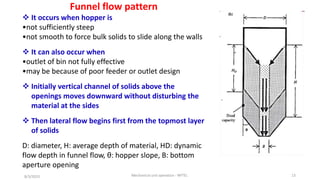
Funnel flow pattern
 It occurs when hopper is
•not sufficiently steep
•not smooth to force bulk solids to slide along the walls
 It can also occur when
•outlet of bin not fully effective
•may be because of poor feeder or outlet design
 Initially vertical channel of solids above the
openings moves downward without disturbing the
material at the sides
 Then lateral flow begins first from the topmost layer
of solids
D: diameter, H: average depth of material, HD: dynamic
flow depth in funnel flow, θ: hopper slope, B: bottom
aperture opening
Disadvantages of funnel flow
•So-called “first-in last-out” flow pattern is unsatisfactory for fine bulk solids of low permeability
•Such material can aerate during discharge through flow channel and this may give rise to
flooding problems or uncontrolled discharge
•They are more prone to cause arching of cohesive solids than mass-flow bins and they usually
require larger outlets for dependable flow
•It may cause segregation of solids and are unsuitable for solids that degrade with time in
stagnant regions
•Cleanout of a funnel flow bin is often uncertain because solids in the stagnant region may pack
and cake
•Thus, funnel flow bins are suitable only for
•coarse,
•free-flowing or slightly cohesive,
•non-degrading solids when segregation is not important
8/3/2023 Mechanical unit operation - NPTEL 15
Flow of granular solids
 Flow of granular solids through circular opening depends on the diameter of
opening and properties of solids
 In general, it does not depend on the height of the bed of solids
 For free flowing particles, the rate of solids flow approximately proportional
to B3, where B is diameter of the opening
8/3/2023 Mechanical unit operation - NPTEL 16
Flow of cohesive solids
•Cohesive particles are very hard to flow
•Column of solids above the outlet moves out as a plug, leaving a rathole with
nearly vertical slides
•Sticky solids and even some dry powders adhere strongly to vertical surfaces
and have enough shear strength to support a plug of considerable diameter
above the openings
•Therefore, to have a continuous flow of granular material, often following
accessories are needed
•Vibrators on the bin walls
•Internal plows near the bin floor
•Jets of air in the discharge opening
8/3/2023 Mechanical unit operation - NPTEL 17
L-13 Conveying of bulk solids
 Conveying of bulk solids in process industries adds additional cost for
•From supply point to store or to process
•Between stages during processes
•Packing and distribution
 Many types of conveying equipment include conveyors, elevators, cranes, trucks and
pneumatic systems
 Motion of material can be based on gravity or manual labour or by employing power means
 Method of motion provides a basis for subdividing these conveyors
 For bulk particulate or powder materials following classification of conveyors is appropriate
•Belt conveyors
•Chain conveyors (scraper conveyors, apron conveyors and bucket elevators)
•Screw conveyors
•Pneumatic conveyors
8/3/2023 Mechanical unit operation - NPTEL 18
Belt conveyors
 Belt conveyors consist of, an endless belt operating between two or more pulleys,
friction driven at one end and carried on an idler drum at the opposite end
 Belt and its load have to be supported on idlers on both conveying and returning
section
 Used for solids conveying at distances from meters to kilometers
 Damage to solids in transport is slight or negligible as there is no relative motion
between belt and solids
 Carrying capacity is high
 Carrying solids long distance mainly in horizontal plane,
•though inclined conveying possible with restricted angle of elevation of 15 -20°
 To avoid spillage or run-back,
•special belts with corrugated sidewalks and lateral ribs are used for steeper inclination
up to 45°
 Their installation cost is high
8/3/2023 Mechanical unit operation - NPTEL 19
Power calculations for belt conveyors
•Horsepower required for transport of solids by belt conveyors can be calculated by
considering frictional resistance of belt, lift and of different pulleys and trippers
•But constant used in such calculations may vary with change in operating conditions
•Power to drive empty conveyor:
•Power to convey material on level:
•Power to lift material:
•Power to operate tripper:
•Total power required = Sum of above four quantities
P: power in horsepower
F: friction factor = 0.03 –0.05
L: conveyor length in meters
L0: constant = 30.5 –45.7
W: weight of moving parts of
conveyor in kg/m of overall length
v: conveyor speed in m/min
T: conveyor capacity in ton/h
H: height of lift in meters
Y and Z: constants
8/3/2023 Mechanical unit operation – NPTEL 20
Example
What is the power requirement (in hp) to move a load of 875 tons/h of a granular material on a conveyor
belt of 1.25 m wide ad 70 m long. The conveyor operates at 90 m/min and its moving parts weight 7500kg
approximately. Constant F and L0 have been evaluated as 0.038 and 29 respectively.
W =
7500
100
= 75
kg
m
v = 90 m/min
P =
0.038 ( 70+29)(0.06 x 75 x 90)
270
= 5.643 hp
P =
0.038 (70 + 29 )(875)
270
= 12.19 hp
Total Power = 5.643 + 12.19 = 17.83 hp
8/3/2023 Mechanical unit operation - NPTEL 21
Chain conveyors
 Main components of chain conveyors
•Chains, moving elements, drives
 Types of chains used commonly are
•Malleable detachable, malleable pintle, steel, roller and combination
 Malleable detachable chain is most common and used for light intermittent
service
 Pintle chain, characterized by a pin which connects the links, is used for
more rigorous service such as vertical elevators
 Depending upon how chain and moving element are mounted for a given
duty, several types of conveyors can be obtained such as
•Scraper conveyors, apron conveyors and bucket elevators
8/3/2023 Mechanical unit operation - NPTEL 22
Bucket elevators
 Consist of high capacity units primarily for bulk elevation of relatively free-flowing
materials
 They are simplest and most dependable equipment for vertical lifting of granular
materials
 Available in wide range of capacity and high efficiency
 Return leg may be located some distance from elevator leg
 Important considerations affecting the design and operation of bucket elevators
are
•Physical properties of conveyed material
•Shape and spacing of buckets
•Speed at which the elevator is driven
•Method of loading the elevator
•Method of discharging the elevator
8/3/2023 Mechanical unit operation - NPTEL 23
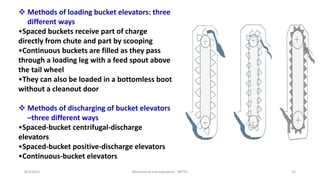
 Methods of loading bucket elevators: three
different ways
•Spaced buckets receive part of charge
directly from chute and part by scooping
•Continuous buckets are filled as they pass
through a loading leg with a feed spout above
the tail wheel
•They can also be loaded in a bottomless boot
without a cleanout door
 Methods of discharging of bucket elevators
–three different ways
•Spaced-bucket centrifugal-discharge
elevators
•Spaced-bucket positive-discharge elevators
•Continuous-bucket elevators
8/3/2023 Mechanical unit operation - NPTEL 24
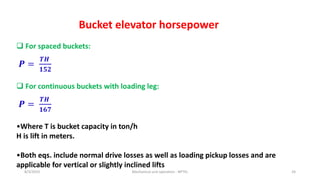
Bucket elevator horsepower
 For spaced buckets:
𝑷 =
𝑻𝑯
𝟏𝟓𝟐
 For continuous buckets with loading leg:
𝑷 =
𝑻𝑯
𝟏𝟔𝟕
•Where T is bucket capacity in ton/h
H is lift in meters.
•Both eqs. include normal drive losses as well as loading pickup losses and are
applicable for vertical or slightly inclined lifts
8/3/2023 Mechanical unit operation - NPTEL 25
Example
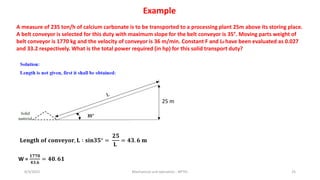
A measure of 235 ton/h of calcium carbonate is to be transported to a processing plant 25m above its storing place.
A belt conveyor is selected for this duty with maximum slope for the belt conveyor is 35°. Moving parts weight of
belt conveyor is 1770 kg and the velocity of conveyor is 36 m/min. Constant F and L0 have been evaluated as 0.027
and 33.2 respectively. What is the total power required (in hp) for this solid transport duty?
35°
25 m
𝐋𝐞𝐧𝐠𝐭𝐡 𝐨𝐟 𝐜𝐨𝐧𝐯𝐞𝐲𝐨𝐫, 𝐋 ∶ 𝐬𝐢𝐧𝟑𝟓° =
𝟐𝟓
𝐋
= 𝟒𝟑. 𝟔 𝐦
W =
𝟏𝟕𝟕𝟎
𝟒𝟑.𝟔
= 𝟒𝟎. 𝟔𝟏
8/3/2023 Mechanical unit operation - NPTEL 26
P =
0.027 ( 43.6+33.2)(0.06 x 40.61 x 36)
270
P = 0.673 hp
Power to lift load,
𝑃 =
𝑇𝐻
270
=
235 𝑥 25
270
= 21.759
Total power required:
= 0.673 + 21.759
= 22.432
~ 22.43 hp
8/3/2023 Mechanical unit operation - NPTEL 27
For the transportation duty, if spaced bucket elevators are used then what is the power requirement in hp?
𝑃 =
𝑇𝐻
152
=
235 𝑥 25
152
= 38.65 ℎ𝑝
For the transportation duty, if continuous bucket elevators are used then what is the power requirement in hp?
𝑃 =
𝑇𝐻
167
=
235 𝑥 25
167
= 35.18 ℎ𝑝
8/3/2023 Mechanical unit operation - NPTEL 28
[1] W.L. McCabe, J. Smith and P. Harriot, Unit Operations of Chemical Engineering, 7thEd.,
McGraw -Hill, International Edition, 2005.
[2] E. Ortega-Rivas, Unit Operations of Particulate Solids: Theory and Practice, CRC Press, FL,
2012.
[3] J.F. Richardson, J.H. Harker, Coulson and Richardson’s Chemical Engineering, 2ndVolume,
5thEd., Butterworth-Heinemann, 2003.
[4] C.J. Geankoplis, Transport Processes and Unit Operations, 4thEd., Prentice Hall, India, 1993.
[5] G.G. Brown et al., Unit Operations, 1stEd., CBS Publishers & Distributors, 2005.
[6] W. L. Badger and J. T. Banchero, Introduction to Chemical Engineering, Tata McGraw-Hill,
International Edition, 1997.
Books and references
Thank You
8/3/2023 Mechanical unit operation - NPTEL 29
Bhavikkumar Mahant: ch19d752@smail.iitm.ac.in

Mechanical unit operations 22_08(1).pptx

  • 1.
    Mechanical Unit Operations 8/3/2023Mechanical unit operation - NPTEL 1 Week 4 : Storage and conveying of bulk solids L-11 Storage of bulk solids L-12 Solid flow out and their flow patterns L-13 Conveying of bulk solids Prof. Nanda Kishore Professor, IIT Guwahati
  • 2.
    • Properties ofmasses of particles • Storage of solids : Bulk and Bin • Pressure in Bulk and Bin storage • Solid flow patterns • Conveying of bulk solids • Power calculations • Examples Outline of discussion Mechanical unit operation - NPTEL 2 8/3/2023
  • 3.
    8/3/2023 Mechanical unitoperation - NPTEL 3 L-11 Storage of bulk solids Properties of masses of particles  Dry and non-sticky particles have many of properties of a fluid • Exert pressure on the sides and walls of container • Flow through opening  Masses of particles also differ from liquids and gases in several ways • Particles interlock under pressure and cannot slide over one another until applied force reaches an appreciable magnitude  Granular solids and solid masses permanently resist distortion when subjected to a moderate distorting force  When applied force is large failure occurs and one layer of particles slide over another • But between layers on each side of the failure there is appreciable friction
  • 4.
    8/3/2023 Mechanical unitoperation - NPTEL 4 Distinctive properties of solid masses  Pressure is not same in all directions • Pressure applied in one direction creates some pressure in other direction but it is always smaller than the applied pressure • It is minimum in the direction at right angles to the applied pressure • In homogeneous mass, the ratio of the normal pressure to the applied pressure is constant, K (this constant is characteristic of the material) • This constant depends on the shape and interlocking tendencies of particles, on stickiness of particle surfaces, and on how tightly the material is packed • This constant is nearly independent of particle size until the grains become very small and the material is no longer free-flowing  Shear stress applied at surface of a solid mass of particles is transmitted throughout a static mass of particles unless failure occurs  Density of solid masses vary depending on degree of packing of grains
  • 5.
    8/3/2023 Mechanical unitoperation - NPTEL 5  For a mass of tightly packed particles to flow, • it must increase in volume to permit interlocking grains to move past one another • i.e., without such dilation flow is not possible  Sides of granular solids piled up on a flat surface are at a definite reproducible angle with the horizontal • This angle is called as the angle of repose of the material • For free-flowing granular solids, it is often between 15-30°  Solid masses are classified as cohesive particles and non-cohesive particles depending on flow properties
  • 6.
    8/3/2023 Mechanical unitoperation - NPTEL 6 Storage of Solids: Bulk and Bin Storage  Bulk Storage •Many solid masses which are coarse such as coal are stored outside in large piles without any protection from weather •Such type of outdoor storage is very economical especially when hundreds or thousands of tons of material is involved •On requirement, these bulk solids are removed from piles by dragline or tractor and delivered to conveyor or to process of interest •Such outdoor storage lead to environmental problems •Dusting can be overcome •Leaching can be controlled
  • 7.
    8/3/2023 Mechanical unitoperation - NPTEL 7  Bin Storage • Valuable or too soluble solids are stored in bins, hoppers or silos • These are cylindrical or rectangular vessels of concrete or metal • Silo is tall and relatively small in diameter • Bin is not very tall and usually fairly wide • Hopper is a small vessel with a slopping bottom (it is for temporary storage before feeding solids to a process) • Bins, silos and hoppers are loaded from top by a kind of elevators; and (discharging is generally done from the bottom)
  • 8.
    8/3/2023 Mechanical unitoperation - NPTEL 8 Pressures in bins and silos  Lateral pressure exerted on walls at any point is less than predicted pressure (from the head of material) above that point  Friction between wall and solid grains  This friction is felt throughout the mass because of the interlocking of particles  Vertical pressure on vessel floor or the packing support is much smaller than that exerted by a column of liquid of same density and height  Actual pressure from solids depends on • Value of K for respective solids • Friction coefficient between solids and container wall • The way solids are placed in the vessel
  • 9.
     If heightof solids column > 3 times diameter of container • additional solids have no effect on pressure at the base • however, total mass increases if more solids are added Unlike in the case of liquids, for granular solids high pressure does not increase the tendency to flow Combination of friction and gravitational forces at some point in the container causes solids to bridge in some extreme cases, so that they do not fall even when the material below them is removed Granular solids with angular particles must be loose in order to flow 8/3/2023 Mechanical unit operation - NPTEL 9
  • 10.
    8/3/2023 Mechanical unitoperation - NPTEL 10 L-12 Solid flow out and their flow patterns  Flow out of bins  Solids flow out  Flow through side opening  Bottom outlets  Types of flow patterns  Three types of flow pattern possible in symmetrical geometry • Mass flow • Funnel or tunnel flow • Expanded flow
  • 11.
    8/3/2023 Mechanical unitoperation - NPTEL 11 Mass flow pattern  It is common in hoppers of sufficiently steep (i.e., cone- bottomed bins with tall and steep cone) and smooth surface • Cause flow of all solids in the bin without stagnant regions during discharge • Solids are in motion at every point within the bin whenever material is drawn from outlet • Flow is uniform • Bulk density of solids is independent of head of solids D: diameter, H: average depth of material, Hcr: critical depth to initiate flow in mass flow, θ: hopper slope, B: bottom aperture opening
  • 12.
    8/3/2023 Mechanical unitoperation - NPTEL 12  Mass flow bins are more suitable for • Cohesive materials • Materials which degrade with time • Fine powders and particulates which are required to be prevented from segregation  Depending on hopper shape and associate flow pattern, the mass flow bins are classified as 1. Conical bins (axisymmetric flow) 2. Wedge or chisel shaped bins (symmetrical or non-symmetrical plane flow) 3. In plane flow bins • slope to the vertical of hopper is 8 –10°larger than corresponding value for axisymmetric bins with conical hoppers • Thus it offer extra storage capacity than axisymmetric bins for the same head room
  • 13.
    8/3/2023 Mechanical unitoperation - NPTEL 13 Funnel flow pattern  It occurs when hopper is •not sufficiently steep •not smooth to force bulk solids to slide along the walls  It can also occur when •outlet of bin not fully effective •may be because of poor feeder or outlet design  Initially vertical channel of solids above the openings moves downward without disturbing the material at the sides  Then lateral flow begins first from the topmost layer of solids D: diameter, H: average depth of material, HD: dynamic flow depth in funnel flow, θ: hopper slope, B: bottom aperture opening
  • 14.
    Disadvantages of funnelflow •So-called “first-in last-out” flow pattern is unsatisfactory for fine bulk solids of low permeability •Such material can aerate during discharge through flow channel and this may give rise to flooding problems or uncontrolled discharge •They are more prone to cause arching of cohesive solids than mass-flow bins and they usually require larger outlets for dependable flow •It may cause segregation of solids and are unsuitable for solids that degrade with time in stagnant regions •Cleanout of a funnel flow bin is often uncertain because solids in the stagnant region may pack and cake •Thus, funnel flow bins are suitable only for •coarse, •free-flowing or slightly cohesive, •non-degrading solids when segregation is not important
  • 15.
    8/3/2023 Mechanical unitoperation - NPTEL 15 Flow of granular solids  Flow of granular solids through circular opening depends on the diameter of opening and properties of solids  In general, it does not depend on the height of the bed of solids  For free flowing particles, the rate of solids flow approximately proportional to B3, where B is diameter of the opening
  • 16.
    8/3/2023 Mechanical unitoperation - NPTEL 16 Flow of cohesive solids •Cohesive particles are very hard to flow •Column of solids above the outlet moves out as a plug, leaving a rathole with nearly vertical slides •Sticky solids and even some dry powders adhere strongly to vertical surfaces and have enough shear strength to support a plug of considerable diameter above the openings •Therefore, to have a continuous flow of granular material, often following accessories are needed •Vibrators on the bin walls •Internal plows near the bin floor •Jets of air in the discharge opening
  • 17.
    8/3/2023 Mechanical unitoperation - NPTEL 17 L-13 Conveying of bulk solids  Conveying of bulk solids in process industries adds additional cost for •From supply point to store or to process •Between stages during processes •Packing and distribution  Many types of conveying equipment include conveyors, elevators, cranes, trucks and pneumatic systems  Motion of material can be based on gravity or manual labour or by employing power means  Method of motion provides a basis for subdividing these conveyors  For bulk particulate or powder materials following classification of conveyors is appropriate •Belt conveyors •Chain conveyors (scraper conveyors, apron conveyors and bucket elevators) •Screw conveyors •Pneumatic conveyors
  • 18.
    8/3/2023 Mechanical unitoperation - NPTEL 18 Belt conveyors  Belt conveyors consist of, an endless belt operating between two or more pulleys, friction driven at one end and carried on an idler drum at the opposite end  Belt and its load have to be supported on idlers on both conveying and returning section  Used for solids conveying at distances from meters to kilometers  Damage to solids in transport is slight or negligible as there is no relative motion between belt and solids  Carrying capacity is high  Carrying solids long distance mainly in horizontal plane, •though inclined conveying possible with restricted angle of elevation of 15 -20°  To avoid spillage or run-back, •special belts with corrugated sidewalks and lateral ribs are used for steeper inclination up to 45°  Their installation cost is high
  • 19.
    8/3/2023 Mechanical unitoperation - NPTEL 19 Power calculations for belt conveyors •Horsepower required for transport of solids by belt conveyors can be calculated by considering frictional resistance of belt, lift and of different pulleys and trippers •But constant used in such calculations may vary with change in operating conditions •Power to drive empty conveyor: •Power to convey material on level: •Power to lift material: •Power to operate tripper: •Total power required = Sum of above four quantities P: power in horsepower F: friction factor = 0.03 –0.05 L: conveyor length in meters L0: constant = 30.5 –45.7 W: weight of moving parts of conveyor in kg/m of overall length v: conveyor speed in m/min T: conveyor capacity in ton/h H: height of lift in meters Y and Z: constants
  • 20.
    8/3/2023 Mechanical unitoperation – NPTEL 20 Example What is the power requirement (in hp) to move a load of 875 tons/h of a granular material on a conveyor belt of 1.25 m wide ad 70 m long. The conveyor operates at 90 m/min and its moving parts weight 7500kg approximately. Constant F and L0 have been evaluated as 0.038 and 29 respectively. W = 7500 100 = 75 kg m v = 90 m/min P = 0.038 ( 70+29)(0.06 x 75 x 90) 270 = 5.643 hp P = 0.038 (70 + 29 )(875) 270 = 12.19 hp Total Power = 5.643 + 12.19 = 17.83 hp
  • 21.
    8/3/2023 Mechanical unitoperation - NPTEL 21 Chain conveyors  Main components of chain conveyors •Chains, moving elements, drives  Types of chains used commonly are •Malleable detachable, malleable pintle, steel, roller and combination  Malleable detachable chain is most common and used for light intermittent service  Pintle chain, characterized by a pin which connects the links, is used for more rigorous service such as vertical elevators  Depending upon how chain and moving element are mounted for a given duty, several types of conveyors can be obtained such as •Scraper conveyors, apron conveyors and bucket elevators
  • 22.
    8/3/2023 Mechanical unitoperation - NPTEL 22 Bucket elevators  Consist of high capacity units primarily for bulk elevation of relatively free-flowing materials  They are simplest and most dependable equipment for vertical lifting of granular materials  Available in wide range of capacity and high efficiency  Return leg may be located some distance from elevator leg  Important considerations affecting the design and operation of bucket elevators are •Physical properties of conveyed material •Shape and spacing of buckets •Speed at which the elevator is driven •Method of loading the elevator •Method of discharging the elevator
  • 23.
    8/3/2023 Mechanical unitoperation - NPTEL 23  Methods of loading bucket elevators: three different ways •Spaced buckets receive part of charge directly from chute and part by scooping •Continuous buckets are filled as they pass through a loading leg with a feed spout above the tail wheel •They can also be loaded in a bottomless boot without a cleanout door  Methods of discharging of bucket elevators –three different ways •Spaced-bucket centrifugal-discharge elevators •Spaced-bucket positive-discharge elevators •Continuous-bucket elevators
  • 24.
    8/3/2023 Mechanical unitoperation - NPTEL 24 Bucket elevator horsepower  For spaced buckets: 𝑷 = 𝑻𝑯 𝟏𝟓𝟐  For continuous buckets with loading leg: 𝑷 = 𝑻𝑯 𝟏𝟔𝟕 •Where T is bucket capacity in ton/h H is lift in meters. •Both eqs. include normal drive losses as well as loading pickup losses and are applicable for vertical or slightly inclined lifts
  • 25.
    8/3/2023 Mechanical unitoperation - NPTEL 25 Example A measure of 235 ton/h of calcium carbonate is to be transported to a processing plant 25m above its storing place. A belt conveyor is selected for this duty with maximum slope for the belt conveyor is 35°. Moving parts weight of belt conveyor is 1770 kg and the velocity of conveyor is 36 m/min. Constant F and L0 have been evaluated as 0.027 and 33.2 respectively. What is the total power required (in hp) for this solid transport duty? 35° 25 m 𝐋𝐞𝐧𝐠𝐭𝐡 𝐨𝐟 𝐜𝐨𝐧𝐯𝐞𝐲𝐨𝐫, 𝐋 ∶ 𝐬𝐢𝐧𝟑𝟓° = 𝟐𝟓 𝐋 = 𝟒𝟑. 𝟔 𝐦 W = 𝟏𝟕𝟕𝟎 𝟒𝟑.𝟔 = 𝟒𝟎. 𝟔𝟏
  • 26.
    8/3/2023 Mechanical unitoperation - NPTEL 26 P = 0.027 ( 43.6+33.2)(0.06 x 40.61 x 36) 270 P = 0.673 hp Power to lift load, 𝑃 = 𝑇𝐻 270 = 235 𝑥 25 270 = 21.759 Total power required: = 0.673 + 21.759 = 22.432 ~ 22.43 hp
  • 27.
    8/3/2023 Mechanical unitoperation - NPTEL 27 For the transportation duty, if spaced bucket elevators are used then what is the power requirement in hp? 𝑃 = 𝑇𝐻 152 = 235 𝑥 25 152 = 38.65 ℎ𝑝 For the transportation duty, if continuous bucket elevators are used then what is the power requirement in hp? 𝑃 = 𝑇𝐻 167 = 235 𝑥 25 167 = 35.18 ℎ𝑝
  • 28.
    8/3/2023 Mechanical unitoperation - NPTEL 28 [1] W.L. McCabe, J. Smith and P. Harriot, Unit Operations of Chemical Engineering, 7thEd., McGraw -Hill, International Edition, 2005. [2] E. Ortega-Rivas, Unit Operations of Particulate Solids: Theory and Practice, CRC Press, FL, 2012. [3] J.F. Richardson, J.H. Harker, Coulson and Richardson’s Chemical Engineering, 2ndVolume, 5thEd., Butterworth-Heinemann, 2003. [4] C.J. Geankoplis, Transport Processes and Unit Operations, 4thEd., Prentice Hall, India, 1993. [5] G.G. Brown et al., Unit Operations, 1stEd., CBS Publishers & Distributors, 2005. [6] W. L. Badger and J. T. Banchero, Introduction to Chemical Engineering, Tata McGraw-Hill, International Edition, 1997. Books and references
  • 29.
    Thank You 8/3/2023 Mechanicalunit operation - NPTEL 29 Bhavikkumar Mahant: ch19d752@smail.iitm.ac.in