ARUSHA TECHNICAL COLLEGE
MODULE NAME: HEAVY EQUIPMENT ELECTRICAL MAINTENANCE:
MODULE CODE: HET 06205
FACILITATOR: ENG, SEBA MAGINGA
TASK: GROUP ASSIGNMENT, GROUP ONE.
AUTOMOTIVE ENGINEERING DEPARTMENT
ORDINARY DIPLOMA IN HEAVY DUTY
EQUIPMENTENGINEERING
GROUP MEMBERS ADMISSION NUMBER
FINIAS Z JONATHAN 19010312008
BAHATI ROBERT MATHIAS 21011712004
LUCIA ROLLENCE SEMANINI 21011702001
NICHOLAS STEPHEN MOLLEL 21011702006
THE MEANING OF MAINTENANCE.
Maintenance: Refers to the set of procedure and practices which aim to ensure the
continuous and efficient operation of machinery and equipment.
Main types of maintenance
1. Preventive maintenance.
Is the type of maintenance intended to prevent equipment breakdowns, failure, or
downtime.
2. Corrective maintenance.
It involves the replacement or repair of equipment after it fails.
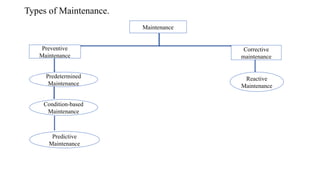
Types of Maintenance.
Maintenance
Corrective
maintenance
Preventive
Maintenance
Predetermined
Maintenance
Condition-based
Maintenance
Predictive
Maintenance
Reactive
Maintenance
THE DIFFERENCE BETWEEN DIRECT
PREVENTIVE AND INDIRECT PREVENTIVE
MAINTENANCE.
Direct Preventive Maintenance:
Refers to the process of conducting regular check-ups and fixing small issues
before they turn into big problems. For example, changing the oil in your car
regularly or checking for leaks in your plumbing system.
WHILE
Indirect Preventive Maintenance:
This is more about keeping the environment or conditions right to prevent problems.
PREVENTIVE MAINTENANCE CYCLE.
Refers to a planned schedule of inspections, repairs, and replacements designed to
prevent equipment breakdowns and ensure optimal functioning
Objective condition monitoring Subjective condition monitoring.
It can be automated, making them efficient and less prone
to errors
It requires manual input and is more susceptible to human
error.
It relies on concrete data and measurements It relies on personal perception and interpretation of the
situation.
Tends to be more accurate and consistent since it's based
on precise measurements
It can vary depending on individual judgment and biases.
It often involves using specialized equipment or sensors It relies on human observation and experience
it provides quantitative data, such as numbers or values It provides qualitative assessments, which are more descriptive
and subjective.
THE DIFFERENCE BETWEEN OBJECTIVE CONDITION
MONITORING AND SUBJECTIVE CONDITION
MONITORING.
I. Mechanical Wear: This occurs when parts rub against each other over time, leading to wear and tear. It
can result in issues like surface pitting, erosion, or material loss.
II. Fatigue: Fatigue failure happens due to repeated loading and unloading of a component, leading to cracks
or fractures, especially in materials like metals.
III. Corrosion: This occurs when materials degrade due to chemical reactions with the environment, leading
to loss of material and weakening of the component.
IV. Misalignment: Misalignment happens when parts are not properly aligned, leading to increased friction,
wear, and potential failure of components like bearings or gears.
V. Overloading: Exceeding the designed load capacity of a component can lead to deformation, bending, or
fracture, causing failure.
FAULTS THAT OCCURRING DURING MACHINE
PARTS.
THE IMPORTANCE OF PREVENTIVE
MAINTENANCE SCHEDULE.
Maintenance schedule; is defined as the process that helps you identify and solve potential problems before they get out of hand.
Importance of preventive maintenance schedule.
I. Cost Savings: Regular maintenance helps identify and address issues early, preventing them from developing into costly problems later on. It's
often more cost-effective to perform routine maintenance than to deal with major repairs or replacements.
II. Increased Equipment Lifespan: Regular servicing ensures that equipment operates at optimal levels, reducing wear and tear and extending its
lifespan. This means you can get more value out of your assets over time.
III. Minimized Downtime: Scheduled maintenance reduces the likelihood of unexpected breakdowns, minimizing downtime and preventing
disruptions to operations. This is especially important for critical equipment in industries like manufacturing, healthcare, and transportation.
IV. Improved Safety: Well-maintained equipment is less likely to malfunction or cause accidents, enhancing workplace safety for employees and
customers.
V. Compliance Requirements: Many industries have regulations mandating regular maintenance of equipment to ensure compliance with safety
and environmental standards. Adhering to these requirements through a preventive maintenance schedule helps avoid penalties and legal issues.
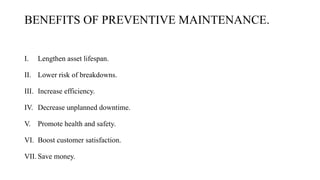
BENEFITS OF PREVENTIVE MAINTENANCE.
I. Lengthen asset lifespan.
II. Lower risk of breakdowns.
III. Increase efficiency.
IV. Decrease unplanned downtime.
V. Promote health and safety.
VI. Boost customer satisfaction.
VII. Save money.
EFFECTIVE MAINTENANCE.
Effective maintenance involves a combination of proactive and reactive
strategies to ensure equipment, system, operates efficiency and reliable.
This involves regular inspections, preventive maintenance schedules, prompt
repairs and continuous improvement efforts based on data analysis and
feedback.
The main goal is to minimize downtime, reduce cost, extend asset lifespan, and
optimize performance.
THE FOLLOWING ARE THE REASONS FOR
NEGLECTING MAINTENANCE.
I. Time concerns. Some may see maintenance as an unnecessary expense and delay to save money in the
short term.
II. Time constraints. People might be too busy with other responsibilities to prioritize maintenance task.
III. Lack of awareness. Some may not realize the important of regular maintenance or the potential
consequences of neglecting it.
IV. Overconfidence. People might believe that their equipment or system are in good condition to forego
maintenance, leading to complacency.
V. Resource limitations. Limited access to skilled labor, tools, or spare parts can hinder maintenance
efforts
MAINTENANCE SHOULD BE DESIGNED DUE TO
THE FOLLOWING REASONS.
I. Improve safety and reduce the risk of accidents
II. Extend the lifespan of equipment and facilities
III. Improve customer satisfaction and loyalty
IV. Prevent unexpected downtime and disruptions to business operations
V. Improved reliability can lead to increased productivity and efficiency
VI. Provide a better working environment for employees.
WHY DO WE NEED MAINTENANCE?
We need maintenance due to the following reasons as follows.
I. Preventive Measures: Regular maintenance helps prevent equipment failures and breakdowns by identifying
and addressing issues before they escalate, reducing the likelihood of costly repairs or replacements.
II. Optimized Performance: Proper maintenance ensures that equipment operates at peak performance levels,
maximizing efficiency and productivity, which ultimately leads to better quality output.
III. Safety: Maintenance helps ensure that equipment and facilities meet safety standards, reducing the risk of
accidents, injuries, or environmental hazards.
IV. Extended Lifespan: Regular maintenance extends the lifespan of equipment and assets by minimizing wear
and tear, reducing the frequency of replacements, and preserving their value over time.
V. Cost Savings: Proactive maintenance strategies, such as preventive and predictive maintenance, can help
save money by avoiding unplanned downtime, minimizing repair costs, and optimizing energy consumption.
COSTS OF DOING MAINTENANCE.
I. Direct Costs: These are the obvious costs you pay directly for maintenance, like buying replacement
parts, hiring technicians, or paying for maintenance services.
II. Indirect Costs: These are the less obvious costs that come from maintenance, like the time and money
lost when machines are out of service, or the extra energy costs if machines aren't running efficiently.
III. Training Costs: Sometimes, you need to train employees to do maintenance tasks properly, which
costs time and money.
IV. Downtime Costs: When machines are down for maintenance, you can't use them to make products or
provide services, which can lead to lost sales or unhappy customers.
V. Safety Costs: If machines aren't properly maintained, they can become unsafe to use, leading to
accidents, injuries, or even lawsuits, which can cost a lot of money to deal with.
THE COSTS OF NOT DOING MAINTENANCE.
I. Downtime Costs: When equipment or systems break down unexpectedly, operations come to a halt,
leading to lost productivity, missed deadlines, and potential penalties for delays.
II. Repair Costs: Failure to address minor issues in a timely manner can result in more extensive
damage requiring costly repairs or even replacement of equipment.
III. Safety Risks: Malfunctioning equipment poses safety hazards to personnel, leading to potential
injuries, workers' compensation claims, lawsuits, and damage to reputation.
IV. Reduced Efficiency: Unmaintained equipment may operate less efficiently, consuming more energy
or resources than necessary, resulting in higher operating costs over time.
V. Loss of Revenue: Downtime and inefficiencies can lead to lost sales opportunities, customer
dissatisfaction, and damage to business relationships, ultimately impacting revenue and profitability.
THE BENEFITS OF MAINTENANCE.
I. Prevent Breakdowns: Maintenance helps stop machines from breaking down unexpectedly, so you
can keep working smoothly without any interruptions.
II. Save Money: Fixing small problems early costs less than waiting for big problems to happen. Plus,
well-maintained machines use less energy, saving you money on bills.
III. Stay Safe: Maintenance checks make sure machines are safe to use, reducing the chance of
accidents or things going wrong.
IV. Last Longer: Taking care of machines helps them last longer, so you don't have to spend money
replacing them as often.
V. Work Better: Regular maintenance makes sure machines work as well as they can, helping you get
work done faster and better.
HOW CAN MAINTENANCE INCREASE
PROFITABILITY OF COMPANY?
We can increase profitability of the company in the following ways as follows.
I. Downtime: Regular maintenance prevents unexpected breakdowns, reducing the downtime when machines are out of service.
This means more time spent on productive activities, leading to increased output and revenue.
II. Lower Repair Costs: Proactive maintenance helps catch and fix problems early, before they escalate into costly breakdowns or
major repairs. By avoiding large repair bills, companies can save money and maintain higher profit margins.
III. Extended Equipment Lifespan: Proper maintenance prolongs the lifespan of equipment and machinery, reducing the frequency of
replacements. This lowers capital expenditure on new equipment and improves the return on investment (ROI) for existing assets.
IV. Improved Efficiency: Well-maintained equipment operates more efficiently, consuming less energy and producing higher-quality
output. This leads to reduced operating costs and higher profitability per unit of production.
V. Enhanced Safety: Maintenance ensures that equipment is safe to operate, reducing the risk of accidents, injuries, or costly legal
liabilities associated with workplace incidents. A safer work environment leads to fewer disruptions and potential financial losses.
CONCLUSION:
Conclusively, maintenance is crucial for sustaining the
functionality and longevity of systems, equipment and infrastructure.
regular upkeep reduce down time ,prevents costly repairs, ensures
safety, and extends the life span of assets. It is an essential investment
for businesses and individual a like to optimize performance and
minimize risks.
THANK YOU!

Heavydutyequipmentelectricalsystemcomponents.pptx

  • 1.
    ARUSHA TECHNICAL COLLEGE MODULENAME: HEAVY EQUIPMENT ELECTRICAL MAINTENANCE: MODULE CODE: HET 06205 FACILITATOR: ENG, SEBA MAGINGA TASK: GROUP ASSIGNMENT, GROUP ONE. AUTOMOTIVE ENGINEERING DEPARTMENT ORDINARY DIPLOMA IN HEAVY DUTY EQUIPMENTENGINEERING GROUP MEMBERS ADMISSION NUMBER FINIAS Z JONATHAN 19010312008 BAHATI ROBERT MATHIAS 21011712004 LUCIA ROLLENCE SEMANINI 21011702001 NICHOLAS STEPHEN MOLLEL 21011702006
  • 2.
    THE MEANING OFMAINTENANCE. Maintenance: Refers to the set of procedure and practices which aim to ensure the continuous and efficient operation of machinery and equipment. Main types of maintenance 1. Preventive maintenance. Is the type of maintenance intended to prevent equipment breakdowns, failure, or downtime. 2. Corrective maintenance. It involves the replacement or repair of equipment after it fails.
  • 3.
  • 4.
    THE DIFFERENCE BETWEENDIRECT PREVENTIVE AND INDIRECT PREVENTIVE MAINTENANCE. Direct Preventive Maintenance: Refers to the process of conducting regular check-ups and fixing small issues before they turn into big problems. For example, changing the oil in your car regularly or checking for leaks in your plumbing system. WHILE Indirect Preventive Maintenance: This is more about keeping the environment or conditions right to prevent problems.
  • 5.
    PREVENTIVE MAINTENANCE CYCLE. Refersto a planned schedule of inspections, repairs, and replacements designed to prevent equipment breakdowns and ensure optimal functioning
  • 6.
    Objective condition monitoringSubjective condition monitoring. It can be automated, making them efficient and less prone to errors It requires manual input and is more susceptible to human error. It relies on concrete data and measurements It relies on personal perception and interpretation of the situation. Tends to be more accurate and consistent since it's based on precise measurements It can vary depending on individual judgment and biases. It often involves using specialized equipment or sensors It relies on human observation and experience it provides quantitative data, such as numbers or values It provides qualitative assessments, which are more descriptive and subjective. THE DIFFERENCE BETWEEN OBJECTIVE CONDITION MONITORING AND SUBJECTIVE CONDITION MONITORING.
  • 7.
    I. Mechanical Wear:This occurs when parts rub against each other over time, leading to wear and tear. It can result in issues like surface pitting, erosion, or material loss. II. Fatigue: Fatigue failure happens due to repeated loading and unloading of a component, leading to cracks or fractures, especially in materials like metals. III. Corrosion: This occurs when materials degrade due to chemical reactions with the environment, leading to loss of material and weakening of the component. IV. Misalignment: Misalignment happens when parts are not properly aligned, leading to increased friction, wear, and potential failure of components like bearings or gears. V. Overloading: Exceeding the designed load capacity of a component can lead to deformation, bending, or fracture, causing failure. FAULTS THAT OCCURRING DURING MACHINE PARTS.
  • 8.
    THE IMPORTANCE OFPREVENTIVE MAINTENANCE SCHEDULE. Maintenance schedule; is defined as the process that helps you identify and solve potential problems before they get out of hand. Importance of preventive maintenance schedule. I. Cost Savings: Regular maintenance helps identify and address issues early, preventing them from developing into costly problems later on. It's often more cost-effective to perform routine maintenance than to deal with major repairs or replacements. II. Increased Equipment Lifespan: Regular servicing ensures that equipment operates at optimal levels, reducing wear and tear and extending its lifespan. This means you can get more value out of your assets over time. III. Minimized Downtime: Scheduled maintenance reduces the likelihood of unexpected breakdowns, minimizing downtime and preventing disruptions to operations. This is especially important for critical equipment in industries like manufacturing, healthcare, and transportation. IV. Improved Safety: Well-maintained equipment is less likely to malfunction or cause accidents, enhancing workplace safety for employees and customers. V. Compliance Requirements: Many industries have regulations mandating regular maintenance of equipment to ensure compliance with safety and environmental standards. Adhering to these requirements through a preventive maintenance schedule helps avoid penalties and legal issues.
  • 9.
    BENEFITS OF PREVENTIVEMAINTENANCE. I. Lengthen asset lifespan. II. Lower risk of breakdowns. III. Increase efficiency. IV. Decrease unplanned downtime. V. Promote health and safety. VI. Boost customer satisfaction. VII. Save money.
  • 10.
    EFFECTIVE MAINTENANCE. Effective maintenanceinvolves a combination of proactive and reactive strategies to ensure equipment, system, operates efficiency and reliable. This involves regular inspections, preventive maintenance schedules, prompt repairs and continuous improvement efforts based on data analysis and feedback. The main goal is to minimize downtime, reduce cost, extend asset lifespan, and optimize performance.
  • 11.
    THE FOLLOWING ARETHE REASONS FOR NEGLECTING MAINTENANCE. I. Time concerns. Some may see maintenance as an unnecessary expense and delay to save money in the short term. II. Time constraints. People might be too busy with other responsibilities to prioritize maintenance task. III. Lack of awareness. Some may not realize the important of regular maintenance or the potential consequences of neglecting it. IV. Overconfidence. People might believe that their equipment or system are in good condition to forego maintenance, leading to complacency. V. Resource limitations. Limited access to skilled labor, tools, or spare parts can hinder maintenance efforts
  • 12.
    MAINTENANCE SHOULD BEDESIGNED DUE TO THE FOLLOWING REASONS. I. Improve safety and reduce the risk of accidents II. Extend the lifespan of equipment and facilities III. Improve customer satisfaction and loyalty IV. Prevent unexpected downtime and disruptions to business operations V. Improved reliability can lead to increased productivity and efficiency VI. Provide a better working environment for employees.
  • 13.
    WHY DO WENEED MAINTENANCE? We need maintenance due to the following reasons as follows. I. Preventive Measures: Regular maintenance helps prevent equipment failures and breakdowns by identifying and addressing issues before they escalate, reducing the likelihood of costly repairs or replacements. II. Optimized Performance: Proper maintenance ensures that equipment operates at peak performance levels, maximizing efficiency and productivity, which ultimately leads to better quality output. III. Safety: Maintenance helps ensure that equipment and facilities meet safety standards, reducing the risk of accidents, injuries, or environmental hazards. IV. Extended Lifespan: Regular maintenance extends the lifespan of equipment and assets by minimizing wear and tear, reducing the frequency of replacements, and preserving their value over time. V. Cost Savings: Proactive maintenance strategies, such as preventive and predictive maintenance, can help save money by avoiding unplanned downtime, minimizing repair costs, and optimizing energy consumption.
  • 14.
    COSTS OF DOINGMAINTENANCE. I. Direct Costs: These are the obvious costs you pay directly for maintenance, like buying replacement parts, hiring technicians, or paying for maintenance services. II. Indirect Costs: These are the less obvious costs that come from maintenance, like the time and money lost when machines are out of service, or the extra energy costs if machines aren't running efficiently. III. Training Costs: Sometimes, you need to train employees to do maintenance tasks properly, which costs time and money. IV. Downtime Costs: When machines are down for maintenance, you can't use them to make products or provide services, which can lead to lost sales or unhappy customers. V. Safety Costs: If machines aren't properly maintained, they can become unsafe to use, leading to accidents, injuries, or even lawsuits, which can cost a lot of money to deal with.
  • 15.
    THE COSTS OFNOT DOING MAINTENANCE. I. Downtime Costs: When equipment or systems break down unexpectedly, operations come to a halt, leading to lost productivity, missed deadlines, and potential penalties for delays. II. Repair Costs: Failure to address minor issues in a timely manner can result in more extensive damage requiring costly repairs or even replacement of equipment. III. Safety Risks: Malfunctioning equipment poses safety hazards to personnel, leading to potential injuries, workers' compensation claims, lawsuits, and damage to reputation. IV. Reduced Efficiency: Unmaintained equipment may operate less efficiently, consuming more energy or resources than necessary, resulting in higher operating costs over time. V. Loss of Revenue: Downtime and inefficiencies can lead to lost sales opportunities, customer dissatisfaction, and damage to business relationships, ultimately impacting revenue and profitability.
  • 16.
    THE BENEFITS OFMAINTENANCE. I. Prevent Breakdowns: Maintenance helps stop machines from breaking down unexpectedly, so you can keep working smoothly without any interruptions. II. Save Money: Fixing small problems early costs less than waiting for big problems to happen. Plus, well-maintained machines use less energy, saving you money on bills. III. Stay Safe: Maintenance checks make sure machines are safe to use, reducing the chance of accidents or things going wrong. IV. Last Longer: Taking care of machines helps them last longer, so you don't have to spend money replacing them as often. V. Work Better: Regular maintenance makes sure machines work as well as they can, helping you get work done faster and better.
  • 17.
    HOW CAN MAINTENANCEINCREASE PROFITABILITY OF COMPANY? We can increase profitability of the company in the following ways as follows. I. Downtime: Regular maintenance prevents unexpected breakdowns, reducing the downtime when machines are out of service. This means more time spent on productive activities, leading to increased output and revenue. II. Lower Repair Costs: Proactive maintenance helps catch and fix problems early, before they escalate into costly breakdowns or major repairs. By avoiding large repair bills, companies can save money and maintain higher profit margins. III. Extended Equipment Lifespan: Proper maintenance prolongs the lifespan of equipment and machinery, reducing the frequency of replacements. This lowers capital expenditure on new equipment and improves the return on investment (ROI) for existing assets. IV. Improved Efficiency: Well-maintained equipment operates more efficiently, consuming less energy and producing higher-quality output. This leads to reduced operating costs and higher profitability per unit of production. V. Enhanced Safety: Maintenance ensures that equipment is safe to operate, reducing the risk of accidents, injuries, or costly legal liabilities associated with workplace incidents. A safer work environment leads to fewer disruptions and potential financial losses.
  • 18.
    CONCLUSION: Conclusively, maintenance iscrucial for sustaining the functionality and longevity of systems, equipment and infrastructure. regular upkeep reduce down time ,prevents costly repairs, ensures safety, and extends the life span of assets. It is an essential investment for businesses and individual a like to optimize performance and minimize risks.
  • 19.