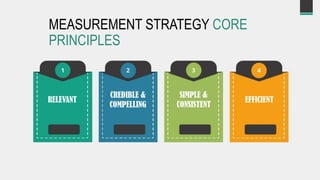
MEASUREMENT STRATEGY CORE
PRINCIPLES
RELEVANT
CREDIBLE &
COMPELLING
SIMPLE &
CONSISTENT
EFFICIENT
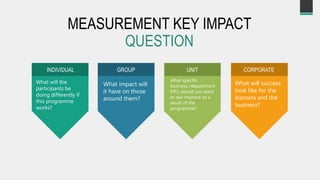
MEASUREMENT KEY IMPACT
QUESTION
What will the
participants be
doing differently if
this programme
works?
What impact will
it have on those
around them?
What specific
business /department
KPI’s would you want
to see improve as a
result of the
programme?
What will success
look like for the
learners and the
business?
INDIVIDUAL GROUP UNIT CORPORATE
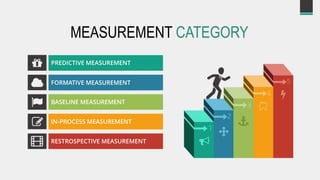
MEASUREMENT CATEGORY
PREDICTIVE MEASUREMENT
FORMATIVE MEASUREMENT
BASELINE MEASUREMENT
IN-PROCESS MEASUREMENT
RESTROSPECTIVE MEASUREMENT
KIRKPATRICK – PHILLIPS MODEL
Knowledge,
skills, & attitude
LEVEL 2
LEARNING
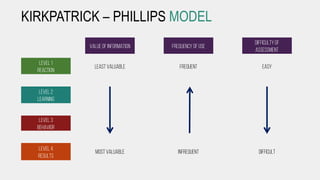
KIRKPATRICK – PHILLIPS MODEL
LEVEL 2
LEARNING
LEVEL 1
REACTION
LEVEL 3
BEHAVIOR
LEVEL 4
RESULTS
VALUE OF INFORMATION FREQUENCY OFUSE
DIFFICULTYOF
ASSESSMENT
Least valuable
mostvaluable
frequent easy
infrequent difficult
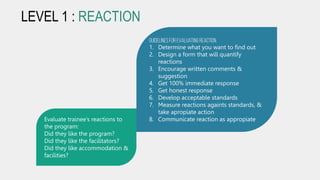
LEVEL 1 : REACTION
Evaluate trainee’s reactions to
the program:
Did they like the program?
Did they like the facilitators?
Did they like accommodation &
facilities?
Guidelinesfor evaluatingreaction
1. Determine what you want to find out
2. Design a form that will quantify
reactions
3. Encourage written comments &
suggestion
4. Get 100% immediate response
5. Get honest response
6. Develop acceptable standards
7. Measure reactions againts standards, &
take apropiate action
8. Communicate reaction as appropiate
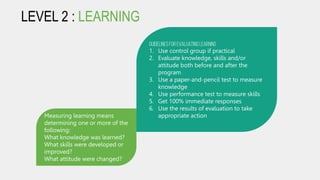
LEVEL 2 : LEARNING
Measuring learning means
determining one or more of the
following:
What knowledge was learned?
What skills were developed or
improved?
What attitude were changed?
Guidelinesfor evaluatinglearning
1. Use control group if practical
2. Evaluate knowledge, skills and/or
attitude both before and after the
program
3. Use a paper-and-pencil test to measure
knowledge
4. Use performance test to measure skills
5. Get 100% immediate responses
6. Use the results of evaluation to take
appropriate action
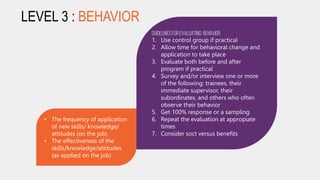
LEVEL 3 : BEHAVIOR
• The frequency of application
of new skills/ knowledge/
attitudes (on the job)
• The effectiveness of the
skills/knowledge/attitudes
(as applied on the job)
Guidelinesfor evaluating BEHAVIOR
1. Use control group if practical
2. Allow time for behavioral change and
application to take place
3. Evaluate both before and after
program if practical
4. Survey and/or interview one or more
of the following: trainees, their
immediate supervisor, their
subordinates, and others who often
observe their behavior
5. Get 100% response or a sampling
6. Repeat the evaluation at appropiate
times
7. Consider soct versus benefits
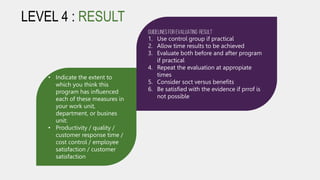
LEVEL 4 : RESULT
• Indicate the extent to
which you think this
program has influenced
each of these measures in
your work unit,
department, or busines
unit:
• Productivity / quality /
customer response time /
cost control / employee
satisfaction / customer
satisfaction
Guidelinesfor evaluating RESULT
1. Use control group if practical
2. Allow time results to be achieved
3. Evaluate both before and after program
if practical
4. Repeat the evaluation at appropiate
times
5. Consider soct versus benefits
6. Be satisfied with the evidence if prrof is
not possible
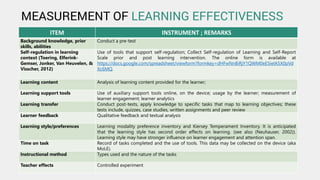
MEASUREMENT OF LEARNING EFFECTIVENESS
ITEM INSTRUMENT ; REMARKS
Background knowledge, prior
skills, abilities
Conduct a pre-test
Self-regulation in learning
context (Toering, Elferink-
Gemser, Jonker, Van Heuvelen, &
Visscher, 2012)
Use of tools that support self-regulation; Collect Self-regulation of Learning and Self-Report
Scale prior and post learning intervention. The online form is available at
https://docs.google.com/spreadsheet/viewform?formkey=dHFwNnBiRjY1QWM0eE5ielA5X0pVd
Xc6MQ.
Learning content Analysis of learning content provided for the learner;
Learning support tools Use of auxiliary support tools online, on the device; usage by the learner; measurement of
learner engagement; learner analytics
Learning transfer Conduct post-tests, apply knowledge to specific tasks that map to learning objectives; these
tests include, quizzes, case studies, written assignments and peer review
Learner feedback Qualitative feedback and textual analysis
Learning style/preferences Learning modality preference inventory and Kiersey Temperament Inventory. It is anticipated
that the learning style has second order effects on learning. (see also (Neuhauser, 2002)).
Learning style may have stronger influence on learner engagement and attention span.
Time on task Record of tasks completed and the use of tools. This data may be collected on the device (aka
MoLE).
Instructional method Types used and the nature of the tasks
Teacher effects Controlled experiment
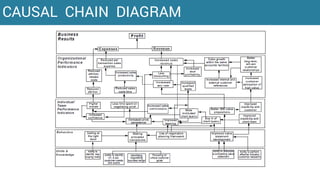
CAUSAL CHAIN DIAGRAM
Thank you
JOKO SUSENO
CORPORATE CULTURE MANAGEMENT
joko.suseno@live.com

Measuring learning impact & effectiveness

  • 2.
    MEASUREMENT STRATEGY CORE PRINCIPLES RELEVANT CREDIBLE& COMPELLING SIMPLE & CONSISTENT EFFICIENT
  • 3.
    MEASUREMENT KEY IMPACT QUESTION Whatwill the participants be doing differently if this programme works? What impact will it have on those around them? What specific business /department KPI’s would you want to see improve as a result of the programme? What will success look like for the learners and the business? INDIVIDUAL GROUP UNIT CORPORATE
  • 4.
    MEASUREMENT CATEGORY PREDICTIVE MEASUREMENT FORMATIVEMEASUREMENT BASELINE MEASUREMENT IN-PROCESS MEASUREMENT RESTROSPECTIVE MEASUREMENT
  • 13.
    KIRKPATRICK – PHILLIPSMODEL Knowledge, skills, & attitude LEVEL 2 LEARNING
  • 14.
    KIRKPATRICK – PHILLIPSMODEL LEVEL 2 LEARNING LEVEL 1 REACTION LEVEL 3 BEHAVIOR LEVEL 4 RESULTS VALUE OF INFORMATION FREQUENCY OFUSE DIFFICULTYOF ASSESSMENT Least valuable mostvaluable frequent easy infrequent difficult
  • 15.
    LEVEL 1 :REACTION Evaluate trainee’s reactions to the program: Did they like the program? Did they like the facilitators? Did they like accommodation & facilities? Guidelinesfor evaluatingreaction 1. Determine what you want to find out 2. Design a form that will quantify reactions 3. Encourage written comments & suggestion 4. Get 100% immediate response 5. Get honest response 6. Develop acceptable standards 7. Measure reactions againts standards, & take apropiate action 8. Communicate reaction as appropiate
  • 16.
    LEVEL 2 :LEARNING Measuring learning means determining one or more of the following: What knowledge was learned? What skills were developed or improved? What attitude were changed? Guidelinesfor evaluatinglearning 1. Use control group if practical 2. Evaluate knowledge, skills and/or attitude both before and after the program 3. Use a paper-and-pencil test to measure knowledge 4. Use performance test to measure skills 5. Get 100% immediate responses 6. Use the results of evaluation to take appropriate action
  • 17.
    LEVEL 3 :BEHAVIOR • The frequency of application of new skills/ knowledge/ attitudes (on the job) • The effectiveness of the skills/knowledge/attitudes (as applied on the job) Guidelinesfor evaluating BEHAVIOR 1. Use control group if practical 2. Allow time for behavioral change and application to take place 3. Evaluate both before and after program if practical 4. Survey and/or interview one or more of the following: trainees, their immediate supervisor, their subordinates, and others who often observe their behavior 5. Get 100% response or a sampling 6. Repeat the evaluation at appropiate times 7. Consider soct versus benefits
  • 18.
    LEVEL 4 :RESULT • Indicate the extent to which you think this program has influenced each of these measures in your work unit, department, or busines unit: • Productivity / quality / customer response time / cost control / employee satisfaction / customer satisfaction Guidelinesfor evaluating RESULT 1. Use control group if practical 2. Allow time results to be achieved 3. Evaluate both before and after program if practical 4. Repeat the evaluation at appropiate times 5. Consider soct versus benefits 6. Be satisfied with the evidence if prrof is not possible
  • 19.
    MEASUREMENT OF LEARNINGEFFECTIVENESS ITEM INSTRUMENT ; REMARKS Background knowledge, prior skills, abilities Conduct a pre-test Self-regulation in learning context (Toering, Elferink- Gemser, Jonker, Van Heuvelen, & Visscher, 2012) Use of tools that support self-regulation; Collect Self-regulation of Learning and Self-Report Scale prior and post learning intervention. The online form is available at https://docs.google.com/spreadsheet/viewform?formkey=dHFwNnBiRjY1QWM0eE5ielA5X0pVd Xc6MQ. Learning content Analysis of learning content provided for the learner; Learning support tools Use of auxiliary support tools online, on the device; usage by the learner; measurement of learner engagement; learner analytics Learning transfer Conduct post-tests, apply knowledge to specific tasks that map to learning objectives; these tests include, quizzes, case studies, written assignments and peer review Learner feedback Qualitative feedback and textual analysis Learning style/preferences Learning modality preference inventory and Kiersey Temperament Inventory. It is anticipated that the learning style has second order effects on learning. (see also (Neuhauser, 2002)). Learning style may have stronger influence on learner engagement and attention span. Time on task Record of tasks completed and the use of tools. This data may be collected on the device (aka MoLE). Instructional method Types used and the nature of the tasks Teacher effects Controlled experiment
  • 25.
  • 26.
    Thank you JOKO SUSENO CORPORATECULTURE MANAGEMENT joko.suseno@live.com