PwC Saratoga:
measuring HR
effectiveness
The approach
www.pwc.com
PwC
Our business:
The MEASUREMENT,
BENCHMARKING and
STRATEGIC APPLICATION
of human capital information
“Bringing objectivity and business alignment
to human capital activities”
Page 2
PwC
Effectiveness of the HR function is a key issue
…what the world’s CEOs are saying?
3
37%believe the
global economy will
improve over the coming
12 months, compared
with 44% in 2014
72%are concerned
about the
availability of key
skills
71%plan to implement a
cost reduction activity
46%use data
analytics to get insight
into how effectively
skills are being
deployed within the
organisation
81%are seeking
broader range of
skills
Source: PwC 18th Annual Global CEO Survey (2015)
50%plan to
increase
headcount in 2015
Mongolian CEO’s:
62% plan to implement cost
reduction activity
51% will increase headcount
85% find difficulty in recruiting
and retention of high-potential
middle managers
42% have plans in implementing
use of data and data
analytics
PwC
C-suite is increasing
focus on human capital
HR is being challenged to answer more
complex questions such as …
How do we compare with the competition and the
‘best’?
Is our business sustainable - are we future-proof?
Are we attracting and developing talent?
What is the impact of our talent strategy?
Do we have good leaders … are our people with
us?
Is our HR function and HR shared services
effective?
How do our HR policies impact business
performance?
"We need to improve our analysis to help
the business drive the top-line.”
“The key improvement that is needed is
faster information, with more depth of
analysis comparing us to the outside
world.”
“Regular management reports are often
late. There is a great deal of unnecessary
detail, and even I can frequently find
errors.”
“There is very little insight provided, and
little value-add. If I ask for comment or
pose questions, they are answered
reactively, but pro-active commentary is
lacking.”
… but they question
HR’s ability to respond
Page 4
PwC
PwC Saratoga
• A tool to bring an objective evidence-base to managing people in organizations.
• More than 30 years of experience in Human Capital effectiveness measurement.
• More than 16,000 organisations from various industry sectors around the world. Saratoga
works with 40% of the FTSE 100 and the Fortune 500.
• Constantly updated methodology.
The results of HR Benchmarking will provide you with the following information:
 What is the human capital return on investment for each full-time employee (i.e. how
much do you get back for every dollar you invest in your people)?
 How much money does each full-time employee make for the company?
 Are learning and development costs effective?
 What is staff turnover and absenteeism costing your organisation annually?
 Can you reduce recruitment costs?
 How efficient is the compensation package structure in your organisation?
 How effective is the structure of your HR department?
5
PwC 6
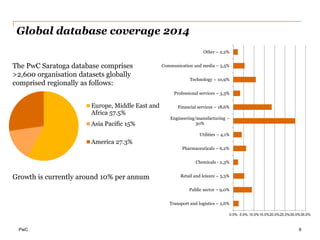
Global database coverage 2014
The PwC Saratoga database comprises
>2,600 organisation datasets globally
comprised regionally as follows:
Growth is currently around 10% per annum
Europe, Middle East and
Africa 57.5%
Asia Pacific 15%
America 27.3%
0.0% 5.0% 10.0%15.0%20.0%25.0%30.0%35.0%
Transport and logistics – 2,6%
Public sector – 9,0%
Retail and leisure – 5,3%
Chemicals - 2,3%
Pharmaceuticals – 6,2%
Utilities – 4,1%
Engineering/manufacturing –
30%
Financial services – 18,6%
Professional services – 3,3%
Technology – 10,9%
Communication and media – 5,5%
Other – 2,2%
PwC
PwC Saratoga’s global coverage
Asia Pacific
Australia
China
Hong Kong
India
Japan
South Korea
New Zealand
Taiwan
Thailand
Singapore
South America
Argentina
Bolivia
Chile
Colombia
Ecuador
Peru
Uruguay
North America
Canada
US
CEE
Bulgaria
Czech Rep.
Hungary
Kazakhstan
Poland
Romania
Russia
Serbia
Slovakia
Turkey
Middle East
Kuwait
Qatar
Saudi Arabia
UAE
EMEA
Belgium Greece South Africa
Denmark Ireland Spain
Finland Italy Sweden
France Netherlands Switzerland
Germany Portugal UK
Central America
Costa Rica
Guatemala
El Salvador
Mexico
Nicaragua
Panama
7
PwC 8
Saratoga provides the HR benchmarking in three
aspects
INPUT OUTPUT
HR Measurement
Financial impact and
productivity
•Revenue per FTE
•Cost per FTE
•Profit per FTE
•Remuneration/Revenue
•Remuneration/Total Costs
•Average remuneration
•Human Capital ROI
•…….
•…….
HR Delivery
Measurement
Bringing in the right people
•Recruitment rate
•Cost per hire
•Acceptance rate , etc.
Developing people
•L&D investment per FTE
•L&D hours per FTE, etc.
Rewarding people
•Average compensation
•Average benefits
•Benefits/Compensation, etc.
Losing people
•Absence rate
•Termination rate
•Involuntary term. rate, etc.
People Productivity
and financial impact
Human Capital Impact
•Productivity
•Financial impact
Human Capital
Engagement
Compensation & benefits
Absence
Turnover
L&D
Talent & succession
Performance management
Organisation Structure
HR function
Resourcing
Employee relations
Workforce structure
PwC
PwC Saratoga metric benchmarking input
questionnaire
Page 9
PwC
Sample output: Scorecard analysis
Page 10
Turnover Your Metrics Sample Percentiles Sample Europe Percentiles Europe
2002 2003 2004 25th 50th 75th Rank 25th 50th 75th Rank
Resignation Rate (%) 6.4 6.6 7.3 4.9 5.8 7.1 78 3.9 8.1 14.1 44
Metric and Unit of
Measurement
Quartile data for your
bespoke sample
Quartile data for the full
European database
Your Metric results,
including trend periods
Your Percentile Rank position
versus the samples
Turnover Your Metrics Sample Percentiles Sample Europe Percentiles Europe
2002 2003 2004 25th 50th 75th Rank 25th 50th 75th Rank
Resignation Rate (%) 6.4 6.6 7.3 4.9 5.8 7.1 78 3.9 8.1 14.1 44
Metric and Unit of
Measurement
Quartile data for your
bespoke sample
Quartile data for the full
European database
Your Metric results,
including trend periods
Your Percentile Rank position
versus the samples
PwC
Sample output: Key metric profile
Page 11
KEY METRIC PROFILE:
Threshold value to PwC Saratoga
suggested target 'Best' quartile
Your result showing a performance gap
versus the 'Best' quartile threshold
Your result achieves the suggested target
quartile
2.4
4.72.4
1.9 
PwC
Benefits of measurement
For the organisation
• Increases the focus of human capital on the
business agenda
• Produce objective measures of human capital
performance revealing genuine as opposed to
perceived action areas
• Allows target-setting and performance
monitoring
• Reveals better performers and good practice
across business units
• Demonstrates your competitive market position
and versus external ‘best’ practice
• Contributing to business-aligned management
reporting
• Challenging existing practice - kicking
complacency
• Hard feedback - raises questions and provokes
debate
For HR
• Improving HR-business strategy alignment
• Helps define evidence-based human capital
strategy and HR programmes
• Clarifying HR and human capital priorities
• Provides business-case evidence for changes in
HR/HC policy and practices
• Helps HR understand its own structure and
performance e.g. functional best practice,
identifying cost savings, efficiency gains and
service improvements
• Raises the profile of HR
• Aids communication with Board members and
other senior business colleagues
Page 12
PwC
Examples of how clients used our benchmarks
• To develop a portfolio of people and HR measures that aligned with business and
people strategy;
• Improve reporting standards and processes;
• Support business cases for technology investment, process improvement, headcount
reduction and identify potential saving;
• Identify characteristics of ‘best practice’ HR processes in order to build ‘best in class’
HR function;
• Develop a baseline of current performance of the HR function prior to undergoing a
transformation programme to improve the efficiency levels of HR service delivery;
• Compare the performance and cost of HR operations across different regions;
• Compare current performance with other best practice functions operating the same
model (i.e. HR Shared Service), identify potential cost savings that could be achieved
within the function, whilst maintaining a high standard of service.
Page 13
PwC
Plan for Mongolia
Page 14
Preparation
stage:
• Registration of
participants
Filling in
questionnaires by
the participants:
• Collection of data
electronically
• Assistance from PwC
experts
Data collection
and analysis:
• Participants submit
the data and we run
the data validation
Report
preparation:
• Access to the reports
for participants is
provided
April 2015 May 2015 June 2015 July 2015
• First time launch in Mongolia
• Work with HRS experts from PwC
• Launch the Saratoga survey with the PayWell Salary Survey
PwC
www.pwc.com
This document has been prepared for the intended recipients only. To the extent
permitted by law, PricewaterhouseCoopers Tax TMZ LLC does not accept or assume
any liability, responsibility or duty of care for any use of or reliance on this document
by anyone, other than (i) the intended recipient to the extent agreed in the relevant
contract for the matter to which this document relates (if any), or (ii) as expressly
agreed by PricewaterhouseCoopers LLP at its sole discretion in writing in advance.
© 2015 PricewaterhouseCoopers Tax TMZ LLC. All rights reserved.
'PricewaterhouseCoopers' refers to PricewaterhouseCoopers LLP (a limited liability
partnership in the United Kingdom) or, as the context requires, other member firms of
PricewaterhouseCoopers International Limited, each of which is a separate and
independent legal entity.

30.03.2015 Measuring Human Capital Workforce Efficiency, Matthew Pottle

  • 1.
  • 2.
    PwC Our business: The MEASUREMENT, BENCHMARKINGand STRATEGIC APPLICATION of human capital information “Bringing objectivity and business alignment to human capital activities” Page 2
  • 3.
    PwC Effectiveness of theHR function is a key issue …what the world’s CEOs are saying? 3 37%believe the global economy will improve over the coming 12 months, compared with 44% in 2014 72%are concerned about the availability of key skills 71%plan to implement a cost reduction activity 46%use data analytics to get insight into how effectively skills are being deployed within the organisation 81%are seeking broader range of skills Source: PwC 18th Annual Global CEO Survey (2015) 50%plan to increase headcount in 2015 Mongolian CEO’s: 62% plan to implement cost reduction activity 51% will increase headcount 85% find difficulty in recruiting and retention of high-potential middle managers 42% have plans in implementing use of data and data analytics
  • 4.
    PwC C-suite is increasing focuson human capital HR is being challenged to answer more complex questions such as … How do we compare with the competition and the ‘best’? Is our business sustainable - are we future-proof? Are we attracting and developing talent? What is the impact of our talent strategy? Do we have good leaders … are our people with us? Is our HR function and HR shared services effective? How do our HR policies impact business performance? "We need to improve our analysis to help the business drive the top-line.” “The key improvement that is needed is faster information, with more depth of analysis comparing us to the outside world.” “Regular management reports are often late. There is a great deal of unnecessary detail, and even I can frequently find errors.” “There is very little insight provided, and little value-add. If I ask for comment or pose questions, they are answered reactively, but pro-active commentary is lacking.” … but they question HR’s ability to respond Page 4
  • 5.
    PwC PwC Saratoga • Atool to bring an objective evidence-base to managing people in organizations. • More than 30 years of experience in Human Capital effectiveness measurement. • More than 16,000 organisations from various industry sectors around the world. Saratoga works with 40% of the FTSE 100 and the Fortune 500. • Constantly updated methodology. The results of HR Benchmarking will provide you with the following information:  What is the human capital return on investment for each full-time employee (i.e. how much do you get back for every dollar you invest in your people)?  How much money does each full-time employee make for the company?  Are learning and development costs effective?  What is staff turnover and absenteeism costing your organisation annually?  Can you reduce recruitment costs?  How efficient is the compensation package structure in your organisation?  How effective is the structure of your HR department? 5
  • 6.
    PwC 6 Global databasecoverage 2014 The PwC Saratoga database comprises >2,600 organisation datasets globally comprised regionally as follows: Growth is currently around 10% per annum Europe, Middle East and Africa 57.5% Asia Pacific 15% America 27.3% 0.0% 5.0% 10.0%15.0%20.0%25.0%30.0%35.0% Transport and logistics – 2,6% Public sector – 9,0% Retail and leisure – 5,3% Chemicals - 2,3% Pharmaceuticals – 6,2% Utilities – 4,1% Engineering/manufacturing – 30% Financial services – 18,6% Professional services – 3,3% Technology – 10,9% Communication and media – 5,5% Other – 2,2%
  • 7.
    PwC PwC Saratoga’s globalcoverage Asia Pacific Australia China Hong Kong India Japan South Korea New Zealand Taiwan Thailand Singapore South America Argentina Bolivia Chile Colombia Ecuador Peru Uruguay North America Canada US CEE Bulgaria Czech Rep. Hungary Kazakhstan Poland Romania Russia Serbia Slovakia Turkey Middle East Kuwait Qatar Saudi Arabia UAE EMEA Belgium Greece South Africa Denmark Ireland Spain Finland Italy Sweden France Netherlands Switzerland Germany Portugal UK Central America Costa Rica Guatemala El Salvador Mexico Nicaragua Panama 7
  • 8.
    PwC 8 Saratoga providesthe HR benchmarking in three aspects INPUT OUTPUT HR Measurement Financial impact and productivity •Revenue per FTE •Cost per FTE •Profit per FTE •Remuneration/Revenue •Remuneration/Total Costs •Average remuneration •Human Capital ROI •……. •……. HR Delivery Measurement Bringing in the right people •Recruitment rate •Cost per hire •Acceptance rate , etc. Developing people •L&D investment per FTE •L&D hours per FTE, etc. Rewarding people •Average compensation •Average benefits •Benefits/Compensation, etc. Losing people •Absence rate •Termination rate •Involuntary term. rate, etc. People Productivity and financial impact Human Capital Impact •Productivity •Financial impact Human Capital Engagement Compensation & benefits Absence Turnover L&D Talent & succession Performance management Organisation Structure HR function Resourcing Employee relations Workforce structure
  • 9.
    PwC PwC Saratoga metricbenchmarking input questionnaire Page 9
  • 10.
    PwC Sample output: Scorecardanalysis Page 10 Turnover Your Metrics Sample Percentiles Sample Europe Percentiles Europe 2002 2003 2004 25th 50th 75th Rank 25th 50th 75th Rank Resignation Rate (%) 6.4 6.6 7.3 4.9 5.8 7.1 78 3.9 8.1 14.1 44 Metric and Unit of Measurement Quartile data for your bespoke sample Quartile data for the full European database Your Metric results, including trend periods Your Percentile Rank position versus the samples Turnover Your Metrics Sample Percentiles Sample Europe Percentiles Europe 2002 2003 2004 25th 50th 75th Rank 25th 50th 75th Rank Resignation Rate (%) 6.4 6.6 7.3 4.9 5.8 7.1 78 3.9 8.1 14.1 44 Metric and Unit of Measurement Quartile data for your bespoke sample Quartile data for the full European database Your Metric results, including trend periods Your Percentile Rank position versus the samples
  • 11.
    PwC Sample output: Keymetric profile Page 11 KEY METRIC PROFILE: Threshold value to PwC Saratoga suggested target 'Best' quartile Your result showing a performance gap versus the 'Best' quartile threshold Your result achieves the suggested target quartile 2.4 4.72.4 1.9 
  • 12.
    PwC Benefits of measurement Forthe organisation • Increases the focus of human capital on the business agenda • Produce objective measures of human capital performance revealing genuine as opposed to perceived action areas • Allows target-setting and performance monitoring • Reveals better performers and good practice across business units • Demonstrates your competitive market position and versus external ‘best’ practice • Contributing to business-aligned management reporting • Challenging existing practice - kicking complacency • Hard feedback - raises questions and provokes debate For HR • Improving HR-business strategy alignment • Helps define evidence-based human capital strategy and HR programmes • Clarifying HR and human capital priorities • Provides business-case evidence for changes in HR/HC policy and practices • Helps HR understand its own structure and performance e.g. functional best practice, identifying cost savings, efficiency gains and service improvements • Raises the profile of HR • Aids communication with Board members and other senior business colleagues Page 12
  • 13.
    PwC Examples of howclients used our benchmarks • To develop a portfolio of people and HR measures that aligned with business and people strategy; • Improve reporting standards and processes; • Support business cases for technology investment, process improvement, headcount reduction and identify potential saving; • Identify characteristics of ‘best practice’ HR processes in order to build ‘best in class’ HR function; • Develop a baseline of current performance of the HR function prior to undergoing a transformation programme to improve the efficiency levels of HR service delivery; • Compare the performance and cost of HR operations across different regions; • Compare current performance with other best practice functions operating the same model (i.e. HR Shared Service), identify potential cost savings that could be achieved within the function, whilst maintaining a high standard of service. Page 13
  • 14.
    PwC Plan for Mongolia Page14 Preparation stage: • Registration of participants Filling in questionnaires by the participants: • Collection of data electronically • Assistance from PwC experts Data collection and analysis: • Participants submit the data and we run the data validation Report preparation: • Access to the reports for participants is provided April 2015 May 2015 June 2015 July 2015 • First time launch in Mongolia • Work with HRS experts from PwC • Launch the Saratoga survey with the PayWell Salary Survey
  • 15.
    PwC www.pwc.com This document hasbeen prepared for the intended recipients only. To the extent permitted by law, PricewaterhouseCoopers Tax TMZ LLC does not accept or assume any liability, responsibility or duty of care for any use of or reliance on this document by anyone, other than (i) the intended recipient to the extent agreed in the relevant contract for the matter to which this document relates (if any), or (ii) as expressly agreed by PricewaterhouseCoopers LLP at its sole discretion in writing in advance. © 2015 PricewaterhouseCoopers Tax TMZ LLC. All rights reserved. 'PricewaterhouseCoopers' refers to PricewaterhouseCoopers LLP (a limited liability partnership in the United Kingdom) or, as the context requires, other member firms of PricewaterhouseCoopers International Limited, each of which is a separate and independent legal entity.