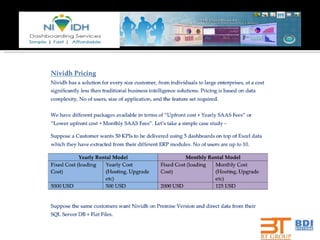
RUDRA NARAYAN PANDEY HCM CONSULTING NIVIDH BUSINESS INTELLIGENCE 919448119930 HTTP://WWW.NIVIDH.COM/BI/ONDEMAND/HRM-BI.JSP RETURN ON INVESTMENT IN HUMAN CAPITAL “ Human Capital Measurement offers a great opportunity for the HR function to take a lead in developing indicators that demonstrate the value that people contribute. Over time, this will form a measurement tool which maps the impact of people management in the organization. The first step for anyone looking to introduce HCM-linked Key Performance Indicators (HCKPIs) is to identify those metrics which are linked to wider business objectives.”
About Us   Nividh  is a simple, fast, affordable enterprise data visualization software solution that provides an alternative to complex and expensive business intelligence software. Nividh delivers Analytics on Web and helps companies drive their business by providing insight and access into critical data, KPIs, and metrics .  Nividh  has been concepted, designed, developed, tested and maintained by a team of best of the breed software professionals who has more than 7+ yrs of BI R&D Experience and 4 years of BI Implementation. IITans form the core of Nividh’s engineering team. Team has skills on all cutting edge technologies, mobile platforms and latest frameworks.  While serving BI customers in last 10 years (some of them are Fortune 500 companies), our core team have served across following Industries:Banking and Financial Services. Life Sciences and Health Care industry. Insurance, Risk and Compliance Manufacturing Retail Education Logistics and Shipping Yoga, Spirituality and Fitness Media & Entertainment Real Estate Having worked in some of the most popular Dashboarding technologies, we are confident that we are providing the best Data Visualization and Dashboarding expertise in a simple, fast & affordable manner through  www.nividh.com . Nividh aims to make Dashboarding affordable for all members in an organization just not only for top management.
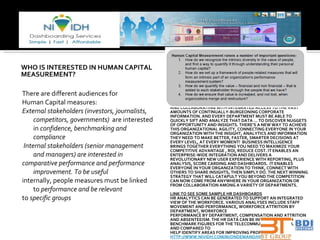
WHO IS INTERESTED IN HUMAN CAPITAL MEASUREMENT? There are different audiences for Human Capital measures: External stakeholders (investors, journalists, competitors, governments)  are interested in  confidence, benchmarking and compliance Internal stakeholders (senior management and managers) are interested in  comparative performance and performance improvement. To be useful internally, people measures must be linked to  performance and be relevant to  specific groups T TO SUCCEED, ALL YOUR DEPARTMENTS HAVE TO BE CONNECTED AND COLLABORATING WITH INTEGRATED ACCESS TO THE VAST AMOUNTS OF CONTINUALLY-BURGEONING CORPORATE INFORMATION. AND EVERY DEPARTMENT MUST BE ABLE TO QUICKLY SIFT AND ANALYZE THAT DATA … TO DISCOVER NUGGETS OF OPPORTUNITY AND INSIGHTS. THERE’S A NEW WAY TO ACHIEVE THIS ORGANIZATIONAL AGILITY, CONNECTING EVERYONE IN YOUR ORGANIZATION WITH THE INSIGHT, ANALYTICS AND INFORMATION THEY NEED TO MAKE BETTER, FASTER, SMARTER DECISIONS AT EVERY LEVEL, AT EVERY MOMENT!  BUSINESS INTELLIGENCE BRINGS TOGETHER EVERYTHING YOU NEED TO MAXIMIZE YOUR COMPETITIVE ADVANTAGE , ROI, REDUCE COST. IT ENABLES AN ENTERPRISE-WIDE INTEGRATION AND DELIVERS A REVOLUTIONARY NEW USER EXPERIENCE WITH REPORTING, PLUS ANALYSIS, SCORE CARDING AND DASHBOARDS.  IT ENABLES EVERYONE IN YOUR ORGANIZATION TO THINK, CONNECT WITH OTHERS TO SHARE INSIGHTS, THEN SIMPLY DO. THE NEXT WINNING STRATEGY THAT WILL CATAPULT YOU BEYOND THE COMPETITION CAN NOW COME FROM ANYWHERE IN YOUR ORGANIZATION OR FROM COLLABORATION AMONG A VARIETY OF DEPARTMENTS.   LINK TO SEE SOME SAMPLE HR DASHBOARDS   HR ANALYTICS CAN BE GENERATED TO SUPPORT AN INTEGRATED VIEW OF THE WORKFORCE. VARIOUS ANALYSES INCLUDE STAFF MOVEMENT AND PERFORMANCE, WORKFORCE ATTRITION BY DEPARTMENT, WORKFORCE  PERFORMANCE BY DEPARTMENT, COMPENSATION AND ATTRITION AND ABSENTEEISM. THE HR DATA CAN BE INTEGRATED WITH BENCHMARK FIGURES FOR THE TELECOMMUNICATIONS INDUSTRY AND COMPARED TO  HELP IDENTIFY AREAS FOR IMPROVING PROFITABILITY HTTP://WWW.NIVIDH.COM/BI/ONDEMAND/HRM-BI.JSP
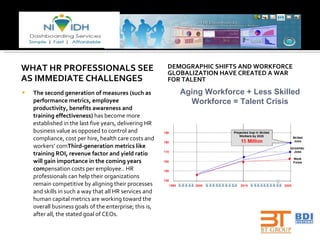
WHAT HR PROFESSIONALS SEE AS IMMEDIATE CHALLENGES The second generation of measures (such as performance metrics, employee productivity, benefits awareness and training effectiveness)  has become more established in the last five years, delivering HR business value as opposed to control and compliance, cost per hire, health care costs and workers’ com Third-generation metrics like training ROI, revenue factor and yield ratio will gain importance in the coming years com pensation costs per employee.. HR professionals can help their organizations remain competitive by aligning their processes and skills in such a way that all HR services and human capital metrics are working toward the overall business goals of the enterprise; this is, after all, the stated goal of CEOs. DEMOGRAPHIC SHIFTS AND WORKFORCE GLOBALIZATION HAVE CREATED A WAR FOR TALENT Aging Workforce + Less Skilled Workforce = Talent Crisis
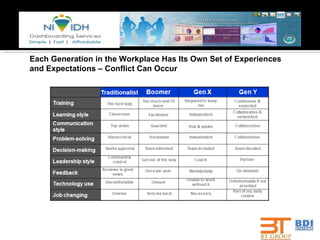
Each Generation in the Workplace Has Its Own Set of Experiences and Expectations – Conflict Can Occur
Executives Are Demanding Answers to Key Questions CEOs (Chancellors) are asking: What workforce segments create most value? How will business (institutions) be impacted by impending retirement and are we prepared? Where is talent demand outpacing supply? What skills will we need in next 5 years that we don’t have today? Turnover?  How much is it costing in lost enrollment? In productivity? In innovation? In quality? Do we have a workforce plan to communicate financial consequences of talent decisions on our business?
 
HCM ANALYTICS To effectively drive an organization’s workforce, provide accurate and timely guidance on corporate strategic initiatives in support of business growth and even to justify the value of the team’s very existence, HR must have a solid handle on its knowledge capital (i.e., data). It is imperative for HR professionals to think strategically, input the right value–add information and use the results as effectively as possible. It may seem obvious to HR professionals, but they can still have a fight on their hands for recognition at the board level. When money is tight, sales directors can show how they’ve boosted the pipeline; the procurement team can calculate how much they’ve saved by squeezing suppliers —  what can HR do? The answer is Human Capital Management analytics. PUTTING ANALYTICS IN PLACE
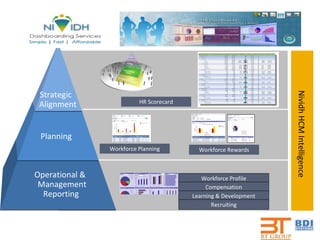
Operational & Management Reporting   Strategic Alignment Planning Nividh HCM Intelligence Workforce Planning Workforce Rewards Workforce Profile Compensation Learning & Development Recruiting HR Scorecard
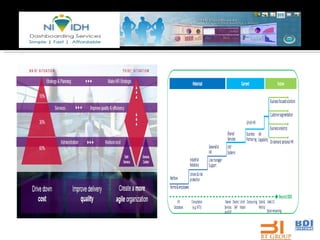
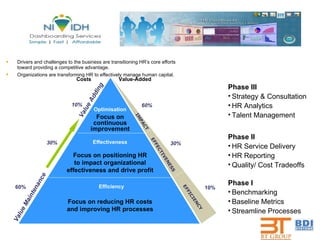
Drivers and challenges to the business are transitioning HR’s core efforts toward providing a competitive advantage. Organizations are transforming HR to effectively manage human capital. Value Maintenance Value Adding Optimisation Focus on continuous improvement Effectiveness Efficiency Costs 10% 30% 60% Focus on positioning HR to impact organizational effectiveness and drive profit Focus on reducing HR costs and improving HR processes Phase I Benchmarking Baseline Metrics Streamline Processes Phase III Strategy & Consultation HR Analytics Talent Management Phase II HR  Service Delivery HR  Reporting Quality/  C ost Tradeoffs EFFICIENCY EFFECTIVENESS IMPACT 60% 30% 10% Value-Added
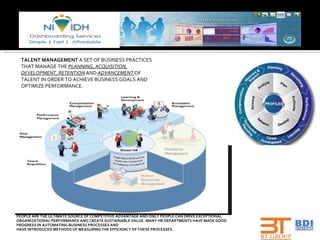
TALENT MANAGEMENT  A SET OF BUSINESS PRACTICES THAT MANAGE THE  PLANNING, ACQUISITION, DEVELOPMENT, RETENTION  AND  ADVANCEMENT  OF TALENT IN ORDER TO ACHIEVE BUSINESS GOALS AND OPTIMIZE PERFORMANCE. PEOPLE ARE THE ULTIMATE SOURCE OF COMPETITIVE ADVANTAGE AND ONLY PEOPLE CAN DRIVE EXCEPTIONAL ORGANIZATIONAL PERFORMANCE AND CREATE SUSTAINABLE VALUE. MANY HR DEPARTMENTS HAVE MADE GOOD PROGRESS IN AUTOMATING BUSINESS PROCESSES AND HAVE INTRODUCED METHODS OF MEASURING THE EFFICIENCY OF THESE PROCESSES.
 
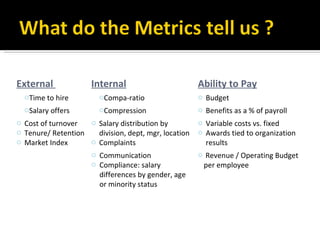
External  Internal Ability to Pay Time to hire Compa-ratio Budget Salary offers Compression Benefits as a % of payroll Cost of turnover  Tenure/ Retention Market Index Salary distribution by division, dept, mgr, location Complaints Variable costs vs. fixed Awards tied to organization  results Communication Compliance: salary differences by gender, age or minority status Revenue / Operating Budget per employee
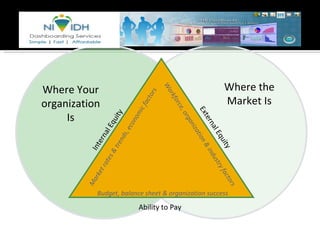
External Equity Internal Equity Ability to Pay Market rates & trends, economic factors Workforce, organization & industry factors Budget, balance sheet & organization success Where Your organization Is Where the Market Is
MEASURES  MONITOR  PLAN  OUTCOMES    Completion, attendance ratios Program, certification expenses Activity profitability Performance outcome ratios Satisfaction ratings ... ROI per employee Headcount cost Headcount variance  Requisition fulfillment cycle time Termination cost per employee Termination cost Turnover rate Absence rate Accident rate Exposure hours Accept ratio Agency effectiveness Cost to hire Vacation days balance Vacation days entitlement Performance review result Contribution factor Maintained qualification count Review result Scarcity level Succession percentage Training % of revenue … . Annual compensation Benefit plan enrollment  Compensation % increase  Increase Variance ]Customer service award variance Dependant count Employee, Employer contribution Employee opt out ratio  Incentive award Hourly pay rate  … . Absence days count Accident Severity Rate Accident Lost time Rate High Performance ratio Low Performance ratio Employee Development cost  Development cost per employee High Performance turnover rate Incentive Pool variance Benefit cost per employee Merit Pool Variance increase variance count termination rate FTE count  Human capital ROI Time to hire Turnover rate .... Headcount, Planning Compensation & Salary  Planning  Improve  Growth  and  Profitability Headcount & Turnover  Compensation, Incentive Performance,  Succession Recruiting , Absence &  Accident Analysis Learning Management Benefits Planning Restructuring planning  Payroll &  Reconciliation Analysis Payroll Liability Planning  Recruitment Planning Trained, certified  headcount Investment factors Training cost factors Revenue/expense ratios
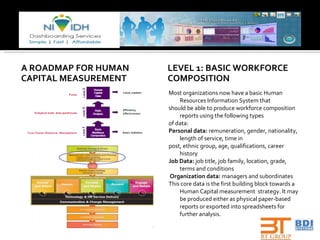
A ROADMAP FOR HUMAN CAPITAL MEASUREMENT LEVEL 1: BASIC WORKFORCE COMPOSITION Most organizations now have a basic Human Resources Information System that should be able to produce workforce composition reports using the following types of data: Personal data:  remuneration, gender, nationality, length of service, time in post, ethnic group, age, qualifications, career history Job Data:  job title, job family, location, grade, terms and conditions Organization data:  managers and subordinates This core data is the first building block towards a Human Capital measurement  strategy. It may be produced either as physical paper-based reports or exported into spreadsheets for further analysis.
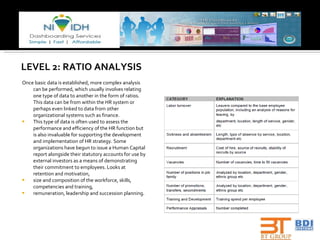
LEVEL 2: RATIO ANALYSIS Once basic data is established, more complex analysis can be performed, which usually involves relating one type of data to another in the form of ratios. This data can be from within the HR system or perhaps even linked to data from other organizational systems such as finance.  This type of data is often used to assess the performance and efficiency of the HR function but is also invaluable for supporting the development and implementation of HR strategy. Some organizations have begun to issue a Human Capital report alongside their statutory accounts for use by external investors as a means of demonstrating their commitment to employees. Looks at retention and motivation, size and composition of the workforce, skills, competencies and training, remuneration, leadership and succession planning.
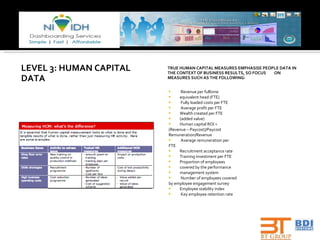
LEVEL 3: HUMAN CAPITAL DATA TRUE HUMAN CAPITAL MEASURES EMPHASISE PEOPLE DATA IN THE CONTEXT OF BUSINESS RESULTS, SO FOCUS  ON MEASURES SUCH AS THE FOLLOWING: Revenue per fulltime equivalent head (FTE) Fully loaded costs per FTE Average profit per FTE Wealth created per FTE (added value) Human capital ROI = (Revenue – Paycost)/Paycost Remuneration/Revenue Average remuneration per FTE Recruitment acceptance rate Training investment per FTE Proportion of employees covered by the performance management system Number of employees covered by employee engagement survey Employee stability index Key employee retention rate
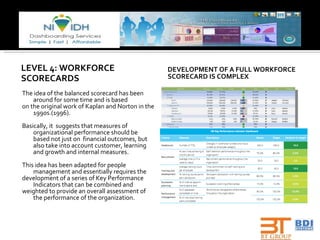
LEVEL 4: WORKFORCE SCORECARDS The idea of the balanced scorecard has been around for some time and is based on the original work of Kaplan and Norton in the 1990s.(1996).  Basically, it  suggests that measures of organizational performance should be based not just on  financial outcomes, but also take into account customer, learning and growth and internal measures. This idea has been adapted for people management and essentially requires the development of a series of Key Performance Indicators that can be combined and weighted to provide an overall assessment of the performance of the organization. DEVELOPMENT OF A FULL WORKFORCE SCORECARD IS COMPLEX
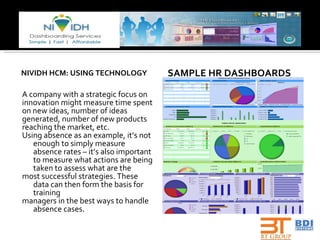
NIVIDH HCM: USING TECHNOLOGY A company with a strategic focus on innovation might measure time spent on new ideas, number of ideas generated, number of new products reaching the market, etc. Using absence as an example, it’s not enough to simply measure absence rates – it’s also important to measure what actions are being taken to assess what are the most successful strategies. These data can then form the basis for training managers in the best ways to handle absence cases.  SAMPLE HR DASHBOARDS
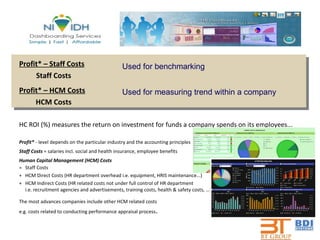
Profit* – Staff Costs   Staff Costs Profit* – HCM Costs HCM Costs HC ROI (%) measures the return on investment for funds a company spends on its employees... Profit*  - level depends on the particular industry and the accounting principles Staff Costs  = salaries incl. social and health insurance, employee benefits Human Capital Management (HCM) Costs = Staff Costs + HCM Direct Costs (HR department overhead i.e. equipment, HRIS maintenance...) + HCM Indirect Costs (HR related costs not under full control of HR department i.e. recruitment agencies and advertisements, training costs, health & safety costs, ...) The most advances companies include other HCM related costs e.g. costs related to conducting performance appraisal process . Used for benchmarking Used for measuring trend within a company
 
Lessons learned from measuring Human Capital Measure the right things it‘s easy to measure the wrong things ;  just because we can count something, doesn‘t mean that it counts companies frequently measure time and cost because it is easy to get these data; it‘s harder to develop measures for such meaningful criteria as quality, results and value Choose fewer things to measure but do a better job the tendency is: if it moves, measure it, because someone, somewhere, someday might want to know the number; the result is data paralysis and confusion the art of metrics is to focus on a core set of meaningful things Move beyond summary data a statistic like „our turnover rate is 9 % “ is useful to compare with competitors, but it could be more useful if, e.g. it looks at turnover by talent level, department, or by manager averages can mask significant variations; segment data to look for more specific things It‘s  about  what you do with the data metrics are only valuable if they result in better decisions gathering data that isn‘t used is a waste of everyone‘s time and patience Increased Need for measuring  HC ROI Through Nividh Competitive pressures on costs and productivity are increasing Top executives are requiring ROI information HR budgets are under increasing review Accountability in all functions is increasing Technology makes acquiring information easier
 
“ Talent management of more senior workforce contributors to ensure organizations organically grow future workers with similar work ethics, values, morals, culture and passionate contribution. HR metrics tools must measure employee value and contribution towards the businesses success so future workers can be measured against such a standard of success.” “ I believe that as HR metrics become standardized, business intelligence models currently applied primarily in marketing, customer service and finance will begin to find their way into the HR department and the HRMS data repository. That information will then be pushed out to line managers in the form of dashboards and scorecards, which will assist in the overall health and development of the Organisation” Sales – Vipul Sharma  +91-9483-265110         [email_address] ,  [email_address] [email_address] COST SAVINGS: Moving to a service center approach shows the strongest streamlining and cost savings Evaluate the potential for hosted services FUTURE:  Specifically focus on talent management Educate yourselves on analytics Focus on improving the user experience

Nividh Hcm BI

  • 1.
    RUDRA NARAYAN PANDEYHCM CONSULTING NIVIDH BUSINESS INTELLIGENCE 919448119930 HTTP://WWW.NIVIDH.COM/BI/ONDEMAND/HRM-BI.JSP RETURN ON INVESTMENT IN HUMAN CAPITAL “ Human Capital Measurement offers a great opportunity for the HR function to take a lead in developing indicators that demonstrate the value that people contribute. Over time, this will form a measurement tool which maps the impact of people management in the organization. The first step for anyone looking to introduce HCM-linked Key Performance Indicators (HCKPIs) is to identify those metrics which are linked to wider business objectives.”
  • 2.
    About Us  Nividh  is a simple, fast, affordable enterprise data visualization software solution that provides an alternative to complex and expensive business intelligence software. Nividh delivers Analytics on Web and helps companies drive their business by providing insight and access into critical data, KPIs, and metrics .  Nividh  has been concepted, designed, developed, tested and maintained by a team of best of the breed software professionals who has more than 7+ yrs of BI R&D Experience and 4 years of BI Implementation. IITans form the core of Nividh’s engineering team. Team has skills on all cutting edge technologies, mobile platforms and latest frameworks.  While serving BI customers in last 10 years (some of them are Fortune 500 companies), our core team have served across following Industries:Banking and Financial Services. Life Sciences and Health Care industry. Insurance, Risk and Compliance Manufacturing Retail Education Logistics and Shipping Yoga, Spirituality and Fitness Media & Entertainment Real Estate Having worked in some of the most popular Dashboarding technologies, we are confident that we are providing the best Data Visualization and Dashboarding expertise in a simple, fast & affordable manner through  www.nividh.com . Nividh aims to make Dashboarding affordable for all members in an organization just not only for top management.
  • 3.
    WHO IS INTERESTEDIN HUMAN CAPITAL MEASUREMENT? There are different audiences for Human Capital measures: External stakeholders (investors, journalists, competitors, governments) are interested in confidence, benchmarking and compliance Internal stakeholders (senior management and managers) are interested in comparative performance and performance improvement. To be useful internally, people measures must be linked to performance and be relevant to specific groups T TO SUCCEED, ALL YOUR DEPARTMENTS HAVE TO BE CONNECTED AND COLLABORATING WITH INTEGRATED ACCESS TO THE VAST AMOUNTS OF CONTINUALLY-BURGEONING CORPORATE INFORMATION. AND EVERY DEPARTMENT MUST BE ABLE TO QUICKLY SIFT AND ANALYZE THAT DATA … TO DISCOVER NUGGETS OF OPPORTUNITY AND INSIGHTS. THERE’S A NEW WAY TO ACHIEVE THIS ORGANIZATIONAL AGILITY, CONNECTING EVERYONE IN YOUR ORGANIZATION WITH THE INSIGHT, ANALYTICS AND INFORMATION THEY NEED TO MAKE BETTER, FASTER, SMARTER DECISIONS AT EVERY LEVEL, AT EVERY MOMENT!  BUSINESS INTELLIGENCE BRINGS TOGETHER EVERYTHING YOU NEED TO MAXIMIZE YOUR COMPETITIVE ADVANTAGE , ROI, REDUCE COST. IT ENABLES AN ENTERPRISE-WIDE INTEGRATION AND DELIVERS A REVOLUTIONARY NEW USER EXPERIENCE WITH REPORTING, PLUS ANALYSIS, SCORE CARDING AND DASHBOARDS.  IT ENABLES EVERYONE IN YOUR ORGANIZATION TO THINK, CONNECT WITH OTHERS TO SHARE INSIGHTS, THEN SIMPLY DO. THE NEXT WINNING STRATEGY THAT WILL CATAPULT YOU BEYOND THE COMPETITION CAN NOW COME FROM ANYWHERE IN YOUR ORGANIZATION OR FROM COLLABORATION AMONG A VARIETY OF DEPARTMENTS.   LINK TO SEE SOME SAMPLE HR DASHBOARDS HR ANALYTICS CAN BE GENERATED TO SUPPORT AN INTEGRATED VIEW OF THE WORKFORCE. VARIOUS ANALYSES INCLUDE STAFF MOVEMENT AND PERFORMANCE, WORKFORCE ATTRITION BY DEPARTMENT, WORKFORCE PERFORMANCE BY DEPARTMENT, COMPENSATION AND ATTRITION AND ABSENTEEISM. THE HR DATA CAN BE INTEGRATED WITH BENCHMARK FIGURES FOR THE TELECOMMUNICATIONS INDUSTRY AND COMPARED TO HELP IDENTIFY AREAS FOR IMPROVING PROFITABILITY HTTP://WWW.NIVIDH.COM/BI/ONDEMAND/HRM-BI.JSP
  • 4.
    WHAT HR PROFESSIONALSSEE AS IMMEDIATE CHALLENGES The second generation of measures (such as performance metrics, employee productivity, benefits awareness and training effectiveness) has become more established in the last five years, delivering HR business value as opposed to control and compliance, cost per hire, health care costs and workers’ com Third-generation metrics like training ROI, revenue factor and yield ratio will gain importance in the coming years com pensation costs per employee.. HR professionals can help their organizations remain competitive by aligning their processes and skills in such a way that all HR services and human capital metrics are working toward the overall business goals of the enterprise; this is, after all, the stated goal of CEOs. DEMOGRAPHIC SHIFTS AND WORKFORCE GLOBALIZATION HAVE CREATED A WAR FOR TALENT Aging Workforce + Less Skilled Workforce = Talent Crisis
  • 5.
    Each Generation inthe Workplace Has Its Own Set of Experiences and Expectations – Conflict Can Occur
  • 6.
    Executives Are DemandingAnswers to Key Questions CEOs (Chancellors) are asking: What workforce segments create most value? How will business (institutions) be impacted by impending retirement and are we prepared? Where is talent demand outpacing supply? What skills will we need in next 5 years that we don’t have today? Turnover? How much is it costing in lost enrollment? In productivity? In innovation? In quality? Do we have a workforce plan to communicate financial consequences of talent decisions on our business?
  • 7.
  • 8.
    HCM ANALYTICS Toeffectively drive an organization’s workforce, provide accurate and timely guidance on corporate strategic initiatives in support of business growth and even to justify the value of the team’s very existence, HR must have a solid handle on its knowledge capital (i.e., data). It is imperative for HR professionals to think strategically, input the right value–add information and use the results as effectively as possible. It may seem obvious to HR professionals, but they can still have a fight on their hands for recognition at the board level. When money is tight, sales directors can show how they’ve boosted the pipeline; the procurement team can calculate how much they’ve saved by squeezing suppliers — what can HR do? The answer is Human Capital Management analytics. PUTTING ANALYTICS IN PLACE
  • 9.
    Operational & ManagementReporting Strategic Alignment Planning Nividh HCM Intelligence Workforce Planning Workforce Rewards Workforce Profile Compensation Learning & Development Recruiting HR Scorecard
  • 10.
    Drivers and challengesto the business are transitioning HR’s core efforts toward providing a competitive advantage. Organizations are transforming HR to effectively manage human capital. Value Maintenance Value Adding Optimisation Focus on continuous improvement Effectiveness Efficiency Costs 10% 30% 60% Focus on positioning HR to impact organizational effectiveness and drive profit Focus on reducing HR costs and improving HR processes Phase I Benchmarking Baseline Metrics Streamline Processes Phase III Strategy & Consultation HR Analytics Talent Management Phase II HR Service Delivery HR Reporting Quality/ C ost Tradeoffs EFFICIENCY EFFECTIVENESS IMPACT 60% 30% 10% Value-Added
  • 11.
    TALENT MANAGEMENT A SET OF BUSINESS PRACTICES THAT MANAGE THE PLANNING, ACQUISITION, DEVELOPMENT, RETENTION AND ADVANCEMENT OF TALENT IN ORDER TO ACHIEVE BUSINESS GOALS AND OPTIMIZE PERFORMANCE. PEOPLE ARE THE ULTIMATE SOURCE OF COMPETITIVE ADVANTAGE AND ONLY PEOPLE CAN DRIVE EXCEPTIONAL ORGANIZATIONAL PERFORMANCE AND CREATE SUSTAINABLE VALUE. MANY HR DEPARTMENTS HAVE MADE GOOD PROGRESS IN AUTOMATING BUSINESS PROCESSES AND HAVE INTRODUCED METHODS OF MEASURING THE EFFICIENCY OF THESE PROCESSES.
  • 12.
  • 13.
    External InternalAbility to Pay Time to hire Compa-ratio Budget Salary offers Compression Benefits as a % of payroll Cost of turnover Tenure/ Retention Market Index Salary distribution by division, dept, mgr, location Complaints Variable costs vs. fixed Awards tied to organization results Communication Compliance: salary differences by gender, age or minority status Revenue / Operating Budget per employee
  • 14.
    External Equity InternalEquity Ability to Pay Market rates & trends, economic factors Workforce, organization & industry factors Budget, balance sheet & organization success Where Your organization Is Where the Market Is
  • 15.
    MEASURES MONITOR PLAN OUTCOMES Completion, attendance ratios Program, certification expenses Activity profitability Performance outcome ratios Satisfaction ratings ... ROI per employee Headcount cost Headcount variance Requisition fulfillment cycle time Termination cost per employee Termination cost Turnover rate Absence rate Accident rate Exposure hours Accept ratio Agency effectiveness Cost to hire Vacation days balance Vacation days entitlement Performance review result Contribution factor Maintained qualification count Review result Scarcity level Succession percentage Training % of revenue … . Annual compensation Benefit plan enrollment Compensation % increase Increase Variance ]Customer service award variance Dependant count Employee, Employer contribution Employee opt out ratio Incentive award Hourly pay rate … . Absence days count Accident Severity Rate Accident Lost time Rate High Performance ratio Low Performance ratio Employee Development cost Development cost per employee High Performance turnover rate Incentive Pool variance Benefit cost per employee Merit Pool Variance increase variance count termination rate FTE count Human capital ROI Time to hire Turnover rate .... Headcount, Planning Compensation & Salary Planning Improve Growth and Profitability Headcount & Turnover Compensation, Incentive Performance, Succession Recruiting , Absence & Accident Analysis Learning Management Benefits Planning Restructuring planning Payroll & Reconciliation Analysis Payroll Liability Planning Recruitment Planning Trained, certified headcount Investment factors Training cost factors Revenue/expense ratios
  • 16.
    A ROADMAP FORHUMAN CAPITAL MEASUREMENT LEVEL 1: BASIC WORKFORCE COMPOSITION Most organizations now have a basic Human Resources Information System that should be able to produce workforce composition reports using the following types of data: Personal data: remuneration, gender, nationality, length of service, time in post, ethnic group, age, qualifications, career history Job Data: job title, job family, location, grade, terms and conditions Organization data: managers and subordinates This core data is the first building block towards a Human Capital measurement strategy. It may be produced either as physical paper-based reports or exported into spreadsheets for further analysis.
  • 17.
    LEVEL 2: RATIOANALYSIS Once basic data is established, more complex analysis can be performed, which usually involves relating one type of data to another in the form of ratios. This data can be from within the HR system or perhaps even linked to data from other organizational systems such as finance. This type of data is often used to assess the performance and efficiency of the HR function but is also invaluable for supporting the development and implementation of HR strategy. Some organizations have begun to issue a Human Capital report alongside their statutory accounts for use by external investors as a means of demonstrating their commitment to employees. Looks at retention and motivation, size and composition of the workforce, skills, competencies and training, remuneration, leadership and succession planning.
  • 18.
    LEVEL 3: HUMANCAPITAL DATA TRUE HUMAN CAPITAL MEASURES EMPHASISE PEOPLE DATA IN THE CONTEXT OF BUSINESS RESULTS, SO FOCUS ON MEASURES SUCH AS THE FOLLOWING: Revenue per fulltime equivalent head (FTE) Fully loaded costs per FTE Average profit per FTE Wealth created per FTE (added value) Human capital ROI = (Revenue – Paycost)/Paycost Remuneration/Revenue Average remuneration per FTE Recruitment acceptance rate Training investment per FTE Proportion of employees covered by the performance management system Number of employees covered by employee engagement survey Employee stability index Key employee retention rate
  • 19.
    LEVEL 4: WORKFORCESCORECARDS The idea of the balanced scorecard has been around for some time and is based on the original work of Kaplan and Norton in the 1990s.(1996). Basically, it suggests that measures of organizational performance should be based not just on financial outcomes, but also take into account customer, learning and growth and internal measures. This idea has been adapted for people management and essentially requires the development of a series of Key Performance Indicators that can be combined and weighted to provide an overall assessment of the performance of the organization. DEVELOPMENT OF A FULL WORKFORCE SCORECARD IS COMPLEX
  • 20.
    NIVIDH HCM: USINGTECHNOLOGY A company with a strategic focus on innovation might measure time spent on new ideas, number of ideas generated, number of new products reaching the market, etc. Using absence as an example, it’s not enough to simply measure absence rates – it’s also important to measure what actions are being taken to assess what are the most successful strategies. These data can then form the basis for training managers in the best ways to handle absence cases. SAMPLE HR DASHBOARDS
  • 21.
    Profit* – StaffCosts Staff Costs Profit* – HCM Costs HCM Costs HC ROI (%) measures the return on investment for funds a company spends on its employees... Profit* - level depends on the particular industry and the accounting principles Staff Costs = salaries incl. social and health insurance, employee benefits Human Capital Management (HCM) Costs = Staff Costs + HCM Direct Costs (HR department overhead i.e. equipment, HRIS maintenance...) + HCM Indirect Costs (HR related costs not under full control of HR department i.e. recruitment agencies and advertisements, training costs, health & safety costs, ...) The most advances companies include other HCM related costs e.g. costs related to conducting performance appraisal process . Used for benchmarking Used for measuring trend within a company
  • 22.
  • 23.
    Lessons learned frommeasuring Human Capital Measure the right things it‘s easy to measure the wrong things ; just because we can count something, doesn‘t mean that it counts companies frequently measure time and cost because it is easy to get these data; it‘s harder to develop measures for such meaningful criteria as quality, results and value Choose fewer things to measure but do a better job the tendency is: if it moves, measure it, because someone, somewhere, someday might want to know the number; the result is data paralysis and confusion the art of metrics is to focus on a core set of meaningful things Move beyond summary data a statistic like „our turnover rate is 9 % “ is useful to compare with competitors, but it could be more useful if, e.g. it looks at turnover by talent level, department, or by manager averages can mask significant variations; segment data to look for more specific things It‘s about what you do with the data metrics are only valuable if they result in better decisions gathering data that isn‘t used is a waste of everyone‘s time and patience Increased Need for measuring HC ROI Through Nividh Competitive pressures on costs and productivity are increasing Top executives are requiring ROI information HR budgets are under increasing review Accountability in all functions is increasing Technology makes acquiring information easier
  • 24.
  • 25.
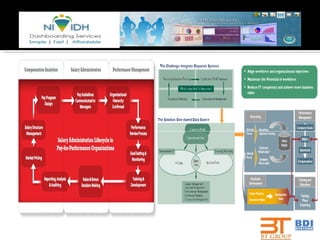
    “ Talent managementof more senior workforce contributors to ensure organizations organically grow future workers with similar work ethics, values, morals, culture and passionate contribution. HR metrics tools must measure employee value and contribution towards the businesses success so future workers can be measured against such a standard of success.” “ I believe that as HR metrics become standardized, business intelligence models currently applied primarily in marketing, customer service and finance will begin to find their way into the HR department and the HRMS data repository. That information will then be pushed out to line managers in the form of dashboards and scorecards, which will assist in the overall health and development of the Organisation” Sales – Vipul Sharma  +91-9483-265110         [email_address] , [email_address] [email_address] COST SAVINGS: Moving to a service center approach shows the strongest streamlining and cost savings Evaluate the potential for hosted services FUTURE: Specifically focus on talent management Educate yourselves on analytics Focus on improving the user experience

Editor's Notes

  • #9 PUTTING ANALYTICS IN PLACE A good HR data management process, one that gives HR, line managers, and senior management access to data at their fingertips, is essential for these very factors. In order to be effective, HR professionals must fully acknowledge data, identify key performance indicators and settle on a technology approach
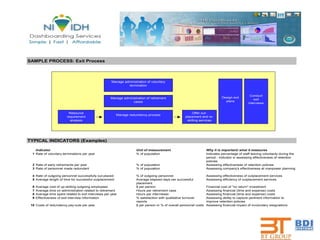
  • #12 Compensation reports how the compensation impacts performance, ensures compensation is equitable and consistent across roles, and aligns incentive compensation with objectives and company goals. HR performance reports HR performance against recruitment and retention goals, monitors and improves employee productivity, and assesses compensation competitiveness to attract top talent. Attrition Retention reports provide information on the drivers of employee turnover, proactively identifies top performers who are likely being recruited by competitors, and reduces recruiting and involuntary termination costs. Workforce profile and compliance reports describe the reduced time and cost of compliance reporting, increases in employee satisfaction and retention, and manages overall profiles and backgrounds of the workforce.
  • #23 Average Compensation By Jobs