BUSINESS COUNCIL of MONGOLIA
NewsWire
www.bcmongolia.org
info@bcmongolia.org
Issue 130, August 6 2010
NEWS HIGHLIGHTS:
Business:
 Khan Resources wins second Mongolian case, too;
 Petro Matad shares rise after tests confirm oil along Davsan Tolgoi trend;
 Petro Matad spends 18% more on exploration in central Mongolia basins;
 Ivanhoe having "interesting talks" with potential new investors;
 Mongolia may kill Aussie coal: Friedland;
 EBRD and Khan Bank sign first co-financing facility;
 Simon Morris takes over as CEO of Khan Bank;
 Peter Morrow retires as CEO, happy to leave behind “a very strong” Khan Bank;
 Centerra posts profit on strong gold price;
 Aspire Mining to form joint venture with Blue Sky Minerals;
 Leyshon Resources continues to review investment opportunities;
 North Asia Resources to acquire iron ore assets in Mongolia;
 Hogan Lovells allies with GTs Advocates;
 A woman sets up an IT firm in Mongolia, and shows how to survive and thrive;
 France's tricky nuclear fusion;
 Rio Tinto announces record H1 profit;
 Xstrata's net profit more than triples.
Economy:
 Planned measures will keep prices fair and stable, says Batbold;
 MPs urge Government to be more active in ensuring food security;
 Central Bank takes credit for stabilizing the economy;
 Steep rise in tourist arrivals;
 Team from Tianjin offers to invest in Mongolia;
 Japan, Mongolia agree to cooperate on resource development;
 Korea rejects Mongolia’s plea to take in more workers;
 Wheat prices rise;
 Russia slashes wheat harvest forecast;
 Key political risks to watch in Mongolia;
 Tumur of Hunnu Coal sees bright future for mining and Mongolia;
 Canceled licenses free 7% of land from mining;
 Collection from Customs and excise increases;
 Friedland says copper will outperform gold;
 Copper hits 3-month high, but market seen tightening;
 Chinese data add to global recovery fears;
 China closer to becoming second largest economy;
 China's CIC may invest up to USD25 billion in Indonesia.
Politics:
 Government to meet in the Gobi;
 Batbold praises people’s initiatives;
 President wants Supreme Court to help in reforming judiciary;
 Asia Foundation team meets President’s advisor;
 Government meetings suspended as Ministers tour provinces;
 Elbegdorj undergoes surgery;
 Special session not ruled out to decide on anti-corruption boss;
 Japan to implement sewage program in ger district;
 Anti-Chinese sentiment fuels rise of Mongolian ultra-nationalism;
 The question that struck the right note in Parliament;
 Fewer marriages, more divorces;
 Two years’ driving license ban for washing cars in Tuul River;
 Arabs here for the falcon catching season;
 Beijing claims 'indisputable sovereignty' over South China Sea.
*Click on titles to link to articles.
BUSINESS
KHAN RESOURCES WINS SECOND MONGOLIAN CASE, TOO
Canada‘s Khan Resources has won a second positive ruling in Mongolia, this time reinstating the
uranium exploration license held by subsidiary Khan Mongolia, the firm said on Tuesday. The
Mongolian Capital City Administrative Court declared that the decision by the Mongolian Nuclear
Energy Agency (NEA) to invalidate Khan Mongolia's exploration license 9282X was invalid and illegal.
The decision follows a ruling on July 19, in which the Mongolian court also ruled that a decision to
invalidate the mining license of Central Asian Uranium Company (CAUC), in which Khan owns 58%,
was actually invalid and illegal.
In April, both CAUC and Khan's 100%-owned Mongolian subsidiary Khan Mongolia received notices
from the NEA, which said that their respective licenses had been invalidated as of October 2009,
based on unspecified violations of Mongolian law. CAUC holds the license for the Dornod uranium
project, and Khan Mongolia has an exploration license for an adjoining property.
The NEA has the right to appeal the court's decisions on CAUC by August 9 and on Khan Mongolia by
August 23. ―Khan continues to believe that it and its Mongolian subsidiaries have always operated in
compliance with applicable Mongolian laws,‖ the company said in a statement. ―As such, any
appeal of the court decisions by the NEA will be vigorously challenged by Khan through all legally
available means.‖
Although the two licenses are no longer considered invalid, they will need to be approved for re-
registration under the new Nuclear Energy Law in Mongolia. Assuming the NEA does not appeal,
Khan will now continue the process of re-registering the licenses under the legislation, CEO Grant
Edey said.
Source: www.miningweekly.com
PETRO MATAD SHARES RISE AFTER TESTS CONFIRM OIL ALONG DAVSAN TOLGOI TREND
Mongolia-focused oil explorer Petro Matad has said that analysis carried out on the drilling results of
its first well in Eastern Mongolia confirmed that oil was present, sending its shares soaring. The
company last week said that its Davsan-Tolgoi-1 (DT-1) exploration well encountered a 12-meter
zone of oil, having said earlier in July that the well had seen oil shows and elevated mud gas as it
neared its total depth of 1,220 meters.
"The completion of the wireline testing of DT-1 confirms that good reservoir quality should be
expected along the length of the Davsan Tolgoi trend," said chief executive Douglas McGay in a
statement. ―We are very happy with the initial results from our first well to date, and look forward
to the completion of the analysis.‖ The DT-1 well was the first of Petro Matad's planned three-well
drilling campaign. The rig will now be moved to drill its second well.
Source: Reuters.com
PETRO MATAD SPENDS 18% MORE ON EXPLORATION IN CENTRAL MONGOLIAN BASINS
Petro Matad has provided an update on the company's drilling operations. The first 2D seismic
survey has commenced on the Blocks IV and V in central Mongolia. Mongolian geophysical
contracting company Khet LLC is undertaking the 360-km survey, covering 7 seismic lines, under
Petro Matad's management and supervision. In addition, an in-fill gravity survey over the entire two
blocks is currently being performed by Mongolian geophysical consultants, Geosan LLC.
Seismic acquisition during 2010, rather than during 2011 as originally planned, is the result of rapid
advancement of the company's geological knowledge of the central Mongolian basins. The
company's in-house exploration team recently completed field expeditions with the assistance of
international and Mongolian experts that identified prospective structures and confirmed principal
elements of Mesozoic hydrocarbon systems across the Blocks. These recent advances have
streamlined the exploration program with the goal of defining drillable targets in a much shorter
time frame than originally envisaged.
The Petroleum Authority of Mongolia recently approved the Company's revised exploration program
and budget. The revisions and extra work have resulted in an 18% increase in exploration
expenditure for both Blocks.
Source: Petro Matad Limited
IVANHOE HAVING “INTERESTING TALKS” WITH POTENTIAL NEW INVESTORS
Ivanhoe Mines is having "interesting" talks with potential new strategic investors following a recent
move to ease restrictions on its shareholder registry, Executive Chairman Robert Friedland has said.
"That has opened us up to some very interesting discussions with third parties," Mr. Friedland said,
without elaborating.
Ivanhoe said on July 13 it planned to terminate a clause in an agreement with its largest
shareholder Rio Tinto that restricts Ivanhoe from issuing shares to other strategic investors.
Source: Mineweb.com
MONGOLIA MAY KILL AUSSIE COAL: FRIEDLAND
Mongolia's coal sector could rob Australia of its global market share, Canadian billionaire mining
executive Robert Friedland has warned. Mr. Friedland, Executive Chairman of Ivanhoe Mines and its
90 per cent owned Ivanhoe Australia Ltd, said "Mongolia could kill Australian coal" because its 25%
mining tax was lower than the 30% proposed in Australia.
Ivanhoe Mines' 79 percent-owned coal company South Gobi Energy Resources Ltd. is the largest coal
producer in Mongolia in terms of export sales. Mongolia has a clear advantage in that it neighbors
its Chinese customers. "They're closer to China than your lucky island," Mr. Friedland told the
Diggers and Dealers mining conference in Western Australia on Wednesday.
Mr. Friedland said Oyu Tolgoi had an after-tax net value of USD16 trillion at recent metal prices.
Source: The Sydney Morning Herald
EBRD AND KHAN BANK SIGN FIRST CO-FINANCING FACILTY
The EBRD and Mongolia‘s largest bank, Khan Bank, have signed a participation agreement for USD10
million under the EBRD Medium-Sized Co-Financing Facility (MCFF). "The MCFF is designed to
provide co-financing by EBRD for up to 50 per cent of Khan Bank‘s loans to selected customers. This
will allow Khan Bank to expand its lending capacity providing larger, longer-term loans while
reducing the risk of single borrower credit concentration. The signing of this agreement is an
important part of Khan Bank‘s strategy to diversify and develop its financial services and banking
products," EBRD said in an announcement.
Khan Bank‘s outgoing CEO Peter Morrow said, ―We are very pleased to be expanding our strategic
relationship with the EBRD. At an important time in Mongolia‘s development, this facility will
expand Khan Bank‘s ability to meet the growing financial needs of its customers with well
structured, longer-term loans.‖
―This facility is an important step in the further enhancement of our cooperation with Khan Bank,
which will enable more businesses to access bank financing and facilitate growth of a medium-sized
private sector in Mongolia,‖ said Mr. Philip ter Woort, Head of the EBRD office in Mongolia.
EBRD has been one of the principal international financial institutions that cooperate with Khan
Bank in a number of ways including long term funding, trade finance, and technical assistance. As
the largest bank in Mongolia, Khan Bank finances corporate, small and medium businesses,
consumers, and agriculture.
Source: The FINANCIAL
SIMON MORRIS TAKES OVER AS CEO OF KHAN BANK
Khan Bank has announced that Mr. Simon Morris has taken over from Mr. J. Peter Morrow as Chief
Executive Officer. Mr. Morris has been with the Standard Chartered Bank (SCB) in Asia, Europe and
Africa for 25 years. Khan Bank Chairman Hideo Sawada commented, ―Khan Bank has thrived over
the past ten years, and we are delighted that Simon is joining us. He has exactly the experience to
lead our success to another level.‖
Mr. Sawada added, ―We thank Pete Morrow for his service and are pleased that he has agreed to
stay on at Khan Bank as an advisor and director for two more years, to provide continuity of our
relationships with key clients and other stakeholders.‖
Mr. Morrow commented, ―It has been a privilege to lead Khan Bank for the past ten years, and to
see it develop into Mongolia‘s leading bank. I will continue to work hard to support Simon and all
our colleagues for the Bank‘s further growth.‖
Mr. Morris comes to Khan Bank with extensive banking experience in international management,
finance, corporate and consumer banking. From 2000 to 2010, Mr. Morris served as CEO of SCB in
Brunei, the Philippines, Indonesia, and most recently Sri Lanka.
Source: Khan Bank
PETER MORROW RETIRES AS CEO, HAPPY TO LEAVE BEHIND “A VERY STRONG” KHAN BANK
In a farewell message on his retirement as CEO of Khan Bank, Mr. J. Peter Morrow has said he has
extended his contract through 2012 and will serve as a part time advisor and Director, ensuring an
orderly transition for domestic and international customers, lenders and stakeholders. He has also
been named Deputy Chairman of Newcom LLC. He has also joined the board of the Mongolian Stock
Exchange and is discussing other situations in the public and private sectors.
Mr. Morrow expressed his pleasure that he is passing on to Mr. Simon Morris, his successor as CEO, a
very strong bank. Deposits have grown over 30% in the first six months of 2010 and the bank has
over MNT 700 billion of cash, 50% of the balance sheet. Its capital of MNT130 billion, 17% of risk
assets, is far higher than any other bank here. Earnings have returned to pre-crisis levels, and the
past two months have been all-time records.
Source: Khan Bank
CENTERRA POSTS PROFIT ON STRONG GOLD PRICE
Centerra Gold last week reported higher-than-expected quarterly earnings, as increased production
and strong gold prices helped the miner return to profit after a loss last year. The Canadian gold
miner's net earnings came in at USD29.8 million. That compares with a net loss of USD79.6 million a
year earlier, when lower gold recoveries and increased costs took a toll. Revenue was 46 percent
higher at USD152.2 million.
The company has operations in Kyrgyzstan and Mongolia. Centerra's flagship property is the Kumtor
mine in Kyrgyzstan. It also owns the smaller Boroo mine in Mongolia. Regulatory issues with the
government have plagued the latter operation since June of 2009. The Boroo heap leach facility,
which uses cyanide to extract gold from crushed ore, has been shut down since April 2009 pending a
final operating permit and Centerra has removed all heap leach production from its 2010 production
guidelines. Even so, gold production at the Boroo mine rose for the quarter on increased recoveries.
Centerra's current production guidance does not include any gold production from its Gatsuurt
project in Mongolia. "Due to the potential for delays in receiving the required approvals for the
Gatsuurt project, Boroo has initiated an alternative plan that is expected to allow the Boroo
operation to achieve the production within the forecasted range of ounces produced," Centerra
said.
Source: Reuters.com
ASPIRE MINING TO FORM JOINT VENTURE WITH BLUE SKY MINERALS
Aspire Mining Limited (ASX), an Australia-based junior resources exploration company, has agreed
to form a joint venture on the Shanagan Coal Project in Mongolia with Blue Sky Minerals LLC, a
Mongolian-owned mining company. Under the terms of the agreement, Aspire Mining will have an
exclusive 12-month option period to explore the project upon the payment of an AUD60,000 option
fee. If Aspire spends more than AUD300,000 on exploration within the 12 months, it can earn a 51%
interest in the project.
Source: Aspire Mining
LEYSHON RESOURCES CONTINUES TO REVIEW INVESTMENT OPPORTUNITIES
Leyshon Resources (LSE-AIM and ASX), one of Australia‘s most financially successful gold mining
companies, has continued to review and is undertaking due diligence on a number of project
investment opportunities - some of which have the potential to meet its investment criteria. The
company says it is currently focusing on coking coal, iron ore, copper and gold opportunities in
northwestern China and southern Mongolia.
Source: Business Financial Newswire
NORTH ASIA RESOURCES TO ACQUIRE IRON ORE ASSETS IN MONGOLIA
North Asia Resources Holdings, formerly known as Green Global Resources, has announced plans to
spend HKD195.5 million to acquire iron ore assets in Mongolia from Inner Mongolia Taishen Mining
Co. According to the agreement signed by the two parties, the iron mine's reserves exceed 79
million tons, and the Hong Kong-listed firm hopes to expand its business in Mongolia.
Earlier last month, North Asia Resources Holdings kicked off construction on a 20-hectare site in
Mongolia to build a handling yard where iron ore will be unloaded for transport to China. The mine
has reserves of 148.9 million tons of iron and 174,000 tons of pure copper.
Source: www.chinaknowledge.com
HOGAN LOVELLS ALLIES WITH GTs ADVOCATES
Hogan Lovells has entered into its first alliance since its 1 May merger after sealing an entente with
Mongolian firm GTs Advocates. The two firms have been loosely affiliated for the last three years.
Hogan Lovells partner Michael Aldrich has been seconded to GTs since April 2009 and will continue
to be resident in Ulaanbaatar.
GTs Advocates is a full-service firm and represents Mongolian companies as well as multinational
corporations, investment banks, private equity firms and funds from North America, Europe and
Asia. It recently advised Citigroup and Macquarie Bank as sponsors of the USD439-million Hong Kong
secondary listing of South Gobi Energy.
Hogan Lovells‘ alliance means it is an international firm with a meaningful presence in the
increasingly lucrative Central Asian nation. To date, two Chinese firms have opened offices in
Mongolia: Longan opened earlier this year in association with local firm Zata, while Lehman, Lee &
Xu opened an office Ulaanbaatar in 2002.
Source: ALB Legal News
A WOMAN SETS UP AN IT FIRM IN MONGOLIA, AND SHOWS HOW TO SURVIVE AND THRIVE
A Mongolian information technology company founded by a woman has shown a way to thrive in the
country‘s often-chaotic economic environment. With the global economic crisis moving into its third
year, Intec‘s strategies to survive and thrive offer lessons for other IT start-ups in the South. While
the global economy‘s prospects are still uncertain, on the positive side, many believe the best
place to be is in emerging economies like Mongolia, with some foreseeing healthy growth for the
next 20 to 30 years. Mongolia‘s information technology entrepreneurs are looking to prove this is
the case. The country has made great strides in improving e-government – jumping from 82nd place
to 53rd in the UN e-government survey 2010
(http://www2.unpan.org/egovkb/global_reports/10report.htm) – and is now aiming to become an
Asian software and IT services outsourcing powerhouse.
Sandwiched between Russia and fast-growing China, Mongolia grapples with the combination of a
large territory, a small population, and limited transport infrastructure connecting it to its
neighbors. Despite its infrastructure obstacles, Mongolia has been able to develop a lively
information technology sector, often with the assistance of the United Nations. Information
technology consulting and services company Intec (www.itconsulting.mn), founded in 2004, has
been able to thrive through the global economy‘s ups and downs by identifying an under-serviced
niche as a consulting, research and training company. Intec now has five full-time staff and works
with a broad network of Mongolian and international consultants.
As is often the case with new businesses, Intec initially found that many doors were closed to start-
up enterprises. ―The major challenges which I faced were to make people understand about the
consulting services,‖ said Intec‘s founder, Ms. Ariunaa Lkhagvasuren. ―The consulting services
concept was new to Mongolia and Mongolians at that time and not many organizations were willing
to work with consulting services. The international and donor organizations were keen to work with
consulting services companies; however, they were requiring companies to have a list of
successfully implemented projects, which was difficult for a new starter like Intec. For example,
registering with the ADB consulting services database required companies to be operational for at
least three years. So, we got registered with ADB consulting services database only in 2008.
Meanwhile, personal connections and communication skills helped to find jobs and opportunities for
Intec.‖
Read more…
―It has been quite challenging. We have franchised the Indian Aptech WorldWide Training center
(http://www.aptech-worldwide.com) in Mongolia – may be one of the few franchising businesses in
Mongolia. Currently that center is now a separate entity/company and it has over 20 plus faculty
staff and over 300 students. Looking at the ICT market, there were quite a number of internet
service providers, mobile phone operators, a few companies started developing software
applications, and services etc. However, there were only two to three consulting companies in the
ICT sector which to my knowledge at that time were providing consulting services, and still there
was a room for Intec.‖
Intec then focused on three areas: consulting services, training and skills, and research. Intec found
they were pioneering a new concept in Mongolia. Intec‘s first contract was a job with the University
of Milwaukee-Wisconsin in the United States to organize a three week course for American students
to learn about the digital divide in Mongolia. But the global economic crisis hit Mongolia hard in
2009.
―It was challenging to survive and continue working the same way,‖ Ms. Lkhagvasuren said.
―There were few ICT-related jobs in Mongolia at that time, and one of our major clients left
Mongolia and we had to find other clients in the market. One of the ways of approaching this was
that we were not asking for fees, instead we would have a barter agreement – we will deliver them
services and they will provide some services for us. For the company itself, we needed to find ways
of financing and covering costs for renting of premises, paying salaries for staff on time, paying
taxes and other expenses.‖
The environment in Mongolia is being helped by the Information and Communications Technology
and Post Authority (ICTPA) of Mongolia (http://www.ictpa.gov.mn), which has been driving forward
an e-Mongolia master plan. With 16 objectives, it ambitiously seeks to place Mongolia in the top
five of Asian IT nations, competing with South Korea, Singapore, Japan and China.
Ms. Lkhagvasuren believes Mongolia has many competitive advantages. ―Mongolia is known for a
high-literacy rate and math-oriented training and education, and ICT specialists are targeting to
become a software outsourcing country for other countries. Another advantage of Mongolians is that
they can easily learn other languages: we are fluent in Russian, English, Japanese, Korean, German
and we believe that with these two major advantages, we will be able to do a good job with
outsourcing of software development.‖
While men still dominate the ICT sector in Mongolia, Ms. Lkhagvasuren has not found being a woman
a disadvantage. ―In Mongolia, as gender specialists say, there is a reverse gender situation. Women
are educated, well-recognized and well-respected. There were situations, when I was the only
women participant in the meeting with about 20 men. But I never felt somewhat discriminated or
mistreated and I think that‘s the overall situation towards gender in Mongolia.‖
Intec‘s success working with Aptech WorldWide Training‘s franchising contract brought many
advantages for a start-up. ―It‘s a faster way to do things, and you don‘t have to re-invent the
wheel.‖ As a Mongolian company, Intec has found it best to play to its local strengths. ―National
companies have knowledge, expertise and experience of local situations, know players and
understand about legal, regulatory matters. Partnership or cooperation is one of the means of
playing alongside big global players.‖
Source: www.nowpublic.com
FRANCE‟S TRICKY NUCLEAR FUSION
France has a long track record of creating successful national champions. Now President Nicolas
Sarkozy wants to create a French nuclear powerhouse. France believes 250 nuclear power stations
will be built worldwide over the next 20 years, requiring total investment of USD1 trillion or more.
But dominating this market may be harder than Mr. Sarkozy thinks.
Sure, France starts from a position of strength in nuclear. Electricité de France, 85% owned by the
French state, is the world's largest operator of nuclear power stations. Its fleet of 58 nuclear plants
generates around 80% of French electricity. Meanwhile, Areva is a leading provider of nuclear
technology. Mr. Sarkozy wants the two companies to form a strategic partnership, with EDF
increasing its 2.4% stake in Areva.
But this could create more problems than it solves. Foreign utilities may be reluctant to buy Areva's
technology if EDF, a competitor, has a much bigger share of the proceeds. Areva reckons 80% of
demand will come from utilities with their own nuclear plant. They may just want new technology,
not EDF's expertise as an operator.
Read more…
What's more, France's recent nuclear record is so ragged, it may struggle to win orders whatever
the ownership structure. A new generation nuclear-power station being build by French state-
owned reactor maker Areva in Finland is years behind schedule and nearly 80% over budget. A new
EDF plant in France using the same Areva technology is also behind schedule. A French consortium
lost out to South Korea for a contract to build a nuclear plant in Abu Dhabi last year partly because
EDF joined only at the last minute.
Another snag: Areva's flagship product, the European Pressurized Reactor which it is building in
Finland and tried to sell to Abu Dhabi, is complex, expensive and too big for some customers. And
Areva's efforts to develop smaller reactors in partnership with Mitsubishi Heavy Industries and EDF's
German rival E.ON might be vulnerable to a strategic partnership with EDF. Nobody said nuclear
fusion was easy.
Source: The Wall Street Journal Asia
RIO TINTO ANNOUNCES RECORD H1 PROFIT
Rio Tinto reported a record first-half profit on Thursday, more than double a year earlier as metals
prices recovered and its mines ran close to full throttle supplying China. The company said it was
focusing on growth now after solving its debt woes, committing to increase its spending on new
projects, including on its Oyu Tolgoi copper and gold project in Mongolia. "We expect second half
capital expenditure to rebound significantly," Chief Executive Tom Albanese said in a statement.
Underlying earnings before one-offs for January-June rose to USD5.8 billion from USD2.6 billion a
year earlier, beating analysts' forecasts of USD5.5 billion, according to a consensus compiled by the
company. Rio's strongest profit growth in at least 10 years follows strong results from Brazil's Vale,
the world's biggest iron ore miner, and Anglo American, recovering from a demand slump last year.
Source: Mineweb.com
XSTRATA‟S NET PROFIT MORE THAN TRIPLES
Anglo-Swiss miner Xstrata PLC reported a more than threefold rise in first-half net profit on
Tuesday, benefiting from rising prices and increased sales volumes across many of its commodities
such as copper, ferrochrome, zinc and nickel. Net profit was USD2.29 billion for the six months to
June 30, compared with USD690 million a year earlier, when results were impacted by a USD219-
million exceptional charge. Revenue rose 43% to USD13.61 billion from USD9.54 billion.
Source: The Wall Street Journal Asia
ECONOMY
PLANNED MEASURES WILL KEEP PRICES FAIR AND STABLE
Speaking to traders and buyers at a food market in Murun soum in Khuvsgul province, Prime Minister
S. Batbold said Mongolia would soon produce enough wheat and vegetables to meet the entire
domestic demand. He also said the planned commodity exchange markets will keep prices fair and
stable, by eliminating middlemen and reducing the number of stages between the primary producer
and the end consumer. The Government also plans to adopt a tax policy offering incentives to
domestic enterprises.
Source: Undesnii Shuudan
MPs URGE GOVERNMENT TO BE MORE ACTIVE IN ENSURING FOOD SECURITY
Two Democratic Party MPs, Mr. D.Gankhuyag and Mr. G.Bayarsaikhan, have written to Prime
Minister S.Batbold that little progress has been made in the implementation of several promises
made in the Government‘s socio-economic guidelines for 2010, and have urged him to ensure that
they do not remain just on paper in the remaining months of the year. Among areas pertaining to
food security where progress has been tardy, the MPs mention the following provisions in the
guidelines endorsed by Parliament: ―The population will have equal and easy access to healthy,
safe, and nutritious food‖; ―An efficient standardization policy will be implemented to ensure
safety of food products‖; ―Modern laboratories to test the quality of food products will be set up in
Ulaanbaatar and at border posts‖; ―The monitoring and information structure relating to public
hygiene, food safety, and availability of safe drinking water will be improved and streamlined‖; and
another on improving livestock health.
The two MPs have cited figures and instances to support their contention that the Government
needs to be more active in these matters.
Source: Undesnii Shuudan
CENTRAL BANK TAKES CREDIT FOR STABILIZING THE ECONOMY
At a press conference to mark the release of the 2009 annual report of the Central Bank, First
Deputy Governor B.Javkhlan listed the various ways in which the bank had succeeded in stabilizing
the economy in recent months. The MNT has gained strength against the USD, and its outward flow
has been arrested. With the restoration of people‘s faith in the banking system, both the number of
savings accounts and the volume of savings with banks have risen. So have inter-bank transactions,
which have also become more efficient. Inflation is under control and foreign currency reserves
stand at a healthy USD1.3 billion.
Source: Udriin Sonin
STEEP RISE IN TOURIST ARRIVALS
Figures released by The National Tourism Center show that there has been a 50.9% increase in the
number of tourists arriving in Mongolia in the first six months of 2010 over the corresponding period
last year. Citizens from Asia Pacific countries account for more than half of the 233,612 foreign
citizens who came, followed by those from Europe.
2009 was a bad year for the industry, with the global economic recession complementing the swine
flu scare in Mongolia to finally show a 20% slump from arrivals the previous year. This year‘s tourists
are estimated to have contributed USD 88.3 million to Mongolia‘s economy.
Source: Onoodor
TEAM FROM TIANJIN OFFERS TO INVEST IN MONGOLIA
Mr. Xin Yuan Ming, head of the political council of the port city of Tianjin in China, recently led a
team of more than 40 political and business officials to Ulaanbaatar. Tianjin is the seaport nearest
Mongolia, which some time ago set up an Ulaanbaatar Representative office in Tianjin.
In their meeting with city officials, the visitors stressed the need and their willingness to strengthen
economic cooperation. The Government of China has a special development policy for Tianjin,
which should help Mongolia when it begins exporting the coal from Tavan Tolgoi. Mr. Xin noted that
Mongolian goods worth USD90 million have been exported through Tianjin in the first five months of
the year.
The Chinese team offered to invest in Mongolia, especially in Ulaanbaatar, mainly in processing
units involving modern technology.
Source: News.mn
JAPAN, MONGOLIA AGREE TO COOPERATE ON RESOURCE DEVELOPMENT
Japan and Mongolia agreed last week to closely cooperate with each other in the development of
mineral resources and energy in Mongolia through technology transfer and investment, Japanese
officials said. Chief Cabinet Secretary Yoshito Sengoku met with visiting Mongolian Mineral
Resources and Energy Minister D.Zorigt and briefed him on Japan‘s new growth strategy that
features exports of technology, finance and personnel training know-how. Mr. Zorigt called for a
closer partnership between Japanese and Mongolian private-sector businesses and sought
investment and the transfer of environment-friendly Japanese technologies in tapping his country‘s
rich mineral resources such as coal and uranium.
Source: Kyodo News
KOREA REJECTS MONGOLIA‟S PLEA TO TAKE IN MORE WORKERS
Mr. Yu Myon Su, Resident Representative of Industrial and Human Resource Department of the
Republic of Korea in Mongolia, has ruled out relaxing the language test criterion for Mongolians
seeking a job in South Korea. Mr. Yu was on a visit to Mongolia to discuss three demands put
forward by the Mongolian Ministry of Social Welfare and Labor to South Korea‘s Ministry of Labor.
One of these was to overlook lack of language skills among those who otherwise met all
requirements to work in South Korea.
Mr. Yu explained that South Korea accepted workers from 15 countries and could not be expected
to relax its standards for any one country. This year Korea declared that 3,100 Mongolians had
passed the Korean language examination. They would have to go through a health test and then be
enlisted on the labor exchange of Korea. ―It is impossible to accept the Mongolian proposal that
everybody who scored more than 80 in the language test should be permitted to take the health
test, and, on passing that, should be registered at our labor exchange,‖ Mr. Yu said, explaining that
increasing the number of workers from any country would disrupt the carefully constructed quota
system affecting 15 countries.
Source: Undesnii Shuudan
WHEAT PRICES RISE
The prolonged hot spell in Russia has begun casting its long shadow over Mongolia. With later
imports uncertain, domestic producers have already begun raising their price, causing concern
among consumers. Mrs. Ts.Yuno, marketing manager at Altan Taria, said the company raised the
price of their best grade flour by MNT20 a kilo on July 20. Other grades of flour continue to sell at
the same rates. Ulaanbaatar Guril Tegeel Co. has increased its flour prices by MNT 30 a kilo.
Source: Udriin Sonin
RUSSIA SLASHES WHEAT HARVEST FORECAST
A severe drought has destroyed much of Russia's wheat crop, but stocks of grain are much higher
than in 2008. Soaring wheat prices—September futures hit USD7.11 a bushel Wednesday, up 58%
from June's lows—are triggering fears of a repeat of 2008's food riots. But the real problems may lie
further afield: in volatility and inflation.
A bit of perspective is necessary. Yes, record temperatures and droughts in Russia and other parts
of Eastern Europe have destroyed crops. Russia has slashed its wheat harvest forecast, now 70
million to 75 million metric tons from 90 million, and the International Grains Council has cut its
global wheat-production forecast for 2010-11 to 651 million tons, down 26 million tons from 2009-
10. Fears of Russian export restrictions, while denied by government officials, are adding to the
pressure on prices. Mongolia buys most of its flour from Russia.
But stocks of grain are much higher than in 2008. The IGC production forecast is still the third-
highest on record. The latest price jump probably says as much about heightened investor
sensitivity to extreme scenarios, plus an increased desire to chase apparently juicy trades, as about
the prospect of food shortages.
The inflationary threat is real. Emerging-market consumers are increasingly eating meat, which
means higher demand for grain that could push price rises for wheat further through the food chain.
Read more…
Even in the West there are pressures. The U.S. saw the biggest rise in food prices in 26 years in
March; in the U.K., bread makers have warned that rising input costs including wheat will be
passed on to consumers. The Organization for Economic Cooperation and Development expects
average real grain, meat and dairy prices to be higher in the coming decade than in 1997-2006.
With consumers watching their wallets as tax increases hit, food prices could come to have a
greater influence on inflation expectations. For bond markets and policy makers, that could
become a real bellyache.
Source: The Wall Street Journal Asia
KEY POLITICAL RISKS TO WATCH IN MONGOLIA
Landlocked Mongolia sits on vast quantities of untapped mineral wealth and analysts say it could be
one of the fastest growing economies of the next decade, as well as a key investment target for
global mining giants. But foreign companies and investors are watching to see whether the country's
fledgling democratic government can build the infrastructure required, maintain stability, improve
the rule of law and -- most crucially -- negotiate its way through the geopolitical pressures exerted
by its two large neighbors, Russia in the north and China in the south.
Following is a summary of key Mongolia risks to watch:
Political instability
The capricious nature of Mongolia's democratic government can complicate foreign investment
projects. The frequent replacement of key personnel at the top levels of Mongolia's government has
also caused concern, with the changes often accompanied by nationalist rhetoric and populist
promises to secure more control over the country's assets.
Analysts also complain about the weakness of Mongolia's political parties and its poor regulatory
capacity. Corruption -- especially "rent-seeking" activities -- may also prove to be a long-term
problem. Transparency International rated Mongolia 120th in its 2009 corruption perception index,
down from 102nd in 2008.
What to watch:
-- How will Mongolia use the proceeds from its mining projects? It has set up education and fiscal
stabilization funds, but it has also promised direct dividends for Mongolian citizens.
-- How will it deal with rapid economic change as foreign investment transforms large parts of the
country's mainly rural economy? Investment in the Oyu Tolgoi copper deposit alone stands at
roughly the equivalent of the country's entire GDP of 2009.
Regulatory risk
In April, Mongolia's president ordered a halt to the issuance and transfer of mineral exploitation
licenses until the government enacts a stricter law on mining investment. The directive has
rekindled some of the uncertainty that for years surrounded mining investment in the country. The
announcement came just days after Mongolia's Nuclear Energy Agency (NEA) invalidated the mining
and exploration licenses of two subsidiaries of Canadian exploration company Khan Resources citing
violations. The move to strip Khan's licenses was subsequently declared illegal by a court in
Mongolia, but that is unlikely to be the end of the matter.
It is unclear how long it would take to pass a new law. President Ts. Elbegdorj's proposed
amendments were discussed by Parliament in June and a final decision is expected to be reached
before the fate of Tavan Tolgoi is settled later in the year. Analysts say that while the move is
unlikely to affect major projects already agreed like Oyu Tolgoi and Tavan Tolgoi, it further raises
the risk levels for doing business in Mongolia.
"The purpose of the suspension appears to be aimed more at creating more regulatory oversight in
the mining sector by weeding out the thousands of small, domestic miners who may have obtained
licenses illegally. But it is also a government response to a popular clamor against 'selling out' the
country's resources," said Eurasia Capital analyst Damien Ma. "As a result, the government may
revisit a plan to change the mining law regime or draft new legislation during parliament's spring
session. If the changes are eventually approved, it could make the mining license regime more
onerous."
What to watch:
-- Hints on the likely shape of the new law.
-- How will the government handle populist pressures to maintain greater control over the country's
strategic assets?
Read more…
Dependence on China, Russia
The precarious nature of Mongolia's independence was illustrated in 2002 when the Dalai Lama was
invited to Ulaanbaatar. Beijing opposed the visit of the man they regard as a separatist and shut
down the country's only rail link for two days, stranding 500 passengers. China officially
relinquished its claims to Mongolia in 1950, but there remains a deep suspicion among Mongolian
people that Beijing seeks to reclaim the territory it lost after the collapse of the Qing dynasty in
1911.
China already dominates Mongolia's economy, buying more than 70 percent of the country's exports
last year. Some Mongolians fear China's bulging population will increasingly lead to immigration into
Mongolia for work -- especially if Chinese firms take over the bulk of its mining sector.
Russia has also been exerting pressure on its former satellite, especially over uranium. Canadian
miner Khan Resources has accused Moscow of working behind the scenes to force it out of a deposit
in the northeast.
The problem of competing influences even complicates transport infrastructure, with the location,
direction and gauge of planned rail projects subject to geopolitical wrangling. Round one was won
by Russia, with the Mongolian government recently agreeing to build a rail link between Tavan
Tolgoi and the Russian border.
What to watch:
-- The growing dominance of China in Mongolia's economy has prompted many of Mongolia's elite to
lean further towards Russia, but China is unlikely to step aside, and will also have much to say on
where and how Mongolia builds its roads and railways.
-- China rejected the bid for Khan Resources by state nuclear firm CNNC after Ulaanbaatar revoked
the company's licenses. Is Russia now in the driving seat in the battle to secure more Mongolian
uranium? What will be China's next move?
Balancing "third neighbors"
Mongolia has sought to carefully balance the interests of China and Russia, and to press ahead with
its "third neighbor" policy aimed at courting allies like the United States, but analysts say no nation
has the clout to underwrite Mongolia's independence or undermine Russia or China's influence.
While the country hopes to develop its resources as quickly as possible, many of its bigger projects
have been stymied by geopolitical concerns. The Tavan Tolgoi coal mine attracted the interest of
consortia in Japan, South Korea, China and Russia as well as global mining giants Rio Tinto and
Peabody. But Mongolia eventually decided to cancel an auction for the property -- a move some
thought was partly motivated by a desire not to offend any of the powerful bidders. A final decision
on the ownership of Tavan Tolgoi is expected later this year.
What to watch:
-- Will Mongolia's efforts to bring in overseas investment be derailed by the pressures being exerted
by Russia and China?
-- The government now appears to be leaning towards privatizing the Tavan Tolgoi property, and is
likely to offer a 30 percent stake to a foreign bidder while offering shares in the project to private
citizens. How much State control will it maintain? Will the ownership model in other key "strategic
resource" projects be the same, or will Mongolia be forced to sell properties outright in order to
kickstart economic growth?
Source: Reuters.com
TUMUR OF HUNNU COAL SEES BRIGHT FUTURE FOR MINING AND MONGOLIA
Mr. George Lkhagvadorj Tumur, Managing Director of Australia-based Hunnu Coal which is exploring
for coal in Mongolia, has said that despite mining being such an important sector in the Mongolian
economy, there are many who do not realize how difficult it is, in both the exploration and
excavation phases. ―They think the country will get rich just by digging deposits out of the earth,
but it is not so easy,‖ he says, while asserting that the expected expansion of mining in Mongolia
would certainly lead to widespread development and improve the general standard of living.
The improvement will be felt not only by people directly involved in mining, but also by many
others who provide various direct or indirect services to them. A completely new city arose around
the Erdenet mines, and similar things will happen with Oyu Tolgoi and Tavan Tolgoi. ―Nobody in
Mongolia ever dreamed of moving to Umnugobi for a new life, but that is what thousands are going
to do now,‖ he said.
Source: Onoodor
CANCELED LICENSES FREE 7% OF LAND FROM MINING
Mr. Kh.Batbaatar of the Geology and Mining Cadastre Department has said that 24.7 percent of the
total territory of Mongolia was under mining licenses on April 20, the day President Ts.Elbegdorj
ordered a total ban on all activities to do with licenses. The National Security Council modified the
President‘s decision on April 30 and the ban now applies only to issue of exploration licenses.
Transfers, mortgages and extensions are now possible.
With exploration licenses not being issued, the number of companies applying for exploitation
licenses has increased. Eleven new licenses have been granted since April 20, raising their total
number to 1,116. The number of exploration licenses stands at 3,205. Altogether 452 licenses have
been canceled on various grounds since the Presidential order, bringing the area of land under
license to 17.8 percent. Mr. Batbaatar said this is a good thing in some ways, but it also means less
revenue for the state.
Source: Ardiin Erkh
COLLECTION FROM CUSTOMS AND EXCISE INCREASES
Revenue from Customs and excise duties in the first six months of the year amounted to
MNT315,726.5 million, 63.0 percent more than in the same period last year. Collection from import
duties increased 51.4 percent but that from export taxes fell against the first half of the previous
year.
Domestic production of alcoholic drinks increased 54.4 per cent, while oil imports rose 16.5
percent. The number of cars imported increased by 3,933 or 76.2 percent over the corresponding
period in 2009.
Source: Montsame
FRIEDLAND SAYS COPPER WILL OUTPERFORM GOLD
Ivanhoe Mines Chairman Robert Friedland, developing the Oyu Tolgoi mine with Rio Tinto Group,
has said copper will outperform gold because of Chinese demand and the nascent electric car
industry. ―We shall need more copper in the next 20 years than was mined in the last 110 years,‖
he told the Diggers and Dealers conference. ―Those of us in the business don‘t have any idea where
this metal is going to come from.‖
―China will always remain the future for miners,‖ Mr. Friedland, 59, said. ―In the next 20 years the
world needs 600 million tons of copper metal, absent the phenomenon of electric cars. Cars are
going to be electric.‖ Copper is used in lithium batteries, which power electric cars, and
construction, with China the biggest user. Construction accounts for a quarter of demand,
according to the Copper Development Association, and builders are the biggest users in the U.S.,
the second-largest consumer of the metal.
Source: Bloomberg
COPPER HITS 3-MONTH HIGH, BUT MARKET SEEN TIGHTENING
Copper hit a three-month high on Wednesday on a rising appetite for risk and slightly stronger-than-
forecast payroll and service sector figures from the United States. Benchmark copper for three-
months delivery on the London Metal Exchange closed at USD7,505, up from USD7,425 a ton on
Tuesday. The metal had earlier touched its highest level since April 27 at USD7,527.
The copper market is seen tightening despite a slowdown in demand from China, leading to a
balanced global market this year, said the head of Xstrata's copper division, the world's fourth-
biggest producer of the metal. LME copper is expected to fall to USD7,200 per ton as a five-wave
cycle has been completed. The inventory picture continued to be supportive for copper prices, but
the pace of stock drawdown slowed. Copper stocks fell by 125 tons on Wednesday to 413,950 tons,
their lowest since November 2009.
Source: www.miningweekly.com
CHINESE DATA ADD TO GLOBAL RECOVERY FEARS
The global economic recovery continues to sputter, with news of slowing expansion in Chinese
manufacturing adding to disappointing growth in the U.S. The Chinese official purchasing managers‘
index for July, published on Sunday, sank to its lowest since February 2009, with government curbs
on lending and property speculation restraining growth. Indices of manufacturing and service-sector
activity for the US, due for release this week, are likely to confirm that the nation‘s economy
continues to decelerate.
The official PMI published by the China Federation of Logistics and Purchasing slid from 52.1 in June
to 51.2 in July. A reading above 50 indicates growth. Economists said that, after correcting for
seasonal factors, the survey showed stabilization rather than a sharp slowing in growth.
The economy has been restrained by attempts to curb real estate speculation, as skyrocketing
house prices have triggered dissatisfaction in many cities. After encouraging lending as part of a
stimulus package, Beijing has reined in bank credit in recent months after bad loan ratios at state
banks shot up. The Chinese central bank said on Sunday that it would stick to its credit target of
USD1,100 billion in new loans for this year and strictly implement the tight credit policies it
adopted.
In the Chinese index, PMI sub-indices for both manufacturing output and new orders fell to their
lowest level in three months in July but continued to show growth. Imports fell compared with a
month earlier.
Source: The Financial Times
CHINA CLOSER TO BECOMING SECOND LARGEST ECONOMY
A senior Beijing official‘s reference to China as the ―world‘s second-largest economy‖ has sparked
excited speculation that Asia‘s new powerhouse may have already reached a long-looming
milestone by surpassing Japan. China‘s rapid recent growth has made it increasingly likely that its
gross domestic product, in U.S. dollar terms, will be larger this year than Japan‘s. However, the
vagaries of international currency movements mean such a result is far from assured.
Observers eagerly awaiting what will be a symbol of shifting global economic power last week
seized on a remark by Mr. Yi Gang, director of the State Administration of Foreign Exchange, about
China‘s growth prospects. ―China is in fact already the second-biggest economy. With the expansion
of the economic base, the growth rate should certainly gradually slow down,‖ Mr. Yi, who is also
deputy central bank governor, said in an interview.
However, Mr. Yi‘s comment fell far short of formal seizure of a title that Japan has held for just
over four decades, especially given that he did not specify whether he was talking about China‘s
GDP at market prices or in purchasing power parity terms. In PPP terms, often a more telling
measure of economic weight, China has already been the second-largest economy for years.
Read more…
China-based economists point out that Tokyo reports detailed and relatively accurate economic
data. Beijing‘s sketchier numbers potentially under-report its economy by as much as 20 per cent,
meaning China may have really been number two for some time, even in dollar terms.
Even using official data, the baton is seen as likely to be decisively passed this year. In 2009,
Japan‘s gross domestic product was worth about USD5,080 billion, while Chinese GDP was initially
reported to be not far behind at about USD4,900 billion.
―This has news value but no economic value,‖ said Mr. Dong Tao, chief China economist at Credit
Suisse. ―At some point this year China‘s economy will overtake Japan‘s as world‘s second-largest
economy in nominal dollar terms; the only thing potentially stopping it right now is the strength of
the yen.‖
Despite Mr. Yi‘s apparently throw-away remark, Beijing is also unlikely to want to make too much
of a fuss about its new status.
Source: The Financial Times
CHINA‟S CIC MAY INVEST UP TO USD25 BILLION IN INDONESIA
China Investment Corp (CIC) may invest up to USD25 billion in Indonesia, a minister of Southeast
Asia's biggest economy has said, a move that will help the fund secure resources in a country hungry
for foreign financing. China's USD300-billion sovereign fund is initially ploughing USD2 billion into
coal, electricity and port projects in the world's largest exporter of coal for power plants,
Indonesia's State Enterprises Minister Mustafa Abubakar said, although he gave no timeframe for the
investments.
Indonesia also has abundant palm oil, copper and timber -- resources in strong demand in China,
which has stepped up investments in resource assets from Australia to Canada to fuel its growth.
CIC invested USD58 billion overseas last year, after sitting on a large cash pile in 2008, and a lot of
its investments were in sectors where Indonesia is strong, such as natural resources and agriculture.
It had 28.4 percent of its diversified equity portfolio in Asia-Pacific at the end of 2009, according to
its annual report.
Source: Reuters.com
POLITICS
GOVERNMENT TO MEET IN THE GOBI
The regular Government meeting on August 27 will be held somewhere in the Gobi desert, but the
province is yet to be announced. There will be two issues on the agenda: climate and ecology, and
national development. The choice of the Gobi is meant to draw people‘s attention to climate
change and to increase awareness of ecological issues.
Source: Ardiin Erkh
BATBOLD PRAISES PEOPLE‟S INITIATIVES
Prime Minister S.Batbold told media in Khuvsgul recently that his visit to Arkhangai, Uvurkhangai
and Khuvsgul provinces was aimed at detailing and explaining to the people the Government‘s
policies, programs, and activities. ―I also wanted to get feedback from citizens on our work,‖ he
said.
He expressed his happiness at finding that people in several places in Arkhangai and Khuvsgul have
taken the initiative to start several programs ―without waiting for us, taking the responsibility for
regional development into their own hands‖. Suggestions and initiatives should come from both
sides, he said, and gave as example the case of the Government agreeing to build a road from
Terkh Lake of Arkhangai to Khuvgsul Lake after receiving several demands from local organizations.
Source: Ardiin Erkh
PRESIDENT WANTS SUPREME COURT HELP IN REFORMING JUDICIARY
The Head of the President‘s Office, Mr. D.Battulga, and the legal advisor to the President, Mr.
G.Ganzorig, recently met Mr. S.Batdelger, Judge General of the Supreme Court and head of General
Council of Courts, to discuss implementation of a program of judicial reforms originally proposed by
President Elbegdorj but now also supported by the National Security Council. The three discussed
ways in which the Supreme Court, the General Council of Courts and the Presidential Office could
coordinate more effectively among themselves to implement not just judicial reforms, but also
programs aimed at curbing corruption, protecting human rights, establishing justice and
strengthening democracy.
Source: English.News.mn
ASIA FOUNDATION TEAM MEETS PRESIDENT‟S ADVISOR
The Asia Foundation‘s Country Representative in Mongolia, Mrs. Meloney C. Lindberg, and her
colleague Mrs. B.Enkhjin, Governance Program Manager, recently called on Mr. G.Ganzorig, legal
advisor to the President, to apprise him of the results of a recent study of businesses on effective
ways to settle economic, commercial and legal disputes. They also offered to cooperate with the
President‘s Office in implementing judicial reforms, combating corruption
and bureaucracy.
Source: News.mn
GOVERNMENT MEETINGS SUSPENDED AS MINISTERS TOUR PROVINCES
The head of the Cabinet Secretariat, Mr. Ch.Khurelbaatar, has told media that the regular
Government meeting on every Wednesday will not be held for a few weeks as several Ministers are
in the provinces to familiarize themselves with regional conditions and also to study how
Government decisions are being implemented. Prime Minister S.Batbold plans to visit 60 soums in
nine provinces.
Source: Montsame
ELBEGDORJ UNDERGOES SURGERY
President Ts. Elbegdorj, 47, underwent rectal surgery on Wednesday at the Mongolian-South Korean
Songdo Hospital in Ulaanbaatar, the President's Office said Thursday. The surgery "was successful
and the president is getting better," it added in a statement.
Source: Xinhua
SPECIAL SESSION NOT RULED OUT TO DECIDE ON ANTI-CORUPTION BOSS
Parliament went into recess without taking action on the Prosecutor General‘s demand for the
removal of the head of the Anti-Corruption Authority (ACA), despite the mandatory imperative that
such decision must be taken within 14 days, but the saga goes on. Deputy Speaker G.Batkhuu (DP),
standing in for Speaker D.Demberel who is on vacation, has told media that summoning a special
session of Parliament cannot be ruled out, but this can be done only after a working group on the
issue submits its recommendations to a sub-committee on special inspection which will discuss
these and present its report to the Standing Committee on Justice. Calling a special session can be
considered only after the Standing Committee reaches a decision. The Prosecutor General has
already demanded a special session but, according to Mr. Batkhuu, he has to concede the plea for
more time from both the committee and the sub-committee so that they can study the issue with
due care.
Meanwhile The General Intelligence Authority (GIA) has defended its arrest of Mr. U.Altangadas,
director of administration at the ACA and considered to be loyal to his beleaguered boss. Denying
all charges of illegality, the GIA has clarified that the arrest was authorized by a prosecutor and
they followed legal procedures in every detail. The ACA was notified of the decision 48 hours prior
to the actual arrest. It is believed that Mr. Algangadas was arrested because of his illegal
investigation of the former director of the ACA investigation department, Mr. E.Amarbat, who
helped prepare the case against the ACA head, Mr. Ch.Sangaragchha.
Source: English.News.mn
JAPAN TO IMPLEMENT SEWAGE PROGRAM IN GER DISTRICT
A Japanese prefecture, with help from the Japan International Cooperation Agency (JICA), will run
a three-year program to construct sewage channels in Ulaanbaatar. A part of the program will be
training Mongolians in modern sewage technology. A recent meeting between Deputy Mayor
B.Baatarzorig and a team from the Japanese prefecture chose the ger district where the project
will be started. Steady migration from the countryside to the capital city has put enormous stress
on its infrastructure, which exists only on a rudimentary scale in many areas where the newcomers
have settled.
Source: English.News.mn
ANTI-CHINESE SENTIMENT FUELS RISE OF MONGOLIAN ULTRA-NATIONALISM
Their right hands rise to black-clad chests and flash out in salute to their nation: "Sieg heil!" They
praise Hitler's devotion to ethnic purity. But with their high cheekbones, dark eyes and brown skin,
they are hardly the Third Reich's Aryan ideal. A new strain of Nazism has found an unlikely home:
Mongolia. Once again, ultra-nationalists have emerged from an impoverished economy and turned
upon outsiders. This time the main targets come from China, the rising power to the south.
Groups such as Tsagaan Khass, or White Swastika, portray themselves as patriots standing up for
ordinary citizens in the face of foreign crime, rampant inequality, political indifference and
corruption. But critics say they scapegoat and attack the innocent. The U.S. state department has
warned travelers of increased assaults on inter-racial couples in recent years – including organized
violence by ultra-nationalist groups.
Dayar Mongol threatened to shave the heads of women who sleep with Chinese men. Three years
ago, the leader of Blue Mongol was convicted of murdering his daughter's boyfriend, reportedly
because the young man had studied in China.
Though Tsagaan Khass leaders say they do not support violence, they are self-proclaimed Nazis.
"Adolf Hitler was someone we respect. He taught us how to preserve national identity," said the 41-
year-old co-founder, who calls himself Big Brother. "We don't agree with his extremism and starting
World War II. We are against all those killings, but we support his ideology. We support nationalism
rather than fascism." It is, by any standards, an extraordinary choice. Under Hitler, Soviet prisoners
of war who appeared Mongolian were singled out for execution. More recently, far-right groups in
Europe have attacked Mongolian migrants.
Read more…
Not all ultra-nationalists use this iconography; and widespread ignorance about the Holocaust and
other atrocities may help to explain why some do. Tsagaan Khass points out that the swastika is an
ancient Asian symbol – which is true, but does not explain the group's use of Nazi colors, the Nazi
eagle and the Nazi salute; or the large picture of the Führer on Big Brother's cigarette case.
Nor does it seem greatly relevant, given their unabashed admiration for Hitler's racial beliefs. "We
have to make sure that as a nation our blood is pure. That's about our independence," said 23-year-
old Battur, pointing out that the population is under three million. "If we start mixing with Chinese,
they will slowly swallow us up. Mongolian society is not very rich. Foreigners come with a lot of
money and might start taking our women."
Big Brother acknowledges he discovered such ideas through the nationalist groups that emerged in
Russia after the Soviet Union's fall; Mongolia had been a satellite state. But the anti-Chinese tinge is
distinct and increasingly popular. "While most people feel far-right discourse is too extreme, there
seems to be a consensus that China is imperialistic, 'evil' and intent on taking Mongolia," said Franck
Billé of Cambridge University, who is researching representations of Chinese people in Mongolia. Hip
hop tracks such as Don't Go Too Far, You Chinks by 4 Züg – chorus: "shoot them all, all, all" – have
been widely played in bars and clubs. Urban myths abound; some believe Beijing has a secret policy
of encouraging men to have sex with Mongolian women.
Yet Tsagaan Khass claims it welcomes law-abiding visitors of all races, and Big Brother can certainly
be hospitable. Enthusiastically shaking hands, he says: "Even though you are a British citizen, you
are still Asian, and that makes you very cool." He says the younger members have taught him to be
less extreme and the group appears to be reshaping itself – expelling "criminal elements" and
insisting on a good education as a prerequisite for membership. One of the leaders is an interior
designer.
But critics fear ultra-nationalists are simply becoming more sophisticated and, quietly, more
powerful. Tsagaan Khass say it "works closely" with other organizations and is now discussing a
merger. "Some people are in complete denial … [but] we can no longer deny this is a problem," said
Anaraa Nyamdorj, of Mongolia's Lesbian, Gay, Bisexual and Transgender Centre.
The U.S. state department has noted increased reports of xenophobic attacks since the spring. The
UN country review cites a recent vicious assault on three young transgender women. When one of
the victims publicly blamed an ultra-nationalist group – not Tsagaan Khass – death threats quickly
followed.
"They are getting more support from the public," added Enkhjargal Davaasuren, director of the
National Center Against Violence, who fears that ultra-nationalists are growing more confident and
victims too scared to come forward. She pointed to a YouTube video posted last year, showing a
man roughly shaving a woman's long hair. The victim's face is buried in her hands, but her hunched
body reeks of fear.
Others in Ulaanbaatar suggest the movement is waning and suspect the groups' menacing stance and
claims of 3,000 members are bluster. Billé thinks there is "a lot of posturing". "We have heard of
instances [of violence]. They are not necessarily all right or all wrong," said Javkhlan, a Tsagaan
Khass leader. But the group is simply a "law enforcement" body, he maintained: "We do checks; we
go to hotels and restaurants to make sure Mongolian girls don't do prostitution and foreigners don't
break the laws. We don't go through and beat the shit out of everyone. We check our information
and make sure it's true."
They rely on police and media pressure to reform such businesses, he added. And if that failed? "We
try to avoid using power," he said. "That would be our very last resort."
Source: The Guardian
THE QUESTION THAT STRUCK THE RIGHT NOTE IN PARLIAMENT
Fifty MPs tabled 78 questions during the Spring session of which 12 are yet to be answered. These
figures include the instance of 9 MPs jointly submitting a 14-point questionnaire. Mr.
G.Bayarsaikhan (DP) asked the largest number (7) of questions, while Mr. N.Ganbyamba (MPRP) and
Mrs. S.Oyun (Civil Will) asked 6 each. An informal poll adjudged one of the 5 questions raised by Mr.
S.Byambatsogt (MPRP) to be the ―most impressive‖ in the session. In this he had asked the Minister
for Culture, Education and Science if khuumi was Mongolian or Chinese, after UNESCO had listed the
form of music as a Chinese heritage. The question is taken to have nudged the Government into
action and finally led UNESCO to accept Mongolia‘s claim to the heritage of khuumi, too.
Source: Onoodor
FEWER MARRIAGES, MORE DIVORCES
The National Statistics Office reveals an increase in the number of divorces, especially among young
couples. The number of people getting married reached a peak in 2006, but that figure of 48,996
has been falling ever since, hitting 34,071 in 2009. Many observers link the drop to the withdrawal
of allowances to new couples and children.
The number of divorces doubled in 2009 from 1,448 in 2006. Some of them involved people who had
tied the knot mainly to be eligible for the handout but social observers worry that otherwise, too,
the institution of marriage is losing its appeal. It is now common for young people to get married
right after graduating from university and to split after having a child. Last year, 10,980 couples
filed for divorce.
Source: English.News.mn
TWO YEARS‟ DRIVING LICENSE BAN FOR WASHING CARS IN TUUL RIVER
Police on horseback and in cars and boats will now be regularly patrolling stretches of the Tuul
River to see that the water is not polluted in any way, such as by washing carpets. Any infringement
will lead to arrest and those washing motor vehicles will have their driving license canceled for two
years. The decision was taken as part of the Queen Tuul and Time campaign organized by the
Metropolitan Mayor‘s Office, the Traffic Police Department, the Professional Monitoring Authority,
the Water Department, the Ministry for Environment, and Green Line organizations.
Source: Ardiin Erkh
ARABS HERE FOR THE FALCON CATCHING SEASON
Altogether 185 people from Qatar, the United Arab Emirates, and Kuwait are now in Mongolia to
catch Saker Falcons using 128 vehicles. They are spread out over 12 provinces, where the
Government has reached an understanding with the administration to avoid conflicts with local
activists. This year‘s export quota has been fixed at 240, with each bird to cost USD11,760. Of this,
USD10,800 comes to the State budget and the rest goes to the province. Reported Saker falcon
exports could approximate USD2.9 million in 2010.
There are about 8,000 Saker Falcons in Mongolia. A high-level meeting was recently held to review
procedures to ensure that the norms for catching the birds were observed and there was no
violation of the export agreement.
Source: English.News.mn
BEIJING CLAIMS „INDISPUTABLE SOVEREIGNTY‟ OVER SOUTH CHINA SEA
The Chinese military declared last week that China had "indisputable sovereignty" over the South
China Sea, but insisted it would continue to allow others to freely navigate one of the busiest
waterways in the world. The statement by the People's Liberation Army seemed designed to
reiterate China's claims to the entire 1.3 million-square-mile waterway while calming concerns in
Washington and Asian capitals that its policy toward the region had suddenly become significantly
more aggressive.
"China has indisputable sovereignty of the South Sea, and China has sufficient historical and legal
backing" to support its claims, Senior Col. Geng Yansheng, a Ministry of Defense spokesman, told
reporters Friday during a visit to an engineering unit on the outskirts of Beijing. But he added, "We
will, in accordance with the demands of international law, respect the freedom of the passage of
ships or aircraft from relevant countries."
Col. Geng's remarks were in reaction to a recent push by the United States, Vietnam and other
Southeast Asian countries to challenge China's claims to the whole sea. In Hanoi on July 23,
Secretary of State Hillary Clinton told a regional security forum that it was in the United States'
"national interest" that freedom of navigation be maintained in the sea. Mrs. Clinton also challenged
China's claims to the whole sea, through which half of all shipped merchant tonnage passes each
year.
U.S. and Asian officials have said that Vietnam and the United States spearheaded the push in part
over concerns that China's navy has become increasingly aggressive in the sea, seizing fishing boats
and arresting sailors from other countries. Some exchanges of gunfire have also occurred in recent
months, Asian officials said.
Read more…
China's claims to the South China Sea stretch back at least to the 1930s, when official maps from
China contained the whole sea as Chinese territory. China's historians have also pointed to ancient
shards of pottery on atolls as proof that the sea has historically belonged to China.
The U.S. push on the issue seems to have taken Chinese leaders by surprise although U.S. officials
have been speaking with China about the problem for months. Mr. Dai Bingguo, China's state
councilor in charge of foreign policy, told Mrs. Clinton in May during a tense exchange on the region
that China viewed its claims to the sea as a "core national interest".
Source: The Washington Post
NEW MONGOLIAN REGULATIONS
The following new laws and amendments were published in the latest weekly Government bulletin.
Unless otherwise decided by Parliament, they will take effect ten (10) days after publication.
Date Laws
28.07.2010 Law on Competition
Annulment of Law on Prohibition of Unfair Competition
Amendments to Law on Advertisement
Amendments to Law on Public Procurement
Amendments to Law on State and Local Property
Please visit BCM's website, Legislative Working Group, for a summary of new and amended
Mongolian laws. BCM members who wish to access complete versions of the laws and regulations in
Mongolian language are welcome to call or email the BCM office: 332345 or info@bcmongolia.org.
ANNOUNCEMENTS
DISCOUNT FOR BCM MEMBERS AT 2 HONG KONG CONFERENCES
BCM members have been offered a 15% discount on the registration fees for the Mongolia
Investment Summit 2010 in Hong Kong on October 14. Co-organized with the full support of the
Mongolian Government, the conference will showcase a range of exciting investment opportunities
in North Asia‘s natural resources capital. In addition, speakers will provide an in-depth guide to the
investment environment in Mongolia, helping investors make the right investment decisions. If you
want to meet Hong Kong based investors interested in Mongolia, then you should attend this event.
And if you have a Mongolia-based investment opportunity which you would like to showcase at the
conference, please contact Toby Duckworth immediately on +44 20 7216 6074 or
toby.duckworth@aspermontuk.com.
A similar discount is available for a related mining investment conference just prior to this event,
aimed at educating investors what they need to look at when investing in the resources industry.
Mining Investment Insight 2010 on October 12-13 has been designed to help investors understand
and quantify the risks involved in early-stage mining projects and factor these into an investment
valuation. Topics to be covered include:
 Understanding risks in a mining project
 Practical approaches to making valuations of an exploration stage mining company
 Guide to the lifecycle of a mining project
 Metals round-up: Supply, demand, risk and reward across the Periodic Table
 Resource or reserve? Inferred, indicated, measured, probable or proved? Determining the
true size of a mining project
 Understanding and putting a value on political and market risk
Please visit www.MiningInvestmentInsight.com or call +852 2219 0111 to book your place.
___________________________________
“BSPOT" on B-TV
BTV (Business TV) now telecasts a 10-minute English-language news program called BSPOT every
evening from Monday to Friday at 21:30, taking most of the stories from the BCM NewsWire.
____________________________________
“MM TODAY” on MNB-TV
BCM is pleased to announce that Mongolian National Broadcasting continues its cooperation with
BCM on ―MM Today‖. This English news program is aired every Friday for 10 minutes and is
scheduled for 21:15 tonight. Tune in to watch this program that reports stories from today‘s BCM
NewsWire.
___________________________________
NEW POSTINGS ON BCM WEBSITE‟S „MONGOLIAN BUSINESS NEWS‟
The draft Tavan Tolgoi Investment Agreement which was submitted by the Government to
Parliament is posted in both languages to BCM‘s websites, (www.bcmongolia.org) and
(www.bcm.mn), ‗Mongolian Business News‘ for your review.
As some of you might have noticed, we are now posting some news stories and analyses relevant to
Mongolia on the BCM website's ‗Mongolian Business News‘ as they come, instead of waiting until
Friday to put them all together in the weekly NewsWire. The NewsWire will, however, continue to
be issued on Friday, and will incorporate items that are already on the home page, so that it
presents a consolidated account of the week‘s events.
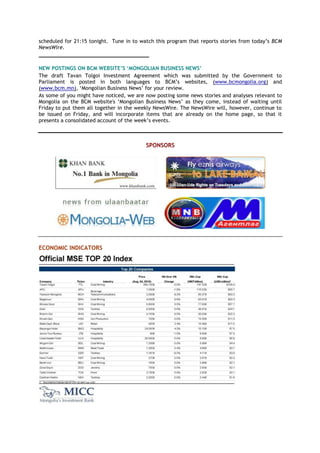
SPONSORS
ECONOMIC INDICATORS
INFLATION
Year 2006 6.0% [source: National Statistical Office of Mongolia (NSOM)]
Year 2007 *15.1% [source: NSOM]
Year 2008 *22.1% [source: NSOM]
Year 2009 *4.2% [source: NSOM]
June 30, 2010 *11.4% [source: NSOM]
*Year-over-year (y-o-y)
CENTRAL BANK POLICY LOAN RATE
December 31, 2008 9.75% [source: IMF]
March 11, 2009 14.00% [source: IMF]
May 12, 2009 12.75% [source: IMF]
June 12, 2009 11.50% [source: IMF]
September 30, 2009 10.00% [source: IMF]
May 12, 2010 11.00% [source: IMF]
CURRENCY RATES – August 5, 2010
Currency name Currency Rate
US dollars US 1,347.82
Euro EUR 1,779.19
Japanese yen JPY 15.76
British pound GBP 2,148.02
Hong Kong dollar HKD 173.61
Chinese yuan CNY 199.00
Russian ruble RUB 45.11
South Korean won KRW 1.15
Disclaimer: Except for reporting on BCM‘s activities, all information in the BCM NewsWire is
selected from various news sources. Opinions are those of the respective news sources.

06.08.2010, NEWSWIRE, Issue 130

  • 1.
    BUSINESS COUNCIL ofMONGOLIA NewsWire www.bcmongolia.org info@bcmongolia.org Issue 130, August 6 2010 NEWS HIGHLIGHTS: Business:  Khan Resources wins second Mongolian case, too;  Petro Matad shares rise after tests confirm oil along Davsan Tolgoi trend;  Petro Matad spends 18% more on exploration in central Mongolia basins;  Ivanhoe having "interesting talks" with potential new investors;  Mongolia may kill Aussie coal: Friedland;  EBRD and Khan Bank sign first co-financing facility;  Simon Morris takes over as CEO of Khan Bank;  Peter Morrow retires as CEO, happy to leave behind “a very strong” Khan Bank;  Centerra posts profit on strong gold price;  Aspire Mining to form joint venture with Blue Sky Minerals;  Leyshon Resources continues to review investment opportunities;  North Asia Resources to acquire iron ore assets in Mongolia;  Hogan Lovells allies with GTs Advocates;  A woman sets up an IT firm in Mongolia, and shows how to survive and thrive;  France's tricky nuclear fusion;  Rio Tinto announces record H1 profit;  Xstrata's net profit more than triples. Economy:  Planned measures will keep prices fair and stable, says Batbold;  MPs urge Government to be more active in ensuring food security;  Central Bank takes credit for stabilizing the economy;  Steep rise in tourist arrivals;  Team from Tianjin offers to invest in Mongolia;  Japan, Mongolia agree to cooperate on resource development;  Korea rejects Mongolia’s plea to take in more workers;  Wheat prices rise;  Russia slashes wheat harvest forecast;  Key political risks to watch in Mongolia;  Tumur of Hunnu Coal sees bright future for mining and Mongolia;  Canceled licenses free 7% of land from mining;  Collection from Customs and excise increases;  Friedland says copper will outperform gold;  Copper hits 3-month high, but market seen tightening;  Chinese data add to global recovery fears;  China closer to becoming second largest economy;  China's CIC may invest up to USD25 billion in Indonesia. Politics:  Government to meet in the Gobi;  Batbold praises people’s initiatives;  President wants Supreme Court to help in reforming judiciary;
  • 2.
     Asia Foundationteam meets President’s advisor;  Government meetings suspended as Ministers tour provinces;  Elbegdorj undergoes surgery;  Special session not ruled out to decide on anti-corruption boss;  Japan to implement sewage program in ger district;  Anti-Chinese sentiment fuels rise of Mongolian ultra-nationalism;  The question that struck the right note in Parliament;  Fewer marriages, more divorces;  Two years’ driving license ban for washing cars in Tuul River;  Arabs here for the falcon catching season;  Beijing claims 'indisputable sovereignty' over South China Sea. *Click on titles to link to articles. BUSINESS KHAN RESOURCES WINS SECOND MONGOLIAN CASE, TOO Canada‘s Khan Resources has won a second positive ruling in Mongolia, this time reinstating the uranium exploration license held by subsidiary Khan Mongolia, the firm said on Tuesday. The Mongolian Capital City Administrative Court declared that the decision by the Mongolian Nuclear Energy Agency (NEA) to invalidate Khan Mongolia's exploration license 9282X was invalid and illegal. The decision follows a ruling on July 19, in which the Mongolian court also ruled that a decision to invalidate the mining license of Central Asian Uranium Company (CAUC), in which Khan owns 58%, was actually invalid and illegal. In April, both CAUC and Khan's 100%-owned Mongolian subsidiary Khan Mongolia received notices from the NEA, which said that their respective licenses had been invalidated as of October 2009, based on unspecified violations of Mongolian law. CAUC holds the license for the Dornod uranium project, and Khan Mongolia has an exploration license for an adjoining property. The NEA has the right to appeal the court's decisions on CAUC by August 9 and on Khan Mongolia by August 23. ―Khan continues to believe that it and its Mongolian subsidiaries have always operated in compliance with applicable Mongolian laws,‖ the company said in a statement. ―As such, any appeal of the court decisions by the NEA will be vigorously challenged by Khan through all legally available means.‖ Although the two licenses are no longer considered invalid, they will need to be approved for re- registration under the new Nuclear Energy Law in Mongolia. Assuming the NEA does not appeal, Khan will now continue the process of re-registering the licenses under the legislation, CEO Grant Edey said. Source: www.miningweekly.com PETRO MATAD SHARES RISE AFTER TESTS CONFIRM OIL ALONG DAVSAN TOLGOI TREND Mongolia-focused oil explorer Petro Matad has said that analysis carried out on the drilling results of its first well in Eastern Mongolia confirmed that oil was present, sending its shares soaring. The company last week said that its Davsan-Tolgoi-1 (DT-1) exploration well encountered a 12-meter zone of oil, having said earlier in July that the well had seen oil shows and elevated mud gas as it neared its total depth of 1,220 meters. "The completion of the wireline testing of DT-1 confirms that good reservoir quality should be expected along the length of the Davsan Tolgoi trend," said chief executive Douglas McGay in a statement. ―We are very happy with the initial results from our first well to date, and look forward to the completion of the analysis.‖ The DT-1 well was the first of Petro Matad's planned three-well drilling campaign. The rig will now be moved to drill its second well. Source: Reuters.com PETRO MATAD SPENDS 18% MORE ON EXPLORATION IN CENTRAL MONGOLIAN BASINS Petro Matad has provided an update on the company's drilling operations. The first 2D seismic survey has commenced on the Blocks IV and V in central Mongolia. Mongolian geophysical contracting company Khet LLC is undertaking the 360-km survey, covering 7 seismic lines, under
  • 3.
    Petro Matad's managementand supervision. In addition, an in-fill gravity survey over the entire two blocks is currently being performed by Mongolian geophysical consultants, Geosan LLC. Seismic acquisition during 2010, rather than during 2011 as originally planned, is the result of rapid advancement of the company's geological knowledge of the central Mongolian basins. The company's in-house exploration team recently completed field expeditions with the assistance of international and Mongolian experts that identified prospective structures and confirmed principal elements of Mesozoic hydrocarbon systems across the Blocks. These recent advances have streamlined the exploration program with the goal of defining drillable targets in a much shorter time frame than originally envisaged. The Petroleum Authority of Mongolia recently approved the Company's revised exploration program and budget. The revisions and extra work have resulted in an 18% increase in exploration expenditure for both Blocks. Source: Petro Matad Limited IVANHOE HAVING “INTERESTING TALKS” WITH POTENTIAL NEW INVESTORS Ivanhoe Mines is having "interesting" talks with potential new strategic investors following a recent move to ease restrictions on its shareholder registry, Executive Chairman Robert Friedland has said. "That has opened us up to some very interesting discussions with third parties," Mr. Friedland said, without elaborating. Ivanhoe said on July 13 it planned to terminate a clause in an agreement with its largest shareholder Rio Tinto that restricts Ivanhoe from issuing shares to other strategic investors. Source: Mineweb.com MONGOLIA MAY KILL AUSSIE COAL: FRIEDLAND Mongolia's coal sector could rob Australia of its global market share, Canadian billionaire mining executive Robert Friedland has warned. Mr. Friedland, Executive Chairman of Ivanhoe Mines and its 90 per cent owned Ivanhoe Australia Ltd, said "Mongolia could kill Australian coal" because its 25% mining tax was lower than the 30% proposed in Australia. Ivanhoe Mines' 79 percent-owned coal company South Gobi Energy Resources Ltd. is the largest coal producer in Mongolia in terms of export sales. Mongolia has a clear advantage in that it neighbors its Chinese customers. "They're closer to China than your lucky island," Mr. Friedland told the Diggers and Dealers mining conference in Western Australia on Wednesday. Mr. Friedland said Oyu Tolgoi had an after-tax net value of USD16 trillion at recent metal prices. Source: The Sydney Morning Herald EBRD AND KHAN BANK SIGN FIRST CO-FINANCING FACILTY The EBRD and Mongolia‘s largest bank, Khan Bank, have signed a participation agreement for USD10 million under the EBRD Medium-Sized Co-Financing Facility (MCFF). "The MCFF is designed to provide co-financing by EBRD for up to 50 per cent of Khan Bank‘s loans to selected customers. This will allow Khan Bank to expand its lending capacity providing larger, longer-term loans while reducing the risk of single borrower credit concentration. The signing of this agreement is an important part of Khan Bank‘s strategy to diversify and develop its financial services and banking products," EBRD said in an announcement. Khan Bank‘s outgoing CEO Peter Morrow said, ―We are very pleased to be expanding our strategic relationship with the EBRD. At an important time in Mongolia‘s development, this facility will expand Khan Bank‘s ability to meet the growing financial needs of its customers with well structured, longer-term loans.‖ ―This facility is an important step in the further enhancement of our cooperation with Khan Bank, which will enable more businesses to access bank financing and facilitate growth of a medium-sized private sector in Mongolia,‖ said Mr. Philip ter Woort, Head of the EBRD office in Mongolia. EBRD has been one of the principal international financial institutions that cooperate with Khan Bank in a number of ways including long term funding, trade finance, and technical assistance. As the largest bank in Mongolia, Khan Bank finances corporate, small and medium businesses, consumers, and agriculture. Source: The FINANCIAL SIMON MORRIS TAKES OVER AS CEO OF KHAN BANK Khan Bank has announced that Mr. Simon Morris has taken over from Mr. J. Peter Morrow as Chief Executive Officer. Mr. Morris has been with the Standard Chartered Bank (SCB) in Asia, Europe and Africa for 25 years. Khan Bank Chairman Hideo Sawada commented, ―Khan Bank has thrived over
  • 4.
    the past tenyears, and we are delighted that Simon is joining us. He has exactly the experience to lead our success to another level.‖ Mr. Sawada added, ―We thank Pete Morrow for his service and are pleased that he has agreed to stay on at Khan Bank as an advisor and director for two more years, to provide continuity of our relationships with key clients and other stakeholders.‖ Mr. Morrow commented, ―It has been a privilege to lead Khan Bank for the past ten years, and to see it develop into Mongolia‘s leading bank. I will continue to work hard to support Simon and all our colleagues for the Bank‘s further growth.‖ Mr. Morris comes to Khan Bank with extensive banking experience in international management, finance, corporate and consumer banking. From 2000 to 2010, Mr. Morris served as CEO of SCB in Brunei, the Philippines, Indonesia, and most recently Sri Lanka. Source: Khan Bank PETER MORROW RETIRES AS CEO, HAPPY TO LEAVE BEHIND “A VERY STRONG” KHAN BANK In a farewell message on his retirement as CEO of Khan Bank, Mr. J. Peter Morrow has said he has extended his contract through 2012 and will serve as a part time advisor and Director, ensuring an orderly transition for domestic and international customers, lenders and stakeholders. He has also been named Deputy Chairman of Newcom LLC. He has also joined the board of the Mongolian Stock Exchange and is discussing other situations in the public and private sectors. Mr. Morrow expressed his pleasure that he is passing on to Mr. Simon Morris, his successor as CEO, a very strong bank. Deposits have grown over 30% in the first six months of 2010 and the bank has over MNT 700 billion of cash, 50% of the balance sheet. Its capital of MNT130 billion, 17% of risk assets, is far higher than any other bank here. Earnings have returned to pre-crisis levels, and the past two months have been all-time records. Source: Khan Bank CENTERRA POSTS PROFIT ON STRONG GOLD PRICE Centerra Gold last week reported higher-than-expected quarterly earnings, as increased production and strong gold prices helped the miner return to profit after a loss last year. The Canadian gold miner's net earnings came in at USD29.8 million. That compares with a net loss of USD79.6 million a year earlier, when lower gold recoveries and increased costs took a toll. Revenue was 46 percent higher at USD152.2 million. The company has operations in Kyrgyzstan and Mongolia. Centerra's flagship property is the Kumtor mine in Kyrgyzstan. It also owns the smaller Boroo mine in Mongolia. Regulatory issues with the government have plagued the latter operation since June of 2009. The Boroo heap leach facility, which uses cyanide to extract gold from crushed ore, has been shut down since April 2009 pending a final operating permit and Centerra has removed all heap leach production from its 2010 production guidelines. Even so, gold production at the Boroo mine rose for the quarter on increased recoveries. Centerra's current production guidance does not include any gold production from its Gatsuurt project in Mongolia. "Due to the potential for delays in receiving the required approvals for the Gatsuurt project, Boroo has initiated an alternative plan that is expected to allow the Boroo operation to achieve the production within the forecasted range of ounces produced," Centerra said. Source: Reuters.com ASPIRE MINING TO FORM JOINT VENTURE WITH BLUE SKY MINERALS Aspire Mining Limited (ASX), an Australia-based junior resources exploration company, has agreed to form a joint venture on the Shanagan Coal Project in Mongolia with Blue Sky Minerals LLC, a Mongolian-owned mining company. Under the terms of the agreement, Aspire Mining will have an exclusive 12-month option period to explore the project upon the payment of an AUD60,000 option fee. If Aspire spends more than AUD300,000 on exploration within the 12 months, it can earn a 51% interest in the project. Source: Aspire Mining LEYSHON RESOURCES CONTINUES TO REVIEW INVESTMENT OPPORTUNITIES Leyshon Resources (LSE-AIM and ASX), one of Australia‘s most financially successful gold mining companies, has continued to review and is undertaking due diligence on a number of project investment opportunities - some of which have the potential to meet its investment criteria. The company says it is currently focusing on coking coal, iron ore, copper and gold opportunities in northwestern China and southern Mongolia.
  • 5.
    Source: Business FinancialNewswire NORTH ASIA RESOURCES TO ACQUIRE IRON ORE ASSETS IN MONGOLIA North Asia Resources Holdings, formerly known as Green Global Resources, has announced plans to spend HKD195.5 million to acquire iron ore assets in Mongolia from Inner Mongolia Taishen Mining Co. According to the agreement signed by the two parties, the iron mine's reserves exceed 79 million tons, and the Hong Kong-listed firm hopes to expand its business in Mongolia. Earlier last month, North Asia Resources Holdings kicked off construction on a 20-hectare site in Mongolia to build a handling yard where iron ore will be unloaded for transport to China. The mine has reserves of 148.9 million tons of iron and 174,000 tons of pure copper. Source: www.chinaknowledge.com HOGAN LOVELLS ALLIES WITH GTs ADVOCATES Hogan Lovells has entered into its first alliance since its 1 May merger after sealing an entente with Mongolian firm GTs Advocates. The two firms have been loosely affiliated for the last three years. Hogan Lovells partner Michael Aldrich has been seconded to GTs since April 2009 and will continue to be resident in Ulaanbaatar. GTs Advocates is a full-service firm and represents Mongolian companies as well as multinational corporations, investment banks, private equity firms and funds from North America, Europe and Asia. It recently advised Citigroup and Macquarie Bank as sponsors of the USD439-million Hong Kong secondary listing of South Gobi Energy. Hogan Lovells‘ alliance means it is an international firm with a meaningful presence in the increasingly lucrative Central Asian nation. To date, two Chinese firms have opened offices in Mongolia: Longan opened earlier this year in association with local firm Zata, while Lehman, Lee & Xu opened an office Ulaanbaatar in 2002. Source: ALB Legal News A WOMAN SETS UP AN IT FIRM IN MONGOLIA, AND SHOWS HOW TO SURVIVE AND THRIVE A Mongolian information technology company founded by a woman has shown a way to thrive in the country‘s often-chaotic economic environment. With the global economic crisis moving into its third year, Intec‘s strategies to survive and thrive offer lessons for other IT start-ups in the South. While the global economy‘s prospects are still uncertain, on the positive side, many believe the best place to be is in emerging economies like Mongolia, with some foreseeing healthy growth for the next 20 to 30 years. Mongolia‘s information technology entrepreneurs are looking to prove this is the case. The country has made great strides in improving e-government – jumping from 82nd place to 53rd in the UN e-government survey 2010 (http://www2.unpan.org/egovkb/global_reports/10report.htm) – and is now aiming to become an Asian software and IT services outsourcing powerhouse. Sandwiched between Russia and fast-growing China, Mongolia grapples with the combination of a large territory, a small population, and limited transport infrastructure connecting it to its neighbors. Despite its infrastructure obstacles, Mongolia has been able to develop a lively information technology sector, often with the assistance of the United Nations. Information technology consulting and services company Intec (www.itconsulting.mn), founded in 2004, has been able to thrive through the global economy‘s ups and downs by identifying an under-serviced niche as a consulting, research and training company. Intec now has five full-time staff and works with a broad network of Mongolian and international consultants. As is often the case with new businesses, Intec initially found that many doors were closed to start- up enterprises. ―The major challenges which I faced were to make people understand about the consulting services,‖ said Intec‘s founder, Ms. Ariunaa Lkhagvasuren. ―The consulting services concept was new to Mongolia and Mongolians at that time and not many organizations were willing to work with consulting services. The international and donor organizations were keen to work with consulting services companies; however, they were requiring companies to have a list of successfully implemented projects, which was difficult for a new starter like Intec. For example, registering with the ADB consulting services database required companies to be operational for at least three years. So, we got registered with ADB consulting services database only in 2008. Meanwhile, personal connections and communication skills helped to find jobs and opportunities for Intec.‖ Read more… ―It has been quite challenging. We have franchised the Indian Aptech WorldWide Training center (http://www.aptech-worldwide.com) in Mongolia – may be one of the few franchising businesses in
  • 6.
    Mongolia. Currently thatcenter is now a separate entity/company and it has over 20 plus faculty staff and over 300 students. Looking at the ICT market, there were quite a number of internet service providers, mobile phone operators, a few companies started developing software applications, and services etc. However, there were only two to three consulting companies in the ICT sector which to my knowledge at that time were providing consulting services, and still there was a room for Intec.‖ Intec then focused on three areas: consulting services, training and skills, and research. Intec found they were pioneering a new concept in Mongolia. Intec‘s first contract was a job with the University of Milwaukee-Wisconsin in the United States to organize a three week course for American students to learn about the digital divide in Mongolia. But the global economic crisis hit Mongolia hard in 2009. ―It was challenging to survive and continue working the same way,‖ Ms. Lkhagvasuren said. ―There were few ICT-related jobs in Mongolia at that time, and one of our major clients left Mongolia and we had to find other clients in the market. One of the ways of approaching this was that we were not asking for fees, instead we would have a barter agreement – we will deliver them services and they will provide some services for us. For the company itself, we needed to find ways of financing and covering costs for renting of premises, paying salaries for staff on time, paying taxes and other expenses.‖ The environment in Mongolia is being helped by the Information and Communications Technology and Post Authority (ICTPA) of Mongolia (http://www.ictpa.gov.mn), which has been driving forward an e-Mongolia master plan. With 16 objectives, it ambitiously seeks to place Mongolia in the top five of Asian IT nations, competing with South Korea, Singapore, Japan and China. Ms. Lkhagvasuren believes Mongolia has many competitive advantages. ―Mongolia is known for a high-literacy rate and math-oriented training and education, and ICT specialists are targeting to become a software outsourcing country for other countries. Another advantage of Mongolians is that they can easily learn other languages: we are fluent in Russian, English, Japanese, Korean, German and we believe that with these two major advantages, we will be able to do a good job with outsourcing of software development.‖ While men still dominate the ICT sector in Mongolia, Ms. Lkhagvasuren has not found being a woman a disadvantage. ―In Mongolia, as gender specialists say, there is a reverse gender situation. Women are educated, well-recognized and well-respected. There were situations, when I was the only women participant in the meeting with about 20 men. But I never felt somewhat discriminated or mistreated and I think that‘s the overall situation towards gender in Mongolia.‖ Intec‘s success working with Aptech WorldWide Training‘s franchising contract brought many advantages for a start-up. ―It‘s a faster way to do things, and you don‘t have to re-invent the wheel.‖ As a Mongolian company, Intec has found it best to play to its local strengths. ―National companies have knowledge, expertise and experience of local situations, know players and understand about legal, regulatory matters. Partnership or cooperation is one of the means of playing alongside big global players.‖ Source: www.nowpublic.com FRANCE‟S TRICKY NUCLEAR FUSION France has a long track record of creating successful national champions. Now President Nicolas Sarkozy wants to create a French nuclear powerhouse. France believes 250 nuclear power stations will be built worldwide over the next 20 years, requiring total investment of USD1 trillion or more. But dominating this market may be harder than Mr. Sarkozy thinks. Sure, France starts from a position of strength in nuclear. Electricité de France, 85% owned by the French state, is the world's largest operator of nuclear power stations. Its fleet of 58 nuclear plants generates around 80% of French electricity. Meanwhile, Areva is a leading provider of nuclear technology. Mr. Sarkozy wants the two companies to form a strategic partnership, with EDF increasing its 2.4% stake in Areva. But this could create more problems than it solves. Foreign utilities may be reluctant to buy Areva's technology if EDF, a competitor, has a much bigger share of the proceeds. Areva reckons 80% of demand will come from utilities with their own nuclear plant. They may just want new technology, not EDF's expertise as an operator. Read more… What's more, France's recent nuclear record is so ragged, it may struggle to win orders whatever the ownership structure. A new generation nuclear-power station being build by French state- owned reactor maker Areva in Finland is years behind schedule and nearly 80% over budget. A new EDF plant in France using the same Areva technology is also behind schedule. A French consortium
  • 7.
    lost out toSouth Korea for a contract to build a nuclear plant in Abu Dhabi last year partly because EDF joined only at the last minute. Another snag: Areva's flagship product, the European Pressurized Reactor which it is building in Finland and tried to sell to Abu Dhabi, is complex, expensive and too big for some customers. And Areva's efforts to develop smaller reactors in partnership with Mitsubishi Heavy Industries and EDF's German rival E.ON might be vulnerable to a strategic partnership with EDF. Nobody said nuclear fusion was easy. Source: The Wall Street Journal Asia RIO TINTO ANNOUNCES RECORD H1 PROFIT Rio Tinto reported a record first-half profit on Thursday, more than double a year earlier as metals prices recovered and its mines ran close to full throttle supplying China. The company said it was focusing on growth now after solving its debt woes, committing to increase its spending on new projects, including on its Oyu Tolgoi copper and gold project in Mongolia. "We expect second half capital expenditure to rebound significantly," Chief Executive Tom Albanese said in a statement. Underlying earnings before one-offs for January-June rose to USD5.8 billion from USD2.6 billion a year earlier, beating analysts' forecasts of USD5.5 billion, according to a consensus compiled by the company. Rio's strongest profit growth in at least 10 years follows strong results from Brazil's Vale, the world's biggest iron ore miner, and Anglo American, recovering from a demand slump last year. Source: Mineweb.com XSTRATA‟S NET PROFIT MORE THAN TRIPLES Anglo-Swiss miner Xstrata PLC reported a more than threefold rise in first-half net profit on Tuesday, benefiting from rising prices and increased sales volumes across many of its commodities such as copper, ferrochrome, zinc and nickel. Net profit was USD2.29 billion for the six months to June 30, compared with USD690 million a year earlier, when results were impacted by a USD219- million exceptional charge. Revenue rose 43% to USD13.61 billion from USD9.54 billion. Source: The Wall Street Journal Asia ECONOMY PLANNED MEASURES WILL KEEP PRICES FAIR AND STABLE Speaking to traders and buyers at a food market in Murun soum in Khuvsgul province, Prime Minister S. Batbold said Mongolia would soon produce enough wheat and vegetables to meet the entire domestic demand. He also said the planned commodity exchange markets will keep prices fair and stable, by eliminating middlemen and reducing the number of stages between the primary producer and the end consumer. The Government also plans to adopt a tax policy offering incentives to domestic enterprises. Source: Undesnii Shuudan MPs URGE GOVERNMENT TO BE MORE ACTIVE IN ENSURING FOOD SECURITY Two Democratic Party MPs, Mr. D.Gankhuyag and Mr. G.Bayarsaikhan, have written to Prime Minister S.Batbold that little progress has been made in the implementation of several promises made in the Government‘s socio-economic guidelines for 2010, and have urged him to ensure that they do not remain just on paper in the remaining months of the year. Among areas pertaining to food security where progress has been tardy, the MPs mention the following provisions in the guidelines endorsed by Parliament: ―The population will have equal and easy access to healthy, safe, and nutritious food‖; ―An efficient standardization policy will be implemented to ensure safety of food products‖; ―Modern laboratories to test the quality of food products will be set up in Ulaanbaatar and at border posts‖; ―The monitoring and information structure relating to public hygiene, food safety, and availability of safe drinking water will be improved and streamlined‖; and another on improving livestock health. The two MPs have cited figures and instances to support their contention that the Government needs to be more active in these matters. Source: Undesnii Shuudan CENTRAL BANK TAKES CREDIT FOR STABILIZING THE ECONOMY At a press conference to mark the release of the 2009 annual report of the Central Bank, First Deputy Governor B.Javkhlan listed the various ways in which the bank had succeeded in stabilizing the economy in recent months. The MNT has gained strength against the USD, and its outward flow
  • 8.
    has been arrested.With the restoration of people‘s faith in the banking system, both the number of savings accounts and the volume of savings with banks have risen. So have inter-bank transactions, which have also become more efficient. Inflation is under control and foreign currency reserves stand at a healthy USD1.3 billion. Source: Udriin Sonin STEEP RISE IN TOURIST ARRIVALS Figures released by The National Tourism Center show that there has been a 50.9% increase in the number of tourists arriving in Mongolia in the first six months of 2010 over the corresponding period last year. Citizens from Asia Pacific countries account for more than half of the 233,612 foreign citizens who came, followed by those from Europe. 2009 was a bad year for the industry, with the global economic recession complementing the swine flu scare in Mongolia to finally show a 20% slump from arrivals the previous year. This year‘s tourists are estimated to have contributed USD 88.3 million to Mongolia‘s economy. Source: Onoodor TEAM FROM TIANJIN OFFERS TO INVEST IN MONGOLIA Mr. Xin Yuan Ming, head of the political council of the port city of Tianjin in China, recently led a team of more than 40 political and business officials to Ulaanbaatar. Tianjin is the seaport nearest Mongolia, which some time ago set up an Ulaanbaatar Representative office in Tianjin. In their meeting with city officials, the visitors stressed the need and their willingness to strengthen economic cooperation. The Government of China has a special development policy for Tianjin, which should help Mongolia when it begins exporting the coal from Tavan Tolgoi. Mr. Xin noted that Mongolian goods worth USD90 million have been exported through Tianjin in the first five months of the year. The Chinese team offered to invest in Mongolia, especially in Ulaanbaatar, mainly in processing units involving modern technology. Source: News.mn JAPAN, MONGOLIA AGREE TO COOPERATE ON RESOURCE DEVELOPMENT Japan and Mongolia agreed last week to closely cooperate with each other in the development of mineral resources and energy in Mongolia through technology transfer and investment, Japanese officials said. Chief Cabinet Secretary Yoshito Sengoku met with visiting Mongolian Mineral Resources and Energy Minister D.Zorigt and briefed him on Japan‘s new growth strategy that features exports of technology, finance and personnel training know-how. Mr. Zorigt called for a closer partnership between Japanese and Mongolian private-sector businesses and sought investment and the transfer of environment-friendly Japanese technologies in tapping his country‘s rich mineral resources such as coal and uranium. Source: Kyodo News KOREA REJECTS MONGOLIA‟S PLEA TO TAKE IN MORE WORKERS Mr. Yu Myon Su, Resident Representative of Industrial and Human Resource Department of the Republic of Korea in Mongolia, has ruled out relaxing the language test criterion for Mongolians seeking a job in South Korea. Mr. Yu was on a visit to Mongolia to discuss three demands put forward by the Mongolian Ministry of Social Welfare and Labor to South Korea‘s Ministry of Labor. One of these was to overlook lack of language skills among those who otherwise met all requirements to work in South Korea. Mr. Yu explained that South Korea accepted workers from 15 countries and could not be expected to relax its standards for any one country. This year Korea declared that 3,100 Mongolians had passed the Korean language examination. They would have to go through a health test and then be enlisted on the labor exchange of Korea. ―It is impossible to accept the Mongolian proposal that everybody who scored more than 80 in the language test should be permitted to take the health test, and, on passing that, should be registered at our labor exchange,‖ Mr. Yu said, explaining that increasing the number of workers from any country would disrupt the carefully constructed quota system affecting 15 countries. Source: Undesnii Shuudan WHEAT PRICES RISE The prolonged hot spell in Russia has begun casting its long shadow over Mongolia. With later imports uncertain, domestic producers have already begun raising their price, causing concern
  • 9.
    among consumers. Mrs.Ts.Yuno, marketing manager at Altan Taria, said the company raised the price of their best grade flour by MNT20 a kilo on July 20. Other grades of flour continue to sell at the same rates. Ulaanbaatar Guril Tegeel Co. has increased its flour prices by MNT 30 a kilo. Source: Udriin Sonin RUSSIA SLASHES WHEAT HARVEST FORECAST A severe drought has destroyed much of Russia's wheat crop, but stocks of grain are much higher than in 2008. Soaring wheat prices—September futures hit USD7.11 a bushel Wednesday, up 58% from June's lows—are triggering fears of a repeat of 2008's food riots. But the real problems may lie further afield: in volatility and inflation. A bit of perspective is necessary. Yes, record temperatures and droughts in Russia and other parts of Eastern Europe have destroyed crops. Russia has slashed its wheat harvest forecast, now 70 million to 75 million metric tons from 90 million, and the International Grains Council has cut its global wheat-production forecast for 2010-11 to 651 million tons, down 26 million tons from 2009- 10. Fears of Russian export restrictions, while denied by government officials, are adding to the pressure on prices. Mongolia buys most of its flour from Russia. But stocks of grain are much higher than in 2008. The IGC production forecast is still the third- highest on record. The latest price jump probably says as much about heightened investor sensitivity to extreme scenarios, plus an increased desire to chase apparently juicy trades, as about the prospect of food shortages. The inflationary threat is real. Emerging-market consumers are increasingly eating meat, which means higher demand for grain that could push price rises for wheat further through the food chain. Read more… Even in the West there are pressures. The U.S. saw the biggest rise in food prices in 26 years in March; in the U.K., bread makers have warned that rising input costs including wheat will be passed on to consumers. The Organization for Economic Cooperation and Development expects average real grain, meat and dairy prices to be higher in the coming decade than in 1997-2006. With consumers watching their wallets as tax increases hit, food prices could come to have a greater influence on inflation expectations. For bond markets and policy makers, that could become a real bellyache. Source: The Wall Street Journal Asia KEY POLITICAL RISKS TO WATCH IN MONGOLIA Landlocked Mongolia sits on vast quantities of untapped mineral wealth and analysts say it could be one of the fastest growing economies of the next decade, as well as a key investment target for global mining giants. But foreign companies and investors are watching to see whether the country's fledgling democratic government can build the infrastructure required, maintain stability, improve the rule of law and -- most crucially -- negotiate its way through the geopolitical pressures exerted by its two large neighbors, Russia in the north and China in the south. Following is a summary of key Mongolia risks to watch: Political instability The capricious nature of Mongolia's democratic government can complicate foreign investment projects. The frequent replacement of key personnel at the top levels of Mongolia's government has also caused concern, with the changes often accompanied by nationalist rhetoric and populist promises to secure more control over the country's assets. Analysts also complain about the weakness of Mongolia's political parties and its poor regulatory capacity. Corruption -- especially "rent-seeking" activities -- may also prove to be a long-term problem. Transparency International rated Mongolia 120th in its 2009 corruption perception index, down from 102nd in 2008. What to watch: -- How will Mongolia use the proceeds from its mining projects? It has set up education and fiscal stabilization funds, but it has also promised direct dividends for Mongolian citizens. -- How will it deal with rapid economic change as foreign investment transforms large parts of the country's mainly rural economy? Investment in the Oyu Tolgoi copper deposit alone stands at roughly the equivalent of the country's entire GDP of 2009. Regulatory risk In April, Mongolia's president ordered a halt to the issuance and transfer of mineral exploitation licenses until the government enacts a stricter law on mining investment. The directive has rekindled some of the uncertainty that for years surrounded mining investment in the country. The announcement came just days after Mongolia's Nuclear Energy Agency (NEA) invalidated the mining
  • 10.
    and exploration licensesof two subsidiaries of Canadian exploration company Khan Resources citing violations. The move to strip Khan's licenses was subsequently declared illegal by a court in Mongolia, but that is unlikely to be the end of the matter. It is unclear how long it would take to pass a new law. President Ts. Elbegdorj's proposed amendments were discussed by Parliament in June and a final decision is expected to be reached before the fate of Tavan Tolgoi is settled later in the year. Analysts say that while the move is unlikely to affect major projects already agreed like Oyu Tolgoi and Tavan Tolgoi, it further raises the risk levels for doing business in Mongolia. "The purpose of the suspension appears to be aimed more at creating more regulatory oversight in the mining sector by weeding out the thousands of small, domestic miners who may have obtained licenses illegally. But it is also a government response to a popular clamor against 'selling out' the country's resources," said Eurasia Capital analyst Damien Ma. "As a result, the government may revisit a plan to change the mining law regime or draft new legislation during parliament's spring session. If the changes are eventually approved, it could make the mining license regime more onerous." What to watch: -- Hints on the likely shape of the new law. -- How will the government handle populist pressures to maintain greater control over the country's strategic assets? Read more… Dependence on China, Russia The precarious nature of Mongolia's independence was illustrated in 2002 when the Dalai Lama was invited to Ulaanbaatar. Beijing opposed the visit of the man they regard as a separatist and shut down the country's only rail link for two days, stranding 500 passengers. China officially relinquished its claims to Mongolia in 1950, but there remains a deep suspicion among Mongolian people that Beijing seeks to reclaim the territory it lost after the collapse of the Qing dynasty in 1911. China already dominates Mongolia's economy, buying more than 70 percent of the country's exports last year. Some Mongolians fear China's bulging population will increasingly lead to immigration into Mongolia for work -- especially if Chinese firms take over the bulk of its mining sector. Russia has also been exerting pressure on its former satellite, especially over uranium. Canadian miner Khan Resources has accused Moscow of working behind the scenes to force it out of a deposit in the northeast. The problem of competing influences even complicates transport infrastructure, with the location, direction and gauge of planned rail projects subject to geopolitical wrangling. Round one was won by Russia, with the Mongolian government recently agreeing to build a rail link between Tavan Tolgoi and the Russian border. What to watch: -- The growing dominance of China in Mongolia's economy has prompted many of Mongolia's elite to lean further towards Russia, but China is unlikely to step aside, and will also have much to say on where and how Mongolia builds its roads and railways. -- China rejected the bid for Khan Resources by state nuclear firm CNNC after Ulaanbaatar revoked the company's licenses. Is Russia now in the driving seat in the battle to secure more Mongolian uranium? What will be China's next move? Balancing "third neighbors" Mongolia has sought to carefully balance the interests of China and Russia, and to press ahead with its "third neighbor" policy aimed at courting allies like the United States, but analysts say no nation has the clout to underwrite Mongolia's independence or undermine Russia or China's influence. While the country hopes to develop its resources as quickly as possible, many of its bigger projects have been stymied by geopolitical concerns. The Tavan Tolgoi coal mine attracted the interest of consortia in Japan, South Korea, China and Russia as well as global mining giants Rio Tinto and Peabody. But Mongolia eventually decided to cancel an auction for the property -- a move some thought was partly motivated by a desire not to offend any of the powerful bidders. A final decision on the ownership of Tavan Tolgoi is expected later this year. What to watch: -- Will Mongolia's efforts to bring in overseas investment be derailed by the pressures being exerted by Russia and China? -- The government now appears to be leaning towards privatizing the Tavan Tolgoi property, and is likely to offer a 30 percent stake to a foreign bidder while offering shares in the project to private citizens. How much State control will it maintain? Will the ownership model in other key "strategic
  • 11.
    resource" projects bethe same, or will Mongolia be forced to sell properties outright in order to kickstart economic growth? Source: Reuters.com TUMUR OF HUNNU COAL SEES BRIGHT FUTURE FOR MINING AND MONGOLIA Mr. George Lkhagvadorj Tumur, Managing Director of Australia-based Hunnu Coal which is exploring for coal in Mongolia, has said that despite mining being such an important sector in the Mongolian economy, there are many who do not realize how difficult it is, in both the exploration and excavation phases. ―They think the country will get rich just by digging deposits out of the earth, but it is not so easy,‖ he says, while asserting that the expected expansion of mining in Mongolia would certainly lead to widespread development and improve the general standard of living. The improvement will be felt not only by people directly involved in mining, but also by many others who provide various direct or indirect services to them. A completely new city arose around the Erdenet mines, and similar things will happen with Oyu Tolgoi and Tavan Tolgoi. ―Nobody in Mongolia ever dreamed of moving to Umnugobi for a new life, but that is what thousands are going to do now,‖ he said. Source: Onoodor CANCELED LICENSES FREE 7% OF LAND FROM MINING Mr. Kh.Batbaatar of the Geology and Mining Cadastre Department has said that 24.7 percent of the total territory of Mongolia was under mining licenses on April 20, the day President Ts.Elbegdorj ordered a total ban on all activities to do with licenses. The National Security Council modified the President‘s decision on April 30 and the ban now applies only to issue of exploration licenses. Transfers, mortgages and extensions are now possible. With exploration licenses not being issued, the number of companies applying for exploitation licenses has increased. Eleven new licenses have been granted since April 20, raising their total number to 1,116. The number of exploration licenses stands at 3,205. Altogether 452 licenses have been canceled on various grounds since the Presidential order, bringing the area of land under license to 17.8 percent. Mr. Batbaatar said this is a good thing in some ways, but it also means less revenue for the state. Source: Ardiin Erkh COLLECTION FROM CUSTOMS AND EXCISE INCREASES Revenue from Customs and excise duties in the first six months of the year amounted to MNT315,726.5 million, 63.0 percent more than in the same period last year. Collection from import duties increased 51.4 percent but that from export taxes fell against the first half of the previous year. Domestic production of alcoholic drinks increased 54.4 per cent, while oil imports rose 16.5 percent. The number of cars imported increased by 3,933 or 76.2 percent over the corresponding period in 2009. Source: Montsame FRIEDLAND SAYS COPPER WILL OUTPERFORM GOLD Ivanhoe Mines Chairman Robert Friedland, developing the Oyu Tolgoi mine with Rio Tinto Group, has said copper will outperform gold because of Chinese demand and the nascent electric car industry. ―We shall need more copper in the next 20 years than was mined in the last 110 years,‖ he told the Diggers and Dealers conference. ―Those of us in the business don‘t have any idea where this metal is going to come from.‖ ―China will always remain the future for miners,‖ Mr. Friedland, 59, said. ―In the next 20 years the world needs 600 million tons of copper metal, absent the phenomenon of electric cars. Cars are going to be electric.‖ Copper is used in lithium batteries, which power electric cars, and construction, with China the biggest user. Construction accounts for a quarter of demand, according to the Copper Development Association, and builders are the biggest users in the U.S., the second-largest consumer of the metal. Source: Bloomberg COPPER HITS 3-MONTH HIGH, BUT MARKET SEEN TIGHTENING Copper hit a three-month high on Wednesday on a rising appetite for risk and slightly stronger-than- forecast payroll and service sector figures from the United States. Benchmark copper for three- months delivery on the London Metal Exchange closed at USD7,505, up from USD7,425 a ton on
  • 12.
    Tuesday. The metalhad earlier touched its highest level since April 27 at USD7,527. The copper market is seen tightening despite a slowdown in demand from China, leading to a balanced global market this year, said the head of Xstrata's copper division, the world's fourth- biggest producer of the metal. LME copper is expected to fall to USD7,200 per ton as a five-wave cycle has been completed. The inventory picture continued to be supportive for copper prices, but the pace of stock drawdown slowed. Copper stocks fell by 125 tons on Wednesday to 413,950 tons, their lowest since November 2009. Source: www.miningweekly.com CHINESE DATA ADD TO GLOBAL RECOVERY FEARS The global economic recovery continues to sputter, with news of slowing expansion in Chinese manufacturing adding to disappointing growth in the U.S. The Chinese official purchasing managers‘ index for July, published on Sunday, sank to its lowest since February 2009, with government curbs on lending and property speculation restraining growth. Indices of manufacturing and service-sector activity for the US, due for release this week, are likely to confirm that the nation‘s economy continues to decelerate. The official PMI published by the China Federation of Logistics and Purchasing slid from 52.1 in June to 51.2 in July. A reading above 50 indicates growth. Economists said that, after correcting for seasonal factors, the survey showed stabilization rather than a sharp slowing in growth. The economy has been restrained by attempts to curb real estate speculation, as skyrocketing house prices have triggered dissatisfaction in many cities. After encouraging lending as part of a stimulus package, Beijing has reined in bank credit in recent months after bad loan ratios at state banks shot up. The Chinese central bank said on Sunday that it would stick to its credit target of USD1,100 billion in new loans for this year and strictly implement the tight credit policies it adopted. In the Chinese index, PMI sub-indices for both manufacturing output and new orders fell to their lowest level in three months in July but continued to show growth. Imports fell compared with a month earlier. Source: The Financial Times CHINA CLOSER TO BECOMING SECOND LARGEST ECONOMY A senior Beijing official‘s reference to China as the ―world‘s second-largest economy‖ has sparked excited speculation that Asia‘s new powerhouse may have already reached a long-looming milestone by surpassing Japan. China‘s rapid recent growth has made it increasingly likely that its gross domestic product, in U.S. dollar terms, will be larger this year than Japan‘s. However, the vagaries of international currency movements mean such a result is far from assured. Observers eagerly awaiting what will be a symbol of shifting global economic power last week seized on a remark by Mr. Yi Gang, director of the State Administration of Foreign Exchange, about China‘s growth prospects. ―China is in fact already the second-biggest economy. With the expansion of the economic base, the growth rate should certainly gradually slow down,‖ Mr. Yi, who is also deputy central bank governor, said in an interview. However, Mr. Yi‘s comment fell far short of formal seizure of a title that Japan has held for just over four decades, especially given that he did not specify whether he was talking about China‘s GDP at market prices or in purchasing power parity terms. In PPP terms, often a more telling measure of economic weight, China has already been the second-largest economy for years. Read more… China-based economists point out that Tokyo reports detailed and relatively accurate economic data. Beijing‘s sketchier numbers potentially under-report its economy by as much as 20 per cent, meaning China may have really been number two for some time, even in dollar terms. Even using official data, the baton is seen as likely to be decisively passed this year. In 2009, Japan‘s gross domestic product was worth about USD5,080 billion, while Chinese GDP was initially reported to be not far behind at about USD4,900 billion. ―This has news value but no economic value,‖ said Mr. Dong Tao, chief China economist at Credit Suisse. ―At some point this year China‘s economy will overtake Japan‘s as world‘s second-largest economy in nominal dollar terms; the only thing potentially stopping it right now is the strength of the yen.‖ Despite Mr. Yi‘s apparently throw-away remark, Beijing is also unlikely to want to make too much of a fuss about its new status. Source: The Financial Times
  • 13.
    CHINA‟S CIC MAYINVEST UP TO USD25 BILLION IN INDONESIA China Investment Corp (CIC) may invest up to USD25 billion in Indonesia, a minister of Southeast Asia's biggest economy has said, a move that will help the fund secure resources in a country hungry for foreign financing. China's USD300-billion sovereign fund is initially ploughing USD2 billion into coal, electricity and port projects in the world's largest exporter of coal for power plants, Indonesia's State Enterprises Minister Mustafa Abubakar said, although he gave no timeframe for the investments. Indonesia also has abundant palm oil, copper and timber -- resources in strong demand in China, which has stepped up investments in resource assets from Australia to Canada to fuel its growth. CIC invested USD58 billion overseas last year, after sitting on a large cash pile in 2008, and a lot of its investments were in sectors where Indonesia is strong, such as natural resources and agriculture. It had 28.4 percent of its diversified equity portfolio in Asia-Pacific at the end of 2009, according to its annual report. Source: Reuters.com POLITICS GOVERNMENT TO MEET IN THE GOBI The regular Government meeting on August 27 will be held somewhere in the Gobi desert, but the province is yet to be announced. There will be two issues on the agenda: climate and ecology, and national development. The choice of the Gobi is meant to draw people‘s attention to climate change and to increase awareness of ecological issues. Source: Ardiin Erkh BATBOLD PRAISES PEOPLE‟S INITIATIVES Prime Minister S.Batbold told media in Khuvsgul recently that his visit to Arkhangai, Uvurkhangai and Khuvsgul provinces was aimed at detailing and explaining to the people the Government‘s policies, programs, and activities. ―I also wanted to get feedback from citizens on our work,‖ he said. He expressed his happiness at finding that people in several places in Arkhangai and Khuvsgul have taken the initiative to start several programs ―without waiting for us, taking the responsibility for regional development into their own hands‖. Suggestions and initiatives should come from both sides, he said, and gave as example the case of the Government agreeing to build a road from Terkh Lake of Arkhangai to Khuvgsul Lake after receiving several demands from local organizations. Source: Ardiin Erkh PRESIDENT WANTS SUPREME COURT HELP IN REFORMING JUDICIARY The Head of the President‘s Office, Mr. D.Battulga, and the legal advisor to the President, Mr. G.Ganzorig, recently met Mr. S.Batdelger, Judge General of the Supreme Court and head of General Council of Courts, to discuss implementation of a program of judicial reforms originally proposed by President Elbegdorj but now also supported by the National Security Council. The three discussed ways in which the Supreme Court, the General Council of Courts and the Presidential Office could coordinate more effectively among themselves to implement not just judicial reforms, but also programs aimed at curbing corruption, protecting human rights, establishing justice and strengthening democracy. Source: English.News.mn ASIA FOUNDATION TEAM MEETS PRESIDENT‟S ADVISOR The Asia Foundation‘s Country Representative in Mongolia, Mrs. Meloney C. Lindberg, and her colleague Mrs. B.Enkhjin, Governance Program Manager, recently called on Mr. G.Ganzorig, legal advisor to the President, to apprise him of the results of a recent study of businesses on effective ways to settle economic, commercial and legal disputes. They also offered to cooperate with the President‘s Office in implementing judicial reforms, combating corruption and bureaucracy. Source: News.mn GOVERNMENT MEETINGS SUSPENDED AS MINISTERS TOUR PROVINCES The head of the Cabinet Secretariat, Mr. Ch.Khurelbaatar, has told media that the regular Government meeting on every Wednesday will not be held for a few weeks as several Ministers are in the provinces to familiarize themselves with regional conditions and also to study how
  • 14.
    Government decisions arebeing implemented. Prime Minister S.Batbold plans to visit 60 soums in nine provinces. Source: Montsame ELBEGDORJ UNDERGOES SURGERY President Ts. Elbegdorj, 47, underwent rectal surgery on Wednesday at the Mongolian-South Korean Songdo Hospital in Ulaanbaatar, the President's Office said Thursday. The surgery "was successful and the president is getting better," it added in a statement. Source: Xinhua SPECIAL SESSION NOT RULED OUT TO DECIDE ON ANTI-CORUPTION BOSS Parliament went into recess without taking action on the Prosecutor General‘s demand for the removal of the head of the Anti-Corruption Authority (ACA), despite the mandatory imperative that such decision must be taken within 14 days, but the saga goes on. Deputy Speaker G.Batkhuu (DP), standing in for Speaker D.Demberel who is on vacation, has told media that summoning a special session of Parliament cannot be ruled out, but this can be done only after a working group on the issue submits its recommendations to a sub-committee on special inspection which will discuss these and present its report to the Standing Committee on Justice. Calling a special session can be considered only after the Standing Committee reaches a decision. The Prosecutor General has already demanded a special session but, according to Mr. Batkhuu, he has to concede the plea for more time from both the committee and the sub-committee so that they can study the issue with due care. Meanwhile The General Intelligence Authority (GIA) has defended its arrest of Mr. U.Altangadas, director of administration at the ACA and considered to be loyal to his beleaguered boss. Denying all charges of illegality, the GIA has clarified that the arrest was authorized by a prosecutor and they followed legal procedures in every detail. The ACA was notified of the decision 48 hours prior to the actual arrest. It is believed that Mr. Algangadas was arrested because of his illegal investigation of the former director of the ACA investigation department, Mr. E.Amarbat, who helped prepare the case against the ACA head, Mr. Ch.Sangaragchha. Source: English.News.mn JAPAN TO IMPLEMENT SEWAGE PROGRAM IN GER DISTRICT A Japanese prefecture, with help from the Japan International Cooperation Agency (JICA), will run a three-year program to construct sewage channels in Ulaanbaatar. A part of the program will be training Mongolians in modern sewage technology. A recent meeting between Deputy Mayor B.Baatarzorig and a team from the Japanese prefecture chose the ger district where the project will be started. Steady migration from the countryside to the capital city has put enormous stress on its infrastructure, which exists only on a rudimentary scale in many areas where the newcomers have settled. Source: English.News.mn ANTI-CHINESE SENTIMENT FUELS RISE OF MONGOLIAN ULTRA-NATIONALISM Their right hands rise to black-clad chests and flash out in salute to their nation: "Sieg heil!" They praise Hitler's devotion to ethnic purity. But with their high cheekbones, dark eyes and brown skin, they are hardly the Third Reich's Aryan ideal. A new strain of Nazism has found an unlikely home: Mongolia. Once again, ultra-nationalists have emerged from an impoverished economy and turned upon outsiders. This time the main targets come from China, the rising power to the south. Groups such as Tsagaan Khass, or White Swastika, portray themselves as patriots standing up for ordinary citizens in the face of foreign crime, rampant inequality, political indifference and corruption. But critics say they scapegoat and attack the innocent. The U.S. state department has warned travelers of increased assaults on inter-racial couples in recent years – including organized violence by ultra-nationalist groups. Dayar Mongol threatened to shave the heads of women who sleep with Chinese men. Three years ago, the leader of Blue Mongol was convicted of murdering his daughter's boyfriend, reportedly because the young man had studied in China. Though Tsagaan Khass leaders say they do not support violence, they are self-proclaimed Nazis. "Adolf Hitler was someone we respect. He taught us how to preserve national identity," said the 41- year-old co-founder, who calls himself Big Brother. "We don't agree with his extremism and starting World War II. We are against all those killings, but we support his ideology. We support nationalism rather than fascism." It is, by any standards, an extraordinary choice. Under Hitler, Soviet prisoners
  • 15.
    of war whoappeared Mongolian were singled out for execution. More recently, far-right groups in Europe have attacked Mongolian migrants. Read more… Not all ultra-nationalists use this iconography; and widespread ignorance about the Holocaust and other atrocities may help to explain why some do. Tsagaan Khass points out that the swastika is an ancient Asian symbol – which is true, but does not explain the group's use of Nazi colors, the Nazi eagle and the Nazi salute; or the large picture of the Führer on Big Brother's cigarette case. Nor does it seem greatly relevant, given their unabashed admiration for Hitler's racial beliefs. "We have to make sure that as a nation our blood is pure. That's about our independence," said 23-year- old Battur, pointing out that the population is under three million. "If we start mixing with Chinese, they will slowly swallow us up. Mongolian society is not very rich. Foreigners come with a lot of money and might start taking our women." Big Brother acknowledges he discovered such ideas through the nationalist groups that emerged in Russia after the Soviet Union's fall; Mongolia had been a satellite state. But the anti-Chinese tinge is distinct and increasingly popular. "While most people feel far-right discourse is too extreme, there seems to be a consensus that China is imperialistic, 'evil' and intent on taking Mongolia," said Franck Billé of Cambridge University, who is researching representations of Chinese people in Mongolia. Hip hop tracks such as Don't Go Too Far, You Chinks by 4 Züg – chorus: "shoot them all, all, all" – have been widely played in bars and clubs. Urban myths abound; some believe Beijing has a secret policy of encouraging men to have sex with Mongolian women. Yet Tsagaan Khass claims it welcomes law-abiding visitors of all races, and Big Brother can certainly be hospitable. Enthusiastically shaking hands, he says: "Even though you are a British citizen, you are still Asian, and that makes you very cool." He says the younger members have taught him to be less extreme and the group appears to be reshaping itself – expelling "criminal elements" and insisting on a good education as a prerequisite for membership. One of the leaders is an interior designer. But critics fear ultra-nationalists are simply becoming more sophisticated and, quietly, more powerful. Tsagaan Khass say it "works closely" with other organizations and is now discussing a merger. "Some people are in complete denial … [but] we can no longer deny this is a problem," said Anaraa Nyamdorj, of Mongolia's Lesbian, Gay, Bisexual and Transgender Centre. The U.S. state department has noted increased reports of xenophobic attacks since the spring. The UN country review cites a recent vicious assault on three young transgender women. When one of the victims publicly blamed an ultra-nationalist group – not Tsagaan Khass – death threats quickly followed. "They are getting more support from the public," added Enkhjargal Davaasuren, director of the National Center Against Violence, who fears that ultra-nationalists are growing more confident and victims too scared to come forward. She pointed to a YouTube video posted last year, showing a man roughly shaving a woman's long hair. The victim's face is buried in her hands, but her hunched body reeks of fear. Others in Ulaanbaatar suggest the movement is waning and suspect the groups' menacing stance and claims of 3,000 members are bluster. Billé thinks there is "a lot of posturing". "We have heard of instances [of violence]. They are not necessarily all right or all wrong," said Javkhlan, a Tsagaan Khass leader. But the group is simply a "law enforcement" body, he maintained: "We do checks; we go to hotels and restaurants to make sure Mongolian girls don't do prostitution and foreigners don't break the laws. We don't go through and beat the shit out of everyone. We check our information and make sure it's true." They rely on police and media pressure to reform such businesses, he added. And if that failed? "We try to avoid using power," he said. "That would be our very last resort." Source: The Guardian THE QUESTION THAT STRUCK THE RIGHT NOTE IN PARLIAMENT Fifty MPs tabled 78 questions during the Spring session of which 12 are yet to be answered. These figures include the instance of 9 MPs jointly submitting a 14-point questionnaire. Mr. G.Bayarsaikhan (DP) asked the largest number (7) of questions, while Mr. N.Ganbyamba (MPRP) and Mrs. S.Oyun (Civil Will) asked 6 each. An informal poll adjudged one of the 5 questions raised by Mr. S.Byambatsogt (MPRP) to be the ―most impressive‖ in the session. In this he had asked the Minister for Culture, Education and Science if khuumi was Mongolian or Chinese, after UNESCO had listed the form of music as a Chinese heritage. The question is taken to have nudged the Government into action and finally led UNESCO to accept Mongolia‘s claim to the heritage of khuumi, too. Source: Onoodor
  • 16.
    FEWER MARRIAGES, MOREDIVORCES The National Statistics Office reveals an increase in the number of divorces, especially among young couples. The number of people getting married reached a peak in 2006, but that figure of 48,996 has been falling ever since, hitting 34,071 in 2009. Many observers link the drop to the withdrawal of allowances to new couples and children. The number of divorces doubled in 2009 from 1,448 in 2006. Some of them involved people who had tied the knot mainly to be eligible for the handout but social observers worry that otherwise, too, the institution of marriage is losing its appeal. It is now common for young people to get married right after graduating from university and to split after having a child. Last year, 10,980 couples filed for divorce. Source: English.News.mn TWO YEARS‟ DRIVING LICENSE BAN FOR WASHING CARS IN TUUL RIVER Police on horseback and in cars and boats will now be regularly patrolling stretches of the Tuul River to see that the water is not polluted in any way, such as by washing carpets. Any infringement will lead to arrest and those washing motor vehicles will have their driving license canceled for two years. The decision was taken as part of the Queen Tuul and Time campaign organized by the Metropolitan Mayor‘s Office, the Traffic Police Department, the Professional Monitoring Authority, the Water Department, the Ministry for Environment, and Green Line organizations. Source: Ardiin Erkh ARABS HERE FOR THE FALCON CATCHING SEASON Altogether 185 people from Qatar, the United Arab Emirates, and Kuwait are now in Mongolia to catch Saker Falcons using 128 vehicles. They are spread out over 12 provinces, where the Government has reached an understanding with the administration to avoid conflicts with local activists. This year‘s export quota has been fixed at 240, with each bird to cost USD11,760. Of this, USD10,800 comes to the State budget and the rest goes to the province. Reported Saker falcon exports could approximate USD2.9 million in 2010. There are about 8,000 Saker Falcons in Mongolia. A high-level meeting was recently held to review procedures to ensure that the norms for catching the birds were observed and there was no violation of the export agreement. Source: English.News.mn BEIJING CLAIMS „INDISPUTABLE SOVEREIGNTY‟ OVER SOUTH CHINA SEA The Chinese military declared last week that China had "indisputable sovereignty" over the South China Sea, but insisted it would continue to allow others to freely navigate one of the busiest waterways in the world. The statement by the People's Liberation Army seemed designed to reiterate China's claims to the entire 1.3 million-square-mile waterway while calming concerns in Washington and Asian capitals that its policy toward the region had suddenly become significantly more aggressive. "China has indisputable sovereignty of the South Sea, and China has sufficient historical and legal backing" to support its claims, Senior Col. Geng Yansheng, a Ministry of Defense spokesman, told reporters Friday during a visit to an engineering unit on the outskirts of Beijing. But he added, "We will, in accordance with the demands of international law, respect the freedom of the passage of ships or aircraft from relevant countries." Col. Geng's remarks were in reaction to a recent push by the United States, Vietnam and other Southeast Asian countries to challenge China's claims to the whole sea. In Hanoi on July 23, Secretary of State Hillary Clinton told a regional security forum that it was in the United States' "national interest" that freedom of navigation be maintained in the sea. Mrs. Clinton also challenged China's claims to the whole sea, through which half of all shipped merchant tonnage passes each year. U.S. and Asian officials have said that Vietnam and the United States spearheaded the push in part over concerns that China's navy has become increasingly aggressive in the sea, seizing fishing boats and arresting sailors from other countries. Some exchanges of gunfire have also occurred in recent months, Asian officials said. Read more… China's claims to the South China Sea stretch back at least to the 1930s, when official maps from China contained the whole sea as Chinese territory. China's historians have also pointed to ancient shards of pottery on atolls as proof that the sea has historically belonged to China. The U.S. push on the issue seems to have taken Chinese leaders by surprise although U.S. officials
  • 17.
    have been speakingwith China about the problem for months. Mr. Dai Bingguo, China's state councilor in charge of foreign policy, told Mrs. Clinton in May during a tense exchange on the region that China viewed its claims to the sea as a "core national interest". Source: The Washington Post NEW MONGOLIAN REGULATIONS The following new laws and amendments were published in the latest weekly Government bulletin. Unless otherwise decided by Parliament, they will take effect ten (10) days after publication. Date Laws 28.07.2010 Law on Competition Annulment of Law on Prohibition of Unfair Competition Amendments to Law on Advertisement Amendments to Law on Public Procurement Amendments to Law on State and Local Property Please visit BCM's website, Legislative Working Group, for a summary of new and amended Mongolian laws. BCM members who wish to access complete versions of the laws and regulations in Mongolian language are welcome to call or email the BCM office: 332345 or info@bcmongolia.org. ANNOUNCEMENTS DISCOUNT FOR BCM MEMBERS AT 2 HONG KONG CONFERENCES BCM members have been offered a 15% discount on the registration fees for the Mongolia Investment Summit 2010 in Hong Kong on October 14. Co-organized with the full support of the Mongolian Government, the conference will showcase a range of exciting investment opportunities in North Asia‘s natural resources capital. In addition, speakers will provide an in-depth guide to the investment environment in Mongolia, helping investors make the right investment decisions. If you want to meet Hong Kong based investors interested in Mongolia, then you should attend this event. And if you have a Mongolia-based investment opportunity which you would like to showcase at the conference, please contact Toby Duckworth immediately on +44 20 7216 6074 or toby.duckworth@aspermontuk.com. A similar discount is available for a related mining investment conference just prior to this event, aimed at educating investors what they need to look at when investing in the resources industry. Mining Investment Insight 2010 on October 12-13 has been designed to help investors understand and quantify the risks involved in early-stage mining projects and factor these into an investment valuation. Topics to be covered include:  Understanding risks in a mining project  Practical approaches to making valuations of an exploration stage mining company  Guide to the lifecycle of a mining project  Metals round-up: Supply, demand, risk and reward across the Periodic Table  Resource or reserve? Inferred, indicated, measured, probable or proved? Determining the true size of a mining project  Understanding and putting a value on political and market risk Please visit www.MiningInvestmentInsight.com or call +852 2219 0111 to book your place. ___________________________________ “BSPOT" on B-TV BTV (Business TV) now telecasts a 10-minute English-language news program called BSPOT every evening from Monday to Friday at 21:30, taking most of the stories from the BCM NewsWire. ____________________________________ “MM TODAY” on MNB-TV BCM is pleased to announce that Mongolian National Broadcasting continues its cooperation with BCM on ―MM Today‖. This English news program is aired every Friday for 10 minutes and is
  • 18.
    scheduled for 21:15tonight. Tune in to watch this program that reports stories from today‘s BCM NewsWire. ___________________________________ NEW POSTINGS ON BCM WEBSITE‟S „MONGOLIAN BUSINESS NEWS‟ The draft Tavan Tolgoi Investment Agreement which was submitted by the Government to Parliament is posted in both languages to BCM‘s websites, (www.bcmongolia.org) and (www.bcm.mn), ‗Mongolian Business News‘ for your review. As some of you might have noticed, we are now posting some news stories and analyses relevant to Mongolia on the BCM website's ‗Mongolian Business News‘ as they come, instead of waiting until Friday to put them all together in the weekly NewsWire. The NewsWire will, however, continue to be issued on Friday, and will incorporate items that are already on the home page, so that it presents a consolidated account of the week‘s events. SPONSORS ECONOMIC INDICATORS
  • 19.
    INFLATION Year 2006 6.0%[source: National Statistical Office of Mongolia (NSOM)] Year 2007 *15.1% [source: NSOM] Year 2008 *22.1% [source: NSOM] Year 2009 *4.2% [source: NSOM] June 30, 2010 *11.4% [source: NSOM] *Year-over-year (y-o-y) CENTRAL BANK POLICY LOAN RATE December 31, 2008 9.75% [source: IMF] March 11, 2009 14.00% [source: IMF] May 12, 2009 12.75% [source: IMF] June 12, 2009 11.50% [source: IMF] September 30, 2009 10.00% [source: IMF] May 12, 2010 11.00% [source: IMF] CURRENCY RATES – August 5, 2010 Currency name Currency Rate US dollars US 1,347.82 Euro EUR 1,779.19 Japanese yen JPY 15.76 British pound GBP 2,148.02 Hong Kong dollar HKD 173.61 Chinese yuan CNY 199.00 Russian ruble RUB 45.11 South Korean won KRW 1.15 Disclaimer: Except for reporting on BCM‘s activities, all information in the BCM NewsWire is selected from various news sources. Opinions are those of the respective news sources.