Prepared by Ahmad Hassan 
September 2014 
0 
Heidrick & Struggles: Talent Acquisition Trends
1 
Talent Matters: A reality check! 
Heidrick & Struggles is a global Executive 
Search and Leadership Consulting firm, we 
believe that successful companies execute 
strategy and drive outstanding performance 
through leadership, and we add value to our 
clients by 
► helping them find executives who will make an 
impact on their businesses 
► Advising them during and after periods of 
significant transition 
As a Partner in the Global Technology 
Practice, I can only share 
► My observations that are influenced by 
interaction with senior leaders at the 
clients with work with. 
► My personal opinions that are formed by 
working in the Technology sector, which 
might not be representative of all sectors!
2 
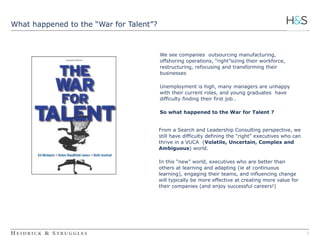
What happened to the “War for Talent”? 
We see companies outsourcing manufacturing, 
offshoring operations, “right”sizing their workforce, 
restructuring, refocusing and transforming their 
businesses 
Unemployment is high, many managers are unhappy 
with their current roles, and young graduates have 
difficulty finding their first job… 
So what happened to the War for Talent ? 
From a Search and Leadership Consulting perspective, we 
still have difficulty defining the “right” executives who can 
thrive in a VUCA (Volatile, Uncertain, Complex and 
Ambiguous) world. 
In this “new” world, executives who are better than 
others at learning and adapting (ie at continuous 
learning), engaging their teams, and influencing change 
will typically be more effective at creating more value for 
their companies (and enjoy successful careers!)
3 
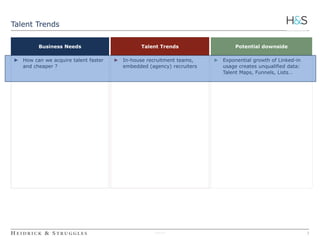
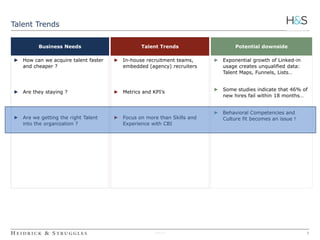
Talent Trends 
Business Needs Talent Trends Potential downside 
► In-house recruitment teams, 
embedded (agency) recruiters 
3090236 
► Exponential growth of Linked-in 
usage creates unqualified data: 
Talent Maps, Funnels, Lists… 
► How can we acquire talent faster 
and cheaper ?
4 
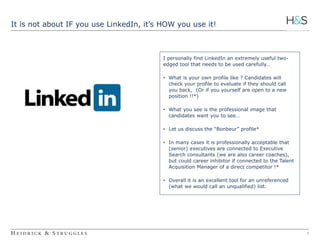
It is not about IF you use LinkedIn, it’s HOW you use it! 
I personally find LinkedIn an extremely useful two-edged 
tool that needs to be used carefully… 
• What is your own profile like ? Candidates will 
check your profile to evaluate if they should call 
you back, (Or if you yourself are open to a new 
position !!*) 
• What you see is the professional image that 
candidates want you to see… 
• Let us discuss the “Bonbeur” profile* 
• In many cases it is professionally acceptable that 
(senior) executives are connected to Executive 
Search consultants (we are also career coaches), 
but could career inhibitor if connected to the Talent 
Acquisition Manager of a direct competitor !* 
• Overall it is an excellent tool for an unreferenced 
(what we would call an unqualified) list.
5 
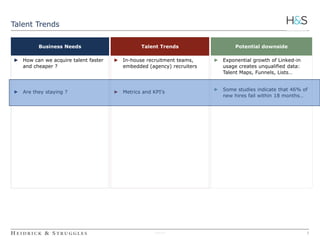
Talent Trends 
Business Needs Talent Trends Potential downside 
► In-house recruitment teams, 
embedded (agency) recruiters 
► Metrics and KPI’s 
3090236 
► Exponential growth of Linked-in 
usage creates unqualified data: 
Talent Maps, Funnels, Lists… 
► Some studies indicate that 46% of 
new hires fail within 18 months… 
► How can we acquire talent faster 
and cheaper ? 
► Are they staying ?
6 
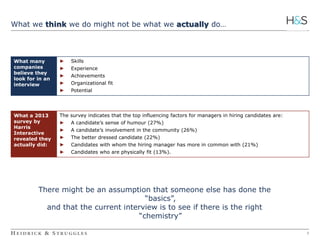
What we think we do might not be what we actually do… 
► Skills 
► Experience 
► Achievements 
► Organizational fit 
► Potential 
What many 
companies 
believe they 
look for in an 
interview 
The survey indicates that the top influencing factors for managers in hiring candidates are: 
► A candidate’s sense of humour (27%) 
► A candidate’s involvement in the community (26%) 
► The better dressed candidate (22%) 
► Candidates with whom the hiring manager has more in common with (21%) 
► Candidates who are physically fit (13%). 
What a 2013 
survey by 
Harris 
Interactive 
revealed they 
actually did: 
There might be an assumption that someone else has done the 
“basics”, 
and that the current interview is to see if there is the right 
“chemistry”
7 
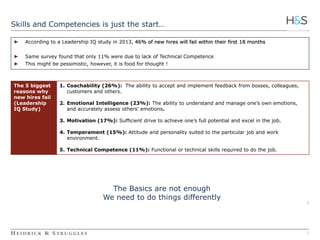
Skills and Competencies is just the start… 
7 
► According to a Leadership IQ study in 2013, 46% of new hires will fail within their first 18 months 
► Same survey found that only 11% were due to lack of Technical Competence 
► This might be pessimistic, however, it is food for thought ! 
1. Coachability (26%): The ability to accept and implement feedback from bosses, colleagues, 
customers and others. 
2. Emotional Intelligence (23%): The ability to understand and manage one’s own emotions, 
and accurately assess others’ emotions. 
3. Motivation (17%): Sufficient drive to achieve one’s full potential and excel in the job. 
4. Temperament (15%): Attitude and personality suited to the particular job and work 
environment. 
5. Technical Competence (11%): Functional or technical skills required to do the job. 
The 5 biggest 
reasons why 
new hires fail 
(Leadership 
IQ Study) 
The Basics are not enough 
We need to do things differently
8 
Talent Trends 
Business Needs Talent Trends Potential downside 
► In-house recruitment teams, 
embedded (agency) recruiters 
► Metrics and KPI’s 
► Focus on more than Skills and 
Experience with CBI 
3090236 
► Exponential growth of Linked-in 
usage creates unqualified data: 
Talent Maps, Funnels, Lists… 
► Some studies indicate that 46% of 
new hires fail within 18 months… 
► Behavioral Competencies and 
Culture fit becomes an issue ! 
► How can we acquire talent faster 
and cheaper ? 
► Are they staying ? 
► Are we getting the right Talent 
into the organization ?
9 
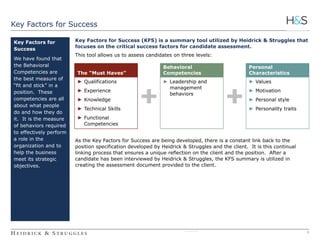
Key Factors for Success 
Key Factors for Success (KFS) is a summary tool utilized by Heidrick & Struggles that 
focuses on the critical success factors for candidate assessment. 
This tool allows us to assess candidates on three levels: 
As the Key Factors for Success are being developed, there is a constant link back to the 
position specification developed by Heidrick & Struggles and the client. It is this continual 
linking process that ensures a unique reflection on the client and the position. After a 
candidate has been interviewed by Heidrick & Struggles, the KFS summary is utilized in 
creating the assessment document provided to the client. 
Key Factors for 
Success 
We have found that 
the Behavioral 
Competencies are 
the best measure of 
“fit and stick” in a 
position. These 
competencies are all 
about what people 
do and how they do 
it. It is the measure 
of behaviors required 
to effectively perform 
a role in the 
organization and to 
help the business 
meet its strategic 
objectives. 
Behavioral 
Competencies 
Personal 
The “Must Haves” Characteristics 
► Qualifications 
► Experience 
► Knowledge 
► Technical Skills 
► Functional 
Competencies 
► Leadership and 
management 
behaviors 
► Values 
► Motivation 
► Personal style 
► Personality traits 
Confidential 9
10 
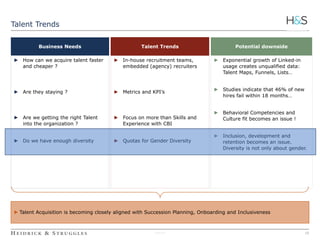
Talent Trends 
Business Needs Talent Trends Potential downside 
► In-house recruitment teams, 
embedded (agency) recruiters 
► Metrics and KPI’s 
► Focus on more than Skills and 
Experience with CBI 
► Quotas for Gender Diversity 
3090236 
► Exponential growth of Linked-in 
usage creates unqualified data: 
Talent Maps, Funnels, Lists… 
► Studies indicate that 46% of new 
hires fail within 18 months… 
► Behavioral Competencies and 
Culture fit becomes an issue ! 
► Inclusion, development and 
retention becomes an issue. 
Diversity is not only about gender. 
► How can we acquire talent faster 
and cheaper ? 
► Are they staying ? 
► Are we getting the right Talent 
into the organization ? 
► Do we have enough diversity 
► Talent Acquisition is becoming closely aligned with Succession Planning, Onboarding and Inclusiveness
11 
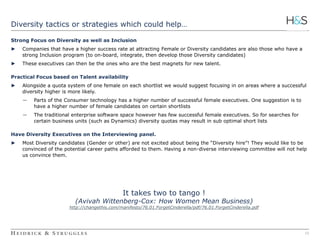
Diversity tactics or strategies which could help… 
Strong Focus on Diversity as well as Inclusion 
► Companies that have a higher success rate at attracting Female or Diversity candidates are also those who have a 
strong Inclusion program (to on-board, integrate, then develop those Diversity candidates) 
► These executives can then be the ones who are the best magnets for new talent. 
Practical Focus based on Talent availability 
► Alongside a quota system of one female on each shortlist we would suggest focusing in on areas where a successful 
diversity higher is more likely. 
― Parts of the Consumer technology has a higher number of successful female executives. One suggestion is to 
have a higher number of female candidates on certain shortlists 
― The traditional enterprise software space however has few successful female executives. So for searches for 
certain business units (such as Dynamics) diversity quotas may result in sub optimal short lists 
Have Diversity Executives on the Interviewing panel. 
► Most Diversity candidates (Gender or other) are not excited about being the “Diversity hire”! They would like to be 
convinced of the potential career paths afforded to them. Having a non-diverse interviewing committee will not help 
us convince them. 
It takes two to tango ! 
(Avivah Wittenberg-Cox: How Women Mean Business) 
http://changethis.com/manifesto/76.01.ForgetCinderella/pdf/76.01.ForgetCinderella.pdf
12 
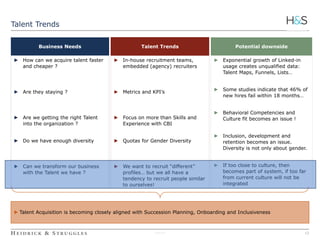
Talent Trends 
Business Needs Talent Trends Potential downside 
► In-house recruitment teams, 
embedded (agency) recruiters 
► Metrics and KPI’s 
► Focus on more than Skills and 
Experience with CBI 
► Quotas for Gender Diversity 
► We want to recruit “different” 
profiles… but we all have a 
tendency to recruit people similar 
to ourselves! 
3090236 
► Exponential growth of Linked-in 
usage creates unqualified data: 
Talent Maps, Funnels, Lists… 
► Some studies indicate that 46% of 
new hires fail within 18 months… 
► Behavioral Competencies and 
Culture fit becomes an issue ! 
► Inclusion, development and 
retention becomes an issue. 
Diversity is not only about gender. 
► If too close to culture, then 
becomes part of system, if too far 
from current culture will not be 
integrated 
► How can we acquire talent faster 
and cheaper ? 
► Are they staying ? 
► Are we getting the right Talent 
into the organization ? 
► Do we have enough diversity 
► Can we transform our business 
with the Talent we have ? 
► Talent Acquisition is becoming closely aligned with Succession Planning, Onboarding and Inclusiveness
13 
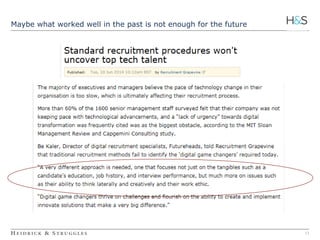
Maybe what worked well in the past is not enough for the future
14 
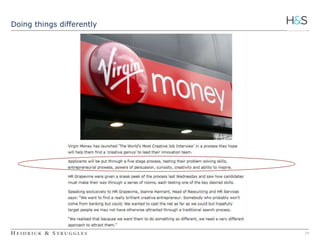
Doing things differently
15 
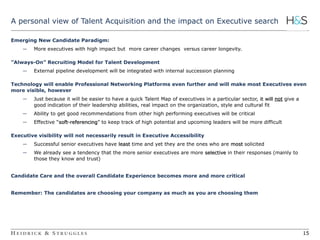
A personal view of Talent Acquisition and the impact on Executive search 
Emerging New Candidate Paradigm: 
― More executives with high impact but more career changes versus career longevity. 
”Always-On” Recruiting Model for Talent Development 
― External pipeline development will be integrated with internal succession planning 
Technology will enable Professional Networking Platforms even further and will make most Executives even 
more visible, however 
― Just because it will be easier to have a quick Talent Map of executives in a particular sector, it will not give a 
good indication of their leadership abilities, real impact on the organization, style and cultural fit 
― Ability to get good recommendations from other high performing executives will be critical 
― Effective “soft-referencing” to keep track of high potential and upcoming leaders will be more difficult 
Executive visibility will not necessarily result in Executive Accessibility 
― Successful senior executives have least time and yet they are the ones who are most solicited 
― We already see a tendency that the more senior executives are more selective in their responses (mainly to 
those they know and trust) 
Candidate Care and the overall Candidate Experience becomes more and more critical 
Remember: The candidates are choosing your company as much as you are choosing them 
15
16 
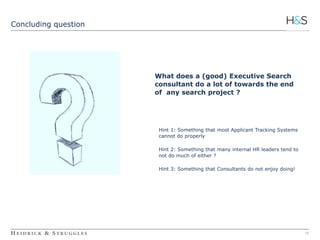
Concluding question 
What does a (good) Executive Search 
consultant do a lot of towards the end 
of any search project ? 
Hint 1: Something that most Applicant Tracking Systems 
cannot do properly 
Hint 2: Something that many internal HR leaders tend to 
not do much of either ? 
Hint 3: Something that Consultants do not enjoy doing!
17 
Ahmad Hassan 
Ahmad Hassan is a partner in Heidrick & Struggles’ Paris office and is a member of both the 
Global Technology & Services and Leadership Consulting practices. He also co-leads the firm's 
Software Practice for EMEA. 
Ahmad focuses on search, assessment and talent development projects at the CEO, COO and 
Managing Director level for multinational companies. He has also conducted Board level 
assignments within the technology sector. 
Prior to joining Heidrick & Struggles, Ahmad spent almost 12 years with another global 
executive search and assessment firm where he was a Managing Director with a well-established 
practice in telecommunications, software, hardware, and the convergence sectors. 
He was an executive with AT&T prior to leaving the corporate life for executive search. One of 
his last roles with AT&T was to lead service delivery for their Outsourcing Division across 
Europe, the Middle East and Africa. His early career was with IBM where he spent 10 years in 
sales and consulting roles. 
Ahmad has two US patents in the area of digital imaging and transmission and is co-leader of 
the Career & Solidarity function for the INSEAD Alumni Association in France. 
Ahmad received his MBA from INSEAD and his engineering degree from Cairo University. He is 
fluent in French, English and Arabic. 
40 rue de Courcelles 
75008 Paris 
France 
tel: +33 (0) 1 44 34 17 00 
ahassan@heidrick.com
40 rue de Courcelles 
75008 Paris 
+33 1 44 34 17 00 
www.heidrick.com 
Link to Ahmad's bio 
18

A personal view of Talent Aquisition Trends

  • 1.
    Prepared by AhmadHassan September 2014 0 Heidrick & Struggles: Talent Acquisition Trends
  • 2.
    1 Talent Matters:A reality check! Heidrick & Struggles is a global Executive Search and Leadership Consulting firm, we believe that successful companies execute strategy and drive outstanding performance through leadership, and we add value to our clients by ► helping them find executives who will make an impact on their businesses ► Advising them during and after periods of significant transition As a Partner in the Global Technology Practice, I can only share ► My observations that are influenced by interaction with senior leaders at the clients with work with. ► My personal opinions that are formed by working in the Technology sector, which might not be representative of all sectors!
  • 3.
    2 What happenedto the “War for Talent”? We see companies outsourcing manufacturing, offshoring operations, “right”sizing their workforce, restructuring, refocusing and transforming their businesses Unemployment is high, many managers are unhappy with their current roles, and young graduates have difficulty finding their first job… So what happened to the War for Talent ? From a Search and Leadership Consulting perspective, we still have difficulty defining the “right” executives who can thrive in a VUCA (Volatile, Uncertain, Complex and Ambiguous) world. In this “new” world, executives who are better than others at learning and adapting (ie at continuous learning), engaging their teams, and influencing change will typically be more effective at creating more value for their companies (and enjoy successful careers!)
  • 4.
    3 Talent Trends Business Needs Talent Trends Potential downside ► In-house recruitment teams, embedded (agency) recruiters 3090236 ► Exponential growth of Linked-in usage creates unqualified data: Talent Maps, Funnels, Lists… ► How can we acquire talent faster and cheaper ?
  • 5.
    4 It isnot about IF you use LinkedIn, it’s HOW you use it! I personally find LinkedIn an extremely useful two-edged tool that needs to be used carefully… • What is your own profile like ? Candidates will check your profile to evaluate if they should call you back, (Or if you yourself are open to a new position !!*) • What you see is the professional image that candidates want you to see… • Let us discuss the “Bonbeur” profile* • In many cases it is professionally acceptable that (senior) executives are connected to Executive Search consultants (we are also career coaches), but could career inhibitor if connected to the Talent Acquisition Manager of a direct competitor !* • Overall it is an excellent tool for an unreferenced (what we would call an unqualified) list.
  • 6.
    5 Talent Trends Business Needs Talent Trends Potential downside ► In-house recruitment teams, embedded (agency) recruiters ► Metrics and KPI’s 3090236 ► Exponential growth of Linked-in usage creates unqualified data: Talent Maps, Funnels, Lists… ► Some studies indicate that 46% of new hires fail within 18 months… ► How can we acquire talent faster and cheaper ? ► Are they staying ?
  • 7.
    6 What wethink we do might not be what we actually do… ► Skills ► Experience ► Achievements ► Organizational fit ► Potential What many companies believe they look for in an interview The survey indicates that the top influencing factors for managers in hiring candidates are: ► A candidate’s sense of humour (27%) ► A candidate’s involvement in the community (26%) ► The better dressed candidate (22%) ► Candidates with whom the hiring manager has more in common with (21%) ► Candidates who are physically fit (13%). What a 2013 survey by Harris Interactive revealed they actually did: There might be an assumption that someone else has done the “basics”, and that the current interview is to see if there is the right “chemistry”
  • 8.
    7 Skills andCompetencies is just the start… 7 ► According to a Leadership IQ study in 2013, 46% of new hires will fail within their first 18 months ► Same survey found that only 11% were due to lack of Technical Competence ► This might be pessimistic, however, it is food for thought ! 1. Coachability (26%): The ability to accept and implement feedback from bosses, colleagues, customers and others. 2. Emotional Intelligence (23%): The ability to understand and manage one’s own emotions, and accurately assess others’ emotions. 3. Motivation (17%): Sufficient drive to achieve one’s full potential and excel in the job. 4. Temperament (15%): Attitude and personality suited to the particular job and work environment. 5. Technical Competence (11%): Functional or technical skills required to do the job. The 5 biggest reasons why new hires fail (Leadership IQ Study) The Basics are not enough We need to do things differently
  • 9.
    8 Talent Trends Business Needs Talent Trends Potential downside ► In-house recruitment teams, embedded (agency) recruiters ► Metrics and KPI’s ► Focus on more than Skills and Experience with CBI 3090236 ► Exponential growth of Linked-in usage creates unqualified data: Talent Maps, Funnels, Lists… ► Some studies indicate that 46% of new hires fail within 18 months… ► Behavioral Competencies and Culture fit becomes an issue ! ► How can we acquire talent faster and cheaper ? ► Are they staying ? ► Are we getting the right Talent into the organization ?
  • 10.
    9 Key Factorsfor Success Key Factors for Success (KFS) is a summary tool utilized by Heidrick & Struggles that focuses on the critical success factors for candidate assessment. This tool allows us to assess candidates on three levels: As the Key Factors for Success are being developed, there is a constant link back to the position specification developed by Heidrick & Struggles and the client. It is this continual linking process that ensures a unique reflection on the client and the position. After a candidate has been interviewed by Heidrick & Struggles, the KFS summary is utilized in creating the assessment document provided to the client. Key Factors for Success We have found that the Behavioral Competencies are the best measure of “fit and stick” in a position. These competencies are all about what people do and how they do it. It is the measure of behaviors required to effectively perform a role in the organization and to help the business meet its strategic objectives. Behavioral Competencies Personal The “Must Haves” Characteristics ► Qualifications ► Experience ► Knowledge ► Technical Skills ► Functional Competencies ► Leadership and management behaviors ► Values ► Motivation ► Personal style ► Personality traits Confidential 9
  • 11.
    10 Talent Trends Business Needs Talent Trends Potential downside ► In-house recruitment teams, embedded (agency) recruiters ► Metrics and KPI’s ► Focus on more than Skills and Experience with CBI ► Quotas for Gender Diversity 3090236 ► Exponential growth of Linked-in usage creates unqualified data: Talent Maps, Funnels, Lists… ► Studies indicate that 46% of new hires fail within 18 months… ► Behavioral Competencies and Culture fit becomes an issue ! ► Inclusion, development and retention becomes an issue. Diversity is not only about gender. ► How can we acquire talent faster and cheaper ? ► Are they staying ? ► Are we getting the right Talent into the organization ? ► Do we have enough diversity ► Talent Acquisition is becoming closely aligned with Succession Planning, Onboarding and Inclusiveness
  • 12.
    11 Diversity tacticsor strategies which could help… Strong Focus on Diversity as well as Inclusion ► Companies that have a higher success rate at attracting Female or Diversity candidates are also those who have a strong Inclusion program (to on-board, integrate, then develop those Diversity candidates) ► These executives can then be the ones who are the best magnets for new talent. Practical Focus based on Talent availability ► Alongside a quota system of one female on each shortlist we would suggest focusing in on areas where a successful diversity higher is more likely. ― Parts of the Consumer technology has a higher number of successful female executives. One suggestion is to have a higher number of female candidates on certain shortlists ― The traditional enterprise software space however has few successful female executives. So for searches for certain business units (such as Dynamics) diversity quotas may result in sub optimal short lists Have Diversity Executives on the Interviewing panel. ► Most Diversity candidates (Gender or other) are not excited about being the “Diversity hire”! They would like to be convinced of the potential career paths afforded to them. Having a non-diverse interviewing committee will not help us convince them. It takes two to tango ! (Avivah Wittenberg-Cox: How Women Mean Business) http://changethis.com/manifesto/76.01.ForgetCinderella/pdf/76.01.ForgetCinderella.pdf
  • 13.
    12 Talent Trends Business Needs Talent Trends Potential downside ► In-house recruitment teams, embedded (agency) recruiters ► Metrics and KPI’s ► Focus on more than Skills and Experience with CBI ► Quotas for Gender Diversity ► We want to recruit “different” profiles… but we all have a tendency to recruit people similar to ourselves! 3090236 ► Exponential growth of Linked-in usage creates unqualified data: Talent Maps, Funnels, Lists… ► Some studies indicate that 46% of new hires fail within 18 months… ► Behavioral Competencies and Culture fit becomes an issue ! ► Inclusion, development and retention becomes an issue. Diversity is not only about gender. ► If too close to culture, then becomes part of system, if too far from current culture will not be integrated ► How can we acquire talent faster and cheaper ? ► Are they staying ? ► Are we getting the right Talent into the organization ? ► Do we have enough diversity ► Can we transform our business with the Talent we have ? ► Talent Acquisition is becoming closely aligned with Succession Planning, Onboarding and Inclusiveness
  • 14.
    13 Maybe whatworked well in the past is not enough for the future
  • 15.
    14 Doing thingsdifferently
  • 16.
    15 A personalview of Talent Acquisition and the impact on Executive search Emerging New Candidate Paradigm: ― More executives with high impact but more career changes versus career longevity. ”Always-On” Recruiting Model for Talent Development ― External pipeline development will be integrated with internal succession planning Technology will enable Professional Networking Platforms even further and will make most Executives even more visible, however ― Just because it will be easier to have a quick Talent Map of executives in a particular sector, it will not give a good indication of their leadership abilities, real impact on the organization, style and cultural fit ― Ability to get good recommendations from other high performing executives will be critical ― Effective “soft-referencing” to keep track of high potential and upcoming leaders will be more difficult Executive visibility will not necessarily result in Executive Accessibility ― Successful senior executives have least time and yet they are the ones who are most solicited ― We already see a tendency that the more senior executives are more selective in their responses (mainly to those they know and trust) Candidate Care and the overall Candidate Experience becomes more and more critical Remember: The candidates are choosing your company as much as you are choosing them 15
  • 17.
    16 Concluding question What does a (good) Executive Search consultant do a lot of towards the end of any search project ? Hint 1: Something that most Applicant Tracking Systems cannot do properly Hint 2: Something that many internal HR leaders tend to not do much of either ? Hint 3: Something that Consultants do not enjoy doing!
  • 18.
    17 Ahmad Hassan Ahmad Hassan is a partner in Heidrick & Struggles’ Paris office and is a member of both the Global Technology & Services and Leadership Consulting practices. He also co-leads the firm's Software Practice for EMEA. Ahmad focuses on search, assessment and talent development projects at the CEO, COO and Managing Director level for multinational companies. He has also conducted Board level assignments within the technology sector. Prior to joining Heidrick & Struggles, Ahmad spent almost 12 years with another global executive search and assessment firm where he was a Managing Director with a well-established practice in telecommunications, software, hardware, and the convergence sectors. He was an executive with AT&T prior to leaving the corporate life for executive search. One of his last roles with AT&T was to lead service delivery for their Outsourcing Division across Europe, the Middle East and Africa. His early career was with IBM where he spent 10 years in sales and consulting roles. Ahmad has two US patents in the area of digital imaging and transmission and is co-leader of the Career & Solidarity function for the INSEAD Alumni Association in France. Ahmad received his MBA from INSEAD and his engineering degree from Cairo University. He is fluent in French, English and Arabic. 40 rue de Courcelles 75008 Paris France tel: +33 (0) 1 44 34 17 00 ahassan@heidrick.com
  • 19.
    40 rue deCourcelles 75008 Paris +33 1 44 34 17 00 www.heidrick.com Link to Ahmad's bio 18