





Measuring Content Marketing
Karen Pate, Ph.D.
Terry Sheehan
Topics To Cover
• Defining Content Marketing
• Measuring Content Today
• Measurement Considerations
DEFINING CONTENT MARKETING
Just so we are on the same page
Con tent something contained, the topics
or matter treated in a written work, the
principal substance.

Mar ket ing the process of
communicating the value of a product or
service to customers, for the purpose of selling
the product or service.
Today’s discussion is about measuring
the impact…

Con tent something contained, the topics
or matter treated in a written work, the
principal substance.

Mar ket ing the process of
communicating the value of a product or
service to customers, for the purpose of selling
the product or service.
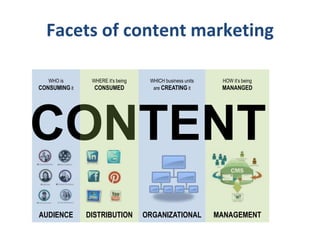
Facets of content marketing
WHO is

WHERE it’s being

CONSUMING it

CONSUMED

WHICH business units
are CREATING it

HOW it’s being

MANANGED

CONTENT
AUDIENCE

DISTRIBUTION

ORGANIZATIONAL

MANAGEMENT
MEASURING CONTENT TODAY
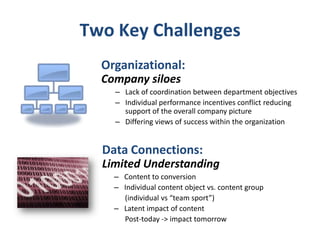
Two Key Challenges
Organizational:
Company siloes
– Lack of coordination between department objectives
– Individual performance incentives conflict reducing
support of the overall company picture
– Differing views of success within the organization

Data Connections:
Limited Understanding
– Content to conversion
– Individual content object vs. content group
(individual vs “team sport”)
– Latent impact of content
Post-today -> impact tomorrow
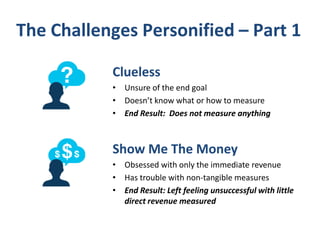
The Challenges Personified – Part 1
Clueless
• Unsure of the end goal
• Doesn’t know what or how to measure
• End Result: Does not measure anything

Show Me The Money
• Obsessed with only the immediate revenue
• Has trouble with non-tangible measures
• End Result: Left feeling unsuccessful with little
direct revenue measured
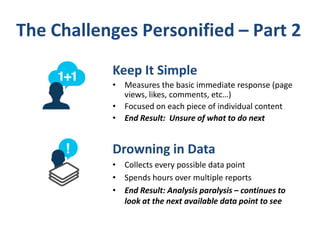
The Challenges Personified – Part 2
Keep It Simple
• Measures the basic immediate response (page
views, likes, comments, etc…)
• Focused on each piece of individual content
• End Result: Unsure of what to do next

Drowning in Data
• Collects every possible data point
• Spends hours over multiple reports
• End Result: Analysis paralysis – continues to
look at the next available data point to see
MEASURING CONTENT:
CONSIDERATIONS
GETTING THE BASICS RIGHT
Think about “Value”
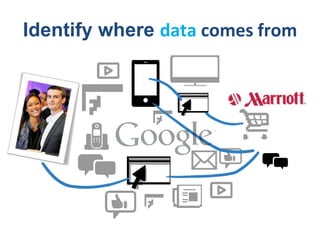
Identify where data comes from
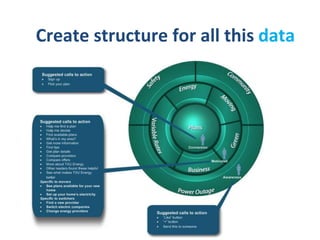
Create structure for all this data
ADDRESSING THE KEY CHALLENGES
Align the Organization
• Develop shared view
of assessing content
performance
• Create transparency
in content
performance
Align the Organization
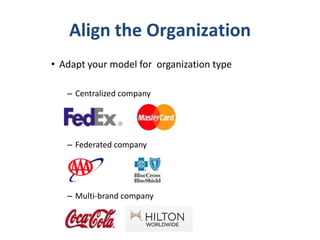
• Adapt your model for organization type
– Centralized company

– Federated company

– Multi-brand company
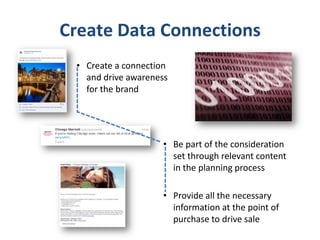
Create Data Connections
• Create a connection
and drive awareness
for the brand

• Be part of the consideration
set through relevant content
in the planning process
• Provide all the necessary
information at the point of
purchase to drive sale
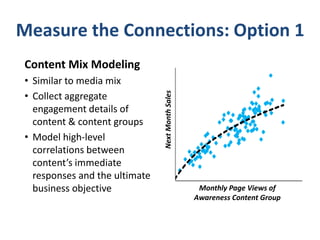
Measure the Connections: Option 1
• Similar to media mix
• Collect aggregate
engagement details of
content & content groups
• Model high-level
correlations between
content’s immediate
responses and the ultimate
business objective

Next Month Sales

Content Mix Modeling

Monthly Page Views of
Awareness Content Group
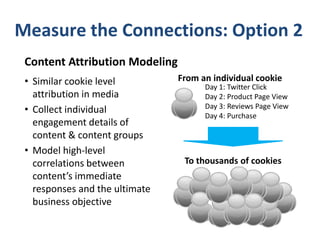
Measure the Connections: Option 2
Content Attribution Modeling
• Similar cookie level
attribution in media
• Collect individual
engagement details of
content & content groups
• Model high-level
correlations between
content’s immediate
responses and the ultimate
business objective

From an individual cookie
Day 1: Twitter Click
Day 2: Product Page View
Day 3: Reviews Page View
Day 4: Purchase

To thousands of cookies
Apply the Insights
• Identify the right content areas
– New opportunities
– Current content worthiness

• Let insights guide content development and execution
– Appropriate format, treatment for target audience, channels
for publishing
Measuring Content: A Case Study
What’s the value?

• Goal is not immediate revenue
–
–
–
–

Connections made
LinkedIn page views
iCrossing visits
Buzz

• Must look at the collective
impact of all presentations
• Long-term view of relationships
– Presentations to sales
– Presentations vs. close rates
– Presentations vs. type of products
sold

• Informs 2014 presentations
QUESTIONS

Measuring Content Marketing - iCrossing - DMA 2013 Conference

  • 1.
    Measuring Content Marketing KarenPate, Ph.D. Terry Sheehan
  • 2.
    Topics To Cover •Defining Content Marketing • Measuring Content Today • Measurement Considerations
  • 3.
  • 4.
    Just so weare on the same page Con tent something contained, the topics or matter treated in a written work, the principal substance. Mar ket ing the process of communicating the value of a product or service to customers, for the purpose of selling the product or service.
  • 5.
    Today’s discussion isabout measuring the impact… Con tent something contained, the topics or matter treated in a written work, the principal substance. Mar ket ing the process of communicating the value of a product or service to customers, for the purpose of selling the product or service.
  • 6.
    Facets of contentmarketing WHO is WHERE it’s being CONSUMING it CONSUMED WHICH business units are CREATING it HOW it’s being MANANGED CONTENT AUDIENCE DISTRIBUTION ORGANIZATIONAL MANAGEMENT
  • 7.
  • 8.
    Two Key Challenges Organizational: Companysiloes – Lack of coordination between department objectives – Individual performance incentives conflict reducing support of the overall company picture – Differing views of success within the organization Data Connections: Limited Understanding – Content to conversion – Individual content object vs. content group (individual vs “team sport”) – Latent impact of content Post-today -> impact tomorrow
  • 9.
    The Challenges Personified– Part 1 Clueless • Unsure of the end goal • Doesn’t know what or how to measure • End Result: Does not measure anything Show Me The Money • Obsessed with only the immediate revenue • Has trouble with non-tangible measures • End Result: Left feeling unsuccessful with little direct revenue measured
  • 10.
    The Challenges Personified– Part 2 Keep It Simple • Measures the basic immediate response (page views, likes, comments, etc…) • Focused on each piece of individual content • End Result: Unsure of what to do next Drowning in Data • Collects every possible data point • Spends hours over multiple reports • End Result: Analysis paralysis – continues to look at the next available data point to see
  • 11.
  • 12.
  • 13.
  • 14.
  • 15.
    Create structure forall this data
  • 16.
  • 17.
    Align the Organization •Develop shared view of assessing content performance • Create transparency in content performance
  • 18.
    Align the Organization •Adapt your model for organization type – Centralized company – Federated company – Multi-brand company
  • 19.
    Create Data Connections •Create a connection and drive awareness for the brand • Be part of the consideration set through relevant content in the planning process • Provide all the necessary information at the point of purchase to drive sale
  • 20.
    Measure the Connections:Option 1 • Similar to media mix • Collect aggregate engagement details of content & content groups • Model high-level correlations between content’s immediate responses and the ultimate business objective Next Month Sales Content Mix Modeling Monthly Page Views of Awareness Content Group
  • 21.
    Measure the Connections:Option 2 Content Attribution Modeling • Similar cookie level attribution in media • Collect individual engagement details of content & content groups • Model high-level correlations between content’s immediate responses and the ultimate business objective From an individual cookie Day 1: Twitter Click Day 2: Product Page View Day 3: Reviews Page View Day 4: Purchase To thousands of cookies
  • 22.
    Apply the Insights •Identify the right content areas – New opportunities – Current content worthiness • Let insights guide content development and execution – Appropriate format, treatment for target audience, channels for publishing
  • 23.
    Measuring Content: ACase Study What’s the value? • Goal is not immediate revenue – – – – Connections made LinkedIn page views iCrossing visits Buzz • Must look at the collective impact of all presentations • Long-term view of relationships – Presentations to sales – Presentations vs. close rates – Presentations vs. type of products sold • Informs 2014 presentations
  • 24.

Editor's Notes

  • #7 Audience–customer touch points and the funnelUseful, usable, desirable, engaging, visibleChannels - Bought, owned and earnedOrganization – marketing, sales, product groups, customer service, PR, community relationsInternal management of contentAudience–customer touch points and the funnelUseful, usable, desirable, engaging, visibleChannels - Bought, owned and earnedOrganization – marketing, sales, product groups, customer service, PR, community relationsInternal management of content
  • #9 Content not given chance to “marinate”Fear of missed opportunity, rush and reactWaiting too long to adapt current content or publish new content
  • #14 Value is not just dollar & cents – it’s measuring impact What is the role of content?Moment of time contribution vs. lifetime valueWhat are we measuring
  • #15 Granularity of content (single content object vs collection) – where does the measurement need to take placeUnderstanding how is content promoted (i.e., promotion – paid media, earned media)? Understanding the synergy of how channels work togetherCarry-over Marriott example and how a consumer process
  • #16 Putting Structure around all the detailsReference the difference in business models – Marriott vs. TXUeCommerce vs. information valueGenerating revenue vs. providing cost savingsMapping to the consumer process and calls to action within the content
  • #20 - Evaluate & Establish contents role in the decision process- Develop links to what we want consumer to do next- Establish more complex relationships between content and future actions consumers take:Content MixContent Attribution