Psychometrics of the ORS and SRS

    Results from RCT’s and Meta-Analyses
                                    Meta-
         of Routine Outcome Monitoring &

                                      1
                                          2
                            Feedback
0011 0010 1010 1101 0001 0100 1011


           The Available Evidence
                     2010

             Scott D. Miller, Ph.D.
0011 0010 1010 1101 0001 0100 1011


      KWWSWZLWWHUFRPVFRWWBGP
                                                       1
                                                                2
                                     KWWSZZZOLQNHGLQFRPVFRWWGPSKG
0011 0010 1010 1101 0001 0100 1011


                                                              1
                                                                  2
                        ZZZFHQWHUIRUFOLQLFDOH[FHOOHQFHFRP
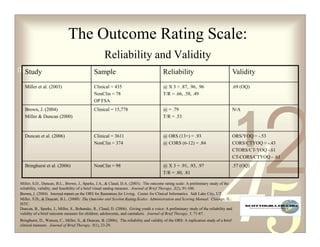
The Outcome Rating Scale:
                                                    Reliability and Validity
0011 0010 1010 1101 Sample0100 1011
  Study             0001                                                                 Reliability                                   Validity
   Miller et al. (2003)                       Clinical = 435                             @ X 3 = .87, .96, .96                         .69 (OQ)
                                              NonClin = 78                               T/R = .66, .58, .49
                                              OP FSA


                                                                                                                                                   2
   Brown, J. (2004)                           Clinical = 15,778                          @ = .79                                       N/A


                                                                                                                                       1
   Miller  Duncan (2000)                                                                T/R = .53


   Duncan et al. (2006)                       Clinical = 3611                            @ ORS (13+) = .93                             ORS/YOQ = -.53
                                              NonClin = 374                              @ CORS (6-12) = .84                           CORS/CTYOQ = -.43
                                                                                                                                       CTORS/CT-YOQ -.61
                                                                                                                                       CT-CORS/CTYOQ - .61
   Bringhurst et al. (2006)                   NonClin = 98                               @ X 3 = .91, .93, .97                         .57 (OQ)
                                                                                         T/R = .80, .81

Miller, S.D., Duncan, B.L., Brown, J., Sparks, J.A.,  Claud, D.A. (2003). The outcome rating scale: A preliminary study of the
reliability, validity, and feasibility of a brief visual analog measure. Journal of Brief Therapy, 2(2), 91-100.
Brown, J. (2004). Internal report on the ORS for Resources for Living. Center for Clinical Informatics. Salt Lake City, UT.
Miller, S.D.,  Duncan, B.L. (2000). The Outcome and Session Rating Scales: Administration and Scoring Manual. Chicago, IL:
ISTC.
Duncan, B., Sparks, J., Miller, S., Bohanske, R., Claud, D. (2006). Giving youth a voice: A preliminary study of the reliability and
validity of a brief outcome measure for children, adolescents, and caretakers. Journal of Brief Therapy, 5, 71-87.
Bringhurst, D., Watson, C., Miller, S.,  Duncan, B. (2006). The reliability and validity of the ORS: A replication study of a brief
clinical measure. Journal of Brief Therapy, 5(1), 23-29.
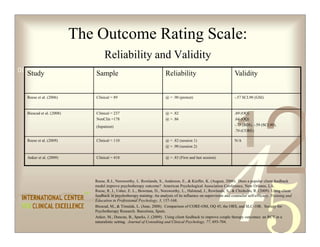
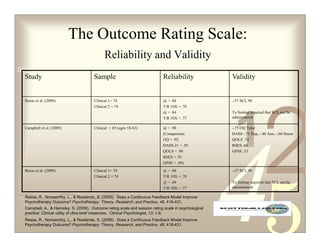
The Outcome Rating Scale:
                                  Reliability and Validity
0011 0010 1010 1101 0001 0100 1011
  Study             Sample                                              Reliability                               Validity


  Reese et al. (2006)        Clinical = 89                              @ = .90 (pretest)                         -.57 SCL90 (GSI)


                                                                                                                  1
                                                                                                                                     2
  Biescad et al. (2008)      Clinical = 237                             @ = .82                                   .69 (OQ)
                             NonClin =178                               @ = .86                                   .64 (OQ)
                             (Inpatient)                                                                          -.73 (BDI), -.59 (SCL90),
                                                                                                                  .70 (CORE)

  Reese et al. (2009)        Clinical = 110                             @ = .82 (session 1)                       N/A
                                                                        @ = .90 (session 2)

  Anker et al. (2009)        Clinical = 410                             @ = .83 (First and last session)


                             Reese, R.J., Norsworthy, L. Rowlands, S., Anderson, E.,  Kieffer, K. (August, 2006). Does a popular client feedback
                             model improve psychotherapy outcome? American Psychological Association Conference, New Orleans, LA.
                             Reese, R. J., Usher, E. L., Bowman, D., Norsworthy, L., Halstead, J., Rowlands, S.,  Chisholm, R. (2009). Using client
                             feedback in psychotherapy training: An analysis of its influence on supervision and counselor self-efficacy. Training and
                             Education in Professional Psychology, 3, 157-168.
                             Biescad, M.,  Timulak, L. (June, 2008). Comparison of CORE-OM, OQ 45, the ORS, and SLC-10R. Society for
                             Psychotherapy Research. Barcelona, Spain.
                             Anker, M., Duncan, B., Sparks, J. (2009). Using client feedback to improve couple therapy outcomes: an RCT in a
                             naturalistic setting. Journal of Consulting and Clinical Psychology, 77, 693-704.
The Outcome Rating Scale:
                                            Reliability and Validity
0011 0010 1010 1101 0001 0100 1011
 Study                                Sample                                Reliability               Validity


 Reese et al. (2009).                 Clinical 1= 74                        @ = .88                   -.57 SCL 90
                                      Clinical 2 = 74                       T/R 10X = .70


                                                                                                                         2
                                                                            @ = .84                   Tx Setting required that SCL not be


                                                                                                       1
                                                                            T/R 10X = .77             administered

 Campbell et al. (2009)               Clinical = 65 (ages 18-62)            @ = .90                   -.75 OQ Total
                                                                            (Comparison:              DASS -.71 Dep, -.46 Anx, -.60 Stress
                                                                            OQ = .95,                 QOLS .74
                                                                            DASS-21 = .95             RSES .66
                                                                            QOLS = .90                GPSE .53
                                                                            RSES = .91
                                                                            GPSE = .89)
 Reese et al. (2009).                 Clinical 1= 74                        @ = .88                   -.57 SCL 90
                                      Clinical 2 = 74                       T/R 10X = .70
                                                                            @ = .84                   Tx Setting required that SCL not be
                                                                            T/R 10X = .77             administered

 Reese, R., Norsworthy, L.,  Rowlands, S. (2009). Does a Continuous Feedback Model Improve
 Psychotherapy Outcome? Psychotherapy: Theory, Research, and Practice, 46, 418-431.
 Campbell, A.,  Hemsley, S. (2009). Outcome rating scale and session rating scale in psychological
 practice: Clinical utility of ultra-brief measures. Clinical Psychologist, 13, 1-9.
 Reese, R., Norsworthy, L.,  Rowlands, S. (2009). Does a Continuous Feedback Model Improve
 Psychotherapy Outcome? Psychotherapy: Theory, Research, and Practice, 46, 418-431.
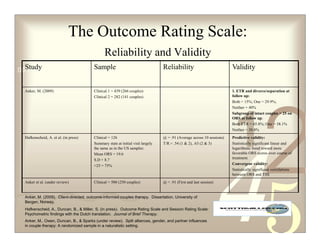
The Outcome Rating Scale:
                                             Reliability and Validity
0011 0010 1010 1101 Sample0100 1011
  Study             0001                                                        Reliability                            Validity


 Anker, M. (2009)                      Clinical 1 = 439 (266 couples)                                                  1. ETR and divorce/separation at
                                       Clinical 2 = 282 (141 couples)                                                  follow up:
                                                                                                                       Both = 15%; One = 29.9%;
                                                                                                                       Neither = 40%


                                                                                                                        1
                                                                                                                                           2
                                                                                                                       Subgroup of intact couples  25 on
                                                                                                                       ORS at follow up:
                                                                                                                       Both ETR = 65.8%; One = 38.1%
                                                                                                                       Neither = 30.8%
 Hafkenscheid, A. et al. (in press)    Clinical = 126                           @ = .91 (Average across 10 sessions)   Predictive validity:
                                       Summary stats at initial visit largely   T/R = .54 (1  2), .63 (2  3)         Statistically significant linear and
                                       the same as in the US samples:                                                  logarithmic trend toward more
                                       Mean ORS = 19.6                                                                 favorable ORS scores over course of
                                       S.D + 8.7                                                                       treatment.
                                       25 = 75%                                                                       Convergent validity:
                                                                                                                       Statistically significant correlations
                                                                                                                       between ORS and TSS
 Anker et al. (under review)           Clinical = 500 (250 couples)             @ = .91 (First and last session)


 Anker, M. (2009). Client-directed, outcome-informed couples therapy. Dissertation. University of
 Bergen, Norway.
 Hafkenscheid, A., Duncan, B.,  Miller, S. (in press). Outcome Rating Scale and Session Rating Scale:
 Psychometric findings with the Dutch translation. Journal of Brief Therapy.
 Anker, M., Owen, Duncan, B.,  Sparks (under review). Split alliances, gender, and partner influences
 in couple therapy: A randomized sample in a naturalistic setting.
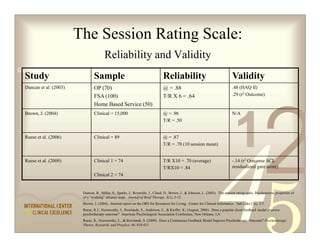
The Session Rating Scale:
                                       Reliability and Validity
0011 0010 1010 1101 0001 0100 1011
 Study                          Sample                                          Reliability                                     Validity
 Duncan et al. (2003)           OP (70)                                         @ = .88                                         .48 (HAQ II)
                                FSA (100)                                       T/R X 6 = .64                                   .29 (r2 Outcome)

                                Home Based Service (50)


                                                                                                                                 1
                                                                                                                                                      2
 Brown, J. (2004)               Clinical = 15,000                               @ = .96                                         N/A
                                                                                T/R = .50


 Reese et al. (2006)            Clinical = 89                                   @ = .87
                                                                                T/R = .70 (10 session mean)


 Reese et al. (2009)            Clinical 1 = 74                                 T/R X10 = .70 (average)                         -.14 (r2 Outcome SCL
                                                                                T/RX10 = .84                                    residualized gain score)
                                Clinical 2 = 74


                         Duncan, B., Miller, S., Sparks, J., Reynolds, J., Claud, D., Brown, J.,  Johnson, L. (2003). The session rating scale: Psychometric properties of
                         of a “working” alliance scale. Journal of Brief Therapy, 3(1), 3-12.
                         Brown, J. (2004). Internal report on the ORS for Resources for Living. Center for Clinical Informatics. Salt Lake City, UT.
                         Reese, R.J., Norsworthy, L. Rowlands, S., Anderson, E.,  Kieffer, K. (August, 2006). Does a popular client feedback model improve
                         psychotherapy outcome? American Psychological Association Conference, New Orleans, LA.
                         Reese, R., Norsworthy, L.,  Rowlands, S. (2009). Does a Continuous Feedback Model Improve Psychotherapy Outcome? Psychotherapy:
                         Theory, Research, and Practice, 46, 418-431.
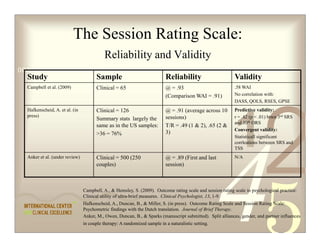
The Session Rating Scale:
                                           Reliability and Validity
0011 0010 1010 1101 0001 0100 1011
  Study                               Sample                              Reliability                      Validity
  Campbell et al. (2009)              Clinical = 65                       @ = .93                          .58 WAI
                                                                          (Comparison WAI = .91)           No correlation with:
                                                                                                           DASS, QOLS, RSES, GPSE


                                                                                                                          2
  Hafkenscheid, A. et al. (in         Clinical = 126                      @ = .91 (average across 10       Predictive validity:


                                                                                                           1
  press)                                                                  sessions)                        r = .42 (p  .01) btwn 3rd SRS
                                      Summary stats largely the
                                                                                                           and 10th ORS
                                      same as in the US samples:          T/R = .49 (1  2), .65 (2 
                                                                                                           Convergent validity:
                                      36 = 76%                           3)
                                                                                                           Statisticall significant
                                                                                                           corrleations between SRS and
                                                                                                           TSS
  Anker et al. (under review)         Clinical = 500 (250                 @ = .89 (First and last          N/A
                                      couples)                            session)


                                Campbell, A.,  Hemsley, S. (2009). Outcome rating scale and session rating scale in psychological practice:
                                Clinical utility of ultra-brief measures. Clinical Psychologist, 13, 1-9.
                                Hafkenscheid, A., Duncan, B.,  Miller, S. (in press). Outcome Rating Scale and Session Rating Scale:
                                Psychometric findings with the Dutch translation. Journal of Brief Therapy.
                                Anker, M., Owen, Duncan, B.,  Sparks (manuscript submitted). Split alliances, gender, and partner influences
                                in couple therapy: A randomized sample in a naturalistic setting.
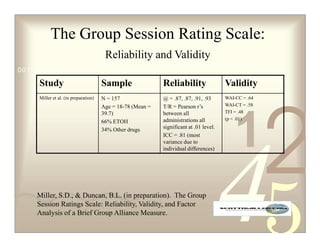
The Group Session Rating Scale:
                                       Reliability and Validity
0011 0010 1010 1101 0001 0100 1011

     Study                            Sample                Reliability                 Validity
     Miller et al. (in preparation)   N = 157               @ = .87, .87, .91, .93      WAI-CC = .64
                                      Age = 18-78 (Mean =   T/R = Pearson r’s           WAI-CT = .58


                                                                                                       2
                                                                                        TFI = .48


                                                                                           1
                                      39.7)                 between all
                                                            administrations all         (p  .01)
                                      66% ETOH
                                      34% Other drugs       significant at .01 level.
                                                            ICC = .81 (most
                                                            variance due to
                                                            individual differences)


    Miller, S.D.,  Duncan, B.L. (in preparation). The Group
    Session Ratings Scale: Reliability, Validity, and Factor
    Analysis of a Brief Group Alliance Measure.
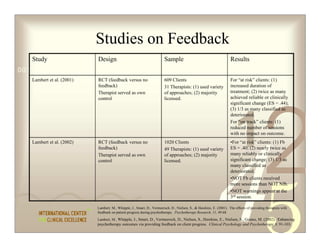
Studies on Feedback
   Study                   Design                                       Sample                                      Results
0011 0010 1010 1101 0001 0100 1011
   Lambert et al. (2001)   RCT (feedback versus no                      609 Clients                                 For “at risk” clients: (1)
                           feedback)                                    31 Therapists: (1) used variety             increased duration of
                           Therapist served as own                      of approaches; (2) majority                 treatment; (2) twice as many
                           control                                      licensed.                                   achieved reliable or clinically
                                                                                                                    significant change (ES = .44);


                                                                                                                                           2
                                                                                                                    (3) 1/3 as many classified as


                                                                                                                       1
                                                                                                                    deteriorated.
                                                                                                                    For “on track” clients: (1)
                                                                                                                    reduced number of sessions
                                                                                                                    with no impact on outcome.
   Lambert et al. (2002)   RCT (feedback versus no                      1020 Clients                                •For “at risk” clients: (1) Fb
                           feedback)                                    49 Therapists: (1) used variety             ES = .40; (2) nearly twice as
                           Therapist served as own                      of approaches; (2) majority                 many reliably or clinically
                           control                                      licensed.                                   significant change; (3) 1/3 as
                                                                                                                    many classified as
                                                                                                                    deteriorated.
                                                                                                                    •NOT Fb clients received
                                                                                                                    more sessions than NOT Nfb.
                                                                                                                    •NOT warnings appear at the
                                                                                                                    3rd session.

                           Lambert, M., Whipple, J., Smart, D., Vermeersch, D., Nielsen, S.,  Hawkins, E. (2001). The effects of providing therapists with
                           feedback on patient progress during psychotherapy. Psychotherapy Research, 11, 49.68.
                           Lambert, M., Whipple, J., Smart, D., Vermeersch, D., Nielsen, S., Hawkins, E., Nielsen, S., Goates, M. (2002). Enhancing
                           psychotherapy outcomes via providing feedback on client progress. Clinical Psychology and Psychotherapy,9, 91-103.
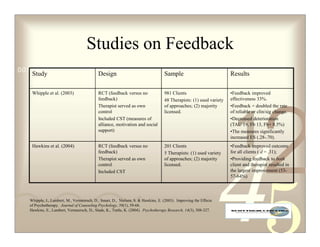
Studies on Feedback
0011 0010 1010 1101 0001 0100 1011
   Study             Design                                                       Sample                            Results

    Whipple et al. (2003)                  RCT (feedback versus no                981 Clients                       •Feedback improved
                                           feedback)                              48 Therapists: (1) used variety   effectiveness 33%.
                                           Therapist served as own                of approaches; (2) majority       •Feedback + doubled the rate


                                                                                                                                      2
                                           control                                licensed.                         of reliable or clin/sig change.


                                                                                                                      1
                                           Included CST (measures of                                                •Decreased deterioration
                                           alliance, motivation and social                                          (TAU 19, Fb 13, Fb+ 8.5%)
                                           support)                                                                 •The measures significantly
                                                                                                                    increased ES (.28-.70).
    Hawkins et al. (2004)                  RCT (feedback versus no                201 Clients                       •Feedback improved outcome
                                           feedback)                              5 Therapists: (1) used variety    for all clients ( d = .31);
                                           Therapist served as own                of approaches; (2) majority       •Providing feedback to both
                                           control                                licensed.                         client and therapist resulted in
                                           Included CST                                                             the largest improvement (53-
                                                                                                                    57-64%)


   Whipple, J., Lambert, M., Vermeersch, D., Smart, D., Nielsen, S.  Hawkins, E. (2003). Improving the Effects
   of Psychotherapy. Journal of Counseling Psychology, 50(1), 59-68.
   Hawkins, E., Lambert, Vermeersch, D., Slade, K., Tuttle, K. (2004). Psychotherapy Research, 14(3), 308-327.
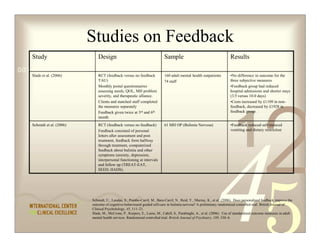
Studies on Feedback
   Study                       Design                                      Sample                                       Results

0011 0010 1010 1101 0001 0100 1011
   Slade et al. (2006)         RCT (feedback versus no feedback            160 adult mental health outpatients          •No difference in outcome for the
                               TAU)                                        74 staff                                     three subjective measures
                               Monthly postal questionnaires                                                            •Feedback group had reduced
                               assessing needs, QOL, MH problem                                                         hospital admissions and shorter stays
                               severity, and therapeutic alliance.                                                      (3.5 versus 10.0 days)
                               Clients and matched staff completed                                                      •Costs increased by £1109 in non-
                               the measures separately                                                                  feedback, decreased by £1928 in


                                                                                                                                               2
                               Feedback given twice at 3rd and 6th                                                      feedback group.


                                                                                                                           1
                               month
   Schmidt et al. (2006)       RCT (feedback versus no feedback)           61 MH OP (Bulimia Nervosa)                   •Feedback reduced self-induced
                               Feedback consisted of personal                                                           vomiting and dietary restriction
                               letters after assessment and post
                               treatment, feedback form halfway
                               through treatment, computerized
                               feedback about bulimia and other
                               symptoms (anxiety, depression,
                               interpersonal functioning at intervals
                               and follow up (TREAT-EAT,
                               SEED, HADS).


                           Schmidt, U., Landau, S., Pombo-Carril, M., Bara-Carril, N., Reid, Y., Murray, K., et al. (2006). Does personalized feedback improve the
                           outcome of cognitive-behavioural guided self-care in bulimia nervosa? A preliminary randomized controlled trial. British Journal of
                           Clinical Psycholology, 45, 111–21.
                           Slade, M., McCrone, P., Kuipers, E., Leese, M., Cahill, S., Parabiaghi, A., et al. (2006). Use of standardised outcome measures in adult
                           mental health services: Randomised controlled trial. British Journal of Psychiatry, 189, 330–6.
Studies on Feedback
   Study             Design                                                           Sample                                 Results
0011 0010 1010 1101 0001 0100 1011

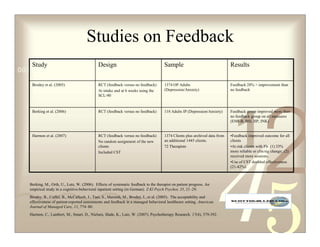
    Brodey et al. (2005)                     RCT (feedback versus no feedback)        1374 OP Adults                         Feedback 28%  improvement than
                                             At intake and at 6 weeks using the       (Depression/Anxiety)                   no feedback
                                             SCL-90


                                                                                                                                                 2
    Berking et al. (2006)                    RCT (feedback versus no feedback)        118 Adults IP (Depression/Anxiety)     Feedback group improved more than


                                                                                                                               1
                                                                                                                             no feedback group on all measures
                                                                                                                             (EMI-B, BSI, IIP, INK)


    Harmon et al. (2007)                     RCT (feedback versus no feedback)        1374 Clients plus archived data from   •Feedback improved outcome for all
                                             No random assignment of the new          an additional 1445 clients.            clients
                                             clients                                  72 Therapists                          •At risk clients with Fb: (1) 33%
                                             Included CST                                                                    more reliable or clin/sig change; (2)
                                                                                                                             received more sessions.
                                                                                                                             •Use of CST doubled effectiveness
                                                                                                                             (21-42%).


   Berking, M., Orth, U., Lutz, W. (2006). Effects of systematic feedback to the therapist on patient progress. An
   empirical study in a cognitive-behavioral inpatient setting (in German). Z Kl Psych Psychot, 35, 21–29.
   Brodey, B., Cuffel, B., McCulloch, J., Tani, S., Maruish, M., Brodey, I., et al. (2005). The acceptability and
   effectiveness of patient-reported assessments and feedback in a managed behavioral healthcare setting. American
   Journal of Managed Care, 11, 774–80.
   Harmon, C., Lambert, M., Smart, D., Nielsen, Slade, K., Lutz, W. (2007). Psychotherapy Research, 17(4), 379-392.
Meta  Mega Anaylses on Feedback
0011 Lambert et al. 1101 0001 0100 1011
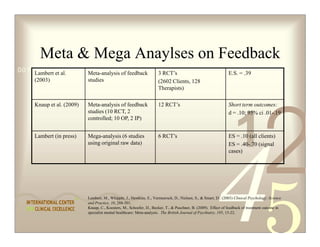
      0010 1010        Meta-analysis of feedback                      3 RCT’s                                   E.S. = .39
      (2003)                studies                                   (2602 Clients, 128
                                                                      Therapists)

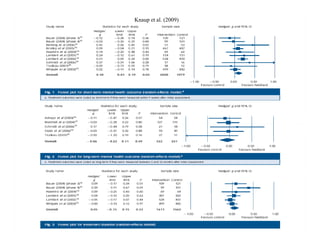
      Knaup et al. (2009)   Meta-analysis of feedback                 12 RCT’s                                  Short term outcomes:


                                                                                                                                     2
                            studies (10 RCT, 2                                                                  d = .10; 95% ci .01-.19


                                                                                                                   1
                            controlled; 10 OP, 2 IP)


      Lambert (in press)    Mega-analysis (6 studies                  6 RCT’s                                   ES = .10 (all clients)
                            using original raw data)                                                            ES = .40-.70 (signal
                                                                                                                cases)


                            Lambert, M., Whipple, J., Hawkins, E., Vermeersch, D., Nielsen, S.,  Smart, D . (2003) Clinical Psychology: Science
                            and Practice, 10, 288-301.
                            Knaup, C., Koesters, M., Schoefer, D., Becker, T.,  Puschner, B. (2009). Effect of feedback of treatment outome in
                            specialist mental healthcare: Meta-analysis. The British Journal of Psychiatry, 195, 15-22.
0011 0010 1010 1101 0001 0100 1011


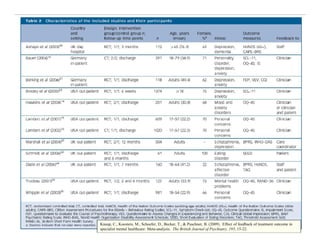
                                                                                                     1
                                                                                                                       2
                     Knaup, C., Koesters, M., Schoefer, D., Becker, T.,  Puschner, B. (2009). Effect of feedback of treatment outcome in
                     specialist mental healthcare: Meta-analysis. The British Journal of Psychiatry, 195, 15-22.
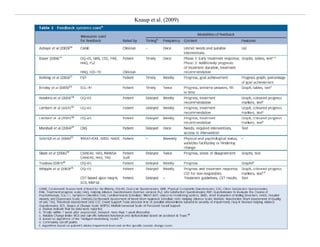
Knaup et al. (2009)


0011 0010 1010 1101 0001 0100 1011


                                                   1
                                                       2
Knaup et al. (2009)


0011 0010 1010 1101 0001 0100 1011


                                                   1
                                                       2
Studies on Feedback Using PCOMS
0011 0010 1010 1101 Design 0100 1011
 Study              0001                                                               Sample                         Results

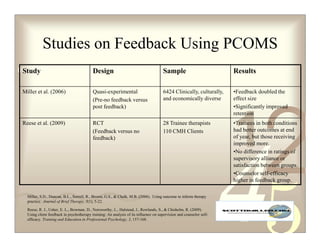
 Miller et al. (2006)                      Quasi-experimental                          6424 Clinically, culturally,   •Feedback doubled the
                                           (Pre-no feedback versus                     and economically diverse       effect size
                                           post feedback)                                                             •Significantly improved


                                                                                                                      1
                                                                                                                                   2
                                                                                                                      retention
 Reese et al. (2009)                       RCT                                         28 Trainee therapists          •Trainees in both conditions
                                           (Feedback versus no                         110 CMH Clients                had better outcomes at end
                                           feedback)                                                                  of year, but those receiving
                                                                                                                      improved more.
                                                                                                                      •No difference in ratings of
                                                                                                                      supervisory alliance or
                                                                                                                      satisfaction between groups.
                                                                                                                      •Counselor self-efficacy
                                                                                                                      higher in feedback group.

   Miller, S.D., Duncan, B.L., Sorrell, R., Brown, G.S.,  Chalk, M.B. (2006). Using outcome to inform therapy
   practice. Journal of Brief Therapy, 5(1), 5-22.

   Reese, R. J., Usher, E. L., Bowman, D., Norsworthy, L., Halstead, J., Rowlands, S.,  Chisholm, R. (2009).
   Using client feedback in psychotherapy training: An analysis of its influence on supervision and counselor self-
   efficacy. Training and Education in Professional Psychology, 3, 157-168.
Studies on Feedback Using PCOMS
   Study                       Design                           Sample                          Results
0011 0010 1010 1101 0001 0100 1011
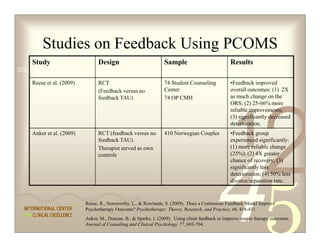
   Reese et al. (2009)         RCT                              74 Student Counseling           •Feedback improved
                               (Feedback versus no              Center                          overall outcomes: (1) 2X
                               feedback TAU)                    74 OP CMH                       as much change on the
                                                                                                ORS; (2) 25-66% more


                                                                                                                 2
                                                                                                reliable improvements;


                                                                                                  1
                                                                                                (3) significantly decreased
                                                                                                deterioration.
   Anker et al. (2009)         RCT (feedback versus no          410 Norwegian Couples           •Feedback group
                               feedback TAU)                                                    experienced significantly:
                               Therapist served as own                                          (1) more reliable change
                               controls                                                         (25%); (2) 4X greater
                                                                                                chance of recovery; (3)
                                                                                                significantly less
                                                                                                deterioration; (4) 50% less
                                                                                                divorce/separation rate.


                         Reese, R., Norsworthy, L.,  Rowlands, S. (2009). Does a Continuous Feedback Model Improve
                         Psychotherapy Outcome? Psychotherapy: Theory, Research, and Practice, 46, 418-431.
                         Anker, M., Duncan, B.,  Sparks, J. (2009). Using client feedback to improve couple therapy outcomes.
                         Journal of Consulting and Clinical Psychology, 77, 693-704.
Feedback Studies Using the
                          ORS/SRS
0011 0010 1010 1101 0001 0100 1011
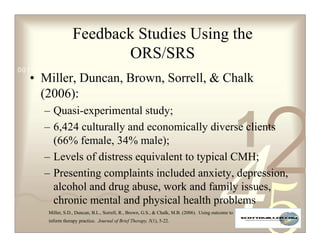
   • Miller, Duncan, Brown, Sorrell,  Chalk
     (2006):


                                                                                                          2
      – Quasi-experimental study;
      – 6,424 culturally and economically diverse clients
        (66% female, 34% male);
      – Levels of distress equivalent to typical CMH;
                                                                                                      1
      – Presenting complaints included anxiety, depression,
        alcohol and drug abuse, work and family issues,
        chronic mental and physical health problems
       Miller, S.D., Duncan, B.L., Sorrell, R., Brown, G.S.,  Chalk, M.B. (2006). Using outcome to
       inform therapy practice. Journal of Brief Therapy, 5(1), 5-22.
Miller, Duncan, Brown, Sorrell, 
                          Chalk (2006)
0011 0010 1010 1101 0001 0100 1011


    • 75 “in-house” therapists:
       – 72% female, average age 37 years;


                                                                         1
                                                                                      2
       – Average 7 years of experience:
          • 45% psychology;
          • 35% social work;
          • 20% Marriage and Family;
    • Feedback:
       – ORS trajectories and messages at each session;
       – SRS messages at the end of each session.
               Miller, S.D., Duncan, B.L., Sorrell, R., Brown, G.S.,  Chalk, M.B. (2006). Using
               outcome to inform therapy practice. Journal of Brief Therapy, 5(1), 5-22.
Miller, Duncan, Brown, Sorrell, 
                          Chalk (2006)
0011 0010 1010 1101 0001 0100 1011

    • Overall, the effect size increased from .37 to
      .79 (113%):


                                                                       1
                                                                           2
          – Using the RCI, 13% of improvement due to
            increase in clients reporting significant
            improvement, 11% due to decrease in people
            reporting deterioration.
          – When analysis is restricted to clients who
            started in the clinical range, the end effect sizes
            rises to 1.06 (186%).
 Miller, S.D., Duncan, B.L., Sorrell, R., Brown, G.S.,  Chalk, M.B.
 (2006). Using outcome to inform therapy practice. Journal of Brief
 Therapy, 5(1), 5-22.
Reese, Norsworthy,  Rowlands
                               (2009)
0011 0010 1010 1101 0001 0100 1011

   • Randomized Clinical Trial:
     – Two experimental groups:


                                                                       1
                                                                                   2
        • University Counseling Center (74)
        • Community Mental Health OP (74)
     – Participants randomized into either TAU or TAU
       with feedback;
     – Therapists were licensed master’s prepared
       clinicians and advanced practicum students.
              Reese, R., Norsworthy, L.,  Rowlands, S. (2009). Does a Continuous Feedback
              Model Improve Psychotherapy Outcome? Psychotherapy: Theory, Research, and
              Practice, 46, 418-431.
Reese, Norsworthy,  Rowlands
                               (2009)
0011 0010 1010 1101 0001 0100 1011

      • In both settings, participants in the feedback
        condition:


                                                                                1
                                                                                    2
            – More reliable change
                  • 80 versus 54% in study 1; 66 versus 41% in study 2;
                  • 2X as much change on the ORS (pre-post change
                    score);
            – Showed improvement sooner (7 versus 10);
            – Showed a trend toward attending more sessions
 Reese, R., Norsworthy, L.,  Rowlands, S. (2009). Does a Continuous Feedback
 Model Improve Psychotherapy Outcome? Psychotherapy: Theory, Research, and
 Practice, 46, 418-431.
Reese, Usher, Bowman et al.
                         (2009)
0011 0010 1010 1101 0001 0100 1011
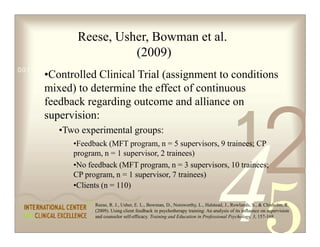
      •Controlled Clinical Trial (assignment to conditions
      mixed) to determine the effect of continuous
      feedback regarding outcome and alliance on


                                                                                                          2
      supervision:
          •Two experimental groups:
              •Feedback (MFT program, n = 5 supervisors, 9 trainees; CP
              program, n = 1 supervisor, 2 trainees)
              •No feedback (MFT program, n = 3 supervisors, 10 trainees;
                                                                                           1
              CP program, n = 1 supervisor, 7 trainees)
              •Clients (n = 110)

                    Reese, R. J., Usher, E. L., Bowman, D., Norsworthy, L., Halstead, J., Rowlands, S.,  Chisholm, R.
                    (2009). Using client feedback in psychotherapy training: An analysis of its influence on supervision
                    and counselor self-efficacy. Training and Education in Professional Psychology, 3, 157-168.
Reese, Usher, Bowman et al.
                                    (2009)
0011 0010 1010 1101 0001 0100 1011
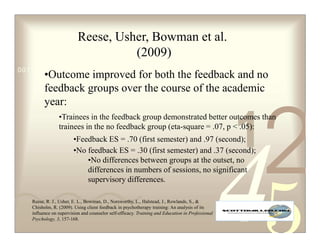
         •Outcome improved for both the feedback and no
         feedback groups over the course of the academic
         year:


                                                                                                  1
                                                                                                      2
                •Trainees in the feedback group demonstrated better outcomes than
                trainees in the no feedback group (eta-square = .07, p  .05):
                       •Feedback ES = .70 (first semester) and .97 (second);
                       •No feedback ES = .30 (first semester) and .37 (second);
                           •No differences between groups at the outset, no
                           differences in numbers of sessions, no significant
                           supervisory differences.

   Reese, R. J., Usher, E. L., Bowman, D., Norsworthy, L., Halstead, J., Rowlands, S., 
   Chisholm, R. (2009). Using client feedback in psychotherapy training: An analysis of its
   influence on supervision and counselor self-efficacy. Training and Education in Professional
   Psychology, 3, 157-168.
Reese, Usher, Bowman et al.
                                (2009)
0011 0010 1010 1101 0001 0100 1011
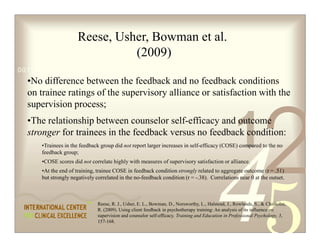
  •No difference between the feedback and no feedback conditions
  on trainee ratings of the supervisory alliance or satisfaction with the
  supervision process;


                                                                                                   1
                                                                                                                  2
  •The relationship between counselor self-efficacy and outcome
  stronger for trainees in the feedback versus no feedback condition:
      •Trainees in the feedback group did not report larger increases in self-efficacy (COSE) compared to the no
      feedback group;
      •COSE scores did not correlate highly with measures of supervisory satisfaction or alliance.
      •At the end of training, trainee COSE in feedback condition strongly related to aggregate outcome (r = .51)
      but strongly negatively correlated in the no-feedback condition (r = -.38). Correlations near 0 at the outset.


                               Reese, R. J., Usher, E. L., Bowman, D., Norsworthy, L., Halstead, J., Rowlands, S.,  Chisholm,
                               R. (2009). Using client feedback in psychotherapy training: An analysis of its influence on
                               supervision and counselor self-efficacy. Training and Education in Professional Psychology, 3,
                               157-168.
Anker, Duncan,  Sparks (2009)
0011 0010 1010 1101 0001 0100 1011

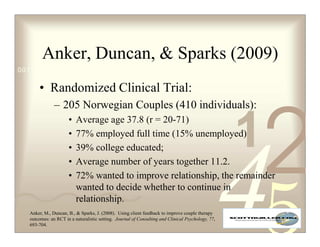
       • Randomized Clinical Trial:
               – 205 Norwegian Couples (410 individuals):


                                                                                                    1
                                                                                                        2
                      •   Average age 37.8 (r = 20-71)
                      •   77% employed full time (15% unemployed)
                      •   39% college educated;
                      •   Average number of years together 11.2.
                      •   72% wanted to improve relationship, the remainder
                          wanted to decide whether to continue in
                          relationship.
   Anker, M., Duncan, B.,  Sparks, J. (2008). Using client feedback to improve couple therapy
   outcomes: an RCT in a naturalistic setting. Journal of Consulting and Clinical Psychology, 77,
   693-704.
Anker, Duncan,  Sparks (2009)
0011 0010 1010 1101 0001 0100 1011

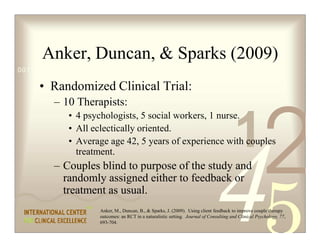
     • Randomized Clinical Trial:
         – 10 Therapists:


                                                                                         1
                                                                                                        2
             • 4 psychologists, 5 social workers, 1 nurse.
             • All eclectically oriented.
             • Average age 42, 5 years of experience with couples
               treatment.
         – Couples blind to purpose of the study and
           randomly assigned either to feedback or
           treatment as usual.
                     Anker, M., Duncan, B.,  Sparks, J. (2009). Using client feedback to improve couple therapy
                     outcomes: an RCT in a naturalistic setting. Journal of Consulting and Clinical Psychology, 77,
                     693-704.
Anker, Duncan,  Sparks (2009)
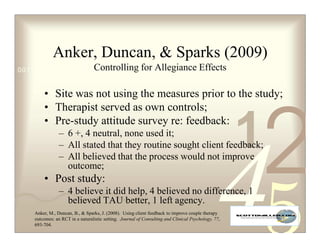
0011 0010 1010 1101 Controlling for
                    0001 0100 1011                              Allegiance Effects

        • Site was not using the measures prior to the study;
        • Therapist served as own controls;


                                                                                                     1
                                                                                                         2
        • Pre-study attitude survey re: feedback:
                – 6 +, 4 neutral, none used it;
                – All stated that they routine sought client feedback;
                – All believed that the process would not improve
                  outcome;
        • Post study:
                – 4 believe it did help, 4 believed no difference, 1
                  believed TAU better, 1 left agency.
    Anker, M., Duncan, B.,  Sparks, J. (2008). Using client feedback to improve couple therapy
    outcomes: an RCT in a naturalistic setting. Journal of Consulting and Clinical Psychology, 77,
    693-704.
Anker, Duncan,  Sparks (2009)
0011 0010 1010 1101 0001 0100 1011

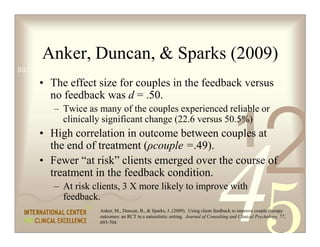
     • The effect size for couples in the feedback versus
       no feedback was d = .50.
         – Twice as many of the couples experienced reliable or


                                                                                         1
                                                                                                        2
           clinically significant change (22.6 versus 50.5%)
     • High correlation in outcome between couples at
       the end of treatment (ρcouple =.49).
     • Fewer “at risk” clients emerged over the course of
       treatment in the feedback condition.
         – At risk clients, 3 X more likely to improve with
           feedback.
                     Anker, M., Duncan, B.,  Sparks, J. (2009). Using client feedback to improve couple therapy
                     outcomes: an RCT in a naturalistic setting. Journal of Consulting and Clinical Psychology, 77,
                     693-704.

Measures And Feedback

  • 1.
    Psychometrics of theORS and SRS Results from RCT’s and Meta-Analyses Meta- of Routine Outcome Monitoring & 1 2 Feedback 0011 0010 1010 1101 0001 0100 1011 The Available Evidence 2010 Scott D. Miller, Ph.D.
  • 2.
    0011 0010 10101101 0001 0100 1011 KWWSWZLWWHUFRPVFRWWBGP 1 2 KWWSZZZOLQNHGLQFRPVFRWWGPSKG
  • 3.
    0011 0010 10101101 0001 0100 1011 1 2 ZZZFHQWHUIRUFOLQLFDOH[FHOOHQFHFRP
  • 4.
    The Outcome RatingScale: Reliability and Validity 0011 0010 1010 1101 Sample0100 1011 Study 0001 Reliability Validity Miller et al. (2003) Clinical = 435 @ X 3 = .87, .96, .96 .69 (OQ) NonClin = 78 T/R = .66, .58, .49 OP FSA 2 Brown, J. (2004) Clinical = 15,778 @ = .79 N/A 1 Miller Duncan (2000) T/R = .53 Duncan et al. (2006) Clinical = 3611 @ ORS (13+) = .93 ORS/YOQ = -.53 NonClin = 374 @ CORS (6-12) = .84 CORS/CTYOQ = -.43 CTORS/CT-YOQ -.61 CT-CORS/CTYOQ - .61 Bringhurst et al. (2006) NonClin = 98 @ X 3 = .91, .93, .97 .57 (OQ) T/R = .80, .81 Miller, S.D., Duncan, B.L., Brown, J., Sparks, J.A., Claud, D.A. (2003). The outcome rating scale: A preliminary study of the reliability, validity, and feasibility of a brief visual analog measure. Journal of Brief Therapy, 2(2), 91-100. Brown, J. (2004). Internal report on the ORS for Resources for Living. Center for Clinical Informatics. Salt Lake City, UT. Miller, S.D., Duncan, B.L. (2000). The Outcome and Session Rating Scales: Administration and Scoring Manual. Chicago, IL: ISTC. Duncan, B., Sparks, J., Miller, S., Bohanske, R., Claud, D. (2006). Giving youth a voice: A preliminary study of the reliability and validity of a brief outcome measure for children, adolescents, and caretakers. Journal of Brief Therapy, 5, 71-87. Bringhurst, D., Watson, C., Miller, S., Duncan, B. (2006). The reliability and validity of the ORS: A replication study of a brief clinical measure. Journal of Brief Therapy, 5(1), 23-29.
  • 5.
    The Outcome RatingScale: Reliability and Validity 0011 0010 1010 1101 0001 0100 1011 Study Sample Reliability Validity Reese et al. (2006) Clinical = 89 @ = .90 (pretest) -.57 SCL90 (GSI) 1 2 Biescad et al. (2008) Clinical = 237 @ = .82 .69 (OQ) NonClin =178 @ = .86 .64 (OQ) (Inpatient) -.73 (BDI), -.59 (SCL90), .70 (CORE) Reese et al. (2009) Clinical = 110 @ = .82 (session 1) N/A @ = .90 (session 2) Anker et al. (2009) Clinical = 410 @ = .83 (First and last session) Reese, R.J., Norsworthy, L. Rowlands, S., Anderson, E., Kieffer, K. (August, 2006). Does a popular client feedback model improve psychotherapy outcome? American Psychological Association Conference, New Orleans, LA. Reese, R. J., Usher, E. L., Bowman, D., Norsworthy, L., Halstead, J., Rowlands, S., Chisholm, R. (2009). Using client feedback in psychotherapy training: An analysis of its influence on supervision and counselor self-efficacy. Training and Education in Professional Psychology, 3, 157-168. Biescad, M., Timulak, L. (June, 2008). Comparison of CORE-OM, OQ 45, the ORS, and SLC-10R. Society for Psychotherapy Research. Barcelona, Spain. Anker, M., Duncan, B., Sparks, J. (2009). Using client feedback to improve couple therapy outcomes: an RCT in a naturalistic setting. Journal of Consulting and Clinical Psychology, 77, 693-704.
  • 6.
    The Outcome RatingScale: Reliability and Validity 0011 0010 1010 1101 0001 0100 1011 Study Sample Reliability Validity Reese et al. (2009). Clinical 1= 74 @ = .88 -.57 SCL 90 Clinical 2 = 74 T/R 10X = .70 2 @ = .84 Tx Setting required that SCL not be 1 T/R 10X = .77 administered Campbell et al. (2009) Clinical = 65 (ages 18-62) @ = .90 -.75 OQ Total (Comparison: DASS -.71 Dep, -.46 Anx, -.60 Stress OQ = .95, QOLS .74 DASS-21 = .95 RSES .66 QOLS = .90 GPSE .53 RSES = .91 GPSE = .89) Reese et al. (2009). Clinical 1= 74 @ = .88 -.57 SCL 90 Clinical 2 = 74 T/R 10X = .70 @ = .84 Tx Setting required that SCL not be T/R 10X = .77 administered Reese, R., Norsworthy, L., Rowlands, S. (2009). Does a Continuous Feedback Model Improve Psychotherapy Outcome? Psychotherapy: Theory, Research, and Practice, 46, 418-431. Campbell, A., Hemsley, S. (2009). Outcome rating scale and session rating scale in psychological practice: Clinical utility of ultra-brief measures. Clinical Psychologist, 13, 1-9. Reese, R., Norsworthy, L., Rowlands, S. (2009). Does a Continuous Feedback Model Improve Psychotherapy Outcome? Psychotherapy: Theory, Research, and Practice, 46, 418-431.
  • 7.
    The Outcome RatingScale: Reliability and Validity 0011 0010 1010 1101 Sample0100 1011 Study 0001 Reliability Validity Anker, M. (2009) Clinical 1 = 439 (266 couples) 1. ETR and divorce/separation at Clinical 2 = 282 (141 couples) follow up: Both = 15%; One = 29.9%; Neither = 40% 1 2 Subgroup of intact couples 25 on ORS at follow up: Both ETR = 65.8%; One = 38.1% Neither = 30.8% Hafkenscheid, A. et al. (in press) Clinical = 126 @ = .91 (Average across 10 sessions) Predictive validity: Summary stats at initial visit largely T/R = .54 (1 2), .63 (2 3) Statistically significant linear and the same as in the US samples: logarithmic trend toward more Mean ORS = 19.6 favorable ORS scores over course of S.D + 8.7 treatment. 25 = 75% Convergent validity: Statistically significant correlations between ORS and TSS Anker et al. (under review) Clinical = 500 (250 couples) @ = .91 (First and last session) Anker, M. (2009). Client-directed, outcome-informed couples therapy. Dissertation. University of Bergen, Norway. Hafkenscheid, A., Duncan, B., Miller, S. (in press). Outcome Rating Scale and Session Rating Scale: Psychometric findings with the Dutch translation. Journal of Brief Therapy. Anker, M., Owen, Duncan, B., Sparks (under review). Split alliances, gender, and partner influences in couple therapy: A randomized sample in a naturalistic setting.
  • 8.
    The Session RatingScale: Reliability and Validity 0011 0010 1010 1101 0001 0100 1011 Study Sample Reliability Validity Duncan et al. (2003) OP (70) @ = .88 .48 (HAQ II) FSA (100) T/R X 6 = .64 .29 (r2 Outcome) Home Based Service (50) 1 2 Brown, J. (2004) Clinical = 15,000 @ = .96 N/A T/R = .50 Reese et al. (2006) Clinical = 89 @ = .87 T/R = .70 (10 session mean) Reese et al. (2009) Clinical 1 = 74 T/R X10 = .70 (average) -.14 (r2 Outcome SCL T/RX10 = .84 residualized gain score) Clinical 2 = 74 Duncan, B., Miller, S., Sparks, J., Reynolds, J., Claud, D., Brown, J., Johnson, L. (2003). The session rating scale: Psychometric properties of of a “working” alliance scale. Journal of Brief Therapy, 3(1), 3-12. Brown, J. (2004). Internal report on the ORS for Resources for Living. Center for Clinical Informatics. Salt Lake City, UT. Reese, R.J., Norsworthy, L. Rowlands, S., Anderson, E., Kieffer, K. (August, 2006). Does a popular client feedback model improve psychotherapy outcome? American Psychological Association Conference, New Orleans, LA. Reese, R., Norsworthy, L., Rowlands, S. (2009). Does a Continuous Feedback Model Improve Psychotherapy Outcome? Psychotherapy: Theory, Research, and Practice, 46, 418-431.
  • 9.
    The Session RatingScale: Reliability and Validity 0011 0010 1010 1101 0001 0100 1011 Study Sample Reliability Validity Campbell et al. (2009) Clinical = 65 @ = .93 .58 WAI (Comparison WAI = .91) No correlation with: DASS, QOLS, RSES, GPSE 2 Hafkenscheid, A. et al. (in Clinical = 126 @ = .91 (average across 10 Predictive validity: 1 press) sessions) r = .42 (p .01) btwn 3rd SRS Summary stats largely the and 10th ORS same as in the US samples: T/R = .49 (1 2), .65 (2 Convergent validity: 36 = 76% 3) Statisticall significant corrleations between SRS and TSS Anker et al. (under review) Clinical = 500 (250 @ = .89 (First and last N/A couples) session) Campbell, A., Hemsley, S. (2009). Outcome rating scale and session rating scale in psychological practice: Clinical utility of ultra-brief measures. Clinical Psychologist, 13, 1-9. Hafkenscheid, A., Duncan, B., Miller, S. (in press). Outcome Rating Scale and Session Rating Scale: Psychometric findings with the Dutch translation. Journal of Brief Therapy. Anker, M., Owen, Duncan, B., Sparks (manuscript submitted). Split alliances, gender, and partner influences in couple therapy: A randomized sample in a naturalistic setting.
  • 10.
    The Group SessionRating Scale: Reliability and Validity 0011 0010 1010 1101 0001 0100 1011 Study Sample Reliability Validity Miller et al. (in preparation) N = 157 @ = .87, .87, .91, .93 WAI-CC = .64 Age = 18-78 (Mean = T/R = Pearson r’s WAI-CT = .58 2 TFI = .48 1 39.7) between all administrations all (p .01) 66% ETOH 34% Other drugs significant at .01 level. ICC = .81 (most variance due to individual differences) Miller, S.D., Duncan, B.L. (in preparation). The Group Session Ratings Scale: Reliability, Validity, and Factor Analysis of a Brief Group Alliance Measure.
  • 11.
    Studies on Feedback Study Design Sample Results 0011 0010 1010 1101 0001 0100 1011 Lambert et al. (2001) RCT (feedback versus no 609 Clients For “at risk” clients: (1) feedback) 31 Therapists: (1) used variety increased duration of Therapist served as own of approaches; (2) majority treatment; (2) twice as many control licensed. achieved reliable or clinically significant change (ES = .44); 2 (3) 1/3 as many classified as 1 deteriorated. For “on track” clients: (1) reduced number of sessions with no impact on outcome. Lambert et al. (2002) RCT (feedback versus no 1020 Clients •For “at risk” clients: (1) Fb feedback) 49 Therapists: (1) used variety ES = .40; (2) nearly twice as Therapist served as own of approaches; (2) majority many reliably or clinically control licensed. significant change; (3) 1/3 as many classified as deteriorated. •NOT Fb clients received more sessions than NOT Nfb. •NOT warnings appear at the 3rd session. Lambert, M., Whipple, J., Smart, D., Vermeersch, D., Nielsen, S., Hawkins, E. (2001). The effects of providing therapists with feedback on patient progress during psychotherapy. Psychotherapy Research, 11, 49.68. Lambert, M., Whipple, J., Smart, D., Vermeersch, D., Nielsen, S., Hawkins, E., Nielsen, S., Goates, M. (2002). Enhancing psychotherapy outcomes via providing feedback on client progress. Clinical Psychology and Psychotherapy,9, 91-103.
  • 12.
    Studies on Feedback 00110010 1010 1101 0001 0100 1011 Study Design Sample Results Whipple et al. (2003) RCT (feedback versus no 981 Clients •Feedback improved feedback) 48 Therapists: (1) used variety effectiveness 33%. Therapist served as own of approaches; (2) majority •Feedback + doubled the rate 2 control licensed. of reliable or clin/sig change. 1 Included CST (measures of •Decreased deterioration alliance, motivation and social (TAU 19, Fb 13, Fb+ 8.5%) support) •The measures significantly increased ES (.28-.70). Hawkins et al. (2004) RCT (feedback versus no 201 Clients •Feedback improved outcome feedback) 5 Therapists: (1) used variety for all clients ( d = .31); Therapist served as own of approaches; (2) majority •Providing feedback to both control licensed. client and therapist resulted in Included CST the largest improvement (53- 57-64%) Whipple, J., Lambert, M., Vermeersch, D., Smart, D., Nielsen, S. Hawkins, E. (2003). Improving the Effects of Psychotherapy. Journal of Counseling Psychology, 50(1), 59-68. Hawkins, E., Lambert, Vermeersch, D., Slade, K., Tuttle, K. (2004). Psychotherapy Research, 14(3), 308-327.
  • 13.
    Studies on Feedback Study Design Sample Results 0011 0010 1010 1101 0001 0100 1011 Slade et al. (2006) RCT (feedback versus no feedback 160 adult mental health outpatients •No difference in outcome for the TAU) 74 staff three subjective measures Monthly postal questionnaires •Feedback group had reduced assessing needs, QOL, MH problem hospital admissions and shorter stays severity, and therapeutic alliance. (3.5 versus 10.0 days) Clients and matched staff completed •Costs increased by £1109 in non- the measures separately feedback, decreased by £1928 in 2 Feedback given twice at 3rd and 6th feedback group. 1 month Schmidt et al. (2006) RCT (feedback versus no feedback) 61 MH OP (Bulimia Nervosa) •Feedback reduced self-induced Feedback consisted of personal vomiting and dietary restriction letters after assessment and post treatment, feedback form halfway through treatment, computerized feedback about bulimia and other symptoms (anxiety, depression, interpersonal functioning at intervals and follow up (TREAT-EAT, SEED, HADS). Schmidt, U., Landau, S., Pombo-Carril, M., Bara-Carril, N., Reid, Y., Murray, K., et al. (2006). Does personalized feedback improve the outcome of cognitive-behavioural guided self-care in bulimia nervosa? A preliminary randomized controlled trial. British Journal of Clinical Psycholology, 45, 111–21. Slade, M., McCrone, P., Kuipers, E., Leese, M., Cahill, S., Parabiaghi, A., et al. (2006). Use of standardised outcome measures in adult mental health services: Randomised controlled trial. British Journal of Psychiatry, 189, 330–6.
  • 14.
    Studies on Feedback Study Design Sample Results 0011 0010 1010 1101 0001 0100 1011 Brodey et al. (2005) RCT (feedback versus no feedback) 1374 OP Adults Feedback 28% improvement than At intake and at 6 weeks using the (Depression/Anxiety) no feedback SCL-90 2 Berking et al. (2006) RCT (feedback versus no feedback) 118 Adults IP (Depression/Anxiety) Feedback group improved more than 1 no feedback group on all measures (EMI-B, BSI, IIP, INK) Harmon et al. (2007) RCT (feedback versus no feedback) 1374 Clients plus archived data from •Feedback improved outcome for all No random assignment of the new an additional 1445 clients. clients clients 72 Therapists •At risk clients with Fb: (1) 33% Included CST more reliable or clin/sig change; (2) received more sessions. •Use of CST doubled effectiveness (21-42%). Berking, M., Orth, U., Lutz, W. (2006). Effects of systematic feedback to the therapist on patient progress. An empirical study in a cognitive-behavioral inpatient setting (in German). Z Kl Psych Psychot, 35, 21–29. Brodey, B., Cuffel, B., McCulloch, J., Tani, S., Maruish, M., Brodey, I., et al. (2005). The acceptability and effectiveness of patient-reported assessments and feedback in a managed behavioral healthcare setting. American Journal of Managed Care, 11, 774–80. Harmon, C., Lambert, M., Smart, D., Nielsen, Slade, K., Lutz, W. (2007). Psychotherapy Research, 17(4), 379-392.
  • 15.
    Meta MegaAnaylses on Feedback 0011 Lambert et al. 1101 0001 0100 1011 0010 1010 Meta-analysis of feedback 3 RCT’s E.S. = .39 (2003) studies (2602 Clients, 128 Therapists) Knaup et al. (2009) Meta-analysis of feedback 12 RCT’s Short term outcomes: 2 studies (10 RCT, 2 d = .10; 95% ci .01-.19 1 controlled; 10 OP, 2 IP) Lambert (in press) Mega-analysis (6 studies 6 RCT’s ES = .10 (all clients) using original raw data) ES = .40-.70 (signal cases) Lambert, M., Whipple, J., Hawkins, E., Vermeersch, D., Nielsen, S., Smart, D . (2003) Clinical Psychology: Science and Practice, 10, 288-301. Knaup, C., Koesters, M., Schoefer, D., Becker, T., Puschner, B. (2009). Effect of feedback of treatment outome in specialist mental healthcare: Meta-analysis. The British Journal of Psychiatry, 195, 15-22.
  • 16.
    0011 0010 10101101 0001 0100 1011 1 2 Knaup, C., Koesters, M., Schoefer, D., Becker, T., Puschner, B. (2009). Effect of feedback of treatment outcome in specialist mental healthcare: Meta-analysis. The British Journal of Psychiatry, 195, 15-22.
  • 17.
    Knaup et al.(2009) 0011 0010 1010 1101 0001 0100 1011 1 2
  • 18.
    Knaup et al.(2009) 0011 0010 1010 1101 0001 0100 1011 1 2
  • 19.
    Studies on FeedbackUsing PCOMS 0011 0010 1010 1101 Design 0100 1011 Study 0001 Sample Results Miller et al. (2006) Quasi-experimental 6424 Clinically, culturally, •Feedback doubled the (Pre-no feedback versus and economically diverse effect size post feedback) •Significantly improved 1 2 retention Reese et al. (2009) RCT 28 Trainee therapists •Trainees in both conditions (Feedback versus no 110 CMH Clients had better outcomes at end feedback) of year, but those receiving improved more. •No difference in ratings of supervisory alliance or satisfaction between groups. •Counselor self-efficacy higher in feedback group. Miller, S.D., Duncan, B.L., Sorrell, R., Brown, G.S., Chalk, M.B. (2006). Using outcome to inform therapy practice. Journal of Brief Therapy, 5(1), 5-22. Reese, R. J., Usher, E. L., Bowman, D., Norsworthy, L., Halstead, J., Rowlands, S., Chisholm, R. (2009). Using client feedback in psychotherapy training: An analysis of its influence on supervision and counselor self- efficacy. Training and Education in Professional Psychology, 3, 157-168.
  • 20.
    Studies on FeedbackUsing PCOMS Study Design Sample Results 0011 0010 1010 1101 0001 0100 1011 Reese et al. (2009) RCT 74 Student Counseling •Feedback improved (Feedback versus no Center overall outcomes: (1) 2X feedback TAU) 74 OP CMH as much change on the ORS; (2) 25-66% more 2 reliable improvements; 1 (3) significantly decreased deterioration. Anker et al. (2009) RCT (feedback versus no 410 Norwegian Couples •Feedback group feedback TAU) experienced significantly: Therapist served as own (1) more reliable change controls (25%); (2) 4X greater chance of recovery; (3) significantly less deterioration; (4) 50% less divorce/separation rate. Reese, R., Norsworthy, L., Rowlands, S. (2009). Does a Continuous Feedback Model Improve Psychotherapy Outcome? Psychotherapy: Theory, Research, and Practice, 46, 418-431. Anker, M., Duncan, B., Sparks, J. (2009). Using client feedback to improve couple therapy outcomes. Journal of Consulting and Clinical Psychology, 77, 693-704.
  • 21.
    Feedback Studies Usingthe ORS/SRS 0011 0010 1010 1101 0001 0100 1011 • Miller, Duncan, Brown, Sorrell, Chalk (2006): 2 – Quasi-experimental study; – 6,424 culturally and economically diverse clients (66% female, 34% male); – Levels of distress equivalent to typical CMH; 1 – Presenting complaints included anxiety, depression, alcohol and drug abuse, work and family issues, chronic mental and physical health problems Miller, S.D., Duncan, B.L., Sorrell, R., Brown, G.S., Chalk, M.B. (2006). Using outcome to inform therapy practice. Journal of Brief Therapy, 5(1), 5-22.
  • 22.
    Miller, Duncan, Brown,Sorrell, Chalk (2006) 0011 0010 1010 1101 0001 0100 1011 • 75 “in-house” therapists: – 72% female, average age 37 years; 1 2 – Average 7 years of experience: • 45% psychology; • 35% social work; • 20% Marriage and Family; • Feedback: – ORS trajectories and messages at each session; – SRS messages at the end of each session. Miller, S.D., Duncan, B.L., Sorrell, R., Brown, G.S., Chalk, M.B. (2006). Using outcome to inform therapy practice. Journal of Brief Therapy, 5(1), 5-22.
  • 23.
    Miller, Duncan, Brown,Sorrell, Chalk (2006) 0011 0010 1010 1101 0001 0100 1011 • Overall, the effect size increased from .37 to .79 (113%): 1 2 – Using the RCI, 13% of improvement due to increase in clients reporting significant improvement, 11% due to decrease in people reporting deterioration. – When analysis is restricted to clients who started in the clinical range, the end effect sizes rises to 1.06 (186%). Miller, S.D., Duncan, B.L., Sorrell, R., Brown, G.S., Chalk, M.B. (2006). Using outcome to inform therapy practice. Journal of Brief Therapy, 5(1), 5-22.
  • 24.
    Reese, Norsworthy, Rowlands (2009) 0011 0010 1010 1101 0001 0100 1011 • Randomized Clinical Trial: – Two experimental groups: 1 2 • University Counseling Center (74) • Community Mental Health OP (74) – Participants randomized into either TAU or TAU with feedback; – Therapists were licensed master’s prepared clinicians and advanced practicum students. Reese, R., Norsworthy, L., Rowlands, S. (2009). Does a Continuous Feedback Model Improve Psychotherapy Outcome? Psychotherapy: Theory, Research, and Practice, 46, 418-431.
  • 25.
    Reese, Norsworthy, Rowlands (2009) 0011 0010 1010 1101 0001 0100 1011 • In both settings, participants in the feedback condition: 1 2 – More reliable change • 80 versus 54% in study 1; 66 versus 41% in study 2; • 2X as much change on the ORS (pre-post change score); – Showed improvement sooner (7 versus 10); – Showed a trend toward attending more sessions Reese, R., Norsworthy, L., Rowlands, S. (2009). Does a Continuous Feedback Model Improve Psychotherapy Outcome? Psychotherapy: Theory, Research, and Practice, 46, 418-431.
  • 26.
    Reese, Usher, Bowmanet al. (2009) 0011 0010 1010 1101 0001 0100 1011 •Controlled Clinical Trial (assignment to conditions mixed) to determine the effect of continuous feedback regarding outcome and alliance on 2 supervision: •Two experimental groups: •Feedback (MFT program, n = 5 supervisors, 9 trainees; CP program, n = 1 supervisor, 2 trainees) •No feedback (MFT program, n = 3 supervisors, 10 trainees; 1 CP program, n = 1 supervisor, 7 trainees) •Clients (n = 110) Reese, R. J., Usher, E. L., Bowman, D., Norsworthy, L., Halstead, J., Rowlands, S., Chisholm, R. (2009). Using client feedback in psychotherapy training: An analysis of its influence on supervision and counselor self-efficacy. Training and Education in Professional Psychology, 3, 157-168.
  • 27.
    Reese, Usher, Bowmanet al. (2009) 0011 0010 1010 1101 0001 0100 1011 •Outcome improved for both the feedback and no feedback groups over the course of the academic year: 1 2 •Trainees in the feedback group demonstrated better outcomes than trainees in the no feedback group (eta-square = .07, p .05): •Feedback ES = .70 (first semester) and .97 (second); •No feedback ES = .30 (first semester) and .37 (second); •No differences between groups at the outset, no differences in numbers of sessions, no significant supervisory differences. Reese, R. J., Usher, E. L., Bowman, D., Norsworthy, L., Halstead, J., Rowlands, S., Chisholm, R. (2009). Using client feedback in psychotherapy training: An analysis of its influence on supervision and counselor self-efficacy. Training and Education in Professional Psychology, 3, 157-168.
  • 28.
    Reese, Usher, Bowmanet al. (2009) 0011 0010 1010 1101 0001 0100 1011 •No difference between the feedback and no feedback conditions on trainee ratings of the supervisory alliance or satisfaction with the supervision process; 1 2 •The relationship between counselor self-efficacy and outcome stronger for trainees in the feedback versus no feedback condition: •Trainees in the feedback group did not report larger increases in self-efficacy (COSE) compared to the no feedback group; •COSE scores did not correlate highly with measures of supervisory satisfaction or alliance. •At the end of training, trainee COSE in feedback condition strongly related to aggregate outcome (r = .51) but strongly negatively correlated in the no-feedback condition (r = -.38). Correlations near 0 at the outset. Reese, R. J., Usher, E. L., Bowman, D., Norsworthy, L., Halstead, J., Rowlands, S., Chisholm, R. (2009). Using client feedback in psychotherapy training: An analysis of its influence on supervision and counselor self-efficacy. Training and Education in Professional Psychology, 3, 157-168.
  • 29.
    Anker, Duncan, Sparks (2009) 0011 0010 1010 1101 0001 0100 1011 • Randomized Clinical Trial: – 205 Norwegian Couples (410 individuals): 1 2 • Average age 37.8 (r = 20-71) • 77% employed full time (15% unemployed) • 39% college educated; • Average number of years together 11.2. • 72% wanted to improve relationship, the remainder wanted to decide whether to continue in relationship. Anker, M., Duncan, B., Sparks, J. (2008). Using client feedback to improve couple therapy outcomes: an RCT in a naturalistic setting. Journal of Consulting and Clinical Psychology, 77, 693-704.
  • 30.
    Anker, Duncan, Sparks (2009) 0011 0010 1010 1101 0001 0100 1011 • Randomized Clinical Trial: – 10 Therapists: 1 2 • 4 psychologists, 5 social workers, 1 nurse. • All eclectically oriented. • Average age 42, 5 years of experience with couples treatment. – Couples blind to purpose of the study and randomly assigned either to feedback or treatment as usual. Anker, M., Duncan, B., Sparks, J. (2009). Using client feedback to improve couple therapy outcomes: an RCT in a naturalistic setting. Journal of Consulting and Clinical Psychology, 77, 693-704.
  • 31.
    Anker, Duncan, Sparks (2009) 0011 0010 1010 1101 Controlling for 0001 0100 1011 Allegiance Effects • Site was not using the measures prior to the study; • Therapist served as own controls; 1 2 • Pre-study attitude survey re: feedback: – 6 +, 4 neutral, none used it; – All stated that they routine sought client feedback; – All believed that the process would not improve outcome; • Post study: – 4 believe it did help, 4 believed no difference, 1 believed TAU better, 1 left agency. Anker, M., Duncan, B., Sparks, J. (2008). Using client feedback to improve couple therapy outcomes: an RCT in a naturalistic setting. Journal of Consulting and Clinical Psychology, 77, 693-704.
  • 32.
    Anker, Duncan, Sparks (2009) 0011 0010 1010 1101 0001 0100 1011 • The effect size for couples in the feedback versus no feedback was d = .50. – Twice as many of the couples experienced reliable or 1 2 clinically significant change (22.6 versus 50.5%) • High correlation in outcome between couples at the end of treatment (ρcouple =.49). • Fewer “at risk” clients emerged over the course of treatment in the feedback condition. – At risk clients, 3 X more likely to improve with feedback. Anker, M., Duncan, B., Sparks, J. (2009). Using client feedback to improve couple therapy outcomes: an RCT in a naturalistic setting. Journal of Consulting and Clinical Psychology, 77, 693-704.