Workshop on Analysis of Clinical Studies – Can Tho University of Medicine and Pharmacy – April 2012
Comparing two groups:
categorical data
Tuan V. Nguyen
Professor and NHMRC Senior Research Fellow
Garvan Institute of Medical Research
University of New South Wales
Sydney, Australia
Workshop on Analysis of Clinical Studies – Can Tho University of Medicine and Pharmacy – April 2012
What we are going to learn …
•  Examples (RCT, CC, Cohort)
•  Two proportions
•  Metrics of effect: d, RR, OR
•  Applicability of d, RR, OR
•  D and z-test
•  NNT
•  Measure of association: OR
•  Small sample size: Fisher’s exact test
Workshop on Analysis of Clinical Studies – Can Tho University of Medicine and Pharmacy – April 2012
Zoledronate and fracture
Randomized controlled clinical trial
Placebo n = 1062, Zoledronate n = 1065
Length of follow-up: 3 years
Lyles KW, et al. Zoledronic acid and clinical fractures and mortality after hip fracture.
N Engl J Med 2007;357. DOI: 10.1056/NEJMoa074941
Workshop on Analysis of Clinical Studies – Can Tho University of Medicine and Pharmacy – April 2012
Smoking and lung cancer
Sir Richard Doll (1912 – 2005)
http://en.wikipedia.org/wiki/Richard_Doll
Lung
Cancer
Controls
Smokers 647 622
Non-smokers 2 27
R Doll and B Hill. BMJ 1950; ii:739-748
Is there an association between smoking and lung cancer?
Workshop on Analysis of Clinical Studies – Can Tho University of Medicine and Pharmacy – April 2012
Mortality in the Titanic incident
Class Dead Survived Total
I 123 200 (62%) 323
II 158 119 (43%) 277
III 528 181 (26%) 709
Total 809 500 (38%) 1309
http://lib.stat.cmu.edu/S/Harrell/data/descriptions/titanic3info.txt
Is there an association between passenger class and and death?
Workshop on Analysis of Clinical Studies – Can Tho University of Medicine and Pharmacy – April 2012
What are common characteristics of these data?
•  Binary outcome: yes/no; dead / survived
•  Proportion / percent / probability
Workshop on Analysis of Clinical Studies – Can Tho University of Medicine and Pharmacy – April 2012
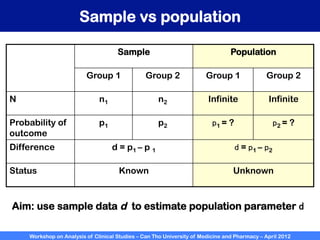
Sample vs population
Sample Population
Group 1 Group 2 Group 1 Group 2
N n1 n2 Infinite Infinite
Probability of
outcome
p1 p2 p1 = ? p2 = ?
Difference d = p1 – p 1 d = p1 – p2
Status Known Unknown
Aim: use sample data d to estimate population parameter d
Workshop on Analysis of Clinical Studies – Can Tho University of Medicine and Pharmacy – April 2012
Metrics of effect
•  Absolute difference (d)
•  Relative risk (RR; risk ratio)
•  Odds ratio (OR)
•  Number needed to treat (NNT)
The choice is dependent on study design
Workshop on Analysis of Clinical Studies – Can Tho University of Medicine and Pharmacy – April 2012
Absolute difference d
Outcome Placebo Treatment
Any fracture 139 92
Non-fracture 923 973
N 1062 1065
Outcome Group 1 Group 2
Bad a b
Good c D
N N1 N2
Absolute difference
p1 = 139 / 1062 = 0.131
p2 = 92 / 1065 = 0.086
d = p2 – p1 = -0.044
p1 = a / N1
p2 = b / N2
d = p2 – p1
Workshop on Analysis of Clinical Studies – Can Tho University of Medicine and Pharmacy – April 2012
Number needed to treat – NNT
Outcome Placebo Treatment
Any fracture 139 92
Non-fracture 923 973
N 1062 1065
Outcome Group 1 Group 2
Bad a b
Good c D
N N1 N2
Number needed to treat
p1 = 139 / 1062 = 0.131
p2 = 92 / 1065 = 0.086
d = p2 – p1 = -0.044
NNT = 1 / d = 22
p1 = a / N1
p2 = b / N2
d = p2 – p1
NNT = 1 / d
Workshop on Analysis of Clinical Studies – Can Tho University of Medicine and Pharmacy – April 2012
Relative risk - RR
Outcome Placebo Treatment
Any fracture 139 92
Non-fracture 923 973
N 1062 1065
Outcome Group 1 Group 2
Bad a b
Good c D
N N1 N2
Relative risk
p1 = 139 / 1062 = 0.131
p2 = 92 / 1065 = 0.086
RR = p2 / p1 = 0.66
p1 = a / N1
p2 = b / N2
RR = p2 / p1
Workshop on Analysis of Clinical Studies – Can Tho University of Medicine and Pharmacy – April 2012
Meaning of RR
•  Risk of developing disease
Treatment: p1 = a / N1
Placebo: p2 = b / N2
•  Relative risk
RR = p1 / p2
•  Implications:
RR = 1, there is no effect
RR < 1, the treatment is beneficial.
RR > 1, the treatment is harmful.
Workshop on Analysis of Clinical Studies – Can Tho University of Medicine and Pharmacy – April 2012
Odds ratio - OR
Outcome Placebo Treatment
Any fracture 139 92
Non-fracture 923 973
N 1062 1065
Outcome Group 1 Group 2
Bad a b
Good c D
N N1 N2
Odds ratio
odds1 = 139 / 923 = 0.140
odds2 = 92 / 973 = 0.094
OR = odds2 / odds1 = 0.68
odds1 = a / c
odds2 = b / d
OR = odds2 / odds1
OR = (a x d) / (b x c)
Workshop on Analysis of Clinical Studies – Can Tho University of Medicine and Pharmacy – April 2012
Meaning of OR
•  OR = 1, there is no association
•  OR < 1, the risk factor is associated with reduced
disease risk
•  OR > 1, the risk factor is associated with increased
disease risk
Workshop on Analysis of Clinical Studies – Can Tho University of Medicine and Pharmacy – April 2012
Study design – time aspect
PAST PRESENT FUTURE
Cohort study,
RCT
(longitudinal,
prospective)
Case-control
study
Cross-
sectional study
Workshop on Analysis of Clinical Studies – Can Tho University of Medicine and Pharmacy – April 2012
Appropriateness of effect size
RCT / prospective
study
Cross-sectional
study
Case-control
study
Relative risk
Odds ratio
NNT
D
Odds ratio
Prevalence ratio
D
Odds ratio
Workshop on Analysis of Clinical Studies – Can Tho University of Medicine and Pharmacy – April 2012
Problem and solution
•  Finding an estimate for d, OR, RR is easy
•  Finding the 95% confidence interval is harder
•  We can however use R
Workshop on Analysis of Clinical Studies – Can Tho University of Medicine and Pharmacy – April 2012
Example of d
1
1
N
a
p =
Treatment Control
Disease a b
No disease c d
Sample size N1 N2
2
1 p
p
d −
=
( ) ( ) ( )
2
2
1
1
1
1 1
1
N
p
p
N
p
p
d
SE
−
+
−
=
( )
d
SE
d
CI 96
.
1
%
95 
=
Zole Placebo
Fracture 92 139
No fracture 973 923
Sample size 1065 1062
044
.
0
086
.
0
131
.
0
1062
139
1065
92
=
−
=
−
=
d
( ) ( ) ( ) 0134
.
0
1062
956
.
0
044
.
0
1065
869
.
0
131
.
0
=
+
=
d
SE
( ) 0134
.
0
96
.
1
044
.
0
%
95 ×
= 
d
CI
( ) 081
.
0
,
018
.
0
%
95 =
d
CI
2
2
N
b
p =
Workshop on Analysis of Clinical Studies – Can Tho University of Medicine and Pharmacy – April 2012
Example of NNT
•  NNT = 1 / 0.044 = 22
•  95% CI for NNT:
–  1 / 0.018 = 55
–  1 / 0.081 = 14
044
.
0
086
.
0
131
.
0
1062
139
1065
92
=
−
=
−
=
d
( ) ( ) ( ) 0134
.
0
1062
956
.
0
044
.
0
1065
869
.
0
131
.
0
=
+
=
d
SE
( ) 0134
.
0
96
.
1
044
.
0
%
95 ×
= 
d
CI
( ) 081
.
0
,
018
.
0
%
95 =
d
CI
Workshop on Analysis of Clinical Studies – Can Tho University of Medicine and Pharmacy – April 2012
Example of RR
Treatment Control
Disease a b
No disease c d
Sample size N1 N2
2
1
/
/
N
b
N
a
RR =
( )
RR
LRR log
=
( )
2
1
1
1
1
1
N
b
N
a
LRR
SE −
+
−
=
( ) ( )
LRR
SE
LRR
LRR
CI 96
.
1
%
95 
=
( ) ( )
LRR
SE
LRR
e
RR
CI 96
.
1
%
95 
=
Zole Placebo
Fracture 92 139
No fracture 973 923
Sample size 1065 1062
66
.
0
131
.
0
086
.
0
1062
/
139
1065
/
92
=
=
=
RR
( ) 4155
.
0
66
.
0
log −
=
=
LRR
( ) 127
.
0
1062
1
139
1
1065
1
92
1
=
−
+
−
=
LRR
SE
( ) 127
.
0
96
.
1
416
.
0
%
95 ×
−
= 
LRR
CI
( ) 127
.
0
96
.
1
416
.
0
%
95 ×
−
= 
e
RR
CI
= 0.514 to 0.847
Workshop on Analysis of Clinical Studies – Can Tho University of Medicine and Pharmacy – April 2012
Example of OR
Disease No disease
Risk +ve a b
Risk –ve c d
bc
ad
OR =
( )
OR
LOR log
=
( )
d
c
b
a
LOR
SE
1
1
1
1
+
+
+
=
( ) ( )
LOR
SE
LOR
LOR
CI 96
.
1
%
95 
=
( ) ( )
LOR
SE
LOR
e
OR
CI 96
.
1
%
95 
=
Lung K Control
Smoking 647 622
No smoking 2 27
04
.
14
2
622
27
647
=
×
×
=
OR
( ) 64
.
2
04
.
14
log =
=
LOR
( ) 735
.
0
27
1
2
1
622
1
647
1
=
+
+
+
=
LOR
SE
( ) 735
.
0
96
.
1
642
.
2
%
95 ×
= 
LOR
CI
( ) 735
.
0
96
.
1
64
.
2
%
95 ×
= 
e
OR
CI
= 3.32 to 59.03
Workshop on Analysis of Clinical Studies – Can Tho University of Medicine and Pharmacy – April 2012
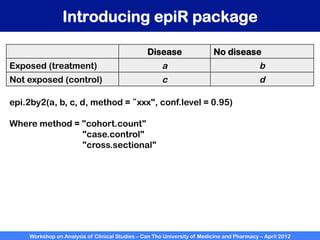
Introducing epiR package
Disease No disease
Exposed (treatment) a b
Not exposed (control) c d
epi.2by2(a, b, c, d, method = “xxx", conf.level = 0.95)
Where method = "cohort.count"
"case.control"
"cross.sectional"
Workshop on Analysis of Clinical Studies – Can Tho University of Medicine and Pharmacy – April 2012
Application of epiR – RCT study
Fracture No frcture
Zoleronate 92 973
Placebo 139 923
library(epiR)
epi.2by2(92, 973, 139, 923, method="cohort.count",
conf.level=0.95)
> epi.2by2(92, 973, 139, 923, method = "cohort.count", conf.level = 0.95)
Disease + Disease - Total Inc risk * Odds
Exposed + 92 973 1065 8.64 0.0946
Exposed - 139 923 1062 13.09 0.1506
Total 231 1896 2127 10.86 0.1218
Point estimates and 95 % CIs:
---------------------------------------------------------
Inc risk ratio 0.66 (0.51, 0.85)
Odds ratio 0.63 (0.48, 0.83)
Attrib risk * -4.45 (-7.09, -1.81)
Attrib risk in population * -2.23 (-4.65, 0.19)
Attrib fraction in exposed (%) -51.51 (-94.42, -18.08)
Attrib fraction in population (%) -20.52 (-33.15, -9.08)
---------------------------------------------------------
* Cases per 100 population units
Workshop on Analysis of Clinical Studies – Can Tho University of Medicine and Pharmacy – April 2012
Application of epiR – Case-control study
K Not K
Smoking 647 622
No smoking 2 27
> epi.2by2(647,622,2,27, method="case.control", conf.level=0.95)
Disease + Disease - Total Prevalence * Odds
Exposed + 647 622 1269 51.0 1.040
Exposed - 2 27 29 6.9 0.074
Total 649 649 1298 50.0 1.000
Point estimates and 95 % CIs:
--------------------------------------------------------------
Odds ratio 14.04 (3.33, 59.3)
Attrib prevalence * 44.09 (34.46, 53.71)
Attrib prevalence in population * 43.1 (33.49, 52.72)
Attrib fraction (est) in exposed (%) 92.88 (69.93, 98.31)
Attrib fraction (est) in population (%) 92.59 (68.98, 98.23)
--------------------------------------------------------------
Workshop on Analysis of Clinical Studies – Can Tho University of Medicine and Pharmacy – April 2012
Application of epiR – Titanic accident
Passenger class Dead Survived
Economy 528 181
Not economy 281 319
> epi.2by2(528,181,281,319, method="cross.sectional", conf.level=0.95)
Point estimates and 95 % CIs:
-----------------------------------------------------------------
Prevalence ratio 1.59 (1.45, 1.75)
Odds ratio 3.31 (2.62, 4.18)
Attrib prevalence * 27.64 (22.51, 32.76)
Attrib prevalence in population * 14.97 (10.19, 19.75)
Attrib fraction in exposed (%) 37.11 (30.81, 42.84)
Attrib fraction in population (%) 24.22 (19.25, 28.88)
------------------------------------------------------------------
Workshop on Analysis of Clinical Studies – Can Tho University of Medicine and Pharmacy – April 2012
Summary
RCT / prospective
study
Cross-sectional
study
Case-control
study
Relative risk
Odds ratio
NNT
D
Odds ratio
Prevalence ratio
D
Odds ratio
Workshop on Analysis of Clinical Studies – Can Tho University of Medicine and Pharmacy – April 2012
Optional – Bayesian analysis of 2 proportions
•  Are the effects the same for the 2 groups?
Side effects None
Drug A 11 9
Drug B 5 15
Workshop on Analysis of Clinical Studies – Can Tho University of Medicine and Pharmacy – April 2012
Frequentist analysis
•  Let X ∼ Binomial(n1, p1) and p1 = X / n1
•  Let Y ∼ Binomial(n2, p2) and p2 = Y / n2
•  Consider the hypothesis p1 = p2
•  The score statistic is:
wo
Comparing two proportions
• Consider testing H0 : p1 = p2
• Versus H1 : p1 6= p2, H2 : p1 > p2, H3 : p1 < p2
• The score test statstic for this null hypothesis is
TS =
p̂1 p̂2
q
p̂(1 p̂)( 1
n1
+ 1
n2
)
where p̂ = X+Y
n1+n2
is the estimate of the common
proportion under the null hypothesis
• This statistic is normally distributed for large n1 and n2.
Lecture 18
Brian Ca↵o
Table of
contents
Outline
The score
statistic
Exact tests
Comparing
two binomial
proportions
Bayesian and
likelihood
analysis of two
proportions
Comparing two proportions
• Consider testing H0 : p1 = p2
• Versus H1 : p1 6= p2, H2 : p1 > p2, H3 : p1 < p2
• The score test statstic for this null hypothesis is
TS =
p̂1 p̂2
q
p̂(1 p̂)( 1
n1
+ 1
n2
)
where p̂ = X+Y
n1+n2
is the estimate of the common
proportion under the null hypothesis
• This statistic is normally distributed for large n1 and n2.
Workshop on Analysis of Clinical Studies – Can Tho University of Medicine and Pharmacy – April 2012
Frequentist analysis
•  p1 = 0.55, p2 = 5/20 = 0.25, p = 16/40 = 0.4
e
ts
g
mial
ns
and
f two
ns
• Test whether or not the proportion of side e↵ects is the
same for the two drugs
• p̂A = .55, p̂B = 5/20 = .25, p̂ = 16/40 = .4
• Test statistic
.55 .25
p
.4 ⇥ .6 ⇥ (1/20 + 1/20)
= 1.61
• Fail to reject H0 at .05 level (compare with 1.96)
• P-value P(|Z| 1.61) = .11
Workshop on Analysis of Clinical Studies – Can Tho University of Medicine and Pharmacy – April 2012
Bayesian analysis
•  Consider putting independent Beta(α1, β1) and
Beta(α2, β2) priors on p1 and p2 respectively
•  Then the posterior is
s
g
ial
s
nd
two
s
for two binomial proportions
• Likelihood analysis requires the use of profile likelihoods,
or some other technique and so we omit their discussion
• Consider putting independent Beta(↵1, 1) and
Beta(↵2, 2) priors on p1 and p2 respectively
• Then the posterior is
⇡(p1, p2) / px+↵1 1
1 (1 p1)n1+ 1 1
⇥py+↵2 1
2 (1 p2)n2+ 2 1
• Hence under this (potentially naive) prior, the posterior for
p1 and p2 are independent betas
• The easiest way to explore this posterior is via Monte
Carlo simulation
•  Hence under this (potentially naive) prior, the
posterior for p1 and p2 are independent betas
•  The easiest way to explore this posterior is via Monte
Carlo simulation
Workshop on Analysis of Clinical Studies – Can Tho University of Medicine and Pharmacy – April 2012
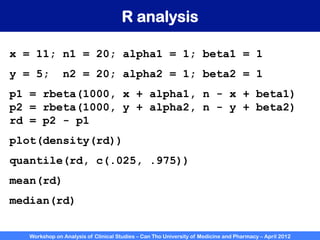
R analysis
x = 11; n1 = 20; alpha1 = 1; beta1 = 1
y = 5; n2 = 20; alpha2 = 1; beta2 = 1
p1 = rbeta(1000, x + alpha1, n - x + beta1)
p2 = rbeta(1000, y + alpha2, n - y + beta2)
rd = p2 - p1
plot(density(rd))
quantile(rd, c(.025, .975))
mean(rd)
median(rd)

Ct lecture 8. comparing two groups categorical data

  • 1.
    Workshop on Analysisof Clinical Studies – Can Tho University of Medicine and Pharmacy – April 2012 Comparing two groups: categorical data Tuan V. Nguyen Professor and NHMRC Senior Research Fellow Garvan Institute of Medical Research University of New South Wales Sydney, Australia
  • 2.
    Workshop on Analysisof Clinical Studies – Can Tho University of Medicine and Pharmacy – April 2012 What we are going to learn … •  Examples (RCT, CC, Cohort) •  Two proportions •  Metrics of effect: d, RR, OR •  Applicability of d, RR, OR •  D and z-test •  NNT •  Measure of association: OR •  Small sample size: Fisher’s exact test
  • 3.
    Workshop on Analysisof Clinical Studies – Can Tho University of Medicine and Pharmacy – April 2012 Zoledronate and fracture Randomized controlled clinical trial Placebo n = 1062, Zoledronate n = 1065 Length of follow-up: 3 years Lyles KW, et al. Zoledronic acid and clinical fractures and mortality after hip fracture. N Engl J Med 2007;357. DOI: 10.1056/NEJMoa074941
  • 4.
    Workshop on Analysisof Clinical Studies – Can Tho University of Medicine and Pharmacy – April 2012 Smoking and lung cancer Sir Richard Doll (1912 – 2005) http://en.wikipedia.org/wiki/Richard_Doll Lung Cancer Controls Smokers 647 622 Non-smokers 2 27 R Doll and B Hill. BMJ 1950; ii:739-748 Is there an association between smoking and lung cancer?
  • 5.
    Workshop on Analysisof Clinical Studies – Can Tho University of Medicine and Pharmacy – April 2012 Mortality in the Titanic incident Class Dead Survived Total I 123 200 (62%) 323 II 158 119 (43%) 277 III 528 181 (26%) 709 Total 809 500 (38%) 1309 http://lib.stat.cmu.edu/S/Harrell/data/descriptions/titanic3info.txt Is there an association between passenger class and and death?
  • 6.
    Workshop on Analysisof Clinical Studies – Can Tho University of Medicine and Pharmacy – April 2012 What are common characteristics of these data? •  Binary outcome: yes/no; dead / survived •  Proportion / percent / probability
  • 7.
    Workshop on Analysisof Clinical Studies – Can Tho University of Medicine and Pharmacy – April 2012 Sample vs population Sample Population Group 1 Group 2 Group 1 Group 2 N n1 n2 Infinite Infinite Probability of outcome p1 p2 p1 = ? p2 = ? Difference d = p1 – p 1 d = p1 – p2 Status Known Unknown Aim: use sample data d to estimate population parameter d
  • 8.
    Workshop on Analysisof Clinical Studies – Can Tho University of Medicine and Pharmacy – April 2012 Metrics of effect •  Absolute difference (d) •  Relative risk (RR; risk ratio) •  Odds ratio (OR) •  Number needed to treat (NNT) The choice is dependent on study design
  • 9.
    Workshop on Analysisof Clinical Studies – Can Tho University of Medicine and Pharmacy – April 2012 Absolute difference d Outcome Placebo Treatment Any fracture 139 92 Non-fracture 923 973 N 1062 1065 Outcome Group 1 Group 2 Bad a b Good c D N N1 N2 Absolute difference p1 = 139 / 1062 = 0.131 p2 = 92 / 1065 = 0.086 d = p2 – p1 = -0.044 p1 = a / N1 p2 = b / N2 d = p2 – p1
  • 10.
    Workshop on Analysisof Clinical Studies – Can Tho University of Medicine and Pharmacy – April 2012 Number needed to treat – NNT Outcome Placebo Treatment Any fracture 139 92 Non-fracture 923 973 N 1062 1065 Outcome Group 1 Group 2 Bad a b Good c D N N1 N2 Number needed to treat p1 = 139 / 1062 = 0.131 p2 = 92 / 1065 = 0.086 d = p2 – p1 = -0.044 NNT = 1 / d = 22 p1 = a / N1 p2 = b / N2 d = p2 – p1 NNT = 1 / d
  • 11.
    Workshop on Analysisof Clinical Studies – Can Tho University of Medicine and Pharmacy – April 2012 Relative risk - RR Outcome Placebo Treatment Any fracture 139 92 Non-fracture 923 973 N 1062 1065 Outcome Group 1 Group 2 Bad a b Good c D N N1 N2 Relative risk p1 = 139 / 1062 = 0.131 p2 = 92 / 1065 = 0.086 RR = p2 / p1 = 0.66 p1 = a / N1 p2 = b / N2 RR = p2 / p1
  • 12.
    Workshop on Analysisof Clinical Studies – Can Tho University of Medicine and Pharmacy – April 2012 Meaning of RR •  Risk of developing disease Treatment: p1 = a / N1 Placebo: p2 = b / N2 •  Relative risk RR = p1 / p2 •  Implications: RR = 1, there is no effect RR < 1, the treatment is beneficial. RR > 1, the treatment is harmful.
  • 13.
    Workshop on Analysisof Clinical Studies – Can Tho University of Medicine and Pharmacy – April 2012 Odds ratio - OR Outcome Placebo Treatment Any fracture 139 92 Non-fracture 923 973 N 1062 1065 Outcome Group 1 Group 2 Bad a b Good c D N N1 N2 Odds ratio odds1 = 139 / 923 = 0.140 odds2 = 92 / 973 = 0.094 OR = odds2 / odds1 = 0.68 odds1 = a / c odds2 = b / d OR = odds2 / odds1 OR = (a x d) / (b x c)
  • 14.
    Workshop on Analysisof Clinical Studies – Can Tho University of Medicine and Pharmacy – April 2012 Meaning of OR •  OR = 1, there is no association •  OR < 1, the risk factor is associated with reduced disease risk •  OR > 1, the risk factor is associated with increased disease risk
  • 15.
    Workshop on Analysisof Clinical Studies – Can Tho University of Medicine and Pharmacy – April 2012 Study design – time aspect PAST PRESENT FUTURE Cohort study, RCT (longitudinal, prospective) Case-control study Cross- sectional study
  • 16.
    Workshop on Analysisof Clinical Studies – Can Tho University of Medicine and Pharmacy – April 2012 Appropriateness of effect size RCT / prospective study Cross-sectional study Case-control study Relative risk Odds ratio NNT D Odds ratio Prevalence ratio D Odds ratio
  • 17.
    Workshop on Analysisof Clinical Studies – Can Tho University of Medicine and Pharmacy – April 2012 Problem and solution •  Finding an estimate for d, OR, RR is easy •  Finding the 95% confidence interval is harder •  We can however use R
  • 18.
    Workshop on Analysisof Clinical Studies – Can Tho University of Medicine and Pharmacy – April 2012 Example of d 1 1 N a p = Treatment Control Disease a b No disease c d Sample size N1 N2 2 1 p p d − = ( ) ( ) ( ) 2 2 1 1 1 1 1 1 N p p N p p d SE − + − = ( ) d SE d CI 96 . 1 % 95  = Zole Placebo Fracture 92 139 No fracture 973 923 Sample size 1065 1062 044 . 0 086 . 0 131 . 0 1062 139 1065 92 = − = − = d ( ) ( ) ( ) 0134 . 0 1062 956 . 0 044 . 0 1065 869 . 0 131 . 0 = + = d SE ( ) 0134 . 0 96 . 1 044 . 0 % 95 × =  d CI ( ) 081 . 0 , 018 . 0 % 95 = d CI 2 2 N b p =
  • 19.
    Workshop on Analysisof Clinical Studies – Can Tho University of Medicine and Pharmacy – April 2012 Example of NNT •  NNT = 1 / 0.044 = 22 •  95% CI for NNT: –  1 / 0.018 = 55 –  1 / 0.081 = 14 044 . 0 086 . 0 131 . 0 1062 139 1065 92 = − = − = d ( ) ( ) ( ) 0134 . 0 1062 956 . 0 044 . 0 1065 869 . 0 131 . 0 = + = d SE ( ) 0134 . 0 96 . 1 044 . 0 % 95 × =  d CI ( ) 081 . 0 , 018 . 0 % 95 = d CI
  • 20.
    Workshop on Analysisof Clinical Studies – Can Tho University of Medicine and Pharmacy – April 2012 Example of RR Treatment Control Disease a b No disease c d Sample size N1 N2 2 1 / / N b N a RR = ( ) RR LRR log = ( ) 2 1 1 1 1 1 N b N a LRR SE − + − = ( ) ( ) LRR SE LRR LRR CI 96 . 1 % 95  = ( ) ( ) LRR SE LRR e RR CI 96 . 1 % 95  = Zole Placebo Fracture 92 139 No fracture 973 923 Sample size 1065 1062 66 . 0 131 . 0 086 . 0 1062 / 139 1065 / 92 = = = RR ( ) 4155 . 0 66 . 0 log − = = LRR ( ) 127 . 0 1062 1 139 1 1065 1 92 1 = − + − = LRR SE ( ) 127 . 0 96 . 1 416 . 0 % 95 × − =  LRR CI ( ) 127 . 0 96 . 1 416 . 0 % 95 × − =  e RR CI = 0.514 to 0.847
  • 21.
    Workshop on Analysisof Clinical Studies – Can Tho University of Medicine and Pharmacy – April 2012 Example of OR Disease No disease Risk +ve a b Risk –ve c d bc ad OR = ( ) OR LOR log = ( ) d c b a LOR SE 1 1 1 1 + + + = ( ) ( ) LOR SE LOR LOR CI 96 . 1 % 95  = ( ) ( ) LOR SE LOR e OR CI 96 . 1 % 95  = Lung K Control Smoking 647 622 No smoking 2 27 04 . 14 2 622 27 647 = × × = OR ( ) 64 . 2 04 . 14 log = = LOR ( ) 735 . 0 27 1 2 1 622 1 647 1 = + + + = LOR SE ( ) 735 . 0 96 . 1 642 . 2 % 95 × =  LOR CI ( ) 735 . 0 96 . 1 64 . 2 % 95 × =  e OR CI = 3.32 to 59.03
  • 22.
    Workshop on Analysisof Clinical Studies – Can Tho University of Medicine and Pharmacy – April 2012 Introducing epiR package Disease No disease Exposed (treatment) a b Not exposed (control) c d epi.2by2(a, b, c, d, method = “xxx", conf.level = 0.95) Where method = "cohort.count" "case.control" "cross.sectional"
  • 23.
    Workshop on Analysisof Clinical Studies – Can Tho University of Medicine and Pharmacy – April 2012 Application of epiR – RCT study Fracture No frcture Zoleronate 92 973 Placebo 139 923 library(epiR) epi.2by2(92, 973, 139, 923, method="cohort.count", conf.level=0.95) > epi.2by2(92, 973, 139, 923, method = "cohort.count", conf.level = 0.95) Disease + Disease - Total Inc risk * Odds Exposed + 92 973 1065 8.64 0.0946 Exposed - 139 923 1062 13.09 0.1506 Total 231 1896 2127 10.86 0.1218 Point estimates and 95 % CIs: --------------------------------------------------------- Inc risk ratio 0.66 (0.51, 0.85) Odds ratio 0.63 (0.48, 0.83) Attrib risk * -4.45 (-7.09, -1.81) Attrib risk in population * -2.23 (-4.65, 0.19) Attrib fraction in exposed (%) -51.51 (-94.42, -18.08) Attrib fraction in population (%) -20.52 (-33.15, -9.08) --------------------------------------------------------- * Cases per 100 population units
  • 24.
    Workshop on Analysisof Clinical Studies – Can Tho University of Medicine and Pharmacy – April 2012 Application of epiR – Case-control study K Not K Smoking 647 622 No smoking 2 27 > epi.2by2(647,622,2,27, method="case.control", conf.level=0.95) Disease + Disease - Total Prevalence * Odds Exposed + 647 622 1269 51.0 1.040 Exposed - 2 27 29 6.9 0.074 Total 649 649 1298 50.0 1.000 Point estimates and 95 % CIs: -------------------------------------------------------------- Odds ratio 14.04 (3.33, 59.3) Attrib prevalence * 44.09 (34.46, 53.71) Attrib prevalence in population * 43.1 (33.49, 52.72) Attrib fraction (est) in exposed (%) 92.88 (69.93, 98.31) Attrib fraction (est) in population (%) 92.59 (68.98, 98.23) --------------------------------------------------------------
  • 25.
    Workshop on Analysisof Clinical Studies – Can Tho University of Medicine and Pharmacy – April 2012 Application of epiR – Titanic accident Passenger class Dead Survived Economy 528 181 Not economy 281 319 > epi.2by2(528,181,281,319, method="cross.sectional", conf.level=0.95) Point estimates and 95 % CIs: ----------------------------------------------------------------- Prevalence ratio 1.59 (1.45, 1.75) Odds ratio 3.31 (2.62, 4.18) Attrib prevalence * 27.64 (22.51, 32.76) Attrib prevalence in population * 14.97 (10.19, 19.75) Attrib fraction in exposed (%) 37.11 (30.81, 42.84) Attrib fraction in population (%) 24.22 (19.25, 28.88) ------------------------------------------------------------------
  • 26.
    Workshop on Analysisof Clinical Studies – Can Tho University of Medicine and Pharmacy – April 2012 Summary RCT / prospective study Cross-sectional study Case-control study Relative risk Odds ratio NNT D Odds ratio Prevalence ratio D Odds ratio
  • 27.
    Workshop on Analysisof Clinical Studies – Can Tho University of Medicine and Pharmacy – April 2012 Optional – Bayesian analysis of 2 proportions •  Are the effects the same for the 2 groups? Side effects None Drug A 11 9 Drug B 5 15
  • 28.
    Workshop on Analysisof Clinical Studies – Can Tho University of Medicine and Pharmacy – April 2012 Frequentist analysis •  Let X ∼ Binomial(n1, p1) and p1 = X / n1 •  Let Y ∼ Binomial(n2, p2) and p2 = Y / n2 •  Consider the hypothesis p1 = p2 •  The score statistic is: wo Comparing two proportions • Consider testing H0 : p1 = p2 • Versus H1 : p1 6= p2, H2 : p1 > p2, H3 : p1 < p2 • The score test statstic for this null hypothesis is TS = p̂1 p̂2 q p̂(1 p̂)( 1 n1 + 1 n2 ) where p̂ = X+Y n1+n2 is the estimate of the common proportion under the null hypothesis • This statistic is normally distributed for large n1 and n2. Lecture 18 Brian Ca↵o Table of contents Outline The score statistic Exact tests Comparing two binomial proportions Bayesian and likelihood analysis of two proportions Comparing two proportions • Consider testing H0 : p1 = p2 • Versus H1 : p1 6= p2, H2 : p1 > p2, H3 : p1 < p2 • The score test statstic for this null hypothesis is TS = p̂1 p̂2 q p̂(1 p̂)( 1 n1 + 1 n2 ) where p̂ = X+Y n1+n2 is the estimate of the common proportion under the null hypothesis • This statistic is normally distributed for large n1 and n2.
  • 29.
    Workshop on Analysisof Clinical Studies – Can Tho University of Medicine and Pharmacy – April 2012 Frequentist analysis •  p1 = 0.55, p2 = 5/20 = 0.25, p = 16/40 = 0.4 e ts g mial ns and f two ns • Test whether or not the proportion of side e↵ects is the same for the two drugs • p̂A = .55, p̂B = 5/20 = .25, p̂ = 16/40 = .4 • Test statistic .55 .25 p .4 ⇥ .6 ⇥ (1/20 + 1/20) = 1.61 • Fail to reject H0 at .05 level (compare with 1.96) • P-value P(|Z| 1.61) = .11
  • 30.
    Workshop on Analysisof Clinical Studies – Can Tho University of Medicine and Pharmacy – April 2012 Bayesian analysis •  Consider putting independent Beta(α1, β1) and Beta(α2, β2) priors on p1 and p2 respectively •  Then the posterior is s g ial s nd two s for two binomial proportions • Likelihood analysis requires the use of profile likelihoods, or some other technique and so we omit their discussion • Consider putting independent Beta(↵1, 1) and Beta(↵2, 2) priors on p1 and p2 respectively • Then the posterior is ⇡(p1, p2) / px+↵1 1 1 (1 p1)n1+ 1 1 ⇥py+↵2 1 2 (1 p2)n2+ 2 1 • Hence under this (potentially naive) prior, the posterior for p1 and p2 are independent betas • The easiest way to explore this posterior is via Monte Carlo simulation •  Hence under this (potentially naive) prior, the posterior for p1 and p2 are independent betas •  The easiest way to explore this posterior is via Monte Carlo simulation
  • 31.
    Workshop on Analysisof Clinical Studies – Can Tho University of Medicine and Pharmacy – April 2012 R analysis x = 11; n1 = 20; alpha1 = 1; beta1 = 1 y = 5; n2 = 20; alpha2 = 1; beta2 = 1 p1 = rbeta(1000, x + alpha1, n - x + beta1) p2 = rbeta(1000, y + alpha2, n - y + beta2) rd = p2 - p1 plot(density(rd)) quantile(rd, c(.025, .975)) mean(rd) median(rd)