





Saint
•
    Servolo
Spectacular Failures with MI


                          ICMI 2012
William R. Miller
But first:
    some
spectacular
 successes
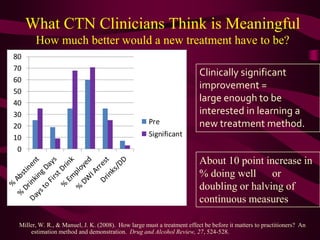
What CTN Clinicians Think is Meaningful
       How much better would a new treatment have to be?
80
70
                                                                        Clinically significant
60
                                                                        improvement =
50
40
                                                                        large enough to be
30                                                                      interested in learning a
                                                    Pre                 new treatment method.
20
10                                                  Significant
 0
                                                                        About 10 point increase in
                                                                        % doing well or
                                                                        doubling or halving of
                                                                        continuous measures

 Miller, W. R., & Manuel, J. K. (2008). How large must a treatment effect be before it matters to practitioners? An
     estimation method and demonstration. Drug and Alcohol Review, 27, 524-528.
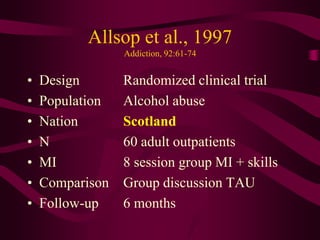
Allsop et al., 1997
                 Addiction, 92:61-74


•   Design       Randomized clinical trial
•   Population   Alcohol abuse
•   Nation       Scotland
•   N            60 adult outpatients
•   MI           8 session group MI + skills
•   Comparison   Group discussion TAU
•   Follow-up    6 months
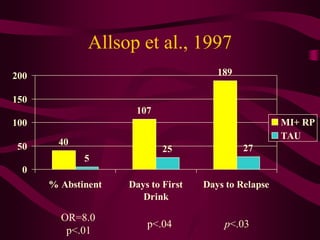
Allsop et al., 1997
200                                    189

150
                     107
100                                                   MI+ RP
                                                      TAU
 50     40
                            25               27
             5
  0
      % Abstinent   Days to First   Days to Relapse
                       Drink

        OR=8.0
                        p<.04           p<.03
         p<.01
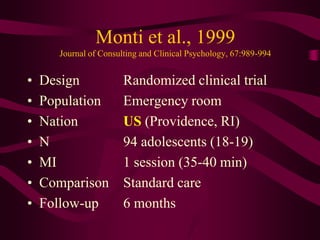
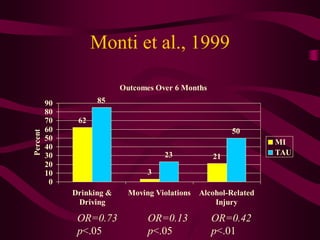
Monti et al., 1999
      Journal of Consulting and Clinical Psychology, 67:989-994


•   Design             Randomized clinical trial
•   Population         Emergency room
•   Nation             US (Providence, RI)
•   N                  94 adolescents (18-19)
•   MI                 1 session (35-40 min)
•   Comparison         Standard care
•   Follow-up          6 months
Monti et al., 1999

                            Outcomes Over 6 Months
          90         85
          80
          70    62
          60                                              50
Percent


          50                                                        MI
          40
          30                           23                           TAU
                                                     21
          20
          10                       3
           0
               Drinking &     Moving Violations   Alcohol-Related
                Driving                               Injury

                OR=0.73            OR=0.13           OR=0.42
                p<.05              p<.05             p<.01
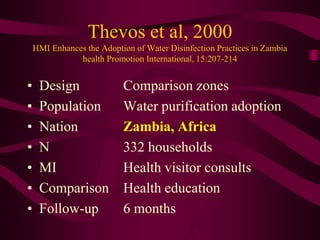
Thevos et al, 2000
    HMI Enhances the Adoption of Water Disinfection Practices in Zambia
               health Promotion International, 15:207-214


•    Design                Comparison zones
•    Population            Water purification adoption
•    Nation                Zambia, Africa
•    N                     332 households
•    MI                    Health visitor consults
•    Comparison            Health education
•    Follow-up             6 months
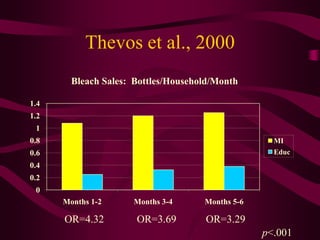
Thevos et al., 2000
        Bleach Sales: Bottles/Household/Month

1.4
1.2
 1
0.8                                                 MI
0.6                                                 Educ
0.4
0.2
 0
      Months 1-2     Months 3-4      Months 5-6

      OR=4.32         OR=3.69        OR=3.29
                                                  p<.001
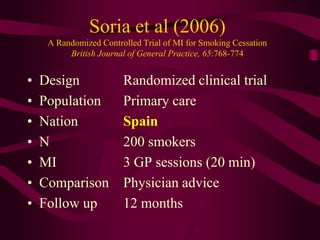
Soria et al (2006)
     A Randomized Controlled Trial of MI for Smoking Cessation
          British Journal of General Practice, 65:768-774


•   Design              Randomized clinical trial
•   Population          Primary care
•   Nation              Spain
•   N                   200 smokers
•   MI                  3 GP sessions (20 min)
•   Comparison          Physician advice
•   Follow up           12 months
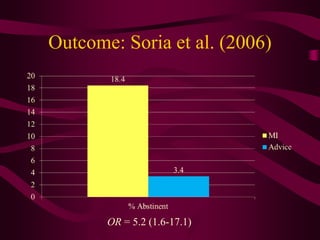
Outcome: Soria et al. (2006)


       OR = 5.2 (1.6-17.1)
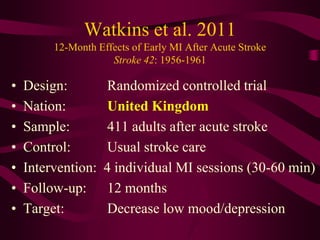
Watkins et al. 2011
         12-Month Effects of Early MI After Acute Stroke
                     Stroke 42: 1956-1961

•   Design:         Randomized controlled trial
•   Nation:         United Kingdom
•   Sample:         411 adults after acute stroke
•   Control:        Usual stroke care
•   Intervention:   4 individual MI sessions (30-60 min)
•   Follow-up:      12 months
•   Target:         Decrease low mood/depression
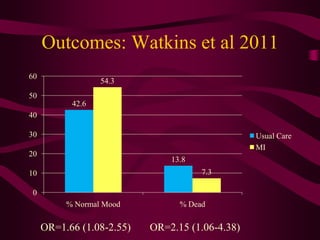
Outcomes: Watkins et al 2011
60
                  54.3
50
           42.6
40

30                                               Usual Care
                                                 MI
20
                               13.8
10                                    7.3

0
          % Normal Mood          % Dead

     OR=1.66 (1.08-2.55)   OR=2.15 (1.06-4.38)
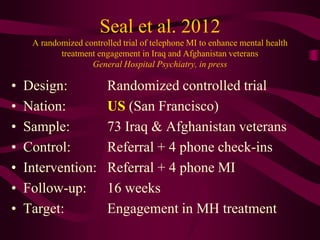
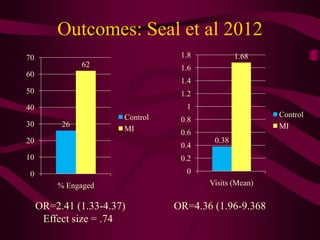
Seal et al. 2012
     A randomized controlled trial of telephone MI to enhance mental health
            treatment engagement in Iraq and Afghanistan veterans
                    General Hospital Psychiatry, in press

•   Design:              Randomized controlled trial
•   Nation:              US (San Francisco)
•   Sample:              73 Iraq & Afghanistan veterans
•   Control:             Referral + 4 phone check-ins
•   Intervention:        Referral + 4 phone MI
•   Follow-up:           16 weeks
•   Target:              Engagement in MH treatment
Outcomes: Seal et al 2012
70                                1.8           1.68
               62                 1.6
60
                                  1.4
50                                1.2
40                                 1
                       Control                          Control
                                  0.8
30        26                                            MI
                       MI         0.6
20                                       0.38
                                  0.4
10                                0.2
 0                                 0
         % Engaged                      Visits (Mean)

     OR=2.41 (1.33-4.37)         OR=4.36 (1.96-9.368
      Effect size = .74
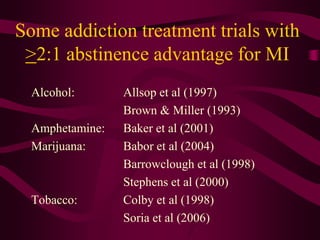
Some addiction treatment trials with
 >2:1 abstinence advantage for MI
  Alcohol:       Allsop et al (1997)
                 Brown & Miller (1993)
  Amphetamine:   Baker et al (2001)
  Marijuana:     Babor et al (2004)
                 Barrowclough et al (1998)
                 Stephens et al (2000)
  Tobacco:       Colby et al (1998)
                 Soria et al (2006)
The news is not all
      good
•
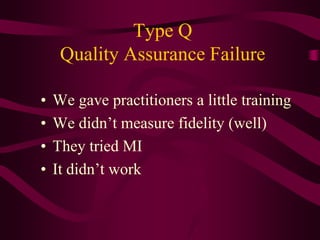
Type Q
     Quality Assurance Failure

•   We gave practitioners a little training
•   We didn’t measure fidelity (well)
•   They tried MI
•   It didn’t work
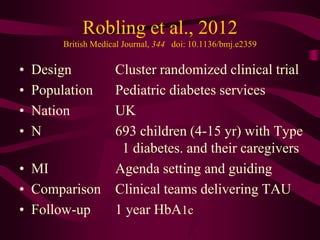
Robling et al., 2012
         British Medical Journal, 344 doi: 10.1136/bmj.e2359


•   Design            Cluster randomized clinical trial
•   Population        Pediatric diabetes services
•   Nation            UK
•   N                 693 children (4-15 yr) with Type
                       1 diabetes. and their caregivers
• MI                  Agenda setting and guiding
• Comparison          Clinical teams delivering TAU
• Follow-up           1 year HbA1c
Robling et al., 2012
          British Medical Journal, 344 doi: 10.1136/bmj.e2359


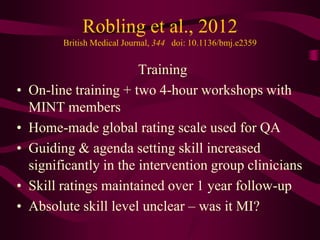
                         Training
•   On-line training + two 4-hour workshops with
    MINT members
•   Home-made global rating scale used for QA
•   Guiding & agenda setting skill increased
    significantly in the intervention group clinicians
•   Skill ratings maintained over 1 year follow-up
•   Absolute skill level unclear – was it MI?
Robling et al., 2012
     British Medical Journal, 344 doi: 10.1136/bmj.e2359


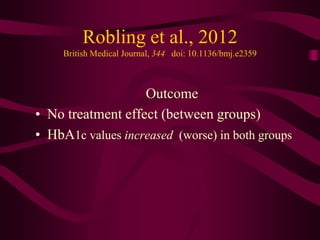
                   Outcome
• No treatment effect (between groups)
• HbA1c values increased (worse) in both groups
Type F
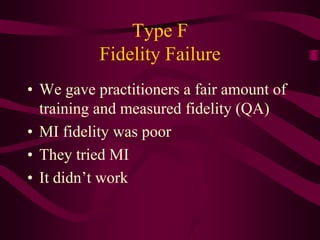
           Fidelity Failure
• We gave practitioners a fair amount of
  training and measured fidelity (QA)
• MI fidelity was poor
• They tried MI
• It didn’t work
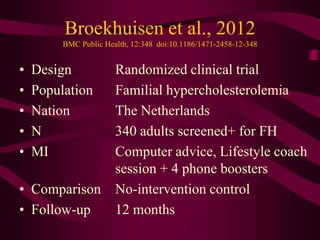
Broekhuisen et al., 2012
         BMC Public Health, 12:348 doi:10.1186/1471-2458-12-348


•   Design             Randomized clinical trial
•   Population         Familial hypercholesterolemia
•   Nation             The Netherlands
•   N                  340 adults screened+ for FH
•   MI                 Computer advice, Lifestyle coach
                       session + 4 phone boosters
• Comparison           No-intervention control
• Follow-up            12 months
Broekhuisen et al., 2012
      BMC Public Health, 12:348 doi:10.1186/1471-2458-12-348


Training: 3-day MI training workshop
Fidelity monitoring: MITI
  “None of the analysed face-to-face counseling sessions
  met the MITI thresholds. . . Skills required for effective
  MI may take longer to develop than the 3-day MI
  workshop in our project.”
Outcome: No significant effect on LDL or
lifestyle behaviors
Type P
         Power Failure
• We had a relatively small sample and
  low power to detect a difference
• There was no difference
Bien et al., 1993
       Behavioural & Cognitive Psychotherapy, 21:347-356


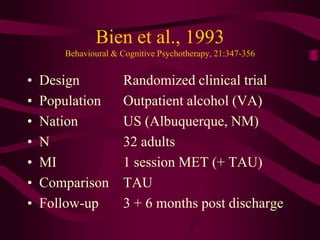
•   Design            Randomized clinical trial
•   Population        Outpatient alcohol (VA)
•   Nation            US (Albuquerque, NM)
•   N                 32 adults
•   MI                1 session MET (+ TAU)
•   Comparison        TAU
•   Follow-up         3 + 6 months post discharge
Bien et al., 1993
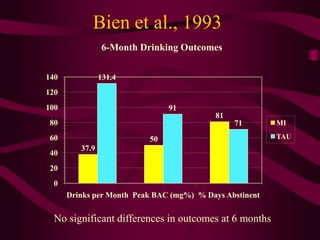
                6-Month Drinking Outcomes

140             131.4
120
100                            91
                                           81
80                                              71       MI

60                        50                             TAU
         37.9
40
20
  0
      Drinks per Month Peak BAC (mg%) % Days Abstinent


  No significant differences in outcomes at 6 months
Type C
 Comprehension Failure

• We tried “MI” (which doesn’t
  sound much like MI)
• It didn’t work
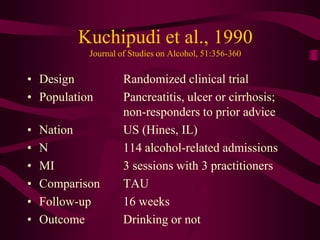
Kuchipudi et al., 1990
            Journal of Studies on Alcohol, 51:356-360

• Design             Randomized clinical trial
• Population         Pancreatitis, ulcer or cirrhosis;
                     non-responders to prior advice
•   Nation           US (Hines, IL)
•   N                114 alcohol-related admissions
•   MI               3 sessions with 3 practitioners
•   Comparison       TAU
•   Follow-up        16 weeks
•   Outcome          Drinking or not
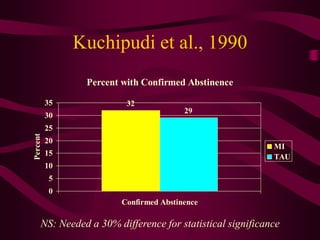
Kuchipudi et al., 1990
                Percent with Confirmed Abstinence

          35              32
                                         29
          30
          25
Percent


          20
                                                            MI
          15                                                TAU
          10
           5
           0
                         Confirmed Abstinence

      NS: Needed a 30% difference for statistical significance
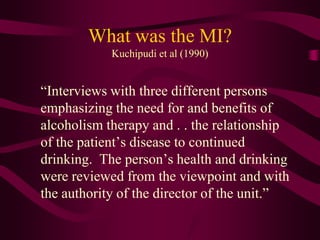
What was the MI?
            Kuchipudi et al (1990)


“Interviews with three different persons
emphasizing the need for and benefits of
alcoholism therapy and . . the relationship
of the patient’s disease to continued
drinking. The person’s health and drinking
were reviewed from the viewpoint and with
the authority of the director of the unit.”
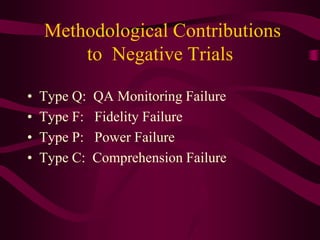
Methodological Contributions
        to Negative Trials

•   Type Q:   QA Monitoring Failure
•   Type F:   Fidelity Failure
•   Type P:   Power Failure
•   Type C:   Comprehension Failure
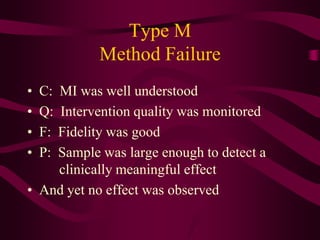
Type M
           Method Failure
•   C:
    MI was well understood
•   Q:
     Intervention quality was monitored
•   F:
    Fidelity was good
•   P:
    Sample was large enough to detect a
    clinically meaningful effect
• And yet no effect was observed
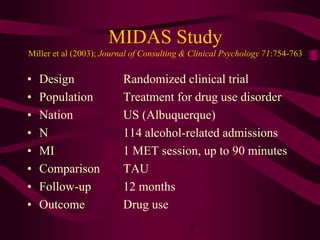
MIDAS Study
Miller et al (2003); Journal of Consulting & Clinical Psychology 71:754-763

•   Design               Randomized clinical trial
•   Population           Treatment for drug use disorder
•   Nation               US (Albuquerque)
•   N                    114 alcohol-related admissions
•   MI                   1 MET session, up to 90 minutes
•   Comparison           TAU
•   Follow-up            12 months
•   Outcome              Drug use
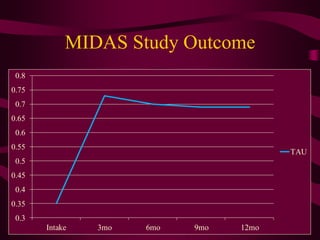
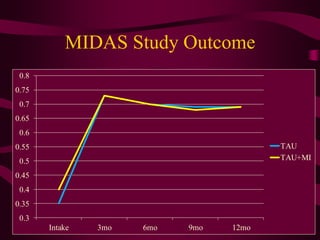
MIDAS Study Outcome
 0.8
0.75
 0.7
0.65
 0.6
0.55
                                         TAU
 0.5
0.45
 0.4
0.35
 0.3
       Intake   3mo   6mo   9mo   12mo
MIDAS Study Outcome
 0.8
0.75
 0.7
0.65
 0.6
0.55                                     TAU
 0.5                                     TAU+MI

0.45
 0.4
0.35
 0.3
       Intake   3mo   6mo   9mo   12mo
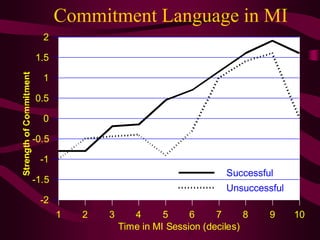
Commitment Language in MI
  2

1.5

  1

0.5

  0

-0.5

 -1
                                           Successful
-1.5
                                           Unsuccessful
 -2
       1   2   3      4      5     6     7      8   9     10
                   Time in MI Session (deciles)
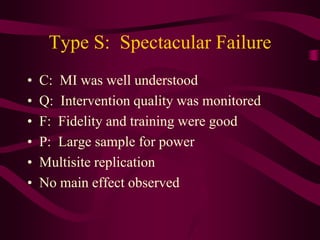
Type S: Spectacular Failure
•   C: MI was well understood
•   Q: Intervention quality was monitored
•   F: Fidelity and training were good
•   P: Large sample for power
•   Multisite replication
•   No main effect observed
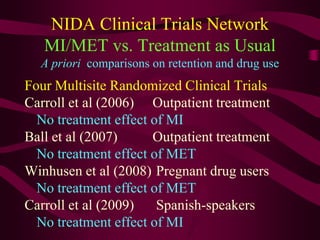
NIDA Clinical Trials Network
   MI/MET vs. Treatment as Usual
  A priori comparisons on retention and drug use
Four Multisite Randomized Clinical Trials
Carroll et al (2006) Outpatient treatment
  No treatment effect of MI
Ball et al (2007)     Outpatient treatment
  No treatment effect of MET
Winhusen et al (2008) Pregnant drug users
  No treatment effect of MET
Carroll et al (2009)   Spanish-speakers
  No treatment effect of MI
Carroll et al., 2006
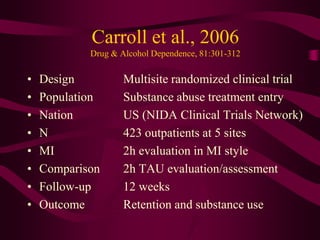
            Drug & Alcohol Dependence, 81:301-312

•   Design          Multisite randomized clinical trial
•   Population      Substance abuse treatment entry
•   Nation          US (NIDA Clinical Trials Network)
•   N               423 outpatients at 5 sites
•   MI              2h evaluation in MI style
•   Comparison      2h TAU evaluation/assessment
•   Follow-up       12 weeks
•   Outcome         Retention and substance use
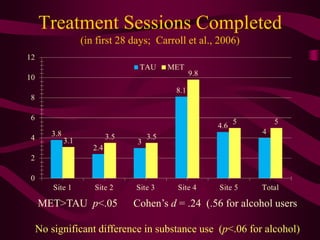
Treatment Sessions Completed
          (in first 28 days; Carroll et al., 2006)


MET>TAU p<.05          Cohen’s d = .24 (.56 for alcohol users

No significant difference in substance use (p<.06 for alcohol)
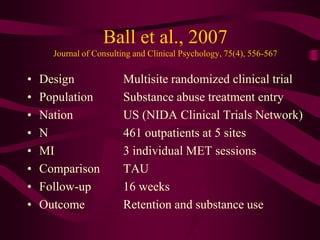
Ball et al., 2007
      Journal of Consulting and Clinical Psychology, 75(4), 556-567

•   Design               Multisite randomized clinical trial
•   Population           Substance abuse treatment entry
•   Nation               US (NIDA Clinical Trials Network)
•   N                    461 outpatients at 5 sites
•   MI                   3 individual MET sessions
•   Comparison           TAU
•   Follow-up            16 weeks
•   Outcome              Retention and substance use
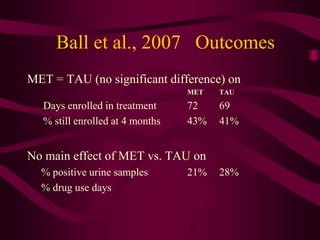
Ball et al., 2007 Outcomes
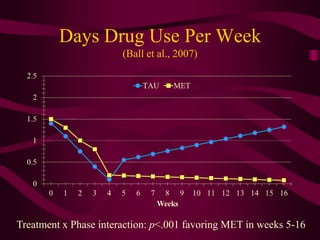
MET = TAU (no significant difference) on
                                  MET   TAU

   Days enrolled in treatment     72    69
   % still enrolled at 4 months   43%   41%


No main effect of MET vs. TAU on
  % positive urine samples        21%   28%
  % drug use days
Days Drug Use Per Week
                       (Ball et al., 2007)


Treatment x Phase interaction: p<.001 favoring MET in weeks 5-16
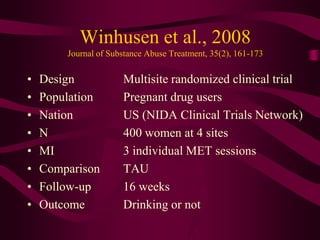
Winhusen et al., 2008
        Journal of Substance Abuse Treatment, 35(2), 161-173

•   Design            Multisite randomized clinical trial
•   Population        Pregnant drug users
•   Nation            US (NIDA Clinical Trials Network)
•   N                 400 women at 4 sites
•   MI                3 individual MET sessions
•   Comparison        TAU
•   Follow-up         16 weeks
•   Outcome           Drinking or not
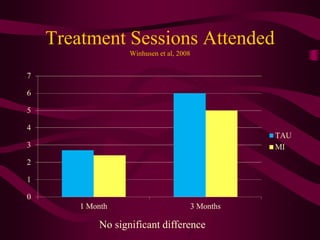
Treatment Sessions Attended
             Winhusen et al, 2008


      No significant difference
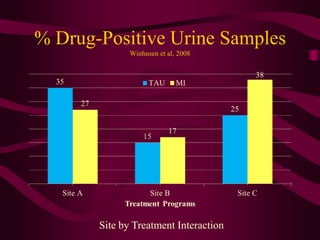
% Drug-Positive Urine Samples
              Winhusen et al, 2008


       Site by Treatment Interaction
Carroll et al., 2009
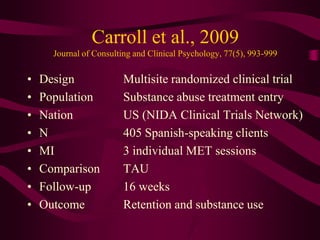
      Journal of Consulting and Clinical Psychology, 77(5), 993-999

•   Design               Multisite randomized clinical trial
•   Population           Substance abuse treatment entry
•   Nation               US (NIDA Clinical Trials Network)
•   N                    405 Spanish-speaking clients
•   MI                   3 individual MET sessions
•   Comparison           TAU
•   Follow-up            16 weeks
•   Outcome              Retention and substance use
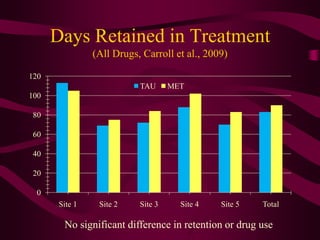
Days Retained in Treatment
                (All Drugs, Carroll et al., 2009)

120
                           TAU      MET
100

 80

 60

 40

 20

 0
       Site 1    Site 2    Site 3     Site 4   Site 5   Total

        No significant difference in retention or drug use
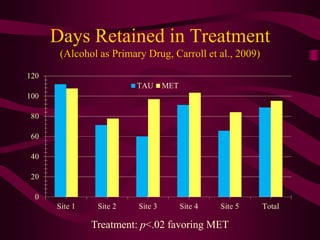
Days Retained in Treatment
 (Alcohol as Primary Drug, Carroll et al., 2009)


        Treatment: p<.02 favoring MET
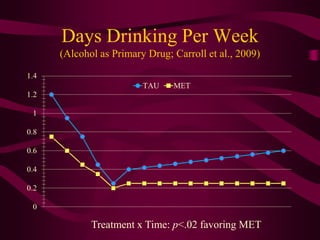
Days Drinking Per Week
(Alcohol as Primary Drug; Carroll et al., 2009)


       Treatment x Time: p<.02 favoring MET
Heisler et al., 2012
                   Circulation (in press)

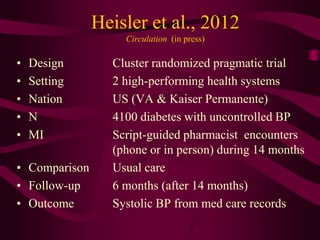
•   Design       Cluster randomized pragmatic trial
•   Setting      2 high-performing health systems
•   Nation       US (VA & Kaiser Permanente)
•   N            4100 diabetes with uncontrolled BP
•   MI           Script-guided pharmacist encounters
                 (phone or in person) during 14 months
• Comparison     Usual care
• Follow-up      6 months (after 14 months)
• Outcome        Systolic BP from med care records
Heisler et al., 2012
                   Circulation (in press)


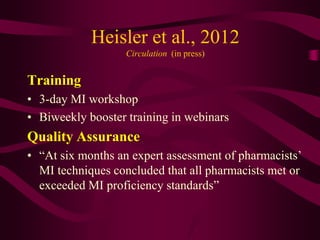
Training
• 3-day MI workshop
• Biweekly booster training in webinars
Quality Assurance
• “At six months an expert assessment of pharmacists’
  MI techniques concluded that all pharmacists met or
  exceeded MI proficiency standards”
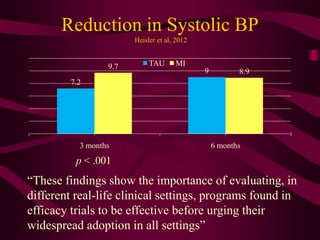
Reduction in Systolic BP
                        Heisler et al, 2012


                  9.7        TAU      MI
                                              9          8.9
         7.2


           3 months                               6 months
          p < .001
“These findings show the importance of evaluating, in
different real-life clinical settings, programs found in
efficacy trials to be effective before urging their
widespread adoption in all settings”
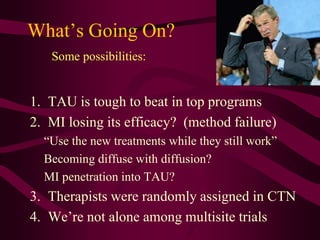
What’s Going On?
   Some possibilities:


1. TAU is tough to beat in top programs
2. MI losing its efficacy? (method failure)
  “Use the new treatments while they still work”
  Becoming diffuse with diffusion?
  MI penetration into TAU?
3. Therapists were randomly assigned in CTN
4. We’re not alone among multisite trials
Other Evidence-Based Treatments
Showing No Effect in CTN Trials

•   Seeking Safety
•   Job Seekers Workshop
•   Telephone follow-up
•   Smoking cessation
•   Brief strategic family therapy
We don’t yet know:
• What components of MI fidelity are most
  important in determining outcomes?
• What factors (besides fidelity and empathy)
  influence therapist effectiveness with MI?
• Why does MI work at some sites and not
  others?
• Are there client populations/attributes for
  whom MI is ineffective, and why?
• What is “treatment as usual” (when that is
  the comparison)?
What we do know so far:
• Efficacy of MI has been reported across nations,
  populations, and change targets
• The effect size of MI varies widely across:
    – Studies
    – Sites within studies
    – Therapists within sites
•   Expect small or no effect comparing MI to TAU
•   Empathy matters (often not measured)
•   Counselor fidelity matters
•   Client change talk matters
The woods are lovely, dark and deep
and miles to go before we sleep

Bill miller icmi 2012 plenary

  • 1.
    Saint • Servolo
  • 2.
    Spectacular Failures withMI ICMI 2012 William R. Miller
  • 3.
    But first: some spectacular successes
  • 4.
    What CTN CliniciansThink is Meaningful How much better would a new treatment have to be? 80 70 Clinically significant 60 improvement = 50 40 large enough to be 30 interested in learning a Pre new treatment method. 20 10 Significant 0 About 10 point increase in % doing well or doubling or halving of continuous measures Miller, W. R., & Manuel, J. K. (2008). How large must a treatment effect be before it matters to practitioners? An estimation method and demonstration. Drug and Alcohol Review, 27, 524-528.
  • 5.
    Allsop et al.,1997 Addiction, 92:61-74 • Design Randomized clinical trial • Population Alcohol abuse • Nation Scotland • N 60 adult outpatients • MI 8 session group MI + skills • Comparison Group discussion TAU • Follow-up 6 months
  • 6.
    Allsop et al.,1997 200 189 150 107 100 MI+ RP TAU 50 40 25 27 5 0 % Abstinent Days to First Days to Relapse Drink OR=8.0 p<.04 p<.03 p<.01
  • 7.
    Monti et al.,1999 Journal of Consulting and Clinical Psychology, 67:989-994 • Design Randomized clinical trial • Population Emergency room • Nation US (Providence, RI) • N 94 adolescents (18-19) • MI 1 session (35-40 min) • Comparison Standard care • Follow-up 6 months
  • 8.
    Monti et al.,1999 Outcomes Over 6 Months 90 85 80 70 62 60 50 Percent 50 MI 40 30 23 TAU 21 20 10 3 0 Drinking & Moving Violations Alcohol-Related Driving Injury OR=0.73 OR=0.13 OR=0.42 p<.05 p<.05 p<.01
  • 9.
    Thevos et al,2000 HMI Enhances the Adoption of Water Disinfection Practices in Zambia health Promotion International, 15:207-214 • Design Comparison zones • Population Water purification adoption • Nation Zambia, Africa • N 332 households • MI Health visitor consults • Comparison Health education • Follow-up 6 months
  • 10.
    Thevos et al.,2000 Bleach Sales: Bottles/Household/Month 1.4 1.2 1 0.8 MI 0.6 Educ 0.4 0.2 0 Months 1-2 Months 3-4 Months 5-6 OR=4.32 OR=3.69 OR=3.29 p<.001
  • 11.
    Soria et al(2006) A Randomized Controlled Trial of MI for Smoking Cessation British Journal of General Practice, 65:768-774 • Design Randomized clinical trial • Population Primary care • Nation Spain • N 200 smokers • MI 3 GP sessions (20 min) • Comparison Physician advice • Follow up 12 months
  • 12.
    Outcome: Soria etal. (2006) OR = 5.2 (1.6-17.1)
  • 13.
    Watkins et al.2011 12-Month Effects of Early MI After Acute Stroke Stroke 42: 1956-1961 • Design: Randomized controlled trial • Nation: United Kingdom • Sample: 411 adults after acute stroke • Control: Usual stroke care • Intervention: 4 individual MI sessions (30-60 min) • Follow-up: 12 months • Target: Decrease low mood/depression
  • 14.
    Outcomes: Watkins etal 2011 60 54.3 50 42.6 40 30 Usual Care MI 20 13.8 10 7.3 0 % Normal Mood % Dead OR=1.66 (1.08-2.55) OR=2.15 (1.06-4.38)
  • 15.
    Seal et al.2012 A randomized controlled trial of telephone MI to enhance mental health treatment engagement in Iraq and Afghanistan veterans General Hospital Psychiatry, in press • Design: Randomized controlled trial • Nation: US (San Francisco) • Sample: 73 Iraq & Afghanistan veterans • Control: Referral + 4 phone check-ins • Intervention: Referral + 4 phone MI • Follow-up: 16 weeks • Target: Engagement in MH treatment
  • 16.
    Outcomes: Seal etal 2012 70 1.8 1.68 62 1.6 60 1.4 50 1.2 40 1 Control Control 0.8 30 26 MI MI 0.6 20 0.38 0.4 10 0.2 0 0 % Engaged Visits (Mean) OR=2.41 (1.33-4.37) OR=4.36 (1.96-9.368 Effect size = .74
  • 17.
    Some addiction treatmenttrials with >2:1 abstinence advantage for MI Alcohol: Allsop et al (1997) Brown & Miller (1993) Amphetamine: Baker et al (2001) Marijuana: Babor et al (2004) Barrowclough et al (1998) Stephens et al (2000) Tobacco: Colby et al (1998) Soria et al (2006)
  • 18.
    The news isnot all good •
  • 19.
    Type Q Quality Assurance Failure • We gave practitioners a little training • We didn’t measure fidelity (well) • They tried MI • It didn’t work
  • 20.
    Robling et al.,2012 British Medical Journal, 344 doi: 10.1136/bmj.e2359 • Design Cluster randomized clinical trial • Population Pediatric diabetes services • Nation UK • N 693 children (4-15 yr) with Type 1 diabetes. and their caregivers • MI Agenda setting and guiding • Comparison Clinical teams delivering TAU • Follow-up 1 year HbA1c
  • 21.
    Robling et al.,2012 British Medical Journal, 344 doi: 10.1136/bmj.e2359 Training • On-line training + two 4-hour workshops with MINT members • Home-made global rating scale used for QA • Guiding & agenda setting skill increased significantly in the intervention group clinicians • Skill ratings maintained over 1 year follow-up • Absolute skill level unclear – was it MI?
  • 22.
    Robling et al.,2012 British Medical Journal, 344 doi: 10.1136/bmj.e2359 Outcome • No treatment effect (between groups) • HbA1c values increased (worse) in both groups
  • 23.
    Type F Fidelity Failure • We gave practitioners a fair amount of training and measured fidelity (QA) • MI fidelity was poor • They tried MI • It didn’t work
  • 24.
    Broekhuisen et al.,2012 BMC Public Health, 12:348 doi:10.1186/1471-2458-12-348 • Design Randomized clinical trial • Population Familial hypercholesterolemia • Nation The Netherlands • N 340 adults screened+ for FH • MI Computer advice, Lifestyle coach session + 4 phone boosters • Comparison No-intervention control • Follow-up 12 months
  • 25.
    Broekhuisen et al.,2012 BMC Public Health, 12:348 doi:10.1186/1471-2458-12-348 Training: 3-day MI training workshop Fidelity monitoring: MITI “None of the analysed face-to-face counseling sessions met the MITI thresholds. . . Skills required for effective MI may take longer to develop than the 3-day MI workshop in our project.” Outcome: No significant effect on LDL or lifestyle behaviors
  • 26.
    Type P Power Failure • We had a relatively small sample and low power to detect a difference • There was no difference
  • 27.
    Bien et al.,1993 Behavioural & Cognitive Psychotherapy, 21:347-356 • Design Randomized clinical trial • Population Outpatient alcohol (VA) • Nation US (Albuquerque, NM) • N 32 adults • MI 1 session MET (+ TAU) • Comparison TAU • Follow-up 3 + 6 months post discharge
  • 28.
    Bien et al.,1993 6-Month Drinking Outcomes 140 131.4 120 100 91 81 80 71 MI 60 50 TAU 37.9 40 20 0 Drinks per Month Peak BAC (mg%) % Days Abstinent No significant differences in outcomes at 6 months
  • 29.
    Type C ComprehensionFailure • We tried “MI” (which doesn’t sound much like MI) • It didn’t work
  • 30.
    Kuchipudi et al.,1990 Journal of Studies on Alcohol, 51:356-360 • Design Randomized clinical trial • Population Pancreatitis, ulcer or cirrhosis; non-responders to prior advice • Nation US (Hines, IL) • N 114 alcohol-related admissions • MI 3 sessions with 3 practitioners • Comparison TAU • Follow-up 16 weeks • Outcome Drinking or not
  • 31.
    Kuchipudi et al.,1990 Percent with Confirmed Abstinence 35 32 29 30 25 Percent 20 MI 15 TAU 10 5 0 Confirmed Abstinence NS: Needed a 30% difference for statistical significance
  • 32.
    What was theMI? Kuchipudi et al (1990) “Interviews with three different persons emphasizing the need for and benefits of alcoholism therapy and . . the relationship of the patient’s disease to continued drinking. The person’s health and drinking were reviewed from the viewpoint and with the authority of the director of the unit.”
  • 33.
    Methodological Contributions to Negative Trials • Type Q: QA Monitoring Failure • Type F: Fidelity Failure • Type P: Power Failure • Type C: Comprehension Failure
  • 34.
    Type M Method Failure • C: MI was well understood • Q: Intervention quality was monitored • F: Fidelity was good • P: Sample was large enough to detect a clinically meaningful effect • And yet no effect was observed
  • 35.
    MIDAS Study Miller etal (2003); Journal of Consulting & Clinical Psychology 71:754-763 • Design Randomized clinical trial • Population Treatment for drug use disorder • Nation US (Albuquerque) • N 114 alcohol-related admissions • MI 1 MET session, up to 90 minutes • Comparison TAU • Follow-up 12 months • Outcome Drug use
  • 36.
    MIDAS Study Outcome 0.8 0.75 0.7 0.65 0.6 0.55 TAU 0.5 0.45 0.4 0.35 0.3 Intake 3mo 6mo 9mo 12mo
  • 37.
    MIDAS Study Outcome 0.8 0.75 0.7 0.65 0.6 0.55 TAU 0.5 TAU+MI 0.45 0.4 0.35 0.3 Intake 3mo 6mo 9mo 12mo
  • 38.
    Commitment Language inMI 2 1.5 1 0.5 0 -0.5 -1 Successful -1.5 Unsuccessful -2 1 2 3 4 5 6 7 8 9 10 Time in MI Session (deciles)
  • 39.
    Type S: SpectacularFailure • C: MI was well understood • Q: Intervention quality was monitored • F: Fidelity and training were good • P: Large sample for power • Multisite replication • No main effect observed
  • 40.
    NIDA Clinical TrialsNetwork MI/MET vs. Treatment as Usual A priori comparisons on retention and drug use Four Multisite Randomized Clinical Trials Carroll et al (2006) Outpatient treatment No treatment effect of MI Ball et al (2007) Outpatient treatment No treatment effect of MET Winhusen et al (2008) Pregnant drug users No treatment effect of MET Carroll et al (2009) Spanish-speakers No treatment effect of MI
  • 41.
    Carroll et al.,2006 Drug & Alcohol Dependence, 81:301-312 • Design Multisite randomized clinical trial • Population Substance abuse treatment entry • Nation US (NIDA Clinical Trials Network) • N 423 outpatients at 5 sites • MI 2h evaluation in MI style • Comparison 2h TAU evaluation/assessment • Follow-up 12 weeks • Outcome Retention and substance use
  • 42.
    Treatment Sessions Completed (in first 28 days; Carroll et al., 2006) MET>TAU p<.05 Cohen’s d = .24 (.56 for alcohol users No significant difference in substance use (p<.06 for alcohol)
  • 43.
    Ball et al.,2007 Journal of Consulting and Clinical Psychology, 75(4), 556-567 • Design Multisite randomized clinical trial • Population Substance abuse treatment entry • Nation US (NIDA Clinical Trials Network) • N 461 outpatients at 5 sites • MI 3 individual MET sessions • Comparison TAU • Follow-up 16 weeks • Outcome Retention and substance use
  • 44.
    Ball et al.,2007 Outcomes MET = TAU (no significant difference) on MET TAU Days enrolled in treatment 72 69 % still enrolled at 4 months 43% 41% No main effect of MET vs. TAU on % positive urine samples 21% 28% % drug use days
  • 45.
    Days Drug UsePer Week (Ball et al., 2007) Treatment x Phase interaction: p<.001 favoring MET in weeks 5-16
  • 46.
    Winhusen et al.,2008 Journal of Substance Abuse Treatment, 35(2), 161-173 • Design Multisite randomized clinical trial • Population Pregnant drug users • Nation US (NIDA Clinical Trials Network) • N 400 women at 4 sites • MI 3 individual MET sessions • Comparison TAU • Follow-up 16 weeks • Outcome Drinking or not
  • 47.
    Treatment Sessions Attended Winhusen et al, 2008 No significant difference
  • 48.
    % Drug-Positive UrineSamples Winhusen et al, 2008 Site by Treatment Interaction
  • 49.
    Carroll et al.,2009 Journal of Consulting and Clinical Psychology, 77(5), 993-999 • Design Multisite randomized clinical trial • Population Substance abuse treatment entry • Nation US (NIDA Clinical Trials Network) • N 405 Spanish-speaking clients • MI 3 individual MET sessions • Comparison TAU • Follow-up 16 weeks • Outcome Retention and substance use
  • 50.
    Days Retained inTreatment (All Drugs, Carroll et al., 2009) 120 TAU MET 100 80 60 40 20 0 Site 1 Site 2 Site 3 Site 4 Site 5 Total No significant difference in retention or drug use
  • 51.
    Days Retained inTreatment (Alcohol as Primary Drug, Carroll et al., 2009) Treatment: p<.02 favoring MET
  • 52.
    Days Drinking PerWeek (Alcohol as Primary Drug; Carroll et al., 2009) Treatment x Time: p<.02 favoring MET
  • 53.
    Heisler et al.,2012 Circulation (in press) • Design Cluster randomized pragmatic trial • Setting 2 high-performing health systems • Nation US (VA & Kaiser Permanente) • N 4100 diabetes with uncontrolled BP • MI Script-guided pharmacist encounters (phone or in person) during 14 months • Comparison Usual care • Follow-up 6 months (after 14 months) • Outcome Systolic BP from med care records
  • 54.
    Heisler et al.,2012 Circulation (in press) Training • 3-day MI workshop • Biweekly booster training in webinars Quality Assurance • “At six months an expert assessment of pharmacists’ MI techniques concluded that all pharmacists met or exceeded MI proficiency standards”
  • 55.
    Reduction in SystolicBP Heisler et al, 2012 9.7 TAU MI 9 8.9 7.2 3 months 6 months p < .001 “These findings show the importance of evaluating, in different real-life clinical settings, programs found in efficacy trials to be effective before urging their widespread adoption in all settings”
  • 56.
    What’s Going On? Some possibilities: 1. TAU is tough to beat in top programs 2. MI losing its efficacy? (method failure) “Use the new treatments while they still work” Becoming diffuse with diffusion? MI penetration into TAU? 3. Therapists were randomly assigned in CTN 4. We’re not alone among multisite trials
  • 57.
    Other Evidence-Based Treatments ShowingNo Effect in CTN Trials • Seeking Safety • Job Seekers Workshop • Telephone follow-up • Smoking cessation • Brief strategic family therapy
  • 58.
    We don’t yetknow: • What components of MI fidelity are most important in determining outcomes? • What factors (besides fidelity and empathy) influence therapist effectiveness with MI? • Why does MI work at some sites and not others? • Are there client populations/attributes for whom MI is ineffective, and why? • What is “treatment as usual” (when that is the comparison)?
  • 59.
    What we doknow so far: • Efficacy of MI has been reported across nations, populations, and change targets • The effect size of MI varies widely across: – Studies – Sites within studies – Therapists within sites • Expect small or no effect comparing MI to TAU • Empathy matters (often not measured) • Counselor fidelity matters • Client change talk matters
  • 60.
    The woods arelovely, dark and deep
  • 61.
    and miles togo before we sleep