MEASURE WHAT MATTERS
understanding measurement & roi for digital experiences
@FARRAHBOSTIC
4 THINGS:
       WHY
       WHAT
       HOW

(AND HOW TO SELL IT)
1. WHY YOU SHOULD MEASURE
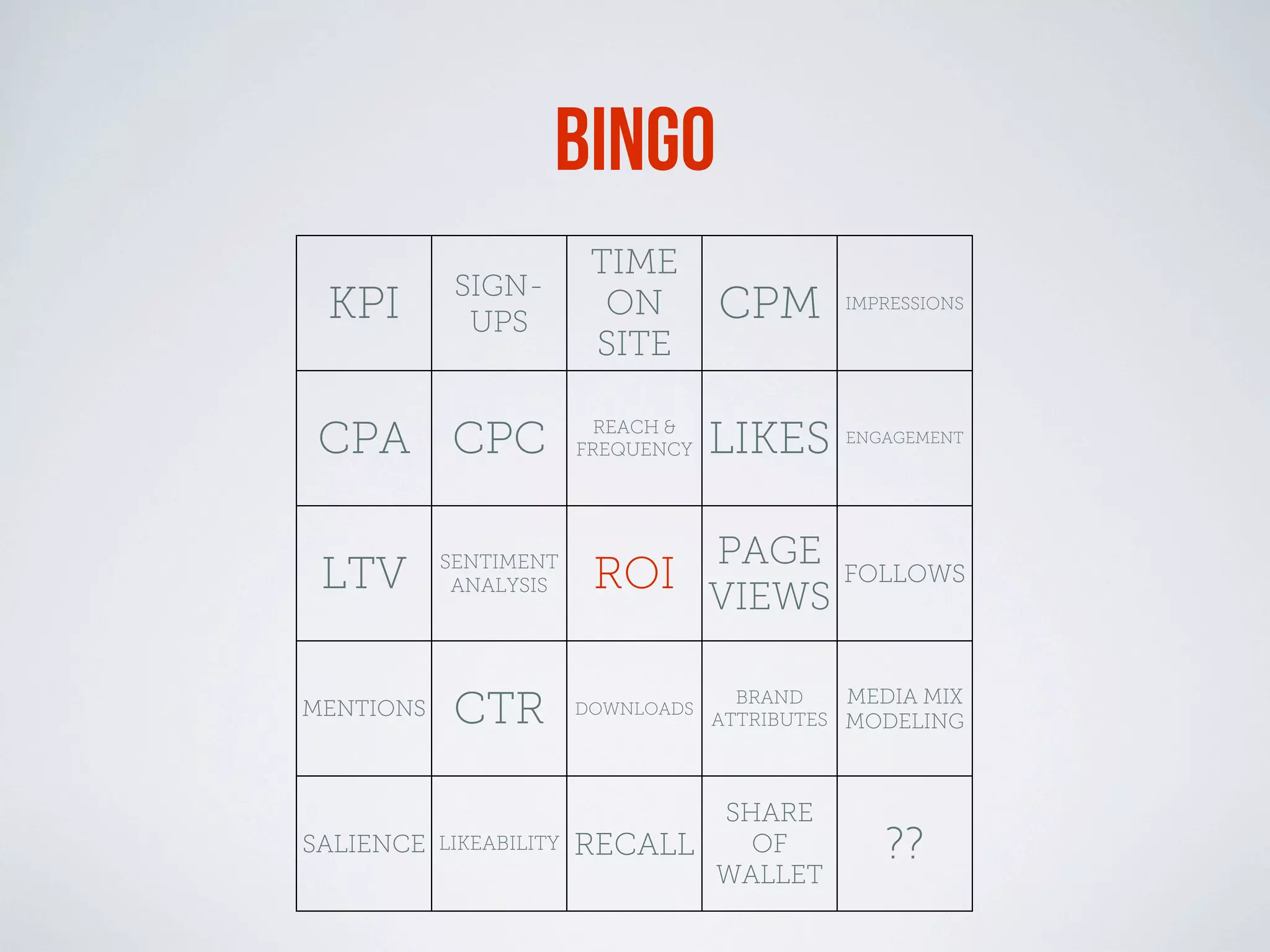
BINGO
                        TIME
            SIGN-
 KPI         UPS
                         ON        CPM       IMPRESSIONS

                        SITE

 CPA CPC                 REACH &
                       FREQUENCY   LIKES     ENGAGEMENT


                            PAGE
 LTV       SENTIMENT
            ANALYSIS    ROI VIEWS            FOLLOWS


MENTIONS    CTR        DOWNLOADS
                                     BRAND    MEDIA MIX
                                   ATTRIBUTES MODELING


                              SHARE
SALIENCE LIKEABILITY   RECALL   OF              ??
                              WALLET
A WORD OF CAUTION


I notice increasing reluctance on
the part of marketing executives
to use judgment; they are coming
to rely too much on research, and
they use it as a drunkard uses a
lamp post: for support, rather
than for illumination.

David Ogilvy
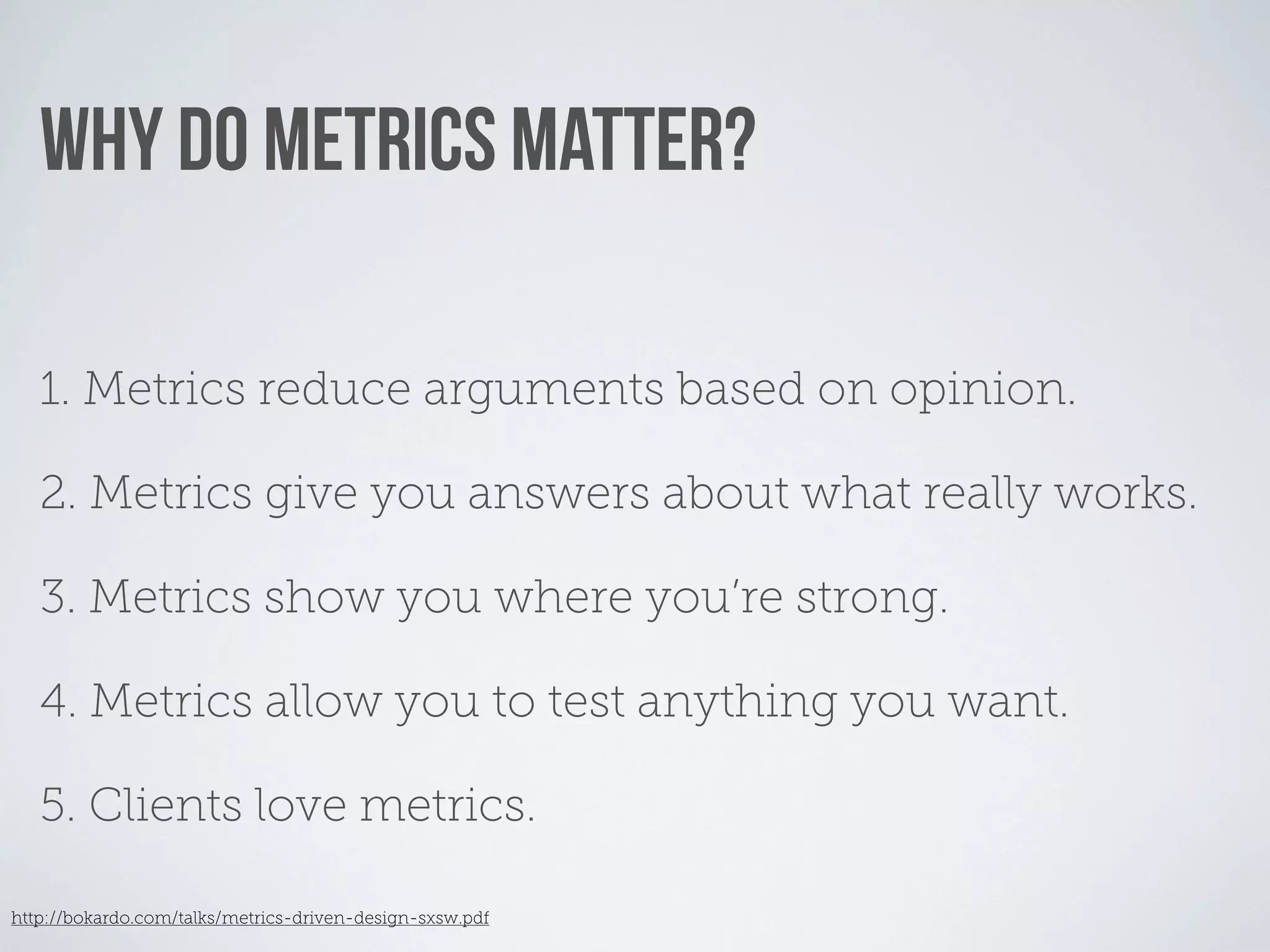
WHY DO METRICS MATTER?

   1. Metrics reduce arguments based on opinion.

   2. Metrics give you answers about what really works.

   3. Metrics show you where you’re strong.

   4. Metrics allow you to test anything you want.

   5. Clients love metrics.

http://bokardo.com/talks/metrics-driven-design-sxsw.pdf
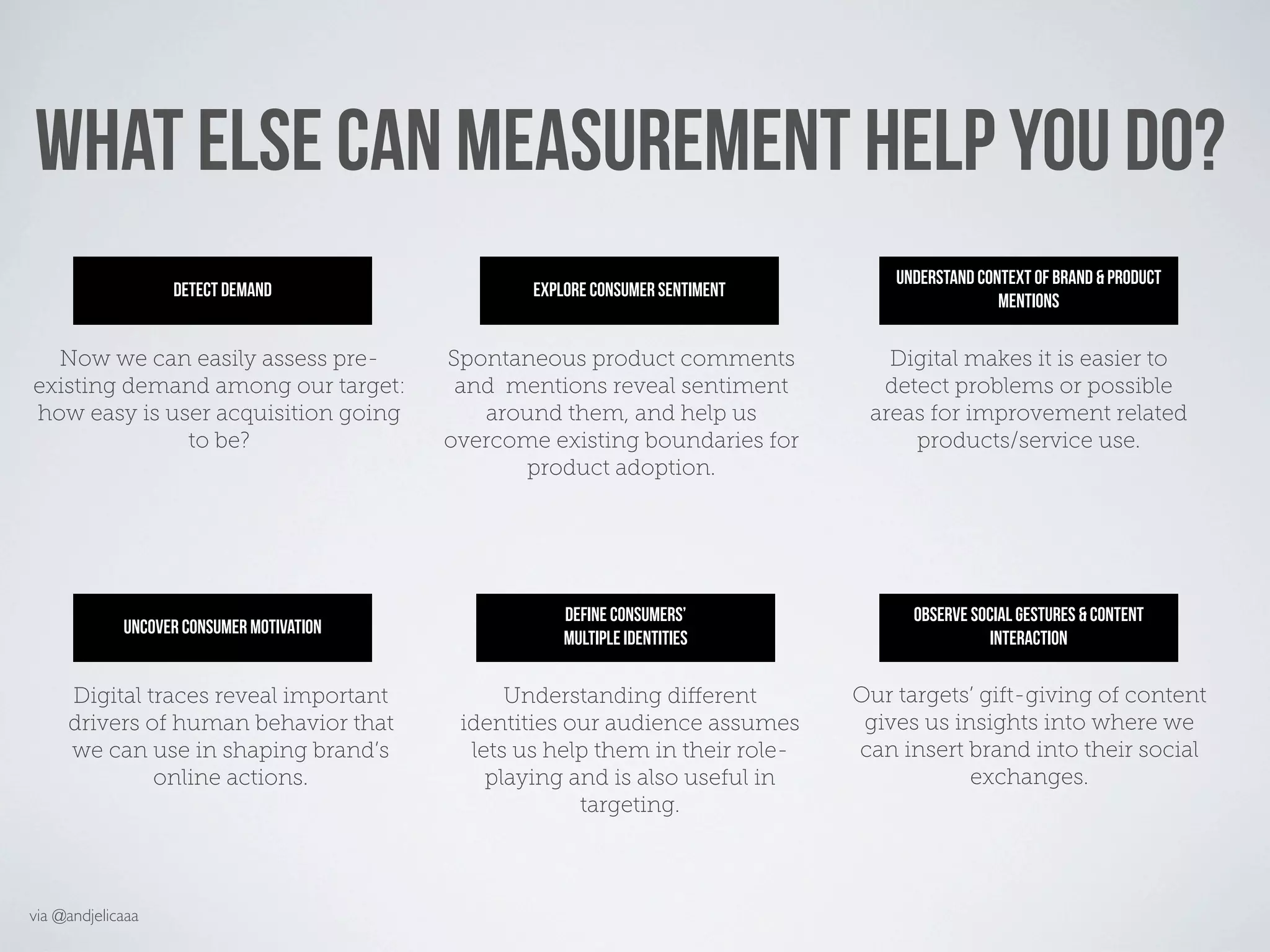
WHAT ELSE CAN MEASUREMENT HELP YOU DO?
                                                                                    UNDERSTAND CONTEXT OF BRAND & PRODUCT
                   DETECT DEMAND                   EXPLORE CONSUMER SENTIMENT
                                                                                                  MENTIONS

  Now we can easily assess pre-            Spontaneous product comments            Digital makes it is easier to
existing demand among our target:           and mentions reveal sentiment         detect problems or possible
how easy is user acquisition going            around them, and help us           areas for improvement related
              to be?                       overcome existing boundaries for          products/service use.
                                                 product adoption.


                                                       DEFINE CONSUMERS’              OBSERVE SOCIAL GESTURES & CONTENT
             UNCOVER CONSUMER MOTIVATION
                                                       MULTIPLE IDENTITIES                       INTERACTION

     Digital traces reveal important             Understanding different        Our targets’ gift-giving of content
     drivers of human behavior that         identities our audience assumes      gives us insights into where we
     we can use in shaping brand’s           lets us help them in their role-   can insert brand into their social
              online actions.                  playing and is also useful in                exchanges.
                                                        targeting.


via @andjelicaaa
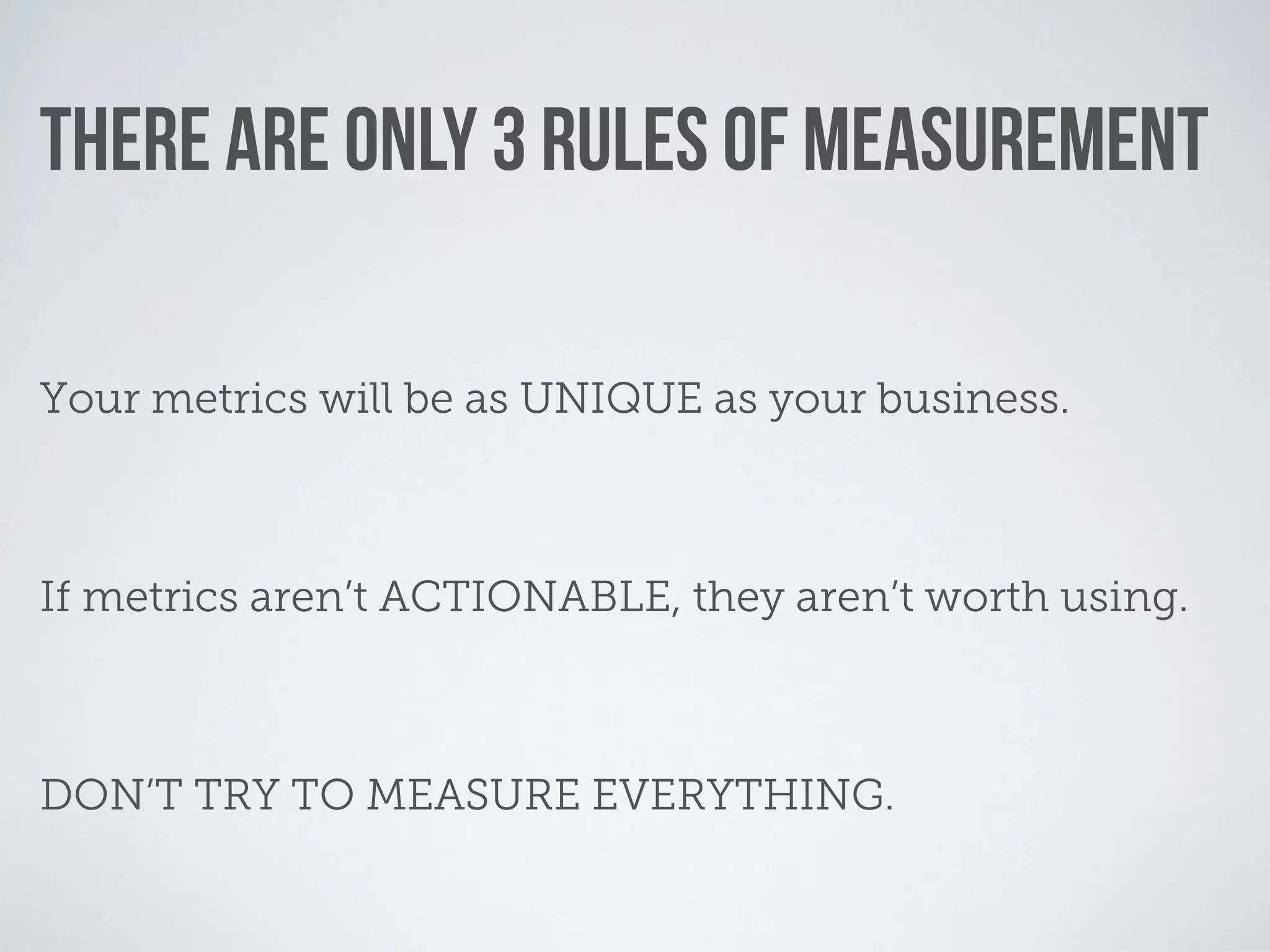
THERE ARE ONLY 3 RULES OF MEASUREMENT

Your metrics will be as UNIQUE as your business.


If metrics aren’t ACTIONABLE, they aren’t worth using.


DON’T TRY TO MEASURE EVERYTHING.
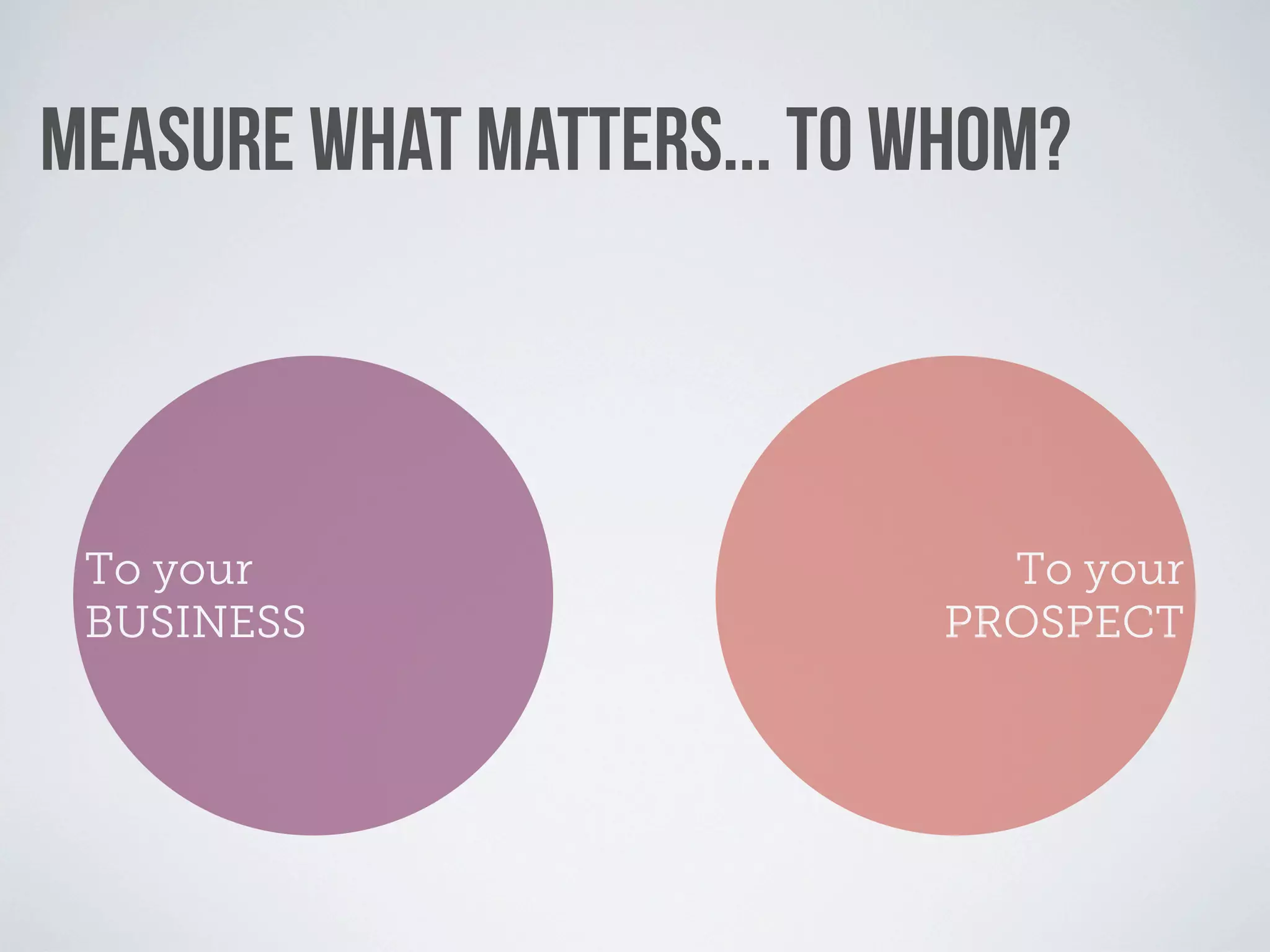
MEASURE WHAT MATTERS... TO WHOM?


 To your                      To your
 BUSINESS                   PROSPECT
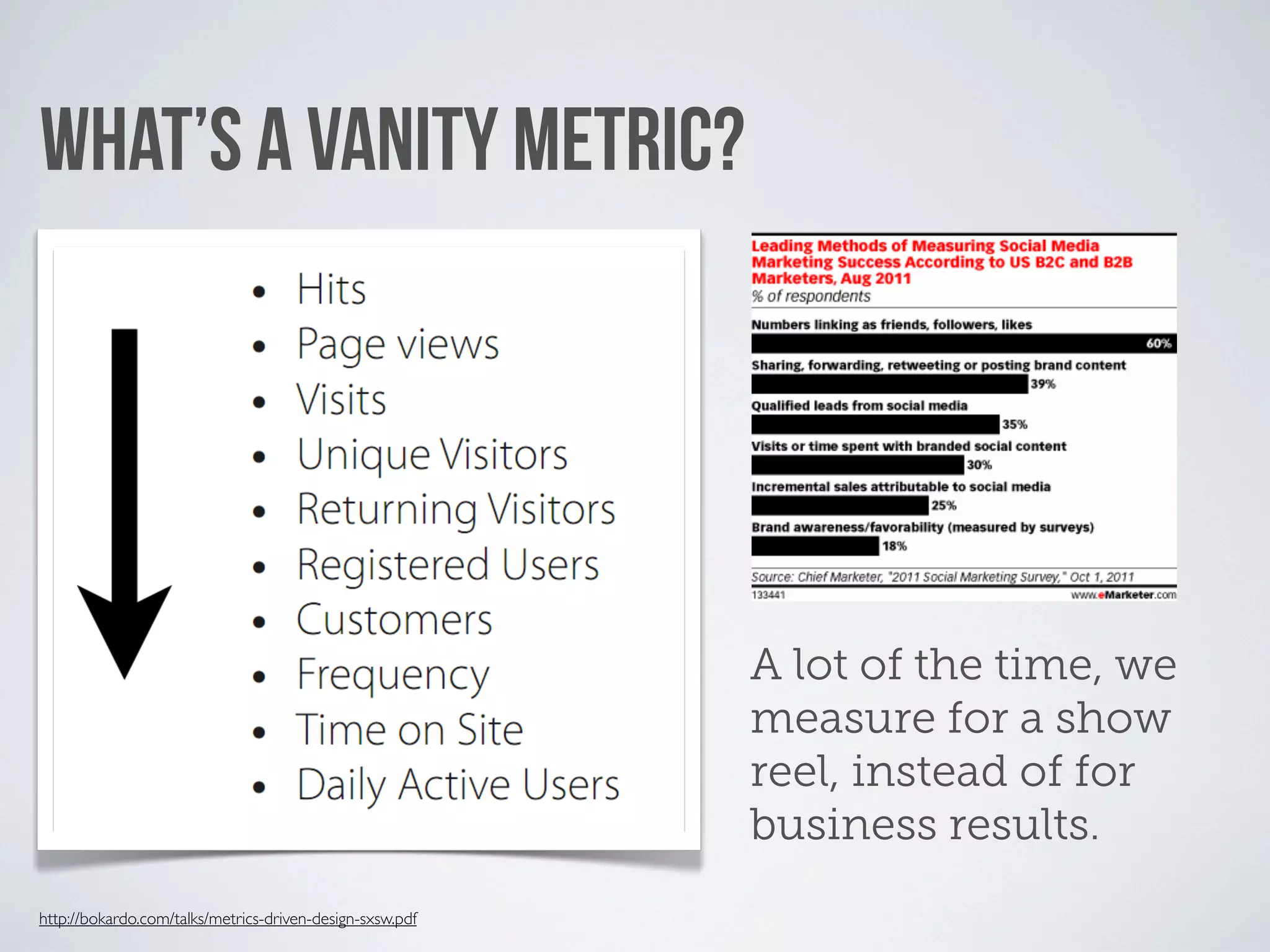
IT’S EASY TO FOCUS ON VANITY METRICS


                       “Numbers that make us
                     look good but don’t really
                        help make decisions.”
                              Eric Ries,
                          The Lean Start-up
WHAT’S A VANITY METRIC?


                                                          A lot of the time, we
                                                          measure for a show
                                                          reel, instead of for
                                                          business results.
http://bokardo.com/talks/metrics-driven-design-sxsw.pdf
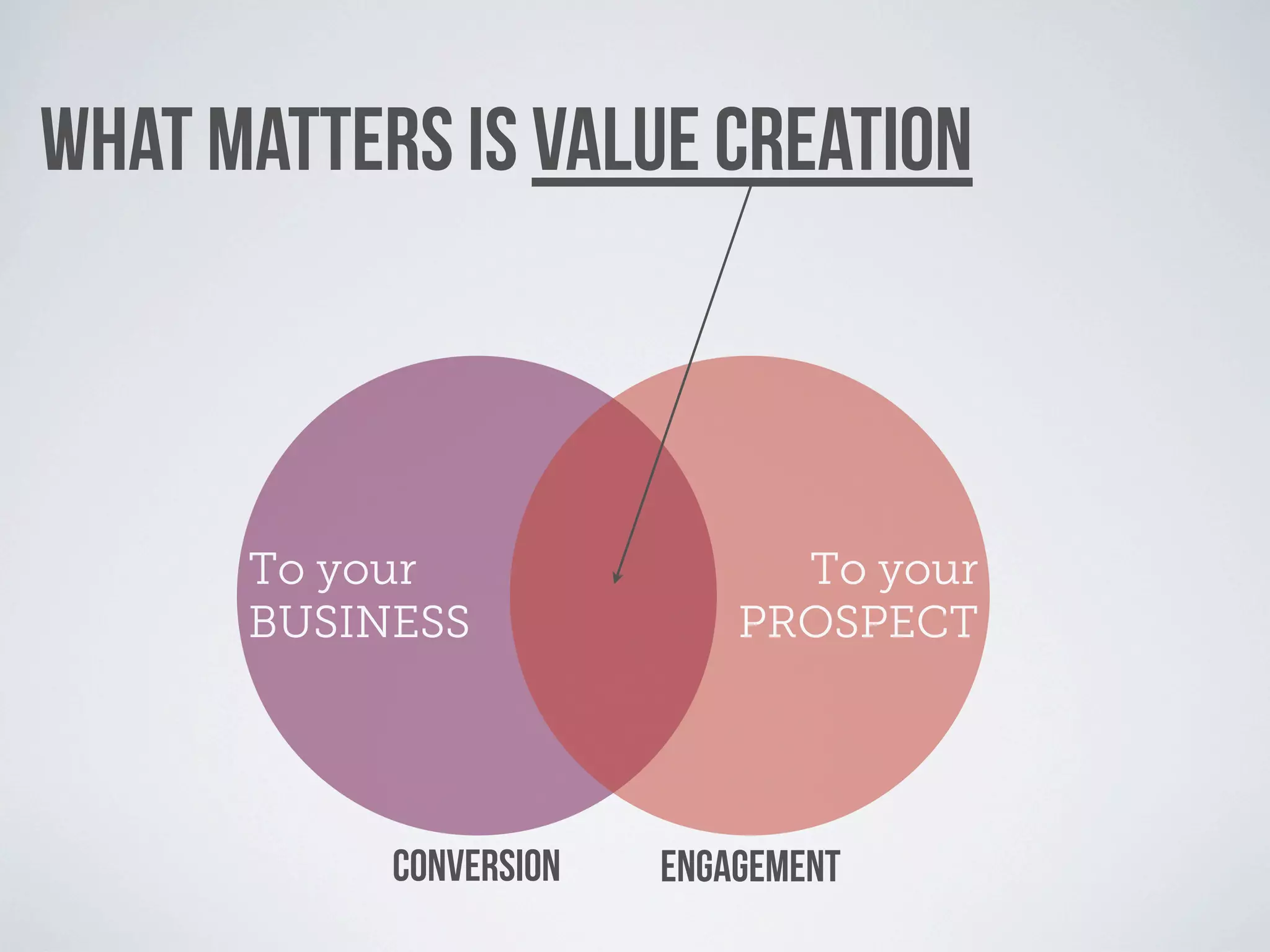
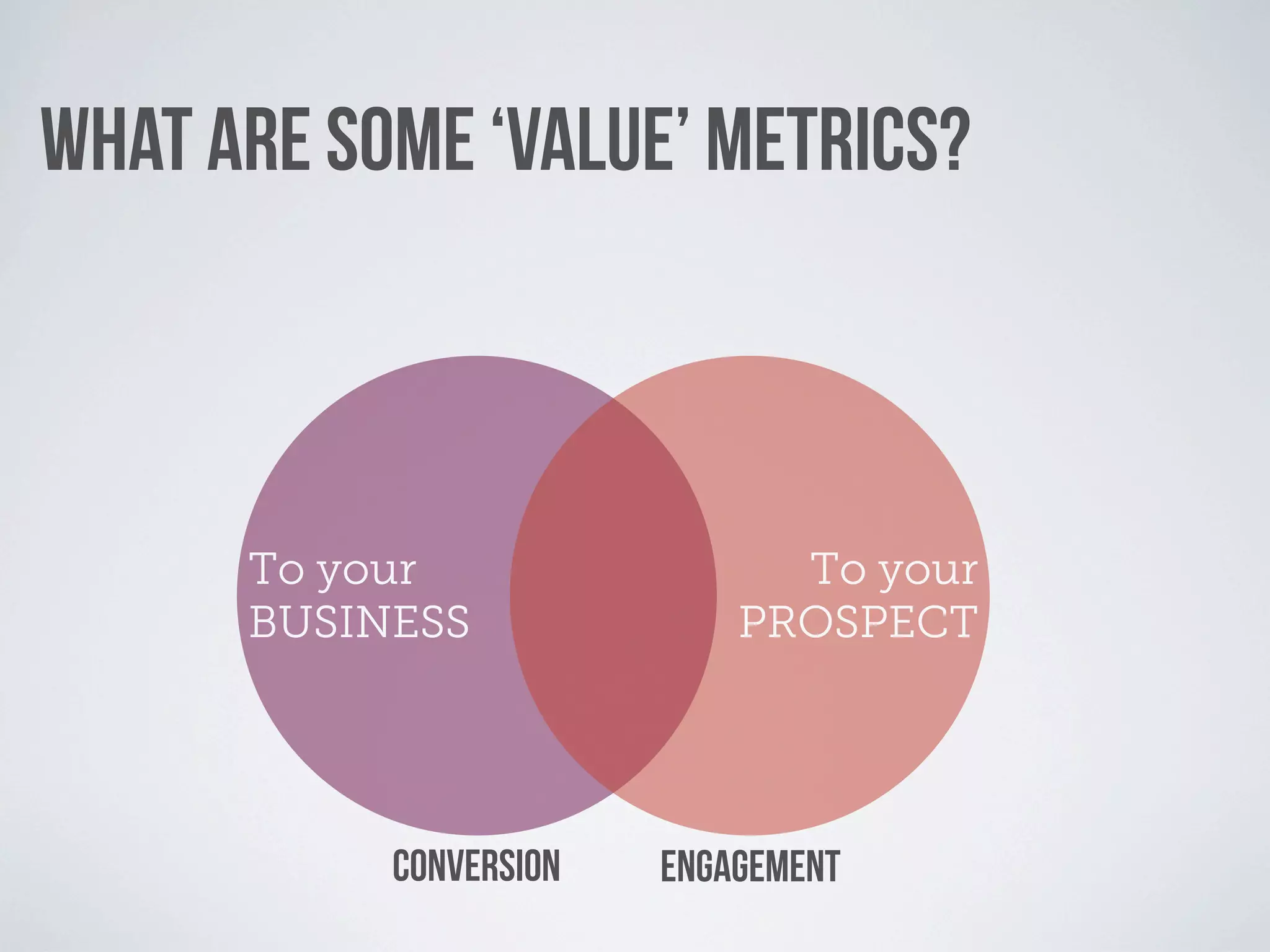
WHAT MATTERS IS VALUE CREATION


      To your                 To your
      BUSINESS              PROSPECT


           CONVERSION   ENGAGEMENT
2. WHAT YOU SHOULD MEASURE
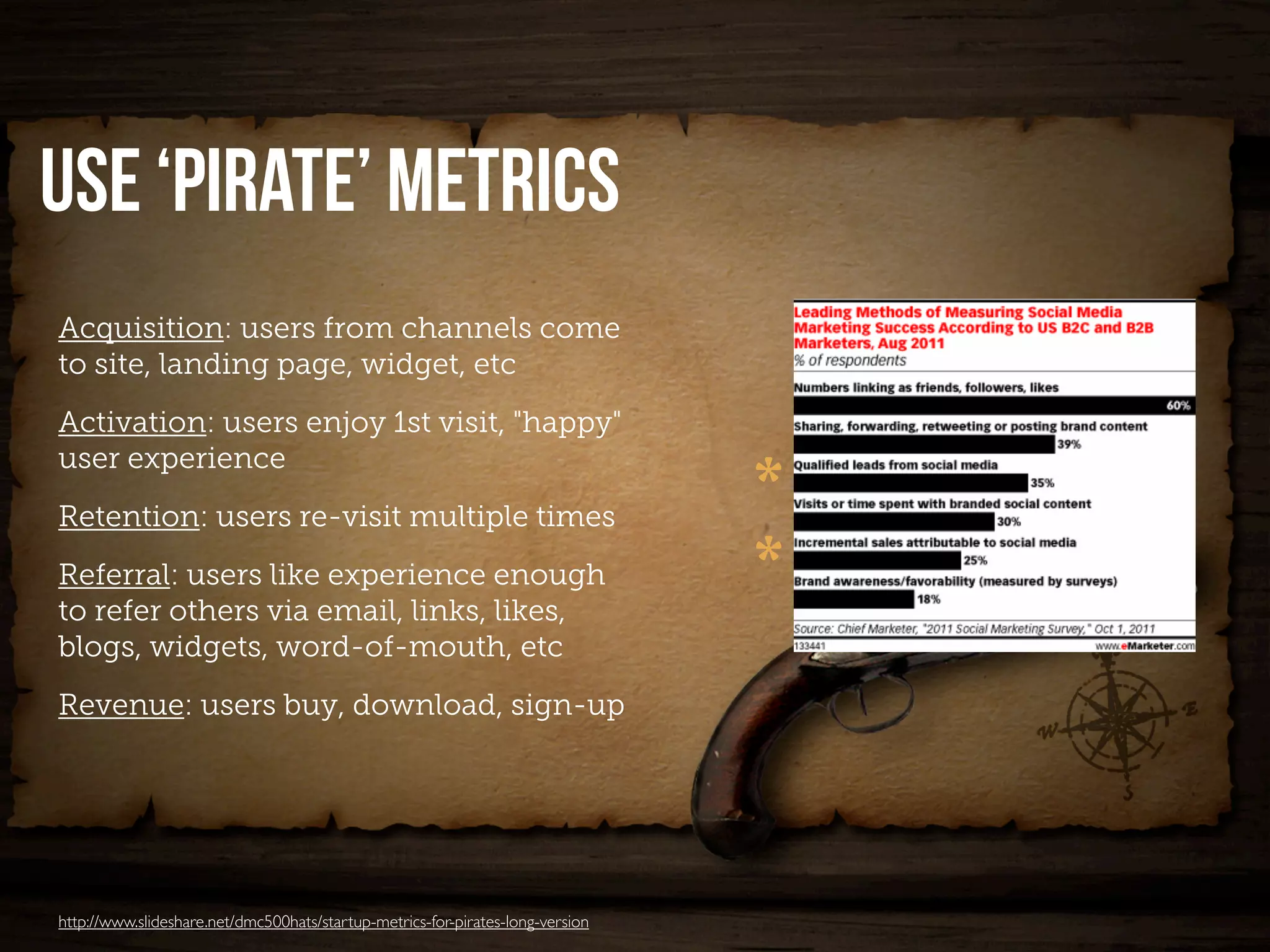
USE ‘PIRATE’ METRICS
Acquisition: users from channels come
to site, landing page, widget, etc
Activation: users enjoy 1st visit, "happy"
user experience
                                                                                *
Retention: users re-visit multiple times
Referral: users like experience enough                                          *
to refer others via email, links, likes,
blogs, widgets, word-of-mouth, etc
Revenue: users buy, download, sign-up


http://www.slideshare.net/dmc500hats/startup-metrics-for-pirates-long-version
WHAT ARE SOME ‘VALUE’ METRICS?


      To your                 To your
      BUSINESS              PROSPECT


           CONVERSION   ENGAGEMENT
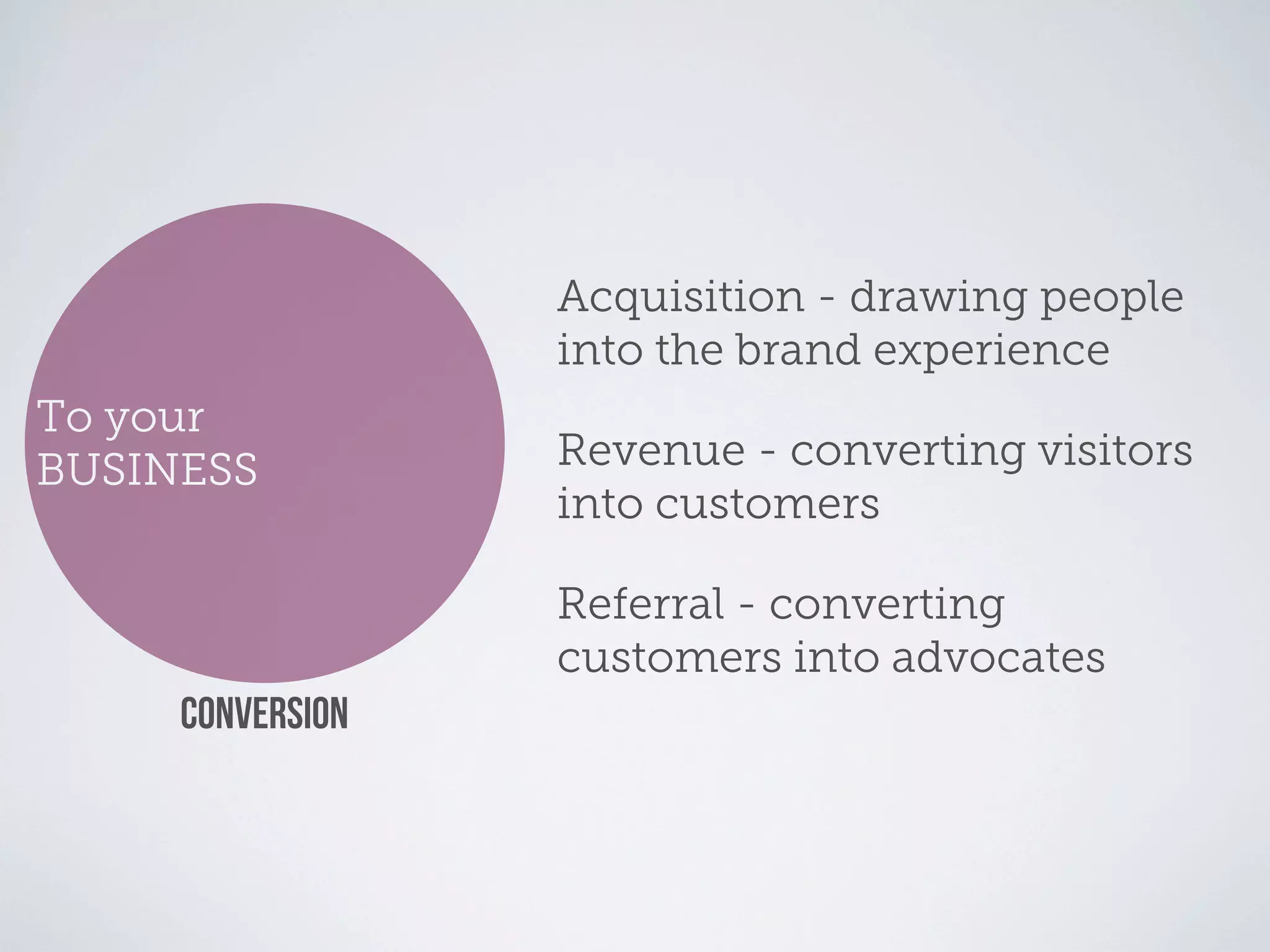
Acquisition - drawing people
                  into the brand experience
To your
BUSINESS          Revenue - converting visitors
                  into customers

                  Referral - converting
                  customers into advocates
     CONVERSION
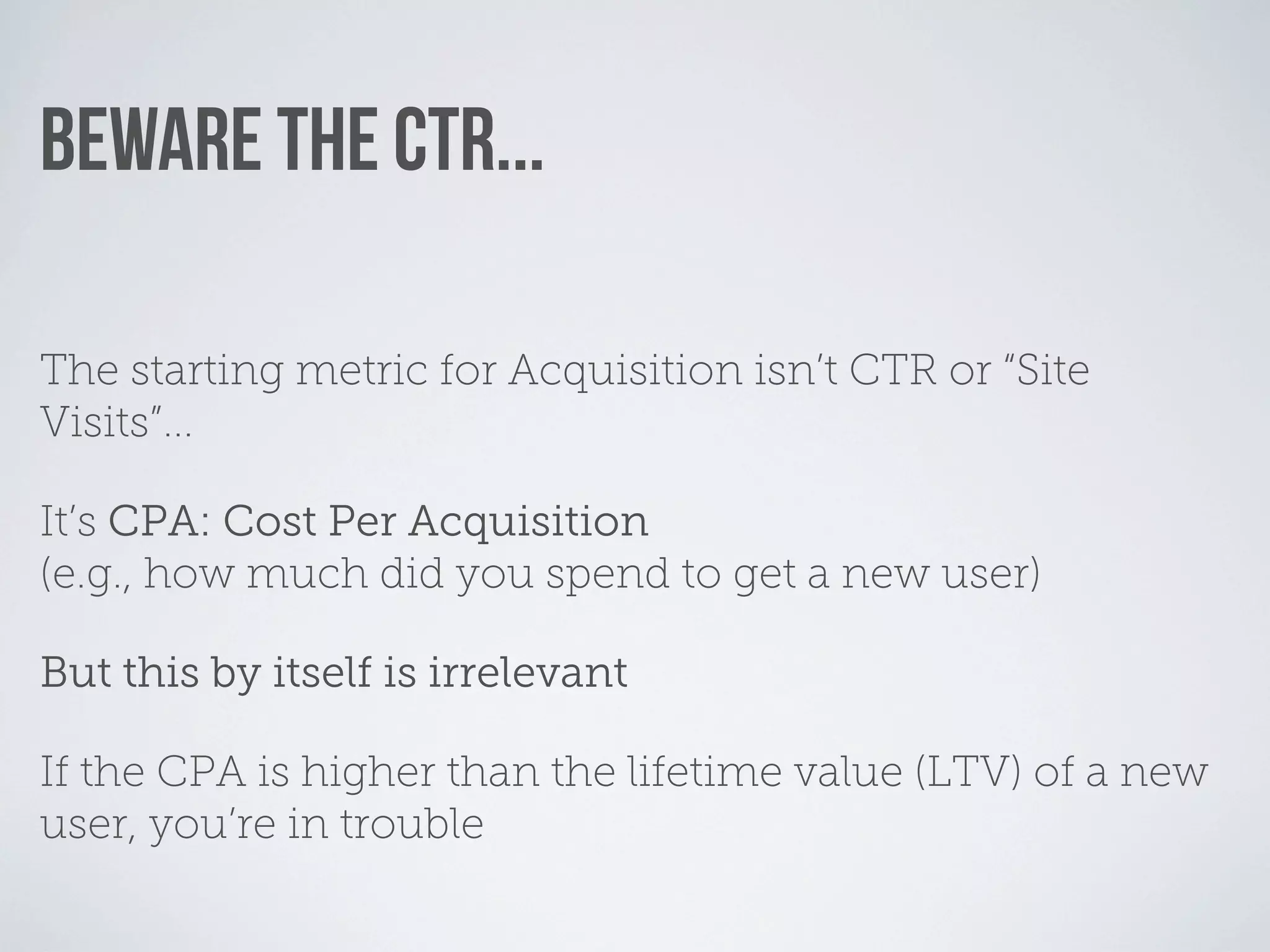
BEWARE THE CTR...

The starting metric for Acquisition isn’t CTR or “Site
Visits”...

It’s CPA: Cost Per Acquisition
(e.g., how much did you spend to get a new user)

But this by itself is irrelevant

If the CPA is higher than the lifetime value (LTV) of a new
user, you’re in trouble
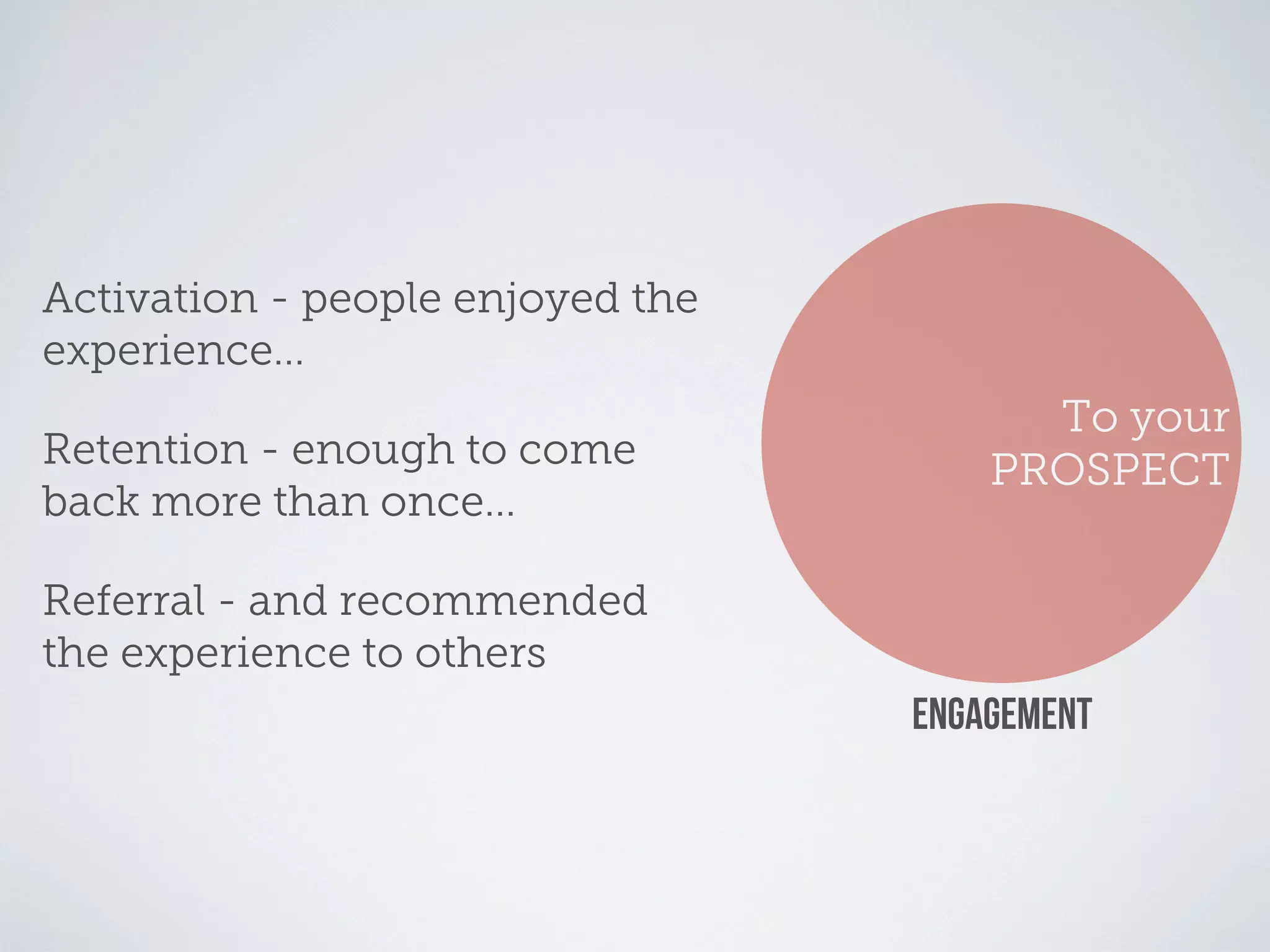
Activation - people enjoyed the
experience...
                                        To your
Retention - enough to come            PROSPECT
back more than once...

Referral - and recommended
the experience to others
                                  ENGAGEMENT
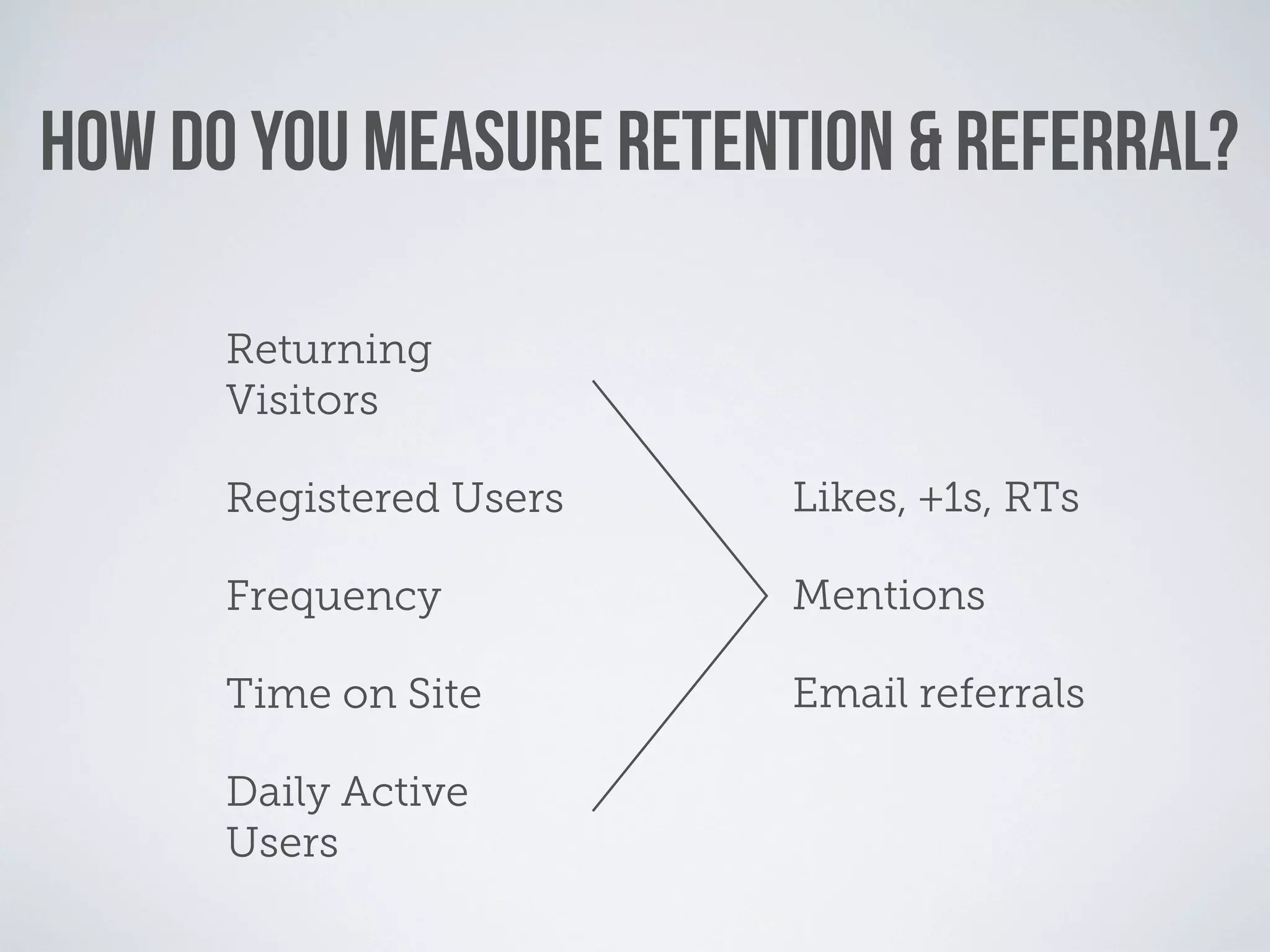
HOW DO YOU MEASURE RETENTION & REFERRAL?

      Returning
      Visitors

      Registered Users   Likes, +1s, RTs

      Frequency          Mentions

      Time on Site       Email referrals

      Daily Active
      Users
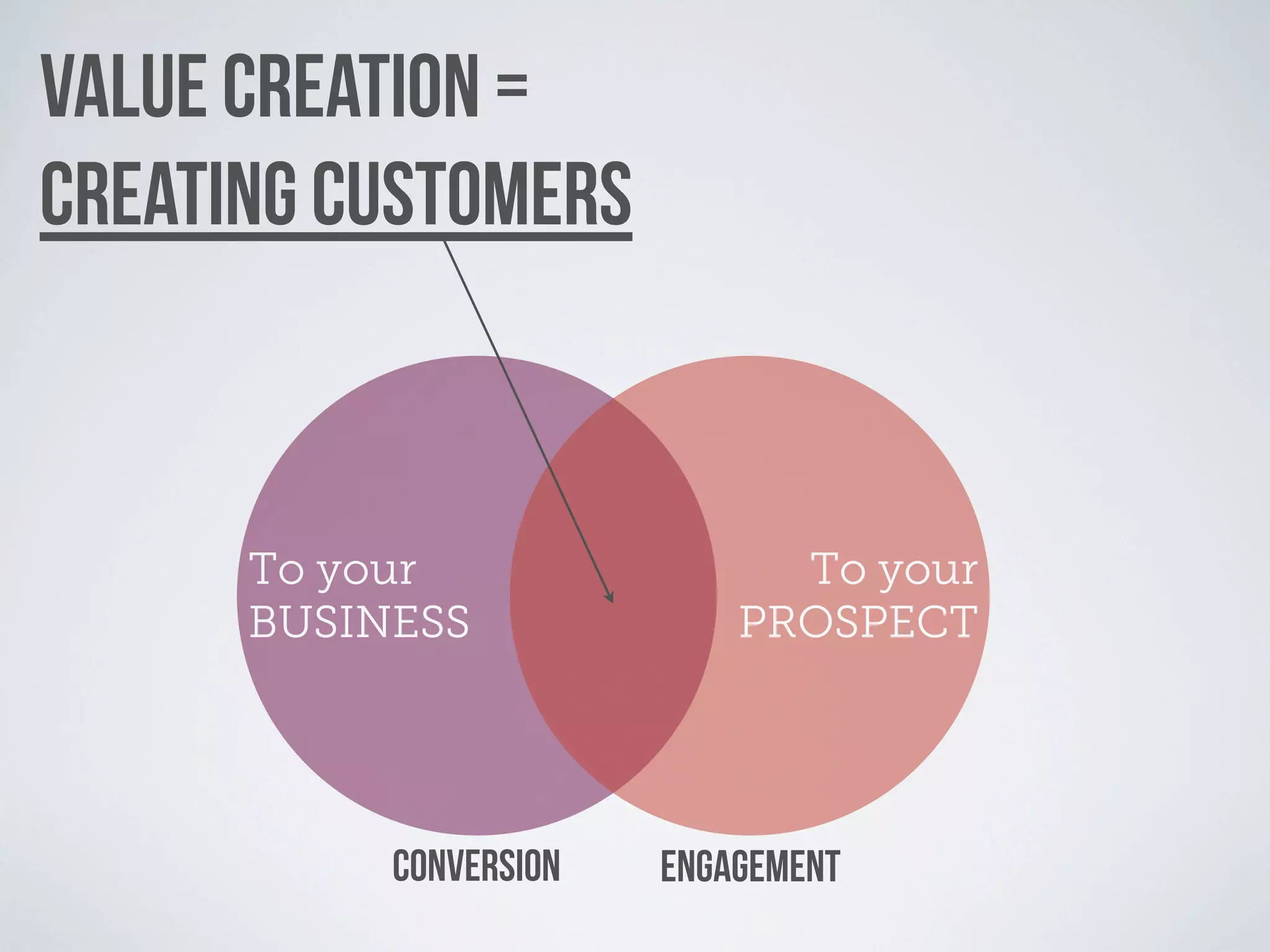
VALUE CREATION =
CREATING CUSTOMERS


      To your                 To your
      BUSINESS              PROSPECT


           CONVERSION   ENGAGEMENT
SO WHAT’S MORE IMPORTANT?

Brand growth comes from Acquisition.

Contrary to popular belief, acquisition is actually cheaper,
and more beneficial to the brand, than retention.

Marketing should be geared toward Acquisition.

Product & service design should be geared toward
Activation & Retention.
BUT WHAT ABOUT THE OTHER STUFF?


Brand attributes?

Loyalty?

Share of wallet?

Media mix modeling?
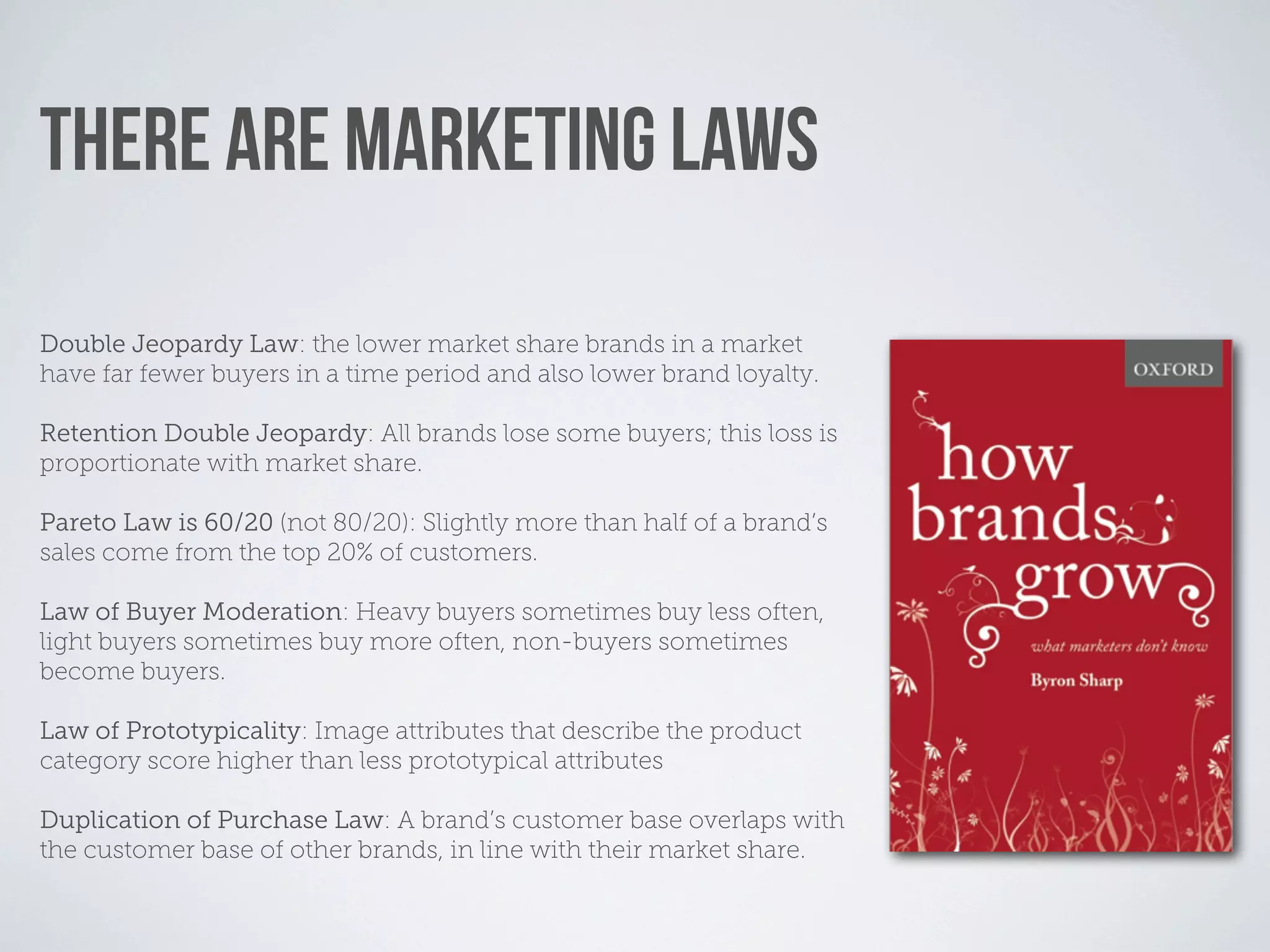
THERE ARE MARKETING LAWS

Double Jeopardy Law: the lower market share brands in a market
have far fewer buyers in a time period and also lower brand loyalty.

Retention Double Jeopardy: All brands lose some buyers; this loss is
proportionate with market share.

Pareto Law is 60/20 (not 80/20): Slightly more than half of a brand’s
sales come from the top 20% of customers.

Law of Buyer Moderation: Heavy buyers sometimes buy less often,
light buyers sometimes buy more often, non-buyers sometimes
become buyers.

Law of Prototypicality: Image attributes that describe the product
category score higher than less prototypical attributes

Duplication of Purchase Law: A brand’s customer base overlaps with
the customer base of other brands, in line with their market share.
AND SOME INCONVENIENT TRUTHS

User bases seldom vary:
Rival brands sell to very similar customer bases.

Attitudes and brand beliefs reflect behavioral loyalty:
Consumers know and say more about brands they use often,
and they think and say little about brands they do not use.

Usage drives attitude:
Consumers like what they buy.
3. TOOLS YOU CAN USE FOR DIGITAL
    EXPERIENCE MEASUREMENT
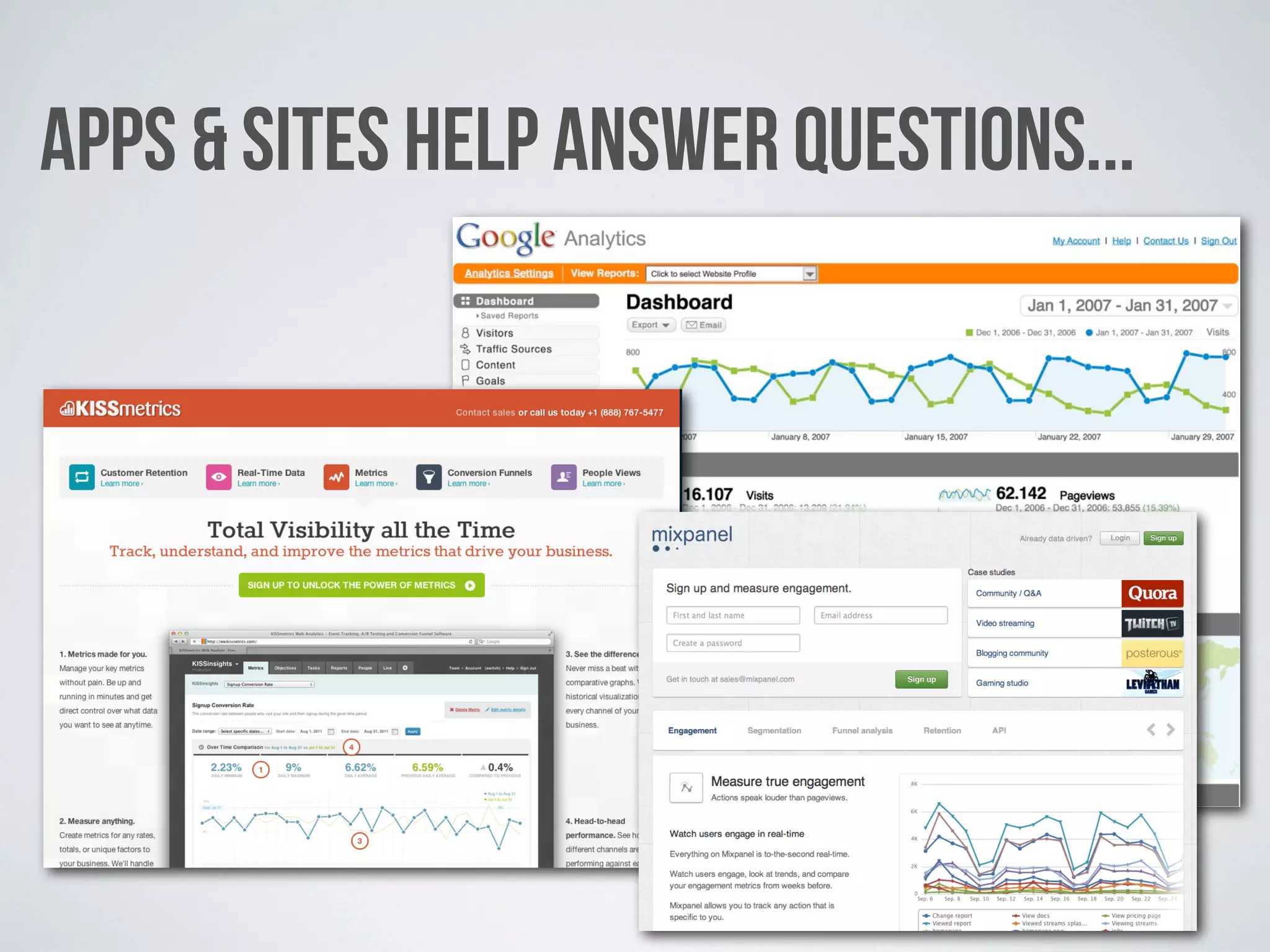
APPS & SITES HELP ANSWER QUESTIONS...


                  I NEVER FELT LIKE I
                     WAS LEARNING
                 ANYTHING IMPORTANT
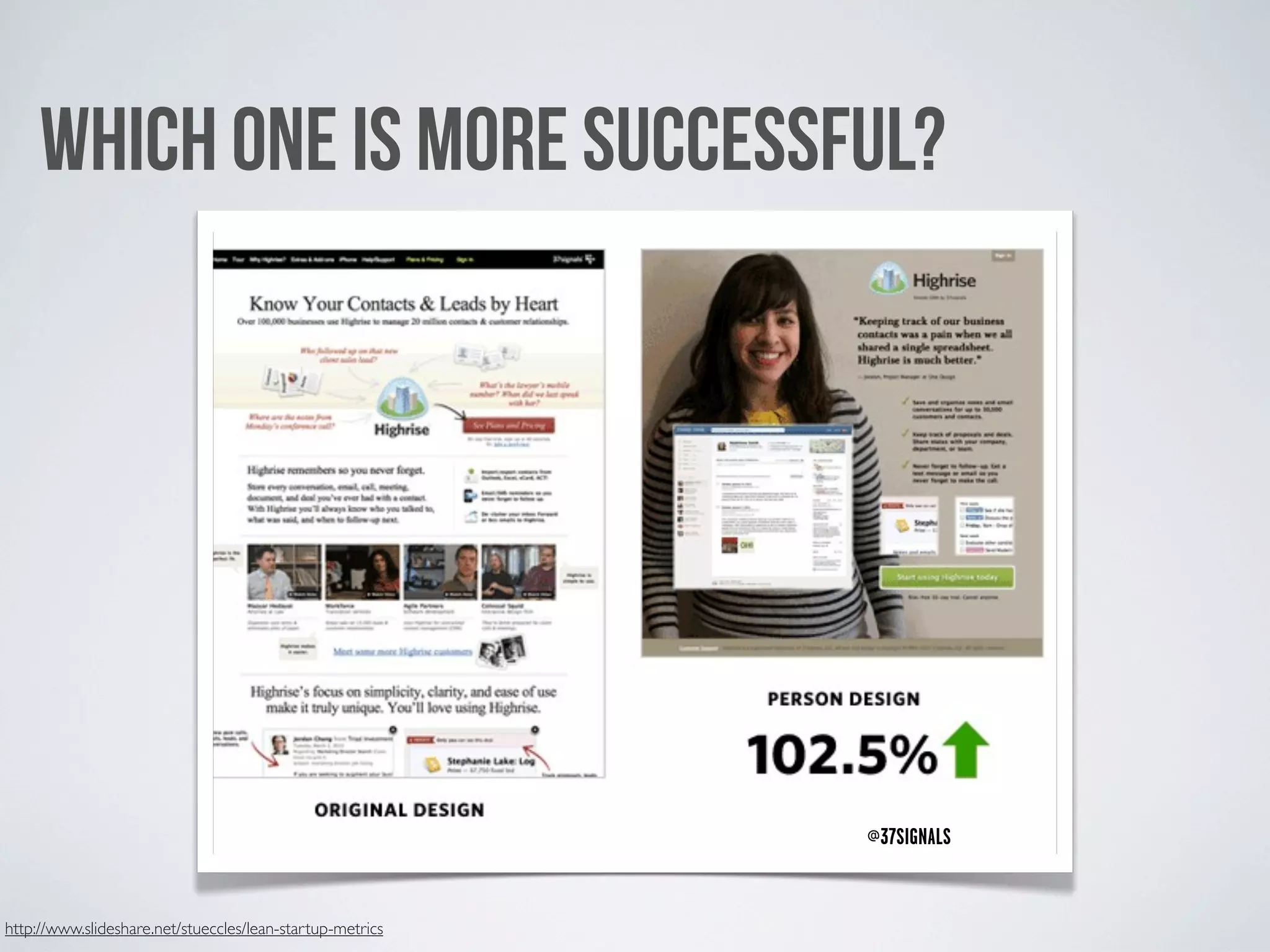
WHICH ONE IS MORE SUCCESSFUL?


                                                           @37SIGNALS


http://www.slideshare.net/stueccles/lean-startup-metrics
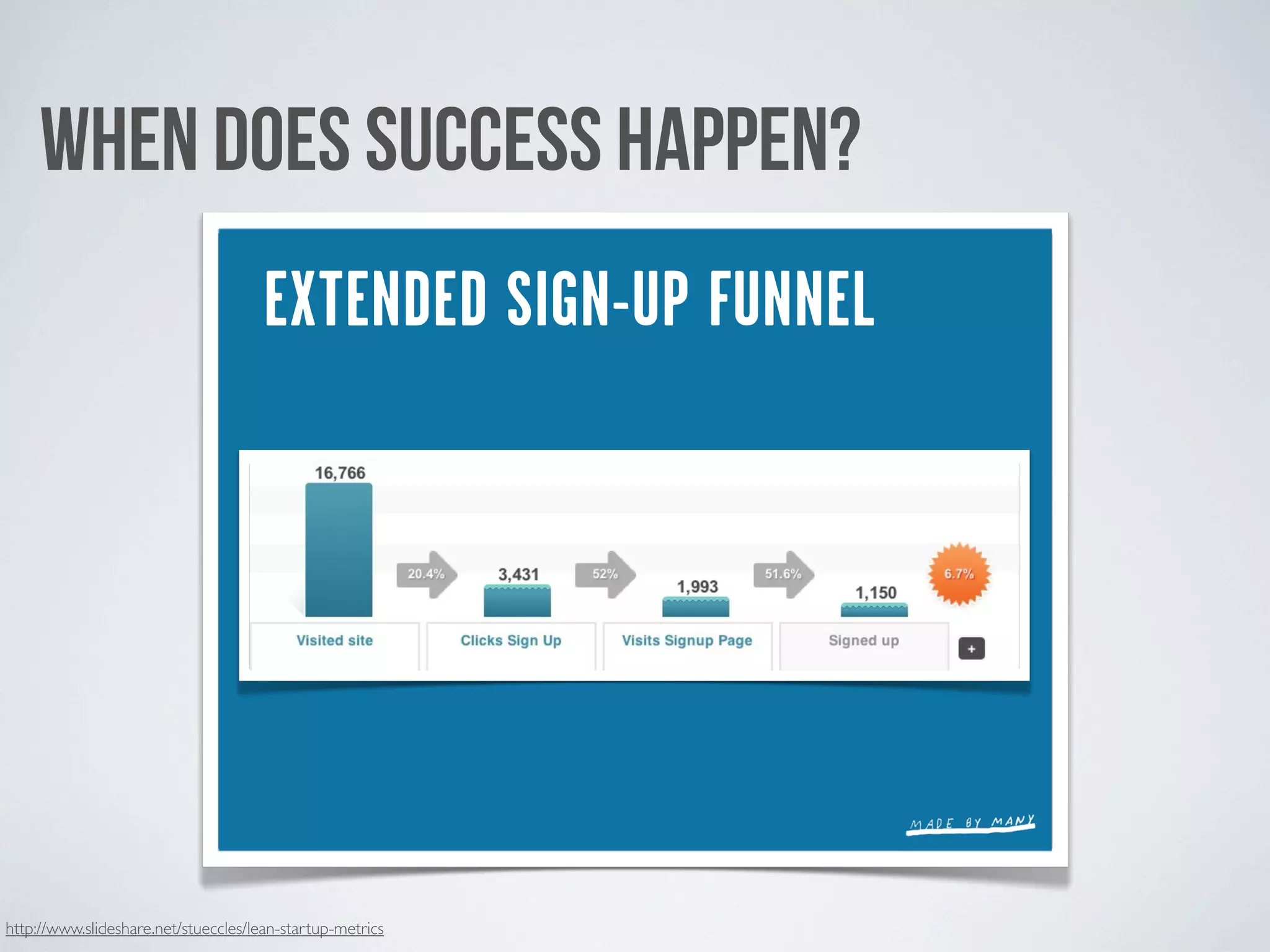
WHEN DOES SUCCESS HAPPEN?
                                      EXTENDED SIGN-UP FUNNEL


http://www.slideshare.net/stueccles/lean-startup-metrics
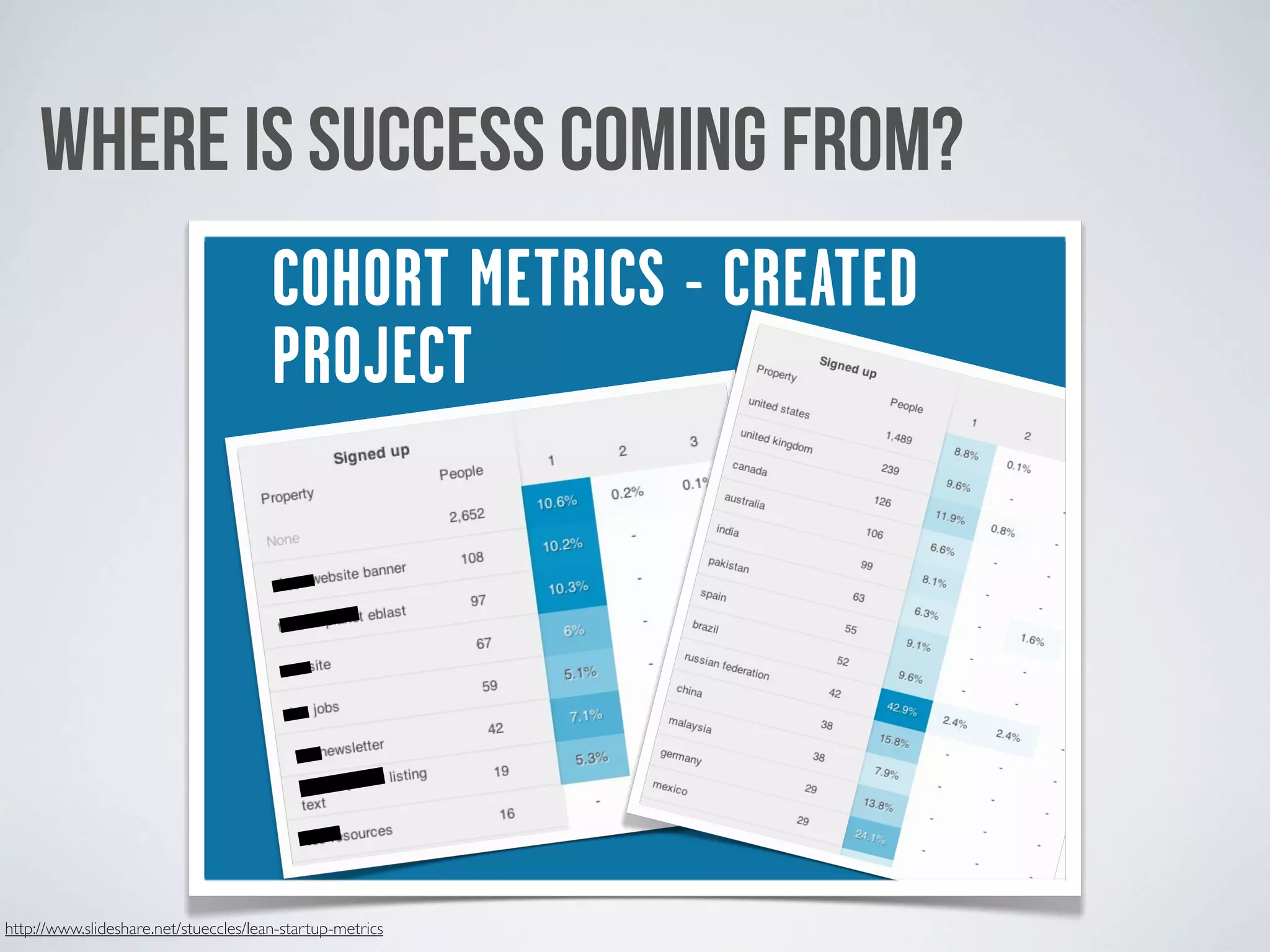
WHERE IS SUCCESS COMING FROM?
                                       COHORT METRICS - CREATED
                                       PROJECT


http://www.slideshare.net/stueccles/lean-startup-metrics
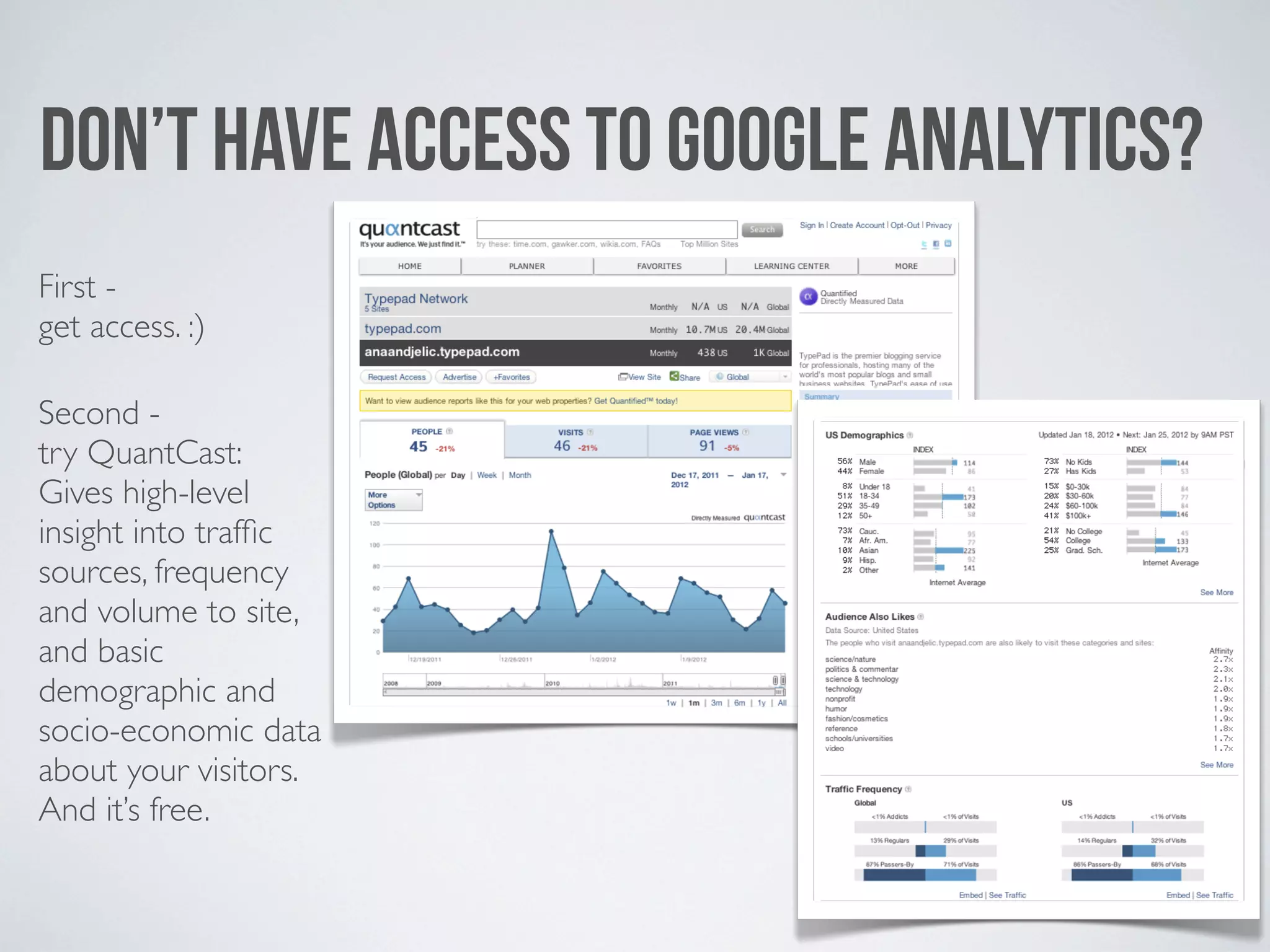
DON’T HAVE ACCESS TO GOOGLE ANALYTICS?
First -
get access. :)

Second -
try QuantCast:
Gives high-level
insight into traffic
sources, frequency
and volume to site,
and basic
demographic and
socio-economic data
about your visitors.
And it’s free.
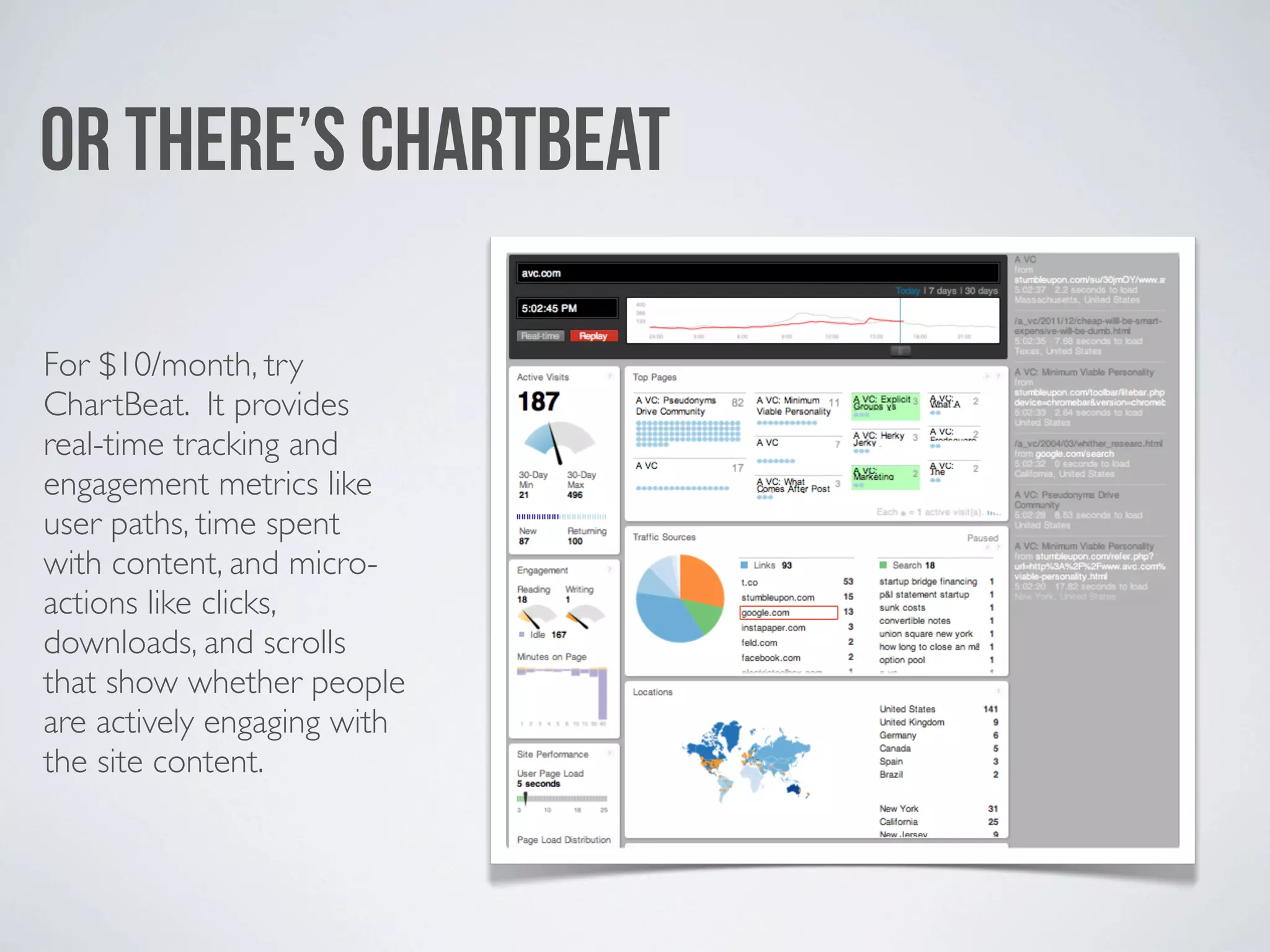
OR THERE’S CHARTBEAT

For $10/month, try
ChartBeat. It provides
real-time tracking and
engagement metrics like
user paths, time spent
with content, and micro-
actions like clicks,
downloads, and scrolls
that show whether people
are actively engaging with
the site content.
HACK THE METRICS

Use unique links - through services like Bit.ly - to
track the behavior that a social mention or display
ad or site/page leads to.

Stop paying for CPMs - pay for conversions (but
define clearly what a ‘conversion’ is, and design ad
units & digital experiences for conversion
moments).
REMEMBER RULE 3 -
    DON’T MEASURE EVERYTHING -
[WE’RE LOOKING FOR WHAT MAKES MEANINGFUL DIFFERENCES]
TITLE

Main Idea


•Bullet


•Bullet
TITLE

Main Idea


•Bullet


•Bullet
TITLE

Main Idea


•Bullet


•Bullet


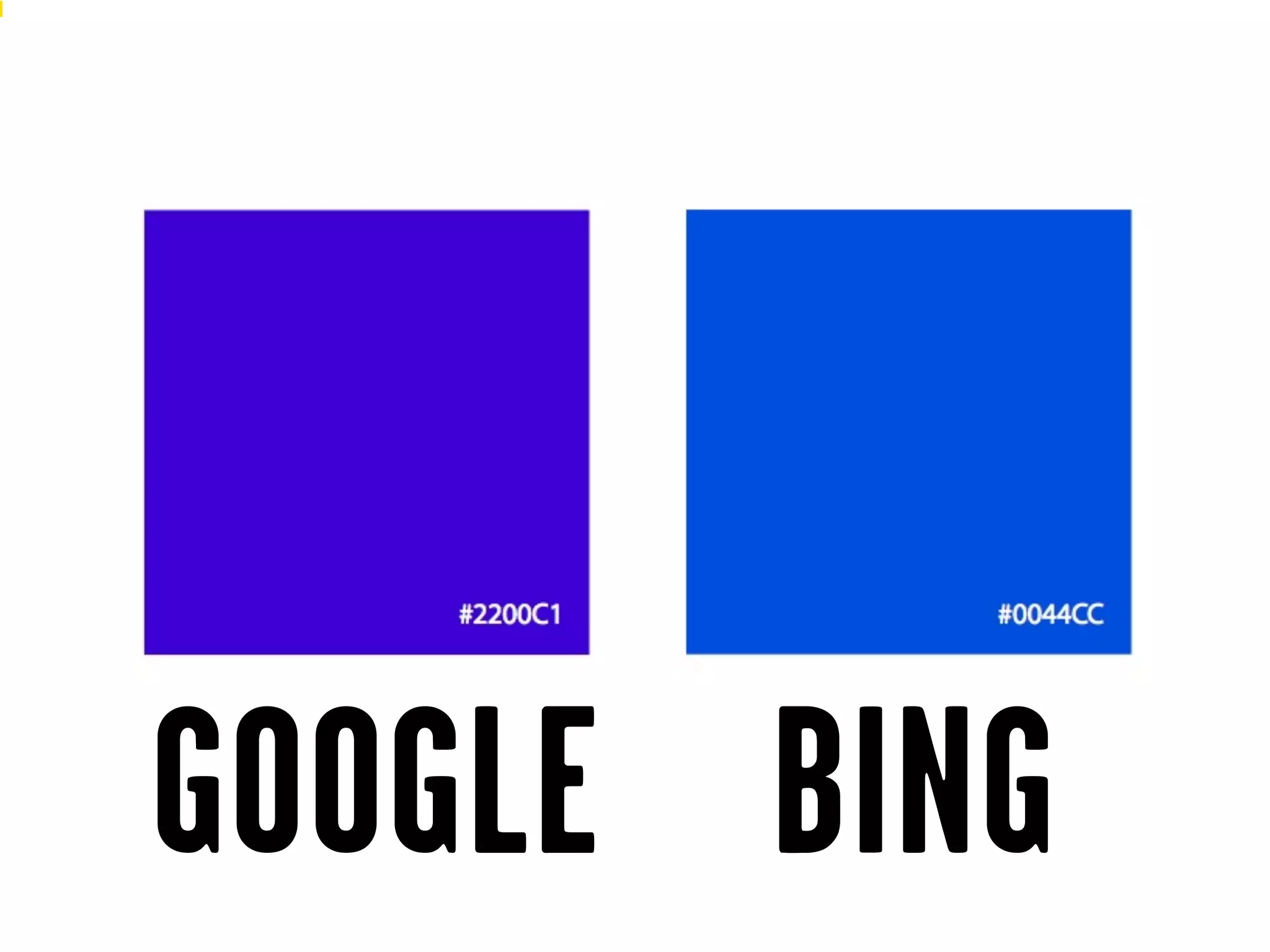
     GOOGLE BING
4. HOW DO YOU ‘SELL IT’
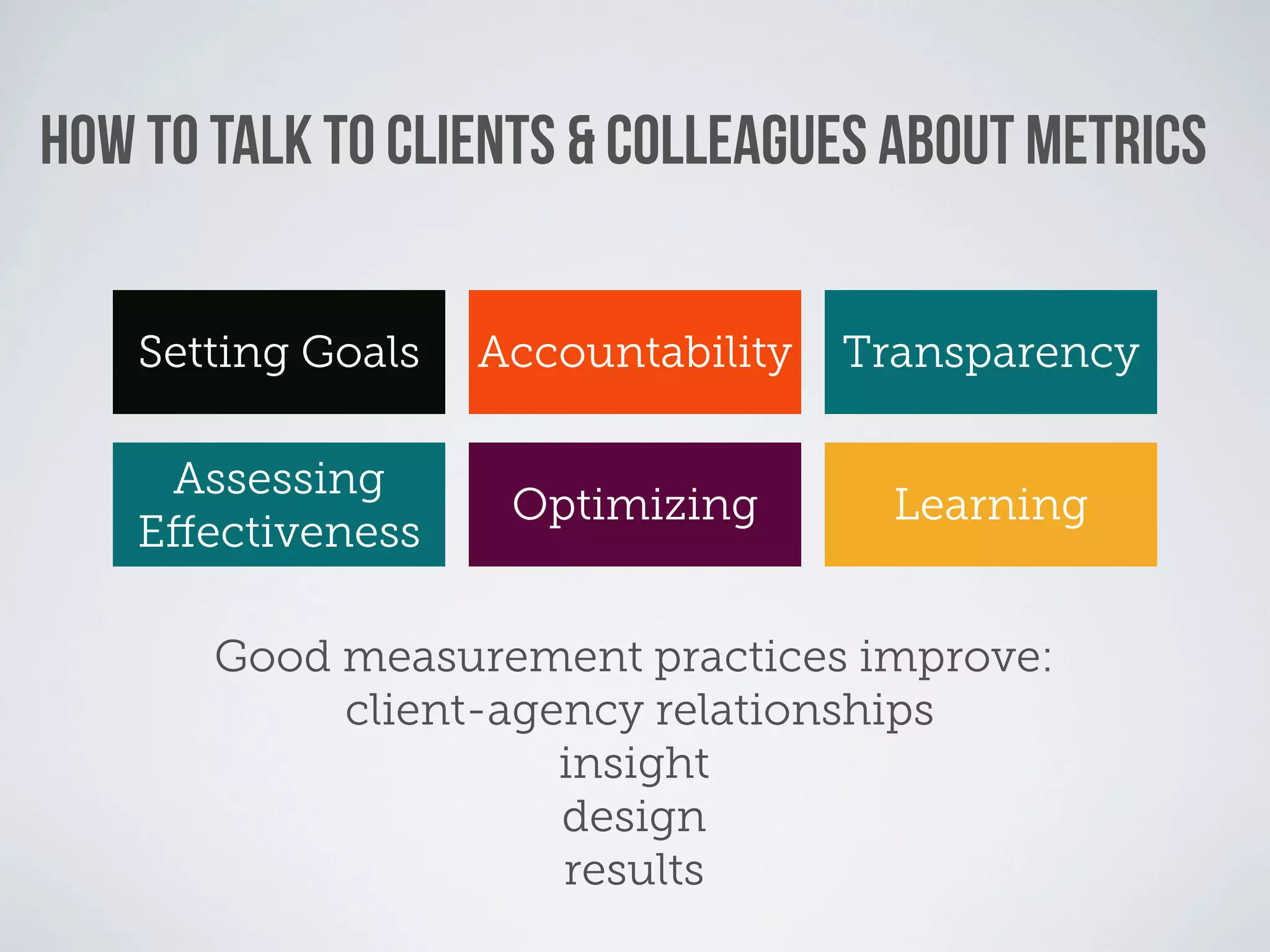
HOW TO TALK TO CLIENTS & COLLEAGUES ABOUT METRICS

    Setting Goals   Accountability   Transparency

      Assessing
                     Optimizing        Learning
    Effectiveness

       Good measurement practices improve:
            client-agency relationships
                      insight
                      design
                      results
SETTING REASONABLE KPI’S

What are the business objectives?

What are the campaign objectives?

What are the channels/touchpoints?

What is the campaign experience & message?

What do we expect people to do?
SUMMING UP
Measure what will teach you the most and help you make the
most important decisions.

Use bespoke, not off-the-shelf, metrics and measurement
tools.

Focus on ‘metrics’ that connect to value creation for the
business and drive brand growth.

Don’t measure everything.
THAT WAS FUN.

Measurement & ROI

  • 1.
    MEASURE WHAT MATTERS understandingmeasurement & roi for digital experiences
  • 2.
  • 3.
    4 THINGS: WHY WHAT HOW (AND HOW TO SELL IT)
  • 4.
    1. WHY YOUSHOULD MEASURE
  • 5.
    BINGO TIME SIGN- KPI UPS ON CPM IMPRESSIONS SITE CPA CPC REACH & FREQUENCY LIKES ENGAGEMENT PAGE LTV SENTIMENT ANALYSIS ROI VIEWS FOLLOWS MENTIONS CTR DOWNLOADS BRAND MEDIA MIX ATTRIBUTES MODELING SHARE SALIENCE LIKEABILITY RECALL OF ?? WALLET
  • 6.
    A WORD OFCAUTION I notice increasing reluctance on the part of marketing executives to use judgment; they are coming to rely too much on research, and they use it as a drunkard uses a lamp post: for support, rather than for illumination. David Ogilvy
  • 7.
    WHY DO METRICSMATTER? 1. Metrics reduce arguments based on opinion. 2. Metrics give you answers about what really works. 3. Metrics show you where you’re strong. 4. Metrics allow you to test anything you want. 5. Clients love metrics. http://bokardo.com/talks/metrics-driven-design-sxsw.pdf
  • 8.
    WHAT ELSE CANMEASUREMENT HELP YOU DO? UNDERSTAND CONTEXT OF BRAND & PRODUCT DETECT DEMAND EXPLORE CONSUMER SENTIMENT MENTIONS Now we can easily assess pre- Spontaneous product comments Digital makes it is easier to existing demand among our target: and mentions reveal sentiment detect problems or possible how easy is user acquisition going around them, and help us areas for improvement related to be? overcome existing boundaries for products/service use. product adoption. DEFINE CONSUMERS’ OBSERVE SOCIAL GESTURES & CONTENT UNCOVER CONSUMER MOTIVATION MULTIPLE IDENTITIES INTERACTION Digital traces reveal important Understanding different Our targets’ gift-giving of content drivers of human behavior that identities our audience assumes gives us insights into where we we can use in shaping brand’s lets us help them in their role- can insert brand into their social online actions. playing and is also useful in exchanges. targeting. via @andjelicaaa
  • 9.
    THERE ARE ONLY3 RULES OF MEASUREMENT Your metrics will be as UNIQUE as your business. If metrics aren’t ACTIONABLE, they aren’t worth using. DON’T TRY TO MEASURE EVERYTHING.
  • 10.
    MEASURE WHAT MATTERS...TO WHOM? To your To your BUSINESS PROSPECT
  • 11.
    IT’S EASY TOFOCUS ON VANITY METRICS “Numbers that make us look good but don’t really help make decisions.” Eric Ries, The Lean Start-up
  • 12.
    WHAT’S A VANITYMETRIC? A lot of the time, we measure for a show reel, instead of for business results. http://bokardo.com/talks/metrics-driven-design-sxsw.pdf
  • 13.
    WHAT MATTERS ISVALUE CREATION To your To your BUSINESS PROSPECT CONVERSION ENGAGEMENT
  • 14.
    2. WHAT YOUSHOULD MEASURE
  • 15.
    USE ‘PIRATE’ METRICS Acquisition:users from channels come to site, landing page, widget, etc Activation: users enjoy 1st visit, "happy" user experience * Retention: users re-visit multiple times Referral: users like experience enough * to refer others via email, links, likes, blogs, widgets, word-of-mouth, etc Revenue: users buy, download, sign-up http://www.slideshare.net/dmc500hats/startup-metrics-for-pirates-long-version
  • 16.
    WHAT ARE SOME‘VALUE’ METRICS? To your To your BUSINESS PROSPECT CONVERSION ENGAGEMENT
  • 17.
    Acquisition - drawingpeople into the brand experience To your BUSINESS Revenue - converting visitors into customers Referral - converting customers into advocates CONVERSION
  • 18.
    BEWARE THE CTR... Thestarting metric for Acquisition isn’t CTR or “Site Visits”... It’s CPA: Cost Per Acquisition (e.g., how much did you spend to get a new user) But this by itself is irrelevant If the CPA is higher than the lifetime value (LTV) of a new user, you’re in trouble
  • 19.
    Activation - peopleenjoyed the experience... To your Retention - enough to come PROSPECT back more than once... Referral - and recommended the experience to others ENGAGEMENT
  • 20.
    HOW DO YOUMEASURE RETENTION & REFERRAL? Returning Visitors Registered Users Likes, +1s, RTs Frequency Mentions Time on Site Email referrals Daily Active Users
  • 21.
    VALUE CREATION = CREATINGCUSTOMERS To your To your BUSINESS PROSPECT CONVERSION ENGAGEMENT
  • 22.
    SO WHAT’S MOREIMPORTANT? Brand growth comes from Acquisition. Contrary to popular belief, acquisition is actually cheaper, and more beneficial to the brand, than retention. Marketing should be geared toward Acquisition. Product & service design should be geared toward Activation & Retention.
  • 23.
    BUT WHAT ABOUTTHE OTHER STUFF? Brand attributes? Loyalty? Share of wallet? Media mix modeling?
  • 25.
    THERE ARE MARKETINGLAWS Double Jeopardy Law: the lower market share brands in a market have far fewer buyers in a time period and also lower brand loyalty. Retention Double Jeopardy: All brands lose some buyers; this loss is proportionate with market share. Pareto Law is 60/20 (not 80/20): Slightly more than half of a brand’s sales come from the top 20% of customers. Law of Buyer Moderation: Heavy buyers sometimes buy less often, light buyers sometimes buy more often, non-buyers sometimes become buyers. Law of Prototypicality: Image attributes that describe the product category score higher than less prototypical attributes Duplication of Purchase Law: A brand’s customer base overlaps with the customer base of other brands, in line with their market share.
  • 26.
    AND SOME INCONVENIENTTRUTHS User bases seldom vary: Rival brands sell to very similar customer bases. Attitudes and brand beliefs reflect behavioral loyalty: Consumers know and say more about brands they use often, and they think and say little about brands they do not use. Usage drives attitude: Consumers like what they buy.
  • 27.
    3. TOOLS YOUCAN USE FOR DIGITAL EXPERIENCE MEASUREMENT
  • 28.
    APPS & SITESHELP ANSWER QUESTIONS... I NEVER FELT LIKE I WAS LEARNING ANYTHING IMPORTANT
  • 29.
    WHICH ONE ISMORE SUCCESSFUL? @37SIGNALS http://www.slideshare.net/stueccles/lean-startup-metrics
  • 30.
    WHEN DOES SUCCESSHAPPEN? EXTENDED SIGN-UP FUNNEL http://www.slideshare.net/stueccles/lean-startup-metrics
  • 31.
    WHERE IS SUCCESSCOMING FROM? COHORT METRICS - CREATED PROJECT http://www.slideshare.net/stueccles/lean-startup-metrics
  • 32.
    DON’T HAVE ACCESSTO GOOGLE ANALYTICS? First - get access. :) Second - try QuantCast: Gives high-level insight into traffic sources, frequency and volume to site, and basic demographic and socio-economic data about your visitors. And it’s free.
  • 33.
    OR THERE’S CHARTBEAT For$10/month, try ChartBeat. It provides real-time tracking and engagement metrics like user paths, time spent with content, and micro- actions like clicks, downloads, and scrolls that show whether people are actively engaging with the site content.
  • 34.
    HACK THE METRICS Useunique links - through services like Bit.ly - to track the behavior that a social mention or display ad or site/page leads to. Stop paying for CPMs - pay for conversions (but define clearly what a ‘conversion’ is, and design ad units & digital experiences for conversion moments).
  • 35.
    REMEMBER RULE 3- DON’T MEASURE EVERYTHING - [WE’RE LOOKING FOR WHAT MAKES MEANINGFUL DIFFERENCES]
  • 36.
  • 37.
  • 38.
  • 39.
    4. HOW DOYOU ‘SELL IT’
  • 40.
    HOW TO TALKTO CLIENTS & COLLEAGUES ABOUT METRICS Setting Goals Accountability Transparency Assessing Optimizing Learning Effectiveness Good measurement practices improve: client-agency relationships insight design results
  • 41.
    SETTING REASONABLE KPI’S Whatare the business objectives? What are the campaign objectives? What are the channels/touchpoints? What is the campaign experience & message? What do we expect people to do?
  • 42.
    SUMMING UP Measure whatwill teach you the most and help you make the most important decisions. Use bespoke, not off-the-shelf, metrics and measurement tools. Focus on ‘metrics’ that connect to value creation for the business and drive brand growth. Don’t measure everything.
  • 43.