MEASUREMENT IN RESEARCH
In our daily life we are said to measure when we use some yardstick to
determine weight, height, or some other feature of a physical object.
Measurement is a relatively complex and demanding task, especially so
when it concerns qualitative or abstract phenomena. By measurement we
mean the process of assigning numbers to objects or observations.
Four kinds of scale of measurement
1. Nominal Scale
2. Ordinal Scale
3. Interval Scale
4. Ratio Scale
1. Nominal Scale
It is simply a system of assigning of number symbols to events in order
to label them.
Sometimes variables measured on nominal scales are called categorical
or qualitative.
Characteristics of Nominal Scale:
• The weakest or least powerful level of measurement
• Mode as the measure of central tendency can only be used
• Chi-square test of statistical significance can be utilized
Examples:
• Group membership (1 = Experimental, 2=Placebo )
• A person’s gender (0 = Female, 1 = Male)
• Blood type, marital status, religion
2. Ordinal Scale
In this case, the characteristics can be put into categories and the
categories also can be ordered in some meaningful way.
Median can be used as the measure of central tendency.
Examples:
Socioeconomic Status
1 = Low 2 = Middle 3 = High
Health Status 1 = Poor 2 = Fair 3 = Good 4 = Excellent
3. Interval Scale
Numbers are assigned to objects or events which can be categorized, ordered
and assumed to have an equal distance between scale values.
It has an arbitrary zero, but it lacks true zero or absolute zero.
Characteristics
❖ Product moment correlation technique
❖ Mean-appropriate measure of central tendency, std. deviation most
widely used measure of dispersion
❖ ‘t’ test and ‘z’ test for statistical test of significance
4. Ratio Scale
The most precise level of measurement consists of meaningfully ordered
characteristics with equal intervals between them and the presence of a zero
point that is not arbitrary but determined by nature.
Represents the actual amount of variables
Examples:
weight, height, income, distance etc.
Sources of error in measurement
a. Respondent:
● Reluctance
● Fatigue, boredom, anxiety etc.
b. Situation:
c. Measurer:
• Behavior, style or look may encourage.
• Incorrect coding
d. Instrument:
• Complex words, poor printing etc.
Tests of sound measurement
1. Validity
2. Reliability and
3. Practicability
1.Validity
Validity of the measuring instrument is the degree or the extent to which it
measures what it is supposed to measure.
2.Concurrent validity
In this method, a test is correlated with a criterion which is available at
present time.
3.Predictive validity
It is the degree to which a measure predicts a second future measure.
4.Construct validity
It is the extent to which the test may be said to measure a theoretical
construct or trait.
Reliability
Measurement is said to be reliable when it give consistent results.
Methods of estimating reliability coefficient
❖ Test-retest method:
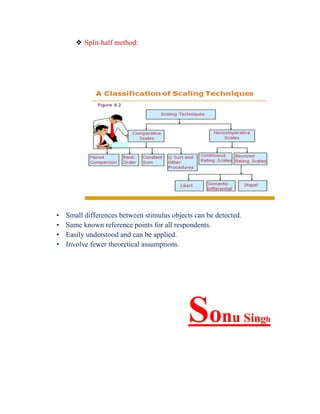
❖ Split-half method:
• Small differences between stimulus objects can be detected.
• Same known reference points for all respondents.
• Easily understood and can be applied.
• Involve fewer theoretical assumptions.
Sonu Singh

Measurement in research

  • 1.
    MEASUREMENT IN RESEARCH Inour daily life we are said to measure when we use some yardstick to determine weight, height, or some other feature of a physical object. Measurement is a relatively complex and demanding task, especially so when it concerns qualitative or abstract phenomena. By measurement we mean the process of assigning numbers to objects or observations. Four kinds of scale of measurement 1. Nominal Scale 2. Ordinal Scale 3. Interval Scale 4. Ratio Scale 1. Nominal Scale It is simply a system of assigning of number symbols to events in order to label them. Sometimes variables measured on nominal scales are called categorical or qualitative. Characteristics of Nominal Scale: • The weakest or least powerful level of measurement • Mode as the measure of central tendency can only be used • Chi-square test of statistical significance can be utilized Examples: • Group membership (1 = Experimental, 2=Placebo ) • A person’s gender (0 = Female, 1 = Male) • Blood type, marital status, religion 2. Ordinal Scale In this case, the characteristics can be put into categories and the categories also can be ordered in some meaningful way. Median can be used as the measure of central tendency.
  • 2.
    Examples: Socioeconomic Status 1 =Low 2 = Middle 3 = High Health Status 1 = Poor 2 = Fair 3 = Good 4 = Excellent 3. Interval Scale Numbers are assigned to objects or events which can be categorized, ordered and assumed to have an equal distance between scale values. It has an arbitrary zero, but it lacks true zero or absolute zero. Characteristics ❖ Product moment correlation technique ❖ Mean-appropriate measure of central tendency, std. deviation most widely used measure of dispersion ❖ ‘t’ test and ‘z’ test for statistical test of significance 4. Ratio Scale The most precise level of measurement consists of meaningfully ordered characteristics with equal intervals between them and the presence of a zero point that is not arbitrary but determined by nature. Represents the actual amount of variables Examples: weight, height, income, distance etc. Sources of error in measurement a. Respondent: ● Reluctance
  • 3.
    ● Fatigue, boredom,anxiety etc. b. Situation: c. Measurer: • Behavior, style or look may encourage. • Incorrect coding d. Instrument: • Complex words, poor printing etc. Tests of sound measurement 1. Validity 2. Reliability and 3. Practicability 1.Validity Validity of the measuring instrument is the degree or the extent to which it measures what it is supposed to measure. 2.Concurrent validity In this method, a test is correlated with a criterion which is available at present time. 3.Predictive validity It is the degree to which a measure predicts a second future measure. 4.Construct validity It is the extent to which the test may be said to measure a theoretical construct or trait. Reliability Measurement is said to be reliable when it give consistent results. Methods of estimating reliability coefficient ❖ Test-retest method:
  • 4.
    ❖ Split-half method: •Small differences between stimulus objects can be detected. • Same known reference points for all respondents. • Easily understood and can be applied. • Involve fewer theoretical assumptions. Sonu Singh