MEANINGFUL LEARNING IN U-
LEARNING ENVIRONMENTS:
An Experience in Vocational Education
J_. BRITO, L. SEIXAS, I. M. FILHO, A. GOMES, B. MONTEIRO
CENTRO DE INFORMÁTICA, UFPE
AGENDA
• I. Ubiquitous learning
• I.A. Meaningful ubiquitous learning
• II. Method
• II.A. Effectiveness evaluation
• III. Results
• IV. Future works
• IV.A. Heritage education
I. UBIQUITOUS LEARNING
Definition and infrastructure
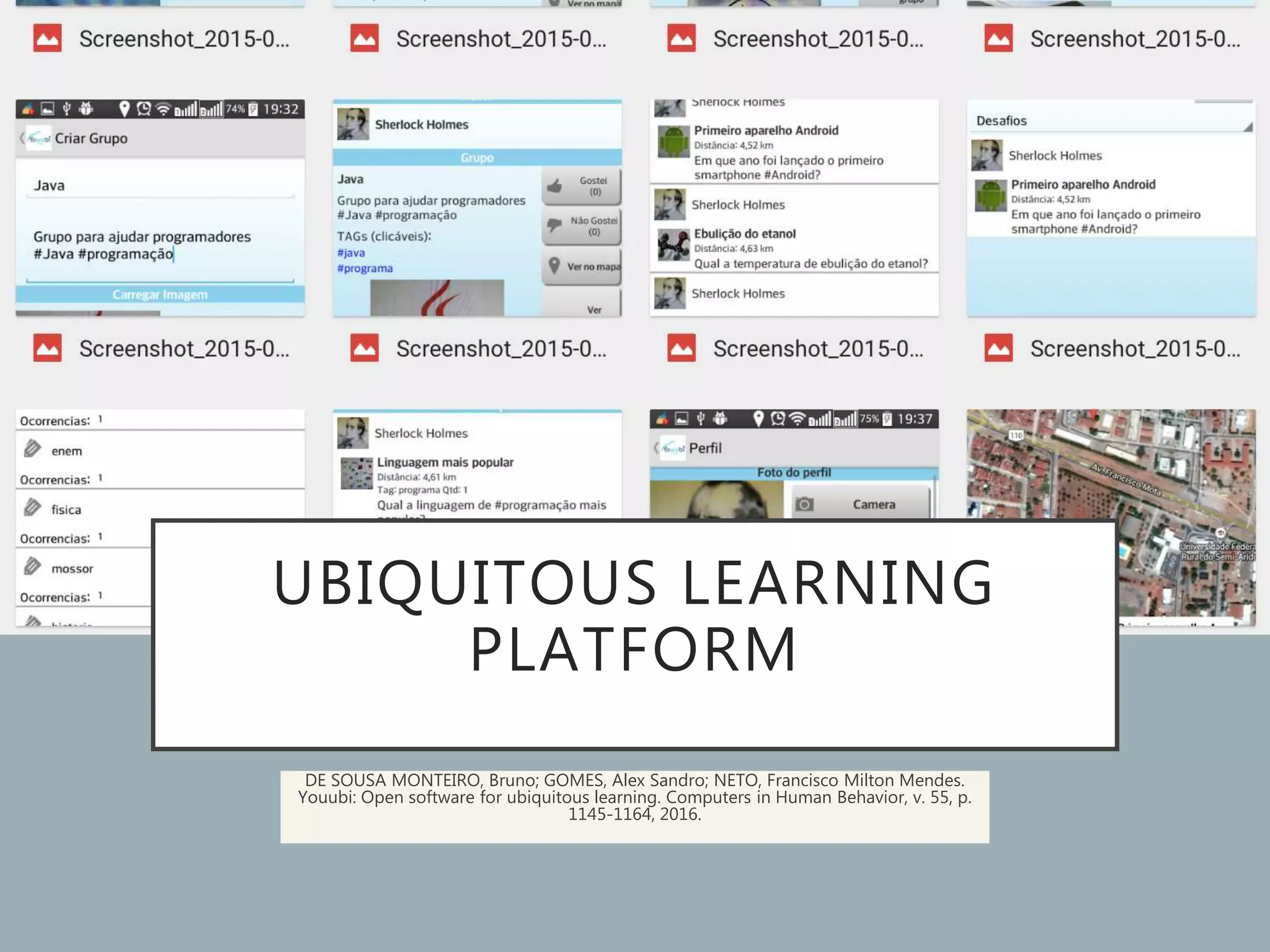
UBIQUITOUS LEARNING
PLATFORM
DE SOUSA MONTEIRO, Bruno; GOMES, Alex Sandro; NETO, Francisco Milton Mendes.
Youubi: Open software for ubiquitous learning. Computers in Human Behavior, v. 55, p.
1145-1164, 2016.
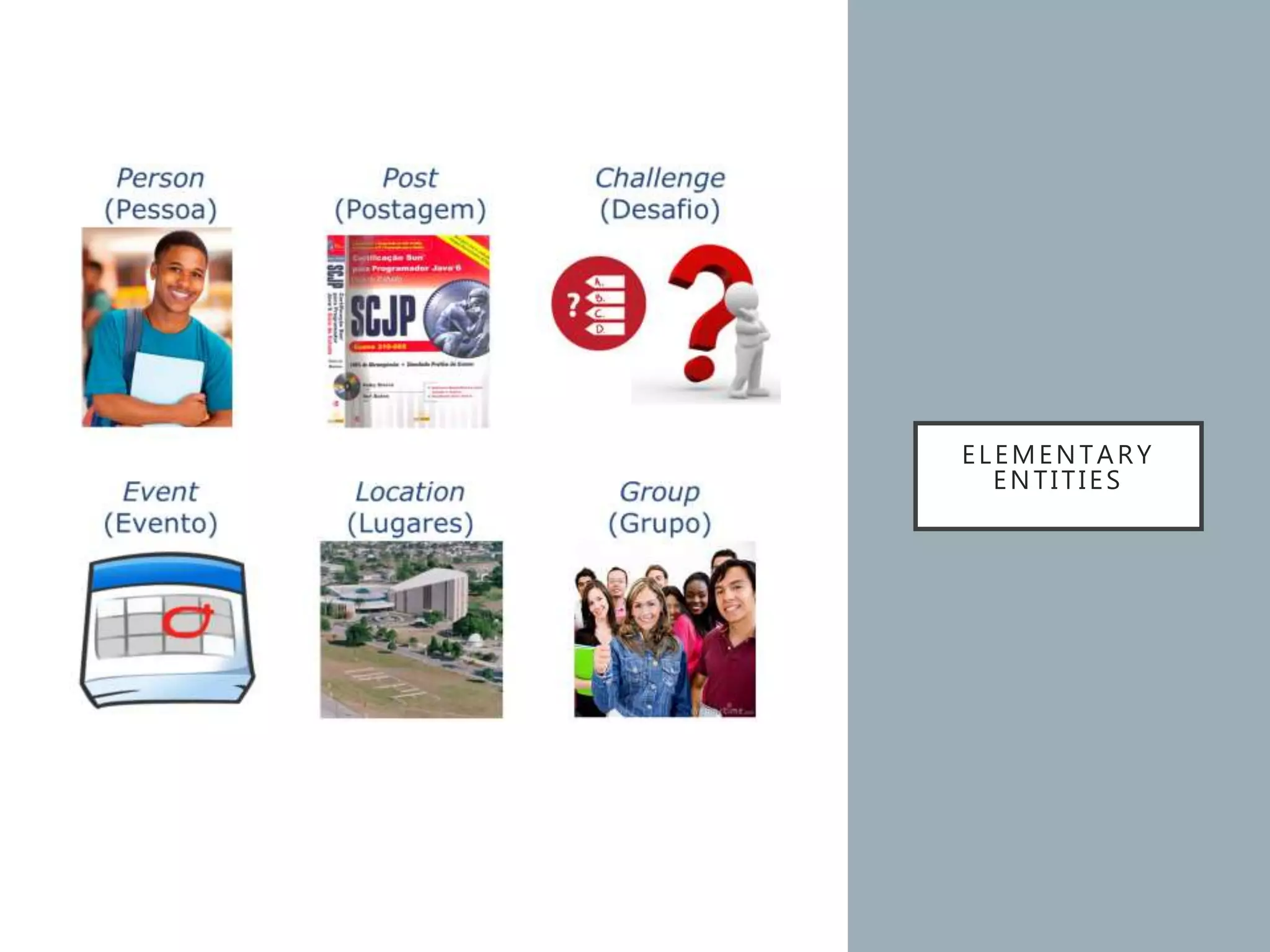
ELEMENTARY
ENTITIES
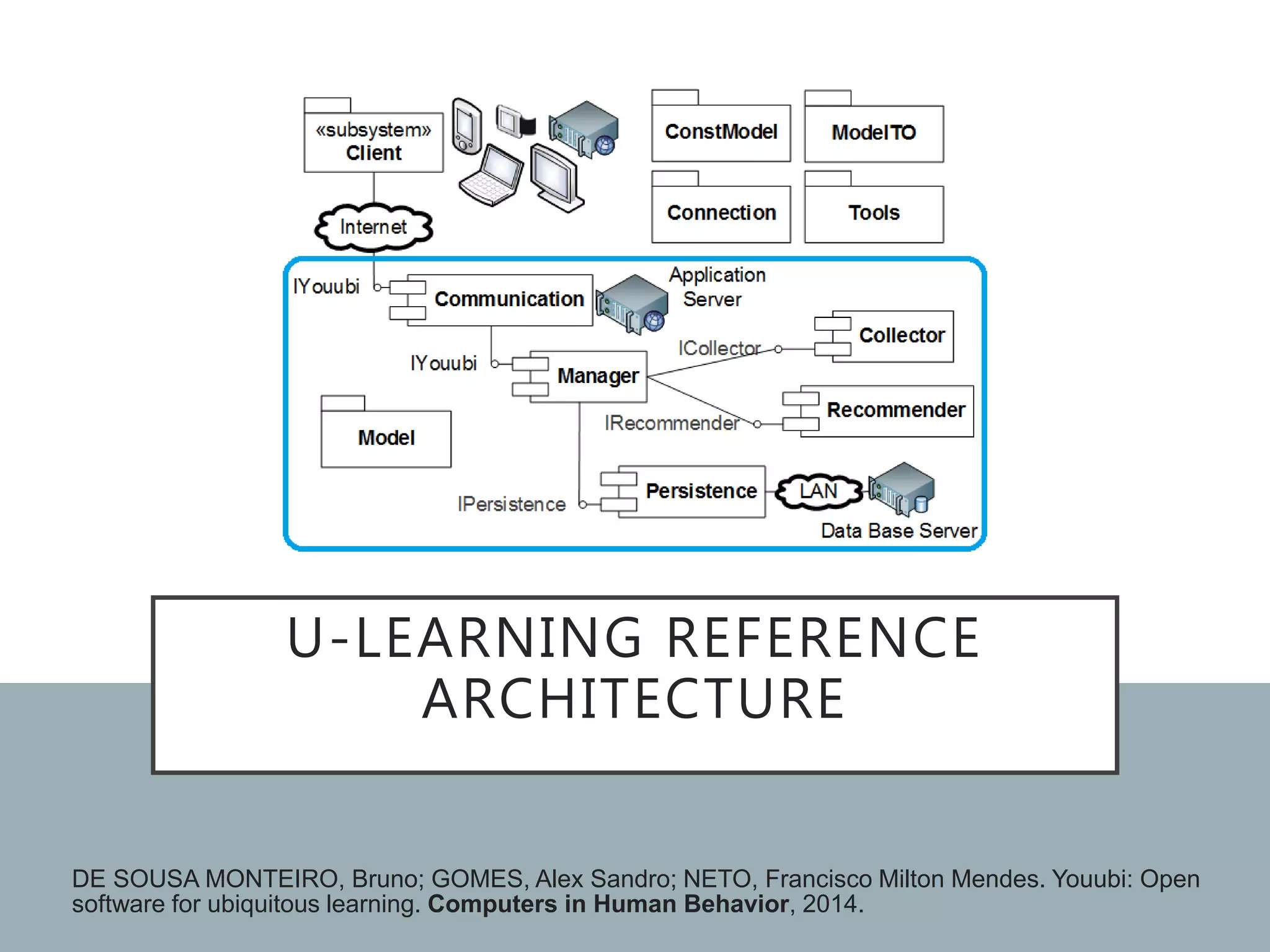
U-LEARNING REFERENCE
ARCHITECTURE
DE SOUSA MONTEIRO, Bruno; GOMES, Alex Sandro; NETO, Francisco Milton Mendes. Youubi: Open
software for ubiquitous learning. Computers in Human Behavior, 2014.
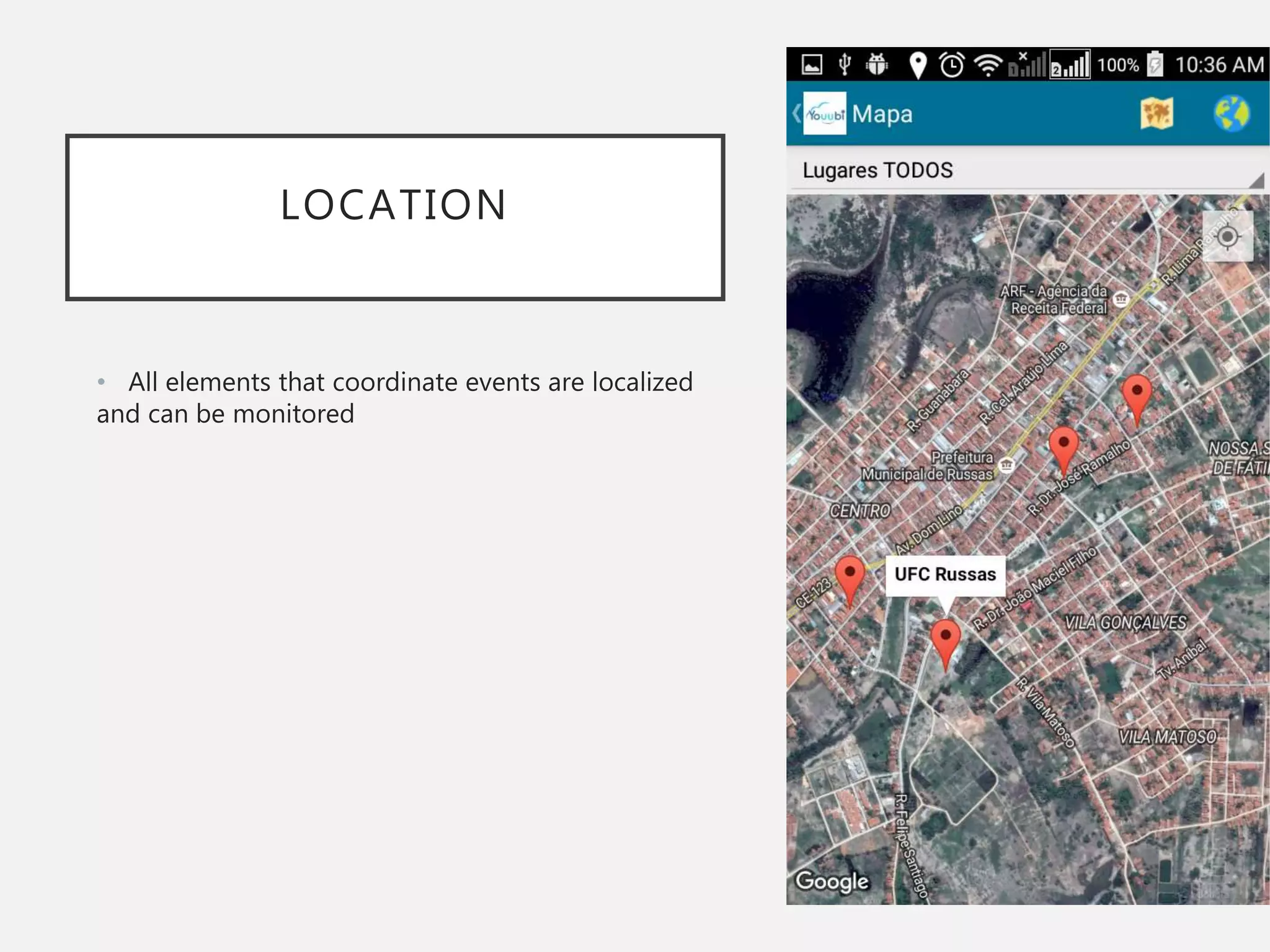
LOCATION
• All elements that coordinate events are localized
and can be monitored
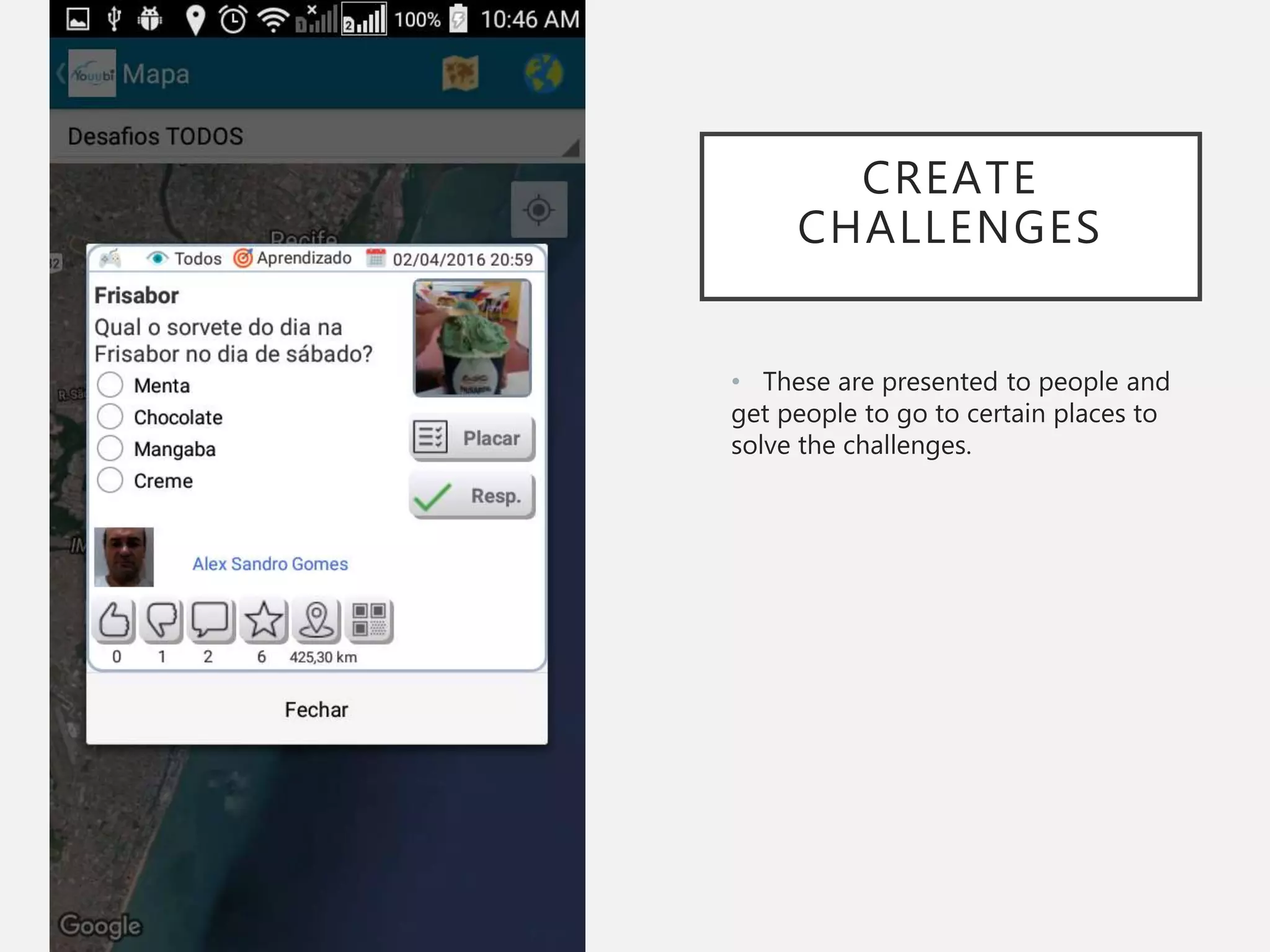
CREATE
CHALLENGES
• These are presented to people and
get people to go to certain places to
solve the challenges.
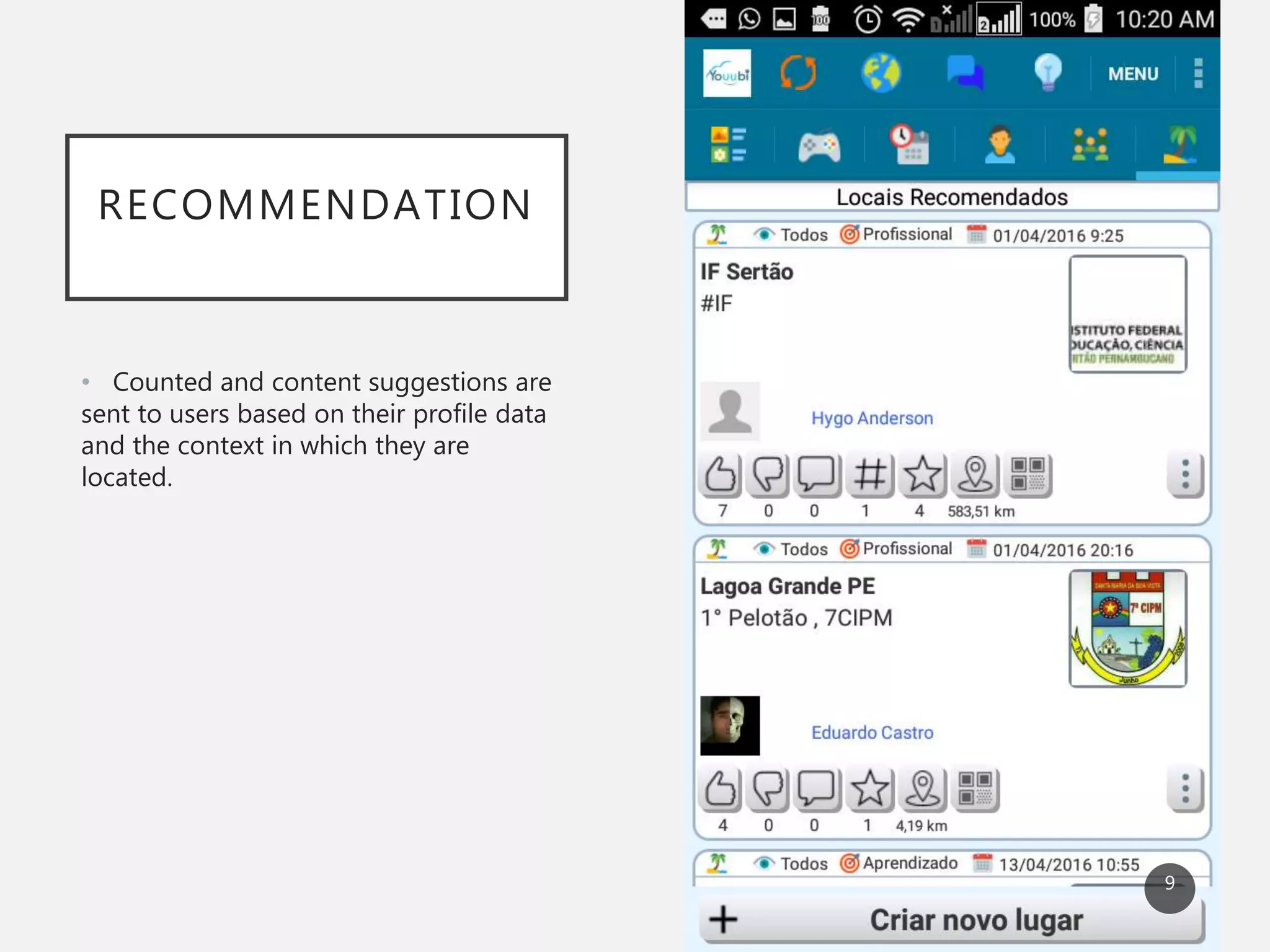
RECOMMENDATION
• Counted and content suggestions are
sent to users based on their profile data
and the context in which they are
located.
9
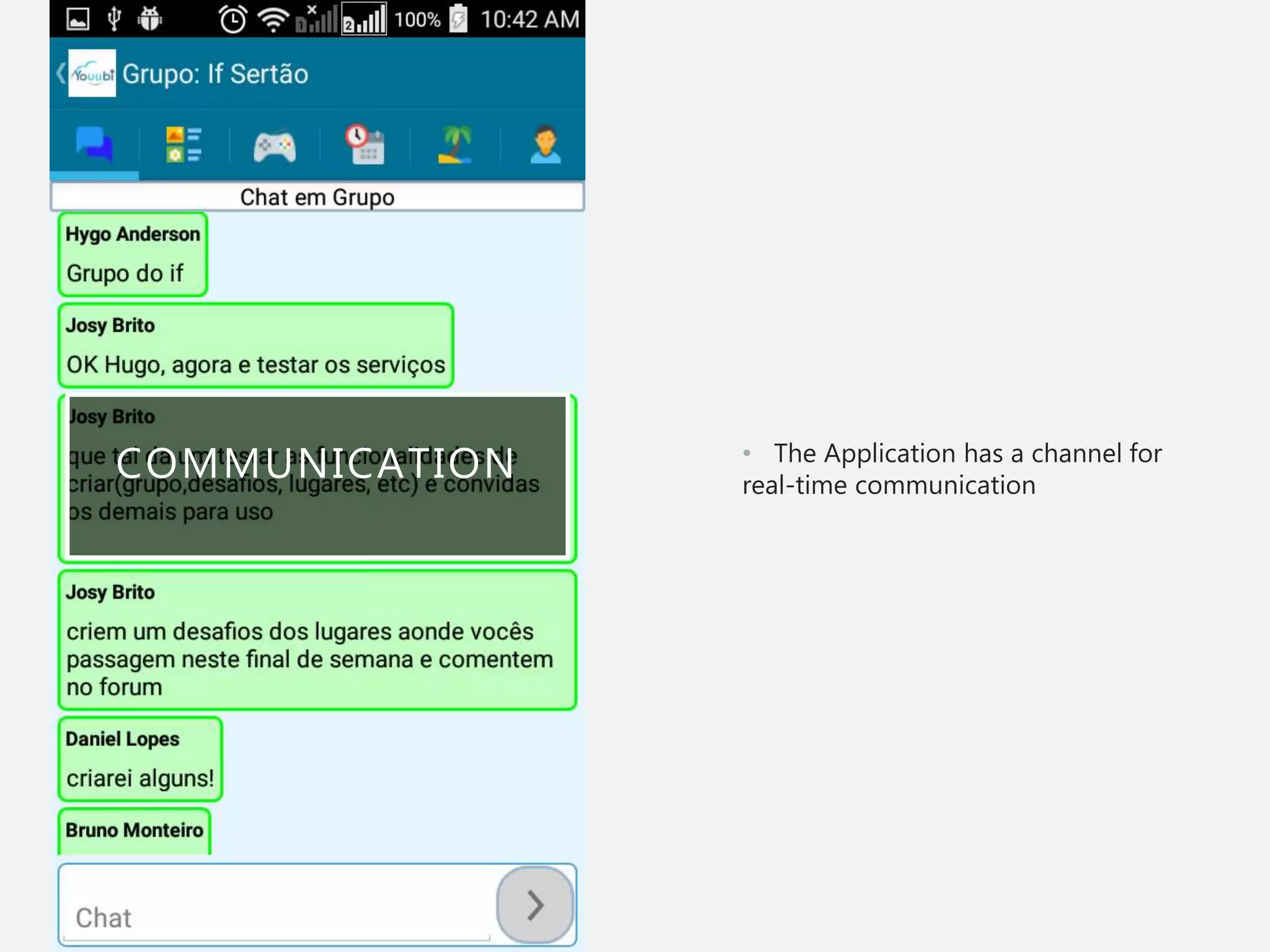
COMMUNICATION • The Application has a channel for
real-time communication
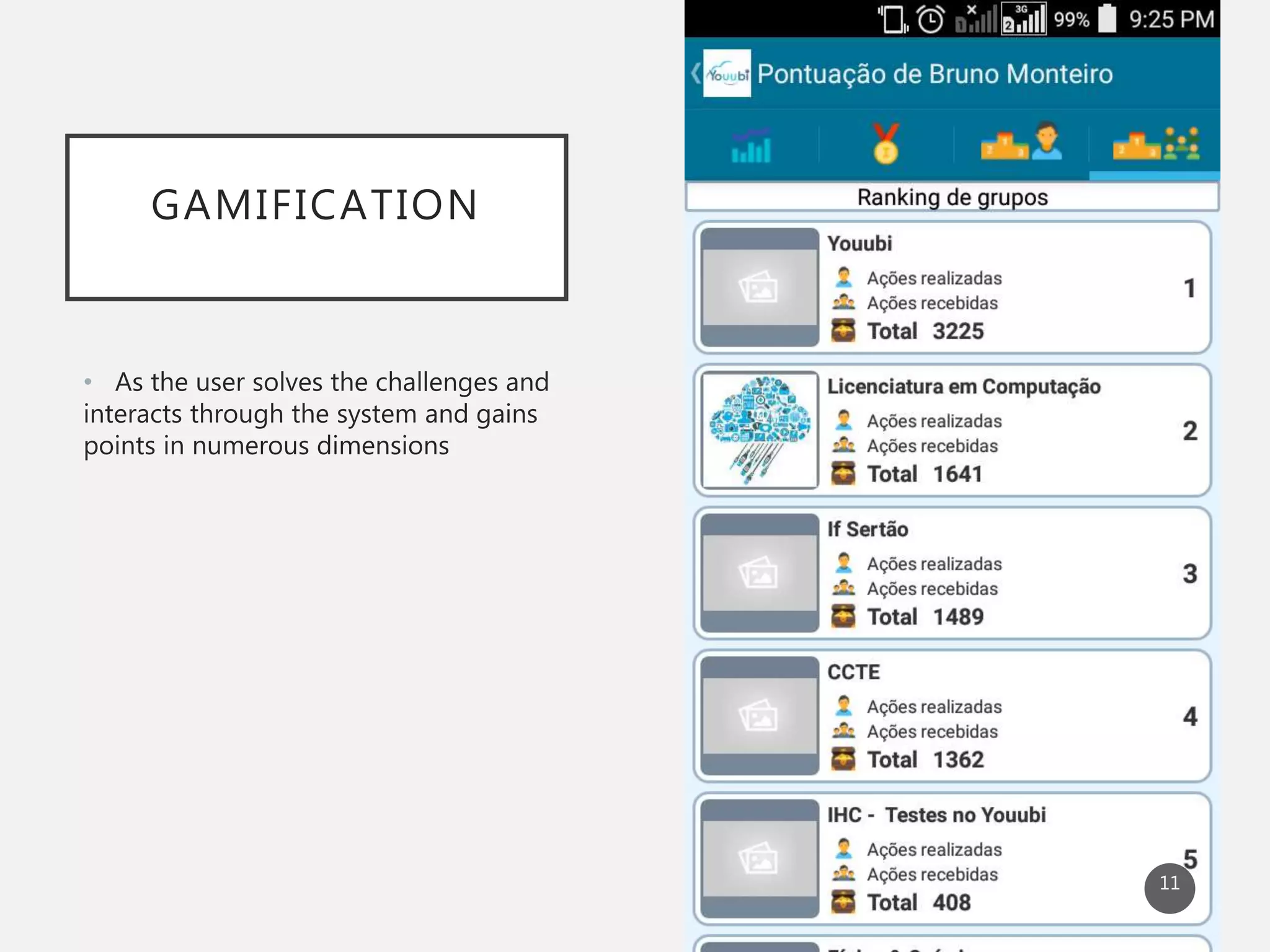
GAMIFICATION
• As the user solves the challenges and
interacts through the system and gains
points in numerous dimensions
11
I.A. MEANINGFUL
UBIQUITOUS LEARNING
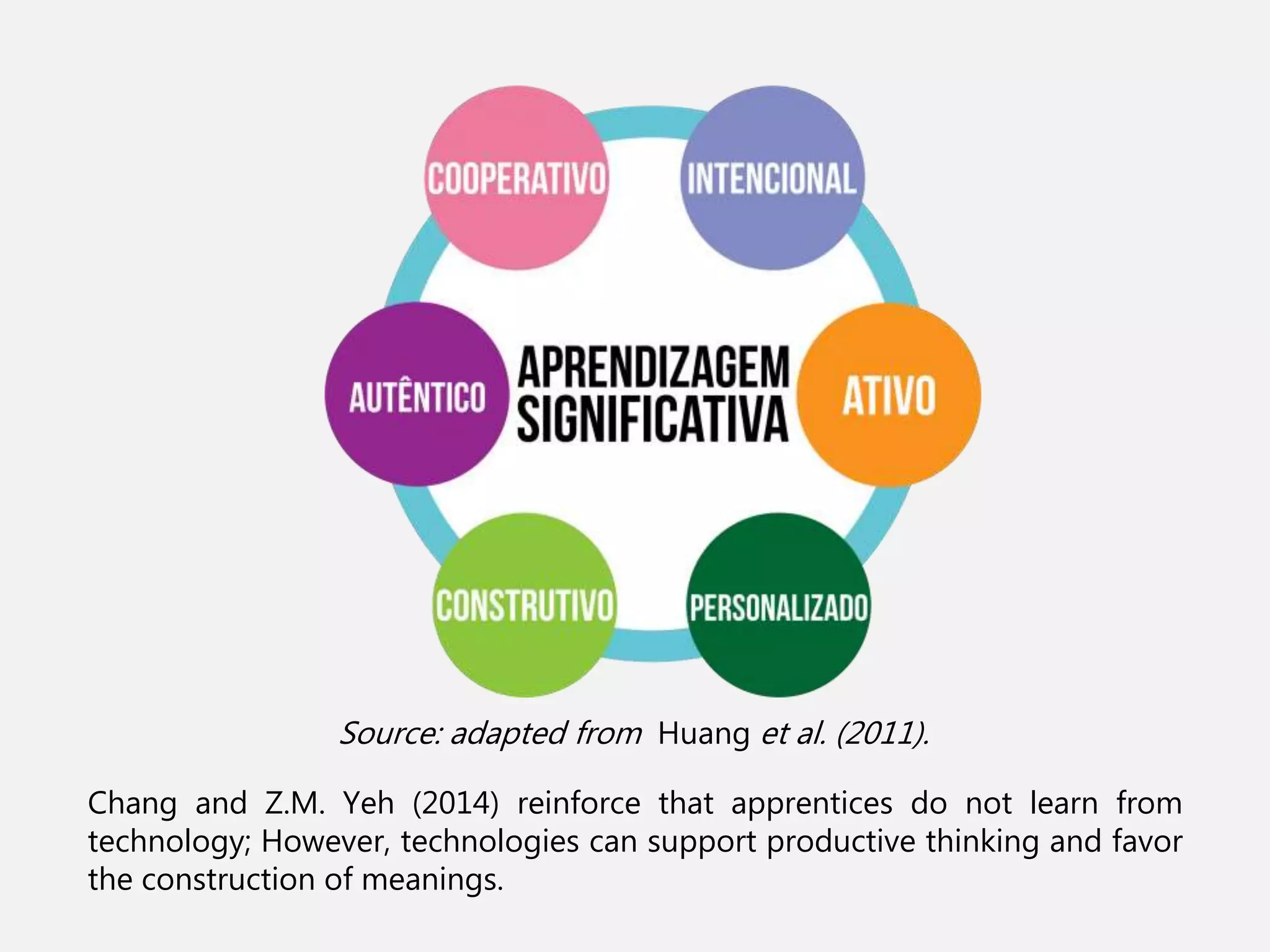
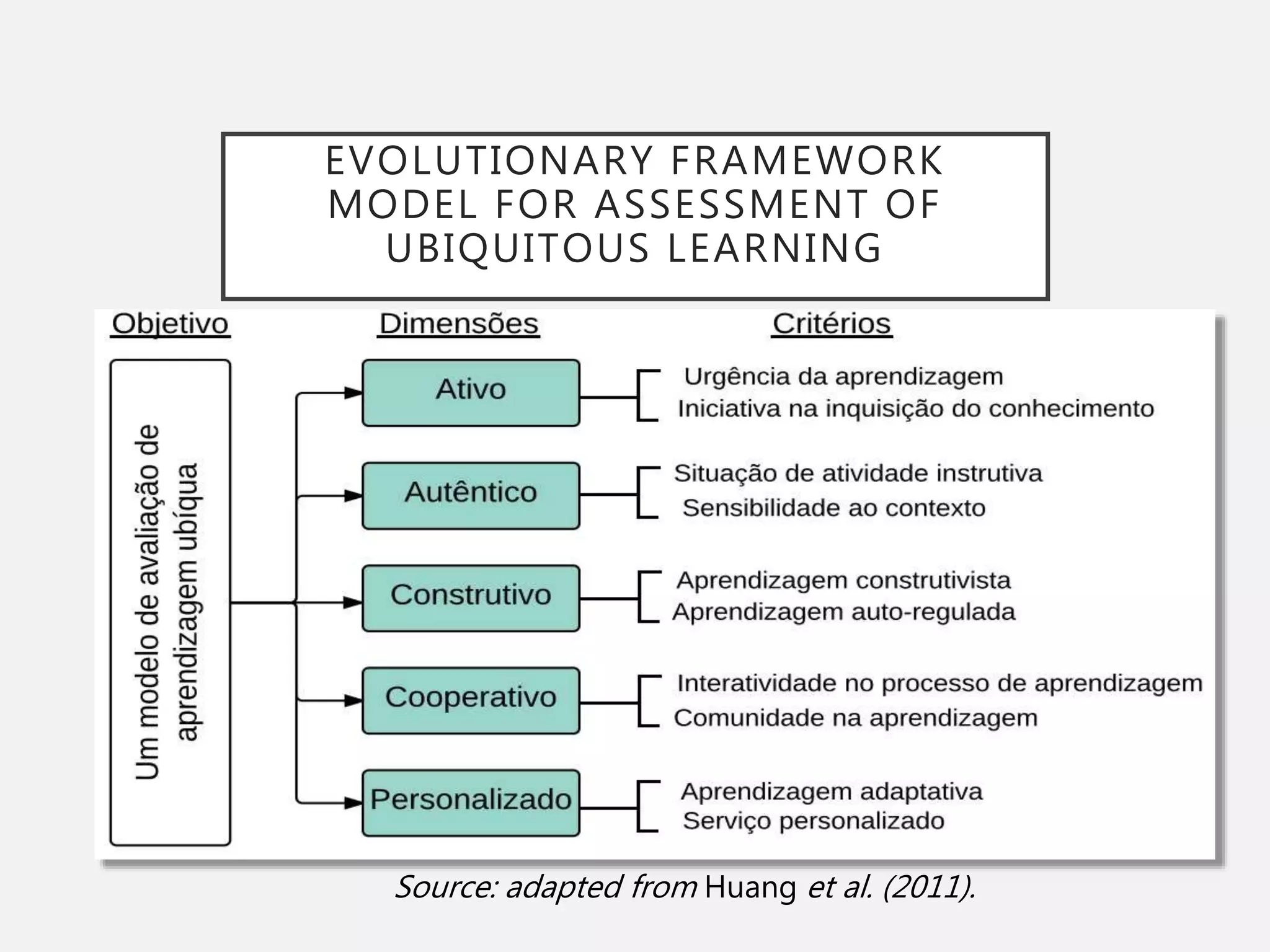
Source: adapted from Huang et al. (2011).
Chang and Z.M. Yeh (2014) reinforce that apprentices do not learn from
technology; However, technologies can support productive thinking and favor
the construction of meanings.
Source: adapted from Huang et al. (2011).
EVOLUTIONARY FRAMEWORK
MODEL FOR ASSESSMENT OF
UBIQUITOUS LEARNING
II. METHOD
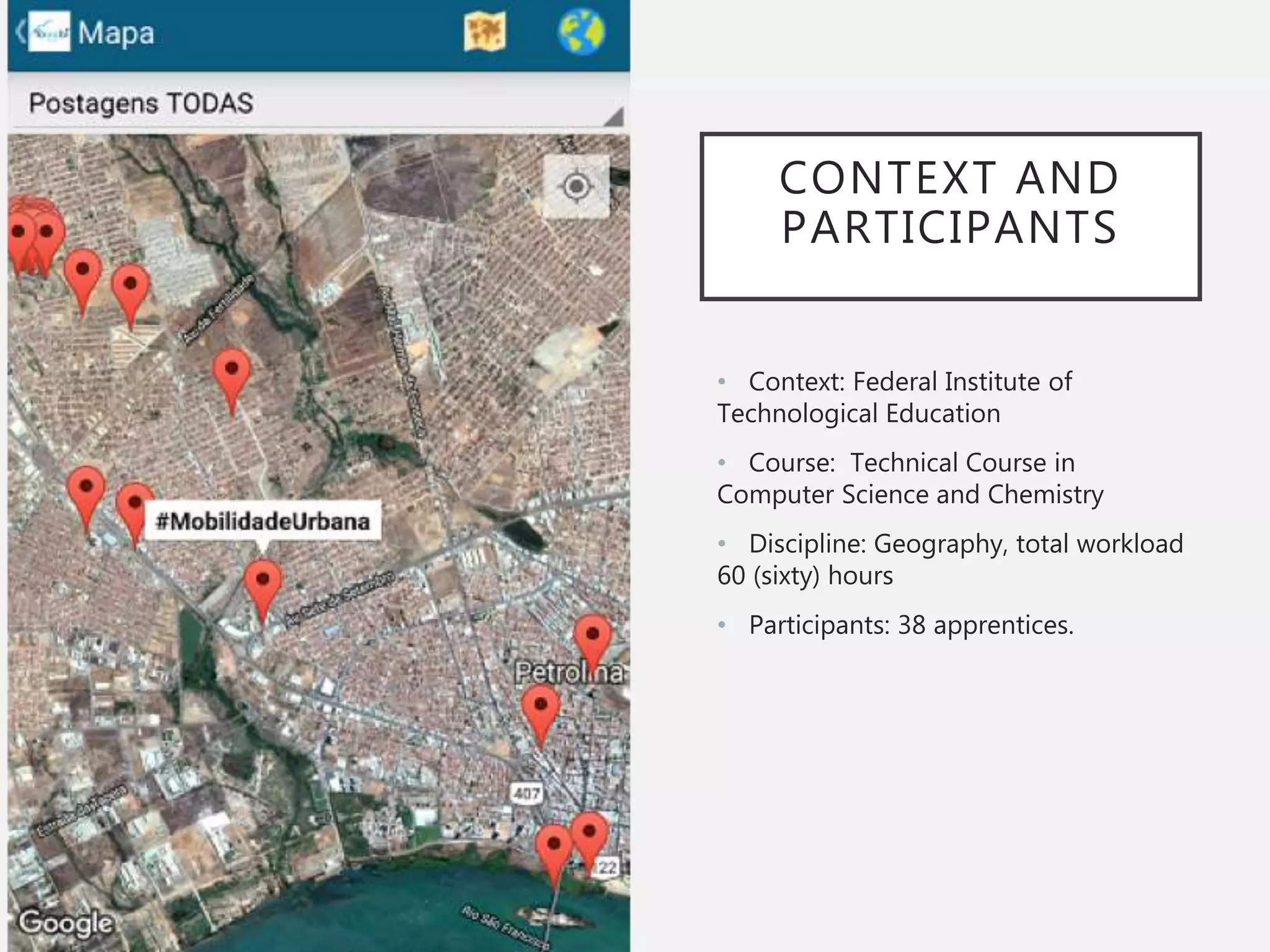
CONTEXT AND
PARTICIPANTS
• Context: Federal Institute of
Technological Education
• Course: Technical Course in
Computer Science and Chemistry
• Discipline: Geography, total workload
60 (sixty) hours
• Participants: 38 apprentices.
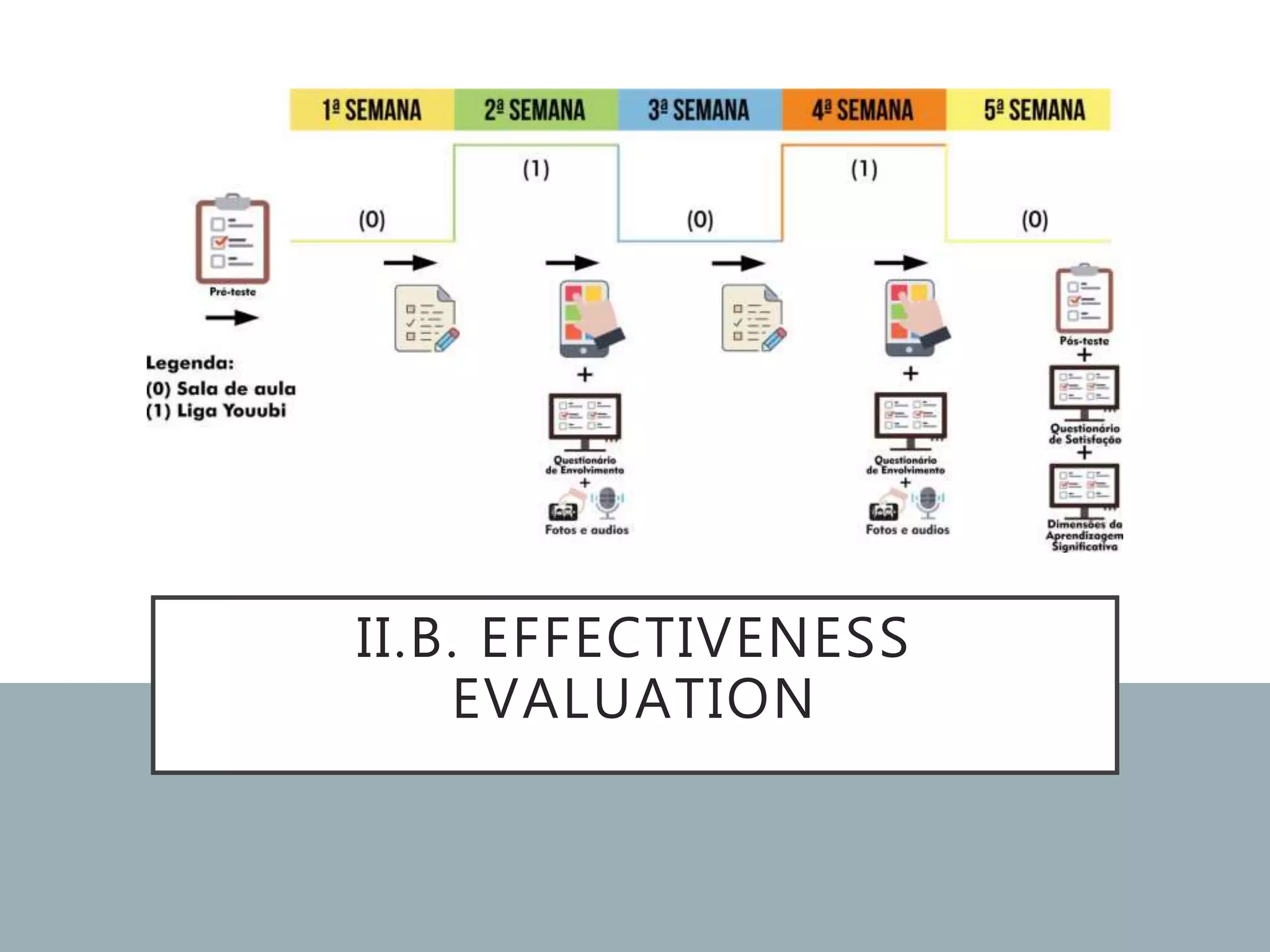
II.B. EFFECTIVENESS
EVALUATION
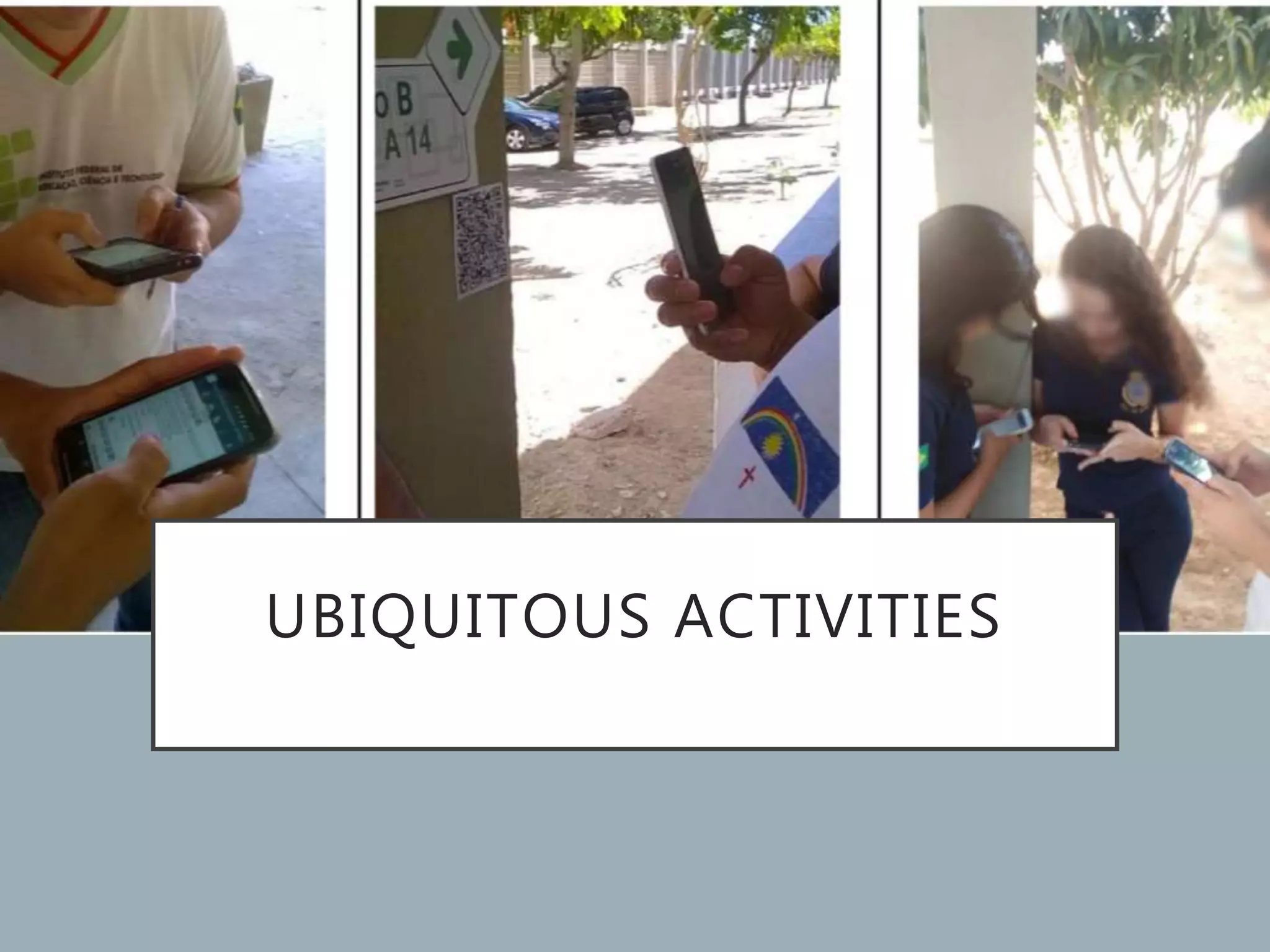
UBIQUITOUS ACTIVITIES
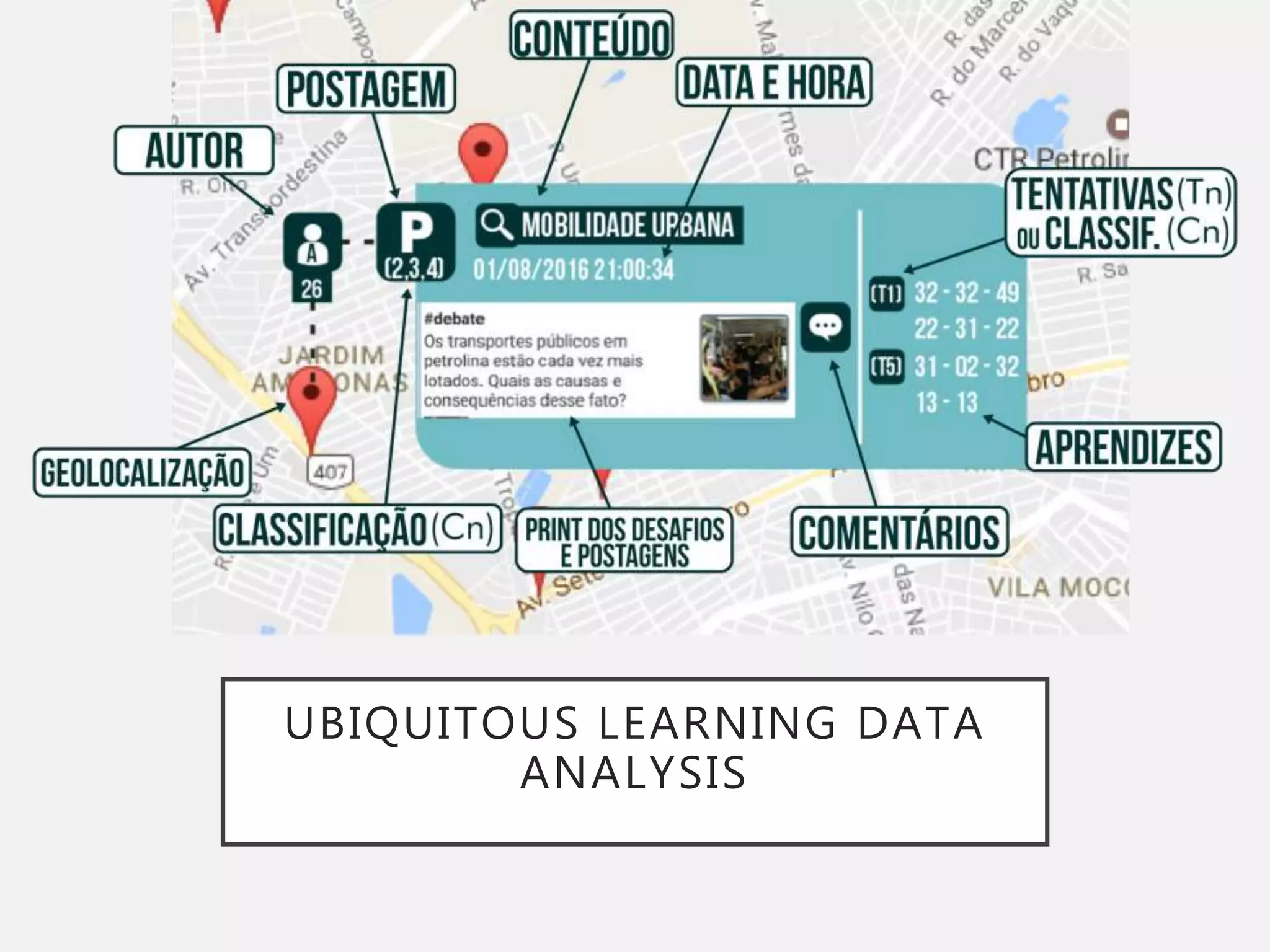
UBIQUITOUS LEARNING DATA
ANALYSIS
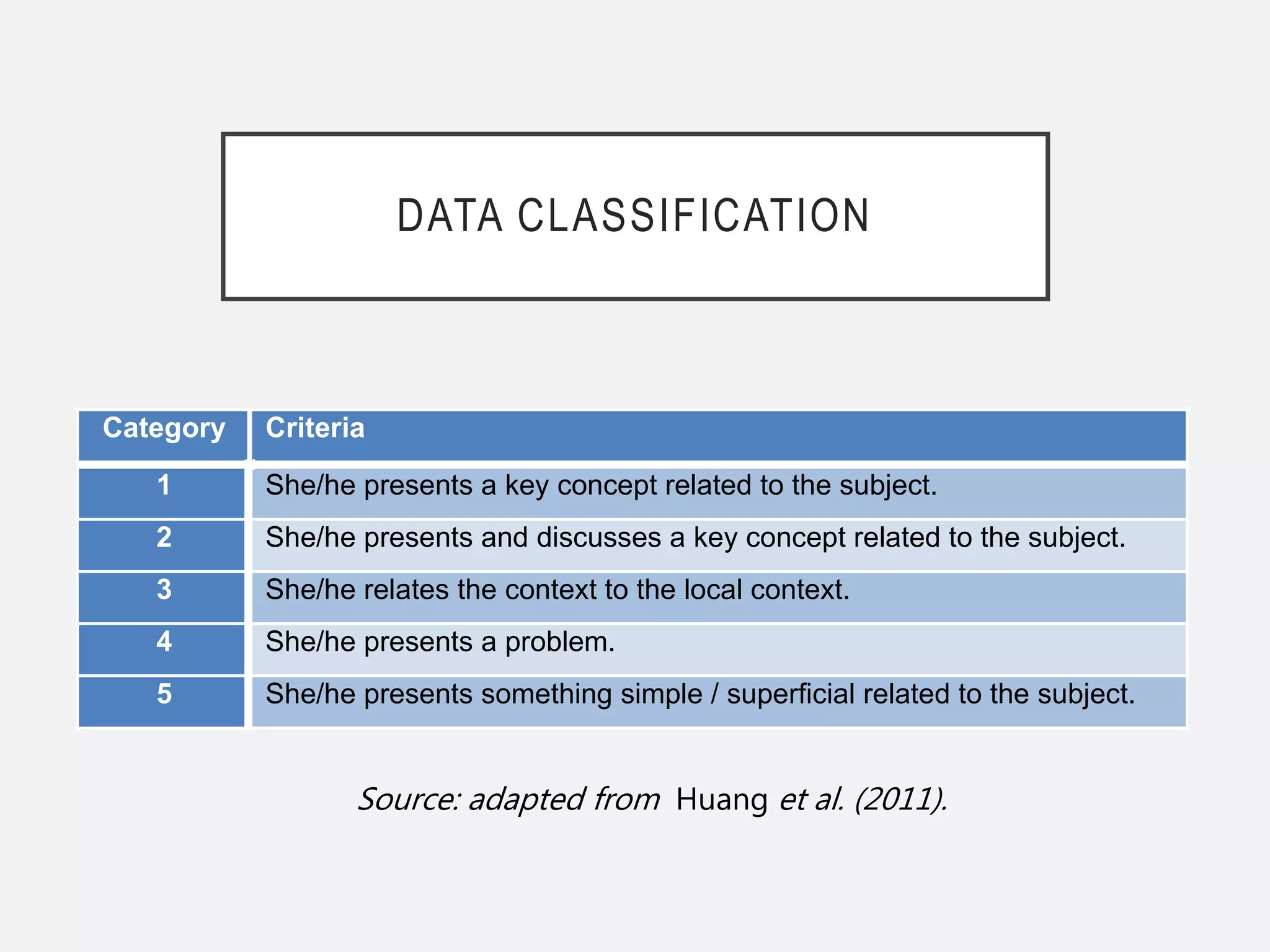
DATA CLASSIFICATION
Category Criteria
1 She/he presents a key concept related to the subject.
2 She/he presents and discusses a key concept related to the subject.
3 She/he relates the context to the local context.
4 She/he presents a problem.
5 She/he presents something simple / superficial related to the subject.
Source: adapted from Huang et al. (2011).
III. RESULTS
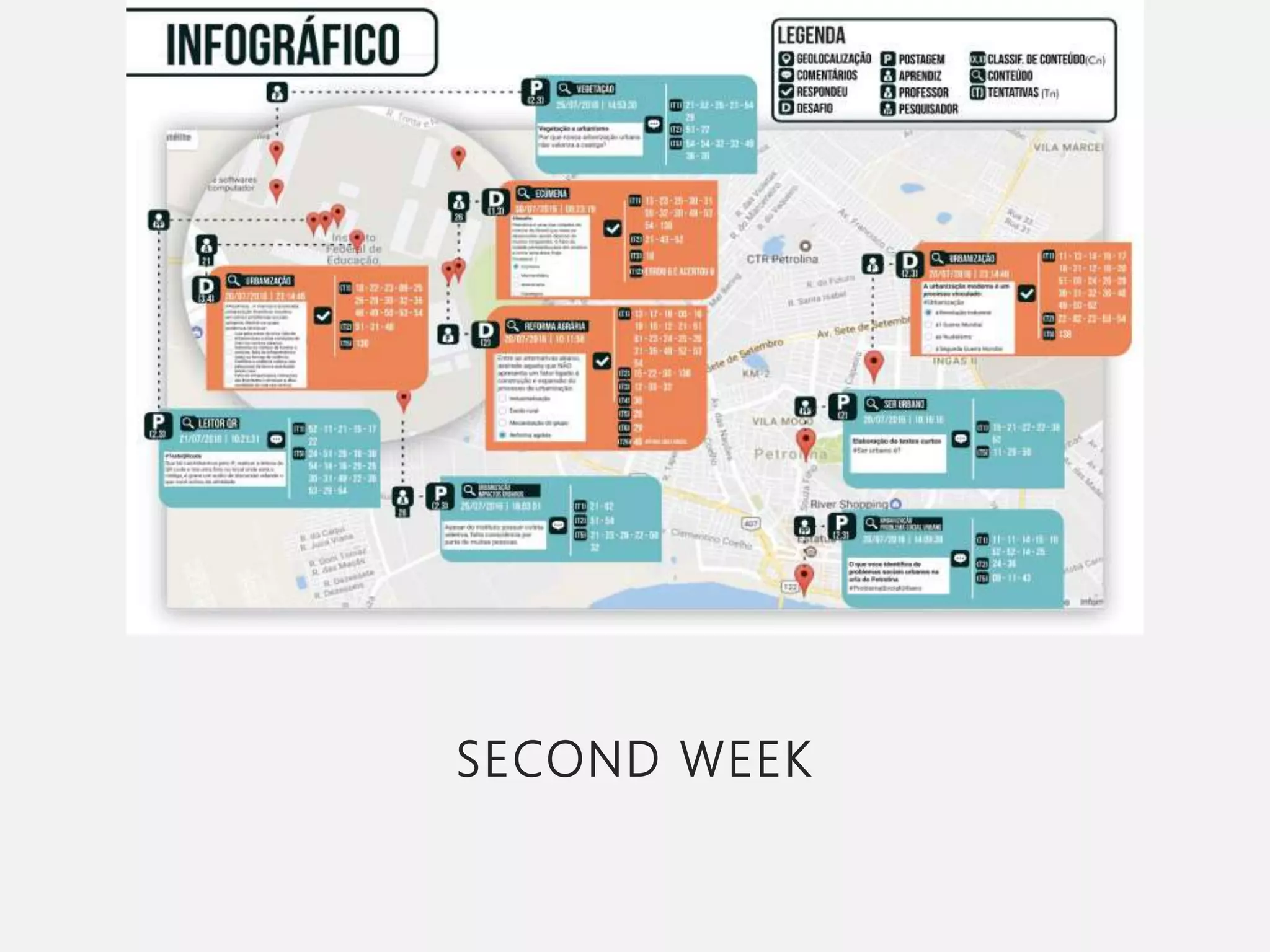
SECOND WEEK
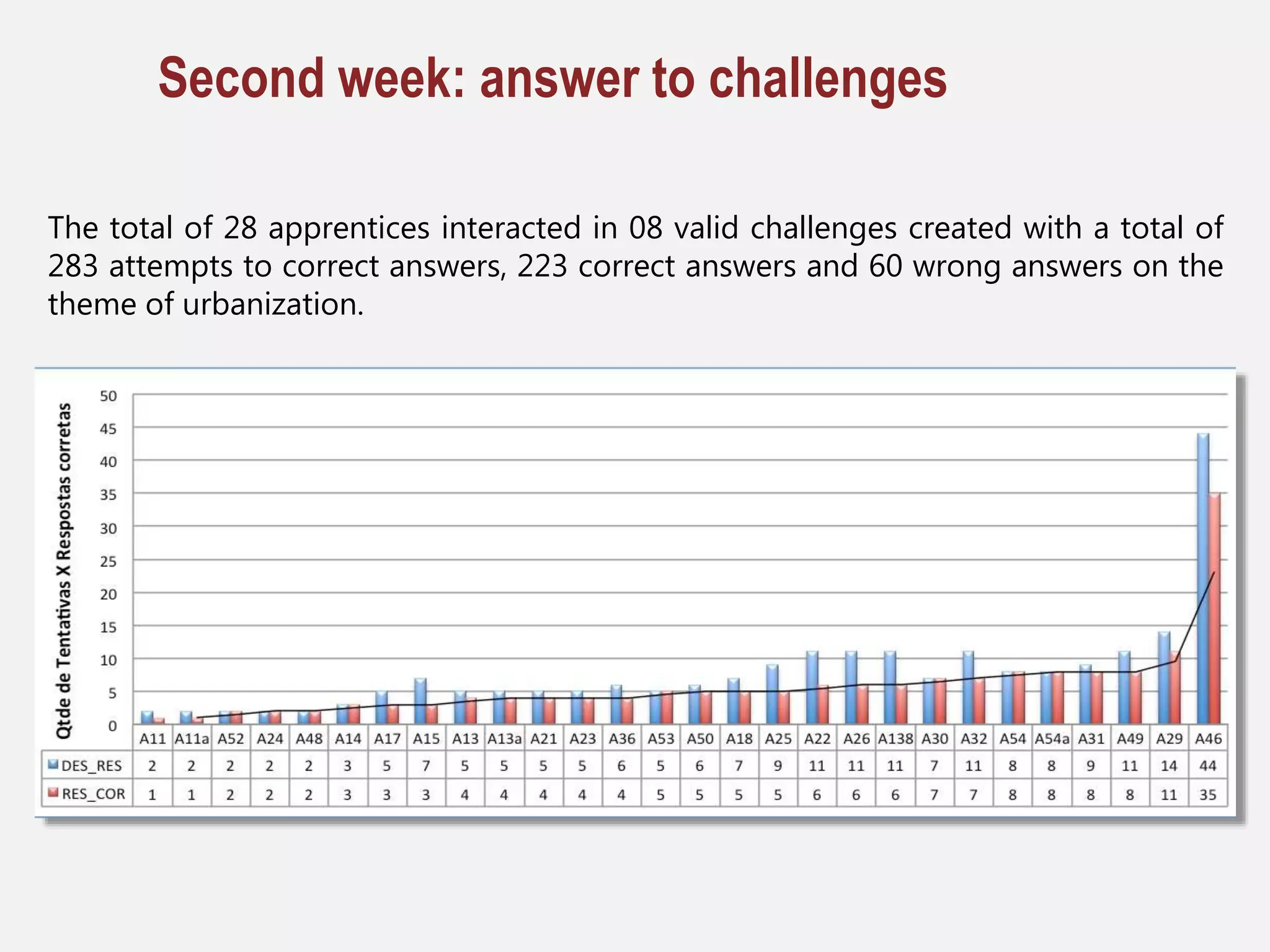
The total of 28 apprentices interacted in 08 valid challenges created with a total of
283 attempts to correct answers, 223 correct answers and 60 wrong answers on the
theme of urbanization.
Second week: answer to challenges
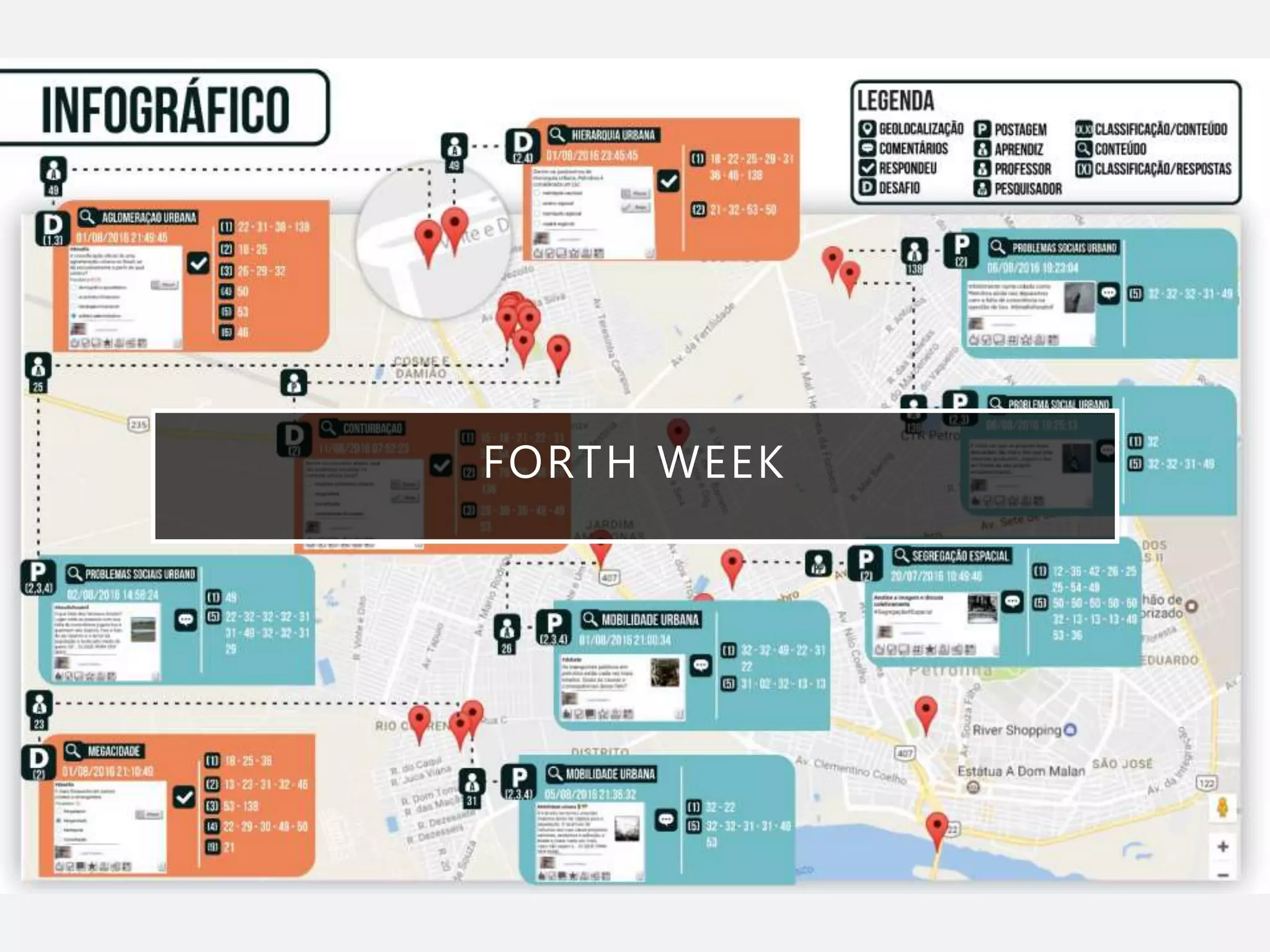
FORTH WEEK
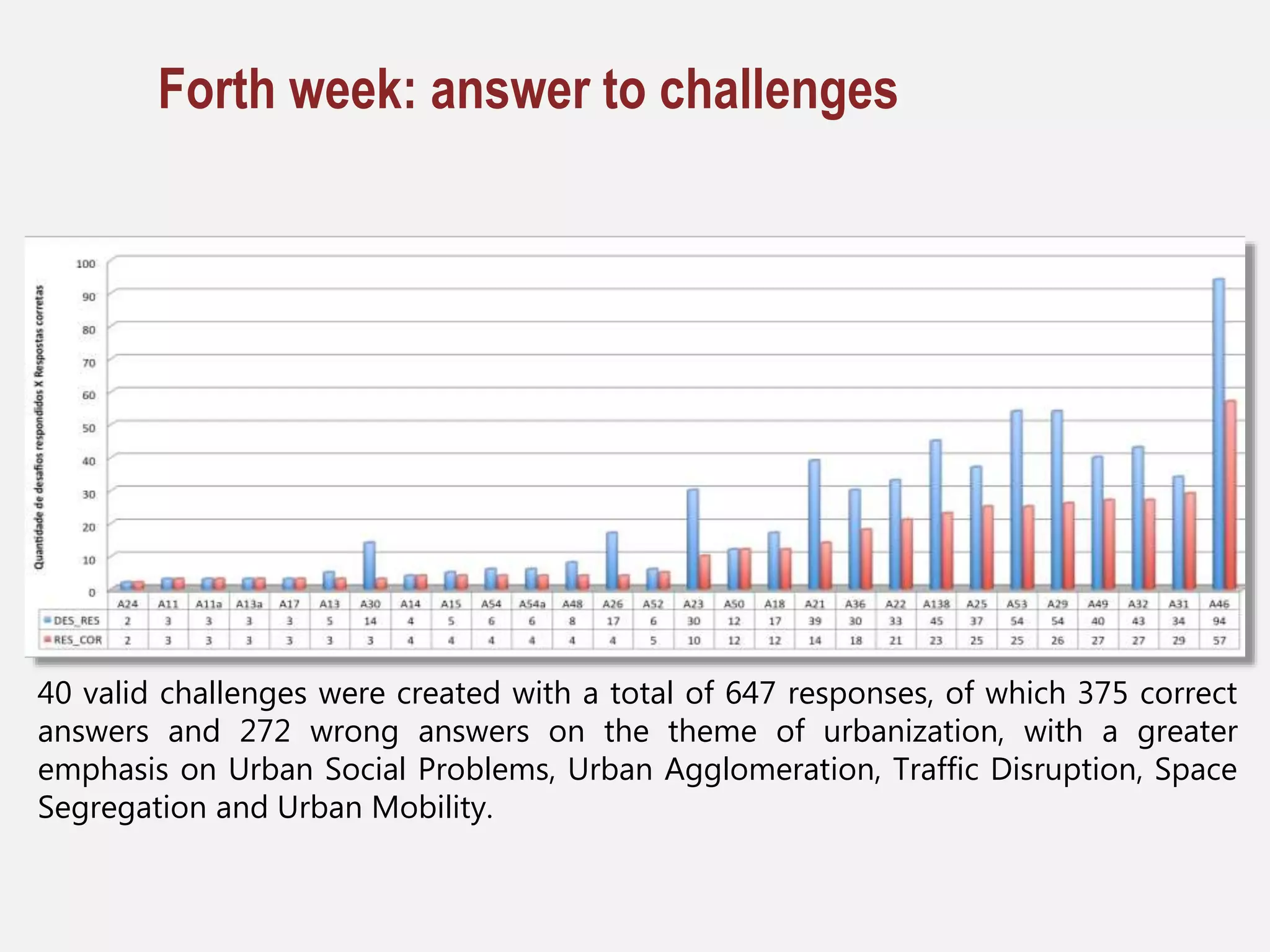
40 valid challenges were created with a total of 647 responses, of which 375 correct
answers and 272 wrong answers on the theme of urbanization, with a greater
emphasis on Urban Social Problems, Urban Agglomeration, Traffic Disruption, Space
Segregation and Urban Mobility.
Forth week: answer to challenges
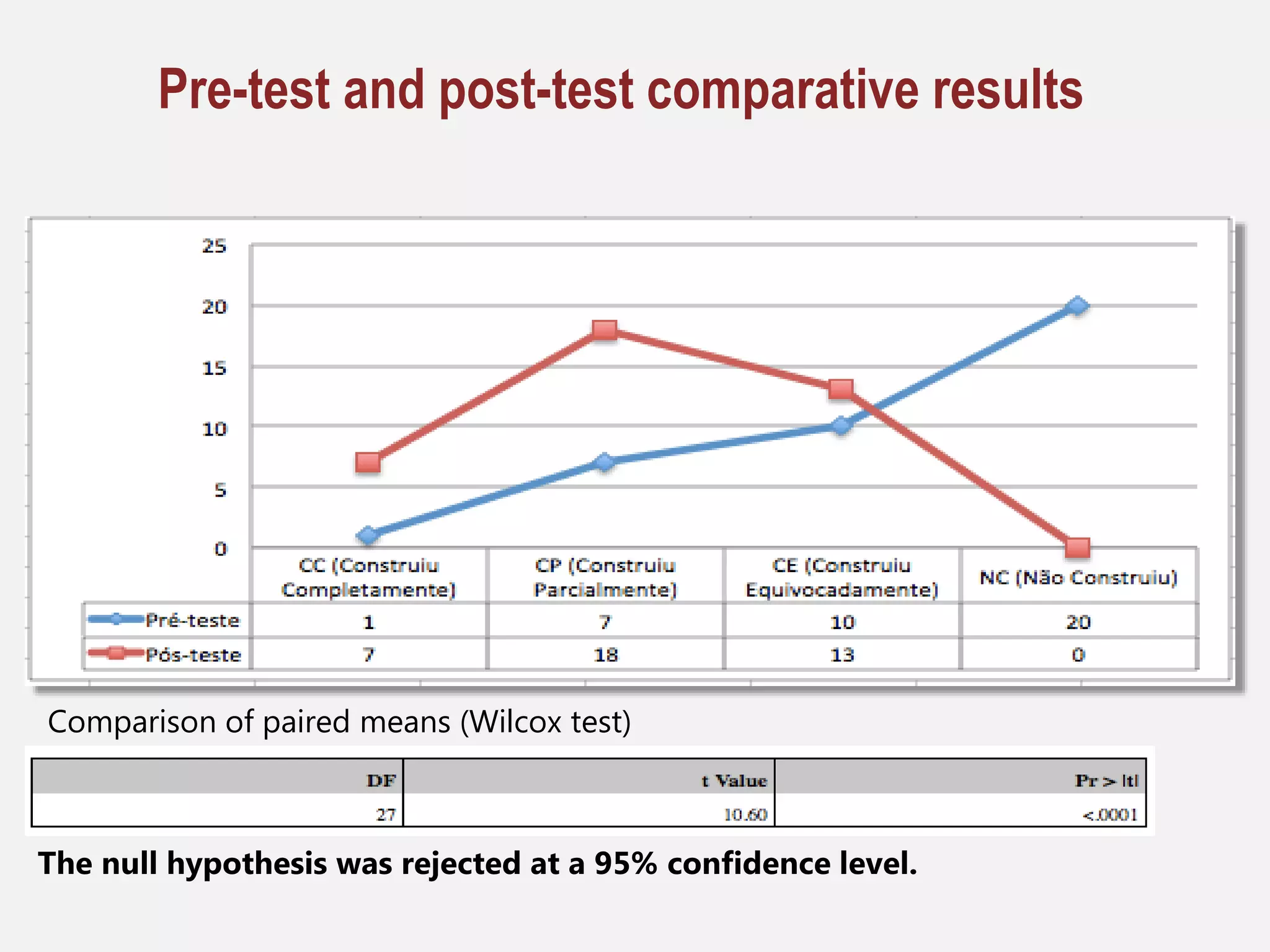
Pre-test and post-test comparative results
Comparison of paired means (Wilcox test)
The null hypothesis was rejected at a 95% confidence level.
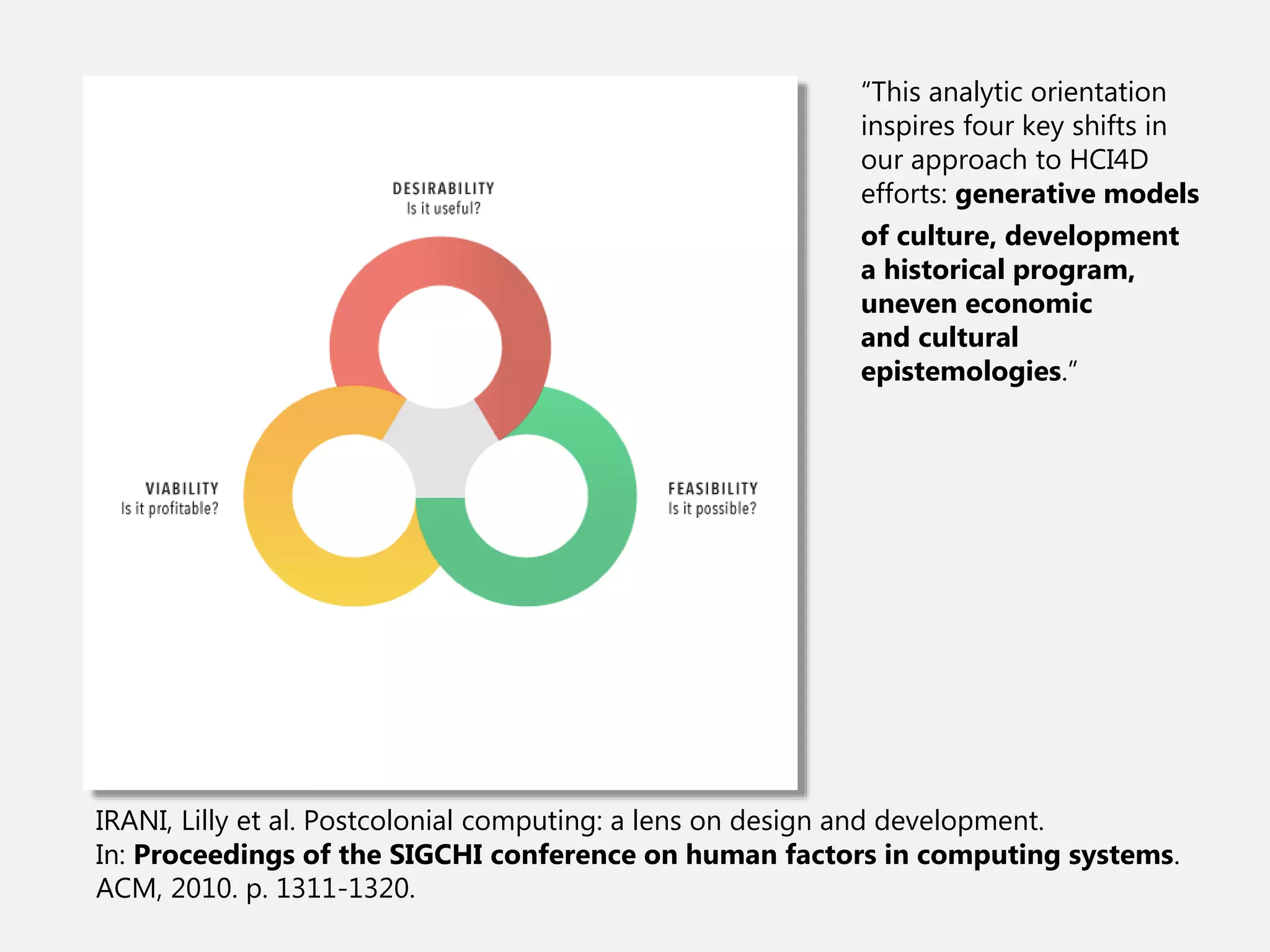
IV. FUTURE WORKS
Heritage education
“This analytic orientation
inspires four key shifts in
our approach to HCI4D
efforts: generative models
of culture, development
a historical program,
uneven economic
and cultural
epistemologies.”
IRANI, Lilly et al. Postcolonial computing: a lens on design and development.
In: Proceedings of the SIGCHI conference on human factors in computing systems.
ACM, 2010. p. 1311-1320.
ETHNOGRAPHIC DESIGN
• (…) participants and ethnographers make knowledge
and places together as they tour the home. This
enables the sensory ethnographer to focus on how the
place(s) she/he seeks to understand are constituted
both in the experience of participants and in the
ethnographic descriptions she or he ultimately creates.
(p. 25:6)
PINK, Sarah et al. Applying the lens of sensory ethnography to sustainable HCI. ACM
Transactions on Computer-Human Interaction (TOCHI), v. 20, n. 4, p. 25, 2013.
OBJECTIVE
Promote Heritage Education using a ubiquitous
learning platform
• People know historical places from the point of view of
other people, using their memories
• People can know the city using routes suggested by
another users
• People reflect about their own identity in relation the
the place they live
• People learn curiosities about the historical places
through challenges
MEANINGFUL LEARNING IN U-
LEARNING ENVIRONMENTS:
An Experience in Vocational Education
J_. BRITO, L. SEIXAS, I. M. FILHO, A. GOMES, B. MONTEIRO
CENTRO DE INFORMÁTICA, UFPE

Meaningful learning in u learning environments- an experience in vocational education

  • 1.
    MEANINGFUL LEARNING INU- LEARNING ENVIRONMENTS: An Experience in Vocational Education J_. BRITO, L. SEIXAS, I. M. FILHO, A. GOMES, B. MONTEIRO CENTRO DE INFORMÁTICA, UFPE
  • 2.
    AGENDA • I. Ubiquitouslearning • I.A. Meaningful ubiquitous learning • II. Method • II.A. Effectiveness evaluation • III. Results • IV. Future works • IV.A. Heritage education
  • 3.
  • 4.
    UBIQUITOUS LEARNING PLATFORM DE SOUSAMONTEIRO, Bruno; GOMES, Alex Sandro; NETO, Francisco Milton Mendes. Youubi: Open software for ubiquitous learning. Computers in Human Behavior, v. 55, p. 1145-1164, 2016.
  • 5.
  • 6.
    U-LEARNING REFERENCE ARCHITECTURE DE SOUSAMONTEIRO, Bruno; GOMES, Alex Sandro; NETO, Francisco Milton Mendes. Youubi: Open software for ubiquitous learning. Computers in Human Behavior, 2014.
  • 7.
    LOCATION • All elementsthat coordinate events are localized and can be monitored
  • 8.
    CREATE CHALLENGES • These arepresented to people and get people to go to certain places to solve the challenges.
  • 9.
    RECOMMENDATION • Counted andcontent suggestions are sent to users based on their profile data and the context in which they are located. 9
  • 10.
    COMMUNICATION • TheApplication has a channel for real-time communication
  • 11.
    GAMIFICATION • As theuser solves the challenges and interacts through the system and gains points in numerous dimensions 11
  • 12.
  • 13.
    Source: adapted fromHuang et al. (2011). Chang and Z.M. Yeh (2014) reinforce that apprentices do not learn from technology; However, technologies can support productive thinking and favor the construction of meanings.
  • 14.
    Source: adapted fromHuang et al. (2011). EVOLUTIONARY FRAMEWORK MODEL FOR ASSESSMENT OF UBIQUITOUS LEARNING
  • 15.
  • 16.
    CONTEXT AND PARTICIPANTS • Context:Federal Institute of Technological Education • Course: Technical Course in Computer Science and Chemistry • Discipline: Geography, total workload 60 (sixty) hours • Participants: 38 apprentices.
  • 17.
  • 18.
  • 19.
  • 20.
    DATA CLASSIFICATION Category Criteria 1She/he presents a key concept related to the subject. 2 She/he presents and discusses a key concept related to the subject. 3 She/he relates the context to the local context. 4 She/he presents a problem. 5 She/he presents something simple / superficial related to the subject. Source: adapted from Huang et al. (2011).
  • 21.
  • 22.
  • 23.
    The total of28 apprentices interacted in 08 valid challenges created with a total of 283 attempts to correct answers, 223 correct answers and 60 wrong answers on the theme of urbanization. Second week: answer to challenges
  • 24.
  • 25.
    40 valid challengeswere created with a total of 647 responses, of which 375 correct answers and 272 wrong answers on the theme of urbanization, with a greater emphasis on Urban Social Problems, Urban Agglomeration, Traffic Disruption, Space Segregation and Urban Mobility. Forth week: answer to challenges
  • 26.
    Pre-test and post-testcomparative results Comparison of paired means (Wilcox test) The null hypothesis was rejected at a 95% confidence level.
  • 27.
  • 28.
    “This analytic orientation inspiresfour key shifts in our approach to HCI4D efforts: generative models of culture, development a historical program, uneven economic and cultural epistemologies.” IRANI, Lilly et al. Postcolonial computing: a lens on design and development. In: Proceedings of the SIGCHI conference on human factors in computing systems. ACM, 2010. p. 1311-1320.
  • 29.
    ETHNOGRAPHIC DESIGN • (…)participants and ethnographers make knowledge and places together as they tour the home. This enables the sensory ethnographer to focus on how the place(s) she/he seeks to understand are constituted both in the experience of participants and in the ethnographic descriptions she or he ultimately creates. (p. 25:6) PINK, Sarah et al. Applying the lens of sensory ethnography to sustainable HCI. ACM Transactions on Computer-Human Interaction (TOCHI), v. 20, n. 4, p. 25, 2013.
  • 30.
    OBJECTIVE Promote Heritage Educationusing a ubiquitous learning platform • People know historical places from the point of view of other people, using their memories • People can know the city using routes suggested by another users • People reflect about their own identity in relation the the place they live • People learn curiosities about the historical places through challenges
  • 31.
    MEANINGFUL LEARNING INU- LEARNING ENVIRONMENTS: An Experience in Vocational Education J_. BRITO, L. SEIXAS, I. M. FILHO, A. GOMES, B. MONTEIRO CENTRO DE INFORMÁTICA, UFPE

Editor's Notes

  • #14 ativo: onde a aprendizagem ocorre por meio da interação com a manipulação de ferramentas dentro de seu meio ambiente de aprendizagem ubíqua ou ambiente urbano; autêntico: onde a aprendizagem é contextualizada em situações do mundo real; construtivo: onde os aprendizes estão engajados na reflexão e articulação do significado do conteúdo aprendido; cooperativo: onde a aprendizagem ocorre por meio da cooperação entre aprendizes nos trabalhos em grupos; personalizado: onde a aprendizagem ocorre por meio de atividades personalizadas baseadas no contexto do ambiente real ou da necessidade cognitiva do aprendiz para promover uma aprendizagem adaptativa ao perfil dele.
  • #15  O Modelo contempla 3 niveis relacionais que sao: 1 nivel o objetivo investigado, 2 nivel verifica-se as 5 dimesoes da aprendizagem significativa, e o 3, destacam-se as 10 principais critérios para ocorrencia da aprendizagem significativa
  • #20 Com a finalidade de auxiliar na melhor compreensao das interaçoes dos aprendizes em lugares diferentes, olhando paisagens diferentes, consumindo conteudo real no lugar aonde ele esta, criou-se um modelo gráfico de visualizaçao representativos das interaçoes em criar tipo de atividade(desafios e postagens), cometar postagens, criar e responder desafios em forma de Quiz de acordo com o conteudo produzido num intervalo de tempo. No modelo foram representados o autor, local criado, o conteudo produzido, o tipo de atividade, a classificaçao com base na analise do conteudo e as tentativas de respostas aos desafios
  • #23 Total de 28 aprendizes interagiram em 14 postagens criadas com um total de 122 comentários válidos sobre o tema de urbanização. E 8 desafios válidos (4) criados pelo professor e (4) criados pelos aprendizes.
  • #24 Com relação a a categoria de respostas dominantes nos desafios, no gráfico destaca os aprendizes que responderam, relacionando-os com o aproveitamento nas tentativas de respostas corretas numa escala de 1 a 5, 1 a 10 e mais de 10 tentativas de responder correto ao desafio. O gráfico revela que todos os aprendizes participaram em respostas aos desafios. Alguns com aproveitamento numa escala de 1 a 5 , 1 a 10, e mais de 10 tentativas de resposta correta. Inicialmente os aprendizes que responderam corretamente na primeira tentativa gráfico revela que todos os aprendizes participaram em respostas aos desafios. Alguns com aproveitamento numa escala de 1 a 5 , 1 a 10, e mais de 10 tentativas de resposta correta. Inicialmente os aprendizes que responderam corretamente na primeira tentativa, os que responderam a a menos desafios, embora com maior aproveitamento, E possivel perceber que alguns aprendizes apenas respondiam sem possivelmente uma construçao de mais significados
  • #26 O gráfico revela que todos os aprendizes participaram em respostas aos desafios. Alguns com aproveitamento numa escala de 1 a 5 , 1 a 10, e mais de 10 tentativas de resposta correta.
  • #27 As práticas baseadas na teoria da aprendizagem significativa, tem o objetivo de projetar situações de aprendizagem que incorporem as conexões entre o conhecimento prévio e os novos conceitos discutidos em sala de aula. Reforçando a análise descritiva dos dados coletados da situação diagnóstica (pré-teste) com os resultados finais e pós-teste, foi realizado um teste de comparação de médias pareadas (Teste de Wilcox) com o objetivo de validar a diferença significativa entre as variáveis. Contudo, verificou-se um valor de p-value abaixo de 0.05 Podemos afirmar que a hipótese nula foi aceita rejeitada a hipótese alternativa, ou seja, que existiu diferença significativa entre o pré-teste e o pós-teste, a um nível de confiança de 95%.
  • #29 Estamos falando de proposição de valor. O bom design nasce da tríade: Desejabilidade, Praticabilidade e Viabilidade.