Leveraging Culture to 
Create a Powerful 
Eco-System for Success 
in STEM Diversity 
Jamie M. Bracey, Ph.D. 
Director, STEM Education & Research 
Founding Director, Pennsylvania MESA 
Temple University College of Engineering 
November 6, 2014
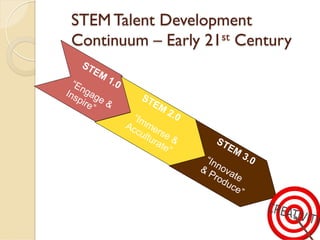
STEM Talent Development 
Continuum – Early 21st Century
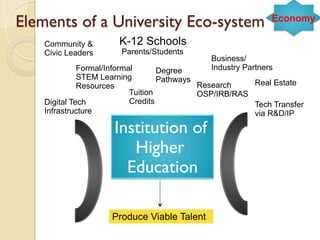
Elements of a University Eco-system Economy 
K-12 Schools 
Parents/Students 
Institution of 
Higher 
Education 
Community & 
Civic Leaders 
Formal/Informal 
STEM Learning 
Resources 
Business/ 
Industry Partners 
Tech Transfer 
via R&D/IP 
Digital Tech 
Infrastructure 
Degree 
Pathways Real Estate 
Tuition 
Credits 
Research 
OSP/IRB/RAS 
Produce Viable Talent
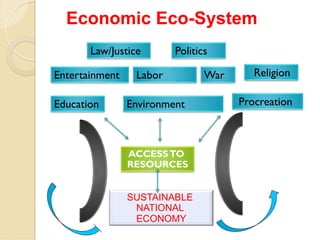
Economic Eco-System 
9 AREAS OF HUMAN INTERACTION WITHIN AN 
ECONOMIC ECO-SYSTEM 
Labor Religion 
Environment 
ACCESS TO 
RESOURCES 
Procreation 
Law/Justice 
Entertainment 
Education 
Politics 
War 
SUSTAINABLE 
NATIONAL 
ECONOMY
In MY lab??!! 
Noooo….sob
I’m not interested in 
preserving the status 
quo, I want to 
overthrow it. 
Niccolo Machiavelli
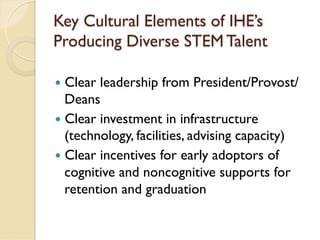
Key Cultural Elements of IHE’s 
Producing Diverse STEM Talent 
— Clear leadership from President/Provost/ 
Deans 
— Clear investment in infrastructure 
(technology, facilities, advising capacity) 
— Clear incentives for early adoptors of 
cognitive and noncognitive supports for 
retention and graduation
Research on Cultural Assets for African American and 
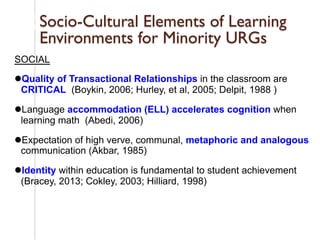
LatinSo oChcilidore-nC ultural Elements of Learning 
Environments for Minority URGs 
SOCIAL 
l Quality of Transactional Relationships in the classroom are 
CRITICAL (Boykin, 2006; Hurley, et al, 2005; Delpit, 1988 ) 
l Language accommodation (ELL) accelerates cognition when 
learning math (Abedi, 2006) 
l Expectation of high verve, communal, metaphoric and analogous 
communication (Akbar, 1985) 
l Identity within education is fundamental to student achievement 
(Bracey, 2013; Cokley, 2003; Hilliard, 1998)
Research on Cultural Assets for Cultural & Linguistic Minorities 
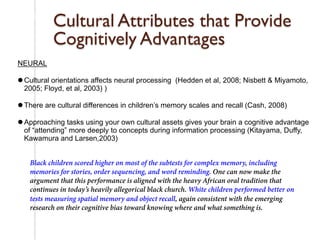
Cultural Attributes that Provide 
Cognitively Advantages 
NEURAL 
l Cultural orientations affects neural processing (Hedden et al, 2008; Nisbett & Miyamoto, 
2005; Floyd, et al, 2003) ) 
l There are cultural differences in children’s memory scales and recall (Cash, 2008) 
l Approaching tasks using your own cultural assets gives your brain a cognitive advantage 
of “attending” more deeply to concepts during information processing (Kitayama, Duffy, 
Kawamura and Larsen,2003) 
Black children scored higher on most of the subtests for complex memory, including 
memories for stories, order sequencing, and word reminding. One can now make the 
argument that this performance is aligned with the heavy African oral tradition that 
continues in today’s heavily allegorical black church. White children performed better on 
tests measuring spatial memory and object recall, again consistent with the emerging 
research on their cognitive bias toward knowing where and what something is. 
, Duffy, Kawamura and Larsen (2003)
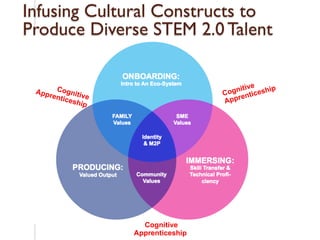
Infusing Cultural Constructs to 
Produce Diverse STEM 2.0 Talent 
Family 
Values SME 
Values 
Community 
Values 
Cognitive 
Apprenticeship 
Cognitive 
Apprenticeship 
Cognitive 
Apprenticeship
First, the results of using Culture & Cognition in STEM 
Education: 
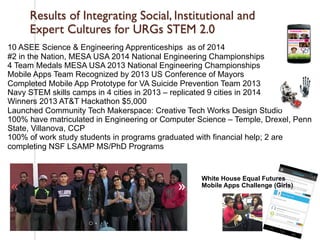
Results of Integrating Social, Institutional and 
Expert Cultures for URGs STEM 2.0 
10 ASEE Science & Engineering Apprenticeships as of 2014 
#2 in the Nation, MESA USA 2014 National Engineering Championships 
4 Team Medals MESA USA 2013 National Engineering Championships 
Mobile Apps Team Recognized by 2013 US Conference of Mayors 
Completed Mobile App Prototype for VA Suicide Prevention Team 2013 
Navy STEM skills camps in 4 cities in 2013 – replicated 9 cities in 2014 
Winners 2013 AT&T Hackathon $5,000 
Launched Community Tech Makerspace: Creative Tech Works Design Studio 
100% have matriculated in Engineering or Computer Science – Temple, Drexel, Penn 
State, Villanova, CCP 
100% of work study students in programs graduated with financial help; 2 are 
completing NSF LSAMP MS/PhD Programs 
ss: 
White House Equal Futures 
Mobile Apps Challenge (Girls) 
2013
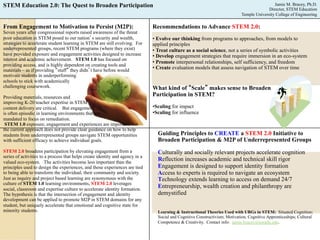
STEM Education 2.0: The Quest to Broaden Participation Jamie M. Bracey, Ph.D. 
From Engagement to Motivation to Persist (M2P): 
Seven years after congressional reports raised awareness of the threat 
poor education in STEM posed to our nation’s security and wealth, 
strategies to accelerate student learning in STEM are still evolving. For 
underrepresented groups, recent STEM programs (where they exist) 
have provided exposure and engagement activities designed to increase 
interest and academic achievement. STEM 1.0 has focused on 
providing access, and is highly dependent on creating tools and 
materials – as if providing “stuff” they didn’t have before would 
motivate students in underperforming 
schools to stick with academically 
challenging coursework. 
Providing materials, resources and 
improving K-20 teacher expertise in STEM 
content delivery are critical. But engagement 
is often episodic in learning environments that are 
mandated to focus on remediation. 
STEM 1.0 exposure, engagement and experiences are important, but 
the current approach does not provide clear guidance on how to help 
students from underrepresented groups navigate STEM opportunities 
with sufficient efficacy to achieve individual goals. 
STEM 2.0 broadens participation by elevating engagement from a 
series of activities to a process that helps create identity and agency in a 
valued eco-system. The activities become less important than the 
principles used to design the experiences, and those experiences are tied 
to being able to transform the individual, their community and society. 
Just as inquiry and project based learning are synonymous with the 
culture of STEM 1.0 learning environments, STEM 2.0 leverages 
social, classroom and expertise culture to accelerate identity formation. 
The hypothesis is that the intersection of engagement and identity 
development can be applied to promote M2P in STEM domains for any 
student, but uniquely accelerate that emotional and cognitive state for 
minority students. 
Director, STEM Education 
Temple University College of Engineering 
Recommendations to Advance STEM 2.0: 
• Evolve our thinking from programs to approaches, from models to 
applied principles 
• Treat culture as a social science, not a series of symbolic activities 
• Develop engagement strategies that require immersion in an eco-system 
• Promote interpersonal relationships, self sufficiency, and freedom 
• Create evaluation models that assess navigation of STEM over time 
What kind of “Scale” makes sense to Broaden 
Participation in STEM? 
• Scaling for impact 
• Scaling for influence 
Guiding Principles to CREATE a STEM 2.0 Initiative to 
Broaden Participation & M2P of Underrepresented Groups 
Culturally and socially relevant projects accelerate cognition 
Reflection increases academic and technical skill rigor 
Engagement is designed to support identity formation 
Access to experts is required to navigate an ecosystem 
Technology extends learning to access on demand 24/7 
Entrepreneurship, wealth creation and philanthropy are 
demystified 
Learning & Instructional Theories Used with URGs in STEM: Situated Cognition; 
Social and Cognitive Constructivism; Motivation; Cognitive Apprenticeships; Cultural 
Competence & Creativity. Contact info: jamie.bracey@temple.edu.

AAC&U 2014 Keynote: Leveraging Culture to Create a Powerful Eco-system for STEM Diversity

  • 1.
    Leveraging Culture to Create a Powerful Eco-System for Success in STEM Diversity Jamie M. Bracey, Ph.D. Director, STEM Education & Research Founding Director, Pennsylvania MESA Temple University College of Engineering November 6, 2014
  • 3.
    STEM Talent Development Continuum – Early 21st Century
  • 4.
    Elements of aUniversity Eco-system Economy K-12 Schools Parents/Students Institution of Higher Education Community & Civic Leaders Formal/Informal STEM Learning Resources Business/ Industry Partners Tech Transfer via R&D/IP Digital Tech Infrastructure Degree Pathways Real Estate Tuition Credits Research OSP/IRB/RAS Produce Viable Talent
  • 5.
    Economic Eco-System 9AREAS OF HUMAN INTERACTION WITHIN AN ECONOMIC ECO-SYSTEM Labor Religion Environment ACCESS TO RESOURCES Procreation Law/Justice Entertainment Education Politics War SUSTAINABLE NATIONAL ECONOMY
  • 6.
    In MY lab??!! Noooo….sob
  • 7.
    I’m not interestedin preserving the status quo, I want to overthrow it. Niccolo Machiavelli
  • 8.
    Key Cultural Elementsof IHE’s Producing Diverse STEM Talent — Clear leadership from President/Provost/ Deans — Clear investment in infrastructure (technology, facilities, advising capacity) — Clear incentives for early adoptors of cognitive and noncognitive supports for retention and graduation
  • 9.
    Research on CulturalAssets for African American and LatinSo oChcilidore-nC ultural Elements of Learning Environments for Minority URGs SOCIAL l Quality of Transactional Relationships in the classroom are CRITICAL (Boykin, 2006; Hurley, et al, 2005; Delpit, 1988 ) l Language accommodation (ELL) accelerates cognition when learning math (Abedi, 2006) l Expectation of high verve, communal, metaphoric and analogous communication (Akbar, 1985) l Identity within education is fundamental to student achievement (Bracey, 2013; Cokley, 2003; Hilliard, 1998)
  • 10.
    Research on CulturalAssets for Cultural & Linguistic Minorities Cultural Attributes that Provide Cognitively Advantages NEURAL l Cultural orientations affects neural processing (Hedden et al, 2008; Nisbett & Miyamoto, 2005; Floyd, et al, 2003) ) l There are cultural differences in children’s memory scales and recall (Cash, 2008) l Approaching tasks using your own cultural assets gives your brain a cognitive advantage of “attending” more deeply to concepts during information processing (Kitayama, Duffy, Kawamura and Larsen,2003) Black children scored higher on most of the subtests for complex memory, including memories for stories, order sequencing, and word reminding. One can now make the argument that this performance is aligned with the heavy African oral tradition that continues in today’s heavily allegorical black church. White children performed better on tests measuring spatial memory and object recall, again consistent with the emerging research on their cognitive bias toward knowing where and what something is. , Duffy, Kawamura and Larsen (2003)
  • 11.
    Infusing Cultural Constructsto Produce Diverse STEM 2.0 Talent Family Values SME Values Community Values Cognitive Apprenticeship Cognitive Apprenticeship Cognitive Apprenticeship
  • 12.
    First, the resultsof using Culture & Cognition in STEM Education: Results of Integrating Social, Institutional and Expert Cultures for URGs STEM 2.0 10 ASEE Science & Engineering Apprenticeships as of 2014 #2 in the Nation, MESA USA 2014 National Engineering Championships 4 Team Medals MESA USA 2013 National Engineering Championships Mobile Apps Team Recognized by 2013 US Conference of Mayors Completed Mobile App Prototype for VA Suicide Prevention Team 2013 Navy STEM skills camps in 4 cities in 2013 – replicated 9 cities in 2014 Winners 2013 AT&T Hackathon $5,000 Launched Community Tech Makerspace: Creative Tech Works Design Studio 100% have matriculated in Engineering or Computer Science – Temple, Drexel, Penn State, Villanova, CCP 100% of work study students in programs graduated with financial help; 2 are completing NSF LSAMP MS/PhD Programs ss: White House Equal Futures Mobile Apps Challenge (Girls) 2013
  • 13.
    STEM Education 2.0:The Quest to Broaden Participation Jamie M. Bracey, Ph.D. From Engagement to Motivation to Persist (M2P): Seven years after congressional reports raised awareness of the threat poor education in STEM posed to our nation’s security and wealth, strategies to accelerate student learning in STEM are still evolving. For underrepresented groups, recent STEM programs (where they exist) have provided exposure and engagement activities designed to increase interest and academic achievement. STEM 1.0 has focused on providing access, and is highly dependent on creating tools and materials – as if providing “stuff” they didn’t have before would motivate students in underperforming schools to stick with academically challenging coursework. Providing materials, resources and improving K-20 teacher expertise in STEM content delivery are critical. But engagement is often episodic in learning environments that are mandated to focus on remediation. STEM 1.0 exposure, engagement and experiences are important, but the current approach does not provide clear guidance on how to help students from underrepresented groups navigate STEM opportunities with sufficient efficacy to achieve individual goals. STEM 2.0 broadens participation by elevating engagement from a series of activities to a process that helps create identity and agency in a valued eco-system. The activities become less important than the principles used to design the experiences, and those experiences are tied to being able to transform the individual, their community and society. Just as inquiry and project based learning are synonymous with the culture of STEM 1.0 learning environments, STEM 2.0 leverages social, classroom and expertise culture to accelerate identity formation. The hypothesis is that the intersection of engagement and identity development can be applied to promote M2P in STEM domains for any student, but uniquely accelerate that emotional and cognitive state for minority students. Director, STEM Education Temple University College of Engineering Recommendations to Advance STEM 2.0: • Evolve our thinking from programs to approaches, from models to applied principles • Treat culture as a social science, not a series of symbolic activities • Develop engagement strategies that require immersion in an eco-system • Promote interpersonal relationships, self sufficiency, and freedom • Create evaluation models that assess navigation of STEM over time What kind of “Scale” makes sense to Broaden Participation in STEM? • Scaling for impact • Scaling for influence Guiding Principles to CREATE a STEM 2.0 Initiative to Broaden Participation & M2P of Underrepresented Groups Culturally and socially relevant projects accelerate cognition Reflection increases academic and technical skill rigor Engagement is designed to support identity formation Access to experts is required to navigate an ecosystem Technology extends learning to access on demand 24/7 Entrepreneurship, wealth creation and philanthropy are demystified Learning & Instructional Theories Used with URGs in STEM: Situated Cognition; Social and Cognitive Constructivism; Motivation; Cognitive Apprenticeships; Cultural Competence & Creativity. Contact info: jamie.bracey@temple.edu.