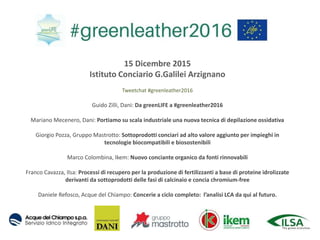
15 Dicembre 2015
Istituto Conciario G.Galilei Arzignano
Tweetchat #greenleather2016
Guido Zilli, Dani: Da greenLIFE a #greenleather2016
Mariano Mecenero, Dani: Portiamo su scala industriale una nuova tecnica di depilazione ossidativa
Giorgio Pozza, Gruppo Mastrotto: Sottoprodotti conciari ad alto valore aggiunto per impieghi in
tecnologie biocompatibili e biosostenibili
Marco Colombina, Ikem: Nuovo conciante organico da fonti rinnovabili
Franco Cavazza, Ilsa: Processi di recupero per la produzione di fertilizzanti a base di proteine idrolizzate
derivanti da sottoprodotti delle fasi di calcinaio e concia chromium-free
Daniele Refosco, Acque del Chiampo: Concerie a ciclo completo: l’analisi LCA da qui al futuro.
GOALS
• 20% reduction in water consumption in the beamhouse stage
• 20% decrease in chemicals used in the beamhouse stage
• 20% reduction in solid waste
• 15% recovery and re-use of by-products with industrial value
• a new knowledge hub to share ideas and technologies
TITLE Green Leather Industry For the Environment (greenLIFE)
TIMELINE 36 month (01/06/2014 – 31/05/2017)
BUDGET Budget: 2.260.000 € / European Union grant: 1.120.000 €
Development of a new liming processes
Research line 1
• Liming process with recovery and re-use of liming baths
• Oxidative liming process
• Enzymatic liming process
Development of a new tanning process
Research line 2
• Studying of a new organic-based tannery product
• Testing to experimental and semi-industrial scale of the new organic-based product
Recovery and re-use of tannery and liming process by-products
Research line 3
• Collection of process by-products
• Treatment or by products and experimentation of a new re-use technology
Research activities / 1
Water treatment system and new technology: potential impact assessment
Research line 4
• Current water treatment district system
• Liming baths and characterisation of processing by-products
• Assessment of the new technology and potential impact on the water treatment Tannery District system
Monitoring of environmental and social impact
Research line 5
• Environmental impact: data collection, analysis and perspective
• Socio-economic impact: data collection, analysis and perspective
Research activities / 2
Some perspective from which to see this project
Partnership structure
• A “supply chain” approach (beyond company gates), with strong territorial references
• Involvement of partners with different institutional functions
• Cooperation between competing companies
Environment as a basic topic for research “as collective activity" (competitive research vs cooperative research)
Importance of communication within a research project
• Learning a multi-stakeholder perspective (Public Administrations at multiple territorial levels, educational
institutions and research, customers, suppliers, ...)
• Development of unusual communication channels: website ( www.greenlifeproject.eu ), social networks (twitter,
linkedin, slideshare, ..) and improvement in their use
Potential for collective learning
• New management tools for planning and assessing (Life Cycle Assessment on district level, activities indicators, ...)
• Management of complex projects
And after?
A new institution: the "Leather District ," potentially able to:
• collect and address technological needs from the territory and towards the territory, in the medium / long term
• disseminate technological and organizational innovations, including also vocational training.
• allow Arzignano to become a reference area within recognized international R&D networks
Ability to lead to system the "Laboratory nature“ of Greenlife regarding:
• research and development
• dissemination of research results and innovations
• partnerships establishment, often at international level
• strengthening of regional networks and the creation of a system of international relations
Environment may continue to be a basic topic for collective research
So…
Thank you for your attention …
and have an interesting seminar

From greenLIFE to #greenleather2016

  • 1.
    15 Dicembre 2015 IstitutoConciario G.Galilei Arzignano Tweetchat #greenleather2016 Guido Zilli, Dani: Da greenLIFE a #greenleather2016 Mariano Mecenero, Dani: Portiamo su scala industriale una nuova tecnica di depilazione ossidativa Giorgio Pozza, Gruppo Mastrotto: Sottoprodotti conciari ad alto valore aggiunto per impieghi in tecnologie biocompatibili e biosostenibili Marco Colombina, Ikem: Nuovo conciante organico da fonti rinnovabili Franco Cavazza, Ilsa: Processi di recupero per la produzione di fertilizzanti a base di proteine idrolizzate derivanti da sottoprodotti delle fasi di calcinaio e concia chromium-free Daniele Refosco, Acque del Chiampo: Concerie a ciclo completo: l’analisi LCA da qui al futuro.
  • 2.
    GOALS • 20% reductionin water consumption in the beamhouse stage • 20% decrease in chemicals used in the beamhouse stage • 20% reduction in solid waste • 15% recovery and re-use of by-products with industrial value • a new knowledge hub to share ideas and technologies TITLE Green Leather Industry For the Environment (greenLIFE) TIMELINE 36 month (01/06/2014 – 31/05/2017) BUDGET Budget: 2.260.000 € / European Union grant: 1.120.000 €
  • 3.
    Development of anew liming processes Research line 1 • Liming process with recovery and re-use of liming baths • Oxidative liming process • Enzymatic liming process Development of a new tanning process Research line 2 • Studying of a new organic-based tannery product • Testing to experimental and semi-industrial scale of the new organic-based product Recovery and re-use of tannery and liming process by-products Research line 3 • Collection of process by-products • Treatment or by products and experimentation of a new re-use technology Research activities / 1
  • 4.
    Water treatment systemand new technology: potential impact assessment Research line 4 • Current water treatment district system • Liming baths and characterisation of processing by-products • Assessment of the new technology and potential impact on the water treatment Tannery District system Monitoring of environmental and social impact Research line 5 • Environmental impact: data collection, analysis and perspective • Socio-economic impact: data collection, analysis and perspective Research activities / 2
  • 5.
    Some perspective fromwhich to see this project Partnership structure • A “supply chain” approach (beyond company gates), with strong territorial references • Involvement of partners with different institutional functions • Cooperation between competing companies Environment as a basic topic for research “as collective activity" (competitive research vs cooperative research) Importance of communication within a research project • Learning a multi-stakeholder perspective (Public Administrations at multiple territorial levels, educational institutions and research, customers, suppliers, ...) • Development of unusual communication channels: website ( www.greenlifeproject.eu ), social networks (twitter, linkedin, slideshare, ..) and improvement in their use Potential for collective learning • New management tools for planning and assessing (Life Cycle Assessment on district level, activities indicators, ...) • Management of complex projects
  • 6.
    And after? A newinstitution: the "Leather District ," potentially able to: • collect and address technological needs from the territory and towards the territory, in the medium / long term • disseminate technological and organizational innovations, including also vocational training. • allow Arzignano to become a reference area within recognized international R&D networks Ability to lead to system the "Laboratory nature“ of Greenlife regarding: • research and development • dissemination of research results and innovations • partnerships establishment, often at international level • strengthening of regional networks and the creation of a system of international relations Environment may continue to be a basic topic for collective research
  • 7.
    So… Thank you foryour attention … and have an interesting seminar