Comparison of Clinical Manifestations
between Patients with
Ocular Myasthenia Gravis and
Generalized Myasthenia Gravis
Roh HS, Lee SY, Yoon JS
Korean J Ophthalmol 2011;25(1):1-7


                                               Journal Reading
                                              dr. Ersifa Fatimah
                                     dr. M. Saiful Islam, SpS(K)
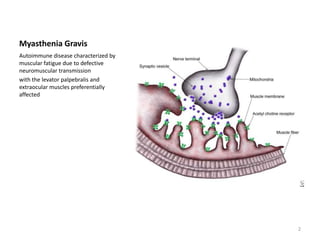
Myasthenia Gravis
Autoimmune disease characterized by
muscular fatigue due to defective
neuromuscular transmission
with the levator palpebralis and
extraocular muscles preferentially
affected


                                      2
MG patients        MG patients
> 75% MG px
present with
                      90% will
    visual
                    generalize
 complaints
                   within 3 years
 50% of px with
     ocular
 manifestation
    develop          80% will
  generalized      generalize
weakness within   within 2 years
   6 months


                                    3
Immune-related disorder (DM
                             1, SLE, Sjogren, Graves, Hashimoto, RA, MS)
                                                  
                                                   Blurry
                             vision, tearing, pain, photophobia, reduced
                                      visual acuity, decreased tear
                                         film, inflammatory soft
                                       tissue, exophthalmos, etc


                                                                           Long-term steroid therapy
          MG:
Diplopia / ocular motility
     defects, ptosis


                                        Ocular
                                      manifestation

                                                                                                  4
Previous studies of MG have not focused on
ophthalmic manifestations other than
ptosis, diplopia, and those caused by the long-
term of MG


No known studies comparing the ophthalmic
features & complications between patients with
ocular MG those of generalized MG

                                                  5
Materials & Methods
   Px diagnosed with MG, Jan 1995 - Dec 2007, minimum 1 year follow-up period
Database of Dept Neurology & Ophthalmology Yonsei University College of Medicine


                              Data, Diagnosis, & Classification
                               Clinical evaluation, confirmatory
 Demographic, ophthalmic                                                 Osserman score
                                diagnostic test (>/1 from Anti-
symptom & sign, associated                                              Gr. I = Ocular gr.
                               Ach Rec Ab, RNST, Neostigmine
autoimmune dis., results of
                               test, Pyridostigmine), CT thorax    Gr. II-IV = Generalized gr.
      diagnostic test
                                           + contrast


 Analysis: SPSS ver 12.0; Pearson chi-square, Fisher’s exact test; Wilcoxon rank sum
                           test; significant if p-value < 0.05


                                                                                                 6
Results & Discussion


•   A rare disease, it is often difficult to analyze a large patient population
•   Median follow up period: 39 months (12-105 months)
•   Range age at disease onset: 3-71
•   65% px develop initial symptoms at age <50 ys.
•   Mean time interval from the onset of ocular MG to generalization: 3.5 ys

                                                                                  7
Bimodal pattern of age of onset in both genders : early-onset & late-onset
Incidence rates peaking 60 - 80 ys, male predominance in the older age group
                              (Allen et al, 2010)


                                               Mean age of disease
                                               onset 40.1 ys (male) &
                                               42.8 ys (female)                8
• A significant number of patients reported various ophthalmic symptoms;
  all of which may be related to the muscular weakness caused by MG.
• Symptoms were observed equally in the ocular & generalized MG groups.
• 7% of generalize MG group had no ptosis / diplopia
                                                                           9
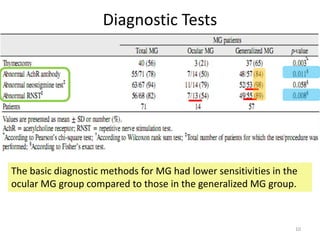
Diagnostic Tests


The basic diagnostic methods for MG had lower sensitivities in the
ocular MG group compared to those in the generalized MG group.


                                                                 10
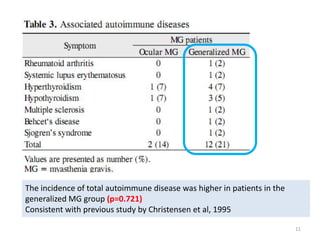
The incidence of total autoimmune disease was higher in patients in the
generalized MG group (p=0.721)
Consistent with previous study by Christensen et al, 1995

                                                                          11
• Anticholinesterase drugs improve symptoms of MG in nearly all ocular and generalized
  MG patients, but the therapeutic effects are limited. Thus, most patients require
  additional immunosuppressive treatment such as corticosteroid treatment
• Although still controversial, there are several studies which have insisted that systemic
  steroid treatment in ocular MG patients can prevent disease progression to generalized
  MG.

                                                                                        12
Long-term corticosteroid effect


An important method for preventing complications in patients receiving
corticosteroids is to limit the total steroid dose.
                                                                         13
One way to reduce the steroid dose is
         by performing early thymectomy during the course of treatment.


Thymectomy is accepted as an effective treatment for MG, for which it
is considered a first line immune treatment.
Thymectomy was performed in 65% of generalized MG patients, and
the majority was able to reduce steroid dosage while continuing
symptom improvement.

                                                                          14
Advice for Neurologist
Neurologists may not detect ocular symptoms and signs other than ptosis
and diplopia or may not be aware of the ophthalmic complications that
can result from combined autoimmune diseases and steroid treatment 
MG patients with ophthalmic signs and symptoms may not receive
immediate proper ophthalmic management.


It is important that patients with ocular MG or generalized MG with
ophthalmic symptoms should undergo regular eye examinations.


Careful attention must be given to generalized MG patients because they
have a higher risk of ophthalmic and other problems associated with
systemic autoimmune disease and long-term treatment of MG than do
ocular MG patients
                                                                      15
Study Limitations
• Small sample
• Selection bias
• Cannot quantitatively compare the efficacies
  of the treatment to severity of the symptoms
  due to fluctuations in disease status &
  treatment response


                                                 16
Conclusion
• MG patients may experience less common eye
  problems  can impair quality of life and should not
  be neglected.
• Common autoimmune diseases further supporting
  ophthalmic complications. In generalized MG, the
  incidence of autoimmune disease is higher and more
  variable than that in ocular MG patients;
  therefore, generalized MG patients should be screened
  for ophthalmic complications.
• Long term steroid treatment in MG patients may also
  cause complications must be taken into careful
  consideration

                                                      17
Critical Appraisal

•   Study design: Retrospective
•   P = Patients with MG
•   I / C = Ocular MG & Generalized MG
•   O = difference in clinical manifestation
    (dx, tx, symptom & sign, related disease)
Best
“study designs”
for ...


                  20
Validity

• Representative sample
Sample size 71, inclusion/exclusion (?)
• Allocation
Random (-) Concealed (-)
Comparable (+)
• Maintenance
Adequate follow up period (+)
Equal management (-)
Drop out (?) Change group (?)
• Measurement
Blind (?) Objective +/-
Importance

• Statistical significance  available p-value
• Dx: Sensitivity/Specificity (+)
• Tx: ?
• Related disease, complication: ?
• The research was not intended to determine
  which one is better
• Open data  viewer can analyze
Applicability

• Patient/ case (+), facility (+)
24
Thank You


            25

MG comparison, Ocular vs General

  • 1.
    Comparison of ClinicalManifestations between Patients with Ocular Myasthenia Gravis and Generalized Myasthenia Gravis Roh HS, Lee SY, Yoon JS Korean J Ophthalmol 2011;25(1):1-7 Journal Reading dr. Ersifa Fatimah dr. M. Saiful Islam, SpS(K)
  • 2.
    Myasthenia Gravis Autoimmune diseasecharacterized by muscular fatigue due to defective neuromuscular transmission with the levator palpebralis and extraocular muscles preferentially affected 2
  • 3.
    MG patients MG patients > 75% MG px present with 90% will visual generalize complaints within 3 years 50% of px with ocular manifestation develop 80% will generalized generalize weakness within within 2 years 6 months 3
  • 4.
    Immune-related disorder (DM 1, SLE, Sjogren, Graves, Hashimoto, RA, MS)  Blurry vision, tearing, pain, photophobia, reduced visual acuity, decreased tear film, inflammatory soft tissue, exophthalmos, etc Long-term steroid therapy MG: Diplopia / ocular motility defects, ptosis Ocular manifestation 4
  • 5.
    Previous studies ofMG have not focused on ophthalmic manifestations other than ptosis, diplopia, and those caused by the long- term of MG No known studies comparing the ophthalmic features & complications between patients with ocular MG those of generalized MG 5
  • 6.
    Materials & Methods Px diagnosed with MG, Jan 1995 - Dec 2007, minimum 1 year follow-up period Database of Dept Neurology & Ophthalmology Yonsei University College of Medicine Data, Diagnosis, & Classification Clinical evaluation, confirmatory Demographic, ophthalmic Osserman score diagnostic test (>/1 from Anti- symptom & sign, associated Gr. I = Ocular gr. Ach Rec Ab, RNST, Neostigmine autoimmune dis., results of test, Pyridostigmine), CT thorax Gr. II-IV = Generalized gr. diagnostic test + contrast Analysis: SPSS ver 12.0; Pearson chi-square, Fisher’s exact test; Wilcoxon rank sum test; significant if p-value < 0.05 6
  • 7.
    Results & Discussion • A rare disease, it is often difficult to analyze a large patient population • Median follow up period: 39 months (12-105 months) • Range age at disease onset: 3-71 • 65% px develop initial symptoms at age <50 ys. • Mean time interval from the onset of ocular MG to generalization: 3.5 ys 7
  • 8.
    Bimodal pattern ofage of onset in both genders : early-onset & late-onset Incidence rates peaking 60 - 80 ys, male predominance in the older age group (Allen et al, 2010) Mean age of disease onset 40.1 ys (male) & 42.8 ys (female) 8
  • 9.
    • A significantnumber of patients reported various ophthalmic symptoms; all of which may be related to the muscular weakness caused by MG. • Symptoms were observed equally in the ocular & generalized MG groups. • 7% of generalize MG group had no ptosis / diplopia 9
  • 10.
    Diagnostic Tests The basicdiagnostic methods for MG had lower sensitivities in the ocular MG group compared to those in the generalized MG group. 10
  • 11.
    The incidence oftotal autoimmune disease was higher in patients in the generalized MG group (p=0.721) Consistent with previous study by Christensen et al, 1995 11
  • 12.
    • Anticholinesterase drugsimprove symptoms of MG in nearly all ocular and generalized MG patients, but the therapeutic effects are limited. Thus, most patients require additional immunosuppressive treatment such as corticosteroid treatment • Although still controversial, there are several studies which have insisted that systemic steroid treatment in ocular MG patients can prevent disease progression to generalized MG. 12
  • 13.
    Long-term corticosteroid effect Animportant method for preventing complications in patients receiving corticosteroids is to limit the total steroid dose. 13
  • 14.
    One way toreduce the steroid dose is by performing early thymectomy during the course of treatment. Thymectomy is accepted as an effective treatment for MG, for which it is considered a first line immune treatment. Thymectomy was performed in 65% of generalized MG patients, and the majority was able to reduce steroid dosage while continuing symptom improvement. 14
  • 15.
    Advice for Neurologist Neurologistsmay not detect ocular symptoms and signs other than ptosis and diplopia or may not be aware of the ophthalmic complications that can result from combined autoimmune diseases and steroid treatment  MG patients with ophthalmic signs and symptoms may not receive immediate proper ophthalmic management. It is important that patients with ocular MG or generalized MG with ophthalmic symptoms should undergo regular eye examinations. Careful attention must be given to generalized MG patients because they have a higher risk of ophthalmic and other problems associated with systemic autoimmune disease and long-term treatment of MG than do ocular MG patients 15
  • 16.
    Study Limitations • Smallsample • Selection bias • Cannot quantitatively compare the efficacies of the treatment to severity of the symptoms due to fluctuations in disease status & treatment response 16
  • 17.
    Conclusion • MG patientsmay experience less common eye problems  can impair quality of life and should not be neglected. • Common autoimmune diseases further supporting ophthalmic complications. In generalized MG, the incidence of autoimmune disease is higher and more variable than that in ocular MG patients; therefore, generalized MG patients should be screened for ophthalmic complications. • Long term steroid treatment in MG patients may also cause complications must be taken into careful consideration 17
  • 18.
    Critical Appraisal • Study design: Retrospective • P = Patients with MG • I / C = Ocular MG & Generalized MG • O = difference in clinical manifestation (dx, tx, symptom & sign, related disease)
  • 20.
  • 21.
    Validity • Representative sample Samplesize 71, inclusion/exclusion (?) • Allocation Random (-) Concealed (-) Comparable (+) • Maintenance Adequate follow up period (+) Equal management (-) Drop out (?) Change group (?) • Measurement Blind (?) Objective +/-
  • 22.
    Importance • Statistical significance available p-value • Dx: Sensitivity/Specificity (+) • Tx: ? • Related disease, complication: ? • The research was not intended to determine which one is better • Open data  viewer can analyze
  • 23.
  • 24.
  • 25.