Dementia Screening and Assessment
What is Dementia?
Demonstrable impairment of memory
A cognitive decline from a previous level of function
Other impairment in at least one or more:
Language (naming) Construction/visuospatial function
Abstraction Judgment/frontal lobe function
Personality
Impairment is sufficient to interfere with function and activities of daily living.
Insidious, and > 6 months
What are the risk factors? (de la Torre, 2004)
Unpreventable:
Age <65: 1%, 65: 2%, 70: 4%, 75: 8%, 80: 16% 85: 32%, 90-94: 38%
Family History- Risk doubles for each first degree relative
Low education
Previous CVA/MI
Preventable:
Vascular Risk Factors- Risk doubles for every vascular risk factor:
Atrial fibrillation, Diabetes, Heart Disease MI/CAD, Hyperlipidemia, Hypertension,
Stroke, Obesity, Smoking.
The Silent Epidemic (Dalziel, 2007; Alzheimer Society)
The facts … The prevalence of dementia in those over age 65 is 8% meaning that an average
family physician’s practice has approximately 30 to 40 elderly patients with dementia (National
Institute on Aging figures)
A new case in Canada every 4 minutes (100,000 new cases per year)
From 450,000 (now) to 750,000 (in 2025)
3rd most expensive disease in the Canadian Healthcare System
1 in 4 Canadians has a family member affected by the disease and half of all Canadians
know someone diagnosed with Dementia
1
Consensus Statements On Dementia Screening
1. Canadian Consensus Conference on Dementia: (Patterson: Can J Neuro Sci 2001; 28 (suppl. 1) S 3-16)
Memory complaints should be evaluated and the followed to assess progression.
Complaints should be considered very seriously if confirmed by caregivers/informants..
2. American Academy of Neurology
General cognitive screening instruments (e.g. MMSE) should be considered for the
detection of dementia when used in patient populations with an elevated prevalence of
cognitive impairment due to age or presence of memory dysfunction. (Peterson:
Neurology 2001; 56: 133-42)
Screening for asymptomatic conditions such as early cognitive impairment should be
considered if the condition is common (8% in those over 65) and important (estimated
cost over $6 billion). The positive predictive value of screening is much higher if the
condition has high prevalence. (The Dementia Tool box: Education Resources for Family
Physician, 2006)
Don’t Delay Dementia Screening
On average there is a delay of 2-3
years from first symptom to diagnosis
Sometimes families delay recognition
but if there are caregiver complaints,
there should be high suspicion of
dementia (96% specific)
Be careful not to miss dementia
because of lack of “complaints” (only
50% sensitive) (Dalziel, 2007)
Studies show that by the time dementia is
actually diagnosed, 55% of those diagnosed
with dementia are BEYOND the mild stage.
(Dalziel, 2007)
45% Mild
45% Moderate
10% Severe
Benefits of early cognitive assessment (adapted from Dalziel, 2007)
Social Benefits Medical Benefits
Allows self determination
Early caregiver education/potential lightening of
caregiver burden
Safety: compliance, driving, cooking
Advance directives planning
Better quality of life
Social/financial planning
Earlier identification of driving risk
Reversible cause/component
Risk factor treatment
Compliance strategies
Treatment of other diseases
Earlier AChEI treatment
Crisis avoidance
2
Using the Dementia Care Flowchart
The flowchart is divided into colored zones based on the overall process:
Zone 1 Identifying those who need to be screened for dementia
Zone 2 Cognitive assessment
Zone 3 Driving assessment
Zone 4 Diagnosing
Zone 5 Treatment and management
Zone 1: Identifying those who need to be screened for dementia
Early Warning Signs Suggesting Cognitive Challenges
(Adapted from the Dementia Tool box, 2006)
Signs Caregivers Can Detect Signs Health Professionals Can Detect
Difficulty performing familiar
tasks
Problems with language
Disorientation of time and
place
poor and decreased judgment
problems with abstract
thinking
Misplacing things
changes in mood and
behavior
changes in personality
loss of initiative
memory loss affecting day-to-
day function
Frequent phone calls/appointments –
missing/wrong day
Poor historian, vague, seems “off,
repetitive questions or stories
Poor compliance meds/instructions
Appearance/mood/personality/behaviour
word-finding/decreased social interaction
Subacute change in function without
clear explanation/frequent visits to ER
confusion - surgery/illness/meds
weight loss/dwindles/ “failure to thrive”
driving – accident/problems/tickets/family
concerns
Head turning sign (turning to caregiver
for answer)
3
Using the Dementia Risk Calculator
The Dementia Risk Calculator Doubling Rule
(de la Torre, 2004, Gauthier et al.,1997 and Siu, 1991)
Risk doubles for every 5 years of age
<65 years 1%
65 years 2%
70 years 4%
75 years 8%
80 years 16%
85 years 32%
Each additional vascular risk factor
approximately doubles the risk (One risk
factor: risk multiplier is 2; 2 or more risk
factors: risk multiplier is 4)
Positive family history doubles the risk.
(One family member: risk multiplier is 2; 2
or more family members: risk multiplier is 4)
Overall risk = age risk _____% x family hx risk multiplier___x vascular risk multiplier
___= ___%
4
5
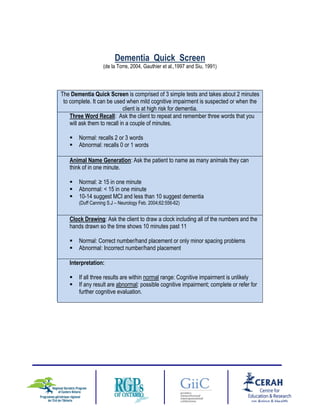
Dementia Quick Screen
(de la Torre, 2004, Gauthier et al.,1997 and Siu, 1991)
The Dementia Quick Screen is comprised of 3 simple tests and takes about 2 minutes
to complete. It can be used when mild cognitive impairment is suspected or when the
client is at high risk for dementia.
Three Word Recall: Ask the client to repeat and remember three words that you
will ask them to recall in a couple of minutes.
Normal: recalls 2 or 3 words
Abnormal: recalls 0 or 1 words
Animal Name Generation: Ask the patient to name as many animals they can
think of in one minute.
Normal: ≥ 15 in one minute
Abnormal: < 15 in one minute
10-14 suggest MCI and less than 10 suggest dementia
(Duff Canning S.J – Neurology Feb. 2004;62:556-62)
Clock Drawing: Ask the client to draw a clock including all of the numbers and the
hands drawn so the time shows 10 minutes past 11
Normal: Correct number/hand placement or only minor spacing problems
Abnormal: Incorrect number/hand placement
Interpretation:
If all three results are within normal range: Cognitive impairment is unlikely
If any result are abnormal: possible cognitive impairment; complete or refer for
further cognitive evaluation.
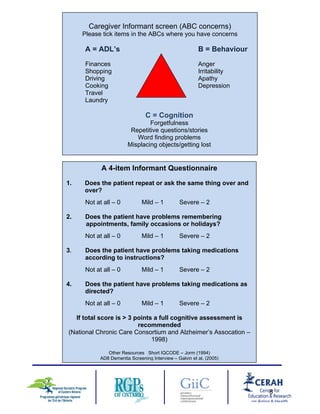
Caregiver Informant screen (ABC concerns)
Please tick items in the ABCs where you have concerns
A = ADL’s B = Behaviour
Finances Anger
Shopping Irritability
Driving Apathy
Cooking Depression
Travel
Laundry
C = Cognition
Forgetfulness
Repetitive questions/stories
Word finding problems
Misplacing objects/getting lost
A 4-item Informant Questionnaire
1. Does the patient repeat or ask the same thing over and
over?
Not at all – 0 Mild – 1 Severe – 2
2. Does the patient have problems remembering
appointments, family occasions or holidays?
Not at all – 0 Mild – 1 Severe – 2
3. Does the patient have problems taking medications
according to instructions?
Not at all – 0 Mild – 1 Severe – 2
4. Does the patient have problems taking medications as
directed?
Not at all – 0 Mild – 1 Severe – 2
If total score is > 3 points a full cognitive assessment is
recommended
(National Chronic Care Consortium and Alzheimer’s Assocation –
1998)
Other Resources Short IQCODE – Jorm (1994)
AD8 Dementia Screening Interview – Galvin et al. (2005)
6
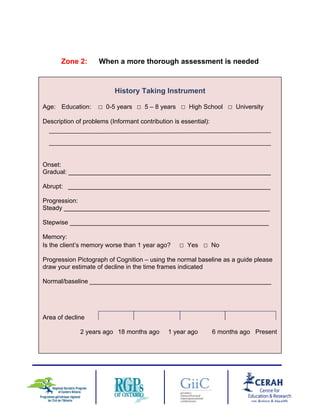
Zone 2: When a more thorough assessment is needed
History Taking Instrument
Age: Education: □ 0-5 years □ 5 – 8 years □ High School □ University
Description of problems (Informant contribution is essential):
Onset:
Gradual: __________________________________________________________
Abrupt: __________________________________________________________
Progression:
Steady ___________________________________________________________
Stepwise _________________________________________________________
Memory:
Is the client’s memory worse than 1 year ago? □ Yes □ No
Progression Pictograph of Cognition – using the normal baseline as a guide please
draw your estimate of decline in the time frames indicated
Normal/baseline ____________________________________________________
Area of decline
2 years ago 18 months ago 1 year ago 6 months ago Present
7
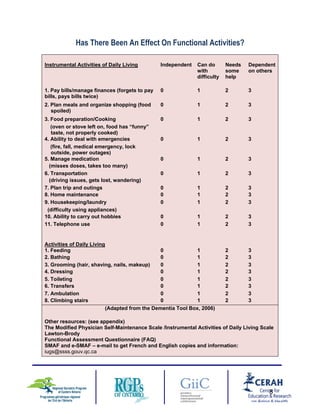
Has There Been An Effect On Functional Activities?
Instrumental Activities of Daily Living Independent Can do
with
difficulty
Needs
some
help
Dependent
on others
1. Pay bills/manage finances (forgets to pay
bills, pays bills twice)
0 1 2 3
2. Plan meals and organize shopping (food
spoiled)
0 1 2 3
3. Food preparation/Cooking 0 1 2 3
(oven or stove left on, food has “funny”
taste, not properly cooked)
4. Ability to deal with emergencies 0 1 2 3
(fire, fall, medical emergency, lock
outside, power outages)
5. Manage medication 0 1 2 3
(misses doses, takes too many)
6. Transportation 0 1 2 3
(driving issues, gets lost, wandering)
7. Plan trip and outings 0 1 2 3
8. Home maintenance 0 1 2 3
9. Housekeeping/laundry 0 1 2 3
(difficulty using appliances)
10. Ability to carry out hobbies 0 1 2 3
11. Telephone use 0 1 2 3
Activities of Daily Living
1. Feeding 0 1 2 3
2. Bathing 0 1 2 3
3. Grooming (hair, shaving, nails, makeup) 0 1 2 3
4. Dressing 0 1 2 3
5. Toileting 0 1 2 3
6. Transfers 0 1 2 3
7. Ambulation 0 1 2 3
8. Climbing stairs 0 1 2 3
(Adapted from the Dementia Tool Box, 2006)
Other resources: (see appendix)
The Modified Physician Self-Maintenance Scale /Instrumental Activities of Daily Living Scale
Lawton-Brody
Functional Assessment Questionnaire (FAQ)
SMAF and e-SMAF – e-mail to get French and English copies and information:
iugs@ssss.gouv.qc.ca
8
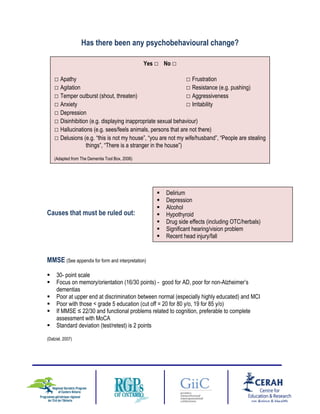
Has there been any psychobehavioural change?
Yes □ No □
□ Apathy □ Frustration
□ Agitation □ Resistance (e.g. pushing)
□ Temper outburst (shout, threaten) □ Aggressiveness
□ Anxiety □ Irritability
□ Depression
□ Disinhibition (e.g. displaying inappropriate sexual behaviour)
□ Hallucinations (e.g. sees/feels animals, persons that are not there)
□ Delusions (e.g. “this is not my house”, “you are not my wife/husband”, “People are stealing
things”, “There is a stranger in the house”)
(Adapted from The Dementia Tool Box, 2006)
Delirium
Depression
Alcohol
Hypothyroid
Drug side effects (including OTC/herbals)
Significant hearing/vision problem
Recent head injury/fall
Causes that must be ruled out:
MMSE (See appendix for form and interpretation)
30- point scale
Focus on memory/orientation (16/30 points) - good for AD, poor for non-Alzheimer’s
dementias
Poor at upper end at discrimination between normal (especially highly educated) and MCI
Poor with those < grade 5 education (cut off = 20 for 80 y/o, 19 for 85 y/o)
If MMSE ≤ 22/30 and functional problems related to cognition, preferable to complete
assessment with MoCA
Standard deviation (test/retest) is 2 points
(Dalziel, 2007)
9
MoCA (see appendix for form and interpretation)
Montreal Cognitive Assessment (MoCA),
a cognitive screening tool for detection of MCI
30-point scale
Available free of charge in multiple languages at www.mocatest.org
Comprehensive: Many more domains than MMSE (good for AD and non AD)
Minor: adjustment for education (add 1 point if ≤ grade 12)
MCI = MOCA <26
Using a cut-off score <26 provides sensitivity of 80%, and specificity of 91% to distinguish MCI
from normal
Much better discrimination between
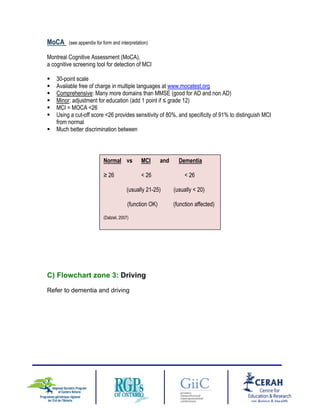
Normal vs MCI and Dementia
≥ 26 < 26 < 26
(usually 21-25) (usually < 20)
(function OK) (function affected)
(Dalziel, 2007)
C) Flowchart zone 3: Driving
Refer to dementia and driving
10
D) Flowchart zone 4: Diagnostic
Diagnosing is Family Physician’s role but could be supported by Interdisciplinary
Health Care Professional in disclosure of dementia diagnosis.
Why is it important to diagnose what type of dementia it is?
Different prognosis
Different treatment
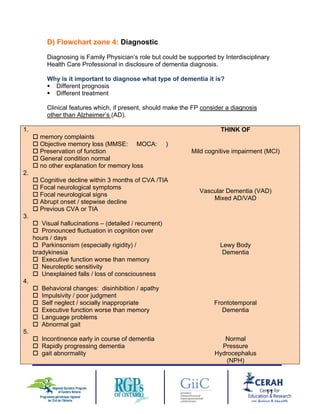
Clinical features which, if present, should make the FP consider a diagnosis
other than Alzheimer’s (AD).
1. THINK OF
memory complaints
Mild cognitive impairment (MCI)
Objective memory loss (MMSE: MOCA: )
Preservation of function
General condition normal
no other explanation for memory loss
2.
Cognitive decline within 3 months of CVA /TIA
Vascular Dementia (VAD)
Mixed AD/VAD
Focal neurological symptoms
Focal neurological signs
Abrupt onset / stepwise decline
Previous CVA or TIA
3.
Visual hallucinations – (detailed / recurrent)
Lewy Body
Dementia
Pronounced fluctuation in cognition over
hours / days
Parkinsonism (especially rigidity) /
bradykinesia
Executive function worse than memory
Neuroleptic sensitivity
Unexplained falls / loss of consciousness
4.
Behavioral changes: disinhibition / apathy
Frontotemporal
Dementia
Impulsivity / poor judgment
Self neglect / socially inappropriate
Executive function worse than memory
Language problems
Abnormal gait
5.
Incontinence early in course of dementia Normal
Pressure
Hydrocephalus
(NPH)
Rapidly progressing dementia
gait abnormality
11
E) Flowchart Zone 5: Treatment and Management
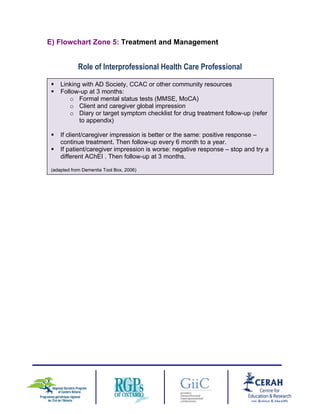
Role of Interprofessional Health Care Professional
Linking with AD Society, CCAC or other community resources
Follow-up at 3 months:
o Formal mental status tests (MMSE, MoCA)
o Client and caregiver global impression
o Diary or target symptom checklist for drug treatment follow-up (refer
to appendix)
If client/caregiver impression is better or the same: positive response –
continue treatment. Then follow-up every 6 month to a year.
If patient/caregiver impression is worse: negative response – stop and try a
different AChEI . Then follow-up at 3 months.
(adapted from Dementia Tool Box, 2006)
12
13
Bibliography
Canadian Consensus Conference on the Diagnosis and Treatment of Dementia (3rd) 2006.
Alzheimer's and Dementia. 2007; 3: 262-265.
Champlain Dementia Network Physician Education Committee. Dementia Toolbox: Dementia
Education for Family Physicians Program; 2006.
Canning Duff SJ et al. Diagnostic utility of abbreviated fluency measures in Alzheimer disease
and vascular dementia. Neurology. 2004; 62:556-62.
Dalziel WB. Vascular concept: vascular risk factors and AD. Canadian Review of Alzheimer’s
Disease and other Dementias. 2007;10 (2): 4-8.
Dalziel WB. Conference: Dementia, screening, early diagnosis and treatment (2007).
Dalziel WB. Workshop: Screening for cognitive impairment (2007).
De la Torre JC. Alzheimer Disease as a vascular disorder. Stroke. 2002; 31:1152-1162.
De la Torre JC. Is Alzheimer’s disease a neurolodegenerative or a vascular disorder? Data,
dogma and dialectics. Lancet Neurology. 2004;3: 184-190.
Folstein MF, Folstein SE, McHugh PR. Mini-Mental State. A practical method for grading the
cognitive state of patients for the clinician. Journal of Psychiatric Research. 1975; 12:189-198.
Galvin JE et al. The AD8, a brief informant interview to detect dementia. Neurology. 2005; 65:
559-564.
Gauthier SJ. Alzheimer disease: current knowledge, management and research. Canadian
Medical Association Journal. 1997; 157:1047-52.
Jorm AF. A short form of the Informant Questionnaire on Cognitive Decline in the Elderly
(IQCODE): Development and cross-validation. Psychological Medicine. 1994; 24:145-153.
Law M, Baum C, Dunn W. Measuring occupational performance. Thorofare: Slack; 2001.
Lawton, M.P., Brody E.M. Assessment of older people: self maintaining and instrumental
activities of daily living. Gerontologist. 1969; 9 (3): 179-186.
Nasreddine ZS. et al. The Montreal Cognitive Assessment, MoCA : A breif screening tool for mild
cognitive impairment. Journal of the American Geriatric Society. 2005; 53: 695 – 699.
Patterson CJS, Gass DA. Screening for cognitive impairment and dementia in the elderly.
Canadian Journal of Neurological Sciences. 2001;28 (suppl.1):3-16.
Peterson RS et al. Mild cognitive impairment. Archives of Neurology. 1999; 56 : 303-308.
Peterson, J.C. Practice parameter: early detection of dementia: mild cognitive impairment (an
evidence-based review). Report of the Quality Standards Subcommittee of the American
Academy of Neurology. Neurology .2001; 56 :133-42.
Pfeffer RI, Kurosaki TT, Harrah CH, et al. Measurement of functional activities of older adult in the
community. Journal of Gerontology. 1982; 37:323-9.
Siu A . Screening for dementia and investigating its causes. Annal of Internal Medicine.
1991;115:122-132.

Dementia screening and Assessment

  • 1.
    Dementia Screening andAssessment What is Dementia? Demonstrable impairment of memory A cognitive decline from a previous level of function Other impairment in at least one or more: Language (naming) Construction/visuospatial function Abstraction Judgment/frontal lobe function Personality Impairment is sufficient to interfere with function and activities of daily living. Insidious, and > 6 months What are the risk factors? (de la Torre, 2004) Unpreventable: Age <65: 1%, 65: 2%, 70: 4%, 75: 8%, 80: 16% 85: 32%, 90-94: 38% Family History- Risk doubles for each first degree relative Low education Previous CVA/MI Preventable: Vascular Risk Factors- Risk doubles for every vascular risk factor: Atrial fibrillation, Diabetes, Heart Disease MI/CAD, Hyperlipidemia, Hypertension, Stroke, Obesity, Smoking. The Silent Epidemic (Dalziel, 2007; Alzheimer Society) The facts … The prevalence of dementia in those over age 65 is 8% meaning that an average family physician’s practice has approximately 30 to 40 elderly patients with dementia (National Institute on Aging figures) A new case in Canada every 4 minutes (100,000 new cases per year) From 450,000 (now) to 750,000 (in 2025) 3rd most expensive disease in the Canadian Healthcare System 1 in 4 Canadians has a family member affected by the disease and half of all Canadians know someone diagnosed with Dementia 1
  • 2.
    Consensus Statements OnDementia Screening 1. Canadian Consensus Conference on Dementia: (Patterson: Can J Neuro Sci 2001; 28 (suppl. 1) S 3-16) Memory complaints should be evaluated and the followed to assess progression. Complaints should be considered very seriously if confirmed by caregivers/informants.. 2. American Academy of Neurology General cognitive screening instruments (e.g. MMSE) should be considered for the detection of dementia when used in patient populations with an elevated prevalence of cognitive impairment due to age or presence of memory dysfunction. (Peterson: Neurology 2001; 56: 133-42) Screening for asymptomatic conditions such as early cognitive impairment should be considered if the condition is common (8% in those over 65) and important (estimated cost over $6 billion). The positive predictive value of screening is much higher if the condition has high prevalence. (The Dementia Tool box: Education Resources for Family Physician, 2006) Don’t Delay Dementia Screening On average there is a delay of 2-3 years from first symptom to diagnosis Sometimes families delay recognition but if there are caregiver complaints, there should be high suspicion of dementia (96% specific) Be careful not to miss dementia because of lack of “complaints” (only 50% sensitive) (Dalziel, 2007) Studies show that by the time dementia is actually diagnosed, 55% of those diagnosed with dementia are BEYOND the mild stage. (Dalziel, 2007) 45% Mild 45% Moderate 10% Severe Benefits of early cognitive assessment (adapted from Dalziel, 2007) Social Benefits Medical Benefits Allows self determination Early caregiver education/potential lightening of caregiver burden Safety: compliance, driving, cooking Advance directives planning Better quality of life Social/financial planning Earlier identification of driving risk Reversible cause/component Risk factor treatment Compliance strategies Treatment of other diseases Earlier AChEI treatment Crisis avoidance 2
  • 3.
    Using the DementiaCare Flowchart The flowchart is divided into colored zones based on the overall process: Zone 1 Identifying those who need to be screened for dementia Zone 2 Cognitive assessment Zone 3 Driving assessment Zone 4 Diagnosing Zone 5 Treatment and management Zone 1: Identifying those who need to be screened for dementia Early Warning Signs Suggesting Cognitive Challenges (Adapted from the Dementia Tool box, 2006) Signs Caregivers Can Detect Signs Health Professionals Can Detect Difficulty performing familiar tasks Problems with language Disorientation of time and place poor and decreased judgment problems with abstract thinking Misplacing things changes in mood and behavior changes in personality loss of initiative memory loss affecting day-to- day function Frequent phone calls/appointments – missing/wrong day Poor historian, vague, seems “off, repetitive questions or stories Poor compliance meds/instructions Appearance/mood/personality/behaviour word-finding/decreased social interaction Subacute change in function without clear explanation/frequent visits to ER confusion - surgery/illness/meds weight loss/dwindles/ “failure to thrive” driving – accident/problems/tickets/family concerns Head turning sign (turning to caregiver for answer) 3
  • 4.
    Using the DementiaRisk Calculator The Dementia Risk Calculator Doubling Rule (de la Torre, 2004, Gauthier et al.,1997 and Siu, 1991) Risk doubles for every 5 years of age <65 years 1% 65 years 2% 70 years 4% 75 years 8% 80 years 16% 85 years 32% Each additional vascular risk factor approximately doubles the risk (One risk factor: risk multiplier is 2; 2 or more risk factors: risk multiplier is 4) Positive family history doubles the risk. (One family member: risk multiplier is 2; 2 or more family members: risk multiplier is 4) Overall risk = age risk _____% x family hx risk multiplier___x vascular risk multiplier ___= ___% 4
  • 5.
    5 Dementia Quick Screen (dela Torre, 2004, Gauthier et al.,1997 and Siu, 1991) The Dementia Quick Screen is comprised of 3 simple tests and takes about 2 minutes to complete. It can be used when mild cognitive impairment is suspected or when the client is at high risk for dementia. Three Word Recall: Ask the client to repeat and remember three words that you will ask them to recall in a couple of minutes. Normal: recalls 2 or 3 words Abnormal: recalls 0 or 1 words Animal Name Generation: Ask the patient to name as many animals they can think of in one minute. Normal: ≥ 15 in one minute Abnormal: < 15 in one minute 10-14 suggest MCI and less than 10 suggest dementia (Duff Canning S.J – Neurology Feb. 2004;62:556-62) Clock Drawing: Ask the client to draw a clock including all of the numbers and the hands drawn so the time shows 10 minutes past 11 Normal: Correct number/hand placement or only minor spacing problems Abnormal: Incorrect number/hand placement Interpretation: If all three results are within normal range: Cognitive impairment is unlikely If any result are abnormal: possible cognitive impairment; complete or refer for further cognitive evaluation.
  • 6.
    Caregiver Informant screen(ABC concerns) Please tick items in the ABCs where you have concerns A = ADL’s B = Behaviour Finances Anger Shopping Irritability Driving Apathy Cooking Depression Travel Laundry C = Cognition Forgetfulness Repetitive questions/stories Word finding problems Misplacing objects/getting lost A 4-item Informant Questionnaire 1. Does the patient repeat or ask the same thing over and over? Not at all – 0 Mild – 1 Severe – 2 2. Does the patient have problems remembering appointments, family occasions or holidays? Not at all – 0 Mild – 1 Severe – 2 3. Does the patient have problems taking medications according to instructions? Not at all – 0 Mild – 1 Severe – 2 4. Does the patient have problems taking medications as directed? Not at all – 0 Mild – 1 Severe – 2 If total score is > 3 points a full cognitive assessment is recommended (National Chronic Care Consortium and Alzheimer’s Assocation – 1998) Other Resources Short IQCODE – Jorm (1994) AD8 Dementia Screening Interview – Galvin et al. (2005) 6
  • 7.
    Zone 2: Whena more thorough assessment is needed History Taking Instrument Age: Education: □ 0-5 years □ 5 – 8 years □ High School □ University Description of problems (Informant contribution is essential): Onset: Gradual: __________________________________________________________ Abrupt: __________________________________________________________ Progression: Steady ___________________________________________________________ Stepwise _________________________________________________________ Memory: Is the client’s memory worse than 1 year ago? □ Yes □ No Progression Pictograph of Cognition – using the normal baseline as a guide please draw your estimate of decline in the time frames indicated Normal/baseline ____________________________________________________ Area of decline 2 years ago 18 months ago 1 year ago 6 months ago Present 7
  • 8.
    Has There BeenAn Effect On Functional Activities? Instrumental Activities of Daily Living Independent Can do with difficulty Needs some help Dependent on others 1. Pay bills/manage finances (forgets to pay bills, pays bills twice) 0 1 2 3 2. Plan meals and organize shopping (food spoiled) 0 1 2 3 3. Food preparation/Cooking 0 1 2 3 (oven or stove left on, food has “funny” taste, not properly cooked) 4. Ability to deal with emergencies 0 1 2 3 (fire, fall, medical emergency, lock outside, power outages) 5. Manage medication 0 1 2 3 (misses doses, takes too many) 6. Transportation 0 1 2 3 (driving issues, gets lost, wandering) 7. Plan trip and outings 0 1 2 3 8. Home maintenance 0 1 2 3 9. Housekeeping/laundry 0 1 2 3 (difficulty using appliances) 10. Ability to carry out hobbies 0 1 2 3 11. Telephone use 0 1 2 3 Activities of Daily Living 1. Feeding 0 1 2 3 2. Bathing 0 1 2 3 3. Grooming (hair, shaving, nails, makeup) 0 1 2 3 4. Dressing 0 1 2 3 5. Toileting 0 1 2 3 6. Transfers 0 1 2 3 7. Ambulation 0 1 2 3 8. Climbing stairs 0 1 2 3 (Adapted from the Dementia Tool Box, 2006) Other resources: (see appendix) The Modified Physician Self-Maintenance Scale /Instrumental Activities of Daily Living Scale Lawton-Brody Functional Assessment Questionnaire (FAQ) SMAF and e-SMAF – e-mail to get French and English copies and information: iugs@ssss.gouv.qc.ca 8
  • 9.
    Has there beenany psychobehavioural change? Yes □ No □ □ Apathy □ Frustration □ Agitation □ Resistance (e.g. pushing) □ Temper outburst (shout, threaten) □ Aggressiveness □ Anxiety □ Irritability □ Depression □ Disinhibition (e.g. displaying inappropriate sexual behaviour) □ Hallucinations (e.g. sees/feels animals, persons that are not there) □ Delusions (e.g. “this is not my house”, “you are not my wife/husband”, “People are stealing things”, “There is a stranger in the house”) (Adapted from The Dementia Tool Box, 2006) Delirium Depression Alcohol Hypothyroid Drug side effects (including OTC/herbals) Significant hearing/vision problem Recent head injury/fall Causes that must be ruled out: MMSE (See appendix for form and interpretation) 30- point scale Focus on memory/orientation (16/30 points) - good for AD, poor for non-Alzheimer’s dementias Poor at upper end at discrimination between normal (especially highly educated) and MCI Poor with those < grade 5 education (cut off = 20 for 80 y/o, 19 for 85 y/o) If MMSE ≤ 22/30 and functional problems related to cognition, preferable to complete assessment with MoCA Standard deviation (test/retest) is 2 points (Dalziel, 2007) 9
  • 10.
    MoCA (see appendixfor form and interpretation) Montreal Cognitive Assessment (MoCA), a cognitive screening tool for detection of MCI 30-point scale Available free of charge in multiple languages at www.mocatest.org Comprehensive: Many more domains than MMSE (good for AD and non AD) Minor: adjustment for education (add 1 point if ≤ grade 12) MCI = MOCA <26 Using a cut-off score <26 provides sensitivity of 80%, and specificity of 91% to distinguish MCI from normal Much better discrimination between Normal vs MCI and Dementia ≥ 26 < 26 < 26 (usually 21-25) (usually < 20) (function OK) (function affected) (Dalziel, 2007) C) Flowchart zone 3: Driving Refer to dementia and driving 10
  • 11.
    D) Flowchart zone4: Diagnostic Diagnosing is Family Physician’s role but could be supported by Interdisciplinary Health Care Professional in disclosure of dementia diagnosis. Why is it important to diagnose what type of dementia it is? Different prognosis Different treatment Clinical features which, if present, should make the FP consider a diagnosis other than Alzheimer’s (AD). 1. THINK OF memory complaints Mild cognitive impairment (MCI) Objective memory loss (MMSE: MOCA: ) Preservation of function General condition normal no other explanation for memory loss 2. Cognitive decline within 3 months of CVA /TIA Vascular Dementia (VAD) Mixed AD/VAD Focal neurological symptoms Focal neurological signs Abrupt onset / stepwise decline Previous CVA or TIA 3. Visual hallucinations – (detailed / recurrent) Lewy Body Dementia Pronounced fluctuation in cognition over hours / days Parkinsonism (especially rigidity) / bradykinesia Executive function worse than memory Neuroleptic sensitivity Unexplained falls / loss of consciousness 4. Behavioral changes: disinhibition / apathy Frontotemporal Dementia Impulsivity / poor judgment Self neglect / socially inappropriate Executive function worse than memory Language problems Abnormal gait 5. Incontinence early in course of dementia Normal Pressure Hydrocephalus (NPH) Rapidly progressing dementia gait abnormality 11
  • 12.
    E) Flowchart Zone5: Treatment and Management Role of Interprofessional Health Care Professional Linking with AD Society, CCAC or other community resources Follow-up at 3 months: o Formal mental status tests (MMSE, MoCA) o Client and caregiver global impression o Diary or target symptom checklist for drug treatment follow-up (refer to appendix) If client/caregiver impression is better or the same: positive response – continue treatment. Then follow-up every 6 month to a year. If patient/caregiver impression is worse: negative response – stop and try a different AChEI . Then follow-up at 3 months. (adapted from Dementia Tool Box, 2006) 12
  • 13.
    13 Bibliography Canadian Consensus Conferenceon the Diagnosis and Treatment of Dementia (3rd) 2006. Alzheimer's and Dementia. 2007; 3: 262-265. Champlain Dementia Network Physician Education Committee. Dementia Toolbox: Dementia Education for Family Physicians Program; 2006. Canning Duff SJ et al. Diagnostic utility of abbreviated fluency measures in Alzheimer disease and vascular dementia. Neurology. 2004; 62:556-62. Dalziel WB. Vascular concept: vascular risk factors and AD. Canadian Review of Alzheimer’s Disease and other Dementias. 2007;10 (2): 4-8. Dalziel WB. Conference: Dementia, screening, early diagnosis and treatment (2007). Dalziel WB. Workshop: Screening for cognitive impairment (2007). De la Torre JC. Alzheimer Disease as a vascular disorder. Stroke. 2002; 31:1152-1162. De la Torre JC. Is Alzheimer’s disease a neurolodegenerative or a vascular disorder? Data, dogma and dialectics. Lancet Neurology. 2004;3: 184-190. Folstein MF, Folstein SE, McHugh PR. Mini-Mental State. A practical method for grading the cognitive state of patients for the clinician. Journal of Psychiatric Research. 1975; 12:189-198. Galvin JE et al. The AD8, a brief informant interview to detect dementia. Neurology. 2005; 65: 559-564. Gauthier SJ. Alzheimer disease: current knowledge, management and research. Canadian Medical Association Journal. 1997; 157:1047-52. Jorm AF. A short form of the Informant Questionnaire on Cognitive Decline in the Elderly (IQCODE): Development and cross-validation. Psychological Medicine. 1994; 24:145-153. Law M, Baum C, Dunn W. Measuring occupational performance. Thorofare: Slack; 2001. Lawton, M.P., Brody E.M. Assessment of older people: self maintaining and instrumental activities of daily living. Gerontologist. 1969; 9 (3): 179-186. Nasreddine ZS. et al. The Montreal Cognitive Assessment, MoCA : A breif screening tool for mild cognitive impairment. Journal of the American Geriatric Society. 2005; 53: 695 – 699. Patterson CJS, Gass DA. Screening for cognitive impairment and dementia in the elderly. Canadian Journal of Neurological Sciences. 2001;28 (suppl.1):3-16. Peterson RS et al. Mild cognitive impairment. Archives of Neurology. 1999; 56 : 303-308. Peterson, J.C. Practice parameter: early detection of dementia: mild cognitive impairment (an evidence-based review). Report of the Quality Standards Subcommittee of the American Academy of Neurology. Neurology .2001; 56 :133-42. Pfeffer RI, Kurosaki TT, Harrah CH, et al. Measurement of functional activities of older adult in the community. Journal of Gerontology. 1982; 37:323-9. Siu A . Screening for dementia and investigating its causes. Annal of Internal Medicine. 1991;115:122-132.