ETATMBA Module 5
Evidence-Based Medicine in
Clinical Practice.
Dr. Harry Gee
Dr. Chisale Mhango
ETATMBA Module 5
"Every intervention is a two-
edged sword."
Iain Chalmers
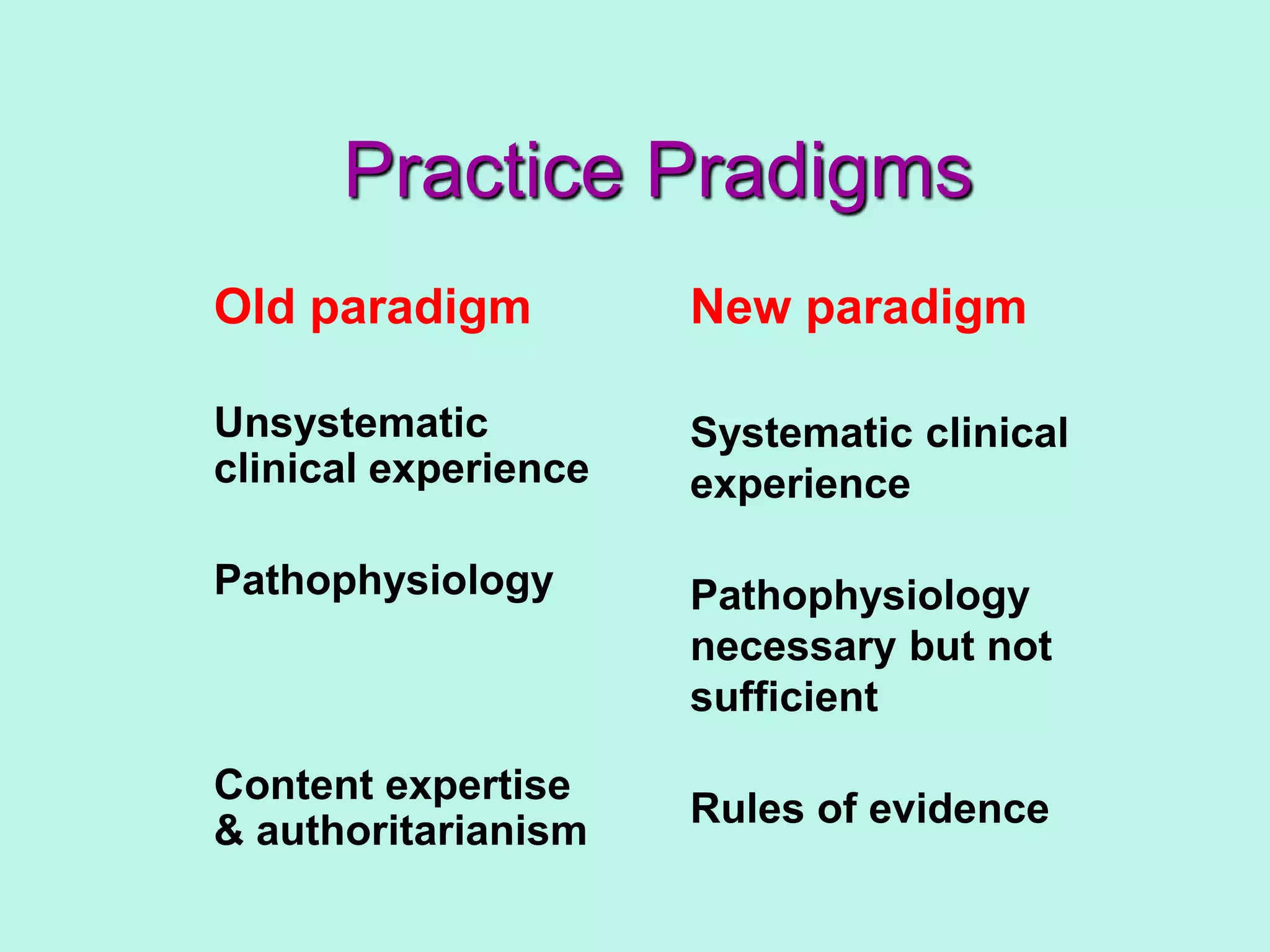
Old paradigm
Unsystematic
clinical experience
Pathophysiology
Content expertise
& authoritarianism
New paradigm
Systematic clinical
experience
Pathophysiology
necessary but not
sufficient
Rules of evidence
Practice Pradigms
ETATMBA Module 5
Pre-Requisites
• Questioning
– The Knowledge Gap
– Honesty
– Humility
– Discerning
• What is merely custom and
practice?
• Desire for Improvement
ETATMBA Module 5
Our Aims
• Understand EBM
– What is it?
– Why do we need it?
– What are the benefits?
– Who benefits?
ETATMBA Module 5
Our Objectives
The key steps:
– Formulate a clinical question
– Search the literature
• Efficiently
• Confidently
– Appraise the evidence
– Apply the evidence
ETATMBA Module 5
What is EBM?
ETATMBA Module 5
Good Clinical Practice
• Knowledge from best external evidence
based on clinical research
• Judgement from experience.
• Understanding of patient's beliefs &
preferences.
Sackett 1996
ETATMBA Module 5
Who Benefits?
ETATMBA Module 5
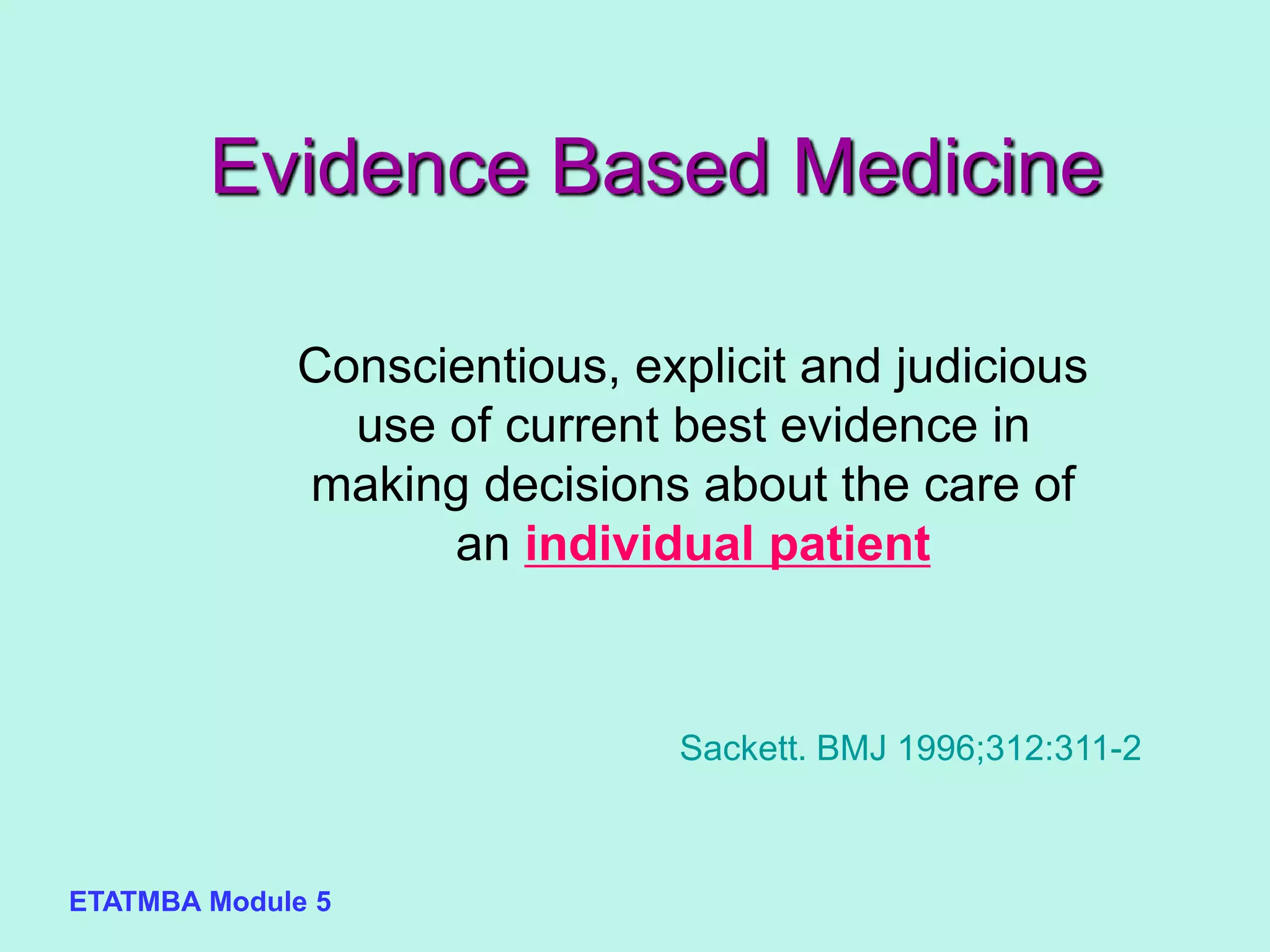
Evidence Based Medicine
Conscientious, explicit and judicious
use of current best evidence in
making decisions about the care of
an individual patient
Sackett. BMJ 1996;312:311-2
ETATMBA Module 5
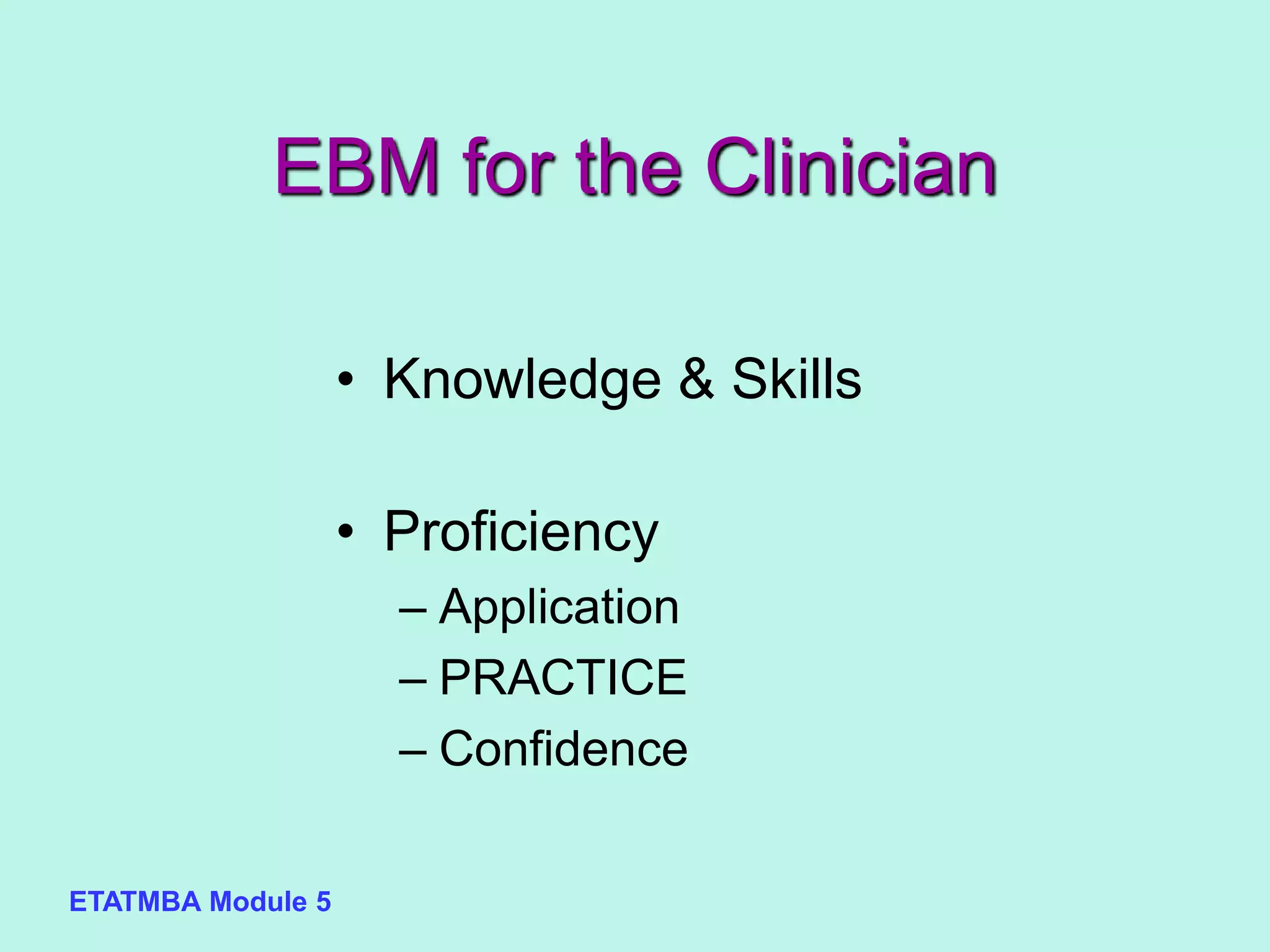
EBM for the Clinician
• Knowledge & Skills
• Proficiency
– Application
– PRACTICE
– Confidence
ETATMBA Module 5
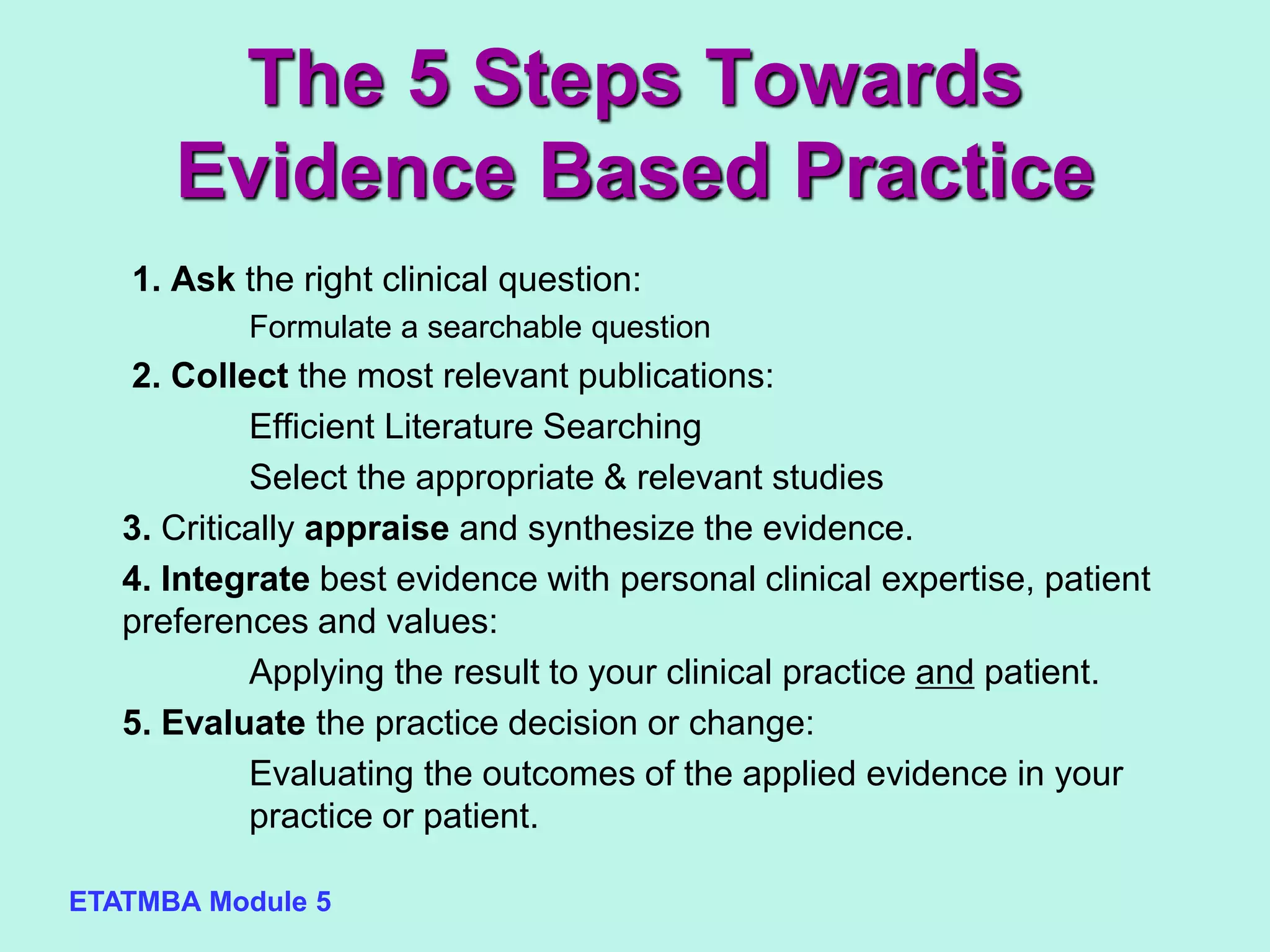
The 5 Steps Towards
Evidence Based Practice
1. Ask the right clinical question:
Formulate a searchable question
2. Collect the most relevant publications:
Efficient Literature Searching
Select the appropriate & relevant studies
3. Critically appraise and synthesize the evidence.
4. Integrate best evidence with personal clinical expertise, patient
preferences and values:
Applying the result to your clinical practice and patient.
5. Evaluate the practice decision or change:
Evaluating the outcomes of the applied evidence in your
practice or patient.
ETATMBA Module 5
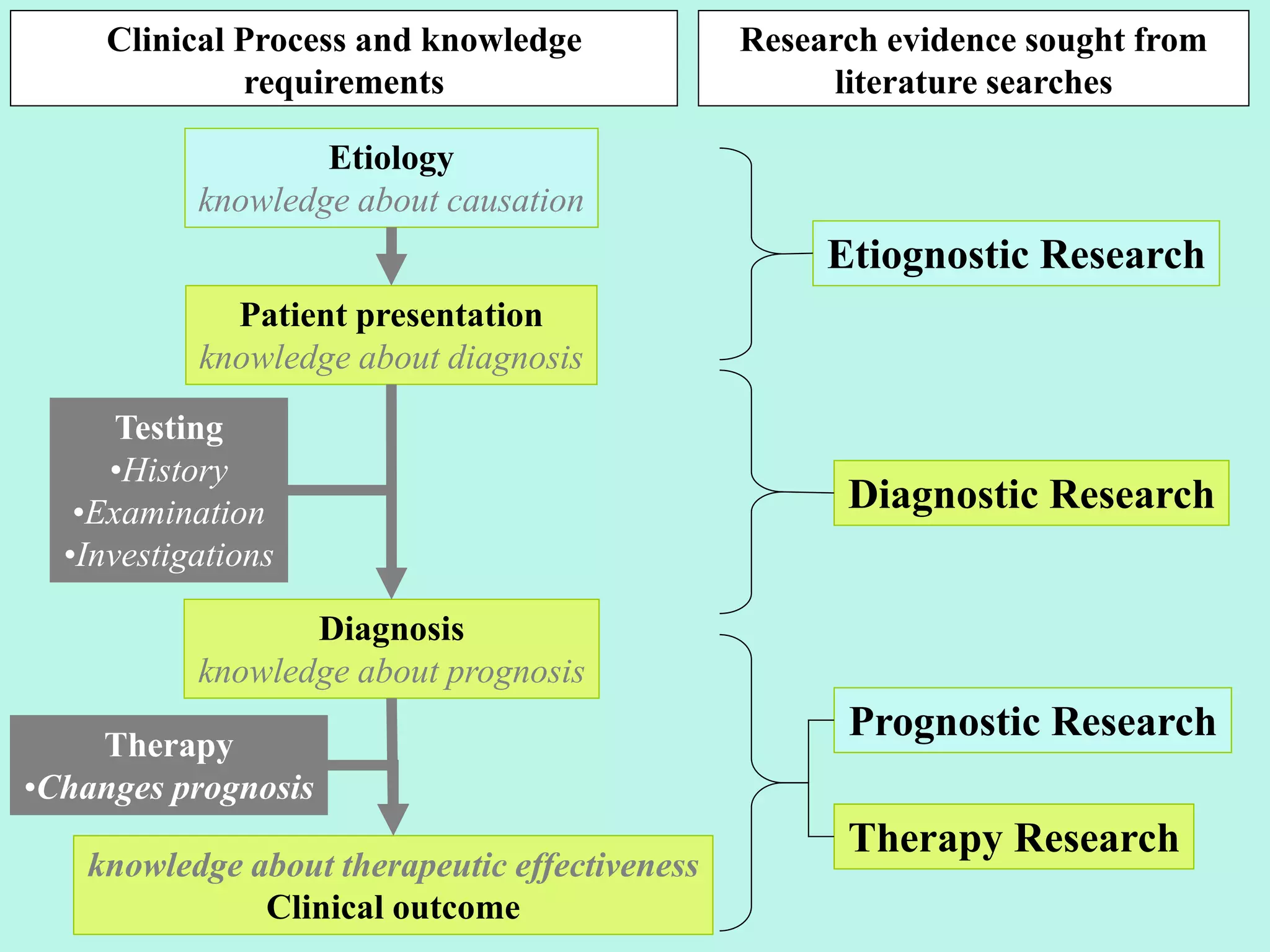
Asking the Right Questions
Patient presentation
knowledge about diagnosis
Testing
•History
•Examination
•Investigations
Diagnosis
knowledge about prognosis
Therapy
•Changes prognosis
knowledge about therapeutic effectiveness
Clinical outcome
Etiology
knowledge about causation
Research evidence sought from
literature searches
Clinical Process and knowledge
requirements
Etiognostic Research
Diagnostic Research
Prognostic Research
Therapy Research
ETATMBA Module 5
•A good answerable question will help us focus
on evidence that is relevant to a patient’s clinical
needs, (or your own knowledge needs).
•They can suggest high yield search strategies
•They can suggest the forms that useful answers
might take (i.e. what is best research design to
answer our question)
The Question - Why is it so
Important?
ETATMBA Module 5
• There is no right or wrong way to turn a
scenario/knowledge need into a question.
• Just make sure it is concise, clinical and uses
appropriate language (avoid colloquialism, in
favour of technical language).
• Ask one question at a time.
Formulating Clinical
Questions
ETATMBA Module 5
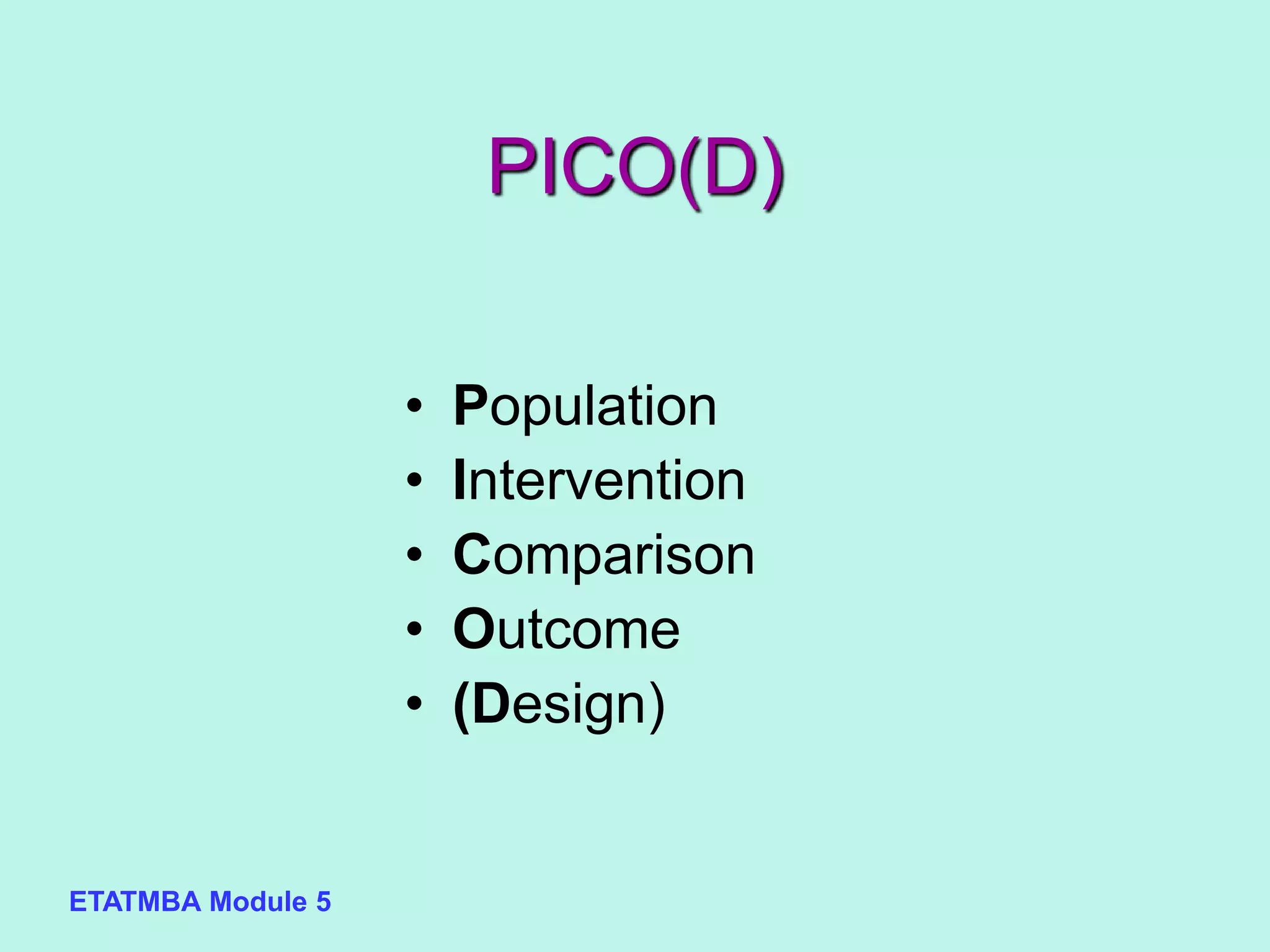
PICO(D)
• Population
• Intervention
• Comparison
• Outcome
• (Design)
ETATMBA Module 5
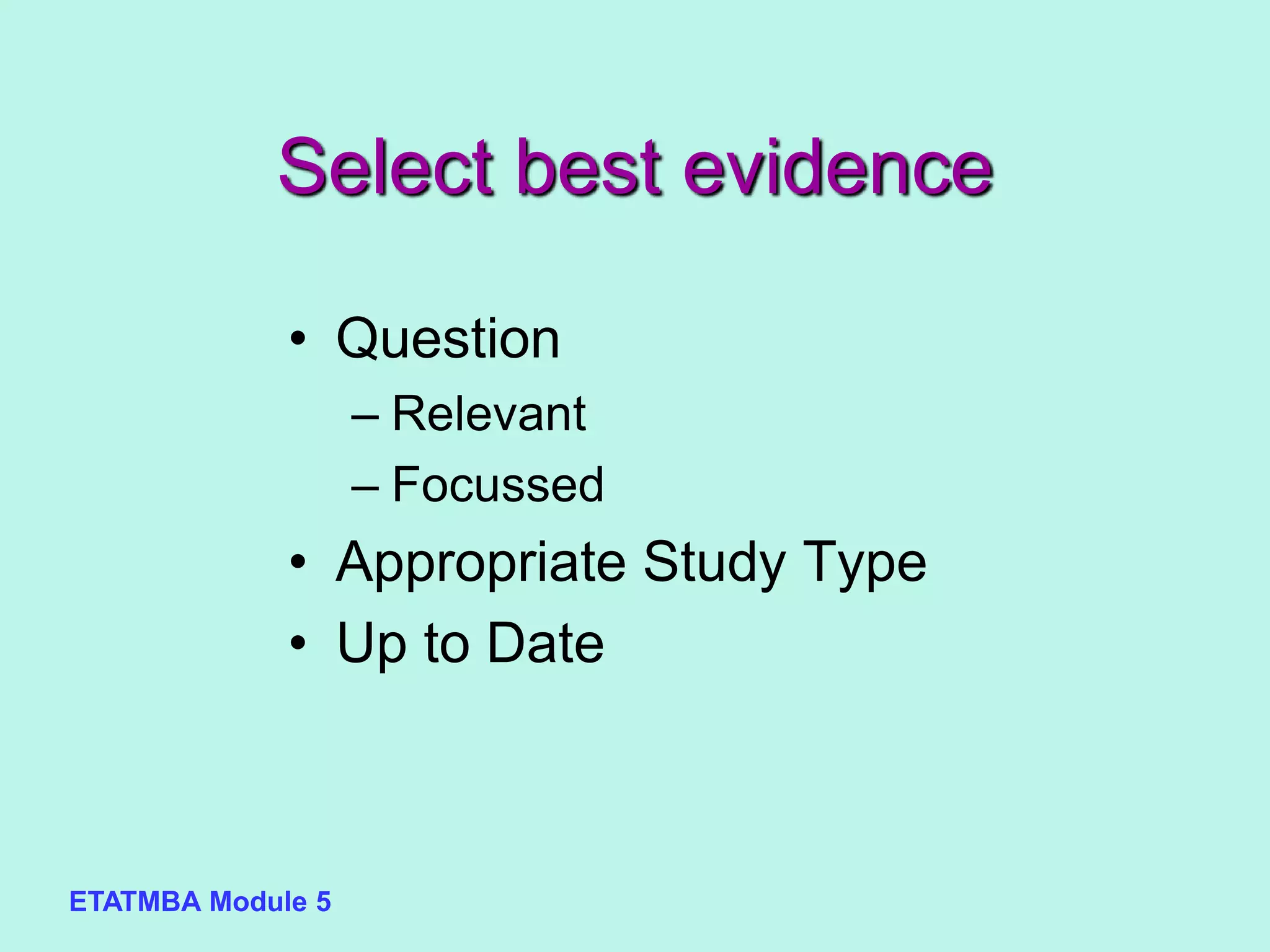
Select best evidence
• Question
– Relevant
– Focussed
• Appropriate Study Type
• Up to Date
ETATMBA Module 5
Research Study Design
ETATMBA Module 5
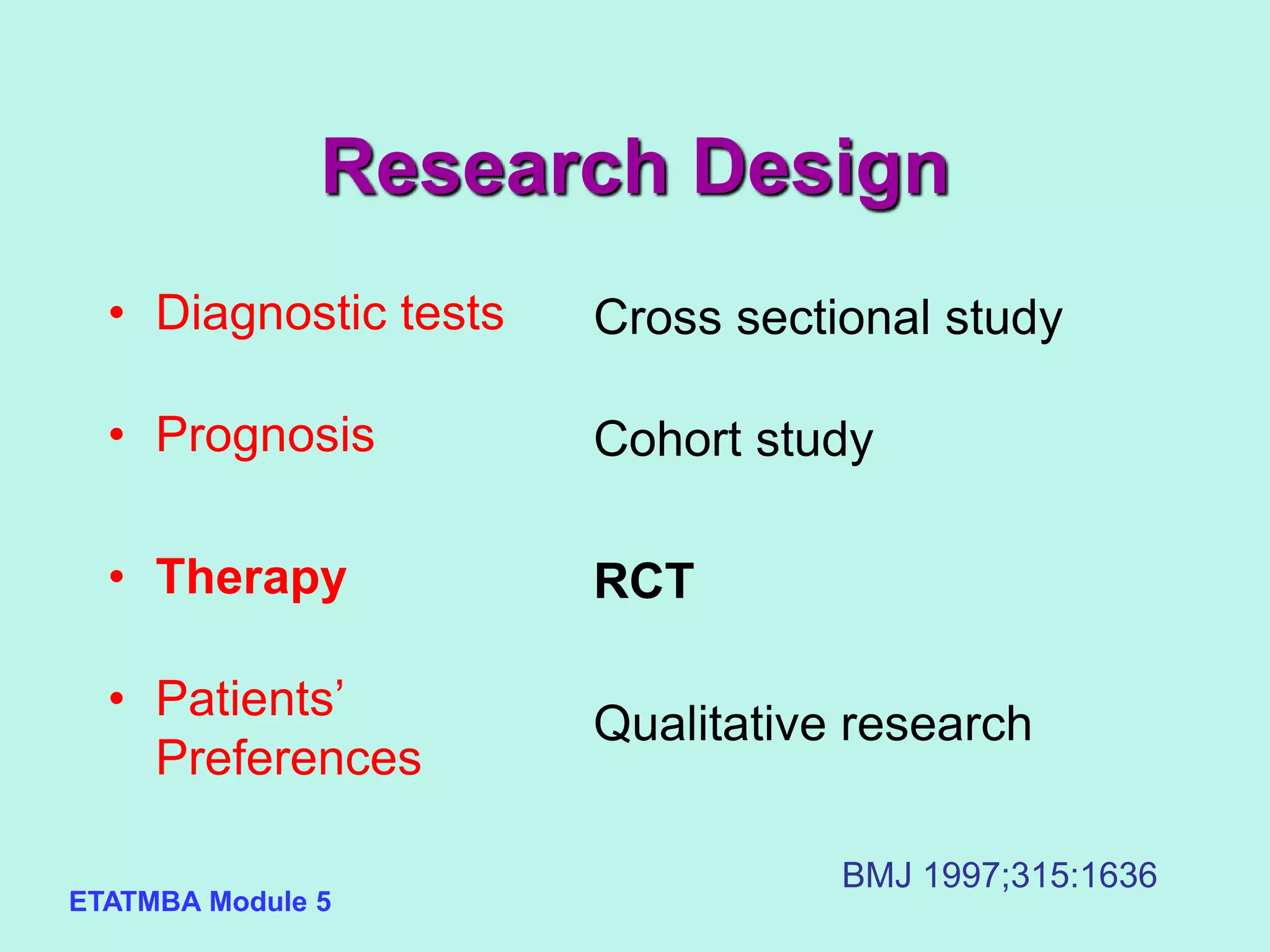
Research Design
• Diagnostic tests
• Prognosis
• Therapy
• Patients’
Preferences
Cross sectional study
Cohort study
RCT
Qualitative research
BMJ 1997;315:1636
ETATMBA Module 5
What resources could be
searched?
ETATMBA Module 5
Why Should We Be Critical
in Our Reading of the
Literature?
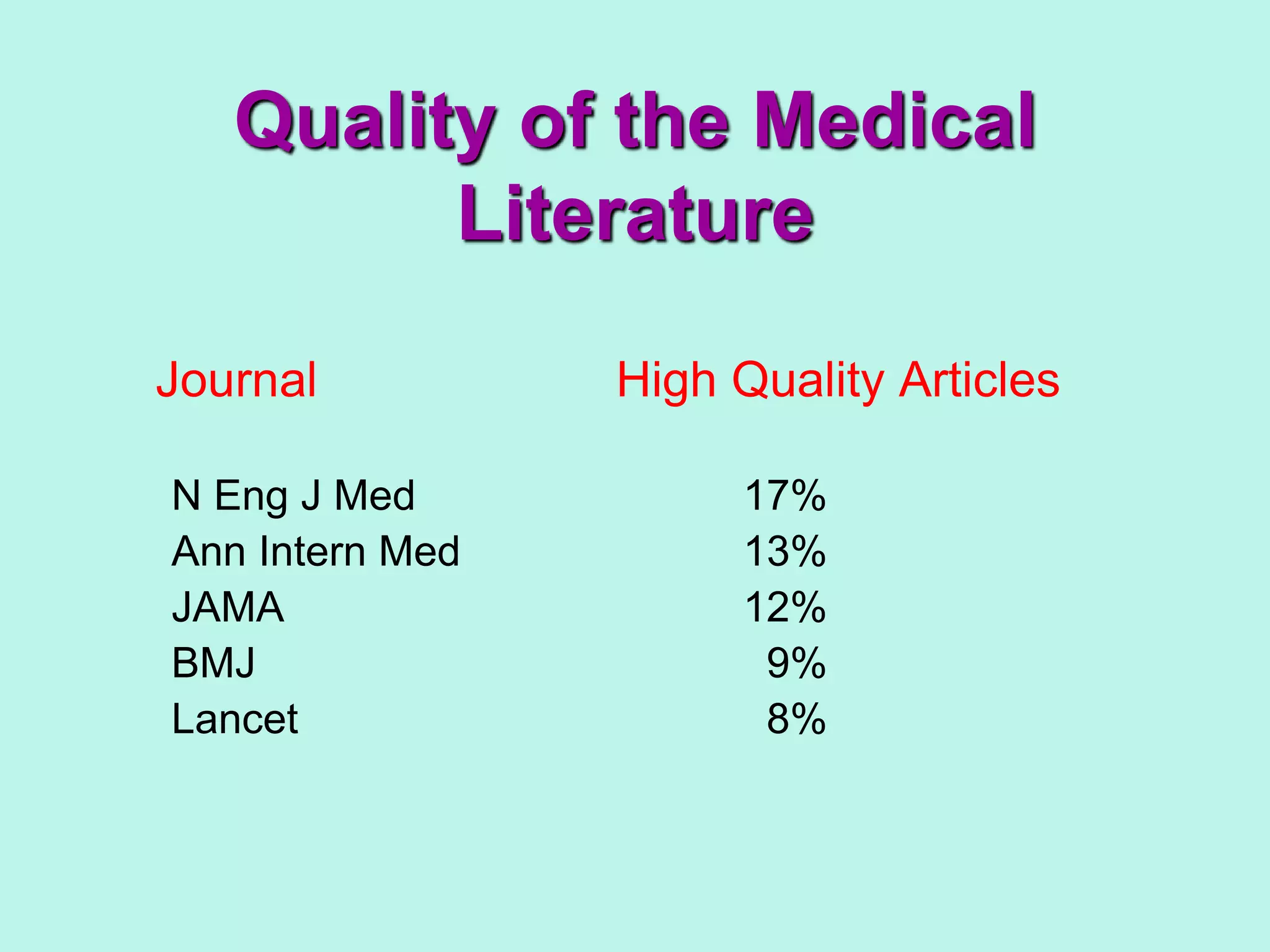
Journal High Quality Articles
N Eng J Med 17%
Ann Intern Med 13%
JAMA 12%
BMJ 9%
Lancet 8%
Quality of the Medical
Literature
ETATMBA Module 5
What do we mean by
Research Quality?
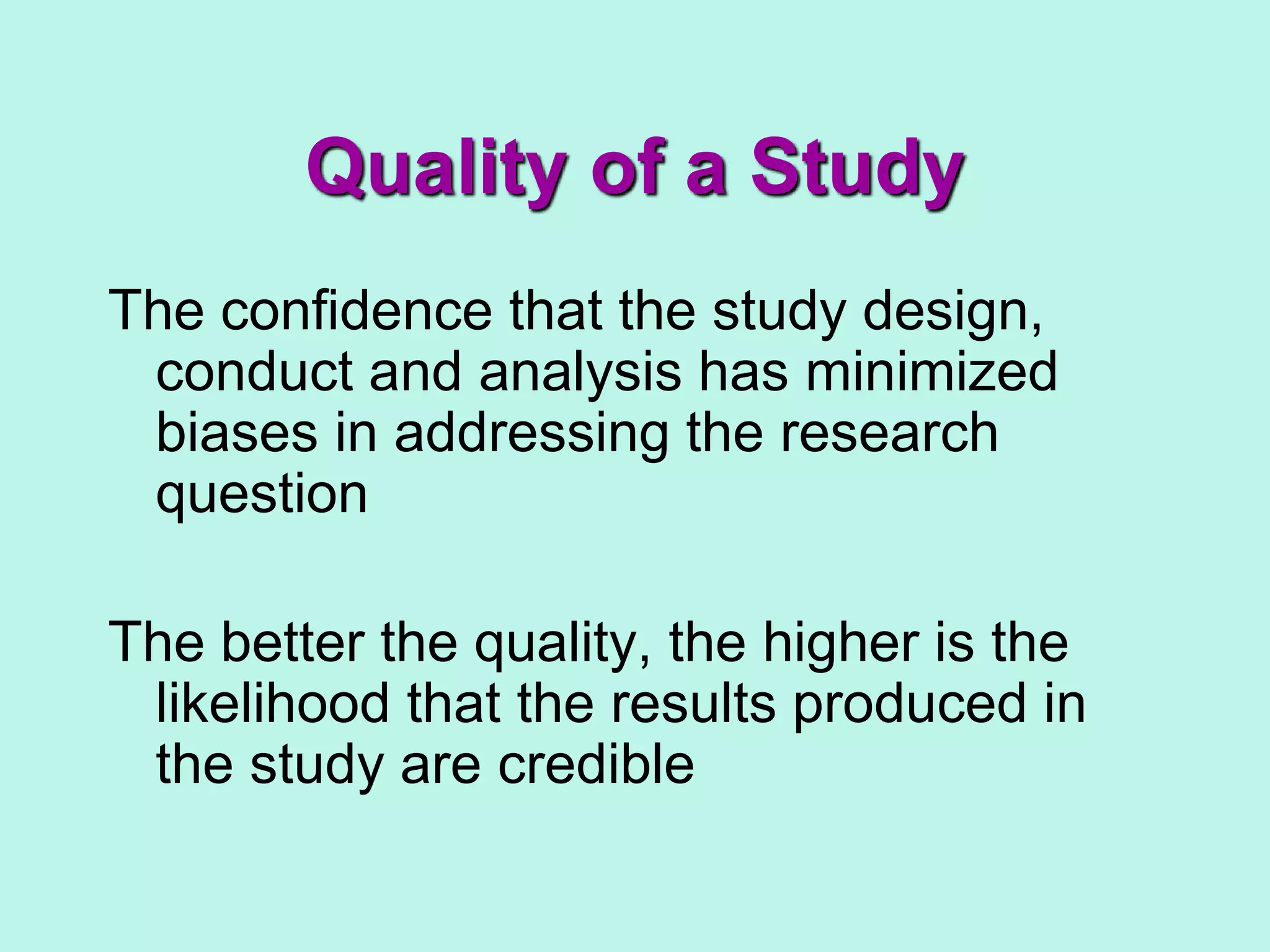
Quality of a Study
The confidence that the study design,
conduct and analysis has minimized
biases in addressing the research
question
The better the quality, the higher is the
likelihood that the results produced in
the study are credible
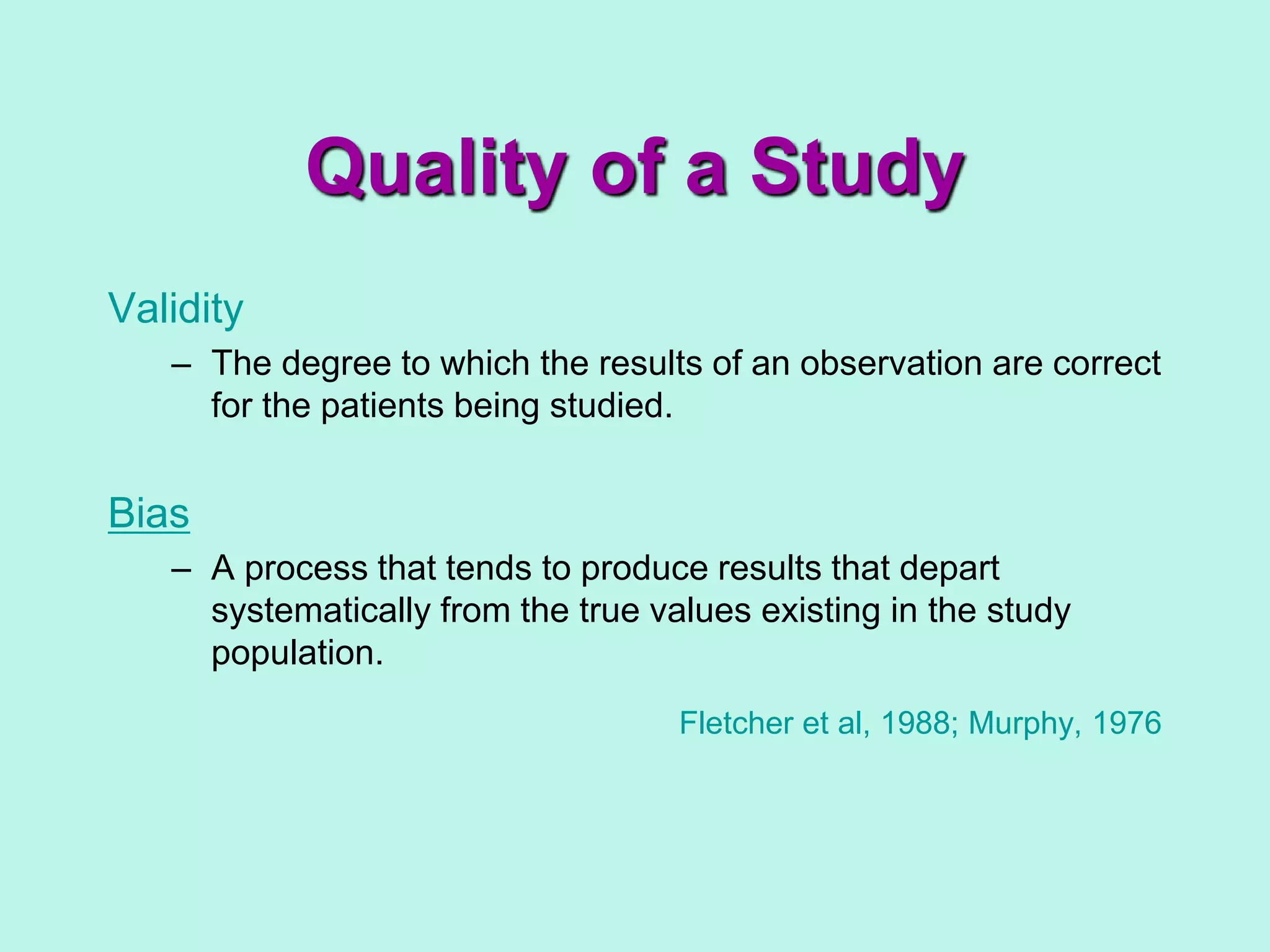
Validity
– The degree to which the results of an observation are correct
for the patients being studied.
Bias
– A process that tends to produce results that depart
systematically from the true values existing in the study
population.
Fletcher et al, 1988; Murphy, 1976
Quality of a Study
ETATMBA Module 5
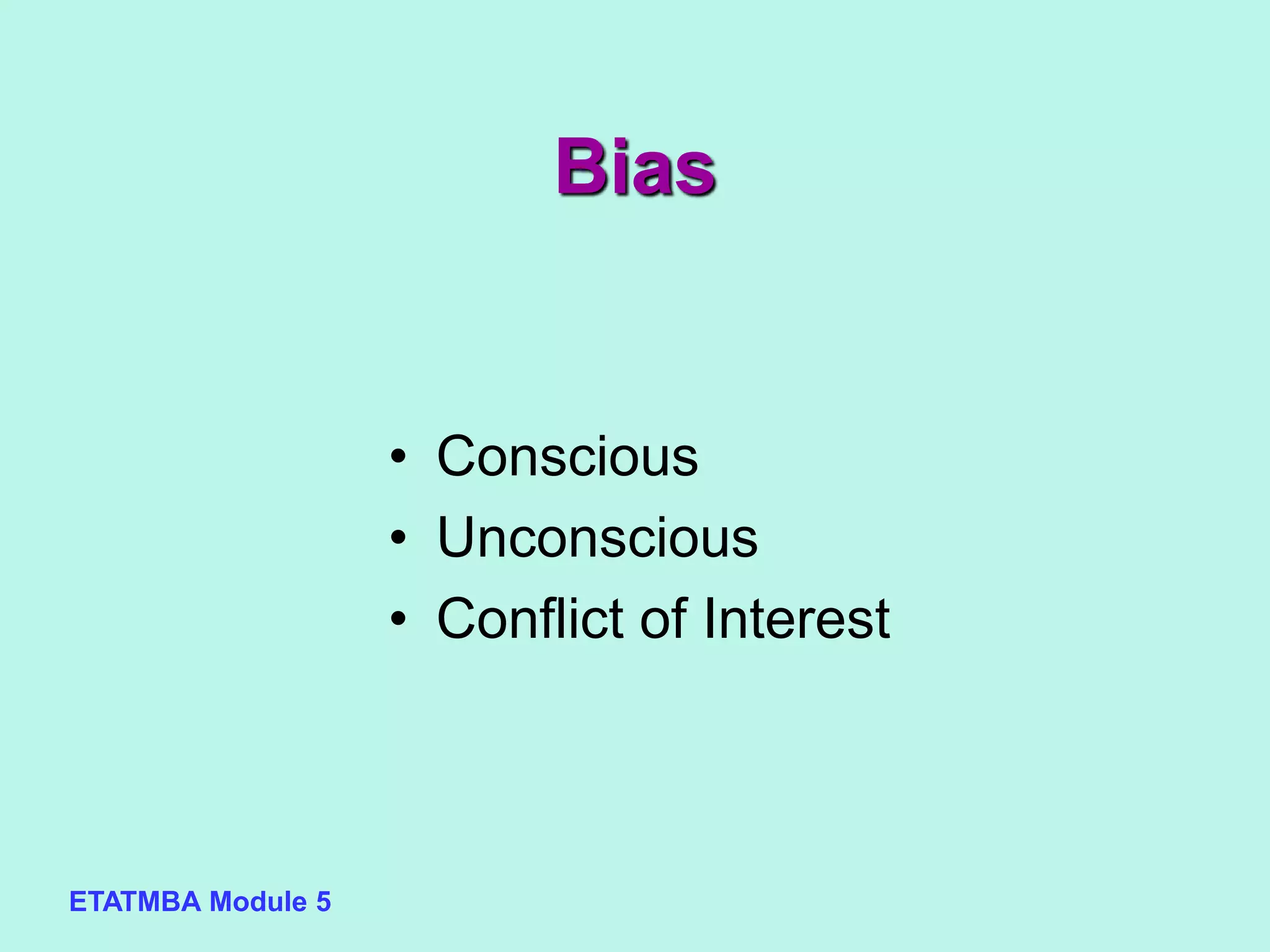
Bias
• Conscious
• Unconscious
• Conflict of Interest
ETATMBA Module 5
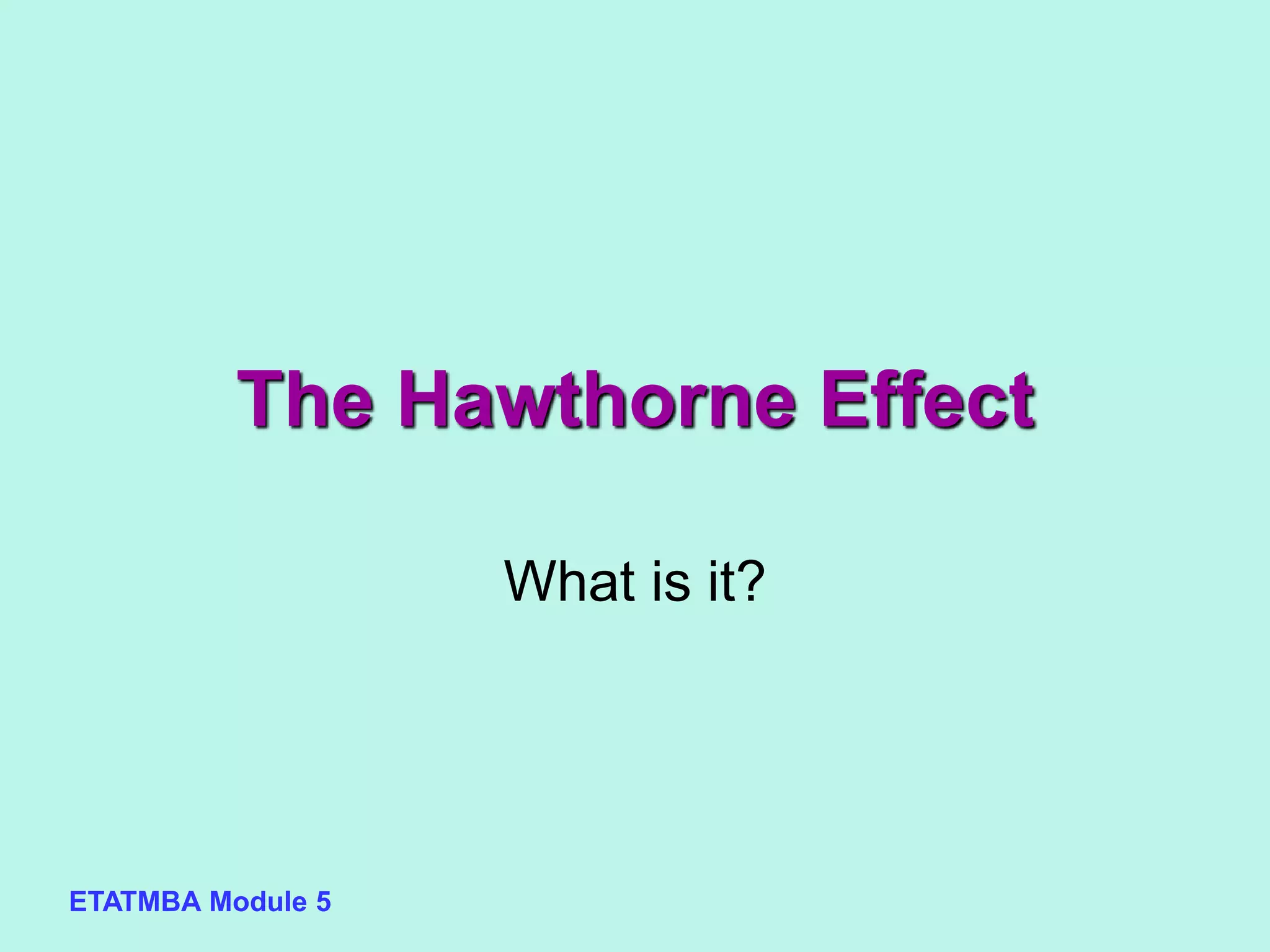
The Hawthorne Effect
What is it?
ETATMBA Module 5
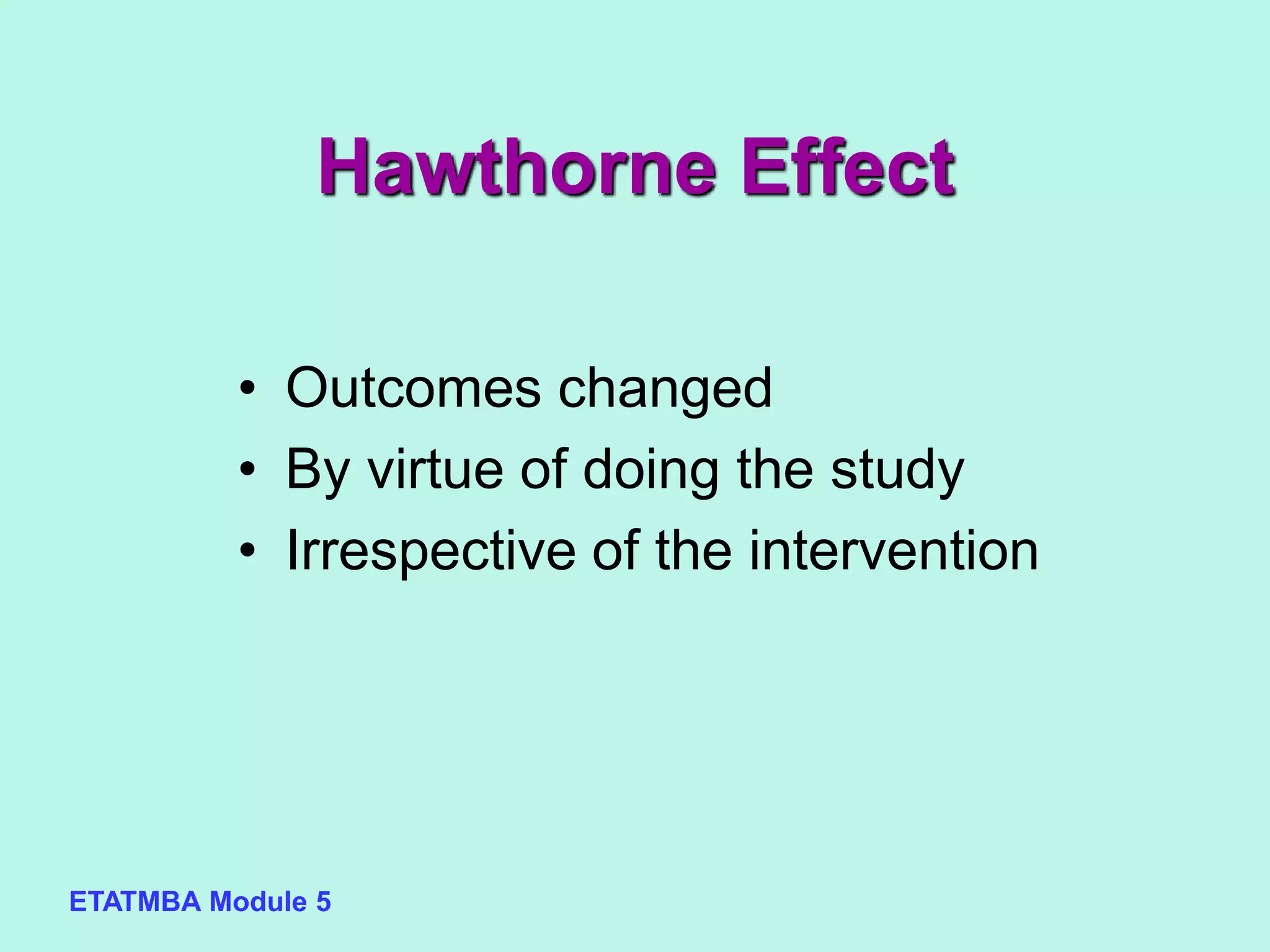
Hawthorne Effect
• Outcomes changed
• By virtue of doing the study
• Irrespective of the intervention
ETATMBA Module 5
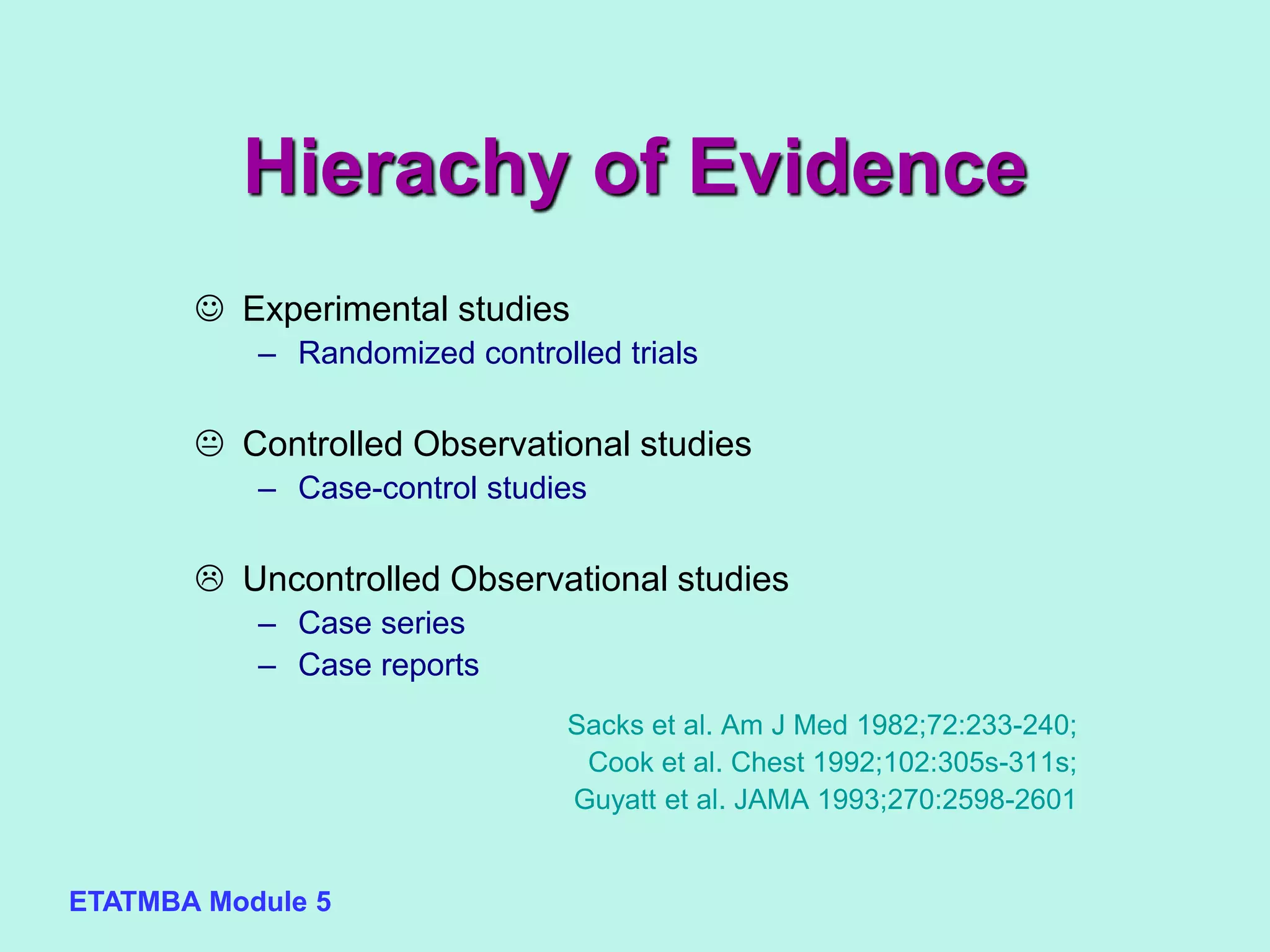
 Experimental studies
– Randomized controlled trials
 Controlled Observational studies
– Case-control studies
 Uncontrolled Observational studies
– Case series
– Case reports
Sacks et al. Am J Med 1982;72:233-240;
Cook et al. Chest 1992;102:305s-311s;
Guyatt et al. JAMA 1993;270:2598-2601
Hierachy of Evidence
ETATMBA Module 5
EBM Basic Skills
• Formulate structured clinical question
• PICO(D)
• Search for evidence
• Systematic
• Select best evidence
• Critically appraise
•GATE Frame
•RAMMbo
•CASP
•CAT maker
ETATMBA Module 5
AT-A-GLANCE
• Acronym
• Title
• Aim
• Groups
• Limbs – Intervention v Comparator
• Absolute Risk Reduction
• Number Needed to Treat (NNT)
• Clinical Conclusion
• Education for patients/carers
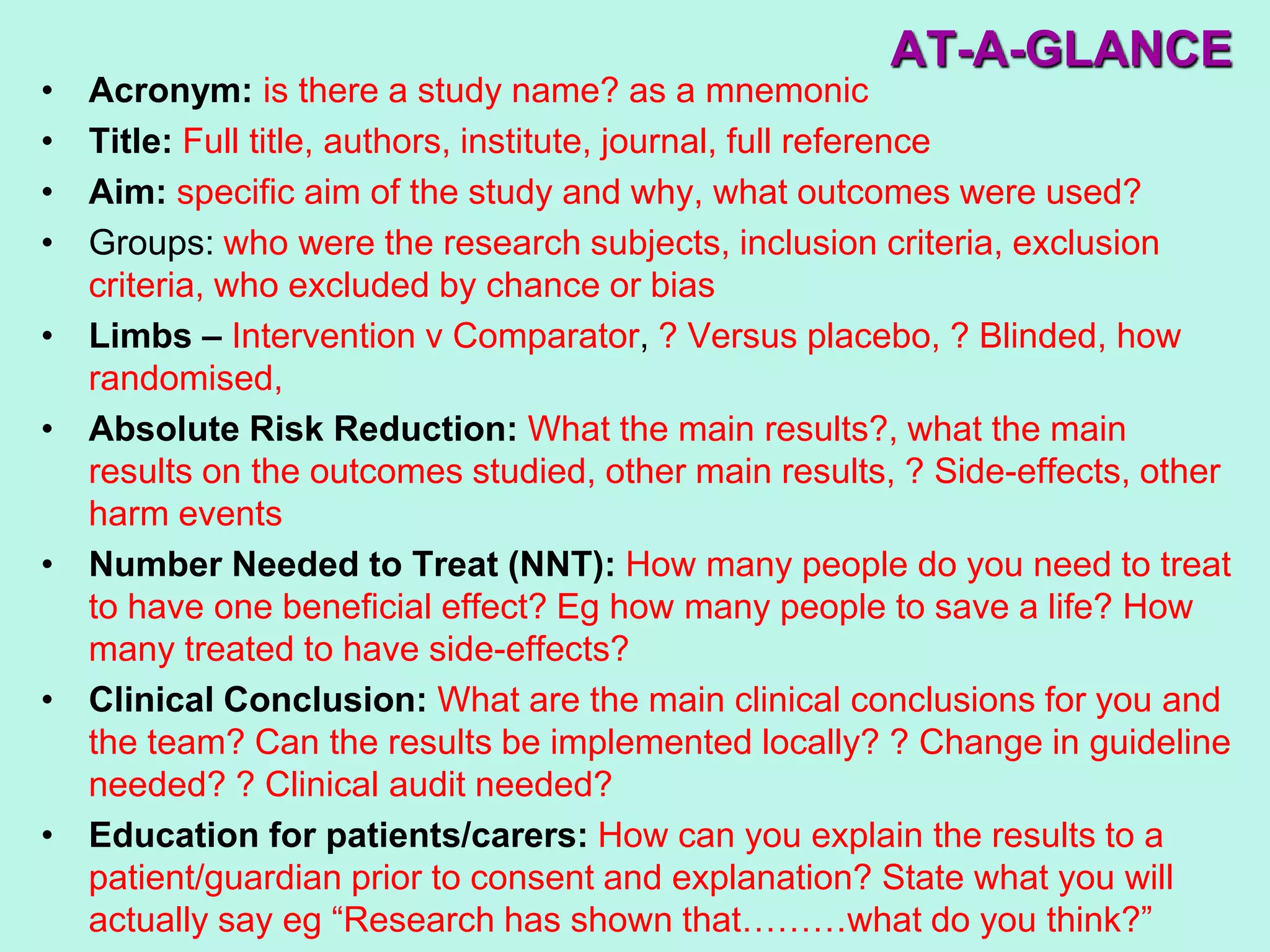
AT-A-GLANCE
• Acronym: is there a study name? as a mnemonic
• Title: Full title, authors, institute, journal, full reference
• Aim: specific aim of the study and why, what outcomes were used?
• Groups: who were the research subjects, inclusion criteria, exclusion
criteria, who excluded by chance or bias
• Limbs – Intervention v Comparator, ? Versus placebo, ? Blinded, how
randomised,
• Absolute Risk Reduction: What the main results?, what the main
results on the outcomes studied, other main results, ? Side-effects, other
harm events
• Number Needed to Treat (NNT): How many people do you need to treat
to have one beneficial effect? Eg how many people to save a life? How
many treated to have side-effects?
• Clinical Conclusion: What are the main clinical conclusions for you and
the team? Can the results be implemented locally? ? Change in guideline
needed? ? Clinical audit needed?
• Education for patients/carers: How can you explain the results to a
patient/guardian prior to consent and explanation? State what you will
actually say eg “Research has shown that………what do you think?”
ETATMBA Module 5
Guidelines
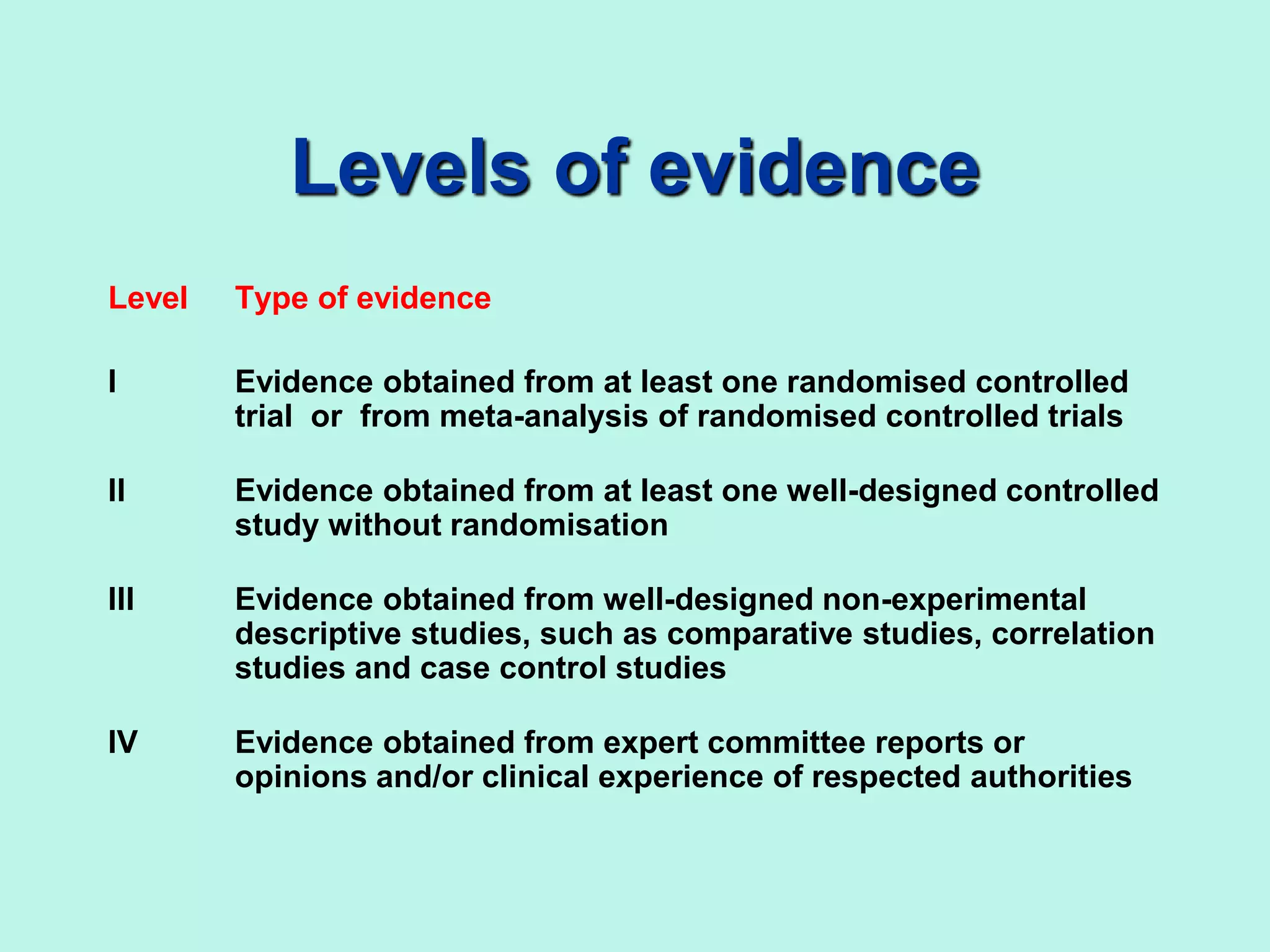
Levels of evidence
Level Type of evidence
I Evidence obtained from at least one randomised controlled
trial or from meta-analysis of randomised controlled trials
II Evidence obtained from at least one well-designed controlled
study without randomisation
III Evidence obtained from well-designed non-experimental
descriptive studies, such as comparative studies, correlation
studies and case control studies
IV Evidence obtained from expert committee reports or
opinions and/or clinical experience of respected authorities
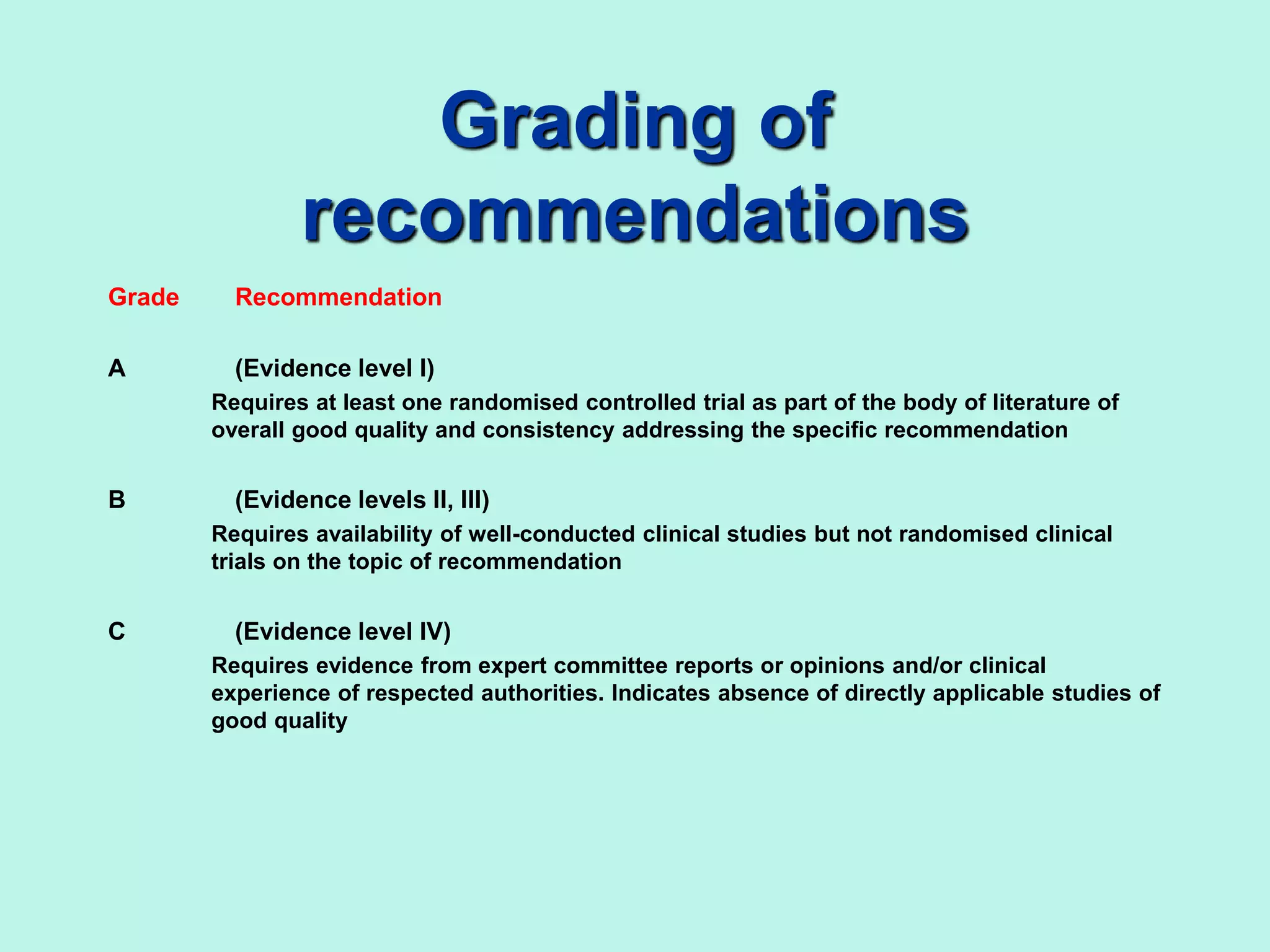
Grading of
recommendations
Grade Recommendation
A (Evidence level I)
Requires at least one randomised controlled trial as part of the body of literature of
overall good quality and consistency addressing the specific recommendation
B (Evidence levels II, III)
Requires availability of well-conducted clinical studies but not randomised clinical
trials on the topic of recommendation
C (Evidence level IV)
Requires evidence from expert committee reports or opinions and/or clinical
experience of respected authorities. Indicates absence of directly applicable studies of
good quality
ETATMBA Module 5
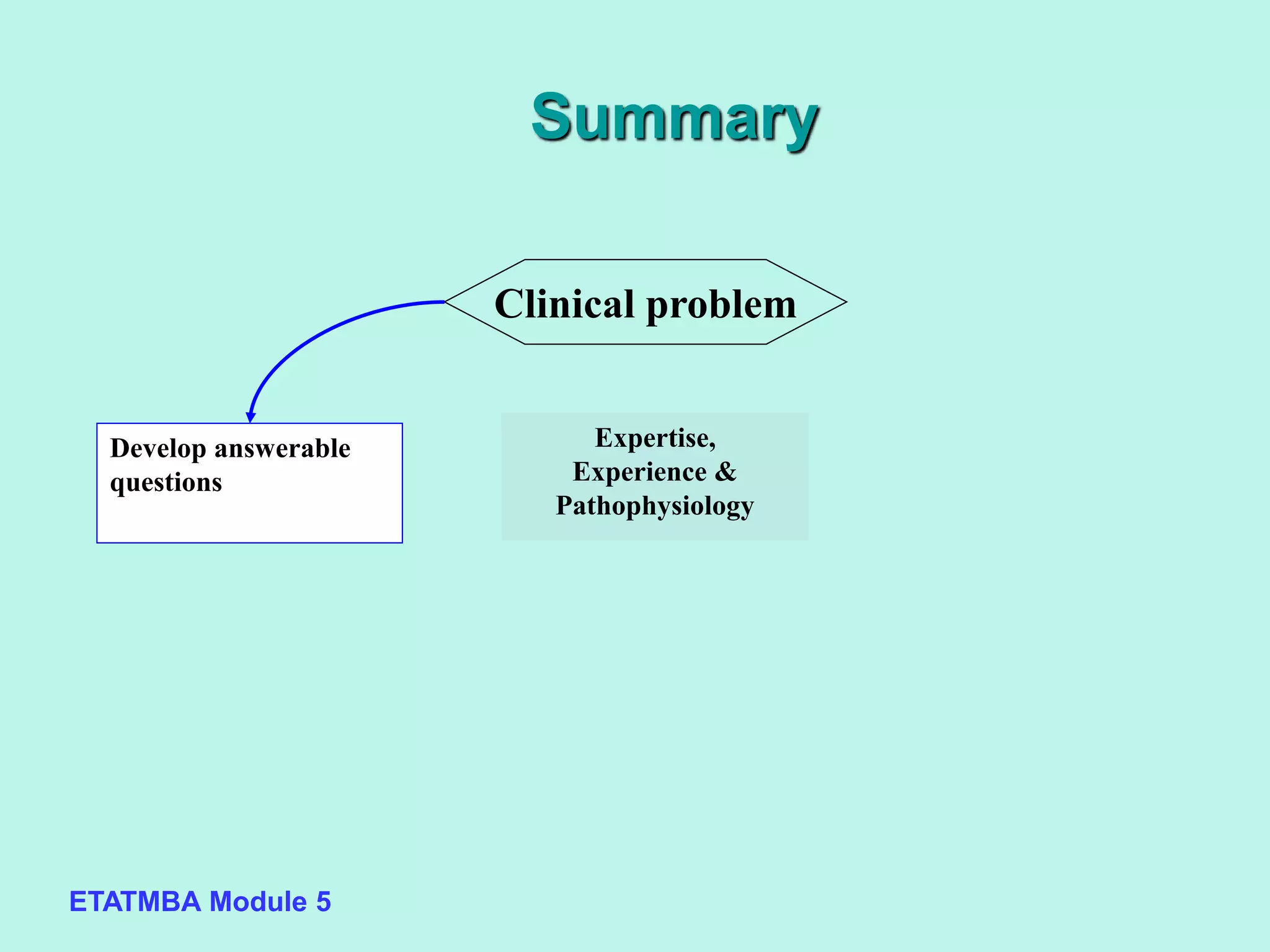
To Summarise
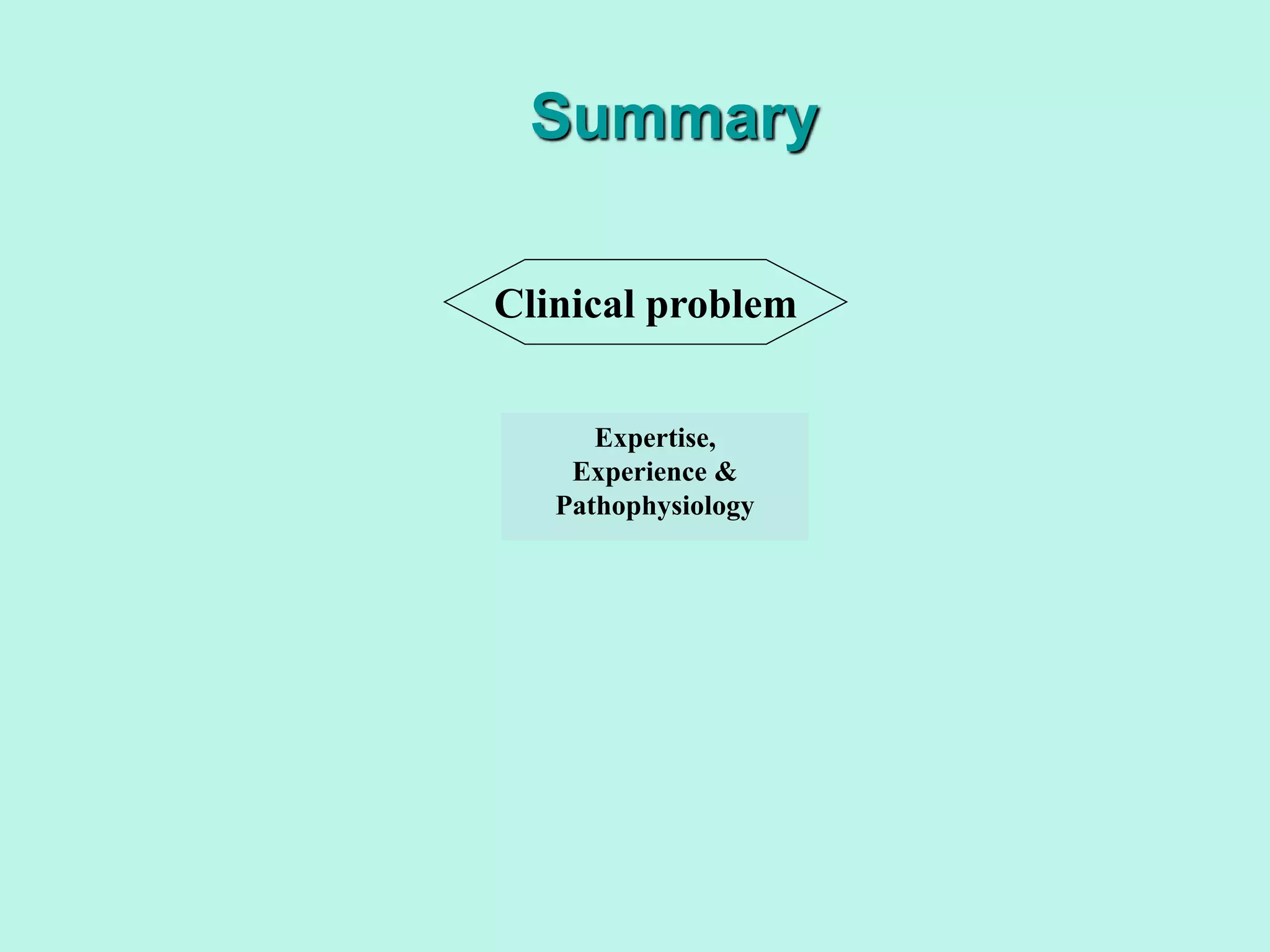
Expertise,
Experience &
Pathophysiology
Clinical problem
Summary
ETATMBA Module 5
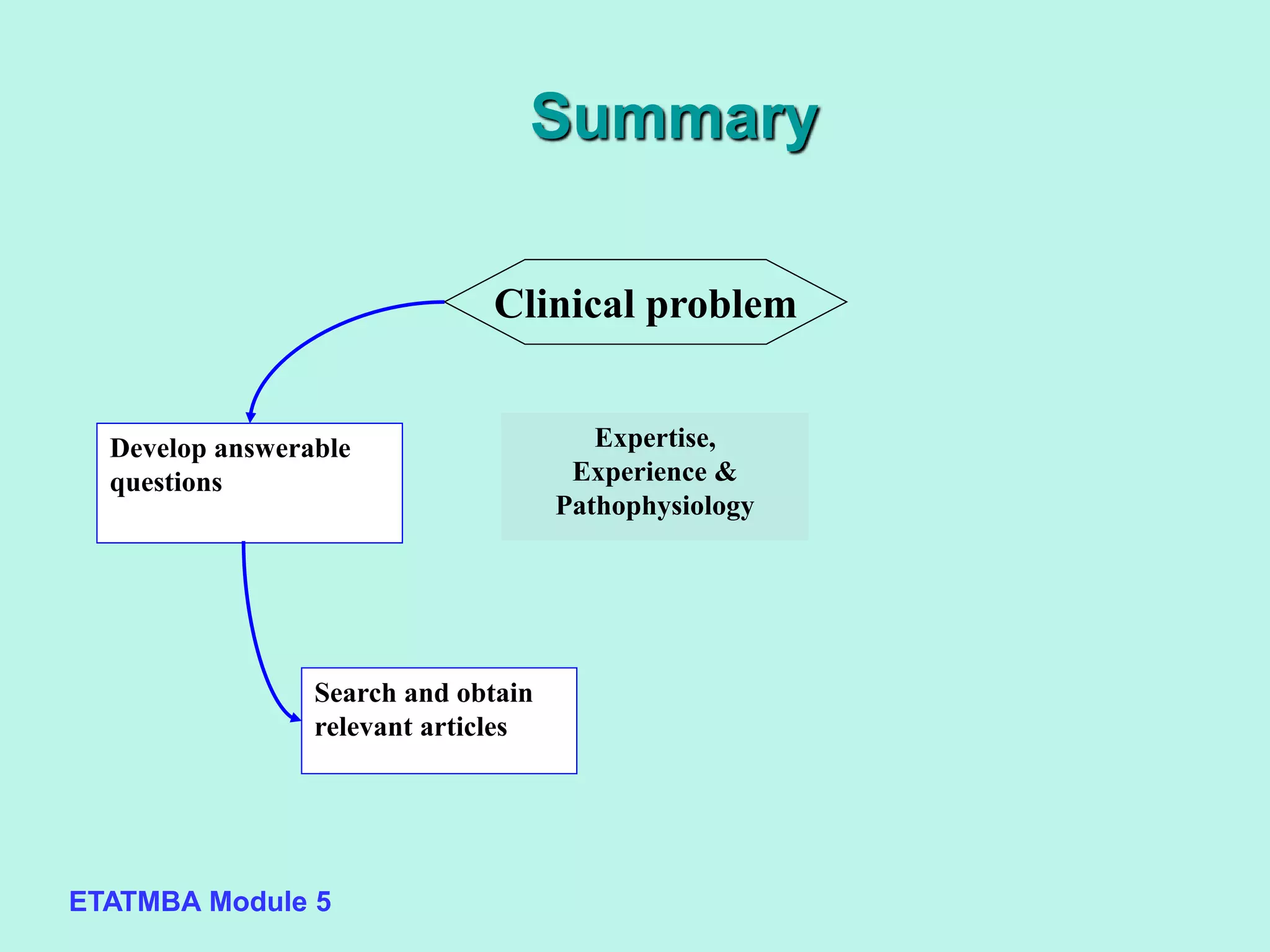
Expertise,
Experience &
Pathophysiology
Clinical problem
Summary
Develop answerable
questions
ETATMBA Module 5
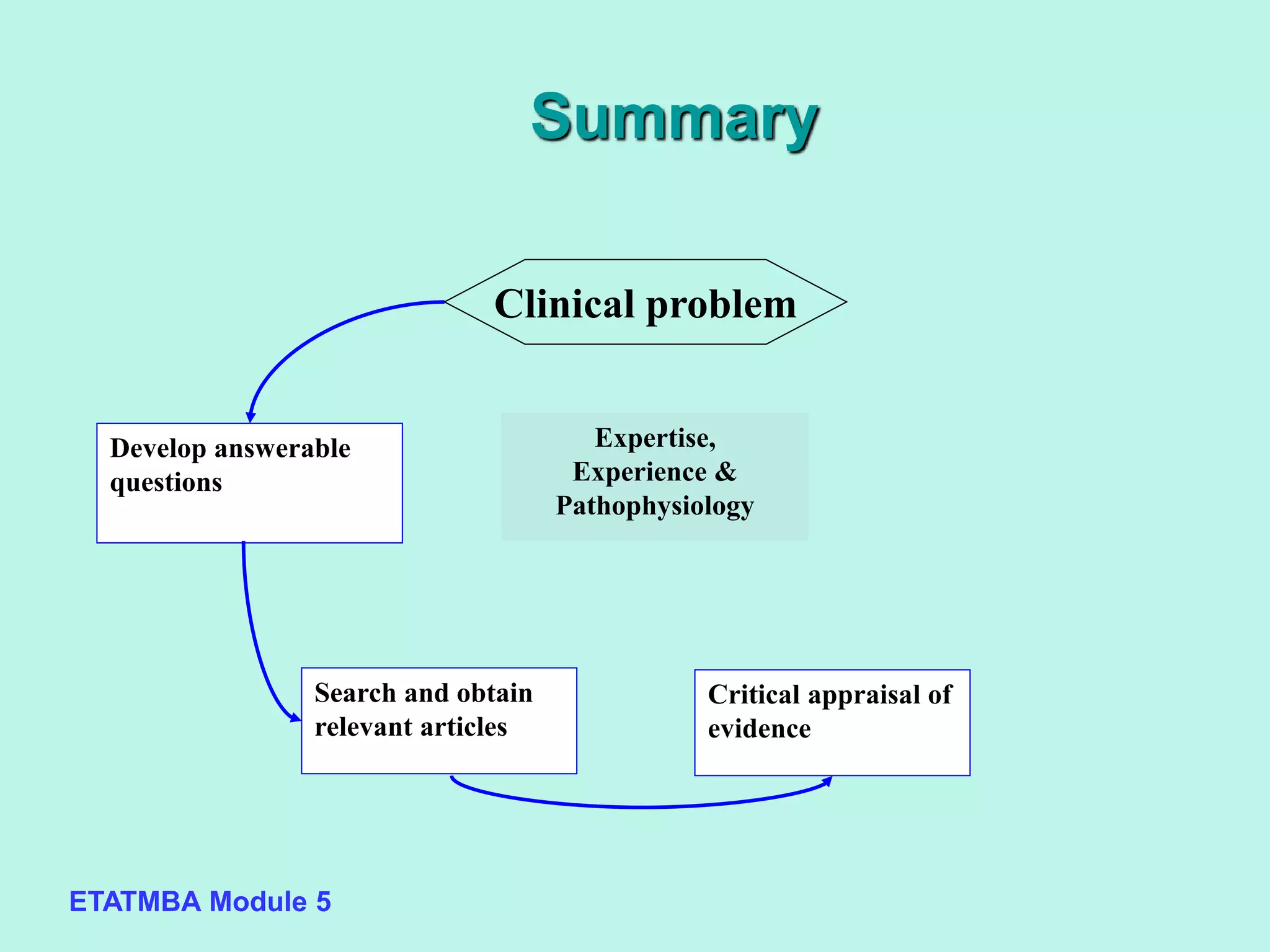
Expertise,
Experience &
Pathophysiology
Clinical problem
Summary
Develop answerable
questions
Search and obtain
relevant articles
ETATMBA Module 5
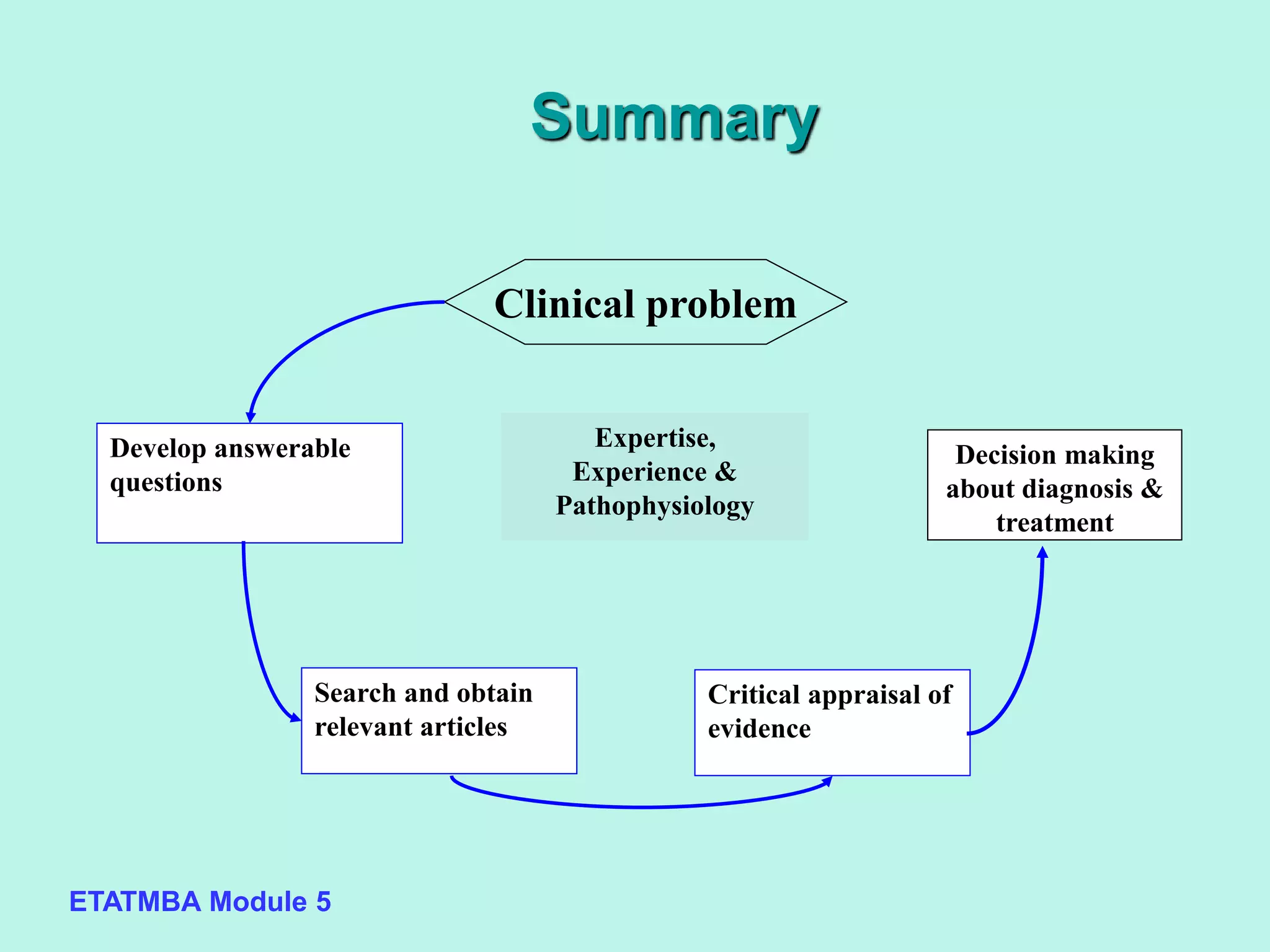
Expertise,
Experience &
Pathophysiology
Clinical problem
Summary
Develop answerable
questions
Search and obtain
relevant articles
Critical appraisal of
evidence
ETATMBA Module 5
Expertise,
Experience &
Pathophysiology
Clinical problem
Summary
Develop answerable
questions
Search and obtain
relevant articles
Critical appraisal of
evidence
Decision making
about diagnosis &
treatment
ETATMBA Module 5
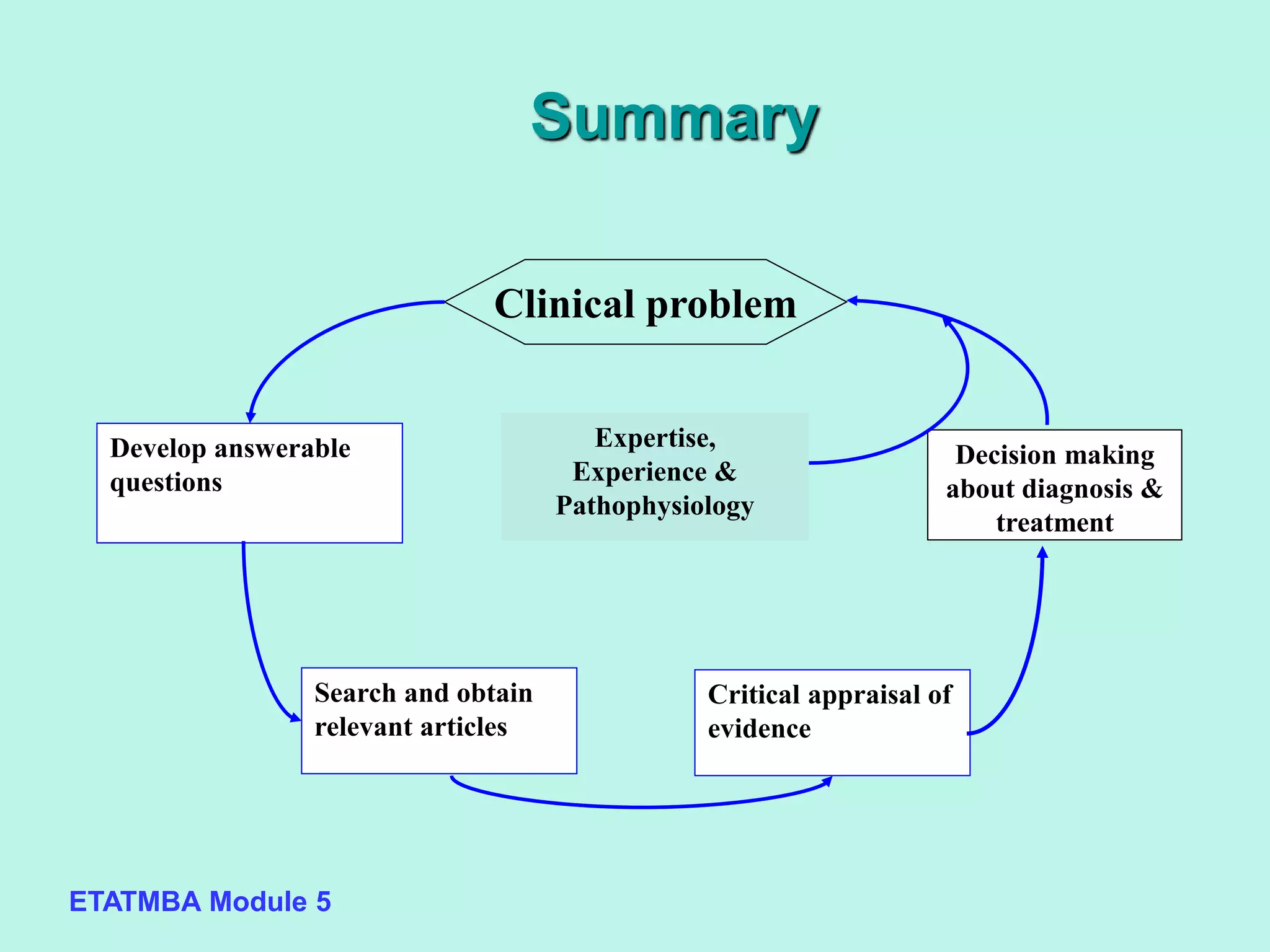
Expertise,
Experience &
Pathophysiology
Clinical problem
Summary
Develop answerable
questions
Search and obtain
relevant articles
Critical appraisal of
evidence
Decision making
about diagnosis &
treatment
ETATMBA Module 5
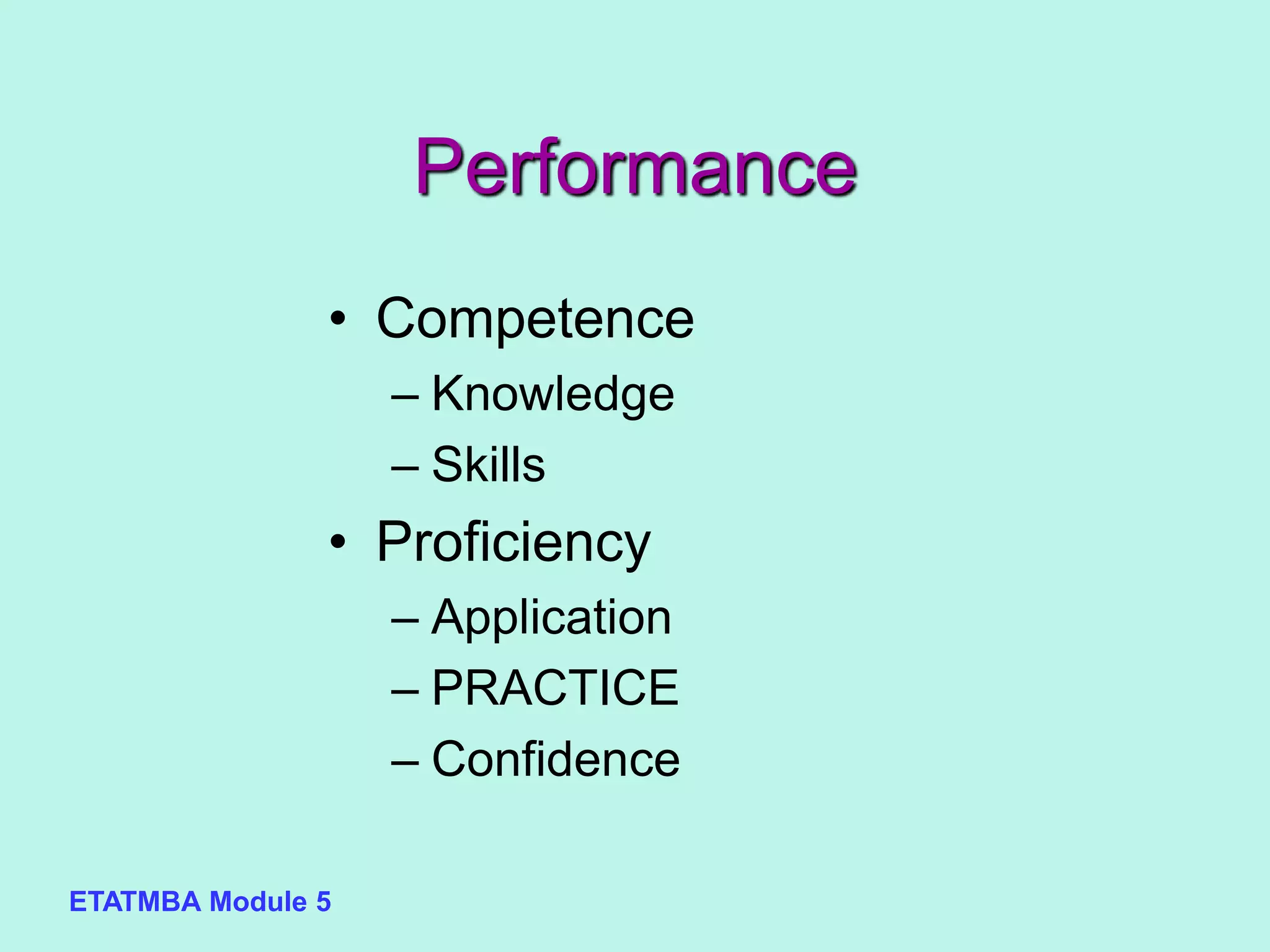
Performance
• Competence
– Knowledge
– Skills
• Proficiency
– Application
– PRACTICE
– Confidence
ETATMBA Module 5
Are We Together ???

ebm_4.ppt

  • 1.
    ETATMBA Module 5 Evidence-BasedMedicine in Clinical Practice. Dr. Harry Gee Dr. Chisale Mhango
  • 2.
    ETATMBA Module 5 "Everyintervention is a two- edged sword." Iain Chalmers
  • 3.
    Old paradigm Unsystematic clinical experience Pathophysiology Contentexpertise & authoritarianism New paradigm Systematic clinical experience Pathophysiology necessary but not sufficient Rules of evidence Practice Pradigms
  • 4.
    ETATMBA Module 5 Pre-Requisites •Questioning – The Knowledge Gap – Honesty – Humility – Discerning • What is merely custom and practice? • Desire for Improvement
  • 5.
    ETATMBA Module 5 OurAims • Understand EBM – What is it? – Why do we need it? – What are the benefits? – Who benefits?
  • 6.
    ETATMBA Module 5 OurObjectives The key steps: – Formulate a clinical question – Search the literature • Efficiently • Confidently – Appraise the evidence – Apply the evidence
  • 7.
  • 8.
    ETATMBA Module 5 GoodClinical Practice • Knowledge from best external evidence based on clinical research • Judgement from experience. • Understanding of patient's beliefs & preferences. Sackett 1996
  • 9.
  • 10.
    ETATMBA Module 5 EvidenceBased Medicine Conscientious, explicit and judicious use of current best evidence in making decisions about the care of an individual patient Sackett. BMJ 1996;312:311-2
  • 11.
    ETATMBA Module 5 EBMfor the Clinician • Knowledge & Skills • Proficiency – Application – PRACTICE – Confidence
  • 12.
    ETATMBA Module 5 The5 Steps Towards Evidence Based Practice 1. Ask the right clinical question: Formulate a searchable question 2. Collect the most relevant publications: Efficient Literature Searching Select the appropriate & relevant studies 3. Critically appraise and synthesize the evidence. 4. Integrate best evidence with personal clinical expertise, patient preferences and values: Applying the result to your clinical practice and patient. 5. Evaluate the practice decision or change: Evaluating the outcomes of the applied evidence in your practice or patient.
  • 13.
    ETATMBA Module 5 Askingthe Right Questions
  • 14.
    Patient presentation knowledge aboutdiagnosis Testing •History •Examination •Investigations Diagnosis knowledge about prognosis Therapy •Changes prognosis knowledge about therapeutic effectiveness Clinical outcome Etiology knowledge about causation Research evidence sought from literature searches Clinical Process and knowledge requirements Etiognostic Research Diagnostic Research Prognostic Research Therapy Research
  • 15.
    ETATMBA Module 5 •Agood answerable question will help us focus on evidence that is relevant to a patient’s clinical needs, (or your own knowledge needs). •They can suggest high yield search strategies •They can suggest the forms that useful answers might take (i.e. what is best research design to answer our question) The Question - Why is it so Important?
  • 16.
    ETATMBA Module 5 •There is no right or wrong way to turn a scenario/knowledge need into a question. • Just make sure it is concise, clinical and uses appropriate language (avoid colloquialism, in favour of technical language). • Ask one question at a time. Formulating Clinical Questions
  • 17.
    ETATMBA Module 5 PICO(D) •Population • Intervention • Comparison • Outcome • (Design)
  • 18.
    ETATMBA Module 5 Selectbest evidence • Question – Relevant – Focussed • Appropriate Study Type • Up to Date
  • 19.
  • 20.
    ETATMBA Module 5 ResearchDesign • Diagnostic tests • Prognosis • Therapy • Patients’ Preferences Cross sectional study Cohort study RCT Qualitative research BMJ 1997;315:1636
  • 21.
    ETATMBA Module 5 Whatresources could be searched?
  • 22.
    ETATMBA Module 5 WhyShould We Be Critical in Our Reading of the Literature?
  • 23.
    Journal High QualityArticles N Eng J Med 17% Ann Intern Med 13% JAMA 12% BMJ 9% Lancet 8% Quality of the Medical Literature
  • 24.
    ETATMBA Module 5 Whatdo we mean by Research Quality?
  • 25.
    Quality of aStudy The confidence that the study design, conduct and analysis has minimized biases in addressing the research question The better the quality, the higher is the likelihood that the results produced in the study are credible
  • 26.
    Validity – The degreeto which the results of an observation are correct for the patients being studied. Bias – A process that tends to produce results that depart systematically from the true values existing in the study population. Fletcher et al, 1988; Murphy, 1976 Quality of a Study
  • 27.
    ETATMBA Module 5 Bias •Conscious • Unconscious • Conflict of Interest
  • 28.
    ETATMBA Module 5 TheHawthorne Effect What is it?
  • 29.
    ETATMBA Module 5 HawthorneEffect • Outcomes changed • By virtue of doing the study • Irrespective of the intervention
  • 30.
    ETATMBA Module 5 Experimental studies – Randomized controlled trials  Controlled Observational studies – Case-control studies  Uncontrolled Observational studies – Case series – Case reports Sacks et al. Am J Med 1982;72:233-240; Cook et al. Chest 1992;102:305s-311s; Guyatt et al. JAMA 1993;270:2598-2601 Hierachy of Evidence
  • 31.
    ETATMBA Module 5 EBMBasic Skills • Formulate structured clinical question • PICO(D) • Search for evidence • Systematic • Select best evidence • Critically appraise •GATE Frame •RAMMbo •CASP •CAT maker
  • 32.
    ETATMBA Module 5 AT-A-GLANCE •Acronym • Title • Aim • Groups • Limbs – Intervention v Comparator • Absolute Risk Reduction • Number Needed to Treat (NNT) • Clinical Conclusion • Education for patients/carers
  • 33.
    AT-A-GLANCE • Acronym: isthere a study name? as a mnemonic • Title: Full title, authors, institute, journal, full reference • Aim: specific aim of the study and why, what outcomes were used? • Groups: who were the research subjects, inclusion criteria, exclusion criteria, who excluded by chance or bias • Limbs – Intervention v Comparator, ? Versus placebo, ? Blinded, how randomised, • Absolute Risk Reduction: What the main results?, what the main results on the outcomes studied, other main results, ? Side-effects, other harm events • Number Needed to Treat (NNT): How many people do you need to treat to have one beneficial effect? Eg how many people to save a life? How many treated to have side-effects? • Clinical Conclusion: What are the main clinical conclusions for you and the team? Can the results be implemented locally? ? Change in guideline needed? ? Clinical audit needed? • Education for patients/carers: How can you explain the results to a patient/guardian prior to consent and explanation? State what you will actually say eg “Research has shown that………what do you think?”
  • 34.
  • 35.
    Levels of evidence LevelType of evidence I Evidence obtained from at least one randomised controlled trial or from meta-analysis of randomised controlled trials II Evidence obtained from at least one well-designed controlled study without randomisation III Evidence obtained from well-designed non-experimental descriptive studies, such as comparative studies, correlation studies and case control studies IV Evidence obtained from expert committee reports or opinions and/or clinical experience of respected authorities
  • 36.
    Grading of recommendations Grade Recommendation A(Evidence level I) Requires at least one randomised controlled trial as part of the body of literature of overall good quality and consistency addressing the specific recommendation B (Evidence levels II, III) Requires availability of well-conducted clinical studies but not randomised clinical trials on the topic of recommendation C (Evidence level IV) Requires evidence from expert committee reports or opinions and/or clinical experience of respected authorities. Indicates absence of directly applicable studies of good quality
  • 37.
  • 38.
  • 39.
    ETATMBA Module 5 Expertise, Experience& Pathophysiology Clinical problem Summary Develop answerable questions
  • 40.
    ETATMBA Module 5 Expertise, Experience& Pathophysiology Clinical problem Summary Develop answerable questions Search and obtain relevant articles
  • 41.
    ETATMBA Module 5 Expertise, Experience& Pathophysiology Clinical problem Summary Develop answerable questions Search and obtain relevant articles Critical appraisal of evidence
  • 42.
    ETATMBA Module 5 Expertise, Experience& Pathophysiology Clinical problem Summary Develop answerable questions Search and obtain relevant articles Critical appraisal of evidence Decision making about diagnosis & treatment
  • 43.
    ETATMBA Module 5 Expertise, Experience& Pathophysiology Clinical problem Summary Develop answerable questions Search and obtain relevant articles Critical appraisal of evidence Decision making about diagnosis & treatment
  • 44.
    ETATMBA Module 5 Performance •Competence – Knowledge – Skills • Proficiency – Application – PRACTICE – Confidence
  • 45.
    ETATMBA Module 5 AreWe Together ???