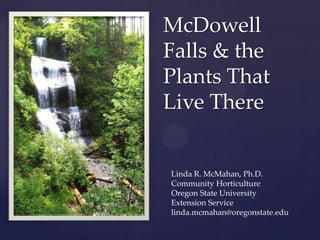
McDowell
    Falls & the
    Plants That
    Live There
{
    Linda R. McMahan, Ph.D.
    Community Horticulture
    Oregon State University
    Extension Service
    linda.mcmahan@oregonstate.edu
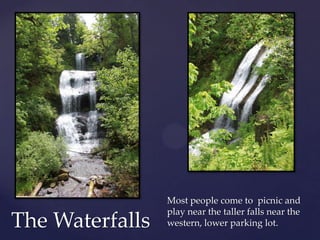
Most people come to picnic and
                 play near the taller falls near the
The Waterfalls   western, lower parking lot.
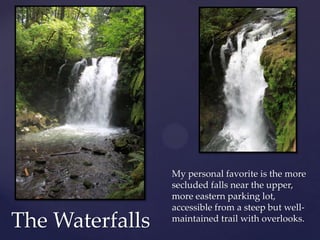
My personal favorite is the more
                 secluded falls near the upper,
                 more eastern parking lot,
                 accessible from a steep but well-
The Waterfalls   maintained trail with overlooks.
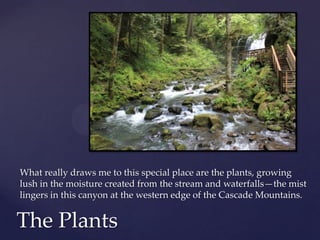
What really draws me to this special place are the plants, growing
lush in the moisture created from the stream and waterfalls—the mist
lingers in this canyon at the western edge of the Cascade Mountains.


The Plants
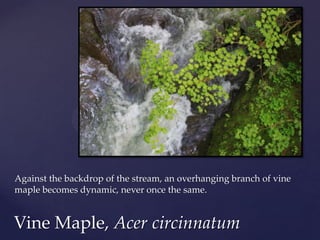
Against the backdrop of the stream, an overhanging branch of vine
maple becomes dynamic, never once the same.


Vine Maple, Acer circinnatum
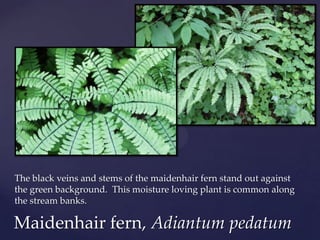
The black veins and stems of the maidenhair fern stand out against
the green background. This moisture loving plant is common along
the stream banks.

Maidenhair fern, Adiantum pedatum
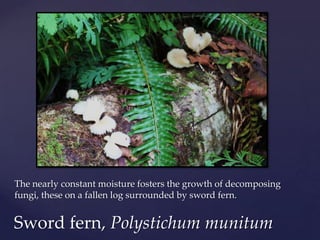
The nearly constant moisture fosters the growth of decomposing
fungi, these on a fallen log surrounded by sword fern.


Sword fern, Polystichum munitum
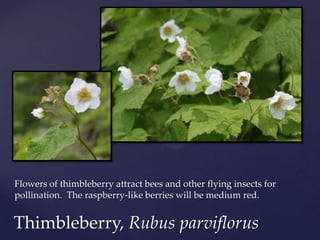
Flowers of thimbleberry attract bees and other flying insects for
pollination. The raspberry-like berries will be medium red.


Thimbleberry, Rubus parviflorus
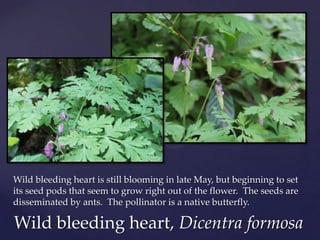
Wild bleeding heart is still blooming in late May, but beginning to set
its seed pods that seem to grow right out of the flower. The seeds are
disseminated by ants. The pollinator is a native butterfly.

Wild bleeding heart, Dicentra formosa
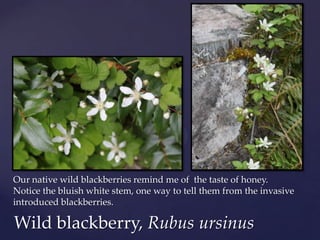
Our native wild blackberries remind me of the taste of honey.
Notice the bluish white stem, one way to tell them from the invasive
introduced blackberries.

Wild blackberry, Rubus ursinus
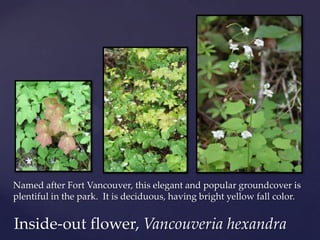
Named after Fort Vancouver, this elegant and popular groundcover is
plentiful in the park. It is deciduous, having bright yellow fall color.


Inside-out flower, Vancouveria hexandra
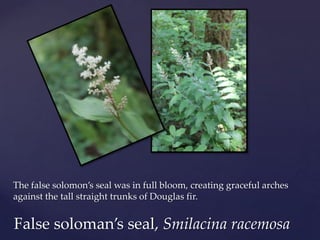
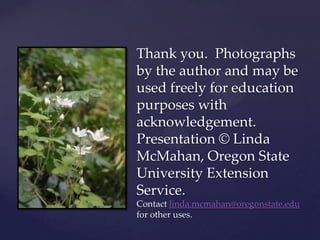
The false solomon’s seal was in full bloom, creating graceful arches
against the tall straight trunks of Douglas fir.


False soloman’s seal, Smilacina racemosa
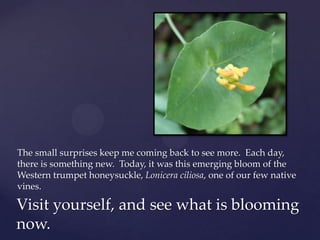
The small surprises keep me coming back to see more. Each day,
there is something new. Today, it was this emerging bloom of the
Western trumpet honeysuckle, Lonicera ciliosa, one of our few native
vines.

Visit yourself, and see what is blooming
now.
Thank you. Photographs
by the author and may be
used freely for education
purposes with
acknowledgement.
Presentation © Linda
McMahan, Oregon State
University Extension
Service.
Contact linda.mcmahan@oregonstate.edu
for other uses.

McDowell falls and PNW native plants

  • 1.
    McDowell Falls & the Plants That Live There { Linda R. McMahan, Ph.D. Community Horticulture Oregon State University Extension Service linda.mcmahan@oregonstate.edu
  • 2.
    Most people cometo picnic and play near the taller falls near the The Waterfalls western, lower parking lot.
  • 3.
    My personal favoriteis the more secluded falls near the upper, more eastern parking lot, accessible from a steep but well- The Waterfalls maintained trail with overlooks.
  • 4.
    What really drawsme to this special place are the plants, growing lush in the moisture created from the stream and waterfalls—the mist lingers in this canyon at the western edge of the Cascade Mountains. The Plants
  • 5.
    Against the backdropof the stream, an overhanging branch of vine maple becomes dynamic, never once the same. Vine Maple, Acer circinnatum
  • 6.
    The black veinsand stems of the maidenhair fern stand out against the green background. This moisture loving plant is common along the stream banks. Maidenhair fern, Adiantum pedatum
  • 7.
    The nearly constantmoisture fosters the growth of decomposing fungi, these on a fallen log surrounded by sword fern. Sword fern, Polystichum munitum
  • 8.
    Flowers of thimbleberryattract bees and other flying insects for pollination. The raspberry-like berries will be medium red. Thimbleberry, Rubus parviflorus
  • 9.
    Wild bleeding heartis still blooming in late May, but beginning to set its seed pods that seem to grow right out of the flower. The seeds are disseminated by ants. The pollinator is a native butterfly. Wild bleeding heart, Dicentra formosa
  • 10.
    Our native wildblackberries remind me of the taste of honey. Notice the bluish white stem, one way to tell them from the invasive introduced blackberries. Wild blackberry, Rubus ursinus
  • 11.
    Named after FortVancouver, this elegant and popular groundcover is plentiful in the park. It is deciduous, having bright yellow fall color. Inside-out flower, Vancouveria hexandra
  • 12.
    The false solomon’sseal was in full bloom, creating graceful arches against the tall straight trunks of Douglas fir. False soloman’s seal, Smilacina racemosa
  • 13.
    The small surpriseskeep me coming back to see more. Each day, there is something new. Today, it was this emerging bloom of the Western trumpet honeysuckle, Lonicera ciliosa, one of our few native vines. Visit yourself, and see what is blooming now.
  • 14.
    Thank you. Photographs bythe author and may be used freely for education purposes with acknowledgement. Presentation © Linda McMahan, Oregon State University Extension Service. Contact linda.mcmahan@oregonstate.edu for other uses.