Minnesota Plant Press
                                         The Minnesota Native Plant Society Newsletter


Volume 24 Number 1                                                                                        Fall 2004
    Monthly meetings
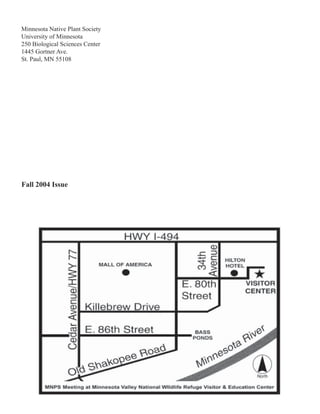
  Minnesota Valley National Wildlife Refuge
                                              MNPS awards lifetime
      Visitor Center, 3815 East 80th St.
       Bloomington, MN 55425-1600
                952-854-5900
                                              membership to botanist
 6:30 p.m. — Building east door opens
 6:30 p.m. — Refreshments,
                                              Dr. R. H. Mohlenbrock
             information, Room A
 7 – 9 p.m — Program, society business        by Scott A. Milburn
 7:30 p.m. — Building door is locked            The board of the Minnesota Native Plant Society recently awarded
 9:00 p.m. — Building closes                  famed Illinois botanist Dr. Robert H. Mohlenbrock and his wife Beverly
                                              lifetime memberships in the society in recognition of Bob’s
               Programs                       contributions to the botanical sciences.
  The MNPS meets the first Thursday in
October, November, December, February,          Bob grew up in Murphysboro, a rural southern Illinois town located
March, April, May, and June. Check the        near Southern Illinois University (SIU) in Carbondale. During his
Web site for more program information.        youth, he had little interest in the subject of biology. However, during
                                              his junior year at Murphysboro Township High School, Bob
  Nov. 4: “Biological Control of Invasive     apprehensively signed up for his first course in biology. He was
Plants in Minnesota,” by Luke Skinner,
DNR Coordinator for Purple Loosestrife        fortunate to have as his biology teacher that year (1947) Miss E. Ester
Program. Seed exchange. Put seeds of          Smith, whom Bob credits for opening his eyes to an entirely different
native plants in small packets, labeled       world. Bob describes Miss Smith as being very dedicated to the
with common and botanical names and           subject of teaching, encouraging the students to work in her lab after
source of seeds.                              school, and taking them on field trips over weekends and during the
  Dec. 2: “Habitat Selection of               summer months. Dr. Mohlenbrock and six other cohorts under the
Grassland and Woodland Birds,” by             tutelage of Miss Smith went on to receive doctoral degrees in either
Tom Cooper, wildlife biologist, Minnesota     botany or zoology and to teach at major university institutions. Bob
Waterfowl Association. Plant-of-the-          went on to dedicate his book on Ferns from the Illustrated Flora of
Month: Viola lanceolata, by Scott             Illinois series to Miss Smith, acknowledging her as the person “who
Milburn.                                      first instilled within the author a love for nature.”
Feb. 3: To be determined                   Dr. Mohlenbrock received his Ph.D. from Washington University
March 3: “Wetland Restoration at         (St. Louis) in 1957 and immediately joined the botany faculty at SIU.
Pioneer Park in Anoka County,” by        He taught for 34 years, serving as chairman of the Botany Department
Jason Husveth, Critical Connections      for 16 years and as major professor for 90 masters and doctoral students.
Ecological Services, Inc.                A number of these students also went on to have very successful careers.
                                         They include Gerould Wilhelm,author of Plants of the Chicago Region;
MNPS Web site                            Tom Elias, director of the U.S. National Arboretum and author of
http://www.stolaf.edu/depts/biology/mnps Complete Guide to the Trees of North America; and Larry Stritch, chief
e-mail: MNPS@HotPOP.com                  botanist, U.S. Forest Service. Dr. Mohlenbrock received many academic
MNPS Listserve                           honors, has published nearly 50 books and 500 scientific papers, and
                                         has served as chairman of the North American Endangered Species
  Send a message that includes the word
                                         Committee for the International Union for the Conservation of Nature
“subscribe” or “unsubscribe” and your
                                         for 14 years. He also writes a series,“This Land,” which he started in
name in the body of the message to:
mn-natpl-request@stolaf.edu                                                               Continued on page 3
Plant Lore                                 Study of genetic diversity
by Thor Kommedahl
What is leatherwood?
Leatherwood is Dirca palustris in the
                                           will help restorations
                                           by Kristine Moncada, graduate
mezereum family, a small family of         student, Applied Plant Sciences           Dr. Mohlenbrock
shrubs with an acrid, tough, and           Program, University of Minnesota          continued from page 1
fibrous bark. It is the only member        This is an abstract of her talk at the    1984, for Natural History Magazine.
of this family native to Minnesota.        April 1, 2004, MNPS meeting.
                                                                                     These articles describe important
                                             Genetic diversity of native plants
What do its names mean?                    is an important biological property       natural areas in North America. Dr.
Dirca is named for Dirce, wife of          to study, particularly as it relates to   Mohlenbrock is best known for his
                                           restoration. By analyzing the             series of the Illustrated Flora of
Lycus, who after her brutal murder,
                                           genetics of a natural population, we      Illinois. The project was started in
changed into the fountain Dirce in                                                   1960, with the objective of
Thebes (Greece). Palustris means           are able to determine patterns of
                                           relatedness. These patterns give us       publishing a complete illustrated
“of swamps.” Another name is               clues of what plants are adapted to       account of every plant occurring in
wicopy, a Cree name for the inner          what sites. In restoration, we can        Illinois. To date, 16 volumes have
bark of basswood. Because thongs           then choose seeds from which area         been published or are in process.
were made from the bark, it was            or zone would be most appropriate         This remarkable series is extremely
called leatherwood.                        to that location.                         valuable to the Midwestern field
                                             The goal of restoration is to           botanist. He is currently working on
What does the plant look like?                                                       a three-volume work dealing with the
                                           establish self-sustaining populations
It is a yellowish, largely-branching       that have the capacity for future         Asteraceae of Illinois and a four-
shrub from 3 to 6 feet tall. The wood      adaptation. By discovering the            volume set of places to visit within
is white, soft, and brittle. The bark is   patterns of variation, we can then        the National Forest system.
remarkably tough and fibrous.              more closely emulate naturally               Since his retirement from SIU, Bob
Leaves are alternate and more or less      occurring populations to ensure long-     and Beverly travel. He teaches
elliptical. Note the jointed twigs.        term success for a restoration.           wetland plant identification courses
Flowers are honey yellow, pendant,           My research is funded by the            across the country. These classes
and give rise to clusters of 3-4 green,    Minnesota         Department         of   fill a void in what has become a
                                           Transportation to aid in developing       recent trend in the academic world,
yellowish, or reddish drupes, each         guidelines for seed collection for
with large seeds.                                                                    an absence of biological field
                                           their restoration projects. In this       courses. I first met Bob by taking
Where do the plants grow?                  project, I am studying the genetics       one of his wetland plant
In Minnesota, shrubs are found in          of four native species: big bluestem      identification courses in Chicago a
rich woods near streams, in springy        (Andropogon gerardii), purple             few years ago. He recently taught a
                                           prairie clover (Dalea purpurea),          field course in the Twin Cities,
woods, or in swamps; hence the             prairie cordgrass (Spartina
name palustris.                                                                      focusing on grasses, sedges, and
                                           pectinata), and Joe-pye weed
                                                                                     rushes, and he will be back again next
Does it have medicinal                     (Eupatorium maculatum). I have
                                           collected these species throughout        June to teach a class on wetland plant
properties?                                                                          identification.
                                           their range within Minnesota.
American Indians used the plant to
treat toothache and drank bark tea as      Through analyzing the variation at        Learn to identify plants in
a laxative. However, contact with
                                           the DNA level, we hope to find the        winter on Nov. 13 field trip
                                           patterns of natural diversity. We can       Jason Husveth will lead a winter
bark causes severe blisters and sores.     then be able to develop seed transfer     botany field trip at the Tamarack
The fruits, if eaten, cause violent        zones, which are geographical             Nature Center in White Bear Twp.,
vomiting, stupor, and vertigo.             regions in which individuals of a         Ramsey County, Saturday, Nov.13,
Does it have any practical uses?           native species can be transferred with    from 9 a.m. to noon. He will focus
                                           no negative effects on the vigor of       on the identification of wildflowers,
American Indians used the flexible         the population. It is important to        trees, and shrubs from persistent
shoots to make baskets and the bark        know what seed is best for a              winter characteristics. Register early
for rope, thongs, bowstrings, and fish     restoration project. It can determine     at jhusveth@ccesinc.com. Space is
lines. Deer and moose graze on             the success or failure of long-term       limited to 30 people. Details will
foliage and twigs.                         plant establishment.                      be posted at www.mnnps.org.
                                                                                                                          3
What we saw on field trips                                                      Humane Society
by Doug Mensing                                                                 applies Think
  The MNPS sponsored two spring field trips in 2004, participated in            Native grant to new
Minnesota’s first Bio-Blitz, and co-sponsored one field trip over the summer.
  Spring was welcomed by approximately 18 native plant enthusiasts who
                                                                                memorial garden
camped for the weekend or just joined the group for day hikes in and around by Dianne Plunkett Latham
Whitewater State Park over the weekend of May 7-9. Participants enjoyed         The Wright County Humane
the lush and diverse wildflowers of southeastern Minnesota at this special    Society has sent a letter of thanks
time of year. Several rare plants were also seen in their wild environments. for the MNPS $200 Think Native
                                                                              grant. The money was applied to
  On May 22, approximately 20 participants met to hike and botanize at their Memorial Garden, on which
Louisville Swamp. Prairies, savannas, wetlands, floodplain forests, and
                                                                              they worked all summer. Their
woodlands were among the native habitats we explored, identifying species
                                                                              objective was to be ready for their
as we went. As with last year, new records of threatened kittentails were
identified near the trail. High water added to the excitement as we waded fall festival Oct. 10.
across a flooded berm. It was enjoyable to see the benefits of restoration      By that time they anticipated
efforts. Bloodroot and other native species were growing in areas recently having the southeast corner of the
cleared of buckthorn and in areas that recently experienced prescribed burns. garden completed. This area
                                                                              includes natural pathways, two
  Minnesota’s first Bio-Blitz was held on June 11-12 at Tamarack Nature flowerbeds and the lawn area around
Center. This was a 24-hour “blitz” to identify as many living things within them. They expect to plant the native
the nature center as possible. 707 species were identified (insects, mammals, grasses and the grass area around the
birds, etc.), including 277 plant species (many contributed by MNPS wall, plus native pond plants before
members who surveyed portions of the park). Thanks to all who contributed Oct. 31. The other beds will be
to this important inventory of biodiversity.                                  developed and memorial plaques
  On Aug. 28, the MNPS collaborated with the Cedar Lake Park Association installed in the spring.
to host an educational hike in this Minneapolis park. Keith Prussing, CLPA      The Wright County Humane
president, led approximately 16 participants on a tour, conveying the history Society invites MNPS members to
of the park area and the restoration efforts that have been going on there tour the garden. Call Eva Forcier at
for over a decade. The restored prairies were seen in their prime-season 320-963-4991 or Paula Savage at
color. We witnessed results that can emerge from active, concerned citizens. 763-479-1918.


                     Minnesota Native Plant Society
                                       Member Registration
Name ____________________________________________________________________________________

Address __________________________________________________________________________________

City ____________________________________________________ State ________ Zip ______________

Phone (W) _________________ (H) ____________________E-Mail _______________________________

Membership category (New ______ Renewal ______)
Individual                                         $15               Senior (62 or over, or retired)           $ 8
Family (2 or more related persons at same address) $15               Student (full time)                       $ 8
Institution                                        $20               Donor                                     $25

Please fill in this form and check the appropriate membership category. Your check should be made payable to the
Minnesota Native Plant Society. Mail the completed form and your check to the Minnesota Native Plant Society,
University of Minnesota, 250 Biological Sciences Center, 1445 Gortner Ave., St. Paul, MN 55108.
Minnesota Native Plant Society
University of Minnesota
250 Biological Sciences Center
1445 Gortner Ave.
St. Paul, MN 55108


Fall 2004 Issue

Fall 2004 Minnesota Plant Press

  • 1.
    Minnesota Plant Press The Minnesota Native Plant Society Newsletter Volume 24 Number 1 Fall 2004 Monthly meetings Minnesota Valley National Wildlife Refuge MNPS awards lifetime Visitor Center, 3815 East 80th St. Bloomington, MN 55425-1600 952-854-5900 membership to botanist 6:30 p.m. — Building east door opens 6:30 p.m. — Refreshments, Dr. R. H. Mohlenbrock information, Room A 7 – 9 p.m — Program, society business by Scott A. Milburn 7:30 p.m. — Building door is locked The board of the Minnesota Native Plant Society recently awarded 9:00 p.m. — Building closes famed Illinois botanist Dr. Robert H. Mohlenbrock and his wife Beverly lifetime memberships in the society in recognition of Bob’s Programs contributions to the botanical sciences. The MNPS meets the first Thursday in October, November, December, February, Bob grew up in Murphysboro, a rural southern Illinois town located March, April, May, and June. Check the near Southern Illinois University (SIU) in Carbondale. During his Web site for more program information. youth, he had little interest in the subject of biology. However, during his junior year at Murphysboro Township High School, Bob Nov. 4: “Biological Control of Invasive apprehensively signed up for his first course in biology. He was Plants in Minnesota,” by Luke Skinner, DNR Coordinator for Purple Loosestrife fortunate to have as his biology teacher that year (1947) Miss E. Ester Program. Seed exchange. Put seeds of Smith, whom Bob credits for opening his eyes to an entirely different native plants in small packets, labeled world. Bob describes Miss Smith as being very dedicated to the with common and botanical names and subject of teaching, encouraging the students to work in her lab after source of seeds. school, and taking them on field trips over weekends and during the Dec. 2: “Habitat Selection of summer months. Dr. Mohlenbrock and six other cohorts under the Grassland and Woodland Birds,” by tutelage of Miss Smith went on to receive doctoral degrees in either Tom Cooper, wildlife biologist, Minnesota botany or zoology and to teach at major university institutions. Bob Waterfowl Association. Plant-of-the- went on to dedicate his book on Ferns from the Illustrated Flora of Month: Viola lanceolata, by Scott Illinois series to Miss Smith, acknowledging her as the person “who Milburn. first instilled within the author a love for nature.” Feb. 3: To be determined Dr. Mohlenbrock received his Ph.D. from Washington University March 3: “Wetland Restoration at (St. Louis) in 1957 and immediately joined the botany faculty at SIU. Pioneer Park in Anoka County,” by He taught for 34 years, serving as chairman of the Botany Department Jason Husveth, Critical Connections for 16 years and as major professor for 90 masters and doctoral students. Ecological Services, Inc. A number of these students also went on to have very successful careers. They include Gerould Wilhelm,author of Plants of the Chicago Region; MNPS Web site Tom Elias, director of the U.S. National Arboretum and author of http://www.stolaf.edu/depts/biology/mnps Complete Guide to the Trees of North America; and Larry Stritch, chief e-mail: MNPS@HotPOP.com botanist, U.S. Forest Service. Dr. Mohlenbrock received many academic MNPS Listserve honors, has published nearly 50 books and 500 scientific papers, and has served as chairman of the North American Endangered Species Send a message that includes the word Committee for the International Union for the Conservation of Nature “subscribe” or “unsubscribe” and your for 14 years. He also writes a series,“This Land,” which he started in name in the body of the message to: mn-natpl-request@stolaf.edu Continued on page 3
  • 3.
    Plant Lore Study of genetic diversity by Thor Kommedahl What is leatherwood? Leatherwood is Dirca palustris in the will help restorations by Kristine Moncada, graduate mezereum family, a small family of student, Applied Plant Sciences Dr. Mohlenbrock shrubs with an acrid, tough, and Program, University of Minnesota continued from page 1 fibrous bark. It is the only member This is an abstract of her talk at the 1984, for Natural History Magazine. of this family native to Minnesota. April 1, 2004, MNPS meeting. These articles describe important Genetic diversity of native plants What do its names mean? is an important biological property natural areas in North America. Dr. Dirca is named for Dirce, wife of to study, particularly as it relates to Mohlenbrock is best known for his restoration. By analyzing the series of the Illustrated Flora of Lycus, who after her brutal murder, genetics of a natural population, we Illinois. The project was started in changed into the fountain Dirce in 1960, with the objective of Thebes (Greece). Palustris means are able to determine patterns of relatedness. These patterns give us publishing a complete illustrated “of swamps.” Another name is clues of what plants are adapted to account of every plant occurring in wicopy, a Cree name for the inner what sites. In restoration, we can Illinois. To date, 16 volumes have bark of basswood. Because thongs then choose seeds from which area been published or are in process. were made from the bark, it was or zone would be most appropriate This remarkable series is extremely called leatherwood. to that location. valuable to the Midwestern field The goal of restoration is to botanist. He is currently working on What does the plant look like? a three-volume work dealing with the establish self-sustaining populations It is a yellowish, largely-branching that have the capacity for future Asteraceae of Illinois and a four- shrub from 3 to 6 feet tall. The wood adaptation. By discovering the volume set of places to visit within is white, soft, and brittle. The bark is patterns of variation, we can then the National Forest system. remarkably tough and fibrous. more closely emulate naturally Since his retirement from SIU, Bob Leaves are alternate and more or less occurring populations to ensure long- and Beverly travel. He teaches elliptical. Note the jointed twigs. term success for a restoration. wetland plant identification courses Flowers are honey yellow, pendant, My research is funded by the across the country. These classes and give rise to clusters of 3-4 green, Minnesota Department of fill a void in what has become a Transportation to aid in developing recent trend in the academic world, yellowish, or reddish drupes, each guidelines for seed collection for with large seeds. an absence of biological field their restoration projects. In this courses. I first met Bob by taking Where do the plants grow? project, I am studying the genetics one of his wetland plant In Minnesota, shrubs are found in of four native species: big bluestem identification courses in Chicago a rich woods near streams, in springy (Andropogon gerardii), purple few years ago. He recently taught a prairie clover (Dalea purpurea), field course in the Twin Cities, woods, or in swamps; hence the prairie cordgrass (Spartina name palustris. focusing on grasses, sedges, and pectinata), and Joe-pye weed rushes, and he will be back again next Does it have medicinal (Eupatorium maculatum). I have collected these species throughout June to teach a class on wetland plant properties? identification. their range within Minnesota. American Indians used the plant to treat toothache and drank bark tea as Through analyzing the variation at Learn to identify plants in a laxative. However, contact with the DNA level, we hope to find the winter on Nov. 13 field trip patterns of natural diversity. We can Jason Husveth will lead a winter bark causes severe blisters and sores. then be able to develop seed transfer botany field trip at the Tamarack The fruits, if eaten, cause violent zones, which are geographical Nature Center in White Bear Twp., vomiting, stupor, and vertigo. regions in which individuals of a Ramsey County, Saturday, Nov.13, Does it have any practical uses? native species can be transferred with from 9 a.m. to noon. He will focus no negative effects on the vigor of on the identification of wildflowers, American Indians used the flexible the population. It is important to trees, and shrubs from persistent shoots to make baskets and the bark know what seed is best for a winter characteristics. Register early for rope, thongs, bowstrings, and fish restoration project. It can determine at jhusveth@ccesinc.com. Space is lines. Deer and moose graze on the success or failure of long-term limited to 30 people. Details will foliage and twigs. plant establishment. be posted at www.mnnps.org. 3
  • 4.
    What we sawon field trips Humane Society by Doug Mensing applies Think The MNPS sponsored two spring field trips in 2004, participated in Native grant to new Minnesota’s first Bio-Blitz, and co-sponsored one field trip over the summer. Spring was welcomed by approximately 18 native plant enthusiasts who memorial garden camped for the weekend or just joined the group for day hikes in and around by Dianne Plunkett Latham Whitewater State Park over the weekend of May 7-9. Participants enjoyed The Wright County Humane the lush and diverse wildflowers of southeastern Minnesota at this special Society has sent a letter of thanks time of year. Several rare plants were also seen in their wild environments. for the MNPS $200 Think Native grant. The money was applied to On May 22, approximately 20 participants met to hike and botanize at their Memorial Garden, on which Louisville Swamp. Prairies, savannas, wetlands, floodplain forests, and they worked all summer. Their woodlands were among the native habitats we explored, identifying species objective was to be ready for their as we went. As with last year, new records of threatened kittentails were identified near the trail. High water added to the excitement as we waded fall festival Oct. 10. across a flooded berm. It was enjoyable to see the benefits of restoration By that time they anticipated efforts. Bloodroot and other native species were growing in areas recently having the southeast corner of the cleared of buckthorn and in areas that recently experienced prescribed burns. garden completed. This area includes natural pathways, two Minnesota’s first Bio-Blitz was held on June 11-12 at Tamarack Nature flowerbeds and the lawn area around Center. This was a 24-hour “blitz” to identify as many living things within them. They expect to plant the native the nature center as possible. 707 species were identified (insects, mammals, grasses and the grass area around the birds, etc.), including 277 plant species (many contributed by MNPS wall, plus native pond plants before members who surveyed portions of the park). Thanks to all who contributed Oct. 31. The other beds will be to this important inventory of biodiversity. developed and memorial plaques On Aug. 28, the MNPS collaborated with the Cedar Lake Park Association installed in the spring. to host an educational hike in this Minneapolis park. Keith Prussing, CLPA The Wright County Humane president, led approximately 16 participants on a tour, conveying the history Society invites MNPS members to of the park area and the restoration efforts that have been going on there tour the garden. Call Eva Forcier at for over a decade. The restored prairies were seen in their prime-season 320-963-4991 or Paula Savage at color. We witnessed results that can emerge from active, concerned citizens. 763-479-1918. Minnesota Native Plant Society Member Registration Name ____________________________________________________________________________________ Address __________________________________________________________________________________ City ____________________________________________________ State ________ Zip ______________ Phone (W) _________________ (H) ____________________E-Mail _______________________________ Membership category (New ______ Renewal ______) Individual $15 Senior (62 or over, or retired) $ 8 Family (2 or more related persons at same address) $15 Student (full time) $ 8 Institution $20 Donor $25 Please fill in this form and check the appropriate membership category. Your check should be made payable to the Minnesota Native Plant Society. Mail the completed form and your check to the Minnesota Native Plant Society, University of Minnesota, 250 Biological Sciences Center, 1445 Gortner Ave., St. Paul, MN 55108.
  • 5.
    Minnesota Native PlantSociety University of Minnesota 250 Biological Sciences Center 1445 Gortner Ave. St. Paul, MN 55108 Fall 2004 Issue