Strategic management 
Class 1 – Group 4 
Team members: 
Tong Tran Thanh Phuong – 295920 
Tran Huu Minh Quan – 295923 
Pham Chau Bao Khoa - 295916
McDonald’s 
Problem statement: 
• Chief Executive Don Thompson stated: “More specifically, 
growth in the informal eating-out industry has been relatively 
flat to declining around the world and we expect that to 
continue.”
Introduction 
• Background: 
Founded: 1955, Franchising since: 1955 
Largest fast-food company 
Operating in over 121 countries, over 35000 locations with 1.5 million employees 
Revenues $28.1 billion in 2013. 
• Mission 
• Vision 
• History
Vision 
"McDonald's vision is to be the world's best quick service 
restaurant experience. Being the best means providing outstanding 
quality, service, cleanliness, & value, so that we make every 
customer in every restaurant smile."
Mission 
McDonald's brand mission is to be our customers' favorite place 
and way to eat and drink. Our worldwide operations are aligned 
around a global strategy called the Plan to Win, which center on an 
exceptional customer experience – People, Products, Place, Price 
and Promotion. We are committed to continuously improving our 
operations and enhancing our customers' experience.
History 
• 1940 First McDonald’s 
• 1952 Attempts at franchising 
• 1954 Milk Shake Machine 
• 1955 prototype opens in Des Plaines, IL 
• 1956 14 McDonald’s 
• 1961 McDonald brothers sell rights 
• 1965 McDonald’s go public 
• 1968 Introduction of Big Mac and shift to Network Television
History (cont) 
• 1970 1600 restaurants 
• 1980 6000 McDonald’s Restaurants 
• 1990 record sales 
• 1994 Kuwait City, Kuwait 
• 2002 Forty seven years after 
 30,000 locations 
 2000 new restaurants 
 World Wide Web 
 McDonald’s a recognized Brand Name
Products 
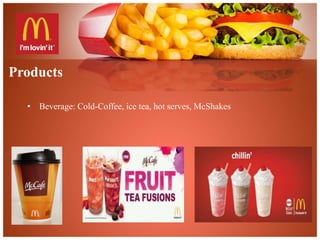
• Beverage: Cold-Coffee, ice tea, hot serves, McShakes
Products 
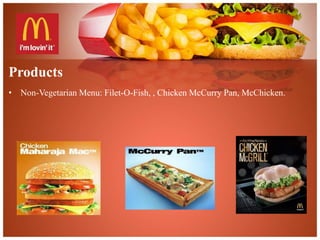
• Non-Vegetarian Menu: Filet-O-Fish, , Chicken McCurry Pan, McChicken.
Products 
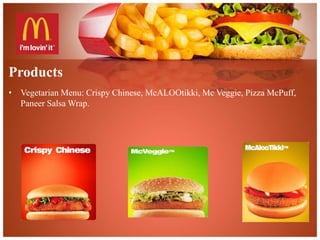
• Vegetarian Menu: Crispy Chinese, McALOOtikki, Mc Veggie, Pizza McPuff, 
Paneer Salsa Wrap.
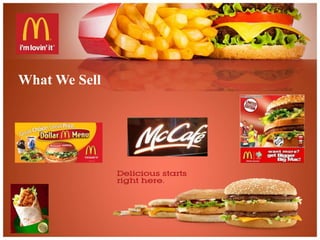
What We Sell 
11
Services 
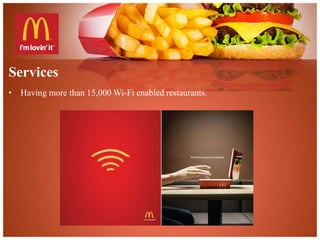
• Having more than 15,000 Wi-Fi enabled restaurants.
Services
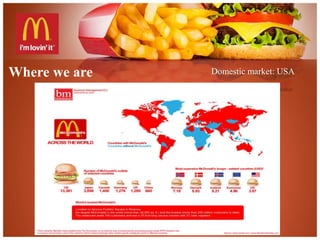
Where we are Domestic market: USA
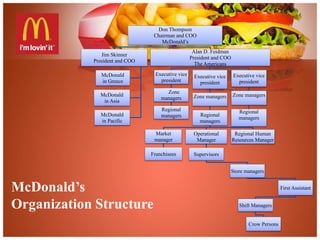
McDonald’s Organization Structure 
• Having tight control of the firm 
• Easily operate the company 
• Improving employees’ performance 
• Atmosphere of cooperation and teamwork 
• The following chart is the organizational structure of McDonald
Don Thompson 
Chairman and COO 
McDonald’s 
Jim Skinner 
President and COO 
McDonald 
in Greece 
McDonald 
in Asia 
McDonald 
in Pacific 
Alan D. Feidman 
President and COO 
The Americans 
Executive vice 
president 
Zone 
managers 
Regional 
managers 
Executive vice 
president 
Zone managers 
Regional 
managers 
Market 
manager 
Franchisees 
Operational 
Manager 
Supervisors 
Executive vice 
president 
Zone managers 
Regional 
managers 
Regional Human 
Resources Manager 
Store managers 
First Assistant 
Shift Managers 
Crow Persons 
McDonald’s 
Organization Structure
Key Processes 
• Doing business over 100 countries 
• 85% franchised restaurants 
• All franchisees are independent, full-time operators 
• Entrepreneur’s number-one franchise named
Manage Operations Technology 
Using OLAP technology: 
 Manipulates data 
 View the data and information
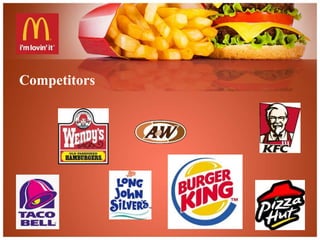
Competitors
Competitive advantages 
• Striving to be cost leaders: prices cannot be matched by 
competitors. 
• The speedy delivery of the food. 
• Strong global presence and largest market share in fast-food 
industry. 
• Net competitive advantage.
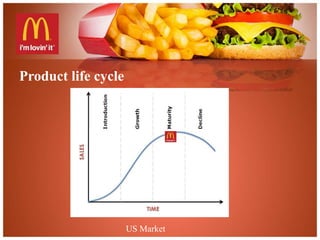
Product life cycle 
US Market
Current strategy of McDonald's: 
• Low-cost strategy to compete with competitors 
• Cutting cost 
• Operating more outlets 
• Focusing on Plan to Win
Financial Analysis 
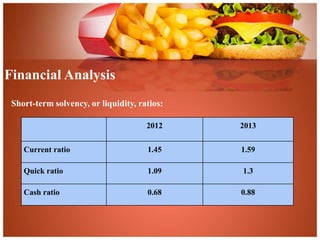
Short-term solvency, or liquidity, ratios: 
2012 2013 
Current ratio 1.45 1.59 
Quick ratio 1.09 1.3 
Cash ratio 0.68 0.88
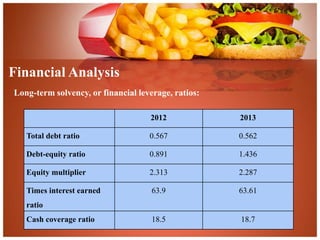
Financial Analysis 
Long-term solvency, or financial leverage, ratios: 
2012 2013 
Total debt ratio 0.567 0.562 
Debt-equity ratio 0.891 1.436 
Equity multiplier 2.313 2.287 
Times interest earned 
ratio 
63.9 63.61 
Cash coverage ratio 18.5 18.7
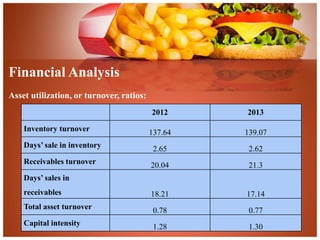
Financial Analysis 
Asset utilization, or turnover, ratios: 
2012 2013 
Inventory turnover 137.64 139.07 
Days’ sale in inventory 
2.65 2.62 
Receivables turnover 
20.04 21.3 
Days’ sales in 
receivables 18.21 17.14 
Total asset turnover 
0.78 0.77 
Capital intensity 
1.28 1.30
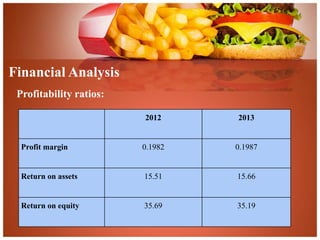
Financial Analysis 
Profitability ratios: 
2012 2013 
Profit margin 0.1982 0.1987 
Return on assets 15.51 15.66 
Return on equity 35.69 35.19
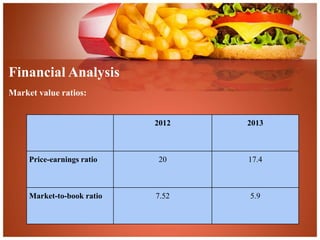
Financial Analysis 
Market value ratios: 
2012 2013 
Price-earnings ratio 20 17.4 
Market-to-book ratio 7.52 5.9
SWOT analysis 
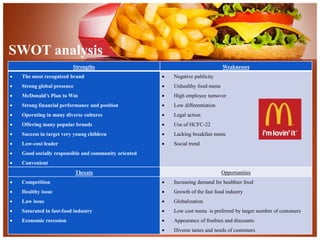
Strengths Weaknesses 
 The most recognized brand 
 Strong global presence 
 McDonald’s Plan to Win 
 Strong financial performance and position 
 Operating in many diverse cultures 
 Offering many popular brands 
 Success in target very young children 
 Low-cost leader 
 Good socially responsible and community oriented 
 Convenient 
 Negative publicity 
 Unhealthy food menu 
 High employee turnover 
 Low differentiation 
 Legal action 
 Use of HCFC-22 
 Lacking breakfast menu 
 Social trend 
Threats Opportunities 
 Competition 
 Healthy issue 
 Law issue 
 Saturated in fast-food industry 
 Economic recession 
 Increasing demand for healthier food 
 Growth of the fast food industry 
 Globalization 
 Low cost menu is preferred by larger number of customers 
 Appearance of freebies and discounts 
 Diverse tastes and needs of customers
SWOT Matrix 
S-O strategies S-T strategies 
• Introducing new nutritious menus 
• Expanding to Asia market 
• Taking advantage of brand name 
• McDonald’s “Plan to Win” 
• Low-cost leadership 
• 
• Taking advantage of brand name 
• Giving back to community 
• Providing new healthier menu 
W-O strategies W-T strategies 
• Minimizing the negative publicity 
• Increasing differentiation 
• Using less Trans fat 
• Switching from HCFC-22 into HFC 
• Increasing Employee satisfaction
CPM Matrix 
McDonald's Burger King Yum Brands Wendy's 
Critical Competitive 
Factors 
Weig 
ht 
Rating Score Rating Score Rating Score Rating Score 
Product Quality 0.15 4 0.6 3 0.45 4 0.6 2 0.3 
Financial 0.15 4 0.6 1 0.15 3 0.45 2 0.3 
Safety 0.12 3 0.36 3 0.36 3 0.36 2 0.24 
Consumer Loyalty 0.08 4 0.32 4 0.32 3 0.24 2 0.16 
Value based on 
Pricing. 
0.12 4 0.48 3 0.36 3 0.36 3 0.36 
Innovation and 
Process Technologies 
0.1 3 0.3 3 0.3 2 0.2 2 0.2 
Global Expansion 0.1 4 0.4 2 0.2 3 0.3 1 0.1 
Market Share 0.1 4 0.4 3 0.3 3 0.3 2 0.2 
Promotions 0.08 4 0.32 4 0.32 3 0.24 3 0.24 
Total 1 3.78 2.76 3.05 2.1 
•McDonald’s 
score high 3.78 
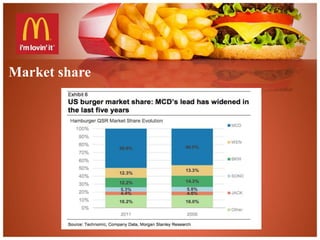
•Highest market 
share 50% 
•Has strong 
position in the 
fast-food industry
Market share
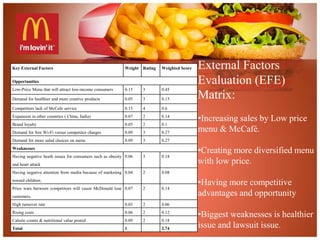
Key External Factors Weight Rating Weighted Score 
Opportunities 
Low-Price Menu that will attract low-income consumers 0.15 3 0.45 
Demand for healthier and more creative products 0.05 3 0.15 
Competitors lack of McCafe service 0.15 4 0.6 
Expansion in other countries ( China, India) 0.07 2 0.14 
Brand loyalty 0.05 2 0.1 
Demand for free Wi-Fi versus competitor charges 0.09 3 0.27 
Demand for more salad choices on menu 0.09 3 0.27 
Weaknesses 
Having negative heath issues for consumers such as obesity 
and heart attack 
0.06 3 0.18 
Having negative attention from media because of marketing 
toward children. 
0.04 2 0.08 
Price wars between competitors will cause McDonald lose 
customers. 
0.07 2 0.14 
High turnover rate 0.03 2 0.06 
Rising costs 0.06 2 0.12 
Calorie counts & nutritional value posted 0.09 2 0.18 
Total 1 2.74 
External Factors 
Evaluation (EFE) 
Matrix: 
•Increasing sales by Low price 
menu & McCafé. 
•Creating more diversified menu 
with low price. 
•Having more competitive 
advantages and opportunity 
•Biggest weaknesses is healthier 
issue and lawsuit issue.
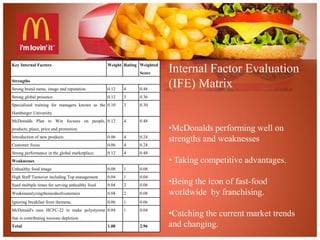
Key Internal Factors Weight Rating Weighted 
Score 
Strengths 
Strong brand name, image and reputation. 0.12 4 0.48 
Strong global presence. 0.12 3 0.36 
Specialized training for managers known as the 
0.10 3 0.30 
Hamburger University. 
McDonalds Plan to Win focuses on people, 
products, place, price and promotion 
0.12 4 0.48 
Introduction of new products 0.06 4 0.24 
Customer focus 0.06 4 0.24 
Strong performance in the global marketplace. 0.12 4 0.48 
Weaknesses 
Unhealthy food image 0.08 1 0.08 
High Staff Turnover including Top management 0.04 1 0.04 
Sued multiple times for serving unhealthy food 0.04 2 0.08 
Weakinanalyzingtheneedsofcustomers 0.04 2 0.08 
Ignoring breakfast from themenu. 0.06 1 0.06 
McDonald's uses HCFC-22 to make polystyrene 
0.04 1 0.04 
that is contributing toozone depletion 
Total 1.00 2.96 
Internal Factor Evaluation 
(IFE) Matrix 
•McDonalds performing well on 
strengths and weaknesses 
• Taking competitive advantages. 
•Being the icon of fast-food 
worldwide by franchising. 
•Catching the current market trends 
and changing.
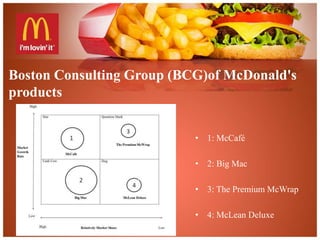
Boston Consulting Group (BCG)of McDonald's 
products 
• 1: McCafé 
• 2: Big Mac 
• 3: The Premium McWrap 
• 4: McLean Deluxe
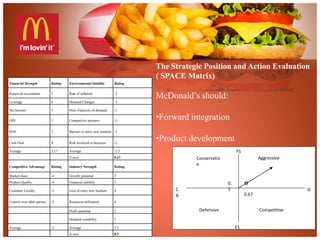
Financial Strength Rating Environmental Stability Rating 
Return on investment. 3 Rate of inflation -3 
Leverage 4 Demand Changes -3 
Net Income 3 Price Elasticity of demand -1 
EPS 3 Competitive pressure -3 
ROE 2 Barriers to entry new markets -3 
Cash Flow 4 Risk involved in business -2 
Average 3.17 Average -2.5 
Y-axis 0.67 
Competitive Advantage Rating Industry Strength Rating 
Market share -4 Growth potential 3 
Product Quality -4 Financial stability 5 
Customer Loyalty -2 Ease of entry new markets 4 
Control over other parties -2 Resources utilization 4 
Profit potential 2 
Demand variability 3 
Average -3 Average 3.5 
X-axis 0.5 
The Strategic Position and Action Evaluation 
( SPACE Matrix) 
McDonald’s should: 
•Forward integration 
•Product development 
Conservativ 
e 
Aggressive 
FS 
C IS 
A 
Defensive Competitive 
ES 
0.67 
0. 
5
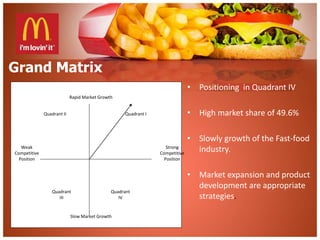
Grand Matrix 
• Positioning in Quadrant IV 
• High market share of 49.6% 
• Slowly growth of the Fast-food 
industry. 
• Market expansion and product 
development are appropriate 
strategies. 
Quadrant II Quadrant I 
Quadrant 
IV 
Quadrant 
III 
Rapid Market Growth 
Strong 
Competitive 
Position 
Weak 
Competitive 
Position 
Slow Market Growth
Strategy 1 
• Expanding to Asia market especially China and India. 
Implementation: 
• Identifying market segmentation. 
• Focusing more on potential market. 
• Legal permission in foreign country 
• Innovating and cooperating with community
Strategy 2 
• Focusing on providing diverse menu include nutrition foods. 
Implementation: 
• Conducting customer survey. 
• Researching new products. 
• Improving their image.
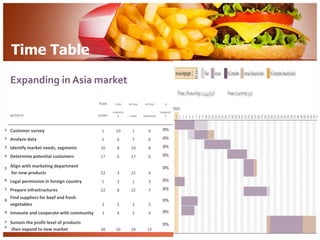
Time Table 
Expanding in Asia market 
PLAN PLAN ACTUAL ACTUAL % 
ACTIVITY START 
DURATIO 
N START DURATION 
COMPLET 
E 
1 Customer survey 1 10 1 6 0% 
2 Analyze data 5 6 7 6 0% 
3 Identify market needs, segments 10 8 10 8 0% 
4 Determine potential customers 17 6 17 6 0% 
5 Align with marketing department 
for new products 22 3 22 4 
0% 
6 Legal permission in foreign country 1 3 1 3 0% 
7 Prepare infrastructures 22 8 22 7 0% 
8 
Find suppliers for beef and fresh 
vegetables 3 5 3 5 
0% 
9 Innovate and cooperate with community 3 4 3 4 0% 
1 
0 
Sustain the profit level of products 
then expand to new market 30 10 29 15 
0%
Marketing
E-Commerce 
• Teaming up with DirectPay to expand online services in India 
• Cooperating with WorldLine to host new website in France 
• Available online ordering in several countries 
• Hiring the first Chief Digital Officer
Recommendation 
Long-term Strategy 
• Expanding influence and presence in Asia market 
Specific Strategy 
• Opening at least 1 restaurant per day in China 
• Having diversity menu in India 
• Receiving feedbacks
Conclusion 
• Good performance in fast-food industry 
• Long reputation for strong marketing campaigns. 
• Must change to adapt new environment 
• Have more innovation and creative strategy
The End 
Thank you for your attention.

McDonald presentation

  • 1.
    Strategic management Class1 – Group 4 Team members: Tong Tran Thanh Phuong – 295920 Tran Huu Minh Quan – 295923 Pham Chau Bao Khoa - 295916
  • 2.
    McDonald’s Problem statement: • Chief Executive Don Thompson stated: “More specifically, growth in the informal eating-out industry has been relatively flat to declining around the world and we expect that to continue.”
  • 3.
    Introduction • Background: Founded: 1955, Franchising since: 1955 Largest fast-food company Operating in over 121 countries, over 35000 locations with 1.5 million employees Revenues $28.1 billion in 2013. • Mission • Vision • History
  • 4.
    Vision "McDonald's visionis to be the world's best quick service restaurant experience. Being the best means providing outstanding quality, service, cleanliness, & value, so that we make every customer in every restaurant smile."
  • 5.
    Mission McDonald's brandmission is to be our customers' favorite place and way to eat and drink. Our worldwide operations are aligned around a global strategy called the Plan to Win, which center on an exceptional customer experience – People, Products, Place, Price and Promotion. We are committed to continuously improving our operations and enhancing our customers' experience.
  • 6.
    History • 1940First McDonald’s • 1952 Attempts at franchising • 1954 Milk Shake Machine • 1955 prototype opens in Des Plaines, IL • 1956 14 McDonald’s • 1961 McDonald brothers sell rights • 1965 McDonald’s go public • 1968 Introduction of Big Mac and shift to Network Television
  • 7.
    History (cont) •1970 1600 restaurants • 1980 6000 McDonald’s Restaurants • 1990 record sales • 1994 Kuwait City, Kuwait • 2002 Forty seven years after  30,000 locations  2000 new restaurants  World Wide Web  McDonald’s a recognized Brand Name
  • 8.
    Products • Beverage:Cold-Coffee, ice tea, hot serves, McShakes
  • 9.
    Products • Non-VegetarianMenu: Filet-O-Fish, , Chicken McCurry Pan, McChicken.
  • 10.
    Products • VegetarianMenu: Crispy Chinese, McALOOtikki, Mc Veggie, Pizza McPuff, Paneer Salsa Wrap.
  • 11.
  • 12.
    Services • Havingmore than 15,000 Wi-Fi enabled restaurants.
  • 13.
  • 14.
    Where we areDomestic market: USA
  • 15.
    McDonald’s Organization Structure • Having tight control of the firm • Easily operate the company • Improving employees’ performance • Atmosphere of cooperation and teamwork • The following chart is the organizational structure of McDonald
  • 16.
    Don Thompson Chairmanand COO McDonald’s Jim Skinner President and COO McDonald in Greece McDonald in Asia McDonald in Pacific Alan D. Feidman President and COO The Americans Executive vice president Zone managers Regional managers Executive vice president Zone managers Regional managers Market manager Franchisees Operational Manager Supervisors Executive vice president Zone managers Regional managers Regional Human Resources Manager Store managers First Assistant Shift Managers Crow Persons McDonald’s Organization Structure
  • 17.
    Key Processes •Doing business over 100 countries • 85% franchised restaurants • All franchisees are independent, full-time operators • Entrepreneur’s number-one franchise named
  • 18.
    Manage Operations Technology Using OLAP technology:  Manipulates data  View the data and information
  • 19.
  • 20.
    Competitive advantages •Striving to be cost leaders: prices cannot be matched by competitors. • The speedy delivery of the food. • Strong global presence and largest market share in fast-food industry. • Net competitive advantage.
  • 21.
  • 22.
    Current strategy ofMcDonald's: • Low-cost strategy to compete with competitors • Cutting cost • Operating more outlets • Focusing on Plan to Win
  • 23.
    Financial Analysis Short-termsolvency, or liquidity, ratios: 2012 2013 Current ratio 1.45 1.59 Quick ratio 1.09 1.3 Cash ratio 0.68 0.88
  • 24.
    Financial Analysis Long-termsolvency, or financial leverage, ratios: 2012 2013 Total debt ratio 0.567 0.562 Debt-equity ratio 0.891 1.436 Equity multiplier 2.313 2.287 Times interest earned ratio 63.9 63.61 Cash coverage ratio 18.5 18.7
  • 25.
    Financial Analysis Assetutilization, or turnover, ratios: 2012 2013 Inventory turnover 137.64 139.07 Days’ sale in inventory 2.65 2.62 Receivables turnover 20.04 21.3 Days’ sales in receivables 18.21 17.14 Total asset turnover 0.78 0.77 Capital intensity 1.28 1.30
  • 26.
    Financial Analysis Profitabilityratios: 2012 2013 Profit margin 0.1982 0.1987 Return on assets 15.51 15.66 Return on equity 35.69 35.19
  • 27.
    Financial Analysis Marketvalue ratios: 2012 2013 Price-earnings ratio 20 17.4 Market-to-book ratio 7.52 5.9
  • 28.
    SWOT analysis StrengthsWeaknesses  The most recognized brand  Strong global presence  McDonald’s Plan to Win  Strong financial performance and position  Operating in many diverse cultures  Offering many popular brands  Success in target very young children  Low-cost leader  Good socially responsible and community oriented  Convenient  Negative publicity  Unhealthy food menu  High employee turnover  Low differentiation  Legal action  Use of HCFC-22  Lacking breakfast menu  Social trend Threats Opportunities  Competition  Healthy issue  Law issue  Saturated in fast-food industry  Economic recession  Increasing demand for healthier food  Growth of the fast food industry  Globalization  Low cost menu is preferred by larger number of customers  Appearance of freebies and discounts  Diverse tastes and needs of customers
  • 29.
    SWOT Matrix S-Ostrategies S-T strategies • Introducing new nutritious menus • Expanding to Asia market • Taking advantage of brand name • McDonald’s “Plan to Win” • Low-cost leadership • • Taking advantage of brand name • Giving back to community • Providing new healthier menu W-O strategies W-T strategies • Minimizing the negative publicity • Increasing differentiation • Using less Trans fat • Switching from HCFC-22 into HFC • Increasing Employee satisfaction
  • 30.
    CPM Matrix McDonald'sBurger King Yum Brands Wendy's Critical Competitive Factors Weig ht Rating Score Rating Score Rating Score Rating Score Product Quality 0.15 4 0.6 3 0.45 4 0.6 2 0.3 Financial 0.15 4 0.6 1 0.15 3 0.45 2 0.3 Safety 0.12 3 0.36 3 0.36 3 0.36 2 0.24 Consumer Loyalty 0.08 4 0.32 4 0.32 3 0.24 2 0.16 Value based on Pricing. 0.12 4 0.48 3 0.36 3 0.36 3 0.36 Innovation and Process Technologies 0.1 3 0.3 3 0.3 2 0.2 2 0.2 Global Expansion 0.1 4 0.4 2 0.2 3 0.3 1 0.1 Market Share 0.1 4 0.4 3 0.3 3 0.3 2 0.2 Promotions 0.08 4 0.32 4 0.32 3 0.24 3 0.24 Total 1 3.78 2.76 3.05 2.1 •McDonald’s score high 3.78 •Highest market share 50% •Has strong position in the fast-food industry
  • 31.
  • 32.
    Key External FactorsWeight Rating Weighted Score Opportunities Low-Price Menu that will attract low-income consumers 0.15 3 0.45 Demand for healthier and more creative products 0.05 3 0.15 Competitors lack of McCafe service 0.15 4 0.6 Expansion in other countries ( China, India) 0.07 2 0.14 Brand loyalty 0.05 2 0.1 Demand for free Wi-Fi versus competitor charges 0.09 3 0.27 Demand for more salad choices on menu 0.09 3 0.27 Weaknesses Having negative heath issues for consumers such as obesity and heart attack 0.06 3 0.18 Having negative attention from media because of marketing toward children. 0.04 2 0.08 Price wars between competitors will cause McDonald lose customers. 0.07 2 0.14 High turnover rate 0.03 2 0.06 Rising costs 0.06 2 0.12 Calorie counts & nutritional value posted 0.09 2 0.18 Total 1 2.74 External Factors Evaluation (EFE) Matrix: •Increasing sales by Low price menu & McCafé. •Creating more diversified menu with low price. •Having more competitive advantages and opportunity •Biggest weaknesses is healthier issue and lawsuit issue.
  • 33.
    Key Internal FactorsWeight Rating Weighted Score Strengths Strong brand name, image and reputation. 0.12 4 0.48 Strong global presence. 0.12 3 0.36 Specialized training for managers known as the 0.10 3 0.30 Hamburger University. McDonalds Plan to Win focuses on people, products, place, price and promotion 0.12 4 0.48 Introduction of new products 0.06 4 0.24 Customer focus 0.06 4 0.24 Strong performance in the global marketplace. 0.12 4 0.48 Weaknesses Unhealthy food image 0.08 1 0.08 High Staff Turnover including Top management 0.04 1 0.04 Sued multiple times for serving unhealthy food 0.04 2 0.08 Weakinanalyzingtheneedsofcustomers 0.04 2 0.08 Ignoring breakfast from themenu. 0.06 1 0.06 McDonald's uses HCFC-22 to make polystyrene 0.04 1 0.04 that is contributing toozone depletion Total 1.00 2.96 Internal Factor Evaluation (IFE) Matrix •McDonalds performing well on strengths and weaknesses • Taking competitive advantages. •Being the icon of fast-food worldwide by franchising. •Catching the current market trends and changing.
  • 34.
    Boston Consulting Group(BCG)of McDonald's products • 1: McCafé • 2: Big Mac • 3: The Premium McWrap • 4: McLean Deluxe
  • 35.
    Financial Strength RatingEnvironmental Stability Rating Return on investment. 3 Rate of inflation -3 Leverage 4 Demand Changes -3 Net Income 3 Price Elasticity of demand -1 EPS 3 Competitive pressure -3 ROE 2 Barriers to entry new markets -3 Cash Flow 4 Risk involved in business -2 Average 3.17 Average -2.5 Y-axis 0.67 Competitive Advantage Rating Industry Strength Rating Market share -4 Growth potential 3 Product Quality -4 Financial stability 5 Customer Loyalty -2 Ease of entry new markets 4 Control over other parties -2 Resources utilization 4 Profit potential 2 Demand variability 3 Average -3 Average 3.5 X-axis 0.5 The Strategic Position and Action Evaluation ( SPACE Matrix) McDonald’s should: •Forward integration •Product development Conservativ e Aggressive FS C IS A Defensive Competitive ES 0.67 0. 5
  • 36.
    Grand Matrix •Positioning in Quadrant IV • High market share of 49.6% • Slowly growth of the Fast-food industry. • Market expansion and product development are appropriate strategies. Quadrant II Quadrant I Quadrant IV Quadrant III Rapid Market Growth Strong Competitive Position Weak Competitive Position Slow Market Growth
  • 37.
    Strategy 1 •Expanding to Asia market especially China and India. Implementation: • Identifying market segmentation. • Focusing more on potential market. • Legal permission in foreign country • Innovating and cooperating with community
  • 38.
    Strategy 2 •Focusing on providing diverse menu include nutrition foods. Implementation: • Conducting customer survey. • Researching new products. • Improving their image.
  • 39.
    Time Table Expandingin Asia market PLAN PLAN ACTUAL ACTUAL % ACTIVITY START DURATIO N START DURATION COMPLET E 1 Customer survey 1 10 1 6 0% 2 Analyze data 5 6 7 6 0% 3 Identify market needs, segments 10 8 10 8 0% 4 Determine potential customers 17 6 17 6 0% 5 Align with marketing department for new products 22 3 22 4 0% 6 Legal permission in foreign country 1 3 1 3 0% 7 Prepare infrastructures 22 8 22 7 0% 8 Find suppliers for beef and fresh vegetables 3 5 3 5 0% 9 Innovate and cooperate with community 3 4 3 4 0% 1 0 Sustain the profit level of products then expand to new market 30 10 29 15 0%
  • 40.
  • 41.
    E-Commerce • Teamingup with DirectPay to expand online services in India • Cooperating with WorldLine to host new website in France • Available online ordering in several countries • Hiring the first Chief Digital Officer
  • 42.
    Recommendation Long-term Strategy • Expanding influence and presence in Asia market Specific Strategy • Opening at least 1 restaurant per day in China • Having diversity menu in India • Receiving feedbacks
  • 43.
    Conclusion • Goodperformance in fast-food industry • Long reputation for strong marketing campaigns. • Must change to adapt new environment • Have more innovation and creative strategy
  • 44.
    The End Thankyou for your attention.

Editor's Notes

  • #38 http://www.fastfoodmenuprices.com/mcdonalds-vs-burger-king/