ASSIGNMENT # A 619
Course Code: 50121619
Course Name: Retail Management
Retail Chain: McDonald’s India
Roll No: 489
McDonald’s India
Introduction
• The McDonald’s Corporation is the world’s largest chain of
hamburger fast food restaurants, serving around 68 million
customers daily in 119 countries.
• Headquarters in the United States, the company began in
1940 as a barbecue restaurant opened by Richard and
Maurice McDonald. In 1948 they reorganized their
business as a hamburger stand using production line
principles.
• McDonald’s operates over 34,000 restaurants worldwide,
employing more than 1.7 million people.
McDonald’s India
Grand Opening: McDonald's opened its doors in India, the
95th country, in 1996 and was the first country to serve non-
beef and non-pork items. Its authority on non-beef and non-
pork products still remains unchallenged.
Ownership: McDonald’s India is a locally owned company
managed by Indians;
- Vikram Bakshi, under Connaught Plaza Restaurants Pvt. Ltd
in Northern and Eastern Region (Headquartered in New Delhi)
through a joint venture
- Smita Jatia, under Hard castle Restaurants Pvt. Ltd. in the
Western and Southern Region(Headquartered in Mumbai)
which is a DL (Development Licensee)
McDonald’s India
McDonald’s Philosophy: McDonald’s philosophy of QSCV
(Quality, Service, Cleanliness and Value) is the guiding force
behind it’s service to the customers in India
The Scorecard: The first McDonald's restaurant in India
opened on October 13, 1996 at Basant Lok, New Delhi.
Today, McDonald’s has 242 restaurants operating in India
serving over 5, 00,000 customers’ everyday and has
completed more than 10 years of unparalleled in the country.
Vendor Development; McDonald’s spent more than 5 years
(from 1990 onwards) on developing the first beef-less and
pork-less menu in McDonald’s history.
Key Landmarks - McDonald’s
India Journey
1996:
• The first McDonald’s restaurant opened on Oct. 13, at
Basant Lok, Vasant Vihar, New Delhi. It was also the first
McDonald’s restaurant in the world not serving beef on its
menu.
1997:
• The first Drive–Thru restaurant at Noida (UP)
• The first disabled friendly store at Noida (UP)
1999: The first Mall location restaurant at Ansal Plaza (Delhi)
Key Landmarks - McDonald’s
India Journey
2000 : The first highway restaurant at Mathura (UP)
2001: The first thematic restaurant at Connaught Place (Delhi)
2002 :
• The first restaurant in a food court at 3C’s, Lajpat Nagar
(New Delhi)
• The first restaurant at the Delhi Metro Station at Inter State
Bus Terminus
• The first fundraiser in association with ORBIS and Dr.
Shroff’s Charity Eye hospital.(Delhi)
Key Landmarks -
McDonald’s India Journey
2003: The first Dessert Kiosk – Faridabad (Haryana)
2004: McDonald’s Delivery Service (McDelivery) introduced in
New Delhi.
2003-04: Indigenous products like McAloo Tikki, McVeggie
and Pizza McPuff exported to Middle East countries.
2006:
• McDelivery on Bicycles flagged off at Chandni Chowk
(Delhi)- another first initiative by McDonald’s India
• 100th McDonalds Restaurant in India, 10th year Anniversary.
Key Landmarks -
McDonald’s India Journey
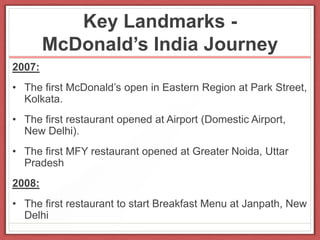
2007:
• The first McDonald’s open in Eastern Region at Park Street,
Kolkata.
• The first restaurant opened at Airport (Domestic Airport,
New Delhi).
• The first MFY restaurant opened at Greater Noida, Uttar
Pradesh
2008:
• The first restaurant to start Breakfast Menu at Janpath, New
Delhi
Key Landmarks -
McDonald’s India Journey
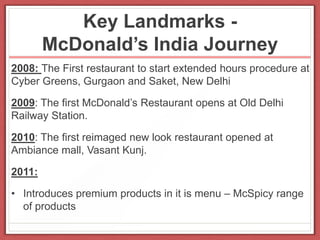
2008: The First restaurant to start extended hours procedure at
Cyber Greens, Gurgaon and Saket, New Delhi
2009: The first McDonald’s Restaurant opens at Old Delhi
Railway Station.
2010: The first reimaged new look restaurant opened at
Ambiance mall, Vasant Kunj.
2011:
• Introduces premium products in it is menu – McSpicy range
of products
Key Landmarks -
McDonald’s India Journey
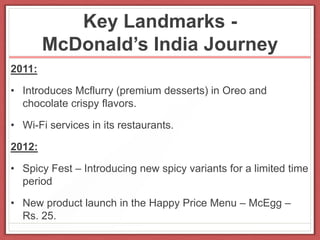
2011:
• Introduces Mcflurry (premium desserts) in Oreo and
chocolate crispy flavors.
• Wi-Fi services in its restaurants.
2012:
• Spicy Fest – Introducing new spicy variants for a limited time
period
• New product launch in the Happy Price Menu – McEgg –
Rs. 25.
Key Landmarks -
McDonald’s India Journey
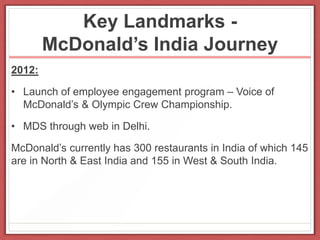
2012:
• Launch of employee engagement program – Voice of
McDonald’s & Olympic Crew Championship.
• MDS through web in Delhi.
McDonald’s currently has 300 restaurants in India of which 145
are in North & East India and 155 in West & South India.
Fast Food Industry In India
• As per new research report “Indian Fast Food Market
Analysis”, India is blessed with one of the fastest growing
fast-food markets in the world. The Indian fast food market is
growing at an annual growth rate of 30-35%.
• Although the market has witnessed robust growth in the past
couple of years, it remains largely under penetrated and
concentrated in the metropolitan cities.
• In 2013, the global fast food market is forecasted to have a
value of $200 billion, an increase of 29.3% and a volume of
94.7 billion transactions, an increase of 10.4% since 2008.
Fast Food Industry In India
• It is estimated through credit Suisse Emerging Consumer
Survey, that the average Indian spends just $11 as
compared to his Chinese counterpart who would ideally
spend $20 on fast food. Yet, if we see the Indian spending
on food in totality, they spend 23% of their earnings on the
same while the Chinese spending is 20%.
• Almost all big fast food brands of the world have succeeded
in making their presence felt in the country and most of them
are posting appreciable growth.
McDonalds Business Model
 Franchise Model :- Only 15% of the total number of
restaurants are owned by the Company. The remaining 85%
is operated by franchises. The company follows a
comprehensive framework of training and monitoring of its
franchises to ensure that they adhere to the Quality, Service,
Cleanliness and Value propositions offered by the company
to its customers.
 Product Consistency :- by developing a sophisticated
supplier networked operation and distribution system, the
company has been able to achieve consistent product taste
and quality across geographies.
McDonalds Business Model
 Act like a retailer and think like a brand :- McDonalds
focuses not only on delivering sales for the immediate
present, but also protecting its long-term brand reputation.
Target Market Segment
McDonald’s has segmented their products according to 3
different bases. They have segmented their products and
positioned their products according to kids, students and
family. But they haven’t segmented their products according to
the Adult target group.
The 3 bases for segmentation are :
• Demographic Segmentation
• Psychographic Segmentation
• Behavioral Segmentation
Target Market Segment
• Demographic Segmentation :- (Kids, family and students.)
McDonalds offers different products like Happy Meal which
includes a free toy for kids. For family it has made different
outlets and meals which are suitable for takeaways and
drive-thru. McDonalds has made its environment suitable for
school/college students to hangout with their friends and
grab their lunch at McDonalds.
• Psychographic Segmentation :- (Convenience and
lifestyle )McDonalds has adapted itself according to the
convenience and lifestyle of the Indian consumers, as India
has a huge vegetarian population so McDonald’s came up
with a different and new product line which includes items
like Mc Veggie burger and Mc Aloo tikki Burger.
Target Market Segment
• Behavioral Segmentation :- (Occasions, for e.g. Birthday
parties for kids). McDonalds at several outlets also provides
facilities like “Play Place” where children can play arcade
games, air hockey etc. This helps McDonalds to attract the
young urban families wanting to spend some quality time
while their children have fun at the outlet.
Customer Perception and
Customer Expectation
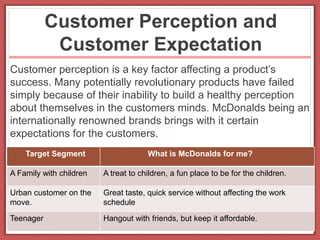
Customer perception is a key factor affecting a product’s
success. Many potentially revolutionary products have failed
simply because of their inability to build a healthy perception
about themselves in the customers minds. McDonalds being an
internationally renowned brands brings with it certain
expectations for the customers.
Target Segment What is McDonalds for me?
A Family with children A treat to children, a fun place to be for the children.
Urban customer on the
move.
Great taste, quick service without affecting the work
schedule
Teenager Hangout with friends, but keep it affordable.
Challenges in Entering Indian
Markets
• Regiocentricism : Re-engineering the menu –
McDonald’s has continually adapted to the customer’s
tastes, value systems, lifestyle, language and perception.
Globally McDonald’s was known for its hamburgers, beef
and pork burgers. Most Indians are barred by religion not to
consume beef or pork. To survive, the company had to be
responsive to the Indian sensitivities. So McDonald’s came
up with chicken, lamb and fish burger to suite the Indian
palate.
• The Vegetarian customer – India has a huge population of
vegetarians. To cater to this customer segment, the
company came up with a completely new line of vegetarian
items like Mc Veggie burger and Mc Aloo tikki.
McDonald’s Marketing Mix
The 5 P’s used by McDonald’s are :-
1. Product
2. Place
3. Price
4. Promotion
5. People
Product
McDonalds has intentionally kept its product depth and
product width limited. McDonalds studied the behavior of the
Indian customer and provided a totally different menu as
compared to its International offerings.
It dropped ham, beef and mutton burgers from the menu. India
is the only country where McDonalds serves vegetarian menu.
Even the sauces and cheese used in India are 100%
vegetarian.
McDonalds continuously innovates its products according to
changing preferences and tastes of it customers. The recent
example is the introduction of the Chicken Maharaja Mac.
McDonalds bring with it a globally reputed brand, world class
food quality and excellent customer specific product features.
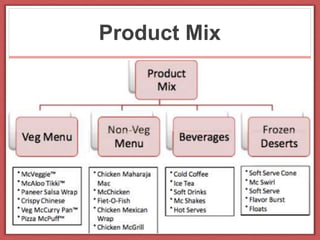
Product Mix
Place
The place mainly consists of the distribution channels. It is
important so that the product is available to the customer at
the right place, at the right time and in right quantity.
There is a certain degree of fun and happiness that a
customer feels each time he dines at McDonalds. There are
certain value propositions that McDonalds offer to its
customers based on their need. McDonalds offers hygienic
environment, good ambience and great service.
McDonald’s Supply Chain
 An Overview
• McDonald's unique 'cold chain', on which the QSR major
has spent more than six years setting up in India, has
brought about a veritable revolution, immensely benefiting
the farmers at one end and enabling customers at retail
counters to get the highest quality food products, absolutely
fresh and at great value.
• McDonald's, through its unique cold chain, has been able to,
both cut down on its operational wastage, as well as
maintain the freshness and nutritional value of raw and
processed food products. This has involved procurement,
warehousing, transportation and retailing of perishable food
products, all under controlled temperatures.
McDonald’s Supply Chain
 Supply Chain Process
• A McDonald's burger is not just a burger but an outcome of
dedicated efforts by farmers, its suppliers, distribution center
and a firm promise by McDonald's.
• McDonald's contributes a great back end process which
enables you to enjoy your favorite burger fresh & hot, and
for that, the supply chain truly acts as a backbone of the
business.
• The supply chain begins at the grass root level, with the
suppliers receiving the crop from the farmers. The crop is
then processed and dispatched to the Distribution centers in
special temperature controlled trucks, which ensures that
the quality of the items is not compromised.
McDonald’s Supply Chain
 Supply Chain Process
• These items are stored in rooms with different temperature
zones and are finally dispatched to the McDonald's
restaurants on the basis of their requirements. McDonald's
expectation of 'Cold, Clean, and On-Time Delivery' plays a
very vital role in maintaining the integrity of the products
throughout the entire 'cold chain'.
McDonald’s Supply Chain
 Sourcing and Storage
 Setting up this extensive cold chain distribution system has
involved the transfer of state-of- the-art food processing
technology by McDonald's and its international suppliers to
pioneering Indian enterprises who, today, are an integral
part of the McDonald's cold chain.
 McDonald's Supply Chain's distribution partner ensures that
all requirements ranging from liquid products coming from
Punjab, to lettuce from Pune, is received from different parts
of the country.
McDonald’s Supply Chain
 Sourcing and Storage
 McDonald's India has around 40 suppliers and all the
suppliers are HACCP certified, ensuring highest level of
quality. They work cohesively to ensure that the final product
reaches the customer consistently each time and every time
 McDonald's India has ensured that this dedicated supply
chain enables the Indian supplier an accesses to latest in
food processing technology, management practices and
advanced agricultural inputs with significant investment at
the back end. This has proved to be a great advantage in
serving the customers better.
McDonald’s Supply Chain
 Supply Chain: Cost Management
The tremendous value benefit is enabled by McDonald's
renowned supply chain management system and by
leveraging economies, which helps minimize costs while
maximizing value to customers.
McDonald's strong back ward integration connects it directly
with various aspects of the business right up to the farm level,
which helps in increasing the productivity in terms of yields
and helps the brand manage costs.
A well entrenched process driven production system ensures
high levels of standardization and quality, which also keeps
wastage and costs in check
McDonald’s Supply Chain
 Supply Chain: Menu Management
• Menu innovations are a constant practice at McDonald's.
McDonald's introduced global core products like McNuggets
and have also re-engineered the product range to suit the
Indian palate. This menu innovation has been possible due
to robust supply chain network right up to farm level.
• Every new product requires a special treatment and the
backend process needs to be upgraded to meet the
requirements.
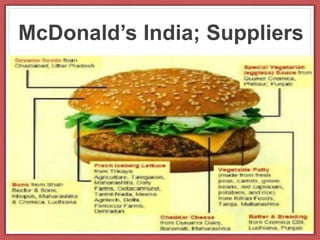
McDonald’s India; Suppliers
Pricing Strategy
Success of McDonalds has been mainly due to its value for
money offering to the Indian Consumers. The prices offered
are in the range of lower middle section of the society.
Moreover it customization in accordance with the taste of
Indian consumers has also worked in its favor. McDonalds
Pricing Strategies are as follows:-
• Value Pricing.
• Product line Pricing.
• Promotional Pricing.
• Penetration Pricing.
Pricing Strategy
 Value Pricing
McDonalds came with the concept of value pricing for Indian
consumers where in it came out with various combos in form of
• Happy meals comprising of small burgers, coke + toy.
• Medium meal combo that consisted of burger, medium fries
and medium coke with the price of Rs. 75
• Maharaja Mac Meal – Rs. 94
• Famil Dines under Rs. 300.
Pricing Strategy
 Product line Pricing
McDonalds has a unique price strategy which falls soley on
many of their product lines. Their Value Meals fall into the
category of Product Line Pricing. “where there is a range of
product or services the pricing reflect the benefits of parts of
the rang”. For example, you can order Two Cheeseburger
Value Meal that comes with a medium drink and fries for
around Rs. 75 (prices may vary). You can Super size this meal
to get a large drink and fries for a little money or you can go
with another value meal that might include different items for
different price.
Pricing Strategy
 Promotional Pricing
If you have driven past a McDonald’s, you will notice that
somewhere on their property, whether it is a banner on their
building or spelled out on their sign, they are always offering
some sort of promotional pricing. This promotion can be seen
as a large banner draped across the building on many
restaurants. This promotion changes weekly and may consist
of different menu items packaged together
Pricing Strategy
 Penetration Pricing
When McDonald’s first began to break into the coffee market,
they ran a large marketing campaign in order to gain some
market share in the industry. For a limited time frame, you
could get a free small coffee every morning from 4-7 am. This
was to promote their new coffee partnership with Green
Mountain coffee and helped spread the word that McDonald’s
was now offering coffee.
Promotion
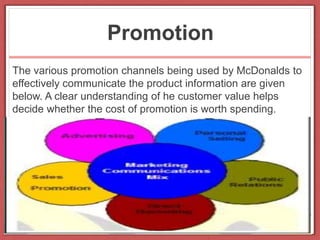
The various promotion channels being used by McDonalds to
effectively communicate the product information are given
below. A clear understanding of he customer value helps
decide whether the cost of promotion is worth spending.
Promotion
There are 3 main objectives of advertising for McDonalds -to
make people aware of an item, feel positive about it and
remember it. The right message has to be communicated to
the right audience through the right media. McDonalds does
its promotion through television, hoardings and bus shelters.
Some of the most famous marketing campaigns of McDonalds
are:
• “You deserve a break today, so get up and get away- To
McDonalds”
• “Aap ke zamane mein, baap ke zamane ke daam”
• “Food, folks and fun.”
People
McDonalds understands the value of both its employees and
its customers. It understands the fact that a happy employee
can serve well and result in a happy customer.
McDonald has been one of the most prominent in the global
hospitality for many years. The continuous growth of the
company in a global market addressing various issues
regarding the Human resources hailing from countries with
different culture is really an interesting matter of study.
Generally a HR strategy involves the careful development of
various components of the HRM.
Human Resource Strategy
A general discussion of the HR strategy of McDonald has
been made as follows:
1. Organizational Structure.
2. Job Analysis and Job Evaluation.
3. Recruitment and Selection Process.
4. Management development (Training and Development).
5. Motivation Performance management and Appraisal.
6. Reward and Employee Benefits.
Human Resource Strategy
1) Organizational Structure
McDonald has 3 different categories in their structure:
• The corporate staff controls the company and manages the
franchises worldwide.
• The Franchisees are given restaurants to manage them
following the standard of practices set by McDonald.
• Restaurant workers are the lower-level wage based
employees who are paid in hourly basis.
Human Resource Strategy
2) Job Analysis and Job Evaluation
• Job Analysis method of the McDonald is developed by the
human resource department in consultation with various
other departments. After job description, job restructuring is
performed on the basis of observations of the senior
employees.
• In McDonald’s, Job evaluation involves deciding the wages
and salaries of the employees on the basis of job analysis.
Job evaluation is also referred as compensation in
McDonald. The organization has its predefined standards
for the evaluation of its employees based on their skills,
knowledge and experiences.
Human Resource Strategy
3) Recruitment and Selection Process
McDonald screens the applications submitted by the individual
applicants. A well devised recruitment policy is formulated for
the selection process. The screening of the applicants is based
on the merit, institute of previous employment, experience and
so on. Candidates passing through this are further processed
for selection.
Human Resource Strategy
4) Management Development
Training and development of employees is of vital concern for
a globalized company like McDonald. McDonald has a
Management Development Program (MDP) designed to
develop the potential leaders. For example, each year,
McDonald trains about 55,000 employees. It also invests more
than $10 million to ongoing employee trainings, providing
valuable skills and knowledge to its franchisees all over the
globe. It has a designated Hamburger University as a
management training center for its valued employees.
Human Resource Strategy
5) Performance Appraisal
The performance of the employees is appraised on a regular
basis. Absence of appropriate performance appraisal leads to
employee dissatisfaction and frustration. McDonald makes use
of various performance appraisal methods like Graphical rating
scale and 360 degree feedback.
Human Resource Strategy
6) Compensation and Employee Benefits
Compensation in McDonald includes:
• Direct financial payments: wages, salaries, bonuses and
commission.
• Indirect payments: financial benefits like paid insurance
Employee Benefits in McDonald includes perks and benefits
like:
• Free life insurance after 3 years of employment,
• Medical and hospital facilities,
• Provident fund, etc.
Competitors Analysis
McDonalds has been a leading fast-food outlet. But the outlet
understudy has other competitors eating away into the market
share. In addition to its traditional rivals – KFC, Dominos, Pizza
Hut- the firm encounters new challenges. Jumbo King
competes using a back to basics approach of quickly serving
up burgers for time-pressed consumer. On the higher end, the
KFC has become potent competitor in the quick service field,
taking away customers from McDonalds.
At this time, a new critical success factor maybe emerging; the
need to create rich, satisfying experience for the consumers.
This brings us to service and experience based competition
which McDonalds can use against Jumbo King.
Competitors Analysis
Keeping in mind the demographics of the area, McDonalds
has Wi-Fi enabled the outlet to cater to the student community.
It is for this overall “Food, Fun & Folks” experience customers
pay premium price over the other competitors.
Competition also reduces product lifecycle; inducing firms to
revise their product portfolios and to revisit their product
market to understand changing needs, expectations and
perception of different market segments. The new
McBreakfast woud be introduced between 6 to 11 am as a
pilot project. This would open up a whole new revenue stream
for McDonalds by tapping into student an working population.
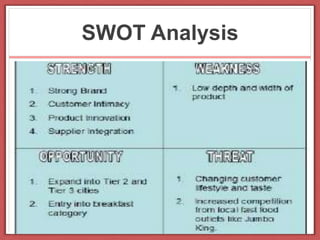
SWOT Analysis