MBT- LEVELING
AND ALIGNMENT
Presented by :
Dr. Nabila Tahir
1
Contents
 Introduction
 Alignment
 Principles in the choice of alignment wires
 Properties of alignment archwires
 Variables in the selection of alignment archwires
 Special problems in alignment
 Alignment in different techniques
 Leveling
 Leveling in different techniques
 Anchorage control during alignment and leveling
 Exception to full bracket placement
2
3
•Re-leveling
•Conclusion
•References
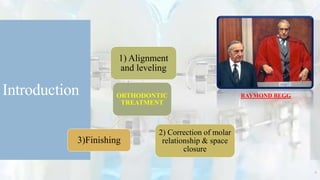
Introduction ORTHODONTIC
TREATMENT
1) Alignment
and leveling
2) Correction of molar
relationship & space
closure
3)Finishing
RAYMOND BEGG
4
DEFINITION
The tooth movements needed to achieve passive engagement
of a steel rectangular arch wire of 0.019” X 0.025”
dimension and of suitable arch form, into a correctly placed
preadjusted 0.022” bracket system.
5
•Systemized orthodontic treatment mechanics – McLaughlin Bennett Trevisi
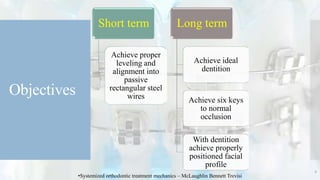
Objectives
Short term
Achieve proper
leveling and
alignment into
passive
rectangular steel
wires
Long term
Achieve ideal
dentition
Achieve six keys
to normal
occlusion
With dentition
achieve properly
positioned facial
profile
6
•Systemized orthodontic treatment mechanics – McLaughlin Bennett Trevisi
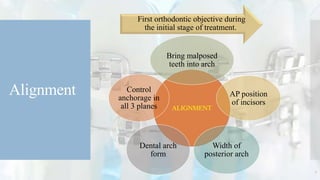
Alignment
First orthodontic objective during
the initial stage of treatment.
ALIGNMENT
Bring malposed
teeth into arch
AP position
of incisors
Width of
posterior arch
Dental arch
form
Control
anchorage in
all 3 planes
7
PRINCIPLES
IN THE
CHOICE OF
ALIGNING
WIRES
1)Light continuous forces
2) Free movement of the archwire
3) Use round wire
4) Address one plane at a time
5) Excess crowding is present , create space
first
8
•Systemized orthodontic treatment mechanics – McLaughlin Bennett Trevisi
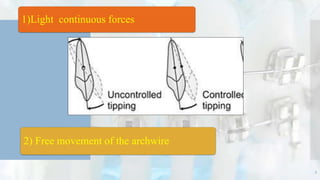
1)Light continuous forces
2) Free movement of the archwire
9
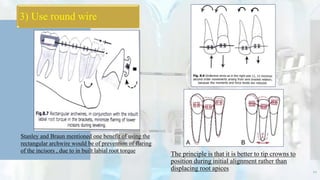
Stanley and Braun mentioned one benefit of using the
rectangular archwire would be of prevention of flaring
of the incisors , due to in built labial root torque
The principle is that it is better to tip crowns to
position during initial alignment rather than
displacing root apices
3) Use round wire
10
4) Address one plane at a time
5) Excess crowding is present , create
space first
11
Properties of
alignment
arch wires
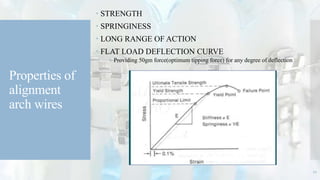
 STRENGTH
 SPRINGINESS
 LONG RANGE OF ACTION
 FLAT LOAD DEFLECTION CURVE
 Providing 50gm force(optimum tipping force) for any degree of deflection
12
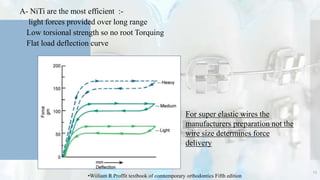
A- NiTi are the most efficient :-
 light forces provided over long range
 Low torsional strength so no root Torquing
 Flat load deflection curve
For super elastic wires the
manufacturers preparation not the
wire size determines force
delivery
13
•Wiiliam R Proffit textbook of comtemporary orthodontics Fifth edition
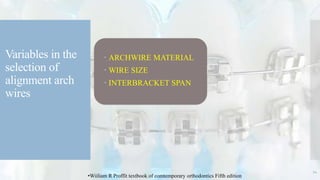
Variables in the
selection of
alignment arch
wires
 ARCHWIRE MATERIAL
 WIRE SIZE
 INTERBRACKET SPAN
14
•Wiiliam R Proffit textbook of comtemporary orthodontics Fifth edition
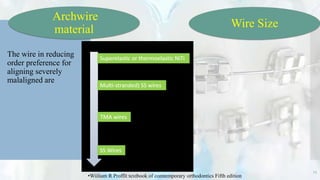
 The wire in reducing
order preference for
aligning severely
malaligned are
Archwire
material Wire Size
15
•Wiiliam R Proffit textbook of comtemporary orthodontics Fifth edition
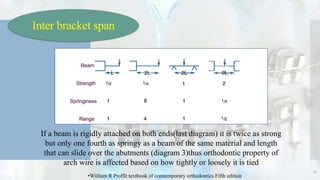
If a beam is rigidly attached on both ends(last diagram) it is twice as strong
but only one fourth as springy as a beam of the same material and length
that can slide over the abutments (diagram 3)thus orthodontic property of
arch wire is affected based on how tightly or loosely it is tied
Inter bracket span
16
•Wiiliam R Proffit textbook of comtemporary orthodontics Fifth edition
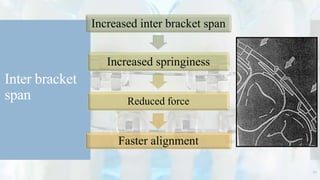
Inter bracket
span
Increased inter bracket span
Increased springiness
Reduced force
Faster alignment
17
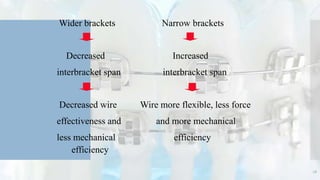
Wider brackets Narrow brackets
Decreased Increased
interbracket span interbracket span
Decreased wire Wire more flexible, less force
effectiveness and and more mechanical
less mechanical efficiency
efficiency
18
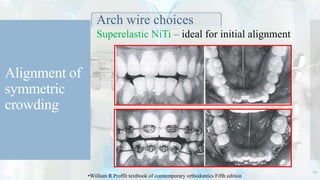
Alignment of
symmetric
crowding
Arch wire choices
Superelastic NiTi – ideal for initial alignment
19
•Wiiliam R Proffit textbook of comtemporary orthodontics Fifth edition
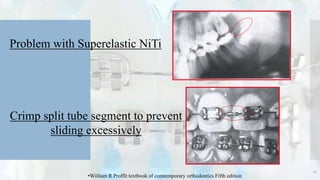
Problem with Superelastic NiTi
Crimp split tube segment to prevent
sliding excessively
20
•Wiiliam R Proffit textbook of comtemporary orthodontics Fifth edition
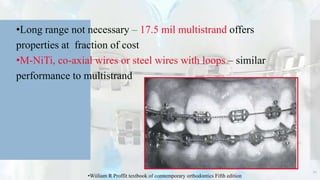
•Long range not necessary – 17.5 mil multistrand offers
properties at fraction of cost
•M-NiTi, co-axial wires or steel wires with loops – similar
performance to multistrand
21
•Wiiliam R Proffit textbook of comtemporary orthodontics Fifth edition
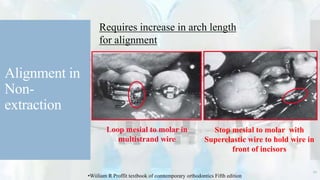
Alignment in
Non-
extraction
Requires increase in arch length
for alignment
Loop mesial to molar in
multistrand wire
Stop mesial to molar with
Superelastic wire to hold wire in
front of incisors
22
•Wiiliam R Proffit textbook of comtemporary orthodontics Fifth edition
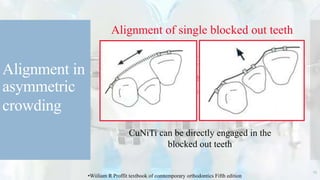
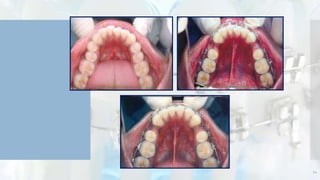
Alignment in
asymmetric
crowding
Alignment of single blocked out teeth
CuNiTi can be directly engaged in the
blocked out teeth
23
•Wiiliam R Proffit textbook of comtemporary orthodontics Fifth edition
24
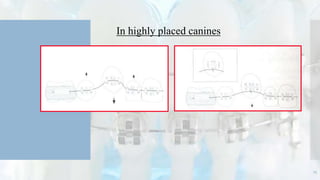
In highly placed canines
25
Consistent and Inconsistent force system
26
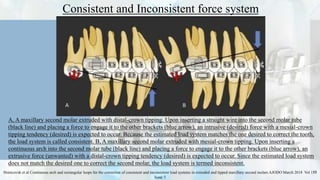
A, A maxillary second molar extruded with distal-crown tipping. Upon inserting a straight wire into the second molar tube
(black line) and placing a force to engage it to the other brackets (blue arrow), an intrusive (desired) force with a mesial-crown
tipping tendency (desired) is expected to occur. Because the estimated load system matches the one desired to correct the tooth,
the load system is called consistent. B, A maxillary second molar extruded with mesial-crown tipping. Upon inserting a
continuous arch into the second molar tube (black line) and placing a force to engage it to the other brackets (blue arrow), an
extrusive force (unwanted) with a distal-crown tipping tendency (desired) is expected to occur. Since the estimated load system
does not match the desired one to correct the second molar, the load system is termed inconsistent.
Shintcovsk et al Continuous arch and rectangular loops for the correction of consistent and inconsistent load systems in extruded and tipped maxillary second molars AJODO March 2018 Vol 153
Issue 3
Special
problems in
alignment
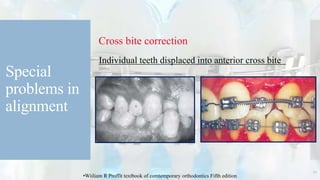
Cross bite correction
Individual teeth displaced into anterior cross bite
27
•Wiiliam R Proffit textbook of comtemporary orthodontics Fifth edition
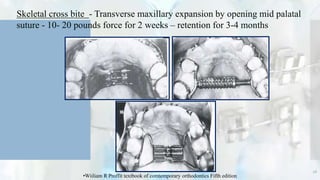
Skeletal cross bite - Transverse maxillary expansion by opening mid palatal
suture - 10- 20 pounds force for 2 weeks – retention for 3-4 months
28
•Wiiliam R Proffit textbook of comtemporary orthodontics Fifth edition
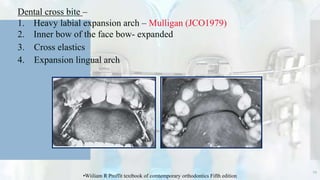
Dental cross bite –
1. Heavy labial expansion arch – Mulligan (JCO1979)
2. Inner bow of the face bow- expanded
3. Cross elastics
4. Expansion lingual arch
29
•Wiiliam R Proffit textbook of comtemporary orthodontics Fifth edition
30
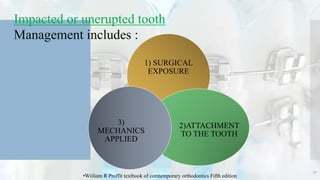
1) SURGICAL
EXPOSURE
2)ATTACHMENT
TO THE TOOTH
3)
MECHANICS
APPLIED
Impacted or unerupted tooth
Management includes :
•Wiiliam R Proffit textbook of comtemporary orthodontics Fifth edition
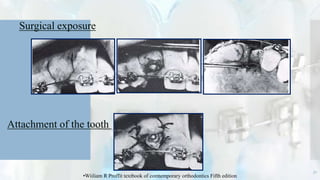
Surgical exposure
Attachment of the tooth
31
•Wiiliam R Proffit textbook of comtemporary orthodontics Fifth edition
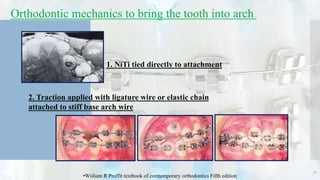
Orthodontic mechanics to bring the tooth into arch
1. NiTi tied directly to attachment
2. Traction applied with ligature wire or elastic chain
attached to stiff base arch wire
32
•Wiiliam R Proffit textbook of comtemporary orthodontics Fifth edition
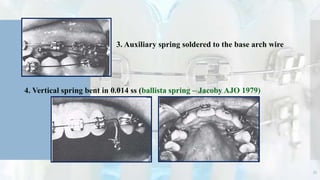
3. Auxiliary spring soldered to the base arch wire
4. Vertical spring bent in 0.014 ss (ballista spring – Jacoby AJO 1979)
33
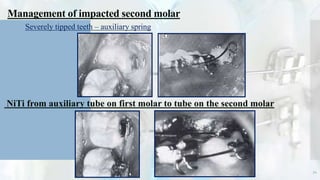
Management of impacted second molar
 Severely tipped teeth – auxiliary spring
NiTi from auxiliary tube on first molar to tube on the second molar
34
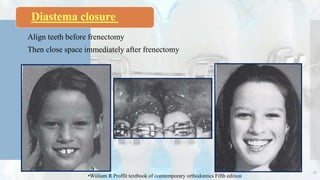
Align teeth before frenectomy
Then close space immediately after frenectomy
35
•Wiiliam R Proffit textbook of comtemporary orthodontics Fifth edition
Diastema closure
Alignment in
different
techniques
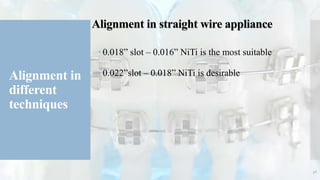
Alignment in straight wire appliance
 0.018” slot – 0.016” NiTi is the most suitable
 0.022”slot – 0.018” NiTi is desirable
36
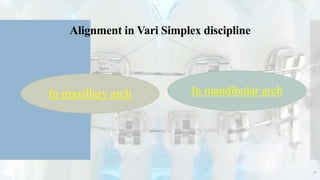
Alignment in Vari Simplex discipline
.
37
In maxillary arch In mandibular arch
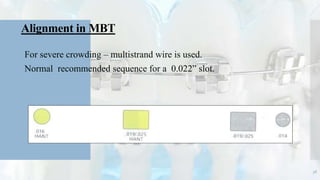
Alignment in MBT
 For severe crowding – multistrand wire is used.
 Normal recommended sequence for a 0.022” slot.
38
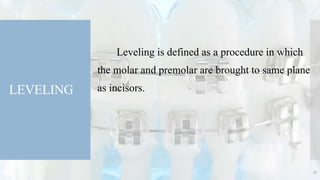
LEVELING
Leveling is defined as a procedure in which
the molar and premolar are brought to same plane
as incisors.
39
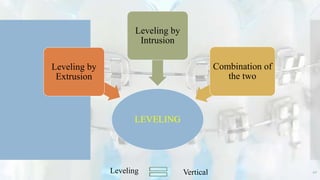
LEVELING
Leveling by
Extrusion
Leveling by
Intrusion
Combination of
the two
Leveling Vertical 40
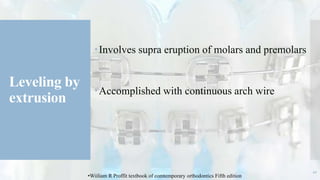
Leveling by
extrusion
Involves supra eruption of molars and premolars
Accomplished with continuous arch wire
41
•Wiiliam R Proffit textbook of comtemporary orthodontics Fifth edition
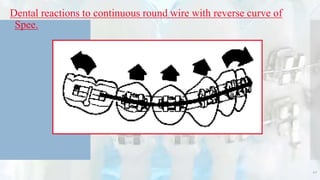
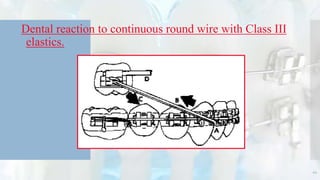
Dental reactions to continuous round wire with reverse curve of
Spee.
42
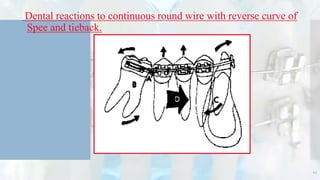
Dental reactions to continuous round wire with reverse curve of
Spee and tieback.
43
Dental reaction to continuous round wire with Class III
elastics.
44
45
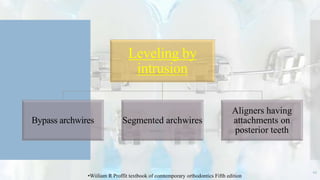
Leveling by
intrusion
Bypass archwires Segmented archwires
Aligners having
attachments on
posterior teeth
•Wiiliam R Proffit textbook of comtemporary orthodontics Fifth edition
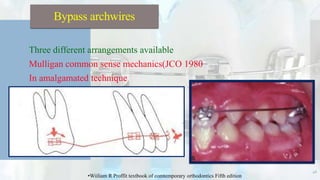
 Three different arrangements available
1. Mulligan common sense mechanics(JCO 1980
2. In amalgamated technique
46
Bypass archwires
•Wiiliam R Proffit textbook of comtemporary orthodontics Fifth edition
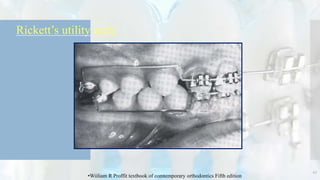
 Rickett’s utility arch
47
•Wiiliam R Proffit textbook of comtemporary orthodontics Fifth edition
48
leveling in
Bioprogressive
therapy
Type A
leveling
Type B
leveling
Type C
leveling
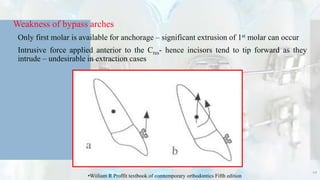
Weakness of bypass arches
 Only first molar is available for anchorage – significant extrusion of 1st molar can occur
 Intrusive force applied anterior to the Cres- hence incisors tend to tip forward as they
intrude – undesirable in extraction cases
49
•Wiiliam R Proffit textbook of comtemporary orthodontics Fifth edition
50
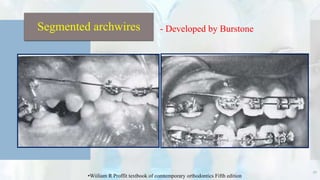
Segmented archwires - Developed by Burstone
•Wiiliam R Proffit textbook of comtemporary orthodontics Fifth edition
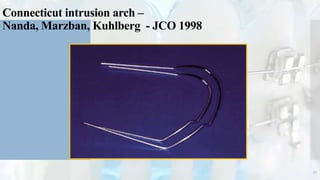
Connecticut intrusion arch –
Nanda, Marzban, Kuhlberg - JCO 1998
51
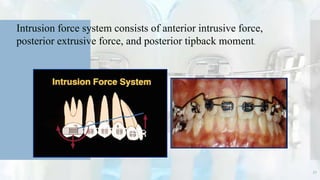
Intrusion force system consists of anterior intrusive force,
posterior extrusive force, and posterior tipback moment.
52
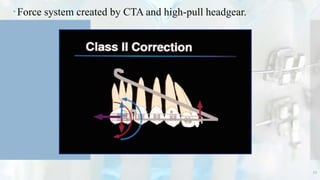
Force system created by CTA and high-pull headgear.
53
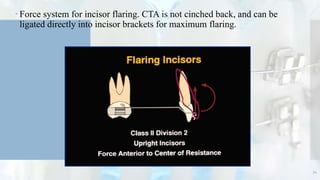
 Force system for incisor flaring. CTA is not cinched back, and can be
ligated directly into incisor brackets for maximum flaring.
54
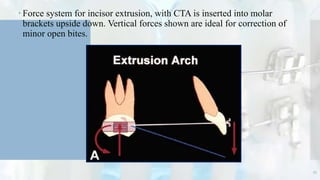
 Force system for incisor extrusion, with CTA is inserted into molar
brackets upside down. Vertical forces shown are ideal for correction of
minor open bites.
55
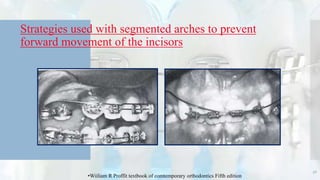
Strategies used with segmented arches to prevent
forward movement of the incisors
56
•Wiiliam R Proffit textbook of comtemporary orthodontics Fifth edition
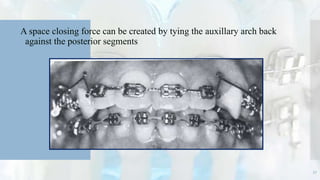
A space closing force can be created by tying the auxillary arch back
against the posterior segments
57
LEVELING IN
DIFFERENT
TECHNIQUES
Leveling in Vari simplex
discipline
58
Leveling in Roth
59
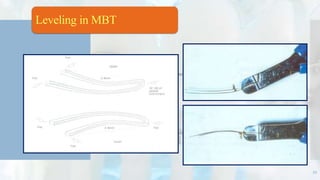
Leveling in MBT
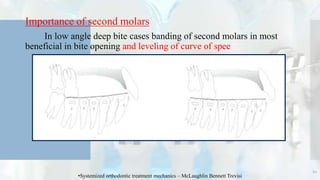
Importance of second molars
In low angle deep bite cases banding of second molars in most
beneficial in bite opening and leveling of curve of spee
60
•Systemized orthodontic treatment mechanics – McLaughlin Bennett Trevisi
61
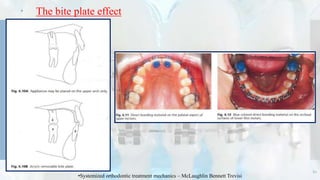
 The bite plate effect
•Systemized orthodontic treatment mechanics – McLaughlin Bennett Trevisi
Anchorage
control
during
aligning and
leveling
62
Principles of
anchorage
control
Reduction of
anchorage needs
Anchorage support
during aligning and
leveling
•Systemized orthodontic treatment mechanics – McLaughlin Bennett Trevisi
63
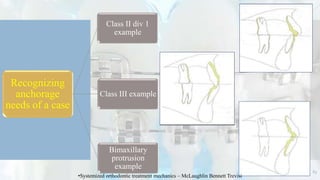
Recognizing
anchorage
needs of a case
Class II div 1
example
Class III example
Bimaxillary
protrusion
example
•Systemized orthodontic treatment mechanics – McLaughlin Bennett Trevisi
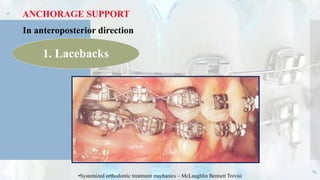
 ANCHORAGE SUPPORT
In anteroposterior direction
64
1. Lacebacks
•Systemized orthodontic treatment mechanics – McLaughlin Bennett Trevisi
65
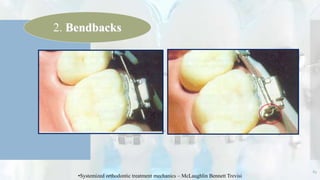
2. Bendbacks
•Systemized orthodontic treatment mechanics – McLaughlin Bennett Trevisi
66
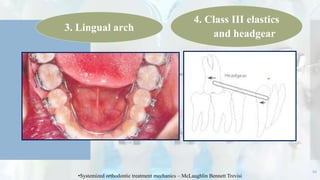
3. Lingual arch
4. Class III elastics
and headgear
•Systemized orthodontic treatment mechanics – McLaughlin Bennett Trevisi
67
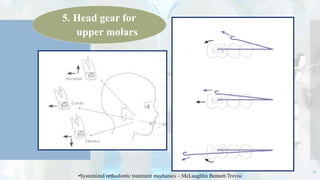
5. Head gear for
upper molars
•Systemized orthodontic treatment mechanics – McLaughlin Bennett Trevisi
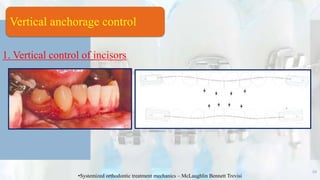
1. Vertical control of incisors
68
•Systemized orthodontic treatment mechanics – McLaughlin Bennett Trevisi
Vertical anchorage control
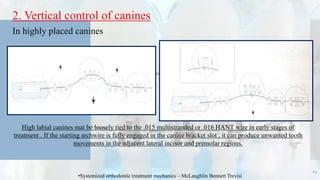
2. Vertical control of canines
In highly placed canines
69
•Systemized orthodontic treatment mechanics – McLaughlin Bennett Trevisi
High labial canines mat be loosely tied to the .015 multistranded or .016 HANT wire in early stages of
treatment . If the starting archwire is fully engaged in the canine bracket slot , it can produce unwanted tooth
movements in the adjacent lateral incisor and premolar regions.
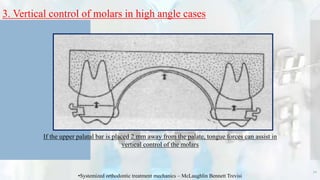
3. Vertical control of molars in high angle cases
70
•Systemized orthodontic treatment mechanics – McLaughlin Bennett Trevisi
If the upper palatal bar is placed 2 mm away from the palate, tongue forces can assist in
vertical control of the molars
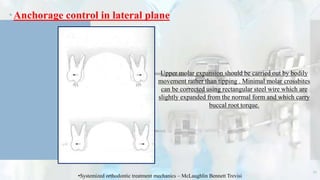
Anchorage control in lateral plane
71
•Systemized orthodontic treatment mechanics – McLaughlin Bennett Trevisi
Upper molar expansion should be carried out by bodily
movement rather than tipping . Minimal molar crossbites
can be corrected using rectangular steel wire which are
slightly expanded from the normal form and which carry
buccal root torque.
72
•Systemized orthodontic treatment mechanics – McLaughlin Bennett Trevisi
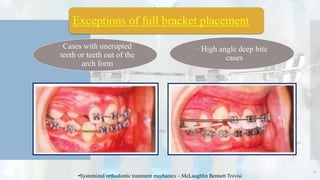
Exceptions of full bracket placement
 Cases with unerupted
teeth or teeth out of the
arch form
 High angle deep bite
cases
Re – leveling
procedures
73
CONCLUSION
74
References
75
•Wiiliam R Proffit textbook of comtemporary orthodontics Fifth edition
•Systemized orthodontic treatment mechanics – McLaughlin Bennett Trevisi
•Shintcovsk et al Continuous arch and rectangular loops for the correction of
consistent and inconsistent load systems in extruded and tipped maxillary
second molars AJODO March 2018 Vol 153 Issue 3
• Leveling and Aligning: Challenges and Solutions Bhavna Shroff and Steven
J. Lindauer Seminars in Orthodontics, Vol 7, No 1 (March), 2001
76

MBT- alignment and leveling seminar.pptx

  • 1.
  • 2.
    Contents  Introduction  Alignment Principles in the choice of alignment wires  Properties of alignment archwires  Variables in the selection of alignment archwires  Special problems in alignment  Alignment in different techniques  Leveling  Leveling in different techniques  Anchorage control during alignment and leveling  Exception to full bracket placement 2
  • 3.
  • 4.
    Introduction ORTHODONTIC TREATMENT 1) Alignment andleveling 2) Correction of molar relationship & space closure 3)Finishing RAYMOND BEGG 4
  • 5.
    DEFINITION The tooth movementsneeded to achieve passive engagement of a steel rectangular arch wire of 0.019” X 0.025” dimension and of suitable arch form, into a correctly placed preadjusted 0.022” bracket system. 5 •Systemized orthodontic treatment mechanics – McLaughlin Bennett Trevisi
  • 6.
    Objectives Short term Achieve proper levelingand alignment into passive rectangular steel wires Long term Achieve ideal dentition Achieve six keys to normal occlusion With dentition achieve properly positioned facial profile 6 •Systemized orthodontic treatment mechanics – McLaughlin Bennett Trevisi
  • 7.
    Alignment First orthodontic objectiveduring the initial stage of treatment. ALIGNMENT Bring malposed teeth into arch AP position of incisors Width of posterior arch Dental arch form Control anchorage in all 3 planes 7
  • 8.
    PRINCIPLES IN THE CHOICE OF ALIGNING WIRES 1)Lightcontinuous forces 2) Free movement of the archwire 3) Use round wire 4) Address one plane at a time 5) Excess crowding is present , create space first 8 •Systemized orthodontic treatment mechanics – McLaughlin Bennett Trevisi
  • 9.
    1)Light continuous forces 2)Free movement of the archwire 9
  • 10.
    Stanley and Braunmentioned one benefit of using the rectangular archwire would be of prevention of flaring of the incisors , due to in built labial root torque The principle is that it is better to tip crowns to position during initial alignment rather than displacing root apices 3) Use round wire 10
  • 11.
    4) Address oneplane at a time 5) Excess crowding is present , create space first 11
  • 12.
    Properties of alignment arch wires STRENGTH  SPRINGINESS  LONG RANGE OF ACTION  FLAT LOAD DEFLECTION CURVE  Providing 50gm force(optimum tipping force) for any degree of deflection 12
  • 13.
    A- NiTi arethe most efficient :-  light forces provided over long range  Low torsional strength so no root Torquing  Flat load deflection curve For super elastic wires the manufacturers preparation not the wire size determines force delivery 13 •Wiiliam R Proffit textbook of comtemporary orthodontics Fifth edition
  • 14.
    Variables in the selectionof alignment arch wires  ARCHWIRE MATERIAL  WIRE SIZE  INTERBRACKET SPAN 14 •Wiiliam R Proffit textbook of comtemporary orthodontics Fifth edition
  • 15.
     The wirein reducing order preference for aligning severely malaligned are Archwire material Wire Size 15 •Wiiliam R Proffit textbook of comtemporary orthodontics Fifth edition
  • 16.
    If a beamis rigidly attached on both ends(last diagram) it is twice as strong but only one fourth as springy as a beam of the same material and length that can slide over the abutments (diagram 3)thus orthodontic property of arch wire is affected based on how tightly or loosely it is tied Inter bracket span 16 •Wiiliam R Proffit textbook of comtemporary orthodontics Fifth edition
  • 17.
    Inter bracket span Increased interbracket span Increased springiness Reduced force Faster alignment 17
  • 18.
    Wider brackets Narrowbrackets Decreased Increased interbracket span interbracket span Decreased wire Wire more flexible, less force effectiveness and and more mechanical less mechanical efficiency efficiency 18
  • 19.
    Alignment of symmetric crowding Arch wirechoices Superelastic NiTi – ideal for initial alignment 19 •Wiiliam R Proffit textbook of comtemporary orthodontics Fifth edition
  • 20.
    Problem with SuperelasticNiTi Crimp split tube segment to prevent sliding excessively 20 •Wiiliam R Proffit textbook of comtemporary orthodontics Fifth edition
  • 21.
    •Long range notnecessary – 17.5 mil multistrand offers properties at fraction of cost •M-NiTi, co-axial wires or steel wires with loops – similar performance to multistrand 21 •Wiiliam R Proffit textbook of comtemporary orthodontics Fifth edition
  • 22.
    Alignment in Non- extraction Requires increasein arch length for alignment Loop mesial to molar in multistrand wire Stop mesial to molar with Superelastic wire to hold wire in front of incisors 22 •Wiiliam R Proffit textbook of comtemporary orthodontics Fifth edition
  • 23.
    Alignment in asymmetric crowding Alignment ofsingle blocked out teeth CuNiTi can be directly engaged in the blocked out teeth 23 •Wiiliam R Proffit textbook of comtemporary orthodontics Fifth edition
  • 24.
  • 25.
    In highly placedcanines 25
  • 26.
    Consistent and Inconsistentforce system 26 A, A maxillary second molar extruded with distal-crown tipping. Upon inserting a straight wire into the second molar tube (black line) and placing a force to engage it to the other brackets (blue arrow), an intrusive (desired) force with a mesial-crown tipping tendency (desired) is expected to occur. Because the estimated load system matches the one desired to correct the tooth, the load system is called consistent. B, A maxillary second molar extruded with mesial-crown tipping. Upon inserting a continuous arch into the second molar tube (black line) and placing a force to engage it to the other brackets (blue arrow), an extrusive force (unwanted) with a distal-crown tipping tendency (desired) is expected to occur. Since the estimated load system does not match the desired one to correct the second molar, the load system is termed inconsistent. Shintcovsk et al Continuous arch and rectangular loops for the correction of consistent and inconsistent load systems in extruded and tipped maxillary second molars AJODO March 2018 Vol 153 Issue 3
  • 27.
    Special problems in alignment Cross bitecorrection Individual teeth displaced into anterior cross bite 27 •Wiiliam R Proffit textbook of comtemporary orthodontics Fifth edition
  • 28.
    Skeletal cross bite- Transverse maxillary expansion by opening mid palatal suture - 10- 20 pounds force for 2 weeks – retention for 3-4 months 28 •Wiiliam R Proffit textbook of comtemporary orthodontics Fifth edition
  • 29.
    Dental cross bite– 1. Heavy labial expansion arch – Mulligan (JCO1979) 2. Inner bow of the face bow- expanded 3. Cross elastics 4. Expansion lingual arch 29 •Wiiliam R Proffit textbook of comtemporary orthodontics Fifth edition
  • 30.
    30 1) SURGICAL EXPOSURE 2)ATTACHMENT TO THETOOTH 3) MECHANICS APPLIED Impacted or unerupted tooth Management includes : •Wiiliam R Proffit textbook of comtemporary orthodontics Fifth edition
  • 31.
    Surgical exposure Attachment ofthe tooth 31 •Wiiliam R Proffit textbook of comtemporary orthodontics Fifth edition
  • 32.
    Orthodontic mechanics tobring the tooth into arch 1. NiTi tied directly to attachment 2. Traction applied with ligature wire or elastic chain attached to stiff base arch wire 32 •Wiiliam R Proffit textbook of comtemporary orthodontics Fifth edition
  • 33.
    3. Auxiliary springsoldered to the base arch wire 4. Vertical spring bent in 0.014 ss (ballista spring – Jacoby AJO 1979) 33
  • 34.
    Management of impactedsecond molar  Severely tipped teeth – auxiliary spring NiTi from auxiliary tube on first molar to tube on the second molar 34
  • 35.
    Align teeth beforefrenectomy Then close space immediately after frenectomy 35 •Wiiliam R Proffit textbook of comtemporary orthodontics Fifth edition Diastema closure
  • 36.
    Alignment in different techniques Alignment instraight wire appliance  0.018” slot – 0.016” NiTi is the most suitable  0.022”slot – 0.018” NiTi is desirable 36
  • 37.
    Alignment in VariSimplex discipline . 37 In maxillary arch In mandibular arch
  • 38.
    Alignment in MBT For severe crowding – multistrand wire is used.  Normal recommended sequence for a 0.022” slot. 38
  • 39.
    LEVELING Leveling is definedas a procedure in which the molar and premolar are brought to same plane as incisors. 39
  • 40.
  • 41.
    Leveling by extrusion Involves supraeruption of molars and premolars Accomplished with continuous arch wire 41 •Wiiliam R Proffit textbook of comtemporary orthodontics Fifth edition
  • 42.
    Dental reactions tocontinuous round wire with reverse curve of Spee. 42
  • 43.
    Dental reactions tocontinuous round wire with reverse curve of Spee and tieback. 43
  • 44.
    Dental reaction tocontinuous round wire with Class III elastics. 44
  • 45.
    45 Leveling by intrusion Bypass archwiresSegmented archwires Aligners having attachments on posterior teeth •Wiiliam R Proffit textbook of comtemporary orthodontics Fifth edition
  • 46.
     Three differentarrangements available 1. Mulligan common sense mechanics(JCO 1980 2. In amalgamated technique 46 Bypass archwires •Wiiliam R Proffit textbook of comtemporary orthodontics Fifth edition
  • 47.
     Rickett’s utilityarch 47 •Wiiliam R Proffit textbook of comtemporary orthodontics Fifth edition
  • 48.
  • 49.
    Weakness of bypassarches  Only first molar is available for anchorage – significant extrusion of 1st molar can occur  Intrusive force applied anterior to the Cres- hence incisors tend to tip forward as they intrude – undesirable in extraction cases 49 •Wiiliam R Proffit textbook of comtemporary orthodontics Fifth edition
  • 50.
    50 Segmented archwires -Developed by Burstone •Wiiliam R Proffit textbook of comtemporary orthodontics Fifth edition
  • 51.
    Connecticut intrusion arch– Nanda, Marzban, Kuhlberg - JCO 1998 51
  • 52.
    Intrusion force systemconsists of anterior intrusive force, posterior extrusive force, and posterior tipback moment. 52
  • 53.
    Force system createdby CTA and high-pull headgear. 53
  • 54.
     Force systemfor incisor flaring. CTA is not cinched back, and can be ligated directly into incisor brackets for maximum flaring. 54
  • 55.
     Force systemfor incisor extrusion, with CTA is inserted into molar brackets upside down. Vertical forces shown are ideal for correction of minor open bites. 55
  • 56.
    Strategies used withsegmented arches to prevent forward movement of the incisors 56 •Wiiliam R Proffit textbook of comtemporary orthodontics Fifth edition
  • 57.
    A space closingforce can be created by tying the auxillary arch back against the posterior segments 57
  • 58.
    LEVELING IN DIFFERENT TECHNIQUES Leveling inVari simplex discipline 58 Leveling in Roth
  • 59.
  • 60.
    Importance of secondmolars In low angle deep bite cases banding of second molars in most beneficial in bite opening and leveling of curve of spee 60 •Systemized orthodontic treatment mechanics – McLaughlin Bennett Trevisi
  • 61.
    61  The biteplate effect •Systemized orthodontic treatment mechanics – McLaughlin Bennett Trevisi
  • 62.
    Anchorage control during aligning and leveling 62 Principles of anchorage control Reductionof anchorage needs Anchorage support during aligning and leveling •Systemized orthodontic treatment mechanics – McLaughlin Bennett Trevisi
  • 63.
    63 Recognizing anchorage needs of acase Class II div 1 example Class III example Bimaxillary protrusion example •Systemized orthodontic treatment mechanics – McLaughlin Bennett Trevisi
  • 64.
     ANCHORAGE SUPPORT Inanteroposterior direction 64 1. Lacebacks •Systemized orthodontic treatment mechanics – McLaughlin Bennett Trevisi
  • 65.
    65 2. Bendbacks •Systemized orthodontictreatment mechanics – McLaughlin Bennett Trevisi
  • 66.
    66 3. Lingual arch 4.Class III elastics and headgear •Systemized orthodontic treatment mechanics – McLaughlin Bennett Trevisi
  • 67.
    67 5. Head gearfor upper molars •Systemized orthodontic treatment mechanics – McLaughlin Bennett Trevisi
  • 68.
    1. Vertical controlof incisors 68 •Systemized orthodontic treatment mechanics – McLaughlin Bennett Trevisi Vertical anchorage control
  • 69.
    2. Vertical controlof canines In highly placed canines 69 •Systemized orthodontic treatment mechanics – McLaughlin Bennett Trevisi High labial canines mat be loosely tied to the .015 multistranded or .016 HANT wire in early stages of treatment . If the starting archwire is fully engaged in the canine bracket slot , it can produce unwanted tooth movements in the adjacent lateral incisor and premolar regions.
  • 70.
    3. Vertical controlof molars in high angle cases 70 •Systemized orthodontic treatment mechanics – McLaughlin Bennett Trevisi If the upper palatal bar is placed 2 mm away from the palate, tongue forces can assist in vertical control of the molars
  • 71.
    Anchorage control inlateral plane 71 •Systemized orthodontic treatment mechanics – McLaughlin Bennett Trevisi Upper molar expansion should be carried out by bodily movement rather than tipping . Minimal molar crossbites can be corrected using rectangular steel wire which are slightly expanded from the normal form and which carry buccal root torque.
  • 72.
    72 •Systemized orthodontic treatmentmechanics – McLaughlin Bennett Trevisi Exceptions of full bracket placement  Cases with unerupted teeth or teeth out of the arch form  High angle deep bite cases
  • 73.
  • 74.
  • 75.
    References 75 •Wiiliam R Proffittextbook of comtemporary orthodontics Fifth edition •Systemized orthodontic treatment mechanics – McLaughlin Bennett Trevisi •Shintcovsk et al Continuous arch and rectangular loops for the correction of consistent and inconsistent load systems in extruded and tipped maxillary second molars AJODO March 2018 Vol 153 Issue 3 • Leveling and Aligning: Challenges and Solutions Bhavna Shroff and Steven J. Lindauer Seminars in Orthodontics, Vol 7, No 1 (March), 2001
  • 76.