GROUP DISCUSSION-A KEY TO CORPORATE ADMISSION
Course
MBA
Unit-2
Prepared by:
Abhishek Apte(Dept of ECLS)
TOPICS COVERED
Group Discussion(GD)
Personal Interview(PI}
Mock GD
Mock PI
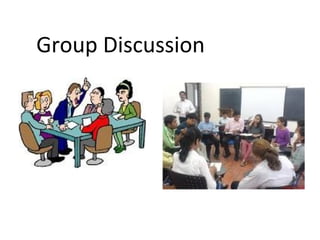
Group Discussion
Group Discussion
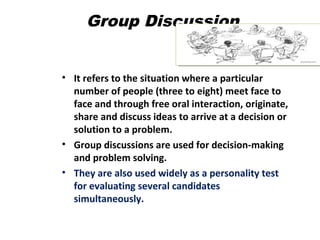
• It refers to the situation where a particular
number of people (three to eight) meet face to
face and through free oral interaction, originate,
share and discuss ideas to arrive at a decision or
solution to a problem.
• Group discussions are used for decision-making
and problem solving.
• They are also used widely as a personality test
for evaluating several candidates
simultaneously.
Categories of Group Discussion
Organizational group discussions
Group discussions as a part of a selection
process.
Structure and Objective
• A group of candidates is given a topic or case for
discussion.
• Normally groups of eight to ten candidates formed
into a leaderless group, and are given a specific
situation to analyze and discuss within a given time
limit
Structure and Objective
• The group sits in circle or U-shape
• They may either be given their choice of seat or seat
allotted.
• This panel observes and evaluates.
• The moderator may or may not be present but
everything you do is watched and marked.
Evaluation Components
During a GD employers evaluate potential for
leadership and ability to work in a team.
The four components generally evaluated in a
group discussion are:
 Knowledge
 Communication skills
 Group behaviour
 Leadership potential
Communication Skills
Candidate assessed in terms of:
• Active listening
• Clarity of thought and expression
• Apt language
• Appropriateness of body language
• Lucidity
• Tone: Quality or character of the voice expression
a particular feeling or mood
• Voice: Power of speech
• Articulation: Act of speaking or expressing an
idea in words
• Fluency: Speaking or writing in an easy, flowing
style
• Modulation: Variations in rate, tone, or volume of
voice
• Good delivery: The ideas expressed fluently in the
right voice, right tone, and right articulation.
• It isn’t sufficient to have ideas. They have to be expressed
effectively.
Phrases to be used in Group
Discussion
1. Asking about or for an opinion
• Could you tell me....?
• What do you think about/of....?
• What’s your opinion about...?
• Do you think/feel....?
• How do you feel about....?
• May I ask you....?
2. Giving and explanation
Look, it’s like this:
What I mean is....
The reason for this is....
The main problem is....
Just let me explain....
Well, the reason is....
Well, the thing is ....
Above all we must keep in
mind that...
• Well, I’d say....
• If you want my opinion....
• You can take it from me
that....
• First of all/
• To start with
• I’d like to point out ...
• What we have to decide is....
• There can be no doubt
that....
• It’s a fact that....
Nobody will deny
that....
The way/
As I see it Everyone
knows....
Let me put it
this/another way....
Let’s get this clear (first
)....
Sorry to interrupt you,
but
The point I’m trying to
make
is....
Personally (speaking) I
think...
GIVING YOUR OPINION…
EXPECTED Body Language during this activity
 Looking attentively at the speaker and nodding
 While speaking, ensuring no one is ignored. Looking at
everybody.
× Avoid over gestures
X Avoid pointing out fingers
X Avoiding monotonous posture by shifting slightly in the
chair or placing arm on the back of your chair
 Showing interest or dislike in the topic.
 Even if one does not like the topic he should try to
develop interest and reveal interest and enthusiasm
through appropriate facial expression.
Group Behaviour ( Team Spirit)
• Group behaviour is reflected in ability to interact with other
members of the group on brief acquaintance.
• Emotional maturity and balance promotes displays your
ability and willingness to build on good interpersonal
relationships. One is expected to be more people centric and
less ego centric.
• Remaining objective, empathetic, and non-threatening, and
behaving maturely as a good team player
Essence
Consistency participation
Keenness in listening and observing
Time sharing and orderly conduct
Ability to handle turbulent situations
Ability to cut excessively exuberant participants
down to size
Ability to dominate the proceedings without
bullying others
Avoiding personal comments
Leadership Skills
o The success of any team depends to a large extent,
on its leader.
o The candidate who possesses both functional ability
and coordinating ability would emerge as the leader.
o Functional ability involves knowledge, mental and
physical energy, emotional stability, objectivity,
communication skill, integrity and emotional
intelligence
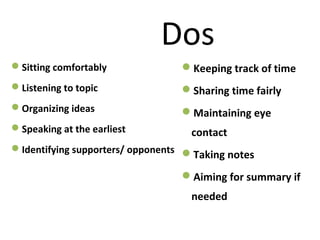
Dos
Sitting comfortably
Listening to topic
Organizing ideas
Speaking at the earliest
Identifying supporters/ opponents
Keeping track of time
Sharing time fairly
Maintaining eye
contact
Taking notes
Aiming for summary if
needed
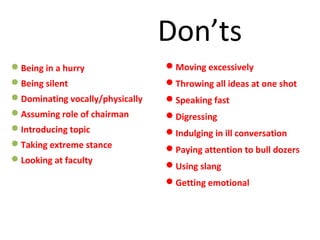
Don’ts
Being in a hurry
Being silent
Dominating vocally/physically
Assuming role of chairman
Introducing topic
Taking extreme stance
Looking at faculty
Moving excessively
Throwing all ideas at one shot
Speaking fast
Digressing
Indulging in ill conversation
Paying attention to bull dozers
Using slang
Getting emotional
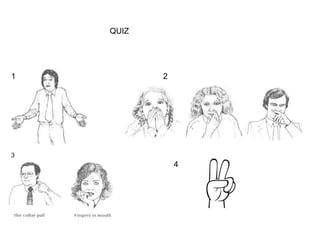
1 2
3
QUIZ
4
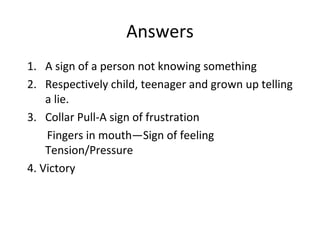
Answers
1. A sign of a person not knowing something
2. Respectively child, teenager and grown up telling
a lie.
3. Collar Pull-A sign of frustration
Fingers in mouth—Sign of feeling
Tension/Pressure
4. Victory
Mba sem 2-unit 4 group discussion

Mba sem 2-unit 4 group discussion

  • 1.
    GROUP DISCUSSION-A KEYTO CORPORATE ADMISSION Course MBA Unit-2 Prepared by: Abhishek Apte(Dept of ECLS)
  • 2.
    TOPICS COVERED Group Discussion(GD) PersonalInterview(PI} Mock GD Mock PI
  • 3.
  • 4.
    Group Discussion • Itrefers to the situation where a particular number of people (three to eight) meet face to face and through free oral interaction, originate, share and discuss ideas to arrive at a decision or solution to a problem. • Group discussions are used for decision-making and problem solving. • They are also used widely as a personality test for evaluating several candidates simultaneously.
  • 5.
    Categories of GroupDiscussion Organizational group discussions Group discussions as a part of a selection process.
  • 6.
    Structure and Objective •A group of candidates is given a topic or case for discussion. • Normally groups of eight to ten candidates formed into a leaderless group, and are given a specific situation to analyze and discuss within a given time limit
  • 7.
    Structure and Objective •The group sits in circle or U-shape • They may either be given their choice of seat or seat allotted. • This panel observes and evaluates. • The moderator may or may not be present but everything you do is watched and marked.
  • 8.
    Evaluation Components During aGD employers evaluate potential for leadership and ability to work in a team. The four components generally evaluated in a group discussion are:  Knowledge  Communication skills  Group behaviour  Leadership potential
  • 9.
    Communication Skills Candidate assessedin terms of: • Active listening • Clarity of thought and expression • Apt language • Appropriateness of body language • Lucidity
  • 10.
    • Tone: Qualityor character of the voice expression a particular feeling or mood • Voice: Power of speech • Articulation: Act of speaking or expressing an idea in words • Fluency: Speaking or writing in an easy, flowing style • Modulation: Variations in rate, tone, or volume of voice • Good delivery: The ideas expressed fluently in the right voice, right tone, and right articulation. • It isn’t sufficient to have ideas. They have to be expressed effectively.
  • 11.
    Phrases to beused in Group Discussion 1. Asking about or for an opinion • Could you tell me....? • What do you think about/of....? • What’s your opinion about...? • Do you think/feel....? • How do you feel about....? • May I ask you....? 2. Giving and explanation Look, it’s like this: What I mean is.... The reason for this is.... The main problem is.... Just let me explain.... Well, the reason is.... Well, the thing is .... Above all we must keep in mind that...
  • 12.
    • Well, I’dsay.... • If you want my opinion.... • You can take it from me that.... • First of all/ • To start with • I’d like to point out ... • What we have to decide is.... • There can be no doubt that.... • It’s a fact that.... Nobody will deny that.... The way/ As I see it Everyone knows.... Let me put it this/another way.... Let’s get this clear (first ).... Sorry to interrupt you, but The point I’m trying to make is.... Personally (speaking) I think... GIVING YOUR OPINION…
  • 13.
    EXPECTED Body Languageduring this activity  Looking attentively at the speaker and nodding  While speaking, ensuring no one is ignored. Looking at everybody. × Avoid over gestures X Avoid pointing out fingers X Avoiding monotonous posture by shifting slightly in the chair or placing arm on the back of your chair  Showing interest or dislike in the topic.  Even if one does not like the topic he should try to develop interest and reveal interest and enthusiasm through appropriate facial expression.
  • 14.
    Group Behaviour (Team Spirit) • Group behaviour is reflected in ability to interact with other members of the group on brief acquaintance. • Emotional maturity and balance promotes displays your ability and willingness to build on good interpersonal relationships. One is expected to be more people centric and less ego centric. • Remaining objective, empathetic, and non-threatening, and behaving maturely as a good team player
  • 15.
    Essence Consistency participation Keenness inlistening and observing Time sharing and orderly conduct Ability to handle turbulent situations Ability to cut excessively exuberant participants down to size Ability to dominate the proceedings without bullying others Avoiding personal comments
  • 16.
    Leadership Skills o Thesuccess of any team depends to a large extent, on its leader. o The candidate who possesses both functional ability and coordinating ability would emerge as the leader. o Functional ability involves knowledge, mental and physical energy, emotional stability, objectivity, communication skill, integrity and emotional intelligence
  • 17.
    Dos Sitting comfortably Listening totopic Organizing ideas Speaking at the earliest Identifying supporters/ opponents Keeping track of time Sharing time fairly Maintaining eye contact Taking notes Aiming for summary if needed
  • 18.
    Don’ts Being in ahurry Being silent Dominating vocally/physically Assuming role of chairman Introducing topic Taking extreme stance Looking at faculty Moving excessively Throwing all ideas at one shot Speaking fast Digressing Indulging in ill conversation Paying attention to bull dozers Using slang Getting emotional
  • 19.
  • 20.
    Answers 1. A signof a person not knowing something 2. Respectively child, teenager and grown up telling a lie. 3. Collar Pull-A sign of frustration Fingers in mouth—Sign of feeling Tension/Pressure 4. Victory