Q1. What are the various phases of project management life cycle? Explain
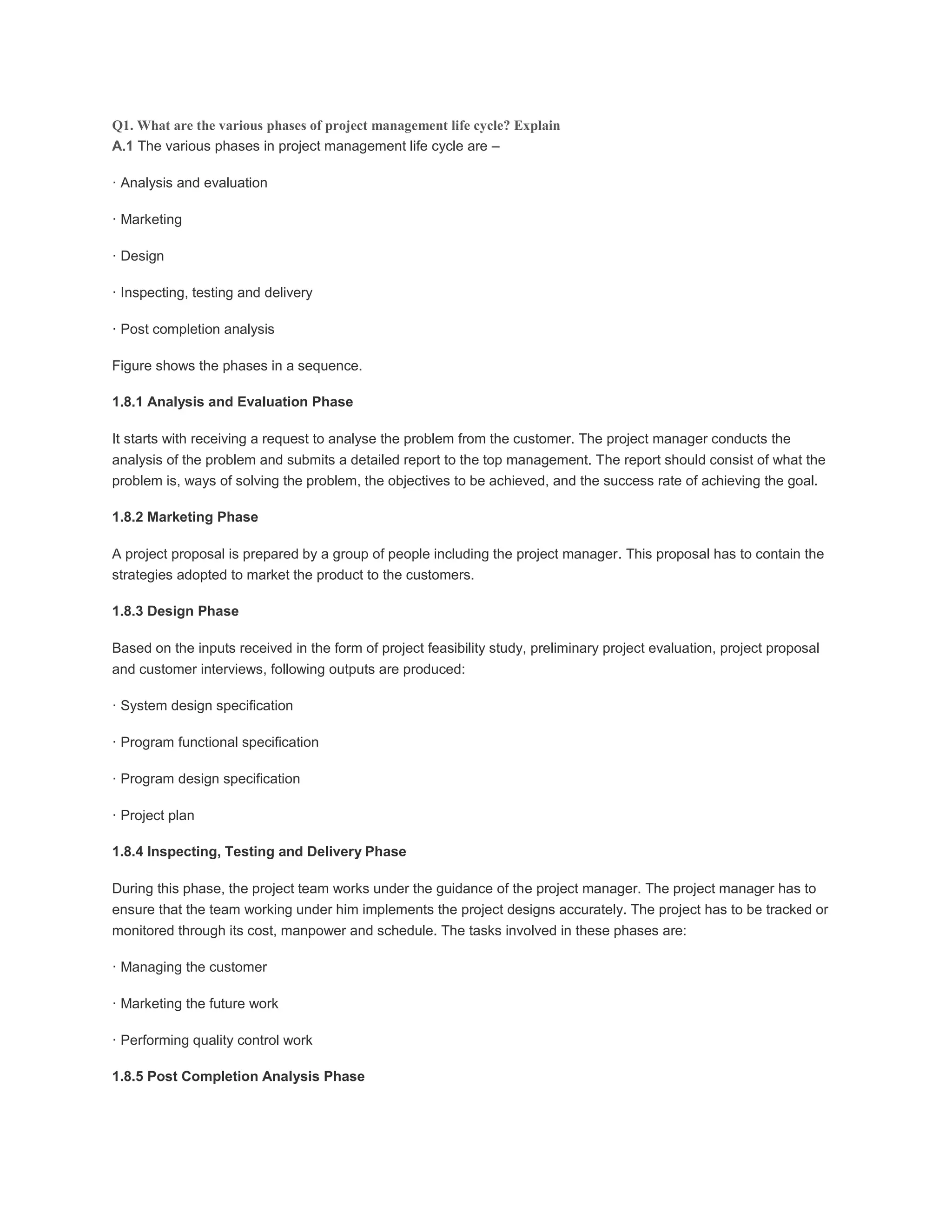
A.1 The various phases in project management life cycle are –
· Analysis and evaluation
· Marketing
· Design
· Inspecting, testing and delivery
· Post completion analysis
Figure shows the phases in a sequence.
1.8.1 Analysis and Evaluation Phase
It starts with receiving a request to analyse the problem from the customer. The project manager conducts the
analysis of the problem and submits a detailed report to the top management. The report should consist of what the
problem is, ways of solving the problem, the objectives to be achieved, and the success rate of achieving the goal.
1.8.2 Marketing Phase
A project proposal is prepared by a group of people including the project manager. This proposal has to contain the
strategies adopted to market the product to the customers.
1.8.3 Design Phase
Based on the inputs received in the form of project feasibility study, preliminary project evaluation, project proposal
and customer interviews, following outputs are produced:
· System design specification
· Program functional specification
· Program design specification
· Project plan
1.8.4 Inspecting, Testing and Delivery Phase
During this phase, the project team works under the guidance of the project manager. The project manager has to
ensure that the team working under him implements the project designs accurately. The project has to be tracked or
monitored through its cost, manpower and schedule. The tasks involved in these phases are:
· Managing the customer
· Marketing the future work
· Performing quality control work
1.8.5 Post Completion Analysis Phase
After delivery or completion of the project, the staff performance has to be evaluated. The tasks involved in this phase
are:
· Documenting the lessons learnt from the project
· Analysing project feedback
· Preparing project execution report
· Analysing the problems encountered during the project
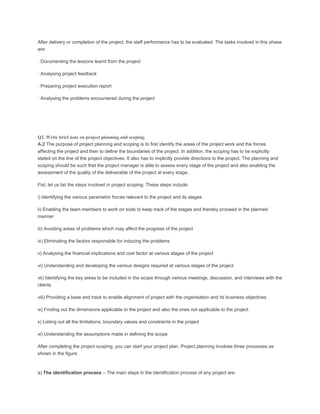
Q2. Write brief note on project planning and scoping.
A.2 The purpose of project planning and scoping is to first identify the areas of the project work and the forces
affecting the project and then to define the boundaries of the project. In addition, the scoping has to be explicitly
stated on the line of the project objectives. It also has to implicitly provide directions to the project. The planning and
scoping should be such that the project manager is able to assess every stage of the project and also enabling the
assessment of the quality of the deliverable of the project at every stage.
Fist, let us list the steps involved in project scoping. These steps include:
i) Identifying the various parametric forces relevant to the project and its stages
ii) Enabling the team members to work on tools to keep track of the stages and thereby proceed in the planned
manner
iii) Avoiding areas of problems which may affect the progress of the project
iv) Eliminating the factors responsible for inducing the problems
v) Analysing the financial implications and cost factor at various stages of the project
vi) Understanding and developing the various designs required at various stages of the project
vii) Identifying the key areas to be included in the scope through various meetings, discussion, and interviews with the
clients
viii) Providing a base and track to enable alignment of project with the organisation and its business objectives
ix) Finding out the dimensions applicable to the project and also the ones not applicable to the project
x) Listing out all the limitations, boundary values and constraints in the project
xi) Understanding the assumptions made in defining the scope
After completing the project scoping, you can start your project plan. Project planning involves three processes as
shown in the figure
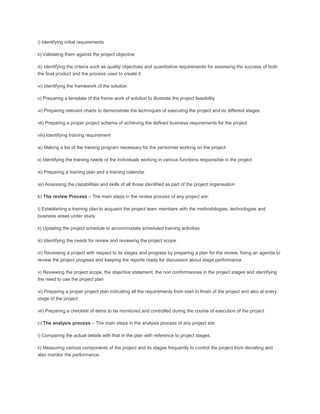
a) The identification process – The main steps in the identification process of any project are:
i) Identifying initial requirements
ii) Validating them against the project objective
iii) Identifying the criteria such as quality objectives and quantitative requirements for assessing the success of both
the final product and the process used to create it
iv) Identifying the framework of the solution
v) Preparing a template of the frame work of solution to illustrate the project feasibility
vi) Preparing relevant charts to demonstrate the techniques of executing the project and its different stages
vii) Preparing a proper project schema of achieving the defined business requirements for the project
viii) Identifying training requirement
ix) Making a list of the training program necessary for the personnel working on the project
x) Identifying the training needs of the individuals working in various functions responsible in the project
xi) Preparing a training plan and a training calendar
xii) Assessing the capabilities and skills of all those identified as part of the project organisation
b) The review Process – The main steps in the review process of any project are:
i) Establishing a training plan to acquaint the project team members with the methodologies, technologies and
business areas under study
ii) Updating the project schedule to accommodate scheduled training activities
iii) Identifying the needs for review and reviewing the project scope
iv) Reviewing a project with respect to its stages and progress by preparing a plan for the review, fixing an agenda to
review the project progress and keeping the reports ready for discussion about stage performance
v) Reviewing the project scope, the objective statement, the non conformances in the project stages and identifying
the need to use the project plan
vi) Preparing a proper project plan indicating all the requirements from start to finish of the project and also at every
stage of the project
vii) Preparing a checklist of items to be monitored and controlled during the course of execution of the project
c) The analysis process – The main steps in the analysis process of any project are:
i) Comparing the actual details with that in the plan with reference to project stages.
ii) Measuring various components of the project and its stages frequently to control the project from deviating and
also monitor the performance.
iii) Deciding how the task, the effort and the defects are to be tracked, what tools to be used, what reporting structure
and frequency will be followed at various stages.
iv) Identifying the preventive and corrective steps to be taken in case of any variance
v) Performing root cause analysis for all problems encountered.
If all the above steps are performed, scoping and planning become effective and the ideal outcome are achieved.
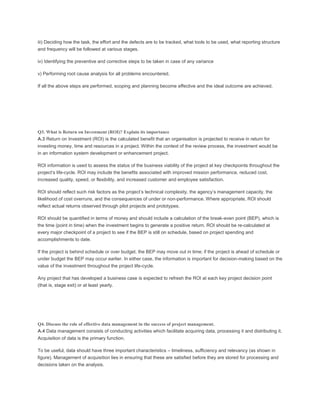
Q3. What is Return on Investment (ROI)? Explain its importance
A.3 Return on Investment (ROI) is the calculated benefit that an organisation is projected to receive in return for
investing money, time and resources in a project. Within the context of the review process, the investment would be
in an information system development or enhancement project.
ROI information is used to assess the status of the business viability of the project at key checkpoints throughout the
project’s life-cycle. ROI may include the benefits associated with improved mission performance, reduced cost,
increased quality, speed, or flexibility, and increased customer and employee satisfaction.
ROI should reflect such risk factors as the project’s technical complexity, the agency’s management capacity, the
likelihood of cost overruns, and the consequences of under or non-performance. Where appropriate, ROI should
reflect actual returns observed through pilot projects and prototypes.
ROI should be quantified in terms of money and should include a calculation of the break-even point (BEP), which is
the time (point in time) when the investment begins to generate a positive return. ROI should be re-calculated at
every major checkpoint of a project to see if the BEP is still on schedule, based on project spending and
accomplishments to date.
If the project is behind schedule or over budget, the BEP may move out in time; if the project is ahead of schedule or
under budget the BEP may occur earlier. In either case, the information is important for decision-making based on the
value of the investment throughout the project life-cycle.
Any project that has developed a business case is expected to refresh the ROI at each key project decision point
(that is, stage exit) or at least yearly.
Q4. Discuss the role of effective data management in the success of project management.
A.4 Data management consists of conducting activities which facilitate acquiring data, processing it and distributing it.
Acquisition of data is the primary function.
To be useful, data should have three important characteristics – timeliness, sufficiency and relevancy (as shown in
figure). Management of acquisition lies in ensuring that these are satisfied before they are stored for processing and
decisions taken on the analysis.
There should be data about customers, suppliers, market conditions, new technology, opportunities, human
resources, economic activities, government regulations, political upheavals, all of which affect the way you function.
Most of the data go on changing because the aforesaid sources have uncertainty inherent in them. So updating data
is a very important aspect of their management.Storing what is relevant in a form that is available to concerned
persons is also important. When a project is underway dataflow from all members of the team will be flowing with the
progress of activities. The data may be about some shortfalls for which the member is seeking instructions. A project
manager will have to analyse them, discover further data from other sources and see how he can use them and take
decisions. Many times he will have to inform and seek sanction from top management.
The management will have to study the impact on the overall organisational goals and strategies and convey their
decisions to the manager for implementation. For example, Bill of Materials is a very important document in Project
Management. It contains details about all materials that go into the project at various stages and has to be
continuously updated as all members of the project depend upon it for providing materials for their apportioned areas
of execution. Since information is shared by all members, there is an opportunity for utilising some of them when
others do not need them. To ascertain availability at some future point of time, information about orders placed,
backlogs, lead times are important for all the members. A proper MIS will take care of all these aspects. ERP
packages too help in integrating data from all sources and present them to individual members in the way they
require. When all these are done efficiently the project will have no hold ups an assure success.
Q5. What is Project risk management? Explain its significance.
A.5 Project risk management is all about the systematic process of identifying, analysing, prioritising and responding
to risk by applying risk management principles and controlling the probability and/or impact of unfortunate events at
the project level. It attempts to maximise the probability and consequences of positive events and to minimise the
probability and consequences of adverse events. The goal is to prevent or reduce risk in a cost-effective manner
without compromising quality or harming the mission or timeline.
The benefits of proper risk management in projects are huge. Organisations can generate a lot of profit if they deal
with uncertain project events in a proactive manner. The result will be that they minimise the impact of project threats
and seize the opportunities that exists.
Proper risk management enables you to deliver the project on time, on budget and with the quality results one’s
project sponsor/client demands. In addition to this, other project team members can be also happy and motivated
enough to perform better and better. All this would essentially boil down to increase in the productivity of team
members and in the efficiency and effectiveness of the resources. In this unit you will learn more about project risk
management.
Q6. Write brief note on project management application software.
A.6 The Microsoft Project family of products offers tools to work on a project from management
point of view. Microsoft Project is designed for people who manage projects independently and
don’t require the capability to manage resources from a central repository. Microsoft has a team
project management solution that enables project managers and their teams to collaborate on
projects.
After creating a fairly complete final project plan it is a good idea to create a baseline version to compare the original
project plan with actual events and achievements.
The following is the typical process followed for project management through this software as shown in figure
1 Reviewing the Baseline
The Baseline created can be used to compare the original project plan with actual events and achievements. This will
display the days required for each task and project phase. For actual operating instructions please refer the Microsoft
Project User Handbook.
2 Tracking Progress
After creating a baseline, if the project has begun, it is necessary to enter actual dates for the tasks that are being
completed and the resource utilisation used to complete them.
Again review different views and the cost and summary tables before proceeding to the next section. Return to the
Entry view of the Gantt chart before proceeding.
3 Balancing Workloads
At times people and equipment may be assigned more work than they can complete in normal working hours. This is
called over allocation. Project can test for this condition and reschedule (or level) their workload to accommodate
completing tasks during a normal day.
4 Monitoring Variances
After a baseline has been established and the project has begun, it is desirable to determine if tasks are being
accomplished on time and /or if cost over runs are occurring. We also need to keep monitoring the performance to
detect early deviations.
5 Creating Reports
Project has many different built-in reports and has the capability building custom reports and exporting data to other
MS Office applications for integration into other reporting venues. These are often intelligent reports.

Mb0049 (2) May 2012 Master of Business Administration - MBA Semester 2 MB0049 – Project Management

  • 1.
    Q1. What arethe various phases of project management life cycle? Explain A.1 The various phases in project management life cycle are – · Analysis and evaluation · Marketing · Design · Inspecting, testing and delivery · Post completion analysis Figure shows the phases in a sequence. 1.8.1 Analysis and Evaluation Phase It starts with receiving a request to analyse the problem from the customer. The project manager conducts the analysis of the problem and submits a detailed report to the top management. The report should consist of what the problem is, ways of solving the problem, the objectives to be achieved, and the success rate of achieving the goal. 1.8.2 Marketing Phase A project proposal is prepared by a group of people including the project manager. This proposal has to contain the strategies adopted to market the product to the customers. 1.8.3 Design Phase Based on the inputs received in the form of project feasibility study, preliminary project evaluation, project proposal and customer interviews, following outputs are produced: · System design specification · Program functional specification · Program design specification · Project plan 1.8.4 Inspecting, Testing and Delivery Phase During this phase, the project team works under the guidance of the project manager. The project manager has to ensure that the team working under him implements the project designs accurately. The project has to be tracked or monitored through its cost, manpower and schedule. The tasks involved in these phases are: · Managing the customer · Marketing the future work · Performing quality control work 1.8.5 Post Completion Analysis Phase
  • 2.
    After delivery orcompletion of the project, the staff performance has to be evaluated. The tasks involved in this phase are: · Documenting the lessons learnt from the project · Analysing project feedback · Preparing project execution report · Analysing the problems encountered during the project Q2. Write brief note on project planning and scoping. A.2 The purpose of project planning and scoping is to first identify the areas of the project work and the forces affecting the project and then to define the boundaries of the project. In addition, the scoping has to be explicitly stated on the line of the project objectives. It also has to implicitly provide directions to the project. The planning and scoping should be such that the project manager is able to assess every stage of the project and also enabling the assessment of the quality of the deliverable of the project at every stage. Fist, let us list the steps involved in project scoping. These steps include: i) Identifying the various parametric forces relevant to the project and its stages ii) Enabling the team members to work on tools to keep track of the stages and thereby proceed in the planned manner iii) Avoiding areas of problems which may affect the progress of the project iv) Eliminating the factors responsible for inducing the problems v) Analysing the financial implications and cost factor at various stages of the project vi) Understanding and developing the various designs required at various stages of the project vii) Identifying the key areas to be included in the scope through various meetings, discussion, and interviews with the clients viii) Providing a base and track to enable alignment of project with the organisation and its business objectives ix) Finding out the dimensions applicable to the project and also the ones not applicable to the project x) Listing out all the limitations, boundary values and constraints in the project xi) Understanding the assumptions made in defining the scope After completing the project scoping, you can start your project plan. Project planning involves three processes as shown in the figure a) The identification process – The main steps in the identification process of any project are:
  • 3.
    i) Identifying initialrequirements ii) Validating them against the project objective iii) Identifying the criteria such as quality objectives and quantitative requirements for assessing the success of both the final product and the process used to create it iv) Identifying the framework of the solution v) Preparing a template of the frame work of solution to illustrate the project feasibility vi) Preparing relevant charts to demonstrate the techniques of executing the project and its different stages vii) Preparing a proper project schema of achieving the defined business requirements for the project viii) Identifying training requirement ix) Making a list of the training program necessary for the personnel working on the project x) Identifying the training needs of the individuals working in various functions responsible in the project xi) Preparing a training plan and a training calendar xii) Assessing the capabilities and skills of all those identified as part of the project organisation b) The review Process – The main steps in the review process of any project are: i) Establishing a training plan to acquaint the project team members with the methodologies, technologies and business areas under study ii) Updating the project schedule to accommodate scheduled training activities iii) Identifying the needs for review and reviewing the project scope iv) Reviewing a project with respect to its stages and progress by preparing a plan for the review, fixing an agenda to review the project progress and keeping the reports ready for discussion about stage performance v) Reviewing the project scope, the objective statement, the non conformances in the project stages and identifying the need to use the project plan vi) Preparing a proper project plan indicating all the requirements from start to finish of the project and also at every stage of the project vii) Preparing a checklist of items to be monitored and controlled during the course of execution of the project c) The analysis process – The main steps in the analysis process of any project are: i) Comparing the actual details with that in the plan with reference to project stages. ii) Measuring various components of the project and its stages frequently to control the project from deviating and also monitor the performance.
  • 4.
    iii) Deciding howthe task, the effort and the defects are to be tracked, what tools to be used, what reporting structure and frequency will be followed at various stages. iv) Identifying the preventive and corrective steps to be taken in case of any variance v) Performing root cause analysis for all problems encountered. If all the above steps are performed, scoping and planning become effective and the ideal outcome are achieved. Q3. What is Return on Investment (ROI)? Explain its importance A.3 Return on Investment (ROI) is the calculated benefit that an organisation is projected to receive in return for investing money, time and resources in a project. Within the context of the review process, the investment would be in an information system development or enhancement project. ROI information is used to assess the status of the business viability of the project at key checkpoints throughout the project’s life-cycle. ROI may include the benefits associated with improved mission performance, reduced cost, increased quality, speed, or flexibility, and increased customer and employee satisfaction. ROI should reflect such risk factors as the project’s technical complexity, the agency’s management capacity, the likelihood of cost overruns, and the consequences of under or non-performance. Where appropriate, ROI should reflect actual returns observed through pilot projects and prototypes. ROI should be quantified in terms of money and should include a calculation of the break-even point (BEP), which is the time (point in time) when the investment begins to generate a positive return. ROI should be re-calculated at every major checkpoint of a project to see if the BEP is still on schedule, based on project spending and accomplishments to date. If the project is behind schedule or over budget, the BEP may move out in time; if the project is ahead of schedule or under budget the BEP may occur earlier. In either case, the information is important for decision-making based on the value of the investment throughout the project life-cycle. Any project that has developed a business case is expected to refresh the ROI at each key project decision point (that is, stage exit) or at least yearly. Q4. Discuss the role of effective data management in the success of project management. A.4 Data management consists of conducting activities which facilitate acquiring data, processing it and distributing it. Acquisition of data is the primary function. To be useful, data should have three important characteristics – timeliness, sufficiency and relevancy (as shown in figure). Management of acquisition lies in ensuring that these are satisfied before they are stored for processing and decisions taken on the analysis.
  • 5.
    There should bedata about customers, suppliers, market conditions, new technology, opportunities, human resources, economic activities, government regulations, political upheavals, all of which affect the way you function. Most of the data go on changing because the aforesaid sources have uncertainty inherent in them. So updating data is a very important aspect of their management.Storing what is relevant in a form that is available to concerned persons is also important. When a project is underway dataflow from all members of the team will be flowing with the progress of activities. The data may be about some shortfalls for which the member is seeking instructions. A project manager will have to analyse them, discover further data from other sources and see how he can use them and take decisions. Many times he will have to inform and seek sanction from top management. The management will have to study the impact on the overall organisational goals and strategies and convey their decisions to the manager for implementation. For example, Bill of Materials is a very important document in Project Management. It contains details about all materials that go into the project at various stages and has to be continuously updated as all members of the project depend upon it for providing materials for their apportioned areas of execution. Since information is shared by all members, there is an opportunity for utilising some of them when others do not need them. To ascertain availability at some future point of time, information about orders placed, backlogs, lead times are important for all the members. A proper MIS will take care of all these aspects. ERP packages too help in integrating data from all sources and present them to individual members in the way they require. When all these are done efficiently the project will have no hold ups an assure success. Q5. What is Project risk management? Explain its significance. A.5 Project risk management is all about the systematic process of identifying, analysing, prioritising and responding to risk by applying risk management principles and controlling the probability and/or impact of unfortunate events at the project level. It attempts to maximise the probability and consequences of positive events and to minimise the probability and consequences of adverse events. The goal is to prevent or reduce risk in a cost-effective manner without compromising quality or harming the mission or timeline. The benefits of proper risk management in projects are huge. Organisations can generate a lot of profit if they deal with uncertain project events in a proactive manner. The result will be that they minimise the impact of project threats and seize the opportunities that exists. Proper risk management enables you to deliver the project on time, on budget and with the quality results one’s project sponsor/client demands. In addition to this, other project team members can be also happy and motivated enough to perform better and better. All this would essentially boil down to increase in the productivity of team members and in the efficiency and effectiveness of the resources. In this unit you will learn more about project risk management. Q6. Write brief note on project management application software. A.6 The Microsoft Project family of products offers tools to work on a project from management point of view. Microsoft Project is designed for people who manage projects independently and don’t require the capability to manage resources from a central repository. Microsoft has a team
  • 6.
    project management solutionthat enables project managers and their teams to collaborate on projects. After creating a fairly complete final project plan it is a good idea to create a baseline version to compare the original project plan with actual events and achievements. The following is the typical process followed for project management through this software as shown in figure 1 Reviewing the Baseline The Baseline created can be used to compare the original project plan with actual events and achievements. This will display the days required for each task and project phase. For actual operating instructions please refer the Microsoft Project User Handbook. 2 Tracking Progress After creating a baseline, if the project has begun, it is necessary to enter actual dates for the tasks that are being completed and the resource utilisation used to complete them. Again review different views and the cost and summary tables before proceeding to the next section. Return to the Entry view of the Gantt chart before proceeding. 3 Balancing Workloads At times people and equipment may be assigned more work than they can complete in normal working hours. This is called over allocation. Project can test for this condition and reschedule (or level) their workload to accommodate completing tasks during a normal day. 4 Monitoring Variances After a baseline has been established and the project has begun, it is desirable to determine if tasks are being accomplished on time and /or if cost over runs are occurring. We also need to keep monitoring the performance to detect early deviations. 5 Creating Reports Project has many different built-in reports and has the capability building custom reports and exporting data to other MS Office applications for integration into other reporting venues. These are often intelligent reports.