01/05/2014
HAVE TO
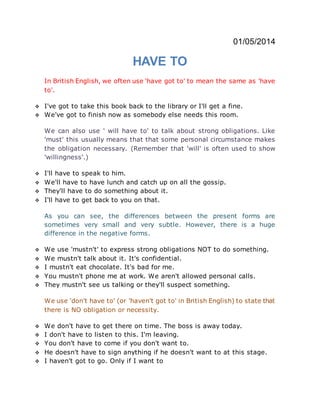
In British English, we often use 'have got to' to mean the same as 'have
to'.
 I've got to take this book back to the library or I'll get a fine.
 We've got to finish now as somebody else needs this room.
We can also use ' will have to' to talk about strong obligations. Like
'must' this usually means that that some personal circumstance makes
the obligation necessary. (Remember that 'will' is often used to show
'willingness'.)
 I'll have to speak to him.
 We'll have to have lunch and catch up on all the gossip.
 They'll have to do something about it.
 I'll have to get back to you on that.
As you can see, the differences between the present forms are
sometimes very small and very subtle. However, there is a huge
difference in the negative forms.
 We use 'mustn't' to express strong obligations NOT to do something.
 We mustn't talk about it. It's confidential.
 I mustn't eat chocolate. It's bad for me.
 You mustn't phone me at work. We aren't allowed personal calls.
 They mustn't see us talking or they'll suspect something.
We use 'don't have to' (or 'haven't got to' in British English) to state that
there is NO obligation or necessity.
 We don't have to get there on time. The boss is away today.
 I don't have to listen to this. I'm leaving.
 You don't have to come if you don't want to.
 He doesn't have to sign anything if he doesn't want to at this stage.
 I haven't got to go. Only if I want to
02/05/2014
USING "HAVE TO" IN PRESENT, PAST, AND FUTURE
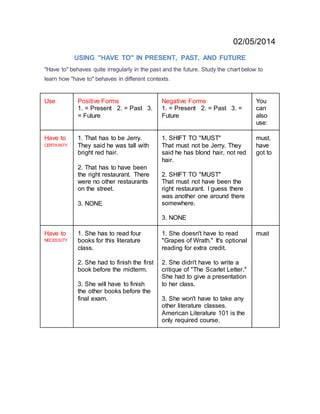
"Have to" behaves quite irregularly in the past and the future. Study the chart below to
learn how "have to" behaves in different contexts.
Use Positive Forms
1. = Present 2. = Past 3.
= Future
Negative Forms
1. = Present 2. = Past 3. =
Future
You
can
also
use:
Have to
CERTAINTY
1. That has to be Jerry.
They said he was tall with
bright red hair.
2. That has to have been
the right restaurant. There
were no other restaurants
on the street.
3. NONE
1. SHIFT TO "MUST"
That must not be Jerry. They
said he has blond hair, not red
hair.
2. SHIFT TO "MUST"
That must not have been the
right restaurant. I guess there
was another one around there
somewhere.
3. NONE
must,
have
got to
Have to
NECESSITY
1. She has to read four
books for this literature
class.
2. She had to finish the first
book before the midterm.
3. She will have to finish
the other books before the
final exam.
1. She doesn't have to read
"Grapes of Wrath." It's optional
reading for extra credit.
2. She didn't have to write a
critique of "The Scarlet Letter."
She had to give a presentation
to her class.
3. She won't have to take any
other literature classes.
American Literature 101 is the
only required course.
must
05/05/2014
HAVE SENTENCE EXAMPLES
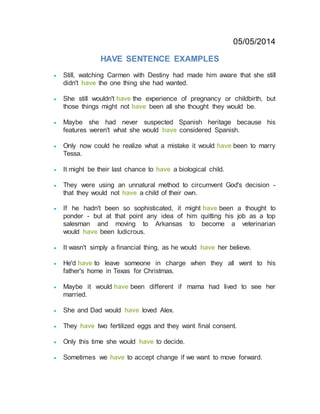
 Still, watching Carmen with Destiny had made him aware that she still
didn't have the one thing she had wanted.
 She still wouldn't have the experience of pregnancy or childbirth, but
those things might not have been all she thought they would be.
 Maybe she had never suspected Spanish heritage because his
features weren't what she would have considered Spanish.
 Only now could he realize what a mistake it would have been to marry
Tessa.
 It might be their last chance to have a biological child.
 They were using an unnatural method to circumvent God's decision -
that they would not have a child of their own.
 If he hadn't been so sophisticated, it might have been a thought to
ponder - but at that point any idea of him quitting his job as a top
salesman and moving to Arkansas to become a veterinarian
would have been ludicrous.
 It wasn't simply a financial thing, as he would have her believe.
 He'd have to leave someone in charge when they all went to his
father's home in Texas for Christmas.
 Maybe it would have been different if mama had lived to see her
married.
 She and Dad would have loved Alex.
 They have two fertilized eggs and they want final consent.
 Only this time she would have to decide.
 Sometimes we have to accept change if we want to move forward.
06/05/2014
MUST & HAVE TO SENTENCES
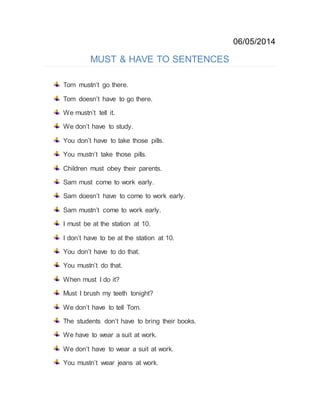
Tom mustn’t go there.
Tom doesn’t have to go there.
We mustn’t tell it.
We don’t have to study.
You don’t have to take those pills.
You mustn’t take those pills.
Children must obey their parents.
Sam must come to work early.
Sam doesn’t have to come to work early.
Sam mustn’t come to work early.
I must be at the station at 10.
I don’t have to be at the station at 10.
You don’t have to do that.
You mustn’t do that.
When must I do it?
Must I brush my teeth tonight?
We don’t have to tell Tom.
The students don’t have to bring their books.
We have to wear a suit at work.
We don’t have to wear a suit at work.
You mustn’t wear jeans at work.
07/05/2014
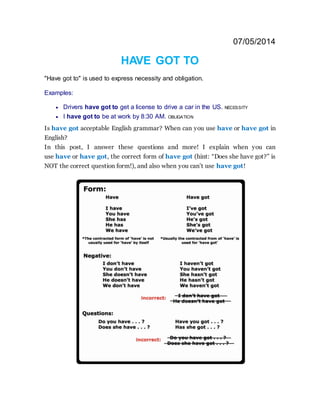
HAVE GOT TO
"Have got to" is used to express necessity and obligation.
Examples:
 Drivers have got to get a license to drive a car in the US. NECESSITY
 I have got to be at work by 8:30 AM. OBLIGATION
Is have got acceptable English grammar? When can you use have or have got in
English?
In this post, I answer these questions and more! I explain when you can
use have or have got, the correct form of have got (hint: “Does she have got?” is
NOT the correct question form!), and also when you can’t use have got!
08/05/2014
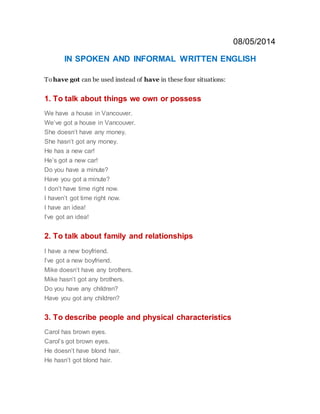
IN SPOKEN AND INFORMAL WRITTEN ENGLISH
To have got can be used instead of have in these four situations:
1. To talk about things we own or possess
We have a house in Vancouver.
We’ve got a house in Vancouver.
She doesn’t have any money.
She hasn’t got any money.
He has a new car!
He’s got a new car!
Do you have a minute?
Have you got a minute?
I don’t have time right now.
I haven’t got time right now.
I have an idea!
I’ve got an idea!
2. To talk about family and relationships
I have a new boyfriend.
I’ve got a new boyfriend.
Mike doesn’t have any brothers.
Mike hasn’t got any brothers.
Do you have any children?
Have you got any children?
3. To describe people and physical characteristics
Carol has brown eyes.
Carol’s got brown eyes.
He doesn’t have blond hair.
He hasn’t got blond hair.
Does your sister have long hair?
Has your sister got long hair?
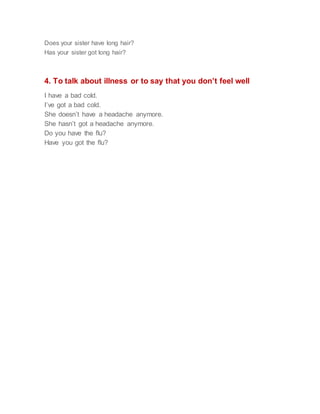
4. To talk about illness or to say that you don’t feel well
I have a bad cold.
I’ve got a bad cold.
She doesn’t have a headache anymore.
She hasn’t got a headache anymore.
Do you have the flu?
Have you got the flu?
09/05/2014
GRAMMAR FOR HAVE GOT
 Have got CANNOT be used for any other use of have (for example, talking
about actions and experiences):
I usually have dinner at 18:00.
NOT: I usually have got dinner at 18:00
 Have got is ONLY used in the present simple tense. It CANNOT be used in
any other tense:
I had a bad cold last week.
NOT: I had got a bad cold last week.
Continuous / progressive forms are NOT possible with these meanings
of have and have got.
 Have got has NOTHING to do with get. It is NOT the present perfect form
of get. [In North American English, have gotten is the present perfect
of get.]
Sometimes have is left out of have got in SPOKEN English (it is not
acceptable to leave out have in written English).
Here are some examples:
Got Milk?
This is a popular advertising campaign for milk in North America. It should
be “Have you got milk?
Got a minute?
In English ‘a minute’ is often used to mean ‘a short amount of time.’ People
often say: ‘Got a minute?’ which is short for ‘Do you have a minute?’ or
‘Have you got a minute?’
I Gotta Feeling
This is the title of a song by the Black Eyed Peas. It should actually be ‘I
have got a feeling. ’Gotta is not a proper English word. It is what native
speakers sometimes SAY instead of ‘got a’ or ‘got to.’
12/05/2014
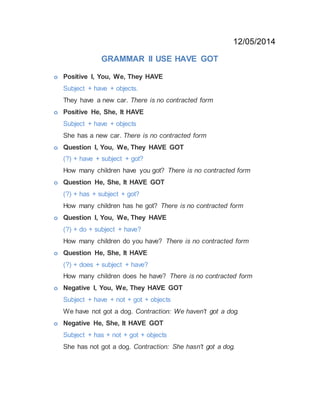
GRAMMAR II USE HAVE GOT
o Positive I, You, We, They HAVE
Subject + have + objects.
They have a new car. There is no contracted form
o Positive He, She, It HAVE
Subject + have + objects
She has a new car. There is no contracted form
o Question I, You, We, They HAVE GOT
(?) + have + subject + got?
How many children have you got? There is no contracted form
o Question He, She, It HAVE GOT
(?) + has + subject + got?
How many children has he got? There is no contracted form
o Question I, You, We, They HAVE
(?) + do + subject + have?
How many children do you have? There is no contracted form
o Question He, She, It HAVE
(?) + does + subject + have?
How many children does he have? There is no contracted form
o Negative I, You, We, They HAVE GOT
Subject + have + not + got + objects
We have not got a dog. Contraction: We haven't got a dog.
o Negative He, She, It HAVE GOT
Subject + has + not + got + objects
She has not got a dog. Contraction: She hasn't got a dog.
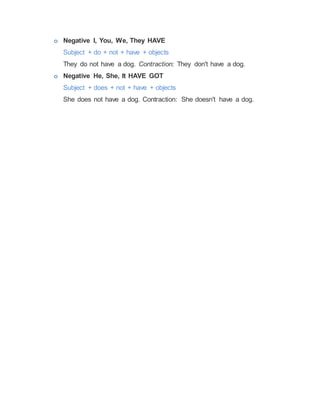
o Negative I, You, We, They HAVE
Subject + do + not + have + objects
They do not have a dog. Contraction: They don't have a dog.
o Negative He, She, It HAVE GOT
Subject + does + not + have + objects
She does not have a dog. Contraction: She doesn't have a dog.
13/05/2014
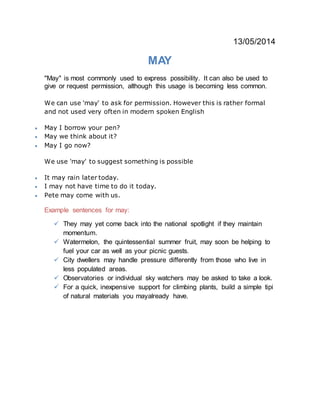
MAY
"May" is most commonly used to express possibility. It can also be used to
give or request permission, although this usage is becoming less common.
We can use 'may' to ask for permission. However this is rather formal
and not used very often in modern spoken English
 May I borrow your pen?
 May we think about it?
 May I go now?
We use 'may' to suggest something is possible
 It may rain later today.
 I may not have time to do it today.
 Pete may come with us.
Example sentences for may:
 They may yet come back into the national spotlight if they maintain
momentum.
 Watermelon, the quintessential summer fruit, may soon be helping to
fuel your car as well as your picnic guests.
 City dwellers may handle pressure differently from those who live in
less populated areas.
 Observatories or individual sky watchers may be asked to take a look.
 For a quick, inexpensive support for climbing plants, build a simple tipi
of natural materials you mayalready have.
14/05/2014
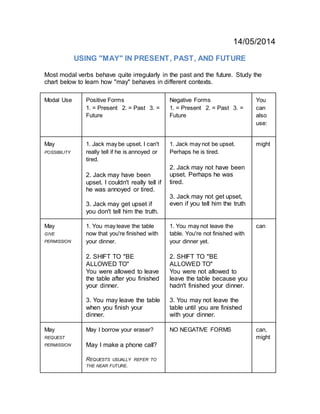
USING "MAY" IN PRESENT, PAST, AND FUTURE
Most modal verbs behave quite irregularly in the past and the future. Study the
chart below to learn how "may" behaves in different contexts.
Modal Use Positive Forms
1. = Present 2. = Past 3. =
Future
Negative Forms
1. = Present 2. = Past 3. =
Future
You
can
also
use:
May
POSSIBILITY
1. Jack may be upset. I can't
really tell if he is annoyed or
tired.
2. Jack may have been
upset. I couldn't really tell if
he was annoyed or tired.
3. Jack may get upset if
you don't tell him the truth.
1. Jack may not be upset.
Perhaps he is tired.
2. Jack may not have been
upset. Perhaps he was
tired.
3. Jack may not get upset,
even if you tell him the truth
might
May
GIVE
PERMISSION
1. You may leave the table
now that you're finished with
your dinner.
2. SHIFT TO "BE
ALLOWED TO"
You were allowed to leave
the table after you finished
your dinner.
3. You may leave the table
when you finish your
dinner.
1. You may not leave the
table. You're not finished with
your dinner yet.
2. SHIFT TO "BE
ALLOWED TO"
You were not allowed to
leave the table because you
hadn't finished your dinner.
3. You may not leave the
table until you are finished
with your dinner.
can
May
REQUEST
PERMISSION
May I borrow your eraser?
May I make a phone call?
REQUESTS USUALLY REFER TO
THE NEAR FUTURE.
NO NEGATIVE FORMS can,
might
15/05/2014
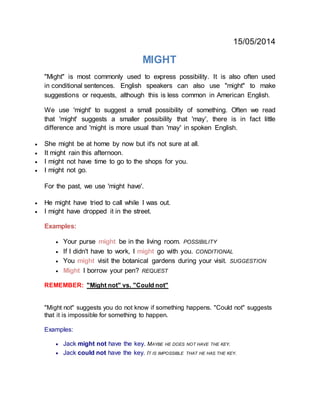
MIGHT
"Might" is most commonly used to express possibility. It is also often used
in conditional sentences. English speakers can also use "might" to make
suggestions or requests, although this is less common in American English.
We use 'might' to suggest a small possibility of something. Often we read
that 'might' suggests a smaller possibility that 'may', there is in fact little
difference and 'might is more usual than 'may' in spoken English.
 She might be at home by now but it's not sure at all.
 It might rain this afternoon.
 I might not have time to go to the shops for you.
 I might not go.
For the past, we use 'might have'.
 He might have tried to call while I was out.
 I might have dropped it in the street.
Examples:
 Your purse might be in the living room. POSSIBILITY
 If I didn't have to work, I might go with you. CONDITIONAL
 You might visit the botanical gardens during your visit. SUGGESTION
 Might I borrow your pen? REQUEST
REMEMBER: "Might not" vs. "Could not"
"Might not" suggests you do not know if something happens. "Could not" suggests
that it is impossible for something to happen.
Examples:
 Jack might not have the key. MAYBE HE DOES NOT HAVE THE KEY.
 Jack could not have the key. IT IS IMPOSSIBLE THAT HE HAS THE KEY.
16/05/2014
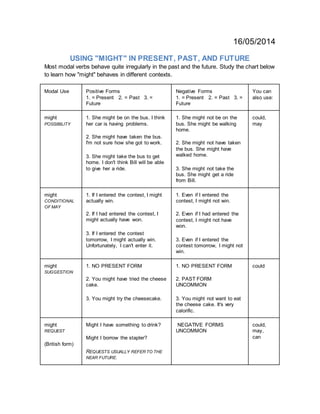
USING "MIGHT" IN PRESENT, PAST, AND FUTURE
Most modal verbs behave quite irregularly in the past and the future. Study the chart below
to learn how "might" behaves in different contexts.
Modal Use Positive Forms
1. = Present 2. = Past 3. =
Future
Negative Forms
1. = Present 2. = Past 3. =
Future
You can
also use:
might
POSSIBILITY
1. She might be on the bus. I think
her car is having problems.
2. She might have taken the bus.
I'm not sure how she got to work.
3. She might take the bus to get
home. I don't think Bill will be able
to give her a ride.
1. She might not be on the
bus. She might be walking
home.
2. She might not have taken
the bus. She might have
walked home.
3. She might not take the
bus. She might get a ride
from Bill.
could,
may
might
CONDITIONAL
OF MAY
1. If I entered the contest, I might
actually win.
2. If I had entered the contest, I
might actually have won.
3. If I entered the contest
tomorrow, I might actually win.
Unfortunately, I can't enter it.
1. Even if I entered the
contest, I might not win.
2. Even if I had entered the
contest, I might not have
won.
3. Even if I entered the
contest tomorrow, I might not
win.
might
SUGGESTION
1. NO PRESENT FORM
2. You might have tried the cheese
cake.
3. You might try the cheesecake.
1. NO PRESENT FORM
2. PAST FORM
UNCOMMON
3. You might not want to eat
the cheese cake. It's very
calorific.
could
might
REQUEST
(British form)
Might I have something to drink?
Might I borrow the stapler?
REQUESTS USUALLY REFER TO THE
NEAR FUTURE.
NEGATIVE FORMS
UNCOMMON
could,
may,
can
19/05/2014
May and Might Examples
"Might and "may" can technically have the same meaning when using them
in sentences. A lot of the time when using one of these in sentences, you
can switch them and the sentence will still make sense.
Examples: "You might want to have a look at this."
"You may want to have a look at this."
"You might want to take this with you."
"You may want to take this with you."
However: "Try as he might, he couldn't"
"Try as he may, he couldn't"
It depends on which using of "might" or "may" you are using, but if it is used
in an opinion type sentence, it makes sense if you use either one.
May and might are both modal verbs.
May is usually slightly more certain than might, but there is little difference.
We use may to suggest something is possible. May is rather formal and
might is more usual in Spoken English.
Both can be used:
Examples:
In England, unexpected guests may/might be offered some tea.
In future, people may/might not need to travel to business meetings.
Life when my parents were young may/might have been less demanding
than it is now.
We use May
1. Ask for permission.
Example: May I borrow your pen?
2. To suggest something is possible.
Example: Andrew may come with us. (Because he is not sure, but he thinks
75 %)
We use might to suggest a small possibility of something.
Examples:
I might go to Susan’s party. (15%, I don’t think so)
My parents might be at home by now but it’s not sure at all. (they have been
to a party till late)
Might is the past tense of may. We only use might when we reffering to the
past.
Example: George might have gone to the party.
This is the second part of your question: How should I resolve the confusion
between using these words everytime: ‘Will’ and ‘Would’, ‘Shall’ and
‘Should’, ‘May’ and ‘Might’?
20/05/2014
Ought To
"Ought to" is used to advise or make recommendations. "Ought to" also
expresses assumption or expectation as well as strong probability, often with
the idea that something is deserved. "Ought not" (without "to") is used to
advise against doing something, although Americans prefer the less formal
forms "should not" or "had better not."
• to express the view that something is the right thing to do, because it’s
morally correct, polite, or someone’s duty:
You ought to admit that you made a mistake.
They ought not to be allowed to damage property without paying
compensation.
• to predict that something is fairly likely or expected, based on normal
circumstances or logic:
Our long-delayed mail is on the way from France and ought to arrive today.
The weather oughtn’t to be cold in May.
• to offer or ask for advice or recommendations:
If you haven’t read the book then you ought to see the movie.
What ought to be done to improve things?
Examples:
 You ought to stop smoking. RECOMMENDATION
 Jim ought to get the promotion. IT IS EXPECTED BECAUSE HE DESERVES
IT.
 This stock ought to increase in value. PROBABILITY
 Mark ought not drink so much. ADVICE AGAINST SOMETHING (NOTICE
THERE IS NO "TO")
21/05/2014
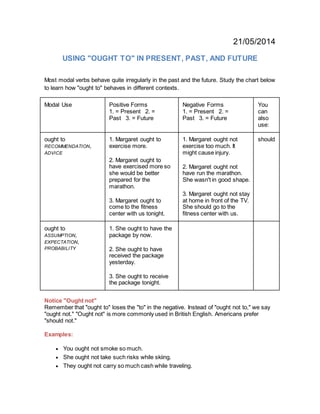
USING "OUGHT TO" IN PRESENT, PAST, AND FUTURE
Most modal verbs behave quite irregularly in the past and the future. Study the chart below
to learn how "ought to" behaves in different contexts.
Modal Use Positive Forms
1. = Present 2. =
Past 3. = Future
Negative Forms
1. = Present 2. =
Past 3. = Future
You
can
also
use:
ought to
RECOMMENDATION,
ADVICE
1. Margaret ought to
exercise more.
2. Margaret ought to
have exercised more so
she would be better
prepared for the
marathon.
3. Margaret ought to
come to the fitness
center with us tonight.
1. Margaret ought not
exercise too much. It
might cause injury.
2. Margaret ought not
have run the marathon.
She wasn't in good shape.
3. Margaret ought not stay
at home in front of the TV.
She should go to the
fitness center with us.
should
ought to
ASSUMPTION,
EXPECTATION,
PROBABILITY
1. She ought to have the
package by now.
2. She ought to have
received the package
yesterday.
3. She ought to receive
the package tonight.
Notice "Ought not"
Remember that "ought to" loses the "to" in the negative. Instead of "ought not to," we say
"ought not." "Ought not" is more commonly used in British English. Americans prefer
"should not."
Examples:
 You ought not smoke so much.
 She ought not take such risks while skiing.
 They ought not carry so much cash while traveling.
21/05/2014
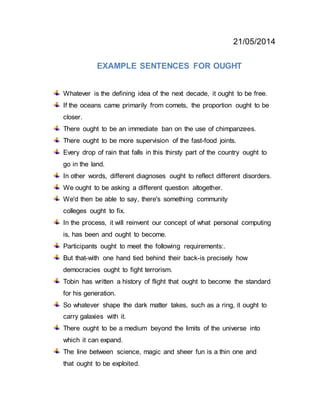
EXAMPLE SENTENCES FOR OUGHT
Whatever is the defining idea of the next decade, it ought to be free.
If the oceans came primarily from comets, the proportion ought to be
closer.
There ought to be an immediate ban on the use of chimpanzees.
There ought to be more supervision of the fast-food joints.
Every drop of rain that falls in this thirsty part of the country ought to
go in the land.
In other words, different diagnoses ought to reflect different disorders.
We ought to be asking a different question altogether.
We'd then be able to say, there's something community
colleges ought to fix.
In the process, it will reinvent our concept of what personal computing
is, has been and ought to become.
Participants ought to meet the following requirements:.
But that-with one hand tied behind their back-is precisely how
democracies ought to fight terrorism.
Tobin has written a history of flight that ought to become the standard
for his generation.
So whatever shape the dark matter takes, such as a ring, it ought to
carry galaxies with it.
There ought to be a medium beyond the limits of the universe into
which it can expand.
The line between science, magic and sheer fun is a thin one and
that ought to be exploited.
21/05/2014
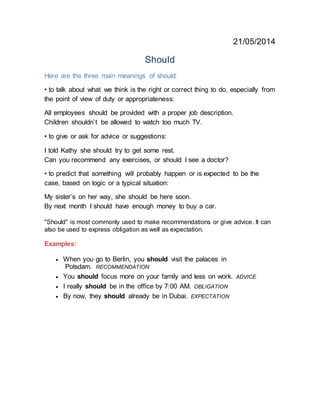
Should
Here are the three main meanings of should:
• to talk about what we think is the right or correct thing to do, especially from
the point of view of duty or appropriateness:
All employees should be provided with a proper job description.
Children shouldn’t be allowed to watch too much TV.
• to give or ask for advice or suggestions:
I told Kathy she should try to get some rest.
Can you recommend any exercises, or should I see a doctor?
• to predict that something will probably happen or is expected to be the
case, based on logic or a typical situation:
My sister’s on her way, she should be here soon.
By next month I should have enough money to buy a car.
"Should" is most commonly used to make recommendations or give advice. It can
also be used to express obligation as well as expectation.
Examples:
 When you go to Berlin, you should visit the palaces in
Potsdam. RECOMMENDATION
 You should focus more on your family and less on work. ADVICE
 I really should be in the office by 7:00 AM. OBLIGATION
 By now, they should already be in Dubai. EXPECTATION
21/05/2014
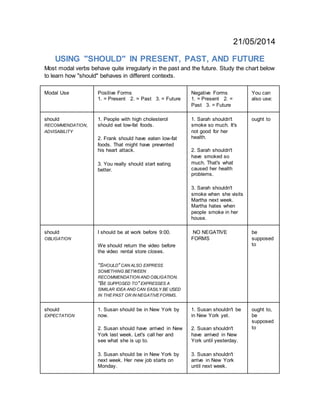
USING "SHOULD" IN PRESENT, PAST, AND FUTURE
Most modal verbs behave quite irregularly in the past and the future. Study the chart below
to learn how "should" behaves in different contexts.
Modal Use Positive Forms
1. = Present 2. = Past 3. = Future
Negative Forms
1. = Present 2. =
Past 3. = Future
You can
also use:
should
RECOMMENDATION,
ADVISABILITY
1. People with high cholesterol
should eat low-fat foods.
2. Frank should have eaten low-fat
foods. That might have prevented
his heart attack.
3. You really should start eating
better.
1. Sarah shouldn't
smoke so much. It's
not good for her
health.
2. Sarah shouldn't
have smoked so
much. That's what
caused her health
problems.
3. Sarah shouldn't
smoke when she visits
Martha next week.
Martha hates when
people smoke in her
house.
ought to
should
OBLIGATION
I should be at work before 9:00.
We should return the video before
the video rental store closes.
"SHOULD" CAN ALSO EXPRESS
SOMETHING BETWEEN
RECOMMENDATION AND OBLIGATION.
"BE SUPPOSED TO" EXPRESSES A
SIMILAR IDEA AND CAN EASILY BE USED
IN THE PAST OR IN NEGATIVE FORMS.
NO NEGATIVE
FORMS
be
supposed
to
should
EXPECTATION
1. Susan should be in New York by
now.
2. Susan should have arrived in New
York last week. Let's call her and
see what she is up to.
3. Susan should be in New York by
next week. Her new job starts on
Monday.
1. Susan shouldn't be
in New York yet.
2. Susan shouldn't
have arrived in New
York until yesterday.
3. Susan shouldn't
arrive in New York
until next week.
ought to,
be
supposed
to
21/05/2014
Must, should, or ought?
While the viewpoint behind it may be outdated, this famous quotation is a
neat way of illustrating one of the main uses of ought, namely expressing the
speaker’s view as to a correct or dutiful course of action, often imbued with a
tinge of social rectitude.
As you may know, ought is a special type of verb known as a modal verb:
I’ve covered some of these already in earlier blogs. I’d now like to turn my
attention to a trio of modals which share a similar range of meanings: must,
ought, and should. All these verbs can be used to talk about duty and
obligation, to give advice or instructions, or to express degrees of probability.
Should can also be used in other ways, but as I’m endeavoring to keep this
fairly brief, I’ll save my discussion of conditional meanings of should and the
difference between should and would for another day. If you’re avid for all
the gen right this minute, you can find a full rundown of should here.
Let’s explore the central meanings of must, should, and ought first, then we’ll
turn to their similarities and differences, so as to help you use each verb in
the most effective and idiomatic way.
Differences and similarities
We can compare and contrast ought, and should according to two categories:
1. - MEANING AND 2. - GRAMMAR.
22/05/2014
1. - Meaning of Must, should, or ought
As we’ve seen, we can use all three verbs to express broadly similar
meanings: the main distinctions between them are related to degrees of
emphasis. Must is the most emphatic: you use it when you’re confident
about a conclusion, or when you want to stress that it’s very important for
someone to follow your recommendations. You also use must to refer to
something that’s required by a rule or law.
Unlike should and ought, must isn’t used to make predictions:
✓ According to the forecast, it should be warm tomorrow.
✓ According to the forecast, it ought to be warm tomorrow.
X According to the forecast, it must be warm tomorrow.
Ought is less strong than must, and isn’t used to talk about things that are
compulsory. It often carries with it slightly more forcefulness and more of a
sense of moral obligation or appropriateness than should.
The meanings of should that we’re addressing in this blog overlap with those
of ought, but should is much more common statistically. There are over 2
million instances of should on the Oxford English Corpus, compared with
around 71,000 occurrences of ought. In particular, should is much more
frequent in questions or negative constructions than ought. Should is the
least forceful of the trio: it’s mostly used to make suggestions and
more tentative predictions.
Compare the nuances of meaning in the following:
If you have a mole that starts to bleed, you must see a doctor. [it’s vital, as it
could be cancer]
The fat content of the cheese must not exceed 44%. [this is to obey a food
regulation]
The object of the exercise was to prevent the public from seeing what
they ought to see. [it’s morally desirable that people knew]
I ought to eat more fruit and vegetables. [it’s a good idea and will make me
healthier]
You should see the size of the crowds he plays in front of! [this is my
opinion, but you don’t actually need to see the crowds for yourself]
I think I should go home. [I’m considering this as an option]
Having said this, however, there’s frequently little distinction in meaning
between ought and should, and indeed it is possible to have the same
interpretation using one or both alternatives. Should is more common in
questions, especially in daily conversation: ought sounds rather formal when
used interrogatively. Additionally, speakers of North American English tend
to use should rather than ought when expressing a negative idea
(we shouldn’tturn away from such opportunities rather than we oughtn’t to
turn away from such opportunities).
22/05/2014
2. - Grammar of Must, should, or ought
2.1 Tenses
You can form the past tense of should and ought by using have and the past
participle of the main verb. We can use this construction to talk about things
which were supposed to have been done or have happened (but didn’t) or to
speculate.
About things which we’re not sure about in the past:
They should have done more research.
I ought to have left here by 3.30.
Surely they should have got home by midnight.
You also form the past of must with have plus the past participle of a main
verb. You can use must have to express certainty about something in the
past, based on logic or normal expectations:
From the evidence of his pupils, he must have been a good teacher.
However, you can’t use must have to talk about something important that
should have occurred in the past or something compulsory. If you say:
They must have done more research.
it doesn’t mean ‘they were supposed to have done more research but didn’t’;
it means that the speaker is sure that they had carried out more research in
order to get to the situation they’re now in.
2.2 Infinitives
Ought is unlike most other modals, because we always use
the infinitive towhen we use it with a main verb. You shouldn’t say:
X I ought eat less meat.
X Ought we visit her soon?
X You ought not miss this play.
You need to use to:
✓ I ought to eat less meat.
✓ Ought we to visit her soon?
✓ You ought not to miss this play.
The only case where you don’t have to accompany ought with to is if there is
no other main verb in the sentence or clause:
✓ Say what you have to say, not what you ought.
✓ We should file that under ‘Educational’ too, oughtn’t we?
With should and must, the infinitive to isn’t used:
X I should to leave now.
X She mustn’t to discuss the case with anyone.
✓ I should leave now.
✓ She mustn’t discuss the case with anyone.
The above should have helped to clarify these three verbs; you ought now
to know how to use them; I must stop writing immediately!
23/05/2014
Shall
"Shall" is used to indicate future action. It is most commonly used in sentences with "I" or
"we," and is often found in suggestions, such as "Shall we go?" "Shall" is also frequently
used in promises or voluntary actions. In formal English, the use of "shall" to describe
future events often expresses inevitability or predestination. "Shall" is much more
commonly heard in British English than in American English; Americans prefer to use other
forms, although they do sometimes use "shall" in suggestions or formalized language.
We don't use 'Shall' very frequently in modern English, particularly in
American English.
It is used to make offers and suggestions and to ask for advice.
 What time shall we meet?
 Shall we vote on it now?
 What dress shall I wear?
 Shall I open the window?
You only really need to know that about 'shall' in modern English. Read
the rest of this only if you want to know more about how some older
speakers still use 'shall'.
Formerly, in older grammar, 'shall' was used as an alternative to 'will'
with 'I' and 'we'. Today, 'will' is normally used. When we do use 'shall', it
has an idea of a more personal, subjective future.
 I shall go to see the boss and I shall ask him to explain this
decision.
Notice that the negative of 'shall' can be 'shall not' or 'shan't' – though
the second one is now very rare in American English.
 I don't like these people and I shall not go to their party.
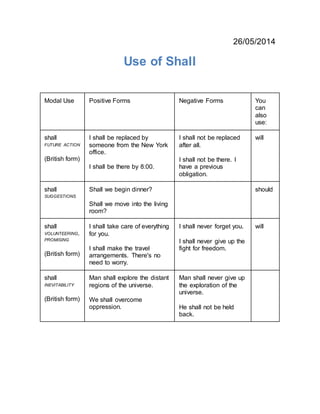
 I shan't object if you go without me.
26/05/2014
Use of Shall
Modal Use Positive Forms Negative Forms You
can
also
use:
shall
FUTURE ACTION
(British form)
I shall be replaced by
someone from the New York
office.
I shall be there by 8:00.
I shall not be replaced
after all.
I shall not be there. I
have a previous
obligation.
will
shall
SUGGESTIONS
Shall we begin dinner?
Shall we move into the living
room?
should
shall
VOLUNTEERING,
PROMISING
(British form)
I shall take care of everything
for you.
I shall make the travel
arrangements. There's no
need to worry.
I shall never forget you.
I shall never give up the
fight for freedom.
will
shall
INEVITABILITY
(British form)
Man shall explore the distant
regions of the universe.
We shall overcome
oppression.
Man shall never give up
the exploration of the
universe.
He shall not be held
back.
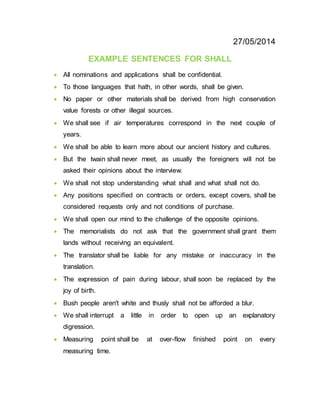
27/05/2014
EXAMPLE SENTENCES FOR SHALL
 All nominations and applications shall be confidential.
 To those languages that hath, in other words, shall be given.
 No paper or other materials shall be derived from high conservation
value forests or other illegal sources.
 We shall see if air temperatures correspond in the next couple of
years.
 We shall be able to learn more about our ancient history and cultures.
 But the twain shall never meet, as usually the foreigners will not be
asked their opinions about the interview.
 We shall not stop understanding what shall and what shall not do.
 Any positions specified on contracts or orders, except covers, shall be
considered requests only and not conditions of purchase.
 We shall open our mind to the challenge of the opposite opinions.
 The memorialists do not ask that the government shall grant them
lands without receiving an equivalent.
 The translator shall be liable for any mistake or inaccuracy in the
translation.
 The expression of pain during labour, shall soon be replaced by the
joy of birth.
 Bush people aren't white and thusly shall not be afforded a blur.
 We shall interrupt a little in order to open up an explanatory
digression.
 Measuring point shall be at over-flow finished point on every
measuring time.
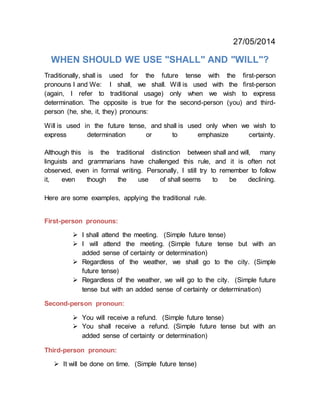
27/05/2014
WHEN SHOULD WE USE "SHALL" AND "WILL"?
Traditionally, shall is used for the future tense with the first-person
pronouns I and We: I shall, we shall. Will is used with the first-person
(again, I refer to traditional usage) only when we wish to express
determination. The opposite is true for the second-person (you) and third-
person (he, she, it, they) pronouns:
Will is used in the future tense, and shall is used only when we wish to
express determination or to emphasize certainty.
Although this is the traditional distinction between shall and will, many
linguists and grammarians have challenged this rule, and it is often not
observed, even in formal writing. Personally, I still try to remember to follow
it, even though the use of shall seems to be declining.
Here are some examples, applying the traditional rule.
First-person pronouns:
 I shall attend the meeting. (Simple future tense)
 I will attend the meeting. (Simple future tense but with an
added sense of certainty or determination)
 Regardless of the weather, we shall go to the city. (Simple
future tense)
 Regardless of the weather, we will go to the city. (Simple future
tense but with an added sense of certainty or determination)
Second-person pronoun:
 You will receive a refund. (Simple future tense)
 You shall receive a refund. (Simple future tense but with an
added sense of certainty or determination)
Third-person pronoun:
 It will be done on time. (Simple future tense)
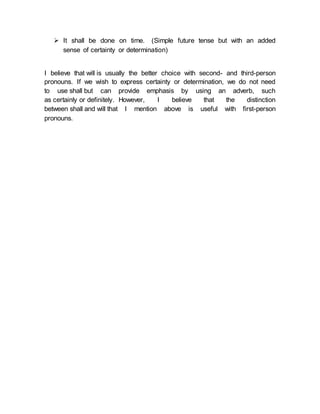
 It shall be done on time. (Simple future tense but with an added
sense of certainty or determination)
I believe that will is usually the better choice with second- and third-person
pronouns. If we wish to express certainty or determination, we do not need
to use shall but can provide emphasis by using an adverb, such
as certainly or definitely. However, I believe that the distinction
between shall and will that I mention above is useful with first-person
pronouns.
28/05/2014
Shall and Will
The main use of the auxiliary verbs will and shall is to form the future tense.
For example:
 I will arrive on Tuesday.
 I shall arrive on Tuesday.
However, these days, the use of shall to form the future tense is becoming
rarer (especially in the US), and it is safe to use will every time. In fact, to
say it's "safe to use will every time" is understating the case. Unless you're
asking a question (more on that below), it is largely expected (particularly in
the US).
That said, it might be useful to know the traditional rules for
using will and shall because you never know when you might have to
showcase your grammar skills or write to an audience of grammar pedants.
Forming the Future Tense with Will in Shall
(Traditional Rules)
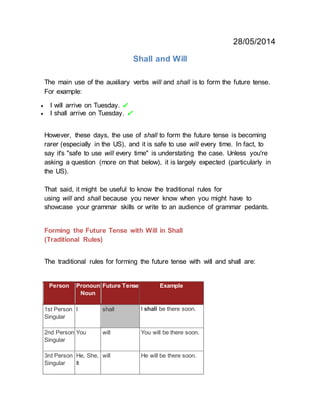
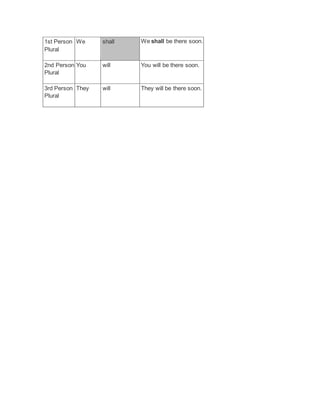
The traditional rules for forming the future tense with will and shall are:
Person Pronoun
Noun
Future Tense Example
1st Person
Singular
I shall I shall be there soon.
2nd Person
Singular
You will You will be there soon.
3rd Person
Singular
He, She,
It
will He will be there soon.
1st Person
Plural
We shall We shall be there soon.
2nd Person
Plural
You will You will be there soon.
3rd Person
Plural
They will They will be there soon.
29/05/2014
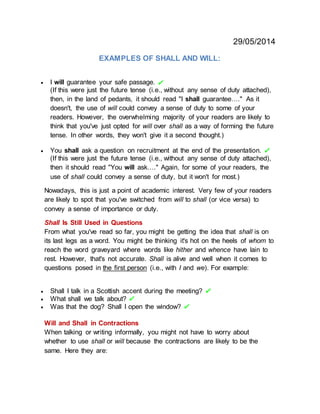
EXAMPLES OF SHALL AND WILL:
 I will guarantee your safe passage.
(If this were just the future tense (i.e., without any sense of duty attached),
then, in the land of pedants, it should read "I shall guarantee…." As it
doesn't, the use of will could convey a sense of duty to some of your
readers. However, the overwhelming majority of your readers are likely to
think that you've just opted for will over shall as a way of forming the future
tense. In other words, they won't give it a second thought.)
 You shall ask a question on recruitment at the end of the presentation.
(If this were just the future tense (i.e., without any sense of duty attached),
then it should read "You will ask…." Again, for some of your readers, the
use of shall could convey a sense of duty, but it won't for most.)
Nowadays, this is just a point of academic interest. Very few of your readers
are likely to spot that you've switched from will to shall (or vice versa) to
convey a sense of importance or duty.
Shall Is Still Used in Questions
From what you've read so far, you might be getting the idea that shall is on
its last legs as a word. You might be thinking it's hot on the heels of whom to
reach the word graveyard where words like hither and whence have lain to
rest. However, that's not accurate. Shall is alive and well when it comes to
questions posed in the first person (i.e., with I and we). For example:
 Shall I talk in a Scottish accent during the meeting?
 What shall we talk about?
 Was that the dog? Shall I open the window?
Will and Shall in Contractions
When talking or writing informally, you might not have to worry about
whether to use shall or will because the contractions are likely to be the
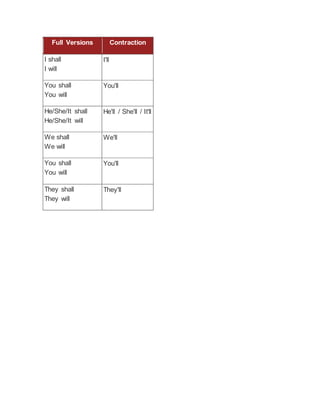
same. Here they are:
Full Versions Contraction
I shall
I will
I'll
You shall
You will
You'll
He/She/It shall
He/She/It will
He'll / She'll / It'll
We shall
We will
We'll
You shall
You will
You'll
They shall
They will
They'll
30/05/2014
THE DIFFERENCE BETWEEN “WILL” AND “SHALL”
When do you use “will” and “shall?” I know that [they] mean the same thing,
but I would like to know when to use them in the correct grammatical sense.
In modern English will and shall are helping verbs. They are used with other
verbs, but lack conjugations of their own.
Both are signs of the future tense.
The old Walsh English Handbook that I used in high school gives this rule for
forming the future:
Use shall in the first person and will in the second and third persons for the
simple future tense:
I shall sing this afternoon.
You will succeed.
He will stay at home.
My observations suggest that shall is rarely used by American speakers.
The two words existed as separate verbs in Old English, the form of English
spoken from 450-1150 C.E.
The verb willan meant “wish, be willing, be about to.”
The verb sculan (pronounced [shu-lan], had the meanings “be obliged to,
have to, must, be destined to, be supposed to.”
In modern usage traces of the old meanings persist for speakers who use
both forms.
Will can imply volition or intention, while shall can imply necessity:
I will scale Mount Everest. (“and no one can stop me!”)
You shall take the garbage out before you do anything else. (“You have no
choice, Junior!”)
A second element enters into the use of shall and will.
As a matter of courtesy, a difference exists according to whether the verb is
used with a first or second person subject. Which to use depends upon the
relationship between speakers.
Parents, teachers, employers, and staff sergeants are within their rights to
tell someone “You shall complete this assignment by 9 p.m.” Such a
construction offers no alternative. It is the same as saying “You must
complete this assignment.”
In speaking to an equal, however, the choice is left up to the other person:
I shall drive to Tulsa today. You will follow on Tuesday. (It’s still up to you.)
Here’s a frequently quoted joke that illustrates the consequences of
using shalland will incorrectly:
A foreign tourist was swimming in an English lake. Taken by cramps, he
began to sink. He called out for help:
“Attention! Attention! I will drown and no one shall save me!”
Many people were within earshot, but, being well-brought up Englishmen
and women, they honored his wishes and permitted him to drown.

Mayo

  • 1.
    01/05/2014 HAVE TO In BritishEnglish, we often use 'have got to' to mean the same as 'have to'.  I've got to take this book back to the library or I'll get a fine.  We've got to finish now as somebody else needs this room. We can also use ' will have to' to talk about strong obligations. Like 'must' this usually means that that some personal circumstance makes the obligation necessary. (Remember that 'will' is often used to show 'willingness'.)  I'll have to speak to him.  We'll have to have lunch and catch up on all the gossip.  They'll have to do something about it.  I'll have to get back to you on that. As you can see, the differences between the present forms are sometimes very small and very subtle. However, there is a huge difference in the negative forms.  We use 'mustn't' to express strong obligations NOT to do something.  We mustn't talk about it. It's confidential.  I mustn't eat chocolate. It's bad for me.  You mustn't phone me at work. We aren't allowed personal calls.  They mustn't see us talking or they'll suspect something. We use 'don't have to' (or 'haven't got to' in British English) to state that there is NO obligation or necessity.  We don't have to get there on time. The boss is away today.  I don't have to listen to this. I'm leaving.  You don't have to come if you don't want to.  He doesn't have to sign anything if he doesn't want to at this stage.  I haven't got to go. Only if I want to
  • 2.
    02/05/2014 USING "HAVE TO"IN PRESENT, PAST, AND FUTURE "Have to" behaves quite irregularly in the past and the future. Study the chart below to learn how "have to" behaves in different contexts. Use Positive Forms 1. = Present 2. = Past 3. = Future Negative Forms 1. = Present 2. = Past 3. = Future You can also use: Have to CERTAINTY 1. That has to be Jerry. They said he was tall with bright red hair. 2. That has to have been the right restaurant. There were no other restaurants on the street. 3. NONE 1. SHIFT TO "MUST" That must not be Jerry. They said he has blond hair, not red hair. 2. SHIFT TO "MUST" That must not have been the right restaurant. I guess there was another one around there somewhere. 3. NONE must, have got to Have to NECESSITY 1. She has to read four books for this literature class. 2. She had to finish the first book before the midterm. 3. She will have to finish the other books before the final exam. 1. She doesn't have to read "Grapes of Wrath." It's optional reading for extra credit. 2. She didn't have to write a critique of "The Scarlet Letter." She had to give a presentation to her class. 3. She won't have to take any other literature classes. American Literature 101 is the only required course. must
  • 3.
    05/05/2014 HAVE SENTENCE EXAMPLES Still, watching Carmen with Destiny had made him aware that she still didn't have the one thing she had wanted.  She still wouldn't have the experience of pregnancy or childbirth, but those things might not have been all she thought they would be.  Maybe she had never suspected Spanish heritage because his features weren't what she would have considered Spanish.  Only now could he realize what a mistake it would have been to marry Tessa.  It might be their last chance to have a biological child.  They were using an unnatural method to circumvent God's decision - that they would not have a child of their own.  If he hadn't been so sophisticated, it might have been a thought to ponder - but at that point any idea of him quitting his job as a top salesman and moving to Arkansas to become a veterinarian would have been ludicrous.  It wasn't simply a financial thing, as he would have her believe.  He'd have to leave someone in charge when they all went to his father's home in Texas for Christmas.  Maybe it would have been different if mama had lived to see her married.  She and Dad would have loved Alex.  They have two fertilized eggs and they want final consent.  Only this time she would have to decide.  Sometimes we have to accept change if we want to move forward.
  • 4.
    06/05/2014 MUST & HAVETO SENTENCES Tom mustn’t go there. Tom doesn’t have to go there. We mustn’t tell it. We don’t have to study. You don’t have to take those pills. You mustn’t take those pills. Children must obey their parents. Sam must come to work early. Sam doesn’t have to come to work early. Sam mustn’t come to work early. I must be at the station at 10. I don’t have to be at the station at 10. You don’t have to do that. You mustn’t do that. When must I do it? Must I brush my teeth tonight? We don’t have to tell Tom. The students don’t have to bring their books. We have to wear a suit at work. We don’t have to wear a suit at work. You mustn’t wear jeans at work.
  • 5.
    07/05/2014 HAVE GOT TO "Havegot to" is used to express necessity and obligation. Examples:  Drivers have got to get a license to drive a car in the US. NECESSITY  I have got to be at work by 8:30 AM. OBLIGATION Is have got acceptable English grammar? When can you use have or have got in English? In this post, I answer these questions and more! I explain when you can use have or have got, the correct form of have got (hint: “Does she have got?” is NOT the correct question form!), and also when you can’t use have got!
  • 6.
    08/05/2014 IN SPOKEN ANDINFORMAL WRITTEN ENGLISH To have got can be used instead of have in these four situations: 1. To talk about things we own or possess We have a house in Vancouver. We’ve got a house in Vancouver. She doesn’t have any money. She hasn’t got any money. He has a new car! He’s got a new car! Do you have a minute? Have you got a minute? I don’t have time right now. I haven’t got time right now. I have an idea! I’ve got an idea! 2. To talk about family and relationships I have a new boyfriend. I’ve got a new boyfriend. Mike doesn’t have any brothers. Mike hasn’t got any brothers. Do you have any children? Have you got any children? 3. To describe people and physical characteristics Carol has brown eyes. Carol’s got brown eyes. He doesn’t have blond hair. He hasn’t got blond hair.
  • 7.
    Does your sisterhave long hair? Has your sister got long hair? 4. To talk about illness or to say that you don’t feel well I have a bad cold. I’ve got a bad cold. She doesn’t have a headache anymore. She hasn’t got a headache anymore. Do you have the flu? Have you got the flu?
  • 8.
    09/05/2014 GRAMMAR FOR HAVEGOT  Have got CANNOT be used for any other use of have (for example, talking about actions and experiences): I usually have dinner at 18:00. NOT: I usually have got dinner at 18:00  Have got is ONLY used in the present simple tense. It CANNOT be used in any other tense: I had a bad cold last week. NOT: I had got a bad cold last week. Continuous / progressive forms are NOT possible with these meanings of have and have got.  Have got has NOTHING to do with get. It is NOT the present perfect form of get. [In North American English, have gotten is the present perfect of get.] Sometimes have is left out of have got in SPOKEN English (it is not acceptable to leave out have in written English). Here are some examples: Got Milk? This is a popular advertising campaign for milk in North America. It should be “Have you got milk? Got a minute? In English ‘a minute’ is often used to mean ‘a short amount of time.’ People often say: ‘Got a minute?’ which is short for ‘Do you have a minute?’ or ‘Have you got a minute?’ I Gotta Feeling This is the title of a song by the Black Eyed Peas. It should actually be ‘I have got a feeling. ’Gotta is not a proper English word. It is what native speakers sometimes SAY instead of ‘got a’ or ‘got to.’
  • 9.
    12/05/2014 GRAMMAR II USEHAVE GOT o Positive I, You, We, They HAVE Subject + have + objects. They have a new car. There is no contracted form o Positive He, She, It HAVE Subject + have + objects She has a new car. There is no contracted form o Question I, You, We, They HAVE GOT (?) + have + subject + got? How many children have you got? There is no contracted form o Question He, She, It HAVE GOT (?) + has + subject + got? How many children has he got? There is no contracted form o Question I, You, We, They HAVE (?) + do + subject + have? How many children do you have? There is no contracted form o Question He, She, It HAVE (?) + does + subject + have? How many children does he have? There is no contracted form o Negative I, You, We, They HAVE GOT Subject + have + not + got + objects We have not got a dog. Contraction: We haven't got a dog. o Negative He, She, It HAVE GOT Subject + has + not + got + objects She has not got a dog. Contraction: She hasn't got a dog.
  • 10.
    o Negative I,You, We, They HAVE Subject + do + not + have + objects They do not have a dog. Contraction: They don't have a dog. o Negative He, She, It HAVE GOT Subject + does + not + have + objects She does not have a dog. Contraction: She doesn't have a dog.
  • 11.
    13/05/2014 MAY "May" is mostcommonly used to express possibility. It can also be used to give or request permission, although this usage is becoming less common. We can use 'may' to ask for permission. However this is rather formal and not used very often in modern spoken English  May I borrow your pen?  May we think about it?  May I go now? We use 'may' to suggest something is possible  It may rain later today.  I may not have time to do it today.  Pete may come with us. Example sentences for may:  They may yet come back into the national spotlight if they maintain momentum.  Watermelon, the quintessential summer fruit, may soon be helping to fuel your car as well as your picnic guests.  City dwellers may handle pressure differently from those who live in less populated areas.  Observatories or individual sky watchers may be asked to take a look.  For a quick, inexpensive support for climbing plants, build a simple tipi of natural materials you mayalready have.
  • 12.
    14/05/2014 USING "MAY" INPRESENT, PAST, AND FUTURE Most modal verbs behave quite irregularly in the past and the future. Study the chart below to learn how "may" behaves in different contexts. Modal Use Positive Forms 1. = Present 2. = Past 3. = Future Negative Forms 1. = Present 2. = Past 3. = Future You can also use: May POSSIBILITY 1. Jack may be upset. I can't really tell if he is annoyed or tired. 2. Jack may have been upset. I couldn't really tell if he was annoyed or tired. 3. Jack may get upset if you don't tell him the truth. 1. Jack may not be upset. Perhaps he is tired. 2. Jack may not have been upset. Perhaps he was tired. 3. Jack may not get upset, even if you tell him the truth might May GIVE PERMISSION 1. You may leave the table now that you're finished with your dinner. 2. SHIFT TO "BE ALLOWED TO" You were allowed to leave the table after you finished your dinner. 3. You may leave the table when you finish your dinner. 1. You may not leave the table. You're not finished with your dinner yet. 2. SHIFT TO "BE ALLOWED TO" You were not allowed to leave the table because you hadn't finished your dinner. 3. You may not leave the table until you are finished with your dinner. can May REQUEST PERMISSION May I borrow your eraser? May I make a phone call? REQUESTS USUALLY REFER TO THE NEAR FUTURE. NO NEGATIVE FORMS can, might
  • 13.
    15/05/2014 MIGHT "Might" is mostcommonly used to express possibility. It is also often used in conditional sentences. English speakers can also use "might" to make suggestions or requests, although this is less common in American English. We use 'might' to suggest a small possibility of something. Often we read that 'might' suggests a smaller possibility that 'may', there is in fact little difference and 'might is more usual than 'may' in spoken English.  She might be at home by now but it's not sure at all.  It might rain this afternoon.  I might not have time to go to the shops for you.  I might not go. For the past, we use 'might have'.  He might have tried to call while I was out.  I might have dropped it in the street. Examples:  Your purse might be in the living room. POSSIBILITY  If I didn't have to work, I might go with you. CONDITIONAL  You might visit the botanical gardens during your visit. SUGGESTION  Might I borrow your pen? REQUEST REMEMBER: "Might not" vs. "Could not" "Might not" suggests you do not know if something happens. "Could not" suggests that it is impossible for something to happen. Examples:  Jack might not have the key. MAYBE HE DOES NOT HAVE THE KEY.  Jack could not have the key. IT IS IMPOSSIBLE THAT HE HAS THE KEY.
  • 14.
    16/05/2014 USING "MIGHT" INPRESENT, PAST, AND FUTURE Most modal verbs behave quite irregularly in the past and the future. Study the chart below to learn how "might" behaves in different contexts. Modal Use Positive Forms 1. = Present 2. = Past 3. = Future Negative Forms 1. = Present 2. = Past 3. = Future You can also use: might POSSIBILITY 1. She might be on the bus. I think her car is having problems. 2. She might have taken the bus. I'm not sure how she got to work. 3. She might take the bus to get home. I don't think Bill will be able to give her a ride. 1. She might not be on the bus. She might be walking home. 2. She might not have taken the bus. She might have walked home. 3. She might not take the bus. She might get a ride from Bill. could, may might CONDITIONAL OF MAY 1. If I entered the contest, I might actually win. 2. If I had entered the contest, I might actually have won. 3. If I entered the contest tomorrow, I might actually win. Unfortunately, I can't enter it. 1. Even if I entered the contest, I might not win. 2. Even if I had entered the contest, I might not have won. 3. Even if I entered the contest tomorrow, I might not win. might SUGGESTION 1. NO PRESENT FORM 2. You might have tried the cheese cake. 3. You might try the cheesecake. 1. NO PRESENT FORM 2. PAST FORM UNCOMMON 3. You might not want to eat the cheese cake. It's very calorific. could might REQUEST (British form) Might I have something to drink? Might I borrow the stapler? REQUESTS USUALLY REFER TO THE NEAR FUTURE. NEGATIVE FORMS UNCOMMON could, may, can
  • 15.
    19/05/2014 May and MightExamples "Might and "may" can technically have the same meaning when using them in sentences. A lot of the time when using one of these in sentences, you can switch them and the sentence will still make sense. Examples: "You might want to have a look at this." "You may want to have a look at this." "You might want to take this with you." "You may want to take this with you." However: "Try as he might, he couldn't" "Try as he may, he couldn't" It depends on which using of "might" or "may" you are using, but if it is used in an opinion type sentence, it makes sense if you use either one. May and might are both modal verbs. May is usually slightly more certain than might, but there is little difference. We use may to suggest something is possible. May is rather formal and might is more usual in Spoken English. Both can be used: Examples: In England, unexpected guests may/might be offered some tea. In future, people may/might not need to travel to business meetings. Life when my parents were young may/might have been less demanding than it is now. We use May
  • 16.
    1. Ask forpermission. Example: May I borrow your pen? 2. To suggest something is possible. Example: Andrew may come with us. (Because he is not sure, but he thinks 75 %) We use might to suggest a small possibility of something. Examples: I might go to Susan’s party. (15%, I don’t think so) My parents might be at home by now but it’s not sure at all. (they have been to a party till late) Might is the past tense of may. We only use might when we reffering to the past. Example: George might have gone to the party. This is the second part of your question: How should I resolve the confusion between using these words everytime: ‘Will’ and ‘Would’, ‘Shall’ and ‘Should’, ‘May’ and ‘Might’?
  • 17.
    20/05/2014 Ought To "Ought to"is used to advise or make recommendations. "Ought to" also expresses assumption or expectation as well as strong probability, often with the idea that something is deserved. "Ought not" (without "to") is used to advise against doing something, although Americans prefer the less formal forms "should not" or "had better not." • to express the view that something is the right thing to do, because it’s morally correct, polite, or someone’s duty: You ought to admit that you made a mistake. They ought not to be allowed to damage property without paying compensation. • to predict that something is fairly likely or expected, based on normal circumstances or logic: Our long-delayed mail is on the way from France and ought to arrive today. The weather oughtn’t to be cold in May. • to offer or ask for advice or recommendations: If you haven’t read the book then you ought to see the movie. What ought to be done to improve things? Examples:  You ought to stop smoking. RECOMMENDATION  Jim ought to get the promotion. IT IS EXPECTED BECAUSE HE DESERVES IT.  This stock ought to increase in value. PROBABILITY  Mark ought not drink so much. ADVICE AGAINST SOMETHING (NOTICE THERE IS NO "TO")
  • 18.
    21/05/2014 USING "OUGHT TO"IN PRESENT, PAST, AND FUTURE Most modal verbs behave quite irregularly in the past and the future. Study the chart below to learn how "ought to" behaves in different contexts. Modal Use Positive Forms 1. = Present 2. = Past 3. = Future Negative Forms 1. = Present 2. = Past 3. = Future You can also use: ought to RECOMMENDATION, ADVICE 1. Margaret ought to exercise more. 2. Margaret ought to have exercised more so she would be better prepared for the marathon. 3. Margaret ought to come to the fitness center with us tonight. 1. Margaret ought not exercise too much. It might cause injury. 2. Margaret ought not have run the marathon. She wasn't in good shape. 3. Margaret ought not stay at home in front of the TV. She should go to the fitness center with us. should ought to ASSUMPTION, EXPECTATION, PROBABILITY 1. She ought to have the package by now. 2. She ought to have received the package yesterday. 3. She ought to receive the package tonight. Notice "Ought not" Remember that "ought to" loses the "to" in the negative. Instead of "ought not to," we say "ought not." "Ought not" is more commonly used in British English. Americans prefer "should not." Examples:  You ought not smoke so much.  She ought not take such risks while skiing.  They ought not carry so much cash while traveling.
  • 19.
    21/05/2014 EXAMPLE SENTENCES FOROUGHT Whatever is the defining idea of the next decade, it ought to be free. If the oceans came primarily from comets, the proportion ought to be closer. There ought to be an immediate ban on the use of chimpanzees. There ought to be more supervision of the fast-food joints. Every drop of rain that falls in this thirsty part of the country ought to go in the land. In other words, different diagnoses ought to reflect different disorders. We ought to be asking a different question altogether. We'd then be able to say, there's something community colleges ought to fix. In the process, it will reinvent our concept of what personal computing is, has been and ought to become. Participants ought to meet the following requirements:. But that-with one hand tied behind their back-is precisely how democracies ought to fight terrorism. Tobin has written a history of flight that ought to become the standard for his generation. So whatever shape the dark matter takes, such as a ring, it ought to carry galaxies with it. There ought to be a medium beyond the limits of the universe into which it can expand. The line between science, magic and sheer fun is a thin one and that ought to be exploited.
  • 20.
    21/05/2014 Should Here are thethree main meanings of should: • to talk about what we think is the right or correct thing to do, especially from the point of view of duty or appropriateness: All employees should be provided with a proper job description. Children shouldn’t be allowed to watch too much TV. • to give or ask for advice or suggestions: I told Kathy she should try to get some rest. Can you recommend any exercises, or should I see a doctor? • to predict that something will probably happen or is expected to be the case, based on logic or a typical situation: My sister’s on her way, she should be here soon. By next month I should have enough money to buy a car. "Should" is most commonly used to make recommendations or give advice. It can also be used to express obligation as well as expectation. Examples:  When you go to Berlin, you should visit the palaces in Potsdam. RECOMMENDATION  You should focus more on your family and less on work. ADVICE  I really should be in the office by 7:00 AM. OBLIGATION  By now, they should already be in Dubai. EXPECTATION
  • 21.
    21/05/2014 USING "SHOULD" INPRESENT, PAST, AND FUTURE Most modal verbs behave quite irregularly in the past and the future. Study the chart below to learn how "should" behaves in different contexts. Modal Use Positive Forms 1. = Present 2. = Past 3. = Future Negative Forms 1. = Present 2. = Past 3. = Future You can also use: should RECOMMENDATION, ADVISABILITY 1. People with high cholesterol should eat low-fat foods. 2. Frank should have eaten low-fat foods. That might have prevented his heart attack. 3. You really should start eating better. 1. Sarah shouldn't smoke so much. It's not good for her health. 2. Sarah shouldn't have smoked so much. That's what caused her health problems. 3. Sarah shouldn't smoke when she visits Martha next week. Martha hates when people smoke in her house. ought to should OBLIGATION I should be at work before 9:00. We should return the video before the video rental store closes. "SHOULD" CAN ALSO EXPRESS SOMETHING BETWEEN RECOMMENDATION AND OBLIGATION. "BE SUPPOSED TO" EXPRESSES A SIMILAR IDEA AND CAN EASILY BE USED IN THE PAST OR IN NEGATIVE FORMS. NO NEGATIVE FORMS be supposed to should EXPECTATION 1. Susan should be in New York by now. 2. Susan should have arrived in New York last week. Let's call her and see what she is up to. 3. Susan should be in New York by next week. Her new job starts on Monday. 1. Susan shouldn't be in New York yet. 2. Susan shouldn't have arrived in New York until yesterday. 3. Susan shouldn't arrive in New York until next week. ought to, be supposed to
  • 22.
    21/05/2014 Must, should, orought? While the viewpoint behind it may be outdated, this famous quotation is a neat way of illustrating one of the main uses of ought, namely expressing the speaker’s view as to a correct or dutiful course of action, often imbued with a tinge of social rectitude. As you may know, ought is a special type of verb known as a modal verb: I’ve covered some of these already in earlier blogs. I’d now like to turn my attention to a trio of modals which share a similar range of meanings: must, ought, and should. All these verbs can be used to talk about duty and obligation, to give advice or instructions, or to express degrees of probability. Should can also be used in other ways, but as I’m endeavoring to keep this fairly brief, I’ll save my discussion of conditional meanings of should and the difference between should and would for another day. If you’re avid for all the gen right this minute, you can find a full rundown of should here. Let’s explore the central meanings of must, should, and ought first, then we’ll turn to their similarities and differences, so as to help you use each verb in the most effective and idiomatic way. Differences and similarities We can compare and contrast ought, and should according to two categories: 1. - MEANING AND 2. - GRAMMAR.
  • 23.
    22/05/2014 1. - Meaningof Must, should, or ought As we’ve seen, we can use all three verbs to express broadly similar meanings: the main distinctions between them are related to degrees of emphasis. Must is the most emphatic: you use it when you’re confident about a conclusion, or when you want to stress that it’s very important for someone to follow your recommendations. You also use must to refer to something that’s required by a rule or law. Unlike should and ought, must isn’t used to make predictions: ✓ According to the forecast, it should be warm tomorrow. ✓ According to the forecast, it ought to be warm tomorrow. X According to the forecast, it must be warm tomorrow. Ought is less strong than must, and isn’t used to talk about things that are compulsory. It often carries with it slightly more forcefulness and more of a sense of moral obligation or appropriateness than should. The meanings of should that we’re addressing in this blog overlap with those of ought, but should is much more common statistically. There are over 2 million instances of should on the Oxford English Corpus, compared with around 71,000 occurrences of ought. In particular, should is much more frequent in questions or negative constructions than ought. Should is the least forceful of the trio: it’s mostly used to make suggestions and more tentative predictions. Compare the nuances of meaning in the following: If you have a mole that starts to bleed, you must see a doctor. [it’s vital, as it could be cancer] The fat content of the cheese must not exceed 44%. [this is to obey a food regulation] The object of the exercise was to prevent the public from seeing what they ought to see. [it’s morally desirable that people knew]
  • 24.
    I ought toeat more fruit and vegetables. [it’s a good idea and will make me healthier] You should see the size of the crowds he plays in front of! [this is my opinion, but you don’t actually need to see the crowds for yourself] I think I should go home. [I’m considering this as an option] Having said this, however, there’s frequently little distinction in meaning between ought and should, and indeed it is possible to have the same interpretation using one or both alternatives. Should is more common in questions, especially in daily conversation: ought sounds rather formal when used interrogatively. Additionally, speakers of North American English tend to use should rather than ought when expressing a negative idea (we shouldn’tturn away from such opportunities rather than we oughtn’t to turn away from such opportunities).
  • 25.
    22/05/2014 2. - Grammarof Must, should, or ought 2.1 Tenses You can form the past tense of should and ought by using have and the past participle of the main verb. We can use this construction to talk about things which were supposed to have been done or have happened (but didn’t) or to speculate. About things which we’re not sure about in the past: They should have done more research. I ought to have left here by 3.30. Surely they should have got home by midnight. You also form the past of must with have plus the past participle of a main verb. You can use must have to express certainty about something in the past, based on logic or normal expectations: From the evidence of his pupils, he must have been a good teacher. However, you can’t use must have to talk about something important that should have occurred in the past or something compulsory. If you say: They must have done more research. it doesn’t mean ‘they were supposed to have done more research but didn’t’; it means that the speaker is sure that they had carried out more research in order to get to the situation they’re now in. 2.2 Infinitives Ought is unlike most other modals, because we always use the infinitive towhen we use it with a main verb. You shouldn’t say: X I ought eat less meat. X Ought we visit her soon? X You ought not miss this play. You need to use to:
  • 26.
    ✓ I oughtto eat less meat. ✓ Ought we to visit her soon? ✓ You ought not to miss this play. The only case where you don’t have to accompany ought with to is if there is no other main verb in the sentence or clause: ✓ Say what you have to say, not what you ought. ✓ We should file that under ‘Educational’ too, oughtn’t we? With should and must, the infinitive to isn’t used: X I should to leave now. X She mustn’t to discuss the case with anyone. ✓ I should leave now. ✓ She mustn’t discuss the case with anyone. The above should have helped to clarify these three verbs; you ought now to know how to use them; I must stop writing immediately!
  • 27.
    23/05/2014 Shall "Shall" is usedto indicate future action. It is most commonly used in sentences with "I" or "we," and is often found in suggestions, such as "Shall we go?" "Shall" is also frequently used in promises or voluntary actions. In formal English, the use of "shall" to describe future events often expresses inevitability or predestination. "Shall" is much more commonly heard in British English than in American English; Americans prefer to use other forms, although they do sometimes use "shall" in suggestions or formalized language. We don't use 'Shall' very frequently in modern English, particularly in American English. It is used to make offers and suggestions and to ask for advice.  What time shall we meet?  Shall we vote on it now?  What dress shall I wear?  Shall I open the window? You only really need to know that about 'shall' in modern English. Read the rest of this only if you want to know more about how some older speakers still use 'shall'. Formerly, in older grammar, 'shall' was used as an alternative to 'will' with 'I' and 'we'. Today, 'will' is normally used. When we do use 'shall', it has an idea of a more personal, subjective future.  I shall go to see the boss and I shall ask him to explain this decision. Notice that the negative of 'shall' can be 'shall not' or 'shan't' – though the second one is now very rare in American English.  I don't like these people and I shall not go to their party.  I shan't object if you go without me.
  • 28.
    26/05/2014 Use of Shall ModalUse Positive Forms Negative Forms You can also use: shall FUTURE ACTION (British form) I shall be replaced by someone from the New York office. I shall be there by 8:00. I shall not be replaced after all. I shall not be there. I have a previous obligation. will shall SUGGESTIONS Shall we begin dinner? Shall we move into the living room? should shall VOLUNTEERING, PROMISING (British form) I shall take care of everything for you. I shall make the travel arrangements. There's no need to worry. I shall never forget you. I shall never give up the fight for freedom. will shall INEVITABILITY (British form) Man shall explore the distant regions of the universe. We shall overcome oppression. Man shall never give up the exploration of the universe. He shall not be held back.
  • 29.
    27/05/2014 EXAMPLE SENTENCES FORSHALL  All nominations and applications shall be confidential.  To those languages that hath, in other words, shall be given.  No paper or other materials shall be derived from high conservation value forests or other illegal sources.  We shall see if air temperatures correspond in the next couple of years.  We shall be able to learn more about our ancient history and cultures.  But the twain shall never meet, as usually the foreigners will not be asked their opinions about the interview.  We shall not stop understanding what shall and what shall not do.  Any positions specified on contracts or orders, except covers, shall be considered requests only and not conditions of purchase.  We shall open our mind to the challenge of the opposite opinions.  The memorialists do not ask that the government shall grant them lands without receiving an equivalent.  The translator shall be liable for any mistake or inaccuracy in the translation.  The expression of pain during labour, shall soon be replaced by the joy of birth.  Bush people aren't white and thusly shall not be afforded a blur.  We shall interrupt a little in order to open up an explanatory digression.  Measuring point shall be at over-flow finished point on every measuring time.
  • 30.
    27/05/2014 WHEN SHOULD WEUSE "SHALL" AND "WILL"? Traditionally, shall is used for the future tense with the first-person pronouns I and We: I shall, we shall. Will is used with the first-person (again, I refer to traditional usage) only when we wish to express determination. The opposite is true for the second-person (you) and third- person (he, she, it, they) pronouns: Will is used in the future tense, and shall is used only when we wish to express determination or to emphasize certainty. Although this is the traditional distinction between shall and will, many linguists and grammarians have challenged this rule, and it is often not observed, even in formal writing. Personally, I still try to remember to follow it, even though the use of shall seems to be declining. Here are some examples, applying the traditional rule. First-person pronouns:  I shall attend the meeting. (Simple future tense)  I will attend the meeting. (Simple future tense but with an added sense of certainty or determination)  Regardless of the weather, we shall go to the city. (Simple future tense)  Regardless of the weather, we will go to the city. (Simple future tense but with an added sense of certainty or determination) Second-person pronoun:  You will receive a refund. (Simple future tense)  You shall receive a refund. (Simple future tense but with an added sense of certainty or determination) Third-person pronoun:  It will be done on time. (Simple future tense)
  • 31.
     It shallbe done on time. (Simple future tense but with an added sense of certainty or determination) I believe that will is usually the better choice with second- and third-person pronouns. If we wish to express certainty or determination, we do not need to use shall but can provide emphasis by using an adverb, such as certainly or definitely. However, I believe that the distinction between shall and will that I mention above is useful with first-person pronouns.
  • 32.
    28/05/2014 Shall and Will Themain use of the auxiliary verbs will and shall is to form the future tense. For example:  I will arrive on Tuesday.  I shall arrive on Tuesday. However, these days, the use of shall to form the future tense is becoming rarer (especially in the US), and it is safe to use will every time. In fact, to say it's "safe to use will every time" is understating the case. Unless you're asking a question (more on that below), it is largely expected (particularly in the US). That said, it might be useful to know the traditional rules for using will and shall because you never know when you might have to showcase your grammar skills or write to an audience of grammar pedants. Forming the Future Tense with Will in Shall (Traditional Rules) The traditional rules for forming the future tense with will and shall are: Person Pronoun Noun Future Tense Example 1st Person Singular I shall I shall be there soon. 2nd Person Singular You will You will be there soon. 3rd Person Singular He, She, It will He will be there soon.
  • 33.
    1st Person Plural We shallWe shall be there soon. 2nd Person Plural You will You will be there soon. 3rd Person Plural They will They will be there soon.
  • 34.
    29/05/2014 EXAMPLES OF SHALLAND WILL:  I will guarantee your safe passage. (If this were just the future tense (i.e., without any sense of duty attached), then, in the land of pedants, it should read "I shall guarantee…." As it doesn't, the use of will could convey a sense of duty to some of your readers. However, the overwhelming majority of your readers are likely to think that you've just opted for will over shall as a way of forming the future tense. In other words, they won't give it a second thought.)  You shall ask a question on recruitment at the end of the presentation. (If this were just the future tense (i.e., without any sense of duty attached), then it should read "You will ask…." Again, for some of your readers, the use of shall could convey a sense of duty, but it won't for most.) Nowadays, this is just a point of academic interest. Very few of your readers are likely to spot that you've switched from will to shall (or vice versa) to convey a sense of importance or duty. Shall Is Still Used in Questions From what you've read so far, you might be getting the idea that shall is on its last legs as a word. You might be thinking it's hot on the heels of whom to reach the word graveyard where words like hither and whence have lain to rest. However, that's not accurate. Shall is alive and well when it comes to questions posed in the first person (i.e., with I and we). For example:  Shall I talk in a Scottish accent during the meeting?  What shall we talk about?  Was that the dog? Shall I open the window? Will and Shall in Contractions When talking or writing informally, you might not have to worry about whether to use shall or will because the contractions are likely to be the same. Here they are:
  • 35.
    Full Versions Contraction Ishall I will I'll You shall You will You'll He/She/It shall He/She/It will He'll / She'll / It'll We shall We will We'll You shall You will You'll They shall They will They'll
  • 36.
    30/05/2014 THE DIFFERENCE BETWEEN“WILL” AND “SHALL” When do you use “will” and “shall?” I know that [they] mean the same thing, but I would like to know when to use them in the correct grammatical sense. In modern English will and shall are helping verbs. They are used with other verbs, but lack conjugations of their own. Both are signs of the future tense. The old Walsh English Handbook that I used in high school gives this rule for forming the future: Use shall in the first person and will in the second and third persons for the simple future tense: I shall sing this afternoon. You will succeed. He will stay at home. My observations suggest that shall is rarely used by American speakers. The two words existed as separate verbs in Old English, the form of English spoken from 450-1150 C.E. The verb willan meant “wish, be willing, be about to.” The verb sculan (pronounced [shu-lan], had the meanings “be obliged to, have to, must, be destined to, be supposed to.” In modern usage traces of the old meanings persist for speakers who use both forms. Will can imply volition or intention, while shall can imply necessity: I will scale Mount Everest. (“and no one can stop me!”) You shall take the garbage out before you do anything else. (“You have no choice, Junior!”) A second element enters into the use of shall and will. As a matter of courtesy, a difference exists according to whether the verb is used with a first or second person subject. Which to use depends upon the relationship between speakers. Parents, teachers, employers, and staff sergeants are within their rights to tell someone “You shall complete this assignment by 9 p.m.” Such a construction offers no alternative. It is the same as saying “You must complete this assignment.” In speaking to an equal, however, the choice is left up to the other person:
  • 37.
    I shall driveto Tulsa today. You will follow on Tuesday. (It’s still up to you.) Here’s a frequently quoted joke that illustrates the consequences of using shalland will incorrectly: A foreign tourist was swimming in an English lake. Taken by cramps, he began to sink. He called out for help: “Attention! Attention! I will drown and no one shall save me!” Many people were within earshot, but, being well-brought up Englishmen and women, they honored his wishes and permitted him to drown.