Testing the framework - LTS Setting the scene 18 March   2009 May Sweeney  Learning and Teaching Scotland
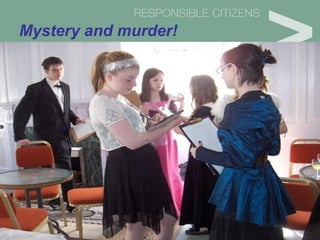
Mystery and murder!
“ Curriculum for Excellence  allows for both professional autonomy and responsibility when planning an delivering the curriculum. . . The frame work provides flexibility ….Such flexibility will result in a more varied pattern of curriculum structures to reflect  local needs and circumstances.”  Building the Curriculum 3 pp11-12
Testing the framework programme 7&8 October 08 – TTF1 secondary  25&26 November 08 – TTF1 recall 19&20 January 09 – TTF2 secondary  5 March 09 – TTF2 recall 27&28 January 09 – TTF3 primary 11 March 09 TTF3 recall 3&4 February 09 - TTF4 ASN/special education 23 March 09 - TTF4 recall
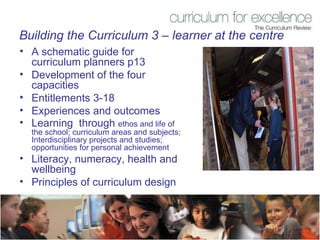
Building the Curriculum 3 – learner at the centre A schematic guide for curriculum planners p13 Development of the four capacities Entitlements 3-18 Experiences and outcomes Learning  through  ethos and life of the school; curriculum areas and subjects; Interdisciplinary projects and studies; opportunities for personal achievement Literacy, numeracy, health and wellbeing Principles of curriculum design
How do we plan for supporting the learner? pupil voice parents as partners partnerships leadership at all levels structures for collaboration opportunities provided by TP 21 pedagogy use of accommodation time as a resource personal support structures assessment, recognition of achievement and qualifications
Workshop Tasks early years/primary   A. transitions B. broad general education C. totality of the curriculum secondary A. transition primary/secondary B. broad general education C. senior phase special education/ASN A. transitions B. broad general education/senior phase C. personal support
Technical tasks Produce a high level plan/curriculum map i.e. what will early years to P7/S1 look like; P7) S1-S6 look like?  Choose your technical task Describe what the area of your chosen task will/could look like in practice. Provide as much detail as possible, including timetabling, supporting features and practical considerations such as staffing Explain your change model i.e. what would be done in the short/medium and long term? Who would be involved? Self-evaluation? Describe the process – what did you do exactly? What questions did you need to ask yourself? What was useful and what was not?
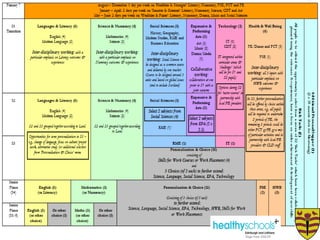
Features to consider Planning for the learning through the ethos and life of the school; curriculum areas and subjects; interdisciplinary projects and studies; opportunities for personal achievement Choices S1-S3 Transition from 4 th  level into the senior phase Literacy, numeracy, and health & wellbeing Personal support structures Skills for learning, skills for life and skills for work Planning for maximising achievement and qualifications in the  senior phase Pathways to sustained positive destinations
Outcomes from TTF so far Process was beneficial  Proof that non-prescriptive guidance leads to a variety of different approaches Range of plans/models emerging  Those involved became ‘multipliers’ Better understanding that a  framework for learning  is more than timetabling Some big questions/issues identified
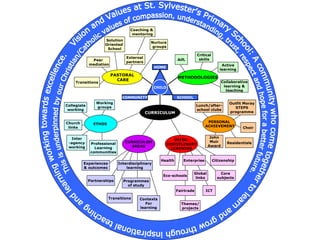
CHILD HOME SCHOOL COMMUNITY CURRICULUM PASTORAL CARE METHODOLOGIES ETHOS   CURRICULUM AREAS INTER- DISCIPLINARY LEARNING PERSONAL ACHIEVEMENT Coaching &  mentoring Programmes of study Experiences & outcomes Critical skills Partnerships Collaborative learning & teaching Active learning AifL Transitions External partners Nurture groups Solution Oriented  School Peer mediation Contexts For learning Transitions Interdisciplinary learning Church links Inter -agency working Collegiate working Professional Learning communities Working groups Health Enterprise Eco-schools Themes/ projects John Muir Award Residentials Choir Outfit Moray STEPS programme Lunch/after- school clubs ICT Fairtrade Core subjects Global links Citizenship Vision and Values at St. Sylvester's Primary School: A community who come together to learn and grow through inspirational teaching and learning working towards excellence.  This is underpinned by our Christian/Catholic values of compassion, understanding, trust, respect and hope for a better future. Vision and Values at St. Sylvester's:  Vision and Values at St. Sylvester's:  Vision and Values at St. Sylvester's:
 
Big issues/questions Understanding of a broad general education Understanding of levels Misconception of number of  subjects/courses in the senior phase Shared understanding and consistency of language ‘ Mapping back’  Taking forward innovation while questions on qualifications remain Migrating from early presentation
 

May Ttf Lts 18 Th March 2009

  • 1.
    Testing the framework- LTS Setting the scene 18 March 2009 May Sweeney Learning and Teaching Scotland
  • 2.
  • 3.
    “ Curriculum forExcellence allows for both professional autonomy and responsibility when planning an delivering the curriculum. . . The frame work provides flexibility ….Such flexibility will result in a more varied pattern of curriculum structures to reflect local needs and circumstances.” Building the Curriculum 3 pp11-12
  • 4.
    Testing the frameworkprogramme 7&8 October 08 – TTF1 secondary 25&26 November 08 – TTF1 recall 19&20 January 09 – TTF2 secondary 5 March 09 – TTF2 recall 27&28 January 09 – TTF3 primary 11 March 09 TTF3 recall 3&4 February 09 - TTF4 ASN/special education 23 March 09 - TTF4 recall
  • 5.
    Building the Curriculum3 – learner at the centre A schematic guide for curriculum planners p13 Development of the four capacities Entitlements 3-18 Experiences and outcomes Learning through ethos and life of the school; curriculum areas and subjects; Interdisciplinary projects and studies; opportunities for personal achievement Literacy, numeracy, health and wellbeing Principles of curriculum design
  • 6.
    How do weplan for supporting the learner? pupil voice parents as partners partnerships leadership at all levels structures for collaboration opportunities provided by TP 21 pedagogy use of accommodation time as a resource personal support structures assessment, recognition of achievement and qualifications
  • 7.
    Workshop Tasks earlyyears/primary A. transitions B. broad general education C. totality of the curriculum secondary A. transition primary/secondary B. broad general education C. senior phase special education/ASN A. transitions B. broad general education/senior phase C. personal support
  • 8.
    Technical tasks Producea high level plan/curriculum map i.e. what will early years to P7/S1 look like; P7) S1-S6 look like? Choose your technical task Describe what the area of your chosen task will/could look like in practice. Provide as much detail as possible, including timetabling, supporting features and practical considerations such as staffing Explain your change model i.e. what would be done in the short/medium and long term? Who would be involved? Self-evaluation? Describe the process – what did you do exactly? What questions did you need to ask yourself? What was useful and what was not?
  • 9.
    Features to considerPlanning for the learning through the ethos and life of the school; curriculum areas and subjects; interdisciplinary projects and studies; opportunities for personal achievement Choices S1-S3 Transition from 4 th level into the senior phase Literacy, numeracy, and health & wellbeing Personal support structures Skills for learning, skills for life and skills for work Planning for maximising achievement and qualifications in the senior phase Pathways to sustained positive destinations
  • 10.
    Outcomes from TTFso far Process was beneficial Proof that non-prescriptive guidance leads to a variety of different approaches Range of plans/models emerging Those involved became ‘multipliers’ Better understanding that a framework for learning is more than timetabling Some big questions/issues identified
  • 11.
    CHILD HOME SCHOOLCOMMUNITY CURRICULUM PASTORAL CARE METHODOLOGIES ETHOS CURRICULUM AREAS INTER- DISCIPLINARY LEARNING PERSONAL ACHIEVEMENT Coaching & mentoring Programmes of study Experiences & outcomes Critical skills Partnerships Collaborative learning & teaching Active learning AifL Transitions External partners Nurture groups Solution Oriented School Peer mediation Contexts For learning Transitions Interdisciplinary learning Church links Inter -agency working Collegiate working Professional Learning communities Working groups Health Enterprise Eco-schools Themes/ projects John Muir Award Residentials Choir Outfit Moray STEPS programme Lunch/after- school clubs ICT Fairtrade Core subjects Global links Citizenship Vision and Values at St. Sylvester's Primary School: A community who come together to learn and grow through inspirational teaching and learning working towards excellence. This is underpinned by our Christian/Catholic values of compassion, understanding, trust, respect and hope for a better future. Vision and Values at St. Sylvester's: Vision and Values at St. Sylvester's: Vision and Values at St. Sylvester's:
  • 12.
  • 13.
    Big issues/questions Understandingof a broad general education Understanding of levels Misconception of number of subjects/courses in the senior phase Shared understanding and consistency of language ‘ Mapping back’ Taking forward innovation while questions on qualifications remain Migrating from early presentation
  • 14.