Wikis and the Proposed Benefits of
Collaborative Communities on Learning
Brittany A.
Spring 2015
Presentation Outline
 Van Dijck’s Key Points
 60 Minutes Segment on Wikipedia’s
Collaboration
 Collaborative Learning Theories
 Wikis and Collaborative Learning Research
[Methods, findings, implications, and relevance]
 Conclusion
 Questions/Discussion
Van Dijck’s Key
Points
Jose van Dijck & Wikipedia
 Wikipedia as a collaborative environment:
unique, peer-produced system
 Generalists and experts collaborate on site
pages
 “we need both”
 Guidelines for Contributors:
 Verifiability
 No Original Research
 Neutral Point of View (NPoV)
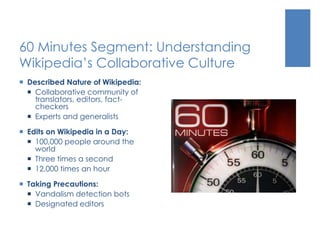
60 Minutes Segment: Understanding
Wikipedia’s Collaborative Culture
 Described Nature of Wikipedia:
 Collaborative community of
translators, editors, fact-
checkers
 Experts and generalists
 Edits on Wikipedia in a Day:
 100,000 people around the
world
 Three times a second
 12,000 times an hour
 Taking Precautions:
 Vandalism detection bots
 Designated editors
Collaborative
Learning Theories
Collaborative Learning
Theories
 Prior cognitive psychology research details the
benefits of collaboration on learning
 Lev Vygotsky’s Social Constructivism (1978)
 Increased learning occurs in social environments
and active collaboration
 George Siemens’s Connectivism (2005)
 Importance of making connections, experiencing
diversity, and hearing varying opinions
Wikis and
Collaborative
Learning Research
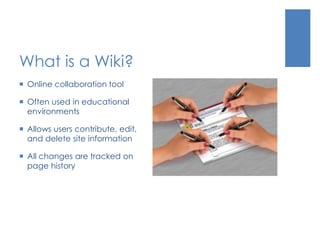
What is a Wiki?
 Online collaboration tool
 Often used in educational
environments
 Allows users contribute, edit,
and delete site information
 All changes are tracked on
page history
Wiki and Threaded Discussion for
Online Collaborative Activities:
Students’ Perceptions and Use
 Authors:
 Andri Ioannou and Anthony R. Artino
 Journal:
 Published in the Journal of Emerging Technologies in
Web Intelligence in 2009
 Research Question:
 Investigate how online tools such as Wiki support or
promote collaborative learning
Methods
 Population:
 15 graduate students enrolled in Education Technology
program
 Enrolled in a learning theory online course and used
Wiki for group activities
 All students were K-12 teachers
 80% had 1-5 years teaching experience
 20% had more than 6 years experience
 Wiki Use:
 1 week of online class time dedicated to using the Wiki
 Warm-up activity: creating personal biography on site
 Group activity: Collaborating in groups of 3-4 in
response to class prompt
Methods
 Measurement:
 After use of Wiki site, students were surveyed
 Asked to evaluate their experience:
 Perceived learning, communication and reflection,
and satisfaction with the learning experience, and
frustration with technology
 Variables often associated with collaborative
learning studies
Findings
 Main Findings:
 Perceived Learning
 Other posters’ ideas provided insight into topic
(supports CL theories)
 Wiki was easy to use
 Facilitated collaboration
 Participants enjoyed seeing others' edits and hearing
other opinions
 Drawbacks:
 Users felt slightly “uncomfortable” or hesitant to
edit/delete another users’ post
 Afraid of offending others
Limitations
 Self-report method
 Short study (only one week)
 Control group
 There was no offline group for comparison
 Focused on perceptions of the platform
 Collaborative learning theory results come from
outside observers
Why Wikis? Student
Perceptions of Using Wikis in
Online Coursework
 Authors:
 Faye Deters, Kristen Cuthrell, and Joy Stapleton
 Journal:
 Published in the MERLOT Journal of Online Learning
and Teaching in 2010
 Research Question:
 How do students perceive online platforms such as
Wikis? Do they find these tools promote
collaboration?
Methods
 Population:
 40 graduate students enrolled in a graduate distance
education course for teachers
 Large Southeastern College of Education
 Wiki Use:
 Case study
 5 weeks during summer session
 Participants worked together in small groups to
research information (on assigned topic) and create
Wiki entries
 Participants created, revised, edit, responded to all
entries
Methods
 Measurement:
 After the 5 week session, data was collected via
surveys and written reflections
 Surveys used a mix of Likert-scale and open-ended
questions regarding:
 perception of Wikis to complete assignments
 Comfort with Wikis
 Effectiveness of Wikis
 Potential uses of the platform (in education)
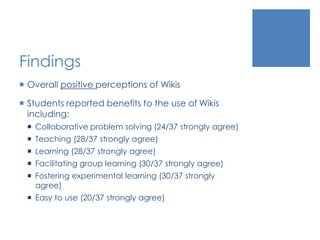
Findings
 Overall positive perceptions of Wikis
 Students reported benefits to the use of Wikis
including:
 Collaborative problem solving (24/37 strongly agree)
 Teaching (28/37 strongly agree)
 Learning (28/37 strongly agree)
 Facilitating group learning (30/37 strongly agree)
 Fostering experimental learning (30/37 strongly
agree)
 Easy to use (20/37 strongly agree)
Limitations
 Self-report method
 Participants were already comfortable with
online institutional systems before the study
(35/37)
 Although only 13 participants had used Wiki, the
others had used some type of collaborative online
platform
 How would results have differed if participants
needed to learn the basics?
 Focused on perceptions of the platform
 Collaborative learning theory results come from
outside observers
Summary and
Implications for
Future Research
Summary and Implications
 Collaborative research environments have been
argued to promote learning
 Wikis seen as online collaborative tools
 Studies show Wikis as a useful tool for
collaboration and learning
 Research studies support Collaborative Learning
theories (Siemen and Vygotsky)
Discussion Questions
 What are your thoughts on collaborative
networks and learning environments?
 Do you believe collaborative environments are
always beneficial or do they have their
shortcomings?
 Can you think of any similar platforms (such as
wikis) that promote collaboration?
References
 Augar, N., Raitman, R. & Zhou, W. (2004). Teaching and learning online
with wikis. In R. Atkinson, C. McBeath, D. Jonas-Dwyer & R. Phillips (Eds),
Beyond the comfort zone: Proceedings of the 21st ASCILITE
Conference (pp. 95-104). Perth, 5-8 December.
 Deters, F. Cuthrell, K., & Stapleton, J. (2010). Why Wikis? Student
Perceptions of Using Wikis in Online Coursework. MERLOT Journal of
Online Learning and Teaching, 6(1).
 Ioannou, A. and Artino, A. (2009). Wiki and Threaded Discussion for
Online Collaborative Activities: Students’ Perceptions and Use. Journal
of Emerging Technologies in Web Intelligence, 1(1), 97-106.
 Siemens, G. (2005). Connectivism: Learning theory for the digital age.
International Journal of Instructional Technology and Distance
Learning, 2(1).
 Vygotsky, L. S. (1978). Mind in society: The development of higher
psychological processes. Cambridge, MA: Harvard University Press.

May 28 Presentation

  • 1.
    Wikis and theProposed Benefits of Collaborative Communities on Learning Brittany A. Spring 2015
  • 2.
    Presentation Outline  VanDijck’s Key Points  60 Minutes Segment on Wikipedia’s Collaboration  Collaborative Learning Theories  Wikis and Collaborative Learning Research [Methods, findings, implications, and relevance]  Conclusion  Questions/Discussion
  • 3.
  • 4.
    Jose van Dijck& Wikipedia  Wikipedia as a collaborative environment: unique, peer-produced system  Generalists and experts collaborate on site pages  “we need both”  Guidelines for Contributors:  Verifiability  No Original Research  Neutral Point of View (NPoV)
  • 5.
    60 Minutes Segment:Understanding Wikipedia’s Collaborative Culture  Described Nature of Wikipedia:  Collaborative community of translators, editors, fact- checkers  Experts and generalists  Edits on Wikipedia in a Day:  100,000 people around the world  Three times a second  12,000 times an hour  Taking Precautions:  Vandalism detection bots  Designated editors
  • 6.
  • 7.
    Collaborative Learning Theories  Priorcognitive psychology research details the benefits of collaboration on learning  Lev Vygotsky’s Social Constructivism (1978)  Increased learning occurs in social environments and active collaboration  George Siemens’s Connectivism (2005)  Importance of making connections, experiencing diversity, and hearing varying opinions
  • 8.
  • 9.
    What is aWiki?  Online collaboration tool  Often used in educational environments  Allows users contribute, edit, and delete site information  All changes are tracked on page history
  • 10.
    Wiki and ThreadedDiscussion for Online Collaborative Activities: Students’ Perceptions and Use  Authors:  Andri Ioannou and Anthony R. Artino  Journal:  Published in the Journal of Emerging Technologies in Web Intelligence in 2009  Research Question:  Investigate how online tools such as Wiki support or promote collaborative learning
  • 11.
    Methods  Population:  15graduate students enrolled in Education Technology program  Enrolled in a learning theory online course and used Wiki for group activities  All students were K-12 teachers  80% had 1-5 years teaching experience  20% had more than 6 years experience  Wiki Use:  1 week of online class time dedicated to using the Wiki  Warm-up activity: creating personal biography on site  Group activity: Collaborating in groups of 3-4 in response to class prompt
  • 12.
    Methods  Measurement:  Afteruse of Wiki site, students were surveyed  Asked to evaluate their experience:  Perceived learning, communication and reflection, and satisfaction with the learning experience, and frustration with technology  Variables often associated with collaborative learning studies
  • 13.
    Findings  Main Findings: Perceived Learning  Other posters’ ideas provided insight into topic (supports CL theories)  Wiki was easy to use  Facilitated collaboration  Participants enjoyed seeing others' edits and hearing other opinions  Drawbacks:  Users felt slightly “uncomfortable” or hesitant to edit/delete another users’ post  Afraid of offending others
  • 14.
    Limitations  Self-report method Short study (only one week)  Control group  There was no offline group for comparison  Focused on perceptions of the platform  Collaborative learning theory results come from outside observers
  • 15.
    Why Wikis? Student Perceptionsof Using Wikis in Online Coursework  Authors:  Faye Deters, Kristen Cuthrell, and Joy Stapleton  Journal:  Published in the MERLOT Journal of Online Learning and Teaching in 2010  Research Question:  How do students perceive online platforms such as Wikis? Do they find these tools promote collaboration?
  • 16.
    Methods  Population:  40graduate students enrolled in a graduate distance education course for teachers  Large Southeastern College of Education  Wiki Use:  Case study  5 weeks during summer session  Participants worked together in small groups to research information (on assigned topic) and create Wiki entries  Participants created, revised, edit, responded to all entries
  • 17.
    Methods  Measurement:  Afterthe 5 week session, data was collected via surveys and written reflections  Surveys used a mix of Likert-scale and open-ended questions regarding:  perception of Wikis to complete assignments  Comfort with Wikis  Effectiveness of Wikis  Potential uses of the platform (in education)
  • 18.
    Findings  Overall positiveperceptions of Wikis  Students reported benefits to the use of Wikis including:  Collaborative problem solving (24/37 strongly agree)  Teaching (28/37 strongly agree)  Learning (28/37 strongly agree)  Facilitating group learning (30/37 strongly agree)  Fostering experimental learning (30/37 strongly agree)  Easy to use (20/37 strongly agree)
  • 19.
    Limitations  Self-report method Participants were already comfortable with online institutional systems before the study (35/37)  Although only 13 participants had used Wiki, the others had used some type of collaborative online platform  How would results have differed if participants needed to learn the basics?  Focused on perceptions of the platform  Collaborative learning theory results come from outside observers
  • 20.
  • 21.
    Summary and Implications Collaborative research environments have been argued to promote learning  Wikis seen as online collaborative tools  Studies show Wikis as a useful tool for collaboration and learning  Research studies support Collaborative Learning theories (Siemen and Vygotsky)
  • 22.
  • 23.
    Discussion Questions  Whatare your thoughts on collaborative networks and learning environments?  Do you believe collaborative environments are always beneficial or do they have their shortcomings?  Can you think of any similar platforms (such as wikis) that promote collaboration?
  • 24.
    References  Augar, N.,Raitman, R. & Zhou, W. (2004). Teaching and learning online with wikis. In R. Atkinson, C. McBeath, D. Jonas-Dwyer & R. Phillips (Eds), Beyond the comfort zone: Proceedings of the 21st ASCILITE Conference (pp. 95-104). Perth, 5-8 December.  Deters, F. Cuthrell, K., & Stapleton, J. (2010). Why Wikis? Student Perceptions of Using Wikis in Online Coursework. MERLOT Journal of Online Learning and Teaching, 6(1).  Ioannou, A. and Artino, A. (2009). Wiki and Threaded Discussion for Online Collaborative Activities: Students’ Perceptions and Use. Journal of Emerging Technologies in Web Intelligence, 1(1), 97-106.  Siemens, G. (2005). Connectivism: Learning theory for the digital age. International Journal of Instructional Technology and Distance Learning, 2(1).  Vygotsky, L. S. (1978). Mind in society: The development of higher psychological processes. Cambridge, MA: Harvard University Press.

Editor's Notes

  • #2 In our readings for this week, we have learned that online tools such as Wiki can be used for collaboration efforts and creating important content
  • #6 http://www.cbsnews.com/news/wikipedia-jimmy-wales-morley-safer-60-minutes/ Interview with cofounder Jimmy Wales
  • #8 Augar, N., Raitman, R. & Zhou, W. (2004). Teaching and learning online with wikis. In R. Atkinson, C. McBeath, D. Jonas-Dwyer & R. Phillips (Eds), Beyond the comfort zone: Proceedings of the 21st ASCILITE Conference (pp. 95-104). Perth, 5-8 December. Siemens, G. (2005). Connectivism: Learning theory for the digital age. International Journal of Instruc- tional Technology and Distance Learning, 2(1). Vygotsky, L. S. (1978). Mind in society: The development of higher psychological processes. Cambridge, MA: Harvard University Press.
  • #10 Augar, N., Raitman, R. & Zhou, W. (2004). Teaching and learning online with wikis. In R. Atkinson, C. McBeath, D. Jonas-Dwyer & R. Phillips (Eds), Beyond the comfort zone: Proceedings of the 21st ASCILITE Conference (pp. 95-104). Perth, 5-8 December.
  • #11 Ioannou, A. and Artino, A. (2009). Wiki and Threaded Discussion for Online Collaborative Activities:  Students’ Perceptions and Use. Journal of Emerging Technologies in Web Intelligence, 1(1), 97-106.
  • #16 Deters, F. Cuthrell, K., & Stapleton, J. (2010). Why Wikis? Student Perceptions of Using Wikis in Online Coursework. MERLOT Journal of Online Learning and Teaching, 6(1).
  • #17 Wiki was a place to store, organize, and display collaborative content
  • #19 “Wikis could be used in the classroom for students to post information about research that they have completed. I do several group projects in my class, such as the solar system, multicultural projects, and so on. This would be a tool for students to use instead of writing the information they find.”