SEGI MBA


                       Assignment on MAXIS
                             Submitted to


                               Ms. Ooi

                               Lecturer


                   Economics for Managers ECO 6073

                              Submitted by


Group Members:

1.   Waleed Mohammad Jamal                   -       SCM - 016584
2.   Md Fantasir Rahman                      -       SCM - 016295
3.   Dinara Kerimbekova                      -       SCM - 015066
4.   Aizada Aldekova                         -       SCM - 016021
5.   Tahmina Aktar Daizy                     -       SCM - 016715
6.   Mohamed Faizal                          -       SCM - 017084


                                 Page 1
Introduction


Maxis Communications Berhad is a leading mobile phone service provider in Malaysia.
Maxis Communications Berhad was established in the early 1990s and commenced mobile
telecommunications operation in August 1995. It was then listed under the first board in
Kuala Lumpur Stock Exchange (KLSE). At present Maxis Communication Berhad is the
biggest telecommunication provider in Malaysia. The company has total subscribers at 13.95
million as of December 2010.


Maxis Communications Berhad, through its subsidiary, Maxis Berhad, engages in the
provision of mobile, fixed line, and international telecommunications services in Malaysia. It
also provides Internet and broadband services; and wireless multimedia related services, as
well as owns, maintains, builds, and operates radio facilities and associated switches. The
company was founded in 1995 and is based in Kuala Lumpur, Malaysia. Maxis
Communications Berhad is a subsidiary of Binariang GSM Sdn Bhd.


It uses the dialling prefix identifier of "012‖, "017" and ―0142‖. In 2002, Maxis purchased
TimeCell, a rival mobile service provider, from Time dotcom Berhad. Prior to the purchase,
Maxis offered phone numbers beginning with 012, and TimeCell 017. Now, subscribers can
choose between the two. Maxis provide a variety of mobile communication products and
services. They offer prepaid call plans, monthly subscription plans, global roaming, MMS,
WAP (over both GSM and GPRS), Residential Fixed Line services, Broadband Internet
plans, and as of early 2005, 3G services to both prepaid and post-paid subscription customers.
Maxis Broadband make consumer can enjoy internet access in outdoor or indoor. It can go
online at speed over 15 times faster than traditional dial up and do more, much more over the
internet.


                                           Page 2
Profile

Maxis Berhad, with its consolidated subsidiaries (together, 'Maxis'), is the leading mobile
communications service provider in Malaysia.


Maxis were granted licences to operate a nationwide GSM900 mobile network, a domestic
fixed network and an international gateway in 1993. It commenced its mobile operations in
August 1995 and launched its fixed line and international gateway operations in early 1996.


Since its establishment, Maxis has been providing a full suite of services on multiple
platforms to fulfil the telecommunications needs of individual consumers, SMEs and large
corporations in Malaysia.


Maxis' mobile service is offered on a post-paid basis under the Maxis brand and via a prepaid
format under the Hotlink brand. The use of these two distinct brands, underpinned by
synergistic values, has enabled Maxis to develop its prepaid business successfully while
maintaining growth in its post-paid segment.


Maxis has also pioneered and led the Malaysian market in delivering innovative mobile
products and services. It was the first to launch 3G services in Malaysia — known as
Maxis3G — in July 2005, and in September 2006, it became among the world's first to use
HSDPA, a high-speed upgrade of its 3G network, to provide wireless broadband services. It
was the first operator to bring the BlackBerry™ and Apple iPhone™ smart phones to
Malaysia. The company in April 2009 unveiled the first commercial NFC-powered service in
Malaysia.


Maxis provide enhanced post-paid packages to corporate and SME customers, based on its
highly successful consumer post-paid plans. These plans are custom-made to meet the needs
of enterprises, especially improved communications within and beyond their compound.


                                           Page 3
Maxis' international gateway services include termination of traffic into Malaysia from
international telecommunications companies, supporting Maxis' own outbound international
direct dial (IDD) traffic, collecting international transit traffic and bandwidth leasing services.
Maxis presently maintain bilateral connections with more than 95 carriers in 38 countries and
have capital investments in a number of submarine cable systems to carry its international
voice and data traffic.


Maxis' significant growth and strong track record of bringing innovation, excellent customer
experience and value to stakeholders has won the company numerous awards over the years.
The latest awards include:


Malaysia's Top Ten Companies: Ranked 1 – Asia's 200 Most Admired Companies, The Wall
Street Journal Asia, 2006

Asian Mobile Operator of the Year – Asian Mobile News Award, 2007

Fourth Most Valuable Brand in Malaysia – Brand Finance, 2008 and 2009

Service Provider of the Year (Malaysia) – Frost & Sullivan, 2008

Mobile Data Service Provider of the Year (Malaysia) – Frost & Sullivan, 2009

Recipient of the Asia Pacific Super Excellent Brand Award – Asia Pacific International
Brands Summit Malaysia, 2009


Maxis' vision is to bring advanced communications services to enrich its customers' lives and
businesses, in a manner that is simple and personalised, by efficiently and creatively
harnessing leading edge technology, and delivering a brand of service experience that is
reliable and enchanting.


                                              Page 4
Analysis of Market Structure

Market structure classifies some of the key traits of a market, including:

        Number of firms
        Similarity of the products sold
        Ease of entry into and exit from the market.

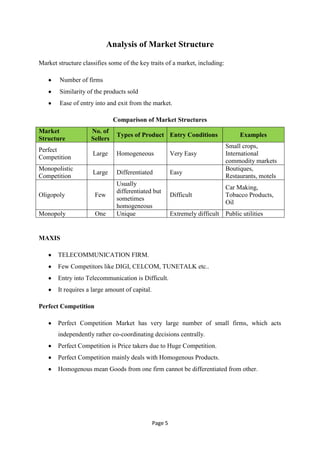
                              Comparison of Market Structures
Market              No. of
                               Types of Product Entry Conditions                     Examples
Structure           Sellers
                                                                               Small crops,
Perfect
                     Large     Homogeneous               Very Easy             International
Competition
                                                                               commodity markets
Monopolistic                                                                   Boutiques,
                     Large     Differentiated            Easy
Competition                                                                    Restaurants, motels
                               Usually
                                                                               Car Making,
                               differentiated but
Oligopoly             Few                                Difficult             Tobacco Products,
                               sometimes
                                                                               Oil
                               homogeneous
Monopoly              One      Unique                    Extremely difficult   Public utilities


MAXIS

       TELECOMMUNICATION FIRM.
       Few Competitors like DIGI, CELCOM, TUNETALK etc..
       Entry into Telecommunication is Difficult.
       It requires a large amount of capital.

Perfect Competition

       Perfect Competition Market has very large number of small firms, which acts
       independently rather co-coordinating decisions centrally.
       Perfect Competition is Price takers due to Huge Competition.
       Perfect Competition mainly deals with Homogenous Products.
       Homogenous mean Goods from one firm cannot be differentiated from other.


                                                Page 5
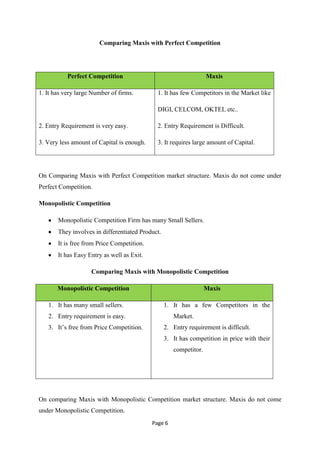
Comparing Maxis with Perfect Competition


           Perfect Competition                                     Maxis

1. It has very large Number of firms.         1. It has few Competitors in the Market like

                                              DIGI, CELCOM, OKTEL etc..

2. Entry Requirement is very easy.            2. Entry Requirement is Difficult.

3. Very less amount of Capital is enough.     3. It requires large amount of Capital.


On Comparing Maxis with Perfect Competition market structure. Maxis do not come under
Perfect Competition.

Monopolistic Competition

       Monopolistic Competition Firm has many Small Sellers.
       They involves in differentiated Product.
       It is free from Price Competition.
       It has Easy Entry as well as Exit.

                    Comparing Maxis with Monopolistic Competition

       Monopolistic Competition                                    Maxis

   1. It has many small sellers.                  1. It has a few Competitors in the
   2. Entry requirement is easy.                     Market.
   3. It‘s free from Price Competition.           2. Entry requirement is difficult.
                                                  3. It has competition in price with their
                                                     competitor.


On comparing Maxis with Monopolistic Competition market structure. Maxis do not come
under Monopolistic Competition.
                                            Page 6
Monopoly

        Monopoly is a Single Seller in the market.
        It deals with unique product.
        Entry Barriers is very difficult.

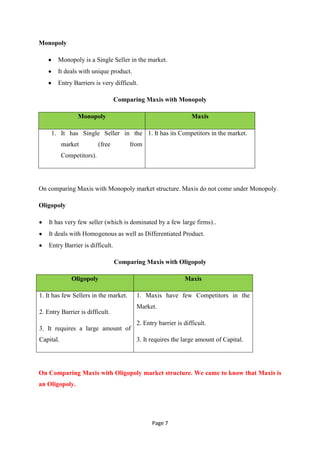
                                   Comparing Maxis with Monopoly

                 Monopoly                                        Maxis

     1. It has Single Seller in the 1. It has its Competitors in the market.
           market          (free        from
           Competitors).


On comparing Maxis with Monopoly market structure. Maxis do not come under Monopoly.

Oligopoly

    It has very few seller (which is dominated by a few large firms)..
    It deals with Homogenous as well as Differentiated Product.
    Entry Barrier is difficult.

                                   Comparing Maxis with Oligopoly

              Oligopoly                                       Maxis

1. It has few Sellers in the market.      1. Maxis have few Competitors in the
                                          Market.
2. Entry Barrier is difficult.
                                          2. Entry barrier is difficult.
3. It requires a large amount of
Capital.                                  3. It requires the large amount of Capital.


On Comparing Maxis with Oligopoly market structure. We came to know that Maxis is
an Oligopoly.


                                                Page 7
Behaviour of Maxis

The behaviour of Maxis can be identified by considering the number and size distribution of
firms (market share in terms of subscribers and revenue) in the market; the extent to which
products are differentiated; how easy it is for other firms to enter the market; and the extent to
which firms are integrated or diversified. However, as there are only 3 large cellular
communication firms (Maxis, Digi and Celcom), individual market shares are used to
measure market power.

The basic conditions faced by the cellular communication firms are:


Demand conditions


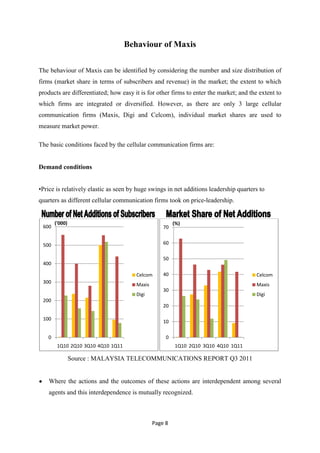
•Price is relatively elastic as seen by huge swings in net additions leadership quarters to
quarters as different cellular communication firms took on price-leadership.


       ('000)                                           (%)
 600                                               70


 500                                               60

                                                   50
 400

                                       Celcom      40                                   Celcom
 300                                   Maxis                                            Maxis
                                                   30
                                       Digi                                             Digi
 200
                                                   20

 100
                                                   10

   0                                                0
        1Q10 2Q10 3Q10 4Q10 1Q11                        1Q10 2Q10 3Q10 4Q10 1Q11

                Source : MALAYSIA TELECOMMUNICATIONS REPORT Q3 2011


    Where the actions and the outcomes of these actions are interdependent among several
    agents and this interdependence is mutually recognized.


                                               Page 8
Neoclassical economics assume perfectly rational agents, perfect information and zero
   transaction costs under perfect competition. However, due to limited cognitive capability
   and/or imperfect information, bounded rational agents experience limits in formulating
   and solving complex problems and in processing (receiving, storing, retrieving,
   transmitting) information. Routine standard procedures or heuristic approaches to
   decision-making are employed by bounded rational agents.
   The sum of the market shares of the n-largest firms.
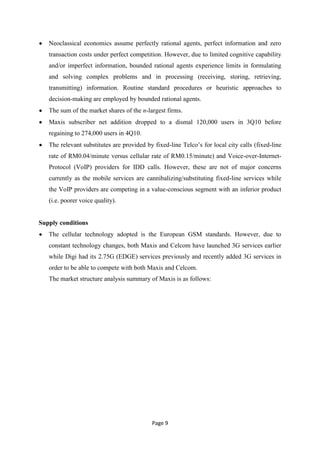
   Maxis subscriber net addition dropped to a dismal 120,000 users in 3Q10 before
   regaining to 274,000 users in 4Q10.
   The relevant substitutes are provided by fixed-line Telco‘s for local city calls (fixed-line
   rate of RM0.04/minute versus cellular rate of RM0.15/minute) and Voice-over-Internet-
   Protocol (VoIP) providers for IDD calls. However, these are not of major concerns
   currently as the mobile services are cannibalizing/substituting fixed-line services while
   the VoIP providers are competing in a value-conscious segment with an inferior product
   (i.e. poorer voice quality).


Supply conditions
   The cellular technology adopted is the European GSM standards. However, due to
   constant technology changes, both Maxis and Celcom have launched 3G services earlier
   while Digi had its 2.75G (EDGE) services previously and recently added 3G services in
   order to be able to compete with both Maxis and Celcom.
   The market structure analysis summary of Maxis is as follows:


                                           Page 9
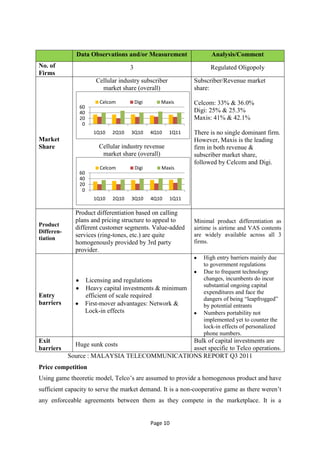
Data Observations and/or Measurement                  Analysis/Comment
No. of                              3                              Regulated Oligopoly
Firms
                       Cellular industry subscriber          Subscriber/Revenue market
                         market share (overall)              share:

                         Celcom         Digi      Maxis      Celcom: 33% & 36.0%
               60
               40                                            Digi: 25% & 25.3%
               20                                            Maxis: 41% & 42.1%
                0
                      1Q10   2Q10   3Q10       4Q10   1Q11   There is no single dominant firm.
Market                                                       However, Maxis is the leading
Share                   Cellular industry revenue            firm in both revenue &
                         market share (overall)              subscriber market share,
                                                             followed by Celcom and Digi.
                         Celcom         Digi       Maxis
               60
               40
               20
                0
                      1Q10   2Q10   3Q10       4Q10   1Q11

              Product differentiation based on calling
              plans and pricing structure to appeal to       Minimal product differentiation as
Product
              different customer segments. Value-added       airtime is airtime and VAS contents
Differen-
              services (ring-tones, etc.) are quite          are widely available across all 3
tiation
              homogenously provided by 3rd party             firms.
              provider.
                                                                High entry barriers mainly due
                                                                to government regulations
                                                                Due to frequent technology
                    Licensing and regulations                   changes, incumbents do incur
                                                                substantial ongoing capital
                    Heavy capital investments & minimum
                                                                expenditures and face the
Entry               efficient of scale required                 dangers of being ―leapfrogged‖
barriers            First-mover advantages: Network &           by potential entrants
                    Lock-in effects                             Numbers portability not
                                                                implemented yet to counter the
                                                                lock-in effects of personalized
                                                                phone numbers.
Exit                                          Bulk of capital investments are
              Huge sunk costs
barriers                                      asset specific to Telco operations.
            Source : MALAYSIA TELECOMMUNICATIONS REPORT Q3 2011
Price competition
Using game theoretic model, Telco‘s are assumed to provide a homogenous product and have
sufficient capacity to serve the market demand. It is a non-cooperative game as there weren‘t
any enforceable agreements between them as they compete in the marketplace. It is a


                                               Page 10
repeated one-shot simultaneous game as they were driven by quarterly performance
accountable to shareholders. As such, they would decide on their pricing strategies
independently and aware of rivals‘ prices in the market while forming certain expectations
about rivals‘ pricing strategies. Actions available are Maintain Price and Undercut Price.


Payoffs are ranked in order of preference (higher number is preferred). The most preferred
outcome by firms is where one undercuts price while its competitors maintains price, leading
to market share gain at the expense of its rivals. When all firms maintain prices, there is no
change in market-share and profitability. When all firms undercut prices, market-share
remains with reduced profitability. The strategic-form representation in a simplified 2-player
model is as follows:
                                                         Telco2
                                                       Maintain Price         Undercut Price
               Telco1       Maintain Price                  3,3                    1,4
                           Undercut Price                4,1                       2,2
                                              Example of Game Theory

Solving for Nash equilibrium, both players have Undercut Price as their dominant strategy
resulting in a Pareto-inefficient Dominant- Strategy-Equilibrium at (2,2). This is a repeated
Prisoners‘ Dilemma game and these interactions are witnessed in the current market through
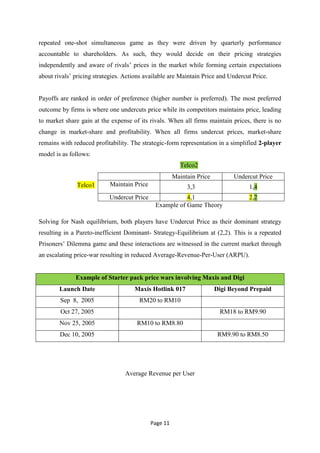
an escalating price-war resulting in reduced Average-Revenue-Per-User (ARPU).


              Example of Starter pack price wars involving Maxis and Digi
        Launch Date                  Maxis Hotlink 017                  Digi Beyond Prepaid
        Sep 8, 2005                    RM20 to RM10
        Oct 27, 2005                                                     RM18 to RM9.90
        Nov 25, 2005                  RM10 to RM8.80
        Dec 10, 2005                                                     RM9.90 to RM8.50


                                  Average Revenue per User


                                             Page 11
60         56        56        56        55
                            57                       52        51
        54                            54        53                       49      49      49    49
             56                  55        55             52        51
  50                   54                                      53        53 50        50 53 49 53
                  45                                 50                          51
  40                                                                                                Celcom
                                                                                                    Maxis
  30
                                                                                                    Digi

  20


  10


    0
         1Q09                                    1Q10                                  1Q11


Source : Articles from 2009 to 2011, Press release 2009 to 2011, Maxis reports 2009 to 2011,
                        Digi Reports 2009 to 2011, Celcom Reports 2009 to 2011.

If this game is repeated infinitely, collusive behaviour through the use of Tit-For-Tat
strategy may result in non-competitive/monopolistic-like pricing which reduces public
welfare. Though Maxis had a higher ARPU previously according to the above data, Maxis
always need to be proactive in monitoring firms‘ behaviour to detect possible tacit collusion
through price-signaling.


Product differentiation
The above game theoretic analysis suggests that if the price-war continues, Maxis and the
other two firms will eventually be forced to price at their marginal costs – similar to a
perfectly competitive firm. Therefore, it is rational to expect Maxis or the similar firms to
soften the intensity of the price competition through product differentiation and customer
segmentation. It is important to note that traditional microeconomic theory treats all
consumers as homogenous. In reality, this is not the case and these firms are thus offering
different calling plans, pricing structures (ON-Net/Off-Net), pre-bundled minutes and
services, etc.


                                                               Page 12
Due to bounded rationality and heterogeneous consumption, consumers find it difficult to
make head-to head cost-benefits comparisons and thus make the products appear to be
somewhat non-homogenous and not fully substitutable for one another.


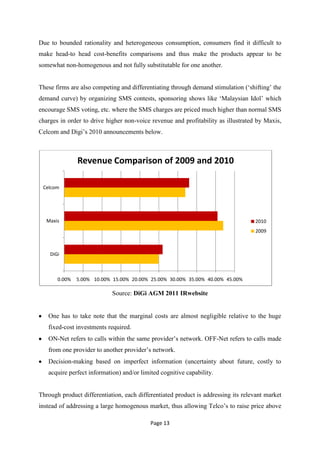
These firms are also competing and differentiating through demand stimulation (‗shifting‘ the
demand curve) by organizing SMS contests, sponsoring shows like ‗Malaysian Idol‘ which
encourage SMS voting, etc. where the SMS charges are priced much higher than normal SMS
charges in order to drive higher non-voice revenue and profitability as illustrated by Maxis,
Celcom and Digi‘s 2010 announcements below.


               Revenue Comparison of 2009 and 2010

 Celcom


  Maxis                                                                            2010
                                                                                   2009


    DiGi


       0.00%   5.00% 10.00% 15.00% 20.00% 25.00% 30.00% 35.00% 40.00% 45.00%

                            Source: DiGi AGM 2011 IRwebsite


   One has to take note that the marginal costs are almost negligible relative to the huge
   fixed-cost investments required.
   ON-Net refers to calls within the same provider‘s network. OFF-Net refers to calls made
   from one provider to another provider‘s network.
   Decision-making based on imperfect information (uncertainty about future, costly to
   acquire perfect information) and/or limited cognitive capability.


Through product differentiation, each differentiated product is addressing its relevant market
instead of addressing a large homogenous market, thus allowing Telco‘s to raise price above

                                           Page 13
marginal cost (and reduce consumer‘s surplus) without losing its entire market share. Thus,
product differentiation can soften price competition and create a degree of market power. We
find from the above data that Maxis currently have the highest market power and leading
company with the highest revenue.


However, these type of firms balance between the reductions in welfare caused by product
differentiation pricing above marginal costs versus the increased in welfare by allowing
disparate consumers‘ preferences to be closely met. Each firm also ensure proper ethical
behaviour on the part of the Telco‘s to ensure that public welfare is protected in SMS
contests, SMS voting, etc. to prevent undesirable negative consumption externalities such as
encouraging the habit of ‗gambling‘, excessive spending, etc.


Advertising
Maxis often use advertising to create brand and/or product differentiation in order to soften
the price competition. To the extent that persuasive advertising create customer loyalty
through perceived differentiation over essentially identical products, they create market
power in the sense that consumers may be willing to pay more for preferred brands, thus
allowing these type of firms to raise prices above marginal costs.


Following the previous assumptions with payoffs ranked in order of preference (higher
number is preferred), the most preferred outcome by firms is where one advertises while its
competitors don‘t, leading to market share and profitability gain at the expense of its rivals.
When all firms don‘t advertise, there is no change in market-share and profitability. When all
firms advertise, market-share remains with reduced profitability. Maxis uses similar strategy
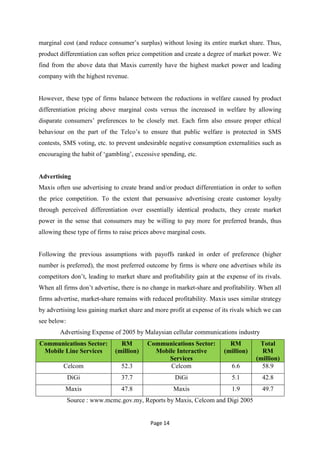
by advertising less gaining market share and more profit at expense of its rivals which we can
see below:
        Advertising Expense of 2005 by Malaysian cellular communications industry
Communications Sector:          RM        Communications Sector:          RM          Total
 Mobile Line Services         (million)     Mobile Interactive          (million)      RM
                                                Services                             (million)
         Celcom                 52.3            Celcom                     6.6         58.9
             DiGi               37.7                  DiGi                 5.1         42.8
          Maxis                 47.8                  Maxis                1.9         49.7
             Source : www.mcmc.gov.my, Reports by Maxis, Celcom and Digi 2005


                                            Page 14
Customer Satisfaction


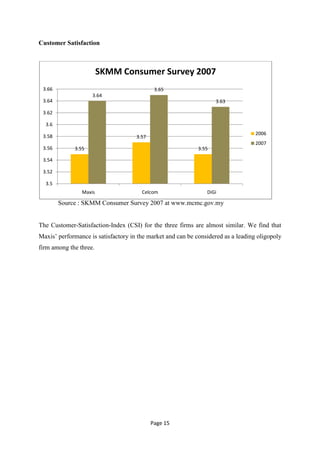
                        SKMM Consumer Survey 2007
 3.66                                        3.65
                    3.64
 3.64                                                               3.63

 3.62

  3.6
                                                                                   2006
 3.58                                3.57
                                                                                   2007
 3.56        3.55                                            3.55

 3.54

 3.52

  3.5
                Maxis                  Celcom                   DiGi

        Source : SKMM Consumer Survey 2007 at www.mcmc.gov.my


The Customer-Satisfaction-Index (CSI) for the three firms are almost similar. We find that
Maxis‘ performance is satisfactory in the market and can be considered as a leading oligopoly
firm among the three.


                                            Page 15
Conclusion
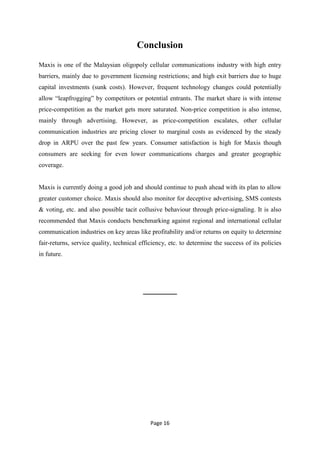
Maxis is one of the Malaysian oligopoly cellular communications industry with high entry
barriers, mainly due to government licensing restrictions; and high exit barriers due to huge
capital investments (sunk costs). However, frequent technology changes could potentially
allow ―leapfrogging‖ by competitors or potential entrants. The market share is with intense
price-competition as the market gets more saturated. Non-price competition is also intense,
mainly through advertising. However, as price-competition escalates, other cellular
communication industries are pricing closer to marginal costs as evidenced by the steady
drop in ARPU over the past few years. Consumer satisfaction is high for Maxis though
consumers are seeking for even lower communications charges and greater geographic
coverage.


Maxis is currently doing a good job and should continue to push ahead with its plan to allow
greater customer choice. Maxis should also monitor for deceptive advertising, SMS contests
& voting, etc. and also possible tacit collusive behaviour through price-signaling. It is also
recommended that Maxis conducts benchmarking against regional and international cellular
communication industries on key areas like profitability and/or returns on equity to determine
fair-returns, service quality, technical efficiency, etc. to determine the success of its policies
in future.


                                          _______


                                             Page 16
References

www.theedgedaily.com
Digi gains market share‖, The Edge Daily, 5 Dec 2005
www.osk188.com
www.digi.com.my
www.maxis.com.my
www.celcom.com.my
Maxis Quarterly 2009 Report
Maxis Quarterly 2010 Report
DiGi 2009 Report
DiGi 2010 Report
Celcom Annual Report 2010
Maxis Annual Report 2010
DiGi Annual Report 2010
www.mcmc.gov.my
www.mobileworld.com.my/ Profit_expense_2005
www.boardroomlimited.com
Dixit, A and Skeath, S (2004): Games of Strategy (2nd Ed), W.W.Norton
www.wikipedia.org
Rosenberg, E.A. and Clements, M.: ―Evolving market structure, conduct and policy in
local telecommunications‖, The National Regulatory Research Institute.
SKMM Consumer Survey 2007 at www.mcmc.gov.my
www.boardroomlimited.com/irdigi/.../DiGiAGM2011IRwebsite
www.theedgemalaysia.com/.../170320-digis-2q-profit-up-187-divide...
www.digi.my/aboutdigi/media/mr_press_det.do?id=5240...4...
www.mysarawak.org/2009/10/30/digi’s-subscriber-base-to-grow.html
www.boardroomlimited.com/irdigi/irdigi/FA220709.pdf
http://telcoblog.nst.com.my/2009/05/celcom-vs-digi-q1-2009.html
http://biz.thestar.com.my/news/story.asp?file=/2008/8/29/business/1910200&sec=busines
s


                                        Page 17
http://biz.thestar.com.my/news/story.asp?file=/2008/11/29/business/2675455&sec=busin
ess
http://telcoblog.nst.com.my/2009/05/celcom-vs-digi-q1-2009.html
axiata.listedcompany.com/misc/axiata_presentation_2Q2011.pdf
http://www.theedgemalaysia.com/insider-asia/180047-maxis-and-digi-offer-yields-at-
fairly-low-risks.html
www.maxis.com.my/.../Announcement_04_2009_Financial_Result_...
axiata.listedcompany.com/misc/axiata_presentation_1Q2011.pdf
www.maxis.com.my/personal/.../1Q_2011_IR_Pack_(FINAL).pdf
Maxis_4Q10_Presentation_FINAL_2
http://www.maxis.com.my/mmc/index.asp?fuseaction=press.view&recID=452
www.maxis.com.my/.../Announcement_02_2010_Press_Release.pdf
www.maxis.com.my/personal/about_us/.../Anmt-PressRelease.pdf
www.maxis.com.my/mmc/index.asp?fuseaction=press.view...499
www.maxis.com.my/...us/.../Maxis_4Q10_Presentation_FINAL.pdf
http://www.theedgemalaysia.com/insider-asia/179310-mobile-subscriber-additions-
surprisingly-robust.html
http://www.thesundaily.my/news/business/celcom-may-pass-service-tax
http://www.scribd.com/doc/39862337/Telecommunications-Sector-Update-Sizing-Up-
The-Pure-Mobile-Domestic-Players-%E2%80%93-Maxis-vs-DiGi-22-10-2010
http://www.scribd.com/doc/60333044/EN for MALAYSIA TELECOMMUNICATIONS
REPORT Q3 2011


                                      Page 18

Maxis economonics assignment

  • 1.
    SEGI MBA Assignment on MAXIS Submitted to Ms. Ooi Lecturer Economics for Managers ECO 6073 Submitted by Group Members: 1. Waleed Mohammad Jamal - SCM - 016584 2. Md Fantasir Rahman - SCM - 016295 3. Dinara Kerimbekova - SCM - 015066 4. Aizada Aldekova - SCM - 016021 5. Tahmina Aktar Daizy - SCM - 016715 6. Mohamed Faizal - SCM - 017084 Page 1
  • 2.
    Introduction Maxis Communications Berhadis a leading mobile phone service provider in Malaysia. Maxis Communications Berhad was established in the early 1990s and commenced mobile telecommunications operation in August 1995. It was then listed under the first board in Kuala Lumpur Stock Exchange (KLSE). At present Maxis Communication Berhad is the biggest telecommunication provider in Malaysia. The company has total subscribers at 13.95 million as of December 2010. Maxis Communications Berhad, through its subsidiary, Maxis Berhad, engages in the provision of mobile, fixed line, and international telecommunications services in Malaysia. It also provides Internet and broadband services; and wireless multimedia related services, as well as owns, maintains, builds, and operates radio facilities and associated switches. The company was founded in 1995 and is based in Kuala Lumpur, Malaysia. Maxis Communications Berhad is a subsidiary of Binariang GSM Sdn Bhd. It uses the dialling prefix identifier of "012‖, "017" and ―0142‖. In 2002, Maxis purchased TimeCell, a rival mobile service provider, from Time dotcom Berhad. Prior to the purchase, Maxis offered phone numbers beginning with 012, and TimeCell 017. Now, subscribers can choose between the two. Maxis provide a variety of mobile communication products and services. They offer prepaid call plans, monthly subscription plans, global roaming, MMS, WAP (over both GSM and GPRS), Residential Fixed Line services, Broadband Internet plans, and as of early 2005, 3G services to both prepaid and post-paid subscription customers. Maxis Broadband make consumer can enjoy internet access in outdoor or indoor. It can go online at speed over 15 times faster than traditional dial up and do more, much more over the internet. Page 2
  • 3.
    Profile Maxis Berhad, withits consolidated subsidiaries (together, 'Maxis'), is the leading mobile communications service provider in Malaysia. Maxis were granted licences to operate a nationwide GSM900 mobile network, a domestic fixed network and an international gateway in 1993. It commenced its mobile operations in August 1995 and launched its fixed line and international gateway operations in early 1996. Since its establishment, Maxis has been providing a full suite of services on multiple platforms to fulfil the telecommunications needs of individual consumers, SMEs and large corporations in Malaysia. Maxis' mobile service is offered on a post-paid basis under the Maxis brand and via a prepaid format under the Hotlink brand. The use of these two distinct brands, underpinned by synergistic values, has enabled Maxis to develop its prepaid business successfully while maintaining growth in its post-paid segment. Maxis has also pioneered and led the Malaysian market in delivering innovative mobile products and services. It was the first to launch 3G services in Malaysia — known as Maxis3G — in July 2005, and in September 2006, it became among the world's first to use HSDPA, a high-speed upgrade of its 3G network, to provide wireless broadband services. It was the first operator to bring the BlackBerry™ and Apple iPhone™ smart phones to Malaysia. The company in April 2009 unveiled the first commercial NFC-powered service in Malaysia. Maxis provide enhanced post-paid packages to corporate and SME customers, based on its highly successful consumer post-paid plans. These plans are custom-made to meet the needs of enterprises, especially improved communications within and beyond their compound. Page 3
  • 4.
    Maxis' international gatewayservices include termination of traffic into Malaysia from international telecommunications companies, supporting Maxis' own outbound international direct dial (IDD) traffic, collecting international transit traffic and bandwidth leasing services. Maxis presently maintain bilateral connections with more than 95 carriers in 38 countries and have capital investments in a number of submarine cable systems to carry its international voice and data traffic. Maxis' significant growth and strong track record of bringing innovation, excellent customer experience and value to stakeholders has won the company numerous awards over the years. The latest awards include: Malaysia's Top Ten Companies: Ranked 1 – Asia's 200 Most Admired Companies, The Wall Street Journal Asia, 2006 Asian Mobile Operator of the Year – Asian Mobile News Award, 2007 Fourth Most Valuable Brand in Malaysia – Brand Finance, 2008 and 2009 Service Provider of the Year (Malaysia) – Frost & Sullivan, 2008 Mobile Data Service Provider of the Year (Malaysia) – Frost & Sullivan, 2009 Recipient of the Asia Pacific Super Excellent Brand Award – Asia Pacific International Brands Summit Malaysia, 2009 Maxis' vision is to bring advanced communications services to enrich its customers' lives and businesses, in a manner that is simple and personalised, by efficiently and creatively harnessing leading edge technology, and delivering a brand of service experience that is reliable and enchanting. Page 4
  • 5.
    Analysis of MarketStructure Market structure classifies some of the key traits of a market, including: Number of firms Similarity of the products sold Ease of entry into and exit from the market. Comparison of Market Structures Market No. of Types of Product Entry Conditions Examples Structure Sellers Small crops, Perfect Large Homogeneous Very Easy International Competition commodity markets Monopolistic Boutiques, Large Differentiated Easy Competition Restaurants, motels Usually Car Making, differentiated but Oligopoly Few Difficult Tobacco Products, sometimes Oil homogeneous Monopoly One Unique Extremely difficult Public utilities MAXIS TELECOMMUNICATION FIRM. Few Competitors like DIGI, CELCOM, TUNETALK etc.. Entry into Telecommunication is Difficult. It requires a large amount of capital. Perfect Competition Perfect Competition Market has very large number of small firms, which acts independently rather co-coordinating decisions centrally. Perfect Competition is Price takers due to Huge Competition. Perfect Competition mainly deals with Homogenous Products. Homogenous mean Goods from one firm cannot be differentiated from other. Page 5
  • 6.
    Comparing Maxis withPerfect Competition Perfect Competition Maxis 1. It has very large Number of firms. 1. It has few Competitors in the Market like DIGI, CELCOM, OKTEL etc.. 2. Entry Requirement is very easy. 2. Entry Requirement is Difficult. 3. Very less amount of Capital is enough. 3. It requires large amount of Capital. On Comparing Maxis with Perfect Competition market structure. Maxis do not come under Perfect Competition. Monopolistic Competition Monopolistic Competition Firm has many Small Sellers. They involves in differentiated Product. It is free from Price Competition. It has Easy Entry as well as Exit. Comparing Maxis with Monopolistic Competition Monopolistic Competition Maxis 1. It has many small sellers. 1. It has a few Competitors in the 2. Entry requirement is easy. Market. 3. It‘s free from Price Competition. 2. Entry requirement is difficult. 3. It has competition in price with their competitor. On comparing Maxis with Monopolistic Competition market structure. Maxis do not come under Monopolistic Competition. Page 6
  • 7.
    Monopoly Monopoly is a Single Seller in the market. It deals with unique product. Entry Barriers is very difficult. Comparing Maxis with Monopoly Monopoly Maxis 1. It has Single Seller in the 1. It has its Competitors in the market. market (free from Competitors). On comparing Maxis with Monopoly market structure. Maxis do not come under Monopoly. Oligopoly It has very few seller (which is dominated by a few large firms).. It deals with Homogenous as well as Differentiated Product. Entry Barrier is difficult. Comparing Maxis with Oligopoly Oligopoly Maxis 1. It has few Sellers in the market. 1. Maxis have few Competitors in the Market. 2. Entry Barrier is difficult. 2. Entry barrier is difficult. 3. It requires a large amount of Capital. 3. It requires the large amount of Capital. On Comparing Maxis with Oligopoly market structure. We came to know that Maxis is an Oligopoly. Page 7
  • 8.
    Behaviour of Maxis Thebehaviour of Maxis can be identified by considering the number and size distribution of firms (market share in terms of subscribers and revenue) in the market; the extent to which products are differentiated; how easy it is for other firms to enter the market; and the extent to which firms are integrated or diversified. However, as there are only 3 large cellular communication firms (Maxis, Digi and Celcom), individual market shares are used to measure market power. The basic conditions faced by the cellular communication firms are: Demand conditions •Price is relatively elastic as seen by huge swings in net additions leadership quarters to quarters as different cellular communication firms took on price-leadership. ('000) (%) 600 70 500 60 50 400 Celcom 40 Celcom 300 Maxis Maxis 30 Digi Digi 200 20 100 10 0 0 1Q10 2Q10 3Q10 4Q10 1Q11 1Q10 2Q10 3Q10 4Q10 1Q11 Source : MALAYSIA TELECOMMUNICATIONS REPORT Q3 2011 Where the actions and the outcomes of these actions are interdependent among several agents and this interdependence is mutually recognized. Page 8
  • 9.
    Neoclassical economics assumeperfectly rational agents, perfect information and zero transaction costs under perfect competition. However, due to limited cognitive capability and/or imperfect information, bounded rational agents experience limits in formulating and solving complex problems and in processing (receiving, storing, retrieving, transmitting) information. Routine standard procedures or heuristic approaches to decision-making are employed by bounded rational agents. The sum of the market shares of the n-largest firms. Maxis subscriber net addition dropped to a dismal 120,000 users in 3Q10 before regaining to 274,000 users in 4Q10. The relevant substitutes are provided by fixed-line Telco‘s for local city calls (fixed-line rate of RM0.04/minute versus cellular rate of RM0.15/minute) and Voice-over-Internet- Protocol (VoIP) providers for IDD calls. However, these are not of major concerns currently as the mobile services are cannibalizing/substituting fixed-line services while the VoIP providers are competing in a value-conscious segment with an inferior product (i.e. poorer voice quality). Supply conditions The cellular technology adopted is the European GSM standards. However, due to constant technology changes, both Maxis and Celcom have launched 3G services earlier while Digi had its 2.75G (EDGE) services previously and recently added 3G services in order to be able to compete with both Maxis and Celcom. The market structure analysis summary of Maxis is as follows: Page 9
  • 10.
    Data Observations and/orMeasurement Analysis/Comment No. of 3 Regulated Oligopoly Firms Cellular industry subscriber Subscriber/Revenue market market share (overall) share: Celcom Digi Maxis Celcom: 33% & 36.0% 60 40 Digi: 25% & 25.3% 20 Maxis: 41% & 42.1% 0 1Q10 2Q10 3Q10 4Q10 1Q11 There is no single dominant firm. Market However, Maxis is the leading Share Cellular industry revenue firm in both revenue & market share (overall) subscriber market share, followed by Celcom and Digi. Celcom Digi Maxis 60 40 20 0 1Q10 2Q10 3Q10 4Q10 1Q11 Product differentiation based on calling plans and pricing structure to appeal to Minimal product differentiation as Product different customer segments. Value-added airtime is airtime and VAS contents Differen- services (ring-tones, etc.) are quite are widely available across all 3 tiation homogenously provided by 3rd party firms. provider. High entry barriers mainly due to government regulations Due to frequent technology Licensing and regulations changes, incumbents do incur substantial ongoing capital Heavy capital investments & minimum expenditures and face the Entry efficient of scale required dangers of being ―leapfrogged‖ barriers First-mover advantages: Network & by potential entrants Lock-in effects Numbers portability not implemented yet to counter the lock-in effects of personalized phone numbers. Exit Bulk of capital investments are Huge sunk costs barriers asset specific to Telco operations. Source : MALAYSIA TELECOMMUNICATIONS REPORT Q3 2011 Price competition Using game theoretic model, Telco‘s are assumed to provide a homogenous product and have sufficient capacity to serve the market demand. It is a non-cooperative game as there weren‘t any enforceable agreements between them as they compete in the marketplace. It is a Page 10
  • 11.
    repeated one-shot simultaneousgame as they were driven by quarterly performance accountable to shareholders. As such, they would decide on their pricing strategies independently and aware of rivals‘ prices in the market while forming certain expectations about rivals‘ pricing strategies. Actions available are Maintain Price and Undercut Price. Payoffs are ranked in order of preference (higher number is preferred). The most preferred outcome by firms is where one undercuts price while its competitors maintains price, leading to market share gain at the expense of its rivals. When all firms maintain prices, there is no change in market-share and profitability. When all firms undercut prices, market-share remains with reduced profitability. The strategic-form representation in a simplified 2-player model is as follows: Telco2 Maintain Price Undercut Price Telco1 Maintain Price 3,3 1,4 Undercut Price 4,1 2,2 Example of Game Theory Solving for Nash equilibrium, both players have Undercut Price as their dominant strategy resulting in a Pareto-inefficient Dominant- Strategy-Equilibrium at (2,2). This is a repeated Prisoners‘ Dilemma game and these interactions are witnessed in the current market through an escalating price-war resulting in reduced Average-Revenue-Per-User (ARPU). Example of Starter pack price wars involving Maxis and Digi Launch Date Maxis Hotlink 017 Digi Beyond Prepaid Sep 8, 2005 RM20 to RM10 Oct 27, 2005 RM18 to RM9.90 Nov 25, 2005 RM10 to RM8.80 Dec 10, 2005 RM9.90 to RM8.50 Average Revenue per User Page 11
  • 12.
    60 56 56 56 55 57 52 51 54 54 53 49 49 49 49 56 55 55 52 51 50 54 53 53 50 50 53 49 53 45 50 51 40 Celcom Maxis 30 Digi 20 10 0 1Q09 1Q10 1Q11 Source : Articles from 2009 to 2011, Press release 2009 to 2011, Maxis reports 2009 to 2011, Digi Reports 2009 to 2011, Celcom Reports 2009 to 2011. If this game is repeated infinitely, collusive behaviour through the use of Tit-For-Tat strategy may result in non-competitive/monopolistic-like pricing which reduces public welfare. Though Maxis had a higher ARPU previously according to the above data, Maxis always need to be proactive in monitoring firms‘ behaviour to detect possible tacit collusion through price-signaling. Product differentiation The above game theoretic analysis suggests that if the price-war continues, Maxis and the other two firms will eventually be forced to price at their marginal costs – similar to a perfectly competitive firm. Therefore, it is rational to expect Maxis or the similar firms to soften the intensity of the price competition through product differentiation and customer segmentation. It is important to note that traditional microeconomic theory treats all consumers as homogenous. In reality, this is not the case and these firms are thus offering different calling plans, pricing structures (ON-Net/Off-Net), pre-bundled minutes and services, etc. Page 12
  • 13.
    Due to boundedrationality and heterogeneous consumption, consumers find it difficult to make head-to head cost-benefits comparisons and thus make the products appear to be somewhat non-homogenous and not fully substitutable for one another. These firms are also competing and differentiating through demand stimulation (‗shifting‘ the demand curve) by organizing SMS contests, sponsoring shows like ‗Malaysian Idol‘ which encourage SMS voting, etc. where the SMS charges are priced much higher than normal SMS charges in order to drive higher non-voice revenue and profitability as illustrated by Maxis, Celcom and Digi‘s 2010 announcements below. Revenue Comparison of 2009 and 2010 Celcom Maxis 2010 2009 DiGi 0.00% 5.00% 10.00% 15.00% 20.00% 25.00% 30.00% 35.00% 40.00% 45.00% Source: DiGi AGM 2011 IRwebsite One has to take note that the marginal costs are almost negligible relative to the huge fixed-cost investments required. ON-Net refers to calls within the same provider‘s network. OFF-Net refers to calls made from one provider to another provider‘s network. Decision-making based on imperfect information (uncertainty about future, costly to acquire perfect information) and/or limited cognitive capability. Through product differentiation, each differentiated product is addressing its relevant market instead of addressing a large homogenous market, thus allowing Telco‘s to raise price above Page 13
  • 14.
    marginal cost (andreduce consumer‘s surplus) without losing its entire market share. Thus, product differentiation can soften price competition and create a degree of market power. We find from the above data that Maxis currently have the highest market power and leading company with the highest revenue. However, these type of firms balance between the reductions in welfare caused by product differentiation pricing above marginal costs versus the increased in welfare by allowing disparate consumers‘ preferences to be closely met. Each firm also ensure proper ethical behaviour on the part of the Telco‘s to ensure that public welfare is protected in SMS contests, SMS voting, etc. to prevent undesirable negative consumption externalities such as encouraging the habit of ‗gambling‘, excessive spending, etc. Advertising Maxis often use advertising to create brand and/or product differentiation in order to soften the price competition. To the extent that persuasive advertising create customer loyalty through perceived differentiation over essentially identical products, they create market power in the sense that consumers may be willing to pay more for preferred brands, thus allowing these type of firms to raise prices above marginal costs. Following the previous assumptions with payoffs ranked in order of preference (higher number is preferred), the most preferred outcome by firms is where one advertises while its competitors don‘t, leading to market share and profitability gain at the expense of its rivals. When all firms don‘t advertise, there is no change in market-share and profitability. When all firms advertise, market-share remains with reduced profitability. Maxis uses similar strategy by advertising less gaining market share and more profit at expense of its rivals which we can see below: Advertising Expense of 2005 by Malaysian cellular communications industry Communications Sector: RM Communications Sector: RM Total Mobile Line Services (million) Mobile Interactive (million) RM Services (million) Celcom 52.3 Celcom 6.6 58.9 DiGi 37.7 DiGi 5.1 42.8 Maxis 47.8 Maxis 1.9 49.7 Source : www.mcmc.gov.my, Reports by Maxis, Celcom and Digi 2005 Page 14
  • 15.
    Customer Satisfaction SKMM Consumer Survey 2007 3.66 3.65 3.64 3.64 3.63 3.62 3.6 2006 3.58 3.57 2007 3.56 3.55 3.55 3.54 3.52 3.5 Maxis Celcom DiGi Source : SKMM Consumer Survey 2007 at www.mcmc.gov.my The Customer-Satisfaction-Index (CSI) for the three firms are almost similar. We find that Maxis‘ performance is satisfactory in the market and can be considered as a leading oligopoly firm among the three. Page 15
  • 16.
    Conclusion Maxis is oneof the Malaysian oligopoly cellular communications industry with high entry barriers, mainly due to government licensing restrictions; and high exit barriers due to huge capital investments (sunk costs). However, frequent technology changes could potentially allow ―leapfrogging‖ by competitors or potential entrants. The market share is with intense price-competition as the market gets more saturated. Non-price competition is also intense, mainly through advertising. However, as price-competition escalates, other cellular communication industries are pricing closer to marginal costs as evidenced by the steady drop in ARPU over the past few years. Consumer satisfaction is high for Maxis though consumers are seeking for even lower communications charges and greater geographic coverage. Maxis is currently doing a good job and should continue to push ahead with its plan to allow greater customer choice. Maxis should also monitor for deceptive advertising, SMS contests & voting, etc. and also possible tacit collusive behaviour through price-signaling. It is also recommended that Maxis conducts benchmarking against regional and international cellular communication industries on key areas like profitability and/or returns on equity to determine fair-returns, service quality, technical efficiency, etc. to determine the success of its policies in future. _______ Page 16
  • 17.
    References www.theedgedaily.com Digi gains marketshare‖, The Edge Daily, 5 Dec 2005 www.osk188.com www.digi.com.my www.maxis.com.my www.celcom.com.my Maxis Quarterly 2009 Report Maxis Quarterly 2010 Report DiGi 2009 Report DiGi 2010 Report Celcom Annual Report 2010 Maxis Annual Report 2010 DiGi Annual Report 2010 www.mcmc.gov.my www.mobileworld.com.my/ Profit_expense_2005 www.boardroomlimited.com Dixit, A and Skeath, S (2004): Games of Strategy (2nd Ed), W.W.Norton www.wikipedia.org Rosenberg, E.A. and Clements, M.: ―Evolving market structure, conduct and policy in local telecommunications‖, The National Regulatory Research Institute. SKMM Consumer Survey 2007 at www.mcmc.gov.my www.boardroomlimited.com/irdigi/.../DiGiAGM2011IRwebsite www.theedgemalaysia.com/.../170320-digis-2q-profit-up-187-divide... www.digi.my/aboutdigi/media/mr_press_det.do?id=5240...4... www.mysarawak.org/2009/10/30/digi’s-subscriber-base-to-grow.html www.boardroomlimited.com/irdigi/irdigi/FA220709.pdf http://telcoblog.nst.com.my/2009/05/celcom-vs-digi-q1-2009.html http://biz.thestar.com.my/news/story.asp?file=/2008/8/29/business/1910200&sec=busines s Page 17
  • 18.
    http://biz.thestar.com.my/news/story.asp?file=/2008/11/29/business/2675455&sec=busin ess http://telcoblog.nst.com.my/2009/05/celcom-vs-digi-q1-2009.html axiata.listedcompany.com/misc/axiata_presentation_2Q2011.pdf http://www.theedgemalaysia.com/insider-asia/180047-maxis-and-digi-offer-yields-at- fairly-low-risks.html www.maxis.com.my/.../Announcement_04_2009_Financial_Result_... axiata.listedcompany.com/misc/axiata_presentation_1Q2011.pdf www.maxis.com.my/personal/.../1Q_2011_IR_Pack_(FINAL).pdf Maxis_4Q10_Presentation_FINAL_2 http://www.maxis.com.my/mmc/index.asp?fuseaction=press.view&recID=452 www.maxis.com.my/.../Announcement_02_2010_Press_Release.pdf www.maxis.com.my/personal/about_us/.../Anmt-PressRelease.pdf www.maxis.com.my/mmc/index.asp?fuseaction=press.view...499 www.maxis.com.my/...us/.../Maxis_4Q10_Presentation_FINAL.pdf http://www.theedgemalaysia.com/insider-asia/179310-mobile-subscriber-additions- surprisingly-robust.html http://www.thesundaily.my/news/business/celcom-may-pass-service-tax http://www.scribd.com/doc/39862337/Telecommunications-Sector-Update-Sizing-Up- The-Pure-Mobile-Domestic-Players-%E2%80%93-Maxis-vs-DiGi-22-10-2010 http://www.scribd.com/doc/60333044/EN for MALAYSIATELECOMMUNICATIONS REPORT Q3 2011 Page 18