What is Strategy? Presentation Copenhagen Business School MBA program February 22 nd  – 23 rd  2010 Christian Rangen
Engage // Innovate  Strategy .  Innovation .  Sales .  Leadership . Christian Rangen Partner  Mobil: +47 92 41 59 49 E-post: Christian@engage-innovate.com www.engage-innovate.com
My intention: Help you get an overview of ‘ Strategic Management’
What is Strategy?
 
There were six men of Hindustan, to learning much inclined, Who went to see an elephant, though all of them were blind, That each by observation might satisfy his mind. The first approached the elephant, and happening to fall Against his broad and sturdy side, at once began to bawl, "This mystery of an elephant is very like a wall." The second, feeling of the tusk, cried, "Ho, what have we here, So very round and smooth and sharp? To me 'tis mighty clear, This wonder of an elephant is very like a spear." The third approached the elephant, and happening to take The squirming trunk within his hands, thus boldly up and spake, "I see," quoth he, "the elephant is very like a snake." The fourth reached out an eager hand, and felt above the knee, "What this most wondrous beast is like is very plain" said he, "'Tis clear enough the elephant is very like a tree." The fifth who chanced to touch the ear said, "E'en the blindest man Can tell what this resembles most; deny the fact who can; This marvel of an elephant is very like a fan." The sixth no sooner had begun about the beast to grope, Than seizing on the swinging tail that fell within his scope; "I see," said he, "the elephant is very like a rope." So six blind men of Hindustan disputed loud and long, Each in his own opinion exceeding stiff and strong; Though each was partly in the right, they all were in the wrong! Mintzberg, et.al. (1998) Strategy Safari
“ Nobody really knows what strategy is” The Economist, in Markides, 2004
The 10 Schools of Strategic Management Mintzberg, et.al. (1998) Strategy Safari
 
A different animal altogether:  Strategy Execution
“ 13”
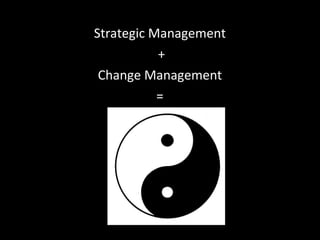
Strategic Management  + Change Management  =
” It doesn’t matter where you want to go,  if the organization doesn’t go with you”
 
 
Let us go back in time
Boston Consulting Group  1965
"Bruce called a staff meeting for a Saturday morning in the fall of 1965. He explained that to survive, much less grow, in a competitive landscape occupied by hundreds of larger and better-known consulting firms, we needed a distinctive identity. He had concluded that we shouldn’t fight the competitive battle as generalists, but should instead stake out a special area of expertise. "He asked what we thought that specialty should be. Many suggestions were offered, but in each case we were able to identify several other firms that already had strong credentials in that particular area. The discussion began to stall.   Then Bruce asked a momentous question: ‘What about business strategy?’ I objected: ‘That’s too vague. Most executives won’t know what we’re talking about.’ Bruce replied, ‘That’s the beauty of it. We’ll define it.“ http://www.bcg.com/this_is_bcg/bcg_history/bcg_history_1963.html
A Timeline on Strategic Management*
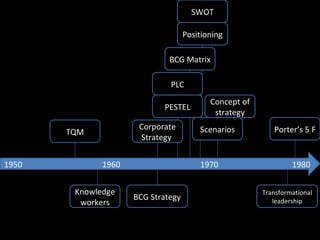
1950   1960    1970  1980 TQM BCG Strategy Knowledge workers Positioning Transformational leadership Concept of strategy Porter’s 5 F Corporate Strategy  BCG Matrix PESTEL PLC Scenarios SWOT
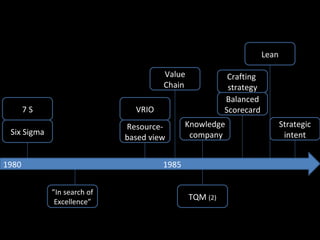
1980   1985 Six Sigma ” In search of Excellence” 7 S Value Chain  Resource-based view VRIO TQM  (2) Lean Balanced Scorecard Strategic intent Knowledge company Crafting  strategy
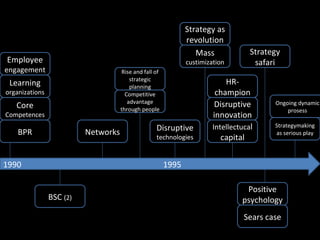
1990   1995 BPR Networks Disruptive innovation Core  Competences BSC  (2) Learning  organizations Mass  custimization Positive psychology Strategymaking as serious play Disruptive  technologies Intellectuca l capital Employee  engagement Strategy safari HR-champion Competitive advantage through people Sears case Strategy as revolution Ongoing dynamic prosess Rise and fall of strategic planning
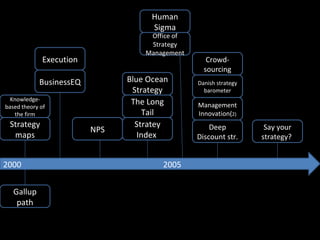
2000   2005 Strategy maps BusinessEQ NPS Blue Ocean Strategy The Long Tail Stratey Index  Human Sigma Management Innovation( 2) Office of Strategy Management Deep Discount str. Gallup path Knowledge-based theory of the firm Execution Danish strategy barometer Crowd-sourcing Say your strategy?
2010   2015 Innovators dream of what might be…. Innovation
Why wait for the future?  Innovators dream of what can be…..
“ The strategist's goal is not to find a niche within the existing industry space but to create new space that is uniquely suited to the company's own strengths - space that is off the map.” 1989; “Strategic Intent”;  Gary Hamel & C.K. Prahalad
Blank
Some of the key assumptions in traditional strategy analysis can be outlined as follows:
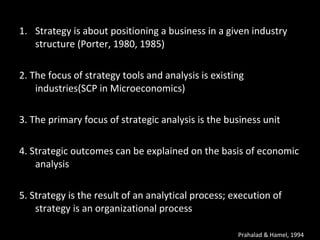
Strategy is about positioning a business in a given industry structure (Porter, 1980, 1985) 2. The focus of strategy tools and analysis is  existing industries(SCP in Microeconomics) 3. The primary focus of strategic analysis is the  business unit 4. Strategic outcomes can be explained on the  basis of economic analysis 5. Strategy is the result of an analytical process; execution of strategy is an organizational  process Prahalad & Hamel, 1994
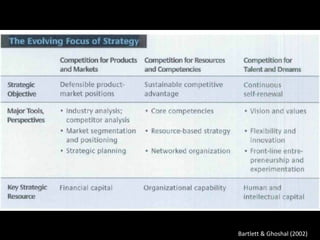
Bartlett & Ghoshal (2002)
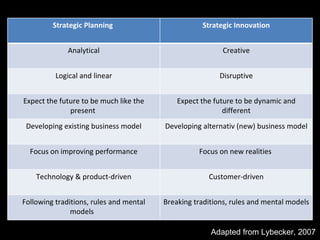
Adapted from Lybecker, 2007  Strategic Planning  Strategic Innovation Analytical Creative Logical and linear Disruptive Expect the future to be much like the present  Expect the future to be dynamic and different Developing existing business model Developing alternativ (new) business model Focus on improving performance Focus on new realities  Technology & product-driven Customer-driven Following traditions, rules and mental models  Breaking traditions, rules and mental models
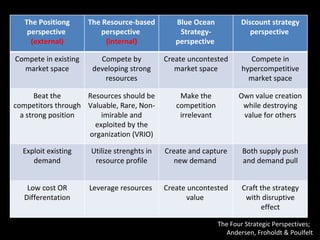
The Four Strategic Perspectives; Andersen, Froholdt & Poulfelt The Positiong perspective  (external) The Resource-based perspective  (internal) Blue Ocean Strategy- perspective  Discount strategy perspective  Compete in existing market space Compete by developing strong resources Create uncontested market space Compete in hypercompetitive market space Beat the competitors through a strong position Resources should be Valuable, Rare, Non-imirable and exploited by the organization (VRIO) Make the competition irrelevant Own value creation while destroying value for others Exploit existing demand Utilize strenghts in resource profile Create and capture new demand  Both supply push and demand pull Low cost OR Differentation Leverage resources  Create uncontested value  Craft the strategy with disruptive effect
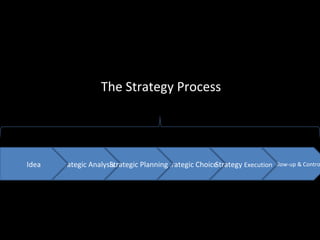
The Strategy Process Strategic Analysis Idea Follow-up & Control Strategic Choice Strategy  Execution Strategic Planning
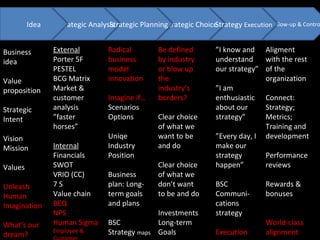
Strategic Analysis Idea Follow-up & Control Strategic Choice Strategy  Execution Strategic Planning Business idea Value proposition Strategic Intent Vision Mission Values Unleash Human Imagination What’s our dream?  Aligment with the rest of the organization Connect:  Strategy; Metrics; Training and development Performance reviews Rewards & bonuses  World-class alignment ” I know and understand our strategy” ” I am enthusiastic about our strategy” ” Every day, I make our strategy happen”  BSC Communi-cations strategy Execution Be defined by industry or blow up the industry’s borders? Clear choice of what we want to be and do Clear choice of what we don’t want to be and do Investments Long-term Goals Align: Organization Culture Rewards  People Radical business model innovation Imagine if… Scenarios  Options Uniqe Industry Position Business plan: Long-term goals and plans BSC  Strategy  maps External Porter 5F PESTEL BCG Matrix Market & customer analysis ” faster horses” Internal Financials SWOT VRIO (CC) 7 S Value chain BEQ NPS Human Sigma Employee & Customer Engagement Innovation rate Culture GPTW
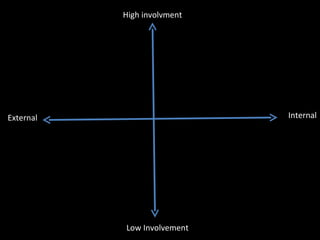
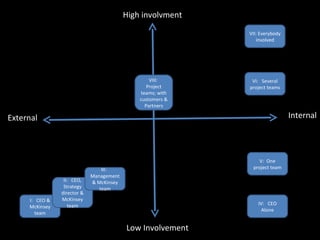
Different ways of running the strategy process
High involvment Internal External Low Involvement
High involvment Internal External Low Involvement I:  CEO & McKinsey team II:  CEO, Strategy director & McKinsey team III:  Management & McKinsey team VI:  Several project teams VII: Everybody involved VIII:  Project teams; with customers & Partners IV:  CEO Alone V:  One project team
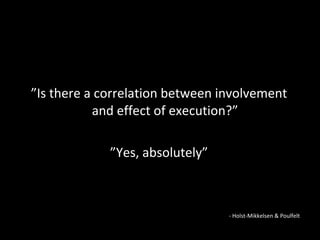
” Is there a correlation between involvement  and effect of execution?”  ” Yes, absolutely” - Holst-Mikkelsen & Poulfelt
Can Strategy Be Made Easy?
Where Do We Want to Be in 3 Years  ? How Are We Going to Get There  ?
How do we achieve competitive advantage?
Low-cost  VS. Differentiation Vs.  Focus
… or… Deep Discount Strategy Vs.  Radical Business Model Innovation
External Perspective  Vs.  Internal Perspective
Incremental Vs.  Innovative Vs.  Radical
Analysis Vs.  Action
Analysis Vs.  Paralysis
What Industry Position Should We Take?
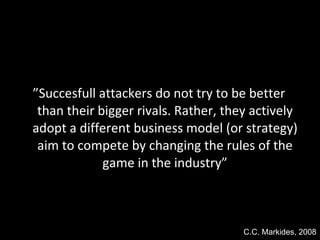
” Succesfull attackers do not try to be better than their bigger rivals. Rather, they actively adopt a different business model (or strategy) aim to compete by changing the rules of the game in the industry” C.C. Markides, 2008
How do we want our customers  to experience us differently?
Who? What?  How? “ The secrets of successful strategies;  Winning People’s Emotional Commitment” Markides, London Business School
The 10 Schools of Strategic Management Mintzberg, et.al. (1998) Strategy Safari
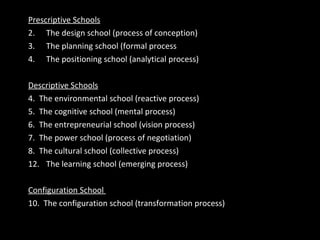
Prescriptive Schools The design school (process of conception)  The planning school (formal process The positioning school (analytical process) Descriptive Schools 4.  The environmental school (reactive process)  5.  The cognitive school (mental process)  6.  The entrepreneurial school (vision process) 7.  The power school (process of negotiation) 8.  The cultural school (collective process)  The learning school (emerging process) Configuration School  10.  The configuration school (transformation process)
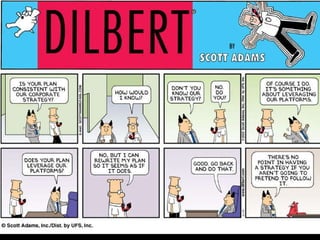
“ Like many organization's, our written strategies quickly became dead documents.” Art Schneiderman, 1987, "The First Balanced Scorecard“
Can You Say What Your Strategy Is? Collins & Ruckstad, 2008
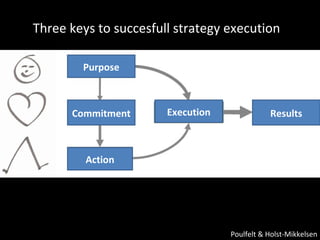
Three keys to succesfull strategy execution Poulfelt & Holst-Mikkelsen Commitment Action Purpose Results Execution
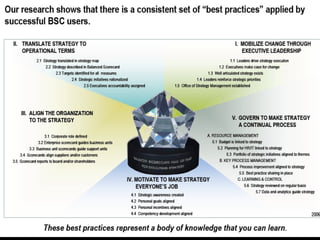
Balanced Scorecard drives Strategy Execution
3 rd  Generation BSC: Focus, Metrics, Alignment, Action
 
The Strategic Sweet Spot Collins & Ruckstad, 2008
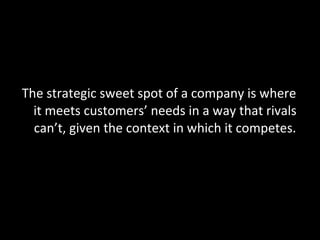
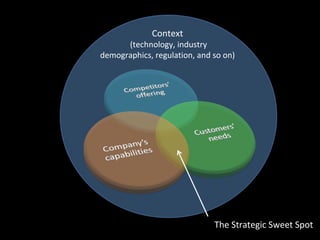
The strategic sweet spot of a company is where it meets customers’ needs in a way that rivals can’t, given the context in which it competes.
The Strategic Sweet Spot Context  (technology, industry demographics, regulation, and so on)
Goldman Sachs
Group one # 1: Using your material, identify the concepts that could be used/are used in the case # 2: Select a few and conduct a breif strategy analysis of Goldman Sachs’ market entry # 3: What’s your view on their strategy
Group two # 1: Using your material, conduct a brief strategic analysis of Goldman Sachs’ market entry # 2: What’s your view on their strategy
Thank you
Engage // Innovate  Strategy .  Innovation .  Sales .  Leadership . Christian Rangen Partner  Mobil: +47 92 41 59 49 E-post: Christian@engage-innovate.com www.engage-innovate.com

Summary lecture on Strategic Management CBS MBA

  • 1.
    What is Strategy?Presentation Copenhagen Business School MBA program February 22 nd – 23 rd 2010 Christian Rangen
  • 2.
    Engage // Innovate Strategy . Innovation . Sales . Leadership . Christian Rangen Partner Mobil: +47 92 41 59 49 E-post: Christian@engage-innovate.com www.engage-innovate.com
  • 3.
    My intention: Helpyou get an overview of ‘ Strategic Management’
  • 4.
  • 5.
  • 6.
    There were sixmen of Hindustan, to learning much inclined, Who went to see an elephant, though all of them were blind, That each by observation might satisfy his mind. The first approached the elephant, and happening to fall Against his broad and sturdy side, at once began to bawl, "This mystery of an elephant is very like a wall." The second, feeling of the tusk, cried, "Ho, what have we here, So very round and smooth and sharp? To me 'tis mighty clear, This wonder of an elephant is very like a spear." The third approached the elephant, and happening to take The squirming trunk within his hands, thus boldly up and spake, "I see," quoth he, "the elephant is very like a snake." The fourth reached out an eager hand, and felt above the knee, "What this most wondrous beast is like is very plain" said he, "'Tis clear enough the elephant is very like a tree." The fifth who chanced to touch the ear said, "E'en the blindest man Can tell what this resembles most; deny the fact who can; This marvel of an elephant is very like a fan." The sixth no sooner had begun about the beast to grope, Than seizing on the swinging tail that fell within his scope; "I see," said he, "the elephant is very like a rope." So six blind men of Hindustan disputed loud and long, Each in his own opinion exceeding stiff and strong; Though each was partly in the right, they all were in the wrong! Mintzberg, et.al. (1998) Strategy Safari
  • 7.
    “ Nobody reallyknows what strategy is” The Economist, in Markides, 2004
  • 8.
    The 10 Schoolsof Strategic Management Mintzberg, et.al. (1998) Strategy Safari
  • 9.
  • 10.
    A different animalaltogether: Strategy Execution
  • 11.
  • 12.
    Strategic Management + Change Management =
  • 13.
    ” It doesn’tmatter where you want to go, if the organization doesn’t go with you”
  • 14.
  • 15.
  • 16.
    Let us goback in time
  • 17.
  • 18.
    "Bruce called astaff meeting for a Saturday morning in the fall of 1965. He explained that to survive, much less grow, in a competitive landscape occupied by hundreds of larger and better-known consulting firms, we needed a distinctive identity. He had concluded that we shouldn’t fight the competitive battle as generalists, but should instead stake out a special area of expertise. "He asked what we thought that specialty should be. Many suggestions were offered, but in each case we were able to identify several other firms that already had strong credentials in that particular area. The discussion began to stall. Then Bruce asked a momentous question: ‘What about business strategy?’ I objected: ‘That’s too vague. Most executives won’t know what we’re talking about.’ Bruce replied, ‘That’s the beauty of it. We’ll define it.“ http://www.bcg.com/this_is_bcg/bcg_history/bcg_history_1963.html
  • 19.
    A Timeline onStrategic Management*
  • 20.
    1950 1960 1970 1980 TQM BCG Strategy Knowledge workers Positioning Transformational leadership Concept of strategy Porter’s 5 F Corporate Strategy BCG Matrix PESTEL PLC Scenarios SWOT
  • 21.
    1980 1985 Six Sigma ” In search of Excellence” 7 S Value Chain Resource-based view VRIO TQM (2) Lean Balanced Scorecard Strategic intent Knowledge company Crafting strategy
  • 22.
    1990 1995 BPR Networks Disruptive innovation Core Competences BSC (2) Learning organizations Mass custimization Positive psychology Strategymaking as serious play Disruptive technologies Intellectuca l capital Employee engagement Strategy safari HR-champion Competitive advantage through people Sears case Strategy as revolution Ongoing dynamic prosess Rise and fall of strategic planning
  • 23.
    2000 2005 Strategy maps BusinessEQ NPS Blue Ocean Strategy The Long Tail Stratey Index Human Sigma Management Innovation( 2) Office of Strategy Management Deep Discount str. Gallup path Knowledge-based theory of the firm Execution Danish strategy barometer Crowd-sourcing Say your strategy?
  • 24.
    2010 2015 Innovators dream of what might be…. Innovation
  • 25.
    Why wait forthe future? Innovators dream of what can be…..
  • 26.
    “ The strategist'sgoal is not to find a niche within the existing industry space but to create new space that is uniquely suited to the company's own strengths - space that is off the map.” 1989; “Strategic Intent”; Gary Hamel & C.K. Prahalad
  • 27.
  • 28.
    Some of thekey assumptions in traditional strategy analysis can be outlined as follows:
  • 29.
    Strategy is aboutpositioning a business in a given industry structure (Porter, 1980, 1985) 2. The focus of strategy tools and analysis is existing industries(SCP in Microeconomics) 3. The primary focus of strategic analysis is the business unit 4. Strategic outcomes can be explained on the basis of economic analysis 5. Strategy is the result of an analytical process; execution of strategy is an organizational process Prahalad & Hamel, 1994
  • 30.
  • 31.
    Adapted from Lybecker,2007 Strategic Planning Strategic Innovation Analytical Creative Logical and linear Disruptive Expect the future to be much like the present Expect the future to be dynamic and different Developing existing business model Developing alternativ (new) business model Focus on improving performance Focus on new realities Technology & product-driven Customer-driven Following traditions, rules and mental models Breaking traditions, rules and mental models
  • 32.
    The Four StrategicPerspectives; Andersen, Froholdt & Poulfelt The Positiong perspective (external) The Resource-based perspective (internal) Blue Ocean Strategy- perspective Discount strategy perspective Compete in existing market space Compete by developing strong resources Create uncontested market space Compete in hypercompetitive market space Beat the competitors through a strong position Resources should be Valuable, Rare, Non-imirable and exploited by the organization (VRIO) Make the competition irrelevant Own value creation while destroying value for others Exploit existing demand Utilize strenghts in resource profile Create and capture new demand Both supply push and demand pull Low cost OR Differentation Leverage resources Create uncontested value Craft the strategy with disruptive effect
  • 33.
    The Strategy ProcessStrategic Analysis Idea Follow-up & Control Strategic Choice Strategy Execution Strategic Planning
  • 34.
    Strategic Analysis IdeaFollow-up & Control Strategic Choice Strategy Execution Strategic Planning Business idea Value proposition Strategic Intent Vision Mission Values Unleash Human Imagination What’s our dream? Aligment with the rest of the organization Connect: Strategy; Metrics; Training and development Performance reviews Rewards & bonuses World-class alignment ” I know and understand our strategy” ” I am enthusiastic about our strategy” ” Every day, I make our strategy happen” BSC Communi-cations strategy Execution Be defined by industry or blow up the industry’s borders? Clear choice of what we want to be and do Clear choice of what we don’t want to be and do Investments Long-term Goals Align: Organization Culture Rewards People Radical business model innovation Imagine if… Scenarios Options Uniqe Industry Position Business plan: Long-term goals and plans BSC Strategy maps External Porter 5F PESTEL BCG Matrix Market & customer analysis ” faster horses” Internal Financials SWOT VRIO (CC) 7 S Value chain BEQ NPS Human Sigma Employee & Customer Engagement Innovation rate Culture GPTW
  • 35.
    Different ways ofrunning the strategy process
  • 36.
    High involvment InternalExternal Low Involvement
  • 37.
    High involvment InternalExternal Low Involvement I: CEO & McKinsey team II: CEO, Strategy director & McKinsey team III: Management & McKinsey team VI: Several project teams VII: Everybody involved VIII: Project teams; with customers & Partners IV: CEO Alone V: One project team
  • 38.
    ” Is therea correlation between involvement and effect of execution?” ” Yes, absolutely” - Holst-Mikkelsen & Poulfelt
  • 39.
    Can Strategy BeMade Easy?
  • 40.
    Where Do WeWant to Be in 3 Years ? How Are We Going to Get There ?
  • 41.
    How do weachieve competitive advantage?
  • 42.
    Low-cost VS.Differentiation Vs. Focus
  • 43.
    … or… DeepDiscount Strategy Vs. Radical Business Model Innovation
  • 44.
    External Perspective Vs. Internal Perspective
  • 45.
    Incremental Vs. Innovative Vs. Radical
  • 46.
  • 47.
    Analysis Vs. Paralysis
  • 48.
    What Industry PositionShould We Take?
  • 49.
    ” Succesfull attackersdo not try to be better than their bigger rivals. Rather, they actively adopt a different business model (or strategy) aim to compete by changing the rules of the game in the industry” C.C. Markides, 2008
  • 50.
    How do wewant our customers to experience us differently?
  • 51.
    Who? What? How? “ The secrets of successful strategies; Winning People’s Emotional Commitment” Markides, London Business School
  • 52.
    The 10 Schoolsof Strategic Management Mintzberg, et.al. (1998) Strategy Safari
  • 53.
    Prescriptive Schools Thedesign school (process of conception) The planning school (formal process The positioning school (analytical process) Descriptive Schools 4. The environmental school (reactive process) 5. The cognitive school (mental process) 6. The entrepreneurial school (vision process) 7. The power school (process of negotiation) 8. The cultural school (collective process) The learning school (emerging process) Configuration School 10. The configuration school (transformation process)
  • 54.
    “ Like manyorganization's, our written strategies quickly became dead documents.” Art Schneiderman, 1987, "The First Balanced Scorecard“
  • 55.
    Can You SayWhat Your Strategy Is? Collins & Ruckstad, 2008
  • 56.
    Three keys tosuccesfull strategy execution Poulfelt & Holst-Mikkelsen Commitment Action Purpose Results Execution
  • 57.
    Balanced Scorecard drivesStrategy Execution
  • 58.
    3 rd Generation BSC: Focus, Metrics, Alignment, Action
  • 59.
  • 60.
    The Strategic SweetSpot Collins & Ruckstad, 2008
  • 61.
    The strategic sweetspot of a company is where it meets customers’ needs in a way that rivals can’t, given the context in which it competes.
  • 62.
    The Strategic SweetSpot Context (technology, industry demographics, regulation, and so on)
  • 63.
  • 64.
    Group one #1: Using your material, identify the concepts that could be used/are used in the case # 2: Select a few and conduct a breif strategy analysis of Goldman Sachs’ market entry # 3: What’s your view on their strategy
  • 65.
    Group two #1: Using your material, conduct a brief strategic analysis of Goldman Sachs’ market entry # 2: What’s your view on their strategy
  • 66.
  • 67.
    Engage // Innovate Strategy . Innovation . Sales . Leadership . Christian Rangen Partner Mobil: +47 92 41 59 49 E-post: Christian@engage-innovate.com www.engage-innovate.com

Editor's Notes

  • #7 and felt above the knee, "What this most wondrous beast is like is very plain" said he, "'Tis clear enough the elephant is very like a tree." The fifth who chanced to touch the ear said, "E'en the blindest man Can tell what this resembles most; deny the fact who can; This marvel of an elephant is very like a fan." The sixth no sooner had begun about the beast to grope, Than seizing on the swinging tail that fell within his scope; "I see," said he, "the elephant is very like a rope." So six blind men of Hindustan disputed loud and long, Each in his own opinion exceeding stiff and strong; Though each was partly in the right, they all were in the wrong!
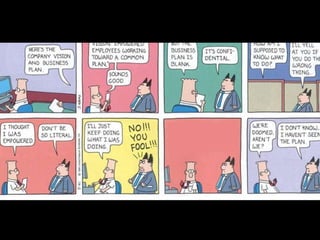
  • #13 It’s a dirty little secret: Most executives can’t articulate their business strategy in a simple statement. And if they cannot, of course, then neither can anyone else.
  • #14 It’s a dirty little secret: Most executives can’t articulate their business strategy in a simple statement. And if they cannot, of course, then neither can anyone else.
  • #31 Bartlett, Ghoshal (2002)
  • #36 It’s a dirty little secret: Most executives can’t articulate their business strategy in a simple statement. And if they cannot, of course, then neither can anyone else.
  • #39 It’s a dirty little secret: Most executives can’t articulate their business strategy in a simple statement. And if they cannot, of course, then neither can anyone else.
  • #52 “ The secrets of successful strategies; Winning People’s Emotional Commitment” Prof. Costas Markides, London Business School
  • #56 It’s a dirty little secret: Most executives can’t articulate their business strategy in a simple statement. And if they cannot, of course, then neither can anyone else.
  • #61 It’s a dirty little secret: Most executives can’t articulate their business strategy in a simple statement. And if they cannot, of course, then neither can anyone else.
  • #62 It’s a dirty little secret: Most executives can’t articulate their business strategy in a simple statement. And if they cannot, of course, then neither can anyone else.
  • #64 It’s a dirty little secret: Most executives can’t articulate their business strategy in a simple statement. And if they cannot, of course, then neither can anyone else.
  • #65 It’s a dirty little secret: Most executives can’t articulate their business strategy in a simple statement. And if they cannot, of course, then neither can anyone else.
  • #66 It’s a dirty little secret: Most executives can’t articulate their business strategy in a simple statement. And if they cannot, of course, then neither can anyone else.
  • #67 It’s a dirty little secret: Most executives can’t articulate their business strategy in a simple statement. And if they cannot, of course, then neither can anyone else.