BFS 7154 – Corporate Financial Strategies
Project Report
Strategic Financial Project Analysis: DiGi
Chan Kwai Sang
2
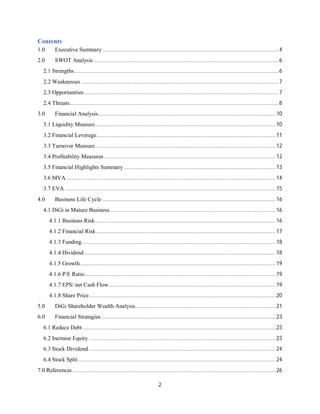
Contents
1.0 Executive Summary.....................................................................................................................4
2.0 SWOT Analysis...........................................................................................................................6
2.1 Strengths........................................................................................................................................6
2.2 Weaknesses ...................................................................................................................................7
2.3 Opportunities.................................................................................................................................7
2.4 Threats...........................................................................................................................................8
3.0 Financial Analysis......................................................................................................................10
3.1 Liquidity Measure........................................................................................................................10
3.2 Financial Leverage.......................................................................................................................11
3.3 Turnover Measure........................................................................................................................12
3.4 Profitability Measures..................................................................................................................12
3.5 Financial Highlights Summary.....................................................................................................13
3.6 MVA...........................................................................................................................................14
3.7 EVA ............................................................................................................................................15
4.0 Business Life Cycle ...................................................................................................................16
4.1 DiGi in Mature Business..............................................................................................................16
4.1.1 Business Risk........................................................................................................................16
4.1.2 Financial Risk .......................................................................................................................17
4.1.3 Funding.................................................................................................................................18
4.1.4 Dividend ............................................................................................................................... 18
4.1.5 Growth..................................................................................................................................19
4.1.6 P/E Ratio............................................................................................................................... 19
4.1.7 EPS/ net Cash Flow...............................................................................................................19
4.1.8 Share Price............................................................................................................................20
5.0 DiGi Shareholder Wealth Analysis............................................................................................. 21
6.0 Financial Strategies....................................................................................................................23
6.1 Reduce Debt ................................................................................................................................ 23
6.2 Increase Equity ............................................................................................................................23
6.3 Stock Dividend ............................................................................................................................24
6.4 Stock Split ...................................................................................................................................24
7.0 References.......................................................................................................................................26
3
8.0 Appendix.........................................................................................................................................27
4
1.0 Executive Summary
DiGi.Com Berhad is listed on Bursa Malaysia Securities Berhad and is part of global
telecommunications provider, Telenor Group. Its mobile service operations are undertaken by its
wholly-owned subsidiary, DiGi Telecommunication Sdn Bhd.
DiGi commenced operations in May 1995 when it launched its fully digital GSM 1800 services,
the first digital mobile communications service in Malaysia. In the last 5 years, DiGi’s revenue
has more than doubled to approximately RM4.9 billion with a subscriber base of 7.7 million.
DiGi is now the 3rd
largest operator carrier in Malaysia with 27% market shares and with market
capitalization of approximate RM18 billion. Currently, more than 3000 employees are hired by
DiGi nationwide.
In this report, DiGi is selected as a model company to be analyzed and the focus of the analysis
will be at its financial position. Generally, this report will try to answer the following questions:
i. Perform a SWOT analysis on this blue chip company and identify the relevant risks
associate with this company, both internally and externally to their operations.
ii. Select the relevant financial ratios to assess the financial status of this company. If possible,
calculate the economic value added (EVA) and the market valued added (MVA) for this
firm and assess its value over the years based on your analysis.
iii. Identify at what stage the life cycle of this company and provide reasons to justify your
claim.
5
iv. As a shareholder or potential investor, are you satisfy with the financial performance and
financial position of this company? Explain and justify your decision.
v. What will be the appropriate financial strategies for this company now? Also, include other
qualitative factors beside just financial strategies.
6
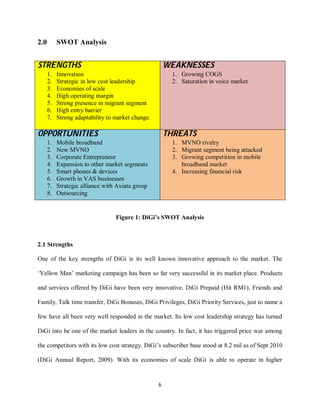
2.0 SWOT Analysis
STRENGTHS
1. Innovation
2. Strategic in low cost leadership
3. Economies of scale
4. High operating margin
5. Strong presence in migrant segment
6. High entry barrier
7. Strong adaptability to market change
WEAKNESSES
1. Growing COGS
2. Saturation in voice market
OPPORTUNITIES
1. Mobile broadband
2. New MVNO
3. Corporate Entrepreneur
4. Expansion to other market segments
5. Smart phones & devices
6. Growth in VAS businesses
7. Strategic alliance with Axiata group
8. Outsourcing
THREATS
1. MVNO rivalry
2. Migrant segment being attacked
3. Growing competition in mobile
broadband market
4. Increasing financial risk
Figure 1: DiGi’s SWOT Analysis
2.1 Strengths
One of the key strengths of DiGi is its well known innovative approach to the market. The
‘Yellow Man’ marketing campaign has been so far very successful in its market place. Products
and services offered by DiGi have been very innovative. DiGi Prepaid (Hit RM1), Friends and
Family, Talk time transfer, DiGi Bonuses, DiGi Privileges, DiGi Priority Services, just to name a
few have all been very well responded in the market. Its low cost leadership strategy has turned
DiGi into be one of the market leaders in the country. In fact, it has triggered price war among
the competitors with its low cost strategy. DiGi’s subscriber base stood at 8.2 mil as of Sept 2010
(DiGi Annual Report, 2009). With its economies of scale DiGi is able to operate in higher
7
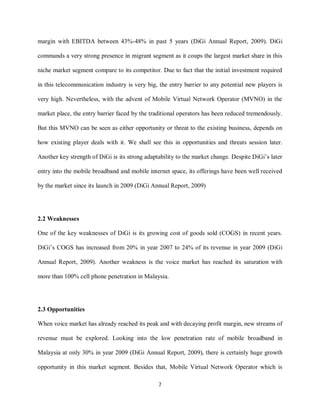
margin with EBITDA between 43%-48% in past 5 years (DiGi Annual Report, 2009). DiGi
commands a very strong presence in migrant segment as it coups the largest market share in this
niche market segment compare to its competitor. Due to fact that the initial investment required
in this telecommunication industry is very big, the entry barrier to any potential new players is
very high. Nevertheless, with the advent of Mobile Virtual Network Operator (MVNO) in the
market place, the entry barrier faced by the traditional operators has been reduced tremendously.
But this MVNO can be seen as either opportunity or threat to the existing business, depends on
how existing player deals with it. We shall see this in opportunities and threats session later.
Another key strength of DiGi is its strong adaptability to the market change. Despite DiGi’s later
entry into the mobile broadband and mobile internet space, its offerings have been well received
by the market since its launch in 2009 (DiGi Annual Report, 2009)
2.2 Weaknesses
One of the key weaknesses of DiGi is its growing cost of goods sold (COGS) in recent years.
DiGi’s COGS has increased from 20% in year 2007 to 24% of its revenue in year 2009 (DiGi
Annual Report, 2009). Another weakness is the voice market has reached its saturation with
more than 100% cell phone penetration in Malaysia.
2.3 Opportunities
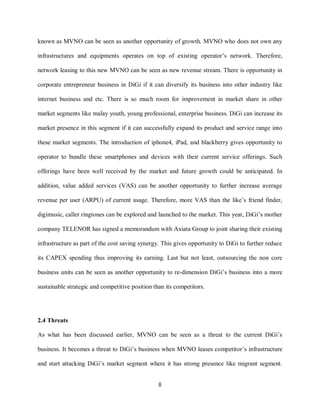
When voice market has already reached its peak and with decaying profit margin, new streams of
revenue must be explored. Looking into the low penetration rate of mobile broadband in
Malaysia at only 30% in year 2009 (DiGi Annual Report, 2009), there is certainly huge growth
opportunity in this market segment. Besides that, Mobile Virtual Network Operator which is
8
known as MVNO can be seen as another opportunity of growth. MVNO who does not own any
infrastructures and equipments operates on top of existing operator’s network. Therefore,
network leasing to this new MVNO can be seen as new revenue stream. There is opportunity in
corporate entrepreneur business in DiGi if it can diversify its business into other industry like
internet business and etc. There is so much room for improvement in market share in other
market segments like malay youth, young professional, enterprise business. DiGi can increase its
market presence in this segment if it can successfully expand its product and service range into
these market segments. The introduction of iphone4, iPad, and blackberry gives opportunity to
operator to bundle these smartphones and devices with their current service offerings. Such
offerings have been well received by the market and future growth could be anticipated. In
addition, value added services (VAS) can be another opportunity to further increase average
revenue per user (ARPU) of current usage. Therefore, more VAS than the like’s friend finder,
digimusic, caller ringtones can be explored and launched to the market. This year, DiGi’s mother
company TELENOR has signed a memorandum with Axiata Group to joint sharing their existing
infrastructure as part of the cost saving synergy. This gives opportunity to DiGi to further reduce
its CAPEX spending thus improving its earning. Last but not least, outsourcing the non core
business units can be seen as another opportunity to re-dimension DiGi’s business into a more
sustainable strategic and competitive position than its competitors.
2.4 Threats
As what has been discussed earlier, MVNO can be seen as a threat to the current DiGi’s
business. It becomes a threat to DiGi’s business when MVNO leases competitor’s infrastructure
and start attacking DiGi’s market segment where it has strong presence like migrant segment.
9
This will certainly trigger another round of price war which could eventually reduce the profit
margin and thus earning per share (EPS). The later entry of YTL E-Solution (YES) with already
existing WIMAX operator like P1, the mobile broadband market certainly will see further
increases in the already intense competition. Lastly, there is a tendency of increasing financial
risk resulted from borrowing since year 2008 (DiGi Annual Report, 2009).
10
3.0 Financial Analysis
In this session, we will analyze DiGi’s financial historical data from 2005 to 2009. All financial
data are extracted from DiGi’s financial year report in those respective years.
3.1 Liquidity Measure
FORMULA
Liquidity Measures 2005 2006 2007 2008 2009
Short Term Solvency
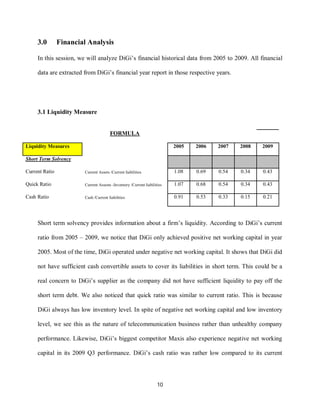
Current Ratio Current Assets /Current liabilities 1.08 0.69 0.54 0.34 0.43
Quick Ratio Current Assests -Inventory /Current liabilities 1.07 0.68 0.54 0.34 0.43
Cash Ratio Cash /Current liabilities 0.91 0.53 0.33 0.15 0.21
Short term solvency provides information about a firm’s liquidity. According to DiGi’s current
ratio from 2005 – 2009, we notice that DiGi only achieved positive net working capital in year
2005. Most of the time, DiGi operated under negative net working capital. It shows that DiGi did
not have sufficient cash convertible assets to cover its liabilities in short term. This could be a
real concern to DiGi’s supplier as the company did not have sufficient liquidity to pay off the
short term debt. We also noticed that quick ratio was similar to current ratio. This is because
DiGi always has low inventory level. In spite of negative net working capital and low inventory
level, we see this as the nature of telecommunication business rather than unhealthy company
performance. Likewise, DiGi’s biggest competitor Maxis also experience negative net working
capital in its 2009 Q3 performance. DiGi’s cash ratio was rather low compared to its current
11
liabilities obligation. Last year, DiGi’s cash in hand was only sufficient to cover 0.21 times of its
current liabilities.
3.2 Financial Leverage
Financial Leverage 2005 2006 2007 2008 2009
Long Term Solvency
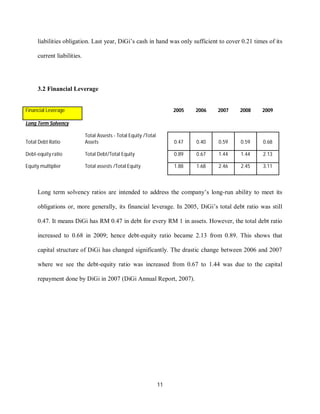
Total Debt Ratio
Total Assests - Total Equity /Total
Assets 0.47 0.40 0.59 0.59 0.68
Debt-equity ratio Total Debt/Total Equity 0.89 0.67 1.44 1.44 2.13
Equity multiplier Total assests /Total Equity 1.88 1.68 2.46 2.45 3.11
Long term solvency ratios are intended to address the company’s long-run ability to meet its
obligations or, more generally, its financial leverage. In 2005, DiGi’s total debt ratio was still
0.47. It means DiGi has RM 0.47 in debt for every RM 1 in assets. However, the total debt ratio
increased to 0.68 in 2009; hence debt-equity ratio became 2.13 from 0.89. This shows that
capital structure of DiGi has changed significantly. The drastic change between 2006 and 2007
where we see the debt-equity ratio was increased from 0.67 to 1.44 was due to the capital
repayment done by DiGi in 2007 (DiGi Annual Report, 2007).
12
3.3 Turnover Measure
Turnover Measures 2005 2006 2007 2008 2009
Inventory Turnover Cost of Goods Sold /Inventory 78.78 94.83 102.66 63.96 89.65
Days' Sales in Inventory 365 days /Inventory turnover 4.63 3.85 3.56 5.71 4.07
Receivables Turnover Sales /Accounts Receivables 13.45 14.55 12.41 11.44 11.68
Days' Sales in receivables 365 days /Receivables turnover 27.14 25.08 29.42 31.90 31.25
Total Asset Turnover Sales /Total Assests 1.02 1.24 1.48 1.24 1.27
In this session, we shall see how efficient DiGi was in dealing with its assets. Impressively,
DiGi’s inventory turnover was very quick in last 5 years. From 2005 to 2009, DiGi’s inventory
was sold in less than 1 week (Days’ Sales In Inventory). Likewise, DiGi needed approximate 1
month to collect outstanding credit accounts (Days’ Sales in receivables). DiGi’s total asset
turnover was improving from 1.02 in 2005 to 1.27 in 2009. It means that DiGi was making RM
1.27 sales for every RM 1 in asset in 2009 almost 27% up from 5 years ago. We may conclude
that DiGi is improving in asset management.
3.4 Profitability Measures
Profitability Measures 2005 2006 2007 2008 2009
Profit Margin Net Income /Sales 16.33% 22.06% 24.36% 23.69% 20.38%
Return on Assets ( ROA) Net Income / Total assets 11.13% 19.77% 27.40% 24.50% 21.14%
Return on Equity (ROE) Net Income /Total Equity 20.95% 33.19% 67.35% 60.13% 65.76%
13
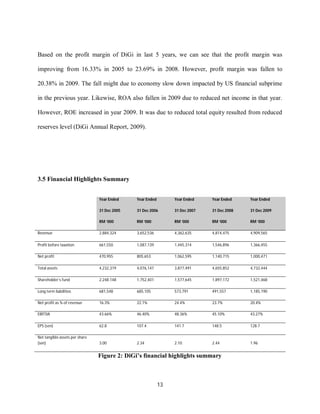
Based on the profit margin of DiGi in last 5 years, we can see that the profit margin was
improving from 16.33% in 2005 to 23.69% in 2008. However, profit margin was fallen to
20.38% in 2009. The fall might due to economy slow down impacted by US financial subprime
in the previous year. Likewise, ROA also fallen in 2009 due to reduced net income in that year.
However, ROE increased in year 2009. It was due to reduced total equity resulted from reduced
reserves level (DiGi Annual Report, 2009).
3.5 Financial Highlights Summary
Year Ended
31 Dec 2005
RM ‘000
Year Ended
31 Dec 2006
RM ‘000
Year Ended
31 Dec 2007
RM ‘000
Year Ended
31 Dec 2008
RM ‘000
Year Ended
31 Dec 2009
RM ‘000
Revenue 2,884,324 3,652,536 4,362,635 4,814,475 4,909,565
Profit before taxation 661,550 1,087,139 1,445,314 1,546,896 1,366,455
Net profit 470,955 805,653 1,062,595 1,140,715 1,000,471
Total assets 4,232,319 4,076,147 3,877,491 4,655,852 4,732,444
Shareholder’s fund 2,248.148 1,752,401 1,577,645 1,897,172 1,521,468
Long term liabilities 681,548 685,105 573,791 491,557 1,185,190
Net profit as % of revenue 16.3% 22.1% 24.4% 23.7% 20.4%
EBITDA 43.66% 46.40% 48.36% 45.10% 43.27%
EPS (sen) 62.8 107.4 141.7 148.5 128.7
Net tangible assets per share
(sen) 3.00 2.34 2.10 2.44 1.96
Figure 2: DiGi’s financial highlights summary
14
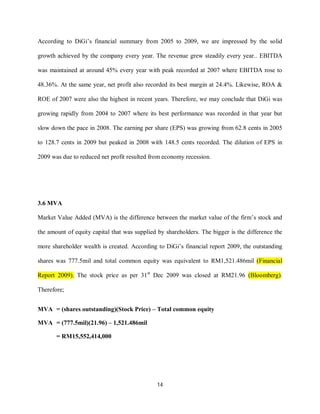
According to DiGi’s financial summary from 2005 to 2009, we are impressed by the solid
growth achieved by the company every year. The revenue grew steadily every year.. EBITDA
was maintained at around 45% every year with peak recorded at 2007 where EBITDA rose to
48.36%. At the same year, net profit also recorded its best margin at 24.4%. Likewise, ROA &
ROE of 2007 were also the highest in recent years. Therefore, we may conclude that DiGi was
growing rapidly from 2004 to 2007 where its best performance was recorded in that year but
slow down the pace in 2008. The earning per share (EPS) was growing from 62.8 cents in 2005
to 128.7 cents in 2009 but peaked in 2008 with 148.5 cents recorded. The dilution of EPS in
2009 was due to reduced net profit resulted from economy recession.
3.6 MVA
Market Value Added (MVA) is the difference between the market value of the firm’s stock and
the amount of equity capital that was supplied by shareholders. The bigger is the difference the
more shareholder wealth is created. According to DiGi’s financial report 2009, the outstanding
shares was 777.5mil and total common equity was equivalent to RM1,521.486mil (Financial
Report 2009). The stock price as per 31st
Dec 2009 was closed at RM21.96 (Bloomberg).
Therefore;
MVA = (shares outstanding)(Stock Price) – Total common equity
MVA = (777.5mil)(21.96) – 1,521.486mil
= RM15,552,414,000
15
Therefore, DiGi’s management has actually created additional value of RM15,552,414,000 to
shareholder wealth.
3.7 EVA
Whereas MVA measures the effects of managerial actions since the very inception of a
company, Economy Value Added (EVA) focuses on managerial effectiveness in a given year.
The EVA basic formula is as follows:
EVA = NOPAT – After-tax dollar cost of capital used to support operations
= EBIT(1 – Corporate tax rate) – (Operating Capital)(WACC)
EVA = 1,393,436,000 x (1 – 0.26) – (2,845,973,000)(4.31%)
= 1,031,142,640 – 122,661,436.3
= RM 908,481,203.70
(please refer to appendix 8.1 for working steps)
16
4.0 Business Life Cycle
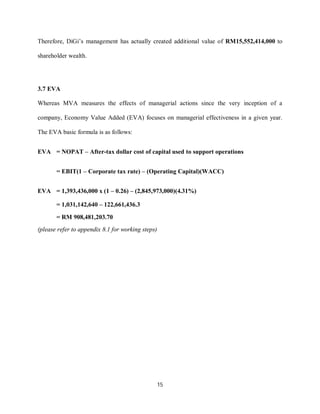
Figure below shows the key aspects in the profile of all business natures according to business
life cycle (BLC). Comparing DiGi’s business profile to this figure, we can conclude that DiGi is
currently in its mature stage of business life cycle. The supporting facts of this conclusion will be
discussed in the next section.
StartUp Growth Business Mature Business Declining Business
Business Risk Very High High Medium Low
Financial Risk Very Low Low Medium High
Funding Equity by Venture
Capitalist
VC plus some
debts
Equity, Debt &
Retained Earning
Debt
Dividends Zero Nominal Level High Total Payout
Growth Very High
Potential
High Low Growth
Potential
Negative
P/E Ratio Very High High Medium Low
EPS/net Cash Flow Very low/Negative Low High Low & Reducing
Share Price Increasing but
Highly Volatile
Increasing but
Volatile
Little Volatility &
Relatively Stable
Falling with
increased volatility
Figure 3: Key aspects in different business life cycle
4.1 DiGi in Mature Business
4.1.1 Business Risk
During the mature phase of a business, business risk exposed is much reduced as expected sales
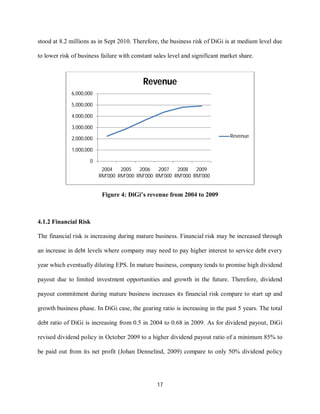
level and market share are achieved. Looking at DiGi’s revenues in past 5 years, we noticed that
the revenues increased steadily from 2004 to 2007 but slow down since 2008. DiGi’s market
share stood at approximately 27% which is 3rd
largest operator in the country. Such prominent
market position proved that DiGi’s products and services have been widely accepted by the
market and is currently enjoying the benefits of economies of scales where the subscriber base
17
stood at 8.2 millions as in Sept 2010. Therefore, the business risk of DiGi is at medium level due
to lower risk of business failure with constant sales level and significant market share.
Figure 4: DiGi’s revenue from 2004 to 2009
4.1.2 Financial Risk
The financial risk is increasing during mature business. Financial risk may be increased through
an increase in debt levels where company may need to pay higher interest to service debt every
year which eventually diluting EPS. In mature business, company tends to promise high dividend
payout due to limited investment opportunities and growth in the future. Therefore, dividend
payout commitment during mature business increases its financial risk compare to start up and
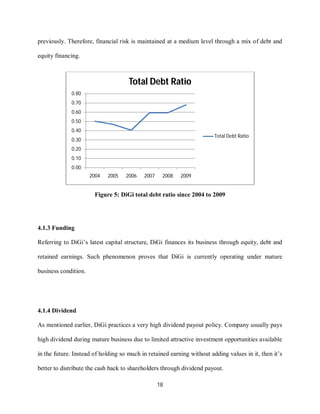
growth business phase. In DiGi case, the gearing ratio is increasing in the past 5 years. The total
debt ratio of DiGi is increasing from 0.5 in 2004 to 0.68 in 2009. As for dividend payout, DiGi
revised dividend policy in October 2009 to a higher dividend payout ratio of a minimum 85% to
be paid out from its net profit (Johan Dennelind, 2009) compare to only 50% dividend policy
0
1,000,000
2,000,000
3,000,000
4,000,000
5,000,000
6,000,000
2004
RM'000
2005
RM'000
2006
RM'000
2007
RM'000
2008
RM'000
2009
RM'000
Revenue
Revenue
18
previously. Therefore, financial risk is maintained at a medium level through a mix of debt and
equity financing.
Figure 5: DiGi total debt ratio since 2004 to 2009
4.1.3 Funding
Referring to DiGi’s latest capital structure, DiGi finances its business through equity, debt and
retained earnings. Such phenomenon proves that DiGi is currently operating under mature
business condition.
4.1.4 Dividend
As mentioned earlier, DiGi practices a very high dividend payout policy. Company usually pays
high dividend during mature business due to limited attractive investment opportunities available
in the future. Instead of holding so much in retained earning without adding values in it, then it’s
better to distribute the cash back to shareholders through dividend payout.
0.00
0.10
0.20
0.30
0.40
0.50
0.60
0.70
0.80
2004 2005 2006 2007 2008 2009
Total Debt Ratio
Total Debt Ratio
19
4.1.5 Growth
DiGi’s future growth is limited due to market penetration has exceeded 100%. In BCG term,
DiGi is viewed as Cash Cow due to large market share but low growth potential.
4.1.6 P/E Ratio
As per 16th
December 2010, DiGi’s share price closed at RM24.86 (Source: Blomberg, 2010). Its
P/E ratio stands at 17.69 times. This P/E ratio is considered relatively low.
4.1.7 EPS/ net Cash Flow
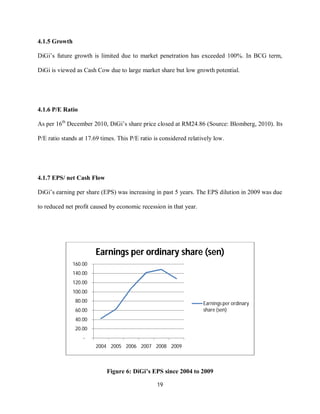
DiGi’s earning per share (EPS) was increasing in past 5 years. The EPS dilution in 2009 was due
to reduced net profit caused by economic recession in that year.
Figure 6: DiGi’s EPS since 2004 to 2009
-
20.00
40.00
60.00
80.00
100.00
120.00
140.00
160.00
2004 2005 2006 2007 2008 2009
Earnings per ordinary share (sen)
Earnings per ordinary
share (sen)
20
Referring to DiGi’s latest financial report, DiGi has very high positive cash flow.
4.1.8 Share Price
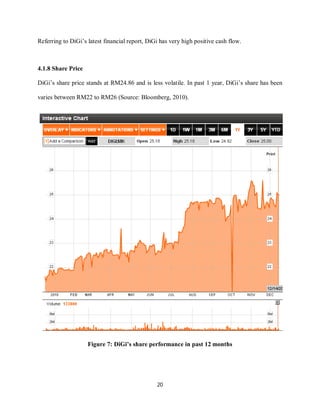
DiGi’s share price stands at RM24.86 and is less volatile. In past 1 year, DiGi’s share has been
varies between RM22 to RM26 (Source: Bloomberg, 2010).
Figure 7: DiGi’s share performance in past 12 months
21
5.0 DiGi Shareholder Wealth Analysis
Financial performance of DiGi is directly proportional to shareholder wealth. As a shareholder or
investor of DiGi, I am concerned about how much returned I have gained in the form of i)
dividend received; ii) Capital Repayment and iii) Capital Gain provided I sell off the shares I
have invested.
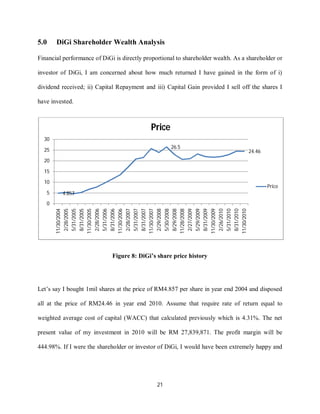
Figure 8: DiGi’s share price history
Let’s say I bought 1mil shares at the price of RM4.857 per share in year end 2004 and disposed
all at the price of RM24.46 in year end 2010. Assume that require rate of return equal to
weighted average cost of capital (WACC) that calculated previously which is 4.31%. The net
present value of my investment in 2010 will be RM 27,839,871. The profit margin will be
444.98%. If I were the shareholder or investor of DiGi, I would have been extremely happy and
4.857
26.5
24.46
0
5
10
15
20
25
30
11/30/2004
2/28/2005
5/31/2005
8/31/2005
11/30/2005
2/28/2006
5/31/2006
8/31/2006
11/30/2006
2/28/2007
5/31/2007
8/31/2007
11/30/2007
2/29/2008
5/30/2008
8/29/2008
11/28/2008
2/27/2009
5/29/2009
8/31/2009
11/30/2009
2/26/2010
5/31/2010
8/31/2010
11/30/2010
Price
Price
22
excited with DiGi’s management effort in creating wealth to my investment. Therefore I am very
happy with DiGi’s financial performance in the past 5-6 years.
(please refer to appendix 8.2 for working steps)
23
6.0 Financial Strategies
In this section, few financial strategies will be proposed with the objective to benefit DiGi’s
financial position in respect to its current standing.
6.1 Reduce Debt
An optimal proportion of capital structure of a firm could maximize shareholder’s value as
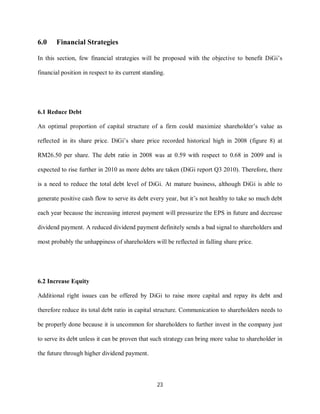
reflected in its share price. DiGi’s share price recorded historical high in 2008 (figure 8) at
RM26.50 per share. The debt ratio in 2008 was at 0.59 with respect to 0.68 in 2009 and is
expected to rise further in 2010 as more debts are taken (DiGi report Q3 2010). Therefore, there
is a need to reduce the total debt level of DiGi. At mature business, although DiGi is able to
generate positive cash flow to serve its debt every year, but it’s not healthy to take so much debt
each year because the increasing interest payment will pressurize the EPS in future and decrease
dividend payment. A reduced dividend payment definitely sends a bad signal to shareholders and
most probably the unhappiness of shareholders will be reflected in falling share price.
6.2 Increase Equity
Additional right issues can be offered by DiGi to raise more capital and repay its debt and
therefore reduce its total debt ratio in capital structure. Communication to shareholders needs to
be properly done because it is uncommon for shareholders to further invest in the company just
to serve its debt unless it can be proven that such strategy can bring more value to shareholder in
the future through higher dividend payment.
24
6.3 Stock Dividend
DiGi has started to pay more dividend than its net profit since 2007. Though this is not
something uncommon for a firm to pay dividend more than its net profit as long as it has very
high cash reserves but DiGi has also started to increase its borrowing since 2008 to maintain a
healthy cash flow due to high dividend payout since 2007. It’s impossible for a firm to continue
pay more dividend than net profit indefinitely without decreasing its cash level and debts.
However, more debts could distress the firm financial position in long term therefore its very
risky and unhealthy to finance high dividend payment by debts. In order to maintain
shareholder’s expectation with high dividend payment, stock dividend can be adopted by DiGi.
A stock dividend is not a true dividend because it is not paid in cash therefore it will not distress
the cash flow of the firm. The effect of a stock dividend is to increase the number of shares that
each owner holds. Shareholder who prefers cash in return can sell off the stock or keep it as
further investment to receive more dividends in the future.
6.4 Stock Split
A stock split is essentially the same thing as a stock dividend, except that a split is expressed as a
ratio instead of a percentage. When a split is declared, each share is split up to create additional
shares. For example, in a three-for-one stock split, each old share is split into three new shares.
Theoretically, a stock split will not have difference in economic accounting. Share price falls in
proportional to its split ratio. But in realistic, share price normally increases constantly after the
split like Public Bank and Genting. Therefore we hope that DiGi’s share price will experience
the same appreciation after the stock split. Another motivation to go for stock split is the popular
trading range. When the security is priced above this level, many investors do not have the funds
25
to buy the common trading unit of 100 shares, called a round lot. Although securities can be
purchased in odd-lot form (fewer than 100 shares), the commissions are higher. Thus, firms will
split the stock to keep the price in this trading range. Since DiGi’s share is priced above RM20
which is considered very much higher than its competitors like Maxis (RM5.30) and Axiata
(RM4.64), it’s necessary to split the stock and bring down the price to lower range.
26
7.0 References
1) Bank Negara Malaysia. (2010, Dec 16) [Online] Available at
https://fast.bnm.gov.my/fastweb/public/MainPage.do
2) Bloomberg Market Data. (2010, Dec 16) DiGi share price [Online] Available at
http://www.bloomberg.com/apps/quote?ticker=DIGI:MK
3) DiGi Publication. (2005). DiGi 2005 Annual Report
4) DiGi Publication. (2006). DiGi 2006 Annual Report
5) DiGi Publication. (2007). DiGi 2007 Annual Report
6) DiGi Publication. (2008). DiGi 2008 Annual Report
7) DiGi Publication. (2009). DiGi 2009 Annual Report
8) Midf Research. (2010, Oct 27). DiGi.com Strong growth in data with more to come.
Retrieved Dec 08th
, 2010, from http://www.midf.com.my/cms/investment-
banking/equity-beat
9) Ross, Westerfield, Jaffe & Jordan (2009). Modern Financial Management (Ed.)
Dividends and Other Payouts, pp. 537-539. McGRAW HILL
10) Tony Davies, Tony Boczko & Jean Chen (2008). Strategic Corporate Finance (Ed)
Financial Strategies from growth to maturity to decline, pp. 618-642. McGraw-Hill.
11) Brigham & Daves (2005). Intermediate Financial Management (Ed) Accounting for
financial management, pp.202-210. Thomson
27
8.0 Appendix
8.1 To Calculate EVA
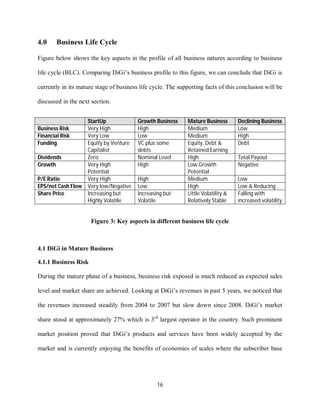
EVA = EBIT ( 1 – Corporate tax rate) – (Operating capital)(WACC)
EBIT = RM1,393,436,000
Corporate tax rate = 26%
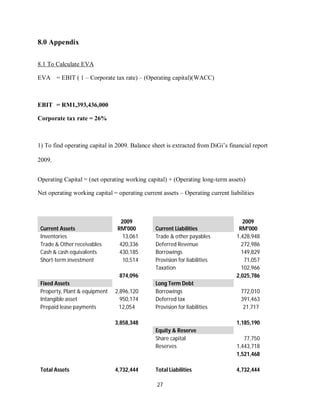
1) To find operating capital in 2009. Balance sheet is extracted from DiGi’s financial report
2009.
Operating Capital = (net operating working capital) + (Operating long-term assets)
Net operating working capital = operating current assets – Operating current liabilities
Current Assets
2009
RM'000 Current Liabilities
2009
RM'000
Inventories 13,061 Trade & other payables 1,428,948
Trade & Other receivables 420,336 Deferred Revenue 272,986
Cash & cash equivalents 430,185 Borrowings 149,829
Short-term investment 10,514 Provision for liabilities 71,057
Taxation 102,966
874,096 2,025,786
Fixed Assets Long Term Debt
Property, Plant & equipment 2,896,120 Borrowings 772,010
Intangible asset 950,174 Deferred tax 391,463
Prepaid lease payments 12,054 Provision for liabilities 21,717
3,858,348 1,185,190
Equity & Reserve
Share capital 77,750
Reserves 1,443,718
1,521,468
Total Assets 4,732,444 Total Liabilities 4,732,444
28
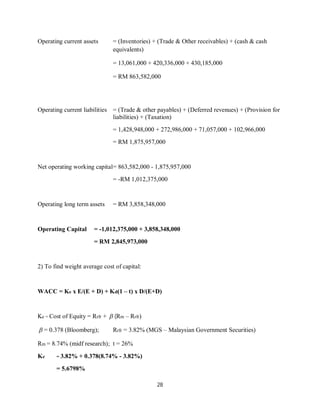
Operating current assets = (Inventories) + (Trade & Other receivables) + (cash & cash
equivalents)
= 13,061,000 + 420,336,000 + 430,185,000
= RM 863,582,000
Operating current liabilities = (Trade & other payables) + (Deferred revenues) + (Provision for
liabilities) + (Taxation)
= 1,428,948,000 + 272,986,000 + 71,057,000 + 102,966,000
= RM 1,875,957,000
Net operating working capital= 863,582,000 - 1,875,957,000
= -RM 1,012,375,000
Operating long term assets = RM 3,858,348,000
Operating Capital = -1,012,375,000 + 3,858,348,000
= RM 2,845,973,000
2) To find weight average cost of capital:
WACC = Ke x E/(E + D) + Kd(1 – t) x D/(E+D)
Ke = Cost of Equity = Rrfr +  (Rm – Rrfr)
 = 0.378 (Bloomberg); Rrfr = 3.82% (MGS – Malaysian Government Securities)
Rm = 8.74% (midf research); t = 26%
Ke = 3.82% + 0.378(8.74% - 3.82%)
= 5.6798%
29
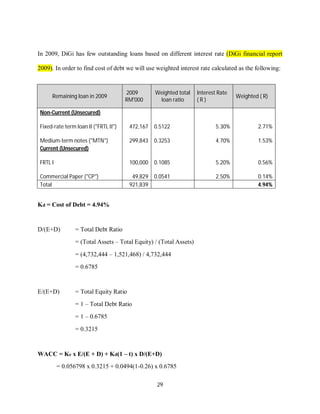
In 2009, DiGi has few outstanding loans based on different interest rate (DiGi financial report
2009). In order to find cost of debt we will use weighted interest rate calculated as the following:
Remaining loan in 2009
2009
RM'000
Weighted total
loan ratio
Interest Rate
( R )
Weighted ( R)
Non-Current (Unsecured)
Fixed-rate term loan II ("FRTL II") 472,167 0.5122 5.30% 2.71%
Medium-term notes ("MTN") 299,843 0.3253 4.70% 1.53%
Current (Unsecured)
FRTL I 100,000 0.1085 5.20% 0.56%
Commercial Paper ("CP") 49,829 0.0541 2.50% 0.14%
Total 921,839 4.94%
Kd = Cost of Debt = 4.94%
D/(E+D) = Total Debt Ratio
= (Total Assets – Total Equity) / (Total Assets)
= (4,732,444 – 1,521,468) / 4,732,444
= 0.6785
E/(E+D) = Total Equity Ratio
= 1 – Total Debt Ratio
= 1 – 0.6785
= 0.3215
WACC = Ke x E/(E + D) + Kd(1 – t) x D/(E+D)
= 0.056798 x 0.3215 + 0.0494(1-0.26) x 0.6785
30
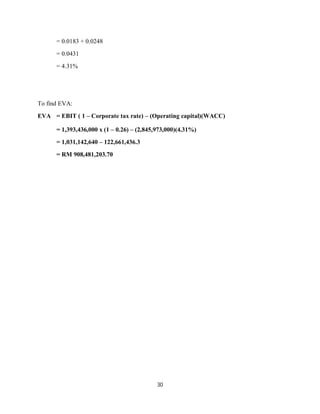
= 0.0183 + 0.0248
= 0.0431
= 4.31%
To find EVA:
EVA = EBIT ( 1 – Corporate tax rate) – (Operating capital)(WACC)
= 1,393,436,000 x (1 – 0.26) – (2,845,973,000)(4.31%)
= 1,031,142,640 – 122,661,436.3
= RM 908,481,203.70
31
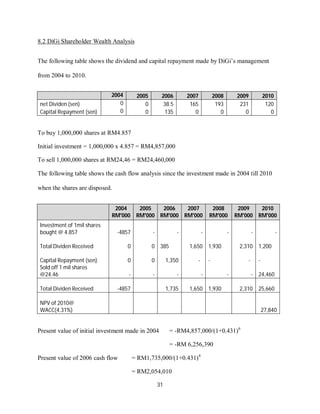
8.2 DiGi Shareholder Wealth Analysis
The following table shows the dividend and capital repayment made by DiGi’s management
from 2004 to 2010.
2004 2005 2006 2007 2008 2009 2010
net Dividen (sen) 0 0 38.5 165 193 231 120
Capital Repayment (sen) 0 0 135 0 0 0 0
To buy 1,000,000 shares at RM4.857
Initial investment = 1,000,000 x 4.857 = RM4,857,000
To sell 1,000,000 shares at RM24,46 = RM24,460,000
The following table shows the cash flow analysis since the investment made in 2004 till 2010
when the shares are disposed.
2004
RM'000
2005
RM'000
2006
RM'000
2007
RM'000
2008
RM'000
2009
RM'000
2010
RM'000
Investment of 1mil shares
bought @ 4.857 -4857 - - - - - -
Total Dividen Received 0 0 385 1,650 1,930 2,310 1,200
Capital Repayment (sen) 0 0 1,350 - - - -
Sold off 1 mil shares
@24.46 - - - - - - 24,460
Total Dividen Received -4857 1,735 1,650 1,930 2,310 25,660
NPV of 2010@
WACC(4.31%) 27,840
Present value of initial investment made in 2004 = -RM4,857,000/(1+0.431)6
= -RM 6,256,390
Present value of 2006 cash flow = RM1,735,000/(1+0.431)4
= RM2,054,010
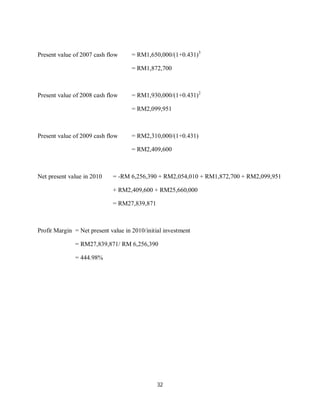
32
Present value of 2007 cash flow = RM1,650,000/(1+0.431)3
= RM1,872,700
Present value of 2008 cash flow = RM1,930,000/(1+0.431)2
= RM2,099,951
Present value of 2009 cash flow = RM2,310,000/(1+0.431)
= RM2,409,600
Net present value in 2010 = -RM 6,256,390 + RM2,054,010 + RM1,872,700 + RM2,099,951
+ RM2,409,600 + RM25,660,000
= RM27,839,871
Profit Margin = Net present value in 2010/initial investment
= RM27,839,871/ RM 6,256,390
= 444.98%

Corporate finance strategy project on digi analysis

  • 1.
    BFS 7154 –Corporate Financial Strategies Project Report Strategic Financial Project Analysis: DiGi Chan Kwai Sang
  • 2.
    2 Contents 1.0 Executive Summary.....................................................................................................................4 2.0SWOT Analysis...........................................................................................................................6 2.1 Strengths........................................................................................................................................6 2.2 Weaknesses ...................................................................................................................................7 2.3 Opportunities.................................................................................................................................7 2.4 Threats...........................................................................................................................................8 3.0 Financial Analysis......................................................................................................................10 3.1 Liquidity Measure........................................................................................................................10 3.2 Financial Leverage.......................................................................................................................11 3.3 Turnover Measure........................................................................................................................12 3.4 Profitability Measures..................................................................................................................12 3.5 Financial Highlights Summary.....................................................................................................13 3.6 MVA...........................................................................................................................................14 3.7 EVA ............................................................................................................................................15 4.0 Business Life Cycle ...................................................................................................................16 4.1 DiGi in Mature Business..............................................................................................................16 4.1.1 Business Risk........................................................................................................................16 4.1.2 Financial Risk .......................................................................................................................17 4.1.3 Funding.................................................................................................................................18 4.1.4 Dividend ............................................................................................................................... 18 4.1.5 Growth..................................................................................................................................19 4.1.6 P/E Ratio............................................................................................................................... 19 4.1.7 EPS/ net Cash Flow...............................................................................................................19 4.1.8 Share Price............................................................................................................................20 5.0 DiGi Shareholder Wealth Analysis............................................................................................. 21 6.0 Financial Strategies....................................................................................................................23 6.1 Reduce Debt ................................................................................................................................ 23 6.2 Increase Equity ............................................................................................................................23 6.3 Stock Dividend ............................................................................................................................24 6.4 Stock Split ...................................................................................................................................24 7.0 References.......................................................................................................................................26
  • 3.
  • 4.
    4 1.0 Executive Summary DiGi.ComBerhad is listed on Bursa Malaysia Securities Berhad and is part of global telecommunications provider, Telenor Group. Its mobile service operations are undertaken by its wholly-owned subsidiary, DiGi Telecommunication Sdn Bhd. DiGi commenced operations in May 1995 when it launched its fully digital GSM 1800 services, the first digital mobile communications service in Malaysia. In the last 5 years, DiGi’s revenue has more than doubled to approximately RM4.9 billion with a subscriber base of 7.7 million. DiGi is now the 3rd largest operator carrier in Malaysia with 27% market shares and with market capitalization of approximate RM18 billion. Currently, more than 3000 employees are hired by DiGi nationwide. In this report, DiGi is selected as a model company to be analyzed and the focus of the analysis will be at its financial position. Generally, this report will try to answer the following questions: i. Perform a SWOT analysis on this blue chip company and identify the relevant risks associate with this company, both internally and externally to their operations. ii. Select the relevant financial ratios to assess the financial status of this company. If possible, calculate the economic value added (EVA) and the market valued added (MVA) for this firm and assess its value over the years based on your analysis. iii. Identify at what stage the life cycle of this company and provide reasons to justify your claim.
  • 5.
    5 iv. As ashareholder or potential investor, are you satisfy with the financial performance and financial position of this company? Explain and justify your decision. v. What will be the appropriate financial strategies for this company now? Also, include other qualitative factors beside just financial strategies.
  • 6.
    6 2.0 SWOT Analysis STRENGTHS 1.Innovation 2. Strategic in low cost leadership 3. Economies of scale 4. High operating margin 5. Strong presence in migrant segment 6. High entry barrier 7. Strong adaptability to market change WEAKNESSES 1. Growing COGS 2. Saturation in voice market OPPORTUNITIES 1. Mobile broadband 2. New MVNO 3. Corporate Entrepreneur 4. Expansion to other market segments 5. Smart phones & devices 6. Growth in VAS businesses 7. Strategic alliance with Axiata group 8. Outsourcing THREATS 1. MVNO rivalry 2. Migrant segment being attacked 3. Growing competition in mobile broadband market 4. Increasing financial risk Figure 1: DiGi’s SWOT Analysis 2.1 Strengths One of the key strengths of DiGi is its well known innovative approach to the market. The ‘Yellow Man’ marketing campaign has been so far very successful in its market place. Products and services offered by DiGi have been very innovative. DiGi Prepaid (Hit RM1), Friends and Family, Talk time transfer, DiGi Bonuses, DiGi Privileges, DiGi Priority Services, just to name a few have all been very well responded in the market. Its low cost leadership strategy has turned DiGi into be one of the market leaders in the country. In fact, it has triggered price war among the competitors with its low cost strategy. DiGi’s subscriber base stood at 8.2 mil as of Sept 2010 (DiGi Annual Report, 2009). With its economies of scale DiGi is able to operate in higher
  • 7.
    7 margin with EBITDAbetween 43%-48% in past 5 years (DiGi Annual Report, 2009). DiGi commands a very strong presence in migrant segment as it coups the largest market share in this niche market segment compare to its competitor. Due to fact that the initial investment required in this telecommunication industry is very big, the entry barrier to any potential new players is very high. Nevertheless, with the advent of Mobile Virtual Network Operator (MVNO) in the market place, the entry barrier faced by the traditional operators has been reduced tremendously. But this MVNO can be seen as either opportunity or threat to the existing business, depends on how existing player deals with it. We shall see this in opportunities and threats session later. Another key strength of DiGi is its strong adaptability to the market change. Despite DiGi’s later entry into the mobile broadband and mobile internet space, its offerings have been well received by the market since its launch in 2009 (DiGi Annual Report, 2009) 2.2 Weaknesses One of the key weaknesses of DiGi is its growing cost of goods sold (COGS) in recent years. DiGi’s COGS has increased from 20% in year 2007 to 24% of its revenue in year 2009 (DiGi Annual Report, 2009). Another weakness is the voice market has reached its saturation with more than 100% cell phone penetration in Malaysia. 2.3 Opportunities When voice market has already reached its peak and with decaying profit margin, new streams of revenue must be explored. Looking into the low penetration rate of mobile broadband in Malaysia at only 30% in year 2009 (DiGi Annual Report, 2009), there is certainly huge growth opportunity in this market segment. Besides that, Mobile Virtual Network Operator which is
  • 8.
    8 known as MVNOcan be seen as another opportunity of growth. MVNO who does not own any infrastructures and equipments operates on top of existing operator’s network. Therefore, network leasing to this new MVNO can be seen as new revenue stream. There is opportunity in corporate entrepreneur business in DiGi if it can diversify its business into other industry like internet business and etc. There is so much room for improvement in market share in other market segments like malay youth, young professional, enterprise business. DiGi can increase its market presence in this segment if it can successfully expand its product and service range into these market segments. The introduction of iphone4, iPad, and blackberry gives opportunity to operator to bundle these smartphones and devices with their current service offerings. Such offerings have been well received by the market and future growth could be anticipated. In addition, value added services (VAS) can be another opportunity to further increase average revenue per user (ARPU) of current usage. Therefore, more VAS than the like’s friend finder, digimusic, caller ringtones can be explored and launched to the market. This year, DiGi’s mother company TELENOR has signed a memorandum with Axiata Group to joint sharing their existing infrastructure as part of the cost saving synergy. This gives opportunity to DiGi to further reduce its CAPEX spending thus improving its earning. Last but not least, outsourcing the non core business units can be seen as another opportunity to re-dimension DiGi’s business into a more sustainable strategic and competitive position than its competitors. 2.4 Threats As what has been discussed earlier, MVNO can be seen as a threat to the current DiGi’s business. It becomes a threat to DiGi’s business when MVNO leases competitor’s infrastructure and start attacking DiGi’s market segment where it has strong presence like migrant segment.
  • 9.
    9 This will certainlytrigger another round of price war which could eventually reduce the profit margin and thus earning per share (EPS). The later entry of YTL E-Solution (YES) with already existing WIMAX operator like P1, the mobile broadband market certainly will see further increases in the already intense competition. Lastly, there is a tendency of increasing financial risk resulted from borrowing since year 2008 (DiGi Annual Report, 2009).
  • 10.
    10 3.0 Financial Analysis Inthis session, we will analyze DiGi’s financial historical data from 2005 to 2009. All financial data are extracted from DiGi’s financial year report in those respective years. 3.1 Liquidity Measure FORMULA Liquidity Measures 2005 2006 2007 2008 2009 Short Term Solvency Current Ratio Current Assets /Current liabilities 1.08 0.69 0.54 0.34 0.43 Quick Ratio Current Assests -Inventory /Current liabilities 1.07 0.68 0.54 0.34 0.43 Cash Ratio Cash /Current liabilities 0.91 0.53 0.33 0.15 0.21 Short term solvency provides information about a firm’s liquidity. According to DiGi’s current ratio from 2005 – 2009, we notice that DiGi only achieved positive net working capital in year 2005. Most of the time, DiGi operated under negative net working capital. It shows that DiGi did not have sufficient cash convertible assets to cover its liabilities in short term. This could be a real concern to DiGi’s supplier as the company did not have sufficient liquidity to pay off the short term debt. We also noticed that quick ratio was similar to current ratio. This is because DiGi always has low inventory level. In spite of negative net working capital and low inventory level, we see this as the nature of telecommunication business rather than unhealthy company performance. Likewise, DiGi’s biggest competitor Maxis also experience negative net working capital in its 2009 Q3 performance. DiGi’s cash ratio was rather low compared to its current
  • 11.
    11 liabilities obligation. Lastyear, DiGi’s cash in hand was only sufficient to cover 0.21 times of its current liabilities. 3.2 Financial Leverage Financial Leverage 2005 2006 2007 2008 2009 Long Term Solvency Total Debt Ratio Total Assests - Total Equity /Total Assets 0.47 0.40 0.59 0.59 0.68 Debt-equity ratio Total Debt/Total Equity 0.89 0.67 1.44 1.44 2.13 Equity multiplier Total assests /Total Equity 1.88 1.68 2.46 2.45 3.11 Long term solvency ratios are intended to address the company’s long-run ability to meet its obligations or, more generally, its financial leverage. In 2005, DiGi’s total debt ratio was still 0.47. It means DiGi has RM 0.47 in debt for every RM 1 in assets. However, the total debt ratio increased to 0.68 in 2009; hence debt-equity ratio became 2.13 from 0.89. This shows that capital structure of DiGi has changed significantly. The drastic change between 2006 and 2007 where we see the debt-equity ratio was increased from 0.67 to 1.44 was due to the capital repayment done by DiGi in 2007 (DiGi Annual Report, 2007).
  • 12.
    12 3.3 Turnover Measure TurnoverMeasures 2005 2006 2007 2008 2009 Inventory Turnover Cost of Goods Sold /Inventory 78.78 94.83 102.66 63.96 89.65 Days' Sales in Inventory 365 days /Inventory turnover 4.63 3.85 3.56 5.71 4.07 Receivables Turnover Sales /Accounts Receivables 13.45 14.55 12.41 11.44 11.68 Days' Sales in receivables 365 days /Receivables turnover 27.14 25.08 29.42 31.90 31.25 Total Asset Turnover Sales /Total Assests 1.02 1.24 1.48 1.24 1.27 In this session, we shall see how efficient DiGi was in dealing with its assets. Impressively, DiGi’s inventory turnover was very quick in last 5 years. From 2005 to 2009, DiGi’s inventory was sold in less than 1 week (Days’ Sales In Inventory). Likewise, DiGi needed approximate 1 month to collect outstanding credit accounts (Days’ Sales in receivables). DiGi’s total asset turnover was improving from 1.02 in 2005 to 1.27 in 2009. It means that DiGi was making RM 1.27 sales for every RM 1 in asset in 2009 almost 27% up from 5 years ago. We may conclude that DiGi is improving in asset management. 3.4 Profitability Measures Profitability Measures 2005 2006 2007 2008 2009 Profit Margin Net Income /Sales 16.33% 22.06% 24.36% 23.69% 20.38% Return on Assets ( ROA) Net Income / Total assets 11.13% 19.77% 27.40% 24.50% 21.14% Return on Equity (ROE) Net Income /Total Equity 20.95% 33.19% 67.35% 60.13% 65.76%
  • 13.
    13 Based on theprofit margin of DiGi in last 5 years, we can see that the profit margin was improving from 16.33% in 2005 to 23.69% in 2008. However, profit margin was fallen to 20.38% in 2009. The fall might due to economy slow down impacted by US financial subprime in the previous year. Likewise, ROA also fallen in 2009 due to reduced net income in that year. However, ROE increased in year 2009. It was due to reduced total equity resulted from reduced reserves level (DiGi Annual Report, 2009). 3.5 Financial Highlights Summary Year Ended 31 Dec 2005 RM ‘000 Year Ended 31 Dec 2006 RM ‘000 Year Ended 31 Dec 2007 RM ‘000 Year Ended 31 Dec 2008 RM ‘000 Year Ended 31 Dec 2009 RM ‘000 Revenue 2,884,324 3,652,536 4,362,635 4,814,475 4,909,565 Profit before taxation 661,550 1,087,139 1,445,314 1,546,896 1,366,455 Net profit 470,955 805,653 1,062,595 1,140,715 1,000,471 Total assets 4,232,319 4,076,147 3,877,491 4,655,852 4,732,444 Shareholder’s fund 2,248.148 1,752,401 1,577,645 1,897,172 1,521,468 Long term liabilities 681,548 685,105 573,791 491,557 1,185,190 Net profit as % of revenue 16.3% 22.1% 24.4% 23.7% 20.4% EBITDA 43.66% 46.40% 48.36% 45.10% 43.27% EPS (sen) 62.8 107.4 141.7 148.5 128.7 Net tangible assets per share (sen) 3.00 2.34 2.10 2.44 1.96 Figure 2: DiGi’s financial highlights summary
  • 14.
    14 According to DiGi’sfinancial summary from 2005 to 2009, we are impressed by the solid growth achieved by the company every year. The revenue grew steadily every year.. EBITDA was maintained at around 45% every year with peak recorded at 2007 where EBITDA rose to 48.36%. At the same year, net profit also recorded its best margin at 24.4%. Likewise, ROA & ROE of 2007 were also the highest in recent years. Therefore, we may conclude that DiGi was growing rapidly from 2004 to 2007 where its best performance was recorded in that year but slow down the pace in 2008. The earning per share (EPS) was growing from 62.8 cents in 2005 to 128.7 cents in 2009 but peaked in 2008 with 148.5 cents recorded. The dilution of EPS in 2009 was due to reduced net profit resulted from economy recession. 3.6 MVA Market Value Added (MVA) is the difference between the market value of the firm’s stock and the amount of equity capital that was supplied by shareholders. The bigger is the difference the more shareholder wealth is created. According to DiGi’s financial report 2009, the outstanding shares was 777.5mil and total common equity was equivalent to RM1,521.486mil (Financial Report 2009). The stock price as per 31st Dec 2009 was closed at RM21.96 (Bloomberg). Therefore; MVA = (shares outstanding)(Stock Price) – Total common equity MVA = (777.5mil)(21.96) – 1,521.486mil = RM15,552,414,000
  • 15.
    15 Therefore, DiGi’s managementhas actually created additional value of RM15,552,414,000 to shareholder wealth. 3.7 EVA Whereas MVA measures the effects of managerial actions since the very inception of a company, Economy Value Added (EVA) focuses on managerial effectiveness in a given year. The EVA basic formula is as follows: EVA = NOPAT – After-tax dollar cost of capital used to support operations = EBIT(1 – Corporate tax rate) – (Operating Capital)(WACC) EVA = 1,393,436,000 x (1 – 0.26) – (2,845,973,000)(4.31%) = 1,031,142,640 – 122,661,436.3 = RM 908,481,203.70 (please refer to appendix 8.1 for working steps)
  • 16.
    16 4.0 Business LifeCycle Figure below shows the key aspects in the profile of all business natures according to business life cycle (BLC). Comparing DiGi’s business profile to this figure, we can conclude that DiGi is currently in its mature stage of business life cycle. The supporting facts of this conclusion will be discussed in the next section. StartUp Growth Business Mature Business Declining Business Business Risk Very High High Medium Low Financial Risk Very Low Low Medium High Funding Equity by Venture Capitalist VC plus some debts Equity, Debt & Retained Earning Debt Dividends Zero Nominal Level High Total Payout Growth Very High Potential High Low Growth Potential Negative P/E Ratio Very High High Medium Low EPS/net Cash Flow Very low/Negative Low High Low & Reducing Share Price Increasing but Highly Volatile Increasing but Volatile Little Volatility & Relatively Stable Falling with increased volatility Figure 3: Key aspects in different business life cycle 4.1 DiGi in Mature Business 4.1.1 Business Risk During the mature phase of a business, business risk exposed is much reduced as expected sales level and market share are achieved. Looking at DiGi’s revenues in past 5 years, we noticed that the revenues increased steadily from 2004 to 2007 but slow down since 2008. DiGi’s market share stood at approximately 27% which is 3rd largest operator in the country. Such prominent market position proved that DiGi’s products and services have been widely accepted by the market and is currently enjoying the benefits of economies of scales where the subscriber base
  • 17.
    17 stood at 8.2millions as in Sept 2010. Therefore, the business risk of DiGi is at medium level due to lower risk of business failure with constant sales level and significant market share. Figure 4: DiGi’s revenue from 2004 to 2009 4.1.2 Financial Risk The financial risk is increasing during mature business. Financial risk may be increased through an increase in debt levels where company may need to pay higher interest to service debt every year which eventually diluting EPS. In mature business, company tends to promise high dividend payout due to limited investment opportunities and growth in the future. Therefore, dividend payout commitment during mature business increases its financial risk compare to start up and growth business phase. In DiGi case, the gearing ratio is increasing in the past 5 years. The total debt ratio of DiGi is increasing from 0.5 in 2004 to 0.68 in 2009. As for dividend payout, DiGi revised dividend policy in October 2009 to a higher dividend payout ratio of a minimum 85% to be paid out from its net profit (Johan Dennelind, 2009) compare to only 50% dividend policy 0 1,000,000 2,000,000 3,000,000 4,000,000 5,000,000 6,000,000 2004 RM'000 2005 RM'000 2006 RM'000 2007 RM'000 2008 RM'000 2009 RM'000 Revenue Revenue
  • 18.
    18 previously. Therefore, financialrisk is maintained at a medium level through a mix of debt and equity financing. Figure 5: DiGi total debt ratio since 2004 to 2009 4.1.3 Funding Referring to DiGi’s latest capital structure, DiGi finances its business through equity, debt and retained earnings. Such phenomenon proves that DiGi is currently operating under mature business condition. 4.1.4 Dividend As mentioned earlier, DiGi practices a very high dividend payout policy. Company usually pays high dividend during mature business due to limited attractive investment opportunities available in the future. Instead of holding so much in retained earning without adding values in it, then it’s better to distribute the cash back to shareholders through dividend payout. 0.00 0.10 0.20 0.30 0.40 0.50 0.60 0.70 0.80 2004 2005 2006 2007 2008 2009 Total Debt Ratio Total Debt Ratio
  • 19.
    19 4.1.5 Growth DiGi’s futuregrowth is limited due to market penetration has exceeded 100%. In BCG term, DiGi is viewed as Cash Cow due to large market share but low growth potential. 4.1.6 P/E Ratio As per 16th December 2010, DiGi’s share price closed at RM24.86 (Source: Blomberg, 2010). Its P/E ratio stands at 17.69 times. This P/E ratio is considered relatively low. 4.1.7 EPS/ net Cash Flow DiGi’s earning per share (EPS) was increasing in past 5 years. The EPS dilution in 2009 was due to reduced net profit caused by economic recession in that year. Figure 6: DiGi’s EPS since 2004 to 2009 - 20.00 40.00 60.00 80.00 100.00 120.00 140.00 160.00 2004 2005 2006 2007 2008 2009 Earnings per ordinary share (sen) Earnings per ordinary share (sen)
  • 20.
    20 Referring to DiGi’slatest financial report, DiGi has very high positive cash flow. 4.1.8 Share Price DiGi’s share price stands at RM24.86 and is less volatile. In past 1 year, DiGi’s share has been varies between RM22 to RM26 (Source: Bloomberg, 2010). Figure 7: DiGi’s share performance in past 12 months
  • 21.
    21 5.0 DiGi ShareholderWealth Analysis Financial performance of DiGi is directly proportional to shareholder wealth. As a shareholder or investor of DiGi, I am concerned about how much returned I have gained in the form of i) dividend received; ii) Capital Repayment and iii) Capital Gain provided I sell off the shares I have invested. Figure 8: DiGi’s share price history Let’s say I bought 1mil shares at the price of RM4.857 per share in year end 2004 and disposed all at the price of RM24.46 in year end 2010. Assume that require rate of return equal to weighted average cost of capital (WACC) that calculated previously which is 4.31%. The net present value of my investment in 2010 will be RM 27,839,871. The profit margin will be 444.98%. If I were the shareholder or investor of DiGi, I would have been extremely happy and 4.857 26.5 24.46 0 5 10 15 20 25 30 11/30/2004 2/28/2005 5/31/2005 8/31/2005 11/30/2005 2/28/2006 5/31/2006 8/31/2006 11/30/2006 2/28/2007 5/31/2007 8/31/2007 11/30/2007 2/29/2008 5/30/2008 8/29/2008 11/28/2008 2/27/2009 5/29/2009 8/31/2009 11/30/2009 2/26/2010 5/31/2010 8/31/2010 11/30/2010 Price Price
  • 22.
    22 excited with DiGi’smanagement effort in creating wealth to my investment. Therefore I am very happy with DiGi’s financial performance in the past 5-6 years. (please refer to appendix 8.2 for working steps)
  • 23.
    23 6.0 Financial Strategies Inthis section, few financial strategies will be proposed with the objective to benefit DiGi’s financial position in respect to its current standing. 6.1 Reduce Debt An optimal proportion of capital structure of a firm could maximize shareholder’s value as reflected in its share price. DiGi’s share price recorded historical high in 2008 (figure 8) at RM26.50 per share. The debt ratio in 2008 was at 0.59 with respect to 0.68 in 2009 and is expected to rise further in 2010 as more debts are taken (DiGi report Q3 2010). Therefore, there is a need to reduce the total debt level of DiGi. At mature business, although DiGi is able to generate positive cash flow to serve its debt every year, but it’s not healthy to take so much debt each year because the increasing interest payment will pressurize the EPS in future and decrease dividend payment. A reduced dividend payment definitely sends a bad signal to shareholders and most probably the unhappiness of shareholders will be reflected in falling share price. 6.2 Increase Equity Additional right issues can be offered by DiGi to raise more capital and repay its debt and therefore reduce its total debt ratio in capital structure. Communication to shareholders needs to be properly done because it is uncommon for shareholders to further invest in the company just to serve its debt unless it can be proven that such strategy can bring more value to shareholder in the future through higher dividend payment.
  • 24.
    24 6.3 Stock Dividend DiGihas started to pay more dividend than its net profit since 2007. Though this is not something uncommon for a firm to pay dividend more than its net profit as long as it has very high cash reserves but DiGi has also started to increase its borrowing since 2008 to maintain a healthy cash flow due to high dividend payout since 2007. It’s impossible for a firm to continue pay more dividend than net profit indefinitely without decreasing its cash level and debts. However, more debts could distress the firm financial position in long term therefore its very risky and unhealthy to finance high dividend payment by debts. In order to maintain shareholder’s expectation with high dividend payment, stock dividend can be adopted by DiGi. A stock dividend is not a true dividend because it is not paid in cash therefore it will not distress the cash flow of the firm. The effect of a stock dividend is to increase the number of shares that each owner holds. Shareholder who prefers cash in return can sell off the stock or keep it as further investment to receive more dividends in the future. 6.4 Stock Split A stock split is essentially the same thing as a stock dividend, except that a split is expressed as a ratio instead of a percentage. When a split is declared, each share is split up to create additional shares. For example, in a three-for-one stock split, each old share is split into three new shares. Theoretically, a stock split will not have difference in economic accounting. Share price falls in proportional to its split ratio. But in realistic, share price normally increases constantly after the split like Public Bank and Genting. Therefore we hope that DiGi’s share price will experience the same appreciation after the stock split. Another motivation to go for stock split is the popular trading range. When the security is priced above this level, many investors do not have the funds
  • 25.
    25 to buy thecommon trading unit of 100 shares, called a round lot. Although securities can be purchased in odd-lot form (fewer than 100 shares), the commissions are higher. Thus, firms will split the stock to keep the price in this trading range. Since DiGi’s share is priced above RM20 which is considered very much higher than its competitors like Maxis (RM5.30) and Axiata (RM4.64), it’s necessary to split the stock and bring down the price to lower range.
  • 26.
    26 7.0 References 1) BankNegara Malaysia. (2010, Dec 16) [Online] Available at https://fast.bnm.gov.my/fastweb/public/MainPage.do 2) Bloomberg Market Data. (2010, Dec 16) DiGi share price [Online] Available at http://www.bloomberg.com/apps/quote?ticker=DIGI:MK 3) DiGi Publication. (2005). DiGi 2005 Annual Report 4) DiGi Publication. (2006). DiGi 2006 Annual Report 5) DiGi Publication. (2007). DiGi 2007 Annual Report 6) DiGi Publication. (2008). DiGi 2008 Annual Report 7) DiGi Publication. (2009). DiGi 2009 Annual Report 8) Midf Research. (2010, Oct 27). DiGi.com Strong growth in data with more to come. Retrieved Dec 08th , 2010, from http://www.midf.com.my/cms/investment- banking/equity-beat 9) Ross, Westerfield, Jaffe & Jordan (2009). Modern Financial Management (Ed.) Dividends and Other Payouts, pp. 537-539. McGRAW HILL 10) Tony Davies, Tony Boczko & Jean Chen (2008). Strategic Corporate Finance (Ed) Financial Strategies from growth to maturity to decline, pp. 618-642. McGraw-Hill. 11) Brigham & Daves (2005). Intermediate Financial Management (Ed) Accounting for financial management, pp.202-210. Thomson
  • 27.
    27 8.0 Appendix 8.1 ToCalculate EVA EVA = EBIT ( 1 – Corporate tax rate) – (Operating capital)(WACC) EBIT = RM1,393,436,000 Corporate tax rate = 26% 1) To find operating capital in 2009. Balance sheet is extracted from DiGi’s financial report 2009. Operating Capital = (net operating working capital) + (Operating long-term assets) Net operating working capital = operating current assets – Operating current liabilities Current Assets 2009 RM'000 Current Liabilities 2009 RM'000 Inventories 13,061 Trade & other payables 1,428,948 Trade & Other receivables 420,336 Deferred Revenue 272,986 Cash & cash equivalents 430,185 Borrowings 149,829 Short-term investment 10,514 Provision for liabilities 71,057 Taxation 102,966 874,096 2,025,786 Fixed Assets Long Term Debt Property, Plant & equipment 2,896,120 Borrowings 772,010 Intangible asset 950,174 Deferred tax 391,463 Prepaid lease payments 12,054 Provision for liabilities 21,717 3,858,348 1,185,190 Equity & Reserve Share capital 77,750 Reserves 1,443,718 1,521,468 Total Assets 4,732,444 Total Liabilities 4,732,444
  • 28.
    28 Operating current assets= (Inventories) + (Trade & Other receivables) + (cash & cash equivalents) = 13,061,000 + 420,336,000 + 430,185,000 = RM 863,582,000 Operating current liabilities = (Trade & other payables) + (Deferred revenues) + (Provision for liabilities) + (Taxation) = 1,428,948,000 + 272,986,000 + 71,057,000 + 102,966,000 = RM 1,875,957,000 Net operating working capital= 863,582,000 - 1,875,957,000 = -RM 1,012,375,000 Operating long term assets = RM 3,858,348,000 Operating Capital = -1,012,375,000 + 3,858,348,000 = RM 2,845,973,000 2) To find weight average cost of capital: WACC = Ke x E/(E + D) + Kd(1 – t) x D/(E+D) Ke = Cost of Equity = Rrfr +  (Rm – Rrfr)  = 0.378 (Bloomberg); Rrfr = 3.82% (MGS – Malaysian Government Securities) Rm = 8.74% (midf research); t = 26% Ke = 3.82% + 0.378(8.74% - 3.82%) = 5.6798%
  • 29.
    29 In 2009, DiGihas few outstanding loans based on different interest rate (DiGi financial report 2009). In order to find cost of debt we will use weighted interest rate calculated as the following: Remaining loan in 2009 2009 RM'000 Weighted total loan ratio Interest Rate ( R ) Weighted ( R) Non-Current (Unsecured) Fixed-rate term loan II ("FRTL II") 472,167 0.5122 5.30% 2.71% Medium-term notes ("MTN") 299,843 0.3253 4.70% 1.53% Current (Unsecured) FRTL I 100,000 0.1085 5.20% 0.56% Commercial Paper ("CP") 49,829 0.0541 2.50% 0.14% Total 921,839 4.94% Kd = Cost of Debt = 4.94% D/(E+D) = Total Debt Ratio = (Total Assets – Total Equity) / (Total Assets) = (4,732,444 – 1,521,468) / 4,732,444 = 0.6785 E/(E+D) = Total Equity Ratio = 1 – Total Debt Ratio = 1 – 0.6785 = 0.3215 WACC = Ke x E/(E + D) + Kd(1 – t) x D/(E+D) = 0.056798 x 0.3215 + 0.0494(1-0.26) x 0.6785
  • 30.
    30 = 0.0183 +0.0248 = 0.0431 = 4.31% To find EVA: EVA = EBIT ( 1 – Corporate tax rate) – (Operating capital)(WACC) = 1,393,436,000 x (1 – 0.26) – (2,845,973,000)(4.31%) = 1,031,142,640 – 122,661,436.3 = RM 908,481,203.70
  • 31.
    31 8.2 DiGi ShareholderWealth Analysis The following table shows the dividend and capital repayment made by DiGi’s management from 2004 to 2010. 2004 2005 2006 2007 2008 2009 2010 net Dividen (sen) 0 0 38.5 165 193 231 120 Capital Repayment (sen) 0 0 135 0 0 0 0 To buy 1,000,000 shares at RM4.857 Initial investment = 1,000,000 x 4.857 = RM4,857,000 To sell 1,000,000 shares at RM24,46 = RM24,460,000 The following table shows the cash flow analysis since the investment made in 2004 till 2010 when the shares are disposed. 2004 RM'000 2005 RM'000 2006 RM'000 2007 RM'000 2008 RM'000 2009 RM'000 2010 RM'000 Investment of 1mil shares bought @ 4.857 -4857 - - - - - - Total Dividen Received 0 0 385 1,650 1,930 2,310 1,200 Capital Repayment (sen) 0 0 1,350 - - - - Sold off 1 mil shares @24.46 - - - - - - 24,460 Total Dividen Received -4857 1,735 1,650 1,930 2,310 25,660 NPV of 2010@ WACC(4.31%) 27,840 Present value of initial investment made in 2004 = -RM4,857,000/(1+0.431)6 = -RM 6,256,390 Present value of 2006 cash flow = RM1,735,000/(1+0.431)4 = RM2,054,010
  • 32.
    32 Present value of2007 cash flow = RM1,650,000/(1+0.431)3 = RM1,872,700 Present value of 2008 cash flow = RM1,930,000/(1+0.431)2 = RM2,099,951 Present value of 2009 cash flow = RM2,310,000/(1+0.431) = RM2,409,600 Net present value in 2010 = -RM 6,256,390 + RM2,054,010 + RM1,872,700 + RM2,099,951 + RM2,409,600 + RM25,660,000 = RM27,839,871 Profit Margin = Net present value in 2010/initial investment = RM27,839,871/ RM 6,256,390 = 444.98%