Maxillary sinus:
It’s the pneumatic space that is lodged inside the body of maxilla and
that communicate with the environment by the way of middle meatus
and the nasal vestibule.
Introduction:
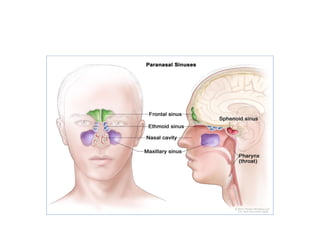
Paranasal sinuses (PNS) are air containing bony spaces around nasal
cavity.
Usually lined by respiratory mucous membrane of ciliated columnar
epithelium.
4 paired (bilateral) PNS are:
-Maxillary
-Frontal
-sphenoid.
- Ethmoidal.
• Maxillary Sinus Infection:
• When inflammation develops in the sinus
either due to infection or allergy, it is defined
"sinusitis" and it's the most common disease of
the sinus.
• Maxillary sinusitis could be broadly divided
into:
• • Acute
• • Sub-acute
• • Chronic
Dental Implication of Maxillary
Sinus
• Maxillary Sinusitis of Dental Origin:
• Spread of infection from peri-apical or
periodontal lesions.
• Over extension of sealers , cements , GP or
silver cones.
• Periapical surgery of maxillary posterior teeth.
• Iatrogenic: sinus perforation or instrument
breakage
• Toothache of Maxillary Sinus Origin:
• In sinusitis a feeling of constant dull aching
pressure or discomfort could be felt on the
posterior maxillary teeth.
• Etiology:
• Part of the nerve supply of the sinus is
posterior superior alveolar nerve that supply
the posterior teeth at the same time.
• Clinical Characteristics of Sinus Toothache:
• Dull, constant, non-pulsating aching pain in maxillary
posterior teeth and sometimes all the teeth in the affected
side.
• Infra-orbital redness.
• Toothache is increased with lowering or bending forward the
head.
• Pain on palpation of the affected sinus.
• Pt. may complain of feeling of teeth elongation.
• Teeth are sensitive to percussion or chewing and to cold
drinks and food.
Oro-Antral Communication & Fistula
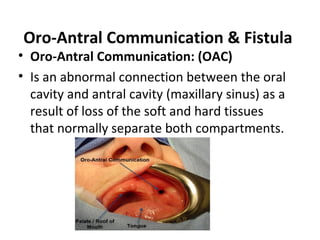
• Oro-Antral Communication: (OAC)
• Is an abnormal connection between the oral
cavity and antral cavity (maxillary sinus) as a
result of loss of the soft and hard tissues
that normally separate both compartments.
• Oro-Antral Fistula: (OAF)
• Is a pathological fistular canal lined with
epithelium (stratified squamous epithelium)
which may or may not be filled with
granulation tissue or polyposis of the sinus
mucous membrane.
• Oro-Antral Fistula: (OAF)
• Is a pathological fistular canal lined with
epithelium (stratified squamous epithelium)
which may or may not be filled with
granulation tissue or polyposis of the sinus
mucous membrane.

Maxillary sinus ppt

  • 1.
    Maxillary sinus: It’s thepneumatic space that is lodged inside the body of maxilla and that communicate with the environment by the way of middle meatus and the nasal vestibule. Introduction: Paranasal sinuses (PNS) are air containing bony spaces around nasal cavity. Usually lined by respiratory mucous membrane of ciliated columnar epithelium. 4 paired (bilateral) PNS are: -Maxillary -Frontal -sphenoid. - Ethmoidal.
  • 3.
    • Maxillary SinusInfection: • When inflammation develops in the sinus either due to infection or allergy, it is defined "sinusitis" and it's the most common disease of the sinus. • Maxillary sinusitis could be broadly divided into: • • Acute • • Sub-acute • • Chronic
  • 4.
    Dental Implication ofMaxillary Sinus • Maxillary Sinusitis of Dental Origin: • Spread of infection from peri-apical or periodontal lesions. • Over extension of sealers , cements , GP or silver cones. • Periapical surgery of maxillary posterior teeth. • Iatrogenic: sinus perforation or instrument breakage
  • 6.
    • Toothache ofMaxillary Sinus Origin: • In sinusitis a feeling of constant dull aching pressure or discomfort could be felt on the posterior maxillary teeth. • Etiology: • Part of the nerve supply of the sinus is posterior superior alveolar nerve that supply the posterior teeth at the same time.
  • 7.
    • Clinical Characteristicsof Sinus Toothache: • Dull, constant, non-pulsating aching pain in maxillary posterior teeth and sometimes all the teeth in the affected side. • Infra-orbital redness. • Toothache is increased with lowering or bending forward the head. • Pain on palpation of the affected sinus. • Pt. may complain of feeling of teeth elongation. • Teeth are sensitive to percussion or chewing and to cold drinks and food.
  • 8.
    Oro-Antral Communication &Fistula • Oro-Antral Communication: (OAC) • Is an abnormal connection between the oral cavity and antral cavity (maxillary sinus) as a result of loss of the soft and hard tissues that normally separate both compartments.
  • 9.
    • Oro-Antral Fistula:(OAF) • Is a pathological fistular canal lined with epithelium (stratified squamous epithelium) which may or may not be filled with granulation tissue or polyposis of the sinus mucous membrane.
  • 10.
    • Oro-Antral Fistula:(OAF) • Is a pathological fistular canal lined with epithelium (stratified squamous epithelium) which may or may not be filled with granulation tissue or polyposis of the sinus mucous membrane.