
1 | P a g e
INTRODUCTION:
Insurance or assurance, device for indemnifying or guaranteeing an i n d i v i d u a l
a g a i n s t l o s s . R e i m b u r s e m e n t i s m a d e f r o m a f u n d t o w h i c h m a n y
individuals exposed to the same risk have contributed certain specified amounts,
called premiums. Payment for an individual loss, divided among many, does not fall
heavily upon the actual loser. The essence of the contract of insurance, called a p o l i c y , i s
m u t u a l i t y . T h e m a j o r o p e r a t i o n s o f a n i n s u r a n c e c o m p a n y
a r e underwriting, the determination of which risks the insurer can take on; and
ratemaking, the decisions regarding necessary prices for such risks. The underwriter is
responsible for guarding against adverse selection, wherein there is
excessive c o v e r a g e o f h i g h r i s k c a n d i d a t e s i n p r o p o r t i o n t o t h e
c o v e r a g e o f l o w r i s k candidates. In preventing adverse selection, the underwriter must
consider physical, psychological, and moral hazards in relation to applicants. Physical hazards
include those dangers which surround the individual or property, jeopardizing the
well- being of the insured. The amount of the premium is determined by the operation of the law
of averages as calculated by actuaries. By investing premium payments in a wide range of
revenue-producing projects, insurance companies have b ecome major
suppliers of capital, and they rank among the nation's largest institutional investors.
In simple terms, insurance allows someone who suffers a loss or accident to be compensated
for the effects of their misfortune. It lets you protect yourself against everyday risks to
your health, home and financial situation.
2 | P a g e
New York Life is a Fortune 100 company and Max India Limited is one of India's leading
multi-business corporations. The company has positioned itself on the quality
platform. It has developed a governance model based on the core values of
excellence, honesty, knowledge, caring, integrity and teamwork. The strategy is to
establish itself as a trusted life insurance specialist through a quality
approach to business. In line with its values of financial responsibility, Max N e w Y o r k
L i f e h a s a d o p t e d p r u d e n t f i n a n c i a l p r a c t i c e s t o e n s u r e s a f e t y o f
policyholder's funds. The Company's paid up capital is Rs. 657 crore,
which is m o r e t h a n t h e n o r m l a i d d o w n b y I R D A . M a x N e w Y o r k
L i f e h a s i d e n t i f i e d individual agents as its primary channel of distribution.
MDRT is an exclusive congregation of the world’s top selling insurance Agents and is
internationally recognized as the standard of excellence in the Life insurance business.
Having set a best in class agency distribution model in place, the company is
spearheading a major thrust into additional distribution channels to further
grow its business. The company is using a five-pronged strategy to pursue alternative channels of
distribution. These include the franchisee model, rural business, direct sales force
involving group insurance and telemarketing opportunities and corporate alliances.
Max New York Life offers a suite of flexible products. It now has 26 life insurance products and
8 riders that can be customized to have more than 400 products.
Max Life Insurance Company Ltd (formerly: Max New York Life Insurance Company Ltd.) is a
joint venture between Max India Ltd., one of India’s multi-business corporations and M S Group
Japan, a Fortune 100 company. Incorporated in 2012, Max New York Life started commercial
3 | P a g e
operation in 2001 and today is one of India’s leading private life insurance companies. The
company offers individual and group life insurance products and is present across the country
through a wide distribution network of multi channel distribution.
Max India is a leading Indian multi-business corporate, while Mitsui Sumitomo Insurance is a
member of MS&AD Insurance Group, which is amongst the top general insurers in the world.
Max Life Insurance offers comprehensive life insurance and retirement solutions for long-term
savings and protection. A financially stable company with sound investment expertise, Max Life
Insurance has a strong customer-centric approach focused on advice-based sales and quality
service.
In the financial year 2011-12, Max Life Insurance had a market share of 8.6%. The Company has
been one of the fastest growing life insurers, with total revenue of Rs. 6,391 crore and enterprise
profit of Rs. 733 crore for the Financial Year 2011-12. The Company's capital base of Rs. 2,127
crore, with a solvency margin of 534% is testimony of its financial strength and stability. As on
31st March 2012, Max Life Insurance had assets under management of Rs. 17,215 crore.
The New York Life Insurance Company (NYLIC) is one of the largest mutual life-insurance
companies in the United States, and one of the largest life insurers in the world, with about $287
billion in total assets under management, and more than $15 billion in surplus and AVR. The
company ranks 71 on the 2011 Fortune 100 list, making it the highest privately held insurance
company on that list. In 2007, NYLIC achieved the best possible ratings by the four independent
rating companies (Standard & Poor's, AM Best, Moody's and Fitch). In June 2009, the same four
rating companies reaffirmed New York Life's superior financial strength, which became a selling
point in national TV ad campaigns that same year. The company is now one of only three life
4 | P a g e
insurers to hold the highest ratings currently awarded to any life insurer by all four rating
agencies (Moody's: Aaa, A.M. Best: A++. Standards & Poor's: AA+, Fitch: AAA. All of these
are for financial strength.). Other New York Life affiliates provide an array of securities products
and services, as well as institutional and retail mutual funds.
Vision
To become the most admired life Insurance Company in India.
Mission
To become one of the top quartile life Insurance companies in India. Be a national player. Be the
brand of the first Choice. Be the Employer of the Choice. Become principal of choice for agents.
5 | P a g e
HISTORY:
The company was founded in 1845 as the Nautilus (Capt. Nemo) Insurance Company in New
York City, with assets of just $17,000. It was renamed the New York Life Insurance Company in
1849. Its first headquarters were at 112-114 Broadway; the first president was James De Peyster
Ogden. The current New York Life headquarters was designed by noted architect Cass Gilbert
and completed in 1928. The New York Life building, at 51 Madison Avenue, was constructed
during the presidency of Darwin P. Kingsley. He expanded the company’s operations and
developed new types of insurance. As with other early insurance companies in the U.S., in its
early years the company insured the lives of slaves for their owners. In response to bills passed in
California in 2001 and in Illinois in 2003, the company reported that Nautilus sold 485
slaveholder life insurance policies during a two-year period in the 1840s; they added that their
trustees voted to end the sale of such policies 15 years before the Emancipation Proclamation.[5]
The company became known for innovative business practices. In 1860, well before state laws
required it, New York Life developed the non-forfeiture option, the predecessor to the
guaranteed cash values of modern policies, under which a policy remains in force even if a
premium payment is missed. It was also the first American life insurance company to pay a cash
dividend to policyholders, and the first U.S. company to issue policies to women at the same
rates as men. Susan B. Anthony was one of their first female policy holders, and her father
worked for NYLIC. In 1896, New York Life became the first company to insure people with
disabilities and the first to issue a policy with a disability benefit that presumes total disability to
be permanent after a predetermined period.
6 | P a g e
In the late 1990s New York Life was one of several large mutual life insurers to back a bill that
would allow demutualization into a structure known as a mutual holding company (MHC). CEO
Sy Sternberg himself argued strongly in favor of the bill, which was ultimately defeated. The
NYLIC board of directors subsequently reversed course, with the company strongly and publicly
embracing their mutual nature in a series of advertisements.
According to their Report to Policyholders 2007, in early 2007 the company's managers became
concerned about the state of credit markets, so in February 2007 based on our belief that the
markets were acting irrationally New York Life decided to move much of its cash flow into safer
investments such as US Treasury bonds. By August 2007, the credit market problems we had
feared were front page news, the Report notes.
In November 2008, the company announced it will not participate in the Troubled Asset Relief
Program. The company can meet all of its strategic objectives without government capital, its
businesses are strong and profitable, and it is committed to remaining a mutual company
operating for the sole benefit of its policyholders, states a company press release.
Theodore Ted Mathas, president and CEO in 2008, said at the time of the financial crisis that
New York Life is built for times like these. This phrase became the title for the 2008 report to
policyholders. Ted Mathas becomes the company chairman on June 1, 2009.
New York Life maintains superior financial ratings from A.M. Best, Fitch Ratings, Moody's and
Standard and Poor's, all of which have reaffirmed the ratings during the financial crisis of
autumn 2008. Max Life Insurance Company Limited provides life insurance products in India.
The company offers a range of participating, non-participating, and linked products covering life
7 | P a g e
insurance, pension, and health benefits. The company provides individual and group life
insurance products consisting of protection, child, retirement, growth, savings, health, and group
plans Max Life Insurance Company Limited distributes its products primarily through individual
agents, corporate agents, banks, and brokers. The company was formerly known as Max New
York Life Insurance Company Limited and changed its name to Max Life Insurance Company
Limited in July 2012. The company was incorporated in 2000 and is based in New Delhi, India.
Max New York Life Insurance Company Limited is a subsidiary of Max India Limited.
8 | P a g e
Max Life Insurance Company Limited Key Developments
Max Life Insurance Company Limited Announces Audited Earnings Results for the Six
Months of 2013
Max Life, the company recorded the net profit before tax of INR 3,980 million, as compared to
INR 3, Insurance Company Limited announced audited earnings results for the six months of
2013. For the period 750 million in the same period last year, recording a growth of 6%. This
rise in net profit was a result of steady revenue coupled with better productivity and cost
efficiency.
Max Life Insurance Company Limited Declares Maiden Interim Dividend
Max Life Insurance Company Limited announced its maiden interim dividend of 5.1% for its
shareholders. The decision was taken at a board meeting. The company has decided to distribute
INR 1,150 million based on the performance of the company during the first half of the financial
year 2012-13.
Max India Mulls Max Life Insurance Stake Sale, Chairman Denies Sale Plans
Max India Limited is looking to sell nearly 5% stake in Max Life Insurance Company Limited to
long-term foreign financial investors. Max India owns Max Life Insurance along with Mitsui
Sumitomo Primary Life Insurance Co., Ltd. The sale is being considered following the recent
decision by the Indian Cabinet to approve the proposal to raise foreign direct investment (FDI) in
the insurance sector to 49% from 26%. Max India and Max Life Insurance’s Chairman, Analjit
Singh told Times of India, Max India is under no obligation to divest additional stake to the
existing joint venture partner. If we were to divest any stake, it would purely be a commercial
decision to unlock the valuation from our life insurance business.
9 | P a g e
New York Life exists insurance venture with max India group
Coimbatore, June 27:
Japanese insurance company, Mitsui Sumitomo Insurance Company Ltd, has replaced New York
Life International Holdings Ltd as the overseas partner of Max India Group in its insurance joint
venture in the country — Max New York Life Insurance Company Ltd.
Mitsui Sumitomo Insurance has acquired 26 per cent stake in the Indian insurance outfit — 16.63
per cent stake from the US company and 9.37 per cent from Max India Ltd.
Max India Group had itself acquired 9.37 per cent stake in the insurance joint venture from its
former partner Max New York Life Insurance Company, which had a 26 per cent stake, by
paying an aggregate consideration of Rs 180.84 crore.
The amount was close to par value of the shares to ensure that the non-resident holding in
MNYL was within the sectoral cap of 26 per cent.
But Max India Group received an aggregate consideration of Rs 984.44 crore from Mitsui
Sumitomo Insurance for the sale of 9.37 per cent in MNYL, which was being renamed as Max
Life Insurance Company Ltd, subject to regulatory approvals.
Max India said that its board of directors approved the purchase of 4 per cent equity stake held
by Axis Bank in MNYL, in tranches not exceeding one per cent of equity stake every year before
October 2020 for an estimated Rs 414 crore.
Of this purchase, maximum of one per cent stake was due to be bought in the near future, Max
India Group said in a statement to the stock exchanges.
10 | P a g e
COMPARATIVE ANALYSIS
Comparative analysis of Revenue A/C
[with respect to Participating Policies (Non-Linked)]
Particulars 09-10
(Rs in lacs)
10-11
(Rs in lacs)
Absolute
Increase/
(Decrease)
(In Rs)
Percentage
Increase/
(Decrease)
(In %)
Premiums earned-(Net)
Premiums
Less: Reinsurance Ceded
Add: Reinsurance Accepted
Income from Investments
a)Interest, Dividends & Rent-
Gross
b)Profit on sale/ redemption of
investments
c)(Loss) on sale/ redemption
of investments
d)Transfer/ Gain on
revaluation/change in fair
value
e)Amortization of discount/
(premium)
f)Appropriation/Expropriation
Adjustment account
Other Income
Contribution from the
Shareholders account
Miscellaneous income
Total (A)
Commission
Operating Expenses related to
Insurance business
Provision for doubtful debts
Bad debts written off
Provision for Tax
Provision (other than taxation)
a)For diminution in the value
of investments (Net)
53649.64
219.08
NIL
53430.56
6465.18
124.86
NIL
NIL
(34.97)
NIL
NIL
27.00
60012.63
9971.02
22919.92
34.48
1
NIL
NIL
64754.61
363.73
NIL
64390.88
9155.60
492.36
(1.76)
NIL
116.76
NIL
NIL
188.00
74341.84
8911.90
21989.05
56.04
NIL
NIL
NIL
11104.97
144.65
NIL
10960.32
2690.42
367.5
(1.76)
NIL
151.73
NIL
NIL
161.00
14329.21
(1059.12)
(930.87)
21.56
(1)
NIL
NIL
20.70
66.03
NIL
20.51
41.61
294.33
NIL
NIL
433.89
NIL
NIL
596.30
23.88
(10.62)
(4.06)
62.53
(100)
NIL
NIL
11 | P a g e
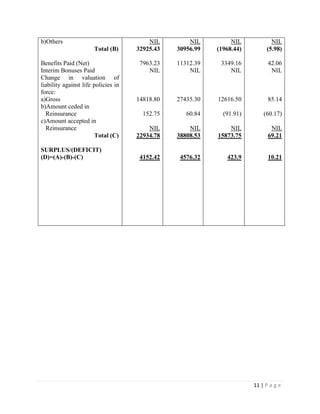
b)Others
Total (B)
Benefits Paid (Net)
Interim Bonuses Paid
Change in valuation of
liability against life policies in
force:
a)Gross
b)Amount ceded in
Reinsurance
c)Amount accepted in
Reinsurance
Total (C)
SURPLUS/(DEFICIT)
(D)=(A)-(B)-(C)
NIL
32925.43
7963.23
NIL
14818.80
152.75
NIL
22934.78
4152.42
NIL
30956.99
11312.39
NIL
27435.30
60.84
NIL
38808.53
4576.32
NIL
(1968.44)
3349.16
NIL
12616.50
(91.91)
NIL
15873.75
423.9
NIL
(5.98)
42.06
NIL
85.14
(60.17)
NIL
69.21
10.21
12 | P a g e
Comparative analysis of Revenue A/C
[with respect to Non-Participating Policies (Non-Linked)]
Particulars 09-10
(Rs in lacs)
10-11
(Rs in lacs)
Absolute
Increase/
(Decrease)
(In Rs)
Percentage
Increase/
(Decrease)
(In %)
Premiums earned-(Net)
Premiums
Less: Reinsurance Ceded
Add: Reinsurance Accepted
Income from Investments
a)Interest, Dividends & Rent-
Gross
b)Profit on sale/ redemption of
investments
c)(Loss) on sale/ redemption
of investments
d)Transfer/ Gain on
revaluation/change in fair
value
e)Amortization of discount/
(premium)
f)Appropriation/Expropriation
Adjustment account
Other Income
Contribution from the
Shareholders account
Miscellaneous income
Total (A)
Commission
Operating Expenses related to
Insurance business
Provision for doubtful debts
Bad debts written off
Provision for Tax
Provision (other than taxation)
a)For diminution in the value
of investments (Net)
b)Others
Total (B)
2154.47
150.22
NIL
2004.25
406.23
16.00
NIL
NIL
(3.12)
NIL
NIL
0.02
2407.54
199.13
203.79
0.18
NIL
NIL
NIL
NIL
403.10
4020.14
126.55
NIL
3893.59
548.80
NIL
NIL
NIL
(2.08)
NIL
NIL
2.03
4442.34
630.05
1523.15
3.56
NIL
NIL
NIL
NIL
2156.76
1865.67
(23.67)
NIL
1889.34
142.57
(16)
NIL
NIL
1.04
NIL
NIL
2.01
2034.80
430.92
1319.36
3.38
NIL
NIL
NIL
NIL
1753.66
86.60
(15.76)
NIL
94.27
35.10
(100)
NIL
NIL
33.33
NIL
NIL
10050
84.52
216.40
647.41
1877.78
NIL
NIL
NIL
NIL
435.04
13 | P a g e
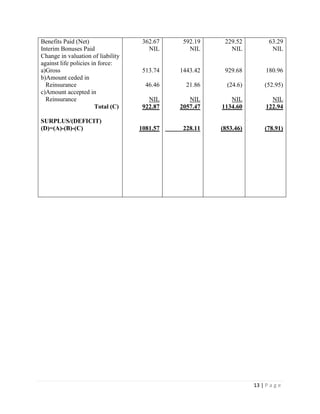
Benefits Paid (Net)
Interim Bonuses Paid
Change in valuation of liability
against life policies in force:
a)Gross
b)Amount ceded in
Reinsurance
c)Amount accepted in
Reinsurance
Total (C)
SURPLUS/(DEFICIT)
(D)=(A)-(B)-(C)
362.67
NIL
513.74
46.46
NIL
922.87
1081.57
592.19
NIL
1443.42
21.86
NIL
2057.47
228.11
229.52
NIL
929.68
(24.6)
NIL
1134.60
(853.46)
63.29
NIL
180.96
(52.95)
NIL
122.94
(78.91)
14 | P a g e
Comparative analysis of Revenue A/C
[with respect to Linked Policies]
Particulars 09-10
(Rs in lacs)
10-11
(Rs in lacs)
Absolute
Increase/
(Decrease)
(In Rs)
Percentage
Increase/
(Decrease)
(In %)
Premiums earned-(Net)
Premiums
Less: Reinsurance Ceded
Add: Reinsurance Accepted
Income from Investments
a)Interest, Dividends & Rent-
Gross
b)Profit on sale/ redemption of
investments
c)(Loss) on sale/ redemption
of investments
d)Transfer/ Gain on
revaluation/change in fair
value
e)Amortization of discount/
(premium)
f)Appropriation/Expropriation
Adjustment account
Other Income
Contribution from the
Shareholders account
Miscellaneous income
Total (A)
Commission
Operating Expenses related to
Insurance business
Provision for doubtful debts
Bad debts written off
Provision for Tax
Provision (other than taxation)
a)For diminution in the value
of investments (Net)
b)Others
Total (B)
69030.31
548.50
NIL
68481.81
7046.46
16907.20
(2704.80)
(20417.05)
(2.93)
57.12
NIL
NIL
69367.81
2001.94
6535.95
9.41
NIL
NIL
NIL
NIL
8547.30
54693.99
390.56
NIL
54303.43
9443.52
16681.54
(19940.94)
(8901.05)
18.09
NIL
NIL
15.21
51619.80
1321.37
4342.94
44.95
NIL
NIL
NIL
NIL
5709.26
(14336.32)
(157.94)
NIL
(14178.38)
2397.06
(225.66)
(17236.14)
11516.00
21.02
(57.12)
NIL
15.21
(17748.01)
(680.57)
(2193.01)
35.54
NIL
NIL
NIL
NIL
(2838.04)
(20.77)
(28.79)
NIL
(20.70)
34.02
(1.33)
(637.24)
56.40
717.41
(100.00)
NIL
NIL
(25.59)
(34.00)
(33.56)
377.68
NIL
NIL
NIL
NIL
(33.20)
15 | P a g e
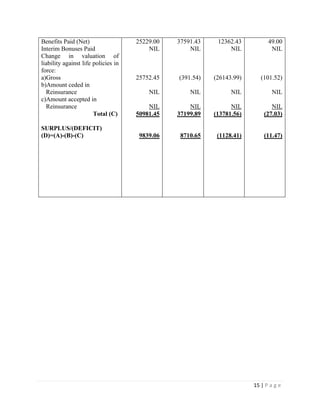
Benefits Paid (Net)
Interim Bonuses Paid
Change in valuation of
liability against life policies in
force:
a)Gross
b)Amount ceded in
Reinsurance
c)Amount accepted in
Reinsurance
Total (C)
SURPLUS/(DEFICIT)
(D)=(A)-(B)-(C)
25229.00
NIL
25752.45
NIL
NIL
50981.45
9839.06
37591.43
NIL
(391.54)
NIL
NIL
37199.89
8710.65
12362.43
NIL
(26143.99)
NIL
NIL
(13781.56)
(1128.41)
49.00
NIL
(101.52)
NIL
NIL
(27.03)
(11.47)
16 | P a g e
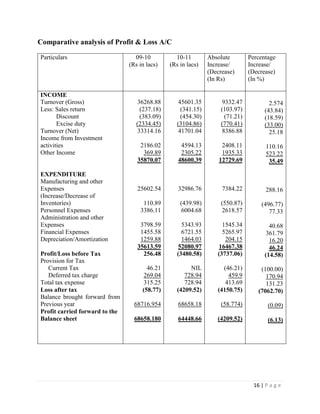
Comparative analysis of Profit & Loss A/C
Particulars 09-10
(Rs in lacs)
10-11
(Rs in lacs)
Absolute
Increase/
(Decrease)
(In Rs)
Percentage
Increase/
(Decrease)
(In %)
INCOME
Turnover (Gross)
Less: Sales return
Discount
Excise duty
Turnover (Net)
Income from Investment
activities
Other Income
EXPENDITURE
Manufacturing and other
Expenses
(Increase/Decrease of
Inventories)
Personnel Expenses
Administration and other
Expenses
Financial Expenses
Depreciation/Amortization
Profit/Loss before Tax
Provision for Tax
Current Tax
Deferred tax charge
Total tax expense
Loss after tax
Balance brought forward from
Previous year
Profit carried forward to the
Balance sheet
36268.88
(237.18)
(383.09)
(2334.45)
33314.16
2186.02
369.89
35870.07
25602.54
110.89
3386.11
3798.59
1455.58
1259.88
35613.59
256.48
46.21
269.04
315.25
(58.77)
68716.954
68658.180
45601.35
(341.15)
(454.30)
(3104.86)
41701.04
4594.13
2305.22
48600.39
32986.76
(439.98)
6004.68
5343.93
6721.55
1464.03
52080.97
(3480.58)
NIL
728.94
728.94
(4209.52)
68658.18
64448.66
9332.47
(103.97)
(71.21)
(770.41)
8386.88
2408.11
1935.33
12729.69
7384.22
(550.87)
2618.57
1545.34
5265.97
204.15
16467.38
(3737.06)
(46.21)
459.9
413.69
(4150.75)
(58.774)
(4209.52)
2.574
(43.84)
(18.59)
(33.00)
25.18
110.16
523.22
35.49
288.16
(496.77)
77.33
40.68
361.79
16.20
46.24
(14.58)
(100.00)
170.94
131.23
(7062.70)
(0.09)
(6.13)
17 | P a g e
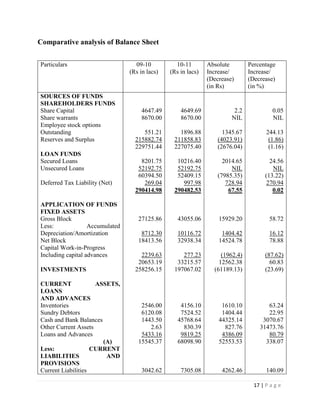
Comparative analysis of Balance Sheet
Particulars 09-10
(Rs in lacs)
10-11
(Rs in lacs)
Absolute
Increase/
(Decrease)
(in Rs)
Percentage
Increase/
(Decrease)
(in %)
SOURCES OF FUNDS
SHAREHOLDERS FUNDS
Share Capital
Share warrants
Employee stock options
Outstanding
Reserves and Surplus
LOAN FUNDS
Secured Loans
Unsecured Loans
Deferred Tax Liability (Net)
APPLICATION OF FUNDS
FIXED ASSETS
Gross Block
Less: Accumulated
Depreciation/Amortization
Net Block
Capital Work-in-Progress
Including capital advances
INVESTMENTS
CURRENT ASSETS,
LOANS
AND ADVANCES
Inventories
Sundry Debtors
Cash and Bank Balances
Other Current Assets
Loans and Advances
(A)
Less: CURRENT
LIABILITIES AND
PROVISIONS
Current Liabilities
4647.49
8670.00
551.21
215882.74
229751.44
8201.75
52192.75
60394.50
269.04
290414.98
27125.86
8712.30
18413.56
2239.63
20653.19
258256.15
2546.00
6120.08
1443.50
2.63
5433.16
15545.37
3042.62
4649.69
8670.00
1896.88
211858.83
227075.40
10216.40
52192.75
52409.15
997.98
290482.53
43055.06
10116.72
32938.34
277.23
33215.57
197067.02
4156.10
7524.52
45768.64
830.39
9819.25
68098.90
7305.08
2.2
NIL
1345.67
(4023.91)
(2676.04)
2014.65
NIL
(7985.35)
728.94
67.55
15929.20
1404.42
14524.78
(1962.4)
12562.38
(61189.13)
1610.10
1404.44
44325.14
827.76
4386.09
52553.53
4262.46
0.05
NIL
244.13
(1.86)
(1.16)
24.56
NIL
(13.22)
270.94
0.02
58.72
16.12
78.88
(87.62)
60.83
(23.69)
63.24
22.95
3070.67
31473.76
80.79
338.07
140.09
18 | P a g e
Provisions
(B)
NET CURRENT ASSETS
(A-B)
997.11
4039.73
11505.64
290414.98
593.88
7898.96
60199.94
290482.53
(403.23)
3859.23
48694.30
67.55
(40.44)
95.53
423.22
0.02
19 | P a g e
RATIOS AND ITS ANALYSIS
CURRENT RATIO
An indication of a company's ability to meet short-term debt obligations; the higher the ratio, the
more liquid the company is. Current ratio is equal to current assets divided by current liabilities.
If the current assets of a company are more than twice the current liabilities, then that company is
generally considered to have good short-term financial strength. If current liabilities exceed
current assets, then the company may have problems meeting its short-term obligations
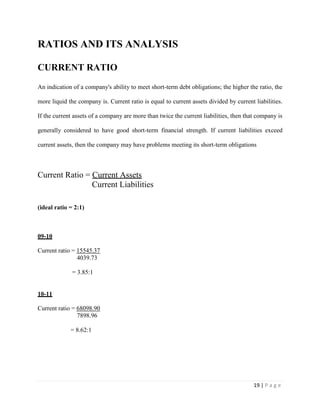
Current Ratio = Current Assets
Current Liabilities
(ideal ratio = 2:1)
09-10
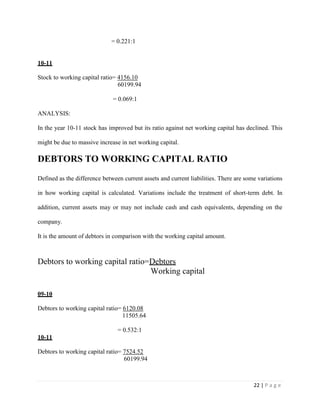
Current ratio = 15545.37
4039.73
= 3.85:1
10-11
Current ratio = 68098.90
7898.96
= 8.62:1
20 | P a g e
ANALYSIS:
The current ratio has improved drastically in the year 10-11 because of huge increase in the cash
and bank balance in that year and also due to increase in other current assets.
QUICK RATIO
An indicator of a company's short-term liquidity. The quick ratio measures a company's
ability to meet its short-term obligations with its most liquid assets. The higher the quick ratio,
the better the position of the company.
The quick ratio is more conservative than the current ratio, a more well-known liquidity measure,
because it excludes inventory from current assets. Inventory is excluded because some
companies have difficulty turning their inventory into cash. In the event that short-term
obligations need to be paid off immediately, there are situations in which the current ratio would
overestimate a company's short-term financial strength.
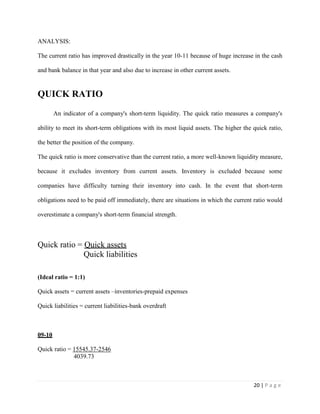
Quick ratio = Quick assets
Quick liabilities
(Ideal ratio = 1:1)
Quick assets = current assets –inventories-prepaid expenses
Quick liabilities = current liabilities-bank overdraft
09-10
Quick ratio = 15545.37-2546
4039.73
21 | P a g e
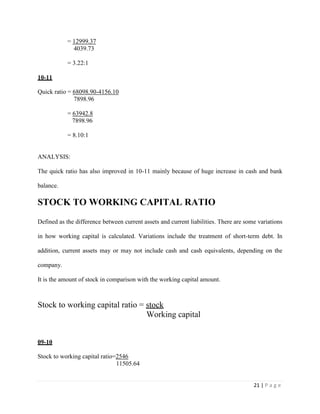
= 12999.37
4039.73
= 3.22:1
10-11
Quick ratio = 68098.90-4156.10
7898.96
= 63942.8
7898.96
= 8.10:1
ANALYSIS:
The quick ratio has also improved in 10-11 mainly because of huge increase in cash and bank
balance.
STOCK TO WORKING CAPITAL RATIO
Defined as the difference between current assets and current liabilities. There are some variations
in how working capital is calculated. Variations include the treatment of short-term debt. In
addition, current assets may or may not include cash and cash equivalents, depending on the
company.
It is the amount of stock in comparison with the working capital amount.
Stock to working capital ratio = stock
Working capital
09-10
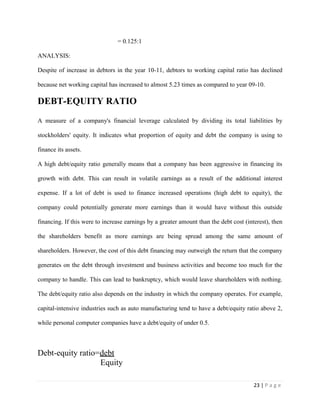
Stock to working capital ratio=2546
11505.64
22 | P a g e
= 0.221:1
10-11
Stock to working capital ratio= 4156.10
60199.94
= 0.069:1
ANALYSIS:
In the year 10-11 stock has improved but its ratio against net working capital has declined. This
might be due to massive increase in net working capital.
DEBTORS TO WORKING CAPITAL RATIO
Defined as the difference between current assets and current liabilities. There are some variations
in how working capital is calculated. Variations include the treatment of short-term debt. In
addition, current assets may or may not include cash and cash equivalents, depending on the
company.
It is the amount of debtors in comparison with the working capital amount.
Debtors to working capital ratio=Debtors
Working capital
09-10
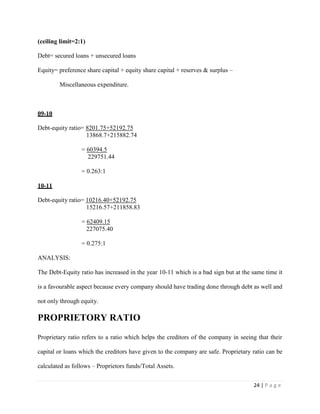
Debtors to working capital ratio= 6120.08
11505.64
= 0.532:1
10-11
Debtors to working capital ratio= 7524.52
60199.94
23 | P a g e
= 0.125:1
ANALYSIS:
Despite of increase in debtors in the year 10-11, debtors to working capital ratio has declined
because net working capital has increased to almost 5.23 times as compared to year 09-10.
DEBT-EQUITY RATIO
A measure of a company's financial leverage calculated by dividing its total liabilities by
stockholders' equity. It indicates what proportion of equity and debt the company is using to
finance its assets.
A high debt/equity ratio generally means that a company has been aggressive in financing its
growth with debt. This can result in volatile earnings as a result of the additional interest
expense. If a lot of debt is used to finance increased operations (high debt to equity), the
company could potentially generate more earnings than it would have without this outside
financing. If this were to increase earnings by a greater amount than the debt cost (interest), then
the shareholders benefit as more earnings are being spread among the same amount of
shareholders. However, the cost of this debt financing may outweigh the return that the company
generates on the debt through investment and business activities and become too much for the
company to handle. This can lead to bankruptcy, which would leave shareholders with nothing.
The debt/equity ratio also depends on the industry in which the company operates. For example,
capital-intensive industries such as auto manufacturing tend to have a debt/equity ratio above 2,
while personal computer companies have a debt/equity of under 0.5.
Debt-equity ratio=debt
Equity
24 | P a g e
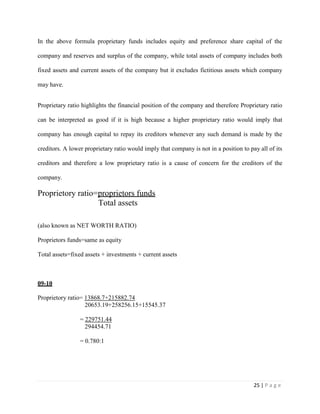
(ceiling limit=2:1)
Debt= secured loans + unsecured loans
Equity= preference share capital + equity share capital + reserves & surplus –
Miscellaneous expenditure.
09-10
Debt-equity ratio= 8201.75+52192.75
13868.7+215882.74
= 60394.5
229751.44
= 0.263:1
10-11
Debt-equity ratio= 10216.40+52192.75
15216.57+211858.83
= 62409.15
227075.40
= 0.275:1
ANALYSIS:
The Debt-Equity ratio has increased in the year 10-11 which is a bad sign but at the same time it
is a favourable aspect because every company should have trading done through debt as well and
not only through equity.
PROPRIETORY RATIO
Proprietary ratio refers to a ratio which helps the creditors of the company in seeing that their
capital or loans which the creditors have given to the company are safe. Proprietary ratio can be
calculated as follows – Proprietors funds/Total Assets.
25 | P a g e
In the above formula proprietary funds includes equity and preference share capital of the
company and reserves and surplus of the company, while total assets of company includes both
fixed assets and current assets of the company but it excludes fictitious assets which company
may have.
Proprietary ratio highlights the financial position of the company and therefore Proprietary ratio
can be interpreted as good if it is high because a higher proprietary ratio would imply that
company has enough capital to repay its creditors whenever any such demand is made by the
creditors. A lower proprietary ratio would imply that company is not in a position to pay all of its
creditors and therefore a low proprietary ratio is a cause of concern for the creditors of the
company.
Proprietory ratio=proprietors funds
Total assets
(also known as NET WORTH RATIO)
Proprietors funds=same as equity
Total assets=fixed assets + investments + current assets
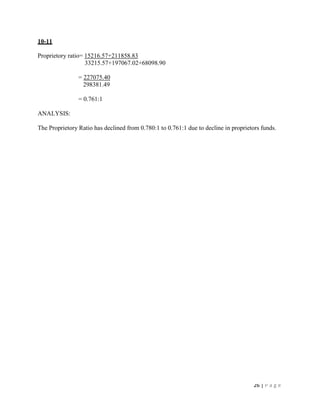
09-10
Proprietory ratio= 13868.7+215882.74
20653.19+258256.15+15545.37
= 229751.44
294454.71
= 0.780:1
26 | P a g e
10-11
Proprietory ratio= 15216.57+211858.83
33215.57+197067.02+68098.90
= 227075.40
298381.49
= 0.761:1
ANALYSIS:
The Proprietory Ratio has declined from 0.780:1 to 0.761:1 due to decline in proprietors funds.
27 | P a g e
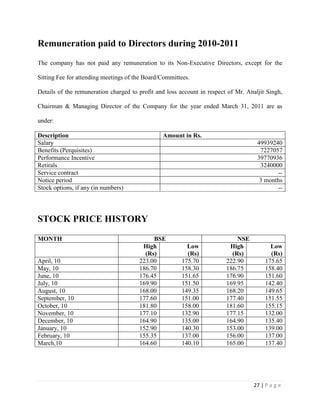
Remuneration paid to Directors during 2010-2011
The company has not paid any remuneration to its Non-Executive Directors, except for the
Sitting Fee for attending meetings of the Board/Committees.
Details of the remuneration charged to profit and loss account in respect of Mr. Analjit Singh,
Chairman & Managing Director of the Company for the year ended March 31, 2011 are as
under:
Description Amount in Rs.
Salary 49939240
Benefits (Perquisites) 7227057
Performance Incentive 39770936
Retirals 3240000
Service contract --
Notice period 3 months
Stock options, if any (in numbers) --
STOCK PRICE HISTORY
MONTH BSE NSE
High
(Rs)
Low
(Rs)
High
(Rs)
Low
(Rs)
April, 10 223.00 175.70 222.90 175.65
May, 10 186.70 158.30 186.75 158.40
June, 10 176.45 151.65 176.90 151.60
July, 10 169.90 151.50 169.95 142.40
August, 10 168.00 149.35 168.20 149.65
September, 10 177.60 151.00 177.40 151.55
October, 10 181.80 158.00 181.60 155.15
November, 10 177.10 132.90 177.15 132.00
December, 10 164.90 135.00 164.90 135.40
January, 10 152.90 140.30 153.00 139.00
February, 10 155.35 137.00 156.00 137.00
March,10 164.60 140.10 165.00 137.40
28 | P a g e
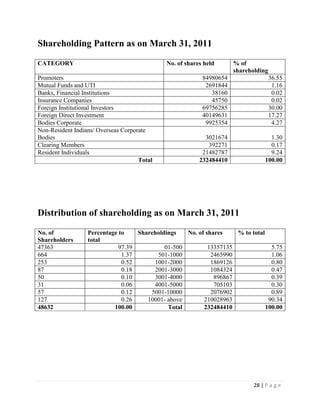
Shareholding Pattern as on March 31, 2011
CATEGORY No. of shares held % of
shareholding
Promoters 84980654 36.55
Mutual Funds and UTI 2691844 1.16
Banks, Financial Institutions 38160 0.02
Insurance Companies 45750 0.02
Foreign Institutional Investors 69756285 30.00
Foreign Direct Investment 40149631 17.27
Bodies Corporate 9925354 4.27
Non-Resident Indians/ Overseas Corporate
Bodies 3021674 1.30
Clearing Members 392271 0.17
Resident Individuals 21482787 9.24
Total 232484410 100.00
Distribution of shareholding as on March 31, 2011
No. of
Shareholders
Percentage to
total
Shareholdings No. of shares % to total
47363 97.39 01-500 13357135 5.75
664 1.37 501-1000 2465990 1.06
253 0.52 1001-2000 1869126 0.80
87 0.18 2001-3000 1084324 0.47
50 0.10 3001-4000 896867 0.39
31 0.06 4001-5000 705103 0.30
57 0.12 5001-10000 2076902 0.89
127 0.26 10001- above 210028963 90.34
48632 100.00 Total 232484410 100.00
29 | P a g e
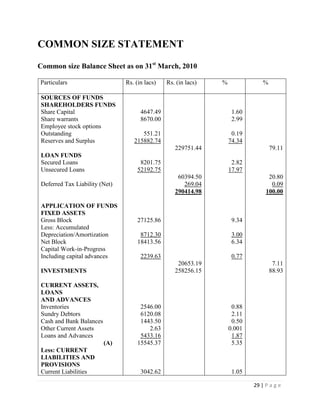
COMMON SIZE STATEMENT
Common size Balance Sheet as on 31st
March, 2010
Particulars Rs. (in lacs) Rs. (in lacs) % %
SOURCES OF FUNDS
SHAREHOLDERS FUNDS
Share Capital
Share warrants
Employee stock options
Outstanding
Reserves and Surplus
LOAN FUNDS
Secured Loans
Unsecured Loans
Deferred Tax Liability (Net)
APPLICATION OF FUNDS
FIXED ASSETS
Gross Block
Less: Accumulated
Depreciation/Amortization
Net Block
Capital Work-in-Progress
Including capital advances
INVESTMENTS
CURRENT ASSETS,
LOANS
AND ADVANCES
Inventories
Sundry Debtors
Cash and Bank Balances
Other Current Assets
Loans and Advances
(A)
Less: CURRENT
LIABILITIES AND
PROVISIONS
Current Liabilities
4647.49
8670.00
551.21
215882.74
8201.75
52192.75
27125.86
8712.30
18413.56
2239.63
2546.00
6120.08
1443.50
2.63
5433.16
15545.37
3042.62
229751.44
60394.50
269.04
290414.98
20653.19
258256.15
1.60
2.99
0.19
74.34
2.82
17.97
9.34
3.00
6.34
0.77
0.88
2.11
0.50
0.001
1.87
5.35
1.05
79.11
20.80
0.09
100.00
7.11
88.93
30 | P a g e
Provisions
(B)
NET CURRENT ASSETS
(A-B)
997.11
4039.73
11505.64
290414.98
0.34
1.39
3.96
100.00
31 | P a g e
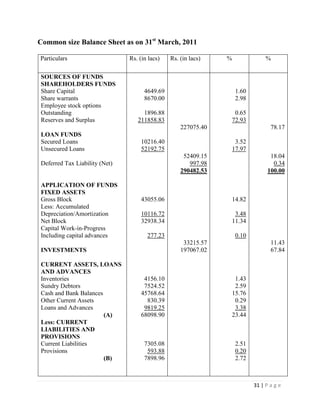
Common size Balance Sheet as on 31st
March, 2011
Particulars Rs. (in lacs) Rs. (in lacs) % %
SOURCES OF FUNDS
SHAREHOLDERS FUNDS
Share Capital
Share warrants
Employee stock options
Outstanding
Reserves and Surplus
LOAN FUNDS
Secured Loans
Unsecured Loans
Deferred Tax Liability (Net)
APPLICATION OF FUNDS
FIXED ASSETS
Gross Block
Less: Accumulated
Depreciation/Amortization
Net Block
Capital Work-in-Progress
Including capital advances
INVESTMENTS
CURRENT ASSETS, LOANS
AND ADVANCES
Inventories
Sundry Debtors
Cash and Bank Balances
Other Current Assets
Loans and Advances
(A)
Less: CURRENT
LIABILITIES AND
PROVISIONS
Current Liabilities
Provisions
(B)
4649.69
8670.00
1896.88
211858.83
10216.40
52192.75
43055.06
10116.72
32938.34
277.23
4156.10
7524.52
45768.64
830.39
9819.25
68098.90
7305.08
593.88
7898.96
227075.40
52409.15
997.98
290482.53
33215.57
197067.02
1.60
2.98
0.65
72.93
3.52
17.97
14.82
3.48
11.34
0.10
1.43
2.59
15.76
0.29
3.38
23.44
2.51
0.20
2.72
78.17
18.04
0.34
100.00
11.43
67.84
32 | P a g e
NET CURRENT ASSETS
(A-B) 60199.94
290482.53
20.72
100.00
33 | P a g e
CASH FLOW STATEMENT
Cash flow statement for the year ended 31st
March, 2010 & 2011
Particulars 10-11
Rs. (in lacs)
09-10
Rs. (in lacs)
A] CASH FLOW FROM OPERATING ACTIVITIES:
NET PROFIT/(LOSS) BEFORE TAXATION
Adjustments for:
Depreciation/Amortization
Employee Stock Option Expense
Wealth Tax
Net Loss on sale of fixed assets
Net Profit on sale of Investments
Fixed assets and Spares written off
Provision for Doubtful debts and advances
Diminution in value of Investments and doubtful advances
to subsidiary
Interest expense
Interest income
Dividend Income from current non trade investments
Liability/Provision no longer requited written back
Unrealized Foreign Exchange (Gain)/ Loss
OPERATING PROFIT BEFORE WORKING
CAPITAL CHANGES
MOVEMENT IN WORKING CAPITAL:
Decrease/ (Increase) in sundry debtors
Decrease/ (Increase) in inventories
Decrease/ (Increase) in loans and advances
Decrease/ (Increase) in trade payables
Decrease/ (Increase) in provisions
Cash generated from Operations
Income Tax Refunded/(Paid)
CASH GENERATED FROM/(USED IN) OPERATING
ACTIVITIES (A)
B] CASH FLOW FROM INVESTING ACTIVITIES
Purchase of investments in subsidiaries
Purchase of investments in mutual funds
Proceeds from sale of investments in mutual funds
Deposits with initial maturity of more than three months
Purchase of fixed assets
Proceeds from sale of fixed assets
Interest Received
Dividend income from current non trade investments
(3480.58)
1464.03
1531.28
1.94
17.44
(1969.43)
NIL
5.94
34.41
6579.99
(1878.61)
NIL
(14.68)
18.74
2310.47
(1404.44)
(1610.10)
(3814.51)
2698.12
(152.68)
(1973.14)
(687.93)
(2661.07)
(14811.17)
(176358.23)
254327.97
(36000.00)
(12504.90)
9.43
874.36
NIL
256.48
1259.88
557.63
1.70
24.14
(1760.85)
0.89
0.42
8.53
1357.13
(251.14)
(47.76)
(174.44)
(75.94)
1156.67
(830.34)
258.31
330.01
(113.25)
160.29
961.69
(18.47)
943.22
(25082.48)
(606304.44)
544722.08
NIL
(2080.61)
15.05
267.95
47.76
34 | P a g e
CASH GENERATED FROM/(USED IN) INVESTING
ACTIVITIES (B)
C] CASH FLOW FROM FINANCING ACTIVITIES
Proceeds from preferential issue of shares
Proceeds from issue of warrants
Shares issue expenses
Proceeds from exercise of employee stock options
Interest paid
Proceeds from issue of Compulsorily Convertible
Debentures
Proceeds from Long term Borrowing
Repayment of Long Term Loans
Proceeds/(Repayment) of Short Term Borrowings
CASH GENERATED FROM/(USED IN) FINANCING
ACTIVITIES (C)
NET INCREASE/(DECREASE) IN CASH AND CASH
EQUIVALENTS (A+B+C)
CASH AND CASH EQUIVALENTS AT THE
BEGINNING OF THE YEAR
CASH AND CASH EQUIVALENTS AT THE END OF
THE YEAR
15537.46
NIL
NIL
NIL
2.20
(6568.10)
NIL
10155.02
(5237.62)
(2902.75)
(4551.25)
8325.14
1443.50
9768.64
(88414.69)
15000.00
8670.00
(593.13)
0.36
(1048.60)
52192.75
53.85
(2066.03)
72.57
72281.77
(15189.70)
16633.20
1443.50
35 | P a g e
CONCLUSION:
As stipulated by the securities and exchange board of India, a qualified practicing company
secretary carries ort the secretarial audit, on a quarterly basis, to reconcile the total admitted
capital with National Securities Depository Ltd (NSDL) and Central Depository Services (India)
Ltd (CDSL) with the total listed and paid-up capital. The audit, interlaid, confirms that the total
listed and paid-up capital of the company is in agreement with the aggregate of the total number
of shares in dematerialized form and total number of shares in physical form.
Shareholders holding shares in dematerialized mode are requested to intimate all changes with
respect to bank details, mandate, nomination, power of attorney, change of address, change of
name etc. to their depository participant (DP). These changes will be reflected in the company’s
records on the down loading of information from Depositories, which will help the company
provide better service to its shareholders.
In respect of shares up to 1000 per folio, transfers are affected on a weekly basis. For others, the
transfers are affected within limits prescribed by law. The average turnaround time for
processing registration of transfers is 15 days from the date of receipt of requests. The processing
activities with respect to requests received for dematerialization are completed within 7-10 days.
36 | P a g e
BIBLIOGRAPHY
 www.maxlifeinsurance.com
 www.maxindia.com
 en.wikipedia.org
 investing.businessweek.com
 www.thehindubusinessline.com

Max life insurance

  • 1.
    1 | Pa g e INTRODUCTION: Insurance or assurance, device for indemnifying or guaranteeing an i n d i v i d u a l a g a i n s t l o s s . R e i m b u r s e m e n t i s m a d e f r o m a f u n d t o w h i c h m a n y individuals exposed to the same risk have contributed certain specified amounts, called premiums. Payment for an individual loss, divided among many, does not fall heavily upon the actual loser. The essence of the contract of insurance, called a p o l i c y , i s m u t u a l i t y . T h e m a j o r o p e r a t i o n s o f a n i n s u r a n c e c o m p a n y a r e underwriting, the determination of which risks the insurer can take on; and ratemaking, the decisions regarding necessary prices for such risks. The underwriter is responsible for guarding against adverse selection, wherein there is excessive c o v e r a g e o f h i g h r i s k c a n d i d a t e s i n p r o p o r t i o n t o t h e c o v e r a g e o f l o w r i s k candidates. In preventing adverse selection, the underwriter must consider physical, psychological, and moral hazards in relation to applicants. Physical hazards include those dangers which surround the individual or property, jeopardizing the well- being of the insured. The amount of the premium is determined by the operation of the law of averages as calculated by actuaries. By investing premium payments in a wide range of revenue-producing projects, insurance companies have b ecome major suppliers of capital, and they rank among the nation's largest institutional investors. In simple terms, insurance allows someone who suffers a loss or accident to be compensated for the effects of their misfortune. It lets you protect yourself against everyday risks to your health, home and financial situation.
  • 2.
    2 | Pa g e New York Life is a Fortune 100 company and Max India Limited is one of India's leading multi-business corporations. The company has positioned itself on the quality platform. It has developed a governance model based on the core values of excellence, honesty, knowledge, caring, integrity and teamwork. The strategy is to establish itself as a trusted life insurance specialist through a quality approach to business. In line with its values of financial responsibility, Max N e w Y o r k L i f e h a s a d o p t e d p r u d e n t f i n a n c i a l p r a c t i c e s t o e n s u r e s a f e t y o f policyholder's funds. The Company's paid up capital is Rs. 657 crore, which is m o r e t h a n t h e n o r m l a i d d o w n b y I R D A . M a x N e w Y o r k L i f e h a s i d e n t i f i e d individual agents as its primary channel of distribution. MDRT is an exclusive congregation of the world’s top selling insurance Agents and is internationally recognized as the standard of excellence in the Life insurance business. Having set a best in class agency distribution model in place, the company is spearheading a major thrust into additional distribution channels to further grow its business. The company is using a five-pronged strategy to pursue alternative channels of distribution. These include the franchisee model, rural business, direct sales force involving group insurance and telemarketing opportunities and corporate alliances. Max New York Life offers a suite of flexible products. It now has 26 life insurance products and 8 riders that can be customized to have more than 400 products. Max Life Insurance Company Ltd (formerly: Max New York Life Insurance Company Ltd.) is a joint venture between Max India Ltd., one of India’s multi-business corporations and M S Group Japan, a Fortune 100 company. Incorporated in 2012, Max New York Life started commercial
  • 3.
    3 | Pa g e operation in 2001 and today is one of India’s leading private life insurance companies. The company offers individual and group life insurance products and is present across the country through a wide distribution network of multi channel distribution. Max India is a leading Indian multi-business corporate, while Mitsui Sumitomo Insurance is a member of MS&AD Insurance Group, which is amongst the top general insurers in the world. Max Life Insurance offers comprehensive life insurance and retirement solutions for long-term savings and protection. A financially stable company with sound investment expertise, Max Life Insurance has a strong customer-centric approach focused on advice-based sales and quality service. In the financial year 2011-12, Max Life Insurance had a market share of 8.6%. The Company has been one of the fastest growing life insurers, with total revenue of Rs. 6,391 crore and enterprise profit of Rs. 733 crore for the Financial Year 2011-12. The Company's capital base of Rs. 2,127 crore, with a solvency margin of 534% is testimony of its financial strength and stability. As on 31st March 2012, Max Life Insurance had assets under management of Rs. 17,215 crore. The New York Life Insurance Company (NYLIC) is one of the largest mutual life-insurance companies in the United States, and one of the largest life insurers in the world, with about $287 billion in total assets under management, and more than $15 billion in surplus and AVR. The company ranks 71 on the 2011 Fortune 100 list, making it the highest privately held insurance company on that list. In 2007, NYLIC achieved the best possible ratings by the four independent rating companies (Standard & Poor's, AM Best, Moody's and Fitch). In June 2009, the same four rating companies reaffirmed New York Life's superior financial strength, which became a selling point in national TV ad campaigns that same year. The company is now one of only three life
  • 4.
    4 | Pa g e insurers to hold the highest ratings currently awarded to any life insurer by all four rating agencies (Moody's: Aaa, A.M. Best: A++. Standards & Poor's: AA+, Fitch: AAA. All of these are for financial strength.). Other New York Life affiliates provide an array of securities products and services, as well as institutional and retail mutual funds. Vision To become the most admired life Insurance Company in India. Mission To become one of the top quartile life Insurance companies in India. Be a national player. Be the brand of the first Choice. Be the Employer of the Choice. Become principal of choice for agents.
  • 5.
    5 | Pa g e HISTORY: The company was founded in 1845 as the Nautilus (Capt. Nemo) Insurance Company in New York City, with assets of just $17,000. It was renamed the New York Life Insurance Company in 1849. Its first headquarters were at 112-114 Broadway; the first president was James De Peyster Ogden. The current New York Life headquarters was designed by noted architect Cass Gilbert and completed in 1928. The New York Life building, at 51 Madison Avenue, was constructed during the presidency of Darwin P. Kingsley. He expanded the company’s operations and developed new types of insurance. As with other early insurance companies in the U.S., in its early years the company insured the lives of slaves for their owners. In response to bills passed in California in 2001 and in Illinois in 2003, the company reported that Nautilus sold 485 slaveholder life insurance policies during a two-year period in the 1840s; they added that their trustees voted to end the sale of such policies 15 years before the Emancipation Proclamation.[5] The company became known for innovative business practices. In 1860, well before state laws required it, New York Life developed the non-forfeiture option, the predecessor to the guaranteed cash values of modern policies, under which a policy remains in force even if a premium payment is missed. It was also the first American life insurance company to pay a cash dividend to policyholders, and the first U.S. company to issue policies to women at the same rates as men. Susan B. Anthony was one of their first female policy holders, and her father worked for NYLIC. In 1896, New York Life became the first company to insure people with disabilities and the first to issue a policy with a disability benefit that presumes total disability to be permanent after a predetermined period.
  • 6.
    6 | Pa g e In the late 1990s New York Life was one of several large mutual life insurers to back a bill that would allow demutualization into a structure known as a mutual holding company (MHC). CEO Sy Sternberg himself argued strongly in favor of the bill, which was ultimately defeated. The NYLIC board of directors subsequently reversed course, with the company strongly and publicly embracing their mutual nature in a series of advertisements. According to their Report to Policyholders 2007, in early 2007 the company's managers became concerned about the state of credit markets, so in February 2007 based on our belief that the markets were acting irrationally New York Life decided to move much of its cash flow into safer investments such as US Treasury bonds. By August 2007, the credit market problems we had feared were front page news, the Report notes. In November 2008, the company announced it will not participate in the Troubled Asset Relief Program. The company can meet all of its strategic objectives without government capital, its businesses are strong and profitable, and it is committed to remaining a mutual company operating for the sole benefit of its policyholders, states a company press release. Theodore Ted Mathas, president and CEO in 2008, said at the time of the financial crisis that New York Life is built for times like these. This phrase became the title for the 2008 report to policyholders. Ted Mathas becomes the company chairman on June 1, 2009. New York Life maintains superior financial ratings from A.M. Best, Fitch Ratings, Moody's and Standard and Poor's, all of which have reaffirmed the ratings during the financial crisis of autumn 2008. Max Life Insurance Company Limited provides life insurance products in India. The company offers a range of participating, non-participating, and linked products covering life
  • 7.
    7 | Pa g e insurance, pension, and health benefits. The company provides individual and group life insurance products consisting of protection, child, retirement, growth, savings, health, and group plans Max Life Insurance Company Limited distributes its products primarily through individual agents, corporate agents, banks, and brokers. The company was formerly known as Max New York Life Insurance Company Limited and changed its name to Max Life Insurance Company Limited in July 2012. The company was incorporated in 2000 and is based in New Delhi, India. Max New York Life Insurance Company Limited is a subsidiary of Max India Limited.
  • 8.
    8 | Pa g e Max Life Insurance Company Limited Key Developments Max Life Insurance Company Limited Announces Audited Earnings Results for the Six Months of 2013 Max Life, the company recorded the net profit before tax of INR 3,980 million, as compared to INR 3, Insurance Company Limited announced audited earnings results for the six months of 2013. For the period 750 million in the same period last year, recording a growth of 6%. This rise in net profit was a result of steady revenue coupled with better productivity and cost efficiency. Max Life Insurance Company Limited Declares Maiden Interim Dividend Max Life Insurance Company Limited announced its maiden interim dividend of 5.1% for its shareholders. The decision was taken at a board meeting. The company has decided to distribute INR 1,150 million based on the performance of the company during the first half of the financial year 2012-13. Max India Mulls Max Life Insurance Stake Sale, Chairman Denies Sale Plans Max India Limited is looking to sell nearly 5% stake in Max Life Insurance Company Limited to long-term foreign financial investors. Max India owns Max Life Insurance along with Mitsui Sumitomo Primary Life Insurance Co., Ltd. The sale is being considered following the recent decision by the Indian Cabinet to approve the proposal to raise foreign direct investment (FDI) in the insurance sector to 49% from 26%. Max India and Max Life Insurance’s Chairman, Analjit Singh told Times of India, Max India is under no obligation to divest additional stake to the existing joint venture partner. If we were to divest any stake, it would purely be a commercial decision to unlock the valuation from our life insurance business.
  • 9.
    9 | Pa g e New York Life exists insurance venture with max India group Coimbatore, June 27: Japanese insurance company, Mitsui Sumitomo Insurance Company Ltd, has replaced New York Life International Holdings Ltd as the overseas partner of Max India Group in its insurance joint venture in the country — Max New York Life Insurance Company Ltd. Mitsui Sumitomo Insurance has acquired 26 per cent stake in the Indian insurance outfit — 16.63 per cent stake from the US company and 9.37 per cent from Max India Ltd. Max India Group had itself acquired 9.37 per cent stake in the insurance joint venture from its former partner Max New York Life Insurance Company, which had a 26 per cent stake, by paying an aggregate consideration of Rs 180.84 crore. The amount was close to par value of the shares to ensure that the non-resident holding in MNYL was within the sectoral cap of 26 per cent. But Max India Group received an aggregate consideration of Rs 984.44 crore from Mitsui Sumitomo Insurance for the sale of 9.37 per cent in MNYL, which was being renamed as Max Life Insurance Company Ltd, subject to regulatory approvals. Max India said that its board of directors approved the purchase of 4 per cent equity stake held by Axis Bank in MNYL, in tranches not exceeding one per cent of equity stake every year before October 2020 for an estimated Rs 414 crore. Of this purchase, maximum of one per cent stake was due to be bought in the near future, Max India Group said in a statement to the stock exchanges.
  • 10.
    10 | Pa g e COMPARATIVE ANALYSIS Comparative analysis of Revenue A/C [with respect to Participating Policies (Non-Linked)] Particulars 09-10 (Rs in lacs) 10-11 (Rs in lacs) Absolute Increase/ (Decrease) (In Rs) Percentage Increase/ (Decrease) (In %) Premiums earned-(Net) Premiums Less: Reinsurance Ceded Add: Reinsurance Accepted Income from Investments a)Interest, Dividends & Rent- Gross b)Profit on sale/ redemption of investments c)(Loss) on sale/ redemption of investments d)Transfer/ Gain on revaluation/change in fair value e)Amortization of discount/ (premium) f)Appropriation/Expropriation Adjustment account Other Income Contribution from the Shareholders account Miscellaneous income Total (A) Commission Operating Expenses related to Insurance business Provision for doubtful debts Bad debts written off Provision for Tax Provision (other than taxation) a)For diminution in the value of investments (Net) 53649.64 219.08 NIL 53430.56 6465.18 124.86 NIL NIL (34.97) NIL NIL 27.00 60012.63 9971.02 22919.92 34.48 1 NIL NIL 64754.61 363.73 NIL 64390.88 9155.60 492.36 (1.76) NIL 116.76 NIL NIL 188.00 74341.84 8911.90 21989.05 56.04 NIL NIL NIL 11104.97 144.65 NIL 10960.32 2690.42 367.5 (1.76) NIL 151.73 NIL NIL 161.00 14329.21 (1059.12) (930.87) 21.56 (1) NIL NIL 20.70 66.03 NIL 20.51 41.61 294.33 NIL NIL 433.89 NIL NIL 596.30 23.88 (10.62) (4.06) 62.53 (100) NIL NIL
  • 11.
    11 | Pa g e b)Others Total (B) Benefits Paid (Net) Interim Bonuses Paid Change in valuation of liability against life policies in force: a)Gross b)Amount ceded in Reinsurance c)Amount accepted in Reinsurance Total (C) SURPLUS/(DEFICIT) (D)=(A)-(B)-(C) NIL 32925.43 7963.23 NIL 14818.80 152.75 NIL 22934.78 4152.42 NIL 30956.99 11312.39 NIL 27435.30 60.84 NIL 38808.53 4576.32 NIL (1968.44) 3349.16 NIL 12616.50 (91.91) NIL 15873.75 423.9 NIL (5.98) 42.06 NIL 85.14 (60.17) NIL 69.21 10.21
  • 12.
    12 | Pa g e Comparative analysis of Revenue A/C [with respect to Non-Participating Policies (Non-Linked)] Particulars 09-10 (Rs in lacs) 10-11 (Rs in lacs) Absolute Increase/ (Decrease) (In Rs) Percentage Increase/ (Decrease) (In %) Premiums earned-(Net) Premiums Less: Reinsurance Ceded Add: Reinsurance Accepted Income from Investments a)Interest, Dividends & Rent- Gross b)Profit on sale/ redemption of investments c)(Loss) on sale/ redemption of investments d)Transfer/ Gain on revaluation/change in fair value e)Amortization of discount/ (premium) f)Appropriation/Expropriation Adjustment account Other Income Contribution from the Shareholders account Miscellaneous income Total (A) Commission Operating Expenses related to Insurance business Provision for doubtful debts Bad debts written off Provision for Tax Provision (other than taxation) a)For diminution in the value of investments (Net) b)Others Total (B) 2154.47 150.22 NIL 2004.25 406.23 16.00 NIL NIL (3.12) NIL NIL 0.02 2407.54 199.13 203.79 0.18 NIL NIL NIL NIL 403.10 4020.14 126.55 NIL 3893.59 548.80 NIL NIL NIL (2.08) NIL NIL 2.03 4442.34 630.05 1523.15 3.56 NIL NIL NIL NIL 2156.76 1865.67 (23.67) NIL 1889.34 142.57 (16) NIL NIL 1.04 NIL NIL 2.01 2034.80 430.92 1319.36 3.38 NIL NIL NIL NIL 1753.66 86.60 (15.76) NIL 94.27 35.10 (100) NIL NIL 33.33 NIL NIL 10050 84.52 216.40 647.41 1877.78 NIL NIL NIL NIL 435.04
  • 13.
    13 | Pa g e Benefits Paid (Net) Interim Bonuses Paid Change in valuation of liability against life policies in force: a)Gross b)Amount ceded in Reinsurance c)Amount accepted in Reinsurance Total (C) SURPLUS/(DEFICIT) (D)=(A)-(B)-(C) 362.67 NIL 513.74 46.46 NIL 922.87 1081.57 592.19 NIL 1443.42 21.86 NIL 2057.47 228.11 229.52 NIL 929.68 (24.6) NIL 1134.60 (853.46) 63.29 NIL 180.96 (52.95) NIL 122.94 (78.91)
  • 14.
    14 | Pa g e Comparative analysis of Revenue A/C [with respect to Linked Policies] Particulars 09-10 (Rs in lacs) 10-11 (Rs in lacs) Absolute Increase/ (Decrease) (In Rs) Percentage Increase/ (Decrease) (In %) Premiums earned-(Net) Premiums Less: Reinsurance Ceded Add: Reinsurance Accepted Income from Investments a)Interest, Dividends & Rent- Gross b)Profit on sale/ redemption of investments c)(Loss) on sale/ redemption of investments d)Transfer/ Gain on revaluation/change in fair value e)Amortization of discount/ (premium) f)Appropriation/Expropriation Adjustment account Other Income Contribution from the Shareholders account Miscellaneous income Total (A) Commission Operating Expenses related to Insurance business Provision for doubtful debts Bad debts written off Provision for Tax Provision (other than taxation) a)For diminution in the value of investments (Net) b)Others Total (B) 69030.31 548.50 NIL 68481.81 7046.46 16907.20 (2704.80) (20417.05) (2.93) 57.12 NIL NIL 69367.81 2001.94 6535.95 9.41 NIL NIL NIL NIL 8547.30 54693.99 390.56 NIL 54303.43 9443.52 16681.54 (19940.94) (8901.05) 18.09 NIL NIL 15.21 51619.80 1321.37 4342.94 44.95 NIL NIL NIL NIL 5709.26 (14336.32) (157.94) NIL (14178.38) 2397.06 (225.66) (17236.14) 11516.00 21.02 (57.12) NIL 15.21 (17748.01) (680.57) (2193.01) 35.54 NIL NIL NIL NIL (2838.04) (20.77) (28.79) NIL (20.70) 34.02 (1.33) (637.24) 56.40 717.41 (100.00) NIL NIL (25.59) (34.00) (33.56) 377.68 NIL NIL NIL NIL (33.20)
  • 15.
    15 | Pa g e Benefits Paid (Net) Interim Bonuses Paid Change in valuation of liability against life policies in force: a)Gross b)Amount ceded in Reinsurance c)Amount accepted in Reinsurance Total (C) SURPLUS/(DEFICIT) (D)=(A)-(B)-(C) 25229.00 NIL 25752.45 NIL NIL 50981.45 9839.06 37591.43 NIL (391.54) NIL NIL 37199.89 8710.65 12362.43 NIL (26143.99) NIL NIL (13781.56) (1128.41) 49.00 NIL (101.52) NIL NIL (27.03) (11.47)
  • 16.
    16 | Pa g e Comparative analysis of Profit & Loss A/C Particulars 09-10 (Rs in lacs) 10-11 (Rs in lacs) Absolute Increase/ (Decrease) (In Rs) Percentage Increase/ (Decrease) (In %) INCOME Turnover (Gross) Less: Sales return Discount Excise duty Turnover (Net) Income from Investment activities Other Income EXPENDITURE Manufacturing and other Expenses (Increase/Decrease of Inventories) Personnel Expenses Administration and other Expenses Financial Expenses Depreciation/Amortization Profit/Loss before Tax Provision for Tax Current Tax Deferred tax charge Total tax expense Loss after tax Balance brought forward from Previous year Profit carried forward to the Balance sheet 36268.88 (237.18) (383.09) (2334.45) 33314.16 2186.02 369.89 35870.07 25602.54 110.89 3386.11 3798.59 1455.58 1259.88 35613.59 256.48 46.21 269.04 315.25 (58.77) 68716.954 68658.180 45601.35 (341.15) (454.30) (3104.86) 41701.04 4594.13 2305.22 48600.39 32986.76 (439.98) 6004.68 5343.93 6721.55 1464.03 52080.97 (3480.58) NIL 728.94 728.94 (4209.52) 68658.18 64448.66 9332.47 (103.97) (71.21) (770.41) 8386.88 2408.11 1935.33 12729.69 7384.22 (550.87) 2618.57 1545.34 5265.97 204.15 16467.38 (3737.06) (46.21) 459.9 413.69 (4150.75) (58.774) (4209.52) 2.574 (43.84) (18.59) (33.00) 25.18 110.16 523.22 35.49 288.16 (496.77) 77.33 40.68 361.79 16.20 46.24 (14.58) (100.00) 170.94 131.23 (7062.70) (0.09) (6.13)
  • 17.
    17 | Pa g e Comparative analysis of Balance Sheet Particulars 09-10 (Rs in lacs) 10-11 (Rs in lacs) Absolute Increase/ (Decrease) (in Rs) Percentage Increase/ (Decrease) (in %) SOURCES OF FUNDS SHAREHOLDERS FUNDS Share Capital Share warrants Employee stock options Outstanding Reserves and Surplus LOAN FUNDS Secured Loans Unsecured Loans Deferred Tax Liability (Net) APPLICATION OF FUNDS FIXED ASSETS Gross Block Less: Accumulated Depreciation/Amortization Net Block Capital Work-in-Progress Including capital advances INVESTMENTS CURRENT ASSETS, LOANS AND ADVANCES Inventories Sundry Debtors Cash and Bank Balances Other Current Assets Loans and Advances (A) Less: CURRENT LIABILITIES AND PROVISIONS Current Liabilities 4647.49 8670.00 551.21 215882.74 229751.44 8201.75 52192.75 60394.50 269.04 290414.98 27125.86 8712.30 18413.56 2239.63 20653.19 258256.15 2546.00 6120.08 1443.50 2.63 5433.16 15545.37 3042.62 4649.69 8670.00 1896.88 211858.83 227075.40 10216.40 52192.75 52409.15 997.98 290482.53 43055.06 10116.72 32938.34 277.23 33215.57 197067.02 4156.10 7524.52 45768.64 830.39 9819.25 68098.90 7305.08 2.2 NIL 1345.67 (4023.91) (2676.04) 2014.65 NIL (7985.35) 728.94 67.55 15929.20 1404.42 14524.78 (1962.4) 12562.38 (61189.13) 1610.10 1404.44 44325.14 827.76 4386.09 52553.53 4262.46 0.05 NIL 244.13 (1.86) (1.16) 24.56 NIL (13.22) 270.94 0.02 58.72 16.12 78.88 (87.62) 60.83 (23.69) 63.24 22.95 3070.67 31473.76 80.79 338.07 140.09
  • 18.
    18 | Pa g e Provisions (B) NET CURRENT ASSETS (A-B) 997.11 4039.73 11505.64 290414.98 593.88 7898.96 60199.94 290482.53 (403.23) 3859.23 48694.30 67.55 (40.44) 95.53 423.22 0.02
  • 19.
    19 | Pa g e RATIOS AND ITS ANALYSIS CURRENT RATIO An indication of a company's ability to meet short-term debt obligations; the higher the ratio, the more liquid the company is. Current ratio is equal to current assets divided by current liabilities. If the current assets of a company are more than twice the current liabilities, then that company is generally considered to have good short-term financial strength. If current liabilities exceed current assets, then the company may have problems meeting its short-term obligations Current Ratio = Current Assets Current Liabilities (ideal ratio = 2:1) 09-10 Current ratio = 15545.37 4039.73 = 3.85:1 10-11 Current ratio = 68098.90 7898.96 = 8.62:1
  • 20.
    20 | Pa g e ANALYSIS: The current ratio has improved drastically in the year 10-11 because of huge increase in the cash and bank balance in that year and also due to increase in other current assets. QUICK RATIO An indicator of a company's short-term liquidity. The quick ratio measures a company's ability to meet its short-term obligations with its most liquid assets. The higher the quick ratio, the better the position of the company. The quick ratio is more conservative than the current ratio, a more well-known liquidity measure, because it excludes inventory from current assets. Inventory is excluded because some companies have difficulty turning their inventory into cash. In the event that short-term obligations need to be paid off immediately, there are situations in which the current ratio would overestimate a company's short-term financial strength. Quick ratio = Quick assets Quick liabilities (Ideal ratio = 1:1) Quick assets = current assets –inventories-prepaid expenses Quick liabilities = current liabilities-bank overdraft 09-10 Quick ratio = 15545.37-2546 4039.73
  • 21.
    21 | Pa g e = 12999.37 4039.73 = 3.22:1 10-11 Quick ratio = 68098.90-4156.10 7898.96 = 63942.8 7898.96 = 8.10:1 ANALYSIS: The quick ratio has also improved in 10-11 mainly because of huge increase in cash and bank balance. STOCK TO WORKING CAPITAL RATIO Defined as the difference between current assets and current liabilities. There are some variations in how working capital is calculated. Variations include the treatment of short-term debt. In addition, current assets may or may not include cash and cash equivalents, depending on the company. It is the amount of stock in comparison with the working capital amount. Stock to working capital ratio = stock Working capital 09-10 Stock to working capital ratio=2546 11505.64
  • 22.
    22 | Pa g e = 0.221:1 10-11 Stock to working capital ratio= 4156.10 60199.94 = 0.069:1 ANALYSIS: In the year 10-11 stock has improved but its ratio against net working capital has declined. This might be due to massive increase in net working capital. DEBTORS TO WORKING CAPITAL RATIO Defined as the difference between current assets and current liabilities. There are some variations in how working capital is calculated. Variations include the treatment of short-term debt. In addition, current assets may or may not include cash and cash equivalents, depending on the company. It is the amount of debtors in comparison with the working capital amount. Debtors to working capital ratio=Debtors Working capital 09-10 Debtors to working capital ratio= 6120.08 11505.64 = 0.532:1 10-11 Debtors to working capital ratio= 7524.52 60199.94
  • 23.
    23 | Pa g e = 0.125:1 ANALYSIS: Despite of increase in debtors in the year 10-11, debtors to working capital ratio has declined because net working capital has increased to almost 5.23 times as compared to year 09-10. DEBT-EQUITY RATIO A measure of a company's financial leverage calculated by dividing its total liabilities by stockholders' equity. It indicates what proportion of equity and debt the company is using to finance its assets. A high debt/equity ratio generally means that a company has been aggressive in financing its growth with debt. This can result in volatile earnings as a result of the additional interest expense. If a lot of debt is used to finance increased operations (high debt to equity), the company could potentially generate more earnings than it would have without this outside financing. If this were to increase earnings by a greater amount than the debt cost (interest), then the shareholders benefit as more earnings are being spread among the same amount of shareholders. However, the cost of this debt financing may outweigh the return that the company generates on the debt through investment and business activities and become too much for the company to handle. This can lead to bankruptcy, which would leave shareholders with nothing. The debt/equity ratio also depends on the industry in which the company operates. For example, capital-intensive industries such as auto manufacturing tend to have a debt/equity ratio above 2, while personal computer companies have a debt/equity of under 0.5. Debt-equity ratio=debt Equity
  • 24.
    24 | Pa g e (ceiling limit=2:1) Debt= secured loans + unsecured loans Equity= preference share capital + equity share capital + reserves & surplus – Miscellaneous expenditure. 09-10 Debt-equity ratio= 8201.75+52192.75 13868.7+215882.74 = 60394.5 229751.44 = 0.263:1 10-11 Debt-equity ratio= 10216.40+52192.75 15216.57+211858.83 = 62409.15 227075.40 = 0.275:1 ANALYSIS: The Debt-Equity ratio has increased in the year 10-11 which is a bad sign but at the same time it is a favourable aspect because every company should have trading done through debt as well and not only through equity. PROPRIETORY RATIO Proprietary ratio refers to a ratio which helps the creditors of the company in seeing that their capital or loans which the creditors have given to the company are safe. Proprietary ratio can be calculated as follows – Proprietors funds/Total Assets.
  • 25.
    25 | Pa g e In the above formula proprietary funds includes equity and preference share capital of the company and reserves and surplus of the company, while total assets of company includes both fixed assets and current assets of the company but it excludes fictitious assets which company may have. Proprietary ratio highlights the financial position of the company and therefore Proprietary ratio can be interpreted as good if it is high because a higher proprietary ratio would imply that company has enough capital to repay its creditors whenever any such demand is made by the creditors. A lower proprietary ratio would imply that company is not in a position to pay all of its creditors and therefore a low proprietary ratio is a cause of concern for the creditors of the company. Proprietory ratio=proprietors funds Total assets (also known as NET WORTH RATIO) Proprietors funds=same as equity Total assets=fixed assets + investments + current assets 09-10 Proprietory ratio= 13868.7+215882.74 20653.19+258256.15+15545.37 = 229751.44 294454.71 = 0.780:1
  • 26.
    26 | Pa g e 10-11 Proprietory ratio= 15216.57+211858.83 33215.57+197067.02+68098.90 = 227075.40 298381.49 = 0.761:1 ANALYSIS: The Proprietory Ratio has declined from 0.780:1 to 0.761:1 due to decline in proprietors funds.
  • 27.
    27 | Pa g e Remuneration paid to Directors during 2010-2011 The company has not paid any remuneration to its Non-Executive Directors, except for the Sitting Fee for attending meetings of the Board/Committees. Details of the remuneration charged to profit and loss account in respect of Mr. Analjit Singh, Chairman & Managing Director of the Company for the year ended March 31, 2011 are as under: Description Amount in Rs. Salary 49939240 Benefits (Perquisites) 7227057 Performance Incentive 39770936 Retirals 3240000 Service contract -- Notice period 3 months Stock options, if any (in numbers) -- STOCK PRICE HISTORY MONTH BSE NSE High (Rs) Low (Rs) High (Rs) Low (Rs) April, 10 223.00 175.70 222.90 175.65 May, 10 186.70 158.30 186.75 158.40 June, 10 176.45 151.65 176.90 151.60 July, 10 169.90 151.50 169.95 142.40 August, 10 168.00 149.35 168.20 149.65 September, 10 177.60 151.00 177.40 151.55 October, 10 181.80 158.00 181.60 155.15 November, 10 177.10 132.90 177.15 132.00 December, 10 164.90 135.00 164.90 135.40 January, 10 152.90 140.30 153.00 139.00 February, 10 155.35 137.00 156.00 137.00 March,10 164.60 140.10 165.00 137.40
  • 28.
    28 | Pa g e Shareholding Pattern as on March 31, 2011 CATEGORY No. of shares held % of shareholding Promoters 84980654 36.55 Mutual Funds and UTI 2691844 1.16 Banks, Financial Institutions 38160 0.02 Insurance Companies 45750 0.02 Foreign Institutional Investors 69756285 30.00 Foreign Direct Investment 40149631 17.27 Bodies Corporate 9925354 4.27 Non-Resident Indians/ Overseas Corporate Bodies 3021674 1.30 Clearing Members 392271 0.17 Resident Individuals 21482787 9.24 Total 232484410 100.00 Distribution of shareholding as on March 31, 2011 No. of Shareholders Percentage to total Shareholdings No. of shares % to total 47363 97.39 01-500 13357135 5.75 664 1.37 501-1000 2465990 1.06 253 0.52 1001-2000 1869126 0.80 87 0.18 2001-3000 1084324 0.47 50 0.10 3001-4000 896867 0.39 31 0.06 4001-5000 705103 0.30 57 0.12 5001-10000 2076902 0.89 127 0.26 10001- above 210028963 90.34 48632 100.00 Total 232484410 100.00
  • 29.
    29 | Pa g e COMMON SIZE STATEMENT Common size Balance Sheet as on 31st March, 2010 Particulars Rs. (in lacs) Rs. (in lacs) % % SOURCES OF FUNDS SHAREHOLDERS FUNDS Share Capital Share warrants Employee stock options Outstanding Reserves and Surplus LOAN FUNDS Secured Loans Unsecured Loans Deferred Tax Liability (Net) APPLICATION OF FUNDS FIXED ASSETS Gross Block Less: Accumulated Depreciation/Amortization Net Block Capital Work-in-Progress Including capital advances INVESTMENTS CURRENT ASSETS, LOANS AND ADVANCES Inventories Sundry Debtors Cash and Bank Balances Other Current Assets Loans and Advances (A) Less: CURRENT LIABILITIES AND PROVISIONS Current Liabilities 4647.49 8670.00 551.21 215882.74 8201.75 52192.75 27125.86 8712.30 18413.56 2239.63 2546.00 6120.08 1443.50 2.63 5433.16 15545.37 3042.62 229751.44 60394.50 269.04 290414.98 20653.19 258256.15 1.60 2.99 0.19 74.34 2.82 17.97 9.34 3.00 6.34 0.77 0.88 2.11 0.50 0.001 1.87 5.35 1.05 79.11 20.80 0.09 100.00 7.11 88.93
  • 30.
    30 | Pa g e Provisions (B) NET CURRENT ASSETS (A-B) 997.11 4039.73 11505.64 290414.98 0.34 1.39 3.96 100.00
  • 31.
    31 | Pa g e Common size Balance Sheet as on 31st March, 2011 Particulars Rs. (in lacs) Rs. (in lacs) % % SOURCES OF FUNDS SHAREHOLDERS FUNDS Share Capital Share warrants Employee stock options Outstanding Reserves and Surplus LOAN FUNDS Secured Loans Unsecured Loans Deferred Tax Liability (Net) APPLICATION OF FUNDS FIXED ASSETS Gross Block Less: Accumulated Depreciation/Amortization Net Block Capital Work-in-Progress Including capital advances INVESTMENTS CURRENT ASSETS, LOANS AND ADVANCES Inventories Sundry Debtors Cash and Bank Balances Other Current Assets Loans and Advances (A) Less: CURRENT LIABILITIES AND PROVISIONS Current Liabilities Provisions (B) 4649.69 8670.00 1896.88 211858.83 10216.40 52192.75 43055.06 10116.72 32938.34 277.23 4156.10 7524.52 45768.64 830.39 9819.25 68098.90 7305.08 593.88 7898.96 227075.40 52409.15 997.98 290482.53 33215.57 197067.02 1.60 2.98 0.65 72.93 3.52 17.97 14.82 3.48 11.34 0.10 1.43 2.59 15.76 0.29 3.38 23.44 2.51 0.20 2.72 78.17 18.04 0.34 100.00 11.43 67.84
  • 32.
    32 | Pa g e NET CURRENT ASSETS (A-B) 60199.94 290482.53 20.72 100.00
  • 33.
    33 | Pa g e CASH FLOW STATEMENT Cash flow statement for the year ended 31st March, 2010 & 2011 Particulars 10-11 Rs. (in lacs) 09-10 Rs. (in lacs) A] CASH FLOW FROM OPERATING ACTIVITIES: NET PROFIT/(LOSS) BEFORE TAXATION Adjustments for: Depreciation/Amortization Employee Stock Option Expense Wealth Tax Net Loss on sale of fixed assets Net Profit on sale of Investments Fixed assets and Spares written off Provision for Doubtful debts and advances Diminution in value of Investments and doubtful advances to subsidiary Interest expense Interest income Dividend Income from current non trade investments Liability/Provision no longer requited written back Unrealized Foreign Exchange (Gain)/ Loss OPERATING PROFIT BEFORE WORKING CAPITAL CHANGES MOVEMENT IN WORKING CAPITAL: Decrease/ (Increase) in sundry debtors Decrease/ (Increase) in inventories Decrease/ (Increase) in loans and advances Decrease/ (Increase) in trade payables Decrease/ (Increase) in provisions Cash generated from Operations Income Tax Refunded/(Paid) CASH GENERATED FROM/(USED IN) OPERATING ACTIVITIES (A) B] CASH FLOW FROM INVESTING ACTIVITIES Purchase of investments in subsidiaries Purchase of investments in mutual funds Proceeds from sale of investments in mutual funds Deposits with initial maturity of more than three months Purchase of fixed assets Proceeds from sale of fixed assets Interest Received Dividend income from current non trade investments (3480.58) 1464.03 1531.28 1.94 17.44 (1969.43) NIL 5.94 34.41 6579.99 (1878.61) NIL (14.68) 18.74 2310.47 (1404.44) (1610.10) (3814.51) 2698.12 (152.68) (1973.14) (687.93) (2661.07) (14811.17) (176358.23) 254327.97 (36000.00) (12504.90) 9.43 874.36 NIL 256.48 1259.88 557.63 1.70 24.14 (1760.85) 0.89 0.42 8.53 1357.13 (251.14) (47.76) (174.44) (75.94) 1156.67 (830.34) 258.31 330.01 (113.25) 160.29 961.69 (18.47) 943.22 (25082.48) (606304.44) 544722.08 NIL (2080.61) 15.05 267.95 47.76
  • 34.
    34 | Pa g e CASH GENERATED FROM/(USED IN) INVESTING ACTIVITIES (B) C] CASH FLOW FROM FINANCING ACTIVITIES Proceeds from preferential issue of shares Proceeds from issue of warrants Shares issue expenses Proceeds from exercise of employee stock options Interest paid Proceeds from issue of Compulsorily Convertible Debentures Proceeds from Long term Borrowing Repayment of Long Term Loans Proceeds/(Repayment) of Short Term Borrowings CASH GENERATED FROM/(USED IN) FINANCING ACTIVITIES (C) NET INCREASE/(DECREASE) IN CASH AND CASH EQUIVALENTS (A+B+C) CASH AND CASH EQUIVALENTS AT THE BEGINNING OF THE YEAR CASH AND CASH EQUIVALENTS AT THE END OF THE YEAR 15537.46 NIL NIL NIL 2.20 (6568.10) NIL 10155.02 (5237.62) (2902.75) (4551.25) 8325.14 1443.50 9768.64 (88414.69) 15000.00 8670.00 (593.13) 0.36 (1048.60) 52192.75 53.85 (2066.03) 72.57 72281.77 (15189.70) 16633.20 1443.50
  • 35.
    35 | Pa g e CONCLUSION: As stipulated by the securities and exchange board of India, a qualified practicing company secretary carries ort the secretarial audit, on a quarterly basis, to reconcile the total admitted capital with National Securities Depository Ltd (NSDL) and Central Depository Services (India) Ltd (CDSL) with the total listed and paid-up capital. The audit, interlaid, confirms that the total listed and paid-up capital of the company is in agreement with the aggregate of the total number of shares in dematerialized form and total number of shares in physical form. Shareholders holding shares in dematerialized mode are requested to intimate all changes with respect to bank details, mandate, nomination, power of attorney, change of address, change of name etc. to their depository participant (DP). These changes will be reflected in the company’s records on the down loading of information from Depositories, which will help the company provide better service to its shareholders. In respect of shares up to 1000 per folio, transfers are affected on a weekly basis. For others, the transfers are affected within limits prescribed by law. The average turnaround time for processing registration of transfers is 15 days from the date of receipt of requests. The processing activities with respect to requests received for dematerialization are completed within 7-10 days.
  • 36.
    36 | Pa g e BIBLIOGRAPHY  www.maxlifeinsurance.com  www.maxindia.com  en.wikipedia.org  investing.businessweek.com  www.thehindubusinessline.com