Mohit Mahajan
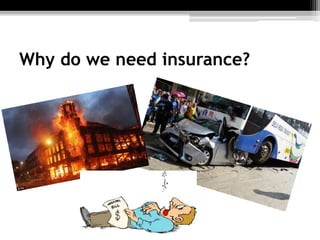
Why do we need insurance?
Introduction
• The insurance industry of India consists of 53
insurance companies
• 24 are in life insurance business
• 29 are non-life insurers.
• Life Insurance Corporation (LIC) is the sole
public sector company.
• In non-life insurers there are six public sector
insurers
Insurance?
• Insurance is a means of protection from financial loss.
It is a form of risk management primarily used
to hedge against the risk of a contingent, uncertain loss.
• An entity which provides insurance is known as an
insurer, insurance company, or insurance carrier.
• A person or entity who buys insurance is known as an
insured or policyholder.
• The amount of money charged by the insurer to the
insured for the coverage set forth in the insurance policy
is called the premium.
Life insurance products
• Term insurance
• Money back policies:
• Whole life policy:
• Pension policy:
• Unit linked insurance policy:
Market size
• India's life insurance sector is the biggest in the world
with about 360 million policies
• It is expected to increase at a Compound Annual Growth
Rate (CAGR) of 12-15 per cent over the next five years
• The country’s insurance market is expected to quadruple
in size over the next 10 years from its current size of US$
60 billion
• India currently accounts for less than 1.5 per cent of the
world’s total insurance premiums
History of Indian insurance
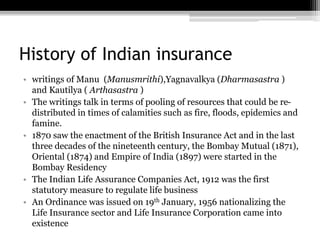
• writings of Manu (Manusmrithi),Yagnavalkya (Dharmasastra )
and Kautilya ( Arthasastra )
• The writings talk in terms of pooling of resources that could be re-
distributed in times of calamities such as fire, floods, epidemics and
famine.
• 1870 saw the enactment of the British Insurance Act and in the last
three decades of the nineteenth century, the Bombay Mutual (1871),
Oriental (1874) and Empire of India (1897) were started in the
Bombay Residency
• The Indian Life Assurance Companies Act, 1912 was the first
statutory measure to regulate life business
• An Ordinance was issued on 19th January, 1956 nationalizing the
Life Insurance sector and Life Insurance Corporation came into
existence
Investments
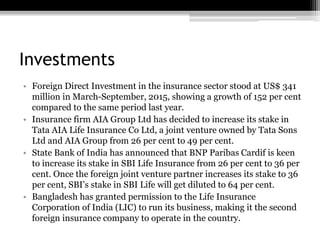
• Foreign Direct Investment in the insurance sector stood at US$ 341
million in March-September, 2015, showing a growth of 152 per cent
compared to the same period last year.
• Insurance firm AIA Group Ltd has decided to increase its stake in
Tata AIA Life Insurance Co Ltd, a joint venture owned by Tata Sons
Ltd and AIA Group from 26 per cent to 49 per cent.
• State Bank of India has announced that BNP Paribas Cardif is keen
to increase its stake in SBI Life Insurance from 26 per cent to 36 per
cent. Once the foreign joint venture partner increases its stake to 36
per cent, SBI’s stake in SBI Life will get diluted to 64 per cent.
• Bangladesh has granted permission to the Life Insurance
Corporation of India (LIC) to run its business, making it the second
foreign insurance company to operate in the country.
Government initiatives
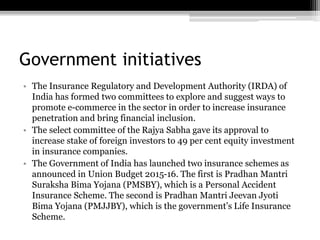
• The Insurance Regulatory and Development Authority (IRDA) of
India has formed two committees to explore and suggest ways to
promote e-commerce in the sector in order to increase insurance
penetration and bring financial inclusion.
• The select committee of the Rajya Sabha gave its approval to
increase stake of foreign investors to 49 per cent equity investment
in insurance companies.
• The Government of India has launched two insurance schemes as
announced in Union Budget 2015-16. The first is Pradhan Mantri
Suraksha Bima Yojana (PMSBY), which is a Personal Accident
Insurance Scheme. The second is Pradhan Mantri Jeevan Jyoti
Bima Yojana (PMJJBY), which is the government’s Life Insurance
Scheme.
Insurance sector reforms
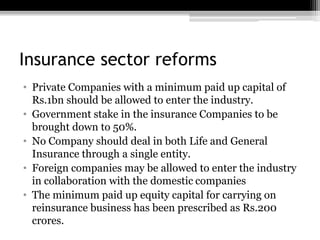
• Private Companies with a minimum paid up capital of
Rs.1bn should be allowed to enter the industry.
• Government stake in the insurance Companies to be
brought down to 50%.
• No Company should deal in both Life and General
Insurance through a single entity.
• Foreign companies may be allowed to enter the industry
in collaboration with the domestic companies
• The minimum paid up equity capital for carrying on
reinsurance business has been prescribed as Rs.200
crores.
IRDA
• Insurance Regulatory and Development Authority of
India (IRDAI) is an autonomous apex statutory body which
regulates and develops the insurance industry in India. It was
constituted by a Parliament of India act called Insurance
Regulatory and Development Authority Act, 1999 and duly passed
by the Government of India
• The agency operates from its headquarters
at Hyderabad, Telangana where it shifted from Delhi in 2001.
• IRDA batted for a hike in the foreign direct investment (FDI) limit
to 49 per cent in the insurance sector from the erstwhile 26 per
cent. The FDI limit in insurance sector was raised to 49% in July
2014.
Mission statement
• To protect the interest of and secure fair treatment to policyholders
• To bring about speedy and orderly growth of the insurance industry (including
annuity and superannuation payments), for the benefit of the common man, and to
provide long term funds for accelerating growth of the economy
• To set, promote, monitor and enforce high standards of integrity, financial
soundness, fair dealing and competence of those it regulates
• To ensure speedy settlement of genuine claims, to prevent insurance frauds and other
malpractices and put in place effective grievance redressal machinery;
• To promote fairness, transparency and orderly conduct in financial markets dealing
with insurance and build a reliable management information system to enforce high
standards of financial soundness amongst market players
• To take action where such standards are inadequate or ineffectively enforced
• To bring about optimum amount of self-regulation in day-to-day working of the
industry consistent with the requirements of prudential requirement
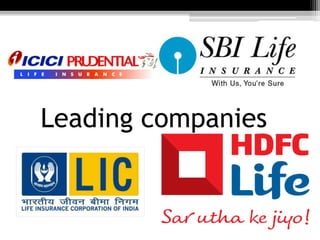
Leading companies
Life Insurance Corporation (India)
Life Insurance Corporation (India) (LIC) is
an Indian state-owned insurance
group and investment company headquartered
in Mumbai. It is the largest insurance company
in India with an estimated asset value
of ₹1560482 crore (US$230 billion).[2] As of
2013 it had total life fund of Rs.1433103.14 crore
with total value of policies sold of 367.82 lakh
that year
Life Insurance Corporation (India)
• 8 zonal offices, around 113 divisional offices, 2,048
branches and 992 satellite offices and corporate
offices.
• 54 customer zones and 25 metro-area service hubs
located in different cities and towns of India.
• It also has a network of 1,337,064 individual agents,
242 Corporate Agents, 89 Referral Agents, 98
Brokers and 42 Banks for soliciting life insurance
business from the public.
• As on 31 March 2014, LIC had 1,20,388 employees,
out of which 24,867 were women (20.65%).
HDFC Life
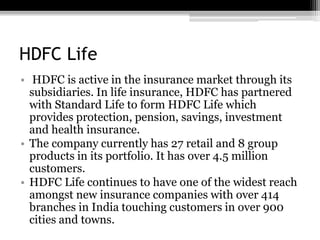
• HDFC is active in the insurance market through its
subsidiaries. In life insurance, HDFC has partnered
with Standard Life to form HDFC Life which
provides protection, pension, savings, investment
and health insurance.
• The company currently has 27 retail and 8 group
products in its portfolio. It has over 4.5 million
customers.
• HDFC Life continues to have one of the widest reach
amongst new insurance companies with over 414
branches in India touching customers in over 900
cities and towns.
ICICI Prudential Life
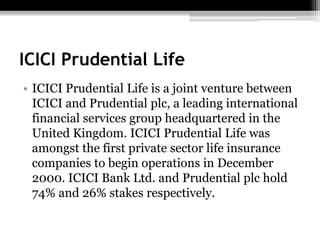
• ICICI Prudential Life is a joint venture between
ICICI and Prudential plc, a leading international
financial services group headquartered in the
United Kingdom. ICICI Prudential Life was
amongst the first private sector life insurance
companies to begin operations in December
2000. ICICI Bank Ltd. and Prudential plc hold
74% and 26% stakes respectively.
SBI Life Insurance Co. Ltd
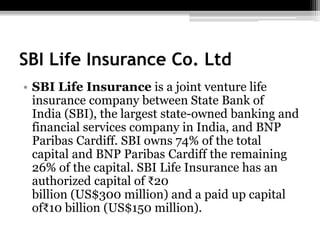
• SBI Life Insurance is a joint venture life
insurance company between State Bank of
India (SBI), the largest state-owned banking and
financial services company in India, and BNP
Paribas Cardiff. SBI owns 74% of the total
capital and BNP Paribas Cardiff the remaining
26% of the capital. SBI Life Insurance has an
authorized capital of ₹20
billion (US$300 million) and a paid up capital
of₹10 billion (US$150 million).
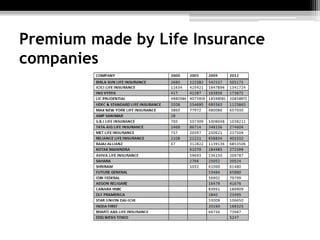
Premium made by Life Insurance
companies
Herfindahl index of Life Insurance
companies
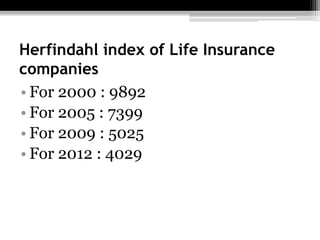
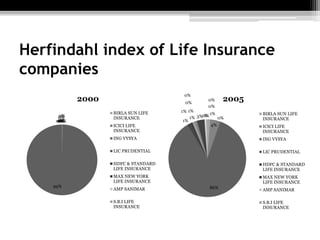
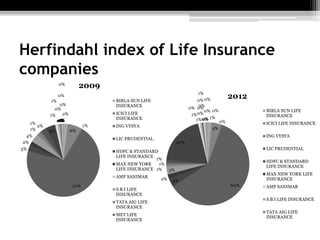
• For 2000 : 9892
• For 2005 : 7399
• For 2009 : 5025
• For 2012 : 4029
Herfindahl index of Life Insurance
companies
0%
0%0%
99%
0%0%
0%0%0%0%0%0%
2000
BIRLA SUN LIFE
INSURANCE
ICICI LIFE
INSURANCE
ING VYSYA
LIC PRUDENTIAL
HDFC & STANDARD
LIFE INSURANCE
MAX NEW YORK
LIFE INSURANCE
AMP SANIMAR
S.B.I LIFE
INSURANCE
1%
4%
0%
86%
1%
1%
1%
1%
0%
0%
3%1%1%
0%
0%
2005
BIRLA SUN LIFE
INSURANCE
ICICI LIFE
INSURANCE
ING VYSYA
LIC PRUDENTIAL
HDFC & STANDARD
LIFE INSURANCE
MAX NEW YORK
LIFE INSURANCE
AMP SANIMAR
S.B.I LIFE
INSURANCE
Herfindahl index of Life Insurance
companies
2%
6%
1%
70%
3%
2%
4%
1%
1%
2%
4%
1%
1%
0%
0%0%0%0%0%0%
0%
0%
0%
2009
BIRLA SUN LIFE
INSURANCE
ICICI LIFE
INSURANCE
ING VYSYA
LIC PRUDENTIAL
HDFC & STANDARD
LIFE INSURANCE
MAX NEW YORK
LIFE INSURANCE
AMP SANIMAR
S.B.I LIFE
INSURANCE
TATA AIG LIFE
INSURANCE
MET LIFE
INSURANCE
1%
4%
0%
60%
3%2%
3%1%
1%
1%
20%
1%
1%
0%
0%
0%
0%
0%
1%
0%0%
0%
0%
0%
2012
BIRLA SUN LIFE
INSURANCE
ICICI LIFE INSURANCE
ING VYSYA
LIC PRUDENTIAL
HDFC & STANDARD
LIFE INSURANCE
MAX NEW YORK LIFE
INSURANCE
AMP SANIMAR
S.B.I LIFE INSURANCE
TATA AIG LIFE
INSURANCE
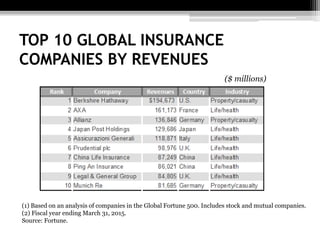
TOP 10 GLOBAL INSURANCE
COMPANIES BY REVENUES
($ millions)
(1) Based on an analysis of companies in the Global Fortune 500. Includes stock and mutual companies.
(2) Fiscal year ending March 31, 2015.
Source: Fortune.
Comparison of India and world
• The Confederation of Indian Industry states that the
insurance sector of the country has been witnessing a
consistent growth rate of late and its present worth is 41
billion US dollars.
• The industry has of late achieved a yearly growth rate within
32 and 34 percent and this makes it the 5th best among
emerging economies around the world.
• India’s insurance penetration is far below the world average
of 6.3%, largely due to limited financial awareness and
literacy among the masses.
• Further, while India stands at 3.1% in terms of life
insurance penetration versus a global average of 3.5%, it
lags far behind in non-life insurance where the penetration is
a mere 0.8% compared to the world average of 2.8%.
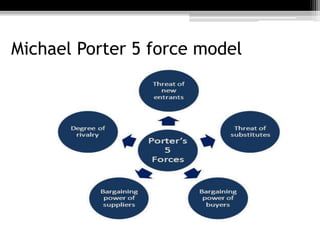
Michael Porter 5 force model
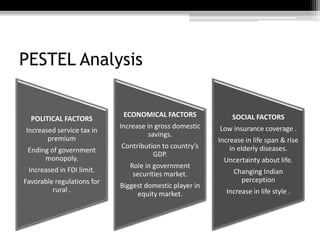
PESTEL Analysis
POLITICAL FACTORS
Increased service tax in
premium
Ending of government
monopoly.
Increased in FDI limit.
Favorable regulations for
rural .
ECONOMICAL FACTORS
Increase in gross domestic
savings.
Contribution to country’s
GDP.
Role in government
securities market.
Biggest domestic player in
equity market.
SOCIAL FACTORS
Low insurance coverage .
Increase in life span & rise
in elderly diseases.
Uncertainty about life.
Changing Indian
perception
Increase in life style .
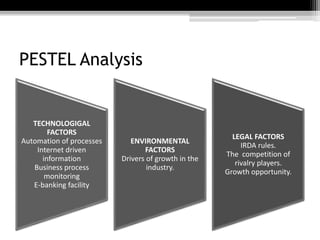
PESTEL Analysis
TECHNOLOGIGAL
FACTORS
Automation of processes
Internet driven
information
Business process
monitoring
E-banking facility
ENVIRONMENTAL
FACTORS
Drivers of growth in the
industry.
LEGAL FACTORS
IRDA rules.
The competition of
rivalry players.
Growth opportunity.
Performance
• India’s life insurance sector is the biggest in the world
with about 360 million policies, LIC of India is the
leading player in the Indian life insurance market,
generating a 69.6% share of the market's value
• India is the fifteenth largest insurance market in the
world in terms of premium volume and has the potential
to grow exponentially in the coming years. On a per
capita income basis, India ranked 140th by nominal GDP
• Which are expected to increase at a compounded annual
growth rate (CAGR) of 12-15 per cent over the next five
years.
Performance
• The insurance industry is planning to hike penetration
levels to five per cent by 2020. In 2020, the Indian life
insurance market is forecast to have a value of $84.3
billion, an increase of 31.7% since 2015. The compound
annual growth rate of the market in the period 2015–20
is predicted to be 5.7%.
• India ranks 20 in global non-life insurance markets. The
growth in global non-life premium was 2.9 per cent.
Over the last 10 years, the penetration of non-life
insurance sector in the country remained steady in the
range of 0.5-0.8 per cent. The share of Indian non-life
insurance premium in global non-life insurance
premium was small at 0.69 per cent
Performance
• According to IRDA in February 2013, it was
proposed that the insurance companies be
required to maintain a solvency ratio of 1.45
from fiscal 2013-14.By and large, the higher the
solvency ratio the stronger the promise.
• Premium collected by Indian insurers is 3.90%
of GDP in FY 2013-14. Per capita premium
underwritten i.e. insurance density in India
during FY 2013-14 is US$ 52.0.
Performance
CONCLUSION
• Insurance is an integral part of any personal
financial plan
• It is essential that you know what each type of
insurance covers and how it works so you can
make the best decision about what to buy. not
base your decision on just what is cheapest, but
look at what it provides.
CONCLUSION
• India has reported an increase in both life insurance
density and penetration. But compared to UK,
France, South Korea, Japan and South Africa, India
is way behind. Among developing countries it stands
second to South Africa. There is much scope for the
life insurance sector to develop in India
• The prediction of new business and total premium
for both private and public sector life insurance
companies in India for the year 2015 also shows an
upward trend which signifies that there is a lot of
scope for life insurance business in India.
Insurance

Insurance

  • 1.
  • 3.
    Why do weneed insurance?
  • 4.
    Introduction • The insuranceindustry of India consists of 53 insurance companies • 24 are in life insurance business • 29 are non-life insurers. • Life Insurance Corporation (LIC) is the sole public sector company. • In non-life insurers there are six public sector insurers
  • 5.
    Insurance? • Insurance isa means of protection from financial loss. It is a form of risk management primarily used to hedge against the risk of a contingent, uncertain loss. • An entity which provides insurance is known as an insurer, insurance company, or insurance carrier. • A person or entity who buys insurance is known as an insured or policyholder. • The amount of money charged by the insurer to the insured for the coverage set forth in the insurance policy is called the premium.
  • 6.
    Life insurance products •Term insurance • Money back policies: • Whole life policy: • Pension policy: • Unit linked insurance policy:
  • 7.
    Market size • India'slife insurance sector is the biggest in the world with about 360 million policies • It is expected to increase at a Compound Annual Growth Rate (CAGR) of 12-15 per cent over the next five years • The country’s insurance market is expected to quadruple in size over the next 10 years from its current size of US$ 60 billion • India currently accounts for less than 1.5 per cent of the world’s total insurance premiums
  • 8.
    History of Indianinsurance • writings of Manu (Manusmrithi),Yagnavalkya (Dharmasastra ) and Kautilya ( Arthasastra ) • The writings talk in terms of pooling of resources that could be re- distributed in times of calamities such as fire, floods, epidemics and famine. • 1870 saw the enactment of the British Insurance Act and in the last three decades of the nineteenth century, the Bombay Mutual (1871), Oriental (1874) and Empire of India (1897) were started in the Bombay Residency • The Indian Life Assurance Companies Act, 1912 was the first statutory measure to regulate life business • An Ordinance was issued on 19th January, 1956 nationalizing the Life Insurance sector and Life Insurance Corporation came into existence
  • 9.
    Investments • Foreign DirectInvestment in the insurance sector stood at US$ 341 million in March-September, 2015, showing a growth of 152 per cent compared to the same period last year. • Insurance firm AIA Group Ltd has decided to increase its stake in Tata AIA Life Insurance Co Ltd, a joint venture owned by Tata Sons Ltd and AIA Group from 26 per cent to 49 per cent. • State Bank of India has announced that BNP Paribas Cardif is keen to increase its stake in SBI Life Insurance from 26 per cent to 36 per cent. Once the foreign joint venture partner increases its stake to 36 per cent, SBI’s stake in SBI Life will get diluted to 64 per cent. • Bangladesh has granted permission to the Life Insurance Corporation of India (LIC) to run its business, making it the second foreign insurance company to operate in the country.
  • 10.
    Government initiatives • TheInsurance Regulatory and Development Authority (IRDA) of India has formed two committees to explore and suggest ways to promote e-commerce in the sector in order to increase insurance penetration and bring financial inclusion. • The select committee of the Rajya Sabha gave its approval to increase stake of foreign investors to 49 per cent equity investment in insurance companies. • The Government of India has launched two insurance schemes as announced in Union Budget 2015-16. The first is Pradhan Mantri Suraksha Bima Yojana (PMSBY), which is a Personal Accident Insurance Scheme. The second is Pradhan Mantri Jeevan Jyoti Bima Yojana (PMJJBY), which is the government’s Life Insurance Scheme.
  • 11.
    Insurance sector reforms •Private Companies with a minimum paid up capital of Rs.1bn should be allowed to enter the industry. • Government stake in the insurance Companies to be brought down to 50%. • No Company should deal in both Life and General Insurance through a single entity. • Foreign companies may be allowed to enter the industry in collaboration with the domestic companies • The minimum paid up equity capital for carrying on reinsurance business has been prescribed as Rs.200 crores.
  • 12.
    IRDA • Insurance Regulatoryand Development Authority of India (IRDAI) is an autonomous apex statutory body which regulates and develops the insurance industry in India. It was constituted by a Parliament of India act called Insurance Regulatory and Development Authority Act, 1999 and duly passed by the Government of India • The agency operates from its headquarters at Hyderabad, Telangana where it shifted from Delhi in 2001. • IRDA batted for a hike in the foreign direct investment (FDI) limit to 49 per cent in the insurance sector from the erstwhile 26 per cent. The FDI limit in insurance sector was raised to 49% in July 2014.
  • 13.
    Mission statement • Toprotect the interest of and secure fair treatment to policyholders • To bring about speedy and orderly growth of the insurance industry (including annuity and superannuation payments), for the benefit of the common man, and to provide long term funds for accelerating growth of the economy • To set, promote, monitor and enforce high standards of integrity, financial soundness, fair dealing and competence of those it regulates • To ensure speedy settlement of genuine claims, to prevent insurance frauds and other malpractices and put in place effective grievance redressal machinery; • To promote fairness, transparency and orderly conduct in financial markets dealing with insurance and build a reliable management information system to enforce high standards of financial soundness amongst market players • To take action where such standards are inadequate or ineffectively enforced • To bring about optimum amount of self-regulation in day-to-day working of the industry consistent with the requirements of prudential requirement
  • 14.
  • 15.
    Life Insurance Corporation(India) Life Insurance Corporation (India) (LIC) is an Indian state-owned insurance group and investment company headquartered in Mumbai. It is the largest insurance company in India with an estimated asset value of ₹1560482 crore (US$230 billion).[2] As of 2013 it had total life fund of Rs.1433103.14 crore with total value of policies sold of 367.82 lakh that year
  • 16.
    Life Insurance Corporation(India) • 8 zonal offices, around 113 divisional offices, 2,048 branches and 992 satellite offices and corporate offices. • 54 customer zones and 25 metro-area service hubs located in different cities and towns of India. • It also has a network of 1,337,064 individual agents, 242 Corporate Agents, 89 Referral Agents, 98 Brokers and 42 Banks for soliciting life insurance business from the public. • As on 31 March 2014, LIC had 1,20,388 employees, out of which 24,867 were women (20.65%).
  • 17.
    HDFC Life • HDFCis active in the insurance market through its subsidiaries. In life insurance, HDFC has partnered with Standard Life to form HDFC Life which provides protection, pension, savings, investment and health insurance. • The company currently has 27 retail and 8 group products in its portfolio. It has over 4.5 million customers. • HDFC Life continues to have one of the widest reach amongst new insurance companies with over 414 branches in India touching customers in over 900 cities and towns.
  • 18.
    ICICI Prudential Life •ICICI Prudential Life is a joint venture between ICICI and Prudential plc, a leading international financial services group headquartered in the United Kingdom. ICICI Prudential Life was amongst the first private sector life insurance companies to begin operations in December 2000. ICICI Bank Ltd. and Prudential plc hold 74% and 26% stakes respectively.
  • 19.
    SBI Life InsuranceCo. Ltd • SBI Life Insurance is a joint venture life insurance company between State Bank of India (SBI), the largest state-owned banking and financial services company in India, and BNP Paribas Cardiff. SBI owns 74% of the total capital and BNP Paribas Cardiff the remaining 26% of the capital. SBI Life Insurance has an authorized capital of ₹20 billion (US$300 million) and a paid up capital of₹10 billion (US$150 million).
  • 20.
    Premium made byLife Insurance companies
  • 21.
    Herfindahl index ofLife Insurance companies • For 2000 : 9892 • For 2005 : 7399 • For 2009 : 5025 • For 2012 : 4029
  • 22.
    Herfindahl index ofLife Insurance companies 0% 0%0% 99% 0%0% 0%0%0%0%0%0% 2000 BIRLA SUN LIFE INSURANCE ICICI LIFE INSURANCE ING VYSYA LIC PRUDENTIAL HDFC & STANDARD LIFE INSURANCE MAX NEW YORK LIFE INSURANCE AMP SANIMAR S.B.I LIFE INSURANCE 1% 4% 0% 86% 1% 1% 1% 1% 0% 0% 3%1%1% 0% 0% 2005 BIRLA SUN LIFE INSURANCE ICICI LIFE INSURANCE ING VYSYA LIC PRUDENTIAL HDFC & STANDARD LIFE INSURANCE MAX NEW YORK LIFE INSURANCE AMP SANIMAR S.B.I LIFE INSURANCE
  • 23.
    Herfindahl index ofLife Insurance companies 2% 6% 1% 70% 3% 2% 4% 1% 1% 2% 4% 1% 1% 0% 0%0%0%0%0%0% 0% 0% 0% 2009 BIRLA SUN LIFE INSURANCE ICICI LIFE INSURANCE ING VYSYA LIC PRUDENTIAL HDFC & STANDARD LIFE INSURANCE MAX NEW YORK LIFE INSURANCE AMP SANIMAR S.B.I LIFE INSURANCE TATA AIG LIFE INSURANCE MET LIFE INSURANCE 1% 4% 0% 60% 3%2% 3%1% 1% 1% 20% 1% 1% 0% 0% 0% 0% 0% 1% 0%0% 0% 0% 0% 2012 BIRLA SUN LIFE INSURANCE ICICI LIFE INSURANCE ING VYSYA LIC PRUDENTIAL HDFC & STANDARD LIFE INSURANCE MAX NEW YORK LIFE INSURANCE AMP SANIMAR S.B.I LIFE INSURANCE TATA AIG LIFE INSURANCE
  • 24.
    TOP 10 GLOBALINSURANCE COMPANIES BY REVENUES ($ millions) (1) Based on an analysis of companies in the Global Fortune 500. Includes stock and mutual companies. (2) Fiscal year ending March 31, 2015. Source: Fortune.
  • 25.
    Comparison of Indiaand world • The Confederation of Indian Industry states that the insurance sector of the country has been witnessing a consistent growth rate of late and its present worth is 41 billion US dollars. • The industry has of late achieved a yearly growth rate within 32 and 34 percent and this makes it the 5th best among emerging economies around the world. • India’s insurance penetration is far below the world average of 6.3%, largely due to limited financial awareness and literacy among the masses. • Further, while India stands at 3.1% in terms of life insurance penetration versus a global average of 3.5%, it lags far behind in non-life insurance where the penetration is a mere 0.8% compared to the world average of 2.8%.
  • 26.
    Michael Porter 5force model
  • 27.
    PESTEL Analysis POLITICAL FACTORS Increasedservice tax in premium Ending of government monopoly. Increased in FDI limit. Favorable regulations for rural . ECONOMICAL FACTORS Increase in gross domestic savings. Contribution to country’s GDP. Role in government securities market. Biggest domestic player in equity market. SOCIAL FACTORS Low insurance coverage . Increase in life span & rise in elderly diseases. Uncertainty about life. Changing Indian perception Increase in life style .
  • 28.
    PESTEL Analysis TECHNOLOGIGAL FACTORS Automation ofprocesses Internet driven information Business process monitoring E-banking facility ENVIRONMENTAL FACTORS Drivers of growth in the industry. LEGAL FACTORS IRDA rules. The competition of rivalry players. Growth opportunity.
  • 29.
    Performance • India’s lifeinsurance sector is the biggest in the world with about 360 million policies, LIC of India is the leading player in the Indian life insurance market, generating a 69.6% share of the market's value • India is the fifteenth largest insurance market in the world in terms of premium volume and has the potential to grow exponentially in the coming years. On a per capita income basis, India ranked 140th by nominal GDP • Which are expected to increase at a compounded annual growth rate (CAGR) of 12-15 per cent over the next five years.
  • 30.
    Performance • The insuranceindustry is planning to hike penetration levels to five per cent by 2020. In 2020, the Indian life insurance market is forecast to have a value of $84.3 billion, an increase of 31.7% since 2015. The compound annual growth rate of the market in the period 2015–20 is predicted to be 5.7%. • India ranks 20 in global non-life insurance markets. The growth in global non-life premium was 2.9 per cent. Over the last 10 years, the penetration of non-life insurance sector in the country remained steady in the range of 0.5-0.8 per cent. The share of Indian non-life insurance premium in global non-life insurance premium was small at 0.69 per cent
  • 31.
    Performance • According toIRDA in February 2013, it was proposed that the insurance companies be required to maintain a solvency ratio of 1.45 from fiscal 2013-14.By and large, the higher the solvency ratio the stronger the promise. • Premium collected by Indian insurers is 3.90% of GDP in FY 2013-14. Per capita premium underwritten i.e. insurance density in India during FY 2013-14 is US$ 52.0.
  • 32.
  • 33.
    CONCLUSION • Insurance isan integral part of any personal financial plan • It is essential that you know what each type of insurance covers and how it works so you can make the best decision about what to buy. not base your decision on just what is cheapest, but look at what it provides.
  • 34.
    CONCLUSION • India hasreported an increase in both life insurance density and penetration. But compared to UK, France, South Korea, Japan and South Africa, India is way behind. Among developing countries it stands second to South Africa. There is much scope for the life insurance sector to develop in India • The prediction of new business and total premium for both private and public sector life insurance companies in India for the year 2015 also shows an upward trend which signifies that there is a lot of scope for life insurance business in India.