• Introduction
• States of matter
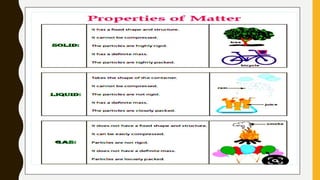
• Properties of different states of matter.
• Examples of states of matter.
• Various Temperature Scale
• Change of State -Melting, Boiling ,Melting point and Boiling point
• Evaporation and Boiling.
• Factors on Which Rate of evaporation depends
• Concept of Latent heat
CONTENT-
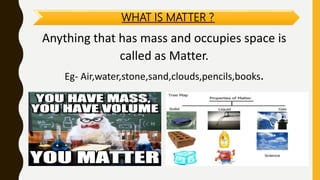
WHAT IS MATTER ?
Anything that has mass and occupies space is
called as Matter.
Eg- Air,water,stone,sand,clouds,pencils,books.
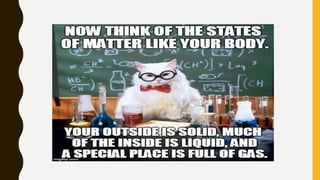
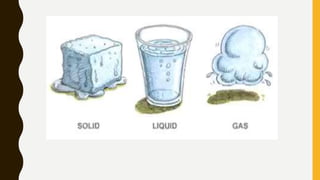
MATTER AROUND US IS EXISTS IN THREE
STATE THEY ARE:-
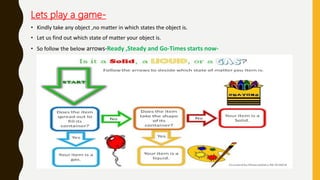
Lets play a game-
• Kindly take any object ,no matter in which states the object is.
• Let us find out which state of matter your object is.
• So follow the below arrows-Ready ,Steady and Go-Times starts now-
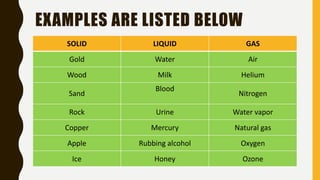
SOLID LIQUID GAS
Gold Water Air
Wood Milk Helium
Sand
Blood
Nitrogen
Rock Urine Water vapor
Copper Mercury Natural gas
Apple Rubbing alcohol Oxygen
Ice Honey Ozone
EXAMPLES ARE LISTED BELOW
TEMPERATURE SCALES
Celsius[°C] Fahrenheit[°F] Kelvin[K]
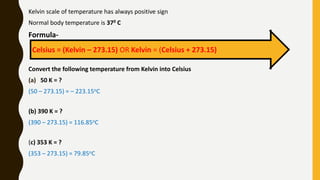
Kelvin scale of temperature has always positive sign
Normal body temperature is 370 C
Formula-
Convert the following temperature from Kelvin into Celsius
(a) 50 K = ?
(50 – 273.15) = – 223.15oC
(b) 390 K = ?
(390 – 273.15) = 116.85oC
(c) 353 K = ?
(353 – 273.15) = 79.85oC
Celsius = (Kelvin – 273.15) OR Kelvin = (Celsius + 273.15)
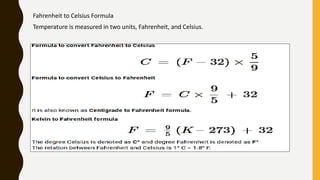
Fahrenheit to Celsius Formula
Temperature is measured in two units, Fahrenheit, and Celsius.
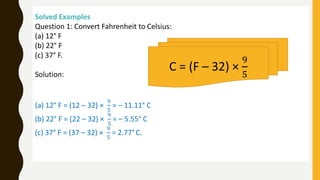
Solved Examples
Question 1: Convert Fahrenheit to Celsius:
(a) 12° F
(b) 22° F
(c) 37° F.
Solution:
(a) 12° F = (12 – 32) Ɨ
9
5
= – 11.11° C
(b) 22° F = (22 – 32) Ɨ
9
5
= – 5.55° C
(c) 37° F = (37 – 32) Ɨ
9
5
= 2.77° C.
C = (F – 32) Ɨ
9
5
Can Matter Change Its State?
Phase Changes-
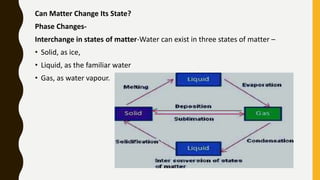
Interchange in states of matter-Water can exist in three states of matter –
• Solid, as ice,
• Liquid, as the familiar water
• Gas, as water vapour.
EFFECT OF CHANGE OF TEMPERATURE
What happens to matter when we heat it?
1. Solids:
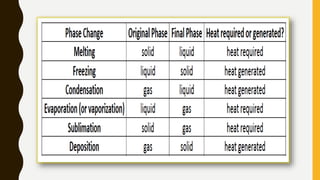
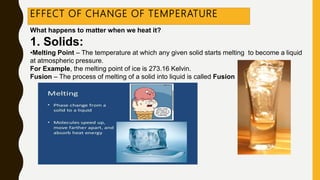
•Melting Point – The temperature at which any given solid starts melting to become a liquid
at atmospheric pressure.
For Example, the melting point of ice is 273.16 Kelvin.
Fusion – The process of melting of a solid into liquid is called Fusion
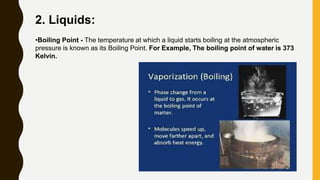
2. Liquids:
•Boiling Point - The temperature at which a liquid starts boiling at the atmospheric
pressure is known as its Boiling Point. For Example, The boiling point of water is 373
Kelvin.
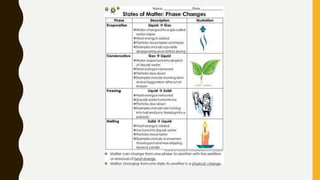
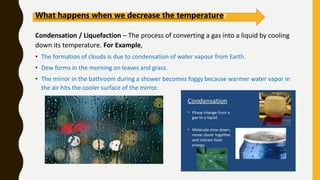
Condensation / Liquefaction – The process of converting a gas into a liquid by cooling
down its temperature. For Example,
• The formation of clouds is due to condensation of water vapour from Earth.
• Dew forms in the morning on leaves and grass.
• The mirror in the bathroom during a shower becomes foggy because warmer water vapor in
the air hits the cooler surface of the mirror.
What happens when we decrease the temperature?
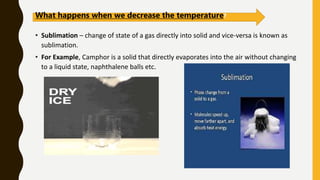
• Sublimation – change of state of a gas directly into solid and vice-versa is known as
sublimation.
• For Example, Camphor is a solid that directly evaporates into the air without changing
to a liquid state, naphthalene balls etc.
What happens when we decrease the temperature?
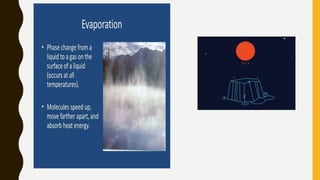
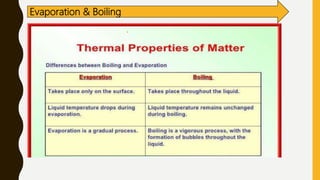
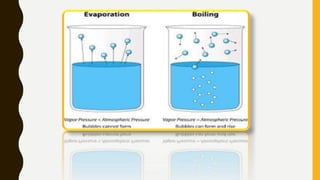
Evaporation & Boiling
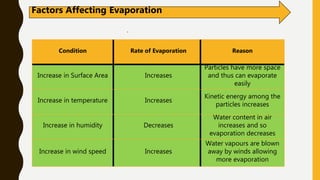
Factors Affecting Evaporation
Condition Rate of Evaporation Reason
Increase in Surface Area Increases
Particles have more space
and thus can evaporate
easily
Increase in temperature Increases
Kinetic energy among the
particles increases
Increase in humidity Decreases
Water content in air
increases and so
evaporation decreases
Increase in wind speed Increases
Water vapours are blown
away by winds allowing
more evaporation
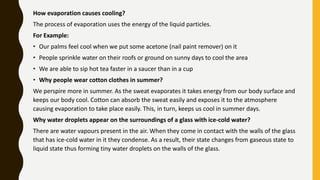
How evaporation causes cooling?
The process of evaporation uses the energy of the liquid particles.
For Example:
• Our palms feel cool when we put some acetone (nail paint remover) on it
• People sprinkle water on their roofs or ground on sunny days to cool the area
• We are able to sip hot tea faster in a saucer than in a cup
• Why people wear cotton clothes in summer?
We perspire more in summer. As the sweat evaporates it takes energy from our body surface and
keeps our body cool. Cotton can absorb the sweat easily and exposes it to the atmosphere
causing evaporation to take place easily. This, in turn, keeps us cool in summer days.
Why water droplets appear on the surroundings of a glass with ice-cold water?
There are water vapours present in the air. When they come in contact with the walls of the glass
that has ice-cold water in it they condense. As a result, their state changes from gaseous state to
liquid state thus forming tiny water droplets on the walls of the glass.
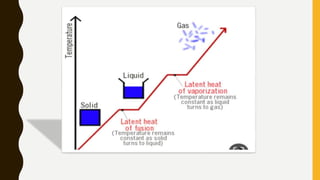
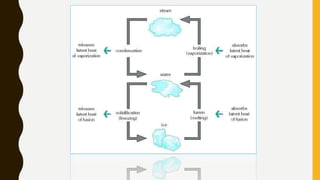
Latent Heat :
• Latent –means hidden
The hidden heat which breaks the force of attraction between the molecules
during change of state.
Latent heat are of two types-
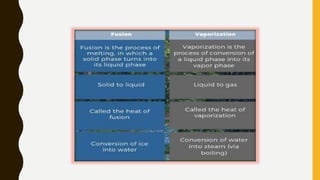
• Latent Heat of Fusion – The amount of heat energy required to change 1 kg of a solid
into liquid at atmospheric pressure at its melting point is known as the Latent Heat of
Fusion..
• Latent Heat of Vaporization – the amount of heat energy required to change 1 kg of a
liquid into a gas at atmospheric pressure at its boiling point is known as Latent Heat of
Vaporization.
THANK YOU !!!!!

MATTER IN OUR SURROUNDING

  • 2.
    • Introduction • Statesof matter • Properties of different states of matter. • Examples of states of matter. • Various Temperature Scale • Change of State -Melting, Boiling ,Melting point and Boiling point • Evaporation and Boiling. • Factors on Which Rate of evaporation depends • Concept of Latent heat CONTENT-
  • 3.
    WHAT IS MATTER? Anything that has mass and occupies space is called as Matter. Eg- Air,water,stone,sand,clouds,pencils,books.
  • 5.
    MATTER AROUND USIS EXISTS IN THREE STATE THEY ARE:-
  • 7.
    Lets play agame- • Kindly take any object ,no matter in which states the object is. • Let us find out which state of matter your object is. • So follow the below arrows-Ready ,Steady and Go-Times starts now-
  • 9.
    SOLID LIQUID GAS GoldWater Air Wood Milk Helium Sand Blood Nitrogen Rock Urine Water vapor Copper Mercury Natural gas Apple Rubbing alcohol Oxygen Ice Honey Ozone EXAMPLES ARE LISTED BELOW
  • 10.
  • 11.
    Kelvin scale oftemperature has always positive sign Normal body temperature is 370 C Formula- Convert the following temperature from Kelvin into Celsius (a) 50 K = ? (50 – 273.15) = – 223.15oC (b) 390 K = ? (390 – 273.15) = 116.85oC (c) 353 K = ? (353 – 273.15) = 79.85oC Celsius = (Kelvin – 273.15) OR Kelvin = (Celsius + 273.15)
  • 12.
    Fahrenheit to CelsiusFormula Temperature is measured in two units, Fahrenheit, and Celsius.
  • 13.
    Solved Examples Question 1:Convert Fahrenheit to Celsius: (a) 12° F (b) 22° F (c) 37° F. Solution: (a) 12° F = (12 – 32) Ɨ 9 5 = – 11.11° C (b) 22° F = (22 – 32) Ɨ 9 5 = – 5.55° C (c) 37° F = (37 – 32) Ɨ 9 5 = 2.77° C. C = (F – 32) Ɨ 9 5
  • 14.
    Can Matter ChangeIts State? Phase Changes- Interchange in states of matter-Water can exist in three states of matter – • Solid, as ice, • Liquid, as the familiar water • Gas, as water vapour.
  • 17.
    EFFECT OF CHANGEOF TEMPERATURE What happens to matter when we heat it? 1. Solids: •Melting Point – The temperature at which any given solid starts melting to become a liquid at atmospheric pressure. For Example, the melting point of ice is 273.16 Kelvin. Fusion – The process of melting of a solid into liquid is called Fusion
  • 18.
    2. Liquids: •Boiling Point- The temperature at which a liquid starts boiling at the atmospheric pressure is known as its Boiling Point. For Example, The boiling point of water is 373 Kelvin.
  • 19.
    Condensation / Liquefaction– The process of converting a gas into a liquid by cooling down its temperature. For Example, • The formation of clouds is due to condensation of water vapour from Earth. • Dew forms in the morning on leaves and grass. • The mirror in the bathroom during a shower becomes foggy because warmer water vapor in the air hits the cooler surface of the mirror. What happens when we decrease the temperature?
  • 20.
    • Sublimation –change of state of a gas directly into solid and vice-versa is known as sublimation. • For Example, Camphor is a solid that directly evaporates into the air without changing to a liquid state, naphthalene balls etc. What happens when we decrease the temperature?
  • 22.
  • 24.
    Factors Affecting Evaporation ConditionRate of Evaporation Reason Increase in Surface Area Increases Particles have more space and thus can evaporate easily Increase in temperature Increases Kinetic energy among the particles increases Increase in humidity Decreases Water content in air increases and so evaporation decreases Increase in wind speed Increases Water vapours are blown away by winds allowing more evaporation
  • 25.
    How evaporation causescooling? The process of evaporation uses the energy of the liquid particles. For Example: • Our palms feel cool when we put some acetone (nail paint remover) on it • People sprinkle water on their roofs or ground on sunny days to cool the area • We are able to sip hot tea faster in a saucer than in a cup • Why people wear cotton clothes in summer? We perspire more in summer. As the sweat evaporates it takes energy from our body surface and keeps our body cool. Cotton can absorb the sweat easily and exposes it to the atmosphere causing evaporation to take place easily. This, in turn, keeps us cool in summer days. Why water droplets appear on the surroundings of a glass with ice-cold water? There are water vapours present in the air. When they come in contact with the walls of the glass that has ice-cold water in it they condense. As a result, their state changes from gaseous state to liquid state thus forming tiny water droplets on the walls of the glass.
  • 26.
    Latent Heat : •Latent –means hidden The hidden heat which breaks the force of attraction between the molecules during change of state. Latent heat are of two types- • Latent Heat of Fusion – The amount of heat energy required to change 1 kg of a solid into liquid at atmospheric pressure at its melting point is known as the Latent Heat of Fusion.. • Latent Heat of Vaporization – the amount of heat energy required to change 1 kg of a liquid into a gas at atmospheric pressure at its boiling point is known as Latent Heat of Vaporization.
  • 30.