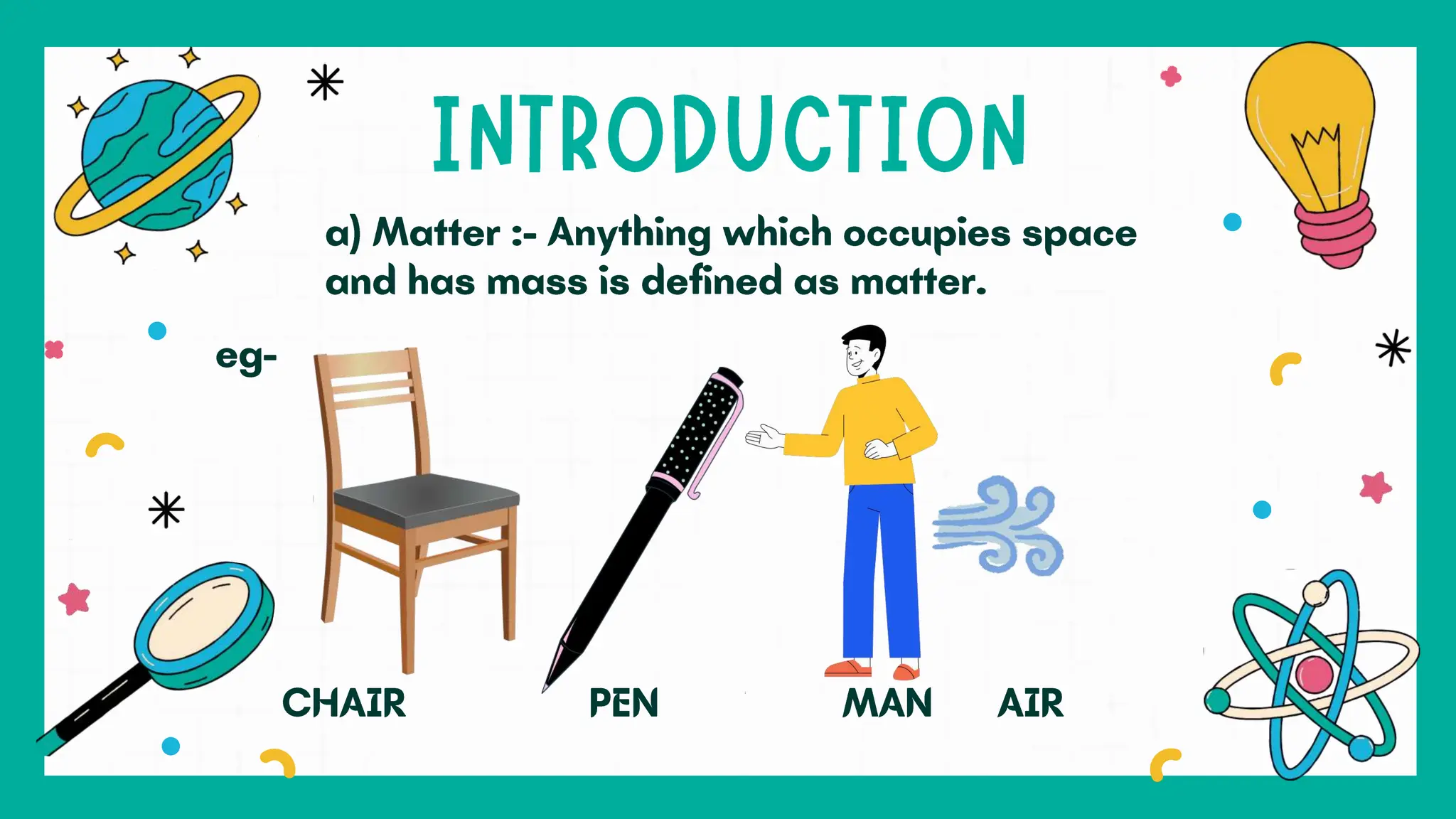
Every matter is composed of several similar
repeating units called particles. The nature of
particles and physical forces among them
determine the nature of the matter.
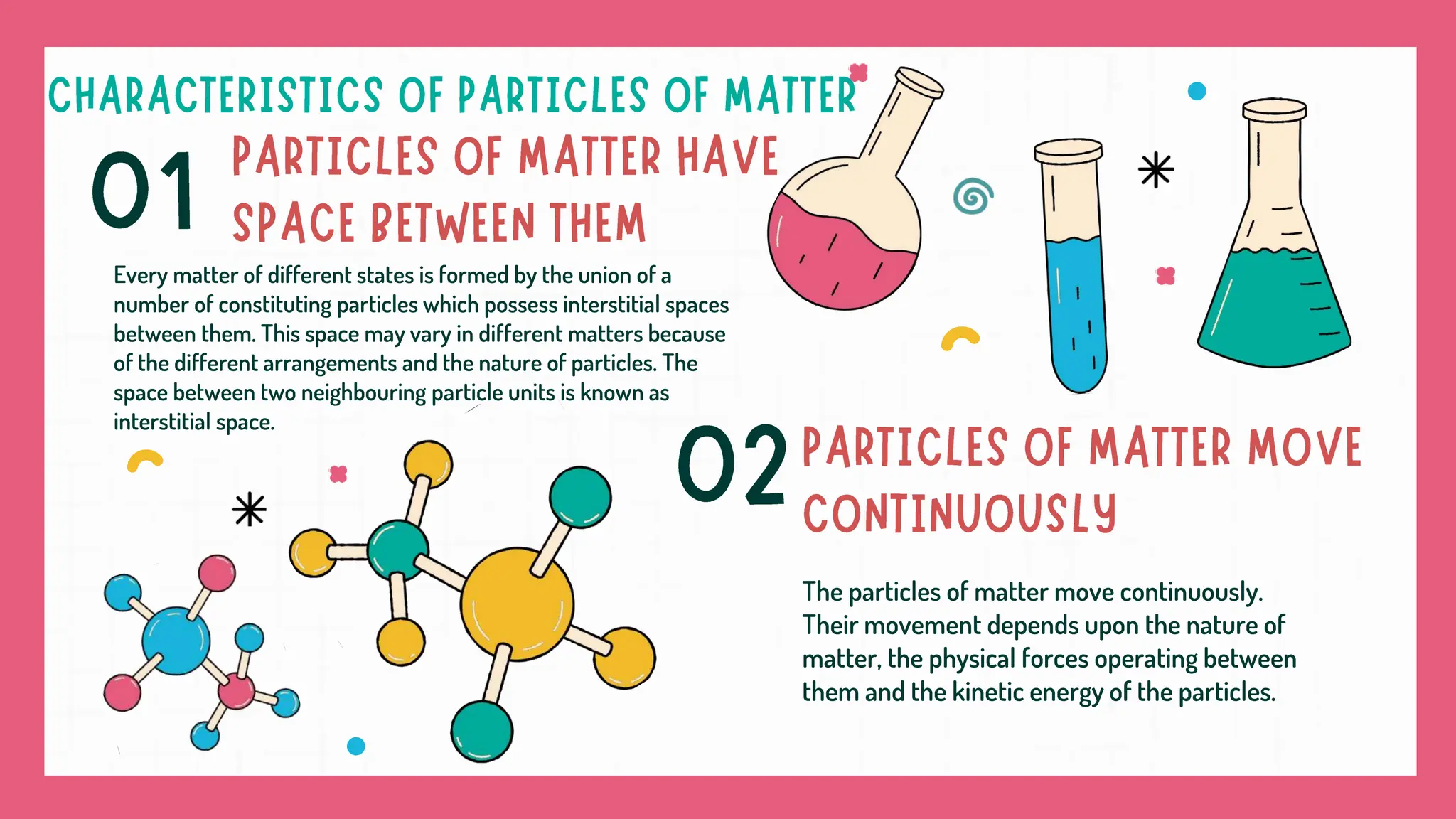
The particles of matter move continuously.
Their movement depends upon the nature of
matter, the physical forces operating between
them and the kinetic energy of the particles.
Every matter of different states is formed by the union of a
number of constituting particles which possess interstitial spaces
between them. This space may vary in different matters because
of the different arrangements and the nature of particles. The
space between two neighbouring particle units is known as
interstitial space.
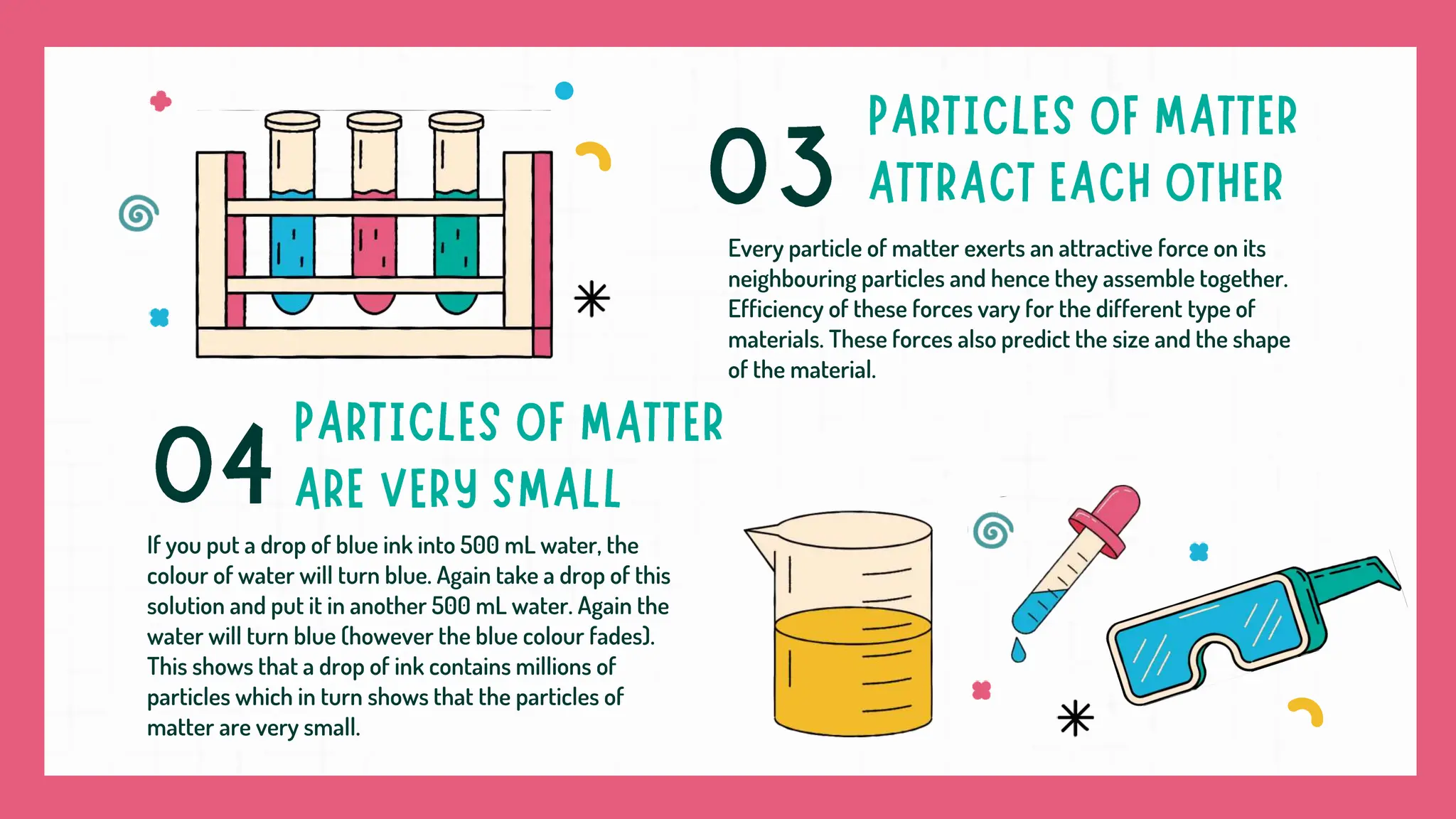
Every particle of matter exerts an attractive force on its
neighbouring particles and hence they assemble together.
Efficiency of these forces vary for the different type of
materials. These forces also predict the size and the shape
of the material.
If you put a drop of blue ink into 500 mL water, the
colour of water will turn blue. Again take a drop of this
solution and put it in another 500 mL water. Again the
water will turn blue (however the blue colour fades).
This shows that a drop of ink contains millions of
particles which in turn shows that the particles of
matter are very small.
Matter around us exists in three different states– solid,
liquid and gas. These states of matter arise due to the
variation in the characteristics of the particles of
matter.
Juice
When a solid is heated it changes into liquid. When a liquid
is heated it changes into gas. When a gas is cooled it
changes to liquid. When a liquid is cooled it changes into
solid. Eg:- If ice is heated it changes into water. If water is
heated it changes into steam. If steam is cooled it changes
into water. If water is cooled it changes into ice.
When a solid is heated, the particles begin to vibrate with
greater speed and begin to move more freely. Then at a
particular temperature the solid melts and changes into
liquid. The process of melting is also known as fusion. The
temperature at which a solid melts is called its melting
point. The melting point of ice is 0°C or 273 K.
When a liquid is heated, its particles begin to move even
faster. Then at a particular temperature the liquid begins
to boil and changes into gas (vapour). Boiling is a bulk
phenomenon. When a liquid boils the bulk of the liquid
changes into vapour. The temperature at which a liquid
starts boiling is called its boiling point. The boiling point of
water is 100°C or 373K (273 + 100).
The change of state directly from solid to
gas or from gas to solid is called
sublimation. Eg:- If solid camphor or
ammonium chloride is heated, it changes
into vapour. If the vapours are cooled it
changes into solid
When pressure is applied on gas the particles come closer
and the gas changes into liquid. We can liquefy gases by
applying pressure and reducing the temperature.
Compressed solid carbon dioxide is called dry ice. If the
pressure is reduced it changes directly to gas without
coming into liquid state. So solid carbon dioxide is known as
dry ice.
The change of state directly from solid to
gas or from gas to solid is called
sublimation. Eg:- If solid camphor or
ammonium chloride is heated, it changes
into vapour. If the vapours are cooled it
changes into solid
The states of matter are inter convertible.
The state of matter can be changed by
changing the temperature or pressure.
Evaporation :- The change of a liquid into vapour at any temperature below its boiling point is
called evaporation. Evaporation is a surface phenomenon. Particles from the surface gain
enough energy to overcome the forces of attraction and changes to vapour state.
b) Factors affecting evaporation :-
The rate of evaporation depends upon surface area, temperature, humidity and wind speed.
Increase in the surface area increases the rate of evaporation.
Increase in temperature increases the rate of evaporation.
Increase in humidity decreases the rate of evaporation
Increase in wind speed increases the rate of evaporation.
When a liquid evaporates, the particles of the liquid absorb heat from the
surroundings and evaporates. So the surroundings become cold.
Eg:- People sprinkle water on the roof or open ground because during
evaporation water absorbs heat makes the hot surface cool. During summer we
sweat more because during evaporation the sweat absorbs heat from our body
making the body cool.
-Utkarsh kumar
Aryan Raj
Aditya Mishra
Suraj

CH-1 Matter in our surroundings

  • 3.
    Every matter iscomposed of several similar repeating units called particles. The nature of particles and physical forces among them determine the nature of the matter.
  • 4.
    The particles ofmatter move continuously. Their movement depends upon the nature of matter, the physical forces operating between them and the kinetic energy of the particles. Every matter of different states is formed by the union of a number of constituting particles which possess interstitial spaces between them. This space may vary in different matters because of the different arrangements and the nature of particles. The space between two neighbouring particle units is known as interstitial space.
  • 5.
    Every particle ofmatter exerts an attractive force on its neighbouring particles and hence they assemble together. Efficiency of these forces vary for the different type of materials. These forces also predict the size and the shape of the material. If you put a drop of blue ink into 500 mL water, the colour of water will turn blue. Again take a drop of this solution and put it in another 500 mL water. Again the water will turn blue (however the blue colour fades). This shows that a drop of ink contains millions of particles which in turn shows that the particles of matter are very small.
  • 7.
    Matter around usexists in three different states– solid, liquid and gas. These states of matter arise due to the variation in the characteristics of the particles of matter.
  • 9.
  • 11.
    When a solidis heated it changes into liquid. When a liquid is heated it changes into gas. When a gas is cooled it changes to liquid. When a liquid is cooled it changes into solid. Eg:- If ice is heated it changes into water. If water is heated it changes into steam. If steam is cooled it changes into water. If water is cooled it changes into ice.
  • 13.
    When a solidis heated, the particles begin to vibrate with greater speed and begin to move more freely. Then at a particular temperature the solid melts and changes into liquid. The process of melting is also known as fusion. The temperature at which a solid melts is called its melting point. The melting point of ice is 0°C or 273 K.
  • 15.
    When a liquidis heated, its particles begin to move even faster. Then at a particular temperature the liquid begins to boil and changes into gas (vapour). Boiling is a bulk phenomenon. When a liquid boils the bulk of the liquid changes into vapour. The temperature at which a liquid starts boiling is called its boiling point. The boiling point of water is 100°C or 373K (273 + 100).
  • 17.
    The change ofstate directly from solid to gas or from gas to solid is called sublimation. Eg:- If solid camphor or ammonium chloride is heated, it changes into vapour. If the vapours are cooled it changes into solid
  • 18.
    When pressure isapplied on gas the particles come closer and the gas changes into liquid. We can liquefy gases by applying pressure and reducing the temperature. Compressed solid carbon dioxide is called dry ice. If the pressure is reduced it changes directly to gas without coming into liquid state. So solid carbon dioxide is known as dry ice.
  • 19.
    The change ofstate directly from solid to gas or from gas to solid is called sublimation. Eg:- If solid camphor or ammonium chloride is heated, it changes into vapour. If the vapours are cooled it changes into solid
  • 20.
    The states ofmatter are inter convertible. The state of matter can be changed by changing the temperature or pressure.
  • 21.
    Evaporation :- Thechange of a liquid into vapour at any temperature below its boiling point is called evaporation. Evaporation is a surface phenomenon. Particles from the surface gain enough energy to overcome the forces of attraction and changes to vapour state. b) Factors affecting evaporation :- The rate of evaporation depends upon surface area, temperature, humidity and wind speed. Increase in the surface area increases the rate of evaporation. Increase in temperature increases the rate of evaporation. Increase in humidity decreases the rate of evaporation Increase in wind speed increases the rate of evaporation.
  • 22.
    When a liquidevaporates, the particles of the liquid absorb heat from the surroundings and evaporates. So the surroundings become cold. Eg:- People sprinkle water on the roof or open ground because during evaporation water absorbs heat makes the hot surface cool. During summer we sweat more because during evaporation the sweat absorbs heat from our body making the body cool.
  • 23.