z
Estimation of
Parameters
UNIT II
MODULE 6
z
PART 1
Point Estimation
z
Learning Targets
 Differentiate descriptive and inferential statistics
 Define, differentiate and illustrate point estimation and interval
estimation
 Discuss the properties of a good estimator
 Use a point estimator to estimate the population mean and
population variance
z
DESCRIPTIVE STATISTICS vs
INFERENTIAL STATISTICS
 DESCRIPTIVE STATISTICS
- aims to describe the characteristics of data
- process of using or analyzing those measures that quantitatively
describe or summarize features from a collection of information
 INFERENTIAL STATISTICS
- aims to make inferences or predictions
- pertains to the process of drawing and making decisions concerning a
given population based on the data obtained from a sample
- focuses on estimation and hypothesis testing
z
Estimation
 A process used to calculate the proposed values for parameters by
using only a random sample from the population.
 Being done because population parameters are usually unknown and
/or the population is infeasible to study
 Note: The results from estimation may not always be accepted since
it is preferred that interpretations and generalizations must be made
using data from the entire population. Thus, it is necessary to do
hypothesis testing.
z
POINT ESTIMATE
- refers to a single value that
best determines the
proposed parameter value
of the population
POINT ESTIMATION
- the process of finding
the point estimate
- involves sampling and
hypothesis testing
z
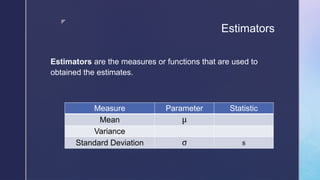
Estimators
Measure Parameter Statistic
Mean μ
Variance
Standard Deviation σ s
Estimators are the measures or functions that are used to
obtained the estimates.
z
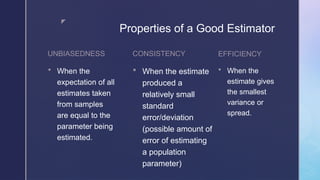
Properties of a Good Estimator
UNBIASEDNESS
 When the
expectation of all
estimates taken
from samples
are equal to the
parameter being
estimated.
CONSISTENCY
 When the estimate
produced a
relatively small
standard
error/deviation
(possible amount of
error of estimating
a population
parameter)
EFFICIENCY
 When the
estimate gives
the smallest
variance or
spread.
z
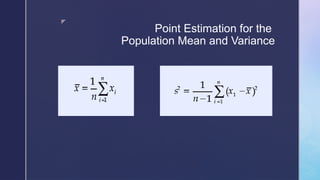
Point Estimation for the
Population Mean and Variance
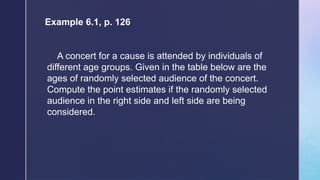
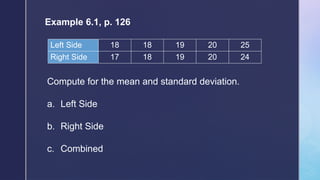
Example 6.1, p. 126
A concert for a cause is attended by individuals of
different age groups. Given in the table below are the
ages of randomly selected audience of the concert.
Compute the point estimates if the randomly selected
audience in the right side and left side are being
considered.
Example 6.1, p. 126
Left Side 18 18 19 20 25
Right Side 17 18 19 20 24
Compute for the mean and standard deviation.
a. Left Side
b. Right Side
c. Combined
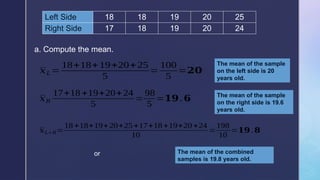
Left Side 18 18 19 20 25
Right Side 17 18 19 20 24
a. Compute the mean.
𝑥𝐿=
18+18+19+20+25
5
=
100
5
=𝟐𝟎
The mean of the sample
on the left side is 20
years old.
𝑥𝑅
17+18 +19+20+24
5
=
98
5
=𝟏𝟗.𝟔 The mean of the sample
on the right side is 19.6
years old.
𝑥𝐿+ 𝑅=
18 +18+19+20+25+17+18+19+20 +24
10
=
198
10
=𝟏𝟗.𝟖
or The mean of the combined
samples is 19.8 years old.
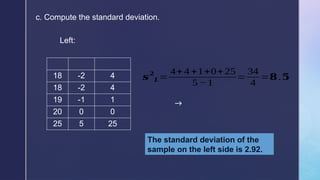
c. Compute the standard deviation.
𝒔
𝟐
𝑳=
4+4 +1+0+25
5 −1
=
34
4
=𝟖.𝟓
The standard deviation of the
sample on the left side is 2.92.
18 -2 4
18 -2 4
19 -1 1
20 0 0
25 5 25
Left:
→
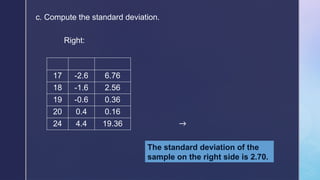
c. Compute the standard deviation.
The standard deviation of the
sample on the right side is 2.70.
17 -2.6 6.76
18 -1.6 2.56
19 -0.6 0.36
20 0.4 0.16
24 4.4 19.36
Right:
→
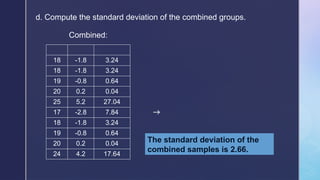
d. Compute the standard deviation of the combined groups.
The standard deviation of the
combined samples is 2.66.
18 -1.8 3.24
18 -1.8 3.24
19 -0.8 0.64
20 0.2 0.04
25 5.2 27.04
17 -2.8 7.84
18 -1.8 3.24
19 -0.8 0.64
20 0.2 0.04
24 4.2 17.64
Combined:
→
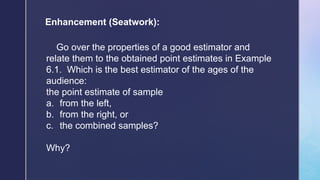
Enhancement (Seatwork):
Go over the properties of a good estimator and
relate them to the obtained point estimates in Example
6.1. Which is the best estimator of the ages of the
audience:
the point estimate of sample
a. from the left,
b. from the right, or
c. the combined samples?
Why?

MATHM6_Estimation-of-Parameters_Part-1.pptx

  • 1.
  • 2.
  • 3.
    z Learning Targets  Differentiatedescriptive and inferential statistics  Define, differentiate and illustrate point estimation and interval estimation  Discuss the properties of a good estimator  Use a point estimator to estimate the population mean and population variance
  • 4.
    z DESCRIPTIVE STATISTICS vs INFERENTIALSTATISTICS  DESCRIPTIVE STATISTICS - aims to describe the characteristics of data - process of using or analyzing those measures that quantitatively describe or summarize features from a collection of information  INFERENTIAL STATISTICS - aims to make inferences or predictions - pertains to the process of drawing and making decisions concerning a given population based on the data obtained from a sample - focuses on estimation and hypothesis testing
  • 5.
    z Estimation  A processused to calculate the proposed values for parameters by using only a random sample from the population.  Being done because population parameters are usually unknown and /or the population is infeasible to study  Note: The results from estimation may not always be accepted since it is preferred that interpretations and generalizations must be made using data from the entire population. Thus, it is necessary to do hypothesis testing.
  • 6.
    z POINT ESTIMATE - refersto a single value that best determines the proposed parameter value of the population POINT ESTIMATION - the process of finding the point estimate - involves sampling and hypothesis testing
  • 7.
    z Estimators Measure Parameter Statistic Meanμ Variance Standard Deviation σ s Estimators are the measures or functions that are used to obtained the estimates.
  • 8.
    z Properties of aGood Estimator UNBIASEDNESS  When the expectation of all estimates taken from samples are equal to the parameter being estimated. CONSISTENCY  When the estimate produced a relatively small standard error/deviation (possible amount of error of estimating a population parameter) EFFICIENCY  When the estimate gives the smallest variance or spread.
  • 9.
    z Point Estimation forthe Population Mean and Variance
  • 10.
    Example 6.1, p.126 A concert for a cause is attended by individuals of different age groups. Given in the table below are the ages of randomly selected audience of the concert. Compute the point estimates if the randomly selected audience in the right side and left side are being considered.
  • 11.
    Example 6.1, p.126 Left Side 18 18 19 20 25 Right Side 17 18 19 20 24 Compute for the mean and standard deviation. a. Left Side b. Right Side c. Combined
  • 12.
    Left Side 1818 19 20 25 Right Side 17 18 19 20 24 a. Compute the mean. 𝑥𝐿= 18+18+19+20+25 5 = 100 5 =𝟐𝟎 The mean of the sample on the left side is 20 years old. 𝑥𝑅 17+18 +19+20+24 5 = 98 5 =𝟏𝟗.𝟔 The mean of the sample on the right side is 19.6 years old. 𝑥𝐿+ 𝑅= 18 +18+19+20+25+17+18+19+20 +24 10 = 198 10 =𝟏𝟗.𝟖 or The mean of the combined samples is 19.8 years old.
  • 13.
    c. Compute thestandard deviation. 𝒔 𝟐 𝑳= 4+4 +1+0+25 5 −1 = 34 4 =𝟖.𝟓 The standard deviation of the sample on the left side is 2.92. 18 -2 4 18 -2 4 19 -1 1 20 0 0 25 5 25 Left: →
  • 14.
    c. Compute thestandard deviation. The standard deviation of the sample on the right side is 2.70. 17 -2.6 6.76 18 -1.6 2.56 19 -0.6 0.36 20 0.4 0.16 24 4.4 19.36 Right: →
  • 15.
    d. Compute thestandard deviation of the combined groups. The standard deviation of the combined samples is 2.66. 18 -1.8 3.24 18 -1.8 3.24 19 -0.8 0.64 20 0.2 0.04 25 5.2 27.04 17 -2.8 7.84 18 -1.8 3.24 19 -0.8 0.64 20 0.2 0.04 24 4.2 17.64 Combined: →
  • 16.
    Enhancement (Seatwork): Go overthe properties of a good estimator and relate them to the obtained point estimates in Example 6.1. Which is the best estimator of the ages of the audience: the point estimate of sample a. from the left, b. from the right, or c. the combined samples? Why?